Au jus: what it is and how to make it
The classic roast-beef sauce, with or without drippings: two recipes with the why behind every step, a ratio for any crowd, jus vs gravy vs demi-glace in one table, how to plate it, the fixes, and the science and history.
The photos on this page are AI-generated illustrations.
Au jus (pronounced oh-ZHOO) is French for "with juice":1 meat served with its own roasting juices, and in American usage the name of that sauce. It is a thin, unthickened sauce made by deglazing the roasting pan's drippings with stock or wine and reducing it.4 Served with roast beef, prime rib and the French dip. Thicken it with flour and it becomes gravy.
Jump to the recipe from drippings, the version without drippings, the ratio for a crowd or how to serve it. The two recipes are our own synthesis of published methods from test kitchens and chefs; the facts come from classic cookbooks, product labels, food-safety regulators and peer-reviewed research, and where something is our own rule we say so. Sources are at the bottom.
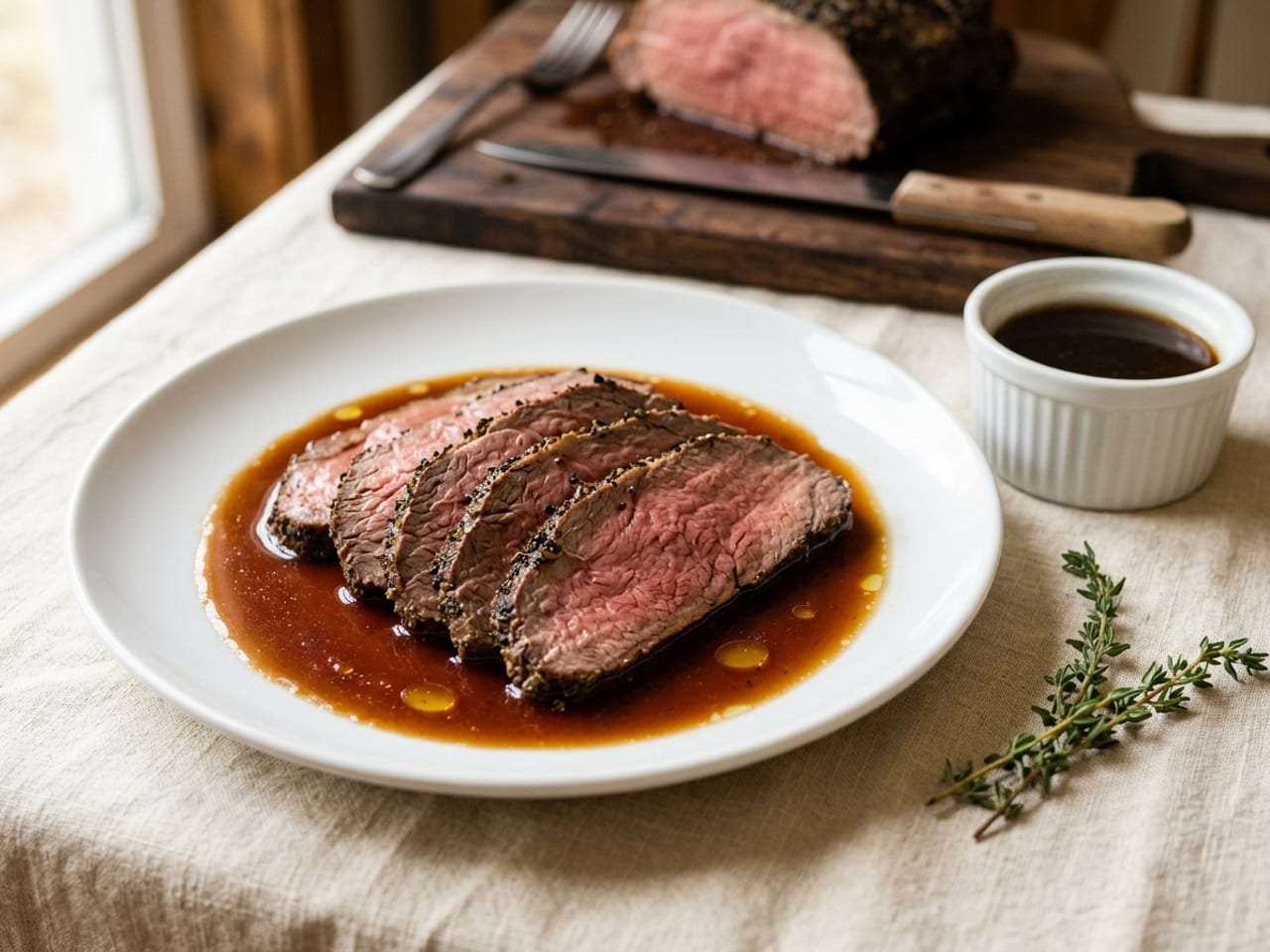
What is au jus?
"Au jus" means "with juice". Merriam-Webster defines it as meat "served in the juice obtained from roasting", placed after the noun: beef au jus.1 A culinary textbook puts it the same way: when a roast is served with its clear, natural juices, it is served au jus, and stock is usually added to the pan juices to make enough to go round.4 The sauce itself is the jus, a word English has used on its own since 1813.2
How to say it. Oh-ZHOO, with the zh of "measure" and a silent s. The French vowel is a rounded "ee" that English does not have. Dictionaries also record the sounded s, oh-ZHOOS, and Merriam-Webster lists oh-JOOS as well,1,3 so those are anglicizations, not errors.
"With au jus"? Purists wince, because "au jus" already contains the "with":5 the MICHELIN Guide calls au jus a style of serving and the sauce just jus.6 But English has used "au jus" as a noun since at least 1903, Merriam-Webster's first known use, and Merriam-Webster and Cambridge both list it ("served with an au jus dip").1,3 Say "a side of jus" if you like; nobody at a steakhouse will misunderstand either.
Is it thickened? A classic au jus is not: its body comes from reduction and the gelatin the meat gives up, and the MICHELIN Guide says jus should never be thickened with flour or dairy.6 A jus lié is lightly bound with arrowroot or cornstarch, and a flour-thickened pan sauce is a gravy.4,8 Plenty of popular "au jus" recipes online add flour, which makes them a thin gravy.
It is not only for beef. In French cooking jus goes with far more than beef: Escoffier served eggs, veal chops, braised lettuce, endive, cardoons and macaroni "au jus".11 In the US, au jus most likely came to mean beef through prime rib and the French dip, though nobody has traced exactly how.
Au jus recipe from drippings
Makes about 2 cups (480 ml): 8 servings for spooning over a roast, or 4 French-dip ramekins. Time: about 25 minutes, made while the roast rests. Built from the prime rib methods of America's Test Kitchen, Alton Brown, Bobby Flay and Tyler Florence,12,16,18,17 none of which thickens its jus.
| Ingredient | US | Metric | Why |
|---|---|---|---|
| Pan drippings from the roast (fat and juices) | all of them | all of them | The browned fond and the meat juices are the flavour; this is what "jus" means.7 |
| Shallot, minced (or ½ small onion) | 1 medium | about 40 g | A sweet aromatic base. |
| Dry red wine (optional) | ½ cup | 120 ml | Acid and depth, and it lifts the fond. Reduced by half first so it does not taste raw.12,16 |
| Low-sodium or unsalted beef broth | 1½ cups | 360 ml | Low in salt because it gets reduced (the math). |
| Low-sodium chicken broth (or more beef) | 1½ cups | 360 ml | America's Test Kitchen mixes beef and chicken broth half and half for its prime rib jus.12 |
| Thyme sprigs and a bay leaf | 2 sprigs, 1 leaf | 2 sprigs, 1 leaf | Classic, and strained out at the end. |
| Worcestershire sauce (optional) | 1 tsp | 1 tsp | A little umami (why it works). |
| Salt and black pepper | to taste, at the end | to taste, at the end | Reduction concentrates salt, so season last. |
- Settle the drippings. Lift the roast onto a board to rest. Pour the drippings into a fat separator or a tall glass and leave them 5 minutes, so the fat rises above the juices.17
- Keep one spoon of fat. Return 1 tablespoon of the fat to the roasting pan and keep the defatted juices for step 6. The rest of the fat can go into Yorkshire pudding. Look at the fond: golden to dark brown is flavour; black is bitter, so skip it and use the no-drippings method.22
- Heat the pan (metal only). Set a metal roasting pan across two burners over medium heat. Never put a glass or ceramic roasting dish on a burner or pour cold liquid into it while it is hot: let it cool, then loosen the fond with a little warm broth and scrape it into a skillet.
- Deglaze and reduce the wine. Cook the shallot 1 to 2 minutes, pour in the wine and scrape the pan with a wooden spoon until the brown bits dissolve. Deglazing is exactly that: dissolving the cooked-on juices with a liquid to make a sauce.86 Boil until the wine is reduced by half, 2 to 3 minutes.
- Add the broth and reduce to 1¾ cups. Add both broths, the thyme and the bay. Simmer briskly, but do not boil hard, which clouds the jus,23 until reduced by a little under half, to roughly 1¾ cups (420 ml), 10 to 15 minutes. A wide roasting pan reduces faster than a saucepan, so go by volume, not the clock.
- Add the juices back and bring to a simmer. Stir in the defatted pan juices, the Worcestershire and whatever has collected on the carving board.12 Those board juices come from meat at medium-rare temperatures, so bring the jus back to a simmer after adding them.
- Strain, then taste and salt. Pour through a fine-mesh sieve, pressing on the shallot. Taste it hot and only then add salt and pepper. Leave a few golden droplets of fat on top: Escoffier thought it "a mistake to remove all the grease" from a roast's jus.9
- Serve it hot. Pour into a warmed gravy boat or ramekins and keep it at 140°F (60°C) or hotter until it goes to the table.39
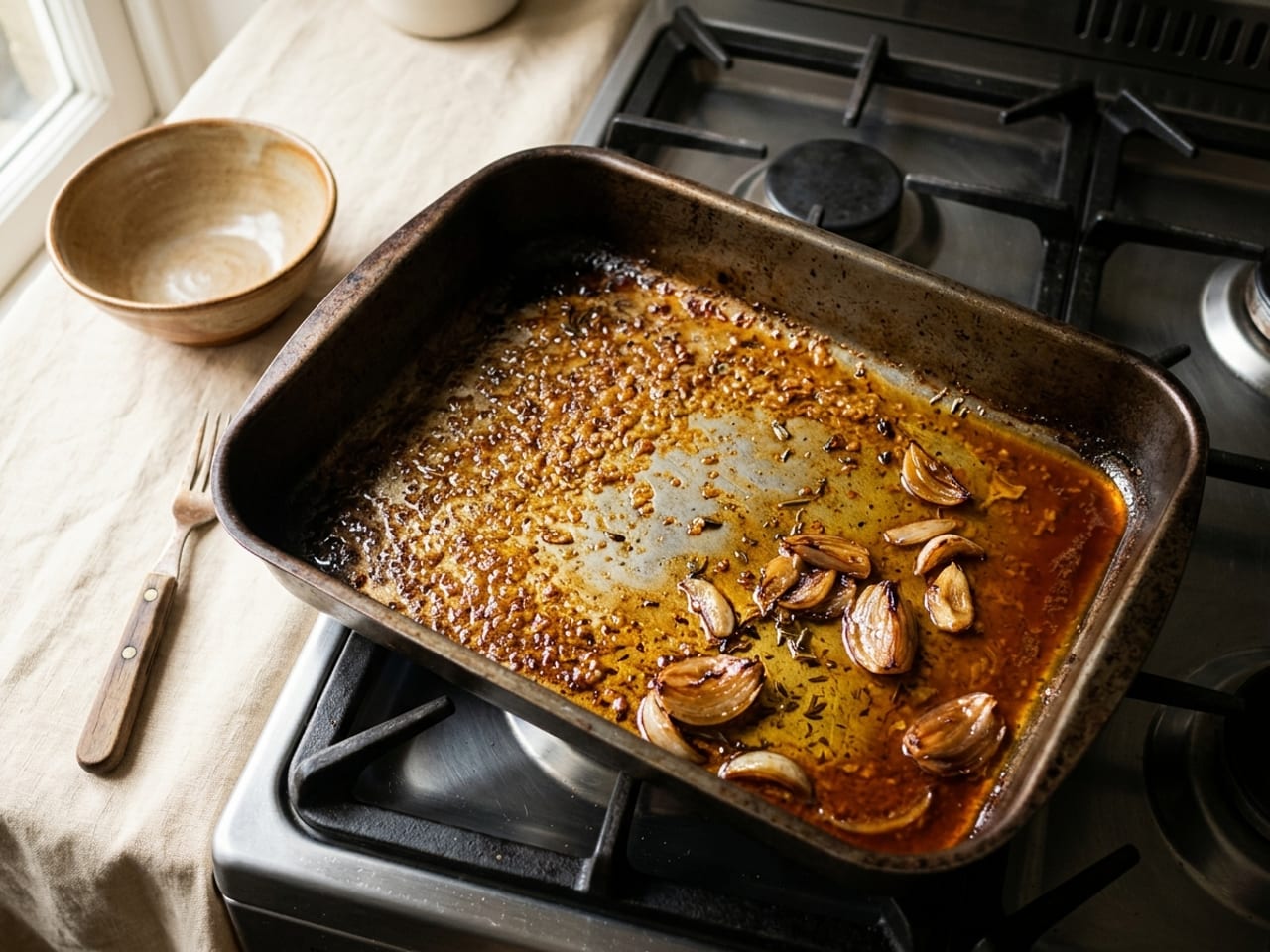 1
1The fond
Golden to dark brown drippings stuck to the pan: this is the flavour. Black means bitter.
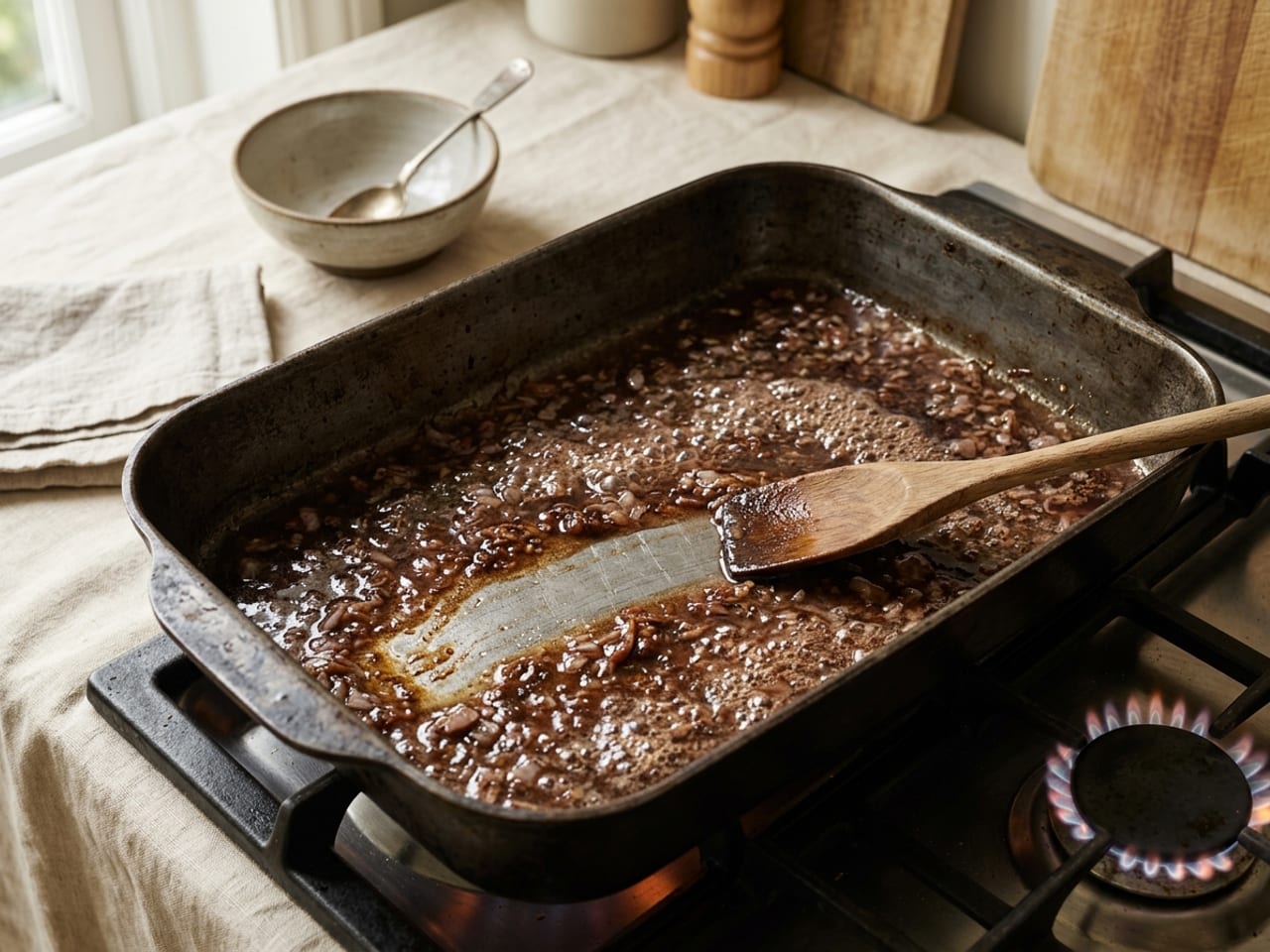 2
2Deglaze
Wine in, scrape with a wooden spoon until the brown bits dissolve, reduce by half.
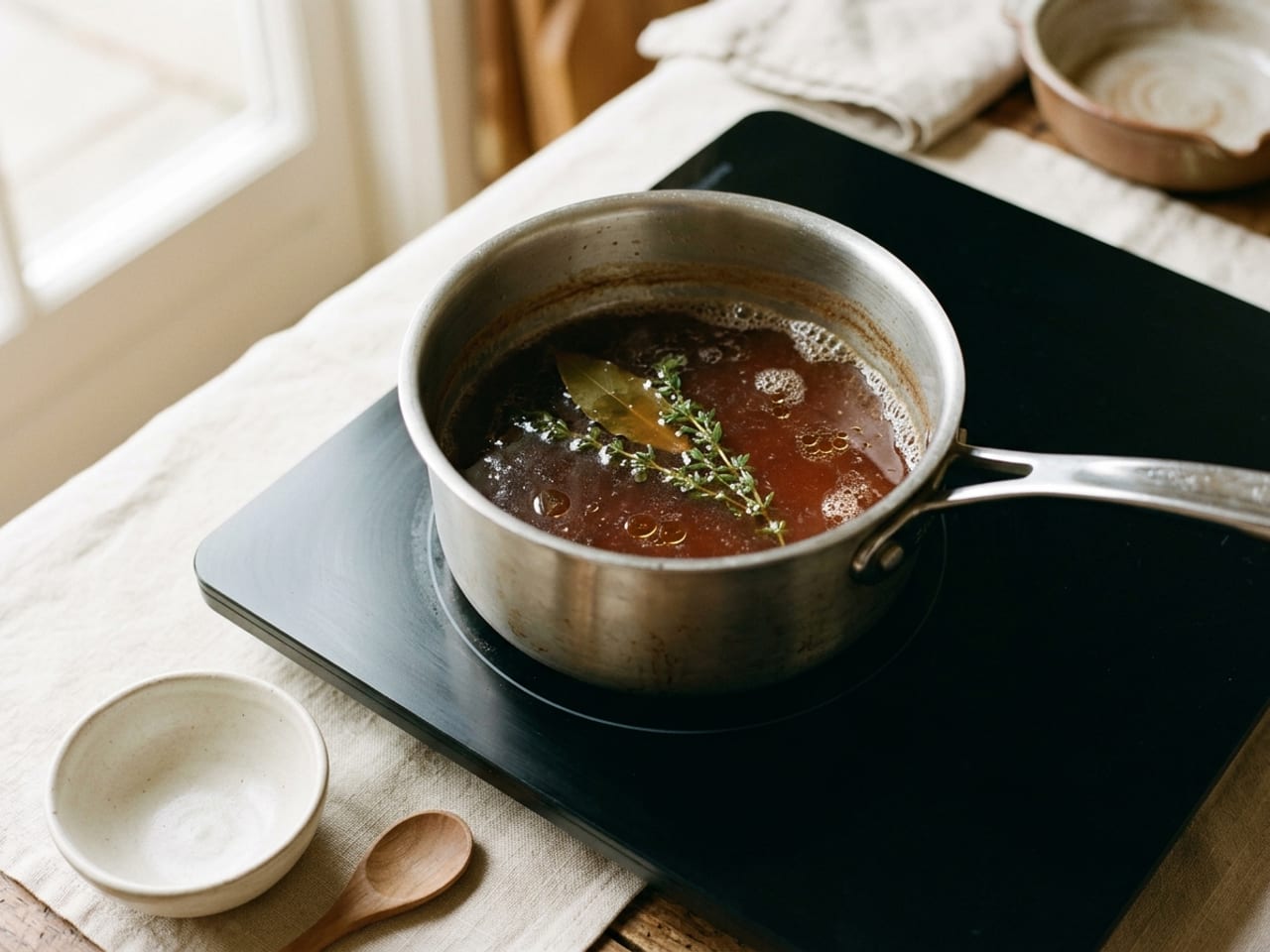 3
3Reduce
Broth and herbs in, simmer down to about 1¾ cups (420 ml). Pour it into a measuring jug to check.
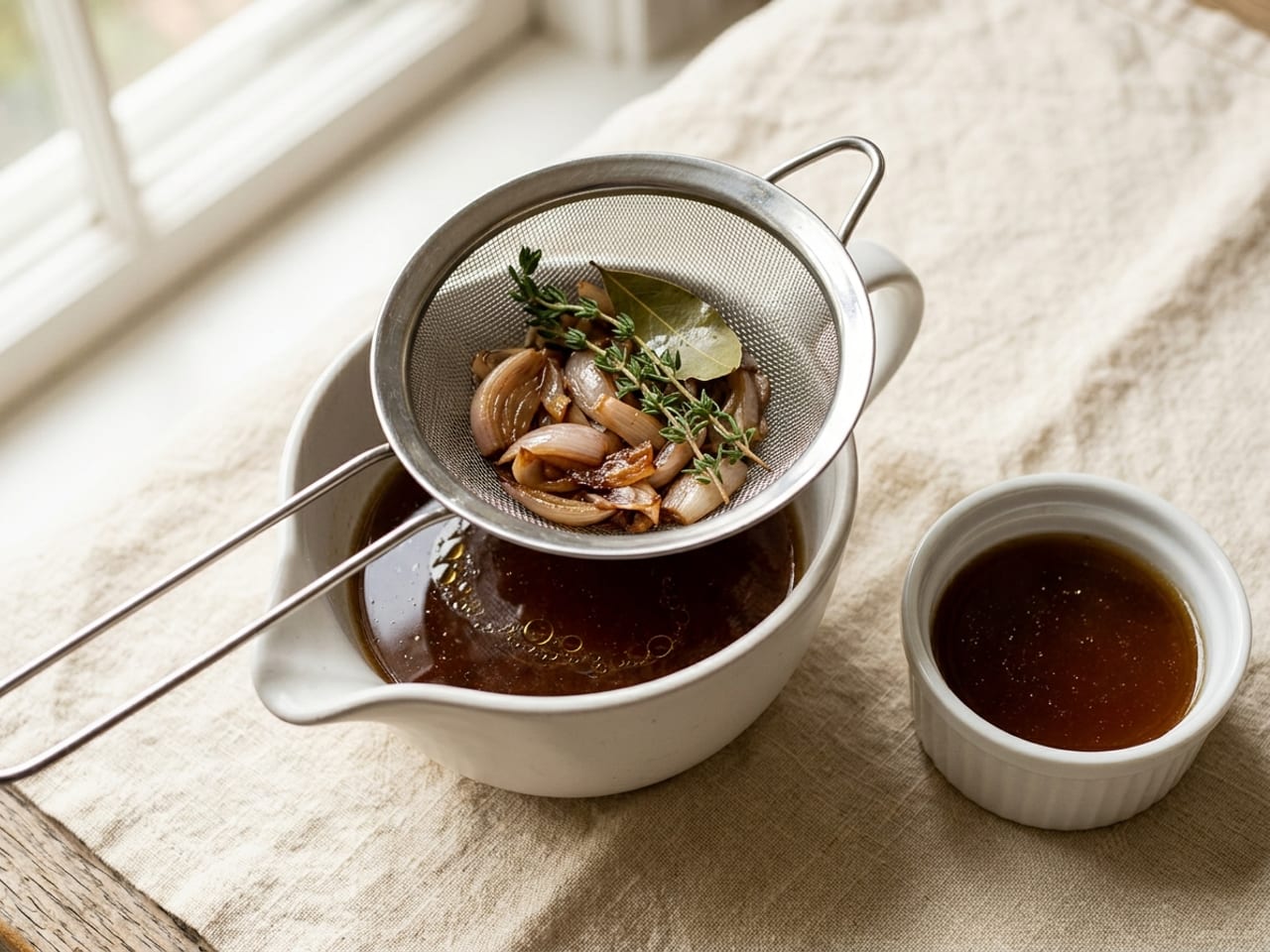 4
4Strain
Through a fine sieve into a warm gravy boat; taste, then salt.
No wine? Deglaze with the same amount of broth and add a teaspoon of red wine vinegar with the Worcestershire. Want a little body? Whisk 1 teaspoon of cornstarch into the cold broth before it goes in, as America's Test Kitchen does for 2½ cups (600 ml);13 you have made a light jus lié. Roasting a big joint? Put a sliced onion and a splash of broth in the pan under the roast so the drippings brown instead of burning.
Au jus without drippings
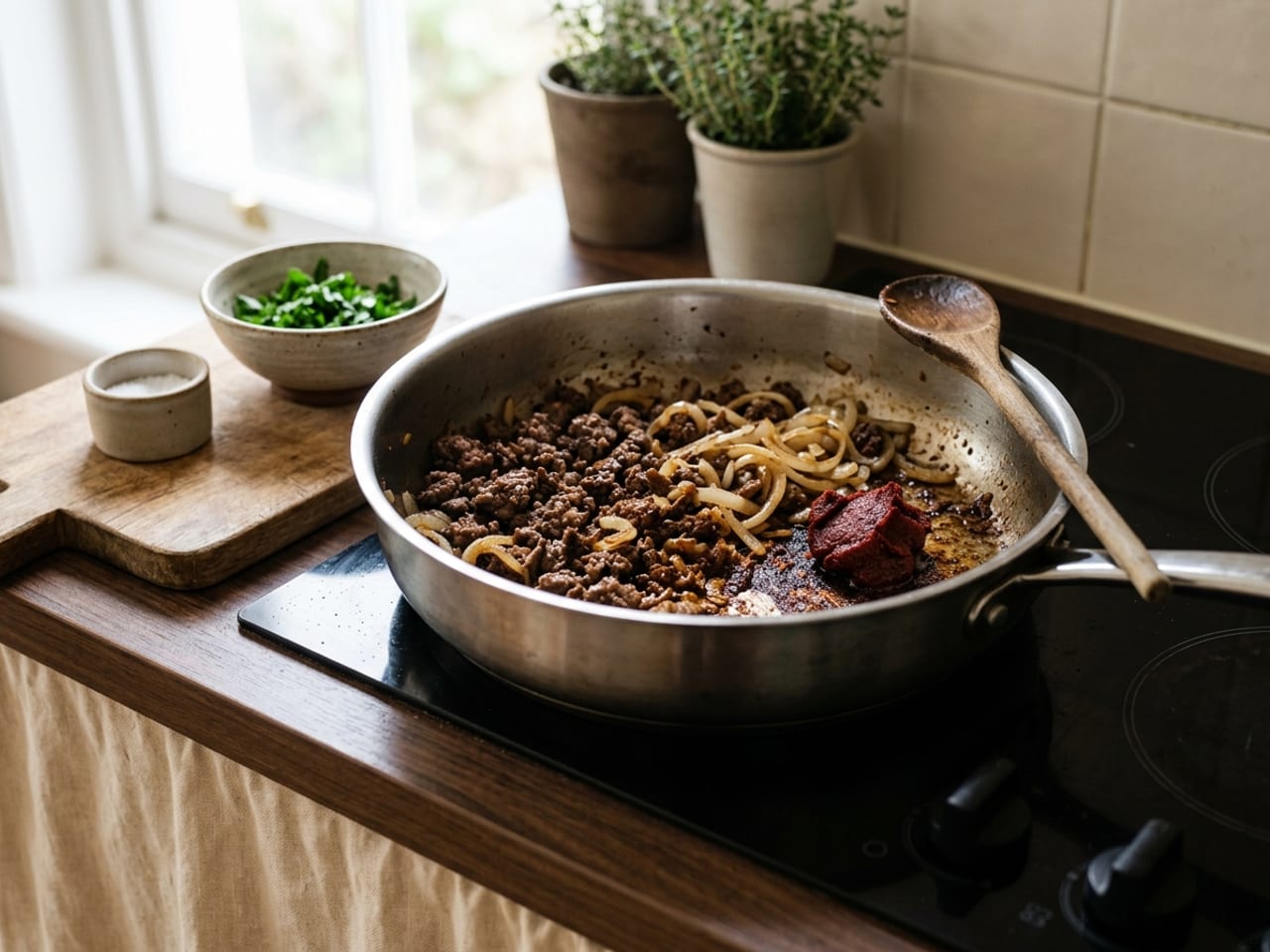
Makes about 2 cups (480 ml): 8 servings over a roast, or 4 French-dip ramekins. Time: about 40 minutes, 10 of them hands-on. No roast, no problem: brown a little beef to make the fond yourself, the trick behind America's Test Kitchen's quick jus.14
| Ingredient | US | Metric | Why |
|---|---|---|---|
| Neutral oil | 1 Tbsp | 15 ml | For browning. |
| Ground beef 80/20 (beef mince with 20% fat) or chopped beef trimmings | ¼ lb | 115 g | Browned hard, it makes the fond a roast would have left. America's Test Kitchen browns trimmings for the same reason.14 |
| Onion, thinly sliced | 1 small | about 70 g | Sweetness and colour. |
| Garlic, smashed | 1 clove | 1 clove | Background, not a garlic sauce. |
| Tomato paste | 1 tsp | 5 g | Browned, it adds glutamate and colour.60 |
| Dry red wine (or more broth plus 1 tsp red wine vinegar) | ½ cup | 120 ml | As above. |
| Low-sodium beef broth (or half beef, half chicken) | 4 cups | 950 ml | It gets reduced by half, so start low in salt. |
| Unflavoured powdered gelatin (optional) | 2 tsp | about 6 g | Gives boxed broth the body of homemade without starch. Test-kitchen guidance is 2 teaspoons per cup for sauces and 1 per cup for soups;25 2 teaspoons in 2 finished cups keeps it thin enough to dunk. |
| Soy sauce or Worcestershire | 1 tsp | 1 tsp | More umami, the job the drippings would have done.60 |
| Thyme sprigs and a bay leaf | 2 sprigs, 1 leaf | 2 sprigs, 1 leaf | Strained out. |
| Salt and black pepper | to taste, at the end | to taste, at the end | Always last. |
- Brown the beef hard. Heat the oil in a wide saucepan and brown the beef, breaking it up, until it is deep brown and a brown crust forms on the pan, 6 to 8 minutes. This is your fond.
- Onion, garlic, tomato paste. Add the onion and cook 5 minutes. Add the garlic and tomato paste and cook 1 minute more, until the paste darkens to brick red.
- Deglaze. Pour in the wine, scrape up the brown bits and reduce by half.
- Simmer and reduce by half. Add the broth, sprinkle in the gelatin (a liquid that is boiled and strained does not need it bloomed first25), then the soy and the herbs. Simmer gently, uncovered, until reduced by half to about 2 cups (480 ml), 20 to 25 minutes.
- Strain and skim. Strain through a fine-mesh sieve, pressing on the solids, and skim off most of the fat (how).
- Taste, then salt. Season with salt and pepper only now, and serve hot.
Beef base shortcut. Two teaspoons of reduced-sodium beef base in 2 cups (480 ml) of water is about 1,020 mg of sodium for the batch.35 A base is made to drinking strength, so do not reduce it: brown the onion and paste, add the base and water, simmer 10 minutes with the herbs and strain.
The au jus ratio: how much for a crowd
Plan on ¼ cup (60 ml) of finished jus a person for a plated roast, the top of our 3 to 4 tablespoon (45 to 60 ml) range, so there is a little left for seconds, and ½ cup (120 ml) for each French-dip ramekin. From drippings you start with about 1½ times the finished amount of broth; without drippings, twice as much, because it is reduced by half.
| Finished jus | Plated roast | French dip | Broth, from drippings | Broth, no drippings |
|---|---|---|---|---|
| 1 cup (240 ml) | 4 people | 2 sandwiches | 1½ cups (360 ml) | 2 cups (480 ml) |
| 2 cups (480 ml) | 8 people | 4 sandwiches | 3 cups (720 ml) | 4 cups (950 ml) |
| 3 cups (720 ml) | 12 people | 6 sandwiches | 4½ cups (1.1 L) | 6 cups (1.4 L) |
| 5 cups (1.2 L) | 20 people | 10 sandwiches | 7½ cups (1.8 L) | 10 cups (2.4 L) |
Scale the wine, aromatics and herbs with the broth. Never scale the salt: add it at the end, to taste. The reduction math: salt does not evaporate, so reducing by half doubles the salt in every spoonful, by two-thirds triples it and by three-quarters quadruples it. That is why every recipe here starts with low-sodium or unsalted broth. And measure: a big batch in a wide pan reduces much faster than the times suggest, so mark the target level or pour it into a measuring jug to check.
With drippings vs without drippings
| From drippings | Without drippings | |
|---|---|---|
| Flavour from | The roast's own fond and juices | Beef browned in the pan, tomato paste, soy or Worcestershire |
| Reduction | By a little under half, to about 1¾ cups (420 ml), 10 to 15 minutes | By half, 20 to 25 minutes |
| Body | Gelatin from the roast and the reduction | Reduction, plus optional powdered gelatin |
| Salt risk | Drippings from a salted or dry-brined roast | The broth, reduced by half |
| Colour | Deep reddish-brown | A little lighter unless the beef is browned hard |
| Best for | Prime rib, roast beef, Sunday roasts | French dip, leftovers, sliced deli beef |
Half and half works too: a small roast gives too little fond for a crowd, so make the no-drippings jus ahead and finish it in the roasting pan, adding the drippings and board juices at the end.
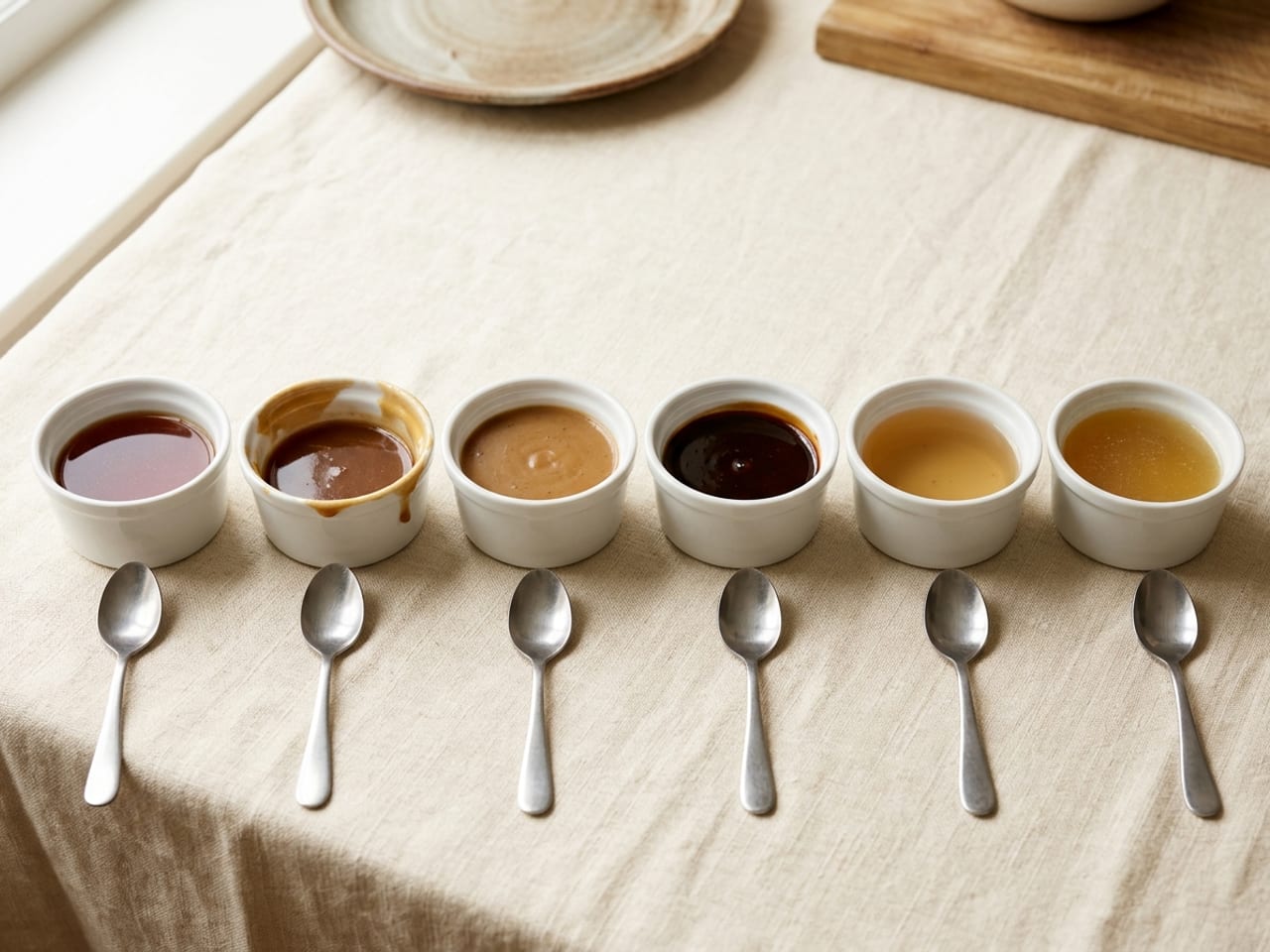
Au jus vs gravy, jus lié, demi-glace, pan sauce, consommé and broth
| Sauce | Made from | Thickened with | Looks | Used for |
|---|---|---|---|---|
| Au jus (natural jus) | Roast drippings deglazed with water or stock, reduced | None: body from gelatin and reduction | Thin, translucent, a little fat on top | Roast beef, lamb and poultry; the French dip |
| Jus lié | Brown stock or jus, reduced | A little arrowroot or cornstarch | Clear, glossy, lightly coats a spoon | Lighter meat dishes; a modern brown sauce |
| Gravy (US pan gravy) | Drippings plus stock or water, sometimes milk or cream | Roux (fat and flour) | Opaque, thick | Roasts, turkey, mashed potatoes (see our turkey gravy) |
| Demi-glace (classical) | Espagnole plus brown stock, reduced | Roux, by way of the espagnole, plus reduction | Dark, translucent, glossy, with body | Base for bordelaise and other brown sauces |
| Pan sauce | Fond from a sauté or roast, deglazed with wine or stock | Reduction, butter, or starch | Light to coating, glossy if buttered | Made in minutes for a steak or chop |
| Glace de viande | Brown stock reduced to a syrup | None: gelatin, so it sets hard when cold | Syrupy, very dark | A spoonful enriches a jus or pan sauce |
| Consommé | Stock clarified with minced meat and egg white | None | Crystal clear | A soup course |
| Broth and stock | Bones or meat simmered in water | None | Thin, clear to cloudy | The base of all of the above |
| Packet "au jus" mix | Salt, corn starch and flavourings plus water | Corn starch | Thin, slightly bound | Effectively an instant, light jus lié |
Definitions from Gisslen's Professional Cooking, the Culinary Institute of America and Escoffier.4,8,9,10 Classical demi-glace contains roux by way of the espagnole;9 modern kitchens often make it from reduced stock alone.4 US labelling rules treat broth and stock as the same thing.85 The five classic sauces are in our mother sauces guide.
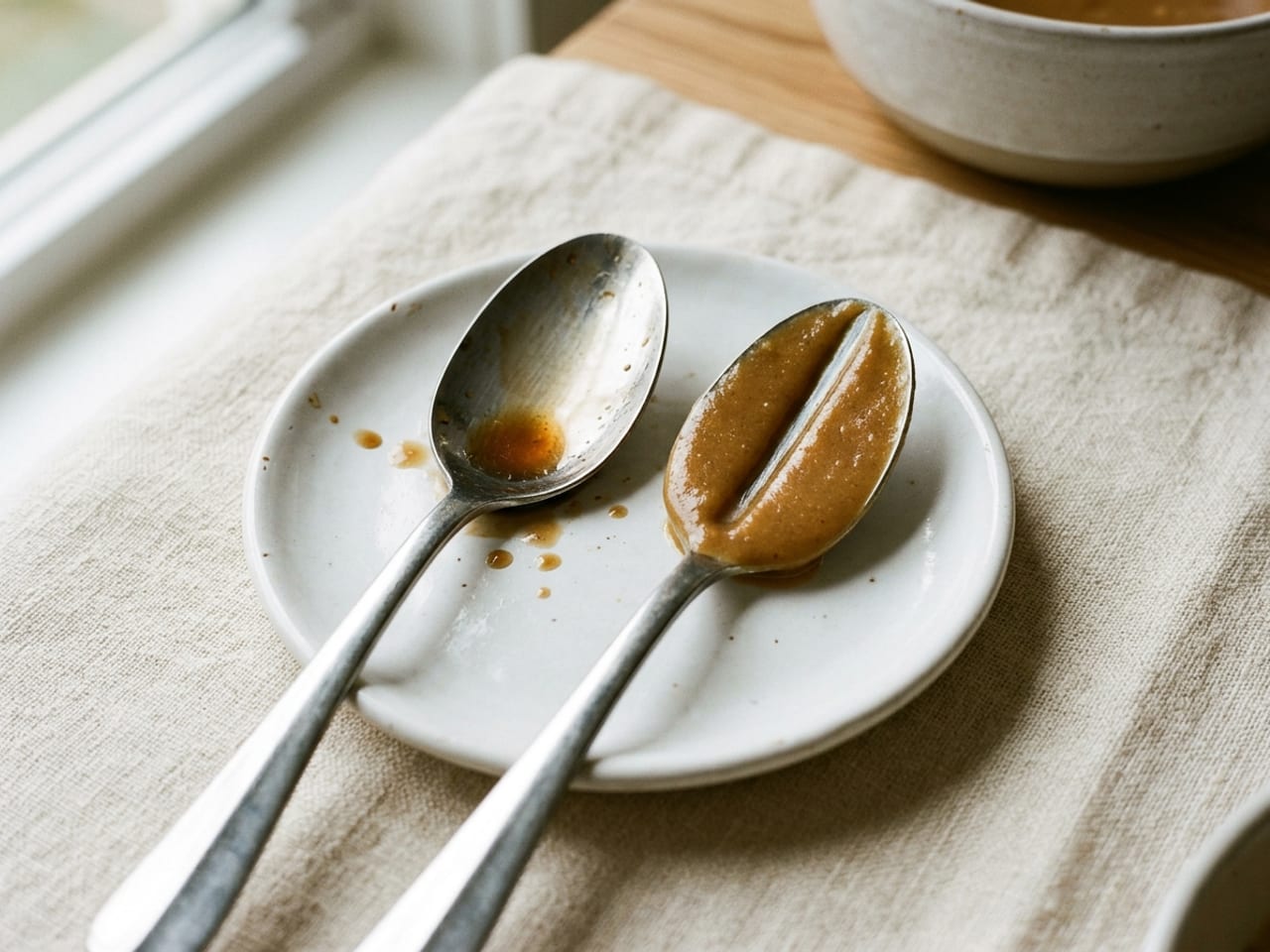
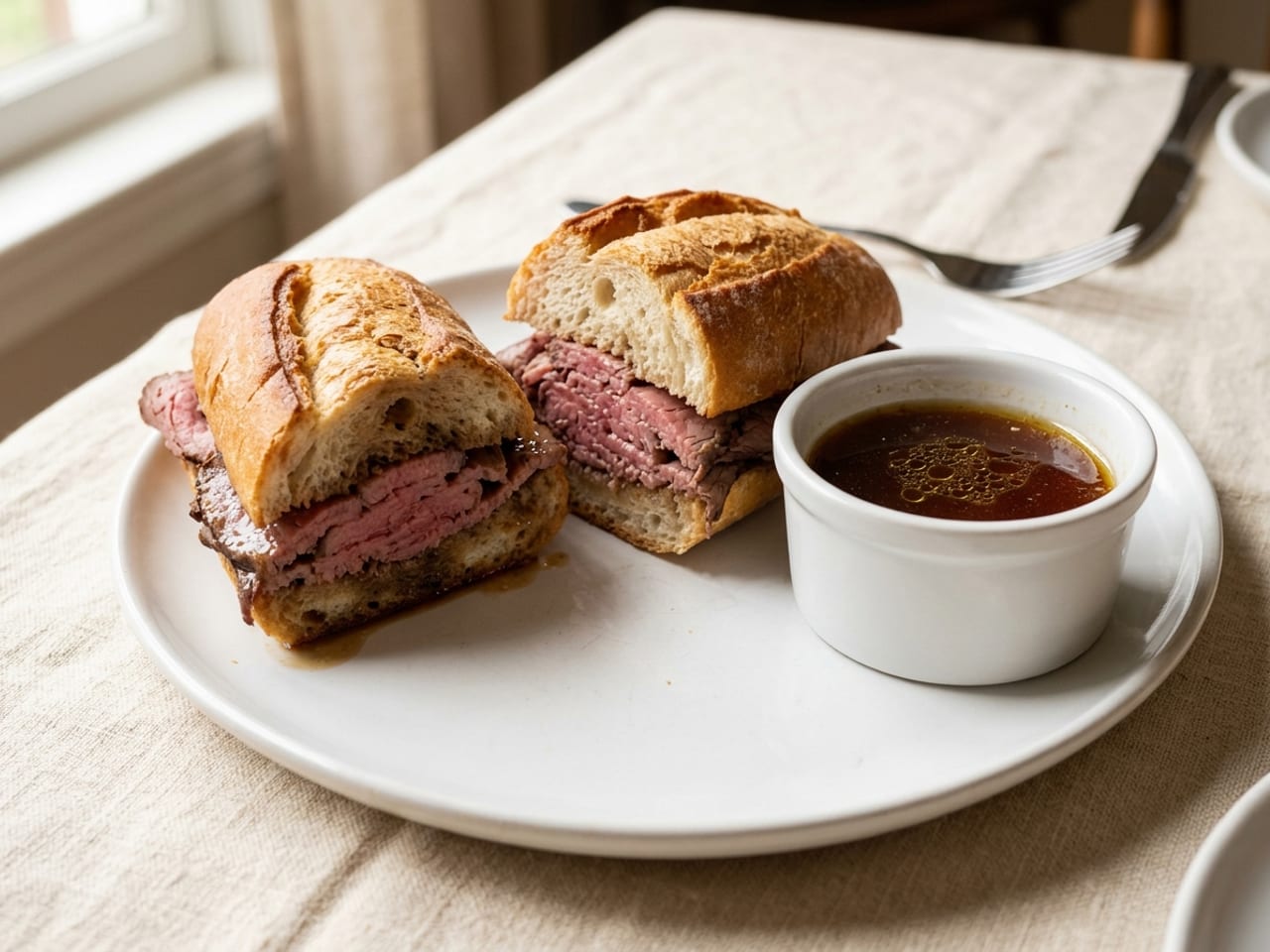
How to serve and plate au jus
Au jus is thin, so it goes where you put it and keeps going. Four ways to place it, from Sunday roast to tasting menu. Thicker sauces have more moves: sauce plating techniques.
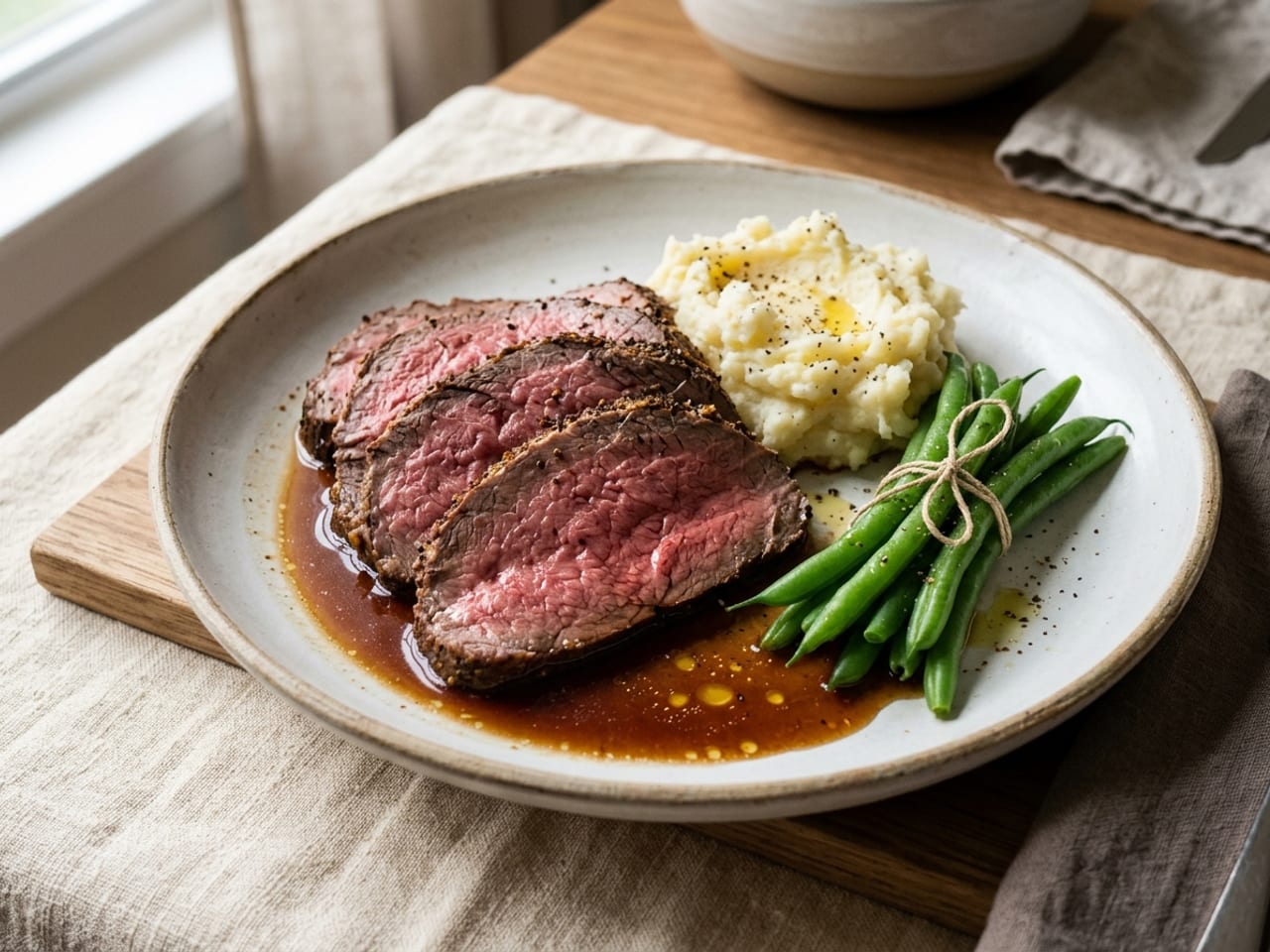
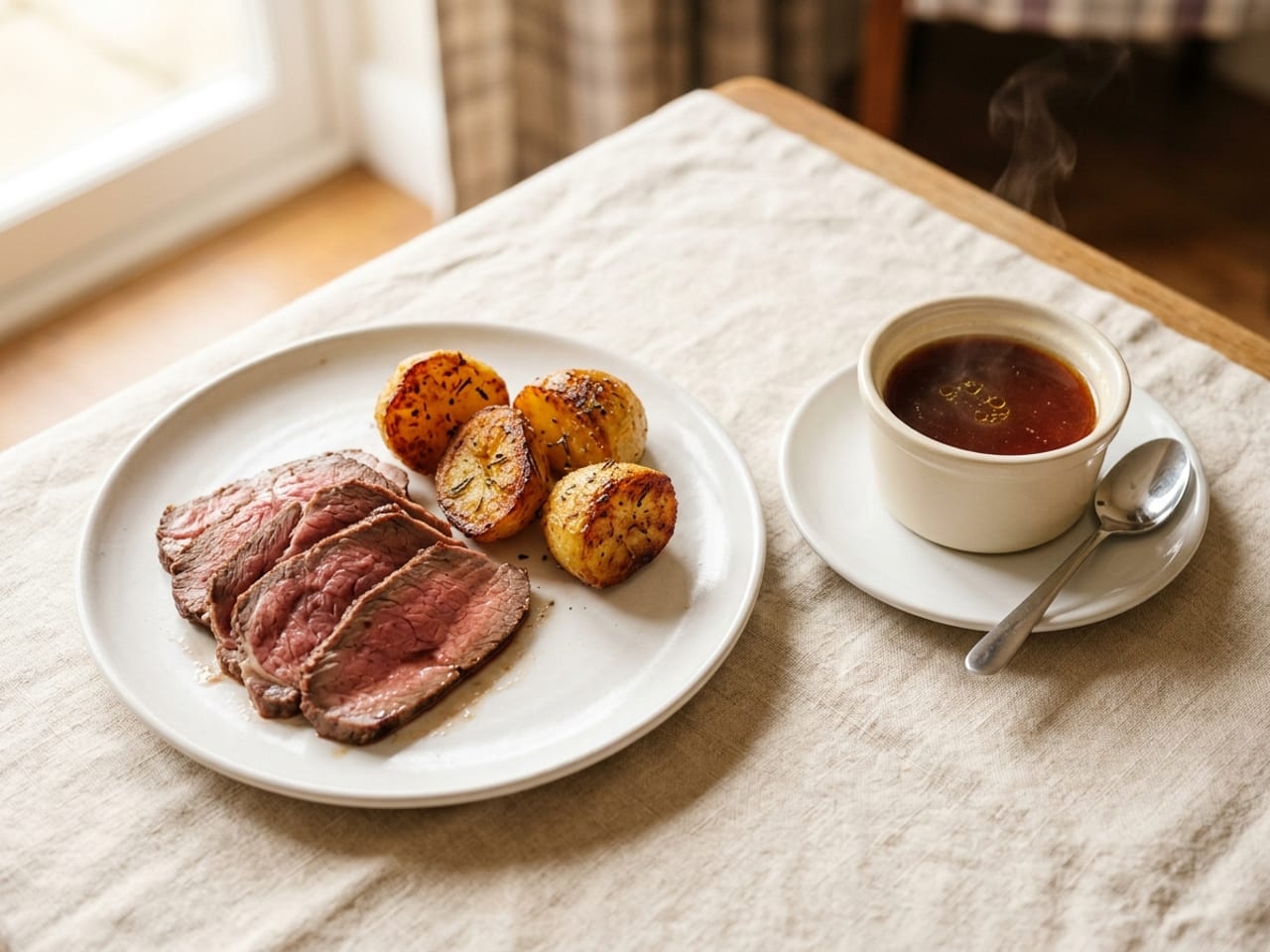
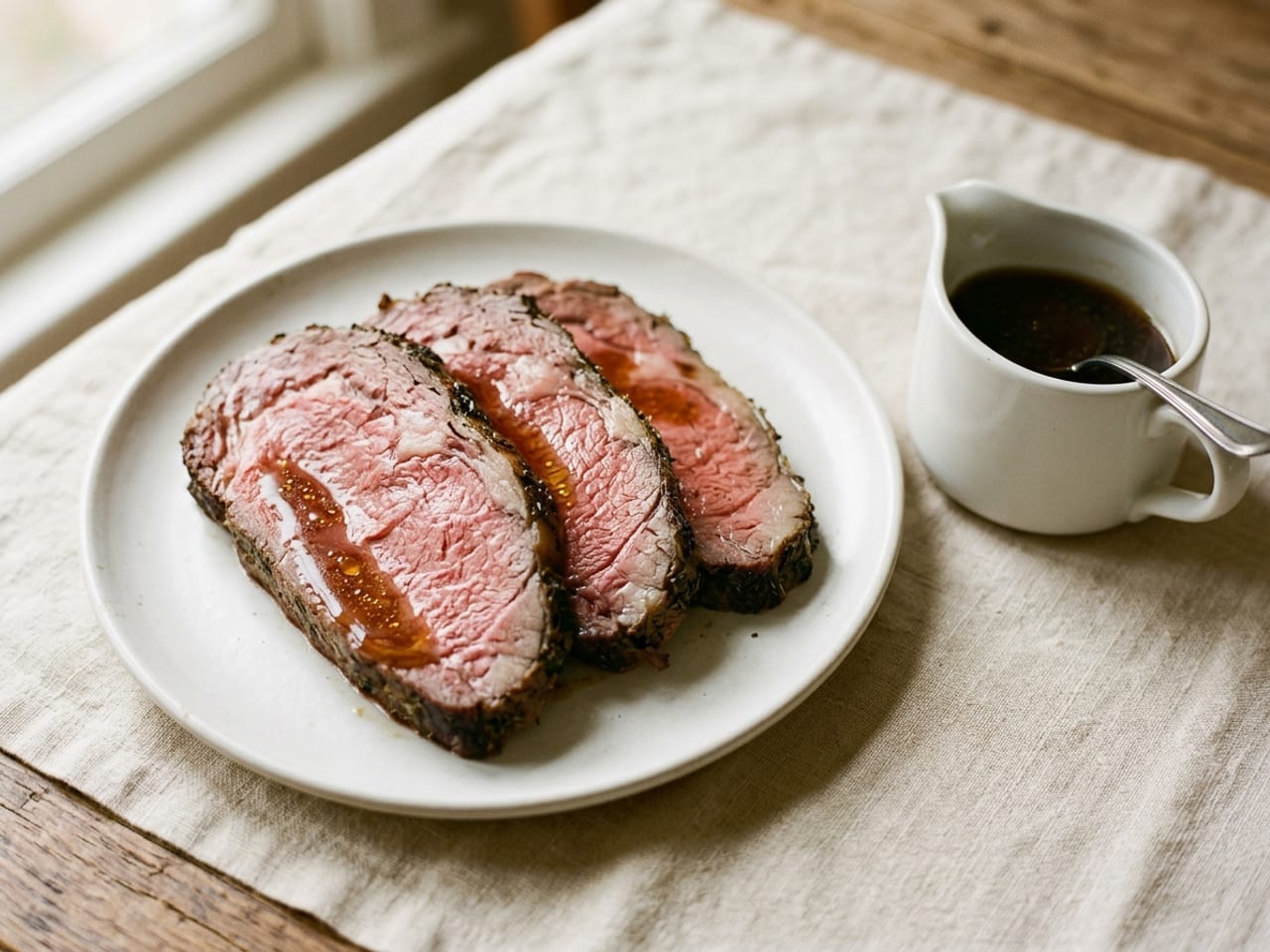
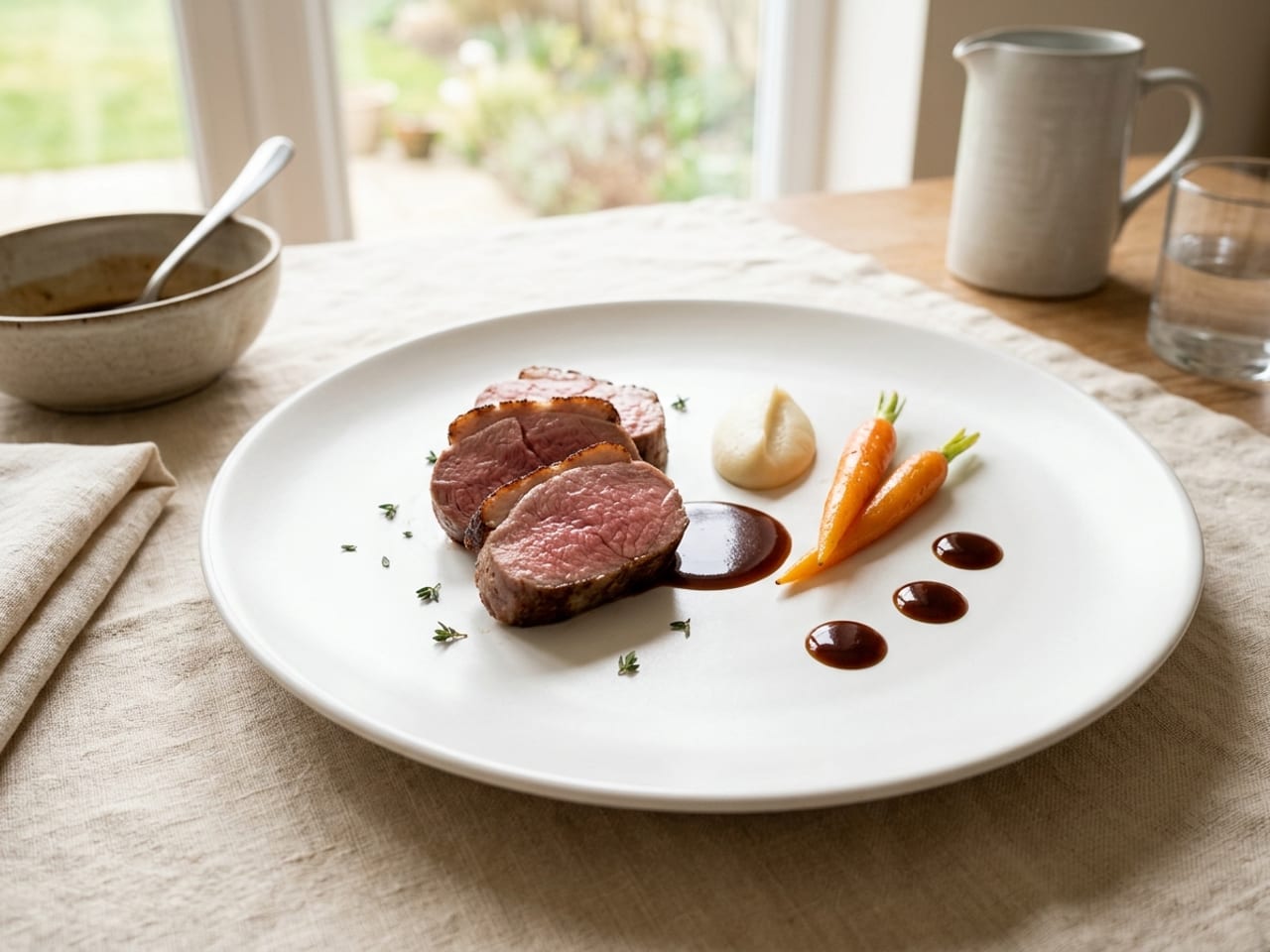
- Strain it for glossA fine-mesh sieve takes out the shallot, herbs and specks that make a jus look muddy. Escoffier strained his through muslin.9
- Under or beside, not over the crustA thin sauce runs, and poured over a roast it soaks the crust you spent hours building. Modern sauces are "served under or around the item as often as over the top of it",4 and Escoffier served roast gravy "invariably" separately.9 A coupe or a shallow rimmed bowl keeps a pool from running to the edge (see plate shapes).
- Plan the quantityThree to four tablespoons (45 to 60 ml) a person for a plated roast, and half a cup (120 ml) for a French-dip ramekin, because dipping needs depth. America's Test Kitchen makes about 2 cups (480 ml) for a prime rib that serves 10 to 12,12 and a Bouchon-style chicken jus is about 2 oz (60 ml) a serving.19 The half-cup ramekin is our rule.
- One ramekin each, and nothing goes back in the potJus that has had bread dipped in it stays at that seat. Top up from the pot; never pour a used ramekin back.
- Leave a little fat, not a slickFat carries aroma: in one study, adding fat raised a chicken soup's aroma compounds, and about 2% fat looked optimal.64 A few golden droplets on top help; a layer of grease coats the mouth and floats on the plate.
- For a restaurant finish, reduce and mountReduce until it just coats a spoon, then swirl in a spoon or two of cold butter off the heat (monter au beurre) for body and shine,4 the way America's Test Kitchen finishes a lamb jus with 2 tablespoons of butter.20 Serve at once: a buttered jus does not hold.
- When in doubt, put it on the sideIn one restaurant study, a dish with its sauces placed separately was rated healthier before tasting; the effect on how good it tasted was small and uncertain.68 It also lets each person decide how much. Plating does change how food is liked: the same chicken and sauce plated attractively was rated tastier.67
For a steak rather than a roast, where each sauce goes (over, beside, under or in a jug) is set out sauce by sauce in how to plate steak.
Serving au jus with a French dip
Give each person a warmed ramekin with about ½ cup (120 ml) of jus: a 6-ounce (180 ml) ramekin holds it with room to dip. America's Test Kitchen warms 1 cup (240 ml) of jus for four sandwiches, dips the sliced beef in it with tongs before building them and serves extra jus on the side.15 Toast the cut faces of the roll, then dip the sandwich briefly, cut end first. Thin liquid wicks into bread quickly,66 so a quick dip keeps the roll together where a long soak turns it to mush. For roast beef without bread, see our roast beef.
Same roast, same jus: drag to compare
The same dinner with the jus poured over everything, then with only a small pool left under the beef and the rest served on the side.
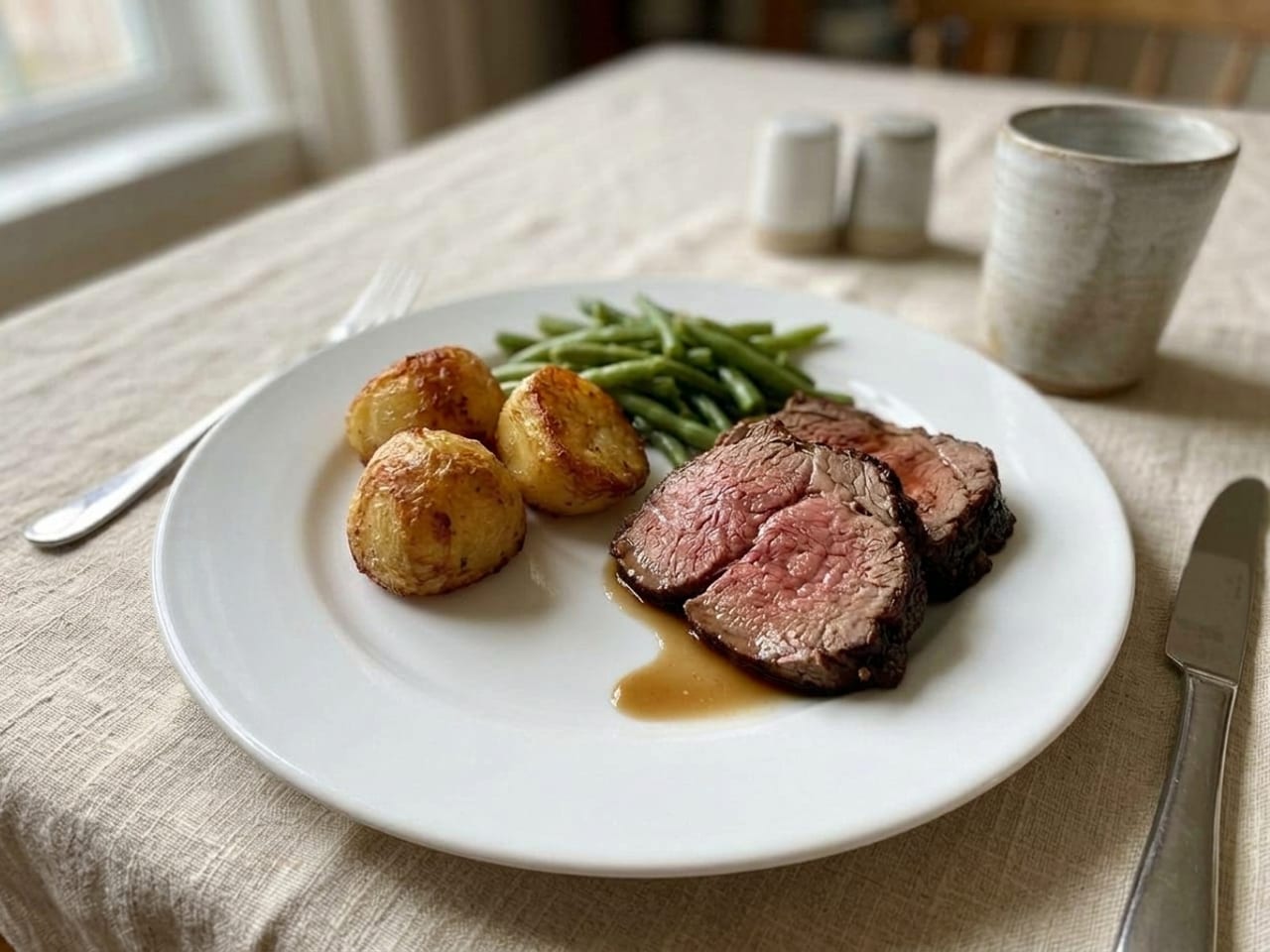
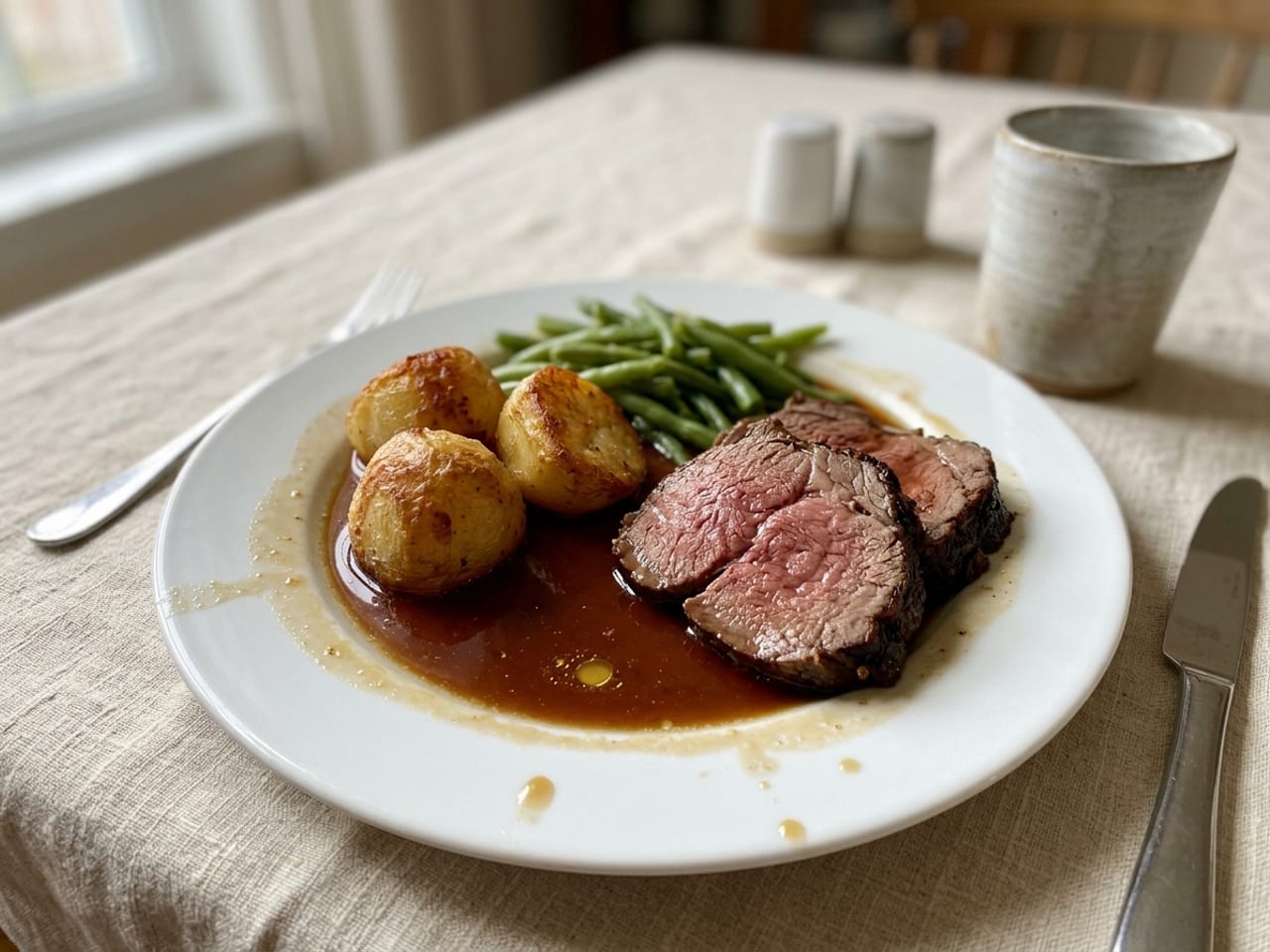 Poured overPooled under
The kit. A fat separator, a fine-mesh sieve, a gravy boat or ramekins, a small ladle or sauce spoon and an instant-read thermometer. For more sauce placement, see how to plate food and Michelin-star plating; jus as a component of a composed plate is in plating components.
Fixes: too salty, greasy, thin, bitter or cloudy
- Too salty: dilute itThe one reliable fix is more liquid: add unsalted broth (or water) and reduce again if it gets thin.26 The potato trick does not work. A potato soaks up salty liquid like a sponge; it does not pull salt out of the rest,26 and in a kitchen test a potato simmered 30 minutes in broth barely changed it.27 A squeeze of lemon masks saltiness a little but removes none. Next time: unsalted broth, salt last, and add drippings from a heavily salted roast a little at a time.
- Greasy: separate, chill or skimA fat separator pours from a low spout and leaves the fat behind.24 Or chill the jus until the fat sets and lift it off. Or skim from the edge of a gently simmering pan. Blotting with a paper towel or a lettuce leaf is, in Cook's Illustrated's words, messy and needs "fresh replacements every few strokes":24 use it for the last few drops only.
- Bitter or harsh: the fond burnedBurnt bits make a bitter sauce, so do not deglaze them.22 Once a jus is bitter there is no fix; start again with the no-drippings method.
- Flat or bland: add umami, then saltA teaspoon of soy sauce or Worcestershire, or a little browned tomato paste, adds glutamate that meat nucleotides amplify (the science).58,60 Reduce a little more, then taste for salt.
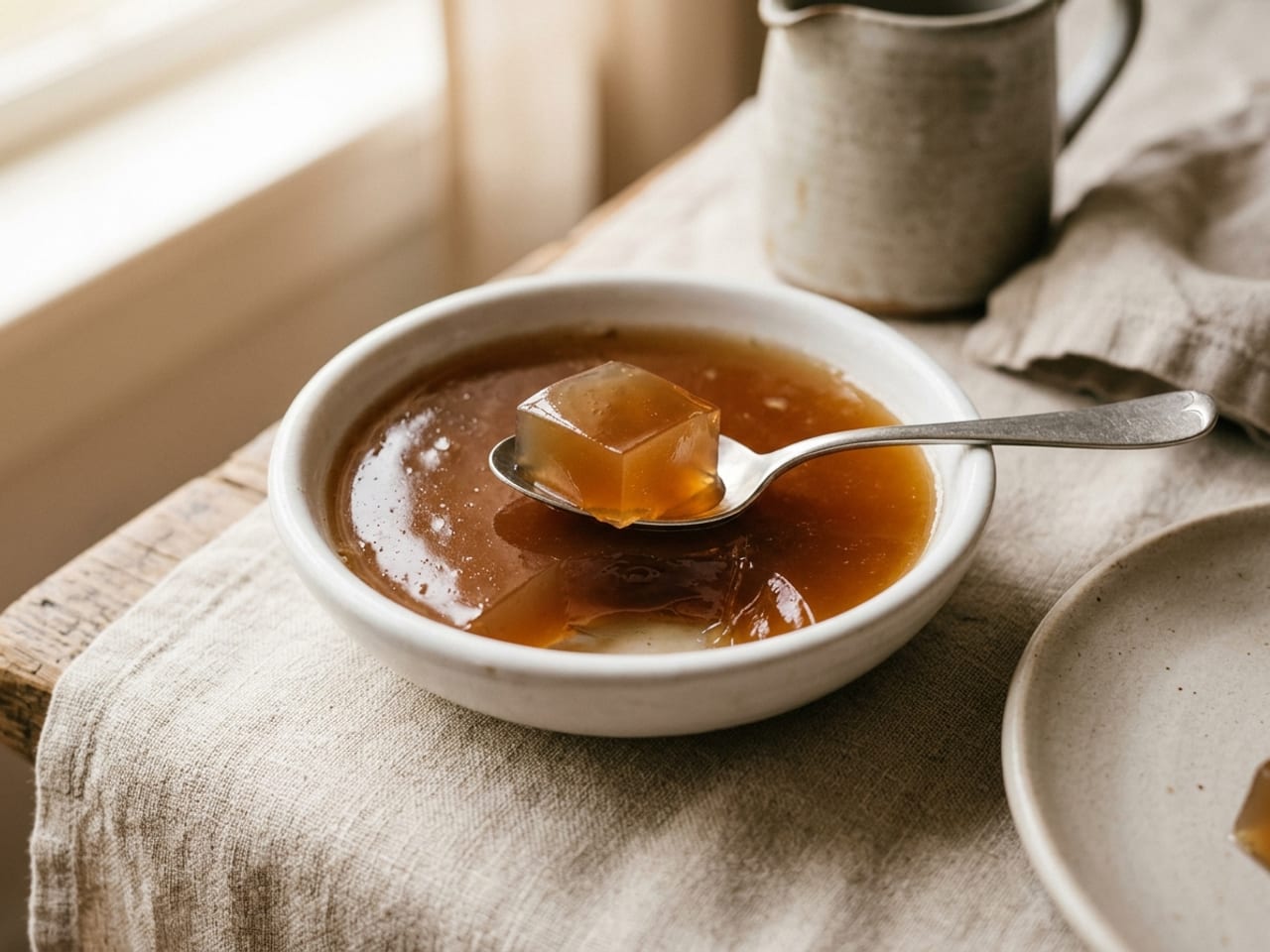
- Set like jelly in the fridgeThat is gelatin, and a good sign. It melts back as it warms;56 judge the thickness hot, never cold.
Chicken, lamb, pork and mushroom jus
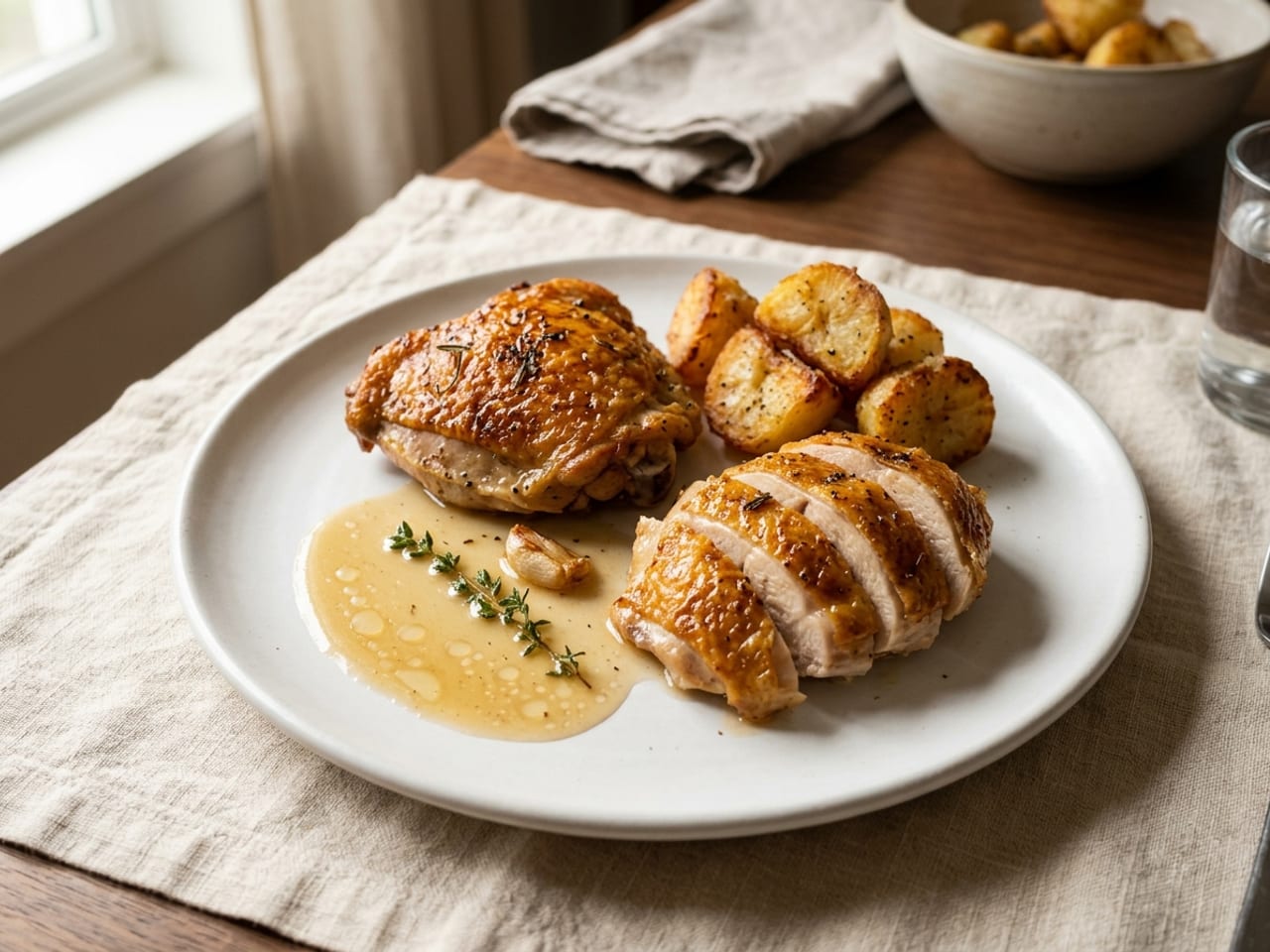
Chicken jus
After a roast chicken, deglaze the pan with ½ cup (120 ml) of white wine or water, add 2 cups (480 ml) of unsalted chicken stock and a thyme sprig, and reduce by half. A Bouchon-inspired version reduces a quart (950 ml) of unsalted stock with 8 oz (225 g) of roasted bones to a quarter.19
Lighter and more golden than beef jus. For turkey, most people want a thicker sauce: see our turkey gravy, and for the bird itself, how to carve a turkey.
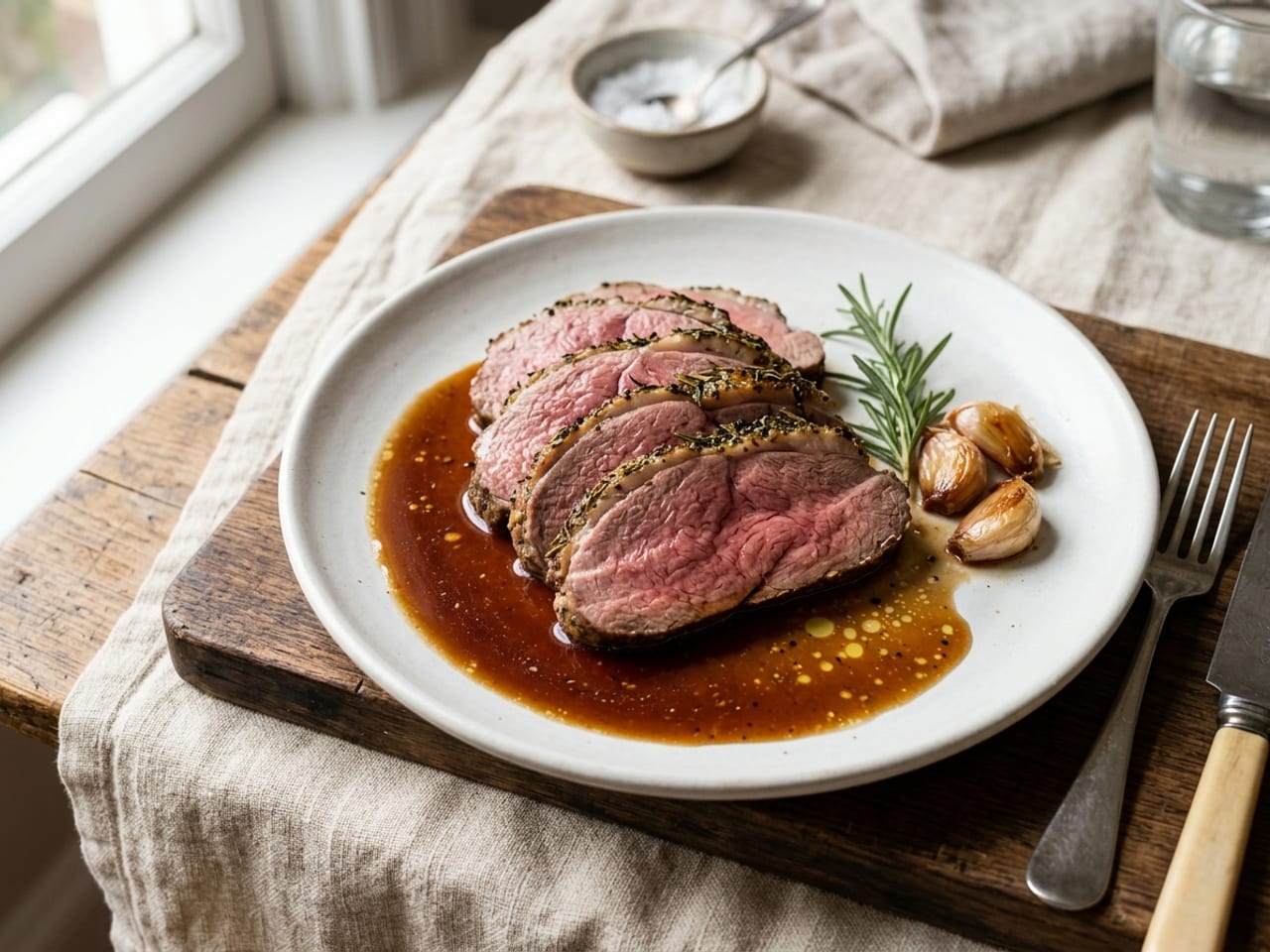
Lamb jus with rosemary
Roast the lamb over smashed garlic and rosemary, then deglaze with wine. America's Test Kitchen reduces 1½ cups (360 ml) of dry Riesling by half and swirls in 2 tablespoons of butter;20 red wine and a cup (240 ml) of stock works too. Take the rosemary out before serving.
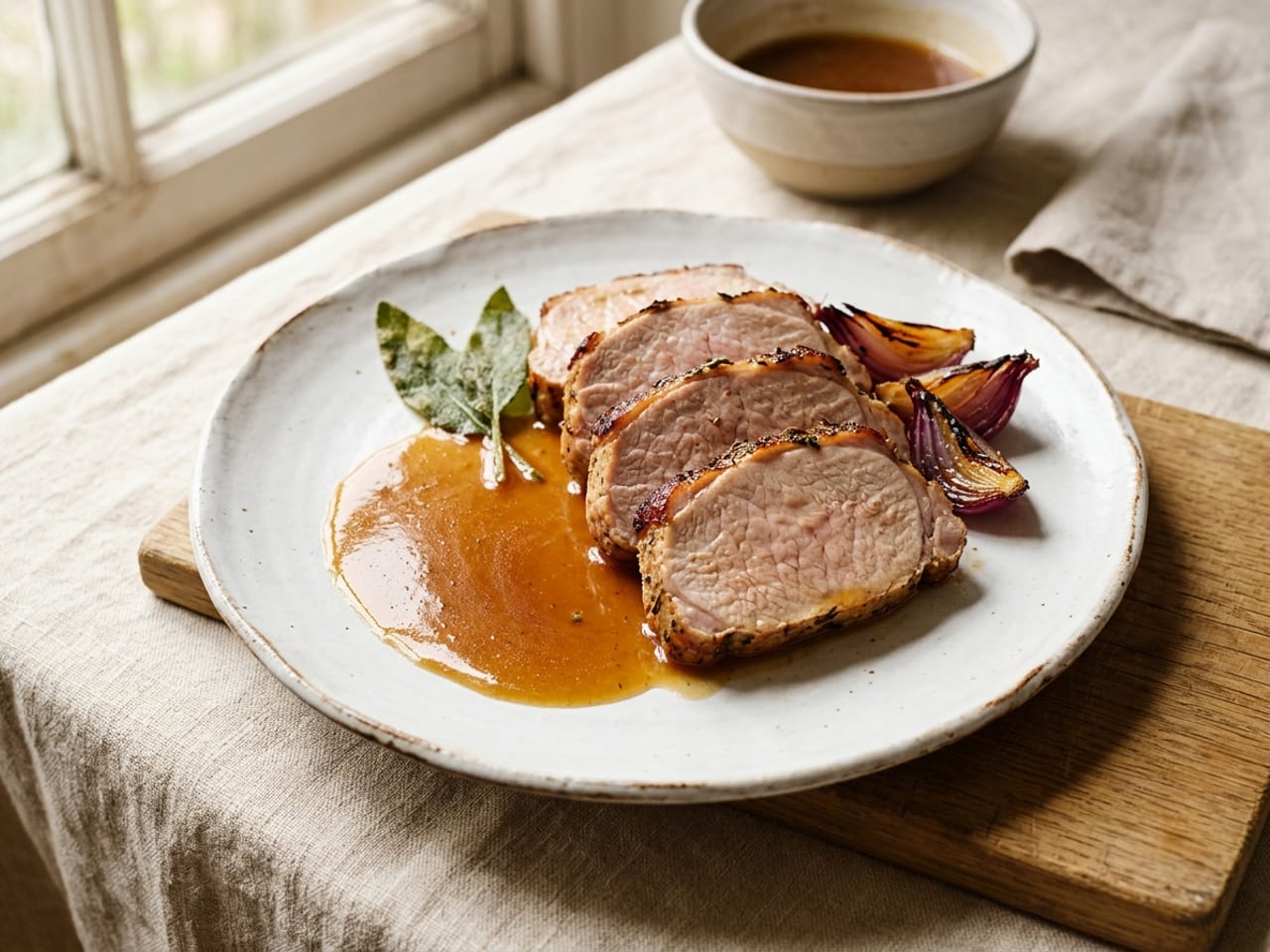
Pork jus
After roast pork, deglaze with dry white wine, dry cider or water, add stock, reduce by half and finish with thyme or sage. Jamie Oliver pot-roasts pork with 200 ml of Chianti, red onion, celery and rosemary for a red-wine pork jus.21
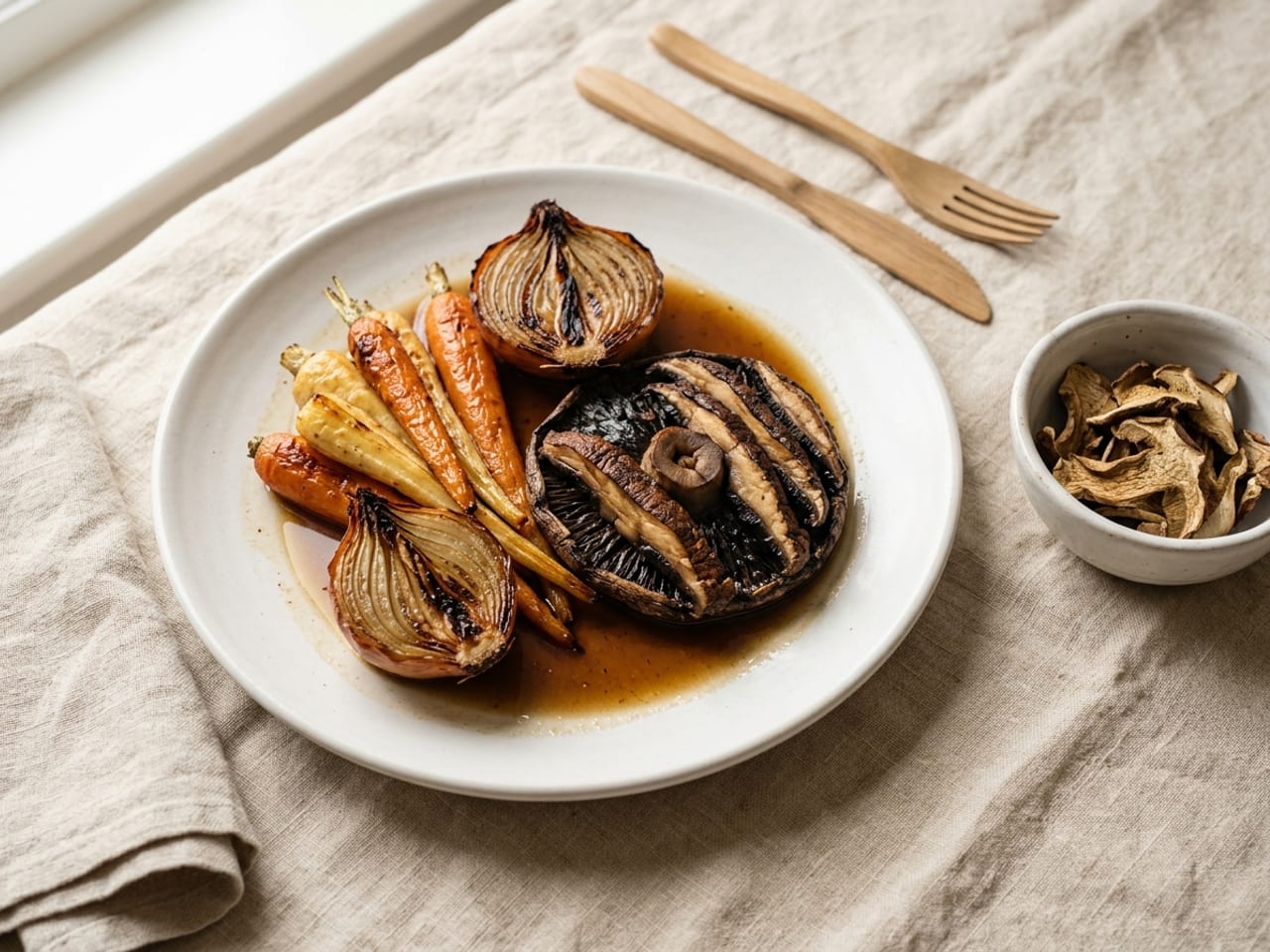
Mushroom jus (vegetarian)
Soak ½ cup (about 15 g) of dried porcini in 3 cups (720 ml) of hot water for 30 minutes. Brown 8 oz (225 g) of sliced cremini and an onion hard, add a teaspoon of tomato paste, deglaze with red wine, then add the strained soaking liquid (leave the grit behind), a cup (240 ml) of vegetable broth, a teaspoon of soy sauce and thyme. Reduce by half, strain, salt last.
Chefs use "jus" for any unthickened liquid carrying one ingredient's concentrated flavour, so the name is fair.4 Dried mushrooms bring guanylate, the umami booster that drying releases, shiitake far more than porcini;60 a dried shiitake or two in the soak adds more. Use gluten-free tamari if you need it gluten-free.
Advanced: a fine-dining bone jus. Restaurant jus is glossier because it starts from roasted bones and long reduction. Roast about 3 lb (1.4 kg) of beef shin, oxtail or short-rib trim and 1 lb (450 g) of chicken wings for gelatin at 425°F (220°C) until deep brown, adding onion, carrot and celery for the last 20 minutes and a smear of tomato paste at the end. Deglaze the tray, cover everything with cold water or unsalted stock, bring to a bare simmer, skim, and simmer about 4 hours. Strain twice, chill, lift off the fat, and reduce until it just coats a spoon. Escoffier's jus lié took 4 litres of stock down to 1 before binding it with 30 g of arrowroot,10 and Kamman binds a gallon of reduced stock with an ounce of starch.7 Skip the starch and you have a modern jus; swirl in cold butter at the end for shine.
Au jus packet vs cube vs scratch
The supermarket packet "au jus" is a starch-thickened seasoning. Salt and corn starch are the first two ingredients of McCormick's mix, and it contains wheat, soy and milk;28 Lawry's starts with salt, modified corn starch and lactose.30 That makes both closer to an instant jus lié than to a natural jus, and neither is gluten-free. The surprise is the sodium: regular boxed beef broth reduced by half, as many recipes do, is saltier than the packet.
| Product | Sodium on the label | Per ¼ cup as served | Per ¼ cup if reduced by half |
|---|---|---|---|
| McCormick Au Jus Gravy Mix28 | 330 mg per ¼ cup made up | 330 mg | not reduced |
| McCormick Au Jus, 30% Less Sodium29 | 200 mg per serving | 200 mg | not reduced |
| Lawry's Au Jus Gravy Mix30 | 390 mg per ¼ cup made up | 390 mg | not reduced |
| Canned au jus, USDA average36 | 478 mg per 100 g | 282 mg | not reduced |
| Swanson Beef Broth31 | 830 mg per cup | 208 mg | 415 mg |
| Swanson 50% Less Sodium Beef Broth32 | 410 mg per cup | 103 mg | 205 mg |
| Swanson Unsalted Beef Broth33 | 75 mg per cup | 19 mg | 38 mg |
| Better Than Bouillon Roasted Beef34 | 680 mg per tsp (makes 1 cup) | 170 mg | made to strength |
| Better Than Bouillon Reduced Sodium35 | 510 mg per tsp (makes 1 cup) | 128 mg | made to strength |
Label figures read on the makers' product pages in September 2026; ¼ cup (60 ml) per serving as on the packets. The per-¼-cup broth figures are our arithmetic from the per-cup label. Unsalted broth is the only option that leaves you room to salt to taste after reducing.
Store, freeze and reheat au jus safely
- Why jus and roast beef in particularClostridium perfringens causes nearly 900,000 food poisonings a year in the US. Beef and gravy are among the foods CDC most commonly links to it, and most outbreaks happen in November and December, with holiday roasts.38 Its spores survive cooking and multiply in food that cools slowly: a big pot of jus left warm on the stove after dinner is exactly that.
- Resting juices go back in, then back to a simmerThe juices on the carving board come from meat at medium-rare temperatures. Add them to the jus and bring it back to a simmer; it costs nothing.
- Rare roast beef, honestlyUSDA's minimum for beef roasts is 145°F (63°C) with a 3-minute rest,42 which most cooks call medium. Every prime rib recipe we read stops well short of that: pulled at about 125°F (52°C) and finished at 130 to 134°F (54 to 57°C) for medium-rare,44 or taken to 135°F (57°C).18 That is common practice for intact roasts but below USDA guidance. Cook to 145°F (63°C) for anyone pregnant, very young, elderly or with a weak immune system, and always when the label says "mechanically tenderized" or "blade tenderized", because the needles can carry surface bacteria inside.43
- The alcohol does not all cook offWine simmered into a dish keeps about 40% of its alcohol after 15 minutes, 35% after 30 minutes and 25% after an hour.37 For children or anyone avoiding alcohol, use the broth-plus-vinegar swap.
What to serve with au jus
- Roast beef and prime rib. The classic. Our roast beef gives you the drippings; a prime rib recipe is coming.
- The French dip. Thin-sliced roast beef on a crusty roll, dipped.
- Brisket. Skim the braising liquid of our brisket and reduce it into a jus for the slices.
- Roast chicken, pork, duck and goose. Each makes its own jus from its pan: roast chicken, roast pork, roast duck and roast goose (pour off most of the duck and goose fat first).
- Yorkshire pudding and mashed potatoes for mopping it up.
- For contrast: svíčková is Czech beef in a thick, creamy vegetable sauce, the opposite philosophy; and homemade beef broth is the best base for a no-drippings jus.
The science of au jus
What peer-reviewed food science says about fond, gelatin, umami, salt, fat and dipping. Where no study has tested the jus itself, we say so.
- The fond is the Maillard reactionThe brown crust on the pan is sugars and amino acids reacting under heat, plus Strecker degradation of amino acids, which make the roasted and meaty aroma compounds: pyrazines, sulfur compounds and aldehydes.48,49 Push it to black and the chemistry turns bitter: in a model system, one Maillard product was 2,000 times more bitter than caffeine by threshold.50 Nobody has measured burnt meat fond itself, but the kitchen rule agrees.
- Body without flour is gelatinCollagen in meat and bone shrinks and, on further heating, dissolves into gelatin; that starts at about 53 to 63 °C (127 to 145°F).55 Gelatin gels melt at about 22 to 34 °C (72 to 93°F),56 which is why a good jus is liquid and glossy on a warm plate, sets in the fridge and melts again when reheated. Reducing concentrates the gelatin, so a well-reduced jus sets firmer. Bone broths vary a lot in the collagen building blocks they carry, with café-made broths highest and commercial ones lowest in one analysis,57 which likely explains why one carton sets and another does not.
- Umami is a two-part synergyGlutamate and the nucleotide inosinate taste far stronger together than either alone, the synergy Yamaguchi measured in 1967,58 and umami is the main taste of meat stocks.59 Beef carries about 80 mg of inosinate per 100 g; soy sauce carries 410 to 1,260 mg of glutamate and tomato 150 to 250.60 So a splash of soy or Worcestershire, or browned tomato paste, in a no-drippings jus rebuilds the pairing that drippings supply. And gentle heat pays: lab beef broths heated at 85 °C (185°F) for an hour had the most intense brothy flavour.61
- Reduction concentrates salt, and heat hides itSodium does not evaporate. Regular canned beef broth has about 372 mg per 100 g, roughly 0.95% salt;36 reduced by half it is about 1.9%, twice the saltiest of the 0.3 to 0.9% salt solutions 584 people tasted in a Japanese study.62 And in one study, ordinary consumers (though not trained tasters) rated hot chicken broth less salty at 70 to 80 °C than at 40 to 60 °C (158 to 176°F against 104 to 140°F),63 so a jus salted "just right" at a simmer can taste salty on the plate. Season on the light side.
- Thin sauces can taste strongerIn thickened solutions, people perceived less flavour once the thickener passed a certain concentration, even though the aroma released did not change.65 That was a model thickener, not a gravy, but it fits the chef's case for a thin, gelatin-bodied jus over a floury one.
- Why the dip worksHow fast a liquid soaks into a porous solid depends on its viscosity, the pore size and time;66 a thin jus wicks into bread far faster than thick gravy. A quick dip of a sturdy, toasted roll is kitchen practice with plausible physics behind it; no study has tested French dip rolls.
Where au jus comes from
Latin broth. Jus and English "juice" are the same word, from Latin ius, "broth, sauce, juice, soup".69 Romans joked about the governor Verres that his ius Verrinum was bad, a pun on "Verres' law" and "boar broth".71 The Roman cookbook of Apicius pours an ius over meat and, in places, binds it with starch (amulo obligas),72 so the thickened jus is older than France. The au jus construction turns up in a 14th-century French poem: "pois au jus", peas in jus.73
The French kitchen. In 1651 La Varenne finished dish after dish with jus de mouton, which his 1653 English translator glossed as "the juice of a leg of mutton rosted at the spit".74,75 He also made a "jus fort rouge" from browned beef, bound with cooked flour or breadcrumbs.74 A century later Menon drew jus from a dedicated cut of beef and lifted the pan residue with a thin coulis, deglazing in all but name.76 Carême made a meat-day and a Lenten "jus maigre".77
Escoffier's rules. "The real and most natural gravy for roasts is made from the swilling of the baking- or dripping-pan, even if water be used as the diluent", he wrote (his English translators rendered jus as "gravy"). He warned that it is "a mistake to remove all the grease from, and to clarify, the gravy of roasts", because "the gravy of a roast is not a consommé", and it "is invariably served separately".9 In 1903 he defined jus de veau lié as 4 litres of veal stock reduced to 1 and bound with 30 g of arrowroot, and preferred it to espagnole for light dishes.10 He wished cooks would thicken with pure starch instead of flour: "It is only habit that causes flour to be still used".9
Gravy, English style. Mrs Beeton's 1861 "Gravy for roast meat" had two ingredients, "Gravy, salt": a dish set under the roasting joint to catch the juices.78 The phrase "au jus" is not in her book. In Boston in 1900 Fannie Farmer called carving juices "dish gravy": with a rump roast, "in carving the meat juices follow the knife".79 Gravy once covered thin juices too;70 the rule that gravy is thick and jus is thin is modern and mostly American.
The word in English. Merriam-Webster dates au jus after a noun to about 1750, jus alone to 1813 and au jus as a noun to 1903.1,2 It looks like menu French that spread through hotel and steakhouse menus; nobody has pinned down exactly how.
Nouvelle cuisine. In October 1973 Gault and Millau declared that glace de viande, fond de veau, red wine, Madeira, blood, roux, gelatin, flour, cheese and starch were no longer "written on the tablets of the law"; chefs kept butter, cream, fresh herbs and "les jus purs".80 The light, reduced jus served under or around the meat is the result,4 though today's glossy restaurant jus quietly brought back the stocks the manifesto rejected.
The French dip. Two Los Angeles restaurants, both founded in 1908, claim it. Philippe's story is that one day in 1918 Philippe Mathieu dropped a roll into the roasting pan and a policeman took it anyway, and came back with friends; why it is "French" is, in its own words, "lost to history".81 Cole's called itself "the originator of the French Dipped Sandwich".82 Neither claim rests on anything but the restaurants' own tradition: the earliest print mention we found, in November 1929, names neither: it describes a third place, the Dugout, whose "specialty is the French Dip sandwich".83 Cole's served its last sandwich on 29 March 2026.84
Au jus glossary: from jus lié to monter au beurre
Jus
The unthickened juices of a roast, deglazed and lightly reduced; also any unthickened liquid carrying one ingredient's concentrated flavour, such as a mushroom jus.
Au jus · oh-ZHOO
French for 'with juice': served with its own natural juices, as in beef au jus. In American usage also a noun for the sauce itself.
Jus lié · fond lié, jus de veau lié
Brown stock or jus lightly bound with a pure starch such as arrowroot or cornstarch; clearer and lighter than a roux sauce.
Jus de rôti
The roast's own jus: the roasting pan deglazed, even with water, reduced and only partly degreased. Escoffier's rule: it is not a consommé.
Fond (stock)
In French, a stock: bones, meat or trimmings gently simmered in liquid as the base for soups, sauces and jus. Fond brun is made from roasted bones.
Fond (pan residue) · sucs in French
The browned, caramelized drippings stuck to the pan after searing or roasting, dissolved by deglazing into a jus or pan sauce.
Deglaze · déglacer
To dissolve the browned cooking juices stuck to a pan with a liquid such as wine, stock or water, to make a jus or sauce.
Drippings
The fat and juices that run from meat as it cooks.
Demi-glace
Classically, equal parts espagnole and brown stock reduced by half; many modern kitchens make it from reduced stock with no roux.
Glace de viande · meat glaze
Brown stock reduced until syrupy, so rich in gelatin that it sets solid when cold; buttered, it becomes a sauce.
Gravy
In the US, a sauce of pan drippings and stock or water thickened with a roux of fat and flour. In 19th-century Britain the word also covered unthickened roast juices.
Pan sauce
A quick sauce made in the pan the meat was cooked in, from the fond, a liquid and a reduction, often finished with butter.
Consommé
Stock clarified with lean minced meat and egg white until it is crystal clear, served as a soup.
Broth · bouillon
A savoury liquid of water in which meat, fish or vegetables have simmered, seasoned to be eaten.
Stock
Kitchen usage: an unseasoned, gelatin-rich liquid made mainly from bones, used as a building block. US labelling rules draw no distinction between broth and stock.
Dégraisser · skim
To remove fat from a liquid. For a roast jus, most of it, not all: a little fat carries flavour.
Monter au beurre
To finish a sauce by swirling in pieces of cold or softened butter off the heat, for body, richness and shine; serve at once.
Nappe · nappé
Coating consistency: the sauce clings to the back of a spoon and a line drawn through it holds. A classic au jus is thinner than nappe.
Reduction
Simmering uncovered to evaporate water, which concentrates flavour, gelatin and salt alike.
Jus gras and jus maigre
Classical French for a meat-based jus and a meatless (Lenten) one; gras and maigre meant meat days and fast days, not fatty and lean.
Ten au jus myths
- "Resting keeps the juice in the meat"In a 2025 test on beef roasts, resting changed where the juice was lost (on the board instead of under the knife), not how much, and made no difference to eating quality.54 Rest it anyway if you like, and pour the board juices into the jus.
- "The alcohol cooks off"A quarter is still there after an hour of simmering.37
- "Au jus means beef"Escoffier served eggs, veal chops, lettuce, endive, cardoons and macaroni "au jus".11
- "Nouvelle cuisine made jus lié its banner"The 1973 manifesto struck out roux, flour, starch and gelatin alike; for sauces it kept butter, cream, fumets and "les jus purs".80
See where the jus should go on your own plate
Pool, ramekin or a line on the cut face: it is easiest to judge on food you actually cooked. Photograph tonight's roast and Plate Artists re-plates your own dish the way a chef would, sauce placement included, with the moves named so you can do it again for real.
Your roast, plated like a chef's
Snap it, upload it, and get the composed version back, with the steps to recreate it on a real plate.
Start free · 1 enhancement →Free account · 1 free enhancement · No credit card
Au jus, answered
What is au jus?
Au jus (pronounced oh-ZHOO) is French for 'with juice'. It describes meat served with its own roasting juices, and in American usage it is also the name of that sauce: a thin, unthickened liquid made by deglazing the roasting pan's drippings with stock or wine and reducing it. It is served with roast beef, prime rib and the French dip sandwich.
How do you pronounce au jus?
Oh-ZHOO, with the 'zh' of 'measure' and a silent s. The French vowel is a rounded 'ee' that English lacks, so oh-ZHOO is the usual English approximation. Many Americans sound the s (oh-ZHOOS), and Merriam-Webster also records oh-JOOS, so those are anglicizations rather than mistakes.
Is it correct to say 'with au jus'?
Strictly it is redundant, because au jus already means 'with juice': the dish is 'beef au jus' and the sauce is the 'jus'. But au jus has been used as a noun in English for more than a century (Merriam-Webster dates the noun to 1903), it is common on American menus, and dictionaries list it, so 'a side of au jus' is normal American English.
What is the difference between au jus and gravy?
Both start from roast drippings. A classic au jus is not thickened: its body comes from reduction and natural gelatin, so it is thin and translucent. Gravy is thickened with a roux of fat and flour, so it is opaque and coats a spoon. In between sits jus lié, a jus lightly bound with arrowroot or cornstarch.
Is au jus the same as beef broth?
No, though it is close. Broth is meat or bones simmered in water. Au jus is made from the drippings and browned fond of a roast (or browned beef), deglazed and reduced, so it is darker, more concentrated and tastes of roast meat. Broth is usually the liquid you add to make it.
What is the difference between au jus and consommé?
Consommé is stock clarified with minced meat and egg white until crystal clear, served as a soup. Au jus is deliberately not clarified: Escoffier wrote that a roast's jus 'is not a consommé', because clarifying and fully degreasing it loses flavour.
Can you make au jus without drippings?
Yes. Brown a little ground beef or beef trimmings hard in a saucepan to make a fond, add onion and a teaspoon of tomato paste, deglaze with red wine, add 4 cups (950 ml) of low-sodium beef broth and reduce by half to 2 cups (480 ml). A teaspoon of soy sauce or Worcestershire and, optionally, 2 teaspoons of gelatin stand in for the flavour and body of drippings.
Can you make au jus without wine?
Yes. Deglaze with the same amount of broth or water instead, and add about a teaspoon of red wine vinegar for the acidity the wine would have given. The jus is a little less deep but still good, and there is no wine alcohol in it.
How do you thicken au jus?
First reduce it further, which thickens it through gelatin. For more body, stir in 1 to 2 teaspoons of powdered gelatin per cup (240 ml). A teaspoon of cornstarch slurry per 2½ cups (600 ml) gives a light body, but then it is a jus lié rather than a jus; thickened with flour it becomes a gravy.
How do you fix au jus that is too salty?
Dilute it with unsalted broth or water, then reduce again if it gets too thin. A potato does not remove salt; it only soaks up salty liquid. To avoid it, use unsalted broth and add salt only at the end, because reducing by half doubles the salt in every spoonful.
How much au jus per person?
About 3 to 4 tablespoons (45 to 60 ml) per person for a plated roast, and half a cup (120 ml) per person for a French dip ramekin. Two cups of finished jus serves about 8 plated portions or 4 sandwiches.
How long does au jus last, and can you freeze it?
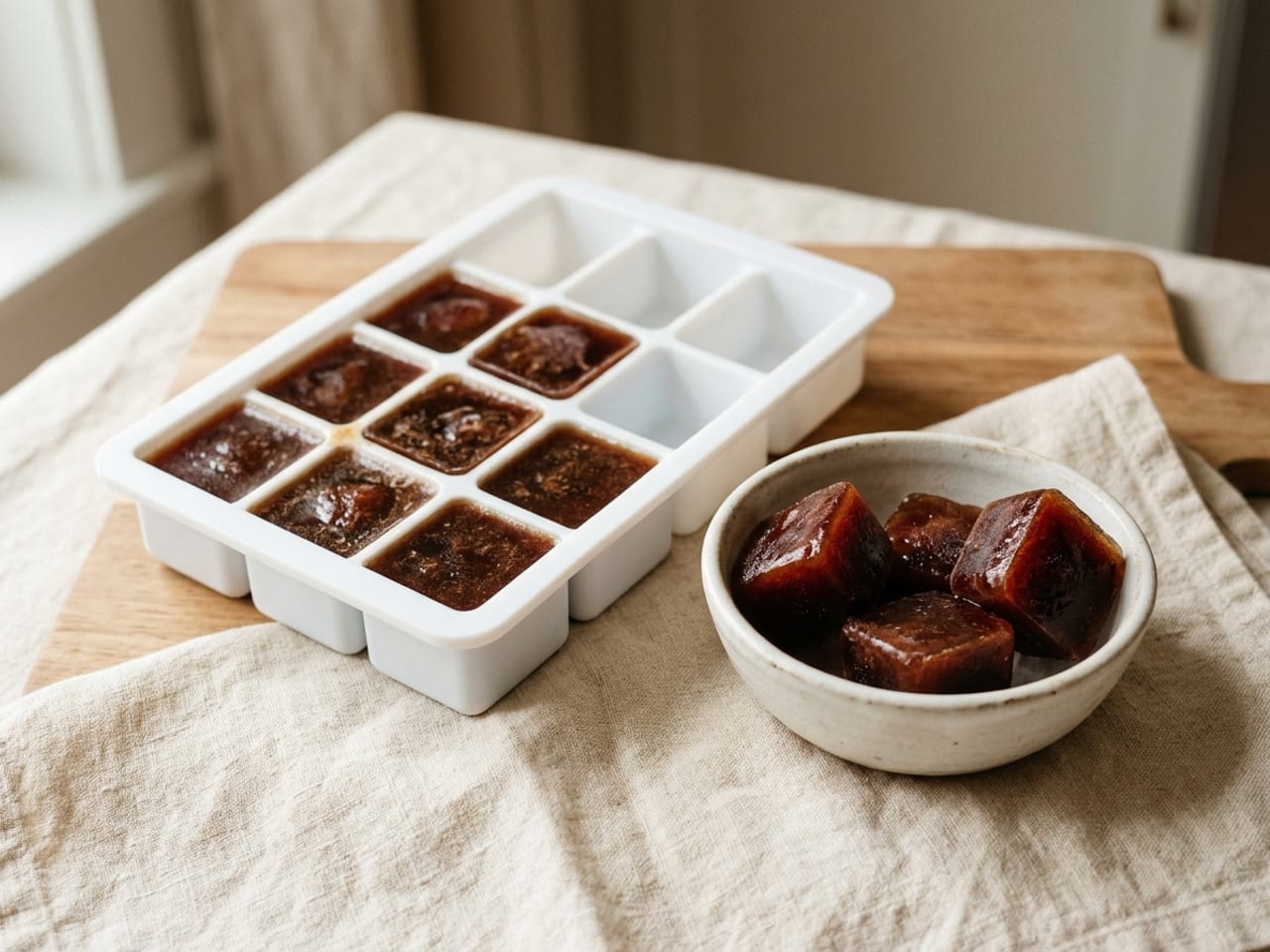
Refrigerate it within 2 hours of cooking and use it within 3 to 4 days. It freezes well: frozen at 0°F (−18°C) it stays safe indefinitely and is best within 2 to 3 months. Freeze it in an ice-cube tray so you can thaw a portion at a time, and reheat it to a rolling boil.
Why does au jus turn to jelly in the fridge?
Gelatin from the meat and bones sets when it is cold and melts again when warm, so a well-made jus firms up like jelly in the fridge. It is a sign of a good jus, not a fault. Reheat it and it turns liquid again.
Is au jus gluten free?
Homemade au jus can be, if your broth is gluten-free and you use tamari instead of soy sauce and a gluten-free Worcestershire. Packet mixes are not a safe bet: McCormick's and Lawry's au jus mixes both contain wheat, as well as soy and milk.
What do you serve au jus with?
Prime rib and roast beef, the French dip sandwich, brisket, roast lamb, and roast chicken or pork with a jus made from their own pan. Yorkshire pudding and mashed potatoes are good for mopping it up.
The cookbooks, labels, rules and research behind this guide
Dictionaries in English and French; cookbooks from Apicius and La Varenne to Escoffier, Beeton and Fannie Farmer, read in Internet Archive scans; the methods of America's Test Kitchen and other published recipes; product labels; the CDC and USDA; and twenty-two peer-reviewed papers verified through Crossref. Where no study has tested something about jus itself, the text says so.
- Merriam-Webster (2026). Au jus (adjective; noun). Merriam-Webster.com Dictionary, French, literally 'with juice'; adjective first known use circa 1750, noun 1903; pronunciations ō-ˈzhü(s) and ō-ˈjüs. merriam-webster.com
- Merriam-Webster (2026). Jus (noun). Merriam-Webster.com Dictionary, juice obtained from roasting meat; first known use 1813. merriam-webster.com
- Cambridge University Press (2026). Au jus. Cambridge Dictionary, noun and adjective senses; US pronunciations /ˌoʊ ˈʒuː/ and /ˌoʊ ˈʒuːs/. dictionary.cambridge.org
- Gisslen, W. (2018). Professional Cooking (9th ed.), chapter 9, Sauces. Wiley, Hoboken, jus, au jus, jus lié, pan gravy, integral sauces, monter au beurre, nappé, reduction and nouvelle cuisine; read in the chapter PDF hosted by the Auguste Escoffier School. resources.escoffier.edu
- Brians, P. (2016). French dip with au jus. Common Errors in English Usage, Washington State University, 'Au jus' means 'with broth' so adding 'with' is redundant. brians.wsu.edu
- Lim, S. (2016). What is jus? MICHELIN Guide, 2 November 2016; jus as the sauce, au jus as the serving style; never thickened with flour or dairy. guide.michelin.com
- Kamman, M. (1997). The New Making of a Cook: jus. William Morrow, New York (via ckbk), jus as deglazed, defatted drippings; jus lié bound with 1 oz arrowroot, cornstarch or potato starch per gallon. ckbk.com
- The Culinary Institute of America (2024). Technique of the Quarter: Examining Sauces. ciachef.edu, jus lié, brown sauces, demi-glace, pan sauces. ciachef.edu
- Escoffier, A. (1907). A Guide to Modern Cookery. William Heinemann, London, stock 'is everything in cooking'; No. 23 half-glaze; No. 41 thickened gravy; No. 255 'The gravy of roasts'; No. 256; the case for fecula and arrowroot over flour; read in the Internet Archive scan. archive.org
- Escoffier, A. (1903). Le Guide culinaire. Paris, jus de veau lié (4 litres of stock reduced to 1 litre, 30 g arrow-root); jus lié preferred to espagnole for light dishes; glace de viande beurrée; read in the Internet Archive scan, translations ours. archive.org
- Escoffier, A. (1907). Le Guide culinaire (2nd ed.). Paris, 'Les jus de rôtis'; Œufs au jus, Côte de veau au jus, Cardons, Endives and Laitues braisées au jus, Macaroni au jus; read in the Internet Archive scan, translations ours. archive.org
- America's Test Kitchen (2026). Prime Rib Roast Beef with Jus. americastestkitchen.com, 1 cup red wine reduced by half; low-sodium beef and chicken broth reduced by two-thirds to about 2 cups; resting juices added; serves 10 to 12. americastestkitchen.com
- America's Test Kitchen (2026). Boneless Rib Roast with Yorkshire Pudding and Jus. americastestkitchen.com, 2½ cups beef broth with 1 teaspoon cornstarch, reduced by half and slightly thickened. americastestkitchen.com
- America's Test Kitchen (2026). Quick Jus. americastestkitchen.com, browned beef trimmings, onion, 2 cups low-sodium broth reduced by half to 1 cup; serves 6 to 8. americastestkitchen.com
- America's Test Kitchen (2026). French Dip Sandwiches. americastestkitchen.com, 1 cup jus, heated, for four sandwiches, with extra jus for dipping. americastestkitchen.com
- Brown, A. (2026). Dry-Aged Standing Rib Roast with Sage Jus. altonbrown.com, degreased pan juices deglazed with water, then red wine reduced by half, strained and served on the side. altonbrown.com
- Florence, T. (2025). Standing Rib Roast with Cabernet au Jus. Food Network, pan juices through a fat separator; roast pulled at 120 to 125°F; read via the Internet Archive. foodnetwork.com
- Flay, B. (2025). Roast Prime Rib with Thyme Au Jus. Food Network, red wine and 4 cups beef stock reduced by half; roast to 135°F; read via the Internet Archive. foodnetwork.com
- Edible Times (2026). Roast chicken jus. edibletimes.com, Bouchon-inspired: 1 quart unsalted stock and 8 oz roasted bones reduced to a quarter; about 2 oz per serving. edibletimes.com
- America's Test Kitchen (2026). Herb-Stuffed Leg of Lamb with Riesling Jus. americastestkitchen.com, 1½ cups dry Riesling reduced by half, then 2 tablespoons butter swirled in. americastestkitchen.com
- Oliver, J. (2026). Pot-roast pork with Chianti jus. jamieoliver.com, 200 ml Chianti with red onion, celery and rosemary in the pan. jamieoliver.com
- Great British Chefs (2026). How to deglaze. greatbritishchefs.com, do not deglaze burnt bits, which give a bitter flavour. greatbritishchefs.com
- America's Test Kitchen (2026). For a clearer stock, simmer, don't boil. americastestkitchen.com, boiling emulsifies soluble proteins and rendered fat into the liquid. americastestkitchen.com
- Cook's Illustrated (2026). Three ways to separate and skim fat. americastestkitchen.com, fat separator with a low spout; lettuce leaf and paper towel dismissed as messy. americastestkitchen.com
- Cook's Illustrated (2026). Body builder for pan sauces. americastestkitchen.com, 2 teaspoons gelatin per cup of broth for sauces, 1 teaspoon per cup for soups. americastestkitchen.com
- Moulton, S. (2012). Sara's kitchen revelations: oversalted it? There is one solution. saramoulton.com, citing Robert L. Wolke's tests in What Einstein Told His Cook: add more water; a potato only soaks up salty water. saramoulton.com
- The Kitchn (2014). Can a potato really fix a too-salty soup? Putting tips to the test. thekitchn.com, one Yukon Gold simmered 30 minutes in 3¾ cups broth made little difference. thekitchn.com
- McCormick (2026). McCormick Au Jus Gravy Seasoning Mix, 1 oz. mccormick.com, label: ½ tsp mix makes ¼ cup, 330 mg sodium; packet plus 3 cups water; contains wheat, soy and milk. mccormick.com
- McCormick (2026). McCormick Au Jus Gravy 30% Less Sodium Mix, 1 oz. mccormick.com, 200 mg sodium per serving against 330 mg for the original. mccormick.com
- McCormick (2026). Lawry's Au Jus Gravy Mix, 1 oz. mccormick.com, label: 1½ tsp mix makes ¼ cup, 390 mg sodium; ingredients begin salt, modified corn starch, lactose (milk). mccormick.com
- Campbell's (2026). Swanson Beef Broth. campbells.com, 830 mg sodium per 1 cup (240 ml). campbells.com
- Campbell's Foodservice (2026). Swanson 50% Less Sodium Beef Broth. campbellsfoodservice.com, 410 mg sodium per 1 cup. campbellsfoodservice.com
- Campbell's (2026). Swanson Unsalted Beef Broth. campbells.com, 75 mg sodium per 1 cup. campbells.com
- Better Than Bouillon (2026). Roasted Beef Base. betterthanbouillon.com, 680 mg sodium per teaspoon, which makes 1 cup. betterthanbouillon.com
- Better Than Bouillon (2026). Reduced Sodium Roasted Beef Base. betterthanbouillon.com, 510 mg sodium per teaspoon. betterthanbouillon.com
- U.S. Department of Agriculture, Agricultural Research Service (2026). FoodData Central, SR Legacy. fdc.nal.usda.gov, gravy, au jus, canned (FDC 171168: 478 mg sodium per 100 g, ¼ cup = 59 g); beef broth, canned (171538: 372 mg per 100 g); fat, beef tallow (171400: 1 cup = 205 g). fdc.nal.usda.gov
- U.S. Department of Agriculture, Agricultural Research Service (2007). USDA Table of Nutrient Retention Factors, Release 6. Nutrient Data Laboratory, Beltsville, alcohol stirred into a mixture and baked or simmered: 40% left after 15 minutes, 35% after 30, 25% after 1 hour, 5% after 2½ hours. ars.usda.gov
- Centers for Disease Control and Prevention (2026). About C. perfringens food poisoning. cdc.gov, nearly 900,000 illnesses a year in the US; linked foods include beef and gravy; most outbreaks in November and December; updated 28 September 2026. cdc.gov
- Centers for Disease Control and Prevention (2026). Preventing C. perfringens food poisoning. cdc.gov, keep cooked food at 140°F or hotter or 40°F or colder; refrigerate within 2 hours (1 hour above 90°F); reheat to 165°F. cdc.gov
- USDA Food Safety and Inspection Service (2020). Leftovers and food safety. fsis.usda.gov, refrigerate within 2 hours; 3 to 4 days in the fridge; 'Reheat sauces, soups and gravies by bringing them to a rolling boil'. fsis.usda.gov
- USDA Food Safety and Inspection Service (2024). Freezing and food safety. fsis.usda.gov, food kept at 0°F is safe indefinitely; gravy, meat or poultry, 2 to 3 months for best quality. fsis.usda.gov
- USDA Food Safety and Inspection Service (2026). Safe minimum internal temperature chart. fsis.usda.gov, beef, pork, veal and lamb steaks, chops and roasts: 145°F (62.8°C) with a 3-minute rest. fsis.usda.gov
- USDA Food Safety and Inspection Service (2026). Mechanically tenderized beef. fsis.usda.gov, surface bacteria can be carried inside by needles or blades; cook to 145°F with a 3-minute rest. fsis.usda.gov
- ThermoWorks (2026). What's the best temperature to cook prime rib? ThermoWorks blog, pull at 125°F, carryover of 5 to 8°F, finished at 130 to 134°F for medium-rare, 30-minute rest. blog.thermoworks.com
- USDA Food Safety and Inspection Service (2025). The color of meat and poultry. fsis.usda.gov, myoglobin, fixed in the tissue cells, gives most of the red colour; read via the Internet Archive. fsis.usda.gov
- Huff-Lonergan, E. (2006). Water-holding capacity of fresh meat. Pork Information Gateway, factsheet PIG 12-04-05, drip is coloured by the sarcoplasmic protein myoglobin, with very little hemoglobin from blood. porkgateway.org
- Suman, S. P., & Joseph, P. (2013). Myoglobin chemistry and meat color. Annual Review of Food Science and Technology, 4, 79–99. doi:10.1146/annurev-food-030212-182623
- van Boekel, M. A. J. S. (2006). Formation of flavour compounds in the Maillard reaction. Biotechnology Advances, 24(2), 230–233. doi:10.1016/j.biotechadv.2005.11.004
- Park, M. K., & Choi, Y.-S. (2025). Effective strategies for understanding meat flavor: a review. Food Science of Animal Resources, 45(1), 165–184. doi:10.5851/kosfa.2024.e124
- Frank, O., Ottinger, H., & Hofmann, T. (2001). Characterization of an intense bitter-tasting 1H,4H-quinolizinium-7-olate by application of the taste dilution analysis, a novel bioassay for the screening and identification of taste-active compounds in foods. Journal of Agricultural and Food Chemistry, 49(1), 231–238. doi:10.1021/jf0010073
- Yoo, J. H., Kim, J. W., Yong, H. I., Baek, K. H., Lee, H. J., & Jo, C. (2020). Effects of searing cooking on sensory and physicochemical properties of beef steak. Food Science of Animal Resources, 40(1), 44–54. doi:10.5851/kosfa.2019.e80
- Barber, N., & Broz, C. C. (2011). The meat searing process: is sealing in juices fact or fiction? Journal of Culinary Science & Technology, 9(2), 99–105. doi:10.1080/15428052.2011.581927
- Kilic, S., Oz, E., Turhan, S., Amarowicz, R., Toldrá, F., Brennan, C., et al. (2023). The effect of sealing process on the textural and sensory properties and protein profile of cooked meat. International Journal of Food Science & Technology, 58(9), 4800–4811. doi:10.1111/ijfs.16590
- Prieto, N., Zawadski, S., Schmidt, B., & López-Campos, Ó. (2025). Effect of resting time on beef roast moisture retention and palatability. Meat Science, 227, 109864. doi:10.1016/j.meatsci.2025.109864
- Tornberg, E. (2005). Effects of heat on meat proteins: implications on structure and quality of meat products. Meat Science, 70(3), 493–508. doi:10.1016/j.meatsci.2004.11.021
- Derkach, S. R., Voron'ko, N. G., Kuchina, Y. A., Kolotova, D. S., Grokhovsky, V. A., Nikiforova, A. A., et al. (2024). Rheological properties of fish and mammalian gelatin hydrogels as bases for potential practical formulations. Gels, 10(8), 486. doi:10.3390/gels10080486
- Alcock, R. D., Shaw, G. C., & Burke, L. M. (2019). Bone broth unlikely to provide reliable concentrations of collagen precursors compared with supplemental sources of collagen used in collagen research. International Journal of Sport Nutrition and Exercise Metabolism, 29(3), 265–272. doi:10.1123/ijsnem.2018-0139
- Yamaguchi, S. (1967). The synergistic taste effect of monosodium glutamate and disodium 5′-inosinate. Journal of Food Science, 32(4), 473–478. doi:10.1111/j.1365-2621.1967.tb09715.x
- Yamaguchi, S., & Ninomiya, K. (2000). Umami and food palatability. The Journal of Nutrition, 130(4), 921S–926S. doi:10.1093/jn/130.4.921S
- Kurihara, K. (2015). Umami the fifth basic taste: history of studies on receptor mechanisms and role as a food flavor. BioMed Research International, 2015, 189402. doi:10.1155/2015/189402
- Cambero, M. I., Seuss, I., & Honikel, K. O. (1992). Flavor compounds of beef broth as affected by cooking temperature. Journal of Food Science, 57(6), 1285–1290. doi:10.1111/j.1365-2621.1992.tb06838.x
- Hayabuchi, H., Morita, R., Ohta, M., Nanri, A., Matsumoto, H., Fujitani, S., et al. (2020). Validation of preferred salt concentration in soup based on a randomized blinded experiment in multiple regions in Japan: influence of umami (L-glutamate) on saltiness and palatability of low-salt solutions. Hypertension Research, 43(6), 525–533. doi:10.1038/s41440-020-0397-1
- Kim, J.-W., Samant, S. S., Seo, Y., & Seo, H.-S. (2015). Variation in saltiness perception of soup with respect to soup serving temperature and consumer dietary habits. Appetite, 84, 73–78. doi:10.1016/j.appet.2014.09.018
- Guan, H., Zhang, W., Tian, Y., Leng, S., Zhao, S., Liu, D., & Diao, X. (2025). Analysis of the flavor profile of chicken white soup with varying fat addition using GC–MS, GC-IMS and E-nose combined with E-tongue. Food Chemistry: X, 26, 102335. doi:10.1016/j.fochx.2025.102335
- Hollowood, T. A., Linforth, R. S. T., & Taylor, A. J. (2002). The effect of viscosity on the perception of flavour. Chemical Senses, 27(7), 583–591. doi:10.1093/chemse/27.7.583
- Washburn, E. W. (1921). The dynamics of capillary flow. Physical Review, 17(3), 273–283. doi:10.1103/PhysRev.17.273
- Zellner, D. A., Loss, C. R., Zearfoss, J., & Remolina, S. (2014). It tastes as good as it looks! The effect of food presentation on liking for the flavor of food. Appetite, 77, 31–35. doi:10.1016/j.appet.2014.02.009
- Motoki, K., Yamaguchi, K., Koda, N., Oshiro, H., Horike, A., Moritoyo, R., Takahashi, C., Noda, T., Tohara, H., & Ishikawa, S. (2026). How chef-designed plating shapes consumer evaluations of a dish in a real restaurant setting. Foods, 15(17), 3081. doi:10.3390/foods15173081
- Harper, D. (2026). Juice (n.). Online Etymology Dictionary, c. 1300 jus, from Old French jus, from Latin ius, 'broth, sauce, juice, soup'. etymonline.com
- Harper, D. (2026). Gravy (n.). Online Etymology Dictionary, late 14c., from Old French; the sense 'meat drippings' dominant from the mid-15th century. etymonline.com
- Cicero, M. T. (70 BC). In Verrem II.1. The Latin Library, §121, the 'ius Verrinum' pun (Verres' law, boar broth). thelatinlibrary.com
- Apicius (c. 400). De re coquinaria, books 3 and 4. The Latin Library, book 3, 'amulo obligas' (bind it with starch); book 4, 'ius supra perfundes' (pour the sauce over), at thelatinlibrary.com/apicius/apicius4.shtml. thelatinlibrary.com
- Littré, É. (1873). Dictionnaire de la langue française: jus; gras. littre.org, 'pois au jus' quoted from Baudouin de Sebourc (14th century); gras and maigre as meat-day and Lenten food. littre.org
- La Varenne, F. P. de (1652). Le Cuisinier françois. Paris, first published 1651; 'jus de mouton' throughout; a made 'jus fort rouge' bound with cooked flour or breadcrumbs; read in the Internet Archive scan. archive.org
- La Varenne, F. P. de (1653). The French Cook. London, jus glossed as 'the juice of a leg of mutton rosted at the spit'; read in the Internet Archive scan. archive.org
- Menon (1756). La Cuisinière bourgeoise. Paris, the beef round 'sert à tirer du jus'; 'coulis clair pour détacher ce qui reste'; read in the Internet Archive scan. archive.org
- Carême, M.-A. (1833). L'Art de la cuisine française au XIXe siècle, tome III. Paris, blond de veau; 'jus maigre' for the Lenten bordelaise; read in the Internet Archive scan. archive.org
- Beeton, I. (1861). The Book of Household Management. S. O. Beeton, London, No. 433 'Gravy for roast meat'; the phrase au jus does not appear; read in the Internet Archive scan. archive.org
- Farmer, F. M. (1900). The Boston Cooking-School Cook Book. Little, Brown, Boston, 'dish gravy' and 'Roast Beef Gravy'; read in the Internet Archive scan of the 1900 printing. archive.org
- Gault, H., & Millau, C. (1973). Vive la nouvelle cuisine française. Le Nouveau Guide Gault-Millau (republished by Gault&Millau, 21 July 2025), commandment 7, 'Honorer les sauces claires'; translation ours. fr.gaultmillau.com
- Philippe The Original (2012). History. philippes.com, founded 1908; the 1918 dropped-roll story; read in the Internet Archive capture of 31 December 2012. web.archive.org
- Cole's (2026). Cole's French Dip. colesfrenchdip.com, 'the originator of the French Dipped Sandwich. Serving Los Angeles since 1908'. colesfrenchdip.com
- Modern Mechanics and Inventions (1929). War veteran erects sand-bagged dugout as eating place in Los Angeles. Modern Mechanics and Inventions, November 1929, p. 102: 'The Dugout specialty is the French Dip sandwich'; read in the Internet Archive scan. archive.org
- Food Journal Magazine (2026). Cole's French Dip closed after 118 years, and the business is for sale. foodjournalmagazine.com, served its last French dip on 29 March 2026, after closing dates postponed since 2025. foodjournalmagazine.com
- USDA Food Safety and Inspection Service (2005). Food Standards and Labeling Policy Book. FSIS-GD-2005-0003, 'No distinction has been made between broth and stock'; gravies need at least 25% stock or broth, or 6% meat. usda.gov
- Larousse (2026). Dictionnaire de français: déglacer. larousse.fr, 'dissoudre à l'aide d'un liquide les sucs de cuisson épaissis au fond du récipient'; translation ours. larousse.fr
Keep going
The five French mother sauces
Béchamel, velouté, espagnole, tomato and hollandaise: how each is thickened, their daughters, and where sauce goes on the plate.
Plating components
Coulis, tuile, quenelle, sauce and jus, gels, foams and the rest of what a chef builds a plate from.
Turkey gravy recipe
When you do want it thick: the drippings-and-roux ratio, per cup, with make-ahead and reheating.
Roast beef recipe
The roast that gives you the drippings for the jus.
Prime rib calculator
How big a roast to buy, the time for your doneness, when to pull it and a countdown to carving.
Michelin-star plating
The fine-dining anatomy: purée, sear, crunch and a sauce spooned around, not over.