Coulis: what it is, how to make it from any fruit, and how to plate it
What the dictionaries and textbooks agree a coulis is and where they split, the method cooked or raw, a raspberry and a red pepper recipe, 38 published recipes side by side, texture fixes, keeping and freezing, the frozen-berry advice country by country, plating and the word's history, each from a named source.
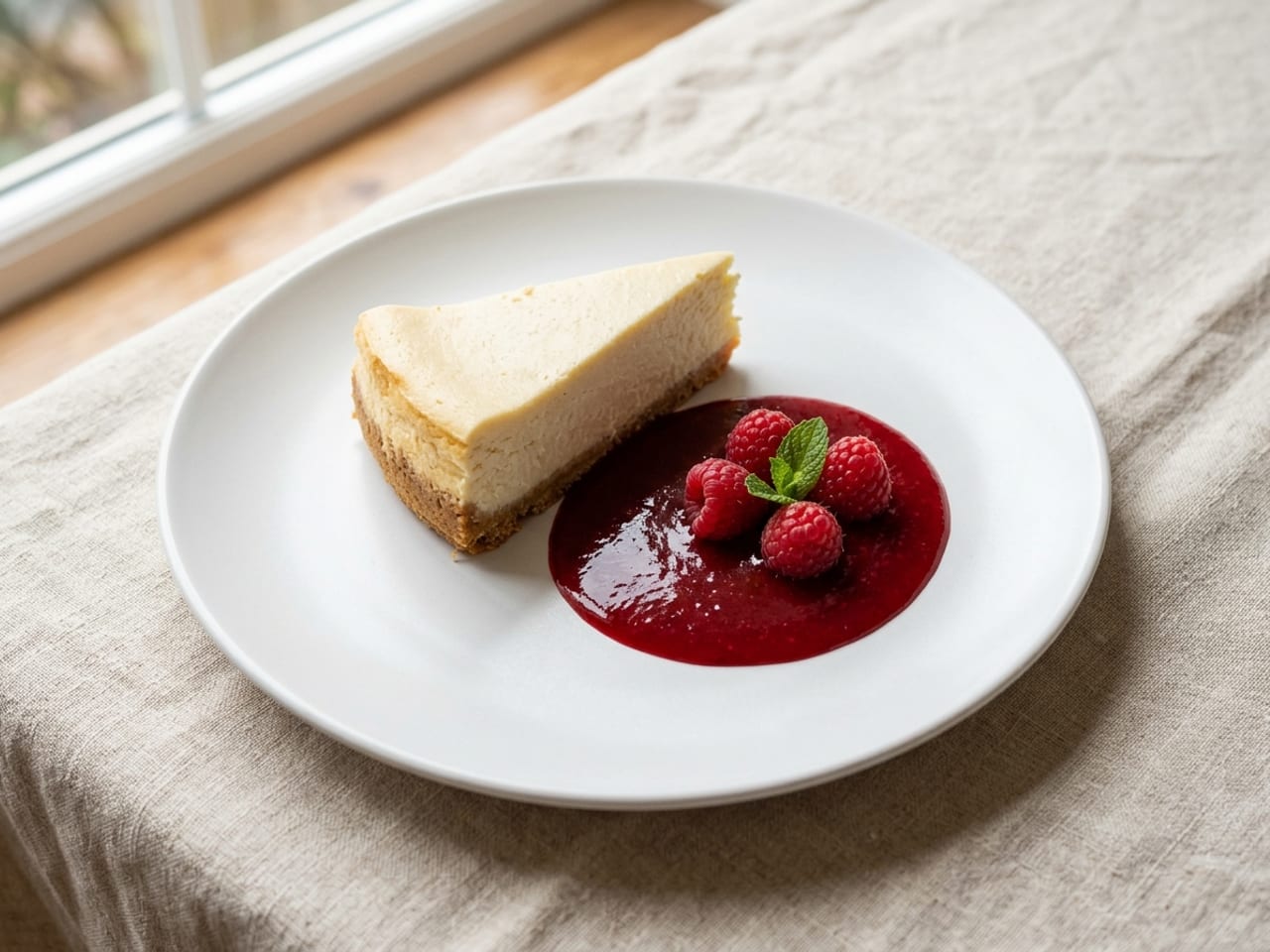
The photos on this page are AI-generated illustrations.
What is a coulis?
A coulis (koo-LEE) is a smooth purée of fruit or vegetables, usually pushed through a sieve, used as a sauce. To make one, purée the fruit, warm it briefly with sugar or not at all, strain out the seeds and skins, and finish it with lemon and sugar to taste.6, 34, 38, 69
- Raspberry coulis: 12 oz (340 g) of raspberries at a bare simmer for about a minute with water, sugar and salt, blended, sieved, lemon stirred in after (the recipe).69, 70
- Sugar: no agreed ratio. In the 17 coulis recipes we read that weigh both, sugar runs from 0% to 66.2% of the fruit's weight (our arithmetic; the table).
- Savoury coulis: red pepper or tomato cooked with aromatics and stock or wine, peas and herbs only blanched, then puréed and strained (savoury).35, 58
- How long it keeps: 1 to 4 days for the four raw coulis we read, three of them 2 days or less; 3 days to 2 weeks for most cooked ones; most sources freeze it (the figures).
- Not the same thing: a compote is chunky, jam is set and much sweeter, and a purée is thicker and coarser (coulis vs).39, 44, 61
On this page: Meaning and pronunciation · Coulis vs purée, compote, jam · The method · Raspberry coulis recipe · Every ratio · Fruit by fruit · Red pepper and tomato coulis · Thicker, thinner, bleeding · Frozen, jam, canned · Colour and flavour · How long it keeps · Food safety · How to plate it · What to serve it with · History · Popular claims · The words · FAQ
How this page was made. Every quantity, time, quotation and verdict comes from the source named beside it: dictionaries, textbooks (Gisslen, Friberg, the CIA, Figoni and McGee, cited as books), test kitchens, magazines and published recipes, US, UK, EU, Nordic and Australian food agencies, peer-reviewed studies (read as their abstracts) and old cookbooks read in machine-read scans or as search fragments. Plate Artists cooked, tasted, timed and measured nothing for it; the two recipes are our synthesis of the cited published ones, not recipes we tested. Sugar percentages, conversions and readings marked "ours" are our own. Each country's food-safety advice is kept apart, and nothing is printed as an agency rule that is not one. Sources are at the bottom.
What a coulis is, how to say it, and where the sources disagree
The definition most sources share. "Coulis (koo lee) A vegetable or fruit purée, used as a sauce" (Gisslen); "a sauce made with pureed vegetable or fruit and often used as a garnish" (Merriam-Webster).6, 34 For On Cooking and The Nibble, straining is what makes it a coulis rather than a purée: the name "refers to what runs off the strainer" (On Cooking), and Friberg's pastry coulis is "usually strained". 38, 44, 66
How to say it. Every source we read gives two syllables and a silent s; they differ on the stress. The plural is written coulis (Cambridge; Webster's New World), though Escoffier's English translator wrote "cullises".7, 8, 21
| Source | As printed | Stress |
|---|---|---|
| Merriam-Webster6 | kü-ˈlē | second syllable |
| Gisslen, Professional Baking36 | koo LEE | second syllable |
| The Nibble66 | coo-LEE | second syllable |
| Webster's New World (on Collins)8 | kuˈli, or ˈkuli | second, or first |
| Cambridge Dictionary (UK and US)7 | /ˈkuː.li/ | first syllable |
| Collins (British)8 | (ˈkuːliː) | first syllable |
| Gisslen, Professional Cooking34 | koo-lee | not marked |
| TLFi (French)1 | [kuli] | not marked (French stresses the last syllable, ours) |
| Littré (French)4 | kou-li | French |
Where the word comes from. From the root of the French couler, to flow (TLFi), through Old French coleïs, "flowing" (Merriam-Webster); Webster's 1913 dictionary traces couler, "to strain, to flow", to the Latin colare, to filter, the root of colander.1, 6, 11 The BCcampus textbook's "French for 'strained liquid'" is a gloss, not a translation.56
In French the word is masculine, un coulis, with the same plural; it also the adjective gives vent coulis, a draught, and the noun also means a grout in building.1 In a French kitchen a coulis de tomate is an everyday tomato sauce, "autre nom de la sauce tomate", and in the CNRTL portal's corpus statistics the kitchen words that pair with it most are crayfish and tomato, after réfractaire from the grout sense.1, 10, 13
Where the definitions split. On four questions, strong sources take opposite sides. We do not pick a winner; the last column says what this page follows.
| The question | One side | The other side | What this page follows |
|---|---|---|---|
| Fruit only, or vegetables too? | Fruit only: Cambridge, "a liquid made by cooking and crushing fruit".7 No fruit at all: the TLFi's culinary sense lists vegetables, fish and meats, with partridge and tomato as its examples.1 | Fruit or vegetables: Merriam-Webster, Collins, Gisslen, On Cooking, the open saucier textbook and the Académie française, whose 9th edition adds "Un coulis de framboises".2, 6, 8, 34, 44, 58 | Fruit or vegetables, as most sources say. This page covers both. |
| Cooked or raw? | Cooked: the Académie ("cuits lentement", even for fruit), Cambridge ("cooking and crushing"), and the CIA, for which a coulis is "typically cooked or heated only slightly".2, 7, 39 | Raw: the BCcampus textbook, "most often an uncooked, strained purée", and Sokol's glossary, "An uncooked fruit sauce".47, 56 Either: Gisslen ("fresh or cooked fruits") and Friberg ("raw or cooked fruits").36, 38 | Either. The method below gives both routes and says what each costs. |
| Thick or thin? | Thick: Gisslen, "a thick sauce made of puréed fruits or vegetables"; Bocuse's German glossary, "Eine dicke, püreeartige Sauce"; a 1956 Spry tomato coulis "much thicker than a sauce"; Anne Willan, "a sauce of thickish consistency".25, 30, 36, 154 | Thin or light: Collins ("a thin purée"), Ayto in the Oxford Companion to Food ("a thin purée or sieved sauce"), Webster's New World ("a light sauce"), Wikipedia ("a thin sauce") and the saucier textbook ("a thin tomato sauce").8, 12, 53, 58 | Pourable. How thick depends on the job on the plate (texture and plating), ours. |
| Ever thickened with starch? | Never: Friberg, "neither thickened nor bound", and with a thickener "you will create a sauce rather than a coulis"; BCcampus files the starch-thickened version as "Fruit sauce".38, 56 | Sometimes: the Oxford Companion to Sugar and Sweets ("sometimes thickened with starch") and the CIA (a cornstarch slurry "If desired"); Tasting Table says "Typically", which no textbook we read supports.39, 52, 63 | Our recipes use none; the thickening fixes say which ones change the name. |
Coulis vs purée, compote, jam, fruit sauce and syrup
Only the distinctions a source prints. Where no source compares the two, the row says so, and any line of our own is marked ours.
| Coulis vs | What the sources print |
|---|---|
| Purée | A purée is "generally thicker and coarser", and the coulis is "what runs off the strainer" (On Cooking).44 "The difference between a purée and a coulis is refinement: to make coulis, the purée is strained" (The Nibble).66 Gisslen simply calls a coulis a purée "used as a sauce".34 French Wikipedia says the purée is the cooked one; no textbook we read says so.13 |
| Compote | The CIA's two kinds of fruit sauce: coulis, "a smooth puréed mixture", and compote, "a chunky mixture"; both "may be cooked or uncooked", but compotes may simmer longer.39 A compote is "cooked fruit served in its own cooking liquid, usually a sugar syrup" (BCcampus), fruit cooked whole or in pieces (Larousse).9, 56 So a cooked coulis is not a compote: the line is texture (our reading of the CIA). |
| Jam | Jam has a legal definition: in the EU, a mixture "brought to a suitable gelled consistency" with 60 % or more soluble dry matter; in the US, "viscous or semi-solid" with soluble solids "not less than 65 percent".61, 62 A pectin gel needs 60 to 65% sugar (McGee).43 No dictionary or textbook we read gives a coulis a sugar minimum or a set, and America's Test Kitchen keeps its simmer to a minute because long-cooked sauces "tasted like jam". 69 |
| Fruit sauce | BCcampus: "A fruit sauce is a fruit purée, cooked and thickened with a starch".56 Friberg agrees that a thickener makes it "a sauce rather than a coulis".38 One cookbook draws the line at cooking instead: a fruit sauce "is cooked with alittle sugar" (sic).55 Gisslen files the coulis and the jam-based sauce together as "fruit sauces".36 |
| Raspberry sauce | Tasting Table: a sauce keeps the pulp and often the seeds, while a coulis is "puréed and then strained through a fine mesh sieve for a thinner, silkier mixture".63 That matches the textbooks on straining; its other claim, cornstarch and butter, is in the claims table. |
| Fruit syrup | No source we read compares the two. Three build the coulis with syrup: Larousse ("Purée de fruits additionnée de sirop"), the saucier textbook (purée "thinned to the desired consistency with sugar syrup") and Gisslen, whose syrup is boiled to 220°F (105°C).9, 36, 58 Our line: a syrup is sugar and liquid; a coulis is the fruit itself, puréed (ours). |
| Curd | A curd is fruit juice cooked with eggs, butter and sugar, like a crème anglaise: "creamy and fruit based, with citrus and berry flavours being the most popular" (BCcampus). A coulis has no egg or butter (ours).56 |
| Gastrique | "A mixture of caramelized sugar and vinegar, used to flavor sauces" (Gisslen).34 No source we read compares it with a coulis; ours: a gastrique has no fruit purée in it, though it can go into a fruit sauce. |
| Nage | Shellfish cooked in an aromatic court-bouillon and served with the liquid (Larousse).9 A shellfish coulis is the opposite in texture: pounded shells passed through a cloth with cream (Escoffier, 1907).20 No source compares the two; the contrast is ours. |
| Fluid gel | A fluid gel is "a magical little sauce that results from pureeing a gelled liquid" (ICE).60 A coulis gets its body, if any, from the fruit or vegetable itself (Gisslen).34 No source compares them directly; see the fluid gel card and an agar fluid gel made from a coulis. |
| Concassé | "Peeled, seeded, and diced tomatoes" (Gisslen).34 Peterson likens a coulis to a concassée "except that a coulis is strained".49 |
| Bisque | The TLFi gives "Bisque de crustacés" as an extended sense of coulis, and Escoffier titled his shellfish soups "Bisque, ou Coulis d'écrevisses". 1, 20 A 2020 French magazine: "la bisque est réalisée à partir d'un coulis de crustacés".10 |
How to make a coulis: the method, cooked or raw
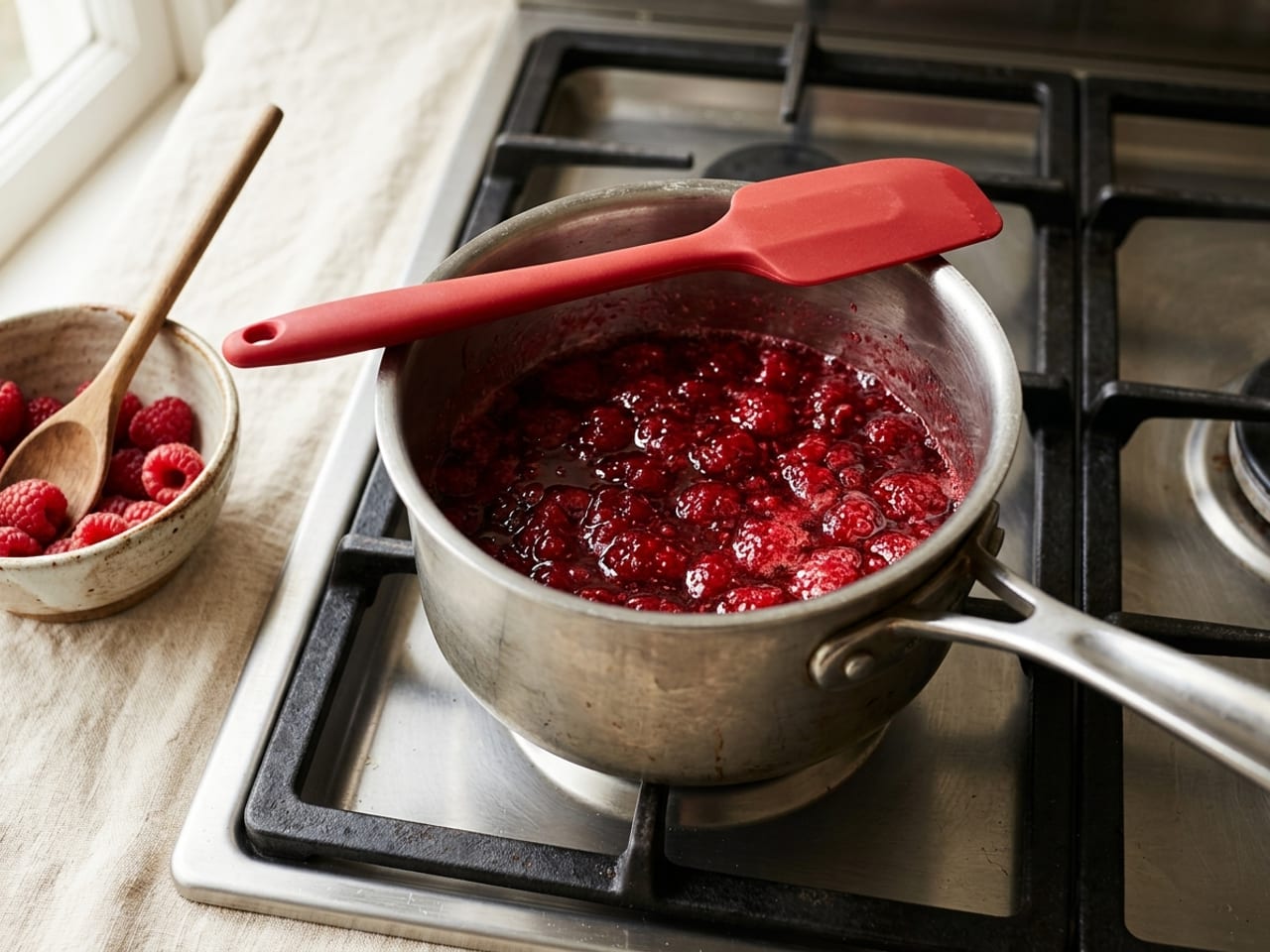
Six steps that hold for any fruit, each with its owners. The cooked and the raw routes differ only in step 2.
- 1. Taste the fruit before you weigh the sugar"Fruit must be tasted to be evaluated for flavor and sugar content so that any formula can be adjusted" (CIA).39 America's Test Kitchen leaves its sugar open for the same reason, because the berry and its ripeness change the sweetness: "Start with 5 tablespoons, then add more if you prefer a sweeter coulis."69 The published ratios run from no sugar to two thirds of the fruit's weight (see the table).
- 2. Heat it briefly, or not at allCooked: America's Test Kitchen brings fruit, sugar, salt and a little water to a bare simmer and cooks "about 1 minute longer", until the sugar dissolves; the CIA simmers "about 10 minutes" for the same reason.39, 69 RecipeTin Eats simmers 3 minutes because it makes the sauce "more syrupy", so it clings and does not "bleed" on the plate.71 Raw: BBC Good Food and Dorie Greenspan purée raw berries with sugar and sieve them; Bill Yosses blends raw raspberries with a syrup he boiled and cooled; Gisslen sieves the raw purée, then mixes in a syrup boiled to 220°F (105°C) and brings it back to the boil.36, 79, 83, 84 Whatever the route, keep the water small (pigments fade as they are diluted, "especially if they're cooked in a pot of water") and use a stainless or other non-reactive pan, since iron, aluminum and tin dull the red pigments (McGee).43 Figoni adds that fruit falls apart faster in a little water with the sugar held back until it collapses.42
- 3. Blend it brieflyAbout 20 seconds in a blender or food processor (America's Test Kitchen).69 "Do not be tempted to over-blend the raspberries as this will break up the seeds and discolour the coulis" (Sally Abé), and Friberg says broken kiwi seeds make a sauce look "muddy".38, 80 McGee: blenders crush best, while food processors "slice rather than crush".43 No blender: cook the fruit until it falls apart and push it through the sieve (Billy Parisi), or mash it with a potato masher first (Chef Not Required).72, 86
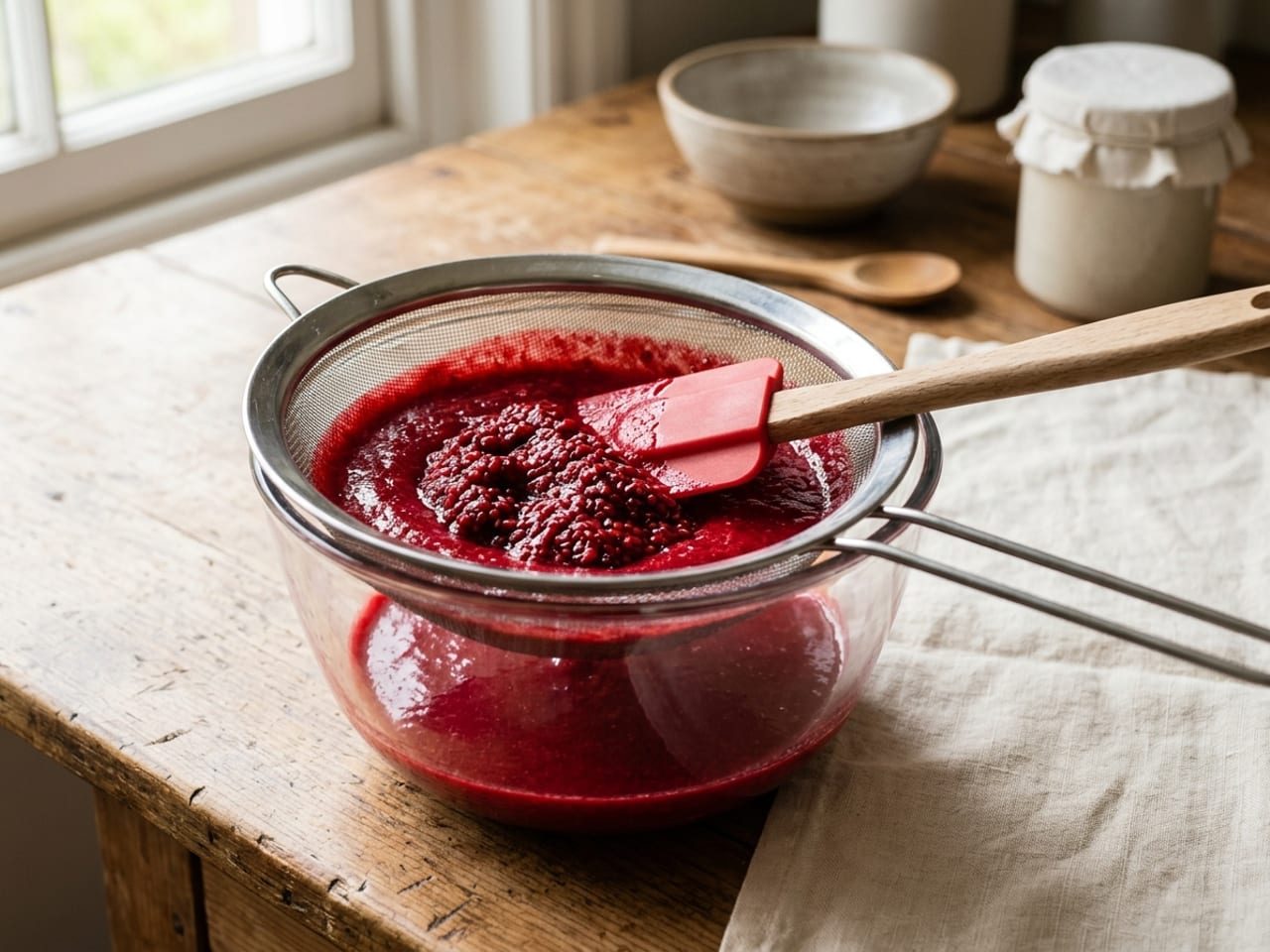
- 4. Strain itThrough a fine-mesh strainer, "pressing and stirring puree with rubber spatula to extract as much seedless puree as possible" (America's Test Kitchen), or a fine sieve or chinois (Gisslen).36, 69 Saucy Dressings sieves "ideally twice" with a conical sieve; A Baking Journey repeats until no seeds pass.73, 82 A food mill can replace both blender and sieve (GialloZafferano, Peterson).50, 81 Thick mango defeats a very fine mesh, so use a larger one (A Baking Journey).75 Of the ways to purée, forcing through a fine sieve "usually makes the smoothest purée, but it is also the most time-consuming" (Gisslen); fibres "can be removed only by passing the puree through a strainer" (McGee).34, 43 No coulis recipe we read names a tamis, the drum sieve.
- 5. Add the lemon, and any more sugar, while it is warmAmerica's Test Kitchen stirs in the lemon juice after straining, and any extra sugar "immediately after straining, while the coulis is still warm, so that the sugar will readily dissolve".69 The CIA puts half its sugar and lemon in the pan and holds the rest back to adjust; Saveur adds all its sugar to the hot strained coulis; Gisslen adds the juice after the last boil.36, 39, 90 Lemon earns its place on colour too: acid keeps the red pigments red and slows browning (McGee).43
- 6. Chill it, then correct the texture and the tasteA coulis thickens as it cools (RecipeTin Eats, Saveur, Chef Not Required).71, 86, 90 America's Test Kitchen chills it at least an hour and adds 1 to 2 teaspoons of water if it is then too thick.69 Taste it at the temperature you will serve it: "If raspberry coulis is to be served cold, evaluate it cold", since "Sweetness increases as product temperatures rise" (Figoni).42
Raspberry coulis recipe
Makes about 1½ cups (360 ml, ours): 12 servings by America's Test Kitchen's count, 2 tablespoons each (ours). Time: 15 minutes, plus at least an hour in the fridge (America's Test Kitchen's figures). Built on America's Test Kitchen's Berry Coulis, with the sugar range of the other published recipes beside it: our synthesis of the cited recipes, not one we tested.69, 70
| Ingredient | US | Metric | Why |
|---|---|---|---|
| Raspberries, fresh, or frozen and thawed | 12 oz | 340 g | America's Test Kitchen's amount, "(or thawed if frozen)".70 A one-minute simmer will not heat frozen fruit through, so thaw it (ours). Imported frozen berries get a full boil in step 1 (why). |
| Water | ¼ cup | 60 ml | Enough to start the fruit without washing out its colour.43, 70 |
| Granulated sugar, divided | 5 to 7 tbsp | about 60 to 90 g (ours) | America's Test Kitchen's range: 5 in the pan, the rest to taste.70 By our conversion that is 18 to 26% of the fruit's weight; the raspberry and any-berry coulis that weigh both run from 10% to 50% (the table). |
| Table salt | ⅛ tsp | ⅛ tsp | Of the sweet coulis we read, only America's Test Kitchen's salt it.70 |
| Lemon juice | 2 tsp | 2 tsp | Stirred in after straining, as America's Test Kitchen's method does; acid keeps the red bright.43, 70 |
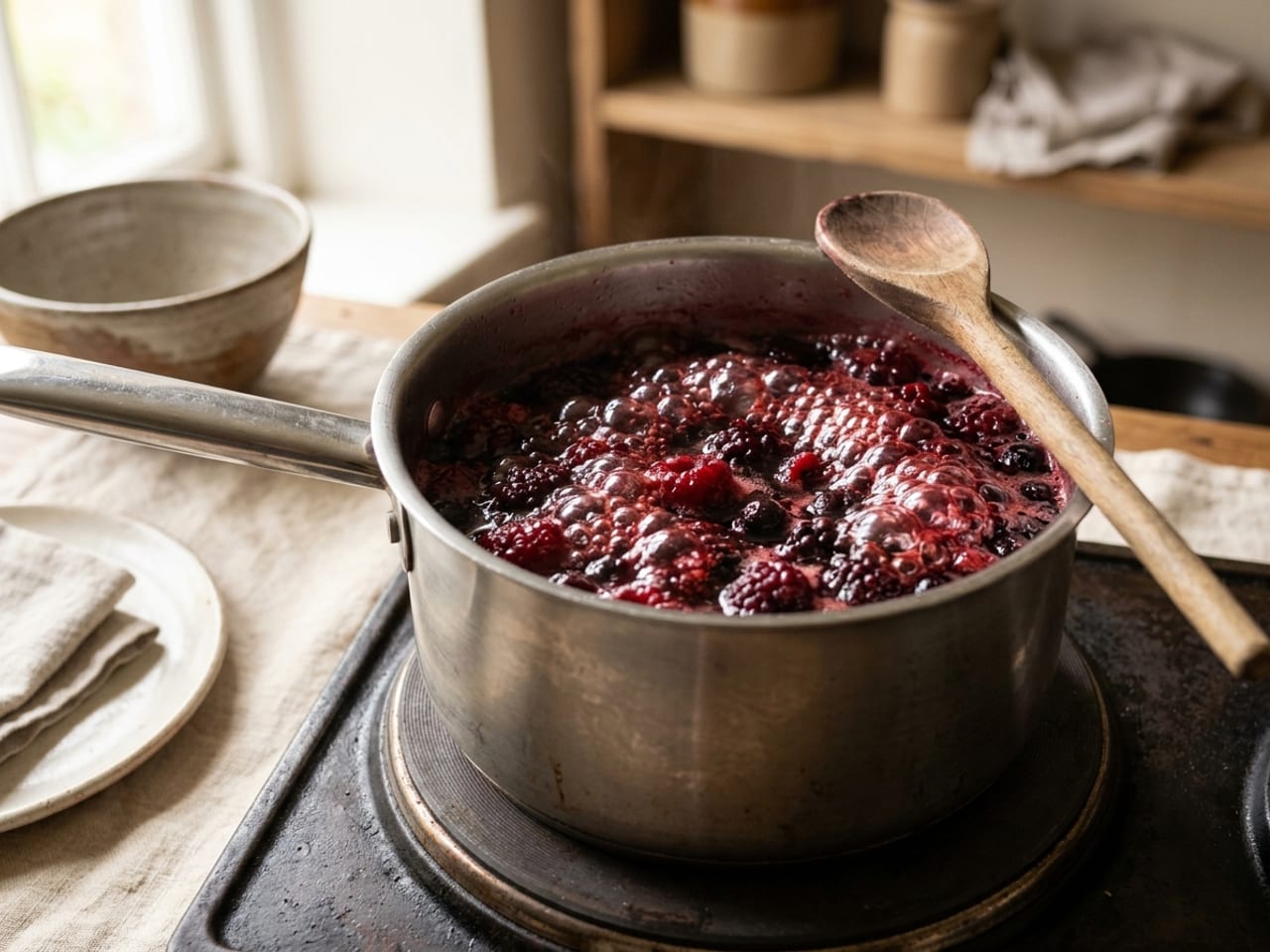
- Heat briefly. Put the raspberries, water, 5 tablespoons of the sugar and the salt in a stainless steel or other non-reactive saucepan. Bring to a bare simmer over medium heat, stirring now and then, and cook until the sugar has dissolved and the berries are heated through, about 1 minute longer.43, 69, 70 Imported frozen berries: bring the pan to a full boil instead and boil it for at least 1 minute, the advice of the Irish (FSAI), Swedish, Norwegian and Danish food agencies; Finland asks a 2-minute boil, or 90 °C (194 °F, ours) for 5 minutes (why).115, 118
- Blend, briefly. Blend until smooth, about 20 seconds, and no longer: over-blending breaks the seeds and dulls the colour.69, 70, 80
- Strain. Strain through a fine-mesh sieve into a bowl, pressing and stirring with a rubber spatula to get as much seedless purée through as you can. Discard the seeds.69, 70
- Season while warm. Stir in the lemon juice. Taste, and add up to 2 tablespoons more sugar now, while the coulis is warm enough to dissolve it.69, 70
- Chill and adjust. Chill for at least 1 hour; it thickens as it cools. Stir it before serving, and if it is then too thick, stir in 1 to 2 teaspoons of water. Taste it cold if you will serve it cold.42, 69, 70, 71
No-cook version. BBC Good Food blitzes 450 g of raspberries with the juice of half a small lemon and 3 tablespoons of icing sugar, pushes it through a sieve with a spatula, and keeps it two days.79 Use fresh berries for it, not imported frozen ones (next paragraph).
Why the full boil for imported frozen raspberries? The Irish, Swedish, Norwegian and Danish food agencies advise boiling them for one minute, Finland for two, because of hepatitis A and norovirus.115, 118 A bare simmer is gentler than a boil, so step 1 brings those berries to a full boil before you blend (ours; the advice by country).
Other berries. America's Test Kitchen's method takes blueberries, blackberries or hulled, sliced strawberries in the same amounts, or 3 oz (85 g) of each for a mixed berry coulis.69, 70
Coulis ratios: fruit, sugar, acid and heat, side by side
38 published recipes, amounts as each prints them. A metric amount in brackets after a US-only one is our conversion. The sugar percentage is our arithmetic and appears only where a recipe weighs both the fruit and the sugar (20 of them). Rows marked "starch" are starch-thickened sauces, which their author does not call coulis.
Raspberry
| Source | Fruit | Sugar | Sugar, % of fruit (ours) | Acid | Liquid | Heat | Raw or cooked | Sieve | Makes |
|---|---|---|---|---|---|---|---|---|---|
| America's Test Kitchen70 | 12 oz (340 g) | 5 to 7 tbsp | by volume, not computed | 2 tsp lemon, after straining | ¼ cup (60 ml) water | bare simmer, then about 1 min | cooked | fine-mesh, pressed | 1½ cups (360 ml) |
| CIA (2016)39 | 2 lb / 910 g | 8 oz / 230 g in the pan, of 1 lb / 450 g listed | 25.3% | 2 oz / 60 g lemon, half held back | none | simmer until the sugar dissolves (about 10 min in its basic method) | cooked | fine-mesh | 32 fl oz / 960 ml |
| RecipeTin Eats71 | 250 g / 8 oz | 2½ tbsp caster | by volume, not computed | ½ tsp lemon | none | simmer 3 min | cooked | optional | 1 cup (250 ml) |
| Billy Parisi72 | 1 cup (240 ml) | ¼ cup (60 ml) | by volume, not computed | juice of ½ lemon | 2 tbsp cold water | 15 to 20 min, "until it becomes thick and jammy" | cooked | fine mesh or chinois, no blender | 8 (servings) |
| A Baking Journey73 | 250 g | 50 g caster | 20% | 30 ml lemon | none | 10 to 15 min, low heat | cooked | thin-mesh, repeated | about 1 cup (240 ml) |
| Mad About Macarons76 | 200 g (7 oz) | 20 g (1½ tbsp) sugar or honey | 10% | juice of ½ lemon | none | fresh: none; frozen: about 5 min | raw or cooked | optional | 2 (servings) |
| Meaningful Eats77 | 6 oz (170 g) | 2 tbsp | by volume, not computed | 2 tbsp lemon, 1 tsp zest | none | 3 to 5 min | cooked | fine mesh | 6 (servings) |
| Emeril Lagasse78 | 2 cups (480 ml) | ¼ cup (60 ml), as a syrup | by volume, not computed | none | ¼ cup (60 ml) water, in the syrup (the source omits the unit; cup is ours) | syrup about 2 min, then fruit about 5 min | cooked | fine mesh, pressed | ⅔ cup (160 ml) |
| BBC Good Food79 | 450 g | 3 tbsp icing sugar | by volume, not computed | juice of ½ small lemon | none | none | raw | sieve, pushed with a spatula | a 500 ml jar |
| Sally Abé (Great British Chefs)80 | 200 g | 1 tbsp icing sugar | by volume, not computed | none | none | a few minutes, until the berries collapse | cooked | fine sieve | not printed |
| GialloZafferano81 | 250 g | 50 g powdered | 20% | 2 spoonfuls lemon | none | 2 to 3 min, then 1 more; or none | raw or cooked | sieve, or a food mill instead | 8.5 oz (240 g) |
| Saucy Dressings82 | 200 g / 7 oz, frozen | 40 g / 1½ oz icing sugar | 20% | ½ lemon | 2 tbsp liqueur | a boil, which it says you can skip | raw or cooked | conical sieve, "ideally twice" | not printed |
| Bill Yosses (NYT)83 | 2 cups (480 ml), fresh or frozen | 2 tbsp, as a cooled syrup | by volume, not computed | none | ¼ cup (60 ml) water in the syrup, 2 tbsp raspberry liqueur | only the syrup is boiled | raw | fine sieve | 8 (servings) |
| Dorie Greenspan (NYT)84 | 1 pint (about 475 ml) | about 3 tbsp | by volume, not computed | none | none | none | raw | strainer | 1 cup (240 ml) |
| Sue Millar Perry (NYT)85 | 1 quart (about 950 ml) | to taste | by volume, not computed | none | none | none | raw | none: a purée, by the definitions that require straining | 2 cups (480 ml) |
| Friberg, raspberry sauce (starch)38 | 2 lb (910 g) | about 2 oz (55 g), to taste | 6% | none | water to 4 cups (960 ml) of juice; 3 tbsp (24 g) cornstarch | simmered 1 min with the starch | cooked | seeds strained out first | about 4 cups (960 ml) |
Any berry or soft fruit
| Source | Fruit | Sugar | Sugar, % of fruit (ours) | Acid | Liquid | Heat | Raw or cooked | Sieve | Makes |
|---|---|---|---|---|---|---|---|---|---|
| Gisslen36 | 7 oz / 200 g berries or other soft fruit | 3.5 oz / 100 g, as a syrup | 50% | 0.5 oz (3 tsp) / 15 g lemon, at the end | 1.33 oz (8 tsp) / 40 g water, in the syrup; kirsch optional | raw purée warmed; syrup boiled to 220°F (105°C); back to a boil | raw, then boiled | fine sieve or chinois | 10 to 11 oz (300 g) |
Strawberry
| Source | Fruit | Sugar | Sugar, % of fruit (ours) | Acid | Liquid | Heat | Raw or cooked | Sieve | Makes |
|---|---|---|---|---|---|---|---|---|---|
| Chef Not Required86 | 500 g (frozen used) | 40 g, more to taste | 8% | 2 tbsp lemon | none | 12 to 18 min, uncovered | cooked | fine sieve | 1 cup (240 ml) |
| Marcellina in Cucina (and Greedy Gourmet)87 | 1 pound (500 grams) | ½ cup (120 ml) | by volume, not computed | 2 tbsp lemon | none | 10 min | cooked | optional | 8 (servings) |
| Friberg, strawberry sauce (starch)38 | 3 lb (1 kg 365 g) | 4 oz (115 g) | 8.4% | none printed | 2 tbsp (16 g) cornstarch per 4 cups (960 ml) of juice | boiled with the starch | cooked | strained | about 4½ cups (1 L 80 ml) |
Mixed berry
| Source | Fruit | Sugar | Sugar, % of fruit (ours) | Acid | Liquid | Heat | Raw or cooked | Sieve | Makes |
|---|---|---|---|---|---|---|---|---|---|
| America's Test Kitchen69 | 3 oz (85 g) each of strawberries, blueberries, raspberries, blackberries | 5 to 7 tbsp | by volume, not computed | 2 tsp lemon, after straining | ¼ cup (60 ml) water | bare simmer, then about 1 min | cooked | fine-mesh, pressed | 1½ cups (360 ml) |
| A Baking Journey74 | 500 g, frozen thawed and drained | 50 g caster | 10% | 15 ml lemon | none; ½ tsp vanilla optional | 15 to 20 min | cooked | sieve | 2 cups (480 ml) |
Blueberry
| Source | Fruit | Sugar | Sugar, % of fruit (ours) | Acid | Liquid | Heat | Raw or cooked | Sieve | Makes |
|---|---|---|---|---|---|---|---|---|---|
| Keep Calm and Eat Ice Cream88 | 3 cups (1 lbs/450gms) | ⅓ cup (75gms) | 16.7% | 1 tbsp lemon | none | the strained juice simmered about 15 min | sieved raw, then cooked | before cooking | 1½ cups (360 ml), about ¼ cup (60 ml) each |
Blackberry
| Source | Fruit | Sugar | Sugar, % of fruit (ours) | Acid | Liquid | Heat | Raw or cooked | Sieve | Makes |
|---|---|---|---|---|---|---|---|---|---|
| BBC Good Food89 | 250 g | 50 g golden caster | 20% | none | 100 ml / 3½ fl oz water, ½ tsp vanilla | boil, then 5 min | cooked | sieve, back of a ladle | about 150 ml / ¼ pint |
| Saucy Dressings82 | 300 g / 10 oz, frozen | 2 tsp honey | by volume, not computed | none | 3 tbsp kirsch or brandy, ½ tsp cinnamon | boiled | cooked | liquidised, pressed through a sieve | not printed |
Black currant
| Source | Fruit | Sugar | Sugar, % of fruit (ours) | Acid | Liquid | Heat | Raw or cooked | Sieve | Makes |
|---|---|---|---|---|---|---|---|---|---|
| Saveur90 | 2 cups (480 ml) | 4 to 6 tbsp, after straining | by volume, not computed | none | ⅔ cup (160 ml) water | about 10 min, until the berries break | cooked | fine sieve | 1 cup (240 ml) |
Cranberry
| Source | Fruit | Sugar | Sugar, % of fruit (ours) | Acid | Liquid | Heat | Raw or cooked | Sieve | Makes |
|---|---|---|---|---|---|---|---|---|---|
| Friberg, cranberry coulis38 | 12 oz (340 g) | 8 oz (225 g) | 66.2% | none | 2 cups (480 ml) water | 10 min, until popped; a quick boil; foam skimmed | cooked | strained | 3 cups (720 ml), read from the metric twin |
| Friberg, Bijou coulis38 | 1 lb (455 g) cranberries, 1 lb (455 g) raw raspberries | 8 oz (225 g) | 24.7% | none | ½ cup (120 ml) water | cranberries 10 min; raspberries added raw | part raw | fine mesh | about 4 cups (960 ml) |
Cherry
| Source | Fruit | Sugar | Sugar, % of fruit (ours) | Acid | Liquid | Heat | Raw or cooked | Sieve | Makes |
|---|---|---|---|---|---|---|---|---|---|
| Kitchen Konfidence91 | 2 cups (480 ml), pitted and halved | 3 tbsp | by volume, not computed | 2 tsp lemon | ¼ cup (60 ml) water | about 5 min | cooked | fine mesh | 1 cup (240 ml) |
Mango
| Source | Fruit | Sugar | Sugar, % of fruit (ours) | Acid | Liquid | Heat | Raw or cooked | Sieve | Makes |
|---|---|---|---|---|---|---|---|---|---|
| Friberg, mango coulis38 | 3 lb 8 oz (1 kg 590 g), 5 or 6 mangoes | none | 0% | ¼ cup (60 ml) lime, ¼ cup (60 ml) orange juice | none | raw purée strained, then a quick boil | raw, then boiled | fine mesh, for the fibres | 4 cups (960 ml) |
| A Baking Journey75 | 400 g, fresh or frozen | 50 g caster | 12.5% | 30 ml lime | 1 or 2 tbsp water if it sticks | 10 to 15 min (about 5 for very ripe small cubes) | cooked | optional; a larger mesh | about 400 g or 1½ cups (360 ml) |
| Saucy Dressings82 | 3 ripe mangoes | 2 tsp icing sugar | by volume, not computed | juice of ½ lemon | vanilla | simmered soft, blended warm | cooked | sieved | not printed |
Passion fruit
| Source | Fruit | Sugar | Sugar, % of fruit (ours) | Acid | Liquid | Heat | Raw or cooked | Sieve | Makes |
|---|---|---|---|---|---|---|---|---|---|
| Kilner92 | 6 passion fruit, pulp and seeds | 3 tbsp | by volume, not computed | 170 ml orange juice | 100 ml water | boil, then 5 to 6 min | cooked | seeds strained out after a few minutes' cooling | not printed |
Kiwi
| Source | Fruit | Sugar | Sugar, % of fruit (ours) | Acid | Liquid | Heat | Raw or cooked | Sieve | Makes |
|---|---|---|---|---|---|---|---|---|---|
| Savory Thoughts93 | 5 kiwi | ⅓ cup (80 ml) | by volume, not computed | juice of ½ lemon | none | covered until soft, or none | raw or cooked | not strained | 1 cup (240 ml) |
Rhubarb
| Source | Fruit | Sugar | Sugar, % of fruit (ours) | Acid | Liquid | Heat | Raw or cooked | Sieve | Makes |
|---|---|---|---|---|---|---|---|---|---|
| Everyday Pie94 | 3 cups (360 grams), diced | ¾ cup (150 grams) | 41.7% | ⅛ tsp orange zest | ½ cup (120 ml) water | 5 to 7 min | cooked | not strained | about 2 cups (480 ml) |
| e-santé95 | 1 kg stalks | 100 g | 10% | 1 lemon | a little water if needed | 30 min, covered, low heat | cooked | not strained | about 1 litre |
| Friberg, rhubarb sauce (starch)38 | 3 lb (1 kg 365 g) stalks | 1 lb 8 oz (680 g) | 49.8% | none printed | cornstarch, boiled 1 min | cooked until it falls apart | cooked | strained | 4 cups (960 ml) |
Apricot
| Source | Fruit | Sugar | Sugar, % of fruit (ours) | Acid | Liquid | Heat | Raw or cooked | Sieve | Makes |
|---|---|---|---|---|---|---|---|---|---|
| Robot-Coupe96 | 1 kg | 170 g sugar and 170 g invert sugar, with 20 g pectin (the 34% counts both) | 34% | 16 g lemon | none | 13 min at 105°C, in the machine | cooked | not printed | not printed |
What the table shows. For raspberry and berries in general, sugar runs from 10% (Mad About Macarons) to 50% (Gisslen), fivefold; the textbooks are sweeter (Gisslen 50%, the CIA 25% in the pan and up to 49% if all its sugar goes in) than recent berry blogs (8 to 20%); cranberry takes the most (our arithmetic). RecipeTin Eats says as much: "Some use up to 3 times as much sugar as I do."36, 39, 71, 76 Heat runs from none to 30 minutes, and America's Test Kitchen and the CIA, ten times apart, both cook until the sugar has dissolved; ATK adds that its minute combines the flavours and helps release the fruit's pectin.39, 69, 95 A rough rule we see across the yields, ours: about 1 cup (240 ml) of seedless coulis from 9 to 12 oz (250 to 340 g) of berries.
Strawberry, mango, blueberry and ten more fruit coulis
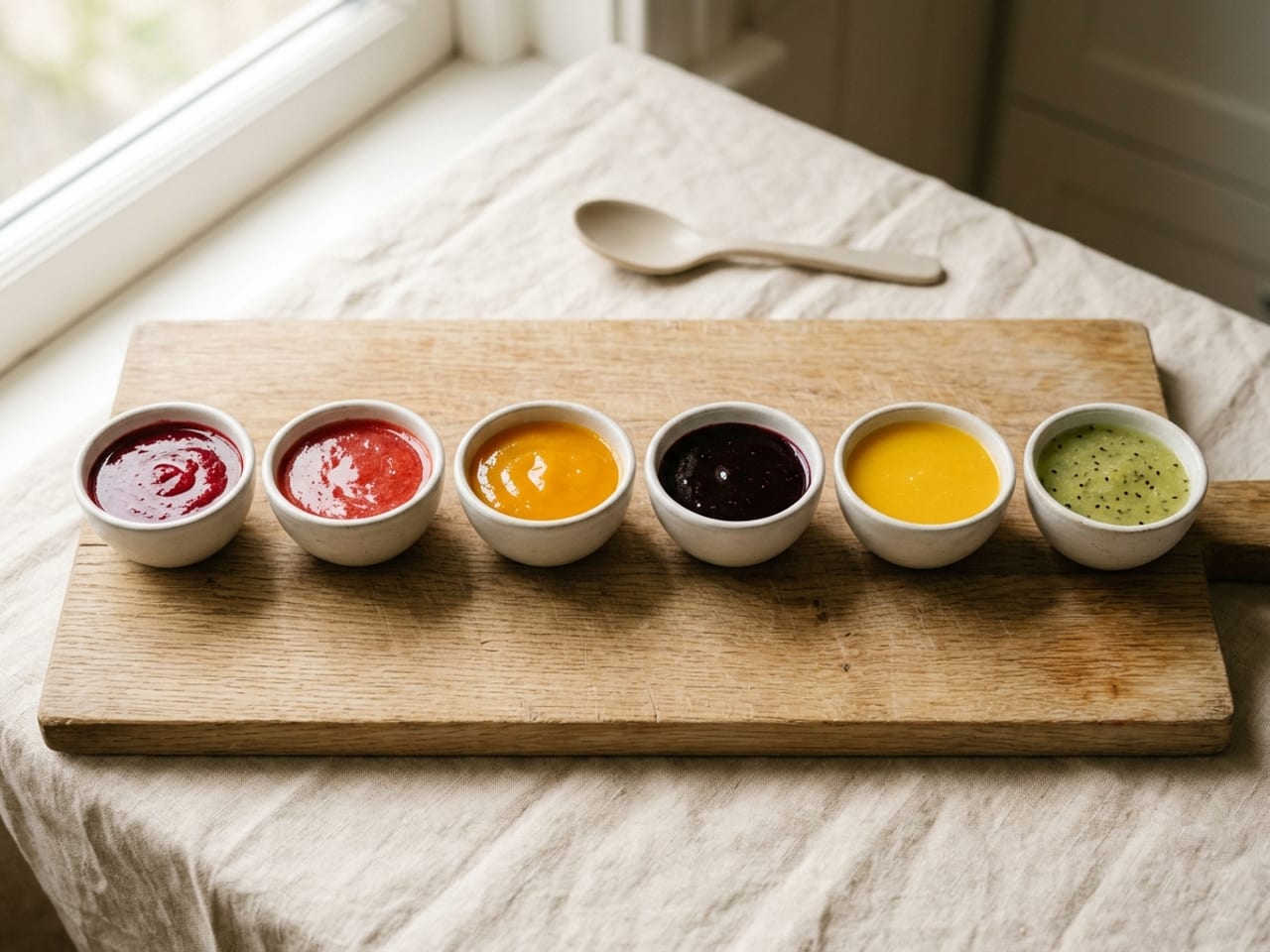
What the sources do with each fruit, and the catch that fruit brings. Each card's recipes are in the table.
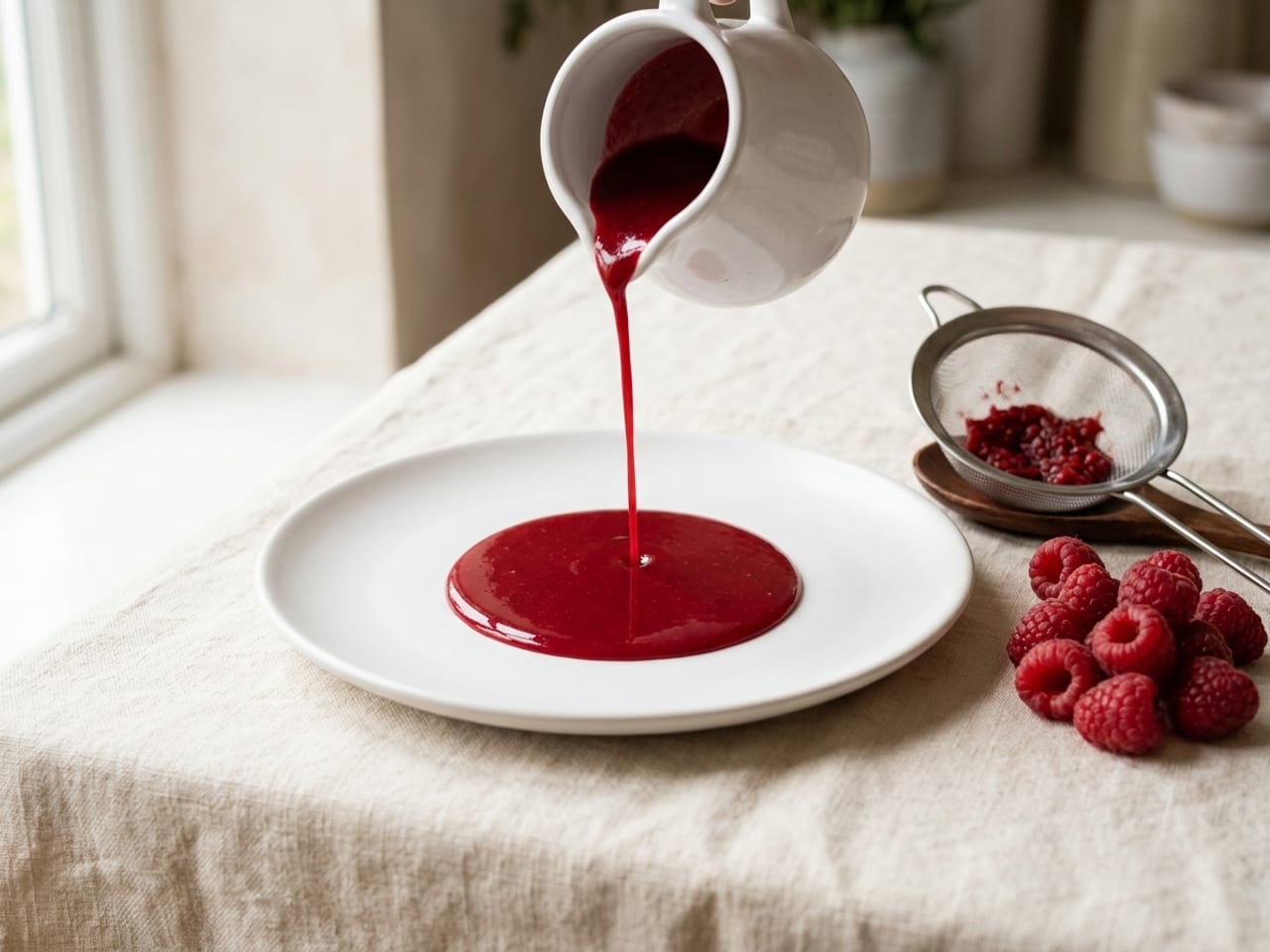
Raspberry coulis
Seeds, and a fivefold spread in sugar
"The best-known is raspberry coulis" (Friberg).38 The seeds are the reason to sieve; over-blending breaks them and "discolour[s] the coulis" (Sally Abé).80 Sugar is where recipes part: 10% of the fruit's weight at Mad About Macarons, 20% at A Baking Journey and GialloZafferano, 25% in the CIA's pan, 50% in Gisslen's formula for any berry (our arithmetic).36, 39, 73, 76, 81 For frozen berries Friberg wants IQF, "Frozen fruit given this designation does not have any added sugar", while Figoni finds sugar-packed fruit keeps its colour and flavour better.38, 42 The recipe above is a raspberry coulis.
Strawberry coulis
Pale berries and a colour that fades
The CIA makes its strawberry coulis by swapping fresh or frozen strawberries into the raspberry formula.39 Chef Not Required simmers 500 g of frozen berries with 40 g of sugar for 12 to 18 minutes; Marcellina in Cucina uses ½ cup (120 ml, ours) of sugar to a pound (500 grams).86, 87 Saucy Dressings disagrees on frozen fruit: "don't be tempted to use frozen".82 Under-ripe berries are "bland and without much color"; Friberg adds raspberry or beet juice, or as a last resort a drop or two of red food colouring.38 Strawberry colour is fragile: in model juices "The strawberry MJ stability was very low", and heated purée browns faster the hotter it gets (science).107, 108
Mixed berry coulis
The mix sets the sharpness
America's Test Kitchen's takes 3 oz (85 g) each of strawberries, blueberries, raspberries and blackberries.69 A Baking Journey: "a larger amount of raspberries or blackberries will create a tangier sauce than one made with a lot of strawberries for example."74
Blueberry coulis
So much pectin it can set
Keep Calm and Eat Ice Cream sieves the raw purée first, then simmers the juice with sugar and lemon for about fifteen minutes.88 Friberg warns that "Due to the large amount of pectin in blueberries, the sauce may set up too much": reheat it and thin it with water or simple syrup.38 Gisslen finds blueberry sauce may have "a more desirable texture when thickened slightly with starch".36 Blueberry pigments are the pH-sensitive kind, red in acid and blue or purple nearer neutral (Figoni).42
Blackberry coulis
Seeds take a big share of the yield
BBC Good Food simmers 250 g with 50 g of golden caster sugar and 100 ml (3½ fl oz) of water for 5 minutes and gets "about 150ml/¼ pint"; we note that this is less than other recipes get from a similar weight of fruit.89 Saucy Dressings sweetens frozen blackberries with honey, kirsch and cinnamon and says that to make a coulis "you need to liquidise and press it through a sieve".82 America's Test Kitchen's single-berry coulis takes blackberries too.70
Black currant coulis
Sugar after straining
Saveur simmers 2 cups (480 ml, ours) of black currants in water about 10 minutes, strains them and only then stirs in 4 to 6 tablespoons of sugar, while hot; "it will thicken as it cools".90 Guérard served a "coulis de cassis" with floating islands in 1976.27
Cherry coulis
Pitting, and a deep pH-sensitive red
Kitchen Konfidence cooks 2 cups (480 ml, ours) of pitted, halved cherries with ¼ cup (60 ml, ours) of water, 3 tablespoons of sugar and 2 teaspoons of lemon for about 5 minutes, then blends and strains them: 1 cup (240 ml, ours) of coulis.91 Friberg's cherry sauce is cooked with red wine and thickened with cornstarch; canned cherries need "only about 5 minutes".38 Cherries, like blueberries and cranberries, carry pH-sensitive anthocyanins (Figoni).42
Mango coulis
Fibres, and a purée that is already thick
Friberg uses no sugar at all: ripe mangoes, lime and orange juice, puréed, strained of their "stringy fibers" and brought to a quick boil.38 A Baking Journey cooks frozen cubes "straight from the freezer" and warns that the thick coulis is hard to push through a very fine sieve.75 Gisslen thins purées of pulpy fruit "(such as mangoes)" with water, simple syrup or juice.36 Friberg's shortcut, thawed frozen mango purée, usually needs cornstarch, which in his terms makes it a sauce.38 The CIA swaps chopped mango into its raspberry formula.39
Passion fruit coulis
Strain the seeds out after cooking
Kilner boils the pulp and seeds of 6 passion fruit with 170 ml of orange juice, 100 ml of water and 3 tablespoons of sugar, simmers 5 to 6 minutes, cools it a few minutes and strains out the seeds.92 Marks & Spencer's bottled mango and passion fruit "coulis" is thickened with cornflour.97
Kiwi coulis
Heat turns it yellow; raw, it eats gelatin
Kiwi carries an enzyme "that inhibits gelatin from setting up"; cooking kills it, but "Kiwi goes from bright green to yellowish at about 140°F (60°C)" (Friberg, whose text prints both), so he thickens kiwi sauce with gelatin warmed to only about 110°F (43°C).38 McGee names the enzyme, actinidin, which "can damage other ingredients in a mixture"; heat "muddies the fruit's delicate color".43 Figoni keeps a kiwi coulis green with an instant starch that needs no heat.42 Blend it briefly: broken seeds look "muddy" (Friberg). The CIA's kiwi coulis swaps kiwi purée into its raspberry formula.39 Our caution, from McGee's account of the enzyme: keep a raw kiwi coulis beside a gelatin panna cotta or a cream rather than under it, where it can attack the gelatin and other proteins it touches. In UK adults the most common cause of kiwi allergy is pollen food syndrome; most people with it react to the raw fruit but "are able to eat the cooked fruit or vegetables without any problem". More serious reactions not related to pollen also occur, more often in children, and heat is no guarantee against those (ours).129
Pineapple and papaya coulis
Cook it before dairy or gelatin
McGee: bromelain "will break down gelatin, so pineapple for gelatin-based desserts must be cooked first", and with milk or cream it makes "bitter-tasting protein fragments"; papaya, melons and kiwi stop gelatin setting too.43 The CIA's Pineapple-Sage Coulis brings the pineapple to a simmer with coconut milk, papaya, sugar and rum.39
Rhubarb and cranberry coulis
Tart fruit, and the widest split
Cranberry tops the table: Friberg's cranberry coulis carries sugar at 66% of the fruit's weight. Rhubarb splits: Everyday Pie's is about 42%, e-santé's 10% (our arithmetic).38, 94, 95 Friberg skims the foam off his cranberry coulis and wants his cranberry and raspberry Bijou coulis to stay sharp: "The coulis should be tangy."38 Neither rhubarb recipe is sieved.94, 95
Apricot and peach coulis
Stone fruit browns; canned apricots are allowed
Robot-Coupe's professional apricot coulis adds 20 g of pectin, 170 g of sugar and 170 g of invert sugar per kilo of fruit, and gelatine leaves if it is to set as a cake layer.96 Saucy Dressings makes peach coulis "the same as for mango coulis", with four or five peaches.82 Friberg, "opposed to using fruit" from a can, makes apricots "one of the few exceptions", using the can's syrup.38 Cut fruit browns; lemon slows it (science).
Savoury coulis: red pepper, tomato, herb and pea
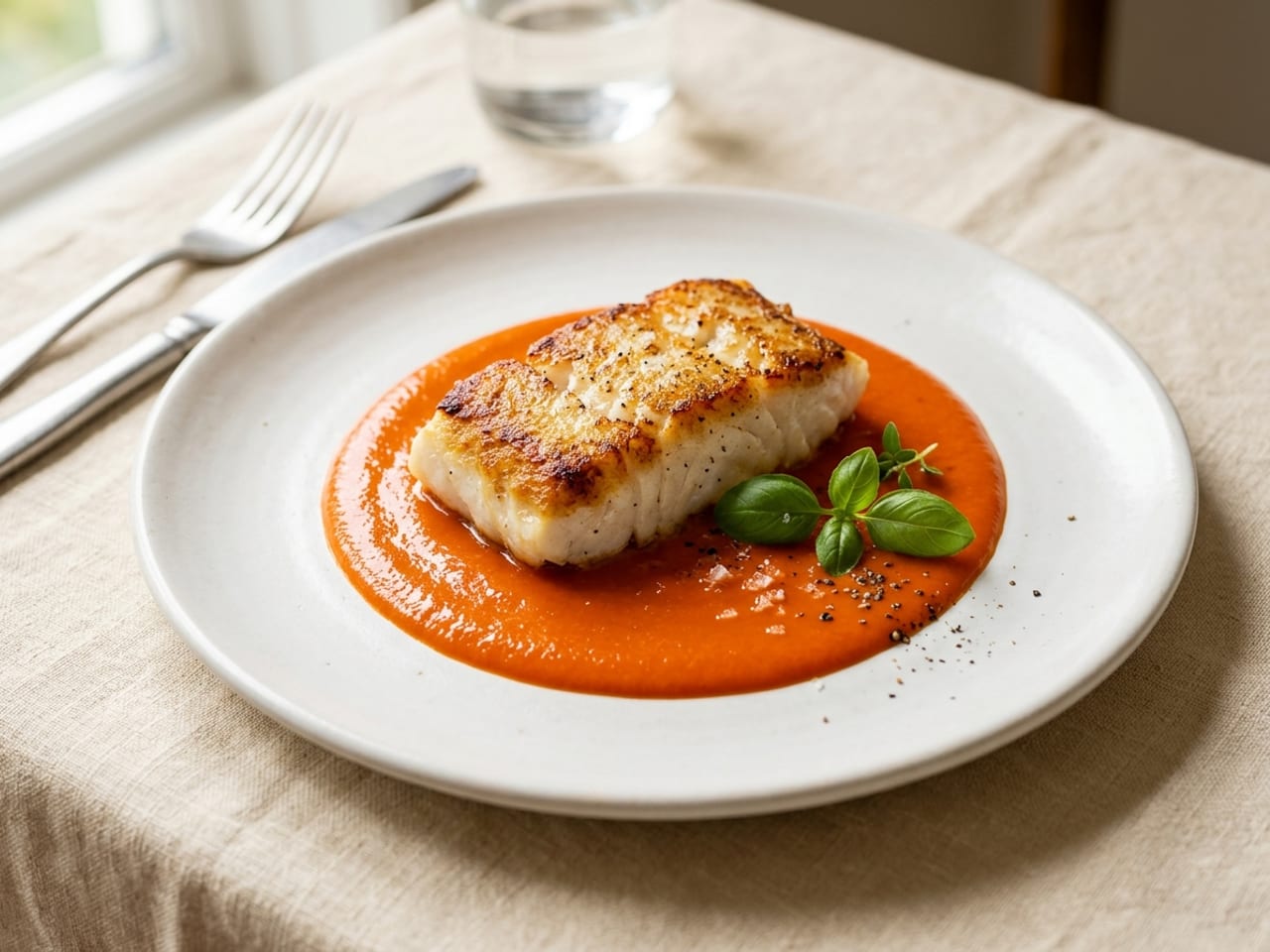
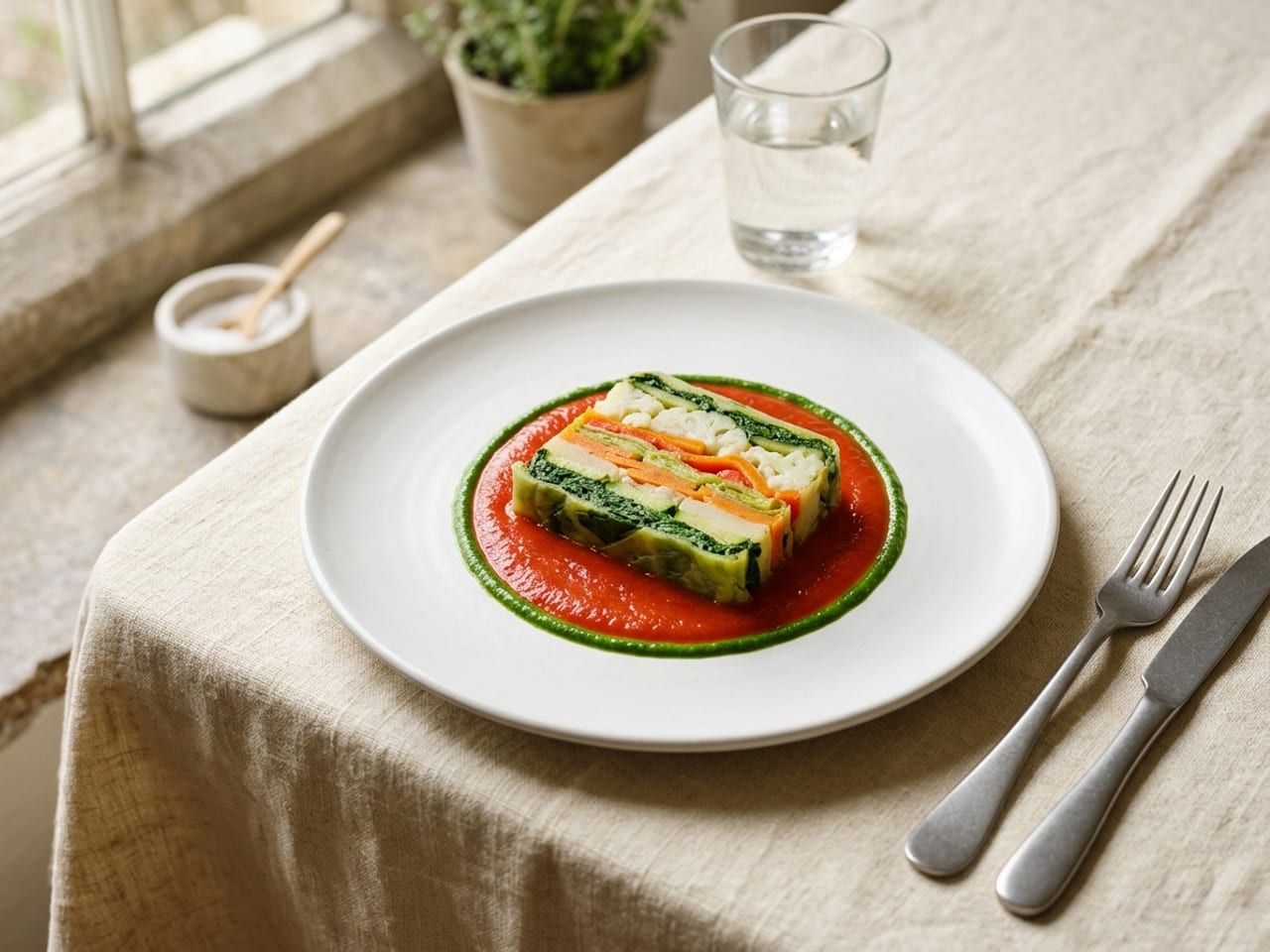
- A different method from fruitVegetable coulis are cooked first, with aromatics and liquid, then puréed and strained: the open saucier textbook cooks the main ingredient with onions, garlic, shallots, herbs or spices, then says "Puree the main ingredient and flavoring ingredients in a food mill, blender or food processor" and "Strain, then thin and season the coulis as desired", naming broccoli, tomatoes and sweet red peppers as popular bases.58 The published recipes cook 15 to 25 minutes in stock, wine or tomato juice and use little or no sugar.50, 98, 99, 101, 102 Gisslen calls a purée-thickened tomato sauce a coulis and lists vegetable coulis among the "healthful sauces" for grilled fish.34 Herbs and green vegetables are the exception: blanched for seconds, not simmered, to keep them green (below).
- Red pepper coulisGisslen sweats red or yellow peppers with shallots in olive oil, covered, "until vegetables are soft, about 20 minutes", adds stock or water, purées and strains; his variation mixes it with an equal volume of tomato purée.35 Emeril Lagasse cooks roasted peppers with shallot and white wine for 20 minutes and strains "for a more refined sauce"; two NYT writers simmer raw peppers in tomato juice or stock and reduce the purée to about 1½ cups (360 ml, ours) without straining.98, 99 It purées smooth without starch: "more than 75% of the cell-wall solids in capsicum puree is pectin" (McGee).43 Roger Vergé served a "coulis de poivrons doux" with a vegetable aspic in his 1979 English edition.28 Our recipe is below.
- Tomato coulis"A coulis is simply a puree that has been strained", and Peterson's simplest tomato coulis is chopped, unpeeled tomatoes simmered soft, worked through a food mill or strainer and cooked down until thick.50 Gisslen's Fresh Tomato Coulis with Garlic cooks peeled, seeded tomatoes "until excess liquid has cooked out".35 Food & Style reduces white wine with shallots, adds 1½ lbs (680 g) of ripe tomatoes or a 15 oz (425 g) can of plum tomatoes and simmers 20 to 25 minutes.102 McGee: a raw tomato purée "cooked quickly close to the boil" gives "a thicker sauce that requires less subsequent reduction", because the enzymes that cut pectin stop around 180°F/80°C; a fast boil loses more of the fresh green note.43 In France a coulis de tomate is simply tomato sauce, "autre nom de la sauce tomate".10, 13
- Herb, pea and other green coulisKoppert Cress blanches 100 g of frozen peas in salted water, refreshes them in ice water, blitzes them with 100 g of cold chicken stock and passes them "through a fine chinois".105 For parsley, Jean-Hugues Belpois blanches the leaves 30 seconds, plunges them into very cold water "to keep the nice green colour", squeezes and blends them with ice-cold water or dry white wine and lemon; the colour fades if it waits, so he suggests "a pinch vitamin C before blending".106 Gisslen thickens a cold snap pea coulis with xanthan gum, and tells you to use a green basil sauce "within 24 hours, or preferably the same day".35 Watery purées such as asparagus can be reduced, "but be careful not to lose the fresh vegetable taste and color" (Gisslen).35 An herb coulis kept under oil is a botulism question: see safety.
- Carrot and root coulisDavid Tanis simmers carrots, garlic and onion in broth with vinegar, cayenne and a little honey about 15 minutes, purées them thoroughly and strains them "if necessary": "Coulis should not be too thick, but rather similar to a thin milkshake", and he ladles "about ¼ cup" (60 ml, ours) under seared scallops.101 Carrots, like peppers, make naturally smooth purées (McGee).43 The idea is old: Massialot's 1693 "Coulis de Racines" pounds carrots, parsley root, parsnips and onions with almonds and soaked bread.16
- When the word is stretchedSome popular "red pepper coulis" recipes blend a roasted pepper with mayonnaise, or with cream and olive oil, and strain nothing.103, 104 A 1986 NYT "Tomato Coulis With Basil" is chopped tomatoes cooked 2 minutes in butter, glossed "Stewed tomatoes with basil".100 By the definitions that require straining, these are sauces, not coulis (ours).44, 50
Red pepper coulis recipe
Time: about 30 minutes, 20 of them at the stove (Emeril Lagasse's 20 minutes; the rest ours). Makes roughly 10 fl oz (300 ml): Emeril Lagasse prints no yield, and Gisslen's Bell Pepper Coulis makes 2½ pt (1.25 L) from 4 lb (2 kg) of peppers, and this 1 lb (450 g) batch is a quarter of that (our scaling). Built on Emeril Lagasse's roasted red pepper coulis and Gisslen's bell pepper coulis: our synthesis, not a recipe we tested.35, 98
| Ingredient | US | Metric | Why |
|---|---|---|---|
| Red bell peppers, roasted, peeled, seeded and roughly chopped | 1 lb | 450 g (ours) | Emeril Lagasse's amount and preparation. Reluctant Gourmet allows jarred roasted peppers "only if they are packed in water".98, 103 |
| Olive oil | 1 tbsp | 1 tbsp | Gisslen sweats his peppers in olive oil, 2 fl oz (60 ml) to 4 lb (2 kg) of peppers; scaled to this batch that is 1 tbsp (our arithmetic).35 |
| Shallot, diced | 1 tbsp | 1 tbsp | Emeril's aromatic; Gisslen uses shallots too.35, 98 |
| Dry white wine, or stock | ½ cup | 120 ml (ours) | Emeril cooks in wine; Gisslen uses stock or water.35, 98 |
| Salt and black pepper | to taste | to taste | Seasoned at the end, as Emeril does.98 |
| Stock or water, to thin | as needed | as needed | The saucier textbook thins vegetable coulis with stock, water or cream.58 |
- Cook gently. Warm the oil in a large sauté pan over low heat, add the shallot, then the peppers and the wine. Cook gently for about 20 minutes, until everything is soft.35, 98
- Purée. Purée until smooth in a blender.35, 98
- Strain. Push it through a fine sieve for a refined sauce, as Emeril and Gisslen do.35, 98
- Adjust. Season with salt and pepper. Thin it with stock or water a spoonful at a time, or simmer it to reduce if it is too thin.58, 99
- Serve warm or cold. Serve it warm or cold, with fish, vegetables or goat's cheese (what to serve it with).58, 160, 161
Keeping it. The one bell pepper coulis in our storage table keeps 5 days in a sealed container in the fridge.142 There is no tested home-canning process for puréed peppers, so freeze it for longer (canning).123, 124 By the OSU and Nummer advice (our application), roasted peppers kept under oil before they are puréed are a botulism risk: refrigerate them and use them within four days, or freeze them (peppers and herbs in oil).114, 126
How to make a coulis thicker or thinner, and stop it bleeding
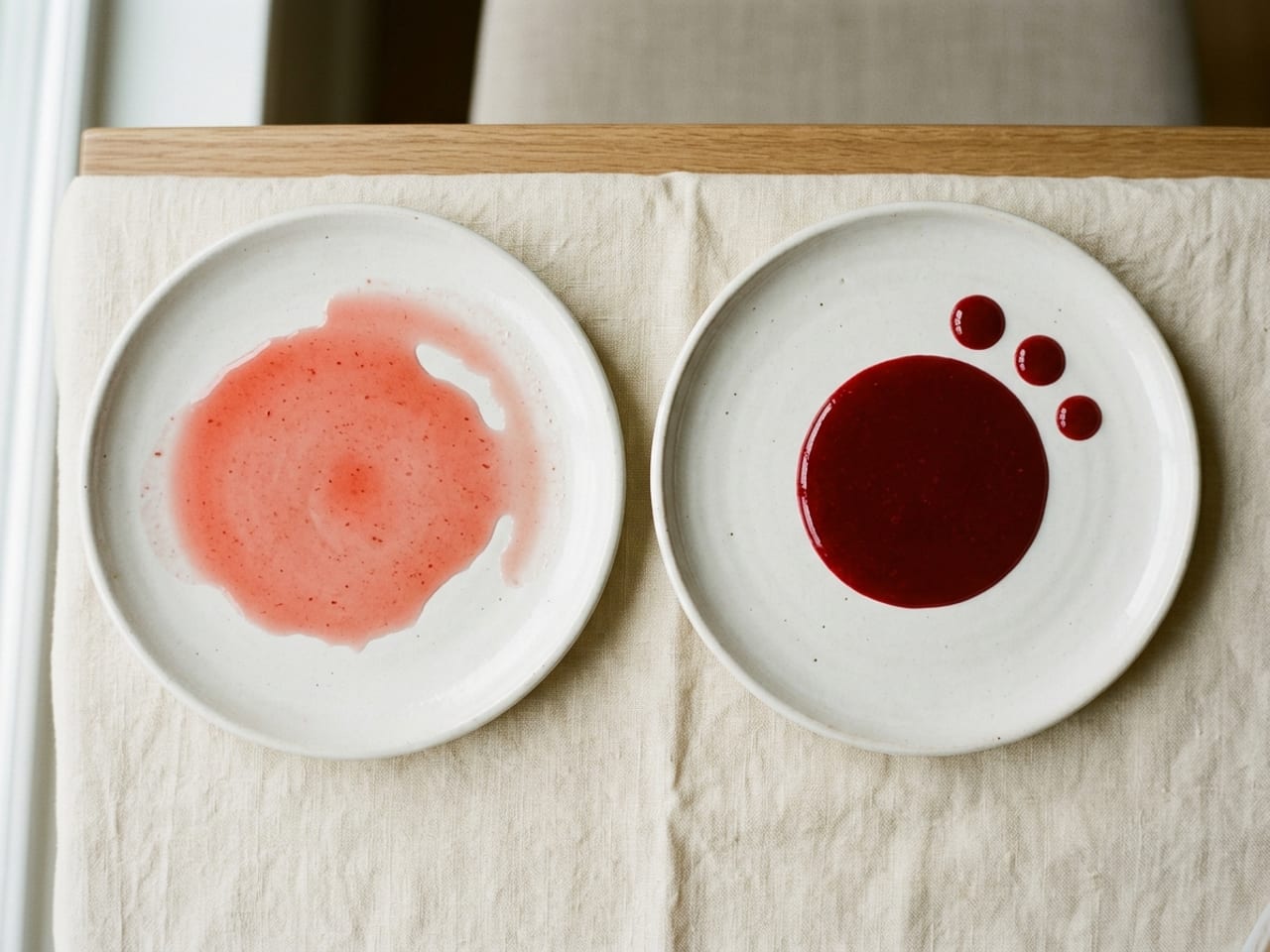
- Why a coulis bleeds into a watery haloMcGee explains it: the plant-cell fragments in a purée "range from 0.01 to 1 millimeter across", bind water far less well than dissolved molecules, and, being denser, "end up sinking and separating from the fluids".43 The pastry textbook's warning follows: a coulis "may separate quickly when used as a plating sauce. It's best to use à la minute."56 So plate it last, and do not let it stand on the plate (our reading of both). Our sauce plating guide collects every printed fix for weeping.
- Thicker: reduce it, or reduce only the thin part"The simplest way to do this is to cook the whole puree down, simmering gently, until the separate thin phase disappears"; a way that "better preserves the puree's fresh flavor" is to drain the thin fluid off and cook it down on its own, then add it back (McGee).43 Gisslen's raspberry sauce: "Use as is or simmer until thickened, as desired."36 RecipeTin Eats simmers so the coulis clings and does not bleed.71 The limit is taste: America's Test Kitchen's long-cooked sauces "tasted like jam", and Billy Parisi cooks his on purpose "until it becomes thick and jammy".69, 72
- Thicker: cornstarch, which may change the nameThe CIA: "a slurry made of 2 oz/60 g water and 1 oz/30 g cornstarch per 2 lb/910 g of coulis", whisked into the boiling coulis and brought back to a boil, which is about 3% of the coulis's weight (ours).39 Friberg: "If you add the thickener, you will create a sauce rather than a coulis"; he boils a starch sauce about 1 minute "to eliminate any cornstarch flavor".38 Acid works against starch: it makes it "overcooked" and thin, and cornstarch's "Gel tightens and weeps over time", while arrowroot is "Relatively stable against acid, heat, mixing, freezing", the starch Figoni lists for "Fruit pies and sauces"; or add the acid after the starch has thickened and cooled.42 No coulis recipe we read uses arrowroot.
- Thicker without heat: instant starchInstant (pregelatinized) starch thickens cold, so "the bright green color and delicate flavor of a kiwi coulis is not damaged"; Figoni calls these starches "ideal for last-minute thickening of sauces for plated desserts".42
- Against weeping: a pinch of xanthanLersch: "Add xanthan to reduce syneresis (water drainage), even in cold preparations", and "To keep water from leaking out of vegetable purées, add a touch of xanthan gum"; about 0.25% for "thin running sauce", which is 2.5 g per kilogram (ours). It is shear-thinning, thick at rest and fluid when stirred, and stops hydrating only above 65% sugar, far sweeter than any coulis here.59 Gisslen thickens a cold snap pea coulis with it; xanthan-thickened liquids "have the same thickness whether hot or cold".35 Lersch writes of purées, not of coulis by name; Gisslen's pea coulis shows it in one.
- Set it: pectin, gelatin, glucoseRobot-Coupe's apricot coulis carries 20 g of pectin per kilo of fruit, about 2% (ours), and adds gelatine to set it as a cake layer.96 Gisslen uses "a small amount of gelatin to thicken a liquid just to the consistency of a sauce"; Friberg sets kiwi sauce with 4 tablespoons (36 g) of gelatin per 3 cups (720 ml, ours) of juice.36, 38 Figoni names low-conversion glucose syrups "for thickening fruit coulis".42
- Hold a shape: an agar fluid gelLersch's basic fluid gel: 185 g of liquid flavour base with 2 g of agar (1.1%) and 0.35 g of xanthan (0.19%), boiled, "Allow to cool until solidified. Place solid gel in a blender and blend until creamy." Agar sets at 0.2%, tolerates acid, sugar, alcohol and protein-digesting enzymes, and does weep (Lersch marks syneresis "yes").59 Made from a strained fruit purée it gives clean dots that hold (ours); by Friberg's rule it is no longer a coulis. See the fluid gel card.
- Thinner: water, syrup, juice or stockA coulis thickens as it cools, so thin it cold: America's Test Kitchen adds 1 to 2 teaspoons of water after chilling, Emeril "a teaspoon at a time".69, 78 Gisslen thins pulpy purées "with water, simple syrup, or an appropriate fruit juice"; Friberg thins a blueberry sauce that has set with water or syrup; savoury coulis take stock, water or cream.36, 38, 58
- How thick? Not "until it coats a spoon"No coulis source we read uses a nappe or "coats a spoon" test. The textures they print are comparisons: "a thin tomato sauce" (the saucier textbook), "a thin milkshake" (Tanis, savoury), "like that of a syrup" (Savory Thoughts, kiwi).58, 93, 101 For plating, America's Test Kitchen asks a thick, smooth sauce for a swoosh or a squeeze bottle, a thin one for a brush, and a deep plate for a pool.68 Our sauce plating guide has every published thickness rule.
Coulis from frozen berries, from jam and from canned fruit
- Coulis from frozen berriesMany of the recipes we read accept frozen fruit; they split on thawing it first (the table below). Our note: thawing matters most for a raw coulis and for a one-minute simmer, which would not heat frozen fruit through. Freezing and thawing a purée frees more pectin from the cell walls (McGee).43 The food-safety catch: imported frozen berries carry hepatitis A and norovirus often enough that Irish, Swedish, Norwegian and Danish agencies advise boiling them for a minute (Finland two), so a raw coulis from imported frozen berries is the use those agencies advise against (ours; details under safety).115, 118
- Coulis from jamA textbook method, not only a shortcut: Gisslen's second kind of fruit sauce is "Heated, strained fruit jams and preserves, diluted with simple syrup, water, or liquor." 36 RecipeTin Eats warms ⅓ cup (80 ml, ours) of jam and stirs in 2 tablespoons of lemon juice and 1 to 2 tablespoons of hot water; Saucy Dressings warms 100 g of seedless raspberry jam with ½ teaspoon of lemon; The Nibble: "Jam can be diluted to approximate coulis".67, 71, 82 The two lemon amounts are about twelve times apart for similar amounts of jam (our arithmetic), so add lemon to taste.
- Coulis from canned fruitFriberg is "opposed to using fruit" from cans out of season but makes apricots an exception, replacing the water and sugar with the can's syrup and cooking only 1 minute; canned cherries need "only about 5 minutes".38 Food & Style accepts a can of plum tomatoes in winter and spring.102 Canned fruit may carry citric acid, ascorbic acid or sulfites against browning (Figoni).42 Tinned berries "have not been identified as a risk" for the viruses (FSAI, Ireland).115
- Bought purées and bottled coulis"Frozen fruit purees may look like ready-made sauces and coulis, but they are not": taste first, since one is likely "too sour and strong tasting, even if sugar is listed as an ingredient" (Figoni).42 A sweetened frozen raspberry purée from Boiron is 85% raspberry and 15% invert sugar syrup at 20 °Brix; its label, as a retailer reproduces it, gives 15 days in the fridge after thawing, against 3 days for the unsweetened purée, and says not to refreeze either.152, 153 Marks & Spencer's bottled mango and passion fruit coulis contains cornflour and 27.1 g of sugars per 100 g, and is to be eaten within 7 days of opening.97
Frozen berries: thaw first, or straight into the pan?
| Source | What it says |
|---|---|
| America's Test Kitchen69 | "(or thawed if frozen)" |
| Gisslen, Melba sauce36 | "Thaw the raspberries and force them through a sieve" |
| Friberg38 | "fresh or frozen"; thawed IQF raspberries |
| CIA (2016)39 | "Raspberries (fresh or frozen)", no thawing step |
| RecipeTin Eats71 | "fresh or frozen (no need to thaw)" |
| A Baking Journey, raspberry73 | thaw "for about 30 minutes" first |
| A Baking Journey, mixed berry74 | "fresh or frozen, thawed & drained" |
| A Baking Journey, mango75 | "straight from the freezer" |
| Mad About Macarons76 | frozen berries cooked gently about 5 minutes; fresh ones not cooked |
| Chef Not Required86 | "(I used frozen)" |
| Saucy Dressings82 | frozen raspberries and blackberries; strawberries "don't be tempted to use frozen" |
| Keep Calm and Eat Ice Cream88 | "If using frozen blueberries allow them to defrost first." |
America's Test Kitchen and Gisslen thaw first, Friberg thaws for his raspberry sauce, and the CIA gives no thawing step; the most popular blog and some others do not thaw; one blog says both on different pages.
Colour and flavour: why raspberry stays red and kiwi does not
- Why raspberry stays red: acidBerry reds are anthocyanins: "In acid conditions, anthocyanins tend toward the red; around neutral pH, they're colorless or light violet; and in alkaline conditions, bluish." McGee adds that iron, aluminum and tin turn them grey, green, blue or brown, and that "The key to maintaining natural anthocyanin coloration is to keep fruits and vegetables sufficiently acidic, and avoid supplying trace metals"; lemon juice helps both ways, since "its citric acid binds up metal ions".43 Figoni's version: red at low pH, blue or purple at medium, green at high, in blueberries, cranberries and cherries.42
- What heat does: dull colour, cooked flavourIn one study of heated strawberry purée, the rate of anthocyanin loss "increased linearly with temperature, but decreased slightly with sugar concentrations", and browning climbed steeply with heat (the chart).107 McGee: pigments leach and fade, "especially if they're cooked in a pot of water"; heat and acid break pectin down, so cooking should be "as brief and gentle as possible"; and industrial jam makers cook under vacuum at 100 to 140°F (38 to 60°C) "to maintain as much fresh flavor and color as possible".43 That fits America's Test Kitchen's one-minute simmer, chosen for flavour.69 A raw purée is fresher but "fragile and changeable"; McGee's fix is to chill it.43 Two findings point opposite ways: Figoni holds the sugar back so fruit breaks down faster, while the strawberry study found sugar slightly protects colour; no source we read tested the two in a coulis.42, 107
- Why apple, banana and pale fruit brown: enzymesCut fruit browns when its enzymes, phenolics and oxygen meet. "The single handiest method for the cook is to coat cut surfaces with lemon juice: the browning enzymes work very slowly in acidic conditions"; chilling below about 40°F/4°C slows them, and "Boiling temperatures will destroy the enzyme" (McGee).43 GialloZafferano's lemon in its raw coulis "will help prevent the pulp from browning"; Figoni also names ascorbic acid.42, 81 On cut banana slices, pineapple juice held back browning about as well as ascorbic acid, and in banana purée one fraction of the juice did better than ascorbic acid; malic and citric acids do the work.110
- Seeds: they dull the colour; bitterness is unprovenOver-blending "will break up the seeds and discolour the coulis" (Sally Abé), and broken kiwi seeds "give the sauce a muddy appearance" (Friberg).38, 80 Whether crushed raspberry seeds make a coulis bitter, no source we read tested; in raspberry juice making, the tannins stayed in the press cake "especially in its seedless fraction", which does not point at the seeds.109 See the claims table.
- Why a coulis is not jam, and does not keep like itA pectin gel, jam, sets best at 60 to 65% sugar; McGee's test is a boil to 217 to 221°F (103 to 105°C), which "indicates that the sugar concentration has reached 65%".43 Every coulis here is far less sweet than that (ours), which is why A Baking Journey says its coulis should not be canned, "as the level of sugar is too low to safely preserve it for weeks or months".73 For frozen fruit, NCHFP says sugar is there "only to maintain flavor, color and texture", not as a preservative.122
How long coulis lasts in the fridge, and freezing it
The keeping times we read, as printed, from 27 sources, shortest first (a few more books say much the same). None says how it reached its figure, and no food agency page we read has an entry for coulis.
| Source | Which coulis | Fridge | Freezer |
|---|---|---|---|
| Dorie Greenspan (NYT)84 | raw raspberry | "up to a day" | not given |
| Clements, Edible for the Irritable140 | not visible | 1 to 2 days | not given |
| BBC Good Food79 | raw raspberry | up to two days | not given |
| Lovefoodies130 | raw raspberry | up to two days | "We don't suggest you freeze coulis" |
| Emeril Lagasse78 | cooked raspberry | up to 3 days | not given |
| Kitchen Konfidence91 | cooked cherry | up to 3 days | not given |
| BBC Good Food89 | cooked blackberry | up to 3 days | up to 3 months |
| Food & Style102 | cooked tomato | up to 3 days | up to 1 month |
| Chattman, Icebox Pies136 | raspberry, mango | up to 3 days | up to 6 months |
| The Vitamix Cookbook145 | berry | 3 to 4 days | up to 1 month |
| America's Test Kitchen69 | cooked berry | up to 4 days | not given |
| Magnier-Moreno, Cooking from Above139 | not visible | 4 days | not given |
| Marcellina in Cucina87 | cooked strawberry | within 4 days | "Or freeze" |
| Vanilla Bean Cuisine131 | raw strawberry (cooking optional) | up to 4 days | up to 3 months, ice-cube tray |
| Bravo!142 | cooked bell pepper | 5 days | not given |
| Billy Parisi72 | cooked raspberry | up to 7 days | up to 3 months |
| Michel Roux, Sauces135 | coulis in general | up to a week (his cucumber coulis 48 hours) | not given |
| Molly Moon's Homemade Ice Cream137 | not visible | up to 1 week | not given |
| RNZ (Stephanie Everitt)134 | cooked raspberry | up to a week | "freeze in smaller batches" |
| RecipeTin Eats71 | cooked raspberry | one week in the recipe card, up to 2 weeks in the text | 3 months |
| Baking With Butter132 | cooked strawberry | up to a week in the recipe card, up to two weeks in the text | up to 3 months, ice-cube trays |
| A Baking Journey73 | cooked raspberry | up to 2 weeks (one line of the page says 1 week) | not given |
| Addicted to Dates133 | cooked strawberry | up to 2 weeks | "a couple of months", ice-cube tray |
| Saveur90 | cooked black currant | up to 2 weeks | not given |
| Thompson, Dallas Classic Desserts141 | not visible | 2 weeks | not given |
| Vinton, Put 'em Up!144 | cooked berry | up to 3 weeks (which recipe the line belongs to is not certain) | up to 6 months |
| North, French Lessons138 | berry, stone fruit | not given | up to 3 months |
What the table says. The four raw coulis say 1 to 4 days, three of them 2 days or less; cooked ones run from 3 days to 2 weeks (3 weeks in Vinton, if that line is the coulis's), and three blogs give two different times on the same page. Our reading: the raw figures are the ones to trust for a raw coulis, and a short time is the safe side of any range.
The agencies' general rules, kept apart. UK: fridge at 0 to 5°C (32 to 41°F, ours), "Eat leftovers within 48 hours or freeze them", defrost in the fridge overnight and use food "within 24 hours after it's been fully defrosted".127 US (USDA, as Nebraska Extension relays it): leftovers keep 3 to 4 days in the fridge or 2 to 6 months frozen, and frozen food is safe indefinitely at 0°F (-18°C, ours) though it loses quality.128 Neither mentions coulis.
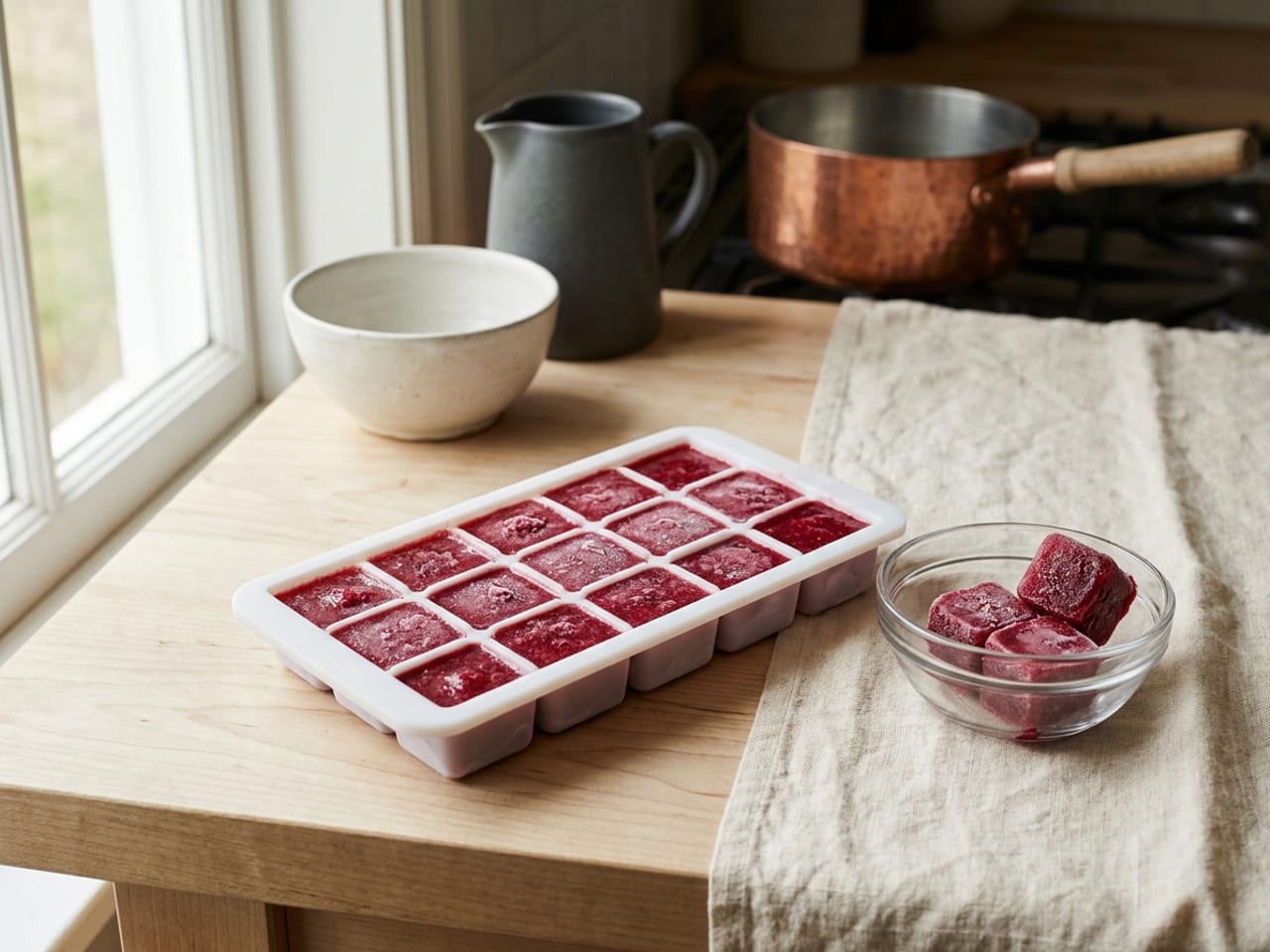
Freezing. Most sources freeze it, for 1 month (Food & Style, Vitamix) to 6 months (Chattman, Vinton); Marco Pierre White and Jesse Ziff Cool say it freezes well and Mary Berry freezes hers; Sue Lawrence, Dorling Kindersley's freezer book and Lovefoodies say not to, and none says why.102, 130, 136, 144, 145, 146, 147, 148, 149, 150 Ice-cube trays give small portions (Vanilla Bean Cuisine, Baking With Butter, Addicted to Dates); thaw it overnight in the fridge and whisk it back to its texture, or reheat and cool it again (Billy Parisi).72, 131, 132, 133 Leave room in the container: Penn State asks ½ inch (1.3 cm, ours) of headspace for puréed fruit in a wide-top pint and 1 inch (2.5 cm, ours) in a wide-top quart, because "Liquid expands when frozen".125
Frozen berries, vegetable coulis and canning: what the agencies say
Frozen berries, hepatitis A and norovirus, country by country
Frozen berries have caused large outbreaks. In Europe in 2013 and 2014, 1,589 hepatitis A cases were tied to mixed frozen berries, 70% of them hospitalised, with two deaths; in Ireland, berry cheesecake was the food most strongly linked to the illness.111, 112 In Germany in 2012, nearly 11,000 people fell ill from one batch of frozen strawberries carrying norovirus, served by large kitchens.116 Freezing does not kill these viruses.115, 118 Each country's advice, in its own terms:
| Where | What the agency says |
|---|---|
| Ireland (FSAI)115 | "the FSAI recommends boiling imported frozen berries for one minute before consumption", particularly for vulnerable people; "Boiling for one minute will destroy viruses, if present." No temperature is given. Unlabelled berries are to be treated as imported; fresh and home-grown frozen berries are outside the advice. |
| Sweden (Livsmedelsverket)118 | "Koka utländska frysta hallon 1 minut", boil imported frozen raspberries for 1 minute (our translation); the advice to businesses was withdrawn in 2021, the consumer advice kept. Boiling one minute cuts hepatitis A by at least 4 log10 units, though the berries' structure suffers badly (our translation). |
| Norway (Matportalen, via the Swedish report)118 | Boil imported frozen berries 1 minute if they go into dishes that are not otherwise heated. |
| Denmark (Fødevarestyrelsen)118, 119 | Advice: boil frozen berries at least a minute, until they bubble. Law since 2012 for businesses: frozen raspberries in products that are not heated must be heat-treated at least one minute at 100 °C (212 °F, ours), or treated another way with the same effect; the requirement covers frozen raspberries, not fresh. |
| Finland (Ruokavirasto, via the Swedish report)118 | Heat foreign frozen berries right through at 90 degrees (194 °F, ours) for at least 5 minutes, or boil them 2 minutes. |
| Germany (BfR, 2013; BVL, 2019)116, 117 | BfR: briefly or unevenly heated dishes with contaminated frozen berries carry a high risk, and heating to core temperatures "von über 90 °C" (above 90 °C, 194 °F, ours) seems suitable to inactivate the viruses; it gives no time. Advice to heat for 2 minutes above 90 °C, seen in German press, is attributed there to a consumer group (Verbraucherzentrale Bayern), not an agency; we did not read it at the source. BVL: heat frozen berries before using them in desserts, cakes or drinks. |
| Australia and New Zealand (FSANZ and MPI)120, 121 | For manufacturers: cook to 85°C (185°F, ours) for 1 minute, with the food matrix mattering; sugar protects the virus, so in strawberry mash at 85°C a millionfold reduction took 6 minutes at 28 °Brix and 30 minutes at 52 °Brix. FSANZ's 2015 recall page for consumers instead calls the virus "resistant to freezing and heating" and gives no boiling advice. |
| United States113 | FDA and CDC pages refused our server, so we print no US agency advice. FDA authors describe two 2022 to 2023 hepatitis A outbreaks tied to fresh and frozen organic strawberries from one Mexican grower: 39 cases in the US and Canada, 21 hospitalised. |
| United Kingdom127 | We found no Food Standards Agency advice on frozen berries. |
What it means for a coulis (ours). A cooked coulis brought to a full boil for one minute meets the Irish, Swedish, Norwegian and Danish advice (Finland asks a 2-minute boil); a bare simmer may not reach a boil, and a sweet coulis needs longer heat than plain fruit by the FSANZ figures.115, 120 A raw coulis blended from imported frozen berries is exactly the unheated use those agencies advise against, though the pastry textbooks describe uncooked coulis from frozen fruit.47, 56, 115 For vulnerable diners, young children, older people, pregnant women and anyone with a weakened immune system, the German agencies say frozen berries only "ausreichend erhitzt", sufficiently heated.117
Herbs, garlic and peppers in oil
Garlic, chili peppers and herbs in oil are low-acid foods in an airless setting, "perfect for growth of Clostridium botulinum bacteria"; homemade flavoured oils, pesto included, are to be refrigerated and used within 4 days, or frozen, and crushed herbs in oil can be frozen in ice-cube trays (Oregon State University Extension).126 A review of home-prepared vegetables in oil lists peppers, garlic, mushrooms and eggplant among the foods behind botulism outbreaks and calls freezing "The safest recommendation".114 One cookbook keeps a "basil coulis" of basil and garlic under olive oil "for several weeks in the refrigerator"; that conflicts with the 4-day rule, which we follow.143
Canning a coulis
The US National Center for Home Food Preservation has a tested process for fruit purée: fruit cooked soft with 1 cup (240 ml, ours) of hot water per quart (950 ml, ours), pressed through a sieve or food mill, reheated to a boil, packed hot with ¼ inch (6 mm, ours) of headspace and processed in a boiling-water canner for 15 minutes up to 1,000 ft (300 m, ours), 20 up to 6,000 ft (1,830 m, ours) and 25 above.122 It excludes, among others, tomatoes, melons, papaya and ripe mango: "There are no home canning recommendations available for purees of these products."122 It says not to can puréed vegetables at all, and its only pepper process is pepper pieces in a pressure canner.123, 124 So a raw coulis, a coulis with extra lemon, liqueur or starch, and any vegetable coulis are not the tested product: freeze them (ours). A blog's 10-minute jar boil kept for 12 months, and a British preserving book's line that a vegetable coulis "must be sterilized", both conflict with NCHFP.132, 151
How to plate a coulis
A summary with a coulis in mind. Every move, with its steps and the thickness it needs, lives in our sauce plating guide; for the rest of a dessert plate, see dessert plating.
A pool, under or beside
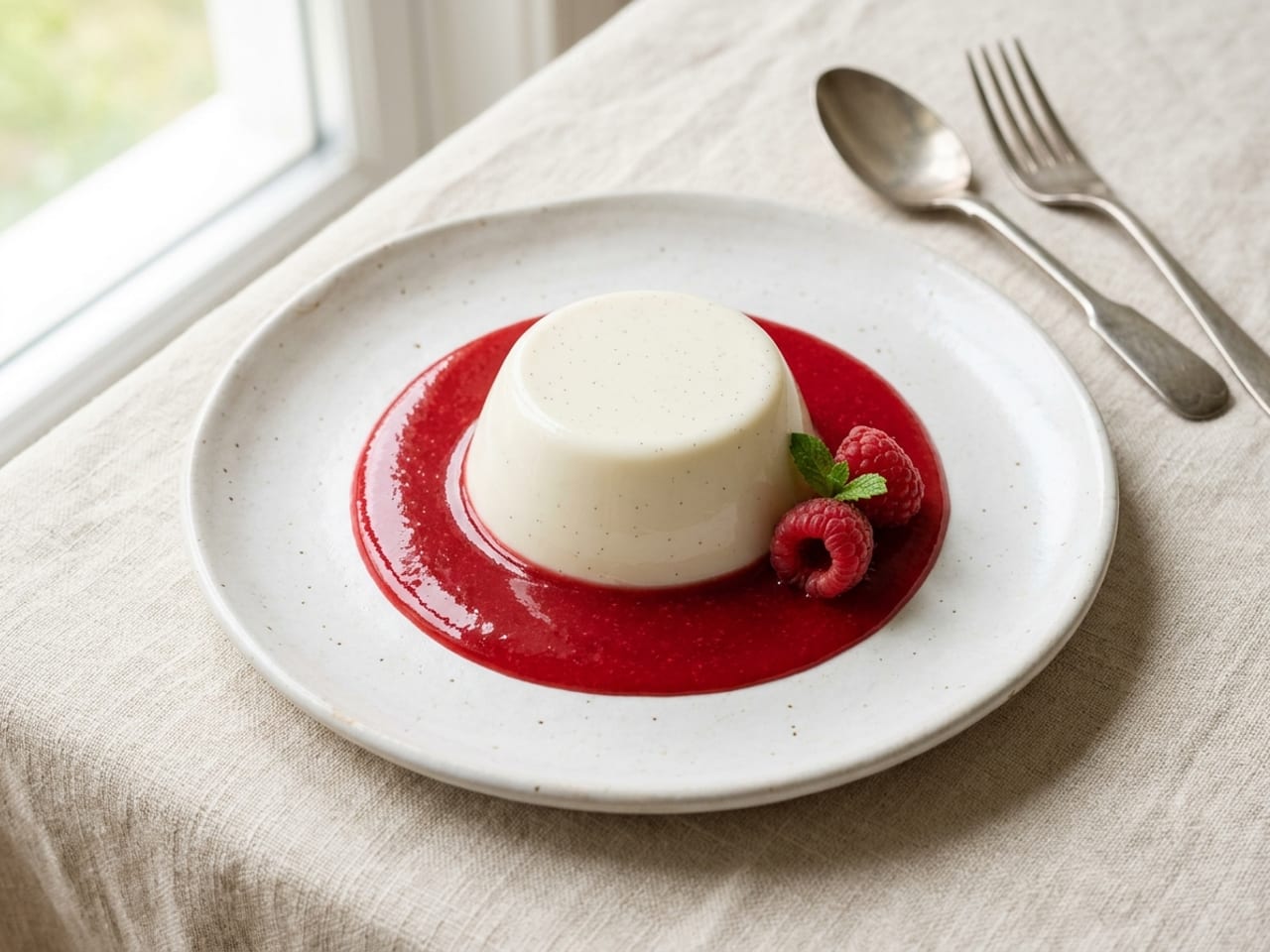
Dessert sauce goes on the plate, not over the dessert, "applied in a decorative fashion to the plate rather than the dessert", and a smaller pool "avoids overwhelming the dessert with too much sauce" (BCcampus).56 Gabriel Gaté turns a panna cotta out onto a spoonful of raspberry coulis; Friberg stands cannoli in the centre of a pool of cranberry coulis.38, 162 For a round pool, America's Test Kitchen uses "a deep plate or a shallow bowl", and Anne Willan chooses slightly hollow plates so that the coulis stands out (our translation).68, 157 Tasting Table prefers flat plates for sauce work (sauce plating).
Dots and lines from a squeeze bottle
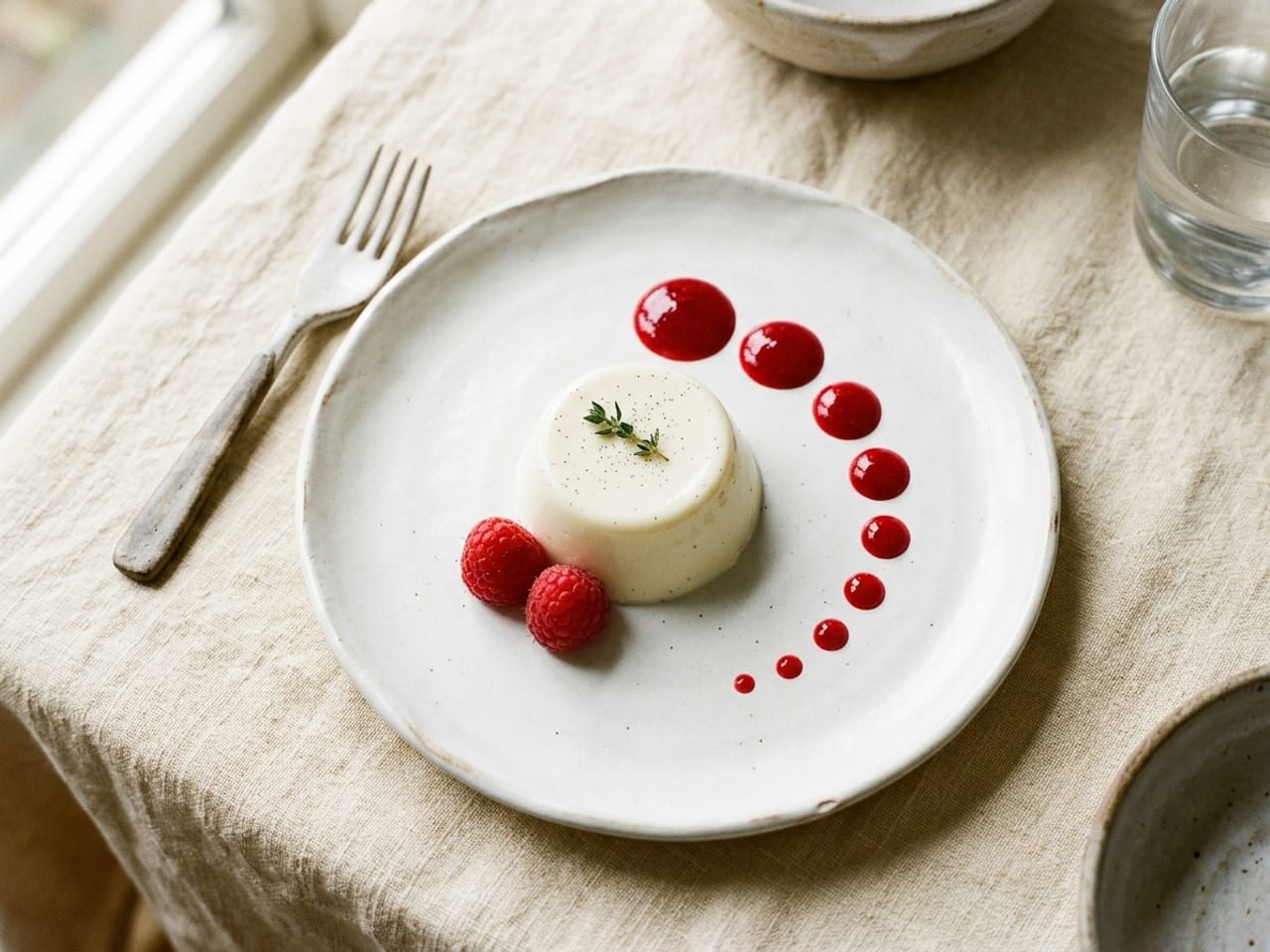
"A squeeze bottle is useful for making dots, lines, curves, and streaks of sauce in many patterns" (BCcampus).56 Gisslen sets "a decorative series of dots of raspberry coulis" beside a chocolate bread pudding, chosen "to lighten the dish and provide tartness"; the CIA places drops of raspberry sauce around a plate's inner rim from a squeeze bottle.36, 40 A thin coulis may spread; a dot needs a sauce that will stay put (America's Test Kitchen's rule for the bottle).68
A swoosh, a streak or a brushstroke
A small amount of sauce streaked "with a brush, an offset spatula, or the back of a spoon" (BCcampus).56 On Baking's photographs show mango coulis painted with a pastry brush, teardrops of fruit coulis and a spatula run through a line.46 America's Test Kitchen keeps the swoosh for thick, smooth sauces, so a thin coulis suits the brush better (our reading).68 The flick and the splatter are in our sauce plating guide.
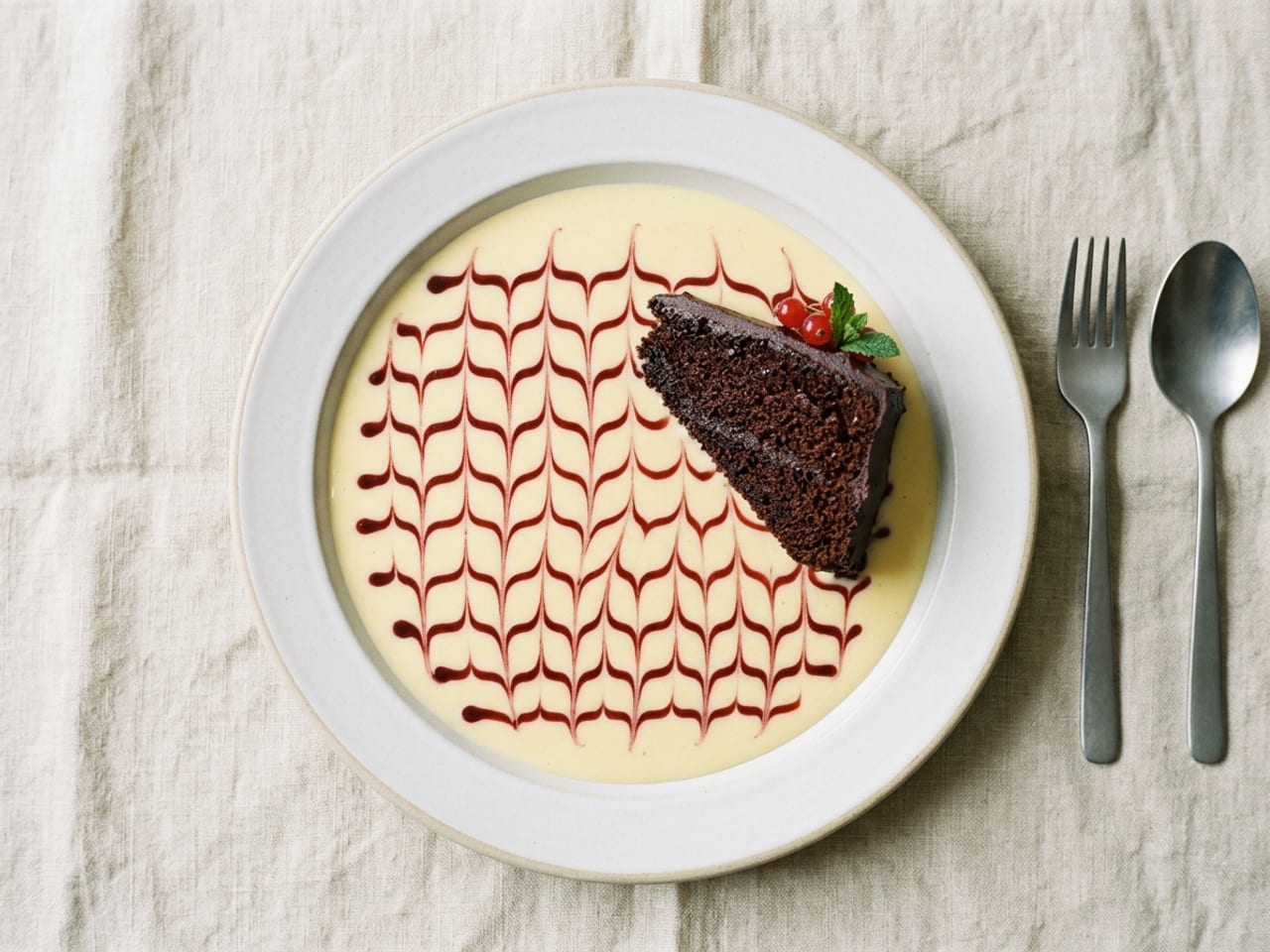
Marbled and feathered with a second sauce
Pool sauces "are often marbled or feathered" by piping lines or dots of a contrasting sauce and drawing a pick or skewer through, and "If you pipe a heavier sauce onto a pool of another sauce, the heavy piping will sink out of sight" (Gisslen).37 BCcampus: the two sauces "should be at about the same fluidity or consistency"; Sokol pairs "crème anglaise and raspberry coulis" and asks for "the same thickness or viscosity".47, 56 The CIA pulls a dot of crème fraîche through each pool of raspberry sauce into "a paisley design".40
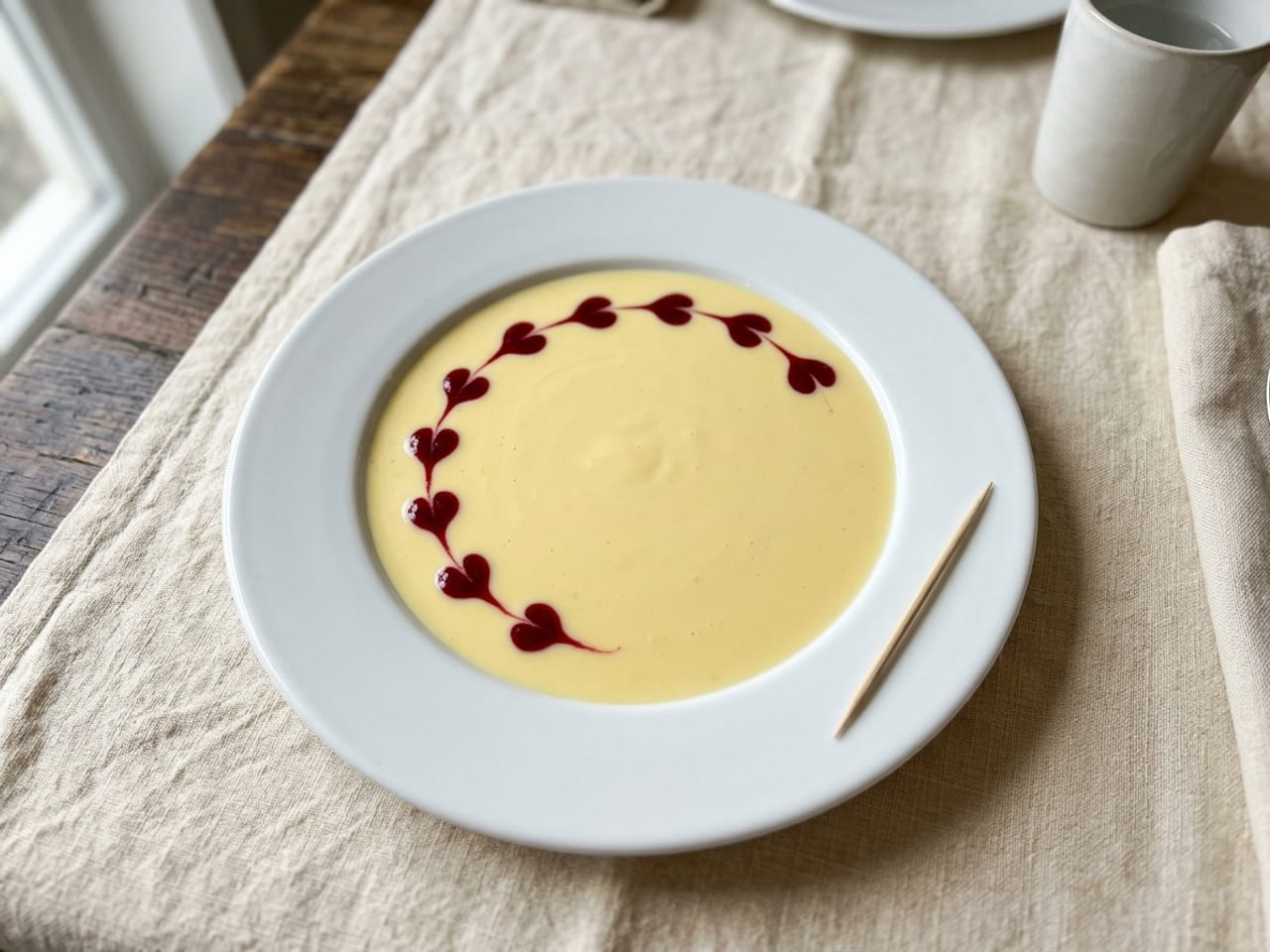
Hearts drawn through dots
Sokol's textbook: dots of sauce on a base sauce, and "a toothpick or wooden skewer is gently drawn" through the centre of each dot, "dragging a tail of sauce into the base sauce, forming a heart"; the hearts can be joined in a circle or a line, "or even left as a few solitary hearts".47 We did not find the move in the Gisslen pages we could read.37 The Nibble makes hearts with the bottle's nozzle tip.67
Movement, colour and glasses
"The flow of coulis can help direct movement and create a focal point", and sauce should radiate from the main component "without a lot of separation" (BCcampus).57 In a glass, Gisslen lays a 1/8 inch (3 mm) layer of raspberry coulis over a crémeux; Ben Vear lines a sundae glass with coulis, "turning the glass to coat it".36, 163
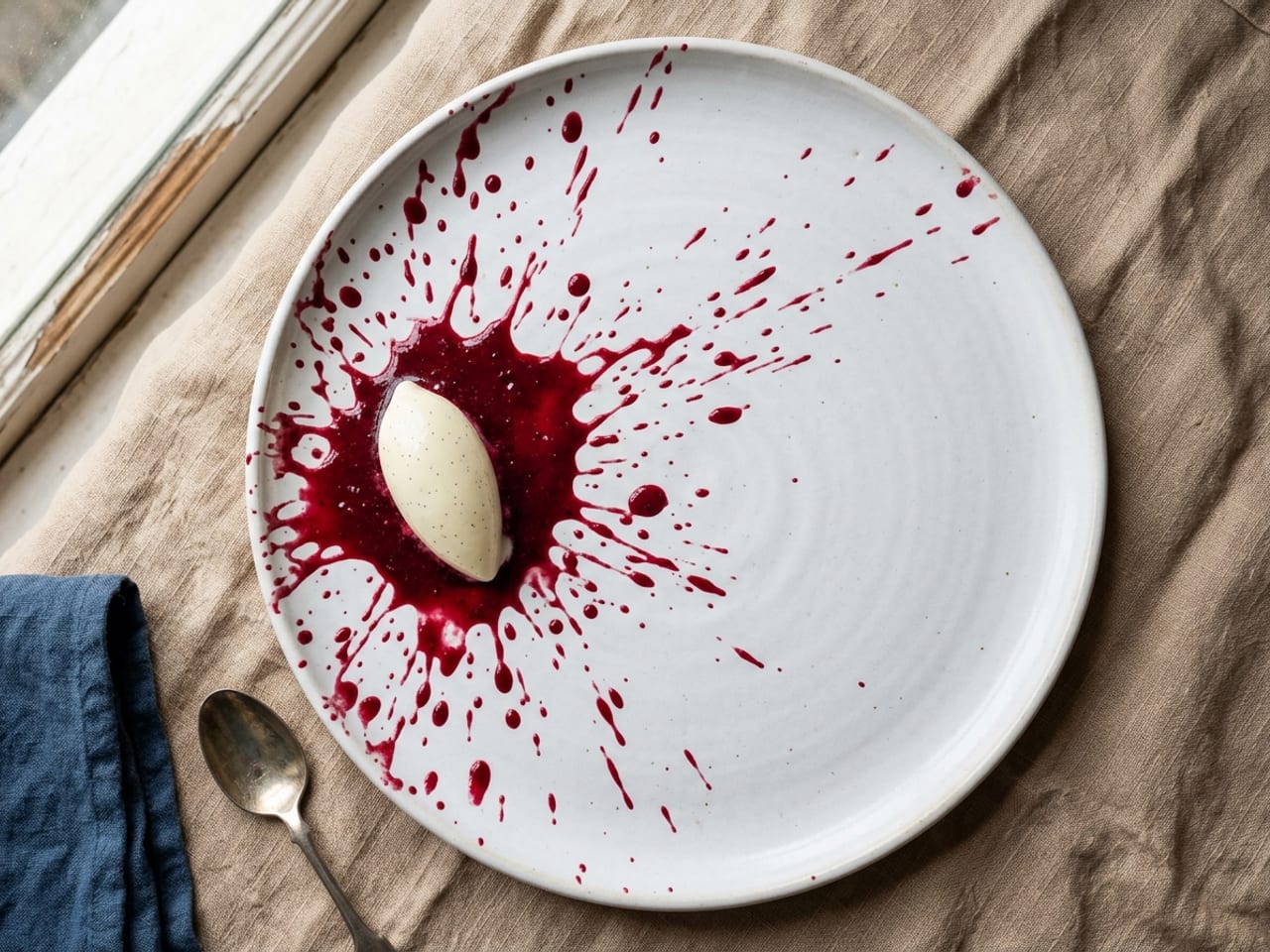
How much coulis per plate
| Who | The amount | What it is |
|---|---|---|
| CIA (2004)40 | no more than 1 fl oz / 30 mL of each fruit sauce | a note in one plated recipe, with the book's own metric; not a general rule |
| CIA (2004)40 | 1 fl oz / 30 mL drizzled from a squeeze bottle | a cranberry sauce in a plated recipe |
| America's Test Kitchen, Berry Coulis70 | 2 tbsp | our arithmetic: 1½ cups (360 ml) that "Serves 12" |
| America's Test Kitchen, Mixed Berry69 | 4 tbsp | our arithmetic: the same 1½ cups, "Serves 6" |
| Friberg, plated desserts38 | about 3 to 4 tbsp (45 to 60 ml) | our arithmetic, if a whole batch goes on 16 or 12 plates |
| Keep Calm and Eat Ice Cream88 | about ¼ cup (60 ml, ours) | "approx ¼ each", six servings |
| David Tanis (savoury)101 | about ¼ cup (60 ml, ours) | warm carrot coulis under scallops, a main course |
| Gisslen (savoury)34 | 1 fl oz / 30 mL | red bell pepper coulis drizzled around quail (Quail with Balsamic Glaze), the book's own metric |
No source we read gives a general amount; these are recipe lines and our arithmetic from yields.
What to serve coulis with, sweet and savoury
- Cheesecake and chocolate"A tart berry sauce will complement a rich cheesecake or chocolate dessert because sourness (acid) will cut through fat" (BCcampus).56 Anne Willan serves raspberry coulis with a chocolate cake "to cut the richness" and calls it "a delicious partner" for a chocolate ginger cheesecake; cookbooks pair it with chocolate mousse pie, a chocolate tart and a mascarpone cheesecake "served with a Raspberry Coulis".136, 141, 155, 166
- Fish and shellfish (savoury)Broiled sole with red pepper coulis; sea bream with ratatouille and tomato coulis (Raymond Blanc); steamed salmon with spicy tomato coulis (Daniel Joly); scallops on carrot coulis (David Tanis).101, 158, 159, 161 Gisslen counts vegetable coulis among the healthful sauces for grilled fish.34
- Terrines, vegetables, cheese and other sauces (savoury)Anne Willan sets a vegetable terrine "on a bed of tomato coulis and parsley purée"; Nico Ladenis makes ravioli of goat's cheese with red pepper coulis and adds "a few drops of red pepper coulis around the plate" of a starter; a bell pepper coulis goes with a red lentil loaf.142, 156, 160 Michel Roux stirs "well-reduced cooked tomato coulis" into a béarnaise.135 A vegetable coulis can be "a hot or a cold accompaniment to other vegetables, starches, meat, poultry, fish or shellfish".58
- Hold back the sugar"A sweet sauce served with a sweet dessert will have the overall effect of hiding flavours in both. Hold back on sweetness in order to intensify other flavours", and "flavour first, presentation second" (BCcampus).56
From medieval meat coulis to raspberry coulis: a short history
For about seven centuries a coulis was savoury: meat, game, fish or crayfish, sometimes roots, peas or tomatoes, pounded or cooked down and strained; the fruit sauce is a sense of the last fifty years. Dates are the earliest we saw in what we read, never claimed as firsts.
| When | What the source says |
|---|---|
| About 1256 | The TLFi's first culinary date: "couleïs de char", a meat coulis, in Aldebrandin of Siena's regimen of health. Littré's early quotations give coulis to the weak or sick.1, 4 |
| About 1392 to 1394 | The Ménagier de Paris: the best meat-day coulis is chicken necks, heads and bones ground, thinned with beef stock and strained; fish days take perch, tench, sole or crayfish.1, 5 |
| 16th century | Ambroise Paré prefers broths to coulis, "à cause qu'ils [les coulis] sont trop espais", too thick.4 |
| 1652 | La Varenne's Cuisinier françois (second edition) strains "liaisons" through the étamine; the word coulis does not occur in the machine-read text of its scan.15 |
| 1690 | Furetière: coulis is what is strained through the jelly bag, the étamine or grey paper, "particulierement des jus de viande".10 |
| 1693 | Massialot (second edition, printed pp. 209 to 215): roast beef pounded hot with bread crusts and partridge carcasses, moistened with jus and bouillon, boiled and passed through the étamine to go on soups; ham coulis "un peu épais"; capon, partridge, duck and pigeon coulis; a "Coulis de Racines" of roots; and anchovy, caper, truffle, morel, pea and mushroom coulis, with a crayfish coulis elsewhere in the book.16 |
| 1756 | Menon's "Coulis Bourgeois" is a roux sauce: veal and ham browned, a butter and flour roux, bouillon, two hours, then the étamine or a tamis; it should be cinnamon-coloured, "ni trop clair". He adds "un peu de coulis pour la lier" throughout the book.17 |
| 1758 edition | Hannah Glasse mocks the French cullis, a leg of veal and a ham for ten or twelve people, "only to mix with other Sauce", in a chapter called "How expensive a French Cook's Sauce is". The earliest English "cullis" we saw in a dated scan.18 |
| 1762 | The Académie française: a juice reduced by cooking and passed through an étamine or a linen cloth; capon, partridge, pea and crayfish coulis.3 |
| 1830s | Carême recalls that the cooks of Louis XIV and XV made their great sauces, "qu'ils appelaient coulis", and calls it "cette pauvre manière de faire". Textbooks agree: the coulis was "the basis for brown sauces well into the nineteenth centu-" (Peterson), and the CIA's textbook, in a sentence that follows the mother sauces and their "derivatives", says "any sauce would most likely have gone by the name of coulis".19, 41, 48 |
| 1907 | Escoffier (second French edition, and the English edition) keeps "Coulis" for purées of poultry, game and fish, calls Bisque and "Cullis" "steadily becoming obsolete" and Purée "that too vulgar term". His fruit sauces are "purée de framboises", "raspberry puree": no fruit coulis in the machine-read text.20, 21 |
| 1942 | Constance Spry's wartime Come into the Garden, Cook prints a "Tomato Coulis" quoted from another writer, ten years before the first known use Merriam-Webster gives.23 |
| 1947 to 1967 | In these English books, tomato coulis meant a thick purée: "strong tomato purée" (Dione Lucas, 1947), "much thicker than a sauce" (Spry, 1956), "thick tomato purée" (Raymond Oliver, 1967).24, 25, 26 |
| 1952 | Merriam-Webster's first known use of coulis as "a sauce made with pureed vegetable or fruit".6 |
| 1976 to 1979 | Nouvelle cuisine: Guérard's Cuisine Minceur has tomato, asparagus and artichoke coulis and raspberry, strawberry, apricot and blackcurrant coulis, and its English edition translates coulis de framboises as "Raspberry Purée Sauce"; the Troisgros book of 1978 renders coulis de tomates "FRESH TOMATO SAUCE"; Vergé (1979) serves a sweet pepper coulis; Bocuse's German glossary calls coulis "Eine dicke, püreeartige Sauce". In French books, "coulis de framboises" runs without a break from 1974.14, 27, 28, 29, 30 |
| 1981 to 1983 | The earliest English fruit coulis we saw in dated scans: "Strawberry Coulis" in Dining in Baltimore (1981), "a sharp raspberry coulis" in the 1982 Good Food Guide, raspberry coulis in an Idaho newspaper in December 1983. English use of the word rises about fivefold in the 1980s and peaks in 1996 in Google Books.14, 31, 32, 33 |
| 2002 | Friberg: the title "has gained popularity only in the last ten years or so", though it was used "as long as 600 years ago" for strained gravy or broth.38 |
| 2014 | "Now a term beloved by trendy chefs, a coulis is no longer an extravagant long-simmered base for complicated sauces but ..." (Tebben).54 |
Sixteen popular claims about coulis, each with a verdict
"Supported, narrowly" means the source covers less than the claim says; "Mixed", that sources point both ways; "No source found", that we found nothing for it.
| The claim | Verdict | What we found |
|---|---|---|
| A coulis is typically thickened with cornstarch and finished with butter. | Not supported | Tasting Table says so.63 Friberg's coulis is "neither thickened nor bound", the CIA's slurry is "If desired", and Gisslen's formula has neither starch nor butter; no fruit coulis recipe we read mounts it with butter.36, 38, 39 |
| Crushed raspberry seeds make a coulis bitter. | No source found | The chefs who warn against over-blending say it dulls the colour, not the taste, and in raspberry juice making the tannins stayed "especially in its seedless fraction" of the press cake.38, 80, 109 |
| Coulis is French for "strain". | Supported, narrowly | The dictionaries derive it from couler, to flow (TLFi; Merriam-Webster's "flowing"); Webster's 1913 gives couler as "to strain, to flow", from Latin colare.1, 6, 11 BCcampus's "strained liquid" is a gloss, and the Daily Meal's "strain" or "flow" is right on flow and half right on strain.56, 65 |
| A coulis is always cooked. | Not supported | BCcampus calls it "most often an uncooked, strained purée", and BBC Good Food, Dorie Greenspan and Bill Yosses never heat the fruit.56, 79, 83, 84 |
| Once a coulis has been cooked it becomes a compote. | Not supported | A study-guide true-or-false item.45 The CIA says both sauces "may be cooked or uncooked" and separates them by texture; Gisslen's coulis is made from "fresh or cooked fruits".36, 39 |
| Reduce a fruit coulis until it coats a spoon. | No source found | No coulis source we read uses that test; they compare textures to "a thin tomato sauce" or a syrup, and America's Test Kitchen warns that long cooking makes it taste "like jam".58, 69, 93 |
| Homemade coulis keeps a week or two in the fridge. | Mixed | Printed times run from a day to 3 weeks (the table); the four raw coulis we read say 1 to 4 days, three of them 2 days or less; no source gives a test behind its figure, and the agencies' general leftovers lines are 2 days (UK) and 3 to 4 days (US).79, 84, 127, 128, 130, 131 |
| Coulis freezes perfectly. | Mixed | RecipeTin Eats: "It freezes 100% perfectly", and most books agree it freezes well; two books and a blog say do not freeze it, without saying why; one blog whisks it after thawing and another may "reheat and cool it again".71, 72, 130, 131, 146, 149, 150 |
| You can water-bath can a coulis and keep it 12 months. | Not supported | A blog prints a 10-minute jar boil and 12 months; NCHFP's tested fruit purée process is different and excludes tomatoes and ripe mango, and there is none for puréed vegetables (canning).122, 123, 132 |
| Coulis first meant meat fat and drippings. | Not supported | Tasting Table says so.64 The medieval and 17th-century coulis was pounded and strained (the Ménagier, Massialot), and Larousse Gastronomique says meat juices, not fat.5, 16, 51 |
| Coulis has six hundred years of history in English. | No source found | Wikipedia says so without a source.12 Friberg's "600 years ago" does not say English; the earliest English "cullis" we saw in a dated scan is Glasse's (1758 edition).18, 38 |
| Escoffier made raspberry coulis. | Not supported | Every coulis in the machine-read text is savoury; his fruit sauce is "purée de framboises", in English "raspberry puree".20, 21 |
| Coulis entered English in 1952. | Not supported | 1952 is Merriam-Webster's first known use of the modern sense; Spry printed a "Tomato Coulis" in 1942, and "cullis" is in Glasse.6, 18, 23 |
| Tomato sauce is a type of coulis. | Supported, narrowly | The Daily Meal says so; Gisslen says a purée-thickened tomato sauce "may be referred to as a coulis", and in French usage a coulis de tomate is tomato sauce.13, 34, 65 |
| Lemon keeps a red coulis red. | Supported | Acid keeps anthocyanins red and lemon's citric acid binds the metal ions that dull them (McGee).43 |
| The sugar preserves a coulis. | Mixed | A Baking Journey says sugar helps it keep, then that its sugar is too low to can it; one maker's sweetened purée keeps 15 days after thawing against 3 for the plain one.73, 152, 153 But a pectin gel such as jam sets best at 60 to 65% sugar (McGee), far above any coulis here, and NCHFP says sugar in frozen fruit is there for flavour, colour and texture, not as a preservative.43, 122 |
Photograph your plate, see it re-plated
Made a coulis and plated a dessert with it? Photograph it and Plate Artists re-plates that dish, with the food kept as it is and the changes named so you can repeat them. Start with a re-plate.
Your food, plated like a chef's
Snap it, upload it, and get the composed version back, with the steps to recreate it at home.
Start free · 1 enhancement →Free account · 1 free enhancement · No credit card
Coulis words, defined
Coulis · koo-LEE; plural coulis; French un coulis
A smooth purée of fruit or vegetables, usually strained, used as a sauce.
Where it comes from. Gisslen: "A vegetable or fruit purée, used as a sauce." From French couler, to flow (TLFi).1, 34
Cullis · plural cullises
The old English form of coulis, for a strained meat sauce or broth.
Where it comes from. Glasse's word in 1758 and Escoffier's English translator's in 1907; Webster's 1913 marks it obsolete.11, 18, 21
Purée
Food mashed, ground or sieved to a smooth pulp; a coulis is a thinner, strained purée used as a sauce.
Where it comes from. Gisslen: "A food product that has been mashed or strained to a smooth pulp"; On Cooking: "generally thicker and coarser" than a coulis.34, 44
Compote
Fruit cooked with sugar and served in pieces in its syrup.
Where it comes from. The CIA's "chunky mixture"; BCcampus: "cooked fruit served in its own cooking liquid".39, 56
Fruit sauce
In BCcampus's glossary, a fruit purée cooked and thickened with starch, set apart from a coulis; Gisslen and the CIA instead count a coulis as one kind of fruit sauce.
Where it comes from. BCcampus: "a fruit purée, cooked and thickened with a starch"; Friberg's "sauce rather than a coulis".36, 38, 39, 56
Chinois · shee-nwah
A fine conical strainer, used to sieve a coulis.
Where it comes from. Gisslen: "A fine conical strainer"; the TLFi likens its shape to a Chinese mandarin's hat.1, 34
Tamis · drum sieve
A drum sieve: a mesh screen stretched in a round frame.
Where it comes from. Gisslen: "A drum sieve, consisting of a screen mesh in a round metal or wood frame"; Menon strains his coulis "dans un tamis".17, 34
Étamine · tammy
A straining cloth of loosely woven fabric, the coulis tool of the old French cookbooks.
Where it comes from. The straining cloth of Massialot, Menon and Escoffier, whose English translator wrote "tammy".1, 16, 17, 21
Food mill
A hand-turned sieve that purées and strains in one step, holding back skins and seeds.
Where it comes from. One of Gisslen's three ways to purée; Peterson and GialloZafferano use one for coulis.34, 50, 81
Napper · nappe, nappé
To coat with a thin layer of sauce; the coats-a-spoon test, which no coulis source we read uses.
Where it comes from. Gisslen: "To coat; to cover a food, savory, or sweet with a light layer of sauce".34
IQF · individually quick-frozen
Fruit frozen loose, piece by piece, with no added sugar.
Where it comes from. Friberg: "Frozen fruit given this designation does not have any added sugar."38
Anthocyanin
The water-soluble red, purple or blue pigment of berries, whose colour depends on acidity.
Where it comes from. McGee: red in acid, colourless or light violet near neutral, bluish in alkaline conditions.42, 43
Syneresis · weeping, bleeding
Liquid seeping out of a gel or a purée as it stands, the watery halo around a coulis.
Where it comes from. Lersch: xanthan reduces "syneresis (water drainage)".59
Xanthan gum
A gum that thickens liquids hot or cold in tiny amounts and slows weeping.
Where it comes from. Lersch: 0.25% for a thin running sauce, works hot or cold; Gisslen's snap pea coulis uses it.35, 59
Fluid gel
A set gel blended back into a smooth sauce that pours yet holds a shape.
Where it comes from. ICE: "a magical little sauce that results from pureeing a gelled liquid".59, 60
À la minute
At the last moment, to order: when a coulis should go on the plate.
Where it comes from. BCcampus on coulis: "It's best to use à la minute."56
Brix · °Brix
A measure of dissolved sugar, in which 1 °Brix is 1% sugar by weight.
Where it comes from. FSANZ: "natural sugar content of berries = 5°Brix (5% wt/wt)"; Boiron's sweetened purée is 20 °Brix.120, 152
Concassé
Peeled, seeded and diced tomato, left in pieces rather than strained.
Where it comes from. Gisslen: "Peeled, seeded, and diced tomatoes"; Peterson: a coulis is like one, "except that a coulis is strained".34, 49
Bisque
A shellfish soup, which French cooks also called a coulis.
Where it comes from. The TLFi's extended sense of coulis; Escoffier's "Bisque, ou Coulis d'écrevisses".1, 20
Liaison
A binding agent for a sauce; La Varenne's were strained through the étamine.
Where it comes from. La Varenne's strained bases of almonds, mushrooms, flour or truffles, "pour lier vos sauces" (1652).15
Coulis, answered
What is a coulis?
A coulis (koo-LEE) is a smooth purée of fruit or vegetables, usually pushed through a sieve, used as a sauce: raspberry coulis with desserts, red pepper or tomato coulis with fish and vegetables. Gisslen's textbook defines it as "A vegetable or fruit purée, used as a sauce." The word comes from the French couler, to flow, and for centuries it meant a strained meat or crayfish preparation; the fruit sauce is the modern sense.
How do you pronounce coulis?
Koo-LEE: two syllables, the s silent, stress on the second syllable in Merriam-Webster, Gisslen and French. Cambridge and Collins British stress the first syllable, KOO-lee. The plural is also coulis.
What is the difference between a coulis and a purée?
A coulis is a purée that has been strained and is thin enough to pour. On Cooking calls a purée "generally thicker and coarser", and The Nibble says the difference is refinement: to make a coulis, the purée is strained.
What is the difference between coulis, compote and jam?
A coulis is smooth; a compote is chunky fruit in its syrup (the CIA's distinction); jam is legally a gelled preserve with at least 60% soluble solids in the EU and 65% in the US. No dictionary or textbook we read gives a coulis a sugar minimum, and it does not set.
How do you make raspberry coulis?
Bring 12 oz (340 g) of raspberries, ¼ cup (60 ml) of water, 5 tablespoons of sugar and a pinch of salt to a bare simmer and cook about a minute, blend about 20 seconds, press through a fine sieve, then stir in 2 teaspoons of lemon juice and more sugar to taste while it is warm. That is America's Test Kitchen's method. A raw version blends the berries with icing sugar and lemon and sieves them, as BBC Good Food does.
How much sugar goes in a coulis?
Recipes disagree widely. In the 17 coulis recipes we read that weigh both fruit and sugar, sugar runs from 0% to 66.2% of the fruit's weight (our arithmetic): none in Friberg's mango coulis, the most in his cranberry. For raspberry, recent recipes use 10 to 20%, the CIA 25% (up to 49%), and Gisslen's formula for any berry 50%. Cranberry takes the most (Friberg, 66%); rhubarb recipes split, 10% to about 42%. Start low and add more after straining, while it is warm.
Do you have to cook a coulis?
No. A pastry textbook calls a coulis "most often an uncooked, strained purée", and BBC Good Food's needs no heat; America's Test Kitchen simmers about a minute and the CIA about ten. Cooking dissolves the sugar and the published keeping times are longer: the four raw recipes we read say 1 to 4 days in the fridge, three of them 2 days or less, cooked ones mostly 3 days to 2 weeks. Imported frozen berries are the exception: the Irish, Swedish, Norwegian and Danish food agencies advise boiling them for a minute, Finland's for two.
Can you make coulis from frozen berries?
Yes, and many recipes say so. America's Test Kitchen and Gisslen thaw them first; RecipeTin Eats puts them in frozen. Ireland's FSAI and the Swedish, Norwegian and Danish agencies advise boiling imported frozen berries for one minute because of hepatitis A and norovirus outbreaks, so cook a coulis made from them rather than blending it raw.
How do you make a coulis thicker?
Simmer it a little longer, or drain off the thin liquid and reduce that alone, as McGee suggests; stop before it tastes like jam. A cornstarch slurry works (the CIA uses 1 oz / 30 g of cornstarch per 2 lb / 910 g of coulis), but Friberg says a thickener makes it "a sauce rather than a coulis". For fruit you would rather not heat, such as kiwi, use an instant starch; against weeping on the plate, about 0.25% xanthan.
Why does my coulis bleed or separate on the plate?
The bits of fruit are denser than the juice, so they sink and the thin liquid runs out around them (McGee). Simmer it so it turns syrupy, reduce the thin part, or add a pinch of xanthan, and plate it at the last minute, as the BCcampus pastry textbook advises.
How long does coulis last in the fridge?
Printed answers run from a day to 3 weeks across the 27 sources in our table. The four raw recipes we read say 1 to 4 days: a day (Dorie Greenspan), two (BBC Good Food, Lovefoodies) or four (Vanilla Bean Cuisine, where cooking is optional); cooked recipes say 3 days (Emeril Lagasse) to 2 weeks (Saveur), and America's Test Kitchen up to 4 days. No food agency page we read lists coulis: the UK's general rule for leftovers is 2 days and the US one 3 to 4 days. Keep it covered and cold.
Can you freeze coulis?
Most sources say it freezes well, for 1 to 6 months; two cookbooks and a blog say not to freeze it, without giving a reason. Freeze it in an ice-cube tray for small portions, thaw it overnight in the fridge and whisk it smooth; the UK Food Standards Agency says to use food within 24 hours of defrosting.
What is red pepper coulis?
A smooth sauce of red peppers cooked with shallot and wine or stock, puréed and strained: Gisslen sweats the peppers about 20 minutes, Emeril Lagasse cooks roasted peppers in white wine for 20. Peppers purée smooth without starch because their cell walls are rich in pectin. Serve it with fish, vegetables or goat's cheese. There is no tested home-canning process for puréed peppers, so freeze it.
What is tomato coulis?
A strained purée of cooked tomatoes: Peterson simmers chopped tomatoes, works them through a food mill or strainer and cooks them down until thick. In France, coulis de tomate is simply another name for tomato sauce; in mid-century English cookbooks it meant a thick tomato purée.
Do you need to strain a coulis?
By most definitions, yes: On Cooking calls a coulis "what runs off the strainer" and Peterson "a puree that has been strained". Friberg says "usually strained", and several popular recipes skip it, which by those definitions makes them purées.
What do you serve coulis with?
Sweet: cheesecake and chocolate desserts, where a tart coulis cuts the richness, panna cotta, ice cream, pavlova and Eton mess, pancakes and waffles. Savoury: red pepper or tomato coulis with fish, shellfish, terrines and goat's cheese.
How much coulis per plate?
Not much. In one plated dessert the CIA allows no more than 1 fl oz (30 mL) of each fruit sauce per plate, and America's Test Kitchen's batch works out at 2 to 4 tablespoons a serving (our arithmetic). Under a savoury main course, David Tanis ladles about ¼ cup (60 ml).
Can you make coulis from jam?
Yes, and it is a textbook method: Gisslen's fruit sauces include heated, strained jams thinned with syrup, water or liquor. Warm the jam, stir in water and lemon juice to taste, and sieve it if it has seeds.
The dictionaries, textbooks, test kitchens, agencies and cookbooks behind this guide
How each source was read (in full, as an abstract, in an archived copy, as the machine-read text of a scan or only as search fragments) is in its entry and under how this page was made. Textbooks read from copies uploaded to the Internet Archive are cited as books without a link. Blogs, brands, retailers and magazines are labelled. Readings, sums and conversions marked ours are our own.
- ATILF / CNRS (2026). Coulis (entry), Trésor de la langue française informatisé. CNRTL portal, definition, pronunciation [kuli], masculine noun, culinary dating ca 1256 (couleïs de char) and 1393 (Ménagier), derived from couler; also the entries chinois, étamine and tamis; read in full through the portal's word API. cnrtl.fr
- Académie française (2026). Coulis (entry), Dictionnaire de l'Académie française, 9th edition. via the CNRTL portal (read through its word API), the culinary sense, with tomato, partridge, crayfish and raspberry coulis; read in full. cnrtl.fr
- Académie française (1762). Coulis (entry), Dictionnaire de l'Académie française, 4th edition. via the CNRTL portal (read through its word API), a juice strained through an étamine or linen; capon, partridge, pea and crayfish; read in full. cnrtl.fr
- Littré, É. (19th century). Coulis (entry), Dictionnaire de la langue française. via the CNRTL portal (read through its word API), pronunciation (kou-li), crayfish coulis as a purée got by pounding crayfish, and historical quotations including Ambroise Paré; read in full. cnrtl.fr
- ATILF / CNRS (2026). Coulis (entry), Dictionnaire du Moyen Français. via the CNRTL portal (read through its word API), quotes the Ménagier de Paris (about 1392 to 1394) on the best meat-day coulis of chicken necks, heads and bones, and the fish-day coulis; read in full. cnrtl.fr
- Merriam-Webster (2025). Coulis (entry). Merriam-Webster.com Dictionary, definition, kü-ˈlē, etymology and first known use 1952 "in the meaning defined above"; the live site refused our server, so read in full in an Internet Archive copy whose own cite line says "Accessed 17 Nov. 2025". web.archive.org
- Cambridge University Press (2026). Coulis (entry). Cambridge Dictionary, "a liquid made by cooking and crushing fruit", plural coulis, /ˈkuː.li/; read in full. dictionary.cambridge.org
- Collins (2025). Coulis (entry), Collins English Dictionary, with the American entry from Webster's New World College Dictionary, 4th edition (Houghton Mifflin Harcourt, 2010). collinsdictionary.com, the British "thin purée" and word origin "C20"; the American "light sauce, esp. in nouvelle cuisine" and plural; the live site refused our server, so read in full in a 2025 Internet Archive copy. web.archive.org
- Éditions Larousse (2026). Coulis, compote, confiture and nage (entries), Dictionnaire de français. larousse.fr, the two culinary senses of coulis (slow-cooked purée; fruit purée with syrup), and the entries compote, confiture and nage; read in full. larousse.fr
- Le Robert (2026). Coulis (entry), Dico en ligne. dictionnaire.lerobert.com, the definition, with Furetière's Dictionnaire universel (1690) reproduced on the page and press examples harvested from Géo and Ça m'intéresse (2020); the page's "17e s." badge is not explained and not printed by us; read in full. dictionnaire.lerobert.com
- G. & C. Merriam Co. (1913). Cullis (entry), Webster's Revised Unabridged Dictionary. websters1913.com, the obsolete English cullis, a strong strained broth for invalids, from couler and Latin colare; read in full. websters1913.com
- Wikipedia contributors (2026). Coulis. Wikipedia (the page that ranks second for the word), revision 1372427657; read in full, as evidence of what the top page says. en.wikipedia.org
- Contributeurs de Wikipédia (2026). Coulis (cuisine). Wikipédia, revision 229511064; read in full, as usage evidence only. fr.wikipedia.org
- Google (2026). Google Books Ngram Viewer: coulis, raspberry coulis, tomato coulis, coulis de framboises, coulis de tomates, 1900 to 2022. books.google.com/ngrams, the English and French corpora, smoothing 0, read as the full data series and summarised by our script; the link is the English query, the French series is the same query with coulis de framboises and corpus=fr; indicative only, since Google Books dating has known errors. books.google.com
- La Varenne, F. P. de (1652). Le Cuisinier françois, second edition. Pierre David, Paris, the strained "liaisons"; the string "coulis" does not occur in the OCR (we did not read the 1651 first edition); read as the machine-read text (OCR) of the scan; quotations restore the long s and correct obvious OCR misreadings. archive.org
- Massialot, F. (1693). Le Cuisinier royal et bourgeois, second edition ("Seconde Edition, revue & augmentée"; first edition 1691). Charles de Sercy, Paris, the alphabetical "Coulis" entries on printed pp. 209 to 215 by the scan's running heads (one head is garbled), and the preface, p. 8; read as the machine-read text (OCR) of the scan; quotations restore the long s and correct obvious OCR misreadings. archive.org
- Menon (1756). La Cuisinière bourgeoise, suivie de l'office, nouvelle édition. F. Foppens (as the scan's record gives it), the "Coulis Bourgeois", pp. 113 to 114, and coulis as a binder throughout; read as the machine-read text (OCR) of the scan; quotations restore the long s and correct obvious OCR misreadings. archive.org
- Glasse, H. (1758). The Art of Cookery, Made Plain and Easy (1758 edition; first published 1747, not read). printed for the author, sold by A. Millar, London, the address to the reader and chapter III, "How expensive a French Cook's Sauce is", pp. 103 to 106; read as the machine-read text (OCR) of the scan; quotations restore the long s and correct obvious OCR misreadings. archive.org
- Carême, M.-A. (continued by Plumerey, A.) (1830s). L'Art de la cuisine française au dix-neuvième siècle, vol. 3. Paris, the opening pages of the fourth part, where the old cooks' grandes sauces "qu'ils appelaient coulis" are recalled; the Internet Archive dates the scan 1833, but the volume appeared after Carême's death and we did not check its title page; read as the machine-read text (OCR) of the scan; quotations restore the long s and correct obvious OCR misreadings. archive.org
- Escoffier, A., with Gilbert, P., & Fétu, É. (1907). Le Guide culinaire, second edition ("Deuxième édition", introduction dated 1 February 1907). Paris, the thick-soup chapter, pp. 135 to 136 (purée, coulis, bisque), "Coulis divers", the Soubise note and the fruit desserts; the Internet Archive's catalogue gives 1903, the first edition's year, which is wrong for this scan; read as the machine-read text (OCR) of the scan; quotations restore the long s and correct obvious OCR misreadings. archive.org
- Escoffier, A. (1907). A Guide to Modern Cookery (English edition of Le Guide culinaire). William Heinemann, London, the soups chapter, pp. 97 to 100 (Cullis "steadily becoming obsolete", No. 240 "Cullises"), No. 144 "Various cullises", p. 55, and the fruit desserts' "raspberry puree"; read as the machine-read text (OCR) of the scan; quotations restore the long s and correct obvious OCR misreadings. archive.org
- Escoffier, A. (1941). The Escoffier Cook Book: A Guide to the Fine Art of Cookery (English translation of the 4th French edition). Crown Publishers, New York, Pêches Melba (No. 2699) and the strawberries covered with raspberry purée; read only as Internet Archive full-text search fragments of the scan: no page image and no page number; the fragments are verbatim as served. archive.org
- Spry, C. (1942). Come into the Garden, Cook. J. M. Dent, London, the 1945 reprint ("First published 1942"), pp. 233 to 234: a "Tomato Coulis" quoted from another writer's book; the scan garbles its butter quantity, which we do not print; read as the machine-read text (OCR) of the scan; quotations restore the long s and correct obvious OCR misreadings. archive.org
- Lucas, D. (1947). The Cordon Bleu Cook Book. as catalogued by the Internet Archive, "Tomato coulis. A mixture of strong tomato purée and sliced"; read only as Internet Archive full-text search fragments of the scan: no page image and no page number; the fragments are verbatim as served. archive.org
- Spry, C. (1956). The Constance Spry Cookery Book. as catalogued by the Internet Archive, "a tomato coulis, much thicker than a sauce"; read only as Internet Archive full-text search fragments of the scan: no page image and no page number; the fragments are verbatim as served. archive.org
- Oliver, R. (1967). Classic Sauces and their Preparation. Wine and Food Society, "fresh tomato coulis (thick tomato purée)"; read only as Internet Archive full-text search fragments of the scan: no page image and no page number; the fragments are verbatim as served. archive.org
- Guérard, M. (1976). La Grande Cuisine Minceur, and its English editions Michel Guérard's Cuisine Minceur (1976 and 1977). Robert Laffont, Paris (French paperback, Le Livre de Poche), the French "sauce coulis" recipes (tomatoes, asparagus, artichokes, raspberries, strawberries, apricots, blackcurrants) and the English titles that translate them as "purée sauce", "purée" or "sauce"; read only as Internet Archive full-text search fragments of the scan: no page image and no page number; the fragments are verbatim as served. archive.org
- Vergé, R. (1979). Cuisine of the Sun (English edition of Cuisine du soleil). as catalogued by the Internet Archive, "Aspic de légumes frais avec son coulis de poivrons doux"; read only as Internet Archive full-text search fragments of the scan: no page image and no page number; the fragments are verbatim as served. archive.org
- Troisgros, J., & Troisgros, P. (1978). The Nouvelle Cuisine of Jean & Pierre Troisgros. as catalogued by the Internet Archive, "Coulis de tomates" translated "FRESH TOMATO SAUCE"; read only as Internet Archive full-text search fragments of the scan: no page image and no page number; the fragments are verbatim as served. archive.org
- Bocuse, P. (1977). Die neue Küche (German edition of La Cuisine du marché), and Paul Bocuse's French Cooking (Pantheon, New York). as catalogued by the Internet Archive, the German glossary's "Coulis: Eine dicke, püreeartige Sauce" and the English hare recipe's "This purée is called the coulis"; read only as Internet Archive full-text search fragments of the scan: no page image and no page number; the fragments are verbatim as served. archive.org
- Dining in Baltimore (1981). Dining in Baltimore. as catalogued by the Internet Archive, "Pears Poached in Vanilla with Strawberry Coulis"; read only as Internet Archive full-text search fragments of the scan: no page image and no page number; the fragments are verbatim as served. archive.org
- The Good Food Guide (1982). The Good Food Guide 1982. as catalogued by the Internet Archive, "with a sharp raspberry coulis"; read only as Internet Archive full-text search fragments of the scan: no page image and no page number; the fragments are verbatim as served. archive.org
- The Times-News (Idaho) (1983). The Times-News, 7 December 1983. newspaper, scanned by the Internet Archive, "garnished with raspberry coulis and fresh mint leaves"; the issue date is in the item's identifier; read only as Internet Archive full-text search fragments of the scan: no page image and no page number; the fragments are verbatim as served. archive.org
- Gisslen, W. (2011). Professional Cooking, 7th edition. John Wiley & Sons, Hoboken, chapter 8, "Stocks and Sauces" (the coulis paragraph, the three ways to purée, nouvelle cuisine and starch), the recipe index and the glossary (coulis, purée, chinois, tamis, napper, monter au beurre, gastrique, concassé), and Quail with Balsamic Glaze ("Drizzle 1 floz (30 mL) coulis around the arrangement"); read as the machine-read text (OCR) of a copy uploaded to the Internet Archive; cited as the book, without a link to that copy.
- Gisslen, W. (n.d.). Professional Cooking, chapter 9, "Sauces". John Wiley & Sons, publisher's chapter PDF hosted by the Auguste Escoffier School of Culinary Arts, the edition is not stated in the file; Bell Pepper Coulis (p. 210), Fresh Tomato Coulis with Garlic, watery vegetable purées, Cold Snap Pea Coulis with xanthan gum and a Basil Sauce to use within 24 hours; read in full. escoffier.edu (PDF)
- Gisslen, W. (2017). Professional Baking, 7th edition (the 6th edition, 2013, prints the same coulis text). John Wiley & Sons, Hoboken, chapter 12, "Basic Syrups, Creams, and Sauces": the Fruit Coulis formula, p. 270 (6th ed. p. 278), the two kinds of fruit sauce, Melba and raspberry sauce, starch and gelatin, the word's history box and two plating uses; read as the machine-read text (OCR) of a copy uploaded to the Internet Archive; cited as the book, without a link to that copy.
- Gisslen, W. (2009). Professional Baking, 5th edition. John Wiley & Sons, marbling and feathering a pool of sauce, the piped sauce of the same weight and consistency, the squeeze bottle, and recipe steps (one, "Pipe a few dots of yogurt onto the sauce and feather", also in the 6th edition's scan); quotations joined from overlapping fragments; read only as Internet Archive full-text search fragments of the scan: no page image and no page number; the fragments are verbatim as served. archive.org
- Friberg, B., with Kemp Friberg, A. (2002). The Professional Pastry Chef: Fundamentals of Baking and Pastry, 4th edition. John Wiley & Sons, New York, the coulis definition, p. 808; Bijou, Cranberry and Mango Coulis, the starch-thickened raspberry, strawberry, rhubarb, cherry, apricot, blueberry and kiwi sauces, pp. 813 to 830; and plated desserts; read as the machine-read text (OCR) of a copy uploaded to the Internet Archive; cited as the book, without a link to that copy (some lines also seen as search fragments of a lending-library scan).
- The Culinary Institute of America (2016). Baking and Pastry: Mastering the Art and Craft, 3rd edition. John Wiley & Sons, Hoboken, chapter 13, "Icings, Glazes, and Sauces", pp. 472 and 503 to 507: coulis and compote, the basic coulis method, the Raspberry Coulis formula and its variations, the cornstarch note and the Pineapple-Sage Coulis; read as the machine-read text (OCR) of a copy uploaded to the Internet Archive; cited as the book, without a link to that copy.
- The Culinary Institute of America (2004). Baking and Pastry: Mastering the Art and Craft, 1st edition. John Wiley & Sons, the contrast rule, the 1 fl oz (30 mL) per fruit sauce per plate note in a plated recipe, squeeze-bottle drops and a crème fraîche paisley; quotations joined from overlapping fragments; read only as Internet Archive full-text search fragments of the scan: no page image and no page number; the fragments are verbatim as served. archive.org
- The Culinary Institute of America (1991). The New Professional Chef, 5th edition (1991) and 6th edition (1996). as catalogued by the Internet Archive, "any sauce would most likely have gone by the name of coulis", in two overlapping fragments; read only as Internet Archive full-text search fragments of the scan: no page image and no page number; the fragments are verbatim as served. archive.org
- Figoni, P. (2011). How Baking Works, 3rd edition. John Wiley & Sons, Hoboken, chapter 12 (starch, Table 12.5, p. 336) and chapter 16 (fruit: cooking fruit in water, sugar and acid, frozen purées, browning, anthocyanins, tasting at serving temperature); read as the machine-read text (OCR) of a copy uploaded to the Internet Archive; cited as the book, without a link to that copy.
- McGee, H. (2004). On Food and Cooking: The Science and Lore of the Kitchen, completely revised and updated. Scribner, New York, pigments, pp. 280 to 281; browning, p. 269 and pp. 288 to 289; purées, pp. 288 to 289 and 621 to 624; jam and pectin, pp. 296 to 297; kiwi and pineapple, pp. 364 to 365, 384 and 607; the medieval coulis, p. 585; read as the machine-read text (OCR) of a copy uploaded to the Internet Archive; cited as the book, without a link to that copy.
- Labensky, S., & Hause, A. (2003). On Cooking: A Textbook of Culinary Fundamentals, 3rd edition (and the 4th edition). as catalogued by the Internet Archive, the coulis sidebar: "what runs off the strainer" and a purée "generally thicker and coarser"; read only as Internet Archive full-text search fragments of the scan: no page image and no page number; the fragments are verbatim as served. archive.org
- Study guide to Labensky & Hause, On Cooking (n.d.). Study guide, chapter "Frozen Desserts, and Dessert Sauces". as catalogued by the Internet Archive, the true-or-false item "Once a coulis has been cooked it becomes a compote" (the answer key is not visible to us); read only as Internet Archive full-text search fragments of the scan: no page image and no page number; the fragments are verbatim as served. archive.org
- Labensky, S. R., Martel, P. A., & Van Damme, E. (2009). On Baking: A Textbook of Baking and Pastry Fundamentals, 2nd edition. Pearson Prentice Hall, the photo captions of plate decoration with coulis (painting with a brush, teardrops, a spatula through a line, a toothpick through a contrasting sauce); the scan mixes the columns, so only the caption names are reliable; read only as Internet Archive full-text search fragments of the scan: no page image and no page number; the fragments are verbatim as served. archive.org
- Sokol, G. (2006). About Professional Baking. Thomson Delmar Learning, chapter 20 (hearts drawn through dots with a toothpick, multisauce designs of the same thickness, the spider web) and the glossary's coulis; quotations joined from overlapping fragments; read only as Internet Archive full-text search fragments of the scan: no page image and no page number; the fragments are verbatim as served. archive.org
- Peterson, J. (1998). Sauces: Classical and Contemporary Sauce Making, 2nd edition (and the 3rd edition, 2008). John Wiley & Sons, "The coulis was the basis for brown sauces well into the nineteenth centu-"; read only as Internet Archive full-text search fragments of the scan: no page image and no page number; the fragments are verbatim as served. archive.org
- Peterson, J. (1999). Essentials of Cooking. Artisan, New York, "a coulis is a mixture, often a fruit purée, that has been strained" and the comparison with a concassée; read only as Internet Archive full-text search fragments of the scan: no page image and no page number; the fragments are verbatim as served. archive.org
- Peterson, J. (2007). Tomato Coulis, in Cooking. Ten Speed Press, via ckbk, read as ckbk's public preview: the headnote and the ingredient list; the method is behind a login. ckbk.com
- Montagné, P. (1961). Larousse Gastronomique, English edition (and The New Larousse Gastronomique, 1977). as catalogued by the Internet Archive, "In the old days sauces in general were called coulis (cullis)"; read only as Internet Archive full-text search fragments of the scan: no page image and no page number; the fragments are verbatim as served. archive.org
- Goldstein, D. (ed.) (2015). The Oxford Companion to Sugar and Sweets. Oxford University Press, the sweet-sauces entry: "Coulis is sometimes thickened with starch"; read only as Internet Archive full-text search fragments of the scan: no page image and no page number; the fragments are verbatim as served. archive.org
- Davidson, A. (1999). The Oxford Companion to Food, quoting Ayto, J., The Diner's Dictionary (Oxford, 1993). Oxford University Press, "A coulis is a thin purée or sieved sauce made typically of vegetables or fruit"; read only as Internet Archive full-text search fragments of the scan: no page image and no page number; the fragments are verbatim as served. archive.org
- Tebben, M. (2014). Sauces: A Global History. Reaktion Books, London, "Now a term beloved by trendy chefs, a coulis is no longer an extravagant long-simmered base for complicated sauces but" (the sentence goes on); quotation joined from two overlapping fragments; read only as Internet Archive full-text search fragments of the scan: no page image and no page number; the fragments are verbatim as served. archive.org
- French Cooking: Classic Recipes and Techniques (author not confirmed from the fragment) (2010). French Cooking: Classic Recipes and Techniques. as catalogued by the Internet Archive, "A fruit sauce differs from a coulis in that it is cooked with alittle sugar" (sic); read only as Internet Archive full-text search fragments of the scan: no page image and no page number; the fragments are verbatim as served. archive.org
- BC Cook Articulation Committee (2015). Dessert Sauces, in Modern Pastry and Plated Dessert Techniques. BCcampus open textbook (CC BY 4.0), the glossary of dessert sauces (compote, coulis, curd, fruit butter, fruit sauce), flooding, feathering, the smaller pool, squeeze bottles and pairing; read in full. opentextbc.ca
- BC Cook Articulation Committee (2015). Design Principles for Plating Food, in Modern Pastry and Plated Dessert Techniques. BCcampus open textbook (CC BY 4.0), the flow of coulis as movement and a focal point; read in full. opentextbc.ca
- Zeringue, A., & Thibodeaux, W. R. (2022). 1.9: Miscellaneous Sauces, in Flavors of the Saucier: Stocks, Sauces, and Soups. Nicholls State University / Workforce LibreTexts (CC BY-NC-SA 4.0), vegetable and fruit coulis, their texture, the vegetable coulis procedure and its uses; its first sentence matches On Cooking almost word for word; read in full. libretexts.org
- Lersch, M. (2014). Texture: A hydrocolloid recipe collection, version 3.0. khymos.org (a compilation; its recipes are not tested by the author), xanthan, p. 87; agar and the basic fluid gel; read in full as the PDF text. khymos.org (PDF)
- Institute of Culinary Education (2026). Taste Test: Fluid Gels. ICE blog (culinary school), the definition of a fluid gel; read in full. ice.edu
- Council of the European Union (2001). Council Directive 2001/113/EC relating to fruit jams, jellies and marmalades and sweetened chestnut purée, Annex I. Official Journal of the European Communities, the definition of jam and the 60 % soluble dry matter rule; read in full. eur-lex.europa.eu
- US Food and Drug Administration (2026). 21 CFR 150.160, Fruit preserves and jams. Electronic Code of Federal Regulations, "viscous or semi-solid" and soluble solids "not less than 65 percent"; read in full. ecfr.gov
- Fernando, D. (2023). The Key Difference Between Raspberry Sauce And Coulis. Tasting Table (magazine), 30 August 2023; read in full. tastingtable.com
- Berrill, A. (2024). Compote Vs Coulis: Is There A Difference Between Dessert Sauces? Tasting Table (magazine), 15 October 2024; read in full. tastingtable.com
- Hariharan, A. (2023). Coulis Vs. Compote: How Different Are They Really? The Daily Meal (magazine), 21 April 2023; read in full. thedailymeal.com
- The Nibble (2012). Tip of the Day: How To Make A Purée or Coulis. The Nibble (webzine), 24 January 2012; read in full. thenibble.com
- The Nibble (2015). Tip of the Day: Plate Painting for Dessert. The Nibble (webzine), 13 November 2015; read in full. thenibble.com
- America's Test Kitchen (2026). How to Plate Your Sauces Like a Fancy Schmancy Chef. America's Test Kitchen (test kitchen), which sauce suits a swoosh, a squeeze bottle, a brush and a pool; read in full. americastestkitchen.com
- America's Test Kitchen (Cook's Illustrated) (2003). Mixed Berry Coulis. Cook's Illustrated, May/June 2003 (test kitchen), posted on the web 22 August 2007; ingredients, method, the reason for the one-minute simmer, storage and serving ideas; the recipe text is public; read in full. americastestkitchen.com
- America's Test Kitchen (Cook's Illustrated) (2003). Berry Coulis. Cook's Illustrated, May/June 2003 (test kitchen), posted on the web 21 August 2007; one kind of berry, the same method; read in full. americastestkitchen.com
- Maehashi, N. (2025). Raspberry Coulis. RecipeTin Eats (blog), 5 December 2025; the page gives two different fridge times; read in full. recipetineats.com
- Parisi, B. (2023). Raspberry Coulis Recipe. billyparisi.com (blog), 9 February 2023; read in full. billyparisi.com
- Sylvie (A Baking Journey) (2019). 3 Ingredients Raspberry Coulis. A Baking Journey (blog), 18 June 2019; the body and the recipe card give different fridge times; read in full. abakingjourney.com
- Sylvie (A Baking Journey) (2026). Mixed Berry Coulis. A Baking Journey (blog), the print view; read in full. abakingjourney.com
- Sylvie (A Baking Journey) (2026). 3 Ingredients Mango Coulis. A Baking Journey (blog), the print view; read in full. abakingjourney.com
- Colonna, J. (2026). Simple Raspberry Coulis. Mad About Macarons (blog), 20 June 2026; she credits Larousse Gastronomique for the raw method, which we did not check; read in full. madaboutmacarons.com
- Meaningful Eats (2024). Fresh Raspberry Coulis (3-Ingredients!). Meaningful Eats (blog), 6 February 2024; read in full. meaningfuleats.com
- Lagasse, E. (2026). Raspberry Coulis. emerils.com (chef's website), undated; read in full. emerils.com
- Clark, E. (2026). Raspberry coulis. BBC Good Food (magazine; the same text on its Middle East edition), an uncooked coulis; read in full. bbcgoodfood.com
- Abé, S. (2016). Easy raspberry coulis. Great British Chefs (magazine; the author cooked five years at The Ledbury and was head chef of The Harwood Arms when it was published), first published 2016; read in full. greatbritishchefs.com
- GialloZafferano (2026). How to prepare coulis. GialloZafferano (Italian recipe magazine), the cooked and the raw coulis; the page gives two different cup conversions for the same 50 g of sugar; read in full. giallozafferano.com
- Saucy Dressings (2026). How To Make A Fruit Coulis. Saucy Dressings (UK food blog), blackberry, mango, peach, raspberry and strawberry coulis and a jam shortcut; read in full. saucydressings.com
- Yosses, B. (2001). Raspberry Coulis. NYT Cooking (newspaper), 7 November 2001; read in full. cooking.nytimes.com
- Greenspan, D. (2001). Raspberry Coulis. NYT Cooking (newspaper), 30 May 2001; read in full. cooking.nytimes.com
- Beckett-Young, K. (recipe of Sue Millar Perry) (1990). Sue Millar Perry's Raspberry Coulis. NYT Cooking (newspaper), 27 May 1990; read in full. cooking.nytimes.com
- Grace, L.-A. (2026). Strawberry Coulis Recipe. Chef Not Required (blog), the print view; read in full. chefnotrequired.com
- Marcellina (2026). Strawberry Coulis Recipe. Marcellina in Cucina (blog), the print view; Greedy Gourmet (Minnaar, M., 21 October 2024) prints the same ingredients and near-identical steps, so we count them as one; read in full. marcellinaincucina.com
- Brooks, S. (2026). Blueberry coulis. Keep Calm and Eat Ice Cream (blog), the print view; its storage line says "freezer for up to five days", apparently a slip for the fridge; read in full. keep-calm-and-eat-ice-cream.com
- Good Food team (2008). Blackberry coulis. BBC Good Food (magazine), 30 January 2008; the page prints its own metric and imperial; read in full. bbcgoodfood.com
- SAVEUR Editors (2007). Black Currant Coulis. Saveur (magazine), 6 March 2007; read in full. saveur.com
- Kitchen Konfidence (2010). Cherry Coulis. Kitchen Konfidence (blog), 26 July 2010; read in full. kitchenkonfidence.com
- Kilner (2026). Passion Fruit Coulis. kilnerjar.co.uk (jar maker's recipe), read in full. kilnerjar.co.uk
- Savory Thoughts (2026). Kiwi Coulis. Savory Thoughts (blog), read in full. savorythoughts.com
- Avila, K. (2025). Rhubarb Coulis. Everyday Pie (blog), 25 July 2025; the print view; read in full. everydaypie.com
- e-santé.fr (2026). Coulis de rhubarbe. e-santé.fr (French health site's recipe), read in full. e-sante.fr
- Robot-Coupe (2026). Apricot Coulis (recipe sheet). Robot-Coupe (professional equipment maker), the PDF recipe sheet, p. 107; read in full. robot-coupe.com (PDF)
- Marks & Spencer (2026). Mango and Passion Fruit Coulis (product page). marksandspencer.com (retailer), ingredients, sugars and the opened-pack life; read in full. marksandspencer.com
- Lagasse, E. (2026). Roasted Red Pepper Coulis (Essence of Emeril, EE2175). emerils.com (chef's website), the print page; read in full. emerils.com
- O'Neill, M. (1991). Red Pepper Coulis. NYT Cooking (newspaper), 9 October 1991; Marian Burros's "Red-Pepper Coulis 2 minutes" (26 September 1990) is near-identical, with vegetable stock for the tomato juice; read in full. cooking.nytimes.com
- Burros, M. (1986). Tomato Coulis With Basil (Stewed tomatoes with basil). NYT Cooking (newspaper), 24 December 1986; read in full. cooking.nytimes.com
- Tanis, D. (2021). Seared Sea Scallops With Spicy Carrot Coulis. NYT Cooking (newspaper), 10 February 2021; read in full. cooking.nytimes.com
- Viviane (Food & Style) (2026). Tomato coulis with shallots and white wine. Food & Style (blog), read in full. foodandstyle.com
- Jones, G. S. (2006). Red Pepper Coulis Recipe. Reluctant Gourmet (blog), 10 May 2006; read in full. reluctantgourmet.com
- Mauer, L. (2025). Red Pepper Coulis. Food Faith Fitness (blog), 4 August 2025; read in full. foodfaithfitness.com
- Koppert Cress (2026). Cold Coulis of Fresh Peas and Zest of Lemon Confit. koppertcress.com (grower's chef recipe), read in full. koppertcress.com
- Belpois, J.-H. (2008). Green parsley sauce. cooking-ez.com (Cuisine Facile, blog), 6 April 2008; the coulis variation is at the end; read in full. cooking-ez.com
- Hsu, H.-Y., Huang, L., & Wu, J. S. (2014). Thermal inactivation of Escherichia coli O157:H7 in strawberry puree and its effect on anthocyanins and color. Journal of Food Science, 79(1), M74 to M80; read as the abstract only. doi:10.1111/1750-3841.12327 · PMID 24611165
- Hernández-Herrero, J. A., & Frutos, M. J. (2014). Colour and antioxidant capacity stability in grape, strawberry and plum peel model juices at different pHs and temperatures. Food Chemistry, 154, 199 to 204; read as the abstract only. doi:10.1016/j.foodchem.2014.01.007 · PMID 24518333
- Sójka, M., et al. (2016). Transfer and mass balance of ellagitannins, anthocyanins, flavan-3-ols, and flavonols during the processing of red raspberries (Rubus idaeus L.) to juice. Journal of Agricultural and Food Chemistry, 64(27), 5549 to 5563; read as the abstract only. doi:10.1021/acs.jafc.6b01590 · PMID 27292440
- Chaisakdanugull, C., Theerakulkait, C., & Wrolstad, R. E. (2007). Pineapple juice and its fractions in enzymatic browning inhibition of banana. Journal of Agricultural and Food Chemistry, 55(10), 4252 to 4257; read as the abstract only. doi:10.1021/jf0705724 · PMID 17439237
- Severi, E., Verhoef, L., Thornton, L., et al. (2015). Large and prolonged food-borne multistate hepatitis A outbreak in Europe associated with consumption of frozen berries, 2013 to 2014. Eurosurveillance, 20(29); read as the abstract only. doi:10.2807/1560-7917.es2015.20.29.21192
- Fitzgerald, M., Thornton, L., O'Gorman, J., et al. (2014). Outbreak of hepatitis A infection associated with the consumption of frozen berries, Ireland, 2013, linked to an international outbreak. Eurosurveillance, 19(43); read as the abstract only. doi:10.2807/1560-7917.es2014.19.43.20942
- McClure, M., Kirchner, M., Greenlee, T., et al. (2025). Investigation of two outbreaks of hepatitis A virus infections linked to fresh and frozen strawberries imported from Mexico, 2022 to 2023. Journal of Food Protection, May 2025; FDA authors; read as the abstract only. doi:10.1016/j.jfp.2025.100505
- Nummer, B. A., Schaffner, D. W., Fraser, A. M., & Andress, E. L. (2011). Current food safety issues of home-prepared vegetables and herbs stored in oil. Food Protection Trends, 31(6), 336 to 342; read in full as the PDF text, whose two columns run together. foodprotection.org (PDF)
- Food Safety Authority of Ireland (2025). Advice to boil imported frozen berries. fsai.ie (agency, Ireland), undated page whose alert counts run to 19 March 2025; read in full. fsai.ie
- Bundesinstitut für Risikobewertung (BfR) (2013). Tiefkühlbeeren vor dem Verzehr besser gut durchkochen (press release 05/2013). bfr.bund.de (agency, Germany), 13 March 2013; read in full; translations ours. bfr.bund.de
- Bundesamt für Verbraucherschutz und Lebensmittelsicherheit (BVL) (2019). Lebensmittel im Blickpunkt: Beerenobst kann auch Träger von Krankheitserregern sein (press release). as republished by idw, Informationsdienst Wissenschaft (agency, Germany), 23 July 2019; read in full; translations ours. idw-online.de
- Rosengren, Å. (Livsmedelsverket, the Swedish Food Agency) (2021). Livsmedelsburna virus i hallon och andra bär: riskhantering (L 2021 nr 12). Livsmedelsverket, Uppsala (agency, Sweden), with an English summary and a section on the advice in Finland (Ruokavirasto, 2020), Norway (Matportalen, 2020) and Denmark (Fødevarestyrelsen, 2020), whose own pages we did not read; read in full as the PDF text; translations ours. livsmedelsverket.se (PDF)
- Fødevarestyrelsen (Danish Veterinary and Food Administration) (2012). Nyt krav om at koge frosne hindbær (press release). PDF hosted by HORESTA, the Danish hospitality trade association (agency, Denmark), 7 September 2012, embargoed to 1 October 2012; read in full; translations ours. horesta.dk (PDF)
- Food Standards Australia New Zealand and New Zealand Ministry for Primary Industries (2015). Guidance for Thermal Inactivation of Hepatitis A virus in Berries. FSANZ / MPI (agencies, Australia and New Zealand; guidance for manufacturers), December 2015, ISBN 978-0-642-34588-2, read in full; its landing page (published 4 April 2020, updated 13 February 2025) read in full too. foodstandards.govt.nz (DOCX)
- Food Standards Australia New Zealand (2015). Frozen berries and hepatitis A. foodstandards.gov.au (agency, Australia and New Zealand), 17 February 2015, the recall page for consumers; read in full. foodstandards.gov.au
- National Center for Home Food Preservation (University of Georgia) (2026). Fruit Purées. nchfp.uga.edu (extension service; the USDA's tested process), the procedure, the process times, the list of fruit it excludes and the FAQ panel on freezing without sugar; read in full. nchfp.uga.edu
- National Center for Home Food Preservation (University of Georgia) (2026). Canning Fruit-based Baby Foods. nchfp.uga.edu (extension service), the caution against canning puréed vegetables; read in full. nchfp.uga.edu
- National Center for Home Food Preservation (University of Georgia) (2026). Peppers. nchfp.uga.edu (extension service), pepper pieces in a pressure canner, the only pepper process on the page; read in full. nchfp.uga.edu
- Penn State Extension (2026). Why Allow Headspace when Canning and Freezing Food? extension.psu.edu (extension service), freezer headspace for crushed or puréed fruit; read in full. extension.psu.edu
- Oregon State University Extension Service (2026). Herbs and vegetables in oil (SP 50-701). extension.oregonstate.edu (extension service), read in full. extension.oregonstate.edu
- Food Standards Agency (2017). How to chill, freeze and defrost food safely. GOV.UK (agency, United Kingdom), published 18 December 2017; general advice, with no entry for coulis; read in full. gov.uk
- Nebraska Extension (relaying USDA FSIS, "Leftovers and Food Safety") (2026). Leftover Food Safety. food.unl.edu (extension service, United States), general advice for leftovers, with no entry for coulis; the FSIS original refused our server; read in full. food.unl.edu
- Anaphylaxis UK (2025). Kiwifruit allergy (factsheet, October 2025). Anaphylaxis UK (patient charity), read in full as the PDF text. anaphylaxis.org.uk (PDF)
- Lovefoodies (2026). How to make a raspberry coulis. Lovefoodies (blog), an uncooked coulis; read in full. lovefoodies.com
- Vanilla Bean Cuisine (2026). Homemade strawberry coulis. Vanilla Bean Cuisine (blog), the print view; read in full. vanillabeancuisine.com
- Baking With Butter (2026). Strawberry Coulis. Baking With Butter (blog), the body and the recipe card give different fridge times; it also prints a jar method; read in full. bakingwithbutter.com
- Addicted to Dates (2026). Quick & Easy Strawberry Coulis (Strawberry Sauce). Addicted to Dates (blog), the print view; read in full. addictedtodates.com
- Everitt, S. (2026). Raspberry Coulis. RNZ, Radio New Zealand recipe collection (broadcaster), read in full. rnz.co.nz
- Roux, M. (2009). Sauces: Sweet and Savoury, Classic and New (new edition). Quadrille, London, the general coulis note, the cucumber coulis and the cooked tomato coulis; quotations joined from overlapping fragments; read only as Internet Archive full-text search fragments of the scan: no page image and no page number; the fragments are verbatim as served. archive.org
- Chattman, L. (2002). Icebox Pies: 100 Scrumptious Recipes for No-Bake, No-Fail Pies. Harvard Common Press, raspberry and mango coulis, and a chocolate mousse pie served with raspberry coulis; the scan mixes columns; read only as Internet Archive full-text search fragments of the scan: no page image and no page number; the fragments are verbatim as served. archive.org
- Neitzel, M. M. (2012). Molly Moon's Homemade Ice Cream. Sasquatch Books, read only as Internet Archive full-text search fragments of the scan: no page image and no page number; the fragments are verbatim as served. archive.org
- North, J. (2013). French Lessons: Leçons françaises. Hardie Grant, Melbourne, stone fruit and berry coulis in the freezer; read only as Internet Archive full-text search fragments of the scan: no page image and no page number; the fragments are verbatim as served. archive.org
- Magnier-Moreno, M. (2009). Cooking from Above: Baking. as catalogued by the Internet Archive, the fruit is not visible in the fragment; read only as Internet Archive full-text search fragments of the scan: no page image and no page number; the fragments are verbatim as served. archive.org
- Clements, S. (2010). Edible for the Irritable. as catalogued by the Internet Archive, the fruit is not visible in the fragment; read only as Internet Archive full-text search fragments of the scan: no page image and no page number; the fragments are verbatim as served. archive.org
- Thompson, H. (2009). Dallas Classic Desserts. as catalogued by the Internet Archive, a restaurant chocolate tart with raspberry coulis, and a coulis kept 2 weeks; read only as Internet Archive full-text search fragments of the scan: no page image and no page number; the fragments are verbatim as served. archive.org
- Bravo, R. (2012). Bravo! Health-Promoting Meals from the TrueNorth Kitchen. Book Publishing Co., the bell pepper coulis and the red lentil loaf it goes with; read only as Internet Archive full-text search fragments of the scan: no page image and no page number; the fragments are verbatim as served. archive.org
- Borde, C. (2005). Sandwiches & Canapés. Kubik / RvR, a "basil coulis" of basil and garlic under olive oil; read only as Internet Archive full-text search fragments of the scan: no page image and no page number; the fragments are verbatim as served. archive.org
- Vinton, S. B. (2010). Put 'em Up! Storey Publishing, the Any-Berry Coulis; which fridge line belongs to the coulis and which to the next recipe is not certain from the fragments; read only as Internet Archive full-text search fragments of the scan: no page image and no page number; the fragments are verbatim as served. archive.org
- Vitamix Cookbook (2009). The Vitamix Cookbook. Duncan Baird, a berry coulis; read only as Internet Archive full-text search fragments of the scan: no page image and no page number; the fragments are verbatim as served. archive.org
- White, M. P. (1990). White Heat (and the 2015 reissue). Mitchell Beazley, London, "This coulis freezes well"; read only as Internet Archive full-text search fragments of the scan: no page image and no page number; the fragments are verbatim as served. archive.org
- Berry, M. (1997). Mary Berry Cooks Puddings and Desserts. BBC Books, London, read only as Internet Archive full-text search fragments of the scan: no page image and no page number; the fragments are verbatim as served. archive.org
- Cool, J. Z. (1994). Tomatoes. Collins, a tomato coulis; read only as Internet Archive full-text search fragments of the scan: no page image and no page number; the fragments are verbatim as served. archive.org
- Lawrence, S. (1992). Entertaining at Home in Scotland. Mainstream, read only as Internet Archive full-text search fragments of the scan: no page image and no page number; the fragments are verbatim as served. archive.org
- Dorling Kindersley (2010). Dinner in the Freezer. Dorling Kindersley, London, read only as Internet Archive full-text search fragments of the scan: no page image and no page number; the fragments are verbatim as served. archive.org
- Patten, M. (2002). Jams, Preserves and Chutneys Handbook. Grub Street, London, "A vegetable coulis can be frozen or sterilized" (the fragment ends mid-sentence); read only as Internet Archive full-text search fragments of the scan: no page image and no page number; the fragments are verbatim as served. archive.org
- Gourmet-Versand (retailer), reproducing Les vergers Boiron's label (2026). Boiron Raspberry Puree, 1 kg (sweetened, frozen). gourmet-versand.com (retailer), the maker's own sheet did not load for us; read in full. gourmet-versand.com
- Gourmet-Versand (retailer), reproducing Les vergers Boiron's label (2026). Boiron raspberry puree unsweetened, 1 kg (frozen). gourmet-versand.com (retailer), read in full. gourmet-versand.com
- Willan, A. (1992). Fruit Desserts. Dorling Kindersley, New York, "A coulis is a sauce of thickish consistency" and frozen berries; read only as Internet Archive full-text search fragments of the scan: no page image and no page number; the fragments are verbatim as served. archive.org
- Willan, A. (1993). Anne Willan's Look & Cook: Delicious Desserts. Dorling Kindersley, London, raspberry coulis with chocolate cakes; read only as Internet Archive full-text search fragments of the scan: no page image and no page number; the fragments are verbatim as served. archive.org
- Willan, A. (1994). French Recipes. Pavilion, London, a vegetable terrine on tomato coulis and parsley purée; read only as Internet Archive full-text search fragments of the scan: no page image and no page number; the fragments are verbatim as served. archive.org
- Willan, A. (2000). Les desserts (French edition of the Look & Cook series). Marabout, slightly hollow plates for a coulis, and tilting the plate to cover it; translation ours; read only as Internet Archive full-text search fragments of the scan: no page image and no page number; the fragments are verbatim as served. archive.org
- Blanc, R. (2005). Simple French Cookery. BBC Books, London, a contents line; read only as Internet Archive full-text search fragments of the scan: no page image and no page number; the fragments are verbatim as served. archive.org
- Joly, D. (2009). Mirabelle Kitchen Secrets from Master Chef Daniel Joly. Northstar Media, a contents line; read only as Internet Archive full-text search fragments of the scan: no page image and no page number; the fragments are verbatim as served. archive.org
- Ladenis, N. (1997). Nico: Recipes and Recollections. Macmillan, London, goat's cheese ravioli with red pepper coulis, and drops of it around a plate; read only as Internet Archive full-text search fragments of the scan: no page image and no page number; the fragments are verbatim as served. archive.org
- Seelig-Brown, B. (2009). The Diabetes Seafood Cookbook. American Diabetes Association, a contents line; read only as Internet Archive full-text search fragments of the scan: no page image and no page number; the fragments are verbatim as served. archive.org
- Gaté, G. (2012). 100 Best Cakes & Desserts. Hardie Grant, mandarin panna cotta turned out onto raspberry coulis; read only as Internet Archive full-text search fragments of the scan: no page image and no page number; the fragments are verbatim as served. archive.org
- Vear, B. (2013). Ice Cream and Other Frozen Delights. Absolute Press, Bath, a sundae glass lined with coulis, and a coulis thickened with cornflour; read only as Internet Archive full-text search fragments of the scan: no page image and no page number; the fragments are verbatim as served. archive.org
- Hoffler, A., & O'Gorman, S. (2013). Meringue Girls (US edition). as catalogued by the Internet Archive, raspberry coulis swirled into cream for an Eton mess; read only as Internet Archive full-text search fragments of the scan: no page image and no page number; the fragments are verbatim as served. archive.org
- Jones, L. (2012). Lily Vanilli's Sweet Tooth. Canongate, a spring Eton mess with rhubarb coulis; read only as Internet Archive full-text search fragments of the scan: no page image and no page number; the fragments are verbatim as served. archive.org
- Junior MasterChef (1997). Junior MasterChef 1997. Vermilion, London (television tie-in), a cheesecake surrounded with raspberry coulis; read only as Internet Archive full-text search fragments of the scan: no page image and no page number; the fragments are verbatim as served. archive.org
Keep going
Sauce plating
Every move for putting a sauce on a plate, with the thickness each one needs.
Plating components
Coulis, tuile, quenelle and the other parts of a plated dish.
Mother sauces
The five classical sauces, and the old coulis that came before them.
How to make mayonnaise
The other quick sauce: mayonnaise, aioli and five flavored mayos.
Plating tools
Squeeze bottles, spoons and sieves, and what each one is for.
Edible flowers
Which flowers are safe on a dessert plate beside the coulis.