Coulis, tuile, quenelle and the other components of a fine-dining plate
Sixteen components, each defined in one line, with a base ratio from a named source, where it goes on the plate, what goes wrong and how to fix it. Plus where the words come from, the gel science, what to make ahead and the safety rules.
The photos on this page are AI-generated illustrations.
A plating component is one prepared element of a composed plate, made separately and placed with a job: a base, a sauce, crunch, acid, aroma. The three names people look up most are the coulis, a smooth strained fruit or vegetable sauce; the tuile, a paper-thin crisp wafer curved like a roof tile; and the quenelle, a smooth oval of ice cream, cream or purée shaped with one or two spoons. Around them sit purées, crumbs, gels, foams, oils and pickles.
This is the pantry behind the look described in Michelin-star plating: that guide shows the structure of a starred plate, this one shows how to make each part of it. The hand moves (the swoosh, the dots, the quenelle roll) are in plating techniques. Sources are at the bottom; where a step is plain kitchen practice with no source behind it, it has no footnote.
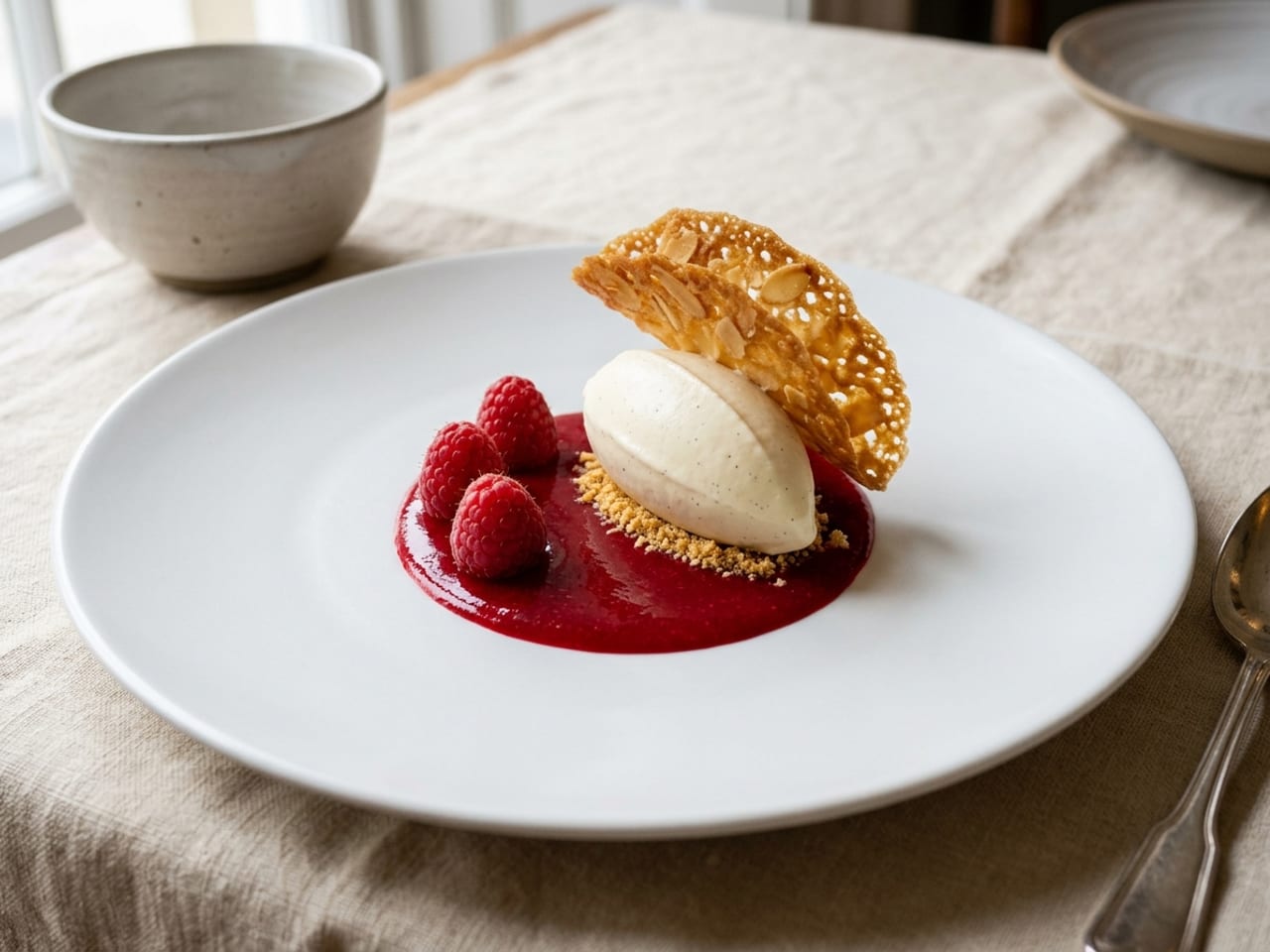
What each component is for
A component earns its place by doing one of four jobs around the main ingredient. Most starred plates cover them with three to five components, not sixteen.
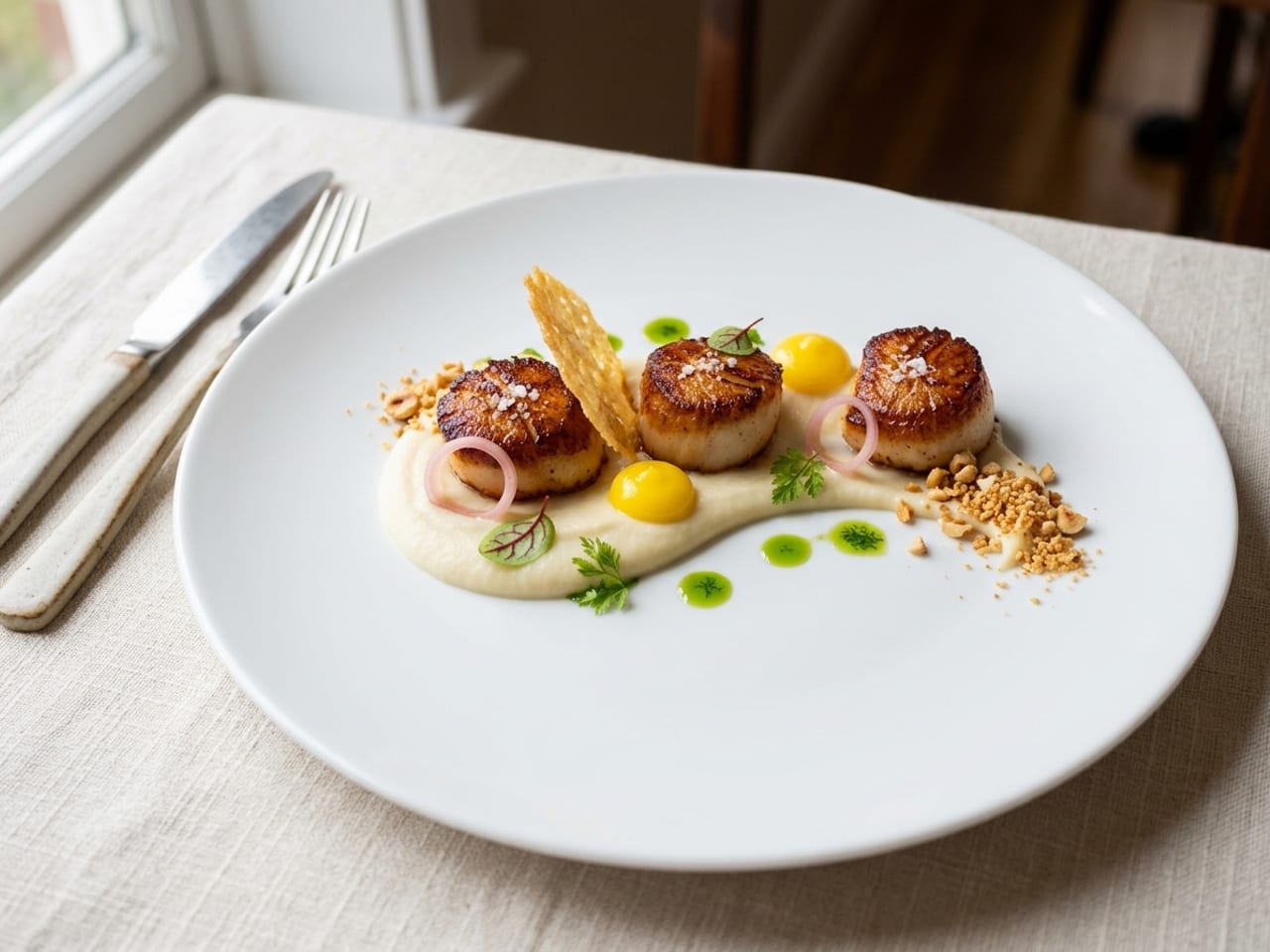
- A baseA purée, a sauce or a cream that holds the hero still and carries the plate's main flavor.
- The heroOne protein or vegetable, cooked well. It is not a component; it is the reason for them.
- CrunchA tuile, a crisp, a crumb or a shard. Soft food needs something that snaps.
- AcidA pickle, a fluid gel of sharp fruit, a few drops of vinegar: it keeps rich food from tiring the palate.
- Aroma and colorHerb oil, a powder, a few leaves. The smallest amounts, placed last.
Plating components at a glance
| Component | Texture | Job on the plate | Make ahead? |
|---|---|---|---|
| Coulis | Pourable, smooth | Sauce, color | Yes, 1 to 3 days |
| Tuile | Thin, crisp | Crunch, height | Yes, airtight |
| Quenelle | A shape, not a recipe | The soft center | Shape it to order |
| Purée | Thick, smooth | Base | Yes, reheat |
| Sauce and jus | Coats a spoon | Moisture, flavor | Base yes, finish last |
| Crémeux | Dense, creamy | Rich base (sweet) | Yes, 1 to 2 days |
| Crisp | Wafer, snaps | Crunch, sound | Yes, airtight |
| Crumb or soil | Loose, sandy | Anchor, crunch | Yes, airtight |
| Meringue shards | Brittle, light | Height, sweetness | Yes, airtight |
| Powder | Dust | Color, flavor burst | Yes, dry |
| Fluid gel | Glossy, holds a dot | Sharp flavor, precision | Yes, 1 to 3 days |
| Set gel | Firm, clean edge | Clarity, shape | Yes |
| Spheres | Skin, liquid center | Surprise, burst | No, serve at once |
| Foam or air | Bubbles | Flavor without weight | Siphon yes, air no |
| Herb oil | Liquid drops | Color, aroma | Up to 4 days, cold |
| Pickled elements | Crisp, sharp | Acid | Yes, about a week |
Coulis, tuile and quenelle
One sauce, one crunch, one shape: each card gives the definition, a base method, where it goes and the usual failure.
Coulis
from French couler, to flow
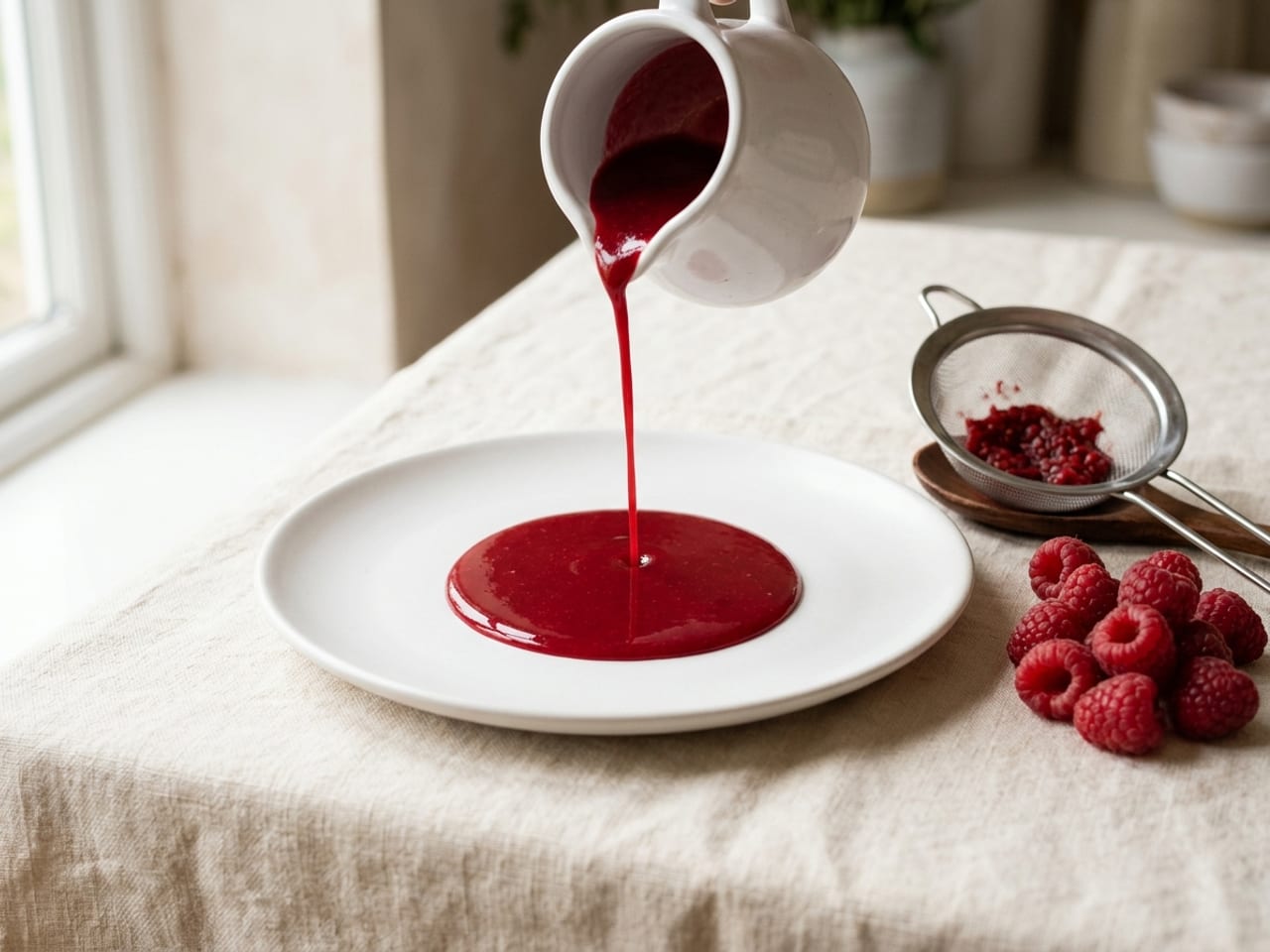
A coulis is a smooth, pourable purée of fruit or vegetables, pushed through a fine sieve so it runs clean, used as a bright sauce on the plate.
Make it:
- Simmer 12 oz (340 g) of berries with 5 to 7 tbsp sugar, a pinch of salt, 2 tsp lemon juice and a splash of water for just one minute.20
- Blend, then push it through a fine sieve to take out every seed and skin.
- Taste once it is strained and add any extra sugar while it is still warm, so it dissolves.20
On the plate: A pool under a dessert, a line of dots, or a pour at the table. The same method makes savory coulis: roasted red pepper, tomato, herbs. Raspberry is the classic because the color reads from across the room.
If it goes wrong: Tastes like jam: it cooked too long. The one-minute simmer exists to keep it fresh.20 Bleeds into a watery halo: reduce it a little, or strain it again and let it sit before plating.
Tuile
French for roof tile
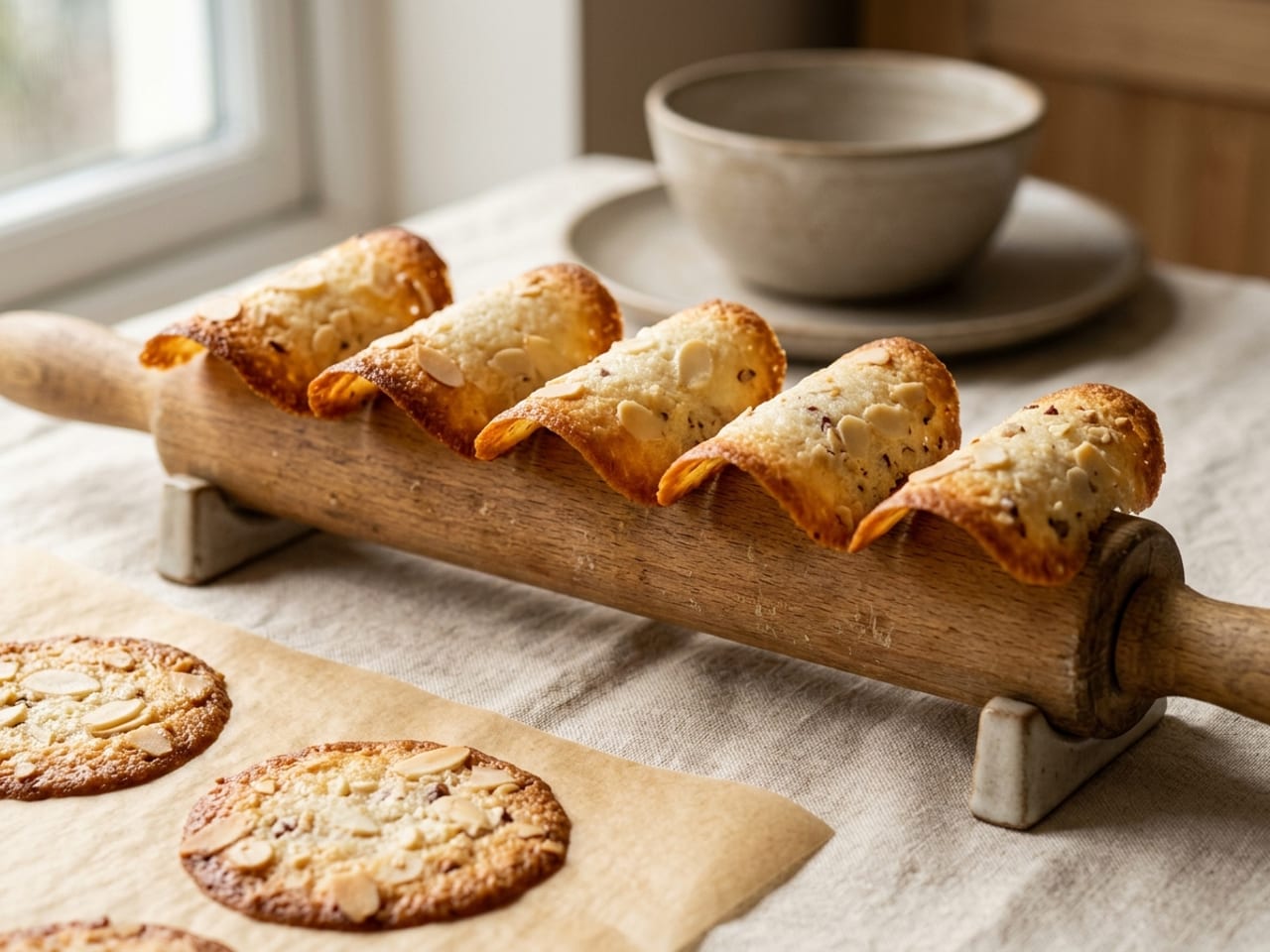
A tuile is a paper-thin, crisp wafer of sugar, egg white, flour and butter (often with almonds), bent over a rolling pin while hot so it sets curved like a roof tile.
Make it:
- Whisk roughly equal weights of flour, powdered sugar and melted butter with egg whites into a thin, smooth batter; chill it 1 to 2 hours, no longer.24
- Spread 2 tsp into a 4 to 5 inch (10 to 13 cm) circle so thin it is nearly transparent, two at a time.24
- Bake at 400°F (204°C) for 4 to 5 minutes, until only the very edge colors, then peel and drape over a rolling pin at once.24
On the plate: The crunch on a soft plate: leaned against a quenelle, standing up out of a mousse, or cut through a stencil into a leaf or a comb. It also works savory, with Parmesan or sesame.
If it goes wrong: Snaps before you can shape it: bake fewer at a time and shape the moment they leave the oven.24 Goes soft: moisture from the filling or the air. Plate it last and keep the rest airtight; King Arthur keeps them up to 10 days.24 Brown edges, pale bendy middle: the batter was uneven; a stencil and an offset spatula fix that.
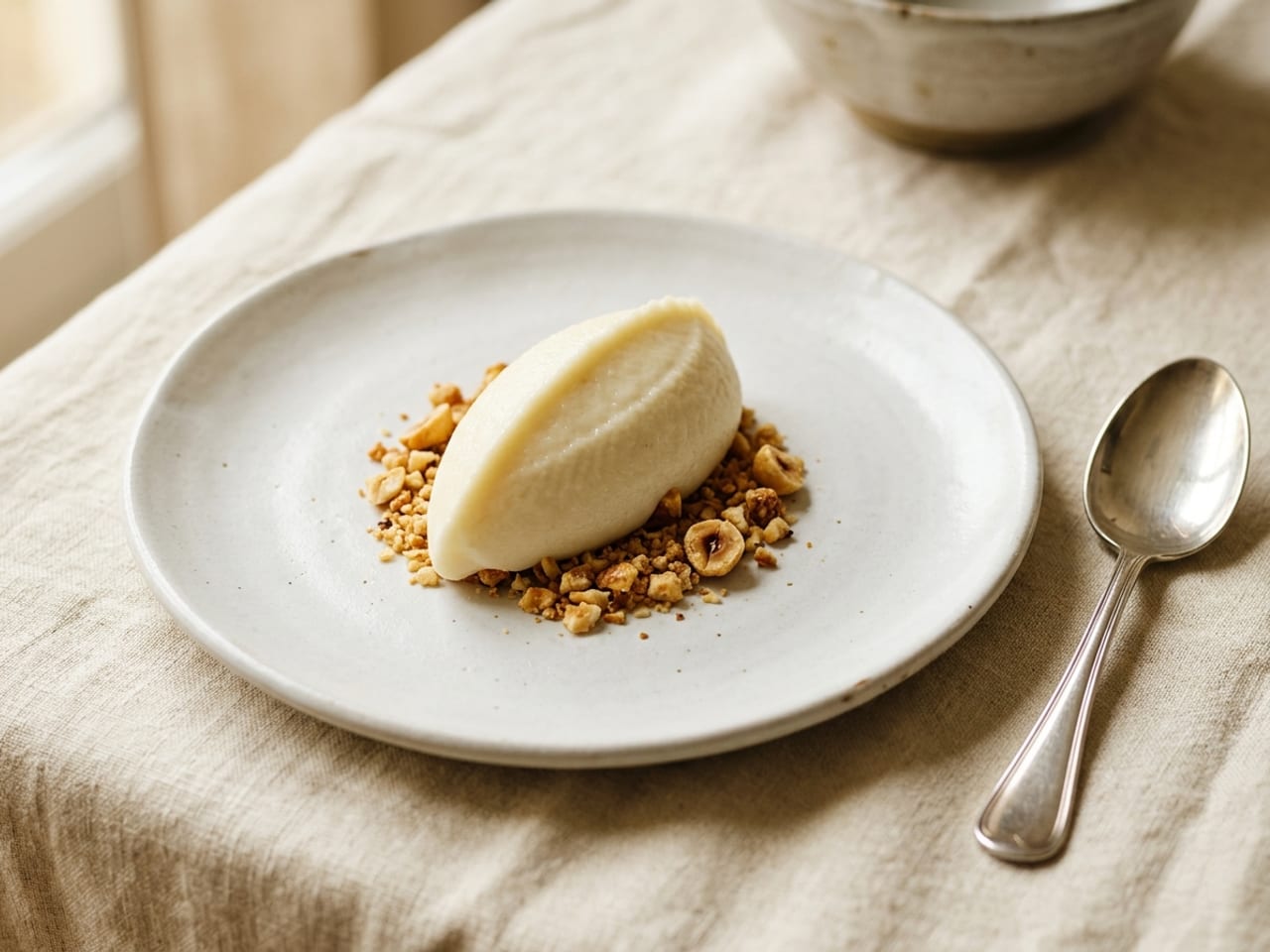
Quenelle
from German Knödel, a dumpling
A quenelle is a small, smooth oval of a soft food (ice cream, cream, mousse, purée or tartare) shaped with one or two spoons; the word first meant a poached dumpling of fish or meat.
Make it:
Two spoons passed back and forth give an oval with three faces; one spoon drawn through the food gives a smooth egg, which many kitchens call a rocher.25 Both methods, step by step, with the right texture for each food, are in how to make a quenelle.
On the plate: One per plate, set on a crumb so it cannot slide. The other hand moves are in plating techniques and dessert plating; a deep oval dessert spoon works.
If it goes wrong: Ragged edges: ice cream straight from the freezer is too hard; a pint needs about 30 minutes in the refrigerator. Grainy cream: it was whipped too far; whip it only until it holds its shape. Slides across the plate: give it an anchor. The sources for these, and more fixes, are in the quenelle guide.
Purée, sauce and crémeux
The soft layer everything else sits on. It carries the plate's main flavor and holds the other components still.
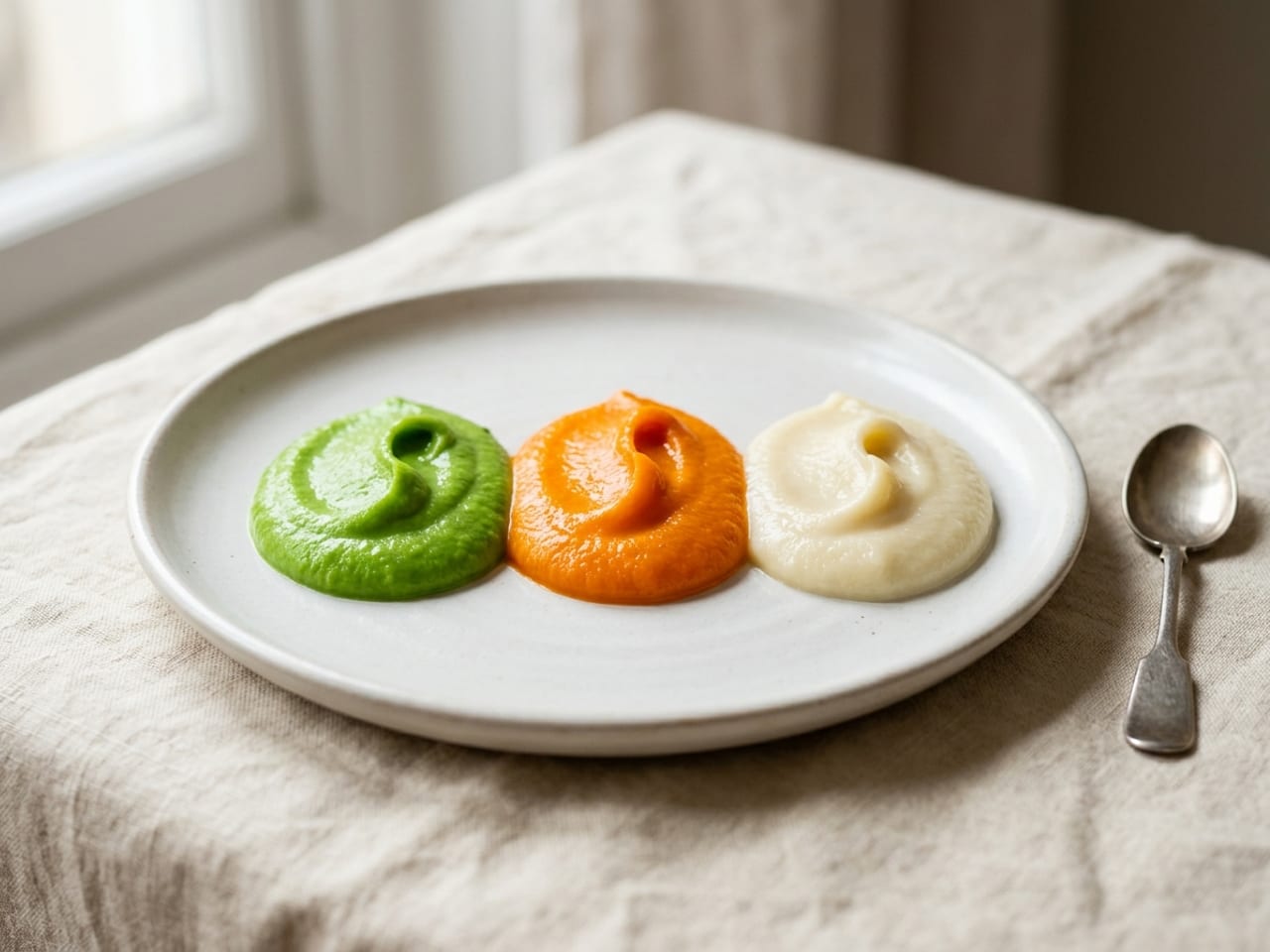
Purée
A purée is a cooked vegetable (or fruit) blended or milled until completely smooth, thick enough to hold its shape as the base the rest of the plate sits on.
Make it:
- Peas, carrots, cauliflower, celeriac: cook until soft, blend with a little of the cooking liquid or butter, then push it through a fine sieve with the back of a ladle.23
- Green ones: cool them fast after blending so the color doesn't fade.23
- Potatoes: never in a blender. Press them through a ricer or food mill and beat in cold butter; published versions of Robuchon's purée run from 2 parts potato to 1 of butter22 to 2.5 to 1.23
On the plate: The base layer: a swoosh, a smear or a spoonful under the protein, as on the salmon with pea purée and the tuna with parsnip purée. The swoosh itself is on Michelin-star plating.
If it goes wrong: Gluey potato: a blender or food processor bursts the swollen starch granules; the only fix is to start again with a ricer.21 Grainy: sieve it. Runny swoosh: cook it down in the pan before plating.
Sauce and jus
jus lié when thickened
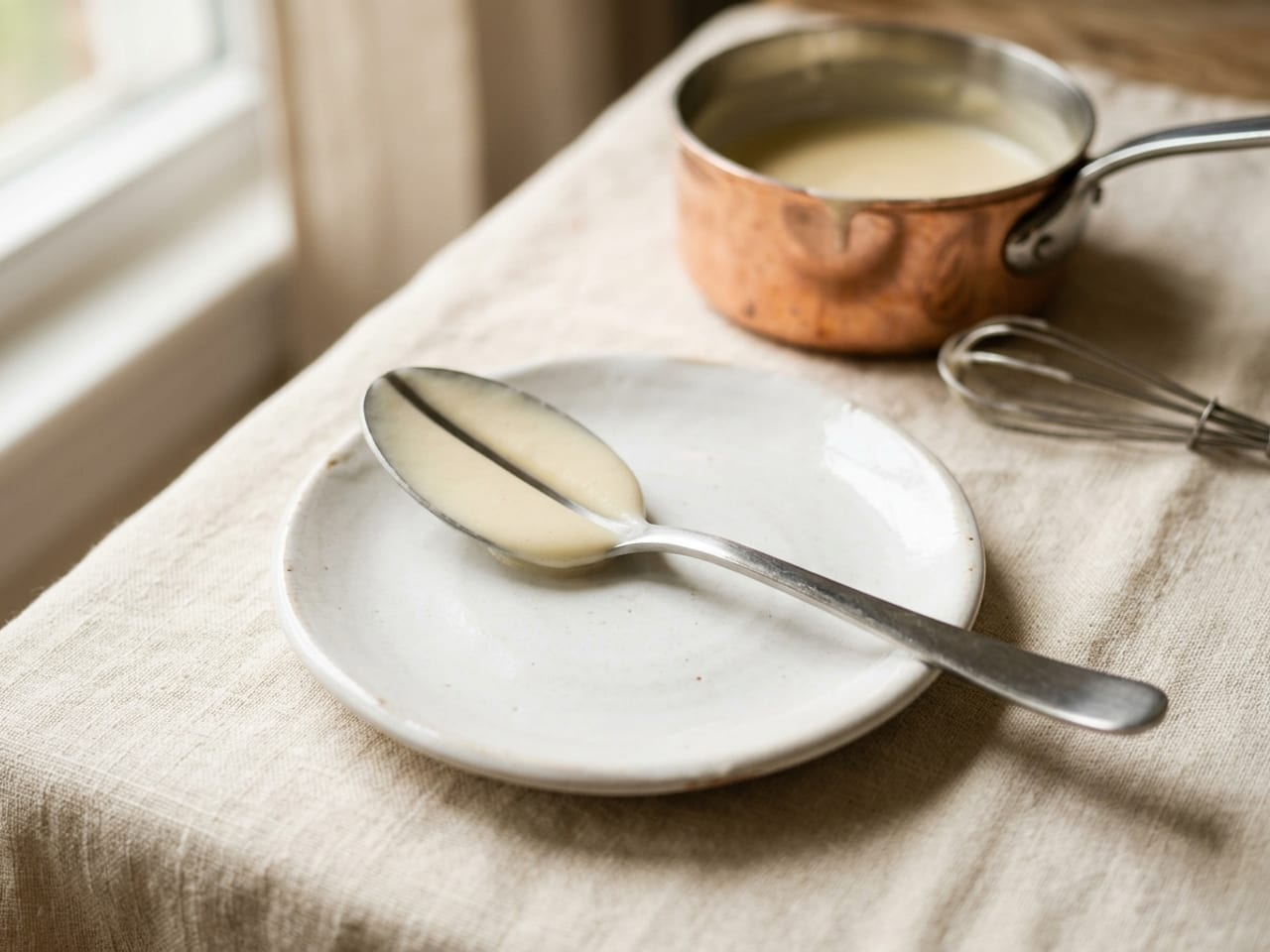
A jus is the thin, concentrated juice of roasted meat, deglazed and reduced (jus lié when lightly thickened with starch); a sauce is any seasoned liquid thickened to coat the back of a spoon.
Make it:
- Deglaze the roasting pan, add stock, reduce until it tastes finished.
- For a jus lié, Escoffier infused a veal or poultry stock and thickened it with arrowroot or starch rather than flour.5
- Test it: dip a spoon and draw a finger line down the back. If the line holds, the sauce is nappe.41
On the plate: Spooned around, not over, at the last moment. The five classic sauces and where to put them are in the mother sauces guide; a roast-drippings sauce is the turkey gravy. Au jus has a guide of its own: how to make and plate au jus, and so do the ways of putting a sauce on the plate: sauce plating techniques.
If it goes wrong: Too thin: reduce, or thicken with a little starch slurry. Floods the plate: two or three tablespoons a portion is plenty.
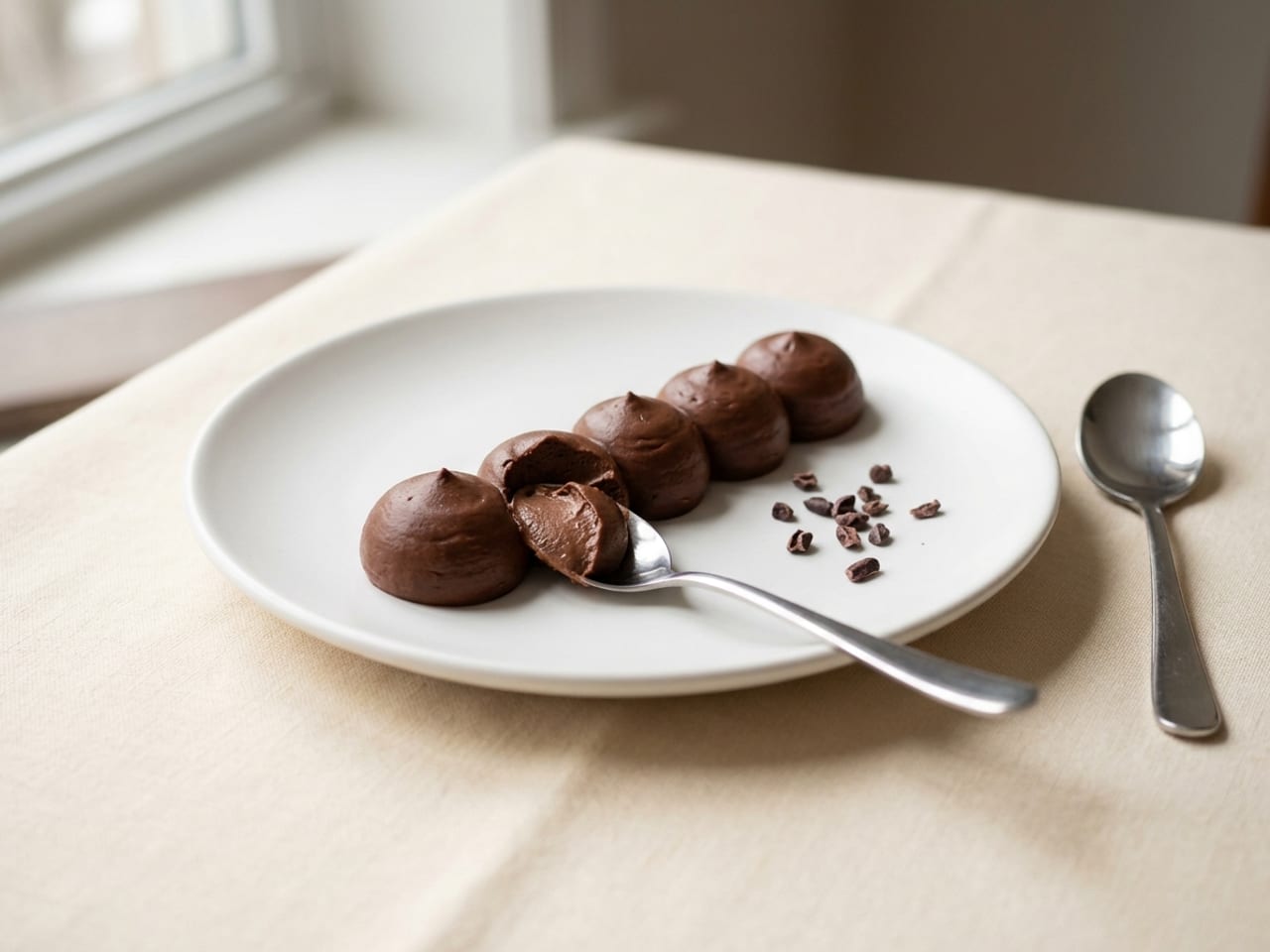
Crémeux
French for creamy
A crémeux is a dense, spoonable pastry cream, classically a crème anglaise emulsified with chocolate, firm enough to pipe or quenelle and soft enough to melt on the tongue.
Make it:
- Make a crème anglaise (Valrhona's base: 500 g cream, 500 g whole milk, 200 g yolks, 100 g sugar) and cook it to 84°C (185°F). Some recipes stop at 175 to 180°F (79 to 82°C).36,37
- Strain it and pour it over partly melted chocolate in portions, about 1 liter (4¼ cups) of anglaise to 380 g (13.4 oz) of dark chocolate, stirring to an emulsion.36
- Blend a few seconds with an immersion blender, then chill until set.36
On the plate: Piped domes or teardrops, a quenelle, or a layer under crumbs and fruit. It is the stirred cousin of the baked custard in a crème brûlée.
If it goes wrong: Grainy or split: strain the anglaise the moment it reaches temperature, then blend; keep the mix above 35°C (95°F) while you emulsify.36
Crisps, crumb, meringue and powders
Every soft plate needs something that snaps. These are the dry components: made ahead, kept airtight, plated last.
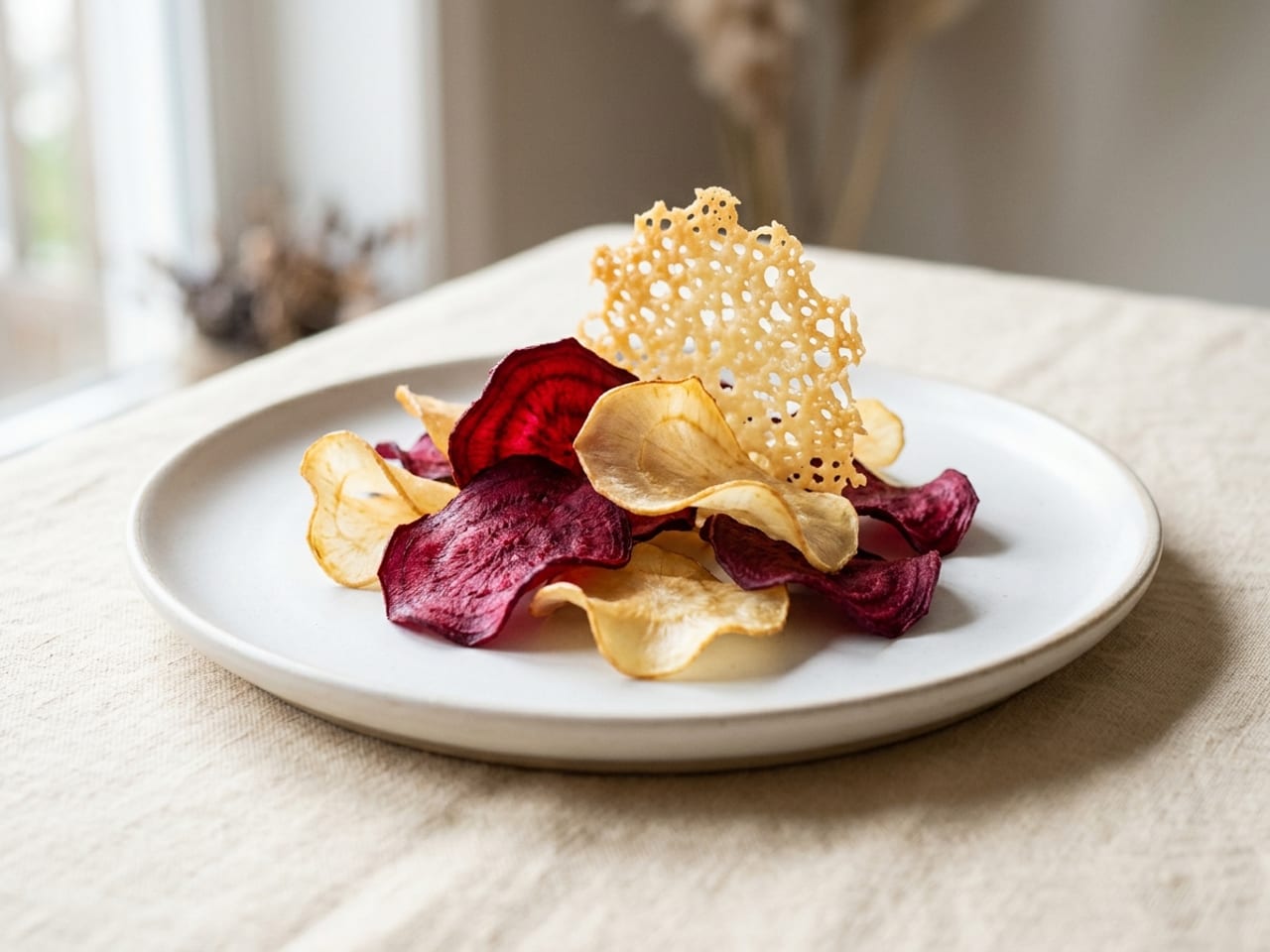
Crisp (chip)
frico when it is cheese
A crisp is a wafer-thin slice or sheet of vegetable, fruit, cheese or starch, baked, dried or fried until it snaps, added for crunch and sound.
Make it:
- Vegetables: slice beetroot or parsnip 1 to 2 mm thin on a mandoline, blot dry, toss in a little oil and bake at 200°C (390°F) for 15 to 20 minutes, stirring once.29
- Cheese (frico): 1 tbsp of shredded Parmesan per crisp, spread in a 2½ inch (6 cm) circle; about 2 minutes in the microwave or a few in a hot oven.30
- Cool on a rack, then store airtight.
On the plate: Stood upright for height, or tucked against something soft. Add it at the pass, not before.
If it goes wrong: Chewy: under-dried. Give it longer in a low oven until it snaps. Went soft on the plate: steam from hot food; keep it away from the sauce and plate it last.
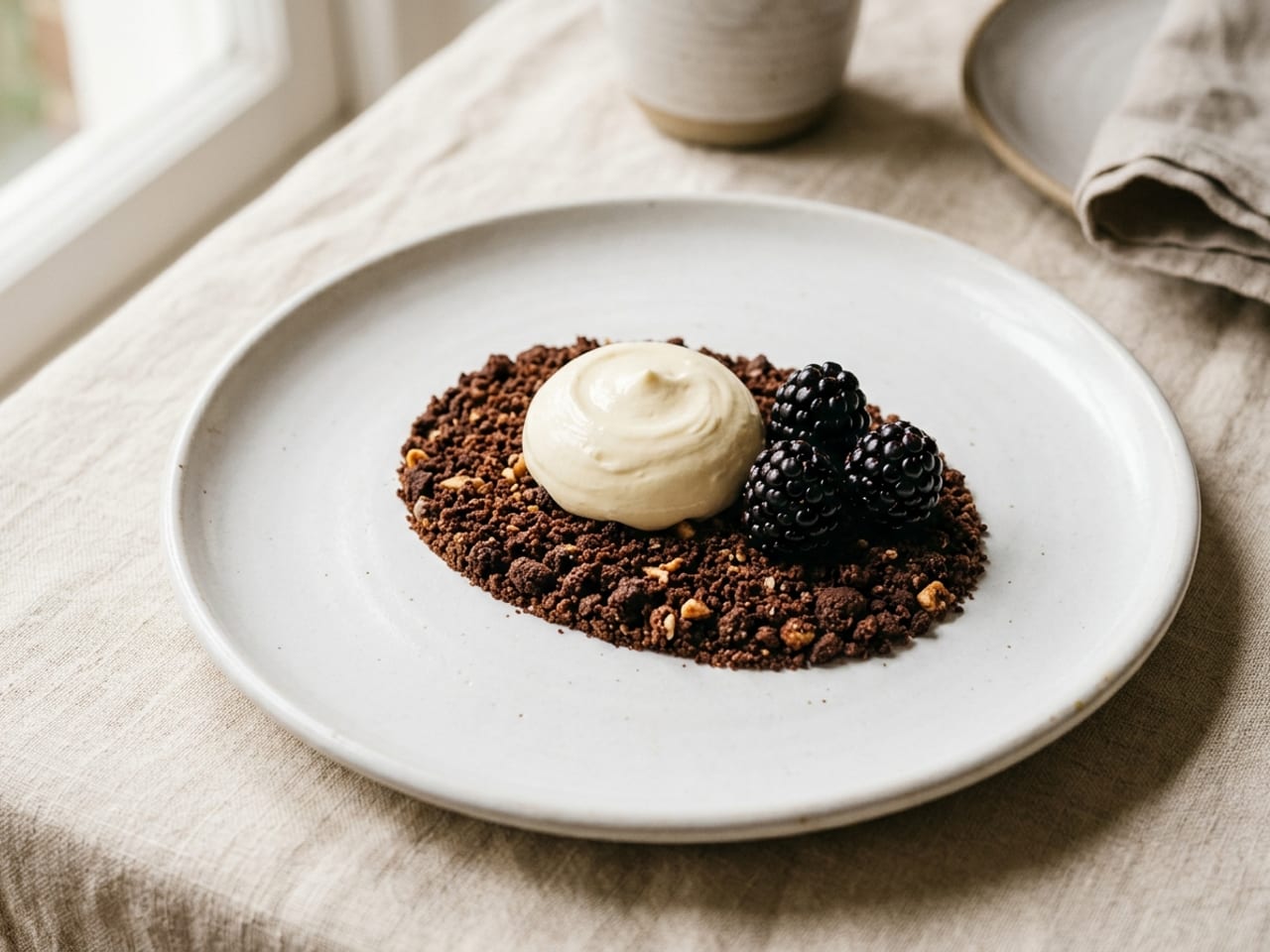
Crumb (soil, streusel)
A crumb is a dry, loose, baked mix of butter, flour or ground nuts, sugar and often cocoa, scattered as a bed; dark versions are called soil because they look like earth.
Make it:
- Chocolate soil: rub 200 g sugar, 200 g ground almonds, 120 g flour and 100 g cocoa with 135 g melted butter.27
- Bake at 160°C (320°F) for about 20 minutes, stirring every 5 so it browns evenly; cool and keep airtight.27
- Streusel is the same idea in roughly equal weights of flour, sugar and butter, baked loose and used as a crunchy layer.28
On the plate: An anchor for a quenelle, a stripe of texture, a dark color block on a pale plate. Savory soils use dried olives, toasted bread, malt or mushrooms.
If it goes wrong: Soggy: it sat on sauce or took on moisture. Keep it airtight and put it on a dry patch of plate, next to the wet elements rather than on them. Burnt in patches: stir it while it bakes.27
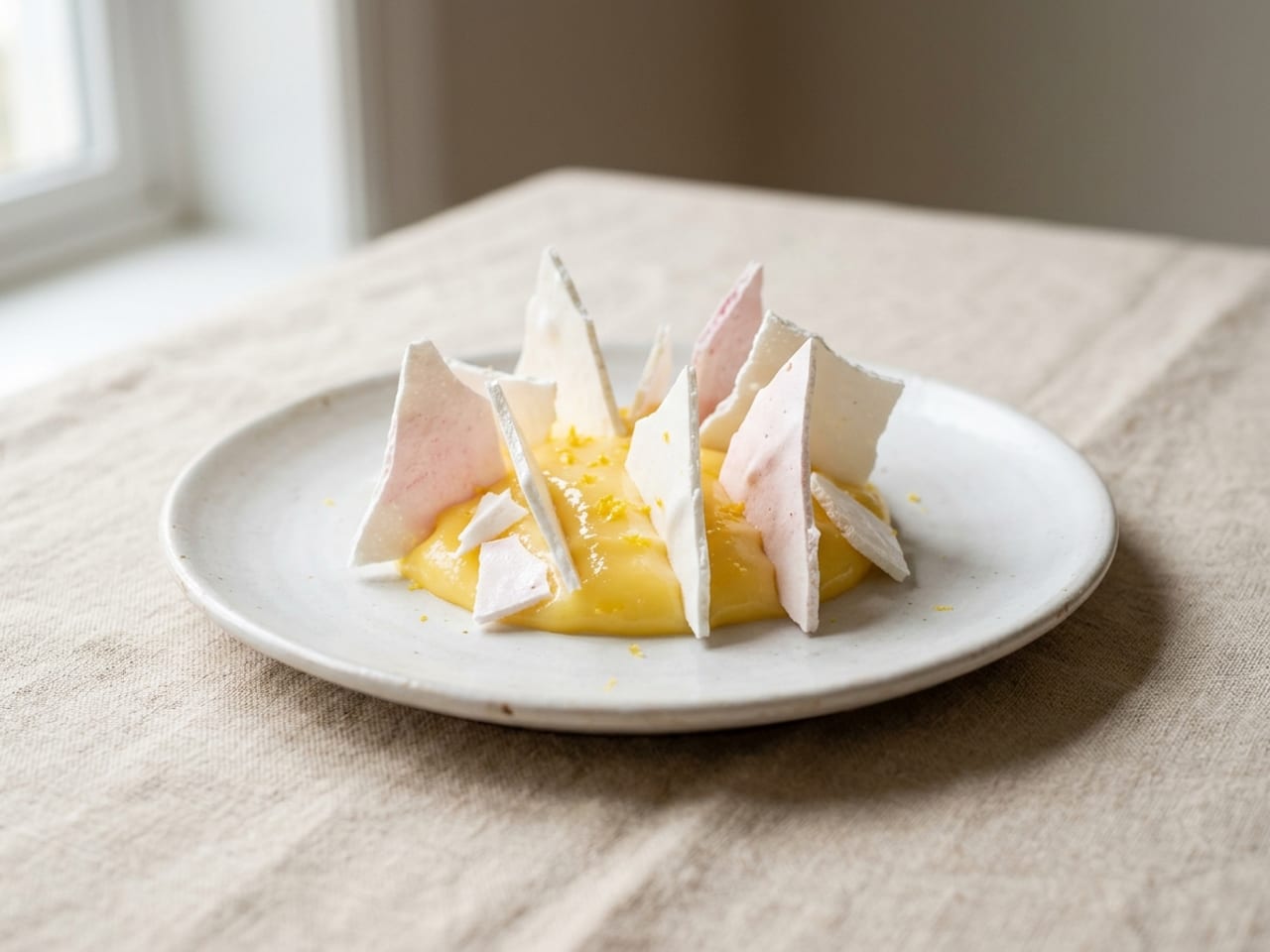
Meringue shards
Meringue shards are thin sheets of egg white whipped with sugar, dried until crisp and broken into jagged pieces that stand up out of a dessert.
Make it:
- Whip whites with about twice their weight in sugar,38 or heat whites and sugar to at least 160°F (71°C) first for a Swiss meringue.38
- Spread it thin on a silicone mat and dry it low and slow until it lifts off in one crisp sheet.39
- Snap into shards and keep them airtight.
On the plate: Height and snap on lemon curd, fruit and cream; tint them with a little fruit powder.
If it goes wrong: Sticky or chewy: sugar pulls moisture out of the air, so humid days need a longer dry; a teaspoon of cornstarch in the sugar helps. Weeping beads of syrup: the same cornstarch soaks them up.39
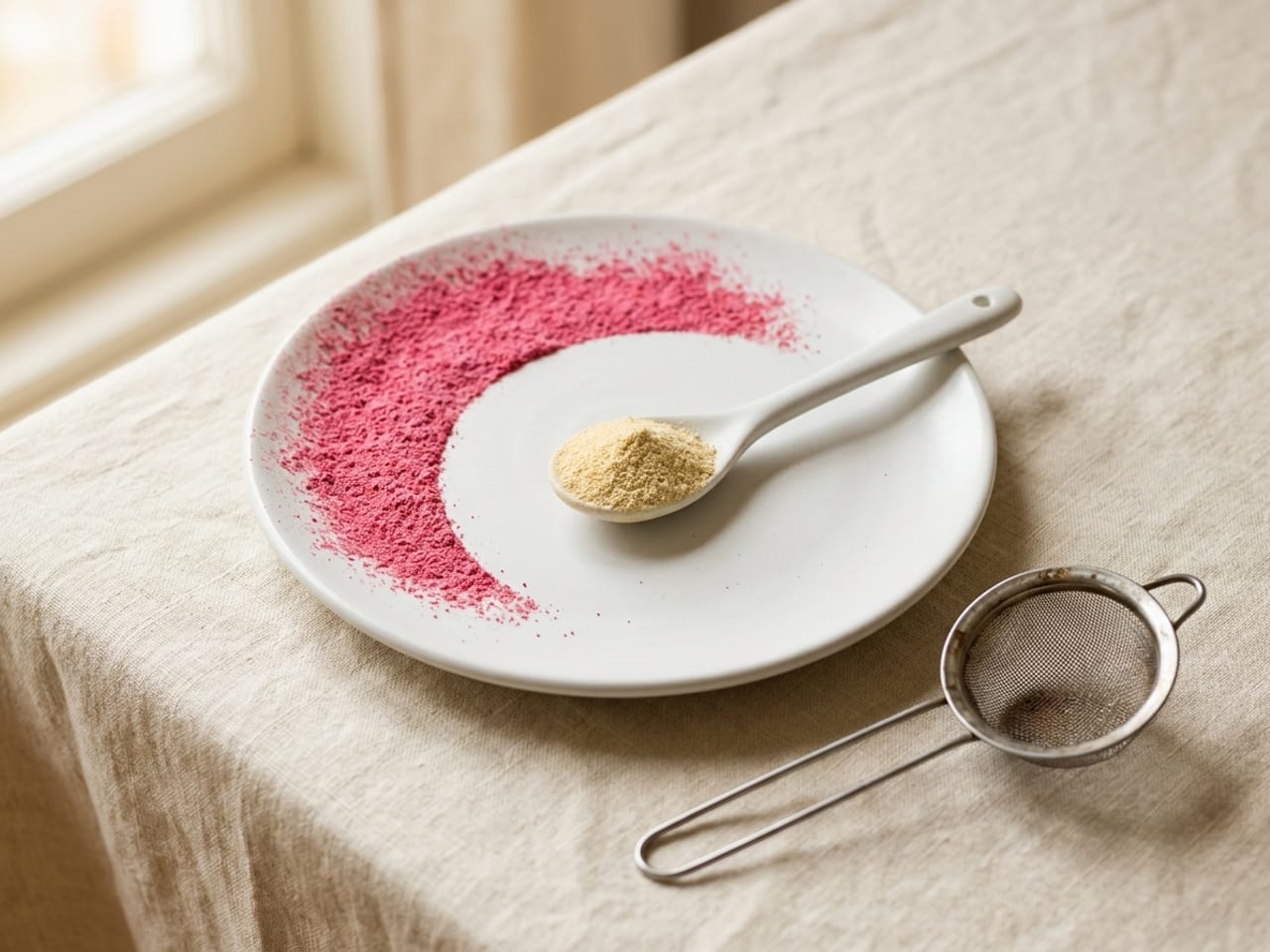
Powder (dust)
A powder is a flavor turned into fine dry dust, either a fat whisked with tapioca maltodextrin or a dried fruit or vegetable ground and sieved, used to add color and a burst of taste.
Make it:
- Fat powders: whisk 80 g olive oil with 25 g tapioca maltodextrin and 3 g salt.19 One supplier works at 60% fat to 40% maltodextrin by weight.31
- Fruit powders: dry the fruit completely (freeze-dried raspberries work straight from the bag), grind and sieve.31
On the plate: Dusted through a stencil or a tea strainer onto a dry part of the plate, at the last second. Olive oil powder turns back into oil on the tongue.
If it goes wrong: Turns to paste: water got in; maltodextrin dissolves in water and only powders fat.31 Clumps in the jar: it drew moisture from the air; store it airtight, cool and dry.19
Fluid gels, gels, spheres and foams
The components elBulli and the labs made common: they carry a strong flavor in a shape a sauce cannot hold.
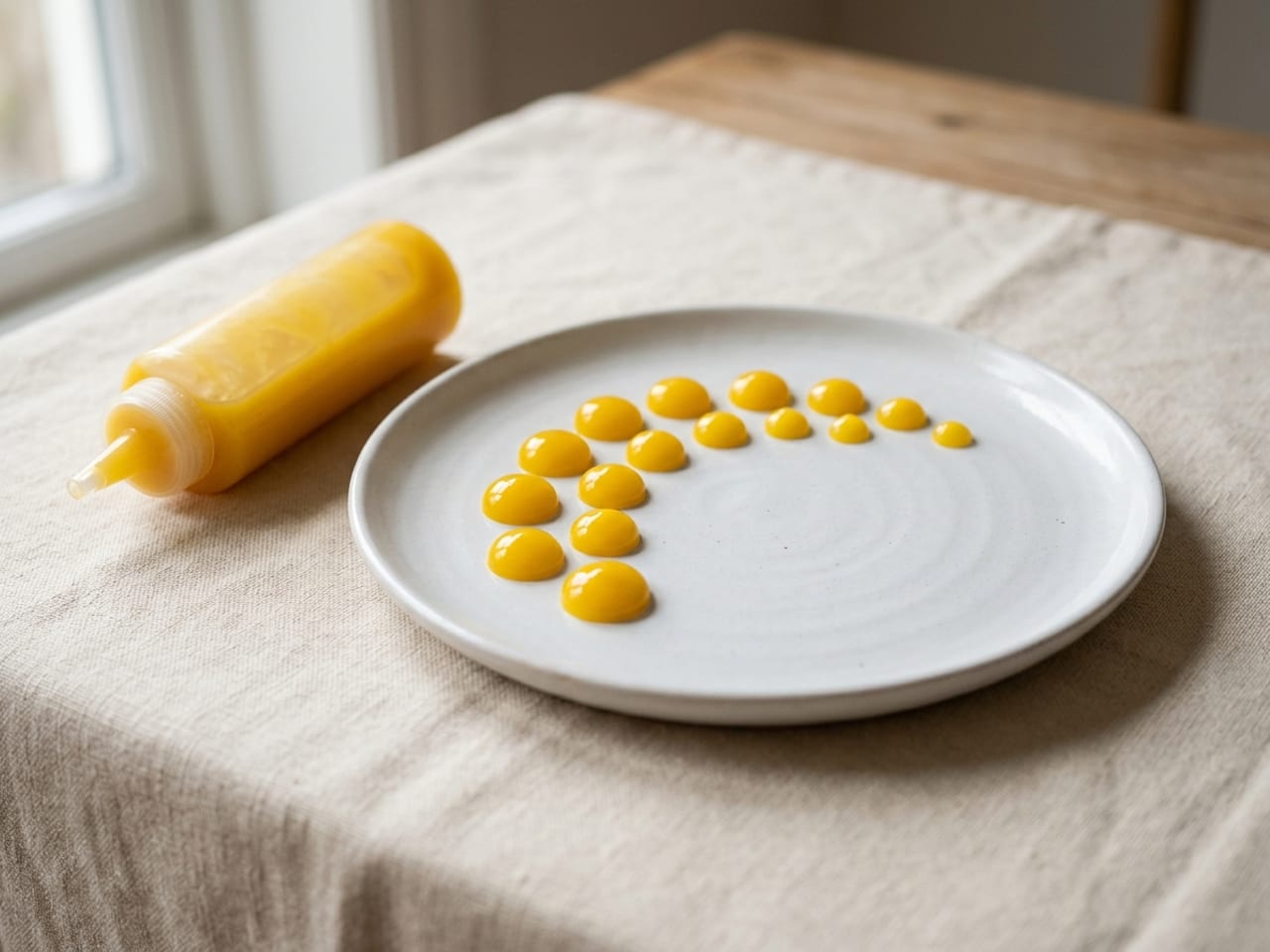
Fluid gel
A fluid gel is a set gel, usually agar or gellan, blended back into a smooth, glossy purée that flows when pushed but holds a sharp dot or line on the plate.
Make it:
- Whisk 2 g agar (1.1%) and 0.35 g xanthan into 185 g of juice or stock and bring to a boil; agar has to boil to set.19
- Let it set solid; agar sets within minutes once it cools to about 35 to 45°C (95 to 113°F).19
- Blend until creamy, then pass through a fine sieve. A looser gel uses about 0.5% agar.43
On the plate: Squeeze-bottle dots and lines that stay put next to hot food, with far sharper flavor than a starch-thickened sauce. Because agar holds up to heat, the dots survive a warm plate.
If it goes wrong: Didn't set: it never boiled.19 Weeps a puddle: agar gels weep; Lersch swaps 0.1 to 0.2% of the agar for locust bean gum.19 Grainy or full of bubbles: blend longer, sieve, and let it rest in the fridge before bottling.
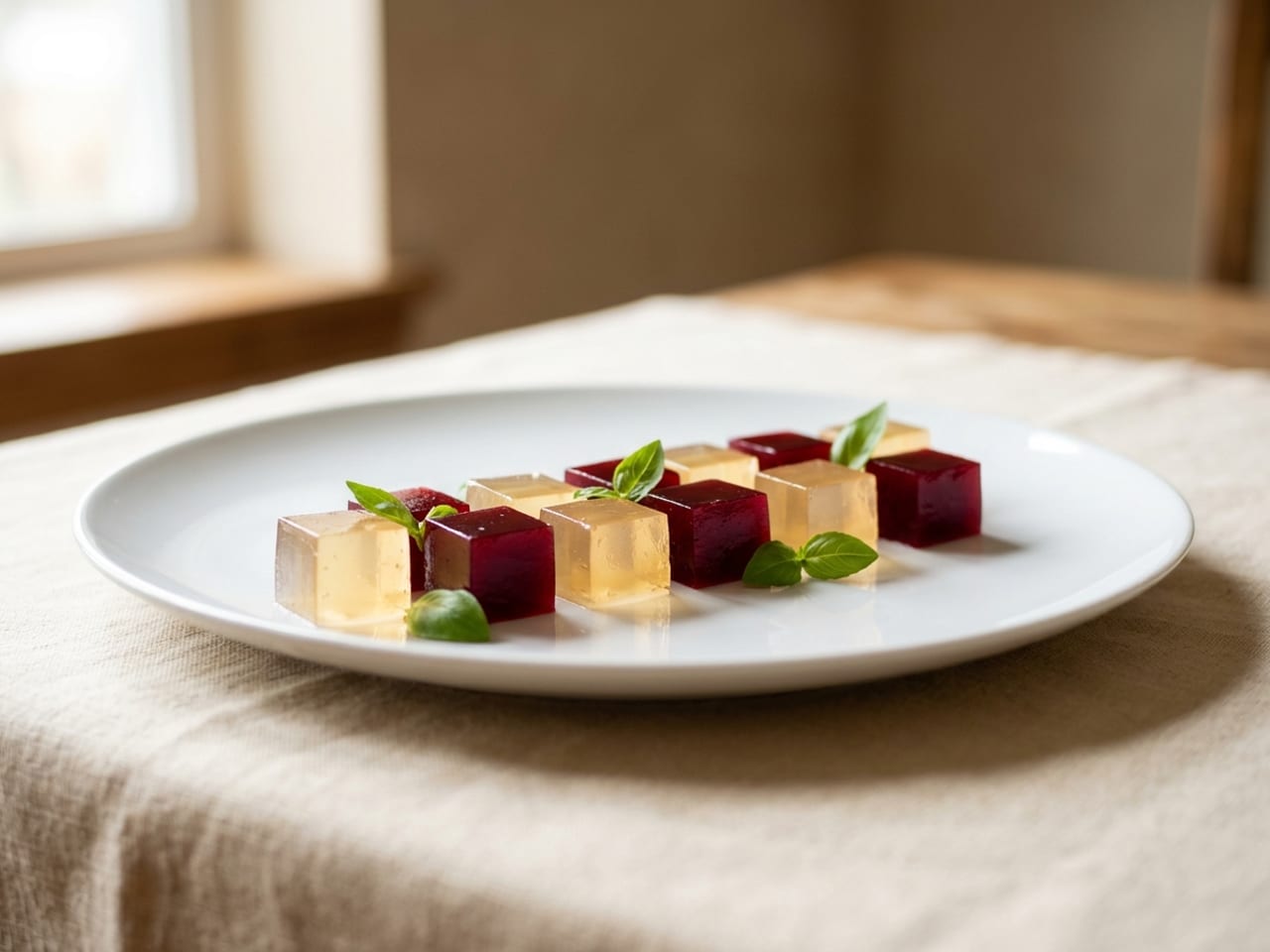
Gel (set gel)
jelly, gel sheet
A set gel is a liquid set firm with gelatin, agar or another gelling agent, then cut into cubes, sheets or shapes that keep a clean edge.
Make it:
- Agar: 0.2% will set a liquid, 0.5% gives a firm jelly; boil it, pour into a tray, cut when set.19
- Gelatin: 0.6 to 1.7% of the liquid's weight, bloomed in cold water first; it sets slowly, over hours, in the fridge.19
- Swapping: use two to three times less agar than gelatin by weight.19
On the plate: Clear cubes of tomato water on a salad, a sheet draped over fish, a jelly with a dessert. Gelatin melts in the mouth; agar stays firm, even warm. The science is below.
If it goes wrong: Won't set with fresh pineapple, kiwi or papaya: their enzymes cut gelatin apart.46 Use canned fruit, whose enzymes are destroyed in processing,42 or use agar, which they cannot break.19 Rubbery: too much gelling agent; weigh it.
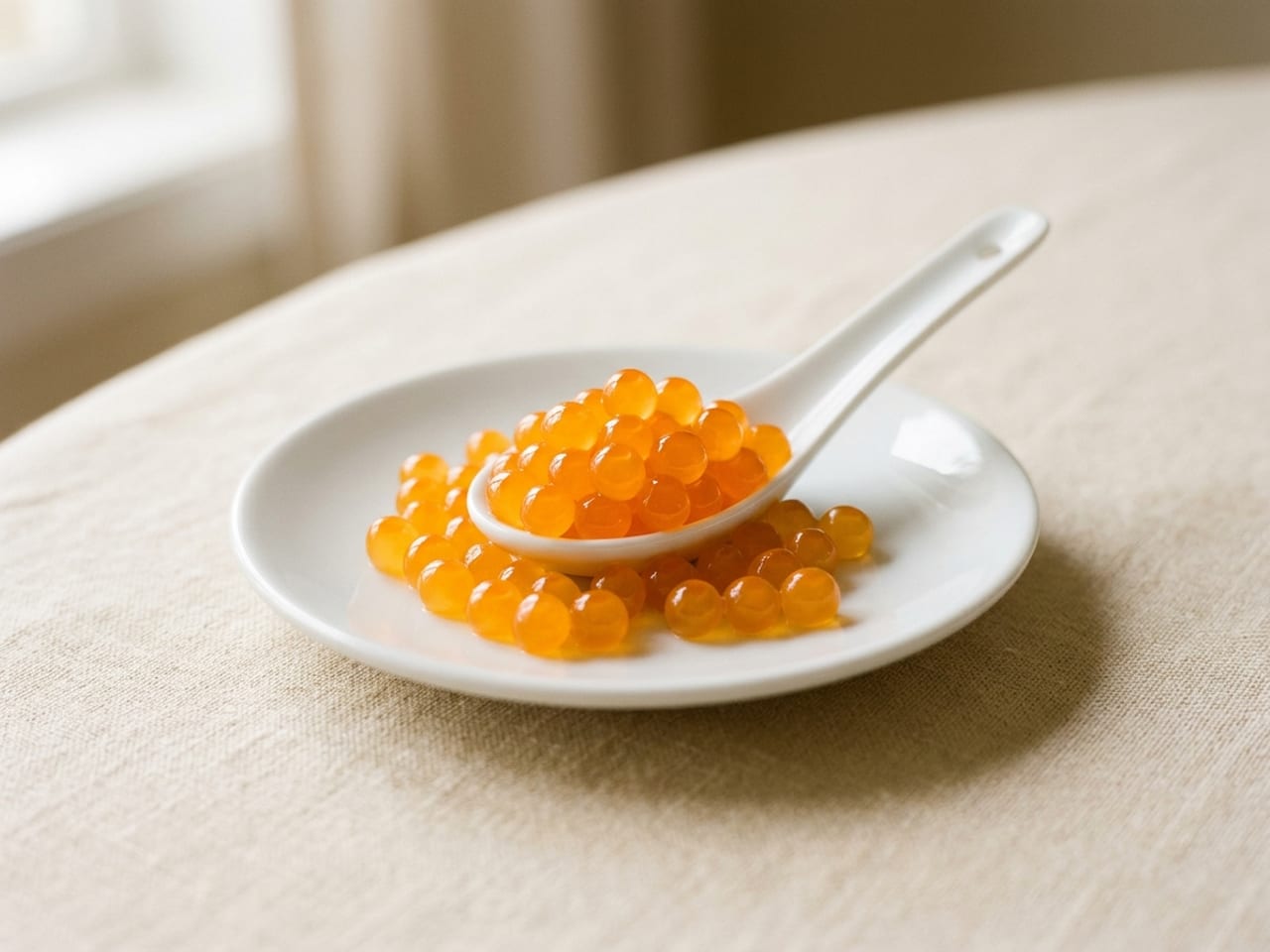
Spheres (spherification caviar)
Spherification drops a flavored liquid containing sodium alginate into a calcium bath (or the reverse), so a thin gel skin forms around a liquid center that bursts in the mouth.
Make it:
- Blend 0.5 to 0.7% sodium alginate into the juice and let the bubbles settle.40
- Drip it from a syringe or pipette into a bath of 10 g calcium chloride per liter (about 1 quart) of water, from no higher than 1 to 2 inches (2.5 to 5 cm).40
- Lift the beads out after about 30 seconds, rinse in clean water and serve at once; they keep firming.40
On the plate: A spoonful of fruit "caviar" on a dessert or an oyster, or one big sphere as the surprise of the plate.
If it goes wrong: Won't form in sour juice: below about pH 3.6 to 4 the alginate turns to insoluble alginic acid; add about 0.8% sodium citrate to lift the pH.19,40 Tails: you are dripping too fast.40 Liquid with calcium in it (dairy): use reverse spherification, calcium in the food and alginate in the bath.40
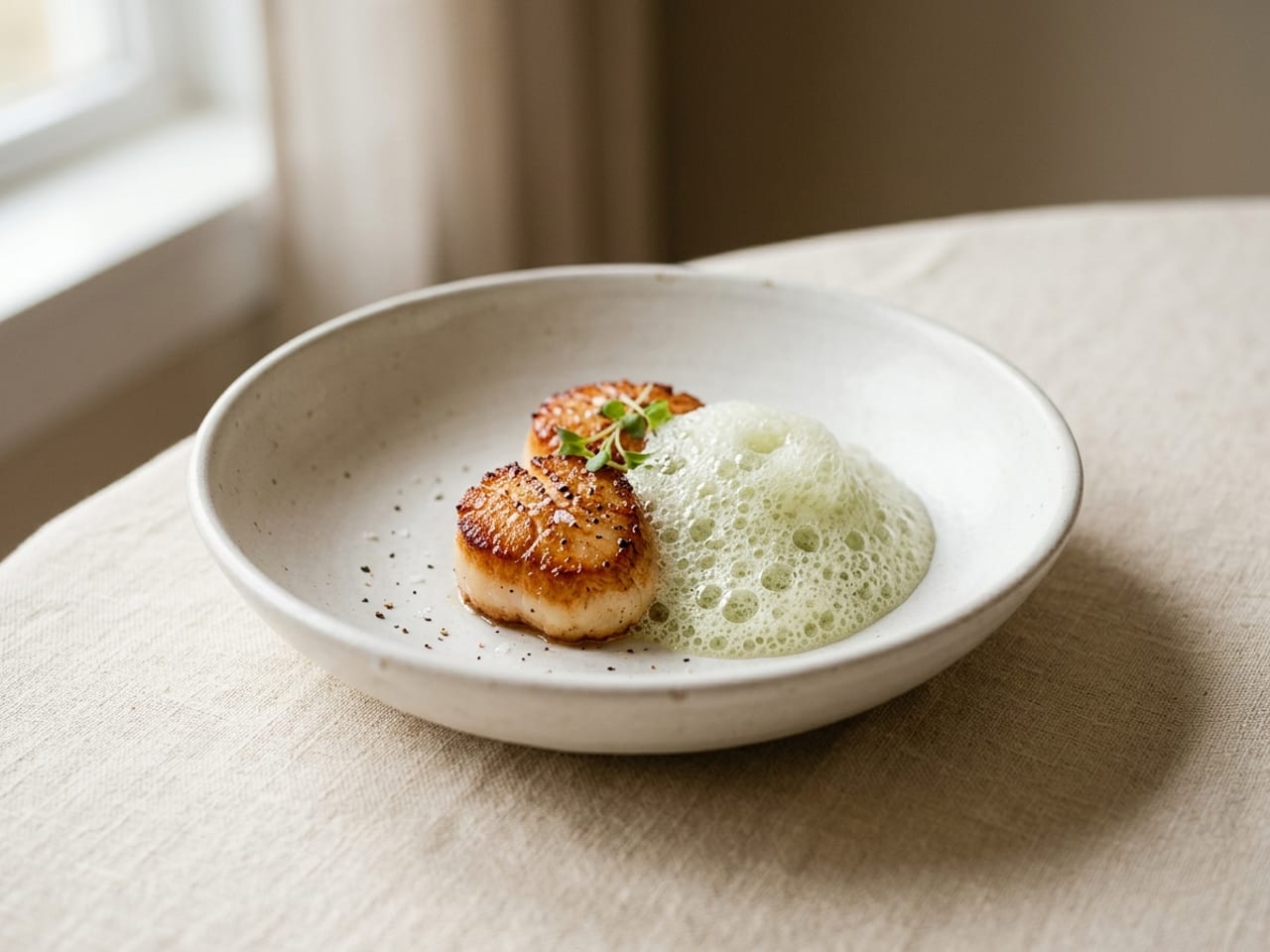
Foam (espuma, air)
A foam is a flavored liquid filled with bubbles; an espuma is made in a cream siphon charged with nitrous oxide, and an air is a looser froth whipped on the surface of a liquid with a little lecithin.
Make it:
- Espuma: set a smooth, sieved liquid with 0.5 to 1.5% gelatin (or use cream for body), fill the siphon no more than halfway, charge and chill.19
- Use one charger for a 0.5 L (1 US pint) siphon and two for 1 L (1 quart), never more, and no pulp or seeds.26
- Air: 1.5 g soy lecithin in 500 g of liquid (0.3%); hold a hand blender at the surface, wait a minute, skim the foam that collects.19
On the plate: A cloud beside seafood, over a soup, or on a dessert: flavor without weight. Airs collapse within minutes, so they go on last.
If it goes wrong: Siphon spits liquid: the base is too warm or too thin, or the charge was short; chill 1 to 2 hours, add gelatin.26 Air won't hold: too much lecithin destabilizes it; use a wide container.19
Herb oil and pickles
Small amounts that change how everything else tastes: green aroma and a hit of acid.
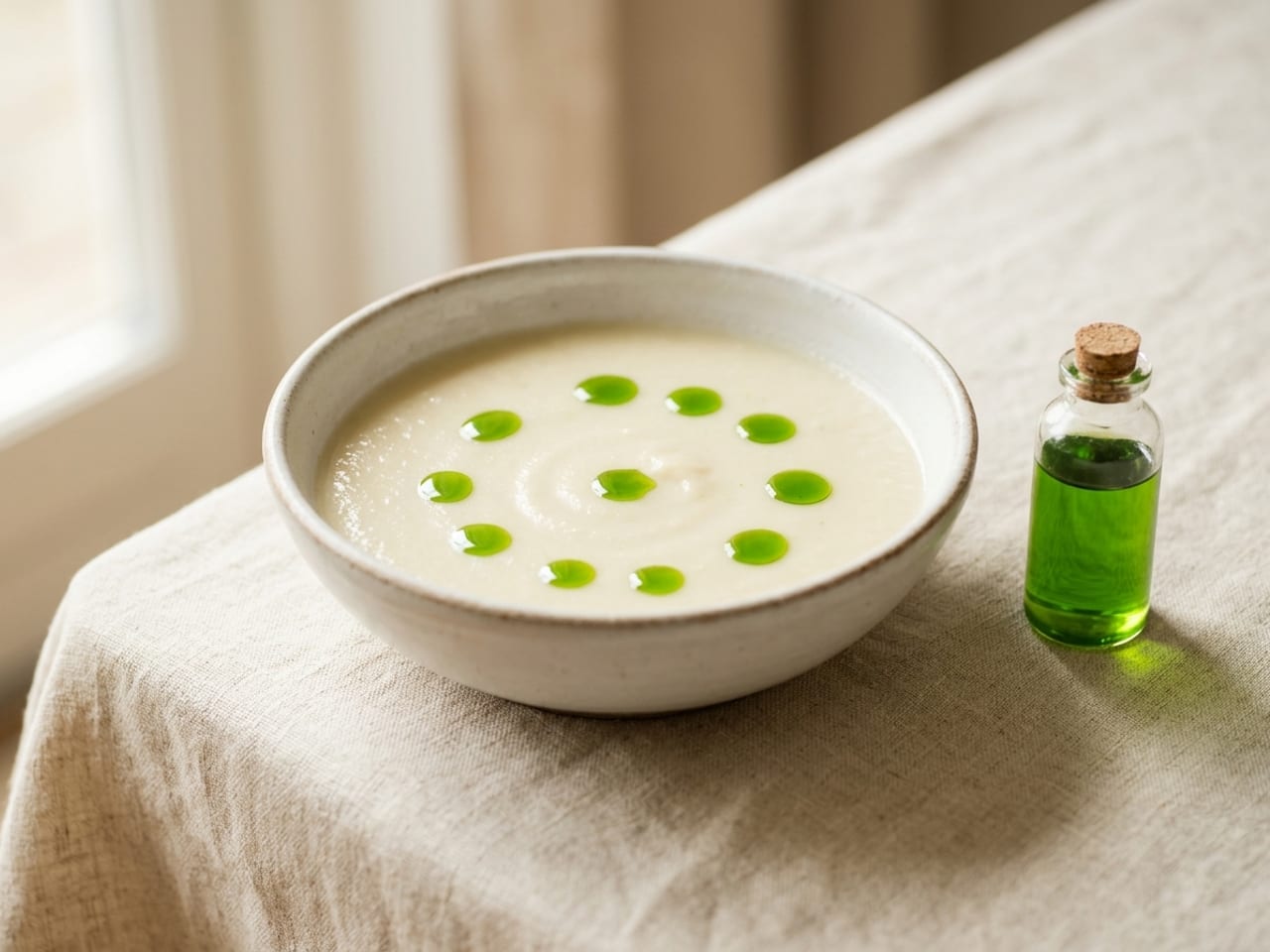
Herb oil
Herb oil is neutral oil blended with blanched green herbs and strained clear, used in drops for vivid color and fresh aroma.
Make it:
- Blanch 200 g (7 oz) of soft herbs for 30 seconds, chill in ice water and squeeze dry; blanching stops the browning enzyme.32
- Blend with 300 g (10½ oz) of neutral oil until the jug feels hot, then chill the oil fast over ice.32
- Strain through a coffee filter without pressing, for a clear green oil.32
On the plate: Drops on a pale soup or purée, a ring around a crudo, a few beads on a sauce: the green does the work of a garnish without the leaf.
If it goes wrong: Khaki, not green: old herbs, no blanch, or it cooled slowly.32 Bitter: you pressed the pulp.32 Keeping it: in the fridge for 4 days at most, or freeze it (why).66
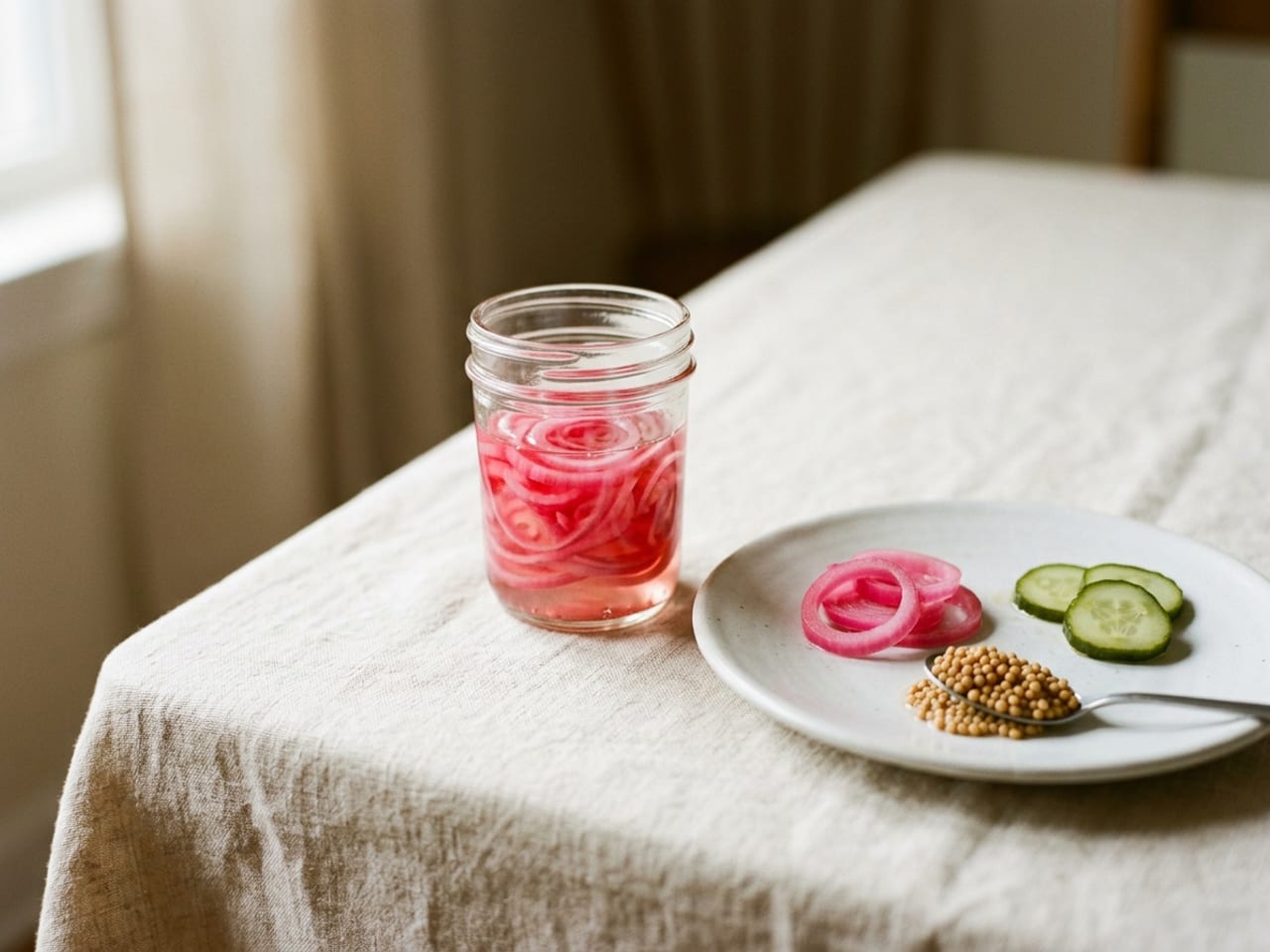
Pickled elements
quick pickles
A pickled element is a vegetable or fruit soaked in a sweet-sour vinegar brine for hours rather than weeks, added in small amounts to cut richness with acid and crunch.
Make it:
- Bring 1 cup (240 ml) red wine vinegar, ⅓ cup (about 65 g) sugar and ¼ tsp salt to a simmer.34
- Pour it over one thinly sliced red onion or shallot and cool about an hour. Softer versions cut the vinegar 1:1 with water.34,35
- Keep it in the fridge; use within a week.34
On the plate: A few rings, never a heap: separated with tweezers on a rich fish, pork belly, a purée. It is the acid half of a bánh mì too.
If it goes wrong: Too sharp: add a little sugar, or cut the vinegar with water as some quick recipes do;35 a pickle meant to keep needs undiluted 5% vinegar.66 Limp: slice thicker, or pour the brine on cool.
Why some gels melt on the tongue and others survive a hot plate
Agar has a huge gap between setting and melting. A 1.5% agarose solution gels at about 32 to 43°C (90 to 109°F) and the gel does not melt until above 85°C (185°F); the gap between the two is almost always more than 45°C.44 That gap is why elBulli could serve hot jellies from 1998,14 and why an agar fluid gel holds its dots beside hot food.
Gelatin melts where you eat. Gelatin gels typically melt around 30 to 40°C (86 to 104°F), higher when there is more gelatin,45 which is the melt-in-the-mouth texture of a good panna cotta and the reason gelatin fails on a warm plate. Fresh kiwi, pineapple and papaya carry enzymes that digest it: in one experiment, gelatin mixed with kiwi's actinidin did not set at all,46 and pineapple's bromelain is so reliable at it that its strength is sold in "gelatin-digesting units".47
Gellan comes in two textures. Low-acyl gellan makes hard, brittle gels and high-acyl gellan soft, elastic ones;48 chefs blend the two for anything in between.
A fluid gel is a gel broken on purpose. Setting a gel while it is sheared (or blending it once set) produces micro-gel particles: the result behaves like a solid at rest and flows once you push it,50 which is exactly what a squeeze-bottle dot needs. The idea came out of Unilever's research labs, patented in 198916 and modelled by Norton and colleagues in 1999.49
Spheres are calcium bridges. Calcium ions lock neighbouring alginate chains together like eggs in an egg box, which is how the skin forms the instant a drop hits the bath.51 The calcium salt sets the speed: calcium chloride reaches full gel strength in about 100 seconds, calcium lactate in about 500 and calcium gluconate in about 2,000, and chloride tastes bitter, which is why cooks put the gentler salts inside the food.52 Alginate's acid groups have a pKa of about 3.4 to 3.7,53 so in very sour juice it turns to alginic acid instead of gelling cleanly.
Foams die three ways: liquid drains out, bubbles merge, and small bubbles feed the big ones.45 Sugar makes egg whites slower to whip but the foam more stable,54 and in a classic experiment summarised in a later review, a single drop of yolk cut an egg-white foam from 135 to 40 ml.55
What the components add: drag to compare
Both frames hold the same three scallops. One has nothing else; the other adds a base, crunch, acid and color.
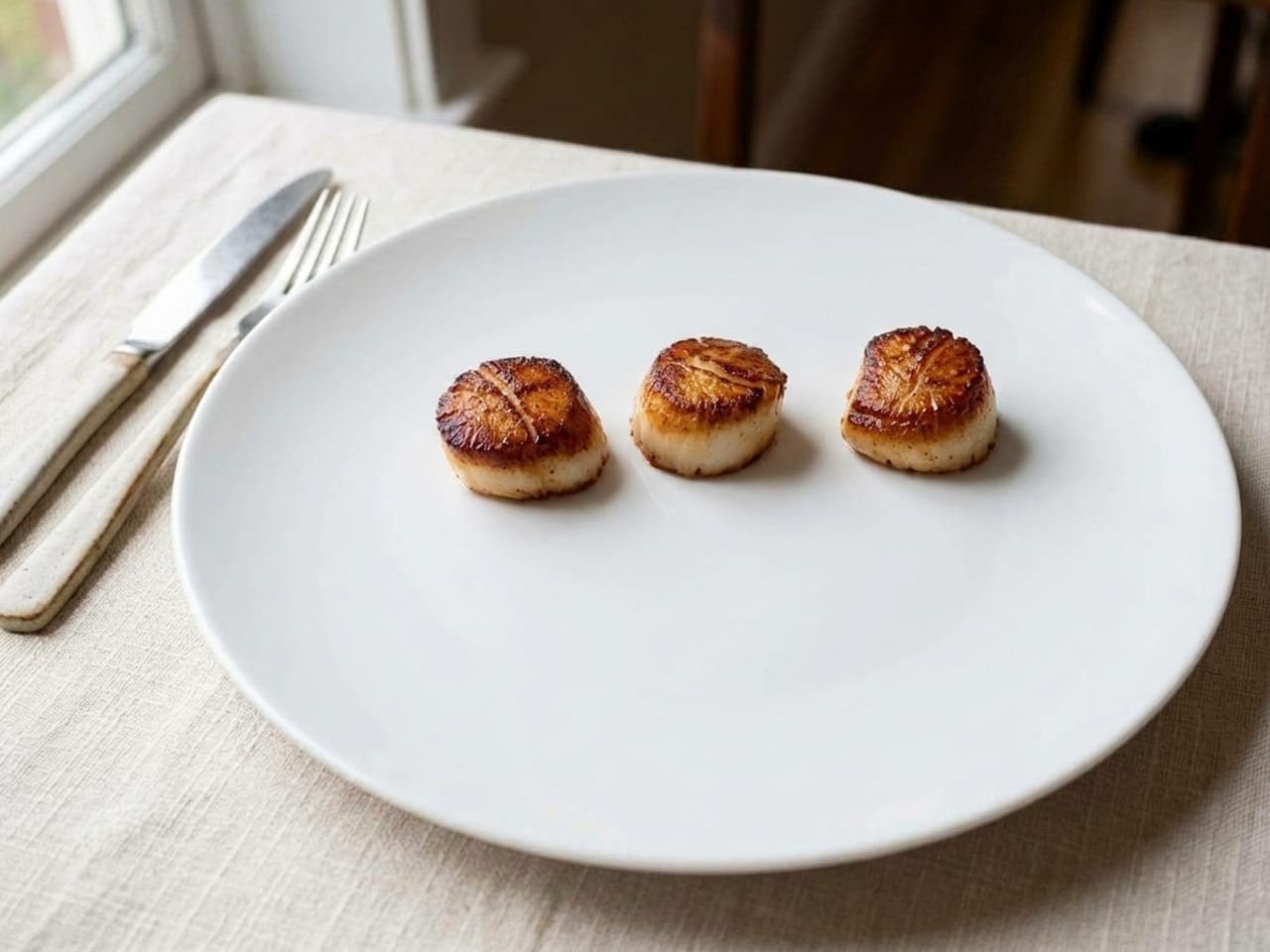 Scallops aloneWith components
What science says about composed plates
No study has tested a coulis or a tuile. What follows is what research on arranged plates, color and texture suggests, including its limits.
- Seventeen components, arranged, tasted betterIn the Kandinsky study, 60 people ate the same salad of 17 components (vegetables, purées, a reduction) plated either tossed, neatly, or like a Kandinsky painting. The artful plate was liked more, rated tastier after eating and worth more money. The groups were small (about 20 each) and it was one dish.59
- The sauce itself tasted better when plated wellWhen the same chicken dish was served plated attractively or not, people liked both the chicken and the sauce significantly more on the attractive plate.60
- Color contrast between components draws the eyeSalad photos with high color contrast between the components (red against green, light against dark) were rated more attractive than pale ones.61 On the plate itself, one strawberry mousse was rated 15% more intense and 10% sweeter on white than on black,62,63 which is an argument for contrast, not for always choosing white.
- Crunch is partly heardPotato chips were rated crisper and fresher when the sound of the bite was turned up in headphones,56 which is why a tuile that has gone soft on the sauce is a loss even when it tastes the same.
- Why contrast works is still a hypothesisThe best-known explanation, "dynamic contrast", proposes that the most palatable foods change from moment to moment in the mouth, and that texture drives most of that change. Its authors called it a hypothesis.57 In one study of 32 adults, eating a lot of one texture made that texture less pleasant, though less strongly than taste did.58
- The odd-number rule is untestedReviewers of the plating research note that whether an odd or even number of items matters had barely been studied.63 Plate the number of components the dish needs.
Where the words come from
Coulis once meant meat. The French dictionary of record derives it from couler, to flow, and finds it in cookery by the thirteenth century, as a strained preparation of meat or crayfish.2 In Massialot's 1693 cookbook a coulis is roast beef or partridge pounded with bread, moistened with stock and passed through a straining cloth to thicken soups and ragouts; he gives a "Coulis de Racines" of root vegetables too.3 Escoffier, in 1907, kept the word ("cullis" in the English edition) for purées of poultry, game and fish, called it "steadily becoming obsolete", and dismissed purée as "that too vulgar term".4 The fruit sauce is the modern sense: Merriam-Webster dates English use of coulis to 1952.1
The tuile is a roof tile. The word is Latin tegula, and French kept it for the curved almond petit four.6 The earliest full recipe we found is in Pierre Lacam's pastry book of 1895, "Cuirasses ou tuiles": almond paste, sugar, flour and egg whites, strewn with flaked almonds and bent over a rolling pin "sitôt cuites", as soon as they are baked.7 English has used the word since 1943.8
The quenelle was a dumpling before it was a shape. The word comes from the German Knödel and is in French by 1749, a year before the Trésor de la langue française's first date.9 English had it by 1813, when Louis Eustache Ude's The French Cook already shaped quenelles with two spoons, one kept in boiling water.71 Carême's menus of 1815 list "quenelles de brochet au suprême", pike quenelles,10 the dish Lyon made its own.72 Escoffier's English edition of 1907 gives four ways to shape them, and the second is the two-spoon method: two coffee-spoons, one kept in hot water, so the forcemeat leaves the spoon "in the shape of a large olive".4 The full story is in our quenelle guide. Only later did the name pass to the shape itself; the MICHELIN Guide now calls it a "rugby-ball scoop of any soft food".11 Meringue had its spoon moment even earlier: Massialot's 1692 recipe shapes it "avec une cueillere", round or oval.12
The modern set came from a kitchen and a lab. elBulli served its first foam, white beans with sea urchin, in 1994, whipped in a cream siphon; its carrot air (a lecithin froth) and spherical melon caviar followed in 2003.13 The chemistry was older: a 1946 US patent already dropped alginate into a calcium solution to make artificial cherries,15 and fluid gels began as an industrial food-science patent.16 Edible "soil" went mainstream with Noma's malt-and-beer dirt; by 2010 TIME was counting the restaurants copying it.17
What to make ahead, and what to make last
A restaurant plate looks effortless because almost everything on it was made hours or days before. The same plan works at home.
| When | What |
|---|---|
| Up to a week ahead | Tuiles, crisps, meringue shards, crumbs and fat powders, airtight (King Arthur keeps tuiles up to 10 days). Quick pickles, in the fridge. |
| One to three days ahead | Purées, coulis, crémeux, set gels and fluid gels, covered in the fridge. Herb oil, no more than 4 days, or frozen. |
| A few hours ahead | Fill and chill the siphon (1 to 2 hours so the base is cold). Mix the alginate base so its bubbles settle. |
| At the last minute | Spheres (they keep firming), lecithin airs (they collapse), powders and crisps (they draw moisture from hot food), the sauce. |
Five component mistakes
- Every component you know, on one plateThree to five components with a clear job each beats nine. If one doesn't change how a bite tastes or feels, leave it in the kitchen.
- Crunch on the wetA tuile on a sauce is soft in two minutes. Put crisps and crumbs on dry ground, and add them last.
- Components that don't taste of the dishA raspberry gel next to beef because it looks good. Every component should share or sharpen a flavor already on the plate.
- Gelatin on a hot plateGelatin melts around mouth temperature, so a gelatin gel beside hot food turns to liquid. Use agar or gellan for warm plates.
- Made at the wrong timeAirs made ten minutes early are puddles; spheres made an hour early are rubber. Check the make-ahead list.
Safety for modern components
- Siphons are pressure vesselsUse only the maker's chargers, one per 0.5 L and two per 1 L; keep chargers away from heat above 50°C (120°F); never unscrew the head while it is pressurized, never lean over it while charging, and retire a siphon that has been dropped or damaged.26 In France the consumer-safety authority identified more than 200,000 defective siphons, most with a plastic head on an aluminum body bought between 2010 and 2013, after explosions caused serious injuries; it advises buying siphons made to the French standard NF D21-901.68
- Quick pickles are refrigerator foodA plating pickle is not a canned preserve: keep it cold, and for anything you plan to keep, use 5% vinegar and a tested recipe without diluting it.66
See which components your plate is missing
The hardest part is knowing which one or two components a dish actually needs. Photograph your plate and Plate Artists re-plates your own dish the way a chef would, with the moves named so you can do it again for real.
Your dish, plated like a chef's
Snap it, upload it, and get the composed version back, with the steps to recreate it on a real plate.
Start free · 1 enhancement →Free account · 1 free enhancement · No credit card
Plating components, answered
What is a coulis?
A coulis is a smooth, pourable purée of fruit or vegetables, strained through a fine sieve, used as a sauce: raspberry coulis under a dessert, red pepper coulis with fish. The word comes from the French couler, to flow, and for centuries it meant a strained meat or game base; the fruit sauce is the modern sense.
What is the difference between a coulis and a purée?
Texture and job. A purée is thick enough to hold its shape and forms the base of a plate; a coulis is thinner, strained, and pours like a sauce. Many coulis start as a purée that is thinned and sieved.
What is a tuile?
A tuile is a paper-thin crisp wafer of sugar, egg white, flour and butter, often with almonds, shaped over a rolling pin while hot so it sets curved like a roof tile (tuile in French). Chefs use it as the crunch on soft desserts, and savory versions use cheese or seeds.
What is a quenelle in cooking?
Today it is a small, smooth oval of a soft food, such as ice cream, cream, mousse or tartare, shaped with one or two spoons: two give it three faces, one a smooth egg. The word first meant a poached dumpling of fish or meat forcemeat, like the pike quenelles of Lyon, and comes from the German Knödel. A London cookbook of 1813 already shapes them between two spoons, one kept in boiling water.
What is a fluid gel?
A gel that is set and then blended, or sheared while it sets, into tiny gel particles. It pours and pipes like a sauce but stands up as a clean dot or line on the plate. Agar and gellan are the usual gelling agents.
What is the difference between agar and gelatin?
Agar comes from seaweed, sets at around 35 to 45°C and does not melt again until about 80 to 90°C, so it can be served warm and is vegetarian. Gelatin comes from animal collagen, sets slowly in the fridge and melts around mouth temperature, which gives it a softer, melting texture. Use two to three times less agar than gelatin.
What is the difference between an espuma and an air?
An espuma is a foam made in a cream siphon charged with nitrous oxide, usually set with gelatin or given body by cream, so it holds for a while. An air is a much lighter froth whipped on the surface of a liquid with a little soy lecithin; it collapses within minutes and goes on last.
How many components should a fine-dining plate have?
There is no rule from research. Most composed plates use three to five components around the main ingredient, each with a job: a base, crunch, acid, and aroma or color. One study found that a salad of 17 components was rated tastier when arranged artfully, so what matters is arrangement and purpose, not the count.
Which plating components can I make ahead?
Most of them. Tuiles, crisps, meringue shards, crumbs and fat powders keep days airtight; purées, coulis, crémeux and gels keep a day or more in the fridge; quick pickles keep about a week cold; herb oil up to 4 days. Spheres, lecithin airs and sauces are made or finished at the last minute.
How long does homemade herb oil keep?
Up to 4 days in the fridge at 40°F (4°C) or colder, according to US food-safety extension services, or frozen for longer. Fresh herbs in oil at room temperature carry a botulism risk.
The texts, recipes and research behind this guide
French cookbooks from 1692 to 1907 read in Internet Archive and Gallica scans; dictionaries; Lersch's hydrocolloid recipe collection and published recipes for every base ratio; two patents; twenty peer-reviewed papers verified through Crossref; and the US, UK and French safety agencies. Where sources disagree (Robuchon's butter, the anglaise temperature, how long herb oil keeps), the page says so.
- Merriam-Webster (2026). Coulis (entry). Merriam-Webster.com Dictionary, definition and first known use in English (1952); read in an Internet Archive copy. merriam-webster.com
- ATILF / CNRS (1994). Coulis (entry), Trésor de la langue française informatisé. CNRTL, derived from couler, to flow; culinary uses dated c. 1256 and 1393. cnrtl.fr
- Massialot, F. (1693). Le Cuisinier royal et bourgeois. Charles de Sercy, Paris, the "Coulis" entries, pp. 219 to 224; digitised by the Internet Archive. archive.org
- Escoffier, A. (1907). A Guide to Modern Cookery (English edition of Le Guide culinaire). William Heinemann, London, quenelles moulded with two coffee-spoons, No. 205, pp. 84 to 85; purées and cullises, Nos. 238 to 240, pp. 97 to 100; pike forcemeat, No. 203; digitised by the Internet Archive. archive.org
- Escoffier, A. (1903). Le Guide culinaire. Paris, "Jus lié à l'Estragon", p. 28; digitised by the Internet Archive. archive.org
- Larousse (2026). Tuile (entry). Dictionnaire de français Larousse, from Latin tegula; sense 3, the almond petit four shaped like a roof tile. larousse.fr
- Lacam, P. (1895). Le Mémorial historique et géographique de la pâtisserie. Paris, "Cuirasses ou tuiles", p. 300; digitised by the Internet Archive. archive.org
- Merriam-Webster (2026). Tuile; quenelle (entries). Merriam-Webster.com Dictionary, first known use in English: tuile 1943; its quenelle entry gives 1845, which the Oxford English Dictionary antedates to 1813 (see source 71); read in Internet Archive copies. merriam-webster.com
- ATILF / CNRS (1994). Quenelle (entry), Trésor de la langue française informatisé. CNRTL, borrowed from German Knödel; first French attestation 1750. cnrtl.fr
- Carême, M.-A. (1815). Le Pâtissier royal parisien, vol. 2. Paris, menu line "Les quenelles de brochet au suprême"; digitised by the Bibliothèque nationale de France. gallica.bnf.fr
- Tan, R. (2018). Kitchen language: what is a quenelle? MICHELIN Guide, 3 October 2018. guide.michelin.com
- Massialot, F. (1692). Nouvelle instruction pour les confitures, les liqueurs, et les fruits. Charles de Sercy, Paris, chapter XXVIII, "Des Meringues & Macarons", pp. 186 to 187; digitised by the Internet Archive. archive.org
- Real Academia de Gastronomía (2019). Twenty-five creations that changed the world of cooking. Google Arts & Culture, elBulli's white bean foam (1994), carrot air (2003) and spherical melon caviar (2003). artsandculture.google.com
- elBulli (2026). History: 2003, and about molecular cuisine. elbulli.com, hot agar jellies in 1998; foams, hot jellies, airs and spherification. elbulli.com
- Peschardt, W. J. S. (1946). Manufacture of artificial edible cherries, soft sheets, and the like. US Patent 2,403,547. United States Patent Office, granted 9 July 1946; alginate dropped into a calcium solution. patents.google.com
- Brown, C. R. T., Cutler, A. N., & Norton, I. T. (Unilever) (1990). Liquid based composition comprising gelling polysaccharide capable of forming a reversible gel. EP 0355908 A1. European Patent Office, filed 10 August 1989; gels present as microgels under 100 microns. patents.google.com
- TIME (2010). Will edible dirt make you clean your plate? TIME, 2 October 2010; Noma's malt-and-beer soil and its imitators. time.com
- Merriam-Webster (2026). Jus; purée (entries). Merriam-Webster.com Dictionary, jus: juice obtained from roasting meat, first known use 1813; read in Internet Archive copies. merriam-webster.com
- Lersch, M. (ed.) (2014). Texture: A hydrocolloid recipe collection, version 3.0. khymos.org, fact boxes for agar (p. 9), gelatin (p. 27), gellan (p. 39), lecithin (pp. 57 to 58), maltodextrin (pp. 62 to 64) and alginate (p. 81); fluid gel basic recipe, p. 100. khymos.org (PDF)
- America's Test Kitchen (2007). Mixed berry coulis. Cook's Illustrated, 12 oz of berries, 5 to 7 tbsp sugar, lemon, a one-minute simmer, strained. americastestkitchen.com
- America's Test Kitchen (2026). Which mashing method is best? Cook's Illustrated, burst starch granules make potatoes gluey; a food processor guarantees it. americastestkitchen.com
- Saveur (2026). Potato purée (Joël Robuchon). Saveur, 2 lb potatoes to 1 lb butter. saveur.com
- Great British Chefs (2026). How to make pomme purée; How to make a pea purée. Great British Chefs, 500 g potatoes to 200 g butter; peas blended, pushed through a sieve, cooled fast. greatbritishchefs.com
- Robbins, M. J. (2026). Tuiles. King Arthur Baking, equal weights of flour, sugar and butter with egg whites; 400°F, 4 to 5 minutes; keeps 10 days airtight. kingarthurbaking.com
- Great British Chefs (2026). How to make tuiles; Quenelle versus rocher: what's the difference? Great British Chefs, 2 mm batter at 160°C; the quenelle feature is dated 2 August 2024: two spoons for three sides, one spoon for a rocher. greatbritishchefs.com
- iSi (2026). iSi Gourmet Whip: instructions for use. iSi GmbH, one charger per 0.25 or 0.5 L, two per 1 L; no pulp or seeds; safety instructions and troubleshooting. manualslib.com
- Foster, P. (2026). Bitter chocolate (with chocolate soil). Great British Chefs, sugar, ground almonds, flour, cocoa and melted butter, baked at 160°C for 20 minutes, stirred every 5. greatbritishchefs.com
- King Arthur Baking (2022). How (and why) to make freezer streusel. King Arthur Baking blog, 17 August 2022; baked streusel as a textural layer. kingarthurbaking.com
- Great British Chefs (2026). Root vegetable crisps. Great British Chefs, beetroot and parsnip sliced 1 to 2 mm, blotted, oiled, 15 to 20 minutes at 200°C. greatbritishchefs.com
- America's Test Kitchen (2026). Microwave cheese crisps. Cook's Illustrated, 1 tbsp shredded cheese per crisp, about 2 minutes. americastestkitchen.com
- Modernist Pantry (2026). Culinary powders. Modernist Pantry blog, 60% fat to 40% tapioca maltodextrin by weight; water-based powders must be dried. modernistpantry.com
- Great British Chefs (2026). How to make herb oil. Great British Chefs, 200 g herbs to 300 g oil, blanched 30 seconds, strained through a coffee filter. greatbritishchefs.com
- America's Test Kitchen (2024). Fresh basil oil. America's Test Kitchen, refrigerate up to 4 days or freeze. americastestkitchen.com
- America's Test Kitchen (2020). Quick pickled red onions. America's Test Kitchen, 1 cup red wine vinegar, ⅓ cup sugar, ¼ tsp salt; refrigerate up to 1 week. americastestkitchen.com
- Great British Chefs (2026). How to pickle cucumber. Great British Chefs, 200 ml white wine vinegar, 200 ml water, 50 g sugar. greatbritishchefs.com
- École Valrhona (2026). Chocolate terminology: chocolate crémeux. Valrhona, crème anglaise cooked to 84°C (185°F) and emulsified with chocolate, 1 liter to 380 g. valrhona.com
- America's Test Kitchen (2026). Crème anglaise. America's Test Kitchen, cooked to 175 to 180°F, strained at once. americastestkitchen.com
- King Arthur Baking (2026). Meringues; Swiss meringue. King Arthur Baking, French meringue at about 2 parts sugar to 1 part egg white by weight, 250°F; Swiss meringue heated to at least 160°F. kingarthurbaking.com
- King Arthur Baking (2018). Meringue rules. King Arthur Baking blog, 17 May 2018; humidity, low and slow baking, cornstarch against weeping. kingarthurbaking.com
- Modernist Pantry (2026). Spherification course: direct spherification; reverse spherification; troubleshooting. Modernist Pantry blog, 0.5 to 0.7% sodium alginate, 10 g calcium chloride per liter, pH above 4.0, 0.8% sodium citrate. modernistpantry.com
- Culinary Institute of America (2026). Kitchen vocab: nappe. CIA Foodies, a sauce that coats the back of a spoon; the line test. ciafoodies.com
- Schwarcz, J. (2017). Why can't I use fresh pineapple to make Jell-O? McGill Office for Science and Society, 20 March 2017; canned fruit is pasteurized, which destroys the enzymes. mcgill.ca
- Modernist Pantry (2026). The secret of Super Agar. Modernist Pantry blog, about 0.5% agar for a fluid gel. modernistpantry.com
- Ciancia, M., Matulewicz, M. C., & Tuvikene, R. (2020). Structural diversity in galactans from red seaweeds and its influence on rheological properties. Frontiers in Plant Science, 11, 559986. doi:10.3389/fpls.2020.559986
- Barham, P., Skibsted, L. H., Bredie, W. L. P., et al. (2010). Molecular gastronomy: a new emerging scientific discipline. Chemical Reviews, 110(4), 2313–2365. doi:10.1021/cr900105w
- Funaki, J., Yano, M., Arai, S., & Abe, K. (1995). Inhibiting the activity of actinidin by oryzacystatin for the application of fresh kiwifruit to gelatin-based foods. Journal of Food Biochemistry, 19(5), 355–365. doi:10.1111/j.1745-4514.1995.tb00540.x
- Benetti, F., Petrini, E., Sordi, R., Gaio, E., & Biagi, M. (2026). A multidisciplinary analytical strategy for the authentication and quality assessment of bromelain in dietary supplements. International Journal of Molecular Sciences, 27(9), 3830. doi:10.3390/ijms27093830
- Nath, P. C., Debnath, S., Sridhar, K., Inbaraj, B. S., Nayak, P. K., & Sharma, M. (2022). A comprehensive review of food hydrogels: principles, formation mechanisms, microstructure, and its applications. Gels, 9(1), 1. doi:10.3390/gels9010001
- Norton, I. T., Jarvis, D. A., & Foster, T. J. (1999). A molecular model for the formation and properties of fluid gels. International Journal of Biological Macromolecules, 26(4), 255–261. doi:10.1016/s0141-8130(99)00091-4
- Ghebremedhin, M., Seiffert, S., & Vilgis, T. A. (2021). Physics of agarose fluid gels: rheological properties and microstructure. Current Research in Food Science, 4, 436–448. doi:10.1016/j.crfs.2021.06.003
- Grant, G. T., Morris, E. R., Rees, D. A., Smith, P. J. C., & Thom, D. (1973). Biological interactions between polysaccharides and divalent cations: the egg-box model. FEBS Letters, 32(1), 195–198. doi:10.1016/0014-5793(73)80770-7
- Lee, P., & Rogers, M. A. (2012). Effect of calcium source and exposure-time on basic caviar spherification using sodium alginate. International Journal of Gastronomy and Food Science, 1(2), 96–100. doi:10.1016/j.ijgfs.2013.06.003
- Cumilaf, J., Hernández-Olivas, E., Brodkorb, A., & Rubilar, M. (2026). Effect of gelation pH on the entrapment and in vitro gastrointestinal digestion of plant proteins in alginate beads. Gels, 12(8), 717. doi:10.3390/gels12080717
- Raikos, V., Campbell, L., & Euston, S. R. (2007). Effects of sucrose and sodium chloride on foaming properties of egg white proteins. Food Research International, 40(3), 347–355. doi:10.1016/j.foodres.2006.10.008
- Lomakina, K., & Míková, K. (2006). A study of the factors affecting the foaming properties of egg white: a review. Czech Journal of Food Sciences, 24(3), 110–118. doi:10.17221/3305-cjfs
- Zampini, M., & Spence, C. (2004). The role of auditory cues in modulating the perceived crispness and staleness of potato chips. Journal of Sensory Studies, 19(5), 347–363. doi:10.1111/j.1745-459x.2004.080403.x
- Hyde, R. J., & Witherly, S. A. (1993). Dynamic contrast: a sensory contribution to palatability. Appetite, 21(1), 1–16. doi:10.1006/appe.1993.1032
- Guinard, J.-X., & Brun, P. (1998). Sensory-specific satiety: comparison of taste and texture effects. Appetite, 31(2), 141–157. doi:10.1006/appe.1998.0159
- Michel, C., Velasco, C., Gatti, E., & Spence, C. (2014). A taste of Kandinsky: assessing the influence of the artistic visual presentation of food on the dining experience. Flavour, 3, 7. doi:10.1186/2044-7248-3-7
- Zellner, D. A., Loss, C. R., Zearfoss, J., & Remolina, S. (2014). It tastes as good as it looks! The effect of food presentation on liking for the flavor of food. Appetite, 77, 31–35. doi:10.1016/j.appet.2014.02.009
- Paakki, M., Sandell, M., & Hopia, A. (2019). Visual attractiveness depends on colorfulness and color contrasts in mixed salads. Food Quality and Preference, 76, 81–90. doi:10.1016/j.foodqual.2019.04.004
- Piqueras-Fiszman, B., Alcaide, J., Roura, E., & Spence, C. (2012). Is it the plate or is it the food? Assessing the influence of the color (black or white) and shape of the plate on the perception of the food placed on it. Food Quality and Preference, 24(1), 205–208. doi:10.1016/j.foodqual.2011.08.011
- Spence, C., Piqueras-Fiszman, B., Michel, C., & Deroy, O. (2014). Plating manifesto (II): the art and science of plating. Flavour, 3, 4. doi:10.1186/2044-7248-3-4
- US Food and Drug Administration (2026). What you need to know about egg safety. FDA, egg dishes to 160°F; pasteurized eggs for anything served raw; read in an Internet Archive copy. fda.gov
- USDA Food Safety and Inspection Service (2026). Shell eggs from farm to table. USDA FSIS, egg mixtures safe at 160°F; dry meringue shells are safe; read in an Internet Archive copy. fsis.usda.gov
- National Center for Home Food Preservation (2026). Freezing garlic in oil; General information on pickling. University of Georgia, flavored oils in the fridge at 40°F or lower for no more than 4 days; 5% vinegar and tested recipes. nchfp.uga.edu
- Oregon State University Extension (2026). Herbs and vegetables in oil (SP 50-701). OSU Extension Service, fresh herbs in oil: refrigerate and use within 4 days, or freeze. extension.oregonstate.edu
- DGCCRF (2017). Siphons culinaires: la DGCCRF appelle à nouveau à la vigilance; Les siphons culinaires: optez pour des produits sûrs. Ministère de l'Économie, France, more than 200,000 defective siphons identified; standard NF D21-901; read in Internet Archive copies. economie.gouv.fr
- UK Home Office (2023). Possession of nitrous oxide is now illegal. GOV.UK, Class C from 8 November 2023; lawful uses such as catering continue. gov.uk
- US Food and Drug Administration (2025). FDA advises consumers not to inhale nitrous oxide products. FDA, 14 March 2025, updated 4 June 2025; read in an Internet Archive copy. fda.gov
- Ude, L. E. (1813). The French Cook. London, sauce No. 72, p. 41: quenelles shaped with two spoons, one "lying also in boiling hot water"; the Oxford English Dictionary's earliest evidence for the word in English; digitised by the Internet Archive. archive.org
- Académie française (n.d.). Quenelle (entry), Dictionnaire de l'Académie française, 9th edition. CNRTL, read through the CNRTL portal; "Les quenelles sont une spécialité lyonnaise". cnrtl.fr
Keep going
Food garnishes
The simpler finish: herbs, citrus, crunch, edible flowers and microgreens, with a garnish for every dish.
Michelin-star plating: the fine-dining anatomy
Where these components go: the purée-sear-crunch structure, the five signature moves and the sixty-second home pass.
The quenelle, step by step
One spoon or two, how warm the spoon should be, the right texture for each food, and the Lyon dish behind the name.
Plating techniques and styles
The hand moves for these components: the swoosh, dots, the quenelle roll, the ring mould and eight plating styles.
Dessert plating
Coulis, crumble and quenelles put to work: the pastry section's six moves and the ninety-second audit.
The five French mother sauces
Béchamel, velouté, espagnole, tomate and hollandaise, and where a chef puts sauce on the plate.