Tourné: how to turn a potato into the "seven-sided" cut, and how to cook and plate it
The tourné cut from the textbooks that define it, side by side where they disagree: the size, the number of sides, the knife, the method, the named potatoes and how each is cooked, each from a named source.
The photos on this page are AI-generated illustrations.
What is a tourné?
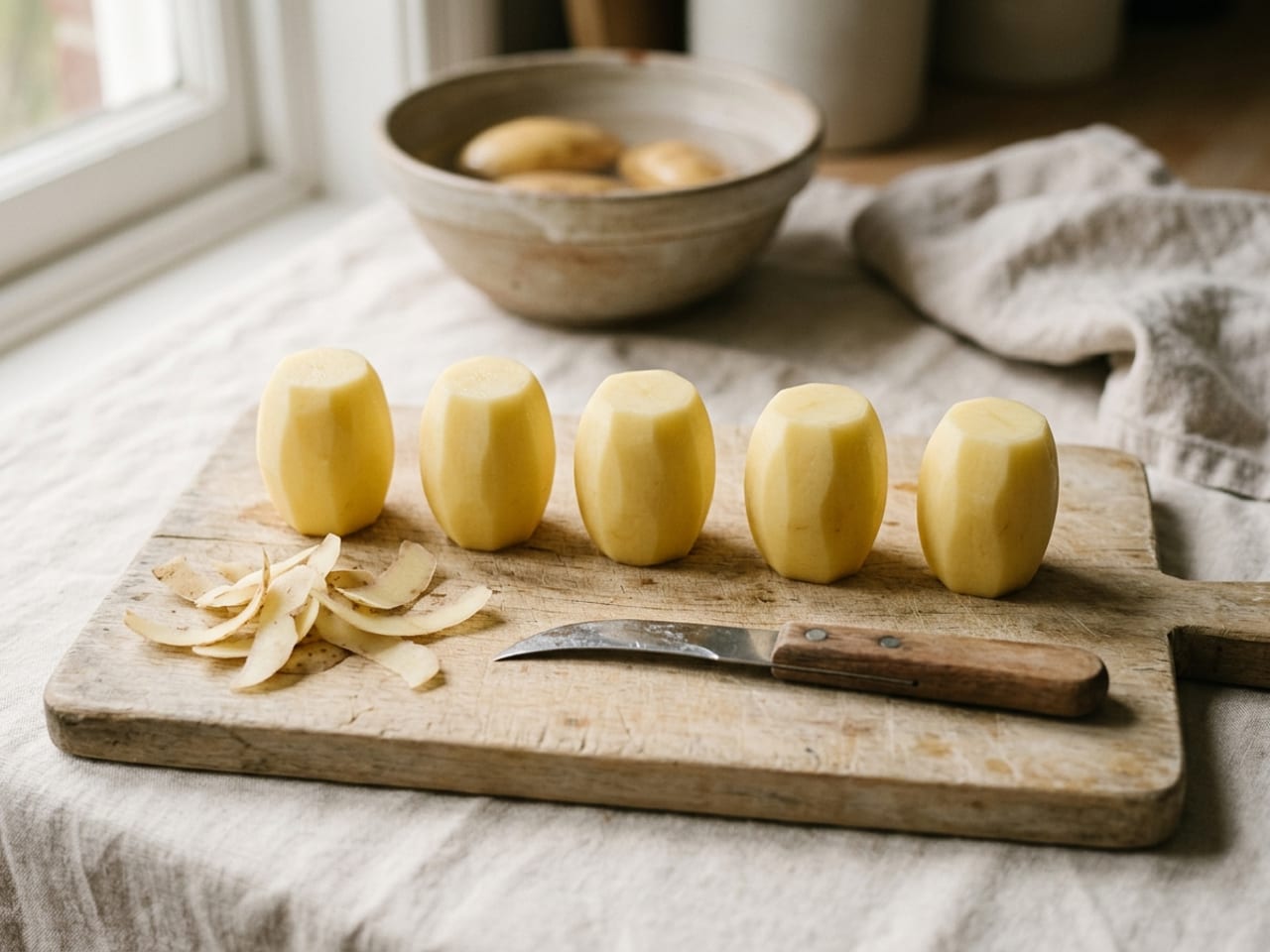
A tourné (toor-NAY, French for "turned") is a vegetable carved into a small barrel with curved faces and flat ends: 2 in long, ¾ in across (50 mm long, 20 mm across) in Gisslen's Professional Cooking. Most US textbooks give it seven faces; others say five, eight or don't count. Carve it with a paring knife or a curved tourné (bird's beak) knife.1, 3, 20, 23, 56 The cut's size is drawn to scale on our knife cuts chart; the other knife cuts are in our knife skills guide.
| The tourné at a glance | What the sources say |
|---|---|
| Size | About 2 in (5 cm) long; ¾ in (2 cm) across in Gisslen, ¾ to 1 in (2 to 2.5 cm) in On Cooking (every source) |
| Sides | Seven in 18 of the 32 sources we tallied; five or seven, six or seven, eight, three to five, three to four or none in the rest (who says what) |
| Knife | A paring knife or a tourné (bird's beak) knife; makers' bird's beak blades 2.36 to 2¾ in (6 to 7 cm) |
| Method | Cut a blank, hold it in the hand, carve each face in one curve toward the thumb, turn and repeat |
| Waste | Not measured by anyone we read; "Allow for greater trimming loss" (Gisslen). Use the trim in soup or mash |
| Named potatoes | Château, fondant, cocotte, anglaise and vapeur are turned; noisette and parisienne are mostly balled |
On this page: Sizes · How many sides · The knife · Step by step · Safety · Carrots and others · Waste and trim · Château, fondant, cocotte · Cooking them · Plating · History · Still used? · Troubleshooting · Claims · Terms · FAQ
How this page was made. Every size, method and verdict comes from the source named beside it, with its edition and page. Most of the textbooks are lending-only scans we could read only as short search fragments or Google Books snippets; old cookbooks were read in dated scans; each source's entry says how it was read. Plate Artists cut, weighed, cooked and timed nothing for this page: the methods are quoted, not kitchen-tested. Sums, angles and anything marked "ours" are our own, and a metric or US twin in brackets is the source's own where it prints one and ours where it does not. Sources are at the bottom.
Tourné cut size: every source's length, width and number of sides
All 32 sources we read that describe the plain tourné's size, shape or number of sides, with the edition and page and each cell in the source's own terms ("-" where it gives nothing). The first 6 are the textbooks most readers meet; the other 26 open under "Show all". Named potatoes (château, fondant, cocotte) have their own table. The headline figure, Gisslen's 2 in long, ¾ in across (50 mm long, 20 mm across), is the one our knife cuts chart draws to scale.
| Source | Length | Across the middle | Ends | Sides (faces) |
|---|---|---|---|---|
| Gisslen, Professional Cooking1 7th ed. 2011, pp. 143, 147; us textbook | 2 in (5 cm) | ¾ in (2 cm) "in diameter" | flat; no end width | 7 ("one-seventh of a full turn") |
| CIA, The Professional Chef3 9th ed. 2011, p. 624 and glossary; us textbook | "Approximately 2 in/5 cm" | - | glossary: "blunt ends" | chart: 7; glossary: "five or seven" |
| Labensky and Hause, On Cooking9 4th ed. 2007, p. 116; us textbook | 2 in (5 cm), "the most common" | ¾ to 1 in (2 to 2.5 cm) in the step caption; the prose figure is unreadable in the scan | flat | 7, "equal" |
| Le Cordon Bleu Classic French Cookbook20 1994, p. 135; school | 2-inch (5-cm) lengths | - | - | "Traditionally" 7, "not absolutely essential" |
| Practical Cookery (fondant potatoes)23, 24, 25 1974, 1981, 1990, 2000, 2004, 2008, 2015; uk textbook | about 5 cm (2 in); the 1974 scan reads 4 cm beside "(2 in)", unverified | 2.5 cm (about 1 in, ours) | 1.5 cm (about ⅝ in, ours) | 8, "eight-sided barrel" |
| Escoffier, Le Guide culinaire56, 57 1907; classic | shapes, not sizes: garlic cloves, olives, elongated olives, a pigeon's egg, corks | - | - | not counted |
Show all 32 sources (26 more)
| Source | Length | Across the middle | Ends | Sides (faces) |
|---|---|---|---|---|
| Gisslen, Professional Cooking2 1st ed. 1983, p. 410; 2nd ed. 1989, p. 439; us textbook | château "about 2 inches (5 cm)"; cocotte about 1½ in (4 cm, ours) | - | - | 7 ("it should have seven sides") |
| CIA, The Professional Chef4 8th ed. 2006, p. 691 and glossary; us textbook | pieces "slightly larger than 2 in/5 cm" before carving | - | narrower than the centre | method: 7; glossary: "five or seven" |
| CIA, The New Professional Chef5 5th ed. 1991, 6th ed. 1996; us textbook | pieces "slightly larger than 2 inches" (5 cm, ours) | - | narrower than the centre | no count; faces "smooth, evenly spaced" |
| CIA, The Professional Chef's Knife Kit6 2000, pp. 53, 59 to 60; us textbook | "Approximately 2 inches" (5 cm, ours) | - | tapered | 7; zucchini three to four |
| CIA, In the Hands of a Chef7 2008, p. 70; us textbook | carrots in 2-inch (5 cm, ours) pieces | - | flat bottoms on zucchini | 7; zucchini, cucumber and carrot "four or fewer" |
| CIA, Instructor's Manual (Healthy Cooking)8 2000; us textbook | 2 in (5 cm, ours) | - | - | "7 even sides"; glossary "usually with seven sides" |
| Labensky and Hause, On Cooking10 2003; us textbook | 2 in (5 cm) | ¾ to 1 in (2 to 2.5 cm) | blunt | 7, "equal" |
| On Cooking text, Pearson custom edition11 2015; us textbook | 2 in (5 cm) | ¾ to 1 in (2 to 2.5 cm) | flat | 7 curved sides |
| On Cooking, Canadian edition12 Internet Archive date 2011; us textbook | "5-cm (2-in.) long" | - | - | not in the fragment |
| Pearson, Culinary Arts (custom text)13 2011; us textbook | "Approximately 2 inches (50 millimeters)" | - | narrower than the centre | 7 |
| Morgan, Culinary Creation14 2006, p. 85; us textbook | 2 in (5 cm) | - | - | 7 |
| Johnson & Wales, Culinary Fundamentals15 2001, Fig. 10-7; school | olivette 1 to 2 in; château 2 to 2½ in; fondante 3 in or more (2.5 to 5, 5 to 6.4 and 7.6 cm, ours) | - | - | 7 |
| NRAEF, Foundations of Restaurant Management & Culinary Arts16 2011; us textbook | - | - | - | "six or seven" |
| Le Cordon Bleu, Turning Vegetables (school page)22 undated, read 2026; school | - | - | - | a courgette: "three to five facets" |
| The Cook's Book (Charlie Trotter's section)18 2005, p. 346; cookbook | 2 in (5 cm) pieces; a recipe's tournés 1 in (2.5 cm) | - | - | 7 curved sides |
| Johnson, Food and Cookery26 1965 and 1972; uk textbook | "two inches" (5 cm, ours) | "one and a quarter inches in diameter" (3 cm, ours) | - | not counted (barrel) |
| Fuller and Renold, The Chef's Compendium27 1992; uk textbook | château 4 cm; fondant 5 cm (about 1½ and 2 in, ours) | - | - | not counted (barrel; cocotte olive-shaped) |
| Finch, Food Preparation and Cookery28 1998; uk textbook | château and fondant 6 cm; "as a vegetable 3.5-4 cm" (about 2¼ and 1½ in, ours) | 2 to 3 cm (about ¾ to 1¼ in, ours) | - | not counted (barrel) |
| Cracknell, The New Catering Repertoire29 1989; uk textbook | 5 cm (2 in, ours) | - | - | not counted (barrel) |
| Leiths School of Food and Wine (school page)30 undated, read 2026; school | carrot cut into four finger-width pieces | - | - | "5- or 7-sided" |
| Escoffier Online (school blog)32 2020; school | a 2-inch (5 cm, ours) zucchini segment | - | tapered | 7, "traditional" |
| The Culinary Pro (online textbook)33 undated, read 2026; school | - | - | - | 7 |
| Saveur (magazine)34 undated, read 2026; cookbook | 2-inch (5 cm, ours) carrot pieces | - | - | not counted (football) |
| Pépin, La Technique58 1976, pp. 199 to 200; cookbook | - | - | - | not counted (football) |
| Larousse gastronomique60 1997; classic | balls, olives, cloves; château a "tonnelet" (small barrel) | - | - | not counted |
| Odom, US Patent 7,278,34651 2007; patent | - | widest at the midsection | flat, narrowest | 7, "of approximately the same size" |
What the tally says (ours)
- Length mostly agrees: about 2 in (5 cm) in most sources that give a plain tourné a length, from the CIA and Gisslen to Le Cordon Bleu, Trotter and Cracknell; Finch's turned vegetable is 3.5 to 4 cm and a Cook's Book recipe turns 1 in (2.5 cm) pieces.18, 28 The named potatoes vary (4 to 6 cm in the British books, up to "3 inches or more" at Johnson & Wales).
- Width does not: ¾ in (2 cm) in Gisslen; ¾ to 1 in (2 to 2.5 cm) in On Cooking's 2003, 2007 and 2015 texts (the 2007 prose sentence's figure is unreadable in the scan, and the Canadian edition gives none); 1¼ in (about 3 cm, ours) in Johnson; 2 to 3 cm in Finch.1, 9, 10, 11, 12, 26, 28
- Only Practical Cookery gives the ends: 1.5 cm (about ⅝ in, ours) at the ends against 2.5 cm (about 1 in, ours) in the middle of a 5 cm (2 in) barrel, so the ends are three-fifths of the middle (ours).23, 25 The CIA and Pearson only say "both ends" are narrower than the centre; Gisslen and the patent call them flat. These fit together: flat-cut ends that are narrower than the middle (ours).4, 13, 51
How many sides does a tourné have? Five, seven, eight, or none counted
Seven is the number in most US textbooks: Gisslen turns the potato "one-seventh of a full turn, to be exact", the CIA's chart prints "7 faces", On Cooking "seven equal sides". 1, 3, 9 In our tally 18 of 32 sources give seven, 14 of them seven alone. But:
- The CIA disagrees with itself. Its 8th-edition method says "7 sides" and its 9th-edition chart "7 faces", while the glossary of both editions says "five or seven sides or faces"; its own instructor's manual says "usually with seven sides".3, 4, 8
- Le Cordon Bleu, in two texts. The 1994 Classic French Cookbook: "Traditionally they have seven sides, but this is not absolutely essential as long as each vegetable has a neat barrel or olive shape, and they are all uniform in size". The school's current technique page gives a courgette "three to five facets".20, 22
- Practical Cookery cuts eight, "eight-sided barrel shapes" for fondant potatoes, in every edition we read from 1974 to 2015.23, 24, 25
- Six or seven, five or seven: a US high-school text (NRAEF, 2011) and Leiths ("5- or 7-sided").16, 30
- Fewer for soft, long vegetables: the CIA gives courgette tournés "three to four faces" and its flat-bottomed zucchini, cucumber and carrot tournés "four or fewer sides".6, 7
- None at all: Escoffier (1907) names shapes, not faces, and 9 sources in the tally count none, Pépin, Larousse and four British textbooks among them.56, 58, 60
Why seven? No source we read says. Gisslen gives the mechanics (a seventh of a turn) and "customers rarely count them"; the reasons sources give are for turning at all: items turned the same way cook evenly (Larousse 1997, Le Cordon Bleu), and look attractive, are bite-size and "roll around easily in the pan" (Miami New Times) or are "easy to roll around a pan" for even colour (Escoffier Online).1, 22, 32, 60, 86 When seven became the rule is under history.
Tourné knife vs paring knife
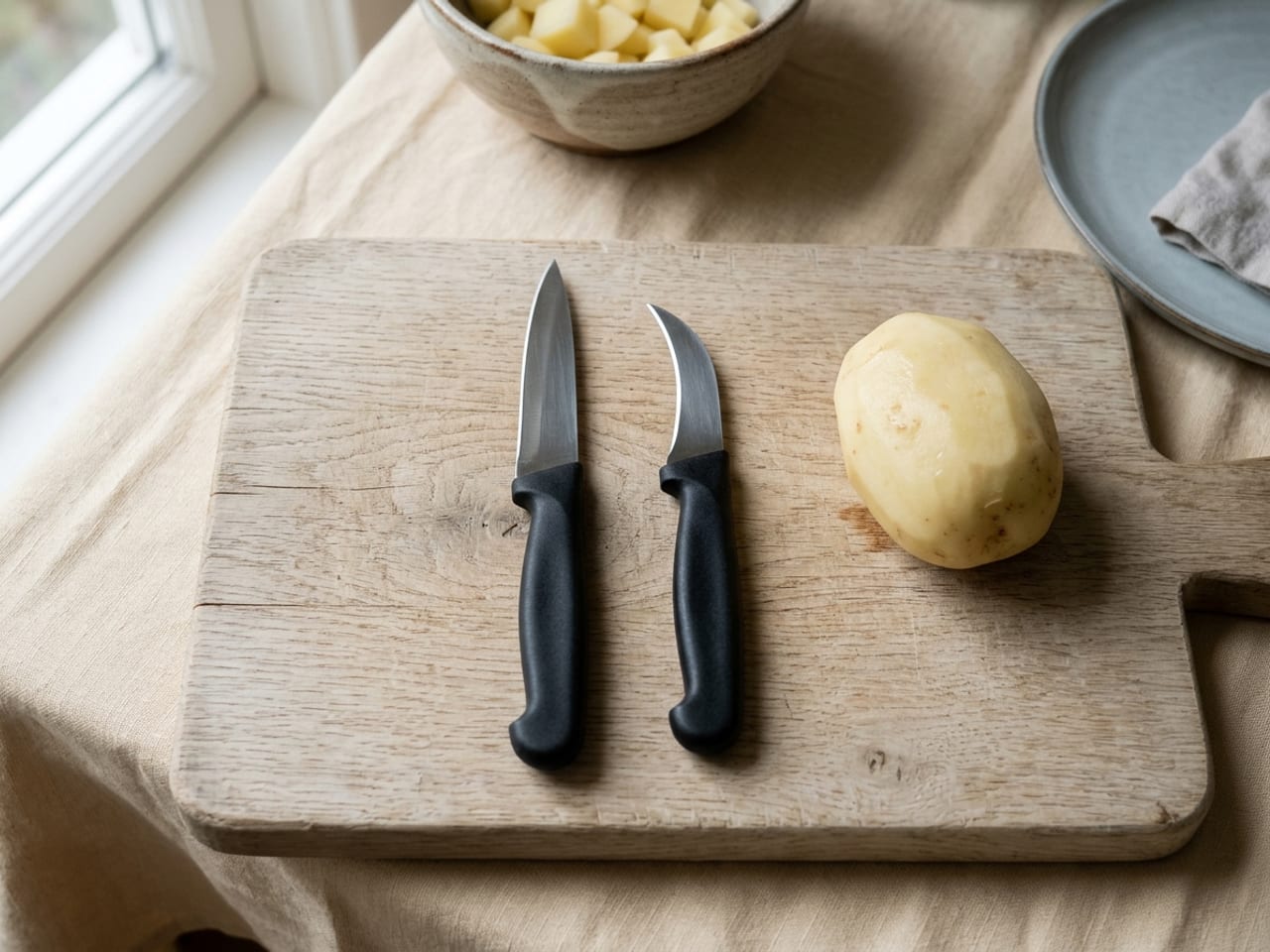
A tourné knife is a paring knife whose short blade curves down like a beak, so it is also sold as a bird's beak, peeling or turning knife. You do not need one: every textbook we read whose method says which knife to carve with allows a straight paring knife, and none requires the curved one.3, 7, 37 The CIA's reason for the curve is that it makes "cutting curved surfaces of tournéed vegetables" easier.3
| Who | What they call it | Blade |
|---|---|---|
| CIA, The Professional Chef, 9th ed. p. 47 (8th ed. p. 150)3, 4 | Tourné knife, "Similar to a paring knife; has curved blade to facilitate cutting curved surfaces of tournéed vegetables" | Not given (its paring knife has a 2 to 4 in, 5 to 10 cm ours, blade) |
| CIA, In the Hands of a Chef (2008)7 | "similar in size to a paring knife"; the "inverted curve of the blade gives this knife its second name, bird's beak" | Not given |
| Pearson, Culinary Arts (2011)13 | The tourné knife, "bird's beak; and granny style", all in the paring-knife family | "2 to 4 inches" (5 to 10 cm, ours) |
| Morgan, Culinary Creation (2006)14 | "the tourné knife (tor-NAY) with its hooked tip" | Not given |
| WÜSTHOF, Classic Peeling Knife37 | A peeling knife "also known as a Turning or Tourne Knife", with a "bird's beak-shaped curved blade" | 2¾ in (7 cm, ours), from the product name |
| Victorinox, Swiss Classic 6.750338 | "Bird's Beak Paring Knife", for "decorative cuts, peeling and doing fine detail work"; tourné not mentioned | 2.4 in (6.1 cm, ours); 6.4 in (16.3 cm, ours) overall |
| ZWILLING, Twin Signature 30720-06239 | "Bird's Beak Peeling Knife", for peeling and "decorative garnishes" | Named 2.75 in (7 cm, ours); its own spec table says 2.36 in (6 cm, ours) |
A paring knife is allowed by all 6 we checked: Gisslen (7th ed. p. 147), his figure uses "the paring knife"1; On Cooking (2007, p. 116), "use a tourné knife or a paring knife"9; CIA Knife Kit (2000), "Using a paring knife or tourne knife"6; Morgan (2006), "using a tourné knife or paring knife"14; Escoffier Online (2020), "A normal paring knife can be used as well"32; and Larousse gastronomique (1997), shape it "à l'aide d'un couteau d'office" (with a paring knife)60. Zwilling's own page names its knife 2.75 in and specifies a 2.36 in (6 cm, ours) blade, so check the spec table, not the title.39 More on paring knives and grips is in our knife skills guide.
How to tourné a potato
The steps are Gisslen's Professional Cooking method, with where the CIA, Le Cordon Bleu, Leiths and the others do it differently beside each. They are quoted, not kitchen-tested by us.
 1
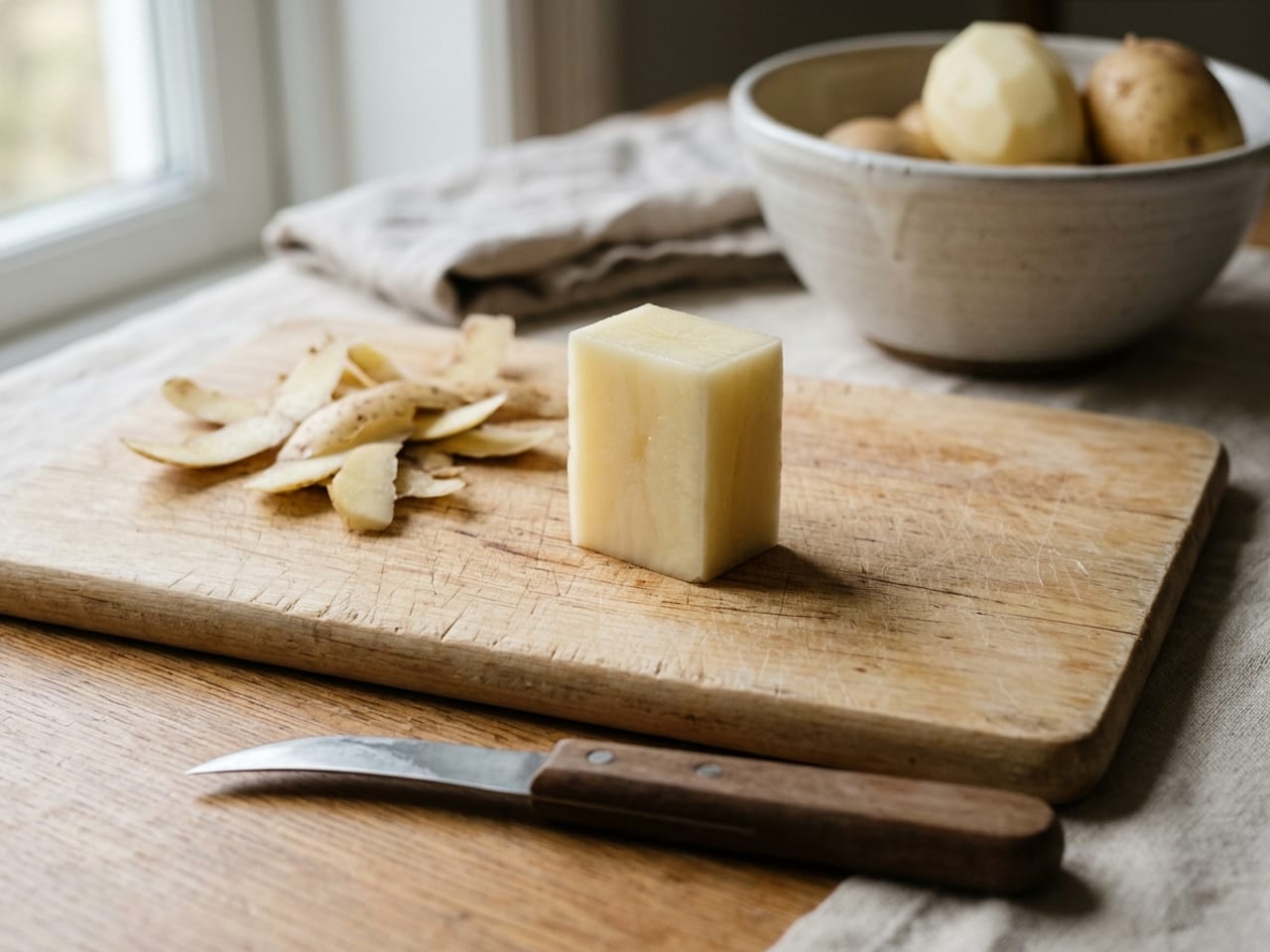
Cut a blank a little bigger than the finished piece
Gisslen cuts the potatoes "roughly into pieces slightly larger than the final size desired", then cuts "off the top and bottom of each piece so the top and bottom are flat and parallel."1 The CIA cuts round vegetables "into quarters, sixths, or eighths (depending on the size), to form pieces slightly larger than 2 in/5 cm", with no squaring step;4 On Cooking cuts potatoes into "as many as six or eight pieces" and calls peeling optional "because in most cases the item's entire surface area is trimmed away."9 Leiths squares a carrot into a block and then removes each corner.30 Start from an even-sized potato: Leith's cookery school puts neat barrels down to "patience, practice and starting with an even-sided regular" one.31
- 2
Hold it, and set the knife at the top edge
"Hold the potato between the thumb and forefinger. Place the paring knife against the top edge as shown and the thumb of the cutting hand firmly against the potato. Your hand should be far enough up on the blade to maintain steady control" (Gisslen).1 Escoffier Online puts the knife hand's thumb "at the bottom of the vegetable".32 A paring knife or a curved tourné (bird's beak) knife both do it.
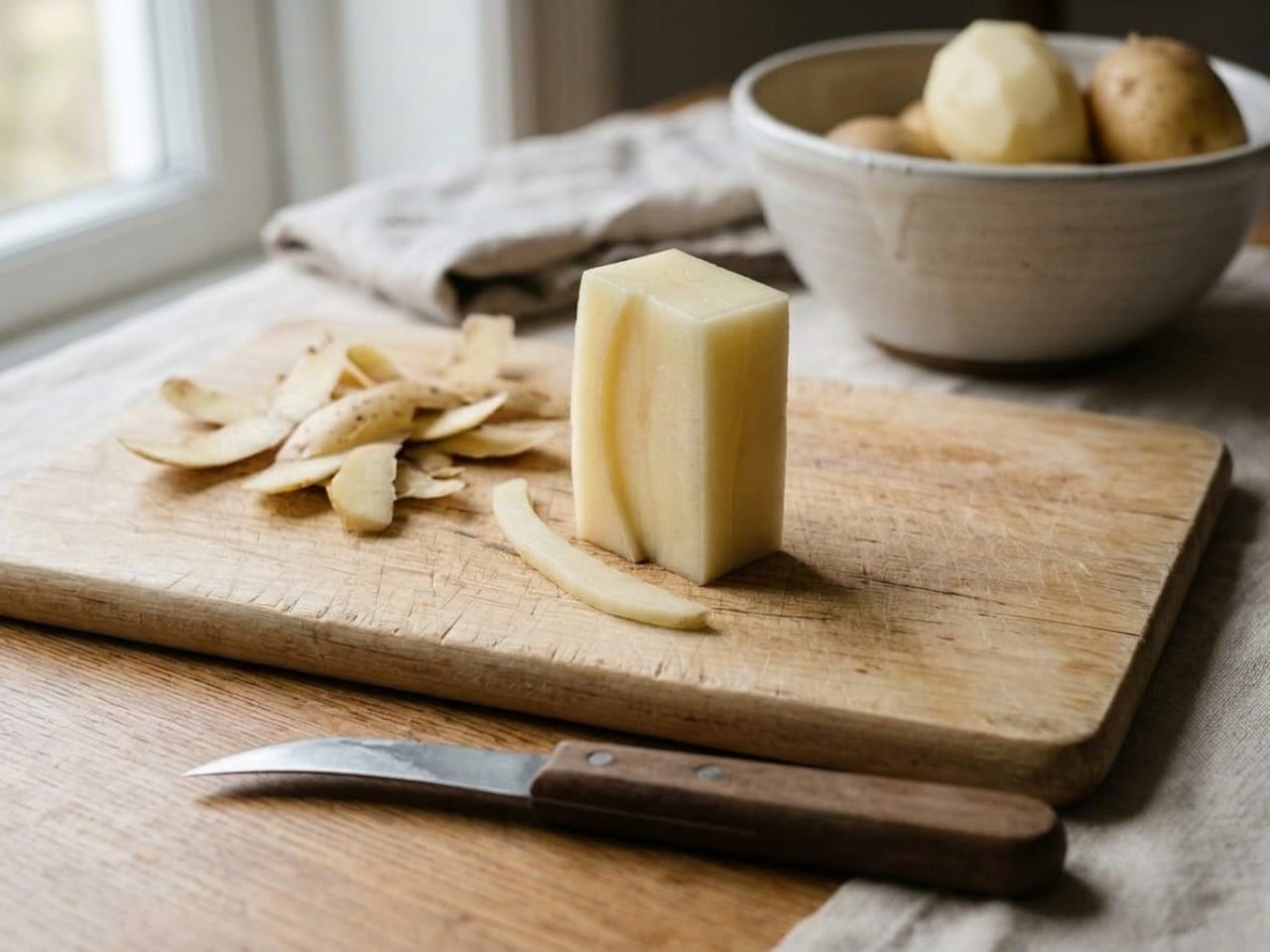 3
Carve the first face in one curve
"Cut down toward your thumb with a curving movement of the blade" (Gisslen);1 Le Cordon Bleu pares "in a quick curving movement";20 Leiths goes in "quite deep at the end of the block", draws the knife up toward you to the middle, "then down and away towards your thumb."30 The CIA wants faces "smooth, evenly spaced, and tapered so that both ends are narrower" than the centre.4 Every hand method we read cuts toward a thumb: read the safety note first.
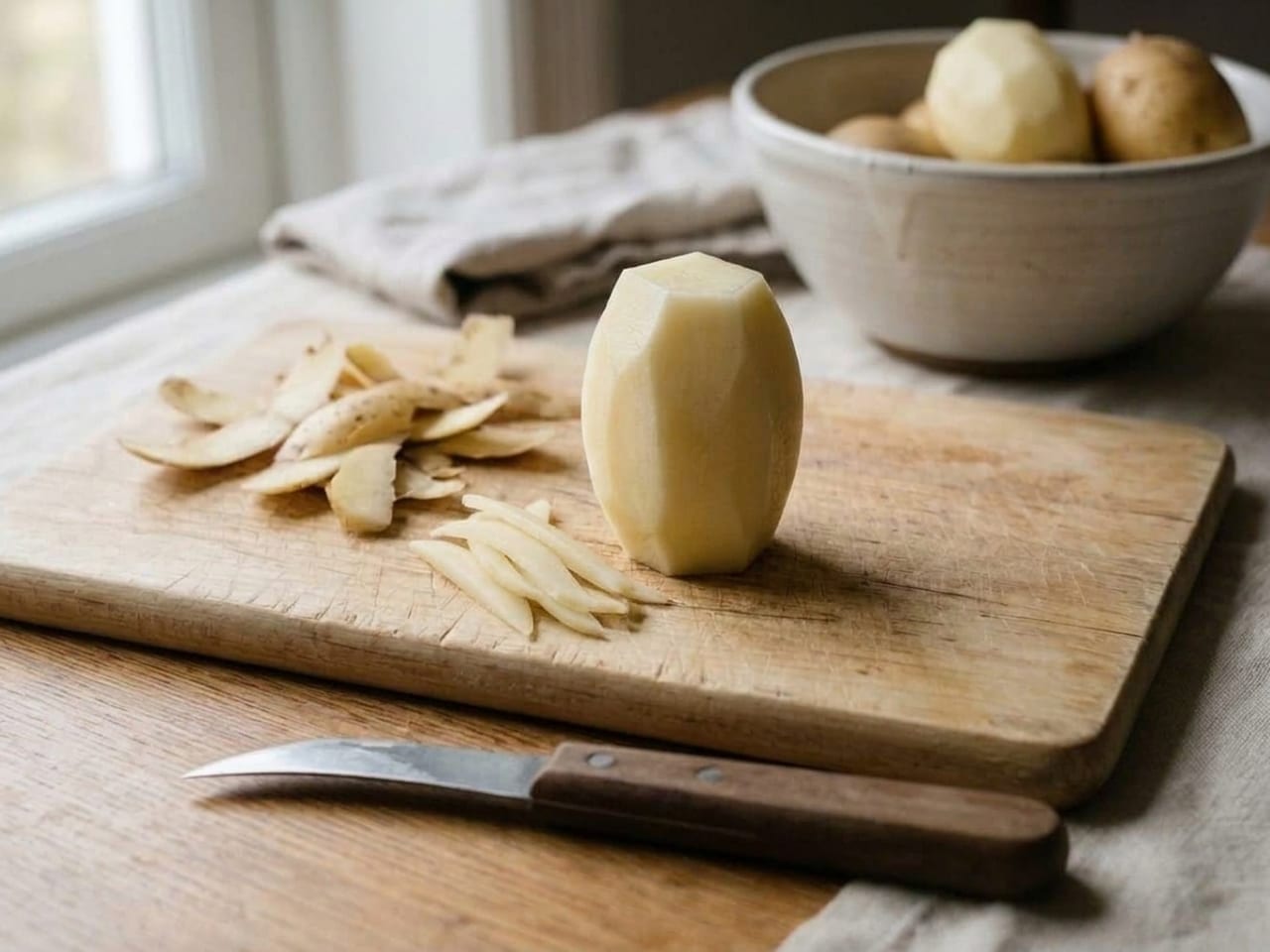 4
Turn it a little and cut the next face
"Turn the potato slightly (one-seventh of a full turn, to be exact) and repeat the motion" (Gisslen).1 One-seventh of a turn is about 51° (360 ÷ 7, our arithmetic); a five-sided piece turns 72° and an eight-sided one 45° (ours). The CIA asks for "as few cuts as possible to create the 7 sides so that the faces of the tourné remain distinct";4 Escoffier Online's ideal is one cut per face, "But you may find that at first, it takes several extra cuts to get the shape right."32 Morgan rough-cuts the seven sides first, "Then trim it until the seven sides are even".14
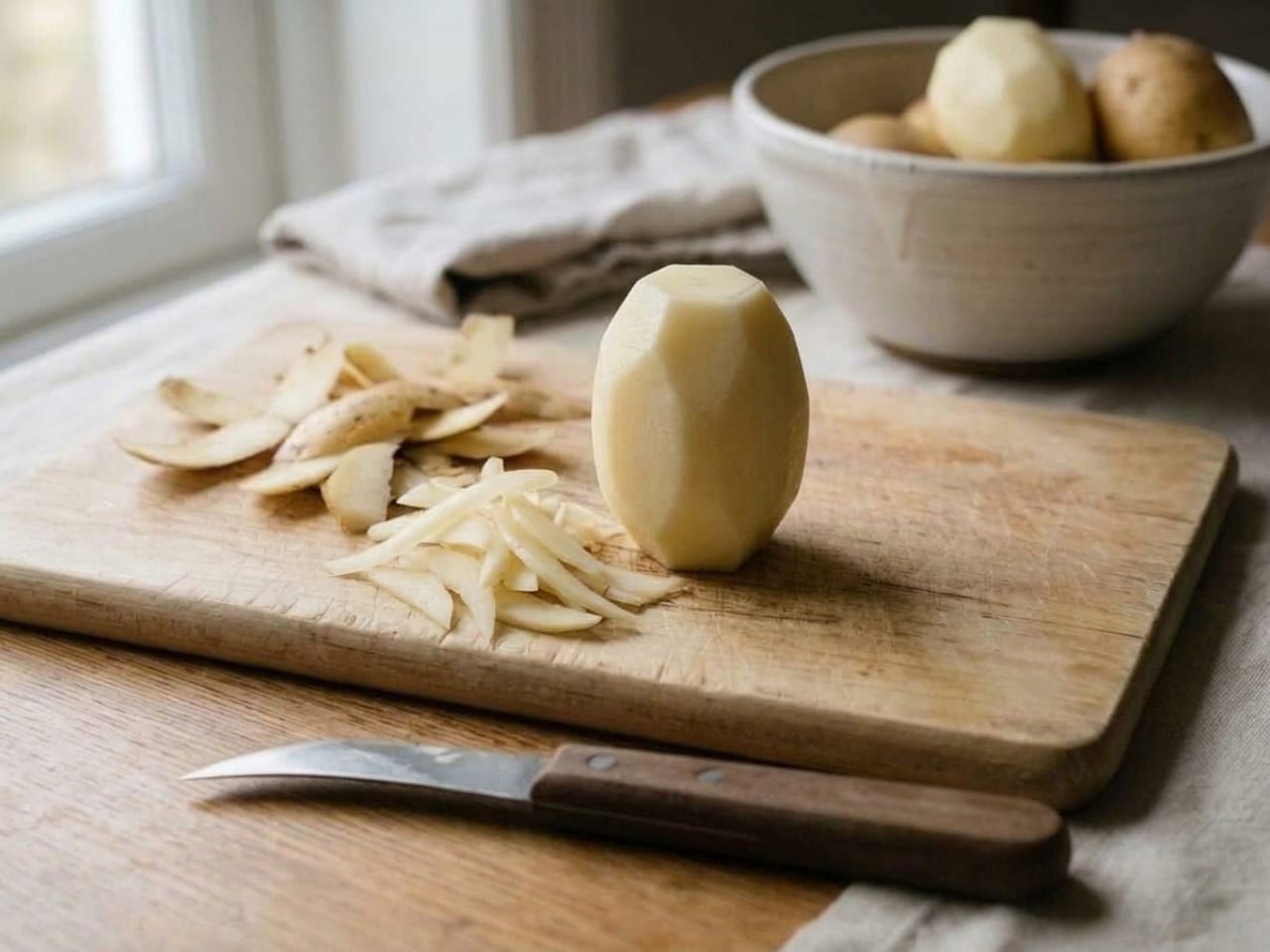 5
Check the shape against the others, and keep the trim
"If perfectly done, the potato has seven sides (but customers rarely count them)" (Gisslen).1 The CIA puts uniformity first: "whichever tourne style you use, all the pieces are cut uniformly";6 so does Le Cordon Bleu, for whom seven is "not absolutely essential as long as each vegetable has a neat barrel or olive shape, and they are all uniform in size".20 Drop finished pieces into cold water if they wait (how long) and keep the offcuts for soup or mash.
Where the published methods differ
Two ways to start: a flat-ended block (Gisslen, Leiths) or wedges and lengths with no squaring (the CIA, On Cooking, Le Cordon Bleu, Trotter). The wedge is old: La Chapelle cut turnips "en quatre" before turning them into olives in 1742.1, 4, 9, 20, 30, 73
| Source | The blank before carving | Hand and direction | Turning and cuts |
|---|---|---|---|
| Gisslen, 7th ed. p. 1471 | Rough pieces slightly larger than final; top and bottom cut flat and parallel | Between thumb and forefinger; cutting thumb braced on the potato; "Cut down toward your thumb" | One-seventh of a turn; no stroke count |
| CIA, 8th ed. p. 6914 | Quarters, sixths or eighths of round vegetables; carrots in 2 in (5 cm) lengths; no squaring | Not in the fragments we read | "as few cuts as possible" |
| On Cooking, 2007 p. 1169 | Potatoes, turnips, beets in six or eight pieces; carrots in 2-inch (5 cm) lengths; peeling optional | Between thumb and forefinger; tourné or paring knife | Seven curved sides |
| Le Cordon Bleu, 1994 p. 13520 | 2-inch (5-cm) lengths; sharp edges trimmed off first | "a quick curving movement" | Turn slightly after each cut |
| Trotter, The Cook's Book, 2005 p. 34618 | 2 in (5 cm) pieces | Turn the piece in the hand while cutting | Seven curved sides |
| Morgan, 2006 p. 8514 | Rough-cut a 2-inch (5-cm) seven-sided shape | Tourné or paring knife | Then trim until the sides are even |
| Leiths (school page)30 | Square the carrot into a block, then remove each corner | In at the end, up toward you to the middle, then "down and away towards your thumb" | The remaining sides the same way |
| Escoffier Online, 202032 | A segment of the vegetable | Knife-hand thumb at the bottom; trim "toward yourself" | Seven smooth cuts top to bottom, more at first |
| La Chapelle, 1742; Pépin, 197658, 73 | La Chapelle: "coupez-les en quatre" (cut them in four) and turn into olives; Pépin: halve a large potato, then each half in two | - | No count |
Cutting toward your thumb: what the textbooks say, and what OSHA says
Every hand method we read carves toward a thumb: in Gisslen it is the cutting hand's own thumb, braced "firmly against the potato" while you "Cut down toward your thumb"; Escoffier Online puts the knife hand's thumb "at the bottom of the vegetable" and trims "toward yourself"; Leiths carves "down and away towards your thumb" without saying which hand.1, 30, 32 The US safety agency OSHA tells young restaurant workers the opposite: "Cut in the direction away from the body" and "Keep your fingers and thumbs out of the way of the cutting line."40 No source we read reconciles the two: the textbooks rely on the braced thumb, a short blade and control, the agency on the direction of the cut.
What is sourced: a sharp knife "is safer than a dull one because it requires less pressure and is less likely to slip" (Gisslen).1 OSHA lists "steel mesh or Kevlar gloves" where an employer provides them, and the FDA Food Code lets slash-resistant gloves touch only food that is cooked afterwards, as a tourné potato is; a raw turned cucumber would need a smooth glove over them.40, 41 None of the textbooks we read mentions gloves for turning.
Our suggestion (not from a source): short, controlled strokes that stop before the edge reaches the braced thumb; keep that thumb below the end of the stroke, never in its path; turn a piece you can hold firmly, not a slippery last nub; and while you learn, wear a cut-resistant glove or thumb guard on the hand whose thumb the blade travels toward.
How to tourné carrots, turnips, courgette and other vegetables
"Many root vegetables, such as carrots and turnips, are cut this way" (Gisslen); Leiths: "Any firm vegetable can be turned".1, 30 What changes is the blank and, for long or soft vegetables, the number of faces.
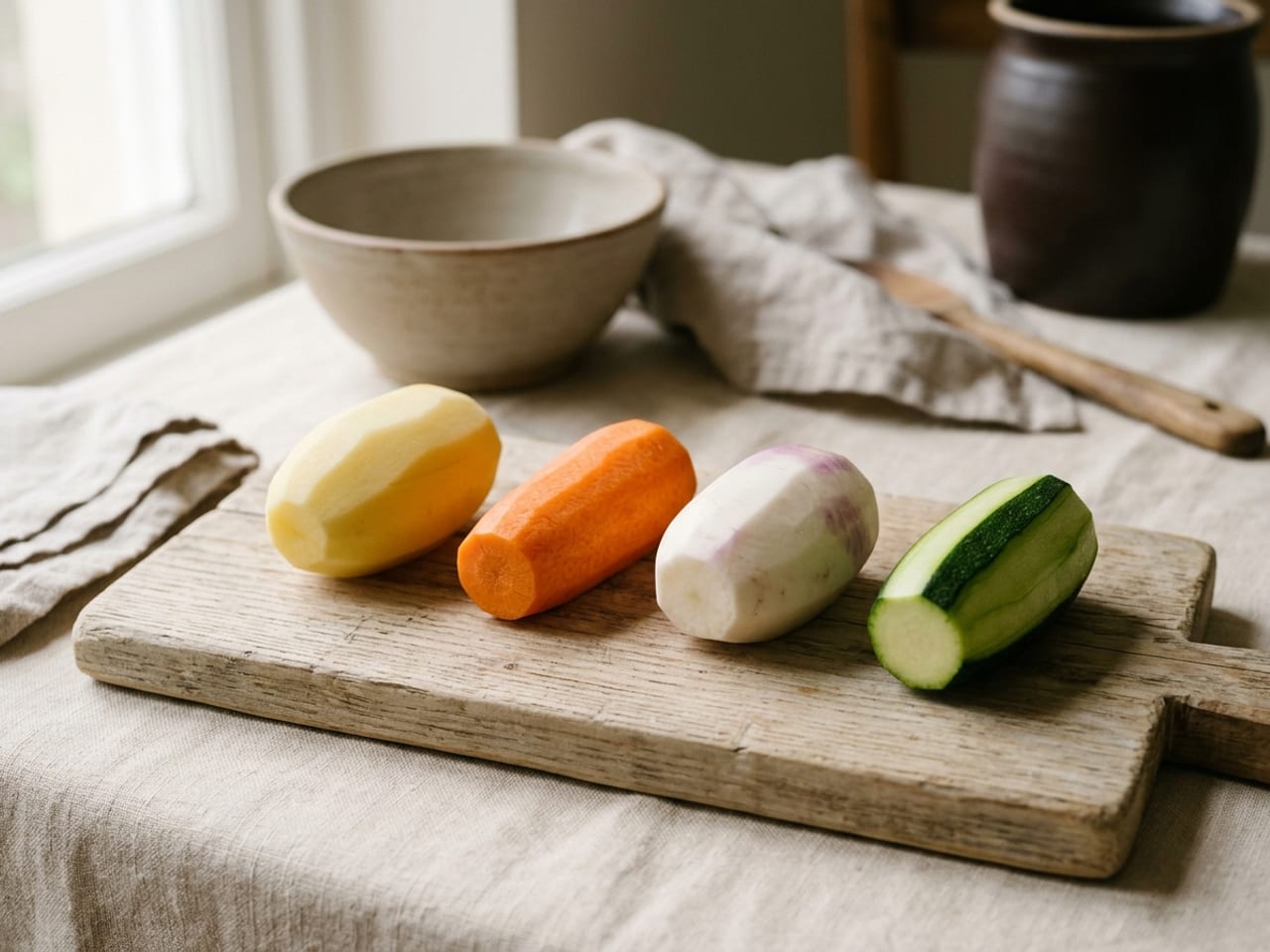
Potato
The vegetable every method above is written for: a flat-ended block (Gisslen), quarters, sixths or eighths (the CIA) or six or eight pieces (On Cooking). Which potato to pick is under potato variety.1, 4, 9
Carrot
No wedges: cut it into 2-inch (5 cm) lengths and turn each (On Cooking, the CIA, Le Cordon Bleu); Finch uses 3 cm (1¼ in, ours) sections. The CIA's flat-bottomed tournés of zucchini, cucumber and carrot "generally have four or fewer sides"; its classic carrot tourné is carved from a 2 in (5 cm) length like a potato. Escoffier turns carrots to garlic cloves and olives, and old carrots "to the shape of elongated olives", parboiled before glazing.4, 7, 9, 20, 28, 57
Turnip
"Many root vegetables, such as carrots and turnips, are cut this way" (Gisslen). On Cooking cuts turnips into six or eight pieces; a 1969 French school manual cuts them into chunks of about 5 cm (2 in, ours), splits each in two or three and shapes them like olives; Escoffier turns them to "grosses olives allongées" for mutton and duckling.1, 9, 56, 63
Courgette (zucchini)
The CIA halves it and makes flat-bottomed tournés with "three to four faces"; Escoffier Online cuts a 2-inch (5 cm, ours) segment into thirds or quarters lengthwise and turns only the inside, "so you leave some of that vibrant green skin"; Leiths keeps the skin on one side for colour; Le Cordon Bleu's finished courgette has "three to five facets".6, 22, 30, 32
Beetroot
Six or eight pieces (On Cooking) or quarters, sixths or eighths (the CIA), each turned like a potato.4, 9
Celeriac
Peel thickly, cut 3 cm × 6 cm (about 1¼ × 2¼ in, ours) sections, turn them and keep them "in acidulated water to prevent discoloration" (Finch). The CIA lists "celeriac, tourné or cut in batonnet" in a stew.3, 28
Parsnip and rutabaga (swede)
Rutabaga is turned in a CIA stew garnish; a Cook's Book recipe turns both as 1 in (2.5 cm) tournés; The Culinary Pro names parsnips. Menon turned carrots and parsnips into sticks in 1755.3, 18, 33, 70
Cucumber
Le Cordon Bleu turns cucumber the same way; the CIA's cucumber tournés have "four or fewer sides"; Saulnier's Doria garnish for fish is "Cucumber turned in clove of garlic shape, cooked slowly in butter". A raw-served turned cucumber is not cooked afterwards: see the glove rule under safety.7, 20, 59
A "turned" mushroom is fluted, not turned: Le Cordon Bleu holds a paring knife "at a slight angle to the mushroom and cut[s] a channel from the center" of the cap, over and over, a different technique that shares the name.20
How much of the potato you lose, and what to do with the trim
No source we read measures how much turning wastes. The nearest figures are plain peeling (81% of a potato left, USDA) and an illustrative 75% for turned carrots in a CIA costing example.3, 42 Gisslen only says "Allow for greater trimming loss if preparing tournéed or parisienne potatoes"; the CIA's Knife Kit, that tourné and parisienne cuts "typically generate a significant amount of trim".1, 6 The CIA's 75% is higher than USDA's figure for carrots that are only peeled (70%), so the two cannot be combined into a measured loss.
| What | Yield | Source and what it measures |
|---|---|---|
| Peeled white or russet potatoes | 81% | USDA Food Buying Guide: 0.81 lb ready-to-cook from each 1 lb as purchased (the same share in kilograms); peeled only, no tourné row42 |
| Peeled potatoes, red / chef | 81% / 85% | CIA Kitchen Calculations handout: Peeling; "An employee's skill in cleaning the product will have an enormous effect on the yield percentage"43 |
| Peeled white potatoes | 80% | Gisslen, 7th ed. p. 547: Plain peeled; for tourné, "Allow for greater trimming loss" (p. 608), no figure1 |
| Tournéed carrots | 75% | CIA, 9th ed. p. 19: An illustrative number in a costing example (sliced carrots 89% in the same pages), not a measurement3 |
| Peeled carrots, no tops | 70% / 82% | USDA / CIA handout: Plain peeled: the CIA's 75% for turned carrots sits between the two42, 43 |
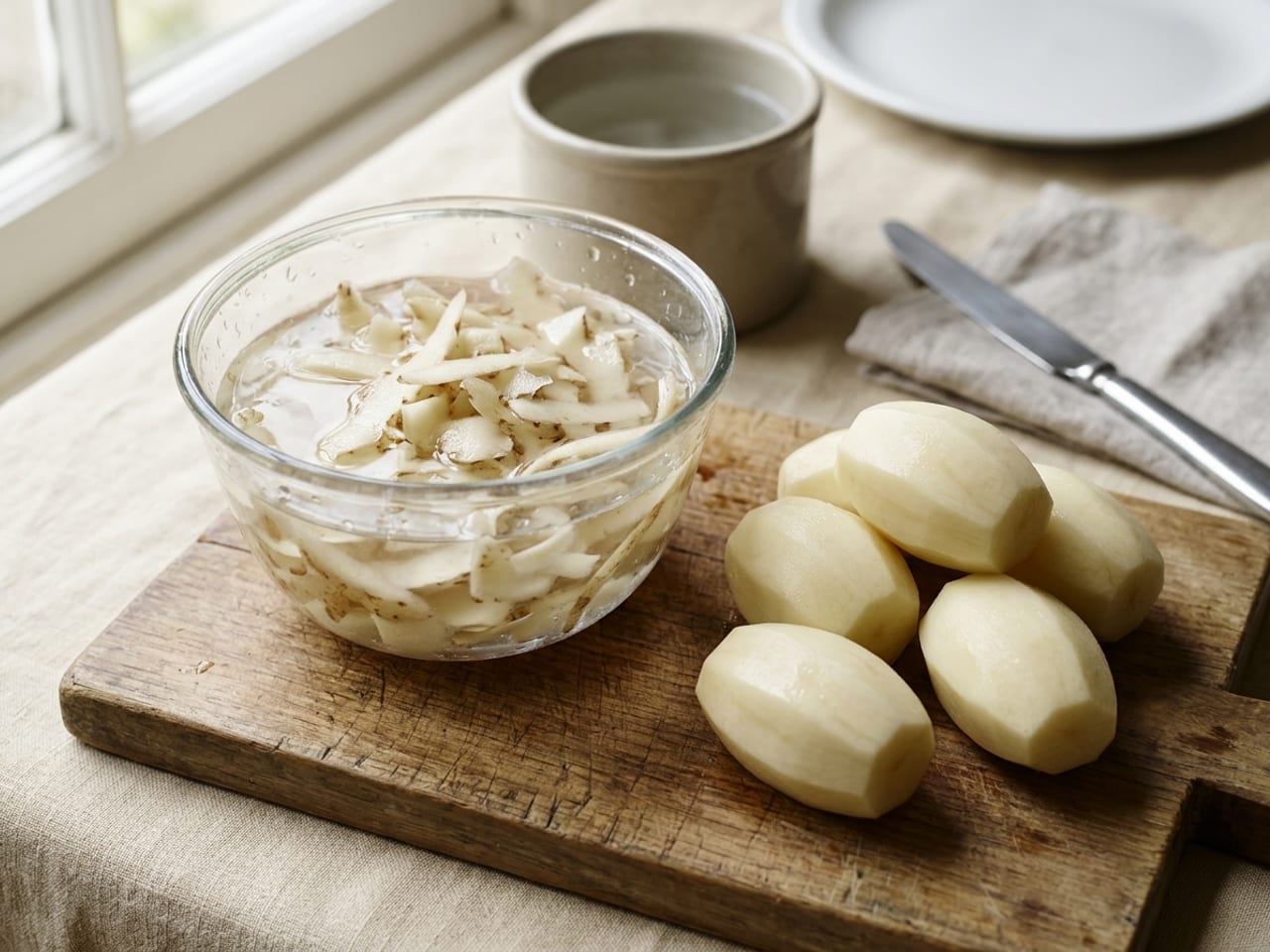
What to do with the trimmings
- Soup or purée: the CIA ("if you have tournéed a carrot ... you can use the trim to prepare a soup, purée, or other dish") and Le Cordon Bleu ("soups and purées"); the CIA's Knife Kit adds coulis.3, 6, 22
- Mashed potatoes, croquettes, stock: Gisslen ("Use the trimmings for mashed potatoes or soup"), Pépin ("soup or croquettes"), Leiths ("stocks and soups"), Escoffier Online ("mashed potatoes, purees, stocks and slaws").1, 30, 32, 58
- Into the same dish: Practical Cookery cuts the potato trimmings into the stew it turns potatoes for; Johnson keeps them "on one side".23, 26
- Two Escoffier recipes that take raw potato, Purée Parmentier (a potato and leek soup, No. 658) and duchesse potatoes (from the croquette mixture, No. 221), are natural homes for trim; the pairing is ours, Escoffier does not tie them to turning.57
Holding cut potatoes in water, and for how long
The CIA holds peeled, cut potatoes "submerged in cold water until it is time to cook them", then drains and blots them dry.3 The FDA Food Code allows it outright: "cut potatoes ... may be immersed in ice or water", with no time limit.41 On time, the Idaho Potato Commission (a potato board, not a safety agency) says "about 24 hours" in water in the refrigerator, that water "does not take the place of refrigeration", and that 1 tablespoon of concentrated lemon juice or white wine vinegar to about a gallon (3.8 L) of water helps against darkening.44 Gisslen allows "a short time under water, although some nutrients will be lost".1 No food-safety agency we read gives an hour limit.
Château, fondant, cocotte and anglaise potatoes: what each is, per source
In 1907 the name was the size: Escoffier turns one potato "de la forme et grosseur des pommes à l'anglaise" and another "en pommes Château".56 Gisslen: "When potatoes are tournéed, they are named according to their size."1 The sizes, though, are not agreed. Every source we read for each name, oldest first:
Château potatoes · pommes château
The olive or small barrel browned in butter, the classic garnish of the Chateaubriand steak (Gilbert 1890; the CIA's glossary: "served with chateau potatoes and béarnaise sauce").
| Source | Shape | Size | How it is cooked |
|---|---|---|---|
| Gilbert, 189064 | Cut in three or four, trimmed to "la forme de petites pommes entières" (small whole potatoes) | - | "au beurre clarifié", kept "très moelleuses" (very soft); the Chateaubriand's garnish |
| Lake, 189465 | "cut in oval shapes" | - | "fried" |
| Senn, 189566 | Quarters, the sharp edges rounded off | - | Blanched in salted water, tossed in clarified butter, baked twenty minutes |
| Fellows, 189767 | "Oval shapes" | - | "blanched, drained and fried a light color in clarified butter" |
| Escoffier, 190756, 57 | "the shape of large olives" | - | "cook them gently in clarified butter, that they may be golden and very soft", parsley to serve |
| Hering, 190962 | "Olivenförmig" (olive-shaped) | - | "gebraten" (fried), parsley |
| Larousse, English ed. 196161 | "to look like large olives" | - | In butter; the garnish for grilled Chateaubriand |
| Fundamentals of French Cookery, 196963 | "the shape of a small egg", kept in water | - | "Small roasted potatoes" |
| Pépin, 197658 | Football-shaped | - | "blanched and fried" |
| Saulnier, English ed. 197659 | "Shape like a large olive" | - | "blanched, roasted nice brown colour, in butter" |
| Gisslen, 1983 to 20111, 2 | "larger ovals" than cocotte | "about 2 inches (5 cm)" | Browned on all sides; "Blanch 3-5 minutes or cook from raw state" (the snippet sits in the line before the château variation) |
| Fuller, 199227 | Barrel | 4 cm (1½ in, ours) | - |
| Larousse, 199760 | "tonnelet" (small barrel) | - | Butter, raw or clarified, "sans avoir été préalablement blanchies" (not blanched first) |
| Finch, 199828 | Barrel | 6 cm (2¼ in, ours) | As roast potatoes |
| Johnson & Wales, 200115 | "Castlelike", seven-sided | 2 to 2½ in (5 to 6.4 cm, ours) | - |
| On Cooking, 2003 and 20079, 10 | Tournéed | - | "sautéed in clarified butter until golden and tender" |
| CIA, 8th and 9th eds.3, 4 | - | - | "chef's or waxy" potatoes, clarified butter or oil (the method did not surface) |
| Practical Cookery, 1974 to 201523, 25 | Barrels "about the same size as fondant potatoes"; evenly sized potatoes "need not be peeled" (older editions) | - | Boiling water "for 2-3 minutes, then refresh immediately", drain, then finished (that step is cut off in the fragment) |
Fondant potatoes · pommes fondantes
The largest turned potato in J&W and Fuller (the same size as château in Practical Cookery and Finch), and the one whose method has changed most: butter only in 1907, stock today, and in the three recipe sites we read no longer turned at all.
| Source | Shape | Size | How it is cooked |
|---|---|---|---|
| Escoffier, 190756, 57 | "large, elongated olives" | "about three oz." (85 g) each in the English edition; "90 grammes environ" in the French | Gently in butter in a sauté pan, pressed lightly with a fork, then "three oz. of fresh butter per every two lbs." (85 g per 900 g, ours), lid on, until absorbed. No stock |
| Hering, 190962 | - | - | "Halb gar gekocht, in Butter gebraten" (half-boiled, then fried in butter) |
| Larousse, English ed. 196161 | "to look like small eggs" | - | A buttered sauté pan, covered, gently on the stove |
| Pépin, 197658 | Football-shaped | - | "butter and a little bit of water" |
| Saulnier, French printing 1956; English ed. 197659 | Château potatoes | - | "cooked in a covered pan, with a little white consommé" (1956 French: "Mouiller légèrement consommé blanc"): the earliest stock version we found |
| Practical Cookery, 1974 to 201523, 24, 25 | Eight-sided barrel | About 5 cm (2 in) long, 1.5 cm (about ⅝ in, ours) at the ends, 2.5 cm (about 1 in, ours) across the middle; 2 to 3 per portion | Brushed with melted butter; white stock halfway up, in the oven until golden and the stock absorbed (the 1974 text; the 2004 printing offers "Chicken stock in place of white stock"; the 2015 liquid step did not surface) |
| Fuller, 199227 | Barrel | 5 cm (2 in, ours) | Butter or sunflower margarine |
| Larousse, 199760 | "tournées en grosses gousses" (large cloves) | - | "braisées dans un fond blanc" (braised in white stock) |
| Finch, 199828 | Barrel | 6 cm (2¼ in, ours) | 1 litre white stock and 50 g melted butter for 1.5 kg potatoes (about 4¼ cups and 1¾ oz for 3.3 lb, ours) |
| Johnson & Wales, 200115 | "Jumbo tourne" | "3 inches or more" (7.6 cm, ours) | - |
| BBC Good Food; Great British Chefs; RecipeTin Eats93, 94, 95 | Cylinders, not turned | 6 cm (2.4 in) across, 3.5 cm (1.4 in) high (RecipeTin Eats); 3 cm (1¼ in, ours) rounds in a 6 cm (2⅜ in, ours) ring (GBC) | Browned, then butter and stock, covered or in the oven, 20 to 30 minutes until tender |
Cocotte potatoes · pommes cocotte; rissolée
A smaller château. How much smaller is the disagreement: about 1½ in (4 cm) against château's 2 in (5 cm) in Gisslen, "a quarter the size" in Practical Cookery, which makes rissolée potatoes "half the size".
| Source | Shape | Size | How it is cooked |
|---|---|---|---|
| Fundamentals of French Cookery, 196963 | Trimmed with a kitchen knife | - | "Smaller roasted potatoes" |
| Pépin, 197658 | "a little football-shaped potato" from a large potato halved, then each half in two | - | Blanched "1 minute in boiling water, drained and sautéed in butter and oil" |
| Saulnier, English ed. 197659 | "Turn Chateau shape but smaller" | - | "cook same way" |
| Gisslen, 1983 to 20111, 2 | Small ovals (filed with rissolé) | "about 1½ inches (4 cm)" | Browned on all sides in fat |
| Fuller, 199227 | "turned to olive shape" | - | Fried |
| Larousse, 199760 | "tournées" | - | "rissolées au beurre et à l'huile" (browned in butter and oil) |
| Practical Cookery, 1990 to 201523, 25 | As château | "a quarter the size" of château | "Cook in a sauté pan or frying pan" |
| The Staff Canteen (Kevin Kindland), 201492 | Whole small potatoes, not turned | "much smaller" than château | Clarified butter plus butter taken to noisette, about 20 minutes |
Anglaise and vapeur potatoes · pommes à l'anglaise; pommes vapeur
Turned potatoes boiled or steamed. Whether anglaise and vapeur are one dish or two depends on the book.
| Source | Shape | Size | How it is cooked |
|---|---|---|---|
| Escoffier, 190756, 57 | "the shape of large garlic cloves" | - | "in salted water or steam"; "The English method is to cook them without salt"; "more especially" with boiled fish |
| Hering, 190962 | In the skin | - | Steamed with water and salt |
| Larousse, English ed. 196161 | "as uniform a size as possible" | - | Boiled or steamed |
| Fundamentals of French Cookery, 196963 | - | - | Anglaise boiled; vapeur steamed: two dishes |
| Pépin, 197658 | Football-shaped, from large elongated chunks | - | "steamed or boiled" |
| Saulnier, English ed. 197659 | "Shape" | - | "cook in a steamer"; vapeur: "(See Anglaise)", one dish |
| Larousse, 199760 | "tournées en gousses" (cloves) | - | Salted water, or steamed (vapeur) |
| Gisslen, 7th ed. p. 6081 | Trimmed to shape | - | Vapeur: "steam in perforated pan instead of boiling" |
Noisette and parisienne potatoes: balled, not turned · pommes noisette; pommes parisienne
Balled with a scoop in most sources we read; two call them turned.
| Source | Shape | Size | How it is cooked |
|---|---|---|---|
| Escoffier, 190756, 57 | Cut "by means of a round spoon-cutter"; parisienne the same, smaller, rolled in meat glaze | Hazelnut | Butter |
| Hering, 190962 | Scooped balls | Hazelnut | Fried |
| Larousse, English ed. 196161 | "With a round vegetable scooping spoon" | - | - |
| Gisslen, 1983 to 20111, 2 | Melon-ball cutter | noisette "smaller than 1 in. (about 2.5.cm)" | Browned in fat |
| On Cooking, 20079 | Parisienne: "small spheres are cut from raw, peeled potatoes with a Parisienne scoop" | - | - |
| CIA glossary, 8th and 9th eds.3, 4 | "Pommes noisette are tournéed potatoes browned in butter" | - | Butter |
| Larousse, 1997 (potato table)60 | noisettes and parisienne both "tournées" | - | Noisette blanched; parisienne browned in butter and oil |
- Noisette and parisienne are balled, mostly: 5 of the 7 sources we read scoop them with a round cutter; 2 call them turned, the CIA's glossary ("Pommes noisette are tournéed potatoes") and Larousse's 1997 table ("tournées"), where Larousse seems to use the word loosely (ours).3, 57, 60
- Olivette: not in Escoffier, Saulnier, Hering or Larousse as we read them; one US school table (Johnson & Wales, 2001) lists a "Tourne Olivette", "Olivelike 7-sided; 1 to 2 inches" (2.5 to 5 cm, ours). We do not treat it as a classic shape.15
- Other turned potatoes in Escoffier: Berrichonne (turned as château, then simmered in bouillon with bacon and onion) and Collerette (corks, fluted).56
How to cook turned potatoes and vegetables, source by source
One card per method, each as its sources print it. Where they split, every version is shown: there is no single correct château or fondant. No source we read gives a pan temperature or a numeric doneness test for any turned potato. The only oven figures we found are Senn's (1895) château, baked "twenty minutes", and a Practical Cookery fragment (2004) that reads "oven 190°C (375°F, Reg. 5) until the potatoes are cooked and golden brown" just before its Delmonico recipe, probably the end of its fondant. Every other test is "golden", "soft" or "tender".23, 66
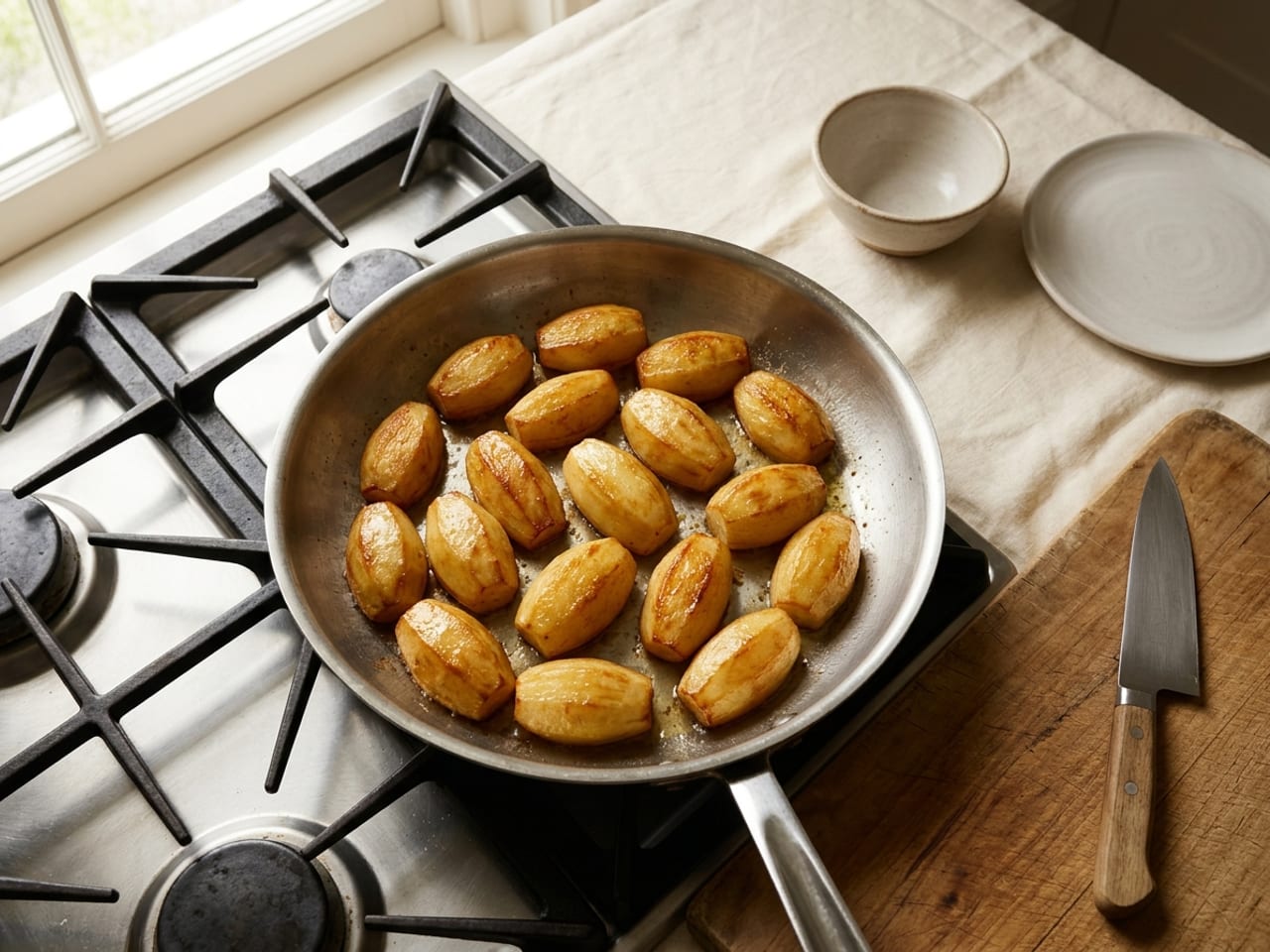
Château, raw into clarified butter
Escoffier (1907): "Turn them to the shape of large olives; season them; cook them gently in clarified butter, that they may be golden and very soft", then parsley just before serving.57 Gilbert had the same in 1890, and Larousse (1997) still says raw or clarified butter "sans avoir été préalablement blanchies" (without blanching first).60, 64 On Cooking: "sautéed in clarified butter until golden and tender."9
The one modern recipe we read in this line, Tasting History's, uses 2 tablespoons of clarified butter or ghee per 1 lb (450 g) of small potatoes, low heat, "about 15 to 20 minutes".90 Why clarified: it lets you cook "at a higher temperature than is possible with whole butter" (the CIA); a food-science table puts ghee's smoke point at 485°F (252°C).3, 101 No source gives a pan temperature or a doneness test beyond "golden" and "soft".
Château, blanched first, then browned
The other method is as old: Senn (London, 1895) blanched quartered potatoes in salted water, tossed them in clarified butter and baked them twenty minutes; Fellows (1897) blanched and "fried a light color in clarified butter".66, 67 Saulnier: "blanched, roasted nice brown colour, in butter"; Pépin: "blanched and fried".58, 59 Practical Cookery puts the barrels in boiling water "for 2-3 minutes, then refresh immediately" and drains them before finishing;25 Emeril Lagasse blanches, then sautés in butter "about 15 to 20 minutes" until "golden and soft".91
What blanching is said to do: Pépin blanches carved potatoes for 1 minute "To avoid discoloration", and Practical Cookery says an enzyme (the fragment we read cuts off which one) is active between "65 and 88°C" (149 and 190°F, ours), "so if the vegetable is put into boiling water the enzyme activity will quickly be destroyed".24, 58 No textbook we read ties the blanch to keeping the facets sharp.
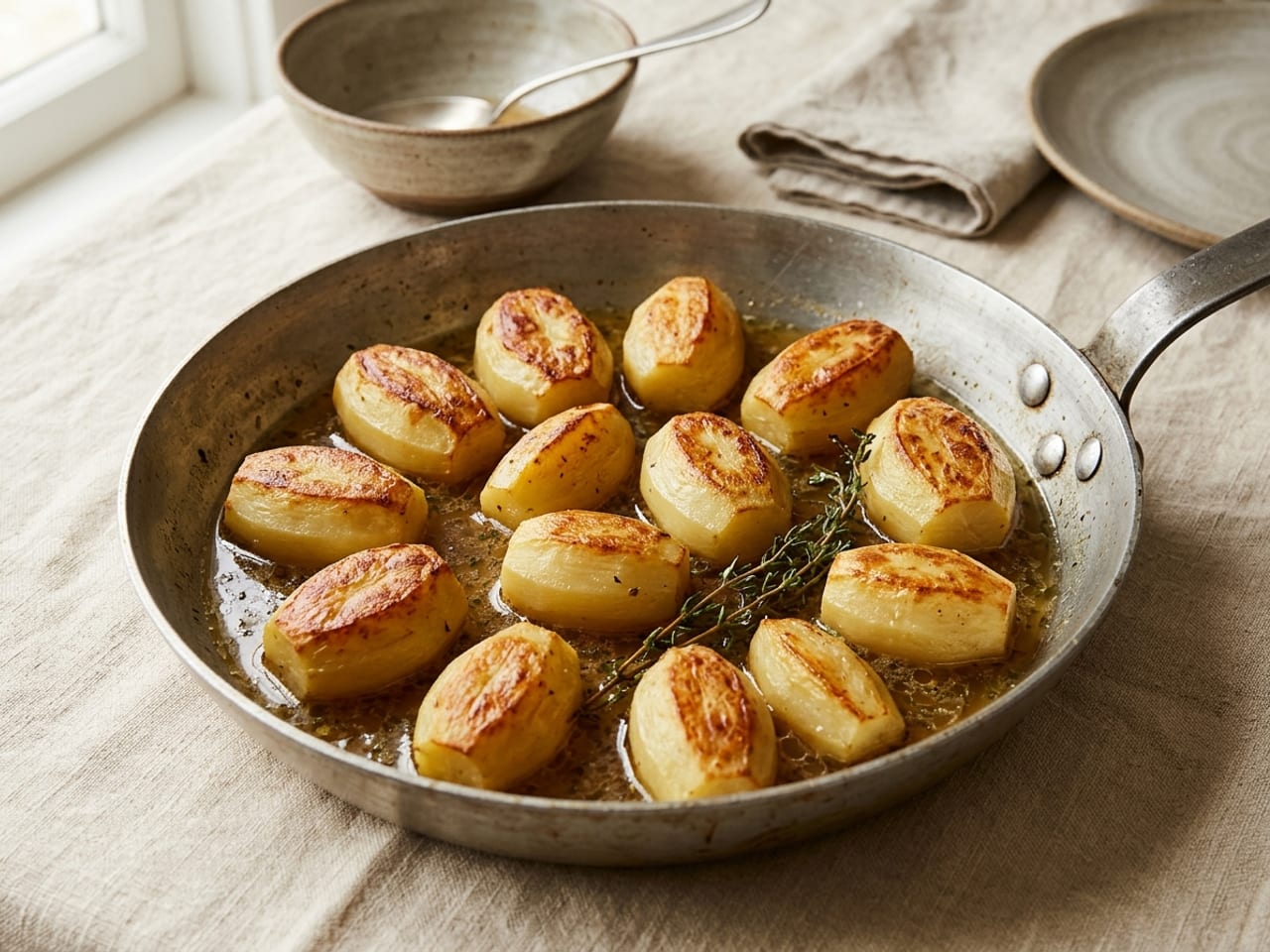
Fondant: at least five versions, none of them the correct one
Escoffier's 1907 fondantes are elongated olives of "about three oz." (85 g) each in the English edition (90 g in the French), cooked gently in butter, pressed lightly with a fork, then given more butter, "lid on until they have entirely absorbed the butter." No stock.56, 57 Pépin cooks them "with butter and a little bit of water"; Saulnier, château potatoes "in a covered pan, with a little white consommé" (in the 1956 French printing we read as in the 1976 English one), the earliest stock version we found.58, 59
Practical Cookery turns them into eight-sided barrels about 5 cm (2 in) long, "allowing 2-3 per portion", brushes them with butter and, in its 1974 text, adds white stock halfway up and cooks them in the oven; Larousse (1997) braises them "dans un fond blanc".23, 25, 60 The recipe sites we read cut cylinders instead: BBC Good Food browns Maris Piper 5 to 7 minutes a side, then adds 200 g (7 oz) butter and 200 ml (7 fl oz) stock and simmers covered 25 to 30 minutes until tender; Great British Chefs trims 3 cm (1¼ in, ours) rounds with a 6 cm (2⅜ in, ours) ring, pours stock halfway up and covers them "with a cartouche or a lid" (a paper round).93, 94 Practical Cookery itself shows "Fondant potatoes in various shapes".24
Cocotte and rissolée: smaller, browned
Pépin blanches his cocotte potatoes "for 1 minute in boiling water, drained and sautéed in butter and oil";58 Practical Cookery cooks them as château but "a quarter the size", "in a sauté pan or frying pan";25 Gisslen browns them on all sides with rissolé and parisienne potatoes, "turned or tossed in the pan so they brown on all sides".1 Larousse: "rissolées au beurre et à l'huile".60
Anglaise and vapeur: boiled or steamed
Escoffier cooks them "in salted water or steam" and adds "The English method is to cook them without salt";57 Gisslen steams the vapeur version "in perforated pan instead of boiling".1 Le Cordon Bleu boils turned vegetables and, "With roast meat of any kind," tosses turned potatoes "in melted butter and very finely chopped parsley"; Cracknell turns a vegetable to a 5 cm barrel, "plain boil; drain and toss in melted" butter.21, 29
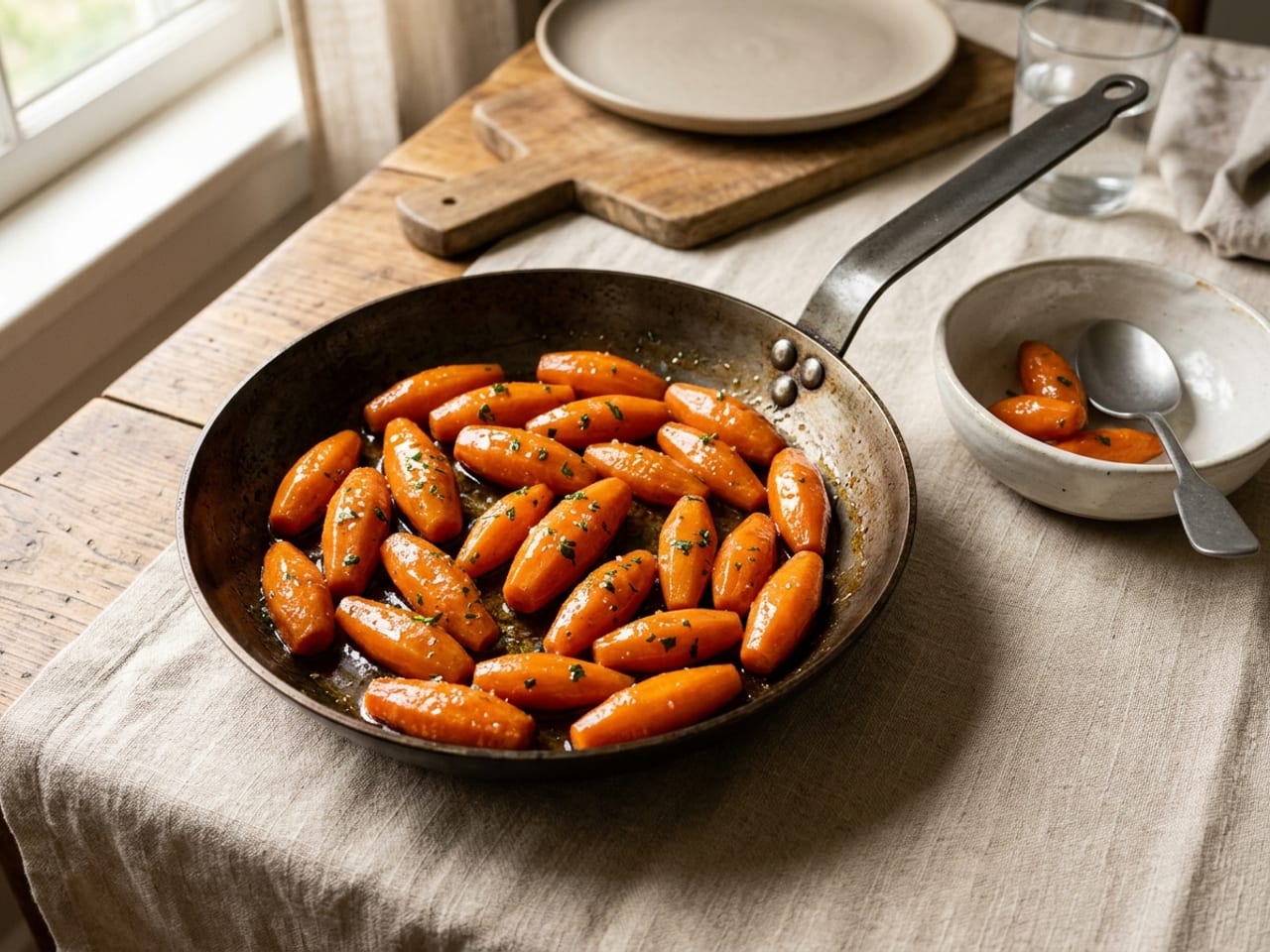
Glazed turned carrots and turnips
Escoffier's glazed carrots for garnish: old carrots turned to elongated olives and parboiled; then "enough water to cover them well, one-half oz. of salt, one oz. of sugar, and two oz. of butter per pint of water" (about 15 g, 30 g and 55 g per 570 ml, ours), cooked "until the water has almost entirely evaporated, so that the reduction may have the consistence of a syrup", and the carrots tossed in it "that they may be covered with a brilliant coat".57 His garnishes cook turned carrots and turnips in consommé and glaze them (carrots and turnips in Printanière, carrots in Nivernaise) or cook them down in it (Flamande).56
A 1969 French school manual separates glazing white (glacés à blanc, for a fricassée or white veal stew) from brown (glacés à brun, for braised beef), shown on button onions; Practical Cookery turns carrots and turnips to glaze for stews.24, 63
Which potato to turn
The sources split. The CIA's château potatoes call for "chef's or waxy yellow" potatoes, and Practical Cookery says "Waxy potatoes are firmer and hold their shape. Floury potatoes are softer and break ...".3, 25 But the CIA's 8th edition turns russets for a stew, BBC Good Food uses Maris Piper (floury in Practical Cookery's variety chart) for fondants, and Practical Cookery's own château wants "small, even-sized potatoes" with no variety named.4, 25, 93 France's seed-potato federation says firm-flesh (chair ferme) varieties hold up "à la vapeur, en salade ou rissolées" (steamed, in salads or pan-browned: the château family, ours) and rates Charlotte and Ratte culinary group A, Bintje B-C.103 In the US, Potatoes USA says "the flesh of red potatoes stays firm throughout the cooking process" and whites "hold their shape well".102 A 2002 study found that dry matter, "rather than the cultivar", decides how firm a steamed potato eats.98 Gisslen calls Bintje waxy; that study and the French federation class it in between.1, 98, 103
Keeping the facets sharp: what the food science says
Food scientists have long known a way to firm cooked potato: "Preheating potatoes at 50 to 80 degrees C has a firming effect on the cooked potato tissue", most of all at 60 to 70 °C (140 to 158 °F, ours) followed by cooling.96 In one study, longer preheating at 60 °C (140 °F, ours) before cooking gave "a less mashable product"; the enzyme thought to cause it (pectin methylesterase) stayed active for an hour at 60 °C but 10 minutes at 78 °C (172 °F, ours) "abolished virtually all" of it, so such a precook has to stay well below a simmer (ours).97 No cooking source we read uses this for turned potatoes, and none ties the classic short blanch to sharper faces. Trying a warm-water precook before browning is our suggestion, not a tested method.
Browning and acrylamide
The UK Food Standards Agency's home advice for frying, roasting or baking starchy foods is to "aim for a golden yellow colour or lighter"; acrylamide forms "above 120°C" (248°F, ours).99 The EU's rules for restaurants (soak cut potatoes 30 minutes to 2 hours, blanch where possible, fry below 175 °C, 347 °F ours) are written for deep-fried cut potato products; applying them to château potatoes is our analogy.100 Escoffier's own word for château is "golden".57
How to plate turned potatoes and vegetables
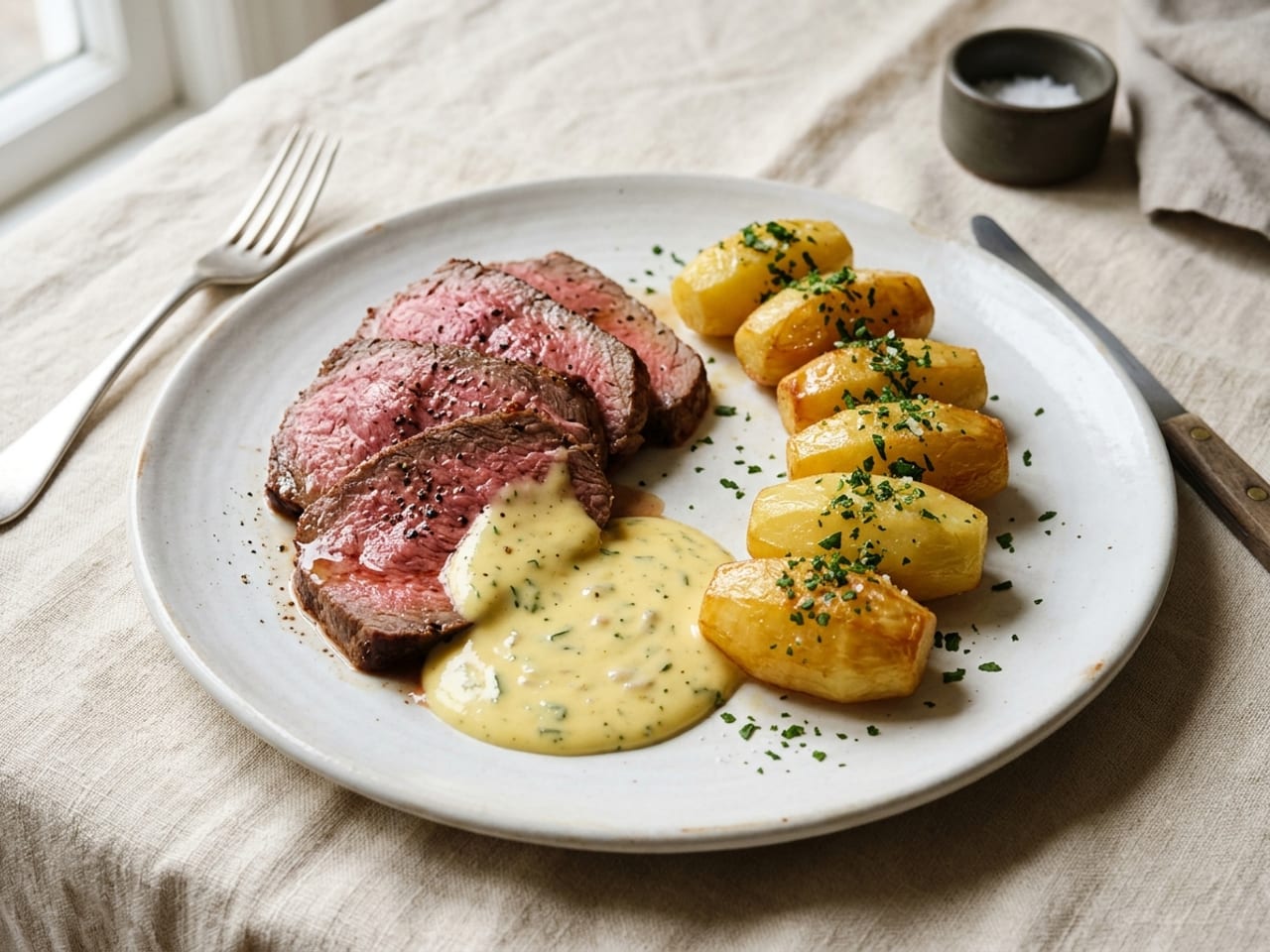
One to three pieces a person in Escoffier's garnishes, two to three fondant potatoes a portion in Practical Cookery, set around or beside the meat.23, 56 Nobody we read gives a position on the plate (a clock position or an odd number): the placing below is what the sources show.
| Source | Shape | Pieces or weight a portion |
|---|---|---|
| Escoffier, 1907 (garnishes)56 | Château | 1 a cover (Viroflay, Bruxelloise; Maraîchère's "grosses"); 2 small (Choisy, for tournedos); 3 (Portugaise) |
| Escoffier, 1907 (garnishes)56 | Fondant | 1 "belle" (Marigny); 1 small with 2 olive-shaped glazed carrots (Florian); 2 small with 2 carrots (Saint-Germain) |
| Escoffier, 1907 (garnishes)56 | Anglaise | 1 small (Flamande); 2 (Anversoise) |
| Escoffier, 1907 (bouquetière)56 | Small château | 250 g for 10 covers, about 25 g (1 oz) a cover (ours); no piece count |
| Escoffier, 1907 (English ed.)57 | Fondant | Each piece "about three oz." (85 g) |
| Practical Cookery23, 25 | Fondant | "2-3 per portion"; nutrition worked on 125 g (4½ oz, ours) raw potato a portion |
| Gisslen, 19832 | Cocotte | 4 oz (110 g) a portion |
| CIA, 8th and 9th eds.3, 4 | Château | 4 lb (1.81 kg) for 10, about 181 g (6.4 oz) raw a serving before trimming (ours) |
| CIA, 9th ed. p. 193 | Tournéed carrots | 4 oz (113 g) a serving (the costing example) |
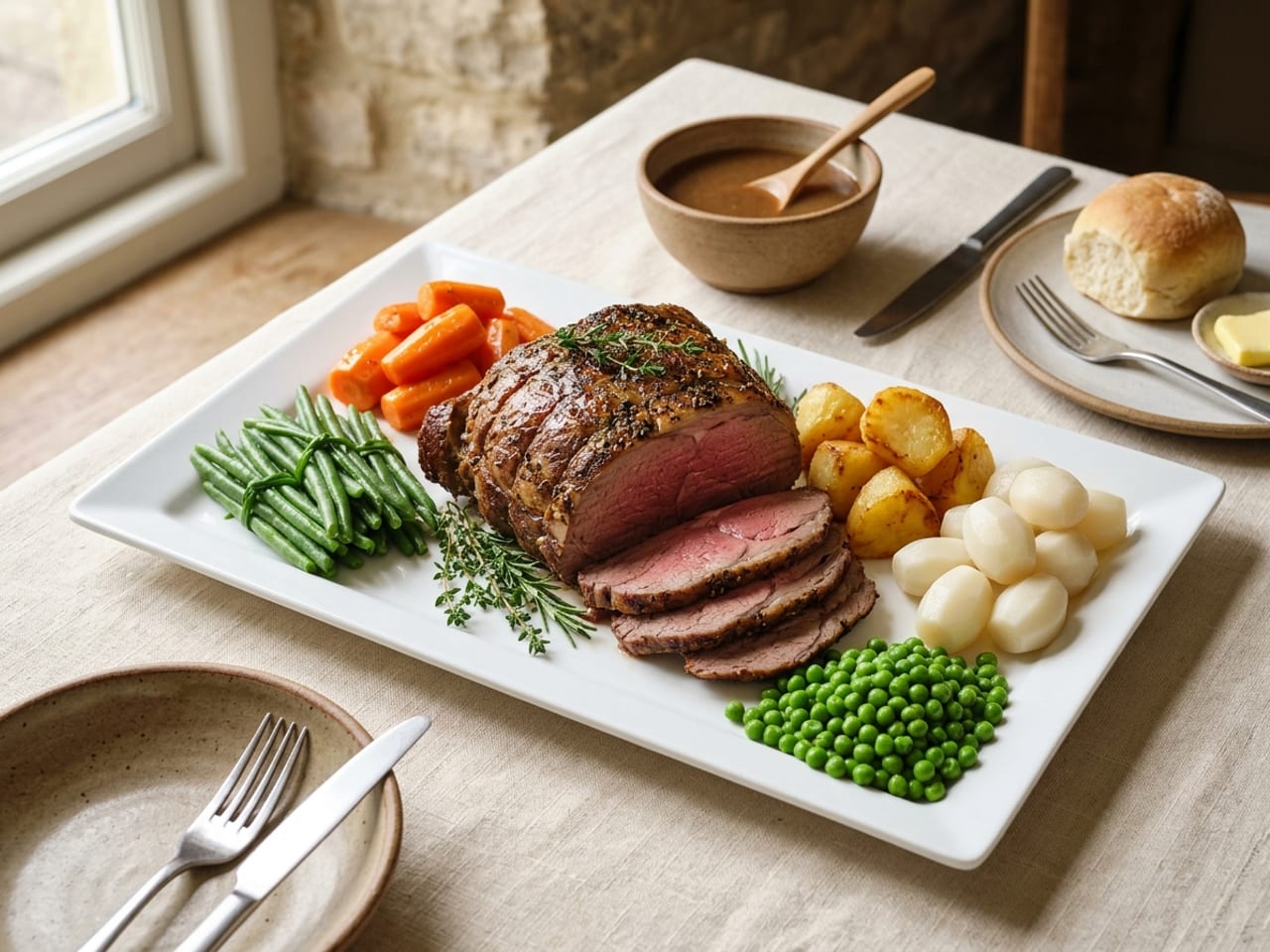
- With beef: château potatoes are the Chateaubriand's garnish (Gilbert 1890; the CIA's glossary: "served with chateau potatoes and béarnaise sauce"; On Cooking adds "a bouquetiére of vegetables").3, 9, 64 Escoffier's Choisy garnish for tournedos is two small château potatoes a cover. Plating the steak itself is in our steak plating guide.56
- Around the bird: Emeril arranges château potatoes "around the duck"; Practical Cookery serves a duck portion "with chateau potatoes and orange jus"; BBC Good Food puts fondant beside "roast chicken, steak or lamb".24, 91, 93
- With fish: Escoffier's anglaise potatoes go "more especially" with boiled fish; Saulnier's Doria garnish is turned cucumber in butter.57, 59
- The bouquetière: Escoffier surrounds a fillet of beef with "Small heaps" of carrots, turnips and olive-shaped potatoes, arranged "in such wise as to vary their colours", with cauliflower too, but his carrots and turnips are "turned by means of a small grooved spoon" in the English edition, "levés à la cuiller" (lifted out with a spoon) in the French: scooped, not carved; only the potatoes are knife-turned "to the shape of olives". Larousse (1997) turns the carrots and turnips for a bouquetière; Gisslen calls it one of the classical garnitures "most often adapted to modern platter presentation".1, 56, 57, 60
- A small cluster on a plate: "A small cluster of equal-size purple beet, white turnip, and orange carrot can look gorgeous on a plate" (Miami New Times, 2011).86 For where a garnish sits on a composed plate, see Michelin star plating and plating techniques.
Where the tourné came from
Turning is French, at least as old as 1734, and for two centuries it meant carving a vegetable to a named shape, an olive, a garlic clove, a cork. The seven sides came later: the earliest we found is a US textbook of 1983. The French dictionary TLFi files the kitchen sense of tourner, "Peler en donnant une forme arrondie et régulière" (to peel, giving a rounded and regular shape), under working on a lathe.80
| When | What we found |
|---|---|
| 1734 | Turnips cut in dice "ou bien tournez en olive" (or turned into olives): the earliest "turned into olives" we found.71 |
| 1740 | "carottes tournées" in a braise, in Le Cuisinier gascon.72 |
| 1742 | La Chapelle turns turnips "en olive, ou autres figures" (into olives, or other figures): the shape is chosen, the olive is the named one.73 |
| 1755 | Menon's "carottes & panais tournez en bâton": carrots and parsnips turned into sticks. Tourner meant shaping with a knife, not one shape.70 |
| 1806 to 1815 | The earliest "pommes de terre tournées" we found (Viard 1806, around a leg of mutton); Carême's small turned round potatoes cooked in butter (1815).74, 75 |
| 1824 and 1846 | English: "three turned carrots" (Beauvilliers in translation, 1824); "small turned potatoes, fried in clarified butter" (Francatelli, 1846), a château potato in all but name (ours).68, 69 |
| 1867 (1877 printing) | Gouffé's glossary (first published 1867; we read the 1877 printing): to turn is to give a vegetable, with the knife, "la forme de poire, de boule ou de bouchon" (a pear, a ball or a cork). No olive, no face count.77 |
| 1889 to 1892 | The name in print: "pommes château" in Garlin's Le Cuisinier moderne (Paris, 1889), the earliest dated use we found; a Chicago banquet menu of 18 January 1892 prints "Pommes Chateau".78, 79 |
| 1890 to 1897 | Château potatoes in print with both methods: raw in clarified butter (Gilbert, 1890) and blanched first (Senn, 1895; Fellows, 1897); "cut in oval shapes and fried" (Lake, 1894).64, 65, 66, 67 |
| 1907 | Escoffier specifies turned vegetables by comparison: garlic cloves (anglaise), large olives (château), elongated olives (fondantes) of about 90 g in the French text, "about three oz." in the English, a pigeon's egg, corks. No face count, no millimetres.56, 57 |
| 1912 | "Sirloin of Beef" with "Chateau Potatoes" on the Titanic's first-class dinner of 14 April, as transcribed (below).81, 82 |
| 1974 | Practical Cookery's fondant potatoes are "eight-sided barrel shapes": the earliest face count of any kind in what we read.23 |
| 1983 | Gisslen's first edition: "If perfectly done, it should have seven sides (but usually the customers won't count". The earliest seven we found.2 |
| 1991 and 1996 | The CIA's textbook still prints no count: faces "smooth, evenly spaced, and tapered".5 |
| 1997 | In the CIA's classroom, Michael Ruhlman writes that you could whittle a vegetable to nothing "looking for that perfect seven-sided football".84 |
| 2006 | The CIA's 8th edition prints "7 sides" in its method; its glossary still says "five or seven".4 |
| 2007 | A US patent for a hand device that turns a potato in seven indexed cuts (expired; we found no sign it was sold).51 |
When did seven sides become the rule?
The earliest "seven sides" we found is Gisslen's Professional Cooking, first edition, 1983: "If perfectly done, it should have seven sides (but usually the customers won't count".2 Before it, no text in the French tradition we read gives a count (in French: La Chapelle 1742, Gouffé, Gilbert, Escoffier 1907, Saulnier's 1956 printing; in German: Hering, Vienna 1909; in English: Escoffier 1907, Larousse 1961, Saulnier 1976, Pépin 1976), and the only British count is Practical Cookery's eight-sided fondant (1974).23, 56, 58, 59, 61, 62, 73, 77 The CIA's textbook prints no count in 1991 or 1996 and first prints "7" in its 8th edition (2006), though a writer who took its classes in the mid-1990s already wrote of students "looking for that perfect seven-sided football". 4, 5, 84 Seven also appears in an Australian cookbook in 1984 and a Houston restaurant recipe in 1987.35, 36 This is the earliest we found, not proof of a first: most textbooks were read only as search fragments, and Larousse 1938, Saulnier 1914 and Escoffier's later editions were not read. Escoffier Online's "A traditional tournée cut has seven sides" is not in Escoffier's own text as we read it.32
Château potatoes on the Titanic
The first-class dinner of 14 April 1912, as transcribed by Titanic Belfast and by Lapham's Quarterly, includes "Sirloin of Beef" followed by "Chateau Potatoes" (Titanic Belfast lists them on consecutive lines; Lapham's: "Sirloin of Beef with Chateau Potatoes").81, 82 An original copy of that menu sold at Heritage Auctions on 7 November 2015 for $118,750, as a trade blog reported.83 We did not see a scan of the menu itself. The gloss Titanic Belfast prints beside the dish is, word for word, Nancy Lake's 1894 definition, "cut in oval shapes and fried". 65 What the ship's kitchen did is not recorded in anything we read; Escoffier's text of the time turns château potatoes to large olives and cooks them in clarified butter (ours, from his 1907 text).57
Do chefs still turn vegetables?
Less than they did, by the accounts we read that compare then and now, but it has not gone: of five Miami chefs asked in 2011, 2 still used the skill and 3 "no longer consider it relevant".86 These are opinions, each with its name and date:
| Who | Where it was said | Side | In their words |
|---|---|---|---|
| Jeff McInnis, Yardbird (Miami)86 | Miami New Times, October 2011 | Still turns | "I'm actually doing it as we speak for the Yardbird menu." |
| Jarrod Verbiak, db Bistro Moderne (Miami)86 | Miami New Times, October 2011 | Still turns | A long, banana-shaped turned potato with steak frites: "we don't count the sides, but the lineage is there"; turning is "a sort of rite of passage". |
| Geoffrey Zakarian86 | Miami New Times, October 2011 | Against | Last did it "25 years ago at Le Cirque": "This to me is torturing the product." |
| Michael Bloise86 | Miami New Times, October 2011 | Against | Last turned vegetables "A few months ago", to school his cooks, but: "I feel like it's superficial and wasteful." "Does a boiled turned potato taste differently than a cubed one?" |
| Alex Pinero86 | Miami New Times, October 2011 | Against | "The last time I used a bird's beak knife was at Casa Tua about four years ago." |
| Dieter Doppelfeld, CIA instructor, at the Certified Master Chef exam85 | in Ruhlman, The Soul of a Chef, 2001 | Mixed | Perfectly turned vegetables are "important in classical cuisine", but "If they don't taste good, who cares?" |
| Martha Rose Shulman, food writer, after a CIA basic-training course17 | Culinary Boot Camp, 2006 | Writer | "The tourne is a purely decorative cut and is usually used for garnishes" |
| Escoffier Online (the Escoffier school's blog)32 | 2020 | Writer | "The tournée cut isn't as popular these days as it was in Auguste Escoffier's day." |
| Erica Martinez, Tasting Table87 | 23 February 2023 | Writer | "rarely used outside of the classroom"; "The rapid-fire pace of a restaurant kitchen doesn't usually allow for it." |
Exams and contests: which ask for it
Of the 6 qualification specs and contest rules we read, 2 name turning: one as an option, one as a method. None sets a face count, a size or a time.
| Exam or contest | Where | Tourné? | Detail |
|---|---|---|---|
| SkillsUSA Culinary Arts, post-secondary (2024)45 | US | An option | Competitors pick at least five cuts from a list that includes "tourne"; Knife Skills is 50 of 1,000 points; no count, size or time |
| SkillsUSA Culinary Arts, high school (2024)46 | US | No | A fixed list of five cuts |
| ACF Certified Culinarian practical (2021)47 | US | No | Julienne, batonnet, parsley and mirepoix |
| SITHCCC023 and SITHCCC001 (2023 and 2022 PDFs)48 | Australia | No | Eight precision cuts listed, none turned |
| NZQA unit standard 1328049 | New Zealand | No | Seven cuts listed |
| National Occupational Standard PPL2PC150 | UK | Listed as a method | "turning" sits apart from the "traditional French cuts"; no size or face count |
Bought-in, machine-made, and on today's menus
- Bought ready-turned: in 2002 a London chef-owner wrote that Covent Garden suppliers sell "turned carrots cut into different shapes"; a UK retailer sells part-cooked "turned carrots, courgettes, baby turnips", "Served at many fine dining establishments" (its claim, no restaurant named).54, 55 We found no frozen château potato on sale.
- Machines: a 1996 US patent covers an industrial shaper whose output is "generally being referred to as Chateau"; a 2007 patent (and its 2011 follow-up) covers a hand device that holds the potato on needles and indexes it through seven cuts along a curved guide, because hand-turning takes "a great deal of effort, time, and skill". Both later patents have expired; we found no sign the device was sold.51, 52, 53
- On menus: fondant potatoes are on dated 2026 menus we read (a racecourse's Christmas menu, a Cambridge college's formal hall), though neither says whether they are turned; we found no 2025 or 2026 restaurant menu printing château potatoes that we could open.88, 89
Tourné troubleshooting
Fixes credited to their source where one exists; the rest are marked ours.
| What goes wrong | What to do |
|---|---|
| The faces blur and round off in the pan | No cooking source we read says how to keep facets sharp. What they do say: Escoffier cooks château "gently", and "Waxy potatoes are firmer and hold their shape" (Practical Cookery).25, 57 The food science is below. |
| Cut pieces go brown before you cook them | Hold them "submerged in cold water" (CIA); Finch keeps turned celeriac "in acidulated water"; Pépin blanches carved potatoes 1 minute "To avoid discoloration".3, 28, 58 |
| Fat spits when they go in | "Drain and blot them dry on paper towels immediately before sautéing to avoid splattering" (CIA).3 |
| The pieces come out different sizes | Cut every blank to the same size before carving (ours) and hold each finished piece against the first (ours): the CIA asks that "all the pieces are cut uniformly".6 |
| A tiny nub and a heap of scraps | "If you keep trimming and trimming, you'll end up with a tiny nub of potato and a lot of scraps!" (Escoffier Online).32 Stop at the first even shape; a face less is fine if every piece matches (ours, after Le Cordon Bleu's "not absolutely essential").20 |
| Lumpy faces made of many small cuts | "Try to make as few cuts as possible" (CIA), or rough out the shape and then trim the faces even (Morgan). A sharp knife "requires less pressure and is less likely to slip" (Gisslen).1, 4, 14 |
| The butter burns before the potatoes are golden | Use clarified butter, as Escoffier does: Practical Cookery says clarified "butter has a higher burning point" and "should always be used if the shallow-fried food is ..." (the fragment cuts off the condition).24, 57 |
| Fondant potatoes fall apart | Practical Cookery: "Floury potatoes are softer and break ..."; BBC Good Food still uses Maris Piper (floury in Practical Cookery's variety chart) for its (cylinder) fondant. Pick a firmer potato for turned fondants (ours).25, 93 |
Popular claims about the tourné, each with a verdict
Fourteen claims, each against what we read. "Supported, narrowly" means the sources cover less than the claim says; "Mixed", that they point both ways; "No source found", that we found nothing for it.
| The claim | Verdict | What we found |
|---|---|---|
| A tourné has seven sides. | Mixed | Seven in most US textbooks we read (12 of the 15 US textbook rows in the tally; 18 of all 32 rows), but the CIA's own glossary says "five or seven", a US high-school text "six or seven", Practical Cookery eight, Le Cordon Bleu calls seven "not absolutely essential", and 9 rows count none. |
| Seven sides is Escoffier's rule, or the classic French one. | Not supported | Escoffier's 1907 text names shapes (garlic cloves, olives) and counts no faces, and so does every French text we read from 1734 to 1997. The earliest seven we found is Gisslen's US textbook, 1983.2, 56, 60 |
| Seven sides make a tourné cook evenly. | No source found | No source we read says why seven. The reasons given are for turning at all: even cooking (Larousse 1997, Le Cordon Bleu), looks, bite size, and pieces that "roll around easily in the pan" (Miami New Times) or are "easy to roll around a pan" (Escoffier Online).22, 32, 60, 86 |
| Anglaise potatoes are 2 inches by 1 inch (5 by 2.5 cm). | No source found | The earliest page we found with that figure is a 2011 Miami New Times article whose size ladder in inches (château 2.5 by 1.5, about 6.4 by 3.8 cm; anglaise 2 by 1; cocotte 1 by 0.5; olive 0.5 by 0.25) names no source.86 No textbook we read gives anglaise a size; Escoffier gives a shape, large garlic cloves.57 |
| A tourné is about ¾ inch (2 cm) in circumference. | Not supported | Tasting Table (2023) wrote "circumference"; Gisslen's ¾ in (2 cm) is the diameter.1, 87 |
| You need a tourné (bird's beak) knife. | Not supported | Every textbook we read whose method names a knife also allows a paring knife; none requires the tourné knife, and Gisslen's own figure uses a paring knife (the knife).1, 6, 9 |
| Noisette and parisienne potatoes are turned. | Mixed | Balled with a round scoop in 5 of the 7 sources we read for them (Escoffier, Hering, Larousse 1961, Gisslen, On Cooking); the CIA's glossary and Larousse's 1997 potato table call them "tournéed" / "tournées".3, 57, 60 |
| Olivette potatoes are a classic French turned shape. | No source found | Not in Escoffier, Saulnier, Hering or Larousse as we read them. The only source we found is a US school table, Johnson & Wales (2001): "Olivelike 7-sided; 1 to 2 inches" (2.5 to 5 cm, ours).15 |
| Fondant potatoes are turned barrels braised in stock. | Mixed | In Practical Cookery and Larousse 1997, yes; Escoffier's 1907 fondantes had no stock, Pépin's used butter and a little water, and the three recipe sites we read cut cylinders (fondant). |
| Château potatoes were served at the Titanic's last first-class dinner. | Supported | "Sirloin of Beef with Chateau Potatoes" on the 14 April 1912 first-class dinner in Lapham's Quarterly's transcription (Titanic Belfast lists the two on consecutive lines); we did not see a scan.81, 82 |
| Turned vegetables cook more evenly. | Supported, narrowly | Larousse (1997) and Le Cordon Bleu say so; we found no measurement of it.22, 60 |
| Nobody turns vegetables any more. | Mixed | Of five Miami chefs asked in 2011, two still used the skill; Tasting Table (2023) calls it "rarely used outside of the classroom"; UK suppliers sell pre-turned carrots, and fondant potatoes are on dated 2026 menus (do chefs still do it).55, 86, 87, 88 |
| Tourné is just a rite of passage for students. | Mixed | Opinions, not facts: Jarrod Verbiak called it "a sort of rite of passage" and still served a turned potato; Michael Bloise called it "superficial and wasteful"; it is an option in one US contest and a listed method in a UK occupational standard, and absent from the other four specs we read (exams).45, 50, 86 |
| There is a machine that turns potatoes. | Supported, narrowly | Patented: an industrial shaper for the "Chateau" shape (1996) and a hand device with seven indexed cuts (2007, expired). We found no evidence the hand device was sold, and no frozen château potato on sale.51, 53 |
Photograph your plate, see it re-plated
Turned potatoes on the plate and not sure where they go? Photograph the dish and Plate Artists re-plates that dish, with the food kept as it is and the changes named so you can repeat them. Start with a re-plate.
Your food, plated like a chef's
Snap it, upload it, and get the composed version back, with the steps to recreate it at home.
Start free · 1 enhancement →Free account · 1 free enhancement · No credit card
Tourné terms, defined
Only the words our knife skills guide does not already define (the bird's beak knife and the cut-resistant glove are there); the cut itself is on the knife cuts chart.
Tourner · to turn
French for to turn: in cooking, to peel or trim a vegetable with a knife to a rounded, regular shape.
Where it comes from. TLFi files the kitchen sense under working on a lathe; Gouffé's glossary (1877 printing of his 1867 book) gives the shapes as a pear, a ball or a cork.77, 80
Château potatoes · pommes château
Potatoes turned to large olives or small barrels and cooked in butter until golden and soft.
Where it comes from. Gilbert 1890 and Escoffier 1907; the Chateaubriand's classic garnish.57, 64
Fondant potatoes · pommes fondantes
Turned potatoes as large as or larger than château, cooked in butter until they absorb it, or today often braised in stock, and often cut as cylinders.
Where it comes from. Escoffier 1907 (butter only); Practical Cookery (eight-sided barrels in stock).23, 57
Cocotte potatoes
Small turned potatoes cooked like château potatoes.
Where it comes from. Gisslen: about 1½ in (4 cm); Practical Cookery: a quarter of château size.1, 25
Rissolée potatoes · pommes rissolées
Potatoes browned all over in fat; in Practical Cookery, turned and half the size of château potatoes.
Where it comes from. Practical Cookery: as château, "half the size"; Gisslen files rissolé with cocotte.1, 23
Pommes à l'anglaise · anglaise potatoes
Turned potatoes boiled or steamed, classically served with boiled fish.
Where it comes from. Escoffier: "the shape of large garlic cloves", salted water or steam.57
Pommes vapeur · steamed potatoes
Turned potatoes cooked in steam.
Where it comes from. One dish with anglaise in Saulnier; a separate one in Fundamentals of French Cookery and Gisslen.1, 59, 63
Noisette and parisienne potatoes · pommes noisette; pommes parisienne
Potato balls scooped with a round cutter and browned in butter: balled, not turned, in most sources.
Where it comes from. Escoffier: a "round spoon-cutter", hazelnut size; parisienne smaller.9, 57
Bouquetière
A garnish of several vegetables arranged in separate small heaps around a roast, colours alternated.
Where it comes from. Escoffier 1907 (heaps around the joint, colours alternated); On Cooking's "a garnish (bouquet) of carefully cut and arranged fresh" vegetables.9, 57
Printanière and jardinière
Names the CIA gives turned vegetables by size; Escoffier's jardinière carrots and turnips are scooped, not turned.
Where it comes from. The CIA, 1991 and 1996: printanière "the size of a large marble", jardinière "the size of a quail's egg".5
Tonnelet
French for a small barrel: Larousse's word for the château shape.
Where it comes from. Larousse 1997, for château potatoes: "en forme de tonnelet".60
Collerette potatoes · pommes collerette
Potatoes turned into corks and fluted: a sign (ours) that turning once meant any knife-carved shape.
Where it comes from. Escoffier 1907: turned "en forme de bouchons" (corks), then fluted with a special knife.56
Fluting · turned mushroom
Cutting curved channels into a mushroom cap: called turning a mushroom, but a different technique from tourné.
Where it comes from. Le Cordon Bleu: a paring knife held "at a slight angle to the mushroom" cuts "a channel from the center" of the cap.20
Glacé à blanc, glacé à brun · glazed white, glazed brown
Vegetables glazed without colour, or cooked on until the glaze browns.
Where it comes from. Fundamentals of French Cookery (1969), for button onions: white for a fricassée, brown for braised beef.63
Tourné, answered
What is a tourné?
A vegetable, usually a potato or carrot, carved with a small knife into a little barrel or football with curved faces and flat or blunt ends. Gisslen's Professional Cooking gives 2 in long, ¾ in across (50 mm long, 20 mm across). Tourné is French for turned: the cook turns the piece between cuts.
How many sides does a tourné have, and why seven?
Seven in most US textbooks (12 of the 15 we tallied; 18 of all 32 sources), but the CIA's own glossary says five or seven, a US high-school text six or seven, Le Cordon Bleu calls seven traditional 'but this is not absolutely essential', Practical Cookery turns eight-sided barrels, the CIA gives courgette three to four faces, and Escoffier counted none. The earliest seven we found is Gisslen's 1983 textbook. No source we read says why seven.
What size is a tourné cut?
About 2 in (5 cm) long in nearly every source. Width varies: ¾ in (2 cm) in Gisslen, ¾ to 1 in (2 to 2.5 cm) in On Cooking, 1¼ in (about 3 cm) in a 1972 British text, 2 to 3 cm in Finch. Practical Cookery alone gives an end width: 1.5 cm at the ends, 2.5 cm in the middle, for a 5 cm fondant potato. Named potatoes run from about 1½ in (4 cm, cocotte in Gisslen) to 6 cm (château and fondant in Finch) and '3 inches or more' (a J&W fondante).
What is a tourné knife used for?
Carving the curved faces of turned vegetables, and peeling round fruit and vegetables. It is a paring knife with a short blade that curves down like a beak, hence its other name, bird's beak; makers also sell it as a peeling or turning knife. The blades we read run from 2.36 to 2¾ in (6 to 7 cm).
Tourné knife vs paring knife: which do I need?
Either. Every textbook we read whose method names a knife also allows a paring knife; none requires the tourné knife, and Gisslen's own figure uses a paring knife. The CIA's reason for the curve is that it makes cutting the curved surfaces easier.
How do you tourné a potato?
Peel it and cut a blank slightly larger than the finished piece, with flat parallel ends (Gisslen), or cut it into quarters, sixths or eighths (the CIA). Hold it between thumb and forefinger, set a paring or tourné knife at the top edge and cut down toward your thumb with a curving movement, so the face tapers and both ends are narrower than the middle (the CIA). Turn it a little (one-seventh of a turn for seven faces) and repeat, in as few cuts as possible, then check it matches the others.
How do you tourné a carrot?
Cut it into 2-inch (5 cm) lengths rather than wedges (On Cooking, the CIA, Le Cordon Bleu), or square each length into a block and take off the corners (Leiths), then carve each length like a potato. The CIA also makes a flat-bottomed carrot tourné with four or fewer sides; Escoffier turned carrots to garlic cloves and olives.
Which potatoes are best for tourné?
The sources split. The CIA's château potatoes use 'chef's or waxy yellow' potatoes and Practical Cookery says waxy potatoes 'are firmer and hold their shape'; but the CIA also turns russets for a stew and BBC Good Food uses Maris Piper (floury in Practical Cookery's variety chart) for fondants. A study found dry matter, more than variety name, decides how firm a potato cooks. Practical Cookery's château asks for 'small, even-sized potatoes'.
What are château potatoes?
Potatoes turned into large olives or small barrels and cooked in butter until golden and soft, the classic garnish of the Chateaubriand steak. Escoffier (1907) cooked them raw in clarified butter; Senn (1895), Saulnier, Pépin and Practical Cookery blanch them first, Practical Cookery for 2 to 3 minutes. Gisslen makes them about 2 in (5 cm) long; Finch 6 cm.
How do you cook tourné potatoes?
By name: château browned in clarified butter, raw or after a short blanch; cocotte the same, smaller; fondant in butter (Escoffier), butter and water (Pépin) or stock (Saulnier, Practical Cookery); anglaise boiled or steamed. To roast, Saulnier roasts château potatoes in butter, a 1969 school manual files them as 'Small roasted potatoes', and Senn (1895) bakes them twenty minutes; the only oven heat we found is a Practical Cookery fragment, 190°C (375°F), probably for its fondant.
Can you make tourné potatoes ahead and keep them in water?
Yes. The CIA holds peeled, cut potatoes submerged in cold water until it is time to cook, then blots them dry; the FDA Food Code allows cut potatoes to be immersed in ice or water and sets no time limit. The Idaho Potato Commission says about 24 hours in water in the refrigerator, and that water does not take the place of refrigeration; Gisslen says 'a short time', with some nutrient loss.
What do you do with tourné trimmings?
Use them: soup, purée or another dish (the CIA), mashed potatoes or soup (Gisslen), soup or croquettes (Pépin), mashed potatoes, purées, stocks and slaws (Escoffier Online), stocks and soups (Leiths). Keeping potato trim in cold water like the cut pieces is our suggestion; no source gives a storage time for trim itself.
How do you pronounce tourné?
toor-NAY. Gisslen respells tourné 'toor nay', On Cooking tourner 'toor-nay', a US high-school text 'tour-NYAY'; the French dictionary TLFi gives tourner as /tuʁ.ne/.
Is tourné still used in restaurants?
Less than it was, by the accounts we read that compare then and now, but it has not gone. Of five Miami chefs asked in 2011, two still used the skill and three no longer considered it relevant; Tasting Table (2023) calls it rarely used outside the classroom. UK suppliers sell pre-turned carrots, it is an optional cut in the 2024 SkillsUSA post-secondary contest, and fondant potatoes are on dated 2026 menus.
What are fondant potatoes?
A large turned potato (the largest in some textbooks, château-sized in others). Escoffier's 1907 fondantes were elongated olives of about 3 oz (85 g) cooked in butter until they absorbed it, with no stock; Practical Cookery turns eight-sided barrels about 5 cm (2 in) long, 2 to 3 a portion, cooked in stock in the oven; the three recipe sites we read (BBC Good Food, Great British Chefs, RecipeTin Eats) cut cylinders, brown them and finish them in stock.
What is a turned mushroom?
A mushroom cap cut with curved channels, also called fluting: Le Cordon Bleu holds a paring knife at a slight angle and cuts a channel from the centre of the cap. It shares the name but not the method with the tourné.
The textbooks, cookbooks, makers, agencies and studies behind this guide
How each source was read (in full, as a PDF, in an archived copy, as a Google Books snippet, or as search fragments of a lending-only scan) is in its entry and under how this page was made. Blogs, magazines, makers' pages and trade bodies are labelled. Sums, angles, conversions and suggestions marked ours are our own.
- Gisslen, W. (2011). Professional Cooking, 7th edition (college version). John Wiley & Sons, Fig. 7.7 p. 143 (the tourné: "2 inches long × 3/4 inches in diameter, with 7 sides, and flat-ended (5 cm x 2 cm)"), the tourné method p. 147, slicing trimmings p. 145, knife safety p. 36, potato yield p. 547, holding peeled potatoes p. 606, boiled and steamed potatoes p. 608, rissolé, cocotte and château potatoes p. 620, the glossary p. 1075; read on 24 October 2026 (and on 30 September 2026 for our knife skills guide) as Google Books search-inside snippets and Internet Archive search fragments. books.google.com
- Gisslen, W. (1983). Professional Cooking, 1st edition (and the 2nd edition, 1989). John Wiley & Sons, the tourné procedure ("it should have seven sides"), Recipe 187 Rissolé or Cocotte Potatoes and 187B Château Potatoes p. 410 (Recipe 189C p. 439 in 1989); read 24 October 2026 as Internet Archive full-text search fragments of a lending-only scan, not the page images. archive.org
- The Culinary Institute of America (2011). The Professional Chef, 9th edition. John Wiley & Sons, the cut chart p. 624 ("Approximately 2 in/5 cm long with 7 faces"), the glossary ("five or seven sides or faces"), the tourné knife p. 47, the costing example pp. 18 to 19, stew garnishes pp. 581 and 606, sautéed potatoes p. 729, château potatoes p. 740, clarified butter; read on 24 October 2026 as Google Books snippets and Internet Archive search fragments. The tourné how-to page, p. 630, returned no snippet for any query. books.google.com
- The Culinary Institute of America (2006). The Professional Chef, 8th edition. John Wiley & Sons, tourné cuts p. 691 ("as few cuts as possible to create the 7 sides"), the tourné knife p. 150, château potatoes p. 793, a russet-potato stew, the glossary ("five or seven sides"); read 24 October 2026 as Internet Archive full-text search fragments of a lending-only scan, not the page images. archive.org
- The Culinary Institute of America (1969). The Professional Chef (1969 and 4th edition 1974); The New Professional Chef, 5th edition (1991) and 6th edition (1996). CIA; Van Nostrand Reinhold, no tourné hit in 1969; "Small-tourne, boiled or Parisienne Potatoes" in 1974; carve 2-inch pieces into barrels or footballs, faces "smooth, evenly spaced", printanière and jardinière sizes, and no face count, in 1991 and 1996; read 24 October 2026 as Internet Archive full-text search fragments of a lending-only scan, not the page images. archive.org
- The Culinary Institute of America (2000). The Professional Chef's Knife Kit. John Wiley & Sons, tourné dimensions p. 53 ("Approximately 2 inches long with seven “faces”"), tourné cuts pp. 59 to 60 (seven faces, zucchini with three to four, "one of the most demanding", trim for purées and coulis); read 24 October 2026 as Internet Archive full-text search fragments of a lending-only scan, not the page images. archive.org
- The Culinary Institute of America (2008). In the Hands of a Chef: The Professional Chef's Guide to Essential Kitchen Tools. John Wiley & Sons, the tourné or bird's beak knife p. 17, tournés p. 70 (seven faces; zucchini, cucumber and carrot tournés "generally have four or fewer sides"); read 24 October 2026 as Internet Archive full-text search fragments of a lending-only scan, not the page images. archive.org
- The Culinary Institute of America (2000). Instructor's Manual to accompany The Professional Chef's Techniques of Healthy Cooking. John Wiley & Sons, cut chart "TOURNE 2” x 7 even sides"; glossary "A barrel-shaped vegetable cut, usually with seven sides"; read 24 October 2026 as Internet Archive full-text search fragments of a lending-only scan, not the page images. archive.org
- Labensky, S. R., & Hause, A. M. (2007). On Cooking: A Textbook of Culinary Fundamentals, 4th edition. Pearson Prentice Hall, tourner p. 116 ("seven equal sides and flat ends"; the step caption reads 2 inches (5 cm) by ¾ to 1 inch (2 to 2.5 cm); the prose sentence's width fraction is unreadable in the scan), château and parisienne potatoes, bouquetière, waxy potatoes, clarified butter; read 24 October 2026 as Internet Archive full-text search fragments of a lending-only scan, not the page images (two scans, oncookingtextboo0000labe_b3h9 and oncookingtextboo0003labe). archive.org
- Labensky, S. R., & Hause, A. M. (2003). On Cooking: Techniques from Expert Chefs, 3rd edition. Prentice Hall, tourner ("seven equal sides and blunt ends", 2 inches (5 cm) by ¾ to 1 inch (2 to 2.5 cm), OCR "74 to 1") and château potatoes; read 24 October 2026 as Internet Archive full-text search fragments of a lending-only scan, not the page images. archive.org
- Pearson Custom Library (2015). Hospitality & Culinary Arts (custom text built from On Cooking). Pearson, the tourné size, 2 inches (5 cm) by ¾ to 1 inch (2 to 2.5 cm) (OCR "%" for ¾), tourné or paring knife; read 24 October 2026 as Internet Archive full-text search fragments of a lending-only scan, not the page images. archive.org
- Labensky, S. R., Hause, A. M., et al. (2011). On Cooking: A Textbook of Culinary Fundamentals, Canadian edition. Pearson Canada, the size sentence gives length only, "5-cm (2-in.) long"; Internet Archive date 2011; read 24 October 2026 as Internet Archive full-text search fragments of a lending-only scan, not the page images. archive.org
- Pearson Custom Library (2011). Culinary Arts (custom college text). Pearson, tourné "Approximately 2 inches (50 millimeters) long with seven sides", ends narrower than the centre, the tourné, bird's beak and granny knives with a blade "2 to 4 inches"; read 24 October 2026 as Internet Archive full-text search fragments of a lending-only scan, not the page images. archive.org
- Morgan, J. L. (2006). Culinary Creation: An Introduction to Foodservice and World Cuisine. Elsevier Butterworth-Heinemann, p. 85 and the glossary (rough out a 2-inch seven-sided shape, then trim; "Chefs have their favorite method"); read 24 October 2026 as Internet Archive full-text search fragments of a lending-only scan, not the page images. archive.org
- Johnson & Wales University College of Culinary Arts (2001). Culinary Fundamentals. Johnson & Wales University, Figure 10-7, the cuts table (tourné olivette, château and fondante; column order read by us from the OCR); read 24 October 2026 as Internet Archive full-text search fragments of a lending-only scan, not the page images. archive.org
- National Restaurant Association Educational Foundation (2011). Foundations of Restaurant Management & Culinary Arts. Prentice Hall, the US high-school ProStart text: "a tourner (tour-NYAY), a football or barrel shape that forms six or seven sides"; read 24 October 2026 as Internet Archive full-text search fragments of a lending-only scan, not the page images. archive.org
- Shulman, M. R. (2006). Culinary Boot Camp: Five Days of Basic Training at the Culinary Institute of America. John Wiley & Sons, a food writer's account of a CIA course, p. 222 area ("The tourne is a purely decorative cut"); read 24 October 2026 as Internet Archive full-text search fragments of a lending-only scan, not the page images. archive.org
- Trotter, C. (vegetables section), in DK (2005). The Cook's Book: Techniques and Tips from the World's Master Chefs. Dorling Kindersley, p. 346 (2 in (5 cm) pieces turned to "an oval shape with seven" curved sides) and a recipe with 1 in (2.5 cm) tournés; read 24 October 2026 as Internet Archive full-text search fragments of a lending-only scan, not the page images. archive.org
- Weinstein, N. (2008). Mastering Knife Skills. Stewart, Tabori & Chang, p. 37 (the tourné "(or bird's beak)" knife); read 24 October 2026 as Internet Archive full-text search fragments of a lending-only scan, not the page images. archive.org
- Le Cordon Bleu (1994). Le Cordon Bleu Classic French Cookbook. Dorling Kindersley, p. 135 "Turning tubular and round vegetables" ("Traditionally they have seven sides, but this is not absolutely essential"), the glossary, turned cucumber, and mushroom fluting; read 24 October 2026 as Internet Archive full-text search fragments of a lending-only scan, not the page images. archive.org
- Wright, J., & Treuille, E. (Le Cordon Bleu) (1996). Le Cordon Bleu Complete Cooking Techniques. Cassell, turned vegetables boiled, turned potatoes tossed in butter and parsley with roast meat, waxy and floury potatoes; read 24 October 2026 as Internet Archive full-text search fragments of a lending-only scan, not the page images. archive.org
- Le Cordon Bleu (2026). Cuisine Technique: Turning Vegetables. cordonbleu.edu (school page, undated), read in full on 24 October 2026: turned "to form exactly the same barrel shape and size thus ensuring even cooking"; a courgette "should have three to five facets"; trimmings to soups and purées. cordonbleu.edu
- Ceserani, V., & Kinton, R. (later Foskett, D., et al.) (1974). Practical Cookery (Edward Arnold 1974 and 5th edition 1981; Hodder & Stoughton 1990 and 2000, 9th edition; 2004). Edward Arnold; Hodder & Stoughton, fondant potatoes ("eight-sided barrel shapes, allowing 2-3 per portion", about 5 cm long, ends 1½ cm and centre 2½ cm: the OCR garbles the fractions and the metric reading is ours), château, rissolée and cocotte potatoes, turned carrots and stew potatoes, the glossary ("Turned, to shape in barrels or large olives"); the 1974 printing (Edward Arnold, scan practicalcookery0004cese) already reads "eight-sided barrel shapes" but "approx. 4 cm (2 in)", which we treat as unverified; the 2004 printing (scan practicalcookery0000fosk) offers "Chicken stock in place of white stock" for its fondant, and a 2004 fragment just before its Delmonico recipe reads "oven 190°C (375°F, Reg. 5) until the potatoes are cooked and golden brown"; read 24 October 2026 as Internet Archive full-text search fragments of a lending-only scan, not the page images. archive.org
- Foskett, D., Ceserani, V., et al. (2008). Practical Cookery, 11th edition. Hodder Arnold, fondant p. 528 and "Fondant potatoes in various shapes" p. 527, château and cocotte p. 529, glazed carrots and turnips, duck with château potatoes, clarified butter for shallow-frying, blanching and enzyme activity (which enzyme is cut off in the fragment); read 24 October 2026 as Internet Archive full-text search fragments of a lending-only scan, not the page images. archive.org
- Foskett, D., Rippington, N., Paskins, P., & Thorpe, S. (2015). Practical Cookery, 13th edition. Hodder Education, recipe 43 fondant ("8-sided barrel shapes ... about 5cm long, end diameter 1.5cm, centre diameter 2.5cm"), recipe 35 château (boiling water "2-3 minutes"), recipe 42 cocotte ("a quarter the size"), the 125 g raw portion basis, waxy and floury varieties and the British Potato Council chart, turned potatoes on stews; read 24 October 2026 as Internet Archive full-text search fragments of a lending-only scan, not the page images. The fondant's liquid step did not surface in any fragment. archive.org
- Johnson, R. J. (1972). Food and Cookery: A Practical Guide to Culinary Art. J. M. Dent, roasted barrel-shaped potatoes "two inches long and one and a quarter inches in diameter", trimmings kept; same text in the 1965 scan; read 24 October 2026 as Internet Archive full-text search fragments of a lending-only scan, not the page images. archive.org
- Fuller, J., & Renold, E. (1992). The Chef's Compendium of Professional Recipes. Butterworth-Heinemann, pommes château turned to a barrel 4 cm long, fondantes 5 cm (the inch figures are garbled in the OCR), cocotte "turned to olive shape"; read 24 October 2026 as Internet Archive full-text search fragments of a lending-only scan, not the page images. archive.org
- Finch, C. F. (1998). Food Preparation and Cookery: An International Approach. Longman, château and fondant potatoes turned to 6 cm barrels, a turned vegetable "as a vegetable 3.5-4 cm long x 2-3 cm", carrots in 3 cm sections, celeriac in 3 x 6 cm sections held in acidulated water; read 24 October 2026 as Internet Archive full-text search fragments of a lending-only scan, not the page images. archive.org
- Cracknell, H. L. (1989). The New Catering Repertoire. Macmillan, "Turn to a barrel shape 5cm long and plain boil" (which vegetable was not visible in the fragment); read 24 October 2026 as Internet Archive full-text search fragments of a lending-only scan, not the page images. archive.org
- Leiths School of Food and Wine (2026). How to cut carrots. leiths.com (school page, undated), read in full on 24 October 2026: block the carrot, remove each corner, carve up toward you to the middle and then "down and away towards your thumb", a "5- or 7-sided barrel", courgette skin kept on one side, trimmings to stocks and soups. leiths.com
- Leith, P., & Waldegrave, C. (2003). Prue Leith's Cookery School. Bloomsbury, Menu lesson 39 (neat château potatoes need "patience, practice and starting with an even-sided regular" potato); read 24 October 2026 as Internet Archive full-text search fragments of a lending-only scan, not the page images. archive.org
- Auguste Escoffier School of Culinary Arts (2020). How to Tournée Cut. escoffieronline.com (school blog; first posted 18 February 2015, dated 3 June 2020), read in full on 24 October 2026: "seven smooth cuts from top to bottom", the hand hold, "A normal paring knife can be used as well", zucchini, waste and what to do with it, and why the cut "isn't as popular these days". escoffieronline.com
- The Culinary Pro (2026). Tourne Potatoes. theculinarypro.com (online culinary textbook, undated), read in full on 24 October 2026: "oblong, seven-sided football-like shapes" for carrots, turnips, parsnips, zucchini and summer squash; the size table was not in the fetched page. theculinarypro.com
- Saveur (2026). Tourneing Vegetables. saveur.com (magazine technique page, undated), read in full on 24 October 2026: 2 in (5 cm) carrot pieces cut "until the carrot resembles a football", no face count. saveur.com
- Pascoe, E. (1984). Four Seasons of Food and Wine. Australia (cookbook), "pared so that it has seven sides" with a special turning knife, "reasonably inexpensive"; read 24 October 2026 as Internet Archive full-text search fragments of a lending-only scan, not the page images. archive.org
- Criswell, A. (1987). Houston Gourmet Cooks. Houston (restaurant recipe collection), a restaurant recipe: vegetables "hand-carved in football shapes with seven sides", "special tourne knives with curved blades"; read 24 October 2026 as Internet Archive full-text search fragments of a lending-only scan, not the page images. archive.org
- WÜSTHOF (2026). Classic 2 3/4" Peeling Knife. wusthof.com (maker's product page), read in full on 24 October 2026: "also known as a Turning or Tourne Knife - with its short, bird's beak-shaped curved blade"; blade length from the product name. wusthof.com
- Victorinox (2026). Swiss Classic Bird's Beak Paring Knife (6.7503). victorinox.com (maker's product page), read in full on 24 October 2026: blade 2.4 in (6.1 cm, ours), overall 6.4 in (16.3 cm, ours), for "decorative cuts, peeling and doing fine detail work"; the page does not mention tourné. victorinox.com
- ZWILLING (2026). Twin Signature 2.75 inch Bird's Beak Peeling Knife (30720-062). zwilling.com (maker's product page), read in full on 24 October 2026: named "2.75 inch", its URL says 2.5 inch and its spec table gives a 2.36 in (6 cm, ours) blade (product 6.65 in, 16.9 cm ours); for peeling and "decorative garnishes". zwilling.com
- US Occupational Safety and Health Administration (2026). Young Worker Safety in Restaurants eTool: Food Preparation. osha.gov, read in full on 24 October 2026: "Cut in the direction away from the body", "Keep your fingers and thumbs out of the way of the cutting line", steel mesh or Kevlar gloves. osha.gov
- US Food and Drug Administration (2026). Food Code 2026. FDA (a model code for food establishments, adopted by states), §3-303.12(C) (cut potatoes "may be immersed in ice or water") and §3-304.15(D) and (E) (slash-resistant gloves only on food that is cooked afterwards, unless covered by a smooth, durable, nonabsorbent glove or a single-use glove); fda.gov returned 403 to this machine, so read in the Wayback Machine's copy of 29 September 2026. fda.gov
- USDA Food and Nutrition Service (2026). Food Buying Guide for Child Nutrition Programs, Section 2: Vegetables yield table. foodbuyingguide.fns.usda.gov, read in full on 24 October 2026 (PDF): white or russet potatoes 0.81 lb ready-to-cook pared per lb as purchased; carrots 0.70, beets 0.77, turnips 0.79, parsnips 0.83, rutabagas 0.85, zucchini 0.95. fns.usda.gov
- The Culinary Institute of America (2024). Kitchen Calculations (handout). ciachef.edu (school handout, uploaded July 2024), read in full on 24 October 2026 (PDF): peeling yields (potatoes, red 81%, chef 85%; carrots 82%; celery root 75%) and why skill and size change them. ciachef.edu
- Idaho Potato Commission (2026). Dr. Potato: Proper Steps to Storing Peeled Potatoes; Do Peeled and Cut Potatoes Need to Be Refrigerated?; Cut Potatoes in Water. idahopotato.com (US state potato commission, undated columns), read in full on 24 October 2026: "about 24 hours" in water in the refrigerator, 1 tablespoon of concentrated lemon juice or white wine vinegar per gallon, and water "does not take the place of refrigeration". idahopotato.com
- SkillsUSA (2024). Culinary Arts Competition, Post-Secondary, 2024. skillsusa.org (national contest rules), read in full on 24 October 2026 (PDF): at least five cuts chosen from a list that includes "tourne"; Knife Skills 50 of 1,000 points. skillsusa.org
- SkillsUSA (2024). Culinary Arts Competition, High School, 2024. skillsusa.org (national contest rules), read in full on 24 October 2026 (PDF): a fixed list of five cuts, none a tourné. skillsusa.org
- American Culinary Federation (2021). Certified Culinarian (CC) Candidate Handbook (updated 1 September 2021). acfchefs.org, read in full on 24 October 2026 (PDF): the practical's cuts are julienne, batonnet, parsley and mirepoix, in 2 hours 30 minutes. acfchefs.org
- training.gov.au (2023). SITHCCC023 Use food preparation equipment and SITHCCC001, Assessment Requirements (Release 1). Australian Government, read in full on 24 October 2026 (PDFs; SITHCCC023 generated 2 March 2023, SITHCCC001 8 April 2022): the precision cuts listed are brunoise, chiffonnade, concasse, jardinière, julienne, macédoine, mirepoix and paysanne. training.gov.au
- NZQA (2026). Unit standard 13280: Prepare fruit and vegetable cuts in a commercial kitchen (version 7). nzqa.govt.nz, read in full on 24 October 2026 (PDF): julienne, brunoise, macédoine, jardinière, paysanne, chiffonade and concasse. nzqa.govt.nz
- UK National Occupational Standards (hosted by SQA) (2026). PPL2PC1 Prepare vegetables for basic dishes (J8J0 04). sqa.org.uk, read in full on 24 October 2026 (PDF): "turning" listed as its own preparation method, apart from the "traditional French cuts"; no size, count or face number. sqa.org.uk
- Odom, D., Jr. (2007). Tourne cutting method, device and kit. US Patent 7,278,346 B2 (filed 22 July 2005, granted 9 October 2007; expired, fee related). Google Patents, read in full on 24 October 2026: a holder on needles, a curved blade guide and an indexing plate with "seven engagement positions"; hand-turning takes "a great deal of effort, time, and skill". patents.google.com
- Odom, D., Jr. (2011). US Patent 7,913,600 B2, a continuation-in-part of 7,278,346 (expired, fee related). Google Patents, read in full on 24 October 2026: a star-shaped or cross-shaped holder in place of the second needle. patents.google.com
- Marton, J. P. (Shelburne Potato Co.) (1996). Vegetable peeling and shaping machine. US Patent 5,582,096 A. Google Patents, read in full on 24 October 2026: potato cores pushed through a slotted tube past shaped blades, "the shape thereof generally being referred to as Chateau". patents.google.com
- Parkinson, A. (2002). Cutting It Fine: Inside the Restaurant Business. Vintage, London, a London chef-owner on Covent Garden suppliers' "turned carrots cut into different shapes"; read 24 October 2026 as Internet Archive full-text search fragments of a lending-only scan, not the page images. archive.org
- Forman & Field (2026). Petits Légumes. formanandfield.com (retailer's product page), read in full on 24 October 2026: part-cooked "turned carrots, courgettes, baby turnips", "Served at many fine dining establishments" (the seller's claim, no restaurant named). formanandfield.com
- Escoffier, A. (1907). Le Guide culinaire, 2nd edition. Paris, the garnishes (c. pp. 110 to 134: proportions for 10 covers; Choisy, Portugaise, Bouquetière, Flamande, Printanière, Saint-Germain and more) and the potatoes (pommes à l'anglaise p. 1036, Château p. 1037, Berrichonne, fondantes pp. 1038 to 1039, Collerette, Noisettes and Parisienne pp. 1047 to 1048); read in full in the Internet Archive scan's OCR text on 24 October 2026; page numbers from the running heads, plus or minus one. archive.org
- Escoffier, A. (1907). A Guide to Modern Cookery. William Heinemann, London, the first English edition: filet de boeuf bouquetière No. 1045, glazed carrots No. 2059, potatoes à l'anglaise No. 2202, Château No. 2208, fondantes No. 2214 ("about three oz." each), noisettes No. 2236, Purée Parmentier No. 658, duchesse No. 221; read in full in the Internet Archive scan's OCR text on 24 October 2026. archive.org
- Pépin, J. (1976). La Technique. Quadrangle / The New York Times Book Co. (Canadian printing, Optimum), Technique 79 "Pommes Cocotte et Anglaise (Potato Ovals)" pp. 199 to 200, potato trimmings pp. 197 to 200, carved potato garnishes; read 24 October 2026 as Internet Archive full-text search fragments of a lending-only scan, not the page images. archive.org
- Saulnier, L. (1976). Le Répertoire de la cuisine, English edition (The Cookery Repertory); first French edition 1914, not read. Leon Jaeggi & Sons, London / Barron's, the potatoes (Château, Cocotte, Rissolées, Fondantes, Anglaise, Vapeur) and the garnishes (Bouquetière, Doria, Bruxelloise, Bourgeoise); the 1956 French printing for two garnish lines and the Fondantes (A) entry, "Mouiller légèrement consommé blanc"; read 24 October 2026 as Internet Archive full-text search fragments of a lending-only scan, not the page images (scans lerepertoiredela0000saul, bwb_Y0-BTF-233, lerepertoiredela0000grin). archive.org
- Larousse gastronomique (with the Comité gastronomique chaired by Joël Robuchon) (1997). Larousse gastronomique (1996 edition, 1997 printing). Larousse-Bordas, Paris, the entries TOURNER (technique) and CHÂTEAU (apprêt), and the potato table p. 833; read in full in the Internet Archive scan's OCR text on 24 October 2026. archive.org
- Montagné, P. (ed. Turgeon, C., & Froud, N.) (1961). Larousse Gastronomique: The Encyclopedia of Food, Wine & Cookery (English edition of the 1938 work). Crown, New York, TOURNER p. 964 and the potatoes pp. 762 to 767 (Château, Fondantes, à l'anglaise, Noisette); read 24 October 2026 as Internet Archive full-text search fragments of a lending-only scan, not the page images. archive.org
- Hering, R., & Heitz, J. M. (1909). Lexikon der Küche, 2nd edition. Vienna (author's edition), the potato entries (Château, Chateaubriand, Noisette, à l'Anglaise, Fondantes), p. ~406; read in full in the Internet Archive scan's OCR text on 24 October 2026. archive.org
- Fundamentals of French Cookery (1969). Fundamentals of French Cookery (English edition of a French catering-school manual). Librairie Jacques Lanore, Paris, château and cocotte potatoes under browned, roasted potatoes; anglaise boiled and vapeur steamed; glazed turnips shaped like olives; glazing white and brown; read 24 October 2026 as Internet Archive full-text search fragments of a lending-only scan, not the page images. archive.org
- Gilbert, P. (1890). La Cuisine de tous les mois. Goubaud, Paris, recipe 46, Pommes château, p. ~80 to 81 (cooked in clarified butter; the garnish of the Chateaubriand); read in full in the Internet Archive scan's OCR text on 24 October 2026. archive.org
- Lake, N. (1894). Menus Made Easy, or How to Order Dinner and Give the Dishes their French Names. Frederick Warne, London and New York, "Pommes de terre Chateau are cut in oval shapes and fried."; read in full in the Internet Archive scan's OCR text on 24 October 2026. archive.org
- Senn, C. H. (1895). Practical Gastronomy and Culinary Dictionary. Spottiswoode, London, recipe 544, Pommes Chateau (quartered, edges rounded, blanched, tossed in clarified butter, baked twenty minutes); read in the Internet Archive scan's OCR text on 24 October 2026. archive.org
- Fellows, C. (1897). A Selection of Dishes. Pittsburg, Pommes Chateau: "Oval shapes of potatoes, blanched, drained and fried a light color in clarified butter"; read in the Internet Archive scan's OCR text on 24 October 2026. archive.org
- Francatelli, C. E. (1846). The Modern Cook. Richard Bentley, London, "small turned potatoes, fried in clarified butter" and "turned carrots and turnips"; read 24 October 2026 as Internet Archive full-text search fragments of a lending-only scan, not the page images (scan b21530038). archive.org
- Beauvilliers, A. (1824). The Art of French Cookery. Longman, Hurst, Rees, Orme, Brown and Green, London, "three turned carrots" in a braise (the French original, L'Art du cuisinier, 1814, has "trois carottes tournées", read in Gallica for our knife skills guide); read 24 October 2026 as Internet Archive full-text search fragments of a lending-only scan, not the page images. archive.org
- Menon (1755). Les Soupers de la cour. Paris, "carottes & panais tournez en bâton"; read in Gallica's text for our knife skills guide (30 September 2026), not re-read. gallica.bnf.fr
- Le Nouveau cuisinier royal et bourgeois (1734). Le Nouveau cuisinier royal et bourgeois (1734 edition). Paris, turnips "tournez en olive"; read 24 October 2026 as Internet Archive full-text search fragments of a lending-only scan, not the page images (scan bub_gb_0LRgJCXATroC_2). archive.org
- Le Cuisinier gascon (1740). Le Cuisinier gascon. Amsterdam, "carottes tournées" in a braise; read 24 October 2026 as Internet Archive full-text search fragments of a lending-only scan, not the page images (scan bub_gb_oU7RLIoC9aAC). archive.org
- La Chapelle, V. (1742). Le Cuisinier moderne, vols. 2 and 4. La Haye, turnips "tournez en olive, ou autres figures"; "coupez-les en quatre & les tournez en olives"; read 24 October 2026 as Internet Archive full-text search fragments of a lending-only scan, not the page images. archive.org
- Viard, A. (1806). Le Cuisinier impérial. Paris, "pommes de terre tournées et cuites à blanc" around a gigot; read 24 October 2026 as Internet Archive full-text search fragments of a lending-only scan, not the page images. archive.org
- Carême, A. (1815). Le Pâtissier royal parisien. Paris, "petites pommes de terre tournées rondes, cuites au beurre"; read 24 October 2026 as Internet Archive full-text search fragments of a lending-only scan, not the page images (scan b29328949_0001). archive.org
- Dubois, U., & Bernard, É. (1864). La Cuisine classique (1864 edition). Paris, "carottes tournées, blanchies et cuites au bouillon; pommes de terre tournées rondes et cuites au beurre"; read 24 October 2026 as Internet Archive full-text search fragments of a lending-only scan, not the page images (scan b33781254). archive.org
- Gouffé, J. (1877). Le Livre de cuisine (first published 1867; 1877 printing read). Hachette, Paris, the glossary: "Tourner, c'est donner avec le couteau la forme de poire, de boule ou de bouchon"; read 24 October 2026 as Internet Archive full-text search fragments of a lending-only scan, not the page images (scan b21525778). archive.org
- Garlin, G. (1889). Le Cuisinier moderne, ou les secrets de l'art culinaire, vol. 2. Garnier frères, Paris, "pommes duchesse, chateaubriand ou pommes château"; read 24 October 2026 as Internet Archive full-text search fragments of a lending-only scan, not the page images (scan lecuisiniermoder02garl). archive.org
- The Inland Printer (1892). The Inland Printer, vol. 9 (October 1891 to September 1892): the Chicago Typothetae banquet menu of 18 January 1892. Chicago (trade magazine), "Fillet of Beef. String Beans. Pommes Chateau."; read 24 October 2026 as Internet Archive full-text search fragments of a lending-only scan, not the page images (the archive's date field, 1883, is the year the magazine was founded). archive.org
- ATILF / CNRTL (2026). Trésor de la langue française informatisé: TOURNER, verbe. cnrtl.fr (dictionary), read in full on 24 October 2026: the kitchen sense "Peler en donnant une forme arrondie et régulière", filed under the lathe sense; IPA /tuʁ.ne/. cnrtl.fr
- Titanic Belfast (2026). Titanic: Food For All Classes. titanicbelfast.com (visitor attraction page), read in full on 24 October 2026: its transcription of the 14 April 1912 first-class dinner, "Chateau Potatoes"; no scan of the menu is shown. titanicbelfast.com
- Lapham's Quarterly (2026). First-Class Dining (Charts & Graphs). laphamsquarterly.org (magazine), read in full on 24 October 2026: the dinner "in the first-class dining saloon of the Titanic on April 14, 1912", with "Sirloin of Beef with Chateau Potatoes". laphamsquarterly.org
- Paul Fraser Collectibles (2015). Titanic last dinner menu auctions for $119,000 (9 November 2015). paulfrasercollectibles.com (trade blog), read in full on 24 October 2026: an original 14 April 1912 first-class dinner menu "has sold for $118,750 at Heritage Auctions" (sale of 7 November 2015); the blog does not reprint the dishes. paulfrasercollectibles.com
- Ruhlman, M. (1997). The Making of a Chef. Henry Holt, a writer's account of the CIA's Skill Development class ("that perfect seven-sided football", "the annoying tourner"); read 24 October 2026 as Internet Archive full-text search fragments of a lending-only scan, not the page images. archive.org
- Ruhlman, M. (2001). The Soul of a Chef. Viking Penguin, the Certified Master Chef exam (the tourner cut, "a seven-sided oval", a "difficult" cut) and chef-instructor Dieter Doppelfeld; read 24 October 2026 as Internet Archive full-text search fragments of a lending-only scan, not the page images. archive.org
- Klein, L. (2011). Bloise, McInnis, Zakarian, Other Chefs on “Turning” Vegetables (4 October 2011). Miami New Times (newspaper), read in full on 24 October 2026: five Miami chefs asked whether they still turn vegetables; the writer's own size ladder (château, anglaise, cocotte, olive), which names no source. miaminewtimes.com
- Martinez, E. (2023). What Is The Tournée Vegetable Cut And Why Is It So Uncommon? (23 February 2023). Tasting Table (magazine), read in full on 24 October 2026: "rarely used outside of the classroom"; "a circumference of about three-quarters of an inch". tastingtable.com
- Leicester Racecourse (2026). Christmas menu 2026. leicester-racecourse.co.uk (event menu), read in full on 24 October 2026 (PDF): "Traditional Roast Turkey & Fondant Potato"; whether the potatoes are turned is not stated. leicester-racecourse.co.uk
- Wolfson College, Cambridge (2026). Formal hall menus (Friday 30 October 2026). wolfson.cam.ac.uk (college dining menu), read in full on 24 October 2026: a plant-based main with "Fondant Potato". wolfson.cam.ac.uk
- Miller, M. (Tasting History) (2026). Château Potatoes. tastinghistory.com (food-history blog; posted "Apr 5", year not shown), read in full on 24 October 2026: 2 tablespoons clarified butter or ghee per 1 lb (450 g) small golden potatoes, low heat, "about 15 to 20 minutes", served as the Titanic's first-class dish. tastinghistory.com
- Lagasse, E. (2026). Chateau Potatoes (Essence of Emeril EE2425). emerils.com (chef's own site), read in full on 24 October 2026: olive-shaped and blanched, sautéed in butter "about 15 to 20 minutes", arranged around a duck. emerils.com
- Kindland, K. (The Staff Canteen) (2014). Pommes cocotte (21 February 2014). thestaffcanteen.com (chef recipe on a trade site), read in full on 24 October 2026: whole small potatoes "roasted in butter", about 20 minutes. thestaffcanteen.com
- Clark, E. (BBC Good Food) (2026). Fondant potatoes. bbcgoodfood.com (recipe publisher, undated page), read in full on 24 October 2026: Maris Piper with the ends sliced flat, browned 5 to 7 minutes a side, then 200 g butter and 200 ml stock, covered 25 to 30 minutes; the make-ahead tip. bbcgoodfood.com
- Great British Chefs (2026). Paprika-Spiked Fondant Potatoes (sponsored variety campaign). greatbritishchefs.com (recipe publisher, undated page), read in full on 24 October 2026: 3 cm rounds trimmed with a 6 cm ring cutter, stock halfway up, then "cover with a cartouche or a lid", low heat 20 to 25 minutes. greatbritishchefs.com
- Maehashi, N. (RecipeTin Eats) (2026). Fondant potatoes. recipetineats.com (blog), read in full on 24 October 2026: cylinders about 6 cm (2.4 in) across and 3.5 cm (1.4 in) high; shaping "entirely optional". recipetineats.com
- Andersson, A., Gekas, V., Lind, I., Oliveira, F., & Öste, R. (1994). Effect of preheating on potato texture. Critical Reviews in Food Science and Nutrition, 34(3), 229 to 251; the abstract read in PubMed on 24 October 2026. doi.org
- Van Dijk, C., Fischer, M., Beekhuizen, J. G., Boeriu, C., & Stolle-Smits, T. (2002). Texture of cooked potatoes (Solanum tuberosum). 3. Preheating and the consequences for the texture and cell wall chemistry. Journal of Agricultural and Food Chemistry, 50(18), 5098 to 5106; the abstract read in PubMed on 24 October 2026. doi.org
- Van Dijk, C., Fischer, M., Holm, J., Beekhuizen, J. G., Stolle-Smits, T., & Boeriu, C. (2002). Texture of cooked potatoes (Solanum tuberosum). 1. Relationships between dry matter content, sensory-perceived texture, and near-infrared spectroscopy. Journal of Agricultural and Food Chemistry, 50(18), 5082 to 5088; the abstract read in PubMed on 24 October 2026. doi.org
- Food Standards Agency (2018). Acrylamide (published 9 January 2018). gov.uk (UK food-safety agency), read in full on 24 October 2026: "aim for a golden yellow colour or lighter"; acrylamide forms "above 120°C"; fridge storage of raw potatoes no longer advised against. gov.uk
- European Commission (2017). Commission Regulation (EU) 2017/2158, Annex II Part A (UK retained text). legislation.gov.uk, read in full on 24 October 2026: for cut, deep-fried potato products in restaurants, soak 30 minutes to 2 hours, blanch where possible, fry below 175 °C; EUR-Lex returned a bot wall. legislation.gov.uk
- Brown, A. C. (2019). Understanding Food: Principles and Preparation (2019 edition; 2011 edition for the pan-frying line). Cengage / Wadsworth, the smoke-point table, "Ghee (clarified butter) 485°F (252°C)"; read 24 October 2026 as Internet Archive full-text search fragments of a lending-only scan, not the page images. archive.org
- Potatoes USA (2026). Potato Types. potatogoodness.com (US potato board, undated), read in full on 24 October 2026: seven US potato types; reds' flesh "stays firm", whites "hold their shape well", yellows can be browned in "oil or clarified butter". potatogoodness.com
- FN3PT (Fédération nationale des producteurs de plants de pommes de terre) (2026). Choisir ses variétés; variety sheets Charlotte, Ratte, Bintje. plantdepommedeterre.org (French seed-potato federation), read in full on 24 October 2026: firm-flesh (chair ferme) varieties hold up "à la vapeur, en salade ou rissolées"; Charlotte and Ratte culinary group A, Bintje B-C. plantdepommedeterre.org
Keep going
Knife skills
The grip, the claw, and julienne, brunoise, chiffonade and dice, step by step.
Knife cuts chart
Every classic cut drawn to scale, the tourné among them, in inches or millimetres.
How to plate steak
Slicing, sauce, sides and the classic steak plates, château potatoes' natural partner.
Plating techniques
The illustrated glossary of plating styles and moves.
Michelin star plating
The anatomy of a fine-dining plate, and how the garnish sits on it.
Food garnish ideas
Twelve kinds of garnish and how to make each one.