How to plate steak: whole or sliced, sauce by sauce, side by side
How a restaurant gets a steak onto the plate, with the source named wherever there is one: when to slice it and which way, what resting does and does not do, where each sauce goes, and how to plate it with mashed potatoes, fries, asparagus, eggs or lobster, cut by cut.
The photos on this page are AI-generated illustrations.
How to plate steak, in 6 steps
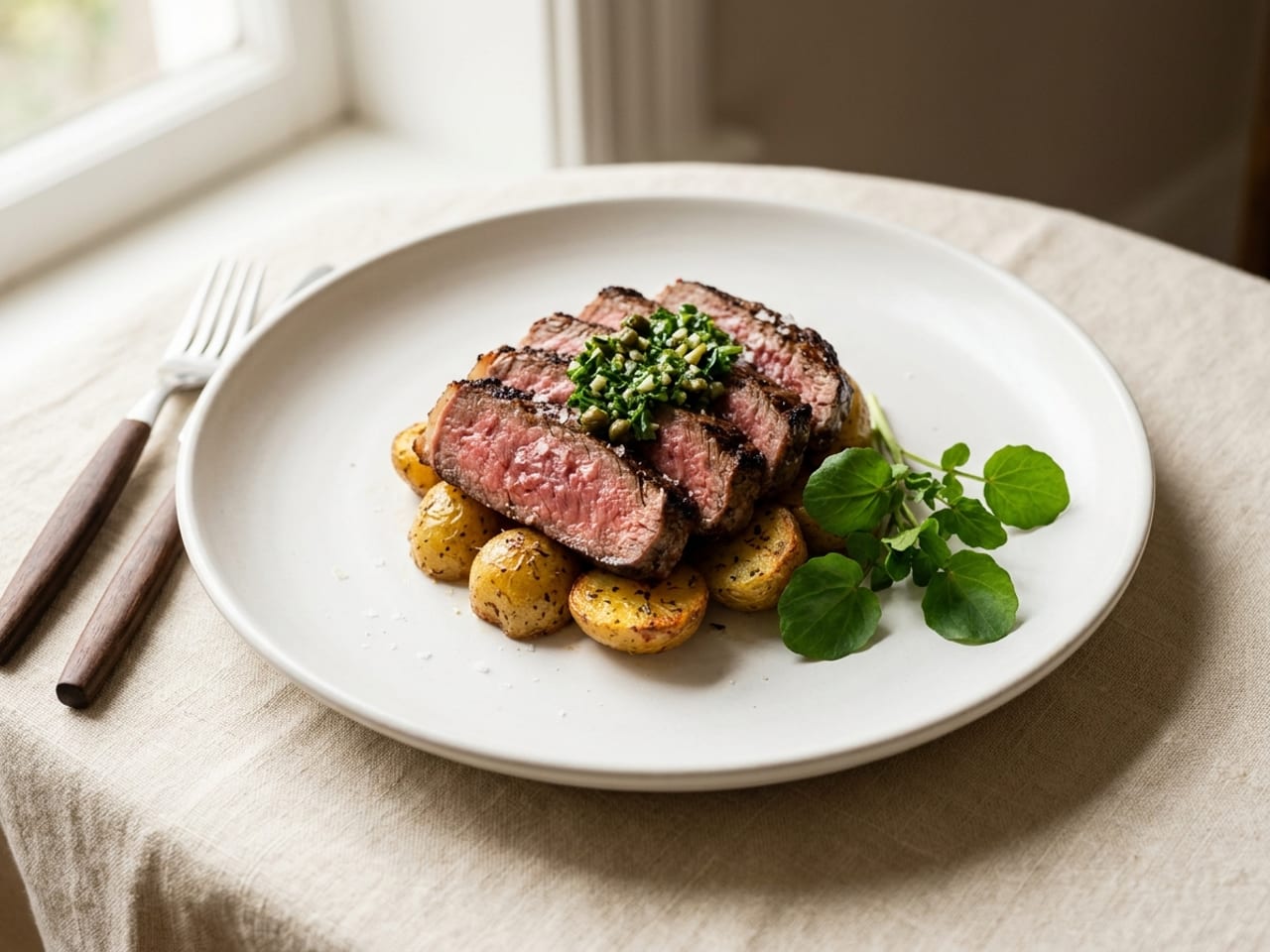
Warm the plate. Let the steak settle on a rack or board so the crust stays dry. Decide whether it goes on whole or sliced, and if sliced, cut across the grain and fan the slices with the cut faces up. Put the sides down first and set the steak on or against them. Sauce according to the sauce: pan sauces over, béarnaise beside, chimichurri passed or spooned on. Finish with flaky salt on the cut faces, wipe the rim and serve at once.
- Warm the plate. Chef Kevin B. Thomson, quoted by the MICHELIN Guide, tells home cooks to serve on plates warmed in the oven: "not hot, just enough to keep the steak warm".1 America's Test Kitchen heats ovensafe dishes "until they're very hot to the touch",38 and Saveur puts steak au poivre on "four warmed plates".51 Check the maker's oven limit first (one maker caps its porcelain at 100°C, 212°F).39 A plate out of a hot oven can burn: carry it with a dry cloth and tell whoever gets it (ours). How to warm a plate.
- Let the steak settle where the crust stays dry. America's Test Kitchen rests steaks "on a wire rack set in a rimmed baking sheet (to keep the crust dry), loosely covered with aluminum foil, for 5 to 10 minutes".19 Published rest times run from none to 20 minutes, or as long as the steak cooked, and the tests disagree on whether resting saves juice: what was measured. If you cook to USDA's 145°F (62.8°C), its rest of at least 3 minutes is part of the safety instruction.77
- Decide: whole or sliced. If sliced, across the grain. A single-portion steak with a pan sauce is plated whole in the recipes we read; without a sauce the sources go both ways; a steak for sharing, or a flank or skirt, is sliced (when each is right). Slice "perpendicular to the fibers instead of parallel to them".9 The published thicknesses differ by cut and by publisher: for a porterhouse, 1/2 inch (1.3 cm) on the bias at Saveur3 and "thin" at America's Test Kitchen;4 "roughly 1cm" (3/8 inch) for tagliata;20 "as thin as possible" for flank.13
- Sides first, then the steak. Our order, since no source we read prescribes one for steak: put the base or the sides down, then set the steak on or against them with the cut faces up. Fanning the slices is a published instruction ("fanning out steak slices slightly", "Fan slices on either side of large platter"),3, 50 and tagliata goes leaves first, slices on top.66 In the two studies that compared them in a dining setting, the centred plate did better than the one set off to the side: a luncheon main course was liked more, and a dessert was rated the larger portion.46, 103 placement.
- Sauce: over, beside or under. It depends on the sauce. Pan sauces are poured or spooned over the steak in the published recipes: peppercorn sauce,30, 51, 52 Saveur's steak Diane sauce60 and the red wine-mushroom pan sauce listed with Cook's Illustrated's strip steaks.5, 102 Béarnaise is sent separately;1, 36 chimichurri is passed at the table53 or spooned over the slices.16 Sauce by sauce.
- Finish and serve at once. Salt the cut faces. Chef Bryan Voltaggio, in the MICHELIN Guide: "once we slice this, you're going to want a little bit of that flake salt just to finish it."2 America's Test Kitchen says flake salt adds "a delicate saline crunch to the meat's crust".19 Wipe the rim and do not wait (both ours). America's Test Kitchen's steak frites, once the fries are fried: "Serve steaks immediately with fries."55
How this page was made. Every sourced instruction here is quoted from the published source named beside it: chefs, test kitchens, recipe writers, Escoffier's English Guide to Modern Cookery, peer-reviewed papers and food-safety agencies; the rest is marked "ours". Plate Artists has not cooked, measured or tasted any of it for this guide. Where the sources disagree, and on resting they disagree a great deal, we set them side by side instead of picking a winner. Trade sources (a beef seller, a beef brand, a grill maker, a thermometer maker) are labelled as such, and the page carries no affiliate links. Suggestions marked "ours" are this guide's own styling and have no named source. Sources are at the bottom.
Whole or sliced: when each is right
The published recipes follow the steak, not a fashion. The pan-sauce recipes we read plate a steak for one whole; without a sauce the sources go both ways (BBC Good Food: "Serve the steak whole or carved into slices";84 America's Test Kitchen's grilling guide slices every steak19). A steak for the table is carved.
| The steak | Serve it | Who says so |
|---|---|---|
| A single-portion steak with a pan sauce | Whole | Cook's Illustrated's strip steak recipe, bylined J. Kenji López-Alt: "Arrange steaks on individual plates and spoon sauce over steaks; serve immediately."5 Chef Kevin B. Thomson: "Serve the steak whole with sauce béarnaise on the side."1 |
| Filet mignon | Usually whole | The beef seller Snake River Farms calls it "a fork-tender steak regardless of how it is cut when served", then adds that cutting it "diagonally at a 45° angle" will "maximize tenderness".6 Great British Chefs' fillet guide slices it after the rest.32 Whole is our rule of thumb, not the sources'. |
| Porterhouse, T-bone, bistecca alla fiorentina | Carved, put back around the bone | Saveur: "Reassemble the steak on a platter along with bone, fanning out steak slices slightly."3 America's Test Kitchen: "Place bones on platter. Slice steaks thin against grain, then reassemble sliced steaks around bones."4 Ruth Rogers carves so that each person gets "slices of both fillet and sirloin".68 |
| Tomahawk and other big steaks for a crowd | Carved | Lani Furbank, writing in the MICHELIN Guide about chef Bryan Voltaggio: "Voltaggio recommends carving the steak and reassembling it with the bone on the plate for an attractive presentation".2 Snake River Farms suggests doing it "at the table to wow your audience".7 |
| Flank, skirt, hanger, tri-tip, picanha | Sliced, in every recipe we read | These are the cuts where the direction of the knife decides how the steak chews: flank cut with the grain took more than four times the force to bite in Cook's Illustrated's test.10 Cut by cut. |
| Tagliata, carne asada | Sliced, by definition | Tagliata is steak "sliced across the grain into thin slices before being served, possibly on a bed of leaves";66 carne asada is "grilled and thinly sliced across the grain".74 |
The reason one chef gives for carving is practical. Bryan Voltaggio, in the MICHELIN Guide: "As you're carving it, you're able to take some of the pieces that are a little bit more done" from the outside, and "The center cuts you can keep for people that want it more medium rare."2 One steak serves two tastes.
Reasons we could not source. You will read that restaurants slice steak so the portion looks bigger, or leave it whole because slices go cold. We found no named source for either. The line in our own dish-by-dish guide, that slices show the cook you got right, is our view and not a sourced rule.
How to slice steak against the grain, cut by cut
What it means. "When recipes call for slicing meat against (or across) the grain, it means you slice it perpendicular to the fibers instead of parallel to them." America's Test Kitchen's picture: "If you think of the fibers as a handful of dry spaghetti, you want to cut the bundle of spaghetti into shorter sections."9
What it is worth. Cook's Illustrated cooked a flank steak in a water bath to 130°F (54°C), cut equally thick slices both ways and measured the force a texture analyzer needed to bite 5 millimetres in: 383 grams against the grain, 1,729 grams with it. On strip loin the figures were 329 and 590. "Flank steak sliced with the grain was 193 percent tougher than strip steak sliced with the grain, but that difference dropped to just 16 percent when both types of steak were sliced against the grain."10 That is two cuts, one temperature, three runs averaged, and the "four times" belongs to flank only. A peer-reviewed study of stir-fry strips from the round and chuck found the same direction: "Slices removed perpendicular to the fiber direction had shear values up to 50% lower than slices removed parallel."11
| Cut | Where the grain runs | How the source slices it |
|---|---|---|
| Ribeye | Snake River Farms lists it among the steaks that "have already been cut against the grain".6 | Snake River Farms cuts "diagonally at a 45° angle".6 On a bone-in ribeye or a tomahawk it takes the cap off first and cuts cap and eye separately, both into "thick slices".7 |
| Strip (New York strip) | Snake River Farms says both that strip steaks "have already been cut against the grain" and that "The New York strip has a grain that runs across the short side of the steak".6 It does not reconcile the two. | Its instruction is to "cut against this grain diagonally".6 Cook's Illustrated's numbers are for slices carved from a piece of strip loin: 329 grams of force to bite against the grain, 590 with it.10 |
| Filet mignon | Also among the steaks that "have already been cut against the grain"; "there's not a grain when looking at the steak".6 | Usually served whole (ours). Snake River Farms calls it "fork-tender" however it is cut, and still suggests a cut "diagonally at a 45° angle" to "maximize tenderness".6 |
| Sirloin | Named among the steaks "cut cross grain" in the USDA comment that the FDA Food Code prints.79 | No cut-specific instruction in the sources we read. The general rule applies: find the lines and cut across them.9 |
| Flank | "the grain runs lengthwise (the long way)".12 | "Simply cut along the short side",6 and "as thin as possible".13 |
| Skirt | "The grains of a skirt steak run crosswise, the short way", so slicing off the end is cutting with the grain.14 | "first cut it into manageable 4- to 6-inch pieces" (10 to 15 cm), then "Slice the individual rectangular pieces the long way. You can slice straight down or at a diagonal."14 |
| Hanger (onglet) | Two long strips once the central silverskin is removed;15 "a very coarse grain that runs across the width of the steak".16 | "Find the direction the grain runs, then use a sharp knife to cut at a 90 degree angle."16 |
| Tri-tip | Two directions: "approximately half of the steak contains fibers running vertically and the other half contains long muscle fibers coming in at an angle".17 | The sources describe the split differently. Traeger: "Locate where the two grains intersect and cut vertically, splitting the roast roughly in half" (it adds "This is optional"), then "slice perpendicular to the grain of each half", thinly and with the knife slightly angled.17 Snake River Farms: "cut the tri tip into three pieces. Make the first cut where the grain changes direction".6 |
| Picanha | The raw steaks are cut with the grain, 2 to 2.5 inches (5 to 6.5 cm) thick, "because the picanha will be cut against the grain upon serving".18 | Cooked whole: rest "10 to 20 minutes", then "carve thin slices by cutting against the grain".18 |
| T-bone and porterhouse | Two muscles, one each side of the bone; the porterhouse has "a larger portion of tenderloin".74 | "Following the contour of the bones, cut the filet off one side of the steak and the top loin off the other. Working on the bias, slice both pieces of meat into 1⁄2"-thick slices, keeping slices together as you go."3 That is 1.3 cm. Then back around the bone.3, 4 |
| Tomahawk | A bone-in ribeye "with a long bone still attached", "made up of different muscles".7 | Hold the bone with "a dry kitchen towel or oven mitt", "start from the handle and cut the steak from the bone", take off the cap, then slice cap and eye into "thick slices".7 |
Long cuts: section first. America's Test Kitchen's general rule: "we recommend first cutting the meat with the grain into smaller sections and then rotating the meat accordingly and proceeding to slice against the grain of the smaller sections."9
How thick: the sources differ, by cut and by publisher. For porterhouse alone, Saveur slices 1/2 inch (1.3 cm) thick on the bias3 and America's Test Kitchen slices "thin".4 Great British Chefs cuts tagliata "roughly 1cm thick" (3/8 inch);20 America's Test Kitchen says thin for every cut ("Slicing thin and against the grain shortens muscle fibers, making all cuts seem more tender")19 and "as thin as possible" for flank;13 Snake River Farms wants "thick slices" from a tomahawk.7 Chewy cuts are sliced thin by everyone; on tender cuts the sources disagree. No source we read gives a figure in millimetres for flank or skirt.
Straight or angled. Snake River Farms gives "a 90 degree angle" for hanger and a 45 degree diagonal for ribeye and strip;6, 16 America's Test Kitchen allows skirt "straight down or at a diagonal".14 Snake River Farms gives the 45 degree diagonal "For optimal tenderness";6 no other source we read claims that, and nobody has measured it. A wider slice is also a presentation choice (ours).
The knife. The sources that mention one say "a sharp knife" and nothing more;7, 16 none specifies a type or a length. Grip and motion are in our knife skills guide.
Resting and carryover: who measured what
Resting is taught as settled. It is not. Here is every test we could read, what it actually measured, and what it measured it on. None of them is peer-reviewed, and we found no peer-reviewed experiment on resting cooked steaks.
| Who | What they did | What they found |
|---|---|---|
| J. Kenji López-Alt, Serious Eats, 2009 | "six steaks of identical thickness that were all cooked to an internal temperature of 125°F" (52°C), one sliced open every 2.5 minutes. | "The steak loses around 13 percent of its weight just during cooking. Cut it open immediately, and you lose an additional nine percent. But allow it to rest, and you can minimize this weight loss down to around an additional two percent."23 Serious Eats now heads the page with a note sending readers to its 2025 article. |
| Cook's Country (America's Test Kitchen) | "we grilled four steaks and let two rest while slicing into the other two immediately". | "The steaks that had rested for 10 minutes shed 40 percent less juice than the steaks sliced right after cooking."21 Four steaks in all. |
| Dan Souza, Cook's Illustrated, written up in 2022 | "We roasted five boneless pork loins until their internal temperatures reached 140 degrees" (60°C), then "repeated the experiment two more times and averaged the results". | On average 10 tablespoons of liquid lost when carved at once, 4 after a 10 minute rest: "a 60 percent decrease in moisture loss".22 Pork roasts, not steaks, though the figure is often repeated as if it were about steak. |
| Greg Blonder, genuineideas.com, 2013 | Two 1.5 inch (3.8 cm) ribeyes, one cut at once and one rested. | Total juice lost: 27 grams against 23 grams. "Within experimental variations (and consistent in two repeated tests), a dead-heat."26 |
| Chris Young, as reported by Serious Eats | Seared samples sliced at the same final internal temperature, rested or not. | Daniel Gritzer's summary: "resting has no measurable effect on juice loss at all."24 We read this second-hand, in Gritzer's article; Young's own video was not watched for this guide. |
| Daniel Gritzer, Serious Eats, 2025 | A tasting of rested against unrested meat: four tasters, unsalted pork chops. | "Across 30 tasting rounds, my tasters identified the rested meat as juicier 16 times, an almost perfect 50/50 split."24 Pork chops again, not steak. |
Why the results differ. Serious Eats' explanation is design. Gritzer's account of the 2009 test: "Because Kenji pulled all the steak samples at 125°F and sliced into each one in successive 2.5-minute intervals, temperature changes during resting were not controlled for". Young's tests, as Gritzer reports them, and Gritzer's own tasting matched the temperature at the moment of slicing and found no difference.24 That does not explain everything: Blonder did not match temperatures and still found none,26 and the two America's Test Kitchen write-ups do not say what temperature their samples were at when cut.21, 22
Where the two sides stand now. Serious Eats: "It's a good idea to pull meat early from the pan or oven and let it rest, but only long enough to give it the time to slide up via carryover cooking to the target internal temperature, which you need to track closely. What resting is not: a fixed amount of time for the meat to sit, which risks it overcooking and losing its crust."24 Meathead, of AmazingRibs.com, goes further: "resting cools the meat, softens the crust and skin, overcooks the center", and "its impact on the perception of juiciness is probably nil."27 America's Test Kitchen still rests.19, 21
How long to rest a steak: 11 published answers
| How long | Who says so |
|---|---|
| None | A reverse-seared steak, per J. Kenji López-Alt: "There's no need for a resting period before serving, thanks to the low-heat method used in the first stage of cooking."33 Snake River Farms, once a reverse-seared tomahawk has had its final sear: "serve immediately".7 Escoffier, of roasts: "As a rule, a roast ought not to wait."36 |
| At least 3 minutes | USDA, as part of its safe minimum for steaks: 145°F (62.8°C) "and allow to rest for at least 3 minutes".77 |
| 5 minutes | Chef Steve Doucakis, in the MICHELIN Guide;1 Saveur's fiorentina;69 BBC Good Food's method, "about 5 mins".84 |
| 5 to 10 minutes | Cook's Country, for "a thin steak or chop";21 America's Test Kitchen's grilling guide.19 |
| 8 to 10 minutes | Great British Chefs, for fillet steak.32 |
| About 10 minutes | Chef Kevin B. Thomson: "Let it rest on a board or warm plate for about 10 mins." His next sentence: "Right before serving, quickly flash in a hot pan for 30 seconds."1 |
| At least 10 to 15 minutes | Lani Furbank in the MICHELIN Guide, for one large steak carved for a crowd.2 |
| 10 to 20 minutes | Snake River Farms, for a picanha cooked whole: "Allow the picanha to rest for 10 to 20 minutes after cooking".18 |
| Half as long as it cooked | BBC Good Food, further down the same page: "at least five minutes and ideally around half the cooking time".84 |
| As long as it cooked | Chef Eric Tulay, in the MICHELIN Guide: resting time "should equal the duration of cooking";29 Great British Chefs says the same.30 |
| Not a fixed time at all | Serious Eats in 2025: rest "only long enough to give it the time to slide up via carryover cooking to the target internal temperature".24 |
One figure that is not in the table. Snake River Farms holds a reverse-seared tomahawk tented with foil for "at least 15 minutes", and says "You can let the steak rest for up to 45 minutes", but that pause comes between the slow cook and the final sear. After the sear it says "serve immediately",7 so it is a hold, not a rest before slicing, and the longest rest before the knife in these sources is the 20 minutes it gives a whole picanha.18
"As long as it cooked" and a fixed number of minutes give very different results for a steak that spent an hour in a low oven, which is one reason this guide does not print a single rest time as the rule.
Where to rest it. On "a wire rack set in a rimmed baking sheet (to keep the crust dry)", says America's Test Kitchen;19 "on a board or warm plate", says BBC Good Food, and chef Kevin B. Thomson's timings in the MICHELIN Guide follow that page almost word for word, so count the two as one voice;1, 84 chef Eric Tulay: "Put the steak on a plate and let it rest for however long it is cooked";29 and America's Test Kitchen's own steak frites rests on a "large plate" under butter and foil.55 Meathead's objection to a flat surface: "the crust of a steak or chop gets soft and wet, especially on the side that is in contact with the plate or cutting board."27
Carryover: how far a steak climbs off the heat
| Source | What it says |
|---|---|
| ThermoWorks | 3 to 5°F (2 to 3°C) for a thinner steak, 10 to 15°F (6 to 8°C) for larger ones; "low heat carries over less and high heat carries over more".34 |
| America's Test Kitchen | A climb of 5 to 15 degrees Fahrenheit (about 3 to 8°C, our conversion) while resting, steaks and burgers less than roasts.35 |
| Certified Angus Beef | "Remove steaks and burgers from heat when thermometer registers 5° F lower than desired doneness."83 That is about 3°C. |
| Greg Blonder (measured) | A 1.5 inch (3.8 cm) reverse-seared ribeye taken off at 125°F (52°C): "the temperature rose to 143F during the resting period" (62°C). That is 18°F (10°C) by our subtraction; his own footnote rounds it to "15F".26 |
| Meathead (AmazingRibs.com) | Two figures. In his resting article, "the center can rise 5 to 10°F" (3 to 6°C).27 In his carryover article, a steak cooked to 130°F (54°C) and left on a plate for 10 minutes, "especially if we tent it with foil", "can easily work its way up to 145°F" (63°C).28 |
| Daniel Gritzer, Serious Eats (measured, a pork chop) | "Even when I pulled one a full 15°F before hitting its target temperature of 140°F, it had reached 140°F and threatened to surpass it in under three minutes."24 That is a climb of about 8°C, to 60°C, and on a pork chop, not a steak. |
| J. Kenji López-Alt (measured, 2009) | No rise at the centre: after 5 minutes "the center of the steak is still at 125°F" (52°C), and by 10 it "has by this time cooled down to around 120°F" (49°C).23 |
What nobody in these sources disputes.
- Trapped steam softens the crustThe test kitchen that argues for resting and the writer who argues against it say the same thing about foil. Cook's Country: "don't crimp the foil around the edges of the pan or plate; this can trap steam and soften the crust or skin."21 Meathead: foil "traps steam which softens crust".27
- The temperature keeps moving after the heat is offBy how much is disputed (see the table). The sources that give a reason name the same two things, how thick the piece is and how hot its outside was: "low heat carries over less and high heat carries over more".28, 34 Which way thickness cuts is itself disputed: America's Test Kitchen and ThermoWorks say steaks climb less than roasts;34, 35 Blonder measured more carryover in his steak than in his roast and says "the carry over is greater in a steak than a roast".26
- USDA's rest is a safety stepFor anyone cooking to USDA's number, the rest is part of it: "During this rest time, the internal temperature is either constant or slightly rises to continue destroying pathogens." USDA's stated reasons for the rest are "safety and quality";86 whatever the rest does for juice, the three minutes are part of the safe minimum.
The plate: warm it, size it, or use a board
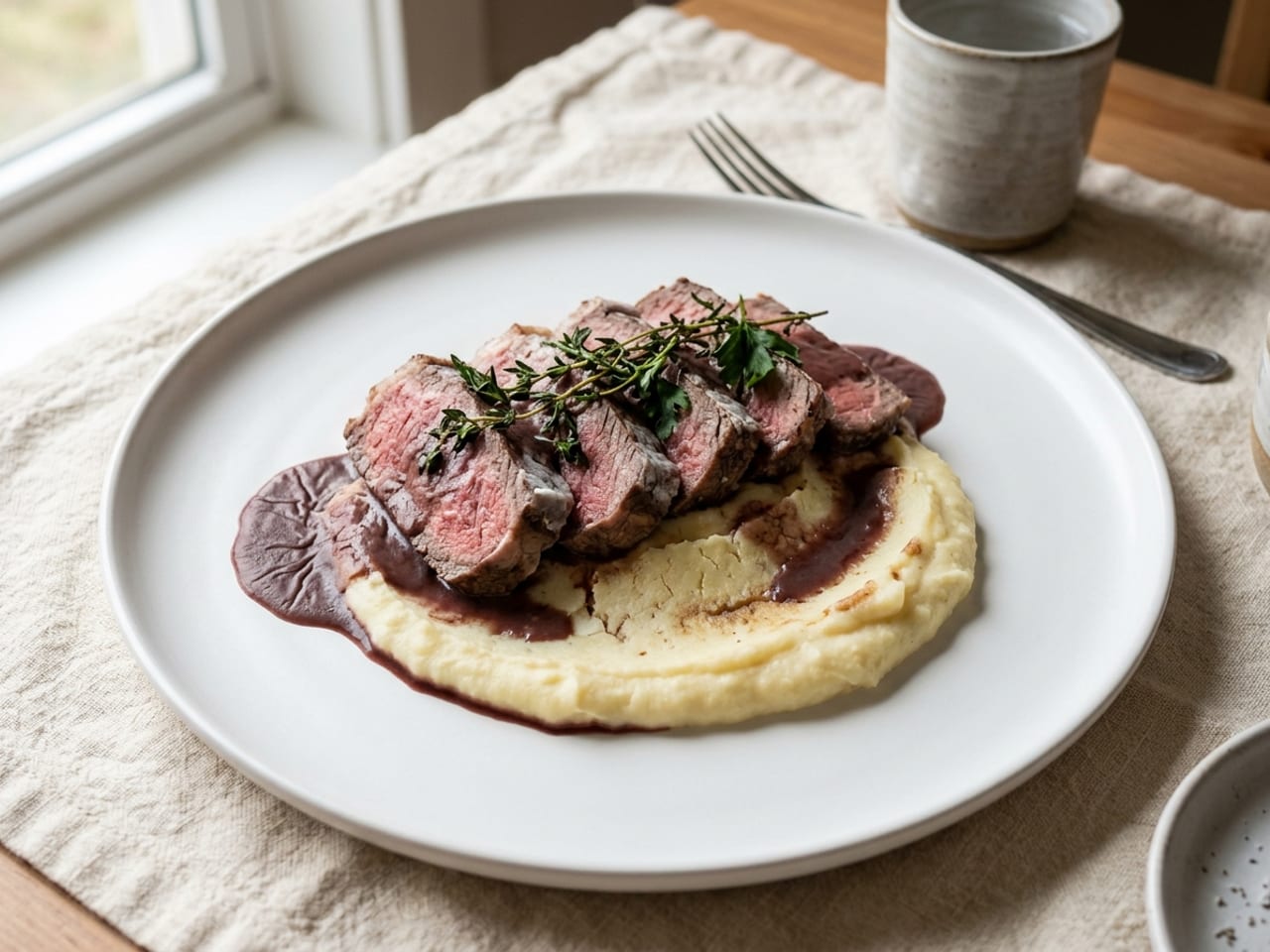
Warm or hot: the sources differ. Chef Kevin B. Thomson's line to home cooks is "not hot, just enough to keep the steak warm."1 America's Test Kitchen heats ovensafe serving dishes "until they're very hot to the touch",38 and Escoffier wanted roasts "on very hot dishes".36 Nobody publishes a target temperature for the plate; the sources give oven settings and times, and they are far apart.
| Method | As published |
|---|---|
| A hot oven, for seconds | Spoke Wine Bar, as America's Test Kitchen reports: "they warm their plates in a hot oven (between 325 and 400 degrees) for just 10 to 40 seconds" (163 to 204°C).37 |
| The lowest oven setting | Chef Joshua Lewin: "Set the temperature as low as possible". The plates can stay in until they are needed.37 |
| A 350°F (177°C) oven, checked | America's Test Kitchen's own method for ovensafe dishes: straight on the rack, "stacking no more than two pieces", "until they're very hot to the touch"; "Check after 30 seconds", then "every minute for up to 3 minutes".38 |
| Boiling water, for dishes that are not ovensafe | America's Test Kitchen's how-to: "You can use boiling water to warm dishes that aren't ovensafe, but be sure that the water is really boiling. We found that hot tap water wasn't hot enough to significantly warm a serving bowl."38 Its other article says to run plates "under superhot water for 10 seconds";37 the publisher disagrees with itself, and that test is why this guide does not list tap water as a method. Boiling water scalds: pour it with care and dry the plate with a cloth (ours). |
| Microwave or dishwasher | A few seconds in the microwave, or the dishwasher's drying cycle; both are listed in the same article.37 |
Check your plates first. Wedgwood's care guide limits its stoneware and porcelain to "Oven safe up to 100°C (212°F)", says bone china is "Not oven or freezer safe unless specifically labelled", and adds "Microwave safe unless the item has metallic decoration" and "Avoid direct flame and sudden temperature changes."39 Two of the oven methods above run hotter than that maker allows, and a cold plate put into a hot oven is a sudden change of temperature, so read your own maker's limit. For dishes that are not ovensafe, America's Test Kitchen uses boiling water and reports that hot tap water "wasn't hot enough to significantly warm a serving bowl".38
A heated plate can burn. A plate that is "very hot to the touch" is hot enough to hurt: carry it with a dry cloth or an oven glove, and tell whoever it is served to that the plate is hot. No agency page we read covers this, so the warning is ours.
What warming is known to do. The one measurement we found is for soup: it "stayed about 10 degrees hotter for 10 minutes in a warmed bowl than it did in a room-temperature bowl", 145°F against 135°F (63°C against 57°C).38 Nobody has published the same test for a steak on a plate. Meathead describes what is at stake: "Let the meat cool and the fat starts to harden and get waxy."27
- Size: larger than you think, and nobody prints a numberBarry Tonkinson of the Institute of Culinary Education, writing about a holiday roast: "a large plate will allow each item to stand out, avoiding overcrowding, which is all too common."40 No source we read gives a diameter for a steak plate, so this guide does not print one. Standard plate sizes are in types of plates.
- Colour: white or dark are both defendedTonkinson: "I like to use a dark, slate color for my holiday plate to show the contrast of the light-colored meat and the wonderfully vibrant vegetables on offer."40 The Escoffier School's rule of thumb: "Bright colors work well against a dark background, while more neutral or subdued colors can use a white background to create some visual excitement."41 A seared steak is brown and pink; the sides decide (ours). More in color on the plate.
- Rim: a frame, and it changes how big the portion looks"Raised edges will create a framework of sorts for your dish".40 In one study, people looking at pictures "overestimated the diameter of food portions by 5% and the visual area of food portions by 10% on plates with wider rims compared with plates with very thin rims".42
- A board or a platter for a shared steakBoth published porterhouse recipes plate on a platter, not on individual plates,3, 4 and Snake River Farms gives an order for a tomahawk: "start with the bone, arrange the center eye piece, then put the cap pieces on the outer section."7 If you serve on a wooden board, it must not be the one the raw steak sat on unless it has been washed in hot, soapy water in between: "Don't put cooked food on the same platter that held raw meat or poultry."78 USDA also says a board with "hard-to-clean grooves" should be discarded.101
Where the steak goes on the plate
Most placement advice is convention. Three pieces of it have been tested (off-centre, stacking and odd numbers), and none of the tests supported the usual rule.
- Centred or off-centre: both studies in a dining setting favour centredMichel and colleagues split 163 diners at one luncheon into two groups and served each group the same main course plated one of two ways: "The main course was liked more, and considered more artistic, when the various elements were presented in the centre of the plate, rather than placed off to one side. The participants also reported being willing to pay significantly more for the centred than for the offset plating (M = £15.35 vs. £11.65)."46 We read the abstract, which does not say what the main course was, so do not take it as a study of steak. Rowley and Spence repeated the comparison on 124 people in "a naturalistic dining context": "the centrally-plated dessert was rated as a larger portion than the offset version of exactly the same dish".103 A dessert, again not steak.
- The clock method: published by some, and not the same twiceA Le Cordon Bleu Malaysia blog post teaches it as "classic plating", one style of eight: "Protein is placed at the centre or between 3 and 9 o'clock on the plate", "Starches (like rice, potatoes, or pasta) are placed at 10 o'clock", "Vegetables are arranged at 2 o'clock."43 Chef Richard Sandoval, quoted by Food Republic, gives a different clock: "Place the protein between 3 and 9 o'clock, the starch between 9 and 11, and the vegetables between 11 and 3", which the article says he recommends to beginners "because it provides structure".44 We found no protein, starch and vegetable clock on the pages we read from the Institute of Culinary Education or the Escoffier School; one post on the Institute's blog uses clock positions only to place a sauce stroke and garnishes.47 So this is some schools' method, not every school's.
- Large at the back, small at the frontTonkinson: "In general, larger items should be placed at the back with smaller, more delicate items at the front, allowing your guest to see every item clearly."40
- Height: two schools say stack, one study says spreadThe Escoffier School: "Stacking items for a layered look can be visually appealing and make the meal appear more substantial than it would scattered across the plate."41 Le Cordon Bleu Malaysia describes building "vertically, creating depth and height", and its example is "steak layered with mashed potatoes and asparagus".43 Tested, it went the other way: in two experiments the same food "was rated as constituting a larger portion when the elements were arrayed-horizontally rather than stacked vertically", and "The food was also liked more and the participants/diners were willing to pay more for it when horizontally and/or centrally arranged."103 The only food that abstract names is a dessert, so it is not a test of steak either. Leaning slices on the starch is our suggestion.
- Negative space: two schools and one chef for, one list of a chef's tips againstLe Cordon Bleu Malaysia: "Empty areas on the plate highlight the main components."43 The Escoffier School suggests "a smaller portion of food on a large plate for more white space".41 Chef Richard Sandoval, in Food Republic: "Negative space is just as important as the elements on the plate".44 An article of chef Hervé Malivert's plating advice on the Institute of Culinary Education's blog says the opposite: "avoid negative space".45 The same article: "Balance doesn't necessarily mean symmetry. Putting too many items on the plate will make it visually unappealing." 45
- Odd numbers: taught, tested, not supportedThe odd-number rule turns up in school blogs: one unsigned post on the Institute of Culinary Education's blog, first published by the Natural Gourmet Institute, says "Dab an odd number of sauce droplets for composure" and, a paragraph later, "place three or four grilled scallions".47 The one study we found that tested it reported "No consistent evidence for a preference for odd or even numbers of food items", and that "a plate containing more items is generally preferred over a plate containing a smaller number of items".48 It showed people photographs of scallops, mostly three against four, so it is evidence about a convention, not about steak. Cut as many slices as the steak gives you.
The general rules of composition are in Plating 101; the fine-dining version is in Michelin-star plating.
How to plate steak with sauce, sauce by sauce
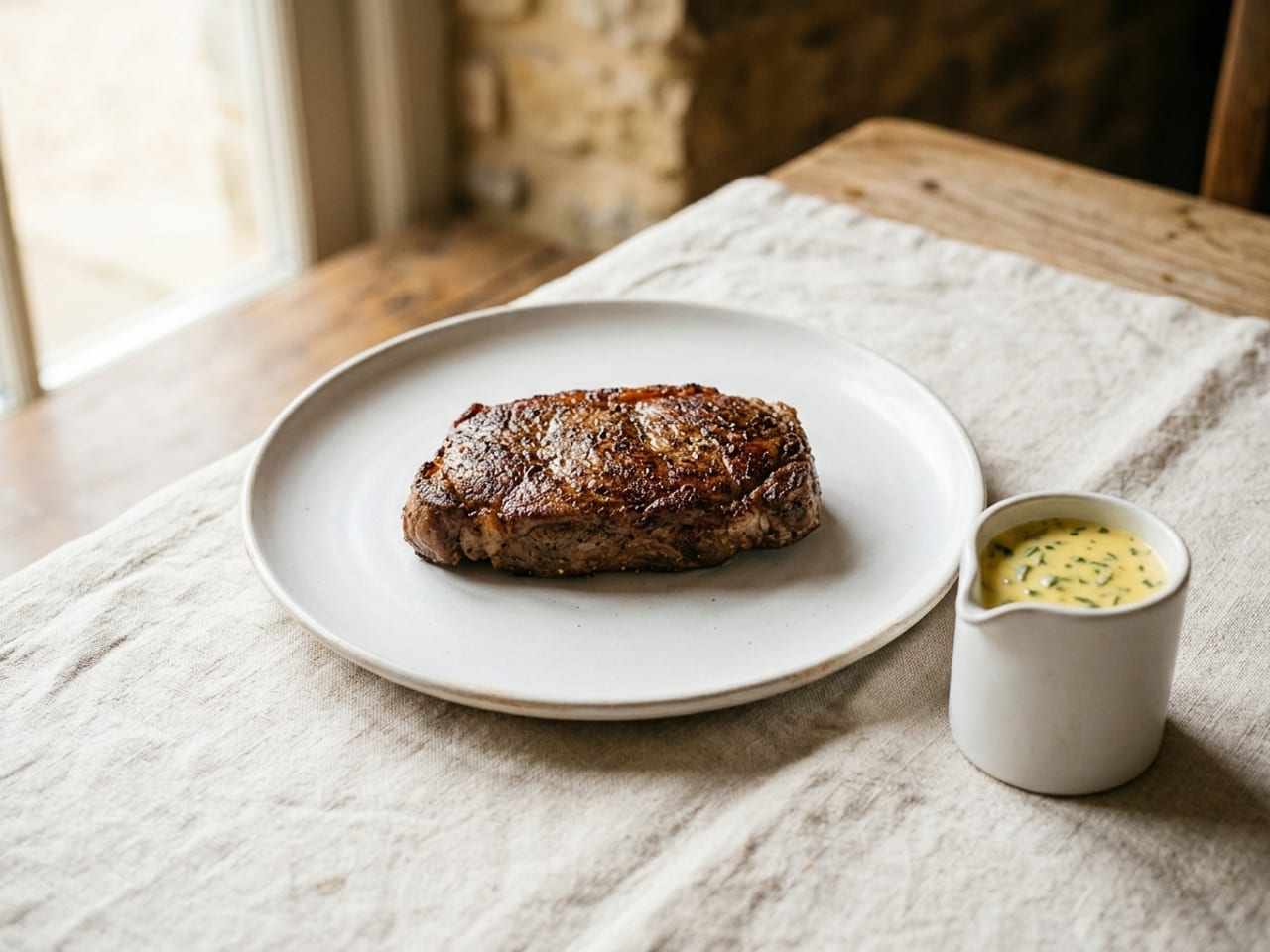
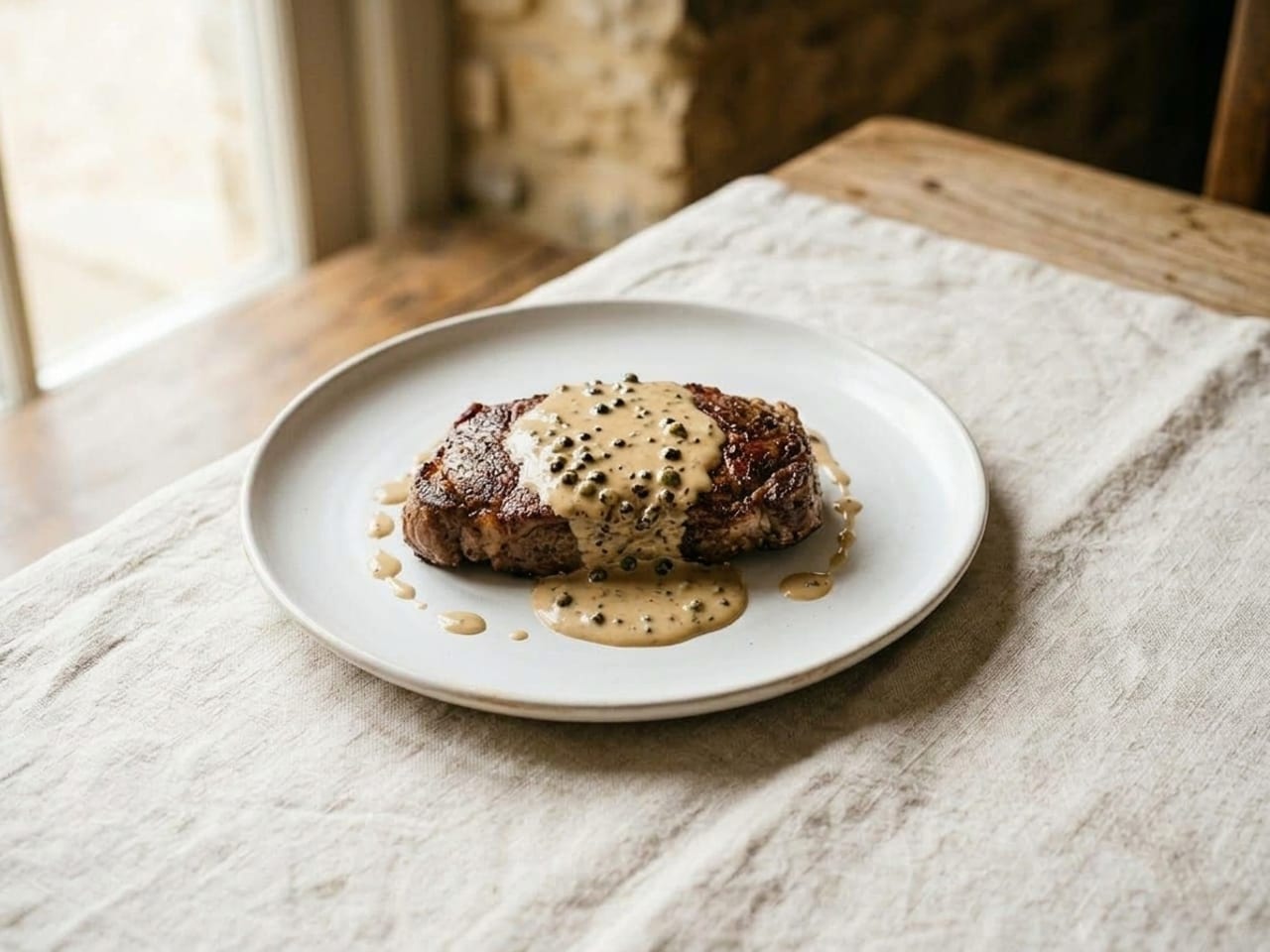
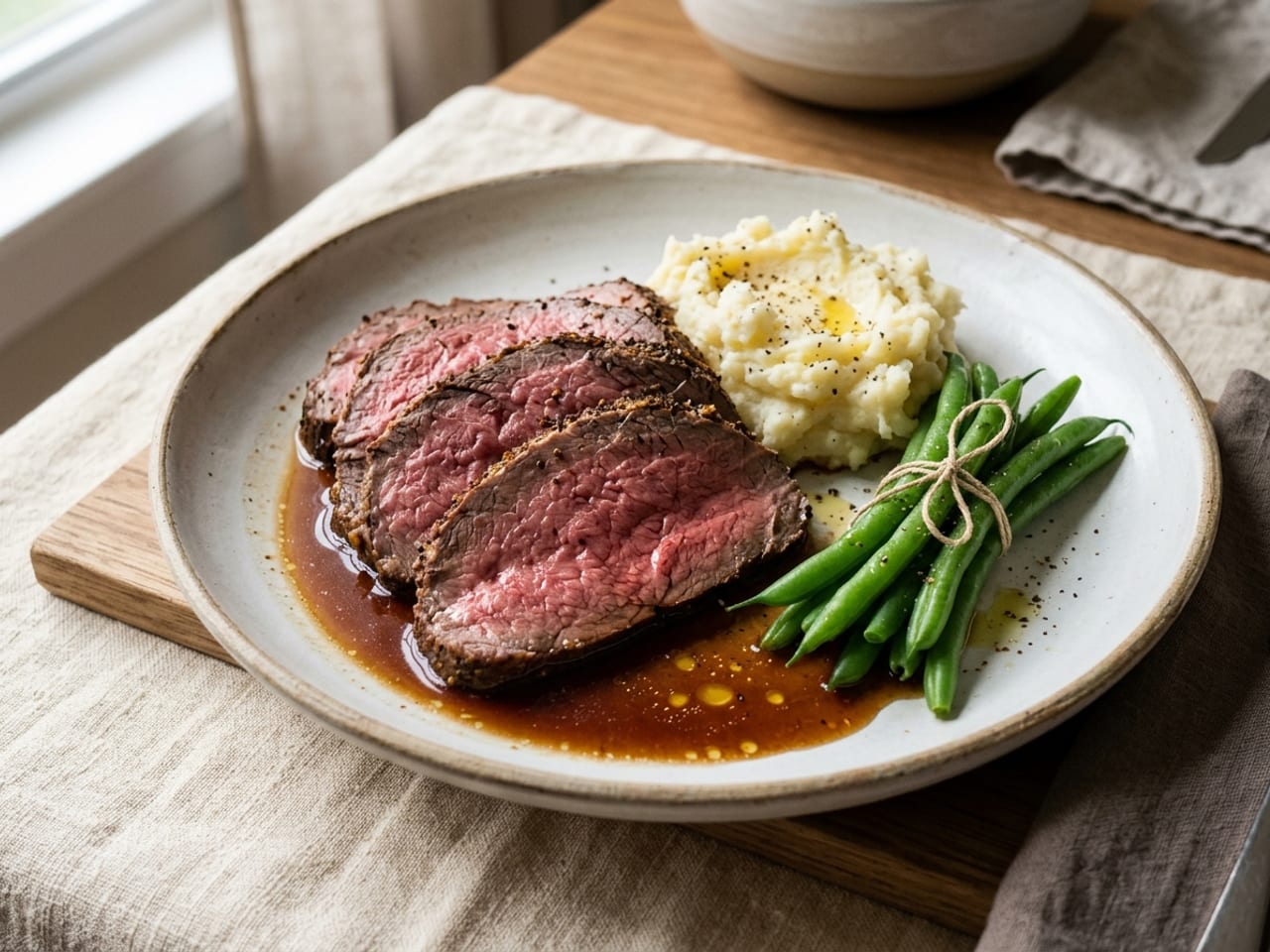
There is no single rule. The pattern in the published recipes: pan sauces over the steak, béarnaise beside it, and chimichurri either passed at the table or spooned over the slices. The moves themselves, from the pool to the thread of sauce around the meat, are in sauce plating techniques.
| Sauce | Where it goes | Who says so |
|---|---|---|
| Peppercorn (au poivre) | Over | Great British Chefs: the sauce "is poured over".30 Chef Bryan Webb: "Pour it over the steaks".52 Saveur: "Season with salt and pour over steaks."51 |
| Béarnaise | Beside, or in a thread around | Chef Kevin B. Thomson: "on the side".1 Escoffier: "Send a Béarnaise sauce separately", or "surround them with a thread of Béarnaise sauce".36 It is an egg-yolk sauce: see the safety notes. |
| Red wine jus, pan sauce, resting juices | Over, around or in a jug: the sources split | Cook's Illustrated spoons its pan sauce "over steaks";5 Saveur pours the resting juices "over meat";3 chef Eric Tulay adds "the meat jus to finish".29 Escoffier, writing of roasts: "The gravy is invariably served separately."36 A jus is "a thin sauce made from meat juices";75 how to make one is in our au jus guide. |
| Chimichurri | Passed at the table, or spooned over the slices | America's Test Kitchen: "Slice and serve, passing chimichurri sauce separately."53 The beef seller Snake River Farms does the opposite with hanger steak: "I prefer to liberally top my steak after it's grilled and sliced."16 The sources split. It is a herb sauce in oil: see the safety notes. |
| Compound butter (maître d'hôtel butter) | On top, to melt | Escoffier: "Serve this with grills in general."36 Great British Chefs: "A little puck of the butter placed on top of a sizzling steak will gently melt over the meat".54 When is disputed: before the rest (America's Test Kitchen, Saveur)3, 55 or at serving (Great British Chefs;32 Escoffier dishes his tournedos vert-pré "with half-melted butter à la Maître-d'Hôtel upon them").36 |
| Mushroom sauce | Over | Saveur's steak Diane turns the steaks in its mushroom, cream and cognac sauce, moves them to "warmed serving plates" and has you "drizzle it over the steaks".60 America's Test Kitchen's red wine-mushroom pan sauce, the one listed with Cook's Illustrated's strip steaks, ends "Spoon sauce over steaks and serve immediately."5, 102 Great British Chefs lists a mushroom sauce among steak sauces without saying where it goes.30 Spooning it over one end so some crust still shows is ours. |
| Blue cheese | On top, as a crumble | The one mention we found is as a finish, not a poured sauce: ThermoWorks lists "blue cheese sprinkles" beside mustard sauce, béarnaise and compound butter for tenderloin.56 In the UK, the NHS tells pregnant women that soft blue-veined cheeses "must be thoroughly cooked";91 a crumble melting on a steak does not meet that (ours). |
About "never sauce the crust". We looked for a named source for that rule and found none. What is documented is narrower. Steam softens a crust, and so does contact with a plate or board;21, 27 béarnaise and gravy are traditionally sent separately;36 and nobody we read has measured what a sauce poured over a steak does to its crust. If you care about the crust, sauce beside. If the dish is the sauce, as with au poivre, pour it over as the recipes do.
Two cautions that do have sources. Do not let the sauce take over: "be careful not to overpower the flavour of the meat".32 And keep wet vegetables out of a brown sauce: Escoffier found that they have "a disintegrating action upon the sauces" and recommended buttered meat glaze or Châteaubriand sauce with vegetable garnishes instead.36 The sauces themselves are in the five French mother sauces.
How to plate steak with 10 sides
One card per search. Where a named source describes the plate, it is quoted. Where none does, the card says the styling is ours.
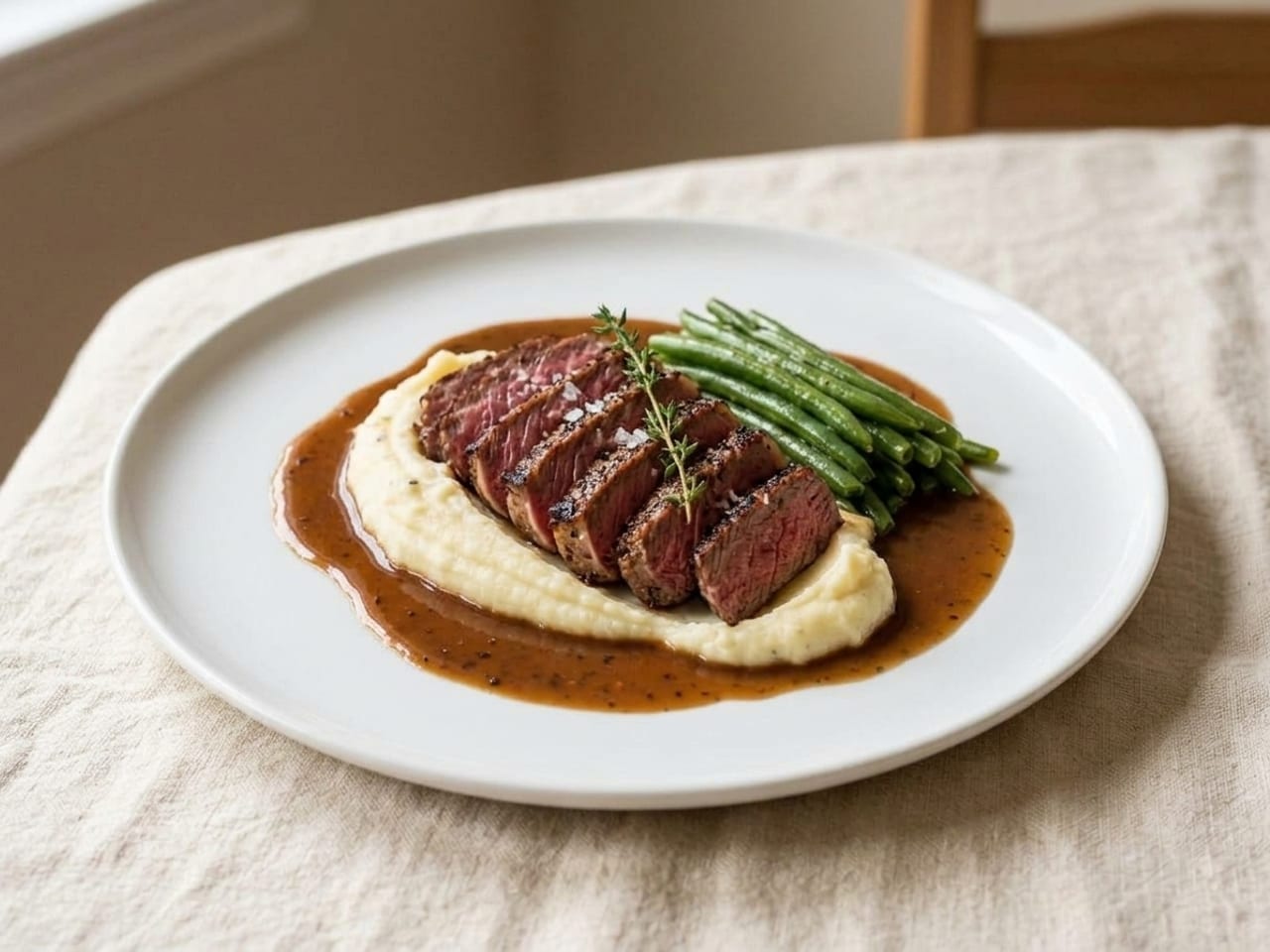
Steak and mashed potatoes
Our styling, with one school source for the stack. A Le Cordon Bleu Malaysia blog post gives "steak layered with mashed potatoes and asparagus" as its example of stacking.43 The rest is ours: make the mash the base, one large spoonful pushed into a short swoosh with the back of the spoon, or a neat mound. Lean the slices on it, cut faces up, and keep the sauce on the steak's side of the plate so the potato is not flooded.
One classical arrangement is Escoffier's tournedos béarnaise: "In the centre arrange a heap of small potatoes cooked in butter and kept very soft", with the steaks around them.36 Those are small whole potatoes, not mash, and the ring is our reading of "In the centre". See the same dinner before and after, and the swoosh in plating techniques.
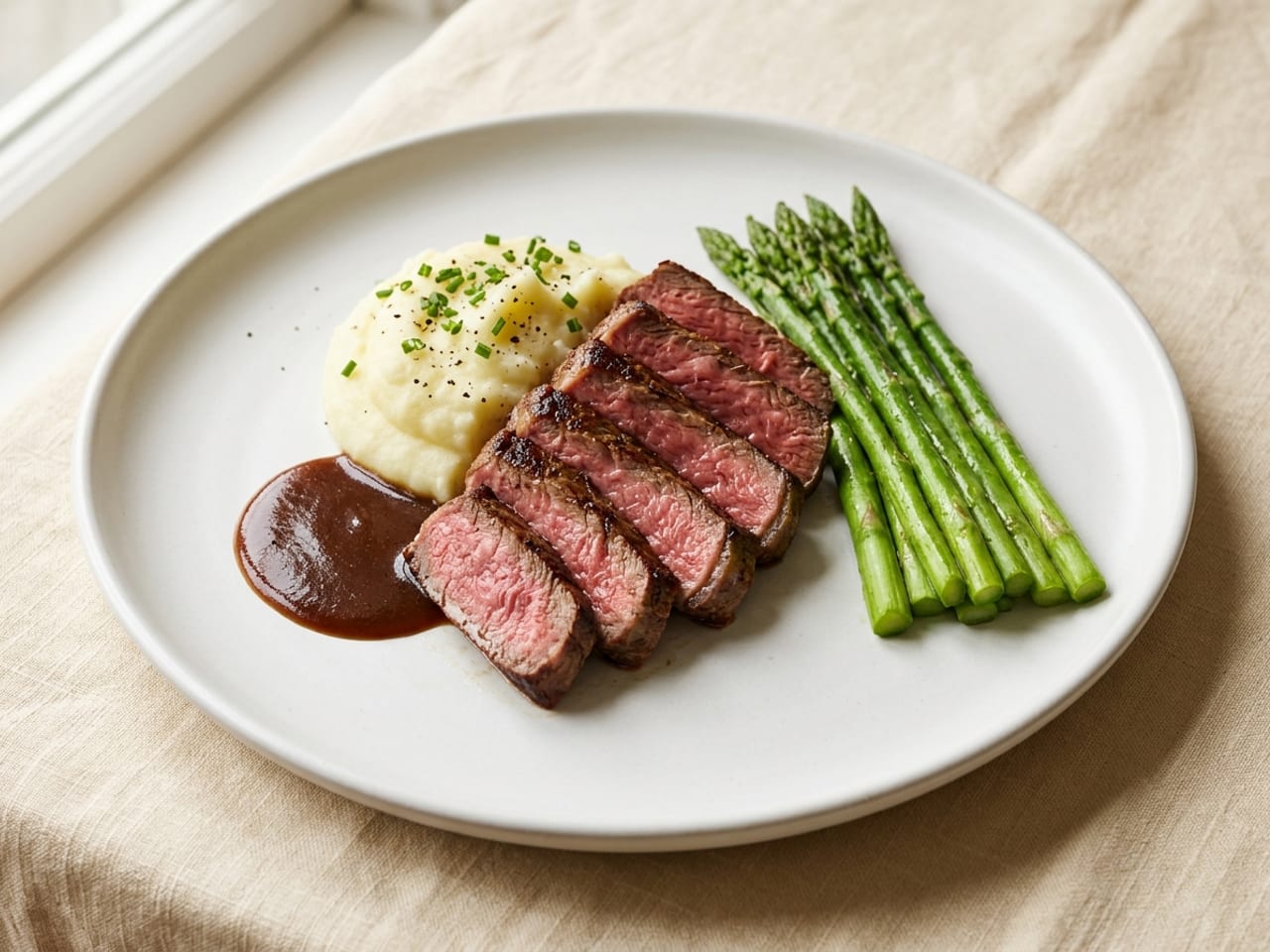
Steak, mashed potatoes and asparagus
Three components is the plate the clock layouts were written for: Le Cordon Bleu Malaysia puts the starch at 10 o'clock and the vegetables at 2, with the protein at the centre or between 3 and 9, and the same post names this trio, "steak layered with mashed potatoes and asparagus", as its example of stacking.43 Laying the spears parallel, tips one way, is our styling; we found no named source for the tied bundle.
Keep the asparagus out of the sauce. Escoffier warned that vegetables such as "asparagus-heads, peas, French beans" have "a disintegrating action upon the sauces", leaving "an unsightly appearance when served upon the diner's plate".36 He was writing about classical brown sauces; our reading is to drain the spears well and sauce the steak, not the vegetable.
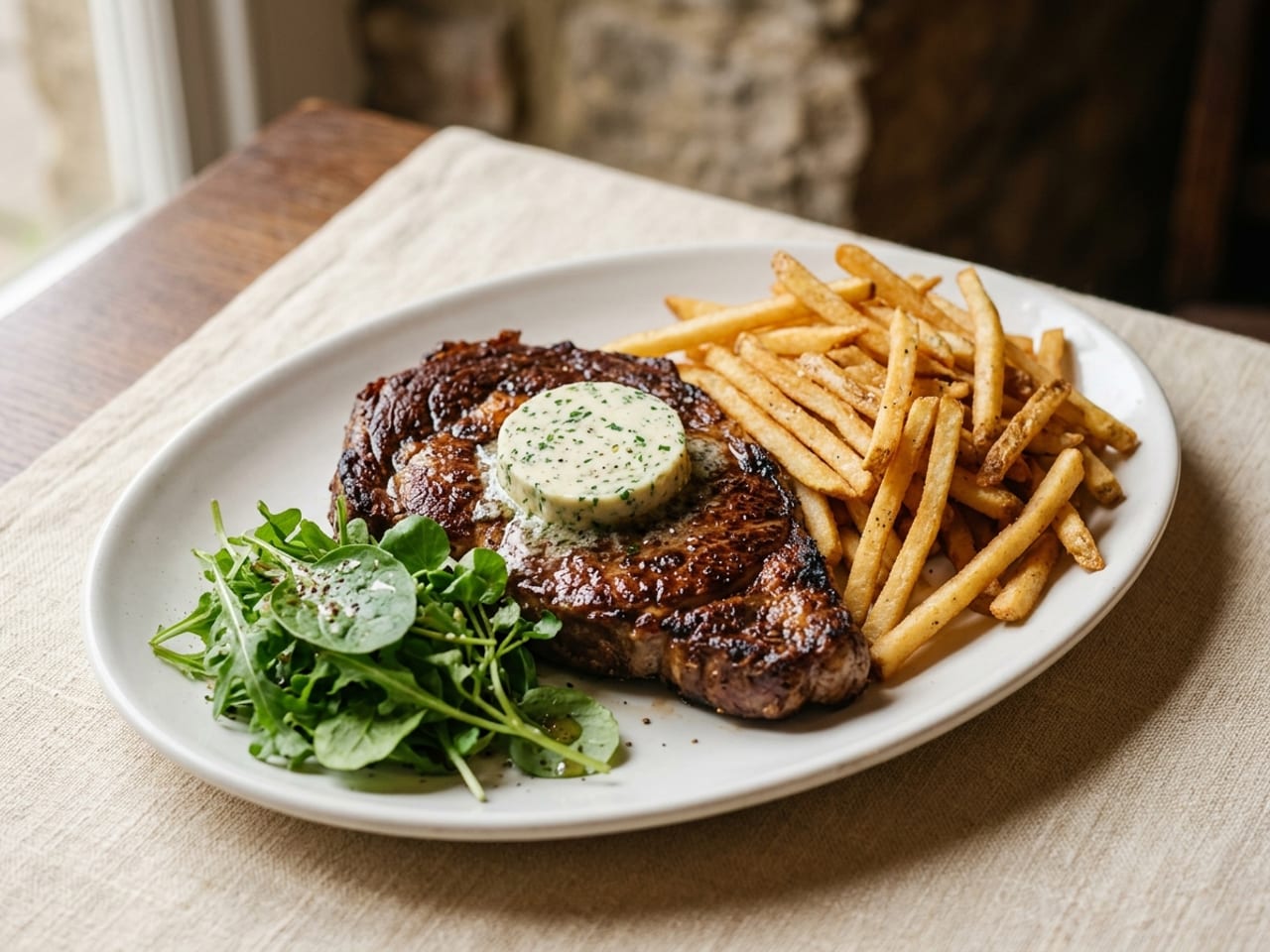
Steak and fries (steak frites)
The published plate is plain: America's Test Kitchen tops the steak with herb butter and says "Serve steaks immediately with fries." 55 A MICHELIN Guide recipe from Bistrot de Yountville, a French bistro in Seoul, ends: "Arrange the steak, sauce, and French fries on serving plates."57 Great British Chefs adds "a crisp green salad".52 Escoffier's tournedos vert-pré is an older plate of the same idea: grilled, dished "with half-melted butter à la Maître-d'Hôtel upon them" and surrounded "with alternate heaps of water-cress and freshly-fried straw potatoes". 36
Styling, ours: a loose pile of fries beside the steak, not under it, and the butter or sauce on the steak. A paper cone or a squared stack of fries is a restaurant flourish with no named source in our research. Escoffier's baseline chip is cut into "rods of half-inch sides" (1.3 cm).36
Steak, potatoes and asparagus
With roast or new potatoes instead of mash, nothing holds the steak up, so the plate is three separate shapes. Escoffier's rule for larger cuts was to arrange the garnishes "alternately round the meat" rather than under it.36 The Institute of Culinary Education's Barry Tonkinson puts "larger items" at the back and "smaller, more delicate items at the front".40
Ours: potatoes in one cluster at the back, cut sides up; asparagus in a row; the steak, whole or fanned, nearest the diner.
Steak and rice
We found no named source for steak with rice, so everything here is ours. Pack the rice into a small bowl or cup and turn it out as a dome, or spread a low bed; fan sliced steak against it and keep the sauce on the steak. Le Cordon Bleu Malaysia's clock lists rice among the starches at 10 o'clock.43
The moulded dome is shown in how to plate rice.
Steak and pasta
No named source here either; this is ours. Twirl long pasta into a nest and set it to one side of a wide plate or shallow bowl, then lay sliced steak beside it or across the top, the way tagliata sits on leaves. One sauce, on the pasta; the steak gets salt and its own juices.
The twirl is in how to plate pasta.
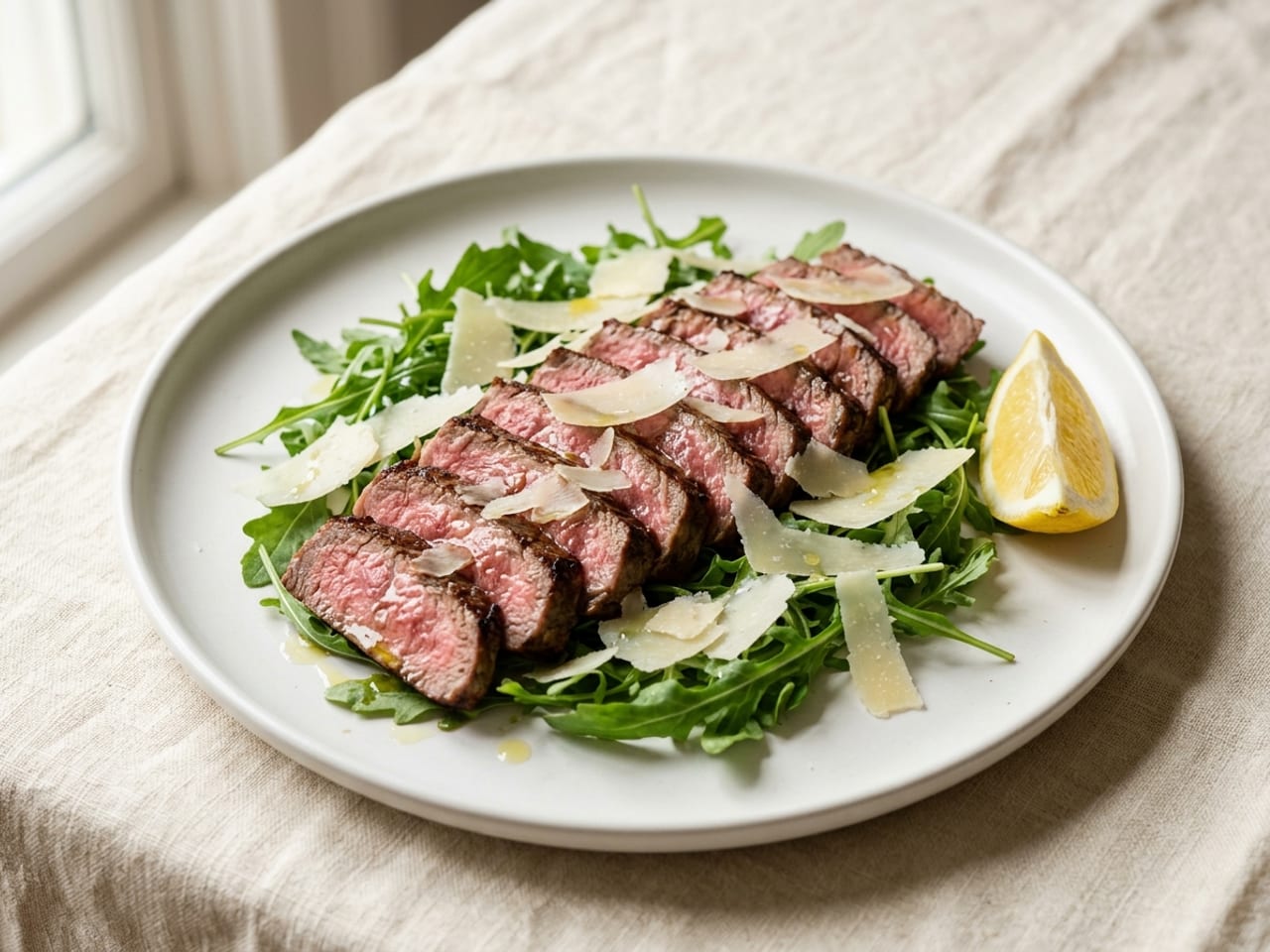
Steak with salad (tagliata)
There is a tradition for this one. Great British Chefs: "Slice the steak thinly across the grain on a chopping board, then arrange each steak's slices on a plate of rocket. Sprinkle the shaved cheese over each plate, add the tomatoes still on their vine, and finish off with a splash of lemon juice and extra-virgin olive oil".66
Or the other way round. America's Test Kitchen, in a recipe it models on "grilled Roman steak with olive oil and lemon" and does not call tagliata, fans the slices "on either side of large platter" and runs the leaves "down center of platter, allowing it to overlap steak", Parmesan over both.50 Another Great British Chefs recipe stirs "any juices from the rested steak" into the dressing.20 The salad itself, leaves, dressing and height, is in how to plate salad.
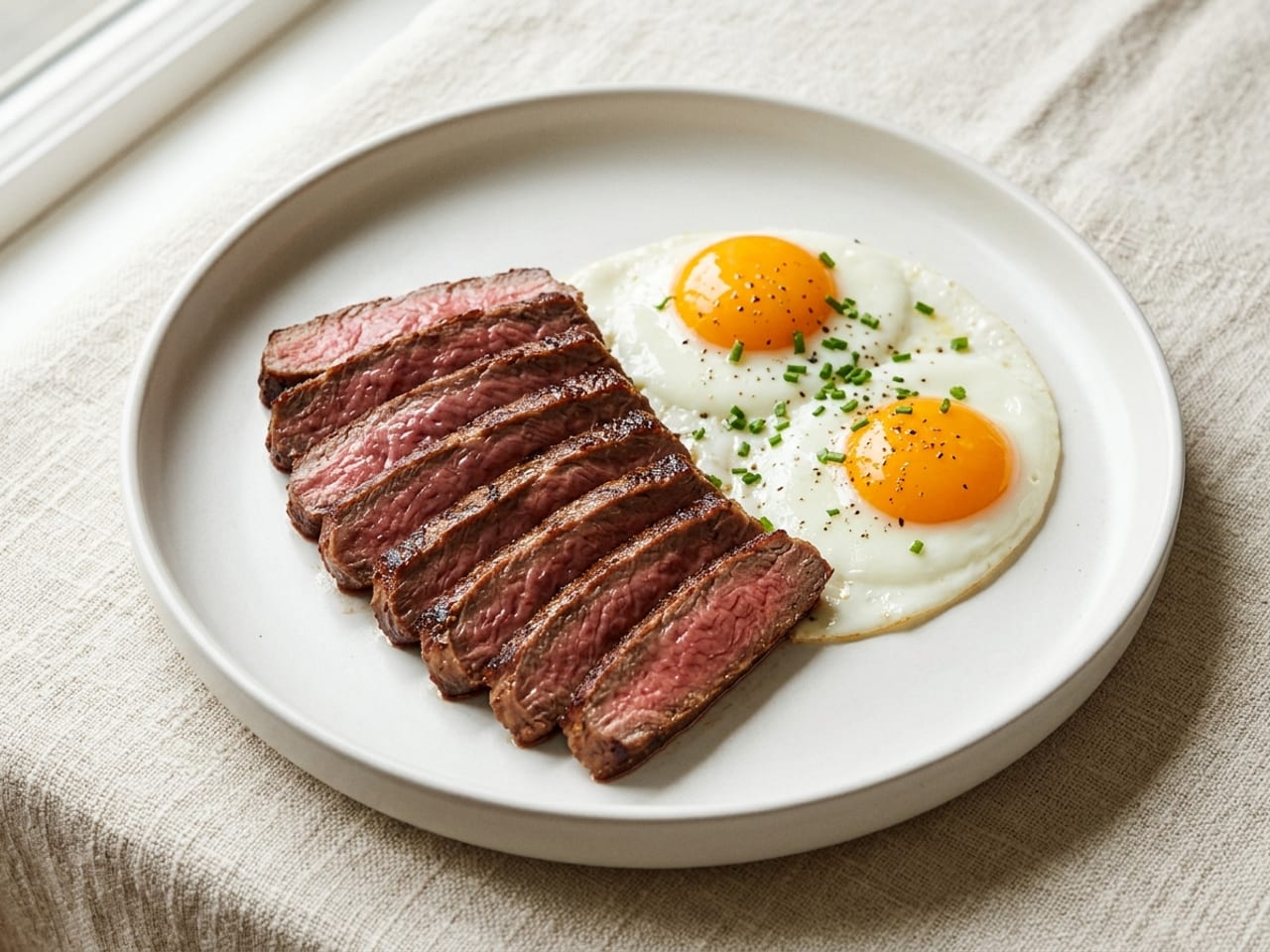
Steak and eggs
The only line we found is that it is "most typically served as a breakfast or brunch food", in Wikipedia, which says nothing about plating.65 Ours: the steak on one side, whole or sliced, the eggs beside it rather than on top, so a runny yolk can do the work of a sauce where the diner wants it.
Runny yolks: FDA's advice to everyone is "Cook eggs until both the yolk and the white are firm",92 and it tells people at greater risk of foodborne illness to avoid "Raw or undercooked eggs".90 The UK's Food Standards Agency says British Lion hen eggs can be eaten "raw or lightly cooked" by most vulnerable groups, but not by people who are "severely immunocompromised and require medically supervised diets".93 A runny yolk is your choice to make, not the agency's recommendation. For anyone at higher risk (65 and older, under 5, pregnant, or with a weakened immune system),89 FDA's advice means a firm yolk.
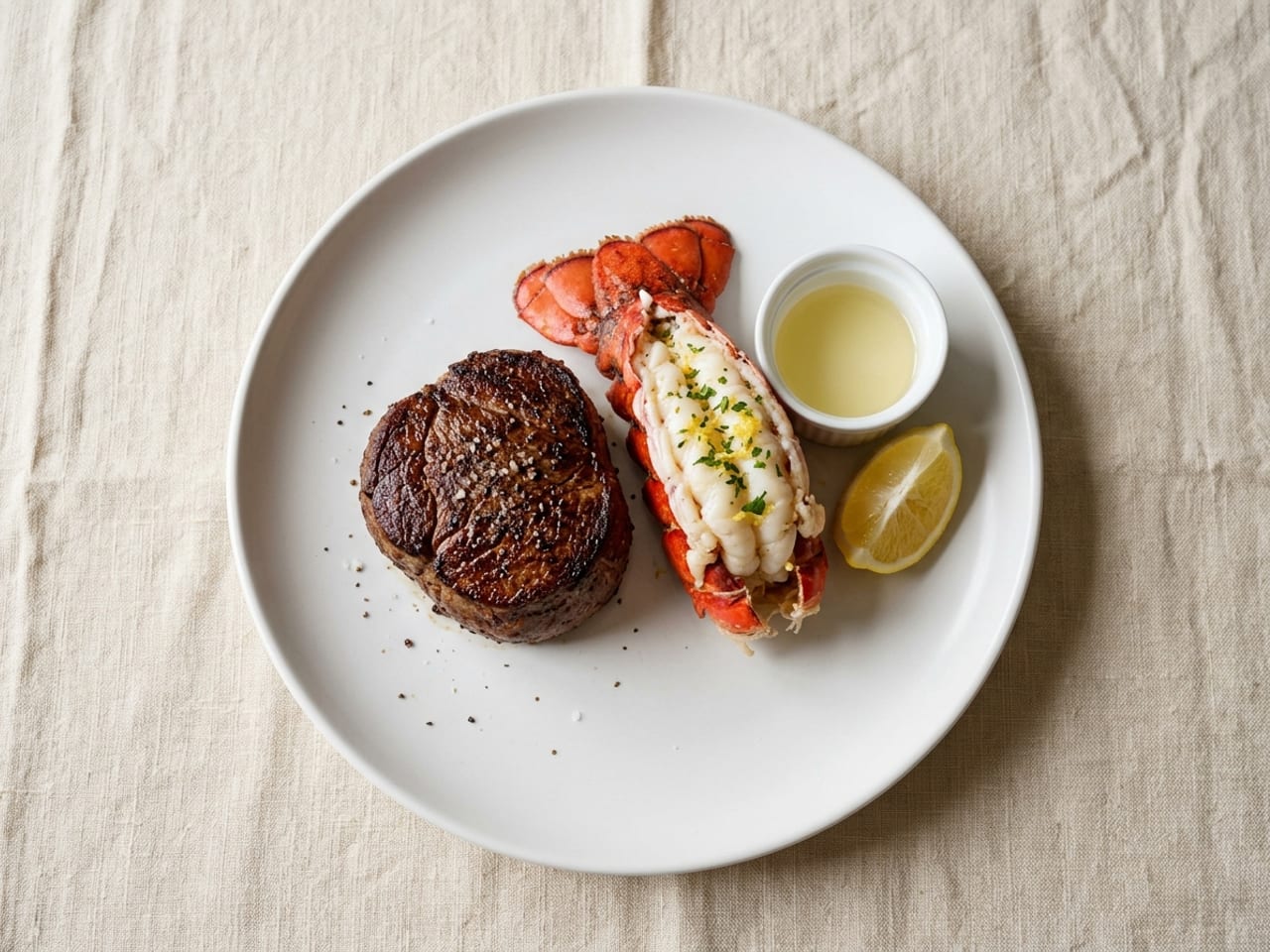
Steak and lobster (surf and turf)
Dictionary.com defines surf and turf as "a steak served with seafood or fish, especially filet mignon and lobster."74 Wikipedia says "the earliest known use of the phrase in print dates to 1961 in the Los Angeles Times", and that it "was featured in 1962 at the Eye of the Needle", the restaurant on top of Seattle's Space Needle.64 We found no source that describes how it is traditionally arranged.
Ours: the filet whole on one half of the plate, the lobster tail on the other, melted butter in its own small pot and a lemon wedge. Two centrepieces need a plain plate and nothing else competing.
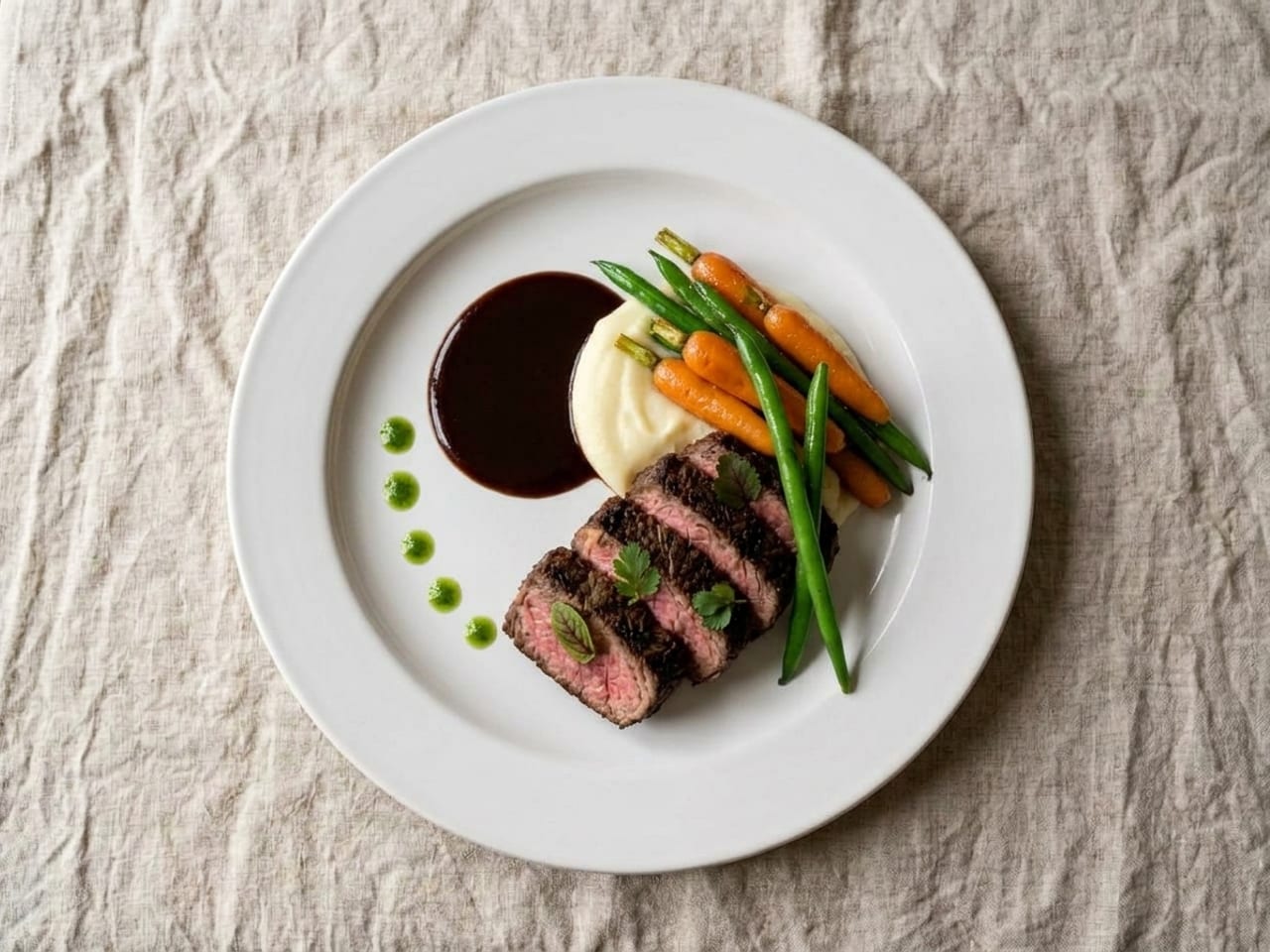
Steak with vegetables
Great British Chefs serves fillet "topped with a knob of butter and the garlicky spinach on the side".32 Escoffier dished some garnishes in a separate vessel: on larger cuts "the sauerkraut should be dished in a timbale".36 His reason was the size of the cut, not wetness; reading it as the way to serve a wet side, such as creamed spinach in its own small dish, is ours.
Timing: Tonkinson uses the rest: when the meat comes out, "you can then begin to reheat your sides and put your sauces together."40 Ours: one shape per vegetable, gathered, not scattered.
Steak and mashed potatoes, before and after
One steak dinner plated twice, from our dish-by-dish guide. Drag the slider.
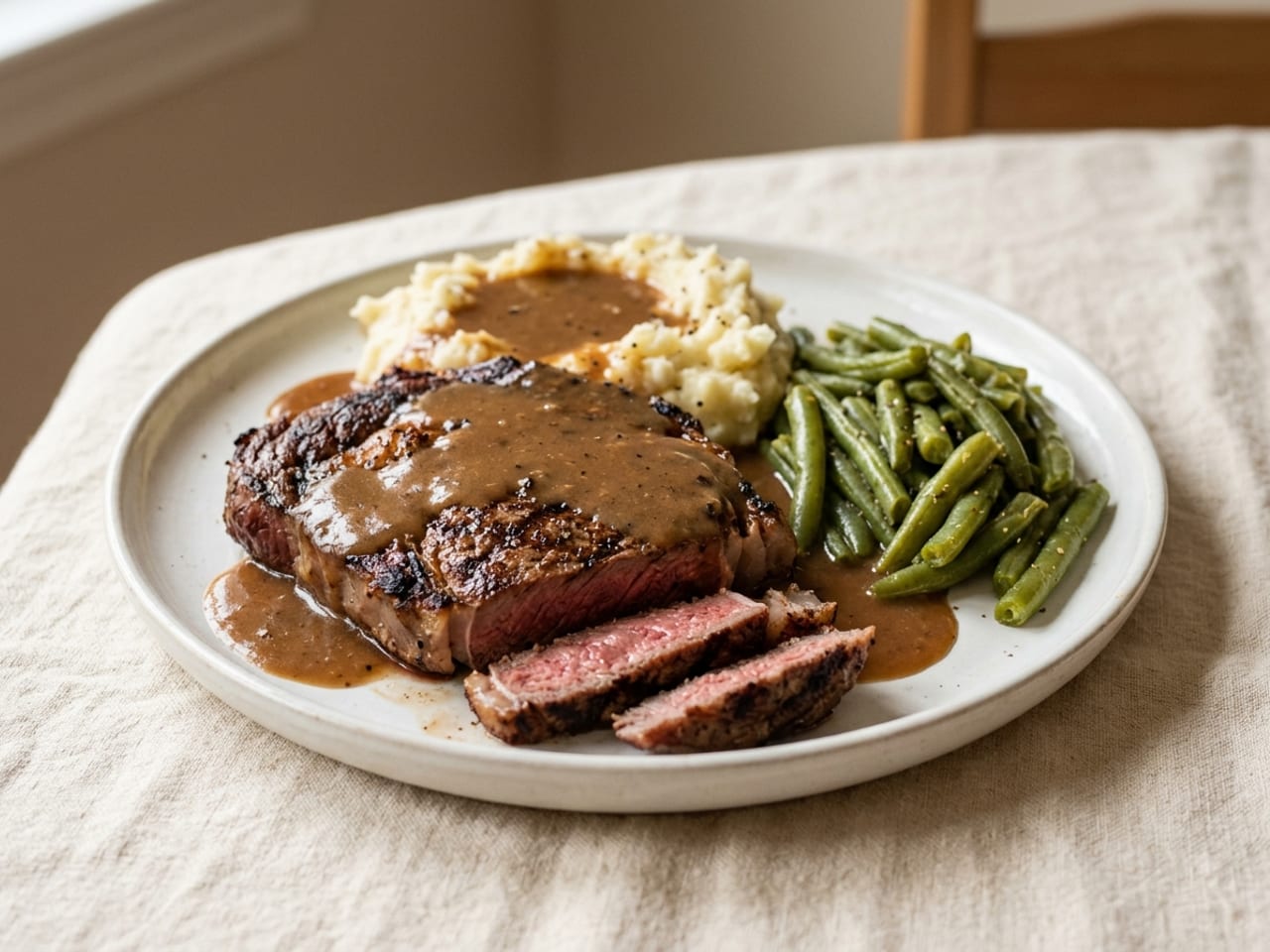 BeforeAfter
Want to see your own steak dinner re-plated?
Re-plate your dish free →Upload a photo of a plate you cooked. Once a day, no sign-up.
How to plate a ribeye, filet mignon, strip, T-bone and tomahawk
The cut decides the plate: a round filet sits in the centre, a strip fans, a T-bone goes back round its bone and a tomahawk needs a board.
How to plate a ribeye
A boneless ribeye for one can go on the plate whole with a compound butter on top (ours). For sharing, slice it: Snake River Farms cuts ribeye "diagonally at a 45° angle",6 and on a bone-in steak it takes the cap off and slices cap and eye separately "so everyone can have a taste of this delicacy".7
Fan the slices, salt the cut faces and use a warm plate: how to warm one.
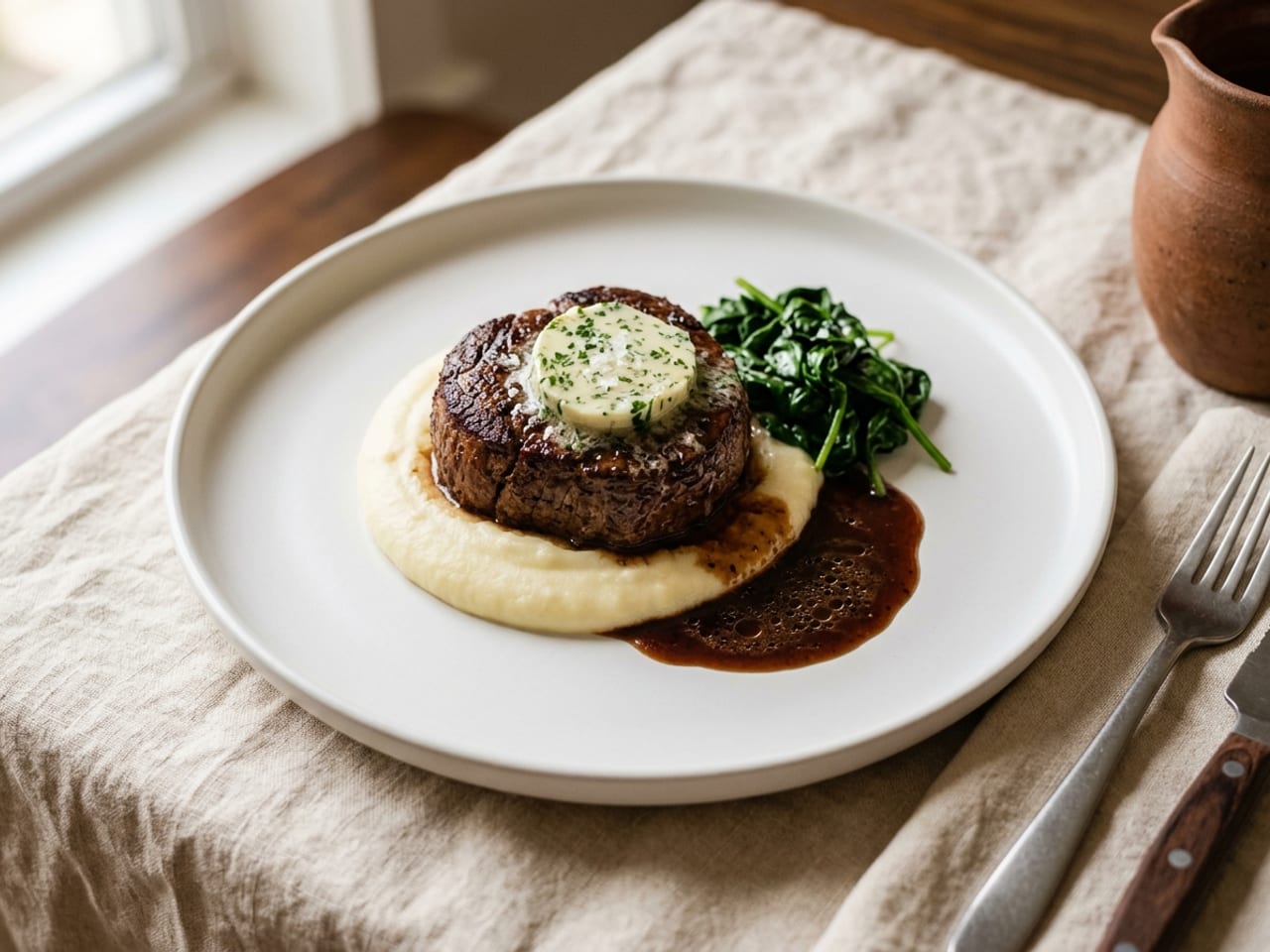
How to plate filet mignon
Usually whole. It is a tall, round steak, so it reads well in the centre of the plate (both ours; Snake River Farms suggests a 45 degree diagonal if you do slice it).6Escoffier's fillet steaks are "about one and one-half inches thick" (3.8 cm) and his tournedos "about one and one-quarter inches" (3.2 cm), "cut to a nice, round shape"; he allows them "various purées" as a garnish.36
Great British Chefs finishes it "topped with a knob of butter" and warns, of sauces: "be careful not to overpower the flavour of the meat".32 Béarnaise goes beside it.1, 36
How to plate a New York strip
Whole with the sauce spooned over is Cook's Illustrated's plate.5 Sliced, Snake River Farms cuts "against this grain diagonally",6 Cook's Illustrated's numbers are for slices carved from a piece of strip loin: 329 grams of force to bite against the grain, 590 with it.10
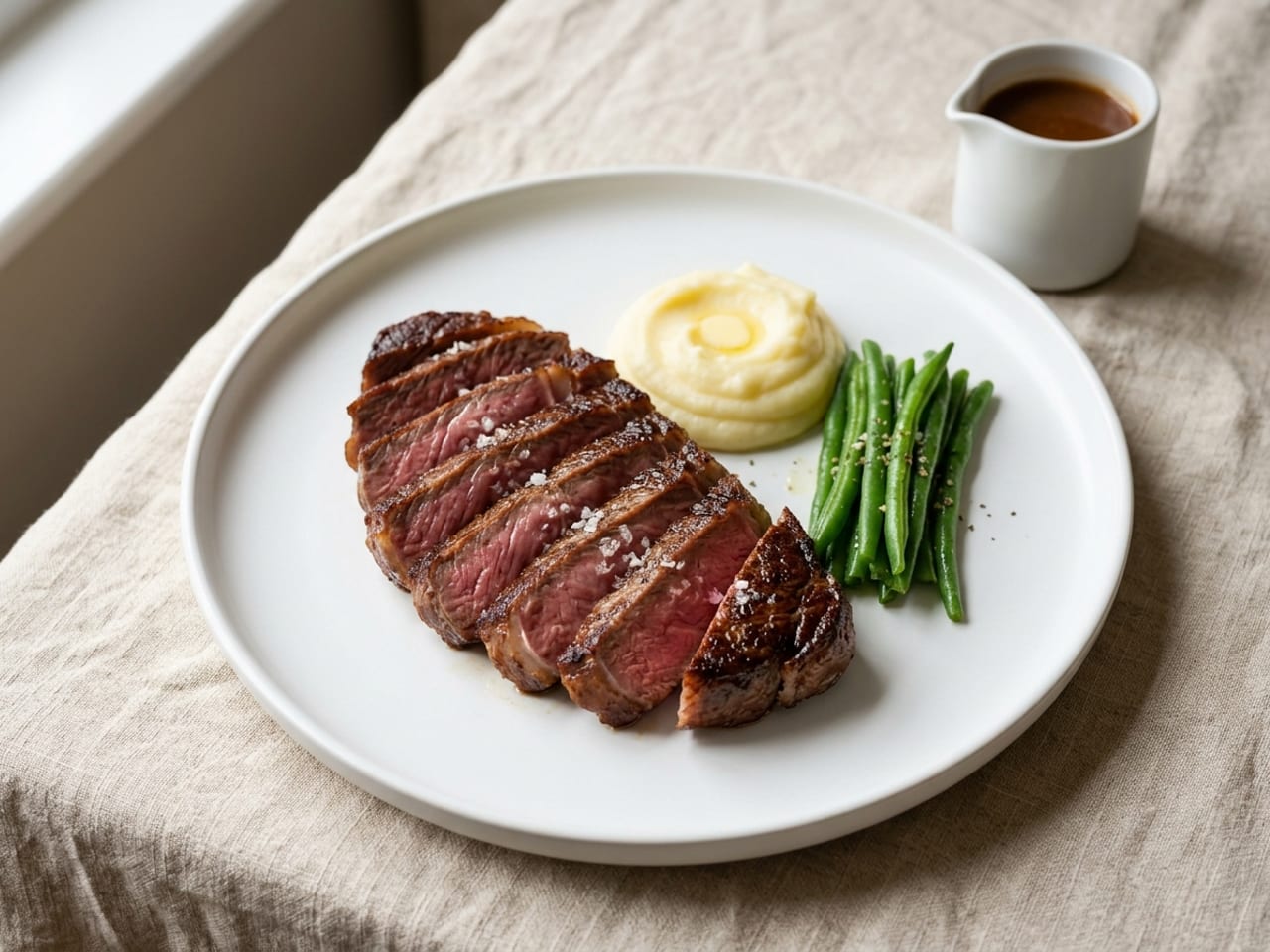
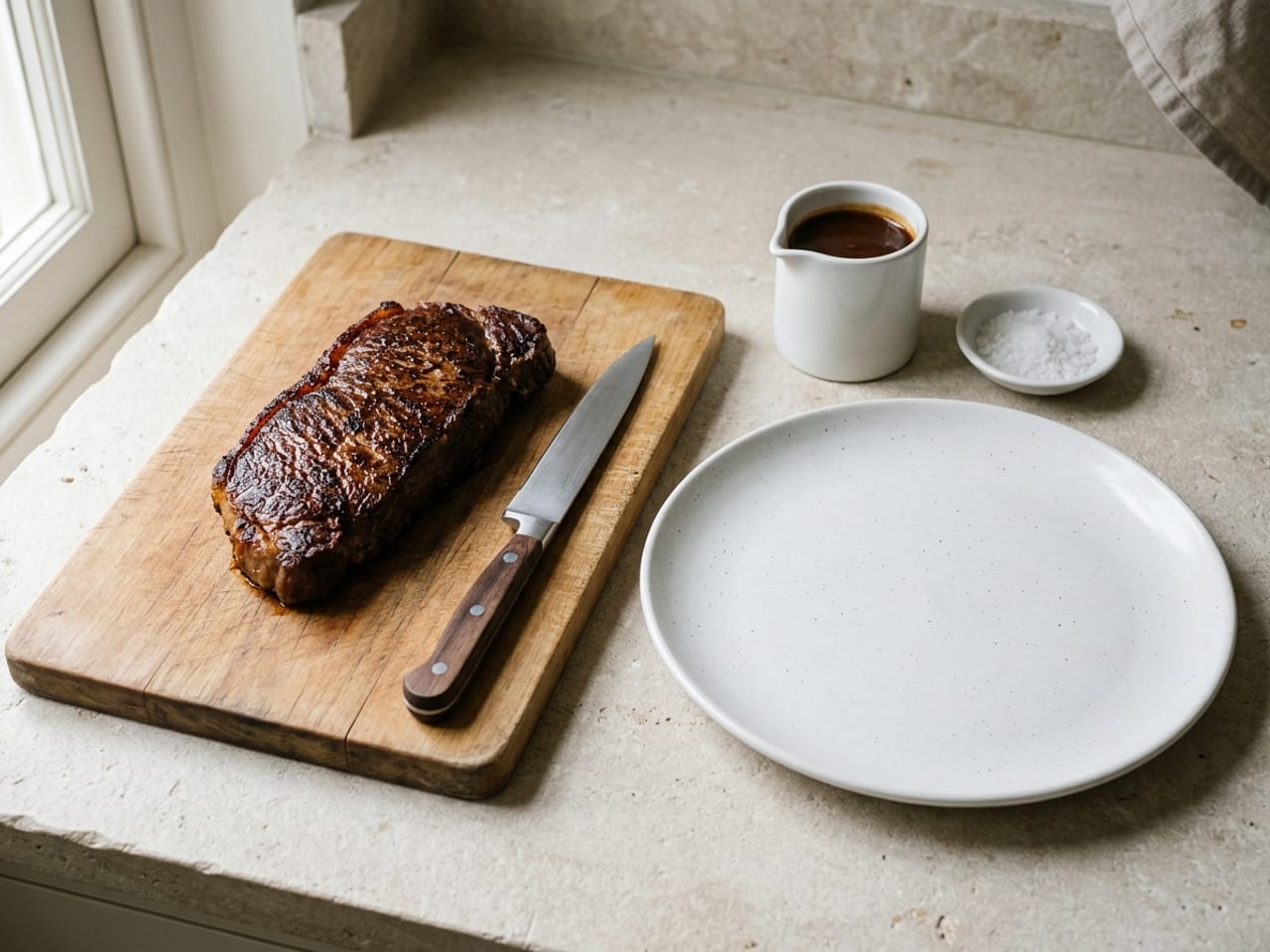
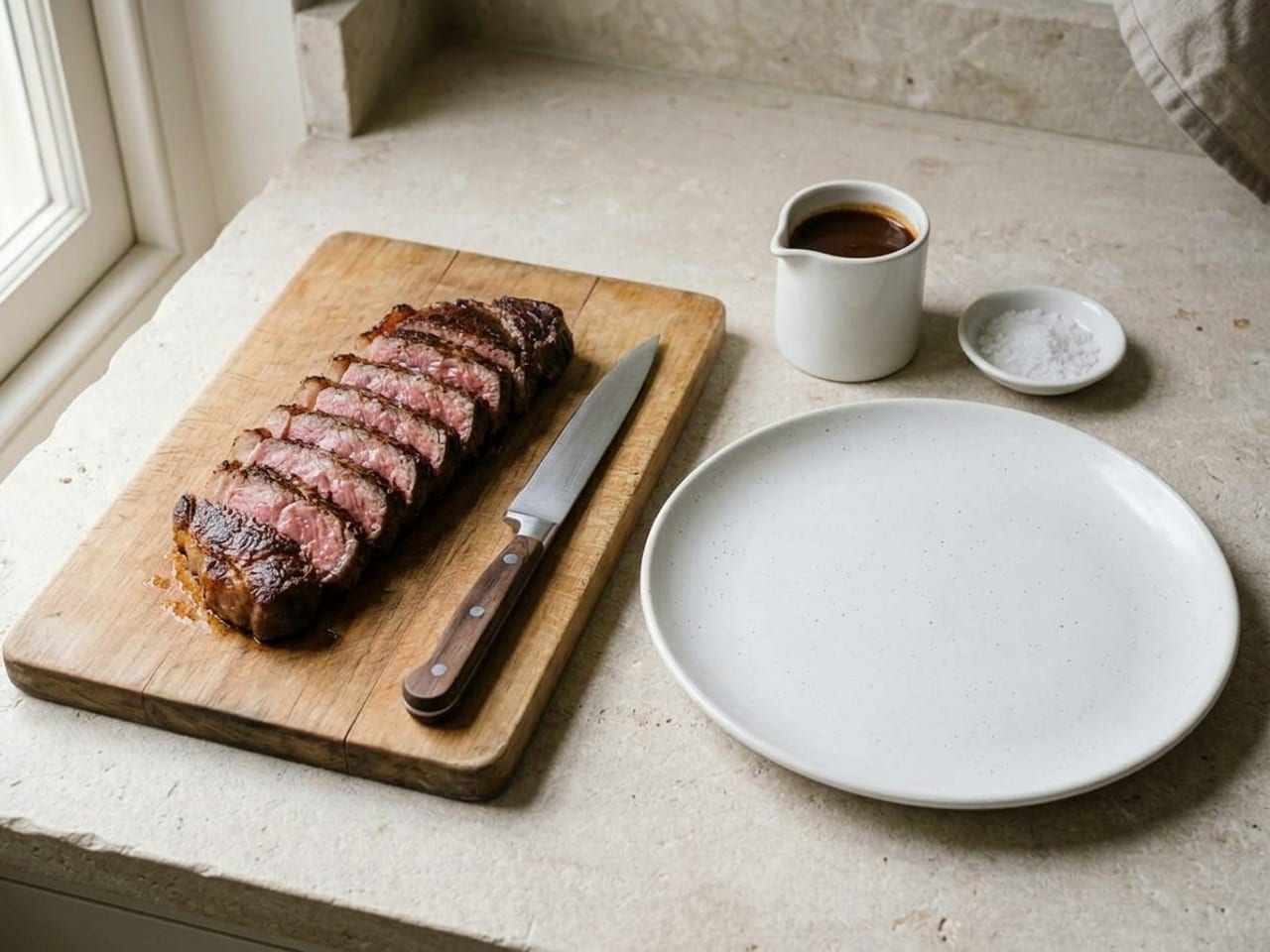
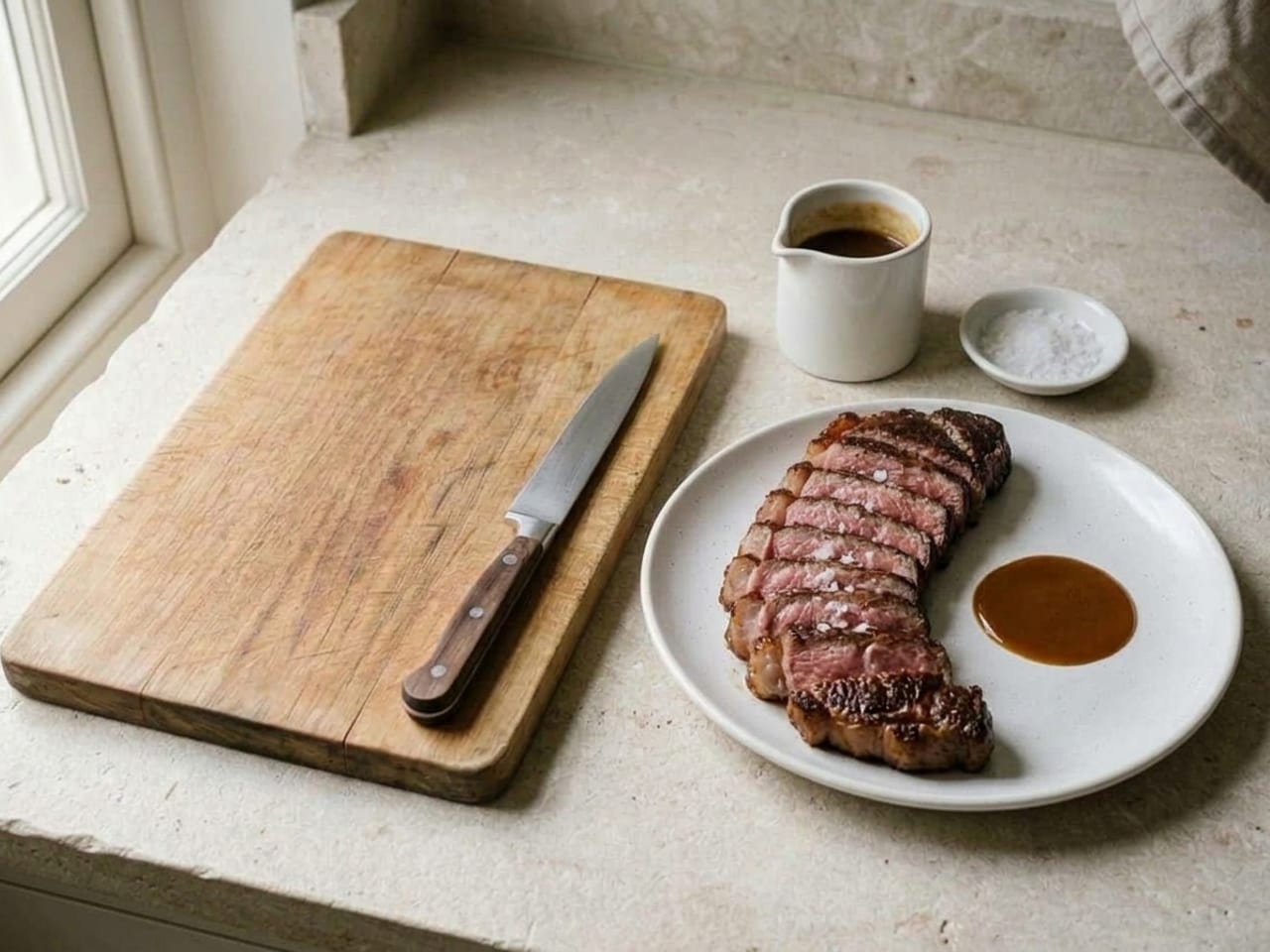
A strip is a long rectangle, so its slices make an even fan (ours). That is the steak in the three frames at the top.
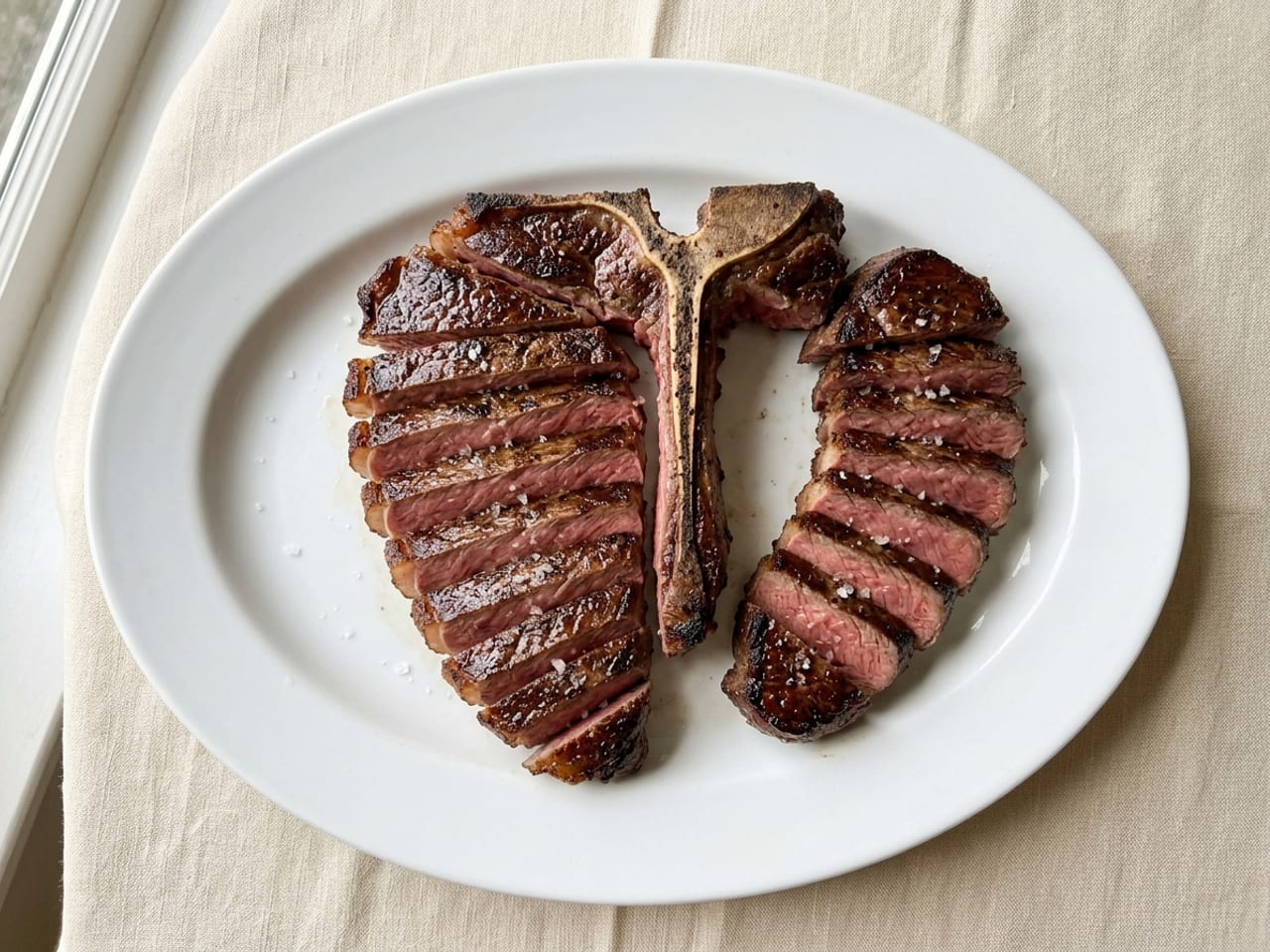
How to plate a T-bone or porterhouse
Carve it and put it back. Saveur: cut both muscles off the bone, slice them on the bias, then "Reassemble the steak on a platter along with bone, fanning out steak slices slightly. Pour reserved juices over meat."3 America's Test Kitchen does the same and drizzles melted butter over.4
Escoffier wrote of the porterhouse that "it is always grilled" and "more often served plain."36 When you serve, give each person some of both sides of the bone.68
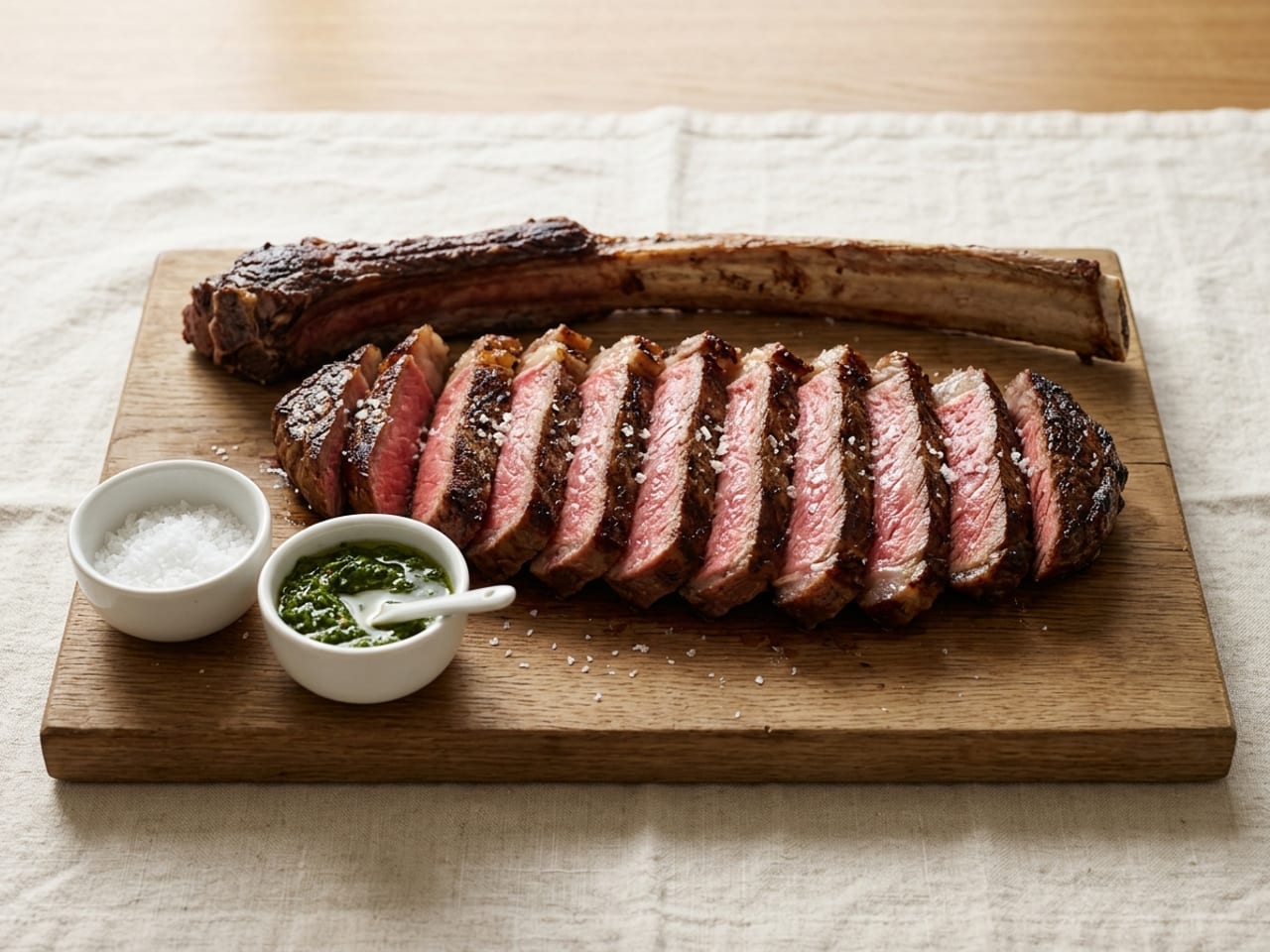
How to plate a tomahawk steak
A tomahawk is "a thick-cut, bone-in ribeye steak with a long bone still attached",7 and Certified Angus Beef's blog puts the bone at "about 20 inches long" (about 51 cm),8 so in our view it needs a board, not a plate; Snake River Farms says "a platter". Reverse-searing it, Snake River Farms holds it "at least 15 minutes" between the slow cook and the final sear, then says "serve immediately": cut the meat from the bone, slice cap and eye, and "start with the bone, arrange the center eye piece, then put the cap pieces on the outer section."7
Two beef-trade sources say the bone does not add flavour.7, 8 Snake River Farms adds that it "insulates the meat from cooking heat", so "The meat next to the bone remains extra juicy and tender", and elsewhere on the same page credits the bone with "tender and flavorful steak along its length".7 Trade copy, and not consistent.
How to plate flank or skirt steak
Sliced in every recipe we read, and thin: "as thin as possible" for flank,13 and for skirt in sections, each sliced "the long way".14 Shingle the slices in one long overlapping row on a platter or board (ours), with chimichurri passed separately53 or spooned over the slices.16
The carne asada tradition is the same cut and the same knife work: "Cut the beef into thin strips and serve it with corn tortillas".72
8 classic steak plates and how each is presented
The presentation column is quoted from recipes and from Escoffier. The story column says how solid the history is, and several of these stories are legends.
| Dish | How it is presented | The story, and how solid it is |
|---|---|---|
| Steak au poivre | On warmed plates, whole, the sauce poured over;51, 52 the peppercorns "cracked, not ground".51 | Wikipedia: "a French dish that consists of a steak, traditionally a filet mignon, coated with coarsely cracked peppercorns."59 We found no solid origin date and give none. |
| Steak frites | Steak with herb butter, fries beside it, served at once.55 Onglet is "a favourite for steak frites in French bistros".15 Escoffier's tournedos vert-pré, with maître d'hôtel butter on top and "water-cress and freshly-fried straw potatoes" around, is an older plate of the same kind (our reading).36 | Wikipedia: "considered by some to be the national dish of Belgium, which claims to be the country of origin"; "Historically, rump steak was commonly used".58 No date is given there, and none here. |
| Steak Diane | A pan-sauced steak. Saveur turns the steaks in the sauce, moves them to "warmed serving plates" and has you "drizzle it over the steaks".60 Wikipedia says it "was originally cooked tableside and sometimes flambéed", and of the early version, "It was not flambéed";61 Saveur speaks of the sirloin's "flambéed cream sauce".60 | Disputed. Saveur: "widely attributed to Beniamino Schiavon, the Drake's maître d'hôtel from 1942 to 1967", who "probably invented" the sauce with chef Luigi Quaglino in 1930s Belgium.60 Wikipedia: "most likely invented in London in the 1930s."61 The name is uncertain too. |
| Tournedos Rossini | Escoffier: "dish them, in the form of a crown, upon fried crusts", then on each "a round slice of foie gras" and on that "a fine slice of truffle."36 That recipe names no sauce; Wikipedia has the dish "finished with sauce madère".62 | Unknown. Wikipedia: "attributed to French master chef Marie-Antoine Carême, or Adolphe Dugléré, or Savoy Hotel chef Auguste Escoffier."62 The word tournedos is French for "turn" and "back" (tourner and dos).74 Why a steak is called that is not settled in anything we cite, and the popular stories about a turned back, with or without Rossini, are ones we could not source. |
| Chateaubriand for two | "a thick slice of tenderloin, broiled and served with potatoes and a sauce, often a béarnaise sauce."74 Escoffier takes it "from the centre of fillet" at "often twice, thrice, and sometimes more than thrice" a fillet steak's weight, and has a sauce named after it (his No. 71).36 Sliced to share (ours). | A tradition, not a fact: Wikipedia reports that Larousse Gastronomique credits Montmireil, the Vicomte de Chateaubriand's chef, in 1822, when the Vicomte was ambassador in London; that another dictionary ties the spelling Châteaubriant to the cattle town of that name; and, of the sauce, that some credit Montmireil and others the Champeaux restaurant.63 We did not read Larousse. |
| Bistecca alla fiorentina | "shared between friends and family",67 carved along the bone, with lemon wedges69 and "a drizzle of extra virgin olive oil and some pepper";70 traditionally with cannellini beans.69 A MICHELIN Guide writer describes chef Guy Grossi's as "garnished with lemon, rosemary and a little olive oil".71 How thick is disputed: "three and four fingers"67 or "3-4 cm" (about 1 1/4 to 1 1/2 inches).70 | Legend: Tuscany's own tourism site tells the 1565 story of English knights shouting "beef-steak!" with the words "They say".70 Great Italian Chefs: the origins "aren't clear".67 |
| Tagliata | Sliced before serving, on rocket, with shaved cheese, lemon and oil;66 rocket is "the more traditional" leaf.20 | The name is the Italian for "cut": the feminine of tagliato.76 |
| Carne asada | "grilled and thinly sliced across the grain",74 in strips with corn tortillas;72 Rick Bayless has it "sliced up, packed into steamy tortillas and drizzled (or slathered) with salsas".73 | "from Spanish: literally, 'roasted meat'".74 |
A steak board for two
One large steak, carved and shared, is how the sources present a porterhouse, a tomahawk, a fiorentina and a Chateaubriand. The T-bone and the tomahawk above are both plates for two.
- One steak, two donenessesChef Bryan Voltaggio: "As you're carving it, you're able to take some of the pieces that are a little bit more done" from the outside, while "The center cuts you can keep for people that want it more medium rare."2 Put the two ends of the fan toward the two diners (ours).
- Sauces in pots, wet sides in their own dishesBéarnaise is sent "separately" and Escoffier dishes sauerkraut "in a timbale" for larger cuts.36 Doing the same with any wet side is our reading; on a shared board it also keeps the wood dry (ours).
Steak doneness temperatures: what medium rare means, and to whom
The same two words carry two different temperatures. On test-kitchen and trade tables, medium rare is 125 to 135°F (52 to 57°C). On USDA's grilling page, Health Canada's chart and Australia's Food Safety Information Council poster, medium rare is 145°F (63°C).
| Whose table | Rare | Medium rare | Medium | Note |
|---|---|---|---|---|
| USDA FSIS, grilling page | not listed | 145°F (63°C) and a rest of at least 3 minutes | 160°F (71°C) | The agency's own label for 145°F is "Medium Rare"; the reading is taken before the steak leaves the heat.77, 78 |
| Health Canada | not listed | 63°C (145°F) | 71°C (160°F) | For "Pieces and whole cuts, for example, steaks and roasts"; well done is 77°C (170°F). The chart gives mechanically tenderized beef its own row, also 63°C (145°F).81 |
| Food Safety Information Council, Australia | not listed | at least 63°C (145°F) | not listed | A consumer charity's poster: "at least 63°C (medium rare). Leave to rest 3-5 minutes."82 |
| Michigan State University Extension | 140°F (60°C) | 145°F (63°C) | not listed | From an extension article on cooked meat colour.85 |
| BBC Good Food | 57°C (135°F) | 63°C (145°F) | 71°C (160°F) | Its "Blue" is 54°C (129°F), which is inside America's Test Kitchen's medium-rare range and at the top of ThermoWorks's rare range below. Checked in the pan, before the rest.84 |
| Certified Angus Beef | 125°F (52°C) | 135°F (57°C) | 145°F (63°C) | A beef brand; it calls USDA's 145°F "medium".83 |
| ThermoWorks | 120 to 130°F (49 to 54°C) | 130 to 135°F (54 to 57°C) | 135 to 145°F (57 to 63°C) | A thermometer maker; the stages are the same for every cut.34 |
| Serious Eats (J. Kenji López-Alt) | 120°F (49°C) | 130°F (54°C) | 140°F (60°C) | Final temperatures from the reverse-sear chart for 1 1/2 inch (3.8 cm) steaks.33 |
| America's Test Kitchen | 120°F (49°C) | 125 to 130°F (52 to 54°C) | 135 to 140°F (57 to 60°C) | Serving temperatures; it stops cooking 5 to 10°F (about 3 to 6°C) lower.35 |
Each figure is printed first in the source's own unit. The second unit is the source's where it gives one and our conversion where it does not: USDA's grilling page, Michigan State, America's Test Kitchen, BBC Good Food and the Australian poster print one unit only. USDA's safe-minimum chart uses no doneness names at all, only one figure for steaks: 145°F (62.8°C) and a rest of at least 3 minutes.77 The figures are also read at different moments: the regulators' (USDA, Health Canada, the Australian poster) and BBC Good Food's are read while the steak is still on the heat; the test-kitchen and trade figures are where the steak ends up after carryover, so they take it off 5 to 10°F (3 to 6°C) earlier still.35, 77, 83, 84 A British reader and an American reader using the same word can end up with different steaks, so a recipe that says "medium rare" should say whose.
Steak safety: 145°F, tenderized beef, sauces and leftovers
Quoted from the agencies, no broader than they wrote it. Where we apply a rule to something the agency did not name, we say the reading is ours.
- USDA's number for home cooks is 145°F plus a rest of at least 3 minutes"Beef, Pork, Veal and Lamb Steaks, Chops and Roasts | 145 degrees F (62.8 degrees C) and allow to rest for at least 3 minutes", measured "before removing food from the heat source".77 The test-kitchen and trade tables put medium rare at 125 to 135°F (52 to 57°C), below that figure. Which to follow for an intact steak is your decision; this page only makes sure you know both numbers. Two cases are not left to taste by the agencies: people at higher risk, and mechanically tenderized beef (both below).
- UK advice lets a seared whole steak stay pinkThe Food Standards Agency: "Whole cuts of meat, such as steaks and joints (except poultry and pork), only ever have bacteria on the outside surface of the meat. These can be served pink in the middle according to taste", provided the outside is seared at a high temperature and "has changed colour". The same page says meat "minced or skewered all the way through should be cooked thoroughly".80
- The US restaurant rule for rare steak without an advisory covers intact beef onlyThe FDA Food Code is a model code for food service, in force only where a state or locality has adopted it, and not a rule for home kitchens. Its paragraph 3-401.11(C) lets a restaurant serve "A raw or undercooked WHOLE-MUSCLE, INTACT BEEF steak" without a menu advisory if the establishment "serves a population that is not a highly susceptible population", the steak "remains intact", and it "is cooked on both the top and bottom to a surface temperature of 63°C (145°F) or above and a cooked color change is achieved on all external surfaces." Beef only, and edges included. A steak that is not intact can still be served rare under the next paragraph, (D), "upon CONSUMER request or selection", but then the menu has to carry the advisory. So a rare steak in a restaurant is not proof that the steak was intact. And "highly susceptible population" describes the establishment, not the guest: it is the Code's term for immunocompromised people, preschool-age children and older adults who get their food in a care setting such as a hospital, a nursing home or a day care centre. The rule does not screen individual diners and does not protect an at-risk person eating in an ordinary restaurant.79
- Mechanically tenderized beef is not an intact steakSome steaks are "pierced with needles or sharp blades to break up muscle fibers", and "If the outside of the meat contains bacteria, it will be transferred to the inside". They "look no different": "The only way to tell if meat has been mechanically tenderized is by checking the label." USDA's advice is to "thoroughly cook all mechanically tenderized meat to an internal temperature of 145°F with a 3-minute rest time." It also says tenderizing "can take place in the processing establishment before the beef is packaged, at a butcher or grocery store, at a restaurant or in the home",86 so where there is no label, in a restaurant or at a butcher's counter, ask. Federally inspected producers in the US have had to label it since 17 May 2016; the rule does not reach restaurant menus, and USDA's reason for it is that cooks "may incorrectly assume that it is safe to cook these products" rare or medium-rare.87 Canada's label gives the same 63°C (145°F), adds "Turn steak over at least twice during cooking", and its assessment found "a five-fold increase in risk" against intact cuts; the Canadian rule "does not apply to MTB cooked and served at foodservice establishments" (MTB is mechanically tenderized beef).88 By the Food Code's definition, a steak that has been scored and marinated is no longer intact either.79
- People at higher risk are told to avoid undercooked meatCDC: "Higher risk groups include people who are 65 and older, children under 5, people with weakened immune systems, and pregnant women."89 FDA: "If you are at greater risk of foodborne illness, you are advised to avoid eating or tasting: Raw or undercooked meat or poultry."90 In the UK, the NHS lists as safe in pregnancy "whole cuts of beef and lamb (such as steaks or cutlets) that have been thoroughly cooked on the outside" and as foods to avoid "raw or undercooked meat".91
- Béarnaise and hollandaise are egg-yolk saucesWhere it is adopted, the Food Code requires restaurants to use pasteurized eggs in "hollandaise or Béarnaise sauce" unless the sauce is cooked to its egg temperatures or sold under the consumer advisory.79 For home cooks the FDA says recipes served with raw or undercooked egg should use pasteurized eggs or egg products; its examples do not name béarnaise, so applying it here is our reading. FDA also advises people at greater risk of foodborne illness to avoid "foods containing raw or undercooked eggs";90 its examples there do not name béarnaise either, and applying it to a béarnaise made with unpasteurized yolks is again our reading. FDA's egg page also says: "Never leave cooked eggs or egg dishes out of the refrigerator for more than 2 hours or for more than 1 hour when temperatures are above 90° F" (32°C).92 UK advice differs: the Food Standards Agency says young children, pregnant women, older people and people with an underlying health condition "can now safely eat raw or lightly cooked hen eggs" that carry the British Lion mark or come from the Laid in Britain scheme, and adds that this "does not apply to individuals who are severely immunocompromised and require medically supervised diets".93
- Chimichurri, herb oil and garlic oil: four days in the fridgeOregon State University Extension: home-made flavoured oils, "including pesto", must be "stored in the refrigerator for up to 4 days or frozen", because herbs and garlic in oil are "an oxygen-free environment which is perfect for growth of Clostridium botulinum bacteria."95 The University of California gives garlic in oil "no more than 4 days" and records home-made garlic in oil behind outbreaks in 1991 and 1999; the same paragraph says "Do not store garlic in oil at room temperature."96 No page we read names chimichurri; treating it the same way is our reading, and the vinegar in a recipe is not a tested acidification. At the table, bring out what you will use and put the rest back in the refrigerator (ours).
- Compound butter lives in the refrigerator"Compound butter (butter mixed with herbs, garlic, spices, or other ingredients) should be stored in the refrigerator at all times."94 Slice it cold onto the hot steak (ours).
- A clean platter, clean tongs, and what that means for the juices"When taking food off the grill, use a clean platter. Don't put cooked food on the same platter that held raw meat or poultry."78 Marinade that touched raw beef is boiled before it goes near the cooked steak.99 No agency page we read mentions the juices on a resting board. Pouring them back, as Saveur and BBC Good Food do,3, 84 is consistent with the clean-platter rule only if the board and tongs never touched the raw steak (ours).
- A thermometer, not the colourUSDA: "insert the food thermometer in the thickest part, away from bone, fat or gristle"; thin pieces "through the side".98 Michigan State University Extension calls colour "a poor indicator of if meat is safe to eat",85 and Serious Eats notes that cutting in to look is unreliable "since hot juices can make it look more rare than it actually is".25 If you probe more than once, the Food Standards Agency's line applies: "Remember to fully clean the temperature probe or cooking thermometer after each use to avoid cross-contamination and to get an accurate reading."80
- Leftovers: two hours, 3 to 4 days, 165°F"Within 2 hours of cooking food or after it is removed from an appliance keeping it warm, leftovers must be refrigerated" (1 hour above 90°F, 32°C). They keep "3 to 4 days" in the refrigerator. Reheat to 165°F (74°C), and "Reheat sauces, soups and gravies by bringing them to a rolling boil."97 That covers pan sauces and gravy; a leftover béarnaise cannot be boiled, so make it fresh (ours).
Steak plating mistakes the sources name
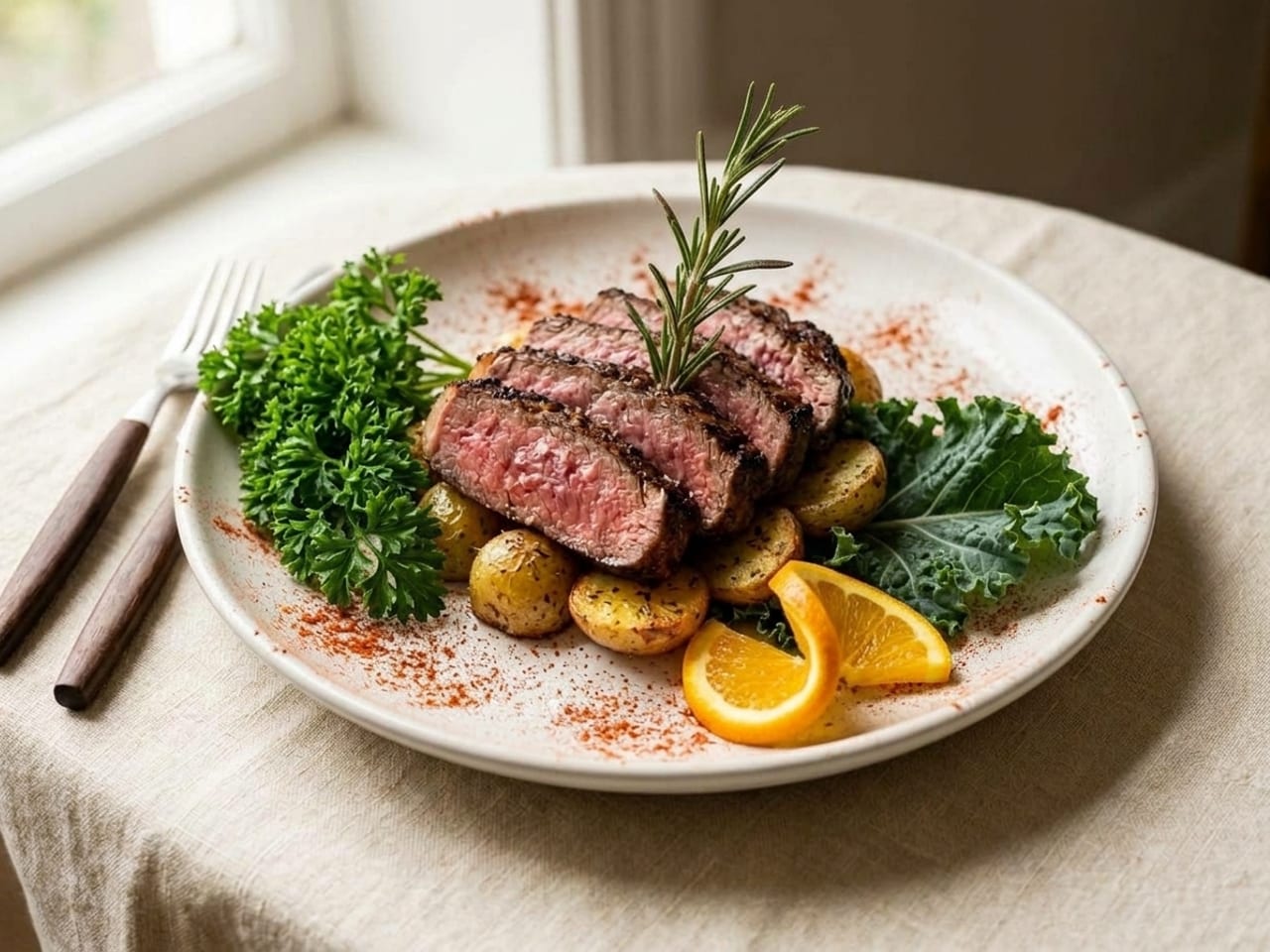
- Slicing with the grain"You're biting into long strands of muscle, meaning it requires more effort to chew."14 On skirt the natural cut, off the end, is the wrong one.
- A sauce that takes over"be careful not to overpower the flavour of the meat", which "should be the star of the show."32
- Wet vegetables in the sauceEscoffier's warning about asparagus, peas and beans breaking a sauce on the plate is more than a century old and is still the reason to drain them.36
- A messy plateIn a controlled study, "Food presented in a neatly arranged presentation is liked more than the same food presented in a messy manner", and the animal-based dish was the one "judged as being more contaminated" when messy (the abstract does not say which foods were plated).49 Wipe the rim.
- The raw-steak platter, reused"Harmful bacteria present in raw meat and poultry and their juices can contaminate safely cooked food."78
Steak plating myths, and what the evidence says
- "Never put sauce on the crust."No named source says it. We looked and found none. The published recipes do the opposite with pan sauces: peppercorn sauce "is poured over",30, 51, 52 steak Diane's sauce is drizzled "over the steaks"60 and a red wine-mushroom pan sauce is spooned "over steaks".102 What the record supports is narrower: béarnaise and gravy are traditionally served separately,36 and steam and contact soften a crust.21, 27 Nobody we read has measured what a sauce does to one.
- "Resting lets the juices redistribute."Contested, including by the people who say it. Cook's Country calls redistribution "The theory";21 its sister title explains resting by juices thickening as they cool;22 BBC Good Food says the fibres "reabsorb" them;84 Chris Young, as reported by Serious Eats, puts it down to vapour pressure falling as the meat cools.24 Four explanations, and tests on both sides: who measured what.
- "The red juice on the plate is blood."Almost none of it is. USDA, of the liquid in a pack of raw beef: "blood is removed from beef during slaughter and only a small amount remains within the muscle tissue."99 The colour comes from myoglobin, which "doesn't circulate in the blood but is fixed in the tissue cells". 100 Applying that to the juice under a cooked steak is our reading; USDA's sentence is about the raw package.
- "Medium rare is one temperature."It is two. 125 to 135°F (52 to 57°C) on the test-kitchen and trade tables; 145°F (63°C) on USDA's grilling page, Health Canada's chart and the Australian poster.33, 34, 35, 78, 81, 82, 83 A page that says "medium rare" without saying whose table is leaving out 10 to 20°F (6 to 11°C).
- "A rare steak is always safe, because the bacteria are only on the outside."Only for an intact steak, and not for everyone. The Food Code's allowance to serve a seared steak rare without a menu advisory covers only beef that is not "injected, mechanically tenderized, reconstructed, or scored and marinated", and it does not apply in places that serve a "highly susceptible population", the Code's term for immunocompromised people, preschool-age children and older adults who get their food in a care setting such as a hospital, a nursing home or a day care centre. It does not screen individual diners.79 A tenderized steak can still be served rare on request with the advisory, and you cannot see tenderizing: on packaged beef read the label; USDA notes it can also be done "at a butcher or grocery store, at a restaurant or in the home", so in a restaurant, ask.86 FDA separately advises anyone at greater risk of foodborne illness to avoid raw or undercooked meat.90
- "Tender steaks do not need to be cut across the grain."America's Test Kitchen says both. One page: rib eye and tenderloin "are tender no matter how you slice them".9 Another, with numbers: "all cuts benefit from slicing against the grain", strip loin included (329 grams of force against 590).10 The measurement favours cutting across.
- "Plate in odd numbers" and "the protein goes off-centre."Conventions, not findings. The odd-number study found "No consistent evidence" either way,48 and in both studies run in a dining setting the centred plate did better.46, 103 None of them is a study of steak: one used scallops, one names only a dessert, and one does not say in its abstract what the main course was.
- "The bone adds flavour."Two beef-trade sources say it does not, and one of them hedges. Snake River Farms: "Some folks say the bone adds flavor, but in general, this is not the case." It goes on to say that the bone "insulates the meat from cooking heat", so "The meat next to the bone remains extra juicy and tender".7 Certified Angus Beef's blog, quoting its in-house meat scientist, Dr. Daniel Clark: "While the bone makes an impressive presentation, it doesn't add flavor."8
- "The mash swoosh, the fries in a cone and the asparagus bundle are chef conventions."We found no named source for any of them on a steak plate. They are styling choices, and this guide labels them as its own wherever it suggests one. (The stack has one school source: a Le Cordon Bleu Malaysia post names "steak layered with mashed potatoes and asparagus".43) Watercress is different, and does have a source: Escoffier's tournedos vert-pré are grilled, dished "with half-melted butter à la Maître-d'Hôtel upon them" and surrounded "with alternate heaps of water-cress and freshly-fried straw potatoes". That is one garnish among dozens in his book, not "the" steak garnish, and round roasts he marks watercress "optional".36
See your own steak plated first
Before the next steak comes off the heat, see where it should go. Photograph a dinner you cooked and Plate Artists re-plates your own dish the way a restaurant would, with the moves named so you can repeat them. The same method for other dinners is in how to plate food, dish by dish.
Your dish, plated like a chef's
Snap it, upload it, and get the composed version back, with the steps to recreate it at home.
Start free · 1 enhancement →Free account · 1 free enhancement · No credit card
Steak plating terms, defined
| Term | Where the word comes from | Defined by |
|---|---|---|
| Against the grain | English; the grain is the direction of the muscle fibres | America's Test Kitchen |
| On the bias | English | Traeger; no dictionary or school definition found |
| Carryover cooking | English | ThermoWorks; America's Test Kitchen |
| Resting | English | Cook's Country; Serious Eats |
| Tagliata | Italian: cut, the feminine of tagliato | Wiktionary; Great British Chefs |
| Au poivre | French: with pepper | Dictionary.com; Saveur |
| Maître d'hôtel butter | French: the head waiter, who once prepared it at the table | Escoffier; Great British Chefs |
| Jus | French | Cambridge Dictionary |
| Béarnaise | French | Dictionary.com |
| Chimichurri | The name of an Argentinian sauce; Dictionary.com's first record in English is 1955 to 1960 | Dictionary.com |
| Chateaubriand | French; Dictionary.com's first record in English is 1875 to 1880 | Cambridge Dictionary; Dictionary.com; Wikipedia |
| Tournedos | French: tourner, to turn, and dos, back | Escoffier; Dictionary.com |
| Porterhouse | English | Dictionary.com |
| Tomahawk | English | Snake River Farms, a beef seller |
| Surf and turf | English | Dictionary.com |
| Carne asada | Spanish: roasted meat | Dictionary.com |
| Mechanically tenderized beef | English; a US labelling term since 2016 | USDA FSIS |
| Whole-muscle, intact beef | English; a term defined in the FDA Food Code | FDA Food Code 2022 |
| Myoglobin | Scientific English | USDA FSIS |
Against the grain · across the grain
Slicing meat perpendicular to its muscle fibres instead of parallel to them, which shortens the fibres in each bite.
On the bias · bias cut
Slicing with the knife angled instead of straight down, which makes each slice wider.
Carryover cooking
The change in a steak's internal temperature after it leaves the heat, as the hot outside keeps warming the centre; published figures for a steak run from no rise at all to about 18°F (10°C), our subtraction from Greg Blonder's readings of 125 and 143°F (his own footnote says 15°F).
Resting
Letting cooked meat stand before it is cut; long taught as a way to keep the juices in, now described by Serious Eats as temperature control, with the published tests split on whether it saves any juice.
Tagliata
An Italian dish of grilled steak sliced across the grain before serving, often laid on rocket with shaved cheese, lemon and olive oil.
Au poivre
Spiced with peppercorns; steak au poivre is a steak coated in cracked peppercorns and served with a pan sauce poured over it.
Maître d'hôtel butter · a compound butter
Softened butter mixed with chopped parsley, salt, pepper and lemon juice, shaped, chilled and set on hot grilled meat to melt.
Jus
A thin sauce made from meat juices.
Béarnaise
A sauce of egg yolks, shallots, tarragon, butter and vinegar, sometimes with white wine and chervil; with steak it is served beside the meat.
Chimichurri
An Argentinian sauce of fresh parsley, oregano, red chiles, lemon zest, vinegar and olive oil, often served with grilled meat.
Chateaubriand
A large, thick piece of beef fillet, big enough for two; also the dish of that cut broiled and served with potatoes and a sauce, often béarnaise.
Tournedos
Small, round, thick steaks cut from the fillet of beef, about 1 1/4 inches (3.2 cm) thick in Escoffier's English Guide to Modern Cookery.
Porterhouse · compare T-bone
A steak cut from the short loin with a T-shaped bone, like a T-bone steak but with a larger portion of tenderloin.
Tomahawk
A thick, bone-in ribeye steak with the long rib bone left attached and cleaned of meat and fat, a trim called frenching.
Surf and turf
A steak served with seafood or fish, especially filet mignon and lobster.
Carne asada
Beef, typically skirt or flank steak, that is marinated or seasoned, grilled and thinly sliced across the grain.
Mechanically tenderized beef · blade tenderized, needle tenderized
Beef pierced with needles or blades to break up muscle fibres, which can carry bacteria from the surface to the inside; it looks no different, so on packaged beef the label is the only way to tell.
Whole-muscle, intact beef
Whole muscle beef that is not injected, mechanically tenderized, reconstructed, or scored and marinated, from which beef steaks may be cut.
Myoglobin
The protein fixed in muscle cells that gives meat most of its red colour; it does not circulate in the blood.
Plating steak, answered
How do you plate steak like a chef?
Warm the plate, let the steak settle on a rack or board so the crust stays dry, then decide whether it goes on whole or sliced. If sliced, cut across the grain and fan the slices with the cut faces up. Put the sides down first and set the steak on or against them. Sauce according to the sauce: pan sauces such as peppercorn are poured or spooned over in the published recipes, béarnaise is served beside, chimichurri is passed at the table or spooned over the slices. Finish with flaky salt on the cut faces, wipe the rim and serve at once.
How do you plate steak and mashed potatoes?
Make the mash the base: push one large spoonful into a short swoosh with the back of the spoon, or shape a neat mound. Lean the sliced steak on it with the pink cut faces up and keep the sauce on the steak's side of the plate. This is our styling suggestion: the only named source we found is a Le Cordon Bleu Malaysia blog post that gives steak layered with mashed potatoes and asparagus as an example of stacking. One classical arrangement, Escoffier's tournedos béarnaise, heaps small buttered potatoes in the centre with the steaks around them.
How do you plate steak, asparagus and mashed potatoes?
Use three clear shapes. One published clock layout (Le Cordon Bleu Malaysia) puts the starch at 10 o'clock, the vegetables at 2 and the protein at the centre or between 3 and 9 o'clock. Lay the asparagus spears parallel with the tips pointing the same way, drain them well, and keep the sauce by the steak: Escoffier warned that vegetables such as asparagus tips break up a sauce on the plate.
How do you plate steak and fries (steak frites)?
Plainly. America's Test Kitchen tops the steak with herb butter and serves it immediately with the fries beside it; Great British Chefs adds a crisp green salad. Keep the fries in a loose pile next to the steak rather than under it, and put the butter or sauce on the steak. A paper cone or a stack of fries is a restaurant flourish, not a sourced convention.
Should you slice steak before serving it?
It depends on the steak. A single-portion steak with a pan sauce is plated whole in the recipes we read; without a sauce the sources go both ways (BBC Good Food serves it whole or carved into slices). Filet mignon is usually plated whole. Big bone-in steaks for sharing (porterhouse, T-bone, tomahawk, bistecca alla fiorentina) are carved and reassembled around the bone. Flank, skirt, hanger, tri-tip and picanha are sliced in every recipe we read, because the direction of the cut decides how tender they eat.
How do you slice steak against the grain?
Find the lines of muscle fibre on the surface and cut perpendicular to them. America's Test Kitchen's picture is a bundle of dry spaghetti cut into short sections. Flank's grain runs the long way, so slice it crosswise, parallel to the short side. Skirt's grain runs the short way, so cut the ribbon into 4 to 6 inch (10 to 15 cm) sections and slice each one the long way. Tri-tip has two grains: the grill maker Traeger splits it where they meet (it calls the split optional) and slices each half across its own grain, and the beef seller Snake River Farms cuts it into three pieces. Snake River Farms says ribeye, strip and filet steaks have already been cut against the grain when you buy them.
How long should steak rest before you slice it?
The published answers run from none to 20 minutes, or as long as the steak cooked. America's Test Kitchen says 5 to 10 minutes; Great British Chefs and chef Eric Tulay say as long as the steak cooked; J. Kenji López-Alt says a reverse-seared steak needs no rest; Serious Eats now says resting should not be a fixed time at all, only long enough for the centre to reach its target temperature. The tests disagree on whether resting saves juice. If you cook to USDA's 145°F (62.8°C), its rest of at least 3 minutes is part of the safety instruction.
Does the sauce go over the steak or beside it?
It depends on the sauce. Pan sauces go over: peppercorn sauce is poured over the steak in the recipes from Great British Chefs, chef Bryan Webb and Saveur, Saveur drizzles its steak Diane sauce over the steaks, and America's Test Kitchen spoons its red wine-mushroom pan sauce over them. Béarnaise is served separately (Escoffier, and chef Kevin B. Thomson in the MICHELIN Guide). Chimichurri is passed at the table (America's Test Kitchen) or spooned over the slices (Snake River Farms, a beef seller, on hanger steak). A compound butter goes on top to melt. We found no named source for the rule that sauce must never touch the crust.
How do you plate steak au poivre?
Whole, on a warmed plate, with the peppercorn sauce poured over the steak. That is how Saveur and chef Bryan Webb's recipe for Great British Chefs plate it. Chips and a green salad are the sides Great British Chefs suggests.
How do you plate steak with chimichurri?
Slice the steak, fan it on a board or platter (our suggestion), and pass the chimichurri separately, as America's Test Kitchen does, or spoon it over the slices, as the beef seller Snake River Farms does with hanger steak. Home-made herb and garlic sauces in oil should be refrigerated and used within 4 days (Oregon State University Extension, for flavoured oils in general; applying it to chimichurri is our reading), so bring out what you will use and put the rest back.
How do you plate a tomahawk steak?
On a board (ours; Snake River Farms says a platter), carved. Reverse-searing it, Snake River Farms holds the steak at least 15 minutes between the slow cook and the final sear, then serves it at once: it holds the bone with a dry towel, cuts the meat from the bone, takes off the cap and slices cap and eye thickly, then arranges the bone first, the eye slices next and the cap pieces on the outside. Certified Angus Beef's blog puts the bone at about 20 inches (51 cm). Two beef-trade sources say the bone does not add flavour, though Snake River Farms adds that it insulates the meat next to it.
How do you plate a T-bone or porterhouse?
Cut both muscles off the bone, slice each on the bias about 1/2 inch (1.3 cm) thick, and put the slices back on either side of the bone on a platter, fanned slightly. Saveur pours the resting juices over; America's Test Kitchen drizzles melted butter. Serve each person some of both sides.
How do you plate filet mignon?
Usually whole (our rule of thumb), in the centre of a warm plate, with a knob of butter on top (Great British Chefs) and any sauce beside it; a purée underneath is our suggestion, and Escoffier lists purées among the garnishes for fillet. The beef seller Snake River Farms notes that filet is fork-tender however it is cut and suggests a 45 degree diagonal if you do slice it, and Great British Chefs warns against a sauce that overpowers the meat.
How do you plate a ribeye?
For one, whole with a compound butter melting on top (our suggestion). For sharing, slice it on a 45 degree diagonal (Snake River Farms), fan the slices with the cut faces up and salt them. On a bone-in ribeye, take the cap off and slice the cap and the eye separately.
What temperature is medium rare steak?
It depends whose table you read. America's Test Kitchen serves medium rare at 125 to 130°F (52 to 54°C), Serious Eats at 130°F (54°C), ThermoWorks at 130 to 135°F (54 to 57°C) and Certified Angus Beef at 135°F (57°C). USDA's grilling page, Health Canada and Australia's Food Safety Information Council attach the words medium rare to 145°F (63°C). USDA's safe minimum for steak is 145°F (62.8°C) with a rest of at least 3 minutes. The lower figures are for intact steaks: USDA gives 145°F with a 3-minute rest for mechanically tenderized beef, and FDA advises people at greater risk of foodborne illness to avoid undercooked meat (CDC lists them as people 65 and older, children under 5, people with weakened immune systems and pregnant women).
Should the plate be warm for steak?
Yes. How warm is disputed: chef Kevin B. Thomson, in the MICHELIN Guide, says not hot, just enough to keep the steak warm; America's Test Kitchen heats ovensafe serving dishes until they are very hot to the touch; Escoffier wanted roasts on very hot dishes. America's Test Kitchen lists a low oven, a few seconds in a hot oven, the microwave and the dishwasher's drying cycle, and boiling water for dishes that are not ovensafe. No source gives a target temperature, and some tableware should not go in a hot oven: Wedgwood limits its stoneware and porcelain to 100°C (212°F). A plate out of a hot oven can burn, so carry it with a dry cloth and warn whoever it is served to.
What are some steak plating ideas for a dinner for two?
Share one big steak on a board: a porterhouse or T-bone carved and put back around the bone, a tomahawk with the slices fanned in front of the bone, or a Chateaubriand sliced across. Chef Bryan Voltaggio's reason for carving is that the outer pieces suit someone who wants the steak more done and the centre suits medium rare. Put sauces in small pots, salt the slices, and use a clean board, not the unwashed one the raw steak sat on.
The chefs, test kitchens, books, papers and agencies behind this guide
Published recipes and how-tos for every method, quoted in their own words and not kitchen-tested for this guide; Escoffier's A Guide to Modern Cookery(English edition first printed 1907; read in Project Gutenberg's text of the revised 1909 edition); peer-reviewed papers verified through Crossref, read as abstracts unless the entry says otherwise; and government pages for food safety. Pages that could only be read in an Internet Archive capture link to the capture and give its date. Six MICHELIN Guide articles block automated reading; they were checked against the live pages on 4 October 2026, which each entry says. Wikipedia and Wiktionary are cited only for dish histories and word senses, and are marked as tertiary. Dates are the ones each page prints or carries in its page data. Videos were not watched. Sources that sell beef, grills or thermometers are identified as trade sources in their entries. Figures and readings marked as ours are our own arithmetic or inference.
- Songtieng, P. (2021). Restaurant Secrets: How To Cook The Perfect Steak. MICHELIN Guide, 24 August 2021; chefs Kevin B. Thomson (New York Steakhouse, Bangkok) and Steve Doucakis (Quince, Bangkok) quoted on serving whole, béarnaise on the side, warm plates and resting; checked against the live page and an Internet Archive capture on 4 October 2026. guide.michelin.com
- Furbank, L. (2018). How to Prepare Steak for a Crowd. MICHELIN Guide, 22 February 2018; chef Bryan Voltaggio on carving one large steak for several people; the reassembling sentence and the rest of "at least 10 to 15 minutes" are the writer's, the doneness and flake-salt sentences are Voltaggio's; checked against the live page and an Internet Archive capture on 4 October 2026. guide.michelin.com
- Saveur (2007). Steak House-Style Porterhouse. saveur.com, page data dated 31 May 2007; serves 2; both muscles cut off the bone, sliced on the bias 1/2 inch thick, reassembled on a platter with the bone, resting juices poured over; butter on the steak before the rest. saveur.com
- Jenkins, C. (2017). Grilled Thick-Cut Porterhouse Steaks. America's Test Kitchen, 22 June 2017; bones on the platter, steaks sliced thin against the grain and reassembled around them, melted butter drizzled over. americastestkitchen.com
- López-Alt, J. K. (2013). Pan-Seared Thick-Cut Strip Steaks. Cook's Illustrated (America's Test Kitchen), page dated 3 April 2013; steaks arranged whole on individual plates, the sauce spooned over; the page lists a red wine-mushroom pan sauce (reference 102) as its sauce. americastestkitchen.com
- Snake River Farms (n.d.). How to Cut against the Grain. SRF Journal, a beef seller's journal; which steaks are already cut across the grain, the flank and New York strip directions, the 45 degree diagonal "to maximize tenderness", the filet, the tri-tip cut into three pieces. snakeriverfarms.com
- Snake River Farms (n.d.). How to Cook a Tomahawk Steak. SRF Journal, a beef seller's journal; what a tomahawk is; a hold of 15 to 45 minutes between the slow cook and the final sear of a reverse sear, then "serve immediately"; carving at the table, cap and eye sliced separately, the platter order; the bone does not add flavour "in general" but "insulates the meat". snakeriverfarms.com
- Kiko, J. (2015). Beef 101: The Tomahawk. Certified Angus Beef blog, 27 April 2015; a beef brand's blog quoting its in-house meat scientist, Dr. Daniel Clark: the bone "doesn't add flavor"; the bone is about 20 inches long. blog.certifiedangusbeef.com
- America's Test Kitchen (n.d.). Slicing Against the Grain: What It Means and How to Do It. americastestkitchen.com, the definition, the dry spaghetti picture, sectioning a long cut before slicing; says luxe cuts are tender however they are sliced. americastestkitchen.com
- Cook's Illustrated (n.d.). Science: How to Slice Steak. America's Test Kitchen, flank cooked in a water bath to 130°F, a texture analyzer, three runs averaged, repeated on strip loin: 383 against 1,729 grams of force for flank, 329 against 590 for strip. americastestkitchen.com
- Boles, J. A., & Shand, P. J. (2008). Effect of muscle location, fiber direction, and slice thickness on the processing characteristics and tenderness of beef stir-fry strips from the round and chuck. Meat Science, 78(4), 369-374; abstract read; thin stir-fry strips of round and chuck, not steaks. doi:10.1016/j.meatsci.2007.06.024 · PMID 22062454
- Bomze, L. (2024). Comparing Flank Steak vs. Skirt Steak. Cook's Illustrated (America's Test Kitchen), 20 May 2024; flank grain runs lengthwise, skirt grain runs crosswise. americastestkitchen.com
- Geary, A. (2015). Pan-Seared Flank Steak with Mustard-Chive Butter. America's Test Kitchen, 6 July 2015; "Slice steak as thin as possible against grain.". americastestkitchen.com
- Pang, K. (2022). How to Cut Skirt Steak for Maximum Tenderness. Cook's Illustrated (America's Test Kitchen), 20 May 2022; cut the ribbon into 4 to 6 inch pieces, then slice each the long way. americastestkitchen.com
- Great British Chefs (2016). How to prepare beef onglet. greatbritishchefs.com, first published 9 November 2016; the page now shows 14 February 2025, a date the site stamps on all its guides; the central silverskin removed, leaving two long strips; a favourite for steak frites in French bistros. greatbritishchefs.com
- Snake River Farms (2021). How to Cook Hanger Steak. SRF Journal, dated 2 July 2021; a beef seller's journal; the heading on the page reads "Get to Know the Hanger Steak"; a coarse grain that runs across the width, cut at a 90 degree angle with a sharp knife; chimichurri put on the steak "after it's grilled and sliced". snakeriverfarms.com
- Traeger (n.d.). How to Cut a Tri-Tip. traeger.com, a grill maker's guide; two grain directions, an optional split where they meet, each half sliced across its own grain, thin and on a slight bias. traeger.com
- Snake River Farms (n.d.). How to Cook Picanha Steak Like a Pro. SRF Journal, a beef seller's journal; raw steaks cut with the grain, 2 to 2.5 inches, so the cooked steak is sliced against it; a whole picanha rests 10 to 20 minutes. snakeriverfarms.com
- Bomze, L. (2022). How to Grill Steak Without a Recipe. Cook's Illustrated (America's Test Kitchen), 15 June 2022; resting on a wire rack, loosely covered with foil, to keep the crust dry; slicing thin and against the grain, flake sea salt on the sliced steak. americastestkitchen.com
- Great British Chefs (2019). Watercress tagliata. greatbritishchefs.com, first published 2019; strips roughly 1cm thick, the resting juices stirred into the dressing, rocket named as the more traditional leaf. greatbritishchefs.com
- Cook's Country (n.d.). Resting Meat. America's Test Kitchen, four grilled steaks, two rested 10 minutes: 40 percent less juice; 5 to 10 minutes for a thin steak or chop; tent loosely, do not crimp the foil; calls redistribution "the theory". americastestkitchen.com
- Souza, D. (2022). The Importance of Resting Meat After Cooking. Cook's Illustrated (America's Test Kitchen), 23 June 2022; that is the page's title; its on-page headline reads "Resting Meat is Worth It", then a dash, then "and We've Got the Data to Prove It"; five boneless pork loins roasted to 140°F, the run repeated twice more and averaged: 10 tablespoons of liquid lost when carved at once against 4 after a 10 minute rest. americastestkitchen.com
- López-Alt, J. K. (2009). From the Archive: The Food Lab on Resting Meat. Serious Eats, first published 4 December 2009; read in an Internet Archive capture of 29 September 2026; marked "Updated on July 22, 2025", with an editor's note pointing to the 2025 article; six steaks cooked to 125°F, one sliced every 2.5 minutes. seriouseats.com (archived)
- Gritzer, D. (2025). This Major Rule About Cooking Meat Turns out to Be Wrong. Serious Eats, published 22 July 2025; read in an Internet Archive capture of 1 November 2025; reports Chris Young's tests, 30 tasting rounds on pork chops, and the site's current position that resting is temperature control. seriouseats.com (archived)
- Ibrahim, L. (2025). For Juicier Steaks and Crispier Chicken Skin, It's Time to Retire These 6 Meat Myths. Serious Eats, published 4 November 2025; read in an Internet Archive capture of 7 November 2025; searing does not seal, rested and unrested meat lose the same juice at the same internal temperature, cutting to peek misleads. seriouseats.com (archived)
- Blonder, G. (2013). nap time. genuineideas.com, January 2013; two 1.5 inch ribeyes: 27 grams of juice unrested, 23 grams rested, "a dead-heat"; a reverse-seared ribeye taken off at 125°F rose to 143°F; footnote 7 rounds that rise to 15°F and says carryover "is greater in a steak than a roast". genuineideas.com
- Goldwyn, M. ("Meathead") (2013). Resting Meat: Why I Think It Is A Mistake, And Why I Think Holding Some Meat Is A Good Idea. AmazingRibs.com, published 29 April 2013; read in an Internet Archive capture of 23 May 2026; "the center can rise 5 to 10°F"; resting "softens the crust and skin, overcooks the center"; foil traps steam; fat hardens as the meat cools; the red liquid is not blood. amazingribs.com (archived)
- Goldwyn, M. ("Meathead") (2012). Carryover Cooking: A Problem or Much Ado About Nothing? AmazingRibs.com, published 22 March 2012, last modified 17 June 2025; read in an Internet Archive capture of 11 April 2026; a steak cooked to 130°F and left 10 minutes on a plate, especially under foil, "can easily work its way up to 145°F". amazingribs.com (archived)
- Chan, C. (2017). The Science of Steak. MICHELIN Guide, 20 December 2017; translated by Vincent Leung; page byline "Michelin Guide Digital-Hong Kong Macau"; Eric Tulay, executive chef of Feather & Bone, Hong Kong: resting time "should equal the duration of cooking"; the steak rested on a plate; the meat jus to finish; checked against the live page on 4 October 2026 (no Internet Archive capture of it exists). guide.michelin.com
- Great British Chefs (2015). How to cook steak. greatbritishchefs.com, first published 20 May 2015; the page now shows 14 February 2025; rest for as long as the steak cooked; peppercorn sauce "is poured over". greatbritishchefs.com
- Burhan, T. (2024). How to Cook Steak Like a MICHELIN Restaurant. MICHELIN Guide Malaysia, 9 December 2024; partner content: the page says "Article created by the MICHELIN Guide in collaboration with Bidfood Malaysia", a food distributor; junior sous chef Jackie Gee (Vantador) on over-resting; checked against the live page and an Internet Archive capture on 4 October 2026. guide.michelin.com
- Welburn, P. (2018). How to cook the perfect fillet steak. Great British Chefs, a video guide; first published 13 March 2018; the page now shows 14 February 2025; rest 8 to 10 minutes, then slice; a knob of butter on top and the spinach on the side; do not overpower the meat; steakhouse sides. greatbritishchefs.com
- López-Alt, J. K. (2025). Reverse-Seared Steak Recipe. Serious Eats, updated 10 February 2025; read in an Internet Archive capture of 22 February 2025; the doneness chart for 1 1/2 inch steaks and "no need for a resting period". seriouseats.com (archived)
- Earl, M. (2025). Steak Temperature Guide: How to Nail Perfect Doneness Every Time. ThermoWorks blog, 13 June 2025, updated 19 January 2026; a thermometer maker's blog; the doneness table from bleu to well done; 3 to 5°F of carryover for a thinner steak, 10 to 15°F for larger ones; the stages are the same for every cut. blog.thermoworks.com
- America's Test Kitchen (n.d.). Doneness Temperatures for Beef and Lamb. americastestkitchen.com, the temperature to stop cooking at and the serving temperature for each doneness; a 5 to 15 degree climb while resting, smaller for steaks than for roasts. americastestkitchen.com
- Escoffier, A. (1907). A Guide to Modern Cookery. London: William Heinemann, English edition first printed May 1907; read in Project Gutenberg's text (ebook 71395) of the New and Revised Edition of January 1909, in its January 1920 impression, so quotes are not dated 1907; Nos. 71 (Châteaubriand sauce), 150 (maître d'hôtel butter), 256 (the dressing of roasts), 1076 (fillet, tournedos, Châteaubriand, and the remarks on sauces with vegetable garnishes), 1081 (tournedos béarnaise), 1126 (tournedos Rossini), 1131 (tournedos Tivoli, the béarnaise sent separately), 1135 (tournedos vert-pré, with water-cress and straw potatoes), 1142 (porterhouse), 2220 (pommes Pont-Neuf). gutenberg.org
- Li, V. S. (2022). How to Warm Up Plates for Dinner Guests. America's Test Kitchen, 22 September 2022; two restaurants' oven methods, plates run under "superhot water", the microwave and the dishwasher's drying cycle; chef Paul Butler on sauces going cold. americastestkitchen.com
- America's Test Kitchen (n.d.). How to Keep Hot Food Warmer Longer. americastestkitchen.com, ovensafe dishes on the rack of a 350°F oven "until they're very hot to the touch", checked after 30 seconds and for up to 3 minutes; boiling water for dishes that are not ovensafe, because hot tap water "wasn't hot enough"; the measured benefit is for soup in a bowl. americastestkitchen.com
- Wedgwood (n.d.). Care Guide. wedgwood.com, stoneware and porcelain "Oven safe up to 100°C (212°F)"; bone china "Not oven or freezer safe unless specifically labelled"; "Microwave safe unless the item has metallic decoration"; "Avoid direct flame and sudden temperature changes". wedgwood.com
- Tonkinson, B. (2021). Pro Plating Tips for Holiday Hosting. Institute of Culinary Education, 8 December 2021; written about a holiday roast plate: a large plate, a dark slate plate, raised edges, larger items at the back, sides reheated while the meat rests. ice.edu
- Auguste Escoffier School of Culinary Arts (2022). The Art of Food Presentation. escoffier.edu, 7 March 2022, updated 28 June 2024; its footer says it was originally published on 20 February 2019; plate colour, stacking for height, white space. escoffier.edu
- McClain, A. D., van den Bos, W., Matheson, D., Desai, M., McClure, S. M., & Robinson, T. N. (2014). Visual illusions and plate design: the effects of plate rim widths and rim coloring on perceived food portion size. International Journal of Obesity, 38(5), 657-662; abstract read; portions judged from pictures. doi:10.1038/ijo.2013.169 · PMID 24005858
- Le Cordon Bleu Malaysia (n.d.). 8 Types of Popular Plating Techniques Aspiring Chefs Can Learn During Their Free Time. cordonbleu.edu, an undated school blog post; the clock layout under "classic plating", one style of eight; height, with "steak layered with mashed potatoes and asparagus" as its stacking example; negative space; sauce painted on a steak plate. cordonbleu.edu
- Parks, B. (2025). The Secret To Picture-Perfect Food Plating Is Mastering One Technique. Food Republic, 19 January 2025; chef Richard Sandoval's clock positions, quoted, and his line that negative space "is just as important as the elements on the plate". foodrepublic.com
- International Culinary Center (2016). How to Improve Your Plating Skills with Chef Hervé Malivert. Institute of Culinary Education blog, first published by the International Culinary Center, 16 August 2016; "avoid negative space" is an unquoted item in the article's list of the chef's tips; balance is not symmetry; decide the cut before the plate. ice.edu
- Michel, C., Velasco, C., Fraemohs, P., & Spence, C. (2015). Studying the impact of plating on ratings of the food served in a naturalistic dining context. Appetite, 90, 45-50; abstract read; 163 diners in two groups at one luncheon in a large dining room, each group served one version; the abstract does not say what the main course was. doi:10.1016/j.appet.2015.02.030 · PMID 25728885
- Natural Gourmet Center (2015). How to Plate a Fish Dish. Institute of Culinary Education blog, 3 February 2015; unsigned, first published by the Natural Gourmet Institute; "Dab an odd number of sauce droplets for composure", then "three or four grilled scallions"; clock positions used to place a sauce stroke and garnishes. ice.edu
- Woods, A. T., Michel, C., & Spence, C. (2016). Odd versus even: a scientific study of the 'rules' of plating. PeerJ, 4, e1526; read in PubMed Central (PMC4734449); 1,816 participants in the Science Museum study; photographs of plates of seared scallops, three against four in most experiments. doi:10.7717/peerj.1526 · PMID 26839741
- Zellner, D. A., Siemers, E., Teran, V., Conroy, R., Lankford, M., Agrafiotis, A., Ambrose, L., & Locher, P. (2011). Neatness counts. How plating affects liking for the taste of food. Appetite, 57(3), 642-648; abstract read; the abstract does not name the foods. doi:10.1016/j.appet.2011.08.004 · PMID 21855585
- Geary, A. (2016). Grilled Frozen Steaks with Arugula and Parmesan. America's Test Kitchen, 24 May 2016; slices fanned on either side of a large platter, arugula down the centre, Parmesan over both, lemon wedges. americastestkitchen.com
- Saveur (2007). Steak au Poivre. saveur.com, page data dated 18 May 2007; steaks on four warmed plates, loosely covered with foil while the sauce is made; "Season with salt and pour over steaks"; peppercorns cracked, not ground. saveur.com
- Webb, B. (2015). Steak au poivre. Great British Chefs, first published 2015; the chef's recipe: steaks on warm serving plates, the sauce poured over; the page's introduction suggests homemade chips and a crisp green salad. greatbritishchefs.com
- America's Test Kitchen (2012). Charcoal-Grilled Argentine Steaks with Chimichurri Sauce. americastestkitchen.com, 29 June 2012; "Slice and serve, passing chimichurri sauce separately.". americastestkitchen.com
- Great British Chefs (2020). Maître d'Hôtel butter. greatbritishchefs.com, first published 2020; a puck of the butter on a sizzling steak; the name comes from the head waiter who prepared it at the table. greatbritishchefs.com
- Dresser, K. (2011). Steak Frites. America's Test Kitchen, 28 November 2011; steaks moved to a large plate, topped with herb butter and tented with foil; "Serve steaks immediately with fries.". americastestkitchen.com
- Earl, M. (2014). Dinner for Two: Beef Tenderloin. ThermoWorks blog, first published 6 February 2014, now dated 9 April 2025; a thermometer maker's blog; finishes for tenderloin, blue cheese among them; the article takes its Chateaubriand "from the center of the loin"; "It can come from any part of the tenderloin" is ThermoWorks's reply to a reader in the comments, not the article. blog.thermoworks.com
- Lee, J. (2020). [Recipe] Classic Steak au Poivre from Bistrot de Yountville. MICHELIN Guide, 21 December 2020; the restaurant is a French bistro in Seoul, chef-owner Tommie Lee; written in Korean by Julia Lee and edited in English by June Lee; checked against the live page and an Internet Archive capture of 7 February 2023. guide.michelin.com
- Wikipedia contributors (n.d.). Steak frites. Wikipedia, read 4 October 2026; a tertiary source; gives no origin date. en.wikipedia.org
- Wikipedia contributors (n.d.). Steak au poivre. Wikipedia, read 4 October 2026; a tertiary source; gives no solid origin date. en.wikipedia.org
- Saveur Editors (2024). Steak Diane. saveur.com, updated 12 February 2024; the recipe was "originally published in March 1997"; the steaks moved to warmed serving plates and the mushroom, cream and cognac sauce drizzled over them; the Drake Hotel attribution to Beniamino Schiavon, the earlier Belgian collaboration with Luigi Quaglino, and the 1968 New York Times obituary on the name. saveur.com
- Wikipedia contributors (n.d.). Steak Diane. Wikipedia, read 4 October 2026; a tertiary source; "most likely invented in London in the 1930s"; originally cooked tableside; says the early version "was not flambéed". en.wikipedia.org
- Wikipedia contributors (n.d.). Tournedos Rossini. Wikipedia, read 4 October 2026; a tertiary source; the invention is attributed to Carême, or Dugléré, or Escoffier; "finished with sauce madère". en.wikipedia.org
- Wikipedia contributors (n.d.). Chateaubriand (dish). Wikipedia, read 4 October 2026; a tertiary source; reports the Larousse Gastronomique attribution of the dish to Montmireil in 1822, a second dictionary's link to the cattle town of Châteaubriant, and a dispute over who created the sauce (Montmireil or the Champeaux restaurant); Larousse itself was not read. en.wikipedia.org
- Wikipedia contributors (n.d.). Surf and turf. Wikipedia, read 4 October 2026; a tertiary source; the 1961 Los Angeles Times use in print and the 1962 Seattle sighting. en.wikipedia.org
- Wikipedia contributors (n.d.). Steak and eggs. Wikipedia, read 4 October 2026; a tertiary source; says nothing about plating. en.wikipedia.org
- Horak-Druiff, J. (2015). Steak tagliata with roasted Piccolo vine tomatoes. Great British Chefs, first published 2015; what tagliata is, and the plate order: rocket, the slices, shaved cheese, tomatoes, lemon juice and oil. greatbritishchefs.com
- Great Italian Chefs (2019). Bistecca alla Fiorentina: Tuscany's Favourite Steak. greatitalianchefs.com, first published 19 February 2019; the page now shows 14 February 2025; a thick T-bone shared at the table, "between three and four fingers thick", restraint with salt and oil, origins "aren't clear". greatitalianchefs.com
- Rogers, R. (2021). Bistecca Fiorentina with artichokes alla Romana and horseradish sauce. Great British Chefs, first published 2021; "carve the meat, giving each person slices of both fillet and sirloin". greatbritishchefs.com
- Saveur (2013). Bistecca Alla Fiorentina (Florentine Steak). saveur.com, from the June/July 2013 issue; rest 5 minutes, slice against the grain along the bone, serve with lemon wedges; traditionally with cannellini beans. saveur.com
- Visit Tuscany (n.d.). Bistecca alla Fiorentina: legends, facts and a recipe. visittuscany.com, the region's official tourism site; "normally 3-4 cm high"; oil and pepper to serve; tells the 1565 naming story as "They say". visittuscany.com
- Goh, K. (2019). In Search Of The Best Fiorentina Steak. MICHELIN Guide, 6 March 2019; about chef Guy Grossi; the garnish sentence is the writer's; checked against the live page and an Internet Archive capture on 4 October 2026. guide.michelin.com
- Martínez, M. (2017). Authentic Carne Asada. Mexico in My Kitchen, 29 May 2017; "Cut the beef into thin strips and serve it with corn tortillas". mexicoinmykitchen.com
- Bayless, R. (n.d.). Grilled Steak Tacos: the complete feast. rickbayless.com, the meat "sliced up, packed into steamy tortillas and drizzled (or slathered) with salsas". rickbayless.com
- Dictionary.com (n.d.). Chateaubriand; tournedos; porterhouse; surf and turf; carne asada; au poivre; béarnaise; chimichurri (entries). dictionary.com, the link opens the chateaubriand entry; tournedos is derived from French tourner, to turn, and dos, back; first-recorded dates in these entries are floor estimates, not origin dates of the dishes. dictionary.com
- Cambridge Dictionary (n.d.). Jus; chateaubriand (entries). dictionary.cambridge.org, the link opens the jus entry: "a thin sauce made from meat juices". dictionary.cambridge.org
- Wiktionary (n.d.). Tagliata (entry). en.wiktionary.org, a crowd-edited dictionary, read 4 October 2026; tagliata as the feminine singular of tagliato, cut. en.wiktionary.org
- USDA Food Safety and Inspection Service (2025). Safe Minimum Internal Temperature Chart. fsis.usda.gov, last updated 14 April 2025; beef, pork, veal and lamb steaks, chops and roasts: 145°F (62.8°C) and a rest of at least 3 minutes, measured before the food leaves the heat. fsis.usda.gov
- USDA Food Safety and Inspection Service (2022). Grilling and Food Safety. fsis.usda.gov, last updated 21 March 2022; "Medium Rare: 145°F"; a clean platter for cooked meat; marinade reserved or boiled; cooked meat kept hot. fsis.usda.gov
- U.S. Food and Drug Administration (2023). Food Code 2022. fda.gov, the "January 18, 2023 Version", read in an Internet Archive capture of 28 September 2026; a model code for food service and retail, not a home-cooking rule; sections 1-201.10(B), 3-302.13, 3-401.11, 3-603.11, 3-801.11 and Annex 3, "Seared Steak". fda.gov (archived)
- Food Standards Agency (2017). Cooking your food. Food Standards Agency (gov.uk), published 18 December 2017; whole cuts of beef can be served pink if seared on the outside; meat minced or skewered all the way through is to be cooked thoroughly; clean the probe after each use. gov.uk
- Health Canada (2024). Safe cooking temperatures. canada.ca, published 4 June 2024; pieces and whole cuts: medium-rare 63°C (145°F), medium 71°C (160°F), well done 77°C (170°F); a separate row for mechanically tenderized beef, 63°C (145°F). canada.ca
- Food Safety Information Council (Australia) (2024). Safe Cooking Temperatures (poster). foodsafety.asn.au, undated on its face; the PDF was created 3 October 2024; whole cuts "at least 63°C (medium rare). Leave to rest 3-5 minutes"; rare or raw meat and toxoplasmosis. foodsafety.asn.au
- Certified Angus Beef (n.d.). Degree of Doneness. certifiedangusbeef.com, a beef brand's chart: rare 125°F, medium rare 135°F, medium 145°F, medium well 150°F, well done 160°F; take steaks off 5°F early. certifiedangusbeef.com
- Desmazery, B. (2026). How to cook steak: Pan-fried method. Good Food (bbcgoodfood.com), page dated 3 June 2026; the site long known as BBC Good Food now brands itself Good Food; "Blue: 54C Rare: 57C Medium rare: 63C Medium: 71C Well done: 75C", checked in the pan; rest "on a board or warm plate for about 5 mins", and "at least five minutes and ideally around half the cooking time"; served whole or carved, resting juices poured over. bbcgoodfood.com
- Schweihofer, J. (2024). Cooked meat color: Part 2. Michigan State University Extension, 1 March 2024; read in an Internet Archive capture of 11 March 2026; rare (140 F) and medium rare (145 F); colour is "a poor indicator of if meat is safe to eat". canr.msu.edu (archived)
- USDA Food Safety and Inspection Service (2022). Mechanically Tenderized Beef. fsis.usda.gov, last updated 21 March 2022; what it is, where it can be done (a plant, a butcher or grocery store, a restaurant, the home), why the inside matters, the label as the only way to tell, 145°F with a 3-minute rest "For safety and quality", and what the rest is for. fsis.usda.gov
- USDA Food Safety and Inspection Service (2015). Descriptive Designation for Needle- or Blade-Tenderized (Mechanically Tenderized) Beef Products. Federal Register, 80 FR 28153, published 18 May 2015, effective 17 May 2016; six outbreaks since 2000, 176 cases; about 10.5 percent of beef products sold; cooks "may incorrectly assume" such beef is safe rare or medium-rare; the rule covers labels, not restaurant menus, and says most States let a restaurant serve it undercooked with a menu advisory. federalregister.gov
- Health Canada (2014). Guidance on Mandatory Labelling for Mechanically Tenderized Beef. canada.ca, June 2014; in force 21 August 2014; the label wording, "Turn steak over at least twice during cooking", and the five-fold risk estimate; does not apply to food service. canada.ca
- Centers for Disease Control and Prevention (2025). People at Increased Risk for Food Poisoning. cdc.gov, 31 January 2025; the four higher-risk groups. cdc.gov
- U.S. Food and Drug Administration (2025). People at Risk of Foodborne Illness. fda.gov, content current as of 16 January 2025; read in an Internet Archive capture of 3 October 2026; advice to avoid raw or undercooked meat and raw or undercooked eggs. fda.gov (archived)
- NHS (2026). Foods to avoid in pregnancy. nhs.uk, page last reviewed 15 June 2026; whole cuts of beef cooked on the outside, raw or undercooked meat, soft blue-veined cheeses, British Lion eggs. nhs.uk
- U.S. Food and Drug Administration (2024). What You Need to Know About Egg Safety. fda.gov, content current as of 5 March 2024; read in an Internet Archive capture of 3 October 2026; pasteurized eggs for recipes served raw or undercooked; the 2-hour limit for egg dishes; the page's examples do not name béarnaise. fda.gov (archived)
- Food Standards Agency (2026). Home food fact checker. Food Standards Agency (gov.uk), updated 21 August 2026; British Lion and Laid in Britain hen eggs raw or lightly cooked for most vulnerable groups; "does not apply to individuals who are severely immunocompromised and require medically supervised diets". gov.uk
- Gayton, A., & Akdemir Evrendilek, G. (2026). Is It Actually Safe to Leave Butter on the Counter? An Expert Weighs In. University of Maine Cooperative Extension, 21 May 2026; an extension article; compound butter kept in the refrigerator at all times. extension.umaine.edu
- Oregon State University Extension Service (2025). Herbs and vegetables in oil. Oregon State University Extension Service, SP 50-701, revised January 2025; home-made flavoured oils, pesto included, refrigerated for up to 4 days or frozen; the botulism reason. extension.oregonstate.edu
- Harris, L. J. (2016). Garlic: Safe Methods to Store, Preserve, and Enjoy. University of California Agriculture and Natural Resources, Publication 8568, October 2016; garlic in oil no more than 4 days in the refrigerator and never stored at room temperature; outbreaks of botulism from garlic in oil. ucanr.edu
- USDA Food Safety and Inspection Service (2020). Leftovers and Food Safety. fsis.usda.gov, last updated 31 July 2020; refrigerate within 2 hours, keep 3 to 4 days, reheat to 165°F, sauces to a rolling boil. fsis.usda.gov
- USDA Food Safety and Inspection Service (2025). Food Thermometers. fsis.usda.gov, last updated 21 March 2025; the thickest part, away from bone, fat or gristle; thin pieces through the side. fsis.usda.gov
- USDA Food Safety and Inspection Service (2024). Beef From Farm to Table. fsis.usda.gov, last updated 4 December 2024; the red liquid in packaged fresh beef is not blood; boil used marinade. fsis.usda.gov
- USDA Food Safety and Inspection Service (2013). The Color of Meat and Poultry. fsis.usda.gov, last updated 6 August 2013; myoglobin, not blood, gives most of the red colour. fsis.usda.gov
- USDA Food Safety and Inspection Service (2024). Cutting Boards. fsis.usda.gov, last updated 27 August 2024; wood or a nonporous board, a separate one for raw meat, washed with hot, soapy water after each use; discard a board with hard-to-clean grooves. fsis.usda.gov
- America's Test Kitchen (2011). Red Wine-Mushroom Pan Sauce. americastestkitchen.com, 18 October 2011; the pan sauce listed on the Cook's Illustrated strip steak page (reference 5); "Spoon sauce over steaks and serve immediately.". americastestkitchen.com
- Rowley, J., & Spence, C. (2018). Does the visual composition of a dish influence the perception of portion size and hedonic preference? Appetite, 128, 79-86; abstract read; two experiments, the second with 124 people in "a naturalistic dining context"; the only food the abstract names is a dessert. doi:10.1016/j.appet.2018.06.005 · PMID 29870757
Keep going
How to plate food, dish by dish
The same method for pasta, salmon, chicken parmesan, lamb chops, rice and more, each shown before and after.
Au jus
The thin pan sauce for beef: what it is, how to make it, and where it goes on the plate.
The five French mother sauces
Hollandaise and its daughter béarnaise, espagnole and demi-glace, defined and plated.
Knife skills
The grip, the claw and the slicing motions behind an even, clean cut.
Food garnish ideas
Twelve kinds of garnish and the same steak garnished twice: too much, then enough.
Michelin-star plating
The structure of a fine-dining plate, and the few moves that build it at home.