How to stack food on a plate: layer order, ring molds and odd-shaped pieces
A base that grips, a layer that binds, crisp things last, the ring lifted off (most often straight up) and the sauce around the base: that is what most of the recipes, textbooks and chefs we read do, and they disagree on the details. This page gives the method with the count behind each step, ring sizes by course, what to do without a ring and with awkward shapes, when not to stack at all, and what the research on tall plates actually found.
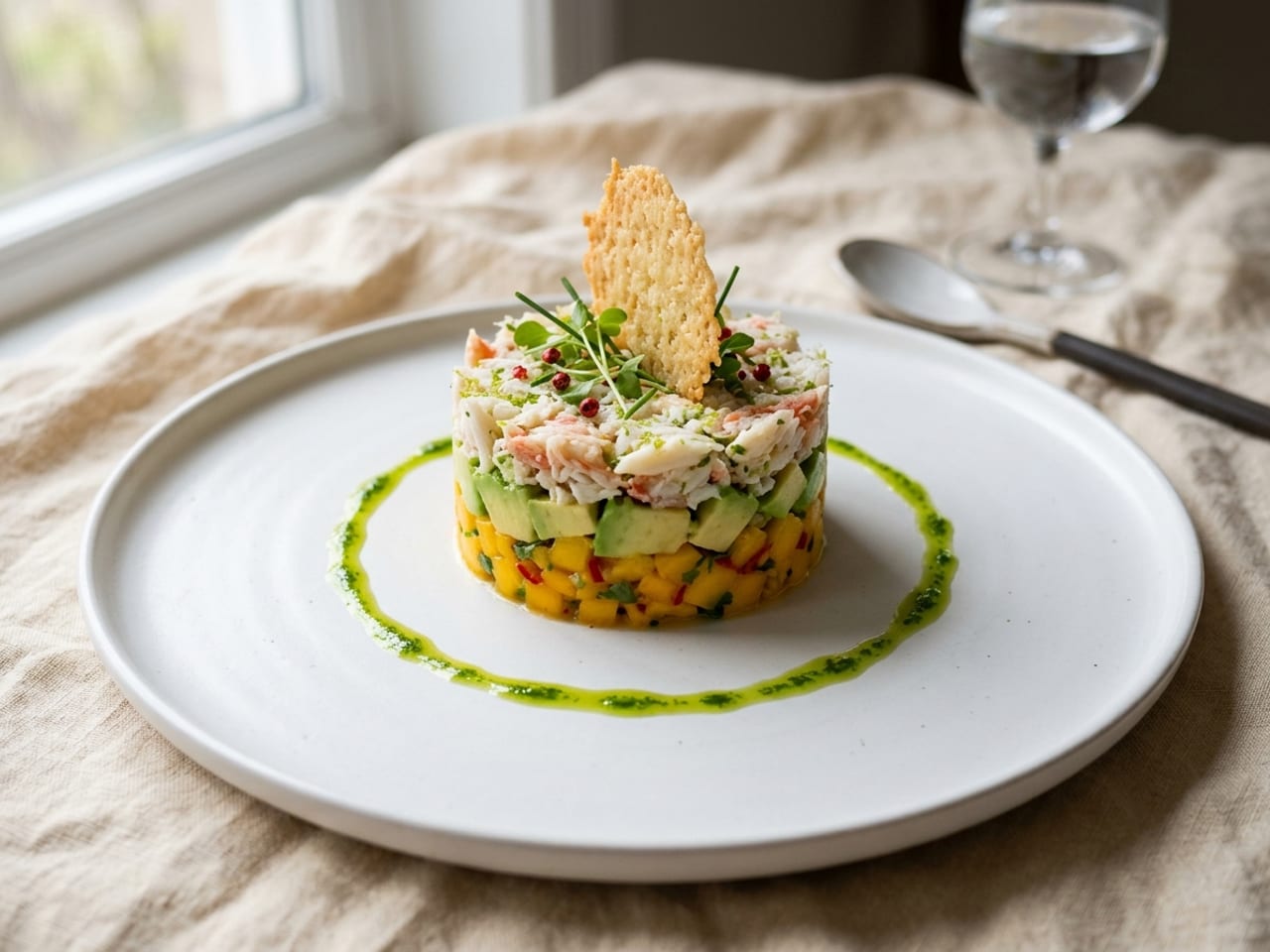
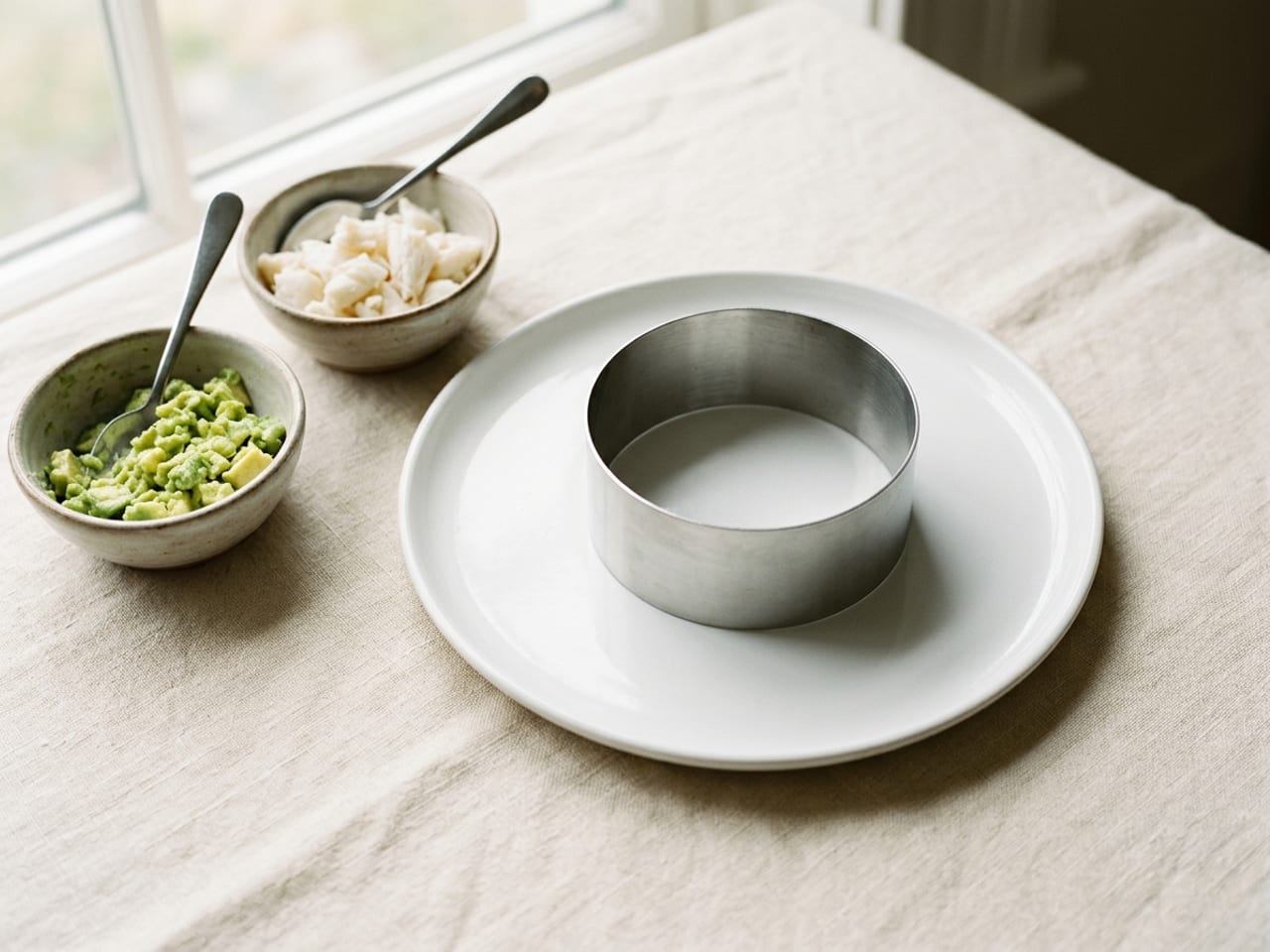
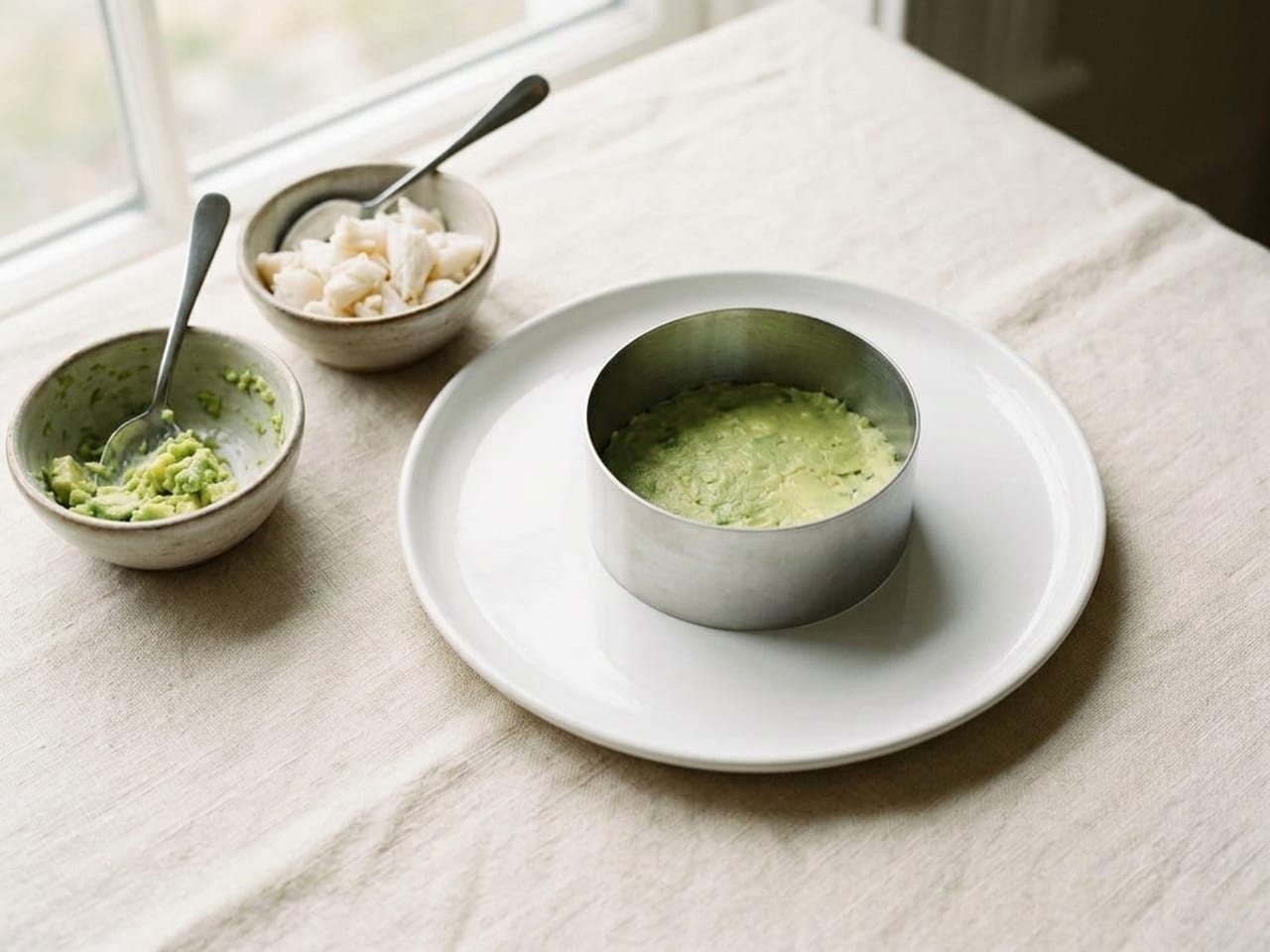
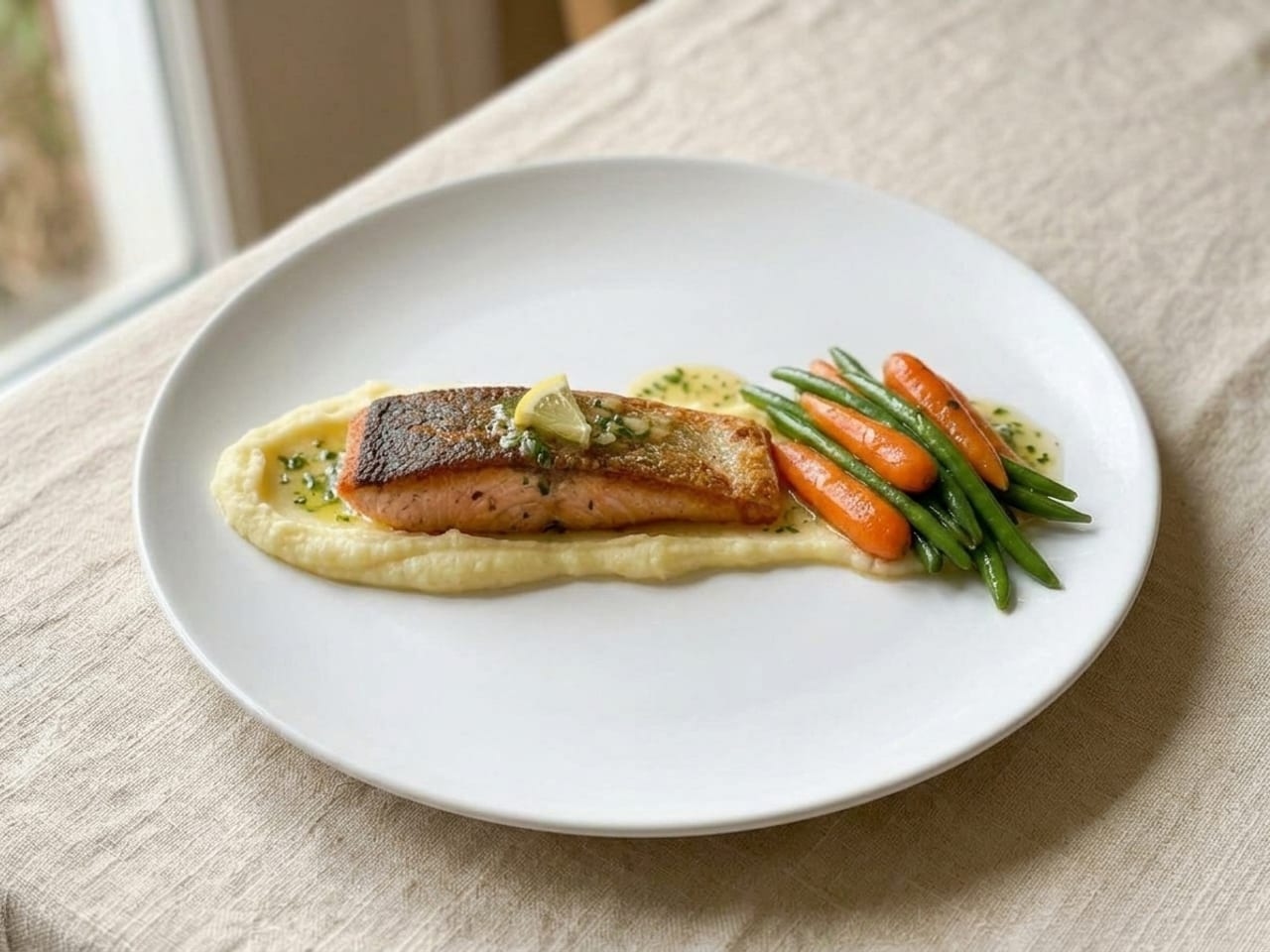
The photos on this page are AI-generated illustrations.
How to stack food for plating, in seven steps
Build from a base that will not slide, through a layer that binds, to the crisp or tall element last. Press each layer into a ring set on the plate, hold the top down and lift the ring straight up, and put the sauce around the base, not over it. That is the majority practice among the sources we read on 14 and 15 October 2026, not a rule; the counts are our own tallies.
- Choose one course and line up the layers. Not a whole meal: The Chopping Block, a Chicago cooking school, picks "the one that is constructible and stable", and most of its stacks are cold. "Line up your ingredients in the order you want to stack them."11
- Start with a base that will not slide. Either a soft binder pressed flat (11 sources, most of them avocado) or a flat, firm piece (9); a starch or a molded vegetable bed (6, rice under raw tuna as well as hot plates), or the sauce itself (7). Rouxbe: "You will need a solid base".12 Who puts what where.
- Drain the wet layers, and include one that binds. "At least one layer needs to be a 'glue' for the build."11 One of Fabricant's salads depends on "uniformly diced and drained vegetables."1 What glues a stack.
- Fill the ring, each layer just covering the last, and press. Ring on the plate in 21 of the sources that say where, lightly oiled in some. Press "gently but firmly", Fabricant's words; she calls compressing the layers "The secret to unmolding stacks perfectly".1
- Crisp and tall things go on last. Six sources put the crisp element on top, where sauce cannot reach it; a soft or sliced top is just as common in cold ring stacks (seven). Why crisp layers go soggy.
- Hold the top down and lift the ring straight up. Straight up, or "up and off", in six sources, and "carefully lift off" in both textbooks; a slight twist in two. Seven hold the top down while the ring rises, with a hand, a pusher, a spoon or a knife. The lift.
- Sauce around the base, wipe, serve. Sauce around (7) or under (7) more often than over (5). Fabricant: "Saucy recipes have a tendency to drain out the bottom", and her step 5 is "serve immediately".1
On this page: Layer order · What glues a stack · The ring, step by step · Lifting the ring · Ring sizes · Without a ring · Odd-shaped pieces · Height and stability · When not to stack · To the table · Stacked dishes · The research · History · Popular claims · Food safety · The words · FAQ
How this page was made. Every rule, size, date and quotation comes from the published source named beside it: chefs' recipes and cookbooks, culinary textbooks, cooking schools, food magazines and sites, peer-reviewed studies, food-safety agencies, regulations and dictionaries. Plate Artists cooked, stacked and measured nothing for it. Counts such as "21 fill the ring on the plate" are our tallies of what the sources print, never a survey, and a source that offers two options is counted under both. The textbooks and several cookbooks (Fabricant, Gisslen, Labensky, the CIA's Garde Manger, Portale, Mantuano) were lending-only scans that we could read only as search fragments, without the surrounding page; each is marked so. Two of the plating studies were read as abstracts only, and say so. Software vendors, sellers and makers are labeled. Rules from different countries, and rules for restaurants against advice for home cooks, are kept apart. Anything marked "ours" is our own reading, count, conversion or suggestion. Sources are at the bottom.
The layer order that holds, and where sources disagree
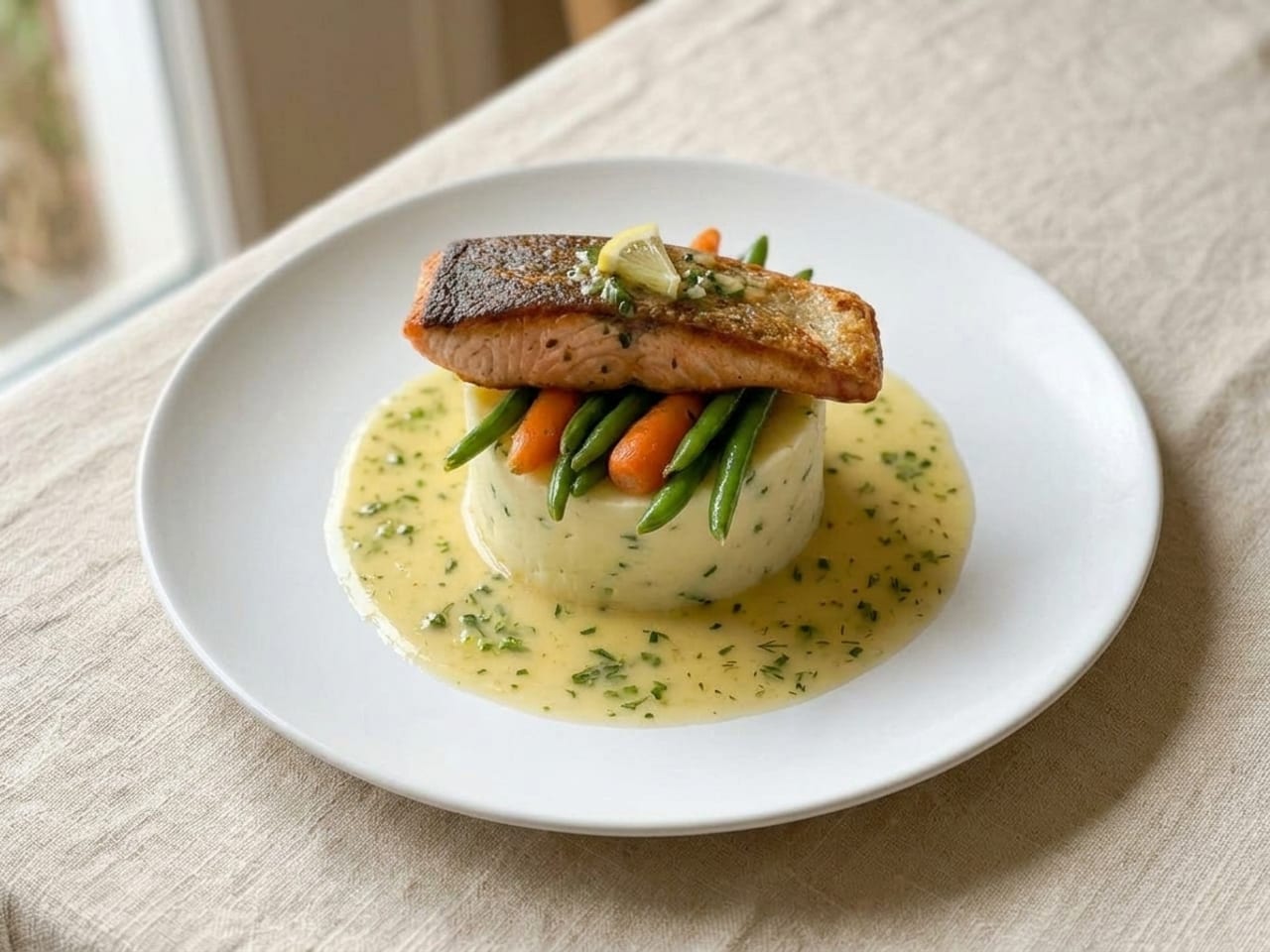
The base. Its job is to grip the plate and carry the rest. Rouxbe's online cooking school starts its tower with roasted peppers because "You will need a solid base"; a columnist puts it as "As in any construction project, a sturdy foundation is required."12, 15 For hot plates the classic base is a starch: Gisslen's stacked layout has the "Main item, vegetable and starch accompaniments, and other garnish stacked neatly one atop the other in the center of the plate", sauce around the outside, and the Swiss school starts with "a solid base of starch or sauce".5, 13 Cold ring stacks most often start soft: mashed avocado, pressed flat. A base can have a job of its own: an open pastry textbook sets ice cream on a cookie because it "will slow down the rate of melting".75
The middle. Each layer just enough to cover the last: Fabricant layers "making sure the previous layer is covered", and Maryland's middle layers "should just be enough to cover the previous layer", about a tablespoon (15 mL) each in Rouxbe's tower.1, 12, 36 The Chopping Block likes "a good strong base and then maybe 3-6 ingredients on top", adding: "You want the height but you also want the stability. A leaning tower of pizza will only make a mess."11
The top. "You can create height at the end with a parmesan crisp, a cracker or a cookie."11 Or a level, soft finish: the CIA spoons crème fraîche on the crab "and smooth it even with the rim".10 Gisslen's caution for any order: "Even when items are stacked, this should be done neatly so that each item is identifiable."5 And taste it the way it will be eaten: The Chopping Block's writer takes "a forkful of all of the ingredients together" during prep.11
The avocado disagreement. In 7 of the ring recipes we read the avocado is the base, pressed in first; in three it sits in the middle, on mango, cucumber or rice; and in two, a chef's and a culinary scientist's, it goes on top: Josiah Citrin spreads it level on the tuna "using an offset spatula", and Jessica Gavin lays thin slices on while the ring is still on.18, 27, 32, 34, 40 Under, it grips; on top, it is the smooth face and the color. Both work; the choice is about what you want seen.
Six questions, each with the positions we found and who holds them. The numbers are our count of the sources we read; a source can sit in two cells.
| The question | One camp | Another | Also in print |
|---|---|---|---|
| What goes at the bottom | A soft binder or purée: 11 (IzzyCooking (avocado), J-Prime Steakhouse (avocado), Southern Lady (avocado), the CIA's crab and avocado salad (avocado), Maryland's Best (avocado), Choosing Chia (avocado), StarKist (guacamole), The Chopping Block (a dab of the glue layer), Fred Bondurant (mash or a purée), Alfred Portale (potato purée under salmon) and ResDiary (fish on mashed potatoes)).10, 11, 15, 16, 29, 35, 36, 37, 38, 41, 64 | A flat firm or crisp piece: 9 (Rouxbe (roasted peppers, "a solid base"), Fred Bondurant (a crisp galette or halved fingerlings), The Daily Meal (vegetable crisps, as one option), Kosher.com (a crouton), Fabricant (a tomato slice, a waffle round, cheese or potato), Josiah Citrin (drained cucumber), a reposted ahi stack (cucumber), Jessica Gavin (cucumber and mango) and McCormick & Schmick's, as printed by 1859 Oregon's Magazine (mango)).1, 12, 15, 18, 27, 34, 40, 44, 58 | Sauce first: 7 (chef John Politte, chef Matthew Cutolo ("underneath or on the side"), HF Coors, Quattro (a dollop of tomato sauce), Kosher.com (dressing, then a crouton), Kent Rollins (enchilada sauce) and Maricruz Avalos (sauce-dipped tortillas)). A starch: 6 (Tasting Table (rice), the Marine Stewardship Council (rice, last into the cup), Gisslen (molded cabbage under fish), Culinary Arts Academy Switzerland ("starch or sauce"), Toast (proteins on starches) and HF Coors (proteins on starches)). The protein: 3 (Reluctant Gourmet's table (its own example disagrees), the Swan and Dolphin hotel (tuna first) and The Nibble's soup napoleon (lobster first)).3, 13, 23, 28, 30, 32, 42, 46, 47, 56, 59, 60, 66, 67 |
| Where the avocado goes | At the bottom: 7 (IzzyCooking, J-Prime Steakhouse, Southern Lady, the CIA, Maryland's Best, Choosing Chia and StarKist (as guacamole)).10, 29, 35, 36, 37, 38, 41 | On top: two (Josiah Citrin and Jessica Gavin), a chef and a culinary scientist.18, 34 | In the middle: three (McCormick & Schmick's (on mango, via 1859 Oregon's Magazine), a reposted ahi stack (on cucumber and mango) and Tasting Table (on rice)). And Gerald Hirigoyen puts it in first, then inverts the ring, so it ends up on top.19, 27, 32, 40 |
| What goes on top | Something crisp or firm, last: 6 (The Chopping Block (a parmesan crisp, a cracker or a cookie), Toast (a crispy garnish on a scallop), John Politte ("the items that you want to keep crisp"), Alfred Portale (croutons stood in the tuna), Tony Mantuano (a Parmigiano round) and The Nibble (croutons and caviar)).11, 17, 20, 30, 56, 67 | A soft or sliced layer, nothing crisp: 7 (Josiah Citrin (avocado spread level), the CIA (crème fraîche smoothed to the rim), Gabriel Gaté (crème fraîche), Jessica Gavin (sliced avocado), Southern Lady (sliced tomato), J-Prime Steakhouse (diced pineapple) and Gerald Hirigoyen (avocado, once the ring is inverted)).10, 18, 19, 21, 29, 34, 35 | Toast also says to "layer soft ingredients over crisp ones", against the same page's own scallop example.56 |
| Sauce under, around or over | Around the base: 7 (Josiah Citrin, Deborah Fabricant, Julian Wright, The Nibble (soup poured around), McCormick & Schmick's, Wayne Gisslen and Rouxbe (oil and dressing drizzled on the plate)).1, 3, 5, 12, 18, 26, 27, 30 | Under everything: 7 (chef John Politte, chef Matthew Cutolo ("underneath or on the side"), HF Coors, Quattro (a dollop of tomato sauce), Kosher.com (dressing, then a crouton), Kent Rollins (enchilada sauce) and Maricruz Avalos (sauce-dipped tortillas)).23, 44, 46, 47, 59, 66, 67 | Over the top: 5 (a reposted ahi stack, Maryland's Best, the Swan and Dolphin hotel (before the ring comes off), Quattro (a little sauce on top) and Deborah Fabricant ("a small amount" over the top, as well as around)).1, 23, 28, 36, 40 |
| Where the ring is filled | On the serving plate: 21 (IzzyCooking, J-Prime Steakhouse, a reposted ahi stack, Southern Lady, McCormick & Schmick's, Josiah Citrin (in a shallow bowl), Wayne Gisslen (1999 and 2011 editions), On Cooking, Gabriel Gaté, Elle Republic, The Nibble (in a soup bowl), Jessica Gavin, Rouxbe, the Swan and Dolphin hotel, Alfred Portale's televised recipe, Alfred Portale's cookbook, Tasting Table, StarKist, Tony Mantuano, Food Republic and Deborah Fabricant (the plate or a baking sheet)).1, 3, 5, 7, 12, 16, 17, 18, 20, 21, 27, 28, 29, 30, 32, 33, 34, 35, 37, 39, 40, 41 | Off the plate, then moved: 5 (the CIA (the filled ring moved to the plate), Deborah Fabricant (a wide spatula), Julian Wright (both mixes ringed, then set on the plate), Quattro (baked in a dish; the move is not described) and a seed seller's potato stacks (lifted out of ramekins with a spatula)).1, 10, 23, 26, 52 | In a closed mold and turned out, which reverses the order: 8 (Gerald Hirigoyen (a ring inverted with a spatula), IzzyCooking (a ramekin), On Cooking (grains), chef Walter Redaelli (a baked timbale), Girl Carnivore (a ramekin), the Marine Stewardship Council (a cup), Tasting Table (a ramekin, as the fallback) and a Food.com user (a 5-cup, 1.2 L ring)).7, 19, 24, 32, 37, 42, 43, 50 |
| How the ring comes off | Straight up, up and off, or up and away: 6 (Deborah Fabricant ("straight up"), Girl Carnivore ("straight up"), StarKist ("straight up"), Café Beaujolais ("straight up", a ring in a soup bowl), Alfred Portale ("up and off") and Tasting Table ("up and away")).1, 16, 17, 31, 32, 41, 43 | With a slight twist: two (Food Republic ("twisting slightly") and The Nibble ("twist the ring slightly")).30, 33 | Holding the top down as it rises: 7 (Deborah Fabricant (the other hand steadies the stack), Rouxbe (the plunger), McCormick & Schmick's (fingers or a spoon), a reposted ahi stack (press the top), Tasting Table (a small spatula on the tuna), Josiah Citrin (a small knife in the center) and a ring seller ("pushers for clean demolding")).1, 12, 18, 27, 32, 40, 48 Girl Carnivore twists only "If the ramekin sticks".43 No direction, just "Carefully lift off": two (Wayne Gisslen ("Carefully lift off") and On Cooking ("Carefully lift off")).3, 5, 7 |
Our reading of the camps. They are less opposed than they look. A cold starter in a ring starts soft because the binder holds the loose dice above it; a hot plate starts with a starch because the protein needs a bed and the sauce needs somewhere to go; sauce goes first when the top must stay crisp. Pick the base for the dish, not the rule. Sites that rank for this question print one order each, sometimes two that contradict each other: Reluctant Gourmet's table says "Protein at the base, vegetables or garnish stacked on top." while its own example sets the fish on mashed potatoes.60
What glues a stack
Seven things the sources use to keep layers from sliding apart. None was tested by us.
- A soft layer that bindsThe Chopping Block: "Think about foods like pesto, hummus or whipped cream. The glue offers some stability to the other ingredients. On some dishes, I'll put a dab on the very bottom to keep the stack from sliding."11 For canapé stacks, cookbook author Margaret Dickenson uses "touches of flavoured mayonnaise, cream cheese or something else to bind the layers in a secure fashion."55 The crab tower in Southern Lady binds its crab with mayonnaise.35
- Grains bound by sauce, and risottoOn Cooking: "grains or vegetables bound by sauces, can be molded into attractive shapes by using metal rings, circular cutters or other forms." The molded forms "create height and keep the plate neat".7 Fabricant discovered "how perfect risotto is in holding stack layers together".1
- Cold, to set itJessica Gavin sets a tuna tower in the freezer for 15 to 20 minutes, "this will help the tower stay together better. Do not leave in the freezer for longer than 20 minutes."34 Fabricant assembles salad stacks 2 hours ahead and chills them.1 A sugar tower is the exception: an ICE chef-instructor keeps a caramel-glued croquembouche out of the refrigerator, "where the humidity can soften sugar and make your tower collapse."74
- Taking the water outThe CIA squeezes the seeds out of the tomato for its salsa layer: "Gently squeeze out the seeds."10 Quattro salts its eggplant on a rack, "Let stand 15 minutes to release moisture; then pat dry."23 Gavin blots the liquid that seeps from her cucumber layer before unmolding.34 A ring maker's warning: "be careful that your fillings aren't too runny, as the circles may spread apart when removing the form."53
- Chunks, not a smooth pasteMaryland's Best mashes the avocado for its base only lightly: "make sure to leave chunks so that it can maintain its density".36
- A pin, for a piece that falls apartFabricant runs "a thin metal skewer through the slice" of a grilled onion to hold its rings; Gisslen holds onion slices with "a bamboo skewer"; a Kosher.com caprese stack has "a skewer through the center".1, 3, 44 A pick left in a stack must be seen: hidden picks.
How to use a ring mold, step by step
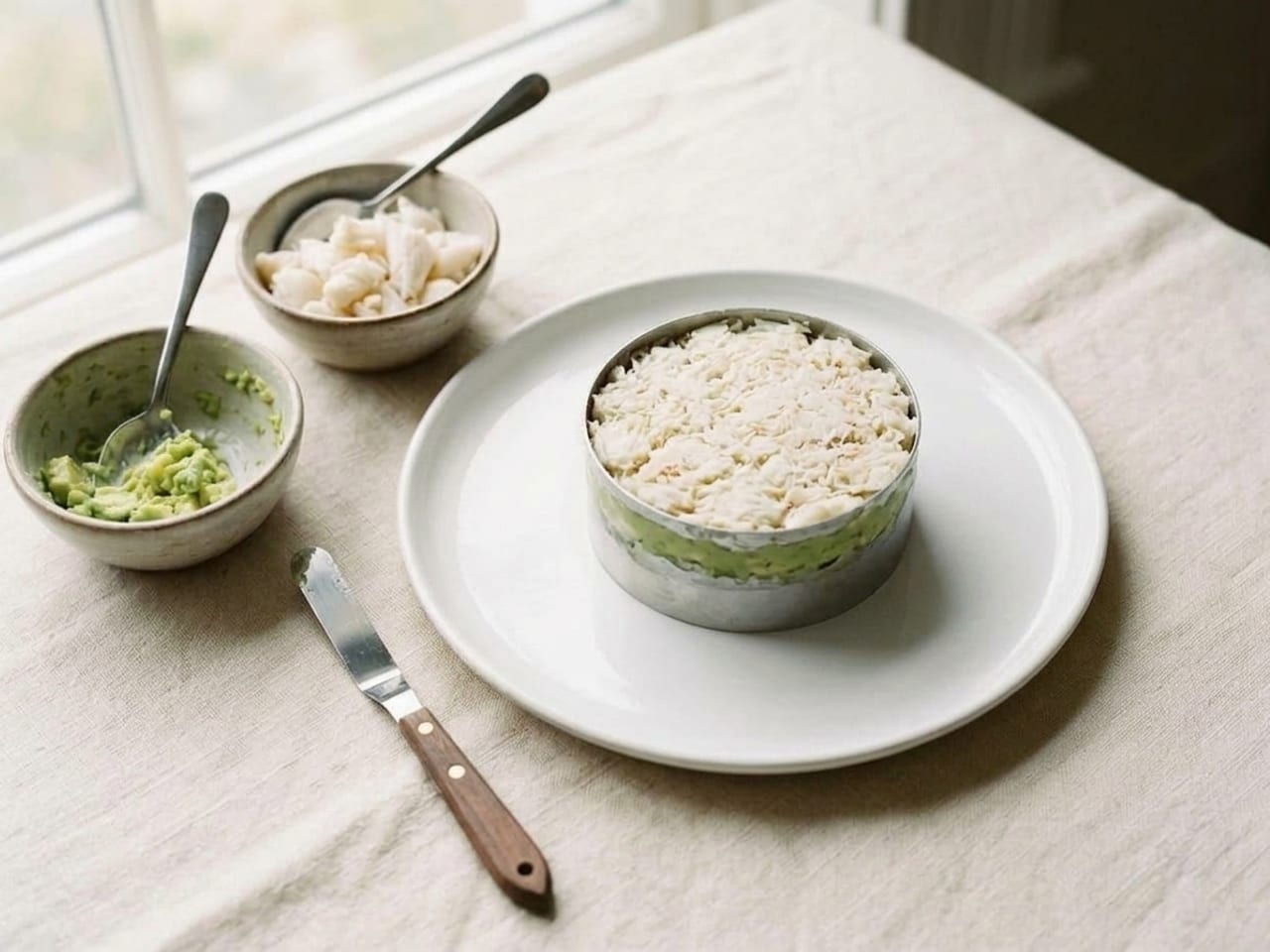
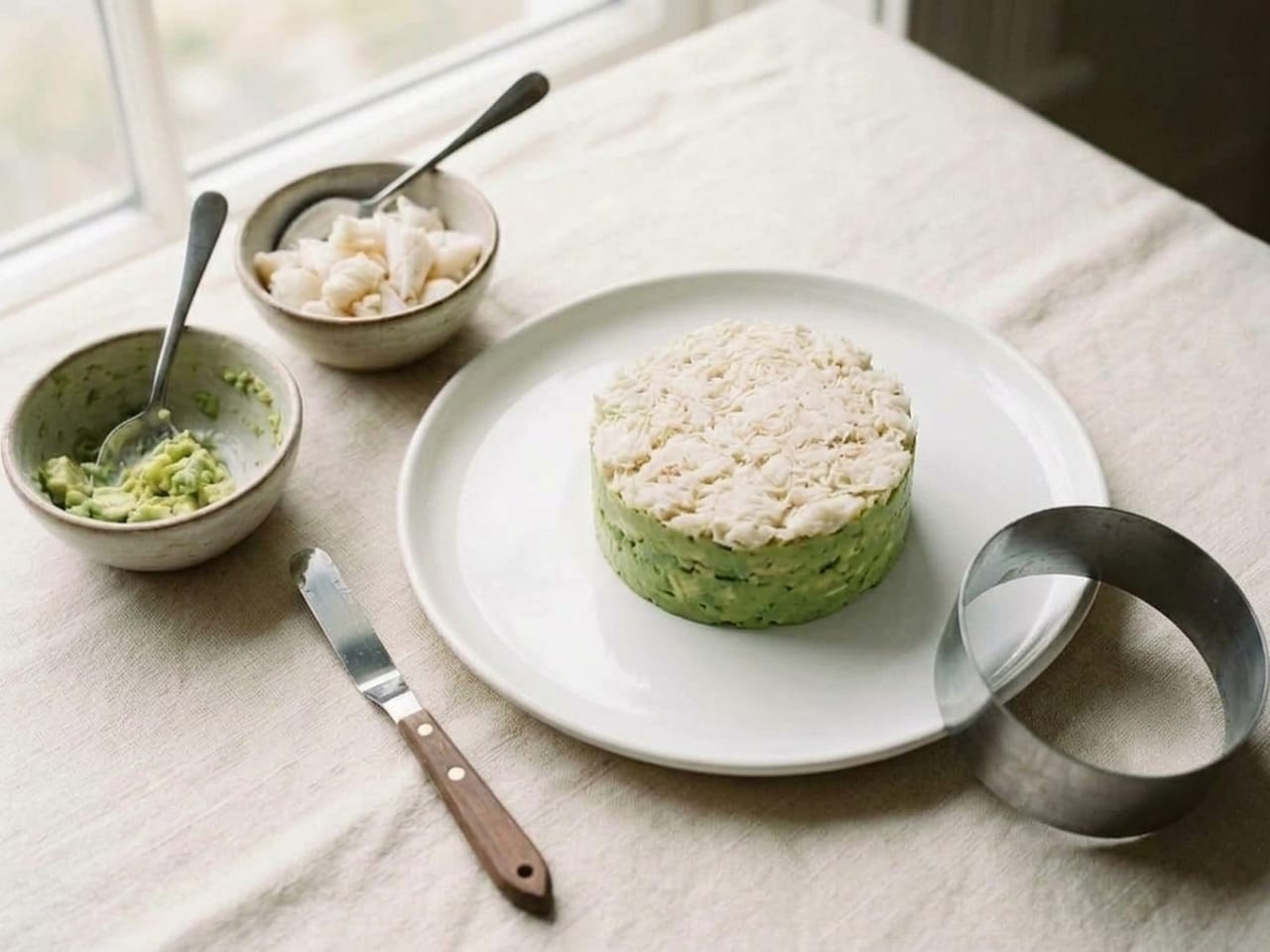
Two published methods. Most fill the ring on the plate; some fill it on a board or a baking sheet and move it. The frames show the first; they are AI renders, not a cooked dish.
On the plate: the textbook method
Gisslen's 1999 procedure has three steps: place the ring where the food should sit; "Fill the mold with the food item. Use a spatula or palette knife to level the top, if desired."; then "Carefully lift off the mold". His 2011 figure shows the same in two pictures.3, 5 On Cooking's procedure for molding vegetables matches it, adding a press.7 It is the method of 21 of the sources that say where the ring is filled, and it needs no transfer: the stack never moves.
Off the plate, then moved: Fabricant's five steps
- Coat the inside of the mold with nonstick spray and "set the mold on the serving plate or baking sheet. Begin layering the ingredients".
- "When the cylinder or mold is filled, press down gently but firmly" to compress the layers, so the stack will "hold together when" unmolded.
- "When the stack is completed, refrigerate," freeze or bake as the recipe says.
- "To serve, using a wide spatula, transfer the stack to a serving plate. With one hand, gently lift the mold off of the stack of ingredients, using the other hand to steady the stack."
- "Garnish the stack as directed and serve immediately".
Stitched from fragments of her 1999 book, so the joins are ours.1 The CIA works the same way for its crab salad: "Transfer the filled ring to the center of an 8-inch plate and carefully lift off the ring mold."10 The off-plate method suits a stack that bakes or chills, and many portions at once: "Keep in mind that you will need one cylinder per guest."1 Its risk is the move; slide the spatula fully under the ring (ours).
Lifting the ring: straight up, or with a twist?
Straight up is the majority: 6 sources lift straight up, or "up and off", against two that twist; the two textbooks say only "Carefully lift off". The names are in the table. Food Republic's 2013 method lifts "twisting slightly (sandcastle-style)", and The Nibble's soup napoleon says "Then twist the ring slightly to remove it." 30, 33 Girl Carnivore twists only "If the ramekin sticks".43 Café Beaujolais, using a ring as a divider in a soup bowl, lifts it "straight up and out of the bowl".31
Hold the top down, which seven sources do in one way or another: Rouxbe's plunger, Fabricant's other hand, a spatula on the tuna at Tasting Table, "your fingers or a spoon" at McCormick & Schmick's.1, 12, 27, 32 Citrin's trick for a stack that rides up with the ring: "While pulling up the ring mold, you may need to insert a small knife into the center to keep the molded stack from lifting off the plate."18 And slowly: Maryland's recipe prints it in capitals, "SLOWLY remove mold".36
Before or after the sauce? After, in most: the Swan and Dolphin hotel is the exception that drizzles glaze and oil and places the garnish before the ring comes off.28 A tall garnish is different: Portale stands his croutons in the tuna while the ring still holds it.17
Ring mold sizes by course and by plate
Every size here is as printed, with the source's own metric where it gives one and ours otherwise. Only Fabricant gives sizes by course; the plate sizes are those printed with a ring.
| Who | The ring | For |
|---|---|---|
| Deborah Fabricant, Stacks (1999), small1 | 2 in across, 3 in high (5 × 7.5 cm) | Appetizers and "tiny tea sandwiches" |
| Fabricant, medium1 | 3 × 3 in (7.5 × 7.5 cm) | Salads, sweets and starters |
| Fabricant, large1 | 3 in across, 4 in high (7.5 × 10 cm) | Entrées, salads, sandwiches and sweets; she likens it to a 15-ounce (425 g) broth can |
| The Culinary Institute of America8, 9, 10 | 6 cm by 3 cm in the 2008 Garde Manger (the book's metric); 2 in by 1½ in (5 by 4 cm) in its 2004 newspaper column | A crab and avocado salad, moved to an 8-inch (20 cm) plate |
| Wayne Gisslen, Professional Cooking (1999)3 | 2½ to 3 in (6 to 8 cm, his metric); 4 in (10 cm) for a tian | Vegetable beds under fish, a spinach portion; the tians on a baking sheet |
| Alfred Portale16, 17 | 3 in across, 1½ in deep (7.5 × 4 cm) on television; 2½ in (6.5 cm) in his 1997 book | Tuna tartare in the center of a chilled 12-inch (30 cm) dinner plate |
| Josiah Citrin; Rouxbe; McCormick & Schmick's12, 18, 27 | 2 in (5 cm) | A tartare in a shallow bowl; a seafood tower; a crab tower |
| Gerald Hirigoyen; Jessica Gavin; Southern Lady19, 34, 35 | 3¼ × 1¼ in (8.3 × 3.2 cm); 3 × 3 in (7.5 × 7.5 cm); 3½ in (9 cm) | Tuna tartare inverted onto the plate; a tuna tower about 2½ in (6.5 cm) high; a crab tower |
| Gabriel Gaté21 | 10 cm (4 in), PVC | Salmon tartare, the mixture divided between two rings |
| Anthony Bourdain, Kitchen Confidential (2000)107 | "about an inch and a half to two inches tall" (4 to 5 cm), "varying inches across" | Mashed potato, the vegetable on that, the chicken on top |
| Salazar Cobo and colleagues (2025), a study98 | 16 cm across, 10 cm high (6¼ × 4 in) | A chicken salad shaped as a "mountain" on a 26 cm (10¼ in) plate |
Reading the table (ours). Most savory rings are 2 to 3 inches (5 to 7.5 cm) across. Plating rings are short: 1¼ to 1½ inches (3 to 4 cm) high in the CIA's, Hirigoyen's and Portale's; Fabricant's are tall, as high as or higher than they are wide, because her whole dish is the stack. The two printed pairings leave a wide border: a 2-inch ring on an 8-inch plate, a 3-inch ring on a 12-inch plate, a quarter of the plate's width. The Chopping Block's plate advice: "make sure you are using a bigger plate."11 Sellers make rings from about 6 to 24 cm, with pushers; our plating tools guide has the catalog sizes.
How to stack food without a ring mold
- A ramekin or cup, turned out: build it upside downTasting Table: "just grease the container and reverse the order, starting with tuna and finishing with rice, then turn the bowl over and release the stack onto the plate."32 The Marine Stewardship Council does it right: sesame seeds into the cup first, rice "lastly".42 Three recipes we read skip the point: IzzyCooking's ramekin does not say which layer goes in first, Gerald Hirigoyen inverts a ring with the avocado in first, so it ends up on top, and Girl Carnivore spoons in "the tomato base, then the tartare" before flipping it, which puts the tomato on top.19, 37, 43 The rule is in one source only; the consequence is ours.
- A can with both ends removedFabricant: "Remove both ends of the can, empty it, and wash the interior thoroughly with warm soapy water".1 The Chopping Block: "use a can opener that takes away the sharp edges."11 Rouxbe, J-Prime and Elle Republic name a small can or a tuna can.12, 29, 39 No agency page we found addresses cut cans as molds; the cut edge is the hazard we can name without one (ours). Improvised rings.
- PVC pipe, cut to heightNot a fringe idea: a Culinary Institute of America associate professor, Olivier Andreini, suggests it ("The molds are dishwasher safe and can be used repeatedly"), Gabriel Gaté uses 10 cm PVC rings, Fabricant's first mold was "a cylinder crafted from PVC pipe" and Bourdain names a "cut-down section of PVC pipe". 1, 10, 21, 107 None of them says anything about food-contact grade, and plumbing pipe is not sold for food. Read this first.
How to plate odd-shaped components
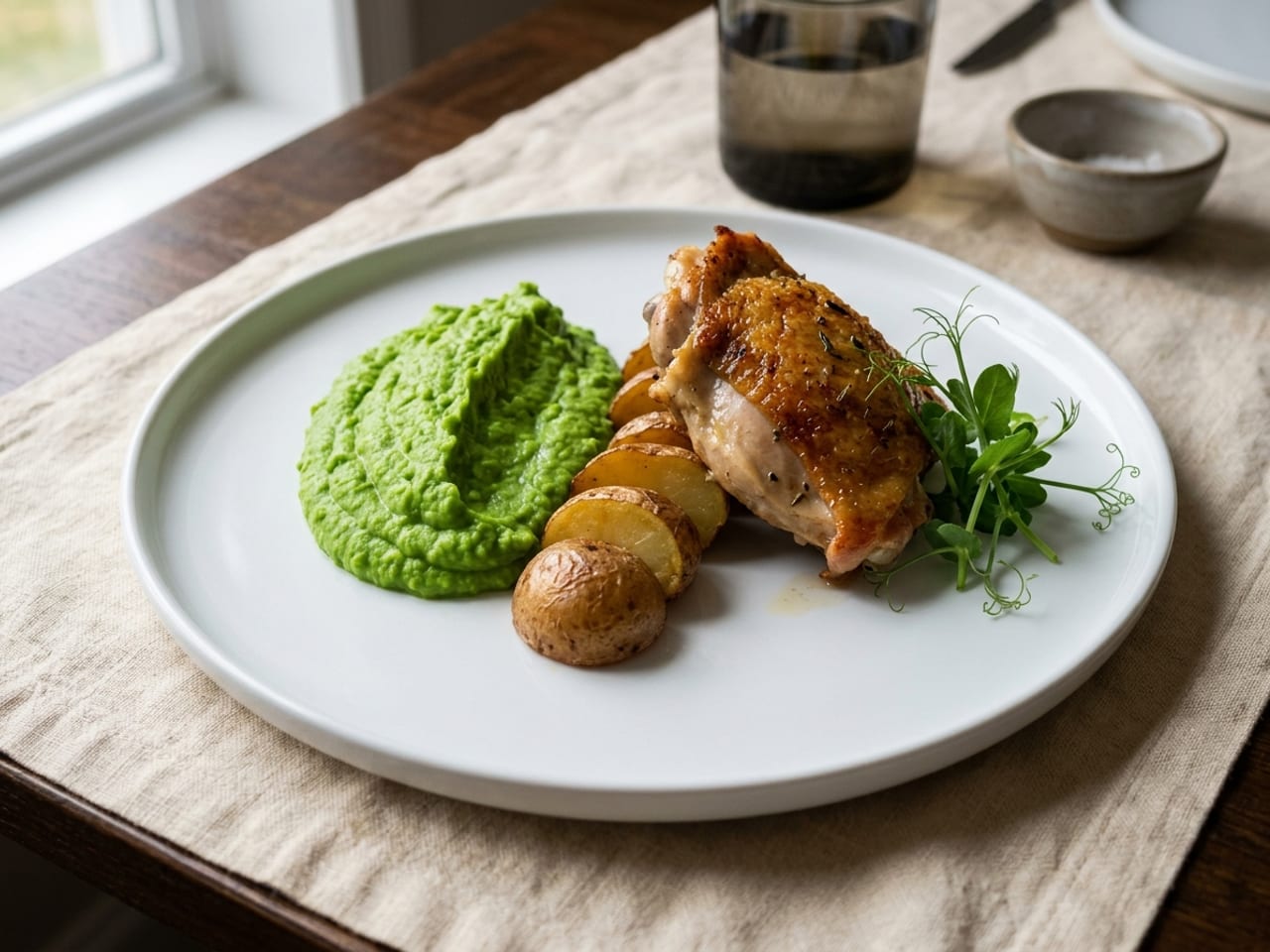
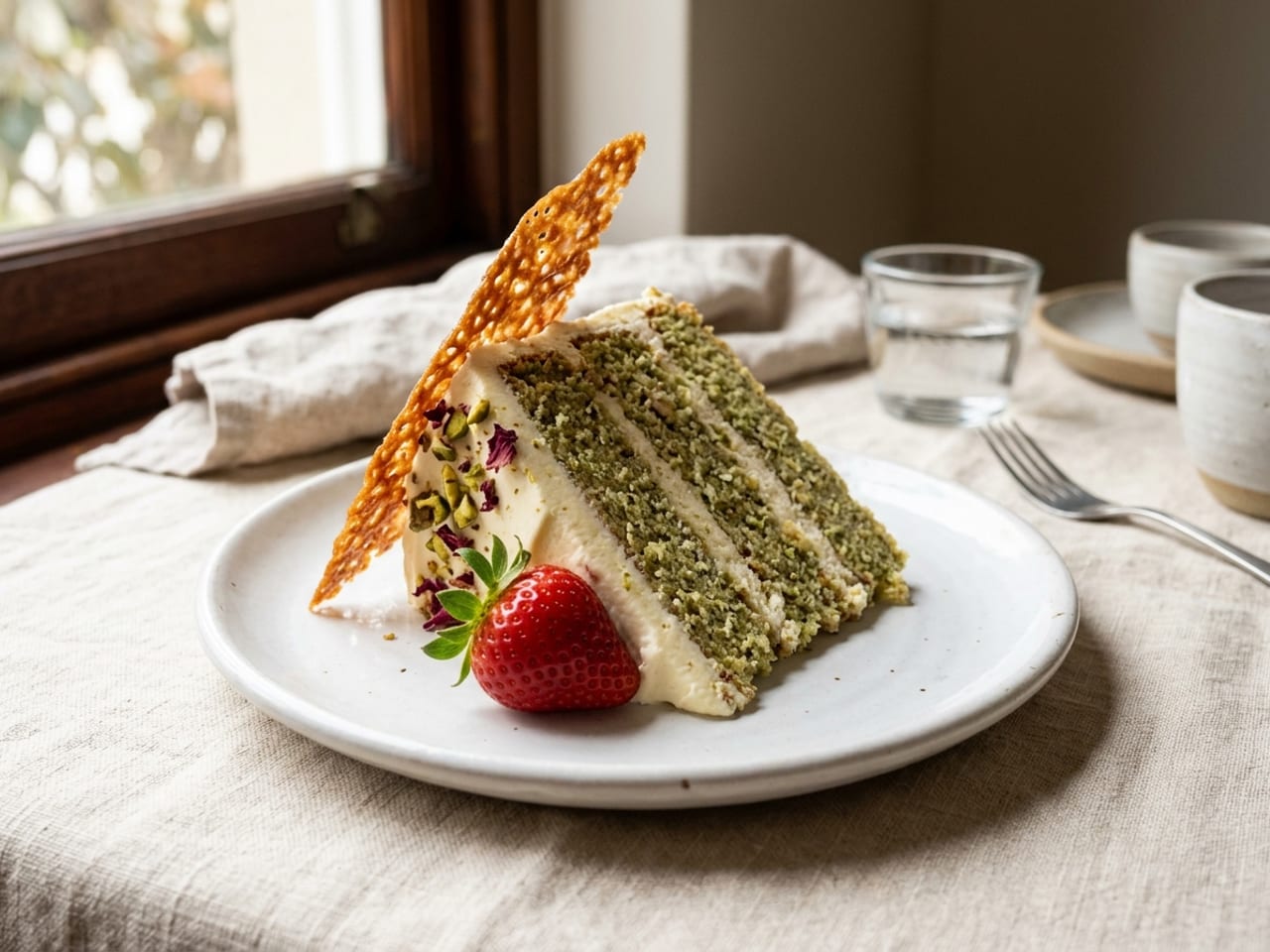
- Give a round piece a flat faceSunset: "Trim a very thin slice from base of tomatoes so they sit flat".77 A foodservice textbook does the same to citrus: "Cut a thin slice of the base so each coronet is stable."78 Fred Bondurant, for a base without mash: "halve them lengthwise and place the cut side on the plate."15
- Cut face against cut faceA Kosher.com caprese stack: a crouton as the flat base, "a tomato half, cut side up", a mozzarella ball, then "a second tomato half, cut side down", so curved meets flat at every joint.44 The angled cut works the same way standing up: a strudel half set "flat end down and angled end up."102
- Lean it on an anchorToast calls firm elements "bases or anchors to support looser items."56 The anchor can be soft: Hans Rockenwagner's "Paper-thin Parmesan bread crisps stand up in white bean puree", and Bourdain, mocking the style, jams a gaufrette potato into the mash.102, 107 Michelin-starred chef Saul Bolton: "Allow foods to rest on each other".84
- Let bones interlockThe guard of honour: two French-trimmed racks with 50 mm (2 in) of bone exposed, then "Interlock the ribs."79 Le Cordon Bleu: "push the racks firmly together so the bones interlock."80 Single cuts: "Bone-in cuts can be leaned against each other (teepee style) to really achieve height."15
- Stand it up only if it is worth seeingA lamb shank recipe from the English meat board: "If the lamb shanks have presentable bones, put the whole shank on the top of the mash. If not take the meat off the bone and arrange on the mash."81 Bolton: "everything should be seen, even if it's just peeking out."84
- Stand the tall garnish in while the ring is onAlfred Portale's tartare: "Stand 3 croutons into tuna and top with a little herb salad. Carefully lift ring mold up and off the plate." The ring holds them while they go in.17
Height and stability: what is published, and what is not
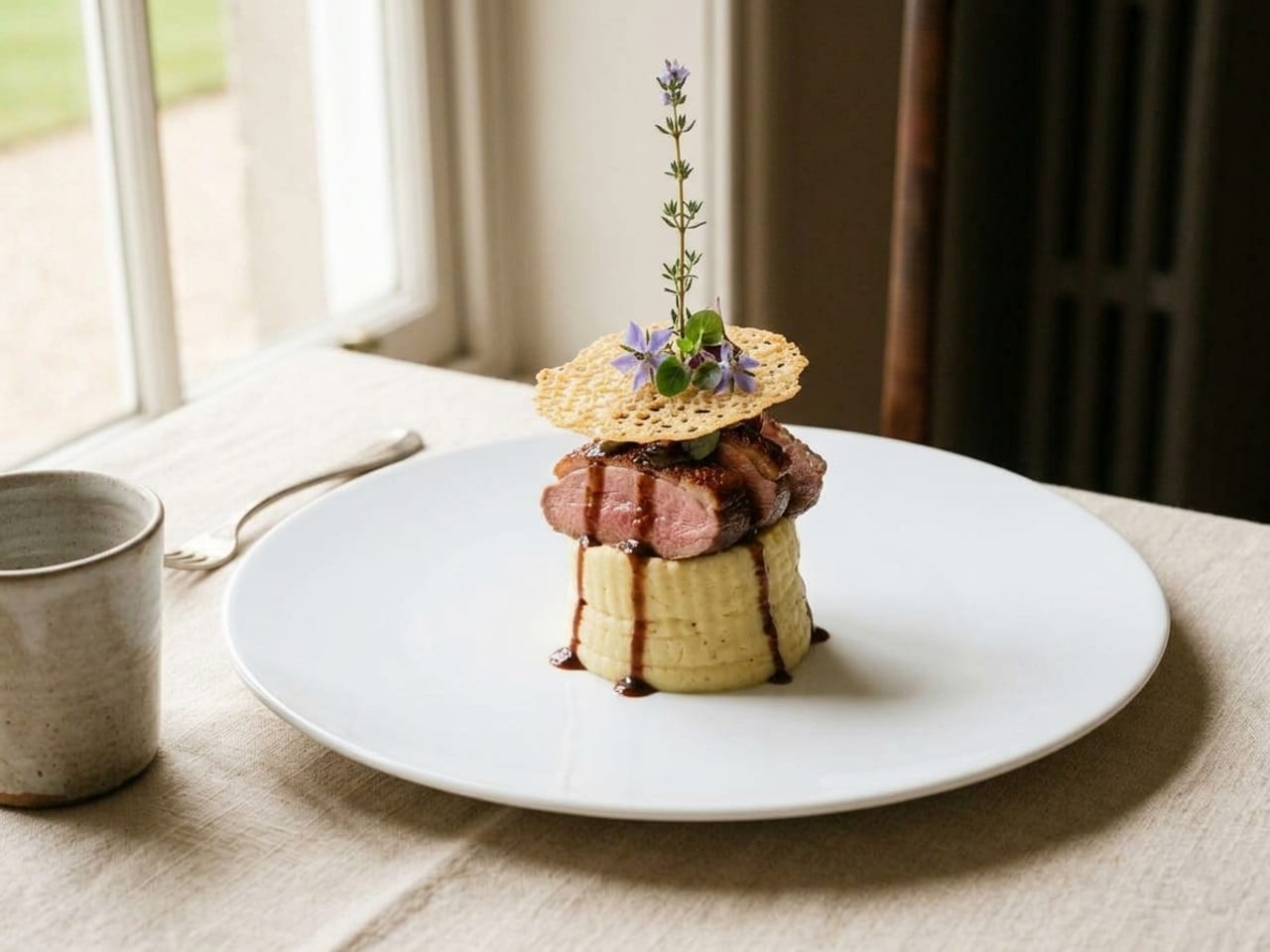
No height limit is published. We found no maximum height and no ratio of base to height from any chef, school or textbook. What exists is description: Jessica Gavin's tower is about 2½ inches (6.5 cm); a Baltimore chef's tallest dish in 2002 was "3 to 4 inches" (7.5 to 10 cm); Portale's seafood salad stood "about four inches tall" (10 cm); and the 1990s entrées a critic described were "4, 5, 6 and more inches high" (10 to 15 cm).34, 103, 106 The American Culinary Federation's competition guide asks for "varied, but not extreme" heights, and warns against presentations that "go overboard" and are hard for judges "to serve and eat".83
What the sources say instead. Toast: "Height should feel intentional, not precarious."57 The Chopping Block: "Sometimes the best planned dish can tip over."11 A textbook: "The function of height is to give focus", and it can be "actual or implied", so a garnish can supply it.70 A small culinary program: "No need to build a 'food tower.'"14
Our rules of thumb, from the physics above and the sources' methods, not from a test: the widest, firmest layer at the bottom; each layer centered on the one below; the top light; and a stack no taller than its base can hold without leaning. The side-to-side shake some posts recommend comes, as far as we could find, from one anonymous careers page; it does no harm before the sauce goes on.65
When not to stack
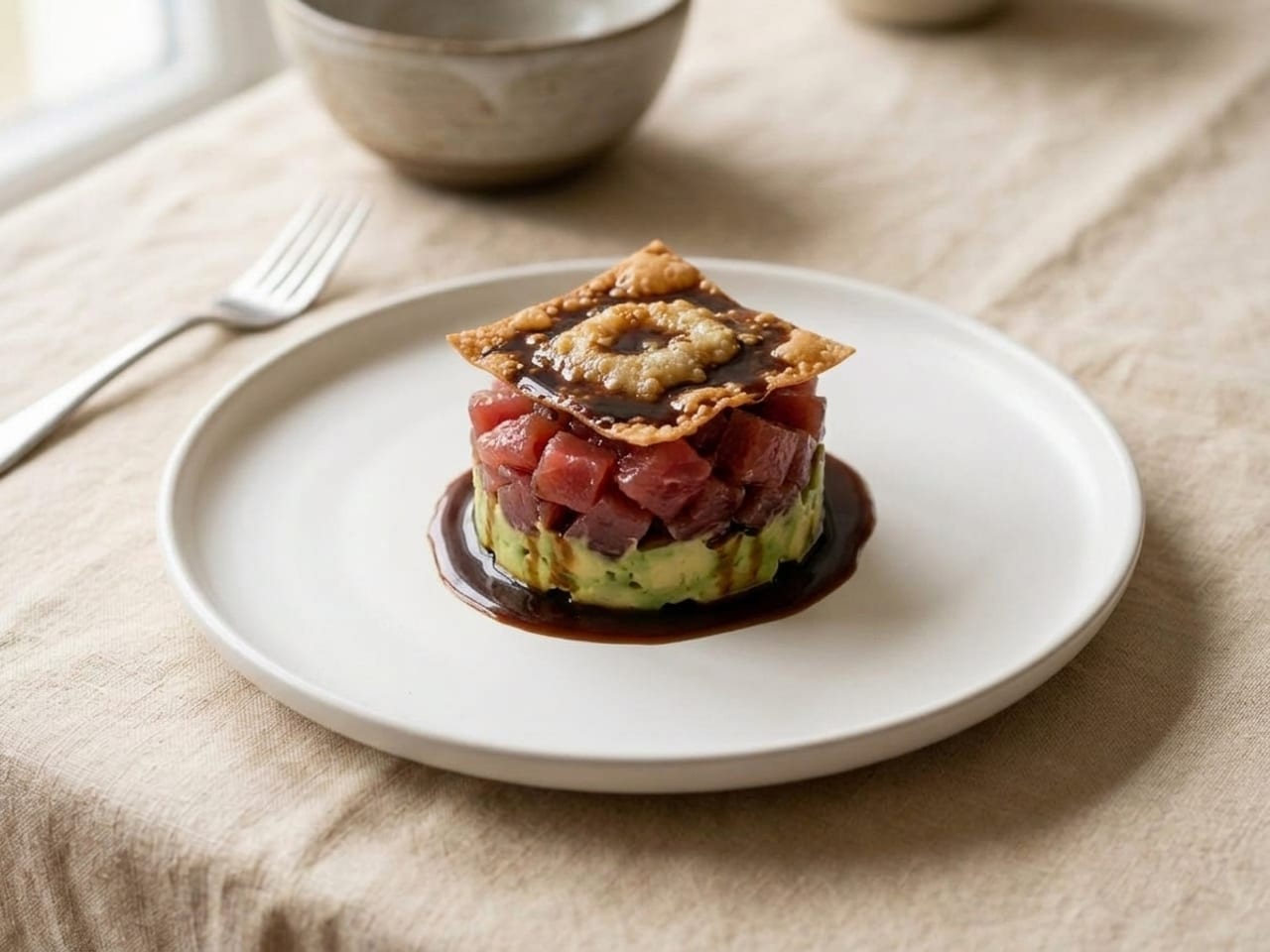
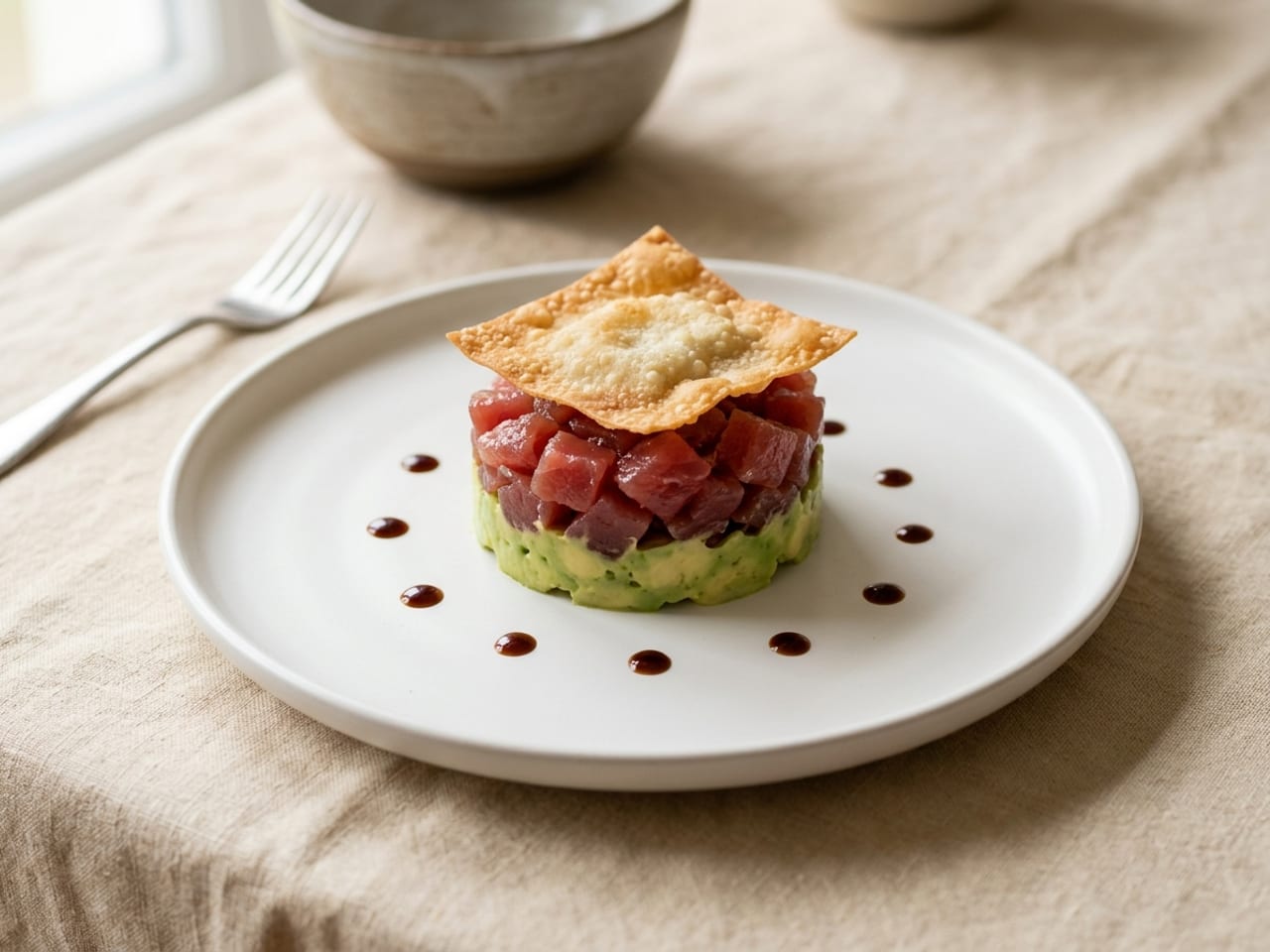 Sauce aroundSauce over
- Crisp on wet, or wet on crispDavid Burke, a chef known for tall food: "There is a method to it. It's not just stacking," and get crisp and moist wrong and "the next thing you know, you're eating a soggy mess."103 Escoffier served the garnish apart from crumbed veal "lest its moisture soften the crisp coating".69 Chef Matthew Cutolo: "You usually have about three to five minutes before the moisture begins softening the crust", his estimate, not a measurement.66 A textbook holds breaded items in a single layer "so that they do not sweat or become soggy", with wax paper between layers if they must be stacked.70
- A sauce that has to go over the topThen it reaches every layer. Cutolo: "serving the sauce underneath or on the side is ideal because it preserves the crispness". Chef Chris Valdes puts a buffer between: "A swipe of purée, a layer of refried beans, a slaw, or even shredded lettuce can act as insulation between sauce and crunch".66 Chef John Politte puts the sauce down first, which "prevents the protein from sitting in liquid".67
- A hot dish you cannot build fastThe Chopping Block: hot stacks work on rice, polenta or potato bases "but there is some finesse in getting it all stacked and to the table hot."11 Hot on cold wilts: chef Megan McCarthy lets warm items "cool slightly to avoid wilting greens" and adds them last, and a restaurant association's textbook: "Warm plates will wilt the leaves."68, 71
- When the diner has to take it apartGisslen: when the style is "carried to extremes", "customers are faced with the job of carefully deconstructing a tower of food and rearranging the items on the plate so they can begin eating."5 An open pastry textbook remembers "towering architectural assemblies that were impressive and beautiful to look at but were difficult to eat".76 Chef James Neel, in 2004: "When it gets to where you can't even eat it, there's no point".93 The Chopping Block uses a bigger plate, because "when your guest digs in, the stack may topple a little."11
- A salad that tastes better tossedEscoffier: "I do not advise the moulding of compound salads, for the increased sightliness resulting therefrom is small compared with the loss in the taste of the preparation." The same sentence allows height: nothing fancier than "the arrangement of the vegetables in a pyramid".69 More in how to plate salad.
- Sugar and crisp pastry that must wait"A mille-feuille gets built at the last minute or the pastry goes soggy." (The same page allows up to 8 hours.)73 King Arthur's napoleons are "best served the day they're assembled".72 A croquembouche is assembled the day it is served, kept out of the fridge and not wrapped in plastic, which makes it sweat.74
Getting a stack to the table
- Warm plates for a warm stack, cold for a cold oneThe Chopping Block: "warm your plates! It'll buy you some time." 11 The only measured figure we found is America's Test Kitchen's: soup heated to 190°F (88°C) "stayed about 10 degrees hotter for 10 minutes in a warmed bowl" (145 against 135°F, 63 against 57°C).86 That is soup in a bowl, not a stack. Practice varies widely: the table.
- The walk to the tableThe Los Angeles Times in 1999, reporting chef Hans Rockenwagner: tall food needs "swift, graceful delivery to the table" lest it "give in to gravity" (his words), and a few of his have been reduced to rubble on "a rough walk through the dining room."102 A food-handler trainer: never let "any of your fingers, especially the thumb, touch the top of the plate."92 We found no carrying method written for stacks; level, slow and one plate per hand is our suggestion.
- Or unmold it at the tableFabricant served a first course in PVC pipe molds and told her guests to lift them "straight up, revealing their stacked first course."1 We found no one else who prints it.
- What can be made aheadComponents, yes; crisp layers, no. Fabricant assembles salad stacks "2 hours prior to serving and chill", dressing the last layer of greens at serving time.1 Gavin's tuna tower keeps up to 3 hours in the refrigerator, her figure.34 King Arthur makes napoleon pastry and cream up to three days ahead and assembles later.72
How warm, how cold: published practice, not a rule
No source gives a target plate temperature for a stack. Each line is its owner's.
| Who | How |
|---|---|
| Hatco, a maker of plate warmers88 | Holds plates at 104 to 122°F (40 to 50°C), its own figures |
| Chef Richard Sandoval, relayed by Tasting Table via People89 | About 5 minutes at 200°F (93°C) |
| America's Test Kitchen, how-to86 | Ovensafe dishes on the rack of a 350°F (177°C) oven, no more than two stacked, checked at 30 seconds and then every minute for up to 3 minutes; boiling water for plates that are not ovensafe; "hot tap water wasn't hot enough" |
| Chef Paul Butler, in America's Test Kitchen's 2022 article87 | 325 to 400°F (163 to 204°C) for 10 to 40 seconds; the same article lists superhot tap water for 10 seconds, which the test kitchen's own how-to found too weak |
| Chefs Joshua Lewin and Paul Butler (same article), cold plates87 | In the fridge for 30 minutes to an hour, for crudo, sushi and salad |
| Food Republic, cold bowls90 | "A mere 15 minutes in the refrigerator" |
Stacked dishes: the tuna stack, crab tower, caprese, napoleon, timbale and tian
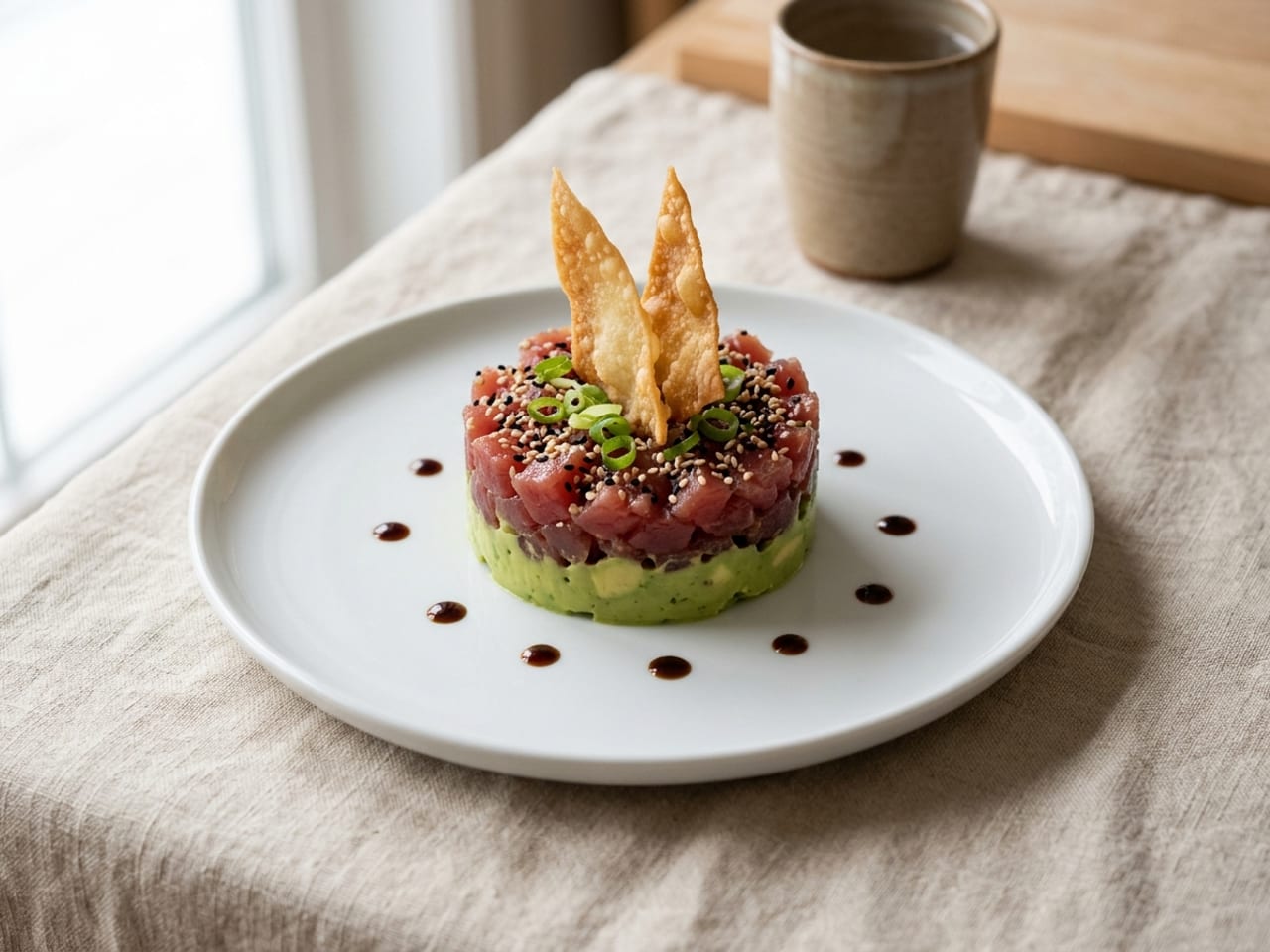
Tuna tartare stack · tuna tower, ahi stack
The ring dish most recipes mean. Avocado or rice at the bottom, raw tuna pressed on top, sometimes a cucumber or mango layer first and a crisp last; Portale's version stands croutons in the tuna.17, 32, 34, 37 Raw fish: see who should avoid it.
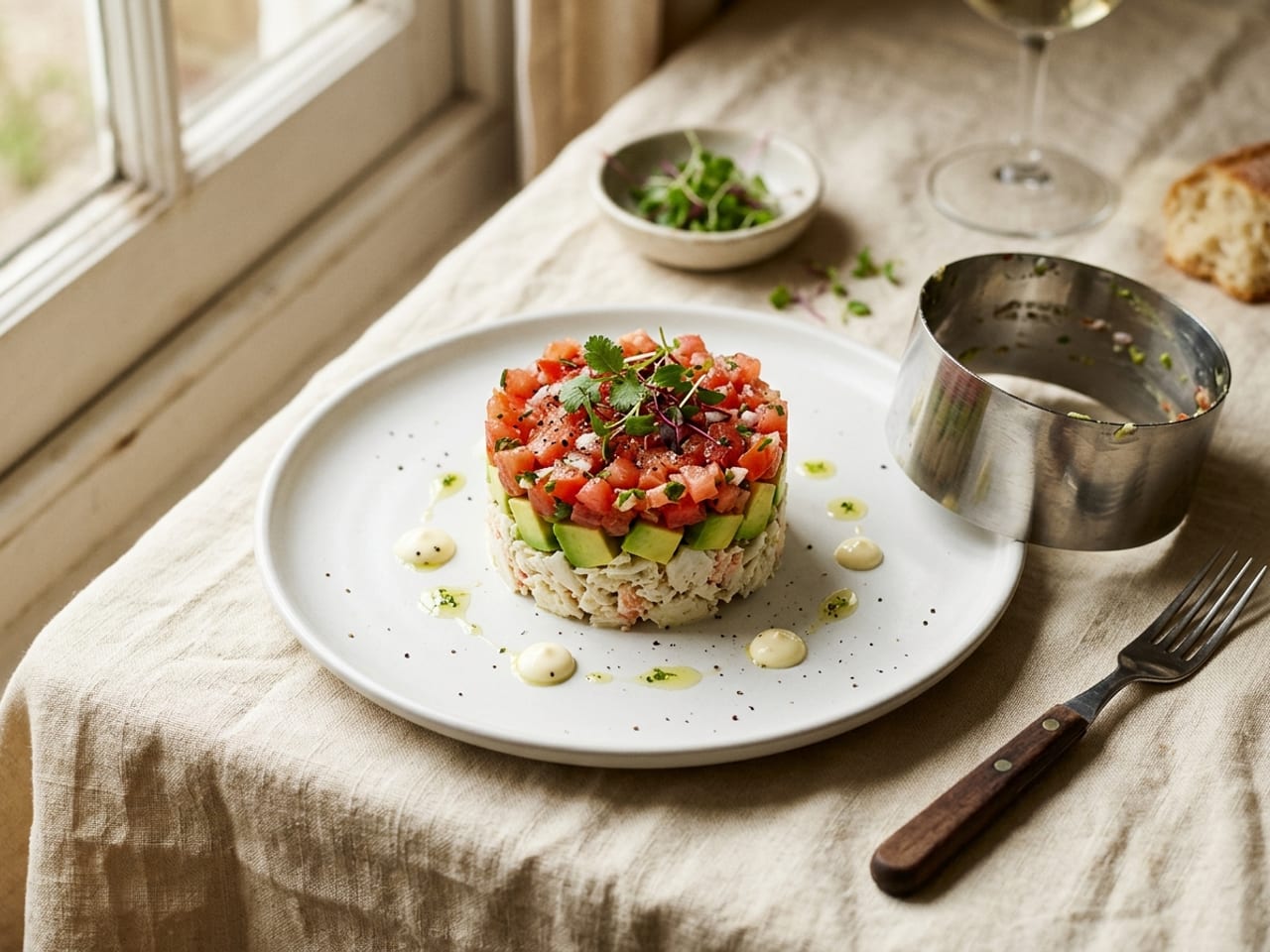
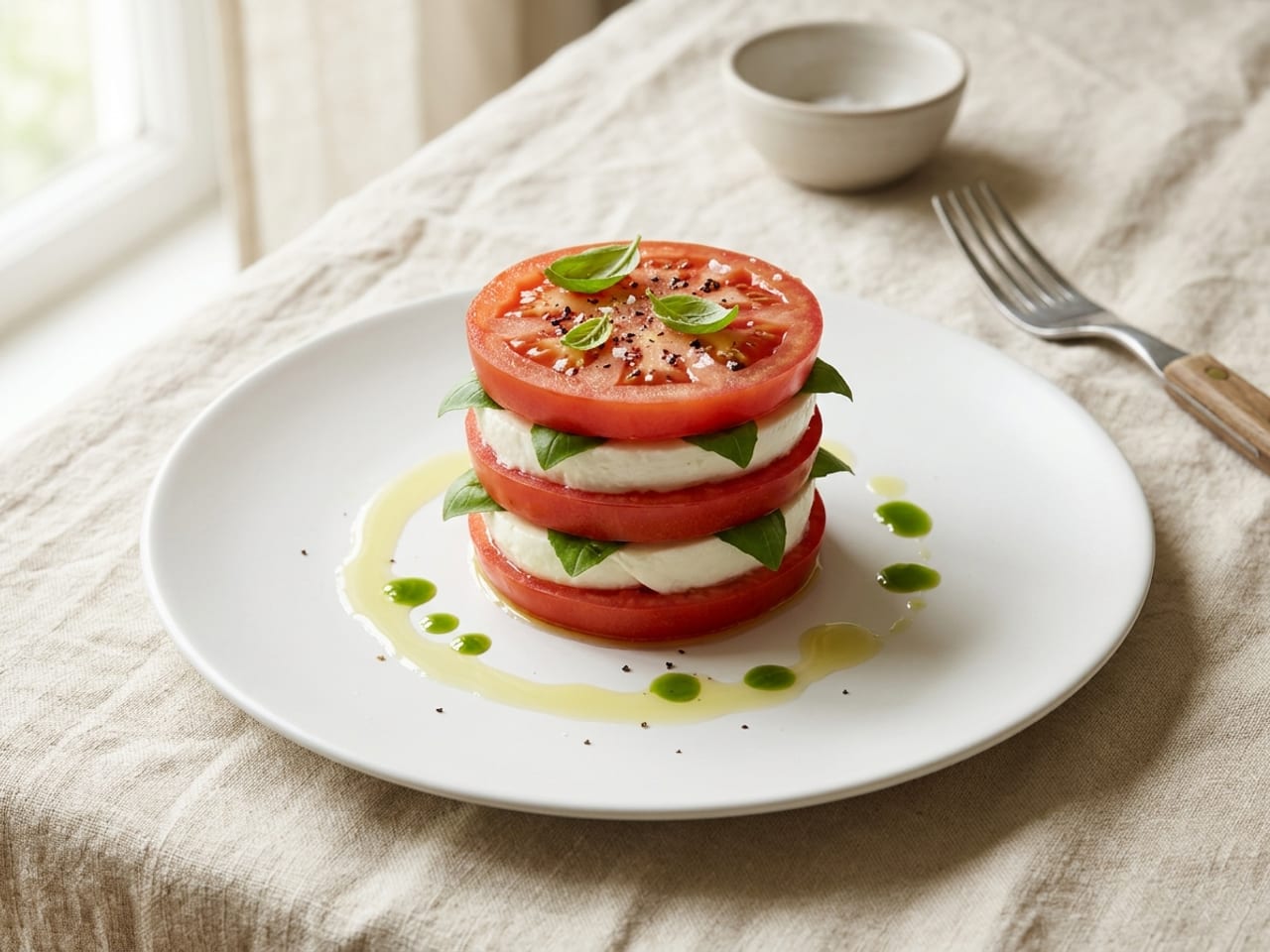
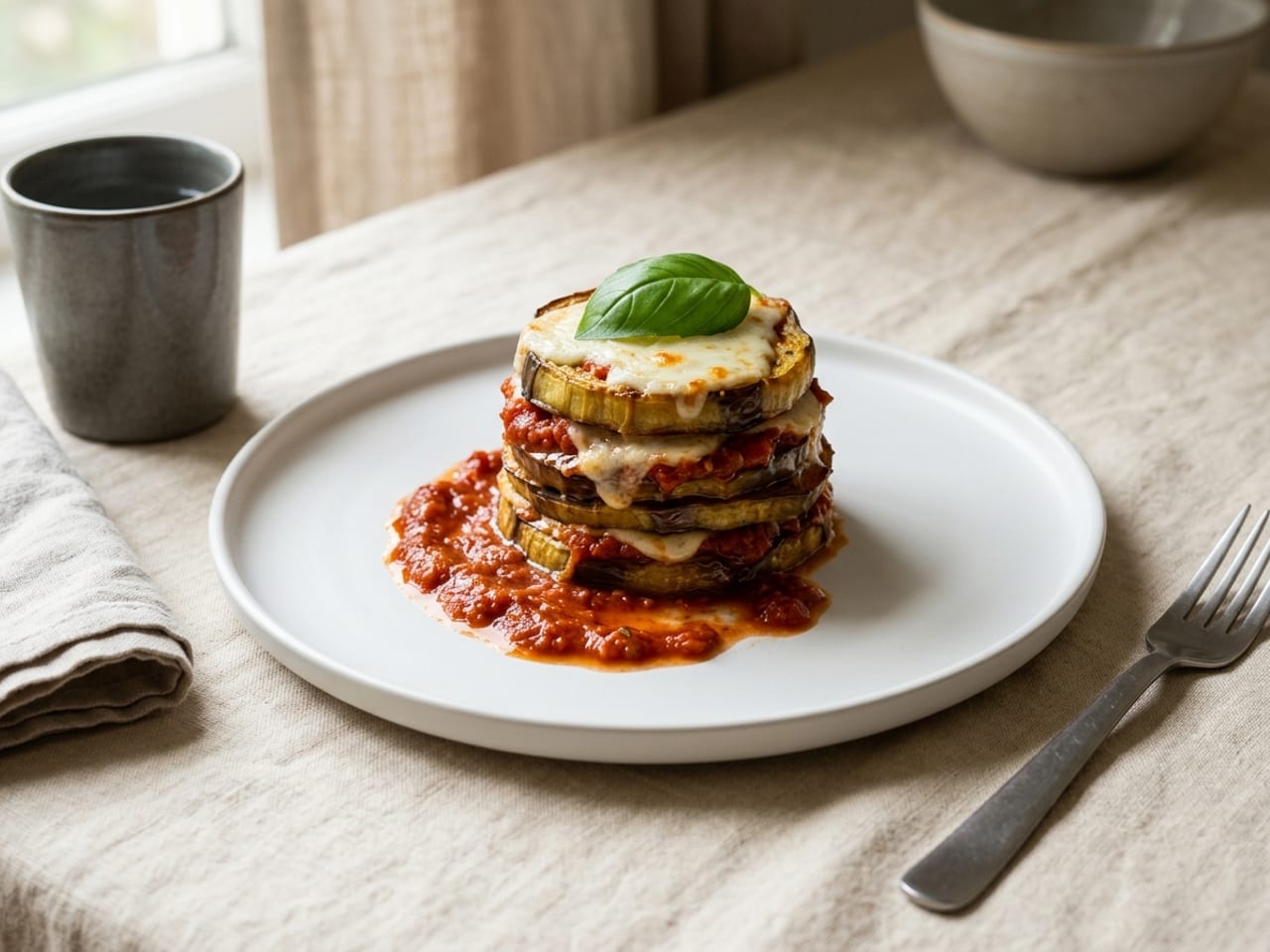
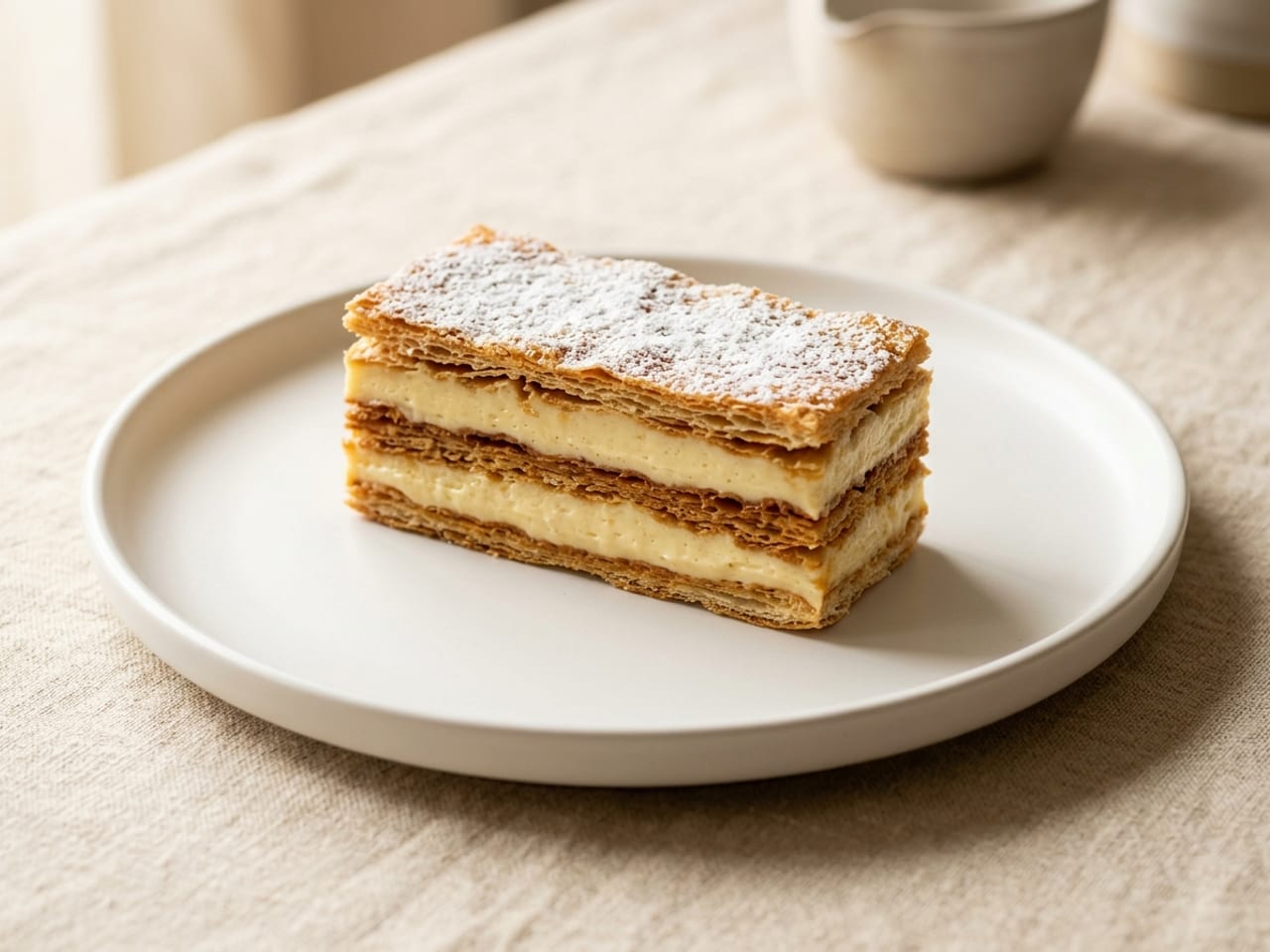
Timbale
Not a ring stack but a closed mold, filled and turned out: On Cooking molds hot grains in "a timbale, soup cup or other" mold and unmolds them upside down; Escoffier garnishes a poached pullet with rice "moulded in small, buttered, timbale moulds."7, 69 Chef Walter Redaelli's eggplant timbale is baked in ramekins and inverted.24
Do diners like stacked food? What the research found
Our verdict: mixed. Two studies found stacked food read as a smaller portion; a later one found a tall salad liked best on a large plate. None measured ease of eating, stability or temperature.
 SpreadStacked
| Study | What it found | What it cannot tell you |
|---|---|---|
| Rowley and Spence, 2018 (Oxford) | Two experiments, 122 people online and 124 in "a naturalistic dining context". "In both experiments, the plate of food was rated as constituting a larger portion when the elements were arrayed-horizontally rather than stacked vertically." Also: "The food was also liked more and the participants/diners were willing to pay more for it when horizontally and/or centrally arranged."96 | Read as the abstract only. Its "and/or" pools flat-against-stacked with centred-against-offset, so it does not say which one drove liking. The only food it names is a dessert. A 2025 paper reports that in Rowley and Spence's own dining experiment the stacked version was rated more artistic (we could not check this in the 2018 paper).98 |
| Szocs and Lefebvre, 2017 | "consumers perceive portions as smaller and eat more when foods are presented vertically (i.e., stacked on the plate) versus horizontally", because they judge by the surface the food covers: looking down, "the surface area of the portion is more salient than the height".97 | Read as the abstract only; the foods, the samples and how much more was eaten are not in it. |
| Salazar Cobo and colleagues, 2025 (Wageningen) | A chicken salad, shaped in a ring 16 cm across and 10 cm high (6¼ by 4 in) into a "mountain", against the same salad spread. Eaten in a cafeteria by 176 people, "salads served on a large plate with high-stacked plating received the highest ratings for liking", the stacked versions were "more fulfilling", and the authors call this "contrary to our hypothesis". No difference in willingness to pay.98 | One product, a soft wide mound rather than a narrow tower, mostly students; the win needs the large 26 cm plate, and the online version disagreed (there the small plate stacked scored higher). One author works for Unilever, which co-funded the study. |
| Ichikawa and colleagues, 2006 | Photographs of the same 300 g (about 10½ oz) of fried rice piled 3, 4, 5 and 6 cm high (1¼ to 2⅜ in): the flattest made "the food less appetizing and less attractive", and height "did not affect" the impression of amount.99 | Photographs on a screen, 10 and 20 students, one food piled higher; not a stack of components. |
Why they may disagree. Salazar Cobo and colleagues suggest the gap between the food and the rim: "A plausible explanation for this difference may lie in ratio between plate- and food surface".98 Looking down at a photo hides height, a point the 2025 paper credits to Rowley and Spence themselves.98 Shared towers are another matter: Charles Spence on tea stands and seafood towers, "A tower offers a way to show a whole lot of food without the implication being that it's all for one person."101
What it means for a home cook (ours). A stack will not make a small portion look generous; on a big plate with room around it, a modest one is no handicap. Pick stacking for the bite and the shape, not for the size.
A short history of tall food
Dated sightings, each only as far as its source goes. Who did it first is not documented in anything we read; "credited with" is the sources' own phrase.
| When | What the source says |
|---|---|
| 1820s and earlier | Plating research reviewers note that "the early work on the aesthetics of plating, for instance, by Carême" was "very much about the vertical arrangement of food."100 We read only the catalogue record of his 1828 architectural pastry book, not the book. |
| 1909 (English edition) | Escoffier molds rice in "small, buttered, timbale moulds", wants a timbale crust whose diameter is "greater than the height", and advises against molding compound salads while allowing a pyramid.69 |
| 1984 and 1985 | Gotham Bar and Grill opens in New York in 1984; Alfred Portale becomes executive chef and partner a year later.104 |
| Mid to late 1980s | The Los Angeles Times in 1999: "Tall food has been tickling our chins since the mid-'80s", and Portale "is credited with constructing some of the first engineered entrees"; his own reason: "To cook the fish faster, I cut the fillet in half and stacked it on the plate."102 The Baltimore Sun in 2002 says it "had appeared in Manhattan and other big cities in the late 1980s", and dates Charlie Trotter's layering and Roy Yamaguchi's tall seared tuna to the same years.103 |
| 1990s | The peak. "The sky seemed the limit as chefs built astonishing towers of meat, fish, starch and greens. Rosemary sprigs rose from the peaks of these creations like flags planted by triumphant mountaineers."103 Chef Andrew Zimmerman, in 2018: "In the '90s, everyone wanted to make food that was unnecessarily tall". 106 Portale later explained the stacks, in 2018, as a way to "standardize the plates" for his cooks, and called it "architectural plating".106 |
| 1997 and 1999 | Portale's cookbook: presentation "can make a tremendous first impression", but "(One doesn't, after all, eat with one's eyes.)"16 In 1999 Deborah Fabricant's Stacks: The Art of Vertical Food brings the style to home cooks.1, 2 |
| 2000 | The backlash in print. Bourdain calls the ring "the backbone of pretentious food presentation", then later in the book: "You might want to reconsider what I said about them too", praising a chef who formed tartare by hand.107 New York Times critic William Grimes writes that the craze for entrées "4, 5, 6 and more inches high" (10 to 15 cm) "seems to be over" (as quoted in 2002).103 A newspaper food writer sets big-bowl cooking against "fussy, towering" plates.108 |
| 2002 to 2004 | Trotter says many chefs were doing "height for height's sake" (the reporter's paraphrase) and that he has done little of it for ten years; Roy's tall tuna "will continue to be offered regardless of shifting fashion."103 In Dallas, "diners soon tired of deconstructing lofty towers of food."93 Gisslen's textbook, in 2003, the earliest edition in which we found the passage, describes chefs who "stack everything on one multilayered tower" and diners left "deconstructing a towering pile of food". 4 |
| 2018 to 2025 | "But even Portale is moving away from stacking."106 By 22 November 2024 Gotham had closed for good.105 In 2025 a Wageningen study finds a tall molded salad the best liked on a large plate.98 |
Ten popular claims about stacking food, each with a verdict
"Supported, narrowly" means the source covers less than the claim says; "Mixed", that sources point both ways; "Not supported", that the claim was checked against the sources it rests on and did not hold; "No source found", that we found no source for it at all.
| The claim | Verdict | What we found |
|---|---|---|
| "Stacking keeps food hot" | Not supported | An untested claim. It traces to a cookware seller's writer paraphrasing a chef (height "helps retain heat") and a school's marketing blog ("Stacking helps retain heat better than flat arrangements"); neither gives a test or a number.61, 62 The one measured figure we found is soup in a warmed bowl.86 A compact mass does cool more slowly than a shallow spread, which is USDA's advice for leftovers, not plates; a stack also tends to sit on a cold base, so the physics could go either way (ours).94 |
| "A stack makes the portion look bigger" | Mixed | Said by Escoffier School ("appear more substantial") and a booking-software blog ("the illusion of more food"); chef Michael Romano says towers began "To make that small amount appear that it was doing something on the plate".63, 64, 103 Two studies found the opposite, and so did the online half of a 2025 study; eaten in a cafeteria, that study found no clear difference in perceived amount, but a tall salad on a large plate was most often judged the ideal amount and was more filling: the research. |
| "Always twist the ring as you lift it" | Not supported | Two sources twist; six lift straight up, up and off or up and away, and both textbooks just say "Carefully lift off". The names are in the table. A twist is the fix Girl Carnivore gives for a mold that sticks.43 |
| "Food towers are dead" | Mixed | Critics declared it over in 2000 and 2002, and Portale himself was moving away from it by 2018.103, 106 But Roy's kept its tower, Gisslen's 2011 edition still calls it "A style popular with today's chefs", and a 2025 study found a molded salad the best liked.5, 98, 103 The 1990s skyscraper is out of fashion; a modest stack is not. |
| "Heaviest at the bottom, lightest on top" | No source found | We found no chef or textbook that states it as a rule. The nearest are Rouxbe's "solid base" and a columnist's "sturdy foundation". 12, 15 The physics of a stack (a low center of gravity is more stable) is a science spot about pennies; applying it to food is ours.85 |
| "Chefs test a stack by moving the plate side to side" | Not supported | The only page we found that prints it is an anonymous careers site: "Test every plating by gently moving the plate side to side to ensure stability."65 No chef, school or textbook we read says it. It is harmless as a home check; do it before the sauce goes on (ours). |
| "Layer soft ingredients over crisp ones for structure" | Not supported | It is one line on a software vendor's blog, whose own example puts the crisp on top.56 Burke and Escoffier say moisture softens a crisp layer, and a textbook keeps breaded items from touching for the same reason.69, 70, 103 |
| "Escoffier was against height" | Not supported | He was against molding compound salads, and in the same sentence allowed "the arrangement of the vegetables in a pyramid".69 |
| "Alfred Portale invented tall food" | Supported, narrowly | He is credited with it, in those words: he "is credited with constructing some of the first engineered entrees" (1999) and "is credited for having invented" it (2024).102, 104 We read no 1980s source that names him, and Trotter and Roy Yamaguchi are dated to the same years.103 |
| "My stack should stand as tall as the one in the photo" | Not supported | Photographed food is often propped: "Cardboard spacers add height to food", "Toothpicks hold ingredients in place".95 The figures on this page are AI renders, not cooked food. |
Food safety for stacked food, by country
Home advice and restaurant rules, US and UK, kept apart and never converted into each other. Metric twins of US figures are ours.
- United States, at home: two hoursUSDA: "Never leave food out of refrigeration over 2 hours. If the temperature is above 90 °F, food should not be left out more than 1 hour." (32°C.) Cold at or below 40°F (4°C), hot at or above 140°F (60°C).117 A cold stack that waits for guests counts.
- Raw fish in a ring (US)FDA: pregnant women, children, older adults and people with weakened immune systems "should avoid" raw fish or shellfish such as sashimi; if you eat raw fish, eat fish that has been previously frozen, though "freezing doesn't kill all harmful germs."116
- United Kingdom (England, Wales and Northern Ireland), at homeThe Food Standards Agency: fridge between 0 and 5°C, and chilled food out of it for "a maximum of four hours" during preparation;119 eat ready-to-eat food "within 4 hours or within 2 hours on a very warm day" of taking it out, which covers a cold stack waiting for guests.121 Smoked salmon and gravlax, common stack layers: pregnant women and people with weakened immune systems "are advised to avoid eating ready-to-eat cold-smoked or cured fish products".121 Minced meat "should be cooked thoroughly"; the page does not name tartare, and a chopped raw beef tartare is minced meat in its sense (our reading).120
- US restaurants: the Food CodeThe FDA's model Food Code binds food establishments where a state or locality adopts it, never home cooks. Cold holding at 41°F (5°C) or below, hot at 135°F (57°C) or above; no bare-hand contact with ready-to-eat food; a consumer advisory for raw animal foods; fish served raw frozen first (for example 168 hours at -4°F, -20°C), with exemptions for some tuna and farmed salmon; and no raw fish or "steak tartare" for highly susceptible populations such as hospital patients.118
- UK food businessesIn England, keeping chilled food above 8°C or hot food below 63°C is an offence for a food business; food kept for service or on display for less than four hours is a defence to the chill rule.124 Businesses selling fish to be eaten raw must freeze it at -20°C for at least 24 hours or -35°C for at least 15, unless it is exempt; farmed Atlantic salmon has a general exemption.122 These are not home rules, and not conversions of the US ones.
- Pressing with your fingersFabricant packs layers with "the backs of your fingers and knuckles, like a real chef".1 At home the UK advice is to "wash your hands with soap and warm water before preparing, cooking, or eating food"; in a US restaurant the Food Code bars bare hands on ready-to-eat food unless the local regulator has approved a procedure.118, 123 A spoon, a pusher or a jar base does the job.
- Hidden picksCookbooks say "Remove the toothpicks before serving."131 A review of 136 published cases of swallowed toothpicks: "The toothpick caused gut perforation in 79 % of all patients", "The overall mortality was 9.6 %", and many did not know they had swallowed one.128 A 2025 review of 479 swallowed sharp wooden objects, 92.5% of them toothpicks: most patients "were unaware of ingestion (74.8%)".129 One case report traces a toothpick to a rolled "beef olive".130 We found no agency rule on picks in plated food. Ours: take a pick out before the plate leaves, or leave only one that is long, visible and obviously not food.
- Improvised rings: cans and pipeUK food-contact law asks that materials meant to touch food "do not transfer their constituents to food in quantities which could ... endanger human health", and a buyer can tell them by the words "for food contact", the symbol, or an obvious food use.125 The US rule is that a substance in an article that contacts food "shall be of a purity suitable for its intended use."126 Plumbing pipe is sold for neither (ours), and a maple-syrup trade paper says drain-waste-vent PVC "should not be used with food".127 We found no agency statement on PVC pipe or cut cans as molds; a ring sold for food avoids the question.
- Hot platesWarm plates are a quality habit, not a safety rule: no agency page we read sets a plate temperature. America's Test Kitchen warms ovensafe dishes only "until they're very hot to the touch".86 Check the maker's oven limit first: one maker caps its porcelain at 100°C (212°F), as our steak plating guide notes. A plate out of a hot oven can burn: carry it with a dry cloth and warn whoever takes it (ours).
See your own plate, re-plated
A stack is one way to give a plate a point of height. To see what a restaurant would do with your own dish, photograph it and Plate Artists re-plates that dish, with the food kept as it is and the steps named so you can repeat them. Start with a re-plate.
Your dish, plated like a chef's
Snap it, upload it, and get the composed version back, with the steps to recreate it at home.
Start free · 1 enhancement →Free account · 1 free enhancement · No credit card
Food stacking words, defined
Definitions and first-use years are each dictionary's own. A word no dictionary we read defines in this sense says so, and its definition is then a textbook's, a chef's or our reading.
Stacked plating · vertical plating, a stack
Plating in which the components of a dish are built one on top of another in the center of the plate instead of set side by side.
Where it comes from. No dictionary we checked defines it; it is chefs' and food writers' usage, and the textbooks'. Gisslen lists the stacked arrangement among standard plate layouts: "stacked neatly one atop the other in the center of the plate". A garde-manger study guide lists "stacked" among five arranged-salad presentation styles.5, 6
Tall food · vertical food, food tower
The fashion, from the mid to late 1980s and peaking in the 1990s, for building restaurant plates as high towers.
Where it comes from. A journalists' and chefs' name, not a dictionary entry: the Los Angeles Times (1999) and The Baltimore Sun (2002) both print "tall food", and Fabricant's 1999 subtitle is "The Art of Vertical Food". Portale preferred "architectural plating".1, 102, 103, 106
Ring mold · ring mould, plating ring, food ring, presentation ring
A bottomless metal ring set on the plate, packed with food and lifted off to leave a neat cylinder.
Where it comes from. A modernist-cooking blog lists "prep rings, plating rings, forming rings, food styling forms, food presentation rings, and simply food rings." The same name is used for a large closed ring for molded dishes, such as a "5-cup ring mold" (about 1.2 L), which is not this tool.49, 50
Entremet ring · pastry ring
A pastry kitchen's bottomless ring, the same tool chefs use for savory stacks.
Where it comes from. Portale's cookbook names a "metal entremet ring mold"; Fabricant tells readers to ask shops for ring molds or tall pastry rings and to say they are for "vertical food presentation".1, 16
Pusher · press, plunger, tamper
A flat disc on a handle that fits inside a ring, used to pack each layer and to hold the top down while the ring is lifted.
Where it comes from. Sellers call it a pusher ("for clean demolding"); Rouxbe calls it a plunger and packs each layer with it; a GEFU set described on a blog comes "with tampers".12, 48, 49, 54
Timbale
A small closed mold shaped like a large thimble, and a dish of food molded or baked in it and turned out.
Where it comes from. Merriam-Webster: "a creamy mixture (as of meat or vegetables) baked in a mold", also the mold and a small pastry shell; French for kettledrum, first known use 1824. Gisslen: "A mold in the shape of a large thimble". Neither dictionary defines a cold stack set in a ring as a timbale.5, 109, 110
Dariole
A small thimble-shaped mold, smaller than a timbale.
Where it comes from. Gisslen's glossary: a small "thimble-shaped mold".5
Turban
A ring-shaped mold, and the dish molded in it.
Where it comes from. Gisslen's glossary: "A type of ring mold", and food prepared in such a mold.5
Napoleon
An oblong pastry of puff pastry layers with a filling between them; on menus, also any layered dish built the same way.
Where it comes from. Merriam-Webster's sense 2: "an oblong pastry with a filling of cream, custard, or jelly". The Online Etymology Dictionary dates the cake sense "from 1892". The savory, any-layered-dish use is menu usage, not a dictionary sense (our reading).111, 112
Mille-feuille · millefeuille
Thin layers of puff pastry with a sweet or savory filling between each layer.
Where it comes from. Merriam-Webster: puff pastry layered "with a filling (such as salmon or cream)", from French for a thousand leaves, first known use 1895. Cambridge gives millefeuille as the UK spelling and mille-feuille as mainly US.113, 114
Tian
A Provençal dish of sliced vegetables baked in olive oil; in a textbook and some chefs' recipes, also a dish molded in a ring.
Where it comes from. Oxford Advanced Learner's Dictionary: "a French dish consisting of slices of vegetables cooked in olive oil", from Provençal; Merriam-Webster has no English entry. The ring-built tian is Gisslen's and the cold crab tian a UK chef's usage.3, 26, 115
Glue layer · binder
A soft, sticky layer, such as a purée, pesto or mayonnaise, that holds the layers on either side of it together.
Where it comes from. The Chopping Block's word: "At least one layer needs to be a 'glue' for the build." On Cooking speaks of foods "bound by sauces".7, 11
Guard of honour
Two racks of lamb stood with their trimmed rib bones interlocked like crossed swords.
Where it comes from. The UK meat board's specification: two French-trimmed seven-rib racks, "interlocked to form a Guard of Honour".79, 80
Architectural plating
Portale's own name for the stacked, built-up plates his kitchen became known for.
Where it comes from. Alfred Portale, in 2018: "I prefer to refer to it as architectural plating". No dictionary entry.106
Stacking food, answered
How do you stack food on a plate?
Pick one course, ideally a cold starter, and line up the layers in order. Set a ring mold (or a biscuit cutter) on the plate, press a base layer in that will not slide, such as mashed avocado, a purée or a flat firm piece, add each layer just to cover the one below, pressing gently but firmly, and finish with anything crisp on top. Hold the top down lightly and lift the ring straight up, then spoon the sauce around the base, wipe the plate and serve straight away. Of the sources we read, 21 fill the ring on the plate and six lift it straight up or up and off.
What goes on the bottom of a food stack?
Something that will not slide. In the published recipes we tallied, 11 start with a soft binder or purée (most often mashed avocado), 9 with a flat firm or crisp piece such as a crouton, a tomato slice or drained cucumber, 6 with a starch such as rice or mash (one of them a molded vegetable bed), and 7 put the sauce on the plate first. The Chopping Block cooking school puts a dab of its glue layer on the very bottom "to keep the stack from sliding". These are our counts of what sources print, not a survey.
What order do you stack food in?
Bottom to top: a base that grips the plate, a layer that binds, the middle layers drained and diced, then the crisp or tall element last, with sauce around the base rather than over the top. For hot plates the common order in what we read is a starch or vegetable bed, then the protein, then a garnish, with sauce around the outside; Gisslen's textbook layout stacks the "main item, vegetable and starch accompaniments, and other garnish" in the center without fixing the order. Turning a filled ramekin out reverses all of this: whatever goes in first ends up on top.
How do you use a ring mold for plating?
Set the ring on the plate where the food should sit, lightly oiled if you like. Fill it a layer at a time, pressing each layer into the ring, and level the top with a spatula. Then lift the ring off: six of the sources we read lift it straight up or up and off, two with a slight twist, and seven hold the top down while it rises, with a pusher, a spoon or a hand. Fabricant may fill hers on a baking sheet instead and move them with a wide spatula, steadying the stack with one hand as the other lifts the mold.
Do you twist a ring mold when you lift it?
Not usually. Food Republic's 2013 method lifts "twisting slightly (sandcastle-style)" and a soup napoleon recipe twists the ring, but six other sources lift straight up or up and off, among them Alfred Portale, and Gisslen's and Labensky's textbooks simply say "carefully lift off". A small twist is a fix for a ring or ramekin that sticks.
What size ring mold should I use?
Most published savory stacks use a ring 2 to 3 inches across (5 to 7.5 cm). Deborah Fabricant gives sizes by course: 2 by 3 inches (5 by 7.5 cm) for appetizers, 3 by 3 inches (7.5 by 7.5 cm) for salads and starters, and 3 inches across by 4 high (7.5 by 10 cm) for entrées. The Culinary Institute of America moves a ring 5 to 6 cm (about 2 to 2½ in) across to an 8-inch (20 cm) plate; Alfred Portale sets a 3-inch (7.5 cm) ring on a chilled 12-inch (30 cm) dinner plate.
What can I use instead of a ring mold?
A round biscuit or cookie cutter does the same job. A greased ramekin or cup works if you fill it in reverse order and turn it out. Recipes also use a can with both ends removed (washed, with the sharp edge taken off), a ring folded from foil, a carton with the bottom cut off, or PVC pipe cut to height. Foil, a food carton and a food can are made to touch food, though a cut can leaves a sharp edge; plumbing pipe is not sold for food at all, so a ring sold for food is the safer choice. Sliced foods of one width, such as tomato and mozzarella, need no ring at all.
How do you keep a food stack from falling over?
Start with a base that grips, include a binding layer, drain anything wet, press each layer gently but firmly, keep the top light, and set the stack in the fridge (or, as one recipe does, the freezer for 15 to 20 minutes) before lifting the ring. Lean odd-shaped pieces on a firm anchor or a dab of purée. Do not build higher than the base can hold: we found no published height limit, and the physics of keeping the center of weight over the base is our addition.
How tall should a food stack be?
No source we found gives a maximum or a height-to-width ratio. Printed heights run from Jessica Gavin's tuna tower of about 2½ inches (6.5 cm) to a Baltimore chef's 3 to 4 inches (7.5 to 10 cm) in 2002 and Alfred Portale's seafood salad of about four inches (10 cm); the 1990s entrées a critic described ran 4, 5, 6 and more inches (10 to 15 cm). The American Culinary Federation's competition guide asks for heights that are "varied, but not extreme".
How do you plate odd-shaped food?
Give it a flat face: trim a thin slice off a round base, or halve it and lay the cut side down. Turn cut faces to meet, cut flat layers to the ring's width, lean pieces against a firm anchor or stand them in a purée, let bones interlock, and show the best side. Some shapes, such as a whole fish, are served lying flat.
Why does my stack go soggy, and where should the sauce go?
Moisture softens crisp layers: one chef gives "about three to five minutes" once sauce touches a crust, his estimate. Put crisp things on top and last, and spoon the sauce around the base or under it rather than over. Of the sources we tallied, 7 put the sauce around the stack, 7 under it and 5 over it. Deborah Fabricant notes that "Saucy recipes have a tendency to drain out the bottom".
Does stacking food keep it warm?
Nobody we read has tested it. The claim comes from a cookware seller's writer paraphrasing a chef and from a cooking school's marketing blog, with no figure. The only measured result we found is America's Test Kitchen's: soup heated to 190°F (88°C) stayed about 10°F (about 5.5°C) hotter for 10 minutes in a warmed bowl than in a room-temperature one. Warm the plates, build fast and serve at once.
Does stacked food look like a bigger or smaller portion?
The studies disagree. Rowley and Spence (2018) found the same food rated a larger portion spread flat than stacked, and Szocs and Lefebvre (2017) that stacked portions look smaller and people eat more of them. Salazar Cobo and colleagues (2025) found a chicken salad shaped tall in a ring liked most and judged closest to the ideal amount when eaten from a large plate. The 2018 study was read as its abstract only, and pools flat-against-stacked with centred-against-offset.
Is stacked food still in fashion?
The tall towers of the 1990s are not: critics called the craze over in 2000, and even Alfred Portale, the chef most credited with tall food, was moving away from it by 2018. A modest stack is still in the textbooks: Gisslen's 2011 edition calls it effective "with restraint" and perhaps best for small dishes, such as some appetizers.
What is a timbale, a tian and a napoleon?
A timbale is a small thimble-shaped mold and the food molded or baked in it, then turned out. A tian is, in the dictionary, a Provençal dish of sliced vegetables baked in olive oil, and in a textbook or on a UK menu, layers built in a ring, such as a crab tian. A napoleon, or mille-feuille, is layers of puff pastry with a filling between them, sweet or savory.
Is a tuna or salmon tartare stack safe to eat?
It is raw fish. In the US, the FDA says pregnant women, children, older adults and people with weakened immune systems should avoid raw fish, and suggests previously frozen fish for anyone who eats it raw; perishable food should not sit out more than 2 hours (1 hour above 90°F, 32°C). In England, Wales and Northern Ireland, the Food Standards Agency lists sushi and smoked or cured fish among foods more likely to carry listeria, and advises pregnant women and people with weakened immune systems to avoid cold-smoked or cured fish such as smoked salmon and gravlax (older people to be aware of the risk); the UK home pages we read give no separate advice on raw fish tartare, so the US at-risk list is the cautious guide. Restaurants follow their own rules, which are not home advice.
The recipes, cookbooks, textbooks, studies and agencies behind this guide
How the scanned books, archived pages and abstracts were read is under how this page was made and in each entry. A book read only as search fragments says so. Agency pages are named with their country and their audience. Sellers, makers and vendors are labeled. Readings, counts and conversions marked as ours are our own.
- Fabricant, D. (1999). Stacks: The Art of Vertical Food. Ten Speed Press, Berkeley, read ONLY as Internet Archive full-text search fragments of a scanned copy (lending only): the surrounding page was not read, no page number was seen, and the machine-read text's slips are the scan's; a home-entertaining cookbook by a self-described non-professional cook; its five-step method, ring sizes by course, cans and PVC pipe as molds, sauce around the base. archive.org
- Allen, N. K. (1999). Review of Stacks, by Deborah Fabricant. Foreword Reviews, reviewed July/August 1999; dates the book and lists its six chapters; a cooking-school blog recalls the book given with "the accompanying set of molds", which this review does not mention. forewordreviews.com
- Gisslen, W. (1999). Professional Cooking (the 4th edition by date). John Wiley & Sons, New York, read ONLY as Internet Archive full-text search fragments of a scanned copy (lending only): the surrounding page was not read, no page number was seen, and the machine-read text's slips are the scan's; the numbered procedure "Shaping foods with a ring mold", rings of 2½ to 3 inches (6 to 8 cm) and a ring-built tomato and zucchini tian. archive.org
- Gisslen, W. (2003). Professional Cooking (the 5th edition by date). John Wiley & Sons, read ONLY as Internet Archive full-text search fragments of a scanned copy (lending only): the surrounding page was not read, no page number was seen, and the machine-read text's slips are the scan's; the earliest printing in which we found the "multilayered tower" passage (phrase searches of the 1999 and 1989 printings found it nowhere, which is weak evidence). archive.org
- Gisslen, W. (2011). Professional Cooking (the 7th edition by date). John Wiley & Sons, Hoboken, read ONLY as Internet Archive full-text search fragments of a scanned copy (lending only): the surrounding page was not read, no page number was seen, and the machine-read text's slips are the scan's; the ring-mold figure, the stacked arrangement as one of the standard plate layouts, the tower passage and the glossary (timbale, dariole, turban). archive.org
- Sackett, L., & Pestka, J. (Gisslen, W., consulting author) (2010). Study Guide to Accompany Professional Garde Manger. John Wiley & Sons, read ONLY as Internet Archive full-text search fragments of a scanned copy (lending only): the surrounding page was not read, no page number was seen, and the machine-read text's slips are the scan's; catalogued on the Internet Archive as the textbook itself, but the scanned text is the companion study guide; it lists "stacked" among five arranged-salad presentation styles. The textbook was not opened. archive.org
- Labensky, S. R., & Hause, A. M. (2007). On Cooking: A Textbook of Culinary Fundamentals (the 4th edition by date). Pearson Prentice Hall, Upper Saddle River NJ, read ONLY as Internet Archive full-text search fragments of a scanned copy (lending only): the surrounding page was not read, no page number was seen, and the machine-read text's slips are the scan's; the procedures for molding vegetables (ring on the plate) and grains (a mold turned upside down on the plate); not found in the 1999 and 2003 printings searched, which is weak evidence. archive.org
- The Culinary Institute of America (2008). Garde Manger: The Art and Craft of the Cold Kitchen (the 3rd edition by date). John Wiley & Sons, Hoboken, read ONLY as Internet Archive full-text search fragments of a scanned copy (lending only): the surrounding page was not read, no page number was seen, and the machine-read text's slips are the scan's; the crab and avocado salad in a 6 cm by 3 cm ring moved to a 20 cm (8 in) plate, metric figures the book's own; the OCR garbles the inch fractions. archive.org
- The Culinary Institute of America (2004). Garde Manger: The Art and Craft of the Cold Kitchen (the 2nd edition by date). John Wiley & Sons, read ONLY as Internet Archive full-text search fragments of a scanned copy (lending only): the surrounding page was not read, no page number was seen, and the machine-read text's slips are the scan's; the same crab and avocado salad in a ring 2 in (5 cm) across. archive.org
- The Culinary Institute of America, for the Associated Press (2004). Crab-avocado salad is a thing of beauty. The Daily Herald (HeraldNet), Everett WA, published 11 August 2004; a syndicated column: rings 2 in by 1½ in, the layers, the transfer to an 8-inch plate, a ring folded from foil, and CIA associate professor Olivier Andreini's PVC pipe rings. heraldnet.com
- Barb (staff writer), The Chopping Block (2021). Stack your Food. The Chopping Block (a recreational cooking school, Chicago), published 23 July 2021; the glue layer, a strong base and 3 to 6 layers, crisps on top for height, cold stacks, warm plates, a bigger plate. thechoppingblock.com
- Rouxbe (2006). Seafood Tower Appetizer. Rouxbe (an online cooking school), published 5 November 2006, with a staff reply of 24 December 2007 giving the ring as about 2 inches; a solid base first, each layer packed with the plunger, light pressure on the plunger while the mold comes up; a can and a wrapped bottle as the home kit. rouxbe.com
- Culinary Arts Academy Switzerland (2026). The Art of Plating Food: Techniques for Stunning Visuals. Culinary Arts Academy Switzerland (a school's marketing blog), undated; read in October 2026: "a solid base of starch or sauce as the first layer". culinaryartsswitzerland.com
- Bates, C. ("Chef Bates") (2021). Plating. Wekiva Culinary (a small culinary program's blog), published 17 July 2021; sauce, then a stable purée or mash, then the protein; an offset spatula or tweezers so a stack is not disturbed. wekivaculinary.org
- Bondurant, F. (2006). Presentation, Presentation, Presentation. Times of the Islands (Turks and Caicos), May/June 2006, pp. 84 to 86, a column by a self-taught cook: a sturdy foundation, fingerlings halved and laid cut side down, a crisp galette, bone-in cuts leaned teepee style. timesoftheislands.com
- Portale, A. (1997). Alfred Portale's Gotham Bar and Grill Cookbook. Doubleday, New York, read ONLY as Internet Archive full-text search fragments of a scanned copy (lending only): the surrounding page was not read, no page number was seen, and the machine-read text's slips are the scan's; a 2½-inch metal entremet ring 1½ inches deep on a chilled large dinner plate, salmon set on a potato purée, and his line that presentation is "by far the least important aspect of a dish". archive.org
- Food Network (2026). Alfred Portale's Tuna Tartare with Herb Salad, Cucumber, Lime, Scallion and Ginger. Food Network (recipe courtesy of Gotham Bar and Grill), undated recipe from the show FoodNation with Bobby Flay, read through a text reader in October 2026 because the page returned a stub: a 3-inch ring 1½ inches deep on a chilled 12-inch dinner plate. foodnetwork.com
- MICHELIN Guide (recipe by Josiah Citrin) (2022). Recipe: Citrin's Ahi Tuna Tartare. MICHELIN Guide, published 15 November 2022, read through a text reader because the page returned nothing: an oiled 2-inch ring in a shallow bowl, cucumber first, avocado spread on top, a knife in the center while the ring comes up, dressing spooned around. guide.michelin.com
- Hirigoyen, G. (2026). Pistachio + Tuna Tartare. American Pistachio Growers (a trade association), undated, read in October 2026: a ring 3.25 by 1.25 inches, avocado then tuna, inverted onto the plate with a flat spatula. americanpistachios.org
- Mantuano, T. (2004). The Spiaggia Cookbook: Eleganza Italiana in Cucina. Chronicle Books, San Francisco, read ONLY as Internet Archive full-text search fragments of a scanned copy (lending only): the surrounding page was not read, no page number was seen, and the machine-read text's slips are the scan's; oiled rings 2 inches tall, packed gently and lifted with the layers intact, the same ring used to cut Parmigiano rounds, and rings lined with a chard leaf or caul fat; one ring width reads "1%" in the scan and could not be resolved. archive.org
- Gaté, G. (2015). Salmon tartare (tartare de saumon). SBS Food, dated 3 June 2015 (the page also shows 12 July 2017); 10 cm PVC rings set on the plate, or "go free-style", and the advice to combine just before serving. sbs.com.au
- Tom Douglas Restaurants (2022). The Best Grilled Eggplant Stacks. tomdouglas.com, published 26 September 2022; eggplant, mozzarella and marinara three times over, built without a ring on an oiled pan. tomdouglas.com
- The Daily Meal (recipe courtesy of Quattro restaurant, Miami) (2015). Parmigiana Di Melanzane In Forma. The Daily Meal, published 18 February 2015; eggplant salted and patted dry, then layered with sauce and cheese in rings set in a baking dish and baked about 15 minutes. thedailymeal.com
- Restaurant Business (recipe from chef Walter Redaelli) (2024). Timballo di Melanzane (Eggplant Timbale). Restaurant Business (a trade magazine), published 17 September 2024; baked in buttered ramekins, a knife run round the edge, then inverted onto the plate. restaurantbusinessonline.com
- Restaurant Business (2010). Goat Cheese and Vegetable Napoleon. Restaurant Business (a trade magazine), published 23 August 2010; puff pastry triangles, goat cheese spread on each, tapenade and grilled vegetables, three pastry layers. restaurantbusinessonline.com
- Wright, J. (head chef, Livingston's, Linlithgow) (2006). Tian of White Crab, Avocado and Langoustine Emulsion. Public Sector Catering (first printed in Cost Sector Catering/Eat Out, December 2006), the two mixes ringed, set one on top of the other, and the emulsion spooned around the tian. publicsectorcatering.co.uk
- 1859 Oregon's Magazine (2010). Crab, Mango and Avocado Salad. 1859 Oregon's Magazine, dated 1 January 2010 (modified 2017); a restaurant tower (McCormick & Schmick's, by the photo's file name): a 2-inch ring, mango, avocado, crab, the top held down while the ring slides up, the ring rinsed between plates. 1859oregonmagazine.com
- Walt Disney World Swan and Dolphin Recipe Club (2026). Tuna Tower. swandolphin.com (a hotel), undated, read in October 2026: glaze, oil and garnish go on before the ring is removed. swandolphin.com
- Tanji (2019). J-Prime Steakhouse's Gingery Tuna Tartare. Goodtaste.tv, published 24 October 2019; a 3-inch ring or biscuit cutter, avocado pressed in first, and a tuna can with both ends cut off as the stand-in. goodtaste.tv
- The Nibble (2018). Tip of the Day: Soup Napoleon & Uses For Ring Molds. The Nibble (a specialty-food webzine; unsigned), published 12 October 2018, read through a text reader because the site returned an error: layers tamped one by one, the ring twisted slightly to remove it, soup poured around. thenibble.com
- Kump, C., Fox, M. S., & Bear, J. (1998). Evening Food: Café Beaujolais. Ten Speed Press, Berkeley, read ONLY as Internet Archive full-text search fragments of a scanned copy (lending only): the surrounding page was not read, no page number was seen, and the machine-read text's slips are the scan's; a ring used as a divider in a soup bowl and lifted "straight up". archive.org
- McGlinn, M. (2023). Tuna Tartare Stacks With Wasabi Shishitos. Tasting Table, published 12 July 2023; rice pressed in first, a spatula on the tuna while the ring is pulled up, and the greased ramekin that reverses the order. tastingtable.com
- Food Republic (2013). What Is A Ring Mold? Plus 8 Recipes To Stuff Into One. Food Republic, published 28 March 2013: set on the plate, "often chilled", packed and lifted "twisting slightly (sandcastle-style)". foodrepublic.com
- Gavin, J. (a culinary scientist) (2026). Tuna Tower with Baked Wonton Crisps. jessicagavin.com, undated print view, read in October 2026: a 3 by 3 inch ring centered on the plate, a tower about 2½ inches high, 15 to 20 minutes in the freezer to set, liquid blotted before unmolding. jessicagavin.com
- Moore, M. (2022). Crab, Tomato, and Avocado Towers. Southern Lady Magazine, published 24 June 2022 (updated 8 February 2023); a 3½-inch ring on the serving plate, avocado pressed in first, crab bound with mayonnaise, tomato on top. southernladymagazine.com
- Maryland Department of Agriculture (Maryland's Best) (2021). Crab Tower. marylandsbest.maryland.gov (a state marketing program; a recipe, not guidance), published 14 September 2021, read through a text reader because the site returned an error: avocado "slightly muddled" with chunks left, middle layers just enough to cover, "SLOWLY remove mold". marylandsbest.maryland.gov
- Yu, I. (2026). Tuna Tartare Recipe. IzzyCooking, undated print view, read in October 2026: avocado at the bottom in a ring on the plate, or a ramekin "reverse[d]" onto the plate, without saying which layer goes in first. izzycooking.com
- Choosing Chia (2015). Thai Tuna Tartare. choosingchia.com, published 6 July 2015, read through a text reader: avocado packed firmly at the bottom, then tuna. choosingchia.com
- Elle (Elle Republic) (2014). Smoked Salmon Tartare. Elle Republic (a blog), published 21 July 2014; a ring, a cleaned tuna can or a large cookie cutter on a chilled plate. ellerepublic.de
- "Carol" (from justfortaste.com) (2026). Ahi Tuna Stacks With Ginger Soy Dressing. a recipe PDF reposted by GCAR (a realtors' association), undated, read in October 2026: five layers in a 3-inch ring on the plate, the top pressed while the mold comes off, an opened can or a sour cream carton as stand-ins. gcar.net
- StarKist (2026). E.V.O.O. Yellowfin Tuna Avocado Stack. StarKist (a tuna brand), undated, read in October 2026: a 2¾ or 3-inch biscuit cutter, guacamole at the bottom, pulled "straight up". starkist.com
- Marine Stewardship Council (2026). Tuna stack. msc.org (a certification charity), undated, read in October 2026: a sprayed ramekin or 1-cup measure filled top layer first and rice last, then turned out. msc.org
- Roberts, K. (2025). How to Shape Tartare Without a Ring Mold (3 Easy Methods). Girl Carnivore (a blog with affiliate links), published 10 December 2025; a wrap-lined or oiled ramekin turned out, or a cookie cutter lifted straight up, "a small twist" only if it sticks. girlcarnivore.com
- Fink, N. (2023). Caprese Salad Stacks with Creamy Pesto Dressing. Kosher.com, published 28 February 2023; a crouton as the flat base, tomato halves cut side up and cut side down, a skewer through the center. kosher.com
- California Olive Ranch (2026). Roasted Eggplant and Tomato Stacks. California Olive Ranch (an olive oil brand), undated, read in October 2026: eggplant, tomato and mozzarella slices stacked without a ring. californiaoliveranch.com
- Rollins, K. (2023). New Mexico Stacked Enchiladas. kentrollins.com, published 20 September 2023; sauce poured over the plate first, tortillas laid in it, a deeper dish to keep it all in. kentrollins.com
- Avalos, M. (2023). New Mexico Stacked Enchiladas. maricruzavalos.com, published 11 September 2023; each tortilla dipped in the sauce and laid on an oven-proof plate. maricruzavalos.com
- Eugene Allard (product copy for a Danesco set) (2026). 9-Piece Stainless Steel Plating Ring Set. Eugene Allard (a seller), undated, read in October 2026: six rings and three pushers, the pushers "for clean demolding". eugeneallard.com
- Logsdon, J. (2013). Ring Molds. Amazing Food Made Easy (a modernist-cooking blog), published 22 February 2013; the trade names for rings, a set with tampers, PVC pipe or a tin can as cheap stand-ins. amazingfoodmadeeasy.com
- Food.com (a user recipe) (2026). German Steak Tartare (hors d'oeuvres). Food.com, undated, read in October 2026; cited only for the other meaning of "ring mold", a 5-cup ring for molded dishes. food.com
- Elle Gourmet (credited to Rosewood Winery) (2026). Beet Tartare with Chèvre, Radish and Endive. ellegourmet.ca, undated print view, read in October 2026: endive wrapped round the outside of the ring before it is removed. ellegourmet.ca
- John Scheepers Kitchen Garden Seeds (2020). Roasted Potato Stacks. kitchengardenseeds.com (a seed seller), published 14 July 2020; potato stacks of equal height pressed in ramekins and lifted out with a spatula. kitchengardenseeds.com
- Culinaris (product copy for a Birkmann ring) (2026). Birkmann - Dessert and food ring 8 cm. Culinaris (a seller), undated, read in October 2026: fillings that are too runny spread when the form is removed. culinaris.de
- Lakeland (2026). Lakeland 4-Piece 7.5cm Presentation Ring Set. Lakeland (a UK seller), undated, read in October 2026: four 7.5 cm rings and one pusher. lakeland.co.uk
- Dickenson, M. (2011). The ultimate stacked dinner. Diplomat Magazine (Ottawa), published 26 June 2011; a cookbook author's column: mini stacks bound with mayonnaise or cream cheese, a rosemary sprig through the stack. diplomatonline.com
- Price, C. (2024). Food Plating Techniques: 10+ Dish Presentation Tips. Toast (a restaurant software vendor), dated 14 November 2024, read as a browser dump because the site refused plain requests; firm bases as anchors, and "layer soft ingredients over crisp ones". toasttab.com
- Tobor, A. (2025). How To Plate Food Like a Chef. Toast (a restaurant software vendor), dated 19 May 2025, read as a browser dump: "intentional, not precarious". toasttab.com
- Shustack, C. (2023). The Rule To Follow For Plating Your Fancy Homemade Dinner Like A True Chef. The Daily Meal, published 25 June 2023; the base soft (purée) or hard (vegetable crisps). thedailymeal.com
- HF Coors ("SEO Team") (2022). 3 Tips for Plating Your Next Culinary Masterpiece. HF Coors (a dinnerware maker), published 11 March 2022; proteins on starches with sauce as the base layer. hfcoors.com
- Jones, G. S. (2025). Food Plating for Home Cooks: The Principles That Actually Transfer from Restaurant to Kitchen. Reluctant Gourmet, published 6 November 2025, read through a text reader; its table puts the protein at the base, its own example puts the fish on the potatoes, and it says its stacked picture was made with AI. reluctantgourmet.com
- Steckel, G. (2021). Plating Food: The Basics with Chef Jamilka Borges. Made In (a cookware seller), published 4 January 2021; the writer's paraphrase of the chef: height "helps retain heat"; no test or figure is given. madeincookware.com
- Le Cordon Bleu Malaysia (2025). 8 Types of Popular Plating Techniques Aspiring Chefs Can Learn During Their Free Time. Le Cordon Bleu Malaysia (a school's marketing blog), dated 11 August 2025: "Stacking helps retain heat better than flat arrangements", with no test or figure. cordonbleu.edu
- Escoffier School of Culinary Arts (Larson, S.) (2022). The Art of Food Presentation. Escoffier School of Culinary Arts (a school's blog), published 7 March 2022; stacking can "make the meal appear more substantial", and food "should never be difficult to eat". escoffier.edu
- ResDiary (2023). 11 Industry Expert Food Presentation and Plating Techniques. ResDiary (a booking software vendor), published 27 November 2023; claims height "gives the illusion of more food". resdiary.com
- JobCannon (anonymous; no byline and no date) (2026). Plating and Food Presentation. JobCannon (a careers site), read in October 2026; the only page we found that prints the side-to-side test; it names no chef, school or source. jobcannon.io
- Forget, A. J. (quoting chefs Matthew Cutolo and Chris Valdes) (2026). Saucy Often Means Soggy, Unless You Layer Your Dish Like This To Keep The Crunch. Tasting Table, published 13 March 2026; "about three to five minutes" is one chef's remark, not a measurement. tastingtable.com
- Stratz, A. (quoting chef John Politte) (2026). The Serving Trick That Keeps Saucy Dishes From Turning Soggy Quick. Tasting Table, published 16 April 2026; sauce on the plate, then a buffer, then the crisp item. tastingtable.com
- Iseman, C. (quoting chef Megan McCarthy) (2025). You're Probably Adding Warm Ingredients To Cold Salad Completely Wrong. Tasting Table, published 4 July 2025; warm items cooled slightly and layered on top just before serving. tastingtable.com
- Escoffier, A. (1909). A Guide to Modern Cookery. William Heinemann, London, the New and Revised English Edition of January 1909, in the 1920 impression transcribed by Project Gutenberg (ebook 71395); crisp coatings and moisture, timbale crusts and moulds, and his objection to moulding salads. gutenberg.org
- Author not given in the catalog record (2000). Food Preparation for the Professional. John Wiley & Sons, New York, read ONLY as Internet Archive full-text search fragments of a scanned copy (lending only): the surrounding page was not read, no page number was seen, and the machine-read text's slips are the scan's; stacked breaded items sweat; hot plates for hot food and cold for cold; height "can be in one of two forms: actual or implied". archive.org
- National Restaurant Association (2011). Foundations of Restaurant Management and Culinary Arts, Level 2 (Teacher's Wraparound Edition). Prentice Hall / Pearson, read ONLY as Internet Archive full-text search fragments of a scanned copy (lending only): the surrounding page was not read, no page number was seen, and the machine-read text's slips are the scan's; a figure caption: warm plates wilt salad leaves. archive.org
- King Arthur Baking (2021). Napoleons. King Arthur Baking (a flour company), dated 26 March 2021; best the day assembled; a pastry sheet baked under a pan to carry the cream; a rest of 30 minutes to 12 hours to set. kingarthurbaking.com
- Le Coup de Grâce (2026). Mille-Feuille Recipe (Napoleon Pastry). lecoupdegrace.ca (a Quebec recipe site), undated, read through a text reader in October 2026: built at the last minute, at most eight hours assembled. lecoupdegrace.ca
- Gordon, K. (chef-instructor, Institute of Culinary Education) (2018). Celebrate New Year's with a Croquembouche. Institute of Culinary Education, published 17 December 2018; caramel above hard crack as the glue, no refrigerator and no plastic wrap, assembled the same day. ice.edu
- BC Cook Articulation Committee (2015). Garnishes. In Modern Pastry and Plated Dessert Techniques. BCcampus Open Education (CC BY 4.0), an open college textbook: ice cream set on a cookie base melts more slowly. opentextbc.ca
- BC Cook Articulation Committee (2015). Plated Desserts. In Modern Pastry and Plated Dessert Techniques. BCcampus Open Education (CC BY 4.0), read in an Internet Archive capture because the site's bot check refused this server: "towering architectural assemblies" that were "difficult to eat". opentextbc.ca
- Sunset (2013). Risotto-Stuffed Tomatoes. Sunset magazine, published 16 July 2013; a thin slice trimmed off the base so the tomato sits flat. sunset.com
- Mitchell, S. E. (1999). Arranging Food Beautifully: Tray and Steam Table Artistry. John Wiley & Sons, New York, read ONLY as Internet Archive full-text search fragments of a scanned copy (lending only): the surrounding page was not read, no page number was seen, and the machine-read text's slips are the scan's; a thin slice off the base "so each coronet is stable"; a molded timbale "adds height". archive.org
- AHDB (Agriculture and Horticulture Development Board) (2026). Lamb Guard of Honour (Meat Purchasing Guide, code L048). AHDB (a UK levy board's trade specification), undated, read in October 2026: two French-trimmed seven-rib racks, 50 mm of bone exposed, the ribs interlocked. ahdb.org.uk
- Wright, J., Treuille, E., & Le Cordon Bleu (1996). Making a Guard of Honour. In Le Cordon Bleu Complete Cooking Techniques. read on ckbk, read as the ckbk preview of the passage only. ckbk.com
- Public Sector Catering (recipe supplied by Eblex) (2026). Lamb shank, mustard mash and shallot confit. Public Sector Catering (a UK trade magazine), undated, read in October 2026: the whole shank on the mash only if the bone is presentable, sauce poured around. publicsectorcatering.co.uk
- Nippon.com (Nippon Communications Foundation) (2022). Rise and Shine with Japanese Breakfast Table Manners. Nippon.com, Japan Data, published 14 December 2022; a whole fish lies with its head to the left and its belly toward the diner. nippon.com
- Leonard, E. G. (2006). American Culinary Federation's Guide to Culinary Competitions: Cooking to Win! John Wiley & Sons, Hoboken, read ONLY as Internet Archive full-text search fragments of a scanned copy (lending only): the surrounding page was not read, no page number was seen, and the machine-read text's slips are the scan's; heights "varied, but not extreme"; presentations that "go overboard"; never reverse a slice when shingling. archive.org
- Bolton, S. (2026). 9 Plating Tips from a Michelin-Star Chef. Great Performances (a New York caterer), undated, read in October 2026: let foods rest on each other, a ½-inch border, "everything should be seen", wipe again. greatperformances.com
- Glass, D. (2019). A Moment of Science: Penny Stack. Indiana Public Media, published 13 September 2019; a science radio spot about a stack of pennies, not food: the center of gravity must stay over the bottom. indianapublicmedia.org
- America's Test Kitchen (2026). How to Keep Hot Food Warmer Longer. America's Test Kitchen, undated how-to, read in October 2026: its side-by-side test of soup in a warmed bowl, plates in a 350°F oven, and hot tap water not hot enough. americastestkitchen.com
- Li, V. S. (quoting chefs Paul Butler and Joshua Lewin) (2022). How to Warm Your Dinner Plates. America's Test Kitchen, published 22 September 2022; 325 to 400°F for 10 to 40 seconds, superhot water for 10 seconds, plates in the fridge 30 minutes to an hour for cold dishes. americastestkitchen.com
- Hatco Corporation (2026). Plate Warmer PWB, PWC. Hatco (a maker of foodservice equipment), read in October 2026: a plate warmer that holds plates at 104 to 122°F (40 to 50°C). hatcocorp.com
- Tomczak, S. (2022). Tips You Need For Heating Dinner Plates. Tasting Table, published 21 July 2022; relays chef Richard Sandoval (via People) at 200°F for about 5 minutes. tastingtable.com
- Polcastro, R. A. (2024). Serve Up A Better, Fresher Salad By Chilling The Bowls. Food Republic, published 29 February 2024; 15 minutes in the refrigerator. foodrepublic.com
- Wholesale Club (2019). Practical Plating Techniques. Wholesale Club (a Canadian food wholesaler), published 27 June 2019; warmed plates for hot food, drips wiped with a towel dipped in vinegar. wholesaleclub.ca
- StateFoodSafety (2014). Server Tip: Hands Off. StateFoodSafety.com (a food-handler training company), published 22 January 2014; no finger on the top of the plate. statefoodsafety.com
- Faries, D. (2004). If It Looks Good, Eat It. Dallas Observer, published 26 February 2004; Dallas chefs on the end of tall food and on the waiter's walk across the room. dallasobserver.com
- USDA Food Safety and Inspection Service (2020). Leftovers and Food Safety. fsis.usda.gov (US agency, home advice), last updated 31 July 2020; read in the Internet Archive capture of 8 October 2026 because the live site refused this server; a big pot cools slowly, shallow containers fast. fsis.usda.gov (archived)
- Zhang, M. (2018). Tricks Food Photographers Use to Make Food Look Delicious. PetaPixel, published 30 November 2018; cardboard spacers, a makeup sponge and toothpicks hold photographed food up. petapixel.com
- Rowley, J., & Spence, C. (2018). Does the visual composition of a dish influence the perception of portion size and hedonic preference? Appetite, 128, 79 to 86; read as the abstract only (the full text sat behind bot checks); two experiments, 122 people online and 124 in a dining setting. doi:10.1016/j.appet.2018.06.005 · PMID 29870757
- Szocs, C., & Lefebvre, S. (2017). Spread or stacked? Vertical versus horizontal food presentation, portion size perceptions, and consumption. Journal of Business Research, 75, 249 to 257; read as the abstract only (closed access); the foods and sample sizes were not in it. doi:10.1016/j.jbusres.2016.07.022
- Salazar Cobo, M. I., Jager, G., Ioannou, O., de Graaf, C., & Zandstra, E. H. (2025). Plate size or plating? Effects of visual food presentation on liking, appetite, and food-evoked emotions in online and real-life contexts. Food Quality and Preference, 122, 105306; read in full (open access); a chicken salad, 192 people online and 176 in a university cafeteria; one author's affiliation is Unilever Foods Innovation Centre. doi:10.1016/j.foodqual.2024.105306
- Ichikawa, M., Seki, J., Wang, S., & Higgins, M. (2006). Visual volume and height of food affect our appetite. Kansei Engineering International, 6(1), 13 to 20; read in full; photographs of fried rice piled 3 to 6 cm high, rated by 10 and 20 students. doi:10.5057/kei.6.13
- Spence, C., Piqueras-Fiszman, B., Michel, C., & Deroy, O. (2014). Plating manifesto (II): the art and science of plating. Flavour, 3, 4; read in the Internet Archive capture of 21 November 2025 because the publisher's page refused this server. doi:10.1186/2044-7248-3-4
- Francis, A. (2026). The Psychology Behind Food Towers: Why Are We Drawn to Tiered Meals? VinePair, published 31 August 2026; about shared towers (tea stands, seafood towers), not plated stacks; quotes Charles Spence. vinepair.com
- Los Angeles Times (no byline on the archive page) (1999). Vertical Reality. Los Angeles Times, dated 11 April 1999 on the paper's archive page; tall food "since the mid-'80s", Portale "is credited with" some of the first, Rockenwagner's crisps and corrals, his warning about the walk to the table. latimes.com
- Hirsch, A. (2002). Downsizing. The Baltimore Sun, published 14 August 2002; the live page is region-blocked from this server, so the whole article was read in the Internet Archive capture of 26 June 2021 of its current address (page 1 also in a 2014 capture of the old address); quotes Charlie Trotter, David Burke, Michael Romano and others, and William Grimes and S. Irene Virbila second-hand. baltimoresun.com (archived)
- Thorn, B. (2024). Gotham Restaurant owner files for Chapter 11 bankruptcy protection. Nation's Restaurant News, published 24 July 2024; Gotham opened in 1984 and Portale became executive chef a year later; he "is credited for having invented" tall food. nrn.com
- Kelso, A. (with Thorn, B.) (2024). New York City landmark Gotham Restaurant closes for good. Nation's Restaurant News, published 22 November 2024; Portale had parted ways with the other owners in 2019. nrn.com
- Thorn, B. (2018). Gone are the days of towering food and swooshes of sauce on the plate. Restaurant Hospitality (a trade magazine), published 6 February 2018; read in the Internet Archive capture of 17 July 2019 because the site has closed; Portale on why he stacked, and "even Portale is moving away from stacking". restaurant-hospitality.com (archived)
- Bourdain, A. (2000). Kitchen Confidential. a memoir; the edition read was not identified, read only as machine-read search snippets of a scan of unknown edition, without page numbers; the metal ring or PVC pipe passage and, later in the book, "You might want to reconsider what I said about them too"; no link is given.
- Snow, J. (Akron Beacon Journal) (2000). 'Big-bowl cuisine' dishes up a big taste. The Times-News (Twin Falls, Idaho), 15 November 2000, read as the machine-read text of an Internet Archive newspaper scan: big bowls framed against "fussy, towering presentations". archive.org
- Merriam-Webster (2026). Timbale. Merriam-Webster.com Dictionary, read in an Internet Archive capture in October 2026 because the live site's bot check refused this server; first known use 1824, French for kettledrum. merriam-webster.com
- Cambridge Dictionary (2026). Timbale. dictionary.cambridge.org, read in October 2026. dictionary.cambridge.org
- Merriam-Webster (2026). Napoleon. Merriam-Webster.com Dictionary, read in an Internet Archive capture in October 2026; the pastry is sense 2 (the first-use date on the page is for the coin). merriam-webster.com
- Harper, D. (2026). Napoleon. Online Etymology Dictionary, read in an Internet Archive capture in October 2026: "as a type of rich cake, from 1892". etymonline.com
- Merriam-Webster (2026). Mille-feuille. Merriam-Webster.com Dictionary, read in an Internet Archive capture in October 2026; first known use 1895; savory fillings included. merriam-webster.com
- Cambridge Dictionary (2026). Millefeuille. dictionary.cambridge.org, read in October 2026; UK spelling millefeuille, mainly US mille-feuille. dictionary.cambridge.org
- Oxford Advanced Learner's Dictionary (2026). Tian. oxfordlearnersdictionaries.com, read in October 2026: a French dish of sliced vegetables cooked in olive oil; Merriam-Webster has no English entry. oxfordlearnersdictionaries.com
- U.S. Food and Drug Administration (2024). Selecting and Serving Fresh and Frozen Seafood Safely. fda.gov (US agency, home advice), content current as of 5 March 2024; read in an Internet Archive capture because the live site refused this server; who should avoid raw fish, previously frozen fish, two hours out. fda.gov
- USDA Food Safety and Inspection Service (2026). "Danger Zone" (40°F - 140°F). fsis.usda.gov (US agency, home advice), read in the Internet Archive capture of 4 October 2026 because the live site refused this server. fsis.usda.gov (archived)
- U.S. Food and Drug Administration (2026). Food Code 2026. fda.gov (a model code for food establishments, binding only where a state or locality adopts it), read as the text of the full PDF in the Internet Archive capture of 29 September 2026 (the same capture the buffet guide uses); sections 3-301.11, 3-402.11, 3-501.16, 3-501.19, 3-603.11 and 3-801.11. fda.gov
- Food Standards Agency (2017). How to chill, freeze and defrost food safely. GOV.UK (UK agency, home advice; England, Wales and Northern Ireland), published 18 December 2017; fridge 0 to 5°C, chilled food out of the fridge at most four hours during preparation, the danger zone 8 to 63°C. gov.uk
- Food Standards Agency (2017). Cooking your food. GOV.UK (UK agency, home advice; England, Wales and Northern Ireland), published 18 December 2017; minced meat cooked thoroughly; the page does not name tartare. gov.uk
- Food Standards Agency (2018). Listeria. GOV.UK (UK agency, home advice; England, Wales and Northern Ireland), published 8 January 2018; cold-smoked or cured fish such as smoked salmon and gravlax for pregnant women and people with weakened immune systems. gov.uk
- Food Standards Agency (2018). Freezing fish, fishery products and treatment for parasites. GOV.UK (UK agency, guidance for food businesses), published 11 January 2018; for food business operators: fish to be eaten raw frozen at -20°C for at least 24 hours or -35°C for at least 15 hours, with exemptions, among them "a general freezing exemption for Atlantic salmon" farmed in a way that keeps the parasite risk minimal. gov.uk
- Food Standards Agency (2017). Why avoiding cross-contamination is important. GOV.UK (UK agency, home advice), published 18 December 2017; wash hands before preparing food. gov.uk
- UK Government (2013). The Food Safety and Hygiene (England) Regulations 2013, SI 2013/2996, Schedule 4. legislation.gov.uk (England, food businesses), read as made; later amendments were not checked; chill holding at 8°C, hot holding at 63°C. legislation.gov.uk
- Regulation (EC) No 1935/2004, UK version (2004). On materials and articles intended to come into contact with food, Articles 1, 3 and 15. legislation.gov.uk, read on legislation.gov.uk in October 2026; the EU version was not opened. legislation.gov.uk
- US Code of Federal Regulations (2026). 21 CFR 174.5, General provisions applicable to indirect food additives. eCFR, read in October 2026; it applies to articles made to contact food, not to home improvisation. ecfr.gov
- Gregg, P. (2021). Non food-grade PVC could become a issue. The Maple News (a trade paper), published 26 May 2021; weak: it reports an industry association, not an agency. themaplenews.com
- Steinbach, C., Stockmann, M., Jara, M., Bednarsch, J., & Lock, J. F. (2014). Accidentally ingested toothpicks causing severe gastrointestinal injury: a practical guideline for diagnosis and therapy based on 136 case reports. World Journal of Surgery, 38, 371 to 377; read as the abstract only. doi:10.1007/s00268-013-2307-z · PMID 24166027
- Chen, K., Chipkin, B., Grimshaw, A. A., Bazerbachi, F., & Li, D. K. (2025). Clinical features and endoscopic management of sharp wooden object ingestions: a systematic review of 479 cases. Gastroenterology Report, read as the abstract only. doi:10.1093/gastro/goaf035 · PMID 40364971
- Hauser, H., Pfeifer, J., Uranüs, S., et al. (1994). Perforation of the cecum by a toothpick. Case report and review of the literature. read as its PubMed record, read as the abstract only: a toothpick swallowed with a rolled "beef olive". PubMed
- Truax, C. (1973). The Soup and Sandwich Cookbook. a period cookbook; the publisher was not checked, read ONLY as Internet Archive full-text search fragments of a scanned copy (lending only): the surrounding page was not read, no page number was seen, and the machine-read text's slips are the scan's: "Remove the toothpicks before serving.". archive.org
Keep going
Plating tools
The ring mold card: catalog sizes, presses and pushers, and the other tools a stack needs.
Plating techniques and styles
Stacked plating beside landscape, free-form and the other named styles.
Plating 101
Height as one of the composition rules, with the rest of the basics.
How to plate salad
The stacked salad, and Escoffier's objection to molding one.
Dessert plating
Stack and lean: one point of height on a dessert plate.
Sauce plating
The sauce moves for the plate around the stack, and their names.