Edible flowers: which are safe, what they taste like, and how to use them
Which flowers you can eat and which part, what each tastes like in each source's own words, and how to use them on cakes, salads, savoury plates and in drinks, with the poisonous look-alikes, buying, storing, crystallising and pressing, each from a named source.
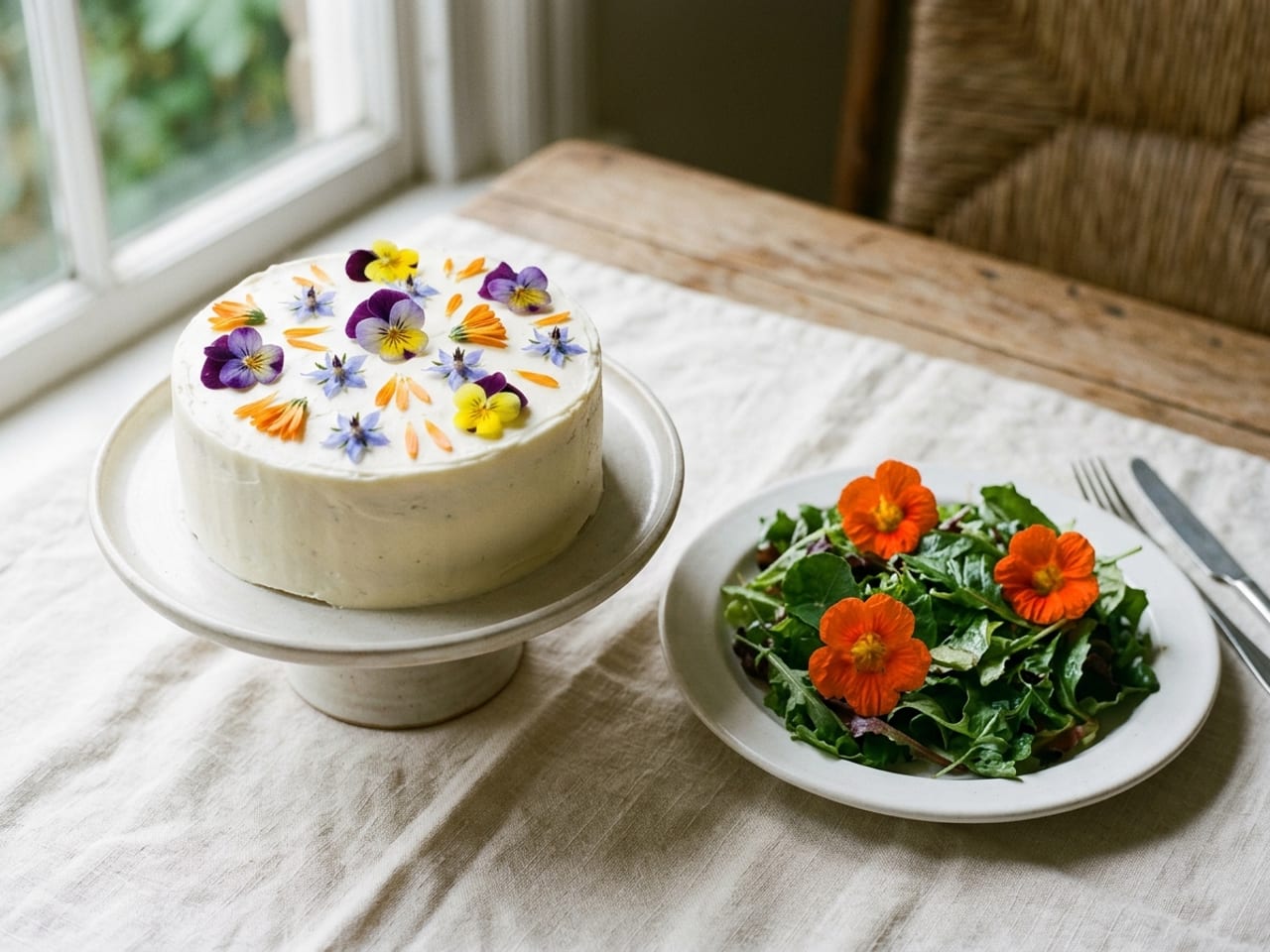
The photos on this page are AI-generated illustrations.
Which flowers are edible?
A flower is edible when three things are true: it is the right species, known by its Latin name; it was grown to be eaten, not bought from a florist; and you eat the right part, usually just the petals. Violas, nasturtiums, borage, calendula, roses and herb flowers top the lists.1, 3, 12
- Edible flowers for cakes: violas and pansies, sweet violets, rose petals, primroses and borage, fresh and put on late, or crystallised for a cake on show.12, 46, 59
- Edible flowers for garnish: nasturtium for pepper, borage and cornflower for blue, calendula for gold, chive and herb flowers for savoury plates, added last.1, 2, 43
- Never: lily of the valley, foxglove, oleander, daffodil, true lilies, hydrangea, sweet pea, poinsettia and the rest of the poisonous list; and nothing from a florist's bouquet.1, 6, 16
- How long they keep: printed figures run from about a day (borage) to 7 to 10 days at 1 to 5 °C (34 to 41 °F), and two weeks in cold-store trials; no study we read tested a home fridge (the figures).
On this page: The three rules · Which part to eat · The edible flower list · The most used flowers · By colour · Poisonous flowers · Sources disagree · Name traps · Buying · Growing · Picking, cleaning, storing · For cakes · For garnish, salads and savoury plates · Drinks and ice · Crystallised, pressed, dried · Colour and flavour science · Nutrition · Allergies and at-risk groups · History · Popular claims · The words · FAQ
How this page was made. Every taste word, rule, time and quotation comes from the source named beside it: US extension services, the Royal Horticultural Society, UK, US and EU agencies and poison references, peer-reviewed studies (many read only as their abstracts), growers, magazines and old cookbooks read in machine-read scans. Plate Artists grew, picked, ate, crystallised and timed nothing for it. Sources describe the same flower in different words, so the list prints each source's words. Where sources disagree on whether a flower is safe to eat at all, it sits in its own table with both sides; where a poison list flags only skin contact or a mild upset for a flower that extension lists and shops sell as food (signet marigold, dianthus, garden chrysanthemum, primrose and others), it stays on the list, with the caution in its row or in the note under the list. US, UK and EU rules are kept apart, and an email from FSA staff is called that, not guidance. Anything marked "ours" is our own reading, conversion or suggestion. Sources are at the bottom.
The three rules: the Latin name, grown as food, the right part
- 1. Know it by its Latin name, and if in doubt, do not eat itCommon names collide, so Colorado State tells readers to "Always use the scientific name when choosing a flower, and if in doubt, do not eat it".1 Penn State calls scientific names "one of the most important keys" and says to skip any cookbook or site that does not give the genus and species.5 The RHS: "Accurate identification of flowers is essential".12 Poison lists are sorted by Latin name for the same reason.17 Every row on this page carries one.
- 2. Sold as food, or grown by you without sprays"Consume only flowers that you or someone else have grown specifically for that purpose".3 Not from florists, garden centres or nurseries, which may have used "chemicals that are not safe to eat"; not sprayed, and not from plants fed fresh or uncomposted manure.1 Not from roadsides, or places livestock or dog walkers use.3, 12 Organic is not a pass: the UK Food Standards Agency's food contact team notes that "even organically produced flowers can have harmful residues of some pesticides, such as nicotine".20 Details under buying.
- 3. Eat the right part, and a little at firstFor most flowers, only the petals: pistils and stamens come out, the sepals come off except on violas, Johnny-jump-ups and pansies, and the bitter white base of rose, dianthus, English daisy and marigold petals is cut away.3, 12 Some flowers are eaten whole (violas, violets, runner beans, clover), and with roselle the part eaten is the calyx.4, 11 Then start small: one new species at a time, in small amounts.1, 3 See which part to eat.
Which part of an edible flower you eat
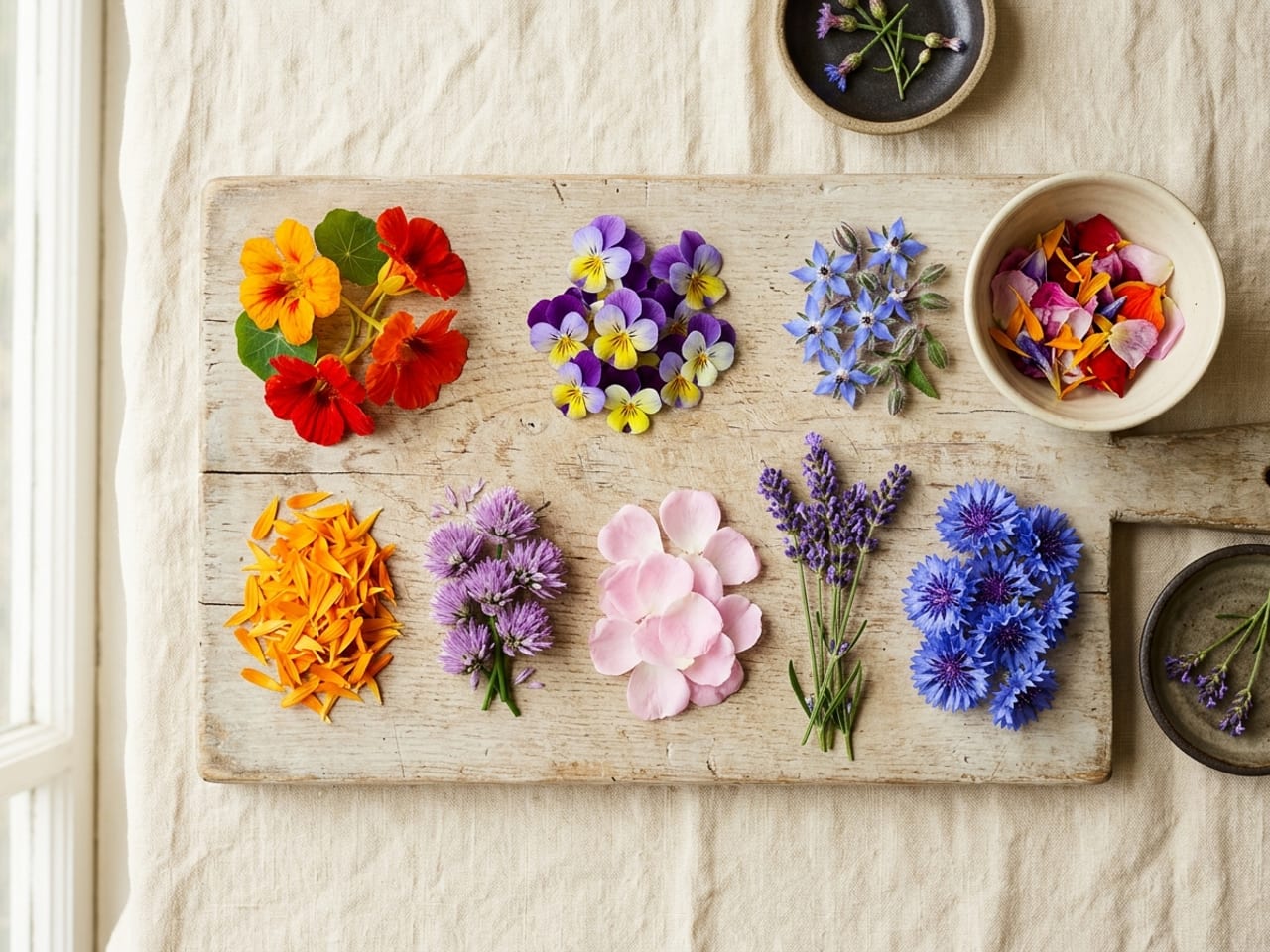
Edible flowers list: taste, colour, the part to eat, season and uses
60 flowers, each with its Latin name and each source's own taste words (the footnote is the owner). Seasons are Colorado State's bloom months for Colorado, or its 2025 sheet's; yours depend on your climate. Flowers that any source we read calls poisonous to eat are not here; a few rows carry a caution from a list that flags skin contact or mild effects, and the row says which. Poisonous and disputed flowers have their own tables.
Garden flowers
| Flower | Tastes like | Colour | Part to eat | In bloom | Uses | Caution |
|---|---|---|---|---|---|---|
| Borage Borago officinalis | cucumber1, 2, 12; slight cucumber4; mild cucumber43 | blue, purple to lavender1 | blue petals only; hairy sepals off4 | June to July1 | garnish; candied1; frozen in ice cubes, salads, fruit cups3; cakes, salads, pâté12 | makes pyrrolizidine alkaloids; small amounts (see allergies and at-risk groups)54, 84 |
| Buzz buttons, toothache plant Acmella oleracea | citrus, spicy; a temporary tingling and numbing2 | not printed in what we read | the flower head, all stem removed2 | June to October2 | beverages, desserts, frozen treats2; used by two Michelin-starred kitchens on Madeira97 | students rated sweet and sour foods less intense after eating one105 |
| Calendula, pot marigold Calendula officinalis | tangy, peppery1, 4; saffron-like3; peppery12 | yellow, gold, orange1 | petals only4 | June to August1 | colour more than flavour4; soups, stews, puddings; dried, pickled, in oil or butter12; dries well1 | not a Tagetes marigold (see name traps) |
| Chicory Cichorium intybus | pleasant, mild-bitter, like endive1 | blue to lavender1 | petals or the whole flower; stems, anthers and pistils off if bitter1 | July to frost1 | garnishes and salads (the general use)1 | none printed |
| Cornflower Centaurea cyanus | floral, cucumber, hint of clove2; lightly sweet and spicy43 | papery florets; blue is the classic colour (ours)43 | petals or florets picked off2, 43 | June to September2 | garnishes, salads, teas, baked goods; fresh or dried2 | none printed |
| Dahlia Dahlia hybrids (UC's safe-list name; Colorado State prints none) | water chestnut, floral, sometimes spicy2 | not printed in what we read | the flower, cut where the stem branches2; petals or the whole flower; stems, anthers and pistils off if bitter1 | June to October2 | garnishes, salads, teas, baked goods2 | none printed |
| Dandelion Taraxacum officinale | bitter1 | yellow1 | petals or the whole flower; stems, anthers and pistils off if bitter1 | May to June; fall1 | cooked only, says Colorado State; no other list we read says so1 | ragweed-family cross-reaction: the evidence conflicts33 |
| Daylily Hemerocallis fulva | cooked: asparagus and zucchini1; buds like asparagus or green bean; petals crunchy4; crunchy, peppery aftertaste12 | tawny orange1 | buds and flowers10, 12 | June to July1 | stir fries, salads, soups12; fresh, fried or dried10 | may be laxative or diuretic: eat in moderation1, 10, 12; toxic to cats10; not a true lily (Lilium): Colorado State warns "Many Lilies ... are NOT edible"1 |
| Dianthus, pinks, carnation Dianthus spp. | spicy, cloves1; clove-like12; sweet clove2 | pink, white and red1 | petals, bitter white base off3, 4 | June to August1 | flavoured sugar, oils and vinegars for cakes12 | a skin allergen to the RHS14 |
| Edible chrysanthemum, shungiku Chrysanthemum coronarium, as Colorado State prints it (now Glebionis coronaria, ours) | mild1 | yellow to white1 | petals or the whole flower; stems, anthers and pistils off if bitter1 | August to October1 | garnishes and salads (the general use)1 | none printed |
| English daisy Bellis perennis | mild to bitter1; not a strong flavour12 | white to purple petals1 | petals, bitter white base off3 | April to September1 | garnish for cakes and salads12 | daisies can cause allergic reactions20 |
| Garden chrysanthemum Dendranthema × grandiflorum (NC State: Chrysanthemum × morifolium) | varieties differ, strong and bitter1 | red, yellow, pink, orange, purple, white1 | petals and flower buds10 | August to October1 | a sweet drink or tea in Asia, a wine in Korea10; creamy soups, fish chowder, egg dishes12 | a skin allergen to the RHS14 |
| Hollyhock Alcea rosea | little, slightly bitter1; bland to slightly bitter4 | various1 | petals; remove all pollen12 | July to frost1 | a garnish, or a container for dip1; crystallised petals on cakes12 | none printed |
| Nasturtium Tropaeolum majus | watercress, peppery1; sweet, spicy, like watercress3; peppery petals, sweet nectar finish43 | varies; white to red1, 4 | flowers, leaves and seedpods4; petals alone for a milder taste12 | July to August1 | fresh in salads1; salads and pasta12; does not dry well2 | none printed |
| Primrose and cowslip Primula vulgaris; cowslip P. veris (ours) | not printed in what we read | not printed in what we read | petals or the whole flower; stems, anthers and pistils off if bitter1 | not printed | crystallised or fresh on cakes; frozen in ice cubes12 | none printed |
| Red clover Trifolium pratense | hay1; sweet4 | pink, lilac1 | the florets, whole1, 4 | June to September1 | scatter florets on salad1; fruit and green salads; wine from whole red flowers12 | none printed |
| Rose Rosa spp. | highly perfumed; sweet to bitter1; strong floral; some dark reds metallic4 | white, pink, yellow, red, orange1 | petals only, bitter white base off1, 3, 4 | May to June, September1 | crystallised; drinks, sugar, icing12 | only roses grown as food: florist roses carry residues (see buying)86 |
| Scented geranium Pelargonium spp. | like the variety, e.g. rose, lemon1; rose- and lemon-scented best4; milder than the leaves12 | white, red, pink, purple1 | petals or the whole flower; stems, anthers and pistils off if bitter1 | varies1 | crystallised, or frozen in ice cubes for cordials12 | Pelargonium, not true geranium (cranesbill) |
| Signet marigold Tagetes tenuifolia (Nebraska: T. signata) | citrus; milder than T. erecta1; lemon-verbena scent3; citrus4 | white, gold, yellow, red1 | petals, bitter white base off3, 4 | May to September1 | garnishes and salads (the general use)1 | NC State calls the flowers edible ("'Lemon Gem' and 'Tangerine Gem' have the best flavor") but says they "May be harmful if eaten in large amounts", and lists the sap as a skin irritant in sunlight; the RHS lists Tagetes minuta as a skin irritant10, 14 |
| Snapdragon Antirrhinum spp. | bland to bitter4; leafy, sweet, slightly bitter2 | a wide range4 | petals, pulled off each flower2 | June to October2 | garnishes, salads, teas2 | none printed |
| Sunflower Helianthus annuus | bittersweet petals4 | white, yellow, orange, burgundy4 | petals only4; whole buds, blanched12 | not printed | buds with garlic butter; petals in salads, stir fries12 | none printed |
| Sweet violet Viola odorata | sweet1; strong, sweet, very floral4; delicate12 | violet, pink, white1 | the whole flower4 | April to May1 | candies well1; sweet or savoury dishes, tea; candied on cakes12 | none printed |
| Tuberous begonia Begonia × tuberhybrida | citrus1; light lemon, crisp4; crisp sour apple (a grower's "Apple Blossom (Begonia)", species not given)43 | white, pink, yellow, red, orange and combinations1 | the flowers; only hybrids are edible1, 4 | July to August1 | salads; garnish for dishes and drinks99 | oxalic acid: avoid with gout, kidney stones, rheumatism49; can aggravate gout20 |
| Viola, pansy, Johnny-jump-up Viola × wittrockiana, V. tricolor | stronger than violets1; wintergreen (Johnny-jump-up)3; sweet lettuce4; floral, leafy, sweet2; vegetable, light mint undertone45 | violet, white, pink, yellow, multi-coloured1 | the whole flower, sepals left on3, 4 | May to July1 | garnishes; candied3; candied, on cakes and soufflés12; frozen treats, teas, baked goods2 | none printed |
| Zinnia Zinnia (the genus, UC's safe-list name; Colorado State prints none) | floral and bitter2 | not printed in what we read | petals, pulled off each flower2 | June to October2 | garnishes, salads, teas2 | none printed |
Herb flowers
| Flower | Tastes like | Colour | Part to eat | In bloom | Uses | Caution |
|---|---|---|---|---|---|---|
| Anise hyssop Agastache foeniculum | strong anise, sweet, licorice1; anise3 | lavender1 | flowers and foliage3 | July to frost1 | teas, sweet and sour marinades3 | none printed |
| Basil Ocimum basilicum | milder than leaves, spicy1; sweet, clove-like12 | white to pale pink1 | petals or the whole flower; stems, anthers and pistils off if bitter1 | July to frost1 | tomato dishes, oils, salad dressings, soups12 | none printed |
| Bee balm, bergamot, Oswego tea Monarda didyma | tea-like, more aromatic than leaves1; strong, spicy, mint4 | red, pink, white, lavender1 | petals or the whole flower; stems, anthers and pistils off if bitter1 | July to August1 | tea; with bacon, poultry, rice and pasta12 | none printed |
| Chive blossom Allium schoenoprasum | onion, strong1; mild onion3, 4 | lavender, red to purple1 | separated florets1, 3 | May to June1 | chive-blossom vinegar39; garnishes and salads (the general use)1 | none printed |
| Coriander, cilantro Coriandrum sativum | like the leaf but milder1 | white1 | petals or the whole flower; stems, anthers and pistils off if bitter1 | June to frost1 | garnishes and salads (the general use)1 | none printed |
| Dill Anethum graveolens | stronger than leaves1; aniseed12 | yellow1 | small umbels, used whole12 | June to frost1 | salads, vegetables, fish; in mayonnaise, white sauce, pickles12 | none printed |
| Fennel Foeniculum vulgare | licorice, milder than leaves, sweet1 | pale yellow1 | small umbels, used whole12 | July to August1 | garnishes and salads (the general use)1 | none printed |
| Garden sage Salvia officinalis | flowery sage, slightly musky1 | blue, purple, white, pink1 | petals or the whole flower; stems, anthers and pistils off if bitter1 | May to July1 | garnishes and salads (the general use)1 | none printed |
| Garlic chives Allium tuberosum | onion, strong1; onion and garlic4 | white1 | separated florets1 | August to frost1 | garnishes and salads (the general use)1 | none printed |
| German chamomile Matricaria recutita (also M. chamomilla, ours) | pleasant pineapple4 | small white daisy flowers4 | petals only4 | not printed | tea32 | as Roman chamomile: ragweed-family allergy32 |
| Lavender (English) Lavandula angustifolia | highly perfumed; may be very strong1; strong lemon-perfume4 | lavender, purple, pink, white1 | petals only3 | June to early August1 | flavoured sugar, honey or vinegar for cakes and biscuits; sprigs with roast pork, lamb, chicken12 | high-camphor lavandin, or too much, tastes soapy102 |
| Mint Mentha spp. | minty; milder than leaves1 | lavender, pink to white1 | petals or the whole flower; stems, anthers and pistils off if bitter1 | July to September1 | in vinegar and butter, sweet or savoury12 | none printed |
| Oregano and marjoram Origanum spp., O. majorana | oregano spicy, pungent like the leaves; marjoram spicy, sweet1 | white (oregano), pale pink (marjoram)1 | petals or the whole flower; stems, anthers and pistils off if bitter1 | June to August1 | garnishes and salads (the general use)1 | none printed |
| Pineapple sage Salvia elegans | pineapple and sage overtones1 | scarlet1 | petals or the whole flower; stems, anthers and pistils off if bitter1 | September1 | garnishes and salads (the general use)1 | none printed |
| Roman (English) chamomile Anthemis nobilis, as Colorado State prints it (now Chamaemelum nobile) | sweet apple1 | white petals, yellow centre1 | petals or the whole flower; stems, anthers and pistils off if bitter1 | late June to frost1 | tea1 | ragweed allergy; no more than one cup of tea a day1; allergic reactions, anaphylaxis among them32 |
| Rosemary Rosmarinus officinalis (now Salvia rosmarinus) | mild rosemary1; slightly pine-like, resinous4 | pale blue, dark blue, pink, white1 | petals or the whole flower; stems, anthers and pistils off if bitter1 | depends on cultivar1 | garnishes and salads (the general use)1 | do not cook the flowers1 |
| Society garlic Tulbaghia violacea | onion flavour1 | lilac1 | petals or the whole flower; stems, anthers and pistils off if bitter1 | spring1 | garnishes and salads (the general use)1 | none printed |
| Summer savory Satureja hortensis | mildly peppery, spicy1 | pink1 | petals or the whole flower; stems, anthers and pistils off if bitter1 | July to August1 | garnishes and salads (the general use)1 | none printed |
| Sweet woodruff Galium odoratum | sweet, nutty, vanilla10 | white10 | the white flowers10 | not printed | garnishes and salads (the general use)1 | may thin the blood if eaten in large amounts10 |
| Thyme Thymus spp. | milder than leaves; most creeping thymes have little flavour1 | pink, purple, white1 | petals or the whole flower; stems, anthers and pistils off if bitter1 | July to August1 | garnishes and salads (the general use)1 | none printed |
Vegetable flowers
| Flower | Tastes like | Colour | Part to eat | In bloom | Uses | Caution |
|---|---|---|---|---|---|---|
| Garden pea Pisum sativum | raw peas1 | white, tinged pink1 | petals or the whole flower; stems, anthers and pistils off if bitter1 | May to June1 | garnishes and salads (the general use)1 | not sweet pea, which is not edible (see name traps)20 |
| Mustard Brassica spp. | mustard, hot1; slightly peppery (on steak tartare at Lyle's, London)66 | yellow1 | petals or the whole flower; stems, anthers and pistils off if bitter1 | April to May1 | salad garnish1 | watch for allergies1 |
| Rocket, arugula Eruca vesicaria | nutty, smoky, less piquant than leaves1 | white1 | petals or the whole flower; stems, anthers and pistils off if bitter1 | May to frost1 | garnishes and salads (the general use)1 | none printed |
| Roselle, Jamaica sorrel, flor de jamaica Hibiscus sabdariffa | tart; a cranberry substitute11 | calyces green, red or dark red104 | the calyx, the fleshy red cup at the base, not the petals11, 104 | not printed | jams, sauces, teas11; agua de jamaica, salsas, tacos, enchiladas35, 104 | a different plant from Hibiscus rosa-sinensis, the hibiscus of the extension lists (see the Hibiscus, China rose row under tree and shrub blossoms) |
| Safflower Carthamus tinctorius | bitter1 | yellow to deep red1 | petals or the whole flower; stems, anthers and pistils off if bitter1 | August1 | may colour cooked food yellow1 | Colorado State also calls it "saffron"; it is not saffron crocus (see name traps)1 |
| Scarlet runner bean Phaseolus coccineus | raw bean but milder1 | bright orange to scarlet1 | the whole flower4 | July to August1 | crunchy; used in salad1 | none printed |
| Squash and courgette blossom, zucchini, pumpkin Cucurbita spp. | mild, raw squash1, 4; fresh and sweet43 | orange, yellow1 | the whole flower, stamens and pistils out4; male flowers, so the plant still fruits12, 35 | July to August1 | hot in tomato sauce, or cold stuffed12; quesadillas, soups, salsas, tamales35 | none printed |
Tree and shrub blossoms
| Flower | Tastes like | Colour | Part to eat | In bloom | Uses | Caution |
|---|---|---|---|---|---|---|
| Apple and crabapple blossom Malus spp. | slightly floral to sour1; floral to slightly sour4 | white to pink1 | petals1 | May1 | petals may be candied1 | the seeds are poisonous1 |
| Elderflower Sambucus nigra (UC: Sambucus spp.) | sweet4 | cream4 | the florets only: leaves, roots, seeds and stems are poisonous4, 10 | not printed | wine, cordial; in a muslin bag for tarts and jellies; battered and fried12 | some wild red-berried kinds are poisonous: use cultivated edible kinds4 |
| Hibiscus, China rose Hibiscus rosa-sinensis | citrus, cranberry1, 4; citrus tea12 | orange, red or purplish red1 | petals; stamens, pistils and calyx off12 | late summer1 | tea flavourings1; a drink when boiled4 | not roselle (H. sabdariffa), whose calyx makes agua de jamaica and roselle tea |
| Lilac Syringa vulgaris | perfume, slightly bitter1; slightly bitter, lemony4 | white, pink, purple, lilac1 | petals or the whole flower; stems, anthers and pistils off if bitter1 | April to May1 | candies well1 | none printed |
| Orange and lemon blossom Citrus sinensis, C. limon | orange: citrus, sweet or strong; lemon: citrus, slightly bitter1 | white1 | petals or the whole flower; stems, anthers and pistils off if bitter1 | varies1 | infused in vinegar74; garnishes and salads (the general use)1 | none printed |
| Plum blossom Prunus spp. | mild, like flower nectar1 | pink to white1 | petals1 | April to May1 | petals candy well1 | the pits of mature fruit are poisonous1 |
| Redbud Cercis canadensis | beanlike to tart apple1 | pink1 | petals or the whole flower; stems, anthers and pistils off if bitter1 | April1 | garnishes and salads (the general use)1 | none printed |
| Rose of Sharon Hibiscus syriacus | mild, nutty1 | red, white, purple, violet1 | petals or the whole flower; stems, anthers and pistils off if bitter1 | July to August1 | garnishes and salads (the general use)1 | none printed |
UC's poison list. The University of California's list of toxic garden plants, read in a 2020 archived copy, also classes some genera on this list: Allium (chives and garlic chives) and the seeds of pansies and violets as minor toxicity, which may mean "vomiting or diarrhea" if eaten; begonia as minor toxicity and oxalates; Chrysanthemum (garden chrysanthemum and shungiku) and Dianthus (pinks) as minor toxicity and dermatitis; hollyhock, English daisy, chamomile (Chamaemelum), primrose and marigold (Tagetes) as dermatitis, a rash from the juice or sap. Apple and Prunus seeds and elder (whose ripe fruit it calls nontoxic) are in its major class; those rows already say which parts to keep off.18 It is a list of plants to call Poison Control about, not a verdict on eating the petals, so we print it once here rather than in every row (ours).
The thirteen most used edible flowers
The flowers growers sell most and the sources say most about. Each links to its row in the list.
Nasturtium
Tropaeolum majus
The peppery one: "Watercress, peppery" to Colorado State, "sweet, spicy" to Nebraska.1, 3 Flowers, leaves and seedpods are all edible; petals alone taste milder.4, 12 The bite is mustard oil, mostly benzyl isothiocyanate (see the science).15, 95 Use it fresh: it does not dry well.2 In one study, gardening-class attendees and Master Gardeners shown slides accepted nasturtiums only when flawless, while pansies forgave a little damage.108
Viola, pansy, Johnny-jump-up
Viola × wittrockiana, V. tricolor
The best seller: first by popularity at one UK grower and "one of our best sellers" at another.43, 45 Five sources, five tastes: "stronger than violets", "wintergreen", "sweet lettuce", "floral, leafy, sweet" and "vegetable flavour with a light mint undertone", and a grower adds "slightly sweet, herbaceous" (viola) and "sweet grassy" (pansy).1, 2, 3, 4, 43, 45 We print them all and pick none. Chefs in a Michigan study liked violas' looks but rated the taste low: 29% called it "appealing".107 Leave the sepals on.3 Pansies, with larger petals, are the flower Colorado State names for crystallising.1
Sweet violet
Viola odorata
Sweet violet is "Sweet", says Colorado State, and "Candies well"; UC calls it "strong, sweet, very floral".1, 4 Candied violets are made commercially in Toulouse as violettes de Toulouse.69 Violets were sold in the Athenian agora.114
Borage
Borago officinalis
Small blue stars that every list says taste of cucumber.1, 3, 4, 12 That is a taste-panel finding: the main aroma compound measured in borage is grassy, and no paper we read names a cucumber compound.97, 99 Pull off the hairy sepals and serve the blue petals.4 Lovely in ice cubes and candied.3, 12 Two cautions: borage makes pyrrolizidine alkaloids (see borage and alkaloids), and cut petals last about a day.78, 84
Calendula
Calendula officinalis
Pot marigold, Calendula officinalis: tangy and peppery, and used "more for color than flavor"; only the petals are eaten.1, 4 The RHS puts the petals in soups, stews and puddings, dried, pickled in vinegar, or in oil or butter.12 The marigold was a common salad ingredient in the Middle Ages.113 It is not a Tagetes marigold (see the marigold trap).
Rose
Rosa spp.
"All roses are edible with the more fragrant roses being the best", says the RHS, for petals crystallised, in drinks, sugar and icing.12 Cut off the bitter white base; some dark red varieties taste metallic.3, 4 Only roses grown as food: florists' roses in a Belgian study carried an average of 14 pesticide substances each.86 Rose was the flower most eaten by the Portuguese in one survey.111
Lavender (English)
Lavandula angustifolia
The edible lists name English lavender, Lavandula angustifolia.1, 4, 12 Whether it tastes of soap depends on cultivar and quantity: culinary lavender is generally low-camphor angustifolia, while high-camphor lavandin (L. × intermedia) or too much gives the soapy taste.102 The RHS uses it in sugar, honey or vinegar for cakes and biscuits, and sprigs with roast pork, lamb and chicken.12 Only the petals are edible.3
Squash and courgette blossom
Cucurbita spp.
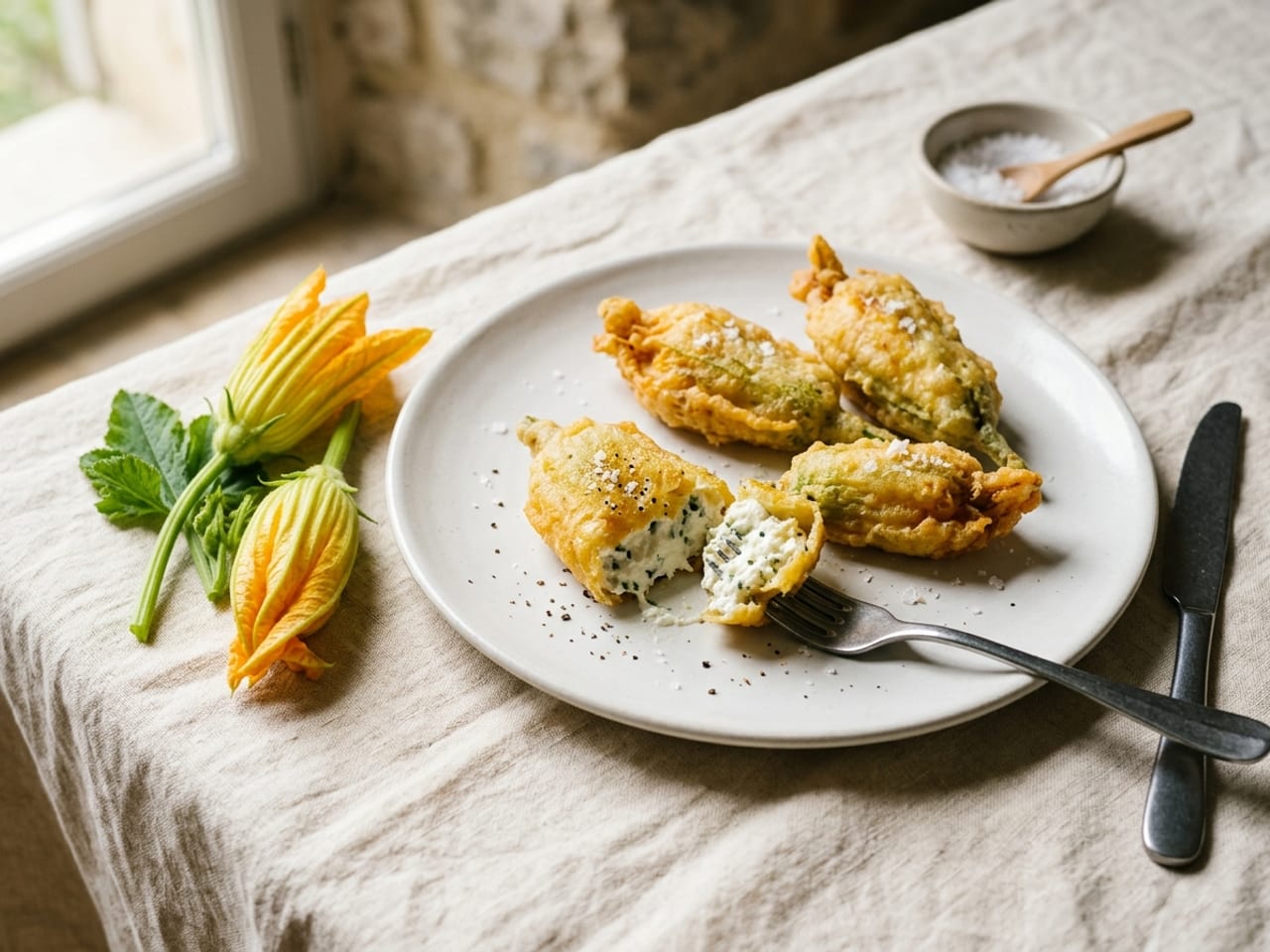
Mild, "raw squash" flavour; take the stamens and pistils out.1, 4 Pick the male flowers, since the female ones become the squash.12, 35 In Mexico, flor de calabaza has been eaten "since pre-Hispanic times" (our translation), in quesadillas and soups.35 Stuffed with ricotta and fried, they are the one flower here that is a dish on its own (see the steps).63
Chive blossom
Allium schoenoprasum
Separate the florets to serve.1 Strength depends on who you ask: "Onion, strong" to Colorado State, "mild, onion" to Nebraska and UC.1, 3, 4 A review describes "a mild onion-garlic flavor with a hint of floral notes".99 Chive blossoms are one of the flowers Oregon State names for flavoured vinegar.39
Dianthus, pinks
Dianthus spp.
Pinks taste of clove to every source that describes them.1, 2, 4, 12 Cut off the bitter white base.3 The RHS uses alpine pinks for flavoured sugar, oils and vinegars for cakes.12 In 1699 Evelyn infused the "Clove-Gillyflower" in vinegar.74 One caution: the RHS lists Dianthus as a skin allergen, and UC's poison list gives pinks its minor-toxicity and dermatitis classes (the same list includes chives and begonia; see the note under the list).14, 18 Our advice: small amounts, petals only.
Cornflower
Centaurea cyanus
"Floral, cucumber, hint of clove", says Colorado State's 2025 sheet, for garnishes, salads, teas and baked goods, fresh or dried.2 A UK grower sells them as "vibrant papery florets" to pick off.43 The Latin name, Centaurea cyanus, is NC State's; the 2025 sheet prints none.10
Elderflower
Sambucus nigra (UC: Sambucus spp.)
Use only the florets: elder's leaves, roots, seeds and stems are poisonous, with "cyanide-inducing glycosides", and some wild red-berried kinds are poisonous.4, 10 The RHS makes wine and cordial, flavours tarts in a muslin bag and fries the heads in batter.12 Elder is the most cited flower in a review of Mediterranean flower eating.113 No source we read says fresh florets must be cooked. Cordial: two recipes compared.
Hibiscus, China rose
Hibiscus rosa-sinensis
Two plants share the name. Colorado State, UC and the RHS list Hibiscus rosa-sinensis, citrus and cranberry, "Used in many tea flavorings", and the RHS makes a citrus tea from it.1, 4, 12 Roselle, Hibiscus sabdariffa, is a different plant: its red calyx, not its petals, is what goes into agua de jamaica, jams, sauces and roselle tea.11, 104 They are two rows in the list, never one.
Edible flowers by colour
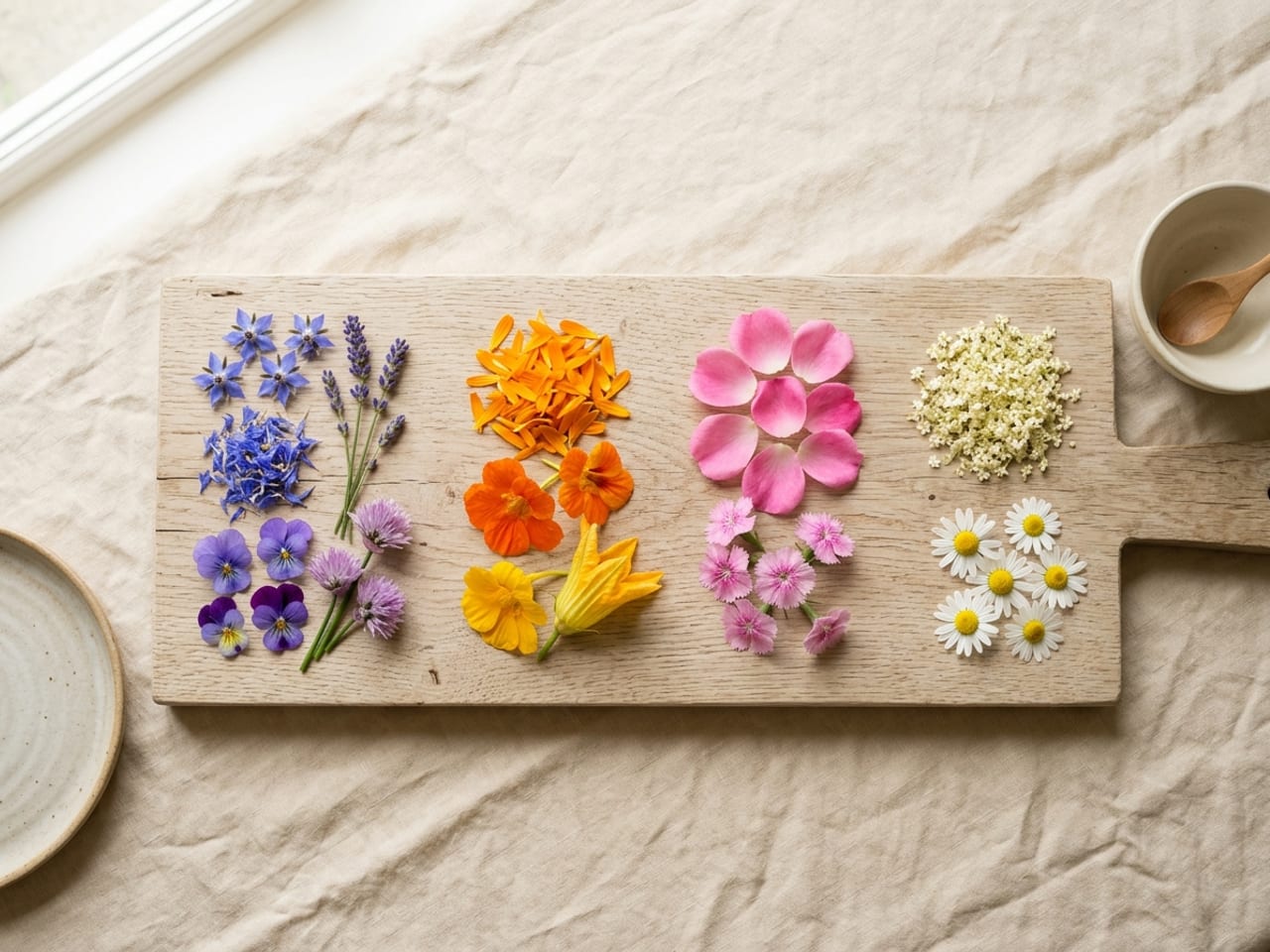
Blue and purple: viola, pansy, johnny-jump-up, sweet violet, borage, cornflower, english daisy, scented geranium, garden chrysanthemum, chive blossom, society garlic, rosemary, thyme, mint, garden sage, lavender (english), bee balm, anise hyssop, rose of sharon, lilac, red clover, chicory.
Yellow and orange: nasturtium, viola, pansy, johnny-jump-up, calendula, signet marigold, rose, squash and courgette blossom, daylily, tuberous begonia, hollyhock, sunflower, primrose and cowslip, snapdragon, dahlia, zinnia, buzz buttons, garden chrysanthemum, edible chrysanthemum, shungiku, dill, fennel, scarlet runner bean, mustard, safflower, hibiscus, china rose, dandelion.
Red and pink: nasturtium, viola, pansy, johnny-jump-up, sweet violet, signet marigold, dianthus, pinks, rose, tuberous begonia, hollyhock, sunflower, snapdragon, dahlia, zinnia, scented geranium, garden chrysanthemum, chive blossom, basil, rosemary, thyme, mint, garden sage, pineapple sage, oregano and marjoram, summer savory, lavender (english), bee balm, scarlet runner bean, garden pea, safflower, roselle, jamaica sorrel, hibiscus, china rose, rose of sharon, lilac, apple and crabapple blossom, plum blossom, redbud, red clover.
White and cream: nasturtium, viola, pansy, johnny-jump-up, sweet violet, signet marigold, dianthus, pinks, rose, tuberous begonia, hollyhock, sunflower, english daisy, snapdragon, dahlia, scented geranium, garden chrysanthemum, edible chrysanthemum, shungiku, garlic chives, basil, coriander, cilantro, rosemary, thyme, mint, garden sage, oregano and marjoram, lavender (english), bee balm, roman (english) chamomile, german chamomile, sweet woodruff, garden pea, rocket, arugula, rose of sharon, elderflower, lilac, apple and crabapple blossom, plum blossom, orange and lemon blossom.
The groups are ours: each flower goes in the families of the colours its sources print in the list above (pink counts as red, purple and lilac as blue), and where no source prints a colour (primrose, dahlia, zinnia, buzz buttons) or prints only "various" or "a wide range" (hollyhock, snapdragon), we placed it. In consumer studies, flower colour took most of the decision to buy (63% and 95% of the points in two groups), and a mix of blue, yellow and orange was the favourite; gardeners rated yellow, orange and blue equally acceptable.108, 109 A Belgian survey, cited in a 2025 review, found warm yellows and oranges preferred to blues and purples.84 Blue stands out because naturally blue food is rare.94 More on colour in our colour on the plate guide.
Poisonous flowers: never on food, drinks or cakes
From the poison references and extension lists named in each row; "not a complete list", as Colorado State says of its own, so if a flower is not on the edible list, do not eat it.1
| Flower | Latin name | What the sources say |
|---|---|---|
| Lily of the valley | Convallaria majalis | Cardiac glycosides and saponins, flowers among the poison parts; NC State rates it "Low" ("Toxic only if large quantities eaten") while UC puts it in its most serious class and the RHS lists it as "toxic if eaten" (its category B).1, 10, 14, 16, 17 |
| Foxglove | Digitalis purpurea | Cardiac glycosides; the flowers are a poison part; effects include an irregular pulse and death.1, 10, 14, 16, 17 |
| Oleander | Nerium oleander | "Highly toxic, may be fatal if eaten!", fresh or dry.1, 10, 14, 16 |
| Daffodil and jonquil | Narcissus spp. | Lycorine and calcium oxalate; bulbs are the most poisonous, but the flowers are listed too.1, 10, 14, 16 One old extension bulletin lists jonquil as edible; Colorado State and UC list Narcissus as toxic, and so do we.1, 9, 18 |
| Monkshood | Aconitum spp. | Severe nervous-system effects; whole plant.1, 14, 16, 17 |
| Larkspur, delphinium | Delphinium spp., Consolida | "Edibility: Poisonous." Flowers listed, toxin delphinine.1, 10, 14 |
| Angel's trumpet, jimsonweed | Brugmansia, Datura | "Among the most toxic of ornamental plants", poisonous "through ingestion and/or inhalation of flowers".1, 10, 14, 17 |
| Carolina jessamine ("false jasmine") | Gelsemium sempervirens | Alkaloids, flowers among the poison parts, severity High; the RHS lists it as "false jasmine". Not a true jasmine (see the jasmine trap).10, 14, 18 |
| Day- and night-blooming "jasmine" | Cestrum spp. | On Colorado State's toxic table, and UC's major-toxicity class, under jasmine and jessamine names.1, 18 |
| True lilies and calla lily | Lilium, Zantedeschia | "Many Lilies contain alkaloids and are NOT edible"; UC lists "some species" of Lilium; calla holds calcium oxalate that burns the mouth.1, 17, 18 Lilies are dangerous to cats: Easter lilies are "not toxic to humans but are very toxic to cats".10, 17 The RHS lists the tiger lily as edible; with the other sources against it, we keep every true lily off this page's list.12 |
| Hyacinth | Hyacinthus | "Edibility: Toxic to humans"; lycorine-type alkaloids.1, 10, 14 Grape hyacinth is a different plant (see the trap). |
| Autumn crocus | Colchicum | Whole plant; on every poison list we read.1, 14, 16, 17 Not saffron crocus (see the trap). |
| Hydrangea | Hydrangea | Cyanogenic glycosides (hydrangin) in leaves and buds; NC State lists the flowers too.10, 17 |
| Azalea, rhododendron | Rhododendron | Grayanotoxins; NC State says moderate amounts pose "little toxic hazard", UC puts it in its major class.1, 10, 14, 18 In Yunnan some species' flowers are eaten after local processing meant to detoxify them or make them palatable, a local practice and not one to copy.90 |
| Sweet pea | Lathyrus odoratus | The sources disagree on the part: Colorado State, NC State and UC's web list name the SEEDS; UC's poisonous-plants booklet names the whole plant; the RHS, pods and seeds; the FSA team says simply that sweet pea "should not" be eaten. None calls the flower edible.1, 10, 14, 17, 18, 20 |
| Opium poppy (Colorado State also calls it common poppy) | Papaver somniferum | On Colorado State's toxic table; "some species of poppy have edible seed, but poppy flowers themselves are toxic".1, 20 |
| Lantana | Lantana camara | Lantadenes; flowers listed.1, 10, 14, 16 |
| Clematis | Clematis spp. | Protoanemonin; deaths are rare because it tastes intensely bitter and irritates the mouth at once.1, 10, 18 |
| Florist ranunculus and anemone | Ranunculus asiaticus, Anemone coronaria | Protoanemonin: burning mouth, pain, vomiting; "All parts of the plant are poisonous" (anemone).10, 14 |
| Morning glory | Ipomoea | Indole alkaloids; the seeds are hallucinogenic in quantity.10, 16, 17 |
| Lupin | Lupinus | "Harmful if eaten"; severe effects in UC's booklet.6, 14, 17 |
| Poison hemlock and water hemlock | Conium maculatum, Cicuta maculata | Both rated High; water hemlock "MAY BE FATAL". People have died mistaking hemlock for wild carrot (see the trap).10, 16 |
| Yarrow | Achillea millefolium | On Colorado State's toxic table.1 Alaska names yarrow among "suggested edible flowers" it did not evaluate; with a toxic listing against it, we keep it off.6 |
| Flowering tobacco | Nicotiana spp. | On the toxic lists.1, 6 |
| Potato flowers | Solanum tuberosum (ours; the source names only potato) | "Don't assume all vegetable flowers are edible. Some such as potato are poisonous."13 |
| Poinsettia | Euphorbia pulcherrima | NC State: "Toxic if ingested", a milky latex sap; the RHS: irritant to skin and eyes and "harmful if eaten"; Colorado State lists Euphorbia. poison.org lists it as non-poisonous but "may cause irritation", which is not edible.1, 10, 14, 16 |
| Also on the toxic lists | various | Daphne, bleeding heart, Chinese lantern, castor bean, mistletoe, cardinal flower (Lobelia), other euphorbias, amaryllis, iris, mountain laurel, glory lily (Gloriosa) and death camas.1, 14, 16 |
Flowers some lists call edible and others do not
Each of these is called edible by at least one source we read and unsafe, or only "non-poisonous", by another. We print both sides and leave every one off our list.
| Flower | Called edible by | Against | Our call |
|---|---|---|---|
| Baby's breath Gypsophila paniculata | UC Sacramento lists it: "mild, slightly sweet"4; Alaska names it among "suggested edible flowers" it did not evaluate6 | NC State tags it "Poisonous to Humans", but its symptoms are from handling, its toxin "Saponin?" and its poison part "Bark"10; UC's poison list gives it the dermatitis class only18; not on the RHS and trade list14 | Not recommended: the sources disagree, and a skin and airway irritant is no garnish. Never in our list. |
| Tiger lily Lilium (the RHS prints "Lilium leucanthemum var. tigrinum") | the RHS: salads, omelettes, poultry, stuffed fish12 | Colorado State: "Many Lilies contain alkaloids and are NOT edible"1; UC lists some Lilium species; lilies are very toxic to cats17, 18 | Kept off, with the other true lilies in the poisonous table. |
| Tulip Tulipa spp. | UC Sacramento: petals, "pea-like"4; NC State: "a vegetable flavor like lettuce, fresh peas or cucumber"10 | the same NC State page lists the flowers among the poison parts10; the RHS and trade list: "harmful if eaten", a skin allergen14; allergy: numb hands, upset stomach4, 20 | Off our list. |
| True jasmine Jasminum spp. | one old bulletin lists "Jasminum species"9; the FSA team: "jasmine is edible"20 | NC State's Jasminum officinale page says nothing either way10; Colorado State, UC and the RHS warn of toxic "jasmines", Cestrum and Gelsemium1, 14, 18 | Off our list: no source we read names a Jasminum species with a taste and a part. |
| Wisteria Wisteria sinensis | NC State: "Flowers edible raw or cooked (stems removed)"10 | the same page lists the flowers as a poison part10; UC: the whole plant, especially the seeds, strong stomach effects17 | Off our list. |
| Butterfly pea Clitoria ternatea | NC State: the flowers "can be used to impart a blue coloration to foods and beverages"; the dye is "edible"10; the US FDA lists the flower EXTRACT as a colour additive (2021), not the flowers as a food21 | the EU has not authorised it as a food: EFSA objected over cyclotides, citing cell effects in vitro and possible effects on the immune system and on the uterus29; Austria rejected five of 19 blue gins for its extract30 | Off our list as a flower to eat: a colour for drinks where the extract is allowed, not petals by the handful, and none if pregnant (ours). See the colour science. |
| Petunia Petunia hybrida | UC Sacramento: "a mild flavor"4; Alaska names it among "suggested edible flowers" it did not evaluate6 | no taste or part printed beyond UC Sacramento's; otherwise only on non-poisonous and "generally believed to be safe" lists, which are not edible lists16, 18 | Off our list: two passing mentions, no detail. |
| Japanese honeysuckle Lonicera japonica | NC State: nectar "can be sucked from flowers without harm"; flowers in some Chinese dishes10 | its fruits are poisonous in large amounts10; one old bulletin lists the whole genus, which no other source does9 | Off our list. |
Name traps: marigold, sweet pea, lily, jasmine and the carrot family
- Marigold: Calendula is not Tagetes"Pot marigold" is Calendula officinalis; signet, African and French marigolds are Tagetes.1, 14 Colorado State lists both kinds as edible, African marigold with "some cultivars ... strong and bitter"; Alaska goes further, "all marigolds are edible, but only calendula and signet marigolds are generally considered tasty".1, 6 NC State's Tagetes page agrees the flowers are edible, best in 'Lemon Gem' and 'Tangerine Gem', but says they "May be harmful if eaten in large amounts" and lists the sap as a poison part that burns skin in sunlight (phototoxic thiophenes); UC lists Tagetes, and the RHS lists Tagetes minuta (which it calls African and French marigold), as a skin irritant.10, 14, 18 Sainsbury's sold "tagete marigold" in its edible range.48 Our list keeps calendula and the signet marigold, with that caution; if a recipe just says "marigold", ask which.
- Lily: daylily, true lily, calla and lily of the valley are four plantsDaylily (Hemerocallis) is on the edible lists, laxative in quantity; true lilies (Lilium) are mostly not, calla (Zantedeschia) is not, and lily of the valley (Convallaria) is poisonous.1, 10, 12 Daylilies and lilies are both dangerous to cats.10, 17 See the lily row for the RHS's tiger lily.
- Jasmine: three plants answer to the nameThe FSA team: "jasmine is edible but the very similar false jasmine is poisonous".20 The RHS names false jasmine as Gelsemium, "harmful if eaten"; NC State notes the genus name comes from the Italian for jasmine and rates it High.10, 14 Colorado State's toxic table adds Cestrum, sold as "Day blooming jasmine, Night blooming jasmine".1 True jasmine, Jasminum, is not on our list (see why).
- The carrot family: dill and fennel yes, white wild umbels noDill, fennel and coriander flowers are edible, and the RHS says small umbels like dill and fennel can be used whole.1, 12 NC State calls Queen Anne's lace (wild carrot) flowers edible.10 But poison hemlock's leaves "resemble parsley", water hemlock "MAY BE FATAL", and "People have died after mistaking hemlock for wild carrots".10, 16 Our reading: take umbellifer flowers only from herbs you bought or sowed, never from a roadside or a field.
- Onions and chives: death camas and daffodil leavesColorado State's toxic table lists death camas under the common name "wild onion".1 In Bristol in 2012, ten people were treated in hospital, thought to have mistaken daffodil greens for a chive used in Chinese cooking; the sources disagree on whether supermarkets were asked to keep daffodils away from food in 2012 or in a 2015 letter.19, 48
- Hyacinth and grape hyacinthHyacinth (Hyacinthus) is on Colorado State's toxic table, while grape hyacinth (Muscari) is on its edible one, "Grapey, slightly sour with bitter aftertaste".1 Because the names collide, we leave grape hyacinth off our list.
- Shop names: "Apple Blossom" can be a begoniaA UK grower sells "Apple Blossom (Begonia)", a begonia with a "crisp sour apple bite", not apple blossom.43 Hibiscus and chamomile each cover two plants: rosa-sinensis and sabdariffa; Roman and German chamomile, whose sources print different tastes.1, 4, 11 Check the Latin name on the label.
Where to buy edible flowers, and why not from a florist
- Buy flowers sold to be eatenSome grocery produce departments sell edible flower mixtures in rigid plastic containers, often near the fresh herbs.5, 8, 53 In the UK, Sainsbury's launched a range of tagete marigold, monkey flowers, viola and dianthus at £3 a punnet, and growers sell to bakers and chefs online.43, 45, 48 In a supermarket test reported in 2004, shoppers bought 243 of 360 containers of nasturtiums and violas over six weeks.110 Look for a Latin name on the pack; if it is missing, ask (our suggestion, after rule 1).
- Never from a florist, a bouquet or a garden centreColorado State, Nebraska, Alaska, K-State, Penn State and NC State all say so: "Never eat flowers from a florist bouquet. You don't know the history of the crop and its pest control treatments."1, 3, 5, 6, 7, 8 The RHS: "Don't use bought flowers, unless they are specifically sold for eating".13 Pesticides used on ornamentals "have not been evaluated to determine their safety on food crops".3
- What is on florists' flowersA Belgian study tested 90 bouquets of roses, gerberas and chrysanthemums from florists and supermarkets: "A total of 107 active substances were detected", about 10 per bouquet, and the worst bouquet carried 97 mg/kg in all; 15 substances found on flowers declared Belgian or Dutch were not authorised in the EU.86 The reason: there are no maximum residue limits for cut flowers, so "cut flowers are often treated regularly up to harvesting or even after harvest".86
- Garden-centre plants: grow them on, or grow from seedOf 29 "bee-friendly" plants bought at UK garden centres, only two carried no pesticide, neonicotinoids were in more than 70%, and systemic compounds turned up in the pollen; the authors suggest growing from seed.87 The RHS gives the one workaround we found: unless a plant is labelled for "culinary purposes", "grow them on for at least three months to reduce the risk of pesticide residues, and only harvest subsequent flowerings".12 The study did not measure how long systemics last, so three months is the RHS's advice, not a tested figure. In the US the label decides: a rose and flower systemic carries "Do not apply to plants grown for food", a nursery fungicide allowed on herb and vegetable plants for retail says "DO NOT apply to plants grown for commercial food production", and using a pesticide against its label breaks federal law.23, 24, 25
- Sprays on edible flowers: the sources disagreePenn State says "no pesticides are registered for use on edible flowers" and never to use vegetable or ornamental pesticides on them; a Penn State horticulturist said the same in 2005.5, 53 Nebraska and Alaska tell growers to use only products labelled for edible crops or edible flowers, as if such labels exist.3, 6 We did not search the EPA's label database, so this stays unresolved here. The safe reading for a home grower is the strictest: no sprays.
- The rules, country by countryUS: pesticide labels are law, and bakers who sell are food manufacturers responsible for FDA rules; an FDA advisory issued through Minnesota warns that "Non-toxic" does not mean edible.22, 23 UK (England): for a business, flowers, foliage and cake picks on a cake are food contact materials; the onus to check a plant is on the business, and a florist who sells flowers for food contact must give written assurance that they are suitable; cakes for your own use are outside those rules (an FSA staff email naming the English regulations, not published guidance).20 EU: pesticide limits cover a food group called "herbs and edible flowers"; a flower not eaten to a significant degree in the EU before 15 May 1997 is a novel food needing authorisation, and the Commission's catalogue of statuses is not exhaustive.26, 28 Butterfly pea is the example: not an authorised food in the EU.29, 30
Growing edible flowers, briefly
From seed, away from the ornamentals. The garden-centre study's authors suggest growing from seed, and many gardeners put the edible bed away from other ornamentals "to avoid chemical spray drift".3, 87 Nasturtiums are "an easy plant to grow"; the RHS rates its edible flowers easy, spring to autumn.3, 12
No sprays, no fresh manure. Penn State: "Alternative pest management strategies must be considered since no pesticides are registered for use on edible flowers."5 Colorado State: no flowers from plants fed fresh or uncomposted manure.1
Bought plants. Unless labelled for culinary use, grow them on for at least three months and pick only later flowers (the RHS); and picking keeps annuals flowering, says Colorado State's 2025 sheet, which gives sowing times for twelve of them.2, 12 From squash, pick the male flowers.12
Picking, cleaning and storing edible flowers, and how long they last
- Pick in the cool of the morning, just open"In the cool of the day, after the dew has evaporated", at their peak, never wilted or past it.3 "Choose flowers that have just fully opened", in the morning right after the dew has dried.5 The RHS adds young flowers and buds, "before the sun becomes too strong", and no old, faded or dusty ones.12 Free of insects and disease.1
- Rinse, dip or brush: the sources disagreeColorado State: "gently rinse with cool running water"; Nebraska: wash gently immediately before using.1, 3 Penn State: clean only if dirty, with a small paintbrush or make-up brush, or a dip in room-temperature water, which damages flowers less than a stream; no salad spinner.5 A Penn State horticulturist went further: no washing "Unless there's a stubborn bug", because water may discolour the petals.53 A 2026 study found bought pansies and snapdragons "rather difficult to wash" and carrying "substantial microbial loads", though no primary foodborne pathogens.83 We print both methods; neither was tested against the other in what we read.
- Store cold and damp: a box or a bagBetween damp paper towels in the fridge.1 Nebraska and the RHS use a plastic bag (Nebraska with damp paper towels inside); Penn State says a plastic container "will be less likely to crush them", on a moist paper towel; a grower uses an airtight container.3, 5, 12, 44 Nebraska picks short-stemmed flowers within 3 to 4 hours of use and stands long stems in water.3
- Days in the fridge add microbesIn the 2026 study, "Refrigerated storage (5 days at 4 °C) resulted in a marked and consistent increase in microbial populations" (4 °C is 39 °F, ours).83 A trade summary of a 2025 review notes E. coli and Staphylococcus aureus in poorly managed crops.54 In what we read we found no recall or outbreak traced to fresh edible flowers; that is an absence, not proof.
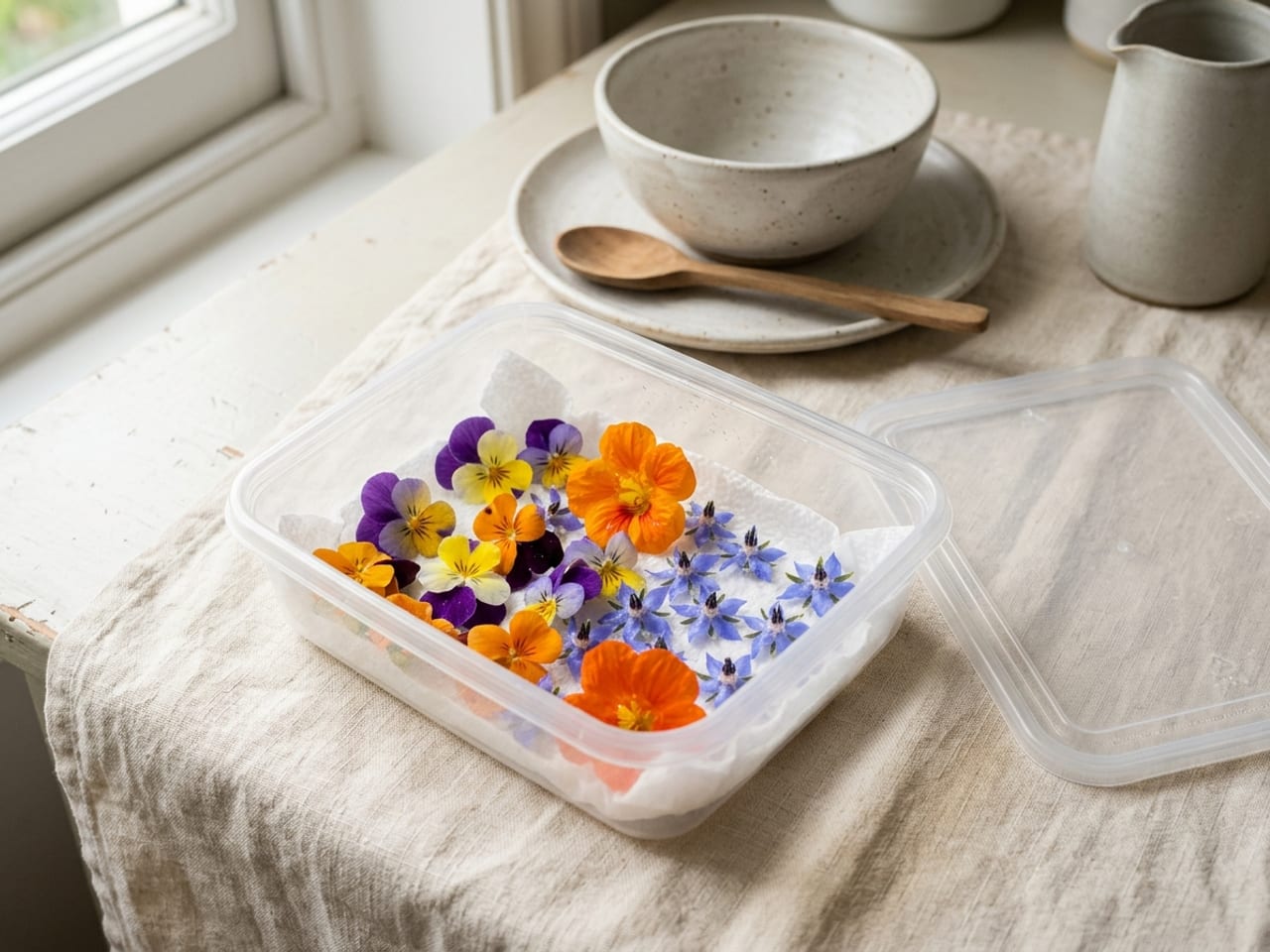
Every fresh-flower shelf life we found, with its condition. They disagree because they measure different things: a cold store at a fixed temperature, a grower's experience, a rule of thumb. Metric to Fahrenheit conversions are ours.
| Source | Flowers | How stored | How long |
|---|---|---|---|
| Kelley et al. 2003 (study)77 | viola, pansy, nasturtium | polyethylene bags at 0 and 2.5 °C (32 and 36.5 °F) | top quality (rated 5 of 5) after 2 weeks |
| Kelley et al. 2003 (study)77 | borage | bags at 0 to 5 °C (32 to 41 °F) | marketable after 1 week |
| Kelley et al. 2003 (study)77 | borage | bags at -2.5 °C (27.5 °F) | still marketable after 2 weeks |
| Kelley et al. 2003 (study)77 | scarlet runner bean | bags at 0 to 10 °C (32 to 50 °F) | marketable after 1 week, not at 2 weeks at any temperature |
| Fernandes et al. 2018 (study)79 | pansy | 4 °C (39 °F), uncoated; with an alginate coating | good appearance 7 days uncoated, 14 days coated |
| Fernandes et al. 2018 (study)80 | pansy | 4 °C (39 °F), uncoated; coated and packed | uncoated degraded in 3 to 4 days; coated up to 14, by colour |
| Fernandes et al. 2018 (study)78 | borage petals | uncoated (the abstract gives no temperature); coated, refrigerated | about 1 day; 5 days coated |
| Fernández-Pintor et al. 2025 (review)84 | edible flowers in general | general figure; it recommends 1 to 5 °C (34 to 41 °F) in perforated containers | generally 7 to 10 days |
| Westlands (grower)44 | its flowers, by variety | airtight container in the fridge | about 4 to 7 days |
| Nurtured in Norfolk (grower)45 | violas | refrigerated | 5 days |
| TeaTime magazine (magazine)59 | edible flowers | clamshell, moistened paper towel, fridge | a week |
| RHS (extension)12 | edible flowers | plastic bag in the fridge | "a couple of days" |
| University of Alaska (extension)6 | edible flowers | plastic, moist paper towel, fridge | "several days" |
| Nurtured in Norfolk (grower)46 | flowers for cakes | fridge | "a few days" |
One magazine-quoted horticulturist says nasturtiums keep longer than most, and the 2003 study agrees; a grower finds nasturtiums and borage the short-lived ones.44, 53, 77
Edible flowers for cakes: fresh, crystallised, pressed, and decoration only
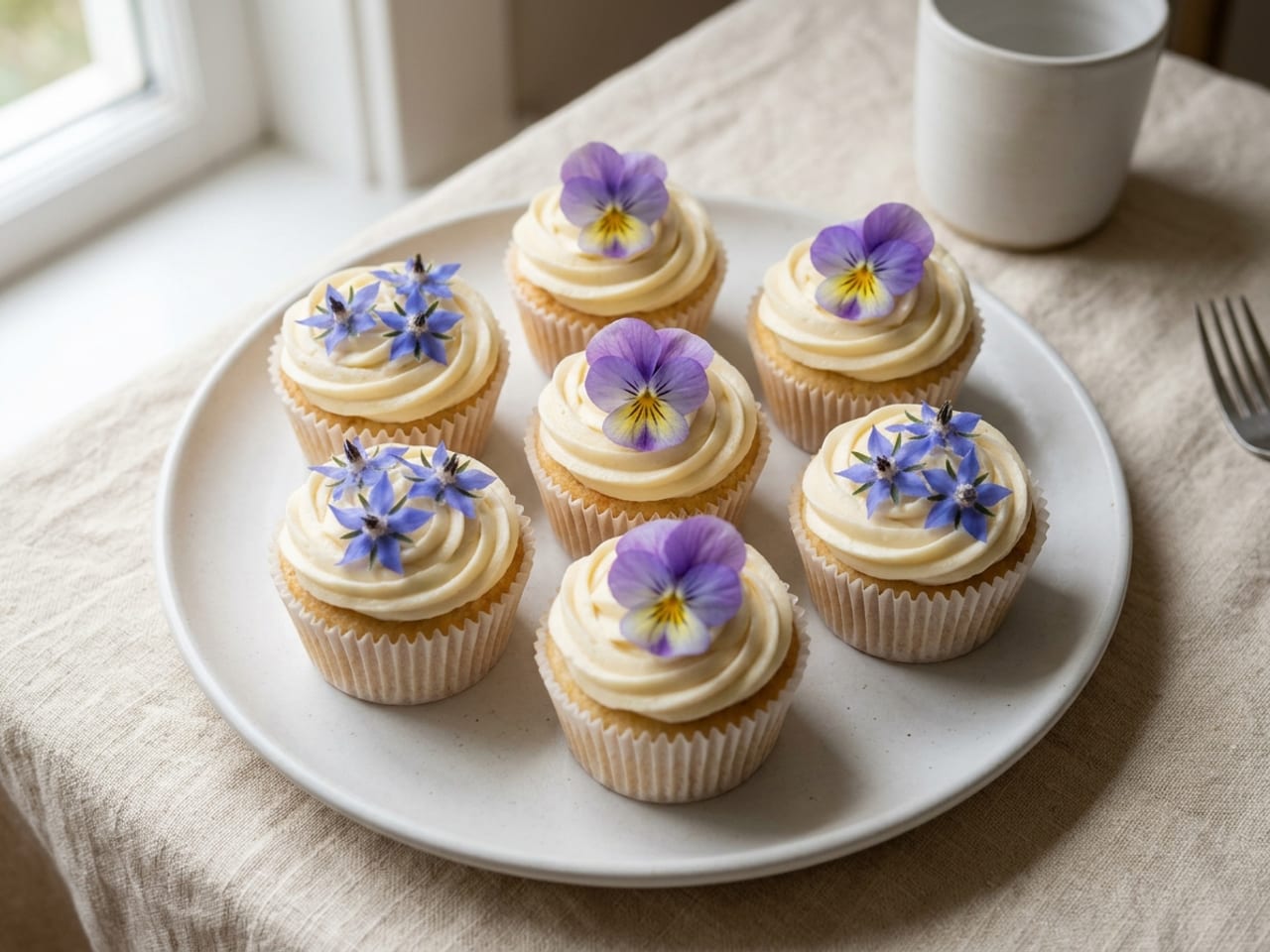
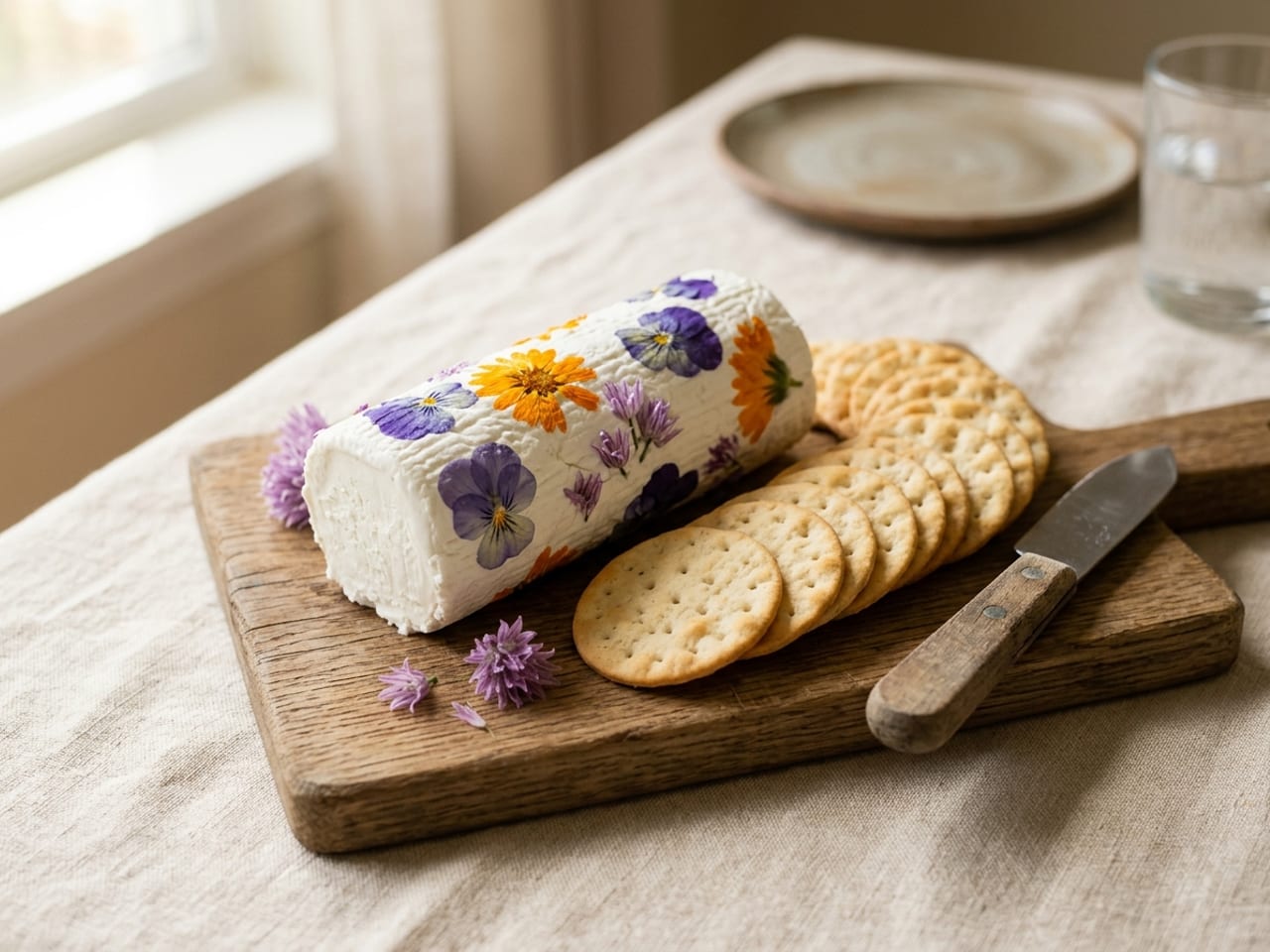
- Fresh edible flowers: on last, small ones straight on the buttercreamA grower quoting a baker: flowers keep a few days in the fridge, but on a cake "they can begin to wilt quite quickly, particularly some of the smaller flowers", so put them on "as close as possible to the time that the cake will be displayed"; smaller ones can sit directly on the buttercream, and on a naked cake they go on each layer.46 The RHS decorates cakes with fresh primroses and cowslips, daisy petals and borage.12 Which hold up best: a grower finds violas and marigolds outlast borage and nasturtiums.44 No source we read gives a number of hours on a cake, or covers fresh flowers on fondant.
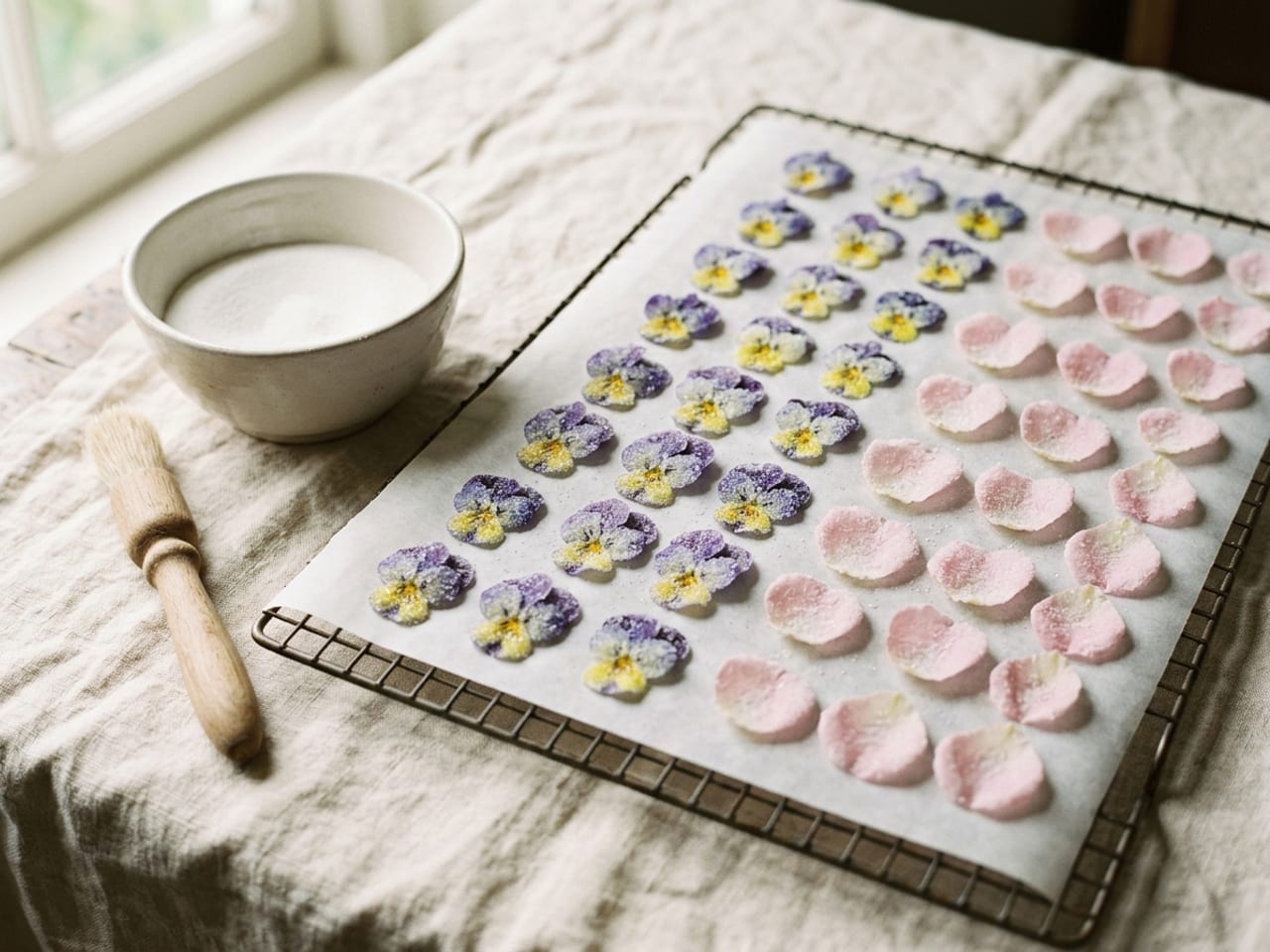
- Crystallised flowers: for a cake on show for hoursTeaTime calls candying "necessary" for a cake on display for a long time, such as a wedding cake: it keeps the flowers from wilting and "prevents the blossoms from absorbing the oils from the icing".59 The RHS uses candied violets and pansies, and crystallised rose, primrose and hollyhock petals, on cakes.12 Method: crystallised flowers, step by step.
- Pressed flowers: flat against the icingPressed edible flowers "work well when pushed into buttercream cakes", says the grower.46 For biscuits, see pressed-flower shortbread.
- Non-edible flowers as decoration: behind a barrier, off before servingThe UK FSA's food contact team, in a 2023 email to a cake business: flowers, foliage and cake picks on a cake "are all food contact materials"; stems that go into the cake "need to be behind a barrier"; "Florist wire is not appropriate"; no sap may leak onto the food; crystallising "will not detoxify" a flower; glycerin- or wax-preserved flowers are inedible.20 Its alternatives: edible species, sugar flowers, food-contact artificial flowers, a food-contact spacer such as a cake pick, or "a decorated dummy display cake" with the real cake kept apart.20 Children "are more at risk from such poisonings and choking hazards".20 The email covers businesses; "Decorated cakes only for personal consumption" are outside it.20 A Minnesota agriculture department bulletin issued with the FDA, about glitters and dusts, says decorations that are not edible "should always be removed from food before serving".22
- "Food-safe flowers" for cakes: no source says soSome cake blogs call gerbera, freesia and lisianthus non-edible but safe for food contact (we did not save those pages, so we do not quote them). In what we read, the only safety listing for gerbera and freesia is UC's list of plants "generally believed to be safe", a poison list that still says to call Poison Control if a child eats quantities; the only source that names lisianthus for cakes is a florist's reading of an unpublished FSA draft; and no source calls any non-edible flower safe for food contact.18, 52 "Non-toxic" does not mean edible.22, 50 Florists' gerberas were among the bouquets carrying residues in the Belgian study.86 So this page never says "food-safe flowers": an edible flower grown as food, or a decoration behind a barrier that comes off.
- The UK FSA's cake-flower guidance: drafted, not publishedAn FSA draft, "Floristry and Food", went to stakeholders in February 2024; an FSA adviser was quoted saying "we have no plans to change the law in this regard".51 "As of August 2025 this new guidance has not been published".50 We found no published version in October 2026 (by search; absence is not proof). A florists' body read the draft as ruling out gypsophila, eucalyptus and most bulb flowers; that is a trade reading, not FSA text.52
Edible flowers for garnish: salads and savoury plates
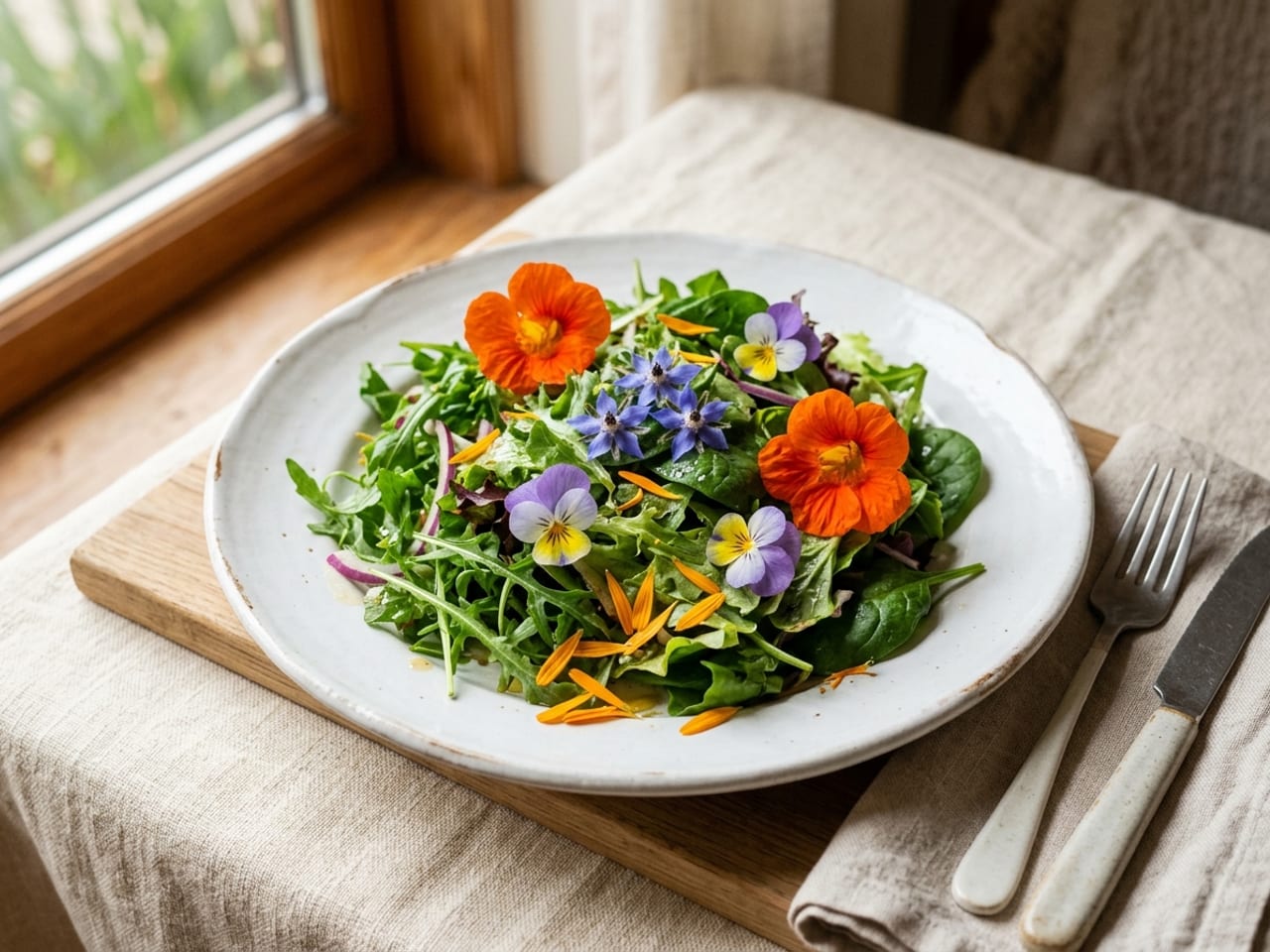
- Salads: dress first, flowers lastFlowers "will soak up moisture, so ... garnish just before serving".43 Beeton in 1861 poured the dressing "under, but not over the salad" and garnished it with nasturtiums.76 Colorado State: nasturtiums "fresh in salads", red clover florets scattered on top, runner bean flowers for crunch.1 Evelyn in 1699 had flowers "sprinkl'd among" the leaves.74 More in our salad plating guide.
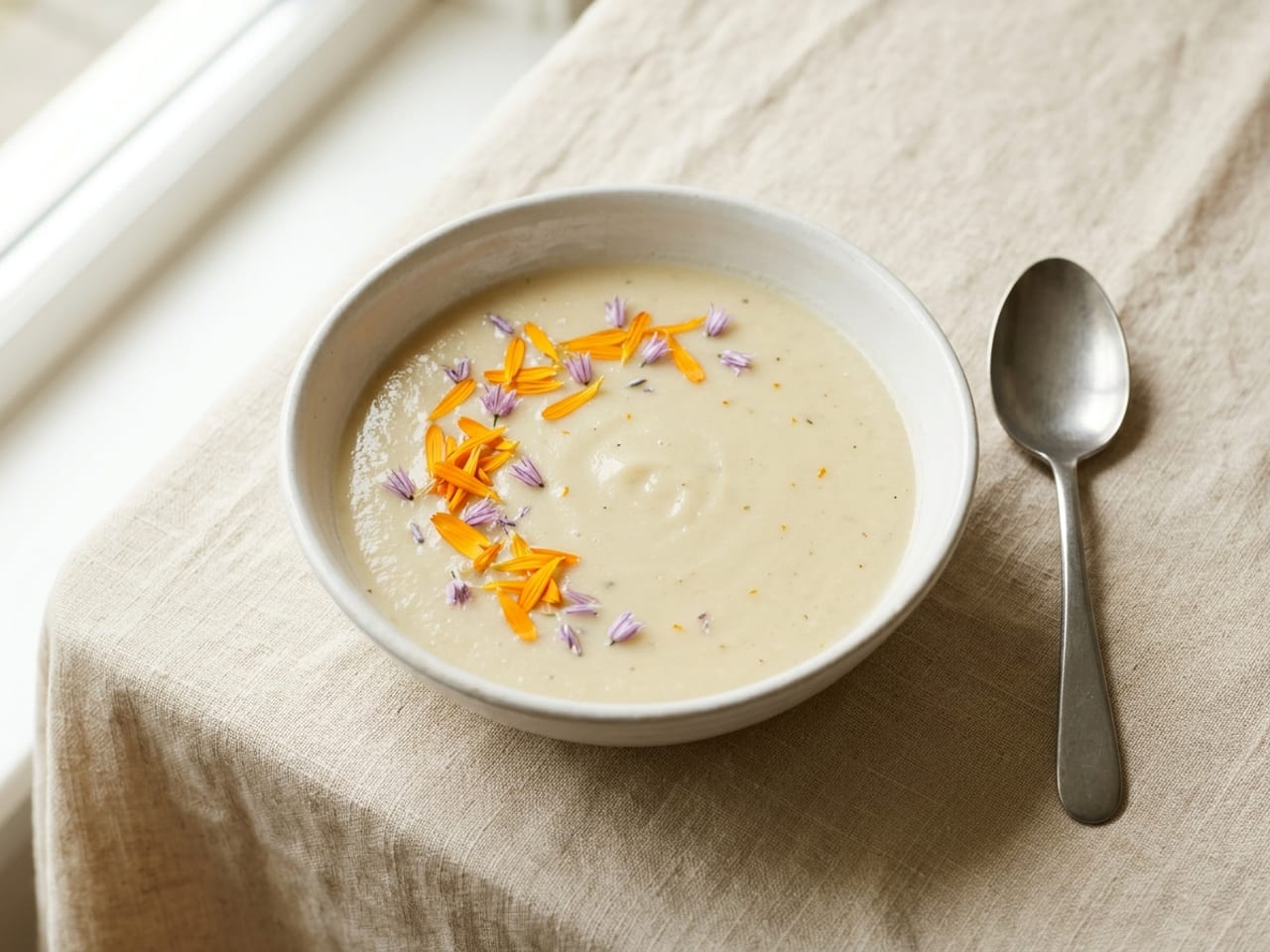
- Soups, eggs, sauces and roastsThe RHS: chrysanthemum and calendula petals in creamy soups, fish chowder and egg dishes; dill flowers in mayonnaise, white sauce and pickles; bergamot with bacon, poultry, rice and pasta; lavender sprigs with roast pork, lamb and chicken; daylily buds in stir fries; sunflower buds blanched, with garlic butter.12 Nebraska minces flowers into cheese spreads, herb butters, pancakes, crêpes and waffles.3
- Squash blossoms: stuffed, fried, in quesadillasThe RHS serves courgette flowers hot in tomato sauce or cold, stuffed with rice, cheese, nuts or meat.12 In Mexico they go into quesadillas, soups, salsas and tamales, cooked a few minutes or raw.35 Italians dip them in batter and fry them in season.66 Steps: stuffed squash blossoms.
- On hot food: last, and brieflyNo source we read rates flowers by how they stand up to heat. Colorado State says not to cook rosemary flowers and to eat dandelion only cooked; daylilies are eaten cooked or raw.1, 10 Japan cooks its edible chrysanthemum petals on purpose: blanched with a little vinegar, which keeps the anthocyanin colour bright, then dressed with soy sauce.36 For a fresh flower on a hot plate, our reading of the wilting advice is to add it at the pass.
- Nasturtium capers and pickled flowersNasturtium buds and young seeds pickled in vinegar or salt stand in for capers.15, 76 Evelyn pickled cowslips, clove gillyflowers and elder flowers in a syrup of loaf sugar and white-wine vinegar poured over "scalding-hot", to eat on their own.74 Oregon State Extension gives a modern flower vinegar method (see the steps).39
- What restaurants doA 2014 Newsweek report: Noma put edible seasonal flowers, such as chrysanthemums and roses, in every dish of one menu; Lyle's in London served mustard flowers on steak tartare; Attica in Melbourne picks about 2,000 oxalis flowers a day in winter, the petals acting "as acid in lieu of citrus or vinegar". 66 Two Michelin-starred kitchens on Madeira named snapdragon, begonia, borage, rose, buzz buttons, sweet alyssum and wild pansy as their most used.97
Edible flowers in drinks, cocktails and ice cubes
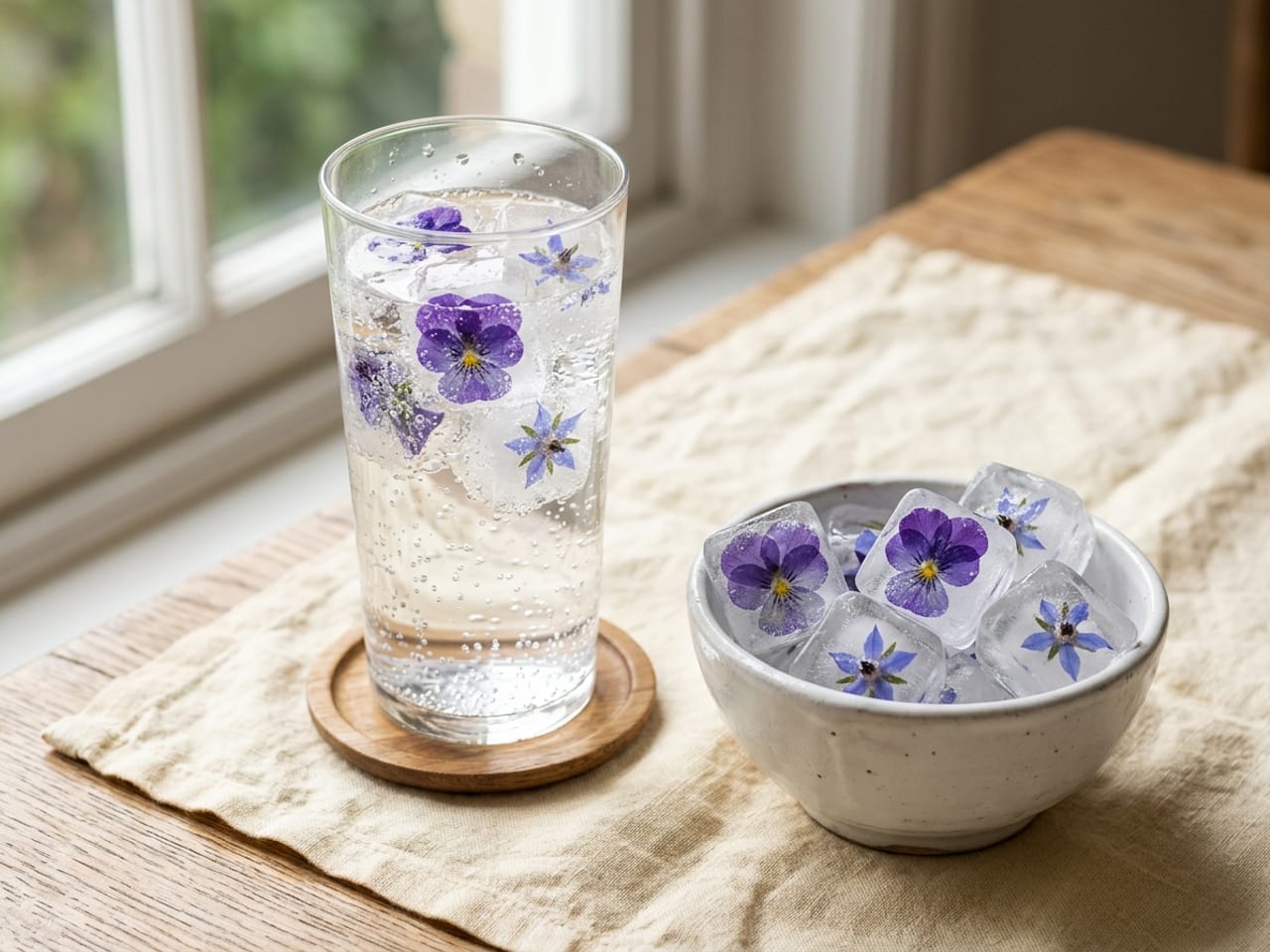
- Flower ice cubesBorage, primroses, cowslips and scented geranium flowers all go into ice cubes in Nebraska Extension's and the RHS's lists.3, 12 In a frozen-storage study, flowers in ice cubes looked like fresh ones for 3 months, while frozen loose flowers held up for only 1.81 For a clear cube that shows the flower, see the steps.
- Cocktails: a flower that floatsViolas are "a popular garnish to float atop of cocktails, hot tea and iced drinks", says a grower, and cook down with sugar into syrups and jellies.45 A study of Madeira restaurant flowers notes borage is "widely used in beverages, such as cocktails or infusions".97 Evelyn liked borage sprigs best "in Wine".74 Buzz buttons go into drinks too, but they numb the mouth and dull sweet and sour, so tell your guests.2, 105 Our cocktail garnish guide covers the classics.
- Butterfly pea: blue, then purple with citrusThe blue dye from the flowers "is pH sensitive and turns pink in acidic solutions", says NC State.10 Empress 1908 gin owes its indigo to butterfly pea, one of eight botanicals.55 Blue drinks sell partly because naturally blue food is rare.94 In the US the extract is a listed colour for drinks, alcoholic ones included; in the EU it is not authorised (EFSA objected on safety grounds; see the disputed table), and Austria rejected five of 19 blue gins for it.21, 29, 30 The chemistry is below.
- Teas: chamomile, hibiscus, chrysanthemumColorado State, on Roman (English) chamomile: ragweed sufferers may be allergic to it, and drink "no more than one cup of tea per day".1 Agua de jamaica is roselle calyx, not hibiscus petals; Mexico's food agency boils 50 g of it in 2 cups (tazas) of water for 15 minutes (1.8 oz and about 500 ml, ours).35, 104 Imperial chrysanthemum teas are traditional in China.106 Bee balm and anise hyssop make teas too.3, 12
- Elderflower cordial: two published recipesSarah Raven: 15 to 20 heads, 1.35 kg sugar, 1.15 litres water and 30 g tartaric or citric acid (3 lb, 39 fl oz and 1 oz, ours); it "keeps for a couple of months in the fridge", or frozen.64 A museum's version after Sophie Grigson: 12 heads, 600 g sugar and 35 g citric acid (1.3 lb and 1.2 oz, ours), strained through three layers of muslin, rested two weeks, keeping "for several months" in a cool place.65 The museum's recipe says the citric acid "works as a preservative"; trim the stalks close, since elder stems are poisonous.10, 65
- Syrups, rose water and orange-blossom waterA 2026 review steeps lavender leaves in milk or cream for ice cream or blends them into syrups and sugar; in Turkey, French lavender makes a purple syrup.102 Rose water is one of the products of distilling the damask rose; a 2024 review says distilling roses for their oil "likely began in Persia during the late seventh century A.D.".115 Moroccan tagines take orange-blossom water and Iranian rice rose water.66
Crystallised, pressed, dried and frozen flowers, step by step
Each step is a named source's, or marked ours. We made none of these.
Crystallised (candied) flowers
Choose flowers "with larger petals, like pansies"; sturdy pansies and violets work best, small or delicate ones are harder.1, 59 Sugar does not make a flower safe: crystallising "will not detoxify" it.20
- Pick clean, dry edible flowers from the list.1
- Make the coating. Colorado State uses pasteurised dehydrated egg white "to avoid food-borne illness"; Alaska's extension sheet whisks 1 teaspoon of pasteurised powdered egg white into 1 tablespoon of warm water; TeaTime whisks 2 teaspoons of meringue powder with 2 tablespoons of water; a grower dissolves a couple of teaspoons of gum arabic overnight in a flavourless spirit such as vodka, to "slightly thinner than single cream".1, 6, 47, 59
- Paint each petal with a soft brush, back and front.1, 58
- Dust both sides with superfine (caster) sugar and knock off the surplus.1, 47
- Dry on wax or parchment paper: "12 to 36 hours", 24 to 30 hours, or "a few hours", depending on the source and the room; they are done when "stiff and brittle". Alaska's extension sheet dries them in a dehydrator on low or an oven at about 150 °F (65 °C, ours) with the door ajar, 10 to 36 hours; one recipe site uses 150 to 200 °F (about 65 to 95 °C, ours).6, 47, 58, 59
- Store airtight in a cool, dark place; colour fades in direct sun, and some petals change colour anyway.1, 47
Raw egg white. In the UK, the NHS says hen eggs with the British Lion stamp or from the Laid in Britain scheme can be eaten raw; other hen eggs only well cooked.31 The US agency pages refused our fetch, so we cite none; this page's methods use pasteurised white, meringue powder or gum arabic. Gum arabic is old: Hannah Woolley steeped it in rose-water overnight in 1662 "To Candy Flowers with their own Colours". 72
Pressed flowers and pressed-flower shortbread
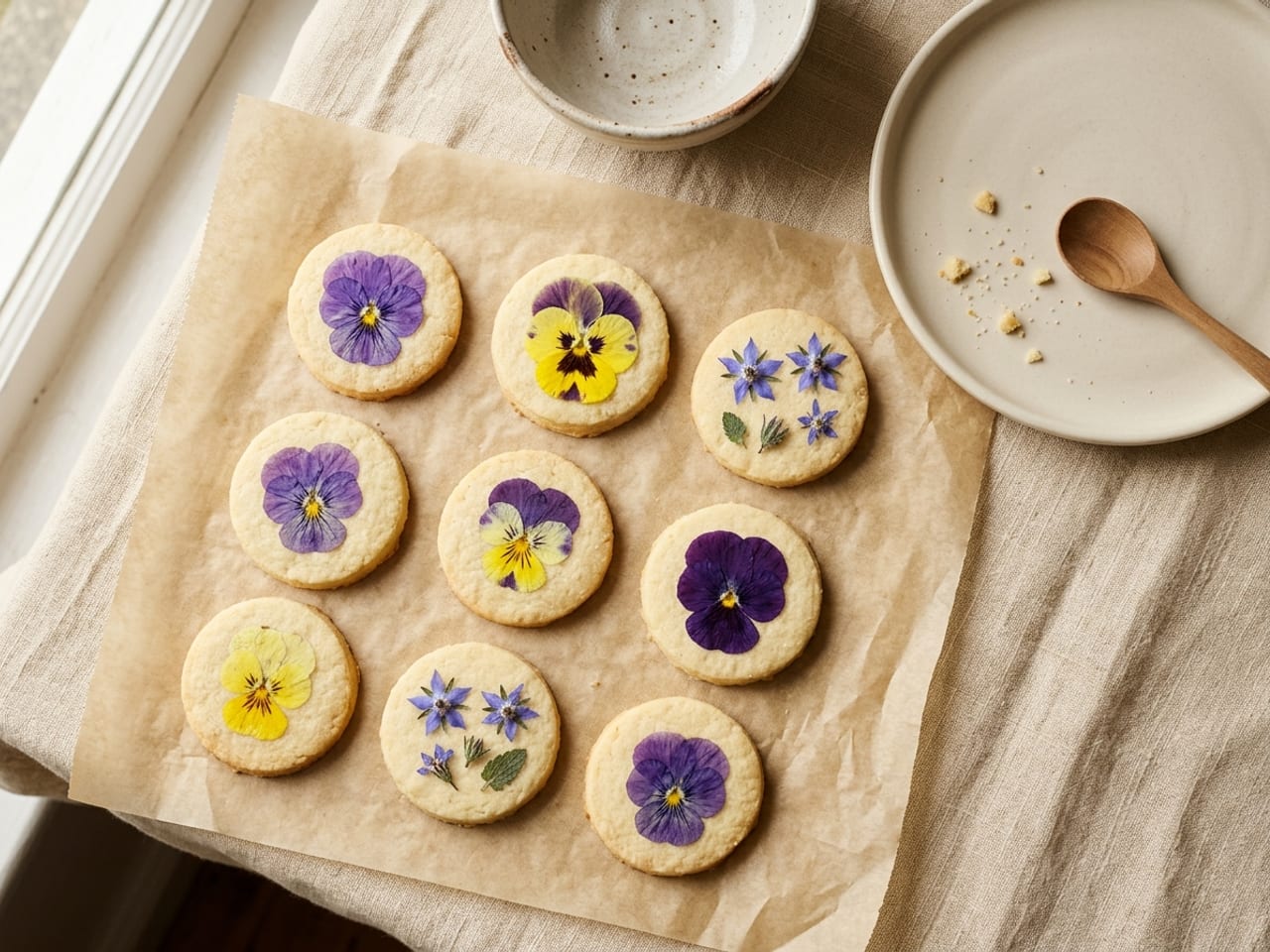
Flat flowers press easiest: "violets, daisies, and single-petal roses"; dry them fast to stop browning, and avoid paper towels (they print their texture) and waxed paper (it holds moisture).41 That sheet is written for crafts; for food, the FSA team says drying materials touching flowers count as food contact, so we press between parchment, never newspaper (our reading).20
- Press edible flowers between parchment "for at least 30 minutes" for biscuits; a full craft press takes "two to three weeks", an iron about three minutes in ten-second presses.41, 61
- Roll and cut the shortbread.60, 61, 62
- Put the flowers on before baking (easier, "but the colors will be less vibrant"), onto just-baked biscuits while hot, or after a 10-minute part-bake with egg white on their backs.61, 62
- Bake pale: "the cookies should stay pale to preserve the flower colors".60
Kerrygold's raw egg white gets only 2 to 4 minutes in the oven, the least cautious of the three for vulnerable eaters; pasteurised white avoids the question (ours).62 Farmers' Almanac also presses lotus petals, which no extension list we read covers.60
Dried flowers and petals
Colorado State: flowers "can be dried, as herbs"; calendula "Dries well", nasturtiums do not.1, 2 No source we read gives a drying temperature for flowers, so the figures below are the US home-preservation centre's for herbs, whose method covers "leaves, flowers or seeds".37, 38
- Air-dry in a warm, dry, well-ventilated place, not in the sun, which costs "flavor and color".37
- Or use a dehydrator preheated to 95 to 115 °F (35 to 46 °C, ours), up to 125 °F (52 °C, ours) where it is humid, in a single layer.37, 38
- Herbs take 1 to 4 hours, until crumbly.37
- Store airtight in a cool, dry, dark place.37
Dried and frozen flowers "are best used in infusions or cooked".12 Drying concentrates residues: on sprayed rose petals, drying raised two fungicides 3.0 to 3.9-fold.85 Silica gel or sand used to dry flowers for food must be food-contact grade, and glycerin- or wax-preserved flowers are not food.20
Clear flower ice cubes and an ice ring
Cloudy ice is air, dirt and minerals pushed to the centre as water freezes from the outside in.42 Frozen in ice, flowers kept a fresh look for 3 months in one study.81
- Use distilled water, boiled and poured straight into the tray: "most of that air dissipated".42
- Freeze in two stages: part-fill with water and flowers, freeze, top up and freeze again. TeaTime does this for a punch-bowl ring in a Bundt pan; the same works in a cube tray (ours).59
- For the clearest ice, insulate the tray's sides and bottom so it freezes from the top down: America's Test Kitchen got "95 percent perfectly clear cubes".42
- Loosen an ice ring with warm water.59
Flower vinegar
Oregon State Extension's method; its popular flowers are chive blossoms and nasturtiums.39 Evelyn infused flowers in vinegar in 1699.74
- Use ¾ to 1 cup of loosely packed blossoms for each pint of vinegar (about 180 to 240 ml to 473 ml, ours), in a sterilised jar.39
- Pour the vinegar over cold, or heated to 190 to 195 °F (88 to 91 °C, ours).39
- Leave 3 to 4 weeks in a cool dark place, then strain until clear and label.39
- Use within 4 to 6 months, best kept in the fridge; discard it untasted if it moulds, bubbles, clouds or turns slimy.39
Colorado State's herb-vinegar sheet gives 6 to 8 months in the fridge or 3 months in a cool dark place at 65 °F (18 °C, ours) or below: the two sheets differ.40 Neither covers flower oils; home-made flavoured oils "have a limited shelf life and should be stored in the refrigerator".1
Flower sugar, butter and syrup
The RHS flavours sugar with rose petals, lavender and alpine pinks, and puts calendula petals and mint flowers in oil, butter or vinegar.12 A 2026 review steeps lavender leaves in milk or cream for ice cream or blends them into syrup; its main aroma compounds evaporate at cooking temperatures.102 We found no tested recipe with amounts, so the steps are ours.
- Use dry, clean petals of a flower from the list, heels off (ours).
- For sugar, bury the petals in caster sugar in a closed jar; for butter, chop them into soft butter (ours).
- Add lavender late to anything cooked, since heat drives its aroma off (ours, from the review above).
- Keep flower butter and oil in the fridge and use them soon (ours, after Colorado State's note on oils).
Stuffed squash blossoms
Edible Austin's fiori di zucca; we found no test-kitchen or extension version.63 Use male flowers.12, 35
- Remove the stamen, "the pollen-producing center"; wash gently and pat dry.63
- Fill each with a heaping teaspoon of ricotta, Parmesan and basil, and twist the petal tips closed.63
- Dip in a batter of flour, olive oil, egg and water.63
- Fry in 2 inches (5 cm, ours) of canola oil at 375 °F (190 °C, ours), or until it shimmers, and serve at once with sea salt.63
How long crystallised flowers keep
| Source | Coating | Drying | Shelf life as printed |
|---|---|---|---|
| Colorado State1 | pasteurised dehydrated egg white | "dry it" (no time) | not given; airtight, cool, dark |
| What's Cooking America58 | pasteurised egg white, powdered white or meringue powder | 12 to 36 hours at room temperature, or a 150 to 200 °F (65 to 95 °C, ours) oven | "up to one (1) year" |
| TeaTime magazine59 | meringue powder | 24 to 30 hours | 3 to 4 months |
| Maddocks Farm (a grower)47 | egg white; gum arabic | "a few hours" | egg white "a couple of weeks"; gum arabic "several weeks or in some cases months" |
| University of Alaska6 | pasteurised powdered egg white, 1 teaspoon in 1 tablespoon warm water | dehydrator on low, or an oven at about 150 °F (65 °C, ours) with the door ajar: "10 to 36 hours" | "Some varieties will store two days; others will keep for several months." |
| Fernandes et al. 2019 (a study)82 | crystallised pansies | lab method | same appearance after 90 days; fewer microbes than fresh |
Three pressed-flower shortbread methods
| Source | When the flowers go on | Glue | Oven | Bake |
|---|---|---|---|---|
| Farmers' Almanac60 | before baking, petals pressed flat onto the dough | egg white under and a thin layer over | 325 °F (163 °C, ours) | 12 to 15 minutes, kept pale |
| Edible South Florida61 | before baking, or onto just-baked hot biscuits | none | 350 °F (175 °C, ours) | 12 to 14 minutes, "very lightly colored" |
| Kerrygold South Africa62 | after a 10-minute part-bake | egg white on the back of each flower | 160 °C (320 °F, ours) | 10 minutes, then 2 to 4 more |
Why butterfly pea turns purple, and where the peppery bite comes from
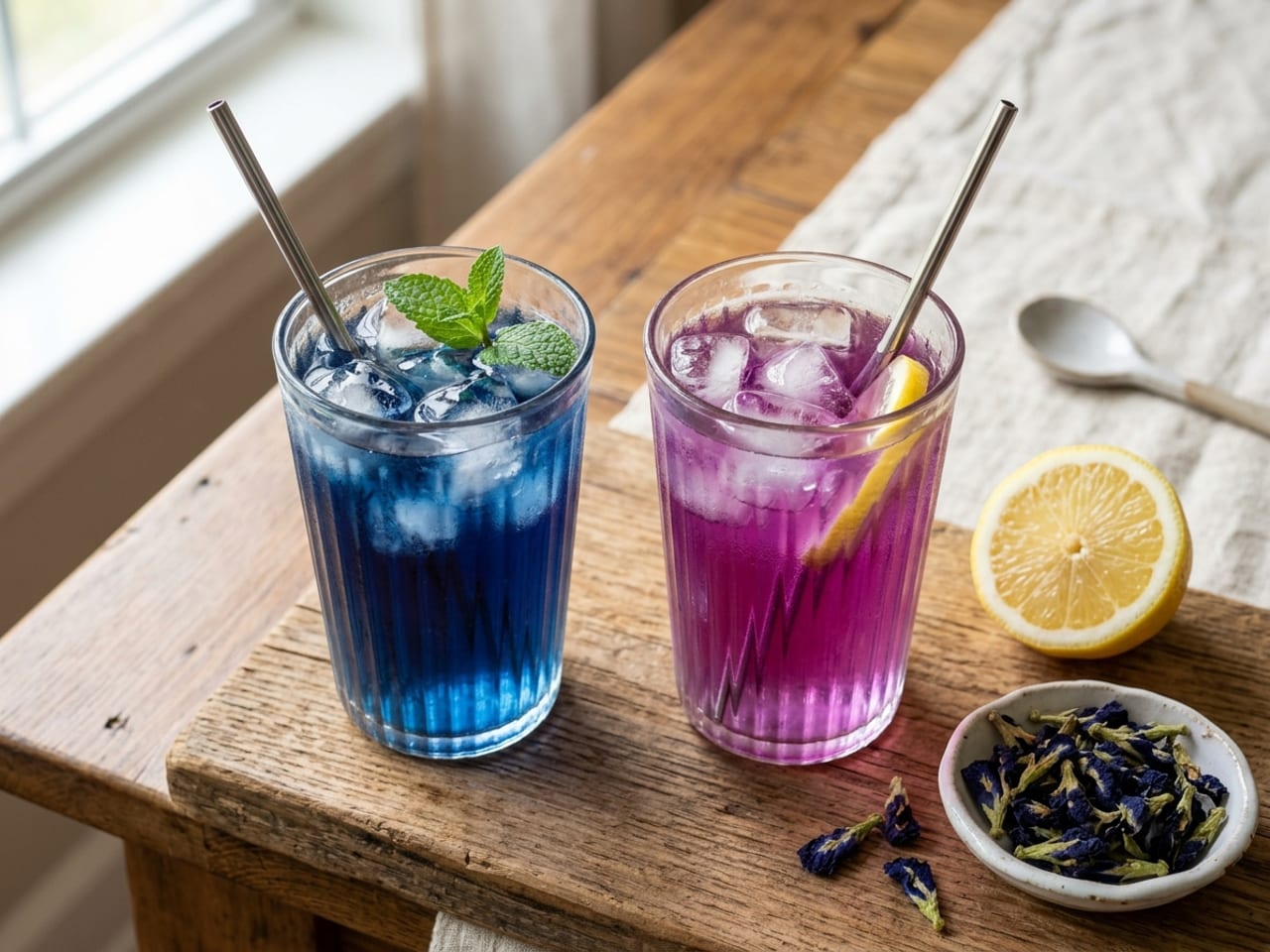
Butterfly pea. Its blue comes from anthocyanins, mostly ternatins, whose many acyl groups give "the plant pigment's stable blue colour". The review prints red "In acidic conditions (pH value < 2)", purple as the pH rises, blue "between six and seven", and "green-light yellow" above neutral.91 In a kitchen that means lemon juice turns the tea purple to pink and baking soda turns it green (our reading). The FDA's specification describes the extract as "a dark blue liquid" at pH 3.0 to 4.5.21 The colours are vivid enough that children aged 7 to 14 used the tea as a pH indicator in a classroom study.92 The plant is native to the Maluku islands of Indonesia and was first documented on the island of Ternate, which its name recalls (ours).93 As a food it is disputed: the FDA lists only the extract as a colour additive, and in the EU it is not authorised because EFSA objected on safety grounds, so it sits in the disputed table, not in our list.21, 29
Other anthocyanin flowers. Roselle calyces hold about 2,520 mg of anthocyanins per 100 g, mostly delphinidin-3-sambubioside, which is why agua de jamaica is red.104 In Japan, purple chrysanthemum petals are blanched with a little vinegar because their anthocyanins then colour brightly.36
Nasturtium's bite. "The odour and taste of Tropaeolum is due to the presence of mustard oils, the same compounds that give cabbage, mustard and cress their distinctive flavours."15 In the flowers, benzyl isothiocyanate made up 95% of the volatile compounds; it forms from glucotropaeolin through the enzyme myrosinase, and boiling inactivates the enzyme.95, 96 Perestrelo and colleagues propose a cautious intake threshold of 1.5 µg per kg of body weight a day for that compound: a risk-assessment proposal, not a legal limit.95
Borage's cucumber. One taste panel, reported in a 2025 review, likened borage to cucumber and nasturtium to radish.99 Measured, borage's main volatile is (Z)-3-hexen-1-ol, "characterized by a grassy smell", and another study links its floral and green notes to ethyl octanoate and 1-hexanol; no paper we read names a cucumber compound.97, 98
Lavender and buzz buttons. Lavender's main aroma compounds, linalool (boiling point about 198 °C, 388 °F ours) and linalyl acetate, are lost "rapidly by evaporation" at cooking temperatures.102 Buzz buttons' tingle is thought to come from spilanthol.105
Edible flower nutrition: what the studies say, at garnish amounts
Mostly water. Water is the main component of edible flowers, about 70 to 90% of their weight, "so, the dry matter in edible flowers is very low".99 A 2017 review gathered more than 100 studies on their nutritional, antioxidant and antimicrobial properties, and a 2019 one sums up the benefits as "nutritional and bioactive" while noting that safety guidelines are scarce.100, 101
At garnish amounts, very little. A garnish is a few petals, and no study we read measured nutrition per garnish portion, so we make no health claim for a flower on a plate (ours). People seem to agree: in a Portuguese and Costa Rican survey, decoration, taste, novelty and aroma came first and nutrition behind, though Brazilian consumers associated food made with flowers with "health care".111, 112
Tea is a different dose. The one trial we read gave three 240 ml (8 fl oz, ours) servings of hibiscus (roselle) tea a day for six weeks; systolic blood pressure fell 7.2 mm Hg against 1.3 with placebo, and diastolic did not differ.103
Allergies, medicines, pregnancy, children and pets
- Everyone: one new flower at a time, a little at first"Introduce flowers into your diet in small quantities one species at a time. Too much of a good thing may cause problems for your digestive system."3 Colorado State and Alaska say the same, and K-State notes that some "can have unpleasant side effects".1, 6, 7
- Pollen allergy, hay fever and asthma: the advice ranges from caution to noNebraska and Penn State: introduce flowers gradually and take the pollen-bearing stamens out; "Consumers with allergies to pollen should proceed with caution".3, 5 UC Sacramento and the RHS go further: "Do not eat flowers if you have asthma, allergies, or hay fever"; "People susceptible to allergy, especially pollen, should not eat flowers".4, 12 An allergist, writing about a man with full-body hives after eating flowers, sees no reason to expect every flower to cross-react, knows of no commercial test, and advises recording which flowers cause symptoms and avoiding them; painkillers such as NSAIDs, alcohol, a viral infection or exercise may make a reaction more likely.57
- Ragweed and the daisy family: chamomile first"Ragweed sufferers may be allergic to chamomile".1 The NIH's complementary-health centre: allergic reactions to chamomile, anaphylaxis among them, are more likely in people allergic to "ragweed, chrysanthemums, marigolds, or daisies"; for dandelion the evidence on that cross-reaction conflicts.32, 33 The FSA team names tulips and daisies as flowers some people react to; UC warns of numb hands or an upset stomach after tulips; Colorado State says "Watch for allergies" with mustard flowers.1, 4, 20
- Borage and pyrrolizidine alkaloidsBorage is one of the plants that make pyrrolizidine alkaloids, compounds "known to be hepatotoxic, genotoxic, and potentially carcinogenic"; a 2025 review reports that borage "consistently exhibited the highest PA content" of the species analysed in the studies it covers, from 77 to 88,602 µg/kg dry weight depending on the part.84 EU limits cover borage LEAVES (750 µg/kg fresh) and dried borage and herbal infusions, but no line covers fresh borage flowers.27, 54 None of the extension lists we read mentions it. Our reading, not a rule: a few flowers as garnish, not handfuls, and none for anyone pregnant or with liver disease.
- Medicines: chamomile, lavender, dandelion, sweet woodruff, hibiscus teaFor herbal products, which are bigger doses than a garnish, the NIH centre reports chamomile interactions with warfarin and some liver-metabolised drugs, a theoretical one between lavender and sedatives, and theoretical ones for dandelion with diabetes, blood-thinning and diuretic drugs.32, 33, 34 Sweet woodruff flowers "can have a blood-thinning effect if eaten in large amounts".10 Hibiscus tea lowered systolic blood pressure in a small trial of people NOT on blood-pressure drugs; if you take them, ask your doctor before drinking it daily (ours).103
- Pregnancy and breastfeeding"Little is known" about chamomile or lavender in pregnancy or while breastfeeding, or about dandelion beyond food amounts.32, 33, 34 For crystallised flowers, raw egg white is fine in the UK only from British Lion or Laid in Britain eggs; elsewhere use pasteurised white or meringue powder.1, 31 See borage above.
- Children: choking, and "anything on the plate can be eaten"Children "are more at risk from such poisonings and choking hazards".20 "Even non-poisonous plants can cause choking".16 And adults think the same way: "Many people believe that anything on the plate can be eaten."3 So nothing goes on a plate or cake that is not food.
- What else a flower can carryInsecticides and heavy metals in the blossom.57 Reviews add microorganisms, and tropane and pyrrolizidine alkaloids carried over from other plants by soil, cross-contamination or bees.84, 88, 89 EU alerts have covered pesticide breaches, Salmonella and excess alkaloids in flower products.54 "Relevant safety requirements and guidelines are scarce."101
A short history of eating flowers
| When | What the source says |
|---|---|
| Ancient Athens | Violets are sold in the agora.114 |
| Ancient Rome | Apicius makes rose wine from petals with "the lower white part removed", violet wine the same way, and a patina de rosis of pounded rose petals; its translator warns that "rose" in some recipes may mean a rosy apple.70 Lavender plays no meaningful role in Apicius.102 |
| Late 7th century | Distilling roses for their oil "likely began in Persia", says a 2024 review; rose water is a product of the same still.115 |
| 10th to 13th century | Arabic and Persian cookbooks use floral waters, above all rose water, in sweet and savoury dishes.102 |
| About 1390 | Richard II's cooks write Rosee, an almond-milk pottage thickened with white rose flowers, and Spynee with hawthorn flowers; borage and violet go into a pot of greens.71 |
| Middle Ages and Renaissance | Marigold is a common salad ingredient; Maestro Martino writes an elderflower soup.113 |
| 1560s to 1597 | Nasturtium arrives from South America with the Spanish; Gerard writes that its smell and taste show it to be "a kind of Cresses".15 |
| Tudor England | Flowers in sweet tarts are "the height of fashion".66 |
| 1662 | Hannah Woolley candies flowers two ways: in sugar boiled to candy height, and with gum arabic steeped in rose-water.72 |
| 1683 | "Candy Flowers for Sallets": gillyflowers, roses, primroses, borage and bugloss, strewn on salads.73 |
| 1699 | John Evelyn puts flowers in salads, infuses them in vinegar and pickles cowslips; nasturtium buds become "Capuchin Capers".74 |
| 17th century onward | New French cuisine separates sweet from savoury, and floral aromatics largely leave Western European savoury cooking.102 |
| From the Edo period | Eating chrysanthemum petals spreads in Japan; Yamagata still blanches them with vinegar.36 |
| 1782 | MacIver's Edinburgh cookbook candies "any kind of flowers you think pretty", which no one should do today: only named edible species.75 |
| 1861 | Beeton garnishes a summer salad with nasturtiums and pickles nasturtium pods as "a very good Substitute for Capers".76 |
| Late 19th century | Toulouse confectioners coat whole violets in sugar syrup, the first said to be M. Viol; one maker's marketing claims 1818, and the sources disagree on how the violet reached Toulouse.67, 68 |
| About 1900 to 1985 | Toulouse violets: 400 growers on 20 ha (49 acres, ours) in 1907 by one count, over 600 farms on 25 ha (62 acres, ours) by another, and 7 farms on about 0.5 ha (1.2 acres, ours) by 1985.67, 114 |
| 1980s | Nouvelle cuisine brings flowers back: pansies for colour, nasturtiums for spice.66 |
| 2014 | Newsweek reports Noma, Fäviken, Meadowood, Lyle's and Attica cooking with flowers they expect diners to eat.66 |
| 2021 | The US FDA lists butterfly pea flower extract as a colour additive.21 |
Sixteen popular claims about edible flowers, each with a verdict
"Supported, narrowly" means the source covers less than the claim says; "Mixed", that sources point both ways; "No source found", that we found no source for it.
| The claim | Verdict | What we found |
|---|---|---|
| If a flower is on the plate, it is edible. | Not supported | "Just because flowers are served with food does not mean they are edible." That is why Nebraska says to keep non-edible flowers off plates altogether: "Many people believe that anything on the plate can be eaten."3 |
| All roses are edible. | Supported, narrowly | The RHS says so of the plant; Colorado State, UC Sacramento and Alaska list Rosa, and Nebraska and Penn State say how to prepare its petals.1, 3, 4, 5, 6, 12 It does not cover a rose from a florist: florists' roses averaged 14 pesticide substances each in one study.86 |
| Non-toxic flowers such as gerbera, freesia and lisianthus are food-safe for cakes. | Not supported | "Non-toxic" does not mean edible, and no source we read calls any non-edible flower food-contact safe (see cakes).18, 22, 50 |
| Organic flowers are safe to eat. | Not supported | Organic flowers "can have harmful residues of some pesticides, such as nicotine", and organic does not make a poisonous species edible.20 |
| Washing makes florist flowers safe to eat. | No source found | No source we read says so. Systemic pesticides were found inside plants and in their pollen, where washing cannot reach (our reading).87 |
| Crystallising a flower makes it safe. | Not supported | Sugar "will not detoxify" a flower.20 |
| Candied flowers keep for a year. | Mixed | One recipe site says "up to one (1) year"; others say 3 to 4 months, or a couple of weeks with egg white; the one study kept crystallised pansies looking the same for 90 days.47, 58, 59, 82 |
| Butterfly pea flower is FDA approved. | Supported, narrowly | The FDA lists the flower EXTRACT as a colour additive; that is not approval of the flowers as food. In the EU it is not authorised.21, 29 |
| Marigolds are edible. | Mixed | Calendula, yes; Tagetes is edible to Colorado State, Alaska and NC State (NC State: harmful "in large amounts"), and a skin irritant to NC State, UC and the RHS, which names Tagetes minuta (see the trap).1, 6, 10, 14, 18 |
| Lilies are edible. | Mixed | Daylilies are, in moderation; the RHS lists tiger lily; Colorado State says many lilies are not edible, and lilies are dangerous to cats.1, 12, 17 |
| Borage tastes of cucumber because it shares cucumber's flavour compound. | No source found | The cucumber likeness is a taste panel's; the measured main compound is grassy, and no paper we read names a shared compound.97, 99 |
| Nasturtiums were eaten as early as 400 BC. | Not supported | A magazine says so without a source; nasturtium is South American and reached Europe in the 1560s.15, 59 |
| Edible flowers are a superfood. | Not supported | Flowers are about 70 to 90% water, and a garnish is a few petals; no study we read measured nutrition per garnish (see nutrition).99 |
| Hibiscus tea lowers blood pressure. | Supported, narrowly | One small trial: three cups a day for six weeks lowered systolic pressure, not diastolic, against placebo. That is roselle tea, not a petal garnish.103 |
| Lavender always tastes of soap. | Not supported | It depends on the cultivar and the amount: low-camphor English lavender, used sparingly.102 |
| Elderflowers must be cooked. | No source found | No source we read says fresh florets must be cooked; the stems, leaves and seeds are the poisonous parts, and both cordial recipes we read steep fresh heads.10, 64, 65 |
Photograph your plate, see it re-plated
Garnished a plate or a cake with flowers? Photograph it and Plate Artists re-plates that dish, with the food kept as it is and the changes named so you can repeat them. Start with a re-plate.
Your food, plated like a chef's
Snap it, upload it, and get the composed version back, with the steps to recreate it at home.
Start free · 1 enhancement →Free account · 1 free enhancement · No credit card
Edible flower words, defined
Edible flower
A flower of a species that published sources list as safe to eat, of which a named part is eaten.
Where it comes from. UC Sacramento: "Any flower that is not poisonous or that does not cause a negative reaction is considered edible", which does not make it tasty.4
Scientific name · Latin name, genus and species
The two-part Latin name of a plant, such as Viola odorata, which identifies it where common names collide.
Where it comes from. Colorado State and Penn State make it rule one for edible flowers.1, 5
Petal
One of the coloured leaves of a flower, and for most edible flowers the only part eaten.
Where it comes from. The extension sheets' word for the part most flowers are eaten for.3, 12
Heel · petal base, white base
The pale, bitter base of a petal, cut off on roses, dianthus, daisies and marigolds.
Where it comes from. The RHS's word; Nebraska calls it the bitter white area at the base of the petal.3, 12
Sepal · calyx (all the sepals together)
One of the small green leaves under a flower's petals; together they form the calyx.
Where it comes from. Nebraska removes them on every flower but violas and pansies; roselle's calyx is the food.3, 11
Stamen · anther (the pollen-bearing tip)
The pollen-bearing part of a flower, taken out before eating.
Where it comes from. Colorado State and Nebraska remove them for bitterness and pollen.1, 3
Pistil
The central female part of a flower, taken out before eating.
Where it comes from. Removed with the stamens in the extension sheets.1, 3
Floret
One of the small flowers that make up a flower head such as chive, clover or cornflower.
Where it comes from. Colorado State: "Separate florets to serve" (chives); red clover florets scattered on salad.1
Umbel
A flat or domed cluster of small flowers on stalks from one point, as in dill and fennel.
Where it comes from. The RHS: "Smaller flowers in umbels like fennel and dill can be cut off and used whole".12
Crystallised flower · candied flower, sugar-preserved flower
An edible flower coated in sugar, either painted with egg white or gum arabic and dusted with fine sugar, or dipped in sugar syrup, then dried.
Where it comes from. Colorado State's "sugar-preserved flowers"; Woolley's "To Candy Flowers" (1662).1, 72
Gum arabic
A plant gum used, dissolved, instead of egg white to stick sugar to petals.
Where it comes from. Woolley steeped it in rose-water in 1662; a grower now dissolves it in vodka.47, 72
Pressed flower
A flower flattened, and usually dried, under weight between papers.
Where it comes from. Craft pressing (Maryland Extension); for biscuits, a light press between parchment.41, 61
Food contact material
Anything that touches food; the FSA staff email we read treats flowers and picks on a business's cake as such, under England's food contact rules.
Where it comes from. The FSA team's term for flowers, foliage and cake picks on a cake sold by a business.20
Maximum residue level (MRL) · maximum residue limit
The most of a pesticide allowed in a food sold in a jurisdiction.
Where it comes from. The EU sets them for a food group named herbs and edible flowers; there are none for cut flowers.26, 86
Novel food
In the EU, a food that needs approval before sale because it was not widely eaten there before 15 May 1997.
Where it comes from. EU law: a food not eaten to a significant degree in the EU before 15 May 1997.28
Anthocyanin
A plant pigment, red, purple or blue depending on acidity, that colours many flowers.
Where it comes from. Butterfly pea's are polyacylated delphinidins called ternatins; roselle's are mostly delphinidin-3-sambubioside.91, 104
Pyrrolizidine alkaloid (PA)
A plant toxin that can harm the liver, made by borage among others, with EU limits for some foods.
Where it comes from. A 2025 review names borage among the plants that make them.27, 84
Quelite
In Mexico, any tender edible flower, leaf or herb, squash blossom among them.
Where it comes from. Mexico's food agency counts squash blossom as one: "toda flor, hoja o hierba que sea tierna".35
Violettes de Toulouse
Whole violets coated in recrystallised sugar syrup, a Toulouse speciality.
Where it comes from. The Oxford Companion to Food: candied violets still made commercially in Toulouse.69
Shokuyō-giku · edible chrysanthemum (Japan)
Chrysanthemums grown in Japan to eat their petals, which are blanched and dressed.
Where it comes from. Japan's agriculture ministry: petals blanched with a little vinegar, as ohitashi, in Yamagata.36
Edible flowers, answered
Which flowers are edible?
Our list has 60 flowers that named extension services, the RHS and growers list as edible, from violas, pansies, nasturtiums, borage, calendula, roses, lavender and squash blossoms to herb flowers such as chive, dill, basil and rosemary. A flower is only edible if it is the right species (check the Latin name), grown to be eaten, and you eat the right part, usually the petals.
What are the best edible flowers for cakes?
Violas and pansies, sweet violets, rose petals, primroses, borage and hollyhock petals are the ones the RHS and growers put on cakes, fresh or crystallised. Fresh flowers wilt on a cake, so put them on as late as you can; for a cake on show for hours, crystallised flowers keep their shape. Small flowers can sit straight on the buttercream.
Which flowers are poisonous and must never go on a cake?
Lily of the valley, foxglove, oleander, daffodil and jonquil, monkshood, larkspur and delphinium, angel's trumpet, Carolina jessamine, hyacinth, autumn crocus, hydrangea, azalea and rhododendron, sweet pea, true lilies and calla lily, poppy flowers, lantana, clematis, morning glory, florist ranunculus and anemone, lupin, poinsettia and the hemlocks are on the poison lists we read. Baby's breath is disputed: NC State tags it poisonous for skin and airway symptoms from handling, while UC Sacramento and Alaska list it as edible, so we leave it off.
Can I put flowers from a florist or a supermarket bouquet on a cake?
Not as food. Colorado State, Nebraska, Alaska, K-State, Penn State and NC State all say never to eat florist, bouquet or garden-centre flowers, and a Belgian study found 107 pesticide substances on roses, gerberas and chrysanthemums bought from florists and supermarkets. If you use non-edible flowers as decoration, the UK FSA's food contact team says stems that go into the cake need a barrier such as a cake pick, florist wire is not appropriate and no sap may touch the food; a US advisory on cake decorations adds that anything not edible should be removed before serving.
Are there food-safe flowers for cake decorating?
No source we read calls any non-edible flower food-safe. The only safety listing we found for gerbera and freesia is a University of California list of plants generally believed to be safe, which is a poison list, not an edible one, and the only source that names lisianthus for cakes is a florist's reading of an unpublished FSA draft. Non-toxic does not mean edible. Use edible flowers grown as food, sugar flowers, or decoration kept behind a barrier.
Where can I buy edible flowers?
Some supermarkets sell them in small rigid boxes near the fresh herbs, and edible-flower growers sell them online to bakers and cooks. Buy only flowers sold for eating, ideally labelled with the Latin name. Never use cut flowers from a florist, a bouquet, or plants from a garden centre unless they are labelled for culinary use; the RHS says to grow bought plants on for at least three months and pick only later flowers.
How long do edible flowers last in the fridge?
Sources print anything from about a day (uncoated borage petals) or a couple of days (RHS) to 4 to 7 days (a UK grower) and 7 to 10 days (a review). In a cold-storage study violas, pansies and nasturtiums kept top quality for 2 weeks at 0 to 2.5 °C (32 to 36.5 °F), colder than most home fridges run (ours), while borage stayed marketable for about a week. No source we read tested a home fridge. Keep them cold and damp, in a box or bag on a moist paper towel, and use them soon: microbes rise markedly over 5 days at 4 °C (39 °F).
How do you crystallise (candy) edible flowers?
Paint each petal, front and back, with pasteurised egg white (or meringue powder in water, or gum arabic dissolved in vodka), dust with superfine sugar, shake off the excess and let them dry on parchment until brittle, from a few hours to a day and a half. Store them airtight in a cool, dark place. Sugar does not make a poisonous flower safe.
Do you need to wash edible flowers?
Sources disagree. Colorado State and Nebraska say to rinse gently just before use; Penn State says clean them only if dirty, with a soft brush or a dip in room-temperature water, which damages them less than rinsing under a stream, and not to dry them in a salad spinner; one horticulturist adds that water may discolour them. Either way, dry them gently and use them soon.
Which part of a flower do you eat?
For most flowers, only the petals. Take out the stamens and pistil, remove the sepals except on violas, Johnny-jump-ups and pansies, and cut off the pale bitter base of rose, dianthus, daisy and marigold petals. A few, such as violas, violets, runner bean flowers and clover, are eaten whole; with roselle (Hibiscus sabdariffa), you eat the red calyx.
Are roses edible?
Yes: the RHS says all roses are edible, the more fragrant the better, and Colorado State, UC Sacramento and Alaska list it too. Eat the petals with the bitter white base cut off, and only from roses grown as food: florist roses can carry pesticides never evaluated for use on food.
Are marigolds edible?
Calendula, the pot marigold, is: tangy and peppery petals. Tagetes marigolds are listed as edible by Colorado State (signet and African), Nebraska and UC Sacramento's garden notes (signet), Alaska ("all marigolds") and NC State, which adds they "May be harmful if eaten in large amounts"; NC State, UC's poison list and the RHS (for Tagetes minuta) also list Tagetes as a skin irritant. Signet marigold is the milder, citrus one; if a recipe says only marigold, check which.
Is butterfly pea flower safe to eat?
The sources disagree, so it is not on our edible list. In the US the FDA lists butterfly pea flower extract as a colour additive for drinks and foods; that covers the extract, not the flowers as a food. In the EU butterfly pea flowers are not an authorised food: EFSA raised safety objections over compounds called cyclotides, citing cell effects in vitro and possible effects on the immune system and the uterus, and Austria rejected blue gins coloured with it. Our advice: skip it if pregnant. The blue turns purple to pink when you add lemon.
Why does lavender taste like soap?
A 2026 review says the soapy taste depends on the cultivar and the amount: culinary lavender is usually low-camphor English lavender (Lavandula angustifolia), while high-camphor lavandin or too much lavender tastes soapy. Use a little; since its aroma evaporates in cooking, we add it late (our advice).
Are edible flowers good for you?
Reviews report vitamins, antioxidants and other compounds in edible flowers, but flowers are about 70 to 90% water and a garnish is a few petals, so the contribution to a meal is tiny; no study we read measured nutrition per garnish. Eat them for taste, colour and fun, not as a health food.
Can edible flowers cause allergies?
Yes. Start with one new flower at a time in small amounts and remove the pollen-bearing stamens. People allergic to ragweed may react to chamomile, and reactions to chamomile are more likely with allergies to chrysanthemums, marigolds or daisies. UC and the RHS go further and advise people with pollen allergies, hay fever or asthma not to eat flowers at all.
When do you add edible flowers to a salad?
Last, after the dressing and just before serving: flowers soak up moisture and wilt. Separate petals at the last moment, scatter whole small flowers such as violas and borage on top, and keep nasturtiums for leafy salads where their peppery bite fits.
The extension services, agencies, studies and cookbooks behind this guide
How each source was read (in full, as an abstract, in an archived copy or as the machine-read text of a scan) is in its entry and under how this page was made. Growers, sellers, brands and blogs are labelled. Readings, counts and conversions marked as ours are our own.
- Newman, S. E., & Stoven O'Connor, A. (reviewed by Murgel, J.) (2025). Edible Flowers (fact sheet 7.237). Colorado State University Extension (United States), published December 1996, reviewed August 2025, labelled peer-reviewed; Table 1 (toxic plants) and Table 2 (recommended plants with edible flowers, with bloom months for Colorado); read in full. extension.colostate.edu
- Lee, M. (Colorado State University Extension intern) (2025). How to grow, harvest and eat 12 tasty edible annual flowers in Colorado. Colorado State University Extension (United States), published October 2025; flavour notes, uses and flowering months for Colorado; it prints no Latin names; read in full. extension.colostate.edu
- Frogge, M. J. (2023). Edible Flower Guide. Nebraska Extension in Lancaster County (United States), 27 September 2023; read in full. lancaster.unl.edu
- Rogala, C., & Pothour, G. (UC Master Gardeners), ed. McClure, J. (2013). Growing Edible Flowers in Your Garden (Garden Notes GN 155). UC Cooperative Extension, Sacramento County (United States), February 2013; Master Gardener notes; read in full as the PDF text. ucanr.edu (PDF)
- Kelley, K. M. (2023). A Consumer's Guide to Edible Flowers. Penn State Extension (United States), updated 14 February 2023; the live address now redirects to a hub page, so it was read in full in an Internet Archive capture. extension.psu.edu (archived)
- Lewis, S. R.-P. (after Smeenk, J., & Brainard, K.) (2022). Edible Flowers for the Garden & Table (HGA-00137). University of Alaska Fairbanks Cooperative Extension Service (United States), reviewed May 2022; read in full. uaf.edu (PDF)
- K-State Research and Extension (2019). Choosing edible flowers (You Asked It!). Kansas State University (United States), July 2019; read in full. k-state.edu
- NC State Extension, Union County Center (2021). What Flowers Can You Eat? North Carolina State University (United States), 20 May 2021, relaying Penn State Extension; read in full. union.ces.ncsu.edu
- Stephens, B. (Master Gardener, Yavapai County) (2007). Edible Flowers (Bulletin #17). University of Arizona Cooperative Extension (United States), adapted in 1996 from a University of Illinois sheet, reformatted 2007; read in full; it lists jonquil as edible, which every other list we read calls toxic, so this page cites it only for that error and for its genus-wide jasmine and crocus entries. extension.arizona.edu (PDF)
- NC State Extension (2026). Extension Gardener Plant Toolbox (plant entries). North Carolina State University and N.C. Cooperative Extension (United States), undated database entries read on 17 October 2026, each in full: Gypsophila paniculata, Hemerocallis and H. fulva, Sambucus nigra, Clitoria ternatea, Galium odoratum, Lonicera japonica, Gelsemium sempervirens, Calendula officinalis, Tagetes, Tulipa, Wisteria sinensis, Chrysanthemum × morifolium, Lilium, Lathyrus odoratus, Jasminum officinale, Convallaria majalis, Digitalis purpurea, Nerium oleander, Narcissus, Hydrangea macrophylla, Rhododendron, Zantedeschia aethiopica, Delphinium, Hyacinthus orientalis, Lantana camara, Clematis, Euphorbia pulcherrima, Ipomoea purpurea, Ranunculus asiaticus, Anemone coronaria, Brugmansia, Conium maculatum, Cicuta maculata, Daucus carota, Gerbera jamesonii, Freesia and Eustoma grandiflorum; Centaurea cyanus (cornflower) was read for our food garnish guide. plants.ces.ncsu.edu
- UF/IFAS Extension Gardening Solutions (2026). Roselle. University of Florida (United States), undated, read in full on 17 October 2026. gardeningsolutions.ifas.ufl.edu
- RHS Advice Team (2026). Edible flowers: growing and using. Royal Horticultural Society (United Kingdom; a gardening charity, not a food agency), undated advice page, read in full on 17 October 2026; it prints the tiger lily as "Lilium leucanthemum var. tigrinum" and lavender as "Lavandula augustifolia", both as on the page. rhs.org.uk
- Royal Horticultural Society, school gardening (2026). Edible flowers. Royal Horticultural Society (United Kingdom), undated teaching resource, read in full on 17 October 2026. rhs.org.uk
- Royal Horticultural Society (2026). Potentially harmful garden plants. Royal Horticultural Society (United Kingdom; the list mirrors the Horticultural Trades Association's), undated, read in full on 17 October 2026; categories A (most toxic) to C. rhs.org.uk
- Oxford Botanic Garden and Herbaria (2026). Tropaeolum (Plants 400 profile). University of Oxford, undated, read in full on 17 October 2026. herbaria.plants.ox.ac.uk
- National Capital Poison Center (2026). Poisonous and non-poisonous plants: an illustrated list. poison.org (United States), undated list, read in full on 17 October 2026; "non-poisonous" there is not the same as edible. poison.org
- Alsop, J. A., & Karlik, J. F. (2016). Poisonous Plants (ANR Publication 8560). University of California Agriculture and Natural Resources (United States), April 2016; the live PDF refused this machine, so it was read in full in an Internet Archive capture; plants listed by scientific name with toxic part, toxin and effect. anrcatalog.ucanr.edu (archived)
- University of California Agriculture and Natural Resources (2021). Safe and Poisonous Garden Plants: toxic plants and safe plants by scientific name. UC ANR (United States), the live pages refused this machine; the toxic list was read in an Internet Archive capture of 2020 and the safe list in one of 2014. Toxicity classes 1 (major), 2 (minor), 3 (oxalates), 4 (dermatitis). "Safe" there means generally believed safe, not edible. ucanr.edu (archived)
- The Daffodil Society (2015). Daffodil danger? The Daffodil Society (United Kingdom; a growers' society blog), 3 March 2015; read in full; second-hand on a Public Health England letter we did not read. thedaffodilsociety.com
- UK Food Standards Agency, policy advisor, food contact materials (2023). Email reply to a cake business on flowers used to decorate cakes. published by the recipient, The Daisy Cake Company (United Kingdom), dated 28 July 2023; a staff reply to one business, not a published FSA guidance page; read in full. daisycakeandco.com (PDF)
- U.S. Food and Drug Administration (2025). 21 CFR 73.69, Butterfly pea flower extract. Code of Federal Regulations, eCFR (United States), listed by 86 FR 49233, 2 September 2021, amended 90 FR 20104, 12 May 2025; a colour additive exempt from certification; read in full. ecfr.gov
- Minnesota Department of Agriculture, in cooperation with the FDA (2018). MDA Advises Bakers to Avoid Use of Non-Edible Decorative Products. Minnesota Department of Agriculture (United States), 20 December 2018; the FDA's own page refused this machine, so this state bulletin issued with the FDA was read in full; it covers glitters and dusts, not fresh flowers. govdelivery.com
- U.S. Environmental Protection Agency (2025). Ways to Obtain Assistance on Pesticide Labeling Issues. US EPA (United States), read in full in the EPA's own snapshot of 19 January 2025. epa.gov (snapshot)
- U.S. Environmental Protection Agency (accepted label) (2014). Bayer Advanced All-in-One Rose & Flower Care Concentrate, EPA Reg. No. 72155-21. EPA Pesticide Product Label System (United States), label accepted May 2014; read in full. epa.gov (PDF)
- U.S. Environmental Protection Agency (accepted label amendment) (2022). Palladium fungicide (cyprodinil and fludioxonil), EPA Reg. No. 100-1328. EPA Pesticide Product Label System (United States), label amendment letter to Syngenta, 3 November 2022; read in full. epa.gov (PDF)
- European Food Safety Authority (Bellisai, G., and others) (2022). Modification of the existing maximum residue levels for spirotetramat in herbs and edible flowers. EFSA Journal 20(12):e07668, read as the abstract only. doi:10.2903/j.efsa.2022.7668 · PMID 36519005
- European Commission (2020). Commission Regulation (EU) 2020/2040, maximum levels of pyrrolizidine alkaloids (annex), as retained in UK law. legislation.gov.uk, the annex paragraph read in full on legislation.gov.uk; in the EU the rule has since been carried into Regulation (EU) 2023/915, which we did not read. legislation.gov.uk
- Finnish Food Authority (Ruokavirasto) (2026). Novel Food Catalogue of European Commission. Ruokavirasto (Finland; a national food agency explaining an EU tool), undated, read in full on 17 October 2026. ruokavirasto.fi
- 3E (regulatory consultancy) (2026). EFSA raises concern about use of Clitoria ternatea L. flowers as traditional food. 3eco.com (a consultancy's summary of an EFSA technical report), undated, read in full on 17 October 2026; EFSA's own report (doi 10.2903/sp.efsa.2022.EN-7084) refused this machine, so its words are quoted from this summary. 3eco.com
- AGES, Austrian Agency for Health and Food Safety (2026). Colourings in blue gin: unauthorised novel food ingredient Clitoria ternatea L. AGES (Austria), page dated 2026; the campaign year is not printed in the text we saved; read in full. ages.at
- NHS (2026). Foods to avoid in pregnancy. NHS (United Kingdom; health advice), read in full on 17 October 2026, for its raw-egg rule. nhs.uk
- National Center for Complementary and Integrative Health (2026). Chamomile. NCCIH, US National Institutes of Health (United States), about herbal products and teas, not garnish amounts; read in full on 17 October 2026. nccih.nih.gov
- National Center for Complementary and Integrative Health (2024). Dandelion. NCCIH, US National Institutes of Health (United States), last updated November 2024; about herbal products; read in full. nccih.nih.gov
- National Center for Complementary and Integrative Health (2025). Lavender. NCCIH, US National Institutes of Health (United States), last updated February 2025; about herbal products; read in full. nccih.nih.gov
- Seguridad Alimentaria Mexicana (Segalmex), Government of Mexico (2022). Nutrición con Sabor, No. 11. gob.mx (Mexico; a consumer bulletin), about 2022; read in full as the PDF text; translations ours. gob.mx (PDF)
- Ministry of Agriculture, Forestry and Fisheries of Japan (2026). うちの郷土料理: 食用ぎくのおひたし (山形県) [Our local dishes: edible chrysanthemum ohitashi, Yamagata]. MAFF (Japan), undated, read in full on 17 October 2026; translations ours. maff.go.jp
- National Center for Home Food Preservation (2026). Drying Herbs. University of Georgia (United States), undated, read in full on 17 October 2026; written for herbs ("leaves, flowers or seeds"), not for flowers as such. nchfp.uga.edu
- Oregon State University Extension (2026). Drying herbs. Oregon State University (United States), undated, read in full on 17 October 2026; the same figures as the National Center for Home Food Preservation. extension.oregonstate.edu
- Oregon State University Extension (2026). Flavored Vinegars (SP 50-736). Oregon State University (United States), undated, read in full on 17 October 2026. extension.oregonstate.edu
- Colorado State University Extension (2021). Making Flavored Vinegar (fact sheet 9.340). Colorado State University Extension (United States), January 2021; herbs only, no flowers; read in full. colostate.edu (PDF)
- University of Maryland Extension, Frederick County Master Gardeners (2018). How to Press Flowers. University of Maryland Extension (United States), 2018; written for craft pressing, not for food; read in full. extension.umd.edu (PDF)
- Bromberg, M. (2019). What is clear ice and how can I make it at home? America's Test Kitchen (a test kitchen), 11 December 2019; the public part read in full. americastestkitchen.com
- Westlands (2026). Buy Edible Flowers Online (range page). Westlands (a UK edible-flower grower, Evesham), read on 17 October 2026, sorted by popularity; the first 15 of 40 products; taste words are the seller's. westlandsuk.co.uk
- Westlands (2021). How long do edible flowers last? Westlands (a UK edible-flower grower), 15 April 2021; read in full. westlandsuk.co.uk
- Nurtured in Norfolk (2026). Viola Edible Flowers (product page). Nurtured in Norfolk (a UK grower selling to chefs and bakers), read in full on 17 October 2026; taste words are the seller's. nurturedinnorfolk.co.uk
- Nurtured in Norfolk (quoting Katie of Moonbow Bakery) (2021). Edible flowers for cake decorating. Nurtured in Norfolk (a UK grower selling to chefs and bakers), 7 May 2021; read in full. nurturedinnorfolk.co.uk
- Billington, J. (Maddocks Farm Organics), interviewed by Food Heaven (2026). How To: Create Crystallised Flowers. Food Heaven magazine (the grower sells edible flowers), undated, read in full on 17 October 2026. foodheavenmag.com
- Food and Drink Digital (2026). Consumers warned over dangers of eating edible flowers, as Sainsbury's set to unveil new range. fooddigital.com (trade news), no date printed in the text we saved; read in full on 17 October 2026. fooddigital.com
- Suttons (2025). Edible flowers: tuberous begonias. Suttons (a UK seed company), dated 24 February 2023 and 3 December 2025 on the page; read in full. suttons.co.uk
- Highspeed Training (2025). Cake Decorations: Which Flowers are Edible? Highspeed Training (a UK food-safety training company), dated 12 August 2025; read in full. highspeedtraining.co.uk
- The Chaos of Cake (2024). Ensuring food safety: best practices for combining floristry and food. The Chaos of Cake (a UK cake business blog), 2024; read in full; it relays an FSA adviser's words second-hand. thechaosofcake.co.uk
- Bradford, V. (2026). New guidelines for floral material on cakes. Floristry Trade Club, Interflora British Unit (florists' trade body), undated, read in full on 17 October 2026; a florist's reading of an FSA draft that was unpublished as of August 2025 (and not found by our search in October 2026). floristrytradeclub.co.uk
- Hebert, K. (reporter), quoting Kelley, K. (Penn State) (2005). Not just for looks. Farm and Dairy (an Ohio farm newspaper), 20 October 2005; read in full. farmanddairy.com
- Food Safety Magazine editorial team (2025). Study Outlines Food Safety Concerns of Increasingly Consumed Edible Flowers. Food Safety Magazine (trade; a summary of a peer-reviewed review), 28 November 2025; read in full. food-safety.com
- Empress 1908 Gin (Victoria Distillers) (2026). Empress 1908 Gin (home page). empressgin.com (a brand's own site), read on 17 October 2026; it quotes a drinks writer and does not itself describe the colour change. empressgin.com
- Vermont Creamery (2026). Roll Your Own Easter Goat Cheese. Vermont Creamery (a cheesemaker), undated, read in full on 17 October 2026. vermontcreamery.com
- Ledford, D. K. (2023). Edible flower allergy (Ask the Expert). American Academy of Allergy, Asthma & Immunology (an allergist's opinion), 20 June 2023; read in full. aaaai.org
- Stradley, L., & Easton, E. (2020). Crystallized Candied Edible Flowers. What's Cooking America (a recipe site), 2020; read in full. whatscookingamerica.net
- TeaTime magazine (2022). A Feast of Flowers. TeaTime (a magazine), 3 March 2022; pages 1 to 4 read in full; its history lines carry no sources. teatimemagazine.com
- Farmers' Almanac (2026). Pressed Flower Shortbread Cookies: Lotus and Lavender Edible Art. Farmers' Almanac (a magazine), undated, read in full on 17 October 2026. farmersalmanac.com
- Edible South Florida (Edible Communities) (2026). Flowery Shortbread. Edible South Florida (a magazine), undated, read in full on 17 October 2026. ediblecommunities.com
- Kerrygold South Africa (2026). Pressed Flower Shortbread Cookies. kerrygold.com (a butter brand's recipe), undated, read in full on 17 October 2026. kerrygold.com
- Edible Austin (Edible Communities) (2026). Fiori di Zucca Ripieni di Ricotta (Fried Squash Blossoms Stuffed with Ricotta). Edible Austin (a magazine), undated, read in full on 17 October 2026. edibleaustin.com
- Raven, S. (2025). Elderflower cordial. sarahraven.com (a grower and writer who sells seed), updated 4 March 2025; read in full. sarahraven.com
- Museums of History NSW, The Cook and the Curator (adapted from Sophie Grigson) (2026). Elderflower cordial. Museums of History NSW (a museum blog, Australia), undated, read in full on 17 October 2026. mhnsw.au
- Helou, A. (2014). Edible flowers are back on the menu. Newsweek, issue of 25 July 2014; read in full. newsweek.com
- Pudlowski, G. (2020). Quint-Fonsegrives : Maurice Rougemont retrouve la violette de Toulouse. gillespudlowski.com (a food critic's blog), 27 March 2020; read in full; translations ours. gillespudlowski.com
- Keylink (UK distributor) (2026). Candiflor (brand page). keylink.org (a distributor's marketing copy for a Toulouse maker), read in full on 17 October 2026; its dates are the maker's own and unverified. keylink.org
- Davidson, A. (2014). Candied violets (entry). The Oxford Companion to Food, via ckbk, read as the entry's free preview on ckbk, which looks complete; edition year as ckbk carries it. ckbk.com
- Apicius, trans. Vehling, J. D. (1936). Cookery and Dining in Imperial Rome. Project Gutenberg eBook #29728, Book I recipes 4 to 6 (rose and violet wine) and recipe 136 (patina de rosis); read in full; Vehling notes that "rose" in some recipes may mean a rose-coloured apple. gutenberg.org
- The master cooks of Richard II, ed. Pegge, S. (1780) (1390). The Forme of Cury. Project Gutenberg eBook #8102, written about 1390; recipes Rosee, Spynee and Eowtes of flessh; read in full. gutenberg.org
- Wolley [Woolley], H. (1662). The Ladies Directory. London, recipes 50 and 156; read as the machine-read text (OCR) of the scan; spelling in the quotations is cleaned only where the scan is unambiguous; the scan is noisy. archive.org
- M. H. (1683). The Young Cook's Monitor. London, "Candy Flowers for Sallets"; read as the machine-read text (OCR) of the scan; spelling in the quotations is cleaned only where the scan is unambiguous. archive.org
- Evelyn, J. (1699). Acetaria: A Discourse of Sallets. London, entries 7 (borage), 20 (cresses), 29 (flowers) and 63 (rosemary) and the appendix of recipes; read as the machine-read text (OCR) of the scan; spelling in the quotations is cleaned only where the scan is unambiguous. archive.org
- MacIver, S. (1782). Cookery and Pastry. Edinburgh, pages 192 to 193, "To candy Flowers"; edition year per the archive's record; read as the machine-read text (OCR) of the scan; spelling in the quotations is cleaned only where the scan is unambiguous. archive.org
- Beeton, I. (1861). The Book of Household Management. S. O. Beeton, London, recipes 1152 (summer salad) and 482 (pickled nasturtiums); read as the machine-read text (OCR) of the scan; spelling in the quotations is cleaned only where the scan is unambiguous. archive.org
- Kelley, K. M., Cameron, A. C., Biernbaum, J. A., & Poff, K. L. (2003). Effect of storage temperature on the quality of edible flowers. Postharvest Biology and Technology 27(3):341-344, read as the abstract only (Penn State's research record and the IIR's Fridoc carry the same abstract); flowers in polyethylene bags in cold storage, not a home fridge. doi:10.1016/S0925-5214(02)00096-0
- Fernandes, L., Pereira, J. A., Saraiva, J. A., Casal, S., & Ramalhosa, E. (2018). The effect of different post-harvest treatments on the quality of borage (Borago officinalis) petals. Acta Scientiarum Polonorum Technologia Alimentaria 17(1):5-10, read as the abstract only. doi:10.17306/J.AFS.0533 · PMID 29514420
- Fernandes, L., Casal, S., Pereira, J. A., Pereira, E. L., Saraiva, J. A., & Ramalhosa, E. (2018). Effect of alginate coating on the physico-chemical and microbial quality of pansies (Viola × wittrockiana) during storage. Food Science and Biotechnology 27(4):987-996, read as the abstract only. doi:10.1007/s10068-018-0326-0 · PMID 30263827
- Fernandes, L., Pereira, J. A., Baptista, P., Saraiva, J. A., Ramalhosa, E., & Casal, S. (2018). Effect of application of edible coating and packaging on the quality of pansies (Viola × wittrockiana) of different colors and sizes. Food Science and Technology International 24(4):321-329, read as the abstract only. doi:10.1177/1082013217753229 · PMID 29357692
- Fernandes, L., Casal, S., Pereira, J. A., Pereira, E. L., Saraiva, J. A., & Ramalhosa, E. (2020). Freezing of edible flowers: Effect on microbial and antioxidant quality during storage. Journal of Food Science 85(4):1151-1159, read as the abstract only; borage, heartsease (Viola tricolor), kalanchoe and dandelion. doi:10.1111/1750-3841.15097 · PMID 32157694
- Fernandes, L., Casal, S., Pereira, J. A., Pereira, E. L., Saraiva, J. A., & Ramalhosa, E. (2019). Physicochemical, antioxidant and microbial properties of crystallized pansies (Viola × wittrockiana) during storage. Food Science and Technology International 25(6):472-479, read as the abstract only. doi:10.1177/1082013219833234 · PMID 30813781
- Ciliberti, I., and others (2026). Microbiological Safety of Ornamental Edible Flowers. Foods 15(15):2697, read as the abstract only; pansy and snapdragon bought for garnish. doi:10.3390/foods15152697 · PMID 42587957
- Fernández-Pintor, B., Morante-Zarcero, S., & Sierra, I. (2025). Tropane and Pyrrolizidine Alkaloids in Edible Flowers and Flower-Derived Foods: A Food Safety Perspective. Foods 14(21):3695, a review, read in full (open access); its consumer survey figures are cited second-hand from other papers. doi:10.3390/foods14213695 · PMID 41227667
- Qin, X., and others (2025). Fate of Tebuconazole and Trifloxystrobin in Edible Rose Petals: Storage Stability and Human Health Risk Assessment. Molecules 30(19):3938, read as the abstract only; a field study in China. doi:10.3390/molecules30193938 · PMID 41097357
- Toumi, K., Vleminckx, C., van Loco, J., & Schiffers, B. (2016). Pesticide Residues on Three Cut Flower Species and Potential Exposure of Florists in Belgium. International Journal of Environmental Research and Public Health 13(10):943, read in full; 90 bouquets of roses, gerberas and chrysanthemums from florists and supermarkets. doi:10.3390/ijerph13100943
- Lentola, A., David, A., Abdul-Sada, A., Tapparo, A., Goulson, D., & Hill, E. M. (2017). Ornamental plants on sale to the public are a significant source of pesticide residues with implications for the health of pollinating insects. Environmental Pollution 228:297-304, read as the abstract only; 29 "bee-friendly" plants from UK garden centres. doi:10.1016/j.envpol.2017.03.084 · PMID 28551560
- Chetia, I., Vijayakumar, A., & Badwaik, L. S. (2025). Edible flowers' flavor, safety and their utilization as functional ingredients: a review. Journal of Food Science and Technology 62(1):11-23, read as the abstract only. doi:10.1007/s13197-024-06071-4 · PMID 39867620
- Carpena, M., Prieto, M. A., & Trząskowska, M. (2024). Chemical and microbial risk assessment of wild edible plants and flowers. EFSA Journal 22(Suppl 1):e221111, read as the abstract only; an EU-FORA fellowship report published by EFSA, not an EFSA opinion. doi:10.2903/j.efsa.2024.e221111 · PMID 39712919
- Shi, Y., Zhou, M., Zhang, Y., Fu, Y., Li, J., & Yang, X. (2021). Poisonous delicacy: Market-oriented surveys of the consumption of Rhododendron flowers in Yunnan, China. Journal of Ethnopharmacology 265:113320, read as the abstract only. doi:10.1016/j.jep.2020.113320 · PMID 32861820
- Hasanah, N. N., Mohamad Azman, E., Rozzamri, A., Zainal Abedin, N. H., & Ismail-Fitry, M. R. (2023). A Systematic Review of Butterfly Pea Flower (Clitoria ternatea L.): Extraction and Application as a Food Freshness pH-Indicator for Polymer-Based Intelligent Packaging. Polymers 15(11):2541, a review, read in full (open access). doi:10.3390/polym15112541
- Naimi, W., Vinnacombe-Willson, G. A., Saldana, S., Ronduen, L., Domjan, H., & Chiang, N. (2024). Teaching Acid-Base Fundamentals and Introducing pH using Butterfly Pea Flower Tea. Journal of Chemical Education 101(3):1373-1378, read as the abstract only. doi:10.1021/acs.jchemed.3c01058 · PMID 38516052
- Maia, N. M. A., and others (2025). Clitoria ternatea: Perspectives on Its Application in Foods and Potential Health Benefits. Plants 14(21):3322, a review, read in full (open access). doi:10.3390/plants14213322
- Spence, C. (2021). What's the Story With Blue Steak? On the Unexpected Popularity of Blue Foods. Frontiers in Psychology 12:638703, read as the abstract only. doi:10.3389/fpsyg.2021.638703 · PMID 33737898
- Perestrelo, R., da Graça Lopes, M., da Silva, A. P., Costa, M. D. C., & Câmara, J. S. (2025). New Contributions to Deepen the Quality-Based Safety Assessment in the Consumption of Edible Nasturtium Flowers: The Role of Volatilome. Life 15(7):1053, read as the abstract only. doi:10.3390/life15071053 · PMID 40724555
- Chocholoušová Havlíková, L., and others (2026). Processing-induced hydrolysis and degradation pathways of glucotropaeolin in edible garden nasturtium (Tropaeolum majus L.) extracts. Food Chemistry: X 37:104162, read as the abstract only. doi:10.1016/j.fochx.2026.104162 · PMID 42436750
- Fernández-Pintor, B., Perestrelo, R., Morante-Zarcero, S., Sierra, I., & Câmara, J. S. (2025). Edible Flowers in Modern Gastronomy: A Study of Their Volatilomic Fingerprint and Potential Health Benefits. Molecules 30(8):1799, read in full (open access); seven flowers used by two Michelin-starred restaurants on Madeira. doi:10.3390/molecules30081799 · PMID 40333778
- Fernandes, L., Casal, S., Pereira, J. A., Malheiro, R., Rodrigues, N., Saraiva, J. A., & Ramalhosa, E. (2019). Borage, calendula, cosmos, Johnny Jump up, and pansy flowers: volatiles, bioactive compounds, and sensory perception. European Food Research and Technology 245(3):593-606, read as the abstract only. doi:10.1007/s00217-018-3183-4
- Carboni, A. D., Di Renzo, T., Nazzaro, S., Marena, P., Puppo, M. C., & Reale, A. (2025). A Comprehensive Review of Edible Flowers with a Focus on Microbiological, Nutritional, and Potential Health Aspects. Foods 14(10):1719, a review, read in full (open access); the Benvenuti 2016 taste panel is cited second-hand from it. doi:10.3390/foods14101719 · PMID 40428498
- Fernandes, L., Casal, S., Pereira, J. A., Saraiva, J. A., & Ramalhosa, E. (2017). Edible flowers: A review of the nutritional, antioxidant, antimicrobial properties and effects on human health. Journal of Food Composition and Analysis 60:38-50, read as the abstract only. doi:10.1016/j.jfca.2017.03.017
- Matyjaszczyk, E., & Śmiechowska, M. (2019). Edible flowers. Benefits and risks pertaining to their consumption. Trends in Food Science & Technology 91:670-674, read as the abstract only. doi:10.1016/j.tifs.2019.07.017
- Uçuk, C., & Spence, C. (2026). Considering Culinary Use of Lavender: Sensory and Cultural Factors. Foods 15(19):3572, a narrative review, read in full (open access); some of its statements rest on trade sources. doi:10.3390/foods15193572
- McKay, D. L., Chen, C. Y., Saltzman, E., & Blumberg, J. B. (2010). Hibiscus sabdariffa L. tea (tisane) lowers blood pressure in prehypertensive and mildly hypertensive adults. Journal of Nutrition 140(2):298-303, read as the abstract only; 65 adults, six weeks. doi:10.3945/jn.109.115097 · PMID 20018807
- Cid-Ortega, S., & Guerrero-Beltrán, J. A. (2012). Propiedades funcionales de la jamaica (Hibiscus sabdariffa L.). Temas Selectos de Ingeniería de Alimentos 6(2):47-63, Universidad de las Américas Puebla, a review, read in full; translations ours. udlap.mx (PDF)
- Jeye, B. M. (2024). Use of Buzz Buttons to Illustrate Taste Perception Principles. Journal of Undergraduate Neuroscience Education, read as the abstract only; a small classroom exercise. doi:10.59390/bclx3929 · PMID 39355669
- Liu, Y., Wang, D., Mei, L., Liang, J., Xu, Y., & Teng, J. (2025). Widely Targeted Metabolomic Analysis of Two Chinese Traditional Herbal Imperial Chrysanthemum Teas. Foods 14(17):3142, read as the abstract only; title shortened. doi:10.3390/foods14173142 · PMID 40941259
- Kelley, K. M., Behe, B. K., Biernbaum, J. A., & Poff, K. L. (2001). Consumer and Professional Chef Perceptions of Three Edible-flower Species. HortScience 36(1):162-166, read as the abstract only. doi:10.21273/HORTSCI.36.1.162
- Kelley, K. M., Behe, B. K., Biernbaum, J. A., & Poff, K. L. (2001). Consumer Ratings of Edible Flower Quality, Mix, and Color. HortTechnology 11(4):644-647, read as the abstract only. doi:10.21273/HORTTECH.11.4.644
- Kelley, K. M., Behe, B. K., Biernbaum, J. A., & Poff, K. L. (2000). Consumer Preference of Edible Flower Color, Container Size, and Price (abstract 496). HortScience 35(3):480, a conference abstract, read as that abstract only. doi:10.21273/HORTSCI.35.3.480B
- Kelley, K. M., Behe, B. K., Biernbaum, J. A., & Poff, K. L. (2004). Consumer and professional chef perceptions and acceptance of edible flowers. Acta Horticulturae 633:475-482, read as the abstract only (Penn State's research record). pure.psu.edu
- Guiné, R. P. F., Florença, S. G., Villalobos Moya, K., & Anjos, O. (2020). Edible Flowers, Old Tradition or New Gastronomic Trend: A First Look at Consumption in Portugal versus Costa Rica. Foods 9(8):977, read as the abstract only; a convenience sample of 290. doi:10.3390/foods9080977 · PMID 32717894
- Rodrigues, H., and others (2017). Eating flowers? Exploring attitudes and consumers' representation of edible flowers. Food Research International 100(Pt 2):227-234, read as the abstract only. doi:10.1016/j.foodres.2017.08.018 · PMID 28888445
- Motti, R., Paura, B., Cozzolino, A., & Falco, B. (2022). Edible Flowers Used in Some Countries of the Mediterranean Basin: An Ethnobotanical Overview. Plants 11(23):3272, a review, read in full (open access); its history is second-hand. doi:10.3390/plants11233272
- Kušen, M., Vokurka, A., & Židovec, V. (2026). Sweet Violet (Viola odorata L.): Botanical, Horticultural, Pharmacological, and Economic Aspects. Plants 15(18):2747, a review, read in full (open access). doi:10.3390/plants15182747
- Verešová, A., and others (2024). Chemical Composition, Biological Activity, and Application of Rosa damascena Essential Oil. Foods 13(22):3579, a review, read in full (open access); its history is second-hand. doi:10.3390/foods13223579
Keep going
Food garnish ideas
Twelve types of garnish, flowers among them, and how to make each one.
Cocktail garnishes
The classic drinks' garnishes, flowers included, and how to cut each one.
How to plate salad
Where the dressing goes, and why flowers go on after it.
Dessert plating
Composing a dessert plate, with nothing on it you cannot eat.
Color on the plate
Using colour on a plate, which flowers bring in one petal.
Plating components
Coulis, tuile, quenelle and the other parts of a plated dish.