How to plate salad: tossed, composed or bound, classic by classic
How a restaurant gets a salad onto the plate, with the source named wherever there is one: plate or bowl, how much dressing and when, how to build height, where the toppings go, and how to plate a Caesar, a caprese, a wedge, a Cobb, a niçoise, a Greek salad and ten more.
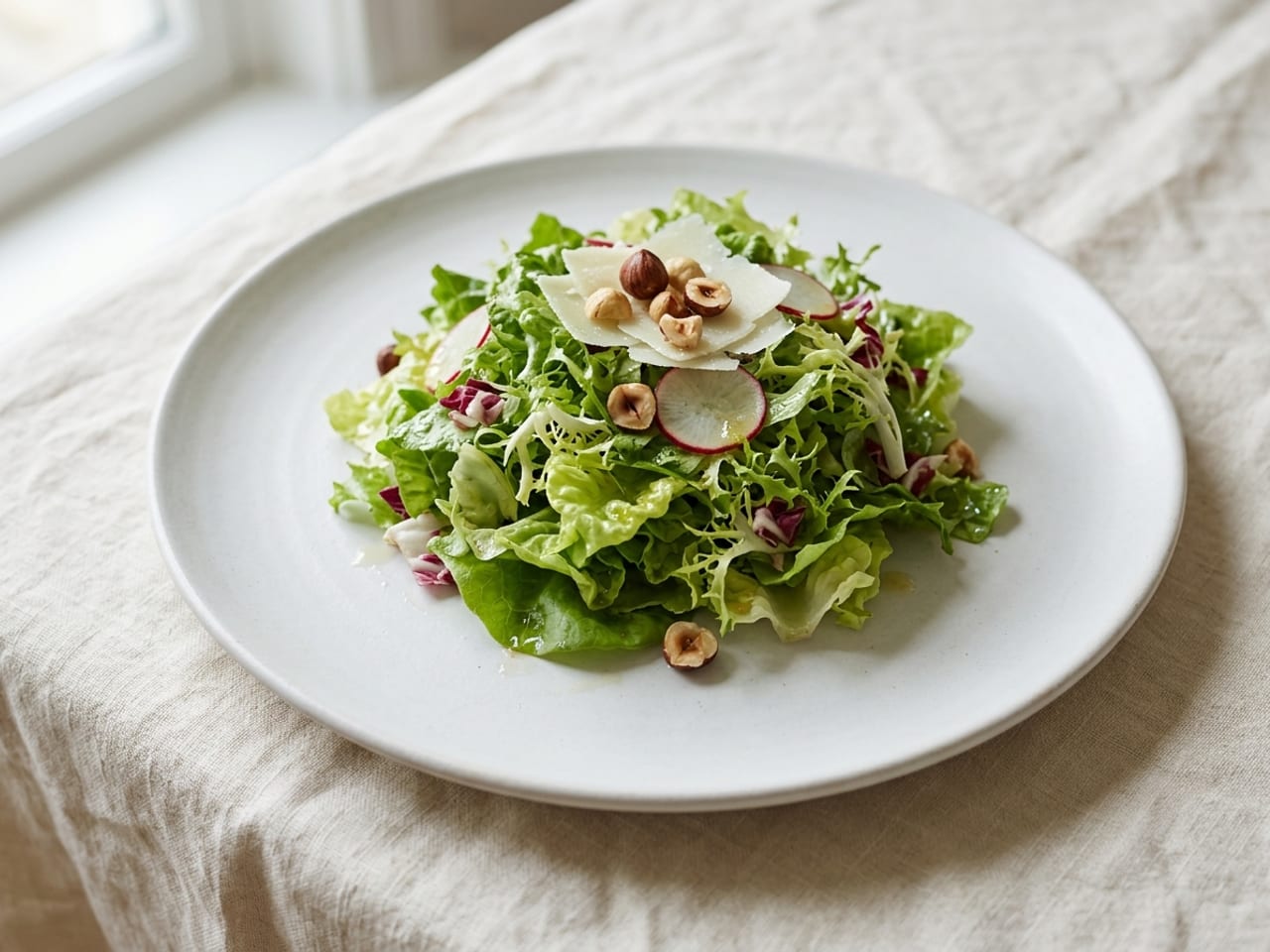
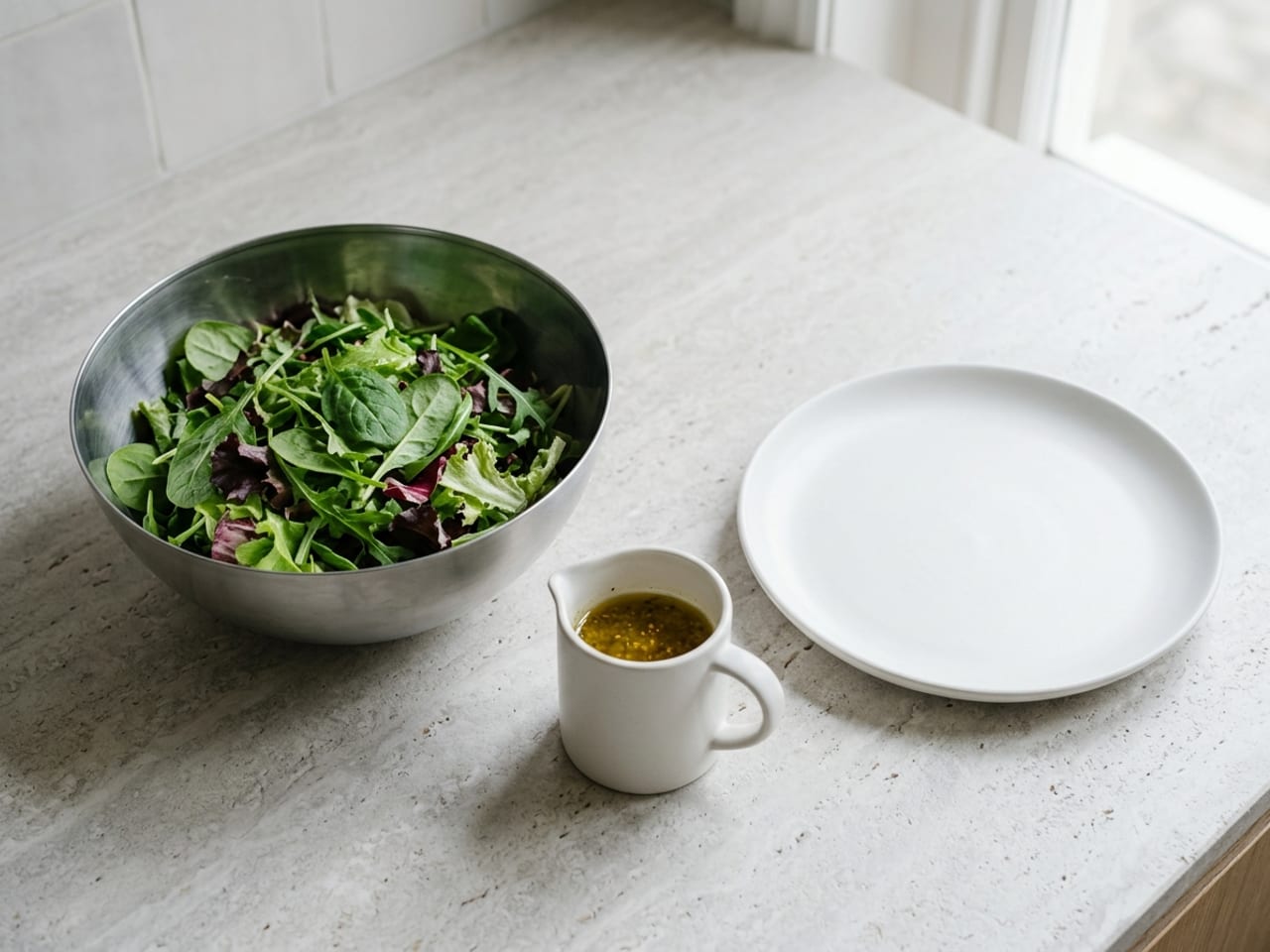
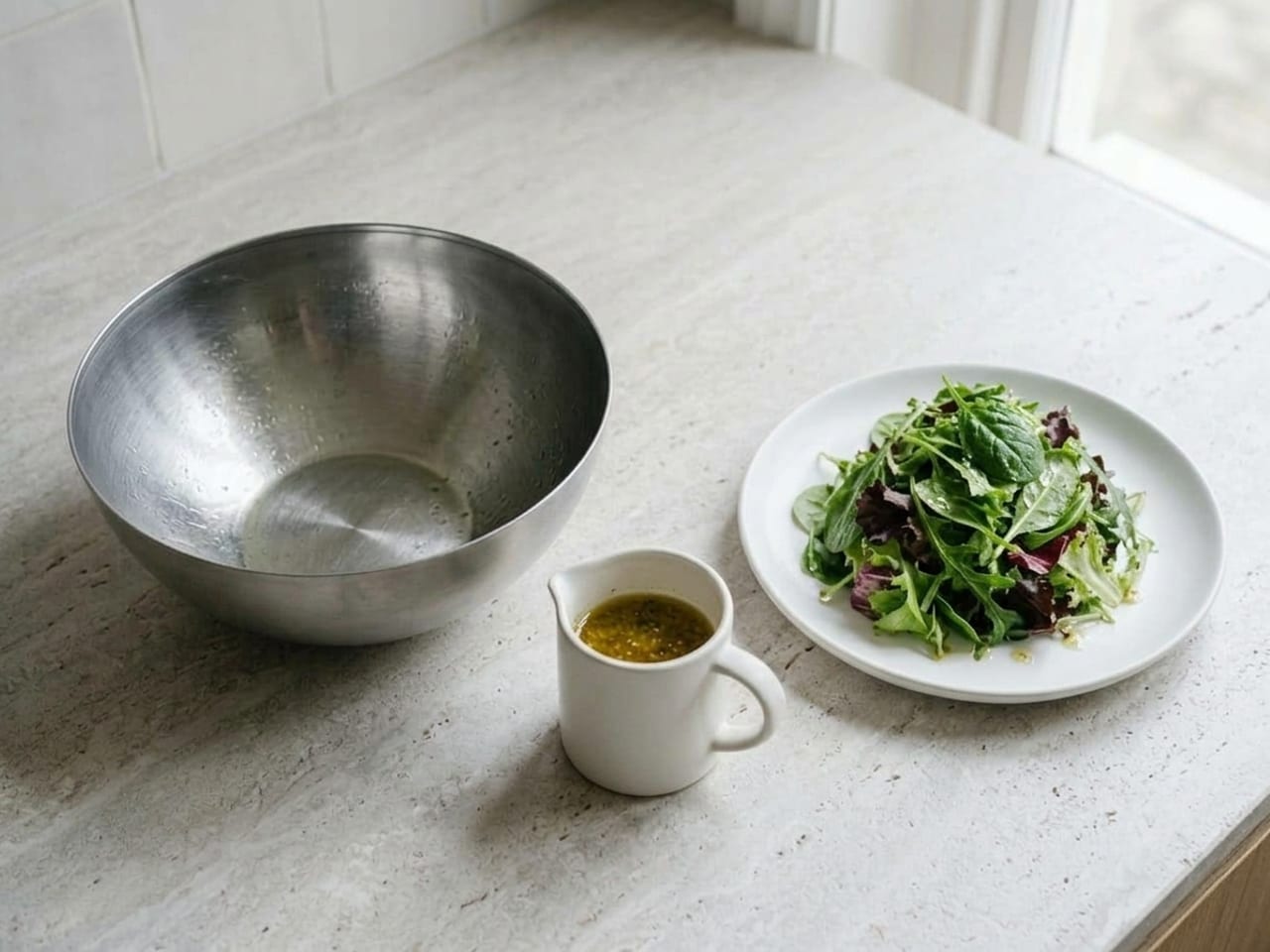
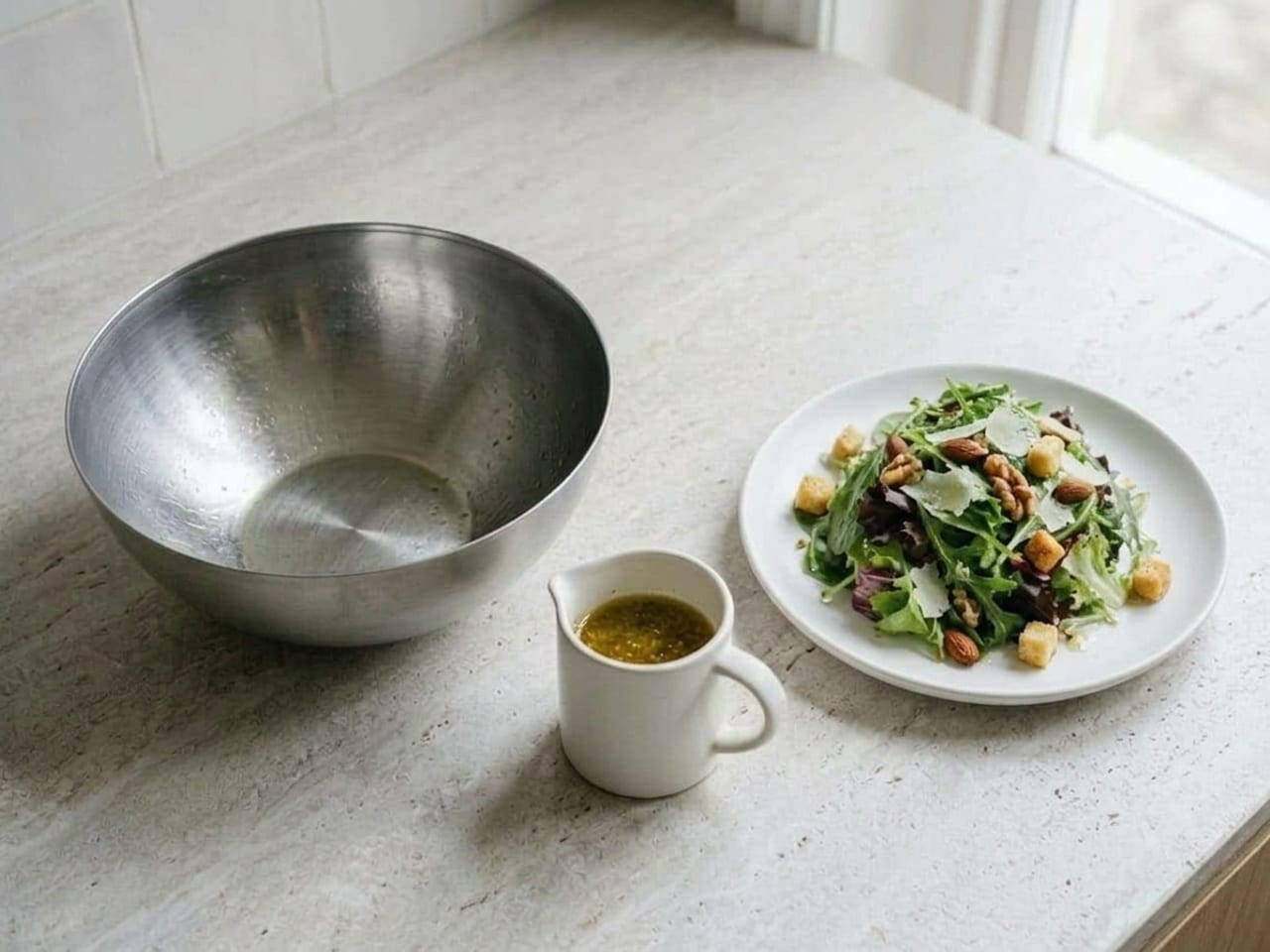
The photos on this page are AI-generated illustrations.
How to plate a salad, in 6 steps
Dry the leaves completely. Choose a plate, a platter or a wide shallow bowl. Dress the leaves in a big bowl just before serving, a little at a time, until they glisten and nothing pools. Lift them onto the plate by the handful so they pile up, whole leaves largest first. Put the heavy toppings, the crunch and the herbs on last, where they can be seen. Finish with salt and pepper, keep the rim clear and serve at once.
- Dry the leaves. America's Test Kitchen: "Greens must be dry for the dressing to cling. Otherwise, you'll be left with a bowl of naked greens and a puddle of dressing."17 Spin them, then blot what is left with paper towels.18 The US Food and Drug Administration gives drying a second reason: a clean towel helps "further reduce bacteria that may be present on the surface".79 Wash under running water first; bagged leaves labelled ready-to-eat need no rewashing, says the FDA.79 Washing, drying, tearing.
- Choose the plate or the bowl; the textbook wants it cold. Toss in a wide, shallow bowl;19 serve a composed or knife-and-fork salad on a plate or platter, where the toppings stay in view.19, 21 Gisslen's textbook: "Select the right plate for the portion size, not too large or too small" and "Cold plates, please."1 Our research found no study of what a chilled plate does: plate or bowl.
- Dress in a big bowl, just before serving. America's Test Kitchen: "Generally, ¼ cup vinaigrette dresses 8 to 10 cups of lightly packed greens, enough for 4 to 6 side salads or 2 to 3 dinner salads."17 That is about 60 mL for 1.9 to 2.4 L of loose leaves (our conversion). The Culinary Institute of America's figure is 15 to 22.5 mL (½ to ¾ fl oz) for a serving of about 57 g (2 oz) of greens.3, 15 J. Kenji López-Alt of Serious Eats puts the greens "in a bowl that you think is way too big for them".26 Toss gently with clean hands, tongs or wooden spoons.3, 19, 79 "Add the dressing in increments",18 and add it late: "Add dressing immediately before service, or serve it on the side."1 How to dress a salad.
- Build the pile a handful at a time; with whole leaves, largest first. Samin Nosrat describes how the New York restaurant Via Carota builds its green salad in the serving bowl, dressing each layer: "gently pile a generous handful of greens into a serving bowl, then sprinkle with salt, pepper and a generous drizzle of dressing. Continue with another handful".74 Lifting leaves you have already tossed onto a plate the same way is our adaptation. With whole leaves, Colu Henry starts "with the largest ones on the bottom" and finishes "with the smaller ones on top".32 Gisslen: "Ingredients mounded on the plate are more interesting than if they are spread", and "Keep the salad off the rim of the plate."1 Building the plate.
- Put the heavy toppings and the crunch on last. Cook's Illustrated: "Reserve half of heavier nuts and cheeses to sprinkle over the dressed salad."18 Bon Appétit tosses some of the toppings in and tops the salad "with the rest post-toss", so that "Your guests will get to see everything that's in the salad".20 Soft things such as salmon or tofu go on "at the very end, after tossing",19 and watery tomatoes are drained first.19 Herbs go on after the dressing too.20
- Finish, clear the rim, serve at once. Cook's Illustrated seasons "with kosher or flake sea salt just after dressing", which "creates appealing pops of salty crunch".18 Gisslen: "Think of the rim as a picture frame".1 Wiping a stray drop off the rim with a clean cloth is ours. Then serve: "toss one last time and serve the salad right away", writes Alice Waters.4 US consumer advice is to refrigerate salads within 2 hours, or within 1 hour above 90°F (32°C).80, 81
How this page was made. Every sourced instruction here is quoted from the published source named beside it: culinary textbooks, test kitchens, recipe writers, chefs, Escoffier's English Guide to Modern Cookery, the Philippine K to 12 Cookery curriculum, peer-reviewed papers and food-safety agencies; the rest is marked "ours". Plate Artists has not cooked, measured or tasted any of it for this guide. The printed textbooks (Gisslen's Professional Cooking, the Culinary Institute of America's Garde Manger, Alice Waters, Marcella Hazan) were read only as short search fragments of Internet Archive scans, without page numbers, so their quotations are brief and some break off mid-sentence. A few sentences reached us second-hand, and say so where they appear: Julia Child through a blog's adaptation of her book with Jacques Pépin, old cookbooks and newspapers through the Food Timeline and Barry Popik, Jacques Médecin through the writers who quote him. Where the sources disagree, we set them side by side instead of picking a winner. The page carries no affiliate links. Sources are at the bottom.
Tossed, composed, bound or stacked: what each is and how each is plated
The kind of salad decides the plate. A tossed salad is piled, a composed salad is arranged, a bound salad is scooped onto a leaf.
| The salad | What it is | How it is plated |
|---|---|---|
| Tossed salad | The ingredients are mixed with the dressing in a bowl. Gisslen defines the other kind against it: composed salads are "arranged on the plate rather than being mixed together".2 | Dressed at the last moment and piled, half the toppings held back for the top.1, 18 Lifting it out by the handful is ours, after Via Carota's layered bowl.74 |
| Composed salad | "Composed salads are salads made by arranging two or more elements attractively on a plate."2 The Culinary Institute of America's Garde Manger says there are no "specific rules governing the requirements", only principles.3 | Each element seasoned on its own, then arranged: Gisslen says to "season each component separately",1 Escoffier dished his compound salads "in distinct heaps of contrasted shades" and wrote that the decoration, "being subject to no rules, is merely a matter of taste".7 Usually a first or main course, not a side.2 |
| Bound salad | Ingredients "held together, or bound, with a dressing, usually a thick dressing such as mayonnaise":1 chicken, tuna, egg, potato and macaroni salad. | As a mound or scoop on a leaf: Gisslen says potato salad "looks bare when served by itself on a salad plate", and his recipes "Arrange the lettuce cups as underliners on cold salad plates".1 |
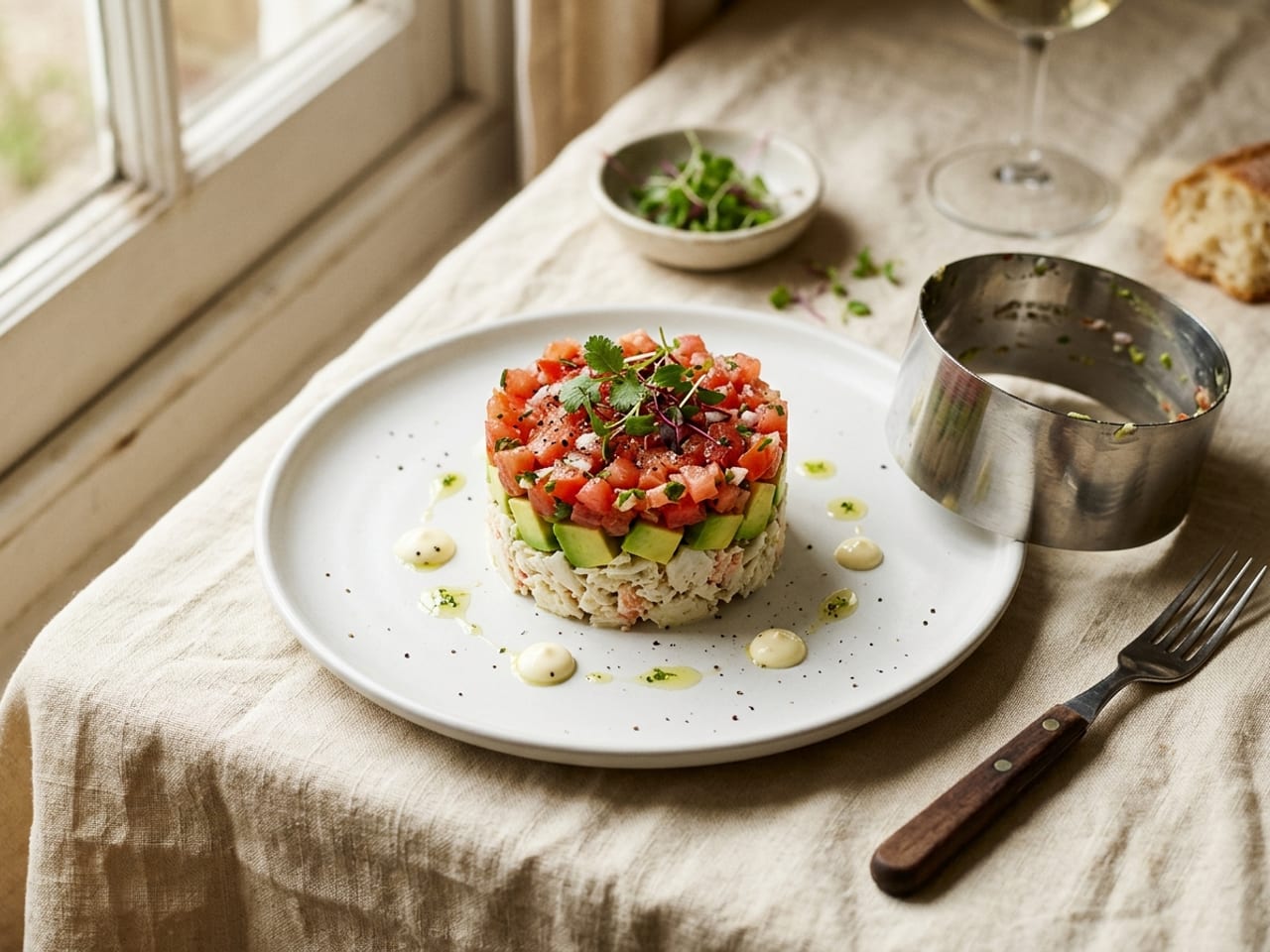
| Stacked or layered salad | Not a textbook category in anything our research opened; the word comes from recipes and trade copy (our reading). The salad is built upward in layers, in a ring mould or a glass. | A trade recipe layers mozzarella, avocado and tomato in a 3 inch (7.6 cm) ring, drains it on a rack and lifts the ring off on the plate.34 The ring mould. |
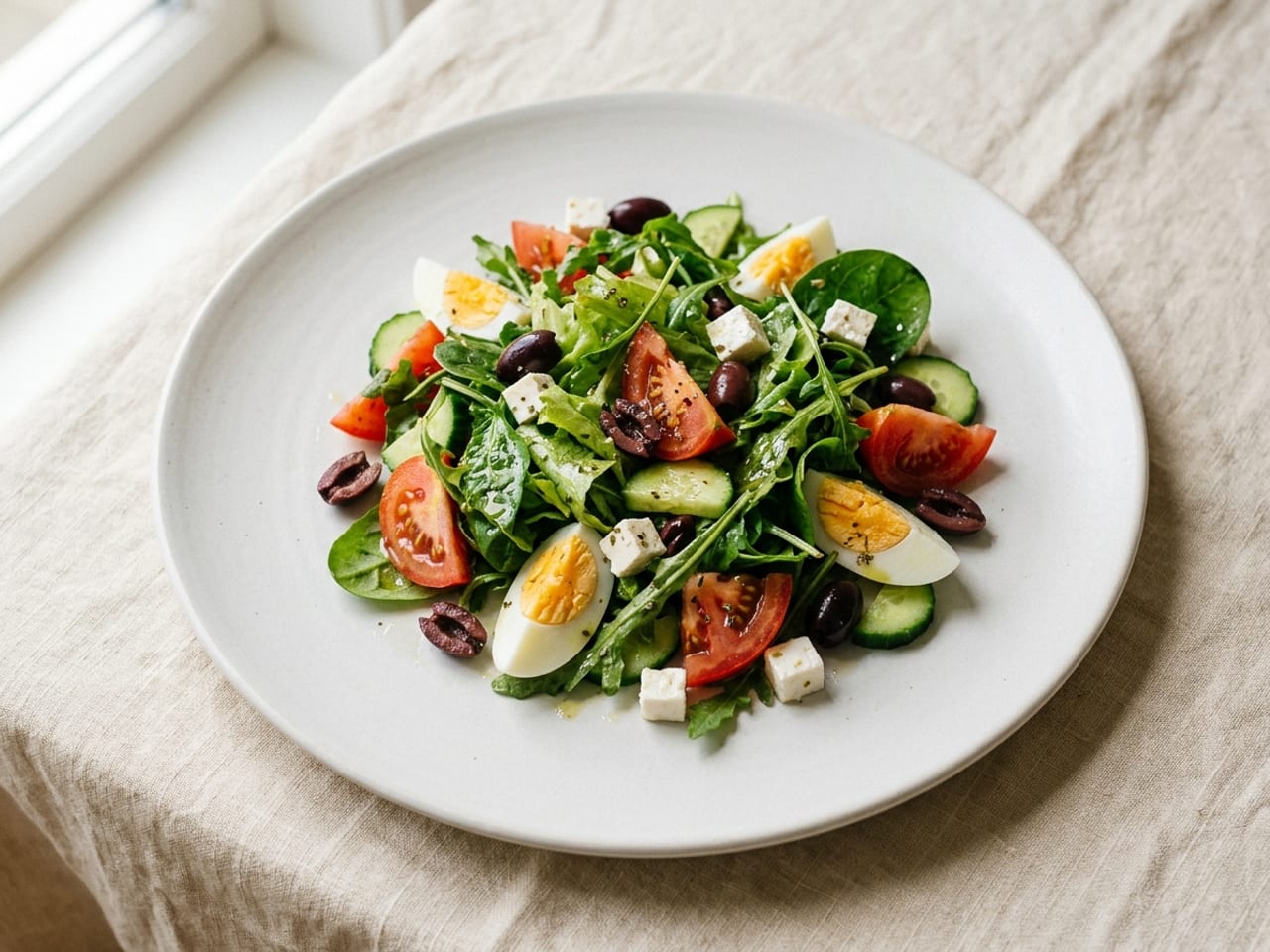
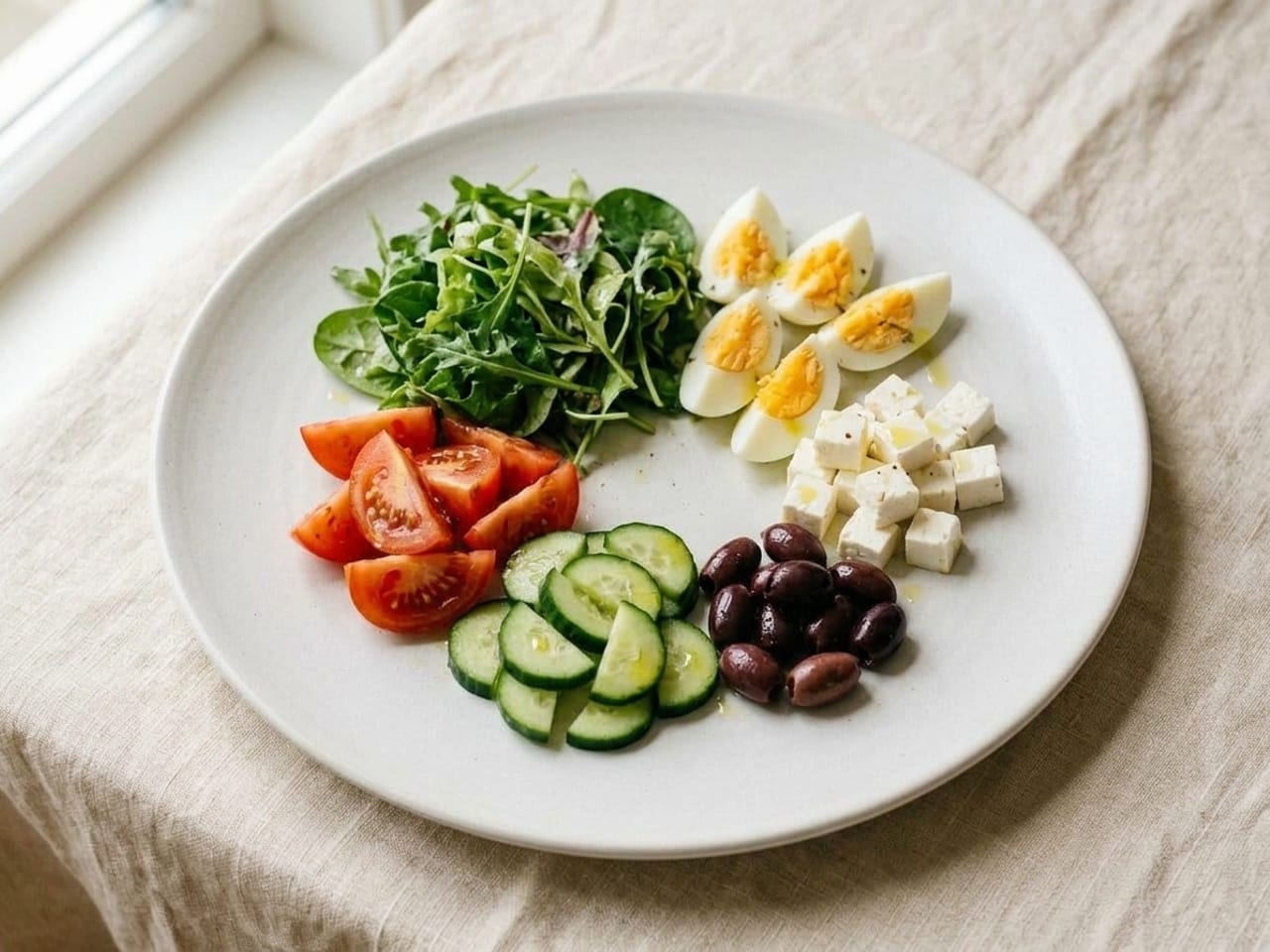
An older division. Escoffier's English guide has two kinds only: "Salads are of two kinds: simple, or compound." Simple salads are raw, the green salads first among them; compound salads "generally consist of cooked vegetables". 7 His compound salad, when it is dished unmixed in separate heaps, is the nearest thing in his book to today's composed salad (our reading; the two words are not interchangeable in every modern textbook). Both words are in the glossary.
The four parts of a plated salad. Gisslen's textbook: "A plated salad may have as many as four parts: base, body, dressing, and garnish."1 The Philippine learner's manual repeats it: "Plated Salad has four parts:". 13
- BaseAlso called the underliner.1 "The base is an edible platform on which the salad is displayed."14 The Philippine learner's manual: cup-shaped leaves of iceberg or Boston lettuce "give height to salad".13 Optional: "most tossed green salads and many composed salads are presented without an underliner".1
- Body"The body is the main ingredients (the bulk) of the salad and is often the namesake."14
- DressingMixed through the salad, "added just prior to serving", or "served on the side".14 Where it goes on the plate.
Salads from our own catalog to practise on: chickpea salad, Italian grinder salad, pasta salad and Czech potato salad.
How to present salads and dressings attractively
That wording is a school competency. In the Philippine Department of Education's K to 12 Cookery curriculum guide, learning outcome 3 is "Present a variety of salads and dressings" and competency 3.1 is "Present salads and dressings attractively" (code TLE_HECK9-12SD-IIh-i-9).12 Two official lists answer it, and they are not the same list.
List 1: the six guidelines for arranging salads
From Wayne Gisslen's Professional Cooking, which says that "appearance and arrangement of a salad are essential to its quality."1 The Philippine learner's manual prints the same six headings, word for word, without his explanations;13 it does not credit him there (our comparison).
| Guideline | Gisslen's words | On your plate (ours) |
|---|---|---|
| 1. Keep the salad off the rim of the plate | "Think of the rim as a picture frame" and "Select the right plate for the portion size".1 | Leave the rim bare. If the salad reaches it, the plate is too small. |
| 2. Strive for a good balance of colors | "Plain iceberg lettuce looks pale and sickly", but "Sometimes just a few shades of green creates a beautiful effect. Too many colors may look messy."1 | Add one or two colours to the green, not every colour you have. |
| 3. Height helps make a salad attractive | "Ingredients mounded on the plate are more interesting than if they are spread"; "Lettuce cups as bases add height. Often just a little height is enough."1 | Pile, lean or overlap. A little height, not a tower. |
| 4. Cut ingredients neatly | "sloppy cutting makes the whole salad look sloppy and haphazard."1 | Even slices and dice. Our knife skills guide has the cuts. |
| 5. Make every ingredient identifiable | "Cut every ingredient into large enough pieces that the customer can recognize each immediately"; "Bite-size pieces are the general rule".1 | Big enough to recognise, small enough for one bite. |
| 6. Keep it simple | "A simple, natural arrangement is pleasing."1 | Stop before the plate looks decorated. |
List 2: the five factors to consider in plating and presenting salads
From the curriculum guide itself, content item 11: Balance, Harmony, Height, Color, Texture.12 The guide lists the five words and does not define them. The readings below are ours, each tied to a source quoted on this page.
| Factor | One way to show it, with a source |
|---|---|
| Balance | Gisslen's wording is "a good balance of colors".1 A food writer's way to get it on a composed plate: "place a cooked vegetable next to a raw one; an orange one next to a dark green one; a rich, creamy ingredient next to a crisp, bright one." 35 |
| Harmony | The parts should go together. The CIA's textbook: "Contrasting flavors are intriguing. Conflicting flavors are a disaster".3 John Evelyn in 1699: the ingredients should "fall into their places, like the Notes in Music, in which there should be nothing harsh or grating".6 |
| Height | See guideline 3 above.1 The Philippine manual adds that a lettuce cup under the salad gives height.13 |
| Color | See guideline 2 above: neither pale iceberg on its own nor every colour at once.1 |
| Texture | Something crisp against the soft: "Croutons add texture, flavor, and crunch to a green salad."14 An open textbook lists "Textured components like crackers or croutons or baked vegetable chips" as garnishes.15 |
For a school answer: the curriculum guide's list is the five factors; the learner's manual teaches the six guidelines. Both are Department of Education documents from 2016, so a question may want either (our reading). The same manual's list of "Important Factors to consider in Salad Preparation" adds three lines on looks: "Eye Appeal. It should be attractive, appetizing, creatively presented", "Simplicity. Make it simple not overcrowded" and "Neatness. Keep salad neatly placed in a plate."13 How such a salad is graded is under school and competitions.
Is salad served on a plate or in a bowl?
Both, and the salad decides. A plate shows a salad; a bowl holds one.
- A plate or platter when the toppings matterOne food site's case against the bowl (a staff writer's argument, no chef quoted): it "hides the beauty of smaller, textural add-ins, such as nuts, seeds, and sweetcorn, that can sink to the bottom", and "the dressing will eventually collect at the base". 21 Alice Waters arranges a composed salad "on a platter".4
- A wide, shallow bowl for tossing, and for a leafy salad at the table"A wide, shallow bowl is ideal for tossing a salad quickly and evenly." It can be the serving bowl or one "that stays in the kitchen after you transfer the greens to a serving bowl".19 The same writer who argues for the plate concedes that a bowl "keeps all the leaves and the vinaigrette contained".21 A Greek-run recipe site keeps a Greek salad in its bowl on purpose: the juices are the point.
- The right size: no cookery source we read gives a numberGisslen's guideline is "Select the right plate for the portion size, not too large or too small."1 Our research found no textbook or test kitchen that says what diameter of plate a salad needs. What a salad plate itself measures is in types of plates.
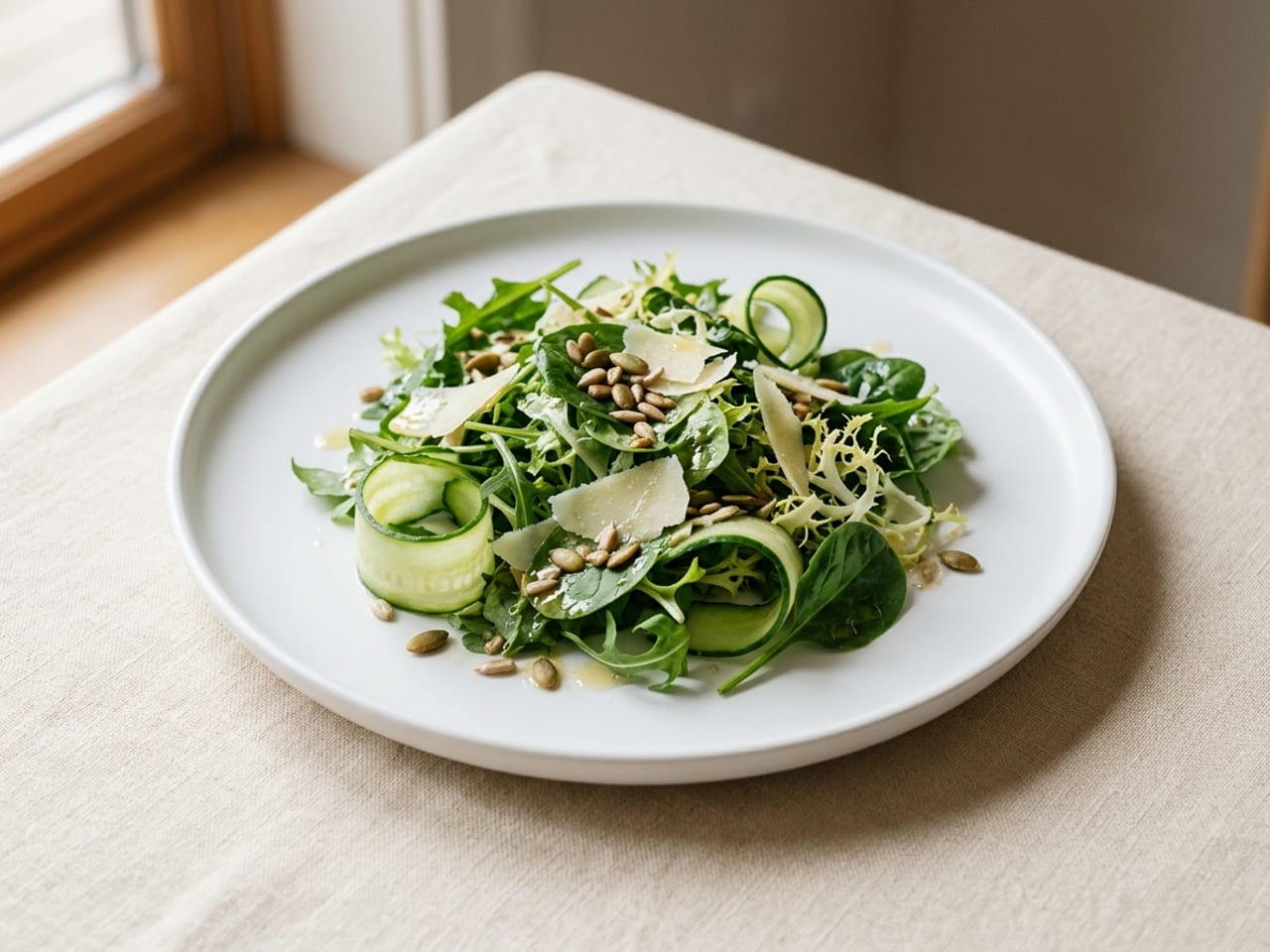
Should the plate be chilled?
- Who recommends a cold plateGisslen: "Cold plates, please. Don't use plates right out of the dishwasher", and "Serve cold foods cold, on cold plates."1 A US lesson plan asks for salad "Served properly chilled on chilled plates but not ice cold".14 One named restaurant chef, Camille Becerra: "When you make a salad at a restaurant, there's a better understanding of the importance of a chilled plate."24
- We found no measured benefit, and no agency page we read mentions itOur research searched PubMed, Europe PMC and Crossref for any study of chilled plates and salad and found none, and none of the food-safety agency pages cited here says anything about chilling serving plates, for or against. Food-site writers suggest 10 to 15 minutes in the fridge;22, 23 neither article reports a test, and no textbook we read gives a time. The reason one article gives is a restaurant's: plates "frequently coming out of the dishwasher hot"; it grants that this "isn't typically the case in home kitchens" and still advises chilling.23 Chill the plate if you like; call it custom, not evidence.
- Cold, not frozen; and warm for a warm salad"Salads should be served cool, not ice cold."14 If plates turn "overly frosty", one of those writers says to let them warm for a few minutes, to avoid "freezing delicate lettuce leaves and any dressing".22 A warm dressing wants the opposite: Escoffier puts a salad with hot bacon seasoning "in a hot salad-bowl".7
The leaves: wash, dry, tear or cut
A salad is plated under the tap and in the spinner before it is plated on the plate. The washing advice is US agency advice and is labelled so.
- Wash under running water; no soap, no sink soak (US advice)FDA: "Wash all produce thoroughly under running water", and washing "with soap, detergent, or commercial produce wash is not recommended."79 The Centers for Disease Control and Prevention's leafy greens page (last reviewed in 2023 and since taken off its site; we read an archived copy and found no replacement): "Rinsing leafy greens under running water is the best way to wash them. Do not soak leafy greens", because "germs from one leaf can spread to the others", and in a sink "germs in the sink can contaminate the greens." 80 That differs from the cook's habit of swishing leaves in a basin: NYT Cooking has you "lift the leaves out and shake them".19 The agency's advice is the safety advice.
- Dry them completely"Dry the greens completely to remove excess water and aid the dressing in clinging to the greens";15 "oil-based dressings will not cling to wet greens."14 Cook's Illustrated adds dilution: "Excess moisture that's left on lettuces and herbs will dilute your dressing."18 No spinner? Bon Appétit: "Line a plastic shopping bag with paper towels, throw in your greens, and knot the bag."20 Evelyn's 1699 version: "swing them altogether gently in a clean course Napkin".6
- Tear or cut: the sources split, and in the one test we found nothing browned for 10 days either wayTear, says a US lesson plan: "torn greens are more attractive", and cutting "causes some greens to turn a rusty color at each cut."14 Cut, says Gisslen, at least in quantity: tearing "is a slow method if you have a large quantity to do" and can "crush or bruise the leaves. Use sharp stainless-steel knives for cutting."1 Either, says an open textbook: "Tearing is preferred but is a matter of preference."15 The one test our research found is Cook's Illustrated's, in 2009: romaine and iceberg cut with a stainless knife, a carbon steel knife and a plastic lettuce knife, and torn by hand, then bagged in the fridge. After 10 days "none showed any signs of browning on the cut or torn surfaces"; metal-cut edges browned at 12 days and torn ones "at 2 weeks". Its verdict: "To prolong the life of lettuce by a day or two, stick to tearing by hand."31 For a salad made and eaten the same day, that test shows no visible difference (our reading). We found no peer-reviewed study that compares the two. One old reason was the blade: Evelyn in 1699 wanted the knife "of Silver, and by no means of Steel, which all Acids are apt to corrode", and Emily Post in 1922 barred a steel knife for salad at table "because it turns black".6, 8 That the no-knife rule began there is our reading.
- Leaf size: one bite"Bite-size pieces are important as a convenience to the customer".1 Cook's Illustrated: "Tear or cut all lettuces into 1½- to 2-inch pieces" (about 4 to 5 cm, our conversion).18 NYT Cooking sizes the leaves before washing.19 For a portion, the lesson plan allows "about one cup of broken greens per serving" (about 240 mL).14 Whole leaves are the exception: see the Caesar.
- Reviving limp leavesCook's Illustrated: "Lettuce wilts because it loses water, so the key to reviving it is to put the water back in. A 30-minute soak in ice water will usually restore crispness." 18 CDC's reason for not soaking applies here too: in a soak, germs can pass from leaf to leaf. A cook who revives leaves this way is choosing the test kitchen's method over the agency's caution (our note). Use a clean bowl, never the sink, and dry the leaves again afterwards.
How to dress a salad
How much, when, with what, and why the order matters. The test results quoted here are the named publishers' own kitchen tests.
- How much: two published figures, then your eyesAmerica's Test Kitchen: ¼ cup of vinaigrette for 8 to 10 cups of lightly packed greens.17 The CIA's Garde Manger: 15 to 22.5 mL per serving, on about 57 g (2 oz) of greens,3 which an open textbook prints as "2oz. greens to ½ or ¾ oz. dressing".15 By our arithmetic the CIA dresses a little more heavily: the test kitchen's quarter cup over 4 to 6 side salads is 10 to 15 mL each. An open textbook gives the test by eye: "all the greens are coated but without dressing pooling on the plate".15 Chef Clem Haxby: "you want the salad glistening, not swimming."25
- Add it in increments"You never want to dump a set amount of dressing over greens and assume they will be perfectly coated."17 Haxby's order: "Start with a dry base. Wet leaves dilute your dressing. Add a little dressing, toss, taste a leaf, then add more if needed."25 America's Test Kitchen allows no undo: "Once you have overdressed your salad, there is no going back".17
- When: at the last momentGisslen: "Dressed greens wilt rapidly."1 America's Test Kitchen: "For the freshest salad, make sure to dress your greens just before serving."17 The Philippine learner's manual: "Do not add dressing to green salads until serving". 13 Evelyn, 1699: "pour not on the Oyl and Vinegar, 'till immediately before the Sallet is ready to be eaten".6 The exception is sturdy leaves: "If using hearty greens like kale, you can dress them up to 30 minutes early", says Haxby.25
- It is mostly the oil that wilts the leaves, not the vinegarCook's Illustrated dressed 2 ounces (57 g) of mixed greens three ways and looked at 15 minutes: oil then vinegar, "seriously wilted"; vinegar then oil, "a little wilted"; an emulsified dressing, "barely wilted at all".28 J. Kenji López-Alt ran his own kitchen test for Serious Eats, half an ounce (14 g) of greens each in vinegar, water and olive oil for ten minutes: "The greens dressed with plain oil wilted significantly faster than those dressed in vinegar."27 Milk Street, after nearly 30 vinaigrettes: "Conventional wisdom says acid wilts greens, but it's actually the oil that's to blame".29 The test kitchen's explanation is the leaf's waxy cuticle, which "prevents water-based liquids (vinegar) from having much effect" while "oil easily penetrates this film."28 These are small kitchen tests judged by eye. And vinegar is not innocent: "it is the oil that is the main culprit here, although the vinegar and salt also play a role".30 No test kitchen we read gives a holding time in minutes for dressed tender leaves, so this page gives none.
- Oil and vinegar separately: vinegar firstCook's Illustrated: "tossing the salad first with the vinegar and again after adding the oil prevented the leaves from wilting too quickly."18 NYT Cooking's no-whisk method uses the same order: sprinkle "very lightly with lemon juice or vinegar. Toss, preferably with your fingers, until leaves are evenly coated. Repeat with oil, then with salt and pepper."19 Evelyn recorded the opposite order in 1699, oil alone first.6
- An emulsified dressing stays on the leafLópez-Alt dressed two salads, one with mustard in the vinaigrette and one without, and set them in funnels over glasses. After ten minutes the broken dressing had dropped "nearly a full teaspoon of vinegar", almost all he had put on, and the emulsified one "at most a dozen drops". His conclusion is the puddle on the plate: "Unless you emulsify your vinaigrette, you end up with a pile of leaves dressed in oil, and a pool of vinegar at the bottom of the salad bowl".27 Milk Street used Dijon mustard as the emulsifier, so that "the oil penetrates the greens more slowly".29
- Hands, tongs or spoonsHands: "The best tool you can use for mixing salad is: Your hands";20 "I usually toss salads with my hands", writes Alice Waters;4 "Tongs can crush soft leaves or break things apart", says Haxby.25 Tools: America's Test Kitchen's own instruction is to "lightly drizzle and toss the salad with tongs a couple of times, tasting as you go",17 and the CIA allows "Tongs, spoons, or, where appropriate, gloved hands".3 NYT Cooking prefers wooden utensils because "they can gently lift and tumble ingredients without crushing them the way metal spoons do."19 If it is hands, FDA's line applies: "begin with clean hands. Wash your hands for at least 20 seconds".79
- Dress the bowl, and use a bowl with roomBon Appétit: "Drizzle your dressing along the walls of your bowl, then lightly toss your greens until the dressing is evenly distributed."20 López-Alt puts the greens "in a bowl that you think is way too big for them".26 America's Test Kitchen rubs "the inside of the salad bowl with half a clove of peeled garlic before adding the lettuce." 17
- Three to one is a starting point, not a lawEvelyn in 1699 ("Oyl-Olive, three Parts; of sharpest Vinegar", lemon or orange juice, "one Part"),6 Escoffier ("three parts of oil to one part of vinegar, with salt and pepper")7 and Gisslen all print 3 to 1, and Gisslen adds at once: "This is not a divine law, however"; "Some chefs prefer a 2:1 ratio".1 Serious Eats found that "two to three parts oil to one part vinegar" made "the strongest emulsion."27 NYT Cooking will not fix a number: "Some people like their vinaigrettes to be half oil, half vinegar, while others go all the way up to one part vinegar to six or seven parts oil."19
- Salt before the dressing, or after: both are publishedBefore: "After you've dried them, season your naked greens with salt and pepper"; 20 the CIA and an open textbook also season the leaves in the bowl first.3, 15 After: Cook's Illustrated seasons "just after dressing", for "pops of salty crunch".18
Where the dressing goes on the plate
| Where | Who does it, in their words |
|---|---|
| Tossed through | The default for leaves: dressed in the bowl "so all the greens are coated but without dressing pooling on the plate".15 |
| Each part on its own | Composed salads: "season each component separately";1 Escoffier's heaps were each "seasoned" before they were dished.7 America's Test Kitchen dresses each row of its Cobb in turn.61 |
| Drizzled over | On a platter: "Simply drizzle your dressing over the top moments before serving."21 Into whole leaves: "making sure it gets into the nooks and crannies of the lettuce cups".32 Over a wedge, with a spoon "to help it cascade down sides".58 |
| A smear underneath | Two Baltimore chefs start a beet salad with a swoosh of pine-nut butter on the plate that, in the writer's words, "adds a design element, a nutty taste, and glues the foundation." It is a second sauce: the beets are tossed in vinaigrette before they go on.33 |
| A dollop and drops | A lesson plan's example of a composed plate: "In the middle of the plate may be a dollop of mango chutney. The vegetables may be drizzled with truffle oil."14 A trade recipe finishes a stacked salad with "drops of chili oil."34 |
| On the side | Gisslen: "or serve it on the side";1 the Philippine manual: "served separately";13 America's Test Kitchen passes the rest of a wedge's dressing "separately".58 López-Alt rejects it for a leaf salad: "dressing on the side is not a good option", because drizzling it over naked greens, or dipping them, "leads to uneven dressing that masks the flavor of the greens instead of enhancing them".26 |
Building the plate: height, toppings, crunch
Our summary of the order: leaves, then the heavy toppings, then crunch, then anything delicate.
- Height: recommended by the textbook, not settled by the studiesGisslen recommends it and limits it in the same breath: "Often just a little height is enough."1 Samin Nosrat describes Via Carota's leaves "all piled as high as gravity will allow".74 The experiments do not agree: flat or centred won in one,103 a tall moulded salad won in another only on a large plate,104 and none tested a loose, hand-piled green salad. The studies.
- Getting the leaves onto the plateBy hand, in handfuls: Via Carota's salad is built that way in its serving bowl, with dressing between the layers.74 Doing the same with tossed leaves on a plate is ours. With whole leaves, largest first: Colu Henry arranges little gem leaves "(casually!) starting with the largest ones on the bottom",32 and Anna Tobias builds a Caesar the same way.45 Twisting leaves into a nest with tongs, or dropping them from a height: our research found no written source for either, so neither is given here as a rule.
- Toppings: keep them where they can be seen"Nobody likes carrot chunks or wads of goat cheese that sink to the bottom of the bowl." The fix is to cut heavy vegetables thin, "Shave or thinly slice them (a peeler or mandoline is helpful here) so they mix evenly with the greens", and to hold half the nuts and cheese for the top.18
- Wet ingredients: drain them, or serve them besideNYT Cooking lists "tomatoes (drained on paper towels, if watery)".19 A US lesson plan goes further: "To prevent tomato juices from thinning a dressing, tomatoes can be served to" the side.14 The Philippine manual's rule 12: "Drain all the ingredients well."13
- The crunch"Croutons add texture, flavor, and crunch to a green salad. Croutons are rarely used with starchy salads (e.g., potato, egg, and pasta)."14 On a composed plate the crunch is the last move: two chefs finish a beet salad by sprinkling it "with pine nuts to create crunch and visual variety."33 Crisps, crumbs and tuiles are in our plating components glossary.
- Cheese: shaved, crumbled or a slab"Crumble soft varieties into ¼- to ½-inch pieces; shave small slivers of hard cheeses" (about 6 to 13 mm, our conversion).18 Bon Appétit shaves "a modest amount of Parmesan" for a Caesar, because "a mound of grated Parmesan may look impressive, but all that clumpy cheese mutes the dressing".46 A slab is the Greek way: feta on top, in one piece.
- Herbs and edible flowers go on after the dressing"toss your greens in dressing before adding herbs: their delicate flavor will shine through much more when they're the outermost layer."20 Flowers on a salad are as old as the 1699 text: "the Sprinklings of Aromaticks, and such Flowers".6 The caution comes with them every time: "Many flowers are edible, but not all", "Do not eat flowers from florists, garden centers, or nurseries", and "Do not use flowers that have been sprayed with pesticides".95 Which flowers, and how to prepare them: food garnishes.
- How many ingredientsFor a main-course salad NYT Cooking says "Six to eight total ingredients, before toppings, is the right number".19 Gisslen's limit is on colours: "Too many colors may look messy."1 "Three colours at most" is often repeated. Gisslen's 7th edition does not say it: what his general plating chapter says is "Two or three colors on a plate are usually more interesting than just one" (a scan fragment), which is a floor and not a ceiling.1 Odd numbers are a myth card.
- The ring mould, and Escoffier's objectionA trade recipe for a stacked salad: "In a 3-in. ring mold, layer ¼ cup mozzarella, ⅓ cup avocado and ¼ cup tomato" (a 7.6 cm ring; about 60, 80 and 60 mL, our conversions), drain the filled rings on a rack, then "Slide 1 ring mold onto a serving plate; carefully remove ring mold."34 Chef Jason Lear dates the fashion: "in the early '90s and into the 2000s, everything was stacked".33 Escoffier was against it long before: "I do not advise the moulding of compound salads, for the increased sightliness resulting therefrom is small compared with the loss in the taste of the preparation. The simplest form of dishing is the best" (his own Salade Parisienne, No. 2017, is set in a jelly-lined mould all the same).7 The tool itself is in plating tools.
Want to see your own salad re-plated?
Re-plate your dish free →Upload a photo of a plate you made. Once a day, no sign-up.
How to plate 16 classic salads
One card per search. Each gives the origin with the earliest date our research supports (legends are labelled as legends), how named sources plate it, where they disagree, and the safety note where one applies. Any card with cooked egg, meat, fish, potato or pasta, cheese or cut fruit follows the table-time limits.
Caesar salad
Origin: a claim, not a record. The salad is credited to Caesar Cardini's restaurant in Tijuana, and etymologist Barry Popik words the date as a claim: "it's claimed that the salad was first served in 1923 or 1924." The Fourth of July 1924 story traces to Cardini's daughter Rosa, born in 1928 according to the Wikipedia text Popik reproduces. The earliest print use of the name that Popik cites is 1946, and he transcribes a March 1945 Sunset recipe for the same salad under the name Romaine Salad.42
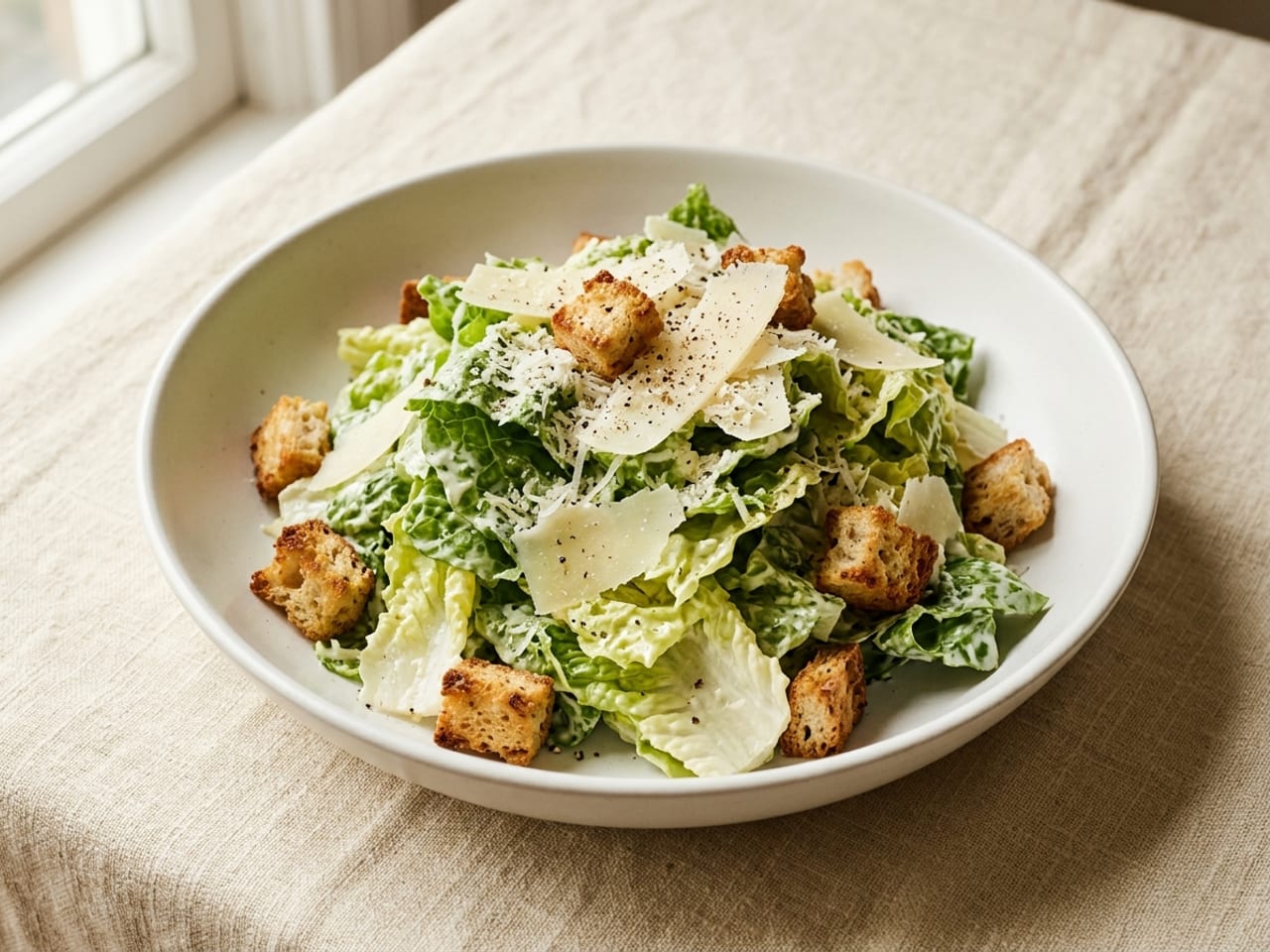
The plate in the oldest account: whole inner leaves. Julia Child's account, as retold by the blog Taste With The Eyes (which says its text is adapted from Julia and Jacques Cooking at Home, Knopf, 1999, the book she wrote with Jacques Pépin; we have not confirmed the passage in that book or in any other): Cardini "used just the hearts of romaine lettuce, the tender short leaves in the center, and he presented them whole", "arranged on each plate so you could pick up a leaf by its short end".43 The restaurant's recipe as NYT Cooking prints it keeps the whole leaves. Pati Jinich's headnote, which calls today's version "but a distant cousin of the original", gives the rules: "The leaves must be whole, crisp and cold; croutons must be sliced, not diced; and Parmesan must be applied generously", and the method ends: "Smear the croutons into the remaining dressing in the bowl and tuck them into the lettuce, including a few on top."44 Anna Tobias gives the build: "start with the larger leaves on the bottom of the plate", with "the smallest, most tender leaves on top and the croutons spread throughout."45 A blogger's adaptation of the Zuni Café recipe stacks the same way, "loosely from large to small". 78 The photo on this card shows the other form, described next: torn romaine tossed in the dressing and piled, with cubed croutons and shaved Parmesan on top.
Where sources split: whole or torn, and the cheese. The torn Caesar is nearly as old as the name in print: the earliest recipe under that name on Popik's page (Gourmet, April 1947, as he transcribes it) tears the romaine and says "Be sure to mix this salad where everyone can see, and only immediately before serving."42 Child's explanation, again as the blog gives it: "Many customers didn't like to get their fingers covered with egg-and-cheese-and-garlic dressing, and he changed to the conventional torn leaf."43 A reader's letter in Gourmet three months after that recipe (July 1947, as Popik transcribes it) insists the romaine is cut: "don't let that old wives' tale about tearing it up matter."42 America's Test Kitchen tears and tosses: "Toss romaine, shredded Parmesan, and dressing in large bowl. Add croutons and toss to combine."47 On top, Bon Appétit shaves "a modest amount of Parmesan",46 where Jinich's headnote wants it "applied generously".44
Chicken Caesar. BBC Good Food builds it in two stages so the chicken stays in view: half the chicken and croutons go over the leaves, most of the dressing is tossed in "with your fingers", then "Scatter the rest of the chicken and croutons, then drizzle with the remaining dressing. Sprinkle the parmesan on top and serve straight away."48
For a crowd, and the egg. Our research found no published method for a Caesar for a crowd beyond recipe yields (America's Test Kitchen's serves 6 to 8);47 the rule on this page applies, dress at the last moment. The 1946 newspaper item Popik transcribes lists "raw or slightly coddled eggs".42 FDA tells US consumers to use pasteurized eggs for Caesar dressing, and UK advice differs: raw egg, country by country. Anchovies and Worcestershire sauce make it a fish dish for anyone with that allergy.98
Caprese
Origin: legend. Named for Capri. A travel feature tells the oldest story as exactly that, "according to legend it was Tiberius who first came up with the recipe", and says "There's still a lively debate on where and when the dish actually originated".49 Nothing our research opened documents a first caprese, so we give no year.
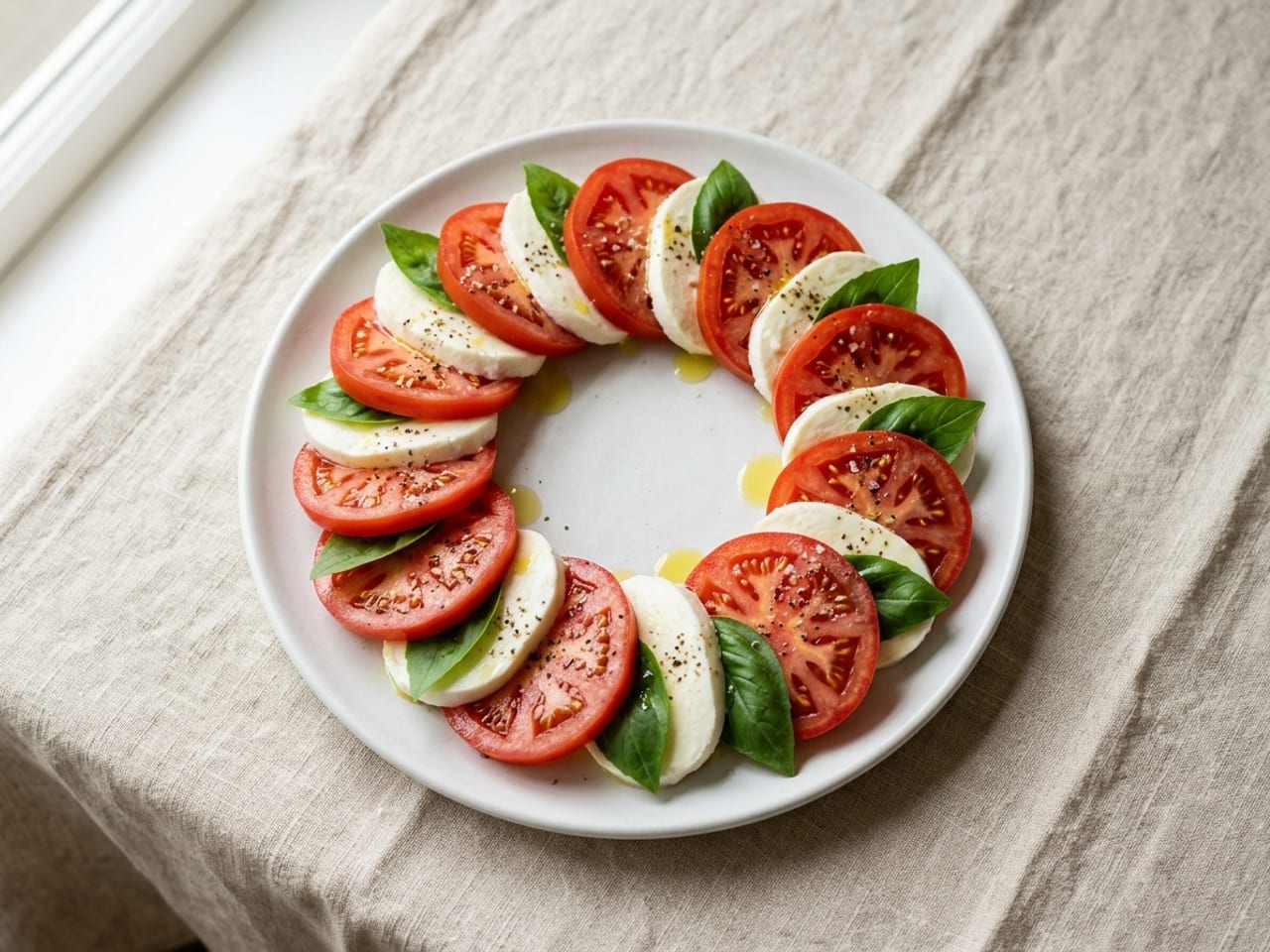
Two plates. Alternating slices: "Layer the tomatoes and mozzarella alternately and in concentric circles on a medium platter",52 or Melissa Clark's "arrange the mozzarella, tomato slices, and whole basil leaves so they overlap slightly. Pour any tomato juices from the cutting board over the dish." 53 La Cucina Italiana likes the tomato slices to be the same size as the cheese (our translation).50 Torn, from Felicity Cloake: "Arrange the tomatoes on a platter, spooning over their juices. Tear the mozzarella over the top, and scatter with torn basil leaves." She credits Jamie Oliver: "It's easier to dot around the salad, and looks, as he says in Jamie's Italy, more rustic". 51
Where sources split: vinegar and basil. La Cucina Italiana's Italian edition: "No a maionese, aceto, olive, uova e salse di nessun genere come il pesto", that is, no to mayonnaise, vinegar, olives, eggs and sauces of any kind such as pesto (our translation).50 America's Test Kitchen tried vinegar and "liked it without".52 Cloake finds that balsamic vinegar overpowers the mozzarella, and quotes Marcella Hazan: "in the classic caprese, there is no vinegar", though Hazan's husband "insists it is a required part of the juices in his version". 51 The basil is torn by hand and added at the last moment, because it wilts and blackens (La Cucina Italiana, our translation);50 tucked in whole between the slices (Clark);53 or chopped over the top, because "whole leaves layered into the mix were chewy and unwieldy to eat".52
Temperature and salt. Mozzarella at room temperature, the slices blotted with kitchen paper, and salt on the tomatoes only (La Cucina Italiana, our translation).50 Clark slices the cheese cold, then lets it "come to room temperature while you prepare the tomatoes."53 In pregnancy, mozzarella is on the NHS and CDC lists when it is made with pasteurised milk.93, 92
For a crowd. Clark: "You can slice and arrange the mozzarella and tomatoes, along with the basil, on a platter a few hours ahead and refrigerate, loosely covered", taken out "About 30 minutes before you're ready to serve" and seasoned "just before serving."53 Skewers are a party version (the label is ours), finished with balsamic glaze: "1 tomato, 1 fresh basil leaf (folded in half if large), 1 miniature fresh mozzarella ball, 1 fresh basil leaf, and 1 tomato" on 4 inch (10 cm) skewers, "assembled up to 24 hours ahead and refrigerated."54 Our research found no source for the history of a stacked caprese; the nearest published recipe is a 2008 trade recipe for a tomato, mozzarella and avocado tower, in the ring mould.34 Time at room temperature counts toward the two hours US agencies allow (ours).
Burrata with tomatoes
Serve it at room temperature. America's Test Kitchen: "Burrata's clean, milky flavor and creamy, tender texture is best enjoyed at room temperature, so remove it from the refrigerator about 15 minutes before serving." On its own it needs little: "finished with olive oil, salt, and pepper."55
Two published plates. Torn over tomatoes, from Hetty Lui McKinnon: "Place the tomatoes on a large platter or divide them among four individual serving plates. Tear the burrata over the tomatoes, letting the creamy interior drape over as much of their surface as possible."56 Halved and filled: "spooning grated tomatoes, fresh herbs, and olive oil directly into the cut halves of burrata".55
The order is the constant (our reading). In both, the tomatoes are seasoned and plated first and the burrata is opened last, so the cream stays white and on top. No source states that as a rule.
As an appetizer, and in pregnancy. One platter for the table or one plate each, as McKinnon writes. The NHS lists burrata among the pasteurised soft cheeses that are safe to eat in pregnancy (UK advice);93 check the label for pasteurised milk.
Wedge salad
Origin: nobody claims it. The Food Timeline's survey of old cookbooks and newspapers: "They do not, however, reveal claimants (hotels, chefs, restaurants) to the invention of the classic American wedge-type salad served with creamy dressing." The wedge "was sometimes called 'Heart of Lettuce'", and "Creamy Roquefort was the traditional dressing."57 Lettuce hearts with Roquefort dressing are in a 1916 cookbook, in a bowl: "Pour over the lettuce and serve garnished with the whites of eggs cut in rings."11 The cut wedge is in print by 1949, in a Chicago Defender recipe titled Heart of Lettuce Salad, as the Food Timeline transcribes it: "Cut head into 4 to 6 wedge shaped pieces, then arrange a wedge in each cup of lettuce." It adds: "Make one to two lengthwise, then cross-wise cuts almost through the wedge to make cutting of salad with fork easier." William Grimes of The New York Times (14 June 2000), quoted on the same page, finds the cut already in the first Joy of Cooking: "They are cut into wedge-shaped pieces, or into crosswise slices."57
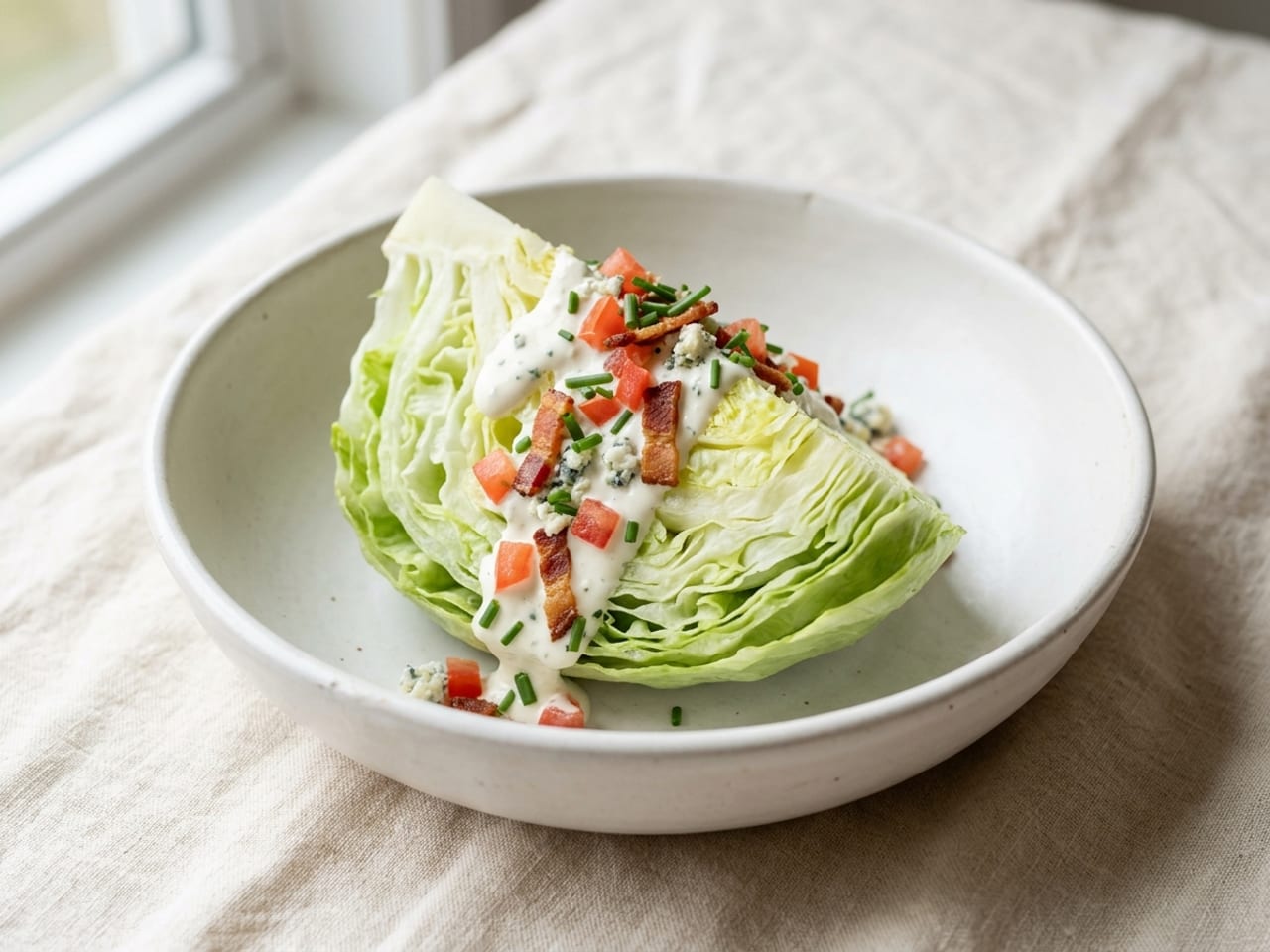
The plate. America's Test Kitchen (2024): "Halve lettuce through core and cut each half into 2 wedges, leaving core intact." Then: "Arrange lettuce wedges, rounded side down, in chilled bowls. Drizzle 3 tablespoons dressing across top of each wedge, using spoon to help it cascade down sides. Divide tomato, crumbled Roquefort, and bacon among wedges." Pickled shallots and chives go on last and the rest of the dressing is passed at the table.58 It is the only source our research found that says which way up the wedge sits.
Where sources split: the core. The same publisher's 2013 recipe has the head "cored and cut into 6 wedges";59 its 2024 recipe leaves the core in, because that "helped the leaves hold together for maximum structure".58
For a crowd, and the blue cheese. The 2013 recipe cuts one head into six smaller wedges and serves them together on a platter: dressing first, then shallot and tomatoes, bacon and extra blue cheese last.59 In pregnancy the NHS says soft blue-veined cheeses "must be thoroughly cooked", pasteurised or not (UK); CDC's table for pregnant women lists blue-veined cheese as a riskier choice when it is made from unpasteurized milk (US).93, 92
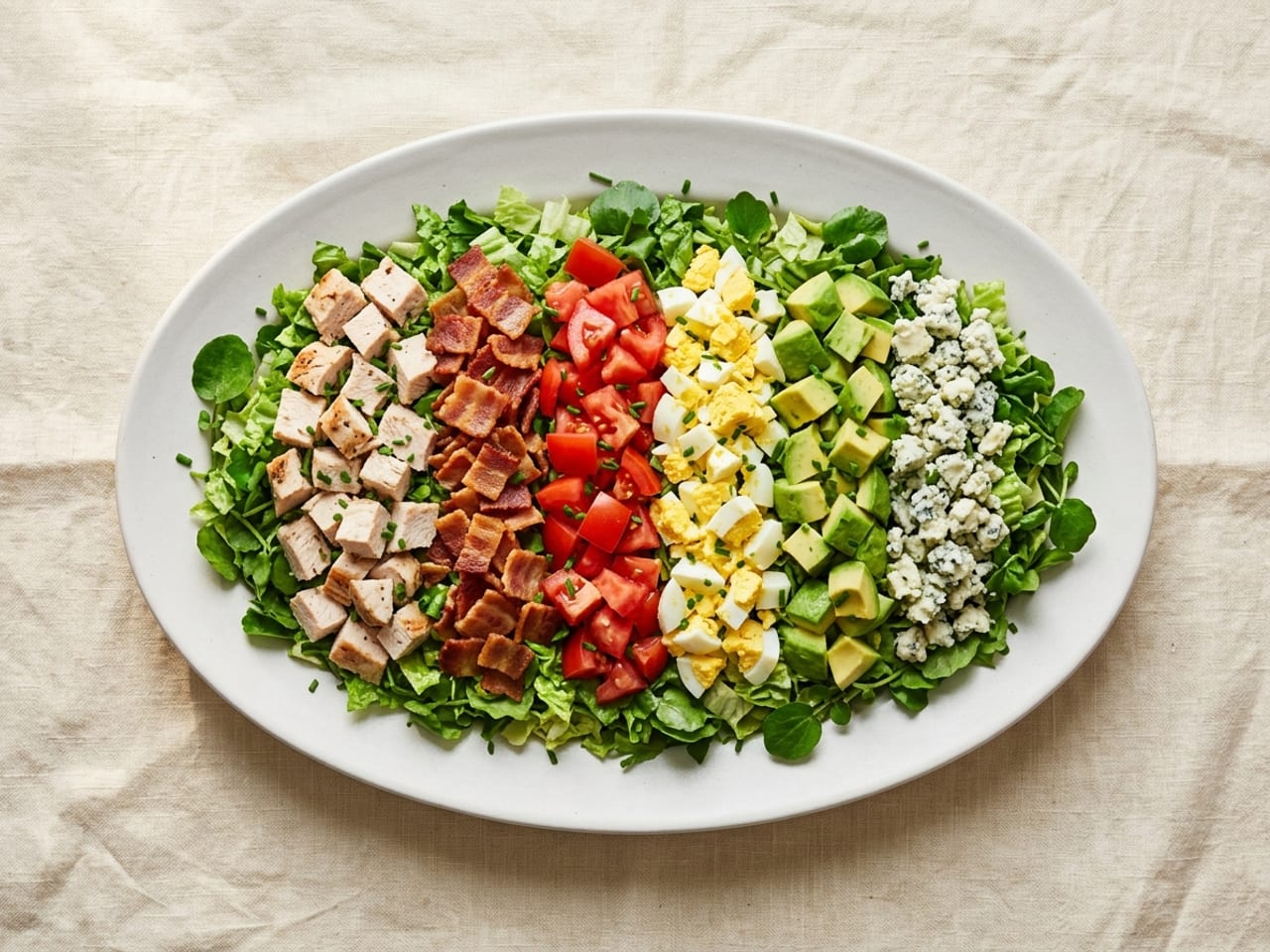
Cobb salad
Origin: the name is settled, the date is not. Named for Robert Cobb of the Brown Derby in Los Angeles. Popik: "There is some debate as to whether Cobb invented the salad in 1926 (when the Little Hat Derby opened) or in 1937 (when the Brown Derby opened)."60 The restaurant's own 1949 cookbook, as the Food Timeline transcribes it, places the salad in "the first four years" of the original Derby and has Cobb making his own dinner from what was in the icebox.57 The 1937 story, in which Cobb fixes a late snack for the theatre owner Sid Grauman, is on Popik's page only as Wikipedia text he reproduces and is not in the 1949 cookbook; 1937 also appears as a claimed first-use date in a 1982 trademark filing he reproduces.57, 60 The honest date is the late 1920s or the 1930s: accounts differ.
The key fact: arranged, then mixed. The Brown Derby's 1949 recipe (again as transcribed) is both of the things people argue about. The ingredients are cut fine and arranged in a salad bowl, the tomatoes "in a strip across the salad", the chicken "over top of chopped greens", the avocado "around the edge of the salad"; and then: "Just before serving mix the salad thoroughly with French Dressing." 57 Arranged was how it was shown; mixed and finely chopped was how it was eaten (our reading). The neat rows on a platter came later.
The modern rows. America's Test Kitchen dresses each component separately and arranges them "on very large, flat serving platter", the chicken "in row along one edge of greens", and says itself that this uses "a traditional dressing in an untraditional way".61 Alison Roman: "Arrange the chicken in the center of the bowl or platter in a straight line. Place the tomatoes on one side and the eggs on the other. Place the avocado next to the eggs, and the blue cheese next to the tomatoes. Sprinkle bacon in the center of the bowl." She calls her torn-and-sliced version "a more elegant visual".62
For a crowd. The platter is the version for a table (ours); it follows the table-time limits. For the blue cheese, see the wedge.
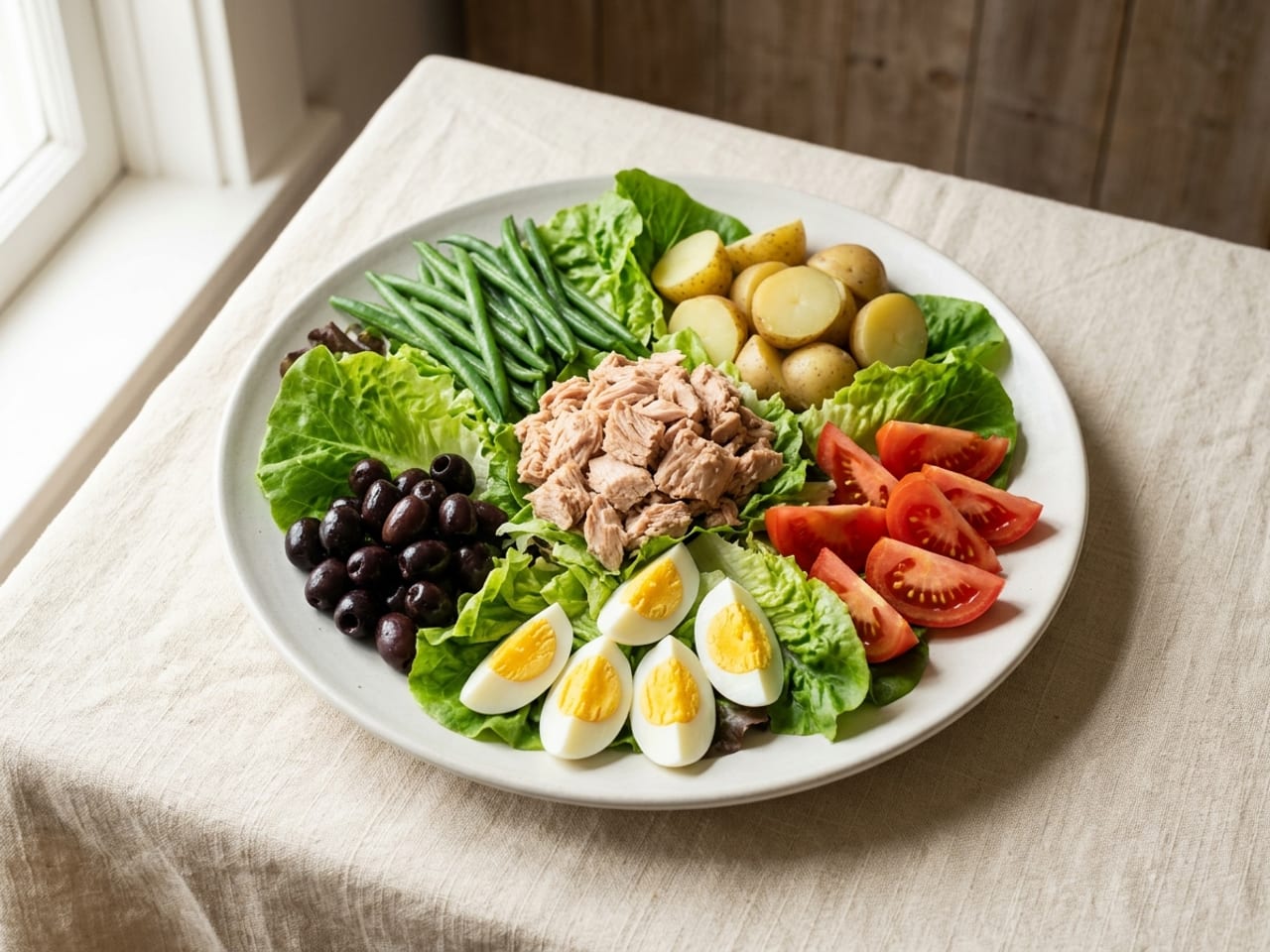
Salade niçoise
Origin: a salad of Nice whose contents are the argument. The oldest printed recipe in our research is Escoffier's, in the revised 1909 English edition: "Take equal quantities of French beans, potato dice, and quartered tomatoes. Decorate with capers, small, stoned olives, and anchovy fillets."7 No tuna, no egg, no lettuce. The purist line is the opposite. Jacques Médecin, as quoted by Felicity Cloake: "never, never, I beg you, include boiled potato or any other boiled vegetable."64 David Lebovitz gives the same sentence in slightly different English (Médecin wrote in French, and we have not opened his book), and sums the rules up himself: "A true Niçoise Salad only has raw vegetables. It can have anchovies or canned tuna, but never both, and neither is required."63
Four published plates. A composed platter (America's Test Kitchen, whose recipe has the boiled potatoes and green beans the purist line rejects, and tuna with optional anchovies; the photo shows that layout): "Arrange bed of lettuce on very large, flat serving platter", "mound tuna in center of lettuce", and every other component "in separate mounds at edge of lettuce bed." 65 A tossed base with an arranged top (Cloake, whose beans are podded broad beans, or French beans out of season): "toss the beans, tomatoes, cucumber, spring onion and red pepper together with two-thirds of the dressing and decant on to a plate. Peel and quarter the eggs and arrange on top, along with the olives, capers, anchovy strips and basil leaves."64 Loosely over lettuce (Lebovitz): "just arrange everything over the lettuce", in "a salad bowl or on a serving platter."63 With seared tuna (Jacques Pépin): "line a large platter with the lettuce leaves. Mound the salade niçoise in the center of the platter and place the sliced tuna and the basil leaves on top."66 Cloake's detail: eggs "maintain their integrity better cut into wedges, rather than sliced".64
Seared tuna: the caution. Pépin's tuna is "cooked until rare on the inside" and cut in ½ inch (1.3 cm) slices.66 Cloake: "It makes, I must admit, a very fine supper, but it's not a salade niçoise".64 FDA's consumer advice: "It's always best to cook seafood thoroughly to minimize the risk of foodborne illness", and pregnant women, children, older adults and people with weakened immune systems should avoid raw or undercooked fish (US).94 More on rare tuna.
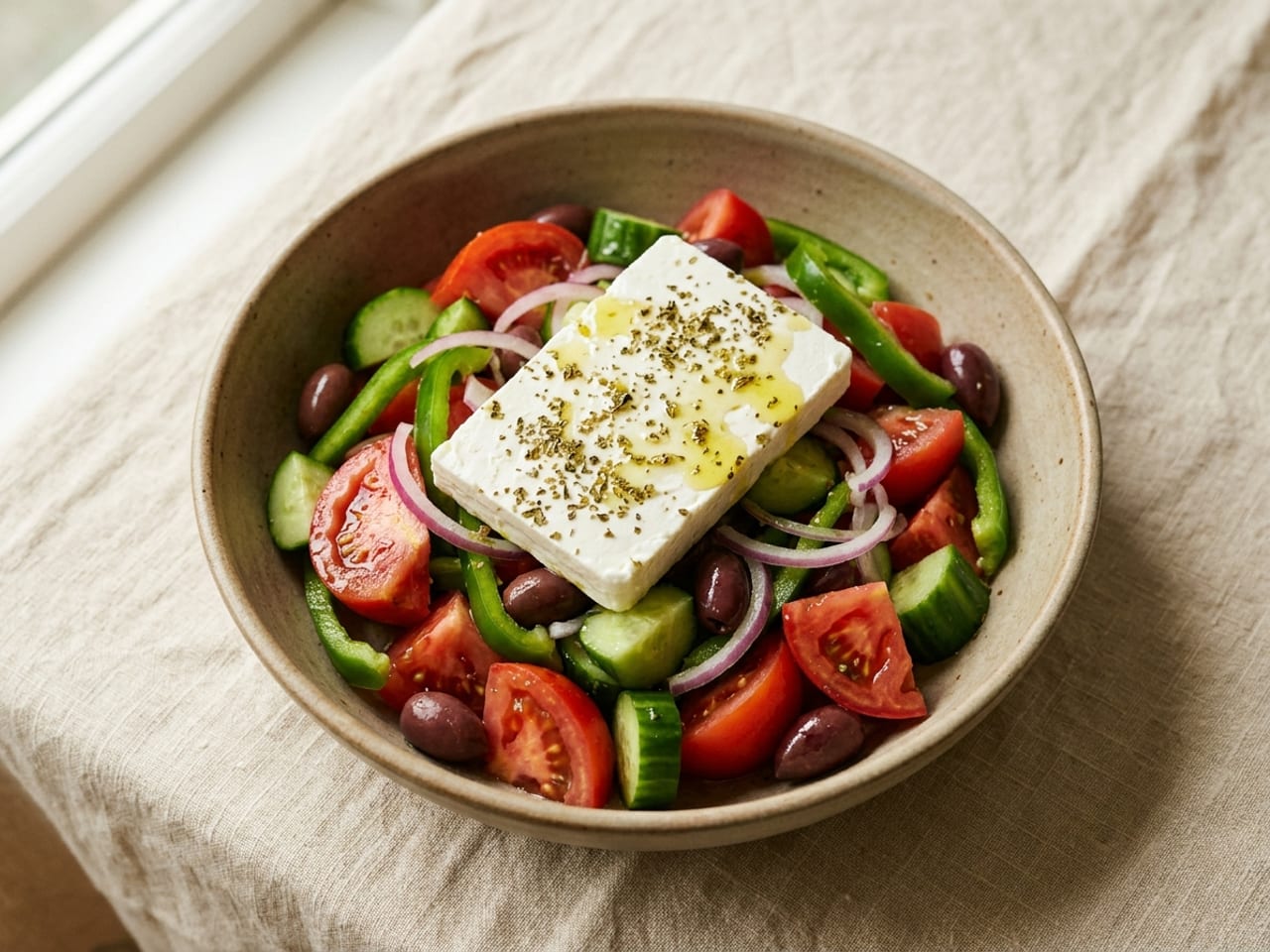
Greek salad (horiatiki)
The plate: big pieces, no lettuce, the feta in one piece on top. A Greek-run recipe site: "Cut the base ingredients in large chunks to give a more rustic touch. Cut the tomatoes straight in the serving bowl, so that the juices remain inside the bowl." Then: "Finish your salad with good quality Greek feta cheese cut in large blocks, but not crumbled. Serve right out of the bowl; no fancy presentation needed for this dish." The finish has an order: "feta cheese on top, a drizzle of olive oil and dried oregano."67 America's Test Kitchen moves the salad to a platter and seasons the cheese itself: "top with feta. Season each slice of feta with extra oregano to taste. Drizzle feta with remaining 1 tablespoon oil."69
Where sources split: slab or crumbled, bowl or platter. Felicity Cloake quotes Nigel Slater, "in Greece the cheese comes in one thick slice, not chopped or crumbled into little bits", and then disagrees on practical grounds: the slab "looks handsome" but "is far less practical than serving it ready crumbled for even distribution." She adds: "If aesthetics matter, however, by all means leave it whole." Her recipe ends "Crumble the feta on top", and she plates on a platter.68 The Greek-run site serves from the bowl, with "lots of crusty bread aside";67 that the bread is for the juices is our reading. Lettuce: the Greek-run site says a Greek salad with leafy greens "is rarely found in Greece",67 and Cloake notes that "Jamie Oliver and Lawson [Nigella Lawson] put cos lettuce in their salads".68
The cheese. CDC's table for pregnant women lists feta as a safer choice "when made with pasteurized milk" (US),92 and the NHS lists pasteurised feta as safe to eat in pregnancy (UK).93 Check the label.
Waldorf salad
Origin: 1896 in print, three ingredients. The earliest printed recipe our research found is in the cook book of Oscar Tschirky of the Waldorf hotel in New York, copyright 1896: "Peel two raw apples and cut them into small pieces, say about half an inch square, also cut some celery the same way, and mix it with the apple." And: "The salad must be dressed with a good mayonnaise." Half an inch is about 1.3 cm. No walnuts, no grapes, no lettuce, and the title page calls him maître d'hôtel, not chef.10 The 1893 date (the year the hotel opened) has no support in our research earlier than the 1896 book. John Mariani's encyclopedia, as the Food Timeline transcribes it, says the dish "was supposedly created by maitre d'hotel Oscar Tschirky of the Waldorf-Astoria Hotel in New York City, which opened in 1893",57 and NYT Cooking writes that he "is credited with creating this piece of Americana in 1893".70 Walnuts are usually dated by a 1928 cook book (Mariani again, via the Food Timeline),57 but they are already in Escoffier's English guide (the revised 1909 edition, read in its 1920 impression): "russet apples and celeriac, both cut into dice, and halved and peeled walnuts". 7
The plate. NYT Cooking's reading of the original sets it on lettuce: most of the apple in thin strips, bound with celery and mayonnaise, then "Arrange on lettuce and top with apple slices."70 Fannie Farmer's 1910 printing has the most decorative version: "remove tops from red or green apples, scoop out inside pulp", then "Refill shells thus made with the salad, replace tops, and serve on lettuce leaves."9 The Philippine learner's manual scoops it onto a lettuce cup.13 The lettuce is a later convention, not part of the 1896 text (our reading).
Allergens. Celery (on the UK list) and walnuts (tree nuts, on the US and UK lists): see allergens that hide in a salad.97, 98
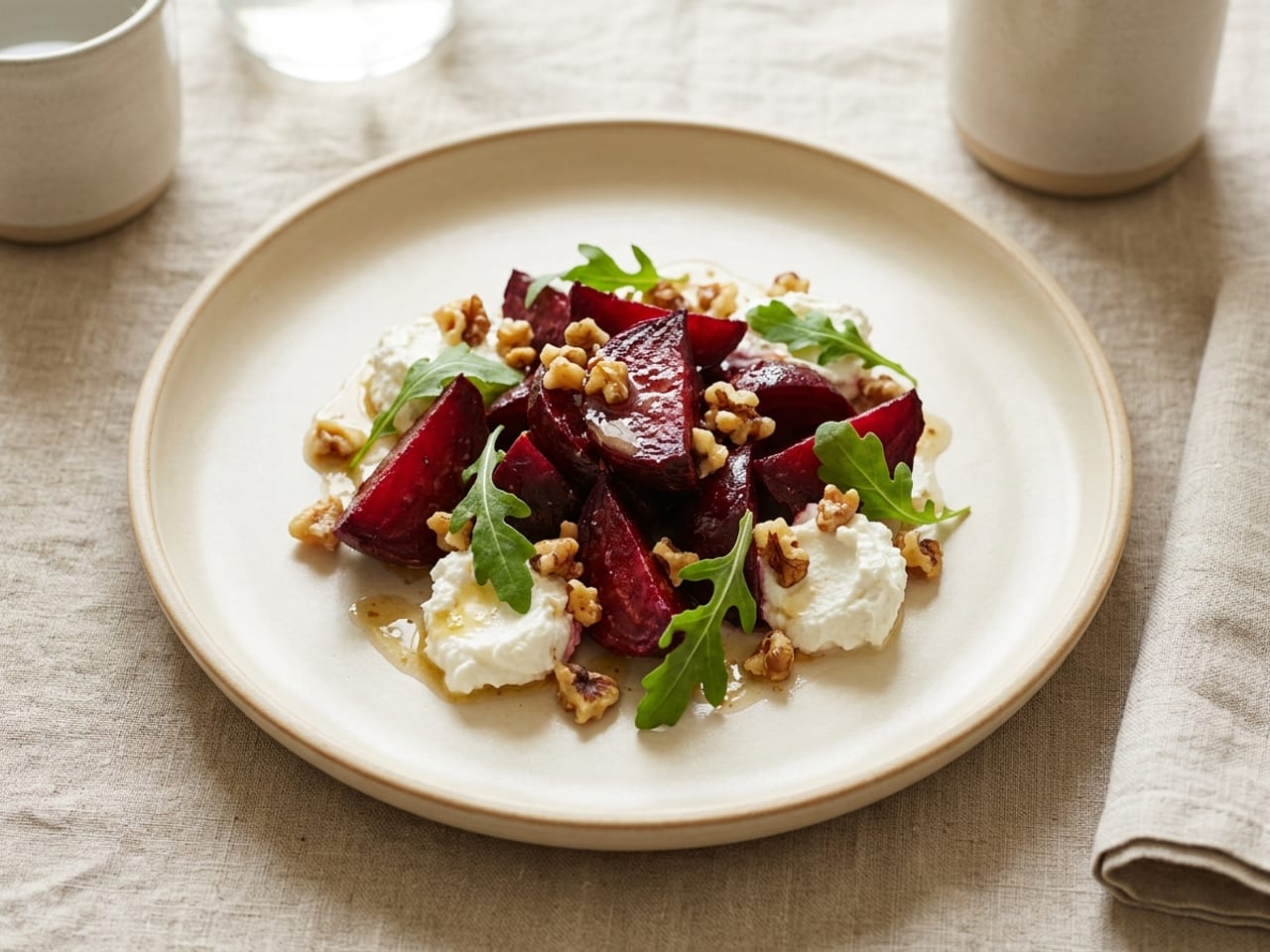
Beet and goat cheese salad
Origin: California, early 1980s, by one writer's account. Julia Moskin in The New York Times: "The combination turned up around the Bay Area in the early 1980s, and whizzed down the West Coast to Los Angeles, where Wolfgang Puck molded a camera-ready Hollywood version." She credits his "beet and goat cheese napoleons" with prompting "a thousand copycats", and cites no document.71
The plate. Moskin's recipe: "pile beets on a serving platter or individual plates. Spoon remaining dressing over the top. Spoon dollops of goat cheese mixture on and around the beets, then tuck in herbs and/or greens. Sprinkle with nuts and serve immediately."72 Mark Bittman dresses the greens and the beets one after the other in the same bowl: "pile the greens on 4 plates. Put the beets in the bowl, toss with some of the dressing and arrange them on top of or around the greens. Crumble the goat cheese on top, and serve."73 Escoffier cut beetroot "into a julienne or into thin roundels".7
Staining. "magenta beets will dye the others to match as soon as they are combined. The best solution is to use just a couple of colors, and marinate them separately until time to serve."72 That tip is about red beets dyeing golden ones; keeping the white cheese off the red until the last second is the same logic, applied by us.
Dressing. Chef Andrew Carmellini, as Moskin paraphrases him: "Dress the beets warm, so the flavors are absorbed, and then dress them again when you serve them". In his own words: "Beets are like sponges".71
Goat cheese and pregnancy. The NHS (UK) lists pasteurised goats' cheese without a white rind as safe to eat, and says rinded chèvre "must be thoroughly cooked".93
Green salad and side salad
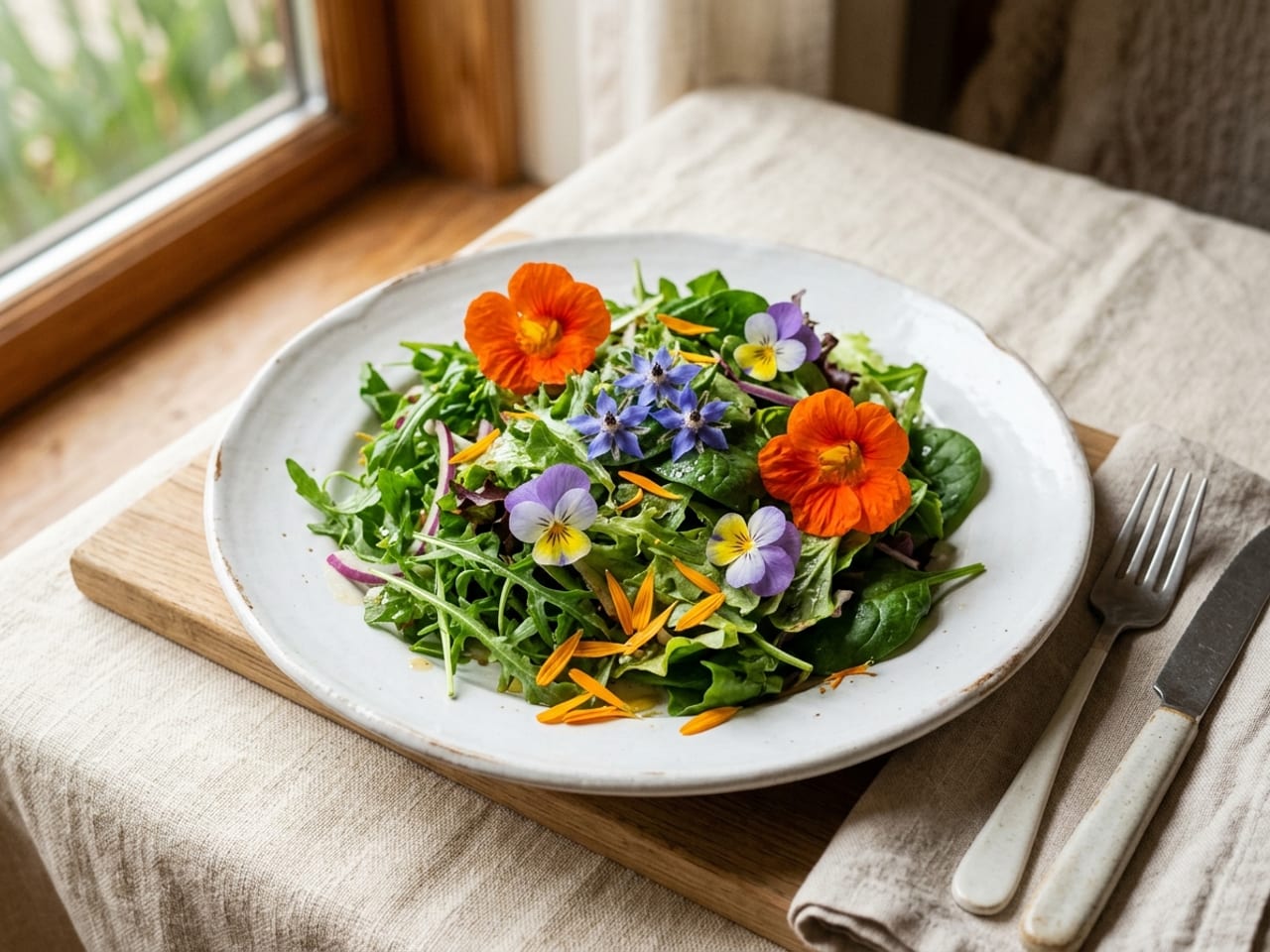
The plate: height is the whole presentation. Samin Nosrat on the insalata verde of Via Carota in New York: "leaves of endive, butter lettuce, frisée and watercress all piled as high as gravity will allow". The method: "gently pile a generous handful of greens into a serving bowl, then sprinkle with salt, pepper and a generous drizzle of dressing. Continue with another handful of salad and more seasoning and dressing, repeating until you have a glorious, gravity-defying mound of salad."74 The photo is the plated green salad from the top of this page, with toppings; Via Carota's is leaves only, in a serving bowl.
As a side. Whether a side salad needs a plate of its own is under serving; where that plate goes is in how to set a table.
Chef's salad
Origin and plate. The Food Timeline: "Food historians can't quite agree on the history and composition of chef's salad much less who assembled the first one." The earliest recipe with that title that its editor holds from an American cookbook is from 1936, and it is tossed in the bowl. The recipe most often cited is that of Louis Diat, chef of the Ritz-Carlton in New York, from 1941. It reaches us three steps removed (Diat, quoted by Jean Anderson, transcribed by the Food Timeline): "Place separately in a salad bowl equal amounts of chopped lettuce (place on the bottom of the bowl), boiled chicken, smoked ox tongue and smoked ham, all cut in julienne style. Add 1/2 hard-cooked egg for each portion. Place some watercress in the center and serve with French Dressing."57 A composed salad in a bowl.
Taco salad
Origin and plate. Cookbook author Jean Anderson, as the Food Timeline transcribes her: "The first recipe I could find for Taco Salad appeared in the May 1968 issue of Sunset." That recipe is plated flat: "Shred the lettuce and arrange on individual salad plates."57 Sohla El-Waylly uses chips as the base: "Arrange some corn chips evenly across the bottom of four serving plates. Evenly divide the meat mixture, cheese, lettuce, tomato and avocado on top of the chips." The finish: "Top each salad with a handful of crushed corn chips, a big dollop of sour cream, and extra cheese."75
Fruit salad
Arranged, not tossed. Gisslen: "Fruit salads are often arranged rather than mixed or tossed".1
Three old plates, all from Fannie Farmer's 1910 printing. Layered: "Arrange alternate layers of shredded pineapple, sliced bananas, and sliced oranges, sprinkling each layer with powdered sugar. Chill before serving." Composed: a pineapple slice as the base, "a circle of thin slices of banana on each piece, nearly to the edge", strawberries piled "in centre". In its own shell: banana skins refilled and stacked "around a mound of lettuce leaves", or the hollowed apples of her Waldorf.9
The gloss. Ali Slagle: "A bit of sugar and lime makes a standout fruit salad: The duo accentuates fruit's flavors and sweetness while creating a syrup to gloss the fruit." Timing: "Eat right away or let sit for up to 1 hour at room temperature."77
Safety, and the cutting. CDC's table lists "Cut melon left out for more than 2 hours (1 hour if it's exposed to temperatures hotter than 90°F, such as a picnic or hot car)" as a riskier choice (US; 90°F is 32°C).91 How to cut each fruit is in how to cut fruit.
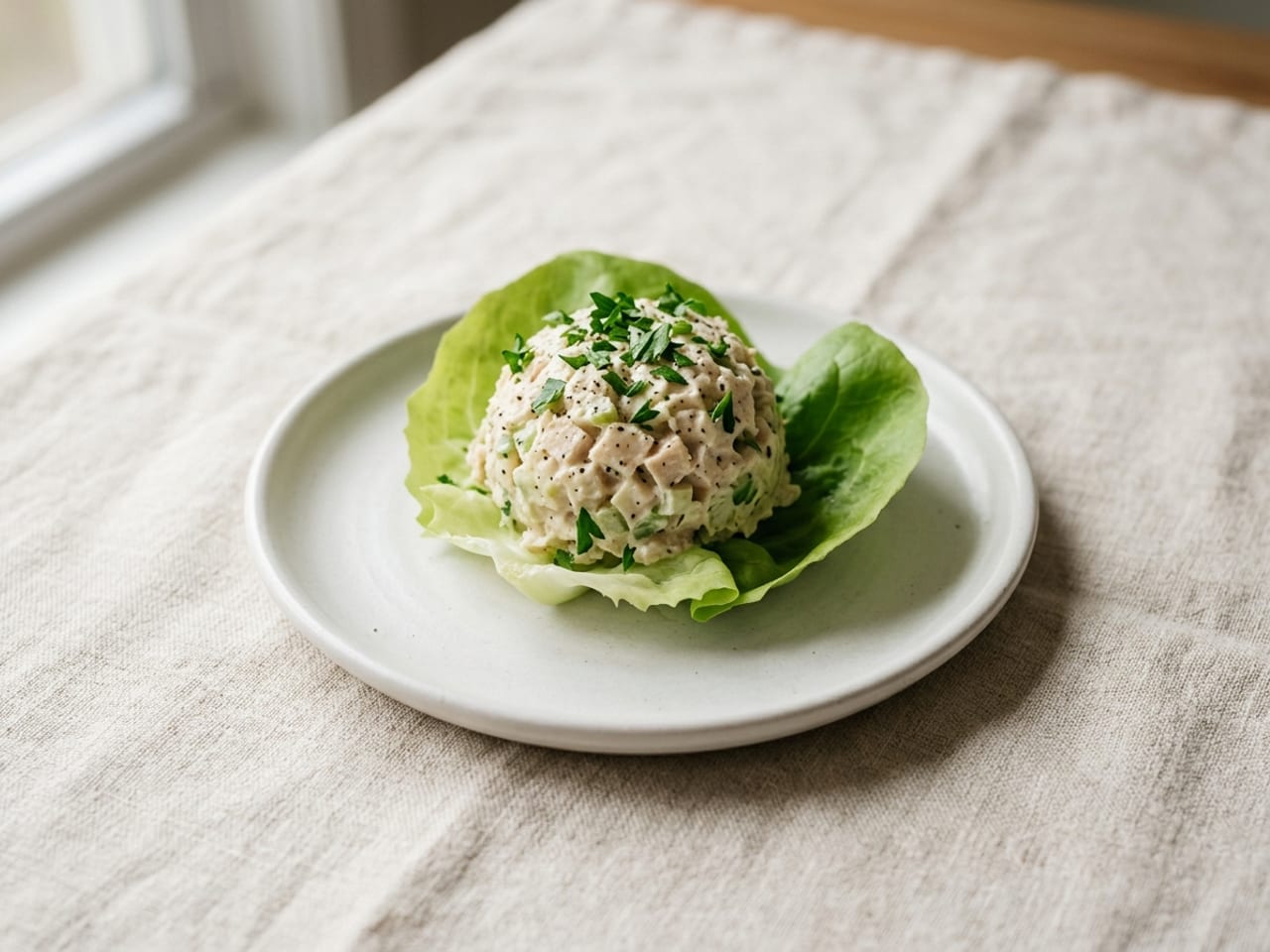
Chicken, tuna and egg salad
The classic form: a mound, garnished, with a leaf under it. Fannie Farmer's Chicken Salad II (1910 printing): "Mound on a salad dish, cover with dressing, and garnish with capers, thin slices cut from small pickles, and curled celery." Her salmon, shrimp, sardine and lobster salads in the same chapter are arranged in or on "nests of lettuce leaves".9 A 1916 cookbook serves its mayonnaise-bound tuna salad "on crisp lettuce leaves."11 Gisslen's recipes set the scoop in lettuce cups "as underliners on cold salad plates". 1
Egg salad in the same book. Farmer's is not chopped: halved whites refilled with yolk, arranged "on a bed of lettuce", the dressing poured "around eggs". 9
Modern shapes (ours). A ring mould or a quenelle makes a neater scoop. Our research opened no modern recipe that plates a bound salad that way, so this is our styling: see the quenelle and the ring mould.
Keeping and serving (US). 3 to 4 days in the fridge on the federal chart;88 at a buffet, USDA keeps "Cold perishable food, such as chicken salad" at 40°F (4°C) or below by "nesting dishes in bowls of ice".87 The mayonnaise question.
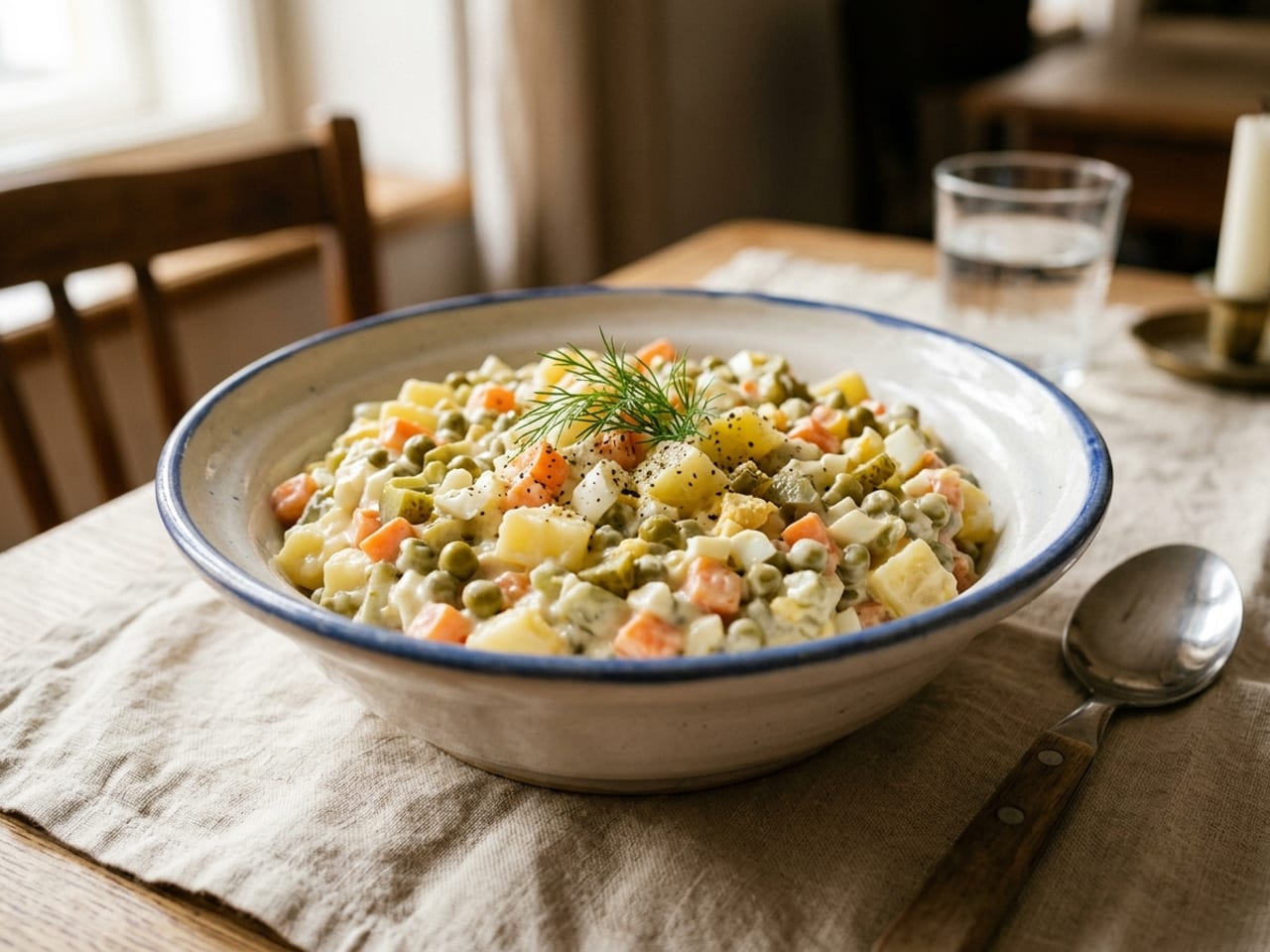
Potato salad
A period plate. Fannie Farmer's Potato Salad I (1910 printing) is the most elaborate we read (it is dressed with oil and vinegar, not mayonnaise): "Arrange in a mound and garnish with whites and yolks of two" hard-boiled eggs, "cold boiled red beets, and parsley", with "small sprigs of parsley in lines dividing beets from eggs".9 The mound is divided into sections by colour.
Today. As a side on a plate, Gisslen wants something under it: potato salad "looks bare when served by itself on a salad plate".1 The crunch does not come from croutons, which "are rarely used with starchy salads (e.g., potato, egg, and pasta)."14 A scoop, a lettuce leaf under it and chopped herbs on top is our styling.
For a crowd, and safety (US). In a bowl, cold, with a serving spoon (ours). The two hours on the table, one above 90°F (32°C), apply as to any perishable food.81 Is the mayonnaise the danger?
Cook it. Czech potato salad, from our catalog.
Pasta and macaroni salad
The scoop. Ligaya Mishan on Hawaiian mac salad: "In Hawaii, a scoop would be served with a plate lunch, alongside rice and a main dish, like chicken katsu." The texture is deliberate: "The pasta is cooked past al dente, until swoony and soft all the way through."76 That softness is what lets it hold a scoop (our reading).
In a bowl or on a plate (ours). For the table, a wide bowl, with some of the vegetables and herbs held back for the top, the same rule Cook's Illustrated gives for leaves;18 on a plate, a mound on a leaf like any bound salad. An open textbook warns that "Pastas and grains will absorb the dressing readily and therefore you may need to re-dress the salad if serving leftovers later."15 Keeping: bound salads.
Cook it. Pasta salad, from our catalog.
Fine dining and Michelin-style salad plating
One dish, Michel Bras's gargouillou, is the reference point: a critic calls it the most copied dish he has met, and two chefs credit its maker with changing how plates look. The moves that transfer to a home plate are older and simpler: separate heaps, whole leaves stacked largest first, a swoosh under the salad and the crunch last.
- The gargouillou, by the chef other chefs say changed the plateMichel Bras's gargouillou of young vegetables, as a critic who ate it in 2017 describes it: "This is a complex assembly of vegetables, herbs, grains, leaves and flowers", which "frequently has 50-80 separate elements", and "the different elements are each prepared separately; this is not a simple salad."37 It dates from around 1980: one chef writes that Bras "came up with the dish in the early 80s",38 and a 2016 interview that he invented it "more than 30 years ago".39 The accounts do not settle on one year, so we print none. The name, in Bras's words: "Originally, Gargouillou was a stew created locally and consisting of potatoes and a slice of ham. I kept the ham and replaced the potatoes with young vegetables". 39
- Who says Bras changed platingChef Wylie Dufresne: "he changed the way all of us think about and present our ingredients", with plates that are "abstract paintings: colorful dots and smears and dramatic lines of sauce; herbs deliberately scattered to look not-so-deliberately scattered."36 Chef Jonathan Tam: "Bras was one of the very few at the time who had a plating technique inspired by the natural landscape."38 The critic, on the dish itself: "It is the most copied dish I have ever encountered", and "Lesser copies that I have tried just taste like a regular salad with many elements".37 The lesson for a home plate is care per component, not the count (our reading).
- "Michelin star salad plating": what there is to citeOur research found no MICHELIN Guide article about plating a salad, so nothing here is Michelin's instruction. The salad below is an illustration from our Michelin-star plating guide, which reads it as a base, leaves stood up for height, a crunch, and citrus in place of a poured dressing.
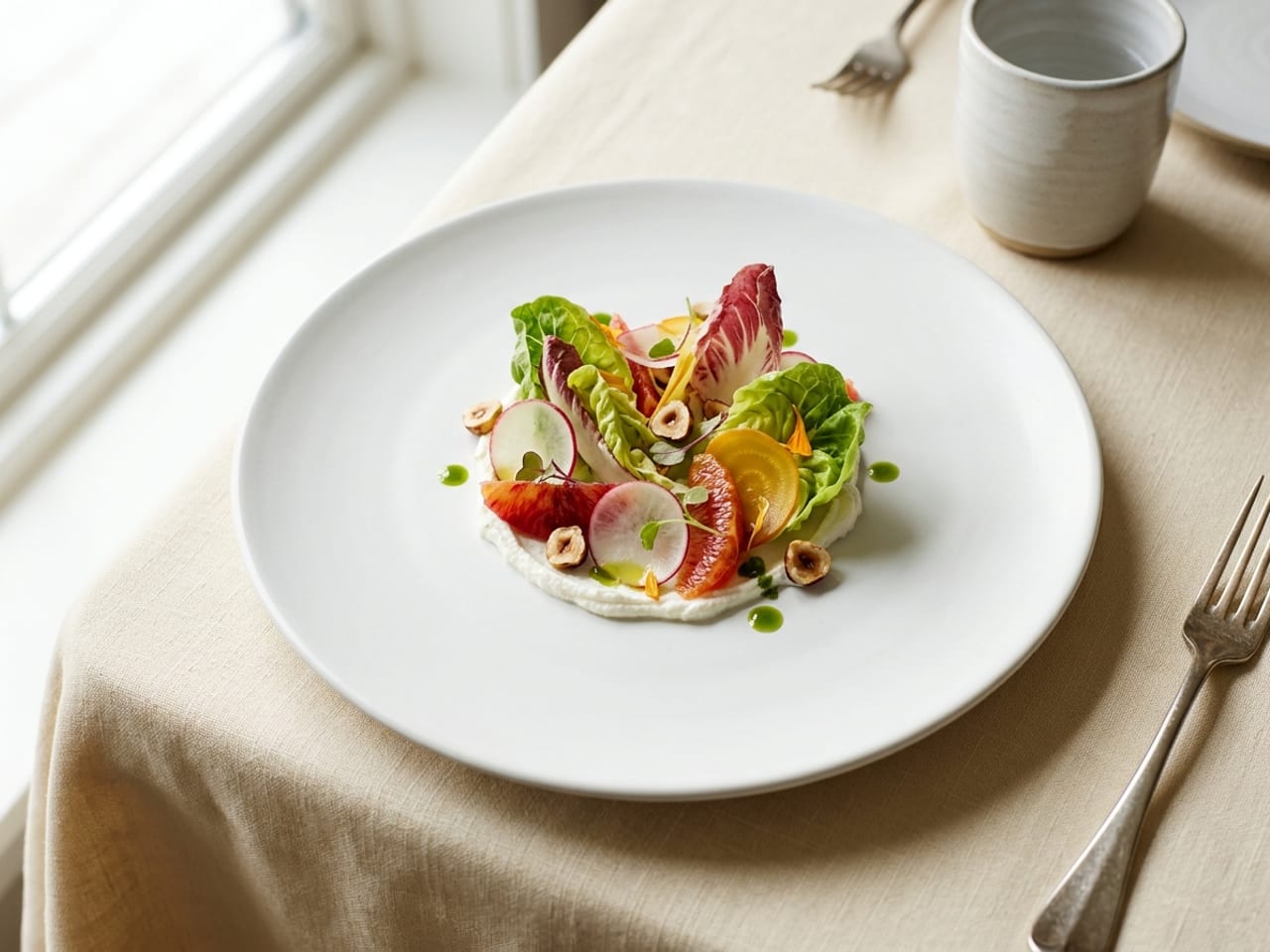
Salad plating ideas: simple, for kids, for school or a competition
Simple first. Each idea links to the source behind it.
Six simple ideas. Pile it, do not spread it (height). Stay in one colour family (guideline 2). Swap the bowl for a platter, where the toppings stay in view (plate or bowl). Build whole leaves largest first (getting the leaves onto the plate). Keep the same ingredients in separate heaps (composed salads). Serve fruit in its own shell (fruit salad).
Salad presentation ideas for kids
One small 2012 study of 23 children. Twenty-three pre-teen children and 46 adults were each shown full-size photographs of 48 plates: "children tended to prefer seven different items and six different colours on their ideal plates, while adults tended to prefer three different colours and three different items." Nobody ate anything, and the authors themselves say the effect on what children actually eat still has to be tested.105 We read the abstract only, which gives no ages beyond "pre-teen" and no statistics; the journal later printed a comment on the paper and the authors' reply, neither of which we could open. Treat the numbers as a hint.
What a source does support is smaller. A food writer remembers that as a child "I didn't like foods touching each other, let alone mixed together." 35 A composed plate, each thing in its own heap, answers that; calling it the format for children is our reading, and no source states it as a rule. Cut everything to one bite,1 and put the dressing in a small pot beside the plate, which the textbooks allow.13
For school or a competition: how a salad is graded
| Whose rubric | What is scored | The wording |
|---|---|---|
| Philippine DepEd curriculum guide (2016) | Competency 3.4: "Rate the finished products using rubrics", after 3.1 "Present salads and dressings attractively", 3.2 on sanitary practices and 3.3 on accompaniments.12 | The five factors it lists for plating and presenting: Balance, Harmony, Height, Color, Texture.12 |
| Canadian Culinary Institute rubric sheet (undated) | Four criteria, each on five levels from 4 (Excellent) to 0 (Insufficient): basic components (lettuce, principal ingredient, dressing, garnish), texture, taste and temperature, appearance.16 | Top band for appearance: "Color is rich and vibrant. Product is visually appealing. Product conveys proper menu image." For components: "All components are present and visible for the salad with required quantities". The "Poor" band for texture: "salad leaves/ greens are wilted and too much dressing on some of the ingredients making it inedible".16 |
A checklist from those rubrics (ours). All four parts present and visible: base, body, garnish, dressing. Nothing on the rim. Leaves crisp and dry, lightly coated. A few colours, not all of them. Every ingredient recognisable. Cold food, clean plate. A US lesson plan's model answer for a pictured salad that falls short is short: "It needs a base and" a garnish.14 For a drawing assignment, the cross-section above labels the four parts. Our research did not open the judging documents of the American Culinary Federation, Worldchefs or SkillsUSA, so this page cites no competition body's criteria beyond the rubrics in the table. The Philippine learner's manual has a rubric of its own, which rates five stages, presentation among them, by how independently the student worked, on a 4 to 1 scale.13
How to serve salad: at a party, for a crowd, before or after the main
- A platter when you are entertainingOne food writer: a salad led by colour "best shows its vibrant colors arranged on a platter", and "Composed salads are ideal when you're entertaining, since most of the work is done ahead of time."35
- For a party or a crowd: assemble ahead, dress lateGisslen: "Avoid plating salads more than an hour or two before service, or they are likely to wilt or dry."1 Plates made ahead wait in the refrigerator, and any time out of it counts toward the limits in the table below (ours; the fragment we read does not say where the plates wait). NYT Cooking: "Keep all salads in the refrigerator until minutes before serving."19 Escoffier's rule for anything that will wait: "Unless they leave the kitchen to be served immediately, compound salads are dished without their constituents being mixed." 7 Buy the leaves late: "either the day of the party or the day before."17 Chef Clem Haxby allows sturdy leaves such as kale to be dressed "up to 30 minutes early".25 How much to make is in the party food calculator.
- Dressing at a party or on a buffetThe textbooks allow it beside the salad,1, 13 and David Lebovitz offers the same for a niçoise: "serve the salad undressed and let guests add their own dressing."63 A jug with a spoon next to an undressed platter is our reading of that; our research found no test kitchen or culinary school page written about salad on a buffet.
- A side salad: on the dinner plate or beside itEmily Post's 1922 reason for a separate plate is temperature: a main that needs a plate "very hot, at the same time as the salad which is cold". She adds that the crescent-shaped salad plate, "made to fit at the side of the place plate, is seen rarely in fashionable houses." 8 Today's placement, and the salad fork, are in how to set a table.
- Salad with pastaIn Marcella Hazan's Italian order salad "is served invariably after the second course to signal the approaching end of the meal",5 so it does not share the table with the pasta, which comes earlier (our reading). An American table that serves both at once is following a different custom, not breaking a rule (ours).
How long salad can sit out, country by country
The numbers differ by country and by who is being addressed. The agencies do not agree on one number, so use your own country's. A home cook follows consumer advice, not a restaurant rule.
| Who the advice is for | The limit | In the agency's words |
|---|---|---|
| United States, home cooks | 2 hours; 1 hour above 90°F (32°C) | "Never leave perishable foods out of refrigeration for more than 2 hours. If the food is exposed to temperatures above 90°F (32°C) (like a hot car or summer picnic), refrigerate it within 1 hour."81 CDC applied it to salad by name: "Refrigerate cooked or cut produce, including salads, within 2 hours".80 |
| United States, a buffet at home | cold food at 40°F (4°C) or colder; on ice past 2 hours | "If food is going to stay out on the buffet table longer than 2 hours, place plates of cold food on ice to retain the chill." Use small platters and swap them: "Don't add new food to an already filled serving dish."82 |
| UK (England, Wales and Northern Ireland), community and charity events | up to 4 hours; 2 in extremely hot weather | "Food that needs to be chilled, such as sandwich fillings served as part of a buffet, should be left out of the fridge for no more than four hours." And: "In extremely hot weather, use food that's been out of the fridge within 2 hours."83 |
Before or after the main course
Americans serving salad first is a habit of the last century, not an old rule (our reading of Emily Post's 1922 order against today's).
| Who | Salad comes | In their words |
|---|---|---|
| Emily Post, United States, 1922 | After the roast | Her fullest formal dinner runs hors d'oeuvre, soup, fish, entrée, roast, salad, dessert, coffee: the sixth line of her list reads "6. Salad".8 |
| Escoffier (revised 1909 English edition) | With the roast | "Simple, or raw salads always accompany hot roasts; compound salads, which generally consist of cooked vegetables, accompany cold roasts."7 |
| Marcella Hazan, Italy | After the second course | "Salad is always served after the second course and its contorno are cleared away."5 |
| Laetitia Rouabah, chef, on France | After the main | "in France, salad is traditionally eaten after the main course, served plain with vinaigrette."40 |
| United States today (a HuffPost writer) | First | "Formal meals in America generally start with a salad and/or soup, followed by an appetizer, an entree and then a dessert course."40 |
| The Emily Post Institute today | Either | It sets the fork for both: "If the salad is served after the entrée, the small salad fork is placed to the right of the dinner fork, next to the plate."41 |
Where the salad course sits in a longer menu, and who serves it before or after the main, is in the courses of a meal, the course meal builder and the prix fixe guide; the salad fork and the salad plate are in how to set a table; quantities for a crowd are in the party food calculator.
Does plating change how a salad tastes? What the studies found
Two experiments had people eat a real salad: one plated it three ways, the other stacked it high or spread it flat. The rest are about other food, or about photographs. Each row gives the design, the number of people and the authors' own caveats.
| Study | What was done | What was found | Caveats |
|---|---|---|---|
| The Kandinsky salad (Michel, Velasco, Gatti and Spence, 2014) | A laboratory experiment with 60 people, 30 men and 30 women, mostly students. Each saw and ate one of three plates of the same salad of 17 components: tossed together in the middle, laid out in neat rows that did not touch, or arranged after a Kandinsky painting. The plate was a white cardboard rectangle. Ratings were on 10-point scales.100 | Mean liking, pooled over the ratings given before and after eating: 8.0 for the art-inspired plate, 5.6 for the tossed one, 5.5 for the neat rows. After eating, tastiness rose for the art-inspired plate (6.8 before, 8.3 after) and did not change significantly for the other two. The four basic tastes did not differ between plates. And the key null, in the authors' words: "the ratings concerning the regular and the neat presentations did not reveal any significant differences for any of the questions."100 | The authors' own: a lab, "a most unusual place in which to eat", students who were paid, a possible novelty effect, and the tossed plate had its sauces mixed in, so it "may, in fact, have" tasted different. Later summaries by the same group give different percentages for this experiment, so we quote the means.100 |
| Neat against messy (Zellner and colleagues, 2011) | Three studies of the same food arranged neatly or messily. We read the abstract, which gives no sample size.101 | "Food presented in a neatly arranged presentation is liked more than the same food presented in a messy manner."101 | Set beside the Kandinsky null, the two disagree only on the surface: tidy against messy is not the same comparison as separate rows against a tossed pile (our reading). |
| Odd against even (Woods, Michel and Spence, 2016) | Seven experiments in which people chose between photographs of plates of seared scallops, mostly three against four; 1,816 visitors to the Science Museum in London in the first, online panels of 100 to 391 in the others.102 | "No consistent evidence for a preference for odd or even numbers of food items was found". With portion size equated, "4-items were preferred over 3": the four-item plates were chosen 61.38% of the time in that experiment.102 | Photographs of scallops, not salad, and nobody ate anything. The authors ask how far the result generalises.102 |
| Stacked against spread (Rowley and Spence, 2018) | An online experiment with 122 people and a second with 124 in "a naturalistic dining context". We read the abstract; the only food it names is a dessert.103 | Food arranged horizontally was rated a larger portion than the same food stacked. It "was also liked more" when "horizontally and/or centrally arranged"; the abstract does not separate the two, and online the liking was "of the visual arrangement".103 | Not a salad. No means or p values in the abstract. |
| A tall chicken salad (Salazar Cobo and colleagues, 2025) | A 300 g chicken salad served spread out or shaped high in a ring mould 16 cm wide and 10 cm tall, on a 20 cm or a 26 cm plate (about 8 and 10 inches): 192 people rated videos online, and 176 ate it in a university cafeteria.104 | In the cafeteria, "salads served on a large plate with high-stacked plating received the highest ratings for liking". The main effects of plate size and of plating were not significant on their own, and "These effects were not replicated in the online experiment".104 | Mostly students, one product, a moulded stack and not a hand-built pile; one author works at a food company's innovation centre.104 |
What that adds up to (our reading). In one laboratory experiment, a salad arranged after a painting was liked more, and rated tastier by the people who ate it, than the same salad tossed. Laying the same ingredients out in neat separate rows did not help. There is no evidence for odd numbers. Height is unsettled: flat or centred won in one study of other food, and a tall moulded salad won in another only on a large plate. None of these studies was run in a home kitchen, and none tested a loose, hand-piled green salad.
Salad safety, country by country
A salad is not cooked, so the rules are about washing, time and what goes on top. Each item says which country's advice it is and who a rule binds. The FDA Food Code is a model code for US food establishments; it does not bind home cooks.
- Washing (United States)Running water, no soap, no soaking, and no need to rewash bagged leaves marked ready-to-eat.79, 80 CDC's page said: "Washing leafy greens does not remove all germs. That's because germs can stick to the surface of leaves and even get inside them."80 If the salad has chicken or steak on it, FDA: "If possible, use one cutting board for fresh produce and a separate one for raw meat, poultry, and seafood."79 Details are above.
- Bound salads and the mayonnaise question (United States)A Michigan State University Extension article: "The truth is, mayonnaise (manufactured) does not cause illness, bacteria does, and bacteria just happen to love to grow in many of the foods we combine with mayonnaise- potatoes, pasta, eggs and chicken." The same article declines to call mayonnaise protective: "while the actual mayo itself is a little on the acidic side, it's not enough to stop bacteria from growing."85 A 2000 review of commercially made dressings reports that Salmonella, E. coli O157:H7 and other pathogens "die when inoculated into mayonnaise and dressings";86 that is the dressing in the jar, not a potato salad after the dressing has been diluted (our note). Our research could not open a USDA page that states this, so we do not attribute it to USDA. The practical rules are the ordinary ones: 2 hours on the table (1 hour above 90°F / 32°C), and 3 to 4 days in the fridge for the salads the federal chart names (egg, chicken, ham, tuna and macaroni).81, 88
- Cooling cooked ingredients (United States)Potatoes, pasta, eggs and chicken go into a salad cold. USDA's consumer advice: "it's important to cool food rapidly", and "divide large amounts of food into shallow containers."87 For a home tuna or pasta salad the plain reading is to chill the ingredients first or the mixed salad promptly (ours).
- Raw egg in Caesar dressing (US and UK)United States: FDA tells consumers that for recipes with raw or undercooked egg, and it names Caesar salad dressing, they should use "shell eggs that have been treated to destroy Salmonella, by pasteurization or another approved method, or pasteurized egg products." It lists who is at greater risk: "children, older adults, pregnant women, and people with weakened immune systems".89 United Kingdom (England, Wales and Northern Ireland): the Food Standards Agency, in guidance written for caterers, says young children, pregnant people, older adults and people with an underlying health condition "can safely eat raw or lightly cooked hen eggs, or foods containing them, if they have a British Lion mark or are produced under the Laid in Britain egg assurance scheme", and that this "does not apply to people who are severely immunocompromised and require medically supervised diets".90 US restaurants: the Food Code requires pasteurized eggs in Caesar salad unless the dish is served at the customer's request with a consumer advisory, and never raw in care settings.84 The Code binds food establishments where it is adopted, not home cooks.
- Raw sprouts (United States)FDA: "People who are more vulnerable to foodborne illness (as identified above) should avoid eating raw or lightly cooked sprouts of any kind".79 CDC's table lists "Any raw or undercooked sprouts, such as alfalfa and bean" as a riskier choice and sprouts cooked until steaming hot as the safer one.91
- Soft cheeses in pregnancy (UK and US wording differ)The NHS lists as safe to eat "pasteurised soft cheeses, such as cottage cheese, cream cheese, processed cheese spreads, mozzarella, feta, paneer, ricotta, mascarpone, halloumi, burrata and goats' cheese that does not have a white coating (rind) on the outside", and says soft blue-veined cheeses and rinded chèvre "must be thoroughly cooked". 93 CDC's table for pregnant women puts "Soft cheese made from unpasteurized (raw) milk", with blue-veined cheese among its examples, on the riskier side, together with any queso fresco-type cheese "when made with pasteurized or unpasteurized (raw) milk" and "Unheated cheese sliced at a deli"; its safer side has "feta and mozzarella, when made with pasteurized milk".92 On pasteurised blue cheese the two differ (our comparison); follow your own country's advice, and check the label.
- Seared or rare tunaFDA's consumer advice (US): "if you choose to eat raw fish anyway, one rule of thumb is to eat fish that has been previously frozen", but "freezing doesn't kill all harmful germs. That's why the safest route is to cook your seafood." Its at-risk groups "should avoid" raw or undercooked fish.94 The Food Code exempts the large tuna species, yellowfin, bigeye and bluefin among them, from the freezing rule it sets for other fish served raw or partly cooked, so a restaurant's rare tuna has not necessarily been frozen; the restaurant still owes the diner a consumer advisory.84 The NHS tells pregnant women to avoid raw fish, and to eat no more than "4 cans or 2 tuna steaks a week" (UK).93 Tuna seared rare is partly raw; that reading is ours.
- Homemade garlic or herb oil (United States)CDC: "Refrigerate homemade oils made with garlic or herbs. Throw the oils away after 4 days."96 That is about oil infusions; CDC names "chopped garlic in oil" among the sources of botulism. For homemade dressings in general, our research found no agency figure for fridge life, so we print none.
- Allergens that hide in a saladUS law names nine: "milk, eggs, fish, Crustacean shellfish, tree nuts, peanuts, wheat, soybeans, and sesame", and FDA counts "dressings (such as salad dressings, sauces, and gravies)" among the five food types most often recalled for undeclared allergens.97 The UK list has fourteen, and two of the extra ones live in salads: mustard, which "can also be found in breads, curries, marinades, meat products, salad dressings, sauces and soups", and celery, which "includes celery stalks, leaves, seeds and the root called celeriac." The same leaflet finds fish in "salad dressings, stock cubes and Worcestershire sauce."98 So a Dijon vinaigrette, a Waldorf and a Caesar each carry an allergen a guest may not expect (ours). The plain ones count as well: nuts and seeds scattered on top (tree nuts, peanuts, sesame), croutons (wheat), cheese (milk) and mayonnaise or Caesar dressing (egg) are on both countries' lists. Tell people what is in the bowl.
Salad plating mistakes the sources name
- The wrong dressing for the leaf"Delicate arugula won't hold up to bold, creamy Caesar dressing."20
Salad myths, and what the record says
- "Always use an odd number of things."One chef's remark, and an experiment against it. The only chef statement our research found is Jason Lear's "Odd numbers usually look best", said of strands of garnish on a beet salad.33 The rule was not found in Gisslen's list, the CIA's principles, the Philippine documents, America's Test Kitchen, NYT Cooking or Bon Appétit as read. In the one study, photographs of three and four scallops shown to 1,816 museum visitors and to online panels: "No consistent evidence for a preference for odd or even numbers of food items was found".102
- "The mayonnaise is what makes potato salad dangerous."Not the jar; the salad still needs the fridge. A US university extension article says manufactured mayonnaise "does not cause illness, bacteria does", and adds that its acidity is "not enough to stop bacteria from growing" once it is mixed with potato, pasta and egg.85 So the myth is wrong about the culprit and right about the caution: bound salads.
- "Never refrigerate tomatoes."Too strong. The study most often cited for it found "no significant loss of flavor volatile content" after 1 or 3 days at 5°C (41°F), and a 65% loss after 8 days. In the same paper a panel of 76 people liked fruit chilled for 7 days, then left a day at room temperature, less than fresh-picked fruit.99
See your own salad plated first
Before the next salad leaves the bowl, see where it should go. Photograph a dish you made and Plate Artists re-plates your own dish the way a restaurant would, with the moves named so you can repeat them. The same method for other dinners is in how to plate food, dish by dish, and for steak in how to plate steak.
Your dish, plated like a chef's
Snap it, upload it, and get the composed version back, with the steps to recreate it at home.
Start free · 1 enhancement →Free account · 1 free enhancement · No credit card
Salad plating terms, defined
| Term | Where the word comes from | Defined by |
|---|---|---|
| Tossed salad | English | Gisslen (by contrast with composed) |
| Composed salad | English | Gisslen, Professional Cooking, 10th edition |
| Bound salad | English | Gisslen, Professional Cooking, 7th edition |
| Simple salad | English translation of Escoffier | Escoffier, A Guide to Modern Cookery (revised 1909 edition) |
| Compound salad | English translation of Escoffier | Escoffier, A Guide to Modern Cookery (revised 1909 edition) |
| Base | English | Gisslen; CAERT lesson plan |
| Garnish | English | Gisslen; CAERT lesson plan |
| Vinaigrette | French | Gisslen; Escoffier |
| Gargouillou | French, from the Aubrac; originally a stew of potatoes and ham | Michel Bras, quoted in The Connexion; Andy Hayler; Jonathan Tam |
| Horiatiki | Greek | My Greek Dish; America's Test Kitchen |
| Insalata caprese | Italian, the salad of Capri | La Cucina Italiana; ITALY Magazine |
| Wedge salad | American English | The Food Timeline |
Tossed salad
A salad whose ingredients are mixed together with the dressing in a bowl before it is plated.
Composed salad
A salad made by arranging two or more elements attractively on a plate instead of mixing them together.
Bound salad
A salad held together, or bound, with a dressing, usually a thick one such as mayonnaise: chicken, tuna, egg, potato and macaroni salad.
Simple salad
Escoffier's name for a raw salad, first of all the green salads; he serves it with hot roasts.
Compound salad
Escoffier's name for a salad of several ingredients, generally cooked vegetables; unless it is served at once it is dished unmixed, the ingredients seasoned and set in distinct heaps.
Base · underliner
The edible platform a plated salad sits on, usually a leaf or a lettuce cup.
Garnish
A small edible decorative item placed on top of a salad for eye appeal, centred or off-centre.
Vinaigrette
A dressing of oil and vinegar, classically three parts oil to one part vinegar, a ratio the textbooks themselves call adjustable.
Gargouillou
Michel Bras's dish of dozens of young vegetables, herbs, leaves and flowers, each prepared separately, plated in a style one chef describes as inspired by the natural landscape.
Horiatiki · Greek village salad, horiatiki salata
The Greek salad as served in Greece: large pieces of tomato, cucumber, green pepper and red onion with olives, no lettuce, and feta in one piece on top.
Insalata caprese · caprese
Tomato, mozzarella and basil with olive oil and salt; La Cucina Italiana's Italian edition rules out vinegar.
Wedge salad · heart of lettuce
A wedge cut from a head of iceberg lettuce, served on its own plate or in a shallow bowl with a creamy dressing, traditionally Roquefort, poured over.
Plating salad, answered
How do you plate a salad?
Dry the leaves completely. Choose a plate or a wide shallow bowl. Dress in a large bowl just before serving, a little at a time: America's Test Kitchen gives a quarter cup (about 60 mL) of vinaigrette for 8 to 10 cups of leaves. Lift the leaves onto the plate a handful at a time so they pile up; with whole leaves, the largest at the bottom. Put half the cheese, nuts and other heavy toppings, the croutons and the herbs on last so they can be seen. Finish with flaky salt and pepper, keep the rim clear and serve at once.
How do you present salad and dressing attractively?
The standard textbook answer is Wayne Gisslen's six guidelines for arranging salads: keep the salad off the rim of the plate, strive for a good balance of colors, use height, cut ingredients neatly, make every ingredient identifiable, and keep it simple. The Philippine K to 12 Cookery learner's manual lists the same six. The dressing is added at the last moment or served on the side, lightly enough that every leaf is coated and nothing pools on the plate.
What are the factors to consider in plating and presenting salads?
The Philippine Department of Education's K to 12 Cookery curriculum guide (May 2016) lists five: balance, harmony, height, color and texture. Its learner's manual teaches a different list, the six guidelines for arranging salads from Gisslen's Professional Cooking: keep the salad off the rim of the plate, strive for a good balance of colors, height helps make a salad attractive, cut ingredients neatly, make every ingredient identifiable, keep it simple. A school answer may need either list.
Is salad served on a plate or in a bowl?
Both. A composed salad or anything eaten with a knife and fork goes on a plate or platter, where the toppings stay visible. A leafy tossed salad is tossed in a wide shallow bowl and can be served from one. The classics split: America's Test Kitchen sets a wedge in a chilled bowl, and a Greek-run recipe site keeps a Greek salad in its bowl so the tomato juices stay with it, where America's Test Kitchen and Felicity Cloake move it to a platter. In his arranging guidelines Gisslen says only to select the right plate for the portion size, not too large or too small; no cookery source we read gives a diameter for the salad, and what a salad plate measures is in our types of plates guide.
Should salad plates be chilled?
Textbooks say so: Gisslen's Professional Cooking asks for cold plates and a US lesson plan for chilled plates, but not ice cold. Food-site writers suggest 10 to 15 minutes in the fridge. Our research found no study of what a chilled plate does for a salad, and none of the food-safety agency pages we read mentions chilling plates, so treat it as custom. The reason one article gives is a restaurant's, plates coming hot out of the dishwasher; it grants that this is not typical of a home kitchen and still advises chilling.
How do you dress a salad properly?
Start with dry leaves in a bowl much bigger than they need. Add the dressing in increments and toss gently with clean hands, tongs or wooden spoons, tasting a leaf as you go, until the leaves glisten and nothing pools. America's Test Kitchen's guide is a quarter cup of vinaigrette for 8 to 10 cups of greens; the Culinary Institute of America's is 15 to 22.5 mL for about 57 g (2 oz). Dress just before serving. If you add oil and vinegar separately, America's Test Kitchen says vinegar first: in small kitchen tests it is mostly the oil that wilts the leaves, though the vinegar and salt also play a role.
Where does the dressing go on a composed salad, and should it be served on the side?
On a composed salad each element is seasoned on its own, as Gisslen and Escoffier both say, and the rest is drizzled over at the last moment, smeared underneath, or placed as a dollop or drops. Dressing on the side is allowed by the textbooks (Gisslen, the Philippine learner's manual, a US lesson plan). J. Kenji López-Alt of Serious Eats argues against it for a leaf salad: drizzling dressing over naked greens, or dipping them, leads in his words to uneven dressing that masks the flavor of the greens.
What is a composed salad?
Gisslen's Professional Cooking defines composed salads as salads made by arranging two or more elements attractively on a plate, instead of mixing them together. Salade niçoise in separate mounds, a Cobb in rows and a caprese are examples. They are usually served as a first or main course. The opposite is a tossed salad; a bound salad is held together with a thick dressing such as mayonnaise.
What are the four parts of a salad?
Base, body, garnish and dressing. Gisslen's Professional Cooking says a plated salad may have as many as four parts. The base, or underliner, is the leaf or lettuce cup underneath; the body is the main ingredient; the garnish is a small edible decoration on top; the dressing is mixed in, added just before serving or served on the side. Most tossed green salads are presented without a base.
How do you plate a Caesar salad?
Two forms are in print. Whole inner romaine leaves: Pati Jinich's headnote to NYT Cooking's recipe from Caesar's in Tijuana says the leaves must be whole, crisp and cold, the croutons sliced and tucked in, the Parmesan generous. Chef Anna Tobias starts with the larger leaves at the bottom and builds a pyramid with the smallest on top. America's Test Kitchen tears the romaine and tosses it instead. For a chicken Caesar, BBC Good Food scatters half the chicken and croutons before tossing and the rest on top. A dressing made with raw egg carries a risk: the FDA advises pasteurized eggs.
How do you plate a caprese salad?
Two published ways. Overlap slices of tomato and mozzarella alternately on a platter, with basil between or over them, as America's Test Kitchen and NYT Cooking's Melissa Clark do; or lay the tomatoes down and tear the mozzarella over the top, as Felicity Cloake does in the Guardian. Serve it at room temperature, salt the tomatoes, and add the basil last. La Cucina Italiana's Italian edition says no vinegar. For a crowd, Clark arranges the platter a few hours ahead, refrigerates it loosely covered, takes it out about 30 minutes before serving and seasons it at the last moment.
How do you plate a Cobb salad or a wedge salad?
A Cobb for a table goes on a large platter in rows over dressed greens, the chicken in a line, as America's Test Kitchen and NYT Cooking's Alison Roman do. The Brown Derby's own 1949 recipe, as transcribed by the Food Timeline, arranged the ingredients in a salad bowl and then mixed the salad before serving, so the arranged look and the mixed salad both go back to the restaurant. A wedge: America's Test Kitchen cuts the head into quarters with the core left in, sets each wedge rounded side down in a chilled bowl, drizzles the dressing over the top, adds tomato, crumbled Roquefort and bacon, and finishes with pickled shallots and chives.
How do you plate chicken salad, tuna salad or potato salad?
As a mound or scoop with a leaf under it. The 1910 printing of Fannie Farmer's Boston Cooking-School Cook Book mounds chicken salad on a salad dish and garnishes it with capers, pickle slices and curled celery, and arranges its salmon, shrimp and lobster salads in nests of lettuce leaves; Gisslen's Professional Cooking uses lettuce cups as underliners. A ring mould or a quenelle gives a neater shape, which is this guide's own suggestion. The US federal chart gives egg, chicken, tuna and macaroni salads 3 to 4 days in the fridge, and any perishable food gets 2 hours at room temperature, 1 hour above 90°F (32°C).
How do you plate fruit salad?
Gisslen says fruit salads are often arranged instead of tossed. The old ways still work: the 1910 printing of Fannie Farmer's cook book layers sliced fruit in a dish, builds a composed plate on a slice of pineapple, or serves the salad in its own hollowed shell. NYT Cooking's Ali Slagle tosses the fruit with a little sugar and lime so that the syrup glosses it. CDC lists cut melon left out for more than 2 hours, or 1 hour in heat above 90°F (32°C), as a riskier choice.
What does fine dining or Michelin star salad plating look like?
We found no MICHELIN Guide article on plating a salad. The reference point is Michel Bras's gargouillou, created around 1980: critic Andy Hayler says it frequently has 50 to 80 separate elements, each prepared separately, and chef Jonathan Tam describes Bras's plating as inspired by the natural landscape. The transferable moves are older and simpler: Escoffier's distinct heaps of contrasting colours, whole leaves stacked with the largest at the bottom, a swoosh of sauce on the plate under the salad, and a crunchy element last.
What are some salad plating ideas for kids?
Keep the ingredients separate: a composed plate with each food in its own heap, which is our reading and not a published rule. One small 2012 study of 23 children, who chose among photographs and did not eat anything, found they tended to prefer seven different items and six different colours on a plate, against three and three for adults. It is one small study, read here as an abstract, and nothing in it shows what children go on to eat, so it is a hint and not a rule.
How do you serve salad at a party or for a crowd, and how long can it sit out?
Assemble ahead and dress late: Gisslen advises against plating salads more than an hour or two before service, and Escoffier dished salads that had to wait without mixing them. Keep plates made ahead in the fridge. A platter keeps toppings visible, and the dressing can go beside it. US agencies say perishable food, salads included, should not sit out more than 2 hours, or 1 hour above 90°F (32°C); the Food Standards Agency's advice for community and charity events in England, Wales and Northern Ireland allows up to 4 hours for a buffet, 2 in extremely hot weather.
Is salad served before or after the main course?
It depends on the country and the century. Emily Post's 1922 formal dinner served salad after the roast. Marcella Hazan says Italian salad comes after the second course, and chef Laetitia Rouabah says the French traditionally eat it after the main. American meals today usually start with it. The Emily Post Institute sets the salad fork for either order.
The textbooks, test kitchens, chefs, papers and agencies behind this guide
Published recipes, how-tos and textbooks for every method, quoted in their own words and not kitchen-tested for this guide; how the printed textbooks, Escoffier and the second-hand quotations were read is under how this page was made and in each entry. Peer-reviewed papers are cited by DOI and were read in full or as abstracts, as each entry says; agency pages are named with their country, and a page that could only be read in an Internet Archive capture links to the capture and gives its date. Dates are the ones each page prints or carries in its page data, videos were not watched, and readings and figures marked as ours are our own inference or arithmetic.
- Gisslen, W. (2011). Professional Cooking, 7th edition. John Wiley & Sons, Hoboken, ISBN 978-0-470-19752-3 (the Internet Archive dates its copy 2011); the chapter on salad dressings and salads, and one sentence on colour from the general plating chapter; read in the Internet Archive scan's search text, as short fragments with no page number recorded, so every quotation here is brief and should be checked against the printed page. archive.org
- Gisslen, W. (2025). Principles. Professional Cooking: 10th Edition, on ckbk, the section on composed salads; ckbk shows "Published 2025"; only the first two paragraphs sit outside the paywall and only those were read. app.ckbk.com
- The Culinary Institute of America (2012). Garde Manger: The Art and Craft of the Cold Kitchen, 4th edition. John Wiley & Sons, ISBN 978-0-470-58780-5; chapter "Salads"; read in the Internet Archive scan's search text with no page number recorded; the scan garbles the ounce fractions of the per-serving figures, the metric figures are legible; the composed-salad principles sit on the page whose running head reads 106. archive.org
- Waters, A. (2007). The Art of Simple Food: Notes, Lessons, and Recipes from a Delicious Revolution. Internet Archive scan of the printed book, read in the scan's search text, as short fragments with no page number recorded. archive.org
- Hazan, M. (1992). Essentials of Classic Italian Cooking. Internet Archive scan of the printed book, read in the scan's search text, as short fragments with no page number recorded. archive.org
- Evelyn, J. (1699). Acetaria: A Discourse of Sallets. London; Project Gutenberg eBook #15517, first published 1699; read in Project Gutenberg's text of the Brooklyn Botanic Garden reprint of the first edition; spelling as printed. gutenberg.org
- Escoffier, A. (1909). A Guide to Modern Cookery. William Heinemann, London; Project Gutenberg eBook #71395, the New and Revised Edition of January 1909, read in its January 1920 impression; the chapter "Salads": No. 1984 (the seasoning of salads), No. 1985 (simple salads), No. 1986 (beetroot salad), No. 1996 (compound salads), No. 2015 (Salade Niçoise), No. 2017 (Salade Parisienne) and No. 2027 (Salade Waldorf). gutenberg.org
- Post, E. (1922). Etiquette. Project Gutenberg eBook #14314, the 1922 text; the order of a formal dinner, salad plates and the steel knife. gutenberg.org
- Farmer, F. M. (1910). The Boston Cooking-School Cook Book. Little, Brown, and Company, Boston; Project Gutenberg eBook #65061, the revised edition in the 1910 printing (its title page lists copyrights from 1896 to 1906), so nothing from it is dated 1896 here; Chicken Salad I and II, Potato Salad I, Egg Salad I, Waldorf Salad, Banana Salad, Fruit Salad I and II. gutenberg.org
- Tschirky, O. (1896). The Cook Book by "Oscar" of the Waldorf. The Werner Company, Chicago and New York, copyright 1896; read in the Internet Archive scan, whose title page reads The Werner Company, Chicago and New York (the archive's catalogue record names Saalfield); "Waldorf Salad" is on p. 433; the scan's machine text misreads three words of the recipe, quoted here from the page image; the title page gives the author's post as maître d'hôtel, The Waldorf. archive.org
- Neil, M. H. (1916). Salads, Sandwiches and Chafing Dish Recipes. David McKay, Philadelphia, copyright 1916; read in the Internet Archive scan; "Lettuce Salad and Roquefort Dressing", p. 214, and "Tuna Fish Salad", pp. 245 to 246. archive.org
- Department of Education, Republic of the Philippines (2016). K to 12 Home Economics - Cookery Curriculum Guide May 2016. K to 12 Basic Education Curriculum, Junior High School TLE and Senior High School TVL Track, Home Economics - Cookery (NC II), page 17 of 44; no personal author; the page is a table, so the wording runs across cell lines; deped.gov.ph refuses direct requests; read in an Internet Archive capture of 7 December 2024. deped.gov.ph (archived)
- Kong, A. S., & Domo, A. P. (2016). Technical Vocational Livelihood Education - Cookery Module 1 Manual. Department of Education, Republic of the Philippines, First Edition 2016, ISBN 978-971-9601-84-5; read as the full text of the copy held by the Internet Archive (uploaded 12 September 2019); printed pages 102 to 103, 114 to 115 and 117 to 119. archive.org
- CAERT, Inc. (n.d.). Salads. Lesson L700058 (Unit: Preparing Foods; Problem Area: Garde Manger), hosted by the Illinois State Board of Education, a US teaching lesson plan with no byline and no date; its resource list was accessed 17 August 2012 and cites Gisslen's 7th edition and On Cooking, 5th edition. isbe.net
- Welsh, M., & Thibodeaux, W. R. (2022). 1.6: Cold Sauces, Salads, and Sandwiches. Garde Manger: A Guide to the Cold Kitchen (Workforce LibreTexts), an open textbook from Finch Henry Job Corps Center and Nicholls State University; last modified 5 October 2022; CC BY-NC 4.0. workforce.libretexts.org
- Canadian Culinary Institute (n.d.). Assessment on task: Salad- Tasting Evaluation. rubric sheet (hosted file), no author and no date; four criteria, each on five levels from 4 (Excellent) to 0 (Insufficient), although the score column prints /3 beside each row and /16 in total; the wording quoted here is reassembled from table cells. canadianculinaryinstitute.ca
- America's Test Kitchen (2026). Salad Dos and Don'ts. America's Test Kitchen (Classes), no byline; page data dated 16 September 2026. americastestkitchen.com
- DeMichele, K. (2019). How to Make a Great Green Salad. Cook's Illustrated (America's Test Kitchen), 29 January 2019. americastestkitchen.com
- Moskin, J. (n.d.). How to Make Salad. NYT Cooking, no date shown on the page; the sections after the dressing are behind the subscriber wall and were not read. cooking.nytimes.com
- Walsh, D. (2014). The 6 Biggest Salad Mistakes. Bon Appétit, 26 March 2014; the headline continues "and How to Avoid Them" after a dash; the advice is credited to assistant food editor Claire Saffitz and test kitchen contributor Alfia Muzio, in the writer's wording. bonappetit.com
- Akbar, J. (2025). For A Salad That Visually Shines, Ditch The Bowl. Tasting Table, 29 July 2025; a staff writer's argument, no chef quoted. tastingtable.com
- Tomczak, S. (2023). It's Best To Chill The Plates When Serving Fresh Salad. Tasting Table, 12 August 2023; a writer's advice; the article reports no test. tastingtable.com
- McNamara, H. (2026). Olive Garden's Salad-Serving Trick Is Something You Should Totally Steal. The Takeout, 27 June 2026; a writer's advice; what the article says about the restaurant chain in its headline was not checked against the chain. thetakeout.com
- Friedman, E. (2024). Why An Expert Says Chilling Your Ingredients Can Make Or Break A Salad. Daily Meal, 5 April 2024; quotes Camille Becerra, chef-partner of As You Are (Ace Hotel Brooklyn). thedailymeal.com
- Hume, A. (2025). Salads Are Best When Tossed By Hand. Chowhound, 29 October 2025; quotes Clem Haxby, chef, nutritionist and culinary director of the book The Salad Project. chowhound.com
- López-Alt, J. K. (2024). Simple Vinaigrette Recipe. Serious Eats, the copy read shows "Updated March 14, 2024"; its sections "Forming a Good Emulsion" and "How to Dress a Salad"; read in an Internet Archive capture of 5 April 2024. seriouseats.com (archived)
- López-Alt, J. K. (2023). What's the Point of a Vinaigrette? | The Food Lab. Serious Eats, first published 2010, updated 17 February 2023; the writer's own kitchen tests, each on half an ounce or an ounce of greens for ten minutes; read in an Internet Archive capture of 27 May 2023. seriouseats.com (archived)
- The Editors of America's Test Kitchen (2012). Preventing Soggy Salad. Cook's Illustrated (America's Test Kitchen), page data dated 1 November 2012; 2 ounces of mixed greens dressed three ways and inspected by eye once, at 15 minutes. americastestkitchen.com
- Christopher Kimball's Milk Street (2021). How To Dress Your Salad For Success. 177milkstreet.com, no date or author shown on the page; the URL path is dated June 2021. 177milkstreet.com
- Luchtel, A. (2024). Save Yourself Stress by Making This Thanksgiving Kale Salad Ahead. America's Test Kitchen, 18 November 2024. americastestkitchen.com
- Cook's Illustrated (2009). The Best Lettuce Knives. Cook's Illustrated (America's Test Kitchen), published July 2009, no author shown; the URL now redirects to a different review; read in an Internet Archive capture of 17 November 2019. cooksillustrated.com (archived)
- Henry, C. (2026). Little gems with avocado, pistachios and miso-honey dressing. Great British Chefs, page dated 1 April 2026. greatbritishchefs.com
- Mayhugh, J. (2015). Feast For The Eyes. Baltimore Magazine, 24 November 2015; a beet salad built in five steps by chefs Chris Becker and Jason Lear; the step texts are the writer's wording, the quotations are the chefs' own. baltimoremagazine.com
- FoodService Director (2008). Avocado, Tomato and Mozzarella Tower Salad. foodservicedirector.com, 1 June 2008; a trade recipe credited to Robert Noble of Sodexo Senior Services. foodservicedirector.com
- Jordan, M. A. (2008). The Composed Salad. Fine Gardening (from Kitchen Gardener Magazine), web date 31 July 2008. finegardening.com
- Dufresne, W. (2016). Michel Bras, the Food Revolutionary. Saveur, 26 April 2016; a chef writing about another chef. saveur.com
- Hayler, A. (2017). Michel Bras. andyhayler.com, a restaurant critic's review of a meal at Bras, Laguiole, in June 2017. andyhayler.com
- Tam, J. (2018). My Favorite Cookbook Almost Killed Me. Vice (Munchies), 23 March 2018; a chef's first-person essay. vice.com
- The Connexion (2016). Nature is the key to my dishes. connexionfrance.com, 30 November 2016; no byline; an interview that quotes Michel Bras. connexionfrance.com
- Tobin, T. (2019). When Is The Best Time To Eat Salad? Before Or After Your Main Course? HuffPost, 14 January 2019; quotes Laetitia Rouabah, executive chef of Benoit, New York, and Tony Gargano of Osteria Bigolaro. huffpost.com
- The Emily Post Institute (2015). The Formal Place Setting. emilypost.com, no byline; page dated 23 June 2015, modified 21 November 2023. emilypost.com
- Popik, B. (2016). Caesar Salad. The Big Apple (barrypopik.com), entry dated 7 July 2016; an etymologist's collection of dated newspaper and magazine citations; the 1945 to 1952 items quoted here are his transcriptions, the scans were not seen; the sentence about Rosa Cardini is Wikipedia text reproduced on his page. barrypopik.com
- Lori Lynn (2012). In Julia Child's Kitchen (A RE-Creation) #CookForJulia. Taste With The Eyes, 9 August 2012; a food blog whose post says it is "An adaptation from Julia and Jacques Cooking At Home By Julia Child and Jacques Pépin" (the Internet Archive catalogue dates that book 1999, New York: Alfred Knopf); the book was not opened, so check it before quoting Child directly. tastewiththeeyes.com
- Jinich, P. (2024). Caesar's Caesar Salad. NYT Cooking, the recipe of Caesar's, Tijuana, adapted by Pati Jinich; published 1 July 2024, updated 2 July 2024; the headnote is the writer's. cooking.nytimes.com
- Tobias, A. (2019). Caesar salad. Great British Chefs, first published 2019 (page data 3 April 2019, modified 14 February 2025); the page spells pyramid "pyrmaid". greatbritishchefs.com
- Li, S., & Morocco, C. (2013). Classic Caesar Salad. Bon Appétit, first printed April 2013; read in an Internet Archive capture of 3 October 2026. bonappetit.com (archived)
- America's Test Kitchen (2012). Classic Caesar Salad. americastestkitchen.com, no byline; page dated 9 November 2012; serves 6 to 8. americastestkitchen.com
- Good Food team (2010). Chicken caesar salad. BBC Good Food, first published 30 June 2010, updated 23 September 2025; serves 4; read in an Internet Archive capture of 4 September 2026. bbcgoodfood.com (archived)
- Wickers, K. (2012). Insalata Caprese. ITALY Magazine, 10 August 2012; a travel feature that tells the origin stories as legend. italymagazine.com
- Di Sabatino, G. (2018). Insalata caprese: 10 consigli per una riuscita perfetta. La Cucina Italiana (Italian edition), published 22 May 2018, updated 24 July 2023; in Italian, the translations are ours; read in an Internet Archive capture of 23 September 2026. lacucinaitaliana.it (archived)
- Cloake, F. (2016). How to make the perfect caprese salad. The Guardian, 4 August 2016; serves 4 with bread; read in an Internet Archive capture of 24 March 2024. theguardian.com (archived)
- America's Test Kitchen (2009). Tomato, Mozzarella, and Basil Salad (Insalata Caprese). americastestkitchen.com, no byline; page dated 30 June 2009. americastestkitchen.com
- Clark, M. (2017). Classic Caprese Salad. NYT Cooking, 14 July 2017. cooking.nytimes.com
- Catalano, P. (2024). Caprese Skewers. The Kitchn, 2 July 2024; makes 16 to 18; read in an Internet Archive capture of 10 February 2026. thekitchn.com (archived)
- America's Test Kitchen (2023). Burrata Breakdown: What It Is and How to Use It. americastestkitchen.com, no byline; 5 June 2023; the browser title reads "What Is Burrata and How Do You Use It?". americastestkitchen.com
- McKinnon, H. L. (2025). Tomato and Burrata Salad With Chile Crisp. NYT Cooking, 29 August 2025. cooking.nytimes.com
- Olver, L. (ed.) (2024). history notes--salad. The Food Timeline (foodtimeline.org), footer "Last Updated: 2024 August 26"; the editor's own summaries are quoted as hers; the cookbooks, magazines and newspapers quoted from this page (The Brown Derby Cookbook, 1949; the Chicago Defender, 10 December 1949; the Culinary Arts Institute Encyclopedic Cookbook, 1950; Louis Diat's Cooking à la Ritz, 1941, as quoted by Jean Anderson; John Mariani, 1999; Jean Anderson, 1997; Sunset, May 1968; William Grimes, The New York Times, 14 June 2000) are her transcriptions and were not opened. foodtimeline.org
- Petito, A. (2024). The Ultimate Wedge Salad. America's Test Kitchen, 2 December 2024. americastestkitchen.com
- America's Test Kitchen (2013). Wedge Salad. americastestkitchen.com, no byline; page dated 30 April 2013. americastestkitchen.com
- Popik, B. (2007). Cobb Salad (Southwest Cobb Salad; Southwestern Cobb Salad; Texas Cobb Salad). The Big Apple (barrypopik.com), entry dated 6 November 2007; the newspaper items are his transcriptions and the scans were not seen; the Wikipedia passages he reproduces are cited as that. barrypopik.com
- America's Test Kitchen (2011). Classic Cobb Salad. americastestkitchen.com, no byline; page dated 14 October 2011. americastestkitchen.com
- Roman, A. (2017). Cobb Salad. NYT Cooking, 4 August 2017. cooking.nytimes.com
- Lebovitz, D. (2020). Classic Salade Nicoise. davidlebovitz.com, page dated 12 September 2020, modified 27 April 2024. davidlebovitz.com
- Cloake, F. (2012). How to make the perfect salade niçoise. The Guardian, 1 August 2012; serves 2; read in an Internet Archive capture of 19 February 2025. theguardian.com (archived)
- America's Test Kitchen (2011). Salade Nicoise. americastestkitchen.com, no byline; page dated 12 October 2011. americastestkitchen.com
- Pépin, J. (1991). Salade Niçoise With Fresh Tuna. NYT Cooking, 29 September 1991. cooking.nytimes.com
- Giannopoulos, E. K. (2013). Traditional Greek Salad recipe (Horiatiki / Xoriatiki). My Greek Dish, published 13 May 2013, modified 2 August 2023; a Greek-run recipe site. mygreekdish.com
- Cloake, F. (2014). How to make the perfect Greek salad. The Guardian, 3 July 2014; serves 4; read in an Internet Archive capture of 12 March 2025. theguardian.com (archived)
- Dunn, S. (2020). Horiatiki Salata (Hearty Greek Salad). America's Test Kitchen, 5 August 2020. americastestkitchen.com
- The New York Times (2017). The Original Waldorf Salad. NYT Cooking, 22 February 2017; the lettuce and the apple-slice garnish are this recipe's additions to the 1896 text. cooking.nytimes.com
- Moskin, J. (2017). Think Beet and Goat Cheese Salad Is a Cliché? A New Recipe Proves It's a Classic. The New York Times, 21 August 2017; the history is the writer's account and cites no document; read in an Internet Archive capture of 21 September 2025. nytimes.com (archived)
- Moskin, J. (2017). Marinated Beet Salad With Whipped Goat Cheese. NYT Cooking, 23 August 2017. cooking.nytimes.com
- Bittman, M. (2013). Roasted-Beet Salad With Goat Cheese and Walnuts. NYT Cooking, 5 May 2013. cooking.nytimes.com
- Nosrat, S. (2019). Via Carota's Insalata Verde. NYT Cooking, 11 December 2019; the salad of Via Carota, New York (chefs Jody Williams and Rita Sodi); the headnote and method are the writer's. cooking.nytimes.com
- El-Waylly, S. (2023). Taco Salad. NYT Cooking, 27 June 2023; the history in the headnote cites no source. cooking.nytimes.com
- Mishan, L. (2022). Mac Salad. NYT Cooking, 3 July 2022; recipe from chef Mark Noguchi. cooking.nytimes.com
- Slagle, A. (2023). Fruit Salad. NYT Cooking, 11 July 2023. cooking.nytimes.com
- Ruland, L. (2022). The Best Caesar Salad Recipe: Zuni Café. Unpeeled Journal, 26 April 2022; a blogger's adaptation of the recipe in Judy Rodgers's The Zuni Cafe Cookbook, which was not opened, so the wording is the blogger's; read in an Internet Archive capture of 7 June 2026. unpeeledjournal.com (archived)
- U.S. Food and Drug Administration (2024). Selecting and Serving Produce Safely. fda.gov, US consumer advice; content current as of 5 March 2024; read in an Internet Archive capture of 19 September 2026. fda.gov (archived)
- Centers for Disease Control and Prevention (2023). Lettuce, Other Leafy Greens, and Food Safety. cdc.gov, US consumer advice; last reviewed 29 September 2023; the page is no longer on the live CDC site and no replacement was found; read in an Internet Archive capture of 6 March 2024. cdc.gov (archived)
- FoodSafety.gov (2023). 4 Steps to Food Safety. U.S. Department of Health and Human Services, US consumer advice; date last reviewed 18 September 2023; read in an Internet Archive capture of 30 September 2026. foodsafety.gov (archived)
- U.S. Food and Drug Administration (2024). Serving Up Safe Buffets. fda.gov, US advice for a buffet at home; content current as of 5 March 2024; read in an Internet Archive capture of 29 September 2026. fda.gov (archived)
- Food Standards Agency (2026). Providing food at community and charity events. gov.uk, UK advice written for volunteers and community events, not for registered caterers; updated 4 September 2026; applies to England, Wales and Northern Ireland. gov.uk
- U.S. Food and Drug Administration (2023). Food Code 2022. fda.gov, the "January 18, 2023 Version", read in an Internet Archive capture of 28 September 2026; a model code for food service and retail that states and localities adopt, not a home-cooking rule; sections 1-201.10(B), 3-302.13, 3-401.11, 3-402.11, 3-603.11 and 3-801.11. fda.gov (archived)
- Jarvie, M. (2015). It must have been the potato salad… Michigan State University Extension, 8 June 2015; a university extension article; read in an Internet Archive capture of 16 April 2026. canr.msu.edu (archived)
- Smittle, R. B. (2000). Microbiological safety of mayonnaise, salad dressings, and sauces produced in the United States: a review. Journal of Food Protection, 63(8), 1144-1153; abstract read; about commercially made dressings in the jar; the author's affiliation is a commercial food laboratory. doi:10.4315/0362-028X-63.8.1144 · PMID 10945595
- USDA Food Safety and Inspection Service (2020). Leftovers and Food Safety. fsis.usda.gov, US consumer advice; last updated 31 July 2020; read in an Internet Archive capture of 29 May 2025. fsis.usda.gov (archived)
- FoodSafety.gov (2023). Cold Food Storage Chart. U.S. Department of Health and Human Services, date last reviewed 19 September 2023; read in an Internet Archive capture of 1 October 2026; two older federal charts (USDA, 2015, and FDA, 2018) print 3 to 5 days for the same row, and none of the three names potato salad. foodsafety.gov (archived)
- U.S. Food and Drug Administration (2024). What You Need to Know About Egg Safety. fda.gov, US consumer advice; content current as of 5 March 2024; read in an Internet Archive capture of 3 October 2026. fda.gov (archived)
- Food Standards Agency (2026). Advice on safe storage, handling and use of eggs for catering. gov.uk, UK guidance written for caterers; published 14 August 2026, last updated 20 August 2026; applies to England, Wales and Northern Ireland. gov.uk
- Centers for Disease Control and Prevention (2025). Safer Food Choices. cdc.gov, US consumer advice, a table of riskier and safer choices; page dated 31 January 2025; read in an Internet Archive capture of 15 September 2026. cdc.gov (archived)
- Centers for Disease Control and Prevention (2025). Safer Food Choices for Pregnant Women. cdc.gov, US consumer advice for pregnancy, a table of riskier and safer choices; page dated 31 January 2025; read in an Internet Archive capture of 28 September 2026. cdc.gov (archived)
- NHS (2026). Foods to avoid in pregnancy. nhs.uk, UK advice; page last reviewed 15 June 2026. nhs.uk
- U.S. Food and Drug Administration (2024). Selecting and Serving Fresh and Frozen Seafood Safely. fda.gov, US consumer advice; content current as of 5 March 2024; read in an Internet Archive capture of 30 September 2026. fda.gov (archived)
- Newman, S. E., & Stoven O'Connor, A. (2025). Edible Flowers. Colorado State University Extension, fact sheet no. 7.237, a US university extension fact sheet; published December 1996, reviewed August 2025. extension.colostate.edu
- Centers for Disease Control and Prevention (2026). Botulism Prevention. cdc.gov, US consumer advice; page dated 26 February 2026; read in an Internet Archive capture of 1 October 2026. cdc.gov (archived)
- U.S. Food and Drug Administration (2026). Food Allergies. fda.gov, content current as of 11 March 2026; read in an Internet Archive capture of 3 October 2026. fda.gov (archived)
- Food Standards Agency (n.d.). 14 Allergens. leaflet (PDF), a UK leaflet, undated, that refers to the Food Information Regulation of December 2014; the live URL now returns 404; read in an Internet Archive capture of 17 December 2024. food.gov.uk (archived)
- Zhang, B., Tieman, D. M., Jiao, C., Xu, Y., Chen, K., Fei, Z., Giovannoni, J. J., & Klee, H. J. (2016). Chilling-induced tomato flavor loss is associated with altered volatile synthesis and transient changes in DNA methylation. Proceedings of the National Academy of Sciences, 113(44), 12580-12585; full text read in an Internet Archive capture of 26 January 2025; a correction (PNAS 113(49), E8007) fixes the spelling of one author's name only. doi:10.1073/pnas.1613910113 · PMID 27791156
- Michel, C., Velasco, C., Gatti, E., & Spence, C. (2014). A taste of Kandinsky: assessing the influence of the artistic visual presentation of food on the dining experience. Flavour, 3, article 7; 20 June 2014; open access; read in full in an Internet Archive capture of 8 January 2025, Table 2 in a capture of 25 August 2024; 60 participants, each of whom saw and ate one of three presentations. doi:10.1186/2044-7248-3-7
- Zellner, D. A., Siemers, E., Teran, V., Conroy, R., Lankford, M., Agrafiotis, A., Ambrose, L., & Locher, P. (2011). Neatness counts. How plating affects liking for the taste of food. Appetite, 57(3), 642-648; abstract read; the abstract gives no sample size and does not name the foods. doi:10.1016/j.appet.2011.08.004 · PMID 21855585
- Woods, A. T., Michel, C., & Spence, C. (2016). Odd versus even: a scientific study of the 'rules' of plating. PeerJ, 4, e1526; read in full in PubMed Central (PMC4734449); 1,816 participants in the Science Museum experiment; photographs of plates of seared scallops, three against four in most experiments. doi:10.7717/peerj.1526 · PMID 26839741
- Rowley, J., & Spence, C. (2018). Does the visual composition of a dish influence the perception of portion size and hedonic preference? Appetite, 128, 79-86; abstract read; an online experiment with 122 people and a second with 124 in "a naturalistic dining context"; the only food the abstract names is a dessert. doi:10.1016/j.appet.2018.06.005 · PMID 29870757
- Salazar Cobo, M. I., Jager, G., Ioannou, O., de Graaf, C., & Zandstra, E. H. (2025). Plate size or plating? Effects of visual food presentation on liking, appetite, and food-evoked emotions in online and real-life contexts. Food Quality and Preference, 122, 105306; open access, read in full; an online experiment with 192 people and a cafeteria experiment with 176 who ate the salad; one author works at a food company's innovation centre, which the paper names among its supporters. doi:10.1016/j.foodqual.2024.105306
- Zampollo, F., Kniffin, K. M., Wansink, B., & Shimizu, M. (2012). Food plating preferences of children: the importance of presentation on desire for diversity. Acta Paediatrica, 101(1), 61-66; abstract read; 23 children and 46 adults chose among photographs; a published comment (2012) and the authors' reply (2013) exist in the same journal and were not read. doi:10.1111/j.1651-2227.2011.02409.x · PMID 21767305
Keep going
How to plate food, dish by dish
The same method for pasta, salmon, chicken parmesan, lamb chops, rice and more, each shown before and after.
How to plate steak
Whole or sliced, sauce by sauce, side by side, including steak over salad.
Food garnish ideas
Twelve kinds of garnish, with the edible flowers that are safe and the ones that are not.
Types of plates
The salad plate, the coupe, the charger and the rest, with their sizes.
How to set a table
Where the salad fork and the salad plate go, whichever course the salad is.
Michelin-star plating
The structure of a fine-dining plate, and the few moves that build it at home.