How to make mayonnaise, plus the 5 flavored mayos people like most
A master recipe by hand or with a stick blender, 28 published recipes side by side, why it splits and how to fix it, then the five flavored mayos with the strongest evidence behind them, each a recipe per cup (240 ml), with the raw-egg advice of each country and how long it keeps, every line from a named source.
The photos on this page are AI-generated illustrations.
How do you make mayonnaise?
Whisk an egg yolk with salt, a little lemon juice or vinegar and, if you like, mustard, then add oil a few drops at a time until it thickens, then in a thin stream, about ½ cup (120 ml) of oil per yolk in our recipe. Or blend a whole egg and the oil in a narrow jar with a stick blender.9, 21, 22, 24
- The recipe: 2 yolks, 1 cup (240 ml) of oil, 1 tablespoon of acid, ½ teaspoon of salt, mustard optional, about 15 minutes by hand (ours) (the card).
- If it splits: start again with a fresh yolk, a spoon of water or a teaspoon of mustard, and beat the broken sauce into it slowly (fixes).10, 18, 34
- The five flavors: garlic aioli, sriracha mayo, chipotle mayo, truffle aioli and burger sauce, picked from menu data, sales and launches, polls and search (the evidence).
- Raw egg: the USDA advises everyone against raw-egg foods and names homemade mayonnaise; the UK allows British Lion and Laid in Britain eggs even for pregnant people, though not for the severely immunocompromised; pasteurized eggs are the usual answer elsewhere (by country).133, 139
- How long it keeps: the only US agency figure for a homemade version is 3 to 4 days, for homemade aioli (every figure).136
On this page: Mayonnaise recipe · Every ratio · How it works · Fix a broken mayo · Olive and avocado oil · No mustard, no egg and more · The 5 flavored mayos · Aioli vs mayo · Store-bought vs homemade · Raw eggs, country by country · How long it keeps · How to plate it · History and the name · Popular claims · The words · FAQ
How this page was made. Every quantity, time, quotation and verdict comes from the source named beside it: the US standard of identity, textbooks and reference books (McGee, Child, Gisslen, Larousse Gastronomique, cited as books), test kitchens, magazines, chefs' and popular recipes, US, UK, German, European, Australian and New Zealand food agencies, peer-reviewed studies (most read as their abstracts), trade press and makers' own pages (labelled), and old French cookbooks read in machine-read scans. Plate Artists cooked, tasted, timed and measured nothing for it; the recipe cards are our synthesis of the cited published recipes, not recipes we tested. The search-interest figures and the recipe-site count are our own pulls, and conversions and sums marked ours are our own. Each country's food-safety advice is kept apart, and nothing is printed as an agency rule that is not one. Sources are at the bottom.
Homemade mayonnaise recipe, by hand or with a stick blender
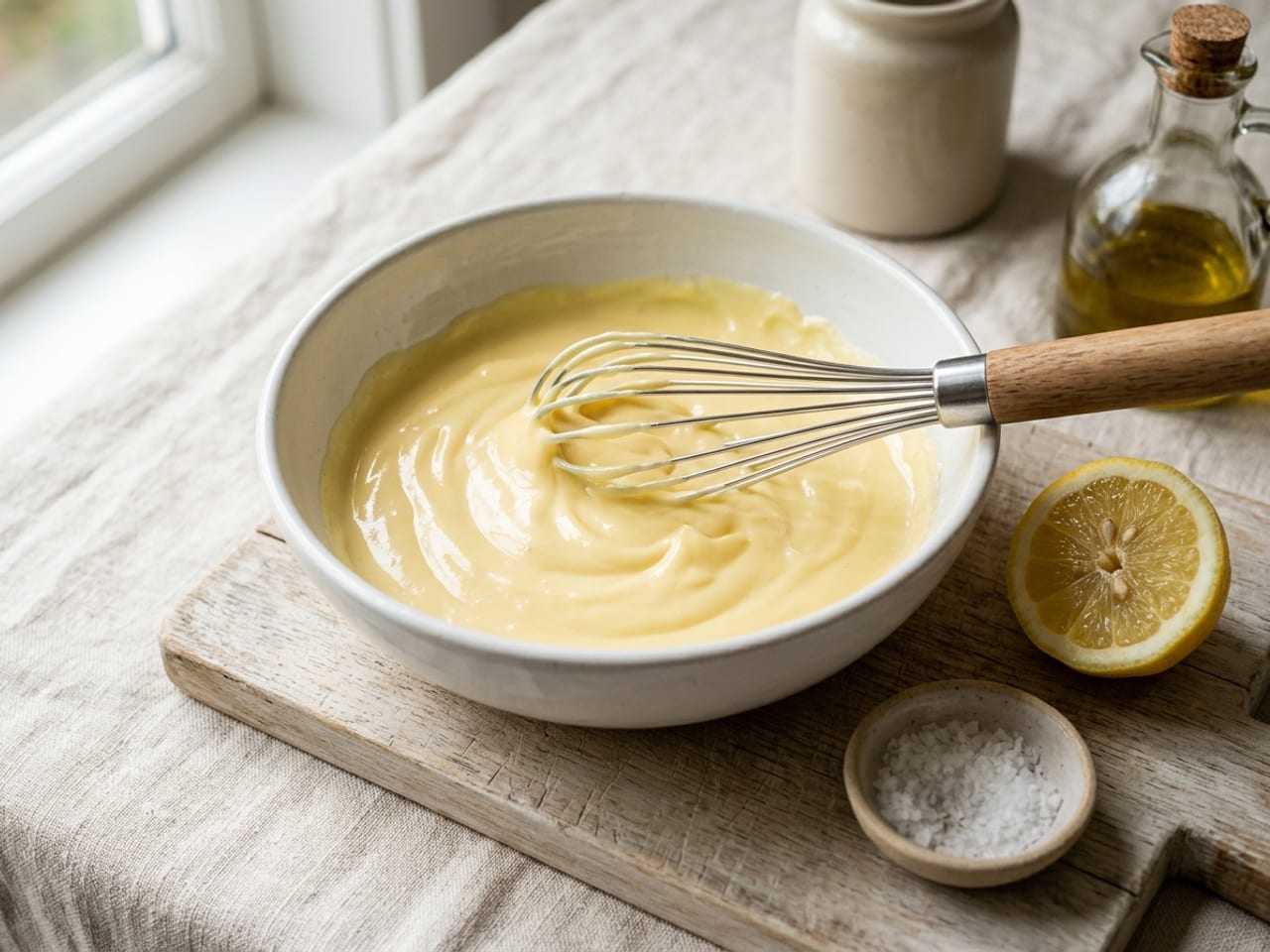
Makes about 1 cup (240 ml): the recipes we read yield about their volume of oil (ours, from the table). Time: about 15 minutes by hand, Bon Appétit's 4 plus 8 minutes of whisking, and a couple of minutes with a stick blender (ours).21 Built on BBC Good Food's and the CIA's proportions and Bon Appétit's hand method, with Child, McGee and Gisslen for the technique and López-Alt and Lawson for the stick blender: our synthesis of the cited recipes, not one we tested.10, 21, 22, 23, 24, 25
| Ingredient | US | Metric | Why |
|---|---|---|---|
| Large egg yolks, at room temperature | 2 | 2 | BBC Good Food beats 2 yolks into 250ml of oil and the CIA 2 yolks into 2 cups (480 ml).22, 23 Warm yolks coat the oil faster than cold ones (McGee).9 Pasteurized yolks if anyone eating it is pregnant, very young, old or has a weakened immune system; in the UK, British Lion or Laid in Britain eggs are the FSA's alternative, except for the severely immunocompromised (safety). |
| Dijon mustard (optional) | 1 tsp | 1 tsp | The CIA's 2 teaspoons per 2 cups (480 ml) of oil, halved (ours). Flavour, and a weaker emulsifier than the yolk (America's Test Kitchen); Carême and Escoffier used none.16, 18, 23, 33 |
| Fine salt | ½ tsp | ½ tsp | Child's amount for 3 yolks; salt beaten into the yolks first helps rather than harms (Escoffier, McGee).9, 10, 18 |
| Lemon juice or white wine vinegar, divided | 1 tbsp | 1 tbsp | The CIA's 2 tablespoons of acid per 2 cups (480 ml) of oil, halved (ours): a teaspoon with the yolks, the rest to taste at the end. Gisslen puts some in first; BBC Good Food and Cloake add it all at the end.11, 22, 23, 27 |
| Neutral oil (sunflower, canola or grapeseed), at room temperature | 1 cup (240 ml) | 240 ml | Half a cup (120 ml) per yolk (ours), well inside Child's ¾ cup (180 ml) and Gisslen's 8 ounces (240 mL) per yolk.10, 11 Olive oil has its own catches (oils). |
| Water | 1 to 3 tsp | 1 to 3 tsp | To thin it when it turns stiff, which McGee calls the sign that the droplets need more room.9 The CIA uses 1 tablespoon for its 2-cup (480 ml) batch.23 |
| For the stick-blender method: 1 large whole egg instead of the yolks, and cold water | 1 egg, 1 tbsp water | 1 egg, 1 tbsp water | Nigella Lawson's proportions, one egg to 250 millilitres of oil and 1 tablespoon of cold water, in a method she credits to J. Kenji López-Alt.25 |
By hand, with a whisk
- Warm everything. Start with every ingredient at room temperature. Child warms the bowl in hot water and heats cold oil to tepid; Escoffier calls making mayonnaise on ice "une erreur absolue", because cold is the most frequent cause of breaking.9, 10, 18 Set the bowl on a folded damp towel so it stays put while you pour (ours).
- Beat the yolks with the salt. Whisk the yolks alone for a minute or two, until thick and sticky, then beat in the salt, the mustard and 1 teaspoon of the acid for 30 seconds more (Child).10 Cloake beats in the salt first and keeps the acid and mustard for the end.27 Salt makes the yolk granules fall apart and gives smaller, steadier droplets (McGee); a little acid now "helps prevent curdling of the egg yolk" (Gisslen).9, 11
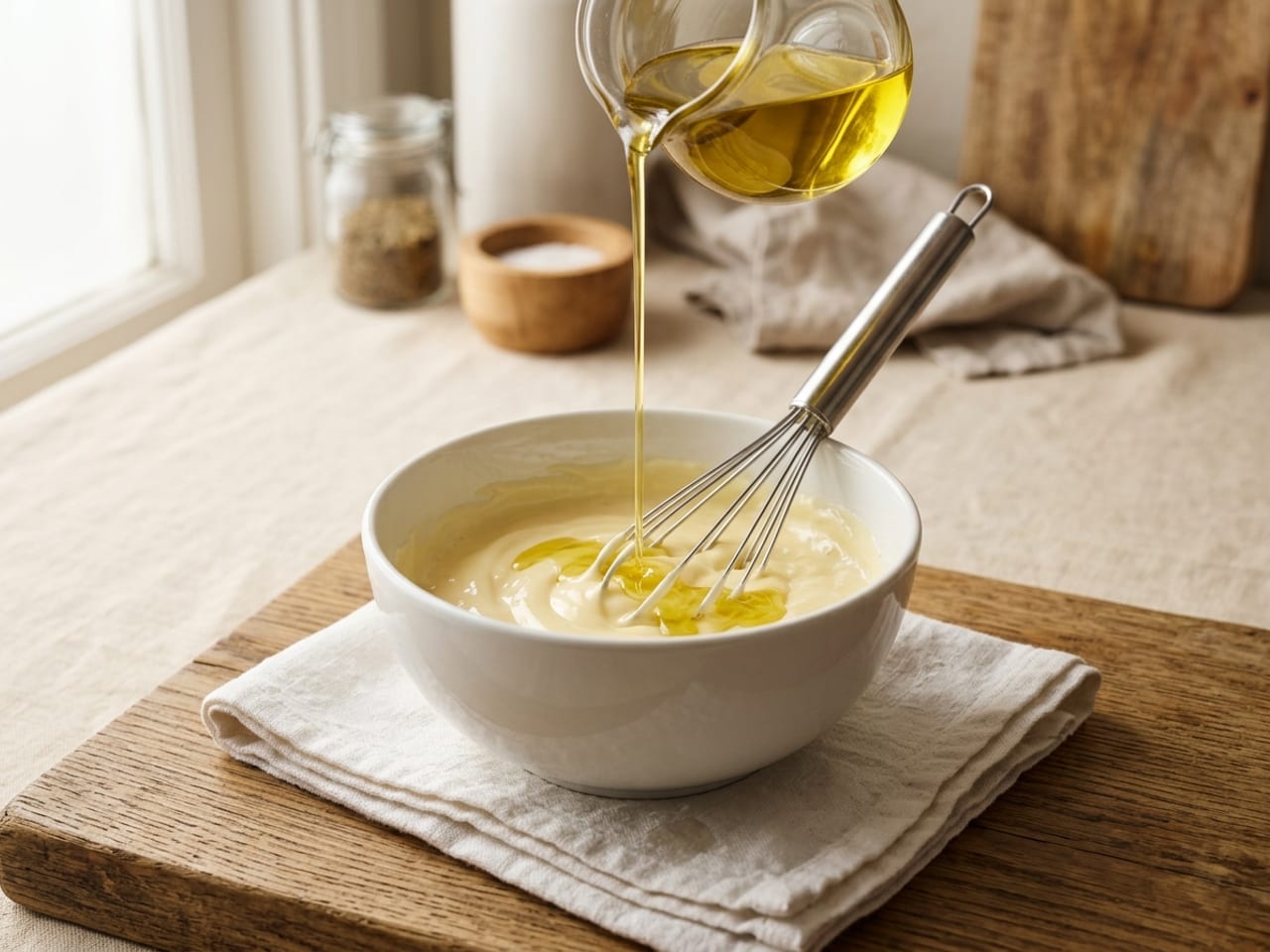
- Add the first oil drop by drop. Whisking all the time, add the oil a few drops at a time: Bon Appétit spends about 4 minutes on the first ¼ cup (60 ml, ours), and Child whisks at about 2 strokes a second.10, 21 Never add more oil at once than the mayonnaise already in the bowl (Gisslen).11 When it thickens into "a very heavy cream", in Child's words "the crisis is over".10
- Then a thin stream. Whisk in the rest in a very slow, thin stream, about 8 minutes more for Bon Appétit, or by 1 to 2 tablespoon dollops for Child, each one absorbed before the next.10, 21 Whenever it turns stiff, loosen it with a few drops of water or acid.9, 10, 12
- Season and finish. Whisk in the rest of the acid and more salt to taste: López-Alt seasons "pretty aggressively" so it does not taste flat and greasy.24 Child finishes every batch with 2 tablespoons of boiling water per 2 to 2¾ cups (480 to 660 ml) as "anti-curdling insurance", about 2 to 3 teaspoons for this batch (our scaling); Escoffier adds his only if the sauce is to be kept.10, 18 It should be "smooth and glossy" and "thick enough to hold its shape" (Gisslen).11 Cover and refrigerate (how long).
With a stick blender and a whole egg
The same ingredients, with one whole egg in place of the two yolks. America's Test Kitchen switched to a whole egg in its processor recipe because the extra volume lets the blades catch; every hand-whisked recipe in our ratio table uses yolks only (whole egg vs yolk).30
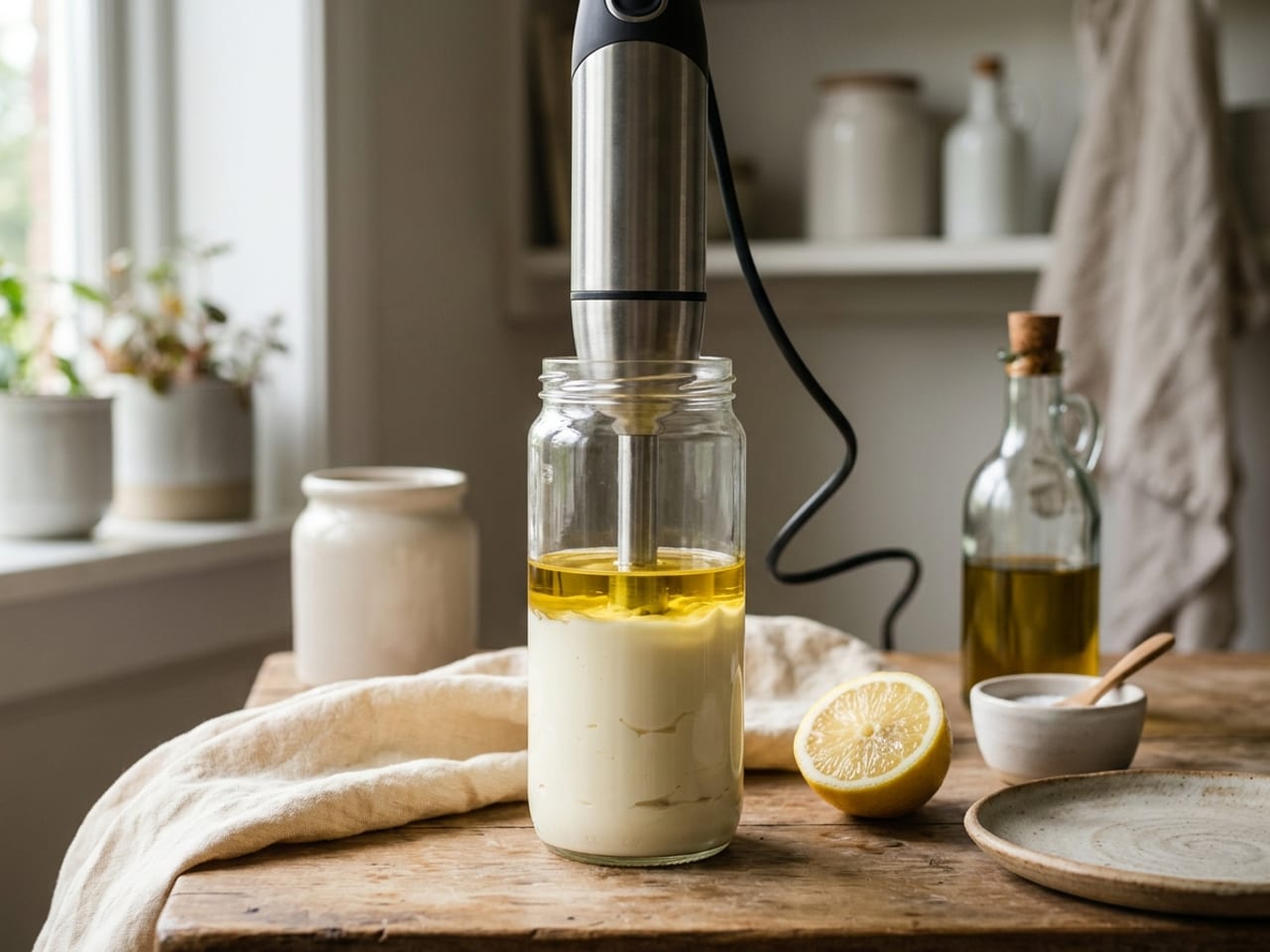
- Pick a snug jar. Use a tall, narrow jar or cup only just wider than the blender head: López-Alt's cup is "just wide enough that the head of the blender fits in the bottom", and Lawson says the snug fit is "what will make the mayo work".24, 25
- Egg in, oil on top. Put the whole egg, the mustard if using, the lemon juice or vinegar, the salt and 1 tablespoon of cold water in the jar, then pour the oil gently on top.24, 25
- Blend at the bottom. Plant the blender flat on the bottom, switch it on at full power and hold it still: a vortex pulls the oil down and mayonnaise forms at the bottom, in about 30 seconds for Lawson.24, 25
- Lift slowly. Slowly lift the head until all the oil is incorporated, then taste and season.24 For olive oil flavour, whisk extra-virgin olive oil in by hand afterwards rather than blending it, as López-Alt and America's Test Kitchen do (why).24, 35
Mayonnaise ratios: egg, oil, acid and mustard, side by side
28 published recipes, amounts as each prints them, grouped by the egg they use. A metric amount in brackets after a US-only one is our conversion at 1 cup (240 ml) = 240 ml, and so is any "per yolk" figure marked ours. Oil per yolk is our arithmetic and is charted only where a recipe gives exact yolks and oil (9 of them).
Raw yolks
| Source | Method | Egg | Oil | Acid | Mustard | Water | Salt | Makes | Oil per yolk or egg |
|---|---|---|---|---|---|---|---|---|---|
| Carême (1842 edition)16 | wooden spoon, the bowl on crushed ice | 2 yolks | "deux verres" (two glasses), with ½ glass of aspic jelly | ¼ tbsp tarragon vinegar first, then alternating with the oil | none (with mustard it is his sauce provençale) | a few drops of cold water at the end, to whiten it | a strong pinch | not printed | one glass |
| Escoffier (1903 and 1907)17, 18 | whisk | 6 yolks (1907: "dont le germe doit être retiré") | 1 litre | 1½ spoons of vinegar, or 1 lemon's juice for a whiter sauce | none | 3 (1903: 3 or 4) spoons of boiling water at the end, if it is to be kept | 10 g, with 1 g white pepper | not printed | about 167 ml (ours); his stated limit 175 ml if it must wait, 200 ml if used at once |
| Child, by hand (1961; 2001 edition)10 | whisk, about 2 strokes a second | 3 yolks | 1½ to 2¼ cups (360 to 540 ml), olive, salad oil or a mix | 1 Tb wine vinegar or lemon juice, then drops to thin | ¼ tsp dry or prepared | 2 Tb boiling water at the end, "anti-curdling insurance" | ½ tsp | 2 to 2¾ cups (480 to 660 ml) | ½ to ¾ cup (120 to 180 ml); her stated maximum ¾ cup (6 ounces, 180 ml) |
| Gisslen, Professional Cooking (2011)11 | mixer | 8 yolks, "preferably pasteurized" | salad oil (the amount is unreadable in the OCR) | 2 tbsp (30 mL) vinegar first; 4 tbsp (60 mL) vinegar and 3 to 4 tbsp (50 to 60 mL) lemon juice during | 2 tsp (10 mL) dry mustard | none | 2 tsp (10 mL) | unreadable in the OCR | his stated limit 8 ounces (240 mL) per large yolk |
| The CIA (consumer site)23 | whisk, or blender | 2 pasteurized yolks | 2 cups (480 ml) vegetable oil | 1 tbsp white wine vinegar first, 1 tbsp lemon juice at the end | 2 tsp Dijon (and ¼ tsp sugar) | 1 tbsp | to taste, with white pepper | 2 cups (480 ml) | 1 cup (240 ml) |
| López-Alt, The Food Lab (2015)24 | stick blender or processor; the olive oil whisked in by hand | 2 large yolks | 1 cup (240 ml) canola and 1 cup (240 ml) extra-virgin olive oil | 1 tbsp lemon juice first, more to taste | 2 tsp Dijon | about 2 tbsp | to taste | 2 cups (480 ml) | 1 cup (240 ml) |
| Pépin, Saveur (2024)26 | whisk, or food processor or blender | 3 large yolks | 2 cups (480 ml) mild olive or vegetable oil | 1 Tbsp tarragon or white wine vinegar, first | 2 Tbsp Dijon | 1 tablespoon cold water, machine method only | ¾ tsp, with ½ tsp white pepper | 2½ cups (600 ml) | ⅔ cup (160 ml) |
| BBC Good Food, Basic mayonnaise22 | whisk | 2 yolks | 250ml sunflower oil | 2 tsp white wine vinegar or lemon juice, at the end | 1 tbsp Dijon | none | to taste | not printed | 125 ml |
| Felicity Cloake (The Guardian)27 | whisk | 2 yolks | 250ml groundnut or sunflower oil, then 25ml extra-virgin olive, walnut or rapeseed oil | 1 tbs vinegar or lemon juice, at the end | 1 tbs, at the end | a little, if you want it thinner | a generous pinch, first | not printed | about 138 ml (ours) |
| Bon Appétit (Wizenberg, 2008)21 | whisk: drops for about 4 minutes, then a thin stream for about 8 | 1 large yolk | ¾ cup (180 ml) canola oil | 1½ tsp lemon juice and 1 tsp white wine vinegar, first | ¼ tsp Dijon | none | ½ tsp | about ¾ cup (180 ml) | ¾ cup (180 ml) |
| America's Test Kitchen (2013)28 | food processor, oil in about 30 seconds | 2 large yolks | ¾ cup (180 ml) canola or other vegetable oil | 4 tsp lemon juice | ¼ tsp Dijon (and ⅛ tsp sugar) | none | ¼ tsp | ¾ cup (180 ml) | ⅜ cup (90 ml) |
| America's Test Kitchen (TV handout)29 | food processor, or by hand "with the same results" | 2 large yolks | ¾ cup (180 ml) regular olive oil, or half extra-virgin and half vegetable | 4 tsp lemon juice | none (Dijon only as a variation) | none | ¼ tsp (and ⅛ tsp sugar) | ¾ cup (180 ml) | ⅜ cup (90 ml) |
| Larousse Gastronomique (1997)12 | whisk; all ingredients at the same temperature | 2 or 3 yolks, by size | the amount is not legible in the OCR | drops of white vinegar, first and during | 2 tablespoons | drops, during, to loosen it | fine salt, cayenne or white pepper | not printed | not printed |
Whole egg (or egg and yolks)
| Source | Method | Egg | Oil | Acid | Mustard | Water | Salt | Makes | Oil per yolk or egg |
|---|---|---|---|---|---|---|---|---|---|
| Child, blender10 | blender at full speed | 1 whole egg | "about a cupful" (240 ml); "Add more, and the machine clogs" | 1 tablespoon lemon juice | a pinch | none | a pinch | not printed | about 1 cup (240 ml) per egg |
| Child, food processor10 | food processor, steel blade | 1 egg and 2 yolks | 2 cups (480 ml) | 1 tsp lemon juice or vinegar, more to taste | ¼ tsp dry | none | 1 tsp | about 2 cups (480 ml) | mixed: not per egg |
| America's Test Kitchen, quick (2007)31 | food processor, oil in about 1 minute | 1 large egg | 1¼ cups (300 ml) vegetable, canola or light olive oil | 2 tsp lemon juice | ¼ tsp Dijon, with hot pepper sauce and Worcestershire | none | a generous ¼ tsp | about 1½ cups (360 ml) | 1¼ cups (300 ml) per egg |
| America's Test Kitchen, easy (2019)30 | food processor, oil over about 2 minutes | 1 large egg | 1½ cups (360 ml) vegetable oil; "Do not substitute olive oil" | 4 tsp white wine vinegar | ½ tsp Dijon (and ¼ tsp sugar) | none | ¾ tsp | about 1½ cups (360 ml) | 1½ cups (360 ml) per egg |
| Nigella Lawson (At My Table)25 | stick blender in a snug goblet | 1 large egg, at room temperature | 250 millilitres cold-pressed rapeseed or regular olive oil (US: 1 cup (240 ml)) | 1 tablespoon lemon juice, 1 teaspoon more at the end | none (saffron and garlic in this golden version) | 1 tablespoon cold water | ½ tsp | approx. 250ml | 250 ml per egg |
| Pinch and Swirl (blog)38 | stick blender in a container just large enough | 1 egg | 1 cup (240 ml) avocado oil | 1 tablespoon lemon juice | 1 tsp Dijon (and ½ tsp sugar, optional) | none | ½ tsp | 16 tablespoons (1 cup, 240 ml) | 1 cup (240 ml) per egg |
| Laylita (blog)39 | blender | 1 egg | ¾ to 1 cup (180 to 240 ml) | 2 tbs lemon juice or vinegar, at the end | none | none | to taste | not printed | ¾ to 1 cup (180 to 240 ml) per egg |
Yolks heated first
| Source | Method | Egg | Oil | Acid | Mustard | Water | Salt | Makes | Oil per yolk or egg |
|---|---|---|---|---|---|---|---|---|---|
| America's Test Kitchen, make-ahead (2020)32 | microwave to 160 to 165 degrees (71 to 74°C, ours), then a processor | 2 large yolks, heated with the water and lemon juice | 1½ cups (360 ml) | 4 tsp lemon juice | ½ tsp | 3 tbsp | ¾ tsp | 1½ cups (360 ml) | ¾ cup (180 ml) |
| Cook's Illustrated, McGee's method36 | microwave to "a food-safe 160 degrees" (71°C, ours), then a whisk | 1 yolk | 1 cup (240 ml), extra-virgin olive oil ⅓ cup (80 ml) or less | 1 tbsp lemon juice | none | 1 tbsp | a pinch | not printed | 1 cup (240 ml) |
| America's Test Kitchen, Kewpie-style (2023)131 | microwave to 160 to 165 degrees (71 to 74°C, ours), then oil | 3 yolks | 1½ cups (360 ml) vegetable oil | 2½ tbsp cider vinegar | ½ tsp Dijon (with ¼ tsp sugar and ¼ tsp MSG) | 3 tbsp | 1 tsp | not in what we read | ½ cup (120 ml) |
Hard-boiled yolks
| Source | Method | Egg | Oil | Acid | Mustard | Water | Salt | Makes | Oil per yolk or egg |
|---|---|---|---|---|---|---|---|---|---|
| Viard, Rémoulade Indienne (1807)13 | pounded, the oil added a spoon at a time | 10 hard-boiled yolks | 8 spoons, "l'une après l'autre" | vinegar | none (spices and saffron d'Inde) | none | not in the passage read | "un peu épaisse", sieved | under a spoon per yolk |
| Escoffier, Gribiche (1903)17 | crushed in a bowl, "Monter en mayonnaise" | 6 hard-boiled yolks | ½ litre | not in the passage read | 1 teaspoon | none | a strong pinch, and pepper | not printed | about 83 ml (ours) |
| Escoffier, Sauce Tartare (1907)18 | worked to a smooth paste, then mounted | 8 hard-boiled yolks | 1 litre | 2 spoons of vinegar | none in the base | none | a strong pinch, and pepper | not printed | 125 ml (ours) |
| Child, Hard Yolk Mayonnaise10 | mashed very smooth; "cannot be made in an electric blender" | 3 hard-boiled yolks | 1 cup (240 ml) | not in the passage read | 1 Tb prepared | none | ¼ tsp | not printed | ⅓ cup (80 ml) |
No egg
| Source | Method | Egg | Oil | Acid | Mustard | Water | Salt | Makes | Oil per yolk or egg |
|---|---|---|---|---|---|---|---|---|---|
| BBC Good Food, Vegan mayonnaise40 | hand blender, the soy milk frothed first | none: 100ml soy milk, at room temperature | 200ml rapeseed oil | 1 tbsp cider vinegar | 1 tsp Dijon (optional) | none | to taste | approx. 300ml | 2 parts oil to 1 of soy milk |
What the table shows. Among the raw-yolk recipes that give exact amounts, oil runs from 90 ml to 240 ml per yolk (our arithmetic), from America's Test Kitchen's ⅜ cup (90 ml) to the CIA's and López-Alt's full cup (240 ml); a whole egg takes up to 1½ cups (360 ml) in America's Test Kitchen's processor recipe.23, 24, 28, 30 Mustard runs from none (Carême, Escoffier, America's Test Kitchen's TV recipe, Lawson) to 2 tablespoons (Pépin, Larousse).12, 16, 18, 25, 26, 29 The acid goes in first in most US recipes and at the end for BBC Good Food, Cloake and Laylita.22, 27, 39 Every hand-whisked recipe in the table uses yolks only; the whole egg turns up in machines.
Why oil and egg turn thick: the emulsion, and how much oil one yolk holds
What happens in the bowl, from McGee, the textbooks and the papers. Where they disagree, both sides are named.
- Oil in a little waterMcGee: "an emulsion of oil droplets suspended in a base composed of egg yolk, lemon juice or vinegar, water, and often mustard", as much as 80% oil by volume and "usually dense and too stiff to pour"; his table gives it 400 parts fat to 100 of water.9 The US standard asks at least 65% oil by weight, and a Kyoto study puts commercial mayonnaise at about 70%.1, 44 One tablespoon (15 ml) of oil beaten in becomes "about 30 billion separate droplets", about 3 thousandths of a millimetre across by hand, a little smaller in a blender (McGee); Kewpie says its own are 2 to 4 thousandths (a maker's claim).9, 49
- What in the yolk does itGisslen and America's Test Kitchen name lecithin.11, 33 McGee and a peer-reviewed review put most of the work elsewhere: the low-density lipoproteins of the yolk's plasma, which "is responsible for the important emulsifying properties of yolk", and its granules once salt breaks them up; lecithin is one emulsifier among them.9, 43 They coat each droplet so the droplets cannot merge.33
- Salt first helpsEscoffier called the idea that salt makes it split a prejudice: dissolved salt, he wrote, "augmente la force assimilatrice des jaunes d'œufs", though he cites no study.18 McGee gives the mechanism: salt makes the yolk granules fall apart, and oil whisked into just the yolks and salt gives smaller, steadier droplets.9, 43
- Warm, not coldMcGee, Child, Gisslen, Cloake and Larousse want the ingredients at room temperature, and Escoffier and Pépin the oil at least; yolks are "most effective when they're raw, and when they're warm" (McGee), and "Cold oil is not easily broken into small droplets" (Gisslen).9, 10, 11, 12, 18, 26, 27 The one dissenter we read is Carême, who set his bowl "sur de la glace pilée", for a sauce that also held aspic jelly.16
- Mustard: flavour, and a helperIts ground seed particles and the mucilage from the seed coat coat oil droplets and steady the emulsion, white mustard especially (McGee); America's Test Kitchen calls it "an emulsifier (albeit a weaker one than egg yolk)", and Pépin "a powerful binder".9, 26, 33 Optional either way (without mustard).
- The acidThe US standard requires one: vinegar or lemon or lime juice of at least 2½% acidity.1 A little at the start "helps prevent curdling of the egg yolk" and dissolves the salt (Gisslen); Escoffier used lemon for a whiter sauce.11, 18 It does not make raw egg safe (what the agencies say).
- How much oil one yolk holdsThe books set limits: Escoffier 1¾ decilitres (175 ml) a yolk if the sauce must wait and 2 (200 ml) if used at once, Child 6 ounces (¾ cup, 180 ml), Gisslen "no more than 8 ounces (240 mL)".10, 11, 18 McGee disagrees: "A single yolk can emulsify a dozen cups of oil or more" (about 2.9 litres, ours); what matters is water, about a third of the oil's volume in yolk, lemon juice, vinegar or water.9 Hervé This is reported to have calculated 24 litres from one yolk, a second-hand report with no calculation shown.42 No one we read published a measured home test, so add water when it stiffens rather than another yolk (ours, after McGee).
- Whole egg vs yolkThe US standard allows whole eggs.1 America's Test Kitchen uses one because it gives the processor blades enough to catch; egg whites are "of little help in coating fat droplets" but their proteins add some viscosity, McGee says.9, 30 Whole-egg sauces run at a higher pH, which matters for safety (acid).153 No source we read compared the taste, colour or thickness of whole-egg and yolk mayonnaise side by side.
- In the fridge and on hot foodA finished mayonnaise "will tend to leak oil in near-freezing refrigerators and on hot rather than warm food"; manufacturers use oils that stay liquid in the fridge, and a weeping one can be stirred back with a few drops of water (McGee).9 When it loses water, as it can left uncovered (ours), it "rapidly separates" (a study of mayonnaise stability).44
Why mayonnaise splits, and how to fix a broken mayonnaise
Escoffier and McGee list almost the same three mistakes. The French verbs say it too: a mayonnaise that works prend (takes), one that fails tourne (turns).5, 9, 18
- A food processor with too little in itThe yolks spray up the sides, so the first oil "merely collects below the blade in a greasy pool"; America's Test Kitchen whisks the first ¼ cup (60 ml) in by hand, or uses a whole egg.30, 33 In a blender, Child stops at about a cup (240 ml): "Add more, and the machine clogs."10
How to fix a broken mayonnaise
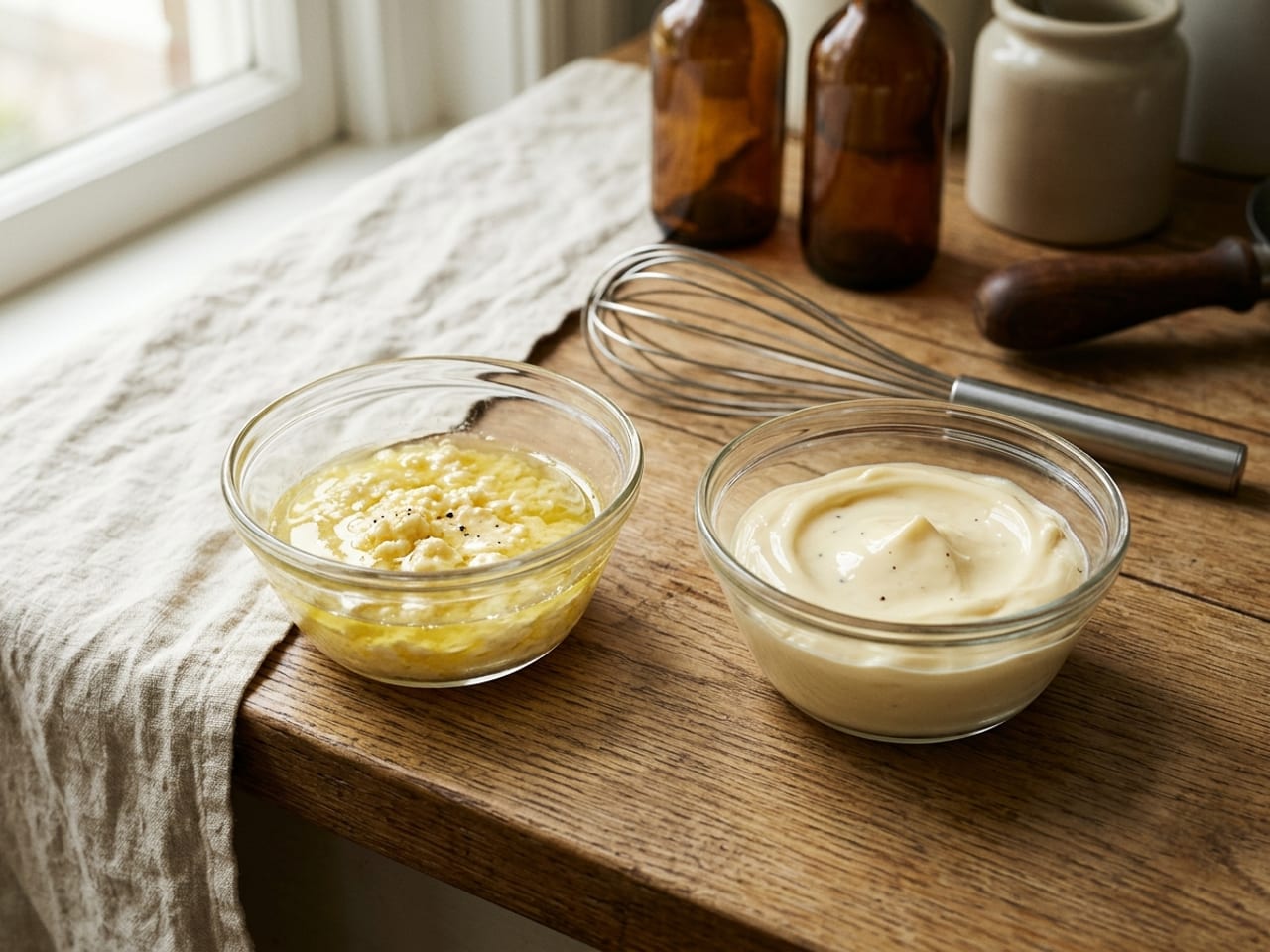
- A fresh yolkEscoffier restarts a broken aïoli "avec un jaune d'œuf cru, ainsi que cela se fait pour la Mayonnaise"; Gisslen beats "an egg yolk or two or some good prepared mayonnaise" and very slowly beats the broken one in; Larousse adds a new yolk little by little.11, 12, 18 McGee calls a small amount of the water phase, "perhaps supplemented with an egg yolk", the more reliable rescue.9
- A spoon of water, no new yolkAmerica's Test Kitchen puts 4 teaspoons of water in a bowl, whisks in about ½ cup (120 ml) of the broken mixture very slowly until it looks like heavy cream, then the rest; the result is "slightly looser than unbroken mayonnaise but still thick and creamy".34
- A teaspoon of mustardChild warms a bowl, creams 1 teaspoon of prepared mustard with 1 tablespoon of the sauce, then beats in the rest by teaspoons: "This always works."10
- Carême's wayA spoon of cold béchamel and a yolk with a spoon of the sauce, beaten smooth, then the broken sauce added in parts.16
- The rule they shareEvery fix we read that starts a new base (yolk, water, mustard or béchamel) adds the broken sauce to it slowly, never the base to the broken sauce (ours, from the fixes above).
Olive oil, avocado oil and neutral oil in mayonnaise
Olive oil brings two different problems, bitterness in a fast machine and splitting later, and the sources separate them.
- Olive oil in a machine can turn bitterAmerica's Test Kitchen made two aïolis from one bottle of extra-virgin olive oil: tasters found the processor batch "markedly bitter"; America's Test Kitchen reports no such note for the hand-whisked one. Its explanation: smaller droplets free more bitter polyphenols.35 Its easy recipe says "Do not substitute olive oil".30 Nigella.com agrees on the symptom but says "It is not exactly understood why", and that a stick blender's smaller blade "usually" avoids it.37 The fixes: regular (not extra-virgin) olive oil, or a neutral oil in the machine and the extra-virgin whisked in by hand; RecipeTin Eats keeps extra-virgin to half the oil, Cloake to the last 25ml.24, 27, 29, 35, 41
- Extra-virgin olive oil can split laterA separate problem: McGee says unrefined extra-virgin olive oil "often produces an unstable mayonnaise" that separates an hour or two after it forms, and advises refined olive oil, or extra-virgin only as a flavouring.9 A 2016 study found olive-oil phenolics made mayonnaise-like emulsions "easier to deform and to break", and Cook's Illustrated keeps extra-virgin to ⅓ cup (80 ml) in its heated-yolk recipe for the same reason.36, 45
- But the yolk can hide the bitternessA Monell Center study found egg-yolk and whey proteins "reduce or even eliminate" the bitterness and throat sting of pungent extra-virgin oils, so in mayonnaise they "may lose" them.46 No paper we found tested blender against whisk directly; the machine effect is America's Test Kitchen's tasting.
- Avocado oil: popular recipes, no serious testPinch and Swirl blends 1 cup (240 ml) of avocado oil with a whole egg, and Laylita likes "a neutral oil like avocado or sunflower".38, 39 We found no test-kitchen, textbook or peer-reviewed avocado-oil mayonnaise, so how it behaves next to olive or sunflower oil is untested in what we read.
Mayonnaise without mustard, without lemon, without a blender, with boiled eggs or without egg
The versions people search for, each with the recipes and books that make it.
- Without mustardThe classic French form: Carême's magnonaise has none, and with mustard it becomes his "sauce provençale", "voilà toute la différence"; Escoffier's has none; the Académie's 8th edition and Littré leave it out ("quelques-uns y ajoutent de la moutarde").6, 7, 16, 18 America's Test Kitchen's TV recipe and Lawson's use none either. The TLFi and Larousse put it in the definition.5, 12, 25, 29 Leave it out and beat the yolk well first; it is a help, not a requirement (ours, from these recipes).
- Without lemonUse vinegar: the US standard takes vinegar or lemon or lime juice.1 The CIA uses white wine vinegar with its lemon, America's Test Kitchen's easy recipe 4 teaspoons of white wine vinegar, Pépin tarragon or white wine vinegar; Escoffier gives either, lemon "si on veut l'obtenir très blanche".18, 23, 26, 30 Kewpie makes its own apple-and-malt vinegar for its mayonnaise (the maker's statement).49
- Without a stick blenderBy hand is the classic way (the steps), and America's Test Kitchen says whisking gives "the same results" as its processor.29 In a food processor, whisk the first ¼ cup (60 ml) of oil in by hand or use a whole egg (America's Test Kitchen), or freeze the oil in 4 to 6 ice-cube compartments so it melts in slowly (López-Alt).24, 30, 33 In a blender, Child whirls a whole egg with mustard, salt and lemon and streams in about a cupful (240 ml, ours) of oil at full speed.10
- With hard-boiled eggsAn old idea with classical names: Viard's Rémoulade Indienne of 1807 pounds ten hard-boiled yolks and adds oil a spoon at a time, Escoffier's gribiche (1903) and tartare (1907) mount hard-boiled yolks with oil, and Child's Hard Yolk Mayonnaise mashes 3 of them with 1 tablespoon of mustard before 1 cup (240 ml) of oil: "Unless the yolks are smooth and free from lumps, they will not absorb the oil", and it "cannot be made in an electric blender".10, 13, 17, 18 McGee: cooked yolks have "far less emulsifying power", can taste a little grainy, take less oil and "tend to leak some free oil".9
- With the yolks heated firstThe USDA's own route for raw-egg recipes: heat the eggs "separately from all other ingredients in a liquid form over low heat, stirring constantly, until the mixture reaches 160 degrees F" (71°C, ours), then finish the recipe.133 America's Test Kitchen microwaves yolks, water and lemon juice to 160 to 165 degrees (71 to 74°C, ours) before the oil, and Taste of Home whisks them over simmering water to 160°F (71°C, ours); Cook's Illustrated prints McGee's microwave version.32, 36, 163 How long these keep is under storage.
- Without egg (vegan)BBC Good Food froths 100ml of soy milk with 1 tablespoon of cider vinegar for 30 seconds with a hand blender, then streams in 200ml of rapeseed oil.40 Aquafaba, the liquid left from canning or boiling pulses, works as an emulsifier: in one study aquafaba-powder versions held 28 days at 4 °C (39°F, ours), with larger droplets than egg yolk; in another, 33 parts aquafaba to 60 of oil gave firmness and stability "comparable to conventional egg-based mayonnaise".47, 48 For egg allergy, a Scottish NHS children's allergy leaflet (past its review date) lists shop-bought egg-free mayonnaise.176
The 5 flavored mayos people like most, and how we picked them
How we picked them. No market researcher we read ranks flavored mayonnaises nationally: there is no Datassential, Technomic or Mintel league table of flavours, no YouGov or Ipsos poll on them and no published sales figures by flavour in what we found (only a supplier's and a maker's say-so, in the table below). So we weighed every signal we could read, strongest kind first: menu data, then polls, then sales and launches (the makers' own words, labelled), then search, then how many recipe sites carry one. Most of those signals point to the first three; truffle aioli is here on menu data and launches, burger sauce on search and recipe sites, and each card says which. The ranking and the confidence are our call, printed with the evidence so you can disagree with it.
| The signal | Whose figure | When | Where | Who paid, or how strong |
|---|---|---|---|---|
| Garlic sauce is listed third of Technomic's top 10 condiment and sauce flavours on US menus, after mayonnaise and marinara (an unnumbered list); sriracha is not in the 1059 | Technomic, via Restaurant Business | undated | US | menu-data firm, reported by trade press |
| Truffle aïoli is on 1.7% of US restaurant menus, up 22% in four years55 | Datassential, via Nation's Restaurant News | 2024 | US | menu-data firm supplies the feature |
| 58% of the population know the word "aïoli" and 42% have tried it56 | Datassential, via Nation's Restaurant News | 2022 | US | sample not stated |
| Chipotle aïoli has "seen consistent growth on menus" (no figure)57 | Datassential, via Nation's Restaurant News | 2020 | US | menu-data firm supplies the feature |
| Garlic aioli, wasabi and basil pesto among the fastest-growing sandwich sauces in restaurants62 | Datassential, via Food Technology | about 2012 | US | an old signal |
| Sriracha aioli at 2.3% market penetration, nearly 25% growth in a year58 | FSR Magazine | undated | US | SPONSORED by a hot-sauce maker; the figure's source is unclear |
| Spicy favoured by 47% of sauce and dip buyers, then smoky and sweet (not mayo-specific)61 | Mintel, via Food Business News | May 2021 | US | sample not given |
| 30% love mayonnaise; 27% dislike or hate hot sauce; no mayo flavours asked60 | YouGov poll of 1,104 adults | 2026 | US | self-funded poll |
| Flavored mayo is "over 7%" of US mayo sales; Garlic and Spicy are "relevant across many markets", Truffle a European flavour63 | Unilever (Hellmann's), citing Circana | 2024 | US, worldwide | BRAND statement |
| Chipotle Mayo "is the top performer" of Hellmann's 2024 flavours64 | a Unilever executive, via Supermarket Perimeter | 2025 | US | BRAND statement |
| Garlic is "the second-biggest segment within flavoured mayonnaise, behind chilli"65 | the maker of Nando's sauces, via The Grocer | 2020 | UK | SUPPLIER claim |
| Flavour is 15% of the UK mayo share (Unilever); mayonnaise is the key growth area in table sauce (NielsenIQ)66 | The Grocer | 2022 | UK | the 15% is a BRAND statement |
| Garlic is the flavour nearly every line carries: Hellmann's Garlic Aioli and Chipotle (2024), Graza's Garlic Aioli (2026); Heinz Seriously Good's first flavoured mayos were garlic, truffle and lemon (UK, 2020); Duke's 2021 bacon, dill, red pepper and habanero-garlic mayos are not on its store page now65, 67, 69 | FoodNavigator-USA; The Grocer; Duke's | 2020 to 2026 | US, UK | brand launches, not sales |
| Cheesy Garlic Bread Aioli one of two winners of Heinz's public vote68 | Inside FMCG | 2024 | Australia, New Zealand | BRAND-RUN vote of over 21,000, self-selected |
| "nearly three-quarters of Canadians who dip mayo" mix it with ketchup or hot sauce67 | Heinz Canada, via FoodNavigator-USA | press release (August), reported 2026 | Canada | BRAND claim, no sample given |
| US search: spicy mayo level with garlic aioli; chipotle mayo about 4 in 10; truffle aioli under 1 in 10; burger sauce, a broader term, above both (the chart below)70 | our Google Trends pull | 5 years to 2026 | US | OURS: relative interest, not volumes |
| UK search: garlic mayo 183 to garlic aioli's 100; sriracha mayo 66.7, spicy mayo 62.5, chipotle mayo 33.3, truffle mayo 12.5; burger sauce 537.570 | our Google Trends pull | 5 years to 2026 | UK | OURS |
| Of 5 big recipe sites, garlic aioli and sriracha or spicy mayo on all 5, lemon aioli, burger sauce and herb on 4, chipotle on 3 (under-counted), truffle on none71 | our count | 2026 | US, UK | OURS: a weak signal |
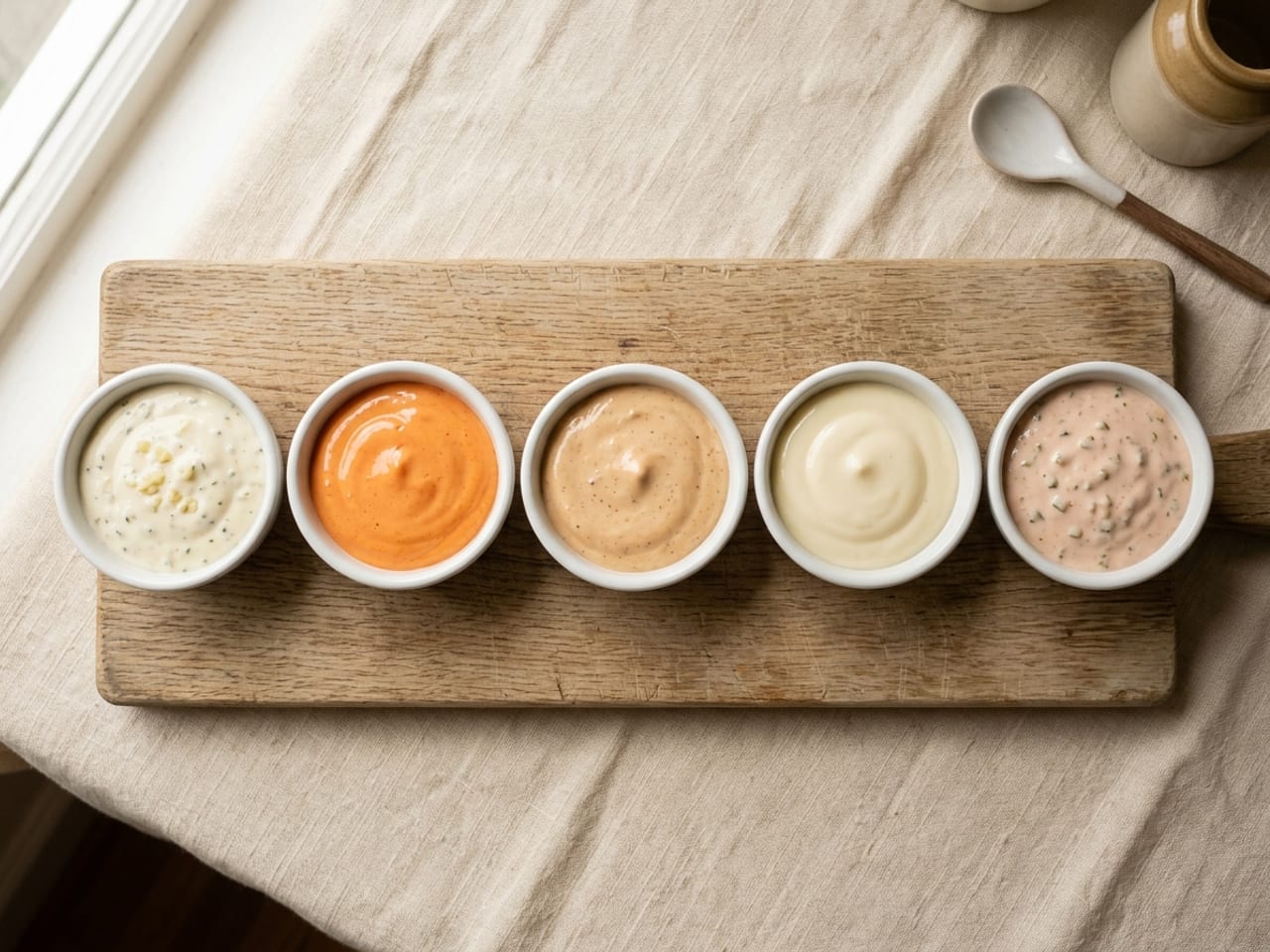
The ranking, with our confidence. 1. Garlic aioli, high; 2. Sriracha mayo (spicy mayo), high; 3. Chipotle mayo, medium to high; 4. Truffle aioli, medium to low; 5. Burger sauce (special sauce), medium (our call). Lemon-herb mayonnaise is the runner-up (below). Every card gives amounts per 1 cup (240 ml) of mayonnaise, homemade or bought, with the published range beside our pick.
1. Garlic aioli recipe · garlic
Why it is here. "Garlic sauce" is listed third of Technomic's top 10 condiment flavours on US menus, garlic is the top flavour search in the UK and level with spicy mayo at the top in the US (our pull), every recipe site we checked has one, and Hellmann's names garlic as a flavour that works across markets (a brand statement).59, 63, 70, 71 Confidence: High (our call): every kind of signal we found points here.
Makes about 1 cup (240 ml), 5 minutes plus half an hour's rest. Our synthesis of the cited recipes, not one we tested.
| Ingredient | US | Metric | Why |
|---|---|---|---|
| Mayonnaise, homemade or store-bought | 1 cup (240 ml) | 240 ml | The master recipe above, or a jar: BBC Good Food and NYT Cooking both start from bought mayonnaise.75, 85 |
| Garlic, finely grated | 2 small cloves | 2 small cloves | Our pick, inside the published range of 1 clove a cup (NYT) to about 5 (Casas, our arithmetic) (the table below).82, 85 |
| Lemon juice | 2 tsp | 2 tsp | Ours, a little under Casas's (1 teaspoon per 6 tablespoons, about 2⅔ teaspoons a cup, our arithmetic) and NYT Cooking's 1 tablespoon per cup (240 ml); add more to taste.82, 85 |
| Fine salt | a pinch | a pinch | BBC Good Food adds ½ teaspoon to its 225ml.75 |
| Extra-virgin olive oil (optional) | 2 tsp | 2 tsp | Ours, a little under Casas's 1 teaspoon per 6 tablespoons of mayonnaise (about 2⅔ teaspoons per cup, 240 ml, our arithmetic), for an olive-oil note.82 |
- Make a garlic paste. Grate or mash the garlic to a paste with the salt and let it sit a minute or two in the lemon juice, as Melissa Clark does. Halve the cloves and lift out any green germ first: Waters calls it bitter.77, 84
- Stir it in. Stir the paste, and the olive oil if using, into the mayonnaise.82, 85
- Let it rest. Cover and chill (ours) for about half an hour: Waters says garlic mayonnaise "will taste better after about half an hour". Taste and add garlic if you want it stronger.77
From scratch. Pound 1 to 2 cloves with the salt in a mortar, then make the master recipe on top of the paste with a mild olive oil for part of the oil: Waters uses 2 or 3 cloves per yolk and 1 cup (240 ml) of olive oil, Tanis "mild-tasting extra-virgin olive oil" (our pick: fewer cloves, after America's Test Kitchen's 1 per cup of oil, 240 ml).77, 78, 88 Whisk the olive oil in by hand rather than in a machine (why).
| Whose recipe | How much, as printed |
|---|---|
| Ferran Adrià (from scratch, whole eggs)83 | 5 cloves to 5 cups (1.2 litres) of oil: about 1 a cup (ours) |
| America's Test Kitchen, Easy Homemade Aioli87 | 1 clove to 1½ cups (360 ml) plus 2 tbsp of oil |
| America's Test Kitchen, Garlic Mayonnaise88 | 1 medium clove (about 1 teaspoon) to 1 cup (240 ml) of oil |
| BBC Good Food, Garlic mayonnaise (Pike)74 | 1 to 3 cloves to 175ml of oil, "depending on how strong you want it" |
| BBC Good Food, Aioli sauce73 | 3 cloves to 300ml of olive oil |
| Alice Waters77 | 2 or 3 cloves to 1 cup (240 ml) of olive oil |
| Nancy Silverton, Lemon Aioli79 | 2 to 3 cloves (about 1 tablespoon) to 1 cup (240 ml) of oil |
| Suzanne Goin80 | 1 small clove to ½ cup (120 ml) of oil |
| David Tanis78 | 1 large or 2 small cloves to ½ cup (120 ml) of oil |
| Gourmet, Classic Aïoli (no egg)81 | ½ cup (120 ml) chopped garlic to 2 cups (480 ml) of oil |
| NYT Cooking, Smoked Paprika Aioli (jar)85 | 1 clove to 1 cup (240 ml) of mayonnaise |
| BBC Good Food, Easy garlic mayonnaise (jar)75 | 3 cloves to 225ml of mayonnaise |
| Penelope Casas (jar)82 | 2 cloves to 6 tbsp of mayonnaise: about 5 a cup (ours) |
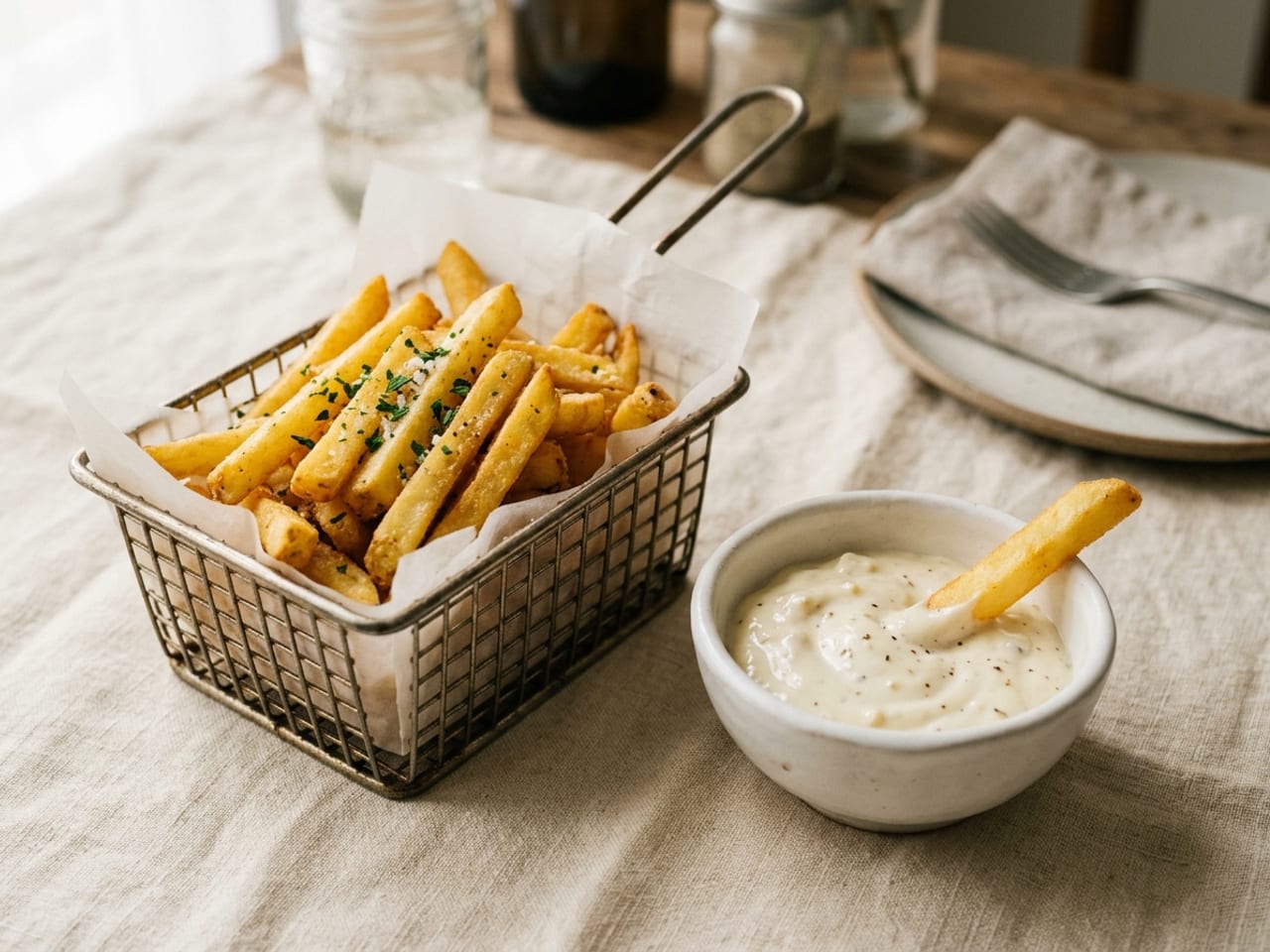
What it goes with. Fries, wedges and chicken goujons (BBC Good Food); fries, burgers and crab cakes (Nation's Restaurant News); sandwiches, burgers and potato salad (Hellmann's, for its jar); "one of my favorite sauces for almost everything" (Waters).56, 64, 75, 77 "Aioli for" completes in US searches to crab cakes, sweet potato fries, fish tacos, artichokes, salmon burgers and a BLT (our pull).72
How long it keeps. Made from scratch, the recipes split from the same day (Waters) through 2 days (BBC Good Food) and 4 days (America's Test Kitchen's garlic mayonnaise) to a week (its whole-egg Easy Homemade Aioli); the one agency figure for home cooks, the USDA's for homemade aioli, is 3 to 4 days, and we follow it.73, 77, 87, 88, 136 Stirred into a jar, see storage.
The catch. Garlic in oil. Garlic is a low-acid food, and kept under oil it gives the botulism bacterium the airless conditions it grows in: homemade garlic oils, roasted garlic or confit kept under oil, go in the fridge for no more than 4 days, or the freezer (Oregon State University; a peer-reviewed review).96, 97 After outbreaks in 1985 and 1989, the FDA required commercial garlic-in-oil to be acidified.97, 98 Dressings below pH 4.6 do not carry that spore risk (SDSU Extension), but no home recipe we read gives its pH, and studies show it depends on how much acid goes in per yolk, so the acid is no licence to keep a raw-garlic aioli longer (ours).99 And the egg: a 2009 wedding outbreak in Australia was traced to a garlic aioli of raw yolk, roasted garlic, Dijon, vinegar and oil.100
2. Sriracha mayo (spicy mayo) recipe · spicy
Why it is here. US searches for "spicy mayo" run level with garlic aioli (our pull), chilli is the biggest UK flavoured-mayo segment by a supplier's account, 47% of US sauce buyers favour spicy (Mintel), and Hellmann's names spicy as a cross-market flavour (a brand statement).61, 63, 65, 70 Against it: sriracha is not in Technomic's top 10 menu flavours, and 27% of Americans dislike or hate hot sauce (YouGov). So the range below runs mild to hot.59, 60 Confidence: High (our call), though the signals disagree.
Makes a little over 1 cup (about 290 ml, ours), in 5 minutes. Our synthesis of the cited recipes, not one we tested.
| Ingredient | US | Metric | Why |
|---|---|---|---|
| Mayonnaise, homemade, store-bought or Kewpie | 1 cup (240 ml) | 240 ml | NYT Cooking's poke bowl takes Kewpie or regular mayonnaise.106 |
| Sriracha | 2 to 3 tbsp | 2 to 3 tbsp | America's Test Kitchen's 2 and Bon Appétit's 3 per cup (240 ml); start at 2 (ours). The published range runs from 2 teaspoons of hot sauce (America's Test Kitchen's Spicy Aïoli) to about 10⅔ tablespoons of sriracha (Delish) per cup (240 ml), our arithmetic.101, 102, 103, 109 |
| Lime or lemon juice | 1 tbsp | 1 tbsp | Ours, half of America's Test Kitchen's 2 tablespoons of lime and Bon Appétit's 2 of lemon.101, 102 |
| Sugar (optional) and salt | a pinch each | a pinch each | Delish's "a touch of sugar and a pinch of salt".109 |
- Whisk. Whisk the mayonnaise, 2 tablespoons of the sriracha and the lime juice together.101, 102
- Taste up. Add sriracha a teaspoon at a time, with the sugar and salt if you like (ours). A vinegar-forward hot sauce such as Tabasco or Cholula in place of sriracha makes it "a little more tart and spiky than intended" (Delish).109
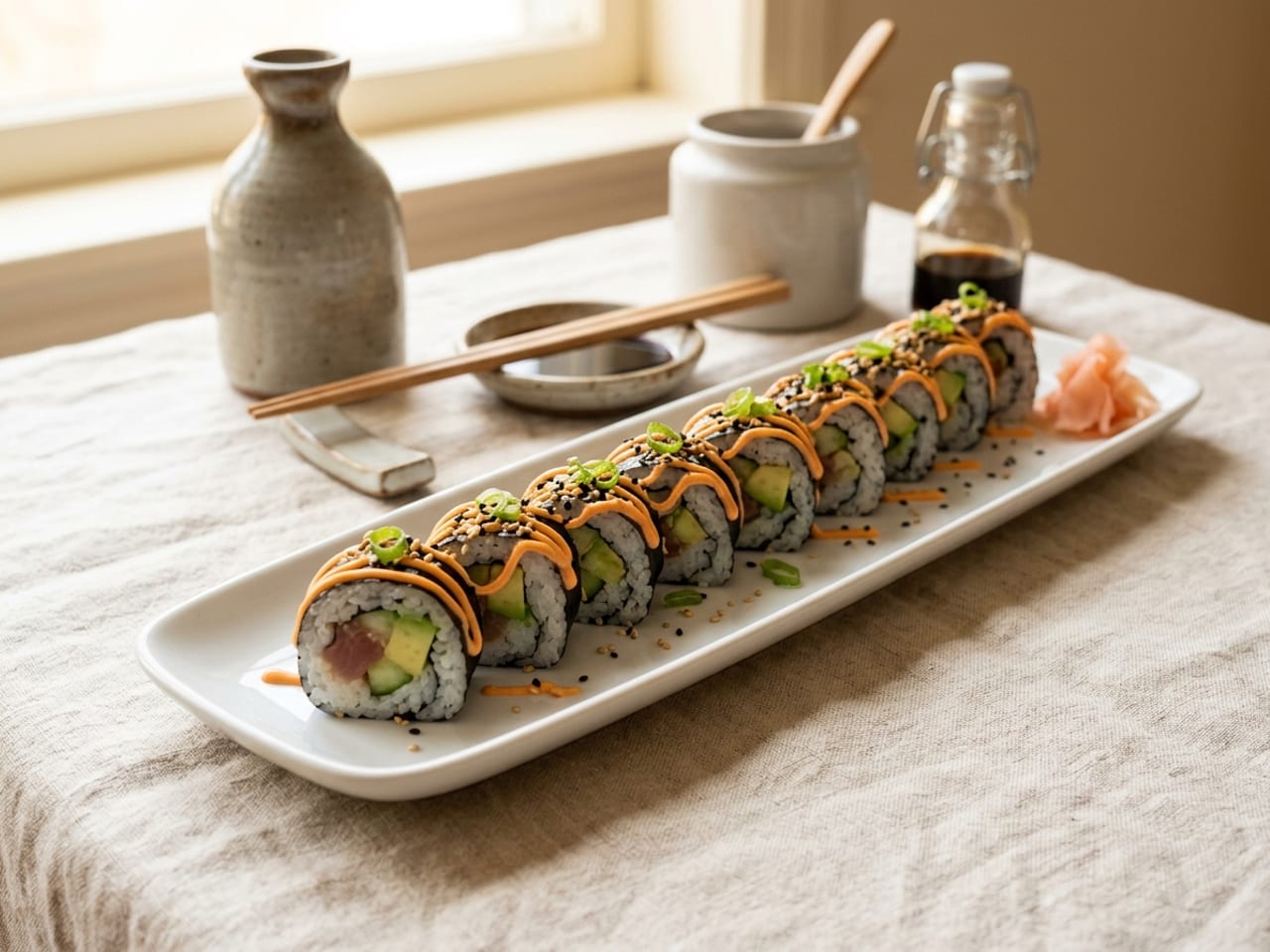
- Bottle it to drizzle. For sushi and bowls, spoon it into a squeeze bottle and keep it covered: left open, the top "can oxidize and change in color".111
| Whose recipe | How much, as printed |
|---|---|
| America's Test Kitchen, Spicy Aïoli (hot sauce)103 | 1 tsp to ½ cup (120 ml): 2 tsp a cup (ours) |
| America's Test Kitchen, Spicy Mayonnaise102 | 2 tbsp to 1 cup (240 ml) |
| Bon Appétit (Martinez)101 | 3 tbsp to 1 cup (240 ml) |
| NYT Cooking (Edge)105 | ½ cup (120 ml) to 2 cups (480 ml): 4 tbsp a cup (ours) |
| Alyona's Cooking (blog)111 | 2 Tbsp to ½ cup (120 ml): 4 tbsp a cup (ours) |
| America's Test Kitchen, salmon burgers104 | 1 to 2 tbsp to ¼ cup (60 ml) |
| BBC Good Food (Goldsmith)108 | 1 to 2 tbsp to 6 tbsp |
| Joe Beef (Morin), Bon Appétit107 | 1 tbsp to 3 tbsp: about 5⅓ tbsp a cup (ours) |
| Bon Appétit (Saffitz), sambal oelek, not sriracha110 | 3 tbsp to ½ cup (120 ml): 6 tbsp a cup (ours) |
| Delish (Xie)109 | ¼ cup (60 ml) to 6 tbsp: about 10⅔ tbsp a cup (ours) |
What it goes with. Sushi and poke bowls (NYT Cooking; "spicy mayo for sushi" and "hibachi" in US searches), onion rings and fries (NYT Cooking), salmon burgers (America's Test Kitchen), crab croquettes (BBC Good Food), a roast pork sandwich (Joe Beef), and fries, burgers and fried rice (Delish).72, 104, 105, 106, 107, 108, 109
How long it keeps. Bon Appétit makes it 1 day ahead; on a jar base, Delish says "a week or more" in a clean jar and a blog a month.101, 109, 111 On homemade mayonnaise, the homemade clock applies (storage).
The catch. Heat varies by bottle and by eater. Hot sauce is one of the condiments Americans most often dislike (YouGov), so start at the low end and serve some plain.60 Kewpie makes a richer, tangier base (Kewpie).
3. Chipotle mayo recipe · smoky
Why it is here. Hellmann's says its Chipotle Mayo is the top performer of its 2024 flavours (a brand statement); Datassential reports "consistent growth on menus"; it is the third flavour name in US search (our pull), weaker in the UK.57, 64, 70 Confidence: Medium to high (our call).
Makes a little over 1 cup (about 290 ml, ours), 5 minutes plus an hour's rest. Our synthesis of the cited recipes, not one we tested.
| Ingredient | US | Metric | Why |
|---|---|---|---|
| Mayonnaise | 1 cup (240 ml) | 240 ml | Wiseman's base for her tacos.112 |
| Chipotles in adobo, minced, with their sauce | 2½ tbsp | 2½ tbsp | Ours, a little under the cup-based recipes: Gourmet's 8 teaspoons (2⅔ tablespoons), Wiseman's 3 tablespoons and America's Test Kitchen's 10 teaspoons a cup (our arithmetic); start low, chipotles vary.112, 113, 114 |
| Lime juice | 1 tbsp | 1 tbsp | Wiseman's amount per cup (240 ml).112 |
| Garlic, grated (optional) | 1 small clove | 1 small clove | Ours; America's Test Kitchen adds a whole clove to its 6-tablespoon batch.115 |
- Mince the chipotles. Chop the chipotles to a paste with some of their adobo sauce; Gourmet seeds them first.112, 113
- Mix and rest. Stir into the mayonnaise with the lime juice and garlic, cover and refrigerate for at least 1 hour, as America's Test Kitchen does.115
- Thin to drizzle. To drizzle it over tacos, thin it with a little water.112
| Whose recipe | How much, as printed |
|---|---|
| America's Test Kitchen (with sour cream)115 | 2 tsp to 3 tbsp mayonnaise and 3 tbsp sour cream |
| Gourmet, with lime113 | 4 tsp to ½ cup (120 ml): 8 tsp a cup (ours) |
| Shelley Wiseman, Just Tacos112 | 3 tbsp to 1 cup (240 ml) |
| America's Test Kitchen, hushpuppies114 | 5 tsp to ½ cup (120 ml): 10 tsp a cup (ours) |
| Sam Sifton, Chipotle Kewpie116 | 5 chipotles to 2 cups (480 ml) of Kewpie |
| Martha Rose Shulman (with yogurt)118 | 1 large or 2 small chipotles to ¼ cup (60 ml) mayonnaise and ½ cup (120 ml) yogurt |
| Jane Daniels Lear119 | "a smidgen" of puréed chipotles |
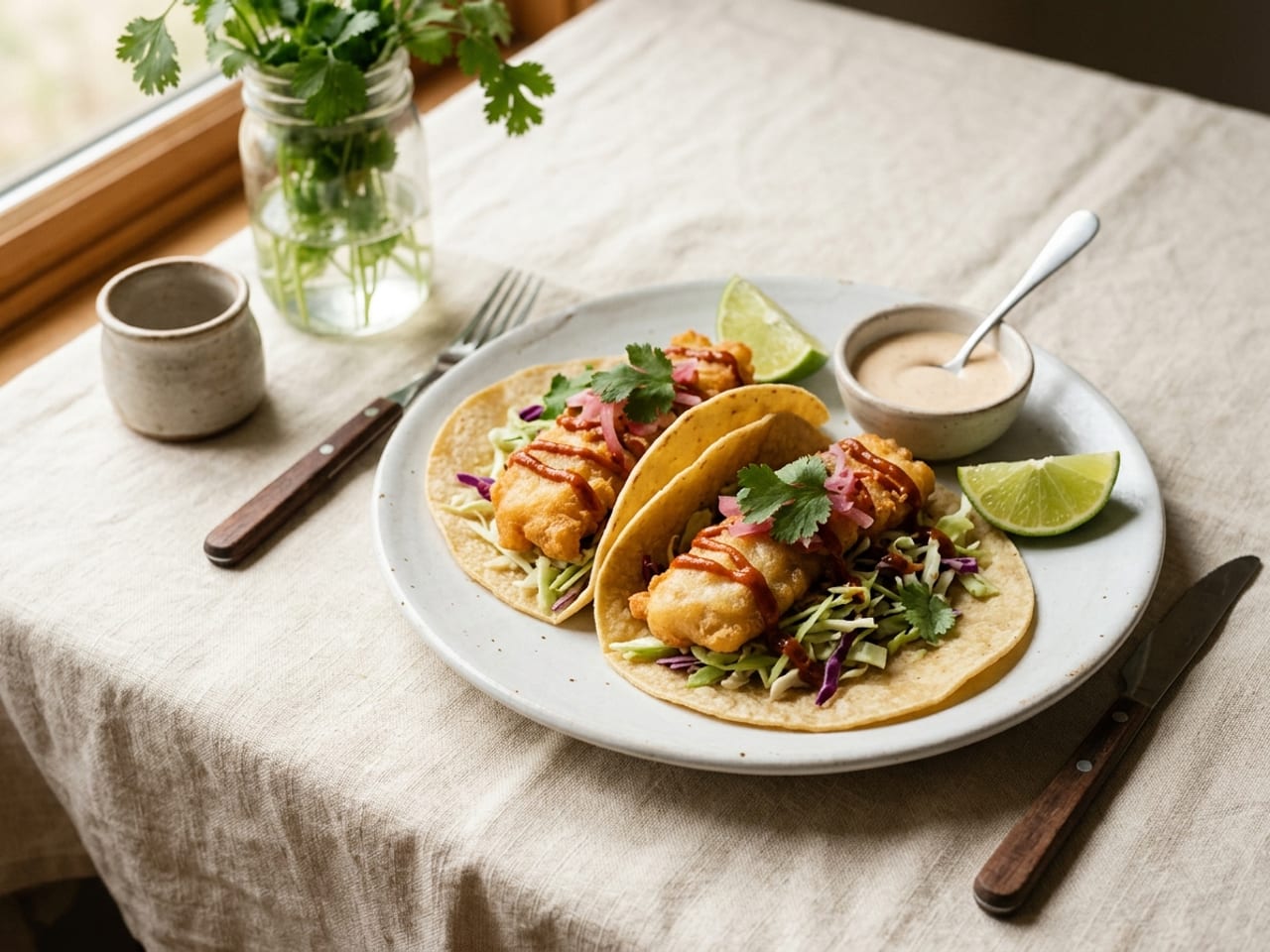
What it goes with. Fish tacos (Sifton) and fried avocado tacos (Wiseman), grilled corn (Gourmet, Shulman), hushpuppies (America's Test Kitchen), and, on menus, Tex-Mex dishes, sandwiches and burgers (Datassential).57, 112, 113, 114, 117, 118
How long it keeps. Sifton's Kewpie version keeps "at least a week"; nothing else we read gives a figure.116 On homemade mayonnaise, the homemade clock applies (storage).
The catch. The heat is in the smoke and the sauce. Chipotles are smoked jalapeños (Nation's Restaurant News), and the recipes count the adobo sauce in their measure.57, 112, 113 Per cup (240 ml), amounts run from about 5⅓ teaspoons in America's Test Kitchen's mayonnaise and sour-cream blend to 10 teaspoons, over 3 tablespoons, in its hushpuppy aioli (our arithmetic), so add it in stages (ours).114, 115Hellmann's jar adds honey and lime (the maker's description).64
4. Truffle aioli recipe · luxe
Why it is here. In what we read, the only flavour besides sriracha aioli (a sponsored figure) with a published national menu figure: on 1.7% of US menus, up 22% in four years (Datassential); Hellmann's sells a truffle mayo in Europe and Heinz launched one in the UK.55, 63, 65 But home cooks barely search for it (7.7 to garlic aioli's 100 in our pull), and none of the five recipe sites we checked has a truffle mayonnaise: the recipes below are two blogs.70, 71 Confidence: Medium to low (our call): strong on menus, weak at home.
Makes about 1 cup (240 ml), in 5 minutes. Our synthesis of the cited recipes, not one we tested.
| Ingredient | US | Metric | Why |
|---|---|---|---|
| Mayonnaise | 1 cup (240 ml) | 240 ml | Both blog recipes start from a cup (240 ml) of bought mayonnaise.120, 121 |
| Truffle oil | ½ tbsp to start | ½ tbsp to start | Chef Not Required starts at ½ tablespoon, Stem and Spoon at 1 and goes to 3: a sixfold spread.120, 121 |
| Garlic, grated | 1 small clove | 1 small clove | Ours: the blogs use 1 and 2 cloves.120, 121 |
| Lemon juice | 1 tsp | 1 tsp | Stem and Spoon's amount.121 |
| Whose recipe | How much, as printed |
|---|---|
| Chef Not Required (blog)120 | ½ tbsp truffle oil to 1 cup (240 ml), "add more to taste" |
| Stem and Spoon (blog)121 | 1 to 3 tbsp truffle oil to 1 cup (240 ml), starting at 1 |
What it goes with. French fries and mussels (Nation's Restaurant News); crab cakes, steaks, burgers and vegetables (Stem and Spoon); "truffle aioli fries" is a US search (our pull).55, 72, 121
How long it keeps. Stem and Spoon keeps its jar-based version up to 1 week; nothing else we read gives a figure.121 On homemade mayonnaise, the homemade clock applies (storage).
The catch. Truffle oil is mostly aroma. Nation's Restaurant News: truffle aïoli is usually made with truffle oil, "which often doesn't have truffles in it at all".55 The key aroma of the Alba white truffle, bis(methylthio)methane, also exists in synthetic form, and telling the two apart takes laboratory analysis; the study does not say how many of the products it tested were synthetic.122 Brands vary, so start small (ours).
5. Burger sauce (special sauce) recipe · tangy
Why it is here. "Burger sauce" draws more searches than any flavour name in our pull, 169 to garlic aioli's 100 in the US and 538 in the UK, with "fry sauce" at 250; four of the five recipe sites carry one, and Heinz Canada says nearly three-quarters of Canadians who dip mayo mix it with ketchup or hot sauce (a brand claim).67, 70, 71 "Burger sauce" is a broader term than a flavour, so the comparison is loose. Confidence: Medium (our call): the biggest search, but a named sauce rather than one recipe.
Makes about 1¾ cups (about 440 ml, ours), in 5 minutes. Our synthesis of the cited recipes, not one we tested.
| Ingredient | US | Metric | Why |
|---|---|---|---|
| Mayonnaise | 1 cup (240 ml) | 240 ml | The base of every burger sauce we read.123, 124, 126, 127 |
| Ketchup | ½ cup (120 ml) | 120 ml | Two parts mayonnaise to one of ketchup, as Epicurious and America's Test Kitchen's classic sauce do; BBC Good Food uses 3 to 2, RecipeTin Eats none.123, 124, 126, 127 |
| Dill pickles or cornichons, finely chopped (or sweet relish) | 3 tbsp | 3 tbsp | Ours, near RecipeTin Eats's 2 tablespoons of gherkins per ¾ cup (180 ml); BBC Good Food uses cornichons, America's Test Kitchen sweet relish.124, 126, 127 |
| Yellow mustard | 1 tbsp | 1 tbsp | Ours: RecipeTin Eats uses 1 tablespoon per ¾ cup (180 ml) of mayonnaise, Epicurious 2 tablespoons per ½ cup (120 ml).123, 127 |
| Pickle juice | 1 tbsp | 1 tbsp | Epicurious's tablespoon "from the jar".123 |
| Sugar or honey | 2 tsp | 2 tsp | RecipeTin Eats's sugar; Epicurious uses honey.123, 127 |
| Onion powder and smoked paprika | ½ tsp each | ½ tsp each | ½ teaspoon each in both recipes; Epicurious's paprika is smoked, RecipeTin Eats's plain.123, 127 |
- Mix. Mix everything together, as BBC Good Food does.126
- Taste and adjust. More ketchup for a pinker, sweeter sauce, more pickle for tang; for the no-ketchup style, leave it out (ours, from the range below).
- Chill until needed. Cover and keep it cold until the burgers are ready (ours).
| Whose recipe | How much, as printed |
|---|---|
| Epicurious (Boone)123 | ½ cup (120 ml) mayonnaise to ¼ cup (60 ml) ketchup: 2 to 1 |
| America's Test Kitchen, Classic Burger Sauce124 | 2 tbsp mayonnaise to 1 tbsp ketchup: 2 to 1 |
| BBC Good Food, Classic burger sauce126 | 3 tbsp mayonnaise to 2 tbsp ketchup: 3 to 2 |
| RecipeTin Eats, Special Burger Sauce127 | ¾ cup (180 ml) mayonnaise, no ketchup |
| America's Test Kitchen, Pub-Style125 | ¾ cup (180 ml) mayonnaise with soy sauce, no ketchup |
What it goes with. Burgers in every recipe, and hot dogs too (BBC Good Food).123, 124, 126, 127 Searches for "fry sauce" suggest fries as well (our pull).70
How long it keeps. RecipeTin Eats: "for the shelf life of the mayonnaise", on a bought base; Epicurious makes it "5 days ahead; keep chilled".123, 127 On homemade mayonnaise, the homemade clock applies (storage).
The catch. It is two sauces. Three of the five recipes we read use ketchup and two do not, and RecipeTin Eats sets its ketchup-free sauce apart from Thousand Island, which it calls "a mix of mayonnaise and ketchup".123, 124, 125, 126, 127 Our card follows the ketchup majority (ours).
Also popular: lemon-herb mayonnaise
The runner-up: plenty of recipes, little evidence of demand
Lemon aiolis (garlic aioli with extra lemon) turn up on four of the five sites we checked and herb mayonnaises on four, and Hellmann's added an Italian Herb & Garlic flavour, basil and oregano, in 2024 (the maker's description), but every search figure is small: lemon aioli 15.4, dill mayo 7.7 and herb mayo 3.8 to garlic aioli's 100 (our pull).64, 70, 71 Bon Appétit's version stirs ½ cup (120 ml) of chopped tender herbs (basil, chives, parsley and/or tarragon), a garlic clove, 1 teaspoon of lemon zest and 2 tablespoons of lemon juice into 1 cup (240 ml) of mayonnaise, "use within one day"; America's Test Kitchen's herbed aioli keeps up to 3 days, and BBC Good Food stirs the zest of a lemon and a bunch of chives into a scratch mayonnaise.128, 129, 130
Aioli vs mayo: what the dictionaries and the Catalan sources say
Is aioli just garlic mayonnaise? It depends whose aioli. Each source in its own words:
| Who | What they say |
|---|---|
| The Spanish Academy92 | Alioli, from Catalan allioli: "Salsa hecha de ajos machacados y aceite", crushed garlic and oil. No egg. |
| The purists, as Barcelona and Australian writers report them81, 89, 91 | Garlic, oil and salt, with a single drop of white wine or sherry vinegar for some; but "many, if not most, restaurants" add yolks (Barcelona Metropolitan), and "almost everyone uses a little egg yolk" (Gourmet Traveller). Gourmet's egg-free Classic Aïoli starts in a blender, then takes about 15 minutes in a mortar, and "will separate if oil is added too quickly". |
| Catalan historians, via Catalan public radio90 | Citing Vicent Marquès and Josep Lladonosa, 3Cat says the version with yolk or whole egg "és més corrent a les fonts documentals antigues que no pas sense": more common in the old sources than the one without. |
| Escoffier (1907)18, 19 | His aïoli is its own sauce: garlic pounded in a mortar, "the yolk of one raw egg", salt and oil, and if it breaks, start again with a yolk. It is not made from his mayonnaise, unlike his Andalouse, which begins "Take the required quantity of Mayonnaise sauce". |
| English dictionaries93, 94, 95 | "a cold, thick sauce made from garlic, eggs, and olive oil" (Cambridge); "a thick cold sauce made of mayonnaise and garlic", from Provençal ai, garlic, and oli, oil (Oxford Learner's); "a garlic-flavored mayonnaise of Provence", first recorded 1895 to 1900 (Dictionary.com). |
| American menus and food pages55, 85, 95 | In the US, "aïoli" is "virtually synonymous with mayonnaise" (Nation's Restaurant News), and NYT Cooking calls jarred mayonnaise with garlic, lemon and paprika an aioli; Dictionary.com notes the word is sometimes "a fancier word for mayonnaise". |
What this page follows (ours). The purists' allioli is garlic, oil and salt in a mortar; the versions with egg are old and now usual, and in the US the word covers any garlicky or flavored mayonnaise. We call a garlic sauce with egg "garlic aioli", as menus do, and never claim the egg-free one is the only original.55, 90, 92
Store-bought vs homemade mayonnaise: the US standard, Kewpie, Duke's and Hellmann's
What the law and the makers say is in the jar. A maker's claim is labelled as one.
| What | What it says | Whose words |
|---|---|---|
| The US standard of identity | Mayonnaise is "the emulsified semisolid food" of vegetable oil, an acid and an egg yolk-containing ingredient, with "not less than 65 percent by weight of vegetable oil"; the acid is vinegar, or lemon or lime juice, of at least 2½% acidity; yolks or whole eggs both qualify. Salt, sweeteners, MSG and spices are optional, but saffron and turmeric are excluded by name, and no other spice may give "a color simulating the color imparted by egg yolk". A rule of 13 October 2026 adds salt substitutes to the options.1, 3 | regulation |
| "Salad dressing" (the spoonable kind) | A different US standard: at least 30% oil and egg yolk equal to 4% liquid yolk, with a starchy paste added. That is the Miracle Whip type of jar (the brand name is ours, not the regulation's).2 | regulation |
| Europe | At the Codex committee for Europe in 2000, the EU observer said "no specific regulations on mayonnaise were currently in force in the European Union"; an industry body put the usual fat at 70 to 80% and the yolk at 5%; eight countries had legal standards and eight more industry ones, and no consensus was reached on a regional standard.4 | intergovernmental report |
| Kewpie (Japan) | "carefully crafted using only egg yolks, not whole eggs", launched in 1925 by Toichiro Nakashima after he tasted mayonnaise in the United States in the 1910s; its oil droplets are 2 to 4 thousandths of a millimetre, finer than homemade; and it founded its own vinegar maker in 1962 to develop a "mayonnaise-specific vinegar" from apple juice and malt, because the mostly rice-based vinegars of Japan did not suit mayonnaise.49 The US bottle lists distilled, rice, white balsamic and cider vinegars, MSG and sugar; the Japan bottle vinegar, MSG and no sugar.50 | maker's statements and labels |
| Duke's (US South) | Soybean oil, "eggs" (not yolks only, by the label), water, distilled and cider vinegar, salt, paprika oleoresin and EDTA; "0g Added Sugars"; "made with Eugenia Duke's original recipe since 1917".51 | maker's statements |
| Hellmann's Real (US) | Soybean oil, water, whole eggs, distilled vinegar, egg yolks, salt, sugar, lemon juice concentrate, EDTA and natural flavours.52, 53 The maker says its eggs are pasteurized and its recipes "carefully crafted to prevent the growth of harmful bacteria", so it is "safe to use during pregnancy".53 | maker's statements; label also on Open Food Facts (crowd-sourced) |
| Is jarred mayonnaise made with pasteurized egg? | In the US, every egg product sold must be pasteurized, and egg products go into "prepared mayonnaise" (USDA); the UK's Food Standards Agency says commercial mayonnaise is "often" made with pasteurised egg; Australia's food agency calls commercial versions safer because they are "heat treated or produced using pasteurised eggs".134, 140, 145 The FDA pages we read do not say it. | agencies |
Where homemade differs (ours, from the rows above and the sections below). In the US a jar's egg products must be pasteurized, its acidity is set by the maker (a highest target of pH 4.4 in one review), and its oils are chosen to stay liquid in the fridge; a commercial-products review found no illness reported from commercially made acidic dressings and called them "very safe" (its author worked at a commercial laboratory).9, 134, 156 Homemade has none of those guarantees: it is raw egg unless you pasteurize or heat it, at whatever acidity your recipe happens to have, and it keeps days, not months (safety, storage). What it has is freshness, your own oil and seasoning, and no sugar or EDTA unless you add them.
Is homemade mayonnaise safe? Raw-egg advice country by country
Homemade mayonnaise is a raw-egg food unless the eggs are pasteurized or the yolks heated, and the agencies disagree about what that means. Each country in its own words, not blended; where a rule is for food businesses, it says so.
| Where | Who | What they say |
|---|---|---|
| United States | USDA Food Safety and Inspection Service (home cooks) | "Everyone is advised against eating raw or undercooked egg yolks and whites or products containing raw or undercooked eggs", naming "homemade mayonnaise"; infants, young children, older adults, pregnant women and people with weakened immune systems are "particularly vulnerable". Pasteurized in-shell eggs "may be used safely without cooking"; pasteurizing at home is "very difficult".133 |
| United States | FDA and CDC (home cooks) | Clean, uncracked eggs "may contain bacteria called Salmonella"; for dishes served with raw egg, use treated shell eggs or pasteurized egg products (FDA, whose examples are Caesar dressing and ice cream, not mayonnaise). Fewer hens carry it than in the 1980s and 1990s, "But some eggs are still contaminated" (CDC). The FDA's pregnancy booklet does not name mayonnaise but calls bought foods "made with pasteurized eggs" lower risk.132, 135, 138 |
| United States | FDA Food Code 2026 (restaurants, where a state adopts it) | Pasteurized eggs "shall be substituted for raw" eggs in mayonnaise unless it is cooked or served raw on a customer's request with the consumer advisory; in places that serve a highly susceptible population (the Code's term), always.137 |
| United Kingdom (England, Wales, Northern Ireland) | Food Standards Agency and NHS | Young children, pregnant people, older people and those with an underlying condition "can now safely eat raw or lightly cooked hen eggs" marked British Lion or produced under Laid in Britain; the NHS lists mayonnaise made with them as "safe to eat" in pregnancy. Not for the severely immunocompromised on medically supervised diets. Other eggs, including those from outside the UK, are cooked thoroughly for vulnerable groups. For caterers, "very low" risk is not "negligible", and "fresh mayonnaise" needs extra care.139, 140, 141, 142 |
| Germany | Federal Institute for Risk Assessment (BfR) | "Avoid using raw eggs in dishes that are to be consumed without being heated further (e.g. desserts, mayonnaise ...)"; foods with raw egg are not recommended for small children, pregnant women or people with weakened immune systems unless fully heated. The BfR names no exception for any egg scheme.143 |
| European Union | EFSA and ECDC (surveillance, not advice) | Salmonella in "eggs and egg products" was the agent and food pair "of most concern" in 2024, and of strong-evidence Salmonella Enteritidis outbreaks, 39% were in homes and 31% in restaurants, cafés, pubs, hotels or catering. We found no EFSA consumer page on mayonnaise; member states give the advice.144 |
| Australia and New Zealand | Food Regulation System guidelines, NSW Food Authority, WA Health (food businesses) | Use commercial sauces or pasteurized egg first; if raw egg is used, acidify to pH 4.2 or lower, keep it at or below 5°C (41°F, ours) and throw it out after 24 hours. "At least 5ml" of vinegar per egg is a starting guide, then measure the pH. Sous vide eggs at 57°C (134.6°F, ours) for at least 75 minutes is the agencies' example for businesses, with commercial equipment and a thermometer accurate to 0.1°C.145, 146, 147 |
| Australia and New Zealand | FSANZ (consumers) | For vulnerable people, raw and lightly cooked eggs "in milkshakes, mayonnaise and aioli" are higher risk; the safer alternative is commercial mayonnaise and aioli.148 |
| New Zealand | Ministry for Primary Industries (pregnancy) | Raw eggs in "home-made mayonnaise and dressings": "Don't eat". Bought mayonnaise: store it in the fridge once opened.149 |
Does the lemon juice or vinegar make it safe?
The agencies: no. "Acidification does not make the food safe but may slow the growth of Salmonella" (the Australian and New Zealand guidelines); the acid "will not kill bacteria" (WA Health); and most raw-egg sauces "do not contain enough vinegar to actually kill the Salmonella".145, 147
The research is more complicated, and is not a method. In one study Salmonella from contaminated yolks "could survive the mayonnaise-making process" and lasted longer with vinegar than with lemon juice at 4°C (39°F, ours); others found vinegar more lethal than lemon at the same pH, and a review says there is "no consensus regarding the critical pH limit".150, 152, 154, 156 Where acid did kill it, it took from 2 hours to 3 days depending on the study, fastest when warm (vinegar to pH 3.9 in one lab study: 2 hours at 25°C (77°F, ours), 24 hours at 8°C (46°F, ours)), and in other studies cold "protected" the bacteria from the acid.151, 152, 153, 155 No agency advises leaving homemade mayonnaise out to let that happen; the US limit for egg dishes is 2 hours out of the fridge, 1 above 90°F (32°C, ours), and we follow it.132 Sauces made with a whole egg run at a higher pH than yolk-only ones and kept Salmonella alive longer.153
Who should not eat raw-egg mayonnaise
The US agencies name children (CDC: under 5), older adults (CDC: 65 and over), pregnant women and anyone with a weakened immune system; USDA adds infants.132, 133, 135 Australia's list adds unborn and newborn babies.145 In the UK, those groups may eat it made with British Lion or Laid in Britain eggs, except the severely immunocompromised.139 For them, and for anyone outside the UK, the agencies' answer is commercial mayonnaise or pasteurized eggs.132, 133, 148
Pasteurized eggs, and heating the yolks yourself
Pasteurized in-shell eggs "may be used safely without cooking", and eggs treated to destroy Salmonella are usually labelled so in the US.132, 133 Liquid pasteurized egg products can stand in too, though USDA says they are "best used in a cooked product, especially if served to high-risk persons", and keep no more than 3 days once opened.134 USDA calls pasteurizing shell eggs at home "very difficult" and gives a route instead: heat the eggs "separately from all other ingredients in a liquid form over low heat, stirring constantly, until the mixture reaches 160 degrees F" (71°C, ours), then make the sauce (heated yolks).133 The only agency text we found on sous vide eggs is the Australian business example, 57°C (134.6°F, ours) for at least 75 minutes with commercial equipment; a university recipe sheet's home tip of about 3 minutes at 140°F (60°C) is nowhere near it (ours).145, 146, 169
When it went wrong
A 2009 wedding in Australia: Salmonella traced to a garlic aioli of raw yolk, roasted garlic, Dijon, vinegar and oil, vinegar and all.100 A 1988 UK outbreak in one large building, 120 of 474 people who answered ill, was "significantly associated with foods containing mayonnaise"; in a 1996 Saudi restaurant outbreak the blender mayonnaise had been kept at room temperature for a median of 6 hours.157, 158 The NSW Food Authority lists mayonnaise and aioli among the raw-egg foods most often implicated, and the national guidelines warn that one contaminated egg can taint a whole batch.145, 146
Egg and mustard allergy
Eggs are one of the nine major allergens in the US, but mustard is not; in the UK and the EU both eggs and mustard are declared allergens, including on loose food in the UK.173, 174, 175 A Scottish NHS children's allergy leaflet (past its review date) counts "Fresh and shop-bought mayonnaise" as raw egg.176
How long homemade mayonnaise keeps, and whether it freezes
The fridge times we read for a homemade mayonnaise or aioli, 29 rows, in each source's own words; one, Larousse, gives no time and is here because it advises against the fridge, and a few scratch aiolis behind the flavour cards fall inside the same spread. Only four come from food agencies, and three of those are rules for food businesses.
| Who | What kind of source | The eggs | How long, as printed |
|---|---|---|---|
| Food Regulation System guidelines (Australia and New Zealand, food businesses)145 | agency | raw, acidified to pH 4.2 or lower | "no longer than 24 hours i.e. should be discarded at the end of the day" |
| NSW Food Authority (food businesses)146 | agency | raw, acidified to pH 4.2 or lower | "no longer than 24 hours", at or below 5˚C (41°F, ours) |
| WA Health (food businesses)147 | agency | raw | "disposed of if it has not been used within 24 hours of manufacture" |
| USDA FoodKeeper, "Aioli, homemade"136 | agency | not stated | 3 to 4 days in the fridge (the entry's keywords include mayonnaise and garlic mayo) |
| Emeril Lagasse162 | chef | raw whole egg and yolk | "for up to 1 day" |
| Alice Waters (garlic mayonnaise)77 | chef | raw yolk | "eaten the same day it is made" |
| BBC Good Food, Basic mayonnaise22 | magazine | raw yolks | "two days" |
| BBC Good Food Middle East, How to make mayonnaise165 | magazine | raw unpasteurised yolks | "only keep for two days in the fridge" |
| BBC Good Food, Aioli sauce73 | magazine | raw yolks | "up to 2 days" |
| Bon Appétit (Wizenberg)21 | magazine | raw yolk | "up to 2 days ahead" |
| BBC Good Food, Garlic mayonnaise74 | magazine | raw yolks | "up to three days" |
| RecipeTin Eats41 | blog | raw yolk | 3 days, "because it contains raw egg yolk" |
| America's Test Kitchen, Herbed Aioli130 | test kitchen | raw yolks | "up to 3 days" |
| America's Test Kitchen, Garlic Mayonnaise88 | test kitchen | raw yolks | "up to 4 days" |
| The Cooking Guy (Sam Zien)166 | blog | raw whole egg | "about 4-5 days" |
| Alphafoodie (blog)167 | blog | raw whole egg | "5-7 days", calling the vinegar and lemon preservatives (unsourced) |
| Tasting Table164 | magazine | pasteurized | "up to four days", attributed to "the USDA" (we did not find that at USDA) |
| America's Test Kitchen, Easy Homemade Mayonnaise30 | test kitchen | raw whole egg | "up to 1 week" |
| America's Test Kitchen, Easy Homemade Aioli87 | test kitchen | raw whole egg | "up to 1 week" |
| Taste of Home163 | magazine | yolks heated to 160°F (71°C, ours) | "up to a week" |
| Cook's Illustrated (Lam)33 | test kitchen | raw, a general claim | "lasts only one to two weeks" |
| J. Kenji López-Alt24 | chef | raw yolks | "up to 2 weeks" |
| Pinch and Swirl (blog)38 | blog | raw whole egg | "Use within 2 weeks" |
| Served From Scratch (blog)168 | blog | raw yolks | "up to two weeks", longer with farm-fresh eggs (unsourced) |
| BBC Good Food, Vegan mayonnaise40 | magazine | no egg (soy milk) | "up to 2 weeks" |
| America's Test Kitchen, Make-Ahead32 | test kitchen | yolks heated to 160 to 165 degrees (71 to 74°C, ours) | "up to 1 month" |
| America's Test Kitchen, Kewpie-Style131 | test kitchen | yolks heated to 160 to 165 degrees (71 to 74°C, ours) | "up to 1 month" |
| University of Vermont saffron recipe sheet (not a food-safety unit)169 | other | raw whole egg | "up to several weeks", against every food agency we read |
| Larousse Gastronomique (1997; no time given)12 | other | raw yolks | no time: "On ne la réserve jamais dans le réfrigérateur, mais dans un endroit frais" (never in the fridge, a cool place), against every food agency we read |
Where they split. By the egg. Every agency figure is 24 hours (the Australian business rules, for raw-egg sauce) or 3 to 4 days (the USDA's homemade aioli, eggs not stated); the week-plus figures come from test kitchens, chefs and blogs, and the month only for yolks heated to 160 degrees F (71°C, ours), on America's Test Kitchen's own claim.32, 33, 136, 145 The USDA keeps raw yolks themselves 2 to 4 days.133
What we follow (ours). Raw-egg homemade mayonnaise and aioli: covered in the fridge, eaten within 3 to 4 days at most, the only agency figure for home cooks; make what you will use in a day or two. The fridge at 40°F (4°C, ours) or below (FDA); Germany's BfR says no more than 7°C (45°F, ours), below 5°C (41°F, ours) ideally.132, 136, 143 Herb versions are given short lives, though no source says the herbs are why: America's Test Kitchen keeps its herbed aioli up to 3 days, the same as its plain yolk aioli, and Bon Appétit's lemon-herb mayonnaise, made on a bought base, is for "use within one day". 86, 128, 130
Can you freeze mayonnaise?
No source we read recommends it. Hellmann's: "Do not freeze", because freezing breaks the emulsion into "a separated, oily, and unappealing texture"; the USDA marks egg salad "Not Recommended" for the freezer and says "Yolks do not freeze well"; Tasting Table says a thawed mayonnaise is still safe but grainy and watery.53, 54, 133, 136, 164
How long can mayonnaise sit out?
For egg dishes, the FDA says no more than 2 hours, or 1 above 90°F (32°C, ours).132 For an opened jar, Hellmann's says "no longer than four hours", while the USDA says shelf-stable commercial mayonnaise "is safe when stored at room temperature after opening" and the fridge label is about quality.54, 136 Those are jars; homemade follows the 2-hour rule (ours, after the FDA).
An opened jar
The USDA gives commercial mayonnaise 2 months in the fridge after opening and 3 to 6 months unopened in the pantry; Hellmann's says "up to 2-3 months" refrigerated.54, 136 For a flavored mayo stirred into a jar the figures vary: RecipeTin Eats says its burger sauce keeps "for the shelf life of the mayonnaise", Delish a week or more for spicy mayo, and NYT Cooking "at least a week" for chipotle Kewpie.109, 116, 127
Mayonnaise at a picnic
A 1982 study found commercial mayonnaise slowed the growth of Salmonella and Staphylococcus in meat salads, the most growth coming in salads without it, but warned it is no substitute for refrigeration; a food-safety researcher puts picnic trouble down to low-acid potatoes, pasta, chicken or eggs, warmth and hygiene: "it's rarely the mayonnaise".159, 160 Homemade is another matter: without the acid of commercial mayonnaise, "all bets are off" (the 1982 study's lead author, on NPR).161
How to plate with mayonnaise and aioli
A summary with mayonnaise in mind. Every move, with its steps and the thickness it needs, lives in our sauce plating guide, which counts plain mayonnaise as too thick for toothpick work and quotes an anonymous cook who wants a spoon-drag sauce with "the consistency of mayonnaise".
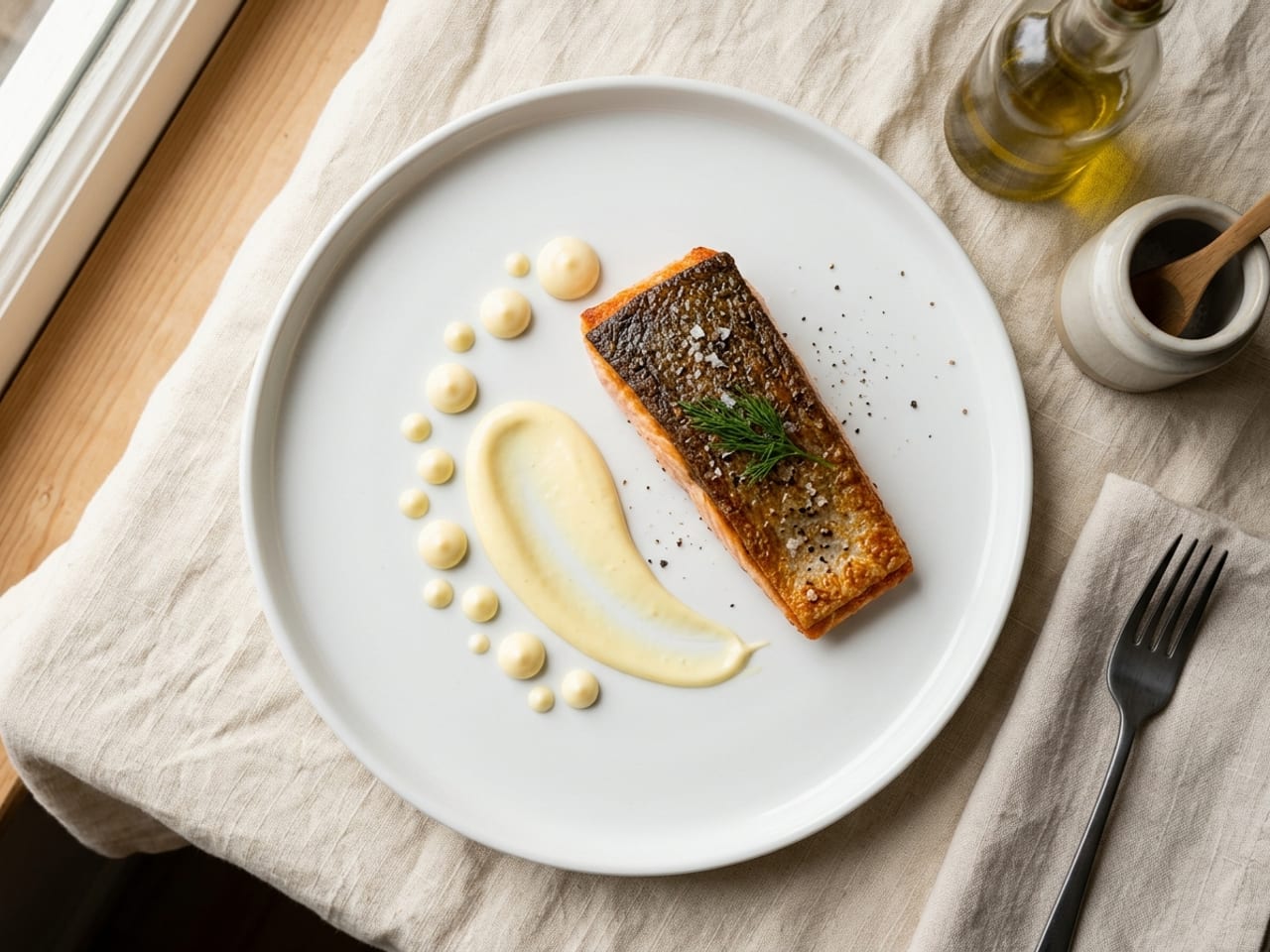
Dots
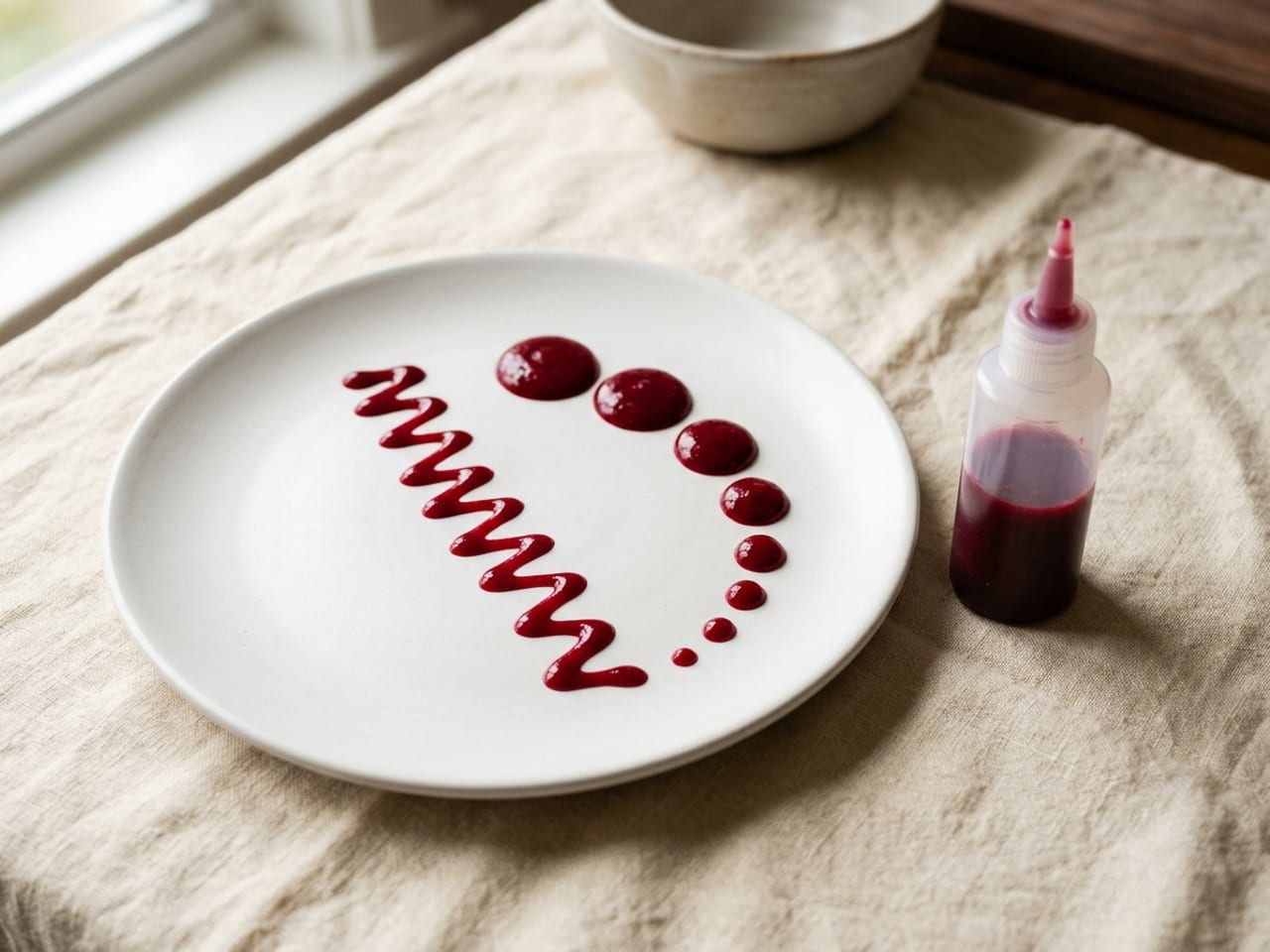
Eric Ripert, recalling dots of a mayonnaise and tomato sauce in Robuchon's kitchen: "The sauce is cold and thick when you start, but if you work too long, it warms up and thins"; they were dropped off the tip of a spoon, not from a squeeze bottle.171 So keep it cold until the last moment (our reading). Not everyone likes them: Delia Smith threatened to "go mad" at one more plate of six dots.171 The steps are in our sauce plating guide.
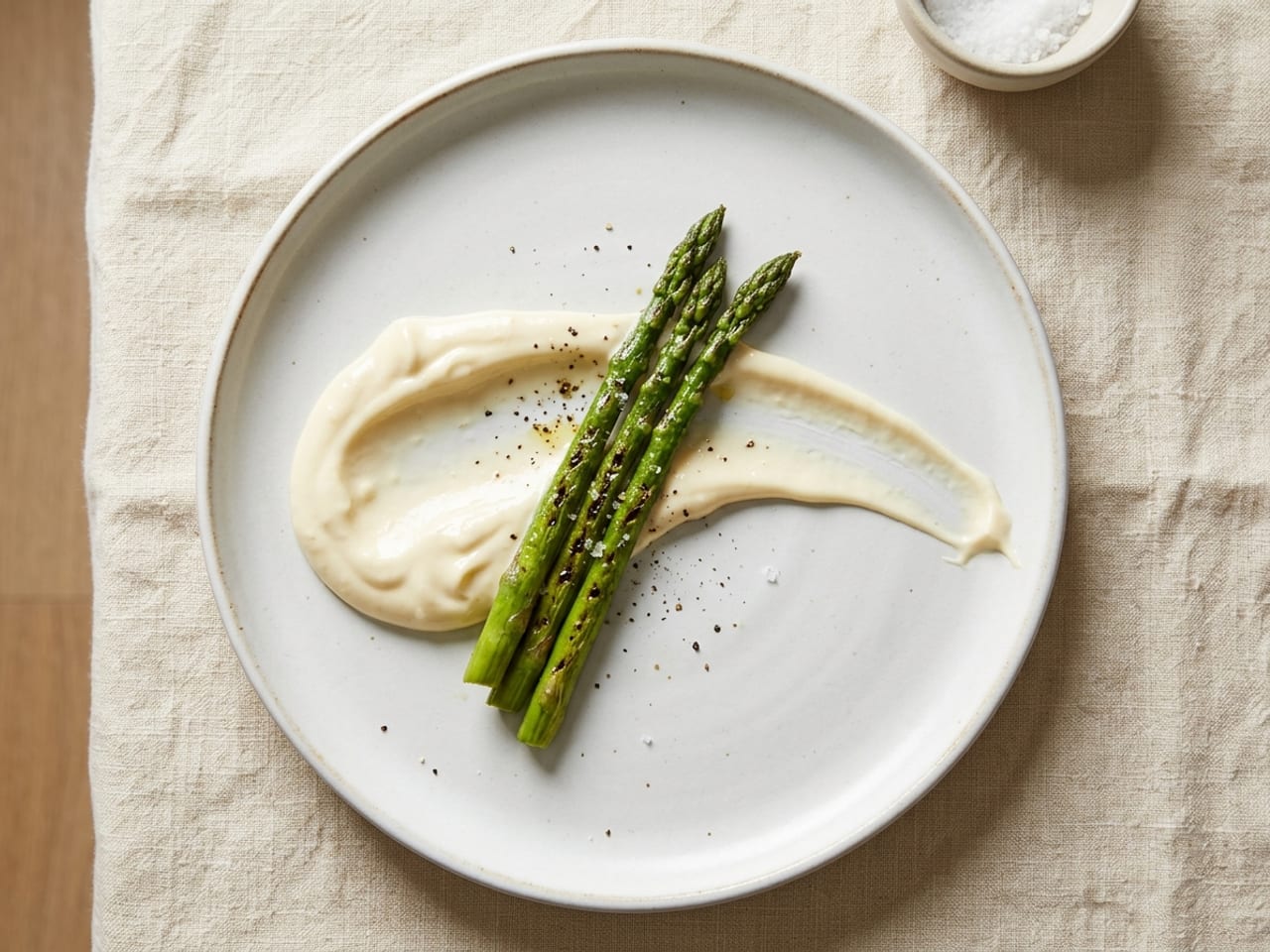
Swoosh
America's Test Kitchen's "Dollop and Swoop" is "meant for thick, smooth sauces like a rouille", so it holds its shape; mayonnaise and aioli are that thick already ("too stiff to pour", McGee).9, 172 The swoosh, step by step.
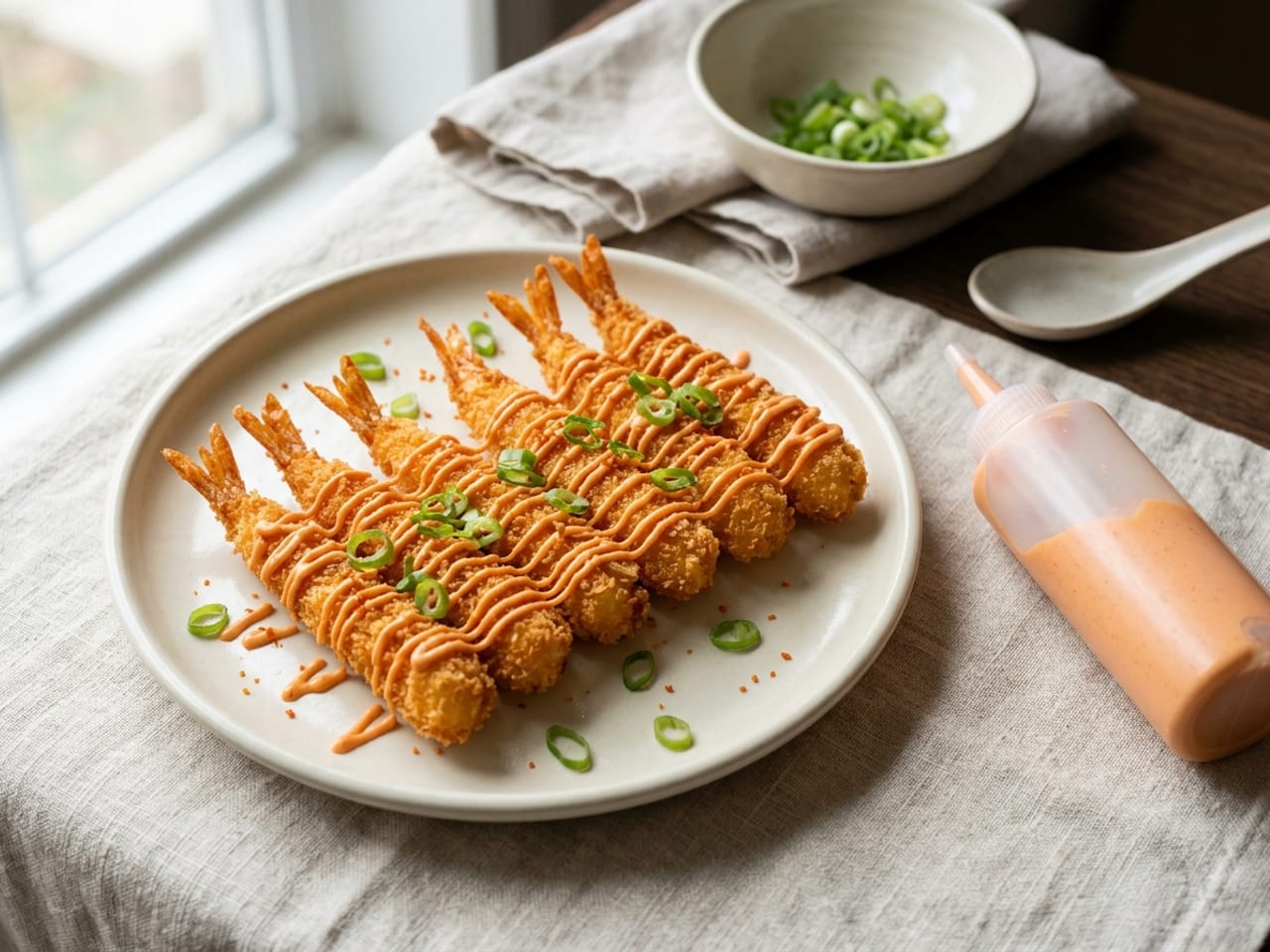
Drizzle from a squeeze bottle
Kewpie built its centenary campaign on the drizzle ("KEWPIE IT.", the maker's own words), and sushi spicy mayo goes into a squeeze bottle; thin a thick flavored mayo with a little water first, as Wiseman does for tacos.49, 111, 112 America's Test Kitchen wants a squeeze-bottle sauce "thick, smooth" enough to "stay put".172 More in sauce plating.
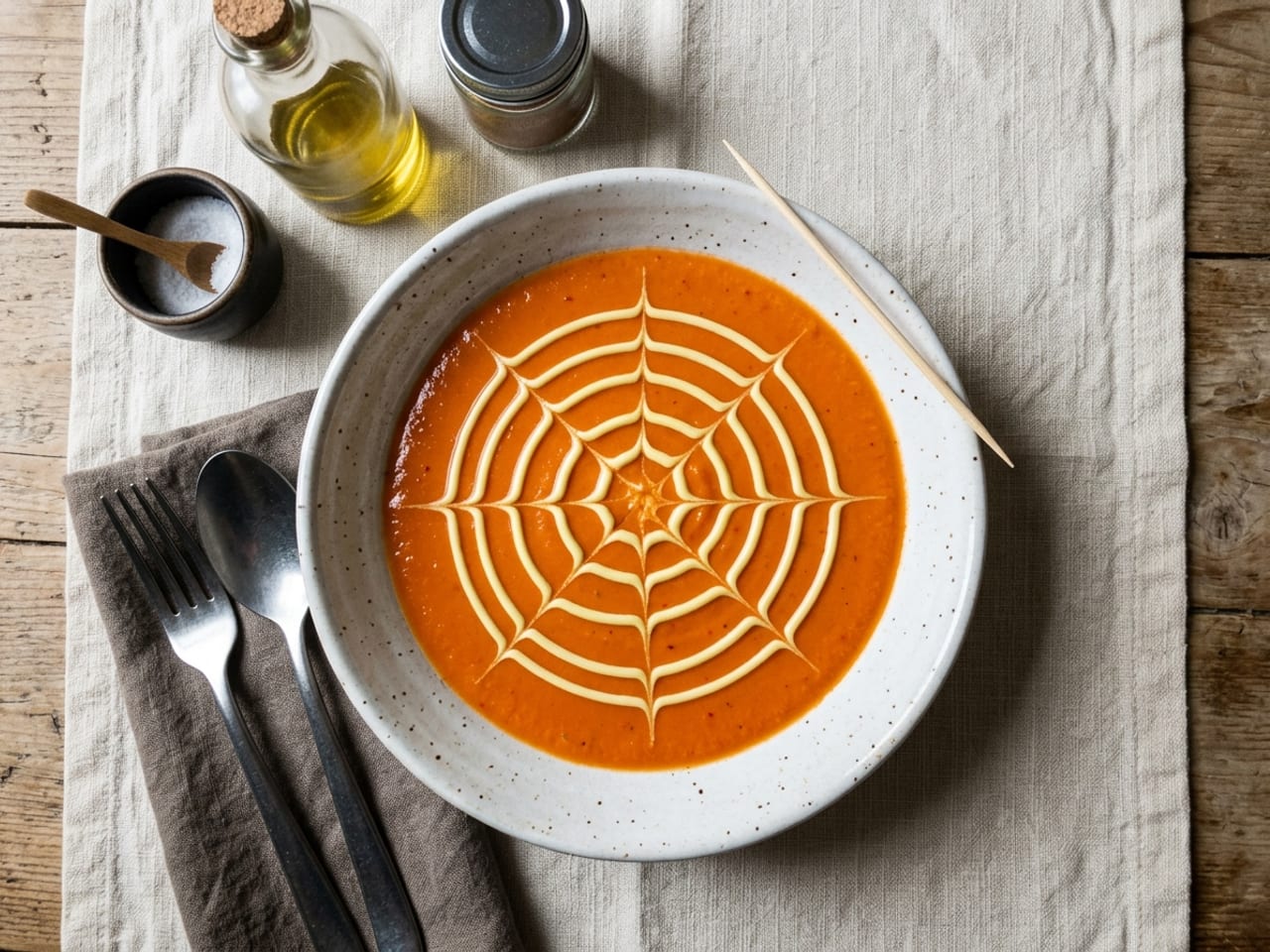
Toothpick patterns
Lines and circles dragged with a toothpick need a sauce "not too thick (such as plain mayonnaise)": thin it with lemon juice or another liquid, perhaps flavoured with curry powder or mustard (Julianne Glatz).170
A quenelle of aioli
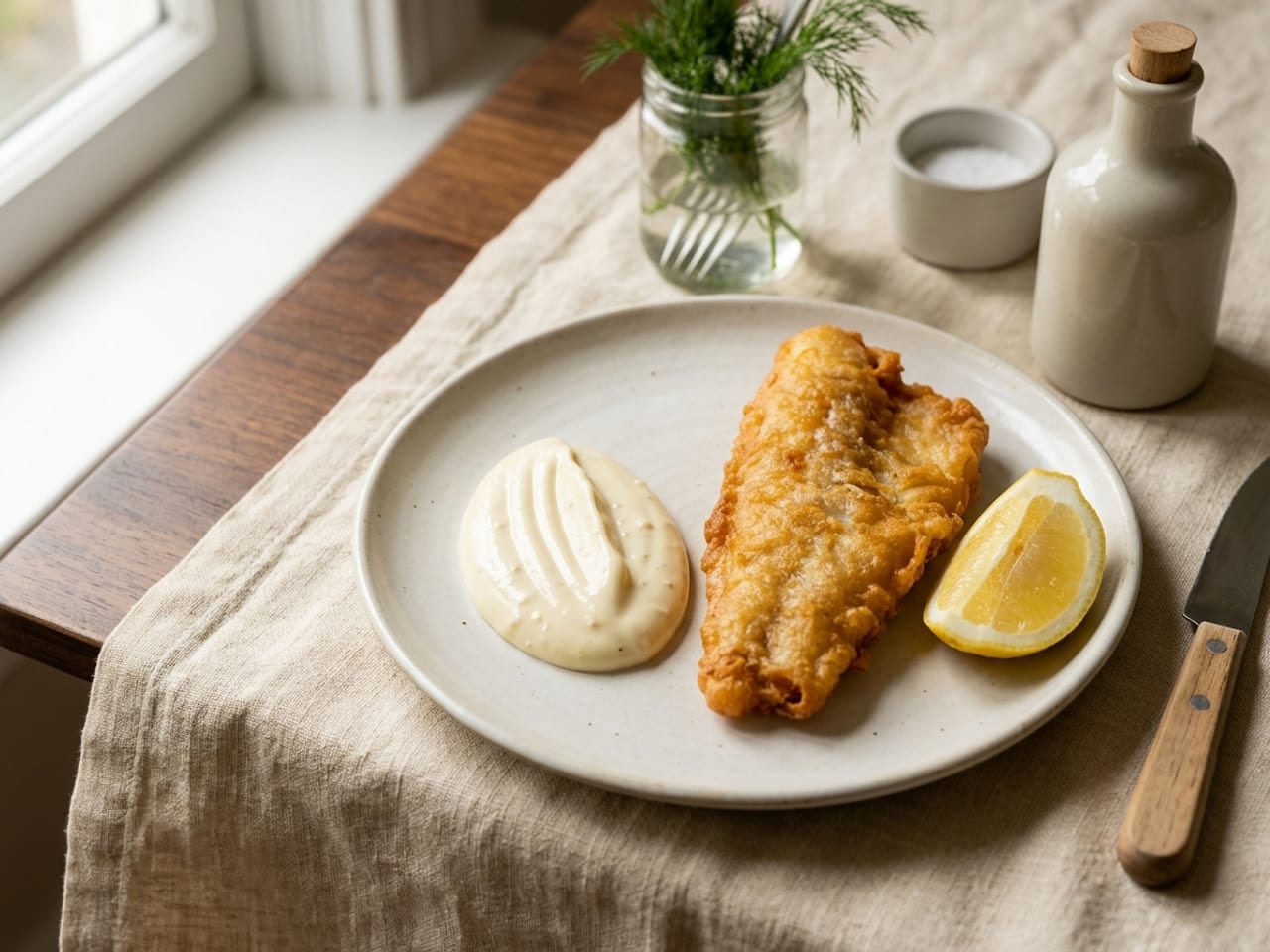
No source we read shapes mayonnaise or aioli into a quenelle; a stiff hand-whisked aioli, "thick enough to hold its shape", is the kind of texture the two-spoon oval needs (ours; Gisslen for the texture).11 How to shape one: our quenelle guide.
On warm food, not hot
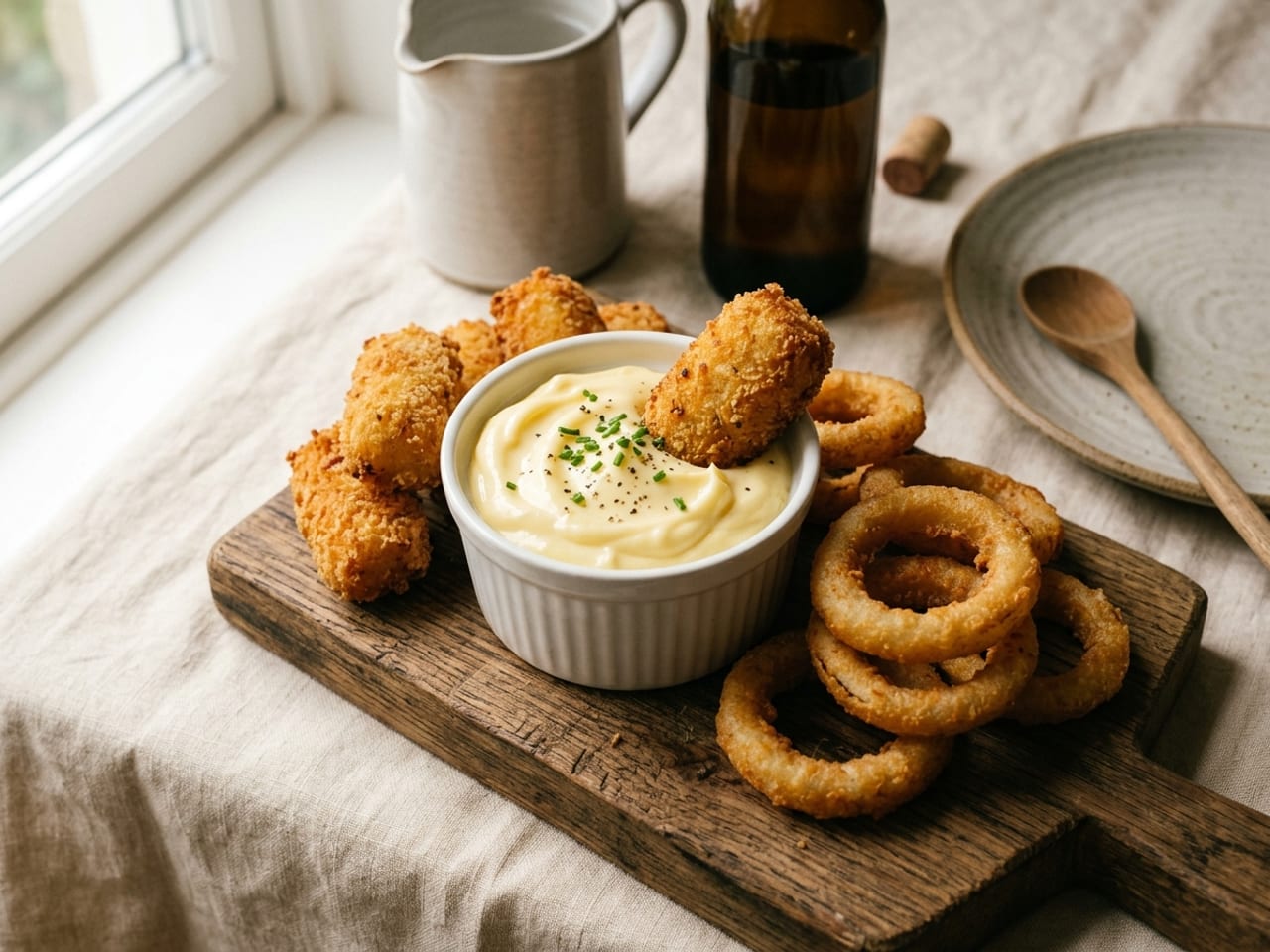
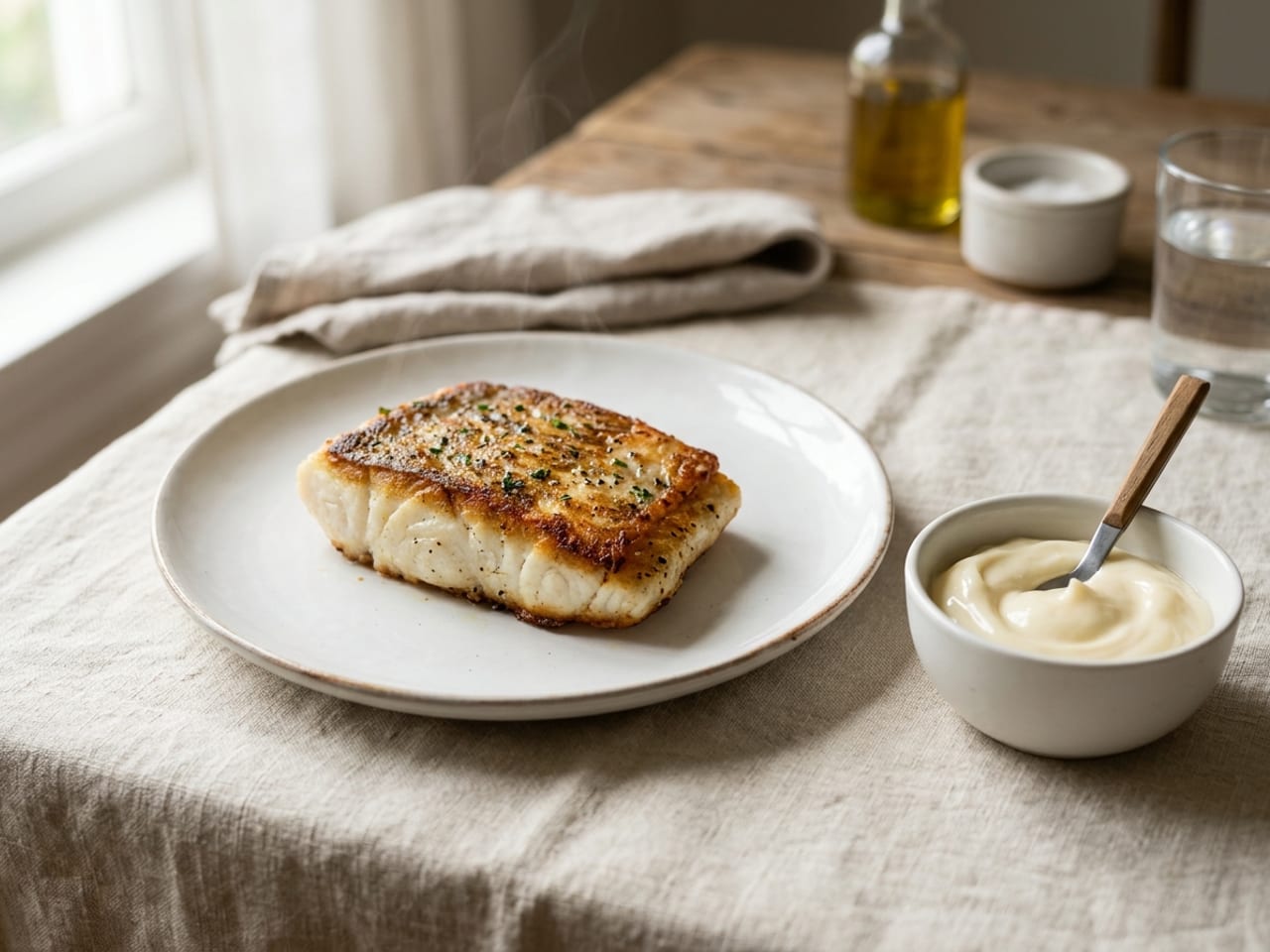
Mayonnaise "will tend to leak oil ... on hot rather than warm food" (McGee), so let a seared fish or a burger rest a moment before the sauce goes on (ours).9
What to serve it with
- Sushi and bowlsSpicy mayo on poke and sushi bowls, with Kewpie or regular mayonnaise.106
- EggsThe French classic, oeufs mayonnaise: Pépin's recipe is the one we drew on above.26
The history of mayonnaise and where the name comes from
The first mayonnaises in print were not always the sauce we make now, and nobody knows for sure where the name comes from. Dates are the earliest we saw in what we read, never claimed as firsts.
| When | What the source says |
|---|---|
| 1756 | The Duc de Richelieu takes Port Mahon on Minorca. The story that his cook named a sauce for it is told only in the conditional, "peut-être" (TLFi), "aurait" (Larousse).5, 12 |
| 1804 | The earliest dated use of the word we saw: August von Kotzebue, reading the bill of fare of Véry, a restaurateur in the Palais-Royal, asks who knows offhand what "eine mayonnaise de poulet" is.14, 20 |
| 1806 to 1807 | Viard's Cuisinier impérial: the TLFi dates "saumon à la mayonnaise" to its 1806 edition. In the 1807 edition we read, a mayonnaise is a jellied cold sauce of velouté, aspic jelly and tarragon vinegar, poured over cold chicken to set; his sauce of raw yolks, mustard and oil is called rémoulade.5, 13 |
| 1808 | Grimod de La Reynière reports cooks saying mayonnaise, mahonnaise and bayonnaise, calls the first "pas français" and picks bayonnaise for the hams of Bayonne. The earliest link to Mahon we saw, as a spelling, with no story of 1756.15 |
| 1828 (1842 edition read) | Carême gives three recipes for "magnonnaise blanche", only one with egg yolks (McGee), and derives the name from manier, to work it. His yolk version has no mustard, sits on crushed ice and is finished with aspic jelly; with mustard, it is his sauce provençale.9, 16 |
| 1855 | The TLFi dates "sauce mayonnaise" to Audot's cookbook, though Viard's 1807 edition already writes "sauce mayonnaise" for his jellied sauce.5, 13 |
| 1870s | Littré: salt, pepper, oil, vinegar and a yolk, "quelques-uns y ajoutent de la moutarde", beaten to the thickness of a thick syrup.7 |
| 1903 and 1907 | Escoffier: "Sauce froide mère" (1903), "considérée comme une sauce Mère, au même titre que l'Espagnole et le Velouté" (1907), 6 yolks to a litre of oil, no mustard. He had dropped the jellied mayonnaise collée, because the gelatine squeezed out beads of oil.17, 18 |
| 1917 | Duke's dates its recipe to Eugenia Duke, 1917 (the maker's statement).51 |
| 1925 | Kewpie launches its mayonnaise in Japan, a yolk-only recipe its founder built after tasting mayonnaise in the United States (the maker's statement).49 |
| 1932 to 1935 | The Académie française's 8th edition still defines it with no mustard.6 |
| 1961 | Mastering the Art of French Cooking is first published; the 2001 edition we read has "The Mayonnaise Family", with hand, blender and processor methods and Child's mustard fix.10 |
| 1997 | Larousse Gastronomique lists four stories for the name, Mahon, Bayonne, manier and moyeu, without choosing one.12 |
| Today | The Spanish Academy derives mayonesa "Del fr. mayonnaise", with mahonesa as another name for it; the US defines it in law; in Europe, the Codex talks on a regional standard stalled without consensus in 2000, when the EU had no mayonnaise regulation in force.1, 4, 8 |
Where the name comes from: four stories
McGee files it under "uncertain etymology", and the sources below give no better answer.9
| The story | Verdict | What we found |
|---|---|---|
| From Mahón, after Richelieu took it in 1756 | Plausible, unproven | Told only in the conditional by the TLFi and Larousse; the word turns up 48 years after the siege, and as mayonnaise, not mahonnaise.5, 12, 14, 20 The Spanish Academy derives mayonesa from French and lists mahonesa only as another name.8 |
| From Bayonne (bayonnaise) | A preference, no evidence | Grimod chose bayonnaise in 1808 by taste, for Bayonne's hams; Bescherelle thought mayonnaise a faulty spelling of it (in the TLFi); Larousse: it "aurait été" a speciality there.5, 12, 15 |
| From manier, to work it (magnonnaise) | Carême's assertion | Carême says the great kitchens always said magnonaise, because the sauce exists only by constant working; his spelling is later than the 1804 mayonnaise.14, 16 |
| From moyeu, old French for egg yolk (moyeunaise) | A suggestion, judged unlikely | Prosper Montagné's idea, reported by Larousse; the one secondary source we read on it, Word Histories, judges it unlikely.12, 20 |
Fifteen popular claims about mayonnaise, each with a verdict
"Supported, narrowly" means the source covers less than the claim says; "Mixed", that sources point both ways; "Unproven", plausible but never shown; "No source found", that we found nothing for it.
| The claim | Verdict | What we found |
|---|---|---|
| Mayonnaise was invented for the Duc de Richelieu after he took Mahón in 1756. | Unproven | Plausible, never shown: the TLFi and Larousse tell it only in the conditional, and the earliest dated use we saw is 1804, as mayonnaise (the name).5, 12, 14 |
| The lemon juice or vinegar makes raw-egg mayonnaise safe. | Not supported | "Acidification does not make the food safe" (the Australian and New Zealand guidelines); the acid "will not kill bacteria" (WA Health). Lab studies saw acid kill Salmonella over 2 hours to 3 days, fastest when warm, which no agency advises relying on (acid).145, 147, 152, 155 |
| Mayonnaise is what makes picnic food spoil. | Not supported | For commercial mayonnaise, the 1982 study found it slowed bacterial growth in meat salads, and the low-acid add-ins and the heat are the problem ("it's rarely the mayonnaise"); it is still no substitute for the fridge, and homemade, with less acid, is another matter.159, 160, 161 |
| Aioli is just garlic mayonnaise. | Mixed | In English dictionaries and on US menus, yes; to the Spanish Academy and the purists it is garlic and oil with no egg, while Catalan public radio, citing two Catalan food historians, says the egg versions are the commoner in old sources (aioli vs mayo).55, 90, 92, 94 |
| Olive oil makes the best mayonnaise. | Mixed | A matter of taste, with two catches: extra-virgin oil turned "markedly bitter" in America's Test Kitchen's processor and can split an hour or two later (McGee), though yolk protein can mask the bitterness (Monell). Gisslen keeps olive oil for "special preparations".9, 11, 35, 46 |
| One yolk can take at most a cup (240 ml) of oil. | Mixed | Child says ¾ cup (180 ml), Gisslen 8 ounces (240 mL) and Escoffier 175 to 200 ml; McGee says "this just isn't true" and a yolk can take a dozen cups (about 2.9 litres, ours) or more if there is water enough. Nobody we read published a measured test.9, 10, 11, 18 |
| Salting the yolks makes mayonnaise split. | Not supported | Escoffier called it a prejudice, and McGee explains why salt first gives smaller, steadier droplets.9, 18 |
| Make mayonnaise over ice so it stays cold. | Not supported | Carême did; Escoffier calls it "une erreur absolue", and McGee, Child and Gisslen want everything at room temperature.9, 10, 11, 16, 18 |
| Mustard is what makes mayonnaise emulsify. | Not supported | The yolk does the main work: mustard helps, as a weaker emulsifier than the yolk (America's Test Kitchen) whose particles steady the droplets (McGee), and Carême and Escoffier made it without.9, 16, 18, 33 |
| Kewpie is made with rice vinegar. | Supported, narrowly | The US bottle lists rice vinegar among four vinegars; in Japan the maker uses its own apple-and-malt vinegar, it says, because the rice-based vinegars of Japan did not suit mayonnaise.49, 50 |
| Homemade mayonnaise keeps for two weeks. | Not supported | Some chefs and test kitchens say so, but the only agency figure for home cooks is 3 to 4 days, for homemade aioli; Australian businesses must bin raw-egg sauce after 24 hours; a month is claimed only for heated yolks (every figure).24, 32, 33, 136, 145 |
| Mayonnaise freezes well. | Not supported | Every source we read that gives a reason says freezing breaks the emulsion, and none recommends it; Tasting Table adds that it is still safe, just "gritty, curdled, and watery".53, 54, 164 |
| Store-bought mayonnaise is always made with pasteurized eggs. | Mixed | In the US, egg products must be pasteurized and are used in prepared mayonnaise (USDA), and Hellmann's says its eggs are pasteurized (the maker's statement); the UK agency says commercial mayonnaise is "often" made with pasteurised egg, not always.53, 134, 140 |
| Mayonnaise is a mother sauce. | Supported, narrowly | Escoffier called it a cold mother sauce "au même titre que l'Espagnole et le Velouté"; it is not among the five warm sauces usually taught (mother sauces).18 |
| A whole egg makes a thinner, paler mayonnaise than yolks. | No source found | No source we read compared them side by side; America's Test Kitchen chose a whole egg for its processor, not for texture.30 |
Photograph your plate, see it re-plated
Made a mayonnaise or an aioli and plated something with it? Photograph the dish and Plate Artists re-plates that dish, with the food kept as it is and the changes named so you can repeat them. Start with a re-plate.
Your food, plated like a chef's
Snap it, upload it, and get the composed version back, with the steps to recreate it at home.
Start free · 1 enhancement →Free account · 1 free enhancement · No credit card
Mayonnaise words, defined
Mayonnaise · mayo; French la mayonnaise
A cold, thick emulsion of oil in egg yolk with lemon juice or vinegar, often with mustard.
Where it comes from. The TLFi: "Sauce froide, semi-solide, obtenue en émulsionnant de l'huile avec un ou plusieurs jaunes d'oeuf et de la moutarde"; the US standard: at least 65% vegetable oil, an acid and egg yolk.1, 5
Aioli · aïoli
A garlic sauce emulsified with oil, with or without egg yolk; in the US, often any flavored mayonnaise.
Where it comes from. From Provençal ai, garlic, and oli, oil (Oxford Learner's); Escoffier's aïoli has a raw yolk.19, 94
Allioli · alioli
The Catalan garlic and oil sauce, made in a mortar, with or without egg.
Where it comes from. The Spanish Academy: "Salsa hecha de ajos machacados y aceite", from Catalan allioli.90, 92
Emulsion
Tiny droplets of one liquid held apart in another that it would not otherwise mix with.
Where it comes from. McGee: mayonnaise is "an emulsion of oil droplets suspended in a base composed of egg yolk, lemon juice or vinegar, water, and often mustard".9
Continuous phase · the water phase
The liquid the droplets float in: in mayonnaise, the water from yolk, acid and any added water.
Where it comes from. McGee: the cook should provide about a third of the oil's volume in yolks, lemon juice, vinegar or water.9
Emulsifier
A substance that coats droplets so they stay apart, such as the proteins and lecithin in egg yolk.
Where it comes from. America's Test Kitchen: emulsifiers "form thin barriers around each oil droplet".9, 33
Lecithin
A phospholipid in egg yolk, one of the emulsifiers that hold mayonnaise together.
Where it comes from. Gisslen: "a powerful emulsifier that makes possible the production of mayonnaise"; McGee: one kind of yolk emulsifier among others.9, 11
Low-density lipoproteins · LDLs
Particles of fat and protein in the yolk's plasma that do much of the emulsifying.
Where it comes from. McGee names them one of two yolk components with most of the emulsifying power; Anton: plasma "is responsible for the important emulsifying properties of yolk".9, 43
Prendre, monter · to take, to mount
French for a mayonnaise that thickens as it should, and for building one with oil.
Where it comes from. The TLFi's "la mayonnaise prend; ... monter, rater, tourner la mayonnaise".5
Tourner · to turn; broken, split
A mayonnaise that has split into curds and loose oil.
Where it comes from. The TLFi lists tourner and rater for a mayonnaise that fails; Larousse brings back "une mayonnaise tournée" with a new yolk.5, 12
Rémoulade
A cold sauce of mayonnaise with mustard, chopped pickles, capers and herbs.
Where it comes from. Viard 1807: mustard, oil, vinegar and two raw yolks; Escoffier: mayonnaise with mustard, cornichons, capers, herbs and anchovy.13, 18
Gribiche
A mayonnaise-style sauce made with hard-boiled yolks, herbs, capers and pickles.
Where it comes from. Escoffier 1903: six hard-boiled yolks with mustard, "Monter en mayonnaise" with half a litre of oil.17
Sauce tartare · tartar sauce
A cold sauce Escoffier made from hard-boiled yolks and oil with chives, listed by Larousse among the sauces derived from mayonnaise.
Where it comes from. Escoffier 1907: eight hard-boiled yolks, a litre of oil, vinegar and a chive or green onion purée; Larousse lists it among the mayonnaise derivatives.12, 18
Mayonnaise collée
Mayonnaise stiffened with melted aspic jelly to coat cold dishes.
Where it comes from. Escoffier 1903: mayonnaise set with aspic, which he gave up because the gelatine squeezed out beads of oil.17
Salad dressing (US standard) · spoonable dressing
A US standardized mayonnaise-like spread with less oil and a starchy paste added.
Where it comes from. 21 CFR 169.150: at least 30% oil and egg yolk equal to 4% liquid yolk, with a starchy paste.2
Aquafaba
The cooking liquid of pulses, used as an egg-free emulsifier.
Where it comes from. He et al. 2021: the liquid from canning or boiling pulse seeds, usable "as a plant-based emulsifier".47
Pasteurized egg
An egg, in the shell or as liquid, heated just enough to kill Salmonella without cooking it.
Where it comes from. CDC: eggs "heated to a high enough temperature for a long enough time to kill Salmonella"; USDA: usable raw in shell form.133, 135
British Lion · Lion mark; Laid in Britain
The UK egg scheme whose hen eggs the FSA says even vulnerable groups may eat raw, except the severely immunocompromised.
Where it comes from. The UK Food Standards Agency: hens vaccinated, extra Salmonella testing, farm hygiene and cool transport.139, 142
Mayonnaise and flavored mayo, answered
How do you make mayonnaise at home?
Whisk 2 egg yolks for a minute or two until thick and sticky, then beat in ½ teaspoon of salt, 1 teaspoon of lemon juice or vinegar and, if you like, 1 teaspoon of Dijon mustard. Add 1 cup (240 ml) of neutral oil a few drops at a time until it thickens into a heavy cream, then in a thin stream, thinning it with a few drops of water if it gets stiff. Finish with the rest of the acid and salt to taste. By hand it takes about 15 minutes (our estimate from Bon Appétit's 4 plus 8 minutes of whisking). This is our synthesis of BBC Good Food's and the CIA's proportions and Bon Appétit's method, not a recipe we tested.
How do you make mayonnaise with an immersion blender?
Put 1 whole egg, 1 tablespoon of lemon juice, ½ teaspoon of salt, mustard if you like and 1 tablespoon of cold water in a tall jar only just wider than the blender head, pour 1 cup (240 ml) of oil on top, plant the blender on the bottom and run it at full power without moving it until mayonnaise forms, about 30 seconds, then lift it slowly. That is J. Kenji López-Alt's method as Nigella Lawson uses it.
What is the ratio of oil to egg yolk in mayonnaise?
In the raw-yolk recipes we read that give exact amounts, 90 to 240 ml of oil per yolk (our arithmetic): from America's Test Kitchen's ⅜ cup (90 ml) to the CIA's 1 cup (240 ml). Escoffier set a limit of 175 to 200 ml a yolk, Child ¾ cup (180 ml) and Gisslen 8 ounces (240 mL), but McGee says one yolk can emulsify "a dozen cups of oil or more" (about 2.9 litres, our arithmetic) if there is enough water, about a third of the oil's volume.
Why did my mayonnaise split, and how do I fix it?
Usually the oil went in too fast at the start, the ingredients were too cold, or there was too much oil for the water in the bowl (Escoffier, McGee). To fix it, start again in a clean bowl with a fresh yolk (Escoffier, Gisslen), 4 teaspoons of water (America's Test Kitchen) or a teaspoon of mustard (Child), and beat the broken sauce into it very slowly. A blender can also bring it back.
Can you make mayonnaise without mustard?
Yes. The classic French mayonnaise of Carême and Escoffier had none; Carême called the version with mustard a different sauce. Mustard adds flavour and helps steady the emulsion, but the yolk does the main work, so beat the yolk well and add the oil slowly.
Can you make mayonnaise with olive oil?
Yes, with two catches. Extra-virgin olive oil can turn bitter in a food processor or blender (America's Test Kitchen's side-by-side tasting), and McGee warns it can make a mayonnaise that separates an hour or two later. Use regular olive oil, or make it with a neutral oil and whisk a little extra-virgin oil in by hand at the end.
Can you make mayonnaise with avocado oil?
Popular recipes do, such as Pinch and Swirl's, with a whole egg and 1 cup (240 ml) of avocado oil and a stick blender. We found no test-kitchen, textbook or scientific test of avocado-oil mayonnaise, so how it compares with olive or sunflower oil is untested in what we read.
Can you make mayonnaise with a whole egg?
Yes: the US standard allows whole eggs, and America's Test Kitchen and Nigella Lawson use one in a machine; America's Test Kitchen says the extra volume helps the blades catch. Every hand-whisked recipe in our ratio table uses yolks only. Whole-egg sauces run at a higher pH, which matters if the eggs are raw.
Can you make mayonnaise with hard-boiled eggs?
Yes, and it is old: Viard pounded hard-boiled yolks with oil in 1807, and Escoffier's gribiche and tartare and Julia Child's Hard Yolk Mayonnaise all use them. Mash the yolks perfectly smooth first; Child says lumpy yolks will not absorb the oil and it cannot be made in a blender. McGee says cooked yolks emulsify less oil and the sauce may weep a little.
How do you make mayonnaise without eggs?
BBC Good Food blends 100ml of soy milk with 1 tablespoon of cider vinegar until frothy, then streams in 200ml of rapeseed oil. Aquafaba, the liquid from cooked or canned pulses, also works as an emulsifier: one study found 33 parts aquafaba to 60 of oil comparable in firmness and stability to egg mayonnaise.
Is homemade mayonnaise safe to eat?
It is a raw-egg food unless the eggs are pasteurized or the yolks heated. The USDA advises everyone against raw-egg foods and names homemade mayonnaise; Germany's BfR says not to use raw eggs in mayonnaise; New Zealand tells pregnant women not to eat it. In the UK, mayonnaise made with British Lion or Laid in Britain eggs is safe even for pregnant people, young children and older people, by the Food Standards Agency and the NHS, though not for the severely immunocompromised on medically supervised diets. Elsewhere, pasteurized eggs are the usual answer for anyone vulnerable.
Does lemon juice or vinegar kill bacteria in homemade mayonnaise?
Not reliably. The Australian and New Zealand guidelines say acidification "does not make the food safe but may slow the growth of Salmonella", and WA Health that the acid "will not kill bacteria". Lab studies saw acid kill Salmonella over 2 hours to 3 days, fastest when warm (one study: 2 hours at 25°C (77°F, our conversion), 24 hours at 8°C (46°F, our conversion)), which no agency advises relying on, and in some studies cold protected the bacteria from the acid.
How long does homemade mayonnaise last?
Printed answers run from the same day to a month across the sources we read. The only agency figure for home cooks is the USDA's 3 to 4 days for homemade aioli; Australian food businesses must discard raw-egg sauces after 24 hours. Test kitchens and chefs print anything from the same day to two weeks, and America's Test Kitchen a month only for yolks heated to 160 degrees F (71°C, our conversion). Keep it covered, cold, and eat it within 3 to 4 days at most.
Can you freeze mayonnaise?
No source we read recommends it: freezing breaks the emulsion, and it thaws "separated, oily" (Hellmann's) or "gritty, curdled, and watery" (Tasting Table). Hellmann's says not to freeze its mayonnaise, and the USDA does not recommend freezing egg salad.
What is the difference between aioli and mayo?
To the Spanish Academy and purists, allioli is crushed garlic and oil, with no egg, pounded in a mortar. Most modern aioli adds egg yolk, which makes it essentially garlic mayonnaise, and Catalan public radio, citing two Catalan food historians, says egg versions were the commoner in old sources. In the US, aioli often just means a flavored mayonnaise.
What are the most popular flavored mayos?
No national ranking exists in what we found, so we weighed menu data, polls, sales and launches, search and recipe sites. Garlic aioli leads on nearly every kind of signal; spicy sriracha mayo ties it in US searches; chipotle mayo is growing on menus (Datassential) and is Hellmann's top-performing new flavour by the brand's account; truffle aioli is on 1.7% of US menus but rarely made at home; and burger sauce, with its cousin fry sauce, draws more searches than any flavour name in our pull.
How do you make spicy mayo for sushi?
Whisk 2 to 3 tablespoons of sriracha and 1 tablespoon of lime or lemon juice into 1 cup (240 ml) of mayonnaise or Kewpie, taste, and add more sriracha a teaspoon at a time. Published recipes range from 2 teaspoons to about 10⅔ tablespoons of hot sauce per cup (240 ml), our arithmetic. Keep it in a covered squeeze bottle to drizzle.
What is burger sauce made of?
Usually mayonnaise and ketchup, about 2 to 1 (Epicurious, America's Test Kitchen) or 3 to 2 (BBC Good Food), with chopped pickles, mustard and a little sugar and spice. RecipeTin Eats makes its special burger sauce without ketchup, and America's Test Kitchen has a pub-style one with soy sauce.
What is the difference between mayonnaise and salad dressing like Miracle Whip?
In the US they are separate legal standards: mayonnaise must be at least 65% vegetable oil by weight, while salad dressing needs only 30% oil, egg yolk equal to at least 4% liquid yolk, and a starchy paste.
Where does the name mayonnaise come from?
Nobody knows. The best-known story, that the Duc de Richelieu's cook named it after taking Mahón in 1756, is plausible but unproven: the earliest dated use we saw is a Paris menu of 1804. Grimod preferred bayonnaise, Carême derived it from manier, to work, and Montagné from moyeu, old French for yolk.
The regulations, textbooks, test kitchens, agencies, studies and cookbooks behind this guide
How each source was read (in full, as an abstract, in an archived copy, as the machine-read text of a scan) is in its entry and under how this page was made. Books read from copies uploaded to the Internet Archive are cited as books without a link. Blogs, brands, retailers and magazines are labelled, and so are maker statements and sponsored figures. Readings, sums and conversions marked ours are our own, and so are the search and recipe-site counts.
- US Food and Drug Administration (2026). 21 CFR 169.140 Mayonnaise (standard of identity), current text. Electronic Code of Federal Regulations (United States), the definition, the 65% oil minimum, the acidifying ingredients and the egg yolk-containing ingredients, including whole eggs; read in full. ecfr.gov
- US Food and Drug Administration (2026). 21 CFR 169.150 Salad dressing (standard of identity), current text. Electronic Code of Federal Regulations (United States), the 30% oil and 4% egg yolk minimums; read in full. The brand name Miracle Whip is not in the regulation. ecfr.gov
- US Food and Drug Administration (2026). Use of Salt Substitutes To Reduce the Sodium Content in Standardized Foods (final rule, document 2026-20848). Federal Register, 13 October 2026, the change to 169.140 adds salt substitute to the optional ingredients; read as the abstract and an excerpt only. federalregister.gov
- FAO/WHO Codex Alimentarius Commission (2000). Report of the 22nd session of the Codex Coordinating Committee for Europe: Proposed Draft Revised Regional Standard for Mayonnaise. FAO, the EU observer, FIC Europe's 70 to 80% fat and 5% yolk, the industry code since 1972, no consensus on a regional standard; the section read in full. Its later fate was seen only in search previews and is not printed. fao.org
- ATILF / CNRS (2026). Mayonnaise (entry), Trésor de la langue française informatisé. CNRTL portal, the definition (with mustard), the dating (1806, Viard), the Mahon etymology given as "peut-être", Bescherelle's bayonnaise, and the verbs prendre, monter, rater, tourner; read in full through the portal's word API. cnrtl.fr
- Académie française (1932 to 1935). Mayonnaise (entry), Dictionnaire de l'Académie française, 8th edition. via the CNRTL portal (read through its word API), salt, pepper, oil, vinegar and egg yolk, no mustard; read in full. The edition years are ours: the portal does not print them. cnrtl.fr
- Littré, É. (1870s). Mayonnaise (entry), Dictionnaire de la langue française. via the CNRTL portal (read through its word API), "quelques-uns y ajoutent de la moutarde", beaten to "un sirop épais"; the mahonnaise and magnonaise spellings reported as "disent-ils"; read in full. The decade is ours. cnrtl.fr
- Real Academia Española (2026). Mayonesa; mahonés, sa (entries), Diccionario de la lengua española. dle.rae.es, "Del fr. mayonnaise"; mahonesa listed as another name for mayonesa; read in full. dle.rae.es
- McGee, H. (2004). On Food and Cooking: The Science and Lore of the Kitchen, completely revised and updated. Scribner, New York, chapter 11, Sauces: mayonnaise (p. 628), the yolk's emulsifiers, starting slowly, rescuing a separated sauce, the box "Olive Oil Can Make Crazy Mayonnaise", hard-cooked yolks; mustard, p. 417; read as the machine-read text (OCR) of a copy uploaded to the Internet Archive; cited as the book, without a link to that copy.
- Child, J., Bertholle, L., & Beck, S. (2001). Mastering the Art of French Cooking, Volume One, fortieth anniversary edition (first published 1961). Alfred A. Knopf, New York, chapter 2, Sauces, "The Mayonnaise Family", pp. 86 to 91: the hand method, the per-yolk maximum, the fix for turned mayonnaise, the blender and processor methods, hard-yolk mayonnaise; fractions are garbled in the OCR and are printed as read from context (e.g. "112 to 214" = 1½ to 2¼); the OCR-uncertain "1 cup safest" and "crisis" amounts are not printed; read as the machine-read text (OCR) of a copy uploaded to the Internet Archive; cited as the book, without a link to that copy.
- Gisslen, W. (2011). Professional Cooking, 7th edition. John Wiley & Sons, Hoboken, chapter 21, Salad Dressings and Salads: the mayonnaise guidelines, the 8 ounces (240 mL) per yolk limit, lecithin, the repair methods and the texture target; the oil quantity of its formula is unreadable in the OCR and is not printed; read as the machine-read text (OCR) of a copy uploaded to the Internet Archive; cited as the book, without a link to that copy.
- Larousse, with the Comité gastronomique chaired by J. Robuchon (1997). Larousse gastronomique (entry MAYONNAISE). Larousse-Bordas, Paris, the definition (with mustard), the four origin stories in the conditional, the method notes and Carême's magnonnaise as Larousse quotes it; read as the machine-read text (OCR) of a copy uploaded to the Internet Archive; cited as the book, without a link to that copy.
- Viard, A. (1807). Le Cuisinier impérial, seconde édition. Barba, Paris (Wellcome Library scan), Rémoulade and Rémoulade Indienne, pp. 54 to 55; Poulets en Mayonnaise, pp. 285 to 286; Saumon à la Mayonnaise and Filets de Soles en mayonnaise, pp. 300 and 302; read as the machine-read text (OCR) of the library scan; quotations correct obvious OCR misreadings. The 1806 first edition the TLFi cites was not read. archive.org
- Kotzebue, A. von (1804). Erinnerungen aus Paris im Jahre 1804, Erster Theil. Frölich, Berlin (Bayerische Staatsbibliothek scan), pp. 173 to 174, Véry's bill of fare in the Palais-Royal and "eine mayonnaise de poulet"; read as the machine-read text (OCR) of the library scan; quotations correct obvious OCR misreadings. archive.org
- Grimod de La Reynière, A. B. L. (1808). Manuel des amphitryons ("par l'Auteur de l'Almanach des Gourmands"). Paris, p. 99 (the bayonnaise of cold chicken) and the footnote on p. 211 (mayonnaise, mahonnaise, bayonnaise); read as the machine-read text (OCR) of the library scan; quotations correct obvious OCR misreadings. archive.org
- Carême, A. (1842). Le Cuisinier parisien, ou l'art de la cuisine française au dix-neuvième siècle (1842 edition; first published 1828). J. Renouard, Paris (Wellcome Library scan), chapter IV, "Traité des sauces magnonaises", pp. 41 to 45; read as the machine-read text (OCR) of the library scan; quotations correct obvious OCR misreadings. The 1828 first edition was not read. archive.org
- Escoffier, A., Gilbert, P., & Fétu, É. (1903). Le Guide culinaire, first edition. Paris (Leeds University Library scan), p. 163: Mayonnaise, "Sauce froide mère", Gribiche and the mayonnaise collée; read as the machine-read text (OCR) of the library scan; quotations correct obvious OCR misreadings. The archive's metadata says 1907; the title page shows the first edition. archive.org
- Escoffier, A. (1907). Le Guide culinaire, deuxième édition. Paris (Leeds University Library scan), pp. 61 to 65: Aïoli, Mayonnaise and its proportions, the causes of breaking, Sauce Rémoulade and Sauce Tartare; read as the machine-read text (OCR) of the library scan; quotations correct obvious OCR misreadings. The archive's metadata says 1903; the title page reads "DEUXIEME EDITION". archive.org
- Escoffier, A. (1907). A Guide to Modern Cookery (English edition). William Heinemann, London (Project Gutenberg eBook 71395), recipe 121, Aioli Sauce, or Provence Butter, and recipe 122, Andalouse; a fragment saved from the public-domain transcription. gutenberg.org
- Tréguer, P. (2017). History of the word 'mayonnaise'. Word Histories (blog), 25 March 2017; the pointer to Kotzebue 1804 and the summary of the theories; read in full. The books it cites (Larousse 1997, Carême 1815, Alléno and Brenot 2014) are cited here only through it, except Larousse, which we read. wordhistories.net
- Wizenberg, M. (2008). Homemade Mayonnaise. Bon Appétit (magazine), 6 April 2008; one yolk, ¾ cup (180 ml) canola oil, the drop-by-drop timings, "Can be made up to 2 days ahead"; read in full. The page prints "1 teaspoon large egg yolk", evidently a slip for one large yolk. bonappetit.com
- Good Food team (2026). Basic mayonnaise. BBC Good Food (magazine), 2 yolks, 1 tbsp Dijon, 250ml sunflower oil, 2 tsp vinegar or lemon at the end, "Will keep in the fridge for two days"; read in full (undated page). bbcgoodfood.com
- The Culinary Institute of America (2026). Mayonnaise. CIA Foodies (the school's consumer site), 2 pasteurized yolks, 2 cups (480 ml) oil, water, vinegar, Dijon, sugar, lemon; whisk or blender; olive or peanut oil "may be substituted"; read in full (undated page; not the Professional Chef textbook). ciafoodies.com
- López-Alt, J. K. (2015). Recipe: Foolproof Homemade Mayonnaise (from The Food Lab, W. W. Norton, 2015). San Francisco Chronicle (newspaper reprint), updated 10 September 2015; the stick-blender method in a tall narrow cup, the olive oil whisked in by hand, the frozen-oil trick, "up to 2 weeks"; read in full. sfchronicle.com
- Lawson, N. (2026). Golden Garlic Mayonnaise (from At My Table). nigella.com (chef website), one whole egg, 250 millilitres oil, a snug goblet, the stick blender planted on the bottom; credits López-Alt's method; read in full (undated page). nigella.com
- Pépin, J. (2024). Jacques Pépin's Oeufs Mayonnaise. Saveur (magazine), 27 September 2024; 3 yolks, 2 Tbsp Dijon, 2 cups (480 ml) oil, mustard as "a powerful binder", oil at room temperature; read in full. saveur.com
- Cloake, F. (2018). Felicity's perfect mayonnaise. The Guardian, syndicated by Gulf News (newspaper column), last updated 8 November 2018; salt first, neutral oil then flavoured oil, acid and mustard at the end; read in full in the reprint (the Guardian refuses this crawler). gulfnews.com
- America's Test Kitchen (2013). Homemade Mayonnaise. America's Test Kitchen (test kitchen), 10 March 2013; 2 yolks, ¾ cup (180 ml) oil, food processor; recipe card read (members' text partly hidden). americastestkitchen.com
- America's Test Kitchen (2017). Homemade Mayonnaise (television recipe handout, PDF). America's Test Kitchen (test kitchen), regular olive oil, or half extra-virgin and half vegetable; no mustard in the base; "You can whisk the oil into the mixture by hand with the same results"; read in full. cloudinary.com (ATK PDF)
- Fairman, M. (2019). Easy Homemade Mayonnaise. America's Test Kitchen (test kitchen), 28 January 2019; one whole egg and 1½ cups (360 ml) vegetable oil, why a whole egg, "Do not substitute olive oil", refrigerated up to 1 week; read in full. americastestkitchen.com
- America's Test Kitchen (2007). Quick Food Processor Mayonnaise. America's Test Kitchen (test kitchen), 22 August 2007; one egg, 1¼ cups (300 ml) vegetable, canola or light olive oil; recipe card read. americastestkitchen.com
- Lam, L. (2020). Make-Ahead Homemade Mayonnaise. America's Test Kitchen (test kitchen), 5 January 2020; yolks, water and lemon juice microwaved to 160 to 165 degrees (71 to 74°C, ours), then oil; "refrigerate for up to 1 month"; read in full. americastestkitchen.com
- Lam, L. (2023). Homemade Mayo with Pasteurized Yolks ("Homemade Mayo That Keeps"). Cook's Illustrated / America's Test Kitchen (test kitchen), 28 February 2023; why processor mayo fails, the first ¼ cup (60 ml) of oil by hand, mustard as a weaker emulsifier, raw-egg mayo "lasts only one to two weeks", a month for heated yolks; read in full where visible. americastestkitchen.com
- America's Test Kitchen (2026). How to Fix Failed Mayo. America's Test Kitchen (test kitchen), the 4-teaspoon water rescue; read in full (undated page). americastestkitchen.com
- America's Test Kitchen / Cook's Illustrated (2026). Testing Olive Oil's Bitter End. America's Test Kitchen (test kitchen), two aïolis from one bottle of extra-virgin olive oil, processor against whisk; the processor batch "markedly bitter"; ATK's explanation, no paper cited; read in full (undated page). americastestkitchen.com
- Cook's Illustrated (2026). Making Mayonnaise Without Raw Egg Yolks with the Microwave. Cook's Illustrated (test kitchen), McGee's method: one yolk with water and lemon juice heated to "a food-safe 160 degrees" (71°C, ours), then 1 cup (240 ml) oil, extra-virgin olive oil kept to ⅓ cup (80 ml); read in full (undated page). cooksillustrated.com
- Nigella.com (2026). Ask Nigella: How Can I Stop The Olive Oil In The Golden Garlic Mayonnaise From Becoming Bitter? nigella.com (chef website Q&A), answered 9 March 2026; "It is not exactly understood why"; read in full. nigella.com
- Stevens, M. (2026). Avocado Oil Mayonnaise. Pinch and Swirl (blog), one whole egg, 1 cup (240 ml) avocado oil, stick blender, "Use within 2 weeks"; read in full (undated page). pinchandswirl.com
- Laylita (2026). Homemade mayonnaise. laylita.com (blog), egg, salt, oil and lemon juice or vinegar in a blender; read in full (undated page). laylita.com
- Pucino, L. (2026). Vegan mayonnaise. BBC Good Food (magazine), 100ml soy milk, 1 tbsp cider vinegar, 200ml rapeseed oil, hand blender, approx. 300ml, "up to 2 weeks"; read in full (undated page). bbcgoodfood.com
- Maehashi, N. (2026). Mayonnaise recipe. RecipeTin Eats (blog), keeps 3 days "because it contains raw egg yolk"; extra-virgin olive oil at most 50% of the oil; read in full. recipetineats.com
- Torrone, P. (2008). (Post quoting a profile of Hervé This.) Make: (blog), 14 February 2008; "He has calculated that you can produce 24 litres of mayonnaise with a single yolk": second-hand, no calculation shown; read in full. makezine.com
- Anton, M. (2013). Egg yolk: structures, functionalities and processes. Journal of the Science of Food and Agriculture, 93(12), 2871 to 2880; read as the abstract only. doi:10.1002/jsfa.6247 · PMID 23716191
- Miyagawa, Y., Nakagawa, K., Fujita, H., & Adachi, S. (2019). Effects of Sodium Chloride and Acetic Acid Concentrations on Dispersion Stability of Mayonnaise. Journal of Oleo Science, 68(10), 1027 to 1032; read as the abstract only. doi:10.5650/jos.ess19161 · PMID 31582667
- Giacintucci, V., Di Mattia, C., Sacchetti, G., Neri, L., & Pittia, P. (2016). Role of olive oil phenolics in physical properties and stability of mayonnaise-like emulsions. Food Chemistry, 213, 369 to 377; read as the abstract only. doi:10.1016/j.foodchem.2016.06.095 · PMID 27451193
- Peyrot des Gachons, C., O'Keefe, A. J., Slade, L., & Beauchamp, G. K. (2021). Protein suppresses both bitterness and oleocanthal-elicited pungency of extra virgin olive oil. Scientific Reports, 11, 11851; read as the abstract only. doi:10.1038/s41598-021-91046-0 · PMID 34088913
- He, Y., Purdy, S. K., Tse, T. J., Tar'an, B., Meda, V., Reaney, M. J. T., & Mustafa, R. (2021). Standardization of Aquafaba Production and Application in Vegan Mayonnaise Analogs. Foods, 10(9), 1978; read as the abstract only; one author is with a company (Prairie Tide Diversified). doi:10.3390/foods10091978 · PMID 34574088
- Jeong, H., & Oh, I. (2025). Physicochemical and structural properties of vegan mayonnaise prepared with peanut sprout oil and aquafaba. Food Chemistry: X, 27, 102463; read as the abstract only. doi:10.1016/j.fochx.2025.102463 · PMID 40297664
- Kewpie Corporation (2026). KEWPIE Mayonnaise (product page, global English site). kewpie.com (maker), MAKER STATEMENTS: yolks only, launched 1925, oil particles of 2/1000 to 4/1000 mm, its own apple-and-malt "mayonnaise-specific vinegar", no preservatives needed, the "KEWPIE IT." drizzle campaign; read in full. kewpie.com
- Kewpie (US official shop) (2026). KEWPIE Mayonnaise, 24 fl. oz (Product of USA) and 450 g (Product of Japan): product listings. kewpieshop.com (maker), the two ingredient lists, read from the shop's product data. kewpieshop.com
- Duke's Mayonnaise (Sauer Brands) (2026). Duke's Real Mayonnaise (product page) and homepage product data. dukesmayo.com (maker), MAKER STATEMENTS: the ingredient list ("eggs"), "0g Added Sugars", "Eugenia Duke's original recipe since 1917", "no added sugar" across its mayos since February 2021; read in full. dukesmayo.com
- Open Food Facts contributors (2026). REAL MAYONNAISE, product 0048001213487 (Hellmann's, Canada and United States). Open Food Facts (crowd-sourced label database, not the maker), the transcribed ingredient list; read through the database's API. openfoodfacts.org
- Hellmann's (Unilever), US (2026). FAQ. hellmanns.com (maker), MAKER STATEMENTS: pasteurised eggs, "safe to use during pregnancy", the ingredient list, refrigerate after opening, "Do not freeze"; read in an Internet Archive (Wayback) capture, because the agency's site refused this machine on 2026-10-18 (snapshot of 6 October 2026). hellmanns.com
- Hellmann's (Unilever), US (2026). How long does mayo last. hellmanns.com (maker), MAKER STATEMENTS: an opened jar "up to 2-3 months" refrigerated, "no longer than four hours" out, freezing breaks the emulsion; read in an Internet Archive (Wayback) capture, because the agency's site refused this machine on 2026-10-18 (snapshot of 15 June 2026). hellmanns.com
- Nation's Restaurant News (data by Datassential) (2024). Truffle aïoli: two trending concepts in one bite (Flavor of the Week). Nation's Restaurant News (trade magazine), published 15 July 2024 (page-embedded date); truffle aïoli on 1.7% of US menus, up 22% in four years; truffle oil "often doesn't have truffles in it"; aïoli "virtually synonymous with mayonnaise" in the US; read in full. Datassential supplies the data. nrn.com
- Nation's Restaurant News (data by Datassential) (2022). Flavor of the Week: Aïoli. Nation's Restaurant News (trade magazine), published 11 April 2022; 58% familiar with "aïoli", 42% have tried it (sample not stated); "essentially garlic mayonnaise"; read in full. nrn.com
- Nation's Restaurant News (data by Datassential) (2020). Flavor of the Week: Smoky meets tangy in chipotle aïoli. Nation's Restaurant News (trade magazine), published 17 May 2020; "consistent growth on menus", no percentage; Tex-Mex, sandwiches and burgers; read in full. nrn.com
- FSR Magazine (sponsored content by Garner Foods, maker of Texas Pete) (2026). How to upscale your menu with signature sauces. FSR Magazine (SPONSORED by a hot-sauce maker), sriracha aioli at 2.3% market penetration with nearly 25% growth, the figure's source unclear; read in full (undated page). fsrmagazine.com
- Restaurant Business (reporting Technomic) (2026). Consumers' favorite sauces, ranked. Restaurant Business (trade magazine), Technomic's top 10 condiment and sauce flavours on US menus: mayonnaise first, garlic sauce third, no sriracha; read in full (undated page). restaurantbusinessonline.com
- YouGov (2026). Americans' favorite condiments (article 54116). YouGov (poll, self-funded), online poll of 1,104 US adult citizens, 30 January to 1 February 2026; 30% love mayonnaise; 27% dislike or hate hot sauce; no mayo flavours asked; read in full. yougov.com
- Berry, D. (reporting Mintel) (2022). (Condiment mash-ups, article 22246.) Food Business News (trade press), 19 September 2022; Mintel, May 2021, US sauce and dip buyers: spicy favoured by 47%, then smoky and sweet (sample not given); "Flavored mayonnaise and aioli have taken off"; read in full. foodbusinessnews.net
- Sloan, A. E. (reporting Datassential) (2012). Sauces deliver consumer meal solutions. Food Technology (IFT), date not on the page; cites reports of 2011 and 2012; garlic aioli, wasabi and basil pesto among the fastest-growing sandwich sauces; the year is ours, from its cited reports. ift.org
- Unilever USA (2024). How Hellmann's is tapping into the flavored mayo trend. Unilever USA newsroom (BRAND statement), 19 June 2024; flavoured mayo "over 7% of overall US mayo sales" (citing Circana, April 2024); Garlic and Spicy "relevant across many markets", Truffle in Europe; read in full on a mirror of unileverusa.com, which refused this machine. unileverusa.com (mirror)
- Nelson, A. (2025). Hellmann's on a winning streak with flavored mayos. Supermarket Perimeter (trade press quoting a Unilever executive), 20 February 2025; BRAND claim that Chipotle Mayo "is the top performer" of the 2024 flavours; the Spicy and Garlic Aioli descriptions; read in full. supermarketperimeter.com
- Leader, A. (2020). Sauces: Top Products 2020 (table sauces). The Grocer (UK trade press), 18 December 2020; a SUPPLIER (the maker of Nando's sauces): garlic "the second-biggest segment within flavoured mayonnaise, behind chilli"; Heinz Seriously Good's garlic, truffle and lemon mayos; read in full. thegrocer.co.uk
- Selwood, D. (2022). Table sauces and seasonings 2022: mayo bucks trend of fall in sauce sales. The Grocer (UK trade press), 16 December 2022; BRAND statement (Unilever) that flavour is 15% of the UK mayo share; NielsenIQ: mayonnaise the key growth area in table sauce; read in full. thegrocer.co.uk
- Inklebarger, T. (2026). Hellmann's, Heinz and McCormick dominate the mayo market, but for how long? FoodNavigator-USA (trade press), 30 January 2026; the 2024 to 2026 flavour launches (Hellmann's Chipotle and Garlic Aioli, Heinz Canada, Graza's Garlic Aioli) and a Heinz Canada BRAND claim on mixing mayo with ketchup or hot sauce; read in full. foodnavigator-usa.com
- Inside FMCG (2024). Heinz launches its "criminally tasty" mayo flavours after public vote. Inside FMCG (Australian trade press), 22 August 2024; a BRAND-RUN vote of more than 21,000 people in Australia and New Zealand, won by Cheesy Garlic Bread Aioli and Margherita Pizza Mayonnaise; read in full. insidefmcg.com.au
- Duke's Mayonnaise (2021). Duke's Southern sauces (press release). dukesmayo.com (BRAND press release), April 2021; Bacon & Tomato, Cucumber Dill, Fire Roasted Red Pepper and Habanero Garlic mayonnaises; read in full. The brand's store page read on 2026-10-18 lists none of them. dukesmayo.com
- Plate Artists (our query) (2026). Google Trends, web search, 5 years to 18 October 2026, United States and Great Britain, "garlic aioli" as the anchor of every batch. Google Trends (OUR measurement), relative interest, not volumes; whole numbers, so small terms are coarse; "spicy mayo" includes sushi spicy mayo and "burger sauce" is a broader term; method and raw output in the run folder. trends.google.com
- Plate Artists (our count) (2026). Flavoured-mayo recipes in the site searches of BBC Good Food, Bon Appétit, Epicurious, NYT Cooking and America's Test Kitchen (top results, strict match). OUR count, 18 October 2026; a weak signal: Bon Appétit and Epicurious share one catalogue, and each site ranks by its own relevance.
- Plate Artists (our query) (2026). Google autocomplete, United States, English: "aioli for", "spicy mayo", "truffle aioli", "garlic aioli", "chipotle mayo". OUR query, 18 October 2026; unweighted suggestions.
- Good Food team (2008). Aioli sauce. BBC Good Food (magazine), 30 January 2008; 3 garlic cloves, 2 yolks, 1 tbsp Dijon, 300ml olive oil; keeps "up to 2 days"; read in full. bbcgoodfood.com
- Pike, C. (2022). Garlic mayonnaise. BBC Good Food (magazine), 17 August 2022; 2 yolks, 175ml oil, 1 to 3 cloves "depending on how strong you want it", up to three days; read in full. bbcgoodfood.com
- Pike, C. (2022). Easy garlic mayonnaise. BBC Good Food (magazine), 2 November 2022; 225ml mayonnaise, 3 cloves, ½ tsp salt; fries, wedges and goujons; read in full. bbcgoodfood.com
- Best, C. (2014). Smoky mushroom burgers with roasted garlic mayo. BBC Good Food (magazine), 28 June 2014; 3 unpeeled cloves roasted in foil, mashed into 50g mayonnaise; read in full. bbcgoodfood.com
- Waters, A. (2011). Garlic Mayonnaise (from In the Green Kitchen, Clarkson Potter, 2010). Bon Appétit (cookbook excerpt), 20 December 2011; 2 or 3 cloves pounded per yolk and 1 cup (240 ml) olive oil, better after half an hour, eaten the same day, the germ removed; her list of flavourings; read in full. bonappetit.com
- Tanis, D. (2019). Garlic Aioli. NYT Cooking (newspaper food section), 6 March 2019; mortar, 1 large or 2 small cloves, 1 yolk, ½ cup (120 ml) mild extra-virgin olive oil; water lets it take more oil; recipe text read. cooking.nytimes.com
- Silverton, N., with Gelber, T. (2010). Lemon Aioli. Bon Appétit (chef recipe), 29 March 2010; 2 to 3 cloves (about 1 tablespoon), 1 extra-large yolk, 1 cup (240 ml) extra-virgin olive oil, 2 to 3 tbsp lemon juice, 1 tsp zest; read in full. bonappetit.com
- Goin, S. (2012). The Creamiest Aioli. Bon Appétit (chef recipe), 12 March 2012; 1 small clove, grated, per yolk and ½ cup (120 ml) oil; pasteurized yolk suggested; read in full. bonappetit.com
- Gourmet (on Bon Appétit) (2004). Classic Aïoli and Quick Aïoli with Egg. Bon Appétit (magazine archive), 20 August 2004; the classic: garlic, salt and extra-virgin olive oil only, in a mortar, about 15 minutes, "will separate if oil is added too quickly"; the quick one adds eggs or yolks in a blender, about 2 minutes; read in full. bonappetit.com
- Casas, P. (2004). Garlic Mayonnaise. Epicurious (cookbook author's recipe), 20 August 2004; 2 cloves grated into 6 tbsp mayonnaise with olive oil and lemon; read in full. epicurious.com
- Adrià, F. (2011). Aioli (from The Family Meal, Phaidon, 2011). Epicurious (cookbook excerpt), 12 October 2011; 5 cloves, 8 eggs, 5 cups (1.2 litres) extra-virgin olive oil, stick blender, the green sprout removed; read in full. epicurious.com
- Clark, M. (2015). Aioli. NYT Cooking (newspaper food section), 21 August 2015; 1 to 3 cloves rested a minute or two in lemon juice and salt, 1 egg and 1 yolk, ¾ cup (180 ml) extra-virgin olive oil; recipe text read. cooking.nytimes.com
- Abernathy, P. (2025). Shrimp Cakes With Smoked Paprika Aioli. NYT Cooking (newspaper food section), 6 November 2025; 1 cup (240 ml) mayonnaise, 1 clove, 1 tbsp lemon, smoked paprika, called aioli; recipe text read. cooking.nytimes.com
- America's Test Kitchen (2007). Aioli. America's Test Kitchen (test kitchen), 22 August 2007; 2 large yolks, 1 garlic clove, ½ cup (120 ml) vegetable oil and ¼ cup (60 ml) extra-virgin olive oil, whisked; "refrigerated for up to 3 days"; recipe text read. americastestkitchen.com
- Fairman, M. (2019). Easy Homemade Aioli. America's Test Kitchen (test kitchen), 28 January 2019; one garlic clove with one whole egg and 1½ cups (360 ml) vegetable oil plus 2 tbsp extra-virgin olive oil; "refrigerated for up to 1 week"; recipe text read. americastestkitchen.com
- America's Test Kitchen (2013). Garlic Mayonnaise. America's Test Kitchen (test kitchen), 7 April 2013; 1 medium clove (about 1 teaspoon) per 2 yolks and 1 cup (240 ml) oil; "up to 4 days"; recipe text read. americastestkitchen.com
- Knowles, E. (2008). Alioli. Gourmet Traveller (Australian magazine), 19 September 2008; purists' garlic and oil, "almost everyone uses a little egg yolk", recipes "calling for up to 10 cloves"; 2 cloves, 1 yolk, 125 ml oil; read in full. gourmettraveller.com.au
- 3Cat / Catalunya Ràdio (El matí de Catalunya Ràdio) (2026). Com fer allioli tradicional (i amb ou, codony, patata o mel!). 3Cat (Catalan public broadcaster), the mortar allioli of garlic, a quarter litre of oil and salt; citing the historians Vicent Marquès and Josep Lladonosa, the egg version "és més corrent a les fonts documentals antigues"; read in full (undated page). We did not read Marquès or Lladonosa. 3cat.cat
- Barcelona Metropolitan (2026). Catalan Cuisine: It's All in the Sauce. Barcelona Metropolitan (local magazine), "many, if not most, restaurants" serve allioli with yolks; purists' oil, garlic and salt; read in full (undated page). barcelona-metropolitan.com
- Real Academia Española (2026). Alioli (entry), Diccionario de la lengua española. dle.rae.es, "Salsa hecha de ajos machacados y aceite", from Catalan allioli; read in full. dle.rae.es
- Cambridge University Press (2026). Aioli (entry), Cambridge Dictionary. dictionary.cambridge.org, "a cold, thick sauce made from garlic, eggs, and olive oil"; read in full. dictionary.cambridge.org
- Oxford University Press (2026). Aioli (entry), Oxford Learner's Dictionaries. oxfordlearnersdictionaries.com, "a thick cold sauce made of mayonnaise and garlic", from Provençal ai, garlic, and oli, oil; read in full. oxfordlearnersdictionaries.com
- Dictionary.com (2026). Aioli (entry and usage note). dictionary.com, "a garlic-flavored mayonnaise of Provence", dated 1895 to 1900; the editorial note on Spanish and French styles; read in full. dictionary.com
- Raab, C., & Woodburn, M. (2026). Herbs and vegetables in oil (SP 50-701). Oregon State University Extension Service, garlic and herbs in oil and botulism; home flavoured oils, "including pesto", refrigerated up to 4 days or frozen; read in full (printable page). extension.oregonstate.edu
- Nummer, B. A., Schaffner, D. W., Fraser, A. M., & Andress, E. L. (2011). Current Food Safety Issues of Home-prepared Vegetables and Herbs Stored in Oil. Food Protection Trends, 31(6), 336 to 342; the Vancouver 1985 and 1989 garlic-in-oil outbreaks and the FDA's acidification rule; read in full (PDF). foodprotection.org
- Morse, D. L., Pickard, L. K., Guzewich, J. J., Devine, B. D., & Shayegani, M. (1990). Garlic-in-oil associated botulism: episode leads to product modification. American Journal of Public Health, 80(11), 1372 to 1373; read as the abstract only. doi:10.2105/ajph.80.11.1372 · PMID 2240308
- South Dakota State University Extension (2023). Making Safe Salad Dressing. SDSU Extension (written for commercial producers), 23 October 2023; dressings below pH 4.6 and spore-formers; particulates need up to 24 hours to reach the acid's pH; read in full. extension.sdstate.edu
- Denehy, E. J., Raupach, J. C., Cameron, S. A., Lokuge, K. M., & Koehler, A. P. (2011). Outbreak of Salmonella typhimurium phage type 44 infection among attendees of a wedding reception, April 2009. Communicable Diseases Intelligence Quarterly Report, 35(2), 192 to 196; read as the abstract only. doi:10.33321/cdi.2011.35.17 · PMID 22010514
- Martinez, R. (2016). Sriracha Mayonnaise. Bon Appétit (magazine), 21 June 2016; 1 cup (240 ml) mayonnaise, 3 tbsp Sriracha, 2 tbsp lemon, 1 clove; "made 1 day ahead"; read in full. bonappetit.com
- Dunn, S. (2019). Spicy Mayonnaise. America's Test Kitchen (test kitchen), 13 November 2019; 1 cup (240 ml) mayonnaise, 2 tbsp sriracha, lime zest and juice, smoked paprika; recipe text read. americastestkitchen.com
- Unger, D. (2015). Spicy Aïoli. America's Test Kitchen (test kitchen), 28 April 2015; ½ cup (120 ml) mayonnaise, 1 tsp hot sauce, lemon, 1 small clove; recipe text read. americastestkitchen.com
- Geary, A. (2024). Fresh Salmon Burgers with Sriracha Mayonnaise. America's Test Kitchen (test kitchen), 6 August 2024; ¼ cup (60 ml) mayonnaise and 1 to 2 tbsp sriracha on the buns; recipe text read. americastestkitchen.com
- Edge, J. T. (2009). Sriracha Mayonnaise Sauce. NYT Cooking (newspaper food section), 20 May 2009; 2 cups (480 ml) mayonnaise, ½ cup (120 ml) sriracha, condensed milk, salt; for onion rings or fries; recipe text read. cooking.nytimes.com
- Deravian, N. (2024). Poke Bowl. NYT Cooking (newspaper food section), 5 January 2024; ⅓ cup (80 ml) Kewpie or regular mayonnaise with sriracha "to taste"; recipe text read. cooking.nytimes.com
- Morin, F. (2010). Sriracha Mayo. Bon Appétit (chef recipe), 17 May 2010; 1 tbsp Sriracha to 3 tbsp mayo, on a roast pork sandwich; read in full. bonappetit.com
- Goldsmith, S. (2022). Crab croquettes with sriracha mayo dip. BBC Good Food (magazine), 26 July 2022; 1 to 2 tbsp sriracha per 6 tbsp mayonnaise; read in full. bbcgoodfood.com
- Xie, J. (2022). Spicy Mayo. Delish (magazine), 18 April 2022; 6 tbsp mayonnaise to ¼ cup (60 ml) sriracha, "1 part spicy condiment ... 1.5 parts mayonnaise", vinegar-forward sauces taste "more tart and spiky", keeps "a week or more"; read in full. delish.com
- Saffitz, C. (2016). Spicy Mayo. Bon Appétit (magazine), 21 June 2016; ½ cup (120 ml) mayonnaise, 3 tbsp sambal oelek, rice vinegar; read in full. bonappetit.com
- Demyanchuk, A. (2026). Spicy Mayo Recipe (like Japanese Restaurants). Alyona's Cooking (blog), ½ cup (120 ml) store-bought mayo to 2 Tbsp sriracha, a squeeze bottle, kept covered because the top "can oxidize", up to 1 month; read in full (print view). alyonascooking.com
- Wiseman, S. (2011). Lime-Chipotle Mayonnaise (from Just Tacos, Taunton, 2011). Epicurious (cookbook excerpt), 20 October 2011; 1 cup (240 ml) mayonnaise, 3 tbsp chipotles en adobo with sauce, 1 tbsp lime; thinned to drizzle; for fried avocado tacos; read in full. epicurious.com
- Gourmet (on Epicurious) (2006). Chipotle Mayonnaise with Lime. Epicurious (magazine archive), 21 August 2006; 4 tsp minced seeded chipotles in adobo per ½ cup (120 ml) mayonnaise, spread on grilled corn; read in full. epicurious.com
- Pixley, S. (2017). Cast Iron Hushpuppies with Chipotle Aioli. America's Test Kitchen (test kitchen), 11 July 2017; ½ cup (120 ml) mayonnaise, 5 tsp minced chipotle in adobo, 1 tsp lime; recipe text read. americastestkitchen.com
- Bruce, E. (2015). Chipotle Mayonnaise. America's Test Kitchen (test kitchen), 27 July 2015; 3 tbsp mayonnaise, 3 tbsp sour cream, 2 tsp chipotle, 1 clove; "refrigerate for at least 1 hour"; recipe text read. americastestkitchen.com
- Sifton, S. (2015). Chipotle Kewpie. NYT Cooking (newspaper food section), 6 December 2015; 5 chipotles, 2 cups (480 ml) Kewpie, shrimp paste; keeps "at least a week"; recipe text read. cooking.nytimes.com
- Sifton, S. (2009). Fish Tacos. NYT Cooking (newspaper food section), 22 March 2009; a white sauce of mayonnaise and sour cream with optional chipotle; recipe text read. cooking.nytimes.com
- Shulman, M. R. (2009). Grilled Corn on the Cob With Chipotle Mayonnaise. NYT Cooking (newspaper food section), 9 July 2009; chipotle, garlic, mayonnaise and yogurt for grilled corn; recipe text read. cooking.nytimes.com
- Lear, J. D. (2006). Chipotle Mayonnaise. Epicurious (magazine archive), 25 June 2006; a whole can of chipotles puréed, "a smidgen" stirred into mayo; read in full. epicurious.com
- Grace, L.-A. (2026). Easy Truffle Aioli (Truffle Mayo With Garlic). Chef Not Required (blog), ½ tbsp truffle oil "add more to taste" and a garlic clove per 1 cup (240 ml) store-bought mayonnaise; read in full (print view, undated). chefnotrequired.com
- Stem and Spoon (2023). Easy Black Truffle Aioli Recipe (with Mayo). Stem and Spoon (blog), 7 October 2023; 1 to 3 tbsp black truffle oil "added to taste" per 1 cup (240 ml) mayonnaise, 2 cloves, lemon; up to 1 week; fries, crab cakes, steaks, burgers; read in full. stemandspoon.com
- Sciarrone, D., Schepis, A., Zoccali, M., Donato, P., Vita, F., Creti, D., Alpi, A., & Mondello, L. (2018). Multidimensional Gas Chromatography Coupled to Combustion-Isotope Ratio Mass Spectrometry/Quadrupole MS with a Low-Bleed Ionic Liquid Secondary Column for the Authentication of Truffles and Products Containing Truffle. Analytical Chemistry, 90(11), 6610 to 6617; read as the abstract only; one co-author is with a flavour house. The abstract does not say how many of the 14 products were synthetic. doi:10.1021/acs.analchem.8b00386 · PMID 29733629
- Boone, R. (2015). Burger Sauce. Epicurious (magazine), 22 January 2015; ½ cup (120 ml) mayonnaise, ¼ cup (60 ml) ketchup, yellow mustard, pickle juice, honey, hot sauce, garlic and onion powder, smoked paprika; read in full. epicurious.com
- López-Alt, J. K. (2012). Classic Burger Sauce. America's Test Kitchen (test kitchen), 13 June 2012; 2 tbsp mayonnaise, 1 tbsp ketchup, relish, sugar, vinegar, pepper; recipe text read. americastestkitchen.com
- Roof, B. (2015). Pub-Style Burger Sauce. America's Test Kitchen (test kitchen), 5 January 2015; mayonnaise with soy sauce, brown sugar and Worcestershire, no ketchup; recipe text read. americastestkitchen.com
- Nice, M. (2019). Classic burger sauce. BBC Good Food (magazine), 4 July 2019; 3 tbsp mayonnaise, 2 tbsp ketchup, 25g cornichons, American mustard; burgers or hotdogs; read in full. bbcgoodfood.com
- Maehashi, N. (2022). Special Burger Sauce. RecipeTin Eats (blog), 26 August 2022; ¾ cup (180 ml) mayonnaise with mustard, sweet gherkins, sugar and spices, no ketchup; "the shelf life of the mayonnaise"; read in full. recipetineats.com
- Martinez, R. (2016). Lemon-Herb Mayonnaise. Bon Appétit (magazine), 21 June 2016; 1 cup (240 ml) mayonnaise, ½ cup (120 ml) tender herbs, a clove, lemon zest and juice; "use within one day"; read in full. bonappetit.com
- Good Food team (2010). Lemon & chive mayonnaise. BBC Good Food (magazine), 15 March 2010; zest of a lemon and a bunch of chives stirred into a scratch mayonnaise; read in full. bbcgoodfood.com
- America's Test Kitchen (2024). Herbed Aioli. America's Test Kitchen (test kitchen), 16 March 2024; basil, parsley and chives pulsed into a garlic mayonnaise; "up to 3 days"; recipe text read. americastestkitchen.com
- Turner, E. (2023). Kewpie-Style Mayonnaise. America's Test Kitchen (test kitchen), 4 December 2023; 3 yolks heated to 160 to 165 degrees (71 to 74°C, ours), cider vinegar, MSG; "refrigerate for up to 1 month"; read in full. americastestkitchen.com
- US Food and Drug Administration (2024). What You Need to Know About Egg Safety. fda.gov (United States), content current as of 5 March 2024; Salmonella in clean, uncracked eggs, the higher-risk groups, treated eggs for raw-egg recipes, the 2-hour rule; read in an Internet Archive (Wayback) capture, because the agency's site refused this machine on 2026-10-18. fda.gov
- USDA Food Safety and Inspection Service (2024). Shell Eggs from Farm to Table. fsis.usda.gov (United States), last updated 20 November 2024; homemade mayonnaise named among raw-egg foods everyone is advised against; pasteurised in-shell eggs; the 160 degrees F (71°C, ours) route; home pasteurising "very difficult"; raw yolks 2 to 4 days; read in an Internet Archive (Wayback) capture, because the agency's site refused this machine on 2026-10-18. fsis.usda.gov
- USDA Food Safety and Inspection Service (2023). Egg Products and Food Safety. fsis.usda.gov (United States), last updated 15 November 2023; all egg products pasteurised, used in "prepared mayonnaise"; best used cooked for high-risk persons; liquid egg products 3 days after opening; read in an Internet Archive (Wayback) capture, because the agency's site refused this machine on 2026-10-18. fsis.usda.gov
- US Centers for Disease Control and Prevention (2023). Salmonella and Eggs. cdc.gov (United States), last reviewed 8 March 2023; Salmonella inside eggs, pasteurised eggs for raw-egg foods, the higher-risk groups; read in an Internet Archive (Wayback) capture, because the agency's site refused this machine on 2026-10-18. cdc.gov
- USDA Food Safety and Inspection Service (2018). FoodKeeper app data (data version 128): Aioli, homemade; Mayonnaise, commercial; Egg salad. fsis.usda.gov (United States), homemade aioli 3 to 4 days in the fridge (keywords include mayonnaise and garlic mayo); commercial mayonnaise 2 months after opening, and "safe when stored at room temperature after opening" if shelf-stable; read in an Internet Archive (Wayback) capture, because the agency's site refused this machine on 2026-10-18 (snapshot of 2 July 2025). fsis.usda.gov
- US Food and Drug Administration (2026). Food Code 2026. fda.gov (model code; in force only where a state or local jurisdiction adopts it), §3-302.13 (pasteurised eggs for mayonnaise), §3-401.11(D), §3-603.11 (consumer advisory), §3-801.11(B) (highly susceptible populations), Table B (pH below 4.2); read in an Internet Archive (Wayback) capture, because the agency's site refused this machine on 2026-10-18 (snapshot of 29 September 2026). fda.gov
- US Food and Drug Administration, with USDA (2022). Food Safety For Pregnant Women, Their Unborn Babies, and Children Under Five. fda.gov (United States), January 2022; raw-egg foods to avoid (mayonnaise not named); "made with pasteurized eggs" lower risk; read in an Internet Archive (Wayback) capture, because the agency's site refused this machine on 2026-10-18. fda.gov
- Food Standards Agency (2026). Home food fact checker. GOV.UK (England, Wales and Northern Ireland), published 2 June 2020, last updated 21 August 2026; British Lion and Laid in Britain hen eggs safe raw or lightly cooked for young children, pregnant people and older people; not for the severely immunocompromised; read in full. gov.uk
- Food Standards Agency (2026). Advice on safe storage, handling and use of eggs for catering. GOV.UK (England, Wales and Northern Ireland), published 14 August 2026, updated 20 August 2026; "very low" is not "negligible"; "fresh mayonnaise" needs extra care; commercial mayonnaise "often" made with pasteurised egg; read in full. gov.uk
- NHS (2026). Foods to avoid in pregnancy. nhs.uk (United Kingdom), last reviewed 15 June 2026; mayonnaise made with raw British Lion or Laid in Britain eggs "safe to eat"; other hen eggs only well cooked; read in full. nhs.uk
- Food Standards Agency (reproduced by the Institute of Food Science & Technology) (2017). New advice on eating runny eggs. ifst.org, the 2017 change for British Lion eggs; non-Lion, non-hen and non-UK eggs cooked thoroughly for vulnerable groups; what the Lion scheme does; read in full (the saved page carries no date; the year is from the announcement). ifst.org
- German Federal Institute for Risk Assessment (BfR) (2024). Foodborne infections in private households: identifying sources and avoiding risks (FAQ). bfr.bund.de (Germany), 22 August 2024; no raw eggs in dishes eaten without heating, mayonnaise named; not for small children, pregnant women or the immunocompromised; fridge at most 7°C; read in full. bfr.bund.de
- EFSA & ECDC (2025). The European Union One Health 2024 Zoonoses Report. EFSA Journal, 23(12), e9759; Salmonella in eggs and egg products the pair of most concern; S. Enteritidis outbreaks mostly in homes and catering; read as the abstract and a fragment of the full text. doi:10.2903/j.efsa.2025.9759 · PMID 41377167
- Food Regulation System / Food Standards Australia New Zealand (2025). Food Safety Guidelines for the Preparation of Raw and Lightly Cooked Egg Foods, Version 1. foodstandards.gov.au (business guidance, Australia and New Zealand), May 2025 (file dated July 2025); pH 4.2 or lower, 5°C or below, 24 hours; "Acidification does not make the food safe"; at least 5 ml vinegar per egg as a guide; sous vide 57°C for at least 75 minutes; read in full. foodstandards.gov.au
- NSW Food Authority (2016). Food safety guidelines for the preparation of raw egg products. foodauthority.nsw.gov.au (business guidance, New South Wales), September 2016; mayonnaise and aioli among the products most often implicated; pH below 4.2 "inhibits"; sous vide at 57°C for at least 75 minutes with commercial equipment; read in an Internet Archive capture (the authority's site did not respond); a newer edition (FI417_2302) exists that we could not open. foodauthority.nsw.gov.au
- Government of Western Australia, Department of Health (2021). Safe handling of raw egg products. health.wa.gov.au (business guidance), last reviewed 3 March 2021; vinegar or lemon acid "will not kill bacteria"; discard within 24 hours; commercial mayonnaise or pasteurised egg as safer alternatives; read in full. health.wa.gov.au
- Food Standards Australia New Zealand (2026). Food safety for vulnerable people. foodstandards.gov.au (consumers), last updated 20 March 2026; raw and lightly cooked eggs in mayonnaise and aioli higher risk; commercial mayonnaise and aioli the safer alternative; read in full. foodstandards.gov.au
- New Zealand Ministry for Primary Industries (2026). What to eat when pregnant (list of safe food in pregnancy). mpi.govt.nz (New Zealand), last reviewed 29 July 2026; raw eggs in home-made mayonnaise and dressings "Don't eat"; bought mayonnaise stored in the fridge once opened; read in an Internet Archive capture (the ministry's site blocked this machine). mpi.govt.nz
- Zhu, J., Li, J., & Chen, J. (2012). Survival of Salmonella in home-style mayonnaise and acid solutions as affected by acidulant type and preservatives. Journal of Food Protection, 75(3), 465 to 471; read as the abstract only. doi:10.4315/0362-028X.JFP-11-373 · PMID 22410219
- Xiong, R., Xie, G., & Edmondson, A. S. (1999). The fate of Salmonella enteritidis PT4 in home-made mayonnaise prepared with citric acid. Letters in Applied Microbiology, 28(1), 36 to 40; read as the abstract only. doi:10.1046/j.1365-2672.1999.00473.x · PMID 10030030
- Nielsen, L., & Knøchel, S. (2020). Inactivation of salmonella strains in acidified broth and raw egg yolk as a function of pH and acid type. Food Microbiology, 92, 103574; read as the abstract only. doi:10.1016/j.fm.2020.103574 · PMID 32950158
- McWhorter, A. R., Sexton, M., & Chousalkar, K. K. (2020). The effects of varied food acid ratios and egg components on Salmonella Typhimurium culturability from raw egg-based sauces. Food Microbiology, 92, 103555; read as the abstract only. doi:10.1016/j.fm.2020.103555 · PMID 32950149
- Keerthirathne, T. P., Ross, K., Fallowfield, H., & Whiley, H. (2016). A Review of Temperature, pH, and Other Factors that Influence the Survival of Salmonella in Mayonnaise and Other Raw Egg Products. Pathogens, 5(4), 63; read in full; the older studies it summarises (Perales and García 1990, Lock and Board 1995, Radford and Board 1993) are cited only through it. doi:10.3390/pathogens5040063 · PMID 27869756
- Keerthirathne, T. P., Ross, K., Fallowfield, H., & Whiley, H. (2019). The Combined Effect of pH and Temperature on the Survival of Salmonella enterica Serovar Typhimurium and Implications for the Preparation of Raw Egg Mayonnaise. Pathogens, 8(4), 218; read as the abstract only. doi:10.3390/pathogens8040218 · PMID 31689979
- Smittle, R. B. (2000). Microbiological safety of mayonnaise, salad dressings, and sauces produced in the United States: a review. Journal of Food Protection, 63(8), 1144 to 1153; read as the abstract only; the author was at a commercial laboratory (Silliker). doi:10.4315/0362-028x-63.8.1144 · PMID 10945595
- Mitchell, E., O'Mahony, M., Lynch, D., et al. (1989). Large outbreak of food poisoning caused by Salmonella typhimurium definitive type 49 in mayonnaise. BMJ, 298(6666), 99 to 101; read as the abstract only. doi:10.1136/bmj.298.6666.99 · PMID 2493310
- al-Ahmadi, K. S., el Bushra, H. E., & al-Zahrani, A. S. (1998). An outbreak of food poisoning associated with restaurant-made mayonnaise in Abha, Saudi Arabia. Journal of Diarrhoeal Diseases Research, 16(3), 201 to 204; read as the abstract only. PubMed 9919018
- Doyle, M. P., Bains, N. J., Schoeni, J. L., & Foster, E. M. (1982). Fate of Salmonella typhimurium and Staphylococcus aureus in Meat Salads Prepared with Mayonnaise. Journal of Food Protection, 45(2), 152 to 156; read as the abstract only; listed among the FDA Food Code's references. doi:10.4315/0362-028X-45.2.152 · PMID 30866198
- Shipman, M. (quoting B. Chapman) (2018). It's Not the Mayonnaise: Food Safety Myths & Summertime Food. NC State News (university), 24 May 2018; low-acid add-ins offset the mayonnaise; for homemade, pasteurised eggs, acid and refrigeration; read in full. news.ncsu.edu
- Elliott, D. (interviewing M. Doyle) (2006). Happy Birthday, Dear Mayo, We Hold You Dear. NPR, Weekend Edition (broadcast), 13 August 2006; "an old wives' tale" for commercial mayonnaise; homemade without that acid, "all bets are off"; read in full. npr.org
- Lagasse, E. (2026). Homemade Mayonnaise. emerils.com (chef website), raw whole egg and yolk; "for up to 1 day"; read in full (undated page). emerils.com
- Taste of Home (2024). How to Make Mayonnaise. Taste of Home (magazine), updated 7 October 2024; yolks whisked over simmering water to 160°F (71°C, ours); "up to a week"; read in full. tasteofhome.com
- Bundela, R. (2025). This Is How Long Homemade Mayonnaise Will Last In The Fridge. Tasting Table (magazine), 14 October 2025; "up to four days" attributed to "the USDA", which we did not find at USDA; freezing "still safe" but grainy; read in full. tastingtable.com
- BBC Good Food Middle East (2026). How to make mayonnaise. BBC Good Food Middle East (magazine, regional edition), video recipe; raw unpasteurised yolks; "only keep for two days in the fridge" and not suitable for young children, the elderly or pregnant; read in full (undated page; the UK edition's page we tried returned 404). bbcgoodfoodme.com
- Zien, S. (2026). Homemade Mayonnaise. The Cooking Guy (popular recipe site), raw whole egg in a food processor; "about 4-5 days" in the fridge; read in full (undated page). thecookingguy.com
- Kazan, S. (2026). Homemade Mayonnaise. Alphafoodie (blog), raw whole egg; "5-7 days", with the unsourced claims that it lasts "as long as your eggs would have" and that the vinegar and lemon "act as preservatives"; read in full (print view, undated). alphafoodie.com
- Tracy (Served From Scratch) (2026). Mayonnaise from Scratch. Served From Scratch (blog), raw yolks; "up to two weeks", and longer with farm-fresh eggs (unsourced); read in full (print view, undated). servedfromscratch.com
- Skinner, M. (2021). A Sample of Saffron Delicacies. North American Center for Saffron Research & Development, University of Vermont (recipe sheet, not a food-safety unit), a raw whole-egg mayonnaise kept "up to several weeks" and a home "pasteurising" tip of about 60 °C/140 °F (its own figures) for about 3 minutes, both against the agencies; read in full (PDF). uvm.edu
- Glatz, J. (2013). Looking good. Illinois Times (newspaper food column), 15 August 2013; toothpick patterns need a sauce "not too thick (such as plain mayonnaise)", or mayonnaise thinned with lemon juice; read in full. illinoistimes.com
- Martyris, N. (2017). Haute Dots Of Sauce: Culinary Art Or A Horror Show On A Plate? NPR, The Salt (broadcaster's website), 6 December 2017; Eric Ripert's account (from his memoir 32 Yolks) of dots of a mayonnaise and tomato sauce, and Delia Smith against dots; read in full; the memoir is quoted second-hand. npr.org
- Lapierre, D. (2022). How to Plate Your Sauces Like a Fancy-Schmancy Chef. America's Test Kitchen (test kitchen), 11 April 2022; the "Dollop and Swoop" for thick, smooth sauces "like a rouille"; the squeeze bottle; read in full. americastestkitchen.com
- US Food and Drug Administration (2026). Food Allergies. fda.gov (United States), the nine major food allergens (eggs among them, mustard not); labelling for packaged foods; read in an Internet Archive (Wayback) capture, because the agency's site refused this machine on 2026-10-18. fda.gov
- Food Standards Agency (2026). Allergen guidance for food businesses. GOV.UK (United Kingdom), updated 17 July 2026; the 14 allergens, eggs and mustard among them, declared for loose food too; read in full. gov.uk
- European Parliament and Council (2011). Regulation (EU) No 1169/2011 on the provision of food information to consumers, Annex II. EUR-Lex (consolidated text of 1 January 2018), item 3, eggs; item 10, mustard; read in full. eur-lex.europa.eu
- Children & Young People's Allergy Network Scotland (NHS Lothian) (2021). Guidance on avoiding egg (NSD610-014.03). NHS Lothian (clinical leaflet; past its stated review date of August 2023), "Fresh and shop-bought mayonnaise" listed as raw egg; egg-free mayonnaise as a substitute; read in full (PDF). nhslothian.scot
Keep going
Sauce plating
Every move for putting a sauce on a plate, with the thickness each one needs.
Mother sauces
Hollandaise is mayonnaise's warm cousin: the five classical sauces.
Coulis
The other sauce you can make in minutes, fruit or vegetable.
Plating tools
Squeeze bottles, spoons and offset spatulas, and what each one is for.
Quenelle
The three-sided oval, for a thick aioli as much as for ice cream.
Canapés
Small bites that a dot of flavored mayo finishes.