Food plating tools: 20 names, what each one does and what to buy first
The tools behind a restaurant-looking plate, each named and pictured: what it is called in American and British kitchens, the mark it leaves on the plate, how published sources use it, what to use from the drawer instead, and what the tested reviews looked for.
The photos on this page are AI-generated illustrations.
What tools are used for food plating?
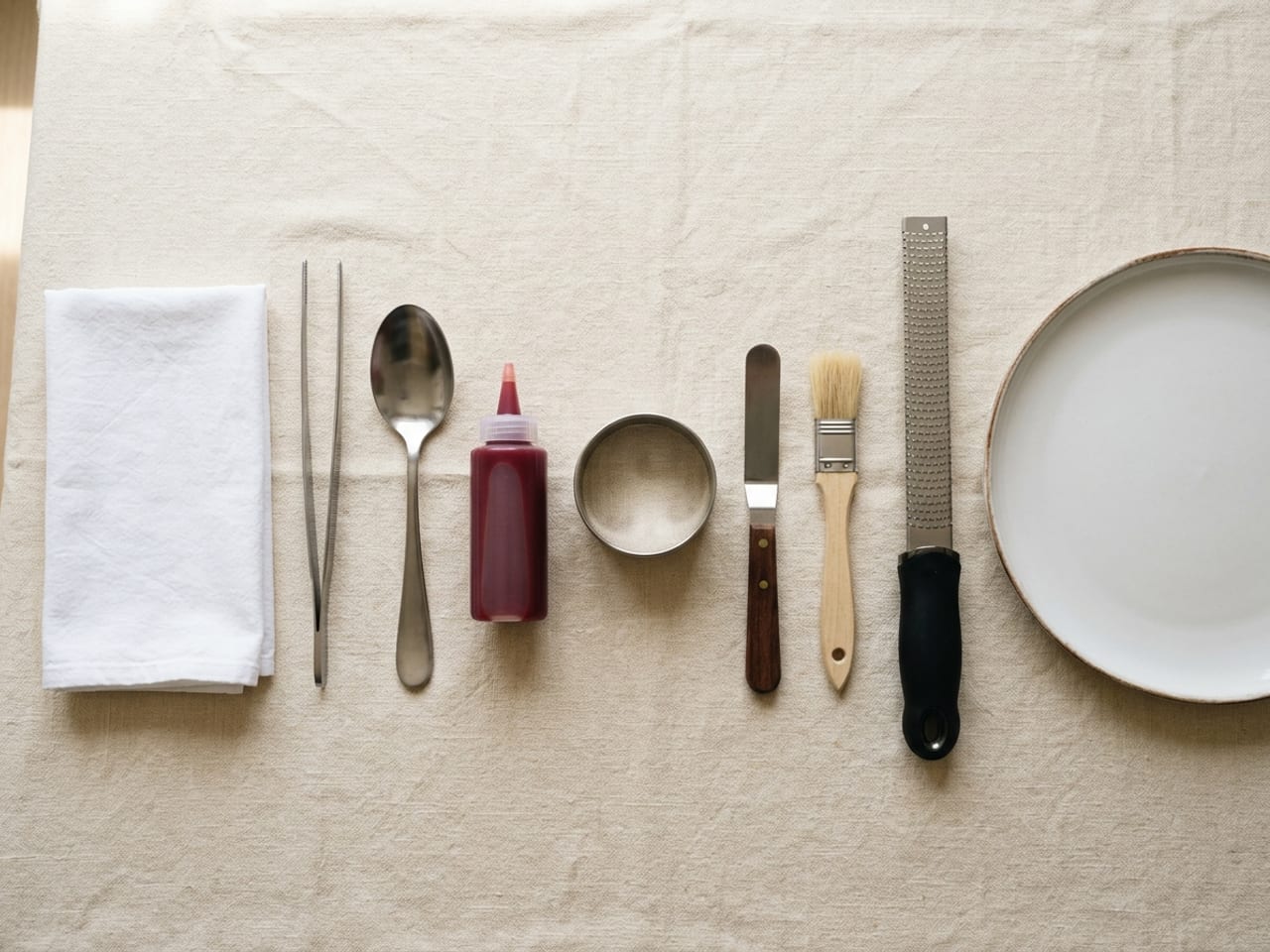
This guide's core kit of nine (our grouping; no source ranks the tools) is plating tweezers, for placing herbs and small garnishes; a large sauce spoon, for swooshes, pools and drizzles, and a spouted saucier spoon, for a measured pour; a squeeze bottle, for dots and lines; a ring mold, for stacks; a small offset spatula, for lifting and spreading; a brush, for painted strokes; a rasp grater, for a fine snow of zest or cheese; and a clean cloth, for the rim. Of the eleven published opinions collected for this guide, nine name a spoon.
- The names. Most of these tools have two or three: plating tweezers are sold as "plating tongs",17 a squeeze bottle is a "squeezy bottle" in Britain,2 an offset spatula is also sold as a palette knife.27 All 20, with their uses, and the glossary.
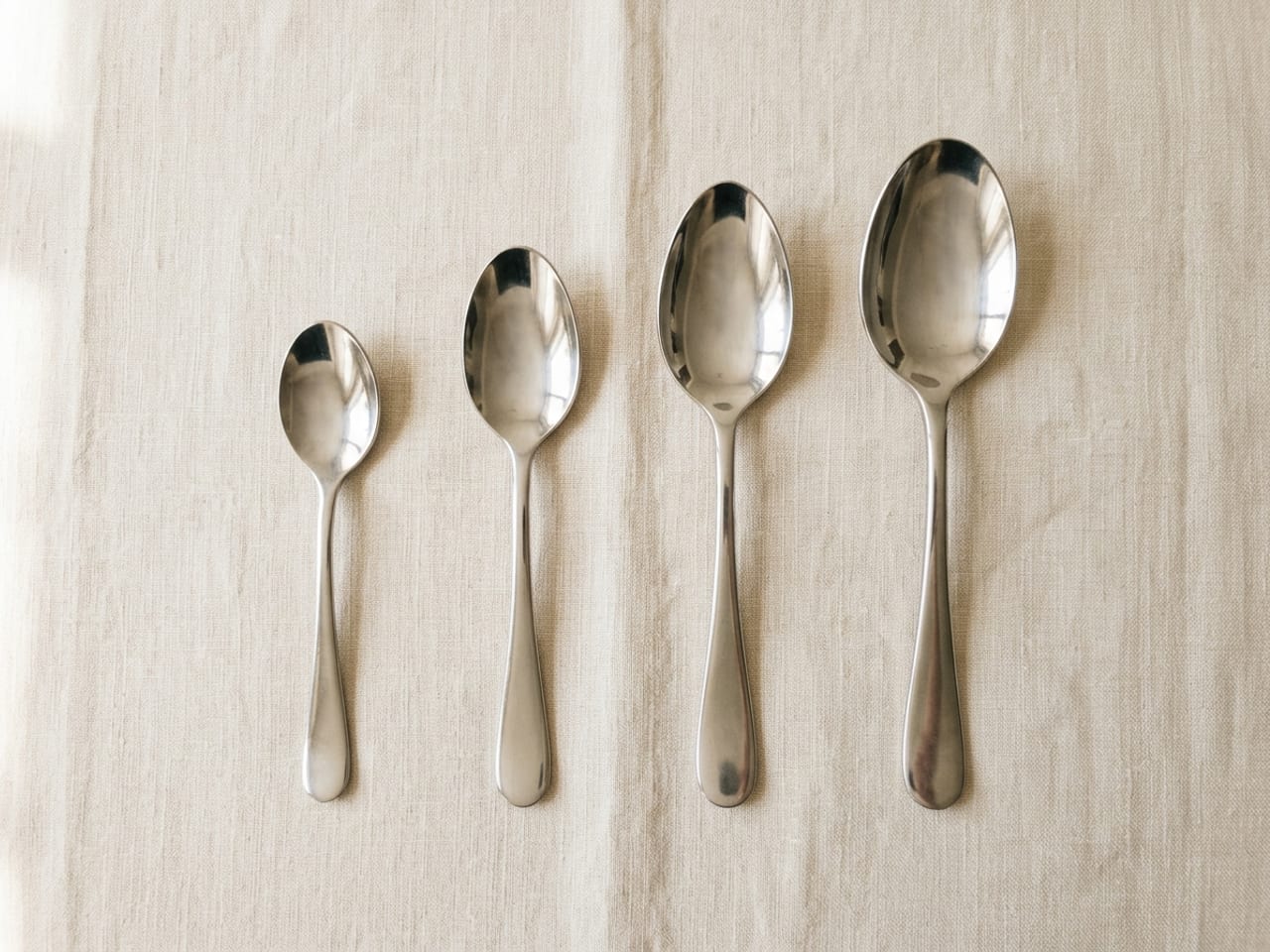
- Two spoons, not one. The Kunz sauce spoon has a tapered tip and no spout; the saucier spoon has a spout.19, 22 The difference, drawn.
- Which tool makes which mark. Swoosh, drag, dots, pool, stack, brush stroke: the table.
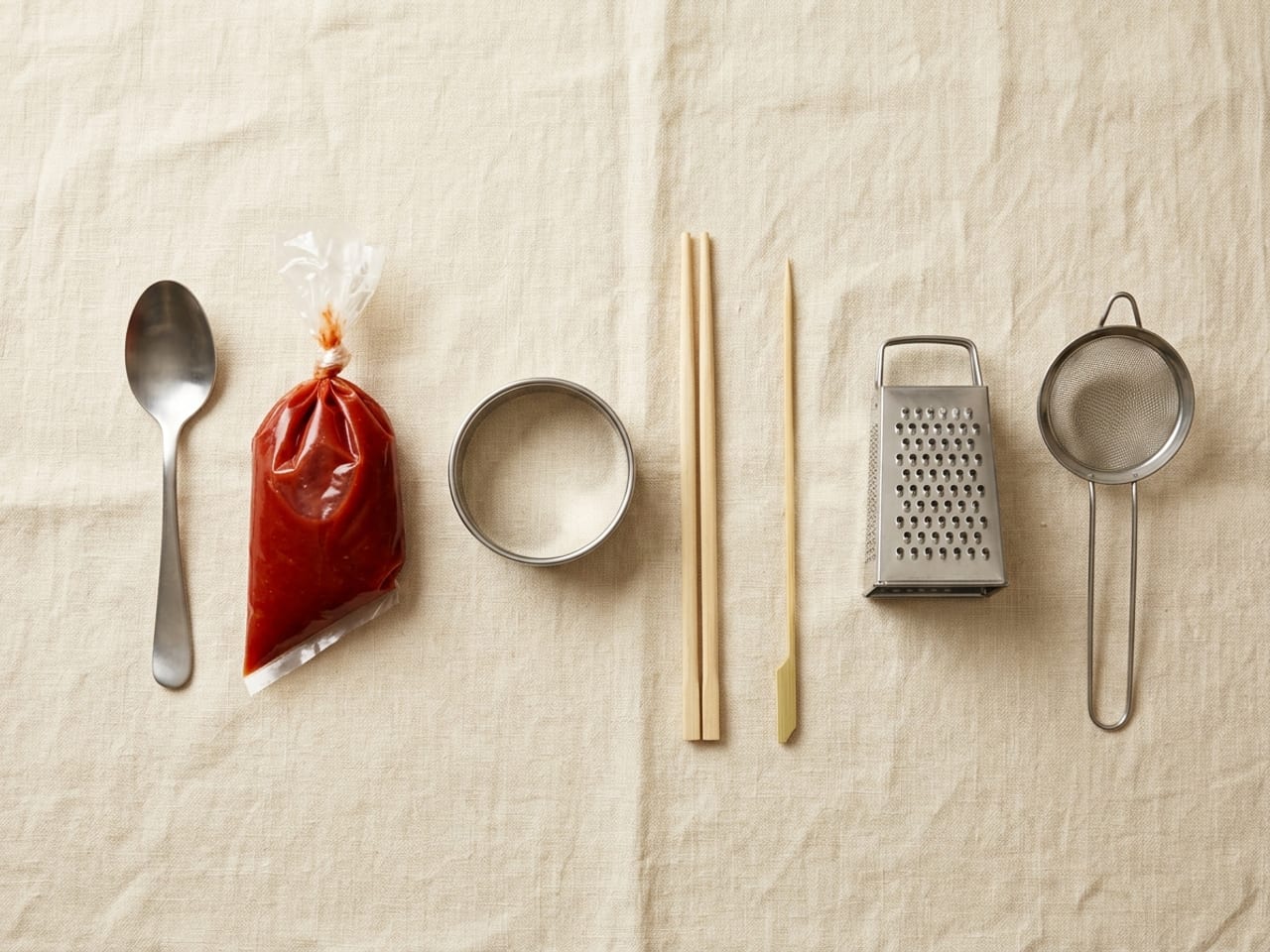
- You may own most of it. A soup spoon, a plastic food bag, a biscuit cutter, chopsticks and a tea strainer all have a named source behind them. Kitchen-drawer substitutes.
- What to get first. There is no agreed order. Eleven opinions, side by side.
- The part that matters most. Sauce in a bottle, herb oil, raw fish in a ring, the torch, the siphon and the mandoline each come with a rule. Food safety.
How this page was made. Every method here is quoted from the published source named beside it: chefs, culinary schools, test kitchens, makers' manuals and food-safety agencies. None was kitchen-tested for this guide. Sizes are given as the catalog prints them, inches first; a metric figure outside quotation marks is our conversion unless the catalog prints it. Where the sources disagree, they are set side by side and no winner is picked. Our own suggestions, readings and arithmetic are labelled "ours". Kunz, JB Prince, Microplane, iSi, Mercer Culinary, Ateco and the other brand names on this page are used only to say whose catalog, manual or product a fact is about: Plate Artists is not affiliated with or endorsed by any of them. Sources are at the bottom.
20 plating tools: names, uses and substitutes at a glance
The first 9 are this guide's core kit and the rest are for one job each; the split is ours, not a source's. Tap a name for the card.
| Tool | Also called | What it is for | From the drawer instead |
|---|---|---|---|
| 1. Plating tweezers | plating tongs, precision tongs, kitchen tweezers, tweezer tongs | Placing herbs, flowers and small garnishes one at a time.79, 80 | Chopsticks;81 fingers, which the one tested review concedes also work.80 |
| 2. Sauce spoon (the Kunz spoon) | Gray Kunz sauce spoon, plating spoon, saucing spoon | The swoosh, the pool and the drizzle; basting and portioning too.49, 64, 71 | "a metal spoon from the cutlery drawer";85 "a soup spoon works well".65 |
| 3. Saucier spoon with a spout | spouted saucier spoon, drizzle spoon | A measured pour: lines, a drizzle, a small pool.22, 68 | No named source gives one for the spout. |
| 4. Squeeze bottle | squeezy bottle (UK) | Dots, lines, zigzags and spirals; drops of oil.64, 74 | A food-grade plastic bag with a corner cut;93 a small spoon, in a retailer's words,73 or the tip of one, as in one famous kitchen.53 |
| 5. Ring mold | ring mould (UK), pastry ring; packed with a press or pusher | Stacking and shaping: rice, grains, salads and tartare.43, 81 Tartare is raw: see the caution. A stacked salad, and Escoffier's objection to moulding one, is in how to plate salad. | A biscuit cutter; a greased ramekin, turned out.84 |
| 6. Offset spatula (palette knife) | palette knife, mini offset spatula, small offset spatula | Lifting and placing flat things; a thick swipe of purée.28, 81 | No named source recommends one. |
| 7. Brush | pastry brush, silicone plating brush, decorating brush | The brush stroke: one painted line or band of thin sauce.64, 69 | A paintbrush, in two sources; only one of them says "Food-safe".67, 69 |
| 8. Rasp grater | rasp, zester; Microplane is a brand | A fine "snow" of cheese, chocolate, nuts or spice; citrus zest.81 | A box grater.81 |
| 9. The rim cloth | cloth, towel; kitchen roll or kitchen paper (UK), paper towel (US) | Wiping drips and smudges off the rim before the plate goes out.68, 73 | It already is the drawer version. |
| 10. Plating wedge and decorating comb | silicone plating wedge, decorating comb | Smears, dots dragged into a chain, combed lines.43, 68 | A skewer, for dragging a drop;69 a toothpick or knife tip, for swirling two sauces.65 |
| 11. Toothpick or skewer | wooden skewer, toothpick | The drag: a dot pulled into a teardrop, rings and lines pulled into a pattern.46, 69 | The tip of a knife;65 a spoon "in a pinch".69 |
| 12. Pipette or dropper | dropper, dropper bottle, funnel dropper | Sold for "serving hors d' oeuvres with a sauce"; the seller's copy does not mention dotting plates.34 | No named source gives one; for drops, the sources use squeeze bottles.74 |
| 13. Piping bag and tips | pastry bag and tip or tube (US), piping bag and nozzle (UK), decorating bag | Piped mounds, dots and lines of purée or mash; filling a ring.46, 68, 105 | A food-grade plastic bag with a corner cut.93 |
| 14. Stencil and duster | dredger, shaker, dusting wand, tea strainer | An even dusting of cocoa, sugar or spice, or a stenciled shape.45, 107 | A small fine-mesh strainer;107 "a fork and knife, a bowl" as the stencil.67 |
| 15. Blowtorch | kitchen torch, butane torch; blowlamp (UK) | Color at the last second: caramelized sugar, toasted meringue, crisped skin.90, 114 | The broiler, for meringue.44 |
| 16. Whipping siphon | cream whipper, whipped cream dispenser, foam siphon, espuma gun | Foam, put on last.117 | An immersion blender, for a light froth only.91 |
| 17. Mandoline and turning slicer | mandolin, Japanese mandoline, turning slicer | Paper-thin slices and ribbons for garnish.92 | No named source recommends one; the reviewers' comparison is a chef's knife. |
| 18. Scissors | kitchen shears, herb scissors, kitchen snips | Herbs cut to order: chives and fine leaves, snipped over the plate.40, 113 | The kitchen shears already in the drawer are what the reviews test. |
| 19. Turntable | cake turntable, revolving cake stand, cake spinner, lazy Susan | A spiral of sauce, squeezed onto a spinning plate.67, 68 | A lazy Susan.67 |
| 20. Plating chopsticks | moribashi, kitchen chopsticks | Placing delicate garnishes, with tips that stay cool.18, 81 | "most chopsticks can still be useful".81 |
9 core plating tools and what each one does
For each tool: what it is and what it is called, the mark it makes, how a named source uses it, and what to use instead.
1. Plating tweezers
Also called: plating tongs, precision tongs, kitchen tweezers, tweezer tongs
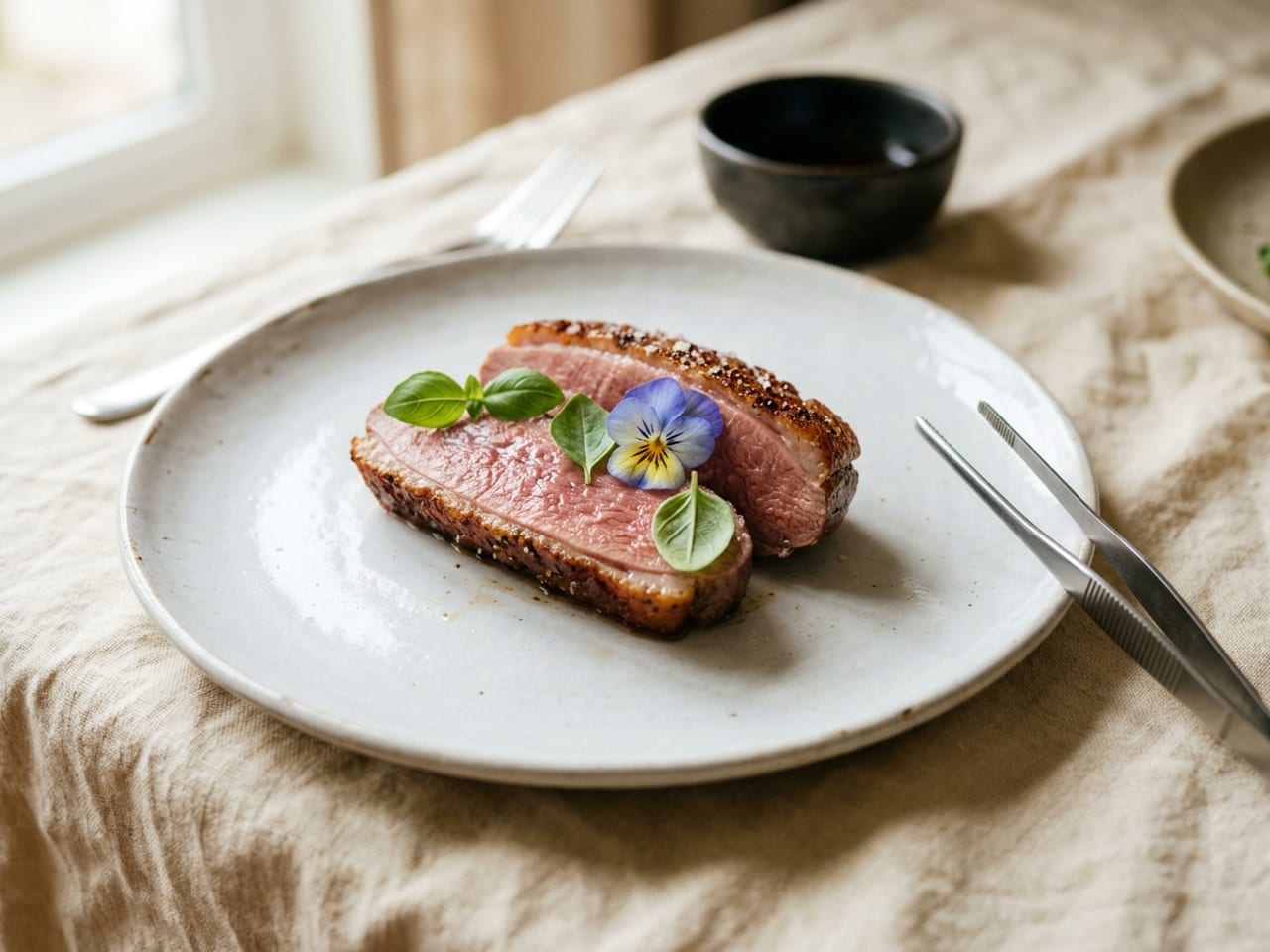
What it is. Long, fine stainless tweezers borrowed from medicine. The New York Times traced them in 2010 to "the operating room: medical tweezers", which chefs favor because they are "more gentle than tweezers designed for plucking eyebrows or extracting pin bones from a halibut".47 One maker sells the whole family as "plating tongs" and never uses the word tweezers;17 another sells nearly all of them, from 4 in to 12 in (10 to 30 cm), as tweezers, and one 10 in model as a "Tweezer Tong".16 In the first maker's catalog they run from 6 1/8 in (15.6 cm) to 11 3/4 in (30 cm).17
Two kinds. "Longer, heavier cooking tweezers are most interchangeable with tongs; they can handle some heft. Shorter and lighter ones (often with offset tips) are ideal for plating and picking up small items, like herbs" (Serious Eats).79
The mark: placed herbs. A leaf, a flower or a crisp set down exactly where it should go. Food & Wine's reviewer explains the offset bend: it "puts the tip a little lower than the grip, so that you can hold the tweezers horizontally to place items on a flat plate without the rest of your hand getting in the way."80 Why not fingers or tongs: tweezers grasp "small ingredients that would otherwise stick to my fingers or clump together",80 they put "less pressure on delicate garnishes" than tongs,82 and fingers are "probably warm", as a publisher's article on chef Jack New's tools puts it.81 No named source was found that gives a step-by-step for placing micro herbs, so this page gives none.
For pasta. Serious Eats lists "Create a perfect pasta nest on a plate" among the uses of kitchen tweezers, and Food & Wine calls a 10-inch (25 cm) pair "ideal for plating stranded pasta".79, 80 Neither prints the steps of the twirl. Christopher Kostow, a chef quoted in the New York Times in 2010, drew the limit by kind of restaurant: haute gastronomy "is rapidly shrinking. You don't need tweezers for pizza and pasta."47
Instead. Chopsticks: "most chopsticks can still be useful in helping you pick up and plate more delicate ingredients" (Gestalten).81 And fingers, as the reviewer who tested seven sets concedes: "You can accomplish most tweezer tasks with your fingers or tongs. However, tweezers generally allow you to do a better job".80
Mind the tips. "Their tips are super sharp."79
2. Sauce spoon (the Kunz spoon)
Also called: Gray Kunz sauce spoon, plating spoon, saucing spoon
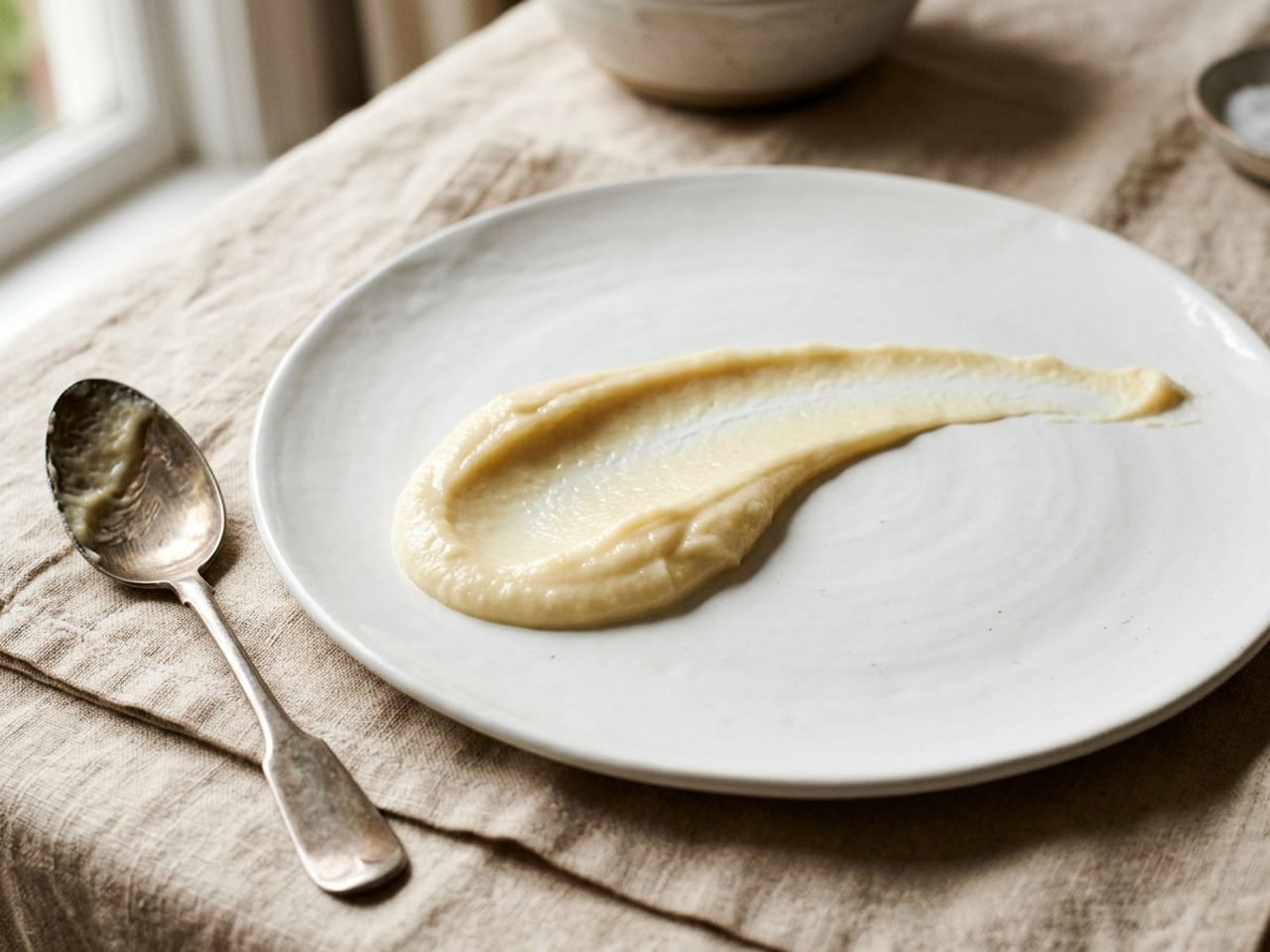
What it is. A spoon bigger than a soup spoon and handier than a serving spoon. "Sauce spoons have larger bowls and longer handles than a standard soup spoon (while they vary, many spoons hover around nine inches long)", says Serious Eats, which calls one of them "the iconic Kunz spoon".70 That is the Gray Kunz sauce spoon, 9 in (22.9 cm) long in its regular size and made of 18/10 stainless steel,19 which Eater calls "a bridge between a larger cooking spoon and a small saucing spoon", "tapered at the tip" for "saucing, making quenelles, and portioning".49 Say "koons".50 Another maker sells its own 9 in (22.9 cm) "Plating Spoon" with a "1.3 oz. Bowl".22 None of the descriptions of the Kunz spoon read for this guide mentions a spout: that is a different spoon.
How much it holds: the sources disagree. The seller's page for the 9 in spoon reads "Approximately 2 Tablespoons".19 The same seller's 2014 press release says it "holds 2.5 tablespoons (about 40 ml)", and so does its page for the gold edition.20, 21 Wirecutter and Bon Appétit both print 2.5 tablespoons.50, 71 By our arithmetic 2.5 US tablespoons is 37 ml, so "about 40 ml" is itself rounded. Nobody measured a spoon for this guide.
The mark: swoosh, pool, drizzle. America's Test Kitchen's swoosh, in its own words:64
- Spoon it on. "Place a spoonful of your sauce on the plate."
- Drag. "Using the back of your spoon, drag the sauce to the other side of the plate to create a comma or apostrophe shape."
- Add the food. "Place your food on top of or next to the sauce."
It is "meant for thick, smooth sauces like a rouille or a puree", because "The thicker consistency is key: It ensures that your swoosh holds its shape and doesn't run all over the plate."64 The sources split on which part of the spoon does the work: America's Test Kitchen and Tasting Table drag with the back,64, 65 while CBC's chef and a restaurant-supply guide dip the tip into the middle of a squeezed circle of sauce and pull.67, 68 For a drizzle, Wirecutter says the tapered end "aims liquids in one direction, creating a steady drizzle facilitated by gravity", and advises: "point the spoon's tip perpendicular to the intended surface".71
Instead. "a metal spoon from the cutlery drawer for spreading sauces and purees", in Fine Dining Lovers' summary of a culinary-school video,85 or "a flat, wide spoon (a soup spoon works well)".65
3. Saucier spoon with a spout
Also called: spouted saucier spoon, drizzle spoon
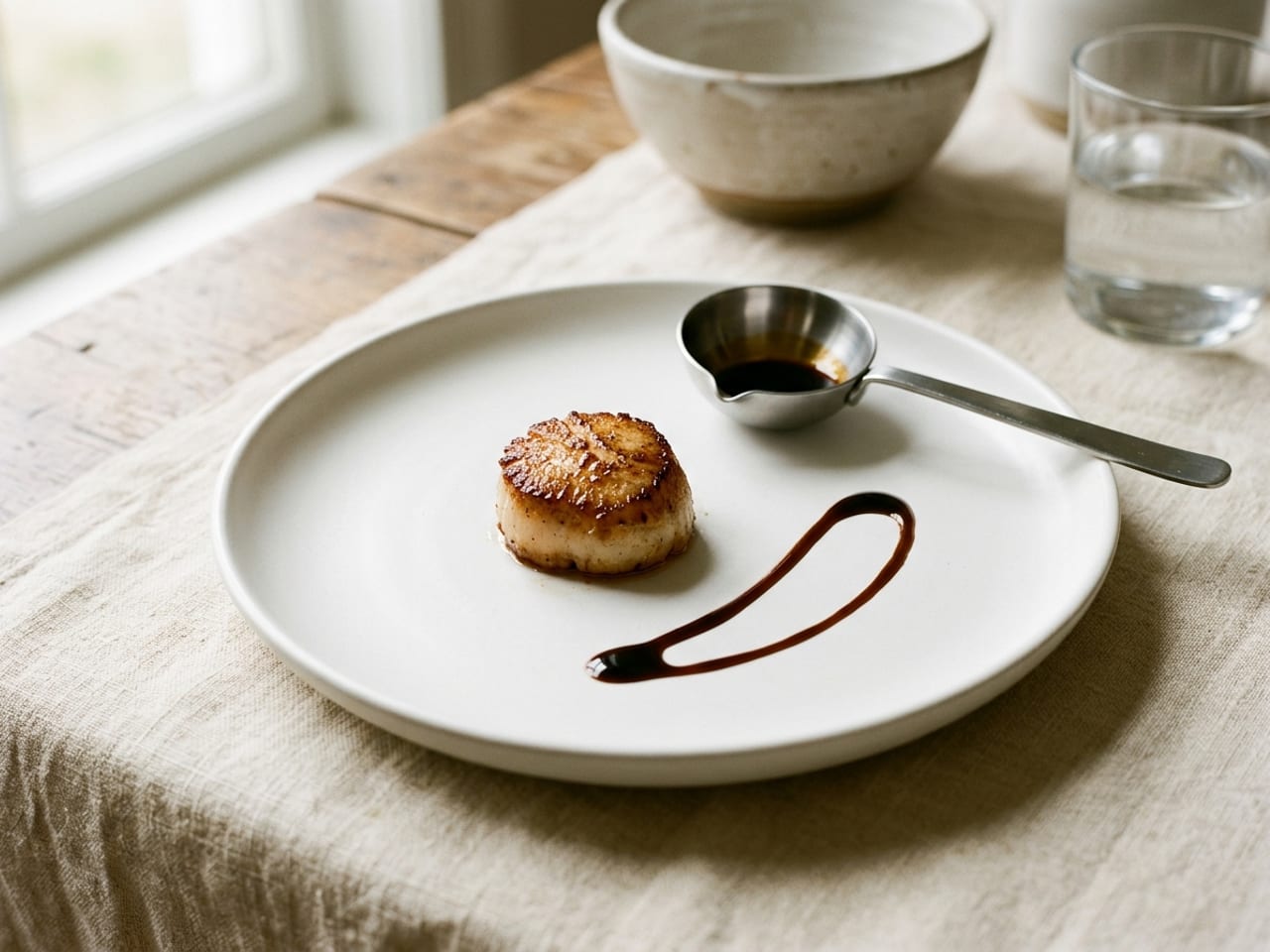
What it is. A plating spoon with a pouring lip. One maker's "Saucier Spoon w/Spout" is 8 1/2 in (21.6 cm) long with a "1 oz. Bowl" and a "Tapered directional spout to provide excellent control of product flow rate"; its petite version is 7 5/16 in (18.6 cm) with a ".4 oz. Bowl".22 A retailer's 9.3 in (23.6 cm) "Drizzle Spoon" has "a generous size bowl and pour spout for extra control while saucing plates". 23 The first maker's "Precision Spoons", 7 in (17.8 cm) and 7 7/8 in (20 cm), have a "Tapered tip for precise decorating".22
The mark: a measured pour. A restaurant-supply guide uses one for exactly that: "Drizzle the demi-glace around the plate using a spouted saucier."68 Chef Jay Fisher pours from a pointed spoon, not a spouted one: "if you want a teaspoon of sauce, the teaspoon-size plating spoon has a point [like a spout] on it so you can pour the right amount. Just like something out of a squeeze bottle, it's spot on" (the bracket is the reporter's).72 An open culinary textbook likewise recommends "a utensil with a tapered bowl that is perfect for drizzling and pouring".43 For a pool, America's Test Kitchen names no spoon at all: "By using a deep plate or a shallow bowl, you can create a perfect circular pool in the center of your dish."64
Instead. No named source gives a substitute for the spout itself. The sources that pour and drag with an ordinary spoon are under the sauce spoon.
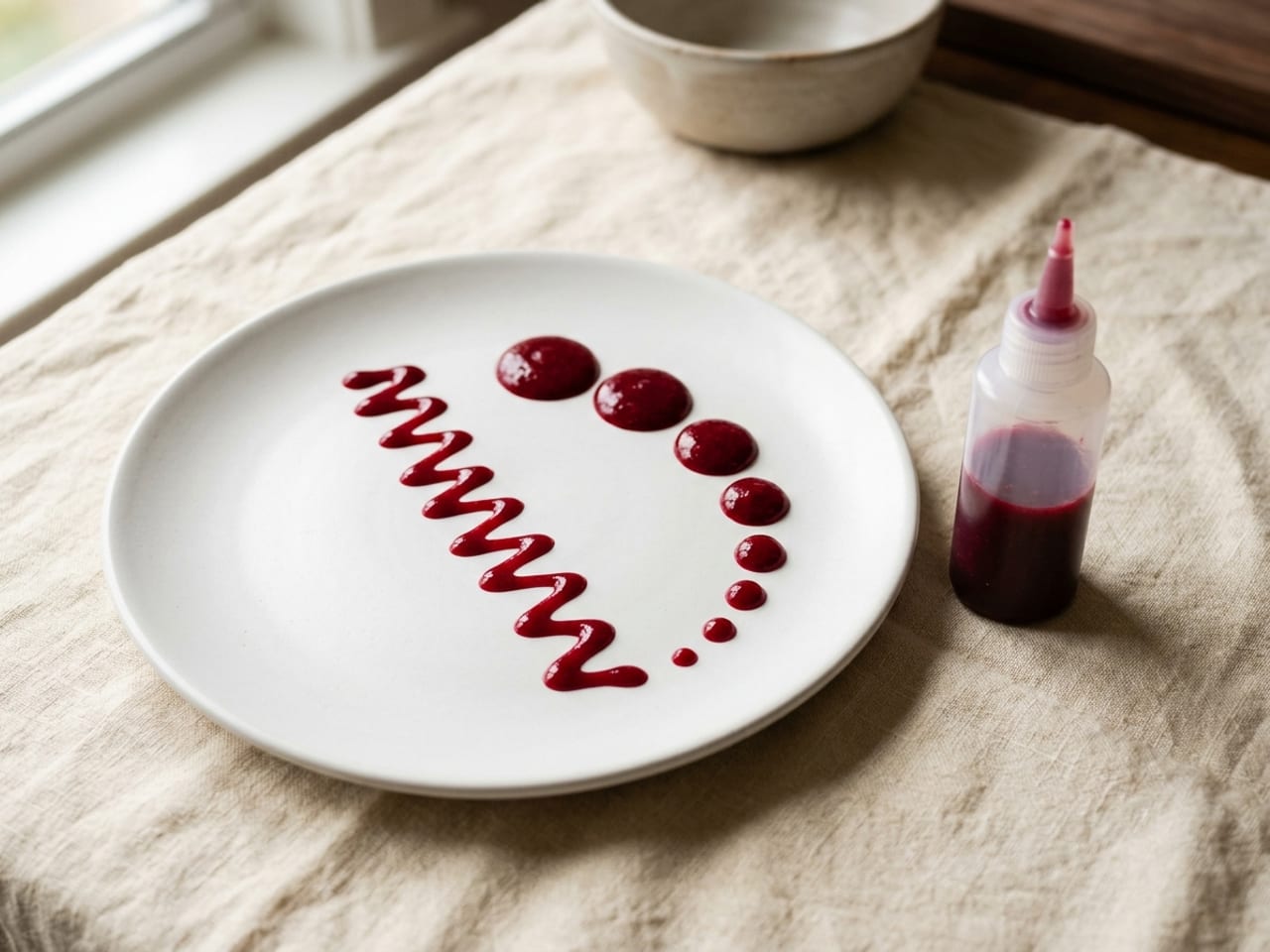
4. Squeeze bottle
Also called: squeezy bottle (UK)
What it is. A soft plastic bottle with a cone tip: "essentially the same objects you see at roadside hot-dog stands, loaded with mustard and ketchup", as Anthony Bourdain wrote in 2000.46 "Squeeze bottle" is American; British English says "squeezy bottle".2 Fine-tip plating bottles at one supplier run from 1.5 oz (about 45 ml; 4.92 in or 12.5 cm tall) to 8 oz (about 235 ml; 7.2 in or 18.3 cm tall); its standard bottle holds 16 oz (about 475 ml).24
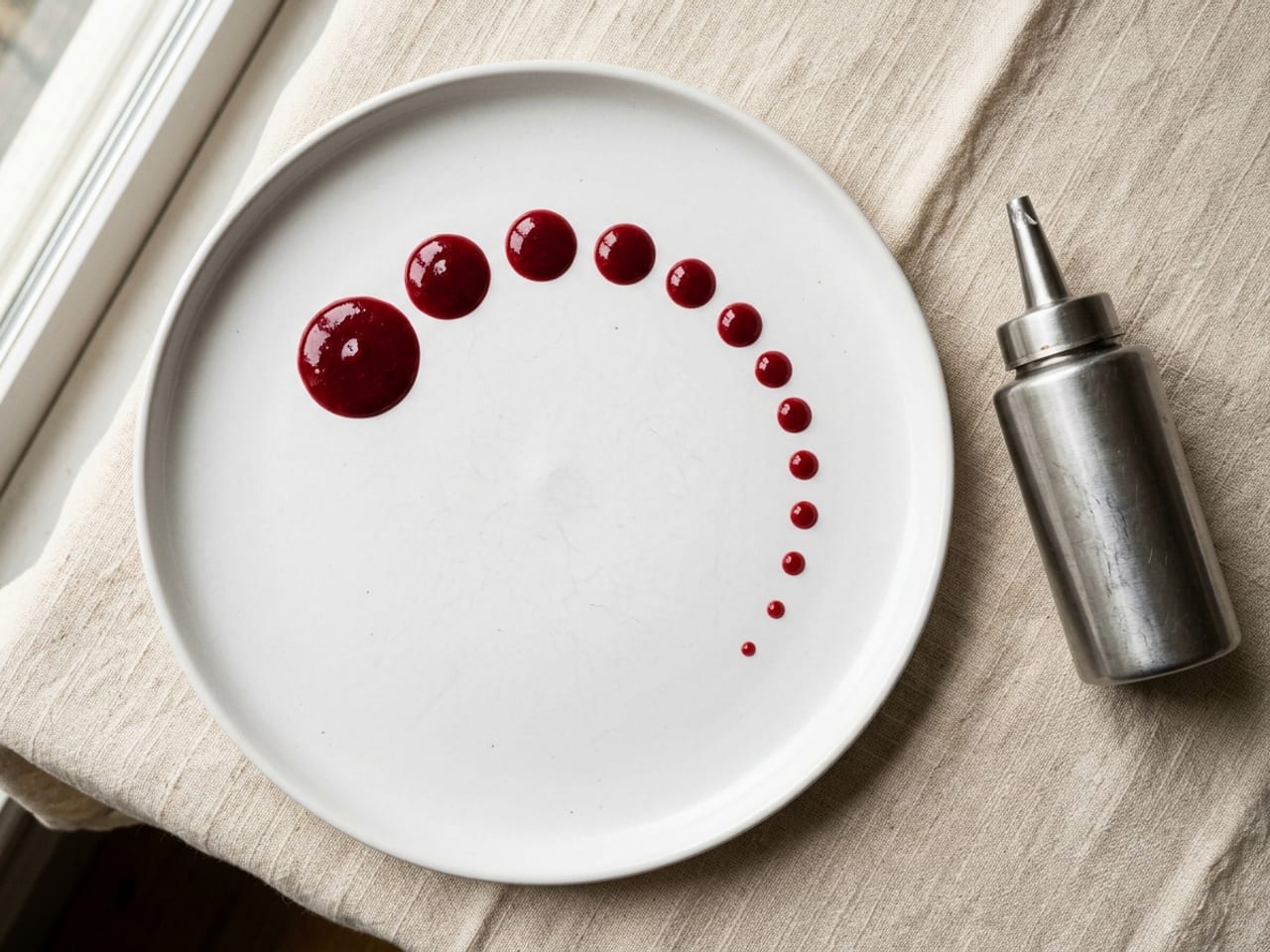
The mark: dots, lines, zigzags, spirals. "You can create a combination of zigzags, dots, waves, or spirals!", with "a thick, smooth sauce that will stay put. Good candidates are a yogurt sauce or, for dessert applications, dulce de leche" (America's Test Kitchen).64 For a dot, a private chef's blog says: "Place the tip on the plate and squeeze gently until a dot is formed. Release your hand so the liquid contracts".66 A culinary school plates "an odd number of sauce droplets" (it does not say with what).69 A caterer told Serious Eats what the bottle is for: "When you're putting a little dab of sauce or a drop of flavored oil on hundreds of hors d'oeuvres, you can't use a spoon".74
Thin sauce, thick sauce. The nozzle decides. "Finer nozzles ... are a bonus if you're doing delicate decorating work with a thicker icing or sauce", while with wide ones the stream "is harder to control and tends to burp and blurp"; and chefs cut the tip themselves: "sometimes you wind up cutting it to your own size".74 Serious Eats ended its test with one bottle for thin liquids and another for thick sauces.74 No source read for this guide gives a nozzle diameter in millimeters, so none is printed here. A ragged nozzle can be trued by pushing "a skewer down through the top of the nozzle".74
Instead. "A food-grade plastic bag will work in a pinch. Fill the bag with the sauce, concentrating it in one corner", then "cut the tip to the desired size" (Los Angeles Times), with the paper's own warning that a hot sauce "could melt the bag".93 Or a spoon: "A squeeze bottle or small spoon can help you apply it exactly where it belongs" (KitchenTime, a retailer, in its write-up of chef Emil Nilsson's tips; the sentence is the retailer's).73 In Joël Robuchon's kitchen, NPR reports from Eric Ripert's memoir, dots went on "not from a squeeze bottle but off the tip of a spoon".53
Not for powders. Powdered sugar and cocoa "tend to clump easily and clog the nozzle" (Milk Street's test kitchen).89 Heat and storage are under food safety.
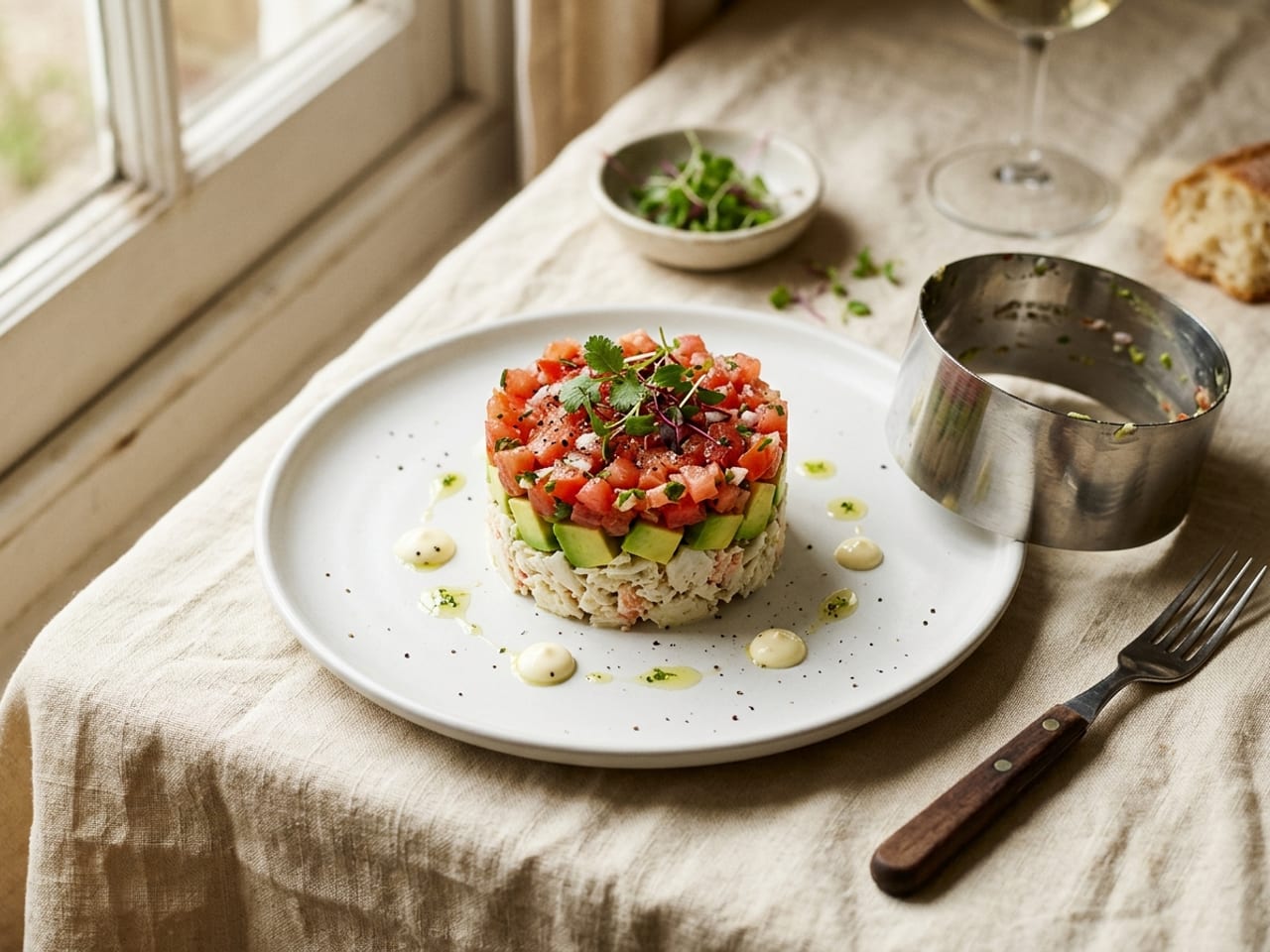
5. Ring mold
Also called: ring mould (UK), pastry ring; packed with a press or pusher
What it is. A bottomless stainless ring. One catalog lists round molds 2 in and 3 in across, 1.75 in or 3 in high (5 and 7.6 cm across, 4.4 or 7.6 cm high), and a "Round Food Molding Set" of two rings (2.75 in or 3.5 in across, 2.1 in high; 7 or 8.9 cm across, 5.3 cm high) with a "Fitted press and transfer plate" to "Form, compress and transfer foods, salads and desserts".25 Another sells seamless rings from 2.36 in to 9.45 in across (6 to 24 cm).26 "Mould" is the British spelling.12 Nobody in those catalogs sells a "tamper": the piece that packs the food is a "press" in one and a "pusher" in the other.25, 26
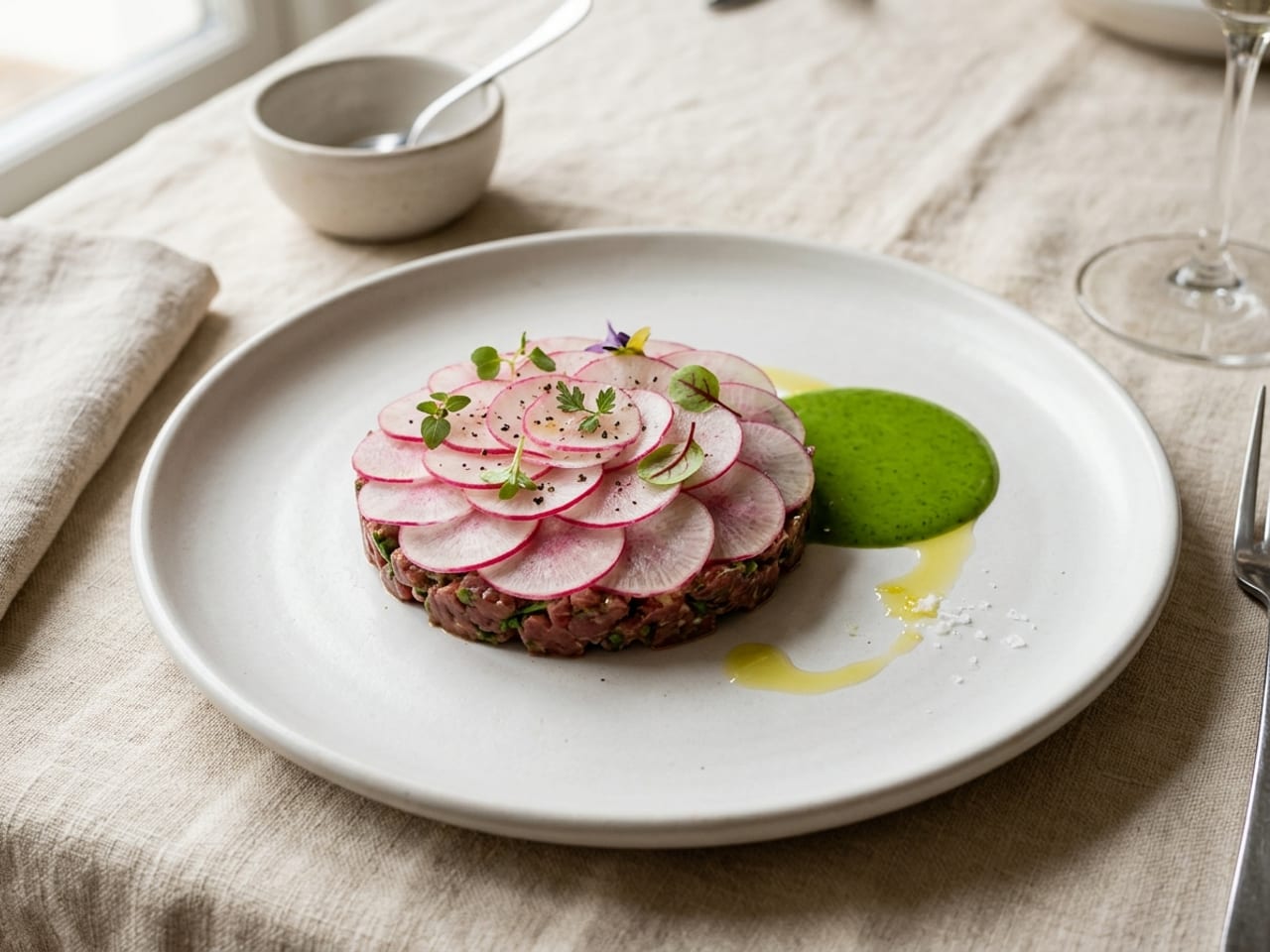
The mark: a stack. "Ring molds also help you develop height and structure when stacking ingredients."43 They are "particularly good for corralling ingredients like rice, sticky grains, and chopped raw fish and meat into uniform shapes" (Gestalten, on the molds chef Jack New uses).81 Raw fish and raw meat are not for everyone: the FDA's list of who should avoid raw fish is under raw food in a ring.136 Food Republic's method in one line: set the ring on the plate, pack it tightly, and lift, "twisting slightly (sandcastle-style) to create a perfect circle for presentation".83 Tasting Table's layered stack, in the recipe's own words:84
- Set the ring. "place a biscuit cutter or ring mold on a plate."
- Pack the base. "Place about ¼ cup rice into the bottom of the mold, pressing down to make the top flat and even" (about 60 ml).
- Add the layers. "Add the avocado pieces next", then "about ¼ cup tuna". The recipe's tuna is "sushi grade ahi tuna" from "a reputable fishmonger" and is served raw: read raw food in a ring first. A cooked filling is molded the same way (ours).
- Press and lift. "press down on the tuna with a spatula and slide the mold up and off of the plate."
A caution on fashion. A retailer's guide that sells them notes that "compactly stacking ingredients isn't as popular as it was 5-10 years ago".68 Bourdain called the metal ring "the backbone of pretentious food presentation" and, later in the same book, wrote: "You might want to reconsider what I said about them too."46
Instead. A biscuit cutter: "You could buy a professional ring mold, but biscuit cutters will also do the trick when forming your tuna stacks." A ramekin, in the same recipe: "just grease the container and reverse the order", then "turn the bowl over and release the stack onto the plate."84 A tin can and plumbing pipe are suggested on one blog, and Bourdain mentions a "cut-down section of PVC pipe"; neither says a word about food safety:46, 87 read food-contact materials first.
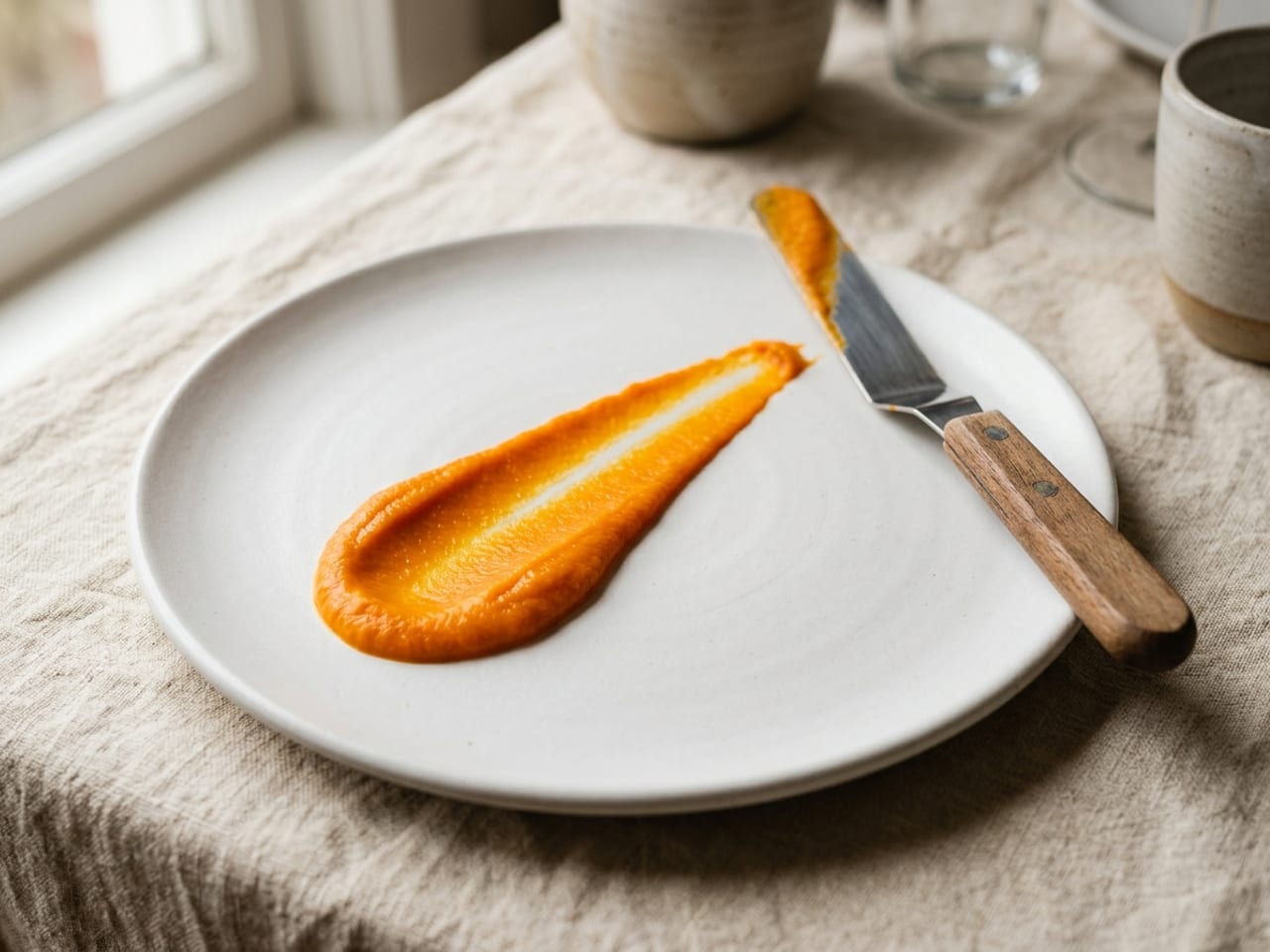
6. Offset spatula (palette knife)
Also called: palette knife, mini offset spatula, small offset spatula
What it is. A small, thin, blunt blade with a step in it. "What makes them 'offset' is the two points where the blade bends at an angle: veering down once near the handle, then jutting out straight again to form a long, flat surface."96 Cambridge Dictionary gives palette knife a cooking sense, "a knife with a wide thin blade, a rounded end, and no sharp edge",3 where Merriam-Webster has only the painter's tool,4 so reading it as the British word is ours; one retailer prints both names on one product.27 The plating size is the small one: one maker's blade is 4 1/4 in by 3/4 in (about 11 cm long),28 another's 4.5 in by .75 in (11.4 by 1.9 cm).25
The mark: a lift, and a thick swipe. The maker's own line: the "Offset blade is ideal for lifting and plating delicate items with flat bottoms".28 A publisher's article on chef Jack New's tools calls offset spatulas "handy for transferring ingredients and for creating swooshes of sauces and purées on the plate"; New himself, it says, uses small palette knives "to place meat and fish".81 For the swipe, a private chef's blog squeezes a thick line of sauce, then: "swipe to the right gently, you just want to move the sauce along, do not push it down. Tilt the spatula gently so you are only using the edge".66 Chef Jay Fisher reaches for "a mini spatula if I have a heavy, pureed sauce".72
Offset or straight. The catalogs sell both.25 The bend is what keeps the hand off the surface: in America's Test Kitchen's cake tests an angled blade "reached easily inside cake pans while still keeping our hands free of frosting."97
Instead. No named source recommends a substitute. Wirecutter mentions the butter knife only to say the spatula's shape "makes it much more adept" at spreading.95
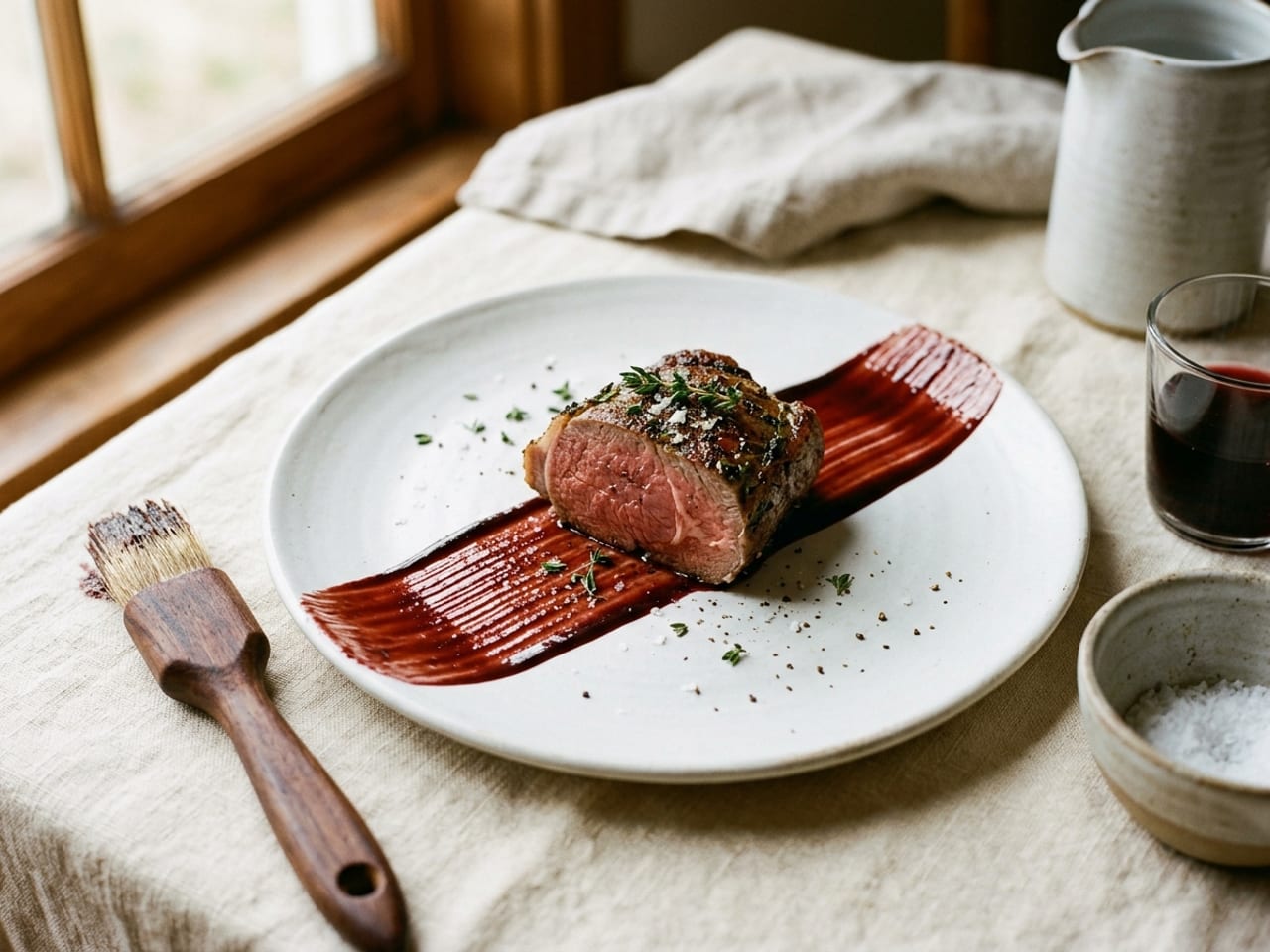
7. Brush
Also called: pastry brush, silicone plating brush, decorating brush
What it is. Either a pastry brush with bristles, sold from 1 in to 4 in (2.5 to 10 cm) wide,32 or a "Silicone Plating Brush", which has a shaped silicone head (a comb, a saw tooth, arches, notches) in place of bristles and is 7 5/8 in (19.4 cm) long.31 An open culinary textbook calls them decorating brushes: "You can use them for both detailed line work and broad strokes as you apply sauces, or when plating purees and coulis beneath meat or vegetables."43
The mark: a brush stroke. America's Test Kitchen: "Dip a clean brush (such as a pastry brush) into the sauce and tap off any excess sauce, just like you would if you were painting a wall", then "Brush the sauce across the plate and place your food on top." It is "meant for thin sauces that are easily spreadable", such as pesto or a balsamic glaze.64 A culinary school aims the stroke: "Stroke the sauce in a single line using a paintbrush, and drag it along the plate, to point at one o'clock. Use a larger paintbrush to achieve a wider stroke."69
Instead. That school says paintbrush, and CBC's chef asks for a "Food-safe paintbrush".67, 69 Only the second says food-safe: see food-contact materials.
8. Rasp grater
Also called: rasp, zester; Microplane is a brand
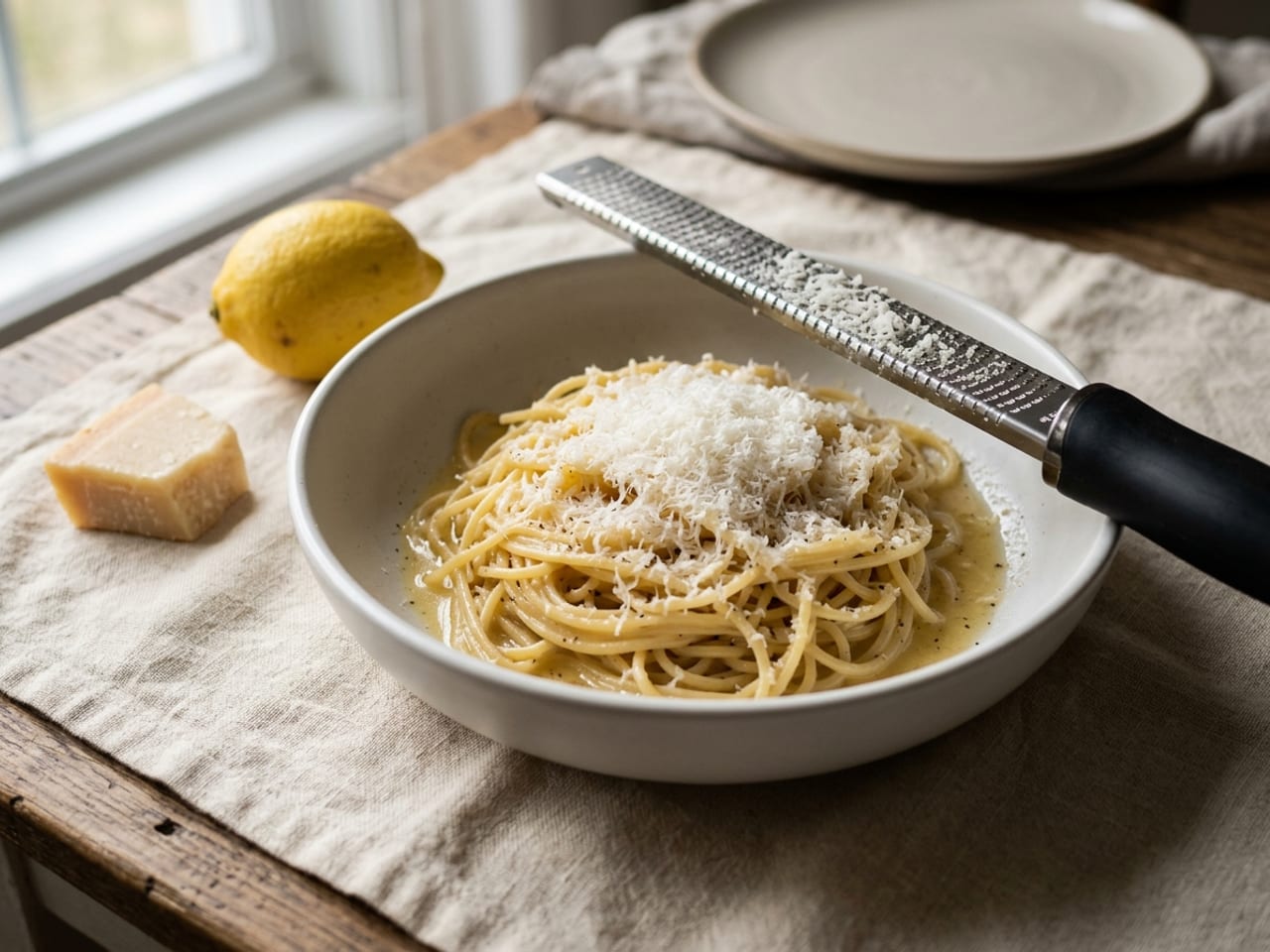
What it is. A long, narrow, very fine grater. Microplane is one maker's trademark;58 the New York Times in 1998 called the tool "the rasp", "commercially dubbed the Microplane".55 One listing gives the size as 12 in long and 1.25 in wide (30.5 by 3.2 cm).33 What sets it apart is how the teeth are made: "the holes are dissolved with ferric chloride, so they are like hundreds of tiny razors", where "Most zesters simply have holes punched into a flat or curved piece of stainless steel or tin."55
The mark: snow. It is "particularly good for creating 'snow'-like textures from ingredients such as chocolate, nuts, hard cheeses, and whole spices like nutmeg. It's also ideal for zesting citrus fruits" (Gestalten, which calls the tool "another frequently used weapon in New's arsenal").81 Two notes from America's Test Kitchen: zest pulled with the grater held teeth-down gathers "in a clump on the back side of the blade", so over a plate it has to be knocked off (our reading); and small, flat-lying teeth made "ultrafine shreds of cheese that disappeared instantly when we sprinkled them over hot pasta."102
Instead. "Box graters provide a similar function to the Microplane; the best thing to do is experiment with grating different ingredients to see what kind of effects the grater's different holes produce. Just be careful where you put your fingers" (Gestalten).81
9. The rim cloth
Also called: cloth, towel; kitchen roll or kitchen paper (UK), paper towel (US)
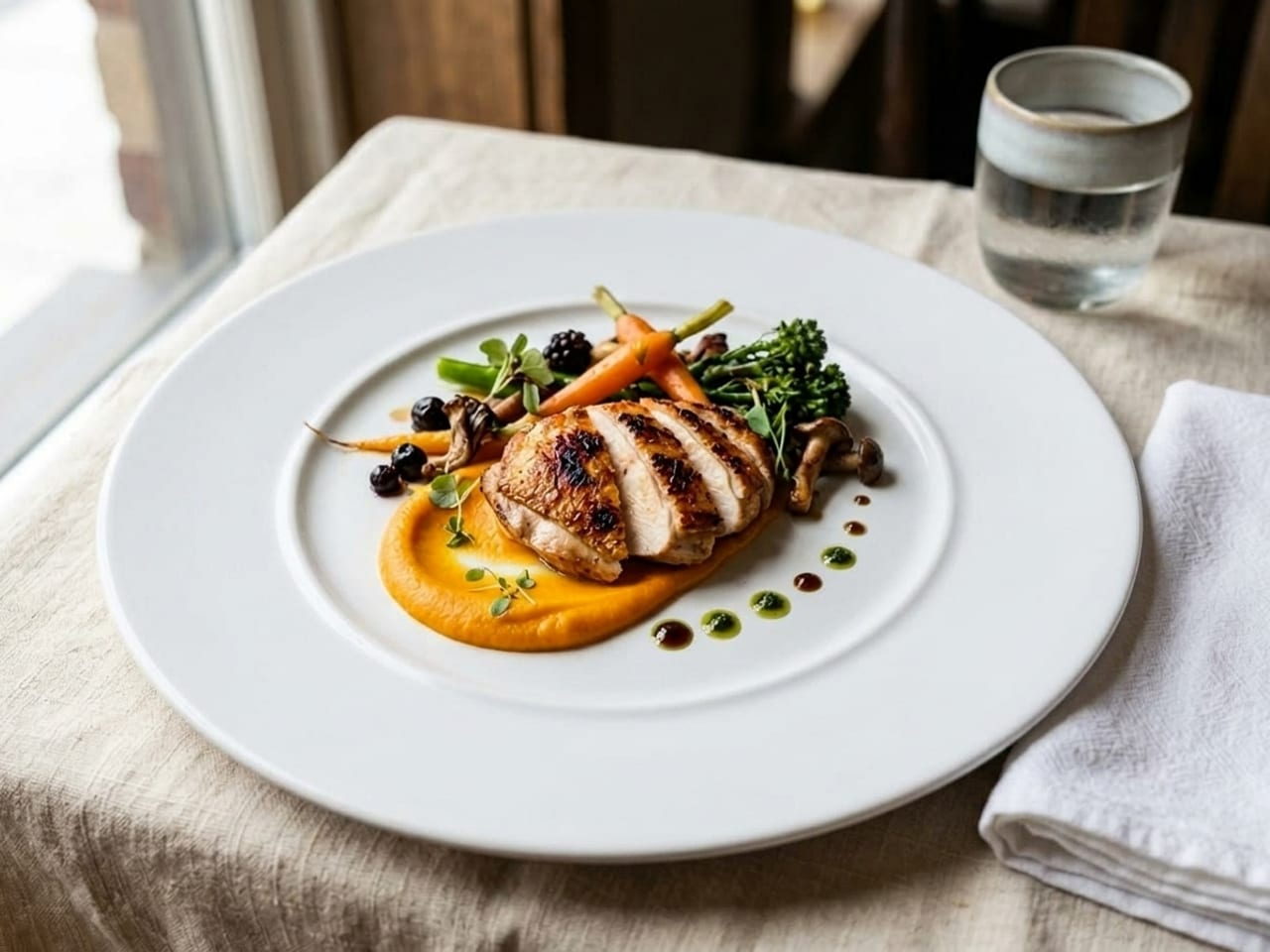
What it is. A clean cloth or paper towel kept for one job. The British say kitchen roll or kitchen paper where Americans say paper towel.13
The mark: none, which is the point. "Once you're done adding your sauce, make sure you wipe down the edge of your plate with a towel, so no drippings distract from your presentation."68 Emil Nilsson, a Swedish head chef: "It's so easy to smudge the rim of a plate or drip sauce by accident"; the retailer that interviewed him adds: "A final wipe with a cloth can make all the difference."73
Damp with what? The sources do not agree, and none is strong. The Culinary Institute of America's textbook, read here only as a search fragment, says to wipe drips "with a clean cloth wrung out in hot water".44 One former pastry cook describes cloths "lightly soaked in a mixture of mostly water with a splash of vinegar".63 And the US model code for restaurants wants cloths that wipe food spills from tableware "Maintained dry" and "Used for no other purpose".123 Its stated reason: "Soiled wiping cloths, especially when moist, can become breeding grounds for pathogens".123 That last is a restaurant rule; at home the useful part is a clean cloth kept for plates only (our reading).
11 more plating tools, each for one job
None of these is needed to start. Three of them (the blowtorch, the siphon and the mandoline) can hurt you, so read the safety notes with their cards.
10. Plating wedge and decorating comb
Also called: silicone plating wedge, decorating comb
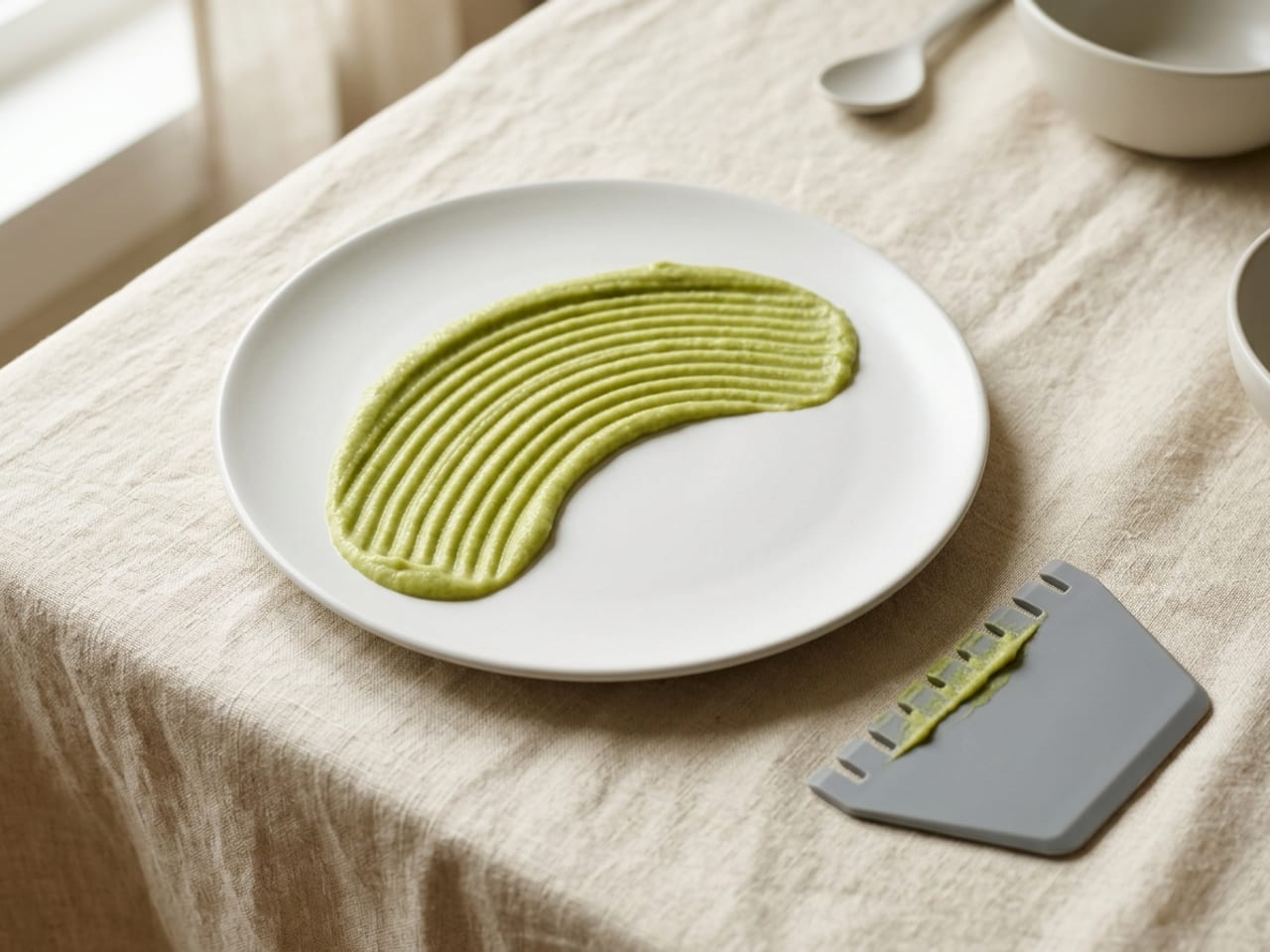
What it is. A small, stiff scraper with a shaped edge. "Plating wedges come pre-cut with flat, round, or pointed edges and are perfect for smearing sauces and other soft ingredients into designs on your plate."43 One maker lists eleven edge profiles (saw tooth, round arch, square notch and so on); its saw-tooth wedge is 3 3/4 by 2 1/2 in (9.5 by 6.4 cm), with a "2 1/4" width for broad patterns on plates or platters".29 The long toothed tool from the pastry kitchen is a "decorating comb".25, 30
The mark: a smear, dragged dots, comb lines. For the smear, a restaurant-supply guide squeezes a filled circle of sauce, then: "Take a spoon or plating wedge and dip it into the middle of the sauce where it's thickest. Quickly pull the sauce across your plate." For dragged dots: "Alternate between two sauce accent dots in a curved line along the side of your plate. Then, take a small plating wedge and place it at the center of the first accent dot in your row. Drag the plating wedge through the accent dots".68 The only named how-to for comb lines found for this guide uses a decorator's tool: CBC's chef pulls two sauces into a wood grain with a paintbrush, then "a graining comb or graining rocker".67 Those are house-painting tools: see food-contact materials.
Instead. For dragging a drop, a skewer: a culinary school uses one, though it does not mention a wedge, so setting the two side by side is ours.69 No named source was found for a fork as a comb, so it is not offered here as sourced advice.
11. Toothpick or skewer
Also called: wooden skewer, toothpick
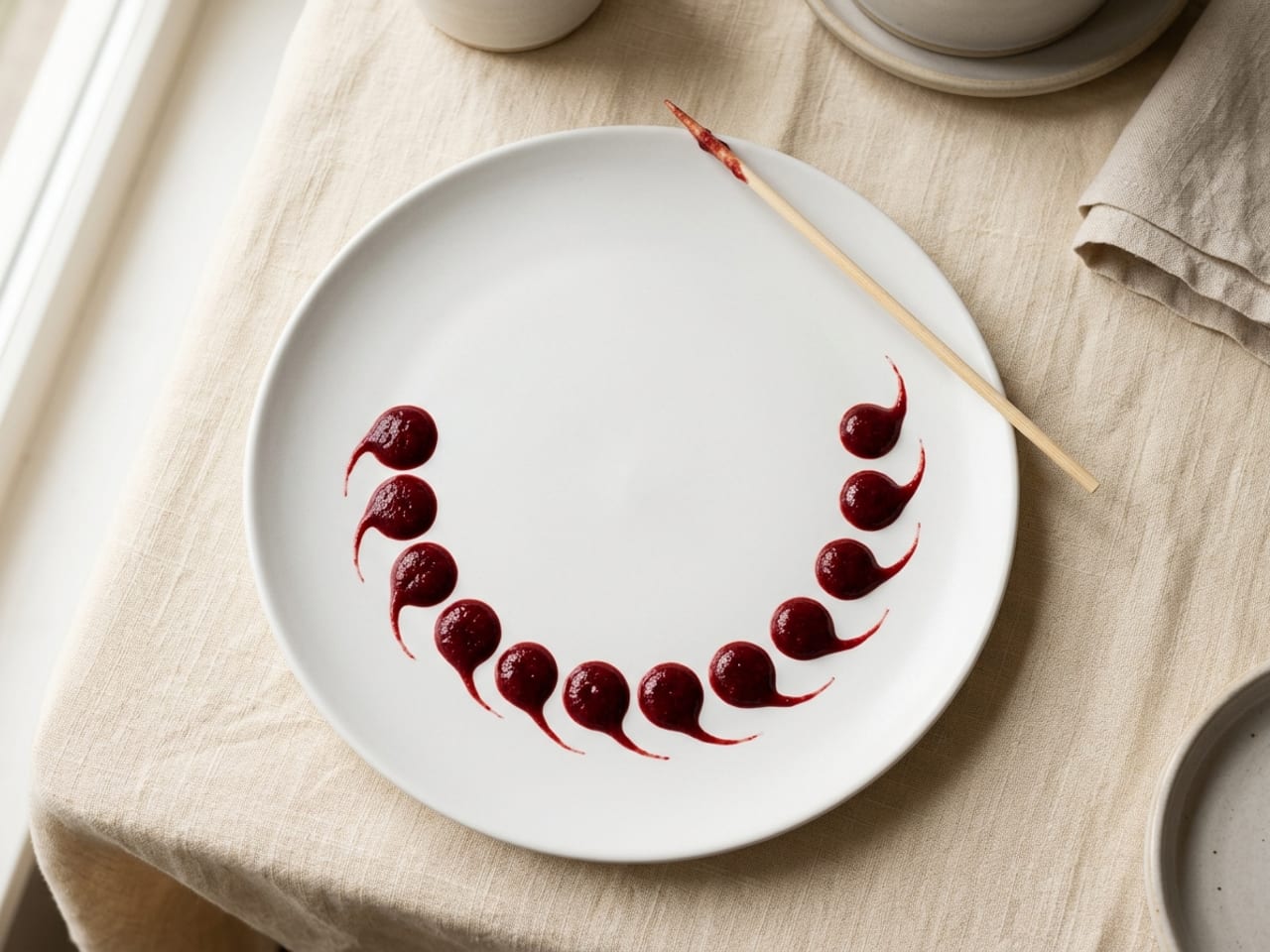
What it is. A sliver of wood. Bourdain's whole sauce lesson is a squeeze bottle and this: run "a couple of concentric rings of darker sauce" around the plate, "now drag a toothpick through the rings or lines, and you'll see that all the fuss is about nothing."46
The mark: the drag. A culinary school's teardrop: "squeeze a large circular drop onto the plate", then "drag a skewer through the droplet, bringing the sauce to one side to the desired length. If in a pinch, this can also be achieved with a spoon in lieu of a skewer."69 For two sauces, "gently swirl them together with a skewer, toothpick, or the tip of a knife."65
Its other job. Truing a ragged squeeze-bottle nozzle.74
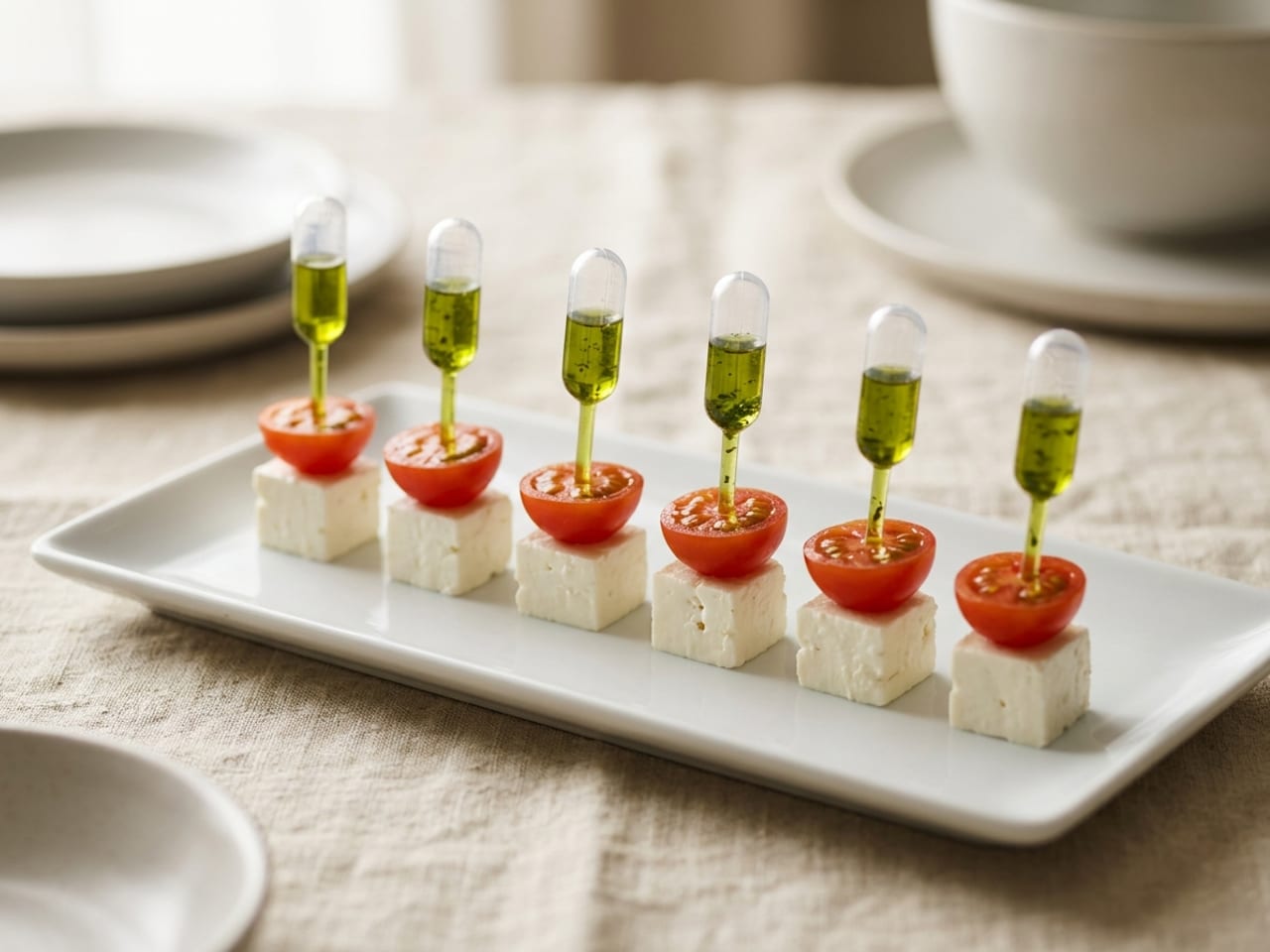
12. Pipette or dropper
Also called: dropper, dropper bottle, funnel dropper
What it is. A laboratory tool. The dictionary has only "a thin glass tube used especially in biology and chemistry for measuring or moving a small amount of liquid", with no kitchen sense and two pronunciations (UK /pɪˈpet/, US /paɪˈpet/).11 Kitchen suppliers sell disposable plastic ones: one teardrop model is 1.8 in (4.6 cm) long, holds 5.9 ml and comes in a pack of 100.34 Buy the ones a kitchen supplier sells for food, not laboratory stock (ours).
What it is sold for. The supplier's copy names serving, not dotting: "Used for transferring or delivering measured quantities of liquids. A unique tool for serving hors d' oeuvres with a sauce."34 By our reading that is a filled pipette sent out with the food. For drops on the plate, the chefs Serious Eats spoke to own squeeze bottles "from nearly dropper-sized" up,74 and Bourdain, in his 2000 book, describes waiters "squeezing drops of chive oil, lobster oil or thirty-year-old balsamic from eye-dropper-sized squeeze bottles."46 The Culinary Institute of America's textbook, in a search fragment, pairs "plastic squeeze bottles or a funnel dropper".44
How. No named culinary source was found teaching pipette dots on a plate, so this page prints no method.
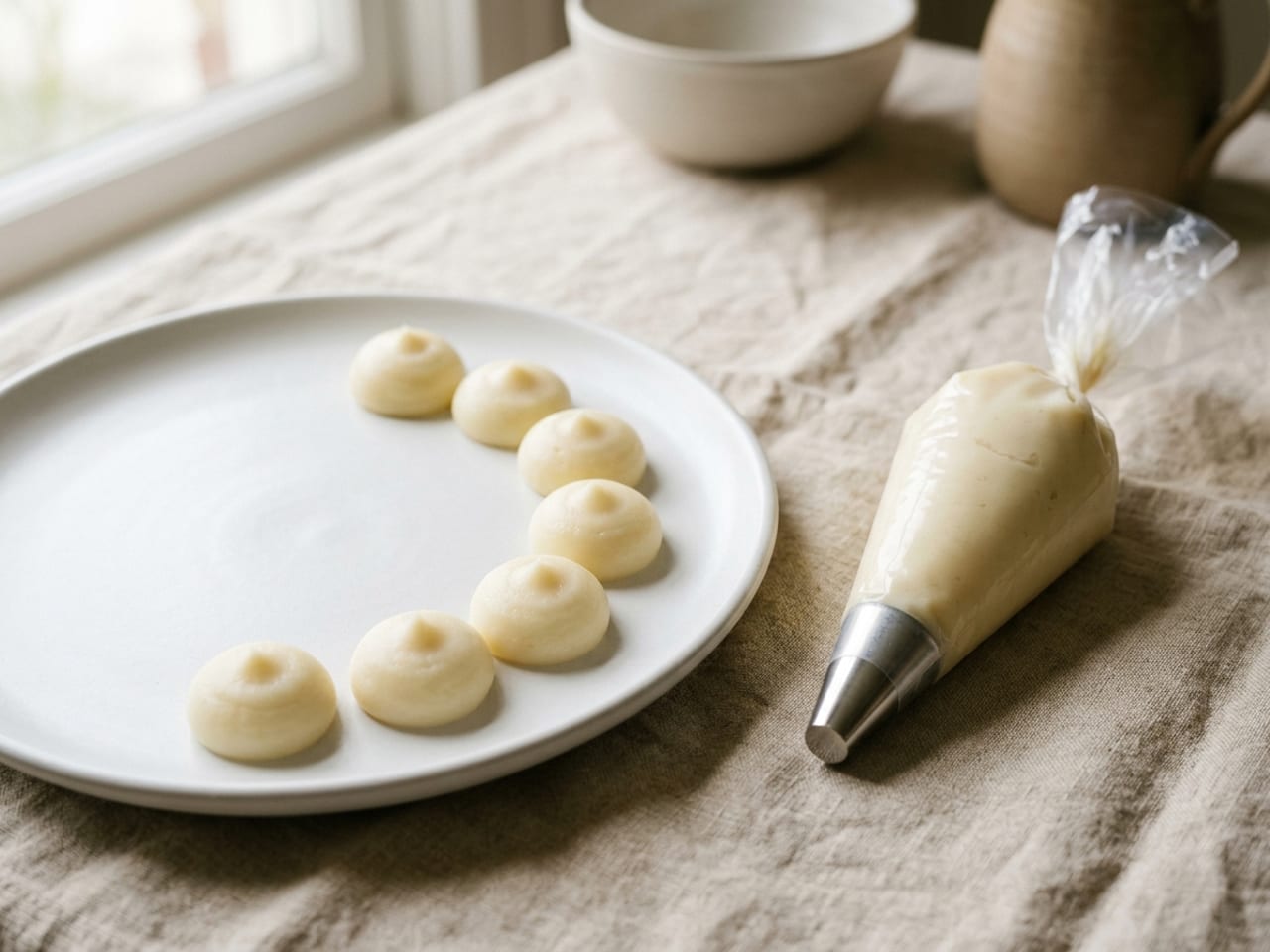
13. Piping bag and tips
Also called: pastry bag and tip or tube (US), piping bag and nozzle (UK), decorating bag
What it is. A cone-shaped bag that forces a soft food through a tip. Americans say pastry bag and tip or tube; the British say piping bag and nozzle (our reading of which dictionary has which word: neither labels its entry by country).6, 7 Tube numbers are not universal: one maker's No. 800 opens at 5/32 in (4 mm) and its No. 806 at 1/2 in (13 mm), while a retailer's own size 0 is 1/8 in (3 mm), so quote the opening, not the number.25, 35
The mark: piped mounds, dots and lines. Great British Chefs fills and holds it this way: "Fold back the top of the piping bag to cover your hand and spoon in the mashed potato", "unfold the top of the bag and twist to seal the bag", then "Hold the twisted end in one hand and guide the pointed tip with the other".88 America's Test Kitchen "preferred tips with openings between ¼ and ½ inch wide" (6 to 13 mm): "Smaller tips clogged easily and took an expert hand to wield well. Larger tips made gloppy, messy decorations." Its tests were savory as well as sweet: it "swirled mounds of hot duchess potatoes, and filled curried deviled eggs."105 Bourdain pipes mashed potato into a ring with one.46 A plain line needs no tip: "You can simply cut the tip off a disposable pastry bag to pipe a line of whatever width you desire".95
None of the tested reviews read for this guide has a sentence about piping purée onto a dinner plate: their tests are cakes, choux and potatoes.
Instead. The same food-grade plastic bag with a corner cut that stands in for a squeeze bottle, with the same warning about a hot filling: it "can hurt your hands, and could melt the bag".93
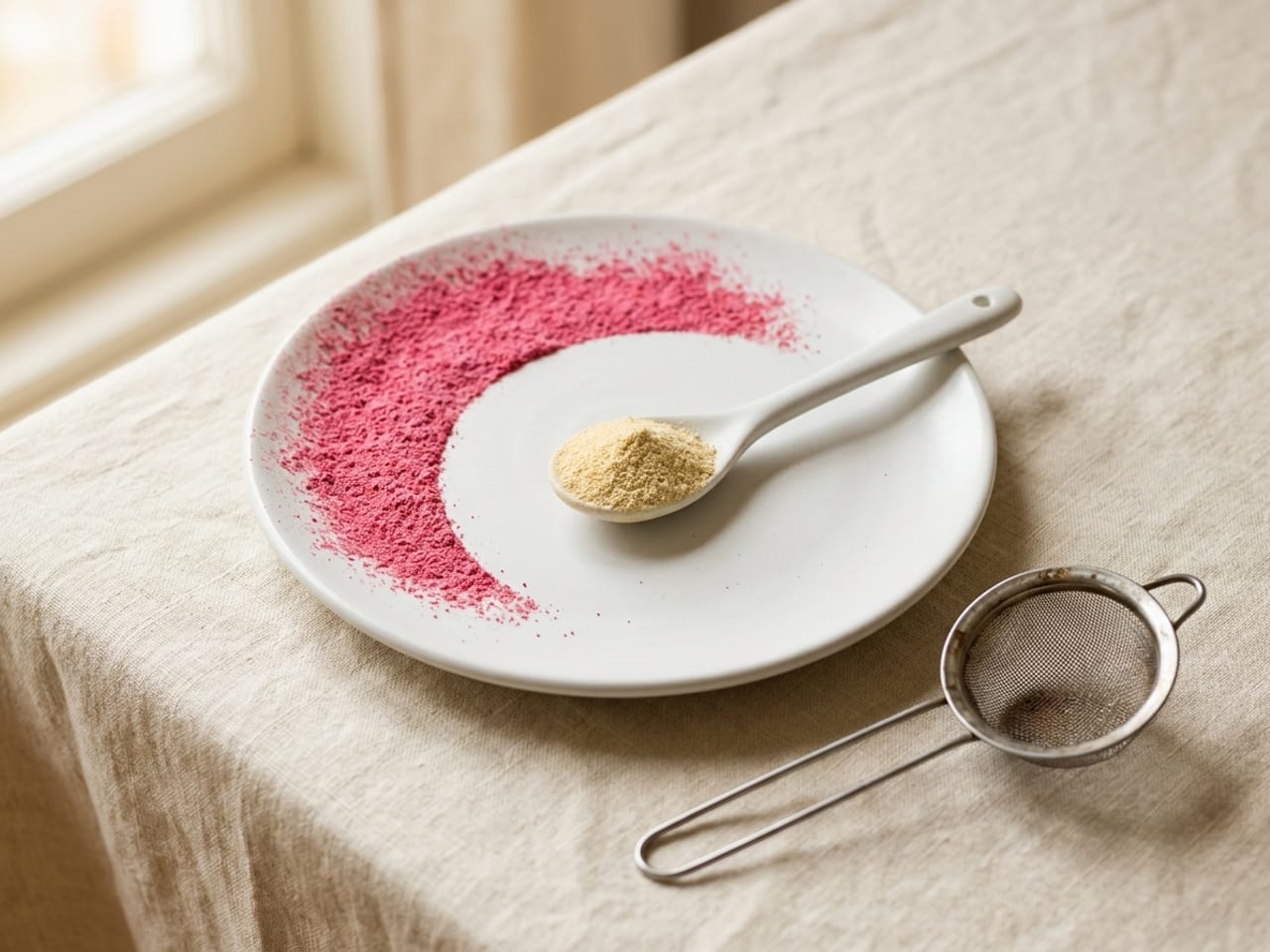
14. Stencil and duster
Also called: dredger, shaker, dusting wand, tea strainer
What it is. Anything that lets a powder fall evenly: a dredger, "a container with a perforated top that is used to coat food (as with flour or sugar) by sprinkling";9 a shaker "with mesh top", 4 oz or 10 oz;25 a "Powdered Sugar Dredger" 4 in high and 2.75 in across (10.2 by 7 cm);36 a "dusting wand";81 or a small fine-mesh strainer, "sometimes known as tea strainers".106
The mark: a dusting, or a stenciled shape. A culinary textbook, read here as a search fragment, dusts plates through a template: "The template can be a doily or a stencil placed over the plate before it is dusted."45 CBC's chef uses a "Wall stencil" and "Powdered spice, such as paprika, cinnamon or cocoa", and offers a no-purchase version: "You could also do this with a fork and knife, a bowl, or ferns."67 A wall stencil is a decorating-shop item, and a fern is a plant nobody has said is safe on a plate: see food-contact materials (the second caution is ours).
How. America's Test Kitchen: "Hold a fine-mesh strainer in one hand and gently tap its side with a finger from the opposite hand. (Do not shake the strainer itself; this will produce heavy spots.)"107 Mesh matters: in its strainer tests, "Strainers with ultrafine mesh produced a finer, more even cocoa coating" than wider mesh.106
Instead. The strainer is the drawer tool: "A fine-mesh strainer and a light touch are all you need".107 A squeeze bottle is not: powders clog it.89
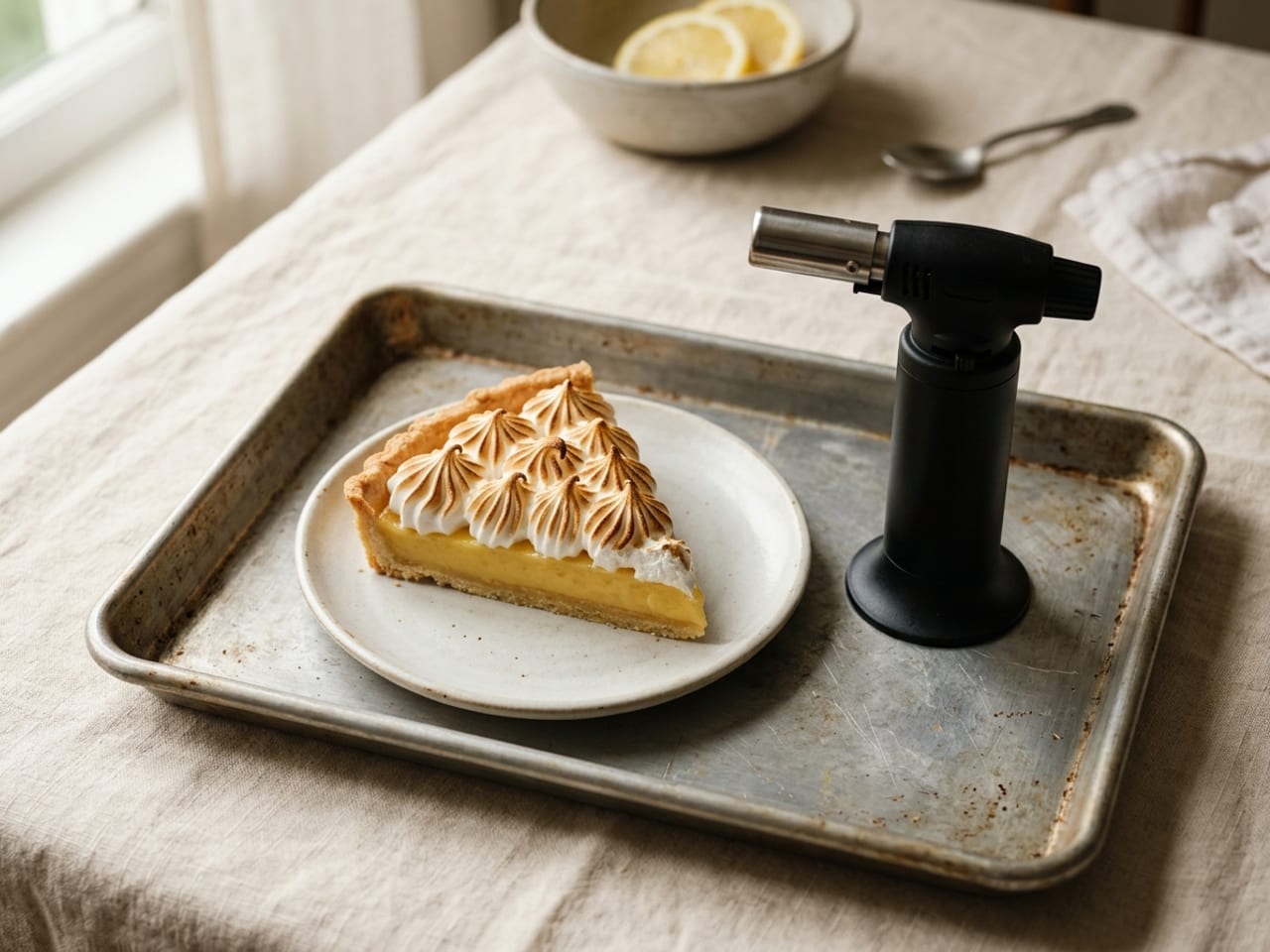
15. Blowtorch
Also called: kitchen torch, butane torch; blowlamp (UK)
What it is. A small butane or propane torch. The dictionary still defines a blowtorch as "a tool used to heat metal or remove paint from a surface", and gives blowlamp as the British word.8 One kitchen model is 7 in (17.8 cm) high, with a flame adjustable "from regular to fine" and a refillable 28 ml fuel cylinder.37
The mark: color. "Blowtorches are traditionally used to caramelise sugar on top of a Crème brûlée", and "They're brilliant for lightly toasting meringues" (Great British Chefs).90 A tested review adds that they "can add crispness to poultry or fish skin that might have gone flabby while waiting to plate."114
How. "use a sweeping motion, where the flame goes slowly back and forth across the surface to evenly 'scorch' the food. Don't concentrate too long on one area, or the food may burn."90 The same source torches on a metal tray, not on the dinner plate. The rest is under torch safety.
Instead. For meringue, the Culinary Institute of America's textbook, in a search fragment, says it "may be browned using either the broiler or a torch."44 Browning only colors the surface (our reading): the note on raw egg white is under torch safety.
16. Whipping siphon
Also called: cream whipper, whipped cream dispenser, foam siphon, espuma gun
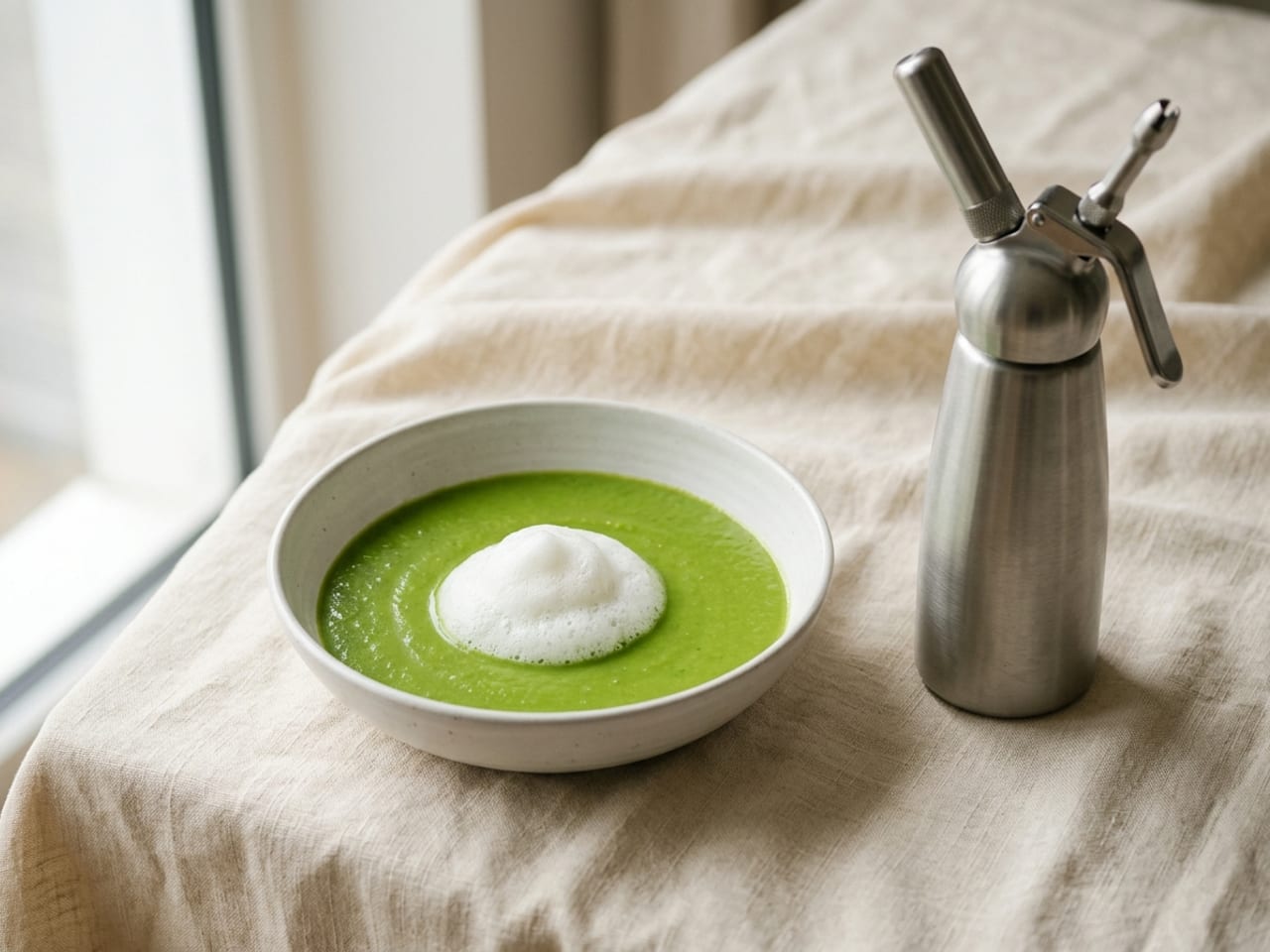
What it is. A pressure bottle charged with nitrous oxide.91 The dictionary knows a siphon only as a bent tube or "a soda siphon";14 the trade says whipper or whipped cream dispenser,38, 117 the New York Times said "foam siphon",47 and Great British Chefs says "espuma gun".91 One pint (0.5 L) model is 12 in (30.5 cm) high and comes with three tips.38
The mark: foam, last. "In high-end restaurants, a whipped cream dispenser (aka a siphon) is a tool for creating whipped batters, aerated sauces, and foam-garnished dishes". It goes on at the end because "unstabilized foams tend to melt down quickly once dispensed".117 The maker's manual says to dispense "shortly before serving".132 "Hold the canister vertically with the tip pointed straight down when dispensing".117
Instead. For a light froth, "the handheld immersion blender. This particular tool is expert at whipping up lighter foams (froth) but less successful when it comes to preparing espuma".91 Ratios are in plating components; charger limits are under siphon safety.
17. Mandoline and turning slicer
Also called: mandolin, Japanese mandoline, turning slicer
What it is. "A kitchen utensil with a blade for slicing and shredding";10 in one review's words, "a knife mounted to a board".118 A French-style one is 16 in long and 5.25 in wide (40.6 by 13.3 cm); a Japanese hand slicer cuts up to 67 mm wide and 3 mm thick; a turning slicer makes "long spaghetti-like strands in 3 thicknesses as well as delicate thin sliced curls".39
The mark: paper-thin slices and ribbons. Great British Chefs gives examples: fennel finely sliced for a ceviche, "stunning radish rounds", "paper-thin beetroot slices" and "courgette ribbons".92 How thin: the two highest-rated models in one test "can produce slices from about half a millimeter thick".119 Bourdain's use is the waffle-cut chip, the gaufrette, made "with a twist of the wrist".46
Instead. No named source recommends a substitute. The comparison the reviewers make is with a knife: one compact model makes "even, paper-thin slices better than most of us can muster with a chef's knife."119 Guards and gloves are under mandoline safety.
18. Scissors
Also called: kitchen shears, herb scissors, kitchen snips
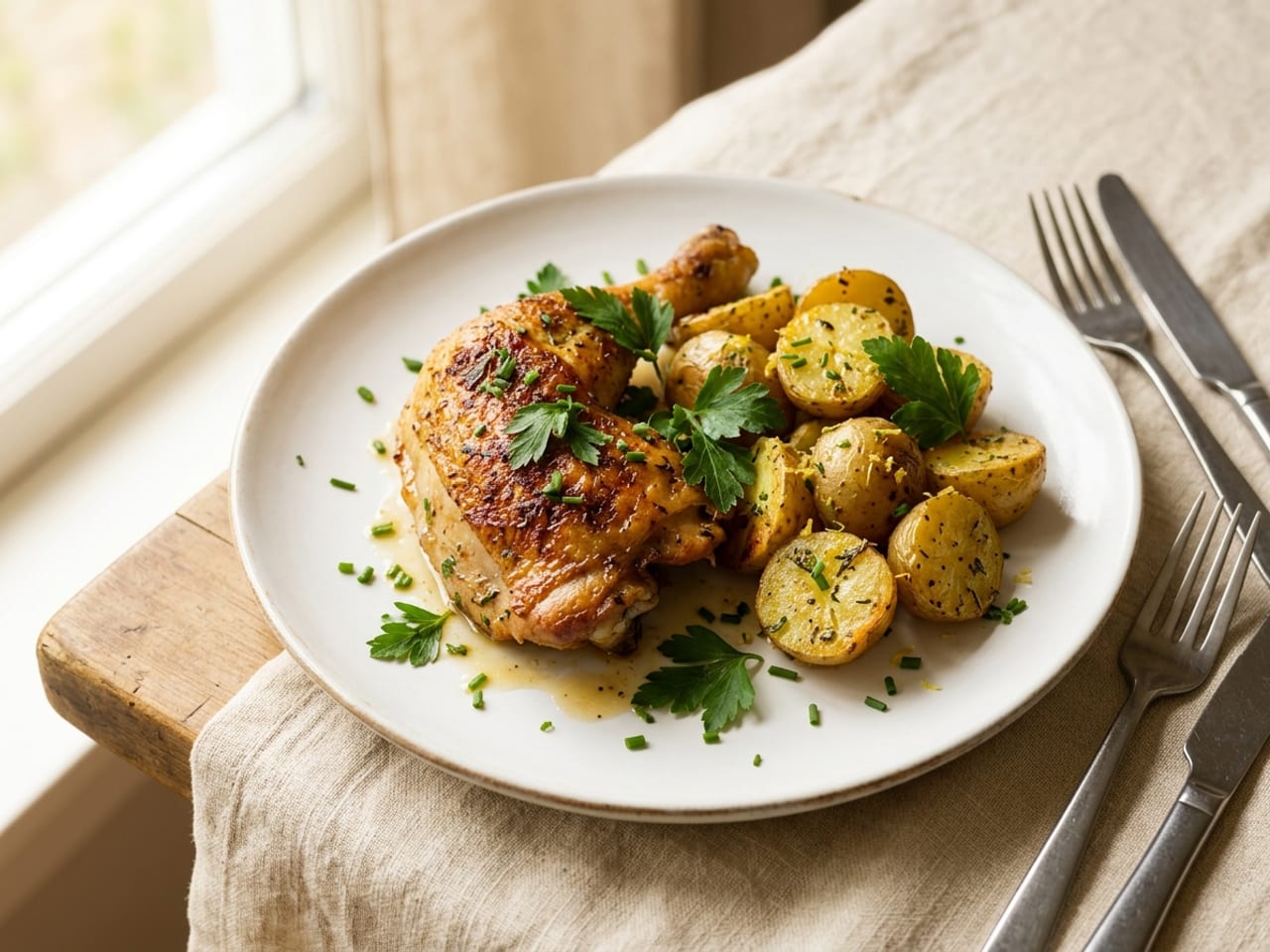
What it is. Fine scissors for cutting herbs at the last moment. One supplier's pair has a 1.88 in (4.8 cm) blade, is 6.3 in (16 cm) overall, and its "Tapered points cut right to the tip"; its five-blade herb scissors are sold to "cut, chop or mince herbs directly into a pan or over a plate for garnishing". 40
The mark: herbs cut to order. The New York Times's tweezers piece mentions "a blossom just clipped from a flowering herb".47 Epicurious tried its shears on "snipping fine herbs for garnish",113 and snipping chives is a test in the Serious Eats and America's Test Kitchen reviews too.110, 111 What decides a clean cut is the alignment of the blades at the tip: "If they aren't perfectly straight, herbs (or paper, or ribbon, etc.) will bend between the blades instead of being sheared off."110
No named source was found that teaches scissors as a plating technique, and no tested review, for or against, of the five-blade kind.
19. Turntable
Also called: cake turntable, revolving cake stand, cake spinner, lazy Susan
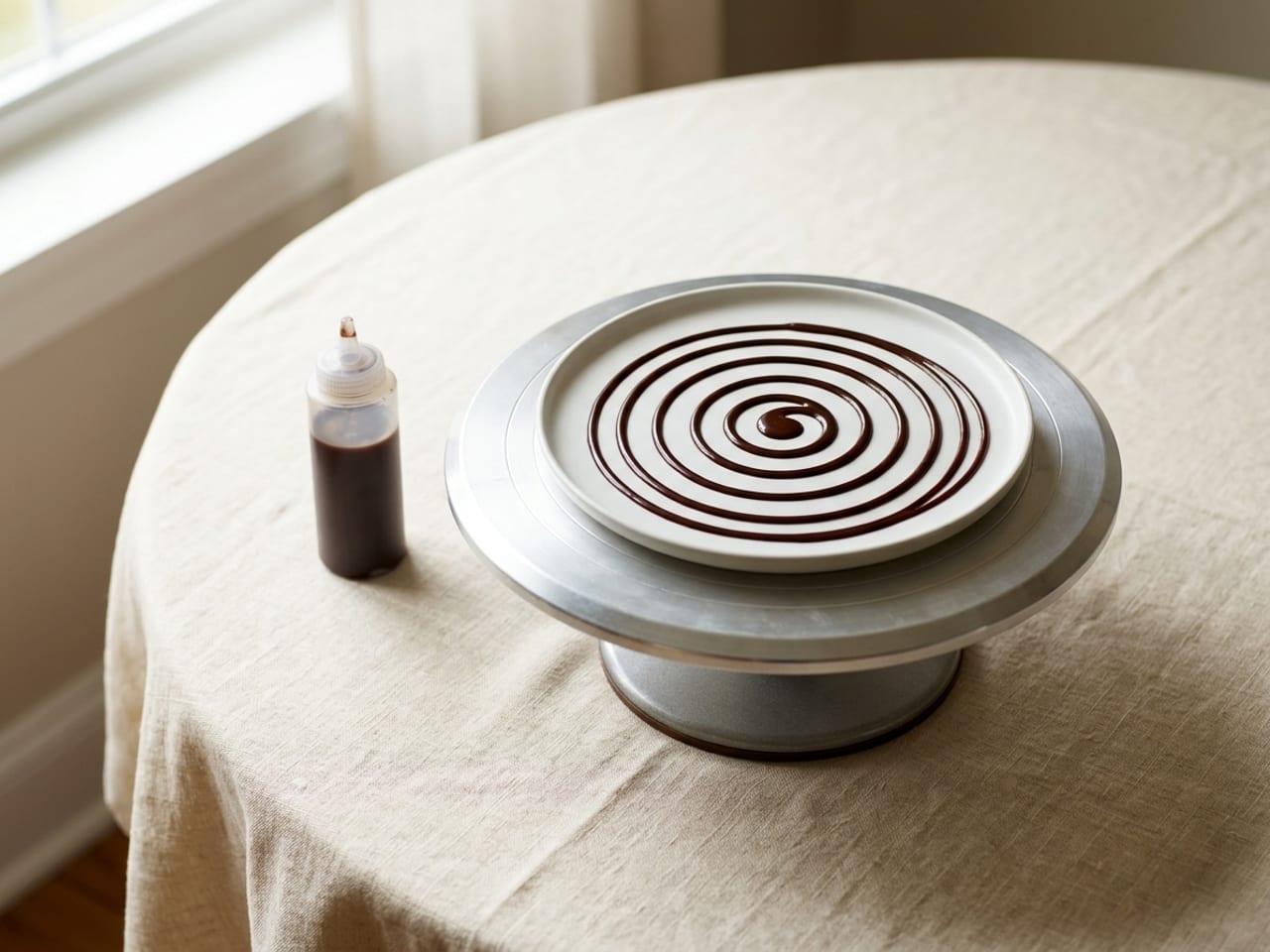
What it is. A cake decorator's revolving stand: a 12 in (30.5 cm) top on a base 5 in (12.7 cm) high in one catalog.25 In that catalog and in both tested reviews read for this guide it is a cake tool, tested with cakes.25, 108, 109
The mark: a spiral. CBC's chef: "Set your plate on a Lazy Susan or cake spinner", "Take your squeeze bottle and point it downwards toward the centre of the plate", then "Start spinning your stand, and then start gently squeezing the bottle until you get the desired swirl design." 67 A private chef's blog puts a towel under the plate "so the plate stays in place", starts in the center and moves the hand slowly outward, and rates the move "Difficulty Hard."66
Instead. A lazy Susan, in the same instruction:67 "a circular piece of wood or plastic on a base that is put on a table and can be turned around so that everyone can reach the food".15
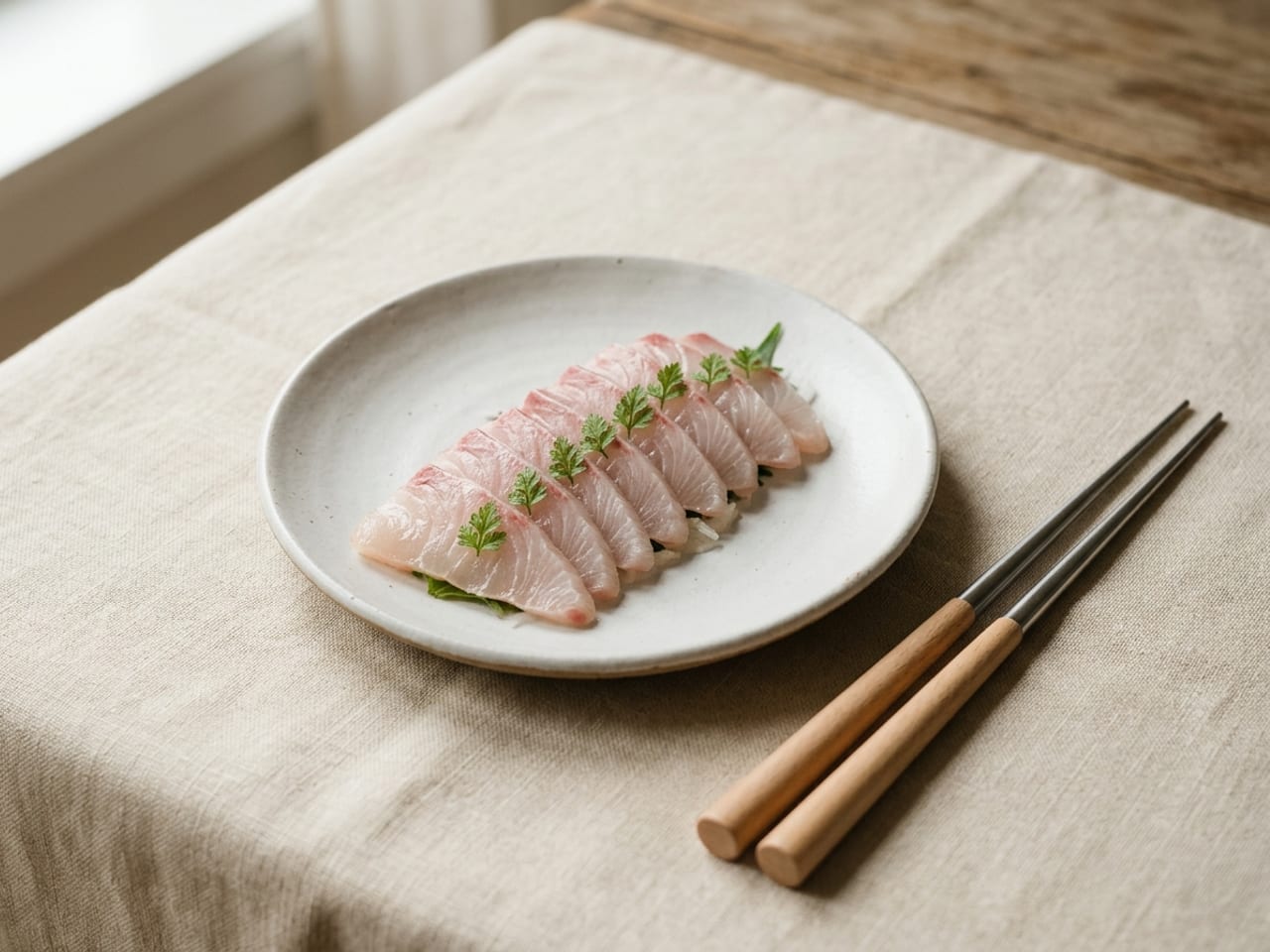
20. Plating chopsticks
Also called: moribashi, kitchen chopsticks
What it is. The tool that tweezers were answering. The New York Times: tweezers "were the Western answer to kitchen chopsticks, which have been used to assemble plates in Asia for centuries."47 One supplier sells forged moribashi with a wooden handle, "12.0 in. overall" (30.5 cm): "plating chopsticks. With super fine points, yet enough weight to have great control these allow for precision plating of garnishes and fine work".18
The mark: a placed garnish, untouched by warm hands. Gestalten, writing about chef Jack New, who uses moribashi "constantly for almost all plating and garnishes", says chopsticks and large tweezers "offer temperature control, which is crucial when handling certain heat-sensitive ingredients such as chocolate, raw fish, and caviar."81
Instead. "Even if you don't have a pair of moribashi, most chopsticks can still be useful in helping you pick up and plate more delicate ingredients" (Gestalten).81
Which plating tool makes which mark
Work backward from the plate you want: find the mark, then the tool, then the guide that teaches the move.
| The mark | The tool | What it needs | Where to learn it |
|---|---|---|---|
| Swoosh | The back of a sauce spoon, or its tip dipped into a squeezed circle of sauce.64, 67 | "thick, smooth sauces like a rouille or a puree".64 | Plating techniques: sauce |
| Drag (teardrop) | A skewer or toothpick through a drop, or a wedge through a row of dots.68, 69 | "a drop of thickened sauce".69 | Plating techniques: sauce |
| Dots | A squeeze bottle; in at least one famous kitchen, the tip of a spoon.53, 64 | "a thick, smooth sauce that will stay put".64 | Michelin-star plating: the moves |
| Lines, zigzags, spirals | A squeeze bottle, with a turntable for the spiral.64, 67 | The same thick, smooth sauce as for dots.64 | On this page |
| Pool | "a deep plate or a shallow bowl";64 the spoon, plain or spouted, is our addition. | "a sauce that's worthy of a large serving, such as a red wine pan sauce or a crème anglaise".64 | Plating techniques: sauce |
| Stack | A ring mold.43, 83 | "a moldable food": rice, sticky grains, or tartare, which is raw (see the caution).81, 83 | Plating techniques: shaping |
| Brush stroke | A brush.64 | "thin sauces that are easily spreadable".64 | Plating techniques: sauce |
| Comb lines | A notched wedge or comb.29, 67 | The one named how-to uses chocolate sauce and dulce de leche.67 | On this page |
| Placed herbs | Tweezers or chopsticks.80, 81 | A leaf or blossom "just clipped", which an offset tip "is less likely to bruise".47 | Michelin-star plating: the moves |
| Thick smear | The edge of an offset spatula.66 | "a heavy, pureed sauce".72 | On this page |
| Quenelle | One spoon or two. | It depends on the food: the guide goes through nine. | The quenelle: one spoon, two spoons |
| Snow and dust | A rasp grater; a strainer.81, 107 | Hard cheese, chocolate, nuts, whole spice; a dry powder.81 | Plating components: powders |
| Foam | A whipping siphon, or an immersion blender for a light froth.91 | Dispensed "shortly before serving".132 | Plating components: foam |
| Drops of oil | A small squeeze bottle.74, 77 | Herb oil kept in the fridge and used within 4 days.125, 126 | Plating components: herb oil |
How thick should the sauce be? No source read for this guide gives a number: no viscosity, no temperature. They give comparisons. For a swoosh or a bottle, "thick, smooth" (America's Test Kitchen);64 "think yogurt or heavy cream" (Tasting Table);65 or, for one private chef, thick enough to "coat the back of a spoon but not completely drip off".66 That is close to what cooks call nappe, "the consistency of a sauce that will coat the back of a spoon": draw a finger down the back of the spoon, and "If you leave a clean line down the center of the spoon, you have nappe."94 The Culinary Institute of America's page gives that as a test for finishing a sauce, not for plating; linking the two is ours. For a brush the sauce is thin.64 Move by move, with how to thicken or loosen a sauce, this is taken further in sauce plating techniques.
Sauce first or sauce last? The sources disagree here too. America's Test Kitchen puts the swoosh down and then the food, though with a bottle it allows either order.64 Chef Emil Nilsson: "Always add your sauce last".73 And the plate matters: Tasting Table warms plates in "a low oven (about 150 degrees Fahrenheit)" (about 65°C) and chills them for cold sauces.65
Kitchen-drawer substitutes for plating tools
Each row says who recommends the substitute, and in whose words. Three rows are there to say that nobody reliable does. Where a source warns about one, the last column says so.
| Instead of | Use | Who says so | The caution |
|---|---|---|---|
| Sauce spoon | An ordinary metal spoon | Fine Dining Lovers on a culinary-school video: "a metal spoon from the cutlery drawer". Tasting Table: "a soup spoon works well". Gestalten, reporting chef Jack New's advice: spoons, "some of which you probably already have". 65, 81, 85 | None given. |
| Squeeze bottle or piping bag | A food-grade plastic bag with one corner cut | Los Angeles Times test kitchen, 2011: "A food-grade plastic bag will work in a pinch."93 | The same piece warns: "Be careful that the sauce isn't too hot", because a hot sauce "can hurt your hands, and could melt the bag." It also says to "practice a bit on a paper towel".93 |
| Squeeze bottle | A small spoon | KitchenTime, a retailer, writing up chef Emil Nilsson's tips: "A squeeze bottle or small spoon can help you apply it exactly where it belongs." 73 NPR, from Eric Ripert's memoir: in Joël Robuchon's kitchen dots went on "not from a squeeze bottle but off the tip of a spoon". 53 | The first sentence is the retailer's, not the chef's; the second is a report of one kitchen, not advice. |
| Dragging a drop of sauce (a wedge's job in the retailer's guide) | A skewer, a toothpick or the tip of a knife | A culinary school drags "a skewer through the droplet". Tasting Table swirls two sauces "with a skewer, toothpick, or the tip of a knife".65, 69 | Neither mentions a wedge; setting the skewer beside it is ours. |
| Tweezers | Chopsticks | Gestalten, on Jack New's tools: "most chopsticks can still be useful in helping you pick up and plate more delicate ingredients."81 | None given. |
| Tweezers | Fingers | Conceded, not recommended. Food & Wine: "You can accomplish most tweezer tasks with your fingers or tongs."80 | "you could, but they're probably warm" (Gestalten);81 small ingredients "stick to my fingers or clump together" (Food & Wine).80 |
| Ring mold | A biscuit or cookie cutter | Tasting Table: "biscuit cutters will also do the trick". Food Republic treats them as one object: "Also known as biscuit cutters".83, 84 | Stainless, not tin-plated: in America's Test Kitchen's tests tin-plated cutters "rusted after single washes".122 |
| Ring mold | A greased ramekin or small bowl, turned out | One recipe, Tasting Table's: "just grease the container and reverse the order".84 | A single source. |
| Ring mold | A tin can with both ends removed, or a piece of PVC pipe | One modernist-cooking blog;87 Bourdain mentions a "cut-down section of PVC pipe" in passing.46 | Neither says anything about food safety, and no test kitchen, culinary school or authority was found recommending either. Not offered here as advice: see food-contact materials. |
| Pastry brush | A paintbrush | A culinary school: "Stroke the sauce in a single line using a paintbrush". CBC's chef: a "Food-safe paintbrush".67, 69 | Only one of the two says food-safe. A pastry brush avoids the question (our suggestion). |
| Rasp grater | A box grater | Gestalten, on Jack New's tools: "Box graters provide a similar function".81 | "Just be careful where you put your fingers".81 |
| Duster and stencil | A tea strainer; a fork and knife, a bowl or a doily as the stencil | America's Test Kitchen: "A fine-mesh strainer and a light touch are all you need". CBC's chef: "a fork and knife, a bowl, or ferns" (a fern is not food: ours). A textbook fragment: "a doily or a stencil". 45, 67, 107 | "Do not shake the strainer itself; this will produce heavy spots."107 |
| Turntable | A lazy Susan | CBC's chef: "Set your plate on a Lazy Susan or cake spinner." 67 | A private chef's blog puts a towel under the plate "so the plate stays in place".66 |
| Whipping siphon | An immersion blender | Great British Chefs: "expert at whipping up lighter foams (froth)".91 | "less successful when it comes to preparing espuma".91 |
| Blowtorch, for meringue | The broiler | The Culinary Institute of America's textbook, in a search fragment: "either the broiler or a torch".44 | Read only as a fragment. |
| Comb, for lines | A fork | No named source was found. | Not offered here as sourced advice. |
Practice on something cheap. "Start with simple, affordable sauces like yogurt, store-bought coulis, or even whipped cream", and "Practice on a spare plate before committing to the final dish."65
Which plating tools to buy first: eleven opinions, no consensus
No two sources give the same list, and none ranks the tools in order. Here are the 11 published opinions collected for this guide, in their own words, and a count of which tools they name. The count is our tally of what was collected. It counts a spoon wherever one is named, for any job, and one entry is two outlets under one heading. It is not a survey, and it does not show that chefs agree.
- Jack New, chef, as reported by Gestalten: spoons you own, then a rasp grater, tweezers lastThe article's words: "If you're just beginning to explore plating, you don't need to go crazy and buy lots of new tools." Aside from different spoons, "some of which you probably already have", New "says it's fine to keep things simple. A Microplane is good, he says", "and maybe some plating tweezers if you're feeling fancy." Only that last phrase is New's own quoted speech.81
- James Briscione, culinary school: five tools, among them a spoon and a ringHis video names five; the written summary of it names two: "a metal spoon from the cutlery drawer for spreading sauces and purees and a simple metal ring mold for adding height to a dish". The video was not watched for this guide, so the other three are not listed.85, 86
- Jay Fisher, chef: a six-part kit"a mini spatula"; "I use a lot of mini squeeze bottles"; "saucing spoons, sometimes called precision serving spoons"; "food tweezers, especially when working with micro greens"; and piping bags with tips and decorating brushes.72
- Great British Chefs, with pastry chef Daniel Fletcher: bottles or molds"picking up a few squeeze bottles or some specially-shaped moulds could make all the difference to your plating." Fletcher: "use an ice cream scoop or good spoon to shape ice cream or sorbet."78
- Annie O'Hare, caterer: the squeeze bottle"you can't use a spoon, so a squeeze bottle is indispensable." 74
- KitchenTime, a retailer, writing up head chef Emil Nilsson's tips: a squeeze bottle or a small spoon"A squeeze bottle or small spoon can help you apply it exactly where it belongs." That sentence is the retailer's, so weigh it as a seller's; Nilsson's own quoted words on sauce are "Always add your sauce last". The only other tool in the five tips is a cloth, also in the retailer's words.73
- Greg Greenfield, private chef: five tools for eight sauce designs"The tools I used for these designs are a squeeze bottle, cake spinner, off-set spatula, teaspoon, dinner spoon".66
- America's Test Kitchen: a spoon, a bottle, a brush, a deep plateNot a list. Its four sauce techniques use only "the back of your spoon", "a plastic squeeze bottle", "a clean brush (such as a pastry brush)" and "a deep plate or a shallow bowl". Reading that as a kit is ours.64
- A restaurant-supply retailer: eight "foundational items"A seller's list, so weigh it accordingly: decorating brushes, garnishing kits, molds, precision tongs, plating wedges, shavers, plating spoons and squeeze bottles.68 The tally does not count its shavers as rasp graters.
And four kits, for comparison. What a maker sells, what one famous kitchen issued, what one chef wrote down, and what the textbooks list.
- The kit the trade sellsOne maker sells plating tools as a set, twice: three plating tongs (straight, curved and offset), two or three spoons (solid, slotted, spouted) and, in the larger set, a 4 1/4 in (about 11 cm) offset spatula, in a roll. No squeeze bottle and no ring.41
- A four-star kitchen's kit, 1990sCraig Koketsu on Lespinasse: "they gave you three Kunz spoons, a Peltex spatula with a wooden handle (which was perfect and now hard to find), and a heat-resistant spatula. Those were your tools. That and a meat fork. No tongs were allowed at all." Spoons, not tweezers.49
- Bourdain's kit, 2000After knives: the squeeze bottle, the toothpick, the metal ring, the pastry bag and the mandoline.46
- What the textbooks listAn open culinary textbook lists decorating brushes, garnishing kits, molds, plating and precision tongs, plating wedges, shavers, spoons and squeeze bottles.43 The Culinary Institute of America's standard textbook, as far as its searchable text shows, has no list of plating tools at all; tweezers appear in it for pulling pin bones.44
Our suggestion (ours, and not a ranking from any source). A spoon you already own and a clean cloth cost nothing, so start there. A squeeze bottle is cheap ($2.50 to $4.90 at the one retailer priced here, as of 4 October 2026)24 and is the second most named tool in the tally. Tweezers, a ring and a small offset spatula can wait until a plate you want to make calls for them.
What tested reviews looked for in each plating tool
Plate Artists has not tested these products and has no affiliate links. Every point below is a named, dated reviewer's finding. Reviews are rewritten under the same address and their picks change, so each one is cited by its printed date. With one exception, none of these reviews tests the tool on a plate: they test oil, ketchup, frosting, crème brûlée and zest. The exception is Food & Wine's tweezers test, which places microgreens on a finished plate and names one pair "for Detailed Plating".80 For every other tool there is no "best for plating" verdict to report, and none is given.
| Tool | Who tested it, and when | What they looked for |
|---|---|---|
| Plating tweezers | Food & Wine only, among the six outlets checked: Greg Baker, published 4 December 2023, live page read 4 October 2026, seven sets.80 Serious Eats and Eater have essays, not tests.79, 82 | "For detail work, you need a fine-pointed pair with an offset design that gives you more precision and keeps your hand and fingers away from the plate." His plating pick is 6.5 inches (16.5 cm) long, "tapering to fine 1/16-inch points" (about 1.6 mm). Rounded silicone tips "made selecting a single banana pepper ring a chore".80 Serious Eats suggests two pairs, "a long, sturdy pair to use in place of tongs, as well as a shorter, lighter pair".79 |
| Sauce spoon | No comparative test was found. Three endorsements from use: Wirecutter (7 March 2025, updated 25 February 2026), Serious Eats (14 June 2023, updated 16 December 2024) and Bon Appétit (6 March 2020).50, 70, 71 | "a nimble, longer handle (but not too long), and a capacious bowl" (Serious Eats).70 Wirecutter's reviewer weighed hers at 78 grams against 61 for a dinner spoon: "the added weight increases stability and control"; the flaw she names is that "hard-water stains can develop on the brushed-steel handle". 71 Other spoons are below. |
| Squeeze bottle | Serious Eats (7 February 2023, updated 6 November 2024): seven 12-ounce (about 355 ml) bottles. America's Test Kitchen (15 April 2020): five 16-ounce (about 475 ml) bottles.74, 75 | Serious Eats: "lids that didn't leak, lacked lid caps, had walls that were just the right thickness to handle different viscosities, and extruded liquids straight", with nozzles "on the narrower side".74 America's Test Kitchen: mouths "about 2 inches in diameter" (5 cm), "thinner, more flexible LDPE" and "simple, one-piece bottle tops".75 Both tested kitchen-size bottles with oil, mayonnaise or ketchup; neither tested small fine-tip bottles or dots on a plate (our observation). |
| Small offset spatula | Wirecutter (updated 18 November 2025) picks a mini 4.5-inch (11.4 cm) model, "the easiest to maneuver of all those we've tested", without saying how many that was.95 Serious Eats "hasn't formally tested them".96 America's Test Kitchen (13 August 2025) tested only blades of 7.5 to 10 inches (19 to 25 cm).97 | America's Test Kitchen's criteria for the large ones: blades offset "to angles measuring about 35 degrees", "less than 1 millimeter thick", of "relatively stiff stainless steel". And a warning about the label: "Manufacturers usually specify the overall length of the blades, rather than that of the flat portions".97 |
| Brush | America's Test Kitchen only: pastry brushes (10 June 2026) and silicone brushes (14 November 2025).98, 99 | Natural bristles "allow you to apply liquids more precisely and with a gentler touch" and "pick up more than double the volume of liquid", but shed and hold odors.98 Silicone brushes "never shed bristles" and are "much easier to clean".99 Its advice is to keep one of each.100 Neither review brushes sauce onto a plate. |
| Rasp grater | Serious Eats (9 June 2022, updated 18 August 2025): 12 models. America's Test Kitchen (11 June 2025). Food & Wine (13 September 2022, updated 3 December 2024): ten models.101, 102, 103 | Teeth "large and high enough that they zest and grate with ease, but not so raised that they dig into the white pith of citrus" (Serious Eats);101 "more than 400 teeth", "arranged in staggered rows", and nothing "measuring 13 inches or more in total length" (33 cm; America's Test Kitchen).102 All three top picks come from the maker whose name became the word for the tool; only one of them names another maker, for value, so none is named here.101, 102, 103 |
| Piping bag and tips | America's Test Kitchen (1 February 2016, an old review): five sets.105 Wirecutter (updated 18 November 2025): three sets of tips.95 | Six tips cover it, says America's Test Kitchen: "a small round writing tip, a larger round tip for bigger designs, a large open star tip, a large closed star tip, a leaf tip, and a petal tip"; and disposable bags, because "reusable cloth bags weren't worth the fuss".105 Wirecutter likes "seamless tips", which are "less likely to rust".95 |
| Duster | America's Test Kitchen's small strainers (24 June 2025), which include a cocoa-dusting test.106 No tested review of stencils or sugar shakers was found; the address of its old shaker review now serves a how-to.107 | Fine mesh: "a finer mesh guarantees a finer sift when decorating a cake with confectioners' sugar."106 |
| Turntable | America's Test Kitchen (27 October 2015, an old review) and Serious Eats (17 May 2019, updated 16 July 2025).108, 109 | Height: stands "at 4.5 to 6 inches tall" (11 to 15 cm) were more comfortable than those at about 3 inches (7.5 cm). Rotation: "the best were smooth and fast with precise bearings that allowed us to stop the spin in one motion."108 Both tested with cakes; neither spins a plate. |
| Scissors | Serious Eats (updated 28 September 2026), America's Test Kitchen (24 June 2025), Wirecutter (updated 29 April 2025, reporting a 2017 test) and Epicurious.110, 111, 112, 113 | Blades that meet at the tip,110 and a "Take-Apart Design", because such shears "could be easily separated for easy cleaning".111 The outlets disagree about the same model, so none is named here. |
| Blowtorch | Serious Eats (updated 16 March 2026): 10 torches. Food & Wine (live page read 4 October 2026): 14. Wirecutter (5 September 2024): four.114, 115, 116 | "A torch that allows you to adjust the flame minutely is ideal. You also want a clean-burning blue flame that is at least three inches long" (7.5 cm).114 Fuel: "Butane is sufficient for most kitchens."115 These reviews are rewritten under the same address with different picks, so no torch is named here. The US Consumer Product Safety Commission recalled butane kitchen torches sold online in April 2025 and in July 2026 because they lacked the child-resistant mechanism that the federal standard for multi-purpose lighters requires, and in 2007 a culinary torch whose fuel could leak near the nozzle; no injuries were reported in any of the three.138 Whichever torch you choose, search the maker and model in the Commission's recall list first (our suggestion). |
| Whipping siphon | Serious Eats (5 October 2022, updated 9 March 2026): 11 dispensers.117 | "Given that most whipped cream dispensers produce similarly fluffy whipped cream and foam, I'd suggest prioritizing your preferred uses and budget when shopping." Only one model it tested was rated for warm use, and it preferred removable pistons that can be inspected "for gunk".117 |
| Mandoline | Serious Eats (updated 30 April 2026): 10. America's Test Kitchen (24 June 2025). Wirecutter (updated 17 July 2025).118, 119, 120 | "Blade sharpness is more important than any other factor."118 They disagree about hand guards: see mandoline safety. |
| Ring molds, pipettes, plating wedges and combs, stencils, sugar shakers, five-blade herb scissors | No tested review was found at Wirecutter, Serious Eats, America's Test Kitchen, Epicurious, Food & Wine or Bon Appétit. | The nearest thing for rings is America's Test Kitchen on round cutters, which "preferred stainless-steel sets to those made from tin-plated steel". 122 |
Other spoons Serious Eats' writer names. There are two: inexpensive spoons that, "while called serving spoons, are quite similar in shape and size to sauce spoons", and a sauce spoon from Mercer Culinary that is "nicely balanced and has ridges where your fingers rest".70 That maker's 9 in plating spoon has a "1.3 oz. Bowl", 22 which by our arithmetic is about 2.6 tablespoons. And the sources that start with a spoon from the drawer are in the substitutes table.
What the tools cost. One retailer's list prices in US dollars, as of 4 October 2026, at jbprince.com. This is not a price comparison, and the items are that retailer's own lines, not the models the reviews picked.
| Item | Price as of 4 October 2026 |
|---|---|
| Gray Kunz sauce spoon, small (7.5 in) | $7.4520 |
| Gray Kunz sauce spoon, regular (9 in) | $13.8019 |
| Gray Kunz sauce spoon, XL (11.5 in) | $17.9020 |
| Offset fine-tip tweezers, 6.5 in | $24.9016 |
| Tapered fine-tip squeeze bottle, 1.5 oz to 8 oz | $2.50 to $4.90 each24 |
| Round ring, 2 x 3 in, stainless steel | $7.3526 |
| Palette knife, mini offset spatula (4.25 in blade) | $3.4027 |
| Mini wedge scraper; silicone decorating tool | $6.70; $10.6030 |
| Rasp grater, 12 in | $12.0033 |
| Teardrop pipettes, pack of 100 | $24.0034 |
How to clean plating tools
Makers and reviewers often disagree about the dishwasher. Where they do, both are quoted. No source was found on sanitizing plating tools at home; hot soapy water and thorough drying is our suggestion.
- Squeeze bottlesSerious Eats, citing a university extension service: "do not microwave them; don't freeze them unless they specifically are made to be freezer-safe; and unless the manufacturer says they are dishwasher-safe, wash your squeeze bottles with warm, soapy water." Its own method is "blasting out any stuck sauces with the spray nozzle on our kitchen sink, then shaking soapy water inside the bottle", and: "Make sure not to neglect the nozzle". A bottle with no cap gets "some foil or plastic wrap around the nozzle".74 America's Test Kitchen found wide mouths easier because a bottle brush fits.75
- The Kunz spoon: reviewer and seller disagreeWirecutter: "Although the Kunz spoon is dishwasher-safe, I'd opt for handwashing it with mild dish soap and warm water", then drying it promptly "to avoid watermarks".71 The seller's product page: "Hand-wash only."19 The same seller's 2014 press release said its gold edition "is dishwasher safe".21
- The rasp grater: maker and reviewers disagreeThe maker: "Most Microplane Kitchen Tools are top-rack dishwasher safe, with the exception of the covers and any tops or lids", brushed "in the same direction as the teeth".104 America's Test Kitchen: "the dishwasher's corrosive detergent, hot water, and heightened water pressure will certainly dull the blades. We suggest washing it by hand and drying it well."102 Serious Eats: "Dishwasher-safe: Yes, but I wouldn't recommend it". 101 And wash it at once, says recipe developer Caroline Chambers, quoted by Food & Wine: "If you're grating garlic or lemon zest and you let it sit for the day, the food will harden, and then it's impossible to remove."103
- Tweezers"their simple design means there aren't any grooves or pockets for food and gunk to get trapped."79 No maker's statement on dishwashers was found for plating tweezers, and no source on cleaning the serrated tips.
- BrushesAmerica's Test Kitchen, for natural bristles: "Rinse briefly to remove debris. Rub warm, soapy water into bristles and rinse thoroughly. Blot with towel and lay flat to dry. Replace brush if it begins to smell." For silicone: "Place in top rack of dishwasher. Replace if silicone retains smells even after washing."100 Even its winning silicone brush "stained and retained odors after six washes".99
- Offset spatula"While wood-handled models require washing by hand, spatulas made of plastic and stainless steel are usually advertised as dishwasher-safe", but "we still think it's best to hand-wash plastic models instead."97
- Rings and cutters"Despite manufacturer assurances that pastry and biscuit cutters are dishwasher-safe, we don't recommend cleaning plastic or metal cutters in the dishwasher." Tin-plated ones "rusted after single washes".122
- Piping bags and strainersReusable cloth bags "either clung to smells or looked tie-dyed from food stains", which is why America's Test Kitchen chose disposable ones.105 For a fine strainer it recommends "soaking the strainer basket in a water and soap mixture" and then the sink's spray attachment or a scrub brush.106
- TurntableHand-wash.109 A one-piece stand "couldn't be submerged in water" (the testers did it anyway, and "it still spun perfectly"), and a two-piece one must be dry before it goes back together: "if its top and base are not 100 percent dry before assembly, they rust together and stop the top from spinning."108
- Mandoline: the reviews disagreeAmerica's Test Kitchen: "any components with blades must be hand-washed so that the blades maintain their edge."119 Wirecutter: "don't put it in the dishwasher, and store it so that the blade is protected."120 Serious Eats prints "Dishwasher-safe" in the care lines of some of its picks.118
- Whipping siphonThe maker's manual: take it apart and clean the parts "in the dishwasher as needed"; "Never store the whipper with the head screwed on!"; and during service, "Clean the decorator tip at regular intervals (every 1-2 hours)". 132
- Blowtorch: maker and reviewer disagreeOne maker's manual: wipe it with a dry cloth only; it "should never be immersed in water" or put in a dishwasher.131 Wirecutter's reviewer does the opposite after a refill: "After refilling your kitchen torch with butane, always clean it with a wet cloth and then a dry one". 116
Plating tool food safety
The restaurant rules quoted here are from the US Food Code, a model code for food businesses. They are given to explain why professional kitchens work the way they do; the advice for home is marked as such, and where it is our reading it says so.
- Sauces in squeeze bottles: four hours is a restaurant rule; at home it is twoThe US Food Code calls a food that needs time or temperature control a TCS food. Its definition includes "An animal FOOD that is raw or heat-treated", "a plant FOOD that is heat-treated" and "garlic-in-oil mixtures".123 By our reading that covers most plating sauces: anything with cream, butter, yogurt or egg, and cooked vegetable purées. The Code exempts food that is acid or dry enough (its tables put anything below pH 4.2 outside the definition), which is where a sharp fruit coulis or a vinaigrette may fall; nobody measures pH at home, so when unsure treat a sauce as covered (ours).123 The Code keeps such food at 5°C (41°F) or colder or at 57°C (135°F) or hotter, and lets a restaurant use time instead, "up to a maximum of 4 hours", with written procedures, a starting temperature and a time marked on the container, after which the food is discarded.123 That is a rule for restaurants. The advice to consumers, from the US Department of Agriculture, is shorter: "Never leave food out of refrigeration over 2 hours. If the temperature is above 90 °F, food should not be left out more than 1 hour" (32°C), with hot food "at or above 140 °F" (60°C) and cold food "at or below 40 °F" (4°C).124 The two documents print different hot-holding lines, 135°F and 140°F; each is given here as its source gives it. For how long a particular sauce keeps in a bottle in a home fridge there is no sourced figure, so none is printed. Serious Eats says not "too long, particularly if a sauce is dairy-, egg-, or meat-based", and calls the bottles safe for storage "for a day or two in the fridge"; for the rest it sends readers to "the USDA's Foodkeeper app".74 Label the bottle with the date, as Oregon State advises for flavored oils.126
- A warm sauce in a plastic bottle: the sources disagreeSerious Eats, "Because of the possibility of chemicals leaching from plastic into food": "you don't want to put hot liquids into a squeeze bottle (or any plastic in general). Let any liquids cool down before you fill the squeeze bottle", and bottles "are not safe to microwave or heat".74 One British equipment maker sells a water-bath warmer, with its own bottles, "to keep sauces and liquids warm for dressing plates", adjustable "to a maximum of 70°C" (158°F); that is one maker's statement about its own equipment, not advice that any plastic bottle may be heated.76 No source gives a temperature for holding a sauce bottle at home. The cue instead: a bottle of warm sauce standing on the counter is on the two-hour clock above (our reading).
- Herb and garlic oils: in the fridge, for days, not weeks"Low acid foods stored in oil create an oxygen-free environment which is perfect for growth of Clostridium botulinum bacteria."126 The US Centers for Disease Control: "Refrigerate homemade oils made using garlic or herbs. Throw away any unused oils made with garlic or herbs after 4 days."125 Oregon State: "in the refrigerator for up to 4 days or frozen".126 Clemson: "used within two to three days", and oil "left at room temperature for more than two hours must be discarded."127 Looking and sniffing do not help: "You cannot see, smell, or taste the toxin that causes botulism."125 One chef-facing how-to says "Store the herb oil in the fridge for up to 2 weeks";77 the food-safety authorities do not, and this page follows the authorities. The recipe and the same warning are in plating components.
- Bare hands: a restaurant rule, not a home ruleFood Code 3-301.11(B): "FOOD EMPLOYEES may not contact exposed, READY-TO-EAT FOOD with their bare hands and shall use suitable UTENSILS such as deli tissue, spatulas, tongs, single-use gloves, or dispensing EQUIPMENT."123 The Code allows exceptions, among them bare hands with the regulator's prior approval.123 This is a rule for restaurants and shops. It does not apply to cooking at home. Tweezers are one way a kitchen can meet it; no source read for this guide says that is why chefs took them up (the link is ours). The sourced reasons for tweezers at home are precision and cool tips, above. Washing your hands before plating is the part that carries over (our reading).
- Cloths, tasting spoons and raw food in a ringIn a restaurant the cloth that wipes plates is "Used for no other purpose", and cloths for wiping surfaces that touched raw animal foods "shall be kept separate from cloths used for other purposes."123 Wirecutter's reviewer tastes from her sauce spoon and adds: "I always wash it between tastings to avoid cross-contamination." 71 The Code has utensils cleaned "Each time there is a change from working with raw FOODS to working with READY-TO-EAT FOODS",123 so a ring that shaped raw tartare is washed before it shapes anything else (our application). Tartare itself is raw. For fish the FDA says "It's always best to cook seafood thoroughly", that freezing "doesn't kill all harmful germs", and that four groups should avoid raw or undercooked fish and shellfish altogether: pregnant women, children, older adults and people with weakened immune systems.136 The stack recipe quoted above asks for "sushi grade ahi tuna" from "a reputable fishmonger" and says to eat it fresh, not as leftovers.84 In a restaurant the Code lets raw fish or steak tartare be served only with a written consumer advisory, and not at all to a highly susceptible population.123 Raw beef, and the freezing rule for fish, are in the quenelle guide.
- Blowtorch"Always light the blowtorch before putting it near raw food, or you run the risk of getting raw fuel on the food during lighting. Make sure there is no flammable material such as alcohol nearby, and place food on a metal tray before blowtorching."90 "Torch taste" has two published explanations: unburnt fuel from a badly adjusted flame, cured by "a short, hissing dark blue flame";128 or compounds made by too much heat, whatever the fuel, which is a preliminary finding.129 Neither makes the type of gas the main factor, though the first adds that "butane torches are especially prone to this".128 One maker's manual warns: "Do not use the torch with the flame outlet tilt down at 45 degrees or more", which matters when the food is below the torch, and never to point it at the face or body.130 Another asks for 30 cm (11.8 in) of clearance and says the torch "must not be left unattended when in use."131 The same manual says a refilled torch "should never be lit directly after refilling since gas may have escaped" (it waits 2 minutes), that the burner must not be touched "directly after application" and must "cool down on a fireproof surface before being stored", and that the torch should not be exposed to "temperatures exceeding 50 °C/120 °F or to direct sunlight".131 These are two makers' limits for their own models: read the manual for yours (ours). After refilling, wipe off "any errant butane drippings, which can catch fire during use", and store the torch "a safe distance from your stove" and away from children.116 A torch colors a meringue; it does not cook it (our reading). USDA's figure for a meringue topping is an oven: "Meringue-topped pies should be safe if baked at 350 degrees F for about 15 minutes" (177°C), and for anything served raw or undercooked, "Use pasteurized eggs or egg products".137 So torch a meringue whose whites were cooked over heat or with hot syrup, or made with pasteurized whites: see plating components.
- Whipping siphonThe maker's limits are exact: one charger for the 0.25 L and 0.5 L (1 US pint) whippers and two for the 1 L (1 US quart), never more, and never overfilled. "Never unscrew the head when the whipper is pressurized!" One model may be kept warm in a bain-marie at no more than what the manual prints as "75 °C / 165 °F"; another "must not be heated externally". A whipper that has been dropped or dented is not used again until the maker's service center has checked it, and only a filled whipper is charged.132 France's consumer regulator reports that since 2010 several models have caused serious accidents at home by exploding, and advises against buying an unmarked siphon with an aluminum body and a plastic head.133 The fuller account, with the warnings about nitrous oxide, is in plating components.
- MandolineNo injury statistic could be sourced, so none is printed. The warnings come from the people who use them: "many a chef has lost the tip of a finger to a razor-sharp mandoline blade";92 "I have cut myself on a mandoline, as has every other person I've ever known who has used one."120 The reviewers disagree about hand guards. Wirecutter: "For home cooks, though, a reliably protective hand guard is a necessity."120 America's Test Kitchen: "most of these guards are next to useless."119 Serious Eats: "Hand guards were more trouble than they're worth."118 The last two end at a cut-resistant glove,118, 119 and the one tested glove review warns that such gloves "are cut-resistant but not cut-proof".121 "Whatever you do, don't try to operate the mandoline with just your bare hand."118 In a restaurant, a slash-resistant glove that touches ready-to-eat food has to be smooth, durable and nonabsorbent or be covered by another glove; that too is a retail rule.123 At home, the glove review prefers machine-washable gloves, because they "come into direct contact with any food we might process".121
- Food-contact materials, and tools from the craft or hardware storeThe Food Code's test for any utensil material is that it "may not allow the migration of deleterious substances or impart colors, odors, or tastes to FOOD" and is "Durable, CORROSION-RESISTANT, and nonabsorbent".123 US regulation requires that a substance in an article that touches food "shall be of a purity suitable for its intended use", and lists silicone among the materials that "may be safely used" in articles for repeated use.134 A label written for painters says nothing about that (our point). The Consumer Product Safety Commission's art-materials guide, in its advice on materials for children: "even products labeled 'non-toxic' when used in an unintended manner can have harmful effects."135 Named sources on this page do use a wall stencil, a graining comb and a paintbrush, and only one item, CBC's "Food-safe paintbrush", is qualified;67, 69 none says the others are made for food. The same source's fern is a garden or florist's plant, not a food, and nothing says which fern or whether it is washed (ours). A pastry brush, a wedge sold for food or a stencil sold for cake decorating avoids the question (our suggestion). The same goes for rings. A tin can or a length of plumbing pipe is suggested on a blog,87 and Bourdain mentions PVC pipe in passing;46 neither says anything about food safety, no test kitchen, culinary school or authority was found recommending either, and the stand-in a recipe developer does name is a biscuit cutter.84 America's Test Kitchen prefers stainless cutters to tin-plated ones, which "rusted after single washes".122 For bottles: "Make sure that the squeeze bottle you're buying is food-grade."74
How these tools got to the plate
Most plating tools were borrowed. A New York Times writer, Oliver Strand, put it this way in 2010: "The blowtorch, we now know, caramelizes as well as it solders. Today, the woodworker's Microplane rasp is far more likely to zest a lemon than shape a credenza." And of the newest arrival: "As tweezers proliferate they could become as much a symbol as a tool: the foam siphon, squeeze bottle or ring mold for this generation."47 Only a few of the tools have a story that can be dated from a source read for this guide. They are below; for the ring mold, the wedge, the brush and the rest, nothing datable was found, so nothing is claimed.
| When | What the record shows |
|---|---|
| 1988 to 1990 | The blowtorch. In 1988 the Los Angeles Times reported a restaurateur's advice that crème brûlée needs "a small soldering or welding torch available at any hardware store."59 By 1990 the same paper called the propane torch "a method of caramelizing the sugar used by many professional chefs", and described the older tool beside it: the salamander, "a heavy iron head that is heated over a gas burner, then passed closely over the sugar".60 |
| 1991 to 1998 | The rasp grater. The maker's parent company dates the tool to 1991: "Richard Grace invented a new chemically-etched wood shaver rasp." 58 The New York Times told the rest on 16 December 1998: "The big moment came in 1994, when Lorraine Lee, a homemaker in Ottawa, Canada, was making an Armenian orange cake. Out of frustration with her old grater, she picked up a new rasp her husband, Leonard, had brought home from their hardware store, Lee Valley Tools." The Lees "promptly changed the product description in their catalogue."55 |
| 1992 to 1994 | The Kunz spoon. Gray Kunz was head chef of Lespinasse, in New York City.21 "During the early days of Lespinasse, Kunz issued a spoon to each chef (the chefs paid for their spoons) with a unique number and station engraved on the back."49 The seller's account: "In 1994, they became available to the general public."21 According to Grub Street, Kunz "encountered the basic shape while working at Girardet, then tracked down the manufacturer and worked to design a slightly unbalanced version".51 Bon Appétit dates the manufacture to "the late '90s", which conflicts with the seller's 1994.50 |
| 1994 | The siphon foam. A white bean foam with sea urchins at elBulli, dated 1994, was "the first foam" served there, and "the key piece of the puzzle" was "the discovery that they could be prepared using a cream whipper", according to The World's 50 Best Restaurants; the restaurant's own catalogue was not read for this guide.61 An undated trade-paper article reports that the siphon's maker learned of it from its distributor in Spain.62 |
| 1995 and 2000 | The squeeze bottle. No source read for this guide names a first chef or a year, so this page gives no date for when it reached the plate. Two dated mentions, and what each shows: on 25 July 1995 the Christian Science Monitor described a chef at a charity art show in Boston who "took white plates and painted on them, using squeeze bottles";52 and in his 2000 book Bourdain ranked "the simple plastic squeeze bottle" first among the professionals' tricks and pointed to Bobby Flay using one on television.46 |
| Mid-1990s to 2010 | Tweezers. "Chefs say that tweezers started to appear in European restaurants in the mid-1990s", the New York Times reported in January 2010; one New York supplier "introduced them in November 2008", and the paper wrote of the chef of Alinea: "His restaurant bought 100 of them."47 That is one newspaper's report of what unnamed chefs said, not a documented first. "Tweezer food" was in print as a phrase by April 2010.48 |
Plating tool myths and shaky claims
- Did tweezers come in with nouvelle cuisine?Not supported. The only dated account found, the New York Times in 2010, has chefs placing them in European restaurants "in the mid-1990s", and the one supplier it names began selling them in November 2008. It credits Michel Bras, "who keeps tweezers in his white jacket", with a style, "gastronomic naturalism", not with introducing the tool. No source names a first user.47
- "Kitchen tweezers are just eyebrow tweezers"The Times traces the plating kind to medical suppliers and says chefs chose them because they are "more gentle than tweezers designed for plucking eyebrows".47 Catalog lengths for plating run from about 6 to 12 inches (15 to 30 cm), with one 4 in (10 cm) pastry pair.16, 17
- "Tweezers make food fussy"In 2010 one chef who had adopted them said the opposite. David Chang told the Times: "you're using tweezers to make it seem natural." Another, in the same article, granted that tweezers are associated with whimsical and pretentious dining.47 The phrase "tweezer food", for "High-end restaurant cuisine that is delicately prepared and presented", was in print three months later.48
- "Gray Kunz invented a new spoon in the late 1990s"According to Grub Street he adapted a shape he met in Frédy Girardet's kitchen and had a version made that "tips forward when you have it in your hand"; that origin rests on one article.51 His cooks had numbered spoons in the early days of Lespinasse, which Eater dates to 1992 to 1993,49 and the seller says they went on public sale in 1994.21 "The late '90s" is Bon Appétit's date.50
- "A Kunz spoon is a quenelle spoon"It is a sauce and basting spoon that cooks also use for quenelles: Eater lists "saucing, making quenelles, and portioning".49 Neither catalog read for this guide sells any spoon as a "quenelle spoon",19, 22 though the phrase is in use: chef Jack New, Gestalten reports, "finds a good-quality quenelle spoon to be particularly indispensable".81 The spoons that do the job are in the quenelle guide.
- "Sauce dots need a squeeze bottle"NPR, citing Eric Ripert's memoir (which was not opened for this guide), reports that in Robuchon's kitchen he had to drop two dozen dots of coral juice on a plate "not from a squeeze bottle but off the tip of a spoon".53
- "Tall food is a 1990s thing""Tall food has been tickling our chins since the mid-'80s", the Los Angeles Times wrote in 1999, crediting Alfred Portale. It does not say he used rings: he describes cutting a fish fillet in half and stacking it.54
- "A palette knife and an offset spatula are different tools"They overlap. The Culinary Institute of America's textbook, in a search fragment, defines a palette knife as a metal spatula that "may be flat or offset",44 and one retailer sells a single tool under both names.27 Nor is it a knife: it has "no sharp edge".3
- "The Microplane was invented as a zester"It was a wood rasp, and the kitchen use was found in Ottawa in 1994 by Lorraine Lee, whose family's tool store sold it: so the New York Times reported on 16 December 1998.55 The maker's own sites tell it less exactly. Its international site says "a woodworking catalog in Toronto", where the Times says Ottawa;57 the parent company's timeline puts a New York Times report in 1999, and the article read for this guide is from December 1998;58 and the maker's account speaks only of "a Canadian homemaker", without her name.56
- "The torch makes the best crème brûlée crust"In the Los Angeles Times Test Kitchen's 1990 comparison, tasters "gave the highest rating for flavor to the crust produced by the salamander tool"; "The propane torch was judged best for speed."60
- "The standard chef's textbook teaches a plating kit"Not the one that could be searched. The Culinary Institute of America's 2011 textbook, as far as its searchable text shows, has no list of plating tools, and tweezers appear in it only for pin bones.44 An open textbook from a Louisiana culinary school does have a section called "Plating Tools of the Trade", in wording that closely tracks a restaurant-supply buying guide.43 And the kit exists as something to buy: three plating tongs, spoons and a small offset spatula in a roll.41
See which marks your own plate needs
Before you buy a tool, see the plate it would make. Photograph a dish you cooked and Plate Artists re-plates your own dish the way a restaurant would, with the moves named so you can tell which tool each one takes. The plating techniques glossary shows each move, and how to plate food, dish by dish applies them to pasta, steak, fish and more.
Your dish, plated like a chef's
Snap it, upload it, and get the composed version back, with the steps to recreate it at home.
Start free · 1 enhancement →Free account · 1 free enhancement · No credit card
Plating tool names: US, UK and trade terms
Where the dictionaries stop. Several of these tools have no kitchen sense in the dictionary at all. Cambridge records tweezers only as the small tool for pulling out hairs or picking up small objects,1 a pipette as laboratory glass,11 a blowtorch as a tool for metal and paint8 and a siphon as a bent tube.14 Merriam-Webster gives a palette knife only as the painter's tool,4 and what Americans call a spatula, for lifting food out of a pan, the British call a fish slice.5 The sauce gun is a catalog word: its US listing reads "Automatic Funnel, which is commonly referred to as a Sauce Gun".42 So the names below come from catalogs and kitchens as much as from dictionaries, and the table says which.
| Term | Who says what | Source |
|---|---|---|
| Plating tweezers | Trade names differ: one maker says plating tongs; a retailer says tweezers and sells one 10 in model as a tweezer tong | Mercer Culinary; JB Prince; Serious Eats |
| Moribashi | Japanese; sold in the US as plating chopsticks | JB Prince; The New York Times |
| Sauce spoon | The seller says sauce spoon; another maker says plating spoon; cooks say Kunz spoon, pronounced koons | JB Prince; Mercer Culinary; Bon Appétit |
| Saucier spoon | Trade names | Mercer Culinary; JB Prince |
| Squeeze bottle | US: squeeze bottle. UK: squeezy bottle | Cambridge Dictionary |
| Ring mold | US: mold. UK: mould. Catalogs also say food molding set, pastry ring | Ateco; JB Prince; Cambridge Dictionary |
| Timbale | UK /tæmˈbɑːl/, US /ˈtɪm.bəl/ | Cambridge Dictionary |
| Press | One catalog says fitted press, another pusher; tamper is a blog's word | Ateco; JB Prince; Amazing Food Made Easy |
| Offset spatula | US and trade name | Serious Eats; Ateco; Mercer Culinary |
| Palette knife | Cambridge Dictionary gives it a cooking sense; Merriam-Webster gives only the painter's tool. Reading it as the British word is ours | Cambridge Dictionary; Merriam-Webster |
| Spatula | The US spatula for lifting food is the UK fish slice | Cambridge Dictionary |
| Plating wedge | Trade: plating wedge, decorating tool, decorating comb | Mercer Culinary; JB Prince; Ateco; LibreTexts |
| Pastry brush | The retailer says pastry brush; one maker also sells a silicone plating brush | JB Prince; Mercer Culinary; LibreTexts |
| Rasp grater | Generic: rasp, rasp grater, zester. Microplane is one maker's trademark | The New York Times; the maker's parent company |
| Pipette | UK /pɪˈpet/, US /paɪˈpet/; the dictionary records only the laboratory tool | Cambridge Dictionary; JB Prince |
| Piping bag | UK: piping bag and nozzle. US: pastry bag and tip or tube (our reading of which dictionary has which word) | Cambridge Dictionary; Merriam-Webster; Ateco |
| Dredger | Merriam-Webster and one retailer say dredger; another catalog says shaker | Merriam-Webster; Ateco; JB Prince |
| Blowtorch | UK also blowlamp | Cambridge Dictionary |
| Whipping siphon | The trade says whipper or whipped cream dispenser; the dictionary has no such sense of siphon | Cambridge Dictionary; JB Prince; Serious Eats; Great British Chefs |
| Mandoline | Merriam-Webster files it under mandolin, "usually mandoline" | Merriam-Webster |
| Sauce gun | The US catalog name is automatic funnel, "commonly referred to as a Sauce Gun" | JB Prince |
| Turntable | Catalog names: revolving cake stand, decorating turntable | Ateco; Cambridge Dictionary |
| Kitchen roll | UK: kitchen roll, kitchen paper, kitchen towel. US: paper towel | Cambridge Dictionary |
| Nappe | French | CIA Foodies (The Culinary Institute of America) |
| TCS food | A term of the US Food Code, which governs food businesses, not home kitchens | FDA Food Code 2022 |
| Tweezer food | In print by April 2010 | Schott's Vocab, The New York Times |
Plating tweezers · plating tongs, precision tongs, tweezer tongs
Long, fine stainless tweezers, adapted from medical tweezers, used to place herbs, flowers and small garnishes; the short ones, often with an offset tip, are for plating, and the long ones stand in for tongs.
Moribashi · plating chopsticks
Japanese plating chopsticks with fine points, used to place garnishes; the New York Times calls tweezers the Western answer to kitchen chopsticks.
Sauce spoon · Kunz spoon, plating spoon, saucing spoon
A spoon about 9 inches (23 cm) long with a bowl larger than a soup spoon's and a tapered tip but no spout, used for saucing, basting and portioning; the Gray Kunz sauce spoon, which Serious Eats calls iconic, is the usual example.
Saucier spoon · spouted saucier spoon, drizzle spoon
A plating spoon with a pouring spout on its bowl, for a measured line, drizzle or pool of sauce; a different spoon from the spoutless sauce spoon.
Squeeze bottle · squeezy bottle
A plastic bottle whose contents are forced out through a narrow tip by pressing its sides; in plating, the tool for dots, lines and drops of oil.
Ring mold · ring mould, pastry ring
A bottomless ring, usually stainless steel, that is set on the plate, packed with food and lifted off to leave a neat round stack.
Timbale
A mixture of thinly cut meat, fish or vegetables cooked in a mould, sometimes with a pastry case.
Press · pusher, tamper
The disc that packs food into a ring mold: a fitted press in one catalog, a pusher in another, and a tamper on one cooking blog.
Offset spatula · mini offset spatula, small offset spatula
A thin, blunt, flexible blade that bends down near the handle and then runs flat; the small size lifts and places flat items and spreads a thick sauce or purée.
Palette knife
A knife with a wide thin blade, a rounded end and no sharp edge, used to spread soft substances; one retailer sells the same tool as a mini offset spatula.
Spatula · fish slice (UK)
A cooking utensil with a wide, flat blade that is not sharp, used especially for lifting food out of pans; British English calls that lifting tool a fish slice.
Plating wedge · silicone plating wedge, decorating comb
A small stiff scraper with a flat, round, pointed or notched edge, pulled through sauce to smear it, drag dots or comb lines.
Pastry brush · silicone plating brush, decorating brush
A brush with natural or silicone bristles used to paint a stroke of thin sauce on the plate; a silicone plating brush has a shaped head instead of bristles.
Rasp grater · rasp, zester; Microplane is a brand
A long, narrow, very fine grater with etched teeth, first sold as a woodworking rasp, used to zest citrus and to grate cheese, chocolate, nuts and spices into a fine snow.
Pipette · dropper
A thin tube for moving a small amount of liquid; kitchen suppliers sell disposable plastic ones for serving hors d'oeuvres with a sauce.
Piping bag · pastry bag, decorating bag
A cone-shaped bag from which a soft food is squeezed through a tip to make mounds, dots and lines.
Dredger · shaker, duster, dusting wand
A container with a perforated or mesh top used to sprinkle a powder such as sugar or cocoa evenly.
Blowtorch · kitchen torch, butane torch, blowlamp
A small gas torch, defined in the dictionary as a tool for heating metal or removing paint, used in kitchens to caramelize sugar and toast meringue.
Whipping siphon · cream whipper, whipped cream dispenser, foam siphon, espuma gun, syphon
A pressure bottle charged with nitrous oxide that dispenses whipped cream and foams.
Mandoline · mandolin
A kitchen utensil with a blade for slicing and shredding; the tool for paper-thin garnish slices.
Sauce gun · automatic funnel
A funnel with a trigger that releases sauce through a nozzle in a controlled flow; sold for garnishing plates with sauces and for filling small vessels.
Turntable · revolving cake stand, cake spinner, lazy Susan
A revolving stand made for decorating cakes; a plate spun on one under a squeeze bottle takes a spiral of sauce.
Kitchen roll · kitchen paper, kitchen towel; paper towel
Absorbent paper on a roll; with a clean cloth, what wipes the rim of a plate before it is served.
Nappe
The consistency of a sauce that will coat the back of a spoon: a finger drawn down the back of the spoon leaves a clean line.
TCS food · time/temperature control for safety food
In the US Food Code, a food that needs time or temperature control to limit the growth of harmful microorganisms or the formation of toxin, such as raw or heat-treated animal foods, heat-treated plant foods and garlic-in-oil mixtures.
Tweezer food
High-end restaurant food that is delicately prepared and presented, often literally with tweezers.
Plating tools, answered
What tools are used for food plating?
This guide's core kit of nine (our grouping; no source ranks the tools) is plating tweezers for placing herbs and small garnishes, a large sauce spoon for swooshes, pools and drizzles, a saucier spoon with a spout for a measured pour, a squeeze bottle for dots and lines, a ring mold for stacks, a small offset spatula for lifting and spreading, a brush for painted strokes, a rasp grater for a fine snow of zest or cheese, and a clean cloth for the rim. A second tier of eleven adds a plating wedge, a skewer, a pipette, a piping bag, a duster, a blowtorch, a whipping siphon, a mandoline, scissors, a turntable and plating chopsticks.
What are the names of plating tools and their uses?
Plating tweezers (also sold as plating tongs) place garnishes. A sauce spoon, such as the Kunz spoon, makes swooshes and pools; a saucier spoon has a spout for pouring. A squeeze bottle (squeezy bottle in the UK) makes dots and lines. A ring mold (ring mould) shapes stacks. An offset spatula (palette knife) lifts and spreads. A pastry brush paints strokes. A rasp grater, often called by the brand name Microplane, grates zest and cheese finely. A plating wedge or decorating comb drags and combs sauce.
What plating tools do I need to start?
There is no agreed list. In the eleven published opinions collected for this guide, a spoon is named in nine and a squeeze bottle in seven; that is a tally of what was collected, not a survey. Chef Jack New, as reported by Gestalten, says it is fine to keep things simple: start with spoons you already own. Our own suggestion, which no source ranks this way, is a spoon and a clean cloth first, then a squeeze bottle.
Why do chefs use tweezers?
For precision and a light touch. Tweezers place a single leaf or flower exactly, put less pressure on delicate garnishes than tongs do, and keep warm fingers off heat-sensitive foods such as chocolate and raw fish. An offset tip sits lower than the grip, so the hand stays off the plate. In restaurants there is also a rule: with some exceptions, the US Food Code has food employees handle ready-to-eat food with utensils or gloves, not bare hands. That rule does not apply to cooking at home, and linking it to tweezers is our reading.
What is a Kunz spoon, and what is special about it?
A Kunz spoon is the Gray Kunz sauce spoon, a stainless steel spoon 9 inches (22.9 cm) long in its regular size, named for the chef who issued numbered ones to his cooks at Lespinasse in New York in the early 1990s. Its bowl is larger than a soup spoon's and its tip is tapered, so it can baste and portion as well as drizzle sauce in one direction. It is pronounced koons.
What size is a Kunz spoon?
The regular Kunz spoon is 9 inches (22.9 cm) long; the small is 7.5 inches (19 cm) and the XL 11.5 inches (29.2 cm). How much the regular one holds is printed two ways: the seller's product page says approximately 2 tablespoons, while its 2014 press release, Wirecutter and Bon Appétit say 2.5 tablespoons. Nobody measured one for this guide.
What is a good Kunz spoon alternative?
Any large metal spoon will make a swoosh: published advice names a spoon from the cutlery drawer and a flat, wide soup spoon. For something closer, Serious Eats' writer names inexpensive serving spoons that are similar in shape and size to sauce spoons, and another maker sells a 9 inch (22.9 cm) plating spoon with a 1.3 ounce bowl. Plate Artists has not tested any of them.
What is a saucier spoon with a spout for?
A saucier spoon with a spout is for a measured pour: a line, a drizzle or a small pool of sauce. One maker's version is 8 1/2 inches (21.6 cm) long with a 1 ounce bowl and a tapered directional spout. It is a different spoon from the Kunz sauce spoon, which has a tapered tip but no spout.
What are ring molds used for?
Ring molds are used to stack and shape food on the plate: rice, grains, tartare, salads. The ring is set on the plate, packed, and lifted off, twisting slightly, to leave a neat round. A biscuit cutter does the same job, and one published recipe uses a greased ramekin turned out onto the plate. Tartare is raw: the FDA says pregnant women, children, older adults and people with weakened immune systems should avoid raw fish.
What is an offset spatula used for, and how is it different from a straight one?
A small offset spatula lifts and places delicate items with flat bottoms and spreads a thick sauce or purée across the plate. Its blade bends down near the handle and then runs flat, which keeps the hand clear of the surface; a straight spatula has no bend. A palette knife, which we read as the British word, may be flat or offset in a textbook's definition, so the offset spatula is one kind of palette knife.
Which squeeze bottle is best for thick sauce?
The nozzle matters more than the bottle. In Serious Eats' test of seven bottles, finer nozzles suited delicate work with a thicker sauce, wide nozzles were harder to control, and the reviewers ended with one bottle for thin liquids and another for thick sauces. Chefs cut the tip to the size they need. No source gives a nozzle size in millimeters, and Plate Artists has not tested any bottle.
What tools do you need for plating pasta?
The sources name long kitchen tweezers: Serious Eats lists making a pasta nest on a plate among their uses, and Food & Wine calls a 10-inch (25 cm) pair ideal for plating stranded pasta. Neither prints the steps of the twirl. A rasp grater finishes the plate with finely grated cheese, though very fine shreds can vanish on hot pasta.
What can I use instead of a squeeze bottle or a piping bag?
A food-grade plastic bag with one corner cut, according to the Los Angeles Times test kitchen: fill it, push the sauce into one corner and cut the tip to size. The same piece warns that a hot sauce can hurt your hands and could melt the bag. A retailer's guide adds that a small spoon can place sauce too.
Can squeeze bottles, Kunz spoons and Microplanes go in the dishwasher?
The sources disagree. Squeeze bottles: only if the maker says so. The Kunz spoon: Wirecutter calls it dishwasher-safe but hand-washes it, and the seller's page says hand-wash only. The rasp grater: the maker says most of its tools are top-rack dishwasher safe, while America's Test Kitchen says to wash it by hand because the dishwasher dulls the blades, and Serious Eats' reviewer would not recommend the dishwasher either.
How long can sauce or herb oil stay in a squeeze bottle?
At room temperature, the US Department of Agriculture's advice to consumers is no more than 2 hours, or 1 hour above 90°F (32°C); the 4-hour limit sometimes quoted is a restaurant provision of the US Food Code with conditions attached. Homemade herb or garlic oil goes in the fridge and is thrown away after 4 days, according to the US Centers for Disease Control. There is no sourced figure for how long other sauces keep in a bottle in the fridge.
Are craft-store brushes, stencils and combs safe to use on food?
Not automatically. Some published plating how-tos do use a paintbrush, a wall stencil or a graining comb, but only one item among them is described as food-safe, and a label written for painting says nothing about contact with food. A pastry brush, a wedge sold for food or a stencil sold for cake decorating avoids the question.
The catalogs, chefs, test kitchens and agencies behind this guide
Dictionaries for the names; makers' and retailers' own catalog pages, read on 4 October 2026, for sizes and prices; published how-tos for every method, quoted in their own words and not kitchen-tested for this guide; tested reviews, each cited by its printed date because reviews are rewritten under the same address; makers' manuals and government pages for safety. Several pages were read in Internet Archive captures, which the entry says. Titles are given as the page prints them; where a headline contains a dash, the page's own title is used and the entry says so. Two textbooks were read only as search fragments of lending-library scans, and Kitchen Confidential from an unpaginated e-text, so none of the three carries a page number. Videos were not watched. Figures and readings marked as ours are our own arithmetic or inference.
- Cambridge Dictionary (n.d.). Tweezers. dictionary.cambridge.org, "a small piece of equipment made of two narrow strips of metal joined at one end"; no kitchen sense is recorded. dictionary.cambridge.org
- Cambridge Dictionary (n.d.). Squeeze bottle. dictionary.cambridge.org, marked US; the entry for "squeezy" is marked mainly UK, with the example "You can buy tomato ketchup in a squeezy bottle". dictionary.cambridge.org
- Cambridge Dictionary (n.d.). Palette knife. dictionary.cambridge.org, "a knife with a wide thin blade, a rounded end, and no sharp edge, used to mix paints together and also to spread soft substances when cooking". dictionary.cambridge.org
- Merriam-Webster (n.d.). Palette knife. Merriam-Webster.com Dictionary, the painter's sense only: "a knife with usually a flexible steel blade and no cutting edge used to mix colors or to apply colors". merriam-webster.com
- Cambridge Dictionary (n.d.). Spatula. dictionary.cambridge.org, "a cooking utensil with a wide, flat blade that is not sharp, used especially for lifting food out of pans"; the entry for "fish slice", marked UK, gives "US spatula". dictionary.cambridge.org
- Cambridge Dictionary (n.d.). Piping bag. dictionary.cambridge.org, "a bag that icing ... cream, or other soft food is squeezed out of"; its examples say "a piping bag fitted with a star nozzle". dictionary.cambridge.org
- Merriam-Webster (n.d.). Pastry bag. Merriam-Webster.com Dictionary, "a funnel-shaped container for holding soft food mixtures" forced "through a pastry tube at the tip". merriam-webster.com
- Cambridge Dictionary (n.d.). Blowtorch. dictionary.cambridge.org, "a tool used to heat metal or remove paint from a surface by producing an extremely hot flame", "UK also blowlamp"; no kitchen sense. dictionary.cambridge.org
- Merriam-Webster (n.d.). Dredger. Merriam-Webster.com Dictionary, second noun entry: "a container with a perforated top that is used to coat food (as with flour or sugar) by sprinkling". merriam-webster.com
- Merriam-Webster (n.d.). Mandolin (sense 2, usually mandoline). Merriam-Webster.com Dictionary, "a kitchen utensil with a blade for slicing and shredding". merriam-webster.com
- Cambridge Dictionary (n.d.). Pipette. dictionary.cambridge.org, "a thin glass tube used especially in biology and chemistry for measuring or moving a small amount of liquid"; UK /pɪˈpet/, US /paɪˈpet/; no kitchen sense. dictionary.cambridge.org
- Cambridge Dictionary (n.d.). Timbale. dictionary.cambridge.org, "a mixture of thinly cut meat, fish, or vegetables, cooked in a mould"; the UK spelling "mould" in its own words. dictionary.cambridge.org
- Cambridge Dictionary (n.d.). Kitchen roll. dictionary.cambridge.org, "UK also kitchen paper, kitchen towel"; "US also paper towel". dictionary.cambridge.org
- Cambridge Dictionary (n.d.). Siphon. dictionary.cambridge.org, "also syphon"; a bent tube for moving liquid, or "a soda siphon"; no whipped-cream or foam sense. dictionary.cambridge.org
- Cambridge Dictionary (n.d.). Lazy Susan. dictionary.cambridge.org, "a circular piece of wood or plastic on a base that is put on a table and can be turned around so that everyone can reach the food". dictionary.cambridge.org
- JB Prince (n.d.). Tweezers & Tongs (collection). jbprince.com, read 4 October 2026: stainless tweezers from 4 in to 12 in, nearly all sold as "tweezers", with one 10 in "Tweezer Tong"; the JB Prince Offset Fine Tip Tweezer, 6.5 in, is $24.90. jbprince.com
- Mercer Culinary (n.d.). Plating Tongs (category and Precision Plus product pages). mercerculinary.com, read 4 October 2026: the whole family is sold as "plating tongs"; lengths from 6 1/8 in (15.6 cm) to 11 3/4 in (30 cm); serrated inner tips. mercerculinary.com
- JB Prince (n.d.). Forged Chopsticks (Moribashi) with Ho-Wood Handle (product page). jbprince.com, read 4 October 2026: "12.0 in. overall"; "moribashi, plating chopsticks". jbprince.com
- JB Prince (n.d.). Gray Kunz Sauce Spoon (product page). jbprince.com, read 4 October 2026: "Regular Size. 9" Overall Length. Approximately 2 Tablespoons 18/10 Stainless steel"; "Hand-wash only"; $13.80. jbprince.com
- JB Prince (n.d.). Gray Kunz Sauce Spoon, small, XL and gold edition (product pages). jbprince.com, read 4 October 2026: small, 7.5 in, "Approximately 1 Tablespoon", $7.45; XL, 11.5 in, "2.5 Tablespoons", $17.90; gold edition, "9" long and holds 2.5 tablespoons (about 40 ml)". jbprince.com
- JB Prince (2014). J. B. Prince Company to Release 20th Anniversary Edition of Iconic Chef's Spoon. PRWeb, press release, 4 September 2014: designed at Lespinasse, on sale to the public in 1994; "9" long, and holds 2.5 tablespoons (about 40 ml)"; the gold edition "is dishwasher safe". prweb.com
- Mercer Culinary (n.d.). Plating Spoons (category and product pages). mercerculinary.com, read 4 October 2026: Plating Spoon, Solid Bowl, 9 in (22.9 cm), "1.3 oz. Bowl"; Saucier Spoon w/Spout, 8 1/2 in (21.6 cm), "1 oz. Bowl"; Petite Saucier Spoon w/Spout, 7 5/16 in (18.6 cm), ".4 oz. Bowl"; Precision Spoons, 7 in and 7 7/8 in. mercerculinary.com
- JB Prince (n.d.). Drizzle Spoon (product page). jbprince.com, read 4 October 2026: "a generous size bowl and pour spout for extra control while saucing plates. 9.3" length". jbprince.com
- JB Prince (n.d.). Tapered Fine Tip Squeeze Bottle (product page). jbprince.com, read 4 October 2026: 1.5 oz (4.92 in tall) to 8 oz (7.2 in tall), $2.50 to $4.90 each; the standard 16 oz bottle is 7.5 in tall; no tip diameter is given. jbprince.com
- Ateco (2018). Ateco catalog. atecousa.com, PDF dated 2018: revolving cake stands, pp. 16 to 17; tube openings, p. 22; round food molding sets and round molds, p. 40; spatulas, pp. 78 to 85; decorating combs, p. 91; shakers, p. 93. atecousa.com
- JB Prince (n.d.). Ring Molds (collection). jbprince.com, read 4 October 2026: seamless stainless rings from 2.36 in to 9.45 in across; small round rings such as 2 x 3 in in 18/8 stainless steel, $7.35; a "Pusher" sold separately. jbprince.com
- JB Prince (n.d.). Palette Knife - Mini Offset Spatula (product page). jbprince.com, read 4 October 2026: one tool sold under both names; 4.25 in blade, 8.25 in overall; $3.40 with a wood or a plastic handle. jbprince.com
- Mercer Culinary (n.d.). Offset Spatula 4 1/4" (product page). mercerculinary.com, read 4 October 2026: "Offset blade is ideal for lifting and plating delicate items with flat bottoms"; "Size: 4 1/4" x 3/4"". mercerculinary.com
- Mercer Culinary (n.d.). Plating Wedges (category) and Silicone Plating Wedge Saw Tooth (product page). mercerculinary.com, read 4 October 2026: eleven edge profiles; the Saw Tooth wedge is 3 3/4 x 2 1/2 in (9.5 x 6.4 cm), with a "2 1/4" width for broad patterns on plates or platters". mercerculinary.com
- JB Prince (n.d.). Straight Edge Silicone Decorating Tool and Straight Mini Wedge Scraper (product pages). jbprince.com, read 4 October 2026: wedge-shaped scrapers for "cake decorating, pastry work, and plating"; silicone tool $10.60, mini wedge scraper $6.70; the long toothed pastry tools are sold as "Decorating Comb". jbprince.com
- Mercer Culinary (n.d.). Plating Brushes (category) and Silicone Plating Brush Comb (product page). mercerculinary.com, read 4 October 2026: eight shaped silicone heads rather than bristles; 7 5/8 in (19.4 cm) long. mercerculinary.com
- JB Prince (n.d.). Pastry Brushes (collection). jbprince.com, read 4 October 2026: boar bristle pastry brushes 1 in to 4 in wide; silicone brushes; an artist brush set. jbprince.com
- JB Prince (n.d.). Microplane Grater/Zester (product page). jbprince.com, read 4 October 2026: "12" length x 1.25" width x 1.25" height"; $12.00. jbprince.com
- JB Prince (n.d.). Teardrop Pipette .2 oz. (product page). jbprince.com, read 4 October 2026: "Used for transferring or delivering measured quantities of liquids. A unique tool for serving hors d' oeuvres with a sauce"; 1.8 in long, 5.9 ml; $24.00 for a pack of 100. jbprince.com
- JB Prince (n.d.). Set of 10 Plain Style Pastry Tips (product page). jbprince.com, read 4 October 2026: its own numbering, "Size 0: 1/8" diameter" up to size 9 at 3/4 in; the store says "pastry bag" and "pastry tip". jbprince.com
- JB Prince (n.d.). Powdered Sugar Dredger (product page). jbprince.com, read 4 October 2026: "For powdered sugar, cocoa, cinnamon, etc. Stainless steel with mesh lid"; 4 in high, 2.75 in across, 10 oz. jbprince.com
- JB Prince (n.d.). Butane Torch without Fuel (product page). jbprince.com, read 4 October 2026: "Adjustable flame from regular to fine"; 7 in high; a refillable 28 ml fuel cylinder. jbprince.com
- JB Prince (n.d.). Profi Gourmet Whip - Pint (product page) and Whipped Cream Makers (collection). jbprince.com, read 4 October 2026: an iSi whipper "For cold and hot preparations"; 12 in high, 1 pint, three tips. jbprince.com
- JB Prince (n.d.). Bron Super Pro Mandoline, Quirelois Japanese Mandoline and Turning Vegetable Slicer (product pages). jbprince.com, read 4 October 2026: the French-style slicer is 16 in long by 5.25 in wide; the Japanese hand slicer cuts up to 67 mm wide and 3 mm thick; the turning slicer makes "long spaghetti-like strands in 3 thicknesses as well as delicate thin sliced curls". jbprince.com
- JB Prince (n.d.). Five Blade Stainless Steel Herb Scissors with Cover and Joyce Chen Scissors (product pages). jbprince.com, read 4 October 2026: five-blade scissors to "cut, chop or mince herbs directly into a pan or over a plate for garnishing"; fine scissors with a 1.88 in blade, 6.3 in overall, whose "Tapered points cut right to the tip". jbprince.com
- Mercer Culinary (n.d.). 7 Pc. Basic Plating Set and 8 Pc. Plating Set (product pages). mercerculinary.com, read 4 October 2026: three plating tongs, two or three spoons and, in the larger set, a 4 1/4 in offset spatula, in a roll; no squeeze bottle and no ring. mercerculinary.com
- JB Prince (n.d.). Automatic Funnel (Sauce Gun) - 2 Quarts - No Stand, and Kwik Automatic Funnel (Sauce Gun) - 0.84 Quarts (product pages). jbprince.com, read 4 October 2026: the 2-quart page opens "Shop our Automatic Funnel, which is commonly referred to as a Sauce Gun"; the Kwik page says "Excellent for garnishing plates with sauces" and gives a 7 mm nozzle with adjustable flow. jbprince.com
- Cheramie; Thibodeaux (2022). Culinary Foundations, section 4.2: Plating Tools of the Trade. LibreTexts (CC BY-NC-SA 4.0), an open textbook from the Chef John Folse Culinary Institute at Nicholls State University, dated 22 June 2022 in the page metadata; its tool list is decorating brushes, garnishing kits, molds, plating and precision tongs, plating wedges, shavers, spoons and squeeze bottles; the wording closely tracks a restaurant-supply buying guide. libretexts.org
- The Culinary Institute of America (2011). The Professional Chef, 9th edition. Hoboken: John Wiley & Sons, read ONLY as full-text search fragments of a lending-library scan, so no page numbers beyond the index's "Hand tools, 52-53": the palette knife entry, the rim-wiping sentence, "plastic squeeze bottles or a funnel dropper", and tweezers named only for pin bones. archive.org
- Labensky; Hause (2007). On Cooking, 4th edition. Upper Saddle River: Pearson Prentice Hall, chapter 36, "Plate Presentation"; read ONLY as full-text search fragments of a lending-library scan: molding vegetables in a ring mold, and plate dusting through "a doily or a stencil". archive.org
- Bourdain, A. (2000). Kitchen Confidential. New York: Bloomsbury, chapter "How to Cook Like the Pros": the squeeze bottle, the toothpick, the metal ring, the pastry bag and the mandoline; quoted from an unpaginated e-text, so print page numbers were not seen.
- Strand, O. (2010). When Fingers Would Fumble, Chefs Turn to Tweezers. The New York Times, published 19 January 2010; read in an Internet Archive capture: medical tweezers, "mid-1990s" in European restaurants according to chefs, on sale at J. B. Prince from November 2008. nytimes.com
- The New York Times (2010). Tweezer Food. Schott's Vocab, The New York Times, 26 April 2010: "High-end restaurant cuisine that is delicately prepared and presented", "often literally with tweezers". nytimes.com
- Kludt, A. (2020). To Commemorate the Death of Gray Kunz, a Timeline of His Work at Lespinasse. Eater, 6 March 2020; an oral history first published in Lucky Peach, issue 3, in 2012; the section on the spoon is dated 1992 to 1993. eater.com
- Sessums, Z. (2020). The Kunz Spoon Is Beloved By The Entire BA Test Kitchen. Bon Appétit, 6 March 2020, first published 22 February 2019: pronounced "koons"; "holds 2.5 tablespoons"; manufactured from "the late '90s". bonappetit.com
- Merwin, H. (2020). The Legacy of Lespinasse and the Late Chef Gray Kunz. Grub Street, 9 March 2020: Kunz met the basic shape at Girardet and had a version made that "tips forward when you have it in your hand". grubstreet.com
- Conover, K. (1995). incrEDIBLE! The Christian Science Monitor, 25 July 1995: at a charity art show in Boston, a chef "took white plates and painted on them, using squeeze bottles". csmonitor.com
- Martyris, N. (2017). Haute Dots Of Sauce: Culinary Art Or A Horror Show On A Plate? The Salt, NPR, 6 December 2017; cites Eric Ripert's memoir 32 Yolks, which was not opened: dots dropped "not from a squeeze bottle but off the tip of a spoon". npr.org
- Los Angeles Times Magazine (1999). Vertical Reality. Los Angeles Times, 11 April 1999: "Tall food has been tickling our chins since the mid-'80s". latimes.com
- Hesser, A. (1998). TEST KITCHEN; A Gift for the Cook, or Carpenter. The New York Times, 16 December 1998, section F, p. 1; read in an Internet Archive capture: the wood rasp, Lorraine Lee of Ottawa and her orange cake in 1994, and the photo-etched teeth. nytimes.com
- Microplane (n.d.). About Us ("From the woodshop to the kitchen"). microplane.com, the maker's account: "a Canadian homemaker" in 1994, unnamed. microplane.com
- Microplane International (n.d.). Our Company. microplaneintl.com, the maker's international site: "a woodworking catalog in Toronto, Canada", and a founding year of 1967. microplaneintl.com
- Grace Stakeholder Investments (n.d.). Origin Story. gracestakeholders.com, the parent company's timeline: 1966 founding, the etched wood rasp in 1991, kitchen use found in 1994, and "1999 The New York Times reports on the new kitchen tool". gracestakeholders.com
- Spencer, M. (1988). Dessert a la Welding Torch Can Add Excitement, Not to Mention Taste, to Meal. Los Angeles Times, 10 November 1988: "a small soldering or welding torch available at any hardware store". latimes.com
- Drake, J. (1990). One Custard That's at Its Best When Burnt to a Crisp. Los Angeles Times, 1 November 1990: the Times Test Kitchen compares the salamander iron, the broiler and the propane torch. latimes.com
- Sgarbi, G. (2017). Twelve iconic dishes of El Bulli. The World's 50 Best Restaurants, 29 June 2017: white bean foam with sea urchins, "la primera espuma (1994)", "the first foam" served at the restaurant, made with a cream whipper; elBulli's own catalogue was not opened; the old theworlds50best.com address redirects here. the50.com
- The Packer (n.d.). Espumas add a touch of class with intense flavor. The Packer, the text is dated only "(Jan. 5)" and speaks of the summer of 2000 as past, so it is an early-2000s article; the site's web date, 12 November 2020, is a re-posting date: the maker's US president on learning from its distributor in Spain that its bottles were being used for foams; dates those foams to "the late 1990s". thepacker.com
- Dempsey, T. (2025). How Do Restaurants Ensure No Fingerprints on Dishes. Talula's Kitchen (Substack), 9 June 2025; a former pastry cook's first-hand account: cloths "lightly soaked in a mixture of mostly water with a splash of vinegar". substack.com
- Lapierre, D. (2022). How to Plate Your Sauces Like a Fancy-Schmancy Chef. America's Test Kitchen, 11 April 2022: the swoosh in three steps, squeeze-bottle designs, the brush stroke and the pool, with the sauce each one needs. americastestkitchen.com
- Carlucci, J. (2025). 16 Restaurant-Worthy Tips For Plating Sauces At Home. Tasting Table, 14 January 2025: "a flat, wide spoon (a soup spoon works well)"; swirl two sauces "with a skewer, toothpick, or the tip of a knife". tastingtable.com
- Greenfield, G. (2021). The Art of Plating. Household Staffing (blog), 23 June 2021; a private chef's blog post: dots with the tip on the plate, the offset-spatula swipe, the plate spun on a cake spinner. householdstaffing.com
- CBC Life (2018). The art of plating: How to smear, swirl and stencil your way to Insta-worthy food creations. CBC, posted 11 April 2018; techniques credited to "Chef Shahir": the smear, the swirl on a lazy Susan, the wall stencil, and graining with a "Food-safe paintbrush" and a grain comb. cbc.ca
- WebstaurantStore (2025). Easy Food Presentation & Plating Techniques. webstaurantstore.com, a retailer's guide, cited by its page title, last updated 15 October 2025; read in an Internet Archive capture of 17 June 2026: smeared sauce, accent dots dragged with a plating wedge, the swirl on a cake turntable, and the rim wiped with a towel. webstaurantstore.com
- Natural Gourmet Center (2015). How to Plate a Fish Dish. Institute of Culinary Education, 3 February 2015: a skewer dragged through a drop of sauce, "an odd number of sauce droplets", and a line of sauce stroked with a paintbrush. ice.edu
- Kelly, G. (2023). Why You Need a Sauce Spoon (or Two or Three). Serious Eats, 14 June 2023, updated 16 December 2024; cited by its page title; read in an Internet Archive capture; an editors' favorite, not a lab test. seriouseats.com
- Yazawa, M. (2025). It's Not Just a Spoon. It's a Kunz Spoon. Wirecutter, The New York Times, 7 March 2025, updated 25 February 2026; one former line cook's endorsement, not a comparative test: "holds 2.5 tablespoons", 9 inches, 78 grams, "dishwasher-safe". nytimes.com
- Amador, J. (2024). Food Plating Ideas For Home Cooks. Cuisine Noir, 14 May 2024; an interview with chef Jay Fisher: mini spatula, mini squeeze bottles, saucing spoons, food tweezers, piping bags and decorating brushes; some of its sentences are the reporter's, not his. cuisinenoir.com
- Sparling, R. (2025). How to plate food like a professional: tips from Hattmakarn Brasserie & Bar. kitchentime.com, 9 May 2025; a retailer's interview with chef Emil Nilsson; "A squeeze bottle or small spoon" and "A final wipe with a cloth" are the retailer's sentences, not his. kitchentime.com
- Andrews, B. (2023). We Tested 7 Squeeze Bottles to Find the Three Best for Cooking, Sauces, and More. Serious Eats, 7 February 2023, updated 6 November 2024; read in an Internet Archive capture: seven 12-ounce bottles tested with water, oil and mayonnaise. seriouseats.com
- Bromberg, M. (2020). The Best Squeeze Bottles. America's Test Kitchen, 15 April 2020: five 16-ounce bottles, each squeezed 100 times and washed 10 times. americastestkitchen.com
- Clifton Food Range (n.d.). Sauce Bottlewarmer (product page). cliftonfoodrange.com, a UK equipment maker's own page: a water bath "to keep sauces and liquids warm for dressing plates", adjustable "to a maximum of 70°C". cliftonfoodrange.com
- Great British Chefs (2023). How to make herb oil. greatbritishchefs.com, first published 4 July 2023; the live page now shows 14 February 2025: herb oils "can be stored in squeezy bottles in the fridge"; "Store the herb oil in the fridge for up to 2 weeks". greatbritishchefs.com
- Great British Chefs (2016). Sweet art: how to plate desserts like a pro. greatbritishchefs.com, first published 23 March 2016; quotes pastry chef Daniel Fletcher: "squeeze bottles are good for when you want to dress plates with precision". greatbritishchefs.com
- El-Waylly, S. (2017). Why You Need a Pair of Kitchen Tweezers. Serious Eats, 14 September 2017, updated 28 October 2025; cited by its page title; an essay, not a comparative test: two kinds of kitchen tweezers and what each is for. seriouseats.com
- Baker, G. (2023). The 5 Best Kitchen Tweezers, Tested & Reviewed. Food & Wine, published 4 December 2023; cited by its page title; every quotation is from the live page as read on 4 October 2026 (seven sets tested, with a microgreen test on a finished plate); an older three-pick edition, updated 5 August 2024, is not quoted. foodandwine.com
- De Souza Crook, J. (2020). To Build a Beautiful Plate, Start With The Right Tools. gestalten.com (journal), 6 April 2020; a publisher's journal article about chef Jack New's tools: chopsticks, tweezers, ring molds, offset spatulas, the rasp grater and the dusting wand; only three short phrases are New's own quoted words. gestalten.com
- Makalintal, B. (2025). I Love My Kitchen Tweezers So Much I Broke Up With Tongs. Eater, 26 March 2025; a single-product essay, not a comparative test. eater.com
- Food Republic (2013). What Is A Ring Mold? Plus 8 Recipes To Stuff Into One. foodrepublic.com, 28 March 2013, updated 8 June 2015: the ring is set on the plate, packed, and "lifted, twisting slightly (sandcastle-style)". foodrepublic.com
- McGlinn, M. (2023). Tuna Tartare Stacks With Wasabi Shishitos Recipe. Tasting Table, 12 July 2023: a layered stack built in "a biscuit cutter or ring mold", with a greased ramekin as the fallback. tastingtable.com
- Garrad-Cole, H. (2017). 5 Essential Food Plating Tools. Fine Dining Lovers, 19 April 2017; a written summary of James Briscione's video for the Institute of Culinary Education, which names two of its five tools: a spoon from the cutlery drawer and a metal ring mold. finedininglovers.com
- Institute of Culinary Education (2016). VIDEO: 5 Must-Have Plating Tools. Institute of Culinary Education, 30 March 2016, by Staff Writers; presented by James Briscione; only the page text was read: the five tools are named in the video, which was not watched. ice.edu
- Logsdon, J. (2013). Ring Molds. Amazing Food Made Easy, 22 February 2013; a modernist-cooking blog: suggests "a piece of PVC pipe" or "a tin can, with both the top and bottom removed" and says nothing about food safety. amazingfoodmadeeasy.com
- Great British Chefs (2015). How to fill and use a piping bag. greatbritishchefs.com, first published 1 June 2015: fold the top of the bag back over the hand, fill, twist to seal, guide the tip with the other hand. greatbritishchefs.com
- Milk Street (2019). Your Squeeze Bottle Is Good for More Than Just Sauce. Christopher Kimball's Milk Street, with chef Chris DiMinno; the warning is Milk Street's own: powders such as powdered sugar or cocoa "clump easily and clog the nozzle". 177milkstreet.com
- Great British Chefs (2015). How to use a blowtorch. greatbritishchefs.com, first published 6 May 2015: a sweeping motion; light the torch before it is near the food; a metal tray; no alcohol nearby. greatbritishchefs.com
- Great British Chefs (2015). How to make a foam. greatbritishchefs.com, first published 20 May 2015: the "espuma gun" for denser foams, the immersion blender for lighter ones. greatbritishchefs.com
- Great British Chefs (2014). How to use a mandoline. greatbritishchefs.com, first published 8 December 2014: fennel and radish sliced for garnishes, paper-thin beetroot, courgette ribbons, and a warning about fingertips. greatbritishchefs.com
- Carter, N. (2011). Test Kitchen tips: Makeshift piping bags. Los Angeles Times, 17 September 2011: "A food-grade plastic bag will work in a pinch"; a hot sauce "could melt the bag". latimes.com
- CIA Foodies (2022). Kitchen Vocab: Nappe. The Culinary Institute of America, 6 September 2022: "the consistency of a sauce that will coat the back of a spoon"; a finger drawn down the spoon leaves "a clean line". ciafoodies.com
- Wirecutter Staff (2025). The Best Holiday Cookie Baking Gear. Wirecutter, The New York Times, updated 18 November 2025: a mini offset spatula, disposable piping bags, a set of tips and fine-mesh strainers; how many spatulas were compared is not stated. nytimes.com
- King, E. (2023). Why an Offset Spatula Is the Tool I Can't Bake Without. Serious Eats, 3 February 2023, updated 11 August 2025; an explainer: "Serious Eats hasn't formally tested them". seriouseats.com
- Brightwell, C. (2025). The Best Offset Spatulas. America's Test Kitchen, 13 August 2025: only blades "measuring from 7.5 to 10 inches long in total", tested on cakes. americastestkitchen.com
- Sandler, S.; Bromberg, M. (2026). The Best Pastry Brushes. America's Test Kitchen, 10 June 2026: boar's-hair brushes tested with egg wash, glaze and olive oil. americastestkitchen.com
- Sandler, S.; Bromberg, M. (2025). The Best Silicone Brushes. America's Test Kitchen, 14 November 2025: silicone brushes tested with egg wash, glaze and melted butter in a hot skillet. americastestkitchen.com
- America's Test Kitchen (n.d.). Pastry Brush versus Silicone Brush. America's Test Kitchen, undated how-to: when to use each, and how to clean each. americastestkitchen.com
- Lin, I. (2022). To Find the Best Rasp-Style Graters, I Zested Loads of Citrus. Serious Eats, 9 June 2022, updated 18 August 2025: 12 models tested on citrus, garlic and cheese. seriouseats.com
- Brightwell, C. (2025). The Best Rasp Graters. America's Test Kitchen, 11 June 2025: Parmesan, lemon and nutmeg; each model washed in the dishwasher 10 times. americastestkitchen.com
- Riske, H.; Machard de Gramont, B. (2022). The Best Zesters, Graters, and Microplanes, According to Our Tests. Food & Wine, 13 September 2022, updated 3 December 2024; read in an Internet Archive capture: ten models; the cleaning advice quoted is recipe developer Caroline Chambers's. foodandwine.com
- Microplane (n.d.). FAQs: How do I clean my Microplane kitchen tools? microplane.com, the maker: "Most Microplane Kitchen Tools are top-rack dishwasher safe, with the exception of the covers and any tops or lids". microplane.com
- Savoie, L. (2016). The Best Piping Set. America's Test Kitchen, 1 February 2016, an old review: five sets, used on cakes, choux, duchess potatoes and deviled eggs. americastestkitchen.com
- Kelly, G. (2025). The Best Small Strainers. America's Test Kitchen, 24 June 2025: strainers about 3 inches wide, with a cocoa-dusting test on parchment. americastestkitchen.com
- America's Test Kitchen (n.d.). The Best Way to Sift Powdered Sugar. America's Test Kitchen, undated how-to, to which the address of its former sugar-shaker review now redirects: "A fine-mesh strainer and a light touch are all you need". americastestkitchen.com
- America's Test Kitchen (2015). The Best Cake Stands. America's Test Kitchen, 27 October 2015, an old review; read in an Internet Archive capture of 3 October 2025, because the live address now serves a different review. americastestkitchen.com (archived)
- Splawn, M. (2019). The 3 Best Cake Stands, Tested & Reviewed. Serious Eats, 17 May 2019, updated 16 July 2025; cited by its page title; read in an Internet Archive capture: 11 stands, mostly for serving. seriouseats.com
- Muzzi, M. (2026). To Find the Best Kitchen Shears, I Snipped Through Chives, Chicken, and Parchment Paper. Serious Eats, updated 28 September 2026: 10 shears; the same address carried a different author's review, with a different winner, in 2025. seriouseats.com
- Bromberg, M.; Brightwell, C. (2025). The Best Kitchen Shears. America's Test Kitchen, 24 June 2025: "Snip chives" among the tests; a preference for take-apart shears. americastestkitchen.com
- DePinho, G. (2025). The Best Scissors for Every Task. Wirecutter, The New York Times, updated 29 April 2025; the kitchen-shears test it reports dates from 2017. nytimes.com
- Karnasiewicz, S. (2020). The Best Kitchen Shears, Tested and Reviewed. Epicurious, dated 2019 and 2020 in its metadata: shears used for "snipping fine herbs for garnish". epicurious.com
- Baker, G. (2026). I Tested 10 Kitchen Torches to Find the Best for Caramelizing Crème Brûlée and Other Fiery Tasks. Serious Eats, updated 16 March 2026; the same address carried a different author's review, with different picks, until at least January 2025. seriouseats.com
- Food & Wine (n.d.). The 5 Best Kitchen Torches, Tested by Food & Wine. Food & Wine, the live page as read on 4 October 2026: 14 torches in two rounds; an edition updated 20 September 2024 ranked them differently. foodandwine.com
- Redwood-Crawford, A. (2024). The Best Kitchen Torch Is One You Can Use Every Day. And Yes, You'll Want To. Wirecutter, The New York Times, 5 September 2024: four torches over two weeks; wipe the torch after refilling and store it away from the stove. nytimes.com
- Redger, A. (2022). The 4 Best Whipped Cream Dispensers of 2026, Tested & Reviewed. Serious Eats, 5 October 2022, updated 9 March 2026; cited by its page title; read in an Internet Archive capture: 11 dispensers, tested with cream and zabaglione. seriouseats.com
- Murray, T. (2023). The 6 Best Mandolines of 2026, Tested & Reviewed. Serious Eats, 13 February 2023, updated 30 April 2026; cited by its page title; read in an Internet Archive capture: 10 mandolines. seriouseats.com
- Bromberg, M. (2025). The Best Mandolines. America's Test Kitchen, 24 June 2025: slices "from about half a millimeter thick"; hand guards "next to useless". americastestkitchen.com
- Galarza, D. (2016). The Best Mandoline. Wirecutter, The New York Times, first published 20 January 2016, updated 17 July 2025: "a reliably protective hand guard is a necessity". nytimes.com
- Bromberg, M. (2019). The Best Cut-Resistant Gloves. America's Test Kitchen, 19 August 2019: the gloves "are cut-resistant but not cut-proof". americastestkitchen.com
- Brightwell, C.; Savoie, L. (2016). The Best Biscuit Cutters. America's Test Kitchen, first published 1 April 2016, last updated 6 November 2025: stainless steel over tin-plated steel, and hand-washing; it tests dough cutting, not stacking. americastestkitchen.com
- U.S. Food and Drug Administration (2022). Food Code 2022. FDA, the model code for restaurants and shops, read in the 18 January 2023 version: sections 1-201.10, 3-301.11, 3-304.14 (with its Annex 3 note), 3-304.15, 3-401.11, 3-501.16, 3-501.19, 3-603.11, 3-801.11, 4-101.11 and 4-602.11; the November 2024 Supplement leaves these sections unchanged. fda.gov
- USDA Food Safety and Inspection Service (2023). "Danger Zone" (40°F - 140°F). fsis.usda.gov, last updated 28 June 2023; read in an Internet Archive capture of 30 September 2026: "Never leave food out of refrigeration over 2 hours", or 1 hour above 90°F. fsis.usda.gov
- Centers for Disease Control and Prevention (2024). Home-Canned Foods (botulism prevention). cdc.gov, dated 25 April 2024; read in an Internet Archive capture of 2 October 2026: "Refrigerate homemade oils made using garlic or herbs. Throw away any unused oils made with garlic or herbs after 4 days"; "You cannot see, smell, or taste the toxin that causes botulism". cdc.gov
- Oregon State University Extension Service (2025). Herbs and vegetables in oil (SP 50-701). extension.oregonstate.edu, flavored oils made at home go "in the refrigerator for up to 4 days or frozen"; label the container with both dates. oregonstate.edu
- Hoover, A. (2017). Herb Infused Oils. Clemson Cooperative Extension, Home & Garden Information Center, 5 June 2017, modified 2025; read in an Internet Archive capture of 20 May 2026: use "within two to three days"; discard if left at room temperature for more than two hours. clemson.edu
- Modernist Cuisine (2011). Torch Tastes. modernistcuisine.com (blog), 18 February 2011; no author is printed: an oxidizing flame burns "dark blue", short and hissing; "always light your torch facing away from the food". modernistcuisine.com
- Adams, P. (2013). Patent Pending: the Searzall. Cooking Issues, 17 March 2013; reports preliminary gas chromatography by Arielle Johnson: the off taste "may be more the result of too-high heat than anything coming out of the fuel canister". cookingissues.com
- Iwatani (2017). Torch Burner Professional CB-TC-PRO2: Instruction Manual. iwatani.com, the maker's manual, marked for professional use: ventilation, never at the face or body, and "Do not use the torch with the flame outlet tilt down at 45 degrees or more". iwatani.com
- Rösle (n.d.). Flambierbrenner 12844: instructions for use. roesle.com, the maker's manual, English section: 30 cm (11.8 in) from adjacent surfaces, never left unattended, never lit directly after refilling, cooled on a fireproof surface, kept below 50 °C/120 °F, wiped with a dry cloth and never immersed in water. roesle.com
- iSi GmbH (n.d.). Gourmet Whip. Thermo Whip. Instructions for Use. isi.com, the maker's manual: one charger for the 0.25 L and 0.5 L whippers, two for the 1 L; "Never unscrew the head when the whipper is pressurized!"; Gourmet Whip kept warm in a bain-marie, printed as "75 °C / 165 °F"; Thermo Whip never heated externally; a dropped or dented whipper goes to the maker's service center. isi.com
- DGCCRF (2020). Les siphons culinaires : optez pour des produits sûrs ! economie.gouv.fr, the French consumer regulator's advice sheet, dated 2 July 2020, read in an Internet Archive capture of 26 March 2023: since 2010 several models have caused serious accidents at home by exploding. economie.gouv.fr
- U.S. Food and Drug Administration (n.d.). 21 CFR 174.5 and 21 CFR 177.2600 (Rubber articles intended for repeated use). Electronic Code of Federal Regulations, read 4 October 2026: a substance in an article that touches food "shall be of a purity suitable for its intended use"; silicone is among the permitted polymers; the section prints temperature limits for some other elastomers and none for silicone. ecfr.gov
- U.S. Consumer Product Safety Commission (n.d.). Art and Craft Safety Guide. cpsc.gov, in the section on materials for children: "even products labeled 'non-toxic' when used in an unintended manner can have harmful effects"; "Keep food and drinks out of the art area". cpsc.gov
- U.S. Food and Drug Administration (n.d.). Selecting and Serving Fresh and Frozen Seafood Safely. fda.gov, read in an Internet Archive capture of 30 September 2026: best to cook seafood thoroughly; freezing does not kill all harmful germs; pregnant women, children, older adults and people with weakened immune systems should avoid raw fish. fda.gov
- USDA Food Safety and Inspection Service (n.d.). Shell Eggs from Farm to Table. fsis.usda.gov, read in an Internet Archive capture of 29 August 2026: meringue-topped pies baked at 350°F for about 15 minutes; pasteurized eggs for recipes served raw or undercooked. fsis.usda.gov
- U.S. Consumer Product Safety Commission (n.d.). 16 CFR Part 1212, Safety Standard for Multi-Purpose Lighters; recall notices 07-235, 25-236 and 26-626. Electronic Code of Federal Regulations; cpsc.gov, the standard requires a child-resistant mechanism; the three recall notices were read on 4 October 2026 and can be found by number at cpsc.gov/Recalls. ecfr.gov
Keep going
Plating techniques and styles
What the tools are for: the swoosh, dots, the pool, the brush stroke, the ring mould and eight plating styles, defined and shown.
Michelin-star plating
The structure of a fine-dining plate, and the few moves that build it at home.
The quenelle
The one move that needs only spoons: the one-spoon and two-spoon methods, step by step, and which spoon to use.
Plating components: coulis, tuile and 14 more
What goes in the bottle, the siphon and the duster: purées, herb oil, foams, gels and powders, each with a base ratio.
Dessert plating
The smear, the dots and the stack on a dessert plate, and the order to plate in.
Food styling
The same tweezers and brushes, used to make real food look fresh on camera.