Canapés: what they are, how many per guest, and keeping the base crisp
A bite of bread, toast, pastry or cracker with a topping, passed with drinks. This page gives the definition and its neighbours, every count of canapés per guest we collected, with its owner, what the books print about bases and holding times, a make-ahead timeline, serving, twelve classics and food safety, each from a named source.
The photos on this page are AI-generated illustrations.
What is a canapé?
A canapé is a small open-faced bite: an edible base of bread, toast, pastry or cracker, sometimes a firm vegetable, with a thin spread, a topping and a garnish, eaten in one or two bites with a drink in the other hand. It is one kind of hors d'oeuvre, and the French word means sofa.1, 4, 12, 13
- How many: published figures run about 3 to 8 a guest before a dinner and about 8 to 16 when the canapés are the meal; sources disagree, so the table names every one we found.
- Size: 1 to 1½ inches (2.5 to 4 cm) across, one or two bites.12
- Crisp bases: make the parts ahead, assemble late, spread to the edges.12, 15
- Spelling: canapé, plural canapés; "canapes" without the accent is common in print.4
On this page: The word · The parts · Canapé vs hors d'oeuvre and the rest · Size · How many per guest · Kinds · Bases · Why bases go soggy · Make-ahead timeline · Serving · Classic canapés · History · Popular claims · Food safety · The words · FAQ
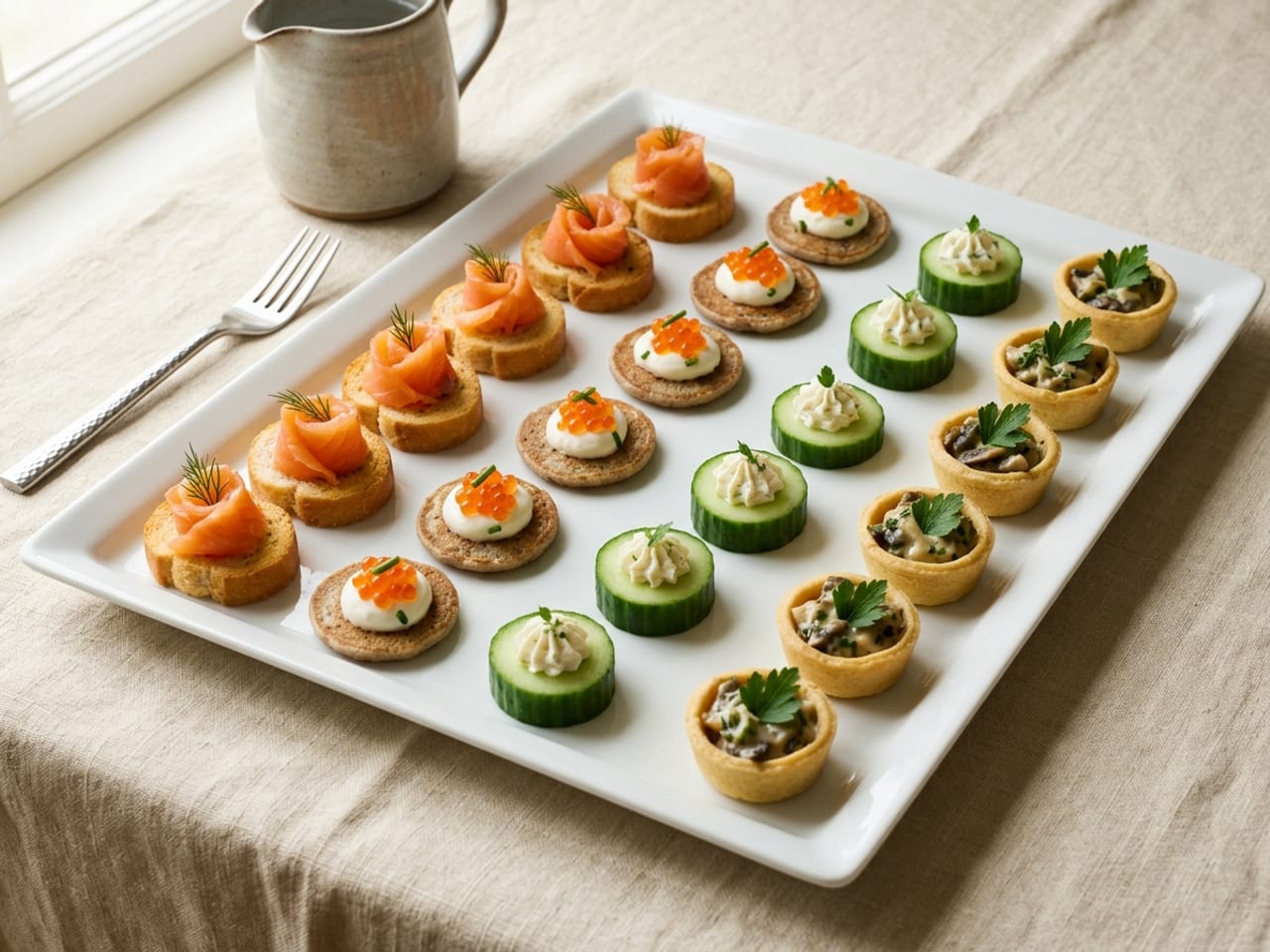
How this page was made. Every definition, count, time and quotation comes from the published source named beside it: dictionaries, culinary textbooks, historical cookbooks, caterers' and venues' guides, magazines, peer-reviewed studies and food-safety agencies. Plate Artists cooked, timed and counted nothing for it. Most textbooks and many cookbooks were lending-only scans we could read only as search fragments, and the 2010 garde-manger textbook only as its free online previews; the old cookbooks were read in machine-read scans. Each is marked so in the sources. Caterers, venues and sellers are labelled. US and UK rules, and rules for businesses against advice for home hosts, are kept apart. Anything marked "ours" is our own reading, count, conversion or suggestion. Sources are at the bottom.
What canapé means: the sofa, the old senses, how to say it
A sofa first. In French a canapé is a sofa, from Old French conopé, a bed curtain, from Latin conopeum and Greek kōnōpeion, a net against mosquitoes; canopy has the same root.4, 6, 7 The food sense is labelled par analogie de forme, by analogy of shape (our translation).7
Two old food senses. Larousse still gives three senses: the sofa, a small slice of bread "nature ou grillée" with a topping, and a slice of fried bread spread with the innards of the game it is served under (our translation).6 The Académie française's 1762 dictionary had only the sofa; its 1930s edition the bread under game; its current one adds, par extension (by extension, our translation), the small topped slice.7 The topped bread is the older in print: the TLFi's first food citation, 1787, is "Petit pain garni de cornichon, d'anchois". 7 Larousse Gastronomique in 1961 gave as its "primary meaning" a slice of crustless bread cut in rectangles, and said canapés are "mostly used as an accompaniment to winged game" (quoted second-hand).42
In English. When it arrived is disputed: Merriam-Webster says about 1750, Dictionary.com 1885 to 1890, John Ayto 1890 and the Oxford Companion to Food the 1890s (the last two second-hand). We found "ANCHOVY CANAPES" in a French cookbook translated in London in 1868. We did not read the Oxford English Dictionary, so this page names no first use.4, 5, 35, 42
How to say it. Cambridge gives /ˈkæn.ə.peɪ/ (KAN-uh-pay) for both British and American English; Merriam-Webster puts KAN-uh-pee first for American English; Oxford also allows the stress on the last syllable in British English; French is [kanape].1, 2, 4, 7 Plural: canapés; in English an unadapted borrowing from French.8 Spelling: the dictionaries print the accent; all six press examples Merriam-Webster quotes, mostly magazines, print "canapes".4
| Dictionary | The base it names | Its definition |
|---|---|---|
| Cambridge (UK learners')1 | biscuit or bread | "a small, thin, salty biscuit or small piece of bread with food such as cheese, fish, or meat on top, that is served with drinks, especially at a party" |
| Oxford Advanced Learner's (UK)2 | biscuit or bread | "a small biscuit or piece of bread with cheese, meat, fish, etc. on it, usually served with drinks at a party" |
| Oxford Advanced American3 | bread or cracker | "a small piece of bread or a cracker with cheese, meat, fish, etc. on it, usually served with drinks at a party" |
| Merriam-Webster (US)4 | bread, toast or cracker | "an appetizer consisting of a piece of bread or toast or a cracker topped with a savory spread (such as caviar or cheese)" |
| Dictionary.com (US)5 | bread, toast or cracker | "a thin piece of bread or toast or a cracker spread or topped with cheese, caviar, anchovies, or other savory food." |
| Collins (UK)5 | bread, toast, etc. | "a small piece of bread, toast, etc, spread with a savoury topping" |
| Larousse (French)6 | bread, plain or toasted | "Petite tranche de pain, nature ou grillée, garnie de menus apprêts" (a small slice of bread, plain or toasted, topped with small preparations; our translation) |
The anatomy of a canapé: base, spread, topping, garnish
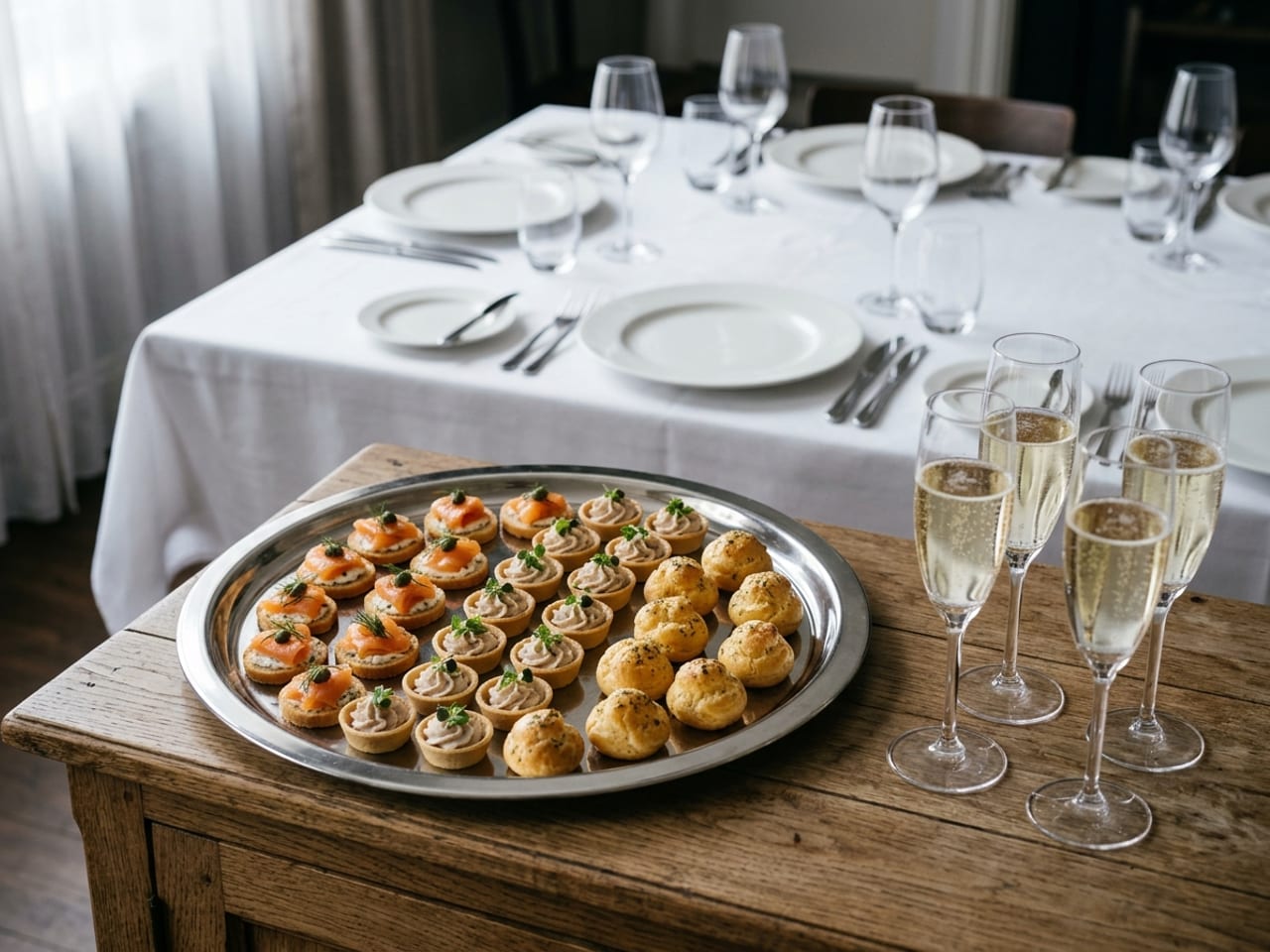
Three parts or four: the textbooks split. Welsh and Thibodeaux: a canapé "always consists of four parts", a base ("usually a toast point"), a spread, a main ingredient and a garnish, "a must have".13 The 2010 Professional Garde Manger counts three: a base of "bread, toast, or sometimes a flat pastry shape", a filling or topping that includes the spread, and a garnish.12 Gisslen also counts three, but they are base, spread and garnish.15
The base carries everything. The CIA calls toasts the "basic building blocks of canapés" for their "durability and sturdiness".20 A vegetable or fruit base "must be strong enough to support the other ingredients"; Thibodeaux's canapé section goes on to Asian soup spoons and edible cracker-dough spoons.13 Labensky names cucumber and zucchini slices and endive leaves.17
The spread is where the books part. Thibodeaux: it "adds flavor, moisture, and helps the next part adhere to the base".13 The 2010 textbook calls a spread a "liquid-resistant barrier that prevents a moist filling from seeping into the bread", but in its sandwich chapter, not its canapé chapter.12 Escoffier buttered the hot toast "with the view of keeping them soft".32 More in the barrier.
The topping and garnish. Canapés favour luxury fillings because each uses so little: "smoked salmon, shrimp, caviar, beef filet"; garnishes "must be tiny, attractive, and completely edible".12 Thibodeaux: "proportional and consistent in size and placement".13
Canapé vs hors d'oeuvre, amuse-bouche, appetizer, crostini and the rest
Fifteen neighbours, each in its own dictionary's or textbook's words, and how a canapé differs.
| Word | What it is | Against a canapé |
|---|---|---|
| Hors d'oeuvre | British: "a small savoury (= not sweet) dish eaten at the start of a meal"; American: "small pieces of food eaten at a party".1 In French, a light dish at the start of the meal, a seated course.7 | The family; a canapé is one kind of it. The 2010 garde-manger textbook sorts hors d'oeuvres into five types by how they are built, canapé being one, and calls canapés "the classic hors d'oeuvres".12 |
| Amuse-bouche | "a small dish served before a meal or between the courses".1 Chosen by the kitchen, 1 to 2 bites, one per guest, served seated before the first course (our amuse-bouche guide). | A canapé is chosen by the host or caterer, several kinds, for guests standing with drinks. An amuse may come on a spoon or in a cup; a canapé, in the dictionaries, is defined by its edible base, though one open textbook's canapé section mentions Asian soup spoons and edible cracker spoons too.13 |
| Appetizer, starter | "a small amount of food eaten before a meal", and mainly in the US also "the first part of a meal"; a starter is "a small dish served as the first part of a meal".1 | Thibodeaux: "Appetizers are part of a meal vs. Hors d' oeuvre, which are apart from the meal."13 In 1922 Emily Post still served a canapé as the first course at the table.40 |
| Finger food | "food that you can eat without using knives, forks, or spoons".1 | Wider. Thibodeaux lists deviled quail eggs and tea sandwiches as finger food, a separate group from canapés.13 |
| Crostini | Treccani: a small slice of bread, also fried or toasted, mostly spread with butter and savoury foods, served as an antipasto (our translation).9 | The Italian twin of the classic canapé: The Oxford Companion to Food says crostini keep "much the same meaning as the old French usage" (quoted second-hand).42 |
| Bruschetta | Treccani: toasted bread dressed with oil and salt and rubbed with garlic (ours); Cambridge adds tomato, cheese or meat on top, "often served at the start of a meal".1, 9 | No size in either definition; Cambridge puts it at the start of a meal rather than with drinks (ours: usually served as a slice, not a bite). |
| Open sandwich, smørrebrød | "a single slice of bread with various types of food ... on the top".1 Smørrebrød is (rye) bread spread with butter and topped (Den Danske Ordbog; ours).10 | Canapés are "miniature open-face sandwiches"12; "Large canapes trespass on the territory of the open sandwich" (Oxford Companion to Food, second-hand).42 |
| Tartine | A slice of bread covered with something easy to spread: butter, jam, honey, cheese (TLFi; ours).7 | Escoffier, 1903: canapés "must be clearly distinguished from tartines"; his are shaped sandwich bread no thicker than half a centimetre (our translation).31 |
| Blini | A yeast pancake, often buckwheat; also "a very small pancake ... usually served with a small amount of food on top as an appetizer".1 | The second sense is a canapé base: the pancake takes the place of the toast. |
| Vol-au-vent, bouchée | "a small, light, cup-shaped pastry case filled with meat, fish, or vegetables in a sauce"; a bouchée is a small pastry case, the word meaning "mouthful".1 In French a bouchée is served as an entrée (TLFi).7 | A filled case rather than a topped base; in the textbook's five types it would be a pastry hors d'oeuvre (ours), and the textbook says many items on a pastry base are "nearly identical" to canapés.12 |
| Barquette, tartlet | "a pastry case in the shape of a boat"; a tartlet is "a small tart ... for one person".1 | Escoffier gave tartlets and barquettes the same garnishes as canapés.32 Thibodeaux says a barquette "should always have a fish or shellfish component".13 |
| Pintxo, tapas | A pintxo is bread or pastry with food on top "kept in place with a small, thin, pointed piece of wood", served with drinks in Spanish bars, especially Basque ones; tapas are small Spanish dishes served with drinks.1 | A pintxo is built like a canapé with a stick through it (ours); tapas is the wider word. |
| Zakuski | Cassell's, about 1880: the cold hors d'oeuvre Russians take "before sitting down to dinner", "generally composed of sandwiches (canapes)". 36 | The spread of dishes; canapés are one item in it. |
| Croûte, croûton (old sense) | Fried or toasted bread that carries or garnishes a dish (TLFi); Mrs Beeton in 1906 put "Olives on Croûtes" with the French "Canapés aux Olives".7, 39 | The same piece of bread under another name. Today a crouton is "a small square piece of bread ... added to soup or a salad".1 |
| Savoury (British) | The savoury course at the end of a British dinner: Escoffier listed canapés among savouries, "pieces of toast ... grilled, buttered, and garnished".32 | A hot canapé served last. The Oxford Companion to Food: hot canapés "come close to what are called savouries in British English" (second-hand).42 |
Canapé size: one bite or two
| Who | The size |
|---|---|
| Professional Garde Manger (2010)12 | "bite-sized, or two-bite-sized at most"; 1 to 1½ in (2.5 to 4 cm) across, 2 in (5 cm) "the largest acceptable size" (the book's own metric) |
| Welsh and Thibodeaux (2022)13 | "1 or 2 bites" |
| Gisslen (2011)15 | "small enough to be eaten in one or two bites" |
| The Culinary Institute of America18 | one bite and no knife and fork is the "traditional notion"; some items at special receptions may be plated |
| Caterer Jean Price, in Town & Country (2003)100 | one bite: "When food takes two bites, the first goes in your mouth, the other goes down the front" |
| Otao Kitchen (2018)86 | "easy to eat in 1 to 2 bites" |
| The Unofficial Mad Men Cookbook (2011)60 | "no more than three bites" |
| Escoffier (1903 French; 1907 English)31, 32 | bread no thicker than half a centimetre in 1903; "about one-quarter inch" (about 6 mm, ours) in the 1907 translation: not the same figure |
| Ranhofer, The Epicurean (1894)33 | rounds 2½ in (6.4 cm) across, oblongs 3½ by 1½ in (about 9 by 4 cm), 3/16 in (5 mm) thick (metric ours) |
| Fannie Farmer (1917 printing)34 | strips 4 by 1½ in (about 10 by 4 cm, ours), bread ¼ in (6 mm) thick |
Reading the table (ours). Today's textbooks agree on one or two bites and about 1 to 1½ inches (2.5 to 4 cm); a strict one-bite rule is one caterer's, and the CIA calls one bite a tradition. The nineteenth-century canapé was bigger, a first course more than a bite. By weight, the CIA's steak tartare canapé makes 30 pieces from 1 lb (454 g) of beef, about 15 g each (our arithmetic), with 1 tsp (5 g) of spread on each base.18
How many canapés per person: every figure we collected
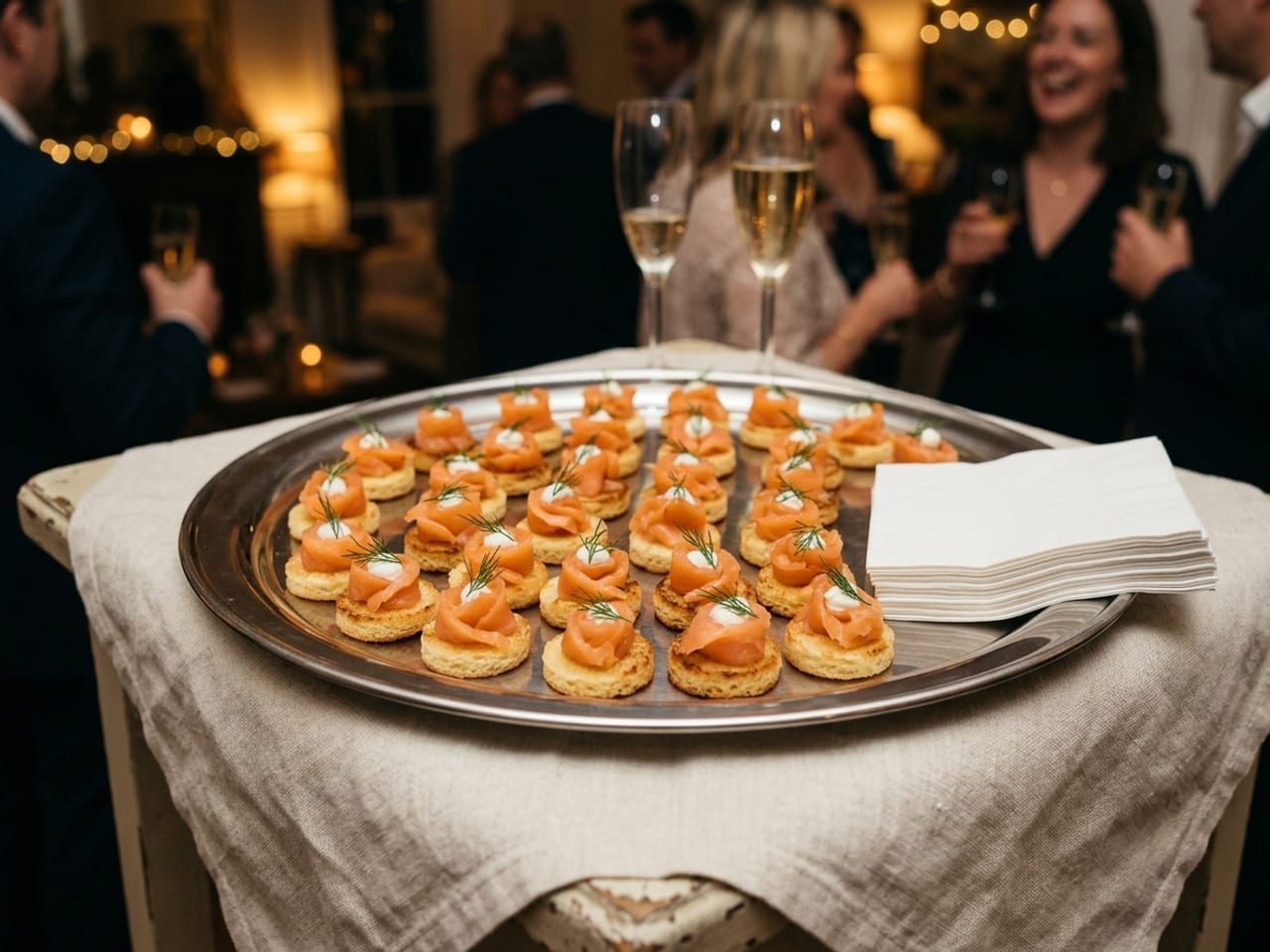
93 figures from 56 sources, as printed, with whose they are, the event and whether they count per event or per hour. None is ours, and none is a rule. We left out one page we could read only as a search preview and five per-recipe or one-line book fragments.
| Who | Event, in their words | Per guest | Counted |
|---|---|---|---|
| Labensky & Hause, On Cooking (2007)17 Textbook | a one-hour cocktail reception before a dinner | 3 to 5 | Per event |
| Labensky & Hause (2007)17 Textbook | hors d'oeuvre are the only food | 4 to 5 | Per hour |
| Nicolet College, Catering (2025)27 Textbook | a cocktail party, passed, a light event | 8 to 12 | Per event |
| Nicolet College (2025)27 Textbook | passed, replacing dinner | 12 to 15 | Per event |
| Backus & Shock, hotel catering text (2017)28 Textbook | a reception with dinner following | 6 to 8 | Per event |
| Backus & Shock (2017)28 Textbook | no dinner following | 10 to 14 | Per event |
| IAEM, The Art of the Show (2006)29 Textbook | 2 hours or less, dinner following: light, moderate, heavy eaters | 3 to 4; 5 to 7; 8+ | Per event |
| IAEM (2006)29 Textbook | 2 hours or less, no dinner: light, moderate, heavy | 6 to 8; 10 to 12; 12+ | Per event |
| IAEM (2006)29 Textbook | 2 to 3 hours, no dinner: light, moderate, heavy | 8 to 10; 10 to 12; 16+ | Per event |
| ACUI, Catering Quick Numbers (undated)30 Trade | under 1½ hours, dinner following: light, medium, heavy | 4 to 5; 7 to 8; 10+ | Per event |
| ACUI30 Trade | under 2 hours, no dinner: light, medium, heavy | 6 to 8; 10 to 12; 14+ | Per event |
| ACUI30 Trade | 2 to 3 hours, no dinner: light, medium, heavy | 8 to 10; 10 to 12; 16+ | Per event |
| Cooking For Crowds For Dummies (Dawn Simmons, caterer)46 Trade book | appetizers before a full meal, at least 4 kinds | 6 to 8 | Per event |
| Cooking For Crowds For Dummies46 Trade book | appetizers without a meal, at least 6 kinds | 12 to 15 | Per event |
| WebstaurantStore (2025), a seller47 Trade | passed appetizers | 4 to 6 | Per hour |
| WebstaurantStore (2025)47 Trade | buffet-style appetizers, a one-hour event | 6 to 8 | Per event |
| WebstaurantStore (2025)47 Trade | stationary appetizers, by weight | 2 to 3 oz (57 to 85 g, ours) of each type | Per event |
| Wigger, banquet manual (1997)48 Trade book | a reception: first hour, second hour | 8, then 6 | Per hour |
| Kilkenny, event planning (2006)49 Trade book | a reception prior to dinner | 6 to 8 | Per hour |
| Kilkenny (2006)49 Trade book | a reception in place of dinner | 10 to 12 | Per hour |
| Van der Pas-Norenius, caterer (2002)50 Caterer or venue | a pre-dinner cocktail hour | 2 to 4 | Per event |
| Van der Pas-Norenius (2002)50 Caterer or venue | first hour, then each hour after (the condition is cut off) | 3, then 2 | Per hour |
| Van der Pas-Norenius (2002)50 Caterer or venue | a party running into meal times: first hour, then each hour | 6, then 4 | Per hour |
| Havin' a Shindig, party planner (2001)51 Trade book | hors d'oeuvres only: first hour, then each hour | 4, then 2 | Per hour |
| Junior League of Milwaukee (2004)52 Trade book | no dinner: the first couple of hours, then | 7 to 9, then 3 to 5 | Per hour |
| Junior League of Milwaukee (2004)52 Trade book | before a dinner | 3 to 4 | Per hour |
| Marquette University Event Services95 Caterer or venue | a reception with no meal | 14 | Per hour |
| Marquette University95 Caterer or venue | over the lunch hour | 10 | Per event |
| Marquette University95 Caterer or venue | late afternoon or late evening | 6 to 8 | Per event |
| Taste of Home Appetizers (2011)53 Magazine | before dinner, 3 or 4 kinds | 4 to 5 | Per event |
| Taste of Home (2011)53 Magazine | a cocktail affair, 4 or 5 kinds | 4 to 6 | Per hour |
| Taste of Home (2011)53 Magazine | in place of a meal, 6 to 8 kinds | 10 to 14 | Per event |
| University of Birmingham Conferences (2024)81 Caterer or venue | a one-hour drinks reception | 4 to 6 | Per event |
| University of Birmingham81 Caterer or venue | before a grand dinner | 4 | Per event |
| University of Birmingham81 Caterer or venue | longer events, each extra hour | 2 to 4 more | Per hour |
| Pembroke College, Oxford (2021)82 Caterer or venue | a pre-dinner reception | 3 to 4 | Per event |
| Pembroke College, Oxford82 Caterer or venue | a drinks party | 8 to 12 | Per event |
| Zouki, Australian caterer (2025)83 Caterer or venue | up to 2, 3 or 4 hours | 6; 8; 10 | Per event |
| Australian caterers answering one question on Easy Weddings (2018 to 2021)84 Caterer or venue | a cocktail wedding with no sit-down meal | 6 to 7; 6 to 8 (two); 7 to 10; 8 to 12 (two); 10 to 12 (seven of ten answers; the others gave a menu or no number) | Per event |
| Paperlust, a stationery seller's blog (2026)85 Blog | pre-dinner nibbles, 60 to 90 minutes | 4 to 6 | Per event |
| Paperlust85 Blog | a cocktail-style reception, no dinner, 2 to 3 hours | 10 to 14, plus 2 substantial | Per event |
| Paperlust85 Blog | with bowl food, 3 to 4 hours | 12 to 16, plus 3 substantial | Per event |
| Paperlust85 Blog | drinks before the ceremony, 30 to 45 minutes | 2 to 3 | Per event |
| Alison Price, London caterer (2001)54 Caterer or venue | a 3½-hour wedding reception | at least 16 | Per event |
| Alison Price (2001)54 Caterer or venue | about 2 hours before a three-course dinner | 6 to 8 | Per event |
| Good Housekeeping Complete Christmas (1997)55 Magazine | drinks, no dinner after | 8 to 10 | Per event |
| Good Housekeeping (1997)55 Magazine | guests going on to dinner | 5 | Per event |
| Good Housekeeping UK (December 2015)56 Magazine | an evening party without dinner | 10 | Per event |
| Good Housekeeping UK (2015)56 Magazine | drinks and nibbles before a meal, savoury | 4 to 5 | Per event |
| Sarah Raven, Complete Christmas (2008)57 Trade book | a 2 to 3-hour drinks party, 7 to 10 kinds | 8 to 10 | Per event |
| Sarah Raven (2008)57 Trade book | guests staying longer than 2 to 3 hours | 15 | Per event |
| Event Management For Dummies (2013)58 Trade book | guests going on to dinner | about 5 | Per event |
| Eric Treuille, Canapés (1999)59 Trade book | an example: 5 recipes, doubled | 10 | Per event |
| The Unofficial Mad Men Cookbook (2011)60 Trade book | no event given | about 4 | Per event |
| Gingers, Hong Kong caterer (2004)61 Caterer or venue | instead of a starter, 4 kinds | 8 | Per event |
| Judy Williams, meetings (1987)62 Trade book | the rule, and boosted (the trigger is not in the fragment) | 6; 10 | Per hour |
| Jan Wilson, budget weddings (1999)63 Trade book | when dinner is being served | 4 | Per hour |
| Tesco Magazine (2019)64 Magazine | a four-hour party (our reading of a jumbled scan) | 12 | Per event |
| Cocktail Parties, Bonnier (2007)65 Trade book | finger food, hot and cold | 5 or 6 | Per hour |
| Miriam Loo, Hors d'Oeuvres Made Easy (1984)66 Trade book | no event given | 6 to 9 | Per hour |
| Betty Crocker (1959)67 Trade book | before a large, late buffet dinner | 6 or 7 | Per event |
| Bradford Times Christmas book (2013)68 Magazine | per hour, and a 3-hour party | 4 to 6; 12 to 18 | Per hour |
| Mount Vernon Inn, Virginia (2021)69 Caterer or venue | receptions | 3 | Per hour |
| Robin Robertson, Vegan Planet (2003)70 Trade book | before a meal (our reading) | 3 to 5 | Per event |
| I'm Writing My Own Cookbook (1979)71 Trade book | drinks and appetizers only | 6 to 8 | Per event |
| The Everything Baby Shower Book (2008)72 Trade book | a shower, 4 to 6 kinds plus something sweet | 4 to 6 | Per hour |
| Practical Hints & Tips (1994)73 Trade book | a light cocktail party | 6 to 10 | Per event |
| Oxmoor House, Holiday Entertaining (2007)74 Magazine | finger-food appetizers | 4 to 6 | Per hour |
| Lisa B., Lifestyle Essentials (2008)75 Trade book | no event given | 5 to 7 | Per hour |
| Louise Pickford, Al Fresco (2002)76 Trade book | no event given | 4 to 6 | Per hour |
| The Taste of Christmas, Murdoch (2001)77 Trade book | "as a general rule" | 4 to 6 | Per hour |
| Hy-Vee Seasons (2008)78 Magazine | "at least" | 4 to 5 | Per hour |
| Zerocater, office caterer (2026)88 Caterer or venue | before a seated meal | 3 to 5 | Per event |
| Zerocater (2026)88 Caterer or venue | a cocktail reception, 2 hours in the evening ("light meal") | 10 to 12 | Per event |
| Zerocater (2026)88 Caterer or venue | replaces dinner, 2 to 3 hours | 12 to 15 | Per event |
| Allens Hire, UK hire firm (2020)89 Trade | no event length given | 6 to 8 savoury plus 2 to 3 sweet | Per event |
| Otao Kitchen, Melbourne caterer (2018)86 Caterer or venue | 3 to 4 hours, no other food | 7 to 9 savoury plus 2 to 3 sweet | Per event |
| Otao Kitchen (2018)86 Caterer or venue | before or after a sit-down meal | 3 to 4 | Per event |
| Otao Kitchen (2018)86 Caterer or venue | after work | 4 to 6 | Per event |
| la-casserole, Dutch caterer87 Caterer or venue | a reception up to 1½ hours | 5 to 6 | Per event |
| la-casserole87 Caterer or venue | a drinks event of 2 to 3 hours | 6 to 10 | Per event |
| la-casserole87 Caterer or venue | an evening reception replacing dinner | 12 to 15 ("twelve or more" on its other page) | Per event |
| Argyll, London venues (2025)91 Caterer or venue | packages sold for a 6 to 9 pm event | 6, 8 or 10 | Sold |
| Cocktail Parties For Dummies (1997)79 Trade book | a 2 to 3-hour early-evening party | 100 for 12 guests (about 8.3, ours) | Per event |
| Fabienne Viner-Luzzato, caterer, The Jewish Chronicle (2014)92 Caterer or venue | guests then eat a meal | 6 to 8 | Per event |
| Fabienne Viner-Luzzato (2014)92 Caterer or venue | "if that is all they will be eating" | 8 to 12 | Per event |
| Jim Wharton, Southern California caterer, in Here Comes The Guide93 Caterer or venue | hors d'oeuvres with a meal service | 3 to 5 bites | Per event |
| Jim Wharton, in Here Comes The Guide93 Caterer or venue | hors d'oeuvres instead of a meal | 12 to 15 bites | Per event |
| Ysenda Maxtone Graham, The Spectator (2022)94 Magazine | "the conventional allocation" at a 2-hour drinks | 12 | Per event |
| University of Exeter (2026) and Magdalene College, Cambridge (2025)97 Caterer or venue | packages sold | 2, 4 or 6; at least 4, or 6 | Sold |
| Dubai World Trade Centre96 Caterer or venue | packages sold, passed only, one of each kind | 3, 6, 9 or 12 | Sold |
| The Nibble, quoting a frozen hors d'oeuvre maker (2009)80 Blog | dinner follows | 4 to 6 | Per event |
| The Nibble (2009)80 Blog | no dinner to follow | 8 to 10 | Per event |
What most sources land on
- Before a dinner: about 3 to 8, in two camps. Of 22 figures, 12 top out at 5 or fewer (Labensky's textbook 3 to 5; Pembroke College and Otao Kitchen 3 to 4) and 6 start at 6 or more (Dummies, a hotel catering text and two caterers at 6 to 8, Betty Crocker in 1959 at 6 or 7, and a Hong Kong caterer at 8 in place of a starter). The middle figure is about 5 (the median of each figure's midpoint, ours).
- A drinks party with no dinner: most print 6 to 12. 16 of 24 figures sit within it, middle about 9; the low ones are for an hour or so (4 to 6 at Birmingham, 5 to 6 up to 1½ hours at a Dutch caterer), the high ones for heavy eaters in two hotel-trade tables (14+ under 2 hours, 16+ for 2 to 3) and for guests who stay past 2 to 3 hours (Sarah Raven's 15).
- When the canapés are the meal: 12 to 15 is the commonest. 12 of 14 figures reach 12 or more; Nicolet's textbook, Dummies and three caterers print 12 to 15 exactly.
- Per hour: 4 to 6 is the commonest line. 12 of 25 per-hour figures sit within it, but the flat figures run from 3 (a Virginia inn) to 14 (a university venue), later hours drop to 2 in three sources, and several say the first hour eats the most.28, 69, 95
The often-quoted rules have owners. "4 to 6 for a one-hour drinks reception, plus 2 to 4 for each extra hour" is the University of Birmingham's conference team, almost word for word81; "3 to 4 before dinner" is Pembroke College and a Melbourne caterer, and the light-eater row of an events-association textbook29, 82, 86; "8 to 12" is Pembroke's drinks party, Nicolet College's light cocktail party and, when canapés are all the guests eat, a caterer writing in The Jewish Chronicle.27, 82, 92 Why some count per event and others per hour: caterers, The Nibble's food writers note, count per person because cocktail parties "are typically capped at 2 hours".80
A worked example (our arithmetic)
Twenty guests, five kinds of canapé. Drinks for an hour before dinner: Labensky's 3 to 5 gives 60 to 100 pieces, 12 to 20 of each kind; Dummies' 6 to 8 gives 120 to 160, 24 to 32 of each. A drinks party that replaces dinner: a caterer's 8 to 12 ("if that is all they will be eating", Viner-Luzzato) gives 160 to 240; Nicolet's 12 to 15 gives 240 to 300. If you have to pick, ours is the higher figure when the drinks run long or the guests arrive hungry, the lower one when a full dinner follows within the hour.
Our two calculators, and where their numbers come from
The party food calculator uses Cooking For Crowds For Dummies: 6 to 8 pieces a guest before a meal and 12 to 15 pieces a guest when appetizers are the whole party, with at least four and six kinds.46 The catering calculator uses Nicolet College's textbook, 8 to 12 for a light reception and 12 to 15 in place of dinner, beside WebstaurantStore's 4 to 6 passed pieces a guest an hour, and at least 6 kinds.27, 47 Their per-event figures sit at the high end of the published spread, while WebstaurantStore's per-hour figure is the commonest one; the table above shows the lower figures beside them.
How many kinds: hot and cold, savoury and sweet, dietary
- How many kindsDummies: at least four kinds before a meal, at least six when there is no meal.46 Taste of Home: three or four before dinner, four or five for a cocktail party, six to eight in place of a meal.53 Sarah Raven: seven to ten for a 2 to 3-hour drinks party.57 Zerocater: about one kind for every ten guests.88 Eric Treuille's example: ten a guest from five recipes, doubled, which is two of each kind (ours).59 Dummies again: "The more variety you have, the smaller portion size each type of appetizer will need to have".46
- Hot and coldTwo caterers print about 60% cold to 40% hot.87, 88 A 1960 party book passes two hot and two cold.106 Zouki's menus run 2 to 4 warm pieces in 6 to 10.83 Gisslen: "Cold items are easiest to serve", and hot and cold should not share a tray ("Avoid presenting hot and cold items on the same tray").15 A hotel catering text's sample banquet order passes the hot items in the first hour, when, it says, guests eat most.28
- Sweet canapésBirmingham's venue: "Savoury canapés are always more popular; if you're serving savoury and sweet, aim for a ratio of around 4:1."81 A hire firm and a caterer add 2 to 3 sweet to 6 to 9 savoury.86, 89 A Spectator columnist reads their arrival as the signal that the party is ending.94 Sweet canapés are not new: Fannie Farmer printed fruit and peach canapés on toast and sponge cake.34 For the small sweets served with the coffee at the end of a dinner, see our mignardises guide.
- Vegetarian, vegan and gluten-freeNo textbook we read gives a share. A wedding caterer includes "Vegetarian choices as well as a few Gluten Free options"84; a stationery seller's blog suggests at least two each of vegetarian, vegan and gluten-free, and "at least one-third of the menu" naturally vegan or gluten-free.85 One university venue's menu has 6 vegetarian or vegan of 11 savoury (3 of them vegan; our count).97 Base matters here: a cucumber or endive base is gluten-free where toast is not (ours).
Canapé bases and how long they hold, as printed
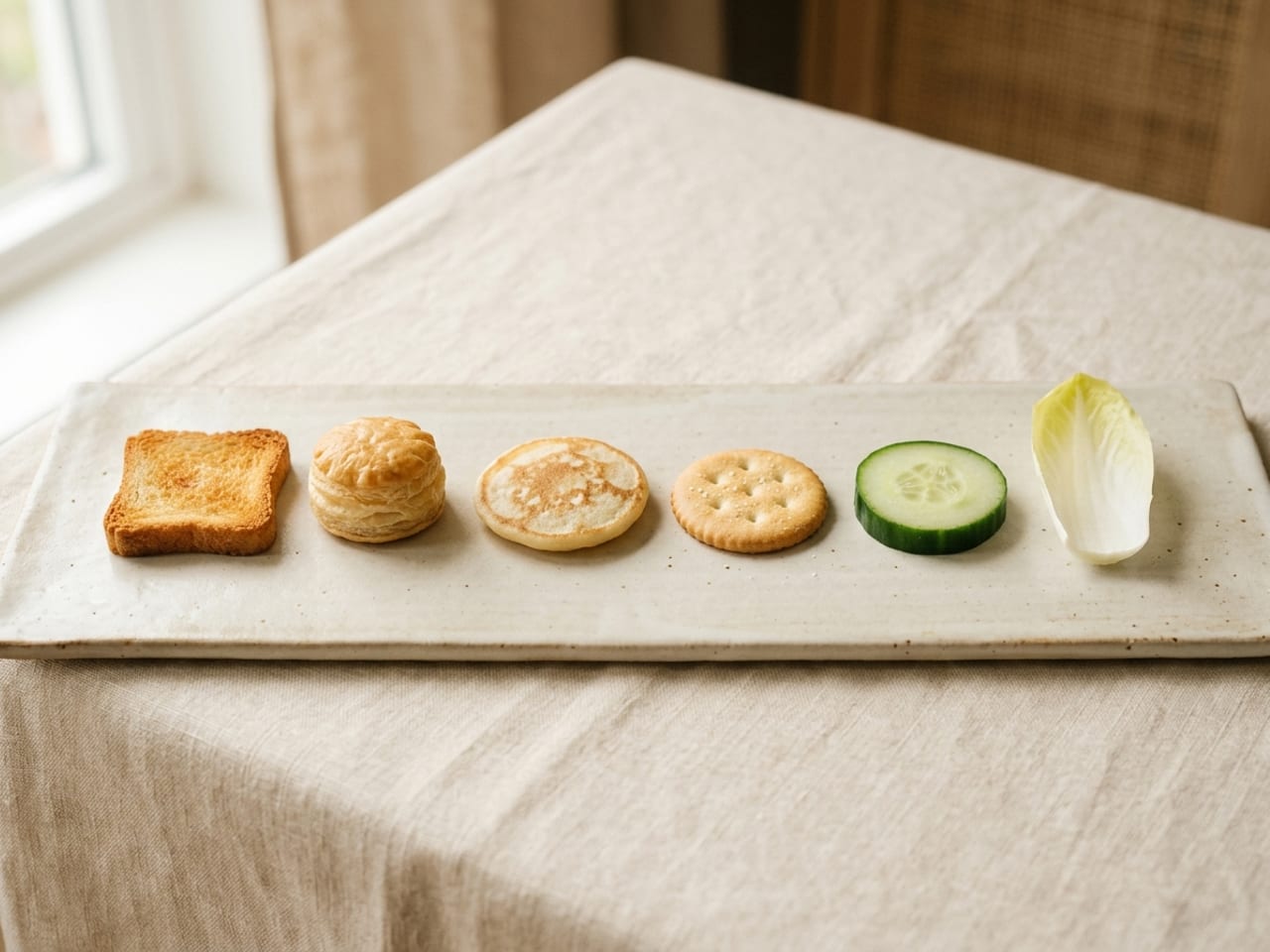
Nobody has ranked them. We found no published ranking of canapé bases by how long they stay crisp, and no timed test of a topped canapé base; we tested nothing either. What the books print are make-ahead windows, one recipe at a time, and the base is never the thing being compared. The nearest measured result is one study that topped nachos with guacamole 30 minutes before tasting: with a thin edible film (cellulose and tomato purée with a little palm oil) between them, 80 panelists preferred the snack and more of them called it the crispier one.146
| Base | Printed make-ahead windows, with their owners |
|---|---|
| Plain toasts (crostini, croûtes), unfilled111, 113, 114, 115, 116, 117, 118, 119 | the morning of the party, not refrigerated (Ernstein 1994); 24 hours (Bowen 1985; delicious.); 2 days (Martha Stewart 1999 and 2003, Joyce 2005); 2 to 3 days (Kremezi 1996); 3 days at room temperature (Morgan 2010); frozen, 1 month (delicious.) |
| Pastry cases (tartlets, filo cups), unfilled125, 126, 127, 128, 129, 130, 131 | 8 hours (Hermé, sweet); a day (Pépin, sweet; Complete Christmas Book, filo); 2 days (Cooking Pleasures); 3 days (Stipovich, filo); "a few days" (Murdoch); a week (Parragon); frozen, 2 weeks (filo) |
| Blini59, 132, 133, 134, 135, 136, 137 | 6 hours (Finger Food 1990); "best eaten on the day" (Finch 2013); 2 days in the fridge, re-crisped (Treuille); 3 days (Bretherton 2012); frozen "a couple of weeks or so" (Owen); Kamman: frozen blini "lose most of their flavor"; made ahead, "assemble just before serving" (Ryan 2014) |
| Choux puffs, baked59, 138 | baked puffs frozen up to 3 months (Betty Crocker 1983); Treuille freezes baked puffs up to 1 month; underbaked puffs "turn soggy when filled" (Treuille) |
| Topped canapés59, 120, 121, 122, 123 | top 30 minutes, 45 minutes or 1 hour before serving, by recipe (Treuille); 1 hour under damp paper towels and film (Gourmet 2001); 2 to 3 hours in the fridge (Methven 1981; Treuille for some); 8 hours, sweet (Hendrickson 2008); the day before (one recipe, Knapp 1982) |
Making them. Crostini: 1 cm (about ⅜ in, ours) baguette slices at 200°C (392°F, ours) for 6 to 7 minutes on a rack, "until almost completely crisp" (delicious.), or 3 mm (about ⅛ in, ours) slices brushed with oil at 180°C (356°F, ours) for 10 minutes (The Irish Times): the two disagree on thickness.111, 112 Toast slabs weighted with a second rack so they do not curl, a thin spread to the edges with an offset spatula.12 Puff pastry squares of 5 cm (about 2 in, ours) at 200°C (392°F, ours); tartlet cases blind-baked with foil parcels of raw rice inside at 180°C (356°F, ours).142
Why canapé bases go soggy, and the fat barrier
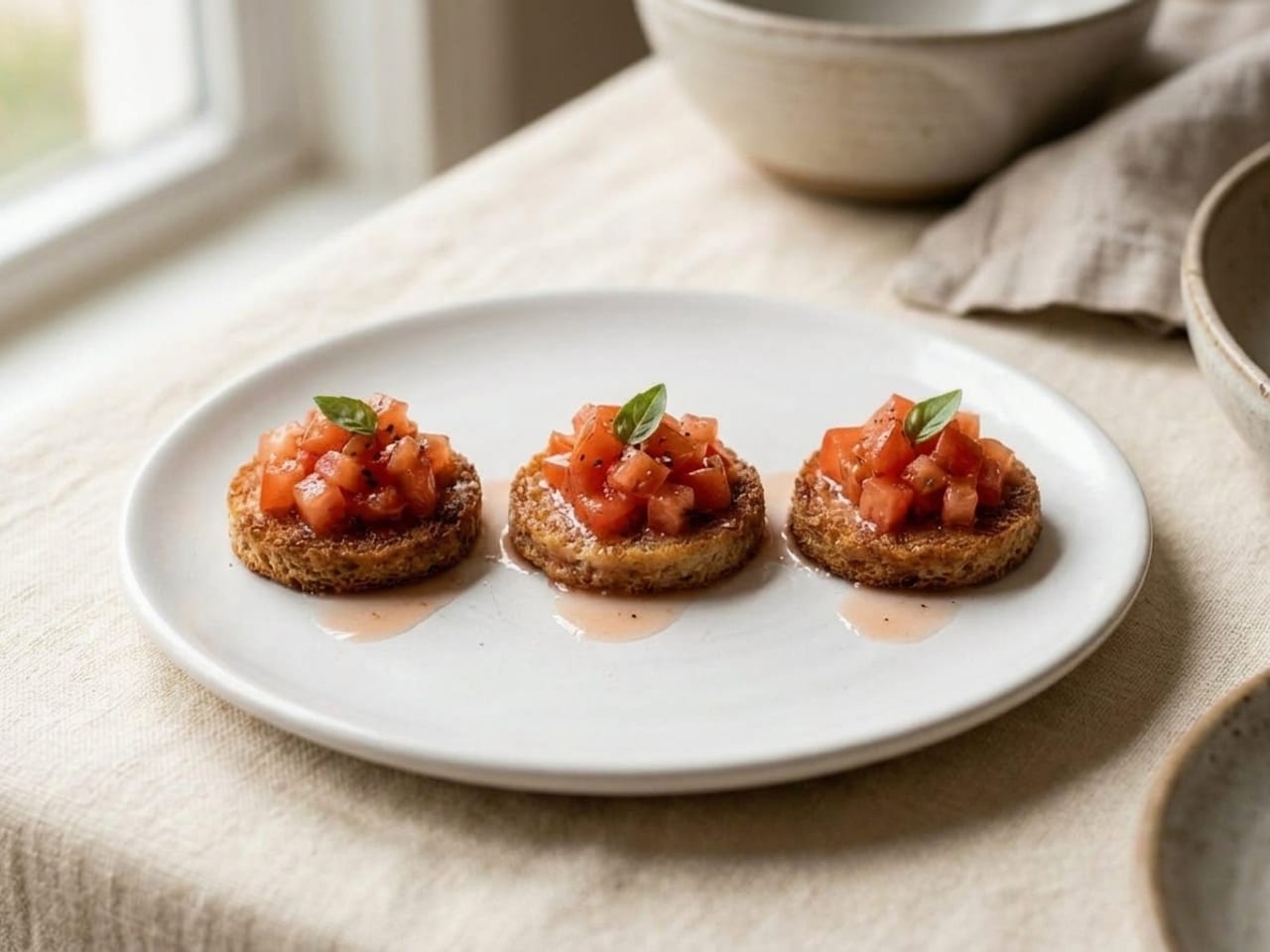
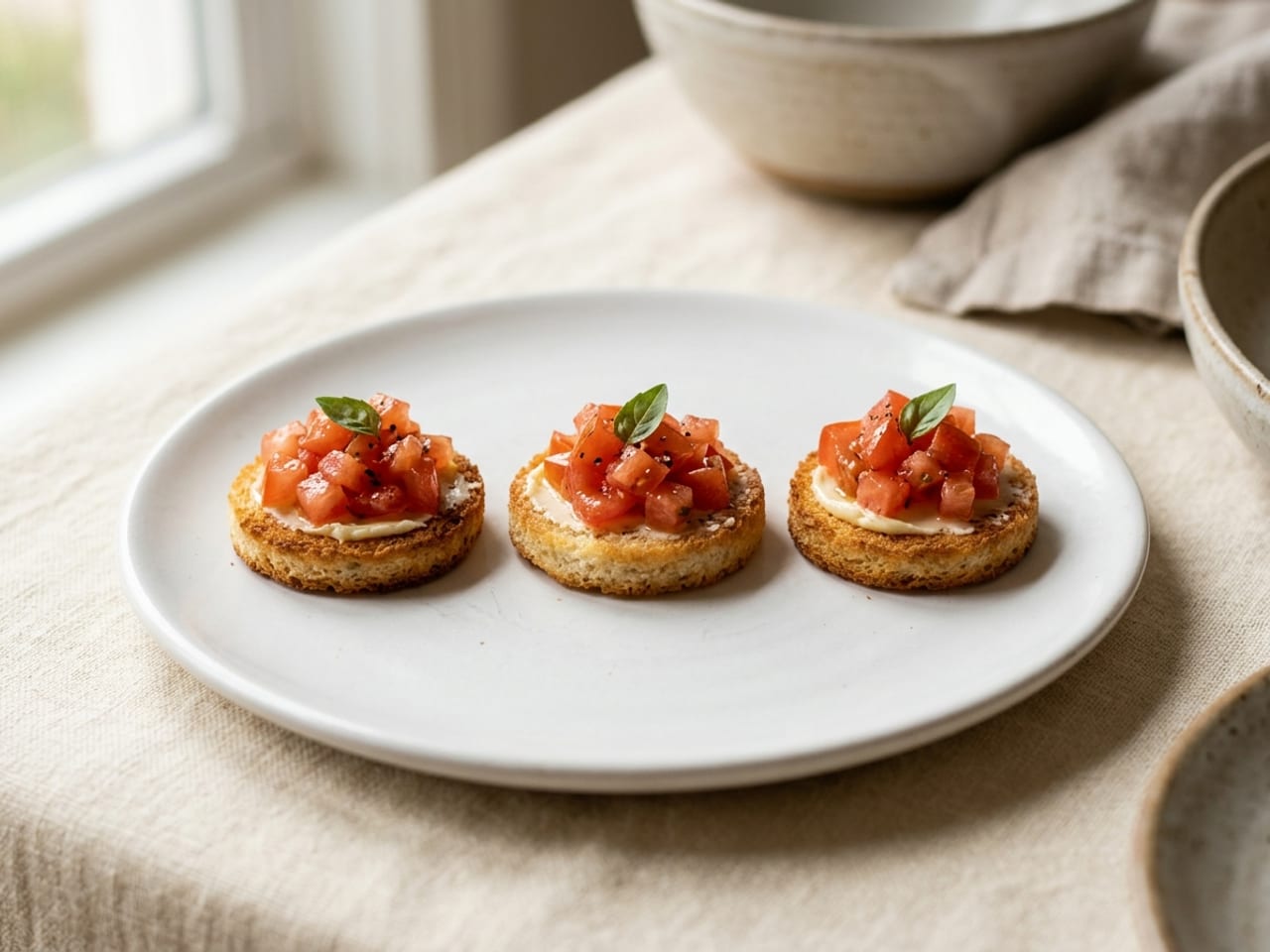 Spread to the edgeNo spread
- Water moves from the wet part to the dry partIn foods built from parts, "the parts with low Aw tend to become soggy when in contact with the parts with high Aw", and how long they last "depends on the speed of the water transfer".146 Crisp snacks, saltine crackers among them, became unacceptable to sensory panels once their water activity rose to about 0.35 to 0.50, a measurement on snacks, not on canapés.144 Bread crust crispness "depends particularly on its water content".145 A topping is far wetter than a toast, so the toast takes up its water (ours).
- Salt and sugar pull water out of the toppingMcGee: a "concentrated solution of any kind draws water out of living cells by osmosis".24 Salted cucumber or tomato weeps onto the base (ours), which is why recipes salt and drain them first: a party book drains and squeezes salted cucumber, and a garde-manger textbook drains its tomato and pepper topping before it goes on the crouton.21, 141
- The fridge stales breadMcGee: bread "in the refrigerator at 46°F/7°C staled as much in one day as bread held at 86°F/30°C did in six days", and reheating to 140°F/60°C reverses staling (his own twins).24 Thibodeaux keeps toast points wrapped at room temperature and the wet parts at 41°F (5°C, ours) or below until assembly, a professional figure (US home advice is 40°F, 4°C), and says bread "may be frozen but not refrigerated".13, 14, 150
- Pastry under a moist fillingA crust under a filling turns "soggy rather than brown and dry"; McGee's fix is to bake it "blind", empty, first.24 Gisslen's baking text: use mealy dough, which "absorbs less liquid than flaky dough does", and high bottom heat.16 The garde-manger textbook says pâte brisée "holds moist fillings without becoming soggy".12
- The textbook answer: assemble lateGisslen, in nearly the same words since 1983 (quoted here from the 2011 edition): assemble "as close as possible to serving time. Bases quickly become soggy, and spreads and garnishes dry out easily".15 A Philippine school module copies his guidelines: make every base, spread and garnish ahead "so that final assembly may go quickly and smoothly", then cover the trays lightly with plastic and hold them briefly in the fridge.25 The CIA: keep the filling off its base "until just before serving time to prevent soggy hors d'oeuvre".20
The barrier: what the books say, and what the science says
Larousse's garde-manger textbook: spreads "act as a moisture barrier between the body of the canapé and the base": it "prevents moisture from the body ingredients from seeping into the crouton and making it soggy".21 The CIA says the same for butter, cheese or mayonnaise, and its instructor's manual calls spreads "both a barrier to keep bread from getting soggy and a way to add moisture".19, 20 Labensky calls butter "an excellent moisture barrier" and says vegetable purées usually are not, in its sandwich chapter.17 For pastry, Suas brushes white chocolate or cocoa butter inside the shell.23 A sandwich book: "butter right up to the edges".140
The science agrees that fat slows water: films are made less permeable by adding "a hydrophobic phase (usually a lipid)"146, though such barriers work less well as the temperature rises147, and controlling moisture inside composite foods "remains today a major challenge".148 We found nothing on brushing a base with egg white to seal it, so this page does not suggest it.
A make-ahead timeline for canapés
Each step is a named source's, or marked ours. The rule under all of it is Gisslen's: the parts ahead, the assembly late.
- Weeks ahead
- Freeze bases if you like: toasts for a month (delicious.), filo cups two weeks, baked choux puffs up to three months.111, 130, 138 Not blini, if Kamman is right about the flavour.135
- Do not freeze mayonnaise, hard-cooked egg white or crisp vegetables: they separate, turn rubbery or wilt.143, 151 One community cookbook assembles a hot canapé, freezes it on baking sheets and stores it in plastic (the note is cut off there).124
- Thaw frozen canapés in the fridge, still wrapped: USDA's safe ways to thaw are the refrigerator, cold water or the microwave, never the counter, and Treuille defrosts its frozen make-ahead items overnight in the fridge.59, 151 A 1968 freezing handbook unwraps them only after thawing, because of condensing moisture (its sentence is cut off in what we read).143
- Two or three days before
- Bake plain toasts and keep them airtight at room temperature: 2 days is the commonest window in the cookbooks we read, and 3 days (Morgan) the longest.114, 116, 117
- Bake unfilled pastry cases: printed windows run from a day (Pépin; The Complete Christmas Book, filo) and 2 days (Cooking Pleasures) to 3 days (Stipovich, filo) and a week (Parragon).126, 127, 129, 130, 131
- Write the list of kinds and the allergens in each (ours; the UK rule for businesses is per item, below).
- The day before
- Make spreads and fillings and keep them cold: Treuille makes some toppings a day ahead, covered in the fridge; Thibodeaux holds them at 41°F (5°C, ours) or below, a professional figure (US home advice is 40°F, 4°C).13, 59, 150
- Blini, if made ahead: Treuille keeps them 2 days in the fridge, airtight, and re-crisps them.59
- The morning
- Have every base, spread and garnish ready and cold, so that, in the school module's words, "final assembly may go quickly and smoothly".25
- Salt and drain watery toppings such as cucumber and tomato.21, 141
- Re-crisp stored bases in a hot oven for about 3 minutes, as Treuille does at 180°C or 200°C (350°F or 400°F, the book's own pairs), then let them cool.59
- The last 30 to 60 minutes
- Spread to the edges, top and garnish production-line style, not one canapé at a time.12 Treuille tops toasts 30 minutes to an hour before serving, by recipe.59
- Cover finished trays lightly and keep them cold until they go out.12, 25 Gourmet's damp paper towel suits soft bread; on a crisp base it would add the water you are keeping out (ours).120
- Hot trays are replaced often so the food stays hot; baking hot canapés in batches is our way to do that.15, 17
- One cookbook keeps its bread bases in a warm oven until needed, up to 2 hours, which "will dry them out and keep them crisp", and in another line warns against leaving them around, "as they will become soggy" (fragments).139
Serving canapés: passed or set out, trays, napkins and picks
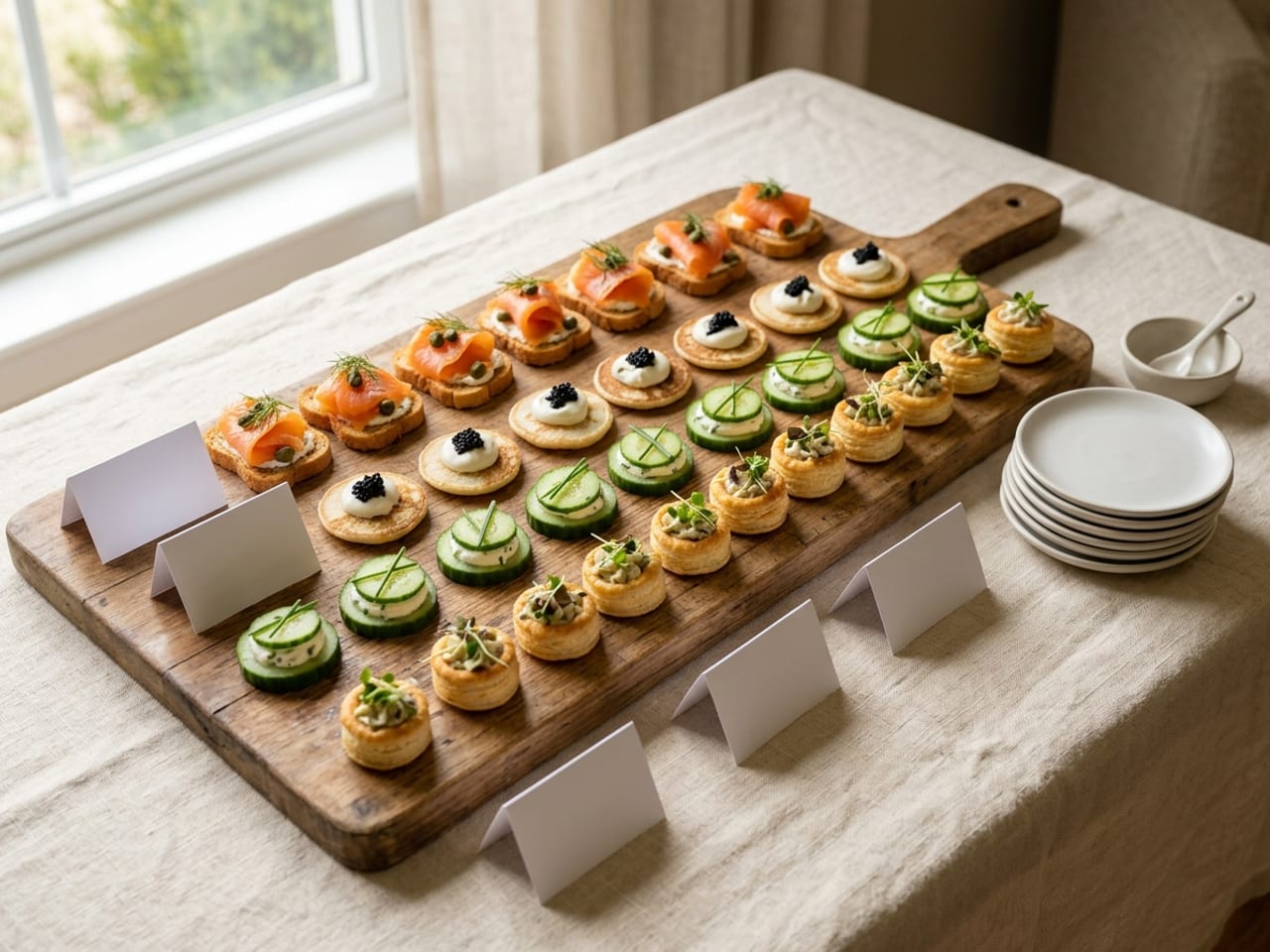
- Passed or stationaryTwo ways, in every textbook we read: butler service, in which "trays of hors d'oeuvres are carried from person to person by servers", and a buffet or stationary display.12, 13, 15, 17 A university venue and a college association say guests eat less when food is passed.30, 95 A hotel catering text's sample order passes hot items for the first hour, then opens stations.28 A working garde-manger text: canapés are traditionally served at "large gatherings where people eat and drink while standing".26 "Heavy hors d'oeuvre" that go past one or two bites belong on a station with plates and utensils.13
- How many serversNo textbook we read prints a number; caterers, planners, a wedding blog and staffing firms do, and they differ: one server for every 15 guests (Wolf), 20 (Zouki), 20 to 25 (Paperlust), 25 to 30 (Elizabeth Andrews, Zerocater), 30 (Argyll), and 25 (Qwick, Breakroom) or 35 (On The Fly Tapsters), the staffing companies our catering calculator quotes.83, 85, 88, 90, 91, 104 None of these is the rule. The CIA gives no ratio, only enough staff to keep taking away "used plates and cups, picks, and napkins", so guests do not resort to "ashtrays and potted palms".18
- Lay the tray out in rowsGisslen: canapés "are best arranged in neat rows, circles, or other arrangements"; Labensky: "parallel diagonal lines, alternating the various styles and shapes"; the CIA: "straight rows" (said of tea sandwiches).15, 17, 18 The CIA wants a passed tray laid out "so that the last person to take one is not rummaging among jumbled garnishes".18 Gisslen prefers one kind per passed tray, two or three for simple items, and not hot and cold together; elsewhere he wants a displayed canapé tray to carry "an assortment of flavors and textures", which we read as the difference between a passed and a set-out tray.15 No source we read gives a spacing or a number per tray. "Odd numbers always look best on a tray" is one London caterer's rule, with "Don't ever leave a single canapé on a tray".98
- Trays and linersLabensky: "Silver and mirror trays create a more formal feel", and cold items can sit on "trays, mirrors, platters, baskets, leaves, papers".17 A vocational course lines the tray with a doily and garnishes the tray with parsley or watercress109; a cooking school says the opposite: "Garnish the table, not the platter."110 Wood and slate appear in a hire firm's and a caterer's advice.89, 92
- NapkinsThe Emily Post Institute: "at least three napkins per person", since guests take a fresh one with each drink.101 With hors d'oeuvres, Town & Country triples the three for drinks; InStyle said nine or ten in 2005 and four in 2017; Susan Spungen counts three a guest per hour.100, 102, 103 One entertaining host passes "the tray in one hand and a stack of cocktail napkins" in the other.105
- Picks and a place for themGisslen: for food with "a moist or oily surface, offer picks".15 A protocol manual puts a small bowl for used toothpicks on the tray or in the server's hand107; an event planner has waiters stay near to take used skewers back, or a half lemon on the tray to push them into.108 InDaily's etiquette column: eat a skewer "from the skewer's end, not from the side", and keep the napkin for "olive pips, toothpicks".99
- How a guest eats one"The typical guest is holding a beverage in one hand", so passed food has to be easy to eat.12 Labensky: very small, so no knife or fork is needed.17 InDaily: napkin in one hand, drink in the other, and shift both to the left to shake hands; anything "Smaller in diameter and height than a 20-cent coin can be managed in a single bite."99
Twelve classic canapés, and where they come from
Each one recurs in two or more of the books we read. Photos are AI renders, some from our sibling guides.
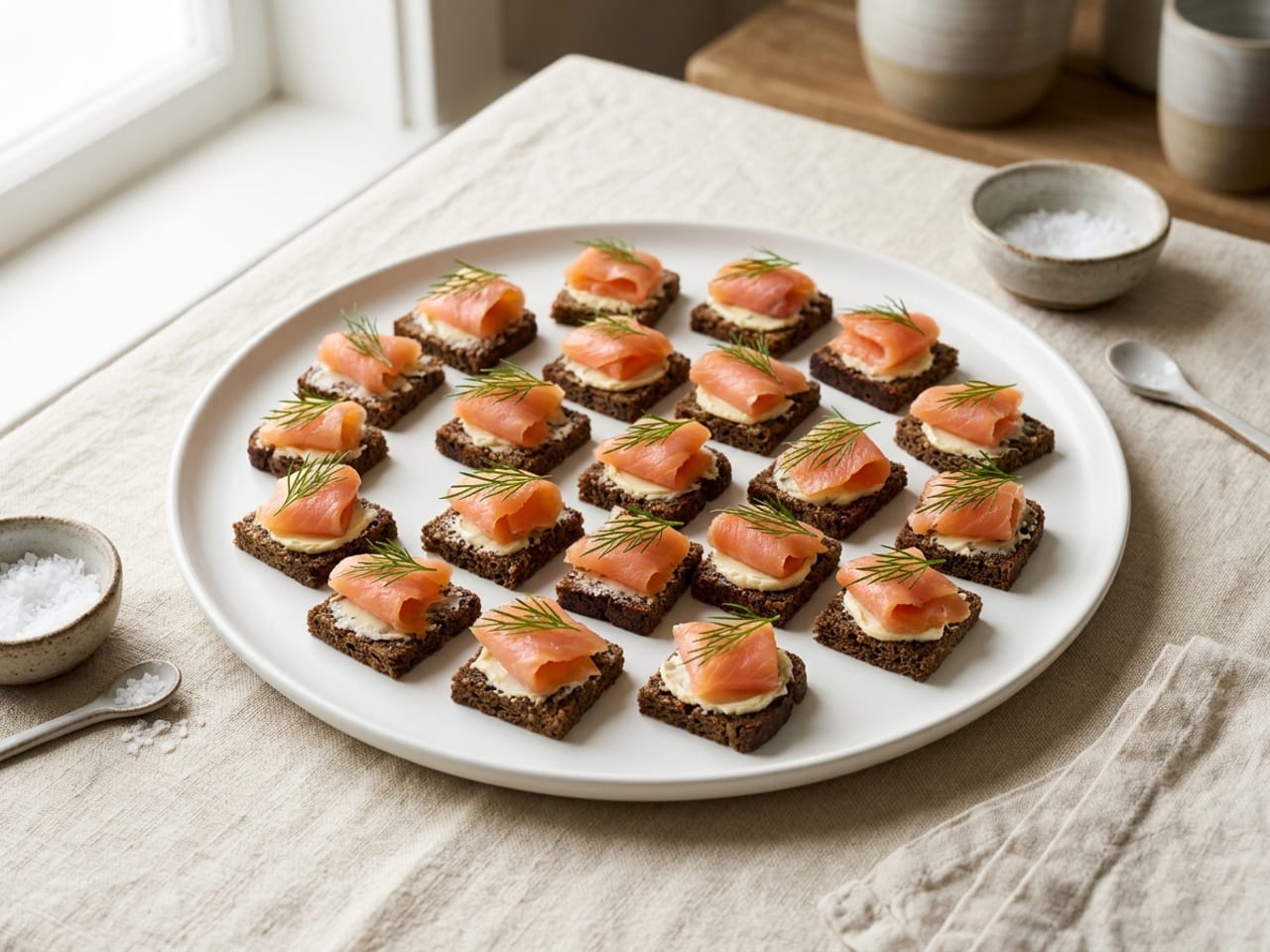
Smoked salmon on brown bread
In Gouffé's 1868 book, Ranhofer's 1894 list and Escoffier's 1903 à la Danoise, dark bread with horseradish butter, smoked salmon, herring and caviar; Lansdown opens a dinner with "Smoked Salmon and Anchovy Canapes".31, 33, 35, 41 Not for pregnant or immunocompromised guests unless cooked until steaming hot, in both UK and US advice: the UK, the US.
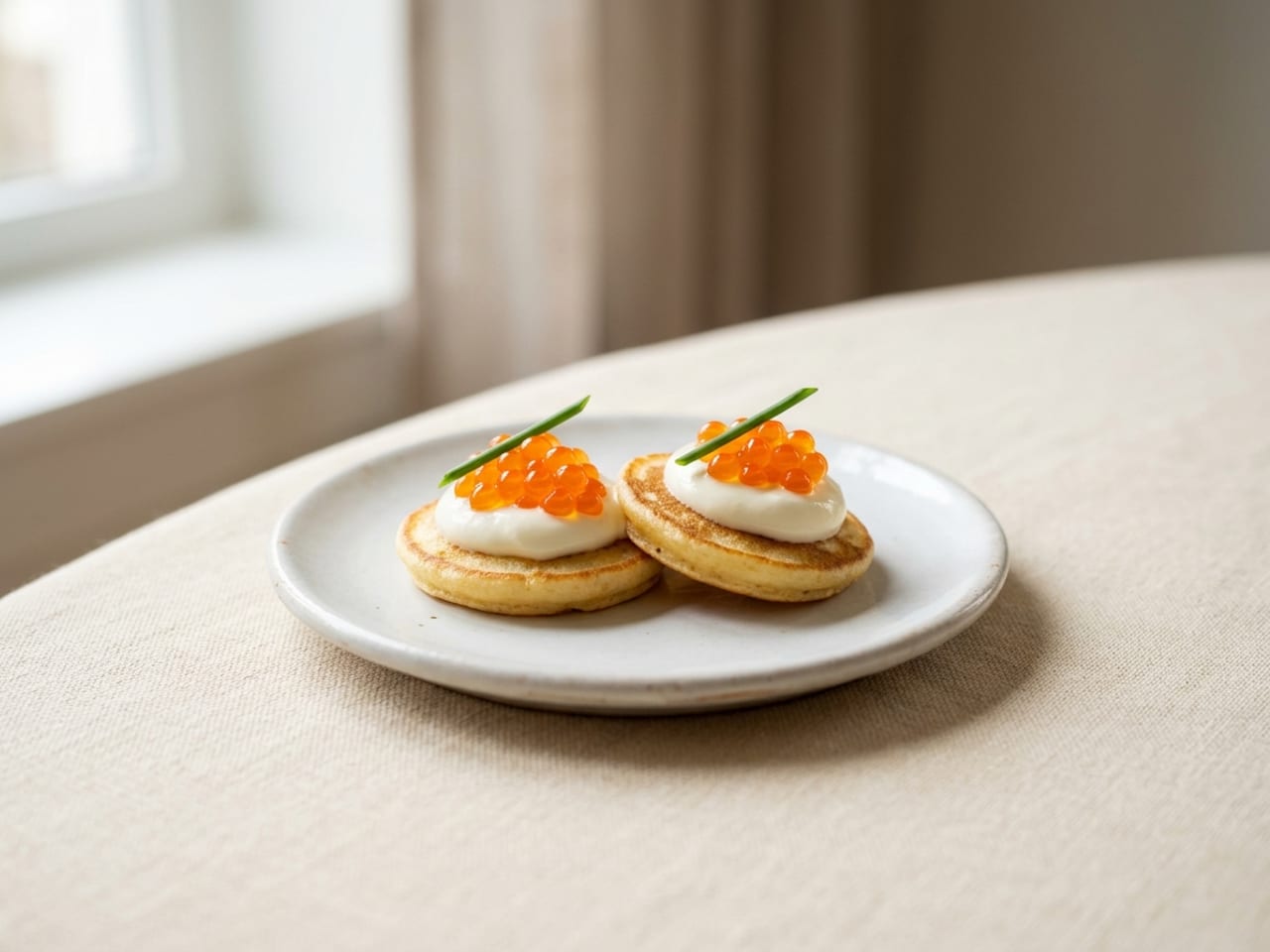
Blini with caviar or roe
Thibodeaux: Osetra caviar is "traditionally served on blinis with crème fraiche".13 The blini in the photo carry trout roe, from our amuse-bouche guide.
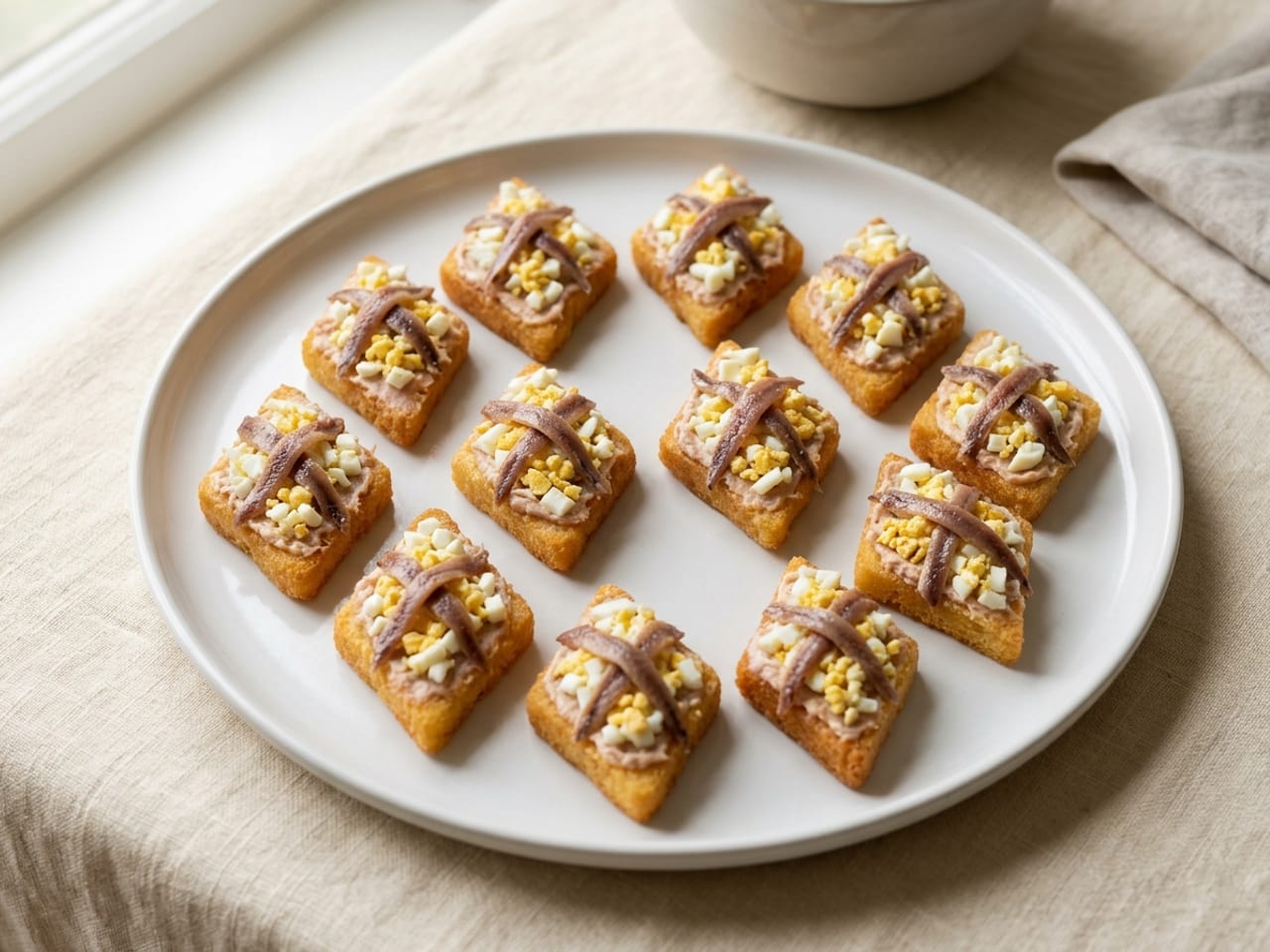
Anchovy canapés
The most repeated canapé in the nineteenth- and early twentieth-century books we read: Gouffé, Cassell's, Ranhofer, Mrs Beeton's 1895 edition and Escoffier, whose lozenge carries anchovy butter, a lattice of fillets and chopped egg.31, 33, 35, 36, 38 Beeton's 1861 anchovy toast is its ancestor.37
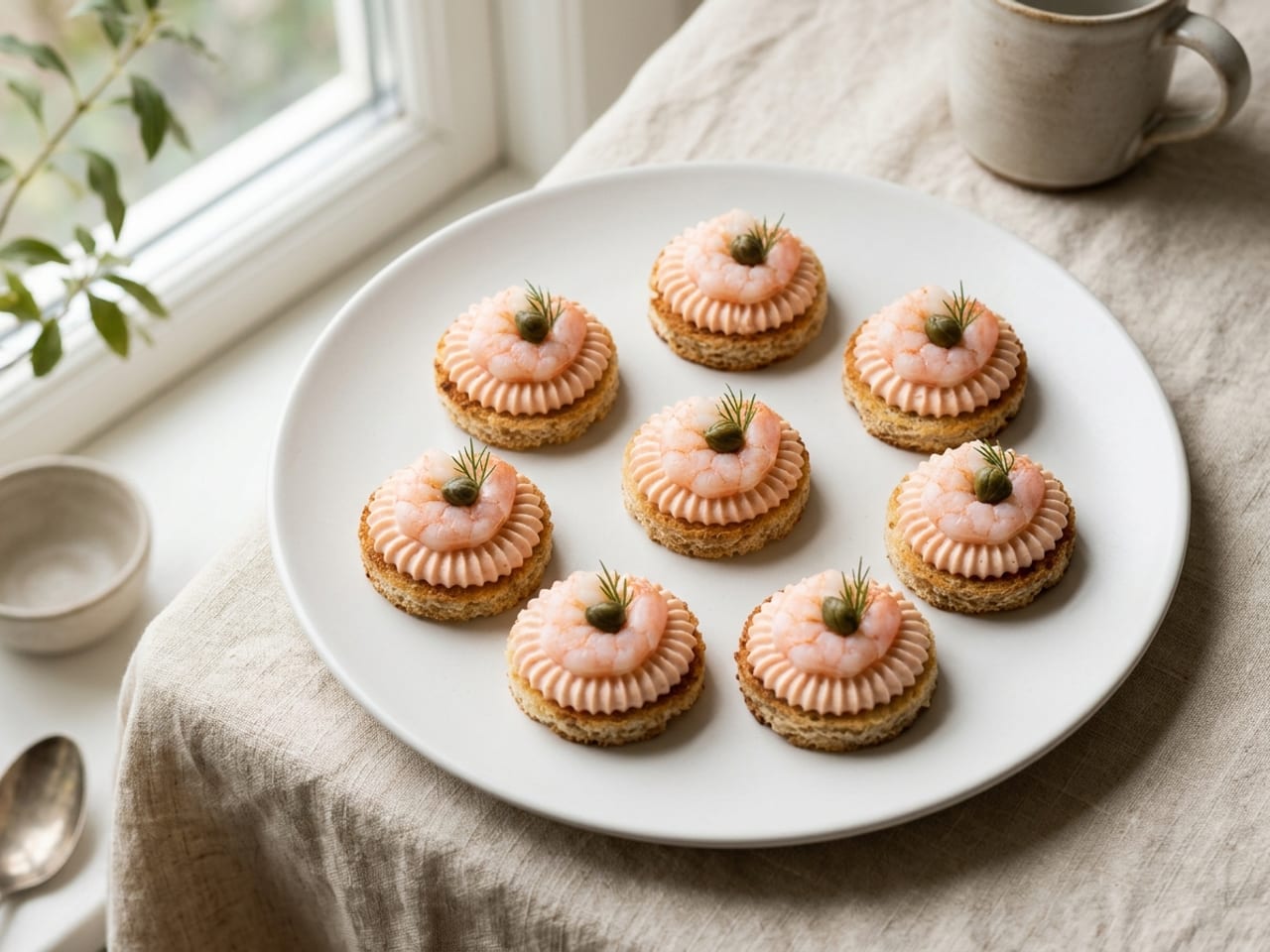
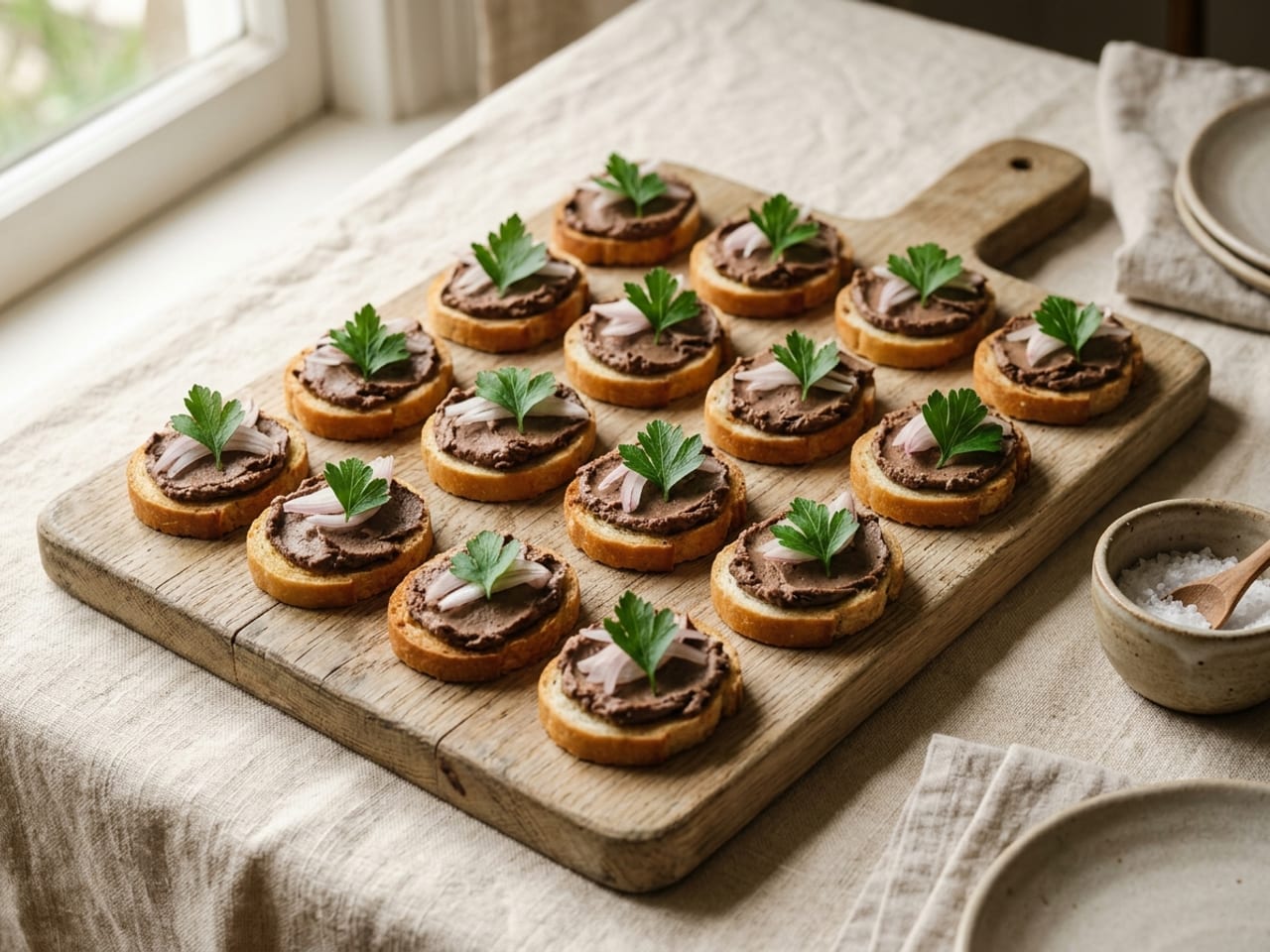
Crostini
Treccani's examples: crostini of truffle, chicken livers, caviar and anchovy.9 Crostini are one of the bases cookbooks most often print a make-ahead time for: the holding times. Liver pâté is on both countries' lists for guests at higher risk: pâté.
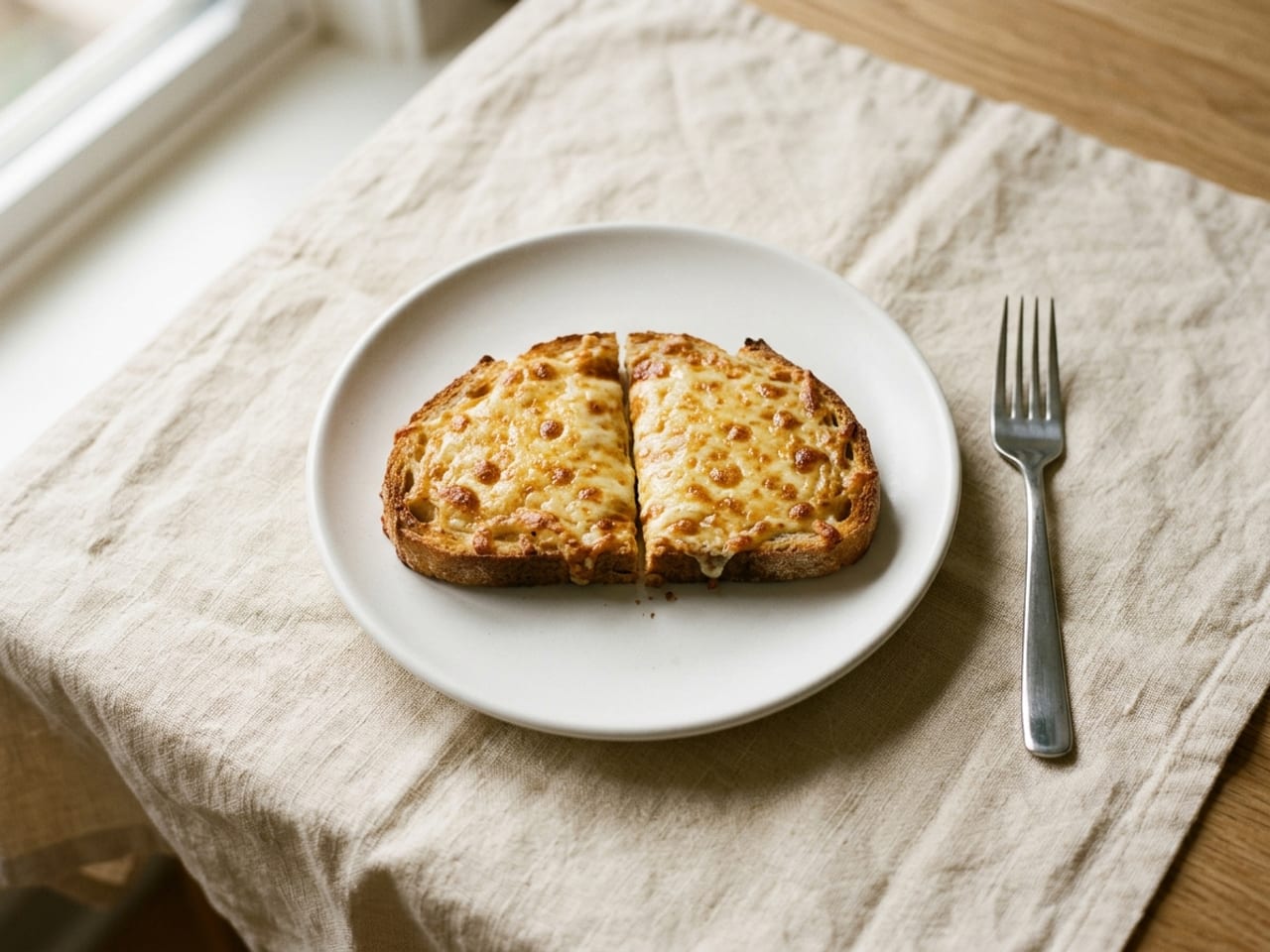
Hot cheese canapés
Farmer: toast rounds under "a thick layer of grated cheese seasoned with salt and cayenne", baked.34 Escoffier's hot one, Canapés des Gourmets, is thin toast fried in butter with a cheese fondue and grilled bacon.32 Cut to a bite, it is close to the British cheese savoury (ours); the photo is the slice from our courses guide.
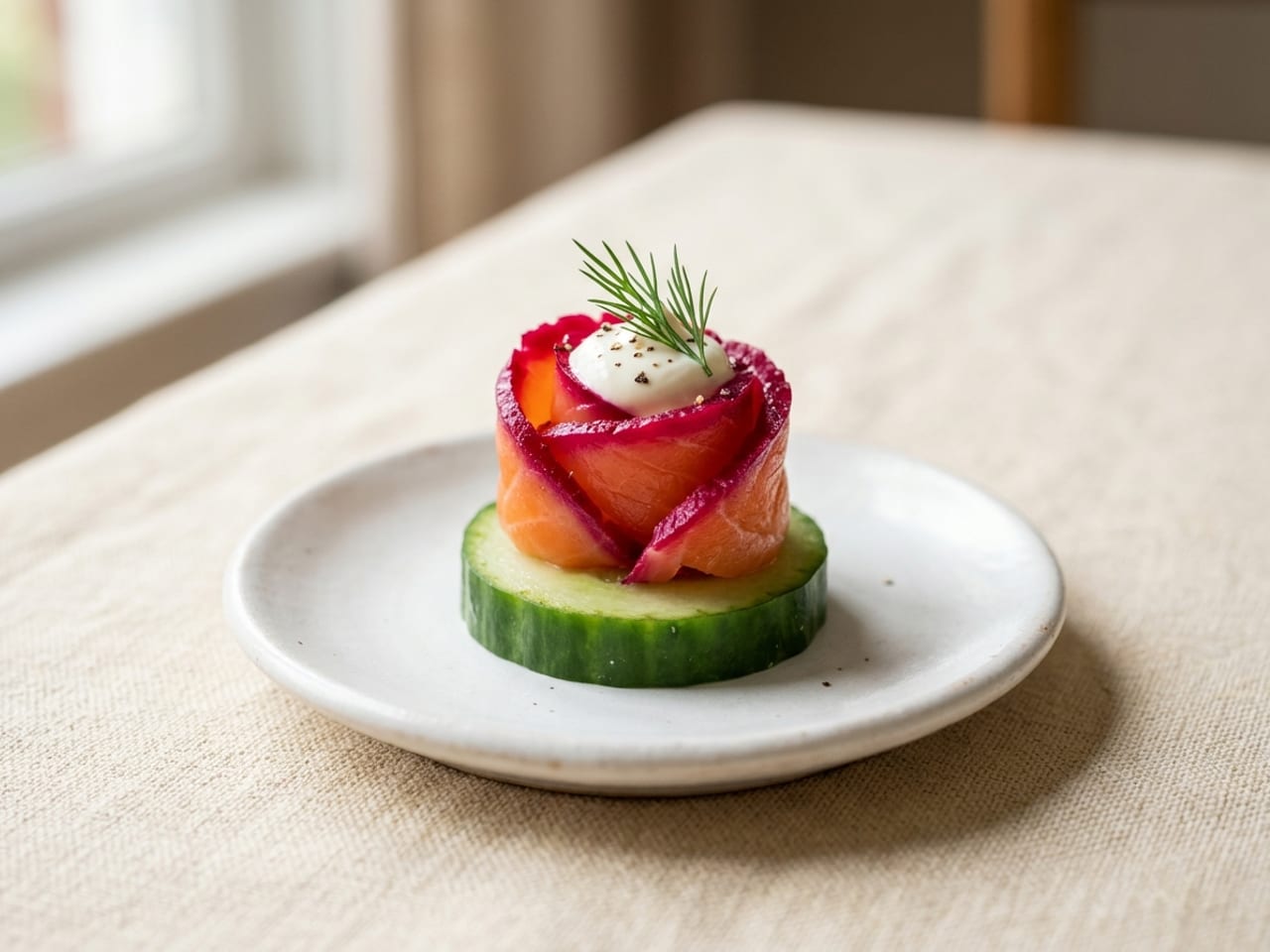
Cucumber rounds
A vegetable base "must be strong enough to support the other ingredients" (Thibodeaux); Labensky names cucumber and zucchini slices and Belgian endive leaves; Larousse prefers the English cucumber "because of its excellent crunch".13, 17, 22 No historical source we read prints a cucumber canapé. The photo is from our amuse-bouche guide. The salmon in the photo is cured, which UK advice puts off the menu for pregnant and immunocompromised guests: why.
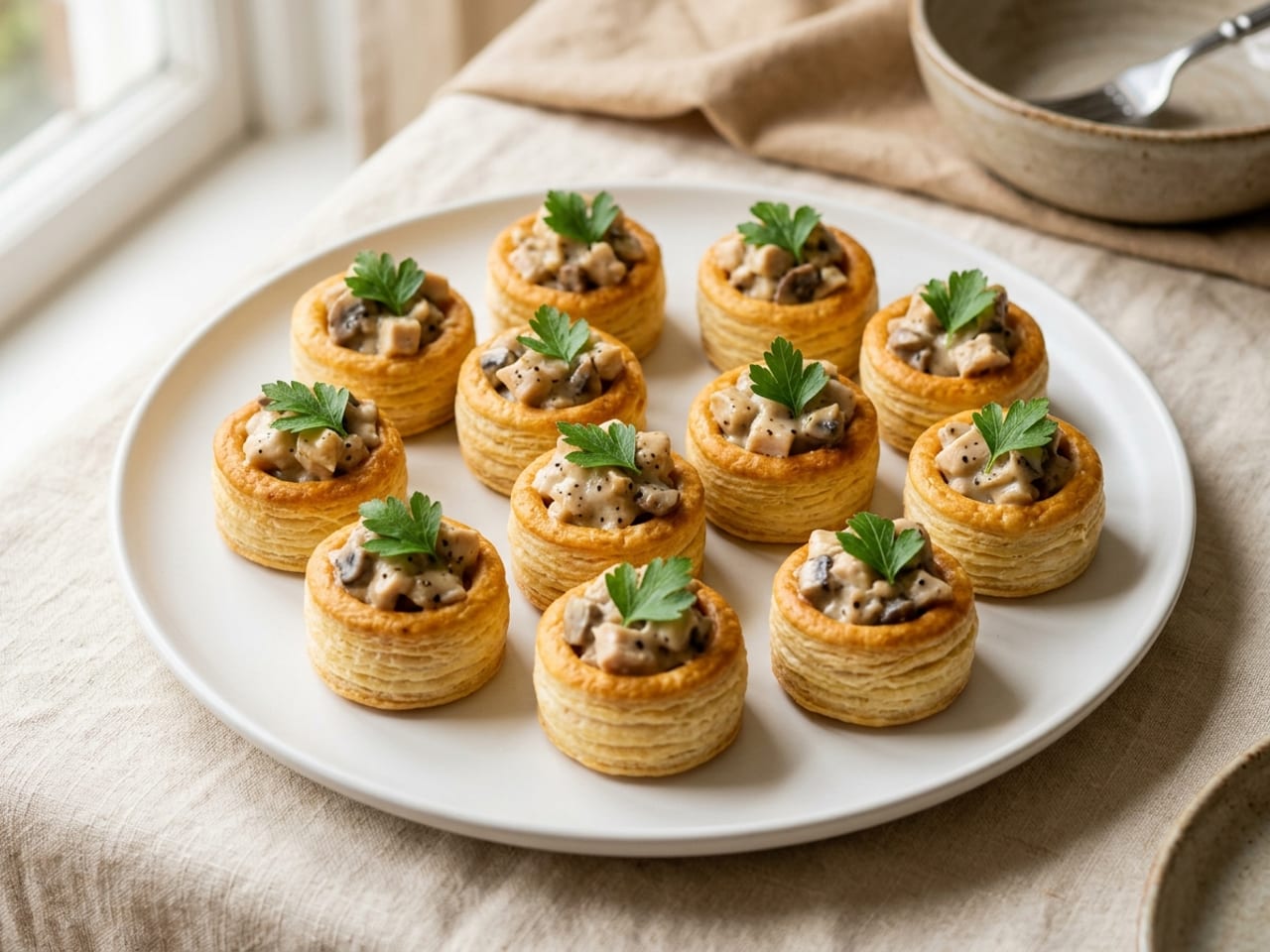
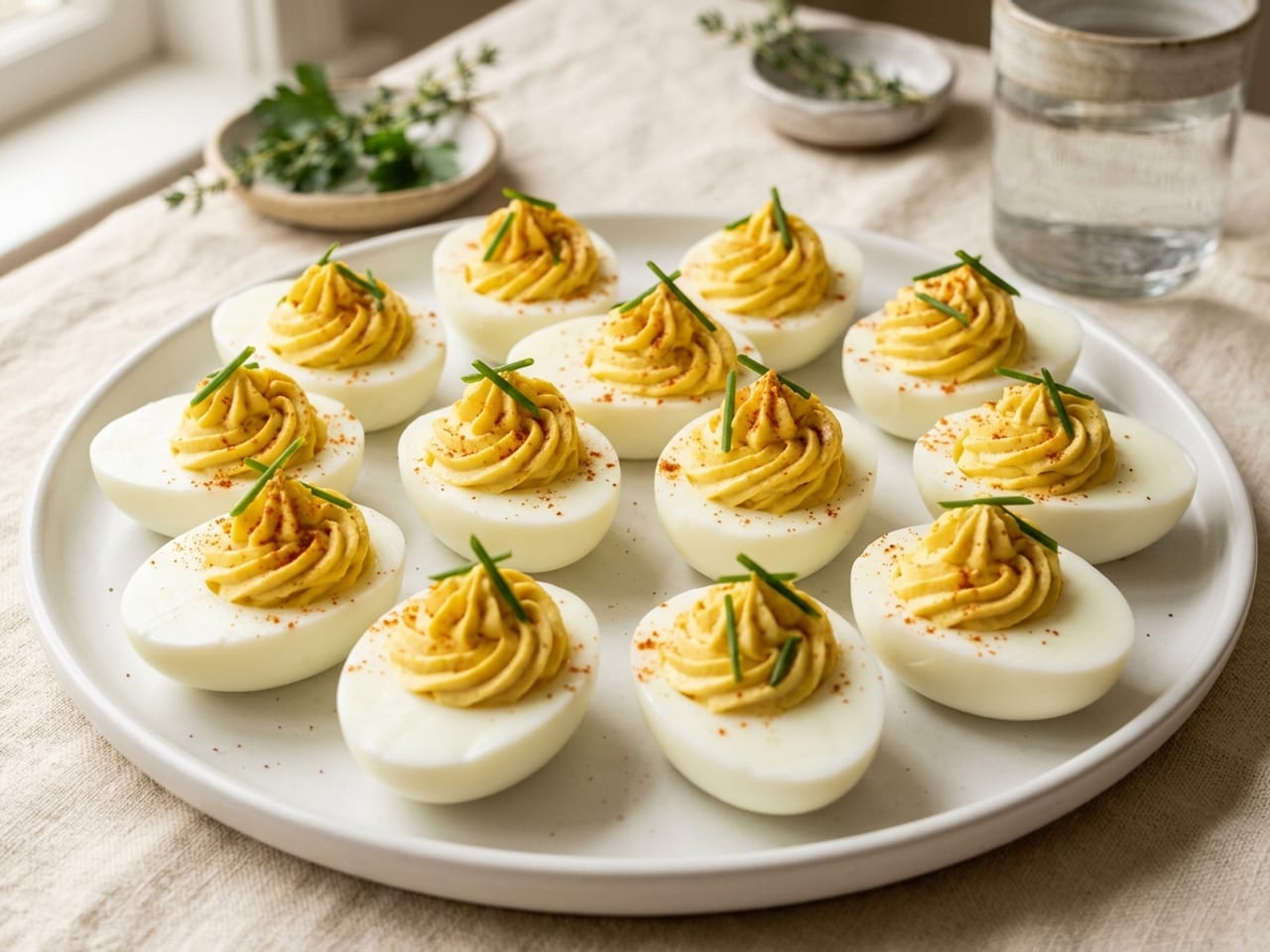
Deviled eggs, a cousin
Not a canapé in the textbooks: halved hard-cooked eggs are a "stuffed" hors d'oeuvre in one and "finger food" in another.12, 13 On a toast base, egg is a canapé: Ranhofer lists "Hard-boiled eggs on canapés".33 Ours is on the drinks tray anyway: deviled eggs.
A short history of the canapé
| When | What the source says |
|---|---|
| c. 1180 to 1762 | Old French conopé, a bed curtain, from Latin conopeum, a mosquito net, from Greek kōnōps, a mosquito (TLFi). The sofa sense is dated 1648; the Académie's 1762 dictionary has only the sofa.7 |
| 1787 | The first French food sense we found: Féraud, "Petit pain garni de cornichon, d'anchois", a small bread topped with gherkin or anchovy (TLFi; ours).7 |
| 1831 to 1838 | Woodcock fillets "en canapé" (Viard, 1831); anchovy, caviar and skate-liver canapés (Grimod de la Reynière, 1838), both cited by the TLFi.7 |
| 1861 | Mrs Beeton has no "canapé", but her anchovy paste on toast or fried bread is a "bonne bouche" for "gentlemen at wine-parties".37 |
| 1868 | "ANCHOVY CANAPES" in Gouffé's Royal Cookery Book, translated in London: the earliest English-language use we saw. Dictionaries give 1750 (Merriam-Webster), 1885 to 1890 (Dictionary.com) and 1890 (Ayto, second-hand); we did not read the OED, so nobody here is "first".4, 5, 35, 42 |
| 1894 | Ranhofer, Delmonico's chef, prints a menu that puts canapés on a separate buffet beside vermouth, absinthe, kümmel and sherry before a Russian-service dinner.33 |
| 1903 to 1907 | Escoffier: canapés are bread cut thin, fried in clarified butter or, more often, grilled, buttered while hot "with the view of keeping them soft"; also the bread under roast game, and in Britain a savoury at the end.31, 32 |
| 1917 to 1922 | Fannie Farmer serves canapés "in place of oysters" or with sherry before dinner; Emily Post's 1922 canapé is a first course at the table.34, 40 |
| 1917 | The first party "so conceived and so called" a cocktail party, in St. Louis, says the Oxford Companion to Spirits & Cocktails; no account we read mentions its food.43, 44 |
| 1940 | James Beard's first book: Hors d'oeuvres and canapés, with a key to the cocktail party (catalogue record only).45 |
| Today | The Académie's current dictionary adds, par extension (by extension, our translation), the small slice of sandwich bread topped with ham or cheese: the party canapé.7 |
Nine popular claims about canapés, each with a verdict
"Supported, narrowly" means the source covers less than the claim says; "Mixed", that sources point both ways; "No source found", that we found no source for it at all.
| The claim | Verdict | What we found |
|---|---|---|
| "A chef named the canapé after his sofa" | No source found | The word does mean sofa, and the food sense is labelled par analogie de forme, by analogy of shape (our translation), in the TLFi.4, 7 The chef story is printed only as "Legend has it" on Dictionary.com; no dictionary we read documents it.5 |
| "A canapé must be one bite" | Mixed | One caterer insists on one bite and the CIA calls it "the traditional notion"; three textbooks allow one or two.12, 13, 15, 18, 100 One cookbook allows three.60 |
| "Canapés are salty so guests drink more" | No source found | Wikipedia says so with no source we could trace.11 No dictionary or textbook we read says it; the nearest is Mrs Beeton's anchovy toast that lets gentlemen "enjoy their port with redoubled gusto".37 |
| "Canapés are traditionally made on stale bread" | Supported, narrowly | Beeton's 1895 anchovy canapés start from a stale loaf; Ranhofer wants a dense loaf "containing no holes", Escoffier sandwich bread. One book, not a tradition.11, 31, 33, 38 |
| "The butter is there as a moisture barrier" | Mixed | Several textbooks say so19, 20, 21; one open textbook says the spread "adds flavor, moisture"13; Escoffier buttered hot toast "with the view of keeping them soft".32 The science supports a fat layer slowing water: the barrier. |
| "Brush the base with egg white to seal it" | No source found | We found no textbook, cookbook or study that tests or even recommends it for canapé bases. |
| "Allow 4 to 6 canapés per person per hour" | Mixed | It is the commonest per-hour figure we found (12 of 25 per-hour lines sit within 4 to 6), but the flat per-hour figures run from 3 to 14, and later hours drop to 2 in three sources.47, 69, 95 The table. |
| "Odd numbers look best on a tray" | Supported, narrowly | One London caterer's rule, quoted in Country Life.98 No textbook we read gives an odd-number rule. |
| "Blini freeze perfectly" | Mixed | On quality, the cookbooks split: Sri Owen freezes them "for a couple of weeks or so", and Madeleine Kamman says they "lose most of their flavor".134, 135 |
Food safety for canapés, by country
US home advice, the US Food Code for businesses and UK rules, kept apart and never converted into each other. Metric twins of US figures are ours.
- How long a tray may sit out: each country's own figureUnited States, home: "Never leave food out of refrigeration over 2 hours", one hour above 90°F (32°C).149, 150 United Kingdom: chilled buffet food out of the fridge "for no more than four hours" at community events, and the same four hours at a home buffet in Scotland.158, 159 Different rules, not conversions; our buffet guide has the full table. FDA: swap trays rather than top them up.150
- Guests at higher risk: what the US listsFoodSafety.gov's list for pregnant women, older adults, young children and people with weakened immunity reads like a canapé menu: raw fish, "Cold smoked fish", "Homemade mayonnaise", "Unpasteurized and/or refrigerated pâtés or meat spreads". It also lists cheese made with unpasteurised milk and unheated queso fresco-type soft cheeses. It suggests canned or shelf-stable pâté, pasteurised cheeses and pasteurised eggs instead.152 FDA: smoked fish only "reheated until steaming hot".153
- United Kingdom: smoked salmon and gravlaxSince 2023 the two UK agencies advise "pregnant women and those with a weakened immune system to avoid eating ready-to-eat cold-smoked or cured fish", smoked salmon, smoked trout and gravlax among them, older people to be aware; if eaten, cook it "until steaming hot all the way through". The update followed 19 linked listeriosis cases and four deaths.157 The NHS says the same for pregnancy.156
- Pâté and homemade mayonnaise: the US and UK differThe NHS lists meat pâté under foods to be careful with ("keep chilled and eat before the use-by date"), liver and liver products (so liver pâté) to avoid, and mayonnaise made with British Lion eggs as fine in pregnancy.156 For pregnancy the NHS also lists raw fish and raw shellfish, sushi included "even if it has been previously frozen", and says mould-ripened soft cheeses such as brie, camembert and chèvre "must be thoroughly cooked"; pasteurised cream cheese, feta, ricotta and mascarpone are fine.156 The US lists refrigerated pâté and homemade mayonnaise as high risk.152 Follow your own country's advice; do not blend them.
- Raw beef on rye: an outbreak on recordCDC: raw ground beef "served on rye bread or crackers with onions", a holiday dish in parts of the upper Midwest, caused an E. coli O157:H7 outbreak in Wisconsin over the 2012 to 2013 holidays (17 patients); earlier outbreaks from the dish each had more than 50 cases. Its advice: cook ground beef to 160°F (71°C).155
- United States, food businesses: the Food CodeFor caterers where it is adopted, the 2026 Food Code has raw fish served ready to eat frozen first, for example at -20°C (-4°F) for 7 days, with exemptions such as some tunas and qualifying farmed salmon, and a written advisory for raw or undercooked animal food. It counts cut tomatoes as food needing time and temperature control. It does not bind a home host.154
- Allergens at eventsFood businesses in England, Wales and Northern Ireland, at a buffet: "you need to provide allergen information for each food item separately", by labels or a sign to ask staff, for the 14 allergens.160, 162 Natasha's Law (PPDS) covers food packed where it is sold before it is ordered; food not in packaging is non-prepacked and needs no PPDS label, though allergen information is still required.161 The FSA's guide for event caterers adds that PPDS does not include platters meant for sharing, nor a platter whose cling film comes off before it is served.162 It names no canapé, so applying that to a passed or set-out canapé tray is our reading; individually boxed canapés packed before ordering would be another matter. Brief the servers on every tray's ingredients.17, 85
- Cocktail sticksNo food-safety agency page we read mentions them. The medical literature does: an estimated 8,176 toothpick injuries a year in the US in 1979 to 1982, children under five most at risk, and a review of 136 swallowed-toothpick cases, most of them with gut perforation.163, 164 Count picks out and give guests somewhere to put them (ours).
Photograph your tray, see it re-plated
Made a tray of canapés? Photograph it and Plate Artists re-plates that tray, with the food kept as it is and the changes named so you can repeat them. Start with a re-plate.
Your food, plated like a chef's
Snap it, upload it, and get the composed version back, with the steps to recreate it at home.
Start free · 1 enhancement →Free account · 1 free enhancement · No credit card
Canapé words, defined
Canapé · canapes, canapés
A one or two-bite piece of bread, toast, pastry or cracker, sometimes a firm vegetable, topped with a savoury spread and garnish and served with drinks.
Where it comes from. French for sofa, from Old French conopé, a bed curtain, and Latin conopeum, a mosquito net (TLFi, Merriam-Webster). Plural canapés; the press often prints "canapes" without the accent.4, 7
Hors d'oeuvre · hors d'oeuvres
A small savoury dish at the start of a meal (British, French) or small pieces of food at a party (American); canapés are one kind.
Where it comes from. French, "outside the work" (Thibodeaux); British and American senses differ (Cambridge).1, 13
Butler service · passed hors d'oeuvres, tray service
Serving canapés on trays that staff carry among the guests.
Where it comes from. The garde-manger textbooks' name: trays "carried from person to person by servers".12, 17
Stationary service · buffet service, display
Setting canapés out on a table for guests to help themselves.
Where it comes from. Thibodeaux's "Stationary Buffet"; Gisslen's "buffet-style".13, 15
Base · bed, crouton, croûte
The edible bottom layer of a canapé that carries the rest.
Where it comes from. The textbooks' word; the 2010 textbook ties it to the French "bed" or "sofa"; Larousse's garde-manger book calls the toast a crouton.12, 21
Spread
The thin layer of butter, cream cheese, mayonnaise or paste between base and topping.
Where it comes from. Thibodeaux: it "adds flavor, moisture, and helps the next part adhere"; other textbooks also call it a moisture barrier.13, 21
Moisture barrier
A layer, usually fat, that slows water moving from a wet topping into a dry base.
Where it comes from. Textbook wording (Larousse 1996, the CIA); the 2010 textbook uses "liquid-resistant barrier" in its sandwich chapter.12, 20, 21
Slab method
Making many canapés at once by topping a long slice of bread and cutting it into pieces.
Where it comes from. One of the two construction methods in Professional Garde Manger: spread and top a whole slab of bread, chill, then cut.12
Croûte · croûton (old sense)
A round or slice of fried or toasted bread used as a base, the older English name for a canapé base.
Where it comes from. TLFi: a piece of (stale) bread, synonym croûton; Beeton 1906 pairs "Olives on Croûtes" with "Canapés aux Olives".7, 39
Crostino · crostini
A small slice of toasted or fried bread with a topping, the Italian counterpart of the classic canapé.
Where it comes from. Italian; Treccani defines it as a small slice of bread, also fried or toasted, spread and served as an antipasto.9
Bouchée
A small puff pastry case with a filling.
Where it comes from. French for a mouthful (Cambridge); in French cooking a little vol-au-vent served as an entrée (TLFi).1, 7
Barquette
A small boat-shaped pastry case for hors d'oeuvres.
Where it comes from. Cambridge: "a pastry case in the shape of a boat".1, 13
Zakuski · zakouski
The Russian spread of small dishes before dinner, of which canapés are one item.
Where it comes from. Cassell's, about 1880, after Urbain Dubois: the cold hors d'oeuvre Russians took before dinner, mostly canapés.36
Savoury
In British dining, a small hot salty course served at the end of dinner, often on toast.
Where it comes from. Escoffier 1907, chapter XIX; Beeton 1895 puts savouries at the close of dinner.32, 38
PPDS · prepacked for direct sale, Natasha's Law
Food packed where it is sold before the customer orders it, which must carry a full ingredients and allergen label.
Where it comes from. UK food law in force since 1 October 2021 (the FSA page cited covers England, Wales and Northern Ireland).161
Canapés, answered
What is a canapé?
A canapé is a small piece of bread, toast, pastry or cracker with a savoury topping, served with drinks, usually in one or two bites. Dictionaries define it by that edible base: British ones say biscuit or bread, American ones bread, toast or cracker. Textbooks also allow a firm vegetable such as a cucumber round or an endive leaf. It is one kind of hors d'oeuvre.
What does canapé mean, and why sofa?
Canapé is French for sofa. The word comes from Old French conopé, a bed curtain, and Latin conopeum, a mosquito net, the same root as canopy. The French food sense is dated 1787 and labelled "by analogy of shape" (our translation); Wikipedia explains it as the topping sitting on the bread as people sit on a sofa, but no dictionary we read says how the analogy arose. The story of a chef looking at his sofa is printed only as a legend.
How do you pronounce canapé, and what is the plural?
KAN-uh-pay in British and American English (Cambridge), with KAN-uh-pee as Merriam-Webster's first American form and a final stress also heard in Britain; in French, ka-na-PAY. The plural is canapés, and magazines and newspapers often print canapes without the accent.
What is the difference between a canapé and an hors d'oeuvre?
Hors d'oeuvre is the family and a canapé is one member of it: a bite built on an edible base. Other hors d'oeuvres are stuffed (a deviled egg), wrapped or rolled (pinwheels, devils on horseback), skewered, or pastry cases. In British and French use an hors d'oeuvre can also be a seated first course.
What is the difference between a canapé and an amuse-bouche?
An amuse-bouche is chosen by the kitchen, usually free, one per seated guest before the first course, and may come on a spoon or in a cup. Canapés are chosen by the host or caterer, several kinds, and passed to guests standing with drinks, on an edible base.
How many canapés per person?
It depends on whether a meal follows. Of the 93 published figures we collected from 56 sources, the ones for a reception before dinner run from 2 to 10 a guest, most often 3 to 5 or 6 to 8. For a drinks party with no dinner, most print 6 to 12; when the canapés are the meal, 12 to 15 is the most common figure. Per hour, the commonest figure is 4 to 6. These are caterers', textbooks' and magazines' figures, and they disagree: see the table.
How many canapés per person before dinner?
Two camps. A culinary textbook (Labensky) gives 3 to 5 for a one-hour reception before dinner, and venues such as Pembroke College print 3 to 4; Cooking For Crowds For Dummies, a hotel catering text and two caterers say 6 to 8. Of 22 before-dinner figures, 12 top out at 5 or fewer and 6 start at 6 or more. For 20 guests that is 60 to 100 pieces on the first reading and 120 to 160 on the second.
How many canapés for a 2-hour party or a wedding?
For a two-hour drinks party with no dinner, printed figures run from about 6 to 12 a guest, with a Spectator columnist calling 12 "the conventional allocation". For a wedding reception before a sit-down meal, a London caterer gives 6 to 8; for a cocktail wedding with no meal, seven of ten Australian caterers who answered one question on a wedding site gave between 6 and 12, and one London caterer at least 16 for three and a half hours. Our catering calculator uses 8 to 12 for a light reception and 12 to 15 in place of dinner.
How many kinds of canapés should I make?
At least four kinds before a meal and at least 6 when there is no meal (Cooking For Crowds For Dummies); Sarah Raven suggests 7 to 10 for a two to three-hour drinks party, and an office caterer about one kind for every ten guests. A UK venue suggests about four savoury to one sweet.
How big should a canapé be?
One or two bites. The 2010 garde-manger textbook gives 1 to 1½ inches (2.5 to 4 cm) across, with 2 inches (5 cm) the largest acceptable size. The Culinary Institute of America calls one bite for hors d'oeuvre "the traditional notion", and one caterer insists on it; the textbooks we read allow one or two.
How do you keep canapés from getting soggy?
Assemble as close to serving as you can: Gisslen's textbook says "Bases quickly become soggy". Spread butter or cream cheese right to the edges, which several textbooks call a moisture barrier; drain or salt-and-drain wet toppings; keep crisp bases wrapped at room temperature, not in the fridge, and re-crisp them in the oven; bake pastry cases blind. No source we found has timed which base stays crisp longest, and we did not test it.
How far ahead can you make canapés?
Plain toast bases: cookbooks print anything from the morning of the party to 3 days ahead, airtight; unfilled pastry cases from 8 hours to a week. Spreads and fillings the day before, kept cold. Topped canapés: printed windows run from 30 minutes to an hour before serving (Treuille, Gourmet) through 2 to 3 hours in the fridge and 8 hours for sweet canapés, to one recipe made the day before. Each figure is one cookbook's, and none says how it was arrived at.
Can you freeze canapés?
Bases freeze: toasts for a month in one magazine, filo cups two weeks, baked choux puffs up to three months, and one community cookbook freezes a hot canapé assembled. Thaw them wrapped, in the fridge (USDA's safe methods are the fridge, cold water or the microwave), and unwrap them after thawing, as a food technology handbook advises. Do not freeze mayonnaise, hard-cooked egg white, lettuce or crisp vegetables. On blini the cookbooks disagree: one freezes them, another says they lose most of their flavour.
Are deviled eggs a canapé?
Not in the textbooks: a halved hard-cooked egg is a "stuffed" hors d'oeuvre in one and finger food in another. On a piece of toast, egg is a canapé, as in Ranhofer's "Hard-boiled eggs on canapés" of 1894.
What is the difference between a canapé and crostini?
Very little: crostini are small slices of toasted or fried bread with a topping, served as an antipasto, which is the classic canapé in Italian. The Oxford Companion to Food says crostini keep much the same meaning as the old French canapé. Bruschetta is toasted bread rubbed with garlic and dressed with oil (Treccani), often topped and served at the start of a meal (Cambridge); neither definition gives a size.
Is a smoked salmon canapé safe in pregnancy?
In the UK, the Food Standards Agency and Food Standards Scotland advise pregnant women and people with weakened immunity to avoid ready-to-eat cold-smoked or cured fish such as smoked salmon and gravlax, or to cook it until steaming hot. In the US, FoodSafety.gov lists cold-smoked fish as a high-risk food for pregnant women and other at-risk people, and the FDA says smoked fish only if reheated until steaming hot.
The dictionaries, textbooks, cookbooks, caterers and agencies behind this guide
How the scanned books, previews and abstracts were read is under how this page was made and in each entry. Caterers, venues and sellers are labelled. Readings, counts and conversions marked as ours are our own.
- Cambridge Dictionary (2026). Canapé; hors d'oeuvre; amuse-bouche; appetizer; starter; finger food; crostini; bruschetta; open sandwich; blini; vol-au-vent; bouchée; barquette; tartlet; crouton; tapas; pintxo; devils on horseback (entries). Cambridge University Press, Cambridge Advanced Learner's Dictionary, read on 16 October 2026; the canapé entry's example sentences are from Lillian Lansdown's household book, not from Emily Post. dictionary.cambridge.org
- Oxford Learner's Dictionaries (2026). Canapé (British entry). Oxford University Press, Oxford Advanced Learner's Dictionary, read on 16 October 2026: "biscuit" in the British entry. oxfordlearnersdictionaries.com
- Oxford Learner's Dictionaries (2026). Canapé (American entry). Oxford University Press, Oxford Advanced American Dictionary, read on 16 October 2026: "cracker" in the American entry. oxfordlearnersdictionaries.com
- Merriam-Webster (2026). Canapé. Merriam-Webster.com Dictionary, the live page refused this machine, so it was read in the Internet Archive capture of 14 April 2026; its "circa 1750" first use is earlier than the first French food use we found (1787) and is treated as unexplained. merriam-webster.com (archived)
- Dictionary.com (2026). Canapé (American entry, and the Collins English Dictionary British entry). Dictionary.com, read on 16 October 2026; dates the English word to 1885 to 1890; its Vocabulary.com box tells the sofa story as "Legend has it". dictionary.com
- Larousse (2026). Canapé. Dictionnaire de français Larousse, read on 16 October 2026; three senses (the sofa, the small topped slice, fried bread under a game bird); translations ours. larousse.fr
- ATILF / CNRS (2026). Canapé; tartine; hors-d'œuvre; amuse-gueule; bouchée; croûton; croûte (entries), with the Académie française dictionaries (4th, 8th and 9th editions) and Littré. Trésor de la langue française informatisé, via the CNRTL, read through the CNRTL's lexical portal on 16 October 2026; translations ours. cnrtl.fr
- Wiktionary (2026). Canapé. Wiktionary (community-edited), read on 16 October 2026; a wiki, weaker than the dictionaries above. wiktionary.org
- Istituto della Enciclopedia Italiana (2026). Crostino; bruschetta. Vocabolario Treccani, read on 16 October 2026; translations ours. treccani.it
- Det Danske Sprog- og Litteraturselskab (2026). Smørrebrød. Den Danske Ordbog, read on 16 October 2026; translation ours. ordnet.dk
- Wikipedia (2026). Canapé. Wikipedia (community-edited; weak, quoted only for the popular claims it repeats), read on 16 October 2026. wikipedia.org
- Sackett, L., & Pestka, J., with Gisslen, W. (2010). Professional Garde Manger: A Comprehensive Guide to Cold Food Preparation. John Wiley & Sons, chapter 10, Canapés, and chapter 9, Spreads for Sandwiches; read ONLY as the free section previews on ckbk, so as fragments: the three-part canapé, the size rule, the slab and individual methods, and the "liquid-resistant barrier", which is in the sandwich chapter. ckbk.com
- Welsh, M., & Thibodeaux, W. R. (2022). Garde Manger: A Guide to the Cold Kitchen, ch. 1.7, Hors d'Oeuvre, Caviar and Buffet Presentation. Workforce LibreTexts (open textbook, CC BY-NC 4.0), last modified 5 October 2022; read in full: the four-part canapé, "1 or 2 bites", vegetable and fruit bases, spoons, passed and stationary service. libretexts.org
- Welsh, M., & Thibodeaux, W. R. (2022). Garde Manger: A Guide to the Cold Kitchen, ch. 1.6, Cold Sauces, Salads, and Sandwiches. Workforce LibreTexts (open textbook, CC BY-NC 4.0), last modified 5 October 2022; read in full: soft butter under the spread keeps sandwich bread from going soggy, and bread frozen rather than refrigerated. libretexts.org
- Gisslen, W. (2011). Professional Cooking (the 7th edition by date), chapter Hors d'Oeuvres. John Wiley & Sons, Hoboken, read ONLY as Internet Archive full-text search fragments of a scanned copy (lending only): the surrounding page was not read, no page number was seen, and the machine-read text's slips are the scan's; "Bases quickly become soggy" is also in the 1983 and 1999 printings. archive.org
- Gisslen, W. (2009). Professional Baking (the 5th edition by date). John Wiley & Sons, read ONLY as Internet Archive full-text search fragments of a scanned copy (lending only): the surrounding page was not read, no page number was seen, and the machine-read text's slips are the scan's; soggy bottom crusts and how to avoid them. archive.org
- Labensky, S. R., & Hause, A. M. (2007). On Cooking: A Textbook of Culinary Fundamentals (the 4th edition by date), chapter Hors d'Oeuvre and Canapés. Pearson Prentice Hall, Upper Saddle River NJ, read ONLY as Internet Archive full-text search fragments of a scanned copy (lending only): the surrounding page was not read, no page number was seen, and the machine-read text's slips are the scan's; the counts per person, butler service, tray layout, vegetable bases, and butter as a moisture barrier (in its sandwich chapter). archive.org
- The Culinary Institute of America (2008). Garde Manger: The Art and Craft of the Cold Kitchen (2000 to 2012 editions). John Wiley & Sons, read ONLY as Internet Archive full-text search fragments of a scanned copy (lending only): the surrounding page was not read, no page number was seen, and the machine-read text's slips are the scan's; wording varies a little between editions; the one-bite "traditional notion", tray layout and a steak tartare canapé yield. archive.org
- The Culinary Institute of America (2004). Garde Manger: The Art and Craft of the Cold Kitchen, 2nd ed., Instructor's Manual. John Wiley & Sons, read ONLY as Internet Archive full-text search fragments of a scanned copy (lending only): the surrounding page was not read, no page number was seen, and the machine-read text's slips are the scan's; spreads as "both a barrier" and "a way to add moisture". archive.org
- The Culinary Institute of America (2007). Hors d'Oeuvre at Home with the Culinary Institute of America. John Wiley & Sons, read ONLY as Internet Archive full-text search fragments of a scanned copy (lending only): the surrounding page was not read, no page number was seen, and the machine-read text's slips are the scan's; the spread "to act as a moisture barrier", and toasts as the "basic building blocks". archive.org
- Larousse, D. P. (1996). The Professional Garde Manger: A Guide to the Art of the Buffet. John Wiley & Sons, New York, read ONLY as Internet Archive full-text search fragments of a scanned copy (lending only): the surrounding page was not read, no page number was seen, and the machine-read text's slips are the scan's; the spread as "a moisture barrier between the body of the canapé and the base". archive.org
- Larousse, D. P. (1995). The Hors d'Oeuvre Bible. John Wiley & Sons, read ONLY as Internet Archive full-text search fragments of a scanned copy (lending only): the surrounding page was not read, no page number was seen, and the machine-read text's slips are the scan's; vegetable bases, the English cucumber, a crisp base, aspic. archive.org
- Suas, M. (2009). Advanced Bread and Pastry: A Professional Approach. Delmar Cengage Learning, read ONLY as Internet Archive full-text search fragments of a scanned copy (lending only): the surrounding page was not read, no page number was seen, and the machine-read text's slips are the scan's; a chocolate or cocoa butter barrier inside a pastry shell. archive.org
- McGee, H. (2004). On Food and Cooking: The Science and Lore of the Kitchen (revised edition). Scribner, New York, read ONLY as Internet Archive full-text search fragments of a scanned copy (lending only): the surrounding page was not read, no page number was seen, and the machine-read text's slips are the scan's; staling, the refrigerator, blind baking and osmosis. archive.org
- Department of Education, Republic of the Philippines (2016). Technical Vocational Livelihood Education: Cookery, Module 1. Department of Education, Pasig City (a school module that copies Gisslen's canapé guidelines), read as the machine-read text (OCR) of the Internet Archive scan; obvious OCR slips in the quotations are cleaned only where the scan supports it; pages 68 to 80. archive.org
- Meyer, A. (2013). The Working Garde Manger. CRC Press, read ONLY as Internet Archive full-text search fragments of a scanned copy (lending only): the surrounding page was not read, no page number was seen, and the machine-read text's slips are the scan's. archive.org
- Mendham, V., Nicolet College (2025). Catering, chapter How Much Food to Prepare. Nicolet College (open textbook, CC BY-NC-SA 4.0), published 7 July 2025; read in full; the book has no canapé content in any chapter, so it is cited only for its piece counts. nicoletcollege.pressbooks.pub
- Backus, L. L., & Shock, P. J. (2017). Catering and Convention Service Survival Guide in Hotels and Casinos. Business Expert Press, read ONLY as Internet Archive full-text search fragments of a scanned copy (lending only): the surrounding page was not read, no page number was seen, and the machine-read text's slips are the scan's. archive.org
- Kent, P. (International Association of Exhibitions and Events) (2006). The Art of the Show: An Introduction to the Study of Exhibition Management, ch. 4. IAEM (a trade association's course text), read ONLY as Internet Archive full-text search fragments of a scanned copy (lending only): the surrounding page was not read, no page number was seen, and the machine-read text's slips are the scan's; a table of light, moderate and heavy eaters, whose rows we read across the scan's columns. archive.org
- Association of College Unions International (2026). Catering Quick Numbers. ACUI (a professional association; undated PDF), read on 16 October 2026; its table of light, medium and heavy eaters read across the PDF's columns by us. acuarp.org (PDF)
- Escoffier, A., with Gilbert, P., & Fetu, E. (1903). Le Guide culinaire, aide-mémoire de cuisine pratique. Paris, read as the machine-read text (OCR) of the Internet Archive scan; obvious OCR slips in the quotations are cleaned only where the scan supports it (Wellcome Library copy), hors-d'oeuvre chapter; translations ours. archive.org
- Escoffier, A. (1907). A Guide to Modern Cookery. Heinemann, London, read as the machine-read text (OCR) of the Internet Archive scan; obvious OCR slips in the quotations are cleaned only where the scan supports it (Cornell copy): No. 316 Canapés and Toast, the savouries chapter and No. 1977 roast woodcock. archive.org
- Ranhofer, C. (1894). The Epicurean. Charles Ranhofer, New York, read as the machine-read text (OCR) of the Internet Archive scan; obvious OCR slips in the quotations are cleaned only where the scan supports it: No. 777 canapés, No. 855 Canapés Lorenzo and the Russian-service dinner menus. archive.org
- Farmer, F. M. (1917). The Boston Cooking-School Cook Book (the 1917 printing; copyright 1896). Little, Brown, Boston, read as the machine-read text (OCR) of the Internet Archive scan; obvious OCR slips in the quotations are cleaned only where the scan supports it; whether the 1896 first edition has the same wording was not checked. archive.org
- Gouffé, J., translated by Gouffé, A. (1868). The Royal Cookery Book (Le Livre de cuisine). Sampson Low, Son, and Marston, London, read as the machine-read text (OCR) of the Internet Archive scan; obvious OCR slips in the quotations are cleaned only where the scan supports it (Wellcome copy); the OCR damaged the inch fractions, so no size is quoted from it. archive.org
- Cassell, Petter, Galpin & Co. (1880). Cassell's Dictionary of Cookery (this copy about 1880). Cassell, London, read as the machine-read text (OCR) of the Internet Archive scan; obvious OCR slips in the quotations are cleaned only where the scan supports it; the entries Canapes and Russian Zakouski. archive.org
- Beeton, I. (1861). The Book of Household Management. S. O. Beeton, London, read as Project Gutenberg eBook #10136 and searched: no "canapé" in it; anchovy toast and fried sippets. gutenberg.org
- Beeton, I., revised (1895). The Book of Household Management. Ward, Lock, Bowden & Co., London, read as the machine-read text (OCR) of the Internet Archive scan; obvious OCR slips in the quotations are cleaned only where the scan supports it; Nos. 2074 to 2090. archive.org
- Beeton, I., revised (1906). Mrs. Beeton's Book of Household Management. Ward, Lock & Co., London, read as the machine-read text (OCR) of the Internet Archive scan; obvious OCR slips in the quotations are cleaned only where the scan supports it; the glossary entry Canapés and Nos. 2720 and 2777. archive.org
- Post, E. (1922). Etiquette in Society, in Business, in Politics and at Home. Funk & Wagnalls, New York, read as Project Gutenberg eBook #14314 and searched. gutenberg.org
- Lansdown, L. B. (1922). How to Prepare and Serve a Meal; and Interior Decoration. Social Mentor Publications (read as Project Gutenberg eBook #7350), the eBook prints no year; 1922 is the Internet Archive and Open Library catalogue date of the Social Mentor printing; read in full and searched. gutenberg.org
- Olver, L. (ed.) (2026). Sandwiches: Canapes. The Food Timeline, read on 16 October 2026; quotes Larousse Gastronomique (1961, p. 208), The Oxford Companion to Food (1999, p. 128) and John Ayto's A-Z of Food and Drink (2002); we did not see those books, so they are quoted second-hand. foodtimeline.org
- Felten, E. (2021). The cocktail party. In The Oxford Companion to Spirits & Cocktails. Oxford University Press, as republished on spiritsanddistilling.com, read on 16 October 2026. spiritsanddistilling.com
- Popik, B. (2026). Cocktail Party. The Big Apple (an etymologist's blog), read on 16 October 2026; transcribes the Kansas City Star of 30 March 1917 and quotes the OED's definition second-hand. barrypopik.com
- Beard, J. (1940). Hors d'oeuvres and canapés, with a key to the cocktail party. M. Barrows and Co., New York, only the Internet Archive catalogue record was read; the book itself is lending-only. archive.org
- Simmons, D., & Simmons, C. (2022). Cooking For Crowds For Dummies Cheat Sheet. Wiley, dummies.com (Dawn Simmons is a professional caterer), updated 5 April 2022; read in full; the party food calculator's source. dummies.com
- WebstaurantStore (2025). A Guide to Catering Portion Sizes. WebstaurantStore (a restaurant-supply seller), last updated 8 July 2025; the live page refused scripts, so it was read in the Internet Archive capture of 30 September 2026. webstaurantstore.com (archived)
- Wigger, G. E. (1997). Themes, Dreams, and Schemes: Banquet Menu Ideas, Concepts, and Thematic Experiences. John Wiley, New York, read ONLY as Internet Archive full-text search fragments of a scanned copy (lending only): the surrounding page was not read, no page number was seen, and the machine-read text's slips are the scan's. archive.org
- Kilkenny, S. (2006). The Complete Guide to Successful Event Planning. Atlantic Publishing Group, Ocala FL, read ONLY as Internet Archive full-text search fragments of a scanned copy (lending only): the surrounding page was not read, no page number was seen, and the machine-read text's slips are the scan's; the same lines in the 2011 and 2016 editions. archive.org
- Van der Pas-Norenius, K. (2002). Pillow Talk at Tulips and Maple, the Art of Catering. T & M Publications, Ottawa (a caterer's book), read ONLY as Internet Archive full-text search fragments of a scanned copy (lending only): the surrounding page was not read, no page number was seen, and the machine-read text's slips are the scan's; one condition is cut off in the fragment. archive.org
- My Chaotic Life (2001). Havin' a Shindig: The Ultimate Party Planner. My Chaotic Life, Laguna Hills CA, read ONLY as Internet Archive full-text search fragments of a scanned copy (lending only): the surrounding page was not read, no page number was seen, and the machine-read text's slips are the scan's. archive.org
- Junior League of Milwaukee (2004). An Occasion to Gather: Milwaukee Entertains. Junior League of Milwaukee (a community cookbook), read ONLY as Internet Archive full-text search fragments of a scanned copy (lending only): the surrounding page was not read, no page number was seen, and the machine-read text's slips are the scan's. archive.org
- Cassidy, C. (ed.) (2011). Taste of Home Appetizers: 410 Party Favorites. Reader's Digest, read ONLY as Internet Archive full-text search fragments of a scanned copy (lending only): the surrounding page was not read, no page number was seen, and the machine-read text's slips are the scan's; the same sentence in three other Taste of Home books of 2009 and 2010. archive.org
- Price, A. (2001). Weddings: The Essential Guide to Organizing the Perfect Day. Creative Publishing International (a London caterer's book), read ONLY as Internet Archive full-text search fragments of a scanned copy (lending only): the surrounding page was not read, no page number was seen, and the machine-read text's slips are the scan's. archive.org
- Good Housekeeping (1997). Good Housekeeping Complete Christmas. Ebury, London, read ONLY as Internet Archive full-text search fragments of a scanned copy (lending only): the surrounding page was not read, no page number was seen, and the machine-read text's slips are the scan's; the same lines in the 1999 edition. archive.org
- Good Housekeeping (UK) (2015). A-Z of Christmas 2015. Good Housekeeping, December 2015, read ONLY as Internet Archive full-text search fragments of a scanned copy (lending only): the surrounding page was not read, no page number was seen, and the machine-read text's slips are the scan's. archive.org
- Raven, S. (2008). Sarah Raven's Complete Christmas. Bloomsbury, London, read ONLY as Internet Archive full-text search fragments of a scanned copy (lending only): the surrounding page was not read, no page number was seen, and the machine-read text's slips are the scan's. archive.org
- Capell, L. (2013). Event Management For Dummies. Wiley, read ONLY as Internet Archive full-text search fragments of a scanned copy (lending only): the surrounding page was not read, no page number was seen, and the machine-read text's slips are the scan's; a different Dummies title from the party food calculator's. archive.org
- Treuille, E., and others (1999). Canapés. Dorling Kindersley, London, read ONLY as Internet Archive full-text search fragments of a scanned copy (lending only): the surrounding page was not read, no page number was seen, and the machine-read text's slips are the scan's; a canapé-only cookbook with a THINK AHEAD line on every recipe. archive.org
- Gelman, J. (2011). The Unofficial Mad Men Cookbook. Smart Pop, Dallas, read ONLY as Internet Archive full-text search fragments of a scanned copy (lending only): the surrounding page was not read, no page number was seen, and the machine-read text's slips are the scan's. archive.org
- Seaton, L. (2004). Gingers: The Dinner Party. Gingers Ltd, Hong Kong (a caterer's book), read ONLY as Internet Archive full-text search fragments of a scanned copy (lending only): the surrounding page was not read, no page number was seen, and the machine-read text's slips are the scan's. archive.org
- Williams, J. (1987). How to Plan and Book Meetings and Seminars. Ross Books, Berkeley, read ONLY as Internet Archive full-text search fragments of a scanned copy (lending only): the surrounding page was not read, no page number was seen, and the machine-read text's slips are the scan's. archive.org
- Wilson, J. (1999). How to Have an Elegant Wedding for $5,000 or Less. Prima, Rocklin CA, read ONLY as Internet Archive full-text search fragments of a scanned copy (lending only): the surrounding page was not read, no page number was seen, and the machine-read text's slips are the scan's. archive.org
- Tesco Magazine (2019). Christmas 2019. Tesco Magazine (a supermarket's magazine), read ONLY as Internet Archive full-text search fragments of a scanned copy (lending only): the surrounding page was not read, no page number was seen, and the machine-read text's slips are the scan's; the machine-read text is jumbled, and placing "over a four-hour" party is our reading. archive.org
- Bonnier (2007). Cocktail Parties. Bonnier, Chichester, read ONLY as Internet Archive full-text search fragments of a scanned copy (lending only): the surrounding page was not read, no page number was seen, and the machine-read text's slips are the scan's; the same line in the 2006 edition. archive.org
- Loo, M. B. (1984). Hors D'oeuvres Made Easy. Current, Colorado Springs, read ONLY as Internet Archive full-text search fragments of a scanned copy (lending only): the surrounding page was not read, no page number was seen, and the machine-read text's slips are the scan's. archive.org
- Betty Crocker (1959). Betty Crocker's Guide to Easy Entertaining. Golden Press, New York, read ONLY as Internet Archive full-text search fragments of a scanned copy (lending only): the surrounding page was not read, no page number was seen, and the machine-read text's slips are the scan's. archive.org
- Bradford Times (2013). Our Heritage Christmas Book 2013. Bradford Times (a local newspaper's supplement), read ONLY as Internet Archive full-text search fragments of a scanned copy (lending only): the surrounding page was not read, no page number was seen, and the machine-read text's slips are the scan's; it credits unnamed "experts". archive.org
- Mount Vernon Inn Restaurant (2021). Catering packet 2021. Mount Vernon Inn, Virginia (a caterer's price list), read ONLY as Internet Archive full-text search fragments of a scanned copy (lending only): the surrounding page was not read, no page number was seen, and the machine-read text's slips are the scan's. archive.org
- Robertson, R. (2003). Vegan Planet. Harvard Common Press, Boston, read ONLY as Internet Archive full-text search fragments of a scanned copy (lending only): the surrounding page was not read, no page number was seen, and the machine-read text's slips are the scan's; "before a meal" is our reading of the cut-off sentence. archive.org
- Grosset & Dunlap (1979). I'm Writing My Own Cookbook. Grosset & Dunlap, read ONLY as Internet Archive full-text search fragments of a scanned copy (lending only): the surrounding page was not read, no page number was seen, and the machine-read text's slips are the scan's. archive.org
- Hill, S. (2008). The Everything Baby Shower Book. Adams Media, read ONLY as Internet Archive full-text search fragments of a scanned copy (lending only): the surrounding page was not read, no page number was seen, and the machine-read text's slips are the scan's. archive.org
- Miller, L. O. (1994). Practical Hints & Tips. (publisher not shown in the record), read ONLY as Internet Archive full-text search fragments of a scanned copy (lending only): the surrounding page was not read, no page number was seen, and the machine-read text's slips are the scan's. archive.org
- Oxmoor House (2007). Holiday Entertaining. Oxmoor House, Menlo Park CA, read ONLY as Internet Archive full-text search fragments of a scanned copy (lending only): the surrounding page was not read, no page number was seen, and the machine-read text's slips are the scan's. archive.org
- Lisa B. (2008). Lifestyle Essentials. Icon, Thriplow, read ONLY as Internet Archive full-text search fragments of a scanned copy (lending only): the surrounding page was not read, no page number was seen, and the machine-read text's slips are the scan's. archive.org
- Pickford, L. (2002). Al Fresco. Ryland Peters & Small, London, read ONLY as Internet Archive full-text search fragments of a scanned copy (lending only): the surrounding page was not read, no page number was seen, and the machine-read text's slips are the scan's. archive.org
- Murdoch Books (2001). The Taste of Christmas. Murdoch Books, read ONLY as Internet Archive full-text search fragments of a scanned copy (lending only): the surrounding page was not read, no page number was seen, and the machine-read text's slips are the scan's. archive.org
- Hy-Vee (2008). Seasons Holiday Entertaining. Hy-Vee (a supermarket's magazine), read ONLY as Internet Archive full-text search fragments of a scanned copy (lending only): the surrounding page was not read, no page number was seen, and the machine-read text's slips are the scan's. archive.org
- Bee, J., & Gregor, J. (1997). Cocktail Parties For Dummies. IDG Books, Foster City CA, read ONLY as Internet Archive full-text search fragments of a scanned copy (lending only): the surrounding page was not read, no page number was seen, and the machine-read text's slips are the scan's; 100 canapés for 12 guests is about 8.3 each, our arithmetic. archive.org
- The Nibble (2009). Black Tie Hors D'Oeuvres: Seven Minutes To Dinner At Eight. The Nibble (a food site; figures attributed to a frozen hors d'oeuvre maker), April 2005, updated May 2009; read in full. thenibble.com
- University of Birmingham Conferences & Events (2024). Your top 10 event planning questions answered. University of Birmingham (a conference venue), 7 March 2019, updated 19 November 2024; read in full. conferences.bham.ac.uk
- Pembroke College, University of Oxford (2021). Drinks Reception Packages August 2021 to July 2022. Pembroke College (a college venue's price list, PDF), read in full; a 2021 to 2022 list that may since have been replaced. pmb.ox.ac.uk (PDF)
- Zouki (2025). Events Menu 2025. Zouki (an Australian caterer; PDF), read in full. zouki.com.au (PDF)
- Easy Weddings (2021). How many canapes per person for a wedding without a sit down meal? Easy Weddings (an Australian directory; answers from ten caterers), question of 21 November 2018, answers 2018 to 2021; read in full. easyweddings.com.au
- Paperlust (2026). Wedding Canape Ideas Australia: The Complete Cocktail Hour Guide. Paperlust (a stationery seller's blog, not a caterer), undated; read on 16 October 2026. paperlust.co
- Nguyen, H. (2018). The Ultimate Guide to Hosting a Canapé Party. Otao Kitchen (a Melbourne caterer and cooking school), 17 September 2018; read in full. otaokitchen.com.au
- la-casserole (2026). Two blog posts on drinks receptions and borrelhapjes (English versions). la-casserole (a caterer in Eindhoven), undated; read on 16 October 2026. la-casserole.nl
- Lavelle, A. (2026). Hors d'Oeuvres & Canapés Office Catering. ZeroCater (an office caterer's blog), 19 June 2026, updated 14 September 2026; read in full. zerocater.com
- Allens Hire (2020). Your ultimate guide to a canapé party. Allens Hire (a UK catering-equipment hire firm), 6 January 2020; read in full. allenshire.co.uk
- Elizabeth Andrews Corporate Catering (2024). Knowledge base. Elizabeth Andrews (a Melbourne caterer), read in full. elizabethandrews.com.au
- Argyll (2025). Spring & Summer Packages 2025. Argyll (a London venue operator; PDF), read in full. workargyll.com (PDF)
- Viner-Luzzato, F. (2014). It's party time! The Jewish Chronicle (a caterer's column), 30 November 2014; read in full. thejc.com
- Here Comes The Guide (2023). Brides Want to Know: Hors d'oeuvre Dilemma. Here Comes The Guide (a California wedding venue guide quoting caterer Jim Wharton), page last updated 5 October 2023; read in full; the same source our catering calculator cites. herecomestheguide.com
- Maxtone Graham, Y. (2022). The etiquette of canapés. The Spectator, 10 December 2022 (an opinion column), read in full. spectator.co.uk
- Marquette University Event Services (2026). Food & Beverage Planning Tips. Marquette University (a university venue), undated; read on 16 October 2026. marquette.edu
- Dubai World Trade Centre Hospitality (2026). The Canapé Selector Menus. DWTC (a venue's menu, PDF), undated; read on 16 October 2026. dwtc.com (PDF)
- University of Exeter Events; Magdalene College, Cambridge (2026). Reception Packages 2026; Canapé & Reception Menus 2025. two university venues' price lists (PDFs), read in full; what is sold, not advice. exeter.ac.uk (PDF)
- Keel, T. (2022). How to make and serve perfect canapés. Country Life (quoting Caroline Hall of Rocket Food, a London caterer), 24 November 2022; read in full. countrylife.co.uk
- Stamatogiannis, P. (2025). A bite sized guide: How to elegantly eat canapés without looking silly. InDaily, Adelaide (a light etiquette column), 23 November 2023, updated 2 June 2025; read in full. indailysa.com.au
- Maroukian, F. (2003). Town & Country Elegant Entertaining. Hearst Books, New York (quoting the caterer Jean Price), read ONLY as Internet Archive full-text search fragments of a scanned copy (lending only): the surrounding page was not read, no page number was seen, and the machine-read text's slips are the scan's. archive.org
- Post, E. L. (1981). The Complete Book of Entertaining from the Emily Post Institute. Harper & Row, New York, read ONLY as Internet Archive full-text search fragments of a scanned copy (lending only): the surrounding page was not read, no page number was seen, and the machine-read text's slips are the scan's. archive.org
- Tung, J.; Editors of InStyle (2017). InStyle Parties (2005 and 2017 editions). InStyle Books; Oxmoor House, read ONLY as Internet Archive full-text search fragments of a scanned copy (lending only): the surrounding page was not read, no page number was seen, and the machine-read text's slips are the scan's; the two editions give different napkin counts. archive.org
- Spungen, S. (2013). What's a Hostess to Do? Artisan, read ONLY as Internet Archive full-text search fragments of a scanned copy (lending only): the surrounding page was not read, no page number was seen, and the machine-read text's slips are the scan's. archive.org
- Wolf, P. (2005). Event Planning Made Easy. McGraw-Hill, New York (an event planner's book), read ONLY as Internet Archive full-text search fragments of a scanned copy (lending only): the surrounding page was not read, no page number was seen, and the machine-read text's slips are the scan's. archive.org
- Benedict, J. (2000). Sophisticated Entertaining: Spirited Food for Grown-Up Parties. HP Books, New York, read ONLY as Internet Archive full-text search fragments of a scanned copy (lending only): the surrounding page was not read, no page number was seen, and the machine-read text's slips are the scan's. archive.org
- Hamelecourt, J. E., & Ross, E. L. (1960). Menus for Entertaining: 72 Parties and 400 Recipes. Hastings House, New York, read ONLY as Internet Archive full-text search fragments of a scanned copy (lending only): the surrounding page was not read, no page number was seen, and the machine-read text's slips are the scan's. archive.org
- Conetsco, C. (2009). Service Etiquette. Naval Institute Press, Annapolis, read ONLY as Internet Archive full-text search fragments of a scanned copy (lending only): the surrounding page was not read, no page number was seen, and the machine-read text's slips are the scan's. archive.org
- Cowie, C. (1998). Weddings. Little, Brown, Boston (an event planner's book), read ONLY as Internet Archive full-text search fragments of a scanned copy (lending only): the surrounding page was not read, no page number was seen, and the machine-read text's slips are the scan's. archive.org
- University of Tennessee, Dept. of Vocational-Technical Education (1981). Food Service Worker: Instructional Modules, 18 to 34. ERIC (a vocational curriculum), read ONLY as Internet Archive full-text search fragments of a scanned copy (lending only): the surrounding page was not read, no page number was seen, and the machine-read text's slips are the scan's. archive.org
- The Chopping Block (2013). Platter Presentation and Table Display. The Chopping Block (a Chicago cooking school's blog), 13 December 2013; read in full. thechoppingblock.com
- delicious. magazine (2026). Mixed cheese crostini. delicious. (a UK food magazine), undated recipe page; read on 16 October 2026. deliciousmagazine.co.uk
- Greenwood, V. (2019). Creative canapes that are quick and easy to make. The Irish Times, 9 December 2019; read in full. irishtimes.com
- Martha Stewart Living (2003). Good Things for Easy Entertaining. Oxmoor House, read ONLY as Internet Archive full-text search fragments of a scanned copy (lending only): the surrounding page was not read, no page number was seen, and the machine-read text's slips are the scan's. archive.org
- Stewart, M. (1999). Martha Stewart's Hors d'Oeuvres Handbook. Clarkson Potter, New York, read ONLY as Internet Archive full-text search fragments of a scanned copy (lending only): the surrounding page was not read, no page number was seen, and the machine-read text's slips are the scan's. archive.org
- Kremezi, A. (1996). Meze, Tapas and Antipasti. Weidenfeld & Nicolson, London, read ONLY as Internet Archive full-text search fragments of a scanned copy (lending only): the surrounding page was not read, no page number was seen, and the machine-read text's slips are the scan's. archive.org
- Joyce, J. (2005). Small Bites. Dorling Kindersley, read ONLY as Internet Archive full-text search fragments of a scanned copy (lending only): the surrounding page was not read, no page number was seen, and the machine-read text's slips are the scan's. archive.org
- Morgan, D. (2010). Skinny Dips. Chronicle Books, read ONLY as Internet Archive full-text search fragments of a scanned copy (lending only): the surrounding page was not read, no page number was seen, and the machine-read text's slips are the scan's. archive.org
- Bowen, C. (1985). Appetizing Starters. Hennerwood, read ONLY as Internet Archive full-text search fragments of a scanned copy (lending only): the surrounding page was not read, no page number was seen, and the machine-read text's slips are the scan's. archive.org
- Ernstein, D. (1994). The Complete Party Book. Viking Studio, read ONLY as Internet Archive full-text search fragments of a scanned copy (lending only): the surrounding page was not read, no page number was seen, and the machine-read text's slips are the scan's. archive.org
- Gourmet magazine editors (2001). Gourmet's Casual Entertaining. Random House, read ONLY as Internet Archive full-text search fragments of a scanned copy (lending only): the surrounding page was not read, no page number was seen, and the machine-read text's slips are the scan's. archive.org
- Methven, B., & Crocker, J. (1981). Microwaving for Holidays & Parties. Publication Arts, Minnetonka, read ONLY as Internet Archive full-text search fragments of a scanned copy (lending only): the surrounding page was not read, no page number was seen, and the machine-read text's slips are the scan's. archive.org
- Knapp Press (1982). Make-Ahead Meals. Knapp Press, Los Angeles, read ONLY as Internet Archive full-text search fragments of a scanned copy (lending only): the surrounding page was not read, no page number was seen, and the machine-read text's slips are the scan's. archive.org
- Hendrickson, K. (2008). Dessert Canapés. Atlantic Publishing, read ONLY as Internet Archive full-text search fragments of a scanned copy (lending only): the surrounding page was not read, no page number was seen, and the machine-read text's slips are the scan's. archive.org
- Charity League of Charlotte (1998). Carolina Sunshine, Then and Now. Wimmer (a community cookbook), read ONLY as Internet Archive full-text search fragments of a scanned copy (lending only): the surrounding page was not read, no page number was seen, and the machine-read text's slips are the scan's. archive.org
- Hermé, P. (1998). Desserts by Pierre Hermé. Little, Brown, read ONLY as Internet Archive full-text search fragments of a scanned copy (lending only): the surrounding page was not read, no page number was seen, and the machine-read text's slips are the scan's; sweet tartlets. archive.org
- Pépin, J. (1994). Today's Gourmet 4. (publisher not shown in the record), read ONLY as Internet Archive full-text search fragments of a scanned copy (lending only): the surrounding page was not read, no page number was seen, and the machine-read text's slips are the scan's; sweet tartlets. archive.org
- Cooking Club of America (2001). The Best of Cooking Pleasures. Cooking Club of America, read ONLY as Internet Archive full-text search fragments of a scanned copy (lending only): the surrounding page was not read, no page number was seen, and the machine-read text's slips are the scan's. archive.org
- Murdoch Books (1999). The Essential Appetizers Cookbook. Murdoch Books, Sydney, read ONLY as Internet Archive full-text search fragments of a scanned copy (lending only): the surrounding page was not read, no page number was seen, and the machine-read text's slips are the scan's. archive.org
- Parragon (2006). 365 Dish a Day. Parragon, Bath, read ONLY as Internet Archive full-text search fragments of a scanned copy (lending only): the surrounding page was not read, no page number was seen, and the machine-read text's slips are the scan's. archive.org
- Transcontinental (2007). The Complete Christmas Book. Transcontinental, Montreal, read ONLY as Internet Archive full-text search fragments of a scanned copy (lending only): the surrounding page was not read, no page number was seen, and the machine-read text's slips are the scan's. archive.org
- Stipovich, K. (2015). Ultimate Appetizers Ideabook. Chronicle Books, read ONLY as Internet Archive full-text search fragments of a scanned copy (lending only): the surrounding page was not read, no page number was seen, and the machine-read text's slips are the scan's. archive.org
- Bretherton, C. (2012). Step-by-Step Bread. Dorling Kindersley, read ONLY as Internet Archive full-text search fragments of a scanned copy (lending only): the surrounding page was not read, no page number was seen, and the machine-read text's slips are the scan's. archive.org
- Australian Consolidated Press (1990). Finger Food. Australian Consolidated Press, Sydney, read ONLY as Internet Archive full-text search fragments of a scanned copy (lending only): the surrounding page was not read, no page number was seen, and the machine-read text's slips are the scan's. archive.org
- Owen, S. (2003). The Rice Book. Frances Lincoln, read ONLY as Internet Archive full-text search fragments of a scanned copy (lending only): the surrounding page was not read, no page number was seen, and the machine-read text's slips are the scan's. archive.org
- Kamman, M. (1978). The Making of a Cook. Atheneum, New York, read ONLY as Internet Archive full-text search fragments of a scanned copy (lending only): the surrounding page was not read, no page number was seen, and the machine-read text's slips are the scan's. archive.org
- Ryan, S. (2014). Café Kitchen. Ryland Peters & Small, read ONLY as Internet Archive full-text search fragments of a scanned copy (lending only): the surrounding page was not read, no page number was seen, and the machine-read text's slips are the scan's. archive.org
- Finch, T. (2013). A Perfect Day for a Picnic. Ryland Peters & Small, London, read ONLY as Internet Archive full-text search fragments of a scanned copy (lending only): the surrounding page was not read, no page number was seen, and the machine-read text's slips are the scan's. archive.org
- Betty Crocker (1983). Betty Crocker's Kitchen Secrets. (publisher not shown in the record), read ONLY as Internet Archive full-text search fragments of a scanned copy (lending only): the surrounding page was not read, no page number was seen, and the machine-read text's slips are the scan's. archive.org
- Duffy, G. (1998). Hors d'Oeuvres. Morrow, read ONLY as Internet Archive full-text search fragments of a scanned copy (lending only): the surrounding page was not read, no page number was seen, and the machine-read text's slips are the scan's. archive.org
- Steele, L. (1989). The Book of Sandwiches. Salamander, read ONLY as Internet Archive full-text search fragments of a scanned copy (lending only): the surrounding page was not read, no page number was seen, and the machine-read text's slips are the scan's. archive.org
- (author not looked up) (1989). Party Eats. (publisher not looked up), read ONLY as Internet Archive full-text search fragments of a scanned copy (lending only): the surrounding page was not read, no page number was seen, and the machine-read text's slips are the scan's. archive.org
- Crisci, A. (2015). The Clink Canapé Book. The Clink Trading (a prison-training restaurant charity), read ONLY as Internet Archive full-text search fragments of a scanned copy (lending only): the surrounding page was not read, no page number was seen, and the machine-read text's slips are the scan's. archive.org
- Tressler, D. K., Van Arsdel, W. B., and others (1968). The Freezing Preservation of Foods, Vol. 4: Freezing of Precooked and Prepared Foods. AVI Publishing, read ONLY as Internet Archive full-text search fragments of a scanned copy (lending only): the surrounding page was not read, no page number was seen, and the machine-read text's slips are the scan's. archive.org
- Katz, E. E., & Labuza, T. P. (1981). Effect of Water Activity on the Sensory Crispness and Mechanical Deformation of Snack Food Products. Journal of Food Science 46(2):403-409, read as the abstract only; tested snacks, not canapés. doi:10.1111/j.1365-2621.1981.tb04871.x
- Primo-Martín, C., & van Vliet, T. (2009). Sensory Crispness of Crispy Rolls: Effect of Formulation, Storage Conditions, and Water Distribution in the Crust. Journal of Food Science 74(8), read as the abstract only. doi:10.1111/j.1750-3841.2009.01318.x
- Freitas, J. A. M., and others (2022). Bacterial Cellulose/Tomato Puree Edible Films as Moisture Barrier Structures in Multicomponent Foods. Foods 11(15):2336, read in full (CC BY; a correction followed in 2023); one 30-minute test of nachos and guacamole. doi:10.3390/foods11152336
- Guillard, V., and others (2004). Effect of Temperature on Moisture Barrier Efficiency of Monoglyceride Edible Films in Cereal-Based Composite Foods. Cereal Chemistry 81(6):767-771, read as the abstract only. doi:10.1094/cchem.2004.81.6.767
- Bourlieu, C., and others (2009). Edible moisture barriers: how to assess of their potential and limits in food products shelf-life extension? Critical Reviews in Food Science and Nutrition 49(5):474-499, a review, read as the abstract only. PubMed
- USDA Food Safety and Inspection Service (2017). Danger Zone (40 °F - 140 °F). USDA FSIS (United States; home advice), last updated 28 June 2017; read in the Internet Archive capture of 31 May 2025, as on our buffet guide. fsis.usda.gov (archived)
- U.S. Food and Drug Administration (2024). Serving Up Safe Buffets. FDA (United States; home advice), content current as of 5 March 2024; read in the Internet Archive capture of 29 September 2026, as on our buffet guide. fda.gov (archived)
- USDA Food Safety and Inspection Service (2024). Freezing and Food Safety. USDA FSIS (United States; home advice), last updated 9 August 2024; the live page refused this machine, so it was read in an Internet Archive capture of 2026. fsis.usda.gov
- FoodSafety.gov (2025). People at Risk of Food Poisoning. FoodSafety.gov (United States; home advice), date last reviewed 14 August 2025; read in the Internet Archive capture of 19 September 2026. foodsafety.gov (archived)
- U.S. Food and Drug Administration (2025). People at Risk of Foodborne Illness. FDA (United States; home advice), content current as of 16 January 2025; read in an Internet Archive capture. fda.gov
- U.S. Food and Drug Administration (2026). Food Code 2026. FDA (United States; a MODEL code that binds food establishments only where a jurisdiction has adopted it, never a home host), § 3-402.11 parasite destruction, § 3-603.11 consumer advisory and the chapter 1 definitions; read as the full text saved by our buffet guide's research; the Code prints its defined terms in small capitals, given here in lower case. fda.gov (PDF)
- Quest, C., Klos, R., Davis, J. P., & Canon, A. J. (2013). Notes from the Field: Escherichia coli O157:H7 Outbreak Associated with Seasonal Consumption of Raw Ground Beef, Wisconsin, December 2012 to January 2013. Morbidity and Mortality Weekly Report 62(48):987 (CDC), 6 December 2013; read in full. PubMed
- NHS (2026). Foods to avoid in pregnancy. NHS (United Kingdom; health advice), last reviewed 15 June 2026; read in full. nhs.uk
- Food Standards Scotland and Food Standards Agency (2023). FSS and FSA issue updated advice to higher risk consumers on ready to eat cold-smoked and cured fish. Food Standards Scotland news (United Kingdom), 27 July 2023; read in full. foodstandards.gov.scot
- Food Standards Agency (2026). Providing food at community and charity events. GOV.UK (applies to England, Northern Ireland and Wales), updated 4 September 2026; guidance for volunteers and community events, as on our buffet guide. gov.uk
- Food Standards Scotland (2026). Christmas food safety. Food Standards Scotland (Scotland; consumer advice for the home), undated, read on 12 October 2026 for our buffet guide. foodstandards.gov.scot
- Food Standards Agency (2026). Allergen guidance for food businesses. GOV.UK (England, Northern Ireland and Wales; a rule for food businesses), updated 17 July 2026; section 3.1, Buffets. gov.uk
- Food Standards Agency (2026). Introduction to allergen labelling for PPDS food. GOV.UK (England, Northern Ireland and Wales; a rule for food businesses), first published 18 January 2021, updated 17 July 2026; it names no canapé example. gov.uk
- Food Standards Agency (2026). Prepacked for direct sale (PPDS) allergen labelling changes for event caterers. GOV.UK (England, Northern Ireland and Wales; a rule for food businesses), updated 17 July 2026; sections 13.3 and 13.6. gov.uk
- Budnick, L. D. (1984). Toothpick-related injuries in the United States, 1979 through 1982. JAMA 252(6):796-797, read as the abstract only; not about canapés. PubMed
- Steinbach, C., and others (2014). Accidentally ingested toothpicks causing severe gastrointestinal injury: a practical guideline for diagnosis and therapy based on 136 case reports. World Journal of Surgery 38(2):371-377, read as the abstract only; pooled case reports, so a measure of severity, not of how often it happens. PubMed
Keep going
Party food calculator
Appetizer pieces for your guest count, before a meal or as the whole party.
Catering calculator
Hors d'oeuvres by the piece for up to 500 guests, with drinks and staff.
Christmas appetizers
Party bites sorted by how far ahead you can make them, with how long each can sit out.
What is an amuse-bouche?
The kitchen's one free bite, and how it differs from a canapé.
Courses of a meal in order
Where the hors d'oeuvre sits when dinner follows.
How to set up a buffet table
For the stationary half: the line, labels and keeping food cold.
How to stack food
What glues layers together, at canapé size and larger.