Tuile: what it is, the batters by weight, and how to shape one
The thin, curved wafer of French pastry, from the textbooks, old cookbooks, chefs and makers who print it, side by side where they disagree: every batter family by weight, the ovens and times, how to stencil and shape one, the coral tuile, why they go soft and how long they keep.
The photos on this page are AI-generated illustrations.
What is a tuile?
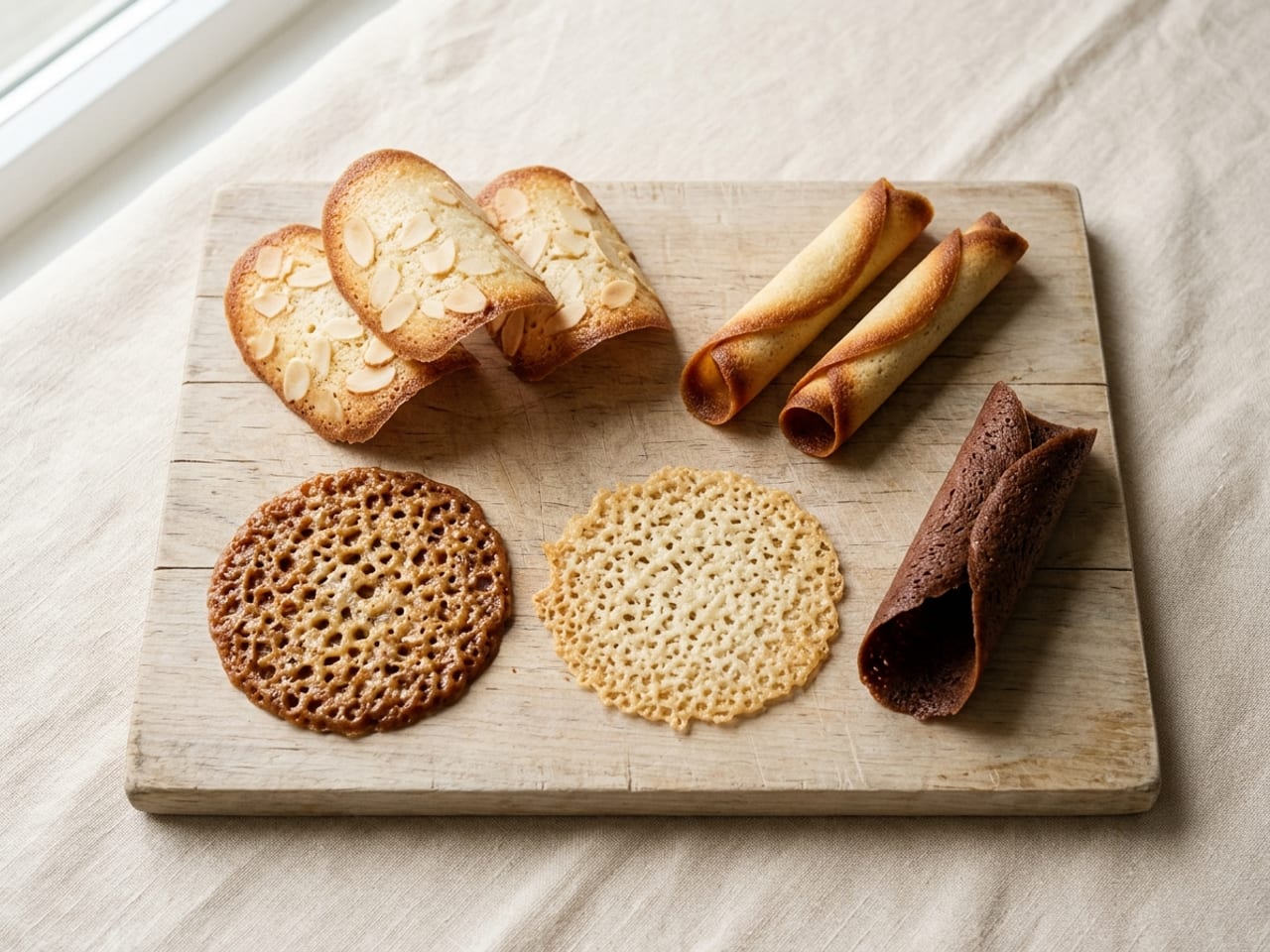
A tuile (say "tweel"; French for a roof tile) is a thin, crisp wafer baked from a soft batter of flour, sugar and egg (most often just the whites), usually with butter and often with almonds, and bent over a rolling pin while warm so it sets curved like a tile. Dictionary.com and Cambridge also give a savoury sense, and Great British Chefs says the word is now used for any crispy part of a dish, sweet or savoury, Parmesan included.12, 71, 72, 73
Tuile pronunciation. One syllable in every English dictionary we read: /twiːl/ (Cambridge, Collins), \ˈtwēl\ (Merriam-Webster). French says [tɥil] (the TLFi), the glide of huit, which English turns into a w (ours); plural tuiles, the same sound in French.71, 73, 74, 76
Not this tuile: searches for tuile also bring up the Tuileries garden in Paris, tulle (the net fabric) and roof tiles. This page is the biscuit; the roof tile is where its name comes from (the word).
| The tuile at a glance | What the sources say |
|---|---|
| The classic batter | Equal weights of flour, powdered sugar, butter and egg white, the stencil paste (On Baking, Friberg); the French almond tuile is a nut-heavy batter of its own (ratios by source) |
| Oven | 350°F (177°C) most often for the paste (7 of 18 bakes), from 160°C (320°F) to 425°F (220°C); done when the edge colours (every oven) |
| Shaped | At once, while hot: over a rolling pin, a glass, a dowel or a bottle; back in the oven to soften if it sets (shapes) |
| Families | Eight: stencil paste, French almond, lace, coral, Parmesan, savoury, cocoa, and isomalt or opaline (the cards) |
| Keeps | One day to two weeks, by source; airtight, and a desiccant helps (Friberg); not the fridge (Meilleur du Chef) (by source) |
| The word | Latin tegula, tile; earliest full recipe we found Lacam 1895; in English print by 1895 and an English recipe by 1907 (history) |
On this page: What it is · The batters · Ratio by source · Oven · How to make one · Stencils · Shapes · Coral tuile · Fixes · Keeping crisp · On the plate · The word · Terms · FAQ
How this page was made. Every formula, temperature, time and shaping move comes from the source named beside it, with its edition or date. The pastry textbooks were read as the machine-read text of uploaded copies; several books only as short search fragments; old French and English cookbooks in dated scans; each source's entry says how it was read. Plate Artists baked, shaped and measured nothing for this page: the methods are quoted, not kitchen-tested. Ratios by weight, conversions and anything marked "ours" are our own arithmetic or suggestion; where a source counts eggs, we weigh a large white at 30 g (King Arthur's chart says 30 to 35 g) and a whole egg at 50 g.11 Sources are at the bottom.
Tuile recipes by family: eight batters by weight, side by side
"The classic tuile" is not one batter. The sources print a family: a thin egg-white stencil paste, a French almond tuile heavy with nuts and often whole eggs, a lace batter that spreads by itself, a pan-fried coral, cheese on its own, oil-and-flour savoury batters, cocoa versions and a sugar sheet. Each card gives a formula as printed (the twin unit ours where the source prints one), the heat and the time, and who prints it.
Stencil paste, the classic thin tuile
tuile batter, pâte à cigarette, tulip paste, wafer batter
Formula. Flour, powdered sugar, soft butter and egg whites in equal weights: On Baking makes it with 1 lb (500 g) of each; Friberg's paste is "only four ingredients, used in equal weights", 8 oz (225 g) of each with 1 cup (240 ml) of whites. Gisslen's tuile runs a little sweeter and leaner: 105 g (3.5 oz) cake flour, 120 g (4 oz) confectioners' sugar, 90 g (3 oz) butter, 90 g (3 oz) whites.
Heat. 350°F (175°C), 5 to 10 minutes (Gisslen); 375°F (190°C), about 5 (Friberg); 400°F (204°C, ours), 4 to 5, "just until the very edge" colours (King Arthur)
The one spread through a stencil and bent warm. Gisslen: "This batter is also known as stencil paste". The earliest equal-weights formula we found is Montagné and Salles in 1902, with whole eggs instead of whites.1, 2, 4, 10, 61
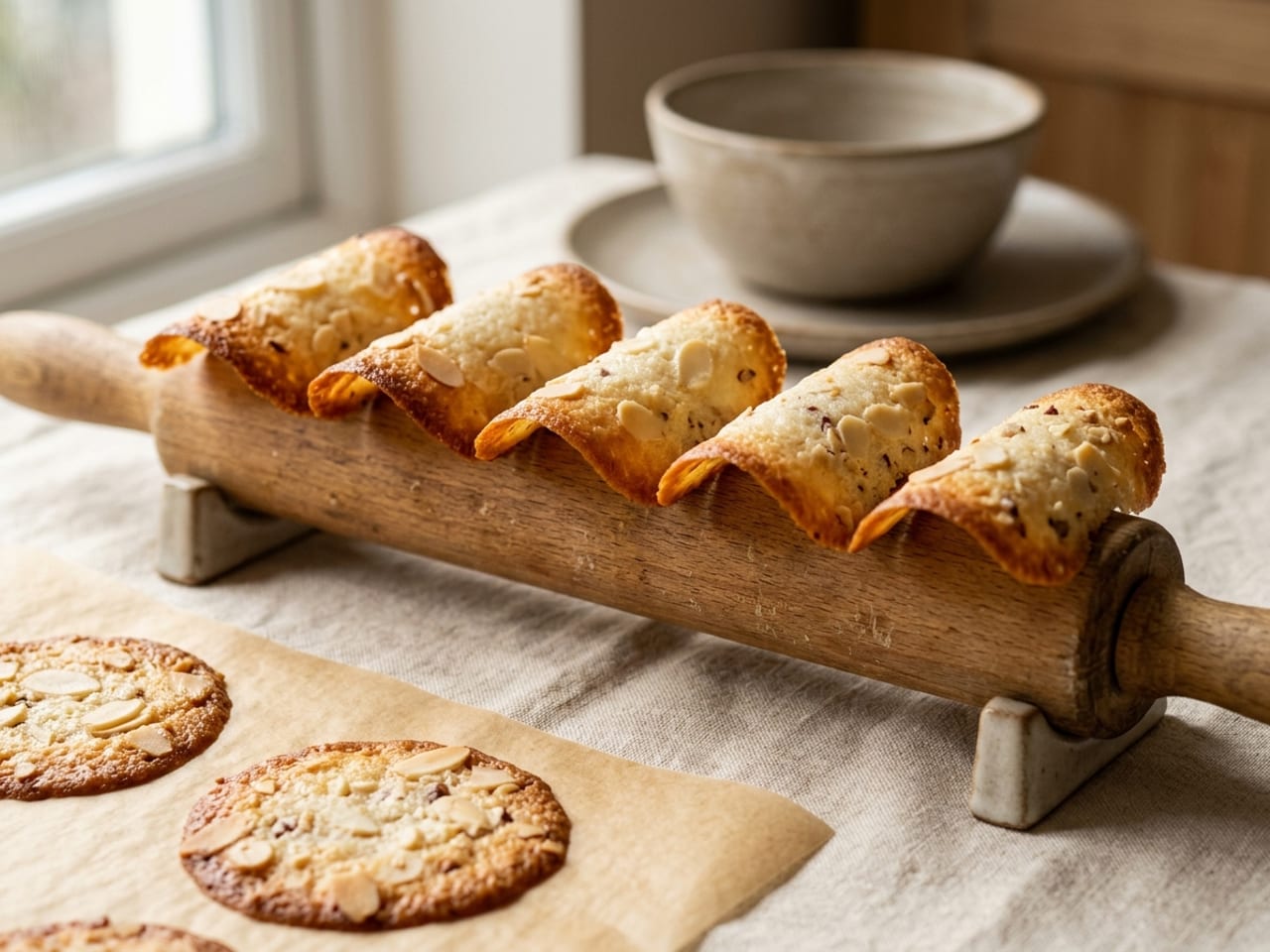
French almond tuile (tuile aux amandes)
the nut-heavy dropped batter, often with whole eggs
Formula. Bilheux: 300 g (10.5 oz) slivered almonds, 250 g (9 oz) confectioners' sugar, 100 g (3.5 oz) flour, 3 egg whites, 3 whole eggs, 75 g (2.5 oz) melted butter. Larousse gastronomique: 200 g (7.1 oz) sugar, 125 g (4.4 oz) flour, 4 or 5 eggs, 150 g (5.3 oz) melted butter, 150 g (5.3 oz) flaked almonds.
Heat. 220°C (425°F) until pale brown (Bilheux); 375°F (190°C) until browned (Gisslen's Almond Tuiles II); Larousse's figure is 275°C (527°F, ours) for about 4 minutes, far hotter than every other source we read (see the oven table)
Dropped by the spoonful and flattened with a fork dipped in cold water, not stencilled. Gisslen calls his nut tuile "a very different batter" from the stencil paste. The early almond tuiles we found, Lacam 1895 and 1911, Colombié 1897 and Kirkland 1907, have no butter in the batter.1, 5, 7, 57, 59, 62, 63
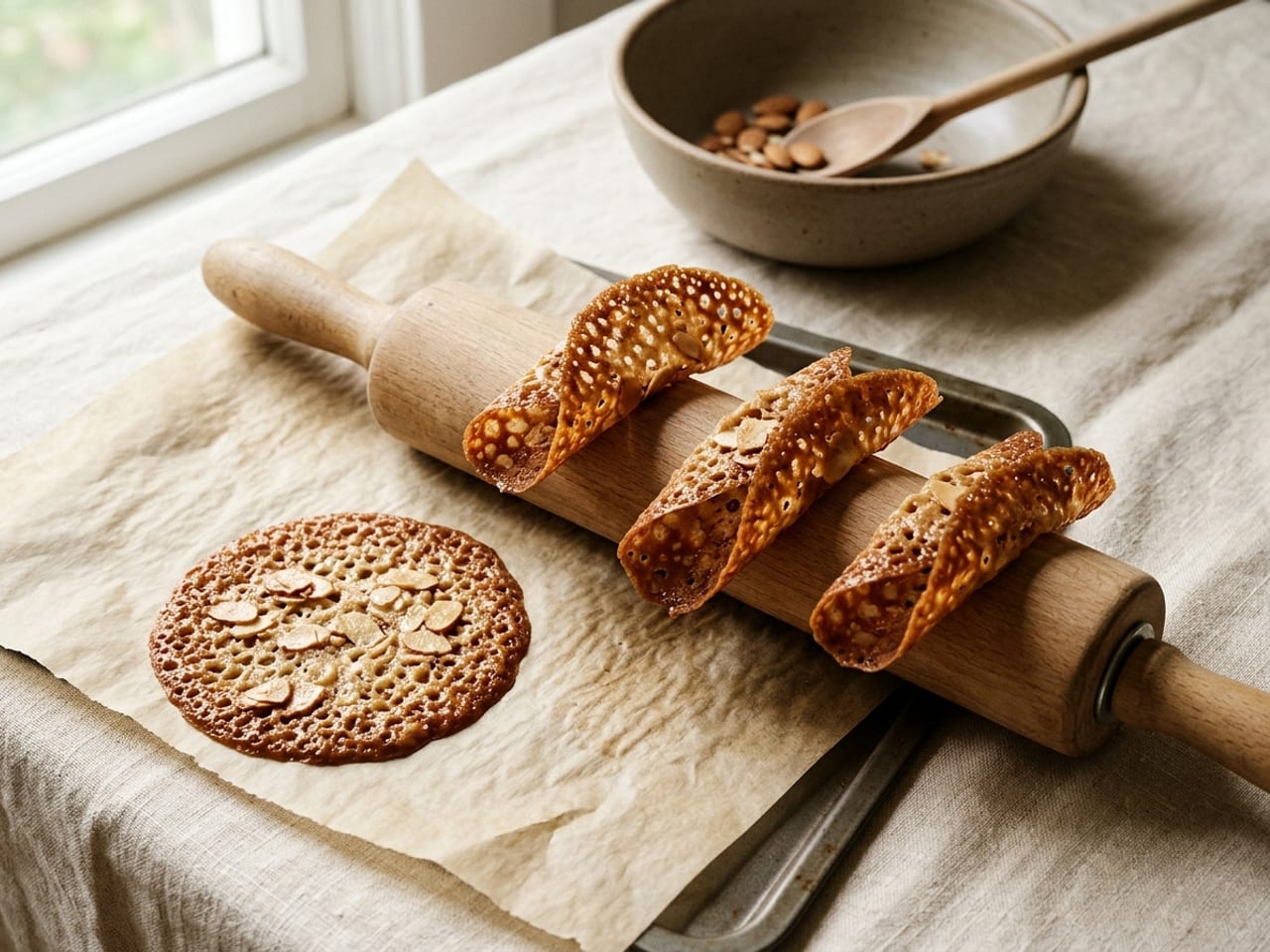
Lace or nut tuile (tuile dentelle)
butter, sugar and syrup with nuts; little or no flour, no egg
Formula. The CIA's Lace Nut Tuiles: 280 g (10 oz) nuts, 280 g (10 oz) sugar, 230 g (8 oz) soft butter, 280 g (10 oz) light corn syrup, 90 g (3 oz) flour, orange zest, rolled into 1 in (3 cm) balls and flattened. Friberg's Florentina batter boils butter, sugar, glucose and cream with almonds and has no flour at all.
Heat. 350°F (177°C), 5 minutes, "until an even light brown" (CIA); 375°F (190°C), about 8 (Friberg); 170°C (340°F), 5 minutes and then 13 to 15 more "until they are deep golden brown" (RecipeTin Eats)
It spreads on its own into a holed, lacy round, so no stencil. RecipeTin Eats' version is egg-free; America's Test Kitchen's oatmeal lace cookie is the same family without the name.2, 3, 26, 27
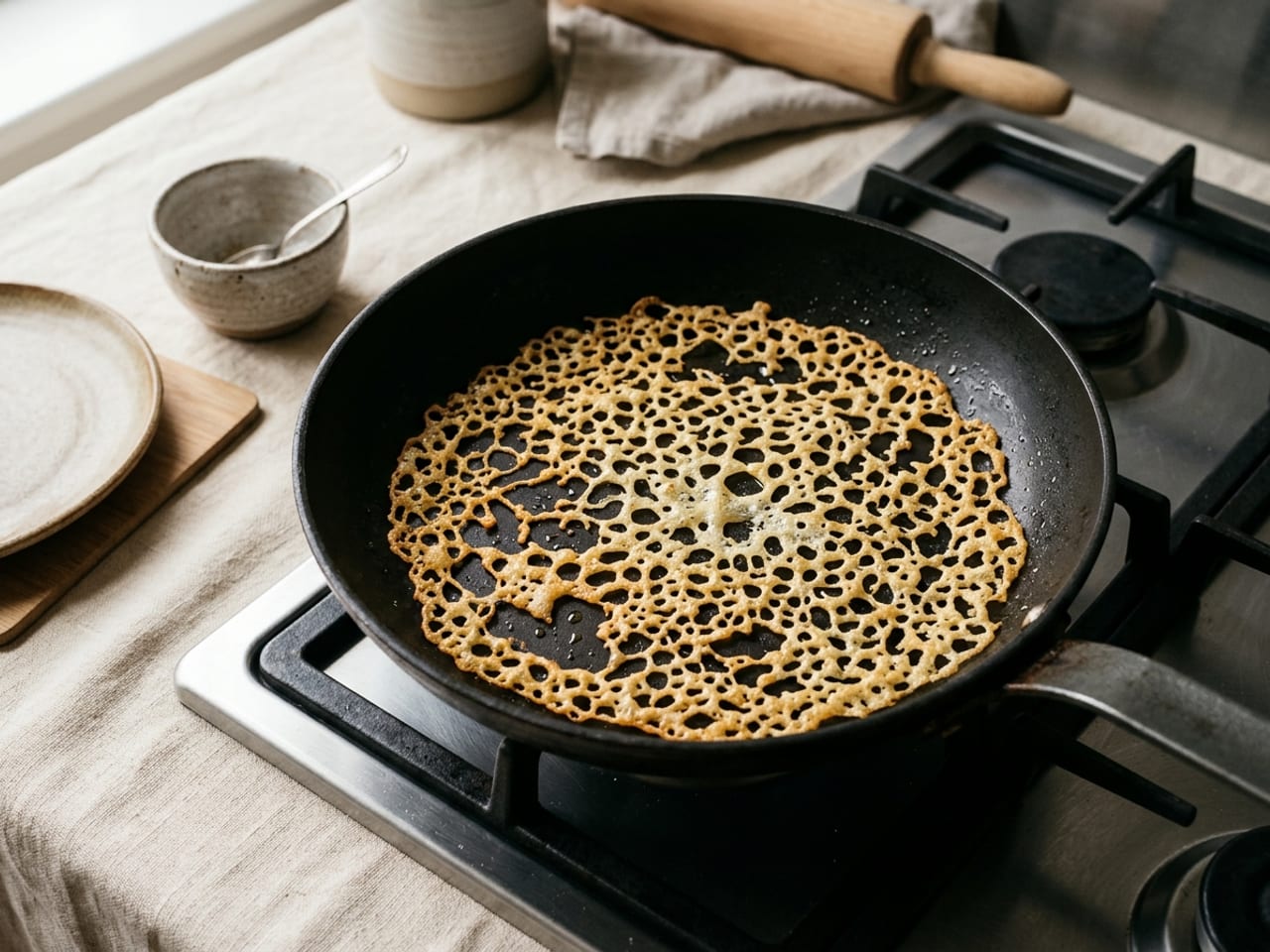
Coral tuile (tuile corail)
flour or cornstarch, water and oil, fried in a pan
Formula. RTBF's proportions (a Comines recipe on the Belgian broadcaster's site): 100 g (3.5 oz) water, 100 g (3.5 oz) oil, 30 g (1.1 oz) flour. Rosanna Stevens uses 40 g (1.4 oz) cornstarch, 100 ml (3.4 fl oz, ours) water and 100 ml oil. Six sources, six ratios (the coral section).
Heat. No oven: a hot non-stick pan, medium-high (Stevens) or medium (Moody Mixologist), until the water has boiled off
The water boils away and the oil fries the starch into a web of holes. No textbook we read prints one; every source is a chef, a cook, a school, a broadcaster or a brand.41, 42, 46
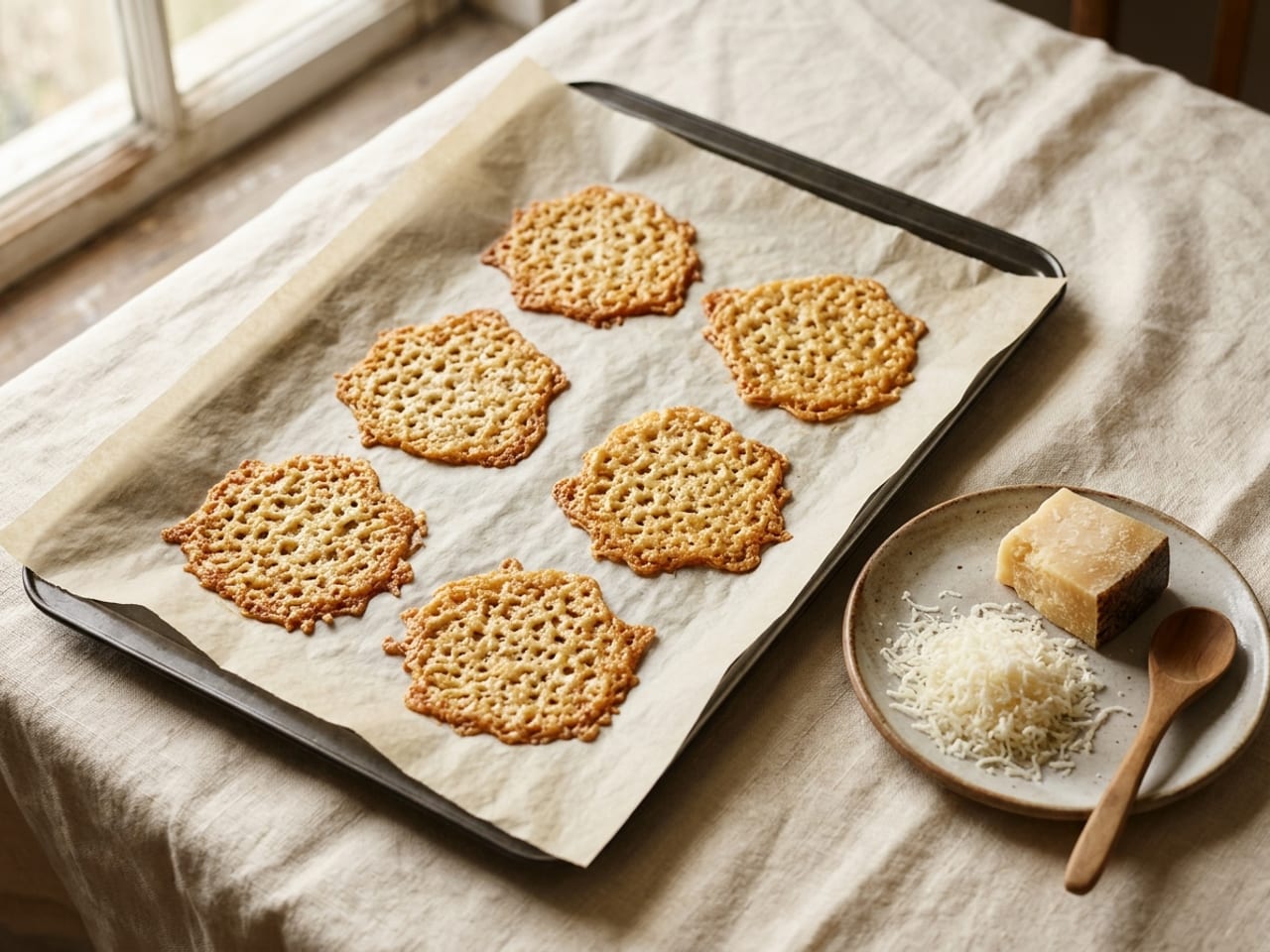
Parmesan tuile and frico
grated hard cheese and nothing else
Formula. Emeril Lagasse: 3 tablespoons of grated Parmigiano-Reggiano per 3 in (7.6 cm, ours) round on parchment. America's Test Kitchen's frico: 2 oz (57 g, ours) of aged Asiago or Montasio in a 10 in (25 cm, ours) non-stick skillet.
Heat. Oven, 350°F (177°C, ours), about 12 minutes until golden brown (Emeril); or the pan, medium-high, about 4 minutes, then flipped (America's Test Kitchen; Lidia Bastianich goes medium-low)
The cheese's own fat fries it. America's Test Kitchen: a pan that is too hot "turns the cheese bitter". In Friuli the crisp frico is one of many versions, "solo una delle numerose versioni esistenti" (ERSA). 28, 30, 31, 32
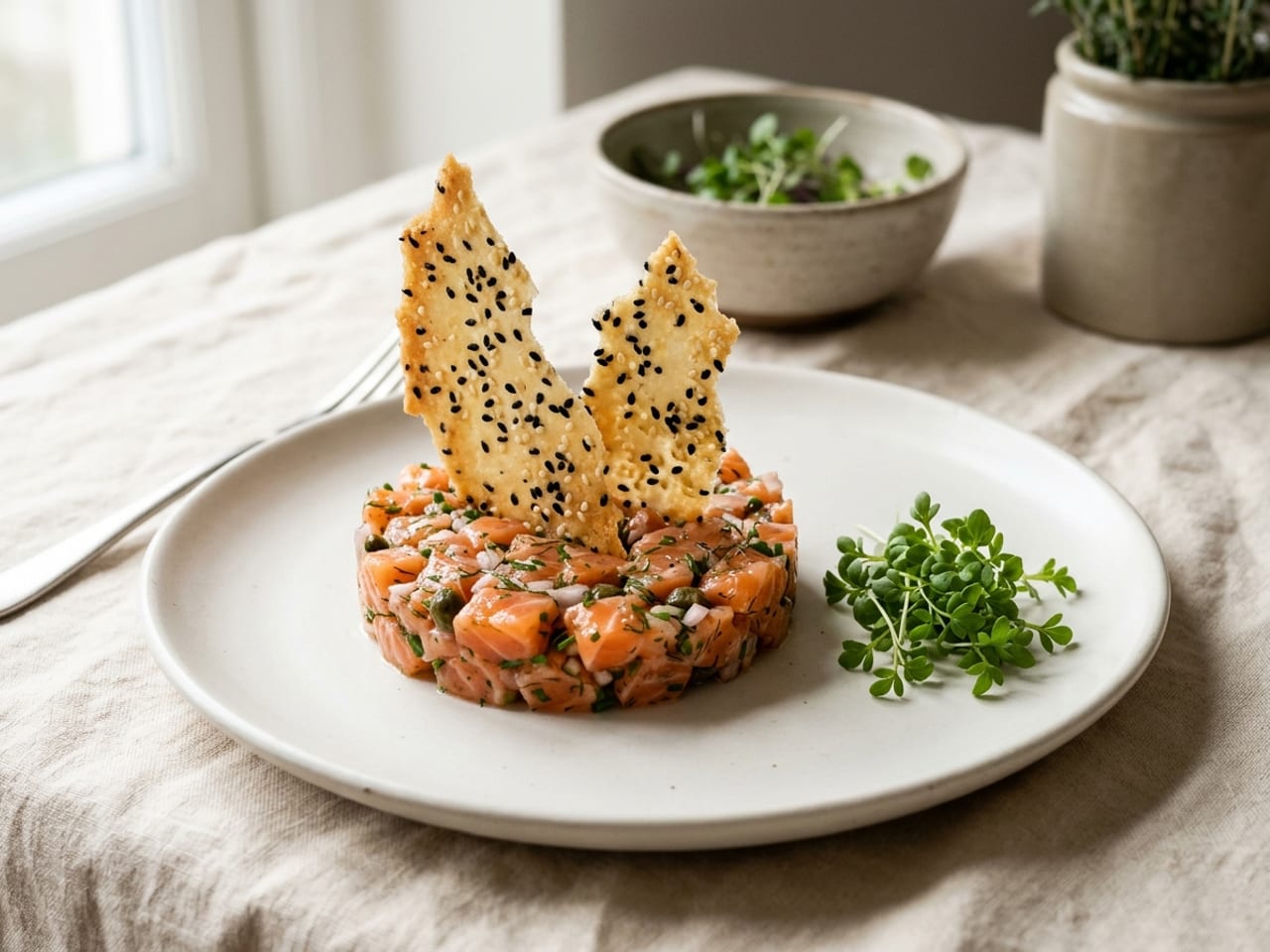
Savoury batter (sesame tuile)
oil instead of butter, no sugar
Formula. Le Cordon Bleu's tuile au sésame: 100 g (3.5 oz) flour, 50 ml (1.7 fl oz, ours) vegetable oil, 20 g (0.7 oz) sesame seeds, 1 egg white, salt and cayenne, spread about 1 mm (1/32 in, ours) thick. Emeril's black sesame tuiles are the sweet equal-weights paste with 1/4 cup of seeds, served with tartare.
Heat. 180°C (356°F, ours), about 5 minutes (Le Cordon Bleu); 350°F (177°C, ours), about 10 (Emeril)
Gisslen's and Shaun Rankin's sesame tuiles are sweet; "sesame" alone does not make a tuile savoury. Le Cordon Bleu breaks its baked sheet into abstract shards.1, 29, 33, 34
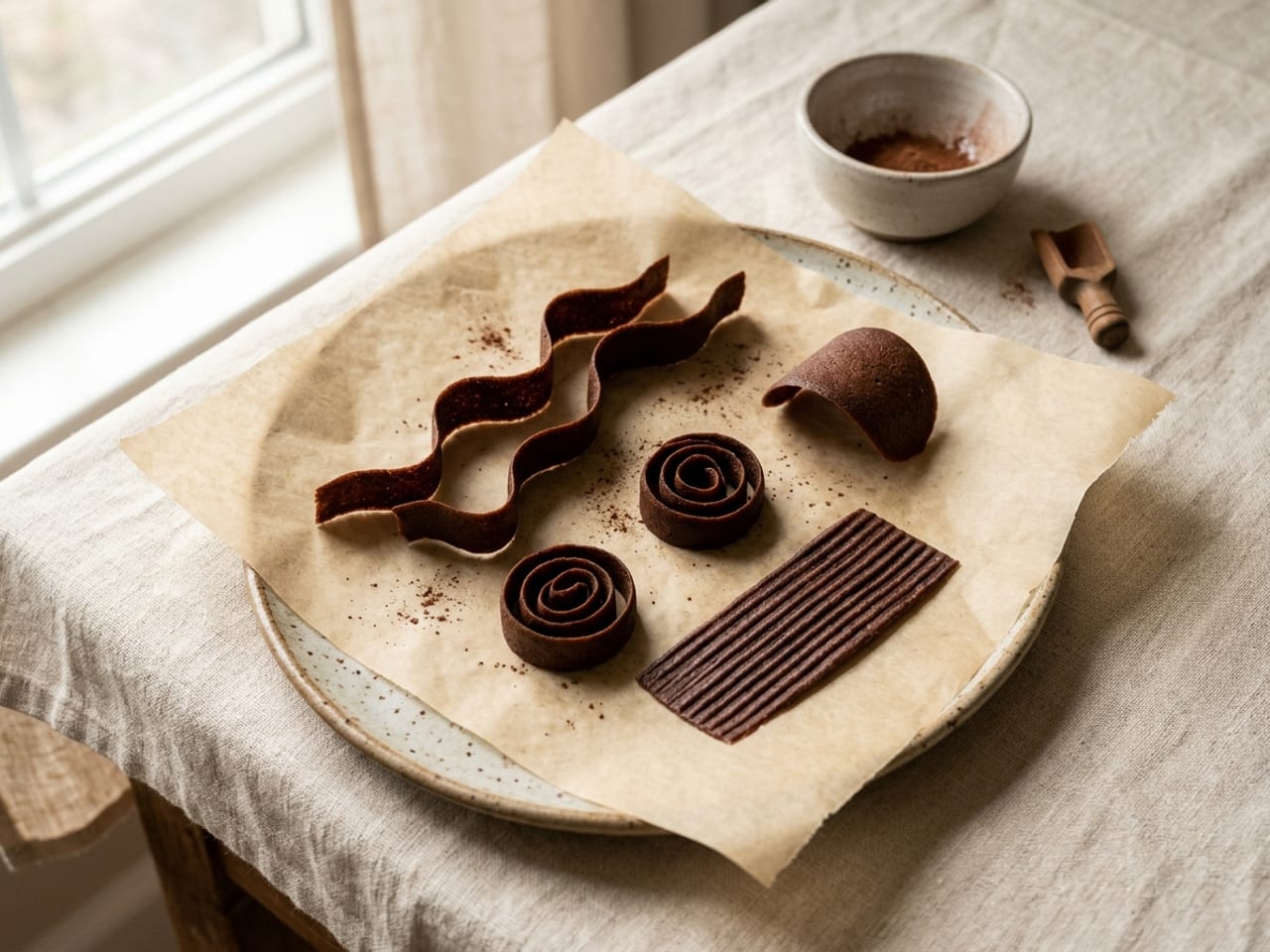
Cocoa (chocolate) tuile
the stencil paste with cocoa for part of the flour
Formula. The CIA: 70 g (2.5 oz) cake flour, 40 g (1.4 oz) Dutch-process cocoa, 60 g (2.1 oz) butter, 130 g (4.6 oz) confectioners' sugar, 100 g (3.5 oz) egg whites. Friberg swaps his 225 g (8 oz) cake flour for 170 g (6 oz) bread flour and 70 g (2 1/2 oz) cocoa.
Heat. 325°F (163°C), 8 to 10 minutes, "until golden brown but still soft" (CIA); the open textbook 170°C or 350°F, 10 to 15
Cocoa is 18% (Friberg's cookie variation) to 36% (the CIA) of the dry ingredients (our arithmetic). Friberg also prints a separate, egg-free chocolate paste (flour, powdered sugar, cocoa, water and butter) that "will not stay in its precise original shape as tuile paste does"; his chocolate tuile decorating paste is the one above. Chocolate work that is not a batter is in our chocolate garnishes guide.2, 3, 6
Isomalt tuile, sugar tuile or opaline
a melted sugar sheet, not a batter
Formula. Stuart Ralston: 100 g (3.5 oz) isomalt and 100 g glucose cooked to 160°C (320°F, ours), cooled, ground to a powder and sieved thin onto a mat. Eddy Van Damme's opaline, "also known as a transparent tuile": 180 g (6.3 oz) fondant and 100 g (3.5 oz) glucose.
Heat. The powder melts at 160°C (320°F, ours) for Ralston, at 350°F (175°C) for Van Damme. Sosa, which sells isomalt, says it is "stable at high temperatures without browning (150°C)": the maker's claim, 302°F ours; a retailer's sheet says reheating it often or above 150°C makes it "significantly more fragile"
Great British Chefs says tuiles are "Often now made with isomalt ... to ensure a good snap"; the maker BENEO says isomalt "absorbs virtually no moisture". We found no BENEO temperature sheet.12, 36, 37, 38, 39, 40
The classic tuile batter ratio, source by source
The flour-sugar-butter-egg batters we read, reduced to one ratio by weight with the flour as 1 (our arithmetic from each printed weight): 20 stencil pastes and seven French almond tuiles (cigarette and pirouette batters counted with the paste: our classification). The first 9 are the ones most readers meet; the other 18 open under "Show all".
| Source | As printed | Flour : sugar : butter : egg (ours) | Eggs, and notes |
|---|---|---|---|
| On Baking (Labensky, Martel, Van Damme)4 2nd ed., 2009, p. 356 | 500 g (1 lb) each of butter, powdered sugar, flour, egg whites | 1 : 1 : 1 : 1 | Whites |
| Friberg, Vanilla Tuile Decorating Paste2 4th ed., 2002, p. 482 | 225 g (8 oz) each of butter, cake flour, powdered sugar; 1 cup (240 ml) whites | 1 : 1 : 1 : 1.07 | Whites; 240 ml of whites taken as 240 g (ours) |
| Gisslen, Almond Tuiles1 6th ed., 2012, p. 510 (7th ed. unchanged) | 105 g cake flour, 120 g confectioners' sugar, 90 g butter, 90 g whites | 1 : 1.14 : 0.86 : 0.86 | Whites; sliced almonds only on top |
| King Arthur (Robbins)10 2011 | 104 g flour, 113 g confectioners' sugar, 113 g butter, 4 large whites | 1 : 1.09 : 1.09 : 1.15 | Whites; melted butter, whisked |
| Open textbook (BCcampus), Basic Tuiles6 2015 | 180 g flour, 240 g sugar, 90 g butter, 120 g whites | 1 : 1.33 : 0.5 : 0.67 | Whites; the leanest and sweetest textbook paste |
| Great British Chefs12 2016 | 100 g flour, 100 g sugar, 3 whites; 50 g butter optional | 1 : 1 : 0 : 0.9 | Whites; the only batter here with no butter |
| Montagné and Salles, Tuiles (Formule 1565)61 1902 | 250 g butter, 250 g icing sugar, 5 eggs, 250 g flour | 1 : 1 : 1 : 1 | Whole eggs; the earliest equal-weights formula we found |
| Bilheux and Escoffier, Les tuiles5 1998 · almond tuile | 100 g flour, 250 g confectioners' sugar, 75 g butter, 3 whites and 3 eggs, 300 g almonds | 1 : 2.5 : 0.75 : 2.4 | Whites and whole eggs; plus almonds, 3 times the flour |
| Larousse gastronomique, tuiles7 1997 · almond tuile | 125 g flour, 200 g sugar, 150 g butter, 4 or 5 eggs, 150 g almonds | 1 : 1.6 : 1.2 : 1.6 | Whole eggs; 4 eggs counted; with 5 the eggs are 2 times the flour |
Show all 27 formulas (18 more)
| Source | As printed | Flour : sugar : butter : egg (ours) | Eggs, and notes |
|---|---|---|---|
| Gisslen, Sesame Tuiles1 6th ed., 2012, p. 511 | 210 g cake flour, 210 g confectioners' sugar, 150 g butter, 150 g whites | 1 : 1 : 0.71 : 0.71 | Whites; sweet, chilled before use |
| Gisslen, ribbon-sponge stencil paste1 6th ed., 2012, p. 410 | 220 g cake flour, 200 g each of sugar, butter, whites | 1 : 0.91 : 0.91 : 0.91 | Whites; "another version of the batter used for Tuile cookies" |
| Friberg, Tuiles (the cookie)2 4th ed., 2002, p. 314 | 170 g flour, 170 g powdered sugar, 115 g butter, 6 whites (180 ml) | 1 : 1 : 0.68 : 1.06 | Whites; mixed, not creamed |
| CIA, Chocolate Tuiles3 3rd ed., 2015, p. 381 | 70 g cake flour and 40 g cocoa, 130 g confectioners' sugar, 60 g butter, 100 g whites | 1 : 1.18 : 0.55 : 0.91 | Whites; flour and cocoa counted together |
| CIA, Honey Tuiles3 3rd ed., 2015, p. 383 | 370 g flour, 280 g confectioners' sugar, 300 g butter, 140 g whites, 170 g honey | 1 : 0.76 : 0.81 : 0.38 | Whites; honey in place of part of the white, chilled until firm |
| Emeril Lagasse, Black Sesame Seed Tuiles29 web, undated | 4 oz flour, 4 oz powdered sugar, 1/4 lb butter, 1/2 cup whites | 1 : 1 : 1 : 1.06 | Whites; 1/2 cup of whites taken as 120 g (ours) |
| Pastry Chef Online (Field)13 2012 | 3.5 oz cake flour, 4 oz powdered sugar, 3 oz butter, 3 oz whites | 1 : 1.14 : 0.86 : 0.86 | Whites; the same weights as Gisslen's |
| Anson Mills14 web, undated | 1.5 oz pastry flour, 2.5 oz confectioners' sugar, 1.3 oz clarified butter, 2 oz whites | 1 : 1.67 : 0.87 : 1.33 | Whites; clarified butter |
| Saveur, Fork-Shaped Tuiles15 web, undated | 4 tbsp flour, 5 tbsp confectioners' sugar, 2 tbsp butter, 1 white | 1 : 1.17 : 0.93 : 1 | Whites; spoons weighed with King Arthur's chart (ours) |
| Mary Berry, Great British Bake Off17 2013 | 200 g plain flour, 180 g icing sugar, 200 g butter, 6 large whites | 1 : 0.9 : 1 : 0.9 | Whites; rested 30 minutes at room temperature |
| Bittman18 2016 | 1 cup flour, 1 cup confectioners' sugar, 1 stick butter, 4 whites | 1 : 0.94 : 0.94 : 1 | Whites; cups weighed with King Arthur's chart (ours) |
| Bonne Maman (brand recipe)20 web, undated | 25 g plain flour, 50 g caster sugar, 25 g butter, 1 large white | 1 : 2 : 1 : 1.2 | Whites; white whisked stiff |
| Lacam, Cigarettes Russes63 1911, p. 578 | 175 g flour, 400 g caster sugar, 200 g butter, 8 whites whipped | 1 : 2.29 : 1.14 : 1.37 | Whites; "cette pâte s'étale beaucoup" |
| Gisslen, Almond Tuiles II1 6th ed., 2012, p. 511 · almond tuile | 45 g bread flour, 240 g sugar, 45 g butter, 135 g whites, 270 g almonds | 1 : 5.33 : 1 : 3 | Whites; "a very different batter" |
| Lacam, Cuirasses ou tuiles57 1895, p. 300 · almond tuile | 300 g flour, 315 g icing sugar, 375 g almond paste, 7 or 8 whites | 1 : 1.05 : 0 : 0.7 | Whites; no butter; almond paste 1.25 times the flour |
| Colombié, Tuiles aux amandes59 1897, pp. 320 to 323 · almond tuile | 10 g flour, 75 g sugar, 75 g almonds, 1 1/2 whites | 1 : 7.5 : 0 : 4.5 | Whites; no butter; almonds 7.5 times the flour |
| Kirkland, The Modern Baker, tuiles62 1907, p. 426 · almond tuile | 4 oz flour, 9 oz castor sugar, 10 oz almonds, 1 egg and 3 whites | 1 : 2.25 : 0 : 1.23 | Whites and whole eggs; no butter; almonds 2.5 times the flour |
| Lacam, Tuiles amandes63 1911, p. 650 · almond tuile | 150 g flour, 500 g sugar, 300 g almonds, 4 eggs and 10 whites | 1 : 3.33 : 0 : 3.33 | Whites and whole eggs; no butter |
Where they split. Seven of the 20 stencil pastes are equal weights within 10% (our arithmetic): On Baking, Friberg, Gisslen's ribbon-sponge paste, Emeril, Mary Berry, Bittman and, with whole eggs, Montagné and Salles in 1902. King Arthur is close on sugar and butter (9% over the flour) and 15 to 35% over on egg white (ours, at 30 to 35 g a white). Gisslen's own tuile and Pastry Chef Online print the same weights, a little sweeter and leaner (1 : 1.14 : 0.86 : 0.86). The open textbook is the lean, sweet outlier, and Great British Chefs leaves the butter out (50 g as an option).1, 2, 4, 6, 10, 12, 13, 17, 18, 29, 61 The French almond tuiles are another batter altogether: Bilheux, Larousse, Gisslen's Almond Tuiles II, Colombié and Kirkland carry 1.2 to 7.5 times the flour in almonds, and Lacam's, Colombié's and Kirkland's have no butter.1, 5, 7, 57, 59, 62, 63
What the levers do, in the sources' words. Butter: adding extra "makes the decorations a bit thinner and more elegant-looking" (Friberg), and he spaces piped lines because the paste "will flow out slightly during baking". Flour: its gluten makes shapes "shrink just a little during baking, but they will do so evenly all around", and a weaker flour leaves the pieces "too fragile". Too soft a paste gives "ragged" edges.2 Gisslen's cookie rules: more sugar and liquid spread a cookie, more flour holds it.1
Oven temperature and time, by source
38 oven settings from the sources we read, hottest first; a twin the source does not print is ours. For the stencil paste the most common setting is 350°F (177°C): 7 of the 18 paste bakes, the rest two at 325°F, three at 375°F, three at 400°F, three at 425°F (our tally, each figure rounded to the nearest 25°F; cigarette and pirouette batters counted with the paste: our classification). In our table, thinner spreads go with hotter, shorter bakes (our reading): King Arthur's "nearly transparent" round takes 4 to 5 minutes at 400°F, Great British Chefs' 2 mm one 8 to 10 at 160°C.10, 12 Every source calls it done by colour, from "just until the very edge" colours (King Arthur) to "deep golden brown, not just a light golden" (RecipeTin Eats, lace).26
| Source | Oven | Time or cue | Batter |
|---|---|---|---|
| Larousse gastronomique (1997)7 | 275°C (527°F, ours) | "4 min environ" | almond |
| Bilheux, tuiles (1998)5 | 425°F (220°C) | until pale brown | almond |
| King Arthur (2011)10 | 400°F (204°C, ours) | 4 to 5 min | stencil paste |
| Friberg, tuiles (2002)2 | 375°F (190°C) | about 5 min | stencil paste |
| Gisslen, almond tuiles (2012)1 | 350°F (175°C) | 5 to 10 min | stencil paste |
| Open textbook (2015)6 | 350°F (170°C); the book's own pair; 350°F is 177°C | 10 to 15 min | stencil paste |
| CIA, lace nut tuiles (2015)3 | 350°F (177°C) | 5 min | lace |
| CIA, chocolate tuiles (2015)3 | 325°F (163°C) | 8 to 10 min | cocoa |
| Great British Chefs (2016)12 | 160°C (320°F, ours); gas 3 | 8 to 10 min | stencil paste |
| CIA, blueberry tuile (2015)3 | 265°F (129°C); convection | about 20 min | fruit |
Show all 38 ovens (28 more)
| Source | Oven | Time or cue | Batter |
|---|---|---|---|
| Friberg, miniature tulips (2002)2 | 425°F (219°C) | about 5 min | stencil paste |
| Bilheux, cigarettes (1998)5 | 425°F (220°C) | golden, darker rim | stencil paste |
| Bonne Maman (brand recipe)20 | 220°C (428°F, ours); 200°C fan | 5 min | stencil paste |
| Friberg, pirouettes (2002)2 | 400°F (205°C) | about 5 min | stencil paste |
| Saveur15 | 400°F (204°C, ours) | 4 1/2 to 5 min | stencil paste |
| Gilles Choukroun (Le Fooding)22 | 190°C (374°F, ours) | about 10 min | lace |
| Gisslen, sesame tuiles (2012)1 | 375°F (190°C) | until golden | stencil paste |
| Gisslen, almond tuiles II (2012)1 | 375°F (190°C) | until browned | almond |
| Friberg, Florentina (2002)2 | 375°F (190°C) | about 8 min | lace |
| Bittman (2016)18 | 375°F (191°C, ours) | 8 to 10 min | stencil paste |
| Kirkland, tuiles (1907)62 | 370°F (188°C, ours) | to a golden colour | almond |
| Mary Berry, GBBO (2013)17 | 180°C (356°F, ours); 160°C fan | 5 to 6 min | stencil paste |
| Le Cordon Bleu, sesame (2025)33 | 180°C (356°F, ours) | about 5 min | savoury |
| Shaun Rankin, sesame (2015)34 | 180°C (356°F, ours); gas 4 | 12 min | lace |
| Emeril, black sesame29 | 350°F (177°C, ours) | about 10 min | stencil paste |
| Pastry Chef Online (2012)13 | 350°F (177°C, ours) | until lightly golden | stencil paste |
| Anson Mills14 | 350°F (177°C, ours) | 5 to 6 min | stencil paste |
| gfJules (gluten-free)24 | 350°F (177°C, ours) | about 15 min | stencil paste |
| America's Test Kitchen, lace cookies (2013)27 | 350°F (177°C, ours) | 6 to 8 min | lace |
| Emeril, Parmesan tuiles28 | 350°F (177°C, ours) | about 12 min | cheese |
| Eddy Van Damme, opaline (2011)37 | 350°F (175°C) | until melted | sugar |
| RecipeTin Eats, lace (2026)26 | 340°F (170°C); 150°C fan | 5 + 13 to 15 min | lace |
| CIA, honey tuiles (2015)3 | 325°F (163°C) | about 10 min | stencil paste |
| CIA, nougatine tuiles (2015)3 | 325°F (163°C) | about 15 min | sugar |
| CIA, apple cider tuiles (2015)3 | 320°F (160°C); convection | until golden | fruit |
| Great British Chefs, cacao tuile35 | 160°C (320°F, ours) | 12 min | sugar |
| Stuart Ralston, isomalt (2023)36 | 160°C (320°F, ours) | until melted | sugar |
| CIA, banana tuiles (2015)3 | 275°F (135°C) | 8 to 9 min | fruit |
Larousse's figure. Larousse gastronomique (1997) bakes its almond tuiles "4 min environ au four préchauffé à 275 °C", 527°F by our conversion. That is far hotter than every other source we read, the French almond tuiles included (Bilheux, 220°C), and we cannot tell from the scan whether it is a misprint: it is Larousse's figure, not our advice.5, 7 The old French books say only "four chaud" (a hot oven), Colombié "un four doux" (a gentle one) for the same almond tuile.57, 59, 63 Fruit tuiles dry cooler, 129 to 160°C (265 to 320°F); sugar tuiles melt at 160 to 175°C (320 to 350°F).3, 36, 37
Resting the batter: the split
Five of the 19 sources below give no rest at all, among them Gisslen, the CIA's chocolate tuiles and the open textbook. King Arthur's "no longer" than 2 hours is the only time limit we read, and it comes with no reason; Lacam in 1911 rested his almond tuile batter 48 hours or more, and École Lenôtre makes it the day before. Chilling or a short rest shows up where a batter is too loose to hold (honey, lace, seeds) and in a few home recipes for the plain paste (Mary Berry 30 minutes at room temperature, Bittman 15 minutes if it will not spread), and On Baking says the opposite of resting: mix "small batches to be used as needed". That a rest hydrates the flour is a chef's explanation (RecipeTin Eats), not a measurement.4, 9, 10, 17, 18, 26, 63
| Source | Rest, as printed | Why, as printed |
|---|---|---|
| King Arthur (2011)10 | "refrigerate for 1 to 2 hours, but no longer" | No reason given; thin it with milk if thick |
| Gisslen, almond tuiles (2012)1 | No rest given | - |
| Gisslen, sesame tuiles (2012)1 | "Chill." | Not stated |
| On Baking (2009)4 | "mixed in small batches to be used as needed" | The batters "are fragile" |
| Open textbook (2015)6 | No rest given | - |
| CIA, chocolate tuiles (2015)3 | No rest given | - |
| CIA, honey tuiles (2015)3 | refrigerate "until firm enough to spread without running" | So it spreads without running |
| Friberg, decorating paste (2002)2 | keeps "for several weeks" chilled; let it soften before use, chill briefly if too soft | Too soft gives ragged edges |
| Friberg, pirouettes (2002)2 | "rest for about 30 minutes" | Not stated |
| Mary Berry (2013)17 | "leave to rest at room temperature for 30 minutes" | Not stated |
| Bittman (2016)18 | "let it rest for 15 minutes or so", only if "not quite spreadable" | To make it spreadable |
| Great British Chefs (2016)12 | No rest given | - |
| Saveur15 | No rest given | - |
| Anson Mills14 | Can be chilled and rested, but back to room temperature before stencilling | "This paste performs best if it is not too cool" |
| École Lenôtre (undated)9 | "better when prepared the day before" | Not stated in the fragments |
| RecipeTin Eats, lace (2026)26 | "Refrigerate for 2 hours" | To make it "scoop-able"; she adds that resting hydrates the flour (her explanation, not a measurement) |
| Shaun Rankin, sesame (2015)34 | "Leave to rest for about 1 hour" | Not stated |
| Gilles Choukroun (Le Fooding)22 | "1 heure au réfrigérateur" (1 hour in the fridge) | Not stated |
| Lacam (1911)63 | "laisser reposer 48 heures et plus si l'on veut" (48 hours, longer if you like) | Not stated |
How to make tuiles with a stencil (the classic tuile recipe)
The stencil paste, the way Gisslen, Friberg, the CIA, On Baking and King Arthur print it. Quoted, not kitchen-tested by us; the numbers are theirs unless marked ours.
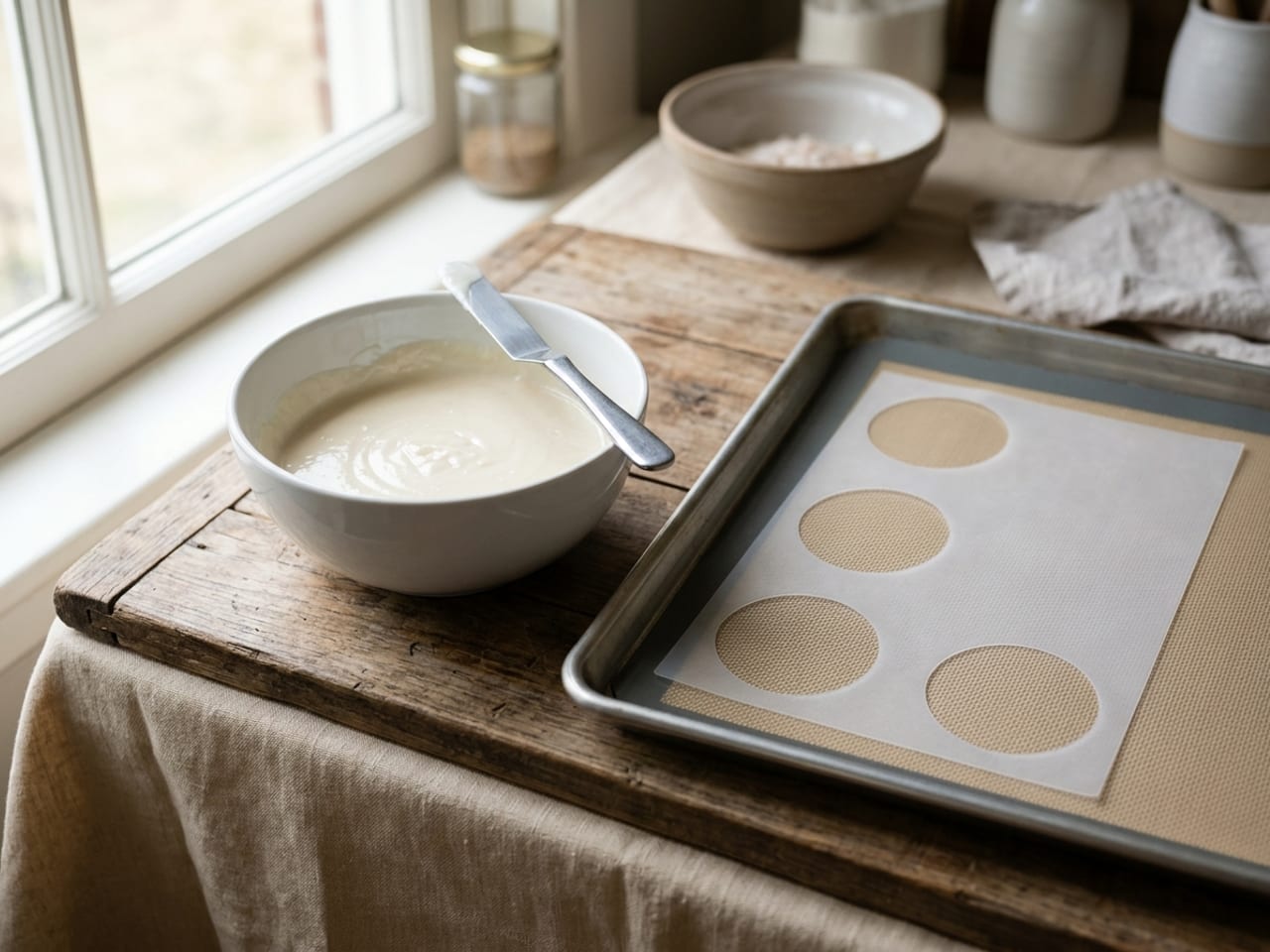 1
Mix equal weights of flour, powdered sugar, soft butter and egg white
On Baking weighs 500 g (1 lb) of each; Friberg's paste is "only four ingredients, used in equal weights". 2, 4 Gisslen and Friberg cream the soft butter and sugar for the paste; King Arthur whisks in melted butter instead. Friberg: "Take care not to overmix the batter once the flour has been incorporated".1, 2, 10 For a small batch, 50 g (1.8 oz) of each is about one and a half large egg whites (ours, at 30 to 35 g a white).
- 2
Rest it, or not (optional)
No textbook we read requires a rest for the plain paste: Gisslen, the CIA's chocolate tuiles and the open textbook spread it at once. King Arthur chills it "1 to 2 hours, but no longer" and gives no reason; Anson Mills says a chilled paste must come back to room temperature, because it "performs best if it is not too cool"; Friberg chills it briefly only if it is so soft the edges go ragged.1, 2, 3, 6, 10, 14 Every source's rest is in the rest table.
- 3
Line a tray with a silicone mat and lay the stencil on it
Gisslen: "Line a sheet pan with a silicone mat. If a mat is not available, use a sheet of parchment paper."1 Anson Mills calls the mat "essential", because on parchment the wafers "cool too quickly to shape"; King Arthur bakes on parchment.10, 14 With neither, the CIA greases and flours an upturned tray and freezes it, so the coating stays put under the stencil.3 Making a stencil is below.
 4
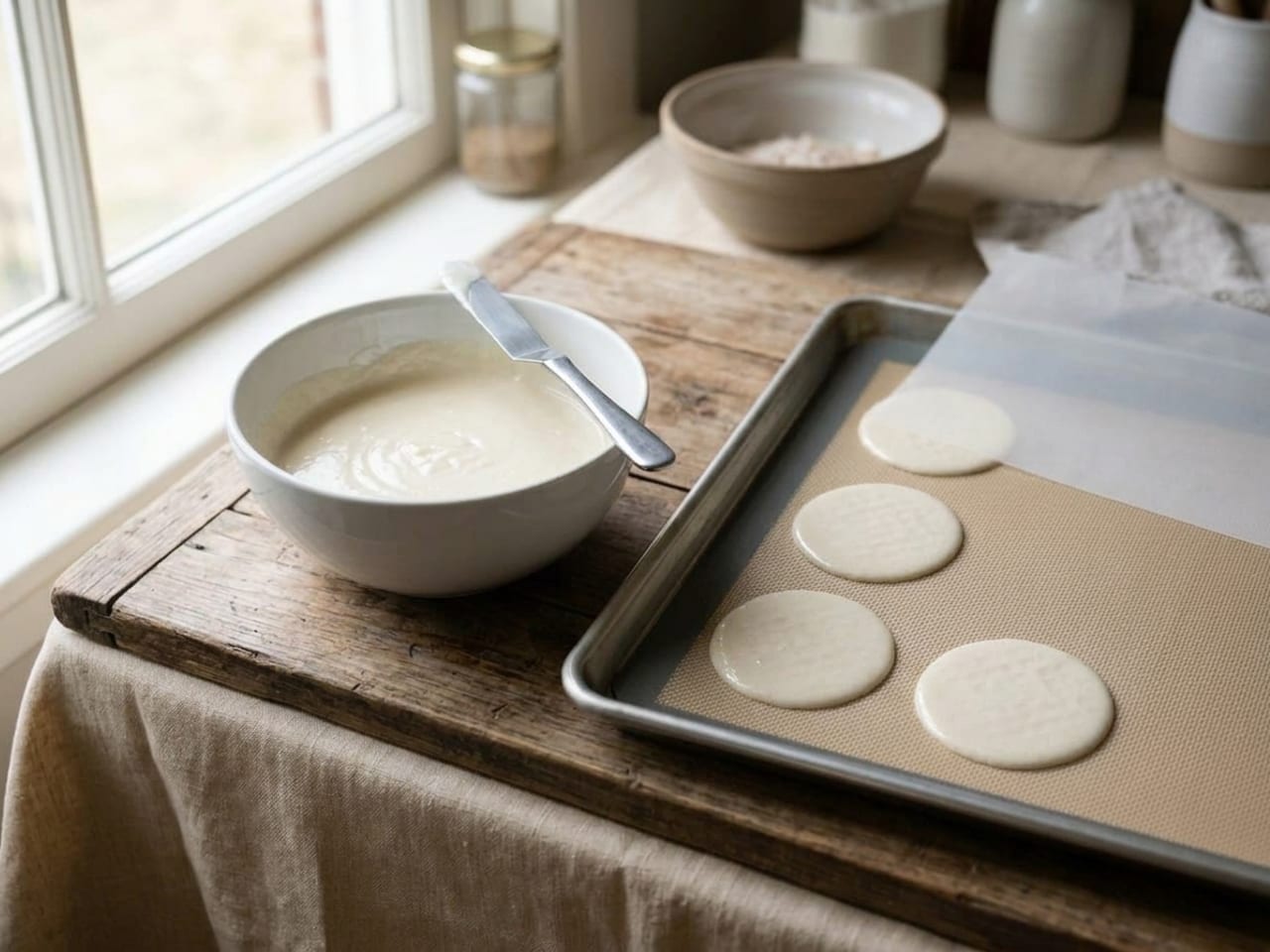
Spread a thin, even layer through the stencil and lift it off
Spread the batter "across the stencil to make a thin layer that completely fills in the cutouts" (Gisslen), "the same thickness as the stencil" (On Baking), then sweep the spatula up at the edge to clear the excess (Anson Mills).1, 4, 14 Friberg holds down the far end of the stencil with the spatula as he lifts it, "to avoid disturbing the paste".2 King Arthur, without a stencil, spreads 2 tsp to a 4 to 5 in (10 to 13 cm, ours) circle, "nearly transparent".10
 5
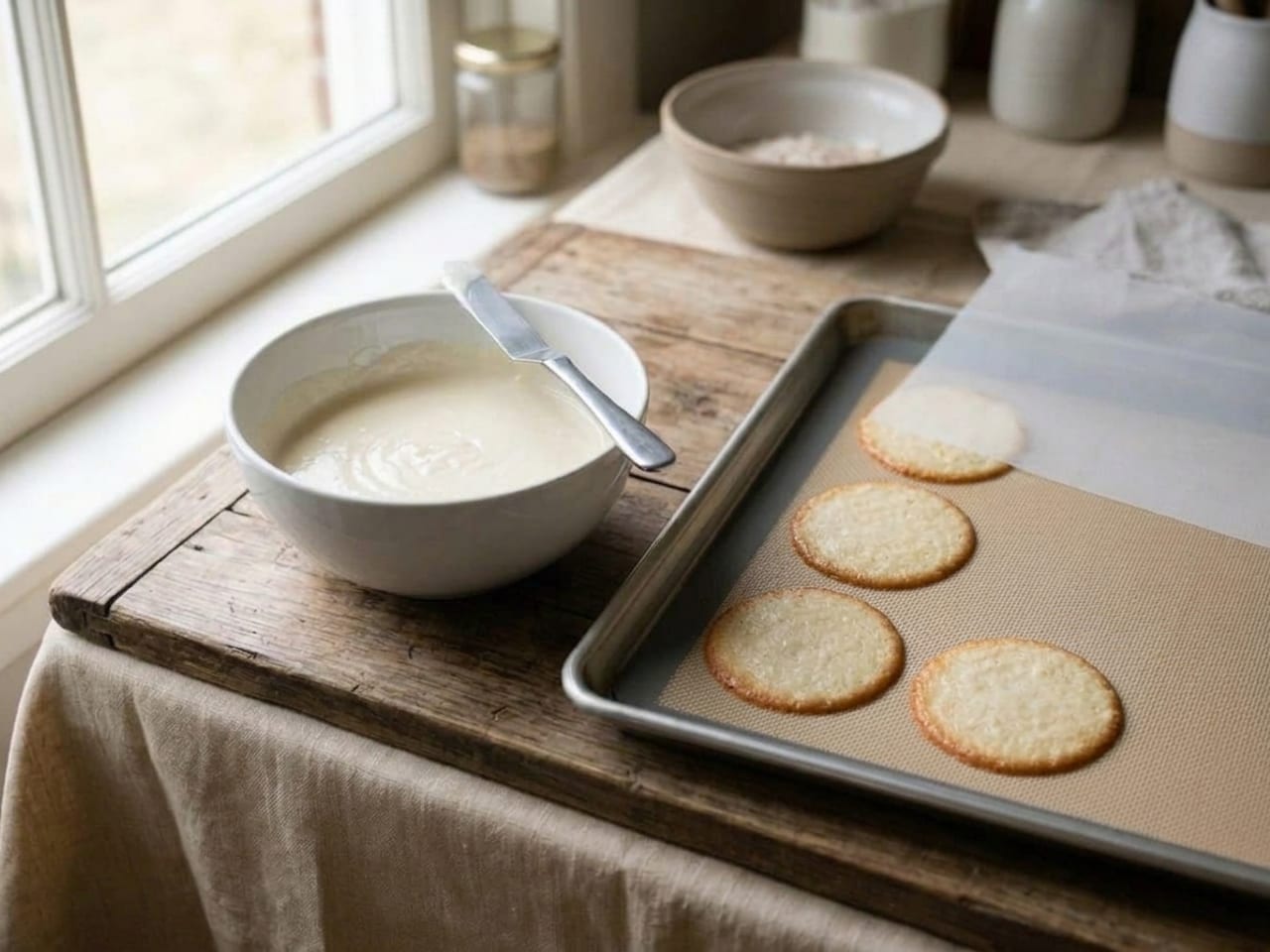
Bake a few at a time until the edge colours
Gisslen: 350°F (175°C), 5 to 10 minutes "depending on thickness, or until lightly browned"; King Arthur: 400°F (204°C, ours), 4 to 5 minutes, "just until the very edge of the circle begins to color", two at a time.1, 10 The colour matters both ways (Friberg): "if they are not brown enough, they will not become crisp after they cool", and too brown "they will break as you try to form them".2 The CIA: they "bake quickly and should be watched almost constantly".3 Every oven figure is in the oven table.
 6
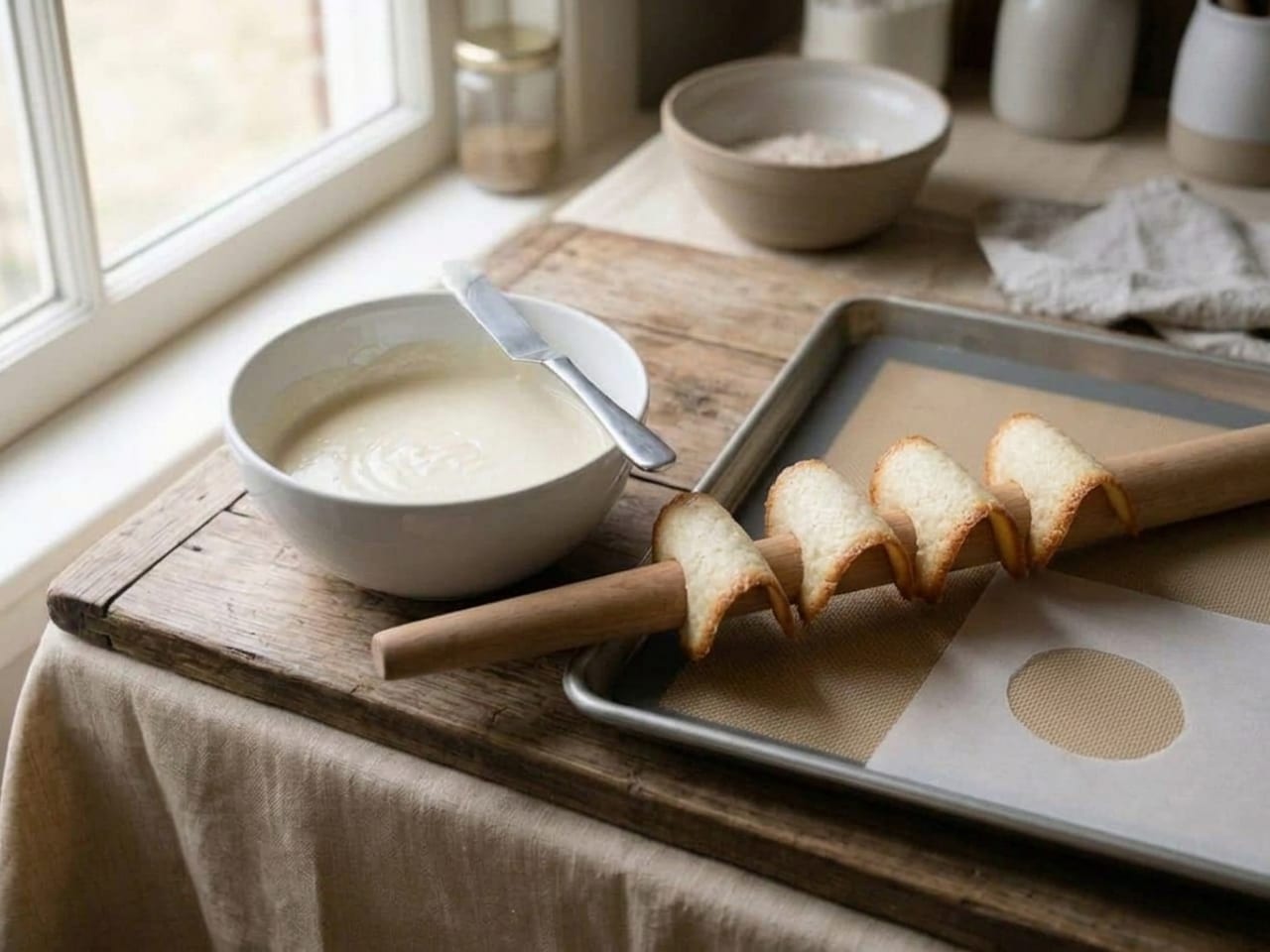
Lift each one and drape it over a rolling pin at once
"Remove the baked cookies from the baking sheet and immediately curve over a rolling pin or tuile rack" (Gisslen). Friberg leaves the tray in the oven with the door open and shapes them "Immediately"; the pirouette, rolled on a dowel, "must be done fairly quickly, or the cookies will start to cool and break".1, 2 If they set first, put the tray back to soften them: the CIA rewarms them "briefly" and reheats its chocolate tuiles "as necessary", Mary Berry gives 30 to 60 seconds.3, 17 No source we read times the shaping window in seconds; other shapes are below.
How to make a tuile stencil (template)
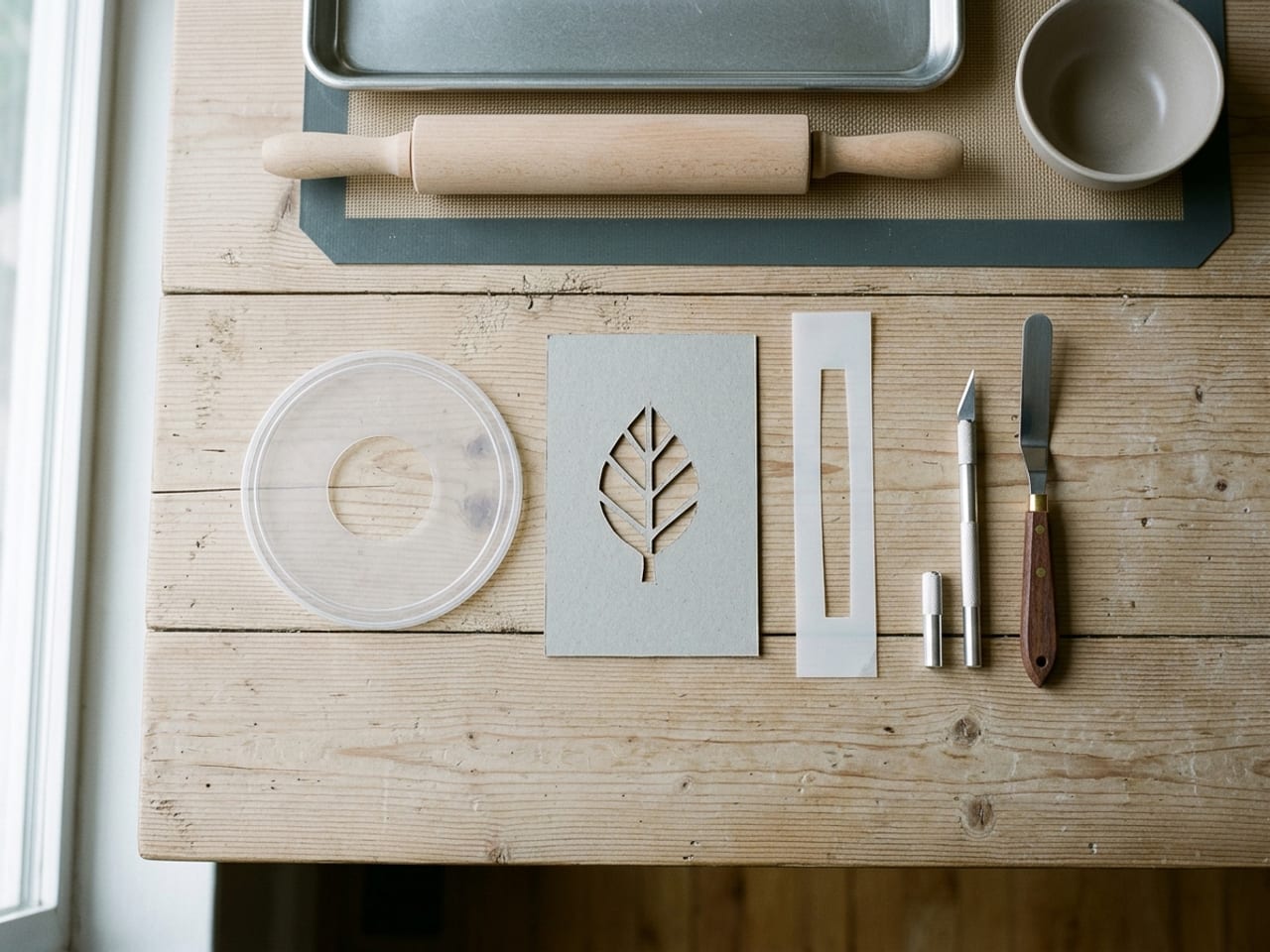
Cut the shape out of something thin, flat and stiff, then spread the batter level with it. The sources' materials and sizes are below; none of them mentions a yogurt lid, though four use some kind of plastic lid. The only thicknesses printed are 2 mm (1/16 in) cardboard (Friberg), a 1 mm tuile stencil (MoldBrothers) and a 1.5 mm silicone decoration stencil (Martellato); On Baking spreads the batter "the same thickness as the stencil".2, 4, 49, 50 A polystyrene stencil is for the cold mat, not the oven (ours: lift it off before baking).
| Source | Stencil made from | Size printed |
|---|---|---|
| Friberg (2002)2 | Cardboard 2 mm (1/16 in) thick, such as cake-box board; bought ones in stainless steel, aluminium or plastic | a round 3 1/4 in (8.1 cm) across; leaves; full-mat grills |
| Gisslen (2012)1 | Thick plastic or thin cardboard, cake-box board "you may need to use a double thickness" | petit-four tuiles 2 1/2 in (6 cm); "stencils of any shape or size" |
| Anson Mills14 | "A rigid plastic lid" about 8 in (20 cm, ours) across, its lip cut off | a 3 1/2 to 4 in (9 to 10 cm, ours) circle traced with a cutter |
| Pastry Chef Online (2012)13 | "a cake box or the lid from your sour cream" | any shape |
| Mary Berry (2013)17 | "a plastic sheet or the lid of an old ice cream carton" | holes 7 cm (2 3/4 in, ours) |
| Zoë François (2008)19 | "old Rubbermaid covers" cut with a craft knife | any shape |
| MoldBrothers (a stencil maker)49 | polystyrene "1 mm thick" | a 9 cm (3 1/2 in, ours) circle |
| Martellato (a mould maker)50 | silicone, "Mould thickness: 1.5 mm" (sold as a decoration stencil) | stars |
Silicone mat or parchment
Every textbook that names a surface puts the silicone mat first: Gisslen falls back to parchment, Friberg to the greased and floured back of a tray, the CIA to a greased, floured and frozen one.1, 2, 3 The split is over parchment: Anson Mills says tuiles bake fine on it "but will cool too quickly to shape", while King Arthur and Bonne Maman bake and shape from parchment.10, 14, 20 Meilleur du Chef never bakes lace tuiles straight on the tray, "Même sur une plaque beurrée" (not even a buttered one).21 The mat's limit in what we read is 480°F (250°C) in Friberg and "482 degrees F" (250°C, ours) in a Silpat retailer's listing, above every tuile oven here except Larousse's figure; its distributor says not to grease it or cut on it, so trim warm tuiles on parchment, as the CIA does (ours).2, 3, 47, 48
Tuile shapes: curves, cups, cigarettes, cones, leaves and combs
What each shape is formed over, source by source. Every textbook says to shape them at once, hot. No source we read gives the shaping window in seconds: the only seconds printed for the paste are Friberg's hold of "about 5 seconds" on a dowel and Mary Berry's 30 to 60 second re-warm (Joy of Baking's 30 seconds to a minute is a wait before lifting a lace batter).2, 16, 17
| Shape | Formed over, by source |
|---|---|
| The classic curve (the tile) | A rolling pin, 3 to 4 in (7.5 to 10 cm) across (Friberg); a rolling pin or wine bottle (King Arthur); a rolling pin "ou une bouteille bien propre" (Larousse); a baguette pan (Friberg, Pépin); tuile moulds or a tuile rack (Bilheux, Gisslen; Lacam's "moules à tuiles" in 1911); wooden-spoon handles (Bonne Maman, Choukroun)1, 2, 5, 7, 10, 20, 22, 25, 63 |
| Cup, tulipe or basket | The upturned bottom of a small glass (Gisslen); between two bowls (Friberg's tulip paste, 7 to 8 in (17.5 to 20 cm) circles); a cup or ramekin (CIA); the base of a greased shot glass (King Arthur); an upturned pudding mould or ramekin with a 13 cm (5 in, ours) round (Mary Berry); brioche moulds (Larousse)1, 2, 3, 7, 10, 17 |
| Cigarette, pirouette or cigar | A 1 in (2.5 cm) dowel (Friberg); a 1/4 in (0.6 cm, ours) dowel, rolled on the mat (Anson Mills); a wooden-spoon handle (King Arthur, Mary Berry); a 1 1/2 in (3.8 cm, ours) dowel or whisk handle for cannoli-size tubes (Bittman)2, 10, 14, 17, 18 |
| Spiral or curly cue | A piped strip wrapped at 45 degrees round a 1/2 in (1.3 cm, ours) dowel, held about 5 seconds (Friberg); twisted round a dowel (CIA)2, 3 |
| Cone | A wooden cone roller, the kind used for pizzelle and krumkake (Friberg)2 |
| Leaf | A 2 mm (1/16 in) cardboard template; curved over something about 6 in (15 cm) across, such as a large can, because "a rolling pin is too narrow" (Friberg)2 |
| Combed lines and waves | A comb pulled through a thin layer of paste on the mat, then rolled across a cylinder (CIA, Friberg); corrugated aluminium flashing as a wave mould (Friberg)2, 3 |
| Flat | Left to cool flat: Gisslen's 3 in (7 cm) wafers, "leave them flat"; the CIA's lace tuiles (shaped warm or left flat); Le Cordon Bleu's broken sesame sheet1, 3, 33 |
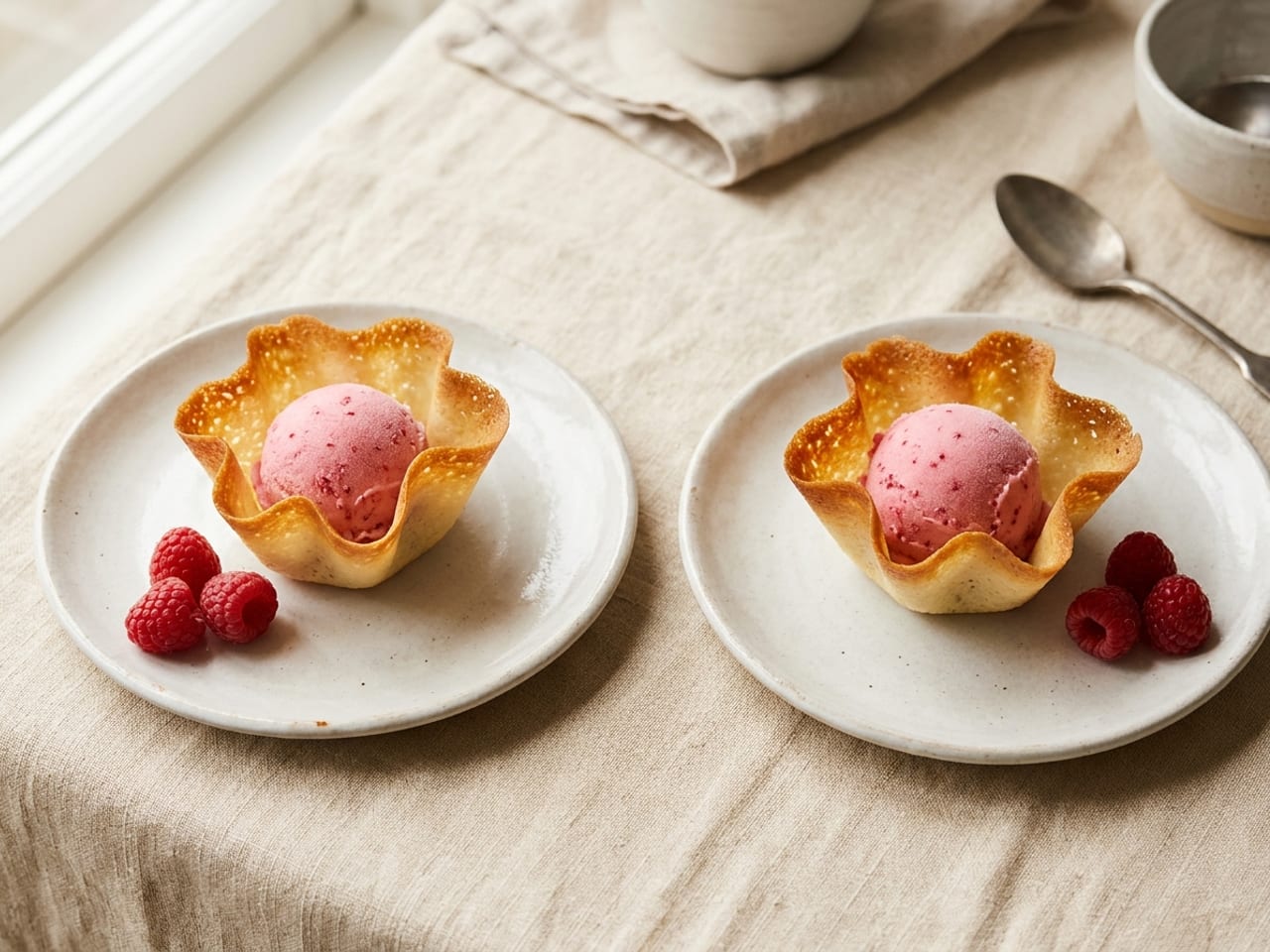
Tuiles without a mould
None of the shapes needs a tuile mould: a rolling pin or a clean wine bottle (King Arthur, Larousse), a wooden-spoon handle, the bottom of a glass, a ramekin or a coffee cup (Gisslen, Bittman), a baguette pan (Friberg, Pépin) or a large can for leaves (Friberg).1, 2, 7, 10, 18, 25 Friberg warns that not all hardware is food grade: aluminium flashing is; PVC pipe used to mould a filling must be lined with food-grade plastic wrap.2
How many at a time
As few as you can shape before they set: King Arthur and Anson Mills bake two, Bonne Maman three a sheet "as the tuiles cook and cool very quickly", Friberg no more than 8 to 10 leaves a pan, Choukroun about 8.2, 10, 14, 20, 22 The CIA bakes in small batches because a tray sent back too often to soften burns the last ones.3 Two recipe writers wait a little instead: Joy of Baking, with a lace-style batter, "about 30 seconds to one minute" until they lift without tearing, and Pastry Chef Online, whose paste is Gisslen's formula baked on a Silpat, lets them "firm up for a minute". No source we read measured why.13, 16
Coral tuile recipe: the ratio, the pan and the colour
A coral tuile is a thin batter of flour or cornstarch, water and oil poured into a hot non-stick pan: "The water rapidly evaporates in the hot pan, leaving the oil to cook the flour suspended in the emulsion. This is what causes the lace pattern to emerge" (Rosanna Stevens). In French it is a tuile corail (Weber France) or, at a Montréal cooking school, a tuile ajourée.41, 43, 44 No textbook we read prints one, and we found no documented origin and no source tying it to a television show: every recipe below is practice: chefs, a cocktail blogger, schools, a broadcaster and a brand.
| Source | As printed | Flour : water : oil by weight (ours) | Oil, and heat |
|---|---|---|---|
| Rosanna Stevens (chef's blog, 2024)41 | 40 g cornstarch, 100 ml water, 100 ml oil | 1 : 2.5 : 2.3 | In the batter; non-stick pan, medium-high, "once hot" |
| RTBF (a recipe from Comines, Belgium)42 | 30 g flour, 100 g water, 100 g oil | 1 : 3.33 : 3.33 | In the batter; non-stick pan |
| Weber France (chef Matt Burgess)43 | 10 g flour + 5 g cornflour, 50 g water, 40 g oil, 10 g raspberry powder | 1 : 3.33 : 2.67 | In the batter; a very hot plancha |
| Ateliers & Saveurs (Montréal cooking school)44 | 25 g flour, 210 ml water, 125 ml grapeseed oil | 1 : 8.4 : 4.6 | In the batter; hot, lightly buttered non-stick pan |
| Taste Canada (student chefs)45 | 15 g flour, 100 g water, parsley; 30 g oil in the pan | 1 : 6.67 : 2 | In the pan; non-stick pan, "a few minutes until dry" |
| Moody Mixologist (cocktail blog)46 | 10 g flour, 70 g water + 20 g beet juice; about 2 tsp oil in the pan | 1 : 9 : 0.9 | In the pan; medium |
The coral tuile ratio: no agreement. Water runs from 2.5 to 9 parts per part of flour by weight, and oil from 0.9 to 4.6 (our arithmetic, ml taken as grams for water and at 0.92 g a ml for oil). The sources split into two camps: four whisk the oil into the batter (Stevens, RTBF, Weber, Ateliers & Saveurs), two pour a thin flour and water slurry into an oiled pan (Taste Canada, Moody Mixologist).
Our pick (ours, not tested): start from the RTBF proportions, 30 g (1.1 oz) flour, 100 g (3.5 oz) water and 100 g (3.5 oz) oil, whisked; Weber's plancha recipe lands on the same 1 : 3.3 water. Pour a thin layer into a hot non-stick pan and leave it alone until the bubbling stops and the edges lift (Weber: "N'y touchez pas", don't touch it), then lift it out to cool, when it crisps.42, 43
- Flour or cornstarch. Stevens prefers cornstarch, which "also makes the coral tuile gluten-free"; plain flour "sometimes made the lace tuiles a bit pancakey". Too thick a pour "will become a pancake".41
- Colour. Plain, it is "pale and beige" (Stevens). Colour it with powdered colouring (not gel or liquid), squid or cuttlefish ink for fish (Stevens, RTBF), beet juice (Moody Mixologist), raspberry powder (Weber), parsley purée (Taste Canada) or curry (RTBF). Stevens finds spices added straight in burn and infuses the oil instead; RTBF adds curry to the batter.41, 42, 43, 45, 46
- Keeping. Stevens: airtight, "use within one week", and "Do not freeze coral tuile". No other coral source we read gives a time.41
Why tuiles spread, crack, stick or go soft, and the fix
Each problem with its cause and fix as the sources give them. Gisslen's fault table is for cookies in general; the rest name tuiles. No source we read treats holes in a stencil tuile as a fault; lace and coral tuiles are holed on purpose.
| Problem | Cause | Fix |
|---|---|---|
| Spreads or loses its shape; ragged edges | Paste too soft (Friberg); for cookies in general, an oven too cool, too little flour, too much sugar or liquid, or a heavily greased pan (Gisslen's faults table) | "chill the paste briefly" (Friberg); grease and flour the pan rather than grease it (Gisslen), or freeze the greased and floured pan before stencilling (CIA); a stencil keeps the edge1, 2, 3 |
| Too thick, not delicate | More batter than the stencil holds | Spread it "the same thickness as the stencil" (On Baking), so thin you can see the mat's weave (Pastry Chef Online); Anson Mills weighs 0.4 to 0.5 oz (11 to 14 g, ours) per 3 1/2 to 4 in round. Joy of Baking's test: a cooled tuile dropped on the floor should shatter4, 13, 14, 16 |
| Browns unevenly across the tray or the cookie | Uneven spreading (CIA); ovens with hot spots; "Cookies may brown unevenly" (Saveur) (a slightly darker rim is the doneness cue, not a fault: King Arthur, Bilheux) | Spread an even layer "so the cookies bake uniformly" (CIA); turn the tray halfway (Anson Mills, Joy of Baking)3, 5, 10, 14, 15, 16 |
| Cracks or breaks when you shape it | It cooled: Friberg rolls pirouettes "fairly quickly, or the cookies will start to cool and break"; too brown (Friberg); too thin (Anson Mills) | Bake a few at a time, 2 (King Arthur, Anson Mills) to 8 or 10 a pan (Friberg); put the tray back to soften, "briefly" for the CIA, 30 to 60 seconds for Mary Berry2, 3, 10, 14, 17 |
| Sticks to the tray | Too little or the wrong grease, too much sugar (Gisslen) | A silicone mat, which needs no grease and must not be greased (Silpat's distributor); or grease the sheet well (Joy of Baking); Meilleur du Chef never bakes lace tuiles straight on the tray, "Même sur une plaque beurrée"1, 16, 21, 48 |
| Never goes crisp after cooling | Taken out with no colour: "if they are not brown enough, they will not become crisp after they cool" (Friberg); the pale centre "still contains moisture" (a seller's blog) | Bake to a few brown spots or a golden rim (Friberg, Bilheux); back in the oven if they do not snap (Gisslen: "return them to the oven for 1 minute")1, 2, 5, 23 |
| Goes soft later | "Crisp cookies can become soft when they absorb moisture" (Gisslen); honey and corn syrup are hygroscopic (Gisslen, McGee); humidity also costs moulded tuiles their shape (CIA) | Airtight, with a desiccant (Friberg, Anson Mills); never with soft cookies (On Baking); re-crisp a couple of minutes at 350°F (177°C, ours), as Bittman does (keeping)1, 2, 3, 4, 8, 14, 18 |
Bake to colour, then shape at once. A tip repeated across the top search results, shape them hot or they crack, has a textbook behind it: Friberg rolls his pirouettes "fairly quickly, or the cookies will start to cool and break", and Colombié wrote in 1897 that they set "presque instantanément" (almost instantly).2, 59 Bilheux adds a two-stage bake, half-baked, cooled, then baked again, which gives "an appealing crunchy texture": the only source we read that does it.5 Zoë François bakes hers until dry "but not browned", against Friberg's rule.2, 19
How to keep tuiles crisp, and how long they keep
How long baked tuiles keep, each source in its own words: from one day (Joy of Baking) to two weeks with a desiccant (Friberg). There is no one right number: the sources keep different batters in different boxes. Our plating components guide prints King Arthur's 10 days and our mignardises guide Bilheux's 3 to 4; both are rows here.2, 5, 10, 16
| Source | Room temperature | How | Frozen |
|---|---|---|---|
| Friberg (2002)2 tuile decorations | "up to 2 weeks" | airtight, "preferably with a desiccant" | - |
| King Arthur (2011)10 egg-white tuiles, spread by hand | "up to 10 days" | airtight | - |
| Bilheux (1998)5 almond tuiles | "3 to 4 days" | sealed, room temperature | "3 to 4 weeks" |
| Mary Berry (2013)17 curved tuiles and cigars | 3 to 4 days | airtight tin | can be frozen (no time given) |
| CIA (2015)3 apple cider tuiles | "up to 3 days" | airtight | - |
| Saveur15 stencil tuiles | "up to 2 days" | airtight | - |
| Joy of Baking16 lace-style tuiles | best the same day; they lose their crispness "after a day" | - | - |
| Emeril Lagasse28 Parmesan tuiles | "for up to 24 hours" | airtight | - |
| Rosanna Stevens (2024)41 coral tuiles | "use within one week" | airtight | "Do not freeze coral tuile" |
Show all 18 sources (9 more)
| Source | Room temperature | How | Frozen |
|---|---|---|---|
| On Baking (2009)4 most cookies (a general rule) | "up to 1 week" | cool, dry, airtight; never with soft cookies | - |
| Bilheux (1998)5 cigarettes | "4 to 5 days" | tightly sealed | "4 to 5 weeks" |
| RecipeTin Eats (2026)26 lace tuiles | "up to 2 days" | airtight | - |
| America's Test Kitchen (2013)27 lace cookies | "up to 2 days" | airtight | - |
| Bittman (2016)18 tuiles | "a couple of days" | airtight | - |
| America's Test Kitchen (2012)30 frico | serve "within 1 hour" | - | - |
| Great British Chefs (2016)12 egg-white tuiles, spread by hand | "use within a few days" | airtight | - |
| Anson Mills14 tuiles and cigarettes | "several days" | well sealed, silica packets | - |
| Meilleur du Chef (2014)21 lace tuiles | "plusieurs jours" (several days) | dry, airtight, parchment between layers; never the fridge | - |
How to keep tuiles crisp
- Bake them to colour. Pale tuiles never crisp (Friberg); a seller of crisping fibre says the pale centre "still contains moisture itself".2, 23
- Cool completely, then shut them away. Gisslen: "Cool completely before storing". The CIA stores moulded tuiles airtight "so they don't lose their shape due to exposure to humidity": damp air costs the curve, not only the snap.1, 3
- Add a desiccant. Friberg keeps tuile decorations airtight "preferably with a desiccant", crisp "for up to 2 weeks"; Anson Mills keeps silica packets in the tin. Friberg's silica gel goes blue to pink when full and dries in a 300°F (149°C) oven; keep any sachet from touching the food (ours).2, 14
- Keep them away from soft things. On Baking: never store crisp cookies with soft ones, which give up their moisture; Meilleur du Chef stacks tuiles between sheets of parchment and never in the fridge.4, 21
- Mind the humidity. "The only enemy to tuile is humidity" (Zoë François). Honey, glucose and corn syrup are hygroscopic (Gisslen, McGee), so honey and lace tuiles should soften sooner than plain ones (our inference; no source measured it); isomalt "absorbs virtually no moisture" (BENEO), and the open textbook says isomalt garnishes "will hold up better in conditions with high humidity".1, 6, 8, 19, 40
Re-crisping soft tuiles
Two sources give a way back: Bittman re-crisps soggy tuiles "for a couple of minutes in the oven at 350°F" (177°C, ours), and Meilleur du Chef puts them back in the oven "1 à 2 minutes" (no temperature).18, 21 To bend them again the re-warm is shorter: "briefly" (the CIA), 30 to 60 seconds (Mary Berry); the CIA's one timed figure, 30 seconds at 325°F (163°C), is for its chocolate caramel sugar tuiles.3, 17
Freezing, and keeping the batter
Baked: Bilheux freezes tuiles 3 to 4 weeks and cigarettes 4 to 5; Mary Berry says baked tuiles "can be frozen" with no time; Stevens says not to freeze coral tuiles.5, 17, 41 The batter: King Arthur alone says not to hold it beyond 2 hours, and On Baking mixes it "in small batches to be used as needed"; the other sources that give a time keep it from overnight to several weeks, and Zoë François freezes hers for months.4, 10, 19
| Source | Batter kept (the fridge unless noted) | Freezer |
|---|---|---|
| King Arthur (2011)10 | "1 to 2 hours, but no longer" | - |
| On Baking (2009)4 | mix "in small batches to be used as needed" | - |
| École Lenôtre9 | made the day before | - |
| Le Cordon Bleu, sesame (2025)33 | 3 days, airtight (no place given) | - |
| Pastry Chef Online (2012)13 | "3-4 days" (3 to 4) | - |
| Mary Berry (2013)17 | 3 to 4 days | - |
| Friberg, tuiles (2002)2 | "up to 1 week" | - |
| Joy of Baking16 | "up to a week" | - |
| Zoë François (2008)19 | a week | "months" |
| Friberg, decorating paste (2002)2 | "several weeks" | - |
Why tuiles go soft: the science, and its limits
Gisslen: "Cookies are crisp when they are low in moisture", and "Crisp cookies can become soft when they absorb moisture"; McGee: crisp, dry cookies "absorb moisture from the air and get soft".1, 8 The measurements are on other foods. Katz and Labuza (1981) let potato chips, popcorn, corn curls and saltines take up moisture and found tasters rejected them at a water activity of about 0.35 to 0.50; Roudaut and colleagues (1998) found crispy bread loses crispness slowly up to 9% water, then steeply, and linked it to the glass transition.52, 53 They measured snacks and bread, not tuiles. Our reading: a warm tuile bends and a cool one snaps for the same reason, and one left in damp air drifts back towards bendy. No source we read measured a tuile.
Tuile garnish: where it goes on the plate
From the early books on, the tuile has gone with ices: Lacam rolls almond cigarettes "pour glaces" in 1895 and serves a bombe "avec des petites tuiles vanille" in 1911.57, 63 On a plated dessert the textbooks lean one against a quenelle, a cake or a tart, stand one up in cream or mousse, spike one into a glazed dome, or make it the cup; the open textbook says an upward curve "can help direct movement" on the plate.1, 2, 3, 4, 6
- Assemble at the last moment. The textbooks build the tuile in as the plate goes out (Friberg, after standing a tuile leaf in cream: "Serve immediately"); King Arthur fills cups "just before serving so that the delicate tuiles don't soften from the moisture in the filling".2, 10
- Wet contact: the split. The textbooks hold a tuile with a little wet glue: Gisslen puts "a dab of sauce under the base of the tuile to keep it from sliding" and even lays tuile strips on top of the sauce under sorbet; the CIA sets one on a pea-size drop of corn syrup.1, 3 Recipe writers warn from the other side: King Arthur and Bittman fill tuile cups only just before serving so they do not go soggy.10, 18 Ice cream technologists say moisture moving into an uncoated wafer "is unavoidable" and protect cones with a chocolate or fat coating; their timescale is days in a freezer, not minutes on a plate.51 No source we read times how fast a tuile softens on a plate. Ours: set it on a dry part of the plate or a small dab, not in a pool of sauce, and add it last.
- Savoury. A Parmesan or sesame tuile works the same way on a starter: Emeril serves black sesame tuiles with tartare, Le Cordon Bleu breaks a sesame tuile over scallops.29, 33
The moves themselves, and the rest of the plate, are in our other guides: the leaning tuile in plating techniques, the crunch among a dessert's five roles in dessert plating, the tuile among the sixteen components in plating components, and cocoa and chocolate decorations in chocolate garnishes.
Tuile meaning, pronunciation and history
Tuile meaning: a roof tile. French tuile is the tile on a roof, from Old French tiule (about 1170) and Latin tegula, from tegere, to cover (the TLFi, Larousse); English tile comes from the same Latin word through Old English, before 900 (Dictionary.com). Larousse's third sense is the pastry: "Petit four sec aux amandes en forme de tuile", a dry almond petit four shaped like a tile.72, 75, 76 Larousse gastronomique says the curve is that of a "tuile romaine", the curved Roman tile; Friberg ties the name to the clay roofs of the Mediterranean; Boulud and Greenspan: "The word tuile means tile in French".2, 7, 68
Named for the roof tiles of Provence? That is a modern cookbook story, not history. The earliest print of it we found is a 1997 London cookbook, The Provençal Table, whose tuiles are "moulded in the shape of Provencal roof tiles (tuiles), hence the name"; Dorie Greenspan's 2006 recipe headnote, which Wikipedia cites for it, repeats it. No historical source we read names Provence; the earliest recipes we found are in Paris-area books.57, 59, 66, 67
Tuile in English. Merriam-Webster: "a French wafer-like cookie made chiefly with flour, egg whites, sugar, and butter and shaped while warm into a curved or rolled form"; Cambridge has a sweet sense and a savoury one; Collins, "a type of delicate almond-flavoured dessert biscuit"; Dictionary.com adds "any crisp, thin wafer accompanying a dish or a meal, such as one made from cheese".71, 72, 73, 74 English cookery books printed it by 1907 (Kirkland's Modern Baker), and a London culinary dictionary listed it in 1895; Merriam-Webster's earliest citation is 1943.58, 62, 71 The older English tuille is a plate of armour, from the same Latin; we found no source linking it to the biscuit.72
In French. The TLFi defines the pastry as a petit four of flour, butter, whipped egg whites and caster sugar "moulé en forme de tuile sur un rouleau à pâtisserie", with "Tuiles aux amandes" as its example. The old food senses of the word are other things: a terracotta plate for baking a galette (1706), a flat crêpe pan in the West of France (Littré), and in the Ménagier de Paris (1390s) a dish of crayfish called "tuille d'escrevisses".76 The TLFi dates the cake sense to 1895, citing a dairy book we did not read.
History: the earliest tuiles we found
We read the old French and English books in Internet Archive scans; Gallica, the French national library, refused this machine, so "earliest" below means the earliest in what we read. Carême (1815), Gouffé (1873), Dubois and Escoffier (1903, 1907) print no tuile biscuit in their scans.
- 1751. Gilliers lays a hot waffle on a rolling pin "pour lui donner une forme de tuile" (to give it the shape of a tile): the shape, on a wafer cooked in an iron, not yet the biscuit.54
- 1855. In London, Read turns warm treacle-and-spice "Italian Jumbles" round a stick; his brandy snaps are the same mixture "without being turned".55
- 1893. "Tuiles aux amandes" among the desserts of a Paris evening party (Goudeau): the earliest use of the name we found, a list with no recipe.56
- 1895. Lacam prints "Cuirasses ou tuiles" (breastplates or tiles): almond paste, icing sugar, flour and 7 or 8 egg whites, "Les doubler sur rouleau, sitôt cuites" (bend them over a rolling pin as soon as they are baked). The earliest full recipe we found.57
- 1895. In London, Senn's culinary dictionary lists "Tuiles." next to "Florentins." among petits fours: the earliest English book use we found.58
- 1897. Colombié's household recipe for tuiles aux amandes: shape them at once, because "ils sèchent presque instantanément" (they set almost instantly), and keep them in a tin.59
- 1902. Montagné and Salles: 250 g each of butter, icing sugar and flour with 5 eggs. The equal weights of the modern paste, with whole eggs.61
- 1907. Kirkland's Modern Baker (London): "Another very fine Continental biscuit is that known as tuiles", at "about 370° F." (188°C, ours), curled over a rolling pin. English cookery books printed it by 1907.62
- 1911. Lacam's Mémorial des glaces (third edition, revised by his son-in-law P. Seurre) names the change, "Tuiles, autrefois cuirasses" (tuiles, formerly cuirasses), adds butter-and-white "Cigarettes Russes", spreads cigarettes in a tin-plate frame (a stencil in all but name) and names "moules à tuiles".63
- 1938. The first Larousse gastronomique has "TUILES (Petits fours)" and "Tuiles aux amandes", with a photograph of tuiles lifted off as they leave the oven.64
- 1943. Merriam-Webster's first known use of tuile (Dictionary.com: first recorded 1940 to 1945), decades after the books above.71
- 1961. The English Larousse sets tuiles on a rolling pin "so that they are given the shape of curved tiles (tuiles)".65
- 1988 and 1990. London restaurant books make cups of "tuile mixture": the Savoy's tulipe of sorbet (1988), Marco Pierre White's "tuile baskets" (1990).69
- 1995. "a parmesan tuile (crisp wafer)" in a Chicago guide, still glossed for readers; "tuile de parmesan" in a French guide the next year. The earliest cheese tuiles in print we found.69
- 2002. Friberg: the cookies are "named after the clay roofing tiles" of a style "popular in the Mediterranean"; the same shape is tegolino in Italian and teja in Spanish.2
- 2006. Dorie Greenspan's recipe headnote ties the name to the roofs of "country homes, particularly those in Provence", the version Wikipedia cites. The story is older in cookbooks (1997 in what we read); no historical source names Provence in what we read.67
- 2016. Great British Chefs: "the word tuile is now used to describe any crispy part of a dish, be it sweet or savoury".12
Related biscuits, and how they differ
- Tulipe (tuile cup): The same thin batter moulded warm into a cup: Gisslen's glossary, "A thin, crisp cookie molded into a cup shape"; Larousse shapes it in brioche moulds. On Baking calls the cup itself "also known as the tuile", so the names cross.1, 4, 7
- Cigarette russe and pirouette: The paste rolled tight round a stick. Larousse makes its cigarette from langue-de-chat batter; Bilheux files cigarettes under creamed mixtures and tuiles under simple ones; Friberg names the paste pâte à cigarette after them.2, 5, 7
- Langue de chat: "a flat sweet finger-shaped biscuit" (cat's tongue): butter, sugar, flour and egg (whites in Colombié's 1899 version, whole eggs in Larousse), piped as a finger and left flat; Larousse rolls the same batter into its cigarettes. Colombié printed the two side by side in 1899.7, 60, 72
- Brandy snap: English, older and darker: treacle and ginger or allspice (Read 1855), no egg white, "rolled into a tube" (Cambridge) and often filled with cream. The warm roll round a stick is the shared move.55, 72, 73
- Florentine: Nuts and candied fruit in a cooked butter, sugar and honey binder, often backed with chocolate and left flat (Cambridge, Gisslen). It sat next to the tuile on Senn's 1895 petits fours list.1, 58, 73
- Frico: Friuli's crisp fried cheese, "Formaggio fritto croccante": the dish the Parmesan tuile resembles, made in a pan from aged Montasio or other Friulian cheese; the crisp one is one of several fricos (ERSA).30, 32
- Crêpe dentelle: Quimper's "biscuits secs" of very thin crêpe strips rolled up (Larousse): a crêpe, not a tuile batter, though French pastry uses "dentelle" (lace) for holed tuiles too.7, 21
- Opaline: A sheet of melted sugar powder, "also known as a transparent tuile" (Eddy Van Damme): the sugar-work sense of the word.37
Photograph your plate, see it re-plated
A tuile is the finishing crunch; the plate around it is where it shows. Photograph a dessert you have made and Plate Artists re-plates that dessert, with the food kept as it is and the changes named so you can repeat them. Start with a re-plate.
Your food, plated like a chef's
Snap it, upload it, and get the composed version back, with the steps to recreate it at home.
Start free · 1 enhancement →Free account · 1 free enhancement · No credit card
Tuile terms, defined
Only the words the site does not already define: tuile itself is in our plating components guide, the offset spatula in plating tools.
Stencil paste · tuile batter, pâte à cigarette, tulip paste, wafer batter
A soft batter of flour, powdered sugar, butter and egg white, spread through a stencil and baked into thin tuiles; equal weights in seven of the 20 we read (On Baking and Friberg among them, our arithmetic).
Where it comes from. Gisslen: "This batter is also known as stencil paste"; Friberg: "also called pate a cigarette"; On Baking: "Wafer batter, also known as stencil batter"; a French design manual draws motifs in "pâte à cigarette".1, 2, 4, 70
Tulipe · tulip cup, tuile cup, tuile basket
A thin, crisp cookie moulded warm into a cup, used as an edible container for ice cream or sorbet.
Where it comes from. Gisslen's glossary; Larousse gastronomique's TULIPE.1, 7
Cigarette russe · cigarette, pirouette
A thin baked wafer rolled tight round a stick while warm into a tube.
Where it comes from. Lacam 1911, "Cigarettes Russes"; Larousse 1997, "dit aussi cigarette russe".7, 63
Tuile dentelle · lace tuile
A tuile from a butter, sugar and syrup batter with nuts that spreads by itself into a thin, holed, lacy round.
Where it comes from. Meilleur du Chef's "Tuiles dentelles"; the CIA's Lace Nut Tuiles.3, 21
Coral tuile · tuile corail
A lacy web made by frying a thin batter of flour or cornstarch, water and oil in a hot pan until the water boils off.
Where it comes from. Weber France's "Tuile corail"; no documented origin in what we read.41, 43
Opaline · sugar tuile, isomalt tuile, transparent tuile
A thin, glassy sheet made by sieving powdered cooked sugar or isomalt onto a mat and melting it in the oven.
Where it comes from. Eddy Van Damme: "Opaline also known as a transparent tuile".36, 37
Frico · frico croccante
Friuli's crisp fried cheese: aged Montasio or another Friulian cheese, grated and cooked flat in a pan until it sets into a wafer; one of several fricos.
Where it comes from. ERSA, Friuli: "Formaggio fritto croccante".32
Langue de chat · cat's tongue
A flat, finger-shaped dry biscuit of butter, sugar, flour and egg white or whole egg, piped and baked flat.
Where it comes from. Dictionary.com: "a flat sweet finger-shaped biscuit".7, 72
Cuirasse · the old French name
French for a breastplate, and Lacam's older name for the almond tuile.
Where it comes from. Lacam 1895, "Cuirasses ou tuiles"; 1911, "Tuiles, autrefois cuirasses".57, 63
Tuile mould · tuile sheet, tuile rack, gouttière (gutter mould)
A metal form with half-round channels that warm tuiles are laid in so they set curved.
Where it comes from. Lacam 1911 "moules à tuiles"; Gisslen's "tuile rack"; Friberg's tuile sheet; Lenôtre's gutter.1, 2, 9, 63
Silicone baking mat · Silpat (a brand)
A reusable non-stick sheet of glass fabric coated in silicone, the surface most textbooks stencil tuiles on.
Where it comes from. Friberg: "glass fabric covered with food-grade silicone".2, 47
Desiccant · silica gel
A drying agent, such as a sachet of silica gel, kept in the airtight box with crisp pieces to take up moisture from the air.
Where it comes from. Friberg: a desiccant placed in the airtight container protects "baked tuile paste decorations" from moist air.2
Water activity · aw
A 0 to 1 measure of how freely water in a food is available; crisp snacks became unacceptable to tasters at about 0.35 to 0.50.
Where it comes from. Katz and Labuza 1981, measured on snack foods.52
Tuiles, answered
What is a tuile?
A thin, crisp wafer baked from a soft batter of flour, sugar and egg (most often just the whites), usually with butter and often with almonds, and bent while warm so it sets curved like a roof tile; tuile is French for tile. Dictionary.com and Cambridge also give a savoury sense, any thin crisp wafer served with a dish, such as one made from cheese.
How do you pronounce tuile?
One syllable, "tweel": /twiːl/ in Cambridge and Collins, \ˈtwēl\ in Merriam-Webster. In French it is [tɥil], with the glide of huit, which English turns into a w. The plural tuiles sounds the same in French.
What does tuile mean in French and in English?
In French a tuile is a roof tile, from Latin tegula (from tegere, to cover), and Larousse's third sense is the curved almond petit four; English tile is the same Latin word. In English a tuile is the biscuit, and in Dictionary.com's second sense any crisp, thin wafer served with a dish; Great British Chefs says the word now covers any crispy part of a dish, sweet or savoury.
What is the ratio for tuile batter?
For the thin stencil paste, equal weights of flour, powdered sugar, butter and egg white: On Baking uses 500 g of each and Friberg calls it "four ingredients, used in equal weights". In our table 7 of the 20 stencil-paste formulas are equal within 10% (our arithmetic); the rest run sweeter and leaner, down to the open textbook's 1 : 1.33 : 0.5 : 0.67 and Great British Chefs' version with no butter. The French almond tuile is a different, nut-heavy batter.
What temperature do you bake tuiles at?
It depends on the batter and how thin it is. For the stencil paste the sources run from 160°C (320°F) at Great British Chefs, spread 2 mm thick, to 425°F (220°C) for Bilheux's cigarettes, and King Arthur bakes its nearly transparent rounds at 400°F (204°C); 350°F (about 177°C) is the most common setting, 7 of the 18 stencil-paste bakes in our table. Every source judges doneness by colour, not by the clock.
Do you need to rest tuile batter?
Not for the plain stencil paste in the textbooks we read: Gisslen, the CIA's chocolate tuiles and the open textbook bake it at once, though Gisslen chills his sesame batter and the CIA its honey batter. King Arthur chills it 1 to 2 hours "but no longer", without saying why; Mary Berry rests hers 30 minutes at room temperature; Lacam in 1911 rested his almond batter 48 hours or more. Chilling is mostly for loose batters that run (the CIA's honey tuiles, lace and seed batters).
How do you make a tuile stencil or template?
Cut the shape out of something thin and flat: cake-box cardboard, 2 mm (1/16 in) in Friberg, doubled if thin in Gisslen, a rigid plastic lid with its lip cut off (Anson Mills), a sour-cream or ice-cream-carton lid (Pastry Chef Online, Mary Berry), or buy one in 1 mm polystyrene. Spread the batter level with the stencil, sweep off the excess and lift the stencil away.
How do you shape tuiles without a mould?
Use what is in the kitchen: a rolling pin or a clean wine bottle for the curve (King Arthur, Larousse), a wooden-spoon handle for cigarettes, the upturned bottom of a glass or a ramekin for a cup (Gisslen, Mary Berry), a large can for a wide leaf (Friberg). Shape them the moment they come out of the oven, and put the tray back for 30 to 60 seconds if they set first (Mary Berry).
How do you make tuile cups?
Spread a larger round (Friberg's tulip paste goes to 7 to 8 in, 17.5 to 20 cm; Mary Berry uses 13 cm, about 5 in), and while it is hot press it over an upturned glass, ramekin or pudding mould, or between two bowls. Fill them just before serving: King Arthur and Bittman both warn that a filling softens them.
How do you make a coral tuile?
Whisk flour or cornstarch, water and oil, pour a thin layer into a hot non-stick pan and leave it until the water has boiled off and a lacy web is left, then lift it. The six recipes we read disagree on the ratio: 2.5 to 9 parts water to 1 of flour by weight, with the oil in the batter or in the pan. RTBF's 30 g flour, 100 g water and 100 g oil, near the low-water end where Weber France's recipe also lands, is our starting pick (ours, not tested).
How do you make Parmesan tuiles?
Grated Parmesan and nothing else: Emeril Lagasse spreads 3 tablespoons into a 3 in (7.6 cm) round on parchment and bakes it at 350°F (177°C) for about 12 minutes until golden brown. In a pan it is the Friulian frico: America's Test Kitchen melts 2 oz (57 g) of aged Asiago or Montasio over medium-high heat for about 4 minutes, and warns that too hot a pan turns it bitter.
Can you make tuiles without eggs?
Yes, but not the stencil paste, which is held by egg white. Egg-free in print: lace tuiles (RecipeTin Eats; Shaun Rankin's sesame tuiles), the CIA's apple cider, banana, blueberry and fig tuiles, coral tuiles, Parmesan tuiles and isomalt tuiles. We found no credible vegan stencil tuile.
What is an isomalt tuile?
A sugar tuile, also called opaline: isomalt or sugar with glucose is cooked, cooled, ground to a powder, sieved thin onto a mat or through a stencil and melted in the oven into a glassy sheet (Stuart Ralston at 160°C, 320°F; Eddy Van Damme at 350°F, 175°C). Its maker says isomalt absorbs virtually no moisture, and the open textbook says isomalt garnishes hold up better in high humidity.
How do you keep tuiles crisp?
Bake them to colour (Friberg: with no colour they never crisp), cool them completely, then keep them airtight, away from soft cookies, ideally with a sachet of silica gel in the box (Friberg, Anson Mills). Never in the fridge (Meilleur du Chef). If they soften, Bittman re-crisps them for a couple of minutes at 350°F (177°C).
How long do tuiles last?
The sources range from 1 day (Joy of Baking: they lose their crispness "after a day") to 2 weeks (Friberg, airtight with a desiccant). King Arthur says up to 10 days airtight, Bilheux 3 to 4 days sealed or 3 to 4 weeks frozen, Mary Berry 3 to 4 days. Parmesan tuiles keep only up to 24 hours (Emeril).
Where does a tuile go on a dessert plate?
As the crunch, added as the plate goes out: leaning against a quenelle of ice cream or a cake, standing up in a mousse or cream, or as a cup. Textbooks hold it with a small dab of sauce, syrup or cream and even set strips on the sauce (Gisslen, the CIA, Friberg), and assemble at the last moment; ours is to keep it on a dry part of the plate or on a small dab, out of any pool of sauce.
The textbooks, old cookbooks, chefs, makers and dictionaries behind this guide
How each source was read (in full, in an archived copy, as a scan's machine-read text, or as a search fragment of a lending-only book) is in its entry and under how this page was made. Makers' and retailers' pages are what they sell and claim; chefs, magazines and test kitchens are practice and opinion, not measurement. Ratios, conversions and suggestions marked ours are our own.
- Wayne Gisslen (2012). Professional Baking, 6th ed. John Wiley & Sons, "Almond Tuiles" (butter 90 g, confectioners' sugar 120 g, egg whites 90 g, cake flour 105 g; "also known as stencil paste"; 350°F (175°C) 5 to 10 minutes; Tulipes) p. 510, "Almond Tuiles II" and "Sesame Tuiles" p. 511, the ribbon-sponge stencil paste (220 g cake flour, 200 g each of sugar, butter and whites) p. 410, the stencil makeup method p. 490, crispness and storage p. 484, panning and cooling pp. 490 to 491, the cookie-faults table p. 492, the glossary (Stencil, Stencil paste, Tulipe) and the plated desserts with tuiles; the 7th edition (2016, p. 502) keeps the Almond Tuiles formula unchanged; read on 26 and 27 October 2026 as the machine-read text (OCR) of a copy uploaded to the Internet Archive (first read in October 2026 for our chocolate garnishes and mignardises guides); cited as the book, without a link to that copy.
- Bo Friberg (2002). The Professional Pastry Chef: Fundamentals of Baking and Pastry, 4th ed. John Wiley & Sons, "Tuiles" pp. 313 to 314 and 323 to 324 (the name, the 3 1/4 in (8.1 cm) template in 2 mm cardboard, 375°F (190°C) about 5 minutes, shaped "Immediately", the pirouette rolled "fairly quickly, or the cookies will start to cool and break"), "Pirouettes" and "Cocoa Tuiles" p. 316, "Florentina Batter" pp. 304 to 305, "Vanilla Tuile Decorating Paste" ("used in equal weights", "pate a cigarette", "tulip paste") and its chocolate version pp. 481 to 482, "Rounded Tuile Leaves" p. 500, the wavy strips, curly cues, miniature tulips and tuile decorations of the plated-dessert chapters, and Appendix B (desiccants, silicone mat, decorating comb and grill, tuile sheet, cone roller); read on 26 and 27 October 2026 as the machine-read text (OCR) of a copy uploaded to the Internet Archive (first read in October 2026 for our chocolate garnishes and mignardises guides); cited as the book, without a link to that copy.
- The Culinary Institute of America (2015). Baking and Pastry: Mastering the Art and Craft, 3rd ed. John Wiley & Sons, ch. 11 "Cookies": stenciled cookies and their pans pp. 330 to 334, "Lace Nut Tuiles" p. 380, "Chocolate Tuiles" p. 381, "Banana Tuiles" p. 382, "Honey Tuiles" p. 383, "Nougatine Tuiles" and "Apple Cider Tuiles" p. 384, "Chocolate Caramel Tuiles" and "Fig Tuiles" p. 385, "Blueberry Tuile" p. 386; the plated-dessert chapter's tuile placements; read on 26 and 27 October 2026 as the machine-read text (OCR) of a copy uploaded to the Internet Archive (first read in October 2026 for our chocolate garnishes and mignardises guides); cited as the book, without a link to that copy.
- Sarah R. Labensky, Priscilla A. Martel and Eddy Van Damme (2009). On Baking: A Textbook of Baking and Pastry Fundamentals, 2nd ed. Pearson Prentice Hall, "Tulipe Cookies (Tuile Batter)", 500 g each of butter, powdered sugar, flour and egg whites, p. 356; wafer or stencil batter ("fragile", "mixed in small batches"), cookie storage and the tulipe plated desserts; read on 26 and 27 October 2026 only as Internet Archive search-inside fragments of a lending-only copy (machine-read text, no page images); quoted briefly and never completed. The oven setting for the tulipe recipe was not in the fragments. archive.org
- Roland Bilheux and Alain Escoffier (1998). Petits Fours, Chocolate, Frozen Desserts, and Sugar Work (French Professional Pastry Series). John Wiley & Sons, "Les tuiles (Tiles)" (300 g almonds, 250 g confectioners' sugar, 100 g flour, 3 whites, 3 whole eggs, 75 g butter; 220°C (425°F); "they must be warm when molded or they will break"; the two-stage bake; 3 to 4 days sealed, 3 to 4 weeks frozen) and "Les cigarettes" (220°C (425°F); 4 to 5 days, 4 to 5 weeks frozen); the simple and creamy mixture groups; read on 26 and 27 October 2026 only as Internet Archive search-inside fragments of a lending-only copy (machine-read text, no page images); quoted briefly and never completed; no page numbers in the fragments. Alain Escoffier is not Auguste Escoffier. archive.org
- BC Cook Articulation Committee (2015). Modern Pastry and Plated Dessert Techniques (BCcampus open textbook, CC BY 4.0). BCcampus Open Education, "Appendix: Standard recipes for dessert garnishes" ("Basic Tuiles": 240 g sugar, 180 g flour, 120 g egg whites, 90 g butter, "a moderate oven (170°C or 350°F)", 10 to 15 minutes; Chocolate and Cinnamon Almond Tuiles) and the chapters "Garnishes" and "Design Principles for Plating Food"; read in full on 25 October 2026 for our chocolate garnishes guide and re-read on 26 October 2026. The method never says when the butter goes in. opentextbc.ca
- Larousse gastronomique (with the Comité gastronomique chaired by Joël Robuchon) (1997). Larousse gastronomique (1996 edition, 1997 printing). Larousse-Bordas, Paris, the entries TUILE ("Petit-four sec, mince ... cintré en forme de tuile romaine"; recipe with 4 or 5 whole eggs, "Cuire 4 min environ au four préchauffé à 275 °C", a rolling pin "ou une bouteille bien propre"), TULIPE, CIGARETTE, LANGUE-DE-CHAT, BISCUIT, CRÊPE and COPEAUX; no page numbers in the OCR; read in the Internet Archive scan's machine-read text (OCR), in full; quotations keep the French as printed and correct obvious OCR misreadings; read on 26 and 27 October 2026. archive.org
- Harold McGee (2004). On Food and Cooking: The Science and Lore of the Kitchen, revised ed. Scribner, ch. 10, cookies "especially prone to losing their texture during storage" and best kept airtight; ch. 12, honey and fructose as hygroscopic sugars; read on 26 and 27 October 2026 only as Internet Archive search-inside fragments of a lending-only copy (machine-read text, no page images); quoted briefly and never completed. archive.org
- École Lenôtre (n.d.). Recettes glacées / Lenôtre Ice Cream Recipes (French and English). École Lenôtre, tuile batter "better when prepared the day before", flattened with "un ustensile plat et humide", shaped on a rolling pin or in a tuile gutter, "Keep in a dry place"; a community upload with no edition or date in its record; read on 26 and 27 October 2026 only as Internet Archive search-inside fragments of a lending-only copy (machine-read text, no page images); quoted briefly and never completed. archive.org
- MaryJane Robbins, King Arthur Baking (2011). Tuiles. kingarthurbaking.com, read in full on 26 October 2026 (JSON-LD datePublished 29 December 2011): 104 g flour, 113 g confectioners' sugar, 113 g melted butter, 4 large egg whites; "refrigerate for 1 to 2 hours, but no longer"; 2 tsp spread to a 4 to 5 in circle, "nearly transparent"; 400°F, 4 to 5 minutes, "just until the very edge of the circle begins to color"; "stored airtight for up to 10 days"; fill "just before serving". kingarthurbaking.com
- King Arthur Baking (2026). Ingredient weight chart. kingarthurbaking.com, read in full on 26 October 2026: a large fresh egg white "30 to 35" g, and the cup weights we use to turn cup recipes into grams (our conversions). kingarthurbaking.com
- Great British Chefs (2016). How to make tuiles. greatbritishchefs.com, read in full on 26 October 2026 (JSON-LD datePublished 18 February 2016): 100 g flour, 3 egg whites, 100 g sugar, no butter (50 g as an option); "a thickness of about 2mm"; 160°C (gas 3), 8 to 10 minutes; "the word tuile is now used to describe any crispy part of a dish, be it sweet or savoury"; "use within a few days". greatbritishchefs.com
- Jennifer Field, Pastry Chef Online (2012). Tuiles. pastrychefonline.com, read in full on 27 October 2026 (posted 18 May 2012, updated 19 December 2024): 3 oz butter, 4 oz powdered sugar, 3 oz egg white, 3.5 oz cake flour; a stencil from "a cake box or the lid from your sour cream"; "just about be able to see the weave of the silpat"; 350°F; batter "3-4 days in the refrigerator"; "let firm up for a minute" before shaping. pastrychefonline.com
- Anson Mills (2026). Tuiles and cigarettes (recipe 758). ansonmills.com, read in full on 27 October 2026 (undated recipe): 1.3 oz clarified butter, 2 oz egg whites, 2.5 oz confectioners' sugar, 1.5 oz pastry flour; a stencil from "A rigid plastic lid"; "0.4 to 0.5 ounces per wafer"; a silicone mat "is essential" because on parchment they "cool too quickly to shape"; 350°F, 5 to 6 minutes; silica packets, "several days". ansonmills.com
- Saveur (2026). Fork-Shaped Tuiles. saveur.com, read in full on 27 October 2026 (undated): 1 egg white, 5 tbsp confectioners' sugar, 2 tbsp butter, 4 tbsp flour; 400°F, 4 1/2 to 5 minutes, "(Cookies may brown unevenly.)"; "up to 2 days". saveur.com
- Stephanie Jaworski, Joy of Baking (2026). Tuiles. joyofbaking.com, read in full on 27 October 2026 (undated): an orange-almond lace-style batter on a well-greased sheet; cool "about 30 seconds to one minute" before lifting; "lose their crispness after a day"; batter "up to a week"; the drop test. joyofbaking.com
- Mary Berry (The Great British Bake Off: Everyday, book extract) (2013). Mary's tuiles with chocolate mousse (technical challenge). thegreatbritishbakeoff.co.uk, read in full on 27 October 2026 (dated 17 September 2013): 200 g unsalted butter, 180 g icing sugar, 6 large egg whites, 200 g plain flour, whisked to a paste, then "leave to rest at room temperature for 30 minutes"; a template with 7 cm holes cut from "a plastic sheet or the lid of an old ice cream carton"; 180°C (160°C fan), 5 to 6 minutes; back in the oven for 30 to 60 seconds to soften (the page's words, with an en dash, paraphrased); baked tuiles frozen or kept 3 to 4 days; batter 3 to 4 days in the fridge. thegreatbritishbakeoff.co.uk
- Mark Bittman (How to Bake Everything, 2016) (2016). Tuiles. The Bittman Project, read in full on 27 October 2026: 1 stick butter, 4 egg whites, 1 cup confectioners' sugar, 1 cup flour; "If it's not quite spreadable, let it rest for 15 minutes or so"; 375°F, 8 to 10 minutes; drape over ramekins or coffee cups for cups, a 1 1/2 in dowel or whisk handle for tubes; "a couple of days" airtight; "If they become soggy, recrisp them for a couple of minutes in the oven at 350°F"; fill "just before serving". bittmanproject.com
- Zoë François, Zoë Bakes (2008). Tuile garnish. zoebakes.com, read in full on 27 October 2026 (dated 6 October 2008): a honey batter; "The only enemy to tuile is humidity"; stencils from "old Rubbermaid covers"; bake until dry "but not browned"; batter "a week in the refrigerator or months in the freezer". zoebakes.com
- Bonne Maman UK (2026). Cranberry and pistachio tuiles. bonnemaman.co.uk (a brand's recipe), read in full on 27 October 2026 (undated): 1 large egg white whisked stiff, 50 g golden caster sugar, 25 g plain flour, 25 g melted butter, spread "almost transparent"; no more than 3 rounds a sheet "as the tuiles cook and cool very quickly"; 220°C (200°C fan), 5 minutes; curved over a wooden-spoon handle. bonnemaman.co.uk
- Chef Philippe, Meilleur du Chef (2014). Tuiles dentelles. meilleurduchef.com (a French pastry retailer and school), read in full on 27 October 2026 (dated 20 February 2014; a reply to a reader dated 26 May 2026): lace tuiles on a glass-fibre sheet or parchment, never straight on the tray "Même sur une plaque beurrée"; "plusieurs jours au sec dans une boîte hermétique"; soft tuiles back in the oven "1 à 2 minutes", "surtout pas de réfrigérateur"; layers separated by parchment. meilleurduchef.com
- Gilles Choukroun (Le Café des Délices), Le Fooding (2026). Le dessert agrumes et cumin. lefooding.com, read in full on 27 October 2026 (undated): melted butter, sugar, flour, sesame seeds and orange juice, no egg, kept "1 heure au réfrigérateur"; about 8 tuiles a sheet, 190°C about 10 minutes, set "à cheval" on wooden-spoon handles: "elles sont assez cassantes". lefooding.com
- Cole Whitney, Modernist Pantry (a seller's blog) (2018). How to keep tuiles ... EverCrisp? blog.modernistpantry.com, read in full on 27 October 2026 (dated 16 September 2018, modified 21 February 2022): the pale centre "still contains moisture itself"; a silica gel packet in the container; its own fibre product suggested at 10% of the flour (a vendor's claim, not a measurement). blog.modernistpantry.com
- Divania Timmal-Jones for gfJules (a gluten-free flour brand) (2026). Gluten Free Tuiles. gfjules.com, read in full on 27 October 2026 (undated print view): butter or a non-dairy alternative, brown sugar, the brand's flour, ground almonds and 2 egg whites; spread "no more than 1/8 inch"; 350°F about 15 minutes. gfjules.com
- Jacques Pépin, Essential Pépin (KQED) (2011). Crispy Tuiles à l'Orange. ww2.kqed.org, read in full on 27 October 2026 (dated 19 September 2011): "Tuile means “tile,” and these cookies are shaped like curved roof tiles"; orange "not usually" in tuiles; a rolling pin "or ... a baguette mold". kqed.org
- Nagi Maehashi, RecipeTin Eats (2026). Almond Lace Tuiles. recipetineats.com, read in full on 27 October 2026 (published 26 June 2026, updated 8 September 2026): egg-free (caster sugar, plain flour, melted butter, orange juice, flaked almonds); "Refrigerate for 2 hours"; 170°C (150°C fan), 5 minutes then 13 to 15 more "until they are deep golden brown"; cool "1 to 1 1/2 minutes" before lifting; "up to 2 days". recipetineats.com
- America's Test Kitchen (2013). Oatmeal Lace Cookies. americastestkitchen.com, read on 27 October 2026 in the page's structured data (JSON-LD datePublished 18 March 2013; the page is for members): butter, brown sugar and dark corn syrup brought to a boil, 1/4 cup (35 g) flour; 350°F, 6 to 8 minutes "until cookies are golden and no longer bubbling"; "up to 2 days". Not called a tuile. americastestkitchen.com
- Emeril Lagasse (Emeril's Creole Christmas) (2026). Parmesan Tuiles. emerils.com, read in full on 27 October 2026 (print page, undated): Parmigiano-Reggiano only, 3 tablespoons per 3 inch round; 350ºF about 12 minutes; "store in an airtight container for up to 24 hours". emerils.com
- Emeril Lagasse (Table 10, Las Vegas) (2026). Black Sesame Seed Tuiles. emerils.com, read in full on 27 October 2026 (print page, undated): 1/4 pound butter, 4 ounces powdered sugar, 1/2 cup egg whites, 4 ounces flour, 1/4 cup black sesame; 350 degrees F about 10 minutes; "If you don’t work quickly enough, the tuiles will become stiff and difficult to bend". emerils.com
- America's Test Kitchen (2012). Frico. americastestkitchen.com (also on The Splendid Table), read on 27 October 2026 in the page's structured data (JSON-LD datePublished 14 June 2012) and in the same recipe on splendidtable.org: aged Asiago or Montasio only, 2 ounces in a 10 inch nonstick skillet over medium-high heat about 4 minutes; a pan too hot "turns the cheese bitter"; serve "within 1 hour". americastestkitchen.com
- Lidia Bastianich, Lidia's Italy (2026). Montasio Cheese Frico (Frico Croccante di Montasio). lidiasitaly.com, read in full on 27 October 2026 (undated): nonstick skillet over medium-low "until a shred of the cheese begins to sizzle 2 to 3 seconds after it hits the pan"; about 3 tablespoons per 2 to 3 inch circle. lidiasitaly.com
- ERSA, Agenzia regionale per lo sviluppo rurale (Friuli Venezia Giulia) (2017). Frico (traditional-product sheet). ERSA, via onaf.it, read in full on 27 October 2026 (PDF printed 22 August 2017): "Formaggio fritto croccante"; aged Montasio, 10 to 15 cm across; "quella croccante è solo una delle numerose versioni esistenti"; the agency's claim of a 15th-century "Caso in patellecte" is the agency's. onaf.it
- Le Cordon Bleu (2025). Recette : Saint-jacques grillés ... et tuile au sésame. cordonbleu.edu, read in full on 27 October 2026 (dated 11 August 2025): 100 g T55 flour, 50 ml vegetable oil, 20 g sesame, 1 egg white, salt and cayenne; about 1 mm thick on parchment; 180 °C about 5 minutes; leftover batter "pendant 3 jours" airtight. cordonbleu.edu
- Shaun Rankin, Great British Chefs (2015). Sesame seed tuiles. greatbritishchefs.com, read in full on 27 October 2026 (JSON-LD datePublished 12 May 2015): sesame and poppy seeds, butter, orange juice, liquid glucose, 25 g flour, icing sugar, no egg; "Leave to rest for about 1 hour"; 180°C (gas 4), 12 minutes; scored into squares while pliable. greatbritishchefs.com
- Great British Chefs (a brand-sponsored chef's recipe) (2023). Cacao tuile. greatbritishchefs.com, read in full on 25 October 2026 for our chocolate garnishes guide and re-read on 26 October 2026: pectin, cane sugar, water, glucose, cocoa and butter boiled, 70% chocolate blended in, spread thin on a silicone mat, 160°C for 12 minutes, broken into shards. No flour and no egg. greatbritishchefs.com
- Stuart Ralston (2023). Isomalt Tuille, in Catalogued: Ideas and Random Thoughts. ckbk, read on 27 October 2026 in ckbk's public preview, whose method is cut short: 100 g isomalt and 100 g glucose cooked to 160°C, cooled, blended to a powder, sieved thin onto a mat and baked at 160°C "until the powder has melted". ckbk.com
- Eddy Van Damme (2011). Opaline | Transparent Tuile. chefeddy.com, read in full on 27 October 2026 (dated 23 May 2011): "Opaline also known as a transparent tuile"; 180 g fondant and 100 g glucose to "a very pale golden color or 350°F (175°C)", powdered, sieved over a stencil onto a Silpat and melted at 350°F (175°C); "stored airtight with a desiccant", isomalt added "To combat the humidity". chefeddy.com
- Sosa Ingredients (an ingredient maker; recipe by Matthias Mittermeier) (2026). Isomalt Thread. sosa.cat, read in full on 27 October 2026 (undated): "Isomalt is stable at high temperatures without browning (150°C)", the maker's claim; the thread is cooked to 170ºC. sosa.cat
- Dortisimo (a Czech cake-supply retailer) (2026). Decorative sugar Isomalt 1 kg (product page). dortisimo.cz, read in full on 27 October 2026: heated "too often, for too long, or at temperatures above +150°C, the product will become significantly more fragile" (a retailer's product sheet, not the maker's). dortisimo.cz
- BENEO (the isomalt maker) (2026). The history of BENEO's Isomalt. blog.beneo.com, read in full on 27 October 2026 (undated): "Isomalt absorbs virtually no moisture"; made from beet sugar by an enzymatic step and hydrogenation. No temperature figure; we found no BENEO data sheet. blog.beneo.com
- Rosanna Stevens, Rosanna ETC (2024). How To Make An Edible Coral Tuile Garnish. rosannaetc.com, read in full on 26 October 2026 (published 20 March 2024): 40 g cornstarch (or pastry or pasta flour), 100 ml water, 100 ml oil; a hot non-stick pan over medium-high heat; plain flour "sometimes made the lace tuiles a bit pancakey"; uncoloured "pale and beige"; squid ink for a teaspoon of the water; "use within one week", "Do not freeze coral tuile". rosannaetc.com
- RTBF (Belgian public broadcaster; byline Patricia Mni) (2026). Jets de houblon à la bière, sauce mousseline, œuf poché et tuile croquante. rtbf.be, read in full on 27 October 2026 (undated): "les proportions : 100 g d’eau, 100 g d’huile et 30 g de farine"; curry, hazelnut oil or cuttlefish ink; a non-stick pan. rtbf.be
- Weber France (recipe credited to chef Matt Burgess) (2026). Cloud cake, framboises, tuile corail et sel pimenté. weber.com, read in full on 27 October 2026 (undated): "Tuile corail à la framboise": 50 g water, 40 g neutral oil, 10 g flour, 5 g cornflour, 10 g freeze-dried raspberry powder, on a very hot plancha; "Elle deviendra croustillante en refroidissant". weber.com
- Ateliers & Saveurs (a Montréal cooking school) (2026). Recipe card: grosses crevettes sautées ... tuile à l'huile de pépins de raisin. ateliersetsaveurs.com (PDF), read in full on 27 October 2026 (undated PDF): 25 g flour, 210 ml water, 125 ml grapeseed oil, a ladle into a hot, lightly buttered non-stick pan; "il ne restera plus que la tuile ajourée". ateliersetsaveurs.com
- Carl Jaan Carbo and Bryan Lee Li (student chefs, Pius X Career Centre), Taste Canada (2026). Parsley Coral Tuile. tastecanada.org, read in full on 26 October 2026 (undated print view): blanched parsley, 100 ml (100 g) water, 1 tbsp (15 g) flour, salt, blended; 2 tbsp (30 g) canola oil heated in a non-stick pan, "Cook for a few minutes until dry". tastecanada.org
- Amy Traynor, Moody Mixologist (2026). How to Make Coral Tuile Cookies for Garnishes. moodymixologist.com, read in full on 26 October 2026 (undated print view): 10 g flour, 5 g sugar, 70 g water, 20 g beet juice; "about 2 teaspoon of oil" in the pan over medium heat. moodymixologist.com
- Chef Supplies (a Canadian retailer's Silpat listing) (2026). Silpat 10 x 14-3/8 in medium baking mat. chefsupplies.ca, read in full on 27 October 2026: woven glass coated with food-standard silicone, "Heat-resistant to 482 degrees F" (480 elsewhere in the same listing); "Do not cut Silpat baking sheets with metal". The maker's own site refused this machine. chefsupplies.ca
- Savour School (an Australian Silpat distributor) (2026). Silpat mat, full size (product page). savourschool.com.au, read in full on 27 October 2026: "Do not grease the Silpat mat. Do not use knives, scrapers, brushes or cutters on the Silpat mat." Its printed range pairs 480°F with 280°C, which do not match, so we do not use it. savourschool.com.au
- MoldBrothers (a stencil maker) (2026). Circle Stencil, medium (product page). shop.moldbrothers.com, read in full on 27 October 2026: "made of 1 mm thick polystyrene" for "thin tuilles", isomalt or meringue; not dishwasher safe. moldbrothers.com
- Martellato, via Meilleur du Chef (2026). Silicone stencil mat, 60 stars (product page). meilleurduchef.com, read in full on 27 October 2026: "Mould thickness: 1.5 mm", -60°C to +230°C; sold as a decoration stencil, not named for tuiles. meilleurduchef.com
- Bruce Tharp and Steven Young, Dairy Foods (2004). Tharp & Young on Ice Cream. Dairy Foods (trade magazine), read in full on 27 October 2026 (dated 17 February 2004): moisture migration from ice cream into cones and wafers "is unavoidable"; the protection is "a material impervious to water (e.g., chocolate or fat/oil coatings)"; days in a freezer, not minutes on a plate. dairyfoods.com
- E. E. Katz and T. P. Labuza (1981). Effect of water activity on the sensory crispness and mechanical deformation of snack food products. Journal of Food Science, 46(2), 403 to 409; potato chips, popcorn, puffed corn curls and saltines, not tuiles; critical water activities generally between 0.35 and 0.50 (the abstract's range, paraphrased); the abstract was read on 27 October 2026 via Crossref, not the full paper. doi.org
- G. Roudaut, C. Dacremont and M. Le Meste (1998). Influence of water on the crispness of cereal-based foods: acoustic, mechanical, and sensory studies. Journal of Texture Studies, 29(2), 199 to 213; crispy bread, not tuiles; crispness falls slowly up to 9% water and then steeply, linked to the glass transition; the abstract was read on 27 October 2026 via Crossref, not the full paper. doi.org
- Sieur Gilliers (1751). Le Cannameliste français. Nancy, entry GAUFFRE: a waffle laid on a rolling pin "pour lui donner une forme de tuile"; read in the Internet Archive scan's machine-read text (OCR), in full; quotations keep the French as printed and correct obvious OCR misreadings; read on 26 October 2026. archive.org
- George Read (1855). The Complete Biscuit and Gingerbread Baker's Assistant. London: Dean and Son, p. 94, "Italian Jumbles, or Brandy Snaps": flour, sugar, butter, ginger and treacle, turned "whilst warm" into cones or round a stick, while "Brandy Snaps are the same as these, without being turned"; read in the Internet Archive scan's machine-read text (OCR), in full; quotations keep the French as printed and correct obvious OCR misreadings; read on 27 October 2026. archive.org
- Émile Goudeau (1893). Paris qui consomme. Paris, p. 225: "Tuiles aux amandes" among the desserts of a Paris evening party, a list with no recipe; read in the Internet Archive scan's machine-read text (OCR), in full; quotations keep the French as printed and correct obvious OCR misreadings; read on 26 October 2026. archive.org
- Pierre Lacam (1895). Le Mémorial historique et géographique de la pâtisserie. Vincennes: the author, the third edition ("3e édition") of 1895, the copy we read; Lacam's earlier Pâtissier-glacier (1865) and the Mémorial's earlier editions were not read; "Cuirasses ou tuiles" (315 g icing sugar, 375 g almond paste, 300 g flour, 7 or 8 egg whites, "four chaud", "Les doubler sur rouleau, sitôt cuites"), p. 300; "Autres cuirasses" p. 300; "Gaufrettes fines, cigarettes" p. 278; "Tuiles noisettes" pp. 566 to 567; read in the Internet Archive scan's machine-read text (OCR), in full; quotations keep the French as printed and correct obvious OCR misreadings; read on 26 and 27 October 2026 (first read for our plating components guide). archive.org
- C. Herman Senn (1895). Practical Gastronomy and Culinary Dictionary. London: Spottiswoode, the dessert section, p. 336: "Florentins. Tuiles. Petits fours. Macarons." and "Tuiles aux fruits", a list with no recipe; read in the Internet Archive scan's machine-read text (OCR), in full; quotations keep the French as printed and correct obvious OCR misreadings; read on 26 October 2026. archive.org
- Auguste Colombié (1897). Traité pratique de cuisine bourgeoise. Paris: L. Mulo, "Tuiles aux amandes", pp. 320 to 323: 75 g almonds, 75 g sugar, 10 g flour, 1 1/2 egg whites; "un four doux"; pressed onto a rolling pin because "ils sèchent presque instantanément"; kept "dans une boîte de fer blanc"; read in the Internet Archive scan's machine-read text (OCR), in full; quotations keep the French as printed and correct obvious OCR misreadings; read on 26 October 2026. archive.org
- Auguste Colombié (cookery column) (1899). Le Monde moderne, vol. 10. Paris, "Tuiles aux amandes" set on a rolling pin "pour donner la forme incurvée", printed beside "Langues de chat au beurre"; read in the Internet Archive scan's machine-read text (OCR), in full; quotations keep the French as printed and correct obvious OCR misreadings, heavy OCR noise; the Internet Archive record's date of 1895 is wrong (the volume is the 1899 fifth year); read on 26 October 2026. archive.org
- Prosper Montagné and Prosper Salles (1902). La grande cuisine illustrée. Monaco, Formule 1565 "Tuiles" (250 g butter, 250 g icing sugar, 5 eggs, 250 g flour; cooled on a rolling pin) and Formule 1566 "Tuiles N° 2" (sugar, ground almonds, 4 whites), pp. 729 to 730; read in the Internet Archive scan's machine-read text (OCR), in full; quotations keep the French as printed and correct obvious OCR misreadings; read on 27 October 2026 (first read for our mignardises guide). archive.org
- John Kirkland (ed.) (1907). The Modern Baker, Confectioner and Caterer, vol. 3. London: Gresham, p. 426: "Another very fine Continental biscuit is that known as tuiles": castor sugar, flour, filleted almonds, one egg and three whites, "about 370° F.", curled over a rolling pin; read in the Internet Archive scan's machine-read text (OCR), in full; quotations keep the French as printed and correct obvious OCR misreadings; read on 26 October 2026. archive.org
- Pierre Lacam (3rd edition, revised and enlarged by P. Seurre, his son-in-law) (1911). Le Mémorial des glaces et entremets de cuisine et pâtisserie. Paris, the 1911 third edition ("revue et augmentée par P. Seurre"), so a recipe may be Seurre's revision; "Tuiles amandes" and "Tuiles, autrefois cuirasses" (rested "48 heures et plus si l'on veut"), p. 650; "Cigarettes Russes" and "Cigarettes petits-fours" (spread in a tin-plate frame), p. 578; "moules à tuiles" p. 586; "petites tuiles vanille" with an iced bombe; read in the Internet Archive scan's machine-read text (OCR), in full; quotations keep the French as printed and correct obvious OCR misreadings; read on 26 and 27 October 2026 (first read for our mignardises guide). archive.org
- Prosper Montagné (with Philéas Gilbert) (1938). Larousse gastronomique. Paris: Larousse, the entries "TUILES (Petits fours)" and "Tuiles aux amandes", a photograph of tuiles lifted from the tray (Maison Desmeuzes), and LANGUES DE CHAT; read on 26 and 27 October 2026 only as Internet Archive search-inside fragments of a lending-only copy (machine-read text, no page images); quoted briefly and never completed. archive.org
- Prosper Montagné (1961). Larousse Gastronomique (first English edition). New York: Crown, "TUILES (Petits-fours)", set on a rolling pin "so that they are given the shape of curved tiles (tuiles)", and "Tuiles with almonds", p. 974; read on 26 and 27 October 2026 only as Internet Archive search-inside fragments of a lending-only copy (machine-read text, no page images); quoted briefly and never completed. archive.org
- Jane Newdick and Maxine Clark (1997). The Provençal Table. London: Ebury Press, a dessert recipe's tuiles, "moulded in the shape of Provencal roof tiles (tuiles), hence the name" (the earliest print of the Provence story we found; a cookbook's framing, with no historical source); read on 26 and 27 October 2026 only as Internet Archive search-inside fragments of a lending-only copy (machine-read text, no page images); quoted briefly and never completed. archive.org
- Dorie Greenspan (2006). Baking: From My Home to Yours ("Translucent Maple Tuiles", pp. 173 to 175). Boston: Houghton Mifflin, the recipe's headnote: tuiles are "named for and curved like the" tiles of "country homes, particularly those in Provence" (a cookbook author's framing, with no historical source); read on 26 and 27 October 2026 only as Internet Archive search-inside fragments of a lending-only copy (machine-read text, no page images); quoted briefly and never completed. archive.org
- Daniel Boulud and Dorie Greenspan (1999). Daniel Boulud's Café Boulud Cookbook. New York: Scribner, "The word tuile means tile in French", and the classic tuile is a thin round cookie lifted from the sheet and "instantly molded over a rolling" pin (two search fragments, the second breaking off there); read on 26 and 27 October 2026 only as Internet Archive search-inside fragments of a lending-only copy (machine-read text, no page images); quoted briefly and never completed. archive.org
- Restaurant guides and chef books (Internet Archive) (1988). Tulipe and Parmesan tuile in print: The Savoy Food and Drink Book (1988), White Heat (1990), Fodor's '95 Chicago and two 1995 guides, Gault-Millau France 1997. Internet Archive search, "tuile mixture" for a "Tulipe de sorbet" (Savoy 1988), "tuile baskets" (Marco Pierre White, 1990), "a parmesan tuile (crisp wafer)" (Fodor's 1995), "tuile de parmesan" (Gault-Millau, 1996 printing); read on 26 and 27 October 2026 only as Internet Archive search-inside fragments of a lending-only copy (machine-read text, no page images); quoted briefly and never completed; the earliest we found, in the Internet Archive only. archive.org
- Gwen Rassemusse (2010). Astuces déco pour changer de la cerise sur le gâteau. Paris: Tana, "Pâte à cigarette" made from 30 g "beurre en pommade" upward and used to draw motifs on sponge and baking sheets; read on 26 and 27 October 2026 only as Internet Archive search-inside fragments of a lending-only copy (machine-read text, no page images); quoted briefly and never completed. archive.org
- Merriam-Webster (2026). Tuile; brandy snap (entries). Merriam-Webster.com Dictionary, "a French wafer-like cookie made chiefly with flour, egg whites, sugar, and butter and shaped while warm into a curved or rolled form"; \ˈtwēl\; "plural tuiles"; "The first known use of tuile was in 1943"; brandy snap "a gingersnap flavored with brandy"; read in an archived (Wayback) copy, the live page refusing this machine (the tuile entry first read on 27 September 2026 for our plating components guide, the brandy snap entry on 27 October 2026). merriam-webster.com
- Dictionary.com (Random House Unabridged and Collins English Dictionary texts) (2026). Tuile; tuille; tile; tegula; brandy snap; florentine; langue de chat (entries). dictionary.com, read in full on 26 and 27 October 2026: tuile sense 2, "any crisp, thin wafer accompanying a dish or a meal, such as one made from cheese", first recorded 1940 to 1945 (its range, paraphrased); tile from Latin tēgula; tuille "a tasset" (armour); brandy snap "rolled into a cylinder after baking"; florentine and langue de chat. dictionary.com
- Cambridge Dictionary (Cambridge Advanced Learner's Dictionary & Thesaurus) (2026). Tuile; brandy snap; Florentine (entries). dictionary.cambridge.org, read in full on 26 and 27 October 2026: tuile "a thin sweet biscuit, usually with a curved shape and made with egg white and almonds" and "a thin, hard savoury biscuit", /twiːl/ (UK and US); brandy snap "rolled into a tube"; Florentine. dictionary.cambridge.org
- Collins English Dictionary (2021). Tuile (entry). collinsdictionary.com, /twiːl/; "a variant spelling of tuille" and "a type of delicate almond-flavoured dessert biscuit"; read on 26 October 2026 in a Wayback copy of 30 April 2021, the live page refusing this machine. collinsdictionary.com
- Larousse (2026). Tuile (entry). Dictionnaire de français Larousse, "latin tegula, de tegere, couvrir"; sense 3 "Petit four sec aux amandes en forme de tuile"; read on 27 September 2026 for our plating components guide and re-read on 26 October 2026. larousse.fr
- ATILF / CNRS: Trésor de la langue française informatisé and Dictionnaire du Moyen Français, with Littré and the Académie française (CNRTL) (2026). Tuile (entries). cnrtl.fr, read on 26 October 2026 through the CNRTL portal: the pastry sense "moulé en forme de tuile sur un rouleau à pâtisserie" (citing Montagné 1967); [tɥil]; "tiule" about 1170 from Latin tegula, from tegere "couvrir"; the date "1895 « petit gâteau »", which cites a dairy book we did not read; "tuile à galette" 1706; Littré's flat crêpe pan of the West; the Ménagier de Paris's "tuille d'escrevisses" (in the Dictionnaire du Moyen Français section). cnrtl.fr
Keep going
Coulis, tuile, quenelle
The sixteen components of a fine-dining plate, each with a base ratio and its fix.
Dessert plating
Where the crunch goes: the pastry section's six moves and the ninety-second audit.
Chocolate garnishes
Tempering, then shards, curls, lace and leaves, every number credited.
Mignardises and petits fours
Tuiles on the coffee tray: the dry petits fours and how long each keeps.