Mignardises and petit fours: what they are, the types, and how to make a tray
What the two words mean and where dictionaries, textbooks and guides draw the line between them, the 20 published ways of sorting petits fours into types, how restaurants serve them, every count per guest we found, a make-ahead tray and four recipes, each from a named source.
The photos on this page are AI-generated illustrations.
What are mignardises?
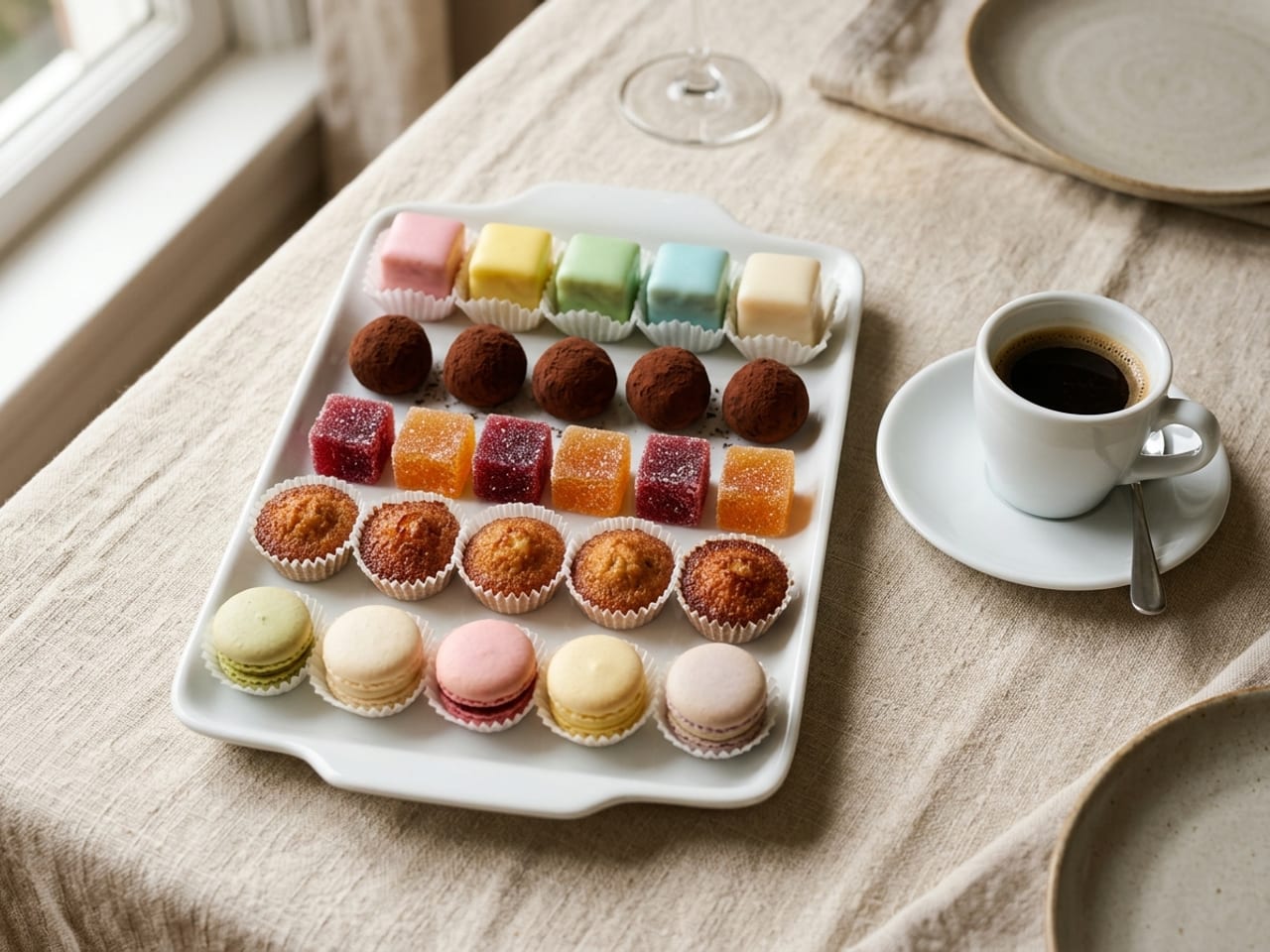
Mignardises (min-yar-DEEZ) are the small sweets, one or two bites each, served with the coffee at the end of a meal. Petit four (pet-ee FOR, French for "small oven") is the older word for these sweets and the wider one, covering small cakes and biscuits; in the United States it usually means a small fondant-iced cake square.1, 13, 18, 59, 65
- Mignardises vs petit fours: for the Culinary Institute of America and Friberg they are the same category; for the MICHELIN Guide a petit four is usually baked and jellies and chocolates are mignardises. We follow the first and say why (the line).21, 61, 65
- Types of petits fours: the textbooks we read sort them into two, three, four, five or six groups, and one 1902 book into ten; the names that recur are sec (dry), glacé (iced), frais (fresh) and déguisé (disguised fruit) (every classification).
- How many per guest: the lowest printed figures are two (a 2018 service textbook, after dessert; Pellaprat 1968) and two or three (Craig 1970, a party menu); our line, two or three each after a full dinner, follows them (every count).83, 84, 87
- Make them ahead: truffles, fruit jellies, dry biscuits and fondant-iced cakes keep for days; choux and cream-filled things are made the same day (the tray).31, 61
- Four recipes: iced petits fours, dark chocolate truffles, pâte de fruits and financiers, each our synthesis of the published recipes cited beside it.
On this page: Meaning and pronunciation · Mignardises vs petit fours · Types of petits fours · The US iced petit four · How restaurants serve them · How many per person · A make-ahead tray · Iced petits fours · Truffles · Pâte de fruits · Financiers · Faults and fixes · Food safety · History · Popular claims · The words · FAQ
How this page was made. Every definition, figure, quotation and verdict comes from the source named beside it: French and English dictionaries, pastry and service textbooks (Gisslen, Friberg, Garrett, Figoni, the Culinary Institute of America and École Lenôtre, cited as books; many others read only as search fragments, which their entries say), restaurant guides and menus, test kitchens, magazines and published recipes, US, UK and Australian food agencies, and old cookbooks read in machine-read library scans. Plate Artists cooked, tasted, timed and measured nothing for it; the four recipes are our synthesis of the cited published ones, not recipes we tested. Conversions, sums and readings marked "ours" are our own. Sources are at the bottom.
Mignardises in English, petit four meaning, and how to say them
Mignardise in French. The TLFi gives the pastry sense last, after daintiness, affectation, a small pink and a braid: "Petits gâteaux servis à la fin du repas (avec le café et les liqueurs le plus souvent)", small cakes served at the end of the meal, most often with the coffee and liqueurs, with one citation, a Gault-Millau guide of July 1984.1 Larousse adds that they come as an assortment, "servie en assortiment à la fin d'un repas", and the Académie française's 9th edition says the sense arose "par confusion avec friandise"; its 8th (1932 to 1935) and 4th (1762) editions have no food sense at all.6, 9 Nor does Littré (1863 to 1872), though its history of the word quotes Agrippa d'Aubigné on the "vivres et mignardises" of the Île d'Oléron, its provisions and dainties.7 The root, mignard, means "gracieux, délicat, joli" (TLFi, dated 1524).2
Mignardises in English. The word is a French loan with little dictionary life in English: Cambridge has no entry, and the Oxford English Dictionary's free factsheet lists three meanings, earliest 1603 (Florio), with uses in "knitting (1860s) baking (1930s)", the wording of each behind its paywall.15, 18 In English kitchens it is the Culinary Institute of America's "An assortment of small, two-bite-size pastries" and Friberg's "another name for an assortment of petits fours".61, 65 A Boston Magazine piece glosses it as French for "precious"; the dictionaries give dainty and affected, not precious.1, 2, 27
Petit four meaning. "French, literally, small oven" (Merriam-Webster), plural "petits fours or petit fours"; its American sense is "a small cake cut from pound or sponge cake and frosted", while Cambridge's British one is "a small cake or biscuit, usually served at the end of a meal with coffee".13, 15 In French the TLFi says "cuite au four", baked, and Larousse allows a fresh or dry cake or a small savoury nibble, "que l'on mange d'une seule bouchée".3, 10 The pastry textbooks size it as "one or two bites" (Gisslen; the CIA; Labensky "one to two"; Bilheux "a bite or two").58, 65, 68, 69
How to say them. Every pronunciation we read, as printed:
| Word | Source | As printed |
|---|---|---|
| Mignardise | Oxford English Dictionary18 | min-yar-DEEZ (British /ˌmɪnjɑːˈdiːz/, US /ˌmɪnˌjɑrˈdiz/) |
| Mignardise | TLFi (French)1 | [miɳaʀdi:z]; the CNRTL portal prints \mi.ɲaʁ.diz\ |
| Mignardise | MICHELIN Guide (Macau, 2019)22 | "mean-ya-diz" |
| Petit four | Merriam-Webster13 | \ˌpe-tē-ˈfȯr\, also \pə-ˌtē-\ and \-ˈfu̇r\ (PET-ee-FOR, puh-TEE-, -FOOR) |
| Petit four | Oxford English Dictionary17 | pet-ee FOR (British), ped-ee FOR (US) |
| Petit four | Cambridge15 | UK /ˌpet.i ˈfɔːr/, US /ˌpet̬.i ˈfɔːr/ |
| Petit four | Collins (2015)16 | (ˈpɛtɪ ˈfɔː; French pəti fur) |
| Petit four | Gisslen59 | "p'tee foor" |
| Petit four | MICHELIN Guide (Macau, 2019)22 | "per-tee-foor" |
| Friandise | TLFi (French)4 | [fʀijɑ̃di:z] |
| Café gourmand | Wiktionnaire8 | \ka.fe ɡuʁ.mɑ̃\ |
| Lagniappe | Merriam-Webster14 | \ˈlan-ˌyap\ or \lan-ˈyap\ (LAN-yap) |
Mignardise vs petit four vs friandise: where each source draws the line
Fourteen rows of sources, side by side. They split three ways: baked against not baked (the MICHELIN Guide articles, English Wikipedia), two names for one thing (the Culinary Institute of America, Friberg, the French dictionaries), and a menu word for the tray (the British textbooks, Escoffier). We do not pick a winner.
| Source | Petit four | Mignardise | Where the line falls |
|---|---|---|---|
| TLFi (French dictionary)1, 3 | "Petite pièce de pâtisserie, cuite au four", served at a reception, a tea or as dessert | "Petits gâteaux servis à la fin du repas (avec le café et les liqueurs le plus souvent)"; one citation, 1984 | Baked (petit four) against the end of the meal (mignardise); they overlap |
| Académie française, 9th ed.6 | "petite pièce de pâtisserie", ordered "pour un buffet, une réception" | "Petite pièce de pâtisserie ou de confiserie (par confusion avec friandise)", served with the coffee | No line drawn: a mignardise can also be a confection |
| Larousse (French dictionary)9, 10 | "Petit gâteau (frais ou sec) ou petit amuse-gueule salé, que l'on mange d'une seule bouchée" | "Petite pâtisserie servie en assortiment à la fin d'un repas" | Mignardises are the assortment at the end of the meal; petit four is wider and can be savoury |
| Office québécois de la langue française (1998)12 | Not defined in the fiche | "Assortiment de confiseries ou de petits fours sucrés proposé à la fin d'un menu": éclairs, choux and tartlets | Mignardises include sweet petits fours, baked ones in its own examples |
| Merriam-Webster, Cambridge, Collins13, 15, 16 | "a small cake cut from pound or sponge cake and frosted" (MW); "a small cake or biscuit, usually served at the end of a meal with coffee" (Cambridge) | No entry in Cambridge; none we could read in Merriam-Webster or Collins | No mignardise entry in Cambridge; Merriam-Webster's and Collins's could not be read |
| Oxford English Dictionary17, 18 | One meaning, earliest evidence 1875 (wording behind the paywall) | Three meanings, with uses in "knitting (1860s) baking (1930s)" (wording behind the paywall) | Not readable without a subscription |
| MICHELIN Guide Singapore (2022) and Macau (2019)21, 22 | "usually baked in the oven": madeleines, tarts, macarons, canelés | "jellies and chocolates are mignardises" (Singapore); "the Alphonso mango tart is a mignardise" (Macau) | Baked or not; the two articles put tarts on opposite sides |
| English Wikipedia, citing a blog37, 38 | Miniature iced cakes: éclairs, chocolate profiteroles, sweet tartlets | "miniature desserts, that are not baked, such as mini chocolate mousses" | Baked or not; the words "not baked" are Wikipedia's, not in the blog it cites |
| Culinary Institute of America (2004, 2016)65, 66 | "a small sweet item that can be consumed in one or two bites" | "This category, also called mignardises"; glossary: "An assortment of small, two-bite-size pastries" | Two names for one category |
| CIA, Remarkable Service (2009)67 | Not in its glossary fragments | The "sweetest of the sweets", served with coffee: truffles, chocolates, caramels, dipped fruits and nuts, macaroons | Mignardises are confections served with coffee or with the check |
| Friberg (2002)61 | "by definition, is bite-sized and elegantly decorated" | "another name for an assortment of petits fours" | Mignardises are an assortment of petits fours |
| Nicolello (1994), Burke (2013)71, 72 | The collective term | One of several menu names for the tray, beside friandises, gourmandises and frivolités | Mignardises is a menu word for the petits fours |
| Escoffier (1903)49 | "Friandises" on a menu are "une variété de Petits Fours et Fruits glacés" | "Mignardises Moscovite" are savoury: tiny tartlets, barquettes and little sandwiches | Menu names; his mignardises here are savoury |
| MICHELIN Guide France (2024)23 | Not used | A "chariot de mignardises" of kougelhopf, financier, madeleine, lemon meringue tart and Paris-brest | In practice, baked things are mignardises too |
What this page follows (ours). Mignardises for the assortment served at the end of a meal, petit four for each piece and for the wider family, as the Culinary Institute of America, Friberg, Larousse and the Office québécois de la langue française use them. We do not use baking as the line: the two MICHELIN Guide articles disagree on where a tart goes, a French restaurant's chariot de mignardises in the MICHELIN Guide carries financiers and madeleines, and the OQLF's own examples of mignardises are baked éclairs, choux and tartlets.9, 12, 21, 22, 23, 61, 65
Friandise
In French a friandise is a delicate dish, "salé ou sucré", and especially, usually in the plural, "Sucreries, petites pâtisseries" (TLFi, which dates the word to 1342 and the sense of a dainty thing to 1541); Larousse: "en particulier petit gâteau, confiserie, sucrerie".4, 11 In English the Oxford English Dictionary marks the old borrowing obsolete (1484 to 1604), but kitchens use the French word: Labensky's petits fours "may also be referred to as friandises", the Food Lover's Companion's are "truffles, mints or petits fours" served after the dessert, Lillicrap's service sequence says "Offer petits fours/friandises to the customers" (2010), and Escoffier's 1903 menus use Friandises for "une variété de Petits Fours et Fruits glacés".19, 20, 49, 69, 82 Its cousin gourmandises is, in the TLFi, a synonym of friandises.5
Café gourmand
A coffee served with several small sweets on one plate, "Café accompagné de différentes mignardises" (Wiktionnaire).8 Le Figaro called it in 2009 "la version au goût du jour des mignardises disposées en fin de repas sur la table pour «pousser» le café": the up-to-date version of the mignardises put out at the end of a meal, sold rather than given.32 Who invented it is disputed: see the history.
Lagniappe, as the CIA uses it
The Culinary Institute of America's service textbook: "Friands ('dainty tidbits') or mignardises may accompany the check. Like dessert, these lagniappes ('something extra,' in Louisiana Creole) are meant to leave a sweet taste".67 It is a description, not a course name: Merriam-Webster's lagniappe is "a small gift given to a customer by a merchant at the time of a purchase", from American Spanish and the Quechua yapa, something added.14
The types of petits fours: two to six, or ten, depending on who you read
The short version for a class. The usual four-type answer is glacés (iced), secs (dry), frais (fresh) and déguisés (fruit coated in sugar, fondant or chocolate): Suas's textbook, MasterClass and a culinary school's blog. Tasting Table's four swap déguisés for salés (savoury) and Garrett's for demi-secs (dry sandwich cookies), Suas adds a fifth, prestige, and Gisslen's Professional Baking has only two, secs and glacés.33, 34, 35, 58, 62, 70 So "the 4 types of petits fours" is Suas's answer and the magazines', not the only one. Every classification we read:
| Source | Kind | How many | The groups, as printed | Notes |
|---|---|---|---|---|
| Montagné and Salles (1902)51 | Old trade book | 10 | fours secs; fours feuilletés; pâte à savarin ou à baba; pâte génoise; pâtes d'amandes, d'avelines, de pistaches, de pignons, de noix; fruits nappés au fondant; fruits nappés au sucre au cassé; fruits candisés; fruits déguisés; compositions diverses | Sorted by base. Fruit confections, fondant-coated, sugar-glazed, candied and disguised, all count as petits fours. |
| Gisslen (1985 to 2017)58, 59 | Textbook | 2 | secs; glacés | "Petits fours are divided into two categories"; glacés include "tiny eclairs, tartlets, filled meringues, and cakes". The same wording in every edition we searched. |
| Friberg (2002)61 | Textbook | 2 | sec; glacé | Names the two; mignardises are "another name for an assortment of petits fours". |
| Mathiot (1991)74 | French household book | 2 | secs; glacés | "Les premiers se conservent fort bien": the dry ones keep very well. |
| Bilheux and Escoffier (1998)68 | Textbook | 2 | secs; frais | "In France, petits fours are sometimes divided into two categories": dry and crunchy, or with "some kind of filling"; macaroons count as sec though filled. |
| Bilheux and Escoffier, by method68 | Textbook | 4 | simple mixtures; creamy mixtures; beaten egg whites folded with powdered ingredients; beaten egg whites folded with liquids or semisolid ingredients | The same book groups its dry petits fours a second way, "based on the method of preparation": tuiles and sablés first, macaroons last. |
| Labensky, On Baking (2009)69 | Textbook | 3 | dry (sec); fresh (frais); iced (glacés) | Iced ones are "most frequently made from a firm cake such as a joconde". |
| Garrett (2012)62 | Textbook | 4 | secs; glaces; frais; demi-secs | Demi-secs are "dry, filled sandwich cookies"; financiers and madeleines go in secs. |
| Johnson & Wales, Culinary Fundamentals (2001)77 | Textbook | 4 | glaces; sec; demi-sec; a fourth cut off in the fragment we read | A US culinary school's textbook; demi-sec again. |
| Burke (2013); Foskett and others (2014)72, 73 | Textbook | 3 | glacé; sec; confiserie variée | The two British vocational textbooks; the third group "covers all the other petits fours confections that do not come under the glacé or sec categories". |
| Nicolello (1994)71 | Textbook | 3 | sec (dry); glacé (glazed); a third group cut off in the fragment we read | A British confectionery textbook. His secs are made from biscuits, meringues, almond mixing, puff paste and sweet paste; glacés and variés "are usually referred to as friandises"; his chapters add boiled-sugar petits fours and marzipan friandises (déguisés). |
| Suas (2009)70 | Textbook | 4 + 1 | sec; glacés; frais; déguisés; and, contemporary, prestige | Madeleines and financiers go in frais; glacés are "not as common as it once was". |
| Tasting Table (2024)33 | Magazine | 4 | glacé; sec; frais; salés | Salés are "bite-sized quiches and miniature sandwiches"; madeleines and financiers in frais. |
| MasterClass (2025)34 | Magazine | 4 | glacés; sec; frais; déguisés | Déguisés are "made by dipping fruit in chocolate or sugar syrup". |
| Escoffier school blog (2021)35 | Blog | 4 | sec; glacés; frais; déguisés | A culinary school's blog, not Auguste Escoffier's books; no savoury group. |
| Sporked (2024)36 | Blog | 3 | glace; secs; frais | Puts madeleines and macarons among the secs. |
| English Wikipedia38 | Encyclopedia | 5 | glacé; salé; sec; frais; déguisés | Its salé group cites only a South African food company's page (CAB Foods); the school blog it cites for the other groups names no salé. |
| French Wikipedia39 | Encyclopedia | 5 | frais; glacé; salé; moelleux; sec | Uncited; moelleux are "ni frais ni secs", neither fresh nor dry. |
| Life on La Lune (2017)37 | Blog | 3, unnamed | iced miniatures; dry sweets; savouries | The blog English Wikipedia cites for its baked line. |
| Juillet, Classic Patisserie (1998)78 | Textbook | 6 | secs; frais; glacés; déguisés; salés; a sixth we did not find | A British A to Z handbook; its salés "are also referred to as Amuse-Gueules". |
Where the lists disagree. Madeleines and financiers move between frais (Suas, MasterClass, Tasting Table) and sec (Garrett; Sporked for madeleines); fruits déguisés are a petit-four type for Suas, MasterClass, Montagné, Juillet and a French guidebook, but confectionery for Bilheux and friandises for Nicolello; and the savoury group appears in the magazine, the encyclopedias, a blog, French usage and one English handbook (Juillet), never in the other textbooks we read.33, 34, 36, 51, 62, 68, 70, 71, 75, 78 The oldest list we read, Montagné and Salles in 1902, has ten groups, sorted by the paste or the fruit.51
Each type, with examples and who names it
Petits fours glacés
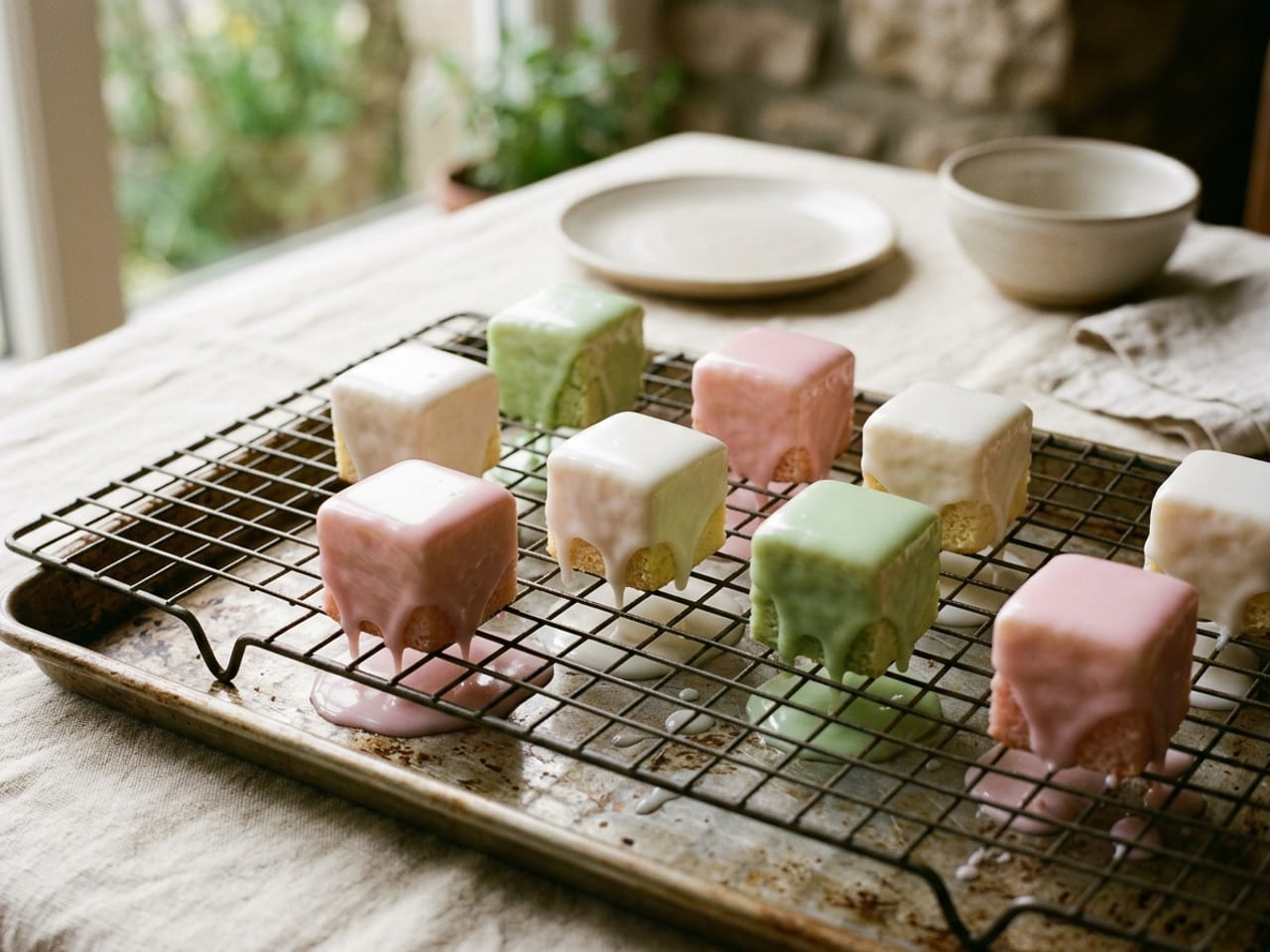
iced; in Gisslen, Friberg, Labensky, Suas, Burke and every magazine list
"Petits fours glacés are iced petits fours" (Gisslen); for Suas, "small, bite-sized cakes with a thin coating of glaze, typically fondant", made in large sheets of thin cake layers, and "not as common as it once was".58, 70 In London in 1910 the fours glacés were "by far the most universally popular".53
Examples. Fondant-iced cake squares; Gisslen also counts tiny éclairs, tartlets and filled meringues; Harris and Borella's Genoese square with a walnut half under coffee fondant.53, 58 The recipe is below.
Petits fours secs
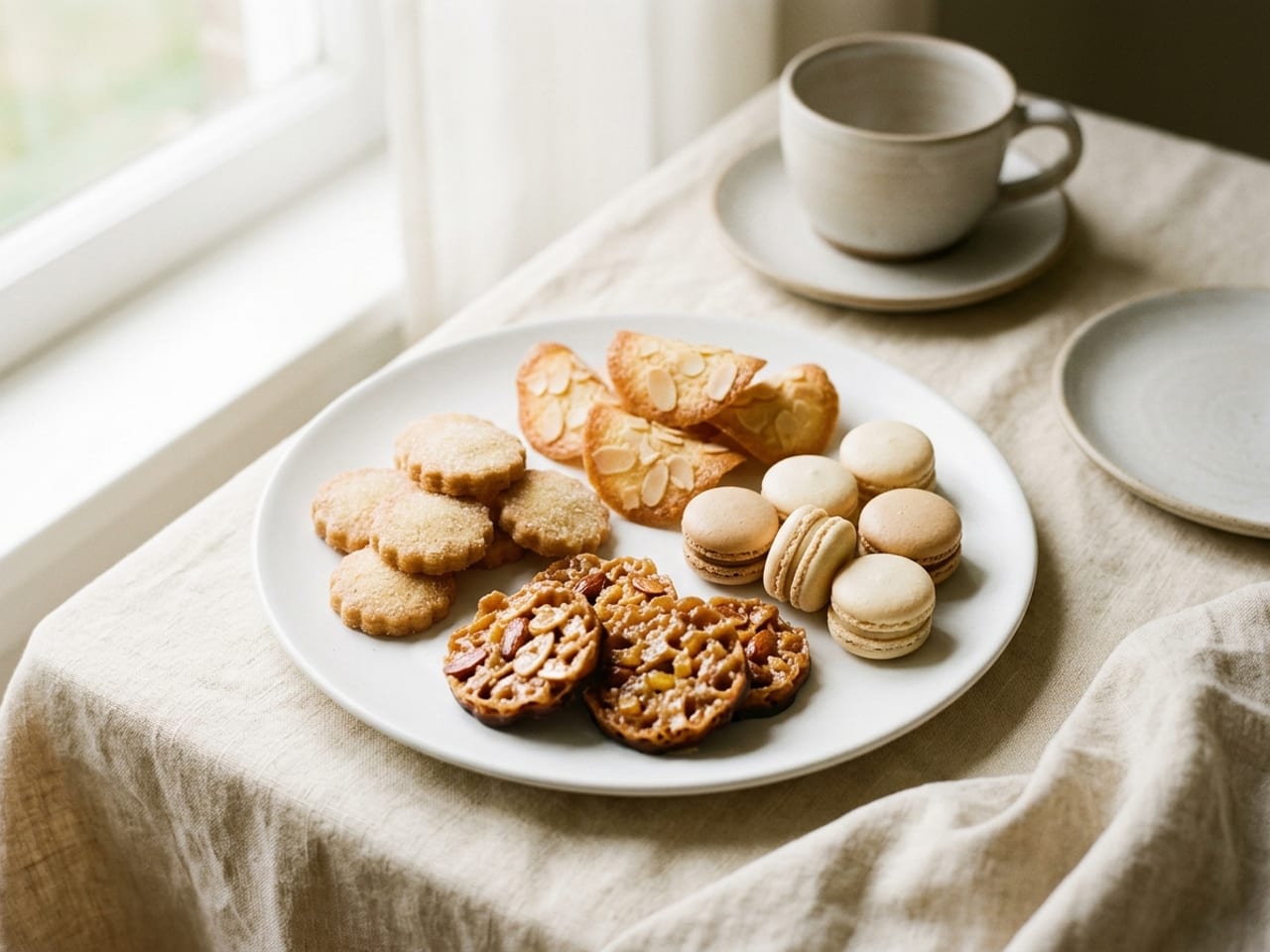
dry; in every textbook list we read
Small, crisp and dry, with "no icing or cream filling, although they may be dipped in chocolate"; served "with after-dinner coffee or as an accompaniment to such cold desserts as ice cream, mousses, and Bavarian creams" (Gisslen). Mathiot: "Les premiers se conservent fort bien", they keep very well.58, 74
Examples. Gisslen's list: butter tea cookies, almond, coconut and pistachio macaroons, shortbread, spritz, langues de chat, almond tuiles, florentines, palmiers and other puff pastry; Burke's cats' tongues, macaroons and Dutch biscuits; Bilheux's tuiles, sablés and diamants.58, 68, 72
Petits fours frais
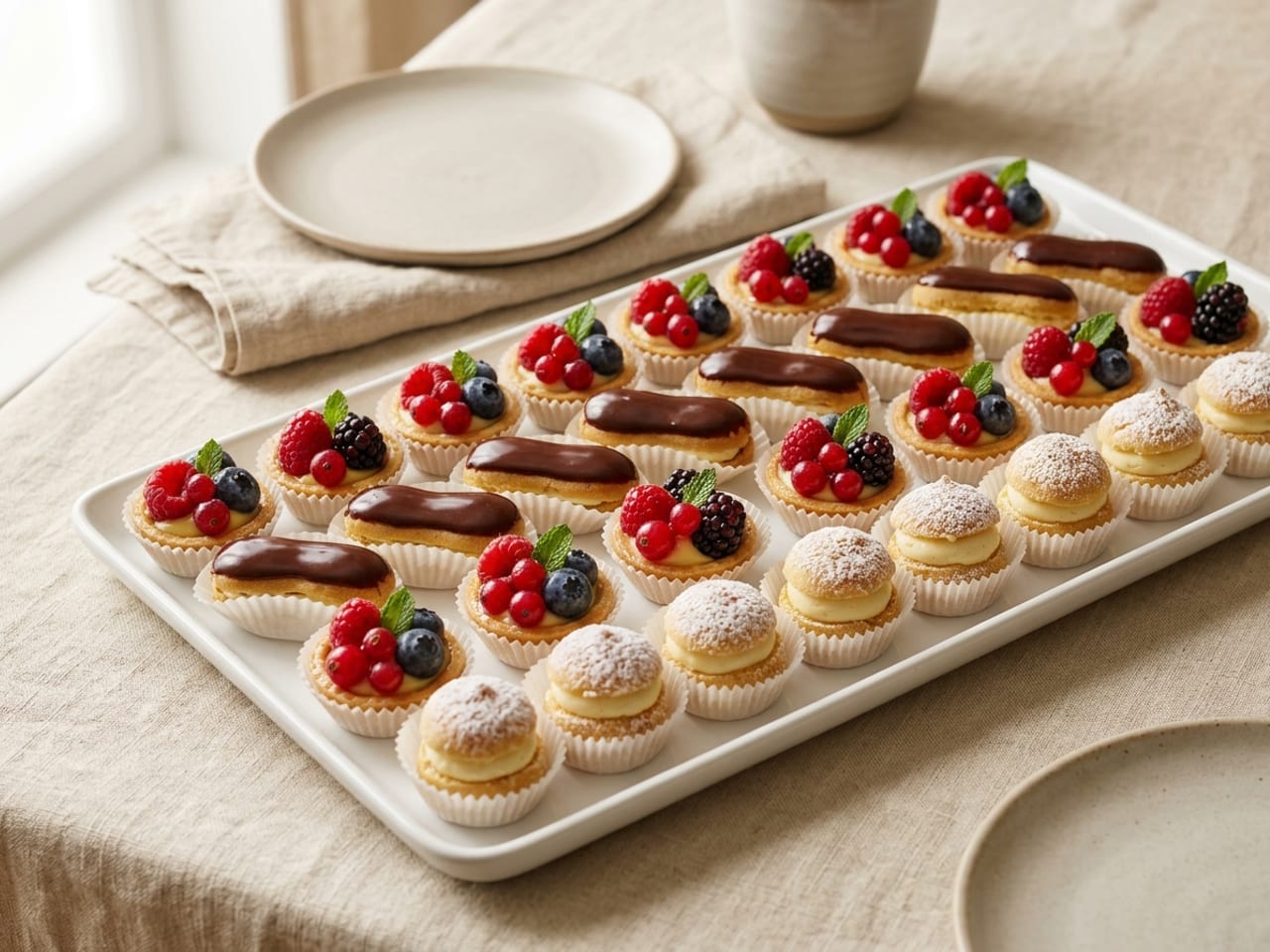
fresh; in Bilheux, Labensky, Suas and the magazine lists
"Moist miniatures that may contain fruit and fillings such as buttercream, citrus curd, ganache or various mousses" (Labensky), or, for Suas, "items that are served the day they are made".69, 70
Examples. Fruit tartlets, cream puffs and éclairs (Garrett). Madeleines and financiers are frais for Suas, MasterClass and Tasting Table and sec for Garrett; Sporked puts madeleines in sec too; Gisslen counts tiny éclairs and tartlets among his glacés.33, 34, 36, 58, 62, 70
Petits fours déguisés
disguised fruit; in Suas, MasterClass, the school blog, Montagné and Salles, Nicolello and Juillet
"Made from fresh, dried, or candied fruits that are coated in cooked sugar, fondant, chocolate, or any combination", traditionally coated in marzipan first (Suas).70 Bilheux and Escoffier file fruits déguisés under chocolate work instead, as things sold in candy shops; a French guidebook calls them "petits fours faits de fruits".68, 75
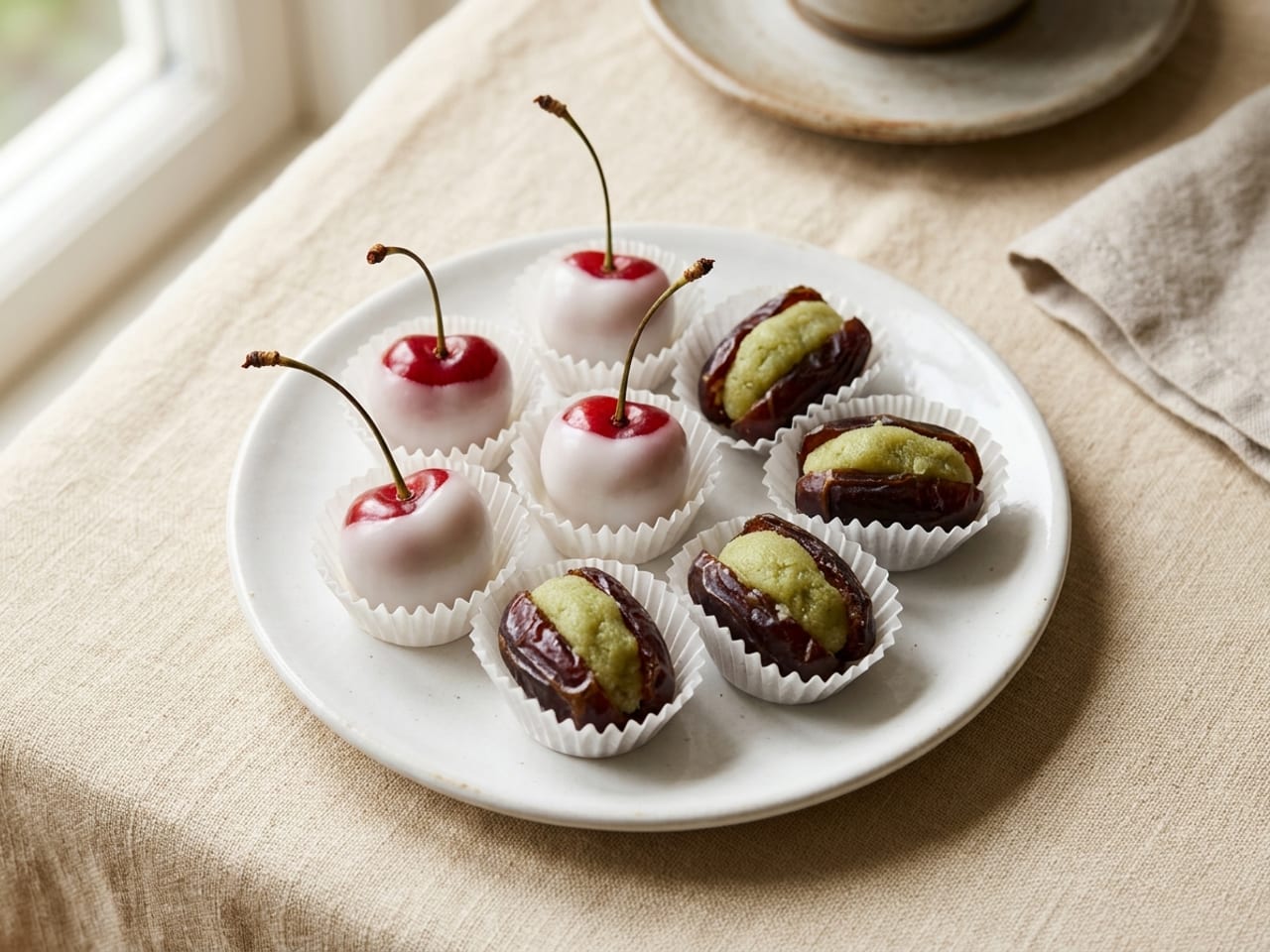
Examples. Dates stuffed with fondant or marzipan and glazed with sugar "to serve on a petits fours tray", and Cape gooseberries dipped in chocolate or fondant (Friberg); Lacam's cerises déguisées, brandied cherries glazed in fondant, filed under his fours glacés (1911).54, 61
Petits fours salés
savoury; in Tasting Table, both Wikipedias, Juillet and French usage
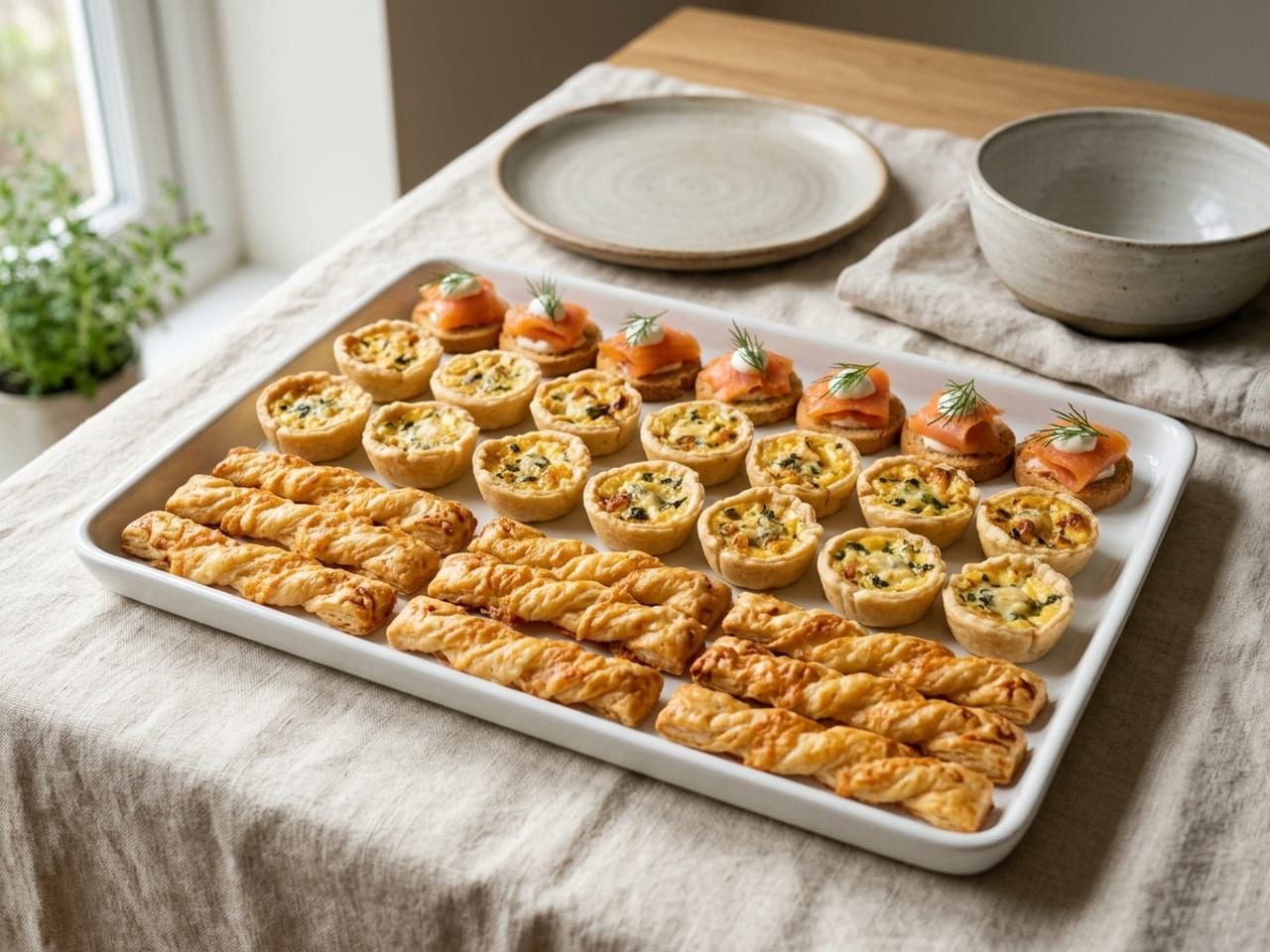
Larousse's petit four can be a "petit amuse-gueule salé", and Escoffier's 1903 "Mignardises Moscovite" are tiny tartlets, barquettes and little sandwiches.10, 49 Of the English textbooks we read, only Juillet's A to Z handbook (1998) lists a savoury group, "also referred to as Amuse-Gueules"; in English these are usually hors d'oeuvres or canapés.78
Examples. "Bite-sized quiches and miniature sandwiches" (Tasting Table). In France people search for petits fours salés for the apéritif (our autocomplete pull).33, 118
Petits fours prestige
contemporary; in Suas
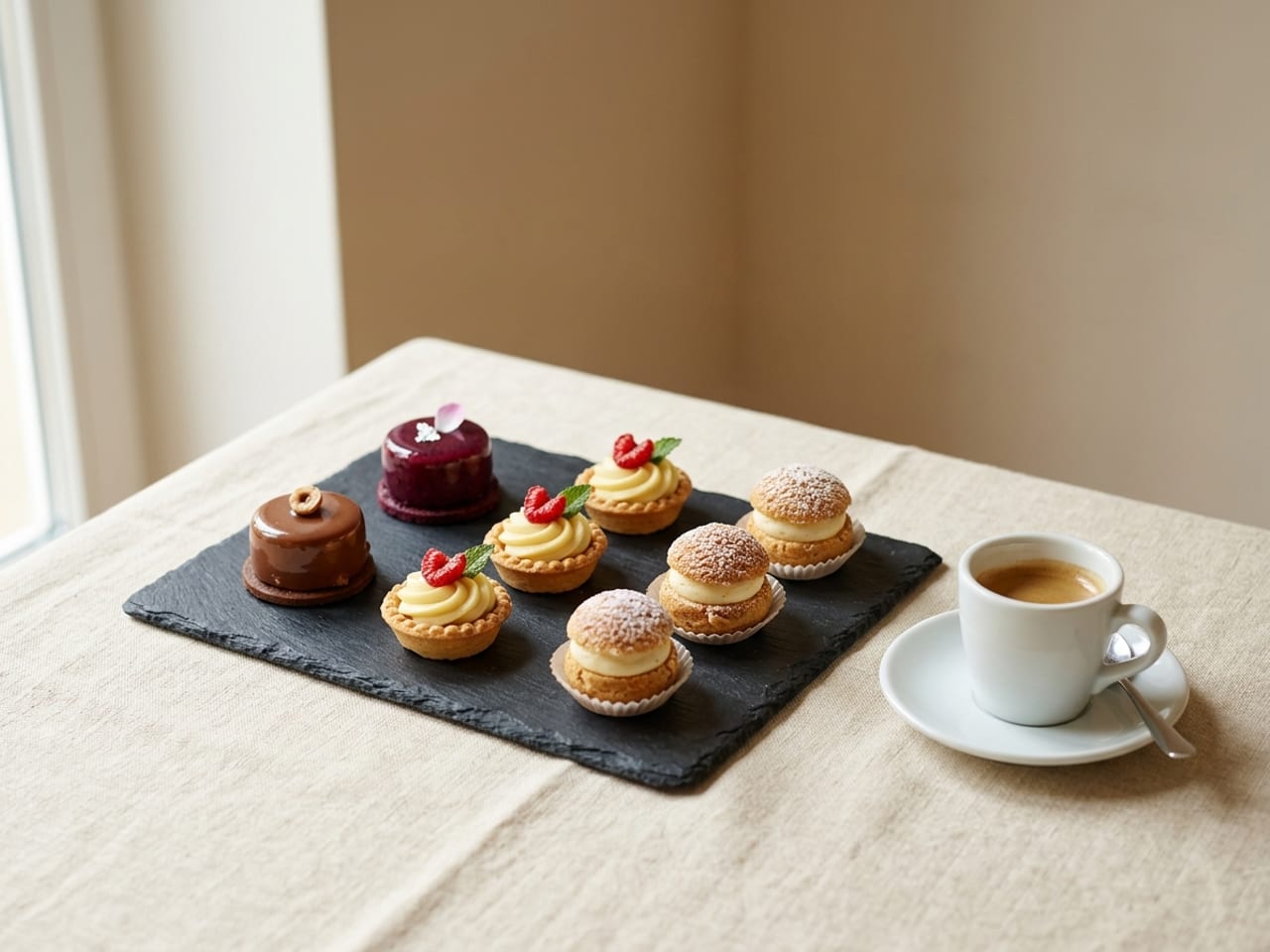
"Composed of more advanced preparations, mirror current trends in pastry", and "may be smaller versions of contemporary entremets or other desserts" (Suas).70 Friberg: many larger pastries become petits fours "simply by cutting them into smaller pieces and perhaps enhancing the decoration a bit".61
Examples. Our examples of the kind, from tasting menus in Singapore: a green tea macaron with salted yuzu buttercream, a miso caramel macaron, a black sesame petit choux (MICHELIN Guide, 2022).21
Confections
confiserie; Burke's confiserie variée, Nicolello's boiled sugar
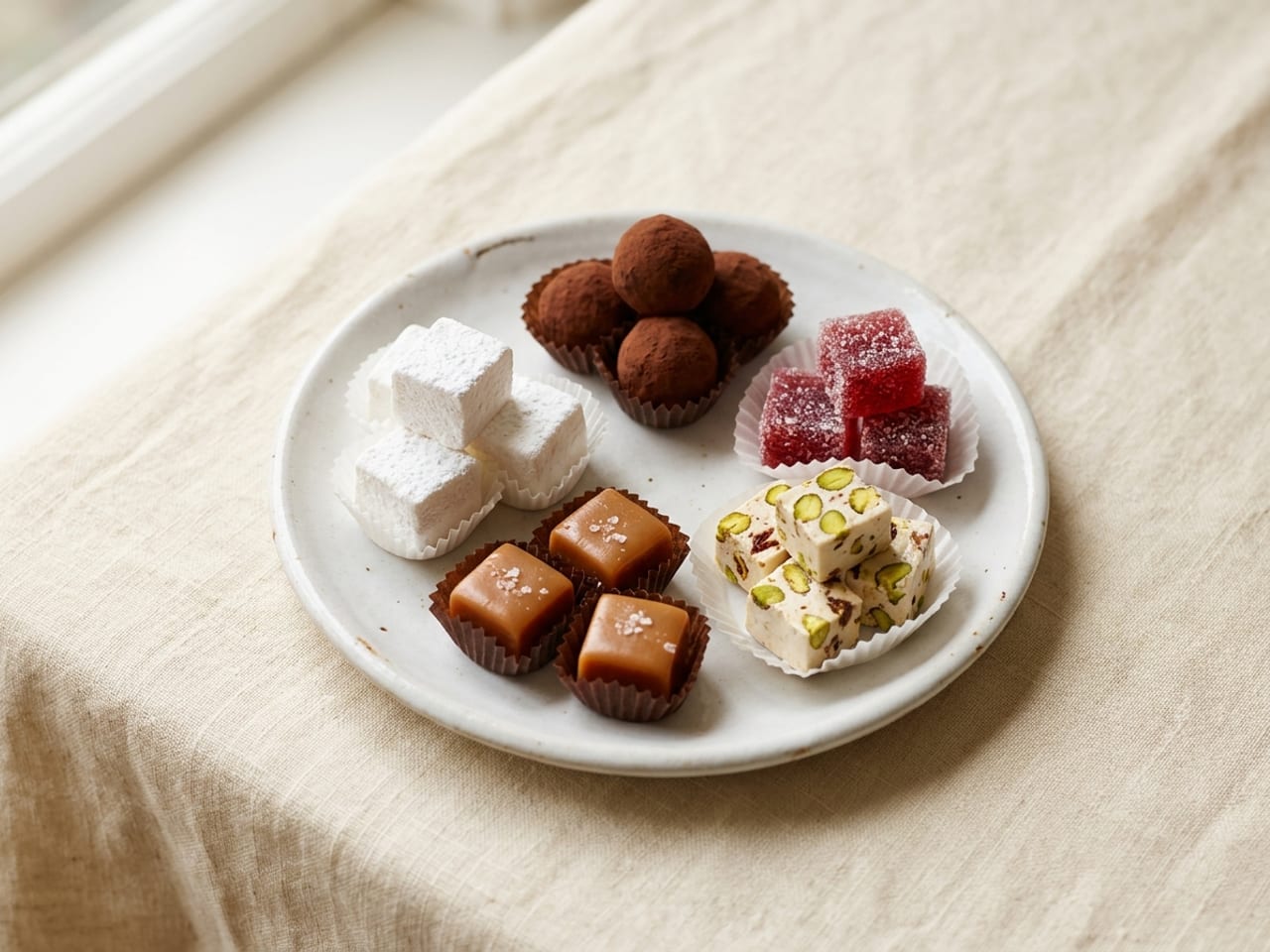
A petit-four group only in the British textbooks (Burke's confiserie variée, Nicolello's boiled-sugar petits fours), but on the tray in the other books that describe one: in Gisslen, restaurants serve "tiny chocolates and petits fours", his pâte de fruits and candied zest "add appeal to plated desserts and petit four trays", and the CIA's service book lists "truffles, chocolates, caramels, dipped fruits and nuts, macaroons" as mignardises.58, 67
Examples. Truffles, pâte de fruits, marzipan fruits ("perhaps the most popular items", Gisslen), caramels (Lenôtre), Lacam's nougat petits fours and pastilles de guimauve (marshmallow, 1911).54, 58, 64 Recipes for truffles and pâte de fruits are below.
The American iced petit four vs the French tray
In the United States a petit four is a cake. Merriam-Webster's only sense is "a small cake cut from pound or sponge cake and frosted", and Gisslen writes: "In North America, the usual type of petit four is a cake cutout iced with fondant. In fact, most people are probably not aware of any other kind." 13, 59 He adds that many of these cakes in American bakeshops "are, in fact, not very 'petit'", and that the broader meaning arrived as restaurants began serving a tray of tiny chocolates and petits fours after dessert.58 Merriam-Webster's 2026 examples show both senses: a sheet cake cut "into single-serving petits fours" (Southern Living) and a tasting menu ending in "a single petit four" (The New Yorker).13
How old the American cake is. In what we read, the earliest American recipe is Fannie Farmer's single "Petit Four" in a printing whose copyrights run 1896 to 1906: cream sponge cake cut with a small round cutter, split and filled, dipped in coloured fondant and set "in a paper case". A 1921 Ohio trade book makes them in sheets 18 x 26 inches (46 x 66 cm, ours) with apricot or marmalade and fondant "of different flavors and colors"; a 1925 catering textbook lists them as small sponge or pound cakes covered with fondant; a 1962 New York pastry book: "In America, Petits Fours Glacés are generally made out of Sponge Cake mixture or Frangipane baked in sheet pans". 55, 56, 57, 76 In British usage they stayed wider: Cambridge's "a small cake or biscuit", Collins's "very small rich sweet cakes and biscuits, usually decorated with fancy icing, marzipan, etc".15, 16
Petit fours vs cake, cupcakes and fondant fancies. No source we read compares them directly. By the definitions above, a petit four is cut from a sheet of cake, layered and coated all over, top and sides; a cupcake is baked in its own cup and frosted on top (ours). English Wikipedia says that in England petits fours are also known as "fancies", citing a hotel-English website; we did not find it in a dictionary.38 In American searches, "petit fours" sits beside Publix, Costco and Walmart: the bought cake square (our autocomplete pull).118
How small. Gisslen caps the iced petit four at 1 in. (2.5 cm) high and across, and Garrett and the CIA hold it to about an inch high; Friberg's cutters run 1 to 1½ inches (2.5 to 3.7 cm) and Nicolello prints 2½ to 3 cm. Popular recipes run 1 to 1½ inches (2.5 to 4 cm, ours) and drift up to 2 and 3 inches (5 and 7.5 cm, ours). The size figures we read, as printed:
| Source | Kind | What | Size, as printed |
|---|---|---|---|
| Gisslen, 7th ed. (2017)58 | Textbook | Iced petit four | no more than 1 in. (2.5 cm) high, no more than 1 in. (2.5 cm) across |
| Gisslen, 4th ed. (2005)60 | Textbook | Iced petit four | 1 in. (2.5 cm) high and across |
| Culinary Institute of America (2004)66 | Textbook | Glazed petit four | "no higher than 1 in/3 cm" (the CIA's own twin) |
| Garrett (2012)62 | Textbook | Iced petit four | 3/4 in to 1 in (1.9 to 2.5 cm) tall |
| Friberg (2002)61 | Textbook | Petits fours cutters | 1 to 1½ inches (2.5 to 3.7 cm) across |
| Nicolello (1994)71 | Textbook | Any petit four | "approximately 2½-3 cm" (about 1 to 1¼ in, ours; the scan reads "23-3 cm") |
| Harris and Borella (1910)53 | Old trade book | Glacé square | 1¼ or 1½ in. squares (the scan is unclear; 3 to 4 cm, ours) |
| King Arthur Baking90 | Popular recipe | Iced petit four | 1 in. (2.5 cm, ours) |
| What's Cooking America99 | Popular recipe | Store-cake squares | approximately 1 inch (2.5 cm, ours) |
| Rose Bakes94 | Popular recipe | Squares | 1 to 1.25 inches (2.5 to 3 cm, ours) |
| My Cake School93 | Popular recipe | Round cutter | 1¼ inches (3 cm, ours) wide |
| Preppy Kitchen95 | Popular recipe | Cubes | 1.25 to 1.5 inches (3 to 4 cm, ours) |
| SheKnows97 | Popular recipe | Cake-mix squares | 1½ inches (4 cm, ours) |
| Add a Pinch96 | Popular recipe | Pieces | 2 inches (5 cm, ours) |
| Mom Loves Baking100 | Popular recipe | Egg shapes | 3-inch (7.5 cm, ours) cutter |
How restaurants serve mignardises
The last course of a tasting menu, and the sweet bookend to the amuse-bouche at its start: Suas calls petits fours "the pastry kitchen's version of the savory amuses bouche".70 They are the last line of the long menus in our courses of a meal guide and the last card of the prix fixe guide's home tasting menu.
- After dessert, with coffee or tea"Petit Fours are usually served post-dessert, along with coffee or tea, in a tasting menu" (MICHELIN Guide); in Gisslen, more and more restaurants serve "a small tray or plate of tiny chocolates and petits fours of many types after dessert". In France, Bilheux and Escoffier add, they also go "with dessert", almost always one with no flour, such as ice cream or a bavarian, and with afternoon tea or coffee.21, 59, 68
- With liqueurs and digestifsLillicrap's 1971 service textbook: at the coffee, "petit fours will be placed on the table and liqueurs offered"; Singapore's JAG pairs its petit fours with teas, tisanes or coffee and proposes "some digestif spirits". Wine Spectator called them bites "designed to accompany coffee and after-dinner drinks".21, 26, 81
- With the check, as something extra"Friands ('dainty tidbits') or mignardises may accompany the check" (the CIA's service textbook); a 2018 service course text: "Present the check upon request only. Serve two mignardises per person." Lillicrap's 2010 sequence offers the petits fours or leaves the tray on the table, then brings the bill. Boston Magazine called them complimentary confections that "help soften the blow of getting the check".27, 67, 82, 84
- On a tray, a plate, a basket or a trolleyA small tray or plate (Gisslen); the tray placed on the table (Lillicrap, 2010); "a basket of madeleines still warm from the oven" (Daniel, 2000); Lobmeyr candy dishes (Menton, Boston, 2014); a blue glass tray (elBulli); silver trays, glass étagères or boxes at French weddings (ABC Salles). With a server or a tray presented at the table, no paper cups; for self-service, small "petits fours cups" (Friberg).26, 27, 30, 59, 61, 82, 132
- The chariot de mignardisesA trolley of sweets wheeled to the table. The 2021 French MICHELIN Guide notes one as "plutôt rare"; in 2024 it described La Fourchette des Ducs's in Obernai, with kougelhopf, a griotte financier, a lavender-honey madeleine, lemon meringue tart and Paris-brest, as "un monument aussi rare que beau". A 2003 Paris guide lists one of chocolates, macarons, caramels and calissons.23, 24, 25
- In a bag to take homeAt The French Laundry, every guest is handed "the cellophane wrapped cookies and truffles all guests receive at the end of a French Laundry meal" (Sonoma Magazine).28 In the UK, a sweet packed before it is ordered may count as prepacked for direct sale under the allergen rules (allergens).
- Under other namesJAAN calls its set "Final Sweets", Zén a "petit four program", served in the restaurant's living room; elBulli commissioned tableware for its "follies" (petits fours) in 1997 and replaced them with "morphings" in 2003; a 2025 Thomas Keller menu simply prints "Mignardises" as the last line.21, 29, 30
- Four pieces, as a jokeSome chefs serve four sweet bites as wordplay, "more of a playful tradition", but the name "does not have anything to do with the actual number" (MICHELIN Guide). Its seven Singapore restaurants served three to six.21
- At afternoon teaBilheux and Escoffier serve petits fours with afternoon tea or coffee.68 On a three-tier stand "the honest answer is that there are no rules" (TeaTime), though some tearooms and hotel lounges put the tiny pastries on top; Emily Post's 1922 stand had cake on the bottom (via Etiquetteer).133, 134
What named restaurants serve
As each source printed it; menus change, so each row carries its date.
| Restaurant | When | How many | What |
|---|---|---|---|
| Zén, Singapore21 | 2022 | Six | Black garlic fudge among them, served in the living room |
| JAAN, Singapore21 | 2022 | Four, "Final Sweets" | A shortbread called "Devon Cream Tea", an almond caramel dipped in chocolate, a coffee chocolate and lemon meringue pie |
| Art, Singapore21 | 2022 | Four | One of them Solero, "a medley of coconut gelato and citrus sorbet" |
| Braci, Singapore21 | 2022 | Four | A Martin Sec sorbet shaped as a little pear and a maritozzo with chantilly among them |
| Buona Terra, Singapore21 | 2022 | Three | Sicilian cannolo, apricot fruit gelée and an Earl Grey chocolate lollipop |
| JAG, Singapore21 | 2022 | Four | A red miso caramel macaron, eaten first, a melilot ganache and a black sesame petit choux among them |
| Sommer, Singapore21 | 2022 | Five | Canelé de Bordeaux, a spiced pineapple madeleine, a green tea macaron, a chocolate tart and a choux croustillant |
| The French Laundry, Yountville26, 28 | 2000; 2007 | Not stated | Bite-sized banana cream pies, triangles of lemon meringue and circles of pecan pie (2000); shortbread and truffles to take home |
| Daniel, New York26 | 2000 | A basket | Madeleines "still warm from the oven" |
| Tru, Chicago26 | 2000 | Not stated | Gale Gand's own versions of Tootsie Rolls and Almond Joys, and "a tiny root beer float" |
| Boston restaurants (five of the article's seven)27 | 2014 | Free | Meringues on a stick (Bondir), financiers (T.W. Food), a passion-fruit marshmallow, torrone, macaron and pâte de fruit (Salts), macarons in Lobmeyr candy dishes (Menton), tiny cake squares (Puritan & Company) |
| La Fourchette des Ducs, Obernai23 | 2024 | A trolley | Kougelhopf, a chocolate cookie, a griotte financier, a madeleine, tarts, Paris-brest, cheesecake, a cold chocolate soufflé and a jam doughnut |
| Guy Savoy, Paris31 | 1997 | Not stated | "It was like having another dessert after the three we had already been served" (Peter Hertzmann) |
What the chefs say makes a good set. "In my opinion, petit fours shouldn't be too complicated" (Art); "light on the tastebuds" (JAAN); cover "crunchy, spongy, biscuit-like bases, along with sweet, salty, and acidic notes" (Sommer); "all in a single bite" (Buona Terra), all in the MICHELIN Guide's Singapore round-up.21 Montagné and Salles asked in 1902 only that they not be "trop volumineuses ou trop lourdes", too big or too heavy.51
How many petits fours per person: every count we found
Our line: two or three each after a full dinner (ours). It follows the lowest figures printed: "Serve two mignardises per person" after dessert (a 2018 service textbook), "two per person is the average" with the coffee at the end of dinners or at a buffet (Nicolello, 1994), "Allow 2 Petits Fours per person" under a petits fours recipe (Pellaprat, 1968) and "2 or 3 petit fours per person" on a party menu (Craig, 1970).71, 83, 84, 87 It is not a rule, and the figures rise with the setting: three to five or more when the sweets are the dessert or the party, and a French pastry textbook says that where they are sold by weight in pastry shops, "most people allow from six to ten" per serving.68, 85, 130, 132 The seven starred Singapore restaurants in a 2022 MICHELIN Guide article served sets of three to six kinds, against "the usual four-piece selection".21
How many kinds. "Variety and small quantities are important" (Nicolello); a brand blog suggests three to seven varieties for a large gathering; for the tray below we use three or four kinds for a dinner of six to eight (ours).71, 126
| Who | Kind | The figure, as printed | The setting |
|---|---|---|---|
| Food & Beverage Management, SHA HF220 (2018)84 | Service textbook | "Serve two mignardises per person." | Fine-dining steps of service, after dessert, with the check |
| Nicolello, Complete Confectionery Techniques (1994)71 | Textbook | "two per person is the average" | Friandises on a cold buffet or with the coffee at the end of dinners, parties or any elegant function |
| OREO blog (2026)126 | Brand | "two to three dessert pieces per guest if dessert follows a meal" | Mini desserts after a meal; brand marketing |
| Bergrest traiteur (undated)129 | Caterer or shop | "2 à 3 pièces" for a café gourmand or small sweet finish; "3 à 4" as dessert after a full meal | A French caterer's table |
| Le 124 Cholet (2025)128 | Blog | "2 à 3 pièces" alongside another dessert; "au minimum 4 à 5" as the only dessert | Sweet petits fours at a meal |
| Pellaprat, Everyday French Cooking (1968)83 | Cookbook | "Allow 2 Petits Fours per person." | The end of a petits fours recipe in a home cookbook; no meal named |
| Craig, Business Woman's Cookbook (1970)87 | Cookbook | "2 or 3 petit fours per person" | A party menu with sandwiches and sausage rolls |
| Always Eat Dessert (2023)124 | Blog | "allowing 2-3 petit fours per person" | A party where other small bites are served |
| Sweet Life Patisserie (undated)125 | Caterer or shop | "about 2-3 pieces per person" | Finger-sized treats on a wedding dessert buffet |
| Lay, Inspired Celebrations (2012)89 | Cookbook | "Serves 20 (3 1-inch petits fours per person)" | A recipe yield in an entertaining cookbook; 1 inch is 2.5 cm (ours) |
| Felder, Patisserie (2013)85 | Textbook | "3 to 4 petits fours per person" at a dinner of finger food; "4 petits fours per person" at a cocktail party | Party planning, with savoury pieces besides |
| Du bocal à l'assiette (undated)127 | Caterer or shop | "3 à 4 mignardises par personne"; "6 à 8" for a wedding dessert; "environ 6 pièces sucrées" with a pièce montée; "Une pièce par heure" for dancing | A French shop blog; its apéritif figures (6 to 15) mix sweet and savoury |
| Cuisine Pratique (2026)130 | Caterer or shop | "3 à 5 petits fours sucrés par personne en dessert", more if they replace dessert | A buffet or cocktail |
| ABC Salles (undated)132 | Caterer or shop | "entre 3 et 5 mignardises par personne" | A wedding |
| Le 124 Cholet (2025)128 | Blog | "3 à 5" at a short apéritif or reception; "4-6" over several hours; "5-6" at a wedding | Receptions and weddings; the 4 to 6 is for several hours with no other dessert |
| Bergrest traiteur (undated)129 | Caterer or shop | "4 à 6 mignardises" as the usual start for a dessert buffet; "5 à 6" as the main dessert buffet; "6 à 8" for a long reception | A French caterer's table |
| LeCadet traiteur (undated)131 | Caterer or shop | "6 à 8 pièces par personne et par heure"; "20 à 24" for a whole meal, of which the sweet part "7 à 8" | An apéritif dînatoire, sweet and savoury |
| Seven restaurants, MICHELIN Guide Singapore (2022)21 | Restaurant guide | Sets of 3, 4, 4, 4, 4, 5 and 6 kinds; "the usual four-piece selection" | Starred tasting menus; the article does not say each guest gets one of each |
| A Day at elBulli (2008)30 | Restaurant | "Serve 2 pieces per person on a blue glass tray." | One end-of-meal item, not the whole set |
| Friberg (2002)61 | Textbook | "can consume two or three without guilt" | A remark about eating finger pastries, not a portion |
| Bridge, The Well-Tooled Kitchen (1991)88 | Kitchen-equipment book | "By allocating 6 petits fours per person, this 50-piece set meets most needs" | Sizing a set of petit-four moulds, in a kitchen-equipment book |
| Bilheux and Escoffier (1998)68 | Textbook | "Most people allow from six to ten petits fours per serving." | Petits fours bought by weight in a French pâtisserie |
| Lenôtre, Buffets Sucrés (1997)86 | Textbook | 200 to "250 g of sweet products per person"; 2 sweet pieces in a cocktail of 8 or 10, 3 in 12, 5 in 20 | Sweet buffets and cocktails; a weight, not a count |
| Gisslen; the CIA's Baking and Pastry and Remarkable Service; Lillicrap58, 65, 67, 82 | Textbook | No per-guest figure in what we read | The baking and service textbooks most often cited |
Build a mignardise tray at home, all of it made ahead
Mignardise ideas that wait: what to pick, how to set it out, how long each kind keeps, and a plan. Friberg is the only textbook we read with rules for arranging a tray, so his are quoted; the rest is labelled ours.
- Pick things that waitPeter Hertzmann's rule for his mignardise plate: "these items need to be able to be prepared in quantity and store or freeze well. Items that have to be prepared or assembled at the last minute do not make an appearance." The CIA says the same for volume service: "Most items should have components that can be made ahead".31, 65
- Plan it, then place it once"Plan your arrangement before you start to place the items on the trays or mirrors to avoid moving them, which mars both the item and the display surface. Start to arrange the items as close as possible to serving time."61
- Rows, one type per row"The pastries should be displayed in rows, one type per row, evenly spaced, on a clean mirror or tray", and the centre row is the focal point, "so plan to use something colorful and eye-catching" (Friberg).61
- Gloves for chocolateFriberg advises food-handling gloves "to avoid leaving fingerprints on chocolate-covered pastries as you move them".61
- Paper cups only for self-serviceSmall paper "petits fours cups" when guests help themselves; when a tray is presented at the table, the server places the pieces with a cake spatula or tongs and no cups are needed (Friberg).61
- No odd-number ruleNo source we read recommends an odd number of pieces or kinds on a petit-four tray. Arrange by kind and colour, as Friberg does.61
- Keep chocolate, fondant and marzipan out of the fridgeFridge moisture leaves "tiny droplets or a moist film on top of chocolate" after more than a few hours, and makes fondant, caramelized sugar and marzipan "melt and become soggy" (Friberg); iced petits fours "should not be refrigerated, as condensation may change their appearance" (Garrett). Anything with a cream filling does belong in the fridge (Gisslen), so make those last or leave them out.59, 61, 62
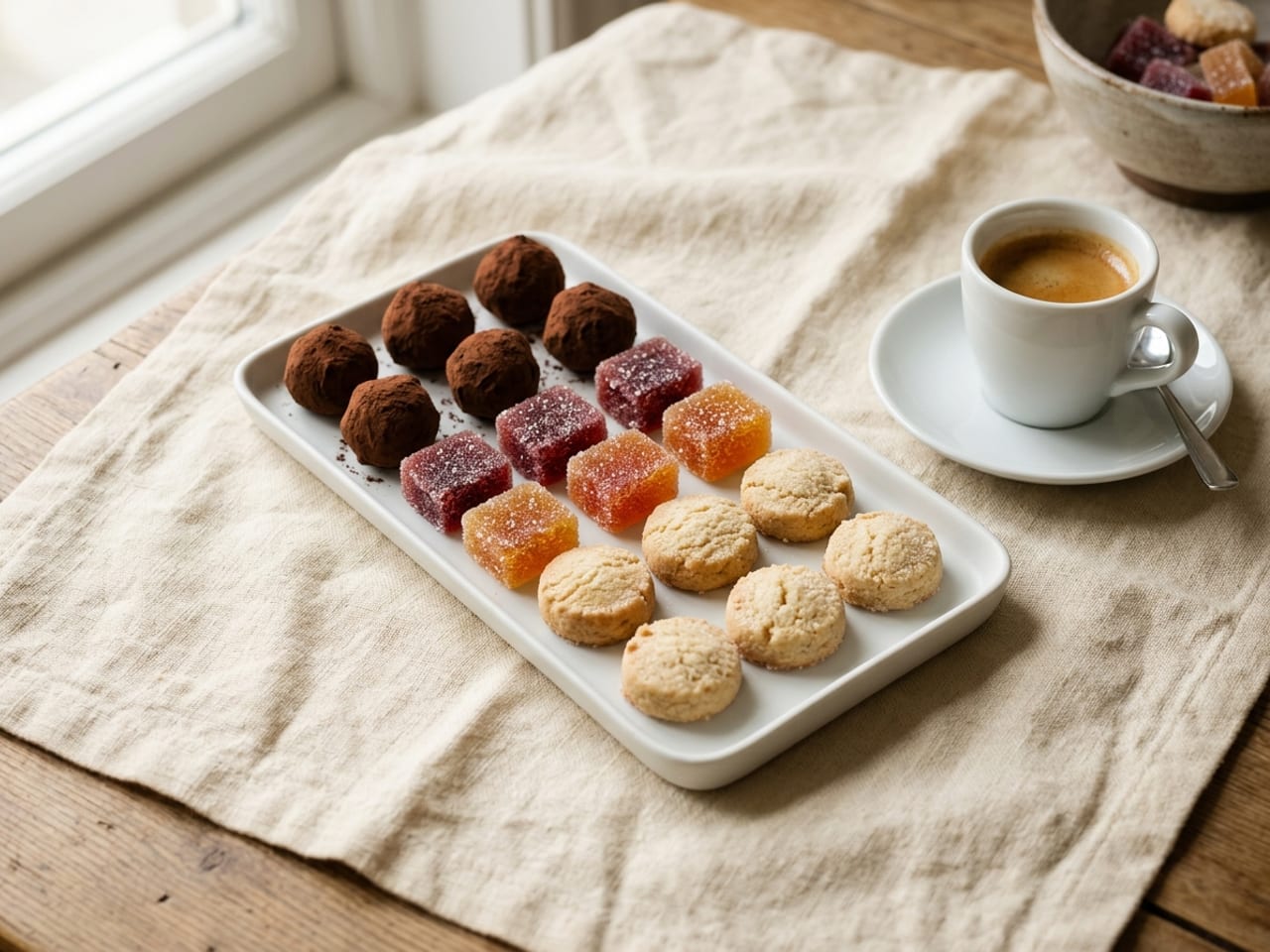
How long each kind keeps
No food agency publishes keeping times for petits fours, macarons or ganache; the nearest agency row is FoodSafety.gov's custard and chiffon pies. These are the makers', textbooks' and recipe writers' own figures, as printed, and they disagree most on macarons and ganache.138
| What | Who | Room temperature | Fridge | Freezer |
|---|---|---|---|---|
| Choux, puff pastry, dairy-filled | Friberg (2002)61 | "must be made up fresh every day" | not given | not given |
| Covered in chocolate, fondant or marzipan | Friberg (2002)61 | "made once or twice a week", with proper storage | spots chocolate; fondant and marzipan go soggy | store them unfinished |
| Iced petits fours, cream-cheese frosting | Rose Bakes (2023)94 | "a few hours" | "up to a week", airtight | the cake "3-4 weeks" |
| Chocolate-coated petits fours | Cooking with Carlee (2025)101 | "three to four days" | "up to a week" | "up to three months" |
| Frangipane sheet for glazed petits fours | CIA (2016)65 | not given | "up to 3 weeks" (fridge or freezer) | "up to 3 weeks" |
| Piped almond petits fours | Bilheux (1998)68 | "a week", sealed, away from heat and humidity | not given | "several weeks" |
| Visitandines (the financier and friand batter) | Bilheux (1998)68 | "3 to 4 days", sealed | not given | "3 to 4 weeks" |
| Madeleines | RecipeTin Eats (2026)117 | best hot; leftovers "3 days" | batter "up to 3 days" | batter "2 months" |
| Tuiles | Bilheux (1998)68 | "3 to 4 days", sealed | not given | "3 to 4 weeks" |
| Cigarettes (rolled wafers) | Bilheux (1998)68 | "several months", airtight | not given | not given |
| Butter cookies | Bilheux (1998)68 | "5 to 10 days" (another recipe "6 to 8 days") | not given | not given |
| Sablés diamants | Bilheux (1998)68 | "8 to 10 days" | not given | "3 to 4 weeks" |
| Langues de chat | Bilheux (1998)68 | "10 to 15 days" | not given | "6 to 8 weeks" |
| Macaroons (one recipe) | Bilheux (1998)68 | "up to 48 hours" | not given | "up to 3 weeks" |
| Macarons | Ladurée119 | "up to 1 day", cool and dry | 4 days at 4 to 6°C (39 to 43°F, ours) | "should not be frozen" |
| Macarons | Pies and Tacos (2021)120 | 2 to 4 hours out at most, for most fillings | "about 4 to 7 days" | filled, 1 to 2 months |
| Macarons | Food Republic (2024)121 | best "the day you buy them" | "four days to a week" | "up to a month" |
| Ganache truffles | Bilheux (1998)68 | not given | "8 to 15 days" | not given |
| Ganache truffles | Greweling (2010)79 | "up to two weeks" at 66° to 68°F (19 to 20°C, ours) | chocolate should not be refrigerated | not given |
| Ganache | Wybauw (2010)80 | "maximum three weeks from production date" for one balanced ganache | not given | not given |
| Pâte de fruits | The Perfect Purée113 | "2 weeks", sealed | not given | not given |
| Pectin jellies, sugar-coated | Greweling (2010)79 | "not very susceptible" to air or humidity | not given | not given |
| Fresh fruit dipped in chocolate | Greweling (2010)79 | "within hours of dipping" | not given | not given |
| Dried fruit dipped | Greweling (2010)79 | "for weeks" | not given | not given |
| Marzipan (the paste) | Gisslen (2012)59 | "indefinitely when protected from air" | not given | not given |
| Éclair shells and pastry cream | Pantry & Larder (2021)122 | shells "1-2 days"; fill at most 4 hours ahead | cream "2 days" or "up to 3 days" (the page says both) | shells "up to 6 weeks" |
| Cream puffs | The Daily Meal (2023)123 | not given | shells "up to 24 hours"; filled "24 to 72 hours" | shells "up to two months" |
| Custard and chiffon pies (the nearest agency row) | FoodSafety.gov138 | not given | "3 to 4 days" | "Do not freeze" |
A make-ahead plan for four kinds (ours)
For the four recipes below, timed inside the keeping figures above. The days are ours; each line names whose keeping time it rests on.
| When | What |
|---|---|
| Up to 3 weeks ahead | Bake the cake sheets for the iced petits fours, wrap and freeze them (the CIA keeps its frangipane sheet up to 3 weeks).65 |
| 4 to 7 days ahead | Make the pâte de fruits; once cut and sugared it keeps sealed at room temperature (2 weeks for one supplier).79, 113 |
| 3 to 5 days ahead | Make the truffles and keep them sealed in a cool room (Greweling: up to two weeks at 66 to 68°F, 19 to 20°C, ours) or in the fridge in a box (Bilheux: 8 to 15 days).68, 79 |
| 2 days ahead | Layer, freeze, cut and ice the petits fours; set them in paper cases, covered, out of the fridge (Friberg makes fondant-covered pastries once or twice a week).58, 61, 62 |
| The day before | Bake the financiers and keep them sealed (Bilheux: 3 to 4 days for the same batter), or bake them on the morning.68 |
| The last hour | Arrange the tray "as close as possible to serving time", in rows, one kind to a row.61 |
How to make petit fours: classic iced petits fours
Makes about 32 squares of 1 in (2.5 cm) (ours). Time: about 1½ hours of work, plus at least an hour in the freezer and an hour to set (ours). Built on Gisslen's procedure for fondant-iced petits fours and his almond cake, scaled to one home pan, with King Arthur's home fondant: our synthesis of the cited recipes, not one we tested.58, 90
| Ingredient | US | Metric | Why |
|---|---|---|---|
| Almond paste | 4½ oz | 125 g | Gisslen's Almond Cake for Petits Fours is almond paste 300%, sugar 225%, butter 225%, eggs 275%, cake flour 67% and bread flour 33%; these amounts are that formula for one 9 x 13 in (23 x 33 cm) pan, our arithmetic.58 |
| Granulated sugar | 3⅓ oz | 95 g | 225% of the flour weight (Gisslen).58 |
| Unsalted butter, soft | 3⅓ oz (about 6½ tbsp) | 95 g | 225% (Gisslen); he mixes the cake by the creaming method.58 |
| Eggs, out of the shell | 4 oz (about 2 large) | 116 g | 275% (Gisslen). Weigh them; "about 2 large" is ours.58 |
| Cake flour | 1 oz | 28 g | 67% (Gisslen).58 |
| Bread flour | ½ oz | 14 g | 33% (Gisslen).58 |
| Apricot jam, heated and sieved | about ⅓ cup | about 110 g | "A thin layer of hot apricot jam or of buttercream" between the layers and on top (Gisslen); King Arthur also brushes the cut sides before freezing. The amount is ours.58, 90 |
| Marzipan, bought | about 5 oz | about 140 g | "A thin sheet of marzipan the same size as the cake sheet" (Gisslen). Where it sits under the coating (Garrett, Gisslen's 4th edition), it "keeps the coating from soaking into the sponge and helps achieve an even surface" (Friberg). Bought, so there is no raw egg white in it (ours). The amount is ours.58, 60, 61, 62 |
| Poured fondant | about 2¼ cups | about 540 ml (ours) | Professionals buy it: poured fondant is "almost always purchased already prepared" (Gisslen). At home, King Arthur's version is 1 cup (142 g) white chocolate chips, 4 cups (454 g) confectioners' sugar, ¼ cup (78 g) light corn syrup, ¼ cup (57 g) hot water and 1 teaspoon vanilla, "enough to cover ... three dozen 1" petit fours".58, 90 |
| Simple syrup or water, to thin | 1 to 3 tbsp | 1 to 3 tbsp | Gisslen thins fondant with simple syrup "so it will coat the cakes with a very thin layer"; King Arthur adds 1 to 3 tablespoons of water.58, 90 |
| To decorate | a little | a little | "Chocolate, piping gel, or colored fondant" (Gisslen).58 |
- Bake one thin sheet of almond cake. Heat the oven to 400°F (200°C), Gisslen's temperature. Soften the almond paste with a little of the egg "until smooth before adding the sugar", cream in the butter, beat in the rest of the egg, then fold in both flours (Gisslen's creaming method). Spread it evenly in a 9 x 13 in (23 x 33 cm) pan lined with parchment, about ¼ in (6 mm) deep, and bake until the top springs back, about 8 to 12 minutes (the time is ours; Gisslen gives none). Cool.58
- Cut it in three and layer it. Cut the sheet crosswise into three equal pieces (ours; Gisslen bakes three sheets). Spread the first with a thin layer of hot apricot jam, top with the second, jam, the third, and a last thin layer of jam.58 Firm, close-grained cake matters: one "too coarse, soft, or crumbly is difficult to cut evenly into small shapes" (Gisslen).58
- Add the marzipan. Roll the marzipan into a thin sheet the size of the cake and lay it on the jam. Gisslen's 7th edition then inverts the whole assembly "so the marzipan layer is on the bottom"; Garrett and his own 4th edition leave it on top, under the fondant. We follow the 7th edition, as our drawing below does.58, 60, 62
- Wrap and freeze. "Wrap the cake in plastic film and freeze. This firms the cake so the neatest possible pieces can be cut from it" (Gisslen; his 4th edition chills it for 1 hour or more instead). A cake-mix recipe freezes at least 1 hour. (King Arthur cuts first and brushes each piece's sides with thin apricot jam before freezing, to hold the crumbs.)58, 60, 90, 97
- Cut small squares. Trim the edges, then cut squares, rectangles or diamonds, "no more than 1 in. (2.5 cm) across" (Gisslen), with a sharp knife held at 90 degrees (Friberg). With the marzipan underneath, you are already cutting it upside down, as Friberg and Gisslen's 4th edition advise for a marzipan-topped sheet. King Arthur lets frozen cake sit about 15 minutes at room temperature, "to soften it up just a bit".58, 60, 61, 91
- Warm the fondant, never above 100°F (38°C). Warm it over a warm-water bath, stirring: "Do not heat it over 100°F (38°C), or it will lose its shine" (Gisslen); Figoni gives 98 to 100°F (37 to 38°C) and King Arthur "Shoot for 100°F". Thin it with simple syrup until it pours in a very thin coat.58, 63, 91 Every figure we read for icing cakes is in the table below.
- Pour or dip. "Place the petits fours 1 in. (2.5 cm) apart on an icing grate over a tray. Pour the fondant over each one, making sure to cover the top and sides completely", or dip each upside down and lift it out with two chocolate forks (Gisslen). Rewarm the fondant to 100°F (38°C) as it thickens, and strain what drips through before you use it again (King Arthur).58, 90
- One thin coat, then let it set. King Arthur: "double dipping is a no-no", because a second coat shows the errors of the first; Gale Gand coats them twice. We follow one thin coat: Friberg warns against fondant so thick that "the multiple layers are obscured". Let it set about an hour (King Arthur).61, 91, 92
- Decorate and store. Decorate with chocolate, piping gel or coloured fondant once the icing has set (Gisslen), set each in a paper case, and keep them covered at cool room temperature: "Once cut and iced, however, the petits fours should not be refrigerated, as condensation may change their appearance" (Garrett).58, 62
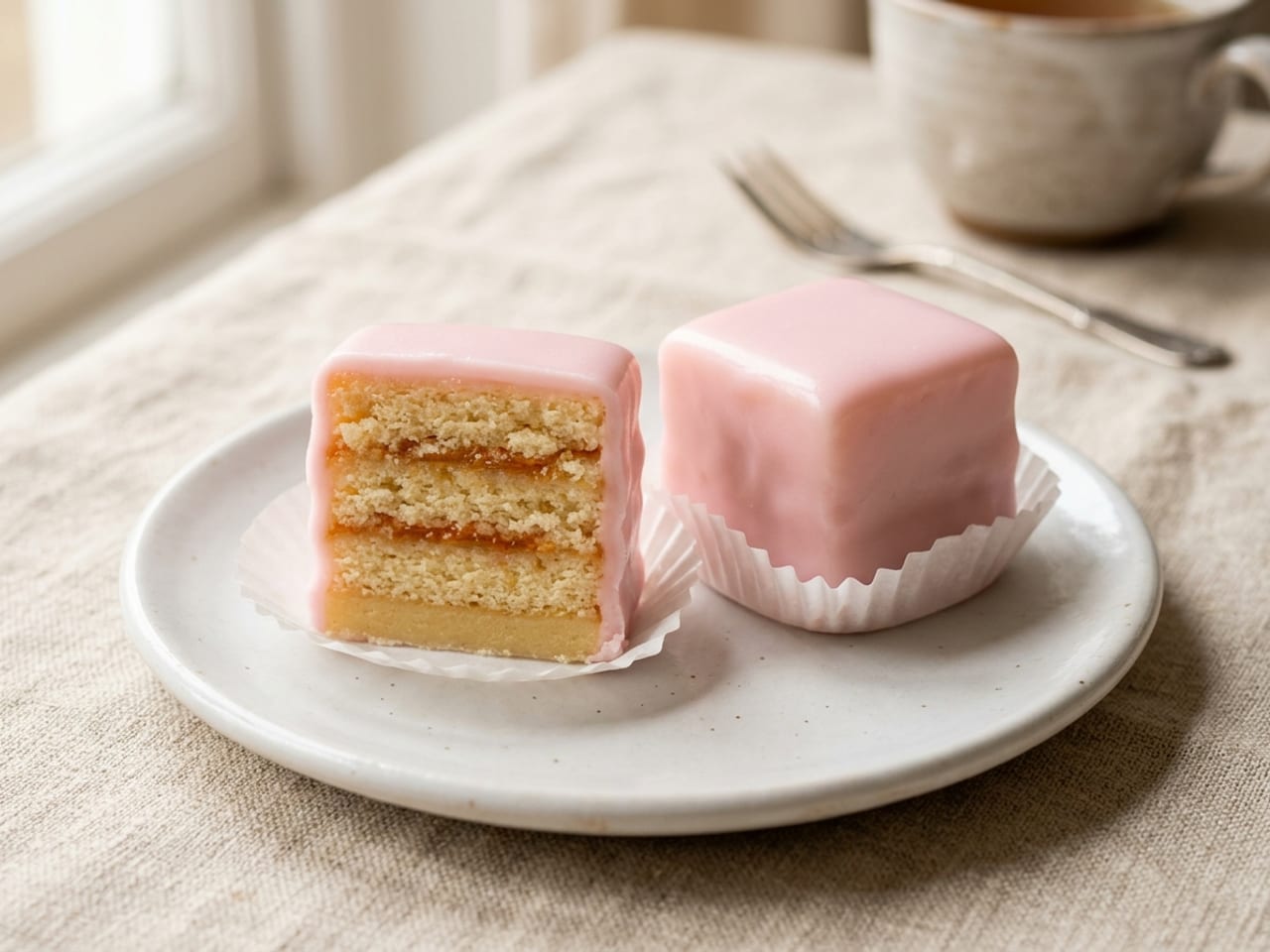
Fondant temperature for iced petits fours, every figure we read
For icing cakes the textbooks agree on a ceiling of about 100°F (38°C) for true fondant: above it the small sugar crystals melt and "reform as large, coarse crystals on cooling", and the shine goes (Figoni; Gisslen). Lenôtre works cooler; only one blog goes above 100°F (38°C), and its glaze is not a crystallised fondant.58, 63, 64, 93 Dipping fruit is a different job: Bilheux and Escoffier warm firm fondant "to 65° to 70°C (149° to 158°F)" for fruits déguisés.68
| Who | Coating | Temperature, as printed |
|---|---|---|
| Gisslen, 7th ed. (2017) and 4th ed. (2005)58, 60 | Poured fondant | "Do not heat it over 100°F (38°C)" |
| Gisslen, 7th ed.58 | Flat icing | "warmed to 100°F (38°C)" |
| Figoni (2011)63 | Prepared cream fondant | "98°-100°F (37°-38°C)" |
| King Arthur Baking (recipe; blog 2011)90, 91 | White-chocolate poured fondant | "about 100°F"; "Shoot for 100°F" (38°C, ours) |
| Rose Bakes94 | Powdered-sugar icing, before the white chocolate goes in | "92° F" (33°C, ours) |
| École Lenôtre (2006)64 | Bought fondant thinned with syrup and cocoa paste, for éclairs | "between 32° and 35°C" (89.6 to 95°F, ours) |
| Kirkland (1907)52 | Fondant for petits fours glacés | "about 85° F." (29°C, ours) |
| My Cake School (2012)93 | Powdered-sugar and corn-syrup glaze | "approximately 115 degrees F" (46°C, ours) |
| Garrett (2012)62 | Glace icing | "warm, not hot, to the touch" |
| Harris and Borella (1910)53 | Fondant | "slightly warm and not too thin" |
| Friberg (2002)61 | Fondant | No temperature; "an easy-to-spread consistency" |
How to make petit fours the quick way: as popular recipes do it
Labelled as each recipe prints it; none follows the textbook method, and the sizes drift up (sizes).
- Store-bought pound cake and canned frostingWhat's Cooking America slices a 16-ounce (454 g, ours) store pound cake into three layers with raspberry jam, cuts about 1-inch (2.5 cm, ours) squares, and pours over canned vanilla frosting warmed 15 to 20 seconds in the microwave to "the consistency of heavy cream"; about 20 to 24.99
- Cake mixSheKnows bakes a box of pound cake mix in an 8 x 8 in (20 x 20 cm, ours) pan at 350°F (175°C, ours) for about 44 minutes, cuts 24 squares of 1½ inches (4 cm, ours), freezes them at least an hour and coats them in white chocolate instead of fondant. Dessert for Two warns: "cold dries out desserts using cake mix".97, 98
- A powdered-sugar glaze instead of fondantIn every home recipe we read, the "fondant" is an uncooked icing of confectioners' sugar, corn syrup and water, often with white chocolate (King Arthur, My Cake School, Preppy Kitchen, Rose Bakes); My Cake School works its glaze at about 115°F (46°C, ours) and says it "does dry firmer". Garrett's glace icing is used "warm, not hot, to the touch".62, 90, 93, 94, 95
Dark chocolate truffles
Makes about 37 truffles of 10 g (ours: half of Gisslen's 75). Time: about 30 minutes of work, time for the ganache to thicken, and an hour or two in the fridge until the piped mounds are firm (ours). The steps follow Gisslen's own procedure for this formula. Gisslen's Dark Chocolate Truffles, halved, at his ratio of 45 g of cream per 100 g of chocolate; popular recipes at 1:1, such as King Arthur's and BBC Good Food's, make a softer ganache, and Gisslen calls equal parts "too soft for truffles". Our synthesis, not a recipe we tested.58, 102, 104
| Ingredient | US | Metric | Why |
|---|---|---|---|
| Dark chocolate (couverture), finely chopped | 9 oz | 250 g | Half of Gisslen's 500 g of dark couverture (our halving; 9 oz is our conversion). Not chocolate chips, which "will not melt into truffle consistency" (Sally's Baking Addiction).58, 103 |
| Heavy cream (double cream) | about ½ cup | 112 g | Half of Gisslen's 7 oz (225 g): 45 g of cream per 100 g of chocolate. His rule: two parts chocolate to one of cream "make a firm ganache that can be used for truffles".58 |
| Unsalted butter, soft | 1 oz (2 tbsp) | 30 g | Half of Gisslen's 2 oz (60 g).58 |
| Vanilla extract | ¼ tsp | ¼ tsp | Half of Gisslen's ½ teaspoon.58 |
| Cocoa powder, to coat | about ¼ cup | about 25 g | "The simplest way of finishing truffles, and one of the most popular" (Gisslen). The amount is ours.58 |
- Make the ganache. Heat the cream and vanilla to a simmer, pour it over the chopped chocolate and stir until it is completely melted. Cool it until it is "just slightly warm to the touch" (Gisslen; Friberg waits for body temperature, "approximately 98°F (36°C)"), then stir in the butter.58, 61
- Let it thicken. Leave it at room temperature until it starts to thicken, then spoon it into a piping bag with a medium plain tip (Gisslen). King Arthur's softer 1:1 ganache is instead chilled 1 to 2 hours, to "the consistency of soft clay", and scooped.58, 102
- Pipe and chill. "Pipe the mixture into small mounds, about 2 tsp (10 mL) each, on sheets of parchment paper. Chill until firm" (Gisslen); each is about 10 g.58
- Roll and coat. Roll each mound round between your palms and drop it into cocoa powder (Gisslen). Friberg notes that a powdered coating needs no tempered chocolate and hides any bloom.58, 61
- Keep them cool. Greweling keeps finished truffles "at a cool room temperature (66° to 68°F)" (19 to 20°C, ours), away from light and humidity, for up to two weeks; Bilheux and Escoffier keep them in the fridge for 8 to 15 days. Either way, sealed: fridge damp marks chocolate (Friberg).61, 68, 79
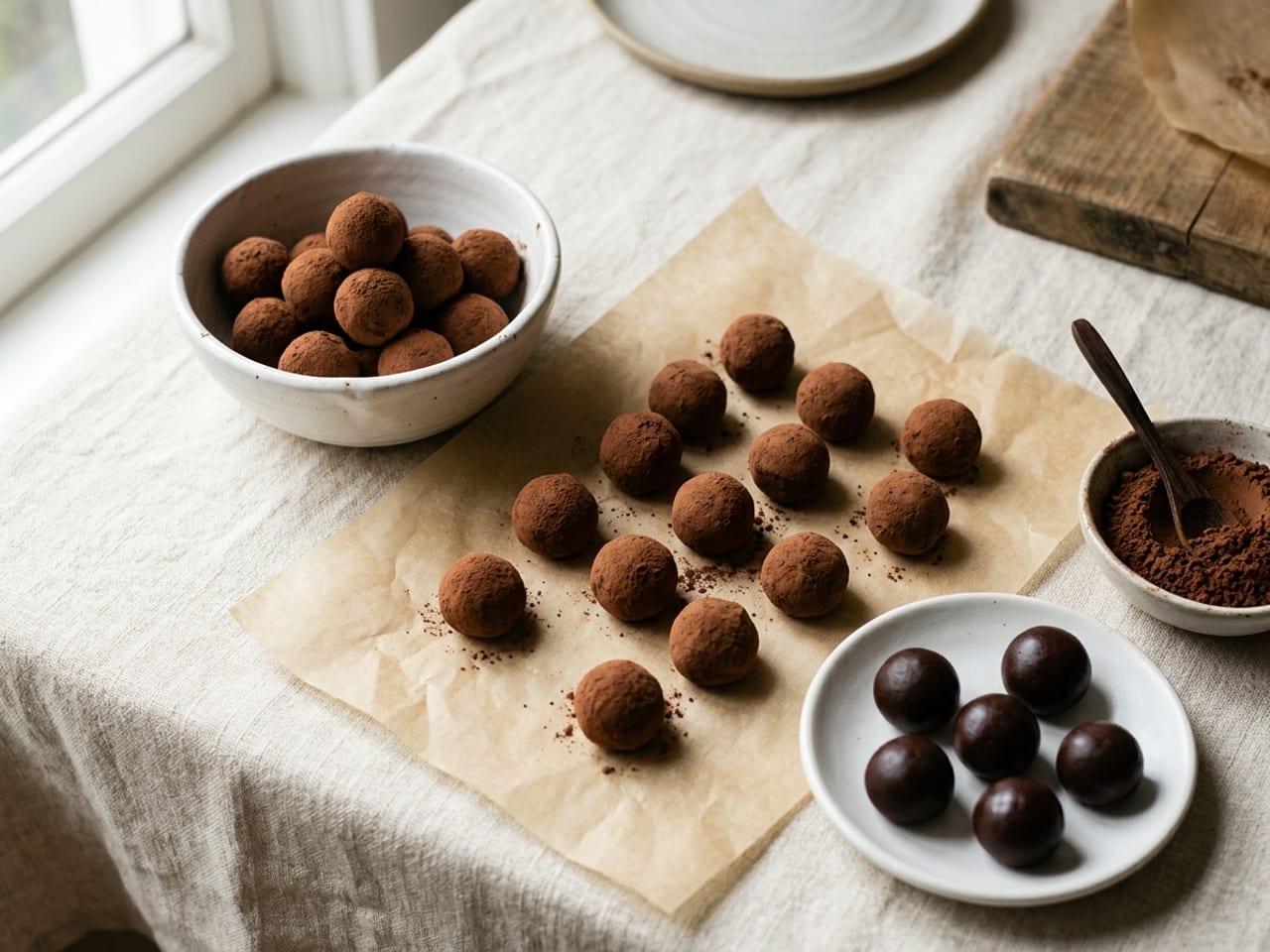
Ganache for truffles: cream per 100 g of chocolate
Textbooks for hand-rolled cocoa truffles sit at 45 to 50 g; King Arthur and BBC Good Food use equal weights; Lenôtre's 81 g is for truffles sealed in a shell of tempered chocolate. Where a recipe prints cream by the cup, we weigh it at 227 g a cup, King Arthur's own 1½ cups = 340 g (ours).58, 61, 64, 102, 104
| Who | Chocolate | Cream | Cream per 100 g chocolate |
|---|---|---|---|
| Gisslen, the rule58 | 2 parts | 1 part | 50 g |
| Gisslen, Dark Chocolate Truffles58 | 500 g couverture | 225 g | 45 g |
| Gisslen, Ganache I58 | 500 g | 375 g (50 to 100% allowed) | 75 g; 100 g is "too soft for truffles" |
| Friberg, dark espresso truffles61 | 455 g dark + 55 g unsweetened | 1 cup (240 ml) | about 45 g (ours) |
| Friberg, milk chocolate61 | 595 g milk | 1 cup (240 ml) | about 38 g (ours) |
| Warren Brown (Food Network)106 | 20 oz (567 g, ours) | 1¼ cups | about 50 g (ours) |
| Sally's Baking Addiction103 | 226 g | ⅔ cup (160 ml) | about 67 g (ours) |
| NPR (2006)105 | 11 oz (312 g, ours) | 1 cup | about 73 g (ours) |
| École Lenôtre (shell-dipped truffles)64 | 700 g of 58% | 570 g, plus glucose and invert sugar | 81 g |
| King Arthur Baking102 | 340 g semisweet | 340 g | 100 g |
| BBC Good Food104 | 300 g of 70% | 300 ml double | about 100 g (ours) |
Without cream. BBC Good Food's 2010 truffles bind melted chocolate with condensed milk, cake crumbs, ground almond and icing sugar, rolled into "walnut-size balls"; Friberg's quick route for large batches is bought chocolate shells, filled and dipped.61, 107
Pâte de fruits (fruit jellies)
Makes about 1 lb 8 oz (720 g), Gisslen's yield: about 80 squares of 1 in (2.5 cm) (ours). Time: about 40 minutes, then overnight to set (ours; the overnight is Gisslen's). Gisslen's Apricot Jellies with the yellow pectin of Lenôtre and Boiron, cooked to the professional 105 to 107°C (221 to 225°F) band: our synthesis, not a recipe we tested. You need a candy thermometer.58, 64, 108
| Ingredient | US | Metric | Why |
|---|---|---|---|
| Apricot purée (or another fruit purée) | 1 lb | 480 g | Gisslen's Apricot Jellies, his quantities throughout.58 |
| Sugar, for the pectin | 2 oz | 60 g | "Mix the pectin with the first quantity of sugar" (Gisslen), so it does not clump; six of the seven recipes we read pre-mix them (KQED stirs everything into the fruit together).58, 111 |
| Yellow pectin (pectin jaune) | 0.4 oz | 12 g | Gisslen says only "pectin"; Lenôtre and Boiron use yellow pectin. Pastry Chef Online uses grocery-store powdered pectin, but not the low- or no-sugar kind.58, 64, 108, 109 |
| Sugar | 1 lb | 480 g | Added in two halves (Gisslen).58 |
| Glucose syrup | 3 oz | 90 g | Gisslen's amount; Pastry Chef Online uses corn syrup.58, 109 |
| Lemon juice | 0.33 oz (about 2 tsp, ours) | 10 g | Last, at the end of the cook: six of the seven recipes we read add the acid there (KQED puts its lemon juice in at the start).58, 64, 108, 111 |
| Granulated sugar, to coat | as needed | as needed | "Roll in sugar" (Gisslen).58 |
- Line a pan. Line a 9 x 9 in (23 x 23 cm) pan with parchment (ours). Gisslen pours his batch into a half sheet pan; the smaller pan gives about Lenôtre's 1 cm (⅜ in) depth (our arithmetic).58, 64
- Warm the purée and add the pectin. Warm the purée to about 50°C (122°F, ours), then whisk in the pectin mixed with the first sugar, as Lenôtre does, and bring it to a boil, stirring.64, 108
- Add the sugar and glucose. Add the rest of the sugar in two halves and the glucose, returning to the boil each time (Gisslen; Boiron adds them "in multiple additions").58, 108
- Cook to 225°F (107°C). Boil, stirring constantly, "until a candy thermometer inserted in the mixture reads 225°F (107°C)" (Gisslen). The professional recipes we read finish at 105 to 107°C (221 to 225°F, ours): Lenôtre 105 to 106°C, Boiron 106°C. The full spread is in the table below.58, 64, 108
- Acid last, then pour. Stir in the lemon juice, take the pan off the heat and let it stand until the bubbling stops, then pour it into the pan (Gisslen). Lenôtre adds tartaric acid and Boiron citric acid off the heat at the same point.58, 64, 108
- Set, cut, sugar. "Let stand overnight, until firm" (Gisslen; Lenôtre leaves his 24 hours). Cut "into 1-in. (2.5-cm) squares, or whatever size is desired" and roll them in sugar; Lenôtre cuts 1 cm cubes.58, 64 Keep them sealed at room temperature: 2 weeks for one supplier, and sugar-coated jellies are "not very susceptible" to air or humidity (Greweling).79, 113
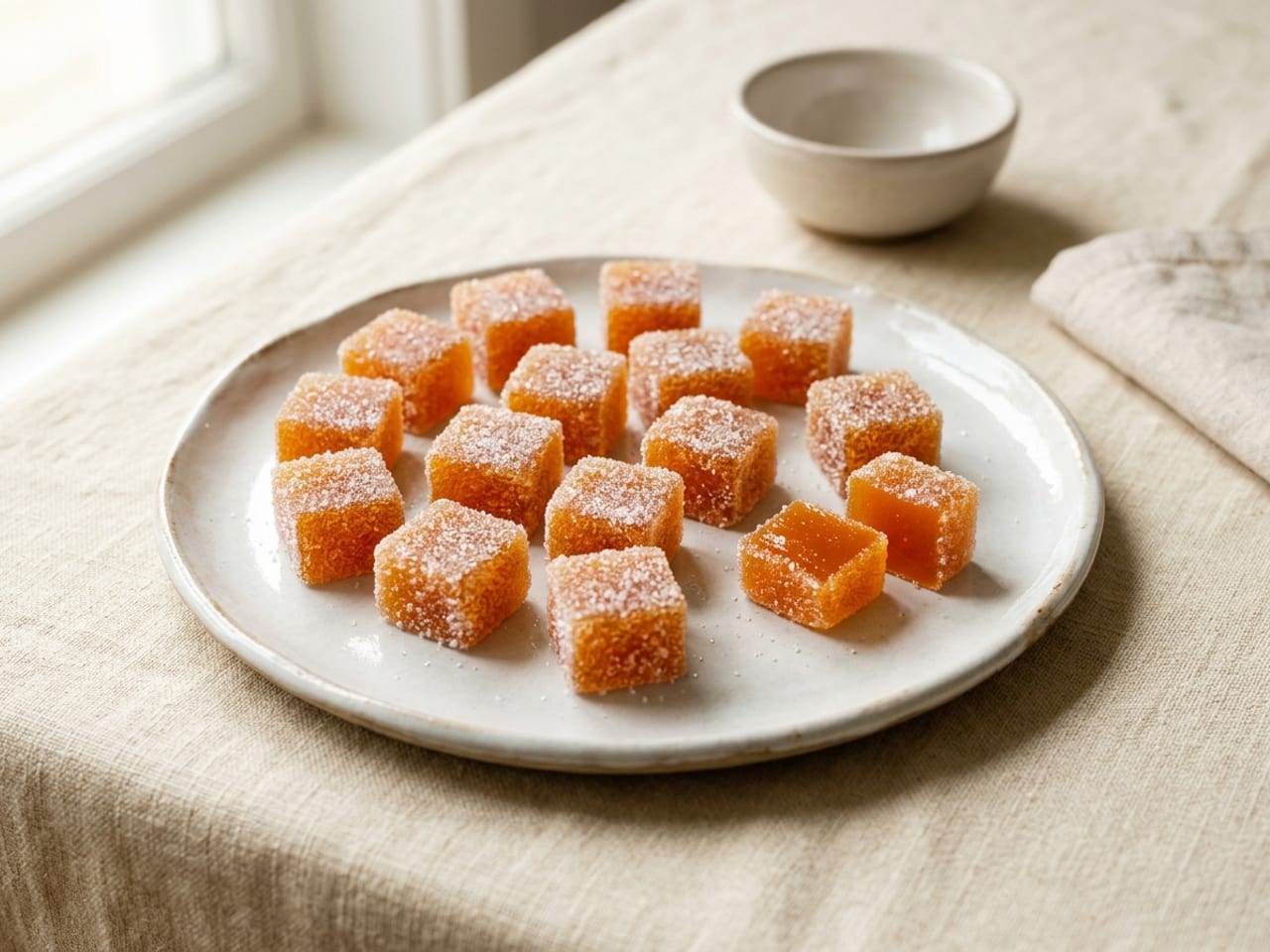
Pâte de fruits temperature, every figure we read
The finishing temperatures run from 104 to 110°C (220 to 230°F, ours) across seven recipes; the professional yellow-pectin ones finish at 105 to 107°C. Six of the seven add the acid at the end (KQED adds lemon juice at the start and zest at the end), and the same six pre-mix the pectin with sugar.
| Who | Pectin, as printed | Final temperature | Acid | Cut |
|---|---|---|---|---|
| Gisslen, 7th ed.58 | "pectin", type not named, 12 g per 480 g purée | 225°F (107°C) | lemon juice, at the end | 1-in. (2.5-cm) squares |
| École Lenôtre64 | yellow, 42 g per 1,600 g pulp | "between 105 and 106°C" (221 to 223°F, ours) | tartaric acid, off the heat | 1 cm cubes |
| Les Vergers Boiron108 | yellow, 9 g per 400 g purée | 106°C (223°F, ours) | citric acid, off the heat | frames or moulds |
| Pastry Chef Online109 | grocery powdered, 20 g per 1,000 g purée | "223 degrees, F" (106°C, ours) | citric acid in water | about 1 in. (2.5 cm, ours) |
| Crowded Kitchen110 | classic powdered, 3 tablespoons per 2 cups (480 ml, ours) of juice | 223˚F (106°C, ours); says pectin gels at about 217 to 222˚F (103 to 106°C, ours) | lemon juice, off the heat | 1.5 in. (4 cm, ours) |
| KQED Bay Area Bites111 | powdered (Sure-Jell), 1 tablespoon | 220 (°F; 104°C, ours) | lemon juice at the start, zest at the end | 1 in. (2.5 cm, ours) |
| Ateliers & Saveurs112 | NH, 18 g | "jusqu'à 110C" (230°F, ours) | citric, off the heat | 2 cm cubes |
Financiers in a mini-muffin tin
Makes 24 (America's Test Kitchen). Time: about 1 hour (ATK: 40 minutes, plus 20 minutes cooling), 14 of them in the oven. ATK's Financiers (Almond-Browned Butter Cakes), which need no special mould; textbooks put financiers on the tray (Gisslen bakes them in petit four moulds and serves them in petit four cases). We picked them over madeleines, whose recipes want a chilled madeleine pan for the hump, though Preppy Kitchen says a mini muffin pan will do (ours). Our synthesis, not a recipe we tested.58, 114, 116
| Ingredient | US | Metric | Why |
|---|---|---|---|
| Unsalted butter | 5 tbsp | 70 g (ours) | Browned, as all three recipes we read do (ATK, Gisslen, BBC Good Food).58, 114, 115 |
| Almond flour | ¾ cup | 85 g | America's Test Kitchen's amount, as printed ("3 ounces/85 grams").114 |
| Granulated sugar | ½ cup plus 1 tbsp | 113 g | ATK.114 |
| All-purpose flour | 2 tbsp | 2 tbsp | ATK.114 |
| Salt | ⅛ tsp | ⅛ tsp | ATK.114 |
| Egg whites | ⅓ cup (3 to 4 large) | 85 g | ATK. Cooked in the cake, so no raw-egg question.114 |
| Baking spray with flour | for the tin | for the tin | It "ensures that the cakes bake up with appropriately flat tops" (ATK).114 |
- Heat the oven, spray the tin. Heat the oven to 375°F (190°C, ours) and spray a 24-cup mini-muffin tin with baking spray with flour (ATK). No financier mould needed: "You'll need a 24-cup mini-muffin tin for this recipe."114
- Brown the butter. Melt the butter and cook it 1 to 3 minutes, until the milk solids are "dark golden brown" (ATK); Gisslen: "until it browns and takes on a nutty aroma".58, 114
- Mix the batter. Whisk the almond flour, sugar, flour and salt, add the egg whites and stir with a spatula until smooth, then stir in the browned butter (ATK). BBC Good Food rests its batter an hour in the fridge; ATK does not.114, 115
- Fill and bake. Fill the cups about half full and bake "until edges are well browned and tops are golden, about 14 minutes, rotating muffin tin halfway through baking" (ATK). Gisslen bakes his at 340°F (170°C) in 1-in. (2.5-cm) moulds; BBC Good Food 16 to 18 minutes at 200C (180C fan) in rectangles.58, 114, 115
- Cool and keep. Turn them out of the tin at once and let them cool at least 20 minutes (ATK). Bilheux and Escoffier keep visitandines, the same batter as financiers and friands, 3 to 4 days sealed at room temperature, or 3 to 4 weeks frozen.68, 114
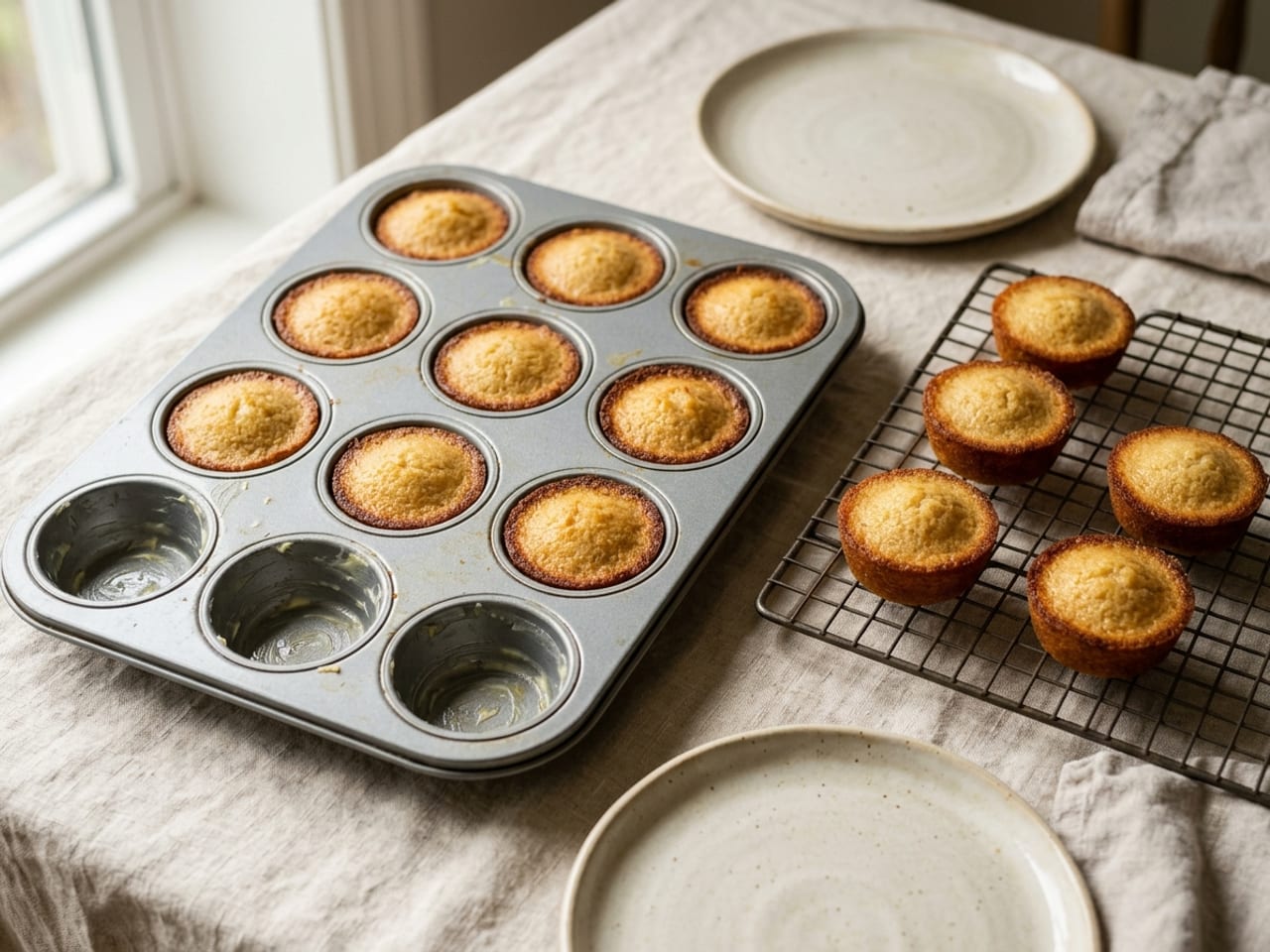
Faults and fixes
What goes wrong with each kind, as the sources name the cause and the fix. Most are for the iced petit four, the hardest of the four recipes.
| The fault | Why | The fix |
|---|---|---|
| Fondant dull and grainy58, 63 | Heated too far: "the crystals become larger and the icing loses its shine and smoothness" (Gisslen). | Keep it at or under 100°F (38°C); Figoni's 98 to 100°F (37 to 38°C). |
| Fondant soft and runny58, 61 | Too much glucose in a homemade fondant (Friberg). | Buy it, as professionals do, or follow the formula exactly (ours). |
| A thick coat hides the layers58, 61, 91 | Fondant too thick, or two coats; Friberg warns against fondant so thick "the multiple layers are obscured". | Thin it with simple syrup "so it will coat the cakes with a very thin layer" (Gisslen); one coat (King Arthur). |
| Ragged cuts58, 93 | A cake "too coarse, soft, or crumbly" (Gisslen), or cutting it soft. | A firm, close-grained cake, frozen before cutting; My Cake School: "use a dense cake which can be easily cut without creating a ragged edge". |
| Crumbs in the icing53, 90 | Loose crumbs on the cut sides. | Brush the sides with thin apricot jam before freezing and strain fondant before you reuse it (King Arthur); Harris and Borella dipped each square in hot apricot first (1910). |
| A brown line under the icing91, 92 | The baked top crust shows through translucent icing. | Trim the top (King Arthur), or turn the cake so the golden side is underneath (Gale Gand). |
| The filling shows as a stripe93 | Jam reaching the cut edge. | My Cake School: "individually cut into each petit four square and pipe a dot of raspberry in the center, so that it doesn't reach the edges". |
| Layers slide and weep58, 95 | Too much filling: "the layers will slide around and weep if overfilled" (Preppy Kitchen). | A thin layer, as Gisslen's method has. |
| Marzipan drags when cut60, 61 | A soft, sticky top layer. | Turn the cake upside down before cutting, so the marzipan is underneath (Gisslen 4th ed.; Friberg). |
| Spots or a wet film after the fridge61, 62 | Condensation on fondant, marzipan and chocolate (Garrett; Friberg). | Keep them at cool room temperature, or boxed if they must go in the fridge (Friberg). |
| Caramel-glazed fruit turns sticky54, 61 | Humidity: glazed at 2 or 3 in the afternoon, by 10 or 11 at night it sticks to the fingers (Lacam, 1911). | Glaze fresh fruit "as close as possible to serving time" (Friberg). |
| Ganache too soft to roll58 | Too much cream: equal parts "makes a ganache that is too soft for truffles" (Gisslen). | Gisslen cuts the cream to as little as 50% for a firmer ganache or warm weather; or chill it longer (ours). |
| Truffles that will not set from chips103 | Chocolate chips "will not melt into truffle consistency" (Sally's Baking Addiction). | Bar chocolate or couverture. |
| Pâte de fruits will not set58, 64, 109, 110 | Not cooked far enough, or the wrong pectin: Crowded Kitchen says pectin "needs to reach about 217˚F-222˚F to gel" (about 103 to 106°C, ours) and goes slightly past; Pastry Chef Online warns off low- or no-sugar pectin. | Cook to the recipe's temperature on a thermometer: 105 to 107°C (221 to 225°F) in the professional recipes. |
| Dry petits fours go soft59, 68, 72 | "Crisp cookies can become soft when they absorb moisture" (Gisslen); Burke calls petits fours "hygroscopic". | Sealed tins, away from humidity (Bilheux), and onto the tray at the last moment. |
Food safety and allergens, kept apart by country
Each country's advice in its own words, and nothing printed as an agency rule that is not one. Most of a mignardise tray is dry, sugary or chocolate and keeps at room temperature in the textbooks we read; the care is for anything with cream, custard, cream cheese or raw egg in it (ours).
How long cream-filled sweets can sit out
Gisslen refrigerates baked goods only when they "could become health hazards, such as those with cream fillings", and keeps pastry cream and cream-filled products cold "at all times".59 How long such food may be out of the fridge depends on where you are and who you are:
| Where and for whom | Who says | The limit |
|---|---|---|
| United States, at home | USDA FSIS136 | "Never leave food out of refrigeration over 2 hours"; 1 hour above 90 °F (32°C, ours). Its danger zone is 40 °F to 140 °F (4 to 60°C, ours). |
| United States, food establishments | FDA Food Code 2026 (adopted by states)135 | Cold holding at 5°C (41°F) or less; time as a public health control up to 4 hours, or 6 hours if the food starts at 5°C (41°F) or less and never passes 21ºC (70ºF), with written procedures. |
| United Kingdom, events and home | Food Standards Agency140, 142 | Chilled buffet food out of the fridge "no more than four hours", within 2 hours in extremely hot weather; fridge 0 to 5°C (32 to 41°F, ours). |
| Australia and New Zealand, food businesses | FSANZ145 | Time between 5°C and 60°C (41 and 140°F, ours), added up: under 2 hours, use or refrigerate; 2 to 4 hours, use but do not refrigerate again; over 4 hours, throw away. |
Friberg's 2002 textbook cites older US figures, 45°F (6°C) and 140°F (60°C) for 4 hours, and gives 2 hours as the quality limit for whipped-cream or custard pastries on a buffet; the current Food Code uses 41°F (5°C) and 135°F (57°C).61, 135 At home we follow the US 2-hour figure for anything with a cream filling (ours).
What has to stay cold
The FDA Food Code names no petit four, ganache or buttercream: a food needs time and temperature control when its water activity and pH let germs grow, and below a water activity of 0.88 it does not, at any pH.135 Ganache is the grey area. Greweling stores ganache truffles at a cool room temperature for up to two weeks and says cream centres "can and should be stored at room temperature"; Bilheux and Escoffier keep truffles in the fridge; New Jersey's rules for food sold from home kitchens list ganache, buttercream, meringue and whipped cream among the banned icings, while Colorado's exclude cream-cheese icings and cream, custard or meringue pies but name no ganache or buttercream.68, 79, 148, 149 No food agency we read publishes a keeping time for petits fours, macarons or ganache; the nearest is FoodSafety.gov's 3 to 4 days in the fridge for custard and chiffon pies, not to be frozen.138
Raw egg: the US and the UK disagree
United States. USDA FSIS: "Avoid icing recipes using uncooked eggs or egg whites"; dry meringue shells, divinity and 7-minute frosting made with hot syrup are safe; egg mixtures are safe at 160 degrees F (71°C, ours); "Everyone is advised against eating raw or undercooked egg yolks and whites".137 The Food Code has food establishments use pasteurized eggs instead of raw ones in foods such as meringue that are not cooked through, unless a customer orders them raw or undercooked under its consumer-advisory rule, and Gisslen says uncooked meringue is not safe unless made with pasteurized whites.59, 135
United Kingdom. The FSA's catering advice says hen eggs with the British Lion mark or from the Laid in Britain scheme can be eaten raw or lightly cooked, even by young children, pregnant people and older adults; its page for community events still says "don't use raw eggs in anything that won't be thoroughly cooked, such as icing or mousse".140, 141 Our mayonnaise guide sets out the FSA's exception for people who are severely immunocompromised. None of the four recipes here uses raw egg: the marzipan is bought and the egg whites in the financiers are baked.
Allergens
United States: nine major allergens, sesame the ninth since 1 January 2023, with almonds named as a tree nut; FALCPA labelling covers packaged food, not most food served unpackaged in restaurants.135, 139 United Kingdom: fourteen, tree nuts including almonds, hazelnuts and pistachios, and a business must give allergen information for every non-prepacked item that contains any of them; an item packed before it is ordered, like a cake "completely packaged in cling film", falls under the prepacked-for-direct-sale labelling rules, so a boxed take-home sweet may too (our reading).143, 144 On a mignardise tray: almonds in marzipan, financiers, macarons and almond cake; milk, egg and wheat almost everywhere; nuts in nougat and florentines. Dried and candied fruit can carry sulphites (ours).
Young children
The CDC's choking list for infants and toddlers, from the USDA WIC program, names "Round or hard candy, jelly beans, caramels, gum drops, or gummy candies", marshmallows, cookies, whole or chopped nuts, and uncut berries and cherries. It names no petit four, but on our reading pâte de fruits, caramels, guimauve, nougat, dry biscuits and dipped cherries all fall under it (ours).146
Liqueur in sweets
Liqueur stirred into a ganache or a fondant is not cooked off: USDA's retention table keeps 70% of the alcohol when it is added with no heat and stored overnight. Friberg flavours dipping fondant with Cointreau or kirsch, and Lacam's déguisés start from brandied cherries.54, 61, 147 No agency we read gives a rule for serving them to children; we would keep them off a children's plate (ours).
Mignardise, petit four, friandise and café gourmand: a dated history
Dates are the earliest we saw in what we read, never claimed as firsts. Old books were read in machine-read library scans; the dictionaries' dates are their own.
| When | What the source says |
|---|---|
| About 1280 | The older French form mignotise, "coquetterie", in Girart d'Amiens (as the TLFi dates it).1 |
| 1342 | Friandise as a personification of gluttony; by about 1380, being fond of something (TLFi).4 |
| 1484 to 1604 | Friandise in English, now obsolete (Oxford English Dictionary).19 |
| 1524 and 1539 | Mignard, "mignon, gentil", then mignardise, "gentillesse mignonne": daintiness, not food (TLFi).1, 2 |
| 1603 | The Oxford English Dictionary's earliest English mignardise, in John Florio's translation.18 |
| 1694 to 1762 | Mignardise is in the Académie's dictionary from 1694 (TLFi), but its 1762 edition gives only daintiness, charms and caresses, and a small pink: no sweet.1, 6 |
| 1805 | "Les extrémités de la table réservées au petit four, aux crèmes, aux friandises" draw the children and the ladies: Grimod de La Reynière's Almanach des gourmands, in a scan of its 1805 second edition, the earliest dated petit four we saw.41 |
| 1806 | The dessert includes "pièces de petit four", and the petit four is "une des parties les plus brillantes et les plus difficiles des Entremets" (Grimod).42 |
| 1807 | Grimod defines it: pieces in which sugar is essential, needing "un Four extrêmement doux", so that petit four is "synonyme de Four doux", a gentle oven; to the rest of pastry it is "what miniature painting is to fresco" (our translation).43 |
| 1815 | Carême's sixth and last oven heat, "four chaleur perdue", five hours after firing, "convient parfaitement pour la cuisson du petit four"; his macarons need "le four à son déclin", after all the other petits fours.44, 45 |
| 1836 | Belon advises shops to keep a second, small oven heated only to the third degree "pour tous les objets appelés de petit four".46 |
| 1871 | A London translation of Gouffé's Livre de conserves prints "PETITS-FOURS" on its title page and a "CHAPTER XXI PETITS FOURS". The dictionaries' earliest English record is 1875; Gouffé's 1871 English translation already prints the word.13, 17, 47 |
| 1873 | Gouffé bakes his tea petits fours "à four papier brun", which on his own paper test is a hot oven.48 |
| 1875 | The Oxford English Dictionary's earliest evidence, in the Times (London); Merriam-Webster's first known use.13, 17 |
| 1896 to 1906 | Fannie Farmer's "Petit Four", a fondant-dipped round of sponge cake, in a Boston Cooking-School printing of those years: the American cake.55 |
| 1902 | Montagné and Salles sort petits fours into ten groups: "Le dessert moderne comporte toujours une série de petits fours."51 |
| 1903 and 1907 | Escoffier's menus put "Mignardises" after the iced dessert; his 1903 "Mignardises Moscovite" are savoury, and in 1907 ices "avec les petits-fours dont on les accompagne" end the dinner.49, 50 |
| 1910 | In a London trade book, "there is probably no term so little understood as 'petits fours'".53 |
| 1930s | The Oxford English Dictionary's baking sense of mignardise (the wording is behind its paywall).18 |
| 1932 to 1935 | The Académie's 8th edition has petits fours, "qu'on sert soit à la fin d'un repas", but still no sweet mignardise.6 |
| 1984 | The TLFi's one citation for the sweet mignardise: "le café et les mignardises", in a Gault-Millau guide.1 |
| About 1997 | The café gourmand, "Lancé il y a une douzaine d'années par la chaîne de restaurants La Criée" (Le Figaro, 2009). French Wikipedia says it was invented in 1990 by the consultant Bernard Boutboul, uncited; Le Figaro quotes him only as a consultant.32, 40 |
| 1997 to 2003 | elBulli commissions tableware for its "follies" (petits fours) and replaces them with "morphings" in 2003.30 |
The "small oven" story, and who tells it. Gisslen hedges: the name "may derive from the fact that, in the days of wood-fired brick ovens, petits fours were baked when the oven was cooling down". Burke tells it as fact; a chef tells it in the MICHELIN Guide; a culinary school's blog tells it, and English Wikipedia, citing that blog, calls it "The most accepted".21, 35, 38, 59, 72 The old books differ: Grimod in 1807 explains the name by a gentle oven, Carême in 1815 bakes petits fours in the cooling oven, Belon in 1836 in a separate small one; none of them says the name came from the cooling oven.43, 44, 46 English Wikipedia's other story, cakes first presented to Louis XIV among the entremets, it takes from a newspaper retelling a popular history; we found nothing older for it.38
Fourteen popular claims about petits fours and mignardises, each with a verdict
"Supported, narrowly" means the sources cover less than the claim says; "Mixed", that they point both ways; "No source found", that we found nothing for it.
| The claim | Verdict | What we found |
|---|---|---|
| Petit four means "small oven" because they were baked in a cooling oven. | Supported, narrowly | The words do mean small oven (Merriam-Webster, Collins), and Carême in 1815 baked the petit four in the "four chaleur perdue", the dying oven.13, 16, 44 But the earliest definition we read, Grimod's in 1807, ties the name to a gentle oven, "synonyme de Four doux"; Belon in 1836 advised a separate small oven for them, and Gouffé in 1873 baked his tea petits fours hot.43, 46, 48 Gisslen says the name "may derive" from the cooling oven; Burke tells it as fact; a chef tells it in the MICHELIN Guide. No source we read documents how the name arose.21, 59, 72 |
| Mignardises are never baked. | Not supported | The Office québécois de la langue française's own examples of mignardises are éclairs, choux and tartlets, and a French restaurant's chariot de mignardises in the MICHELIN Guide carries financiers and madeleines.12, 23 English Wikipedia's "that are not baked" is not in the blog it cites.37, 38 The MICHELIN Guide's line is that a petit four is "usually baked", with jellies and chocolates as mignardises.21 |
| There are four types of petit fours. | Mixed | Four in Suas (plus prestige), Garrett (with demi-secs), Johnson & Wales, MasterClass, Tasting Table (with a different fourth) and a school blog; two in Gisslen, Friberg and Mathiot; three in Labensky, Nicolello and the British textbooks; six in Juillet; ten in Montagné and Salles (the table).33, 34, 51, 58, 62, 69, 70, 71, 72, 77, 78 |
| Petit fours are always iced. | Not supported | Petits fours secs have "no icing or cream filling" (Gisslen). The iced cake square is the North American sense, where "most people are probably not aware of any other kind".58, 59 |
| Petit fours come in fours. | Not supported | Some chefs serve four as wordplay, but the name "does not have anything to do with the actual number" (MICHELIN Guide).21 |
| Serve an odd number of pieces or kinds. | No source found | No source we read recommends it for a petit-four tray. Friberg's rules are contrast, rows of one kind and colour.61 |
| A petit four must be one bite. | Mixed | Larousse says one bite, and so does one Singapore chef; Gisslen, the CIA, Labensky and Bilheux say one or two.10, 21, 58, 65, 68, 69 |
| Petits fours are always sweet. | Mixed | Not in French: Larousse includes a savoury nibble, and Escoffier's 1903 mignardises were savoury. Only one English handbook we read, Juillet's, has a savoury group.10, 49, 78 |
| Mignardise is French for "precious". | Not supported | That gloss is a magazine's; the TLFi gives daintiness and affectation, from mignard, gracious, delicate, pretty.1, 2, 27 |
| Mignardise is not an English word. | Mixed | Cambridge has no entry, but the Oxford English Dictionary has three meanings, the earliest from 1603, with a baking use from the 1930s.15, 18 |
| Petit four first appeared in English in 1875. | Supported, narrowly | 1875 is the dictionaries' earliest record (OED, Merriam-Webster); a London translation of Gouffé already prints "PETITS-FOURS" in 1871.13, 17, 47 |
| Macarons keep for weeks. | Mixed | Ladurée: 4 days in the fridge and "should not be frozen"; a macaron blog freezes filled ones 1 to 2 months; one Bilheux recipe keeps 48 hours at room temperature or 3 weeks frozen.68, 119, 120 |
| Chocolates and iced petits fours belong in the fridge. | Mixed | Fridge damp marks chocolate and softens fondant and marzipan (Friberg); iced petits fours "should not be refrigerated" (Garrett); Greweling keeps truffles in a cool room. But Bilheux and Escoffier keep truffles in the fridge for 8 to 15 days, petit fours with a cream-cheese frosting go in the fridge (Rose Bakes), and so does anything cream-filled (Gisslen).59, 61, 62, 68, 79, 94 |
| Café gourmand was invented in 1990 by Bernard Boutboul. | Mixed | French Wikipedia says so without a source; Le Figaro in 2009 credits the La Criée chain, about a dozen years earlier, and quotes Boutboul as a consultant.32, 40 |
Photograph your plate, see it re-plated
Plated a dessert before the mignardises? Photograph it and Plate Artists re-plates that dish, with the food kept as it is and the changes named so you can repeat them. Start with a re-plate.
Your food, plated like a chef's
Snap it, upload it, and get the composed version back, with the steps to recreate it at home.
Start free · 1 enhancement →Free account · 1 free enhancement · No credit card
Mignardise and petit four words, defined
Mignardise · min-yar-DEEZ; usually plural, mignardises
A small sweet, one or two bites, served with the coffee at the end of a meal; in the plural, the assortment.
Where it comes from. TLFi: "Petits gâteaux servis à la fin du repas (avec le café et les liqueurs le plus souvent)"; from mignard, dainty.1, 18
Petit four · pet-ee FOR; plural petits fours or petit fours
A small cake, biscuit, pastry or confection eaten in one or two bites; in the US, a small fondant-iced cake square.
Where it comes from. Merriam-Webster: "French, literally, small oven"; the dictionaries' earliest English record is 1875, and an 1871 London translation of Gouffé already prints it.13, 15, 58
Petits fours glacés · iced petits fours
Petits fours with an icing, usually poured fondant, over small layered cakes or other pastries.
Where it comes from. Gisslen: "Petits fours glacés are iced petits fours".58, 70
Petits fours secs · dry petits fours
Small, crisp biscuits and cookies with no icing or cream filling.
Where it comes from. Gisslen: "sec means 'dry'"; small, dainty cookies, meringues, macaroons, puff pastry.58, 69
Petits fours frais · fresh petits fours
Small filled or moist pastries, such as tartlets and éclairs, made to be eaten the same day.
Where it comes from. Labensky: "moist miniatures that may contain fruit and fillings"; Suas: served the day they are made.69, 70
Petits fours déguisés · disguised fruit; fruits déguisés
Fresh, dried or candied fruit, often stuffed with marzipan, dipped in sugar, fondant or chocolate.
Where it comes from. Suas: fruits "coated in cooked sugar, fondant, chocolate, or any combination".61, 70
Petits fours salés · savoury petits fours
Savoury bites served with drinks, a French and magazine category that only one English handbook we read lists.
Where it comes from. Larousse: "petit amuse-gueule salé"; Tasting Table: "bite-sized quiches and miniature sandwiches"; Juillet: "also referred to as Amuse-Gueules".10, 33, 78
Petits fours prestige
Suas's contemporary group: miniature versions of modern plated desserts and entremets.
Where it comes from. Suas: "smaller versions of contemporary entremets or other desserts".70
Friandise · usually plural, friandises
A delicacy; on an English menu, another name for the petits fours served with coffee.
Where it comes from. TLFi: "Sucreries, petites pâtisseries"; Labensky: petits fours "may also be referred to as friandises".4, 19, 69
Gourmandise · usually plural
A tempting delicacy; in the plural, a menu name for small sweets.
Where it comes from. TLFi: sweets, "Synon. friandises"; one of Burke's menu names for the tray.5, 72
Café gourmand · \ka.fe ɡuʁ.mɑ̃\ (Wiktionnaire)
A coffee served with a few small sweets on one plate, sold as a dessert in French restaurants.
Where it comes from. Wiktionnaire: "Café accompagné de différentes mignardises"; Le Figaro 2009.8, 32
Lagniappe · LAN-yap
A small extra given free; how the CIA describes mignardises sent with the check.
Where it comes from. The CIA's service textbook calls mignardises with the check "lagniappes ('something extra,' in Louisiana Creole)".14, 67
Chariot de mignardises · mignardise trolley
A trolley of small sweets wheeled to the table at the end of a meal.
Where it comes from. MICHELIN Guide France: "Le chariot de mignardises de la Fourchette Des Ducs"; in 2021 "plutôt rare".23, 24
Poured fondant · fondant icing
A white icing of tiny sugar crystals in syrup, warmed and poured to give a thin, shiny coat.
Where it comes from. Gisslen: the icing for petits fours, "almost always purchased already prepared"; never over 100°F (38°C).58, 63
Marzipan
A paste of ground almonds and sugar, rolled thin as a layer or shaped into small fruits.
Where it comes from. Friberg: under fondant it "keeps the coating from soaking into the sponge".58, 61
Ganache
Chocolate melted into hot cream, soft or firm by the proportion; the centre of a truffle.
Where it comes from. Gisslen: two parts chocolate to one of cream "make a firm ganache that can be used for truffles".58
Pâte de fruits · fruit jellies; plural pâtes de fruits
Fruit purée cooked with sugar and pectin until it sets, cut in squares and rolled in sugar.
Where it comes from. Gisslen's Apricot Jellies; Greweling: "Known in Europe as pate de fruit".58, 79
Financier
A small almond cake made with browned butter and egg whites.
Where it comes from. Gisslen bakes them in petit four molds; Bilheux: the visitandine batter in other moulds.58, 68, 114
Petits fours cups · petit four cases
Small fluted paper cases that hold one petit four.
Where it comes from. Friberg: "Known as petits fours cups", for self-service; Gisslen serves financiers in paper petit four cases.58, 61
Four chaleur perdue · the oven of lost heat
The cooling oven, hours after firing, in which Carême baked petits fours.
Where it comes from. Carême, 1815: the sixth and last heat of a wood-fired oven, which "convient parfaitement pour la cuisson du petit four".44
Mignardises and petit fours, answered
What are mignardises?
Mignardises (min-yar-DEEZ) are the small sweets, one or two bites each, served with the coffee at the end of a meal, often after the dessert: truffles and other chocolates, fruit jellies, small biscuits, tiny tarts and iced cakes. The French dictionary TLFi defines them as small cakes served at the end of the meal, most often with the coffee and liqueurs, and Larousse adds that they come as an assortment.
What does mignardise mean in English?
There is no everyday English word for it. In English kitchens mignardises are "An assortment of small, two-bite-size pastries" (the Culinary Institute of America) or "another name for an assortment of petits fours" (Friberg). The French word comes from mignard, dainty or delicate, and once meant daintiness or affectation; the sweet is a later sense. Cambridge has no entry, and the Oxford English Dictionary dates a baking use to the 1930s.
How do you pronounce mignardise and petit four?
Mignardise: min-yar-DEEZ (Oxford English Dictionary). Petit four: PET-ee-FOR in Merriam-Webster, also puh-TEE-; pet-ee FOR in British English and ped-ee FOR in American in the Oxford English Dictionary. The plural is petits fours, and Merriam-Webster also accepts petit fours.
What is the difference between mignardises and petit fours?
It depends on who you ask. For the Culinary Institute of America, Friberg and the French dictionaries they overlap: mignardises are the assortment of petits fours served at the end of the meal. For the MICHELIN Guide a petit four is usually baked (madeleines, macarons, canelés) and jellies and chocolates are mignardises, though its Macau and Singapore articles put tarts on opposite sides. British textbooks treat mignardises as one menu name for the petits fours. We set the sources side by side in 14 rows and follow the first view.
What are petit fours?
Petit four, French for small oven, is any small cake, biscuit, pastry or confection eaten in one or two bites (Gisslen). In the United States the word usually means one kind: a small square of layered cake coated in fondant, which Gisslen says is the only kind most North Americans know. In Britain it is a small cake or biscuit served with coffee at the end of a meal (Cambridge).
What are the 4 types of petit fours?
In the four-type lists (Suas's textbook, MasterClass, a culinary school's blog): petits fours glacés (iced), secs (dry biscuits), frais (fresh, filled, eaten the same day) and déguisés (fruit coated in sugar, fondant or chocolate). Tasting Table's fourth type is salés (savoury) instead, Garrett's is demi-secs (dry sandwich cookies), Suas adds a fifth, prestige, Gisslen's Professional Baking has only two (secs and glacés), Labensky's On Baking three, and a 1902 French book ten. We list all 20 classifications we read.
What are some examples of petit fours?
Iced: small fondant-covered cake squares, tiny éclairs and tartlets. Dry: sablés, tuiles, langues de chat, macarons, florentines and palmiers. Fresh: fruit tartlets, cream puffs and éclairs, and for some writers madeleines and financiers. Disguised fruit: fondant-dipped cherries and marzipan-stuffed dates. Confections on the same tray: chocolate truffles, pâte de fruits, nougat, caramels and marzipan fruits.
How many petit fours per person?
After a full dinner, two or three each is our line. It follows the lowest printed figures: a 2018 service textbook's "Serve two mignardises per person" after dessert, Nicolello's "two per person is the average" with the coffee at the end of dinners (1994), Pellaprat's "Allow 2 Petits Fours per person" under a petits fours recipe (1968) and Craig's "2 or 3" on a party menu (1970). When the sweets are the dessert or the party, caterers and blogs print three to five or more; a French pastry textbook says that where they are sold by weight in pastry shops, "most people allow from six to ten" per serving. Seven starred restaurants in Singapore served sets of three to six kinds (MICHELIN Guide, 2022).
What are petit fours made of?
The classic iced petit four is three thin layers of firm cake, often an almond cake, sandwiched with hot apricot jam, with a thin sheet of marzipan, cut into squares no more than 1 inch (2.5 cm) across and coated in poured fondant (Gisslen). Popular recipes use pound cake, buttercream and a glaze of powdered sugar, corn syrup and white chocolate.
How do you make petit fours?
Bake thin sheets of a firm cake, stack them with a thin layer of hot apricot jam, add a thin sheet of marzipan, wrap and freeze, then cut squares no more than 1 inch (2.5 cm) across. Warm poured fondant to no more than 100°F (38°C), thin it with syrup, and pour it over the squares set apart on a wire rack, or dip them. Let it set (about an hour, King Arthur) and decorate. That is Gisslen's method, with King Arthur's home fondant; our recipe gives the amounts for one 9 x 13 inch (23 x 33 cm) pan.
What is the difference between petit fours and cake or cupcakes?
A petit four is a cake cut small: Merriam-Webster defines it as a small cake cut from pound or sponge cake and frosted. By that definition it is cut from a sheet, layered and coated all over, where a cupcake is baked in its own cup and frosted on top; that comparison is ours, as no source we read makes it.
What are friandises?
Friandise is French for a delicacy, and in the plural for sweets and small pastries (TLFi). On English menus it is another name for the petits fours served with coffee: Labensky says petits fours may also be called friandises, and the Food Lover's Companion lists truffles, mints or petits fours served after the dessert. In English the old word is obsolete (Oxford English Dictionary).
What is a café gourmand?
A coffee served with a few small sweets on the same plate, sold as a dessert in French restaurants. Le Figaro called it in 2009 the up-to-date version of the mignardises put out with the coffee, launched about a dozen years earlier by the La Criée chain. French Wikipedia's claim that it was invented in 1990 by Bernard Boutboul has no source.
How far ahead can you make mignardises?
Most of them days ahead, which is the point: Peter Hertzmann only puts on his plate things that can be "prepared in quantity and store or freeze well". Dry petits fours keep from 3 or 4 days (tuiles) to 10 to 15 days (langues de chat) in sealed tins (Bilheux), truffles up to two weeks in a cool room (Greweling), pâte de fruits 2 weeks sealed (one supplier), and visitandines, the financier batter, 3 to 4 days (Bilheux). Choux and cream-filled pastries are made the same day (Friberg).
Do petit fours need to be refrigerated?
Iced petits fours with jam and marzipan should not be: "Once cut and iced, however, the petits fours should not be refrigerated, as condensation may change their appearance" (Garrett), and fridge damp spots chocolate and softens fondant and marzipan (Friberg). Anything with a cream, custard or cream-cheese filling does go in the fridge, and US food-safety advice is to leave such food out no more than 2 hours (1 hour above 90°F, 32°C).
Why are they called petit fours?
Petit four is French for small oven. The earliest definition we read, Grimod de La Reynière's in 1807, says the name means a gentle oven, "synonyme de Four doux", because these sugary pieces need one; Carême in 1815 baked them in the cooling oven hours after firing, and Belon in 1836 advised a separate small oven for them. The popular story that they were baked as the oven cooled matches Carême's practice, but no source we read records how the name arose.
What are good mignardise ideas for a dinner party?
Our suggestion: pick three or four that keep, one of each kind: an iced petit four or financier, a dry biscuit such as a sablé or tuile, a chocolate truffle and a square of fruit jelly. Make them over the week before, arrange them in rows, one kind to a row, close to serving, and bring them out with the coffee, two or three per guest (our line, following the lowest printed counts). Keep chocolates out of the fridge (Friberg, Greweling).
The dictionaries, textbooks, restaurant guides, recipes and agencies behind this guide
How each source was read (in full, in an archived copy, as the machine-read text of a scan or an uploaded copy, or only as search fragments) is in its entry and under how this page was made. Textbooks read from copies uploaded to the Internet Archive, and books read only as search fragments, are cited as books without a link. Blogs, brands, caterers and magazines are labelled. Readings, sums and conversions marked ours are our own.
- ATILF / CNRS (2026). Mignardise. Trésor de la langue française informatisé (TLFi), via the CNRTL portal, sense C.3 (pastry), whose one citation is the Nouveau guide Gault-Millau of July 1984; the older senses (daintiness, affectation, a pink, a braid), the pronunciation and the dated history of the word (1539, 1567, 1696, mignotise about 1280); read in full. cnrtl.fr
- ATILF / CNRS (2026). Mignard. Trésor de la langue française informatisé (TLFi), via the CNRTL portal, the root adjective: "Qui est gracieux, délicat, joli", dated 1524; read in full. cnrtl.fr
- ATILF / CNRS (2026). Four (petit four). Trésor de la langue française informatisé (TLFi), via the CNRTL portal, petit four: a small piece of pastry "cuite au four", with citations from Renard (1897), Proust (1920) and Sartre (1938); the entry dates the oven but gives no date for petit four; read in full. cnrtl.fr
- ATILF / CNRS (2026). Friandise. Trésor de la langue française informatisé (TLFi), via the CNRTL portal, a delicate dish, savoury or sweet, and especially, usually plural, sweets and small pastries; dated 1342; pronunciation; read in full. cnrtl.fr
- ATILF / CNRS (2026). Gourmandise. Trésor de la langue française informatisé (TLFi), via the CNRTL portal, sense B.2, plural: sweets, "Synon. friandises", the dish sense dated 1835 (Balzac); read in full. cnrtl.fr
- Académie française (2026). Mignardise; Four; Friandise; Gourmandise. Dictionnaire de l'Académie française, 9th edition, with the 8th (1932 to 1935) and 4th (1762) editions, via the CNRTL portal, the 9th edition's pastry sense of mignardise, "par confusion avec friandise", absent from the 8th and 4th editions; petits fours in the 8th and 9th editions, absent from the 4th; read in full. cnrtl.fr
- Émile Littré (2026). Mignardise; Four; Friandise. Dictionnaire de la langue française (1863 to 1872), via the CNRTL portal, five senses of mignardise, none a pastry, with Agrippa d'Aubigné's "vivres et mignardises" in its Historique; petits fours, "sorte de petite pâtisserie légère pour desserts, pour soirées"; read in full. cnrtl.fr
- Wiktionnaire contributors (2026). Mignardise; Café gourmand. Wiktionnaire (community-edited French dictionary), the pastry sense with citations from Houellebecq (2010) and Reza (2021); café gourmand, "Café accompagné de différentes mignardises"; read in full. fr.wiktionary.org
- Larousse (2026). Mignardise. Dictionnaire de français en ligne, sense 4: "Petite pâtisserie servie en assortiment à la fin d'un repas"; read in full. larousse.fr
- Larousse (2026). Petit four. Dictionnaire de français en ligne, "Petit gâteau (frais ou sec) ou petit amuse-gueule salé, que l'on mange d'une seule bouchée", with both spellings and plurals; read in full. larousse.fr
- Larousse (2026). Friandise; Gourmandise. Dictionnaire de français en ligne, friandise: "Chose délicate et agréable à manger, en particulier petit gâteau, confiserie, sucrerie"; gourmandise sense 2; read in full. larousse.fr
- Office québécois de la langue française (1998). Mignardises. Grand dictionnaire terminologique (fiche, bakery and pastry), "Assortiment de confiseries ou de petits fours sucrés proposé à la fin d'un menu", with examples of éclairs, choux and tartlets; fiche last updated 1998, read in full 2026-10-19. oqlf.gouv.qc.ca
- Merriam-Webster (2026). Petit four. Merriam-Webster.com Dictionary, the definition, both plurals, "French, literally, small oven", first known use 1875, the pronunciations and its example sentences (Southern Living and The New Yorker, May 2026); page last updated 2 August 2026, read in an Internet Archive (Wayback) capture, because the live site refused this machine on 2026-10-19 (capture of 8 September 2026). We could not read an entry for mignardise or friandise (no capture exists). merriam-webster.com (archived)
- Merriam-Webster (2026). Lagniappe. Merriam-Webster.com Dictionary, "a small gift given to a customer by a merchant at the time of a purchase", from American Spanish la ñapa and Quechua yapa; read in an Internet Archive (Wayback) capture, because the live site refused this machine on 2026-10-19 (capture of 29 September 2026). merriam-webster.com (archived)
- Cambridge University Press (2026). Petit four. Cambridge Advanced Learner's Dictionary, "a small cake or biscuit, usually served at the end of a meal with coffee", plural petits fours, UK and US pronunciations; read in full. Its mignardise URL returns the dictionary's home page: no entry. dictionary.cambridge.org
- Collins (2015). Petit four. Collins English Dictionary, "any of various very small rich sweet cakes and biscuits, usually decorated with fancy icing, marzipan, etc"; read in an Internet Archive capture of 5 April 2015 (the live site refused this machine). collinsdictionary.com (archived)
- Oxford English Dictionary (2025). Petit four, n. Oxford English Dictionary (free factsheet), earliest evidence 1875, in the Times (London); pronunciations; the definition itself is behind the paywall. Read in an Internet Archive capture of 3 May 2025. oed.com (archived)
- Oxford English Dictionary (2024). Mignardise, n. Oxford English Dictionary (free factsheet), three meanings, with uses in "knitting (1860s) baking (1930s)"; earliest evidence 1603 (Florio); pronunciation min-yar-DEEZ; the wording of the meanings is behind the paywall. Read in an Internet Archive capture of 7 July 2024. oed.com (archived)
- Oxford English Dictionary (2025). Friandise, n. Oxford English Dictionary (free factsheet), "This word is now obsolete. It is last recorded around the early 1600s" (1484 to 1604). Read in an Internet Archive capture of 3 May 2025. oed.com (archived)
- Sharon Tyler Herbst and Ron Herbst (2007). The New Food Lover's Companion, 4th ed. Barron's, entries "petit four" and "friandise"; read as the machine-read text (OCR) of a copy uploaded to the Internet Archive; cited as the book, without a link to that copy.
- Mikka Wee (2022). Petit Fours: Let These 7 MICHELIN-Starred Restaurants Tickle Your Sweet Tooth. MICHELIN Guide Singapore, 9 March 2022: when petit fours are served, the baked line, the four-bite wordplay, and the sets at Zén, JAAN, Art, Braci, Buona Terra, JAG and Sommer; read in full on the live page (19 October 2026) and in an Internet Archive capture of 12 June 2025. guide.michelin.com
- Karyn Wong (2019). Tutorial: French Fine Dining Rituals Decoded. MICHELIN Guide (Macau, English), 11 July 2019: mignardises and petits fours as bite-sized desserts at the end of the meal, the baked line and the Alphonso mango tart as a mignardise; read in full. guide.michelin.com
- Le Guide MICHELIN (2024). Le retour des chariots de desserts. MICHELIN Guide France, 18 March 2024: the chariot de mignardises at La Fourchette des Ducs (Obernai) and what it carries; read in full in an Internet Archive capture of 14 February 2026. guide.michelin.com
- Michelin (2021). MICHELIN Guide France 2021: Restaurants and Hotels. Michelin, two entries name a chariot de mignardises, one calling it rather rare; read only as Internet Archive search-inside fragments of a lending-only copy (machine-read text, no page number); quoted briefly and never completed.
- Petit Futé (2003). Paris Île-de-France 2003. Nouvelles éditions de l'université, a chariot de mignardises of chocolates, macarons, caramels and calissons; read only as Internet Archive search-inside fragments of a lending-only copy (machine-read text, no page number); quoted briefly and never completed.
- Wine Spectator (2000). Sweets, Petits Fours and Mignardises. Wine Spectator (magazine), 21 March 2000: The French Laundry's, Daniel's and Tru's end-of-meal sweets at the time; read in full. winespectator.com
- Leah Mennies (2014). Parting Favors: Seven Free Desserts Served at Boston Restaurants. Boston Magazine, 28 January 2014: complimentary mignardises sent with the check, restaurant by restaurant; read in full. bostonmagazine.com
- biteclub (2007). French Laundry desserts. Sonoma Magazine (blog), the cellophane-wrapped cookies and truffles every guest receives at the end of a French Laundry meal; the byline reads November 2007, updated August 2019; read in full. sonomamag.com
- Thomas Keller Restaurant Group (2025). Chef's tasting menu, 13 November 2025. thomaskeller.com (restaurant menu, PDF), the last line reads "Mignardises", in quotation marks, after the chocolate course; the PDF does not name which Keller restaurant; read in full. thomaskeller.com
- Ferran Adrià and others (2008). A Day at elBulli. Phaidon, the "follies" (petits fours), tableware commissioned from 1997, replaced by "morphings" in 2003, and one end-of-meal item served "2 pieces per person on a blue glass tray"; read only as Internet Archive search-inside fragments of a lending-only copy (machine-read text, no page number); quoted briefly and never completed.
- Peter Hertzmann (2011). Amuse-bouches, intermèdes et mignardises (culinary doodads). à la carte (hertzmann.com, a home cook's essays), 2 May 2011: what goes on his mignardise plate and the rule that its items "need to be able to be prepared in quantity and store or freeze well"; the live site now shows a suspended account, so read in full in an Internet Archive capture of 13 December 2017. hertzmann.com (archived)
- Le Figaro (2009). Le «café gourmand» en vogue. Le Figaro (newspaper), 28 May 2009: café gourmand as the up-to-date version of the mignardises set out with the coffee, launched "il y a une douzaine d'années" (about a dozen years earlier) by the La Criée chain; read in an Internet Archive capture of 11 October 2026. lefigaro.fr
- Molly Harris (2024). The 4 Types Of Petits Fours, Explained. Tasting Table (magazine), 2 January 2024: glacé, sec, frais and salés; read in full. tastingtable.com
- MasterClass (2025). Petit Fours Recipe: How to Make Petit Fours Glacés. MasterClass (articles), last updated 1 November 2025: four types (glacés, sec, frais, déguisés) and the hedged oven story; read in an Internet Archive capture of 10 February 2026. masterclass.com
- Auguste Escoffier School of Culinary Arts (2021). How To Make Petit Fours: A Brief History & Recipes. school blog (not Auguste Escoffier's own books), four types (sec, glacés, frais, déguisés) and the two-setting oven story, with no sources cited; dated 5 October 2021 by Wikipedia's citation; read in full. escoffieronline.com
- Luke Field (2024). What Are Petit Fours? Sporked (blog), 24 December 2024: three types, with madeleines among the secs; read in full. sporked.com
- Life on La Lune (2017). French Flavours: P is for Petits Fours. Life on La Lune (personal blog), 21 December 2017: the page English Wikipedia cites for its baked and unbaked line; it does not use the words "not baked"; read in full. lifeonlalune.com
- Wikipedia contributors (2026). Petit four. Wikipedia (English, community-edited), the revision read 2026-10-19 (raw wikitext): used only as a pointer, checked against what it cites. en.wikipedia.org
- Wikipédia contributors (2026). Petit four; Mignardise. Wikipédia (French, community-edited), five uncited types (frais, glacé, salé, moelleux, sec) and the disambiguation page for mignardise; read 2026-10-19 as raw wikitext, used only as a pointer. fr.wikipedia.org
- Wikipédia contributors (2026). Café gourmand. Wikipédia (French, community-edited), the uncited claim that café gourmand was invented in 1990 by Bernard Boutboul for La Criée; the page is tagged for missing sources; read 2026-10-19 as raw wikitext. fr.wikipedia.org
- A.-B.-L. Grimod de La Reynière (1805). Almanach des gourmands, seconde année, 2nd ed. Paris: Maradan (An XIII), p. 53: "les extrémités de la table réservées au petit four, aux crèmes, aux friandises"; read as the machine-read text (OCR) of the library scan; quotations correct obvious OCR misreadings (Wellcome Collection). archive.org
- A.-B.-L. Grimod de La Reynière (1806). Almanach des gourmands, troisième et quatrième années. Paris: Maradan, the dessert's "pièces de petit four" (3rd year, 2nd ed.) and the petit four as "une des parties les plus brillantes et les plus difficiles des Entremets" (4th year); read as the machine-read text (OCR) of the library scan; quotations correct obvious OCR misreadings. archive.org
- A.-B.-L. Grimod de La Reynière (1807). Almanach des gourmands, cinquième année. Paris: Maradan, the article "Du Petit-Four", pp. 72 to 75: pieces in which sugar is essential, needing "un Four extrêmement doux", so that petit four is "synonyme de Four doux"; read as the machine-read text (OCR) of the library scan; quotations correct obvious OCR misreadings. archive.org
- Antonin Carême (1815). Le Pâtissier royal parisien, tome 1. Paris: J.-G. Dentu, the six degrees of a wood-fired oven, pp. 58 and 59, the sixth, "four chaleur perdue", suiting "la cuisson du petit four"; the division of the work; read as the machine-read text (OCR) of the library scan; quotations correct obvious OCR misreadings. archive.org
- Antonin Carême (1815). Le Pâtissier royal parisien, tome 2. Paris: J.-G. Dentu, part 8, "le petit four et les confitures": the macaron baked in "le four à son déclin", after all the other petits fours; read as the machine-read text (OCR) of the library scan; quotations correct obvious OCR misreadings. archive.org
- M. Belon (1836). Le Pâtissier national et universel. Paris: Imprimerie de Mme Huzard, the part "Pâtisserie de petit four" and the advice to keep a second, small oven heated only to the third degree "pour tous les objets appelés de petit four"; read as the machine-read text (OCR) of the library scan; quotations correct obvious OCR misreadings. archive.org
- Jules Gouffé, translated by Alphonse Gouffé (1871). The Book of Preserves (Le livre de conserves). London: Sampson Low, Son, and Marston, "PETITS-FOURS" on the title page and "CHAPTER XXI PETITS FOURS", p. 212, biscuits baked "in a slow oven"; read as the machine-read text (OCR) of the library scan; quotations correct obvious OCR misreadings (Wellcome Collection). archive.org
- Jules Gouffé (1873). Le Livre de pâtisserie. Paris: Hachette, the section "Pâtes de petits fours à thé", pp. 367 to 369, baked "à four papier brun", and the brick oven that cooks "à mesure que celui-ci perd de sa chaleur", pp. 9 to 11; read as the machine-read text (OCR) of the library scan; quotations correct obvious OCR misreadings. archive.org
- Auguste Escoffier (1903). Le Guide culinaire, 1st ed. Paris: Émile Colin, the menus section, p. 780: "Mignardises Moscovite" as savoury tartlets, barquettes and little sandwiches, and "Friandises" as "une variété de Petits Fours et Fruits glacés"; read as the machine-read text (OCR) of the library scan; quotations correct obvious OCR misreadings (Internet Archive dates this scan 1907; its title page reads 1903). archive.org
- Auguste Escoffier (1907). Le Guide culinaire, 2nd ed. Paris, chapter XV "Glaces" (ices "avec les petits-fours dont on les accompagne" end the dinner), the hot hors d'oeuvre as "quelque chose comme un petit-four spécial", and menus ending with petits-fours or mignardises; read as the machine-read text (OCR) of the library scan; quotations correct obvious OCR misreadings (the preface to the second edition is dated 1 February 1907; Internet Archive dates the scan 1903). archive.org
- Prosper Montagné and Prosper Salles (1902). La Grande Cuisine illustrée. Paris, "Entremets, pâtisserie, glaces, sorbets, petits fours", pp. 727 to 729: the ten categories of petits fours and "Le dessert moderne comporte toujours une série de petits fours"; read as the machine-read text (OCR) of the library scan; quotations correct obvious OCR misreadings (Wellcome Collection). archive.org
- John Kirkland (ed.) (1907). The Modern Baker, Confectioner and Caterer, vol. 3. London: Gresham, chapter LXXII "Petits Fours Glacés", pp. 391 and 392, fondant "warmed to about 85° F."; read as the machine-read text (OCR) of the library scan; quotations correct obvious OCR misreadings (University of Toronto). archive.org
- H. G. Harris and S. P. Borella (1910). All about Genoese glacés, petits fours & bonbons. London: Maclaren, p. 48 and after: "petits fours simply means small things that have been baked", the glacé method and the stuffed fruits; read as the machine-read text (OCR) of the library scan; quotations correct obvious OCR misreadings (Leeds University Library). archive.org
- Pierre Lacam (1911). Le Mémorial des glaces et entremets de cuisine et pâtisserie. Paris, the "Fours glacés" section (cerises déguisées, stuffed walnuts glazed in cracked sugar), "Petits-fours au nougat" and the humid-day warning on caramel-glazed fruit, p. 690; read as the machine-read text (OCR) of the library scan; quotations correct obvious OCR misreadings. archive.org
- Fannie Merritt Farmer (1906). The Boston Cooking-School Cook Book (revised printing). Boston: Little, Brown, "Petit Four", p. 502: cream sponge cake cut with a small round cutter, filled and dipped in coloured fondant, set in paper cases; the copyright page lists 1896 to 1906 (Internet Archive dates it 1900); no "Petit Four" turned up in the machine-read text of the 1896 facsimile; read as the machine-read text (OCR) of the library scan; quotations correct obvious OCR misreadings. archive.org
- James L. Mackenzie (1921). Baker's Friend: Up-to-date Receipts. Toledo, Ohio: Eoff-Sewell, "PETIT FOURS": sheets 18 x 26 inches, jam, hot jelly, fondant "of different flavors and colors", cut small; read as the machine-read text (OCR) of the library scan; quotations correct obvious OCR misreadings. archive.org
- Alice Bradley (1925). Cooking for Profit: Catering and Food Service Management. Chicago, the cake table, p. 86: petit fours as small sponge or pound cakes in assorted shapes, covered with fondant; read as the machine-read text (OCR) of the library scan; quotations correct obvious OCR misreadings. archive.org
- Wayne Gisslen (2017). Professional Baking, 7th ed. John Wiley & Sons, "Procedure: Making Fondant-Iced Petits Fours" (p. 472), poured fondant (pp. 416 and 417), the Almond Cake for Petits Fours (p. 395), ganache and Dark Chocolate Truffles (pp. 268 to 272, 641), Apricot Jellies (p. 594), financiers and madeleines (pp. 368, 412); read as the machine-read text (OCR) of a copy uploaded to the Internet Archive; cited as the book, without a link to that copy.
- Wayne Gisslen (2012). Professional Baking, 6th ed. John Wiley & Sons, ©2013; the two categories of petits fours (pp. 479 and 480, the same wording as in fragments of the 1985, 1994 and 2005 editions), the North American petit four, the oven story, petits fours secs (p. 491), staling, storage and sanitation; read as the machine-read text (OCR) of a copy uploaded to the Internet Archive; cited as the book, without a link to that copy.
- Wayne Gisslen (2005). Professional Baking, 4th ed. (Le Cordon Bleu edition). John Wiley & Sons, the fondant-iced petits fours procedure (p. 424): chilled for an hour, marzipan left on top; read as the machine-read text (OCR) of a copy uploaded to the Internet Archive; cited as the book, without a link to that copy.
- Bo Friberg (2002). The Professional Pastry Chef: Fundamentals of Baking and Pastry, 4th ed. John Wiley & Sons, petits fours sec and glacé, mignardises as "another name for an assortment of petits fours", marzipan under fondant, tray arrangement and storage (chapter 12), fondant (p. 18), truffles (pp. 451 and 452) and the glossary; read as the machine-read text (OCR) of a copy uploaded to the Internet Archive; cited as the book, without a link to that copy.
- Toba Garrett (2012). Professional Cake Decorating, 2nd ed. John Wiley & Sons, "Miniature cakes and decorated cookies" (pp. 284 and 285) and the glace icing for petits fours (p. 341); read as the machine-read text (OCR) of a copy uploaded to the Internet Archive; cited as the book, without a link to that copy.
- Paula Figoni (2011). How Baking Works, 3rd ed. John Wiley & Sons, fondant warmed "to 98°-100°F (37°-38°C)" and why; read as the machine-read text (OCR) of a copy uploaded to the Internet Archive; cited as the book, without a link to that copy.
- École Lenôtre (2006). La Pâtisserie: Grands classiques et créations / Pastrymaking: Classics and Creations. Éditions Jérôme Villette, bilingual; fondant for éclairs at 32 to 35°C (pp. 66 to 69), blackcurrant and passion fruit jellies (p. 246), chocolate truffles and caramels; read as the machine-read text (OCR) of a copy uploaded to the Internet Archive; cited as the book, without a link to that copy.
- The Culinary Institute of America (2016). Baking and Pastry: Mastering the Art and Craft, 3rd ed. John Wiley & Sons, petits fours "also called mignardises" (p. 729), the frangipane sheet kept up to 3 weeks, volume service, ganache and bar-cookie shelf life, glossary; read as the machine-read text (OCR) of a copy uploaded to the Internet Archive; cited as the book, without a link to that copy.
- The Culinary Institute of America (2004). Baking and Pastry: Mastering the Art and Craft, 1st ed. John Wiley & Sons, "Glazed Petits Fours", the size rule "no higher than 1 in/3 cm" and the glossary entries mignardises and petit four; read only as Internet Archive search-inside fragments of a lending-only copy (machine-read text, no page number); quoted briefly and never completed.
- The Culinary Institute of America (2009). Remarkable Service, 2nd ed. (and 3rd ed., 2013). John Wiley & Sons, friands or mignardises that "may accompany the check" as lagniappes, and the glossary entries MIGNARDISES, FRIANDS and LAGNIAPPE; read only as Internet Archive search-inside fragments of a lending-only copy (machine-read text, no page number); quoted briefly and never completed.
- Roland Bilheux and Alain Escoffier (1998). Petits Fours, Chocolate, Frozen Desserts, and Sugar Work (French Professional Pastry Series). John Wiley & Sons, the two French categories and the four method groups, serving, "six to ten petits fours per serving", keeping times by recipe and fruits déguisés; read only as Internet Archive search-inside fragments of a lending-only copy (machine-read text, no page number); quoted briefly and never completed. Alain Escoffier is not Auguste Escoffier.
- Sarah R. Labensky, Priscilla A. Martel and Eddy Van Damme (2009). On Baking: A Textbook of Baking and Pastry Fundamentals, 2nd ed. Pearson Prentice Hall, chapter 18 "Petits Fours": dry, fresh and iced, "one to two bites", "also be referred to as friandises"; read only as Internet Archive search-inside fragments of a lending-only copy (machine-read text, no page number); quoted briefly and never completed.
- Michel Suas (2009). Advanced Bread and Pastry: A Professional Approach. Delmar Cengage Learning, "Categories of Petits Fours": sec, glacés, frais and déguisés, and the contemporary prestige; the pastry kitchen's version of the amuse-bouche; read only as Internet Archive search-inside fragments of a lending-only copy (machine-read text, no page number); quoted briefly and never completed.
- Ildo Nicolello (1994). Complete Confectionery Techniques. London: Hodder & Stoughton, chapter 2 "Petits Fours and Friandises": size, menu names and "two per person is the average"; read only as Internet Archive search-inside fragments of a lending-only copy (machine-read text, no page number); quoted briefly and never completed.
- Mick Burke (2013). Professional Patisserie: For Levels 2, 3 and Professional Chefs. London: Hodder Education, glacé, sec and confiserie variée; the oven story told as fact; menu names for the tray; read only as Internet Archive search-inside fragments of a lending-only copy (machine-read text, no page number); quoted briefly and never completed.
- David Foskett and others (2014). Practical Cookery for the Level 3 NVQ and VRQ Diploma. Hodder Education, chapter 12 "Petits fours": the same three categories as Burke; read only as Internet Archive search-inside fragments of a lending-only copy (machine-read text, no page number); quoted briefly and never completed.
- Ginette Mathiot (1991). Je sais faire la pâtisserie. Paris: Albin Michel, petits fours "secs ou glacés"; read only as Internet Archive search-inside fragments of a lending-only copy (machine-read text, no page number); quoted briefly and never completed.
- Hélène Lurçat (2002). Paris gourmandises. Paris: Parigramme, glossary: "Fruits déguisés : petits fours faits de fruits"; read only as Internet Archive search-inside fragments of a lending-only copy (machine-read text, no page number); quoted briefly and never completed.
- Dominique D'Ermo (1962). The Modern Pastry Chef's Guide to Professional Baking. New York: Harper & Row, "In America, Petits Fours Glacés are generally made out of Sponge Cake mixture or Frangipane baked in sheet pans"; read only as Internet Archive search-inside fragments of a lending-only copy (machine-read text, no page number); quoted briefly and never completed.
- Johnson & Wales University, College of Culinary Arts (2001). Culinary Fundamentals. Providence, R.I.: Johnson & Wales University, "four types of petits fours: petits fours glaces, petits fours sec, petits fours demi-sec, and", the fourth cut off; read only as Internet Archive search-inside fragments of a lending-only copy (machine-read text, no page number); quoted briefly and never completed.
- Claude Juillet (1998). Classic Patisserie: An A-Z Handbook. Oxford: Butterworth-Heinemann, "six main types of Petits Fours": secs, frais, glacés, déguisés and salés, which "are also referred to as Amuse-Gueules" (the sixth was not found); read only as Internet Archive search-inside fragments of a lending-only copy (machine-read text, no page number); quoted briefly and never completed.
- Peter P. Greweling (The Culinary Institute of America) (2010). Chocolates and Confections at Home. John Wiley & Sons, storing truffles, ganache centres, pectin jellies, dipped fruit, gianduja and marzipan; read only as Internet Archive search-inside fragments of a lending-only copy (machine-read text, no page number); quoted briefly and never completed.
- Jean-Pierre Wybauw (2010). Fine Chocolates: Great Experience (Fine Chocolates 2). Lannoo, ganache shelf life and water activity; read only as Internet Archive search-inside fragments of a lending-only copy (machine-read text, no page number); quoted briefly and never completed.
- D. R. Lillicrap (1971). Food and Beverage Service, 1st ed. London: Edward Arnold, at the coffee "petit fours will be placed on the table and liqueurs offered"; read only as Internet Archive search-inside fragments of a lending-only copy (machine-read text, no page number); quoted briefly and never completed.
- John Cousins, Dennis Lillicrap and Suzanne Weekes (2010). Food and Beverage Service, 8th ed. London: Hodder Education, service step 35, "Offer petits fours/friandises to the customers or place the tray on the table", before the bill; read only as Internet Archive search-inside fragments of a lending-only copy (machine-read text, no page number); quoted briefly and never completed.
- Henri-Paul Pellaprat (1968). Everyday French Cooking for the American Home. New York: World Publishing, "Allow 2 Petits Fours per person" at the end of a petits fours recipe whose name is cut off; read only as Internet Archive search-inside fragments of a lending-only copy (machine-read text, no page number); quoted briefly and never completed.
- Eli Feldman (compiler) (2018). Food & Beverage Management (SHA HF220, sections A1 and A2). Pearson Learning Solutions (custom course text), fine-dining steps of service: "Present the check upon request only. Serve two mignardises per person."; which school's course it is was not verified; read only as Internet Archive search-inside fragments of a lending-only copy (machine-read text, no page number); quoted briefly and never completed.
- Christophe Felder (2013). Patisserie: Mastering the Fundamentals of French Pastry. New York: Rizzoli, party planning: 4 petits fours per person at a cocktail party, 3 to 4 at a finger-food dinner; read only as Internet Archive search-inside fragments of a lending-only copy (machine-read text, no page number); quoted briefly and never completed.
- Gaston Lenôtre (École Lenôtre) (1997). Buffets Sucrés: Sweet Buffets. C.H.I.P.S., 200 to 250 g of sweet products per person, and the sweet share of a cocktail; read only as Internet Archive search-inside fragments of a lending-only copy (machine-read text, no page number); quoted briefly and never completed.
- Elizabeth Craig (1970). Business Woman's Cookbook. Cookery Book Club, a party menu with "2 or 3 petit fours per person"; read only as Internet Archive search-inside fragments of a lending-only copy (machine-read text, no page number); quoted briefly and never completed.
- Fred Bridge (1991). The Well-Tooled Kitchen. New York: Morrow, "By allocating 6 petits fours per person, this 50-piece set meets most needs"; read only as Internet Archive search-inside fragments of a lending-only copy (machine-read text, no page number); quoted briefly and never completed.
- Ngoc Nguyen Lay (2012). Inspired Celebrations. Dallas: Brown Books, a recipe yield "Serves 20 (3 1-inch petits fours per person)"; read only as Internet Archive search-inside fragments of a lending-only copy (machine-read text, no page number); quoted briefly and never completed.
- King Arthur Baking (2026). Poured Fondant Icing. King Arthur Baking (test kitchen recipe), white chocolate, confectioners' sugar, corn syrup and hot water, poured "at about 100°F", enough for "three dozen 1" petit fours"; the apricot jam tip; read in full. kingarthurbaking.com
- MaryJane Robbins (2011). Petits fours with poured fondant icing. King Arthur Baking blog, 1 April 2011: frozen cake, "Shoot for 100°F", and "double dipping is a no-no"; read in full. kingarthurbaking.com
- Gale Gand (2026). Fondant Glazed Petit Fours. Food Network (recipe), undated: once set, the petits fours "should be coated again"; read in full. foodnetwork.com
- Melissa Diamond (2012). Petit Four Glaze Recipe; How to Make Petit Fours (video tutorial). My Cake School (blog), 21 October and 21 November 2012 (glaze page updated 2023): a powdered-sugar glaze at "approximately 115 degrees F", frozen dense cake, buttercream instead of marzipan; read in full. mycakeschool.com
- Rose Atwater (2023). Perfect Petit Fours Recipe (with Tutorial); Petit Four Icing (aka Poured Fondant). Rose Bakes (blog), first posted April 2015, updated December 2023: 1 to 1.25-inch squares, icing "when it reaches 92° F", keeping times and readers' comments on candy melts; read in full. rosebakes.com
- John Kanell (2026). Petit Fours. Preppy Kitchen (blog), cream cheese pound cake cut in 1.25 to 1.5 inch cubes and a white-chocolate coating; fillings used sparingly; read in full. preppykitchen.com
- Robyn Stone (2026). Petit Fours Recipe. Add a Pinch (blog), pound cake "Cut into 2-inch pieces"; read in full. addapinch.com
- SheKnows (2026). Valentine's Day petits fours recipe. SheKnows (magazine), a box of pound cake mix, 1½ inch squares, white chocolate instead of fondant; read in full. sheknows.com
- Christina Lane (2026). Chocolate Petit Fours {cake mix}. Dessert for Two (blog), cake mix petits fours and the warning that cold dries out cake-mix desserts; read in full. dessertfortwo.com
- Lisa Jaworski (2026). Petit Fours Recipe (Simple Petit Fours). What's Cooking America (blog), a store-bought pound cake, raspberry jam and canned vanilla frosting warmed to "the consistency of heavy cream"; read in full. whatscookingamerica.net
- Mom Loves Baking (2026). Easter Egg Petits Fours. Mom Loves Baking (blog), 31 March 2026: frozen pound cake, a 3-inch cutter and white candy melts; read in full. momlovesbaking.com
- Carlee (2025). Chocolate Petit Fours. Cooking with Carlee (blog), updated 25 November 2025: keeping times at room temperature, in the fridge and frozen; read in full. cookingwithcarlee.com
- King Arthur Baking (2026). Chocolate Truffles. King Arthur Baking (test kitchen recipe), 340 g semisweet chocolate to 340 g heavy cream, chilled to "the consistency of soft clay"; read in full. kingarthurbaking.com
- Sally McKenney (2026). Homemade Chocolate Truffles. Sally's Baking Addiction (blog), 8 ounces of chocolate to 2/3 cup heavy cream; "Truffles are too firm with less liquid"; read in full. sallysbakingaddiction.com
- BBC Good Food (2026). Easy chocolate truffles. BBC Good Food (magazine), 300g 70% dark chocolate, 300ml double cream, 50g butter, makes 50; read in full. bbcgoodfood.com
- NPR (2006). Chocolate Truffles. NPR (radio, recipe page), 8 February 2006: 11 ounces of bittersweet chocolate to 1 cup of heavy cream; the author is not named in the text we read. npr.org
- Warren Brown (2026). Bittersweet Chocolate Truffles. Food Network (recipe), 20 ounces of bittersweet chocolate to 1¼ cups of heavy cream; read in full. foodnetwork.com
- BBC Good Food (2010). Chocolate truffles. BBC Good Food (magazine, April 2010), a no-cream truffle of melted chocolate, condensed milk, cake crumbs, ground almond and icing sugar; read in full. bbcgoodfood.com
- Les Vergers Boiron (2026). Kumquat-Pineapple Pâte de fruit. Les Vergers Boiron (fruit purée maker, professional recipe), yellow pectin mixed with sugar, cooked "to a final temperature of 106°C", citric acid off the heat; read in full. les-vergers-boiron.com
- Jennifer Field (2020). Pastry Gems: Pate de Fruits. Pastry Chef Online (blog), 2009, updated 2020: cooked "to 223 degrees, F", grocery-store powdered pectin but not the low- or no-sugar kind; read in full. pastrychefonline.com
- Crowded Kitchen (2026). Homemade Pâtes de Fruits (no corn syrup). Crowded Kitchen (blog), cooked to 223˚F: "Pectin needs to reach about 217˚F-222˚F to gel"; read in full. crowdedkitchen.com
- Kate Williams (2026). DIY Pâte de Fruit Makes an Elegant Holiday Gift. KQED Bay Area Bites (public media), cooked to 220 (°F); restaurants serve them "as an after-dinner bite"; read in full. kqed.org
- Ateliers & Saveurs (2026). Pâte de fruits aux agrumes. Ateliers & Saveurs (Montréal cooking school, recipe PDF), NH pectin, cooked "jusqu'à 110C", cut in 2 cm cubes; read in full. ateliersetsaveurs.com
- The Perfect Purée of Napa Valley (2026). Fruit Purée Pâte de Fruit. The Perfect Purée (fruit purée supplier, recipe credited to Liza Cheng), "Shelf-life of pate de fruit is 2 weeks", sealed, at room temperature; read in full. perfectpuree.com
- America's Test Kitchen (2020). Financiers (Almond-Browned Butter Cakes). America's Test Kitchen (Cook's Illustrated, March/April 2020), 5 January 2020: 24 cakes in a mini-muffin tin, browned butter, about 14 minutes; read in full. americastestkitchen.com
- BBC Good Food (2026). Financiers. BBC Good Food (magazine), browned butter, ground almonds and egg whites, 16 to 18 minutes in a 12-hole silicone tray; read in full. bbcgoodfood.com
- John Kanell (2026). Madeleines. Preppy Kitchen (blog), a chilled pan for the hump, and a mini-muffin pan if there is no madeleine pan; read in full. preppykitchen.com
- Nagi Maehashi (2026). Madeleines. RecipeTin Eats (blog), published 9 July 2021, updated 14 September 2026: best hot, leftovers 3 days, batter kept 3 days or frozen; read in full. recipetineats.com
- Plate Artists (ours) (2026). Google autocomplete pull, en-US and fr-FR, 19 October 2026. our own measurement, what people type after mignardises, petit fours, financiers recipe and madeleines recipe; Google suggest gives no volumes.
- Ladurée (2026). How to Store Macarons. Ladurée (the maker's own advice), 4 to 6°C for 4 days, up to 1 day at room temperature, "should not be frozen"; read in full. laduree.com
- Camila Hurst (2021). Macaron Storage (How I Store, Freeze, and Plan Ahead). Pies and Tacos (blog), updated 28 November 2021: 4 to 7 days in the fridge, filled macarons frozen 1 to 2 months; read in full. piesandtacos.com
- Food Republic (2024). Will Macarons Last Longer At Room Temp Or In The Fridge? Food Republic (magazine), 14 April 2024; read in full. foodrepublic.com
- Veronica Fletcher (2021). How to Store Eclairs. Pantry & Larder (blog), 24 March 2021: shells and cream kept apart, filled at most 4 hours before serving; read in full. pantryandlarder.com
- The Daily Meal (2023). How To Store Cream Puffs So They Don't Become A Soggy Mess. The Daily Meal (magazine), 17 July 2023; read in full. thedailymeal.com
- Allison Ferraro (2023). Easy Homemade Petit Fours. Always Eat Dessert (blog), 17 May 2023: "allowing 2-3 petit fours per person" when other small bites are served; read in full. alwayseatdessert.com
- Sweet Life Patisserie (2026). Dessert buffets. Sweet Life Patisserie, Eugene, Oregon (bakery), undated: about 2 to 3 pieces per person of finger-sized treats on a wedding dessert buffet; read in full. sweetlifedesserts.com
- OREO (Mondelēz) (2026). The Ultimate Guide to Choosing Dessert Trays for Entertaining; 10 Dessert Tray Ideas for Easy Party Entertaining. OREO blog (brand marketing), 2 and 4 September 2026: two to three dessert pieces per guest after a meal, and tray layout; read in full. oreo.com
- Du bocal à l'assiette (2026). Combien de mignardises prévoir par personne pour un événement réussi ? Du bocal à l'assiette (French shop blog), undated, no author: figures for apéritifs, weddings and desserts, sweet and savoury together; read in full. dubocalalassiette.fr
- marie (Le 124 Cholet) (2025). Combien de petit four sucré par personne en dessert ? Le 124 Cholet (French blog), 9 August 2025, updated 11 August 2025; read in full. le124cholet.fr
- Bergrest traiteur (2026). Petits fours par personne : la bonne quantité pour votre buffet. Bergrest traiteur repas à domicile (French caterer), undated: 2 to 3 pieces for a café gourmand or small sweet finish, up to 6 to 8 for a long reception; read in full. bergrest-traiteur-repas-domicile.fr
- Marlène (Cuisine Pratique) (2026). Les petits fours : types et quantités. Cuisine Pratique (French kitchenware shop blog), updated 1 October 2026: 3 to 5 sweet petits fours per person as dessert; read in full. cuisine-pratique.com
- LeCadet traiteur (2026). Quelle quantité de petits fours par personne pour un apéritif ou un buffet dînatoire ? LeCadet (French caterer), undated: 6 to 8 pieces per person per hour, sweet and savoury; read in full. lecadet.fr
- ABC Salles (2026). Pourquoi servir des mignardises à ses invités de mariage ? ABC Salles (French venue directory), undated: 3 to 5 mignardises per person at a wedding, and how they are presented; read in full. abcsalles.com
- TeaTime (2021). The Three-Tier Cake Stand. TeaTime (magazine), 5 January 2021: "the honest answer is that there are no rules"; read in full. teatimemagazine.com
- Etiquetteer (2022). More About Afternoon Tea (vol. 21, issue 16). Etiquetteer (etiquette column), 16 March 2022: Emily Post's 1922 stand with cake on the bottom against today's sweets on top; read in full. etiquetteer.com
- US Food and Drug Administration (2026). Food Code 2026. FDA (a model code for food establishments, adopted by states; not a rule for home kitchens), the TCS definition and its pH and water-activity tables, cold holding at 5°C (41°F), time as a public health control (4 or 6 hours), pasteurized eggs for meringue, the nine major food allergens; read in an Internet Archive capture of 29 September 2026. fda.gov
- USDA Food Safety and Inspection Service (2023). "Danger Zone" (40°F - 140°F). USDA FSIS (US consumer advice), last updated 28 June 2023: "Never leave food out of refrigeration over 2 hours", 1 hour above 90 °F; read in an Internet Archive (Wayback) capture, because the live site refused this machine on 2026-10-19. fsis.usda.gov
- USDA Food Safety and Inspection Service (2024). Shell Eggs from Farm to Table. USDA FSIS (US consumer advice), last updated 20 November 2024: "Avoid icing recipes using uncooked eggs or egg whites", dry meringue shells and 7-minute frosting safe, egg mixtures safe at 160 degrees F; read in an Internet Archive (Wayback) capture, because the live site refused this machine on 2026-10-19. fsis.usda.gov
- FoodSafety.gov (US HHS, USDA, FDA) (2026). Cold Food Storage Chart. FoodSafety.gov, custard and chiffon pies 3 to 4 days in the fridge, "Do not freeze"; no row for petits fours, éclairs, macarons or ganache; read in an Internet Archive (Wayback) capture, because the live site refused this machine on 2026-10-19. foodsafety.gov
- US Food and Drug Administration (2024). Food Allergies. FDA, content current as of 17 September 2024: FALCPA's eight allergens, sesame the ninth since 1 January 2023, and food not pre-packaged with a label outside its labelling rules; read in an Internet Archive (Wayback) capture, because the live site refused this machine on 2026-10-19. fda.gov
- Food Standards Agency (2026). Providing food at community and charity events. UK Food Standards Agency, updated 4 September 2026: chilled buffet food out of the fridge no more than four hours (2 in extreme heat); no raw eggs in icing or mousse; fresh-cream cakes in the fridge; read in full. gov.uk
- Food Standards Agency (2026). Advice on safe storage, handling and use of eggs for catering. UK Food Standards Agency, updated 20 August 2026: British Lion or Laid in Britain hen eggs safe raw or lightly cooked, including for vulnerable groups; read in full. gov.uk
- Food Standards Agency (2017). How to chill, freeze and defrost food safely. UK Food Standards Agency, 18 December 2017: fridge 0 to 5°C, freezer around -18°C, chilled food out at most four hours during preparation; read in full. gov.uk
- Food Standards Agency (2026). Allergen guidance for food businesses. UK Food Standards Agency, updated 17 July 2026: the 14 allergens, and allergen information for every non-prepacked item; read in full. gov.uk
- Food Standards Agency (2026). Prepacked for direct sale (PPDS) allergen labelling changes for event caterers. UK Food Standards Agency, updated 17 July 2026: PPDS does not include cakes displayed loose; a cake packaged in cling film before it is ordered is PPDS; read in full. gov.uk
- Food Standards Australia New Zealand (2025). 2-hour / 4-hour rule. FSANZ (a rule for food businesses), last updated 30 September 2025: ready-to-eat potentially hazardous food between 5°C and 60°C, cumulative; read in full. foodstandards.gov.au
- US Centers for Disease Control and Prevention (2026). Choking Hazards (Infant and Toddler Nutrition). CDC, 11 March 2026: the USDA WIC list of choking foods for young children; read in an Internet Archive (Wayback) capture, because the live site refused this machine on 2026-10-19. cdc.gov
- USDA Agricultural Research Service, Nutrient Data Laboratory (2007). USDA Table of Nutrient Retention Factors, Release 6. USDA ARS, December 2007: alcohol retained after adding with no heat and storing overnight, 70%; read in full. ars.usda.gov
- New Jersey Department of Health (2026). Cottage Food: Prohibited Food Products. State of New Jersey (rules for home-based food sales), buttercream and ganache among the prohibited icings and frostings; TCS foods not allowed; read in full. nj.gov
- Colorado State University Extension (2026). Baked Goods (Cottage and Retail Foods). FoodSmart Colorado (extension service), only non-potentially hazardous baked goods for cottage sale; cream-cheese fillings or icings not permitted; read in full. colostate.edu
Keep going
Amuse-bouche
The free bite that opens the meal, the bookend to the mignardises.
Courses of a meal
Where the mignardises sit in a 3 to 12-course order.
Prix fixe and tasting menus
The menu words, and a home tasting menu that ends on a tray of sweets.
Dessert plating
How to plate the dessert that comes before them.
Canapés
The savoury bites with drinks, and how many per guest.
Palate cleanser
The sorbet or granita between courses, before the sweets.