24 fancy desserts for a dinner party sorted by last-minute work
Most lists of fancy desserts are a long run of photos and no plan. This one sorts 24 desserts, most of them restaurant classics, by the thing that decides a dinner party: how much work is left once your guests are seated. Every card gives the make-ahead window, the minutes after dinner, how to plate it and its allergens.
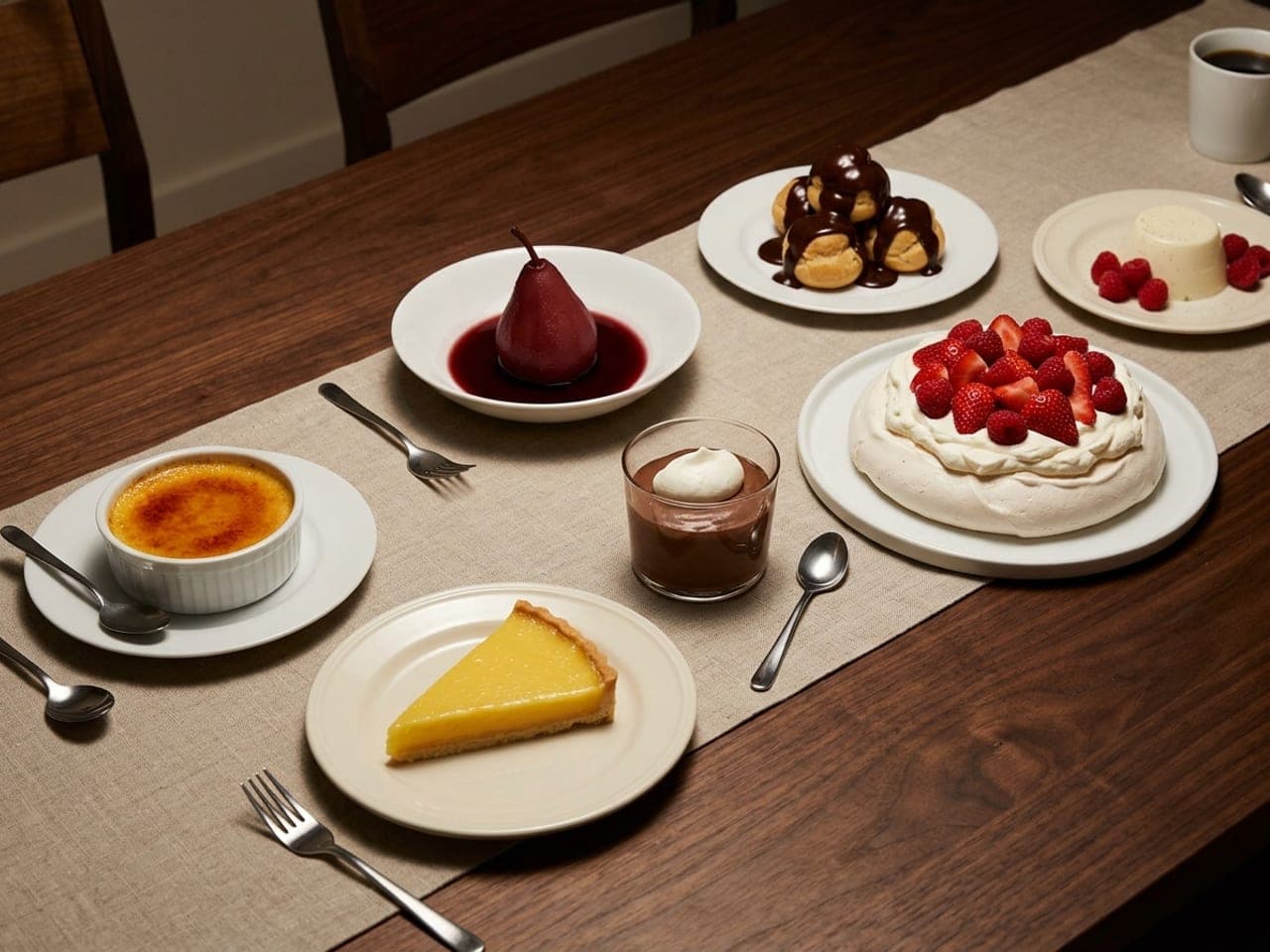
The photos on this page are AI-generated illustrations.
Choose a fancy dessert by how much work is left once guests are seated, not by how it looks in a photo. A pastry textbook defines a plated dessert as components “prepared well in advance” and “assembled à la minute”, at the last minute, and that last minute is the part a host has to plan. Of the 17 dessert roundups we read, 15 are ungrouped lists, and none sorts its desserts by what is left to do at serving time.
So the 24 desserts below are sorted into four tiers: finished before guests arrive, one finishing step at serving, in the oven during the main course and cooked at the last minute. Each card gives the make-ahead window with the source that states it, what is left to do after dinner and roughly how long it takes, one way to plate it, and its allergens, with a flag for raw egg, alcohol, caffeine or gelatin. Most open with a line on where the dessert comes from, as far as the record goes. After the cards: how to plate, how much per guest, which dessert after which dinner, the safety notes and a make-ahead timeline.
The short recipes on the cards are not kitchen-tested by us. Each one follows the named published recipe: the quantities are that recipe’s, and the method is retold in our words. Two desserts in the list link to full recipes on this site instead, and three more follow the numbered list. Where sources disagree on a make-ahead window we name both or take the shorter one, and where a number is our own estimate or arithmetic the card says so. The “min active” chip on a card is hands-on time. Where the recipe prints an active or prep time for the batch on the card, the chip is that figure (the lower one where it prints a range; a printed prep time can leave out the cooking); where it prints none, or only a total, the chip is our estimate. On the cards that link to our own recipes it matches the active time on the recipe page, prep plus cooking, where that page shows one.
A note on units: US measures come first with the metric beside them. Where a recipe was written in metric, the oven temperature is our exact conversion, so a recipe written for 180°C is printed here as 356°F (180°C); set your dial to the nearest mark. The ounces are the publisher’s own where it prints them (the BBC’s rounded pairs include 1 oz / 25 g and 11 oz / 300 g) and our exact conversion where it does not. Gram weights marked “about” are conversions of cup measures, by King Arthur Baking’s weight chart.
Three numbers run through the page: egg mixtures are safe at 160°F (71°C), nothing with egg or dairy sits out longer than 2 hours, and a flamed dessert still holds 75% of its alcohol.
How to choose: four kinds of last-minute work
Pick the tier before you pick the dessert. The question is not which one looks best, it is what you are willing to be doing while your guests are at the table.
| Tier | Work once guests are seated | Minutes after dinner | What you need | Examples |
|---|---|---|---|---|
| Finished before guests arrive (9) | None. Unmold, slice or spoon, straight from the fridge. | 0 to 5, plating only (our estimate) | Fridge space; ramekins, glasses or a tart pan | Panna cotta, chocolate mousse, lemon posset, tiramisu, poached pears |
| One finishing step at serving (7) | One short job: torch the sugar, whip and top, warm a sauce, pull the espresso or spin the caramel. | 3 to 20 | A kitchen torch or a broiler, a freezer, an espresso maker | Crème brûlée, pavlova, profiteroles, affogato |
| In the oven during the main course (3) | It bakes while the main course is eaten and goes straight to the table; the tarte Tatin is reheated a little earlier and turned out at serving. | 9 to 14 in the oven for the cakes and soufflés, 20 for the tarte Tatin’s reheat | A free oven, a timer, a towel for hot ramekins | Chocolate soufflé, molten chocolate cake, tarte Tatin |
| Cooked at the last minute (5) | All of the cooking, at the stove or under a hot oven, with guests watching or waiting. | 10 to 25 | A burner, a stainless-steel skillet, a long lighter and a pan lid; a whisk and a bowl for zabaglione | Crêpes Suzette, bananas Foster, cherries jubilee, zabaglione |
One oven, one cook. If the main course needs the oven or your attention until the moment it is served, stay in the first two tiers. Our dinner party menu planner follows the same rule: only one dish on the stove at the last minute, and a dessert made the day before.
Where the minutes come from. They are the recipe’s own times where it prints them. Where we add steps up or estimate, the card says “our estimate”. None of them includes heating the oven.
Finished before guests arrive, plated from the fridge
9 desserts that are done hours or days ahead. After dinner you unmold, slice or spoon, and that is all. Three of them (lemon posset, crème caramel and pots de crème) are also the easiest to serve to a mixed table: nothing raw, nothing flamed, no alcohol and no gelatin. Panna cotta joins them when nobody at the table avoids gelatin, which is animal-derived (so not for vegetarians, or for guests who avoid pork or beef gelatin); its ½ tsp of vanilla extract is alcohol-based, so use only the bean for guests who avoid alcohol entirely.
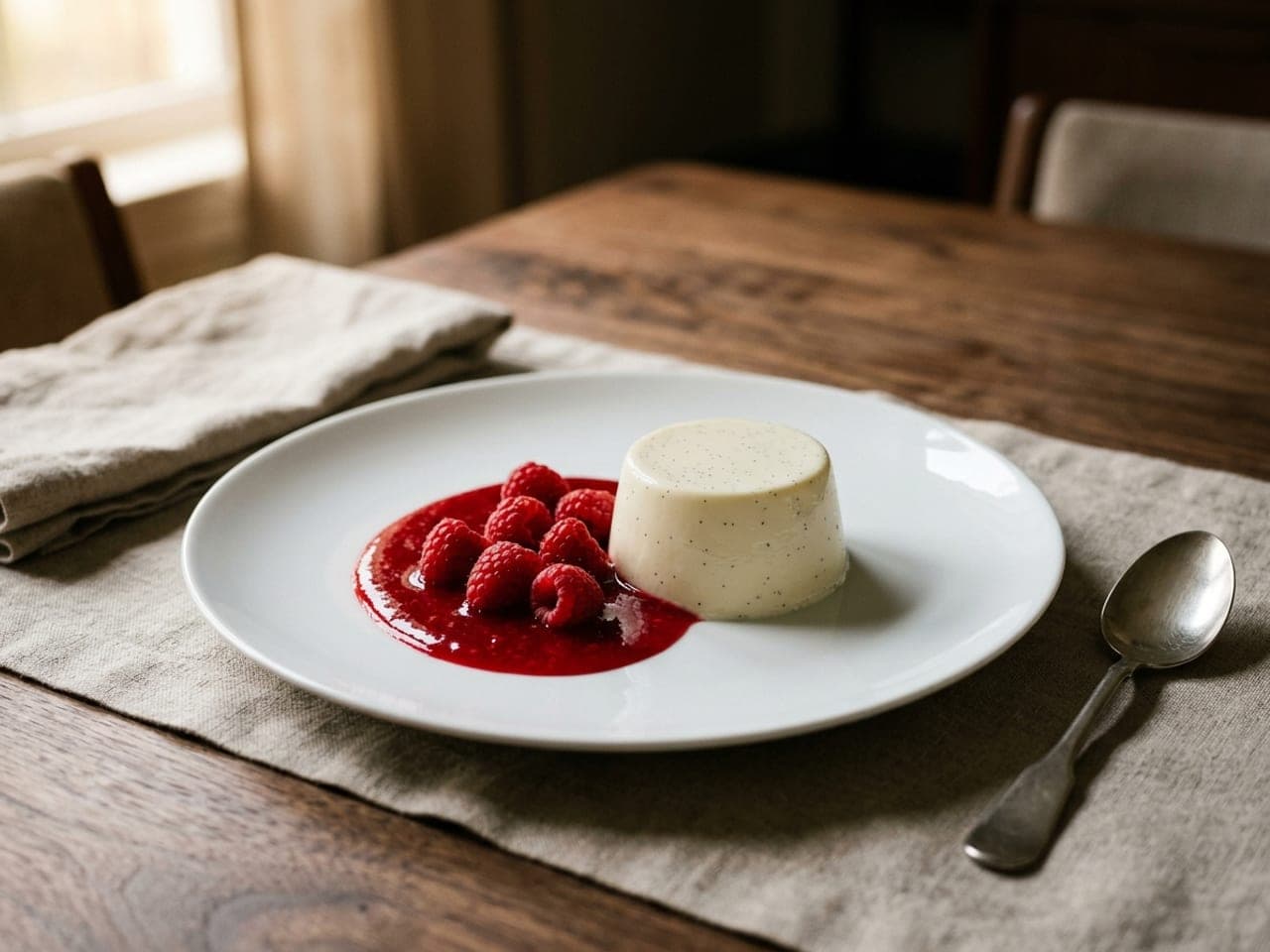
1Vanilla panna cotta with fruit
Claimed by Piedmont’s Langhe hills; the tale of a Hungarian woman inventing it there is a legend, and the earliest recipe we found is in the Turin paper Stampa Sera in 1971. Make ahead: we plan on 2 days, well covered, the window David Lebovitz gives for his own panna cotta. Serious Eats says the recipe we follow keeps 10 days or longer tightly wrapped, but USDA FSIS gives cooked leftovers 3 to 4 days in the fridge, so we stop at 2. Allow at least 4 hours to set. After dinner: no cooking. Run a knife around each one and turn it out (America’s Test Kitchen’s method), then add the fruit: about 5 minutes for six, our estimate. Plate it: unmolded on a cool plate, the fruit or a spoonful of raspberry coulis beside it, not over it; or set it in glasses and skip the unmolding, as Lebovitz does. Served cold. Allergens: milk. Gelatin is animal-derived, so it is not vegetarian. No egg, wheat or nuts as written. The ½ tsp of vanilla extract is made with alcohol; leave it out for anyone who avoids alcohol entirely, the vanilla bean is enough.
Quick recipe · Serves 6, in ½ cup (118 ml) cups (after Stella Parks, Serious Eats)
Ingredients
- 1¾ cups (395 g) heavy cream
- 1 cup (225 g) whole milk, plus ¼ cup (55 g) for the gelatin
- 1 vanilla bean, split lengthwise, and ½ tsp vanilla extract
- ⅓ cup (70 g) sugar and ½ tsp Diamond Crystal kosher salt
- ¼ oz (7 g) unflavored gelatin powder, about 2⅛ tsp
- 6 to 8 oz (170 to 225 g) fresh fruit, plain or sprinkled with sugar, to serve
Method
- Heat the cream, the 1 cup (225 g) of milk and the vanilla pod until steaming. Cover and leave to steep for at least 1 hour; Serious Eats allows up to 24. Past 2 hours, steep it in the fridge (our caution). Rub the vanilla seeds into the sugar with the salt.
- Stir the gelatin into the remaining ¼ cup (55 g) of milk with the vanilla extract and leave it for about 10 minutes.
- Reheat the cream until steaming, lift out the pod, take the pan off the heat and whisk in the sugar and the gelatin until dissolved. Do not let it simmer, which weakens the set. Cool to lukewarm, stirring now and then, so it does not separate into layers.
- Divide between 6 lightly greased cups. Serious Eats says about 3½ oz (100 g) each; by our arithmetic the batch runs a little over that, so expect full cups or a spoonful to spare. Cover and refrigerate for at least 4 hours.
Keep fresh kiwi and pineapple out of the cream: David Lebovitz notes that their enzymes can stop gelatin from setting. As a garnish, add them at the last minute.
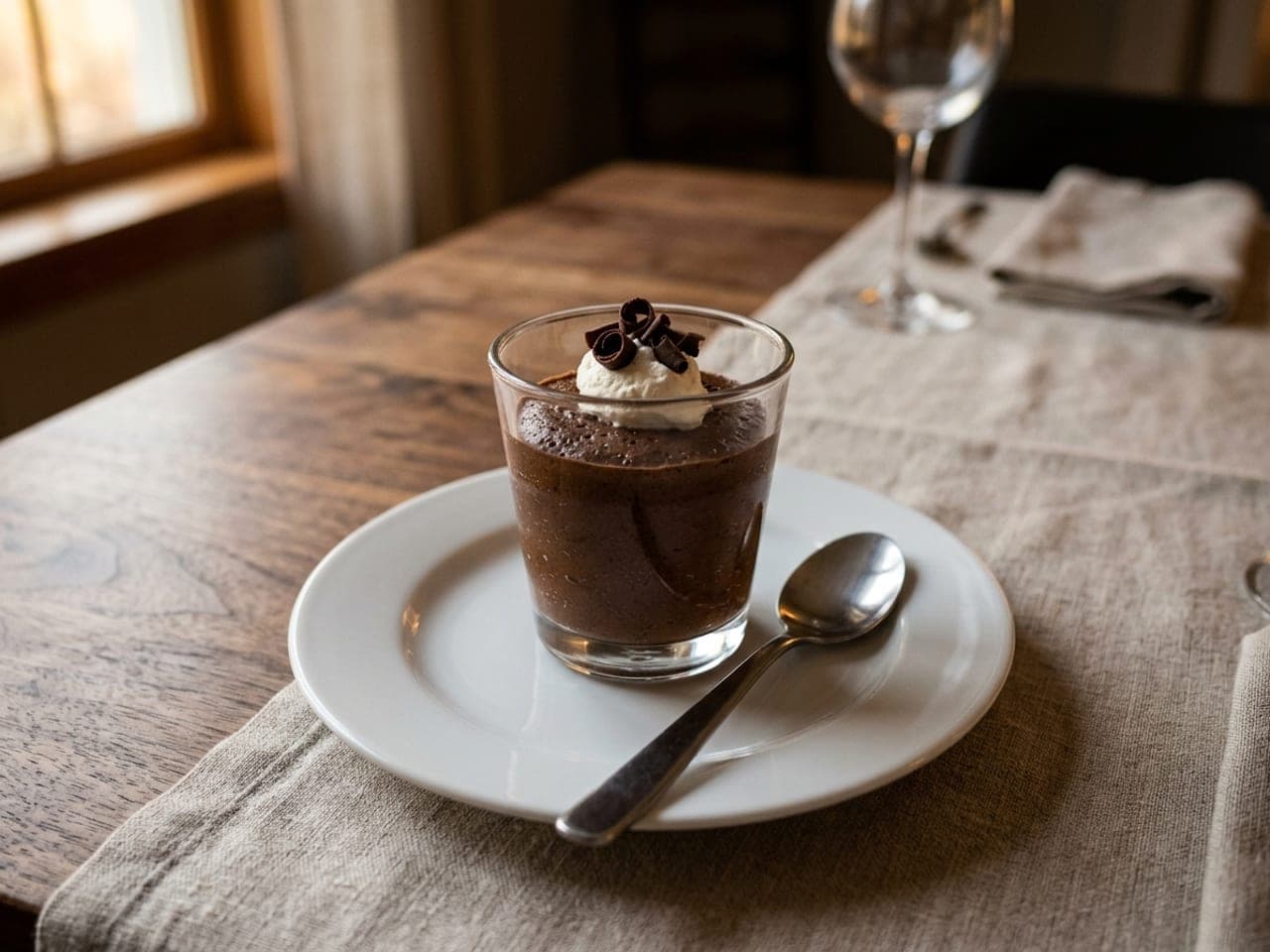
2Chocolate mousse
A “mousse de chocolat”, a whipped chocolate cream, is already in Menon’s confectionery manual of 1750; the story that Toulouse-Lautrec invented it is a legend. Make ahead: David Lebovitz keeps this one up to 4 days; Bon Appétit and America’s Test Kitchen stop at 1 day for theirs, and with raw egg white in it so do we. Allow 4 hours to set. After dinner: nothing to cook. Take it out 10 minutes before serving (America’s Test Kitchen) and add the cream. Plate it: in a short glass or a teacup on a small plate, one small spoonful of softly whipped cream and a few chocolate curls, cool rather than fridge-cold. Allergens: egg, milk; soy lecithin in most chocolate. Flags: raw whites and barely warmed yolks (see the note in the recipe); rum that is only warmed, so leave it out for children, pregnant guests and anyone avoiding alcohol (Lebovitz says it can be omitted, and then uses 1 tsp of vanilla extract in place of the ½ tsp); coffee and chocolate, so caffeine.
Quick recipe · Serves 6 (after David Lebovitz, who adapts Julia Child)
Ingredients
- 6 oz (170 g) bittersweet or semisweet chocolate, chopped
- 6 oz (170 g) unsalted butter, cut into small pieces
- ¼ cup (60 ml) dark-brewed coffee
- 4 large eggs, separated (pasteurized in the shell: see the note)
- ⅔ cup (130 g) sugar, plus 1 tbsp for the whites
- 2 tbsp (30 ml) dark rum and 1 tbsp (15 ml) water
- A pinch of salt and ½ tsp vanilla extract
Method
- Melt the chocolate, butter and coffee together in a bowl set over barely simmering water. Take it off the heat and let it cool until tepid.
- In a second bowl over the same water, whisk the yolks with the ⅔ cup (130 g) of sugar, the rum and the water for about 3 minutes, until it is thick enough to hold a trail (Lebovitz’s picture: “like runny mayonnaise”). Move the bowl into ice water and beat until cool and thick, then fold in the chocolate.
- Beat the whites with the salt until they hold their shape, add the 1 tbsp of sugar and beat until thick and shiny but not fully stiff, then beat in the vanilla. Fold a third into the chocolate, then the rest, and stop as soon as it is even: overfolding costs volume.
- Spoon into 6 glasses and refrigerate for at least 4 hours, until firm.
The whites in this mousse are raw, and the yolks are only warmed for about 3 minutes, with no temperature given. For any recipe served raw or undercooked the FDA says to use pasteurized eggs or egg products, above all for children, older adults, pregnant women and people with weakened immune systems. Use eggs pasteurized in the shell; the American Egg Board says their whites can take up to about four times as long to whip. Lebovitz’s alternative is carton pasteurized whites whose label says they can be whipped, but USDA FSIS says carton egg products are best used cooked when a guest is at higher risk. Bon Appétit’s version cooks the yolks to 160°F (71°C) and still warns about its raw whites. For those guests, pots de crème are the baked chocolate alternative.
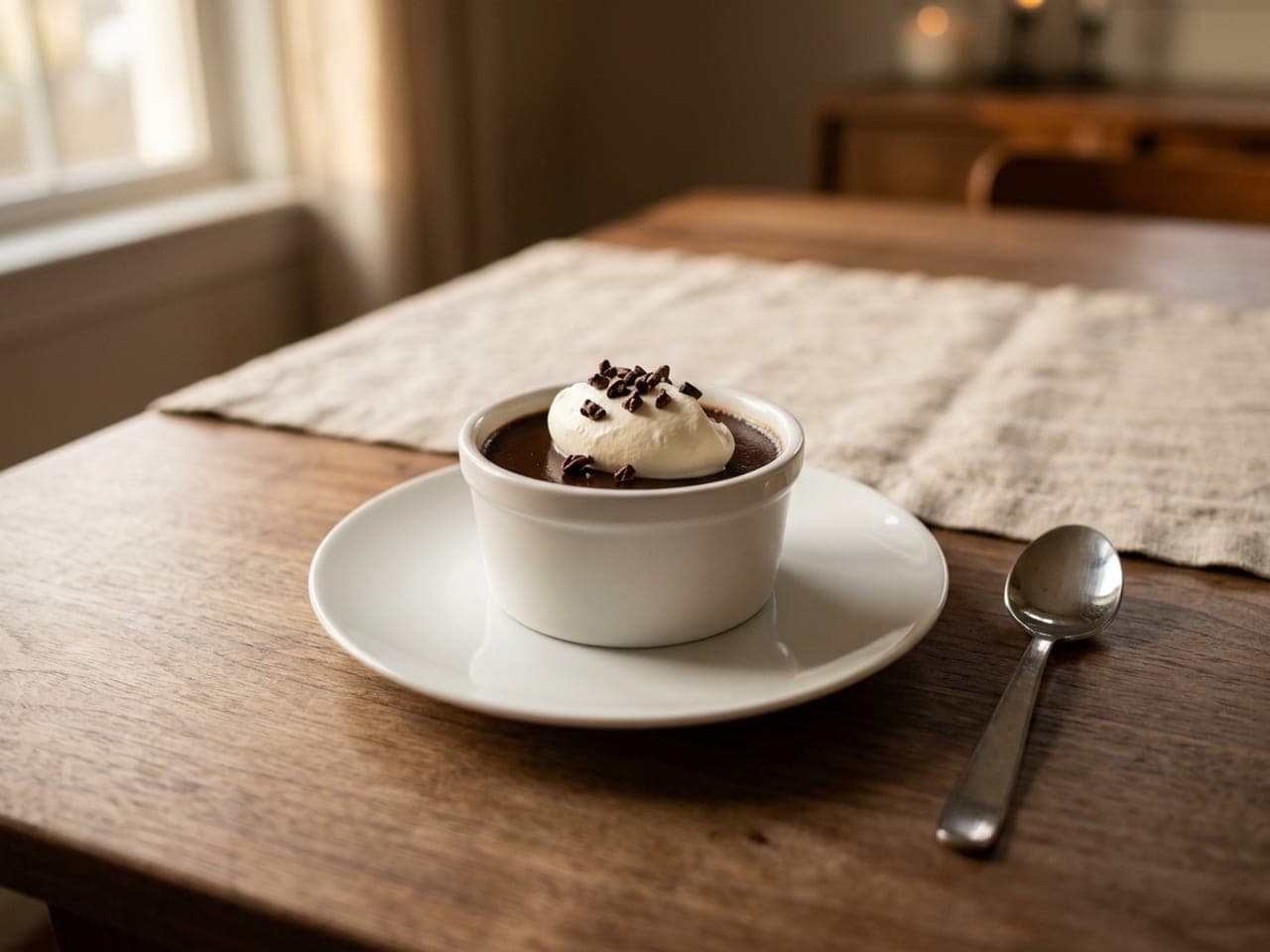
3Chocolate pots de crème
Little pots of cream, as the name says: a Paris restaurant guide of 1814 lists “petits pots de crême, café et chocolat”, two for 16 sous. Make ahead: 2 days, covered and chilled (Epicurious). Bon Appétit allows 5 for its own; the FDA gives leftover cooked egg dishes 3 to 4, so we stop at 2. Allow 3 hours to chill. After dinner: nothing to cook. Whip a little cream and top each pot as it goes out; America’s Test Kitchen lets its pots stand 20 to 30 minutes at room temperature first. Plate it: in its ramekin on a small plate with a teaspoon, one spoonful of whipped cream and a pinch of cacao nibs or chocolate curls. Allergens: egg, milk; soy lecithin in most chocolate. The yolks are baked, not raw, so this is the chocolate dessert for guests who should avoid raw egg. The recipe judges doneness by the jiggle; when you are cooking for those guests, check one pot with a thermometer: the FDA’s figure for egg dishes is 160°F (71°C) in the center.
Quick recipe · Serves 6, in 6 oz (177 ml) ramekins (after Epicurious, Café Tamayo’s recipe)
Ingredients
- 2 cups (473 ml) heavy cream
- ½ cup (118 ml) whole milk
- 5 oz (142 g) bittersweet or semisweet chocolate, chopped
- 6 large egg yolks
- ⅓ cup (about 66 g) sugar
Method
- Heat the oven to 325°F (163°C). Bring the cream and milk just to a simmer, take the pan off the heat, add the chocolate and whisk until smooth.
- Whisk the yolks with the sugar, then whisk in the hot chocolate cream a little at a time. Strain, let it stand 10 minutes and skim off the foam.
- Pour into six 6 oz (177 ml) ramekins and cover each with foil. Stand them in a baking dish, set the dish on the oven rack and pour in hot water to come halfway up their sides. Bake 50 to 60 minutes, until they are set but the centers still jiggle.
- Lift them out, take off the foil and cool, then chill for at least 3 hours.
Fill the water bath once the dish is sitting on the oven rack, so you never carry a pan of hot water, and lift the ramekins out with tongs or a folded towel. Refrigerate within 2 hours of baking.
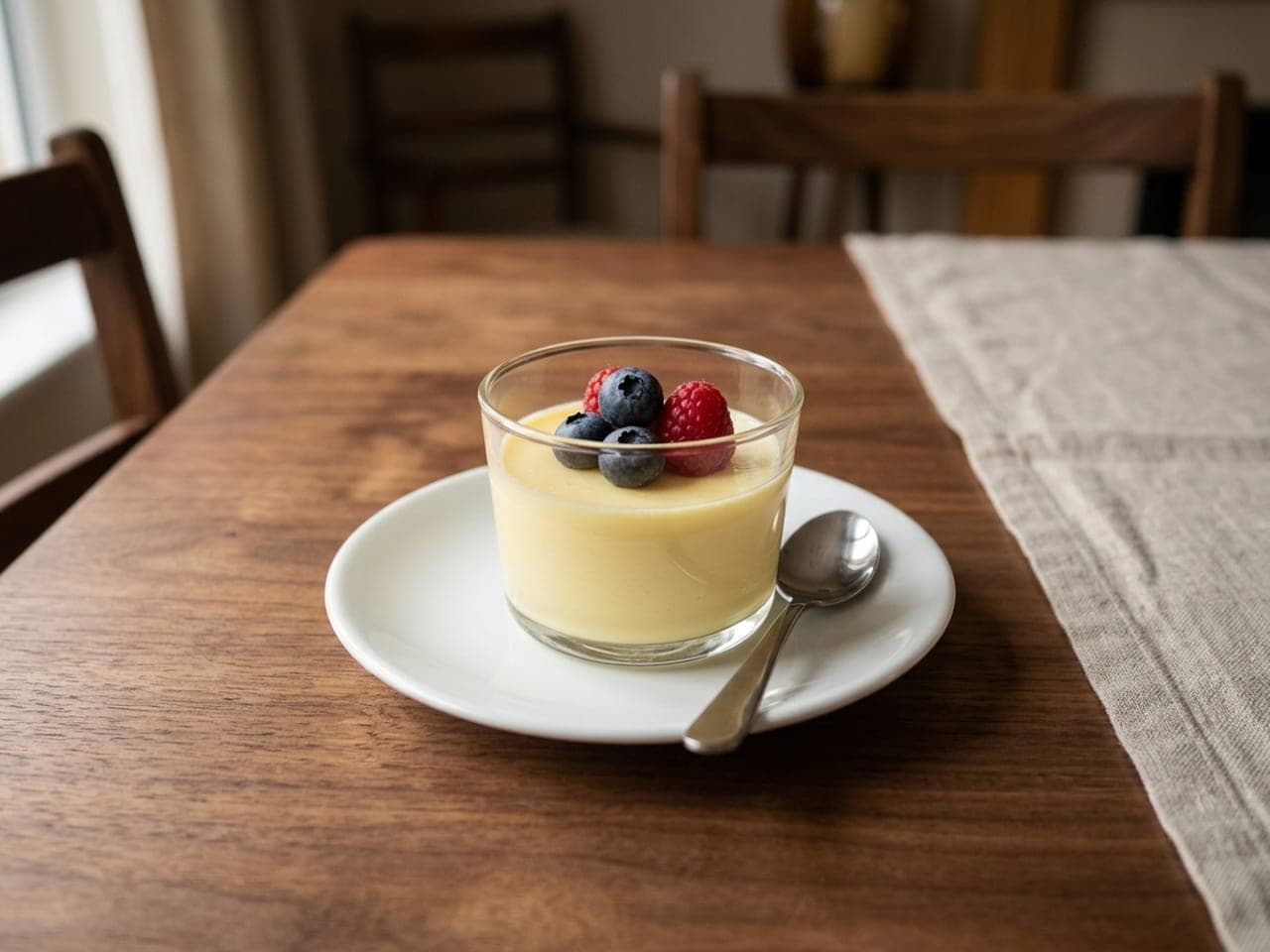
4Lemon posset
Posset began as a hot medieval drink of curdled milk (the Oxford English Dictionary dates the word to before 1425). Elizabeth Moxon printed a cold lemon posset, served in glasses, by 1752; today’s three-ingredient set cream is a late 20th-century simplification. Make ahead: 2 days, wrapped (America’s Test Kitchen); BBC Good Food and Serious Eats stop at 24 hours for theirs. Allow 3 hours to set. After dinner: unwrap, leave 10 minutes at room temperature and add the berries. Plate it: in a small glass or ramekin on a saucer with a teaspoon, a few berries placed on top. It is rich, so the portion is small. Allergens: milk only. No egg, no gelatin (the lemon’s acid sets the cream), no wheat, nuts or alcohol: the easiest dessert here to serve to a mixed table.
Quick recipe · Serves 6 (after Annie Petito, America’s Test Kitchen)
Ingredients
- 2 cups (473 ml) heavy cream
- ⅔ cup (132 g) granulated sugar
- 1 tbsp grated lemon zest
- 6 tbsp (89 ml) lemon juice, from 2 lemons
- 1½ cups (about 355 ml) blueberries or raspberries, to serve
Method
- Bring the cream, sugar and zest to a boil over medium heat and keep it boiling, stirring often, until it has reduced to 2 cups (473 ml), 8 to 12 minutes. Pour it into a heatproof measuring jug once or twice to check: the set depends on that volume.
- Off the heat, stir in the lemon juice. Leave it for about 20 minutes, until slightly cooled with a skin on top, then strain.
- Divide between 6 small glasses or ramekins and refrigerate, uncovered, for at least 3 hours, until set. Wrap them once they are cold.
Boiling cream climbs the pan fast: use a deep saucepan, do not leave it, and lift it off the heat for a moment if it threatens to boil over.
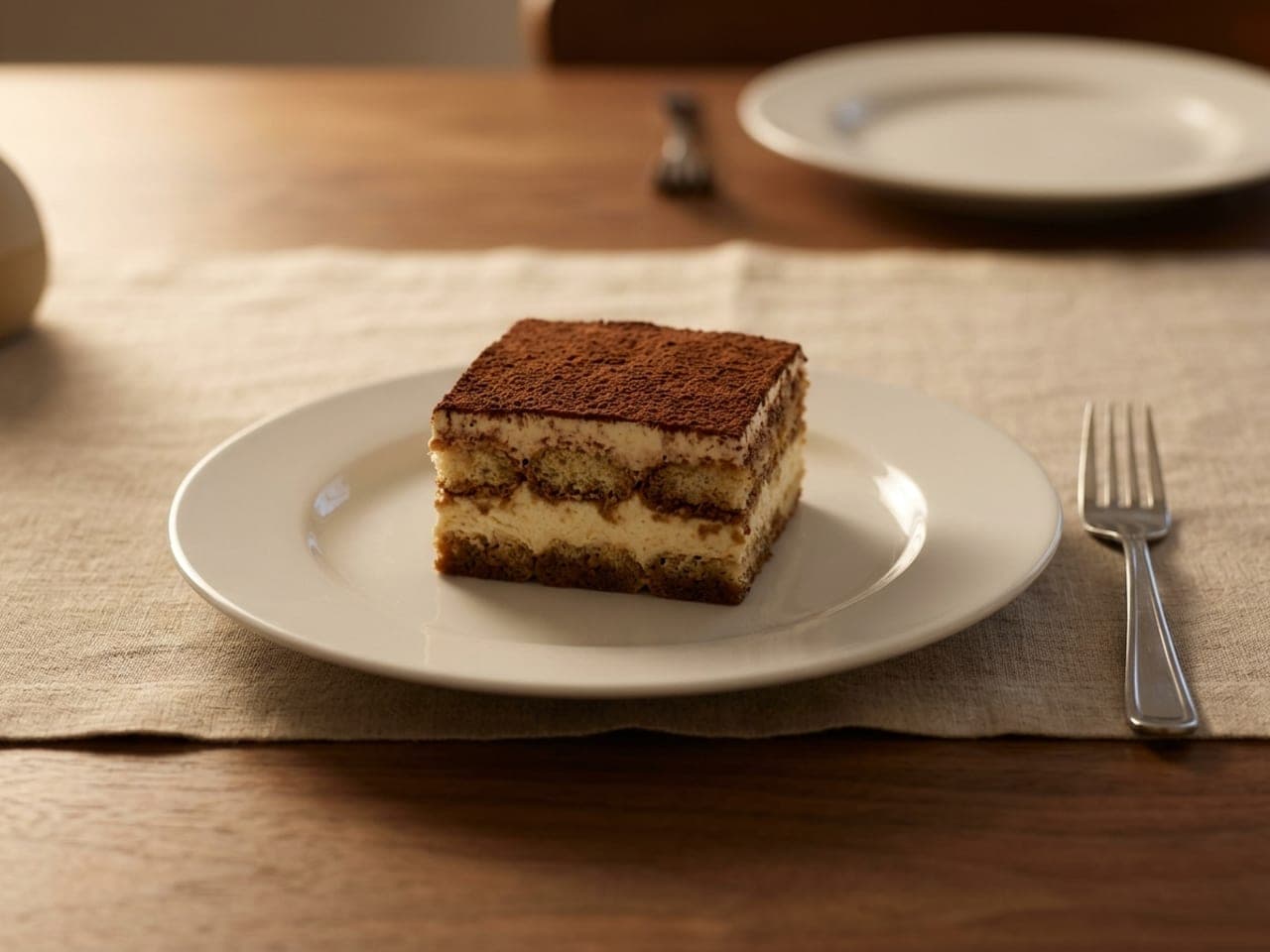
5Tiramisu
Its origin is disputed: Le Beccherie in Treviso dates it to the early 1970s, Friuli points to 1950s Tolmezzo, and the earliest print use of the name we found is a Friuli bakery advert of December 1979. The Medici story is a legend, and we found no record behind the brothel one. Make ahead: up to 3 days (Serious Eats); BBC Good Food gives its own, which has no egg in the cream, 2, and that is what we plan on. After dinner: nothing to cook: dust with fresh cocoa and cut. Plate it: a square lifted out with a spatula, the knife wiped between cuts, on a small plate; cocoa through a fine sieve at the last moment; served chilled. Allergens: egg, milk, wheat (the ladyfingers; check the packet, which often adds soy and a nut warning); sulfites if you use Marsala or another wine-based bottle; tree nuts if the dark liqueur is a nut liqueur. Flags: unheated liqueur (USDA’s table has 70% of the alcohol left after a night in the fridge) and espresso, so as written it is not for children, pregnant guests or anyone avoiding alcohol or caffeine; the note in the recipe has an alcohol-free version. The eggs here are cooked to 160°F (71°C); FoodSafety.gov tells pregnant women not to eat tiramisu that may contain raw eggs.
Quick recipe · One 7 by 11 inch (18 by 28 cm) dish, 8 to 12 servings as published (after Stella Parks, Serious Eats); it is built by the dish, so we have not scaled it
Ingredients
- About ⅔ cup (140 g) piping-hot espresso or strong brewed coffee
- ¼ cup (20 g) Dutch-processed cocoa powder, plus more for dusting
- ¼ cup (55 g) crème de cacao or another dark liqueur, and ¼ cup (55 g) Cardamaro, another mild amaro or sweet Marsala
- 1 tbsp (15 g) vanilla extract
- 5 large eggs (245 g)
- ½ cup (100 g) sugar and ¼ tsp Diamond Crystal kosher salt
- 24 oz (680 g) mascarpone, straight from the fridge
- About 30 ladyfingers
Method
- Whisk the cocoa into the hot espresso, then whisk in the liqueurs and vanilla.
- Stir the eggs, sugar and salt in a mixer bowl set over a pot of steaming water, scraping all the time, until they reach 160°F (71°C), about 5 minutes. Whip on high speed until thick and more than four times the volume, 5 to 10 minutes. On medium speed add the mascarpone a few spoonfuls at a time, then whip briefly until smooth.
- Dip each ladyfinger in the coffee for a second or two, no longer, and cover the bottom of the dish with them (about half). Spread on half the cream and dust with cocoa. Repeat with the rest of the ladyfingers and the rest of the cream.
- Dust with cocoa, cover and refrigerate for at least 1 hour.
Trust the thermometer, not the clock: 160°F (71°C) is the FDA’s figure for egg mixtures. The liqueurs are not cooked. For an alcohol-free dish Serious Eats swaps them for coffee mixed with hazelnut or almond milk and chocolate syrup, which adds tree nuts. Out of the fridge for 2 hours at most.
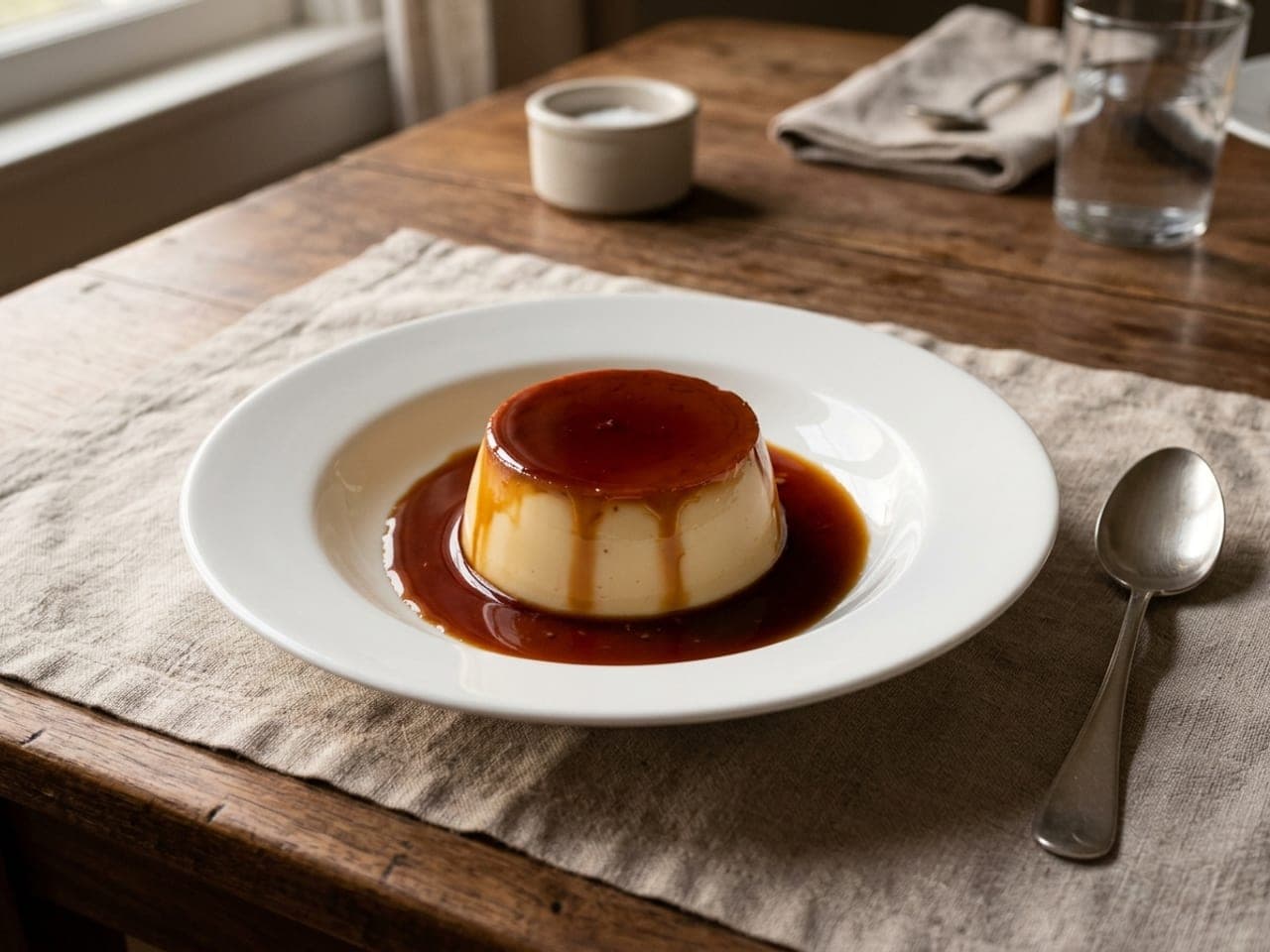
6Crème caramel
Flan is an old word for a flat cake; the custard turned out of a caramel-lined mold is the “crème renversée” in Escoffier’s Guide culinaire of 1903, called crème caramel in English since about 1906 (Merriam-Webster). Make ahead: 2 days, in the ramekins (Epicurious, America’s Test Kitchen); BBC Good Food allows 3 for its own. They chill overnight before they are turned out. After dinner: unmold only: knife around the edge, plate on top, flip and shake gently. About 5 minutes for six, our estimate. Plate it: on a small rimmed plate or shallow coupe, so the caramel runs over the custard and pools around it. No garnish. Served cold. Allergens: egg, milk. No wheat, nuts or gelatin. The eggs are baked, not raw; for guests at higher risk, check that one custard has reached 160°F (71°C) in the center.
Quick recipe · Serves 6, in ¾ cup (177 ml) ramekins (after Epicurious, “Caramel Flan”, first printed in Bon Appétit in May 1992)
Ingredients
- 1 cup (200 g) sugar and ⅓ cup (79 ml) water, for the caramel
- 1¾ cups (414 ml) heavy cream
- 1 cup (237 ml) whole milk
- ½ vanilla bean, split lengthwise, and ⅛ tsp kosher salt
- 7 tbsp (88 g) sugar, for the custard
- 3 large eggs plus 2 large egg yolks
Method
- Bring the cream, milk, salt and the vanilla seeds and pod just to a simmer. Take off the heat and steep for 30 minutes.
- Dissolve the 1 cup (200 g) of sugar in the water over low heat, then turn the heat up and cook without stirring to a deep amber, about 10 minutes. Pour it at once into six ¾ cup (177 ml) ceramic ramekins at room temperature and, holding each with an oven mitt or a folded towel, tilt it so the caramel runs up the sides: the caramel heats the dish at once. Stand them in a 13 by 9 inch (33 by 23 cm) baking pan.
- Heat the oven to 350°F (177°C). Whisk the 7 tbsp (88 g) of sugar with the eggs and yolks just until blended, making as little foam as you can, then gently whisk in the warm cream. Strain into the ramekins. Set the pan on the oven rack, pour in hot water to come halfway up the ramekins and bake about 40 minutes, until the edges are set and the centers still jiggle.
- Cool for no more than 2 hours, chill uncovered for about 2 hours, then cover and chill overnight. To serve, run a small knife around each flan, turn it over onto a plate and shake gently.
Caramel is far hotter than boiling water (America’s Test Kitchen: over 300°F (149°C)) and it sticks. Pour it away from you, keep children out of the kitchen, and hold any burn under cool running water for 20 minutes, the NHS’s advice. Fill the water bath only once the pan is on the oven rack. Our caution: do not pour hot caramel into cold or thin glass dishes, which can crack.
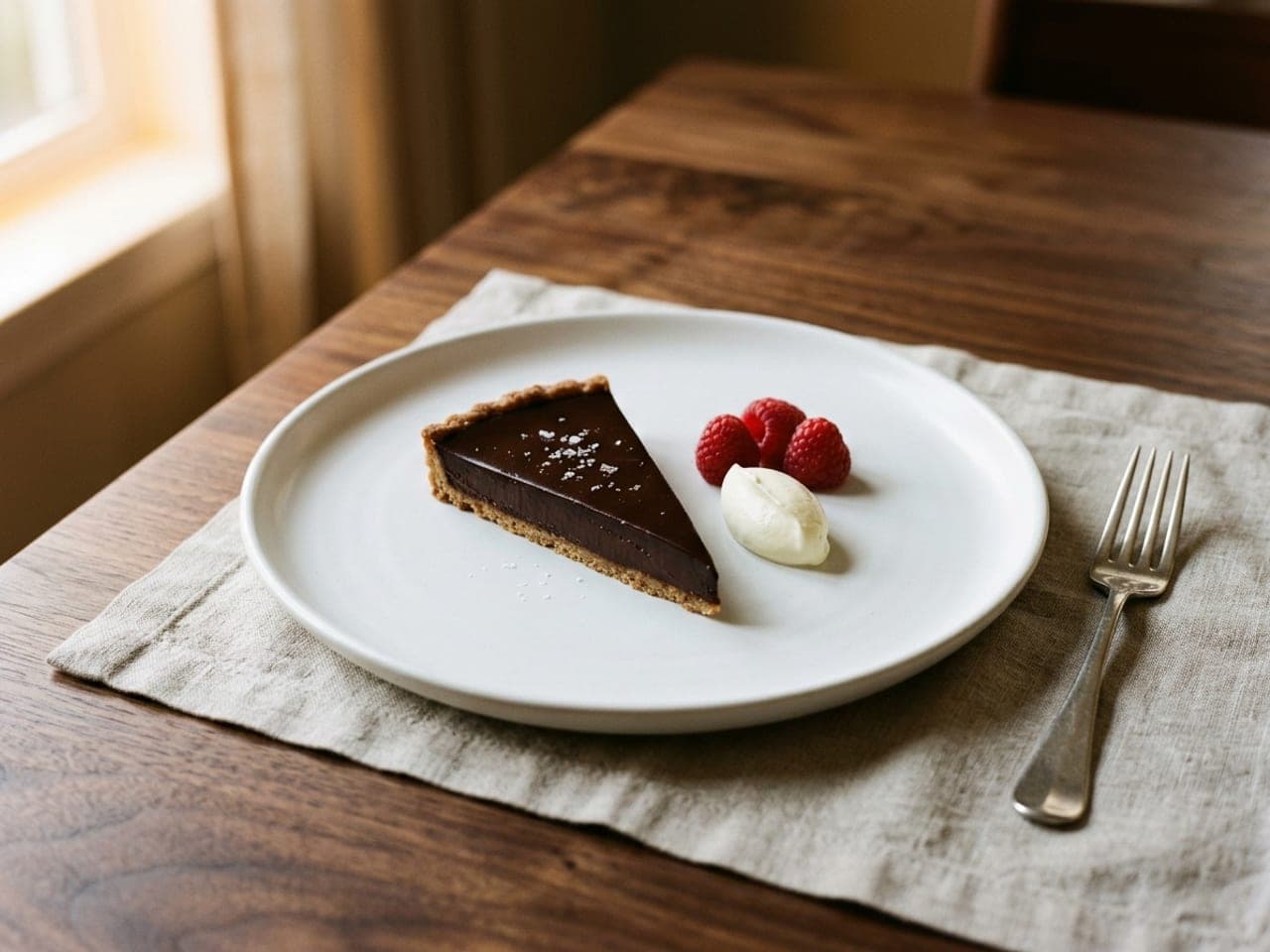
7Chocolate ganache tart
Chocolate, hot cream and butter poured into a baked shell and left to set. This crust is ground nuts pressed into the pan, so there is no pastry to roll: Bon Appétit says it “requires zero dough-making skills”. Make ahead: 1 day, covered and chilled (Bon Appétit); allow 1 hour to set. After dinner: unmold, scatter with flaky salt and slice with a hot knife: about 5 minutes, our estimate. Williams-Sonoma lets its own chocolate tart stand 20 minutes at room temperature first. Plate it: a slim wedge on a flat plate with a small quenelle of crème fraîche and a few raspberries, like the dessert course in our prix fixe guide. Allergens: tree nuts (the crust), milk; soy lecithin in most chocolate. No wheat or egg as written. Caffeine: about 37 mg in an eighth of the tart, from the chocolate (our arithmetic from USDA’s figure).
Quick recipe · One 12 inch (30 cm) tart: 8 servings as published, more if you cut slim wedges (after Janice Tiefenbach of Elena, Montreal, in Bon Appétit)
Ingredients
- 2½ cups (about 590 ml) mixed raw nuts, such as walnuts, blanched hazelnuts, pistachios or almonds (the recipe gives volume only)
- 6 tbsp (about 74 g) sugar and ¾ tsp kosher salt
- 4 tbsp (57 g) unsalted butter, melted, plus soft butter for the pan
- 12 oz (340 g) bittersweet chocolate, chopped
- 2 cups (473 ml) heavy cream
- 6 tbsp (85 g) unsalted butter, at room temperature, cut into pieces
- Flaky sea salt
Method
- Heat the oven to 350°F (177°C). Butter a 12 inch (30 cm) tart pan with a removable bottom and line the base with parchment. Pulse the nuts until finely chopped, pulse in the sugar and salt, then the melted butter, until it looks like wet sand. Press it firmly over the base and up the sides.
- Bake 20 to 25 minutes, until golden brown, and let it cool.
- Heat the cream until it just begins to simmer and pour it over the chocolate. Leave it for 5 minutes, add the soft butter and stir until smooth and glossy. Scrape into the crust.
- Chill, uncovered, for at least 1 hour, until set. Unmold, scatter with flaky salt and cut into wedges with a knife dipped in hot water and wiped dry.
The crust is all tree nuts: say so when you serve it. Packaged mixed nuts are often packed alongside peanuts, and some carry a wheat warning, so read the bag before you call the tart gluten-free.
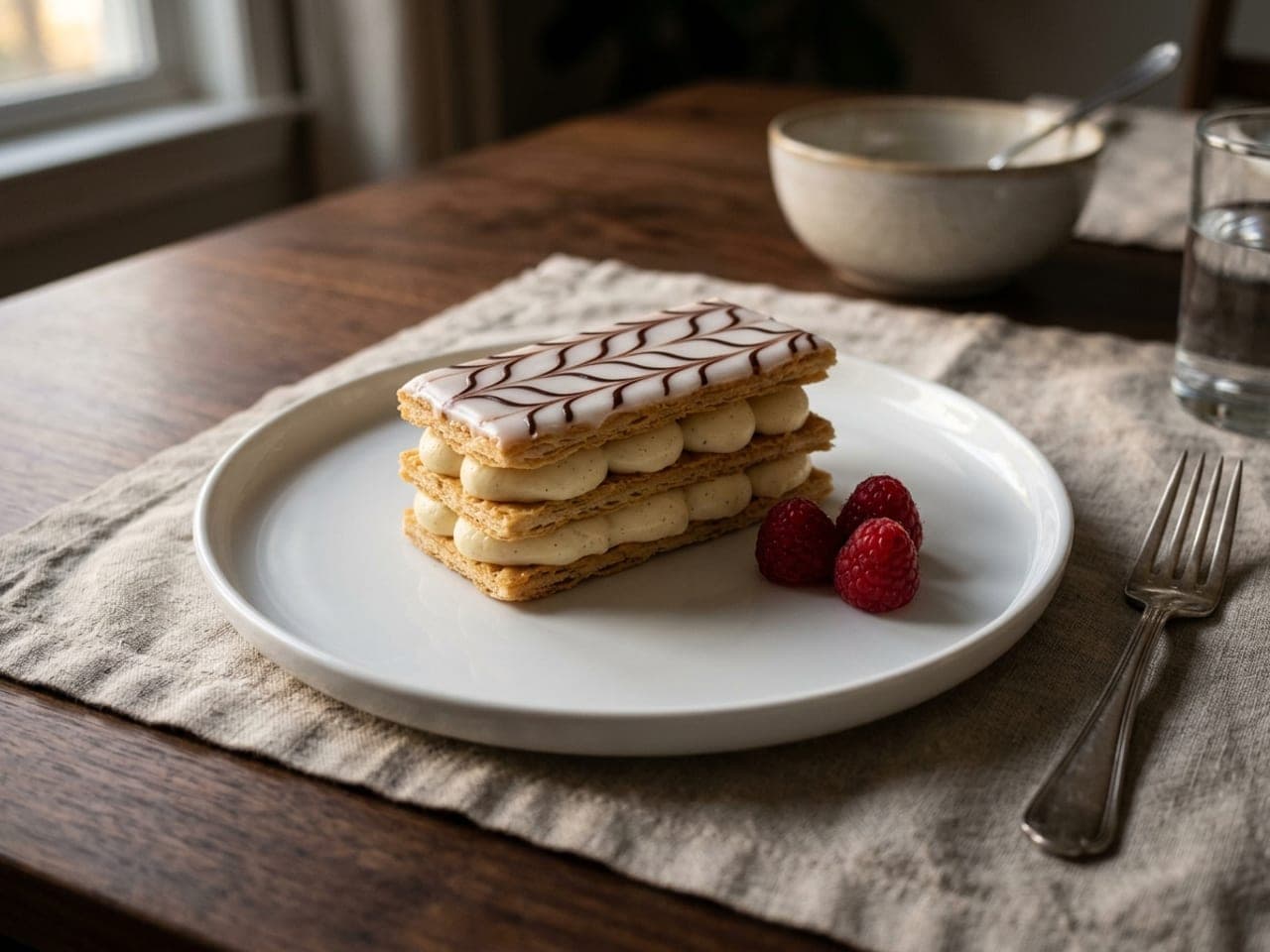
8Mille-feuille with bought puff pastry
The earliest use of the name we found is in English: “A Cake of Mille Feuilles”, stacked with jam, in Vincent La Chapelle’s The Modern Cook (London, 1733). A New York bakers’ manual was calling the cream-filled version Napoleons by 1892; no record ties the pastry to the emperor himself. Make ahead: pastry cream 1 day ahead in the fridge and the baked pastry 1 day ahead, covered at room temperature; the assembled pastries then rest in the fridge, uncovered, for 30 minutes to 8 hours (Sally’s Baking). King Arthur allows 12 hours for its own but says they are best the day they are assembled. So: bake the pastry and cook the cream the day before, and assemble on the day itself, in the afternoon: Sally’s 8 hours count back from dessert, not from dinner. After dinner: nothing; plate from the fridge. Plate it: one pastry on a flat plate, icing up, nothing wet under it and a few raspberries beside it, served chilled. Sally’s calls each one shareable, so half is a fair portion. Allergens: wheat, milk, egg; soy lecithin in most chocolate; check the bought pastry’s label. The pastry cream is boiled: no raw egg.
Quick recipe · 5 three-layer pastries, as published (after Sally McKenney, Sally’s Baking)
Ingredients
- 1 lb (454 g) bought all-butter puff pastry, thawed (2 sheets)
- 4 large egg yolks and 3 tbsp (23 g) cornstarch
- 2 cups (480 ml) whole milk and ½ cup (100 g) granulated sugar
- 1 tbsp (14 g) unsalted butter, 1½ tsp vanilla extract and a small pinch of salt
- ½ cup (120 ml) cold heavy cream
- Icing: 1 cup (120 g) confectioners’ sugar, sifted, 1½ tbsp milk and ½ tsp vanilla extract
- 2 oz (57 g) semi-sweet chocolate, from a bar, melted
Method
- Pastry cream: whisk the yolks with the cornstarch. Heat the milk with the sugar, whisk it into the yolks, strain it back into the pan and whisk over medium heat until thick and bubbling for about 20 seconds, 185 to 190°F (85 to 88°C). Whisk in the butter, vanilla and salt, press plastic wrap onto the surface and chill for at least 3 hours and up to 24.
- Heat the oven to 400°F (204°C). Overlap the two pastry sheets, roll them together into a rectangle of about 11 by 16 inches (28 by 41 cm) and prick it all over. Bake on a parchment-lined baking sheet with parchment and a second, weighted baking sheet on top for 20 minutes, then uncover and bake 7 to 9 minutes more, until golden brown. Cool, trim and cut 15 squares of about 3 inches (7.6 cm).
- Whip the cream to medium peaks, about 3 minutes, and beat in the cold pastry cream on low speed. Chill for 1 to 4 hours. Whisk the icing and spread it on 5 of the squares; before it sets, pipe 4 lines of melted chocolate across each and drag a toothpick through them.
- Pipe 9 dollops of cream onto a plain square, set a second plain square on top, pipe 9 more and finish with an iced square. Refrigerate, uncovered, for at least 30 minutes and up to 8 hours.
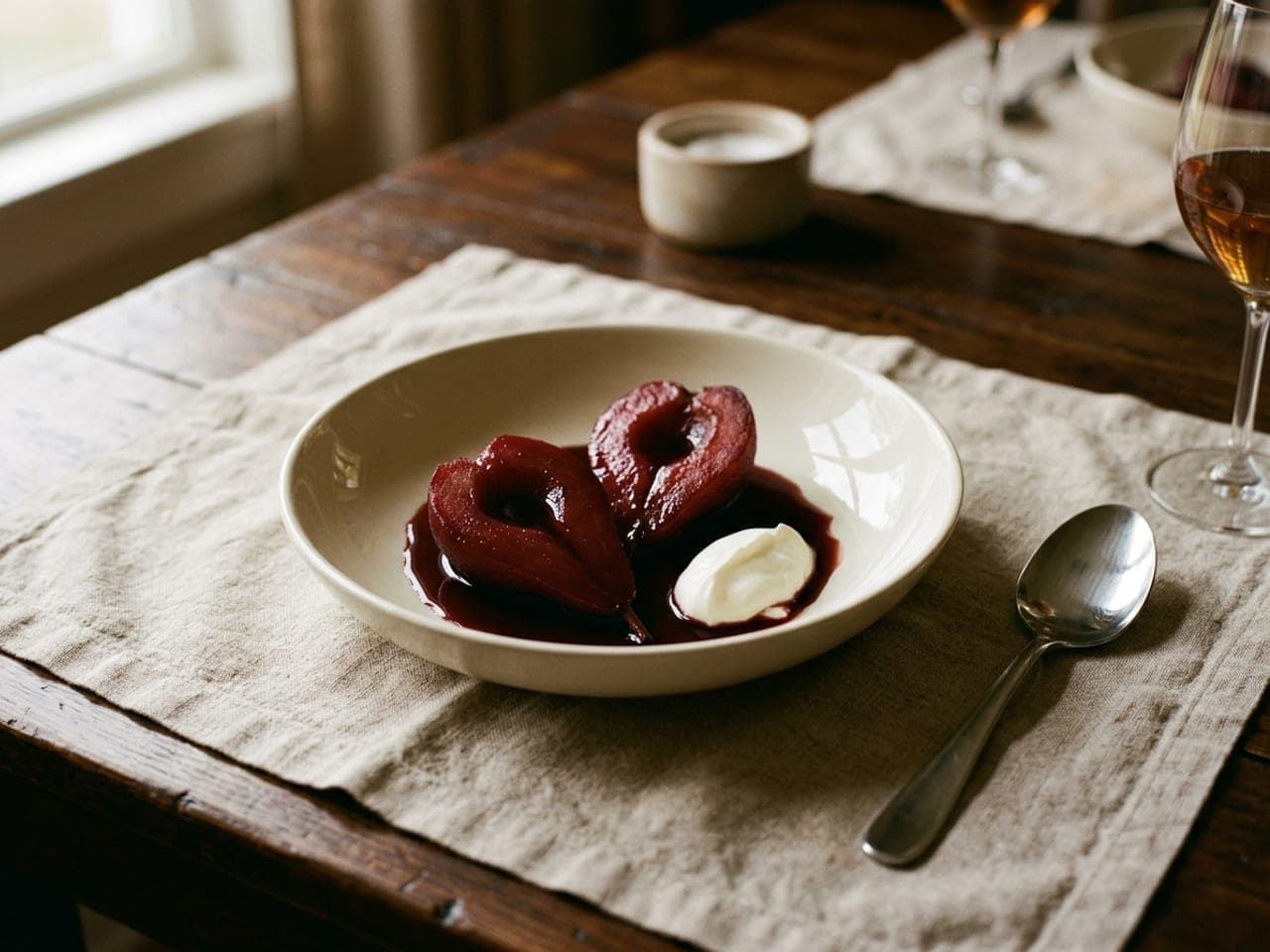
9Red-wine poached pears, served chilled
Wine-poached pears have no known inventor. Their chocolate-sauce cousin, poires Hélène, is tied by legend to Offenbach’s 1864 operetta; the earliest recipe we found is in Escoffier’s 1907 second edition. Make ahead: chilled in their syrup for 2 hours to 3 days (America’s Test Kitchen); BBC Good Food says 2 days for its own. After dinner: nothing when they are served chilled. Serious Eats serves its pears warm, which adds about 5 minutes of rewarming and 20 to 30 of reducing the wine to a glaze. Plate it: two pear halves, cut side down, in a shallow bowl, syrup spooned over, a spoonful of crème fraîche beside them. No cinnamon stick: a garnish should be edible. Allergens: none of the nine major US allergens in the pears; the wine brings sulfites, one of the fourteen named in the EU and UK, and the crème fraîche milk. Alcohol: it stays: USDA’s table has 40% left after 15 minutes of simmering and 35% after 30. For children, pregnant guests and anyone avoiding alcohol, poach in sugar syrup, as David Lebovitz does.
Quick recipe · Serves 6 (after America’s Test Kitchen, “Red Wine-Poached Pears with Black Pepper and Cloves”)
Ingredients
- 1 bottle (750 ml) red wine: a dry, medium-bodied one such as Côtes du Rhône, Pinot Noir or Merlot
- ¾ cup (149 g) sugar
- 25 black peppercorns and 3 whole cloves
- 3 sprigs fresh thyme and 5 sprigs fresh mint
- 1 vanilla bean, halved lengthwise, seeds scraped out and kept
- ½ cinnamon stick and ⅛ tsp salt
- 6 ripe but firm pears, about 8 oz (227 g) each, preferably Bosc or Bartlett, peeled, halved and cored
Method
- Simmer the wine with the sugar, peppercorns, cloves, thyme, mint, vanilla seeds and pod, cinnamon and salt for about 5 minutes.
- Add the pears, bring to a boil, then turn the heat to low, cover and simmer for 10 to 20 minutes, turning the pears every 5 minutes or so, until a toothpick slides in with very little resistance. Lift them into a shallow dish.
- Simmer the syrup over medium heat until it has thickened slightly and measures 1¼ to 1½ cups (296 to 355 ml), about 15 minutes, and strain it over the pears.
- Refrigerate until well chilled, at least 2 hours and up to 3 days. Spoon the pears and syrup into bowls.
Refrigerate within 2 hours. The syrup still holds alcohol: USDA’s nutrient retention table has 40% of it left after 15 minutes of simmering and 35% after 30, and this recipe simmers for 30 to 40 minutes in all, so treat the pears as alcoholic. For an alcohol-free version David Lebovitz poaches pears in 1 quart (1 l) of water with 1 cup (200 g) of sugar.
One finishing step at serving
7 desserts where the base is made ahead and one short job is left for the last minute: a torch, a whisk, a warm sauce or a shot of espresso. That last step is what makes them feel made to order.
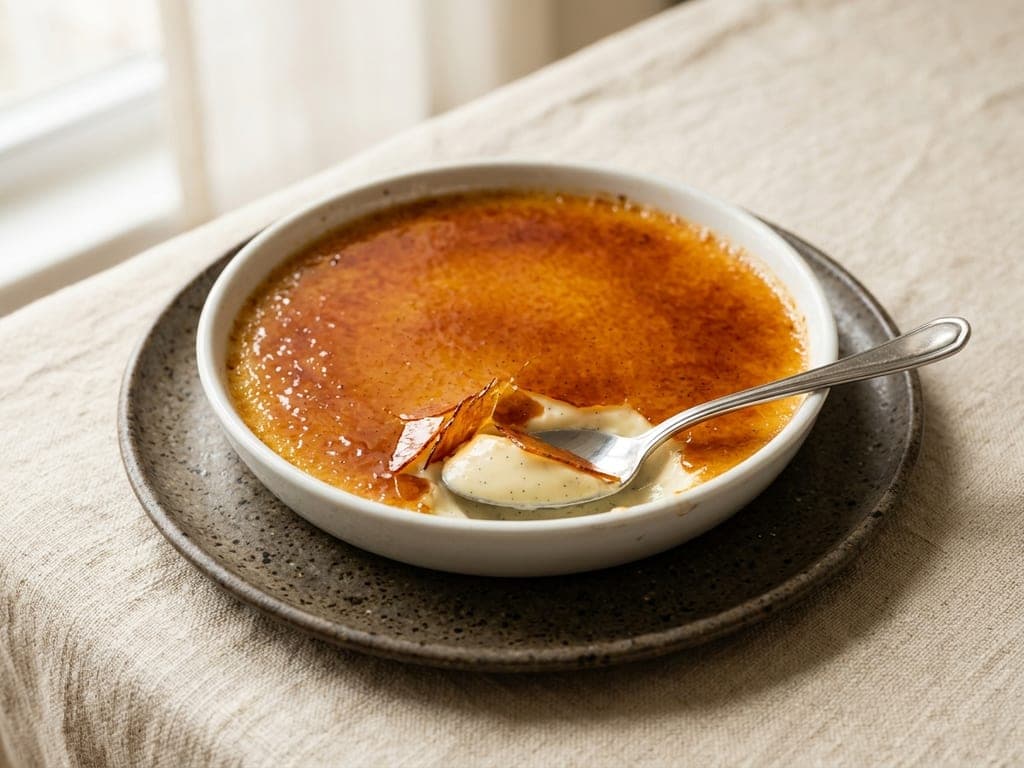
10Crème brûlée
The oldest printed recipe called crème brûlée is in François Massialot’s Le Cuisinier roïal et bourgeois (Paris, 1691). The story that it was invented at Trinity College, Cambridge, is a legend; the college says it “almost certainly has no basis in fact”. Make ahead: our recipe bakes the custards up to 3 days ahead; Serious Eats says 2 for its own, America’s Test Kitchen 4, tightly wrapped. After dinner: the one job: blot, sugar and caramelize just before serving, with a torch about 2 inches (5 cm) above the sugar or one of the recipe’s no-torch methods, then 2 minutes to harden. If you torch, the recipe takes the custards out of the fridge 20 minutes before. About 10 minutes of work for six, our estimate. Plate it: in its ramekin or shallow dish on a small plate over a folded napkin, with a teaspoon and nothing on top: cool custard, warm crust. Allergens: egg, milk. No wheat or nuts as written. The custard is baked to 170 to 175°F (77 to 79°C), past the 160°F (71°C) that USDA and the FDA give for egg dishes.
The twist: No torch in the house? The recipe also gives a broiler method (porcelain or stoneware ramekins only, never glass) and a poured-caramel crust, so the finishing step still takes minutes.
Full recipe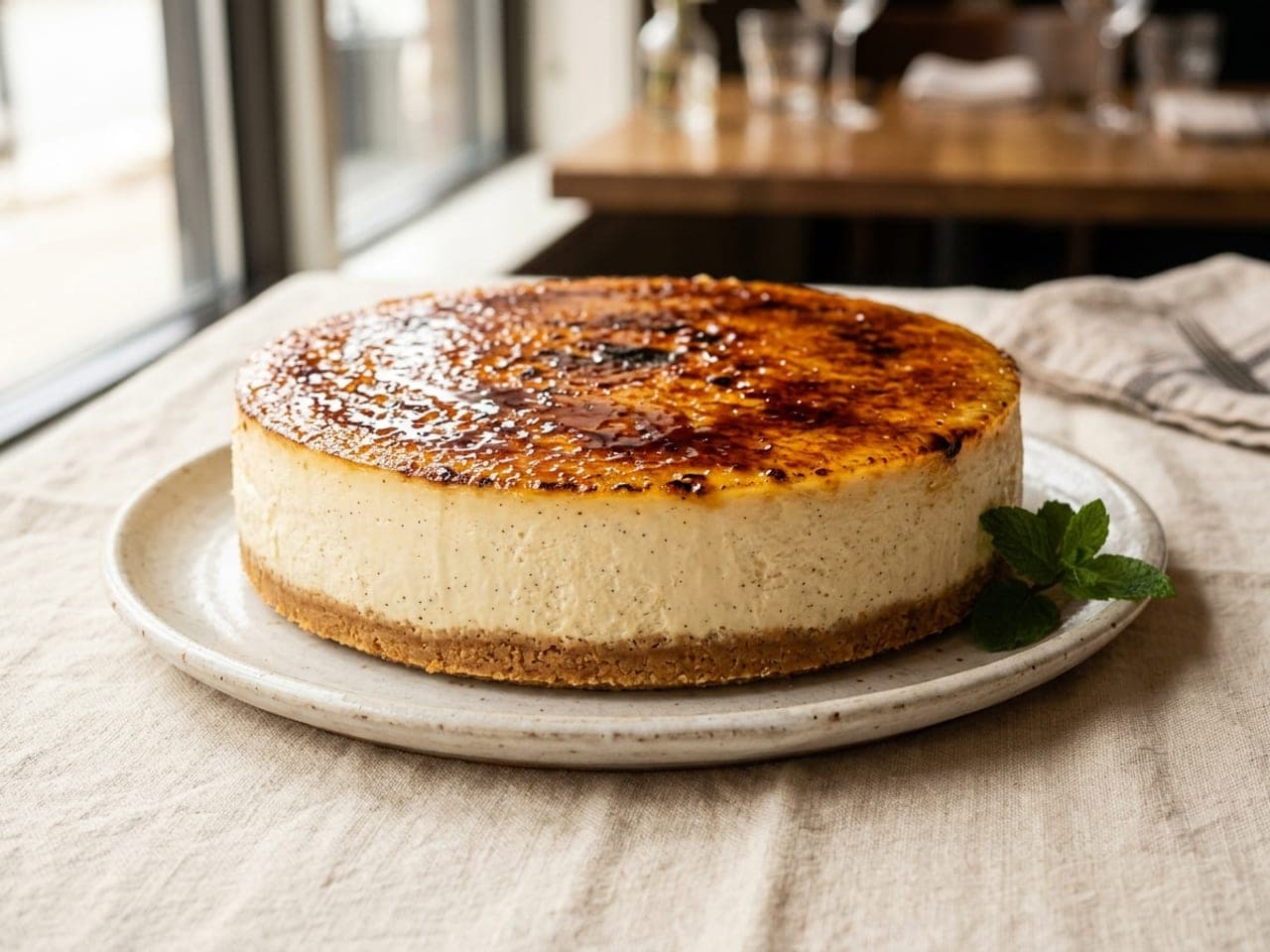
11Crème brûlée cheesecake
Our recipe crosses the two: a baked cheesecake under a torched sugar crust. Make ahead: the day before; the recipe wants at least 6 hours of chilling, better overnight. After dinner: dust the top with superfine sugar in two thin coats, torch it and rest it 5 minutes. Caramelize just before serving, and only what you will serve. The recipe keeps a whole cheesecake away from the broiler: with no torch, broil single slices or serve it plain. About 10 minutes, our estimate. Plate it: one upright slice just off center on a small plate, cut with a knife dipped in hot water and wiped dry, the amber top left bare. Allergens: wheat (the graham cracker crust), milk, egg; bought graham crackers can contain soy and some boxes carry a nut warning, so read the box before you call the cake nut-free. Doneness is judged by the wobble; for guests at higher risk, check that the center has reached 160°F (71°C), the FDA’s figure for egg dishes.
The twist: It serves 12, which makes it the dessert on this page for a long table.
Full recipe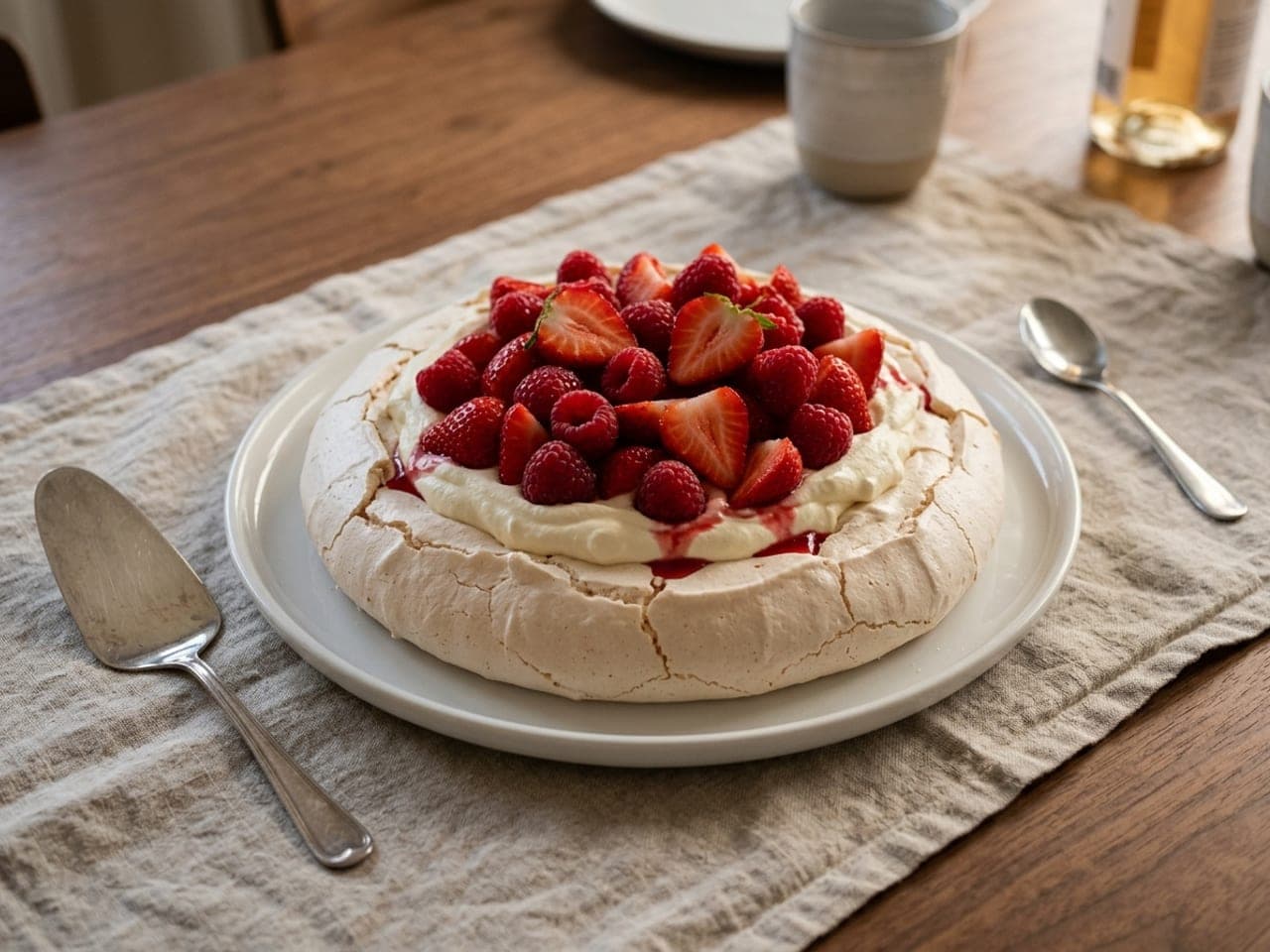
12Pavlova with berries
Named for the ballerina Anna Pavlova, who toured Australia and New Zealand in 1926, and disputed between the two: food historian Helen Leach dates the first known New Zealand recipe for pavlova as a meringue cake to 1929, ahead of Perth’s 1935 claim. Make ahead: bake the shell the day before and leave it in the switched-off oven overnight (BBC Good Food, King Arthur). America’s Test Kitchen keeps its own shells a week; Nigella Lawson’s site allows 2 days in dry weather, in an airtight container, for mini pavlovas. After dinner: whisk the crème fraîche cream and top the shell: about 5 minutes, our estimate. The strawberries stand in their sugar and lemon for 30 minutes first (BBC Good Food), so toss them as the main course goes out. King Arthur fills up to an hour before serving and Nigella Lawson’s site tops its mini pavlovas just before serving, 1 hour ahead at the outside, because meringue softens under cream. Plate it: whole on a flat platter, cream in the dip, the berries and their juice over it, cut into wedges at the table. A cracked shell is normal. Allergens: egg, milk. No wheat or nuts as written. Egg: the center stays soft; for guests at higher risk use whites from eggs pasteurized in the shell or heat the whites first (see the note in the recipe).
Quick recipe · Serves 6: one 8 inch (20 cm) pavlova (after Barney Desmazery, BBC Good Food)
Ingredients
- 4 egg whites
- 7 oz (200 g) caster (superfine) sugar
- 2 tsp cornflour (cornstarch) and 1 tbsp lemon juice
- 11 oz (300 g) full-fat crème fraîche, 1 oz (25 g) icing (confectioners’) sugar and ¼ tsp vanilla extract
- 14 oz (400 g) strawberries, 7 oz (200 g) raspberries, 1 tbsp icing sugar and a small squeeze of lemon juice
- A handful of small mint or basil leaves
Method
- Heat the oven to 248°F (120°C, or 100°C fan). Whisk the whites until they look like shaving foam, then add the sugar a tablespoon at a time, whisking until the meringue is thick and glossy and a dab rubbed between your fingers no longer feels grainy. Whisk in the cornflour and lemon juice for 30 seconds.
- Spread it into an 8 inch (20 cm) round on parchment, with a dip in the middle. Bake 1 hour, turn the oven off and leave the pavlova inside to cool completely with the door shut, overnight if you can.
- Hull the strawberries, halve or quarter them, toss them with the icing sugar and lemon and leave for 30 minutes, then stir in the raspberries. Whisk the crème fraîche with its icing sugar and the vanilla until thick.
- To serve, spoon the cream into the dip, pile on the fruit and its juice and scatter the leaves over.
USDA FSIS calls dry meringue shells safe, but a pavlova is baked low and keeps a soft center, and no source we read has measured its temperature. For children, older adults, pregnant women and people with weakened immune systems, use whites from eggs pasteurized in the shell (the American Egg Board says to allow up to about four times as long for them to foam), or follow America’s Test Kitchen and heat the whites and sugar over simmering water to 160 to 165°F (71 to 74°C) before whipping. Do not swap in a carton: plain carton whites are meant for recipes that need little foaming, and USDA FSIS says carton egg products are best used in a cooked product when a guest is at higher risk.
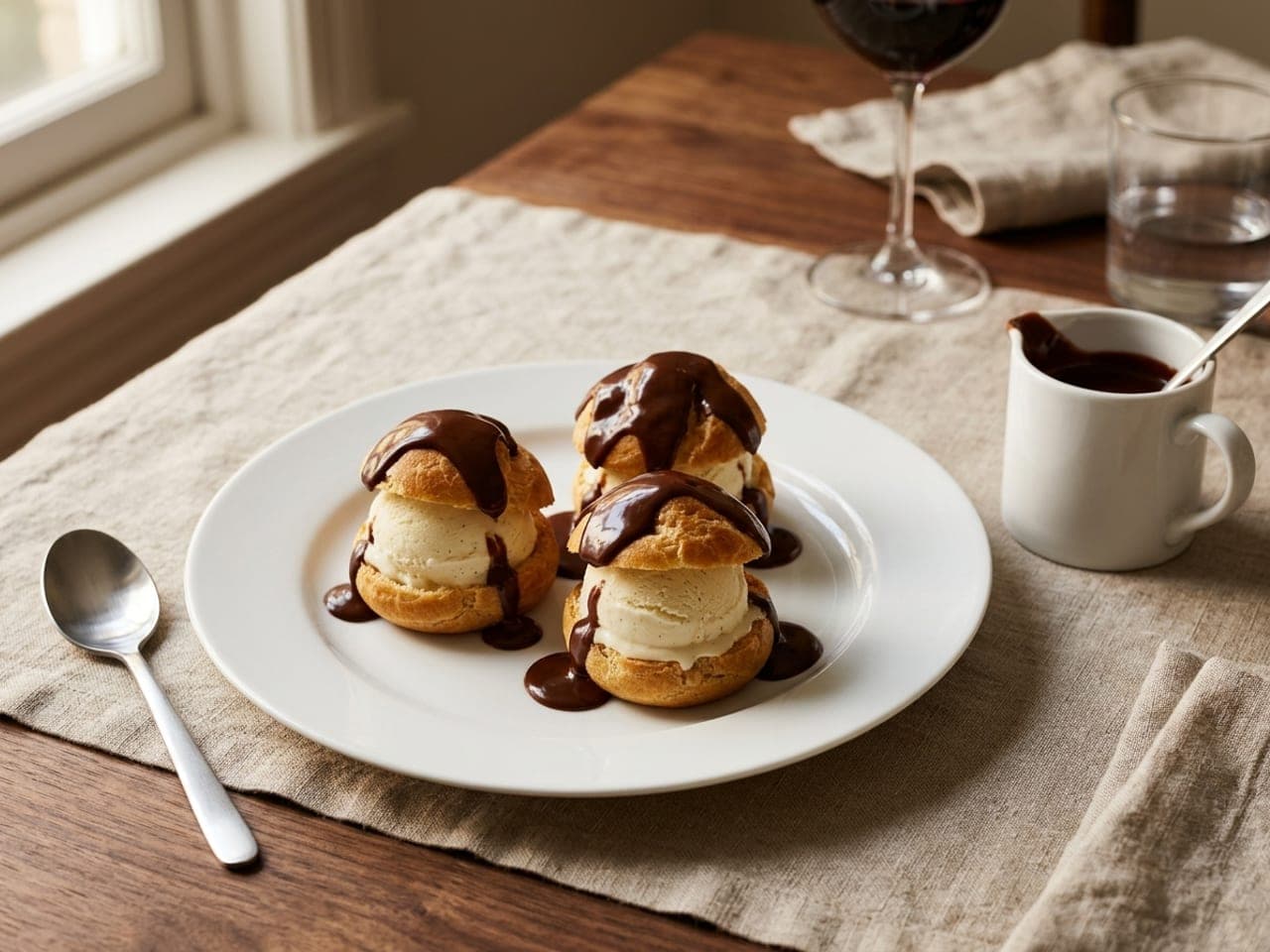
13Profiteroles with hot chocolate sauce
In Rabelais (1542) a “profiterolle” was a small tip; choux buns are in Menon by 1749 and profiteroles with chocolate sauce in an English-language cookbook by 1884. The tale that Catherine de’ Medici’s cook brought choux to France is a legend; the earliest printing we found is from 1893. Make ahead: everything (America’s Test Kitchen): puffs 24 hours airtight or 1 month frozen, ice cream scooped and frozen up to 1 week, and the sauce up to 3 weeks in the fridge by America’s Test Kitchen’s count; it is cream and butter, and USDA FSIS gives leftovers 3 to 4 days, so plan on making it no more than 3 days ahead. After dinner: crisp the puffs 5 to 8 minutes at 300°F (149°C), 8 to 10 from frozen, rewarm the sauce 1 to 3 minutes in the microwave at half power, then split, fill and pour: about 10 minutes, our estimate. Plate it: three filled puffs on a chilled plate, the warm sauce poured over at the table from a small jug. Allergens: egg, milk, wheat; soy lecithin in most chocolate; check the ice cream tub for nut and peanut warnings. Coffee ice cream adds caffeine to the chocolate’s. Choux is fully baked. For a choux cousin with cream and caramel, see our Větrník.
Quick recipe · Serves 6 to 8: 24 small puffs (after Dawn Yanagihara, America’s Test Kitchen)
Ingredients
- 5 tbsp (71 g) unsalted butter, 6 tbsp (89 ml) water, 2 tbsp (30 ml) whole milk, 1½ tsp sugar and ¼ tsp salt
- ½ cup (71 g) all-purpose flour, sifted
- 2 large eggs plus 1 large white, beaten: you need ½ cup (118 ml), so discard any extra
- Sauce: ¾ cup (177 ml) heavy cream, 3 tbsp (44 ml) light corn syrup, 3 tbsp (43 g) unsalted butter and a pinch of salt
- 6 oz (170 g) bittersweet chocolate, chopped fine
- 2 quarts (1.9 l) vanilla or coffee ice cream
Method
- Bring the butter, water, milk, sugar and salt to a boil. Off the heat stir in the flour, then cook the paste over low heat for 3 minutes, to 175 to 180°F (79 to 82°C). Run it in a food processor for 10 seconds, pour in the eggs with the motor running and process 30 seconds more.
- Pipe 24 mounds, each 1½ inches (3.8 cm) wide, onto a parchment-lined baking sheet. Bake at 425°F (218°C) for 15 minutes without opening the door, then at 375°F (191°C) for 8 to 10 minutes, until golden and firm. Cut a small slit in the side of each puff, return them to the switched-off oven and prop the door open for about 45 minutes, until crisp.
- Sauce: bring the cream, corn syrup, butter and salt to a boil, take off the heat, add the chocolate, cover for 5 minutes and whisk until smooth.
- To serve, crisp the puffs in the oven, split them near the base, set three or four bottoms on each plate, put a scoop of ice cream on each and press the tops on. Pour the warm sauce over.
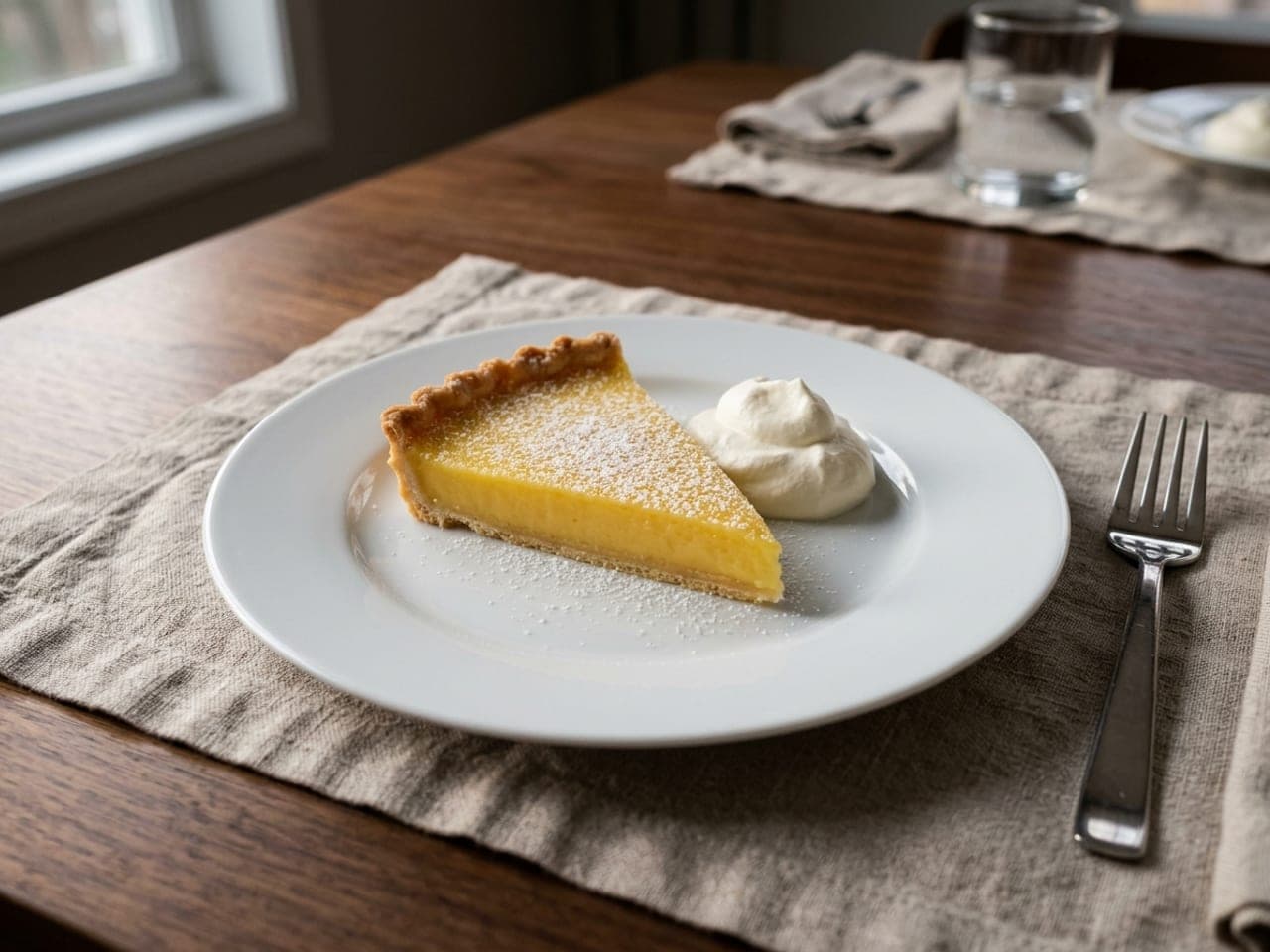
14Lemon tart
It has no known inventor: Pierre de Lune printed lemon-peel tourtes in Paris in 1656, and Hannah Glasse’s The Art of Cookery (1747) has “Orange or Lemon Tarts” and a lemon, egg and butter pudding baked in pastry, a forerunner of today’s filling. Make ahead: up to 2 days, undecorated (Mary Berry); BBC Good Food’s lighter version is “best eaten the same day”. Bake it the day before and keep it in the fridge: Berry’s page does not say where to store it, and a baked egg and cream filling falls under the 2-hour rule. After dinner: the finish is the one job: dust with confectioners’ sugar at the last moment (Berry: the tart’s moisture makes it vanish within minutes), or dust generously and caramelize it with a torch, her optional glaze. About 3 minutes, our estimate. Plate it: a wedge on a flat plate with a spoonful of lightly whipped cream beside it; cold from the fridge (Berry also serves it warm, on the day it is baked). Allergens: egg, milk, wheat. The filling is baked to a slight wobble with no temperature given; for guests at higher risk, the center should read 160°F (71°C).
Quick recipe · One 9 inch (23 cm) tart, serves 8 as published (after Mary Berry, BBC Food); not scaled
Ingredients
- Pastry: 6 oz (175 g) plain (all-purpose) flour, 3½ oz (100 g) cold butter, 1 oz (25 g) icing (confectioners’) sugar, 1 egg yolk and 1 tbsp cold water
- 5 eggs (UK medium, about US large)
- 4 fl oz (125 ml) double (heavy) cream
- 8 oz (225 g) caster (superfine) sugar
- 4 lemons, zest and juice: about 5 fl oz (150 ml) of juice
- Icing (confectioners’) sugar, to dust
Method
- Make the pastry from the flour, butter, icing sugar, yolk and water, line a 9 inch (23 cm) loose-bottomed fluted tart tin with it and chill for 30 minutes. The recipe’s own shortcut is a bought sweet pastry case; they run smaller, so the BBC’s tip is to halve the filling and use 2 large eggs. Check a bought case for a nut warning.
- Heat the oven to 392°F (200°C, or 180°C fan). Bake the case blind for 12 to 15 minutes with baking beans, then 10 to 12 minutes without, until pale golden and completely dry. Turn the oven down to 338°F (170°C, or 150°C fan).
- Whisk the eggs, then whisk in the cream, sugar, lemon zest and juice. Pour most of it into the case, set the tin on the oven shelf and top it up there, so it does not spill.
- Bake 30 to 35 minutes, until just set with a slight wobble in the center. Cool, lift it out of the tin and refrigerate it within 2 hours of baking. Dust with icing sugar only when you serve.
If you torch the sugar glaze, do it on a metal tray away from napkins and the tablecloth, and keep the flame off the pastry edge, which burns first.
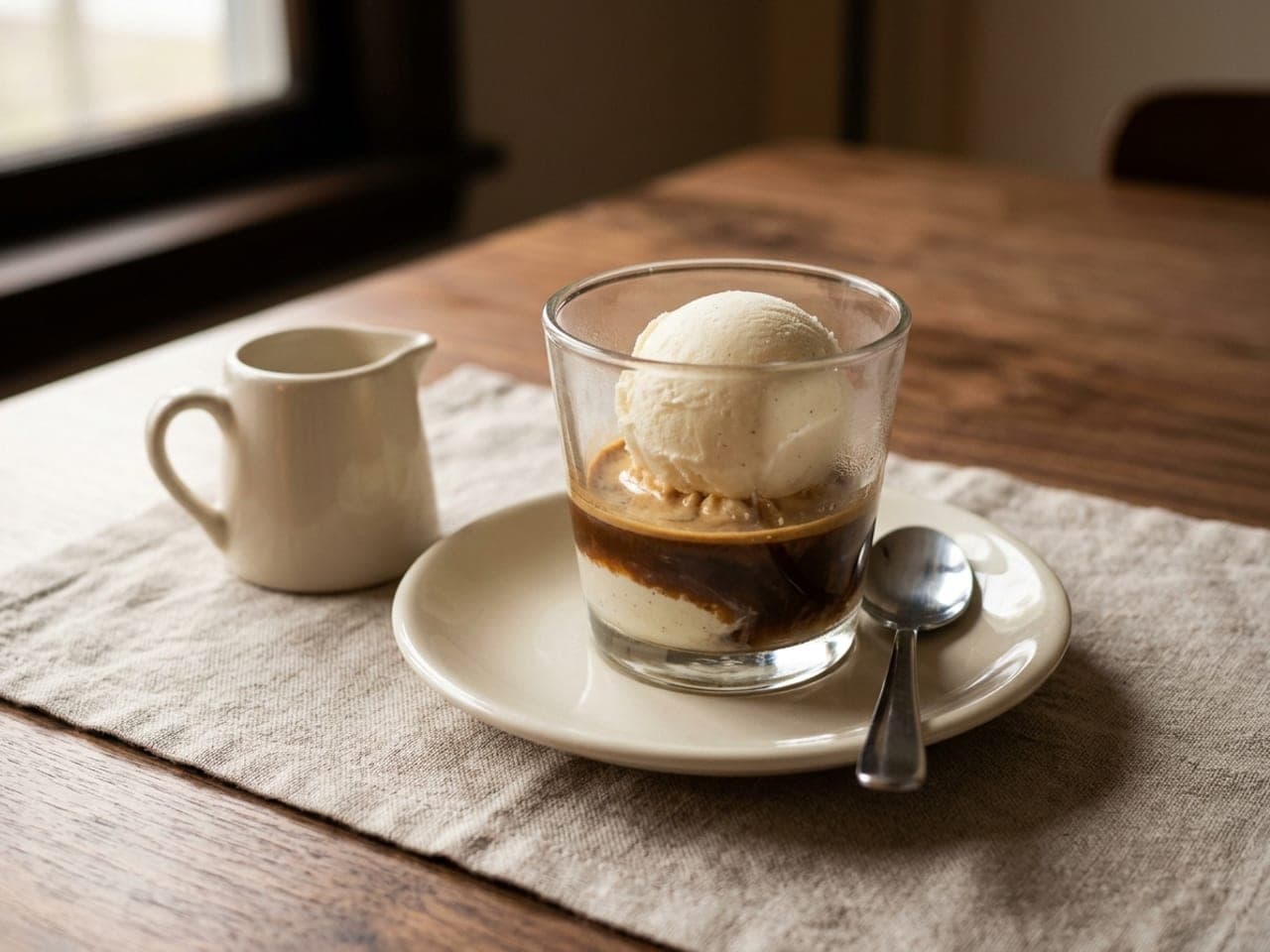
15Affogato
Affogato means “drowned”: ice cream drowned in hot espresso. Its origin is undocumented; the word reached English dictionaries with a first use in 1992. Make ahead: nothing to cook. Scoop the ice cream into the glasses and return them to the freezer; Food Network Kitchen does this up to 4 hours ahead for its cherries jubilee. After dinner: pull one shot of espresso per guest and pour; Serious Eats puts the prep at 3 minutes a serving. Plate it: one generous scoop in a small heatproof glass or a cappuccino cup (our caution: hot espresso can crack a thin glass that has come straight from the freezer) on a saucer with a teaspoon, the espresso poured at the table. Allergens: milk; egg if the ice cream contains it; soy if you add shaved chocolate. Check the tub for nut and peanut warnings, and a cookie on the saucer adds wheat and often tree nuts. Caffeine: a 1 fl oz (30 ml) shot has about 63 mg by USDA’s figures, and the 1½ oz (40 g) shot this recipe allows about 85 mg by our arithmetic, against the 200 mg a day that ACOG and EFSA use for pregnancy. Decaf works, and is the version for children.
Quick recipe · Serves 4 (after Daniel Gritzer, Serious Eats, whose recipe is for one)
Ingredients
- 4 generous scoops vanilla ice cream or gelato
- 4 shots hot espresso, 1 to 1½ oz (30 to 40 g) each
- Optional, from Serious Eats’s list: shaved chocolate, whipped cream or a dusting of cinnamon
Method
- Put one scoop of ice cream in each of 4 small glasses or cappuccino cups.
- Pull the espresso, one shot per glass.
- Pour one hot shot over each scoop and hand it over at once, with a spoon.
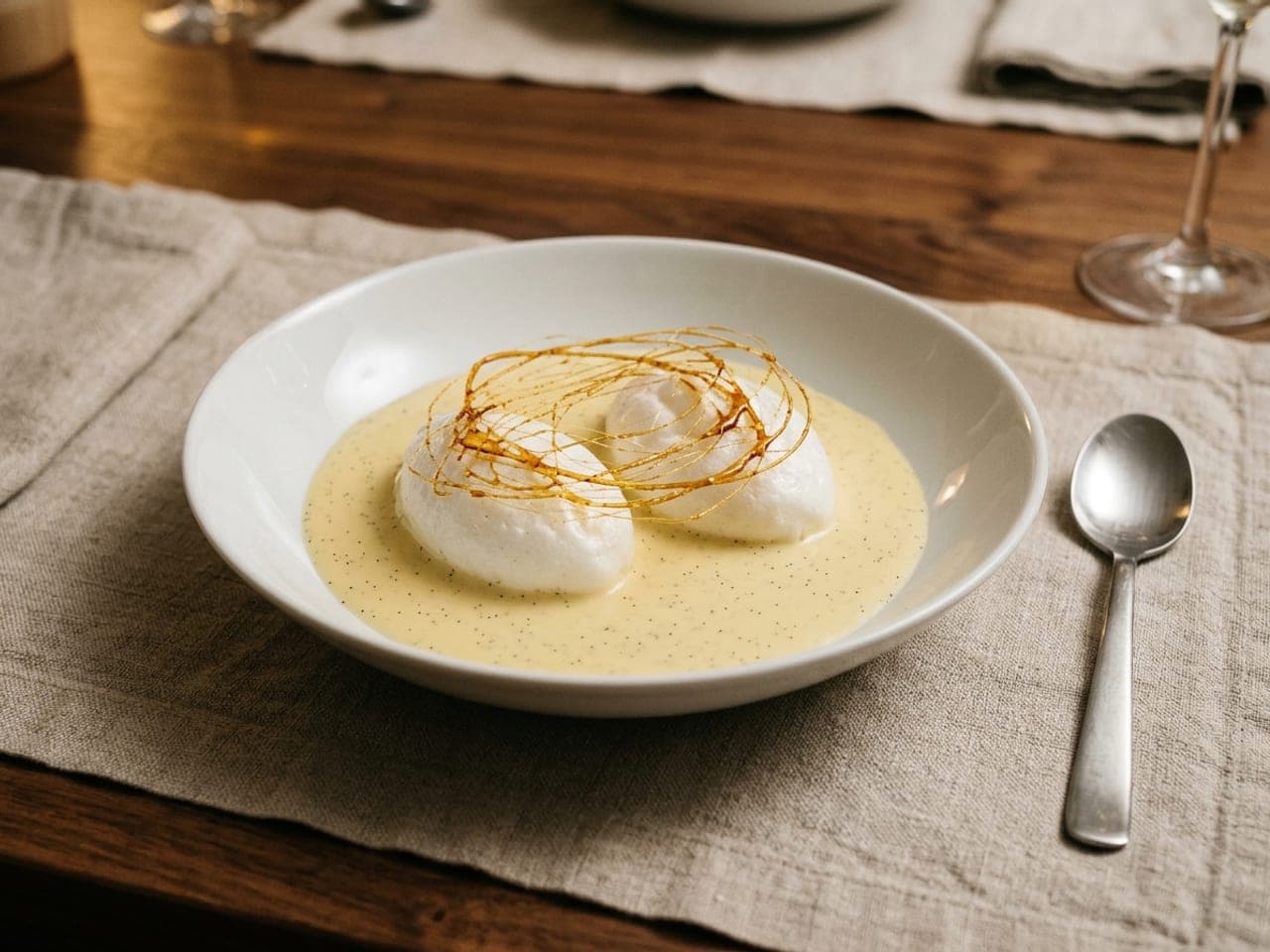
16Île flottante (floating island)
Œufs à la neige is in La Varenne’s cookbook of 1651 and Hannah Glasse printed a floating island (her spelling: “Flooting Island”) in 1747, but neither was today’s dish; in Escoffier’s 1903 Guide culinaire the poached meringues on custard are still œufs à la neige, and île flottante is a liqueur-soaked sponge cake. Make ahead: the custard up to 2 days, covered and chilled. The meringues are a same-day job: Bon Appétit chills them for at least 1 hour and no more than 3, so poach them in the last hour before guests arrive and count back from dessert, not from dinner. Serious Eats keeps its own custard 3 days. After dinner: the caramel: about 6 minutes of boiling and 8 of cooling, until it falls from a fork in ribbons, then plate. About 15 to 20 minutes. Plate it: a pool of cold custard in a shallow bowl, two meringues on it, caramel threads waved over the top. Allergens: egg, milk. No wheat, nuts or gelatin. Egg: the meringues are poached for 1 minute a side; see the note in the recipe.
Quick recipe · Serves 6, two meringues each (after Bon Appétit, “Floating Islands”, 2005)
Ingredients
- 4 cups (946 ml) whole milk: half for the custard, half for poaching
- 2 vanilla beans, split lengthwise
- 6 large egg yolks and 4 large egg whites
- 1¼ cups (about 248 g) sugar in all: ½ cup (about 99 g) for the custard, ¼ cup (about 50 g) for the meringue and ½ cup (about 99 g) for the caramel
- A pinch of salt
- ¼ cup (59 ml) water, for the caramel
Method
- Custard: bring 2 cups (473 ml) of the milk to a simmer with the vanilla, cover and steep 10 minutes. Whisk the yolks with ½ cup (about 99 g) of sugar until thick, about 2 minutes, whisk in the milk and stir over medium-low heat until it coats the back of a spoon, about 9 minutes. Do not let it boil. Strain and chill for at least 3 hours.
- Meringues: bring the other 2 cups (473 ml) of milk to a simmer in a 10 inch (25 cm) skillet. Beat the whites with the salt to soft peaks, add ¼ cup (about 50 g) of sugar a tablespoon at a time and beat until stiff and glossy. Shape ovals about twice the size of an egg with two spoons and poach them three or four at a time, 1 minute a side, until you have 12; drain on a towel and refrigerate for 1 to 3 hours.
- Caramel: dissolve the last ½ cup (about 99 g) of sugar in the water and boil, swirling the pan now and then, until pale golden, about 6 minutes. Let it cool for about 8 minutes, until it falls from a fork in ribbons.
- Spoon custard onto each plate, set 2 meringues on it and wave a fork dipped in the caramel back and forth over the top to make threads.
Two things here are lightly cooked. The custard is done when it coats a spoon; with a thermometer, take it to at least 160°F (71°C), the FDA’s figure for egg mixtures, and stop by 180°F (82°C), Serious Eats’s limit for crème anglaise. The meringues are poached for 1 minute a side and no source we read has measured them, so for children, older adults, pregnant women and people with weakened immune systems use whites from eggs pasteurized in the shell. Caramel is far hotter than boiling water: hold a burn under cool running water for 20 minutes (NHS).
In the oven during the main course
3 desserts that are mixed or baked ahead and need the oven around the main course: the soufflé and the molten cake bake while the main course is on the table, and the tarte Tatin’s reheat finishes as the main course is served. They need a free oven and a host who can leave the table once.
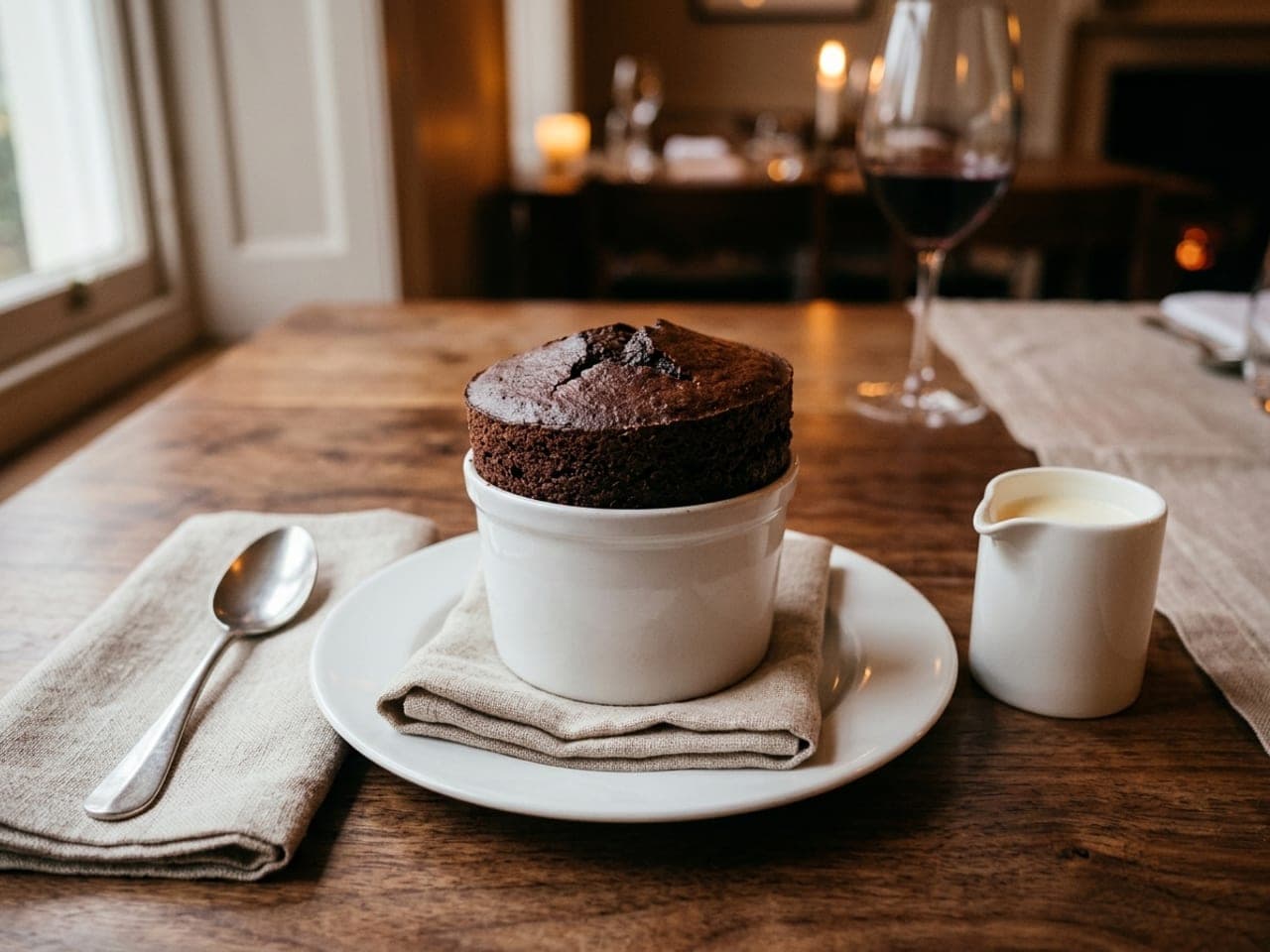
17Chocolate soufflé
Soufflé means “puffed”: Vincent La Chapelle printed an “omelet puff’d” in The Modern Cook (1733), and a chocolate soufflé is in Louis Ude’s The French Cook of 1813. Make ahead: Sally’s Baking holds this batter, in the ramekins, covered in the fridge for up to 2 days; Serious Eats gives its own 1. USDA FSIS says to bake raw-egg dishes within 24 hours, so fill the ramekins that morning. After dinner: oven to 400°F (204°C) during the main course, then 13 to 14 minutes at 375°F (191°C), a minute or so more from the fridge. It starts to fall about 5 minutes out of the oven (America’s Test Kitchen), so seat everyone first. Plate it: in its ramekin, set on a folded napkin on a small plate so it cannot slide, carried in at once; at the table, open the top and pour in cold cream or crème anglaise. Allergens: egg, milk; soy lecithin in most chocolate. No flour. Egg: the center is soft by design; see the note in the recipe.
Quick recipe · Serves 4, in 6 oz (177 ml) straight-sided ramekins (after Sally McKenney, Sally’s Baking)
Ingredients
- 4 tbsp (56 g) unsalted butter, plus 1 tbsp (14 g) very soft butter for the ramekins
- 4 oz (113 g) semi-sweet chocolate, from a bar, coarsely chopped
- 3 large eggs, separated
- 1 tsp vanilla extract and ⅛ tsp salt
- ⅛ tsp cream of tartar
- 3 tbsp (38 g) granulated sugar, plus 4 tsp (16 g) for the ramekins
Method
- Melt the butter and chocolate together and let them cool for 3 to 5 minutes, then whisk in the egg yolks, vanilla and salt.
- Beat the whites with the cream of tartar to soft peaks, about 2 minutes. Add the sugar a tablespoon at a time and beat to stiff, glossy peaks, about 2 minutes more, and stop there. Fold the whites into the chocolate in 3 additions. If you are baking right away, chill the batter for 5 to 10 minutes while the oven heats.
- Brush four 6 oz (177 ml) ramekins with the soft butter and coat them with sugar. Fill them, level the tops and run a thumb around the inside of each rim. Cover and refrigerate if you are baking later.
- Heat the oven to 400°F (204°C) with a rack in the lower third. Put the ramekins in on a baking sheet, turn the oven down to 375°F (191°C) at once and bake 13 to 14 minutes, a minute or so longer if the batter was chilled for more than an hour, until the edges are set and the centers barely jiggle. Serve immediately.
A soufflé with a soft center is undercooked egg unless a thermometer says otherwise: the FDA’s figure for egg dishes is 160°F (71°C), and America’s Test Kitchen found that probing a soufflé with a thermometer does not make it fall. For children, older adults, pregnant women and people with weakened immune systems, bake it until the center reads 160°F (71°C) or use pasteurized eggs. The ramekins come out at oven heat: carry them on the baking sheet, set each on its napkin and tell guests the dish is hot.
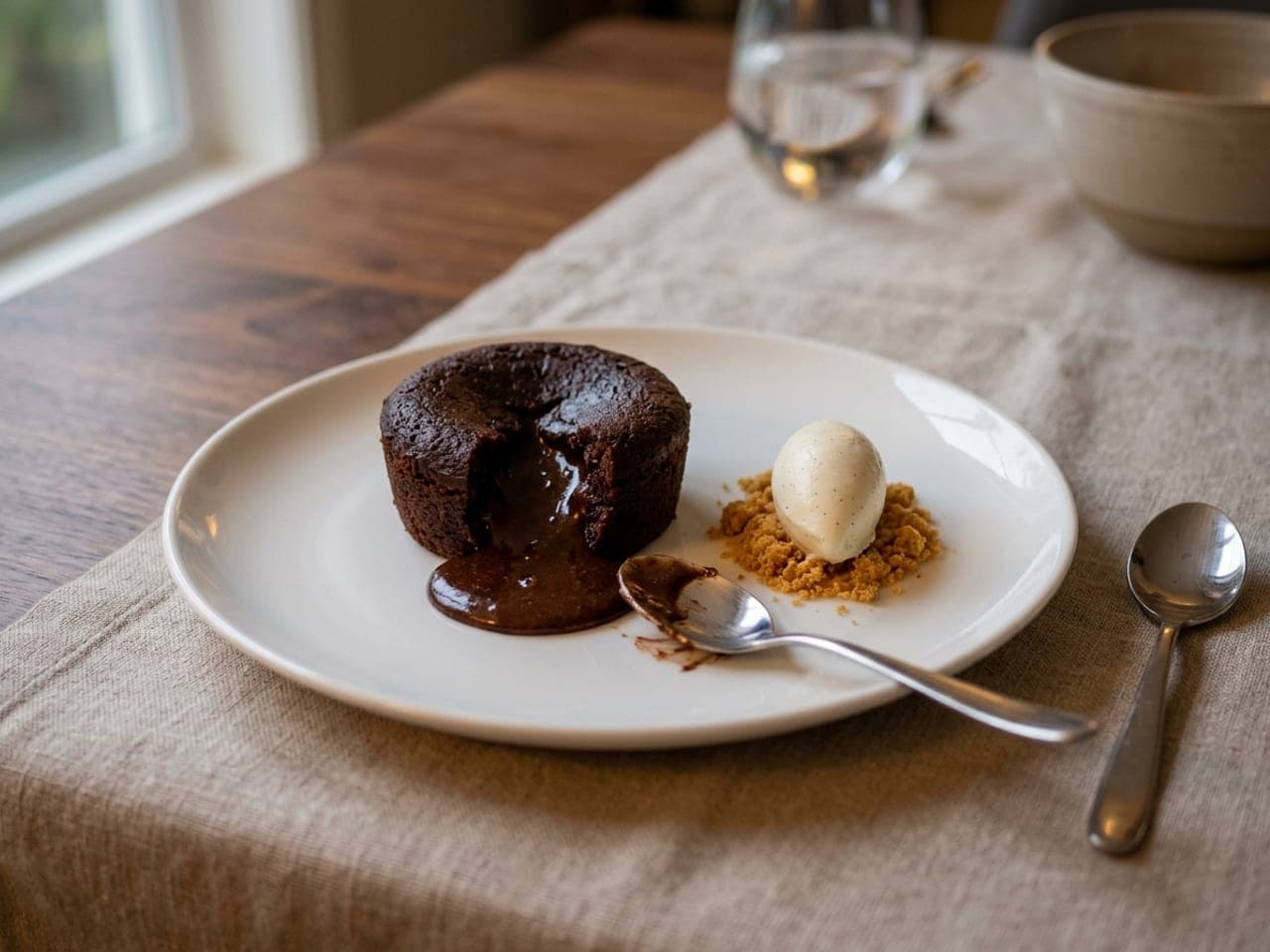
18Molten chocolate cake
Disputed. Michel Bras dates his chocolate coulant, baked around a frozen ganache core, to 1981; Jean-Georges Vongerichten made the simpler underbaked cake famous in New York and, The New York Times reported in 1991, said he got the recipe from his mother, while French chefs in the same article said they had made such cakes for years. Make ahead: the batter keeps in the fridge for several hours and comes back to room temperature before baking (Food & Wine). America’s Test Kitchen holds its own for 24 hours, also USDA FSIS’s limit for raw-egg batter. Mix it on the day of the dinner, that morning at the earliest and that afternoon if you can: Food & Wine’s window is several hours, not overnight. After dinner: 9 to 12 minutes at 450°F (232°C), 1 minute’s rest, unmold: about 15 minutes, with the oven heating during the main course. Plate it: turned out on a room-temperature plate, one small quenelle of vanilla ice cream beside it on baked cookie crumbs so it cannot slide; served at once. Allergens: egg, milk, wheat; soy lecithin in most chocolate; check the ice cream and the cookies for nut warnings. Caffeine: about 37 mg a cake from the chocolate (our arithmetic from USDA’s figure). Who should skip it: the center is underbaked batter; see the note in the recipe.
Quick recipe · Serves 4, in 6 oz (177 ml) ramekins (after Jean-Georges Vongerichten’s recipe, as published by Food & Wine)
Ingredients
- ½ cup (113 g) unsalted butter, cubed, plus more for the ramekins
- 6 oz (170 g) bittersweet chocolate, about 66% cacao, chopped
- 2 large eggs plus 2 large egg yolks, at room temperature
- ¼ cup (about 50 g) granulated sugar
- ¼ tsp kosher salt
- 2 tbsp (about 15 g) all-purpose flour, plus more for the ramekins
Method
- Heat the oven to 450°F (232°C). Butter and flour four 6 oz (177 ml) ramekins and stand them on a baking sheet.
- Melt the chocolate and butter in a bowl set over simmering water until smooth.
- Beat the eggs, yolks, sugar and salt with a mixer on high speed until thick and pale, 2 to 3 minutes. Quickly fold in the melted chocolate and the flour. Divide between the ramekins, about ½ cup (118 ml) each. To make it ahead, cover and refrigerate the batter for up to several hours and let it come back to room temperature before it goes into the oven (Food & Wine); cold batter will not bake through in this time.
- Bake 9 to 12 minutes, until the tops are just set and the edges spring back but the centers still feel soft. Rest 1 minute, turn each one out onto a plate, wait 10 seconds and lift off the ramekin.
No source we read gives a measured temperature for the center of a molten cake, so we do not print one. Treat the center as undercooked egg and uncooked flour (the FDA counts flour as a raw food until it is baked). Our advice, not a published rule: children, older adults, pregnant women and people with weakened immune systems should skip it, because pasteurized eggs answer the egg but not the flour; pots de crème are the baked chocolate alternative. USDA FSIS: refrigerate raw-egg batter and bake it within 24 hours; the time it spends coming back to room temperature counts toward the 2-hour rule. Use a towel to turn out the hot ramekins.
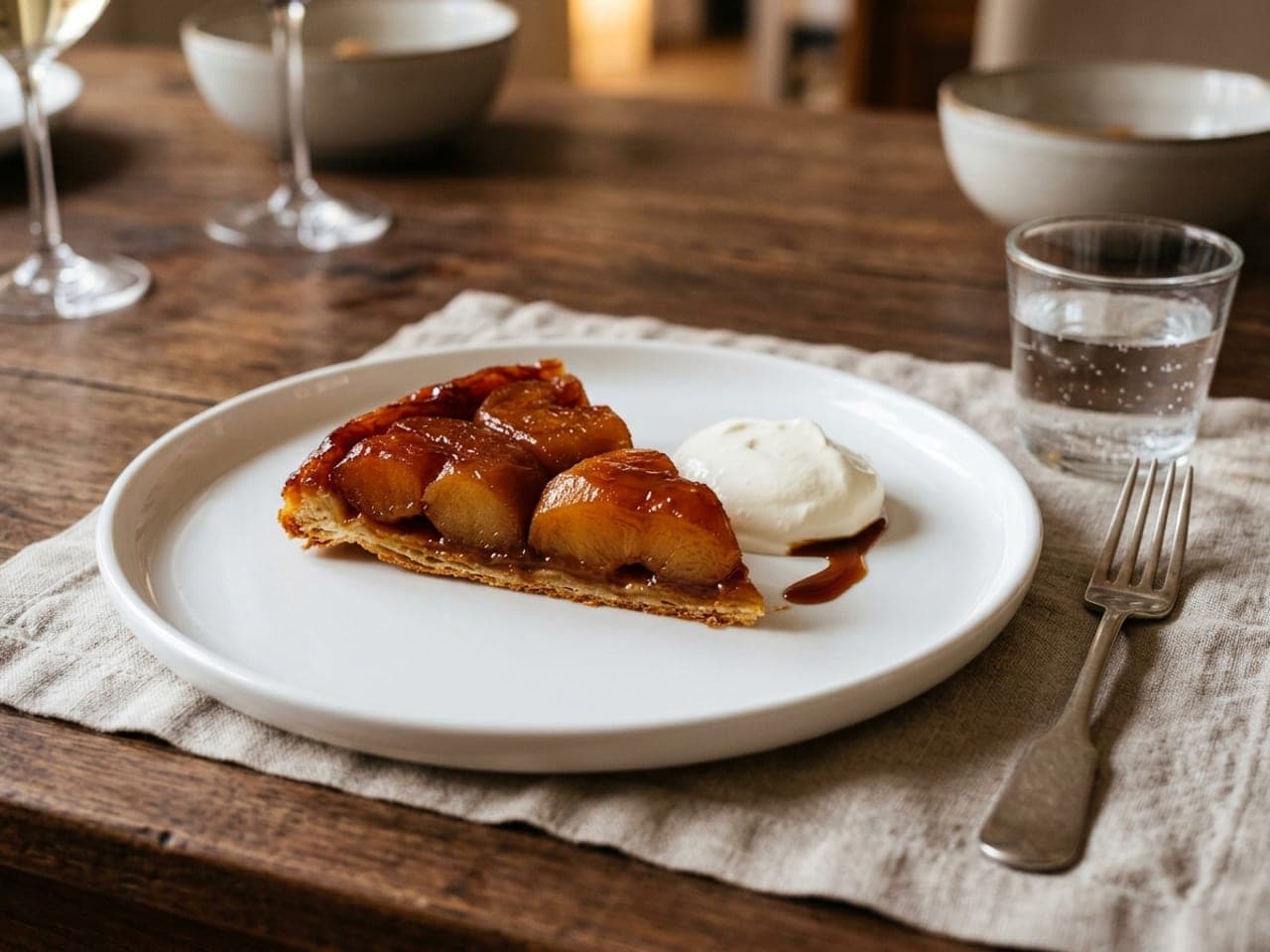
19Tarte Tatin, reheated and turned out
The Tatin sisters served it at their hotel in Lamotte-Beuvron, in Sologne: a Paris newspaper was praising “la tarte de Mlle Tatin” on 18 December 1899. The kitchen-accident story is a legend that historians trace to the 1970s. Make ahead: Raymond Blanc says his is best cooked a day or two ahead and kept in its dish in the fridge; Serious Eats says its own is best the day it is made, because the pastry softens. Bake it the day before. After dinner: one reheat and no baking: 20 minutes at 302°F (150°C, or 130°C fan) an hour before serving (Blanc). On our clock that is about 20 minutes after guests sit down, so it comes out as the main course is served; turn it onto a deep plate just before dessert. Plate it: a just-warm wedge, apples up, on a room-temperature plate with a spoonful of cold crème fraîche or vanilla ice cream beside it. A pastry textbook’s note: a well-caramelized tarte Tatin needs little or no garnish. Allergens: wheat, milk. No egg or nuts in the recipe; check the labels of the bought pastry and of the ice cream, which often adds egg and a nut warning.
Quick recipe · Serves 6, from an 8 inch (20 cm) dish (after Raymond Blanc, BBC Good Food)
Ingredients
- 10.6 oz (300 g) all-butter puff pastry, and a little flour for dusting
- 6 dessert apples, about 2 lb (900 g), such as Braeburn or Cox, peeled, cored and quartered
- 3½ oz (100 g) golden caster (superfine) sugar
- 3 oz (85 g) unsalted butter: 2 oz (60 g) chilled and diced, 1 oz (25 g) melted
- Full-fat crème fraîche or vanilla ice cream, to serve
Method
- Roll the pastry ⅛ inch (3 mm) thick, cut a 9½ inch (24 cm) circle, prick it and freeze it flat. Heat the oven to 356°F (180°C, or 160°C fan).
- In an 8 inch (20 cm) flameproof tatin dish or heavy ovenproof frying pan, cook the sugar for 5 to 7 minutes to a dark amber caramel that is just starting to smoke. Turn off the heat and stir in the diced butter. Pack the apple quarters in tightly, rounded side down, and brush them with the melted butter.
- Bake 30 minutes. Lay the frozen pastry on top, tuck in the edge, prick a few holes and bake 40 to 45 minutes more, until the pastry is golden brown and crisp.
- Cool for 1 hour, then refrigerate it in its dish if you are serving it the next day. To serve, reheat it for 20 minutes at 302°F (150°C, or 130°C fan) an hour before serving, then run a knife around the edge and turn it out onto a plate deep enough to hold the juices.
Dark caramel is around 340°F (170°C) and sticks to skin: keep children out of the kitchen while you make it. Turn the tart out away from you, with a towel over your forearm, because hot juices run out as it drops. A burn goes under cool running water for 20 minutes (NHS). Stand back when the butter goes into the caramel, because it spits, and leave a towel over the pan handle whenever it is out of the oven. These two are our cautions.
Cooked at the last minute, in front of guests
5 desserts that are cooked when everyone is ready for them. Three are flambéed: our advice is to flame them at the stove, where guests can watch from a distance, rather than at the table, and to read the safety note in each recipe first. None of the 17 roundups we read lists cherries jubilee, baked Alaska or crêpes Suzette at all.
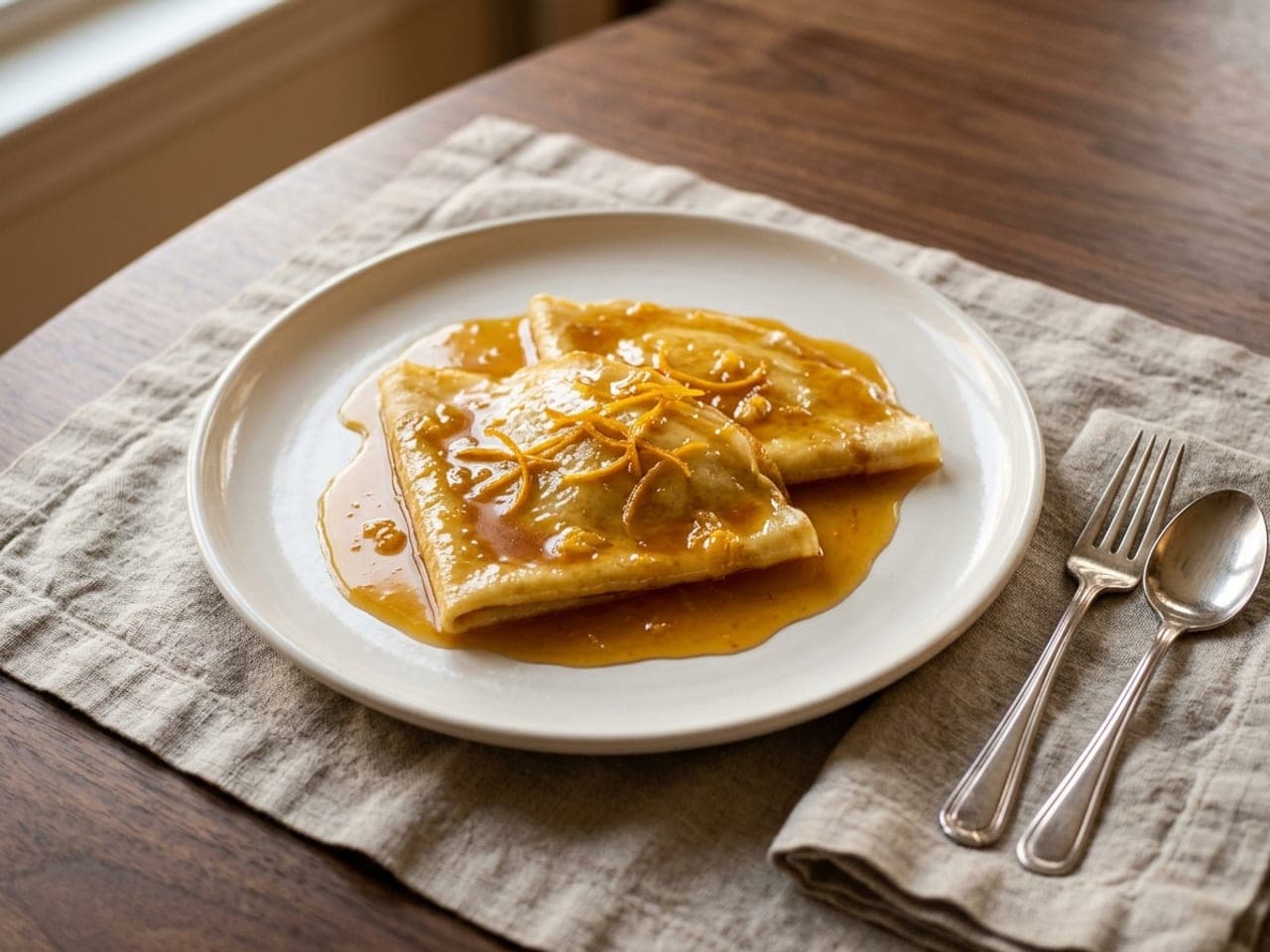
20Crêpes Suzette
The story of a teenage waiter flaming them by accident for the Prince of Wales in 1895 is a legend that rests on his own 1934 memoir: crêpes Suzette were on the menu of a lunch served at Paillard’s in Paris in 1891, and Escoffier’s 1903 recipe is not flambéed at all. Make ahead: the crêpes, up to 2 days, well wrapped in the fridge and brought back to room temperature before you start the sauce (Jacques Pépin; America’s Test Kitchen says 3 for its own). Our Crêpes recipe makes a plain batch too; the 2-day window is Pépin’s, not ours. After dinner: the whole finish: about 6 minutes for the orange butter sauce, then dipping and folding and about 30 seconds of flame. Allow 10 to 12 minutes at the stove, our estimate. Plate it: folded in quarters and overlapped on a warm plate, sauce spooned over, nothing else; served at once. Allergens: egg, milk, wheat. Alcohol: flaming leaves 75% of it (USDA’s table). For children, pregnant guests and anyone avoiding alcohol, make the sauce without the liqueur and skip the flame.
Quick recipe · Serves 6, from 10 crêpes (after Jacques Pépin, in Food & Wine)
Ingredients
- Crêpes: 2 large eggs, ¾ cup (about 90 g) all-purpose flour, ½ cup (118 ml) milk, ⅓ cup (79 ml) cold water, ½ tsp sugar and ⅛ tsp salt
- 1 tbsp canola oil and 1 tbsp melted unsalted butter, plus butter for the pan
- 6 tbsp (85 g) unsalted butter, softened
- 6 tbsp (about 74 g) sugar: ¼ cup (about 50 g) for the orange butter and 2 tbsp (about 25 g) to sprinkle at the end
- 1 tbsp finely grated orange zest and ⅓ cup (79 ml) fresh orange juice
- ¼ cup (59 ml) Grand Marnier and 2 tbsp (30 ml) Cognac, measured into a small cup before you start
Method
- Whisk the eggs, flour, milk, sugar and salt until smooth, then whisk in the water, oil and melted butter. Heat a buttered 10 inch (25 cm) crêpe pan, pour in 3 tbsp of batter and tilt to coat. Cook about 45 seconds, until the edge browns, turn and cook 10 to 15 seconds more. Make 10.
- Blend the soft butter with the sugar, holding back 2 tbsp, and the zest, then blend in the orange juice. In a 12 inch (30 cm) flameproof skillet that is not nonstick, cook this over medium heat until bubbling, 2 to 3 minutes, then about 3 minutes more, until syrupy.
- Turn the heat to low. Dip each crêpe in the sauce on both sides, fold it in quarters, let the extra sauce drip off and set it on a baking sheet. When all 10 are done, return them to the skillet, overlapping, scrape in any sauce left on the sheet and sprinkle them with the 2 tbsp of sugar.
- Turn the burner off and take the pan off the heat. Pour in the Grand Marnier and Cognac from the cup, stand back and light the sauce at arm’s length with a long-handled lighter. Spoon the sauce over the crêpes with a long spoon until the flames die, about 30 seconds, and serve.
Flambé rules, from America’s Test Kitchen’s two flambé guides and the culinary schools Rouxbe and ICE: measure the spirit into a small cup before you start and never pour it from the bottle; turn off the burner and the extractor fan and take the pan off the heat before the spirit goes in; tie back long hair, roll up sleeves and clear the space around the pan (and, our addition, above it); light it with a long lighter or long match, arm fully extended, standing back; keep a pan lid within reach and slide it over the pan from the side if the flames climb. Use a stainless-steel skillet, not nonstick: the flame can damage the coating (America’s Test Kitchen). The flame does not remove the alcohol: USDA’s nutrient retention table has 75% of it left in flamed dishes. Pépin lights his sauce over medium heat; the steps here add and light the spirit off the heat, as America’s Test Kitchen’s guide advises.
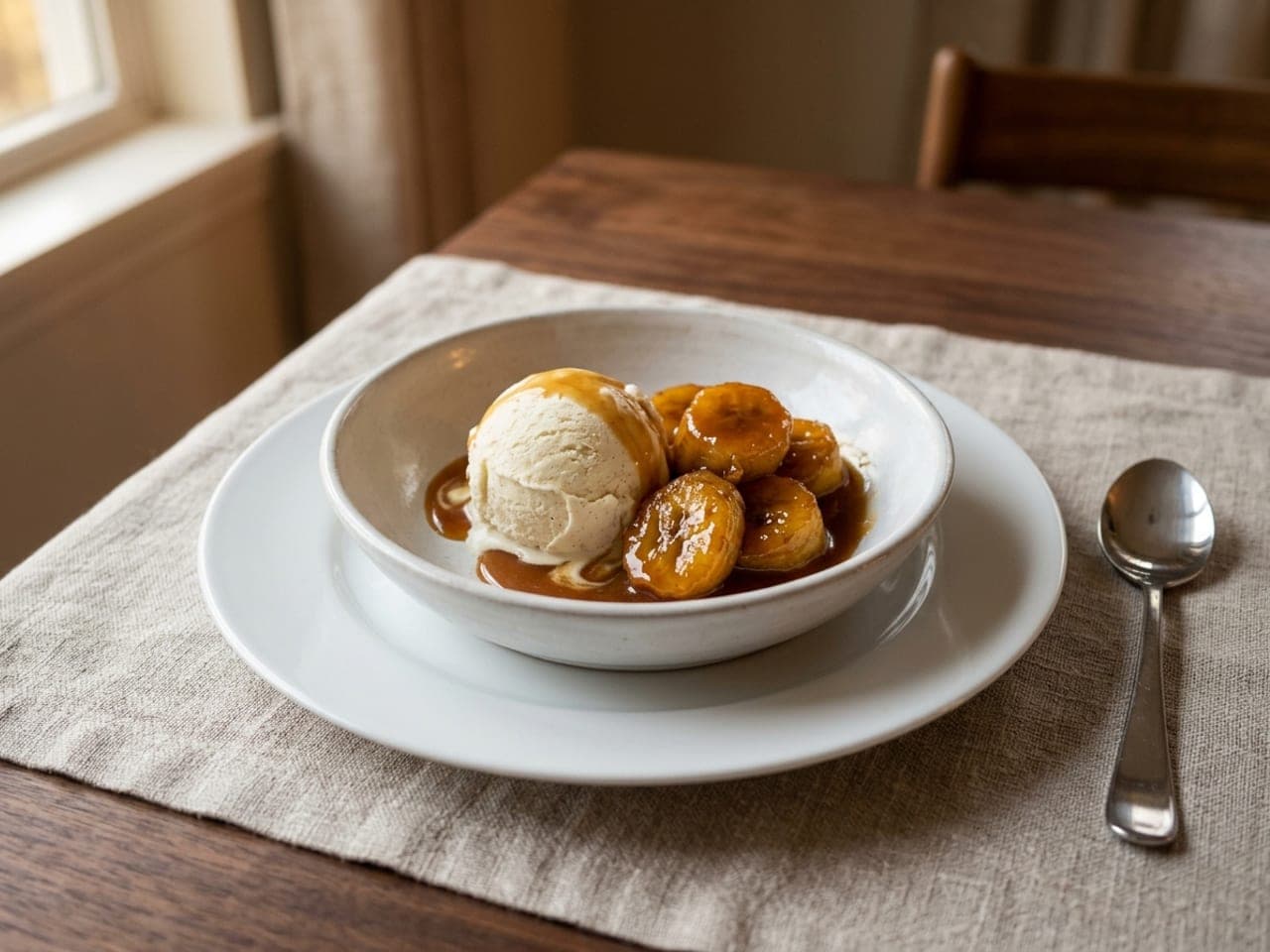
21Bananas Foster
Created at Brennan’s in New Orleans and named for Richard Foster, a friend of owner Owen Brennan; the restaurant’s own account dates it to 1951 and credits its chef Paul Blangé. Make ahead: nothing; Serious Eats says it is best made right before serving. America’s Test Kitchen scoops the ice cream into the bowls while the bananas cook; the steps here scoop it before dinner and keep the bowls in the freezer, which Food Network Kitchen does up to 4 hours ahead for its cherries jubilee. After dinner: all of it, about 10 minutes (Serious Eats’s time for the dish): melt the butter and sugar, soften the bananas 1 to 2 minutes, flame 15 to 30 seconds (America’s Test Kitchen’s time for the same amount of rum), spoon over the ice cream. Plate it: one scoop of vanilla ice cream in a chilled shallow ceramic bowl, banana pieces leaning against it, the hot caramel spooned over; served at once. Allergens: milk; egg if the ice cream contains it. No wheat or nuts in the sauce; check the ice cream tub for nut, peanut and wheat warnings before you call it nut-free or gluten-free. Alcohol: flaming leaves 75% of the rum, and the liqueur is only simmered for a minute or two (USDA’s table has 85% left when alcohol is stirred into a hot liquid). For children, pregnant guests and anyone avoiding alcohol, make the butter, brown sugar and cinnamon sauce with no liqueur, rum or flame.
Quick recipe · Serves 4 at Brennan’s half banana a person; the restaurant gives its recipe as serving 2 to 4 (after Brennan’s, New Orleans)
Ingredients
- 1 oz (28 g) butter
- ½ cup (about 107 g) light brown sugar
- ¼ tsp ground cinnamon
- 1½ fl oz (44 ml) banana liqueur, measured into a small cup before you start
- 1½ fl oz (44 ml) aged rum, measured into a second small cup
- 2 bananas, peeled and cut so that each guest gets half a banana
- Vanilla ice cream, to serve
Method
- Scoop the ice cream into 4 bowls and put them in the freezer.
- Melt the butter with the sugar and cinnamon in a stainless-steel skillet over medium heat. When the butter has melted, take the pan off the heat, stir in the banana liqueur from its cup, then set the pan back over medium heat.
- When the sauce starts to cook, add the bananas and cook until they begin to soften, 1 to 2 minutes.
- Turn the burner off and take the pan off the heat. Add the rum from its cup, give it about 5 seconds to warm, then light it at arm’s length with a long match or lighter and shake the pan gently until the flames die, 15 to 30 seconds. Spoon the bananas and sauce over the ice cream.
Flambé rules, from America’s Test Kitchen’s two flambé guides and the culinary schools Rouxbe and ICE: measure the spirit into a small cup before you start and never pour it from the bottle; turn off the burner and the extractor fan and take the pan off the heat before the spirit goes in; tie back long hair, roll up sleeves and clear the space around the pan (and, our addition, above it); light it with a long lighter or long match, arm fully extended, standing back; keep a pan lid within reach and slide it over the pan from the side if the flames climb. Use a stainless-steel skillet, not nonstick: the flame can damage the coating (America’s Test Kitchen). The flame does not remove the alcohol: USDA’s nutrient retention table has 75% of it left in flamed dishes. Brennan’s own recipe stirs the liqueur in over the heat and tilts the pan toward a gas flame; the steps here add both the liqueur and the rum off the heat and light the rum with a long match, America’s Test Kitchen’s method for the same dish.
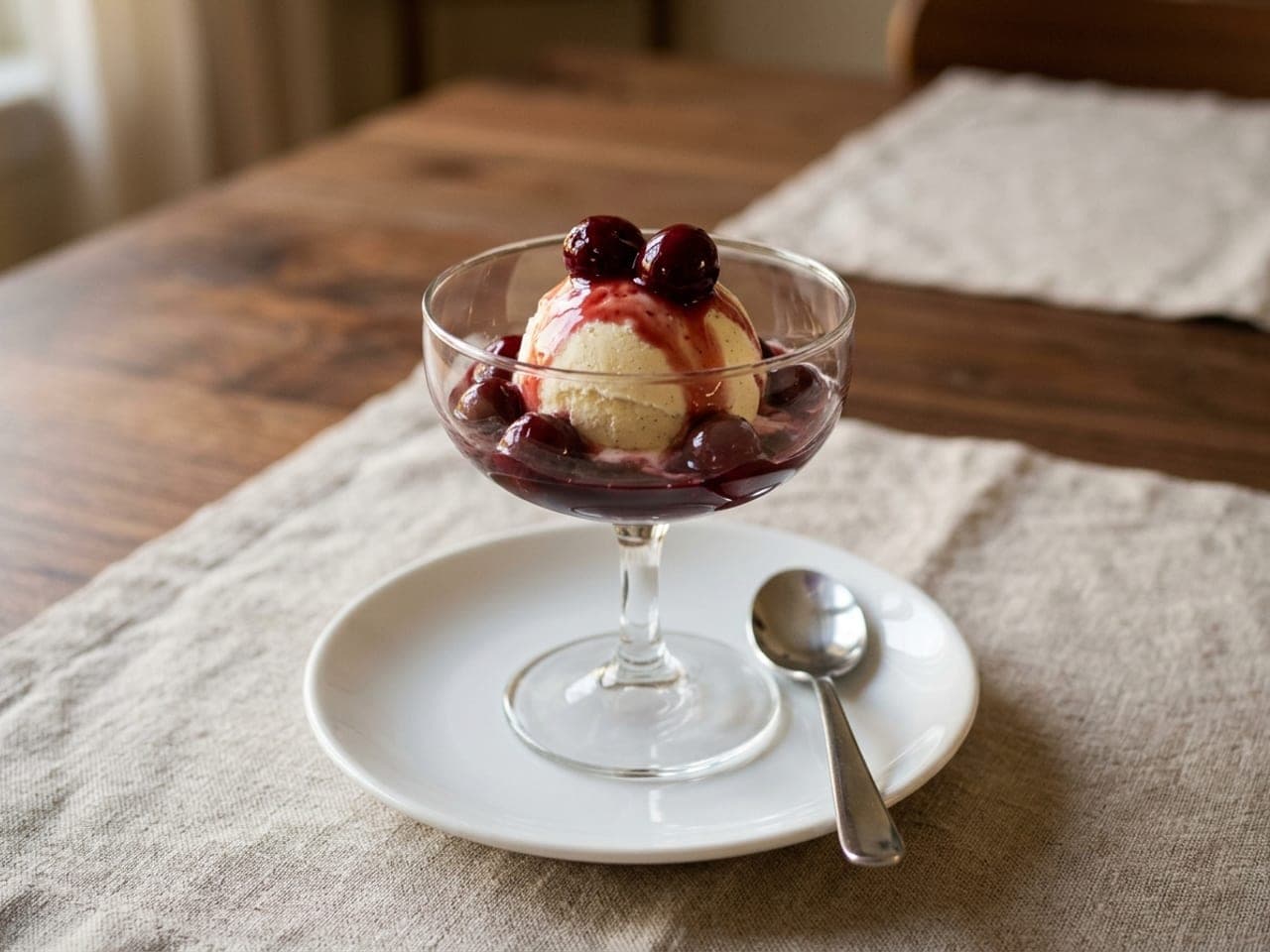
22Cherries jubilee
Tradition ties it to Queen Victoria’s Golden Jubilee of 1887, which is unproven; the story that it was made for her Diamond Jubilee of 1897 is wrong, because “cerises jubilé” is on a menu printed in 1892. Escoffier’s 1903 recipe has flaming kirsch and no ice cream. Make ahead: pit the cherries that morning (our advice), and scoop the ice cream into the dishes and freeze them up to 4 hours ahead (Food Network Kitchen). Serious Eats’s sauce can be made 2 days ahead and reheated, without the flame. After dinner: all of the cooking: 6 to 8 minutes for the cherries, 30 seconds of flame, then butter, zest and a rest of 5 minutes. America’s Test Kitchen lists 25 minutes in total; allow about 15 at the stove, our estimate. Plate it: one scoop of vanilla ice cream in a chilled glass coupe, the warm cherries and syrup spooned around and over it. Allergens: milk; egg if the ice cream contains it. No wheat or nuts in the cherries; check the ice cream tub for nut, peanut and wheat warnings before you call it nut-free or gluten-free. Alcohol: flaming leaves 75% of it (USDA’s table). For children, pregnant guests and anyone avoiding alcohol, skip the kirsch and the flame.
Quick recipe · Serves 4 (after Mark Huxsoll, America’s Test Kitchen)
Ingredients
- 1 lb (454 g) fresh sweet cherries, pitted
- ⅓ cup (66 g) sugar
- 1 tbsp (15 ml) water and ⅛ tsp salt
- ¼ cup (59 ml) kirsch, measured into a small cup before you start
- 1 tbsp (14 g) unsalted butter
- ½ tsp grated lemon zest
- Vanilla ice cream, to serve
Method
- In a 12 inch (30 cm) skillet that is not nonstick, cook the cherries, sugar, water and salt over medium-high heat, swirling the pan now and then, for 6 to 8 minutes, until the cherries are tender and starting to wrinkle.
- Turn the burner off and take the pan off the heat. Stir in the kirsch from the cup, then light it at arm’s length with a long match or lighter and shake the pan gently until the flames die, about 30 seconds.
- Back over the heat, stir in the butter and lemon zest until the butter melts, about 30 seconds. Take the pan off the heat and let it sit for 5 minutes.
- Spoon the cherries and syrup over the ice cream.
Flambé rules, from America’s Test Kitchen’s two flambé guides and the culinary schools Rouxbe and ICE: measure the spirit into a small cup before you start and never pour it from the bottle; turn off the burner and the extractor fan and take the pan off the heat before the spirit goes in; tie back long hair, roll up sleeves and clear the space around the pan (and, our addition, above it); light it with a long lighter or long match, arm fully extended, standing back; keep a pan lid within reach and slide it over the pan from the side if the flames climb. Use a stainless-steel skillet, not nonstick: the flame can damage the coating (America’s Test Kitchen). The flame does not remove the alcohol: USDA’s nutrient retention table has 75% of it left in flamed dishes. America’s Test Kitchen’s recipe returns the skillet to medium-high heat before lighting; its own safety guide adds the spirit with the heat off, and the steps here light it there too.
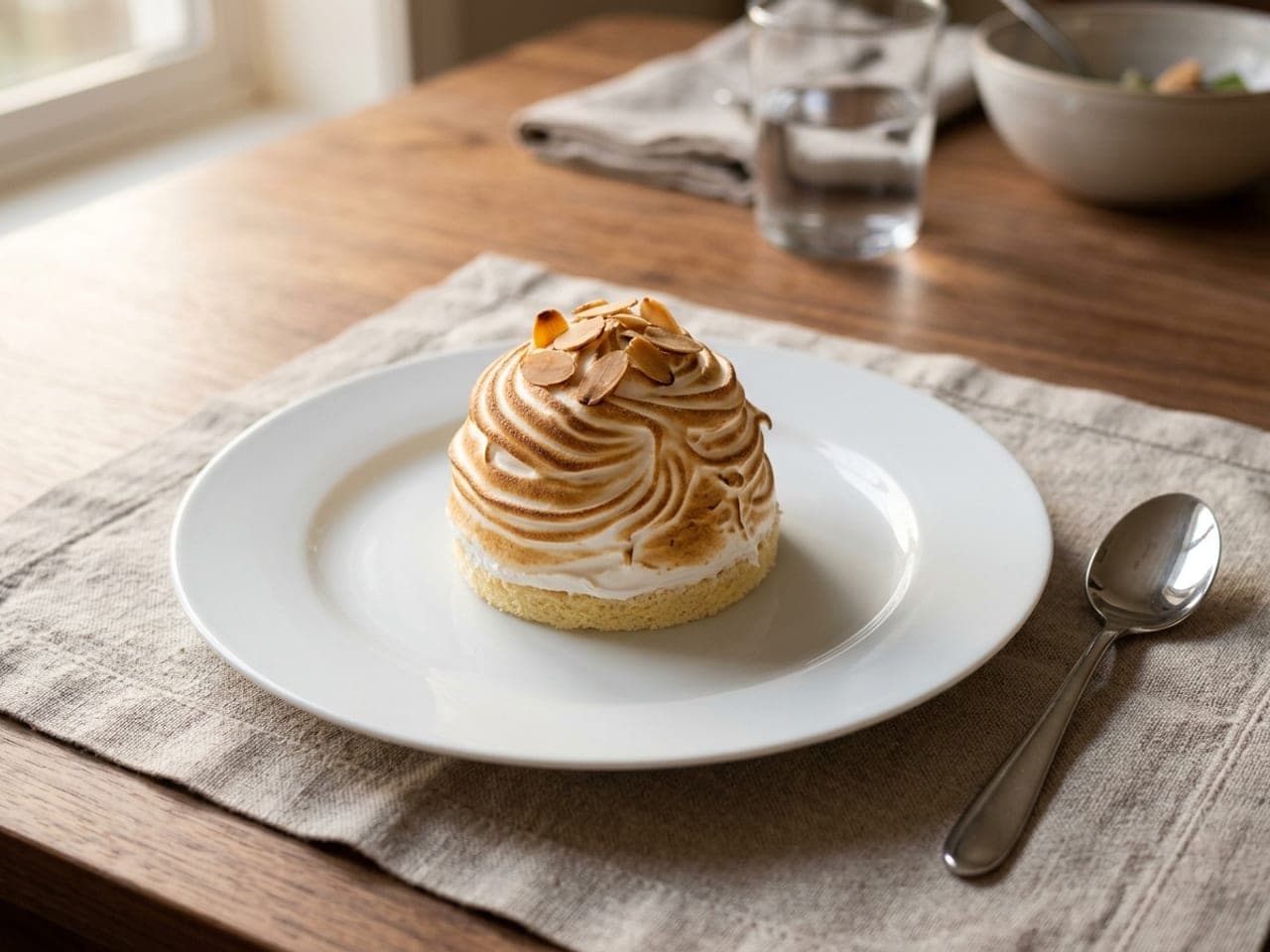
23Individual baked Alaska
A British journalist ate a “baked ice” called an Alaska at Delmonico’s in New York in the winter of 1879 to 1880; the earliest use of the name Baked Alaska we found is in Fannie Farmer’s 1896 cookbook. The tale that it marked the 1867 purchase of Alaska is a legend. Make ahead: ice cream molds frozen overnight, sponge 24 hours in a tin, bases cut on the day (BBC Good Food). BBC Good Food chills its raw meringue up to 5 hours; King Arthur makes its cooked meringue only when ready to serve. After dinner: oven to 428°F (220°C, or 200°C fan), ice creams onto their bases, cover completely with meringue, bake 3 minutes. About 10 minutes with the meringue ready, 20 to 25 if you cook it then; both our estimates. Plate it: straight from the oven onto a chilled plate, on its own, with a dessert spoon. It does not wait. Allergens: egg, milk, wheat, tree nuts (almonds). Flags: raw egg white that is only browned, and uncooked kirsch; see the note in the recipe.
Quick recipe · Makes 4 (after BBC Good Food, “Mini baked Alaskas with boozy cherry centres”)
Ingredients
- 17 fl oz (500 ml) tub good vanilla ice cream
- 7 oz (200 g) black cherry jam and 2 tbsp (30 ml) kirsch
- 3½ oz (100 g) butter, softened, plus extra for the tin
- 3½ oz (100 g) toasted flaked almonds: keep 2 tbsp back and grind the rest
- 3 oz (85 g) self-raising flour
- 2 eggs, lightly beaten, plus 3 egg whites (from eggs pasteurized in the shell: see the note)
- 8 oz (225 g) caster (superfine) sugar: 3½ oz (100 g) for the sponge and 4.4 oz (125 g) for the meringue
Method
- Line 4 individual pudding molds with plastic wrap and press in the ice cream, leaving a hollow in each. Stir 2 tsp of the kirsch into the jam, spoon it into the hollows, cover and freeze overnight.
- Heat the oven to 356°F (180°C, or 160°C fan). Beat the butter, ground almonds, flour, the 2 eggs and 3½ oz (100 g) of sugar until smooth, spread in a buttered and lined 8 inch (20 cm) square tin and bake 15 to 18 minutes, until golden and springy. Cool. On the day, cut four 2¾ inch (7 cm) rounds and drizzle them with the rest of the kirsch.
- Whisk the whites until stiff, then whisk in the remaining 4.4 oz (125 g) of sugar until the meringue is thick and glossy.
- To serve, heat the oven to 428°F (220°C, or 200°C fan). Set the sponge rounds on a parchment-lined baking sheet, turn an ice cream out onto each, peel off the wrap and cover it completely with meringue. Scatter with the reserved almonds, bake 3 minutes, until the tips are just browning, and serve at once.
This meringue is raw egg white: 3 minutes in the oven browns the tips and does not cook it. For any recipe served raw or undercooked the FDA says to use pasteurized eggs or egg products, above all for children, older adults, pregnant women and people with weakened immune systems. Either use whites from eggs pasteurized in the shell, which take up to about four times as long to whip (American Egg Board), or, better for those guests, make King Arthur’s cooked meringue instead: whisk ¾ cup (149 g) sugar, 3 large egg whites (105 g), ¼ tsp cream of tartar and ¼ tsp salt over simmering water to 161°F (72°C), 5 to 7 minutes, then whip to stiff peaks, 4 to 6 minutes, when you are ready to serve. Carton whites are not the answer here: USDA FSIS says pasteurized egg products are best used in a cooked product when a guest is at higher risk. The kirsch goes in uncooked: leave it out for children, pregnant guests and anyone avoiding alcohol.
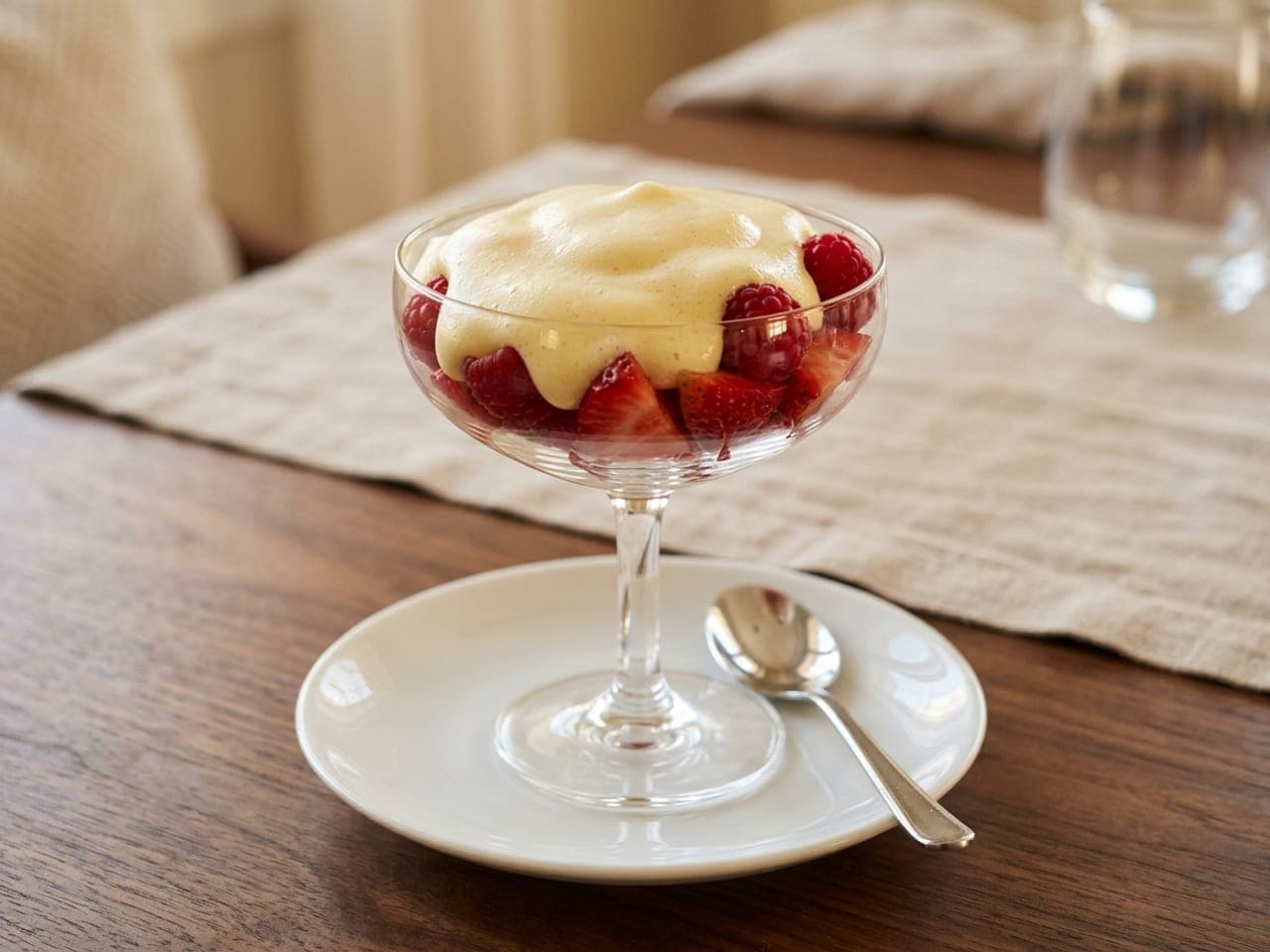
24Zabaglione over berries
The oldest dated recipe on this page: the papal cook Bartolomeo Scappi printed a “zambaglione” of egg yolks, sugar and sweet wine in 1570, as a warm restorative in his book of food for the sick. The tales crediting a mercenary captain or a Spanish saint are legends. Make ahead: nothing for the warm classic. Put the berries in their glasses and measure the sugar and wine. Separate the yolks into a covered bowl in the fridge, and keep the sugar off them until you whisk. After dinner: about 5 minutes of constant whisking over simmering water, then more off the heat; Serious Eats lists 15 minutes in all. Plate it: spooned warm over berries in a stemmed glass or coupe on a saucer. A crisp cookie beside it adds wheat and often nuts. Allergens: egg; sulfites (the wine). No milk, wheat or nuts as written. Flags: the wine is only warmed, so most of its alcohol remains (USDA’s table has 85% left when alcohol is stirred into a hot liquid), and the yolks are lightly cooked; see the note in the recipe.
Quick recipe · Serves 4 (after Gina DePalma and Daniel Gritzer, Serious Eats)
Ingredients
- 4 large egg yolks
- ¼ cup (50 g) sugar
- ¼ cup (60 ml) Vin Santo or another sweet fortified wine, such as Marsala
- A pinch of kosher salt
- Lemon juice to taste (optional)
- Fresh berries or other fruit, to spoon it over
Method
- Bring 1 inch (2.5 cm) of water to a gentle simmer in a saucepan that holds a heatproof bowl snugly without the bowl touching the water. Off the heat, whisk the yolks and sugar in the bowl until smooth, then whisk in the wine and salt.
- Set the bowl over the water and whisk without stopping, reaching the whole bowl so no spot overheats and scrambles, until the foam thickens, about 5 minutes.
- The test: a whiskful dropped back into the bowl should take a full 8 seconds to flatten. Take the bowl off the heat and keep whisking until it is warm or at room temperature, adding a little lemon juice if you like.
- Spoon over the fruit in glasses and serve.
No recipe we read gives a temperature for zabaglione. The FDA’s figure for egg mixtures is 160°F (71°C): check the foam with an instant-read thermometer, and for children, older adults, pregnant women and people with weakened immune systems use pasteurized yolks. It is an alcoholic dessert; for children, pregnant guests and anyone avoiding alcohol, our suggestion is the berries with softly whipped cream instead.
More desserts from our recipe pages
Three more desserts with full recipes on this site.
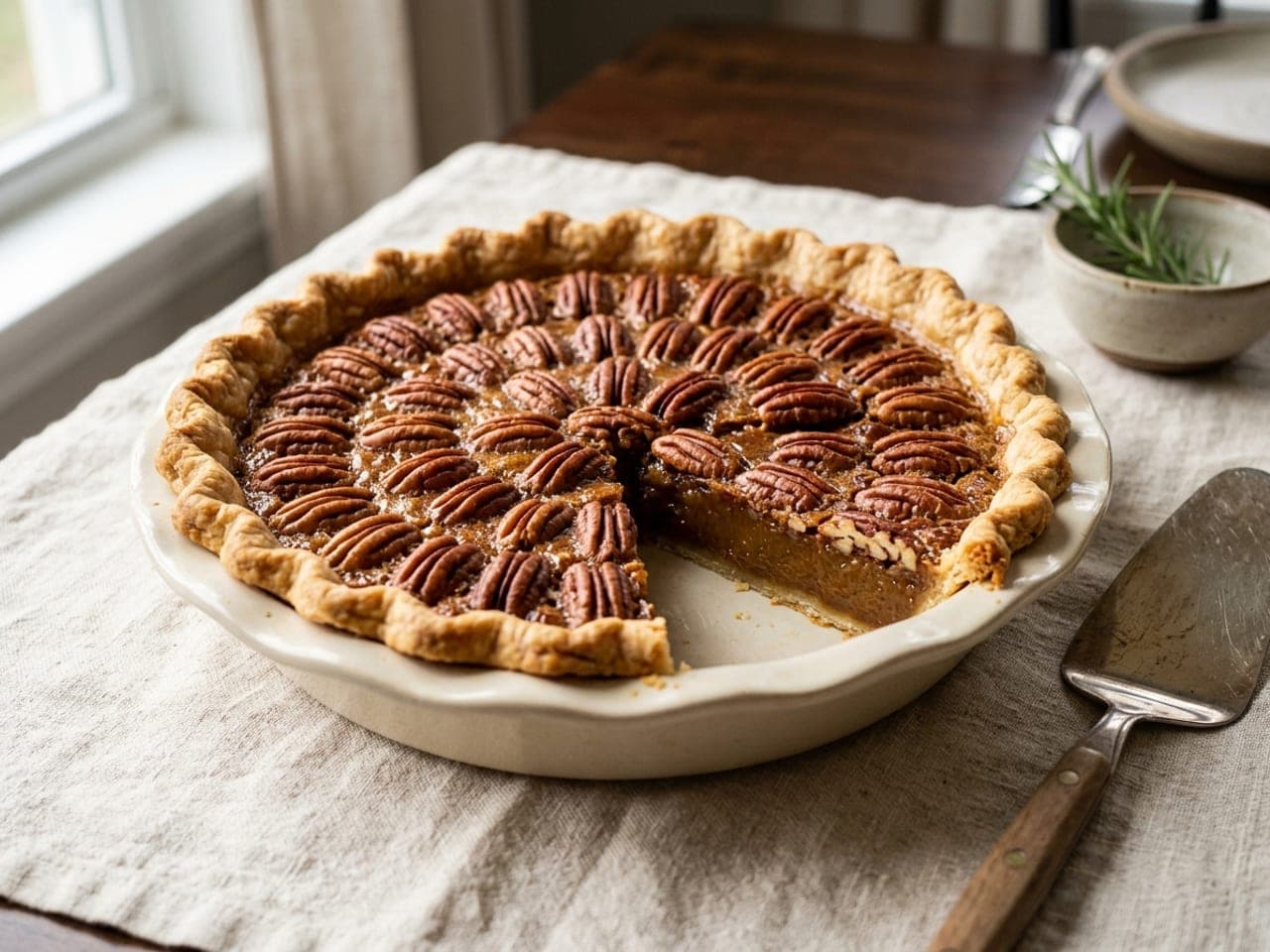
Pecan pie, or pecan tartlets
The pie you finish the day before. Make ahead: the recipe says it is at its best made the day before: cool it 2 hours on a rack, then refrigerate it uncovered until cold, at least 3 hours or overnight. It is an egg custard pie, so it goes into the fridge within 2 hours of baking, and FoodSafety.gov gives it 3 to 4 days there. After dinner: nothing to cook. Take slices out of the fridge 20 to 30 minutes before serving, or rewarm the whole pie at 250°F (120°C) for about 15 minutes. Plate it: one wedge just off center on a wide plate with a quenelle of whipped cream. Allergens: tree nuts (pecans), egg, milk, wheat; many pecans are packed alongside peanuts. Leave out the recipe’s optional bourbon for children, pregnant guests and anyone avoiding alcohol. For children under 5, take the whole pecan halves off the slice, as the recipe advises.
The twist: For a plated dessert, bake it as eight or nine 4 inch (10 cm) tartlets, the recipe’s second plating idea, so every guest gets a whole one.
Full recipe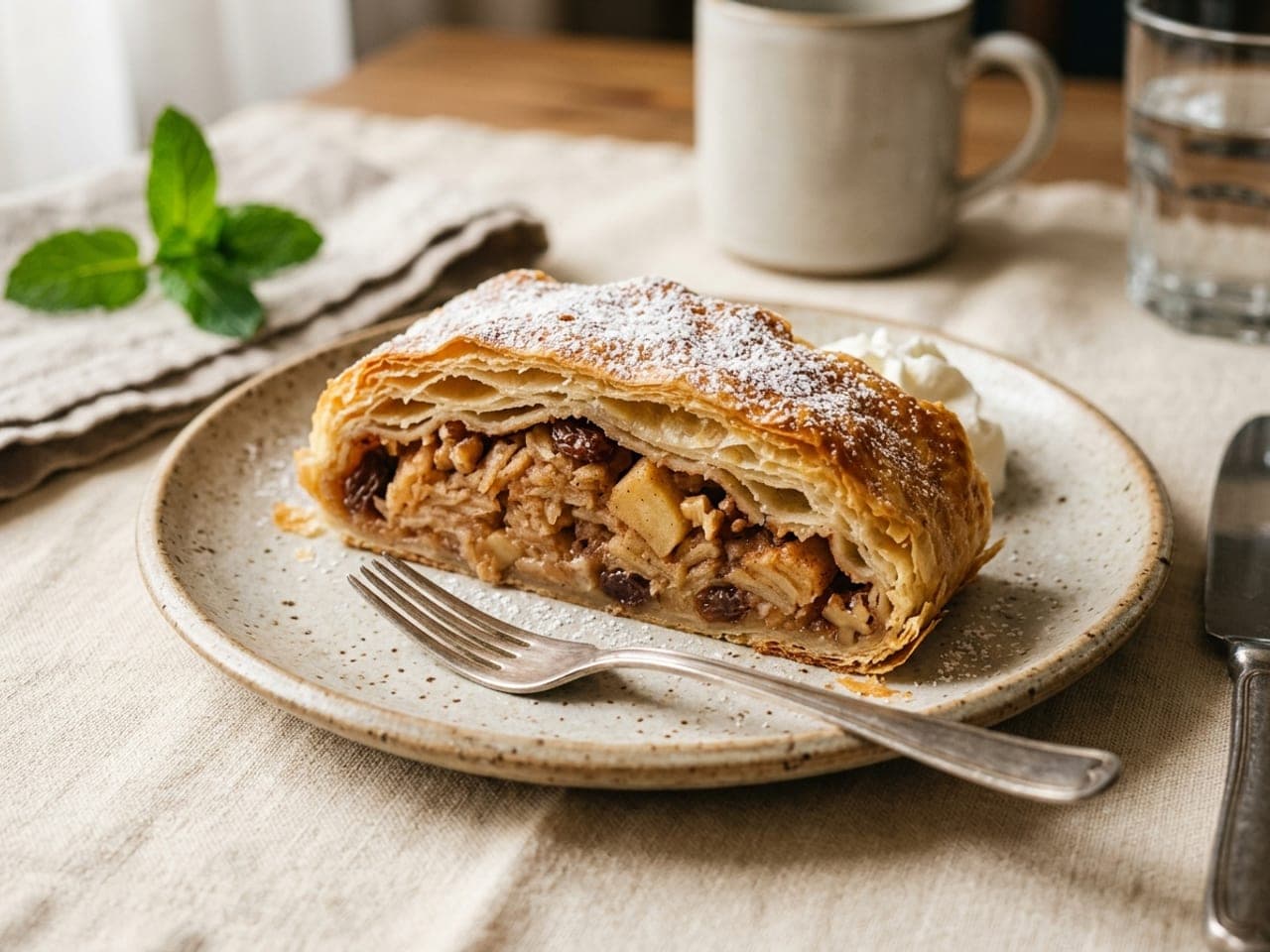
Apple strudel
Our Czech-style strudel in bought puff pastry: apples, raisins, walnuts and toasted breadcrumbs, cut into 8 portions. Make ahead: it bakes for 35 to 40 minutes at 392°F (200°C, or 180°C fan) and rests 10 minutes before cutting, so bake it before guests sit down; the recipe gives no storage window. After dinner: slice and plate. If you want it warm, Once Upon a Chef reheats strudel in a 300°F (149°C) oven; no source we read gives a time. Plate it: one slice, cut side showing, on a flat plate with a spoonful of whipped cream or vanilla ice cream beside it. Allergens: wheat (pastry, breadcrumbs), tree nuts (walnuts), and milk in the cream or ice cream beside it; bought puff pastry often contains milk too, and bought breadcrumbs can add milk, soy or sesame, so check both labels. No egg in the ingredient list; ice cream may add it.
Full recipe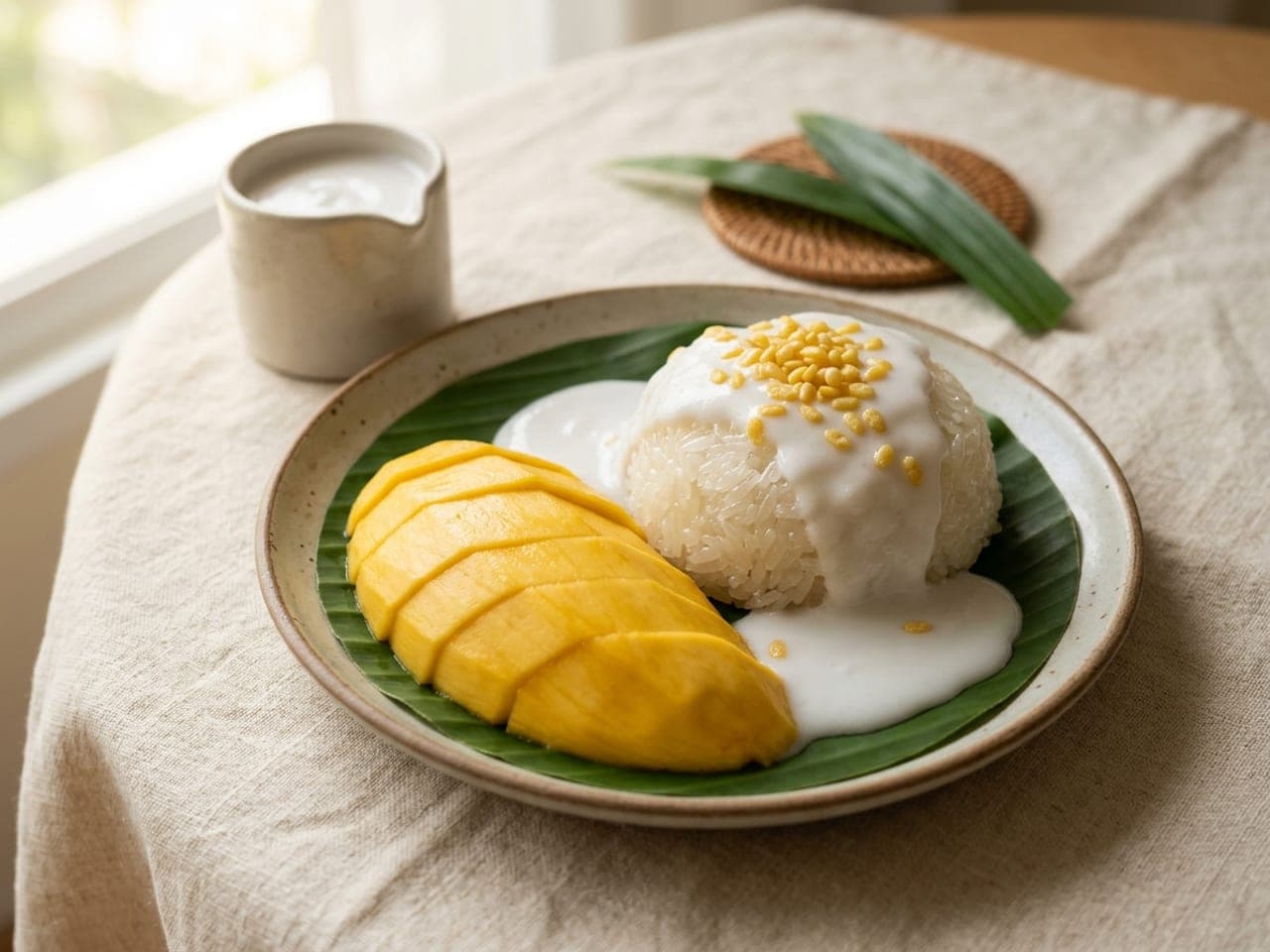
Mango sticky rice
The one dessert on this page with no egg, milk, wheat, gelatin or alcohol: the recipe is vegan and gluten-free as written. Make ahead: only the soak (at least 4 hours, or overnight) and the toasted mung beans. The recipe’s rule is to serve the rice within 2 hours of steaming, 1 hour if it sits outdoors above 90°F (32°C), so time the steaming so that the rice comes off the heat within 2 hours of dessert; it is not a day-before dessert. After dinner: cut the chilled mango, rewarm the coconut sauce and spoon it on: about 5 minutes, our estimate. Plate it: a small dome of rice with the sauce over it, the mango fanned beside it and the toasted mung beans on top. Allergens: none of the nine major US allergens as written; it contains coconut and mung beans, and sesame if you use the recipe’s substitute topping.
Full recipe
How to plate a dessert at home
A pastry textbook’s definition: “A plated dessert is an arrangement of one or more components. For most desserts, all the components are prepared well in advance. A plated dessert itself, however, is assembled à la minute (at the last minute).” These are the moves, with the guide that teaches each one. Our dessert plating guide has the full system.
- Chill or warm the plateCold desserts go on chilled plates and warm ones on warm plates, the first check in our 60-second dessert audit. Blue Apron’s kitchen guide: twenty minutes in the fridge chills a plate, and five minutes in a 200°F (93°C) oven warms one, if the plates are oven-safe.
- Sauce first, and not muchThe sauce goes on the bare plate before the dessert: a smear, a pool or a line of dots, all in sauce techniques, with a coulis as the simplest one to make. One pastry instructor’s teaching notes allow 1 to 2 oz (28 to 57 g) of sauce a plate, about 2 to 4 tbsp.
- One crunch, added lastA tuile, a shard of caramel or a crisp cookie, placed on a dry part of the plate and never on the sauce, where it softens.
- Fruit as a countThree berries placed, not a handful scattered, as in our short version of how to plate desserts. Plate the number the dessert needs.
- The right plate, or its own dishOur plate glossary puts the dessert plate at 6 to 8.5 in (15 to 22 cm) in the US. A dessert baked in a ramekin is served in it, on a small plate that catches drips.
- Only what gets eatenPastry Arts Magazine’s rule: nothing goes on the plate as decoration that is not meant to be eaten. That rules out the cinnamon stick and the reflex mint sprig.
- Plate fast, frozen lastEverything is made and staged before dinner; plating is a sprint, and anything frozen lands in the last seconds. Wipe the rim and go.
How much dessert per guest
We found no single authority that publishes a portion table for plated desserts after a dinner. These are the published figures we found, each with its source. Crowd-catering charts run larger; in our reading they are sized for buffets, not for a plate after a full dinner.
| Dessert | Per guest | Where the figure comes from |
|---|---|---|
| Set cream or baked custard | One 4 to 6 oz (118 to 177 ml) ramekin | America’s Test Kitchen uses 5 oz (148 ml) ramekins for panna cotta and pots de crème and 6 oz (177 ml) for crème brûlée; our crème brûlée recipe uses 4 oz (120 ml). |
| Lemon posset | About 3.2 fl oz (94 ml) | Our arithmetic: America’s Test Kitchen’s batch divided by its 6 servings. |
| Chocolate soufflé | One ramekin | 6 oz (177 ml) in Sally’s Baking’s recipe; 1 cup (237 ml) in America’s Test Kitchen’s. |
| Molten chocolate cake | One 6 oz (177 ml) ramekin | Food & Wine: about ½ cup (118 ml) of batter each. |
| Cheesecake | 1/12 to 1/16 of a 9 inch (23 cm) cake | America’s Test Kitchen serves 12 to 16 from one; our crème brûlée cheesecake serves 12. |
| Pie or tart | ⅛ of a 9 inch (23 cm) pie or tart | Our pecan pie cuts 8 wedges and Mary Berry’s lemon tart serves 8. Cooking for Crowds For Dummies allows a wedge 3 inches (7.6 cm) wide at the rim. |
| Profiteroles | 3 or 4 puffs | America’s Test Kitchen: 24 puffs serve 6 to 8. |
| Ice cream as the dessert | ½ cup (118 ml) | America’s Test Kitchen’s bananas Foster: 1 pint (473 ml) for 4. |
| The main item on a plated dessert | 3 to 5 oz (85 to 142 g) | A rule of thumb from one pastry instructor’s teaching notes; we could not trace a textbook behind it. |
| Sauce | 1 to 2 oz (28 to 57 g) | The same rule of thumb. |
| Any dessert, on a menu of five courses or more | Three quarters of the usual portion | Our own assumption, the one our course meal builder uses. |
How many desserts? One, for a seated dinner: the classic home dinner party is three courses, a first course, a main and dessert. Cooking for Crowds For Dummies also plans on one dessert serving a guest. If you do make two, our party food calculator splits the servings between them and adds a 20% cushion, which is our rule, not a published one.
Which dessert after which dinner
These are our suggestions, not rules. The reasoning in the last column is what the sources say; the picks are ours. To see a whole menu at once, deal one in the dinner party menu planner or build it course by course in the course meal builder.
| Your dinner | A dessert that fits (our suggestion) | The reasoning |
|---|---|---|
| A rich or heavy main: steak, a braise, lasagna | Lemon posset, poached pears, lemon tart or pavlova; for chocolate, a slim wedge of chocolate tart | Pastry Arts Magazine: “A heavy meal might mean a lighter dessert that refreshes your guests instead of weighing them down further.” Tasting Table’s list for a steak dinner starts with four chocolate desserts; the slim wedge is our advice (the one place that list asks for “a small slice” is cheesecake). |
| A main that needs you at the stove until it is served | Anything in tier 1 | Our menu planner’s rule: only one dish on the stove at the last minute. |
| The oven is full until the main course comes out | Tiers 1 and 2, except the profiteroles, whose puffs are crisped in the oven; or zabaglione and the flambés, which need a burner and no oven | A soufflé or a molten cake needs the oven at 375 to 450°F (191 to 232°C) while you eat. |
| Five courses or more | Something small and cold: lemon posset, panna cotta or an affogato | Our prix fixe guide builds a long menu as an arc, light to rich and back, with portions that shrink as courses are added; a palate cleanser can go between the main course and dessert. |
| Pregnant guests, small children or anyone avoiding alcohol at the table | Lemon posset, crème caramel, pots de crème, crème brûlée or panna cotta | Nothing raw, nothing flamed and no liqueur. Panna cotta is set with animal gelatin, so ask first, and a pot de crème carries about 20 mg of caffeine from its chocolate (our arithmetic). See the safety notes. |
| You want the dessert to be the event | Chocolate soufflé, crêpes Suzette or baked Alaska | They are cooked at the last minute and carried straight in. Practice once first: Food52’s advice is that a dinner party is not the time to try a recipe you have never made. |
Raw egg, flames, hot sugar and allergens
None of the 17 dessert roundups we read mentions raw egg, pasteurized eggs or flambé safety once, though they list raw-egg mousse, tiramisu and bananas Foster. These are the agency numbers the cards above are built on.
- Raw and undercooked eggUSDA FSIS advises everyone against eating raw or undercooked eggs. For any recipe served raw or undercooked the FDA says to use pasteurized eggs or egg products, above all for children, older adults, pregnant women and people with weakened immune systems. On this page that covers the chocolate mousse and baked Alaska (raw whites), the poached meringues of the île flottante, the soft centers of the soufflé, molten cake and pavlova, and zabaglione. Custards and tarts judged by a wobble (lemon tart, cheesecake, crème caramel, pots de crème) are cooked, but for those guests check the center with a thermometer. USDA FSIS says eggs pasteurized in the shell can be used without cooking; of carton egg products it says they are pasteurized but best used in a cooked product when the guest is at higher risk. For those guests use shell-pasteurized eggs, a cooked meringue or a baked dessert.
- The number is 160°F (71°C)Egg mixtures are safe once they reach 160°F (71°C), the figure USDA FSIS and the FDA both give, so a stirred custard taken to 175°F (79°C) is well past it. A Swiss meringue is cooked only if a thermometer says so, and hot sugar syrup alone does not reliably cook the whites unless it reaches 250°F (121°C), the same line our palate cleanser guide draws.
- UK eggs are a separate ruleIn the UK, the Food Standards Agency says pregnant women, young children and older people can eat raw or lightly cooked hen eggs that carry the British Lion mark or come from the Laid in Britain scheme; that does not apply to people who are severely immunocompromised. The advice covers those UK schemes only, not eggs from anywhere else.
- Raw-egg batter waits 24 hours at mostUSDA FSIS: cook dishes containing raw eggs immediately, or refrigerate them and cook within 24 hours. That is the limit we use for soufflé and molten cake batter, whatever a recipe allows.
- The 2-hour ruleNever leave perishable food out more than two hours, or one hour above 90°F (32°C), and keep the fridge at 40°F (4°C) or below. Every dessert here with egg or dairy goes back into the fridge inside that window, and the 10 to 30 minutes a mousse, a posset or a pot de crème spends coming up to temperature count toward it.
- Fridge windowsFoodSafety.gov gives custard pies and pecan pie 3 to 4 days in the fridge, the same as cooked egg dishes, and we count from the day they are made; USDA’s FoodKeeper gives sweetened whipped cream 1 day. In the UK, the Food Standards Agency says to eat leftovers within 48 hours. A recipe that claims longer is talking about texture.
- FlambéMeasured spirit from a small jug, never the bottle; burner and extractor fan off and the pan off the heat when the spirit goes in; a long lighter at arm’s length; a lid within reach (America’s Test Kitchen, Rouxbe, the Institute of Culinary Education). Use a spirit of about 80 proof, 40% alcohol: The Spruce Eats calls anything over 120 proof dangerous, and Bon Appétit’s ceiling is about 1 tbsp a serving. Keep children 3 feet (1 m) from the stove, the National Fire Protection Association’s rule. Rouxbe adds two more: not in a small kitchen, and a fire extinguisher within reach as well as the lid. The National Fire Protection Association’s cooking sheet says not to use the stove if you are sleepy or have been drinking, so if the cook has had wine with dinner, someone who has not lights the pan, or the dessert goes out unflamed. Our addition: never add more spirit to a pan that is already alight. Our advice: flame at the stove and carry the pan in.
- Alcohol staysUSDA’s nutrient retention table: 75% of the alcohol is left in a flamed dish, 85% when it is stirred into a hot liquid, 70% after a night in the fridge with no heat (tiramisu), 40% after 15 minutes of simmering and 35% after 30 (poached pears). The CDC says there is no known safe amount of alcohol in pregnancy. Ask before you serve: a flamed dessert looks as if the alcohol has gone.
- Caramel and the torchSugar caramelizes at about 340°F (170°C) and sticks to skin. Hold a burn under cool running water for 20 minutes, the NHS’s advice (the American Burn Association says at least 5 minutes, and not cold or icy water). No ice, no butter, oil or cream, and do not pull off anything that has stuck to the skin, caramel included. Get medical help for a burn that is deep, larger than a hand, or on the face or hands: 911 in the US, 999 or A&E in the UK. Use the torch on a metal tray, away from napkins and the tablecloth; the maker’s manual adds that it must never be left lit, that the flame guard stays hot after use, that it stays out of children’s reach and that it is refilled away from any flame.
- AllergensUS law names nine major allergens (milk, eggs, fish, crustacean shellfish, tree nuts, peanuts, wheat, soybeans and sesame); the UK and EU name fourteen, adding celery, mustard, lupin, mollusks and sulfites. The ones on this page are egg, milk, wheat, tree nuts, soy (the lecithin in most chocolate) and sulfites (wine). Sesame can come in with a substitute topping and peanuts with packaged nuts. “May contain” warnings are voluntary in the US, so read the label on every bought component (ice cream, puff pastry, ladyfingers, graham crackers, chocolate) before you tell a guest a dessert is free of something, and say what is in the dessert when you serve it. The FDA has had many reports of undeclared milk in dark chocolate, so read the label before calling a dessert dairy-free. Most gelatin comes from beef or pork, so panna cotta is not vegetarian; lemon posset is the set cream that is.
- CaffeineBy USDA’s figures a 1 fl oz (30 ml) espresso shot has about 63 mg of caffeine and 1 oz (28 g) of 60 to 69% dark chocolate about 24 mg. By our arithmetic from those figures, a slice of the chocolate tart or one molten cake holds 1½ oz (43 g) of chocolate, about 37 mg, a glass of the mousse about 28 mg and a pot de crème about 20 mg. ACOG describes less than 200 mg a day as moderate in pregnancy and EFSA says up to 200 mg a day raises no safety concern for the fetus; the FDA cites 400 mg for most adults. EFSA proposes 3 mg per kg of body weight a day for children, which by our arithmetic is about 60 mg for a 44 lb (20 kg) child: one shot. Offer decaf for the affogato.
- Raw flourThe FDA counts flour as a raw food until it is baked. That is why the center of a molten cake is not for guests at higher risk even with pasteurized eggs, and why any crumble or cookie crumb used as a garnish is baked first.
Make-ahead timeline for a dinner party dessert
An example for six guests on a Saturday, sitting down at 7:30 pm (19:30), with one dessert from each tier side by side so you can see what each costs you on the night: lemon posset, crème brûlée, chocolate soufflé or cherries jubilee. You would serve one of them.
Our pace. The clock times, and any job with no source named, are ours: dessert at 8:50 pm (20:50) is 80 minutes after sitting down, the three-course pace our dinner party menu planner uses. The windows and minutes are the recipes’ own.
- The week before
- Ask your guests about allergies, pregnancy, alcohol and caffeine, then choose the dessert (our advice).
- Choose one you have made before: Food52’s rule is that a dinner party is not the time for a recipe you have never tried.
- Buy the pantry items: chocolate, sugar, the kirsch, and eggs pasteurized in the shell if the dessert is served raw or soft.
- Thursday: 2 days before
- Shop for today’s cooking: the cream, lemons and eggs.
- Lemon posset: make it on Thursday evening, chill it uncovered for at least 3 hours, then wrap. America’s Test Kitchen keeps it up to 2 days.
- Crème brûlée: bake the custards, get them into the fridge within 2 hours and cover them once cold. Do not sugar them yet.
- Friday: the day before
- Pull the plates, ramekins, glasses and spoons you will use, and check the kit: gas in the torch, a long lighter, a lid that fits the skillet.
- Cherries jubilee: measure the kirsch into a small covered jug and put the bottle away.
- Shop for the rest of the fresh ingredients: the berries, the cherries, the eggs for the soufflé and cream for serving.
- Saturday morning
- Chocolate soufflé: make the batter, fill the buttered and sugared ramekins, cover and refrigerate. That keeps it inside USDA FSIS’s 24 hours for raw-egg batter.
- Pit the cherries and refrigerate them.
- Set the table, and check the fridge is at 40°F (4°C) or below.
- 5:30 pm (17:30)
- Cherries jubilee: scoop the ice cream into the serving dishes and put them in the freezer, which Food Network Kitchen does up to 4 hours ahead.
- Fill the coffee maker but do not switch it on until dessert (Ina Garten’s tip).
- 7:30 pm (19:30): guests sit down
- Nothing for dessert. If you are in the kitchen now, you chose the wrong tier.
- 8:10 pm (20:10): the main course goes to the table
- Chocolate soufflé: heat the oven to 400°F (204°C), rack in the lower third.
- Crème brûlée: take the custards out of the fridge. If you are torching, the recipe gives them 20 minutes at room temperature first.
- 8:30 pm (20:30): between the main course and dessert
- Clear the table and switch on the coffee.
- Lemon posset: unwrap and leave at room temperature for 10 minutes, then add the berries. Done.
- Crème brûlée: blot the tops, sugar them, torch about 2 inches (5 cm) above the sugar and leave 2 minutes to harden. Caramelize just before serving.
- Chocolate soufflé: ramekins in, oven down to 375°F (191°C), 13 to 14 minutes plus a minute or so because they are cold. America’s Test Kitchen gives a soufflé about 5 minutes before it falls, so have plates, napkins and guests ready before you open the door.
- Cherries jubilee: cook the cherries 6 to 8 minutes, take the pan off the heat with the burner and fan off, add the kirsch from the jug and light it with a long lighter. When the flames die, about 30 seconds, put the pan back on the heat, stir in the butter and zest, then rest it 5 minutes off the heat and spoon over the ice cream.
- 8:50 pm (20:50): dessert
- Serve. Start a 2-hour clock for anything with egg or dairy that came out of the fridge; above 90°F (32°C) it is 1 hour.
- By 10:10 pm (22:10)
- Two hours after the first custards left the fridge: leftovers back in the fridge or in the bin. Custards and possets keep within the windows on their cards; a soufflé or a flambé does not keep.
- Leave the torch, the skillet and the hot ramekins to cool where they are before you move them.
See your dessert re-plated
Photograph a dessert you are testing for the dinner and Plate Artists shows it re-plated, with the exact moves to get there on a real plate. Your first re-plate is free with an account.
Start free · 1 enhancement →Free account · 1 free enhancement · No credit card
Fancy dessert questions, answered
What is the fanciest dessert?
There is no official ranking. In our reading, the showpieces on a restaurant menu are the desserts finished in front of the guest, which is the fourth tier here: crêpes Suzette, baked Alaska, cherries jubilee and a soufflé carried in before it falls. Carême called the large soufflé “the queen of hot pastry, ancient and modern” in 1815. At home, the fanciest dessert is the one you can plate calmly, so start with how to choose.
Which fancy desserts can be made ahead?
All 9 in the first tier. By the recipes we follow: lemon posset, pots de crème and crème caramel 2 days ahead (America’s Test Kitchen and Epicurious), poached pears up to 3 (America’s Test Kitchen), tiramisu 2 to 3 (BBC Good Food for its own, Serious Eats for the one we follow), panna cotta 2 (David Lebovitz’s window for his own; Serious Eats allows the one we follow far longer, and we stop at 2), chocolate mousse and chocolate tart the day before, and mille-feuille assembled that afternoon. In the second tier the base is made ahead too: crème brûlée custards 2 to 3 days, a pavlova shell the day before, and profiterole puffs a month ahead in the freezer.
Which fancy desserts are actually easy?
Lemon posset is three ingredients and no thermometer. Serious Eats says of affogato that it is “so simple, it’s hardly a recipe”, and David Lebovitz calls panna cotta “incredibly easy to make”. BBC Good Food labels its poached pears and its pavlova Easy. The same site labels its tarte Tatin “A challenge” and its profiteroles “More effort”, which matches where things go wrong: caramel, timing and choux.
What is a plated dessert, and what are its components?
A dessert composed on each guest’s own plate, as opposed to a whole cake or a bowl passed around. One pastry textbook defines it as “an arrangement of one or more components”, prepared in advance and “assembled à la minute”, and lists five things to balance: flavor, texture, temperature, color and shape. Our dessert plating guide counts five roles on the plate: the hero, the sauce, the crunch, the cream or frozen element and a garnish that belongs. As a pastry term the phrase is recent: we could not find it in print before the late 1980s.
What are the classic French desserts?
From this page: crème brûlée, crème caramel, pots de crème, chocolate mousse, chocolate soufflé, tarte Tatin, lemon tart (tarte au citron), profiteroles, mille-feuille, île flottante, crêpes Suzette and poached pears. That is the French repertoire, not a ruling on origins: crème brûlée is claimed by England and Catalonia too. Tiramisu, panna cotta, affogato and zabaglione are Italian, lemon posset is English, bananas Foster and baked Alaska are American, and New Zealand and Australia both claim the pavlova.
What dessert goes with steak or a heavy main course?
Something lighter or sharper than the main. Pastry Arts Magazine’s advice is that a heavy meal “might mean a lighter dessert that refreshes your guests”; our picks are lemon posset, lemon tart, poached pears or pavlova. If the table wants chocolate after steak, Tasting Table’s list leads with it, a flourless torte and then mousse. Keeping it small is our advice: a slim wedge of chocolate tart or a small glass of mousse. See which dessert after which dinner.
Is chocolate mousse with raw eggs safe, and can you eat it when pregnant?
In the US the official answer is no for raw shell eggs: USDA FSIS advises everyone against raw or undercooked eggs, and FoodSafety.gov tells pregnant women to eat foods containing raw or lightly cooked eggs only if they are made with pasteurized eggs. So use eggs pasteurized in the shell, or choose a baked chocolate dessert such as pots de crème. In the UK the NHS says mousse made with British Lion or Laid in Britain hen eggs is safe in pregnancy; that covers those schemes only. Mousse also carries caffeine and often alcohol; see the chocolate mousse card.
How do I make a store-bought dessert look fancy?
Plate it. In our dessert plating guide the same brownie goes from plain to restaurant-style with nothing new baked: a smear of sauce, a quenelle on crumbs, one shard and a wiped rim. The recipes here allow shortcuts too: bought all-butter puff pastry for the mille-feuille and tarte Tatin, a bought pastry case for Mary Berry’s lemon tart, and good bought ice cream for the affogato, profiteroles and flambés. See how to plate a dessert at home.
What is the hardest dessert to make?
There is no agreed answer, but the sources point at the same few. BBC Good Food labels Raymond Blanc’s tarte Tatin “A challenge”, and Serious Eats says tarte Tatin “can be a tricky dessert to make”: you have to judge the caramel, cook the apples without burning either and then turn the whole thing over. A soufflé is easy to mix and hard to time, because it starts to fall about 5 minutes after it leaves the oven (America’s Test Kitchen).
How many desserts should I make for a dinner party?
One plated dessert for a seated dinner. A three-course dinner is a first course, a main and dessert, and Cooking for Crowds For Dummies plans on one dessert serving a guest. On a long menu the extras are small: our palate cleanser guide defines a pre-dessert as two or three bites, and in our prix fixe guide the sweets with coffee are one or two bites each. See how much dessert per guest.
Does the alcohol burn off when you flambé a dessert?
No. USDA’s nutrient retention table has 75% of the alcohol still in a flamed dish, which by our arithmetic is roughly a quarter of a standard drink a serving when ¼ cup (59 ml) of 80-proof rum is flamed for four. An Idaho State University dietitian makes the same point about cherries jubilee. For children, pregnant guests, people in recovery and anyone who does not drink, make the sauce without the spirit and skip the flame.
Is it safe to flambé at home?
It can be, if you follow the rules professionals use and the person lighting the pan has not been drinking: measure the spirit into a small jug first and never pour from the bottle, take the pan off the heat and turn off the burner and the extractor fan before adding it, light it with a long lighter at arm’s length, and keep a lid and a fire extinguisher within reach. America’s Test Kitchen says the flames burn out in 15 to 30 seconds. Do it at the stove, in a stainless-steel skillet, with nothing above or beside the pan that can catch. The full list is in the safety notes.
How far ahead can I torch a crème brûlée?
As late as you can. Serious Eats says the caramelized sugar softens and melts over 20 to 30 minutes, because sugar pulls moisture from the custard, and tells cooks to torch right before serving; our recipe says about 30. The custards themselves are the make-ahead part: baked 2 to 3 days ahead and kept in the fridge, per our crème brûlée recipe and Serious Eats.
The research behind this guide
Sources for the recipes, numbers and dates on this page:
- FDA, What you need to know about egg safety (160°F; pasteurized eggs for raw or undercooked recipes; who is at risk)
- USDA FSIS, Shell eggs from farm to table (egg mixtures safe at 160°F; raw-egg dishes cooked within 24 hours; dry meringue shells)
- USDA FSIS, Egg products and food safety (pasteurized egg products are best used in a cooked product for people at higher risk)
- FoodSafety.gov, People at risk: pregnant women (tiramisu and other raw-egg foods)
- FoodSafety.gov, Cold food storage chart (custard, pumpkin and pecan pies: 3 to 4 days)
- FoodSafety.gov, FoodKeeper (sweetened whipped cream 1 day; cooked leftovers 3 to 4 days)
- USDA FSIS, Danger zone (2 hours, 1 hour above 90°F)
- FDA, Refrigerator thermometers (40°F or below)
- American Egg Board, Using cooked eggs in dishes that normally feature uncooked eggs (whites from pasteurized shell eggs take up to about four times as long to whip)
- South Dakota State University Extension, Egg safety and holiday foods (hot syrup and meringue; 250°F)
- Food Standards Agency, Home food fact checker (British Lion and Laid in Britain eggs)
- Food Standards Agency, Cooking your food (leftovers within 48 hours)
- NHS, Foods to avoid in pregnancy (mousse made with British Lion eggs)
- USDA, Table of nutrient retention factors, release 6 (alcohol retained: flamed 75%)
- CDC, About alcohol use during pregnancy
- Idaho State University, No worries, the alcohol burns off during cooking. But does it really?
- America’s Test Kitchen, How to flambé safely
- America’s Test Kitchen, How to flambé (long match, arm extended; lid from the side)
- Rouxbe, Flambéing safety note (never from the bottle; not in a small kitchen; extinguisher and lid)
- Institute of Culinary Education, What is flambé?
- The Spruce Eats, How to flambé foods (80 proof; over 120 proof is dangerous)
- Bon Appétit, How to flambé (about 1 tbsp of spirit a serving)
- National Fire Protection Association, Cooking safety tip sheet (lid; kid-free zone of 3 feet; not when sleepy or after alcohol), copy hosted by the Nevada State Fire Marshal
- NHS, Burns and scalds: treatment (cool running water for 20 minutes)
- American Burn Association, Burn first aid (at least 5 minutes; not cold or icy water; when to get care)
- Williams-Sonoma, Crème brûlée torch manual (ventilation; flame guard; never unattended; out of children’s reach; refilling)
- FDA, Food allergies (the nine major allergens; undeclared milk in dark chocolate; advisory statements are voluntary)
- Food Standards Agency, Allergen guidance for food businesses (the 14 allergens)
- David Lebovitz, How to use gelatin (not vegetarian; fruit enzymes)
- USDA FoodData Central, Espresso, restaurant-prepared (caffeine)
- USDA FoodData Central, Chocolate, dark, 60 to 69% cacao solids (caffeine)
- ACOG, Moderate caffeine consumption during pregnancy (less than 200 mg a day)
- EFSA, Caffeine (200 mg a day in pregnancy; 3 mg per kg for children)
- FDA, Spilling the beans: how much caffeine is too much? (400 mg a day)
- FDA, Flour is a raw food
- Serious Eats, Vanilla bean panna cotta (Stella Parks)
- David Lebovitz, Panna cotta (up to 2 days ahead; glasses)
- America’s Test Kitchen, Unmolding panna cotta
- David Lebovitz, Chocolate mousse (after Julia Child)
- Bon Appétit, Chocolate mousse (yolks cooked to 160°F; 1 day ahead)
- America’s Test Kitchen, Dark chocolate mousse (24 hours; 10 minutes at room temperature)
- Epicurious, Chocolate pots de crème (Café Tamayo)
- Bon Appétit, Chocolate pots de crème (5 days)
- America’s Test Kitchen, Chocolate pots de crème (20 to 30 minutes at room temperature; 5 oz ramekins)
- America’s Test Kitchen, Lemon posset with berries (Annie Petito)
- BBC Good Food, Easy lemon posset (up to 24 hours)
- Serious Eats, 3-ingredient lemon possets (up to 24 hours)
- Serious Eats, Tiramisu (Stella Parks; eggs cooked to 160°F; up to 3 days)
- BBC Good Food, Best ever tiramisu (no egg in the cream; 2 days)
- Sally’s Baking, Tiramisu (wipe the knife between cuts)
- Epicurious, Caramel flan (Bon Appétit, May 1992)
- America’s Test Kitchen, Classic crème caramel (2 days; caramel over 300°F)
- BBC Good Food, Crème caramel (3 days)
- Bon Appétit, Chocolate ganache tart (Janice Tiefenbach, Elena)
- Williams-Sonoma, Chocolate tart (20 minutes at room temperature before serving)
- Sally’s Baking, Mille-feuille (Napoleon pastry)
- King Arthur Baking, Napoleons (up to 12 hours; best the day they are assembled)
- America’s Test Kitchen, Red wine-poached pears with black pepper and cloves
- Serious Eats, Red wine poached pears (served warm, with a glaze)
- BBC Good Food, Poached pears in red wine (2 days; Easy)
- David Lebovitz, Poached pears (sugar syrup)
- Serious Eats, Crème brûlée (2 days; the crust softens over 20 to 30 minutes)
- America’s Test Kitchen, Make-ahead crème brûlée (4 days)
- America’s Test Kitchen, Classic crème brûlée (6 oz ramekins)
- America’s Test Kitchen, Buttermilk panna cotta (5 oz ramekins)
- America’s Test Kitchen, New York-style cheesecake (serves 12 to 16; hot knife)
- BBC Good Food, Pavlova (Barney Desmazery; Easy)
- King Arthur Baking, Pavlova (overnight in the oven; fill up to an hour before serving)
- America’s Test Kitchen, Strawberry, lime and basil pavlova (shell keeps 1 week; whites heated to 160 to 165°F)
- Nigella.com, Mini pavlovas in advance (2 days in dry conditions)
- Nigella.com, Assembling pavlova in advance (no more than 1 hour)
- America’s Test Kitchen, Profiteroles (Dawn Yanagihara)
- BBC Good Food, Profiteroles (More effort)
- BBC Food, Mary Berry’s lemon tart
- BBC Good Food, The ultimate makeover: lemon tart (best eaten the same day)
- Serious Eats, Affogato (Daniel Gritzer)
- Food Network Kitchen, Cherries jubilee (ice cream scooped up to 4 hours ahead)
- Bon Appétit, Floating islands (2005)
- Serious Eats, Île flottante (custard 3 days; meringue 1 to 2 hours)
- Serious Eats, Crème anglaise (175°F; not past 180°F)
- Sally’s Baking, Chocolate soufflé
- Serious Eats, Chocolate soufflé (batter up to 1 day)
- America’s Test Kitchen, Busting soufflé myths (falls after about 5 minutes)
- America’s Test Kitchen, Make-ahead chocolate soufflé (1 cup ramekins)
- Food & Wine, Molten chocolate cake (Jean-Georges Vongerichten)
- America’s Test Kitchen, Chocolate volcano cakes (batter up to 24 hours)
- BBC Good Food, Tarte tatin (Raymond Blanc; A challenge)
- Serious Eats, Tarte Tatin (best the day it is made)
- Food & Wine, Crêpes Suzette (Jacques Pépin)
- America’s Test Kitchen, Crêpes Suzette (crêpes up to 3 days)
- Brennan’s, Bananas Foster: the house account and recipe
- Serious Eats, Bananas Foster (10 minutes; best made right before serving)
- America’s Test Kitchen, Bananas Foster (off the heat; 15 to 30 seconds)
- America’s Test Kitchen, Cherries jubilee (Mark Huxsoll)
- Serious Eats, Cherries jubilee (sauce 2 days ahead)
- BBC Good Food, Mini baked Alaskas with boozy cherry centres
- King Arthur Baking, Baked Alaska (meringue cooked to 161°F)
- Serious Eats, Zabaglione (Gina DePalma and Daniel Gritzer)
- Once Upon a Chef, Apple strudel (reheat at 300°F)
- King Arthur Baking, Ingredient weight chart (the gram figures marked “about”)
- BC Cook Articulation Committee, Modern Pastry and Plated Dessert Techniques: Plan dessert plating
- Pastry Arts Magazine, A short(ish) guide to plated desserts
- Tasting Table, The 12 best desserts to serve after a steak dinner
- Ron Pehoski, Plated desserts: components of a plated dessert (teaching notes: main item 3 to 5 oz, sauce 1 to 2 oz)
- Dummies.com, How much to cook when you cook for a crowd (from Cooking for Crowds For Dummies)
- Blue Apron, How to warm and chill plates
- Food52, How to prep a dinner party ahead of time
- Williams-Sonoma, Ina Garten’s top 10 make-ahead tips
- Stampa Sera, 8 January 1971 (the earliest panna cotta recipe we found)
- Regione Piemonte, list of traditional food products (2002): panna cotta, with the Langhe story told as “si narra”
- Menon, La science du maître d’hôtel confiseur (1750): Mousse de chocolat
- Honoré Blanc, Le guide des dîneurs (1814): petits pots de crême
- Oxford English Dictionary, posset
- Elizabeth Moxon, English Housewifry (1752 edition): To make a Lemon Posset
- Il Ponte, December 1979 (the earliest print use of “tiramisù” we found)
- La Cucina Italiana, Tiramisù and Le Beccherie
- La Cucina Italiana, La vera storia del tiramisù (the Treviso account; the Medici legend)
- ANSA, 5 August 2017: Friuli lists tiramisù as a traditional product (Tolmezzo, 1950s)
- Trésor de la langue française, flan
- Auguste Escoffier, Le Guide culinaire, first edition (1903)
- Auguste Escoffier, Le Guide culinaire, second edition (1907; archive.org lists the scan as 1903, the title page says second edition): Poires Hélène
- Merriam-Webster, crème caramel (first known use 1906)
- Vincent La Chapelle, The Modern Cook (1733), volume 2: A Cake of Mille Feuilles
- Vincent La Chapelle, The Modern Cook (1733), volume 3: Omelet puff’d
- Herman Hueg, Ornamental Confectionery (1892): Napoleons
- François Massialot, Le Cuisinier roïal et bourgeois (1691): Crême brûlée
- Trinity College, Cambridge, Trinity burnt cream
- Te Ara, the Encyclopedia of New Zealand, Anna Pavlova and her baked namesake
- BBC Travel, The surprising truth about pavlova’s origins (Helen Leach)
- Trésor de la langue française, profiterole (Rabelais, 1542)
- Menon, La science du maître d’hôtel cuisinier (1749): Petits choux
- “Wyvern” (A. R. Kenney-Herbert), Sweet Dishes (1884): Profiteroles au chocolat
- Pierre Lacam, Le glacier classique et artistique (1893): the Medici choux story
- Pierre de Lune, Le Cuisinier (1656): lemon-peel tourtes
- Hannah Glasse, The Art of Cookery, Made Plain and Easy (1747)
- Oxford English Dictionary, affogato (first evidence 1992)
- La Varenne, Le Cuisinier françois (1651): Oeufs à la neige
- Louis Eustache Ude, The French Cook (1813): Soufflé au chocolat
- Antonin Carême, Le Pâtissier royal parisien (1815)
- The New York Times, 27 November 1991, The cakes that take New York erupt with molten chocolate
- Bras, Un nom, trois générations (the coulant of 1981)
- Le Journal, 18 December 1899: la tarte de Mlle Tatin
- Université de Liège, Les grands mythes de la gastronomie: la tarte des demoiselles Tatin
- Le Soir, 12 August 1891: crêpes Suzette on the menu of a lunch at Paillard’s
- Henri Charpentier, Life à la Henri (1934)
- Le Gaulois, 25 May 1892: cerises jubilé
- L’Art culinaire (1894), A. Escoffier’s menu column, priced in shillings: Cerises Jubilé and Crêpes Suzette
- George Augustus Sala, America Revisited (first published 1882; this scan is the third edition, 1883), vol. 1, p. 90: the Alaska at Delmonico’s
- Fannie Merritt Farmer, The Boston Cooking-School Cook Book (1896): Baked Alaska
- Bartolomeo Scappi, Opera (1570): zambaglione
- Gambero Rosso, Zabaione: storia, curiosità e ricetta (the Baglioni story, told as a legend)
- Kay Avila, Take Six More Cooks (1988): the earliest use of “plated desserts” as a pastry term that we found; we saw only an excerpt of the book
Keep going
12 Christmas dinner ideas
Twelve complete Christmas menus to put before the dessert, each with an oven plan and make-ahead dates.
Dessert plating guide
The five roles on a dessert plate, six moves worth practicing and a 60-second audit before the plate goes out.
Dinner party menu planner
Deals a three or four course menu from our recipes and schedules it, with the dessert that sets the day before flagged.
Course meal builder
From three courses to twelve: what each course is, which plate it takes and how the portions shrink as the menu grows.
Prix fixe at home
A seven-course menu with a palate pause, a small dessert and sweets with the coffee, and a make-ahead plan for one cook.