Dutch Apple Pie: Crumb Topping, Crisp Crust, Why It’s Dutch
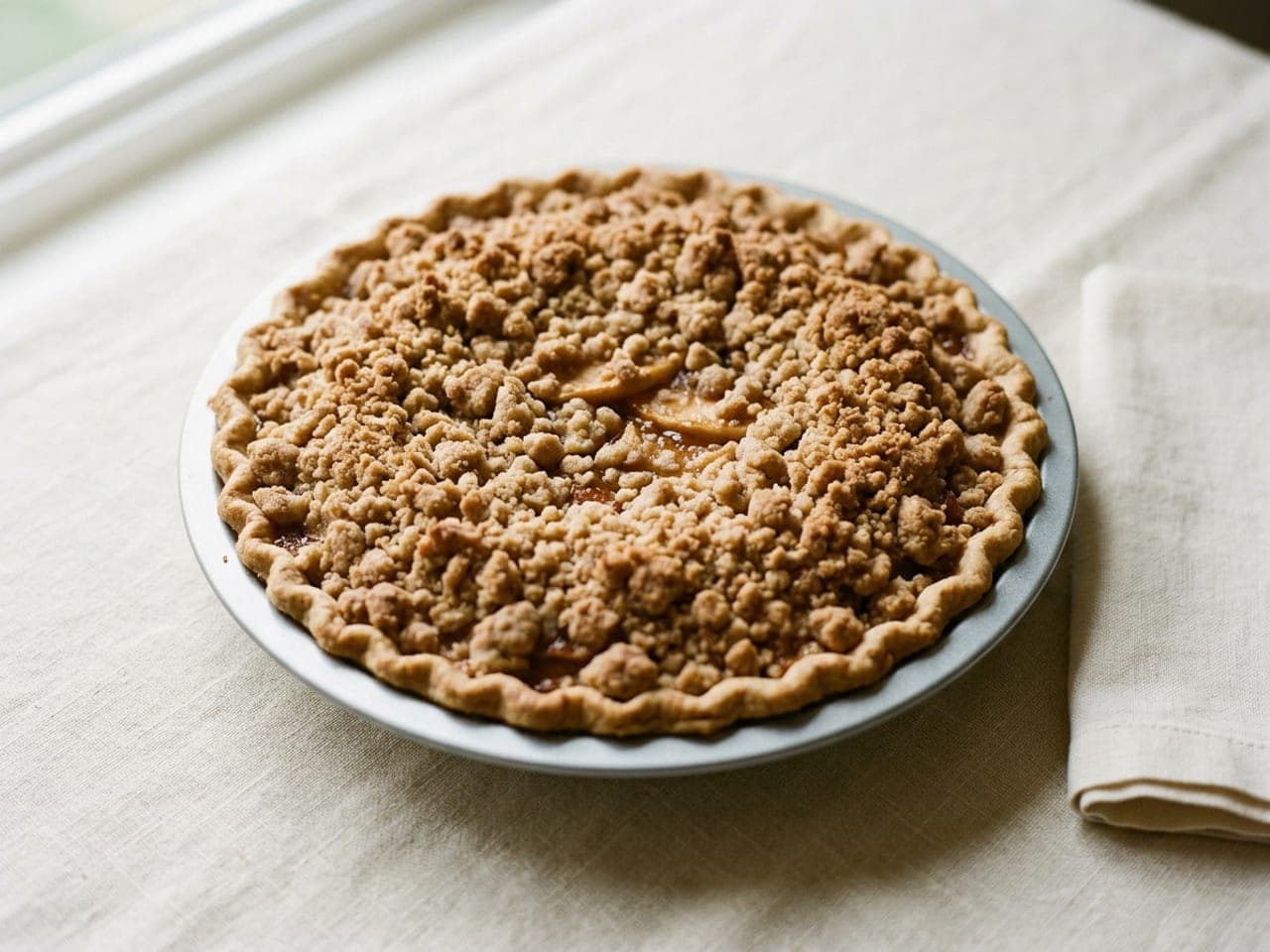
An American Dutch apple pie built to be sliced and plated: one all-butter crust, 3 lb (1.4 kg) of firm apples cut 1/4 inch (6 mm) thick, and a streusel measured by weight so it bakes into crumbs instead of a sheet. The apples go in raw after an hour in their sugar, and the page defends that choice and says when a cooked filling is the better one. It names the rack, the pan and a doneness test you can see, explains where the 175°F (79°C) printed on other recipes comes from, sizes the apples to what a 9-inch (23 cm) pie plate really holds, and answers the name: in the 35 or so recipes we could read from its first half-century in American print, a Dutch apple pie never had a crumb topping. Allow about 1 1/2 hours of chilling and 4 hours of cooling around the 65-minute bake. Three ways to plate it close the page.
Ingredients
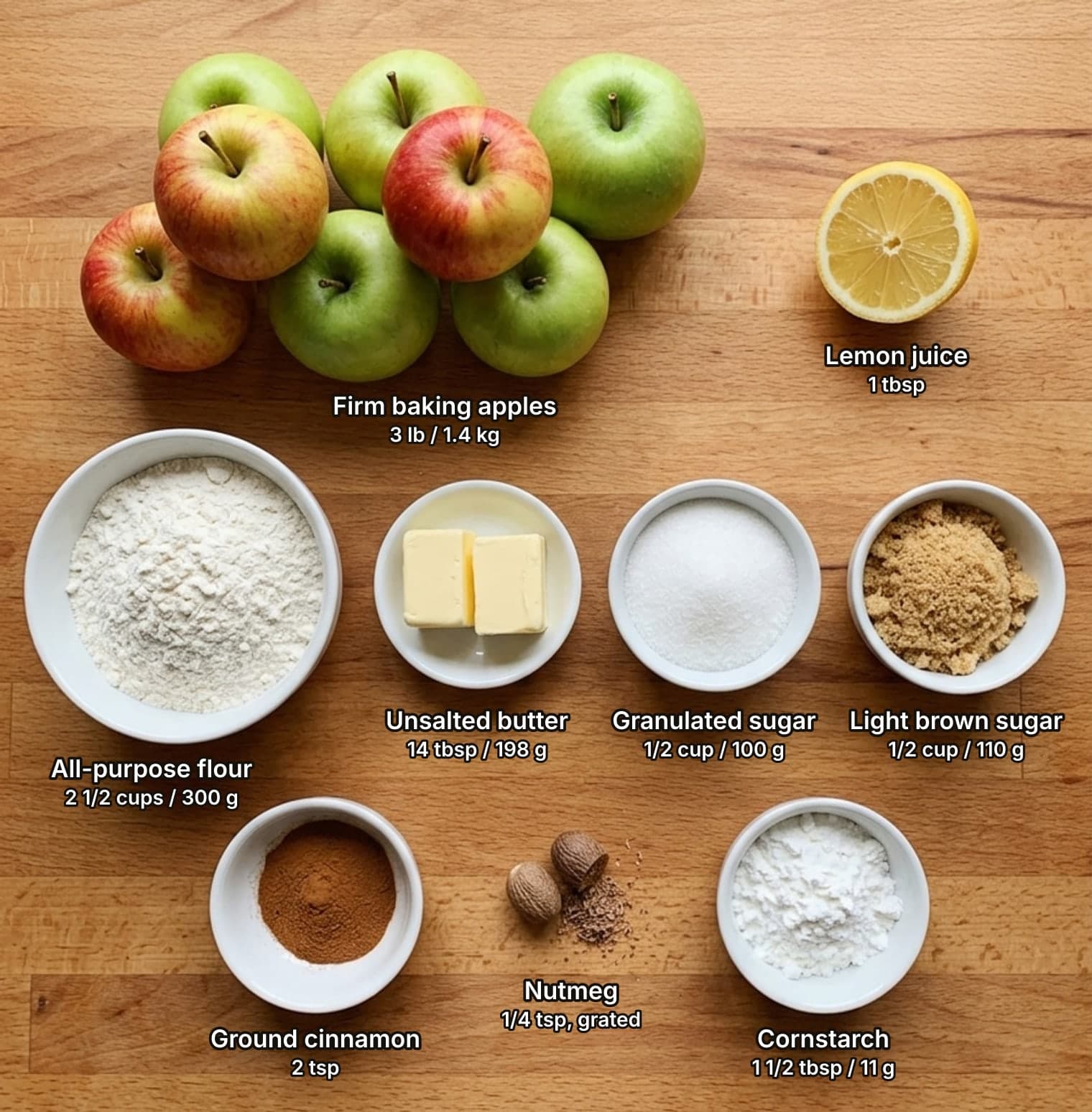
- all-purpose flour (plain flour), for the crust (wheat)1 1/4 cups (150 g)
- unsalted butter, cold, cut into 1/2 inch (1.25 cm) cubes, for the crust (milk). A firm plant-based block can replace it 1:1; check it for tree nuts and soy, and see the safety notes1/2 cup (113 g)
- granulated sugar, for the crust1 1/2 tsp (6 g)
- fine salt, for the crust1/2 tsp
- ice water, for the crust3 to 4 tbsp (45 to 60 ml)
- all-purpose flour and granulated sugar, mixed, to dust the base of the shell before filling1 tsp each
- firm baking apples, peeled, cored and sliced 1/4 inch (6 mm) thick, which gives about 2 lb (900 g) of slices. US: half Granny Smith and half Golden Delicious or Braeburn, or all Pink Lady. Europe: Boskoop with Braeburn or, in autumn, Jonagold3 lb (1.4 kg), about 6 large or 7 to 8 medium apples
- granulated sugar, for the filling (white caster or granulated sugar in the UK)1/2 cup (100 g)
- fresh lemon juice (about half a lemon)1 tbsp
- ground cinnamon, for the filling1 1/2 tsp
- freshly grated nutmeg1/4 tsp
- fine salt, for the filling1/4 tsp
- cornstarch (cornflour in the UK). For a pie you will freeze, use 3 tbsp (about 21 g) tapioca starch instead1 1/2 tbsp (about 11 g)
- all-purpose flour (plain flour), for the streusel (wheat)1 1/4 cups (150 g)
- light brown sugar, packed (light soft brown sugar), for the streusel1/2 cup (110 g)
- ground cinnamon, for the streusel1/2 tsp
- fine salt, for the streusel1/4 tsp
- unsalted butter, melted and cooled until just warm, for the streusel (milk)6 tbsp (85 g)
- heavy cream (double cream), optional, only for the cream-poured version (milk); see the section on the cream-poured version. Not counted in the calories1/2 cup (120 ml)
Dutch apple pie vs apple pie: what losing the lid changes
The short answer: a regular American apple pie has pastry underneath and on top, and a Dutch apple pie has pastry underneath and a crumb topping, a streusel of flour, sugar and butter, on top. Same plate, same kind of filling. In American usage “apple crumb pie” is the same pie under a plainer name.
The lid is the only difference, but it changes three things that comparison pages do not mention. First, steam. King Arthur Baking describes a streusel top as “obviously much more effective than a solid-top crust at releasing steam quickly”, so the juices concentrate in the oven instead of being trapped. Second, the gap. Under a pastry lid, raw apples shrink away and leave a hollow; crumbs simply settle with the fruit. With no raw lid to seal to it, the bottom crust can also be par-baked, which King Arthur says double-crust pies “aren’t a good choice” for. Third, the calories. A Dutch apple pie is not the lighter option. In this recipe the streusel carries about 197 kcal per slice, where a second crust of the same dough would add about 172, and the streusel alone holds about 14 g of the sugar in each slice.
It is not the same as an apple crumble or an apple crisp, which have no bottom crust: America’s Test Kitchen’s apple crumble is fruit and streusel in an 8-inch (20 cm) square dish. The relationship is close, though. A 1956 recipe sheet from Trudy McNall’s television program Home Cooking, in Rochester, New York, defined one by the other: “For DUTCH APPLE PIE Follow Apple Crisp recipe”, with the apples put into a pie pan lined with unbaked pastry and the crumbs sprinkled over.
And it is not the apple pie of the Netherlands. A Dutch appeltaart is a different object. It is baked in a straight-sided springform tin, not a sloped pie plate. Its shell is a sweet, crumbly butter dough made with sugar and egg, closer to a cookie than to flaky pastry, pressed over the base and up the sides, and the top is a lattice of strips of the same dough. The filling is small slices or pieces of apple, classically the tart Belle de Boskoop, usually with raisins or currants and often with cinnamon and lemon. It is served in wedges with coffee, often with whipped cream. A crumb-topped tart does exist in the Netherlands, under its own name, appelkruimeltaart, and the history section below shows how late that name turns up in Dutch newspapers.
How to make Dutch Apple Pie
- Make the dough and give it an hour in the fridge. Whisk the 1 1/4 cups (150 g) all-purpose flour (plain flour) with the 1 1/2 tsp sugar and the 1/2 tsp fine salt. Add the 1/2 cup (113 g) cold, cubed butter and rub or cut it in until the largest pieces are the size of peas and the rest looks like coarse meal. Sprinkle over 3 tbsp ice water, toss with a fork, and add up to 1 tbsp more only if dry flour is still loose in the bowl. Press the dough into a disc about 1 inch (2.5 cm) thick, wrap it and refrigerate for at least 1 hour, or for up to 2 days. Why this matters: the pea-sized pieces of butter are what become flakes, and they only survive rolling if they are cold. The rest also gives the flour time to take up the water, so the dough rolls without cracking and shrinks less in the oven. Handle it as little as you can once the water is in, because working wet dough toughens the crust.
- Mix the streusel with melted butter, then chill it. In a bowl, whisk the 1 1/4 cups (150 g) flour for the streusel with the 1/2 cup (110 g) packed light brown sugar, the 1/2 tsp cinnamon and the 1/4 tsp salt, breaking up any lumps of sugar. Weigh the flour if you can: the cup measure assumes a spooned and leveled cup of 120 g, and a cup scooped straight from the bag can weigh 140 g or more, which is enough to turn the mix sandy. Drizzle the 6 tbsp (85 g) melted, just-warm butter over the top and toss with a fork until no dry flour is left and the mix has gathered into large chunks with pea-sized pieces among them. Stop there; do not stir it to a paste. Refrigerate for at least 1 hour. Why this matters: by weight this is 1 part flour to about 0.7 sugar and just under 0.6 butter, the proportion three America’s Test Kitchen crumb toppings land on, and butter is only a quarter of the mix. Melted butter wets every grain of flour, so that small amount is enough to bind the crumbs and there is less fat to run in the oven. The chill sets the butter again, so the clumps go into the heat firm and keep their shape instead of slumping into a sheet. If the mix looks sandy and will not clump, sprinkle on 1 to 2 tsp cold water and toss again.
- Slice the apples 1/4 inch (6 mm) thick and leave them in the sugar for an hour. Peel and core the 3 lb (1.4 kg) of apples and slice them 1/4 inch (6 mm) thick. You should have about 2 lb (900 g) of slices, roughly 8 cups (1.9 litres), a cup (240 ml) more if they are loosely packed. Toss them in a large bowl with the 1 tbsp lemon juice, the 1/2 cup (100 g) granulated sugar, the 1 1/2 tsp cinnamon, the 1/4 tsp nutmeg and the 1/4 tsp salt. Leave them at room temperature for 1 hour, and up to 2, turning them once or twice. Why this matters: sugar draws juice out of the slices, so they soften and lose volume in the bowl instead of in the pie. Pastry chef Stella Parks measured sliced apples losing about a third of their volume as they give up their juice to sugar alone, but over about 3 hours; one hour gets you part of the way, and two gets you more. Fruit that has already begun to settle packs into the shell with a lower mound, so the streusel sits on a more level bed and is pulled apart less as the apples sink. Thin, even slices matter for the same reason: they lie flat, cook at the same rate and give a wedge with clean layers. Do not pour the juice away. It is flavor, and the starch will set it.
- Roll the dough, line the plate and chill it while the oven heats. Put a rimmed baking sheet (a baking tray with a lip) on the lower-middle rack and heat the oven to 425°F (220°C). On a floured surface, roll the dough into a 13-inch (33 cm) circle about 1/8 inch (3 mm) thick. Ease it into a 9-inch (23 cm) metal pie plate (pie dish) without stretching it, fold the overhang under itself to build a thick rim that rests on the lip of the plate, and crimp it. Refrigerate the lined plate for 30 minutes. Why this matters: cold, firm dough keeps its shape and its flakes when it meets the heat, and a rim that sits on the lip is less likely to slide down the side. The hot sheet matters as much. It drives heat into the base of a metal plate from the first minute, which is what browns a bottom crust under wet fruit. Use the preheated sheet with a metal plate only. A cold glass or ceramic plate should not be set on hot metal, as a precaution against cracking; it goes on a room-temperature sheet on the lowest rack instead, and it needs longer (see the section on the bottom crust).
- Dust the base, fill the shell and scatter the cold streusel loosely. Stir the 1 1/2 tbsp (about 11 g) cornstarch (cornflour in the UK) into the apples and their juice until no white streaks remain. Mix the 1 tsp flour with the 1 tsp sugar and sprinkle it over the base of the cold shell. Lift the apples in by the handful, laying the slices flat and pressing gently so there are no large air pockets. Mound them slightly higher in the middle and scrape all the juice from the bowl over them. Break the chilled streusel into pieces between the size of a pea and a hazelnut and scatter it over the apples right up to the rim, loosely, without patting it down. Why this matters: the flour and sugar on the base, which King Arthur Baking calls crust dust, takes up the first juice before it can soak into raw pastry. Starch stirred into the juice is spread evenly instead of sitting in dry pockets. And a loose layer of streusel leaves gaps for steam. America’s Test Kitchen scatters its crumb topping loosely for that reason, so more of the fruit’s moisture can escape, where a packed layer traps the steam and softens itself from below.
- Bake at 425°F (220°C) for 15 minutes, then at 350°F (175°C) for 45 to 55. Set the pie on the hot baking sheet and bake at 425°F (220°C) for 15 minutes. Turn the oven down to 350°F (175°C) and bake for another 45 to 55 minutes, turning the sheet front to back about halfway through. If the crumbs reach a deep golden brown before the filling is bubbling in the middle, lay a sheet of foil loosely over the top and carry on. Why this matters: the hot start sets the bottom crust and the rim before the juices flow, and the long, moderate finish is what the apples and the starch need. The schedule sits between two tested recipes: King Arthur Baking starts its Dutch apple pie at 425°F (220°C) for 15 minutes, and Cook’s Country bakes its version at 350°F (175°C) for about 1 hour 10 minutes, on a baking sheet on the lower-middle rack. Total time here is 60 to 70 minutes. The foil is this page’s addition, not part of either recipe: it stops the sugar in the streusel from scorching while the middle of the pie catches up. In a glass plate allow 10 to 15 minutes more, and in heavy ceramic up to 25.
- Test for doneness in the middle, not at the edge. Start checking at 50 minutes, about 35 minutes after you turn the oven down (later in glass or ceramic, by the extra time in step 6). Look for thick, slow bubbles of syrup breaking up through the crumbs, first at the edge and then within 1 to 2 inches (2.5 to 5 cm) of the center; part the crumbs with the tip of a knife if you cannot see. Once juice is bubbling there, give the pie 10 more minutes, the margin King Arthur Baking recommends for apple pie. In a metal plate that brings the pie out at 60 to 70 minutes in all. If the center is slower than that, keep baking, with the foil over the crumbs once they are deep golden: the bubbles decide, not the clock. A paring knife pushed down through the center should meet no resistance from the apples. Why this matters: bubbles at the rim only tell you that the outside of the pie is hot. Cornstarch has to come to just about a boil to thicken fully, and sugar and acid raise that requirement, so a filling that never bubbles in the middle will run when it is cut, however brown the top is. A thermometer is a cross-check, not the test. Treat 195°F (91°C) in the center as a minimum: it is the temperature pastry chef Stella Parks bakes her apple pie to, with tapioca starch, and the only tested fruit-pie figure this page could find. The 175°F (79°C) printed on some recipes is a custard-pie number; the doneness section explains.
- Cool for 4 hours before you cut it. Move the pie, still in its plate, to a wire rack and leave it uncovered for at least 4 hours. If the plate is glass, read the safety note on hot glass before you set it down. Why this matters: the thickeners are switched on in the oven, but the gel only forms as the pie cools. America’s Test Kitchen cut one deep-dish apple pie after 1 hour and another after 4; juice pooled under the first slice and not under the second, and its rule is that “For most pies, the magic number is 4 hours.” Leaving the pie uncovered lets the last steam out through the crumbs, so the streusel stays crisp. Four hours on the counter is inside US guidance for a plain fruit pie. If you follow UK guidance, or your filling has cream in it, cool the pie for 2 hours and let it finish setting in the fridge (see the safety notes). To serve it warm, cut cold slices and rewarm them at 350°F (175°C) for about 10 to 15 minutes, until hot through and the crumbs are dry to the touch. Use a thin, sharp knife, wipe it between cuts, and accept that the first slice out is always the untidy one.
Safety & hygiene Important
- Room temperature or fridge: US and UK guidance differ. In the US, a baked fruit pie made with sugar may be kept at room temperature for a short time. The USDA’s FoodKeeper database lists fruit pies, apple among them, at 1 to 2 days in the pantry or 1 week in the refrigerator. University extension services add a combined route: University of Maine Cooperative Extension says fruit pies “Can be stored covered at room temperature for up to 2 days and then refrigerated for 2 additional days. Or, put them straight in the refrigerator for up to 7 days”, and Iowa State, crediting the USDA, gives the same 2 days out and 2 more in the fridge. University of Illinois Extension gives the same 2 days at room temperature. These are two separate routes, 2 days out and then 2 in the fridge, or up to a week in the fridge from the start; do not add them together. The clock starts when the pie comes out of the oven, not when it is cut. A US fridge should be at 40°F (4°C) or below. The UK Food Standards Agency publishes no figure for fruit pies. Its general advice for cooked food is to cool it and put it in the fridge within 1 to 2 hours, keep the fridge at 5°C (41°F) or below, and eat leftovers within 48 hours. Read strictly, that sends a home-baked pie to the fridge the same day and gives it 2 days, and that is the cautious line for a UK reader. A pie made with a sugar substitute loses the protection sugar gives; Iowa State says to refrigerate it and eat it within 1 to 2 days. If you cut the sugar well below the recipe’s, treat the pie the same way; that last caution is ours, not Iowa State’s. The 7-day figure belongs to a baked fruit pie. The loose stovetop filling on our apple pie filling page has no published figure of its own, so it stays under the general 3 to 4 day rule for cooked leftovers.
- Cream in the filling changes the rule. If you make the cream-poured version on this page, or add milk, sour cream or melted ice cream to the apples, treat the pie as a dairy pie. University of Illinois Extension’s rule is: “If a pie contains eggs or dairy products, it should be stored in the refrigerator and not left out at room temperature for more than two hours.” That rule was written with custard, cream and pumpkin pies in mind, and no agency page we found addresses a small amount of cream baked into a sugary, acidic apple filling, so this is the cautious reading: cool the pie on a rack for no more than 2 hours, or 1 hour if the room is above 90°F (32°C), refrigerate it, and eat it within 4 days, the fridge figure Maine’s extension gives for cream and custard pies (2 days under UK guidance). The butter in the crust and the streusel does not trigger the rule. The same guidance treats ordinary fruit pies, which have butter crusts, as safe at room temperature.
- Freezing: baked or unbaked, and which starch. Baked: cool the pie completely, freeze it uncovered until solid, then wrap it in plastic wrap (cling film) or foil. Iowa State and Maine extension both give up to 4 months for best quality, and the UK Food Standards Agency says baked goods are best within 3 to 4 months. At 0°F (-18°C) food stays safe beyond that; the limit is about texture. Thaw it overnight in the fridge and, under UK guidance, eat it within 24 hours of it being fully defrosted. Unbaked: assemble the pie in a metal plate, freeze it, wrap it, and bake it from frozen within 3 months, Iowa State’s figure for unbaked fruit pies. Penn State Extension’s method for frozen pies is 425°F (220°C) for 25 minutes in the lower third of the oven, then 350°F (175°C) with the pie moved to the center rack until done. It gives no extra-time figure for a whole frozen pie; expect it to take clearly longer than a fresh one and go by the test in step 7. No source we read tested that long a hot start on a streusel top, so lay foil loosely over the crumbs as soon as they are golden. For any pie headed to the freezer, thicken with tapioca starch, not cornstarch, because flour and cornstarch gels separate and weep after freezing. Do not put a frozen glass plate into a hot oven.
- A hot sheet, bubbling syrup and a heavy pie. The baking sheet is at oven temperature and the filled pie is heavy. Pull the oven rack out, set the pie on the sheet with both hands, and slide the rack back, instead of reaching into the oven. When you turn the pie or take it out, lift it by the sheet, not by the rim of the plate. The bubbling filling is at or just above the boiling point of water and, unlike water, it clings to skin and goes on burning, so keep your hand clear when you part the crumbs to look, and keep children back. If you are scalded, the NHS advice is to hold the burn under cool running water for 20 minutes and to put no creams, oils or butter on it. Juice that drips onto the sheet will smoke; that is harmless and is the reason the sheet has a rim. If you par-bake the shell, lift the pie weights (baking beans) out by the parchment (baking paper) and let them cool before you touch them. If you bake in glass, take the same care on the way out as on the way in: set the hot plate on a dry towel, a dry cloth potholder or a wooden board, never on a wet or cold counter, a damp cloth or in the sink, and do not use a plate that is chipped or cracked. Published cautions for glass bakeware disagree on whether a hot dish may go on a metal cooling rack, so the dry towel or the board is the cautious choice.
- Allergens and substitutions. As written the pie contains wheat (crust, streusel and crust dust) and milk (butter in the crust and streusel, and the cream if you make that version). There is no egg in it unless you brush the rim with egg wash or stir in melted ice cream, which often contains egg. Tree nuts come in two ways: if you add pecans, walnuts or almonds to the streusel, and through some plant-based butters. Oats: Coeliac UK notes that oats contain avenin, a protein similar to gluten, that most people with celiac disease can tolerate gluten-free oats, and that many standard oats are contaminated with wheat, barley or rye. An oat streusel is therefore only gluten-free if the oats are labelled gluten-free and the flour is replaced as well, and this page has not worked out a gluten-free flour version. In the UK and EU oats are a listed allergen in their own right. Dairy-free: King Arthur Baking’s trials found two stick-style vegan butters a workable 1:1 swap in pie crust, with paler browning because they contain no milk solids. One of the two is made from cultured cashew milk, and King Arthur says it is not a choice for anyone with a nut allergy; the other contains soybean oil. Check the label of any plant-based block for tree nuts (cashew, almond, coconut), soy and a “may contain milk” warning. Use a firm block, not a tub spread, and chill the streusel well; both tested butters were softer than dairy butter. Bottled lemon juice, if you swap it for fresh, usually contains sulphites. Bought pies vary: of the frozen Dutch apple pies whose ingredient lists we read in the USDA’s branded-food database, one declares wheat only and another lists butter in its crust, so milk as well; retailer listings for some add soy. Read the box.
- Raw flour, and a check on your cinnamon. Raw flour is not a ready-to-eat food. The streusel and the dough contain no egg, but the US Food and Drug Administration’s advice is the same either way: “Never eat or taste raw flour, dough, or batter.” Do not nibble the raw crumbs or let children do it, wash your hands and the bowl after mixing, and bake any streusel you want as a garnish before it goes on a plate. Ground cinnamon: the FDA keeps a running public alert listing brands of ground cinnamon found with elevated lead, mostly sold through discount and international grocers, and it was updated as recently as September 2026. If young children will eat the pie, check your jar against that list.
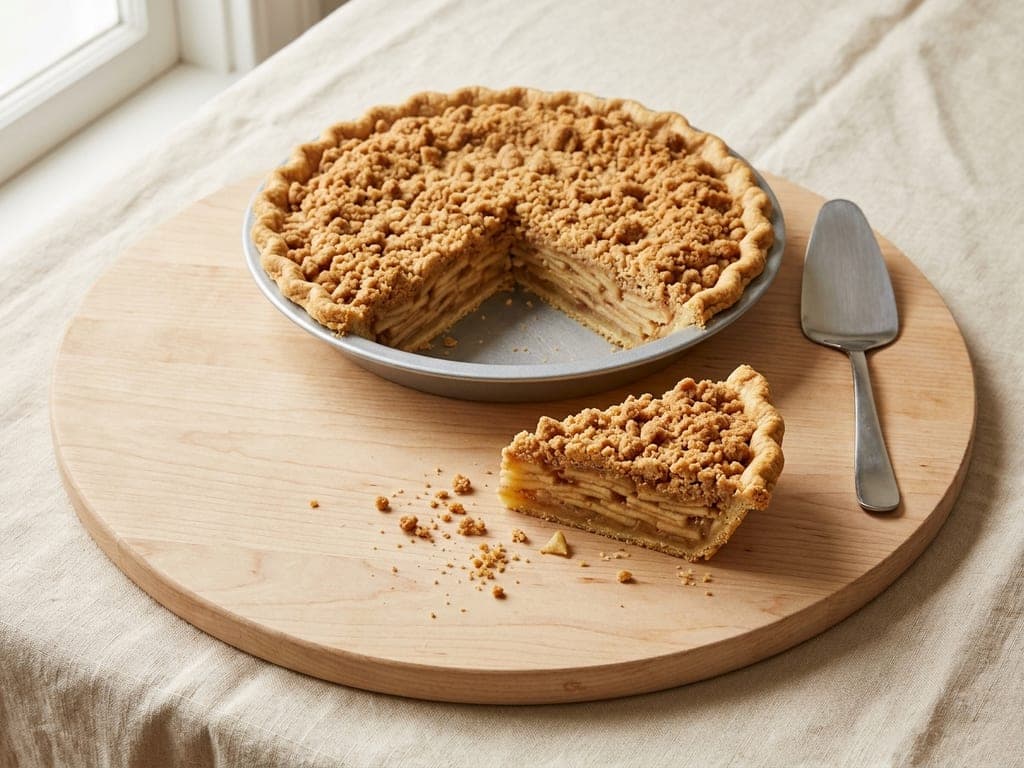
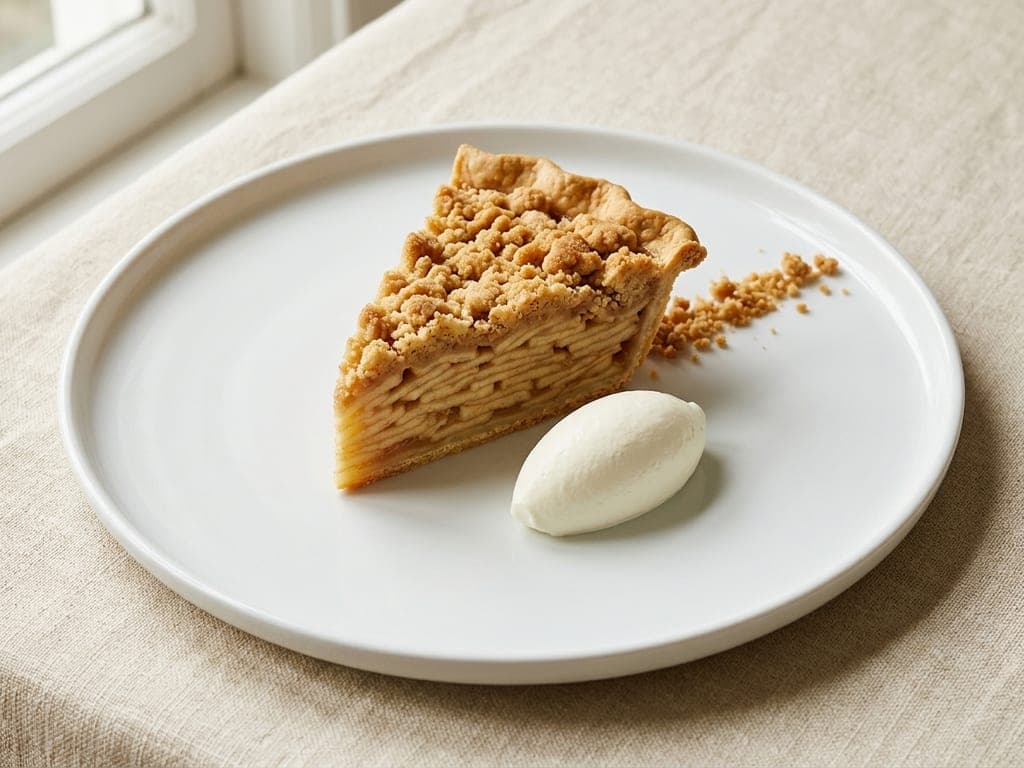
3 ways to plate it
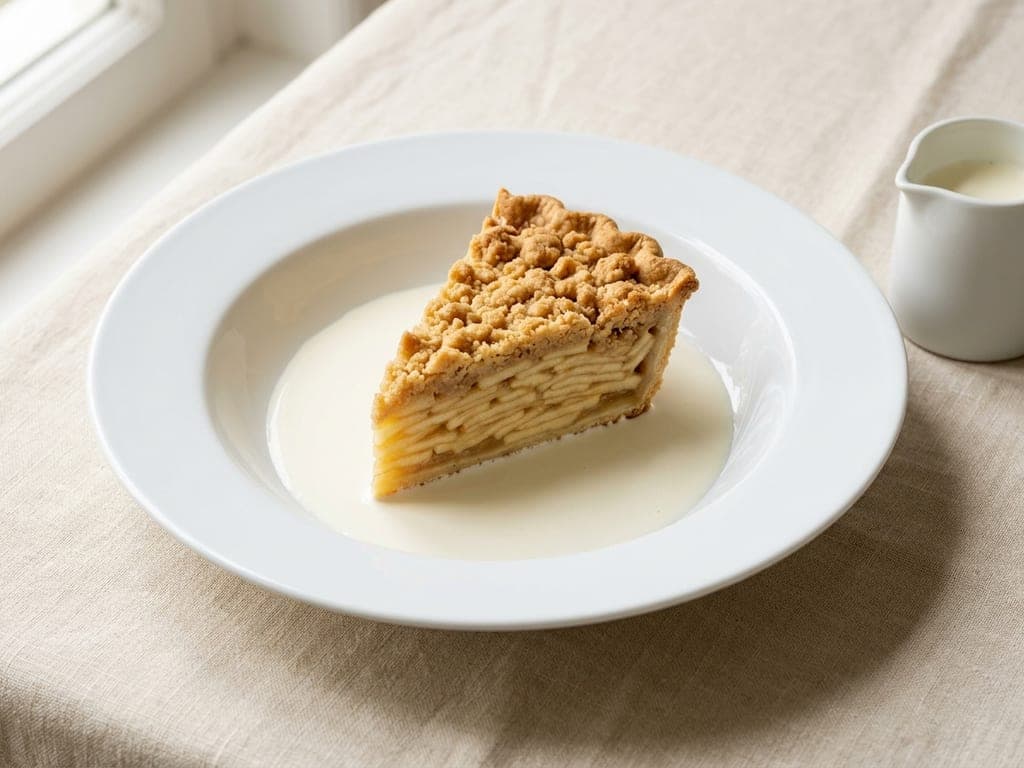
Raw slices or a cooked filling: which one this pie should use
Most ranking recipes toss raw slices with sugar and flour and fill the shell at once. One top-ranking recipe cooks a butter, flour and sugar sauce and pours it over raw apples. The test kitchens are split. Cook’s Country leaves 2 1/2 lb (1.1 kg) of raw sliced apples in their sugar for 1 to 2 hours and bakes the pie for about 1 hour 10 minutes at 350°F (175°C). Cook’s Illustrated sautés 4 1/2 lb (2 kg) of apples, drains them, boils the juice down, fills a fully baked shell and gives the assembled pie only about 10 minutes in the oven. Both work. They are different pies.
This recipe uses raw slices, for four reasons. Our apple pie filling page argues for pre-cooking because it fixes three problems: the hollow under the lid, mushy slices and watery juice. One: under a streusel the hollow cannot form, because there is no lid for the fruit to shrink away from. Two: the watery juice is eased by the open top, which lets steam out far faster than pastry does. Three: the long bake that raw apples need is the same long bake a bottom crust needs. After baking apple pies in metal, glass and stoneware on different racks, King Arthur Baking concluded, “The longer you let it brown and bubble, the better your bottom crust will be.” Four: it is one bowl and one bake, which is what most people looking for this pie expect. That leaves the mushy slices, and the next paragraph deals with them.
Raw has costs, and the recipe is built around them. Nothing protects a raw slice from the heat, so the variety has to be a firm one; by J. Kenji López-Alt’s figures, quoted on the filling page, apples whose pectin has not been set start to fall apart at about 183 to 185°F (84 to 85°C). Raw fruit sinks as it bakes and takes the crumbs with it, which is why the slices sit in their sugar for an hour first. And a raw pie is not done until its center has bubbled, which takes the full 60 to 70 minutes.
A cooked filling is the better route in five cases. You already have a batch of our apple pie filling in the fridge or freezer. You only have soft or very sweet dessert apples such as McIntosh, Fuji or Gala; the gentle hold at 140 to 160°F (60 to 71°C) in that recipe pays off most on exactly those. You want more apple in the pie: a batch of the cooked filling starts from 3 1/2 lb (1.6 kg) of whole apples and packs in level, because the shrinking happened in the pot, and Cook’s Illustrated gets 4 1/2 lb (2 kg) into a deep 9-inch (23 cm) plate that way. You want to assemble on the day from parts made ahead. Or you are baking in glass or ceramic and want the shortest possible time with wet fruit on the pastry.
To use it here, line and chill the plate as in the recipe, spread one completely cooled batch of the filling, 4 to 4 1/2 cups (1 to 1.1 litres), level in the raw shell, and scatter the chilled streusel over it. In the 5 to 5 1/4 cup (1.2 to 1.25 litre) plate this recipe is sized for, that batch sits a little below the rim; only the smallest 9-inch (23 cm) plates are filled to the brim by it. Leave out this page’s apples, sugar, lemon, spices and cornstarch; the filling brings its own. Bake on the lower-middle rack at 425°F (220°C) for about 25 minutes, then at 375°F (190°C) for 25 to 30 minutes more, laying foil loosely over the streusel once it is golden, until the pastry is deep golden and the filling bubbles at the edge. That is the schedule from the filling page: the apples are already cooked, so you are baking pastry and crumbs and reheating the fruit. A frozen disc of the tapioca version goes into the raw shell still frozen, in a metal plate, with the 20 to 25 minutes extra that Penn State Extension allows. Cool the pie for several hours before cutting, as with any starch-set filling.
Streusel by weight: the ratio, the butter and why crumbs melt
Recipes for the topping give cups and no reasons. Put on a scale, the tested ones fall into a narrow band, and the band explains most failures. The German baseline, as printed in a basic recipe from the magazine Lecker, is 2 parts flour to 1 sugar and 1 butter (300 g, 150 g and 150 g). Three America’s Test Kitchen formulas written years apart, Cook’s Illustrated’s Dutch apple pie, Cook’s Country’s Pennsylvania Dutch apple pie and the test kitchen’s apple crumble, all use melted butter and all come out at about 1 part flour to 0.7 sugar and 0.55 to 0.6 butter. King Arthur Baking’s Dutch apple pie uses cold butter and far more of it: 120 g flour, 107 g brown sugar and 113 g butter, about 1 to 0.9 to 0.95. This recipe is 150 g flour, 110 g brown sugar and 85 g melted butter, which is 1 to 0.73 to 0.57. The American ratios are calculated from the published cup and spoon measures, so read them as close, not exact.
Look at the butter as a share of the whole mix and a pattern appears. In the five toppings above it is between 24 and 33%. The three melted-butter ones sit at the bottom of that range, at 24 to 26%, and King Arthur’s cold-butter one at the top, at 33%. Two other cold-butter streusels we put on the scale, King Arthur’s general streusel topping (counting its flour, sugar and butter and leaving out its oats) and America’s Test Kitchen’s coffee-cake streusel, come to 32 to 34%. Here it is just under 25%. The German baseline is the exception, with chilled butter at 25%, but it also carries far less sugar. Our reading of those numbers, which none of the sources states outright: melted butter wets the flour completely, so less of it is needed to bind, while cold butter leaves dry flour around lumps of fat, so those recipes carry more. Change the state of the butter without changing the amount and you get the two classic failures, a greasy topping (melted butter at a cold-butter quantity) or a dusty one (cold butter at a melted-butter quantity).
Does cold or melted butter give bigger crumbs? The sources disagree on the surface. Lecker baked the versions side by side and reported that the more liquid the butter, the finer the crumbs. Cook’s Illustrated tosses melted butter in with a fork “until evenly moistened and mixture forms many large chunks with pea-sized pieces mixed throughout.” Both are true. Melted butter makes something close to a dough, and whether that ends up fine or chunky depends on how far you stir it and whether you chill it and break it up afterwards. Cold butter makes loose rubble whose size is set by your fingers. Neither is the one true way to big crumbs, and any page that says so is describing its own habits.
Why crumbs melt into a sheet, and what to do. Chill them: the German test found that after an hour in the fridge the crumbs held their shape better in the oven, the baking authors quoted by the German news site t-online say at least 1 hour and preferably overnight, America’s Test Kitchen’s streusel topping says “Chill thoroughly before using”, and Cook’s Country refrigerates its topping while the crust chills. Keep to the ratio, because too much butter or too little flour is the usual reason crumbs run. If the mix is sandy, it was rubbed too far or is too dry to clump; America’s Test Kitchen adds 2 tsp water and 2 tsp vanilla to its crumble topping for that reason. If it bakes dense, it was packed down: scatter it loosely. And give it a level, compact bed of fruit to sit on, which is what the hour in the sugar is for.
One more idea is worth knowing, with its limits stated. America’s Test Kitchen’s apple crumble bakes the fruit covered for 35 minutes until it has collapsed and only then adds the topping, so the crumbs spend less time over juicy fruit. That is a crumble, not a pie, and none of the tested Dutch apple pies does it. If your streusel has drowned before, you could borrow the idea: cover the filled pie with foil for the first 15 minutes at 425°F (220°C), then uncover it, lifting the foil away from you because the steam under it scalds, scatter the cold streusel and carry on at 350°F (175°C).
Variations, by weight. For a cold-butter streusel, use King Arthur’s formula as it stands: 1 cup (120 g) flour, 1/2 cup (107 g) brown sugar and 8 tbsp (113 g) cold butter, rubbed in until lumpy. For oats, replace 1/4 cup (30 g) of the flour with 1/3 cup (30 g) rolled oats (porridge oats), a fifth of the flour, which is the swap the German authors suggest for extra crunch. For nuts, stir in 1/2 cup (about 55 g) chopped pecans or walnuts once the crumbs have formed; America’s Test Kitchen found that finely chopped almonds “loosened up the structure of the topping so that it didn’t bake up compact and dense.” And if you want crumbs to garnish plates, bake a spare handful on its own: King Arthur gives 325°F (163°C) for 15 minutes on a parchment-lined sheet, stirred every 5 minutes, and it keeps in an airtight container at room temperature once fully cool.
This is also why a homemade pie tastes different from a bought one. On the three frozen supermarket Dutch apple pies whose ingredient lists we read in the USDA’s branded-food database, the fat in the topping is palm oil, or palm and soybean oil, and none of the three lists butter in its crumb topping.
A crisp bottom crust and a doneness test you can trust
Start with the plate, because a “9-inch” (23 cm) plate is not one size. When America’s Test Kitchen measured pie plates sold as 9-inch (23 cm), brimful capacity ran from 4.25 cups (1 litre) for the classic glass plate to 6 cups (1.4 litres), and the metal plates it preferred held about 5.25 cups (1.25 litres). That is a 40% spread, and the classic glass plate is the smallest of them. This recipe is sized for a plate of 5 to 5 1/4 cups (1.2 to 1.25 litres): 3 lb (1.4 kg) of whole apples, 2 lb (900 g) of slices. To check yours, fill it to the brim with water from a measuring jug. Then allow about 6 oz (170 g) of prepared slices for every cup (240 ml) it holds. A 4.25-cup (1 litre) plate takes about 1 lb 10 oz (730 g) of slices from 2 1/2 lb (1.1 kg) of whole apples, which is the amount Cook’s Country’s recipe uses. A 6-cup (1.4 litre) plate takes about 2 1/4 lb (1 kg) of slices from 3 1/2 lb (1.6 kg). Scale the filling’s sugar, spice and starch with the apples. The streusel as written covers any of them; for the deepest plates, make one and a quarter times the dough.
Then the material. King Arthur Baking baked apple pies in metal, stoneware and glass on different racks. The metal pan gave “a lovely brown bottom crust when baked anywhere in the oven”; stoneware and glass on the middle rack “resulted in pie with damp, pale bottom crust” and needed the bottom rack. America’s Test Kitchen’s pie-plate tests explain why: “Thin, lightweight metal conducts heat better than thicker glass and ceramic do, so pie crust browns more quickly.” In those tests pies in glass needed 10 to 15 minutes more than pies in metal, and the heaviest ceramic plate took up to 25 minutes longer to bake a double-crust apple pie. So: a metal plate on a preheated baking sheet on the lower-middle rack, or a glass or ceramic plate on the lowest rack with the extra time. The sheet is not only there for drips. In King Arthur’s words it “also helps to concentrate the oven’s heat on the base.”
Because there is no lid, this pie has an option a double-crust pie does not: par-baking. King Arthur Baking says single-crust fruit pies with crumb toppings can be prebaked, and its figure for a partial bake is 375°F (190°C) for 20 minutes, with the shell lined with parchment or foil and filled with weights. It is worth doing if you bake in glass or ceramic, or if soggy bases have beaten you before; cool the shell, then fill and bake as written, with a ring of foil over the rim so it does not overbrown. The crust dust in step 5, 1 tsp flour and 1 tsp sugar on the base, is the lighter version of the same insurance. None of the ranking recipes we read blind-bakes the shell, and few say which rack to use.
Now doneness. Ranking recipes offer “golden and bubbly”, a time and nothing else, or, in one top-ranking recipe, a thermometer reading of 175°F (79°C) in the center, on the grounds that pectin breaks down and softens the apples at that temperature. The same number is what America’s Test Kitchen and the thermometer maker ThermoWorks print as the temperature at which to take a pumpkin pie out of the oven. Neither of those pages mentions fruit pies. For an apple pie the figure is too low twice over. The apples: by López-Alt’s figures, quoted on our apple pie filling page, apples whose pectin has not been set start to fall apart at about 183 to 185°F (84 to 85°C), so at 175°F (79°C) the slices can still be firm. The starch: cornstarch begins to swell at lower temperatures in plain water, but it needs to be just about boiling for its full strength, and the sugar and acid in a pie filling push that higher.
The only thermometer figure for a fruit pie from a tested source that this page could find is Stella Parks’s 195°F (91°C), and she bakes to it on purpose, below a boil, with tapioca starch, which swells before a simmer. That is why the test in step 7 is one you watch for: thick bubbles within 1 to 2 inches (2.5 to 5 cm) of the center, then 10 more minutes. King Arthur’s instruction is to “Bake your apple pie for at least 10 more minutes after you see juice actively bubbling”, and Cook’s Country adds the knife test, baking until a “paring knife inserted in center meets no resistance.” If you thicken with tapioca instead of cornstarch, 195°F (91°C) in the center is a usable endpoint. With cornstarch, trust the bubbles.
Why it is called Dutch: the early pie had no crumb topping
Ranking pages give two answers. One says the pie comes from the Netherlands, where it has been made for centuries. The other, printed by one top-ranking recipe, says the name refers to the Pennsylvania Dutch and their tradition of topping pies with streusel instead of a second crust. The printed record supports neither as stated. A plain statement of the limit first: the American part of what follows rests on a full-text search of the Internet Archive’s scanned books, magazines and newspapers, and the large newspaper archives outside it were not searched. Every date here is the earliest we saw, not a first.
The earliest American text found says whose pie it is. On 8 August 1891 the Worcester, Massachusetts weekly Light reprinted a piece from the Philadelphia magazine Housekeeper’s Weekly under the heading “Dutch Apple Pie”. Many people, it says, find that an apple pie tastes like a shell filled with apple sauce. “This is not so with the pies which the Pennsylvania Dutch make. They do not cut the apples into little pieces, only slicing them down like tomatoes, occasionally cutting the slices in half.” The slices are laid on the bottom crust “with a little milk or water poured over them”, sugared and sprinkled with cinnamon. “There is no top crust”. So the Pennsylvania Dutch attribution has a primary source behind it. The streusel does not. The pie is open, and there is not a crumb on it.
It stayed that way. In about 35 North American recipes titled “Dutch apple pie” and dated 1891 to 1937, none has a crumb or streusel top. In most of them the dish is a single bottom crust, apple halves, quarters or eighths laid in close rows, sugar and cinnamon, and a little milk, cream, sour cream or water poured over. They come from Pennsylvania and from across the Midwest, and from as far as California and Ontario. In Wallaces’ Farmer of 22 August 1902 a columnist signing herself Aunt Susan wrote: “This is called Dutch apple pie, and it is fine. People who have delicate digestions can eat this because it only has one crust.” A contributor to American Agriculturist’s household pages wrote on 20 May 1905, “Did you ever make, eat, or see a Dutch apple pie? If not, do make one.” The only crumbs in any of them are bread crumbs, and they go under the fruit, in a Wisconsin reader’s recipe of 1900. The cream version was still being celebrated in 1938, when Clementine Paddleford of the New York Herald Tribune described a restaurant’s open-face Dutch apple pie in a column we read in the word historian Barry Popik’s transcription, not on the original page: “The crust is filled with diced apples sprinkled with cinnamon. Cream is whipped with sugar and this poured over the fruit. This goes into a slow oven to cook down to a rich, heavenly mess, custardlike in appearance.”
The earliest crumb top seen under the name is in the Boston American of 5 April 1938: a cup (about 220 g) of packed brown sugar, four tablespoons of butter, three tablespoons of flour and a teaspoon of cinnamon, cut together and sprinkled over sliced apples in an unbaked shell. That is a sugar crumb, not today’s flour-heavy streusel. Three months later, on 7 July 1938, the Circleville Herald in Ohio said of a sour cream and brown sugar Dutch apple pie: “The brown sugar and sour cream will curdle but they form delicious little crumbs and flecks over the apples and the pie is very rich and satisfying.” The cream pie already looked crumb-topped when it came out of the oven. That the streusel grew out of it is our reading; no source says so.
By the 1950s the crumb version was something you could buy. The earliest streusel-topped Dutch apple pie seen on sale is in an Acme Super Markets advertisement in the Bristol Courier of Pennsylvania on 24 April 1952: “Delicious apples in tasty crust and topped with streussel”, for 55 cents. Chatelaine magazine in Toronto printed a modern-style recipe that November, a mix of flour, cinnamon, brown sugar and butter: “Sprinkle this crumbly mixture over top of apples.” On 21 January 1955 the A&P chain advertised its “JANE PARKER CINNAMON STREUSSEL Dutch Apple Pie”, promising “a crunchy, sweet contrast to the smooth, juicy apple filling.” No document we read explains the switch, and no person or company can be named as having made it.
The cream did not go quietly. Betty Crocker’s Good and Easy Cook Book of 1954 already has a “Dutch Apple Pie” that is a two-crust apple pie with cream poured “through slits in top crust” near the end of baking, and in the larger Betty Crocker cookbooks, from the 1956 Picture Cook Book to printings the archive dates as late as 1991, it sits beside a crumb-topped pie called “French Apple Pie”. A Gettysburg grocery advertisement of 2 May 1963 offered “Regular, French or Dutch APPLE PIE” side by side. The crumbs themselves are well documented in Pennsylvania German kitchens: Edith Thomas’s Mary at the Farm, a 1915 book of recipes collected among the Pennsylvania Germans, describes Rivel Kuchen as “a pie crust covered with a mixture of sugar, butter and flour crumbled together” and lists crumb pies eaten for breakfast. Its plain apple pie, though, printed as “Apple Tart”, is an open tart of halved apples with no crumbs. The crumbs and the apples were in the same kitchens before they were on the same pie, at least in that book.
As for the Netherlands: the appeltaart is far older than any of this. A cookbook published in Brussels around 1514 by Thomas van der Noot, which its modern scholarly edition calls the first printed cookbook in the Dutch language, has one, a lidded tart with no crumb topping that is described on our apple pie filling page. But no document we read traces a line from it, or from any Netherlands recipe, to the American crumb pie; pages that connect the two simply set them side by side. The Dutch newspaper record gives the idea no support. In the Dutch national library’s digitised newspapers the name of the crumb-topped apple tart does not turn up before 1980: a supermarket advertisement of June 1980 for a baking mix for apple or apricot kruimeltaart, a recipe headed “Appel kruimeltaart” that December, and the one-word appelkruimeltaart on 6 November 1981. The English phrase “Dutch apple pie” appears in a single article, in De Volkskrant on 3 July 1982, quoting a Grand Rapids, Michigan bakery’s advertisement welcoming Queen Beatrix. That database covers newspapers only, not cookbooks.
There is an older “Dutch apple pie” still, and it is a third dish. The fifth edition of Vegetarian Cookery, published anonymously in London in 1852 and attributed to Martha Brotherton of Salford, has a recipe under that name for a covered pie of sliced apples layered with currants, lemon and candied peel, ending “cover with paste, and bake in a moderately hot oven.” The edition before it, of 1833, does not. The 1852 recipe is the earliest use of the phrase we saw anywhere, and it has little in common with the American pie beyond apples and pastry. So the honest answer to the question has three parts. “Dutch” here is the old American word for German, and the earliest American text we saw credits the pie by name to the Pennsylvania Dutch, the German-speaking settlers of Pennsylvania and their descendants; nothing we read ties it to the Netherlands. The name was attached to their open, lidless apple pie by 1891. And the crumb topping joined the name only around the middle of the twentieth century, in everything we could read.
The cream-poured version: a nod to the older pie
The pie that carried the name before the crumbs often had cream or milk poured over the apples, and that part is easy to bring back with one extra ingredient. Modern test kitchens have kept the cream alive alongside the crumbs: Cook’s Country writes that “The hallmark of Dutch apple pie is its creamy apple filling” and adds 1/2 cup (120 ml) of melted vanilla ice cream or heavy cream to its raw apples, and Betty Crocker poured the same amount of cream through the slits of a two-crust pie.
To make it with this recipe, change one thing. After the apples are in the shell and before the streusel goes on, pour 1/2 cup (120 ml) of heavy cream (double cream) slowly and evenly over them. Then scatter the streusel and bake as written, using the same test: bubbles near the center, then 10 more minutes. Expect a softer, more custard-like set than the plain version, and plan to bake it a day ahead and rest it overnight in the fridge, after its 2 hours on the rack; Cook’s Country says of its own cream-enriched pie that it “is best when baked a day ahead of time and allowed to rest overnight.” The old recipes used whatever the kitchen had, sweet cream, sour cream, milk and, in a 1932 Michigan club cookbook, evaporated milk. Heavy cream is what Betty Crocker used and what Cook’s Country allows in place of its melted ice cream, so it is the one suggested here.
It has three consequences, and they should be stated with it. Calories: 1/2 cup (120 ml) of heavy cream adds about 405 kcal and 43 g of fat to the pie, which is about 51 kcal and 5 g of fat a slice, for about 530 kcal. Allergens: milk is now in the filling as well as the crust and crumbs. Storage: the pie becomes a dairy pie under US extension guidance, so it goes into the fridge within 2 hours instead of sitting out for the usual 4-hour cool, and it keeps for 4 days, not 7. Cool it on a rack for 2 hours and let it finish setting in the fridge. Freezing is less certain; the extension pages say custard and cream pies “do not freeze well”, nobody has tested that on a cream-enriched apple filling as far as we could find, and some weeping should be expected.
Make-ahead, storing and reheating
For a holiday table the pie splits into parts that keep. The dough can be made up to 2 days ahead. The streusel can be mixed a day ahead and kept in the fridge, which only improves it, or frozen raw and scattered on straight from the freezer, as King Arthur Baking does with what it calls freezer streusel. The baked pie needs its 4 hours, so bake it in the morning for the evening, or the day before.
In the US the choice is between the counter and the fridge: loosely covered at room temperature for up to 2 days from baking, the day it was baked included, or in the fridge from the start. In a hot or humid kitchen use the fridge. UK guidance, read strictly, sends it to the fridge within 1 to 2 hours and gives it 2 days. The details and the sources are in the safety notes. Either way, cover it loosely and never while it is still warm, because trapped steam is what softens the crumbs. The streusel does lose some crispness in the fridge.
To bring it back, heat does the work. For a whole pie from the freezer, Iowa State’s extension service gives two routes: thawed in the fridge, then 350°F (175°C) for 10 to 15 minutes; or thawed for 1 hour on the counter, then 375°F (190°C) for about 30 minutes. It adds that the edges can be covered with foil if they start to burn. For single slices the first figure is a fair guide: about 10 to 15 minutes at 350°F (175°C), until the slice is hot through and the crumbs are dry to the touch. Rewarm only the slices you are about to eat, and under UK guidance do not rewarm the same slice twice. A microwave warms the filling and softens everything else.
For the freezer, change the starch. Use 3 tbsp (about 21 g) of tapioca starch in place of the cornstarch, the same swap as on our apple pie filling page, where 2 1/2 tbsp of tapioca replaces 1 tbsp plus 1 tsp of cornstarch, rounded up. If the pie will be frozen unbaked, Penn State Extension advises 1 tbsp more thickener, which makes 4 tbsp (about 28 g) of tapioca starch. Bake a frozen unbaked pie without thawing, by the Penn State schedule in the safety notes, and use the doneness test in step 7, not the clock.
Questions, answered
What is the difference between Dutch apple pie and regular apple pie?
The top. A regular American apple pie has a pastry lid; a Dutch apple pie has a crumb topping, a streusel of flour, sugar and butter, over the same bottom crust and the same kind of filling. The missing lid changes more than the look: steam escapes faster, there is no hollow under the top, and the bottom crust can be par-baked. It is not a lighter pie. In this recipe the streusel carries about 197 kcal a slice, more than the roughly 172 kcal a second crust would add. The apple pie of the Netherlands, appeltaart, is a third thing: a tall tart in a sweet butter dough with a lattice top.
Why is it called Dutch apple pie?
“Dutch” here is the old American word for German, and on the evidence of the earliest American recipe we found it points to the Pennsylvania Dutch, the German-speaking settlers of Pennsylvania, not to the Netherlands. That recipe, printed in 1891, credits them by name, but for an open pie of sliced apples with a little milk or water poured over and no top crust. In about 35 recipes under the name from 1891 to 1937, none has a crumb topping. The earliest crumb-topped “Dutch apple pie” seen is from 1938, and a streusel-topped one was being advertised by a supermarket chain by 1952. Those dates come from a search of the Internet Archive only, so they are the earliest seen, not firsts. No document we read links the American pie to a recipe from the Netherlands.
What is the topping on a Dutch apple pie made of?
Flour, sugar and butter, usually with cinnamon and salt: a streusel. The useful answer is the ratio by weight. Tested melted-butter streusels use about 1 part flour to 0.7 sugar and 0.55 to 0.6 butter; cold-butter ones use about 1 to 0.9 to 0.95; the German baseline is 2 to 1 to 1. This recipe is 1 1/4 cups (150 g) flour, 1/2 cup (110 g) light brown sugar and 6 tbsp (85 g) melted butter, with 1/2 tsp cinnamon and 1/4 tsp salt. Oats or chopped nuts are optional. The three frozen supermarket pies whose ingredient lists we read use palm oil, or palm and soybean oil, in the topping in place of butter.
What are the best apples for Dutch apple pie?
Firm apples that are tart, dense or both, the same rule as for any pie where you want slices and not sauce. In the US: half Granny Smith and half Golden Delicious or Braeburn, or Pink Lady on its own. In Europe: Boskoop with Braeburn or, in autumn, Jonagold. Because the slices go in raw here, lean toward the tart side. Tested recipes differ on purpose: Cook’s Country prefers Golden Delicious or Gala in its raw pie, and Cook’s Illustrated adds McIntosh to its pre-cooked filling so that it breaks down into the sauce. This recipe sets its juice with starch, so it does not need a collapsing apple. The measured acidity and firmness figures are on our apple pie filling page.
Should you cook the apples before putting them in the pie?
For this pie you do not need to. The best argument for pre-cooking is the hollow that forms under a pastry lid, and a crumb topping has no lid; the crumbs settle with the fruit. Raw slices, left in their sugar for an hour and baked for 60 to 70 minutes until the center bubbles, give a fully cooked filling in one bake. Use a cooked filling instead if you have a batch made ahead, if your apples are soft, sweet varieties, or if you want to pack more fruit into the plate. Both routes are published by the same test-kitchen family, and the section on raw and cooked fillings gives the baking schedule for each.
Does Dutch apple pie need to be refrigerated?
It depends on the filling and on whose guidance you follow. A plain fruit-and-sugar pie: the USDA’s FoodKeeper database allows 1 to 2 days at room temperature or 1 week in the fridge, and US university extension pages allow 2 days covered at room temperature followed by 2 more in the fridge. A filling with cream, milk or ice cream in it: refrigerate within 2 hours and eat within 4 days. The UK Food Standards Agency has no fruit-pie figure; its general rule for cooked food is fridge within 1 to 2 hours and eat within 2 days. The butter in the crust and crumbs does not make it a dairy pie.
Can you freeze Dutch apple pie?
Yes, baked or unbaked. Baked: cool it, freeze it uncovered until solid, wrap it, and use it within about 4 months (3 to 4 in UK guidance); thaw overnight in the fridge and warm at 350°F (175°C) for 10 to 15 minutes. Unbaked: freeze it in a metal plate and bake from frozen within 3 months, at 425°F (220°C) for 25 minutes, then 350°F (175°C) until the center bubbles, which takes clearly longer than a fresh pie. Thicken a pie meant for the freezer with tapioca starch, 3 tbsp (about 21 g) here, plus 1 tbsp if it is frozen unbaked, because cornstarch and flour weep after freezing. Raw streusel also freezes on its own and goes on frozen.
Is Dutch apple pie the same as apple crumb pie or apple crumble pie?
In American usage, yes: apple crumb pie and apple crumble pie are other names for the crumb-topped pie now sold as Dutch apple pie. The trade used the names together for decades, as in “Dutch apple crumb”, which would be redundant if “Dutch” had always meant crumbs. Two distinctions are worth keeping. An apple crumble or apple crisp has no bottom crust. And the older Dutch apple pie was an open pie, often with cream or milk poured over the apples, and had no crumb topping; Betty Crocker cookbooks went on printing a cream-poured “Dutch Apple Pie”, with two crusts, for decades after the crumb pie reached the shops. In the Netherlands the crumb-topped tart is called appelkruimeltaart.
Why did my crumb topping melt instead of staying crumbly?
Usually one of four things. The streusel went into the oven warm: chill it for at least 1 hour so the butter is firm. The ratio was off: too much butter or too little flour runs, and butter should be about a quarter of the mix when it is melted and about a third when it is cold. It was packed down: scatter it loosely so steam can escape. Or it sat on raw, tall fruit that sank and released juice under it: let the sliced apples stand in their sugar first so they settle. A sandy topping is the opposite fault, too dry to clump, and 1 to 2 tsp of cold water fixes it.
How do you know when Dutch apple pie is done?
When thick, slow bubbles break through the crumbs within 1 to 2 inches (2.5 to 5 cm) of the center, and the pie has then had 10 more minutes. Bubbling at the edge alone is not enough, and neither is a golden top; the top browns long before the middle is hot. A paring knife should slide through the center apples with no resistance. Expect 60 to 70 minutes in a metal plate, 10 to 15 minutes more in glass and up to 25 more in heavy ceramic. If you use a thermometer, read at least 195°F (91°C) in the center. The 175°F (79°C) some recipes print is the figure for pumpkin pie custard.
How many calories are in a slice of Dutch apple pie?
About 482 kcal for one eighth of this pie. The arithmetic, using USDA FoodData Central values: crust, 150 g flour (546), 113 g butter (810) and 6 g sugar (23), is 1,379 kcal. Crust dust, 2.5 g flour (9) and 4 g sugar (15), is 24. Filling, 900 g peeled apple slices at 48 kcal per 100 g (432), 100 g sugar (387), 11 g cornstarch (42), 15 g lemon juice (3) and 4 g cinnamon (10), is 874. Streusel, 150 g flour (546), 110 g brown sugar (418), 85 g butter (610) and 1.3 g cinnamon (3), is 1,577. That totals 3,854 kcal, and 3,854 divided by 8 is 482. The streusel is the largest part at about 41%, then the crust at 36% and the filling at 23%. Each slice has about 21 g of fat, 27.5 g of added sugar and about 300 mg of sodium, nearly all of it from the 1 tsp of salt in the recipe. Frozen supermarket pies look lighter, 320 to 340 kcal a slice on the three US labels listed in the USDA’s branded-food database, but their slice, an eighth or a ninth of the pie, weighs 119 to 131 g. Per 100 g they come to 260 to 277 kcal, and this pie comes to about 250 to 280 if it loses 10 to 20% of its weight in the oven, which is an assumption and not a measurement. The density is about the same; the slice is smaller.
Snap your finished plate and let the AI plate it again — more beautifully.