Brunoise: the size, how to cut it, and fine brunoise vs small dice
The brunoise cut from the textbooks, dictionaries, old cookbooks and studies that describe it, side by side where they disagree: the size, the method, the vegetables, the cooking, the plate and the word.
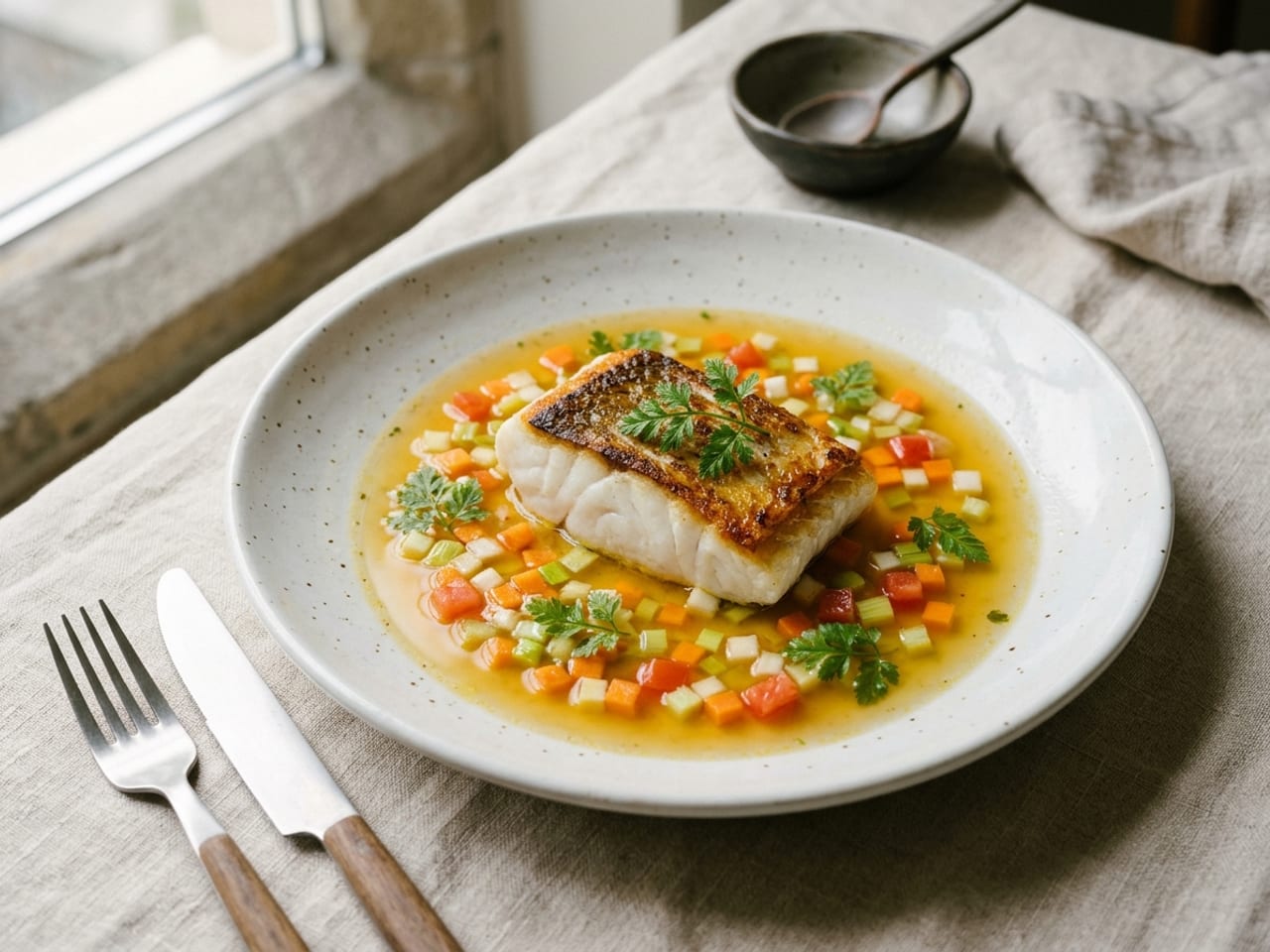
The photos on this page are AI-generated illustrations.
What is brunoise?
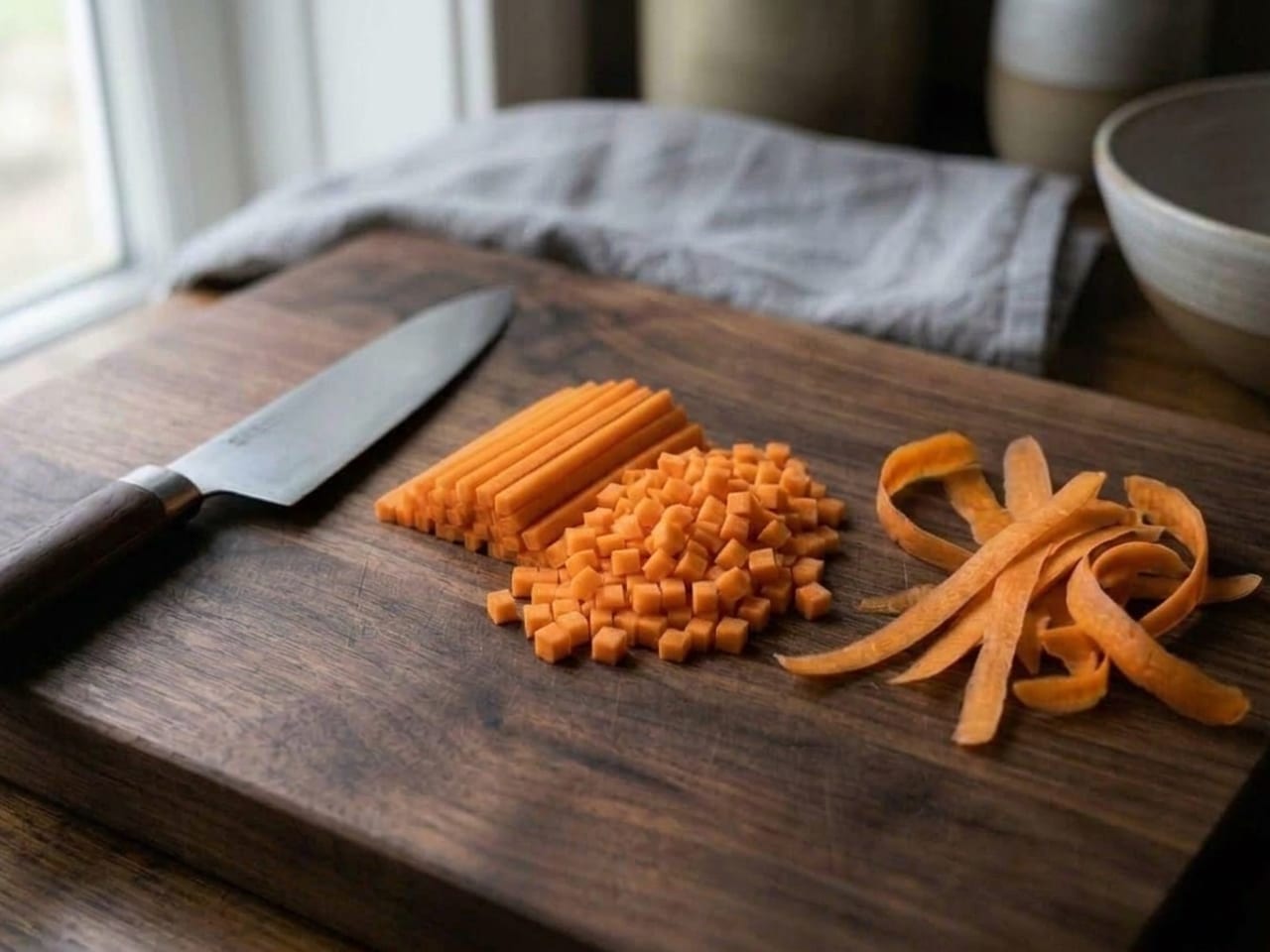
Brunoise (broon-WAHZ) is vegetables cut into tiny, even cubes: a julienne cut across at the same width. In the US textbooks the cubes are ⅛ in (3 mm) on each side, and a fine brunoise is 1/16 in (1.5 mm). Escoffier cut his 3 mm (about ⅛ in, ours), Practical Cookery and the City & Guilds books print 2 mm (about 1/16 in, ours) and Larousse gastronomique (1997) 1 or 2 mm (about 1/25 to 1/16 in, ours). The word is French; where the name comes from is unproven.1, 2, 6, 12, 35, 43 The chart draws it at true size beside the fine brunoise and the small dice: every knife cut drawn to scale; the grip and the other cuts are in our knife skills guide.
| Brunoise at a glance | What the sources say |
|---|---|
| What it is | A julienne "cut crosswise" into cubes (CIA); also the soup garnish Le Cordon Bleu calls "the classic consomme garnish" (step by step)15 |
| Size | ⅛ in (3 mm) in every US textbook we read; 3 mm (about ⅛ in, ours) in Escoffier (1907); 2 mm (about 1/16 in, ours) in Practical Cookery and the City & Guilds books and in a French CAP textbook (other British books print 1 mm or 4 mm); 1 or 2 mm in Larousse (1997); sizes printed since 1903 run 1 to 4 mm (about 1/25 to 5/32 in, ours) (the tally) |
| Fine brunoise | 1/16 in (1.5 mm), cut from a fine julienne (CIA, Gisslen, On Cooking) (fine brunoise) |
| How to say it | broon-WAHZ; OED /brʊˈnwɑːz/ (UK), /bruˈnwɑz/ (US); French /bʁy.nwaz/ (as printed) |
| Vs small dice | Small dice is ¼ in (6 mm), cut from a batonnet: twice the edge (compared) |
| Cooking | Sweated or stewed in butter in the textbooks (Senn and Gisslen say not to brown it); four older cookbooks browned it (cooking) |
| The name | Probably the town of Brunoy ("potage à la Brunoy", 1808), unproven; one German trade glossary derives it from brunir, to brown, with no source; no dictionary we read gives either (the word) |
On this page: Meaning · Pronunciation · Step by step · Onion, pepper, tomato · Size · Fine brunoise · Vs small dice · Cooking · Consommé brunoise · Cutting ahead · On the plate · Tools · History · The word · Troubleshooting · Terms · FAQ
How this page was made. Every size, time, temperature and date comes from the source named beside it, with its edition and page where it has one. Many textbooks are lending-only scans we could read only as short search fragments or Google Books snippets, and old cookbooks were read in dated scans; each source's entry says how it was read. Plate Artists cut, cooked and timed nothing for this page: the methods are quoted, not kitchen-tested. Conversions, sums and anything marked "ours" are our own, and a metric or US twin in brackets is the source's own where it prints one and ours where it does not. Sources are at the bottom.
Brunoise meaning
Three senses, one word. The cut: "Cut into very small ... dice" and the dish: "Garnished with vegetables cut in this manner" (Gisslen's glossary).2 French lexicography adds the cooked mixture: for Quebec's language office a brunoise is a mix of carrots, turnips, leeks, onions and celery "mêlés et étuvés au beurre" (mixed and stewed in butter) for soups, sauces and stuffings, then the operation, then the cut.45 Larousse gives the cut and "résultat de cette opération", the result; Le Robert, food "coupé en très petits dés, pour la garniture des potages".12, 46
Is brunoise a verb? Wiktionary lists it as one ("brunoise, brunoised, brunoising"), and Fine Dining Lovers writes "what it means to brunoise your vegetables"; the Oxford English Dictionary has the noun only, and the textbooks write "cut brunoise".2, 43, 44, 55 The word is rare in print: under 0.01 uses per million words in modern English, by the OED's count.43 Where it comes from is further down.
How to pronounce brunoise
Say broon-WAHZ, as our chart respells it, or broo-NWAHZ, the OED's American respelling; in French the first vowel is the French ü, /bʁy.nwaz/.43, 44 As printed:
| Source | Kind | Pronunciation as printed |
|---|---|---|
| Oxford English Dictionary (UK)43 | British dictionary | /brʊˈnwɑːz/ and /bruːˈnwɑːz/ |
| Oxford English Dictionary (US)43 | American English | /bruˈnwɑz/ (broo-NWAHZ) |
| Wiktionary44 | Online dictionary | UK /bɹʊˈnwɑːz/, /bɹuːˈnwɑːz/; US /bɹuˈnwɑz/, /bɹunˈwɑ/ |
| Gisslen, Professional Cooking2 | US textbook | broon wahz |
| Ruhlman, The Elements of Cooking17 | US reference book | BREWN-wahz |
| Wiktionary; Wikipedia44 | French | Wiktionary /bʁy.nwaz/, Wikipedia [bʁynwaz] (our respelling: brew-NWAHZ, the French ü) |
| Duden48 | German dictionary | [brynoaːz(ə)] |
How to brunoise a carrot
The CIA's and Gisslen's method: square, plank, julienne, then cut across. No textbook we read gives brunoise a motion of its own. Quoted, not kitchen-tested by us; the short version in three frames is in our knife skills guide.
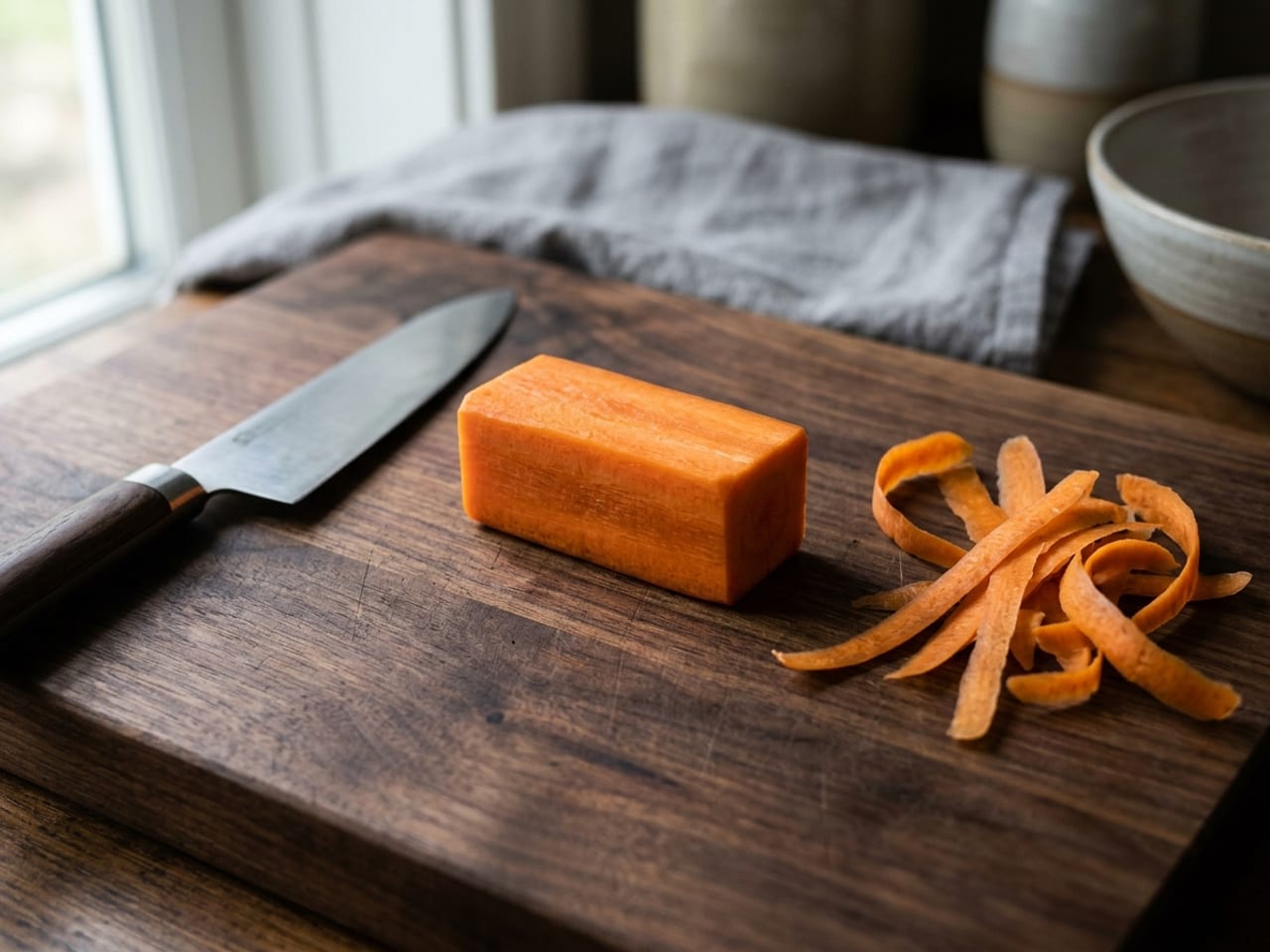 1
Wash, peel and square off the carrot
Wash it "before being cut" (FDA Food Code), peel it, and cut it into lengths of 1 to 2 in (3 to 5 cm), the length of the CIA's julienne; CooksInfo cuts 5 cm (2 in) lengths.1, 53, 76 Then square it: "cut a slice from each side and both ends of the vegetable to make an even rectangular solid or cube" (CIA).1 Escoffier used only "the red part" of the carrot for his consommé, which we read as the outer flesh (ours).36
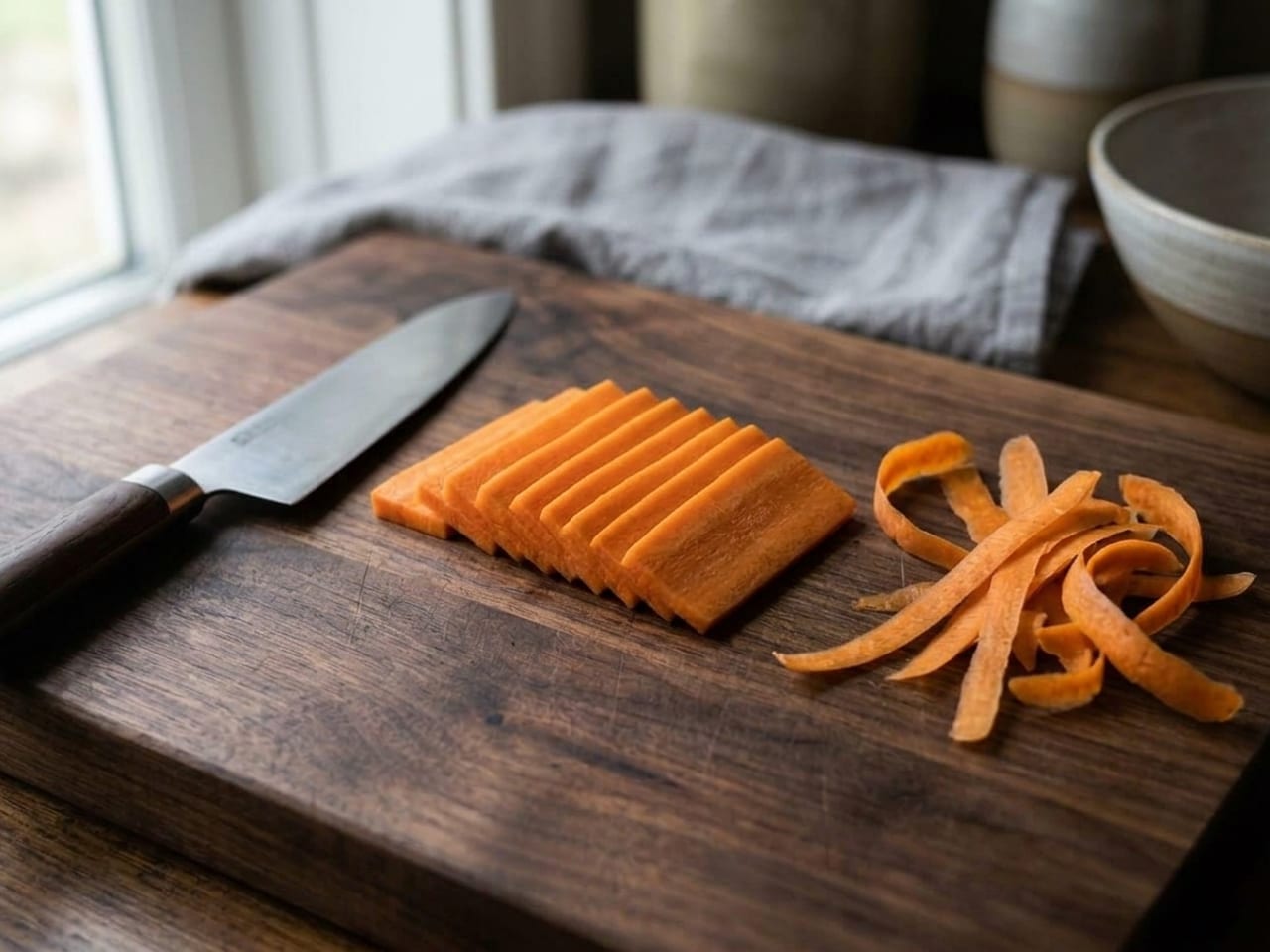 2
Slice it into planks ⅛ in (3 mm) thick
"Slice the vegetable lengthways into rectangles about 3mm thick" (Fine Dining Lovers), ⅛ in (3 mm) in the US textbooks.1, 55 For precision cuts "it is important to cut with a 'slice' technique": "The slicing motion should move either forwards or backwards", not straight down (CIA).1
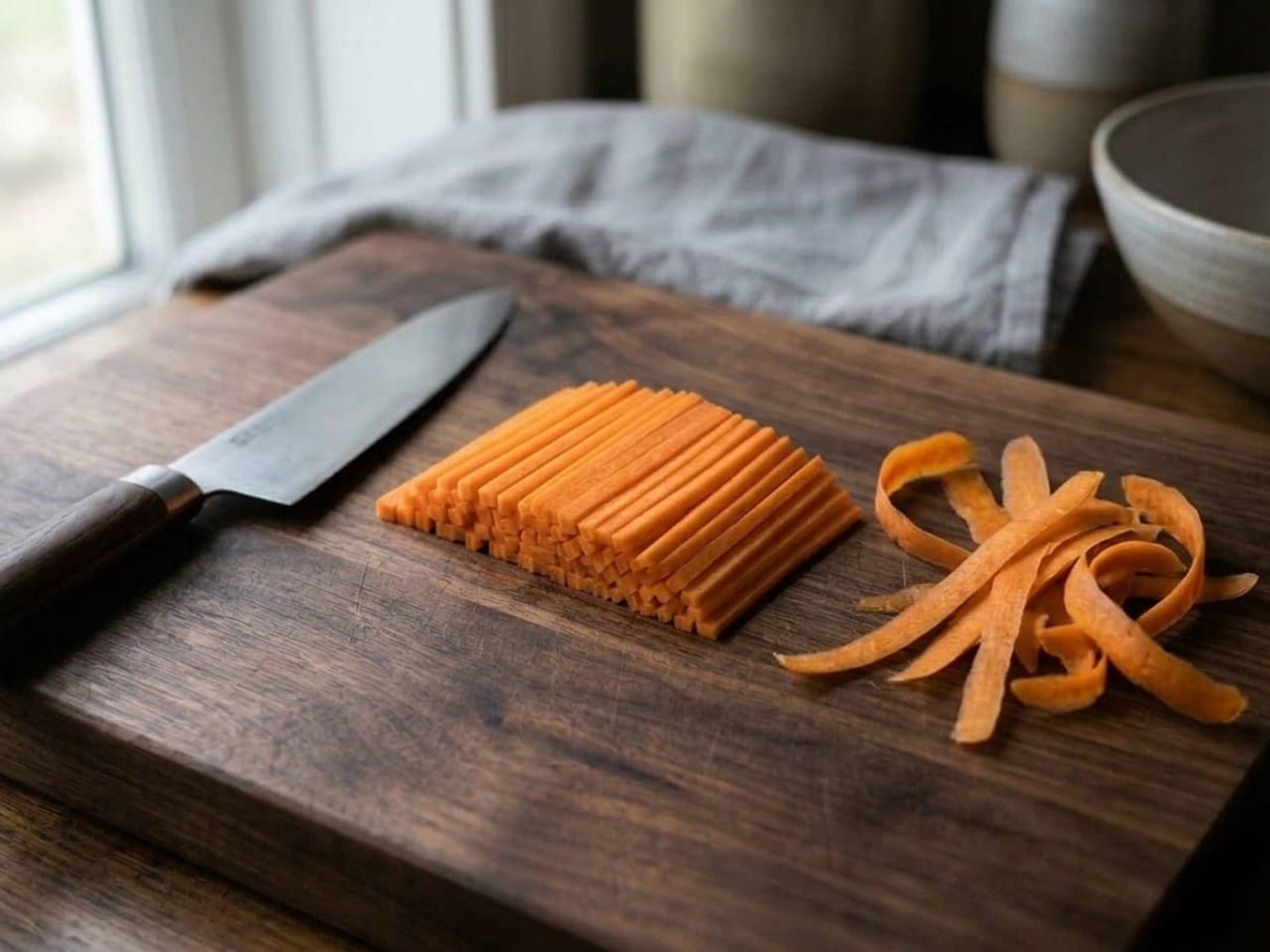 3
Stack the planks and cut them into a julienne
Stack two or three planks (ours) and cut them into sticks of the same width, a julienne of ⅛ × ⅛ × 1 to 2 in (3 × 3 × 25 to 50 mm). "For brunoise cut, items are first cut in julienne, then cut crosswise" (CIA); Gisslen teaches dice, brunoise, batonnet, allumette and julienne as one method, because "the process of cutting dice first requires you to cut stick shapes".1, 2 Every source's julienne size, and the julienne by vegetable, is in our julienne guide.
 4
Line up the sticks and cut across at the same width
"Take a bunch of your julienne and cut crosswise" (The Food Lab); Kamman cuts "a small bundle of julienne pieces" with "the same motion as for slicing", and CooksInfo stacks the sticks "about three to four high", "using your knuckles as a guide".18, 19, 53 Keep the fingertips "curled under, out of the way of the blade" (Gisslen).2 Cut every ⅛ in (3 mm): when the crosscut matches the stick, each piece is a cube (our reading of the method; no source names the fault).
- 5
Check the cubes, and keep the trimmings
Even cuts matter for two reasons, Gisslen says: "It ensures even cooking" and "It enhances the appearance of the product".2 Use the squared-off scraps for "purées, soups, stews, stocks" (Gisslen).2 For a fine brunoise, 1/16 in (1.5 mm), "cut items first in fine julienne" (CIA) and cross-cut at that width.1
Which knife, and how to hold the food
A sharp chef's knife; the CIA's runs 8 to 12 in (20 to 30 cm, ours) and its utility knife 5 to 8 in (13 to 20 cm, ours).1 Precision cuts are sliced, not pressed: "Do not press the knife straight down or grip the knife with a loose wrist, as this could result in less accurate cuts" (CIA).1 The guiding hand makes a claw, "Fingertips are curled under, out of the way of the blade" (Gisslen), and America's Test Kitchen's "bear claw" rests the knuckles against the blade.2, 64 More on grips, honing and safety is in our knife skills guide; machines and mandolines are below.
How to brunoise an onion, shallot, pepper, tomato, celery or leek
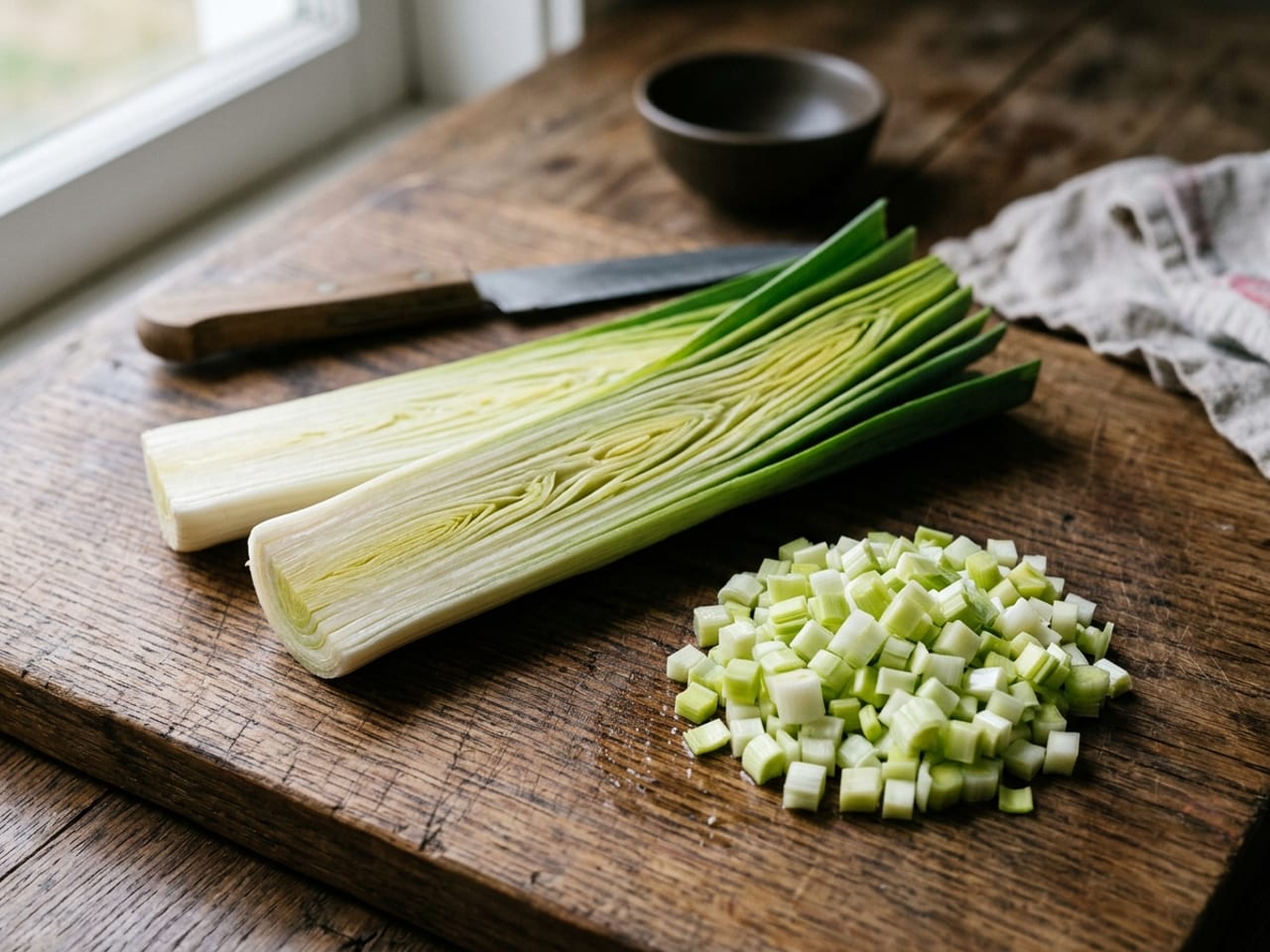
Any firm vegetable that can be squared and planked takes the carrot method; layered ones (onion, shallot, leek) and soft ones (tomato) need a change of route. Fifteen foods, what the sources do with each, and a tip:
| Food | How | Tip |
|---|---|---|
| Carrot21, 35, 36 | The steps above: square, plank, julienne, cut across | Escoffier used only "the red part" (rouge de carotte); The Book of Yields gives carrots the same 81.3% yield for any cut |
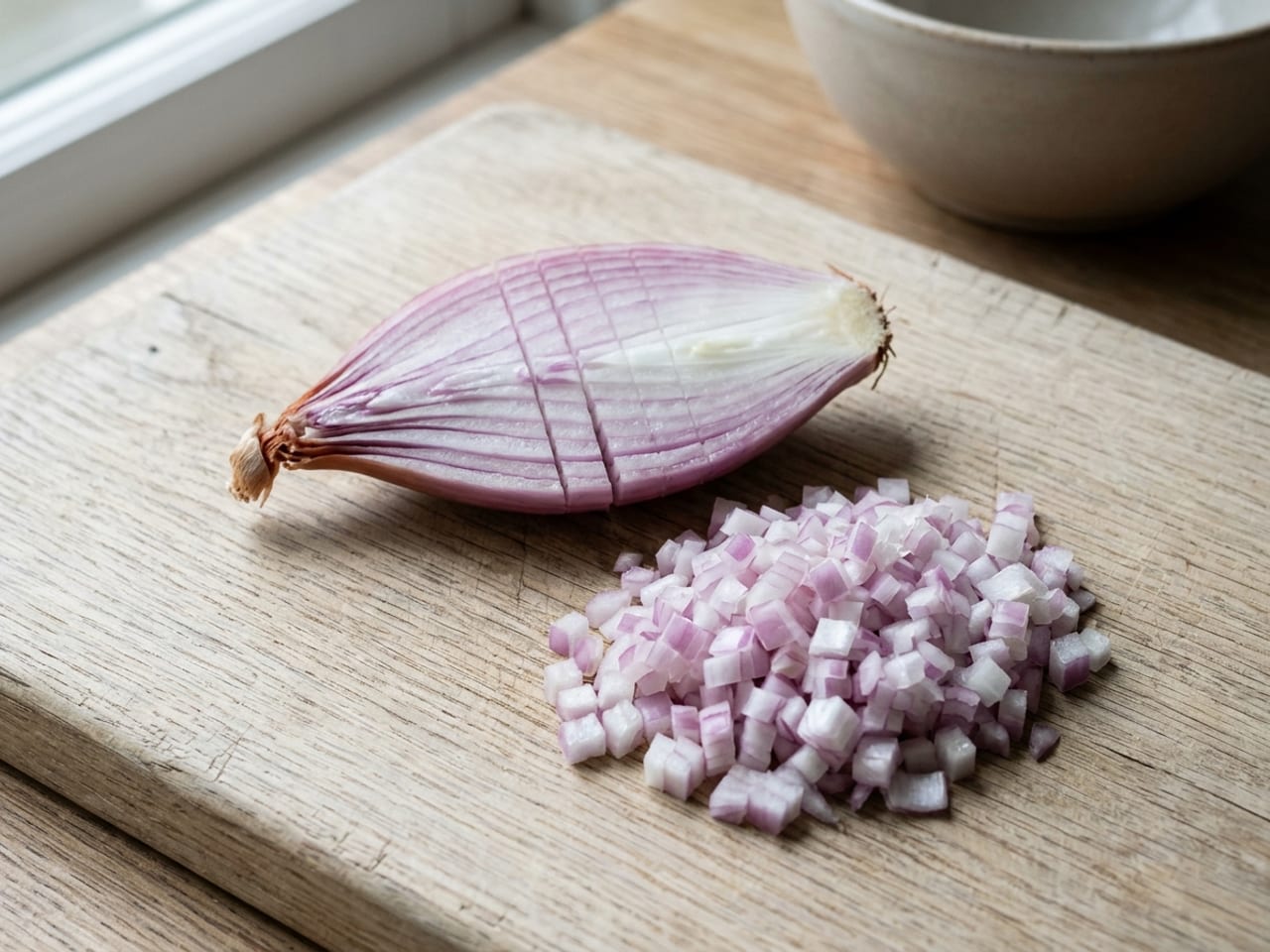
| Onion (white, yellow, red)2, 55, 64 | Gisslen's method: halve through the root, cut lengthwise toward it ("Do not cut through the root end"), make a few horizontal cuts, then slice across: "The closer together you make the cuts, the smaller the dice will be". For brunoise, cuts about ⅛ in (3 mm) apart (ours), the fine end of ATK's "1/8 to 1/4 inch" spacing for minced onion | Fine Dining Lovers skips the horizontal cut: strips "just short of the root", then a quarter turn and "a rocking motion"; ATK has a no-horizontal-cut method too |
| Shallot2, 21, 66 | The onion method on a halved shallot; Gisslen's mignonette is "Shallots, cut brunoise" in wine vinegar | Little waste: 90.6% usable (The Book of Yields). Raw, cut it last: "in applications featuring raw onions, it is best to chop them immediately before you need them" (ATK) |
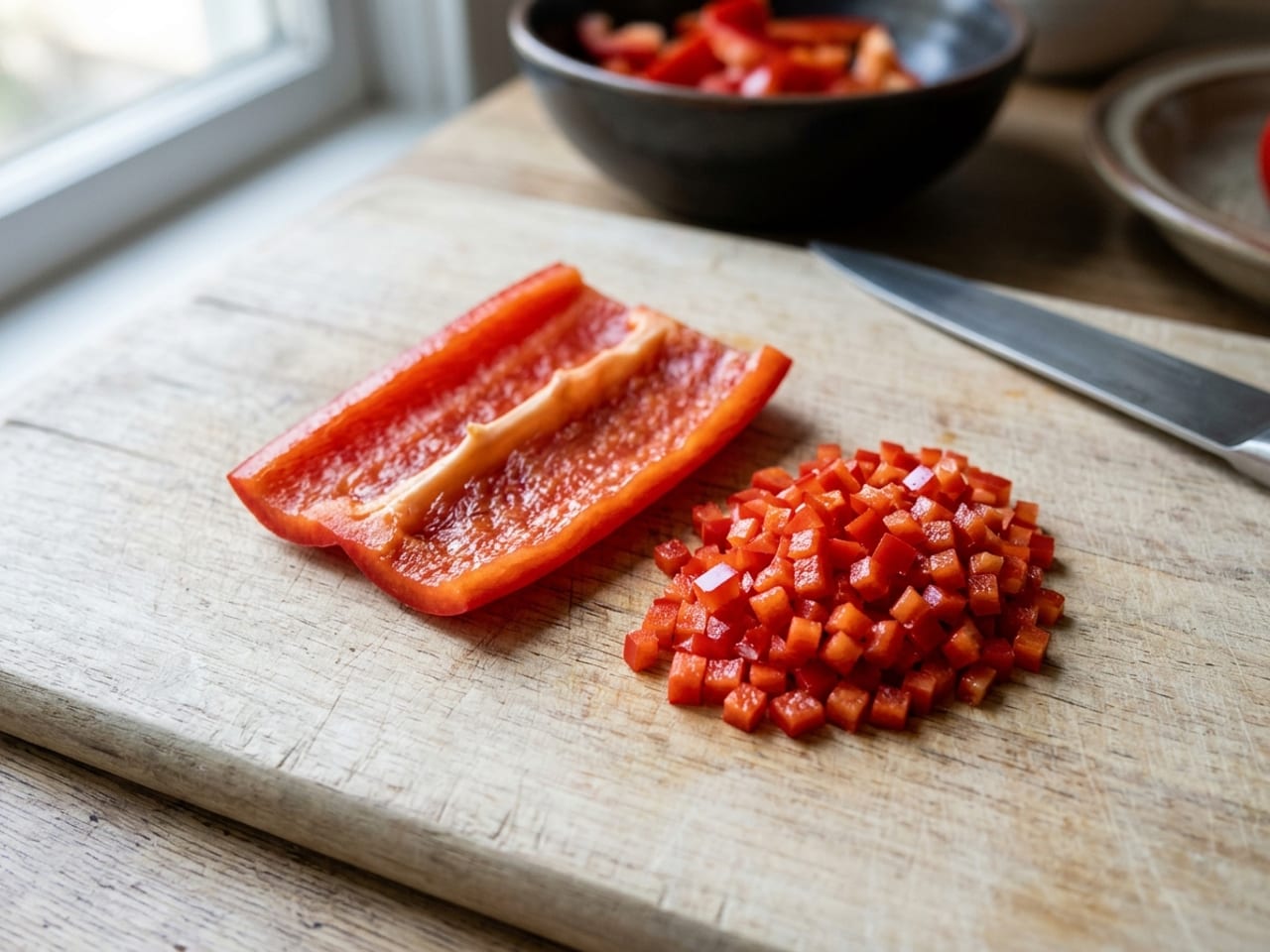
| Bell pepper (red, green, yellow)1, 21, 62 | Cut the walls into flat panels and slice off the pale membrane: "Interior membrane of peppers have been sliced off as part of the cutting" (The Book of Yields, on pepper brunoise); then julienne and cut across. The CIA fillets peppers as it does tomato flesh | Colours together are chef practice: Voltaggio's red and green pepper brunoise in one preparation |
| Jalapeño and other chiles1 | Seed, then cut like a pepper: the CIA's relish takes "1 jalapeño, seeded, cut into brunoise" | "wear gloves, wash cutting surfaces and knives, and avoid contact with sensitive tissue such as the eyes" (CIA) |
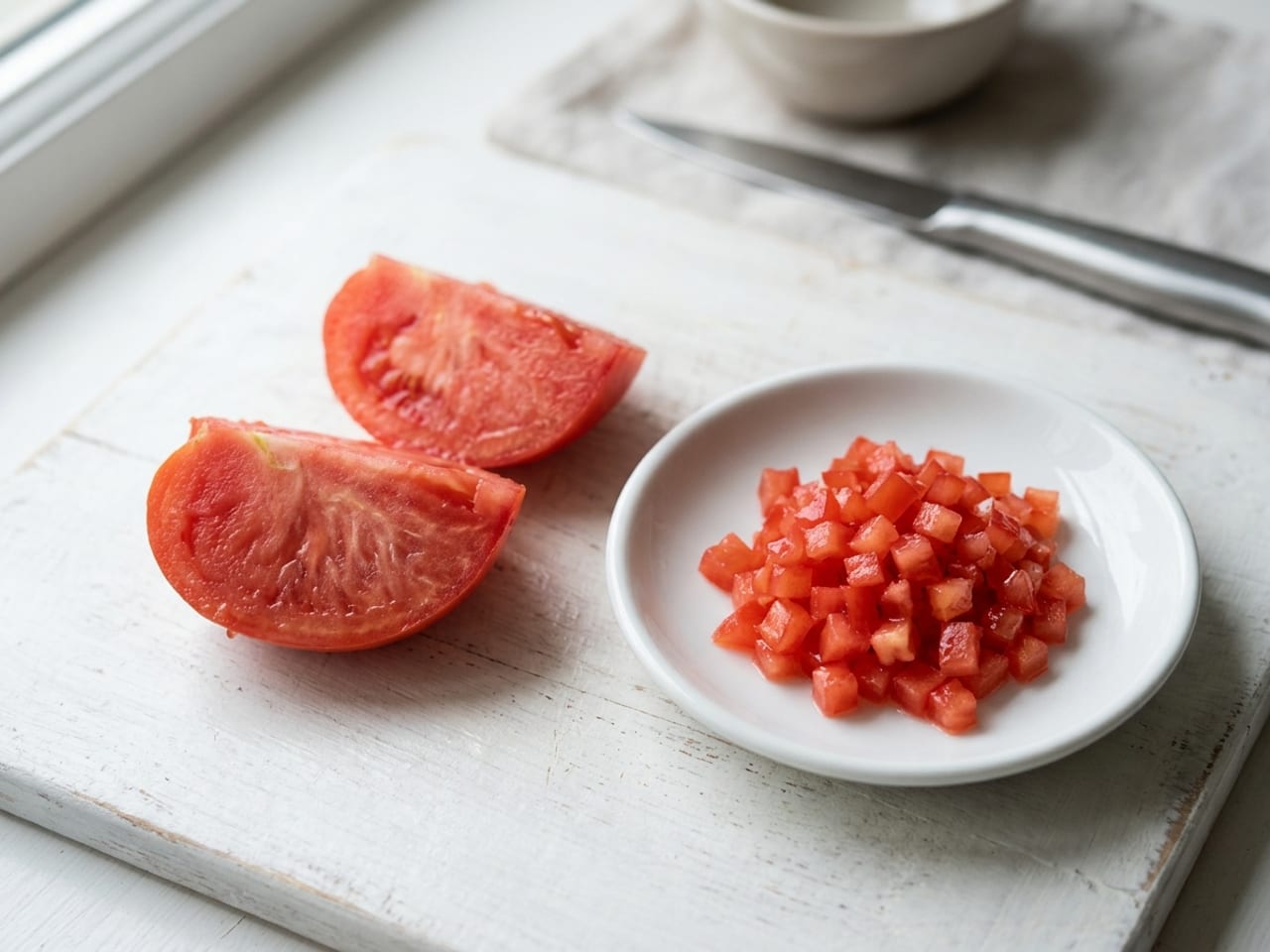
| Tomato (concassé)1, 6, 8, 54, 76 | Peel and seed it (concassé), then "trim the tomato flesh so that it has an even thickness" and cut it (CIA) | Soft and wet: Tasting Table calls brunoise "too small for juicy ones like tomatoes"; British books cut tomato concassé as "gros brunoise", 4 mm in one. Cut tomatoes go in the fridge (keeping) |
| Celery and celeriac12, 21, 36 | Cut a celery stalk into lengths, plank, julienne and cut across like the carrot (ours); Larousse names "céleri-rave", celeriac, among the usual brunoise roots | Escoffier garnishes a soup with "two tablespoonfuls of a brunoise of celery" (about 30 mL, ours); celery yields 68.8% (The Book of Yields) |
| Leek1, 21, 36, 55 | "Cut the leek lengthwise into halves, thirds, or quarters. Rinse the leek under running water to remove any remaining grit or sand" (CIA); Fine Dining Lovers cuts "even quarters or fifths"; then slice across | Escoffier uses the white "heads" of leeks; a leek yields 43.8% after trimming (The Book of Yields) |
| Turnip and rutabaga21, 35 | The carrot method on a peeled, squared root | In Escoffier's consommé with the carrot; "Rutabaga, Brunoise" yields 81.3%, the same as the whole root (The Book of Yields) |
| Zucchini (courgette) and cucumber2, 15, 21 | Gisslen's relish takes zucchini "outside part only, without" the seedy core, and cucumber peeled and seeded | Peeled, seeded cucumber yields 55% (The Book of Yields); Le Cordon Bleu tops a dish with a brunoise of mango, cucumber and ginger |
| Fennel2 | In Gisslen's Vegetable Caper Relish, cut brunoise with carrot, zucchini and shallot, then sweated | Cut the bulb into flat layers before the planks (ours) |
| Garlic, ginger, lemongrass1, 10, 21 | The CIA minces garlic ("like you would mince an onion"); a British level 3 textbook lists "Garlic (cut into brunoise)", ginger, lemongrass and "Red chilli brunoise" | Ginger "yields 70 % when peeled" (The Book of Yields) |
| Apple, mango and other fruit2, 8, 15, 52, 62 | French Wikipedia allows "légumes ou de fruits"; a British textbook cuts apples "into julienne or a brunoise"; Le Cordon Bleu a mango brunoise | Gisslen's Fruit Salsa cuts the fruit "into fine" dice and the red onion brunoise; chefs spoon apple brunoise into soup bowls |
| Potato2, 73 | Gisslen shows the whole dice and brunoise method on a peeled potato | Robot Coupe rates its machine at "600 g potatoes 3x3x3 mm" a batch (about 1⅓ lb, ⅛ in, ours; maker) |
| Cheese, ham and truffle35, 36, 62 | Not only vegetables: Escoffier folds "a Brunoise of Gruyère" into cheese fritters and cuts ham "en fine brunoise" for a sauce | A truffle brunoise beside a carrot one in The Joy of Truffles (1998) |
How to brunoise an onion or a shallot
No textbook we read gives onion brunoise a method of its own: use Gisslen's layered-vegetable cut with the cuts closer together. Halve it through the root and peel it, lay it flat, make lengthwise cuts toward the root ("Do not cut through the root end"), a few horizontal cuts, then slice across; "The closer together you make the cuts, the smaller the dice will be".2 At about ⅛ in (3 mm) apart (our application) you sit at the fine end of America's Test Kitchen's spacing for minced onion, "1/8 to 1/4 inch between each cut".64 Fine Dining Lovers leaves out the horizontal cut and rocks the knife across 3 mm (⅛ in) strips, and ATK publishes a method without horizontal cuts too.55, 64 A shallot works the same way and loses little: 90.6% usable (The Book of Yields).21 The full onion method with frames is in our knife skills guide.
Tomato, pepper and other soft or thin-walled vegetables
Flatten them into an even thickness first. The CIA peels and seeds a tomato (concassé) and trims the flesh "so that it has an even thickness", and fillets peppers and chiles the same way; The Book of Yields notes that for a pepper brunoise the "Interior membrane of peppers have been sliced off".1, 21 The web is warier: Tasting Table calls the cut "too small for juicy ones like tomatoes or pineapple", and Ripert remembers that with a soft vegetable "a fine brunoise is a nightmare; it becomes like mush".20, 54 British books cut tomato concassé as a coarser "gros brunoise".6 Our suggestion: cut soft flesh last and a little larger, and drain it.
Brunoise size in mm and inches, by source
31 rows from the sources we read (some rows group two or more books), each in its own words, with the edition and page. The first 13 are the textbooks most readers meet, Escoffier, Larousse, the British outliers, the most copied web pages and the machine; the other 18 open under "Show all". Where a source prints inches the millimetres are ours, and the other way round. The classic texts before 1903 are in the history.
| Source | In its words | Size as a number |
|---|---|---|
| CIA, The Professional Chef1 9th ed. 2011, p. 623 and glossary p. 1161; us textbook | "A dice cut of 1/8-in/3-mm cubes", "first cut in julienne, then cut crosswise" | ⅛ in (3 mm) |
| Gisslen, Professional Cooking2 7th ed. 2011, Fig. 7.7 p. 143 and glossary; us textbook | "Brunoise ... (3 X 3 X 3 mm)"; "Cut into very small" dice | 3 mm (⅛ in in the chart) |
| Escoffier, Le Guide culinaire35 1903 and 1907, p. 153; classic text | "dés de 3 millimètres de côté" (dice 3 mm a side), for the consommé brunoise | 3 mm (about ⅛ in, ours) |
| Escoffier, A Guide to Modern Cookery36 1907, No. 548, pp. 200 to 201; classic text | "Cut into small dice"; the glossary: "to cut a product into small dice". The English edition drops the 3 mm | - |
| New Larousse Gastronomique (English)13 catalogued 1960 and 1977; a search fragment; reference book | "Vegetable brunoise for soups ... Cut the following into dice about 3 mm" | about 3 mm (about ⅛ in, ours) |
| Larousse gastronomique12 1996, 1997 printing; reference book | "dés minuscules, de 1 ou 2 mm de côté" (tiny dice, 1 or 2 mm a side) | 1 or 2 mm (about 1/16 in, ours) |
| Practical Cookery6 11th ed. 2008; uk textbook | "Cut the strips into 2mm squares" | 2 mm (about 1/16 in, ours) |
| City & Guilds and UK diploma books8 1986, 2006, 2007, 2008, 2010; uk textbook | "2mm x 2mm x 2mm"; "Brunoise Cut to 2mm dice" | 2 mm (about 1/16 in, ours) |
| Professional Chef Level 2; Practical Cookery6, 8 2007; 13th ed. 2015; uk textbook | "Gros brunoise 4mm x 4mm dice"; "gros brunoise for Scotch broth" | 4 mm (about 5/32 in, ours) |
| Professional Cookery: The Process Approach9 1990; uk textbook | "A very small dice" of "1 mm sides" | 1 mm (about 1/25 in, ours) |
| CooksInfo53 2012, updated 2018; web | "A regular brunoise gives you cubes 3 mm (⅛th inch) in size", though its method cuts "4 mm (⅛th inch) thick slices" | 3 mm (⅛ in, as it prints) |
| Wikipedia (English)51 read 2026; web | "about 3 mm (1⁄8 in) or less"; "In France, a 'brunoise' cut is a smaller 1 to 2 mm" (no source given) | 3 mm (⅛ in) or less; 1 to 2 mm (about 1/25 to 1/16 in, ours) |
| Robot Coupe, CL 50 Gourmet discs73 read 2026; maker | "Brunoise 2x2x2 mm", "3x3x3 mm" (the disc that comes with the machine) and "4x4x4 mm" | 2, 3 or 4 mm (5/64, ⅛, 5/32 in, the maker's) |
Show all 31 rows (18 more)
| Source | In its words | Size as a number |
|---|---|---|
| CIA, The Professional Chef's Knife4 1978 (catalogue date); us textbook | "REGULAR BRUNOISE 1/8 in. x 1/8 in. x 1/8 in." | ⅛ in (3.2 mm, as printed) |
| Healthy Living Kitchen (college text)5 2014; us textbook | "Brunoise: 1/8 x 1/8" | ⅛ in (about 3 mm, ours) |
| Escoffier, Le Guide culinaire, other recipes35 1907; classic text | "grosse brunoise" (coarse), "fine brunoise" and "brunoise excessivement fine": grades, with no number | - |
| Maincent-Morel, La cuisine de référence (CAP)11 2002 (catalogue date); french textbook | "petits cubes très réguliers de 2 mm de section carrée"; green beans "2 à 3 mm"; orange zest "1 mm" | 2 mm (about 1/16 in, ours) |
| Practical Professional Cookery7 1999; uk textbook | "approximately 2mm dice" | 2 mm (about 1/16 in, ours) |
| Intermediate 2 Hospitality course notes (Scotland)9 2008; uk textbook | In a soup "normally 2mm x 2mm x 2mm, but for a garnish would be smaller", 1 mm | 1 to 2 mm (about 1/25 to 1/16 in, ours) |
| Food Preparation and Cookery: An International Approach9 1998; uk textbook | "very small dice, 4mm square" | 4 mm (about 5/32 in, ours) |
| Pépin, La Technique; New Complete Techniques16 1976; 2012; reference book | "Very small cubes or dices of vegetables are called brunoise" | - |
| Ruhlman, The Elements of Cooking17 2007; reference book | "a decorative vegetable cut, a tiny dice" (its fractions are garbled in the scan, so we print none) | - |
| Saulnier, Le Répertoire de la Cuisine14 English ed. 1976; reference book | Consommé Brunoise "garnished with small cubes of carrots, turnips" | - |
| OQLF Grand dictionnaire terminologique (Quebec)45 1983; reference book | "tout petits dés" (very small dice), and the mixture "étuvés au beurre" | - |
| Rouxbe; Pepperdine Dining; the Escoffier School; a CIA alumni sheet58, 59, 60, 61 read 2026; school | "tiny, uniform cubes that are ⅛ of an inch on each side" (Pepperdine); "from julienne you get brunoise" (Rouxbe) | ⅛ in (about 3 mm, ours) |
| Tasting Table54 read 2026; web | "3mm (regular) or 1.5mm (fine) in size, according to Cook's Info" | 3 mm (about ⅛ in, ours) |
| Fine Dining Lovers55 2021; web | "rectangles about 3mm thick", then sticks and cubes | about 3 mm (about ⅛ in, ours) |
| Wikipedia, List of culinary knife cuts51 read 2026; web | "sides measuring approximately 1⁄8 inch (3 mm)" | ⅛ in (3 mm) |
| Wikipédia (French)52 read 2026; web | "coupés en dés de 2 mm de côté", from a chef's website | 2 mm (about 1/16 in, ours) |
| Wikipedia (German, Spanish, Portuguese)52 read 2026; web | German 1 to 2 mm; Spanish 2 to 3 mm, and 1 to 2 mm further down the same page; Portuguese 2 to 3 mm | 1 to 3 mm (about 1/25 to ⅛ in, ours) |
| Wiktionary44 read 2026; web | "usually to the dimensions of 2 mm or less" | 2 mm (about 1/16 in, ours) or less |
What the tally says
- US textbooks agree: ⅛ in (3 mm). The CIA, a 1978 CIA knife book and a college text print ⅛ in, and Gisslen prints 3 mm (his inch fractions are garbled in our scan; the chart's ⅛ in matches; the 1978 table rounds to 3.2 mm). The four school and alumni pages repeat it, and so do five of the eight web rows (one of them copying another); the other three are finer.1, 2, 4, 5, 58, 60
- British and French books go finer. Practical Cookery, Practical Professional Cookery, the City & Guilds and diploma books and a French CAP textbook print 2 mm (about 1/16 in, ours), Larousse gastronomique (1997) "1 ou 2 mm", and one British book 1 mm; but British books also have a coarser "gros brunoise" of 4 mm (about 5/32 in, ours).6, 7, 8, 9, 11, 12
- Escoffier was 3 mm, and not only 3 mm. His consommé brunoise is "dés de 3 millimètres de côté" in both French editions (1903, 1907), but he also writes grosse, fine and "excessivement fine" brunoise, and his English edition says only "small dice". The mid-century English Larousse still printed "about 3 mm" for its soup brunoise (a search fragment).13, 35, 36
- "In France, the fine brunoise is the standard" is CooksInfo's line. It lists one source, the 1977 English New Larousse Gastronomique, which we could not read; the older English Larousse, which we saw only as a search fragment, prints about 3 mm. The French books we read range from 1 to 3 mm, about 1/25 to ⅛ in (and Gouffé printed 5 mm, about 3/16 in, in 1867): Escoffier's 3 mm equals the US ⅛ in and only the modern Larousse and a French CAP book go finer, and none calls the fine brunoise the French standard.11, 12, 13, 30, 35, 53
- So 1 to 4 mm covers every number in this tally (about 1/25 to 5/32 in, ours). The 19th-century cooks cut larger: Carême about 4.5 mm, Gouffé 5 mm (both about 3/16 in, ours), Ranhofer ¼ in (about 6 mm, ours) (history).26, 30, 33 Our suggestion, not a rule: cut ⅛ in (3 mm) for a US recipe and the size the book prints for a British or French one; for a clear-soup garnish, finer.
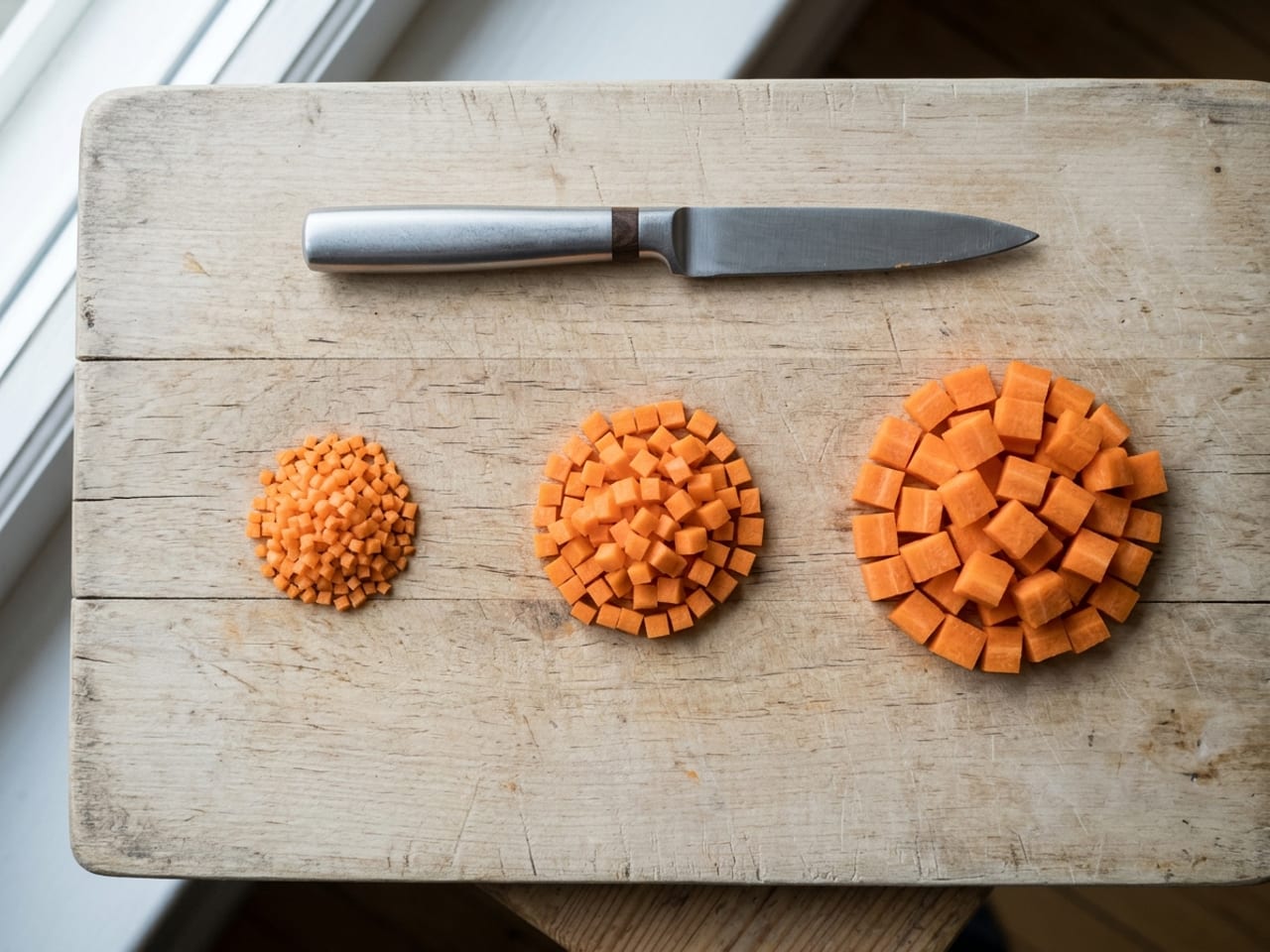
Fine brunoise: 1/16 in (1.5 mm)
The US textbooks add a smaller grade, cut from a fine julienne: "For fine brunoise, a 1/16-in/1.50-mm cube, cut items first in fine julienne" (CIA), 1.5 mm in Gisslen and On Cooking.1, 2, 3 It is the smallest cut with a set size on our chart, though Escoffier's "brunoise excessivement fine" and the 1 mm (about 1/25 in) end of Larousse's 1 or 2 mm and one British textbook are finer in practice.9, 12, 35 Wikipedia's list prints 1/16 in as 2 mm, and no machine disc we read goes below 2 mm (5/64 in). The CIA's consommé garnish is a fine brunoise; Gisslen's is the ⅛ in (3 mm) one.1, 2, 51, 73
| Source | In its words | Size |
|---|---|---|
| CIA, The Professional Chef (2011), glossary1 p. 1161 | "a 1/16-in/1.50-mm cube, cut items first in fine julienne" | 1/16 in (1.5 mm) |
| Gisslen, Professional Cooking (2011)2 Fig. 7.7 p. 143 | "Fine brunoise ... (1.5 X 1.5 X 1.5 mm)" | 1.5 mm (1/16 in in the chart) |
| On Cooking (2007)3 knife cuts | a "(1.5-millimeter) cube is referred to as a fine brunoise" | 1/16 in (1.5 mm) |
| CIA, The Professional Chef's Knife (1978)4 the cut table | "FINE BRUNOISE 1/16 in. x 1/16 in. x 1/16" | 1/16 in (1.6 mm, as printed) |
| Healthy Living Kitchen (2014)5 college text | "Fine brunoise: 1/16 x 1/16" | 1/16 in (about 1.6 mm, ours) |
| Rouxbe; Pepperdine; the Escoffier School; a CIA alumni sheet58, 59, 60, 61 read 2026 | "from fine julienne you get fine brunoise" (Rouxbe); "1/16 of an inch on each side" (Pepperdine) | 1/16 in (about 1.6 mm, ours) |
| CooksInfo; Tasting Table (quoting it)53, 54 2018; read 2026 | "a fine brunoise gives you cubes 1.5 mm (⅙th inch) in size" (the ⅙ is a slip for 1/16, ours) | 1.5 mm (1/16 in, ours) |
| Wikipedia, List of culinary knife cuts51 read 2026 | "sides measuring approximately 1/16 inch (2 mm)" | 1/16 in, printed as 2 mm |
| Robot Coupe (maker)73 read 2026 | Its finest brunoise disc is 2 mm: no machine disc we read cuts 1.5 mm | 2 mm (5/64 in, the maker's) |
| Maincent-Morel, La cuisine de référence (CAP)11 2002 (catalogue date) | a lesson plan cuts carrot and celery "en fine brunoise", "petits dés de 2 à 3 mm de section" (OCR repaired: the scan reads "brunoiæ") | 2 to 3 mm (about 1/16 to ⅛ in, ours) |
| Escoffier, Le Guide culinaire (1907)35 several recipes | "fine brunoise" for soups, and "brunoise excessivement fine" for the Bordelaise mirepoix | - |
| Saulnier, Le Répertoire (1976)14 English ed. | "Fine Brunoise of carrots, onion and parsley roots" for the Bordelaise mirepoix | - |
| Ripert, 32 Yolks (2016)20 a memoir | "brunoise (very small dice), and fine brunoise (super-small dice)" | - |
Brunoise vs small dice, mince, julienne, macédoine, mirepoix and paysanne
Brunoise vs small dice: the same cube, two sizes, from two sticks. A brunoise is ⅛ in (3 mm), cut from a julienne; a small dice is ¼ in (6 mm), cut from a batonnet, so it has twice the edge and about eight times the volume of a brunoise (our arithmetic).1, 2 Food Republic, which calls them "fine dice, or brunoise" and "small dice, or macédoine", says the small dice is "four millimeters larger"; on the textbook sizes the gap is ⅛ in (3 mm, ours). It keeps small dice for dishes that want "a more prominent vegetable bite".57 Brunoise vs mince: "Mince: to chop into very fine pieces", and to chop is "to cut into irregularly shaped pieces" (Gisslen): a mince has no set shape or size, a brunoise is cut cube by cube.2 The Escoffier School warns that going smaller than ⅛ in "could quickly transition into a mince", and Larousse's 1 mm (about 1/25 in, ours) overlaps a fine mince in practice (our reading).12, 61 "Fine dice" is loose: Food Republic means brunoise by it, the US textbooks keep "fine" for the 1/16 in fine brunoise.1, 57
Brunoise vs julienne: the julienne is the stick, the brunoise the cube cut from it. Brunoise vs macédoine, mirepoix and paysanne: a macédoine is a dice of mixed vegetables, 5 mm in British books, 4 mm in a French CAP textbook, but a dish of large-dice vegetables in the CIA; a mirepoix is a flavouring mix whose size follows its cooking time, which Escoffier cut "en brunoise plus ou moins fine"; a paysanne is thin and flat, not a cube.1, 2, 8, 11, 35 Every size below is the chart's:
| Cut | Shape | Size | How it differs |
|---|---|---|---|
| Brunoise1 | Tiny cube | ⅛ × ⅛ × ⅛ in (3 × 3 × 3 mm) | A julienne "cut crosswise" (CIA) |
| Fine brunoise1 | Tinier cube | 1/16 × 1/16 × 1/16 in (1.5 × 1.5 × 1.5 mm) | Cut "first in fine julienne" (CIA); the smallest cut with a set size on the chart |
| Small dice1, 2, 57 | Cube | ¼ × ¼ × ¼ in (6 × 6 × 6 mm) | Cut from a batonnet, not a julienne: twice the edge, about eight times the volume of a brunoise (our arithmetic); Food Republic keeps it for "a more prominent vegetable bite" |
| Mince2 | Irregular bits | very fine, no set size | "Mince: to chop into very fine pieces" (Gisslen): chopped, no set shape; a brunoise is cut, one cube at a time |
| Julienne1 | Square stick | ⅛ × ⅛ × 1 to 2 in (3 × 3 × 25 to 50 mm) | The stick a brunoise is cut from |
| Macédoine1, 8, 11 | Cube, mixed | about 3/16 × 3/16 × 3/16 in (5 × 5 × 5 mm) | A dice of mixed vegetables: "5mm dice" in British books, "cubes de 4 mm" in a French CAP textbook; in the CIA, a dish of large-dice vegetables |
| Mirepoix2, 35 | Rough pieces | ½ to 2 in, by cooking time (1.2 to 5 cm, by cooking time) | A flavouring mix where "neatness of cut is not important" (Gisslen); Escoffier cut his "en brunoise plus ou moins fine", more or less fine by use |
| Paysanne1, 2, 35 | Thin flat square | ½ × ½ × ⅛ in (12 × 12 × 3 mm) | Thin and wide, not a cube; Escoffier's Matignon is cut "en fine paysanne" |
| Jardinière8, 12 | Short baton | about ⅛ × ⅛ × ⅝ in (3 × 3 × 15 mm) | A stick garnish of carrot and turnip with beans and peas (Larousse); British batons "4mm x 4mm x 1.5cm long" in one book (the chart uses 3 mm) |
Cooking with brunoise: sweated or browned, consommé, sauces and salsas
The textbooks we read sweat or stew a brunoise in butter, and Senn and Gisslen say not to brown it; some 19th-century cooks browned it, and some cooks blanch it for a garnish. Small pieces suit short cooking (Gisslen's mirepoix rule, below). Gisslen defines sweating as "To cook slowly in fat without browning, sometimes under a" cover, and browning sautéed vegetables as caramelization, "the browning of sugars": two different results.2
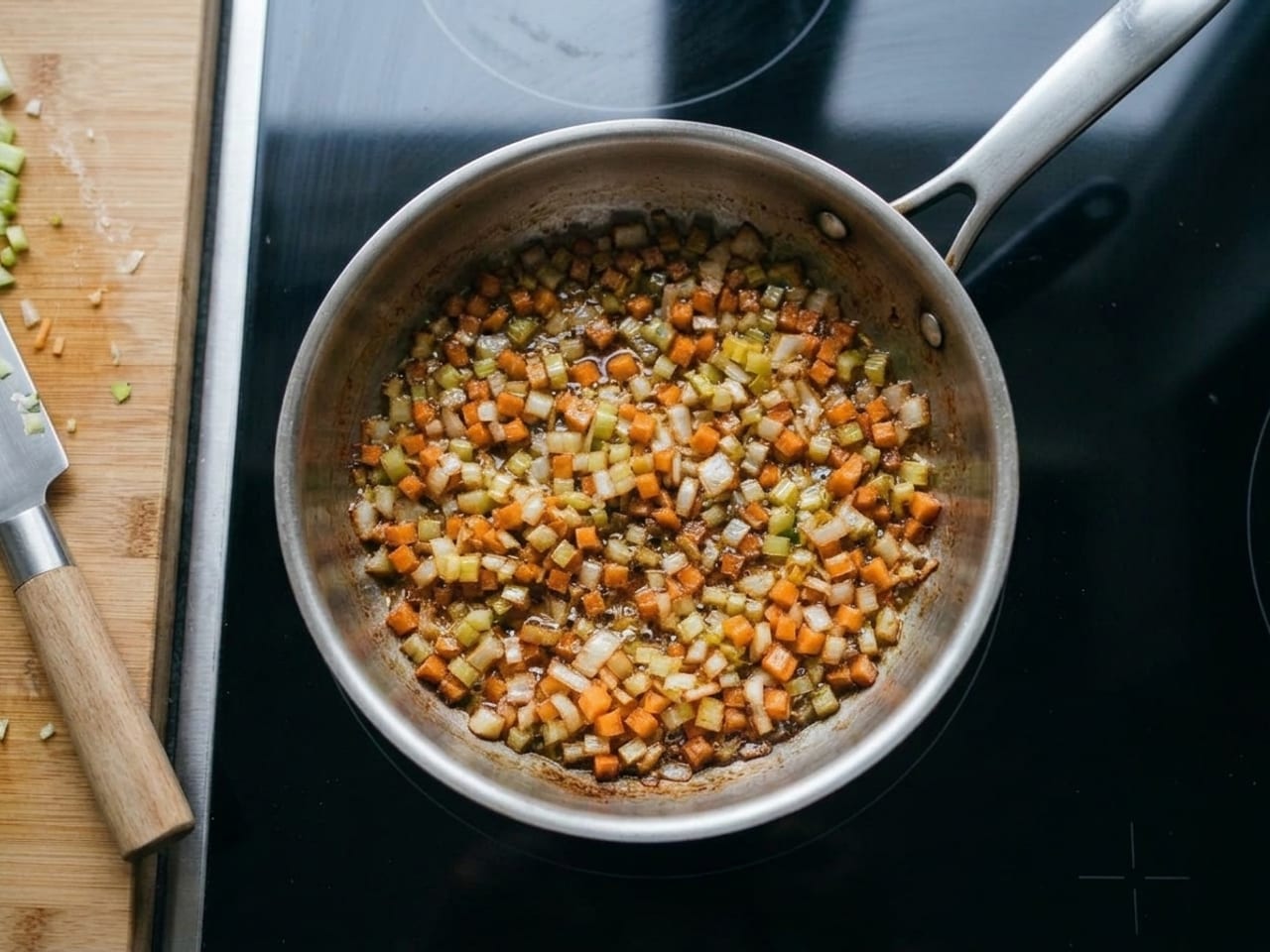
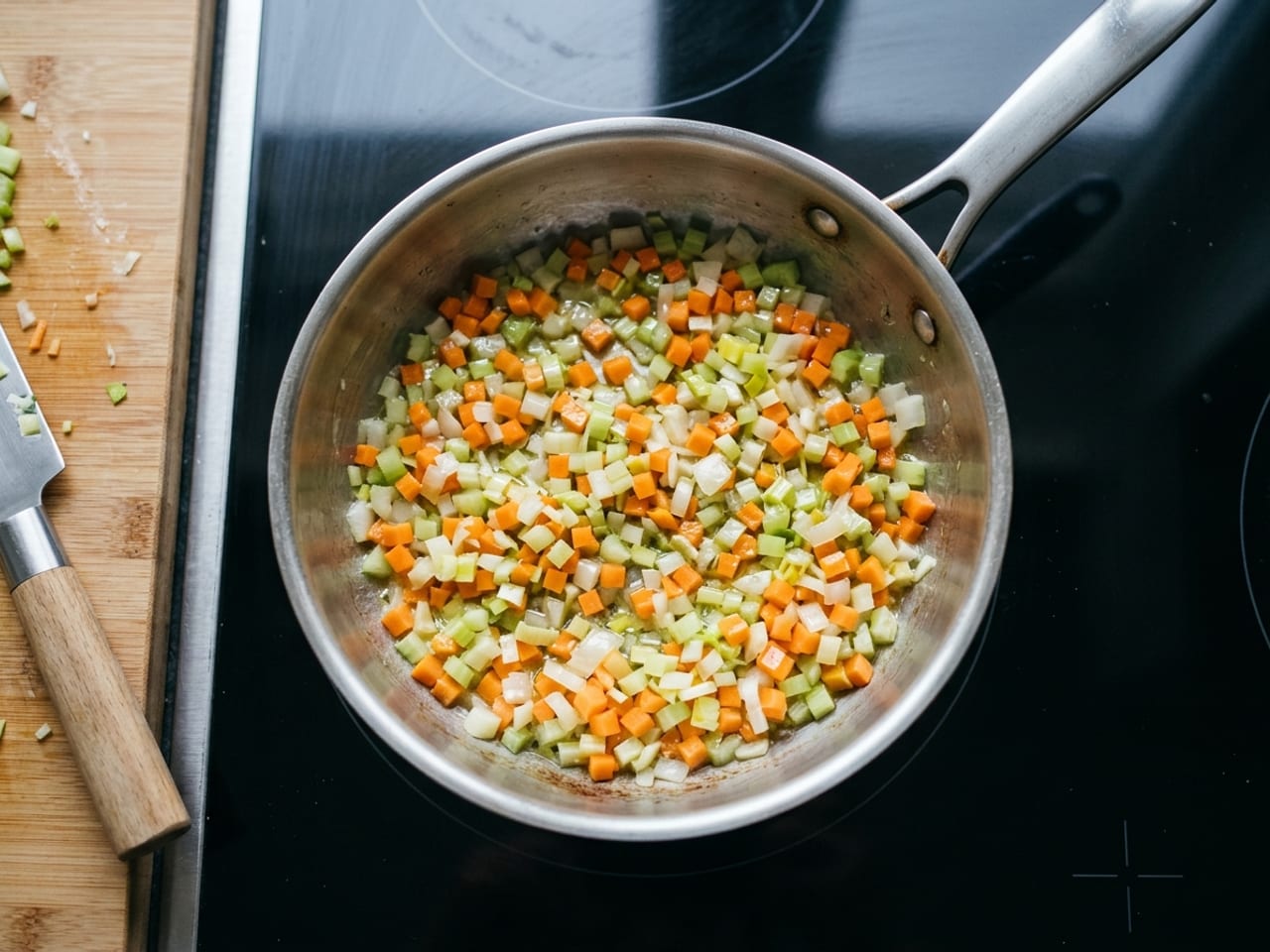 SweatedBrowned
Sweated or browned: every source that says
Nine of the 18 rows below have no browning step, four brown it (all before 1870), three blanch it for a garnish, and two allow either. So browning was one practice, not the definition, which matters for the name.
| Source | Year | What it does | Verdict |
|---|---|---|---|
| Ude, The French Cook24 | 1813 | Fried in butter in summer, blanched in winter, "without having lost their original colour" | Not browned |
| Beauvilliers, L'Art du cuisinier25 | 1814 | Fried in clarified butter: "faites-leur prendre couleur" (make them take colour) | Browned |
| Carême, L'Art de la cuisine française26 | 1833 | "légèrement roussir" in butter, to "une couleur blonde et bien égale" (an even blond) | Browned |
| Francatelli, The Modern Cook28 | 1846 | Fried with butter and sugar until they have "a light brown colour" | Browned |
| Dubois and Bernard; Dubois29, 32 | 1864; 1893 | Blanched, then finished in broth with a little sugar and glazed; no browning step | Not browned |
| Gouffé, Le livre de cuisine30 | 1867 | Blanched, then "faites revenir d'une couleur rouge" (fried to a red-brown, ours) | Browned |
| Ranhofer, The Epicurean33 | 1894 | Fried "colorless" | Not browned |
| Senn, Practical Gastronomy34 | 1895 | "do not let them take colour" | Not browned |
| Escoffier, Le Guide culinaire; A Guide to Modern Cookery35, 36 | 1907 | "étuver doucement au beurre"; in English "stew them in butter" | Not browned |
| Hering, Lexikon der Küche37 | 1909 | "gedünsteten Gemüsen" (stewed vegetables) | Not browned |
| OQLF (Quebec)45 | 1983 | "étuvés au beurre" (stewed in butter) | Not browned |
| Larousse gastronomique12 | 1997 | "Souvent étuvée au beurre" (often stewed in butter) | Not browned |
| Gisslen, Professional Cooking2 | 2011 | "Sweat lightly in butter"; in his barley soup, "Do not let them brown" | Not browned |
| On Cooking3 | 2007 | Consommé brunoise: "blanched or sautéed brunoise of turnip, leek, celery and onion" | Either |
| CooksInfo53 | 2018 | "gently cooked in butter"; as a soup garnish "blanched very briefly in boiling, salted water", then iced | Blanched |
| The Savoy Food and Drink Book62 | 1988 | Carrot and leek "cut in brunoise and blanched" | Blanched |
| Wikipedia (English)51 | read 2026 | "blanched briefly in salty boiling water, then submerged in salted ice water" | Blanched |
| Vocabulary.com50 | read 2026 | "quickly boiled and cooled" for a garnish, "or they may be browned in butter" | Either |
Cook time and size
Gisslen's rule for mirepoix is the nearest the sources give: "small pieces if cooking time will be short, larger pieces for longer cooking times", and "the size to which you cut mirepoix depends on how long it is to be cooked"; for a long beef stock he cuts 1 to 2 in (3 to 5 cm).2 No study we found times brunoise against a larger dice. Purdue Extension says carrots "take longer to sauté or stir-fry than" peppers, zucchini, onions, eggplant or celery, so in a mixed brunoise the carrot may be the slow one, though at brunoise size the gap is probably small (ours).72 The times the sources print:
| Source | What | How long |
|---|---|---|
| CIA (2011), a recipe1 | Shallots sweated until tender (the cut is not shown in the fragment) | about 2 minutes |
| Practical Cookery (2015)6 | Vegetables sweated without colour (the cut is not shown) | 3 minutes |
| Escoffier (1907)35 | Ham "en fine brunoise" simmered in a tomato demi-glace | 5 to 6 minutes |
| The French Cooking Academy, sauce vierge63 | "finely diced shallot" and diced tomato warmed in olive oil | 5 to 6 minutes |
| Gisslen (2011), barley soup2 | Onion, carrot and turnip cut brunoise, sweated | until about half-cooked |
| Senn (1895), consommé brunoise34 | Very small dice simmered in the clear soup | about half an hour |
| Gilbert (1890)31 | "dés très fins" simmered in the soup | 35 to 40 minutes |
| Ude (1813)24 | The diced roots boiled in rich broth | about an hour |
| Gouffé (1867)30 | Half-centimetre squares, browned, simmered in the soup | 2 hours |
Is brunoise a base for stocks? Wikipedia says brunoise is used "in stocks and soups to rapidly increase the rate that flavours and aromas are transferred", citing a food dictionary (Herbst and Herbst, 2013) that we did not read; none of the textbooks we read puts brunoise in a stock, and Gisslen sizes stock vegetables to the simmer, large for long ones.2, 51 By that rule (our reading) a brunoise suits cooks short enough that tiny pieces do not dissolve: garnishes and quick sauces.
Consommé brunoise, the garnish the books call classic
Escoffier's Consommé à la Brunoise is for 2 litres of consommé (about 2 quarts, ours): 300 g (about 10½ oz, ours) of the red part of carrot, 200 g (about 7 oz) of turnip, 3 medium leek whites, 2 small celery sticks and half a small onion, cut "en dés de 3 millimètres de côté", seasoned with salt and a pinch of sugar, "étuver doucement au beurre" (stewed gently in butter) and finished in half a litre (about 2 cups, ours) of consommé; at service, peas, diced French beans and chervil.35 His English edition of the same year gives other quantities (two small carrots, one small turnip) and no size.36 As a garnish for any soup, he measures juliennes and brunoises "à raison d'une ou 2 cuillerées par litre de potage", one or two spoonfuls a litre.35
Gisslen's version sweats onion or leek, carrot, celery and turnip "lightly in butter" and simmers them in a little consommé, but cooks the garnish separately and adds "1-2 tbsp (15-30 mL) garnish to each portion" at service; "All cuts should be small enough to fit the bowl of a spoon." 2 The CIA calls "a fine brunoise of vegetables" a traditional consommé garnish, On Cooking a "blanched or sautéed" one, and Practical Professional Cookery garnishes a batch of its consommé with 100 g (about 3½ oz, ours) of cooked brunoise (the fragment we read does not say how many portions).1, 3, 7 Escoffier's variants add poached eggs (à la Colbert), quenelles, barley or rice.35
Sauces, vinaigrettes, salsas and tartare
- A fine mirepoix for sauces. Escoffier cut his mirepoix "en brunoise plus ou moins fine selon l'emploi" and the Bordelaise one "excessivement fine", made in advance; Gisslen's curry sauce starts with "mirepoix, cut brunoise" cooked "until tender but not brown". 2, 35, 36
- Finished sauces. Escoffier's Ecossaise sauce is "an Allemande sauce, combined with a brunoise of vegetables"; Larousse says brunoise garnishes sauces and flavours crayfish and osso buco.12, 36 Gisslen's bordelaise and shallot butter use chopped or minced shallots, not brunoise.2
- Vinaigrettes and mignonette. Gisslen's Mignonette is "Shallots, cut brunoise" in wine vinegar; a chefs' congress vinaigrette takes piquillo peppers, shallot and garlic, each "brunoise".2, 62
- Relishes and salsas. Gisslen's Vegetable Caper Relish cuts carrot, zucchini, fennel, shallot, roasted pepper and cucumber brunoise, sweats the first four "just until the vegetables soften slightly", then mixes in the pepper, cucumber, capers and vinegar; his Fruit Salsa has "Red onion, cut brunoise"; the CIA's relish a jalapeño and red onion "cut into brunoise".1, 2
- Tartare. Gisslen's Tuna Tartare says "Mince the tuna" and does it in the brunoise moves, slices, then strips, then "very small dice" (our reading), with minced shallots, mixed "shortly before" serving because the lime acid coagulates the protein.2 Raw onion tastes stronger the finer it is cut ("Minced onion tastes stronger than chopped onion", Cook's Illustrated), and we expect the same of shallot (ours); cut onion keeps changing: in one study the tear compound dominated the first 10 minutes and the compounds thought to give the onion smell peaked at 60 minutes.65, 68
Can you cut brunoise ahead? How long it keeps
No regulator or university we read gives a home keeping time for cut carrot, onion or pepper. Larousse says a brunoise is generally used as soon as it is ready, while Escoffier made his finest mirepoix in advance. The day counts we found are a trade body's 7 days for cut onion and four industrial ones from the USDA handbook: commercial packs in controlled cold rooms, not a tub in a home fridge.12, 36, 69, 70
| Source | What | Kind | Ahead, and how long |
|---|---|---|---|
| Larousse gastronomique (1997)12 | Brunoise | Practice | "généralement utilisée aussitôt prête" (generally used as soon as it is ready), or kept "quelques instants sous un linge humide" (a few moments under a damp cloth) |
| Escoffier (1907), English edition36 | Mirepoix | Practice | The coarse mirepoix is made "immediately before being used, but this is not so in the case of the finer Mirepoix" |
| America's Test Kitchen66 | Raw onion | Test kitchen | "it is best to chop them immediately before you need them" |
| America's Test Kitchen66 | Chopped onion, cooked | Test kitchen | Onions chopped on four successive days: most tasters could pick the older ones when cooked gently in butter, "very few" in a braise. "If onions are a mere accent in your dish, feel free to prep them in advance" |
| National Onion Association69 | Cut onion | Trade body | Up to 7 days in a sealed container in the fridge (its FAQ page says 7 to 10 days at 40°F (4°C, ours) or below) |
| USDA Agriculture Handbook 66 (2016)70 | Diced onion | Industry | "A storage life of 10 days is possible" in polymer bags at 2°C (36°F) |
| USDA Agriculture Handbook 66 (2016)70 | Diced bell pepper | Industry | Visual quality kept 15 days at 1°C (34°F) in the studies it reviews |
| USDA Agriculture Handbook 66 (2016)70 | Sliced celery | Industry | One 1974 study: "can only be maintained for 6 days at 4°C (40 °F) without notable quality change"; the handbook's general figure for fresh-cut celery sticks is "typically 12 to 14 days at 0 to 5 °C (32 to 41 °F)" |
| USDA Agriculture Handbook 66 (2016)70 | Cut carrot | Industry | Kept at 1 to 3°C (34 to 38°F); 0.5 cm (about 3/16 in, ours) slices treated with ascorbic acid in modified-atmosphere packs were unaffected for 14 days at 4°C (39°F) |
| FDA Food Code (2022, 2026)76 | Cut raw carrot, celery | US food business | "cut, raw vegetables such as celery or carrot sticks or cut potatoes ... may be immersed in ice or water" |
| CDC (2019); FDA consumer advice77, 78 | Any cut produce | Home | Into the fridge within 2 hours of cutting, within 1 hour if it is above 90°F (32°C, ours) outside; refrigerate pre-cut produce |
Why cut carrot turns white. "As the cut surface loses water, adhering cellular debris may impart a white blush" (USDA handbook): drying of the cut surface is the cause both the handbook and a 2007 study give, and a brunoise has far more cut surface than a stick (our arithmetic on the cut). That study, on baby carrots, found that spinning them dry longer made them whiter; it also says several earlier studies add lignin formation, a part we did not find settled.70, 71 Our suggestion: cut the same day, cover the cubes and keep them cold.
Food safety. The FDA Food Code names cut tomatoes, cut melons and cut leafy greens as foods that need time or temperature control; cut onion and carrot are not named. So a tomato brunoise (concassé) goes in the fridge like any cut tomato: for US food businesses under the Food Code, held at 41°F (5°C) or below. The Code also lets a business hold "cut, raw vegetables such as celery or carrot sticks" in ice or water, and a cooked brunoise is heat-treated plant food, which the Code also treats as controlled unless it has been modified so it cannot support growth.76 At home, wash vegetables before cutting and get any cut vegetable into the fridge within 2 hours, within 1 hour if it is above 90°F (32°C, ours) outside, as the CDC advised in 2019.77, 78 The same rule is on our knife skills guide.
Brunoise as a garnish: where it goes and how much
A brunoise goes on the plate in small amounts: spooned into a soup or around the main item (our summary of the chef books below), scattered on top, or folded into a sauce or salsa. No book we read gives plate geometry or grams per plate beyond the soup spoonful. Gisslen's modern garnish is "small edible items (smaller than side dishes) intended to enhance the visual appeal of the dish", whose "Flavors and textures ... should serve as an appropriate complement or contrast", and "Garnishes are not added just for color."2
- How much: 1 or 2 spoonfuls a litre of soup (Escoffier); 1 to 2 tbsp (15 to 30 mL) a portion of consommé (Gisslen). Plant-based fine dining spoons "tablespoons each of the celery root brunoise, red apple brunoise, and Granny Smith apple brunoise into each bowl" (chef practice).2, 35, 62 For a plate, a spoonful or two is our suggestion; Gisslen's rule for buffet platters is that the garnish "should enhance, not overwhelm, the main item", which we apply to a plate.2
- When: at service. Gisslen adds the consommé garnish "At service time"; Escoffier adds his peas, beans and chervil at the end; Fine Dining Lovers sprinkles brunoise "on top of some dishes as an aromatic garnish prior to serving".2, 35, 55 A raw shallot or onion brunoise is cut last (why).
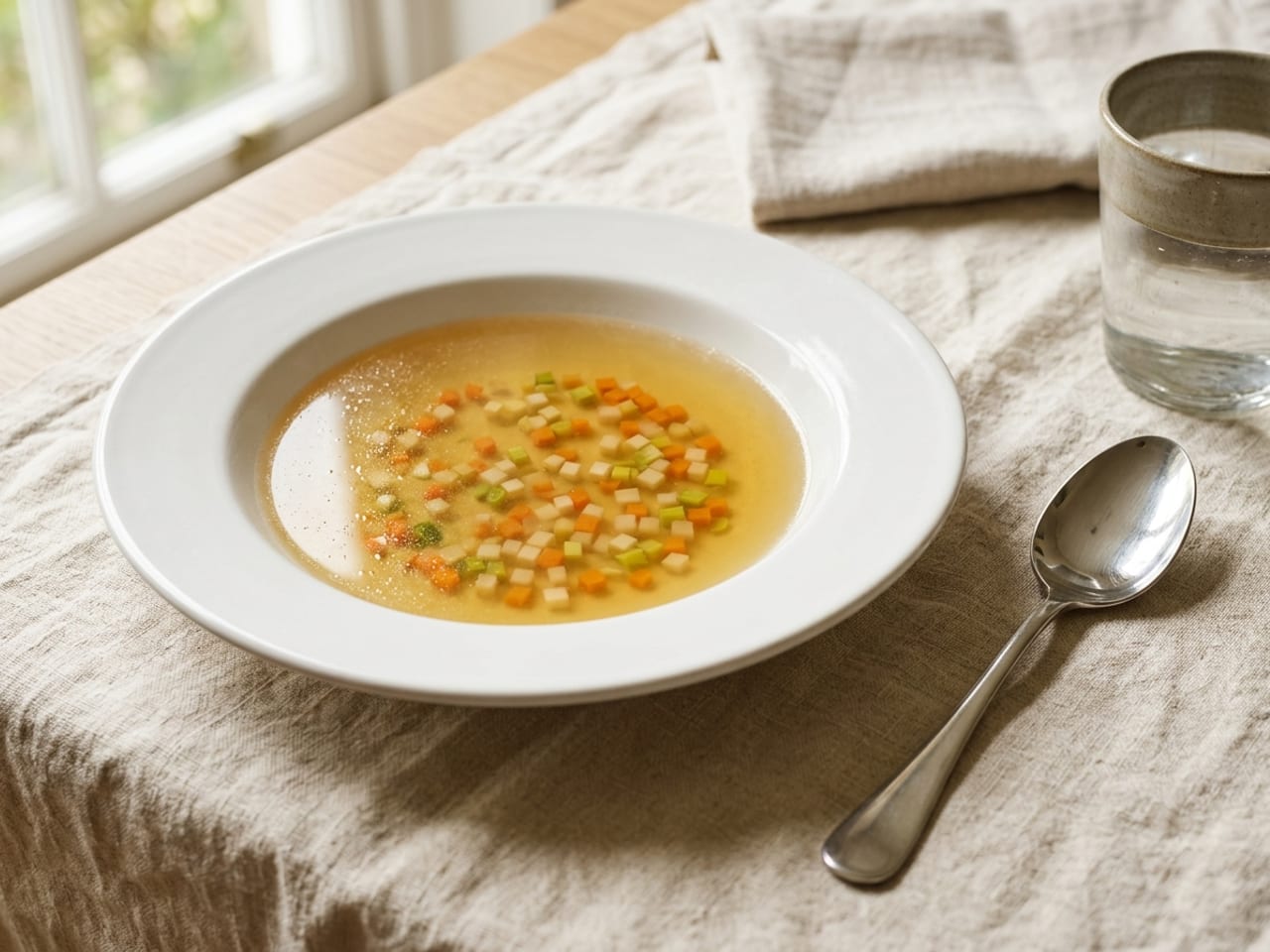
- Where: in the bottom of a soup plate or scattered over a clear soup; in a pool of broth or sauce (our hero image; Practical Cookery lists a fine brunoise of vegetables and tomato as a garnish with a liquid); as a named part of a main course (the French Culinary Institute's "Roasted Pork Tenderloin with Vegetable Brunoise and Potatoes"); spooned over as a relish or vinaigrette.2, 6, 62
- Colour: Escoffier mixed the orange of carrot with white turnip, pale leek and celery; Gisslen's relish puts orange carrot, green zucchini skin and red pepper together; Voltaggio cuts red and green pepper.2, 35, 62 Why they chose those colours, none of them says: two or three colours, cut to one size, is our suggestion.
- Cut well, or it shows: "If vegetables are improperly cut during prep, the plate presentation will look improper" (Gisslen).2
On our recipe pages, the birria consommé is topped with "a confetti of finely diced white onion", a home cousin of the brunoise garnish. More garnish ideas are in our food garnish guide; for the sauce or broth under it, sauce plating; for the composed plate, plating techniques.
Knives, mandolines and brunoise machines
A sharp chef's knife is the textbook tool (above), and the knife skills guide adds that a santoku or a nakiri works as well: which knife matters less than a sharp edge.
- Mandoline: the CIA lists it for "Slicing, julienning, cutting gaufrettes and batonnets": it makes the planks or the sticks, and you cut across by knife.1 America's Test Kitchen: "Wear a cut-resistant glove on the hand you use to hold the food", and "A sharp blade is the safest blade."74
- Brunoise machines: Robot Coupe's own listing for its CL 50 Gourmet gives brunoise discs of 2, 3 and 4 mm (5/64, ⅛ and 5/32 in, the maker's twins), the 3 mm disc included; its Australian page for that disc says "25 kg of brunoises in 6 minutes flat!" (about 55 lb, ours), a maker's claim with no method given. Its ordinary dicing kits start at "5 x 5mm (3/16'')", nearer a small dice than a brunoise (ours).73 A disc cuts in one pass what the textbooks cut julienne-then-across (our reading).
- Hand dicers and choppers: we found only shopping round-ups, no test of one on brunoise, so we print no claim. Dubois in 1893 already allowed "à la machine" beside the knife.32
- Safety: curl the fingertips, slice rather than press, keep the board steady (ours), and use a glove on a mandoline; with chiles, gloves and a washed board (CIA). The rest is in our knife skills guide.1, 2, 74
Yield. Neat sticks cost weight (squaring off is our reading): USDA counts 0.70 lb of carrot sticks against 0.83 lb chopped from each pound bought (that is, 70% against 83%, ours), while The Book of Yields gives a rutabaga brunoise the same 81.3% as the whole root, because it measures trimming and peeling, not the squared-off scraps (our reading).21, 75 Keep the scraps for soup or stock.
Brunoise meaning and history: Brunoy or brun?
In the books we read, brunoise was a soup before it was a size. "Un potage à la Brunoy" is in print in 1808 and "La Brunoise" in 1813; the dice were browned by some cooks and not by others, sized against cooked rice, in French lines or in half-centimetres, until Escoffier printed 3 mm (1903) and the US textbooks ⅛ in.4, 22, 24, 25, 26, 30, 35 The dates below are the earliest we found in the scans we could search: floors, not origins.
| When | What we found |
|---|---|
| 1808 | "Un potage à la Brunoy" on Grimod de La Reynière's autumn menus, with no reason for the name: the earliest print link to the town of Brunoy we found.22 |
| 1813 | Ude's "La Brunoise" in London: carrots and turnips "cut them into dice", kept "without having lost their original colour", boiled an hour in broth; his bill of fare lists "La Brunoise au consommé clair". No size.24 |
| 1814 | Beauvilliers' "Potage à la Brunoise": browned, and with rice the dice "pas plus gros que le riz lorsqu'il est crevé", no bigger than cooked rice.25 |
| 1815 to 1822 | Carême's menus: "La brunoise au beurre d'écrevisses" (1815) and "Le potage à la Brunoise au blond de veau" (1822): a standard menu soup.26 |
| 1822 | Raimbault's soup (fourth edition, 1822 by the Internet Archive's catalogue) uses the julienne's vegetables, "à la seule différence qu'il faut les couper en dé", cut in dice instead; a copy catalogued 1811 has the same index entry (that date is unverified), so the book may predate Ude.23 |
| 1828 | The Oxford English Dictionary's earliest English evidence, the London Literary Gazette; Ude's English book of 1813 is older.24, 43 |
| 1833 | Carême: "petits dés de deux lignes carrées", about 4.5 mm or 3/16 in (ours: a ligne is about 2.26 mm), browned blond; he also writes "petits dés semblables à la brunoise", using the word for a shape.26 |
| 1846 | Soyer in London cuts his brunoise roots with "a small diamond cutter": diamonds, not dice.27 |
| 1846 | Francatelli's Brunoise Soup: "small dice" fried to "a light brown colour".28 |
| 1864 | Dubois and Bernard: "petits dés réguliers, au couteau ou au coupe-racine" (small regular dice, by knife or root-cutter), blanched, not browned.29 |
| 1867 | Gouffé: "petits carrés d'un demi-centimètre", 5 mm (about 3/16 in, ours), fried red-brown and simmered 2 hours; elsewhere "1 décilitre de brunoise", a measured garnish.30 |
| 1877 | Kettner's Book of the Table complains that one soup "appears in cookery books under nine or ten different names", brunoise first among them, and adds: "Some of the cookery books call the soup Potage à la Brunoy".38 |
| 1890 | Gilbert: "dés très fins", sweated, simmered 35 to 40 minutes.31 |
| 1893 | Dubois: "dés fins soit au couteau, soit à la machine", and meat cut "comme la brunoise" is a salpicon (the date is the Internet Archive catalogue's).32 |
| 1894 | Ranhofer in New York: "quarter inch squares", about 6 mm (ours), fried "colorless".33 |
| 1895 | Senn in London: "the smaller the better", "do not let them take colour".34 |
| 1903 and 1907 | Escoffier: "dés de 3 millimètres de côté" for the consommé, the same in both French editions; elsewhere grosse, fine and "excessivement fine".35 |
| 1907 | Escoffier's English edition: "small dice", no figure.36 |
| 1909 | Hering's German kitchen lexicon: "Kleinwürfelig geschnittene Gemüse", small-cubed vegetables.37 |
| 1955 | A dish-name dictionary: "Brunoy, a district in France, celebrated for its spring vegetables", with no source (read as a search fragment).39 |
| 1960s to 1970s | The English New Larousse Gastronomique: soup brunoise "about 3 mm" (a search fragment; catalogue dates 1960 and 1977).13 |
| 1978 | The CIA's Professional Chef's Knife: regular brunoise ⅛ in (3.2 mm) and fine 1/16 in (1.6 mm), the earliest US table of fixed brunoise and fine brunoise sizes, and the earliest ⅛ in, that we found (a search fragment; catalogue date).4 |
| 1983 | Quebec's OQLF entry (updated 1983): brunoise is the stewed mixture, the operation and the cut, with no size.45 |
| 1996 to 1997 | Larousse gastronomique: "1 ou 2 mm de côté".12 |
| 2002 | A French CAP textbook: 2 mm (catalogue date).11 |
| 2016 | The Oxford English Dictionary first publishes its entry, a noun only.43 |
Where the word comes from: Brunoy, probably; brun, unsourced
No dictionary we read gives a source for the name. The OED says only "a borrowing from French", the Danish national encyclopedia "af ukendt oprindelse" (of unknown origin), and the French dictionaries TLFi and Littré have no entry; Dictionary.com has none either. We could not read Merriam-Webster, Collins or Etymonline.43, 46, 47, 49
Brunoy is the earliest print link we found. Brunoy is a town south-east of Paris, and Grimod's "potage à la Brunoy" of 1808 comes five years before Ude's "La Brunoise" (our arithmetic).22, 24 Eight later sources name Brunoy, none with evidence: Kettner (1877), French Wikipedia (tagged "citation needed"), CooksInfo ("reputedly") and Tasting Table, which repeats it, Food Republic ("developed by chefs in Brunoy"), a 1955 dish dictionary that calls Brunoy "celebrated for its spring vegetables", a 1968 menu guide and a 1979 menu guide.38, 39, 41, 42, 52, 53, 54, 57 So: probably Brunoy, unproven, and we found no named inventor.
"From brun, brown" has one unsourced source. A German hospitality glossary (g-wie-gastro) says the word comes from "brunir", to brown, because the vegetables are "häufig in Butter angebraten" (often fried in butter) and lightly browned, and gives no source.56 The browned-soup story fits Beauvilliers, Carême, Francatelli and Gouffé, but the earliest dated recipe we found, Ude's, keeps the dice "without having lost their original colour", and Escoffier and Larousse stew them in butter with no browning step (the tally). A brun word Littré does list is the old verb brunoyer, "to look brownish" (our translation of "Avoir une teinte brunâtre"), which is not brunoise.12, 24, 35, 46
| Source | Kind | What it says about the name |
|---|---|---|
| Oxford English Dictionary43 | Dictionary | "brunoise is a borrowing from French"; no further source on the free page |
| Wiktionary (English; French)44 | Dictionary | "Borrowed from French"; the French entry: "Étymologie manquante ou incomplète" (etymology missing) |
| TLFi; Littré46 | Dictionary | No entry: Littré prints "Mot brunoise non trouvé" |
| Le Robert; Larousse online; Larousse gastronomique12, 46 | Dictionary | A definition, no etymology |
| Duden (German)48 | Dictionary | "französisch brunoise", from French, no further |
| Lex.dk (Danish)47 | Dictionary | "fransk, men af ukendt oprindelse": French, but of unknown origin |
| Dictionary.com; The Free Dictionary49 | Dictionary | No entry |
| Littré, brunoyer46 | Dictionary | A different word: the old verb brunoyer, to look brownish, is from brun, "fait comme verdoyer"; it is not brunoise |
| Wikipédia (French)52 | Encyclopedia | "Le nom provient de la commune de Brunoy", tagged "[réf. nécessaire]" (citation needed) |
| CooksInfo53 | Web | "reputedly popularized" in Brunoy, "Thus its name"; no source |
| Kettner's Book of the Table (1877)38 | Cookery book | "Some of the cookery books call the soup Potage à la Brunoy"; the word "has not been adopted by any of the classical French dictionaries"; no source for the link |
| Tasting Table54 | Web | "The name is derived from the Brunoy commune in France, where the cut was popularized" (repeats CooksInfo); no source |
| Food Republic57 | Web | "developed by chefs in Brunoy, France to elevate the visual presentation of dishes"; no source, and no inventor named |
| g-wie-gastro Hogapedia (German trade glossary)56 | Web | "leitet sich von der Zubereitungsart „brunir“ ab, was „bräunen“ bedeutet": from brunir, to brown; no source given |
| Classical Recipes of the World (1955)39 | Dish dictionary | "Brunoy, a district in France, celebrated for its spring vegetables"; no source |
| Combes, Dictionary of Cuisine French (1962)40 | Dish dictionary | Lists "brunois adj. of Brunoy" next to brunoise, with no etymology |
| Pan Am, Menu Translator (1968)41 | Menu guide | "named for the Brunoy district" (a search fragment, cut off); no source |
| Atkinson, Menu French (1979)42 | Dish dictionary | Reads "la brunoise" as "in Brunoy style", with no evidence |
Classic dishes. Potage or consommé à la brunoise (Ude, Beauvilliers, Carême, Escoffier); Brunoise à la Colbert with poached eggs, and brunoise with quenelles, barley or rice (Escoffier); a purée of lentils "a la brunoise" (Francatelli); Escoffier's Consommé Souveraine, quenelles stuffed "with a very fine brunoise".24, 25, 26, 28, 35, 36 Julienne and chiffonade began as soups too: the julienne story and the chiffonade story.
Brunoise troubleshooting
| Problem | Likely cause | Fix |
|---|---|---|
| Little rectangles, not cubes | The crosscuts were wider or narrower than the sticks (our reading of the method) | Cut across at exactly the stick width, ⅛ in (3 mm); start from planks and sticks of one thickness1, 2 |
| Uneven pieces | Planks of different thickness, or a carrot not squared off | Square it first; the CIA warns that "Unevenly cut items give an impression of carelessness that can spoil the dish's look"1 |
| Crushed, wet cubes | A dull edge, or pressing straight down | A sharp knife and a slicing stroke: "Do not press the knife straight down" (CIA)1 |
| A soft vegetable turns to mush | Ripe tomato, cucumber flesh, soft fruit | Seed and trim to firm flesh first (CIA); Ripert: "If the vegetable is too soft, then a fine brunoise is a nightmare". Cut it larger (a gros brunoise) if it will not hold (ours)1, 6, 20 |
| The onion falls apart before you cut across | The lengthwise cuts went through the root | "Do not cut through the root end" (Gisslen); or use the no-horizontal-cut method2, 55, 64 |
| Raw shallot or onion tastes harsh | More cutting, stronger flavour: ATK finds minced onion stronger than chopped, and we extend that to shallot (ours) | Cut it just before it is used raw (ATK); for a mignonette or tartare, cut it last65, 66 |
| Carrot cubes turn white on the surface | "white blush": the cut surface drying out (USDA handbook, Moretti 2007) | Cover the cubes and keep them cold, or cut them closer to use (ours)70, 71 |
| A mixed brunoise cooks unevenly | Carrots "take longer to sauté or stir-fry than" onions, peppers or celery (Purdue, on stir-fries; our guess that it holds for tiny cubes) | Start the carrot first, or cut it a touch finer (ours)72 |
| It browned when you wanted it pale | Too much heat for a sweat | Sweat it: "To cook slowly in fat without browning, sometimes under a" cover (Gisslen)2 |
| The consommé clouds | Raw garnish cooked in the clear soup | "prepare and cook the garnish separately" and add it "At service time" (Gisslen)2 |
| Too much waste from squaring off | Neat shapes cost weight (squaring off is our reading) | Use the trimmings in soups or stock (Gisslen); USDA counts 0.70 lb of carrot sticks against 0.83 lb chopped per pound bought (70% against 83%, ours)2, 75 |
Photograph your plate, see it re-plated
Tiny cubes on the dish and not sure where they go? Photograph the plate and Plate Artists re-plates that dish, with the food kept as it is and the changes named so you can repeat them. Start with a re-plate.
Your food, plated like a chef's
Snap it, upload it, and get the composed version back, with the steps to recreate it at home.
Start free · 1 enhancement →Free account · 1 free enhancement · No credit card
Brunoise terms, defined
Twelve words the site does not already define: brunoise and julienne are in our food garnish glossary, the knife words in our knife skills guide, and every cut's size in the chart.
Gros brunoise · grosse brunoise, coarse brunoise
A coarser brunoise: about 4 mm (about 5/32 in, ours) in one British diploma book; Practical Cookery uses the name for Scotch broth and tomato concassé without a size.
Where it comes from. Escoffier's "grosse brunoise"; a British diploma book's "Gros brunoise 4mm x 4mm dice".8, 35, 40
Brunoise excessivement fine
Escoffier's exceedingly fine brunoise, finer than his 3 mm consommé dice (our reading), with no number given.
Where it comes from. Escoffier's Mirepoix fine dite à la Bordelaise.35
Consommé brunoise · consommé à la brunoise
A clear soup garnished with a brunoise of carrot, turnip, leek, celery and onion, cooked in butter and consommé.
Where it comes from. Escoffier p. 153; Gisslen; the CIA; Practical Professional Cookery.1, 2, 7, 35
Potage à la brunoise · brunoise soup
In the earliest books we found, the soup the word named: broth with diced roots, sometimes with rice, bread or pasta.
Where it comes from. Ude 1813, Beauvilliers 1814, Carême; Gouffé's with pasta.24, 25, 26, 30
Brunoise à la Colbert
Escoffier's brunoise soup with small poached eggs added; his other variants add quenelles, barley or rice.
Where it comes from. "Avec adjonction de petits œufs pochés, la Brunoise ordinaire devient Brunoise à la Colbert" (Escoffier).35
Mirepoix à la Bordelaise · fine mirepoix
A fine mirepoix of carrot, onion and parsley stalks cut very fine brunoise and made in advance, for crayfish and lobster.
Where it comes from. Escoffier, in brunoise "excessivement fine"; Saulnier: "Fine Brunoise of carrots, onion and parsley roots".14, 35, 36
Matignon
Escoffier's flavouring base of carrot, onion, celery and raw ham cut in fine paysanne, not brunoise.
Where it comes from. "Émincer en fine paysanne": carrot, onion and celery (Escoffier).35
Salpicon
Meat or other food cut small like a brunoise: the name Dubois gives a dice of meat.
Where it comes from. Dubois: meat cut "comme la brunoise, prennent le nom de salpicon".32
Étuver · étuvé, étuvée
French for cooking gently in fat; the French books we read use it for brunoise and none browns it (our reading of the word).
Where it comes from. Escoffier's "étuver doucement au beurre"; Larousse's "étuvée au beurre".12, 35, 45
Brunoyer
An old French verb, to look brownish, from brun: a different word from brunoise, not its source.
Where it comes from. Littré: "Brun. Ce verbe est fait comme verdoyer".46
Ligne · line
The old French line, about 2.26 mm (ours): the unit Carême sized his brunoise in.
Where it comes from. Carême's "petits dés de deux lignes carrées"; Raimbault's julienne "d'une demi-ligne".23, 26
White blush
The whitish film on cut carrot as its surface dries; drying is what the USDA handbook names, and a 2007 study also cites lignin, which we did not find settled.
Where it comes from. "white blush on 'baby' carrots decreases the intensity of the underlying orange color" (USDA handbook).70, 71
Brunoise, answered
What is brunoise?
A knife cut: vegetables cut into tiny even cubes by cutting a julienne across. In the US textbooks a brunoise is ⅛ in (3 mm) on each side and a fine brunoise 1/16 in (1.5 mm). The word also names the soup garnish of diced carrot, turnip, leek, celery and onion cooked in butter, as in consommé brunoise, which Le Cordon Bleu calls "the classic consomme garnish".
What size is a brunoise cut in mm and inches?
⅛ in (3 mm) cubes in the US textbooks (the CIA, Gisslen), and 3 mm (about ⅛ in, ours) in Escoffier's French Guide culinaire of 1907. Practical Cookery and the City & Guilds books print 2 mm (about 1/16 in, ours), Larousse gastronomique (1997) 1 or 2 mm (about 1/25 to 1/16 in, ours), and a coarser British "gros brunoise" 4 mm (about 5/32 in, ours). In the sources since 1903 that we read, the printed sizes run from 1 to 4 mm (about 1/25 to 5/32 in, ours); 19th-century cooks cut up to ¼ in (about 6 mm, ours).
What is fine brunoise?
A smaller brunoise, 1/16 in (1.5 mm) cubes, cut from a fine julienne (CIA, Gisslen, On Cooking). It is the smallest cut with a set size on our knife cuts chart, though Escoffier's "brunoise excessivement fine" and the 1 mm (about 1/25 in, ours) end of Larousse's 1 or 2 mm and one British textbook are finer still. CooksInfo says "In France, the fine brunoise is the standard", citing an English Larousse we could not read; the French books we read give 1 to 3 mm (about 1/25 to ⅛ in, ours), and Gouffé printed 5 mm in 1867.
How do you pronounce brunoise?
broon-WAHZ. The Oxford English Dictionary gives /brʊˈnwɑːz/ for British English and /bruˈnwɑz/ (broo-NWAHZ) for American; in French it is /bʁy.nwaz/, with the French ü in the first syllable.
What does brunoise mean, and where does the word come from?
In cooking, tiny diced vegetables, the cut and the garnish made from them. No dictionary we read gives a source for the name: the OED says only that it is borrowed from French, a Danish encyclopedia says its origin is unknown, and TLFi and Littré have no entry. The earliest print link we found is to the town of Brunoy: 'un potage à la Brunoy' in 1808, five years before 'La Brunoise' (Ude, 1813). That link is probable, not proven. One German trade glossary derives it from brunir, to brown, with no source; no dictionary we read gives a source for either.
Does brunoise mean browned?
One German trade glossary says so, with no source; no dictionary we read does. The earliest recipe we found (Ude, 1813) keeps the dice 'without having lost their original colour'; Beauvilliers (1814), Carême, Francatelli and Gouffé browned them, while Escoffier and Larousse stew them in butter (étuver) with no browning step, and Gisslen says 'Do not let them brown'. Browning was one practice, not the definition.
Is brunoise a verb?
Wiktionary lists the verb (brunoised, brunoising), and Fine Dining Lovers writes 'what it means to brunoise your vegetables', but the Oxford English Dictionary has brunoise only as a noun. Textbooks usually write 'cut brunoise' or 'cut into brunoise'.
What is the difference between brunoise and small dice?
Size and the stick they start from. A brunoise is ⅛ in (3 mm), cut from a julienne; a small dice is ¼ in (6 mm), cut from a batonnet. The small dice has twice the edge and about eight times the volume (our arithmetic). Food Republic keeps small dice for dishes that want "a more prominent vegetable bite" and brunoise for aromatics and garnish.
Is brunoise the same as mince or a fine dice?
No. Gisslen defines mince as 'to chop into very fine pieces': chopped, irregular, with no set size. A brunoise is cut cube by cube to a set size. 'Fine dice' is loose: Food Republic uses it for brunoise, while the US textbooks keep 'fine' for the 1/16 in (1.5 mm) fine brunoise.
What is the difference between julienne and brunoise?
A julienne is a stick, ⅛ × ⅛ × 1 to 2 in (3 × 3 × 25 to 50 mm); a brunoise is that stick cut across into cubes, ⅛ × ⅛ × ⅛ in (3 × 3 × 3 mm). A fine julienne gives a fine brunoise.
How do you brunoise an onion or a shallot?
Halve it through the root, peel it, make lengthwise cuts toward the root without cutting through it, a few horizontal cuts, then slice across (Gisslen). For brunoise, space the cuts about ⅛ in (3 mm) (our application), the fine end of America's Test Kitchen's 1/8 to 1/4 inch spacing for minced onion. Cut a raw shallot just before you use it.
How do you brunoise a bell pepper, tomato or celery?
Pepper: cut the walls into flat panels, slice off the pale membrane, julienne and cut across. Tomato: peel and seed it, trim the flesh to an even thickness (CIA), then cut; British books call this a gros brunoise. Celery: cut the stalk into lengths and plank, julienne and cut across like a carrot (ours).
What is brunoise used for?
As a soup garnish, above all consommé brunoise (Le Cordon Bleu: 'the classic consomme garnish'); also in sauces (a fine mirepoix, Escoffier's Bordelaise mirepoix, Gisslen's curry sauce), stuffings, relishes and salsas, mignonette and vinaigrettes. Escoffier measured it at 1 or 2 spoonfuls a litre of soup, Gisslen 1 to 2 tbsp (15 to 30 mL) a portion.
Is brunoise used for stock?
Not in the textbooks we read. Wikipedia says brunoise is used in stocks, but Gisslen sizes mirepoix by cooking time: large pieces of 1 to 2 in (3 to 5 cm) for a long beef stock, small pieces only for short cooking. By that rule (our reading) a brunoise suits cooks short enough that tiny pieces do not dissolve: garnishes and quick sauces.
Can you make brunoise in a food processor or with a dicer?
With a machine made for it: Robot Coupe sells brunoise discs of 2, 3 and 4 mm (5/64, 1/8 and 5/32 in, the maker's) for its CL 50 machine, and its dicing kits start at 5 mm (3/16 in). A mandoline cuts the planks or sticks, then you cut across by knife (CIA). We found no test of a hand dicer on brunoise.
Can you cut brunoise ahead, and how long does it keep?
Larousse uses it as soon as it is cut, or keeps it a few moments under a damp cloth. ATK found onion chopped up to four days earlier was hard to tell apart in a braise but not in a simple dish, and says to cut raw onion just before use. The day counts we found are a trade body's 7 days for cut onion (National Onion Association) and industrial ones (USDA: diced onion 10 days at 2°C (36°F) in packs). At home, get any cut vegetable into the fridge within 2 hours (CDC 2019); cut tomato always goes in the fridge (the Food Code's rule for cut tomatoes is for businesses).
The textbooks, dictionaries, old cookbooks, studies and agencies behind this guide
How each source was read (in full, as a PDF, in an archived copy, as a Google Books snippet, as an abstract, or as search fragments of a lending-only scan) is in its entry and under how this page was made. Blogs, magazines, makers' pages and shops are labelled. Conversions and suggestions marked ours are our own.
- The Culinary Institute of America (2011). The Professional Chef, 9th edition. John Wiley & Sons, the cut chart p. 623 (brunoise ⅛ in, 3 mm; small dice ¼ in, 6 mm), fine julienne p. 620, the slicing stroke p. 618, the glossary p. 1161 (brunoise, fine brunoise 1/16 in, 1.50 mm, julienne, paysanne, jardinière), consommé garnish pp. 302 and 310, chiles p. 164, garlic p. 634, leeks p. 635, tomato concassé pp. 636 to 637, mandoline p. 68, the Vegetable Julienne and Macédoine of Vegetables recipes pp. 705 to 706 and a relish p. 965; read on 29 October 2026 as Google Books search-inside snippets and Internet Archive full-text search fragments (and on 30 September 2026 for our knife skills guide). books.google.com
- Gisslen, W. (2011). Professional Cooking, 7th edition. John Wiley & Sons, Fig. 7.7 basic cuts and shapes p. 143 (brunoise 3 × 3 × 3 mm, fine brunoise 1.5 × 1.5 × 1.5 mm; the OCR garbles the inch fractions, so we print his millimetres), cutting dice and brunoise pp. 144 to 147, chopping mirepoix p. 146, the glossary (brunoise, sweat, chop, mince), soups and Consommé Brunoise pp. 230 to 231, barley soup, curry sauce, Vegetable Caper Relish, Mignonette, Fruit Salsa, Tuna Tartare p. 520 and ch. 28 on garnish; read in an Internet Archive OCR copy of the whole book on 29 October 2026. books.google.com
- Labensky, S. R. & Hause, A. M. (2007). On Cooking: A Textbook of Culinary Fundamentals, 4th edition. Pearson Prentice Hall, the fine brunoise (1/16 in, 1.5 mm) and the consommé garnishes; read 29 October 2026 as Internet Archive full-text search fragments of a lending-only scan, not the page images. archive.org
- The Culinary Institute of America (1978). The Professional Chef's Knife. Boston: CBI, the cut table: fine brunoise 1/16 in (1.6 mm) and regular brunoise ⅛ in (3.2 mm); the date is the Internet Archive catalogue's; read 29 October 2026 as Internet Archive full-text search fragments of a lending-only scan, not the page images. archive.org
- Healthy Living Kitchen (college text, CIA-trained authors) (2014). Healthy Living Kitchen: A Recipe for Life. college textbook, brunoise ⅛ in and fine brunoise 1/16 in; read 29 October 2026 as Internet Archive full-text search fragments of a lending-only scan, not the page images. archive.org
- Foskett, D., Ceserani, V., Kinton, R. and others (2015). Practical Cookery, 11th edition (2008) and 13th edition (2015). Hodder Education, 11th ed.: julienne and brunoise cut to "2mm strips" and "2mm squares"; 13th ed.: "gros brunoise for Scotch broth", tomato concassé as gros brunoise, soup garnishes, a fine brunoise of vegetables and tomato as a garnish with a liquid (the fragment does not say for which dish), "sweat without colour"; read 29 October 2026 as Internet Archive full-text search fragments of a lending-only scan, not the page images. archive.org
- Cracknell, H. L. & Kaufmann, R. J. (1999). Practical Professional Cookery, 3rd edition. Macmillan / Thomson, brunoise "approximately 2mm dice", carrot, turnip, leek and celery in equal quantities, and Consommé Brunoise with 100 g of cooked brunoise; read 29 October 2026 as Internet Archive full-text search fragments of a lending-only scan, not the page images. archive.org
- City & Guilds and UK diploma textbooks (2010). Professional Cookery S/NVQ Level 2 (2006); Professional Chef Level 2 Diploma (2007); Professional Cookery Level 1 Diploma (2008); Professional Cookery, City & Guilds Level 2 (2010); Catering: Food Preparation and Service (1986). UK vocational textbooks, brunoise 2 mm in each; "Gros brunoise 4mm x 4mm dice" (2007); macédoine 5 mm and jardinière batons 4 × 4 × 15 mm; an apple "cut into julienne or a brunoise" (2007); read 29 October 2026 as Internet Archive full-text search fragments of a lending-only scan, not the page images. archive.org
- UK course books (1998). Professional Cookery: The Process Approach (1990); Food Preparation and Cookery: An International Approach (1998); Intermediate 2 Hospitality course notes (2008). UK textbooks and course notes, brunoise "1 mm sides" (1990); "very small dice, 4mm square" (1998); 2 mm in a soup and 1 mm for a garnish (2008); read 29 October 2026 as Internet Archive full-text search fragments of a lending-only scan, not the page images. archive.org
- Professional Chef Level 3 S/NVQ (2007). Professional Chef Level 3. UK vocational textbook, recipes with garlic, ginger, lemongrass, red chilli and shallot "brunoise"; the edition year is the series'; read 29 October 2026 as Internet Archive full-text search fragments of a lending-only scan, not the page images. archive.org
- Maincent-Morel, M. (2002). La cuisine de référence: techniques et préparations de base (CAP cuisine). Éditions BPI, "Tailler en dés": brunoise 2 mm, 2 to 3 mm for green beans, 1 mm for orange zest, macédoine 4 mm, and the consommé brunoise; the date is the Internet Archive catalogue's; read in full in the Internet Archive scan (OCR text) on 29 October 2026. archive.org
- Comité gastronomique (président Joël Robuchon) (1997). Larousse gastronomique (1996, 1997 printing). Paris: Larousse-Bordas, the entries BRUNOISE (dés de 1 ou 2 mm, étuvée au beurre, kept "quelques instants sous un linge humide"), PAYSANNE, JULIENNE and JARDINIÈRE; the MACÉDOINE digits are damaged in the OCR and are not printed; read in full in the Internet Archive scan (OCR text) for our tourné or chiffonade guide and re-read on 29 October 2026. archive.org
- Montagné, P. (1960). Larousse Gastronomique (Hamlyn, 1961) and New Larousse Gastronomique (English editions catalogued 1960 and 1977). London: Hamlyn, "Vegetable brunoise for soups ... Cut the following into dice about 3 mm" (the sentence is cut off in the fragment); read 29 October 2026 as Internet Archive full-text search fragments of a lending-only scan, not the page images. archive.org
- Gringoire, T. & Saulnier, L. (1976). Le Répertoire de la Cuisine (English edition). Barron's, consommé Brunoise, the Mirepoix à la Bordelaise in "Fine Brunoise", a sauce with "large Brunoise"; read 29 October 2026 as Internet Archive full-text search fragments of a lending-only scan, not the page images. archive.org
- Wright, J. & Treuille, E. (Le Cordon Bleu) (1996). Le Cordon Bleu Complete Cooking Techniques. London: Cassell, brunoise "the classic consomme garnish", the vegetable brunoise p. 166 and a brunoise of mango, cucumber and root ginger; read 29 October 2026 as Internet Archive full-text search fragments of a lending-only scan, not the page images. archive.org
- Pépin, J. (1976). La Technique (1976) and New Complete Techniques (2012). Optimum; Black Dog & Leventhal, "Very small cubes or dices of vegetables are called brunoise"; read 29 October 2026 as Internet Archive full-text search fragments of a lending-only scan, not the page images. archive.org
- Ruhlman, M. (2007). The Elements of Cooking. Scribner, the entry Brunoise ("a decorative vegetable cut, a tiny dice"); its OCR fractions are not printed; read 29 October 2026 as Internet Archive full-text search fragments of a lending-only scan, not the page images. archive.org
- Kamman, M. (1997). The New Making of a Cook. William Morrow, brunoise cut from "a small bundle of julienne pieces" with the slicing motion; her OCR fractions are not printed; read 29 October 2026 as Internet Archive full-text search fragments of a lending-only scan, not the page images. archive.org
- López-Alt, J. K. (2015). The Food Lab: Better Home Cooking Through Science. W. W. Norton, "To cut brunoise, take a bunch of your julienne and cut crosswise", and aromatics to "Dice and soften in butter"; read 29 October 2026 as Internet Archive full-text search fragments of a lending-only scan, not the page images. archive.org
- Ripert, E. (2016). 32 Yolks: From My Mother's Table to Working the Line. Random House, cooking-school memories of brunoise and fine brunoise, and soft vegetables turning to mush; read 29 October 2026 as Internet Archive full-text search fragments of a lending-only scan, not the page images. archive.org
- Lynch, F. T. (2007). The Book of Yields, 7th edition. John Wiley & Sons, rutabaga brunoise 81.3%, onions and shallots 90.6%, leeks 43.8%, celery 68.8%, carrots 81.3% for any cut, and the note that pepper membrane is sliced off for brunoise; read as Google Books search-inside snippets on 29 October 2026. books.google.com
- Grimod de La Reynière, A. B. L. (1808). Manuel des amphitryons. Paris, "Un potage à la Brunoy", p. 182; a prior reading of the Gallica scan for our knife skills guide (Gallica refused this machine on 29 October 2026). gallica.bnf.fr
- Raimbault, A. T. (1822). Le parfait cuisinier, ou le bréviaire des gourmands. Paris, the brunoise soup: the julienne's vegetables "coupées en dé"; the date is the Internet Archive catalogue's and the title page says "quatrième édition"; a copy catalogued 1811 has the same index entry (that date is unverified); read in full in the Internet Archive scan (OCR text) on 29 October 2026. archive.org
- Ude, L. E. (1813). The French Cook. London, No. 8 "La Brunoise", p. 58, and the bill of fare p. 59; read in full in the Internet Archive scan (OCR text) on 29 October 2026. archive.org
- Beauvilliers, A. (1814). L'Art du cuisinier, tome 1. Paris, "Potage à la Brunoise", pp. 20 to 21, and the bills of fare; read in full in the Internet Archive scan (OCR text) on 29 October 2026 (and in the Gallica scan for our knife skills guide). archive.org
- Carême, A. (1833). L'Art de la cuisine française au dix-neuvième siècle, tome 1 (text as in the 1854 edition); Le Maître d'hôtel français (1822); Le Pâtissier royal parisien (1815). Paris, "Potage à la Brunoise" p. 85 (dice of "deux lignes carrées", browned to "une couleur blonde"), "petits dés semblables à la brunoise"; the 1815 and 1822 menus as full-text search fragments; read in full in the Internet Archive scan (OCR text) on 29 October 2026 (the 1833 Gallica scan was read for our knife skills guide). archive.org
- Soyer, A. (1846). The Gastronomic Regenerator. London, No. 154 "Potage à la Brunoise", the roots cut with "a small diamond cutter"; read in full in the Internet Archive scan (OCR text) for our tourné or chiffonade guide and re-read on 29 October 2026. archive.org
- Francatelli, C. E. (1846). The Modern Cook. London, No. 273 Brunoise Soup ("a light brown colour") and No. 290; read in full in the Internet Archive scan (OCR text) on 29 October 2026. archive.org
- Dubois, U. & Bernard, É. (1864). La cuisine classique. Paris, "Garniture de potage à la brunoise" ("petits dés réguliers", blanched) and a "garniture brunoise" for chicken; read in full in the Internet Archive scan (OCR text) on 29 October 2026. archive.org
- Gouffé, J. (1867). Le livre de cuisine. Paris: Hachette, potage Brunoise p. 359 ("petits carrés d'un demi-centimètre", fried "d'une couleur rouge") and "1 décilitre de brunoise" p. 389; read in full in the Internet Archive scan (OCR text) on 29 October 2026. archive.org
- Gilbert, P. (1890). La cuisine de tous les mois. Paris, No. 435 Potage brunoise aux quenelles ("dés très fins"); read in full in the Internet Archive scan (OCR text) for our tourné or chiffonade guide and re-read on 29 October 2026. archive.org
- Dubois, U. (1893). La cuisine d'aujourd'hui. Paris, "Pour préparer la brunoise", pp. 13 to 14 ("dés fins", knife or machine; meat cut "comme la brunoise" is a salpicon) and the potage pp. 447 to 448; the date is the Internet Archive catalogue's; read in full in the Internet Archive scan (OCR text) on 29 October 2026. archive.org
- Ranhofer, C. (1894). The Epicurean. New York, No. 291 Brunoise Soup with Quenelles ("quarter inch squares", fried "colorless"); read in full in the Internet Archive scan (OCR text) on 29 October 2026. archive.org
- Senn, C. H. (1895). Practical Gastronomy and Culinary Dictionary. London, No. 108 Consommé Brunoise ("the smaller the better", "do not let them take colour") and the glossary; read in full in the Internet Archive scan (OCR text) on 29 October 2026. archive.org
- Escoffier, A. (1907). Le Guide culinaire, 2e édition (and the 1st edition, 1903). Paris, Consommé à la Brunoise p. 153 ("dés de 3 millimètres de côté", the same in the 1903 edition, p. 153), "Juliennes et brunoises" (1 or 2 spoonfuls a litre), the mirepoix p. 101 ("brunoise plus ou moins fine"), the Bordelaise mirepoix ("brunoise excessivement fine"), the Espagnole ("grosse brunoise"), Brunoise à la Colbert, Piroguis aux légumes and a ham "fine brunoise"; read in full in the Internet Archive scan (OCR text) for our tourné or chiffonade guide and re-read on 29 October 2026. archive.org
- Escoffier, A. (1907). A Guide to Modern Cookery. London: Heinemann, No. 548 Consommé Brunoise pp. 200 to 201 ("small dice", no size), Nos. 228 and 229 mirepoix pp. 94 to 95, No. 613 Consommé Souveraine, the Ecossaise sauce, the cream-soup garnishes and the glossary ("Cut, Brunoise-fashion"); read in full in the Internet Archive scan (OCR text) for our tourné or chiffonade guide and re-read on 29 October 2026. archive.org
- Hering, R. (1909). Lexikon der Küche. professional kitchen lexicon, "Brunoise: Kleinwürfelig geschnittene Gemüse" and the consommé "mit kleinwürfeligen, gedünsteten Gemüsen"; read in full in the Internet Archive scan (OCR text) for our tourné or chiffonade guide and re-read on 29 October 2026. archive.org
- Dallas, E. S. (1877). Kettner's Book of the Table. London, brunoise among "nine or ten different names" for much the same soup, and "Some of the cookery books call the soup Potage à la Brunoy"; read in the Internet Archive scan. archive.org
- Classical Recipes of the World (author not in the catalogue) (1955). Classical Recipes of the World. dish-name dictionary, the entry BRUNOISE ("Brunoy, a district in France, celebrated for its spring vegetables"), with no source given; read 29 October 2026 as Internet Archive full-text search fragments of a lending-only scan, not the page images. archive.org
- Combes, S. (1962). Dictionary of Cuisine French. London: Barrie & Rockliff, "brunoise nf. very fine dice of vegetables. grosse brunoise coarse brunoise", and "brunois adj. of Brunoy" nearby, with no etymology; read 29 October 2026 as Internet Archive full-text search fragments of a lending-only scan, not the page images. archive.org
- Pan American World Airways (1968). Menu Translator. Pan Am, BRUNOISE: "Soup with a garnish of finely chopped vegetables; named for the Brunoy district," the fragment cut off; read 29 October 2026 as Internet Archive full-text search fragments of a lending-only scan, not the page images. archive.org
- Atkinson, D. (1979). Menu French. Oxford: Pergamon, "la brunoise" glossed as "in Brunoy style", with no evidence given; read 29 October 2026 as Internet Archive full-text search fragments of a lending-only scan, not the page images. archive.org
- Oxford English Dictionary (2016). brunoise, n. (first published 2016). oed.com, the entry's free summary page (the full entry is paywalled): "a borrowing from French", earliest evidence 1828 (London Literary Gazette), a noun only, and UK and US pronunciations; read on 29 October 2026. oed.com
- Wiktionary contributors (2026). brunoise (English and French entries). en.wiktionary.org; fr.wiktionary.org, the English verb sense ("brunoised, brunoising"), the pronunciations, and the French entry's "Étymologie manquante ou incomplète"; read on 29 October 2026. en.wiktionary.org
- Office québécois de la langue française (1983). brunoise (Grand dictionnaire terminologique, fiche 8429831). vitrinelinguistique.oqlf.gouv.qc.ca, the mixture stewed in butter, the operation and the cut; no size; read in full on 29 October 2026. oqlf.gouv.qc.ca
- ATILF / CNRTL; Littré; Le Robert; Larousse (2026). French dictionaries: TLFi and Littré (no entry for brunoise), Le Robert and Larousse online (definitions, no etymology). cnrtl.fr; littre.org; lerobert.com; larousse.fr, the CNRTL search returned no entry; Littré: "Mot brunoise non trouvé", and its verb brunoyer (from brun) is a different word; read on 29 October 2026. lerobert.com
- Skibsted, L. H. (2026). brunoise. Lex (Danish national encyclopedia), "brunoise er fransk, men af ukendt oprindelse"; read in full on 29 October 2026. lex.dk
- Duden (2026). Brunoise. duden.de, "in sehr kleine Würfel geschnittenes Gemüse", from "französisch brunoise"; read in full on 29 October 2026. duden.de
- Dictionary.com; The Free Dictionary (2026). brunoise (no entry in either). dictionary.com; thefreedictionary.com, Dictionary.com shows "bruise" instead; The Free Dictionary: "not available in the general English dictionary"; read on 29 October 2026. dictionary.com
- Vocabulary.com (2026). brunoise. vocabulary.com, the dictionary note: boiled and cooled for a garnish "or ... browned in butter"; read in full on 29 October 2026. vocabulary.com
- Wikipedia contributors (2026). Brunoise (oldid 1331053052) and List of culinary knife cuts (oldid 1361228695). en.wikipedia.org, "about 3 mm (1⁄8 in) or less", "In France ... 1 to 2 mm" (uncited), blanching, "stocks and soups"; the list's fine brunoise 1/16 in (2 mm); read on 29 October 2026. en.wikipedia.org
- Wikipédia; Wikipedia (de, es, pt) contributors (2026). Brunoise (French oldid 227463793, German, Spanish) and Brunesa (Portuguese). wikipedia.org, French: 2 mm and Brunoy "[réf. nécessaire]"; German: 1 to 2 mm; Spanish: 2 to 3 mm and, further down, 1 to 2 mm; Portuguese: 2 to 3 mm; read on 29 October 2026. fr.wikipedia.org
- CooksInfo (2018). Brunoise (published 24 November 2012, updated 24 June 2018). cooksinfo.com, 3 mm regular, 1.5 mm fine, "In France, the fine brunoise is the standard", its only listed source the 1977 English New Larousse Gastronomique (an edition we did not read), its method in 4 mm steps, and Brunoy "reputedly"; read in full on 29 October 2026. cooksinfo.com
- Tasting Table (2026). What the brunoise knife cut is and when to use it. tastingtable.com, 3 mm or 1.5 mm "according to Cook's Info"; sturdy vegetables; undated; read in full on 29 October 2026. tastingtable.com
- Fine Dining Lovers (2021). What is the brunoise cutting technique? (4 October 2021). finedininglovers.com, 3 mm planks and sticks, the onion method without a horizontal cut, the leek in quarters or fifths, and uses; read in full on 29 October 2026. finedininglovers.com
- g-wie-gastro (Hogapedia glossary) (2026). Brunoise (Gastronomie-Glossar). g-wie-gastro.de, a German hospitality-software site, "leitet sich von der Zubereitungsart „brunir“ ab, was „bräunen“ bedeutet", because the vegetables are "häufig in Butter angebraten"; no source given on the page; undated; read in full on 29 October 2026. g-wie-gastro.de
- Food Republic (2026). The difference between brunoise and small dice knife cuts. foodrepublic.com, "fine dice, or brunoise cut", the "four millimeters" line, and uses; undated; read in full on 29 October 2026. foodrepublic.com
- Rouxbe Online Culinary School (2026). Types of knife cuts; What is brunoise? rouxbe.com, "from julienne you get brunoise", "from fine julienne you get fine brunoise", sizes in inches; undated; read in full on 29 October 2026. rouxbe.com
- Furdell, R. (2021). Knife Cuts Guide (Cook's Reference Sheet). ciafoodies.com (a CIA alumni site; not an official CIA publication), brunoise ⅛ in, fine brunoise 1/16 in, fine julienne 1/16 × 1/16 × 1 to 2 in; read on 29 October 2026 as a PDF. ciafoodies.com (PDF)
- Pepperdine University Dining (2026). Brunoise. dining.pepperdine.edu, "⅛ of an inch on each side" and "A fine brunoise is 1/16 of an inch"; undated; read in full on 29 October 2026. pepperdine.edu
- Auguste Escoffier School of Culinary Arts (2026). Knife skills: 10 knife cuts every professional cook should know. escoffier.edu, brunoise in 1/8-inch cubes, fine brunoise "standardized to very small 1/16" cubes", "a smaller cut could quickly transition into a mince"; undated; read in full on 29 October 2026. escoffier.edu
- Chefs' and hotel cookbooks (2011). Long, Great Chefs Cook Vegan (2008); Voltaggio, Volt ink. (2011); The Savoy Food and Drink Book (1988); The Joy of Truffles (1998); The French Culinary Institute's Salute to Healthy Cooking (1998); StarChefs International Chefs Congress recipes (2010). restaurant and school cookbooks, celery root and apple brunoise spooned into each bowl; red, green and yellow pepper brunoise; carrot and leek "cut in brunoise and blanched"; carrot brunoise sweated in butter; Roasted Pork Tenderloin with Vegetable Brunoise; a piquillo pepper vinaigrette with brunoise shallot; read 29 October 2026 as Internet Archive full-text search fragments of a lending-only scan, not the page images. archive.org
- Blenkiron, K. (The French Cooking Academy) (2026). Classic sauce vierge. thefrenchcookingacademy.com, "20 g (0.7 oz) finely diced shallot", simmered 5 to 6 minutes; undated; read in full on 29 October 2026. thefrenchcookingacademy.com
- America's Test Kitchen (2016). How to cut an onion (12 April 2016); A different way to chop onions. Cook's Illustrated, spacing for diced and minced onion ("For minced or finely chopped onions, leave 1/8 to 1/4 inch between each cut"), the bear claw, and a method without horizontal cuts; read for our knife skills guide (its refs 26 and 27). americastestkitchen.com
- Bomze, L. (2022). How strong does an onion taste? Depends on how you cut it (7 July 2022). Cook's Illustrated, "Minced onion tastes stronger than chopped onion, which tastes stronger than sliced"; an explanation, no measurements shown; read in full on 29 October 2026. cooksillustrated.com
- America's Test Kitchen (2026). Cutting onions in advance. americastestkitchen.com, a tasting of chopped onions stored four days (number of tasters not given); undated; read in full on 29 October 2026. americastestkitchen.com
- University of Wisconsin-Madison News (2009). Curiosities: Why do onions make us cry when we cut them? (27 July 2009). news.wisc.edu, Irwin Goldman on alliinase and chilling onions before cutting; read in full on 29 October 2026. news.wisc.edu
- Løkke, M. M., Edelenbos, M., Larsen, E. & Feilberg, A. (2012). Investigation of volatiles emitted from freshly cut onions (Allium cepa L.) by real time proton-transfer reaction-mass spectrometry (PTR-MS). Sensors, 12(12):16060 to 16076; abstract. doi.org
- National Onion Association (2026). Common onion myths; FAQs. onions-usa.org, cut onions keep up to 7 days in a sealed container in the fridge (its FAQ page says 7 to 10 days at 40 °F or below); read for our knife skills guide, where it is ref 50. onions-usa.org
- Gross, K. C., Wang, C. Y. & Saltveit, M. (eds.) (2016). The Commercial Storage of Fruits, Vegetables, and Florist and Nursery Stocks (Agriculture Handbook 66, revised February 2016). USDA Agricultural Research Service, Fresh-Cut Vegetables (Barth, Zhuang and Saltveit), pp. 624 to 633: white blush, carrots, celery, onions, bell pepper; industrial packs and storage, not home kitchens; read in full (copy saved by our chiffonade run, 27 October 2026) and re-read on 29 October 2026. ars.usda.gov (PDF)
- Moretti, C. L., Mattos, L. M., Machado, C. M. M. & Kluge, R. A. (2007). Physiological and quality attributes associated with different centrifugation times of baby carrots. Horticultura Brasileira, 25:557 to 561; read in full (PDF). embrapa.br (PDF)
- Purdue Extension FoodLink (2026). Carrot. extension.purdue.edu, carrots "take longer to sauté or stir-fry than" peppers, zucchini, onions, eggplant or celery; undated; read on 29 October 2026 as a PDF. purdue.edu (PDF)
- Robot Coupe (2026). CL 50 Gourmet vegetable preparation machine: product pages and catalogue sheet; Brunoise 3 × 3 × 3 mm disc. robot-coupe.com (maker), the maker's own listing: brunoise discs 2, 3 and 4 mm, "Dicing equipment - 5 x 5mm (3/16'')", "25 kg of brunoises in 6 minutes flat!" (a maker claim, no method given, on the Australian page for the 3 × 3 × 3 mm disc, https://www.robot-coupe.com/australia/en_AU/p/discs-brunoises-3x3x3-mm/18282; the USA CL 50 page gives "Brunoise capacity: 600 g potatoes 3x3x3 mm"); read in full on 29 October 2026. robot-coupe.com
- Bromberg, M. / America's Test Kitchen (2021). How to use a mandoline (18 February 2021). America's Test Kitchen, the cut-resistant glove, the guard, "A sharp blade is the safest blade"; read for our knife skills guide (its ref 19). americastestkitchen.com
- USDA Food and Nutrition Service (2025). Food Buying Guide for Child Nutrition Programs, Section 2: Vegetables (yield table). foodbuyingguide.fns.usda.gov, carrots: 0.70 lb of sticks or 0.83 lb chopped per pound as purchased; read for our knife skills guide (its ref 25). fns.usda.gov (PDF)
- U.S. Food and Drug Administration (2026). Food Code 2026 (and the 2022 Food Code). U.S. Department of Health and Human Services, §1-201.10 (time/temperature control for safety food: cut melons, cut leafy greens, cut tomatoes), §3-302.15 washing, §3-303.12(C) cut raw vegetables in ice or water, §3-501.16 cold holding, §3-501.19 time as a public health control, Annex 3; read in archived copies fetched for our chiffonade guide (fda.gov refuses this machine) and re-read on 29 October 2026. fda.gov (PDF)
- U.S. Food and Drug Administration (2024). Selecting and Serving Produce Safely (content current as of 5 March 2024). fda.gov, wash before peeling or cutting; refrigerate pre-cut produce; read in an archived copy (Wayback, 11 October 2026) saved by our chiffonade run, re-read on 29 October 2026. fda.gov
- Centers for Disease Control and Prevention (2019). Outbreak of Salmonella infections linked to pre-cut melons. cdc.gov, April 2019: refrigerate cut fruit and vegetables within 2 hours, 1 hour above 90°F; read in an archived copy (archive.cdc.gov) for our knife skills guide, where it is ref 48. archive.cdc.gov
Keep going
Knife skills
The grip, the claw, and julienne, brunoise, chiffonade and dice, step by step.
Knife cuts chart
Brunoise, fine brunoise and small dice drawn to scale, in inches or millimetres.
Chiffonade
How to cut herb and leaf ribbons, every source's width, and which leaves work.
Tourné
How to turn a potato, every source's size and sides, and château potatoes.
Food garnish ideas
Twelve kinds of garnish and how to make each one.
Sauce plating
Pools, dots and swooshes: where the sauce goes, and how much.