Julienne: the size, how to cut it by knife, peeler or mandoline, and julienne vs batonnet
The julienne cut from the textbooks, dictionaries, old cookbooks and test kitchens that describe it, side by side where they disagree: the size, the names, the method, the tools, the cooking, the plate and the word.
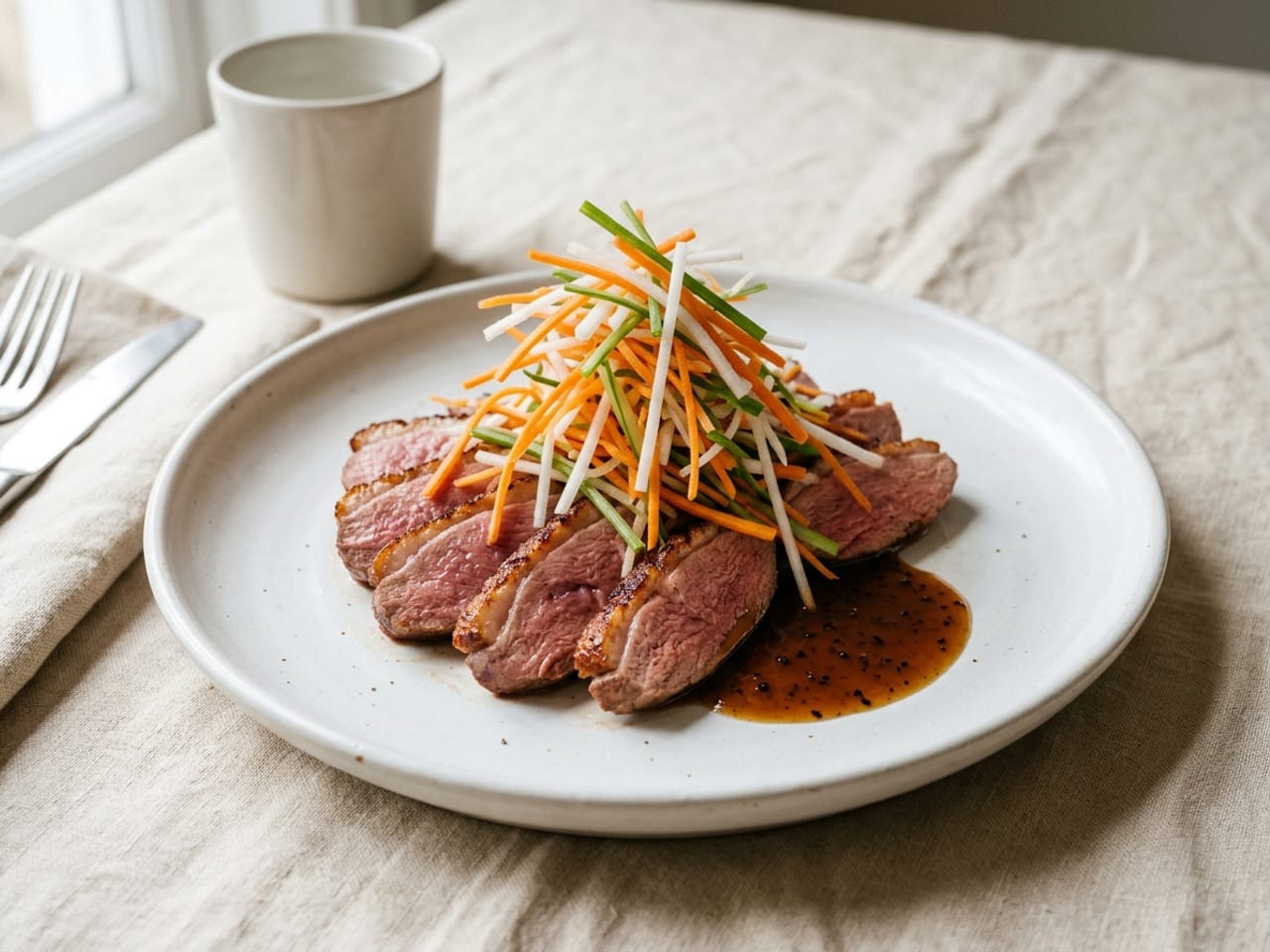
The photos on this page are AI-generated illustrations.
What is julienne?
Julienne (joo-lee-EN) is food cut into thin, square sticks. In the US textbooks a julienne is ⅛ in (3 mm) thick and 1 to 2 in (25 to 50 mm) long, and a fine julienne is 1/16 in (1.5 mm). The name drifts: a US student competition chart and a Canadian textbook call the 1/16 in (1.5 mm) stick julienne and the ⅛ in (3 mm) stick allumette. The word is French and named a soup (the earliest we found: 1691) before it named the cut; where the name comes from is uncertain.1, 3, 6, 8, 20, 65 The chart draws it at true size beside the fine julienne and the batonnet: every knife cut drawn to scale; the grip and the other cuts are in our knife skills guide.
| Julienne at a glance | What the sources say |
|---|---|
| What it is | "Vegetables, potatoes, or other items cut into thin strips" (CIA); "match-shaped rods" (Escoffier, 1907) (step by step)1, 40 |
| Size | ⅛ × ⅛ × 1 to 2 in (3 × 3 × 25 to 50 mm) in the CIA and Gisslen; 2 in long in On Cooking (2007); 2 cm "short" or 4 cm "long" in British books; slices 1 to 2 mm thick in Larousse (1997); 2 to 3 in long on three of the web pages we read (the tally) |
| Fine julienne | 1/16 in (1.5 mm) square, the same length (CIA, Gisslen, On Cooking) (fine julienne) |
| Other names | Matchstick; allumette, paired with potatoes in the CIA's 1969 index and Gisslen, but for the ⅛ in (3 mm) stick of anything in SkillsUSA's chart; French cut on some web pages (the drift) |
| How to say it | joo-lee-EN; /ˌdʒuːlɪˈɛn/ (Collins); French [ʒyljεn] (as printed) |
| Vs batonnet | A batonnet is ¼ in (6 mm) square: the same stick, twice as thick (compared) |
| Tools | A chef's knife; a julienne peeler, a mandoline or a machine disc are quicker for big batches (ours), each with its own shape and risks (tools) |
| The name | A first name (Julien or Julienne), probably; "l'évolution sém. demeure obscure" (TLFi). For the "chef Jean Julien" story, the earliest trace we found is an anonymous Wikipedia edit of 2005 (the name) |
On this page: Meaning · Pronunciation · Step by step · Carrot, onion, pepper · Size · Fine julienne · Allumette and matchstick · Peeler and mandoline · Vs batonnet · Cooking · Julienne fries · Julienne soup · Keeping · Julienne salad · On the plate · History · The name · Troubleshooting · Terms · FAQ
How this page was made. Every size, time, temperature and date comes from the source named beside it, with its edition and page where it has one. Many textbooks are lending-only scans we could read only as short search fragments or Google Books snippets, and old cookbooks were read in dated scans; each source's entry says how it was read. Plate Artists cut, cooked and timed nothing for this page: the methods are quoted, not kitchen-tested. Conversions, sums and anything marked "ours" are our own, and a metric or US twin in brackets is the source's own where it prints one and ours where it does not. Sources are at the bottom.
Julienne meaning
Two senses, then three. The cut: "to cut (something, especially a vegetable) into thin strips or small, matchlike pieces"; and the soup: "a clear soup garnished, before serving, with julienne vegetables" (Dictionary.com). The American Heritage Dictionary puts the soup first, "Consommé or broth garnished with long thin strips of vegetables".60, 61 Gisslen adds the dish sense, "Garnished with foods cut in this manner".3 In French the word also names a plant (1665 and 1677 in TLFi) and a fish, separate senses.65
Is julienne a verb? Yes in the American Heritage Dictionary ("julienned, julienning, juliennes": "To cut (food) into long thin strips"), Dictionary.com and Wiktionary; Cambridge lists only the verb: "Julienne the leeks and wash them well."60, 61, 62, 64 The old cookbooks we read never use it as a verb: they write "cut as for Julienne" or "cut julienne-fashion". Merriam-Webster dates the verb to about 1930 (its page, read in an Internet Archive copy).34, 40, 67 Long or short strips? The American Heritage says "long thin strips", Webster's New World "short, thin strips".61, 63 Where the name comes from is further down.
Julienne pronunciation
Say joo-lee-EN, as our chart respells it, with the stress on the last syllable; American dictionaries also give a French-style start, zhü-LYEN ("zh" plus the French u, two syllables: Dictionary.com, YourDictionary), and in French it is [ʒyljεn].60, 65 As printed:
| Source | Kind | Pronunciation as printed |
|---|---|---|
| Dictionary.com (Random House)60 | American dictionary | joo-lee-EN, or a French-style zh first sound; IPA /ˌdʒu liˈɛn, ʒüˈljɛn/ |
| Collins English Dictionary60 | British dictionary | /ˌdʒuːlɪˈɛn/ |
| Cambridge Advanced Learner's Dictionary62 | UK and US | /ˌdʒuː.liˈen/ for both |
| Webster's New World (YourDictionary)63 | American dictionary | jo͝olē-ĕn, zhü-lyĕn |
| Wiktionary64 | Online dictionary | /ˌdʒuːliˈɛn/ or /ˌʒuːliˈɛn/ |
| Gisslen, Professional Cooking3 | US textbook | zhoo lee yen (glossary); zhoo lee enn (Fig. 7.11) |
| On Cooking5 | US textbook | ju-lee-en |
| TLFi; Wiktionnaire64, 65 | French | TLFi [ʒyljεn], Wiktionnaire \ʒy.ljɛn\ (our respelling: zhu-LYEN, the French u) |
How to julienne by knife
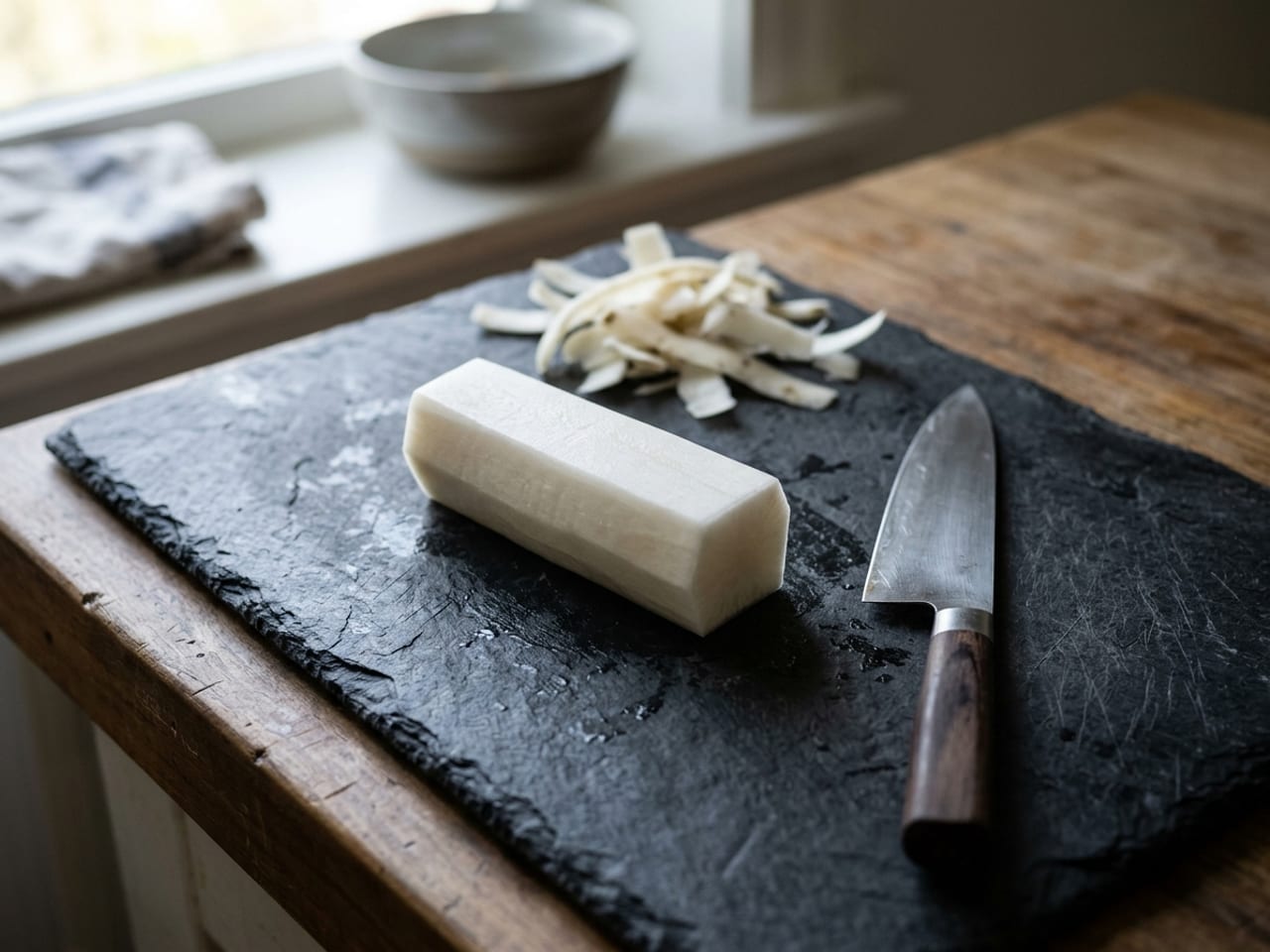
The CIA's and Gisslen's method on any firm vegetable, shown here on a daikon: square, plank, stack, cut. Quoted, not kitchen-tested by us; the same cut on a carrot, in three frames, is in our knife skills guide.
 1
Wash, peel, cut into lengths and square off
Wash the vegetable "to remove soil and other contaminants before being cut" (FDA Food Code), peel it and cut it into lengths of 1 to 2 in (25 to 50 mm), the CIA's and Gisslen's julienne.1, 3, 94 Then square it: "cut a slice from each side and both ends of the vegetable to make an even rectangular solid or cube" (CIA). At the least, "If the vegetable is round, cut a thin slice off one side to make a stable base" (Institute of Child Nutrition).1, 7 Le Cordon Bleu cuts a peeled mooli (daikon) "crosswise into thin slices, then into julienne strips": the same cut from rounds.13
 2
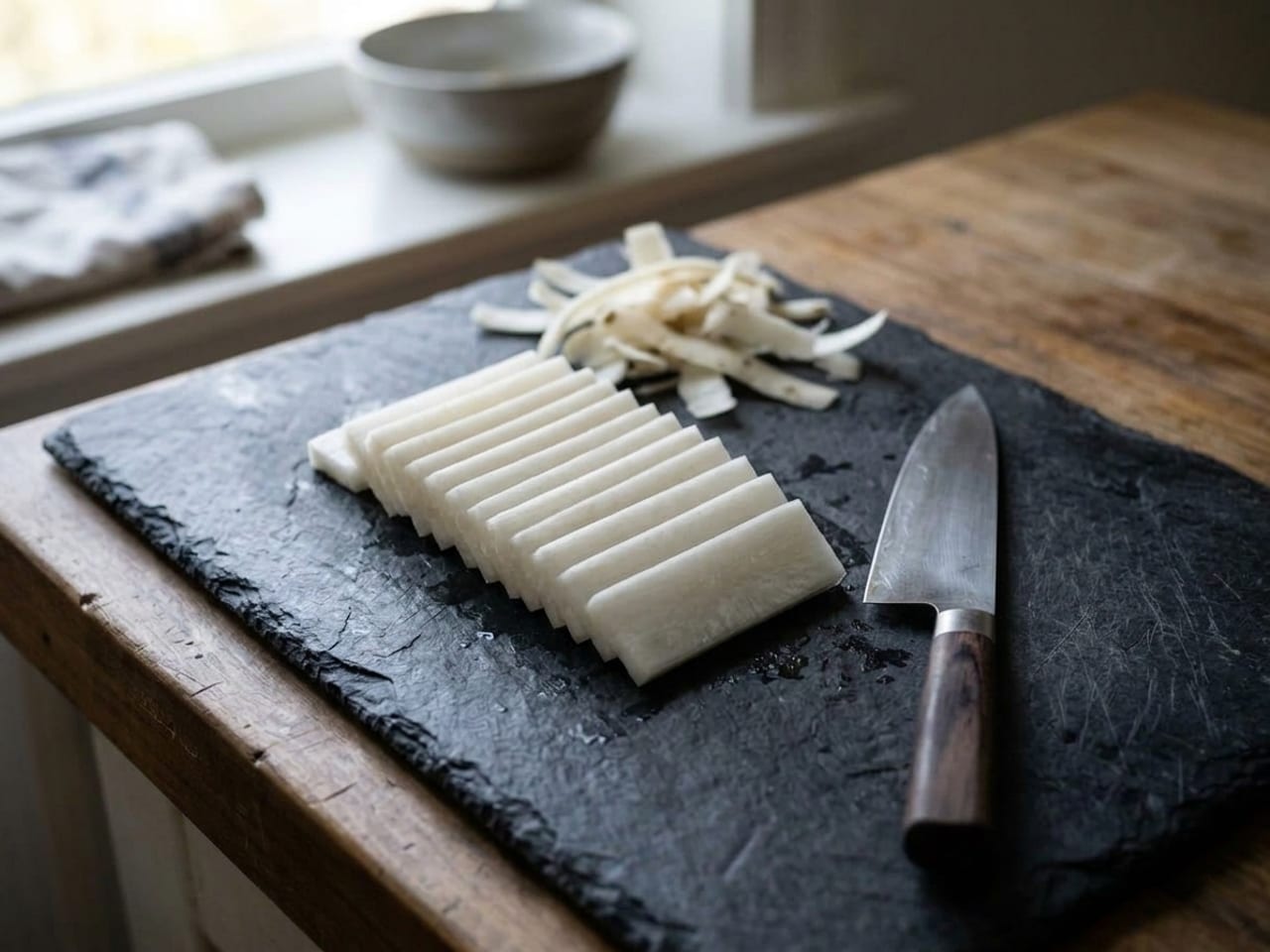
Slice it into planks ⅛ in (3 mm) thick
The plank sets the stick. Gisslen cuts every stick shape by one method, and only the slice changes: ¼ in (6 mm) slices give batonnet, and slices ⅛ in "(3 mm) thick would give you allumette potatoes", his name for a potato julienne.3 Slice, do not chop: "The slicing motion should move either forwards or backwards. Do not press the knife straight down" (CIA). The Staff Canteen's chef keeps the tip on the board, which "makes the knife more stable".1, 75
 3
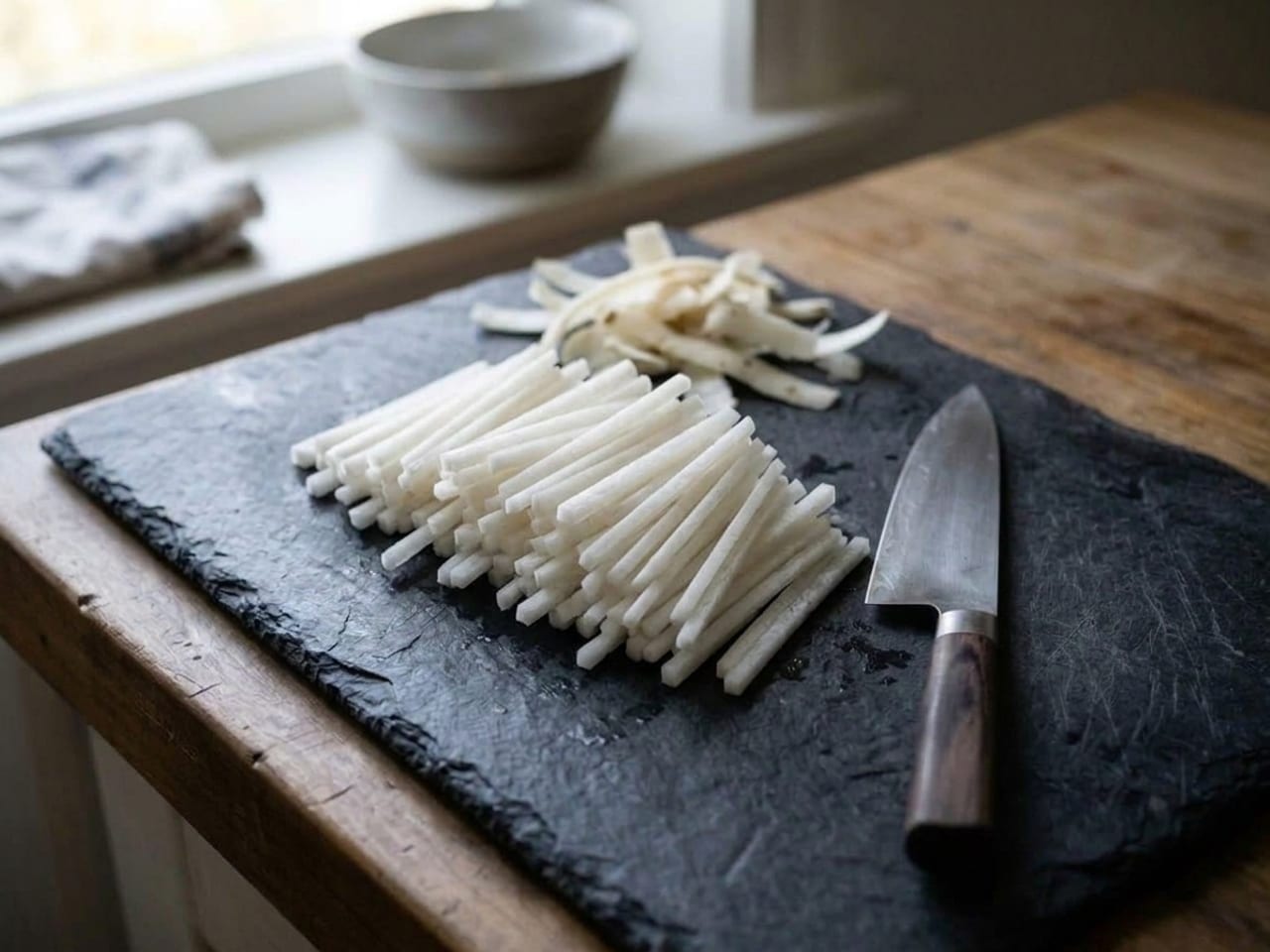
Stack a few planks and cut sticks of the same width
"Stack a few planks at a time and cut lengthwise with the chef knife into 1/16- to 1/8-inch-thick strips (the same width as the planks)" (about 1.5 to 3 mm, ours; Institute of Child Nutrition); "You can stack them up a little bit, couple at a time" (The Staff Canteen).7, 75 The guiding hand makes a claw: "Fingertips are curled under, out of the way of the blade" (Gisslen).3
- 4
Check that the sticks are square and even
A julienne is square in section: Dubois (1893) cuts strips "aussi larges qu'épais, c'est-à-dire carrés", as wide as they are thick.35 Even sizes cook together: "Pour l'unité de cuisson, les légumes doivent être taillés aussi régulièrement que possible" (Escoffier), and Beeton warned in 1861 that otherwise "some will be hard whilst the others will be done to a pulp". 31, 39 For a fine julienne, slice the planks 1/16 in (1.5 mm) thick and cut at that width (CIA, Gisslen).1, 3
- 5
Use them soon, or hold them cold
For a raw salad, "Cut vegetables as close as possible to serving time, or they may dry or shrivel" (Gisslen); wilted raw vegetables "can be recrisped by holding them for a short time in ice water".3 Cut potatoes go straight into cold water (CIA).1 How long cut julienne keeps is below.
Which knife, and how to hold it
"A chef knife is the most practical knife for julienning" (Institute of Child Nutrition).7 Precise cuts are sliced: "Do not press the knife straight down or grip the knife with a loose wrist, as this could result in less accurate cuts" (CIA).1 Gisslen's first slicing stroke starts "with the tip of the knife on the cutting board" and moves forward and down; his second starts at an angle with the tip on the food and slices "downward and forward through the item". 3 Keep the edge sharp: a sharp blade "glides, producing piles of crisply cut vegetables or fruit with little bruising or escaped juice" (America's Test Kitchen, on peelers).82 Grips, honing, boards and first aid are in our knife skills guide; peelers, mandolines and machines are below.
Why bother squaring? Our reasoning, not a measurement: square sticks need trimmings. The nearest published figure is the USDA's, 0.70 lb of raw carrot sticks against 0.83 lb of trimmed, peeled carrot per pound bought (70% against 83%, ours), for sticks 4 by ½ in (about 10 by 1.3 cm, ours), far thicker than a julienne.81 No source we read gives a yield for julienne itself. For a stir-fry or a salad where square sections do not matter, the knife skills guide has a low-waste bias-cut route.
How to julienne carrots, onion, bell pepper, zucchini, cucumber, ginger and potato
Any firm food that can be squared and planked takes the method above; layered, watery and leafy ones change route. Seventeen foods, what the sources do with each, and whether a textbook says so or it is chef practice:
| Food | How | Tip | Basis |
|---|---|---|---|
| Carrot1, 40, 55 | The steps above: square, plank, stack, cut. Escoffier cut "the red part only", the outer flesh, for his consommé | Or a julienne peeler: Grace Young finds the peeler's "Kinpira-cut are thinner than hand-cut julienne". The knife skills guide shows the carrot in three frames | Textbook |
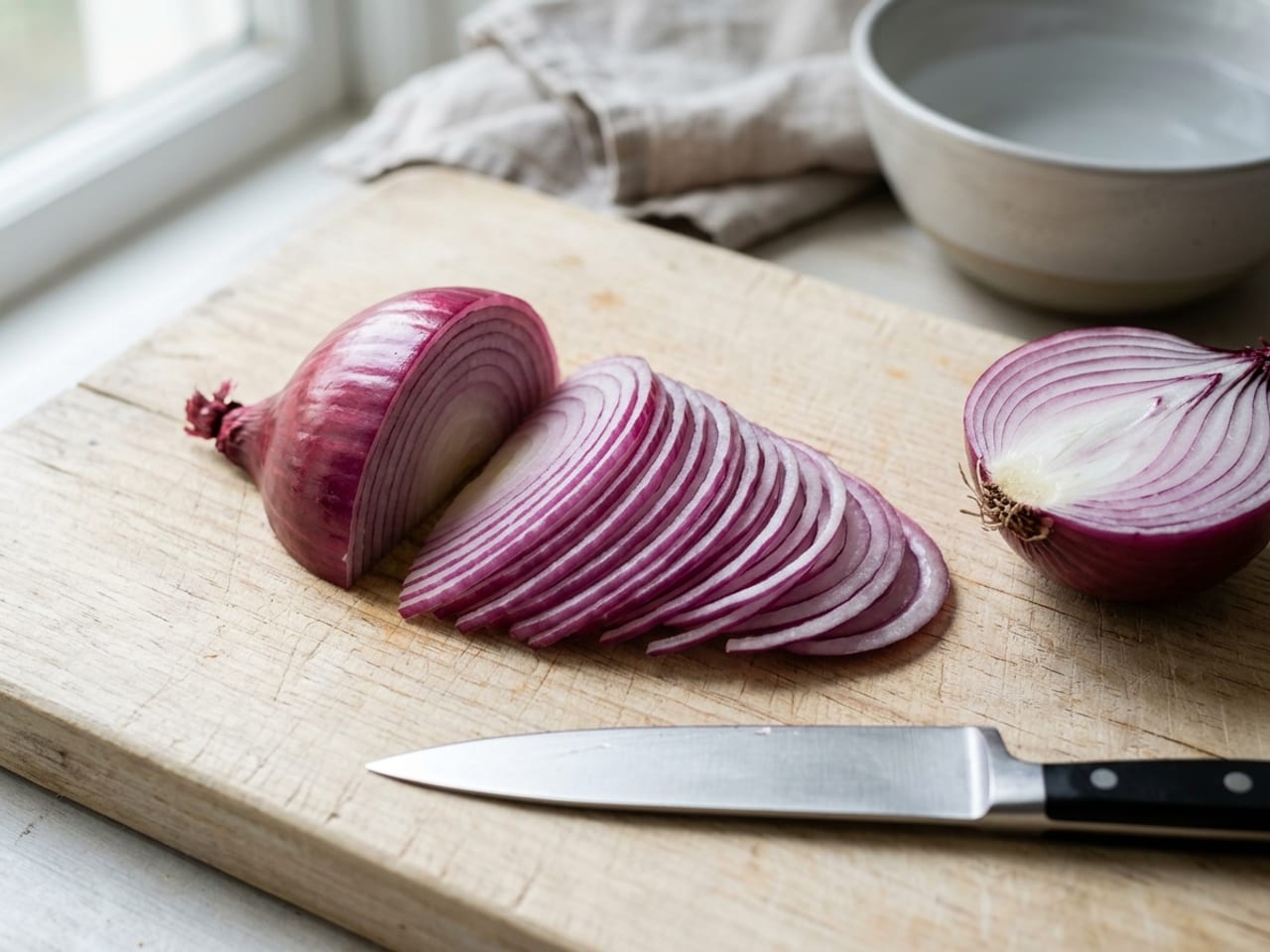
| Onion5, 39, 71, 76 | What recipes call julienned onion is thin slices cut from root to tip (pole to pole), not square sticks: CooksInfo says onion is "too difficult to julienne owing to its layers", and Escoffier's own Potage Julienne cuts the other vegetables "en Julienne" but slices the onion, "émincer l'oignon très finement" | Pole-to-pole slicing "ruptures fewer cells" than slicing across, so it tastes milder (Cook's Illustrated). Textbook recipes write "Onions, julienne" with no size (On Cooking) | Practice |
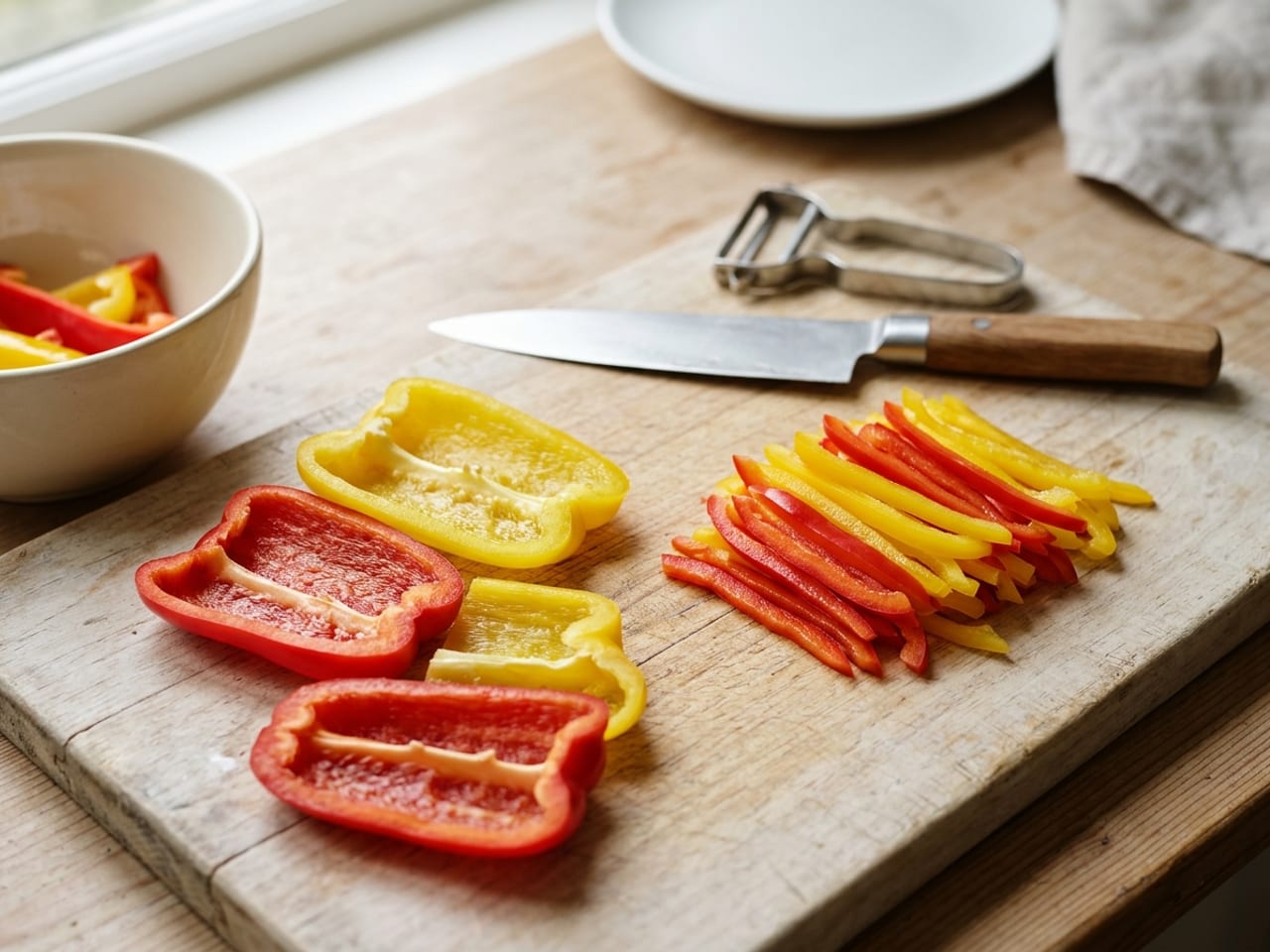
| Bell pepper1, 4, 12, 40 | Halve it, "Remove seeds and core" (Gisslen); the CIA fillets tomatoes and says the method "is also used for peppers and chiles", then "Cut the flesh into julienne or other shapes, as desired"; for tomato it adds that the flesh is trimmed "so that it has an even thickness" (we apply the same idea to pepper walls, ours) | Laying the panels skin side down is chef practice, not a textbook line; The Book of Yields notes the inner membrane is "sliced off as part of the cutting". Escoffier cut capsicum "finely, Julienne-fashion" for a sauce | Textbook and practice |
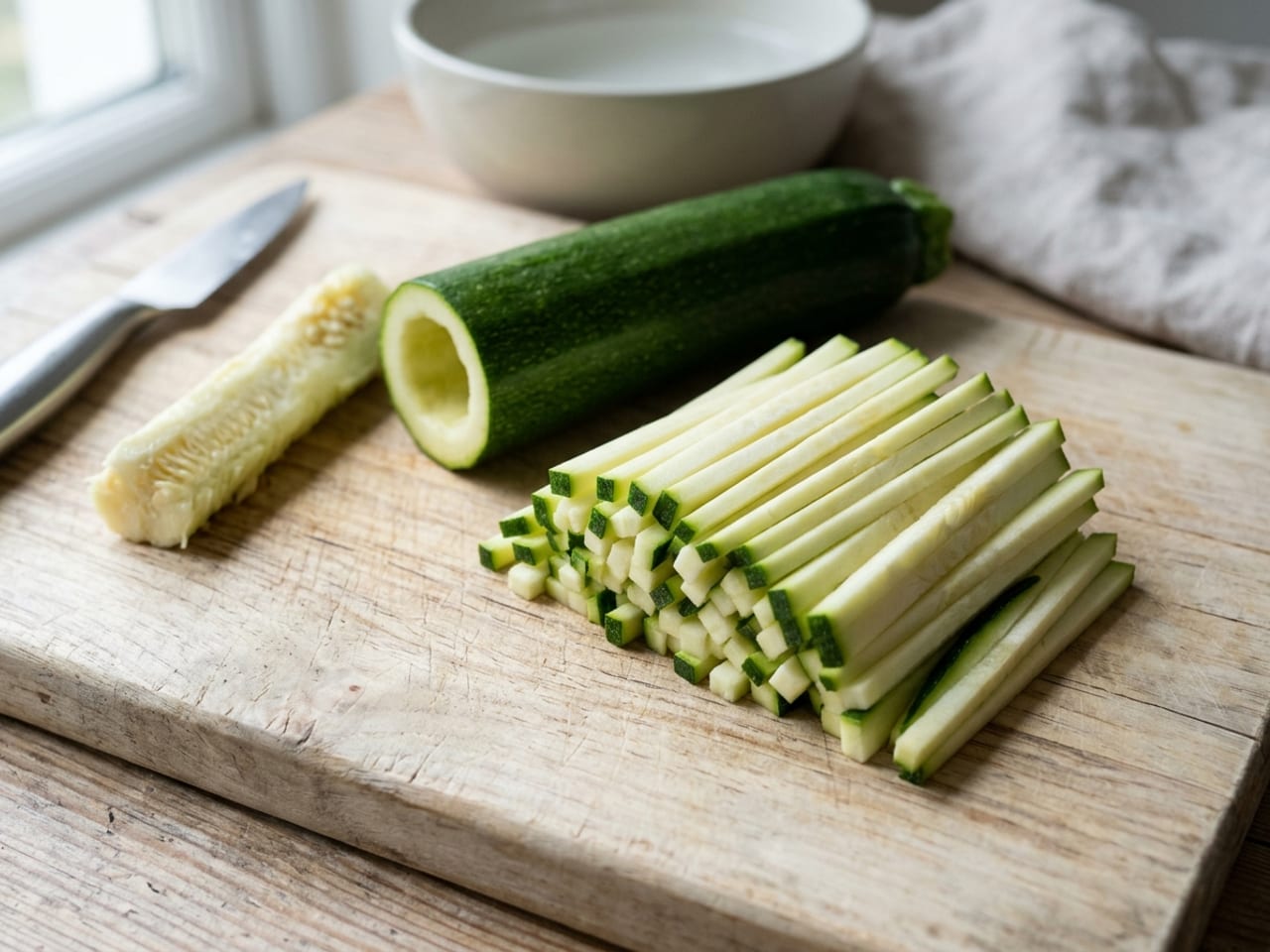
| Zucchini (courgette) and cucumber3, 78 | Chefs cut the firm outer flesh into strips and leave the seedy core: no textbook we read says "skin only" for julienne. Gisslen peels and seeds cucumber for his soups | Watery: America's Test Kitchen discards the "seeds and core, then salt and squeeze dry" for shredded zucchini. Our teriyaki chicken heaps fine cucumber julienne for height | Practice |
| Ginger13, 14 | Peel, slice thin, then strips: Le Cordon Bleu cuts ginger "into julienne" to match a stir-fry's beef | Fried for a garnish: "Blanch julienned peeled fresh root ginger; pat dry", then deep-fry (Le Cordon Bleu) | Textbook |
| Potato1, 3, 15, 79 | Gisslen teaches the whole stick method on a peeled potato; Pépin: "Peel and wash the potatoes, then cut into julienne. Wash the julienne and dry" | Hold cut potato "submerged in cold water", then dry it "to prevent splattering" in the oil (CIA); cold, because "warm or hot water will actually cause the starch to swell and gelatinize" (Potato Goodness). Julienne fries | Textbook |
| Leek1, 3, 15, 53 | "Cut the leek lengthwise into halves, thirds, or quarters. Rinse the leek under running water to remove any remaining grit or sand" (CIA); Pépin stacks ⅛-inch (3-millimeter) slices and cuts them "into a fine julienne" | Marco Pierre White blanches a fine leek julienne "for 1 minute"; Gisslen fries leek julienne as a garnish | Textbook |
| Daikon (mooli) and radish13, 82 | "Cut a peeled mooli crosswise into thin slices, then into julienne strips" (Le Cordon Bleu), or square it as in the steps | America's Test Kitchen lists daikon among the foods a julienne peeler handles; our banh mi pickles daikon and carrot matchsticks | Textbook |
| Beet (beetroot)7, 28, 40, 82 | Escoffier's beetroot salad: "cut it into a julienne or into thin roundels"; Carême wrote of "la julienne de betteraves" | Beets are on the Institute of Child Nutrition's list of firm produce for julienne, and on America's Test Kitchen's peeler list | Textbook |
| Apple3, 7, 43, 93 | The carrot method on a firm apple; apples are on the Institute of Child Nutrition's list, and Larned's 1914 julienne salad could "add carrots and apples" | It browns: Gisslen treats vegetables "that brown when cut" with "an acid or antioxidant"; the USDA handbook warns acids "may leave off flavors and promote tissue softening" | Textbook |
| Celery and celeriac15, 40, 44, 93 | "A julienne of celery is never as thin as a julienne of leeks or carrots" (Pépin); Escoffier's celeriac: "Quarter, peel, and cut the vegetable in julienne fashion" | Crisp it: Hammond (1918) leaves julienne celery "in ice water until quite crisp"; small water losses make celery limp (USDA handbook) | Textbook |
| Citrus zest1, 3, 40 | "Use a paring knife to cut thin strips from the peel, being careful to cut only the outer" coloured part (Gisslen), then strips; Escoffier cuts zest "in fine julienne-fashion" | Blanch times differ: 30 seconds (CIA), 2 minutes (Escoffier's Cumberland sauce), 5 minutes (Gisslen, and Escoffier's zest) | Textbook |
| Snap peas1, 44 | String them first: "Snap off the stem end, using either a paring knife or your fingers, and pull" (CIA); then thin strips along the pod | No textbook we read gives a julienne size for pods; Hammond's 1918 julienne soup has "thin strips of string beans" | Textbook |
| Jícama, papaya and other firm fruit1, 82 | The CIA's Jícama Salad cuts papaya "into julienne using the fine die on a mandoline" or grates it on a box grater | America's Test Kitchen tested its julienne peelers on green papaya | Textbook |
| Cabbage39, 94 | Escoffier adds cabbage "en Julienne, blanchi" to his Potage Julienne; flat leaves are really shredded, like a chiffonade | Cut cabbage counts as cut leafy greens under the FDA Food Code (keeping) | Textbook |
| Basil and other leaves | What recipes call julienned basil is a chiffonade: leaves stacked, rolled and sliced into ribbons (our chiffonade guide) | A julienne is a square stick of a firm food; a leaf cannot be cut square (ours) | Practice |
| Meat, truffle and cheese3, 39, 40 | Gisslen's egg rolls take "Cooked meat or poultry, cut fine julienne"; Escoffier garnishes consommés with truffle "cut in julienne-fashion", chicken and tongue | "To cut raw pork into julienne more easily, partially freeze it first" (Gisslen) | Textbook |
What does "julienned onion" mean?
Thin slices, not sticks. No textbook we read gives onion a julienne size: recipes write "Onions, julienne" and leave it there (On Cooking), and CooksInfo says an onion is "too difficult to julienne owing to its layers".5, 71 Even the soup the cut is named after slices its onion: Escoffier's Potage Julienne cuts carrot, turnip, leek and celery "en Julienne" and the onion "très finement" by slicing, "émincer".39 The cooks' version is practice: halve the onion through the root, lay it flat and slice from root to tip. Slicing pole to pole "ruptures fewer cells" than slicing across, and "Minced onion tastes stronger than chopped onion, which tastes stronger than sliced" (Cook's Illustrated).76 For raw onion, cut it just before it is used (America's Test Kitchen).77 The diced onion method, with frames, is in our knife skills guide.
How to julienne a bell pepper, zucchini or cucumber
Make flat, even panels first. In his stuffed peppers recipe Gisslen halves peppers and removes "seeds and core"; the CIA fillets tomatoes, says the method "is also used for peppers and chiles" and cuts the flesh "into julienne or other shapes, as desired" (its "so that it has an even thickness" trim is a tomato line; applying it to pepper walls is ours).1, 4 Laying a panel skin side down to cut it is chef practice that no textbook we read puts in words. Zucchini and cucumber are watery: chefs cut the firm outer flesh and set the seedy core aside (practice; no textbook we read says "skin only" for julienne), and America's Test Kitchen salts and squeezes shredded zucchini because it is "this watery vegetable".78 On our recipe pages, the teriyaki chicken heaps fine cucumber julienne for height, and the banh mi pickles daikon and carrot matchsticks about ⅛ inch (3 mm) thick.
Julienne size in mm and inches, by source
24 rows from the sources we read, each in its own words, with the thickness and the length apart because the books split on both. The first 12 are the textbooks most readers meet, the name swap, the British, French and classic rows and the two most copied web pages; the other 12 open under "Show all". Where a source prints inches the millimetres are ours, and the other way round. The classic texts before 1903 are in the history.
| Source | In its words | Thickness | Length |
|---|---|---|---|
| CIA, The Professional Chef1 9th ed. 2011, glossary p. 1161; us textbook | "Vegetables, potatoes, or other items cut into thin strips"; this size "is standard" | ⅛ in (3 mm) | 1 to 2 in (3 to 5 cm, as printed) |
| Gisslen, Professional Cooking3 7th ed. 2011, Fig. 7.7 p. 143; us textbook | Julienne, and allumette potatoes, in one row | 3 mm (⅛ in in the chart; his fractions are garbled in our scan) | 25 to 50 mm (1 to 2 in in the chart) |
| On Cooking (US)5 4th ed. 2007, p. 104 (and 2003); us textbook | "a stick-shaped item"; "Julienne and batonnet are matchstick-shaped" | ⅛ in (3 mm) | 2 in, fixed (about 5 cm, ours) |
| On Cooking, Fourth Canadian Edition6 2009; canadian textbook | "1 to 2 mm (1/16 in.) for julienne, 3 mm (1/8 in.) for allumette" | 1 to 2 mm (1/16 in, as printed) | garbled in our scan |
| SkillsUSA Knife Cut Chart8 2024; competition | "Julienne 1/16” x 1/16” x 1” to 2”"; the ⅛ in stick is "Allumette*" | 1/16 in (about 1.5 mm, ours) | 1 to 2 in (about 25 to 50 mm, ours) |
| SkillsUSA National Culinary Arts Contest9 High School, June 2024; competition | "Julienne (1/8”x1/8”x2”) Carrots": its own chart's allumette size | ⅛ in (about 3 mm, ours) | 2 in (about 5 cm, ours) |
| Institute of Child Nutrition (USDA-funded)7 2023, pp. 8 to 9; school | "The strips can range from 2-3 inches long and from 1/16- to 1/8-inch thick" | 1/16 to ⅛ in (about 1.5 to 3 mm, ours) | 2 to 3 in (about 5 to 7.5 cm, ours) |
| Practical Cookery; Foundation Practical Cookery16 11th ed.; 2009; uk textbook | "2 cm lengths (short julienne)"; "Double the length (4cm) is a long julienne", for garnishing | - (not in the fragments we read) | 2 cm short, 4 cm long (about ¾ and 1½ in, ours) |
| Larousse gastronomique19 1996, 1997 printing; reference book | slices "de 1 à 2 mm d'épaisseur", stacked and cut into filaments | 1 to 2 mm (about 1/16 in, ours) | printed, but the digits are damaged in our scan |
| Escoffier, A Guide to Modern Cookery40 1907, glossary and No. 576a; classic text | "match-shaped rods"; for the consommé, "fillets, two inches in length" | - | 2 in (about 5 cm, ours) |
| CooksInfo71 2012, updated 2021; web | "about 1.5 mm x 1.5 mm square and 5 cm long"; some chefs call 3 mm a "regular julienne" | 1.5 mm (1/16 in, as printed) | 5 cm (2 in, as printed) |
| Made In (a cookware maker's blog)74 read 2026; web | "2-3 inches long by 1/8-inch by 1/8-inch" | ⅛ in (about 3 mm, ours) | 2 to 3 in (about 5 to 7.5 cm, ours) |
Show all 24 rows (12 more)
| Source | In its words | Thickness | Length |
|---|---|---|---|
| Gisslen, Professional Cooking, glossary3 7th ed. 2011; us textbook | "Cut into small, thin strips" | 3 mm | 6.5 cm (about 2½ in, ours): longer than his own Fig. 7.7 |
| Gisslen, Professional Cooking4 1983 and 1989 eds., basic cuts figure; us textbook | "Julienne (or allumette potatoes)" | 3 mm | the OCR reads "2 V2 in." (our reading: 2½ in, about 6.5 cm) |
| Furdell, Knife Cuts Guide (a CIA alumni sheet)10 2021; school | Julienne beside a fine julienne of 1/16 in | ⅛ in (about 3 mm, ours) | 1 to 2 in (about 25 to 50 mm, ours) |
| Rouxbe (online cooking school)11 read 2026; school | "thin, matchstick-like strips" | ⅛ in (about 3 mm, ours) | 2 in (about 5 cm, ours) |
| City & Guilds and UK diploma books17 2006; 2007; uk textbook | "julienne 3-4 cm matchsticks" (2006); "julienne 2mm x 2mm x 4cm long" (2007) | 2 mm (about 1/16 in, ours), in the 2007 book | 3 to 4 cm (about 1¼ to 1½ in, ours) |
| Le Cordon Bleu Kitchen Essentials14 2001; school | "about 2 in. in length" (the two-column scan stitches the words; matchsticks is our reading) | - | about 2 in (about 5 cm, ours) |
| Pépin, New Complete Techniques15 2012; reference book | "very thin strips"; a leek's "fine julienne" is cut from ⅛-inch (3-millimeter) slices | ⅛ in (3 mm) slices, for a leek | - |
| The Observer Guide to British Cookery18 1984; reference book | "a thin julienne (thinner than matchstick strips)" | - | - |
| Wikipedia, Julienning69 read 2026; web | 3 × 3 × 40 to 50 mm, sourced to one blog | 3 mm (0.12 in, as printed) | 40 to 50 mm (1.57 to 1.97 in, as printed) |
| The Staff Canteen (a chef's video)75 read 2026; web | "roughly 3 mm is the standard size", squares "about 40 mm long" | 3 mm (about ⅛ in, ours) | about 40 mm (about 1½ in, ours) |
| The Takeout72 2025; web | "uniform sticks measuring about ⅛ inch" | about ⅛ in (about 3 mm, ours) | - |
| Chowhound73 2024; web | "around 3-inch long", "around an ⅛ to a ¼ inch" | ⅛ to ¼ in (about 3 to 6 mm, ours) | about 3 in (about 7.5 cm, ours) |
What the tally says
- US textbooks agree on the thickness: ⅛ in (3 mm). The CIA, Gisslen and On Cooking all print it (five rows), and so do Furdell's and Rouxbe's sheets, the 2024 SkillsUSA contest and four of the six web pages we read (the Institute of Child Nutrition prints a range, 1/16 to ⅛ in).1, 3, 5, 9, 11
- They do not agree on the length. 1 to 2 in (25 to 50 mm) in the CIA and in Gisslen's 2011 figure; a fixed 2 in in On Cooking (2007), about 5 cm (ours); 2½ in (about 6.5 cm, ours) in Gisslen's 1983 and 1989 editions (our reading of the OCR) and 6.5 cm (about 2½ in, ours) in his own 2011 glossary.1, 3, 4, 5 The chart and this page use the CIA's 1 to 2 in (25 to 50 mm).
- The name swaps. SkillsUSA's 2024 chart and On Cooking's Canadian edition call the 1/16 in (1 to 2 mm) stick julienne and the ⅛ in one allumette, and CooksInfo prints julienne at 1.5 mm; yet the same year's SkillsUSA contest sheet asks for "Julienne (1/8”x1/8”x2”) Carrots".6, 8, 9, 71 More in the names.
- British and French books work in centimetres, go shorter and, in the diploma book and Larousse, thinner. Practical Cookery cuts 2 cm "short" and 4 cm "long" julienne, a diploma book 2 mm × 4 cm, and Larousse (1997) slices 1 to 2 mm thick.16, 17, 19 Larousse's length is often quoted online as 3 to 5 cm; the digits are damaged in the scan we read, so we print no length for it.
- Three web pages say longer. A USDA-funded school training sheet and a cookware maker's blog print 2 to 3 in (about 5 to 7.5 cm, ours) and Chowhound about 3 in (about 7.5 cm) and ⅛ to ¼ in thick; Chowhound's 3 in is longer than any textbook row above, and 2 to 3 in reaches past the CIA's 2 in but includes Gisslen's older 2½ in. CooksInfo, Wikipedia, Rouxbe and the Staff Canteen print 2 in or less.7, 73, 74
- So the thickness in this tally runs from 1 mm to ¼ in (about 6 mm, ours) and the length from 2 cm to 3 in (about ¾ to 3 in, or 2 to 7.5 cm, ours). Our suggestion, not a rule: cut ⅛ in (3 mm) by 1 to 2 in (25 to 50 mm) for a US recipe, and the size the book prints for a British or French one. If a recipe gives a size, trust the size over the name.
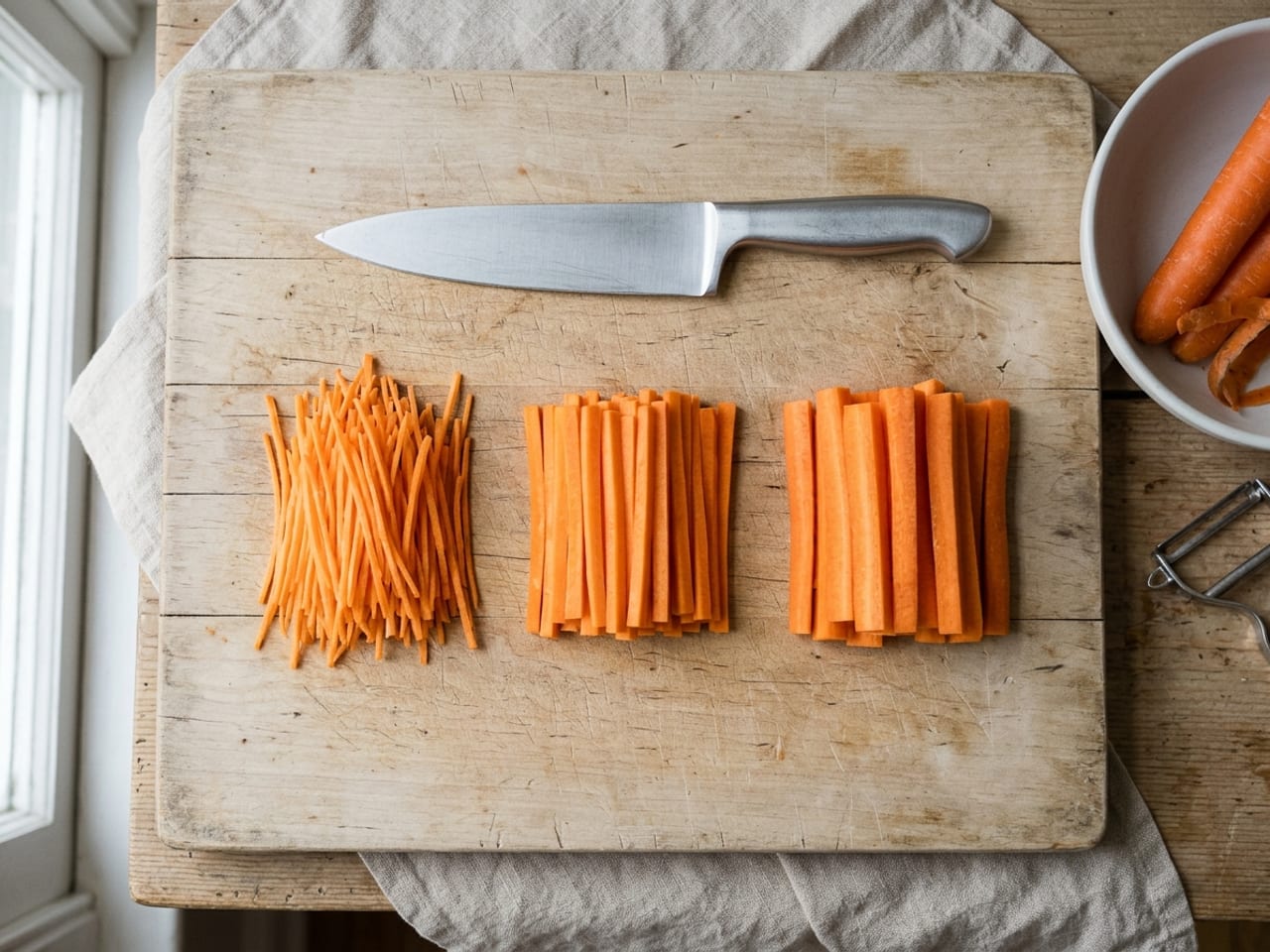
Fine julienne: 1/16 in (1.5 mm)
The US textbooks add a thinner grade at the same length: 1/16 × 1/16 × 1 to 2 in (1.5 × 1.5 × 25 to 50 mm) (the CIA's chart, Gisslen, On Cooking at a fixed 2 in, about 5 cm, ours).1, 3, 5 It is the stick behind a fine brunoise. The word "fine" does not travel: SkillsUSA's chart and On Cooking's Canadian edition call this size plain julienne, Pépin cuts his leek "fine julienne" from ⅛-inch (3-millimeter) slices, and a German maker's "fine" insert is 3.5 mm, about the textbook julienne (our comparison).6, 8, 15, 87 Ranhofer (1894) and Dubois (1893) graded fine, medium and large julienne by length too.35, 36 Because it is so thin, a mandoline may make it easier (ours), with a cut-resistant glove (tools).
| Source | In its words | Size |
|---|---|---|
| CIA, The Professional Chef1 9th ed. 2011, p. 620 and glossary | "FINE JULIENNE" in the cut chart; the glossary's metric is garbled in our snippet | 1/16 × 1/16 × 1 to 2 in (about 1.5 × 1.5 × 25 to 50 mm, ours) |
| Gisslen, Professional Cooking3 7th ed. 2011, Fig. 7.7 p. 143 | "Fine julienne", printed "( 1.5X1.5X25-50 mm )" | 1.5 × 1.5 × 25 to 50 mm |
| On Cooking (US)5 2007 | "A fine julienne", "(1.5 mm X 1.5mm X 5 cm)" | 1/16 × 1/16 × 2 in (1.5 × 1.5 mm × 5 cm) |
| Rouxbe; Furdell (a CIA alumni sheet)10, 11 read 2026; 2021 | Fine julienne 1/16 in square, 2 in (about 5 cm) long (Rouxbe) or 1 to 2 in (about 25 to 50 mm) (Furdell; metric ours) | 1/16 in (about 1.5 mm, ours) |
| SkillsUSA chart; On Cooking (Canada); CooksInfo6, 8, 71 2024; 2009; 2021 | The same 1/16 in (about 1.5 mm) stick, called plain julienne; CooksInfo adds that some chefs call it "a fine julienne" | 1/16 in; 1 to 2 mm; 1.5 mm |
| Pépin, New Complete Techniques15 2012 | Leeks: ⅛-inch (3-millimeter) slices cut "into a fine julienne" | from ⅛ in (3 mm) slices |
| Ranhofer, The Epicurean36 1894 | "the fine Julienne is five-eighths of an inch long by little over one-sixteenth of an inch square" | just over 1/16 in × ⅝ in (about 1.6 × 16 mm, ours) |
| Dubois, La cuisine d'aujourd'hui35 1893 | "la fine julienne coupée courte": 1.5 cm long, the medium 2.5 cm | 1.5 cm long (about ⅝ in, ours) |
| Escoffier, A Guide to Modern Cookery40 1907 | zest cut "in fine julienne-fashion" | - |
| The Observer Guide to British Cookery18 1984 | "a thin julienne (thinner than matchstick strips)" | - |
| Börner V-Slicer (maker's manual)87 read 2026 | "Cut fine 3,5mm julienne strips and sticks": the maker's fine is near the textbook julienne | 3.5 mm (about ⅛ in, ours) |
| Robot Coupe (maker)88 read 2026 | Its finest square julienne disc | 2 × 2 mm (5/64 in, the maker's) |
Allumette, matchstick, batonnet, French cut: the names drift
The match comparison is the oldest English gloss we read: Escoffier's 1907 glossary says "match-shaped rods", and a 1914 salad book "long, match-like strips"; the word "matchstick" itself is in none of the old cookbooks we searched.40, 43 Allumette (French for a match) was a puff-pastry strip in 1864 and still is in Larousse; the earliest allumette potato we read is in Escoffier's Guide culinaire of 1903 (our copy's date), and the CIA in 1969 (an index entry) and Gisslen in 1983 to 2011 pair it with potato julienne.2, 3, 4, 19, 32, 38 SkillsUSA and On Cooking's Canadian edition use it for the ⅛ in (3 mm) stick of any vegetable.6, 8 French cut is web usage (The Takeout, Wikipedia).69, 72 Batonnet is the ¼ in (6 mm) stick in every textbook we read, though one chef's cookbook calls a carrot baton "A thick julienne".1, 5, 8, 52 What each source calls each size:
| Source | 1/16 in (1.5 mm) stick | ⅛ in (3 mm) stick | ¼ in (6 mm) stick |
|---|---|---|---|
| CIA (2011); Gisslen (2011); a CIA alumni sheet (2021)1, 3, 10 | Fine julienne | Julienne (Gisslen: also allumette potatoes) | Batonnet |
| On Cooking (US, 2003 and 2007)5 | Fine julienne | Julienne: "Julienne and batonnet are matchstick-shaped" | Batonnet |
| On Cooking (a 2006 printing)5 | - | "Allumette", 3 mm × 5 to 6 cm, in a section titled "Cutting Julienne, Allumette and Batonnet" (its julienne size is not in our fragments) | Batonnet, 6 mm |
| On Cooking, Canadian edition (2009)6 | Julienne (1 to 2 mm) | Allumette (3 mm) | Batonnet (6 mm) |
| SkillsUSA (2024)8, 9 | Julienne (the chart) | "Allumette*" in the chart, but "Julienne (1/8”x1/8”x2”)" in the same year's contest sheet | Batonnet |
| CIA (1969); Gisslen (1983, 1989)2, 4 | - | "Julienne or Alumette Potatoes" (CIA); "Julienne (or allumette potatoes)" (Gisslen) | - |
| CooksInfo (2021)71 | Julienne; "a fine julienne" for some chefs | "Most, though, reserve that 3 mm x 3 mm dimension for the term “allumette.”"; a "regular julienne" for some | - |
| The Takeout (2025); Chowhound (2024); Wikipedia69, 72, 73 | - | Julienne, "matchstick or French-cut" (The Takeout); "Julienne, allumette, or French cut" (Wikipedia) | Batonnet, "twice the size of julienne matchsticks" (The Takeout) |
| The China Moon Cookbook (1992)52 | - | Julienne | "Batons: A thick julienne. Used in our kitchen to apply exclusively to carrots" |
| The Observer Guide to British Cookery (1984; no size, only "a thin julienne (thinner than matchstick strips)")18 | - | - | - |
For fried potatoes the names drift again, from Escoffier's allumettes of one-fifth of an inch to Gisslen's 3 mm straw potatoes: julienne fries.
Julienne peeler, mandoline, food processor disc or knife?
A knife cuts square sticks of any size; a julienne peeler needs no knife skill, and how square its strips come out depends on the gap between its blades (America's Test Kitchen); a mandoline is fast and even and is the tool that needs a glove; a machine disc cuts in one pass (ours). We recommend no product, and the test-kitchen findings below are America's Test Kitchen's and Cook's Illustrated's. America's Test Kitchen sums up the trade-offs: the knife "Takes expert skill"; the mandoline "Can be dangerous; pricey; need to store device; takes extra setup and cleanup"; the julienne peeler needs "No skill".82
| Tool | What it makes | When it fits | Safety |
|---|---|---|---|
| Chef's knife1, 3, 7, 82 | Square sticks at any size you cut, ⅛ in (3 mm) or finer | Any amount, any vegetable; "Takes expert skill" (America's Test Kitchen's table); "the most practical knife for julienning" (Institute of Child Nutrition) | The claw, a slicing stroke, a sharp edge and a still board (above) |
| Julienne peeler71, 82 | "rectangular strips called matchsticks" from firm produce; in ATK's test, peelers with more space between the blades cut "thicker, more symmetrical squared-off matchsticks instead of thin, flat noodle shapes"; its OXO had a ⅛ in (about 3 mm) gap, its GIR half that, 1/16 in (about 1.5 mm), and cut strips that are "a bit thin and flat" | "No skill needed; inexpensive; compact; quick to use and clean up", but "slightly slower than mandoline when making large quantities" (ATK); for "quick garnishes and decorative salad toppings in very small quantities" (CooksInfo) | Hold the food on the board near one end; "If cutting your hand is a concern", a cut-resistant glove (ATK); one model has a flip-over blade cover for the drawer (CooksInfo). No peeler recall found |
| Mandoline with julienne blades82, 83, 84, 86, 87 | Even slices set by the platform; many models have julienne blades or attachments (two or three in Cook's Illustrated's review; one small ceramic model cannot make julienne); one retailer lists the Super Benriner's three julienne blades by tooth count (54, 25 and 10 teeth), with no stick size; Börner's manual: 3.5 and 7 mm inserts | "Perfect, crisp, uniform cuts; can do large quantities in a flash" (ATK); julienne blades "useful for salads and slaw; as vegetable noodles; and if thick enough, for french fries" (Cook's Illustrated); one retailer advises that on its julienne blades you "may want to avoid" sweet potatoes and carrots, while Cook's Illustrated found the same model slices "making julienne from even the toughest foods" | "Wear a cut-resistant glove on the hand you use to hold the food" (ATK); "most of these guards are next to useless" (two spring-loaded ones worked); the 2018 julienne-blade recall |
| Food processor julienne disc3 | With discs, processors "can also slice, shred, and julienne solid foods such as vegetables" (Gisslen). We read no home maker's page that states its disc's size, so we print none | Large batches for slaw, salads and stir-fries (ours) | Follow the maker's manual (ours) |
| Commercial vegetable machine88 | Robot Coupe's own listing: square julienne discs from 2 × 2 to 8 × 8 mm (5/64 to 5/16 in, the maker's twins), its 3 × 3 mm disc the textbook ⅛ in, plus flat 1 × 8 and 2 × 4 to 2 × 10 mm strips | Restaurant volume: "10 kg of julienne in 2 minutes flat!" (about 22 lb, ours; a maker claim with no method) | The maker's guards and manual (ours) |
| Spiralizer89 | A continuous spiral, not straight sticks | Vegetable noodles: in one chef's side-by-side test the spiralizer was "three times faster" than a julienne peeler and wasted less, but "the peeler was much easier to clean" (Reviewed) | Keep fingers off the blade (ours) |
| Box grater1 | Shreds, not square sticks | The CIA's alternative for papaya: grate it on "the large holes of a box grater or cut into julienne" | Stop before your knuckles reach the holes (ours) |
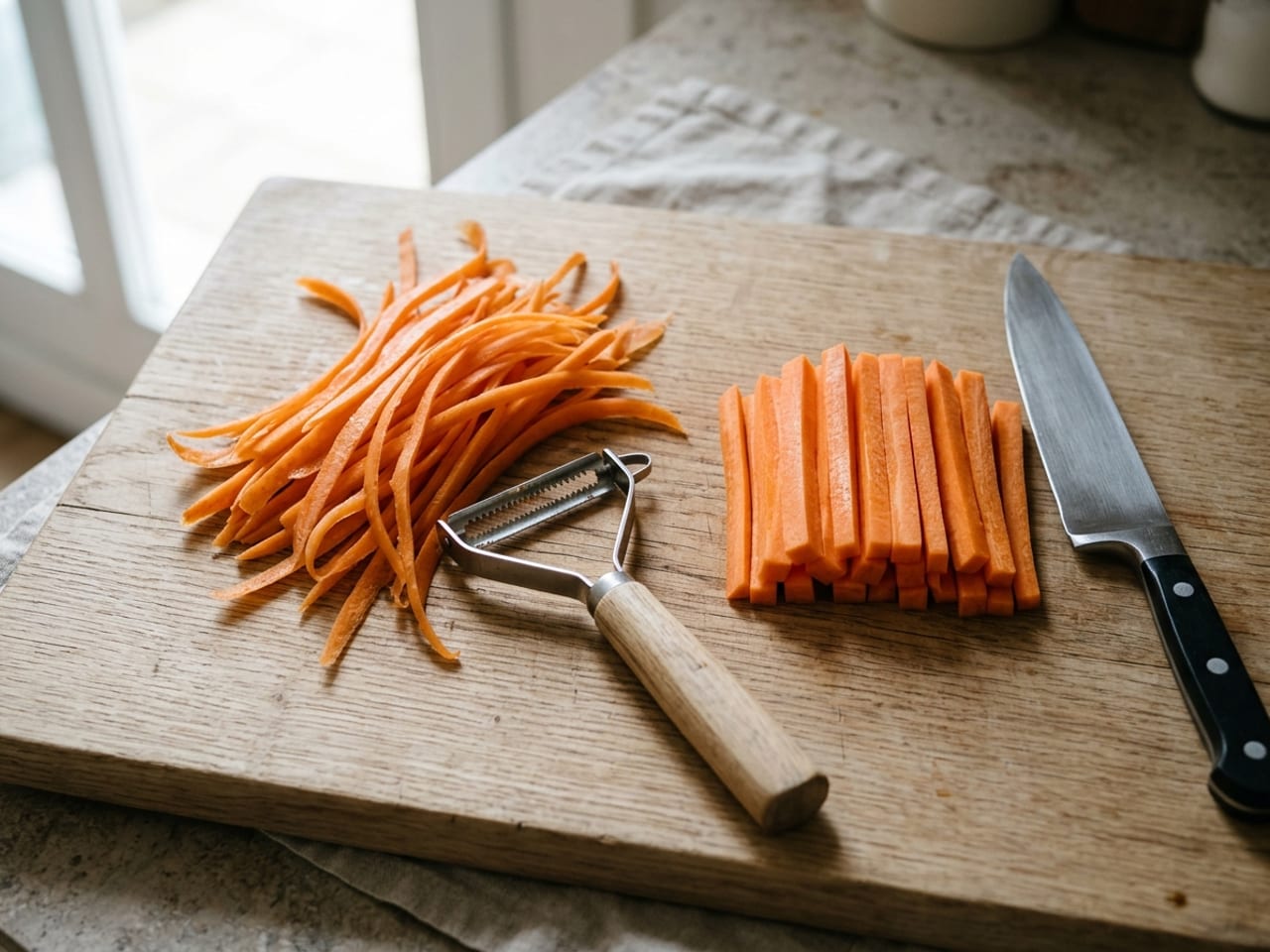
How to use a julienne peeler
"You'll typically need to peel produce first with a regular vegetable peeler. Then you use the julienne peeler, drawing it along the length of the vegetable to cut long, narrow strips" (America's Test Kitchen). Most are Y-shaped; in the US the julienne blade is usually a row of folded points, and a Thai style has a wavy blade. Hold the food "down on a cutting board, grasping it firmly as close to one end as possible to expose its maximum length"; "Depending on where you start the peeler on the food, you'll get longer or shorter matchsticks".82 In ATK's test, peelers with more space between the two blades "trapped less food in their teeth and cut thicker, more symmetrical squared-off matchsticks", while serrated or crowded blades left food "bruised and wet" and strips "that resembled seaweed".82 CooksInfo calls it "less a peeler, and more a small spiralizer or “handheld mandoline”", and some ordinary peelers carry a julienne blade on the other side.71 For matchsticks from a ribbon peeler, Reviewed stacks the ribbons "about five high" and slices them with a knife.89
Julienne on a mandoline, and the glove
Gisslen: a mandoline's "Additional blades can be used in combination with the flat blade to cut julienne and batonnet", and "For safest use, a detachable guard is also supplied".3 Cook's Illustrated is blunter about the guard: "Unfortunately, most of these guards are next to useless", and of its favourite model, "It lacks a good hand guard, so you'll need a cut-resistant glove to use it safely" (Cook's Illustrated).83 America's Test Kitchen's rules: "Wear a cut-resistant glove on the hand you use to hold the food", "If the food gets stuck in the blade, don't push harder", and "A sharp blade is the safest blade."84 A glove is "cut-resistant but not cut-proof" and "not puncture-resistant" (ATK); in a US food business, a slash-resistant glove that touches ready-to-eat food needs "a SMOOTH, durable, and nonabsorbent outer surface" or a single-use glove over it (FDA Food Code 2022, §3-304.15; ¶(E) in the 2026 edition).85, 94 A German maker's manual says: "For your safety always use the Safety Holder".87 Glove ratings are explained in our knife skills guide.
The 2018 julienne-blade recall, and what we did not find
On 1 May 2018 the US Consumer Product Safety Commission (recall 18-147: Sharper Image and Frigidaire mandolines) and Health Canada (RA-66644: the Sharper Image model) recalled them because "The small blades in the julienne slicer attachment can separate from the plastic assembly": the CPSC counts about 19,000 units in the US and about 230 in Canada (Health Canada counts 11,448 in the US and about 228 in Canada for the Sharper Image alone), sold from May 2017 to April 2018 for $13 to $20, with four US reports and one Canadian report of blades coming loose and no injuries; "Only the julienne blade attachment is affected".90, 91 It is the only recall of a julienne blade we found. We found no recall of a julienne peeler, and no mandoline injury count: a PubMed search on 1 November 2026 returned one case report.92 So we print no injury rate for mandolines or peelers.
Julienne vs batonnet, allumette, matchstick, brunoise, chiffonade, shredded and grated
Julienne vs batonnet: the same stick at two thicknesses, cut the same way. A julienne is ⅛ in (3 mm) square and a batonnet ¼ in (6 mm), "twice the size of julienne matchsticks", as The Takeout puts it; Gisslen's only difference between the two potato cuts is the slice, ¼ in (6 mm) or ⅛ in (3 mm).3, 72 Chowhound's "⅛ to a ¼ inch" (about 3 to 6 mm, ours) julienne runs into batonnet territory.73 Julienne vs allumette and matchstick: matchstick is a plain English name for julienne; allumette is paired with potato julienne in the CIA's 1969 index and Gisslen's books, and is the ⅛ in (3 mm) stick in SkillsUSA's chart, and a thicker fried potato in Escoffier (the drift). Julienne vs brunoise: the brunoise is the julienne cut across into cubes. Julienne vs chiffonade: a julienne is a square stick of a firm food, a chiffonade a ribbon of leaf. Julienne vs shredded or grated: a julienne is squared to a set section; a shred is whatever a grater, a peeler or an unsquared knife cut leaves (our definition). Every set size below is the chart's:
| Cut | Shape | Size | How it differs |
|---|---|---|---|
| Julienne1 | Square stick | ⅛ × ⅛ × 1 to 2 in (3 × 3 × 25 to 50 mm) | "Vegetables, potatoes, or other items cut into thin strips" (CIA) |
| Fine julienne1, 8 | Thinner square stick | 1/16 × 1/16 × 1 to 2 in (1.5 × 1.5 × 25 to 50 mm) | Half the thickness; SkillsUSA's chart calls this size plain julienne (fine julienne) |
| Batonnet1, 72 | Thicker square stick | ¼ × ¼ × 2 to 2½ in (6 × 6 × 50 to 60 mm) | Twice the thickness: "¼ inch strips, or twice the size of julienne matchsticks" (The Takeout); the stick behind a small dice |
| Allumette2, 3, 8, 40 | Square stick, often potato | ⅛ in to about 1/5 in (3 to about 5 mm, ours), by source | A potato julienne paired with the name (the CIA's 1969 index, Gisslen), the ⅛ in stick of anything (SkillsUSA), or Escoffier's fried potato of one-fifth of an inch (the drift) |
| Matchstick40, 72 | Square stick | ⅛ × ⅛ × 1 to 2 in (3 × 3 × 25 to 50 mm) | Another name for julienne: "match-shaped rods" (Escoffier, 1907); "matchstick or French-cut" (The Takeout) |
| French fry3 | Thick potato stick | ⅜ × ⅜ × 3 in (10 × 10 × 75 mm) | The fried potato at three times the thickness (our arithmetic); Gisslen's straw potato is cut as thin as his julienne, 3 mm (our comparison; fries) |
| Brunoise1 | Tiny cube | ⅛ × ⅛ × ⅛ in (3 × 3 × 3 mm) | A julienne cut across at the same width (our brunoise guide) |
| Chiffonade | Ribbon of leaf | fine ribbons, no set width | Leaves stacked, rolled and sliced, not a square stick (our chiffonade guide) |
| Shredded43, 55 | Irregular strand | No set size | Whatever a grater or peeler leaves, not squared; old books blur the two ("Shred in julienne strips lettuce", 1914), and Grace Young finds the peeler cut "thinner than hand-cut julienne" |
| Grated1 | Short shreds | No set size | The box grater's large holes: the CIA's alternative to a mandoline julienne for papaya |
Cooking with julienne: blanched, stir-fried, fried and in soup
Julienne is cut thin so it cooks fast and evenly: a soup garnish first, then sauces, salads, stir-fries, fried garnishes and straw potatoes. No textbook we read prints a blanch or stir-fry time for julienne vegetables; the textbook times below are for citrus zest and a poached-fish garnish, and the rest are chefs' recipes and extension charts. "Thin uniform cuts ensure a quick and even rate of cooking or marinating" (Institute of Child Nutrition), and Escoffier cut his julienne regularly "Pour l'unité de cuisson", for even cooking.7, 39 What the books use it for:
| Use | What the sources do |
|---|---|
| Clear soup3, 39, 40 | Escoffier's Potage and Consommé Julienne (carrot, turnip, leek, celery, cabbage, onion); Gisslen's Consommé Julienne: "Onion or leek, carrot, and celery, cut julienne" |
| Meat and truffle soup garnish36, 39, 40 | Truffle "cut in julienne-fashion", chicken and tongue in consommés (Escoffier); Ranhofer: vegetable julienne is "usually intended for soups", while "chicken, game, foies-gras, truffles, tongue and mushrooms are used for garnishings" |
| Sauces40 | Cumberland sauce: lemon rind "cut finely. Julienne-fashion, scalded for two minutes"; Andalouse: "two oz. of capsicum cut finely. Julienne-fashion, per pint of sauce" (Escoffier) |
| Salads and slaws3, 7, 40 | Escoffier's celeriac and beetroot salads; Gisslen's Pacific Rim Salad with "Carrots, cut julienne"; raw in salads and slaws for crunch (Institute of Child Nutrition). The dish called julienne salad is below |
| Stir-fries and spring rolls3, 14, 56 | Gisslen's egg rolls and spring rolls: "Cooked meat or poultry, cut fine julienne", bamboo shoots and mushrooms julienne; a wok book: "very fine “squared-off” strips like matchsticks"; ginger cut to match the beef (Le Cordon Bleu) |
| Poached fish and shellfish3 | Gisslen's Scallops and Shrimp à la Nage: carrot, leek and celery julienne sweated, then simmered "until the vegetables are cooked but still slightly crisp" |
| Fried garnish3, 13 | "Other vegetables, such as leeks and celery, can be cut into thin shreds or julienne and fried. These may be dusted in flour before frying" (Gisslen); Le Cordon Bleu's deep-fried ginger |
| Fried potatoes and nests3, 39, 40 | Straw and allumette potatoes, and Escoffier's fried nests of straw potatoes (fries, nests) |
| Quick cooking and marinating7 | "Thin uniform cuts ensure a quick and even rate of cooking or marinating" (Institute of Child Nutrition) |
| Raw hors d'oeuvre19 | Larousse also cuts raw vegetables julienne for hors-d'oeuvre |
How long to blanch, sauté or stir-fry julienne
Blanch and shock. Gisslen's rule for vegetables cooked ahead: "Cook the six vegetables separately in a steamer or in boiling salted water until crisp-tender. Shock each vegetable in ice water as soon as it is cooked. Drain and refrigerate." He gives no time by cut.3 The figures we found for julienne run from about 30 seconds for a carrot julienne in a chef's recipe to 2 to 3 minutes in a garden cookbook's chart, which lumps julienne with slices and dice; the 2 minutes for carrot strips from the National Center for Home Food Preservation is for freezing, not for eating now.52, 54, 80 Sauté and stir-fry. Gisslen's quick sauté is for "tender, small-cut vegetables that cook quickly", and in a stir-fry "add the longer-cooking ones first and the quicker-cooking ones last".3 Our japchae gives carrot matchsticks 1 to 2 minutes in the pan, "still distinctly snappy". The times as printed:
| Source | What | How long | For |
|---|---|---|---|
| Tropp, The China Moon Cookbook (1992)52 | "blanch the carrot julienne until tender-crisp", then ice water | about 30 seconds | Chef's recipe |
| White, White Heat (1990)53 | "Cut the leek white into fine julienne and blanch in boiling water" | 1 minute | Chef's recipe |
| White, White Heat (1990)53 | carrot in "very thin julienne", blanched "briefly" and refreshed in cold water | no figure | Chef's recipe |
| Our japchae recipe | Carrot matchsticks in the pan, cooked in sequence with the other vegetables | 1 to 2 minutes | Stir-fry (our recipe) |
| Gisslen (2011), à la nage3 | julienne sweated in butter "for a few minutes", then simmered until "still slightly crisp" | a few minutes | Textbook recipe |
| Garden Way's Joy of Gardening Cookbook (1994)54 | "Parboil for salads (sliced, diced, or julienned)" | 2 to 3 minutes | Cookbook chart |
| National Center for Home Food Preservation (2014)80 | Carrot lengthwise strips (not julienne), blanched before freezing | 2 minutes | Freezing |
| CIA (2011), citrus vinaigrette1 | julienne zest: "Blanch the zests for 30 seconds" | 30 seconds | Sauce |
| Escoffier (1907), Cumberland sauce40 | rind "Julienne-fashion, scalded for two minutes" | 2 minutes | Sauce |
| Escoffier (1907) zest; Gisslen (2011)3, 40 | zest "in fine julienne-fashion", scalded; "Blanch the zests in boiling water 5 minutes" | 5 minutes | Sauce |
| Senn (1895), Consommé Julienne37 | "very fine long shreds" cooked in the consommé | about 30 minutes | Soup |
| Gouffé (1867); Kettner (1877)33, 34 | Julienne fried brown, then simmered in the soup | 3 hours | Soup |
The sources split by purpose, not necessarily by fact: seconds for a garnish that goes straight into ice water, minutes for a chart that covers every cut or for the freezer. Our suggestion: start a ⅛ in (3 mm) carrot julienne at the short end and taste.
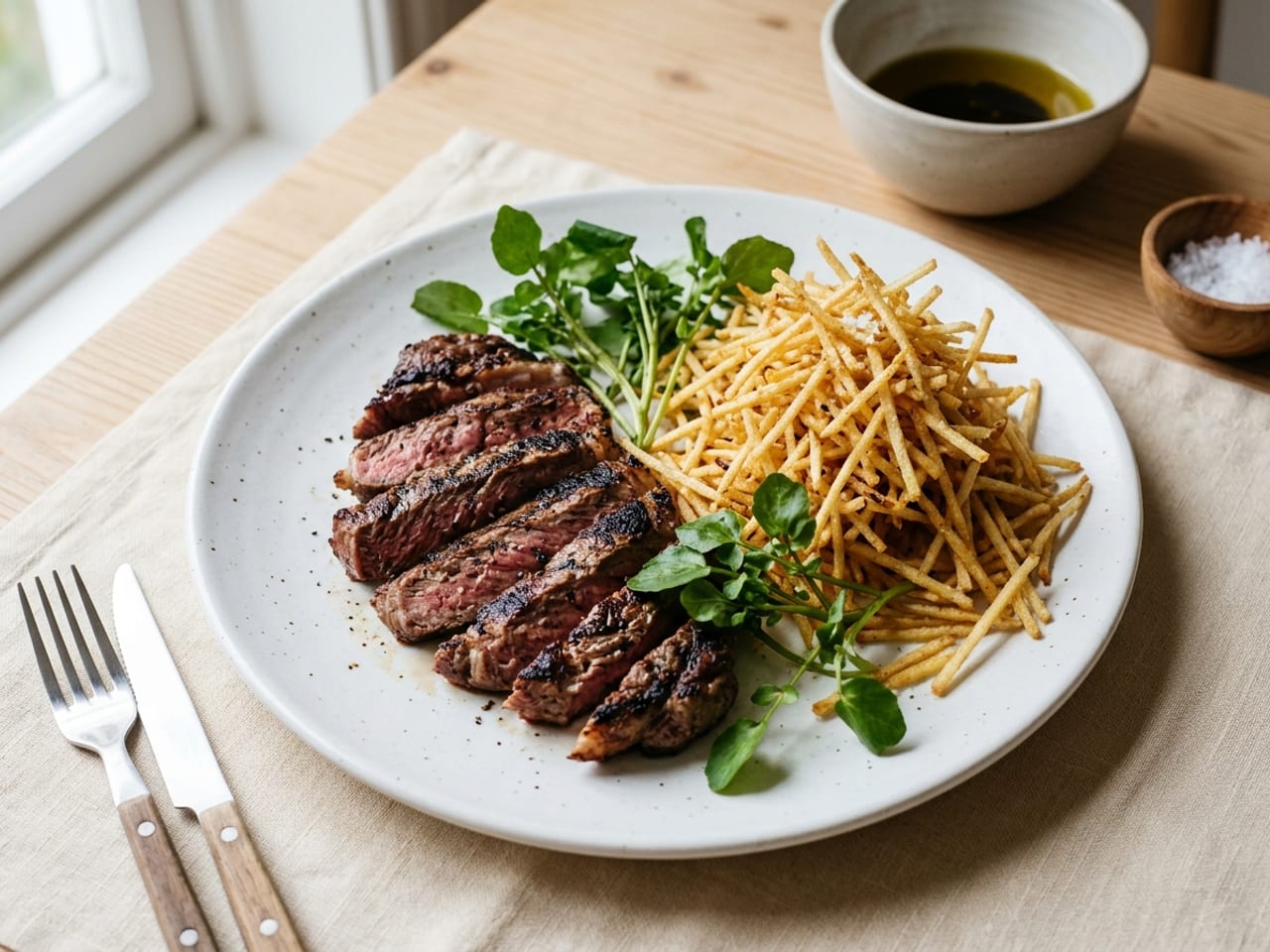
Julienne fries: straw, allumette and shoestring potatoes
Gisslen's straw potatoes are cut 3 mm thick, as thin as his julienne (our comparison); he says "Fry like potato chips", and the chips line beside it gives one step in hot fat at 375°F (190°C) (two-column OCR, our reading); his allumette (shoestring or matchstick) potatoes are a little thicker in the recipe, about 0.5 cm, and fried in one step with no blanching. His own cutting figure, though, gets allumette from 3 mm slices, and his older editions (1983, 1989) label the ⅛ in (3 mm) potato "Julienne (or allumette potatoes)" (our reading of the OCR); the CIA's 1969 index lists "Julienne or Alumette Potatoes" as one entry, with no size in our fragment.2, 3, 4 Escoffier put allumettes, at one-fifth of an inch, between straw potatoes and Pont-Neuf, and fried his straw potatoes twice, the second time "afresh into smoking fat" just before serving.38, 40 Before frying, hold cut potato "submerged in cold water", rinse it "in several changes of cold water if indicated" and dry it thoroughly "to prevent splattering when they are added to the oil" (CIA); Dubois soaked straw potatoes 20 minutes (1893).1, 35 No source we read gives a soaking time for julienne potatoes today.
| Source | Name | Size as printed | How it is fried |
|---|---|---|---|
| Escoffier (French copy dated 1903; 1907 English)38, 40 | Pommes de terre en allumettes | "small rods, of one-fifth in. sides" (about 5 mm, ours); in French, between pailles and Pont-Neuf | Hot fat, "let them dry well before draining them"; no temperature |
| Escoffier (1907)40 | Pommes pailles (straw potatoes) | "a long, thin julienne"; no number | Washed, dried on linen, fried, then just before serving "plunge them afresh into smoking fat": two steps, no temperature |
| Escoffier (1907)39, 40 | Pommes Pont-Neuf | "rods of half-inch sides"; 1 cm in the French | "the generic type of fried potatoes" |
| Ranhofer (1894)36 | "POTATOES, JULIENNE OR STRAW" | eighth-inch slices cut into fillets; "For straws the fillets are much thinner" | Fried; no allumette in his book |
| Dubois (1893)35 | Pommes de terre paille | long fillets "pas plus larges qu'épais", no wider than thick | Soaked 20 minutes in cold water, dried, fried twice |
| Senn (1895)37 | Pommes frites à la Julienne; pommes pailles | "small shreds, similar to julienne roots"; straws "fine shreds" about 1½ in (about 4 cm, ours) long (the OCR reads "li in.", our reading) | Washed and dried, fried in boiling fat until crisp; straws about six minutes |
| CIA, The Professional Chef (1969)2 | "Julienne or Alumette Potatoes" | An index entry; size not in our fragment | - |
| Gisslen (1983, 1989)4 | "Julienne (or allumette potatoes)" | 3 mm thick, 2½ in long (our reading of the OCR) | - |
| Gisslen (2011), the cutting figure3 | Allumette potatoes | slices "(3 mm) thick would give you allumette potatoes" | - |
| Gisslen (2011), the recipe3 | Allumette potatoes (shoestring or matchstick potatoes) | strips "slightly less than" ¼ in thick (the OCR garbles the fraction), "(about 0.5 cm)": thicker than his own figure's 3 mm | "one step (without blanching) until very crisp"; no temperature printed |
| Gisslen (2011)3 | Straw potatoes | "very thin strips", "(3 mm) thick": the julienne's thickness | "Fry like potato chips"; the chips line beside it gives one step in hot fat at 375°F (190°C) (two-column OCR, our reading) |
| Gisslen (2011)3 | French fries | 1 cm square and about 7.5 cm long (about ⅜ in and 3 in; Gisslen's fraction is garbled in the OCR, so ⅜ is our reading) | Held in cold water; fried at 325°F (160°C) until pale, then at 350° to 375°F (175° to 190°C) until brown and crisp |
| SkillsUSA (2024); On Cooking, Canadian edition (2009)6, 8 | Allumette | The ⅛ in (3 mm) stick of any vegetable | - |
Julienne soup: potage and consommé julienne
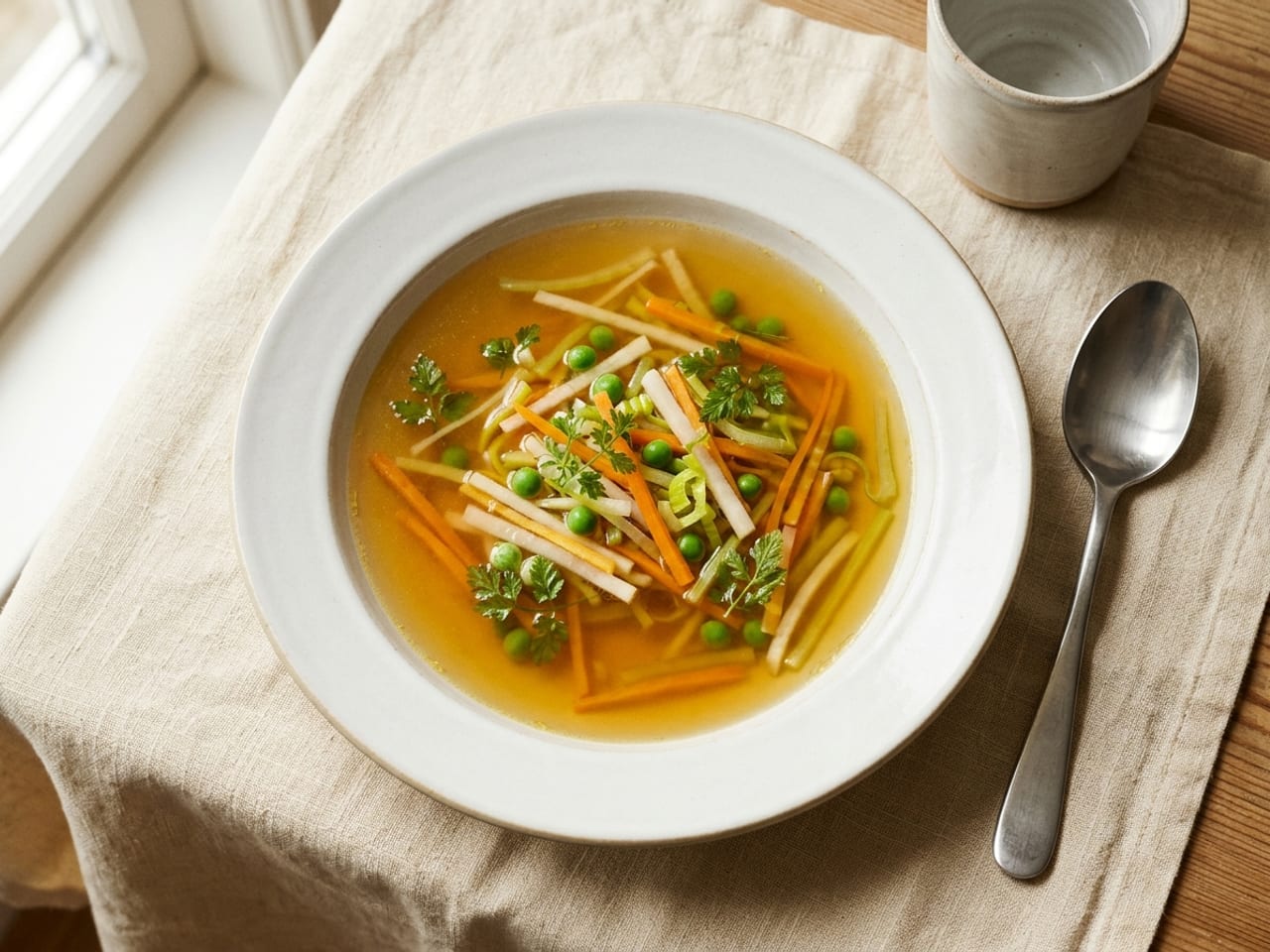
The soup came first (history). Escoffier's Consommé Julienne cuts "into fillets, two inches in length, the red part only of two medium-sized carrots, one medium-sized turnip, one leek, half a stick of celery, some cabbage leaves, and half an onion", stews them in butter and finishes them in the consommé with peas, "one tablespoonful of sorrel and lettuce chiffonade" and chervil.40 His French Potage Julienne gives quantities for 2 litres (about 2 quarts, ours), seasons the vegetables with salt and a pinch of sugar, stews them in butter, adds blanched cabbage "en Julienne" and slices the onion rather than cutting it in sticks; his "Julienne Darblay" is, he writes, "le potage Julienne classique, de la cuisine flamande" (a clear potato soup with julienne, in his recipe).39
Gisslen's Consommé Julienne is "Onion or leek, carrot, and celery, cut julienne", cooked like his brunoise garnish, "1-2 tbsp (15-30 mL) garnish to each portion" at service, and "julienne may need to be cut shorter than for other applications" so it fits the spoon.3 Escoffier measures a julienne garnish by the spoonful: one or two a litre for vegetables, one or half a spoonful for meat or fish.39 Older soups were cooked longer and some browned: Gouffé fried the strips "d'une couleur d'acajou foncé", dark mahogany, and simmered them three hours; Dubois and Bernard sweated theirs "sans leur faire prendre couleur".32, 33 Larousse cooks julienne like a fondue de légumes to garnish soups and consommés.19
Can you cut julienne ahead? How it keeps
The textbooks cut raw julienne late, and warn that water holds it at a price. No regulator or university we read gives a home keeping time for cut carrot, onion or pepper; the three day counts below (grated carrot, sliced celery, cut onion) are industrial figures from the USDA handbook, commercial packs in controlled cold rooms, not a tub in a home fridge, and its carrot and potato rows give temperatures and faults, not days.1, 3, 93
| Source | What | Kind | Ahead, and how long |
|---|---|---|---|
| Gisslen (2011)3 | Raw vegetables for a salad | Textbook | "Cut vegetables as close as possible to serving time, or they may dry or shrivel" |
| Gisslen (2011)3 | Potato, eggplant, artichoke, sweet potato | Textbook | Lemon juice, "an antioxidant solution, or hold under water until ready to use (Some vitamins and minerals will be lost)" |
| CIA (2011)1 | Any cut vegetable in water | Textbook | "extended storage in water, once vegetables are peeled or cut, can rob them of flavor, texture, and nutritional value" |
| America's Test Kitchen77 | Raw onion | Test kitchen | "it is best to chop them immediately before you need them"; as a mere accent in a cooked dish, ahead is fine |
| FDA Food Code (2026), §3-303.12(C)94 | Cut raw carrot, celery, potato | US food business | "cut, raw vegetables such as celery or carrot sticks or cut potatoes ... may be immersed in ice or water" |
| FDA Food Code (2026), §1-201.10 and §3-501.1694 | Cut tomato, cut leafy greens (cabbage included), cut melon, cooked julienne | US food business | Time/temperature control for safety food: held at 41°F (5°C) or below. Cut carrot and onion are not named |
| USDA Food Safety and Inspection Service95 | Perishable food at home | Home | "Never leave food out of refrigeration over 2 hours. If the temperature is above 90 °F, food should not be left out more than 1 hour" (90°F is 32°C, ours) |
| USDA Agriculture Handbook 66 (2016)93 | Fresh-cut carrot | Industry | Kept at 1 to 3°C (34 to 38°F); "Most quality loss in cut carrots results from formation of either white blush or off odor and slimy surface" |
| USDA Agriculture Handbook 66 (2016)93 | Grated carrot | Industry | "up to 10 days at 2 to 10 °C (36 to 52 °F)" in a commercial bag (sic: the handbook prints 52 °F; 10 °C is 50 °F, ours): not a home figure (ours) |
| USDA Agriculture Handbook 66 (2016)93 | Sliced celery | Industry | "can only be maintained for 6 days at 4°C (40 °F) without notable quality change"; a 2.5 to 5% water loss makes it limp |
| USDA Agriculture Handbook 66 (2016)93 | Fresh-cut onion | Industry | "A storage life of 10 days is possible" in polymer bags at 2°C (36°F) |
| USDA Agriculture Handbook 66 (2016)93 | Potato sticks | Industry | Browning is "a major problem"; "Vacuum packaging of fresh-cut potatoes may create anaerobic conditions that allow growth of Clostridium botulinum" |
Why cut carrot turns white. "As the cut surface loses water, adhering cellular debris may impart a white blush to the surface that masks varietal color"; "Low storage temperature and retention of surface moisture significantly delay development of white blush", and "Using sharp knives is important to reduce tissue damage and extend shelf-life" (USDA handbook).93 Cut apple and potato brown because an enzyme, polyphenol oxidase, turns phenolic compounds dark in the presence of oxygen; acid slows it, but acids "may leave off flavors and promote tissue softening".93 Our suggestion: cut the same day, cover the sticks and keep them cold.
Food safety. Wash produce before cutting (FDA Food Code §3-302.15). The Food Code names cut tomatoes, cut melons, cut leafy greens (which include cabbage) and heat-treated plant food as foods that need time or temperature control; cut carrot and onion are not named. So a cabbage julienne, a tomato julienne or a blanched julienne goes in the fridge: for US food businesses under the Food Code, at 41°F (5°C) or below. The Code also lets a business hold "cut, raw vegetables such as celery or carrot sticks or cut potatoes" in ice or water.94 At home, USDA's rule is no more than 2 hours out of the fridge, 1 hour above 90°F (32°C, ours).95 The cut-produce rules for home and business are also on our knife skills guide.
What is a julienne salad?
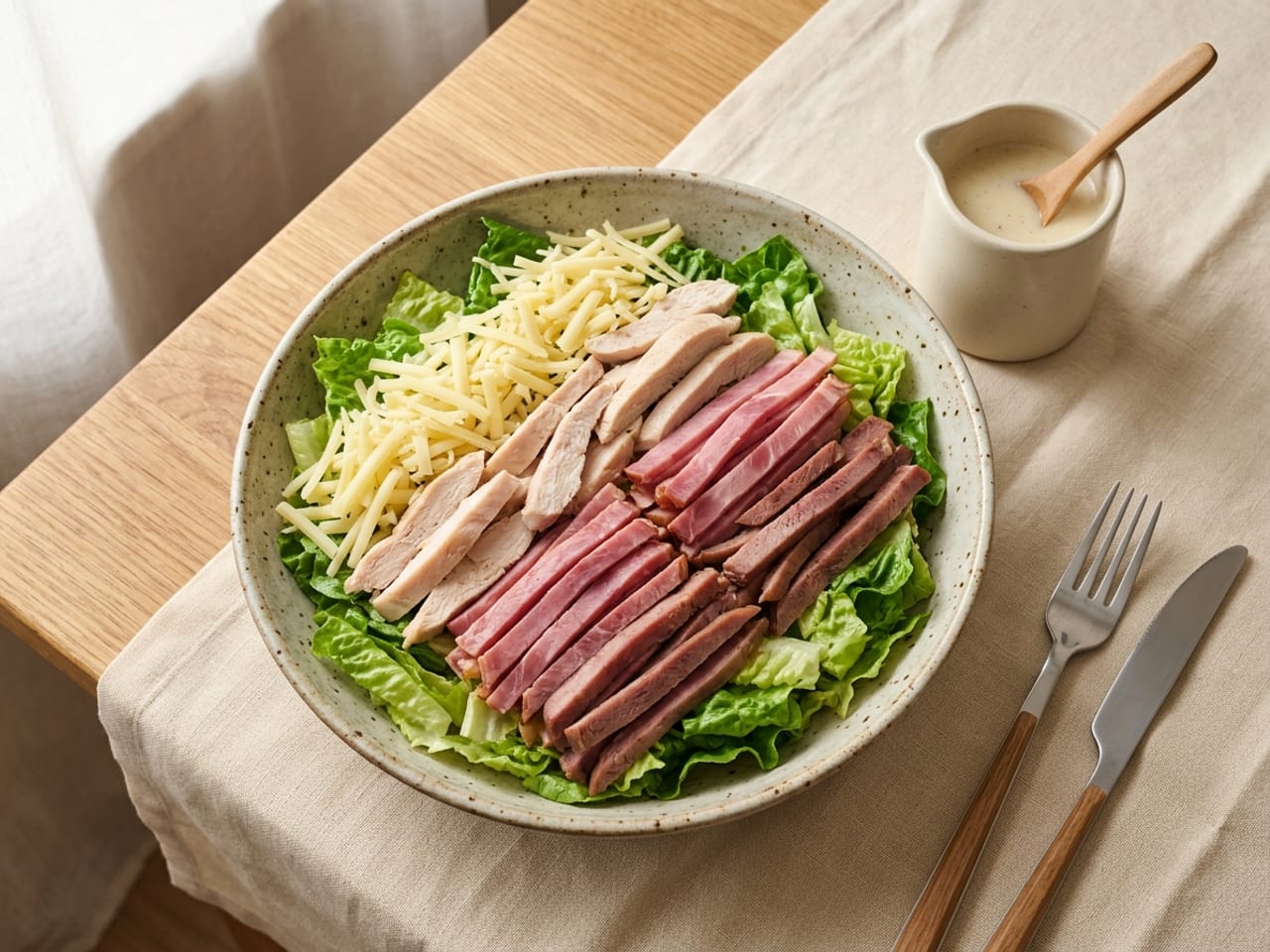
Two dishes share the name. In the dated books we read, a julienne salad is first a salad of strips of vegetables (potato in 1900, celery and beet in 1918, cabbage in 1925); a version with chicken and tongue appears in 1914; the salad of ham, tongue or chicken and cheese in strips on lettuce, a cousin of the chef's salad, is what we found in books of 1978 (London) and 1987 (New York); 1987 Chicago menus list a "Julienne Salad" beside the chef salad.42, 43, 44, 45, 48, 49 These are the earliest dates we found in the scans we searched (the Internet Archive's full text), not first uses.
Julienne salad vs chef salad. The Food Timeline's earliest recipe titled "Chef's Salad" in an American cookbook is from 1936, and its 1941 Ritz chef's salad already has the meats "all cut in julienne style"; a 1987 Chicago menu still lists "Julienne Salad" and "Chef Salad" as two items.47, 50 The 1900 potato salad is older than the earliest titled chef's salad but is no ancestor of the meat salad (our reading). Beware menus of 1899 to 1913: "Julienne" there is the soup, printed next to a salad heading.46 The plated vegetable salad on our knife skills guide belongs to the older sense. In all, five of the dated rows below are vegetable salads, three are julienne salads with meat (1914, 1978, 1987), one is a chef's salad cut julienne-style (1941), and two are menus:
| When | Source | What is in it | Meat? |
|---|---|---|---|
| 1899 to 1913 | US and Canadian newspaper menus46 | "Julienne" in a menu column is the soup, printed next to a SALAD heading: not a julienne salad | Menu |
| 1900 | Detlefs, A Little Book of Practical Cookery, p. 3542 | "Cut pared potatoes into narrow strips and simmer in seasoned white stock until barely tender", then dressing, on lettuce or cress | No |
| 1914 | Larned, One Hundred Salads, p. 6643 | "Shred in long, match-like strips the white meat of cooked chicken, a little tongue if at hand, celery, artichoke fonds, and truffles", on lettuce; "Or omit the meat and truffles, add carrots and apples" | Either |
| 1918 | Hammond, The Swedish, French, American Cook Book, p. 30344 | Celery "cut in julienne style, leave in ice water until quite crisp", cooked beet and lettuce, with endive and mayonnaise | No |
| 1925 | The Heinz Book of Salads, p. 3245 | "Let this shredded cabbage stand in ice water until crisp", then green pepper and cooked carrot strips in French dressing | No |
| 1934 to 1942 | US newspapers and magazines (search fragments)46 | Green pepper, carrots and cabbage | No |
| 1941 | Louis Diat's chef's salad at the Ritz (quoted by the Food Timeline)47 | "boiled chicken, smoked ox tongue and smoked ham, all cut in julienne style": called a chef's salad, not a julienne salad | Yes |
| 1978 | Carrier, Great Salads and Vegetables, p. 2248 | Smoked ox tongue, ham and cheese: "Cut tongue, ham and cheese into thin strips and arrange according to colour on bed of lettuce" | Yes |
| 1987 | Barbecues & Salads, p. 5249 | Ham, tongue, chicken, Gruyère or Swiss and Colby, pictured beside a Cobb salad | Yes |
| 1987 | Chicago delivery menus50 | "Julienne Salad" listed beside "Chef Salad" and "Antipasto": two dishes by name | Menu |
| 2008; 2011 | Cooks Academy (Dublin); Everyday to Gourmet51 | "Julienne Salad of Carrot, Cucumber and Mint"; a celeriac julienne salad | No |
Julienne on the plate: nests, height and colour
Julienne gives a plate line and height: piled loosely as a nest on or beside the main item, scattered over a soup, or fried crisp. No book we read gives plate geometry or an amount of julienne per plate (only per bowl of soup); the rules below are Gisslen's, the nests are cookbook practice, and the amounts for a plate are our suggestion. Gisslen's garnish is "small edible items (smaller than side dishes) intended to enhance the visual appeal of the dish", and his basic rule: "Keep it simple."3
- Nests: "a nest of julienne" is cookbook language from the late 1960s: "Garnish the medallions with a nest of julienne potatoes" (1969), quail "presented in a nest of julienne potatoes" (1988), and a "‘nest’ of julienne vegetables" on chilled side plates (1989).57 a caption in Raymond Oliver's 1969 book reads "Shape the julienne potatoes into a nest", and Escoffier fried straw potatoes in a basket called a "Moule à Nid", a nest mould, to hold fried potatoes.39, 41 A Los Angeles chef of the 1990s built "corrals" of shoestring potatoes to keep purées and sauces from spreading.59
- Height: "Ingredients mounded on the plate are more interesting than if they are spread flat", and a little height is enough (Gisslen).3 Our teriyaki chicken heaps fine cucumber julienne "rather than spreading it flat". More on building up in how to stack food.
- Crisp it in ice water: wilted raw vegetables "can be recrisped by holding them for a short time in ice water" (Gisslen); Hammond (1918) left julienne celery "in ice water until quite crisp"; one chef's cookbook gives celery 2 minutes "to curl and crisp it", another puts scallion strips "in ice water to crisp".3, 44, 58 Drain and dry before plating (ours).
- Colour: "Two or three colors on a plate are usually more interesting than just one", and "Too many colors may look messy" (Gisslen), whose salad example adds "a few shreds of carrot, red cabbage, or other colored vegetable". Carrier arranged his julienne salad's strips "according to colour".3, 48
- Cut well, or it shows: "Ragged or sloppy cutting makes the whole salad look sloppy and haphazard" (Gisslen).3
- How much: in a consommé, "1-2 tbsp (15-30 mL) garnish to each portion" (Gisslen), or one or two spoonfuls a litre (Escoffier).3, 39 On a plate, a small loose nest that does not hide the main item is our suggestion.
- Garnish ideas from the books: fried leek or celery julienne, "dusted in flour before frying" (Gisslen); deep-fried ginger (Le Cordon Bleu); blanched citrus zest (Escoffier, the CIA); heaps of straw potatoes and watercress beside grilled meat (Escoffier).1, 3, 13, 40
On our recipe pages, the banh mi stuffs the roll with pickled daikon and carrot matchsticks, and the japchae folds carrot matchsticks into the noodles. More garnish ideas are in our food garnish guide; for leafy ribbons, chiffonade; for the julienne cut into cubes, brunoise; for a composed salad, how to plate a salad; and for the nest as a plating move, plating techniques.
Julienne meaning and history: a soup before it was a cut
In the books we read, julienne was a soup for about 65 years before it was a cut. Massialot printed "Potages à la Julienne" in 1691, with no cut given; a later Massialot book, catalogued 1722 to 1730, has the vegetables in chunks; Menon cut them "en petits filets" in 1755; English cooks made it an inch long from 1759; Ranhofer graded it in fractions of an inch in 1894; and the US textbooks settled on ⅛ in (3 mm).1, 20, 21, 22, 24, 36 The dates below are the earliest we found in the scans we could search: floors, not origins. 1691 is the earliest we found; dates later than that, printed online as the first use, are not.
| When | What we found |
|---|---|
| 1691 | Massialot's Cuisinier roïal et bourgeois: "On fait aussi des Potages à la Julienne", and "Trois Juliennes aux Poulardes" on a menu. No cut is given: the earliest printed julienne we found, and TLFi dates the cooking sense to this book.20, 65 |
| 1722 to 1730 (catalogue) | A later Massialot book (Le Nouveau cuisinier, catalogued 1722 to 1730): cucumbers "coupez en ovale", lettuces "par quartiers", whole mushrooms, small onions: chunks, not strips.21 |
| 1755 | Menon: "Potage de Julienne ... Coupez en petits filets", the first strips in a julienne soup we found; in the same book roots "coupées comme pour une Julienne", the earliest use of the word as a shape we found.22 |
| 1758 | Les Dons de Comus: "Julienne pour toutes les saisons", with only the lettuce in strips, "petits filets de laitue".23 |
| 1759 | Verral in Lewes: "Potage, or Soup a-la Julienne", "a favourite soup, and now highly in vogue" (printed with a long s, which we modernise), with carrot "about an inch in length", sliced very thin and cut into small square pieces: the earliest English julienne we read.24 |
| 1806 | Viard: roots cut "en filets de la grosseur d'une demi-ligne, et huit ou dix lignes de long" (about 1.1 mm thick and 18 to 23 mm long, ours: a ligne is about 2.26 mm).25 |
| 1808 | Grimod de La Reynière: juliennes whose vegetables are cut so fine that they need no fork.26 |
| 1813 | Ude in London: the soup's roots "cut them all into little fillets", fried in butter, with sugar "to take off the bitter taste of the roots"; elsewhere slices "as for a julienne, about one line thick and one inch long" (about 2.3 by 25 mm, ours), the word used as a shape without explanation.27 |
| 1833 | Carême: carrot cut to length, into ribbons, then "petits filets d'une ligne carrée" (about 2.3 mm square, ours); and "la julienne de betteraves", a julienne of one vegetable.28 |
| 1846 | Francatelli: "Cut all these vegetables into fine shreds an inch long"; Soyer cuts carrot slices "into small thin strips".29, 30 |
| 1861 | Beeton: "strips of about 1-1/4 inch long" (about 3 cm, ours), all the same size, "or some will be hard whilst the others will be done to a pulp".31 |
| 1864 | Dubois and Bernard: the red part of the carrots in "filets très-fins de 2 centim. de long", sweated "sans leur faire prendre couleur"; their "Allumettes" are puff pastry.32 |
| 1867 | Gouffé: strips "de 2 centimètres de long sur 1 centimètre" (as printed), fried to dark mahogany and simmered three hours; the soup can be made well only nine months of the year, and shops sell dried "Juliennes".33 |
| 1877 | Kettner's Book of the Table: the name is "utterly unknown"; cooks write "cut the vegetables as for Julienne"; the straws "about one inch long".34 |
| 1893 | Dubois grades "la fine julienne coupée courte, celle de moyenne longueur et la grosse julienne": 1.5 cm, 2.5 cm and 3 to ? cm long ("3 à à" in the damaged OCR; we read 4), square in section (the date is the Internet Archive catalogue's).35 |
| 1894 | Ranhofer in New York: fine julienne ⅝ in long and just over 1/16 in square, medium ⅞ in by ⅛ in, large 1¾ to 2 in by 3/16 in (about 16 × 1.6 mm, 22 × 3 mm and 44 to 51 × 5 mm, ours): the earliest inch grading we read. The modern ⅛ in (3 mm) julienne is his medium thickness (our comparison).36 |
| 1895 | Senn: a clear soup with vegetables "cut into very thin strips, about an inch long, called Julienne": the word names the cut.37 |
| 1903 | Escoffier's Le Guide culinaire (an Internet Archive copy dated 1903; its title page reads "Deuxième édition"): "Pommes de terre frites en Allumettes", the earliest allumette potato we read.38 |
| 1907 | Escoffier in English: "Cut, Julienne-fashion = to cut a product into match-shaped rods"; the consommé's fillets "two inches in length".40 |
| 1914 | Larned (the Internet Archive's date for the book): "long, match-like strips" of chicken and tongue in a julienne salad.43 |
| 1969 | The CIA's Professional Chef (an index entry, the Internet Archive's 1969 edition) lists "Julienne or Alumette Potatoes"; a caption in Raymond Oliver's book (a search fragment of the English edition) reads "Shape the julienne potatoes into a nest".2, 41 |
| 1996 to 1997 | Larousse gastronomique: slices "de 1 à 2 mm d'épaisseur", cut into filaments.19 |
| 2011 | The CIA's 9th edition: ⅛ by ⅛ by 1 to 2 in (3 mm by 3 mm by 3 to 5 cm) "is standard"; Gisslen prints 3 × 3 × 25 to 50 mm and a fine julienne of 1.5 mm.1, 3 |
| 2024 | SkillsUSA's chart calls the 1/16 in (1.5 mm) stick julienne and the ⅛ in (3 mm) stick allumette; its contest sheet the same year asks for a ⅛ in julienne.8, 9 |
Inch-long, then two inches. The English books from Verral (1759) to Senn (1895) cut the strips about an inch (about 25 mm, ours) long (Beeton 1¼ in, about 3 cm), two French books of the 1860s 2 cm (about ¾ in, ours); Escoffier's consommé of 1907 cut them two inches (about 5 cm, ours), the length On Cooking keeps, and the CIA and Gisslen allow 1 to 2 in (25 to 50 mm).1, 5, 24, 31, 32, 33, 37, 40 Sorrel. Kettner reports a "tradition" that a julienne needs sorrel, and quotes a Parisian physician, Dr. Boques: "votre Julienne serait manquee" without it (failed; the OCR prints "manquee"); Verral's 1759 soup already had sorrel, lettuce and chervil minced in it; Escoffier finished his with a sorrel and lettuce chiffonade.24, 34, 40 Brunoise and chiffonade began as soups too: the brunoise story and the chiffonade story.
Where the name comes from, and the Jean Julien story
A first name, probably; nobody knows how it reached the soup. Most of the dictionaries we read that give an origin derive it from a first name, Julien or Julienne (Larousse, Wiktionnaire, the American Heritage), or Jules, Julien or Julienne (Collins), or call it a "generic use of Julienne woman's name" (Random House). TLFi, the French historical dictionary, says "Prob.", probably, and that the change of meaning "demeure obscure".60, 61, 64, 65
The cook story is old, and was doubted early. In 1877 Kettner's Book of the Table wrote that the soup was once "supposed to be named after some cook who invented" it, but that it existed long before, and that "all the best French etymologists have given up the word as a hopeless puzzle"; it then offered its own guess, from "Alleluia", an old name for wood sorrel.34 Etymonline keeps the "otherwise unknown cook", and the Century Dictionary suggested "a French caterer in Boston" (Etymonline's English soup is 1841, the same as Merriam-Webster's).66
The earliest trace of "chef Jean Julien" we found is from 2005. It is an anonymous edit to Wikipedia's article on 25 September 2005, "that a certain chef Jean Julien first used this method of preparing vegetables"; editors removed it on 27 May 2008 "until it can be referenced". No dated cookbook or dictionary we read names a cook called Jean Julien.70 Two of the 14 rows below (Etymonline, English Wiktionary) say the name was probably a cook's, with no name and no evidence; Kettner reports the story to doubt it, and the talk page is where the Jean Julien line was added and removed.
Earliest English use. Verral's soup of 1759 is the earliest English julienne we read, and Ude used the word for the cut in 1813: both earlier than Dictionary.com's 1835 to 1845, the 1841 soup of Merriam-Webster and Etymonline (the Internet Archive copies we read) and Etymonline's 1889 for the strips.24, 27, 60, 66, 67 We found no "to julienne" in any dated cookbook we read; Merriam-Webster dates the verb to about 1930.67
| Source | Kind | What it says about the name |
|---|---|---|
| Dictionary.com (Random House)60 | Dictionary | "generic use of Julienne woman's name", dated 1835 to 1845, later than Verral's 1759 soup |
| American Heritage Dictionary (2022)61 | Dictionary | "probably from the name Julienne" |
| Collins English Dictionary (2014)60 | Dictionary | "from name Jules, Julien, or Julienne" |
| Larousse (French, online)65 | Dictionary | "du prénom Julien" |
| TLFi (CNRS)65 | Dictionary | "Prob. dér. du prénom Julien ou Julienne; l'évolution sém. demeure obscure": probably the first name, the change of meaning obscure |
| Wiktionnaire (French)64 | Dictionary | "Viendrait du prénom Julien", 17th century |
| Le Robert; Académie française (9th ed.); Littré65 | Dictionary | No origin on the pages we read: the Académie gives only the fish, Littré only the plant |
| Online Etymology Dictionary (Internet Archive copy, 2024)66 | Dictionary | literally "(soup made) in the manner of Julien", "presumably the name of an otherwise unknown cook"; the Century Dictionary "suggests 'a French caterer in Boston'" |
| Wiktionary (English)64 | Dictionary | From Jules or Julien, "presumably from an otherwise unknown chef of that name" |
| Vocabulary.com68 | Dictionary | "The word comes from a soup of the same name": the order of the senses, not the name |
| Wikipedia, Julienning69 | Encyclopedia | "The origin of the term is uncertain." |
| Kettner's Book of the Table (1877)34 | Cookery book | "the meaning of its name is utterly unknown"; it was once "supposed to be named after some cook who invented" the soup, but the soup was older, and "etymologists have given up the word as a hopeless puzzle" |
| Kettner's Book of the Table (1877), its own guess34 | Cookery book | From "Alleluia", a name for wood sorrel, through a Calabrian "Juliola", brought by Catherine de Medici's cooks: "Is it incredible that ...", a guess no dictionary we read adopts |
| Wikipedia talk page70 | Wiki talk page | The line "that a certain chef Jean Julien first used this method of preparing vegetables" was added on 25 September 2005 by an anonymous shared address and removed on 27 May 2008 "until it can be referenced"; a 2006 comment raises Jefferson's cook Honoré Julien only to rule him out |
Julienne troubleshooting
| Problem | Likely cause | Fix |
|---|---|---|
| Sticks taper into wedges | Planks of uneven thickness from a vegetable that was not squared, or a pressed cut (our deduction; no source we read names this fault) | Square it first, "a slice from each side and both ends", and slice rather than press (CIA)1 |
| Wet, crushed or bruised strips | A dull or tearing edge: ATK's serrated peeler blade left food "bruised and wet" | A sharp blade "glides" with "little bruising or escaped juice" (ATK); slice, do not press (CIA)1, 82 |
| The peeler makes flat noodles, not sticks | Blades set close together: ATK found that peelers with less space between the blades cut "thin, flat noodle shapes" (its GIR, with a 1/16 in, about 1.5 mm, gap, cut strips that are "a bit thin and flat") | A peeler with more space between the blades (ATK), or the knife82 |
| The peeler jams | Food trapped in its teeth (ATK: some models "constantly jammed with shreds of food") | Wider-spaced blades (ATK); clear the teeth as you go (ours)82 |
| Some strips raw, some mushy | Sizes not matched: "some will be hard whilst the others will be done to a pulp" (Beeton) | Cut regularly (Escoffier); in a stir-fry, "add the longer-cooking ones first" (Gisslen)3, 31, 39 |
| Raw strips go limp | Water loss: "Small amounts of water loss (2.5 to 5%)" make celery limp (USDA handbook) | Cut close to serving and recrisp briefly in ice water (Gisslen)3, 93 |
| Carrot strips turn white | White blush: the cut surface drying (USDA handbook) | Keep them cold and moist, and cut with a sharp knife (USDA handbook); or cut closer to use (ours)93 |
| Potato or apple strips brown | An enzyme, polyphenol oxidase, darkens the cut surface in air (USDA handbook) | Cold water for potato (CIA), an acid or antioxidant (Gisslen), not for long: water "can rob them of flavor, texture, and nutritional value" (CIA)1, 3, 93 |
| Julienne potatoes spatter in the oil | Wet strips | Drain and dry them thoroughly "to prevent splattering" (CIA)1 |
| The onion falls apart into layers | An onion is "too difficult to julienne owing to its layers" (CooksInfo) | Slice it root to tip instead: what recipes mean by julienned onion (practice)71 |
| Celery julienne will not go thin | "A julienne of celery is never as thin as a julienne of leeks or carrots" (Pépin) | Accept a slightly thicker strip (ours)15 |
| Soup julienne too long for the spoon | Cut to plate length | "julienne may need to be cut shorter than for other applications" (Gisslen)3 |
| Food sticks on the mandoline | The blade or the food is catching | "If the food gets stuck in the blade, don't push harder"; a glove on the hand that holds the food (ATK)84 |
| Carrots catch on mandoline julienne blades | One retailer's note for the Super Benriner's julienne blades: "You may want to avoid vegetables such as sweet potatoes and carrots"; Cook's Illustrated, testing the same model, found it slices "making julienne from even the toughest foods" | Try a firm carrot on your own blade before a big batch; the knife or a julienne peeler is the fallback (ours)86 |
Photograph your plate, see it re-plated
A nest of julienne on the dish and not sure where it goes? Photograph the plate and Plate Artists re-plates that dish, with the food kept as it is and the changes named so you can repeat them. Start with a re-plate.
Your food, plated like a chef's
Snap it, upload it, and get the composed version back, with the steps to recreate it at home.
Start free · 1 enhancement →Free account · 1 free enhancement · No credit card
Julienne terms, defined
Twelve words the site does not already define: julienne itself is in our food garnish glossary, the knife words in our knife skills guide, and every cut's size in the chart.
Allumette · alumette (CIA, 1969)
French for a match: a puff pastry strip in 1864 and in Larousse, a fried potato rod in Escoffier, paired with potato julienne in the CIA's 1969 index and in Gisslen, and the ⅛ in (3 mm) stick of any vegetable in SkillsUSA's chart.
Where it comes from. Dubois and Bernard's pastry "ALLUMETTES" (1864); Escoffier's "Pommes de terre frites en Allumettes" (1903); the CIA's "Julienne or Alumette Potatoes" (1969); SkillsUSA's "Allumette*" (2024).2, 8, 32, 38
Pommes pailles · straw potatoes
Potatoes cut into a long, thin julienne and fried crisp: 3 mm (about ⅛ in) thick in Gisslen, who says to fry them like potato chips (his chips line: 375°F, 190°C); fried twice in Escoffier.
Where it comes from. Escoffier: "Cut the potatoes into a long, thin julienne"; Gisslen's straw potatoes, 3 mm.3, 40
Shoestring potatoes · matchstick potatoes
Gisslen's other names for his allumette potatoes, about 0.5 cm thick, fried in one step; a 1990s Los Angeles chef built corrals of them to hold sauces.
Where it comes from. Gisslen's recipe title "Allumette Potatoes (Shoestring or Matchstick Potatoes)".3, 59
Potage à la julienne · julienne soup, consommé julienne
The soup the word first named, in 1691: a broth (of veal breast, capon or pigeon in the one recipe we saw) with no cut given; chunks in a later Massialot book, strips from 1755; in Escoffier a clear soup with carrot, turnip, leek, celery, cabbage and onion.
Where it comes from. Massialot 1691; Menon 1755; Verral 1759; Escoffier No. 576a.20, 22, 24, 40
Julienne Darblay
Escoffier's julienne soup on a clear potato (Parmentier) base, which he calls the classic julienne soup of Flemish cooking.
Where it comes from. "Le potage que nous appelons «Julienne Darblay», est le potage Julienne classique, de la cuisine flamande" (Escoffier).39
Julienne salad
A salad of strips: vegetables in the earliest books we read (potato, 1900), chicken and tongue in 1914, and ham, tongue or chicken with cheese on lettuce in books of 1978 (London) and 1987 (New York).
Where it comes from. Detlefs 1900; Larned 1914; Carrier 1978; Barbecues & Salads 1987.42, 43, 48, 49
Julienne peeler
A peeler, usually Y-shaped, with a toothed blade that cuts long, narrow strips along a vegetable that has been peeled first with an ordinary peeler.
Where it comes from. America's Test Kitchen's equipment review; CooksInfo.71, 82
Moule à nid · nest mould
Escoffier's frying basket for a nest: lined with interlaced straw potatoes, closed, fried to colour and turned out to hold other fried potatoes.
Where it comes from. "Nids pour le dressage des Pommes frites" (Escoffier).39
Short julienne, long julienne
British textbook names for julienne cut from 2 cm (about ¾ in, ours) and 4 cm (about 1½ in, ours) lengths; the long one is for garnishing.
Where it comes from. "2 cm lengths (short julienne)"; "Double the length (4cm) is a long julienne" (Practical Cookery).16
Fine, medium and large julienne · fine julienne, grosse julienne
The 1890s grades by length and thickness: ⅝, ⅞ and 1¾ to 2 in (about 16, 22 and 44 to 51 mm, ours) long in Ranhofer, thicker as they get longer; today only the fine julienne survives in the US textbooks.
Where it comes from. Dubois (1893): "la fine julienne coupée courte, celle de moyenne longueur et la grosse julienne"; Ranhofer (1894).35, 36
Juliennes (dried)
Steam-dried vegetable mixtures sold for soup in Paris in 1867; Gouffé says fresh vegetables are always to be preferred.
Where it comes from. "On vend dans le commerce, sous le titre de Juliennes, des mélanges de légumes séchés à la vapeur" (Gouffé).33
Julienne (the plant and the fish)
In French, also dame's rocket, a garden plant, and the ling, a fish: separate senses of the same word (the plant is older than the soup in TLFi).
Where it comes from. TLFi (the plant, 1665 and 1677); the Académie ("Poisson marin de la famille des Gadidés").65
Julienne, answered
What is julienne?
A knife cut: food cut into thin, square sticks, also called matchsticks. In the US textbooks (the CIA, Gisslen) a julienne is ⅛ × ⅛ × 1 to 2 in (3 × 3 × 25 to 50 mm), and a fine julienne 1/16 in (1.5 mm) square. The word first named a soup, potage à la julienne (in the earliest book we found, Massialot, 1691), and still names the clear soup garnished with those strips.
What size is a julienne cut in mm and inches?
⅛ in (3 mm) thick and 1 to 2 in (25 to 50 mm) long in the CIA and Gisslen; On Cooking (2007) fixes the length at 2 in (about 5 cm). British books cut 2 cm "short" or 4 cm "long" julienne, Larousse gastronomique (1997) slices 1 to 2 mm thick, and three of the web pages we read say 2 to 3 in or more. Across the sources we read the thickness runs from 1 mm to ¼ in (about 6 mm, ours) and the length from 2 cm to 3 in (about ¾ to 3 in, ours). SkillsUSA's 2024 chart calls the 1/16 in (1.5 mm) stick julienne, but its contest sheet the same year asks for ⅛ in (3 mm).
What is fine julienne?
A thinner julienne: 1/16 × 1/16 × 1 to 2 in (1.5 × 1.5 × 25 to 50 mm) in the CIA, Gisslen and On Cooking. It is the stick a fine brunoise is cut from. The name drifts: SkillsUSA's chart and On Cooking's Canadian edition call this size plain julienne, and a German maker's "fine" julienne insert is 3.5 mm.
How do you pronounce julienne?
joo-lee-EN, with the stress on the last syllable: /ˌdʒuːlɪˈɛn/ in Collins, /ˌdʒuː.liˈen/ in Cambridge. American dictionaries also give a French-style "zhü-lyen" (two syllables), and in French it is [ʒyljεn].
What does julienne mean, and is it a verb?
It means cut into thin strips, or the clear soup garnished with them, or (Gisslen) garnished with food cut that way. It is a verb in the American Heritage Dictionary, Dictionary.com, Cambridge and Wiktionary (julienned, julienning); Merriam-Webster dates the verb to about 1930. The old cookbooks we read wrote 'cut as for Julienne' or 'cut julienne-fashion' instead.
What is the difference between julienne and batonnet?
Thickness. A julienne is ⅛ in (3 mm) square, a batonnet ¼ in (6 mm), twice as thick, and a little longer (2 to 2½ in (50 to 60 mm)). Both are cut the same way from planks; julienne leads to brunoise, batonnet to small dice.
What is the difference between julienne, allumette and matchstick?
Matchstick is the usual modern English name for julienne; the oldest match comparison we read is Escoffier's 1907 glossary, 'match-shaped rods'. Allumette drifts: paired with potato julienne in the CIA's 1969 index and in Gisslen, the ⅛ in (3 mm) stick of any vegetable in SkillsUSA's chart and On Cooking's Canadian edition, a fried potato of one-fifth of an inch in Escoffier, and a puff pastry strip in French cookery. If a recipe gives a size, trust the size over the name.
How do you julienne carrots by hand?
Wash and peel the carrot, cut it into lengths of 1 to 2 in (25 to 50 mm), square each length by slicing off the rounded sides, slice it into planks ⅛ in (3 mm) thick, stack a few planks and cut sticks of the same width, with your fingertips curled under. Slice forward or back rather than pressing straight down (CIA). A julienne peeler needs no knife skill (America's Test Kitchen) but the strips can come out flatter than knife-cut sticks (ATK found close-set blades cut flat "noodle" shapes).
How do you julienne an onion?
You slice it: what recipes call julienned onion is thin slices cut from root to tip (pole to pole), not square sticks. CooksInfo says onion is 'too difficult to julienne owing to its layers', and Escoffier's own julienne soup slices its onion. Halve the onion through the root, lay it flat and slice lengthwise (chef practice). Sliced onion tastes milder than chopped or minced (Cook's Illustrated).
How do you julienne a bell pepper, zucchini or cucumber?
Make flat, even panels first. For a pepper, halve it, remove the seeds and core, trim the pale ribs and any uneven flesh (ours; the CIA's even-thickness line is about tomato), then cut strips; laying the panels skin side down is chef practice. For zucchini or cucumber, chefs julienne the firm outer flesh and set the seedy core aside; no textbook we read says 'skin only'.
How do you use a julienne peeler?
Peel the vegetable first with an ordinary peeler, hold it on a board near one end, and draw the julienne peeler along its length to cut long, narrow strips (America's Test Kitchen). Where you start sets the length. In ATK's test, peelers with more space between the blades cut squarer sticks and jammed less; a glove helps if you worry about your hand. Grace Young finds the Kinpira peeler's strips thinner than hand-cut julienne.
Can you julienne with a mandoline or a food processor?
Yes. Many mandolines have julienne blades or attachments and give even strips fast, but Cook's Illustrated finds most hand guards 'next to useless': wear a cut-resistant glove on the hand that holds the food. Food processors take julienne discs (Gisslen); we read no home maker's stated disc size, and Robot Coupe's commercial discs run 2 × 2 to 8 × 8 mm. In 2018 one mandoline's julienne blade attachment was recalled in the US and Canada (blades could separate); no injuries were reported.
How long do you blanch julienne carrots?
No textbook we read prints a time for julienne carrots (the textbook times are for citrus zest). A chef's recipe blanches carrot julienne 'until tender-crisp, about 30 seconds' and plunges it into ice water (The China Moon Cookbook); a garden cookbook parboils julienned, sliced or diced carrots 2 to 3 minutes for salads; for freezing, the National Center for Home Food Preservation blanches carrot strips 2 minutes. In a stir-fry, our japchae gives carrot matchsticks 1 to 2 minutes.
What is a julienne salad?
Two dishes share the name. In the dated books we read it is first a salad of vegetable strips (potato in 1900, celery and beet in 1918, cabbage in 1925), with a chicken and tongue version in 1914; in books of 1978 (London) and 1987 (New York) it is strips of ham, tongue or chicken and cheese on lettuce, a cousin of the chef's salad. A 1987 Chicago menu lists julienne salad and chef salad as two items.
What are julienne fries?
Potatoes cut julienne-thin and fried crisp. Gisslen's straw potatoes are 3 mm thick, as thin as his julienne (our comparison), and fried 'like potato chips' (his chips line gives 375°F, 190°C); his allumette (shoestring or matchstick) potatoes are about 0.5 cm and fried in one step without blanching. Escoffier's allumettes were one-fifth of an inch. Soak cut potatoes in cold water and dry them well before frying (the CIA).
Was julienne named after a chef called Jean Julien?
No source we read says so before 2005. The earliest trace we found is an anonymous Wikipedia edit of 25 September 2005, removed in 2008 'until it can be referenced'. Dictionaries derive the word, probably, from the first name Julien or Julienne, and the French historical dictionary calls the change of meaning obscure; in 1877 Kettner's Book of the Table already doubted the story of a cook who invented the soup.
The textbooks, dictionaries, old cookbooks, test kitchens and agencies behind this guide
How each source was read (in full, as a PDF, in an archived copy, as a Google Books snippet, or as search fragments of a lending-only scan) is in its entry and under how this page was made. Blogs, magazines, makers' pages and shops are labelled. Conversions and suggestions marked ours are our own.
- The Culinary Institute of America (2011). The Professional Chef, 9th edition. John Wiley & Sons, the glossary p. 1161 (julienne ⅛ × ⅛ × 1 to 2 in, 3 mm × 3 mm × 3 to 5 cm; fine julienne 1/16 in), the fine julienne chart p. 620, the slicing stroke p. 618, squaring off pp. 623 to 624, leeks p. 635, tomato and pepper fillets pp. 636 to 637, snap peas p. 641, holding cut vegetables in water p. 648, potatoes in cold water p. 732, the Jícama Salad p. 921 and a citrus vinaigrette p. 955; read on 1 November 2026 as Google Books search-inside snippets (and on 29 October and 30 September 2026 for our brunoise and knife skills guides). books.google.com
- The Culinary Institute of America (1969). The Professional Chef. The Culinary Institute of America (1969 edition), the index entry "Julienne or Alumette Potatoes", p. 194; read 1 November 2026 as Internet Archive full-text search fragments of a lending-only scan, not the page images. archive.org
- Gisslen, W. (2011). Professional Cooking, 7th edition. John Wiley & Sons, Fig. 7.7 basic cuts p. 143 (julienne and allumette potatoes 3 × 3 × 25 to 50 mm, fine julienne 1.5 × 1.5 × 25 to 50 mm; the OCR garbles the inch fractions), the guiding hand and slicing pp. 142 to 144, Fig. 7.11 cutting sticks and dice pp. 144 to 145, zest Fig. 7.24 p. 149, the glossary (julienne 3 mm × 3 mm × 6.5 cm; allumette), Consommé Julienne p. 231, soups, à la nage, vegetables that brown p. 557, sautéing and stir-frying, deep-fried vegetables, allumette, straw and French fried potatoes p. 625, salads (garnish, colour, height, cutting), egg rolls, equipment (food processor discs, mandoline) and plating; read in an Internet Archive OCR copy of the whole book and as Google Books snippets on 1 November 2026. books.google.com
- Gisslen, W. (1989). Professional Cooking (1983 and 1989 editions). John Wiley & Sons, Fig. "Basic cuts and shapes": "Julienne (or allumette potatoes)", read in the OCR as "Vs in. x Vs in. x 2 V2 in. (3 mm x 3 mm x 6" (our reading: ⅛ × ⅛ × 2½ in); the stuffed peppers recipe; read 1 November 2026 as Internet Archive full-text search fragments of a lending-only scan, not the page images (copies professionalcook00giss, 1989, and professionalcook0000giss, 1983). archive.org
- Labensky, S. R. & Hause, A. M. (2007). On Cooking: A Textbook of Culinary Fundamentals, 4th edition (and the 2003 edition, and a 2006 printing). Pearson Prentice Hall, "Cutting julienne and batonnet", p. 104 (julienne ⅛ × ⅛ × 2 in, 3 mm; fine julienne 1/16 × 1/16 × 2 in, 1.5 mm × 1.5 mm × 5 cm; batonnet slices ¼ in, 6 mm; "Julienne and batonnet are matchstick-shaped"); the 2006 printing's separate allumette entry (3 mm × 3 mm × 5 to 6 cm) and its section "Cutting Julienne, Allumette and Batonnet"; the mandoline; recipes with "Onions, julienne"; read 1 November 2026 as Internet Archive full-text search fragments of a lending-only scan, not the page images (copies oncookingtextboo0003labe, oncookingtechniq0000labe, oncookingtextboo0003unse, oncookingtextboo0000unse_b4d0). archive.org
- Labensky, S., Hause, A., Martel, P. et al. (2009). On Cooking: Fourth Canadian Edition. Pearson Canada, "1 to 2 mm (1/16 in.) for julienne, 3 mm (1/8 in.) for allumette or 6 mm (1/4 in.) for batonnet"; the julienne length is garbled in the OCR; read 1 November 2026 as Internet Archive full-text search fragments of a lending-only scan, not the page images. archive.org
- Institute of Child Nutrition (2023). Culinary Quick Bites: Knife Skills: How to Julienne. University of Mississippi (USDA-funded school nutrition training), pp. 8 to 9 and 12: strips 2 to 3 in long and 1/16 to ⅛ in thick, a stable base, stacking a few planks, the uses, gloves for the hands-on drill; read in full on 1 November 2026 as a PDF. theicn.org (PDF)
- SkillsUSA (2024). 2024 Knife Cut Chart. skillsusa.org (student competition body), "Julienne 1/16” x 1/16” x 1” to 2”", "Allumette* 1/8” x 1/8” x 1” to 2”", batonnet ¼ × ¼ × 2 to 2½ in; its note credits the dimensions to guidelines "used here at The Culinary Institute of America"; read in full on 1 November 2026 as a PDF (poster layout). skillsusa.org (PDF)
- SkillsUSA (2024). National Culinary Arts Contest, High School (27 June 2024, Atlanta). skillsusa.org, "Skill Component: Vegetable Cuts", item 5: "Julienne (1/8”x1/8”x2”) Carrots"; read in full as a PDF on 24 October 2026 for our tourné guide and re-read on 1 November 2026. skillsusa.org (PDF)
- Furdell, R. (2021). Knife Cuts Guide (Cook's Reference Sheet). ciafoodies.com (a CIA alumni site; not an official CIA publication), julienne ⅛ × ⅛ × 1 to 2 in, fine julienne 1/16 × 1/16 × 1 to 2 in, batonnet ¼ × ¼ × 2 to 2½ in; read as a PDF on 29 October 2026 for our brunoise guide. ciafoodies.com (PDF)
- Rouxbe Online Culinary School (2026). What is julienne?; Types of knife cuts. rouxbe.com, julienne ⅛ × ⅛ × 2 in, fine julienne 1/16 × 1/16 × 2 in, "thin, matchstick-like strips"; undated; read in full on 1 November 2026 (the types page on 29 October 2026). rouxbe.com
- Lynch, F. T. (2007). The Book of Yields, 7th edition. John Wiley & Sons, the note that pepper membrane is sliced off as part of the cutting, and one yield for carrots whatever the cut; read as Google Books search-inside snippets on 29 October 2026 for our brunoise guide. books.google.com
- Wright, J. & Treuille, E. (Le Cordon Bleu) (1996). Le Cordon Bleu Complete Cooking Techniques. London: Cassell, "MOOLI JULIENNE" and "DEEP-FRIED GINGER" (julienned ginger blanched, then fried); read 1 November 2026 as Internet Archive full-text search fragments of a lending-only scan, not the page images. archive.org
- Le Cordon Bleu (2001). Le Cordon Bleu Kitchen Essentials. Le Cordon Bleu, julienne "about 2 in. in length" (the two-column page stitches the words) and ginger cut "into julienne" for a stir-fry; read 1 November 2026 as Internet Archive full-text search fragments of a lending-only scan, not the page images. archive.org
- Pépin, J. (2012). Jacques Pépin New Complete Techniques. New York: Black Dog & Leventhal, "How to Julienne": "very thin strips", leeks from ⅛-inch (3-millimeter) slices "into a fine julienne", celery "never as thin", and a potato julienne washed and dried; read 1 November 2026 as Internet Archive full-text search fragments of a lending-only scan, not the page images. archive.org
- Foskett, D., Ceserani, V. & Kinton, R. (2009). Practical Cookery, 11th edition; Foundation Practical Cookery (2009). Hodder Education, julienne from "2 cm lengths (short julienne)"; "Double the length (4cm) is a long julienne", for garnishing; read 1 November 2026 as Internet Archive full-text search fragments of a lending-only scan, not the page images (copies practicalcookery0000cese_c1q7 and foundationpracti0000fosk; the page is not shown in the fragments). archive.org
- City & Guilds and UK diploma textbooks (2007). Professional Cookery S/NVQ Level 2 (2006); Professional Chef Level 2 Diploma (2007). UK vocational textbooks, "julienne 3-4 cm matchsticks" (2006) and "julienne 2mm x 2mm x 4cm long" (2007); read as Internet Archive full-text search fragments on 29 October 2026 for our brunoise guide. archive.org
- The Observer; Herbst, S. T. (1990). The Observer Guide to British Cookery (1984); Food Lover's Companion (1990). cookery book; food dictionary, orange peel cut "into a thin julienne (thinner than matchstick strips)" (1984); julienne "Foods that have been cut into thin, matchstick strips" (1990); read 1 November 2026 as Internet Archive full-text search fragments of a lending-only scan, not the page images. archive.org
- Comité gastronomique (président Joël Robuchon) (1997). Larousse gastronomique (1996, 1997 printing). Paris: Larousse-Bordas, the entries JULIENNE (slices "de 1 à 2 mm d'épaisseur", by knife or mandoline, then cut into filaments; cooked like a fondue de légumes for soups and consommés; raw for hors-d'oeuvre; the length digits are damaged in the OCR, so no length is printed) and ALLUMETTE (a puff pastry strip); read in full in the Internet Archive scan (OCR text) on 1 November 2026 (first read on 29 October 2026 for our brunoise guide). archive.org
- Massialot, F. (1691). Le Cuisinier roïal et bourgeois. Paris, "Potages à la Julienne", p. 283, and the menus pp. 26 and 38 ("Trois Juliennes aux Poulardes"); a prior reading of the Gallica scan for our knife skills guide (30 September 2026); Gallica refused this machine on 1 November 2026. gallica.bnf.fr
- Massialot, F. (1722 to 1730). Le Nouveau cuisinier royal et bourgeois, tome 3 (catalogued by Gallica 1722 to 1730). Paris, "Potage ou Julienne", p. 298: cucumbers "coupez en ovale", lettuces "par quartiers", whole mushrooms; a prior reading of the Gallica scan for our knife skills guide (30 September 2026); Gallica refused this machine on 1 November 2026. gallica.bnf.fr
- Menon (1755). Les Soupers de la Cour, tome 1. Paris, "Potage de Julienne", p. 100 ("Coupez en petits filets"), and roots "coupées comme pour une Julienne", p. 356; a prior reading of the Gallica scan for our knife skills guide (30 September 2026); Gallica refused this machine on 1 November 2026. gallica.bnf.fr
- Les Dons de Comus (anonymous) (1758). Les Dons de Comus, nouvelle édition, tome 1. Paris, "Julienne pour toutes les saisons", p. 89 ("petits filets de laitue"); a prior reading of the Gallica scan for our knife skills guide (30 September 2026); Gallica refused this machine on 1 November 2026. gallica.bnf.fr
- Verral, W. (1759). A Complete System of Cookery. Lewes, "Potage, or Soup a-la Julienne", pp. 11 to 12 (carrot "about an inch in length", "now highly in vogue"); read in full in the Internet Archive scan (OCR text) on 1 November 2026. archive.org
- Viard (1806). Le Cuisinier impérial. Paris, the julienne roots "coupées en filets de la grosseur d'une demi-ligne, et huit ou dix lignes de long", pp. 4 to 5; a prior reading of the Gallica scan for our knife skills guide (30 September 2026); Gallica refused this machine on 1 November 2026. gallica.bnf.fr
- Grimod de La Reynière, A. B. L. (1808). Manuel des amphitryons. Paris, juliennes whose vegetables need no fork; a prior reading of the Gallica scan for our knife skills guide (30 September 2026); Gallica refused this machine on 1 November 2026. gallica.bnf.fr
- Ude, L. E. (1813). The French Cook. London, No. 4 "Potage a la Julienne" and No. 5, pp. 56 to 57, and "as for a julienne, about one line thick and one inch long", pp. 341 to 342; read in full in the Internet Archive scan (OCR text) on 1 November 2026. archive.org
- Carême, A. (1833). L'Art de la cuisine française au dix-neuvième siècle, tome 1. Paris, the julienne p. 86 (strips "d'une ligne carrée") and "la julienne de betteraves" p. 272; a prior reading of the Gallica scan for our knife skills guide (30 September 2026); Gallica refused this machine on 1 November 2026. gallica.bnf.fr
- Francatelli, C. E. (1846). The Modern Cook. London, No. 255 Julienne Soup ("fine shreds an inch long"); read in full in the Internet Archive scan (OCR text) on 1 November 2026. archive.org
- Soyer, A. (1846). The Gastronomic Regenerator. London, No. 148 "Potage a la Julienne", pp. 63 to 64; read in full in the Internet Archive scan (OCR text) on 1 November 2026. archive.org
- Beeton, I. (1861). The Book of Household Management. London: S. O. Beeton, No. 131 Soup à la Julienne ("strips of about 1-1/4 inch long", all the same size); read in full in the Project Gutenberg text (#10136) on 1 November 2026. gutenberg.org
- Dubois, U. & Bernard, É. (1864). La cuisine classique. Paris, No. 102 "Potage à la julienne" ("filets très-fins de 2 centim. de long", sweated without colour) and No. 9457 Allumettes (puff pastry, 12 × 2 cm); read in full in the Internet Archive scan (OCR text) on 1 November 2026. archive.org
- Gouffé, J. (1867). Le livre de cuisine. Paris: Hachette, "Julienne" (soup), pp. 55 to 56: nine months of the year, "filets de 2 centimètres de long sur 1 centimètre" as printed, fried "d'une couleur d'acajou foncé", and dried "Juliennes" sold in shops; read in full in the Internet Archive scan (OCR text) on 1 November 2026. archive.org
- Dallas, E. S. (1877). Kettner's Book of the Table. London, the article "Julienne", pp. 261 to 266: "the meaning of its name is utterly unknown", the cook story doubted, a "tradition" that a julienne needs sorrel (a Parisian physician, Dr. Boques: "votre Julienne serait manquee" without it; OCR spelling), its own Alleluia and Juliola guess, "cut the vegetables as for Julienne", straws "about one inch long"; the author is the Internet Archive record's, not checked on the title page; read in full in the Internet Archive scan (OCR text) on 1 November 2026 (a Google scan). archive.org
- Dubois, U. (1893). La cuisine d'aujourd'hui. Paris, "Pour couper les légumes et les viandes en julienne" (fine, medium and large julienne; square strips) and pommes de terre paille (soaked 20 minutes, fried twice); the date is the Internet Archive catalogue's; read in full in the Internet Archive scan (OCR text) on 1 November 2026. archive.org
- Ranhofer, C. (1894). The Epicurean. New York, No. 318 "Cutting vegetables Julienne" and Julienne Soup, pp. 271 to 272 (fine, medium and large julienne in fractions of an inch), and No. 2792 "POTATOES, JULIENNE OR STRAW"; read in full in the Internet Archive scan (OCR text) on 1 November 2026. archive.org
- Senn, C. H. (1895). Practical Gastronomy and Culinary Dictionary. London, the glossary (Consommé Julienne: strips "about an inch long, called Julienne"), No. 104 Consommé Julienne, No. 536 Pommes Frites à la Julienne, No. 538 pommes pailles and a menu's "Pommes Julienne"; read in full in the Internet Archive scan (OCR text) on 1 November 2026. archive.org
- Escoffier, A. (1903). Le Guide culinaire (Leeds copy, dated 1903 by the Internet Archive; title page "Deuxième édition"). Paris, "Pommes de terre frites en Allumettes" (between pailles and Pont-Neuf); read in full in the Internet Archive scan (OCR text) on 1 November 2026 (Leeds and Wellcome copy). archive.org
- Escoffier, A. (1907). Le Guide culinaire, 2e édition. Paris, "Potage Julienne" (quantities for 2 litres; "émincer l'oignon très finement"; "Pour l'unité de cuisson"), "Julienne Darblay", "Juliennes et brunoises" (spoonfuls a litre), "julienne courte et un peu plus grosse" (Appareil à la Montglas), "julienne assez grosse", allumette, paille and Pont-Neuf potatoes, the "Moule à Nid", bouquets of pommes pailles, and the pastry Allumettes; read in the Internet Archive scan (OCR text) on 29 October 2026 for our brunoise guide and re-read on 1 November 2026. archive.org
- Escoffier, A. (1907). A Guide to Modern Cookery. London: Heinemann, the glossary p. xiv ("Cut, Julienne-fashion"), No. 576a Consommé Julienne pp. 208 to 209, Nos. 561 and 571 consommés, Potage Lamballe, Nos. 122 and 134 sauces, the zest, No. 329 celeriac, No. 1986 beetroot salad, Nos. 2215, 2219 and 2220 allumette, straw and Pont-Neuf potatoes p. 660 to 661, chipped potatoes and the straw-potato garnishes; read in full in the Internet Archive scan (OCR text) on 1 November 2026. archive.org
- Oliver, R. (1969). La Cuisine: Secrets of Modern French Cooking. English edition, "CUTTING EN JULIENNE: This means cutting a food into fine strips" and "Shape the julienne potatoes into a nest" (a photo caption seen in a search fragment, not running text); read 1 November 2026 as Internet Archive full-text search fragments of a lending-only scan, not the page images. archive.org
- Detlefs, E. G. (1900). A Little Book of Practical Cookery. Danville, Illinois, "JULIENNE SALAD", p. 35: potato strips simmered in white stock; the author and year are from the book and the Internet Archive record; read in full in the Internet Archive scan (OCR text) on 1 November 2026. archive.org
- Larned, L. H. (1914). One Hundred Salads. New York: Charles Scribner's Sons, Julienne Salad, p. 66 (index and page footer; chicken, tongue, celery, artichoke bottoms and truffle "in long, match-like strips", or carrots and apples), and the Chiffonade Salad; read in full in the Internet Archive scan (OCR text) on 1 November 2026. archive.org
- Hammond, M. M. (1918). The Swedish, French, American Cook Book. New York, "Julienne Salad, à la Ethel Bayes", p. 303 (celery crisped in ice water, beet, lettuce), Salade à la Casanova and Beef Julienne soup pp. 29 to 30; read in full in the Internet Archive scan (OCR text) on 1 November 2026. archive.org
- H. J. Heinz Company (1925). The Heinz Book of Salads. Pittsburgh (a company recipe booklet), "Julienne Salad", p. 32 (cabbage crisped in ice water, green pepper, cooked carrot strips); read in full in the Internet Archive scan (OCR text) on 1 November 2026. archive.org
- US newspapers and magazines (1942). Julienne salad recipes in the Campbell Press (1934), Chatelaine (1934), the Circleville Herald (1935), the Sikeston Standard (1940), Better Homes and Gardens (1940) and Good Nutrition for Everybody (1942). Internet Archive full-text index, green pepper, carrots and cabbage; and menus of 1899 to 1913 that print "Julienne" as the soup next to a salad heading; read on 1 November 2026 as search fragments (noisy OCR).
- The Food Timeline (2026). Salads: chef's salad. foodtimeline.org, the earliest recipe titled "Chef's Salad" in an American cookbook (1936), and Louis Diat's Ritz recipe of 1941 (meats "all cut in julienne style") as quoted from Jean Anderson (1997); Diat's book was not opened; read in full on 1 November 2026. foodtimeline.org
- Carrier, R. (1978). Great Salads and Vegetables. London: Hamlyn, Julienne Salad, p. 22 (smoked ox tongue, ham and cheese in thin strips on lettuce); read 1 November 2026 as Internet Archive full-text search fragments of a lending-only scan, not the page images. archive.org
- Exeter Books (1987). Barbecues & Salads. New York: Exeter Books, Julienne Salad, p. 52 (ham, tongue, chicken, Gruyère or Swiss and Colby), facing a Cobb salad; read 1 November 2026 as Internet Archive full-text search fragments of a lending-only scan, not the page images. archive.org
- Dial Out / Dine In (1987). Dial Out/Dine In: Chicago Restaurants That Deliver. Chicago, menus listing "Julienne Salad" beside "Chef Salad" and "Antipasto"; read 1 November 2026 as Internet Archive full-text search fragments of a lending-only scan, not the page images.
- Cooks Academy; Everyday to Gourmet (2011). Cooks Academy Cookbook (Dublin, 2008); Everyday to Gourmet (2011). cookbooks, "Julienne Salad of Carrot, Cucumber and Mint" and a celeriac "JULIENNE SALAD"; read 1 November 2026 as Internet Archive full-text search fragments of a lending-only scan, not the page images.
- Tropp, B. (1992). The China Moon Cookbook. New York: Workman, carrot julienne blanched "until tender-crisp, about 30 seconds" and iced; "Batons: A thick julienne"; read 1 November 2026 as Internet Archive full-text search fragments of a lending-only scan, not the page images. archive.org
- White, M. P. (1990). White Heat. cookbook, leek white "into fine julienne" blanched "for 1 minute", carrot "very thin julienne" blanched briefly; read 1 November 2026 as Internet Archive full-text search fragments of a lending-only scan, not the page images (two copies).
- Garden Way (1994). Garden Way's Joy of Gardening Cookbook, 2nd edition. Storey, the carrot chart: "Parboil for salads (sliced, diced, or julienned): 2-3 minutes"; read 1 November 2026 as Internet Archive full-text search fragments of a lending-only scan, not the page images. archive.org
- Young, G. (2010). Stir-Frying to the Sky's Edge. New York: Simon & Schuster, "Two ways to julienne carrots": "Kinpira-cut are thinner than hand-cut julienne"; read 1 November 2026 as Internet Archive full-text search fragments of a lending-only scan, not the page images (the surrounding page was not seen). archive.org
- Wright, J. (1995). Wok & Stir-Fry: A Guide to Quick, Healthy Cooking. cookbook, julienne as "very fine “squared-off” strips like matchsticks"; read 1 November 2026 as Internet Archive full-text search fragments of a lending-only scan, not the page images.
- Campbell Soup Company and others (1989). Campbell's Great Restaurants Cookbook, U.S.A. (1969); Cooking for a Crowd (1968); Pasta and Rice (1988); Summer Cooking (1989). cookbooks, "Garnish the medallions with a nest of julienne potatoes" (1969), quail "presented in a nest of julienne potatoes" (1988), a "‘nest’ of julienne vegetables" on chilled side plates (1989); read 1 November 2026 as Internet Archive full-text search fragments of a lending-only scan, not the page images.
- Chefs' cookbooks (2010). Marriages: Est Est Est Cookbook (1999); The Elements of Taste (2001); How to Cook Like a Top Chef (2010). cookbooks, celery submerged in ice water "for 2 minutes to cur! and crisp it" (1999; the OCR prints "cur!", our correction: curl); scallion strips put "in ice water to crisp" (2010); read 1 November 2026 as Internet Archive full-text search fragments of a lending-only scan, not the page images.
- Los Angeles Times (1999). Vertical reality (11 April 1999). Los Angeles Times, Rockenwagner's corrals of shoestring potatoes; read in an archived copy saved by our stacking guide's run and re-read on 1 November 2026. latimes.com
- Dictionary.com; The Free Dictionary (2026). julienne (Random House and Collins entries; the Random House Kernerman Webster's College Dictionary, 2010; Collins English Dictionary, 12th ed., 2014). dictionary.com; thefreedictionary.com, adjective, noun and verb; "joo-lee-en" and a French-style second pronunciation; dated 1835 to 1845, "generic use of Julienne woman's name" (Random House); "from name Jules, Julien, or Julienne" (Collins, via The Free Dictionary; collinsdictionary.com refused this machine); read in full on 1 November 2026. dictionary.com
- American Heritage Dictionary (2022). julienne (The American Heritage Dictionary of the English Language, 5th edition). HarperCollins, noun (the broth), adjective and transitive verb; "probably from the name Julienne"; read in full on 1 November 2026. ahdictionary.com
- Cambridge University Press (2026). julienne (Cambridge Advanced Learner's Dictionary & Thesaurus). dictionary.cambridge.org, a verb only, UK and US /ˌdʒuː.liˈen/; read in full on 1 November 2026. dictionary.cambridge.org
- YourDictionary (Webster's New World College Dictionary) (2026). julienne. yourdictionary.com, "short, thin strips"; "jo͝olē-ĕn, zhü-lyĕn"; read in full on 1 November 2026. yourdictionary.com
- Wiktionary contributors (2026). julienne (English and French entries). en.wiktionary.org; fr.wiktionary.org, the English verb forms, /ˌdʒuːliˈɛn/ and /ˌʒuːliˈɛn/, its own first-use date (not repeated here) and "presumably from an otherwise unknown chef of that name"; the French entry: \ʒy.ljɛn\, "Viendrait du prénom Julien"; community-edited; read in full on 1 November 2026. en.wiktionary.org
- ATILF (CNRS); Larousse; Le Robert; Académie française; Littré (2026). julienne: Trésor de la langue française informatisé; Dictionnaire de français Larousse; Dico en ligne Le Robert; Dictionnaire de l'Académie française, 9e édition; Littré. cnrtl.fr; larousse.fr; dictionnaire.lerobert.com, TLFi [ʒyljεn], "Prob. dér. du prénom Julien ou Julienne; l'évolution sém. demeure obscure", the cooking sense dated 1691 (Massialot; a prior reading for our knife skills guide, the tab our fetch could not load); Larousse "fins bâtonnets", "du prénom Julien"; Le Robert "coupés en bâtonnets", no etymology; the Académie (the ling fish) and Littré (the plant) give no cooking sense; read in full on 1 November 2026. cnrtl.fr
- Online Etymology Dictionary (2026). julienne (Online Etymology Dictionary). etymonline.com, literally "(soup made) in the manner of Julien", "presumably the name of an otherwise unknown cook", the Century Dictionary "suggests 'a French caterer in Boston'"; English noun 1841, the strips sense 1889; read in the Internet Archive's 2024 copy on 1 November 2026 (the live site refuses this machine). etymonline.com
- Merriam-Webster (2026). julienne. merriam-webster.com, noun 1841 (the soup, sense 2) and verb circa 1930; etymology "short for potage à la julienne, probably from Julienne woman's name"; read in the Internet Archive's 2024 copy on 1 November 2026 (the live site refuses this machine). merriam-webster.com
- Vocabulary.com; Wordnik (2026). julienne. vocabulary.com; wordnik.com, "The word comes from a soup of the same name" (Vocabulary.com); older dictionary senses that define only the soup (Wordnik, which does not pair each line with its source); read in full on 1 November 2026. vocabulary.com
- Wikipedia contributors (2026). Julienning (as served 1 November 2026). en.wikipedia.org, "Julienne, allumette, or French cut"; 3 mm × 3 mm × 40 to 50 mm, sourced to one blog; a first-use date for Massialot later than his 1691 first edition (not repeated here); "The origin of the term is uncertain"; read on 1 November 2026. en.wikipedia.org
- Wikipedia contributors (2026). Talk:Julienning (threads "Who is Julien?", 2006, and "The imaginary 'Jean Julien'?", 2008). en.wikipedia.org, the "chef Jean Julien" line added on 25 September 2005 by an anonymous shared address and removed on 27 May 2008 "until it can be referenced"; read on 1 November 2026. en.wikipedia.org
- CooksInfo (2021). Julienne (published 24 November 2012, updated 31 March 2021); Julienne peelers (published 16 August 2020, updated 19 January 2022). cooksinfo.com, julienne 1.5 mm × 1.5 mm × 5 cm, a "regular julienne" of 3 mm for some chefs, "Most, though, reserve that 3 mm x 3 mm dimension for the term “allumette.”"; onion "too difficult to julienne"; the peeler "less a peeler, and more a small spiralizer or “handheld mandoline”"; read in full on 1 November 2026. cooksinfo.com
- Nishimura, M. (2025). Julienne vs batonnet cuts: what's the actual size difference? (2 February 2025). The Takeout, julienne "about ⅛ inch", batonnet "¼ inch strips, or twice the size", "matchstick or French-cut"; read in full on 1 November 2026. thetakeout.com
- Ephanov, N. (2024). Julienne vs baton knife cuts: what's the difference? (23 October 2024). Chowhound, "around 3-inch long", "around an ⅛ to a ¼ inch"; read in full on 1 November 2026. chowhound.com
- Made In Cookware (2026). Julienne cut. madeincookware.com (a cookware maker's blog), "2-3 inches long by 1/8-inch by 1/8-inch" and its carrot steps; its first-use date is unsourced and later than 1691, so it is not repeated; undated; read in full on 1 November 2026. madeincookware.com
- The Staff Canteen (2026). How to cut carrot julienne (video). thestaffcanteen.com, 3 mm "the standard size", sticks "about 40 mm long", the claw and the knife tip on the board; the chef is named only as Russell; read on 1 November 2026 as a transcript extract. thestaffcanteen.com
- Bomze, L. (2022). How strong does an onion taste? Depends on how you cut it (7 July 2022). Cook's Illustrated, pole to pole "ruptures fewer cells"; "Minced onion tastes stronger than chopped onion, which tastes stronger than sliced"; read in full on 29 October 2026 for our brunoise guide. cooksillustrated.com
- America's Test Kitchen (2026). Cutting onions in advance. americastestkitchen.com, a tasting of chopped onion stored four days: raw onion cut just before use; undated; read in full on 29 October 2026 for our brunoise guide. americastestkitchen.com
- America's Test Kitchen (2026). The best way to cook zucchini. americastestkitchen.com, shredded zucchini: seeds and core discarded, then salted and squeezed; undated; read in full on 1 November 2026. americastestkitchen.com
- Potato Goodness (Potatoes USA) (2026). Why should I soak potatoes in cold water before cooking? potatogoodness.com (a US potato trade body), cold water, not warm; undated; read in full on 1 November 2026. potatogoodness.com
- National Center for Home Food Preservation (2014). Freezing carrots (from So Easy to Preserve, 6th edition, Bulletin 989). University of Georgia Cooperative Extension, carrots blanched before freezing: lengthwise strips 2 minutes; read in full on 1 November 2026. nchfp.uga.edu
- USDA Food and Nutrition Service (2025). Food Buying Guide for Child Nutrition Programs, Section 2: Vegetables (yield table). foodbuyingguide.fns.usda.gov, carrots: 0.70 lb of raw sticks (4 by ½ in) or 0.83 lb trimmed and peeled per pound as purchased; read as a PDF on 24 October 2026 for our tourné guide. fns.usda.gov (PDF)
- America's Test Kitchen (2026). The best julienne peelers (equipment review). americastestkitchen.com, how a julienne peeler works, the blade gap (⅛ in against 1/16 in), serrated and tight blades, how to hold the food, the glove, and a knife, mandoline and peeler pros-and-cons table; tested on carrots, russet potatoes, zucchini and green papaya; undated; read in full on 1 November 2026. americastestkitchen.com
- Cook's Illustrated / America's Test Kitchen (2026). Mandolines (equipment review). cooksillustrated.com, hand guards: "most of these guards are next to useless" (two spring-loaded ones worked), the glove, julienne blade counts per model, julienne for salads, slaw, noodles and fries; undated; read in full on 1 November 2026. cooksillustrated.com
- Bromberg, M. / America's Test Kitchen (2021). How to use a mandoline (18 February 2021). America's Test Kitchen, the cut-resistant glove, the guard "if it's any good", don't push harder, "A sharp blade is the safest blade"; read for our knife skills guide (30 September 2026). americastestkitchen.com
- Bromberg, M. / America's Test Kitchen (2019). The best cut-resistant gloves (19 August 2019). America's Test Kitchen, "cut-resistant but not cut-proof", "not puncture-resistant"; read for our plating tools guide. americastestkitchen.com
- MTC Kitchen (2026). Super Benriner Mandoline Slicer No. 95 Professional Series. mtckitchen.com (a retailer relaying the maker's specification), three julienne blades named by tooth count (54, 25 and 10), slices 0.5 to 8.0 mm, and a warning that sweet potatoes and carrots do not slice easily with the julienne blades; no stick size in mm; read in full on 1 November 2026. mtckitchen.com
- Börner (2026). V6 ExclusiveLine Starter Set: instructions (five languages). as hosted by the retailer proidee.at (maker's manual), julienne inserts "3,5mm" (fine) and "7mm" (medium); "For your safety always use the Safety Holder"; undated; read in full on 1 November 2026 as a PDF. proidee.at (PDF)
- Robot Coupe (2026). Julienne disc collection; Julienne 3 × 3 mm (1/8") disc. robot-coupe.com (maker), the maker's own listing: julienne discs 1 × 8, 1 × 26, 2 × 2, 2 × 4, 2 × 6, 2 × 8, 2 × 10, 2.5 × 2.5, 3 × 3, 4 × 4, 6 × 6 and 8 × 8 mm for its commercial machines, and "10 kg of julienne in 2 minutes flat!" (a maker claim); read in full on 1 November 2026. robot-coupe.com
- Reviewed (USA Today network) (2026). Do you really need a spiralizer in your kitchen to make zoodles? reviewed.com, one chef, one spiralizer and one julienne peeler side by side: the spiralizer "three times faster", the peeler "much easier to clean"; undated; read in full on 1 November 2026. reviewed.com
- U.S. Consumer Product Safety Commission (2018). Sharper Image and Frigidaire mandoline slicers recalled by Premier Kitchen Products due to laceration hazard (recall 18-147, 1 May 2018). cpsc.gov, about 19,000 units (and about 230 in Canada), four reports of blades separating, no injuries, a $15 gift card; read on 1 November 2026 on Justia's copy (recalls.justia.com/household-and-office/kitchen/18-147), cpsc.gov having refused this machine, and on cpsc.gov itself on 30 September 2026 for our knife skills guide. cpsc.gov
- Health Canada (2018). Premiere Kitchen Products recalls The Sharper Image Mandoline Slicer with Interchangeable Blades (RA-66644, 1 May 2018). Recalls and safety alerts, recalls-rappels.canada.ca, only the julienne blade attachment; one report in Canada and four in the US, no injuries; about 228 units in Canada and 11,448 in the US; read in full on 1 November 2026. recalls-rappels.canada.ca
- National Library of Medicine (2026). PubMed searches: mandoline[Title/Abstract] AND (injury OR laceration OR amputation); "mandolin slicer"[Title/Abstract]. pubmed.ncbi.nlm.nih.gov, run by us on 1 November 2026 through the E-utilities API: one record (a 2026 fingertip case report) and none. pubmed.ncbi.nlm.nih.gov
- Gross, K. C., Wang, C. Y. & Saltveit, M. (eds.) (2016). The Commercial Storage of Fruits, Vegetables, and Florist and Nursery Stocks (Agriculture Handbook 66, revised February 2016). USDA Agricultural Research Service, Color at the Cut Surface (p. 606) and Fresh-Cut Vegetables (Barth, Zhuang and Saltveit, pp. 624 to 634): white blush, carrots, celery, onions, potato sticks; page numbers ours from the PDF's page markers; industrial packs and cold rooms, not home kitchens; read in full (copy saved by our chiffonade run) and re-read on 1 November 2026. ars.usda.gov (PDF)
- U.S. Food and Drug Administration (2026). Food Code 2026 (and the 2022 Food Code). U.S. Department of Health and Human Services, §1-201.10 (time/temperature control for safety food: heat-treated plant food, cut melons, cut leafy greens, cut tomatoes; cut leafy greens include cabbage), §3-302.15 washing before cutting, §3-303.12(C) cut raw vegetables in ice or water, §3-304.15(C) slash-resistant gloves (2022), §3-501.16 cold holding, Annex 3; read in archived copies (fda.gov refuses this machine) and re-read on 1 November 2026. fda.gov (PDF)
- USDA Food Safety and Inspection Service (2026). Danger zone (40°F to 140°F). fsis.usda.gov, never more than 2 hours out of the fridge, 1 hour above 90°F; read in a Wayback copy (4 October 2026) saved by our stacking guide's run and re-read on 1 November 2026. fsis.usda.gov
Keep going
Knife skills
The grip, the claw, and julienne, brunoise, chiffonade and dice, step by step.
Knife cuts chart
Julienne, fine julienne and batonnet drawn to scale, in inches or millimetres.
Brunoise
The julienne cut across: every source's size, fine brunoise, and how to cook it.
Chiffonade
How to cut herb and leaf ribbons, every source's width, and which leaves work.
Food garnish ideas
Twelve kinds of garnish and how to make each one.
How to stack food
Height on the plate: rings, layers and the nest.