Chiffonade: how to cut herb and leaf ribbons, how wide, and which leaves work
The chiffonade cut from the textbooks, dictionaries, old cookbooks and studies that describe it, side by side where they disagree: the method, the width, the leaves, the browning, the plate and the word.
The photos on this page are AI-generated illustrations.
What is chiffonade?
Chiffonade (shif-uh-NAHD or shif-uh-NAYD: US dictionaries give both) is leaves cut into fine ribbons: stack a few, roll them into a tight cylinder and slice across the roll. No textbook definition we read gives a width, only "fine shreds"; web figures run from 1 mm to ¼ in (about 6 mm, ours). In French, a chiffonnade is also ham sliced very thin.1, 2, 13, 15, 20, 70, 71 The chart lists it as fine ribbons, no set width, among every knife cut drawn to scale; the grip and the other cuts are in our knife skills guide.
| Chiffonade at a glance | What the sources say |
|---|---|
| What it is | Leaves rolled tight and sliced across into fine ribbons; "fine shreds" in Gisslen and the CIA (step by step) |
| How to say it | shif-uh-NAHD or shif-uh-NAYD: US dictionaries give both; French [ʃifɔnad] (see the tally) |
| How wide | No set width in any textbook definition we read; ⅛ in (about 3 mm, ours) in a US school lesson, 1 cm (about ⅜ in, ours) for endives in Larousse, 1 mm to ¼ in (6 mm, ours) on the web (the tally) |
| Which leaves | Basil, mint, sage, sorrel, spinach, chard, kale, collards and lettuces; cabbage is "shredded" in Gisslen and Peterson, a chiffonade in the CIA; parsley and cilantro are usually chopped (leaf by leaf) |
| Keeping it green | Cut it last; never chill basil (cold is the documented cause of black basil); lettuce, spinach, kale and cabbage ribbons are cut leafy greens: for US food businesses under the FDA Food Code, held at 41°F (5°C) or used under the 4-hour time rule; at home, into the fridge within 2 hours (safety, why) |
| Classically | Sorrel and lettuce cut in strips and cooked in butter as a soup garnish, by the late 1800s (history) |
On this page: Meaning · Pronunciation · Step by step · Which way to roll · How wide · Which leaves · Parsley and cilantro · Why it darkens · Safety · Vs julienne · On the plate · History · The word · Chiffonnade de jambon · Troubleshooting · Terms · FAQ
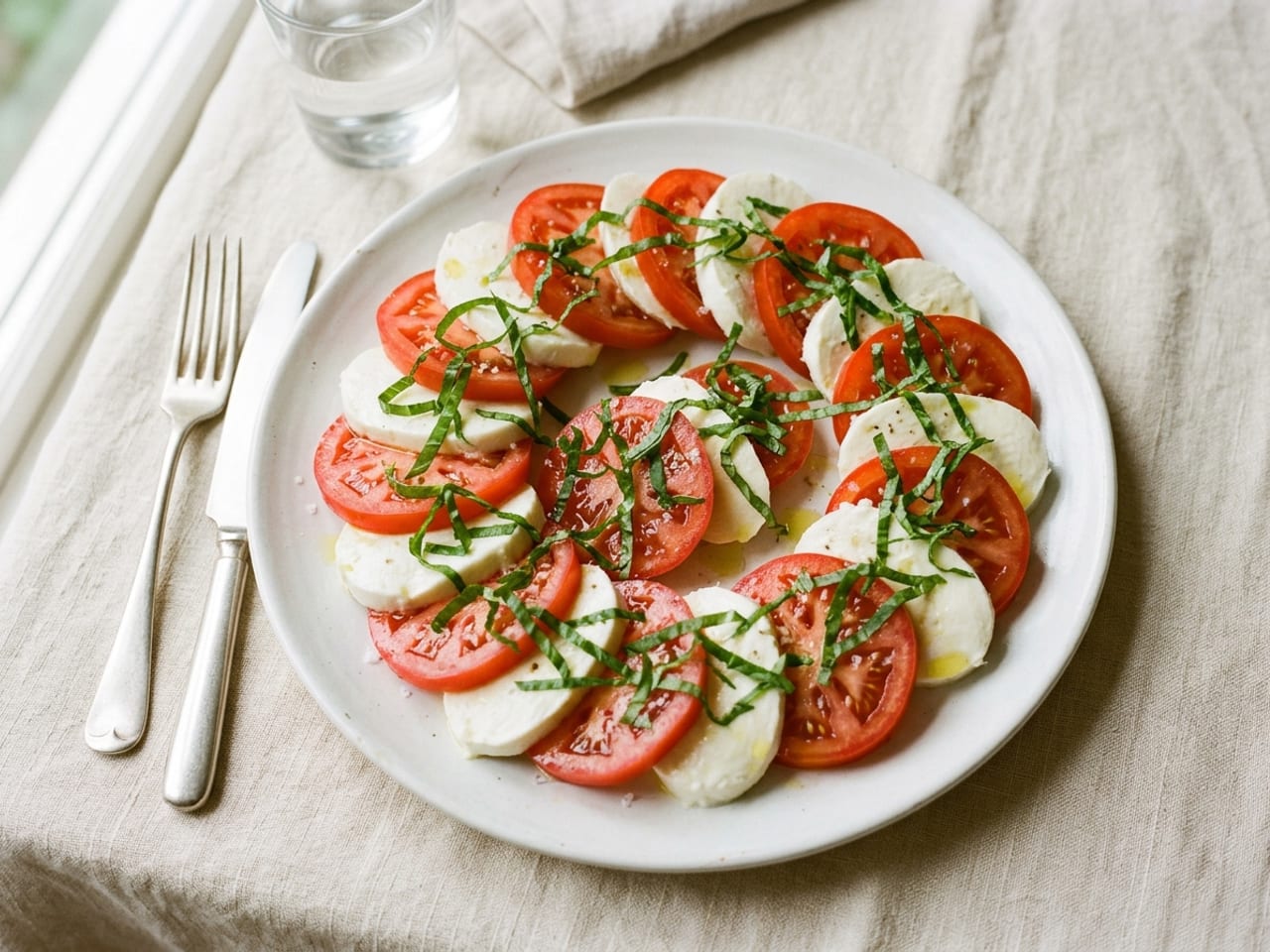
How this page was made. Every width, time, temperature and date comes from the source named beside it, with its edition and page where it has one. Many textbooks are lending-only scans we could read only as short search fragments or Google Books snippets, old cookbooks were read in dated scans, and several web pages in archived copies; each source's entry says how it was read. Plate Artists cut, stored and timed nothing for this page: the methods are quoted, not kitchen-tested. Conversions, sums and anything marked "ours" are our own, and a metric or US twin in brackets is the source's own where it prints one and ours where it does not. Sources are at the bottom.
Chiffonade meaning and pronunciation
Three meanings, one word. In English cooking, chiffonade is "shredded or finely cut vegetables or herbs used especially as a garnish" (Merriam-Webster) or "vegetables or herbs cut into very narrow strips, often used as garnish" (Cambridge), and Cambridge also gives the verb, "to cut vegetables or herbs into very narrow strips".13, 14 In French cookery the older sense is a garnish: "Feuilles de laitue, d'oseille ou d'une autre plante, coupées en fines lanières et fondues au beurre" (lettuce, sorrel or other leaves cut in fine strips and melted in butter, TLFi), the sorrel and lettuce that Escoffier put into soups (history).17 And in a French shop, "une chiffonnade de jambon" is ham sliced very thin and served in loose pieces (the deli sense).20
Chiffonade meaning in French, literally: the word is built on the verb chiffonner, "to crumple" (TLFi, Merriam-Webster), from chiffon, a rag (Etymonline goes straight tochiffon), with the cookery ending -ade.13, 16, 17 It does not mean "little ribbons", a gloss you will meet on many cooking sites with no source (who says what). Modern French spells it chiffonnade, English usually chiffonade.
Not the same thing: a "chiffonade dressing" or "chiffonade salad" in American cookbooks is a named mixed dressing or salad, its ingredients chopped in some books and shredded in others: a dish, not a leaf-ribbon technique (the false friend).1, 44
How to pronounce chiffonade
Say shif-uh-NAHD, as Cambridge does for British English, or shif-uh-NAYD: Merriam-Webster and Dictionary.com list both for American English, Cambridge's US entry too.13, 14, 15 The French stress the last syllable, [ʃifɔnad].17 As printed:
| Source | Kind | Pronunciation as printed |
|---|---|---|
| Merriam-Webster13 | US dictionary | ˌshi-fə-ˈnād and ˌshi-fə-ˈnäd (shif-uh-NAYD, shif-uh-NAHD) |
| Dictionary.com (Random House)15 | US dictionary | shif-uh-nayd, -nahd (the last syllable in bold, for stress) |
| Cambridge Dictionary14 | UK and US dictionary | UK /ˌʃɪf.əˈnɑːd/ (shif-uh-NAHD); US /ˌʃɪf.əˈnɑːd/ and /ˌʃɪf.əˈneɪd/ |
| Collins (on Dictionary.com)15 | British dictionary | /ˌʃɪfəˈnɑːd/ (shif-uh-NAHD) |
| On Cooking3 | US textbook | chef-fon-nahd |
| Illinois State Board of Education lesson12 | US school lesson | SHIF-ah-nod |
| Fellows, A Selection of Dishes (1897)39 | US hotel menu dictionary | shi-fon-ade (our reading: rhymes with made) |
| TLFi17 | French dictionary | [ʃifɔnad] (our respelling: shee-fo-NAD, French stress on the last syllable) |
How to chiffonade basil
Gisslen's Professional Cooking method, with where the CIA, On Cooking, MasterClass and the others add to it. It works the same for mint, sage, spinach or sorrel. Quoted, not kitchen-tested by us; the same cut in three frames is also in our knife skills guide.
- 1
Wash and dry the leaves, and take out tough ribs
Wash the leaves before you cut them, then dry them: the FDA Food Code washes raw produce "before being cut", and air-dried or spun cut lettuce browned less in storage in the USDA handbook's figures.87, 98 Pick off the stems and "remove the heavy leaf ribs" (Gisslen); Escoffier removed "all the leaf-ribs" of his sorrel and lettuce.1, 42 Basil leaves need only their stems pinched off.
 2
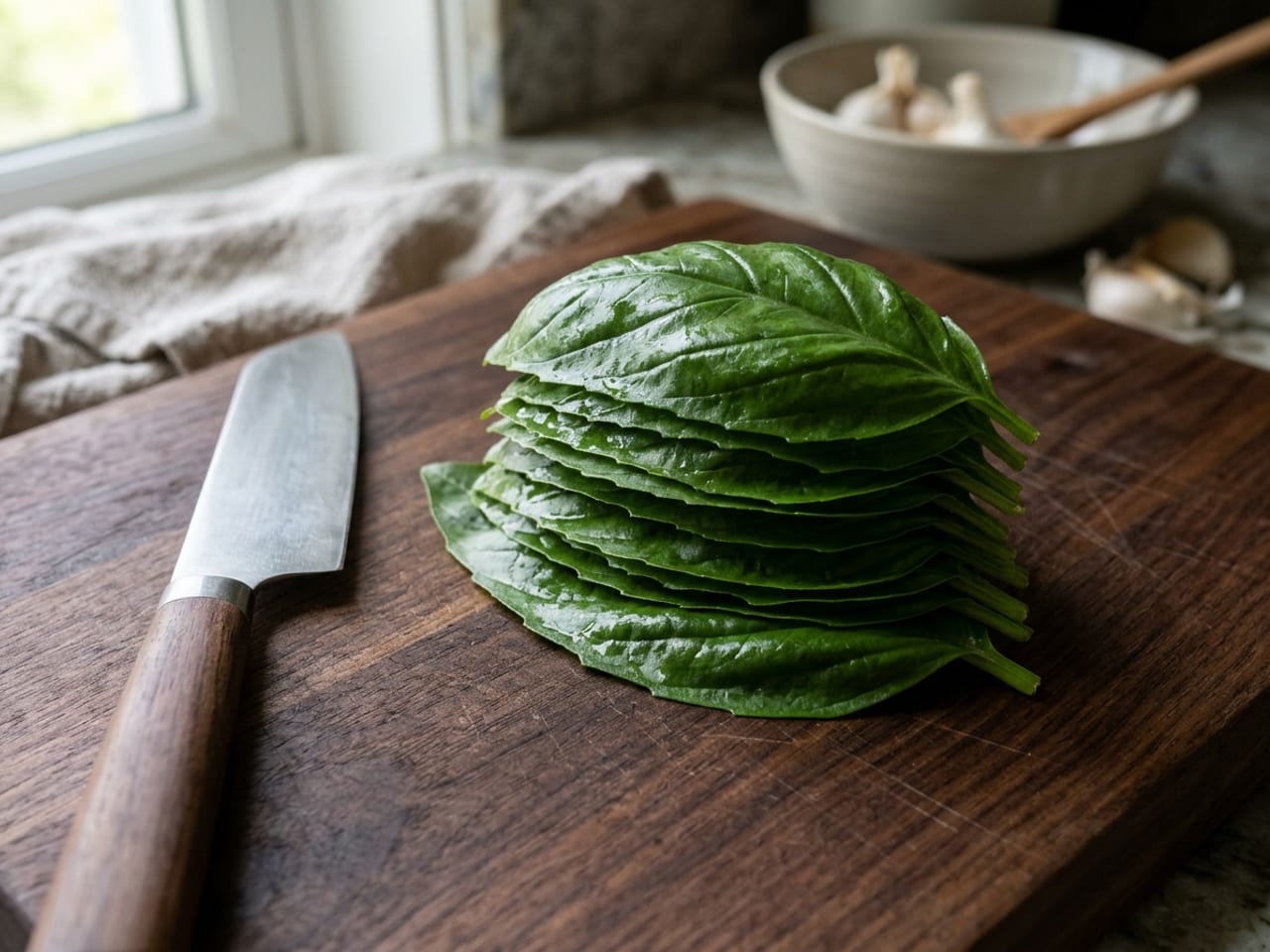
Stack a few leaves
Stack the leaves "a few at a time" (Peterson).7 No textbook we read gives a number; Forks Over Knives says "3 to 4 large leaves or 4 to 6 small leaves", one site's advice.74 A knife maker's blog puts the largest at the bottom, glossy sides down.72 For a small amount, MasterClass rolls "a single leaf".69
 3
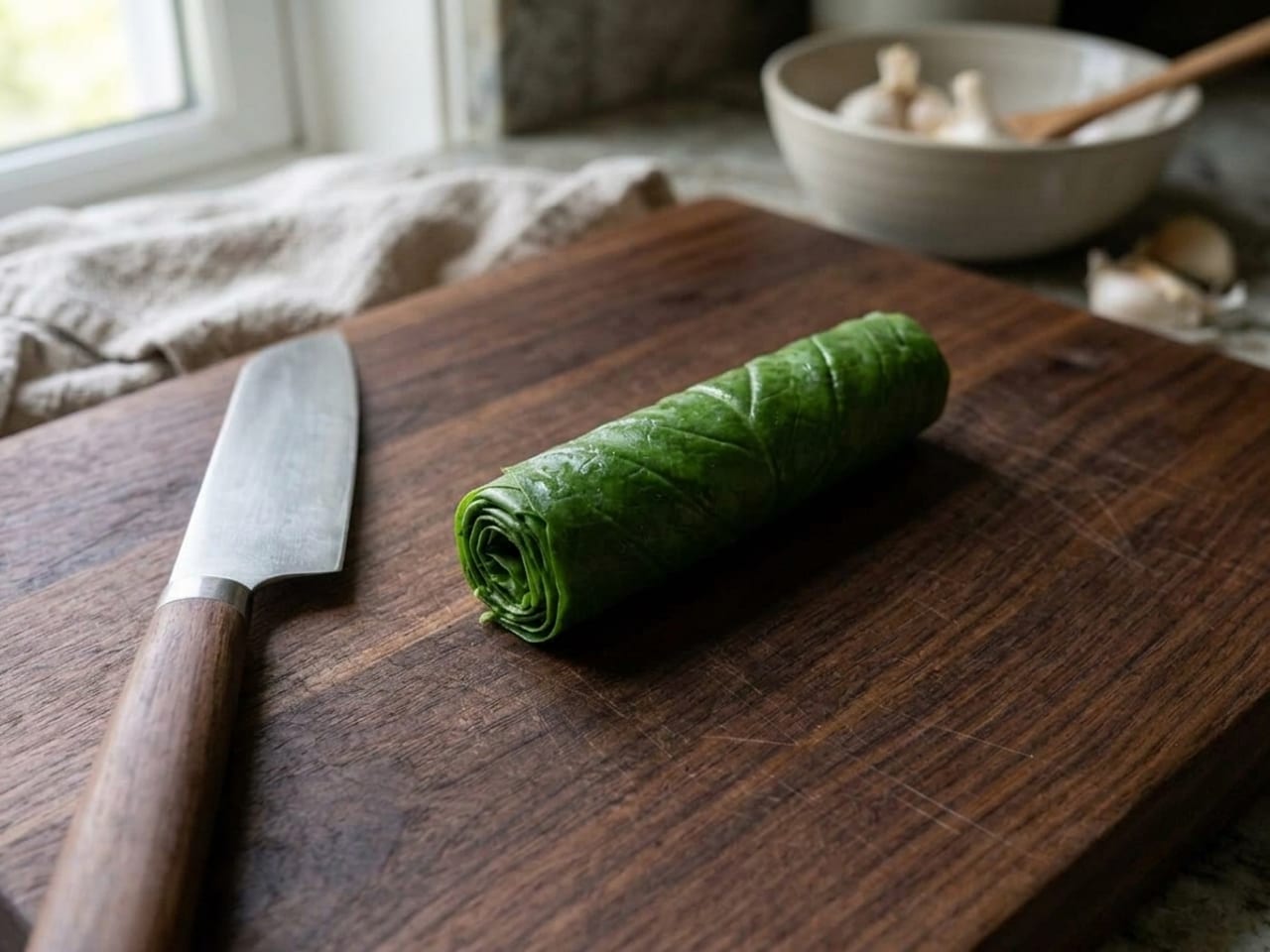
Roll them into a tight cylinder
"Roll the leaves into a tight cylinder" (Gisslen), "tightly like a cigar" (On Cooking); Forks Over Knives tucks in the ends so the log stays firm.1, 3, 74 Which way to roll is not in any textbook: two blogs roll from the stem end for longer ribbons, from the long edge for shorter ones (see the tally).72, 73
 4
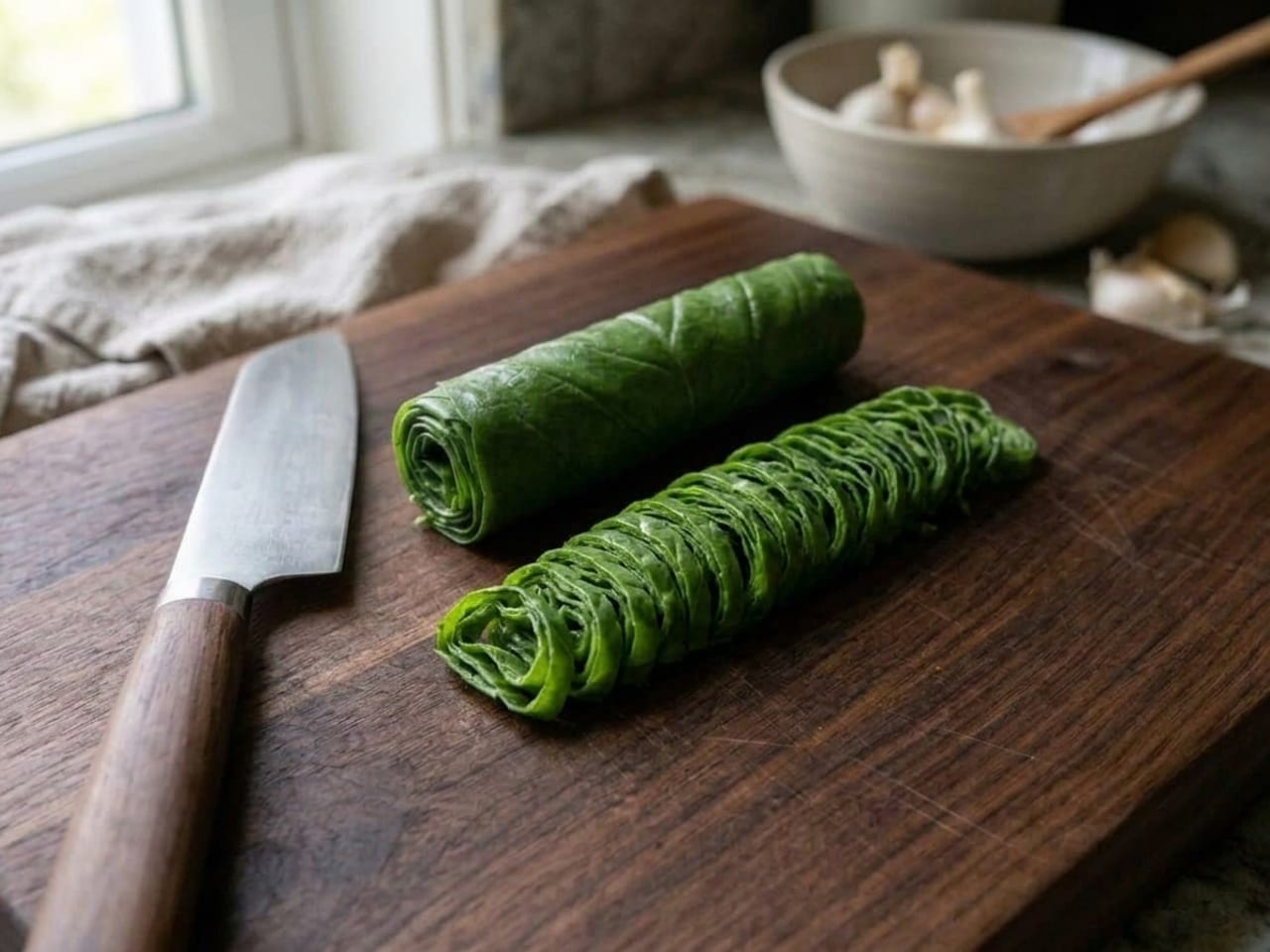
Slice across the roll with a sharp knife
"Slice the cylinder crosswise into thin shreds" (Gisslen).1 MasterClass keeps "the tip of your knife against the cutting board the entire time"; the Institute of Culinary Education uses "a smooth slicing motion rather than pressing straight down".63, 69 On shredded lettuce, "a sharp blade exercising a slicing action" kept best in storage (Bolin, 1977).93 How wide is yours to choose: no textbook definition gives a width.
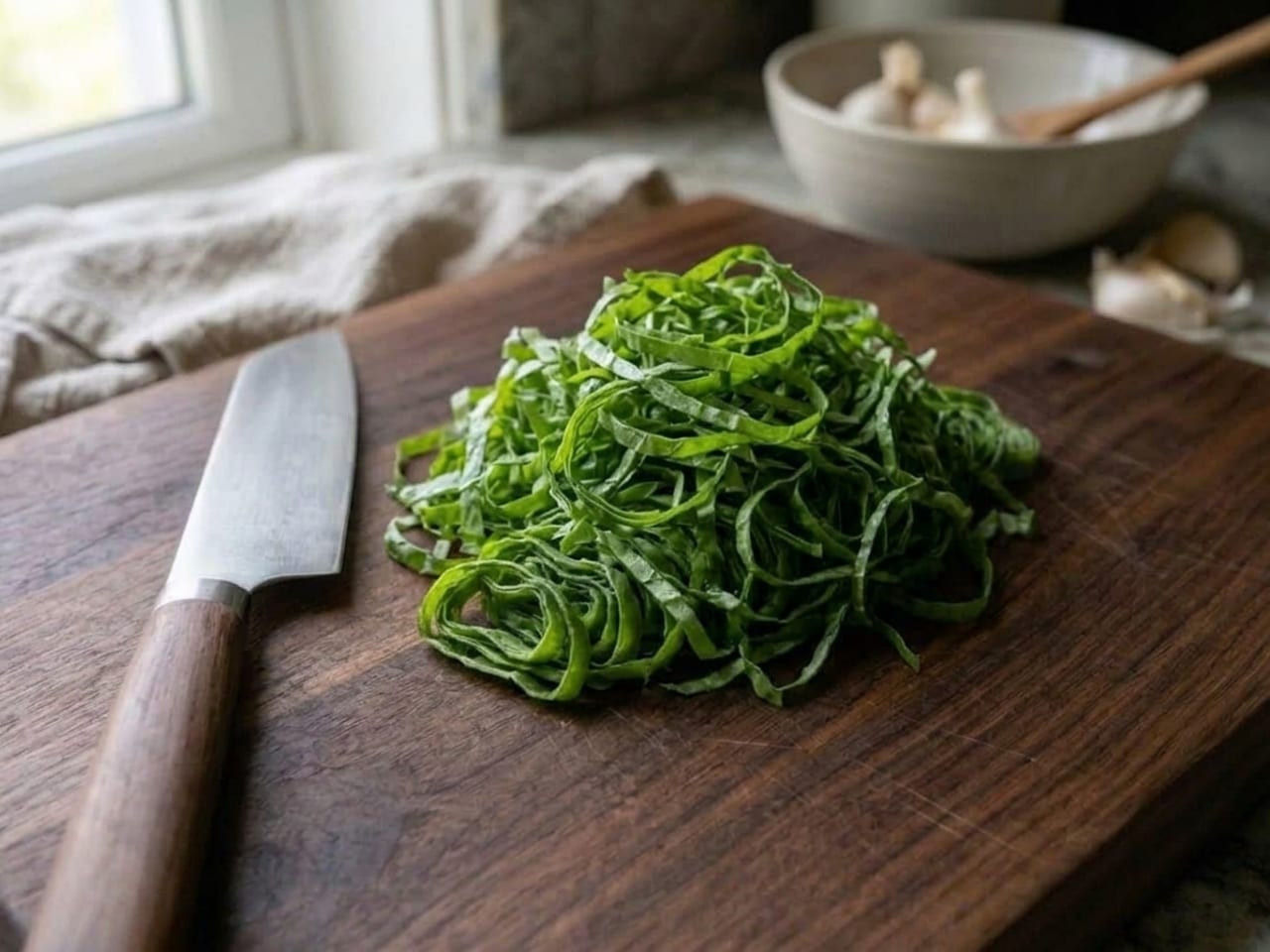
Which way to roll, and how many leaves
No textbook we read gives a leaf count or a roll direction. They say "a tight cylinder", "a tight bundle" or "like a cigar" and slice "crosswise".1, 3, 8 The counts come from the web: "3 to 4 large leaves or 4 to 6 small leaves" at Forks Over Knives, the same figures at Misen, whose sources list Forks Over Knives, and "8-10 halves" of collard leaf on a vegan blog.72, 74, 76 The direction is blog advice: roll from the stem end for longer ribbons, from the long edge for shorter ones.72, 73 The only older source with a direction, Time-Life's Classic French Cooking of 1970, rolls "lengthwise", and it is the earliest roll-into-a-cylinder method we found: Escoffier pressed the leaves flat instead (rolled or not).42, 48
Our reading: roll whichever way gives the ribbon length you want, and stack only as many leaves as you can roll tight. Heads such as cabbage and iceberg are not rolled at all: cut a wedge and slice it cut side down (heads).
| Source | Stack | Roll | Slice |
|---|---|---|---|
| Escoffier (1907; the 1941 US edition the same)42, 43 classic | - | No roll: "squeeze the latter tightly between the fingers of the left hand and the table" | "fine strips with a sharp knife" |
| Gisslen (7th ed. 2011, p. 148)1 textbook | - | "a tight cylinder"; no direction | "crosswise into thin shreds" |
| On Cooking (2003 to 2009)3 textbook | Spinach, washed and destemmed, stacked | "tightly like a cigar" | - |
| Time-Life, Classic French Cooking (1970)48 cookbook | "a handful at a time" | "roll them lengthwise into a tight cylinder" | "crosswise as fine as possible" |
| Forks Over Knives74 magazine | "3 to 4 large leaves or 4 to 6 small leaves" | Tight, ends tucked in | "crosswise (like you are slicing a carrot)" |
| Misen (2024)72 knife maker | 3 to 4 large or 4 to 6 smaller, largest at the bottom, glossy sides down | "from either the stem end (for longer ribbons) or the long edge (for shorter strips)" | - |
Show all 18 sources (12 more)
| Source | Stack | Roll | Slice |
|---|---|---|---|
| Larousse gastronomique (1997)46 reference | "superposées" (stacked) on a board | Not mentioned | "ciseler en julienne" |
| Le Cordon Bleu (1996; 2001)4 textbook | - | "rolled together" | "crosswise into shreds" |
| Pépin (2001; 2017)8 textbook | - | "a tight bundle"; mint rolled like a scroll | "a very thin chiffonade" |
| Ruhlman (2007)9 reference | Stack them | "a tight bundle" | Crosswise |
| Peterson (2003)7 reference | "a few at a time" | Roll | Slice |
| Institute of Culinary Education63 school | Neatly | A cigar shape | "a smooth slicing motion rather than pressing straight down" |
| MasterClass (2021)69 magazine | "a small, even pile", or a single leaf | "a tight cylinder (that resembles a cigar)" | Tip on the board; then fluff |
| Evolving Table (2022, 2024)73 blog | - | "For longer strips, start rolling from the stem end" | - |
| Made In (2023)71 knife maker | Stems off | "Working from the smaller end" | Rocking, tip on the board |
| Olives for Dinner (collards)76 blog | "8-10 halves of leaves" | Tight | Thin |
| CooksInfo (2004, 2018)70 encyclopedia | Stack or roll: "Some leaves may bruise if they are rolled, so you would stack instead" | Depends on the leaf; heads cut in a wedge | - |
| Time-Life, Fresh Ways with Salads (1986)58 cookbook | A head of escarole or napa cabbage | None: cut side down | "slice it into chiffonade" |
The knife and the stroke
Any sharp knife. Gisslen's general-purpose knife is the chef's knife, with the santoku "as a substitute" and a utility or "salad" knife for "cutting and preparing lettuce"; Made In likes a 6 in (15 cm, ours) chef's knife or a nakiri for herbs and an 8 in (20 cm, ours) chef's knife for larger greens.1, 71 Sharp matters, and on a leaf it has been measured: on shredded iceberg, "a sharp blade exercising a slicing action was superior to either a sharp blade chopping or a dull blade slicing or chopping" (Bolin and colleagues, 1977, judged by storage life).93 McGee explains why: a dull knife "crushes rather than cuts, bruises a wide swath of cells, and can result in rapid brown-black discoloration", an explanation rather than a test on herbs.97
The stroke is where practice splits. The Institute of Culinary Education lets "the curve of the knife glide across the cutting board to prevent bruising" and MasterClass keeps the tip down; one chef's blog says "don't drag the knife, or it will bruise the leaves".63, 69, 78 The one measurement, on lettuce, favours slicing over chopping.93 More on grips and strokes is in our knife skills guide.
Chiffonade cut size: how wide, in millimetres and inches
33 width rows from the sources we read (some rows group two or three books), each in its own words, with the edition and page. The first 12 are the textbooks most readers meet and every source that prints a number; the other 21 open under "Show all". Where a source prints inches the millimetres are ours, and the other way round.
| Source | How fine, in its words | Width as a number |
|---|---|---|
| Gisslen, Professional Cooking1 7th ed. 2011, p. 148 and glossary p. 1064; textbook | "fine shreds"; "thin shreds" | - |
| CIA, The Professional Chef2 9th ed. 2011, glossary; textbook | "Fine shreds of leafy vegetables or herbs" | - |
| Labensky and Hause, On Cooking3 2003, 2007, 2009; textbook | "finely sliced or shredded" | - |
| Escoffier, A Guide to Modern Cookery42 1907, No. 215, pp. 89 to 90; classic text | "cut them into fine strips with a sharp knife" | - |
| Larousse gastronomique, the definition46 1997, p. 264; reference book | "lanières plus ou moins larges" (strips more or less wide); its recipes say "très fine" and "grossièrement" (coarsely) | - |
| Larousse gastronomique, chiffonnade d'endives à la crème46 1997; recipe in a reference | "les détailler en lanières de 1 cm de large" (cut them in strips 1 cm wide), for cooked endives | 1 cm (about ⅜ in, ours) |
| Illinois State Board of Education lesson L70003612 c. 2011; school | "a fine ribbon cut or shred", crosswise cuts 1/8 inch wide | ⅛ in (about 3 mm, ours) |
| America's Test Kitchen, Giving Kale a Rubdown67 read 2026; test kitchen | "cut the leaves into 1/4-inch ribbons", for a kale salad | ¼ in (about 6 mm, ours) |
| CooksInfo70 2004, updated 2018; web | "There are no formal definitions of exactly how thin", then its own figure | about 1 mm (1/25 in) |
| Misen (knife maker's blog)72 2024; web | "typically 1/16 to 1/8 inch wide"; lettuce "1/8 inch or less" for tender leaves, wider for hearty ones | 1/16 to ⅛ in (about 1.6 to 3 mm, ours) |
| Evolving Table (recipe blog)73 2022, updated 2024; web | "slice the leaves into ⅛ to 1/16-inch sections" | 1/16 to ⅛ in (about 1.6 to 3 mm, ours) |
| Made In (knife maker's blog)71 2023; web | "as thin as you like, usually between 1/16" and ¼"" | 1/16 to ¼ in (about 1.6 to 6 mm, ours) |
Show all 33 rows (21 more)
| Source | How fine, in its words | Width as a number |
|---|---|---|
| Le Cordon Bleu Complete Cooking Techniques; Kitchen Essentials4 1996, p. 162; 2001; textbook | "shreds"; "thin strips" | - |
| Cracknell and Kaufmann, Practical Professional Cookery5 1992 and 1999; textbook | "finely shredded vegetable leaves" | - |
| Professional Cookery Level 1 Diploma; City & Guilds Level 26 2008; 2010; textbook | "finely shredded"; lettuce "very finely shredded" (the same list sizes brunoise, "2mm dice") | - |
| CIA, Garde Manger; The Professional Garde Manger54 2004; undated; textbook | basil "fine chiffonade"; arugula "a broad chiffonade" | - |
| Pépin, Complete Techniques8 2001, p. 319; textbook | "a very thin chiffonade" | - |
| Peterson, Essentials of Cooking7 2003; reference book | "Shred, julienne, and chiffonade all mean to cut into thin strips" | - |
| Ruhlman, The Elements of Cooking9 2007; reference book | "an elegant cut, like a julienne" | - |
| Escoffier, Le Guide culinaire41 1907; classic text | "ciselées" (cut fine); or "rondelles" (small rounds) | - |
| Hering, Lexikon der Küche40 1909; classic text | "in kleinen Streifen" (in small strips) | - |
| Larousse gastronomique, 1st ed. (quoted by French Wikipedia)19 1938, not read by us; reference book | "minces lanières" (thin strips), "julienne fine" | - |
| Larousse Gastronomique, 1st English ed.45 1961; reference book | "finely shredded lettuce" | - |
| Saulnier, Le Répertoire de la Cuisine47 English ed. 1976; reference book | No width; the term is in its glossary | - |
| TLFi (French dictionary)17 read 2026; dictionary | "coupées en fines lanières" (cut in fine strips) | - |
| Merriam-Webster; Cambridge; Collins13, 14, 15 read 2026; dictionary | "finely cut"; "very narrow strips"; "finely shredded" | - |
| Child, In Julia's Kitchen with Master Chefs10 1995; chef's book | "cut into chiffonade (very narrow strips)"; one romaine chiffonade is "1 inch long" (the scan's OCR prints "I inch"; a length, not a width) | - |
| NZQA unit standard 1328011 version 7; school | Required in the assessment; no width | - |
| Institute of Culinary Education63 2026; school | "thin, elegant ribbons" | - |
| America's Test Kitchen, Understanding Cutting Terms64 read 2026; test kitchen | "very thin strips" (the same list gives inches for minced, chopped and julienne, none for chiffonade) | - |
| MasterClass69 2021; web | "the thinnest slices possible" | - |
| Forks Over Knives74 read 2026; web | "thin ribbons" | - |
| Wikipedia18 read 2026; web | "long, thin strips" | - |
What the tally says
- No textbook definition we read gives a width. All 17 textbook, classic and reference-book rows (definitions, methods and recipe lines; one, Larousse 1938, quoted second-hand) say it in words, in: Gisslen, CIA, Labensky and Hause, Le Cordon Bleu Complete Cooking Techniques, Cracknell and Kaufmann, Professional Cookery Level 1 Diploma, Pépin, Peterson, Ruhlman, Escoffier, Hering, Larousse gastronomique, Saulnier. Larousse even allows strips "plus ou moins larges", more or less wide, and the garde-manger books ask for a "fine" or a "broad" chiffonade.46, 54
- Numbers appear in seven places, none of them a definition: a cooked endive recipe inside Larousse (1 cm, about ⅜ in, ours), a US school lesson (⅛ in, about 3 mm, ours), a test kitchen's kale salad (¼ in, about 6 mm, ours) and four web pages, from 1 mm (CooksInfo) to ¼ in (Made In).12, 46, 67, 70, 71, 72, 73 These are web figures, none traced to a textbook; CooksInfo itself opens with "There are no formal definitions of exactly how thin".70
- So the chart says "fine ribbons, no set width", and our knife cuts chart keeps it that way. Our suggestion, not a rule: for a herb garnish, cut about as fine as the web's common range, 1/16 to ⅛ in (about 1.6 to 3 mm); for a salad of sturdy greens such as kale, wider, as America's Test Kitchen's ¼ in (about 6 mm) ribbons are.
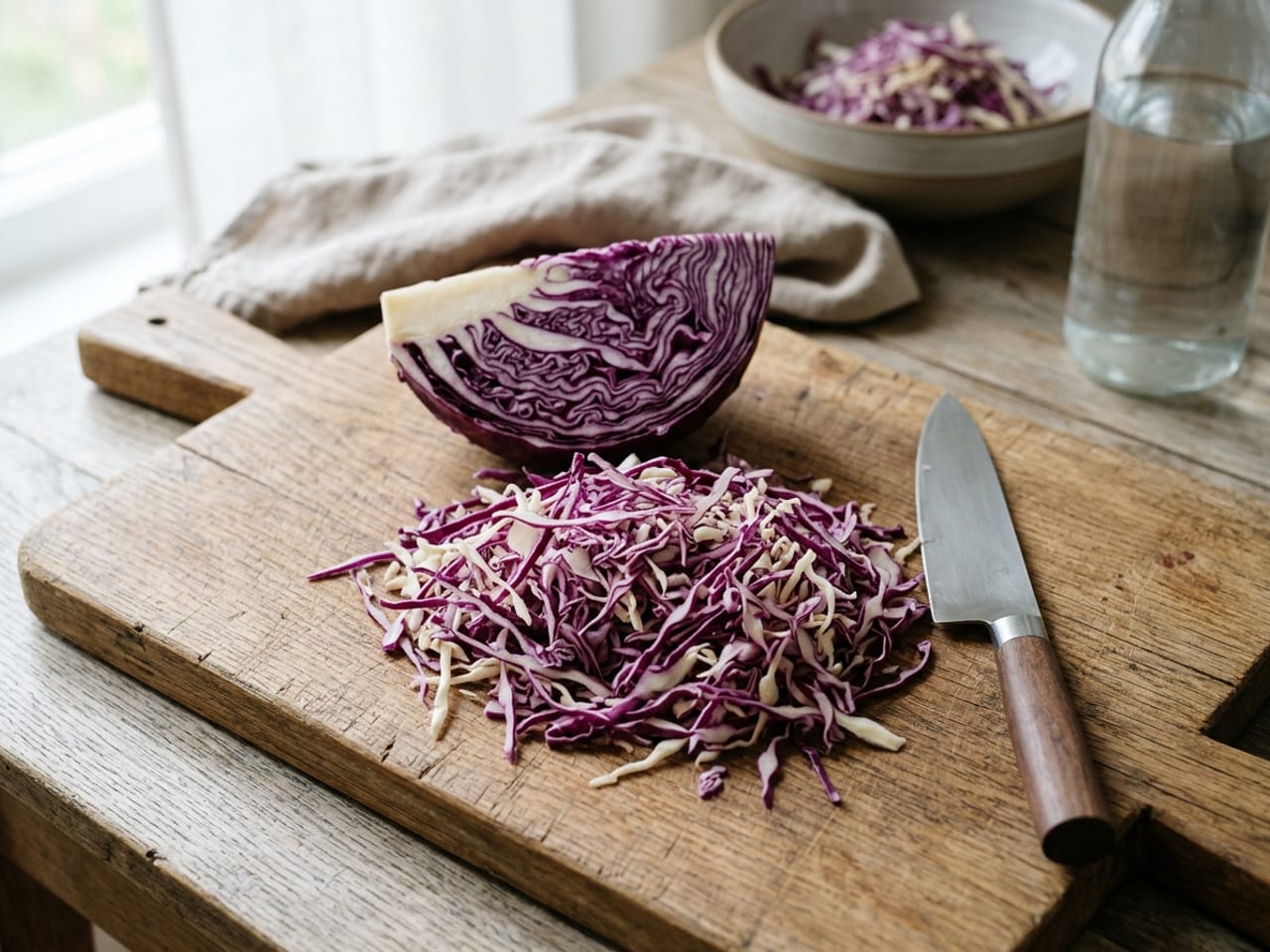
Which leaves you can chiffonade: mint, sage, spinach, kale, lettuce, cabbage
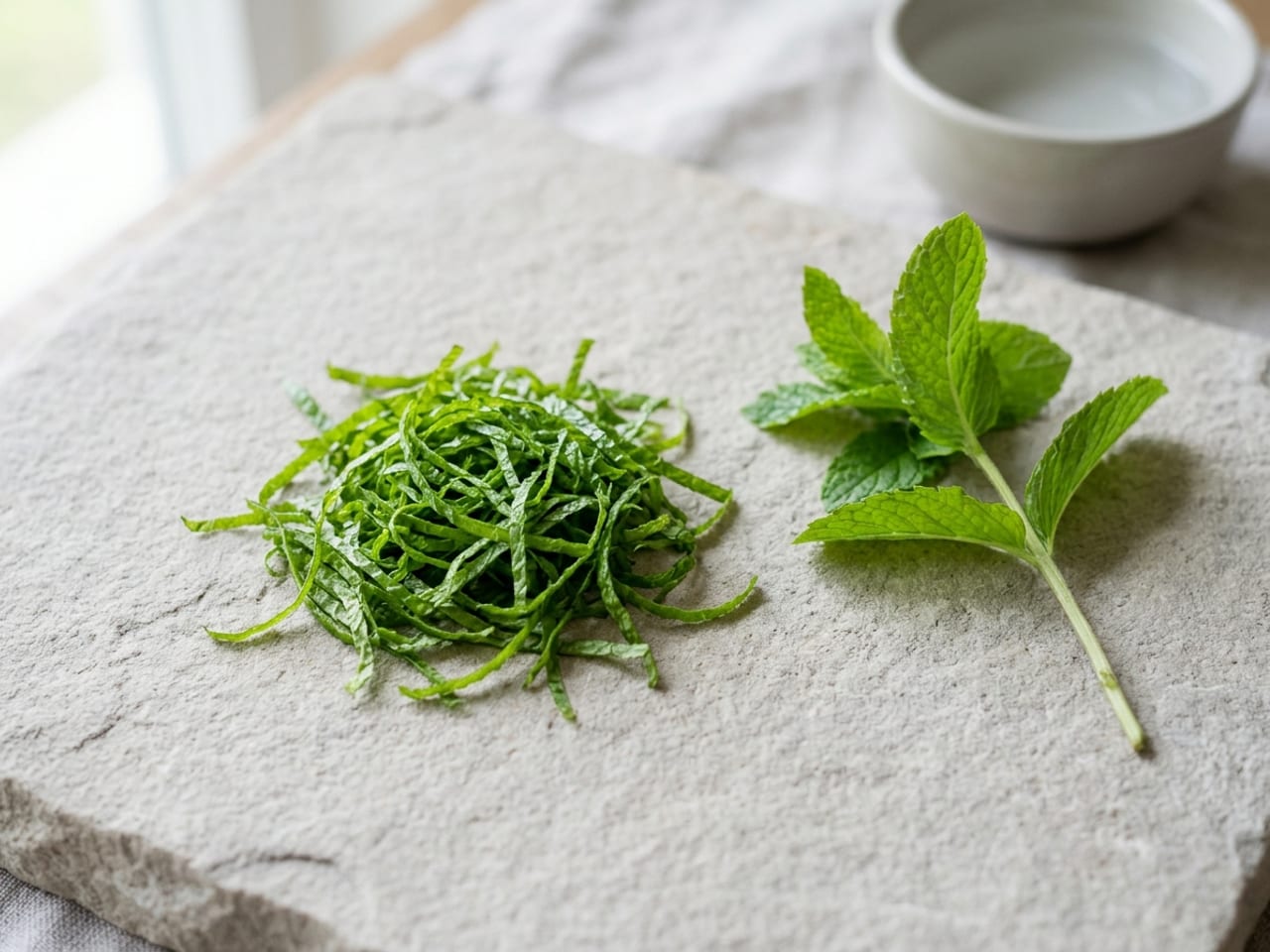
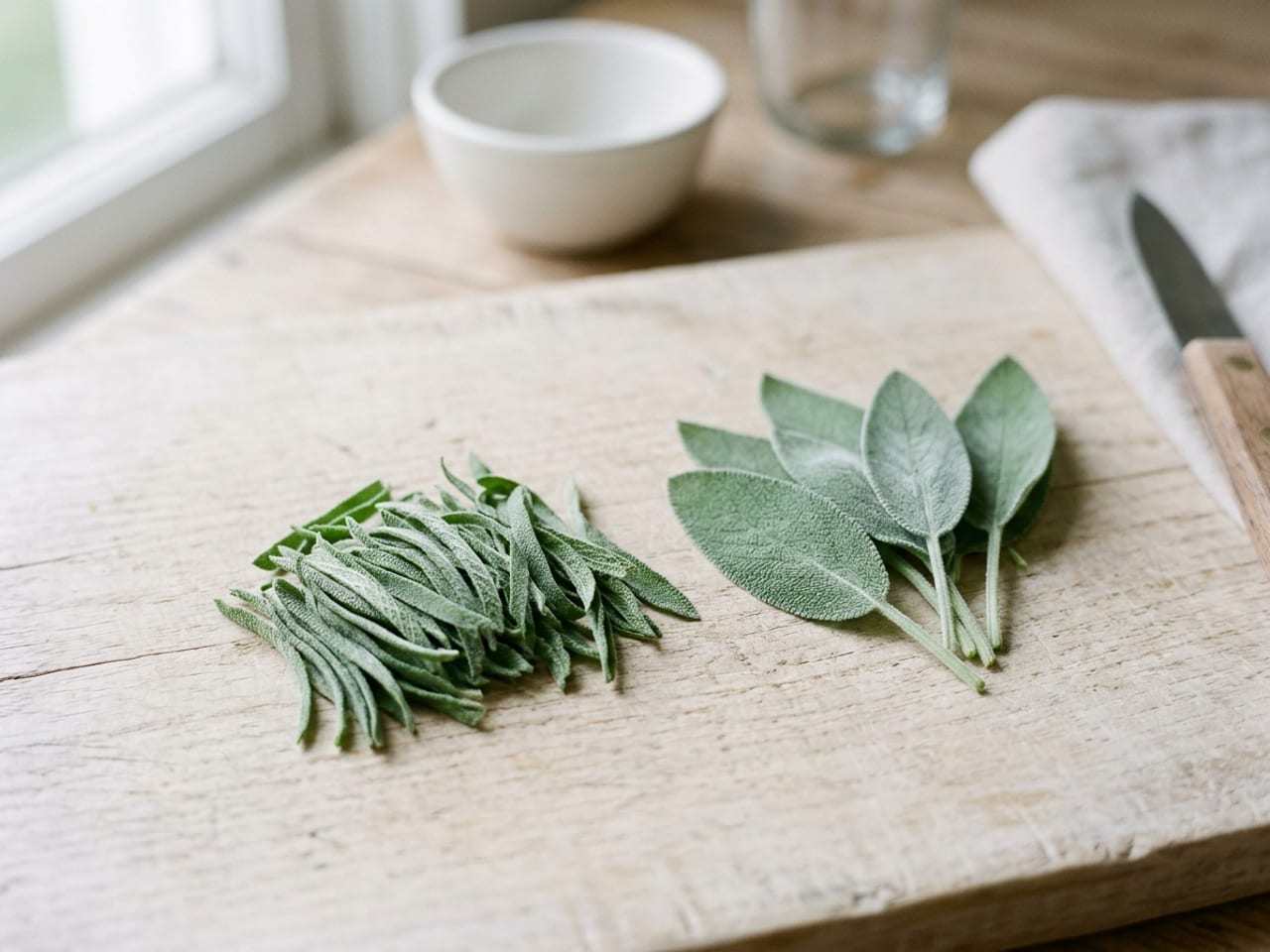
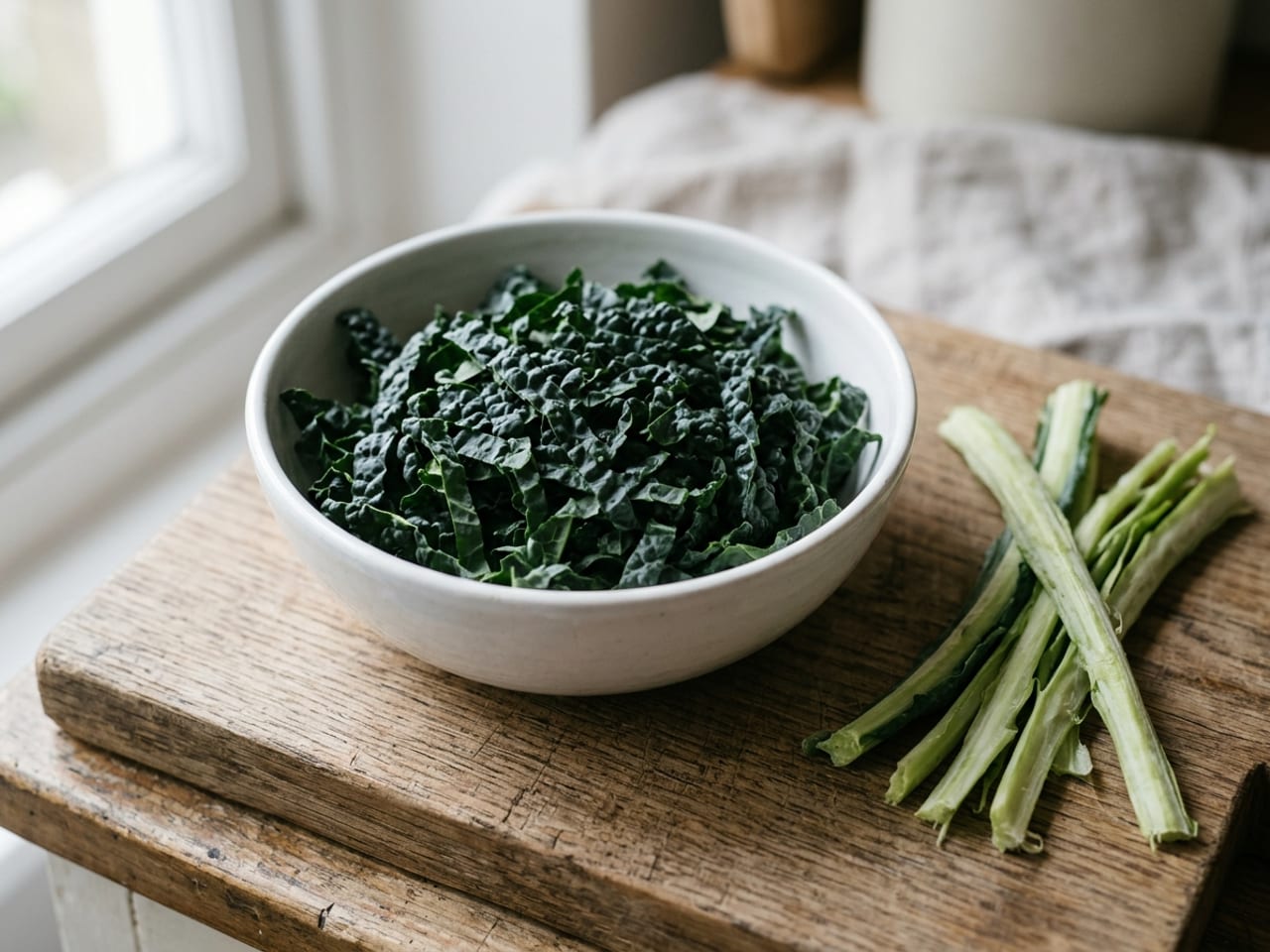
Large, soft, flat leaves that stack and roll. The classical chiffonade was sorrel and lettuce; today the sources name 14 kinds of leaf. Who says yes to each, and the tip that goes with it:
| Leaf | Chiffonade? | Who says so | Tip |
|---|---|---|---|
| Basil1, 2, 65 | Yes | Every modern source; Gisslen and the CIA in their recipes | Cut it last and never chill it (why) |
| Mint8, 10, 63, 69, 75, 87 | Yes | MasterClass, the Institute of Culinary Education, Pépin, Julia Child, The Nibble | Not hurt by cold, unlike basil: mint ribbons can wait in the fridge (ours, from USDA's storage advice) |
| Sage9, 69, 71, 75 | Yes | Made In, MasterClass, Ruhlman, The Nibble | "sage's earthy, piney flavor disperses evenly" in thin ribbons (The Nibble) |
| Sorrel1, 4, 5, 36, 40, 42, 46 | Yes, ribs out | Escoffier, Gisslen (his figure is sorrel), Larousse, Practical Professional Cookery, Le Cordon Bleu, Senn, Hering | "very tender" leaves, ribs removed (Escoffier); for most purposes sorrel is cut chiffonade (Gisslen) |
| Lettuce: butter, romaine (cos), iceberg1, 2, 3, 8, 10, 42, 46, 70, 72 | Yes | Escoffier, Gisslen, Larousse, On Cooking (romaine), Pépin (Boston), the CIA (iceberg), Julia Child (romaine) | Tender lettuces thinner, hearty romaine wider (Misen); an iceberg is cut as a wedge, not rolled (CooksInfo) |
| Spinach and baby spinach3, 4, 5, 7, 41, 69 | Yes | On Cooking (its demonstration leaf), Le Cordon Bleu, Practical Professional Cookery, Peterson, MasterClass, Escoffier's country soups | Wash and destem, then stack and roll "tightly like a cigar" (On Cooking) |
| Swiss chard18, 69, 71, 75 | Yes, ribs out | MasterClass, Made In, The Nibble, Wikipedia | Cut the thick stems out before you stack (ours) |
| Kale, curly and lacinato (Tuscan)67, 71, 72, 75 | Yes, ribs out | Made In, Misen, The Nibble, America's Test Kitchen | "After removing the ribs, cut the leaves into 1/4-inch ribbons" (about 6 mm, ours) and massage: at least 5 minutes for curly kale, about a minute for Tuscan (ATK) |
| Collard greens56, 71, 75, 76 | Yes, ribs out | Made In, The Nibble, Daniel Boulud's 1988 menu, Olives for Dinner | "Slice away the tough veins", then stack the halves (Olives for Dinner) |
| Cabbage: green, red, savoy, napa1, 2, 7, 58 | Shred or chiffonade | Gisslen and Peterson call it shredding; the CIA writes "green cabbage chiffonade" and Time-Life napa "chiffonade" | A wedge, cut side down; Gisslen: "long, fine shreds", "Do not chop" (heads) |
| Endive, chicory, escarole, radicchio45, 46, 58, 59 | Yes | Larousse 1961 and 1997 (endive, wild chicory), Time-Life (escarole), The Artful Vegan (radicchio) | Larousse cuts endives for its cream chiffonnade 1 cm wide (about ⅜ in, ours) |
| Shiso (perilla)2, 75 | Yes | The CIA (a recipe), The Nibble | A large flat leaf that stacks like basil (ours) |
| Arugula (rocket)54 | Yes | A garde-manger text: arugula "cut into a broad chiffonade" | Small leaves: stack a few flat rather than roll them (ours) |
| Makrut (kaffir) lime leaf59, 61, 62 | Yes | The Artful Vegan ("chiffonade"); David Thompson's Thai Food ("shredded") | "Slice very thin if it is intended to be eaten" (The Herb Society of America) |
| Tarragon60 | Yes | One cookbook (Panera, 2004) | Small, narrow leaves: a few at a time (ours) |
| Flat-leaf parsley18, 55, 63, 70, 75 | Usually chopped | Charlie Trotter cuts a "flat-leaf parsley chiffonade"; Wikipedia (uncited), CooksInfo and The Nibble call it unsuited; the Institute of Culinary Education chops it | Small and flat, so most cooks bunch and chop it (below) |
| Cilantro (coriander leaf)3, 18, 56, 57, 63 | Usually chopped | On Cooking ("Cilantro leaves, chiffonade"), De Gustibus and a Chicago cookbook cut it chiffonade; Wikipedia (uncited) calls it unsuited; the Institute of Culinary Education chops it | Small and soft: bunch and chop, or stack a few leaves flat (ours; below) |
| Thyme and rosemary18, 70, 75 | No source uses it | Wikipedia (uncited), CooksInfo and The Nibble call them unsuited; we found no recipe that cuts them chiffonade | Strip the leaves and chop or mince them |
| Brussels sprouts | No source uses it | In what we read, only shredded, for slaws; no source we read gives a chiffonade method | Shred thin across the sprout, as for a slaw (ours) |
Can you chiffonade parsley, cilantro or thyme?
Parsley and cilantro, yes, though most cooks chop them. The leaves are small and flat, so the Institute of Culinary Education gathers parsley and cilantro into a mound and chops them, and Wikipedia, CooksInfo and The Nibble call parsley unsuited for chiffonade (Wikipedia names cilantro too, and its line is tagged "citation needed").18, 63, 70, 75 But chefs do cut them in ribbons: Charlie Trotter's "flat-leaf parsley chiffonade", On Cooking's "Cilantro leaves, chiffonade", De Gustibus's "cilantro-leaf chiffonade".3, 55, 56 Our suggestion: stack a few of the largest leaves flat and slice them, or bunch them tight and chop: how to mince herbs.
Thyme and rosemary, no: we found no source that cuts them chiffonade, and every source that mentions them calls them unsuited.18, 70, 75 Strip the leaves and chop them.
Cabbage, iceberg and other heads
A head grows in layers, so you do not roll it: "cut a wedge from the cabbage, and slice from that wedge" (CooksInfo), or lay it "cut side down and slice it into chiffonade" (Time-Life, on escarole).58, 70 Whether that is a chiffonade or a shred depends on the book: Gisslen and Peterson shred cabbage, Gisslen in "long, fine shreds" with the warning "Do not chop", while the CIA writes "green cabbage chiffonade".1, 2, 7 For an industrial coleslaw cut, the USDA handbook gives shreds of ¼ to ⅜ in (0.63 to 0.95 cm), much wider than a herb ribbon.87
Why chiffonade turns dark, and how to keep it green
Cold is the well-documented cause of black basil; cut edges also brown as they sit, which is documented for lettuce over hours. No study we found times basil or mint ribbons. Cut them last, keep basil out of the fridge, and use a sharp knife.2, 84, 87, 90, 93 Each common claim against what was measured:
| The claim | Verdict | What we found |
|---|---|---|
| Cold turns basil black | Documented | "Storage at less than 12°C (54°F) causes injury in basil leaves and temperatures less than 10°C (50°F) induces severe if not total injury"; leaves "blacken from necrosis in as little as 1 day at 0°C or 3 days at 5°C" (32°F and 41°F, ours). USDA's handbook keeps basil at 12°C (54°F); a 2026 review repeats the figures. Mint and sage are "not chilling sensitive".84, 85, 86, 87 |
| Cut edges brown as they sit | Documented for lettuce, over hours | For fresh-cut lettuce, "Browning (enzymatic) of the cut edges is the main defect". It is a wound response: in cut romaine mid-rib at 10°C (50°F, ours) the wound enzyme PAL, which makes the compounds that brown, started rising after 6 hours and peaked at 24. No single enzyme reading predicts how fast a given lettuce browns.87, 90, 91 |
| Cut basil browns like a cut apple | Same enzyme family; not timed for ribbons | Basil has polyphenol oxidase, the enzyme family that browns cut fruit and lettuce, and its usual main phenolic is rosmarinic acid (chicoric acid in some cultivars). Ground basil darkens fast: ATK's pesto "started to darken as soon as we scooped it out of the food processor". But no study we found times how fast basil or mint ribbons darken.66, 88, 89, 92 |
| Basil ribbons turn black within minutes | Not measured | Blogs say so ("Basil oxidizes quickly when the cut sides are exposed to air") without times or tests; ATK says freshly chopped basil "can quickly turn dull black" and judged it by eye. In what we read, no one has timed it.65, 77 |
| A dull knife blackens herbs | Measured on lettuce and apples; explained for herbs | A sharp blade slicing kept shredded iceberg longest (Bolin, 1977), and sharp blades delayed browning in apples. For herbs, McGee explains that a dull knife "bruises a wide swath of cells, and can result in rapid brown-black discoloration": an explanation, not a test.93, 95, 96, 97 |
| A metal knife darkens leaves: tear them instead | Mixed, and a matter of days | On lettuce in the fridge, Cook's Illustrated saw the first browning on cut edges at 12 days (metal knives), 13 (plastic) and about 14 (torn), and a 2008 study also favoured tearing; a 2012 study found knife-cut cabbage and lettuce browned less than hand-torn, Gisslen says tearing is more likely to bruise, and McGee that its squeezing may damage tender leaves. Gisslen's carbon-steel warning names hard-cooked eggs, not leaves. Every gap is days of storage, and a ribbon cannot be torn.1, 68, 94, 95, 97 |
| A little oil keeps it green | Weak | Oil on whole leaves "barely slowed the blackening"; oil on the cut basil slowed it but left it "a little oily" (ATK). McGee warns that oil soon makes a leaf "dark and sodden".65, 97 |
| Lemon juice keeps it green | Not tested on ribbons | Vitamin C stopped basil's enzyme in a test tube, but strong acid (pH 2.5) did not fully stop it there; and acid with heat turns chlorophyll olive-brown. No one we read tested lemon on herb ribbons.85, 88, 92 |
| Blanching keeps basil green | Supported for pesto | Leaves blanched 20 to 30 seconds and iced made pesto that stayed bright green for hours on the counter and a week in the fridge (ATK). For a raw garnish ATK found it "an awful lot of trouble", and a blanched leaf is no longer a raw ribbon (ours).65, 66 |
| Bruising darkens leaves | Observed | Kneading kale ribbons "breaks down the kale's cell walls much the way that heat does, darkening the leaves" (ATK, on purpose for a salad). Crushed leaves can look darker without any browning (our inference).67 |
How to keep chiffonade green
- Cut it last. The CIA and America's Test Kitchen both cut herbs just before they are served.2, 65
- Keep basil at room temperature, whole, "with freshly cut stems immersed in water" (McGee), never below 12°C (54°F) (USDA). Mint and sage can go in the fridge.87, 97
- Dry the leaves well before cutting (The Practical Kitchen, Jessica Gavin). Surface moisture shortened shredded lettuce's storage life, and air-dried or spun cut lettuce browned less.77, 78, 87, 93
- Use a sharp knife and a slicing stroke (the knife).93
- If it must wait, lettuce, spinach, kale and cabbage ribbons go in the fridge (the Food Code's rule below), covered (ours: in industry, packing with little oxygen slowed lettuce browning, USDA handbook). Basil ribbons cannot be both cold and green for long: cut basil last.87, 98
Can you chiffonade ahead? How long it keeps
No source we read measured how long basil or mint ribbons stay green, in or out of the fridge. The test kitchens and most practice sources say cut it last; only two blogs give fridge times for cut ribbons, and they disagree (1 to 2 days; 3 to 4 days), untested.73, 78 Measured figures exist for cut lettuce:
| Source | What | Cut ahead? | How long, and where |
|---|---|---|---|
| CIA, The Professional Chef (2011)2 | Fresh herbs | "as close to service time as possible" | - |
| America's Test Kitchen (basil)65 | Chopped basil | "just before serving" | Oil after cutting slowed darkening but left the basil a little oily; judged by eye |
| Gisslen (2011), green salads1 | Whole or torn salad greens | Prepare greens ahead | In the fridge "in a colander covered with damp towels"; plated salads not "more than an hour or two before service" |
| Made In (2023)71 | Basil | Use it right after cutting | - |
| The Practical Kitchen (2020, 2023)77 | Basil | Not "too far in advance" | No time given |
| Jessica Gavin (blog)78 | Cut basil | - | 1 to 2 days airtight in the fridge (untested) |
| Evolving Table (blog)73 | Herbs; lettuces | A few hours for delicate herbs; 1 to 2 days for sturdier lettuces | Leftovers 3 to 4 days airtight in the fridge (untested) |
| America's Test Kitchen (pesto)66 | Blanched basil, ground | Blanch 20 to 30 s, then ice | Green for hours on the counter, a week in the fridge, 3 weeks frozen |
| USDA Agriculture Handbook 66 (2016)87 | Fresh-cut lettuce | (industry) | Market life under 24 h at 23°C (73°F), over 24 h at 10°C (50°F), over 48 h at 2°C (36°F); 6 days in air at 5°C (41°F) |
| USDA Agriculture Handbook 66 (2016)87 | Whole basil; whole mint | - | Basil at 12°C (54°F), about 2 weeks; mint at 0°C (32°F), 2 to 3 weeks |
| Cook's Illustrated (2009)68 | Cut or torn lettuce | - | First browning on the edges at 12 to 14 days, refrigerated in zipper bags |
Food safety: lettuce ribbons are not the same as herb ribbons
The FDA Food Code counts lettuce, spinach, cabbage, kale, arugula and chard that have been "cut, shredded, sliced, chopped, or torn" as cut leafy greens, and says "The term 'leafy greens' does not include herbs such as cilantro or parsley."98 Cut leafy greens are a time/temperature control for safety food: for US food businesses under the FDA Food Code they are held at 41°F (5°C) or below, or used within 4 hours under the Code's time rule, with written procedures and the time marked.98 At home the rule is shorter: get cut vegetables into the fridge within 2 hours, 1 hour above 90°F (32°C, ours), as the CDC advised for cut produce in 2019.100 So a lettuce, spinach, kale or cabbage chiffonade goes in the fridge if it waits; a basil, mint or sage chiffonade is outside that definition. Wash produce before you cut it, then dry it.98, 99
Two pieces of advice pull apart here. The FDA's consumer page says to store perishable produce "(like strawberries, lettuce, herbs, and mushrooms)" in the fridge at 40°F (4°C, ours) or below; the postharvest research says basil is injured below 12°C (54°F).84, 87, 99 The first is about safety, the second about quality (our reading): whole basil keeps best on the counter in water, and cut basil is best cut last, not stored. Herbs are not risk-free: in 2019 a Cyclospora outbreak traced to fresh basil reached 241 laboratory-confirmed patients in 11 states, as Food Safety News reported the CDC's figures.102 In the UK, the Food Standards Agency's advice is to wash salad leaves eaten raw and chill below 5°C (41°F, ours).101 The same rule is on our knife skills guide.
Chiffonade vs julienne, shred, mince and brunoise
Chiffonade vs julienne: both are long and thin, but a julienne is a square stick of a set size cut from a firm vegetable (⅛ × ⅛ × 1 to 2 in (3 × 3 × 25 to 50 mm) in the US textbooks), and a chiffonade is a flat ribbon of leaf with no set width. Ruhlman calls chiffonade "an elegant cut, like a julienne", and Larousse describes the chiffonnade cut as leaves cut "en julienne".9, 46 Chiffonade vs shred: the same knife action. The CIA heads the cut "Chiffonade (shredding)" and ATK writes "Cut into Chiffonade (or Shredded)"; Peterson keeps the words apart by food: "cabbage are shredded; leafy herbs and greens such as basil and spinach are cut into chiffonade".2, 7, 64 Chiffonade vs chopped or minced basil: ribbons against pieces; chopping is the route for small herbs.63, 64 Chiffonade vs chiffon: the fabric and the cake share the word's root, chiffon, a rag, and nothing else (the word).16
| Cut | Shape | Size | For |
|---|---|---|---|
| Chiffonade1, 2 | Flat ribbon | fine ribbons, no set width | Leaves and herbs, stacked and rolled |
| Julienne71 | Square stick | ⅛ × ⅛ × 1 to 2 in (3 × 3 × 25 to 50 mm) | Firm vegetables: "you can julienne a beet, but you would chiffonade its greens" (Made In) |
| Shred1, 7 | Thin strip | No set size | "to cut into thin strips, either with the coarse blade of a grater (manual or power) or with a chef's knife" (Gisslen); cabbage is shredded (Gisslen, Peterson) |
| Chopped fine63, 64 | Small pieces | ⅛ to ¼ in (about 3 to 6 mm, ours) | Parsley, cilantro and other small herbs (ICE: gathered and chopped) |
| Mince64 | Tiny pieces | very fine, no set size; ATK: ⅛ in (about 3 mm, ours) or smaller | Garlic, shallots, herbs (ours; see knife skills) |
| Brunoise | Cube | ⅛ × ⅛ × ⅛ in (3 × 3 × 3 mm) | Firm vegetables, cut from a julienne (our brunoise guide) |
Sizes for julienne, brunoise and mince are the chart's, from the US textbooks; see how to julienne and every source's julienne size in our julienne guide, and every source's brunoise size in our brunoise guide.
Chiffonade as a garnish: when and where it goes
Today, raw ribbons are scattered over the dish at the last moment; classically, the chiffonade was cooked into the soup or laid as a bed under eggs or cold seafood. The verbs in the modern sources are "sprinkle" and "top each portion with a little", "At service time".1, 50, 65 Escoffier, by contrast, cooked it: melted in butter for a thick soup, "as is most often the case", or added to a consommé half an hour before serving; the leaf he added raw at the last moment was the chervil, his "pluches".41, 42
- When: last, at service: Gisslen tops each portion "At service time", and the CIA cuts fresh herbs "as close to service time as possible". Heat cooks leaves, as Escoffier's soups show, so on a hot dish add raw ribbons last if you want them fresh (ours).1, 2, 42
- How much: "a little" (Gisslen); Escoffier used about "two tablespoonfuls of a chiffonade of sorrel" per quart (about 1 litre, ours) of soup. Gisslen's rule for any garnish: "It should not be elaborate or dominate the salad. Remember this basic rule of garnishing: Keep it simple."1, 42
- Scattered, piled or a bed: scattered is what the modern sources do; a bed is the classic and garde-manger use (Collins even defines it as leaves "used as a base for a dish or as a garnish").15, 46, 53 No source we read describes a tall nest or pile of chiffonade: a small, loose heap on top of a dish is our suggestion, not a classic.
- Which dishes: tomato salads and caprese, chilled and hot soups, pasta, eggs, cold seafood cocktails, Thai curries (shredded lime leaf) and kale salads, from the tables above.
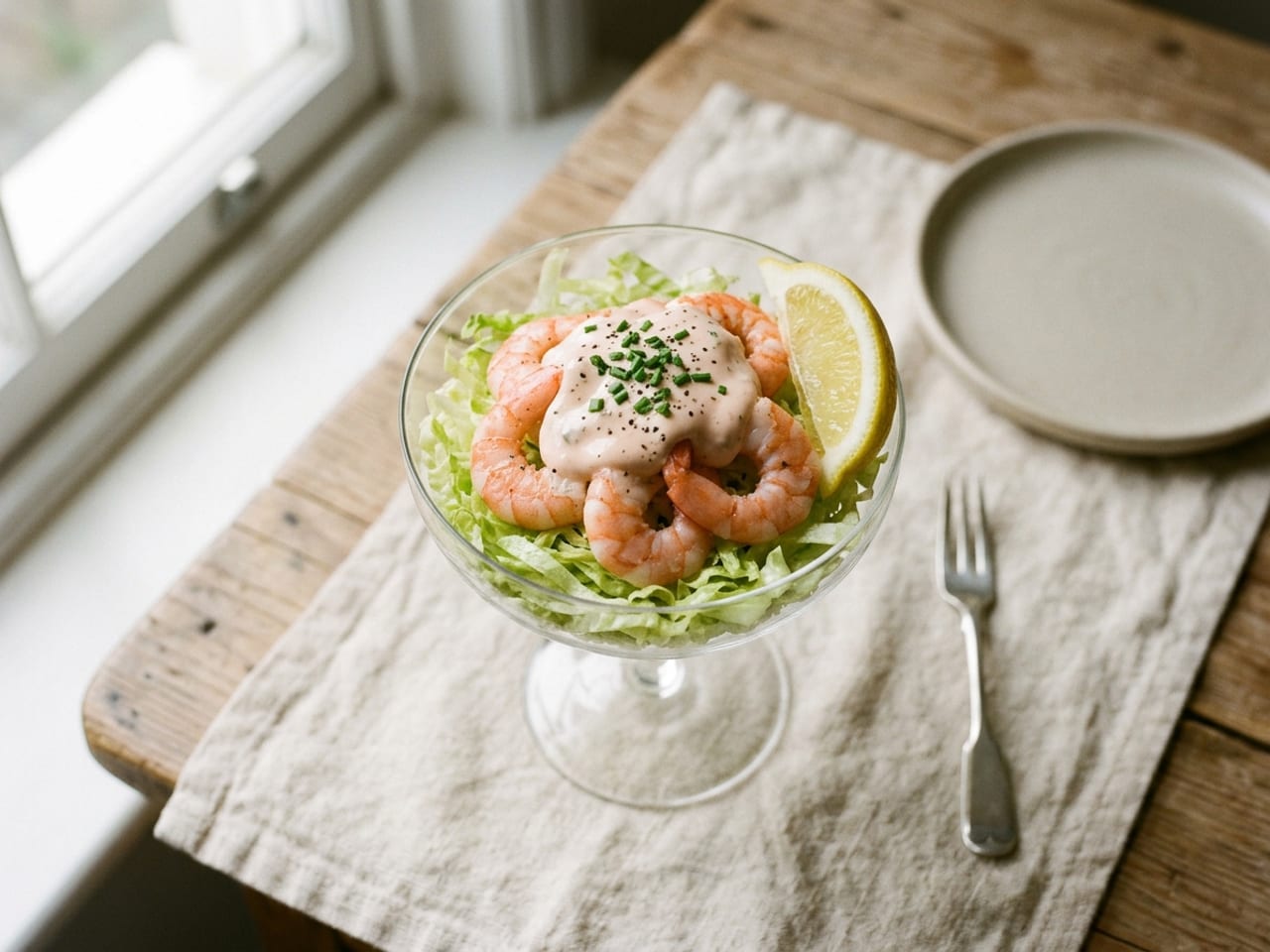
Where a chiffonade goes, in every source we read: 7 classic uses and 6 modern ones.
| Source | Classic or modern | Where it goes | When |
|---|---|---|---|
| Escoffier (1907)42 | Classic | In the soup, cooked: for a consommé "add it to the latter half an hour before dishing up"; for a thick soup melted in butter first | Before service |
| Dubois and Bernard (1864)32 | Classic | Blanched rounds in the tureen, with raw parsley and chervil leaves | At service |
| Escoffier (1907), Œufs à la Maraîchère41 | Classic | A bed: "Garnir le fond du plat d'une cuillerée de chiffonnade" (line the dish with a spoonful of chiffonnade), eggs broken on top | Before cooking |
| Ranhofer (1894)35 | Classic | The dome-shaped base of a composed salad; the centre of a ring of potato and beet | - |
| Larousse gastronomique (1997)46 | Classic | A bed under cold seafood, "sur une chiffonnade de laitue", and lining cocktail coupes | - |
| Sonnenschmidt, Garde Manger (1993)53 | Classic | "a platter covered with a chiffonade of lettuce" | - |
| Gisslen (2011), soups1 | Classic | Any solid soup garnish (his rule, not a chiffonade recipe) arranged "in the bottom of a heated soup plate", soup ladled over | At service |
| Gisslen (2011), chilled tomato soup1 | Modern | "top each portion with a little basil chiffonade" | "At service time" |
| Gisslen (2011), Insalata Caprese1 | Modern | "Sprinkle with fresh basil, cut chiffonade" over tomato and mozzarella | - |
| Puck (1981); Chez Panisse (1984); the CIA (1991)50, 51, 52 | Modern | "sprinkle with a chiffonade of basil"; "Serve garnished with the chiffonade of basil" | Finishing |
| America's Test Kitchen65 | Modern | On a tomato salad | "just before serving" |
| Thompson, Thai Food (2002)61 | Modern | Shredded makrut lime leaves (he does not call them chiffonade) scattered over curries and salads | Finishing |
| The Washington Post (2021), via Dictionary.com15 | Modern | A bed: "a substantial cutlet splayed across a chiffonade of snap peas and fresh mint" | - |
More garnish ideas, and a short chiffonade card, are in our food garnish guide; for leafy salads as a whole see how to plate a salad, and for the plate around the garnish, plating techniques.
The classical chiffonade, and where the word comes from
The first chiffonnade we found was a soup, listed in 1767; its 1772 recipe cuts mixed greens, leeks, chives and roots in strips. By the late 1800s it had narrowed to sorrel and lettuce cut in strips (or rounds) and cooked in butter as a soup garnish, which is Escoffier's chiffonnade. The raw basil ribbon on top of a plate is modern.23, 32, 33, 41, 50 Larousse still defines it as sorrel, endive or lettuce, eaten raw or melted in butter for a soup, and its "mixte" is sorrel and lettuce together.46
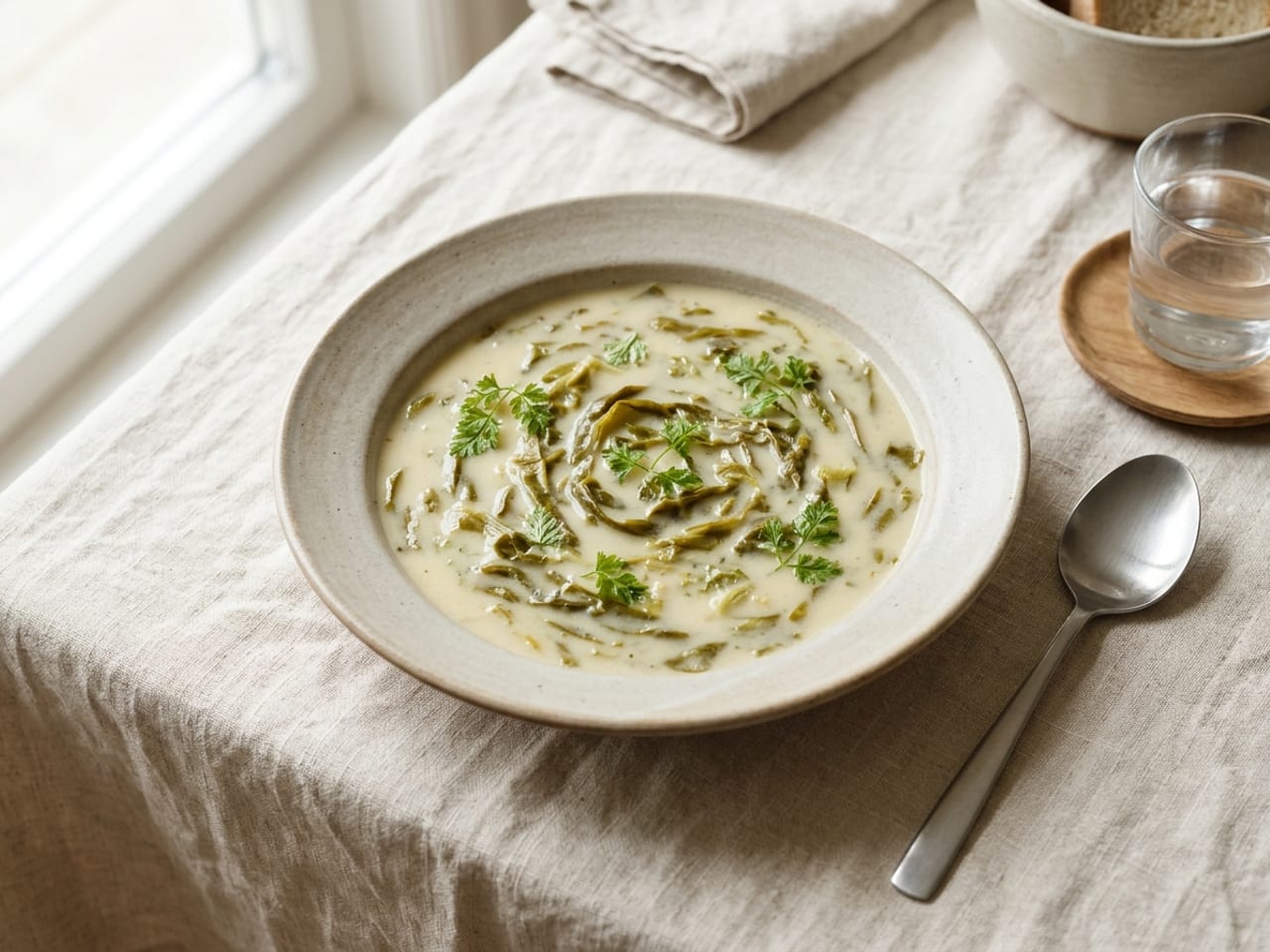
| When | What we found |
|---|---|
| 1767 | A "potage de chiffonnade" is listed in the Dictionnaire portatif de cuisine (the first edition, read in Gallica for our knife skills guide).23 |
| 1772 | Its recipe: "Coupez en filets, chicorée, laitue, pourpier, oseille, poireaux, ciboulettes & racines": chicory, lettuce, purslane, sorrel, leeks, chives and roots cut in strips, for a soup.23 |
| 1779 | A Munich cookbook by Jean Neubauer, a Bavarian count's head cook: its "Potage chiffonné ou Chiffonnade" is "Eine klare Suppe von Wurzeln", a clear soup of roots cut in little shapes.24 |
| 1823 | Carême's menus list "Le potage à la chiffonade, au consommé".25 |
| 1828 | "Potage printanier ; ou Chiffonnade": spring roots and peas, with sorrel and romaine "déchirées", torn, to the size of a sou coin (Le cuisinier royal).26 |
| 1830 | The earliest English we found: "Potage, Printannier, or Chiffonade" in Dolby's Cook's Dictionary, earlier than the dictionaries' dates below.27 |
| 1832 | The French dictionary TLFi's first attestation of chiffonnade.17 |
| 1841 | Krünitz's encyclopedia (by then continued by J. W. D. Korth): a root-vegetable soup in which the chiffonade is "dreieckig geschnitten", cut in triangles.28 |
| 1846 | London: Soyer's "Make a Chiffonade as follows" (lettuces, sorrel, chervil, tarragon, cucumbers, sweated in butter) and Francatelli's Chiffonade Soup, its greens and celery "shred fine".29, 30 |
| 1847 | Etymonline's date for the English word; Louis Barré's Complément to the Académie française dictionary gives chiffonnade, "d'après plusieurs lexiques" (after several dictionaries), as "sorte de potage", a kind of soup.16, 31 |
| 1864 | Dubois and Bernard's "Chiffonnade pour garniture": rounds of lettuce and sorrel leaf cut with a column cutter and blanched: by now the garnish is sorrel and lettuce.32 |
| 1867 | Gouffé: sorrel "coupée en chiffonnade, c'est-à-dire en filets que vous blanchissez" (cut in chiffonnade, that is, in strips that you blanch): the earliest use as the name of a cut we found.33 |
| 1875 to 1880 | Dictionary.com (1875 to 80) and Merriam-Webster (1877) date the English word.13, 15 |
| 1890s | Sorrel and lettuce soup garnishes in Gilbert (Paris, 1890) and Senn (London, 1895, a glossary entry: "Soup herb leaves"); in the US, Ranhofer's and the Waldorf's chiffonade salads and Fellows's "Vegetables shredded".34, 35, 36, 37, 39 |
| 1907 | Escoffier: lettuce and sorrel "ciselées, fondues au beurre"; in English "a mince of sorrel or lettuce", pressed flat by hand and cut in fine strips, not rolled.41, 42 |
| 1909 | Hering's German kitchen lexicon: "Sauerampfer oder Kopfsalat in kleinen Streifen", sorrel or lettuce in small strips.40 |
| 1917 | Fannie Farmer's Chiffonade Dressing, a French dressing with chopped parsley, pepper, egg and shallot: a mixed dressing, not a leaf-ribbon cut (the false friend).44 |
| 1970 | The earliest roll-it-up method we found: "roll them lengthwise into a tight cylinder and cut it crosswise" (Time-Life, Classic French Cooking).48 |
| 1975 | Craig Claiborne's sorrel chiffonade "is then cooked": still the classical use.49 |
| 1981 to 1991 | The raw basil chiffonade as a plate garnish: Wolfgang Puck (1981), Chez Panisse (1984), the CIA's textbook (1991).50, 51, 52 |
| 1991 | "Chiffonnade de jambon" in French print, the earliest we found (the deli sense).83 |
"Earliest we found" means in the scans we could search: the dates are floors, not origins. The English word is in print by 1830 in what we read, 17 years before Etymonline's 1847 and 47 before Merriam-Webster's 1877 (our arithmetic).13, 16, 27
Where the word comes from: a rag, not a ribbon
The three dictionaries we read agree on a rag: TLFi and Merriam-Webster derive chiffonnade fromchiffonner, to crumple (itself from chiffon, a rag), Etymonline from chiffon directly, and TLFi's cookery ending -ade is not a diminutive. Etymonline ties the name to "the condition of the leafy stuff" once cut. "Little rags" (Wikipedia, uncited) and "little ribbons" (a Vocabulary.com note, unsourced) are popular glosses, not the meaning.13, 15, 16, 17, 18
| Source | Kind | What it says |
|---|---|---|
| TLFi, chiffonnade17 | Dictionary | from the verb chiffonner with the cookery suffix -ade, "sur le modèle de" capilotade, croustade, brandade, estouffade |
| TLFi, chiffonner17 | Dictionary | "Froisser en donnant l'apparence d'un chiffon": to crumple, giving something the look of a rag |
| TLFi, chiffon17 | Dictionary | a crumpled piece of cloth (1609), "lambeau de vieille étoffe", a scrap of old cloth (1611); from chiffe + -on |
| TLFi, -ade17 | Dictionary | a suffix "exprimant l'idée d'action ou l'idée de coll.": action or a collective, not a diminutive |
| Merriam-Webster13 | Dictionary | "French chiffonnade, from chiffonner to crumple, from chiffon" |
| Etymonline16 | Etymology dictionary | chiffon a "diminutive of chiffe 'a rag, piece of cloth'"; the cookery word "In reference to the condition of the leafy stuff after it is so treated" |
| Wikipedia18 | Unsourced | "means little rags in the original French", tagged "citation needed" |
| Vocabulary.com, on Dictionary.com15 | Unsourced | "In French, chiffonade means 'little ribbons,'", with no source |
Was the classical chiffonade rolled? No
No classical text we read rolls the leaves. In 1772 they are cut "en filets", in 1828 torn, in 1864 cut into rounds; Escoffier in 1907 says to "squeeze the latter tightly between the fingers of the left hand and the table. Now cut them into fine strips with a sharp knife", and the 1941 American edition says the same.23, 26, 32, 42, 43 Larousse stacks the leaves on a board.46 Wikipedia cites that 1941 Escoffier for "stacking leaves, rolling them tightly", but the book presses, it does not roll.18, 43 The earliest roll into a tight cylinder we found is Time-Life's, 1970; it is the textbook method today.1, 3, 48
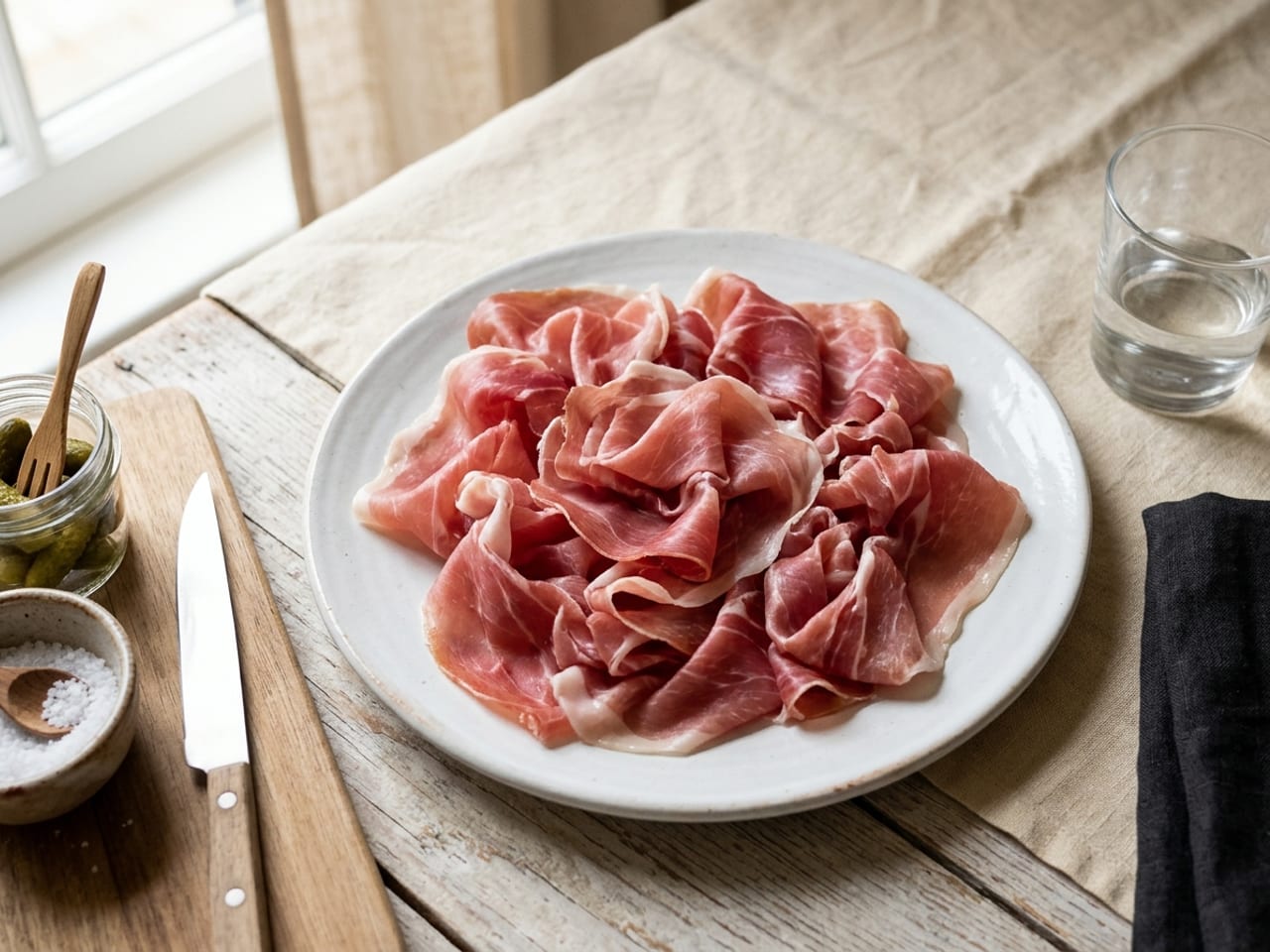
Chiffonnade de jambon: the French deli sense
In France a chiffonnade is also sliced meat. Larousse's dictionary gives it as a second sense: "Par extension, mets émincé servi en morceaux épars : Une chiffonnade de jambon" (by extension, a thinly sliced food served in loose pieces).20 A 1998 French cookbook says "Les tranches doivent être extrêmement fines", the slices must be extremely thin.82 On the shelf it is a sales name: Auchan files "Chiffonnades, charcuterie en tranche", a cured-ham pack sells on its "tranchage très fin", another prints "Dénomination légale : Chiffonnade de Jambon cru Italien", Carrefour sells a chiffonnade of cured beef, and the word covers cooked ham too.21, 22, 79, 80, 81 "Épars" (loose, scattered) fits the crumpled look of the root verb (our reading).
It is in French print by 1991 in what we found, which is a floor, not an origin date.83 We found no English dictionary that gives the meat sense, and no English book in our search that uses "chiffonade of ham".13, 14, 15
Chiffonade dressing and chiffonade salad: the false friend
In American cookbooks "chiffonade" also named a dressing and a mixed salad: dishes, not the leaf-ribbon cut, their ingredients minced in some books and shredded in others. The American Salad Book (1899): "A green salad, commonly of lettuce or cresses with a liberal sprinkling of cold minced vegetables over the top".38 Fannie Farmer's Chiffonade Dressing is a French dressing with chopped parsley, red pepper, hard-boiled egg and shallot; Gisslen still prints one, a vinaigrette with eggs, beets, parsley and onion "all chopped fine".1, 44 Saulnier's Chiffonnade salad is "Lettuces, celery in julienne, chicory, endives". 47 If a recipe asks for chiffonade dressing, it means a dressing with finely cut mix-ins, not a leaf-ribbon cut.
Chiffonade troubleshooting
| Problem | Likely cause | Fix |
|---|---|---|
| The basil ribbons go black | Basil kept in the fridge, or cut long before serving | Keep whole basil above 12°C (54°F), stems in water; cut it last65, 84, 87, 97 |
| Edges look bruised or wet | A dull knife, or pressing straight down | A sharp knife and a slicing stroke, tip on the board (McGee explains the crushing; Bolin measured slicing on lettuce)63, 69, 93, 97 |
| Ribbons stick together in clumps | Damp leaves (ours), or not fluffed | Dry the leaves first; fluff the pile with your fingers after cutting69, 77, 78 |
| The roll falls open or slips | Too many leaves, or a loose roll | Stack fewer ("a few at a time"), roll tight and tuck the ends in7, 74 |
| The ribbons come out short | Rolled from the long edge | Roll from the stem end for longer ribbons (blog advice)72, 73 |
| Ribbons are stringy or tough | Ribs and stems left in kale, collards, chard or old sorrel | "remove the heavy leaf ribs" before stacking1, 42, 67 |
| Small leaves will not roll | Parsley and cilantro: small, flat leaves | Bunch and chop (ICE), or stack a few flat and slice (ours); strip thyme and chop it (herbs)55, 63 |
| A cabbage or iceberg will not roll | A head grows in layers | Cut a wedge and slice it cut side down58, 70 |
| Ribbons look dark and oily | Oiled to keep them green | Skip the oil: on whole leaves it barely slowed darkening, on cut basil it slowed it but left the basil oily (ATK), and oil soaks into a leaf and darkens it (McGee)65, 97 |
| Kale ribbons are tough in a salad | Raw curly kale | Massage the ribbons: at least 5 minutes for curly kale, about 1 minute for Tuscan (ATK)67 |
Photograph your plate, see it re-plated
Herb ribbons on the dish and not sure where they go? Photograph the plate and Plate Artists re-plates that dish, with the food kept as it is and the changes named so you can repeat them. Start with a re-plate.
Your food, plated like a chef's
Snap it, upload it, and get the composed version back, with the steps to recreate it at home.
Start free · 1 enhancement →Free account · 1 free enhancement · No credit card
Chiffonade terms, defined
Twelve words the site does not already define: chiffonade, julienne, brunoise and pluches are in our food garnish glossary, and the knife words in our knife skills guide.
Ciseler · ciselé
French for cutting leaves or herbs finely with a knife; the verb behind the classical chiffonnade.
Where it comes from. Escoffier's lettuce and sorrel are "ciselées"; Larousse cuts the chiffonnade by "ciseler en julienne".41, 46
Shred
To cut into thin strips by knife, grater or machine; the CIA files chiffonade under it.
Where it comes from. Gisslen: "to cut into thin strips, either with the coarse blade of a grater (manual or power) or with a chef's knife".1, 2
Potage à la chiffonnade · potage de chiffonnade
The soup the word first named: broth with greens, leeks, herbs and roots cut in strips.
Where it comes from. Listed in 1767, a recipe in 1772; Carême's menus in 1823.23, 25
Chiffonnade mixte
A chiffonnade of sorrel and lettuce together, the classical pair.
Where it comes from. Larousse: "un mélange d'oseille et de laitue".46
Rondelles (in a chiffonnade)
French for rounds; in a chiffonnade, small rounds of sorrel or lettuce leaf cut with a column cutter and blanched, the other classical form. On a carrot or cucumber a rondelle is a round slice (see the knife cuts chart).
Where it comes from. Dubois and Bernard (1864) cut them with a column cutter; Escoffier allows "rondelles" in some cases. On a carrot or cucumber a rondelle is a round slice: the chart's rondelle.32, 41
En filets · in strips
French for cut in strips: how the oldest recipes describe the chiffonnade cut.
Where it comes from. The 1772 soup's "Coupez en filets"; Gouffé's "c'est-à-dire en filets".23, 33
Chiffonade salad
A named salad of mixed greens with finely cut or minced vegetables, in American hotel books and in Saulnier's French repertoire; a dish, not a knife cut.
Where it comes from. Ranhofer 1894, the Waldorf 1896, the American Salad Book 1899; Saulnier's Chiffonnade salad.35, 37, 38, 47
Chiffonade dressing
A French dressing or vinaigrette with finely chopped egg, parsley, beets or pepper and onion.
Where it comes from. Fannie Farmer (1917); Gisslen's vinaigrette variation, ingredients "all chopped fine".1, 44
Chiffonnade de jambon · ham chiffonnade
French for ham (most often cured in the packs and guides we read, cooked too) sliced very thin and served in loose, scattered pieces.
Where it comes from. Larousse's dictionary, sense 2; French retail packs.20, 79
Chilling injury
Damage a cold-sensitive plant suffers when chilled above freezing (for basil, below 12°C (54°F)); in basil it shows as black spots and dark leaves.
Where it comes from. Basil: injury below 12°C (54°F), "necrosis and browning or blackening of the leaves" (USDA).84, 87
Cut leafy greens
In the US Food Code, cut salad greens that a food business must keep at 41°F (5°C) or control by time.
Where it comes from. FDA Food Code §1-201.10: lettuces, spinach, cabbage, kale, arugula and chard, "cut, shredded, sliced, chopped, or torn"; herbs excluded.98
Chiffonade, answered
What is chiffonade?
A way of cutting leaves into fine ribbons: stack a few, roll them into a tight cylinder and slice across the roll. Basil is the usual example; sorrel and lettuce were the classical ones. No textbook definition gives a width ("fine ribbons, no set width"); it is mostly a garnish.
What does chiffonade mean in French?
It comes from chiffonner, to crumple, from chiffon, a rag, with the cookery ending -ade (TLFi, Merriam-Webster). It does not mean little ribbons: that gloss has no source. In French, une chiffonnade is classically sorrel and lettuce cut in strips and cooked in butter, and today also ham sliced very thin.
How do you pronounce chiffonade?
shif-uh-NAHD or shif-uh-NAYD: Merriam-Webster and Dictionary.com give both for American English, and Cambridge gives shif-uh-NAHD for British English. In French it is [ʃifɔnad], stressed on the last syllable.
How do you chiffonade basil?
Wash and dry the leaves and pinch off the stems. Stack a few (Forks Over Knives says 3 to 4 large or 4 to 6 small), roll them into a tight cylinder like a cigar, slice across the roll with a sharp knife, tip on the board, then fluff the ribbons apart with your fingers and use them straight away (Gisslen, MasterClass, the CIA).
What size is a chiffonade cut in mm and inches?
No textbook definition gives one: Gisslen and the CIA say "fine shreds" and Larousse allows strips "plus ou moins larges" (more or less wide). Numbers appear only outside definitions: 1 mm (CooksInfo), 1/16 to 1/8 in (about 1.6 to 3 mm, ours) on a knife maker's blog and a recipe blog, 1/16 to 1/4 in (about 1.6 to 6 mm, ours) at Made In, 1/8 in (about 3 mm, ours) in a US school lesson, 1/4 in (about 6 mm, ours) for ATK's kale salad and 1 cm (about 3/8 in, ours) for Larousse's cooked endives.
What is the difference between chiffonade and julienne?
A julienne is a square stick of a set size cut from a firm vegetable, ⅛ × ⅛ × 1 to 2 in (3 × 3 × 25 to 50 mm) in the US textbooks. A chiffonade is a flat ribbon of leaf with no set width. Made In puts it this way: you can julienne a beet, but you would chiffonade its greens.
Is chiffonade the same as shredding?
Nearly. The CIA heads the cut 'Chiffonade (shredding)' and America's Test Kitchen writes 'Chiffonade (or Shredded)'. Shred is the wider word: Gisslen allows a grater or a knife, and he and Peterson shred cabbage, while chiffonade is used for herbs and soft greens.
Can you chiffonade parsley or cilantro?
Yes, though most cooks chop them. The leaves are small and flat, so the Institute of Culinary Education chops parsley and cilantro, and several sites call parsley unsuited (one, Wikipedia, cilantro too); but Charlie Trotter cuts a flat-leaf parsley chiffonade and On Cooking a cilantro chiffonade. Our suggestion: stack a few large leaves flat and slice them. We found no source that cuts thyme or rosemary chiffonade.
How do you chiffonade kale, spinach or lettuce?
Strip out the ribs of kale, collards and chard first. Stack and roll spinach and soft lettuces like basil (On Cooking rolls spinach 'tightly like a cigar'). For a kale salad ATK cuts 1/4-inch (about 6 mm, ours) ribbons and massages them, at least 5 minutes for curly kale and about a minute for Tuscan. Cut an iceberg as a wedge and slice it cut side down.
Can you chiffonade cabbage?
You can cut it the same way, though Gisslen and Peterson call it shredding. Cut a wedge, lay it cut side down and slice thin (CooksInfo, Time-Life). Gisslen wants cabbage in long, fine shreds and says do not chop; the CIA writes 'green cabbage chiffonade'.
Why does basil chiffonade turn black?
The documented cause is cold: basil is injured below 12°C (54°F) and its leaves blacken in as little as 1 day at 0°C (32°F) or 3 days at 5°C (41°F), so never keep it in the fridge. Cut edges also darken as they sit (the same enzyme family that browns a cut apple), but no study we found times basil ribbons. Cut it last, with a sharp knife.
Can you chiffonade basil ahead of time?
Not well. The CIA and America's Test Kitchen cut it just before serving, and no study measures how long basil ribbons stay green. Two blogs give fridge times (1 to 2 days; 3 to 4 days) without testing, and cold is what blackens basil. Lettuce, spinach, kale and cabbage are not hurt by cold (ours, from the USDA handbook), so they can wait in the fridge: at home within 2 hours of cutting; for US food businesses under the FDA Food Code, at 41°F (5°C) or under a 4-hour time rule.
What is chiffonade used for?
Mostly as a garnish: raw ribbons scattered over tomato salads, caprese, soups and pasta at the last moment. Classically it was cooked into soups (Escoffier's sorrel and lettuce) or laid as a bed under eggs (Escoffier) or cold seafood (Larousse).
How do you chiffonade mint or sage?
The same way as basil: stack, roll tight, slice across and fluff. Unlike basil, mint and sage are not hurt by cold, so the USDA handbook stores them near 0°C (32°F); cut mint ribbons can wait in the fridge (our application).
What is chiffonnade de jambon?
A French name for ham, most often cured in what we read (cooked too), sliced very thin and served loosely piled; Larousse's dictionary gives it as a second sense, and French packs use it as a sales name, for beef too. We found it in French print by 1991, and in no English dictionary.
What is chiffonade dressing?
A false friend: a French dressing or vinaigrette with finely chopped egg, parsley, pepper or beets and onion (Fannie Farmer 1917, Gisslen): a mixed dressing, not a leaf-ribbon technique. The American chiffonade salad was a mixed green salad, minced in some books and shredded in others.
The textbooks, dictionaries, old cookbooks, studies and agencies behind this guide
How each source was read (in full, as a PDF, in an archived copy, as a Google Books snippet, as an abstract, or as search fragments of a lending-only scan) is in its entry and under how this page was made. Blogs, magazines, makers' pages and shops are labelled. Conversions and suggestions marked ours are our own.
- Gisslen, W. (2011). Professional Cooking, 7th edition. John Wiley & Sons, chiffonade p. 148 and Fig. 7.23 (sorrel), shred p. 142, the glossary p. 1064, basil cut chiffonade pp. 263 and 691, sorrel p. 548, cabbage shreds p. 583, knife materials and knife types (ch. 3), green salads (ch. 21), the Insalata Caprese and Chiffonade Dressing (p. 703); read as Google Books search-inside snippets and in an Internet Archive OCR copy on 27 October 2026 (and on 30 September 2026 for our knife skills guide). books.google.com
- The Culinary Institute of America (2011). The Professional Chef, 9th edition. John Wiley & Sons, the glossary (chiffonade), the knife-cut list p. 618 ("Chiffonade (shredding)") and index, fresh herbs p. 129, recipes with iceberg and shiso (p. 514), basil (p. 590) and green cabbage (p. 822) chiffonade; read on 27 October 2026 as Google Books search-inside snippets. The method on p. 621 did not surface in any snippet. books.google.com
- Labensky, S. R. & Hause, A. M. (2007). On Cooking: A Textbook of Culinary Fundamentals (also the 2003 printing and the 4th Canadian edition, 2009). Pearson Prentice Hall, the knife-skills chapter (chiffonade, "chef-fon-nahd", spinach rolled "like a cigar") and recipes with romaine, cilantro and basil chiffonade; read 27 October 2026 as Internet Archive full-text search fragments of a lending-only scan, not the page images. archive.org
- Wright, J. & Treuille, E. (1996). Le Cordon Bleu Complete Cooking Techniques (and Le Cordon Bleu Kitchen Essentials, 2001). Le Cordon Bleu, the glossary p. 162 ("rolled together") and the garnish list; read 27 October 2026 as Internet Archive full-text search fragments of a lending-only scan, not the page images. archive.org
- Cracknell, H. L. & Kaufmann, R. J. (1999). Practical Professional Cookery (1992 and 1999 printings). Macmillan, term 23 Chiffonade and recipe 309 Chiffonades; read 27 October 2026 as Internet Archive full-text search fragments of a lending-only scan, not the page images. archive.org
- Various (2008). Professional Cookery: Level 1 Diploma (2008); Professional Cookery, City & Guilds NVQ/SVQ Technical Certificate Level 2 (2010). UK vocational textbooks, the cut lists (brunoise "2mm dice", chiffonade "finely shredded"; lettuce chiffonade "very finely shredded"); read 27 October 2026 as Internet Archive full-text search fragments of a lending-only scan, not the page images. archive.org
- Peterson, J. (2003). Essentials of Cooking. Artisan, "How to Shred, Julienne, and Chiffonade"; read 27 October 2026 as Internet Archive full-text search fragments of a lending-only scan, not the page images. archive.org
- Pépin, J. (2001). Jacques Pépin's Complete Techniques (and A Grandfather's Lessons, 2017). Black Dog & Leventhal, Technique 126, p. 319 ("a very thin chiffonade"); mint rolled like a scroll (2017); read 27 October 2026 as Internet Archive full-text search fragments of a lending-only scan, not the page images. archive.org
- Ruhlman, M. (2007). The Elements of Cooking. Scribner, the entry Chiffonade; read 27 October 2026 as Internet Archive full-text search fragments of a lending-only scan, not the page images. archive.org
- Child, J. (1995). In Julia's Kitchen with Master Chefs. Knopf, mint, basil and romaine "cut into chiffonade (very narrow strips)"; read 27 October 2026 as Internet Archive full-text search fragments of a lending-only scan, not the page images. archive.org
- New Zealand Qualifications Authority (2026). Unit standard 13280: Prepare fruit and vegetable cuts in a commercial kitchen, version 7. nzqa.govt.nz (PDF), julienne and chiffonade are required in the assessment; no sizes; read in full on 24 October 2026 for our tourné guide. nzqa.govt.nz (PDF)
- CAERT, Inc. (distributed by the Illinois State Board of Education) (2011). Lesson L700036: Professional Knife Skills. isbe.net (PDF), chiffonade, "SHIF-ah-nod", crosswise cuts 1/8 inch wide (the PDF's text layer prints the 1/8 glyph as "c", as it does for its 1/8 inch brunoise); resources accessed February 2011; read in full on 27 October 2026. isbe.net (PDF)
- Merriam-Webster (2026). chiffonade. Merriam-Webster.com Dictionary, pronunciations, definition, etymology, first known use 1877; read from a copy saved on 28 September 2026 for our food garnish guide (the live page refused this machine on 27 October 2026). merriam-webster.com
- Cambridge University Press (2026). chiffonade. Cambridge Dictionary, UK and US pronunciations, noun and verb; read in full on 27 October 2026. dictionary.cambridge.org
- Dictionary.com (with Collins English Dictionary and Vocabulary.com) (2026). chiffonade. Dictionary.com, the American entry (shif-uh-nayd, -nahd; 1875 to 80), the British Collins entry, the Vocabulary.com explanation box ("little ribbons", unsourced) and example sentences; read in full on 27 October 2026. dictionary.com
- Harper, D. (2025). chiffonade; chiffon. Online Etymology Dictionary, English date 1847; chiffon a diminutive of chiffe; read on 27 October 2026 in an archived copy (citation box "Retrieved November 15, 2025"; the live page refused this machine). etymonline.com
- ATILF / CNRS (2026). Trésor de la langue française informatisé: chiffonnade, chiffonner, chiffon, chiffe, -ade. CNRTL, chiffonnade first attested 1832, from chiffonner + the cookery suffix -ade; chiffonner "to crumple"; -ade an action or collective suffix; also Littré's and the Wiktionnaire's entries on the same pages; read in full on 27 October 2026 through the CNRTL API. cnrtl.fr
- Wikipedia contributors (2026). Chiffonade (revision 1359620148). Wikipedia, the "little rags" and "not suited to coriander, parsley, thyme, or rosemary" lines, both tagged "citation needed", and the method cited to The Escoffier Cook Book p. 90; read in full on 27 October 2026. wikipedia.org
- Wikipédia contributors (2026). Chiffonnade (revision 224610959). Wikipédia (French), quotes the 1938 Larousse gastronomique (Montagné) definition (not read by us in the 1938 scan) and "par extension" the chiffonnade de jambon; read in full on 27 October 2026. fr.wikipedia.org
- Éditions Larousse (2026). chiffonnade. Dictionnaire de français Larousse, sense 1, leaves cut in fine strips; sense 2, "par extension, mets émincé servi en morceaux épars : une chiffonnade de jambon"; read in full on 27 October 2026. larousse.fr
- Wiktionnaire contributors (2026). chiffonnade. Wiktionnaire, two senses, a soup made of herbs and a food cut in very fine strips (the ham example); read in full on 27 October 2026. fr.wiktionary.org
- La langue française (2024). chiffonnade (updated 12 February 2024). lalanguefrancaise.com, the two senses and usage citations including a recall of "chiffonnade de jambon cuit supérieur"; read in full on 27 October 2026. lalanguefrancaise.com
- Anonymous (1772). Dictionnaire portatif de cuisine, d'office, et de distillation. Paris: Lottin le jeune, "Potage de chiffonnade" and the list of soups, in a "nouvelle édition" published by Lottin le jeune (dated 1772 by the Internet Archive record; the imprint year is not legible in the OCR) (the 1767 first edition's listing was read in Gallica on 30 September 2026 for our knife skills guide; Gallica refused this machine on 27 October 2026); read in full in the Internet Archive scan (OCR text) on 27 October 2026. archive.org
- Neubauer, J. (1779). Allerneuestes Kochbuch. Munich: Johann Nepomuk Fritz, "Potage chiffonné ou Chiffonnade", a clear soup of roots; by Jean Neubauer, head cook to Count von der Wahl (Bayerische Staatsbibliothek copy); read in full in the Internet Archive scan (OCR text) on 27 October 2026 (Fraktur, rough OCR). archive.org
- Carême, M.-A. (1823). Le maître d'hôtel français, tome 1. Paris: Firmin Didot, "Le potage à la chiffonade, au consommé" on the menus (no recipe text); read in full in the Internet Archive scan (OCR text) on 27 October 2026. archive.org
- Viard, A. & Fouret (1828). Le cuisinier royal, 13th edition. Paris: Barba, "Potage printanier ; ou Chiffonnade", sorrel and romaine torn to the size of a sou (a recipe marked "(F.)", Fouret's); read in full in the Internet Archive scan (OCR text) on 27 October 2026. archive.org
- Dolby, R. (1830). The Cook's Dictionary, and House-keeper's Directory. London: Colburn and Bentley, "Potage, Printannier, or Chiffonade"; read in full in the Internet Archive scan (OCR text) on 27 October 2026. archive.org
- Krünitz, J. G. (vol. 178 by J. W. D. Korth) (1841). Ökonomisch-technologische Encyklopädie, Band 178. Berlin, "Gensdarmensuppe und Chiffonade", roots cut in triangles; read in full in the Internet Archive scan (OCR text) on 27 October 2026. archive.org
- Soyer, A. (1846). The Gastronomic Regenerator. London, "Make a Chiffonade as follows"; read in full in the Internet Archive scan (OCR text) on 27 October 2026. archive.org
- Francatelli, C. E. (1846). The Modern Cook. London, No. 256, Chiffonade Soup; read in full in the Internet Archive scan (OCR text) on 27 October 2026. archive.org
- Barré, L. (ed.) (1847). Complément du Dictionnaire de l'Académie française (1847 printing). Paris: Firmin Didot frères, chiffonnade "d'après plusieurs lexiques, sorte de potage" (OCR "potagi"); a supplement edited by Louis Barré, not published by the Académie; read in full in the Internet Archive scan (OCR text) on 27 October 2026. archive.org
- Dubois, U. & Bernard, É. (1864). La cuisine classique. Paris: Dentu, "Chiffonnade pour garniture": rounds of lettuce and sorrel cut with a column cutter; read in full in the Internet Archive scan (OCR text) on 27 October 2026. archive.org
- Gouffé, J. (1867). Le livre de cuisine. Paris: Hachette, sorrel "coupée en chiffonnade, c'est-à-dire en filets"; read in full in the Internet Archive scan (OCR text) on 27 October 2026. archive.org
- Gilbert, P. (1890). La cuisine de tous les mois. Paris: Goubaud, a soup finished with a chiffonnade of sorrel and lettuce, p. 98 area; read in full in the Internet Archive scan (OCR text) on 24 October 2026 for our tourné guide and re-read for this one. archive.org
- Ranhofer, C. (1894). The Epicurean. New York, "Nonpareil (Chiffonade) Salad" and "Potatoes, Chiffonnade"; read in full in the Internet Archive scan (OCR text) on 27 October 2026. archive.org
- Senn, C. H. (1895). Practical Gastronomy and Culinary Dictionary. London, the glossary ("Soup herb leaves") and Consommé de Volaille à la Chiffonade; read in full in the Internet Archive scan (OCR text) on 24 October 2026 for our tourné guide and re-read for this one. archive.org
- Tschirky, O. (1896). The Cook Book by "Oscar" of the Waldorf. hotel chef's cookbook, Chiffonade Salad and Chiffonnade Soup; read in full in the Internet Archive scan (OCR text) on 27 October 2026. archive.org
- De Loup, M. (1899). The American Salad Book. New York, "Chiffonade Salad. A green salad, commonly of lettuce or cresses with a liberal sprinkling of cold minced vegetables over the top"; read in full in the Internet Archive scan (OCR text) on 27 October 2026. archive.org
- Fellows, C. (1897). A Selection of Dishes. Pittsburg, "CHIFFONADE shi-fon-ade Vegetables shredded"; read in full in the Internet Archive scan (OCR text) on 24 October 2026 for our tourné guide and re-read for this one. archive.org
- Hering, R. (1909). Lexikon der Küche. professional kitchen lexicon, "Chiffonnade: Sauerampfer oder Kopfsalat in kleinen Streifen", and Chiffonnette; read in full in the Internet Archive scan (OCR text) on 24 October 2026 for our tourné guide and re-read for this one. archive.org
- Escoffier, A. (1907). Le Guide culinaire, 2e édition. Paris, "Chiffonnade et pluches" under the garnishes for soups, the country soups with spinach and purslane, Œufs à la Maraîchère; read in full in the Internet Archive scan (OCR text) on 24 October 2026 for our tourné guide and re-read for this one. archive.org
- Escoffier, A. (1907). A Guide to Modern Cookery. London: Heinemann, No. 215 Chiffonade, pp. 89 to 90, Consommé Mirette (No. 586) and Potage Fontanges; read in full in the Internet Archive scan (OCR text) on 24 October 2026 for our tourné guide and re-read for this one. archive.org
- Escoffier, A. (1941). The Escoffier Cook Book. New York: Crown, No. 215, the leaves squeezed between the fingers and the table top; read 27 October 2026 as Internet Archive full-text search fragments of a lending-only scan, not the page images. archive.org
- Farmer, F. M. (1917). A New Book of Cookery. Boston: Little, Brown, Chiffonade Dressing, p. 214; read in full in the Internet Archive scan (OCR text) on 27 October 2026. archive.org
- Montagné, P. (1961). Larousse Gastronomique, first English edition. Crown / Hamlyn, the chicory, sorrel and lettuce chiffonnades, pp. 270 and 450; read 27 October 2026 as Internet Archive full-text search fragments of a lending-only scan, not the page images. archive.org
- Comité gastronomique (président Joël Robuchon) (1997). Larousse gastronomique. Paris: Larousse-Bordas, the entry CHIFFONNADE (p. 264 per the index) and its recipes (endives in strips of 1 cm, sorrel, the "mixte"), the cold-seafood and cocktail recipes on a lettuce chiffonnade, a "chiffonnade très fine" soup and lettuce "grossièrement taillée en chiffonnade"; read in full in the Internet Archive scan (OCR text) on 24 October 2026 for our tourné guide and re-read for this one. archive.org
- Gringoire, T. & Saulnier, L. (1976). Le Répertoire de la Cuisine (the 1976 English edition, and a French printing the Internet Archive dates 1956). Barron's, the glossary, consommé garnishes and the Chiffonnade salad; read 27 October 2026 as Internet Archive full-text search fragments of a lending-only scan, not the page images. archive.org
- Claiborne, C., Franey, P. et al. (1970). Classic French Cooking (Foods of the World). Time-Life Books, "roll them lengthwise into a tight cylinder and cut it crosswise"; read 27 October 2026 as Internet Archive full-text search fragments of a lending-only scan, not the page images (the fragment does not show which leaf). archive.org
- Claiborne, C. (1975). Craig Claiborne's Favorites from the New York Times. cookbook, sorrel cut into a chiffonade "is then cooked"; read 27 October 2026 as Internet Archive full-text search fragments of a lending-only scan, not the page images. archive.org
- Puck, W. (1981). Modern French Cooking for the American Kitchen. cookbook, "sprinkle with a chiffonade of basil"; read 27 October 2026 as Internet Archive full-text search fragments of a lending-only scan, not the page images. archive.org
- Waters, A. et al. (1984). Chez Panisse Pasta, Pizza & Calzone. cookbook, "Serve garnished with the chiffonade of basil"; read 27 October 2026 as Internet Archive full-text search fragments of a lending-only scan, not the page images. archive.org
- The Culinary Institute of America (1991). The New Professional Chef, 5th edition. textbook, "Garnish them with the fresh chiffonade of basil"; read 27 October 2026 as Internet Archive full-text search fragments of a lending-only scan, not the page images. archive.org
- Sonnenschmidt, F. & Nicolas, J. (1993). The Professional Chef's Art of Garde Manger, 5th edition. textbook, "a platter covered with a chiffonade of lettuce"; read 27 October 2026 as Internet Archive full-text search fragments of a lending-only scan, not the page images. archive.org
- The Culinary Institute of America; Larousse, D. (2004). Garde Manger: The Art and Craft of the Cold Kitchen (2004); The Professional Garde Manger. textbooks, "fine chiffonade basil" and arugula "cut into a broad chiffonade"; read 27 October 2026 as Internet Archive full-text search fragments of a lending-only scan, not the page images. archive.org
- Trotter, C. (1998). The Kitchen Sessions with Charlie Trotter. cookbook, "flat-leaf parsley chiffonade"; read 27 October 2026 as Internet Archive full-text search fragments of a lending-only scan, not the page images. archive.org
- Sailhac, A. F. (2005). Cooking at De Gustibus at Macy's. cookbook, "fresh cilantro-leaf chiffonade" and a "Chiffonade of Collard Greens" (Daniel Boulud, 1988); read 27 October 2026 as Internet Archive full-text search fragments of a lending-only scan, not the page images. archive.org
- Various chefs (2011). Chicago's Homegrown Cookbook. cookbook, "chiffonade the cilantro"; read 27 October 2026 as Internet Archive full-text search fragments of a lending-only scan, not the page images. archive.org
- Time-Life Books (1986). Fresh Ways with Salads (Healthy Home Cooking). Time-Life Books, escarole and napa cabbage chiffonade, cut side down, and the "Cutting Chiffonade" technique page; read 27 October 2026 as Internet Archive full-text search fragments of a lending-only scan, not the page images. archive.org
- Millennium Restaurant (Tucker, E. et al.) (2003). The Artful Vegan (Millennium Restaurant). cookbook, radicchio and kaffir lime leaves chiffonade; read 27 October 2026 as Internet Archive full-text search fragments of a lending-only scan, not the page images. archive.org
- Panera Bread (2004). The Panera Bread Cookbook. cookbook, "fresh tarragon, chiffonade"; read 27 October 2026 as Internet Archive full-text search fragments of a lending-only scan, not the page images. archive.org
- Thompson, D. (2002). Thai Food (Arharn Thai). cookbook, "torn or shredded kaffir lime leaves" as a garnish; read 27 October 2026 as Internet Archive full-text search fragments of a lending-only scan, not the page images. archive.org
- The Herb Society of America (2026). Makrut Lime, Citrus hystrix: tips and recipes. herbsociety.org (PDF), "Slice very thin if it is intended to be eaten"; read in full on 27 October 2026. herbsociety.org (PDF)
- Institute of Culinary Education (Staff Writers; video with Chef James Briscione and Wüsthof) (2026). How to Chiffonade, Chop and Slice Different Herbs. ice.edu (blog), basil and mint chiffonade, a smooth slicing motion, parsley and cilantro chopped; read in full on 27 October 2026. ice.edu
- America's Test Kitchen (2026). Understanding Cutting Terms. americastestkitchen.com, chiffonade, minced, chopped and julienne; read in full on 27 October 2026 (public part). americastestkitchen.com
- America's Test Kitchen / Cook's Country (2026). Chopping and Using Fresh Basil (how-to 6249). americastestkitchen.com, four basil preparations compared by eye in tomato salads (no times or temperatures reported); read in full on 27 October 2026. americastestkitchen.com
- America's Test Kitchen (2026). Brighter, Greener Pesto (how-to 5857). americastestkitchen.com, fresh vs blanched basil pesto compared by eye and by taste; read in full on 27 October 2026. americastestkitchen.com
- America's Test Kitchen / Cook's Illustrated (2026). Giving Kale a Rubdown (how-to 6542). americastestkitchen.com, 1/4-inch ribbons, massage times for curly and Tuscan kale; read in full on 27 October 2026 (public part). americastestkitchen.com
- Cook's Illustrated (2009). Lettuce Knives (equipment review 1178, 1 July 2009). cooksillustrated.com, romaine and iceberg cut with two metal knives and a plastic knife, or torn, then refrigerated: days to visible browning on the edges; read on 27 October 2026 in an archived copy (Wayback, 13 November 2013); the live URL now redirects. cooksillustrated.com (archived)
- MasterClass (2021). How to Chiffonade Leafy Herbs and Vegetables (updated 3 August 2021). masterclass.com (magazine), stack, roll into a cigar, slice with the tip on the board, fluff; read on 27 October 2026 in an archived copy (Wayback 2025; the live page refused this machine). masterclass.com
- CooksInfo (2018). Chiffonade (first published 20 June 2004, updated 24 June 2018). cooksinfo.com (food encyclopedia), "no formal definitions", its own figure of about 1 mm, stack or roll by leaf, heads cut in a wedge; read in full on 27 October 2026. cooksinfo.com
- Johnson, I. (Made In Cookware) (2023). How to Chiffonade (10 April 2023). madeincookware.com (knife maker's blog), "usually between 1/16” and ¼”", roll from the smaller end, knife sizes; read in full on 27 October 2026. madeincookware.com
- Misen (2024). Chiffonade cut definition (3 December 2024) and How to chiffonade lettuce. misen.com (knife maker's blog), "typically 1/16 to 1/8 inch wide", leaf counts and roll direction; the definition page cites other blogs (one of them Forks Over Knives) and reads as compiled content, so we give it little weight; read in full on 27 October 2026. misen.com
- Brazil, L. (Evolving Table) (2024). What is a Chiffonade Cut? (8 September 2022, updated 20 May 2024). evolvingtable.com (recipe blog), roll direction, "⅛ to 1/16-inch" widths, prep-ahead and storage times; read on 27 October 2026 in archived copies (Wayback 2025 and 10 February 2026; the live site refused this machine). evolvingtable.com
- Forks Over Knives (2026). How to Chiffonade. shop.forksoverknives.com (magazine shop blog), "3 to 4 large leaves or 4 to 6 small leaves", tucked ends, slice crosswise; read in full on 27 October 2026. forksoverknives.com
- The Nibble (2014). Food 101: How To Chiffonade & Foods To Garnish With Chiffonade (21 January 2014). blog.thenibble.com (food webzine), the leaf list and the small leaves it leaves out; read in full on 27 October 2026. thenibble.com
- Olives for Dinner (2026). How to Chiffonade Collard Greens. olivesfordinner.com (recipe blog), "Stack 8-10 halves of leaves"; read in full on 27 October 2026. olivesfordinner.com
- Eisenberg, R. (The Practical Kitchen) (2023). How to Chiffonade Basil (and Other Leafy Greens) (17 June 2020, updated 13 February 2023). thepracticalkitchen.com (chef's blog), cut late, sharp knife, wash and dry first; no times given; read in full on 27 October 2026. thepracticalkitchen.com
- Gavin, J. (2026). How to Cut Basil (28 July 2023, modified 12 May 2026). jessicagavin.com (chef's blog), "don't drag the knife", dry in a spinner, cut basil 1 to 2 days in the fridge; read in full on 27 October 2026. jessicagavin.com
- Auchan (2026). AOSTE Apéritif chiffonnades de jambon cru, 6 tranches, 80 g (product page). auchan.fr, the shelf name "Chiffonnades, charcuterie en tranche" and "tranchage très fin"; read in full on 27 October 2026. auchan.fr
- Houra (Cora group) (2026). Auchan Le Charcutier chiffonnade de jambon cru italien, 80 g (product page). houra.fr, "Dénomination légale : Chiffonnade de Jambon cru Italien"; read in full on 27 October 2026. houra.fr
- Open Food Facts (2026). Chiffonnade de Boeuf, Carrefour Sélection (product 3245415694919). openfoodfacts.org, cured raw beef sold as a chiffonnade; read on 27 October 2026 through its API. openfoodfacts.org
- Anonymous (1998). Le grand livre des pâtes (French edition). cookbook, "reçoit l'appellation de chiffonnade de jambon. Les tranches doivent être extrêmement fines", p. 187; read 27 October 2026 as Internet Archive full-text search fragments of a lending-only scan, not the page images. archive.org
- Various (a 1991 French novel; Gault-Millau France, 1993 edition) (1991). The earliest "chiffonnade de jambon" in Internet Archive full text. Internet Archive full-text search, 116 hits sorted by year, the first 1991 ("une chiffonnade de jambon de Bayonne"), then Gault-Millau ("de Parme"); read 27 October 2026 as Internet Archive full-text search fragments of a lending-only scan, not the page images. The archive holds little French print of the 1970s and 1980s, so this is a floor, not an origin date. archive.org
- Brindisi, L. J. & Simon, J. E. (2023). Preharvest and postharvest techniques that optimize the shelf life of fresh basil (Ocimum basilicum L.): a review. Frontiers in Plant Science, 14:1237577; read in full. doi.org
- Tapparo, G., Botta, G., Caratti, A., Felizzato, G., Liberto, E. & Bertolino, M. (2026). Sweet basil raw material functionality as a framework for industrial pesto quality: a field-to-fork perspective. Foods, 15(15):2760; read in full. doi.org
- Larsen, D. H., Liu, Y., Yao, M., Erol, Ö., Ji, Y., Woltering, E. J., Marcelis, L. F. M. & Choi, Y. H. (2025). Basil chilling injury: oxidative stress or energy depletion? Food Chemistry, 477:143581; abstract. doi.org
- Gross, K. C., Wang, C. Y. & Saltveit, M. (eds.) (2016). The Commercial Storage of Fruits, Vegetables, and Florist and Nursery Stocks (Agriculture Handbook 66, revised February 2016). USDA Agricultural Research Service, Annual Culinary Herbs pp. 173 to 174, Perennial Culinary Herbs p. 485, Fresh-Cut Fruits and Fresh-Cut Vegetables (lettuce, romaine, cabbage) pp. 609 to 630; read in full on 27 October 2026. ars.usda.gov (PDF)
- Vitor, D. M., Oliveira, L. S., Guimarães, S. F., Pereira, A. M. & Finger, F. L. (2021). Partial purification and characterization of the enzyme polyphenol oxidase in basil 'Genovese' (in Portuguese, English abstract). Revista Brasileira de Plantas Medicinais, 21:201 to 209 (the issue is dated 2019; the article page gives 25 December 2021 as its publication date); read in full. rbpm.emnuvens.com.br
- Kwee, E. M. & Niemeyer, E. D. (2011). Variations in phenolic composition and antioxidant properties among 15 basil (Ocimum basilicum L.) cultivars. Food Chemistry, 128(4):1044 to 1050; abstract. doi.org
- Campos, R., Nonogaki, H., Suslow, T. & Saltveit, M. E. (2004). Isolation and characterization of a wound inducible phenylalanine ammonia-lyase gene (LsPAL1) from Romaine lettuce leaves. Physiologia Plantarum, 121(3):428 to 438; read in full (UC Davis author copy). doi.org
- Cantos, E., Espín, J. C. & Tomás-Barberán, F. A. (2001). Effect of wounding on phenolic enzymes in six minimally processed lettuce cultivars upon storage. Journal of Agricultural and Food Chemistry, 49(1):322 to 330; abstract. doi.org
- Moon, K. M., Kwon, E.-B., Lee, B. & Kim, C. Y. (2020). Recent trends in controlling the enzymatic browning of fruit and vegetable products. Molecules, 25(12):2754; read in full. doi.org
- Bolin, H. R., Stafford, A. E., King, A. D. & Huxsoll, C. C. (1977). Factors affecting the storage stability of shredded lettuce. Journal of Food Science, 42(5):1319 to 1321; abstract. doi.org
- Martínez, I., Ares, G. & Lema, P. (2008). Influence of cut and packaging film on sensory quality of fresh-cut butterhead lettuce (Lactuca sativa L., cv. Wang). Journal of Food Quality, 31(1):48 to 66; abstract. doi.org
- Chung, H. S., Jeong, M. C. & Moon, K. D. (2012). Effects of cutting methods on qualities of fresh-cut apples and leafy vegetables (in Korean, English abstract). Korean Journal of Food Preservation, 19(2):173 to 177; English abstract. koreascholar.com
- Incardona, A., Amodio, M. L. & Colelli, G. (2021). Monitoring the effect of cutting blade sharpness on quality of fresh-cut product. Acta Horticulturae, 1319:67 to 74; abstract. doi.org
- McGee, H. (2004). On Food and Cooking: The Science and Lore of the Kitchen, revised edition. Scribner, cut produce p. 269, salad greens p. 318, storing herbs p. 396, cutting herbs p. 399; read on 27 October 2026 as Google Books search-inside snippets. books.google.com
- U.S. Food and Drug Administration (2026). Food Code 2026 (and the 2022 Food Code). U.S. Department of Health and Human Services, §1-201.10 definitions (cut leafy greens; time/temperature control for safety food), §3-302.15 washing, §3-501.16 cold holding, §3-501.19 time as a public health control, Annex 2 and 3; read in an archived copy fetched on 10 October 2026 (fda.gov refuses this machine). fda.gov (PDF)
- U.S. Food and Drug Administration (2024). Selecting and Serving Produce Safely (content current as of 5 March 2024). fda.gov, washing, drying and refrigerating produce, herbs included; read on 27 October 2026 in an archived copy (Wayback, 11 October 2026). fda.gov
- Centers for Disease Control and Prevention (2019). Outbreak of Salmonella infections linked to pre-cut melons. cdc.gov, April 2019: refrigerate cut fruit and vegetables within 2 hours, 1 hour above 90°F; read in an archived copy (archive.cdc.gov) for our knife skills guide, where it is ref 48. archive.cdc.gov
- Food Standards Agency (2018). E. coli (first published 30 January 2018). GOV.UK, washing salad leaves eaten raw, chilling below 5°C; read in full on 27 October 2026 through the GOV.UK content API. gov.uk
- News Desk (2019). CDC logs 241 confirmed victims in Cyclospora outbreak traced to basil. Food Safety News, October 2019, relaying CDC figures (the CDC notice itself refused this machine); read in full on 27 October 2026. foodsafetynews.com
Keep going
Knife skills
The grip, the claw, and julienne, brunoise, chiffonade and dice, step by step.
Knife cuts chart
Every classic cut drawn to scale, in inches or millimetres.
Food garnish ideas
Twelve kinds of garnish and how to make each one.
Tourné
How to turn a potato, every source's size and sides, and château potatoes.
Brunoise
Every source's brunoise size, fine brunoise, and how to brunoise an onion, pepper or tomato.
How to plate a salad
Leaves, dressing and height, from the side salad to fine dining.
How to cut fruit
The same grip and claw on mango, pineapple and citrus suprêmes.