Entremet: what it is, what's inside, and how to serve a slice
The word, the five layers, and the cake from freezer to plate.
The photos on this page are AI-generated illustrations.
What is an entremet?
Today, a layered French mousse cake: "a cake composed of multiple components assembled into layers, encased in a mousse, enrobed with a glaze and topped with fine decorations".30 Once, the dishes "between the dishes": in French, a "Série de plats servis entre le rôti et le dessert", and at medieval feasts a spectacle between the services.5, 6, 14
- Say it AHN-truh-may (US) or ON-truh-may (UK), our respellings of Cambridge's /ˈɑːn.trə.meɪ/ and /ˈɒn.trə.meɪ/; the t and s are silent.1, 2
- Entremet or entremets? French writes entremets for one or many: "Attention au s final, même au singulier : un entremets." The Académie's 4th edition already writes "l'entremets".7, 10 English "entremets" takes "a singular or plural verb"; the singular entremet is an English back-formation.2, 12
- In the meal it sat between the roast and the dessert; in France today an entremets is a sweet served after the cheese, and a school dictionary's example is "La mousse au chocolat est un entremets."5, 8, 9 The full course order is in our courses of a meal guide.
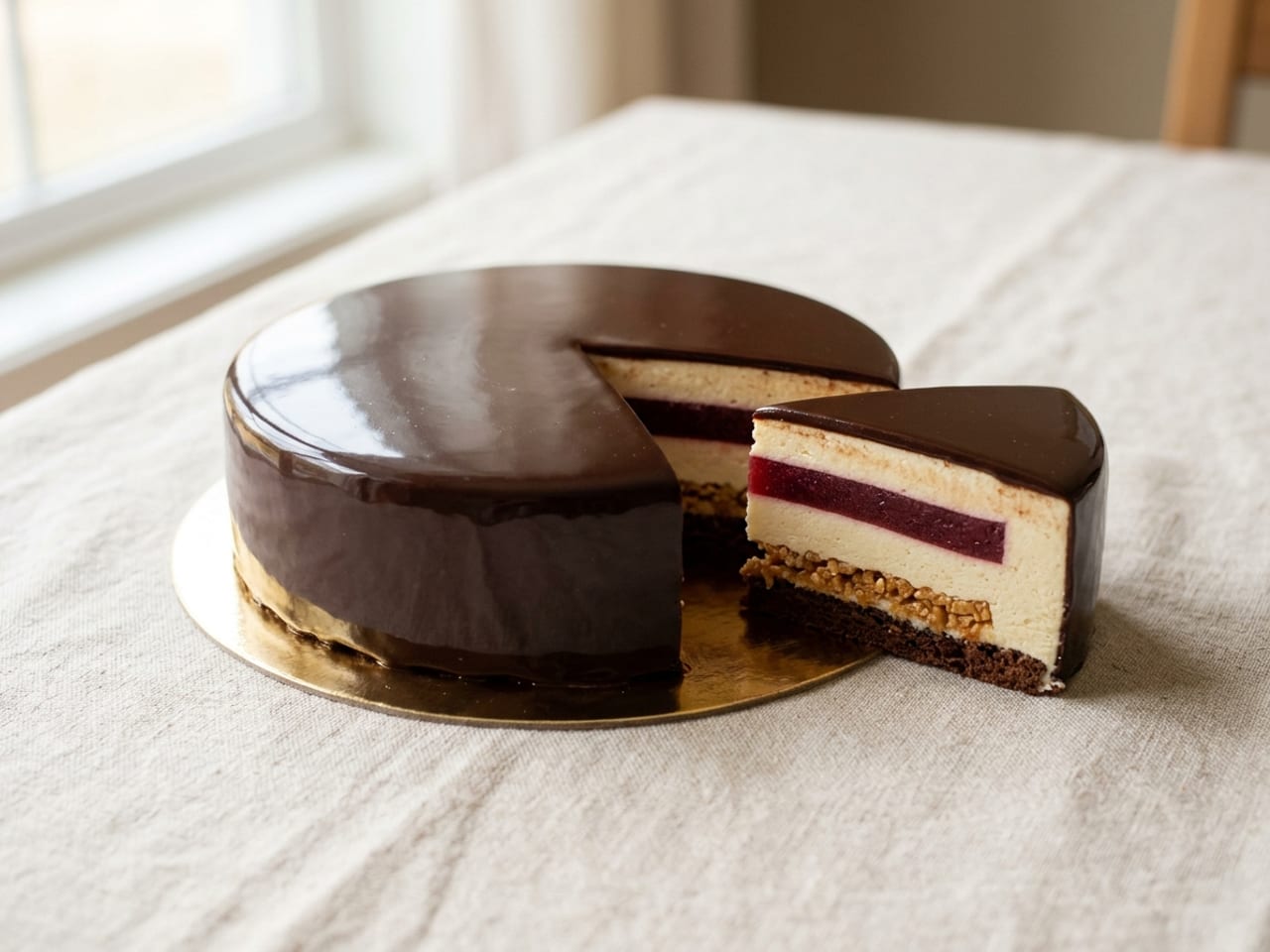
The five parts of a typical entremet, bottom to top (ours)
On this page: The layers · Entremet vs mousse cake · Classics · Freezer to table · Cutting a slice · Portions · Plating a slice · The entremetier · History · Where sources disagree · FAQ
- Base (a sponge, biscuit, dacquoise or joconde): Gives the cake structure: it “must be sturdy enough to support mousse layers”. Valrhona cuts its sponge “to the diameter of the mold”.31, 35
- Crunch (praline with feuilletine, streusel or a crisp shortbread): A crunch against the soft mousse (ours): the layers bring “creaminess, tartness, a crunch, lightness, nuttiness or decadence”, and “would usually at least consist of a chocolate crunch and light sponge or dacquoise.”30, 49 See crunch components.
- Mousse (a chocolate, fruit or cream mousse set with gelatin): The body and the shape: it “acts as a sort of sugary scaffolding that supports the structure of the whole dessert”.30, 32
- Insert (a crémeux, namelaka, compote or jelly, frozen first): The surprise in the middle, made and frozen on its own, then pressed into the mousse: “Entremets are primarily composed of inserts.”32, 42 See crémeux.
- Glaze or velvet spray (a mirror glaze poured on the frozen cake, or a cocoa butter spray): “Glazes add little to no flavour and mainly act as a beautiful veil that conceals all the wonderful surprises inside.”30
How it is built. Each part is made and frozen on its own: "each layer should be made in its own receptacle".33 Valrhona pours the mousse into an acetate-lined ring and presses the frozen insert in, "un montage à l'envers" (upside down), then freezes it all; Callebaut's school builds right side up, sponge first.34, 42 Plan on two days with overnight freezing: "This is a 2-day dessert!"30, 53 There is "no strict list" of what each layer must be.33 Ours: the "made of" lines sum up the recipes tallied below.
Which layers 8 published builds name
Ours: each recipe's own component list, read for the five layers. Base in 8 of 8, mousse in 8, insert in 6, glaze in 6, crunch in 5: the crunch is the part most often left out.
- École Valrhona, Entremets 3 chocolats: base, crunch, mousse, insert, glaze or velvet spray.34
- Valrhona, Entremets Surprise: base, crunch, mousse, insert, glaze or velvet spray.35
- Valrhona, Paradis Blanc: base, mousse, insert, glaze or velvet spray.36
- Callebaut, Entremets Rugoso Abricot: base, mousse, insert, glaze or velvet spray.41
- Elle & Vire, Chocolate entremets: base, crunch, mousse, insert, glaze or velvet spray (a chocolate sponge is the base; the crisp shortbread it stands on and a praline in the insert are the crunch (our reading)).43
- Christophe Rull on Sugar Geek Show, Chocolate Entremet: base, mousse, insert, glaze or velvet spray (a ganache on the cake round is the insert (our reading)).53
- Patissland, Royal au chocolat: base, crunch, mousse.49
- Meilleur du Chef, Chocolate Trianon: base, crunch, mousse.50
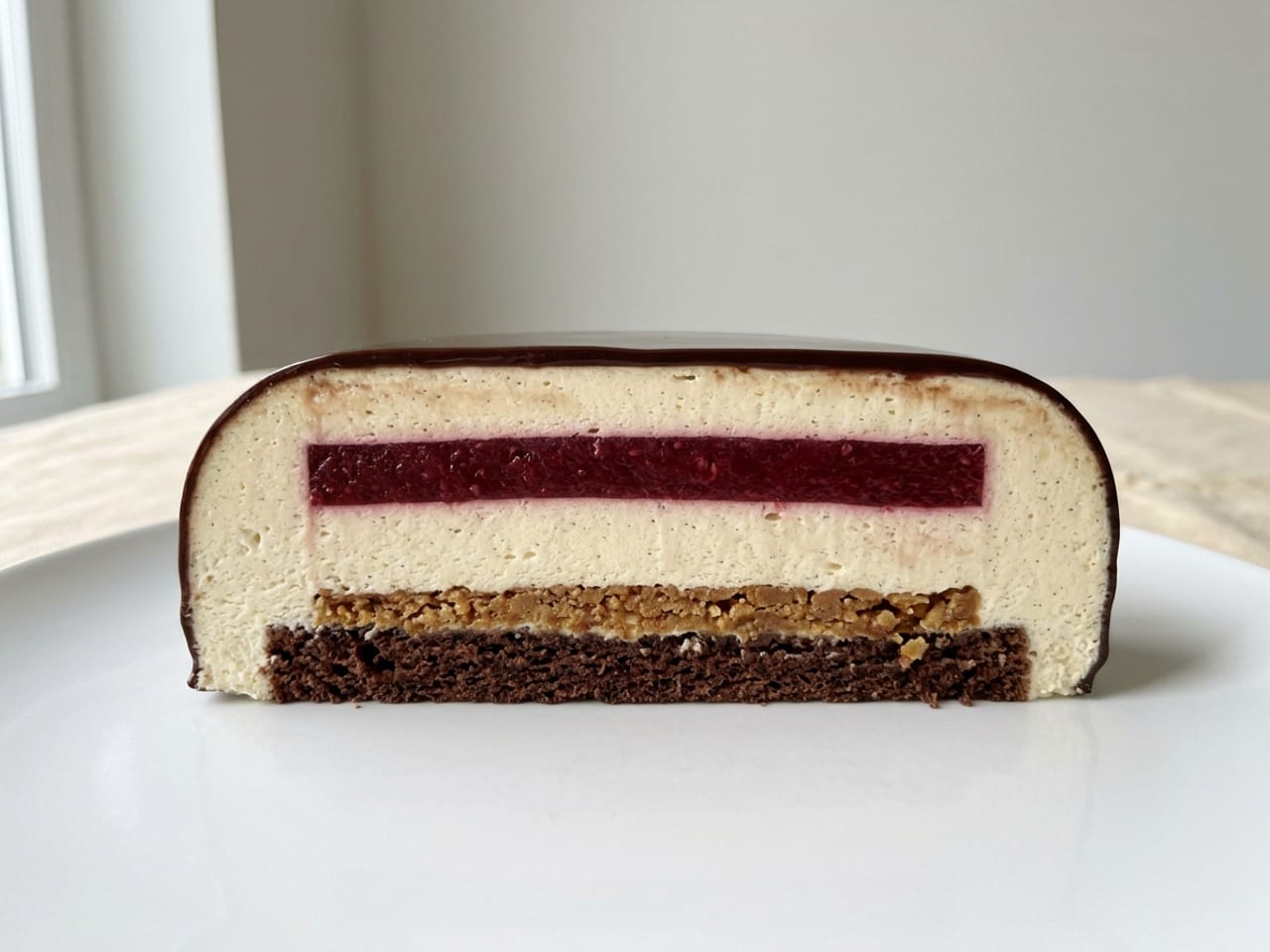
Entremet vs mousse cake, layer cake, petit gâteau, bavarois and charlotte
| Dessert | How it is built | What sets it | Served | Usual size |
|---|---|---|---|---|
| Entremet30, 31, 32, 56, 71, 74, 75, 76 | A mousse around one or more inserts, on a sponge or crunch base, with a glaze or velvet finish | Freezing between every step; gelatin in the mousse | Thawed in the fridge, served chilled | Rings of 16 to 24 cm (6.3 to 9.4 in), 3.5 to 4.5 cm (1.4 to 1.8 in) high |
| Mousse cake52, 62, 70 | Ours: any cake set with mousse. Shops and blogs also call a glazed entremet a mousse cake; not every mousse cake has inserts or a glaze | Gelatin, chilled or frozen | Chilled | As an entremet |
| Layer cake31, 65 | Ours: baked sponge layers with a filling and frosting. “Unlike traditional layer cakes or tortes, entremets are mousse-forward” | Baking (ours) | Usually room temperature; King Arthur chills it 10 to 15 minutes before cutting if there is time | Not compared in our sources |
| Petit gâteau24, 44, 69 | Built like an entremet, one portion each (ours): a book's glazing section is “Glazing Entremets Petits Gâteaux” | Freezing | Whole, not sliced; thawed in the fridge 2 to 3 hours | One serving |
| Bavarois46, 47 | One moulded cream: “crème anglaise, de gélatine et d'aromates”, lightened with whipped cream | Gelatin, chilled (“moulé et refroidi”) | Cold, turned out of its mould | A mould; no size in our sources |
| Charlotte21, 48 | A filling “entourée de tranches de pain beurrées ou de biscuits”; in Escoffier's charlotte russe, ladyfingers around a Bavarois | The Bavarois's gelatin (charlotte russe) | Cold (charlotte russe) | A mould; no size in our sources |
In French, the bavarois and the charlotte are themselves entremets: the TLFi defines both with the word.47, 48 France's pastry diploma pairs entremets with petits gâteaux ("un entremets et/ou des petits gâteaux"), and Suas's petits fours prestige "may be smaller versions of contemporary entremets or other desserts" (see mignardises).24, 25 In everyday French the word can also mean a plain flan or pudding.27
Seven named entremets and their layers
- Royal au chocolat, or Trianon: a dacquoise or Russe biscuit base (Patissland: almond dacquoise; Meilleur du Chef: Russe biscuit), praline crunch, dark chocolate mousse. “Both names refer to the same recipe, depending on the region and the pastry chef.” Meilleur du Chef's Trianon has a Russe biscuit base and a crunchy praline layer “about 1 cm” (0.4 in) thick; a recipe site says it is “estimated” to date from the 1960s or 1970s, with no exact date.49, 50, 51
- Trois chocolats (three chocolates): cake base with streusel, namelaka, milk chocolate mousse, dark chocolate mousse, black glaze. As École Valrhona builds it, upside down, “pour 6 entremets de 16 cm de diamètre” (six cakes 16 cm, 6.3 in, across): one maker's version, not a fixed recipe.34
- Bavarois: one moulded cream of crème anglaise, gelatin and whipped cream. French dictionaries file it as an entremets: “Entremets sucré, composé de crème anglaise, de gélatine et d'aromates, moulé et refroidi.”46, 47
- Charlotte russe: lady's-finger biscuits around a Bavarois. Escoffier, 1907, in his chapter “Entremets (Sweets)”: a rosette of heart-shaped biscuits on the bottom of the mould, the sides lined with biscuits “set upright and close together”.21, 48
- Diplomate aux fruits: Genoise with fruit, apricot glaze, a fruit Bavarois on top. Escoffier, 1907, in “Various Cold Sweets (Entremets)”: “a base of Genoise with fruit, glazed with apricot jam” and “a Bavarois with fruits”.21
- Biscuit à la reine: a Savoy biscuit with a Maraschino Bavarois turned out on it. Escoffier, 1907, the same section: “Turn out upon it a Bavarois with Maraschino”. Ours: a base and a cream, the bones of today's cake, with no insert and no glaze, only royale icing (Escoffier).21
- Alaska (baked Alaska): an ice cream core under a baked covering. At Delmonico's in December 1879, George Augustus Sala ate “an entremet called an "Alaska."”: “The nucleus or core of the entremet is an ice cream.” Ours: the singular “entremet” in English print.22
Only cakes a source calls entremets are here. None we read says it of the opéra or the fraisier, so they are left out, and the "Entremets Forêt Noire" Valrhona prints is a plated dessert of meringue, kirsch crémeux and cherry sorbet, not a layered cake.40
Glazing, thawing and serving an entremet
Glaze it frozen, at your recipe's temperature
The cake must be frozen through: G. Detou says "at least 4 hours, ideally 12 hours in the freezer", and Sugar Geek Show: "The frozen surface creates a temperature shock that makes the glaze set the moment it touches the cake".52, 56 Glazes with gelatin rest in the fridge first, 12 to 24 hours in the recipes we read.36, 41, 55, 56 Pour temperatures run from 28 to 40°C (82 to 104°F) by glaze type. G. Detou's own limits for its glazes: above 37°C (99°F) "the glaze slides off the entremet and leaves bare patches", below 30°C (86°F) "the glaze is too thick".56 Callebaut's gelatin glaze is poured at 28°C and Rull's at 40°C, so the limit belongs to the glaze.41, 53 Use your recipe's number. After about 5 minutes, trim the pooled glaze from the foot with a hot spatula.52
Ours: set the cake on its serving board before glazing. Landis, on a gelatin mirror glaze: because of the sticky glaze, "the cakes really can't be moved around once they're moved to their final resting place".58
| Who | Glaze | Pour at |
|---|---|---|
| Callebaut, Rugoso Abricot41 | black glaze with gelatin, rested 24 hours | 28°C (82°F, ours) |
| Christophe Felder's Royal, on Baking Like a Chef57 | cocoa glaze | 30°C (86°F) |
| Valrhona, Paradis Blanc36 | white chocolate and vanilla glaze | 30 to 40°C (85 to 105°F) |
| Sugar Geek Show52 | mirror glaze | 90°F (32°C); above 95°F (35°C, ours) it runs |
| Tasting Table, on “most recipes”54 | mirror glaze | 90 to 95°F (32 to 35°C, ours) |
| G. Detou56 | white chocolate mirror glaze | 32 to 35°C (90 to 95°F) |
| G. Detou56 | dark chocolate mirror glaze | 35 to 38°C (95 to 100°F) |
| École Valrhona, 3 chocolats34 | Absolu Noir glaze | 35°C (95°F, ours) |
| Valrhona, Azélia (Antonio Bachour)37 | chocolate glaze | 35°C (95°F) |
| Elle & Vire43 | dark chocolate glaze | 36°C (97°F, ours) |
| Bruno Albouze55 | coloured mirror glaze with gelatin | 35 to 38°C (he prints 97°F) |
| Valrhona, CitricChoc38 | chocolate glaze | 37 to 38°C (99 to 100°F) |
| Christophe Rull, on Sugar Geek Show53 | chocolate glaze | 40°C (104°F) |
| Valrhona (Saïd M'Dahoma)39 | plant-based glaze, no gelatin | 40°C (104°F) |
Velvet spray instead of glaze. A cocoa butter and chocolate spray gives a velvet finish the moment it hits a frozen surface: Callebaut, "Always apply the spray gun mixture directly onto pastries frozen at -18°C" (0°F); a shop, asked whether the cake must be frozen: "Yes, this is essential; otherwise, the spray will run."59, 60 Ours: spray it on its serving board too.
Thaw it in the fridge
The CDC: "Never thaw food on the counter because bacteria multiply quickly in the parts of the food that reach room temperature."79 The glaze agrees: at room temperature "the sides will fog with condensation and the glaze will go dull".62 How long, as each source prints it:
| Cake | Thaw |
|---|---|
| Individual petits gâteaux (a frozen food-service product)69 | 2 to 3 hours in the fridge |
| A 20 cm (8 in) Royal, glazed frozen57 | 3 to 4 hours in the fridge |
| An entremet, size not given56 | 4 hours in the fridge |
| A mousse cake62 | 4 to 6 hours in the fridge, “longer for a taller cake” |
| An 18 cm (7.1 in) dome, 9 cm (3.5 in) tall73 | 4 to 6 hours “in a display case”; the shop does not say how cold, so use the fridge (ours) |
| Valrhona's frozen tiramisu dessert, as one blog reports it61 | in the fridge “the day before service” |
A blog that thaws entremets for a bakery puts it plainly: "There is no honest universal answer." Size, height and the fridge all change the time.61
Serving temperature
Cold, but not straight from the fridge: one recipe takes it out "for about 20 minutes before tasting it", and a patisserie says to eat its entremet within 20 to 25 minutes of taking it out, "Best serving temp: (10°C - 12°C)" (50 to 54°F).57, 70 Both are well inside the 2-hour limit below.
How long it keeps
| Where | How long, and who says so |
|---|---|
| Out of the fridge, at the table79 | 2 hours at most, 1 hour above 90°F (32°C): the rule for any perishable food |
| A whole decorated cake, in the fridge at 40°F (4°C) or below57, 79 | 2 to 3 days (one recipe blog) |
| Thawed petits gâteaux69 | within 48 hours; “Do not re-freeze thawed product.” (one maker) |
| Frozen, at 0°F (-18°C) or below57, 64, 79 | “up to two weeks” (a bakery blog); “two to three weeks”, or “up to one month” unglazed, on one recipe page that gives both |
These are single blogs' and makers' figures, not a safe-keeping rule. The only rule on this page is the CDC's: 2 hours out (1 above 90°F, 32°C), the fridge at 40°F (4°C) or below (food safety).79
Food safety
- Two hours out, at most. "Never leave perishable food out for more than 2 hours (or 1 hour if exposed to temperatures above 90°F)" (32°C); the fridge at 40°F (4°C) or below, the freezer at 0°F (-18°C).79
- Eggs in the mousse. Use pasteurised eggs or follow a recipe that cooks them: Gisslen says classic raw-egg mousses "must be modified to specify the use of pasteurized eggs", and yolk or milk-and-egg mixtures for mousses are cooked to 160°F (71°C) first.45, 80, 81 An Italian meringue is not a safe shortcut on its own: its whites "do not reach much above 125°F" (52°C) unless the syrup reaches 250 to 266°F (121 to 130°C), says the American Egg Board.80
- Allergens. One patisserie's entremet lists "dairy, egg, gelatine (bovine), gluten, nuts (almond, hazelnut)"; almond and hazelnut are tree nuts, among the nine foods that cause most reactions in the US.70, 82 Gelatin is animal; Valrhona publishes a plant-based glaze, and agar in a mousse "can weep water after thawing".39, 62
How to cut an entremet into clean slices
Thawed or still part-frozen: the blogs we read split, two to one, and no textbook settles it (the split). Every source agrees on a hot, dry knife.
- Cut it cold, with a hot knife; whether it is still part-frozen is the split below. (ours)
Patissland, of its Royal: “Assembled the day before and kept chilled, it holds better and cuts more cleanly.”49 A bakery blog: “When thawed, the entremet should still feel firm yet yielding when cut with a warm knife.” Thawed or still part-frozen splits the sources (below).64 - Dip a long knife in hot water, then wipe it dry.
Yumsto: slice “with a long knife dipped in hot water and wiped dry”.62 King Arthur, testing frosted cakes: “Be sure to dry the knife thoroughly, then cut your slices while the knife is still slightly warm to the touch.”65 - Cut down through the glaze to the base in one stroke. (ours)
Ours: no source we read describes the stroke. Yumsto's warning is the reason to keep it clean: “a half-frozen mousse drags on the knife and cracks instead of cutting cleanly.”62 - Wipe the knife and heat it again before every cut.
Yumsto: before “every single cut”. King Arthur: “be sure to wipe the knife clean between slices”.62, 65 - Lift each slice out with a cake server; the rest goes straight back in the fridge. (ours)
Ours, with the CDC's clock: “Never leave perishable food out for more than 2 hours (or 1 hour if exposed to temperatures above 90°F).”79 Gisslen, on why it matters: “if a slice of cake is poorly cut ... no amount of fancy plate design will correct those faults”.66
King Arthur's test kitchen found a serrated knife cut frosted layer cakes more neatly than a chef's knife; for mousse cakes, the one source we read says only "a long knife".62, 65
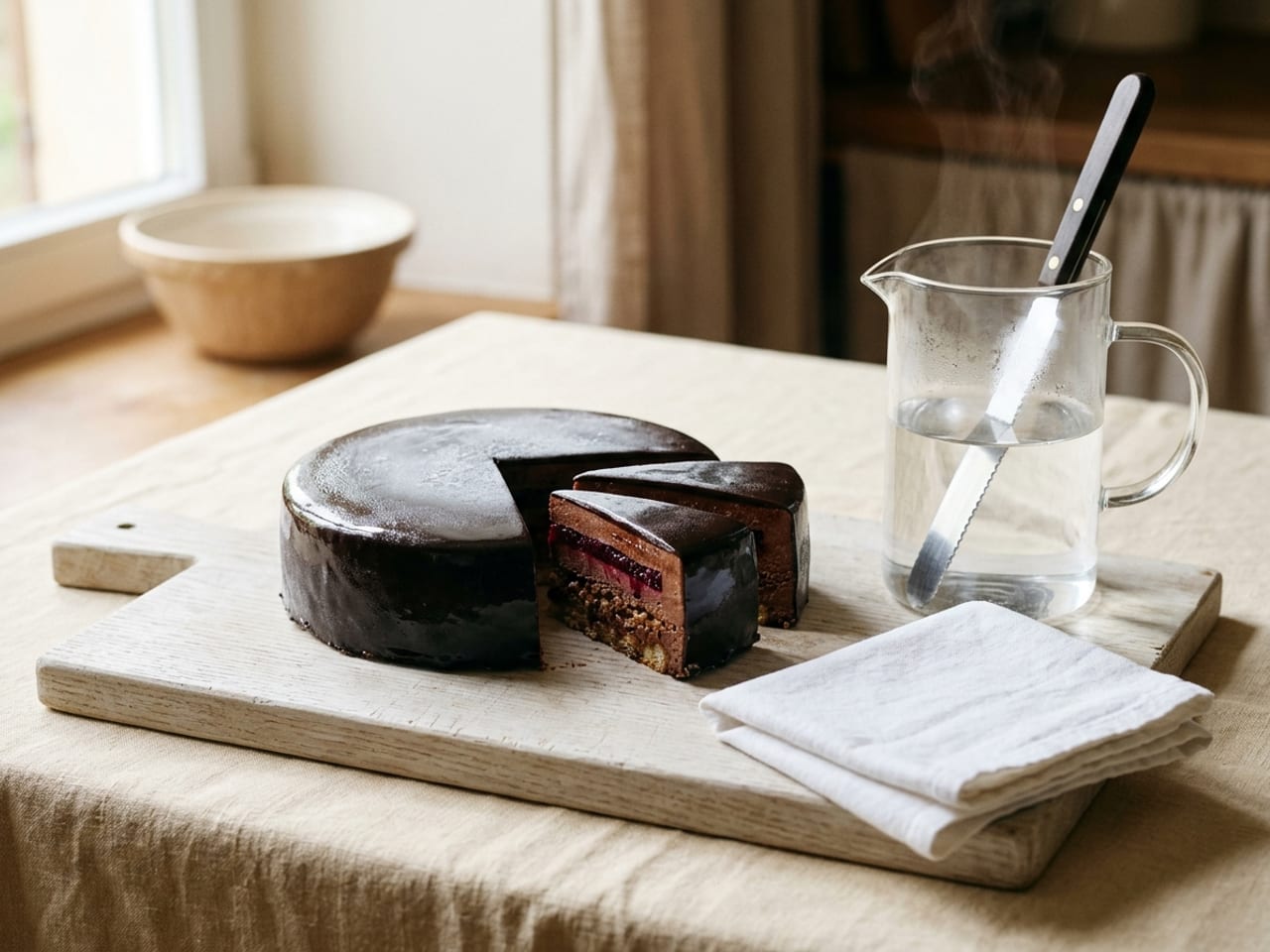
How many slices per ring size
No pastry textbook or maker's recipe we read gives slices per cake; Valrhona's "MAKES 10 PIECES" means ten cakes.36 These are shops' and blogs' rules of thumb. The last column is ours: the ring's volume (the maker's ml where printed, else a cylinder of the printed size) divided by the slices.
| Ring or mould | Size | Slices | Who says | Per slice (ours) |
|---|---|---|---|---|
| Ring71 | 16 cm (6.3 in) × 4.5 cm (1.8 in) high | 4 to 6 | Patissland (a shop), “depending on layer thickness” | about 151 to 226 ml (5.1 to 7.6 fl oz) |
| A shop's own cake, 650 g70 | 6 in (15 cm, ours) | 6 to 8 | Lacher Patisserie (a patisserie) | no height given |
| Silicone mould (Ocean 1050)72 | 18 cm (7.1 in) × 5.3 cm (2.1 in) high, 1,050 ml (36 fl oz) | 8 to 10 | Patissland (a shop) | about 105 to 131 ml (3.6 to 4.4 fl oz) |
| A 180 mm Silikomart mould30 | 18 cm (7.1 in) | 8 to 12 | Dessertisans (a blog) | no height given |
| Dome mould73 | 18 cm (7.1 in) × 9 cm (3.5 in) high, 1,570 ml (53 fl oz) | 8 to 10 | Patissland (a shop) | about 157 to 196 ml (5.3 to 6.6 fl oz) |
| Ring74 | 20 cm (7.9 in) × 4.5 cm (1.8 in) high | 6 to 8 | Patissland (a shop) | about 177 to 236 ml (6 to 8 fl oz) |
| Lacor ring75 | 20 cm (7.9 in) × 3.5 cm (1.4 in) high | 6 | AZ Boutique (a shop) | about 183 ml (6.2 fl oz) |
| An 8 in mould, Royal recipe57 | 20 cm (7.9 in) | 8 | Baking Like a Chef (a blog) | no height given |
| Ring74 | 24 cm (9.4 in) × 4.5 cm (1.8 in) high | 8 to 10 | Patissland (a shop) | about 204 to 255 ml (6.9 to 8.6 fl oz) |
Height matters as much as width. The same shop gives its 18 cm (7.1 in) mould 8 to 10 slices and its wider 20 cm (7.9 in) ring only 6 to 8; by our arithmetic its 18 cm slices are the smallest in the table. A cake-size chart for cakes in general works by volume: "Serving count depends on diameter, finished cake height and serving volume", at 125 or 180 cm³ a serving.72, 74, 77
How to plate a slice of entremet
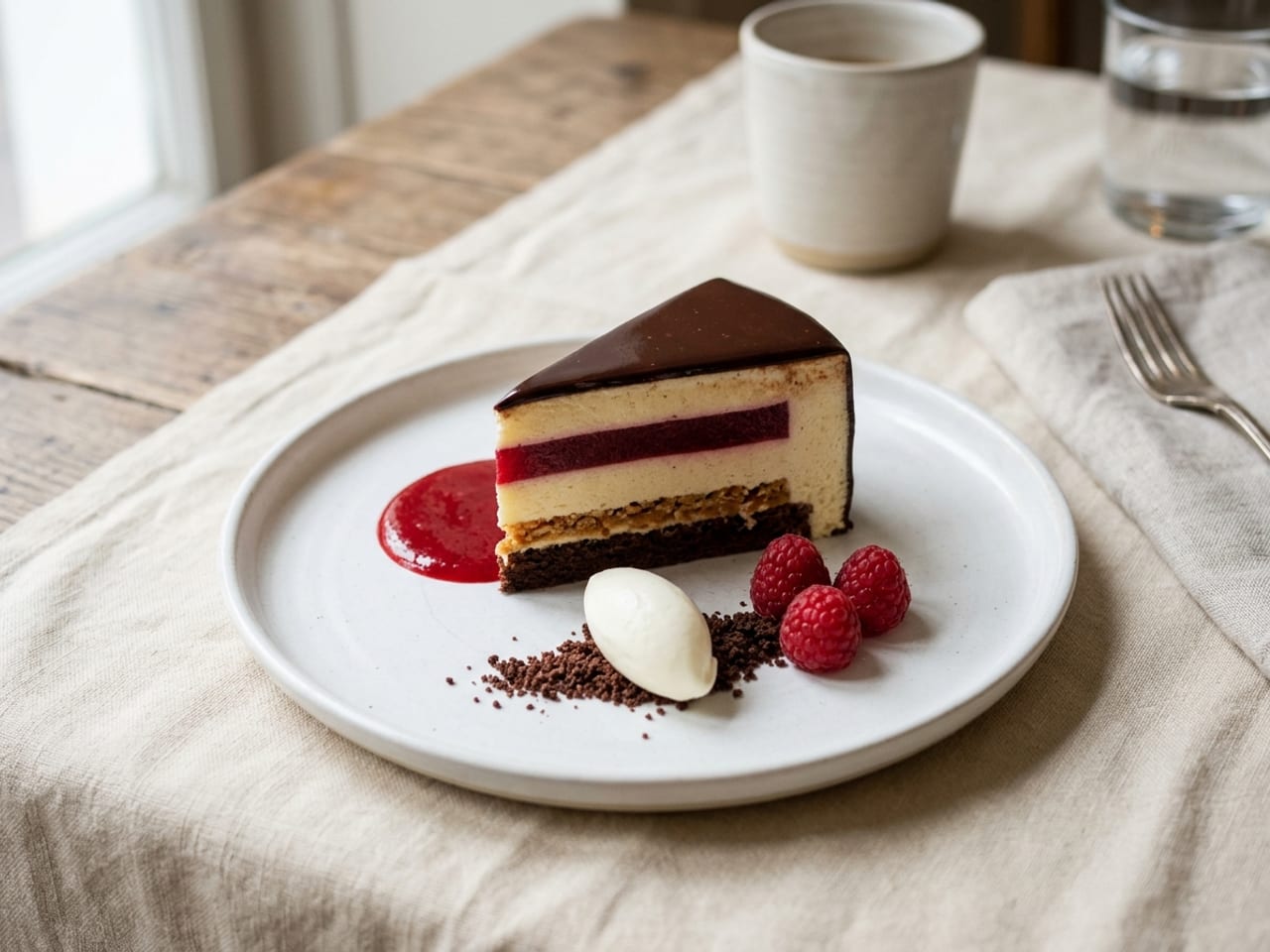
Gisslen: "For most desserts, all the components are prepared well in advance. The plated dessert itself, however, is assembled at the last minute."67 No source we read plates an entremet slice step by step, so this order follows our dessert plating guide, with the sources' words where they have any:
- A chilled plate, in a colour the cake stands out on.
A bakery blog: “using contrasting colours on the plate to make the entremet stand out.”64 Ours: the chilled plate is our dessert plating guide's first check. - Sauce first, on the bare plate: a small pool or smear beside the slice.
“A small spoonful of sauce or coulis alongside the slice”; a pastry chef sizes it at “about 2 Tablespoons for a 4 oz. main component” (30 ml for 113 g, ours).64, 68 - The slice, cut face toward the guest, so every layer shows.
The bakery blog: “Plating should emphasise the dessert's vertical structure”.64 Ours: no source we read says which way the cut face goes; we searched. - A crunch beside it: a short crumb line or a tuile.
The bakery blog: “a delicate tuile can elevate the plate without overpowering the main piece.”64 Ours: the crumb line is our dessert plating guide's soil. - A cold element last, anchored on the crumbs: a quenelle of ice cream or cream.
Ours: our dessert plating guide's rule: the frozen element lands last, on something that stops it sliding. - Decoration at the very end: a few berries, a leaf, gold leaf.
G. Detou: “Add the decorations at the last moment (flowers, gold leaves, fresh fruits).”56
The parts are in our plating components guide (coulis, soil, tuile, quenelle), and the checks before a dessert leaves the kitchen in the 60-second dessert audit. Sauce sized "When the main component is gone, the sauce should be gone".68
Petits gâteaux: served whole
An individual entremet is not sliced: one maker says to remove the acetate ring "while still frozen", thaw 2 to 3 hours in the fridge and "Serve as they come or decorate to your desire".69 Ours: plate it the same way as a slice, the sauce beside it, never over the glaze.
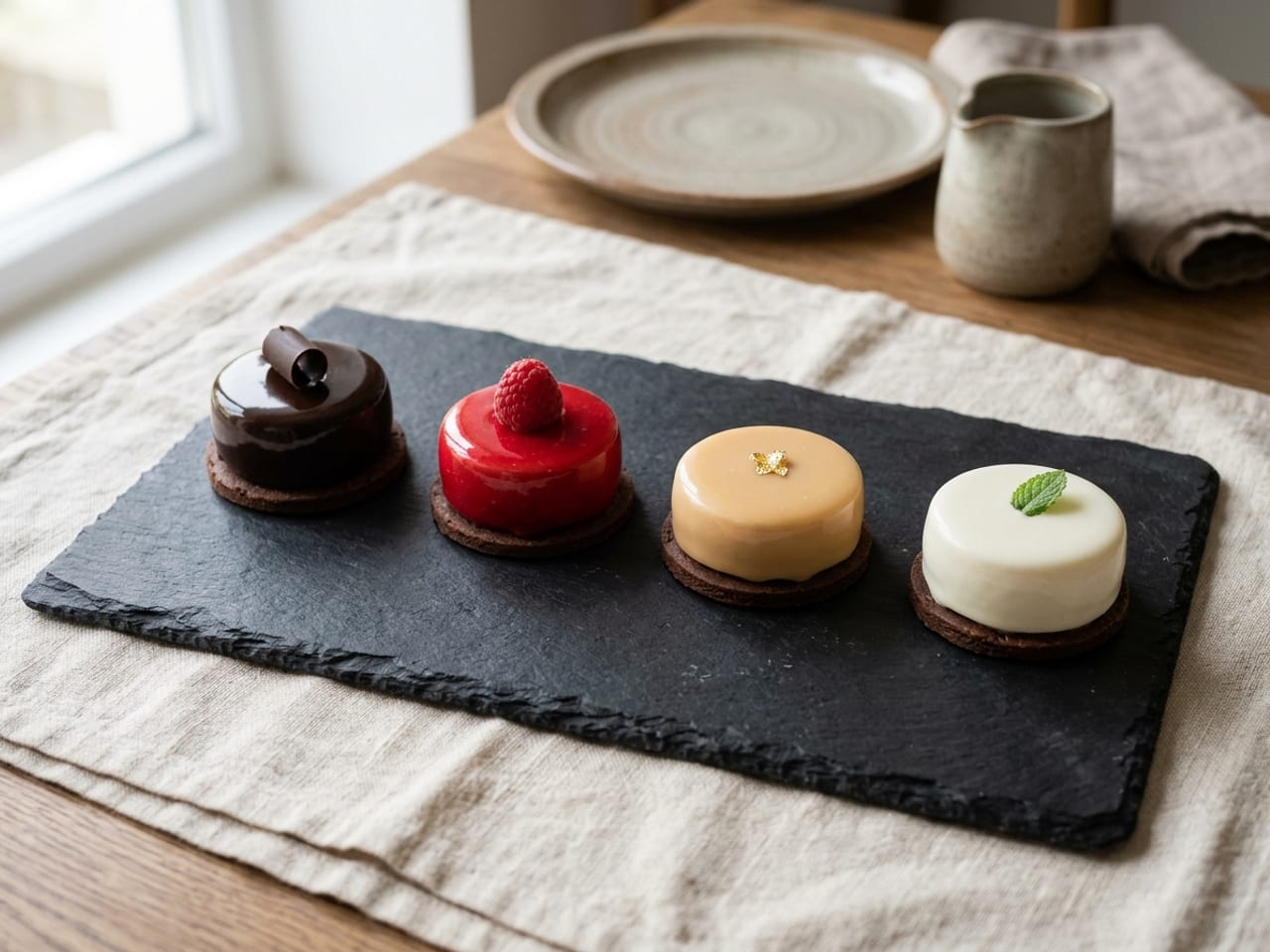
The whole cake at the table
Ours: glaze it on its serving board, since Landis finds a glazed cake cannot be moved once it is in place; trim the foot of the glaze; add "the decorations at the last moment".52, 56, 58 Carrying it: one patisserie says to keep it level and, "For journeys longer than 1 hour, use a cooler bag and ice packs".70 Cut it at the table or in the kitchen with the steps above.
What is an entremetier?
The cook once in charge of the entremets (also spelled entremétier, or entremettier, the TLFi's spelling). Larousse's 1870s dictionary: "Cuisinier chargé de la préparation des entremets, dans une grande cuisine", the word built on entremets.14 Today the station does vegetables and starches: "The entremétier prepares vegetables, starches, soups, eggs, pasta, rice, and similar dishes."28, 29
Why the name stuck (our reading). In the classical service, entremets covered vegetables and eggs as well as sweets: Carême's book has series of entremets of vegetables, of eggs and of sugar, its 1834 English translation glosses entremets as "second-course dishes", and Wikipedia, citing a food historian we did not read, says vegetables "were served by themselves only as entremets".18, 19, 26 No source says it in one sentence. The entremetier is not the pastry cook: desserts are the pâtissier's, as the brigade chart in our garde manger guide shows.
From feast spectacle to mousse cake
- About 1170: the French word first means an entertainment, “divertissement, intermède” (Marie de France, Lanval).5, 9
- Early 1200s: in French, a dish, “plat d'accompagnement servi entre les mets principaux”. This is the French first use as a dish; the 1170 sense above was an entertainment.5
- 1378: at Charles V's feast for the emperor, “le roi fit supprimer un service pour arriver plus vite à l'entremets”, a staged conquest of Jerusalem.14
- 1393: a Paris household book's menus serve “L'entremets eslevé”: swan, peacock, bittern and heron.15
- 1454: Philip of Burgundy's Feast of the Pheasant has entremets “featuring birds”; English banquets had sugar showpieces called subtleties.16, 17
- 15th century: English borrows the word from French (Dictionary.com: 1425 to 1475); the OED's earliest evidence is 1477, in a translation by William Caxton. This is the English first use.2, 3, 4
- 1828: Carême's book has series of “entremets-potagers” and of “entremets de sucre”, and its index files vegetables, eggs and sugar work all as entremets.18
- 1878 to 1932: the Académie's dictionary gives only the old sense in 1878 and only the sweet one in 1932: “L'entremets aujourd'hui est généralement un plat sucré”.5
- 1903 and 1907: Escoffier's French chapter is “Entremets chauds et Entremets froids”; in the 1907 English edition it is “Entremets (Sweets)”, hot and cold, among them the charlotte russe and moulded Bavarois.20, 21
- From about the 1970s (our reading): the pastry trade's layered cake. An apprentice handout says most of today's creams and mousses “n'étaient pas connues avant les années 1970” and that ring assembly gave the entremets its clean shape. No inventor, no exact date: thinly sourced.23
- 2019: France's pastry diploma examines “un entremets monté avec ou sans cercle”.24
Two first dates, two languages. The early 1200s date on our palate cleanser guide is the French one (as a dish); the 15th century and 1477 on our courses of a meal guide are the English one. Both are right.2, 4, 5
Frozen or thawed, and the other splits
| Question | One side | The other | Our note |
|---|---|---|---|
| Cut it frozen or thawed? | Thawed (2 sources): Yumsto, “The cake is easiest to slice fully thawed from the fridge, not half-frozen”; a bakery blog, “When thawed, the entremet should still feel firm yet yielding when cut with a warm knife.”62, 64 | Part-frozen (1 source, a pan-set entremet cut into bars): “The cake will still be somewhat frozen when cutting, so you'll get nice slices.”63 | All three are blogs; no textbook or school we read settles it. Ours: whichever you choose, the knife is hot and dry. |
| When does the ring come off? | Albouze: “always unmold it ahead of time (≈2 hours)” so the surface air-dries.55 | Straight from the freezer: Novak removes ring and acetate “while the cake is completely frozen”; G. Detou: “Take it out of the freezer just before glazing”.56, 61 | One against two. Both sides glaze a cake that is still frozen. |
| Glaze on the day, or ahead? | On the day: “glaze the cake on the day of serving and let it thaw in the refrigerator for 3 to 4 hours”.57 | Ahead: “You can easily make and glaze everything 2 or even 3 days ahead of time”; Albouze keeps the glazed cake frozen.55, 58 | Landis's cakes are small domes. Makers claim a glaze stays glossy 2 to 3 days (G. Detou) and 48 to 72 hours (Valrhona); we found no test. |
| How long in the freezer? | “up to two weeks” (a bakery blog).64 | “two to three weeks” and, unglazed, “up to one month” (one recipe page, both figures); a chef's bûche, not a mousse cake, “up to 1 month” unglazed.57, 78 | No maker or textbook we read prints a figure. We print only named ones. |
| One glaze temperature? | 28°C (82°F) for Callebaut's gelatin glaze.41 | 40°C (104°F) for Rull's glaze and Valrhona's plant-based one.39, 53 | Not a contradiction: different glazes. Use your recipe's number. |
| How many slices from 18 cm (7.1 in)? | 8 to 10, for a 5.3 cm (2.1 in) tall mould.72 | 8 to 12 for a 180 mm mould; the same shop as the first gives its 20 cm (7.9 in) ring only 6 to 8.30, 74 | Shop and blog rules of thumb; no textbook gives slices per cake. |
| Is a pastry an entremets? | Le Robert: “Entremets sucré (aujourd'hui confondu avec le dessert, mais excluant la pâtisserie)”.11 | France's pastry diploma: “Monter, garnir et glacer un entremets et/ou des petits gâteaux”.24 | Ours: Le Robert is a general dictionary and its “excluant la pâtisserie” sits at odds with the trade's use; the diploma text names the cake but never defines the word. |
| Does “mets” mean course or dish? | GoodtoKnow: “Entre means 'between' and 'mets' means course.”13 | The TLFi makes it a compound of entre and mets, and its first dish sense is “plat d'accompagnement servi entre les mets principaux”.5, 6 | Dish: the TLFi's own entry for mets is “Aliment élaboré entrant dans la composition d'un repas”, synonym “plat”. A course is a service (ours). |
Entremets, answered
What is an entremet?
In bakeries today, an entremet is "a cake composed of multiple components assembled into layers, encased in a mousse, enrobed with a glaze and topped with fine decorations" (Dessertisans). The word is older: French entremets, "between dishes", once meant the dishes served between the roast and the dessert, and at medieval feasts a spectacle staged between the services. In French today it is a sweet dish served after the cheese; a children's dictionary's example is chocolate mousse.
What does entremet mean in French and in English?
French entremets is entre, between, and mets, dish. The TLFi gives the old sense, a series of dishes served between the roast and the dessert, and the modern one, a sweet dish served after the cheese and before the dessert proper. Cambridge gives English both: "a dessert" and "a small dish that is served between the main dish and a sweet dish, especially at a formal meal". In English baking it now often means the layered mousse cake.
How do you pronounce entremet?
AHN-truh-may in American English and ON-truh-may in British English: our respellings of Cambridge's US /ˈɑːn.trə.meɪ/ and UK /ˈɒn.trə.meɪ/ (Dictionary.com prints ahn-truh-may). In French it is ɑ̃.tʁə.mɛ, with a nasal first vowel. No dictionary we read sounds the final t or s.
Is it entremet or entremets?
In French it is always entremets, one or many: Larousse warns "Attention au s final, même au singulier : un entremets." English dictionaries list entremets too, used "with a singular or plural verb" (Dictionary.com). The singular entremet is an English back-formation, in print by 1882, when George Augustus Sala wrote of an entremet called an "Alaska". This page writes entremet for one cake and entremets for several (ours).
What is inside an entremet cake?
The stack we draw (ours) has five parts, bottom to top: a sponge, biscuit or dacquoise base, a crunch, a mousse that makes the body and the shape, one or more inserts (a crémeux, compote or namelaka) frozen first and pressed into the mousse, and a mirror glaze or velvet spray. Of the 8 makers' and recipe sites' builds we read, only three name all five: 8 have a base, 8 a mousse, 6 an insert, 6 a glaze and 5 a crunch.
What is an entremetier?
A cook in the classical kitchen brigade. A Larousse dictionary of the 1870s defines the entremétier as the "Cuisinier chargé de la préparation des entremets, dans une grande cuisine". Today a hospitality school says the entremétier "prepares vegetables, starches, soups, eggs, pasta, rice, and similar dishes". Our reading of why: vegetables and egg dishes were once served as entremets, and the station kept the name. It is not the pastry station.
What is the difference between an entremet and a mousse cake?
An entremet is a mousse cake with more parts: inserts inside the mousse, a base and a glaze or velvet finish. Paris Gourmet calls entremets "mousse-forward" and lists sponge, mousse, inserts and a glaze; shops and blogs also sell glazed entremets as mousse cakes. Ours: every entremet of this kind is a mousse cake, but a plain mousse on a sponge, with no insert or glaze, is a mousse cake that few would call an entremet.
How do you cut an entremet cleanly?
Cut it cold, with a long knife dipped in hot water and wiped dry, in one stroke down to the base (the stroke is ours), and wipe and reheat the blade before every cut (Yumsto; King Arthur says the same for frosted cakes). Whether to cut it fully thawed or still part-frozen splits the blogs we read, two to one, and no textbook settles it.
How long does an entremet take to thaw?
In the fridge, not on the counter: the CDC says never thaw food on the counter (the fridge is the first way it lists), and at room temperature the glaze fogs with condensation. The times we read: 2 to 3 hours for individual petits gâteaux, 3 to 4 hours for a 20 cm (8 in) cake, 4 hours (G. Detou), 4 to 6 hours for an 18 cm (7.1 in) dome 9 cm (3.5 in) tall (a shop, "in a display case"; use the fridge), longer for a taller cake. Then take it out about 20 minutes before eating; one patisserie gives 10 to 12°C (50 to 54°F) as the best serving temperature.
What temperature should a mirror glaze be for an entremet?
It depends on the glaze. The pour temperatures we read run from 28°C (82°F) for Callebaut's gelatin glaze to 40°C (104°F) for Christophe Rull's chocolate glaze and Valrhona's plant-based one, 10 of the 14 between 30 and 38°C (86 and 100°F). Use your recipe's number, and pour it on a cake frozen solid: "The frozen surface creates a temperature shock that makes the glaze set the moment it touches the cake" (Sugar Geek Show).
How long does an entremet keep?
In the fridge, a decorated cake 2 to 3 days by one recipe blog; thawed petits gâteaux within 48 hours by one maker, never refrozen. In the freezer, the figures we read are a bakery blog's "up to two weeks" and one recipe page's "two to three weeks", or a month unglazed; no maker or textbook we read prints one. These are single blogs' and makers' figures, not a safe-keeping rule. The only rule here is the CDC's: 2 hours out at most (1 hour above 90°F, 32°C), the fridge at 40°F (4°C) or below.
Is an entremet a palate cleanser?
No. One food site says that "In its original iteration, an entremet serves as a palate cleanser", but the dictionaries we read define the old entremets as dishes, savoury or sweet, served between the roast and the dessert, and at medieval feasts also a spectacle. Our palate cleanser guide covers the sorbets and granitas served for that, and its Not entremets box says the same.
How many people does an entremet serve?
Only shops and blogs print a number: a 16 cm (6.3 in) ring serves 4 to 6, a 20 cm (7.9 in) ring 6 to 8 and a 24 cm (9.4 in) ring 8 to 10 (Patissland, rings 4.5 cm or 1.8 in high), and an 18 cm (7.1 in) mould 8 to 10 or 8 to 12. Height counts as much as width. No pastry textbook we read gives slices per cake.
Is there an entremet recipe on Plate Artists?
Not yet, and this page builds none. The makers' recipes we read are in the sources: École Valrhona's three-chocolate entremets, Valrhona's Paradis Blanc, Callebaut's Rugoso Abricot and Elle & Vire's chocolate entremets. Plan on two days with overnight freezing: "This is a 2-day dessert!" (Sugar Geek Show, with Christophe Rull).
Your food, plated like a chef's
Snap it, upload it, and get the composed version back, with the steps to recreate it at home.
Start free · 1 enhancement →Free account · 1 free enhancement · No credit card
How this page was made
We baked, glazed, cut and plated nothing: every temperature, time and count is its source's, read on 19 November 2026 unless its entry says otherwise. Ours: the typical stack in the drawing, the one-line "made of" summaries, the layer tally across 8 published builds, the grouping of the tables, the conversions in brackets, the ring volumes and ml per slice, the cutting stroke and the lift, the plate layout (cut face toward the guest, crumb line, quenelle) and every line marked ours. The food-safety lines are the CDC's and match our other guides. The Merriam-Webster and OED dates are our courses of a meal guide's earlier readings; we could not open either page this time.
We could not read: Merriam-Webster, Collins, Etymonline and the OED's entry text (refused or empty to us), Larousse Gastronomique, Gisslen's Professional Cooking and the CIA's textbooks beyond the excerpts cited, the FSIS and FDA pages (refused), a Food Network entremet recipe, and Dalloyau's and Larousse's opéra pages. The modern cake meaning rests on an anonymous apprentice handout and France's pastry diploma, so we give no inventor and no first date. The figures are AI renders, not photographs.
The dictionaries, cookbooks, makers and pages behind this guide
How each source was read (in full, as an excerpt, as OCR of a scan, as a search summary, or as a prior reading for another of our guides) is in its entry. Makers and shops sell something, and their entries say so.
- Cambridge University Press (2026). entremets. Cambridge Advanced Learner's Dictionary (dictionary.cambridge.org), read in full on 19 November 2026: headword "entremets", plural "entremets"; "a dessert (= sweet food eaten at the end of a meal)" and "a small dish that is served between the main dish and a sweet dish, especially at a formal meal"; UK /ˈɒn.trə.meɪ/, US /ˈɑːn.trə.meɪ/; examples "Sweet entremets are usually served towards the end of a meal" and "Serve this dish as a vegetable entremets". dictionary.cambridge.org
- Dictionary.com (Random House Unabridged; Collins English Dictionary quoted on the same page) (2026). entremets. dictionary.com, read in full on 19 November 2026: "(used with a singular or plural verb)"; "the sweet dishes or dessert course served after a cheese course"; British (Collins) "a light dish, formerly served at formal dinners between the main course and the dessert"; American [ahn-truh-may], /ˈɑn trəˌmeɪ, ɑ̃ trəˈmɛ/; late Middle English from Middle French, dated 1425 to 1475 (Old French entremes); its example sentences quote Salon (2021) and the Los Angeles Times (2021) using "entremets" for pastry-shop cakes. dictionary.com
- Merriam-Webster (2026). entremets. Merriam-Webster.com Dictionary, first known use, 15th century: a prior reading, from an Internet Archive capture, for our courses of a meal guide (October 2026); the live page refused us on 19 November 2026, when a search tool's summary repeated the same century and that the word is "plural in form but singular or plural in construction". merriam-webster.com
- Oxford English Dictionary (2026). entremet, n. Oxford University Press, earliest evidence 1477, in a translation by William Caxton: a prior reading of the free summary page for our courses of a meal guide (6 October 2026); on 19 November 2026 the page loaded without its text for us, and only a search tool's summary repeated the date. oed.com
- ATILF (CNRS and Université de Lorraine) (2026). Entremets. Trésor de la langue française informatisé (cnrtl.fr), read in full on 19 November 2026: sense A, "Vieilli, au plur. Série de plats servis entre le rôti et le dessert"; sense B, "Mod. Plat sucré servi après le fromage et avant le dessert proprement dit"; first dates "Ca 1170 au fig. « divertissement, intermède »" (Marie de France, Lanval), "début xiiie s. « plat d'accompagnement servi entre les mets principaux »" and 1668 (La Fontaine); a compound of entre and mets ("Composé de entre * et de mets *", its cross-reference stars kept); [ɑ̃tʀəmε]; the Académie gave only sense A in 1878 and only sense B in 1932: "L'entremets aujourd'hui est généralement un plat sucré". cnrtl.fr
- ATILF (CNRS and Université de Lorraine) (2026). Mets. Trésor de la langue française informatisé (cnrtl.fr), read in full on 19 November 2026: sense A, "Aliment élaboré entrant dans la composition d'un repas", with the synonym "plat" (dish). cnrtl.fr
- Larousse (2026). entremets. Dictionnaire de français (larousse.fr), read in full on 19 November 2026: "Plat sucré, chaud ou froid, que l'on sert entre le fromage et les fruits ou comme dessert"; "En un seul mot. Attention au s final, même au singulier : un entremets". larousse.fr
- Larousse (2026). entremets. Dictionnaire junior and Dictionnaire collège (larousse.fr), two school dictionaries, read in full on 19 November 2026: the junior one, "Dessert chaud ou froid servi entre le fromage et les fruits. La mousse au chocolat est un entremets."; the collège one, "Plat sucré que l'on sert après le fromage et avant les fruits, ou comme dessert"; the link goes to the junior entry. larousse.fr
- Académie française (2026). Entremets. Dictionnaire de l'Académie française, 9th edition (dictionnaire-academie.fr), read in full on 19 November 2026: "Étymologie : xiie siècle, entremes, « divertissement, intermède »"; "Plat qui, dans un repas, était servi après le rôti et avant le dessert"; "Entremets salé, sucré"; today "Préparation sucrée servie après le fromage et qui peut tenir lieu de dessert". dictionnaire-academie.fr
- Académie française (2026). Entremets. Dictionnaire de l'Académie française, 4th edition, tome 1, page 641 (dictionnaire-academie.fr), read in full on 19 November 2026: "Se dit proprement de ce qui se sert sur table après le rôti & avant le fruit. Après cela on servit l'entremets." (the singular, with its s). dictionnaire-academie.fr
- Le Robert (2026). entremets. Dico en ligne Le Robert (dictionnaire.lerobert.com), read in full on 19 November 2026: "anciennement Plat servi entre le rôti et le dessert"; "Entremets sucré (aujourd'hui confondu avec le dessert, mais excluant la pâtisserie)"; the page's 17th-century tab reproduces Furetière (1690): "Plats de ragoust qu'on met sur la table entre les services, & particulierement entre le rost & le fruit". dictionnaire.lerobert.com
- Wiktionary contributors (2026). entremet; entremets. en.wiktionary.org and fr.wiktionary.org (wikis, weak), read in full on 19 November 2026 as raw wikitext: English "entremet" is a back-formation from "entremets (which is both singular and plural)"; English "entremets" replaced Middle English "entermes"; the French noun is masculine and invariable, "Se sert entre les mets". en.wiktionary.org
- Conroy, R. (GoodtoKnow) (2020). What is an entremets and how can you make one? goodto.com (a UK magazine site), 20 March 2020 (author and date as printed on the page), read in full on 19 November 2026: "In old French entremets translates literally as 'between courses'. Entre means 'between' and 'mets' means course."; "Each entremets should include layers that each give textures of spongy, creamy, bubbly, crunchy and wobbly.". goodto.com
- Larousse, P. (1870). Grand dictionnaire universel du XIXe siècle, vol. 7: Entremétier; Entremets. Paris; the Bibliothèque nationale de France copy on the Internet Archive, read as OCR on 19 November 2026 (title page of the scan: "E. 1870"): "ENTREMÉTIER ... Cuisinier chargé de la préparation des entremets, dans une grande cuisine" ("rad. entremets"); entremets as dishes served "en même temps que les rôtis et les salades", and formerly a "Spectacle ou divertissement qui se donnait autrefois entre les différents services d'un festin"; at Charles V's feast of 1378 "le roi fit supprimer un service pour arriver plus vite à l'entremets", a staged conquest of Jerusalem. archive.org
- Le Ménagier de Paris (1393), French text after Pichon's 1846 edition (2026). Le Ménagier de Paris: the menus. pbm.com (a web transcription; transcriber not named in the text we read), read in full on 19 November 2026: menus I, XI and XIV: "L'entremets. Lux et carpes. L'entremets eslevé. Cine, paons, butors, hérons et autres choses." and "La teste de sanglier à l'entremès.". pbm.com
- Bard Graduate Center (2026). VII of Diamonds, Pheasant: Feast of the Pheasant. Carving Cards (an online exhibition of a graduate research institute), undated page, read in full on 19 November 2026: "On the night of February 17, 1454, Duke Philip of Burgundy hosted the legendary Feast of the Pheasant"; it "featured storytelling and performances, including entrements featuring birds" (the page's spelling); "Many aristocratic banquets in the Middle Ages and early modern period featured surprise dishes known as sotelties". exhibitions.bgc.bard.edu
- Davies, B. (Centre for Early Modern Studies, King's College London) (2022). Subtlety. CEMS KCL blog (a doctoral candidate's post), 10 March 2022, read in full on 19 November 2026: "a subtlety, a sugar ornament customarily served at banquets for the elite"; "While the original source of the term is unclear"; it does not use the word entremets. kingsearlymodern.co.uk
- Carême, M.-A. (1828). Le Pâtissier royal parisien, tome I. Paris; Leeds University Library copy on the Internet Archive, read as OCR on 19 November 2026 (the print run shown in the scan's front matter; the first edition is 1815): the series "des entremets-potagers en général" and "les entremets de sucre en général"; index headings "DES ENTREMETS DE LÉGUMES", "DES ENTREMETS D'OEUFS ET AUTRES", "DES ENTREMETS DE SUCRE", "DES GROSSES PIÈCES D'ENTREMETS". archive.org
- Carême, M.-A. (1834). The Royal Parisian Pastrycook and Confectioner. London (English translation); copy on the Internet Archive, read as OCR on 19 November 2026: noodles go "into boiling cream if for entremets (second-course dishes)". archive.org
- Escoffier, A. (1903). Le Guide culinaire, aide-mémoire de cuisine pratique. Paris; Leeds University Library copy on the Internet Archive, read as OCR on 19 November 2026: the chapter "Entremets chauds et Entremets froids" (page 1061 in the contents), "Il ne s'agit ici que des entremets de cuisine"; he would serve light French entremets to English and American guests only "exceptionnellement", as they prefer "les entremets substantiels". archive.org
- Escoffier, A. (1907). A Guide to Modern Cookery. London: Heinemann; Cornell University Library copy on the Internet Archive, read as OCR on 19 November 2026: the chapter "Entremets (Sweets)" (page 687), the section "Various Cold Sweets (Entremets)", No. 2637 Charlotte Russe (lady's-finger biscuits lining a mould filled with a Bavarois, pages 762 to 763, just before the section on creams that opens "Cold creams, served as entremets"), No. 2720 Biscuit à la Reine (a Savoy biscuit with a Maraschino Bavarois turned out on it) and No. 2722 Diplomate aux fruits ("a base of Genoise with fruit" and "a Bavarois with fruits"); "I have placed the Savouries before the Entremets, instead of after the Ices, as is customary in England". archive.org
- Sala, G. A. (1882). America Revisited, vol. 1. London: Vizetelly; copy on the Internet Archive, read as OCR on 19 November 2026, page 90, of a Delmonico's dinner in December 1879: "an entremet called an "Alaska." The "Alaska" is a baked ice."; "The nucleus or core of the entremet is an ice cream.". archive.org
- CFA 84 (an apprentice training centre; author not named) (2026). Technologie pâtisserie: évolution de la pâtisserie. cfa84patis.free.fr (an undated course handout, weak), read in full on 19 November 2026, pages 8 and 9: "la plupart des crèmes ou des mousses que l'on utilise aujourd'hui n'étaient pas connues avant les années 1970"; ring and frame assembly "assurent à l'entremets une régularité et une netteté parfaites"; Gaston Lenôtre "le chef de file de la « nouvelle pâtisserie »"; in 1977 Yves Thuriès's books "furent les catalyseurs de la décoration moderne des entremets"; in Bellouet and Perruchon's L'art du dessert (1992) "j'assiste à l'apothéose de l'entremets". cfa84patis.free.fr
- Ministère de l'Éducation nationale (2019). Référentiel du CAP Pâtissier. Journal officiel, 16 April 2019 (the copy hosted by École des Métiers Dijon Métropole), read in full on 19 November 2026: the block "Entremets et petits gâteaux": "Monter, garnir et glacer un entremets et/ou des petits gâteaux"; "Effectuer des montages avec des cercles ou des moules"; "le moule adapté (silicone, cercle)"; the practical exam must include "un entremets monté avec ou sans cercle et de petits gâteaux"; it never defines the word. ecoledesmetiers.fr
- Suas, M. (2009). Advanced Bread and Pastry: A Professional Approach. Delmar Cengage Learning, the prestige petit four "may be smaller versions of contemporary entremets or other desserts": a prior reading for our mignardises guide (October 2026), not re-read on 19 November 2026.
- Wikipedia contributors (2026). Entremet. en.wikipedia.org (a wiki, weak; used only as a guide to its own sources), read in full on 19 November 2026 as raw wikitext; citing Flandrin (2007), which we did not read: "Vegetables were served hot as entremets"; "vegetables were served by themselves only as entremets"; and, citing Montagné (1938), "By the 20th century, entremets had come to refer only to sweet dishes served near the end of the meal". en.wikipedia.org
- Wikipédia contributors (2026). Entremets. fr.wikipedia.org (a wiki, weak), read in full on 19 November 2026 as raw wikitext: in everyday French "il correspond généralement aujourd'hui à un flan ou un pudding"; in the 19th century "l'entremets est servi avec le rôti et constitue le second service". fr.wikipedia.org
- Wikipedia contributors (2026). Kitchen brigade. en.wikipedia.org (a wiki, weak), read in full on 19 November 2026 as raw wikitext: the entremetier "prepares soups and other dishes without meat or fish, including vegetable dishes and egg dishes. Originally the entremets preparer.". en.wikipedia.org
- Culinary Arts Switzerland (Swiss Education Group) (2026). Brigade de Cuisine: 15 Roles in a Professional Kitchen. culinaryartsswitzerland.com (a hospitality school's blog), undated page, read in full on 19 November 2026: "The entremétier prepares vegetables, starches, soups, eggs, pasta, rice, and similar dishes. In the classical brigade, this area could be split into more specific roles, but modern kitchens often group these responsibilities together.". culinaryartsswitzerland.com
- Dessertisans (2025). What Is an Entremet? A Guide to Elegant Multi-Layered Desserts. dessertisans.com (a pastry blog with affiliate links), published 2 April 2020, updated 15 January 2025, read in full on 19 November 2026: "An entremet is a cake composed of multiple components assembled into layers, encased in a mousse, enrobed with a glaze and topped with fine decorations."; "The layers would usually at least consist of a chocolate crunch and light sponge or dacquoise."; "Glazes add little to no flavour and mainly act as a beautiful veil that conceals all the wonderful surprises inside."; a 180 mm mould is "a perfect cake size for 8-12 people"; "With a standard household freezer, an entremet will take 2-3 nights of work.". dessertisans.com
- Paris Gourmet (2026). What Is an Entremet? parisgourmet.com (a US importer of French pastry ingredients), 19 February 2026, read in full on 19 November 2026: "An entremet (pronounced ahn-truh-MAY) is a refined French layered dessert composed of sponge cake, mousse, inserts such as crémeux or fruit compote, and finished with a glaze or velvety coating."; "Unlike traditional layer cakes or tortes, entremets are mousse-forward and rely on textural contrast, clean slicing, and structural integrity.". parisgourmet.com
- Food Republic (2024). What Makes Entremet Cake So Unique? foodrepublic.com (a food website), 15 December 2024, read in full on 19 November 2026: "Entremets are primarily composed of inserts."; mousse "acts as a sort of sugary scaffolding that supports the structure of the whole dessert"; "gelatin is a far safer (and firmer) bet when you're dealing with so many different pieces for a single dessert" (safer for the structure). foodrepublic.com
- The Daily Meal (2024). What Is A French Entremet (And What Goes Into One)? thedailymeal.com (a food website), updated 29 April 2024, read in full on 19 November 2026: "There is no strict list of which sweet treat should comprise each individual layer"; "each layer should be made in its own receptacle"; it also says "In its original iteration, an entremet serves as a palate cleanser", which the dictionaries we read do not support (decision #13). thedailymeal.com
- École Valrhona (2026). Entremets 3 chocolats. Valrhona (a chocolate maker), recipe PDF, undated PDF, read in full on 19 November 2026: a cake base with streusel, a namelaka made the day before, a milk and a dark mousse, and a black glaze; "Recette calculée pour 6 entremets de 16 cm de diamètre et de 4.5 cm de hauteur"; built upside down ("un montage à l'envers"); "Démouler puis glacer aussitôt à l'aide du glaçage Absolu Noir préalablement fondu à 35°C". dam.valrhona.com
- Valrhona (2026). Entremets Surprise. valrhona.com (a chocolate maker's professional recipe), undated page, read in full on 19 November 2026: crème anglaise, a chocolate cream mix and a raspberry compote as inserts, an almond streusel baked on a chocolate sponge cut "to the diameter of the mold", a light chocolate mousse and a glaze; "Make the light mousse and pour directly into the molds before placing the insert. Freeze."; "Prepare the cream mix and the raspberry compote a day in advance.". valrhona.com
- Valrhona (2020). Paradis Blanc Entremets. Valrhona chefs' recipe booklet (US), pages 12 and 13, file dated 6 March 2020, read in full on 19 November 2026: "MAKES 10 PIECES" of Ø16 cm (ten cakes, not ten slices); a Genoa cake and apricot compote insert built in 14 cm rings, a mascarpone mousse poured 400 g into each 16 cm ring, a white chocolate and vanilla glaze; "Use at 85-105°F (30-40°C)." and "Store at 40°F (4°C) for 12 hours before use.". dam.valrhona.com
- L'École Valrhona (chef Antonio Bachour) (2026). Azélia Entremet. valrhona.us (a chocolate maker's recipe), undated page, read in full on 19 November 2026: "The glaze will be ready when it reaches 35°C (95°F)."; "Build the entremet upside down"; "Glaze the frozen cake and decorate". valrhona.us
- Valrhona (2026). CitricChoc Entremets. valrhona.com (a chocolate maker's recipe), undated page, read in full on 19 November 2026: "Reheat the glaze to 99-100ºF (37-38°C), mix to blend and remove air bubbles as much as possible."; "Freeze all. Remove from the mold and glaze with the chocolate glaze.". valrhona.com
- Valrhona (chef Saïd M'Dahoma) (2026). Shiny Plant-based Chocolate Mirror Glaze. valrhona.us (a chocolate maker's recipe), undated page, read in full on 19 November 2026: a glaze set without gelatin; "Use the glaze at 40°C / 104°F for optimal shine and coverage.". valrhona.us
- Valrhona (from chef Quique Dacosta) (2026). Entremets Forêt Noire. valrhona.com (a chocolate maker's professional recipe), undated page, read in full on 19 November 2026: a plated dessert of a meringue disc, kirsch crémeux and cherry sorbet, finished with "Serve immediately.", not a layered frozen cake: the maker uses the word loosely. valrhona.com
- Callebaut (2026). Entremets Rugoso Abricot. callebaut.com (a chocolate maker's professional recipe, in French), undated page, read in full on 19 November 2026 (the page text came as fragments, not full sentences): "BISCUIT AMANDES CACAO", "INSERT ONCTUEUX VANILLE", "COMPOTEE D'ABRICOT FRAIS", "MOUSSE CHOCOLAT RARE RUGOSO", "GLAÇAGE NOIR"; "500 g de mousse par entremets"; the glaze is set with gelatin, "Réserver au frigo 24 heures avant utilisation", "Utiliser à 28°C"; "Démouler, puis pulvériser en noir et jaune velours". callebaut.com
- Callebaut Chocolate Academy (2026). The Architecture of Entremets: Layers, Techniques and Ingredients (course preview). callebaut.com (a chocolate maker's school), the public preview PDF only (file dated February 2026 in its address), read on 19 November 2026: crémeux "brings a smooth, indulgent, creamy texture to our entremets", served cold at 4 to 10°C; "Top the mousse with the frozen lemon compote insert, and press gently to level it."; "Transfer to the freezer until completely solid."; equipment "Freezer (-20ºC) or Blast freezer"; "6 units of metal rings 4,5 cm height". callebaut.com
- Elle & Vire Professionnel (2026). Chocolate entremets. elle-et-vire.com (a dairy brand's professional recipe), undated page, read in full on 19 November 2026: "Add chocolate mousse to the mould. Add the frozen whipped Sublime with vanilla insert. Freeze. Glaze with dark chocolate glaze and position on top of the crispy shortbread."; the glaze "Use at 36°C.". elle-et-vire.com
- Curley, W., & Curley, S. (2014). Patisserie: A Masterclass in Classic and Contemporary Patisserie. Jacqui Small; the section as shown on ckbk.com, the section "Glazing Entremets Petits Gâteaux" only (an excerpt), read on 19 November 2026: "Finishing entremets or petits gâteaux with a glaze creates a wonderfully shiny and glossy finish."; "Demould the product required for glazing and place back into the freezer."; "Unlike spraying there is no specialized equipment involved.". ckbk.com
- Gisslen, W. (2026). Professional Baking, chapter 12: Basic Syrups, Creams, and Sauces. Wiley; the chapter PDF hosted by the Auguste Escoffier School (edition not printed in it), the one chapter, read in full on 19 November 2026: "Chocolate mousses are chocolate creams that are given a light texture by the addition of egg foams or whipped cream or both"; classic raw-egg recipes "must be modified to specify the use of pasteurized eggs"; "Italian meringue is made by beating a hot sugar syrup into the egg whites"; "Unless made with pasteurized egg whites, uncooked meringue should not be considered safe to eat". resources.escoffier.edu
- go2HR and BCcampus (2026). Modern Pastry and Plated Dessert Techniques. an open textbook (CC BY 4.0), the PDF, read in full on 19 November 2026 (its year is not in our extract): of crème anglaise, "With additional yolks, gelatin, whipped cream, and flavouring, it becomes Bavarian cream.". ecampusontario.ca
- ATILF (CNRS and Université de Lorraine) (2026). Bavarois. Trésor de la langue française informatisé (cnrtl.fr), read in full on 19 November 2026: "Entremets sucré, composé de crème anglaise, de gélatine et d'aromates, moulé et refroidi". cnrtl.fr
- ATILF (CNRS and Université de Lorraine) (2026). Charlotte. Trésor de la langue française informatisé (cnrtl.fr), read in full on 19 November 2026: "Entremets fait de marmelade de pommes ou de crème fouettée entourée de tranches de pain beurrées ou de biscuits". cnrtl.fr
- Patissland (2026). Recette du Royal au chocolat. patissland.fr (the recipe blog of a pastry-supplies shop (it sells the rings and moulds)), undated page, read in full on 19 November 2026: "The Royal au chocolat, also known as the Trianon, is one of the most iconic entremets of French pastry."; "Almond dacquoise, praline crunch and dark chocolate mousse. Both names refer to the same recipe, depending on the region and the pastry chef."; "Assembled the day before and kept chilled, it holds better and cuts more cleanly."; set "at least 4 hours, ideally overnight". patissland.fr
- Meilleur du Chef (Chef Philippe) (2013). Chocolate Trianon. meilleurduchef.com (a recipe site run by a pastry-supplies shop), 2 August 2013, read in full on 19 November 2026: a Russe biscuit base, then "Spread the crunchy praline on top." "Make it an even, compact layer, to a thickness of about 1 cm.", then a chocolate mousse; serves 6. meilleurduchef.com
- La Pâtisserie du Monde (2026). The history of Trianon Chocolate Royal cake. lapatisseriedumonde.com (a recipe site, weak), undated page, read in full on 19 November 2026: "Although there is no exact date of creation, it is estimated that the Trianon Cake emerged in the 1960s or 1970s"; "The base is a hazelnut dacquoise". lapatisseriedumonde.com
- Marek, L. (Sugar Geek Show) (2026). Mirror Cake Glaze Recipe. sugargeekshow.com (a cake decorator's blog), published 18 November 2026, read in full on 19 November 2026: the cake must be frozen solid; "The frozen surface creates a temperature shock that makes the glaze set the moment it touches the cake"; a failed pour means "Either the glaze was too warm when you poured it (above 95º F), or the cake wasn't frozen solid."; "Professional mirror glaze cakes are almost always built this way."; "After about 5 minutes, run a hot offset spatula or knife along the base of the cake to remove the excess glaze pooled at the bottom."; "Allow the cake to come to room temperature for 20 to 30 minutes before serving". sugargeekshow.com
- Sugar Geek Show, with chef Christophe Rull (2026). Chocolate Entremet Cake. sugargeekshow.com (a cake decorator's blog), updated 1 October 2026 by Liz Marek, read in full on 19 November 2026: "This is a 2-day dessert!"; "Freeze the entremets for a minimum of 3 hours. Chef Christophe recommends freezing them overnight."; the glaze cooled "104°F (40°C)" before pouring; "the first layer will cover any air bubbles and the 2nd layer will be shiny". sugargeekshow.com
- Tasting Table (2023). Before Pouring Your Mirror Glaze, Make Sure Your Cake Is Frozen. tastingtable.com (a food website), 10 December 2023, read in full on 19 November 2026: "most recipes will call for the glaze to be between 90 and 95 degrees Fahrenheit". tastingtable.com
- Albouze, B. (2025). Colored Mirror Glaze. brunoalbouze.com (a chef's recipe site), © 2025, read in full on 19 November 2026: "Rewarm mirror glaze to 97ºF/35-38ºC. Glaze the frozen cake."; "always unmold it ahead of time (≈2 hours)"; then "transfer it to a tray and keep it frozen"; "It is crucial to allow any mirror glaze that contains gelatin to rest in the refrigerator for at least 12 hours.". brunoalbouze.com
- G. Detou (2026). Mirror glaze: the recipe that shines like a pro pastry shop. gdetou.com (the blog of a Paris pastry-supplies shop, English edition), undated page, read in full on 19 November 2026: white-chocolate glaze at 32 to 35°C, dark-chocolate at 35 to 38°C; "Too hot (>37 °C / 99 °F)": "the glaze slides off the entremet and leaves bare patches"; "Too cold (<30 °C / 86 °F)": "the glaze is too thick"; frozen "at least 4 hours, ideally 12 hours in the freezer"; "Take it out of the freezer just before glazing"; "The entremet must thaw in the refrigerator, not at room temperature"; "Allow 4 hours of thawing in the refrigerator before serving."; "Add the decorations at the last moment (flowers, gold leaves, fresh fruits)."; the glaze rests 12 hours. gdetou.com
- Baking Like a Chef (recipe credited to Christophe Felder) (2026). Royal Chocolate Cake (Trianon / Gâteau Royal). bakinglikeachef.com (a food blog, weak), undated page, read in full on 19 November 2026: an 8 inch (20 cm) mould, "Yield: 8"; "Let the glaze cool down to 86°F (30°C)."; "glaze the cake on the day of serving and let it thaw in the refrigerator for 3 to 4 hours"; "Take the dessert out of the fridge for about 20 minutes before tasting it"; "Store the decorated cake in the fridge for 2 to 3 days."; frozen "for up to two to three weeks" in its text and "up to one month" without the glaze in its FAQ. bakinglikeachef.com
- Landis, L. (Love and Olive Oil) (2019). Mirror Glaze Christmas Ornament Cakes. loveandoliveoil.com (a baking blog), December 2019 (the date in the address), read in full on 19 November 2026: "You can easily make and glaze everything 2 or even 3 days ahead of time if you so desire."; "the cakes really can't be moved around once they're moved to their final resting place". loveandoliveoil.com
- Callebaut Chocolate Academy (2026). Spray gun: chocolate velvet effect. callebaut.com (a chocolate maker's tutorial), undated page, read in full on 19 November 2026: "Always apply the spray gun mixture directly onto pastries frozen at -18°C. The resulting thermal shock is necessary to create the velvet effect."; a reply on the same page, for entremets: "Do ensure that your item is absolutely frozen and spray it right out of the freezer."; "Make sure to spray a thin layer: too thick a layer is inclined to peel off.". callebaut.com
- Patissland (2026). Velvet spray. patissland.fr (a pastry-supplies shop (it sells the rings and moulds)), undated page, read in full on 19 November 2026: to "Should it be frozen beforehand?", "Yes, this is essential; otherwise, the spray will run."; "The flocked finish comes from the immediate crystallization of cocoa butter on contact with a frozen surface.". patissland.fr
- Novak, T. (tannov.com) (2026). How I Freeze and Thaw an Entremet Without Damaging Its Texture. tannov.com Pastry Journal (a bakery's blog; weak, its prose reads templated), undated page, read in full on 19 November 2026: "I remove the metal ring and acetate while the cake is completely frozen and supported on a rigid board."; "There is no honest universal answer. Diameter, height, insert mass, frozen starting temperature, refrigerator airflow, box design and refrigerator load all change the time."; "If droplets appear, I do not wipe the glaze". tannov.com
- Yumsto (2026). Mousse Cake Guide: Gelatine, Ring & Acetate Strip Tips. yumsto.com (a recipe site, weak), undated page, read in full on 19 November 2026: pour the glaze onto the frozen cake at 30 to 35°C (86 to 95°F) "so it sets quickly"; thaw in the fridge for 4 to 6 hours, "longer for a taller cake"; at room temperature "the sides will fog with condensation and the glaze will go dull"; slice "with a long knife dipped in hot water and wiped dry" before "every single cut"; "The cake is easiest to slice fully thawed from the fridge, not half-frozen"; agar "can weep water after thawing". yumsto.com
- Parsley Sage Sweet (guest post on Chef Dennis) (2026). How to Make an Classic French Entremet. askchefdennis.com (a food blog, weak), undated page, read in full on 19 November 2026: "I prefer to freeze, then cut, to get nice slices, then bring to room temperature for serving"; "The cake will still be somewhat frozen when cutting, so you'll get nice slices.". askchefdennis.com
- Anybakedcakes (2026). What is Entremet? A Comprehensive Guide to Layered French Pastry. anybakedcakes.co.uk (a UK bakery's blog, weak), undated page, read in full on 19 November 2026: "When thawed, the entremet should still feel firm yet yielding when cut with a warm knife."; "A properly made entremet can be stored in the freezer for up to two weeks and safely thawed in the fridge for several hours before serving."; "Plating should emphasise the dessert's vertical structure, using contrasting colours on the plate to make the entremet stand out."; "A small spoonful of sauce or coulis alongside the slice, a mint leaf, or a delicate tuile can elevate the plate without overpowering the main piece.". anybakedcakes.co.uk
- King Arthur Baking (2019). The best way to cut cake. kingarthurbaking.com (a flour maker's test-kitchen blog), 21 May 2019, read in full on 19 November 2026, about frosted layer cakes, not mousse cakes: "We found serrated knives performed better than chef's knives when cutting cake"; "Be sure to dry the knife thoroughly, then cut your slices while the knife is still slightly warm to the touch."; "be sure to wipe the knife clean between slices". kingarthurbaking.com
- Gisslen, W. (2008). Professional Baking: Three Essentials of Dessert Presentation. Wiley; the section as shown on ckbk.com, the public excerpt only, read on 19 November 2026: "if a slice of cake is poorly cut, if sauces have poor texture, or if whipped cream is over-whipped and curdled, then no amount of fancy plate design will correct those faults". ckbk.com
- Gisslen, W. (2008). Professional Baking: Plating Guidelines. Wiley; the section as shown on ckbk.com, the public excerpt only, read on 19 November 2026: "A plated dessert is an arrangement of one or more components. For most desserts, all the components are prepared well in advance. The plated dessert itself, however, is assembled at the last minute.". ckbk.com
- Field, J. (Pastry Chef Online) (2026). Creative Ideas for Dessert Plating. pastrychefonline.com (a pastry chef's blog), undated page, read in full on 19 November 2026: a basic plated dessert has the main item, a sauce and a garnish; "When the main component is gone, the sauce should be gone", "about 2 Tablespoons for a 4 oz. main component". pastrychefonline.com
- ifiGOURMET (IcEscape brand) (2026). Red Fruits White Chocolate Petit Gâteau. ifigourmet.com (an importer of frozen desserts for food service), undated page, read in full on 19 November 2026: "Remove acetate ring from Petit Gâteau while still frozen. Thaw under refrigeration 2-3 hours prior to service"; "use within 48 hours. Do not re-freeze thawed product."; "Serve as they come or decorate to your desire". ifigourmet.com
- Lacher Patisserie (2026). Raspberry Valrhona Jivara Mousse Cake. lacherpatisserie.com (a patisserie's shop page), undated page, read in full on 19 November 2026: a 6 inch (15 cm) cake of "650g+" for 6 to 8 servings; "Take out from fridge and consume within 20-25 minutes for optimal taste and texture. Best serving temp: (10°C - 12°C)."; "For journeys longer than 1 hour, use a cooler bag and ice packs to preserve freshness."; "Allergens: Contains dairy, egg, gelatine (bovine), gluten, nuts (almond, hazelnut)". lacherpatisserie.com
- Patissland (2026). Stainless steel mousse ring Ø16 cm x H 4.5 cm. patissland.fr (a pastry-supplies shop (it sells the rings and moulds)), undated page, read in full on 19 November 2026: "Indicative size", "4 to 6 people", "depending on layer thickness". patissland.fr
- Patissland (2026). Silikomart Ocean 1050 mould. patissland.fr (a pastry-supplies shop (it sells the rings and moulds)), undated page, read in full on 19 November 2026: a silicone mould 180 mm across and 53 mm high, 1,050 ml, for "Round entremets to share, serving 8 to 10". patissland.fr
- Patissland (2026). Silikomart Dome Mold Ø18 cm, 1570 ml. patissland.fr (a pastry-supplies shop (it sells the rings and moulds)), undated page, read in full on 19 November 2026: a 9 cm tall dome, "the go-to size for desserts serving 8 to 10"; "At 9 cm tall, allow 4 to 6 hours to thaw in a display case before serving for a perfectly soft center.". patissland.fr
- Patissland (2026). Pastry Ring Ø20 and Ø24 cm. patissland.fr (a pastry-supplies shop (it sells the rings and moulds)), undated page, read in full on 19 November 2026: "Available in Ø20 cm (6 to 8 servings) or Ø24 cm (8 to 10 servings), with a height of 4.5 cm, it's ideal for layered desserts: insert, sponge, mousse, and glaze.". patissland.fr
- AZ Boutique (selling a Lacor ring) (2026). Cake / entremets ring 18/10 stainless steel, height 3.5 cm, diameter 20 cm. az-boutique.com (a kitchenware shop), undated page, read in full on 19 November 2026: the ring "has a 3.5cm height and a 20cm diameter"; "This cake ring is usefull to make desserts or other preparations for 6 persons." (the shop's spelling). az-boutique.com
- Meilleur du Chef (2026). Stainless Steel Entremets Cake Ring 18 cm (Mallard Ferrière). meilleurduchef.com (a pastry-supplies shop (it sells the rings and moulds)), undated page, read in full on 19 November 2026: "Stainless steel Entremets cake ring for layered desserts.", 18 cm across and 3.5 cm high; no serving count. meilleurduchef.com
- PEK.si editorial team (2026). Cake Size Chart: Diameter, Height and Servings. pek.si (a Slovenian baking-supplies shop's blog), updated 3 October 2026, read in full on 19 November 2026, for cakes in general: "Serving count depends on diameter, finished cake height and serving volume."; it counts 125 cm³ or 180 cm³ a serving. pek.si
- Dumas, M. (2026). Bûche de Noël (Classic French Yule Log). micheldumas.com (a chef's recipe site), undated page, read in full on 19 November 2026, about a rolled log cake, not a mousse entremet: "Freeze (un-glazed) up to 1 month; thaw in fridge overnight, then glaze.". micheldumas.com
- U.S. Centers for Disease Control and Prevention (2026). Preventing Food Poisoning. cdc.gov, read in full on 19 November 2026: "Never leave perishable food out for more than 2 hours (or 1 hour if exposed to temperatures above 90°F)."; "Keep your refrigerator at 40°F or below and your freezer at 0°F or below"; "Never thaw food on the counter because bacteria multiply quickly in the parts of the food that reach room temperature.". cdc.gov
- American Egg Board (2026). Important Food Safety Information. incredibleegg.org (the US egg industry's board), read in full on 19 November 2026: yolks for "chilled soufflés, chiffons, mousses and similar foods" are cooked first (to 160°F); "The egg whites in an Italian meringue (made by adding hot sugar syrup to egg whites while beating them) do not reach much above 125°F so this method is not recommended except for dishes that are further cooked."; with the syrup at "hardball stage (250°F to 266°F) the whites will reach a high enough temperature"; pasteurized eggs "are a safe to use in egg recipes that are not fully cooked" (its typo). incredibleegg.org
- Hillers, V. (Washington State University Extension) (1997). Is That Mousse Safe to Eat? CAHNRS News, Washington State University, 4 December 1997, read in full on 19 November 2026: "Mousse recipes that use raw eggs should be modified by heating the milk, eggs and sugar to 160 degrees F.". news.cahnrs.wsu.edu
- Food Allergy Research & Education (FARE) (2026). Common Allergens. foodallergy.org (a US non-profit), read in full on 19 November 2026: "there are nine foods that cause the majority of reactions"; "Tree nuts include, but are not limited to, walnut, almond, hazelnut, cashew, pistachio and Brazil nuts.". foodallergy.org
Keep going
Dessert plating
The five roles of a plated dessert: hero, sauce, crunch, cold element, garnish.
Plating components
Crémeux, crumb, tuile, coulis and quenelle, each explained.
Mignardises
The small sweets with the coffee, petits fours prestige included.
Courses of a meal
Where the entremets sat, from the old French service to today's menus.