Palate cleansers: what they are, when to serve one and what actually works
The spoonful of sorbet between courses, explained: what it is called, where Escoffier put it and why, what taste-panel research really shows, 14 ideas beyond lemon sorbet, and how to portion, plate and time one at your own table.
The photos on this page are AI-generated illustrations.
What is a palate cleanser?
A palate cleanser is a small, sharp, usually cold bite or sip served between the courses of a meal as a pause before a change of flavor. The classic one is a spoonful or two of tart sorbet or granita; a few sips of tea, a slice of apple or pickled ginger with sushi do the same job.
- What it is called. Palate cleanser, sorbet course or, on American menus, intermezzo. In France the older custom is the trou normand, and a small sweet one just before dessert is a pre-dessert. The names, explained.
- When. Once, at the biggest change of gear. Classically that was after the entrées and before the roast; at a home dinner we suggest after the main course and before dessert. Where it goes.
- How much. One or two spoonfuls: 1 to 2 tablespoons (15 to 30 ml) per guest. Per Se's sorbet weighed 0.6 oz (17 g).51 How to serve it.
- What. Something sharp, cold and barely sweet, or something neutral. 14 ideas, from lemon granita to salty lassi.
- Does it work? We found no test showing that a mid-meal sorbet resets the palate. It earns its place as a pause. Lab tests do show what helps after particular foods. What the tests found.
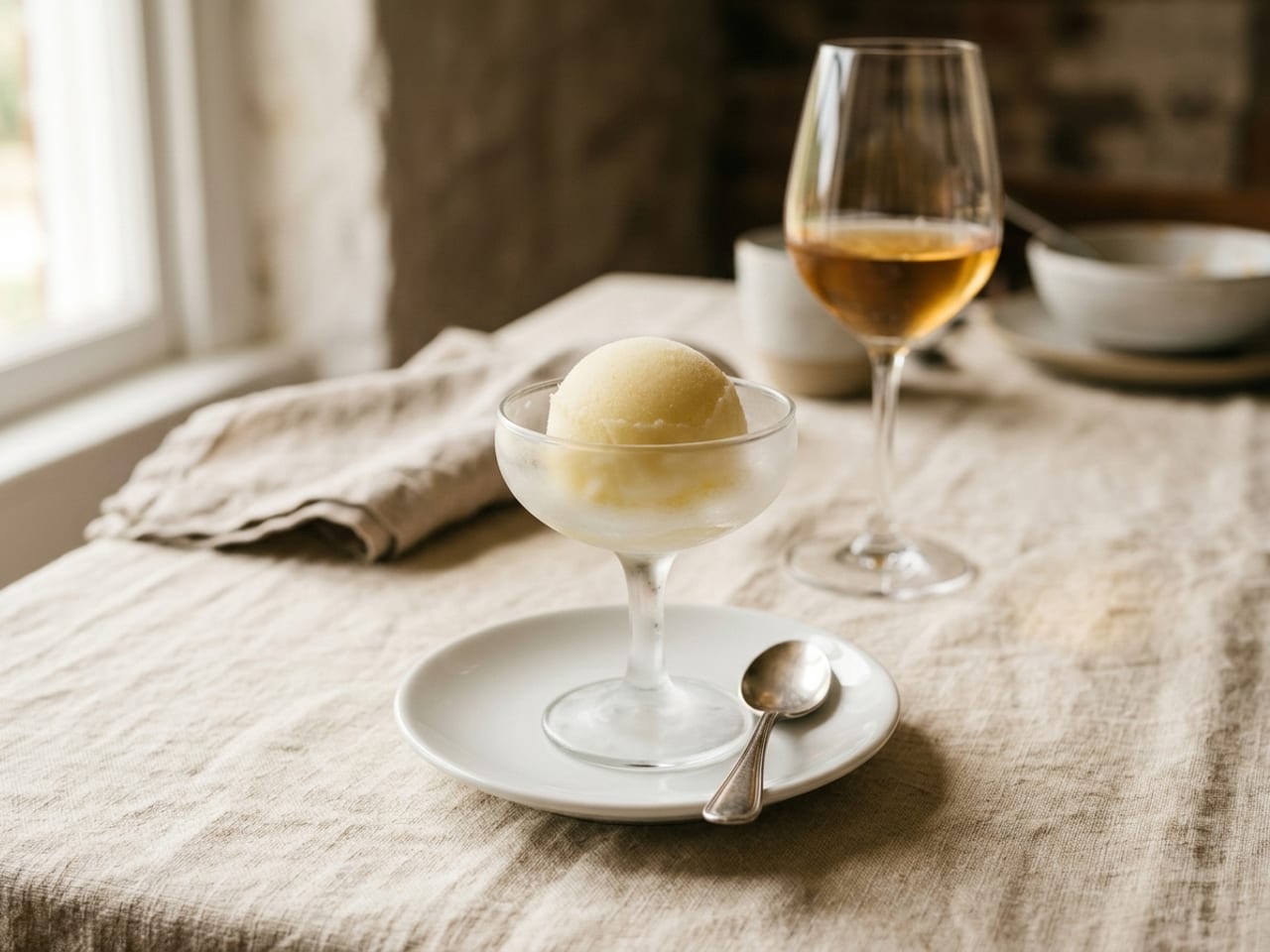
Merriam-Webster defines the idiom cleanse the palate as "to clean and refresh the mouth between different parts of a meal", with the example "Sorbet is sometimes served between courses to cleanse the palate."1 It is spelled palate; "palette cleanser" and "pallet cleanser" are misspellings of the same phrase. People also use it for a light book or show after a heavy one: see the figure of speech.
It did not start out as a taste-bud reset. The chefs who wrote the course down said it was for the stomach and for the clock. Escoffier served his "after the Entrées" to freshen the stomach before the roast;18 Ranhofer, at Delmonico's, listed it under "Interval". 20 It had replaced an older glass of spirits, the coup du milieu and the trou normand.14, 15 The claim that it "resets your taste buds" came later, and we found no test of it in a real meal. This guide keeps the two apart: what the course was for, and what the evidence shows. Sources are at the bottom.
When to serve a palate cleanser
There is no single rule. Published sources put the cleanser in at least eight places, and most of the disagreement comes from menus that have shrunk since the books were written.
| Position | Who puts it there |
|---|---|
| Before the roast | The classic slot. Escoffier: sherbets are "served after the Entrées".18 Ranhofer: "A punch or sherbet is always served after the entrées and before the roast", and the menus he printed for Delmonico's dinners of 1867 to 1870 show it there.20 Fannie Farmer agrees: "Punch, when served, always precedes the game course."24 |
| After the fish | Ranhofer calls serving the punch after the fish "the custom in Russia" and thinks it "certainly preferable to wait until the entrées are removed."20 Normandy's tourist board puts today's trou normand "between the fish and meat courses", and sometimes before the cheese.46 |
| With the roast | A French household manual of 1877 serves sorbets at the same time as the roast, at the moment when the trou normand used to be taken.14 |
| After the roast | Grimod's coup du milieu, the sorbet's ancestor, was drunk immediately after the roast.15 American manuals that put Roman punch "just after the roast" or "just after the beef" mean the big joint, with the game still to come.21, 22 Our reading of these books: they put the ice after the heavy joint and before the game. |
| Before dessert | The modern restaurant slot. Francisco Migoya describes the pre-dessert as "a bridge between the last savory course and the sweet items to come."41 The Escoffier school's online guide also lists a cleanser as a go-between before dessert.50 |
| Before the soup | A curiosity from an 1877 American manual: "One often sees Roman punch served as a first course just before the soup."21 |
| Between every course | The trou normand of 1841 was a glass of eau-de-vie between each service of a banquet, and Maupassant's wedding guests, in a story of 1882, take one between each dish.12, 13 |
| Halfway, or before the main | A shorter modern menu: "about halfway through a large multi-course meal, or just before the entree", in the American sense of the main course.45 |
Why the books disagree. A formal dinner of the 1800s had two meat stages: the entrées, then a roast, usually game. The ice marked half-time between them. When menus shrank to a single main course, the slot split in two: some cooks moved the cleanser in front of the main, and restaurants moved it to the gap between savory and sweet, where it became the pre-dessert. "Between fish and meat", the line most websites repeat, is Normandy's custom for the trou normand,46 not a universal rule.
Our recommendation for a home dinner (ours, not a rule from any of these books): serve one cleanser, at the biggest change of gear.
- Three to five courses: you don't need one. If you want the pause anyway, put it after the main course and before dessert.
- A long menu with one main course: after the main, before dessert. That is where our course meal builder puts it (the builder adds the cleanser from 8 courses up), and where the green-apple sorbet sits in our seven-course tasting menu at home. The builder's 7 course meal order has no cleanser; add one in the same place if you like. The other published orders are in the courses of a meal, in order.
- Two meat courses: between them, lighter meat first. That is the builder's 10-course and 12-course meal, and it is Escoffier's slot under modern names.
- Before the main instead: a fair variant when the main needs ten minutes of last-minute cooking and you want the table occupied.
More than one cleanser in a home dinner is rarely needed. For how many courses a prix fixe or tasting menu runs to, see that guide.
Is sorbet a dessert or a palate cleanser? Both. It is the same food at a different size and sharpness: a full, sweet scoop is dessert; one or two tart spoonfuls mid-meal are a cleanser.
Right after the last dish, or right before the next? After. Clear the plates, serve the cleanser to an empty table, and let the next course follow about ten minutes later (our pace; see how to serve it).
Do palate cleansers work? What the tests found
Sensory scientists have compared cleansers head to head in the ten lab studies cited here, and they do not agree on a winner. Here is what each kind of test found, and what it does not show. PubMed-indexed papers carry a PMID next to the DOI in the sources.
- We found no test of a sorbet course in a real dinnerAlmost every study below is a lab test: people sip, chew or rinse with one thing over and over and rate one sensation. The ten head-to-head cleanser panels are small, 8 to 40 people, and about half describe their tasters as trained. The other studies are mostly small too, though one chili test had 72 volunteers and one appetite study 180. We found no published study that serves a sorbet, or any other intermezzo, between the courses of a meal and measures whether the next dish is enjoyed more. One trial does serve a sorbet mid-meal, the hospital study of the trou normand in the last card below, but it measures the stomach and has posted no results. So anything said about a mid-meal sorbet, on this page too, is an inference.
- Across foods, a plain cracker and water were the most reliableIn one lab test of six cleansers against seven kinds of food, from jelly beans to smoked sausage, a bite of plain water cracker, rinsed down with water, was the only one that kept a 24-person panel's scores steady for every food.85 What it doesn't show: that crackers make the next bite taste better. The measure was whether ratings drifted between repeat tastings of the same food. And there is no universal winner: three other panels found that nothing beat plain water or no cleanser at all,88, 89, 90 and in a 2016 red-wine test plain crackers were the worst for telling samples apart.91 It depends on what you just ate.
- Nothing fully stops red wine's astringency buildingSip a tannic red six times and it feels drier each time. In an 18-person panel a bite of unsalted cracker before the first and fourth sips held that down more than a pectin rinse or water did, with water the least effective, though astringency still rose.86 A 14-person panel in 2016 found that none of its five cleansers could prevent the build-up.91 In a nine-person study milk was the only rinse that lowered the tannin left in saliva; still and sparkling water did not.92 Time may help: in a test of white wine with added tannin, eight trained judges carried less astringency into the next sip with 40 seconds between sips instead of 20, though a first experiment found no difference between 5 and 30 seconds.96 What it doesn't show: a ranking you can rely on. These are one-wine tests with small panels, and an earlier one found a pectin rinse beat crackers.87
- Tea makes a fatty mouthful feel less fattyFat feels slippery; tannin feels dry and rough. In an experiment with 21 people, sips of oolong tea between bites of salami left mouths feeling less fatty than sips of water did.97 What it doesn't show: anything about sorbet. The paper names sorbets among the things people believe cleanse the palate, but it tested one fatty food and one tea.
- For chili burn, cold and milk clearly helpIn a 1990 experiment cold rinses soothed chili burn better than room-temperature ones, a sugar solution did as well as cold whole milk, and a weak alcohol solution was no better than water.98 When 72 volunteers chased spicy tomato juice with seven different drinks, whole milk, skim milk and a sugary fruit drink put out the most fire; fizzy water and plain water did least.101 Skim worked about as well as whole, so fat alone does not explain it. What it doesn't show: lasting relief. In another test rice, butter, pineapple juice and water all dulled the burn until they were spat out, and then it came back.99 In the seven-drink test the plain water was also the only drink served at room temperature.
- The nearest thing to a sorbet test: a water ice tied with cold waterAfter a chili rinse, Italian ice soothed the burn about as well as cold water at 4 °C (39 °F), and ice cream and lassi soothed it most.102 Cold does part of the job; fat and protein seem to do the rest, though the yogurt in the same test did worse than cold water, so dairy alone is not the answer. Sweet and sour rinses each sped the fade of chili burn in an older experiment, which is why a cold, sweet, sour sorbet after a spicy course is a reasonable guess.100 What it doesn't show: a restaurant sorbet, a real dish, or anything beyond two minutes. Italian ice is a commercial water ice.
- Cold briefly dulls sweetnessCool the tongue from body temperature to 20 °C (68 °F) and sugar tastes weaker and caffeine less bitter, while salt and sour are untouched.103 A later study says the reported effects have "generally been small and inconsistent" and finds a direct drop in sweetness only with cooling to 5 to 12 °C (41 to 54 °F).104 What it doesn't show: a frozen cleanser before a course; we found no test of one. Our inference cuts against sorbet, not for it: a very cold mouth may briefly mute the first bites of the next plate, which is a reason to keep the portion small and not to rush the next course.
- After oily fish, warm water with lemon did bestA trained panel of eight found that warm diluted lemon juice (0.5%, at 45 °C / 113 °F), taken with a cracker, left the least behind after Atlantic salmon. Warm water alone reduced the oily coating; lemon water at room temperature reduced the fishy aftertaste.94 What it doesn't show: anything about lemon sorbet. No cold condition was tested, and eight people is a small panel.
- Novelty and attention restore appetiteAfter ten tastes of the same juice, people's salivation and liking for it faded. One taste of a different juice, or of chocolate, brought both back, and a video game with no taste at all revived the salivation.105 In another experiment people who had eaten their fill of a plain food ate again, about 80% of their first intake, once it was seasoned.106 What it doesn't show: a between-course cleanser. It does suggest that a pause and a change of scene could do much of what the sorbet gets credit for, and the next course is already a new flavor.
- Sourness makes you salivateIn 32 adults a 5% citric acid solution drove the highest saliva flow measured, and ordinary foods reached 43% to 71% of it.107 Saliva is the mouth's own rinse, which is the most plausible reason a sharp lemon or apple cleanser feels as if it clears things. What it doesn't show: that the next course tastes better for it.
- No cleanser is neutral, not even waterThe same orange drink tasted less sour after a cracker than after water or a carrot stick.89 Sparkling water made bitter cream cheese taste less bitter without helping tasters tell samples apart.88 And in a taste-lab experiment plain water tasted bitter after something salty or sweet, and sweet after something sour or bitter.108 What it doesn't show: how big these effects are at a dinner table; lab adaptation is far stronger than eating a dish.
- Coffee beans were no better than air for the noseThe jar of coffee beans on the perfume counter has one published test that we found. Students smelled three fragrances nine times over, then sniffed coffee beans, lemon slices or plain air; the coffee group did no better at spotting a new scent than the other two.110 The nose tires of one smell at a time and recovers with time away from it.111 What it doesn't show: that coffee does harm. It is one small study that calls itself exploratory.
- Alcohol with a meal slowed the stomachIn a randomized crossover trial, 20 healthy adults ate cheese fondue with white wine or black tea, then a shot of schnapps or water: the stomach emptied significantly faster with tea or water than with wine or schnapps, and indigestion was reported only occasionally, whatever the drink. The shot on its own showed a trend towards slower emptying, not a significant effect.112 In a study of 16 healthy men, the eight given a high-calorie meal took 131 minutes to half-empty the stomach with water and 186 with red wine.113 In a third study beer, wine and whisky all slowed emptying, the stronger the drink the more.114 A hospital team in Lyon has run a controlled trial of the trou normand itself, 2.5 cl of Calvados with apple sorbet against water with apple sorbet, in eight people. It was completed in March 2026, and no results had been posted when we checked on 3 October 2026.115 What it doesn't show: harm. The honest wording is that a mid-meal spirit does not speed digestion, which is why this guide makes no digestion claim for any cleanser.
14 palate cleanser ideas to serve between courses
Six frozen, two with alcohol and six that never see the freezer, including savory and non-alcoholic palate cleansers. Each method is drawn from the published recipe cited beside it, with that recipe's own quantities; we have not kitchen-tested them. The quantities are full batches: as a cleanser, serve 1 to 2 tablespoons (15 to 30 ml) a guest.
1. Lemon sorbet
Frozen · after a rich course or before dessert · up to a week ahead
The classic: a smooth, churned ice of lemon juice and syrup, one small scoop in a chilled glass. It suits the gap after a rich savory course and the one before dessert.
Method (Max Falkowitz, Serious Eats): whisk 1 cup (240 ml) fresh lemon juice (about 6 lemons), 1 tablespoon zest, 1½ cups (355 ml) water, 2 cups (475 ml) light corn syrup (or glucose syrup) and 1 tablespoon (15 ml) vodka or gin; add ½ teaspoon kosher (coarse) salt to taste, churn, then freeze until firm, 2 to 3 hours.53 The spirit is there for texture, so it can be left out (our note); leave it out when the sorbet is also the alcohol-free option. With no machine, BBC Good Food's lemon sorbet, in which 2 tablespoons of vodka are optional, is whisked once an hour for 4 hours, but by our arithmetic it is about 40% sugar: a dessert sorbet, so serve less of it.56
Ahead: best within a week.54 A bought tub of sharp lemon sorbet is fine too.
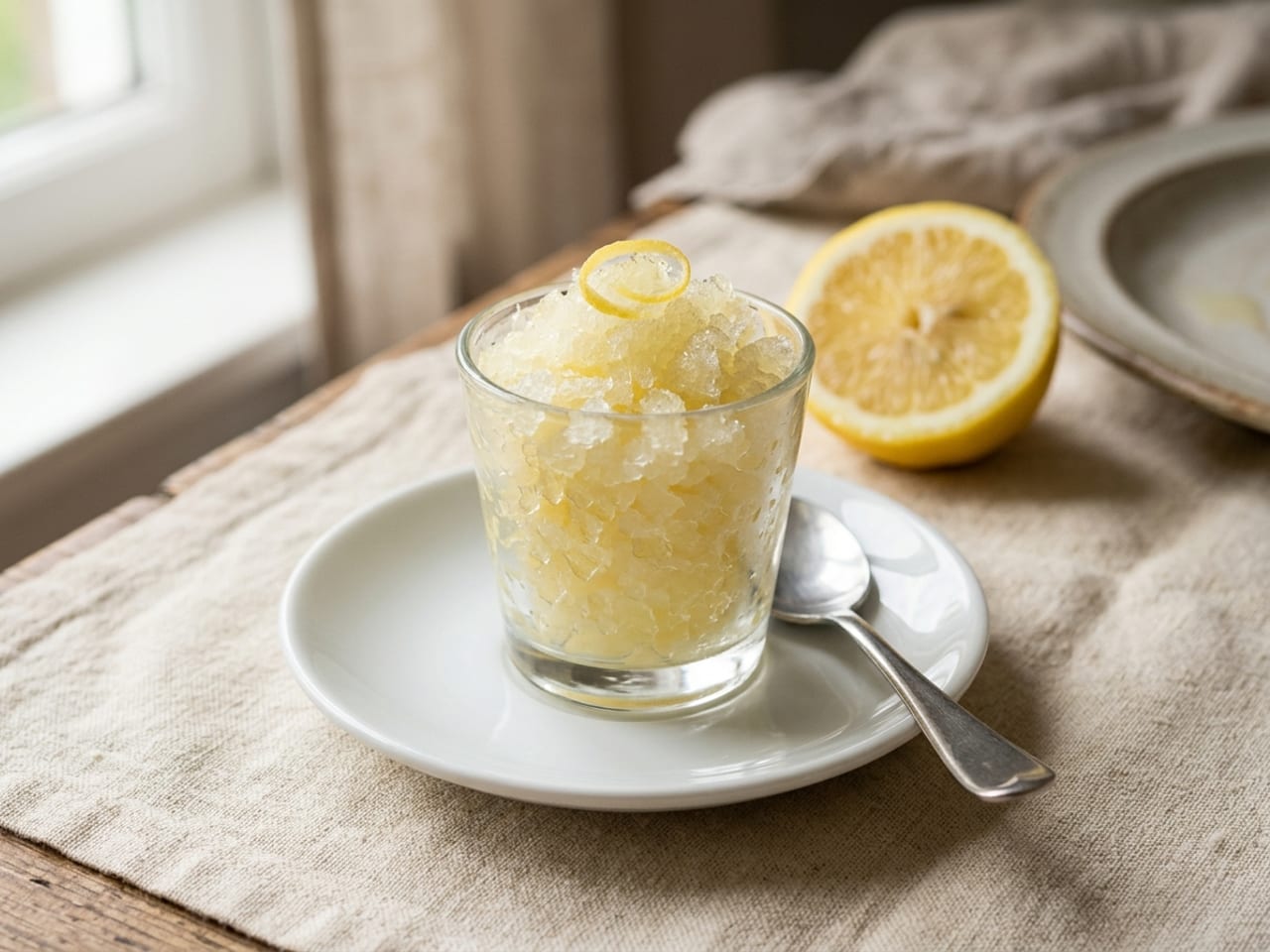
2. Lemon granita
Frozen · alcohol-free · no machine · up to 4 days ahead
Sorbet's lower-sugar relative: the same kind of base frozen in a shallow dish and scraped into flakes. It is icier and sharper and needs no machine, which makes it the home cook's cleanser.69
Method (Saveur): stir 1½ cups (355 ml) fresh lemon juice (8 to 9 lemons), ½ cup (100 g) sugar and 1 cup (240 ml) water until the sugar dissolves. Pour into a baking dish and freeze, stirring with the tines of a fork every 30 minutes, until slushy and frozen, about 4 hours.57 By our arithmetic that is about 15% sugar, the sharpest recipe on this page.
Ahead: up to 4 days;57 scrape it again with a fork just before serving.69
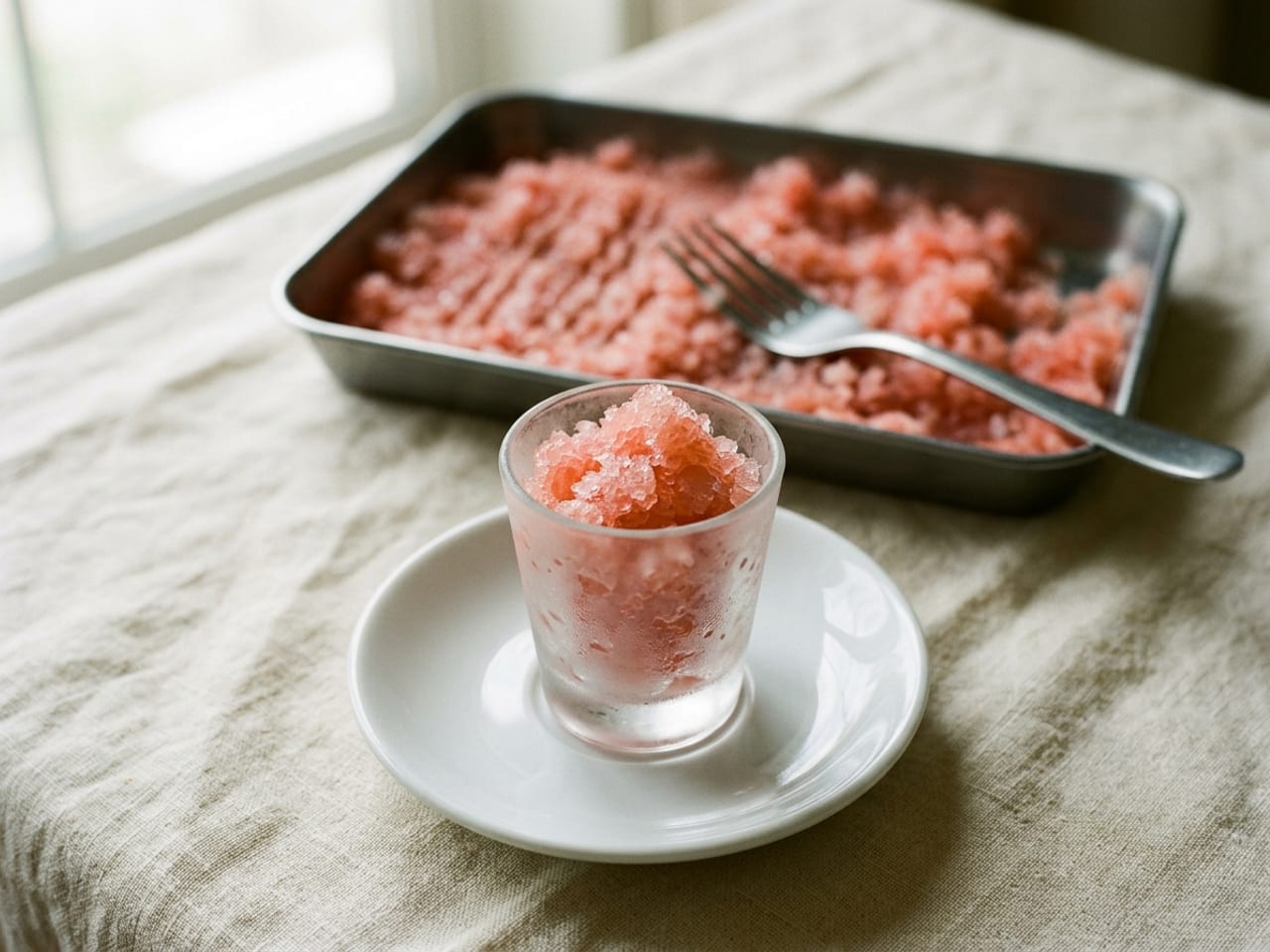
3. Pink grapefruit granita
Frozen · alcohol-free · no machine · start the day before
The same idea in pink, and one of the three cleansers our course meal builder deals. It suits the same gaps as lemon.
Method (Williams-Sonoma): boil ¾ cup sugar (the recipe prints 185 g; a level ¾ cup is nearer 150 g), ¾ cup (180 ml) water and 2 teaspoons grapefruit zest for 1 to 2 minutes and chill. Add 1½ cups (375 ml) unsweetened grapefruit juice, pour into a shallow metal pan (stainless steel, not bare aluminum; our note) and freeze, whisking every 30 minutes, until semifirm, about 3 hours. Cover, freeze for at least 8 hours or up to 24, then scrape the surface into fine crystals with a fork.58 About 25 to 28% sugar by our arithmetic, depending on which of those you follow, so sweeter than the lemon granita.
Ahead: the day before. The recipe suggests unpasteurized juice-bar juice; see the safety notes before using it for every guest.
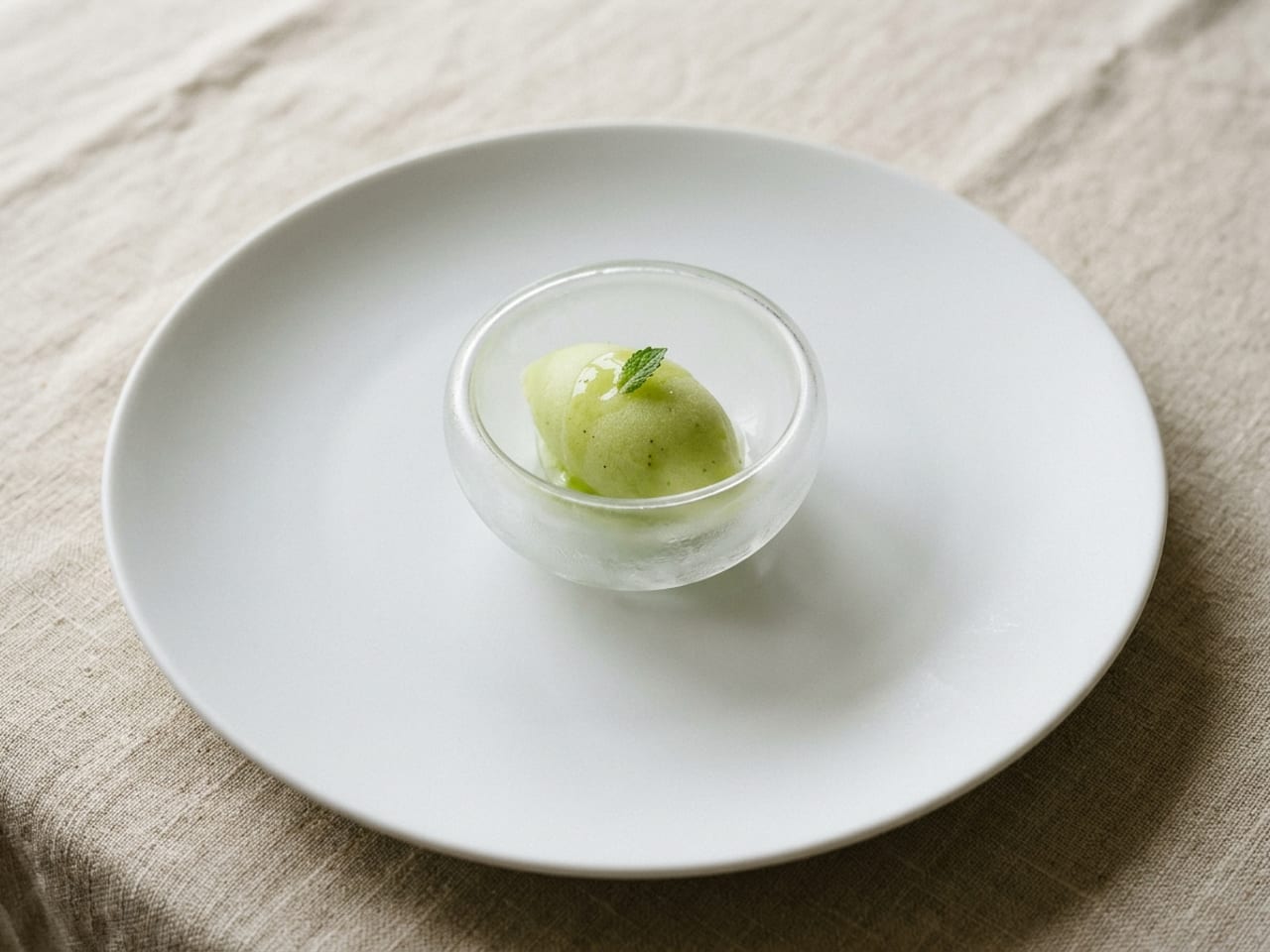
4. Green apple sorbet
Frozen · after fish or a rich course · up to a week ahead
The flavor of the trou normand without the brandy, and the "palate pause" in our seven-course tasting menu at home. Sharp rather than sweet.
Method (David Lebovitz's recipe, as adapted by Kitchen Konfidence): bring 2 cups (475 ml) sparkling apple cider, ⅓ cup (65 g) sugar and ½ cup (120 ml) water to a boil. Add 4 unpeeled Granny Smith apples (about 2 lb / 900 g) in chunks, simmer covered for 5 minutes and leave to steep until room temperature. Press through a strainer, sharpen with lemon juice to taste (about ½ teaspoon), chill and churn. Makes about 3 cups (700 ml).59 We read the adaptation, not the book, and it does not say whether the cider is alcoholic. In the US the name usually means a soft drink; in the UK and Europe cider is alcoholic, and five minutes at a covered simmer does not cook the alcohol out: in the USDA's retention table 40% of the alcohol is still there after 15 minutes of simmering.129 For an alcohol-free sorbet, use sparkling apple juice (ours).
Ahead: within a week, like any churned sorbet.54
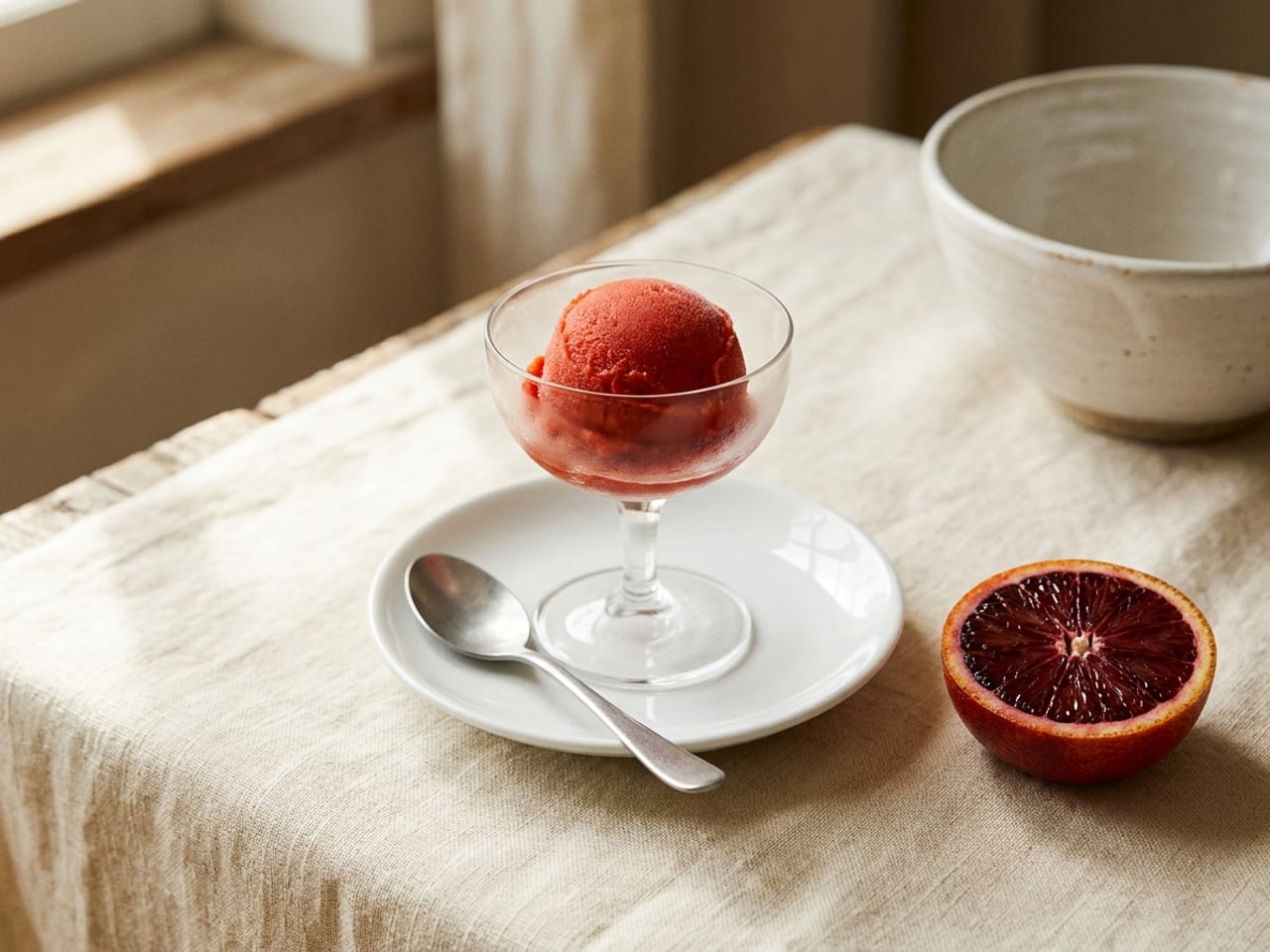
5. Blood orange sorbetto
Frozen · alcohol-free · machine or fork · written as an intermezzo
The one recipe here that its author wrote for this job: Tyler Florence gives the yield as "about 15 intermezzo servings".60
Method (Tyler Florence, Food Network): simmer 1 cup (240 ml) water with ½ cup (100 g) sugar for 2 minutes, cool, add 2 cups (475 ml) blood orange juice and churn. Without a machine, pour it into a shallow dish, freeze for 1 hour, then break up the ice with a fork every hour.60 By our arithmetic that is about 3½ tablespoons (50 ml) a guest and about 17% sugar.
Ahead: as for the lemon sorbet or, made with a fork, the granita.
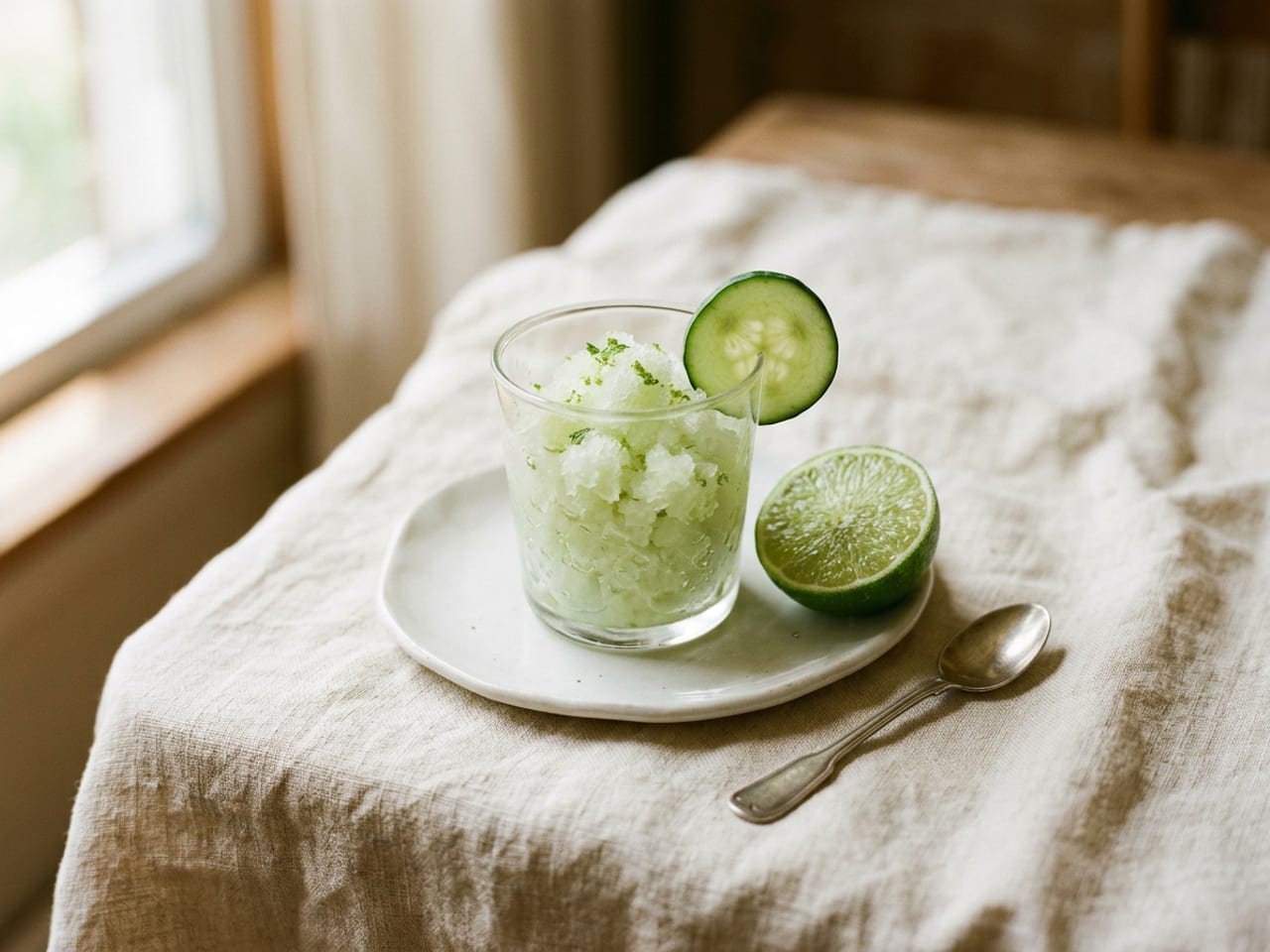
6. Cucumber-lime granita
Frozen · alcohol-free · no machine · sweet or savory
A light, green cleanser, and the route to a savory one when you don't want sugar between two savory courses.
Method (Brooke McLay, Betty Crocker): simmer ½ cup (100 g) sugar with ½ cup (120 ml) water to a thin syrup and cool. Blend with 2 peeled, seeded cucumbers and the juice of 2 limes, freeze for 2 to 3 hours or until completely frozen, then rake a fork through it.61 For a version with no sugar at all, James Syhabout purées 4 cups (0.95 L) of peeled, seeded cucumber pieces with 1 tablespoon lime juice, ½ teaspoon matcha and ¼ teaspoon kosher salt, freezes it solid and scrapes it into fine shards. He spoons it over raw oysters; serving it on its own between courses is our suggestion.62
Ahead: a day or two (ours), scraped again before serving.
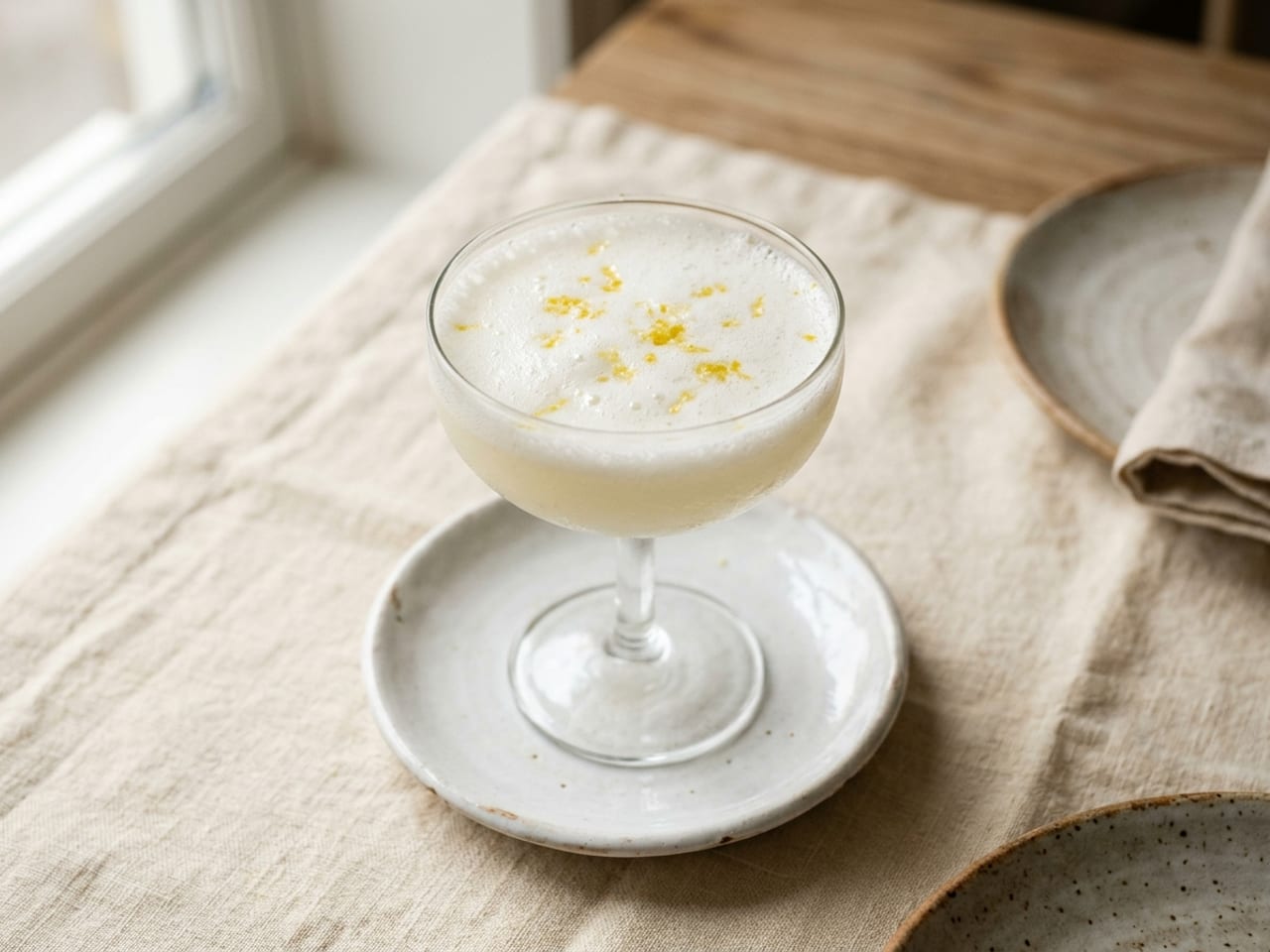
7. Sgroppino
Drink · contains alcohol · mid-meal or before dessert · made at the last second
The Italian palate cleanser drink: lemon sorbet whisked with prosecco and vodka until frothy. Saveur calls it "common in Italy as a palate cleanser, a dessert, or a pre-dinner drink",63 and the Treccani dictionary lists it as a regional word for lemon sorbet taken as a digestive with vodka or sparkling wine.32
Method (Steve Wildy of Vetri, in Saveur), per drink: whisk ⅓ cup (80 ml) lemon sorbet with a splash of prosecco, then slowly whisk in 1 oz (30 ml) vodka and the rest of 3 oz (90 ml) prosecco. Serve in a martini glass or coupe.63 Lidia Bastianich chills the glass in the freezer for 15 minutes and says to "serve right away, so they stay nice and slushy."64
As a cleanser: halve it per guest (our suggestion); a full one is about 1.2 US standard drinks by our arithmetic, with prosecco at 11%. For an alcohol-free version, whisk a lemon sorbet made without vodka or gin with sparkling water (ours).
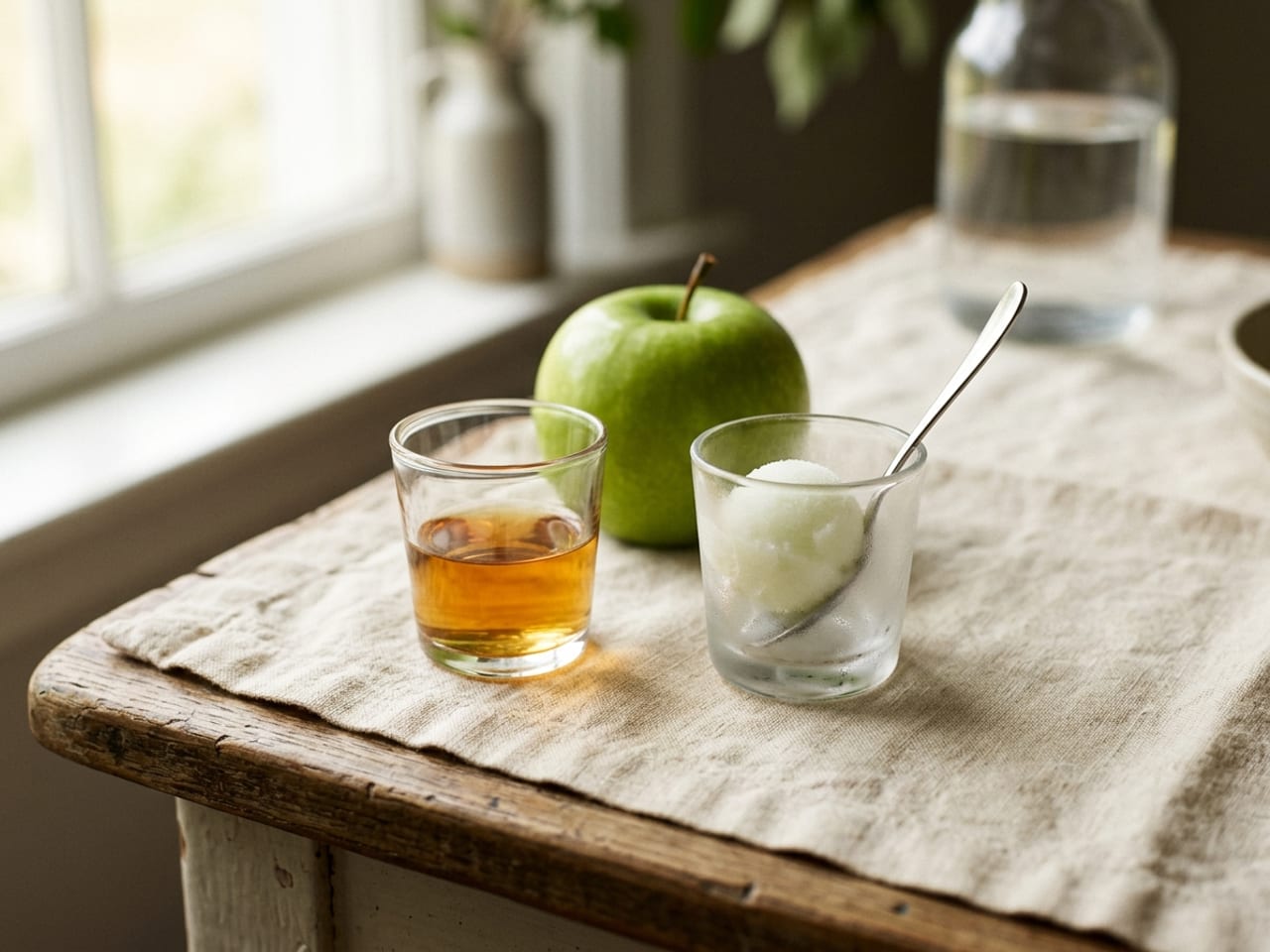
8. Trou normand
Spirit or sorbet · contains alcohol · between fish and meat on a long menu
Normandy's tourist board calls it "a small glass of Calvados, local apple brandy, or Calvados-soaked apple sorbet between courses", and places it between the fish and the meat of an elaborate menu.46 It is a pause, not a digestive aid (see the research).
Method: one published version, from Le Veau d'Or in New York, is 1 oz (30 ml) fresh-pressed Granny Smith apple juice and 1 oz (30 ml) freezer-cold blanche Armagnac in a shot glass52 (wash the apple first; see the safety notes on raw juice). Our home version: one small scoop of the green apple sorbet above with a teaspoon or two (5 to 10 ml) of Calvados poured over at the table. The sources describe that combination but none gives a quantity, so the amount is ours.
Without alcohol: a scoop of the green apple sorbet made with sparkling apple juice, not alcoholic cider, and a splash more of the cold juice over it (ours). A 1 oz (30 ml) pour of 40% spirit is about two thirds of a US standard drink.
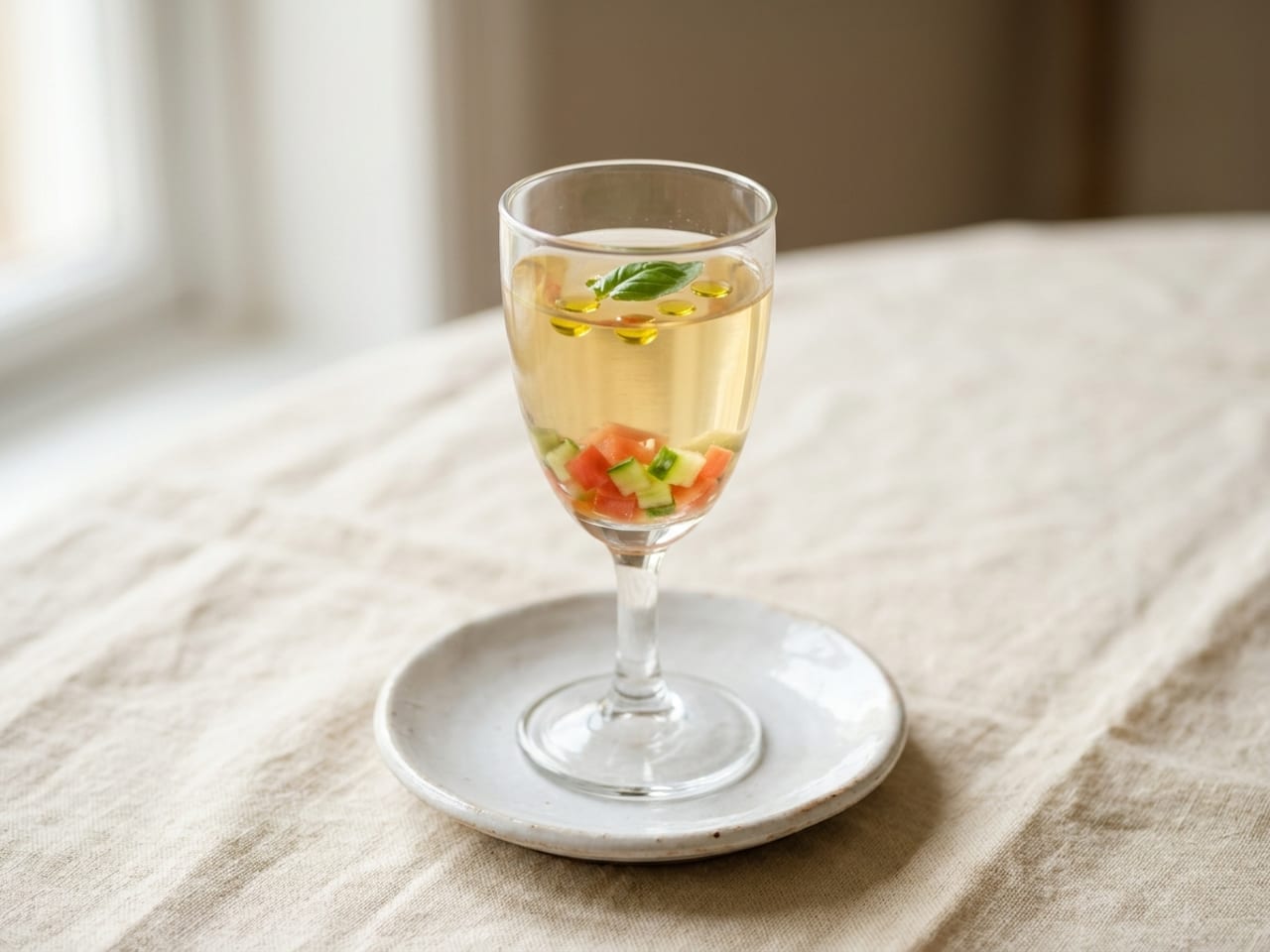
9. Chilled tomato water
Savory · alcohol-free · no added sugar · drips overnight
The clear juice that drips from salted, chopped tomatoes: a savory sip with no sugar and no alcohol. Our sources serve it as a first course; using it between courses is our suggestion, and it is also one of our amuse-bouche ideas.
Method (Crumbs on the Table, a raw version of the tomato consommé that Raymond Blanc and Chez Panisse made known): pulse 1 kg (2 lb 3 oz) ripe tomatoes with half a shallot, half a garlic clove, basil stems, sea salt and pepper to a chunky salsa. Tip into a strainer lined with a double layer of damp muslin over a bowl, cover and leave it to drip for 8 to 24 hours without pressing, which would cloud it. It yields about 400 ml (1⅔ cups), four sherry glasses. The source dresses it with diced tomato and cucumber, basil and a few drops of olive oil, as in the picture; between courses, leave them out (ours).65
Ahead: start it the day before. Drip it in the fridge and serve it within a day or two, deep-chilled, in shot or sherry glasses (the fridge and the day count are ours).
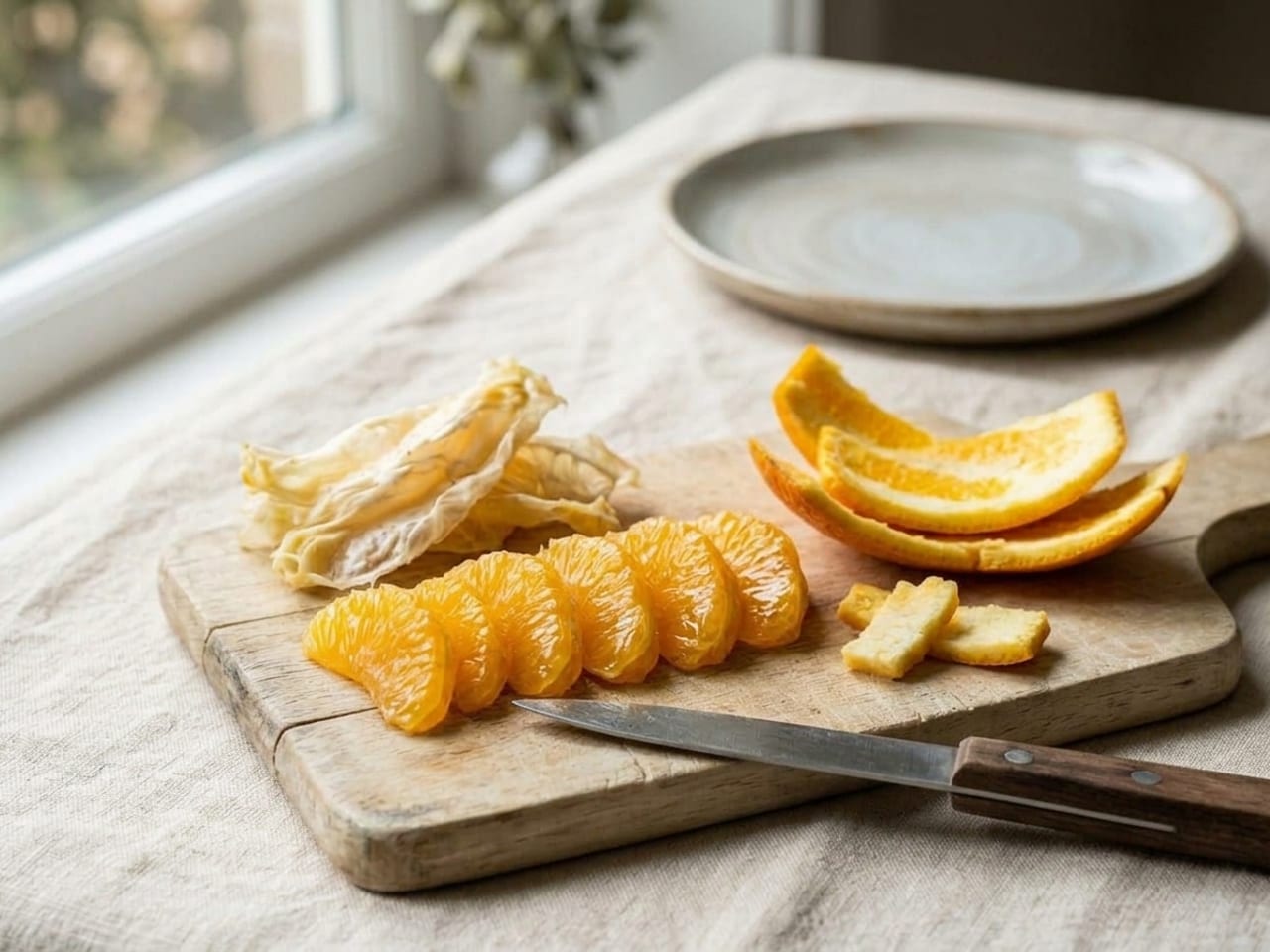
10. Citrus suprêmes
Fresh · alcohol-free · no freezer · before dessert
Membrane-free segments of orange or grapefruit: the cleanser for a kitchen with no freezer space. The Nibble's list runs from citrus sorbet to "sucking on a lemon or lime wedge";49 serving plain segments is our suggestion.
Method: cut the segments free of their membranes as shown in how to cut fruit, and serve two or three per guest in a small glass or on a saucer, with nothing added (the portion is ours).
Ahead: cut them in the morning and keep them covered in the fridge (ours).
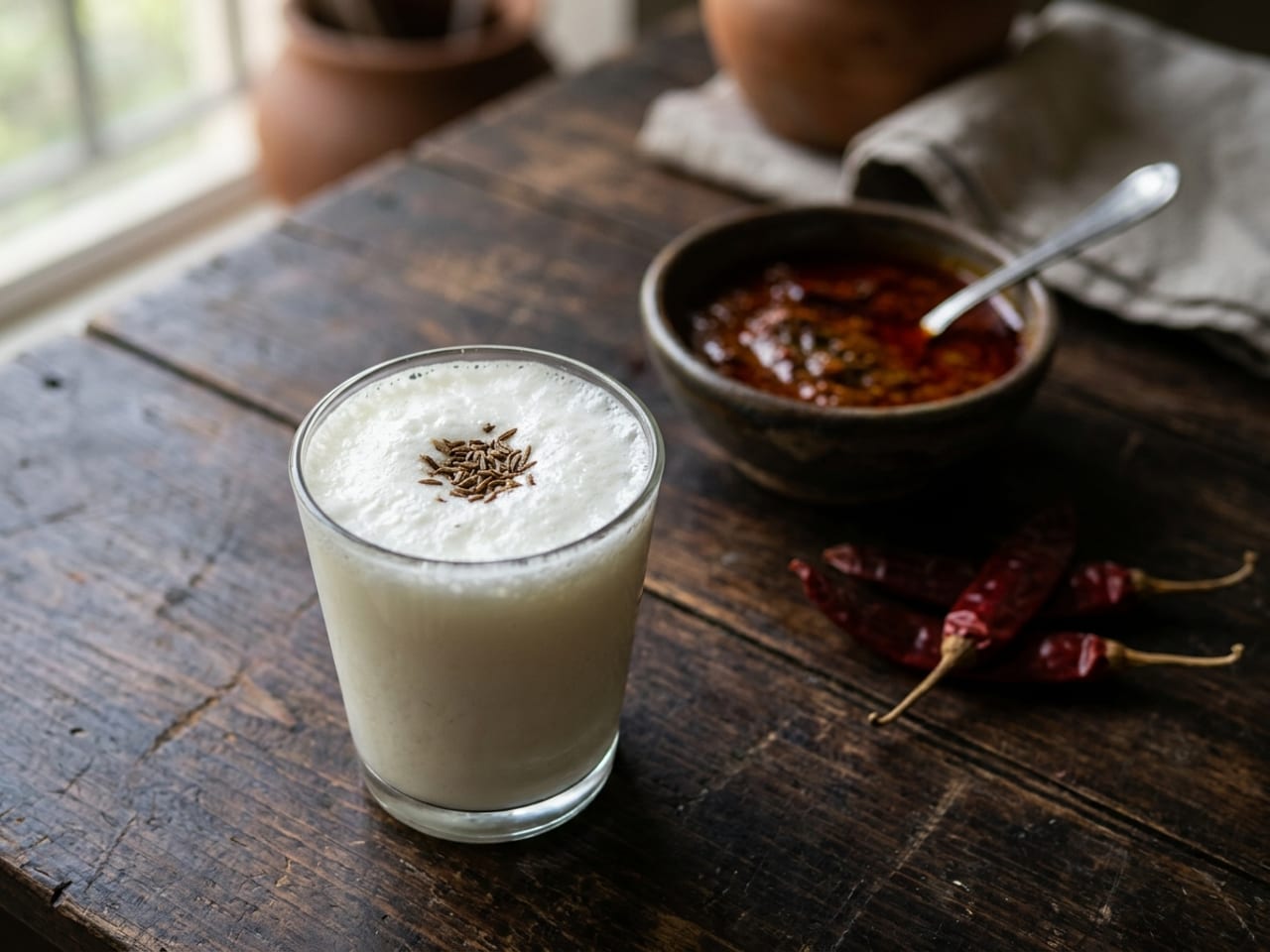
11. Salty lassi
Drink · contains dairy · alcohol-free · after a spicy course only
The one time a creamy cleanser is the right one. Against chili burn, milk, ice cream and lassi soothed more than water did in taste tests, and a water ice only matched cold water. Yogurt on its own did worse than cold water in the same test, and cold is part of what works, so pour the lassi over ice as the recipe does. The paper's abstract does not say which lassi it used, and we found no test of a salty one.101, 102
Method (Sumayya Usmani, Great British Chefs): blend 250 g (about 1 cup) whole set yogurt, 25 ml (5 teaspoons) whole milk, ½ teaspoon salt and 1 teaspoon caster sugar until frothy, pour over glasses filled with ice cubes and top with ½ teaspoon dry-roasted cumin seeds. Makes 4.67
Ahead: blend it before dinner and keep it in the fridge (ours).
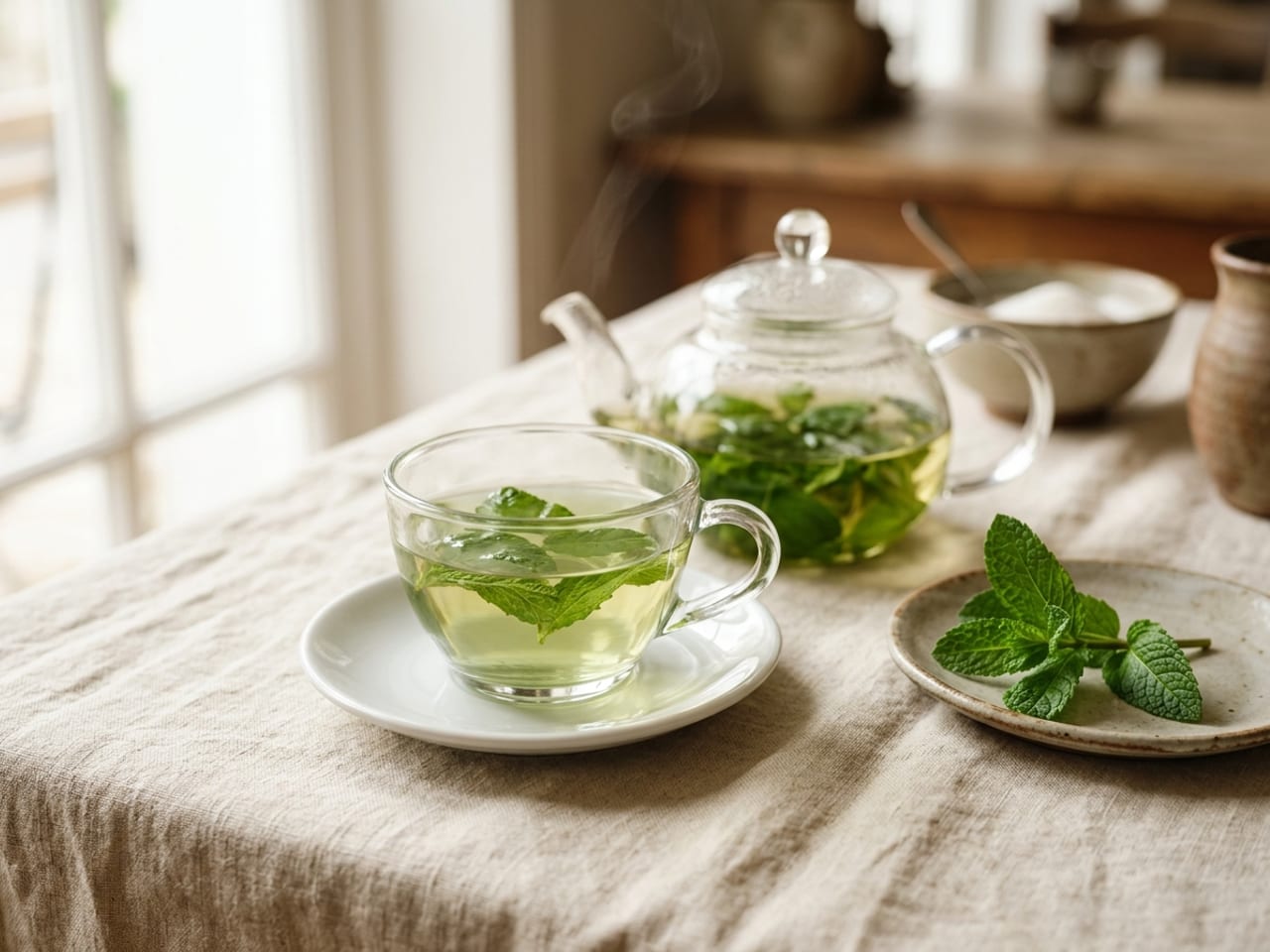
12. Fresh mint tea
Hot drink · alcohol-free · before dessert or after a heavy meal
A warm cleanser. One published list suggests "lightly brewed green, black, or mint tea, with minimal sweetener".48 The lab result for tea against a fatty mouthful used oolong, a true tea; we found no test of mint.97
Method (Miriam Nice, BBC Good Food Middle East): clap a handful of fresh mint (about half a pack) between your hands, drop it into a pot, fill the pot with boiling water and infuse for 2 to 3 minutes.68 Leave out the honey, or nearly.
Serve: a few sips in an espresso cup (ours), made while the plates are cleared.
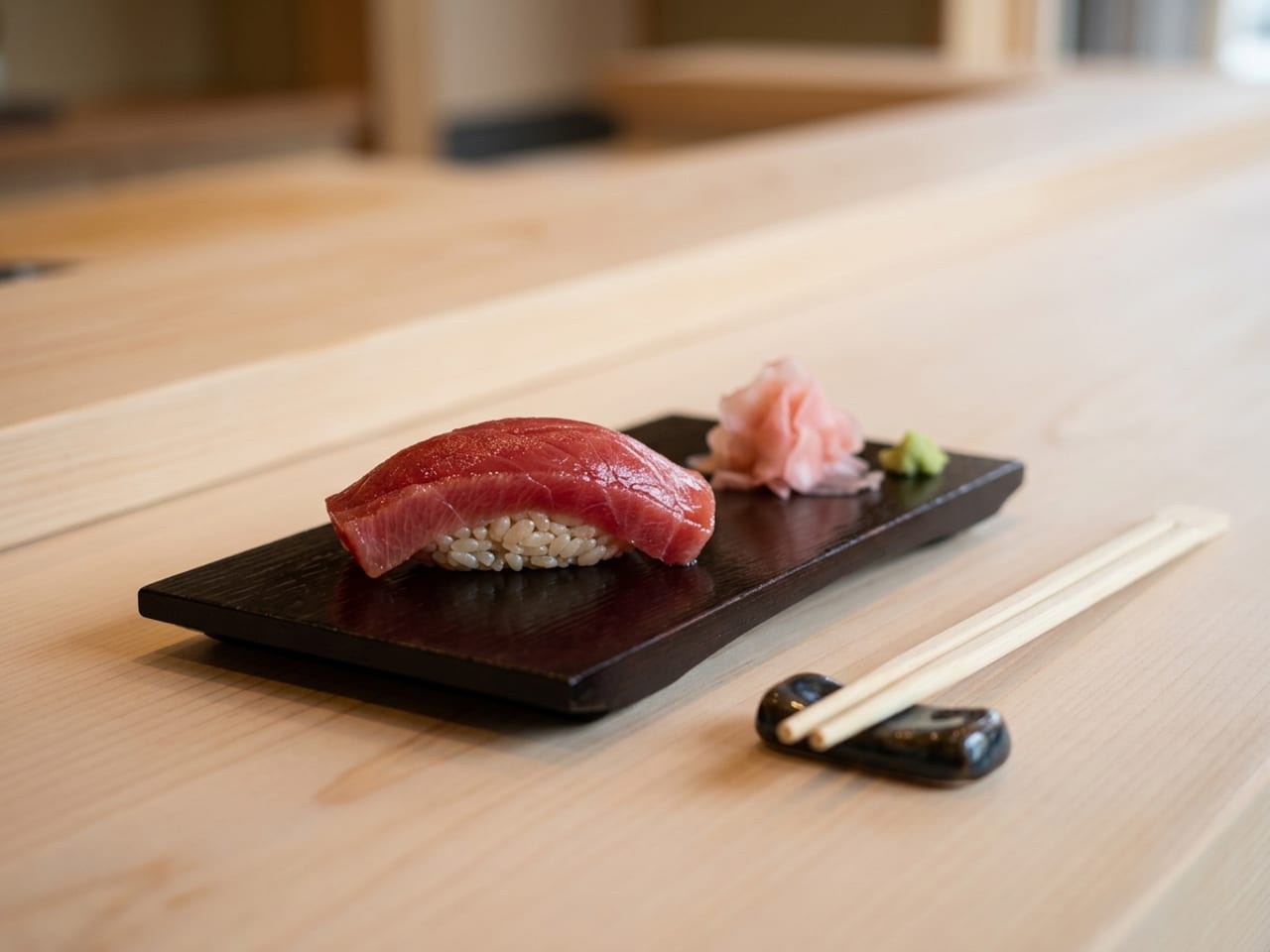
13. Pickled ginger (gari)
Pickle · alcohol-free · between pieces of sushi · make days ahead
Thin slices of young ginger in sweetened rice vinegar. "A chef offers ginger as a palate cleanser in between sushi bites, not an additional snack," chef Mike Collantes told the MICHELIN Guide,81 and Sushi Yasuda asks guests to "avoid putting it on your sushi or sashimi".82
Method (Namiko Hirasawa Chen, Just One Cookbook): slice 8 oz (225 g) young ginger paper-thin, salt it with 2 teaspoons Diamond Crystal kosher salt for 5 minutes, blanch for 1 to 2 minutes, drain and squeeze. Pour over a boiled mixture of 1 cup (240 ml) unseasoned rice vinegar, ½ to ¾ cup (100 to 150 g) sugar and 1 teaspoon kosher salt.66
Ahead: at least 4 hours in the fridge, and better the next day or later.66
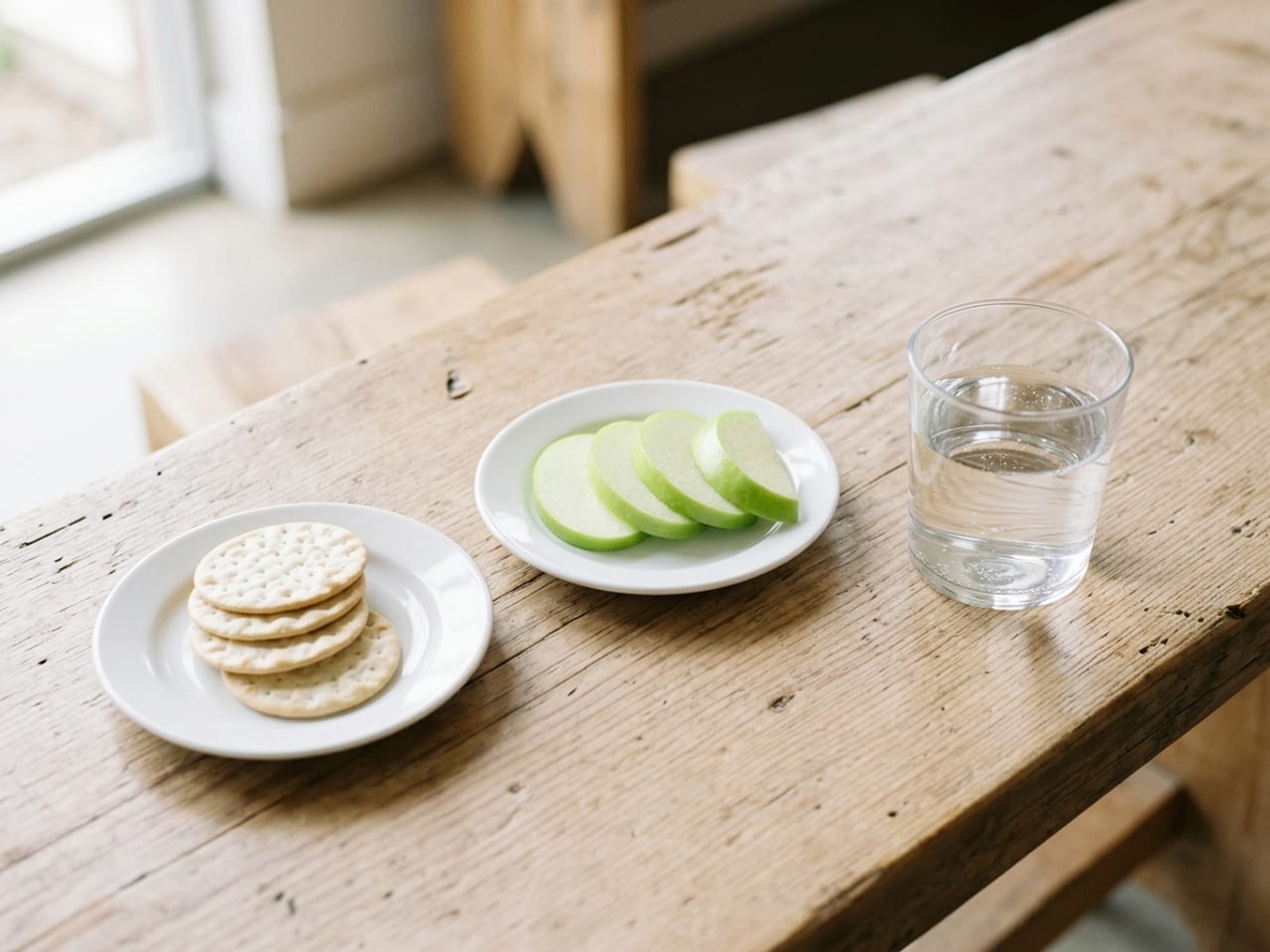
14. Apple, plain crackers and water
Neutral · alcohol-free · for wine, cheese and olive oil tastings
The professional's kit, for a tasting, not a dinner. Olive oil panels chew a small slice of apple and rinse with water;74 wine competition judges get a carafe of cold water and pieces of bread;76 the ISO sensory standard suggests water and "bland foods (for example, unsalted crackers)".75
Method: none. A thin slice of tart apple, plain bread or water crackers, and still water. In the one test that ran six cleansers against seven foods, a cracker with water was the most reliable.85
Serve: give each guest their own water glass and their own plate, as a tasting booth does.74 More in the tastings table.
Match the palate cleanser to the transition
What tradition serves at each change of gear, next to what lab tests found for that kind of food. The two columns do not always agree.
| The transition | What to serve | What the tests say |
|---|---|---|
| After a rich or fatty course | A tart citrus or apple sorbet or granita; a few sips of tea48 | Sips of tea made a fatty mouthful feel less fatty than water did. Acidic foods such as sorbet were not tested.97 |
| After fish | A trou normand, in Normandy's fish-to-meat slot;46 a lemon or apple sorbet or a sgroppino there is our suggestion | After oily salmon, warm water with a little lemon cleared the mouth best in a panel of eight. Nothing cold was tested.94 |
| After a spicy course | Salty lassi over ice, or a small glass of cold milk50, 67 | The best-supported match here: cold, milk, ice cream and lassi all cut chili burn. A water ice only matched cold water, and yogurt did worse than cold water in the one test that tried it.98, 101, 102 |
| Before dessert | A pre-dessert: a small, sharp ice or fruit, citrus segments, or mint tea41 | We found no test. The pastry rule is two or three bites that need not be sweet.41 |
| Between wines | Water and a piece of plain bread or an unsalted cracker76, 78 | Crackers slowed the build-up of astringency most in one test and were worst for telling wines apart in another; nothing stopped it, and a longer wait between sips helped in one experiment.86, 91, 96 |
| Between cheeses | A slice of tart apple, water, plain crackers80 | Convention: cheese judges are handed sliced apple. We found no comparison. |
| Between olive oils | A small slice of apple, then water at room temperature74 | Set by the International Olive Council's method, not by a published comparison. |
| Between pieces of sushi | A slice of gari, eaten between pieces81, 82 | Custom; we found no test of it. The nearest lab result: the pungent compound in ginger boosts a salivary enzyme that breaks down certain lingering sulfur aromas.109 |
Sorbet as a palate cleanser: the technique that matters
A cleanser sorbet and a dessert sorbet are the same food at different sweetness and size. These are the points that decide whether yours is sharp and scoopable, taken from the cited recipe writers.
- Sugar: about 20 to 30% by weight, and you can't just cut it"A sugar concentration between 20% to 30% will generally produce a scoopable, creamy sorbet. Add less and your sorbet is too icy to scoop; add more and it may never freeze."54 Harold McGee gives 25 to 35%.55 No source we read gives a sugar target specifically for a cleanser sorbet, so "sharp, not sweet" is advice, not a measured standard, and we don't print a number for it.
- Or make granita, which is meant to be less sweet"Sorbet contains less liquid and more sugar," as America's Test Kitchen puts it; its granita ratio is 1 pound (450 g) of berries to 1 cup (240 ml) of liquid and ½ cup (100 g) of sugar. Too much sugar and the mixture stays slushy; too little and it freezes hard and is difficult to scrape.69 Escoffier already said granités "answer the same purpose as Sherbets": iced syrups with no meringue, "a light, granulated mass."18 The Italian dictionary definition is a kind of sorbet stirred as it freezes into a mass of tiny ice crystals,33 and Merriam-Webster dates the word in English to 1869.128
- Scrape with a fork every 30 minutesMost recipes say every 30 minutes, some stretch to an hour, for 2 to 4 hours in all.57, 69, 71 Use a shallow glass or stainless steel dish; America's Test Kitchen uses a 13 by 9 inch (33 by 23 cm) glass baking dish.69 If it sets too hard, leave it at room temperature for a few minutes and rake it back into crystals.71
- Alcohol: a spoonful softens it, a glassful stops it freezingAlcohol lowers a sorbet's freezing point. Serious Eats puts the danger zone "above five tablespoons of 80 proof alcohol per quart", about 75 ml of 40% spirit per 0.95 L, beyond which a home freezer may never set it, and notes that spirit-laced sorbets melt fast and refreeze harder and icier.54 Escoffier added the liqueur only "when the Sherbet is completely frozen; that is to say, at the last moment."18 That is the trou normand logic: pour the spirit over at the table instead of freezing it in.
- How sweet the published recipes areOur arithmetic from the quantities in each recipe, sugar by weight, counting the juice's own sugar at typical values: Saveur's lemon granita about 15%, Tyler Florence's blood orange sorbetto about 17%, Williams-Sonoma's grapefruit granita about 25 to 28% and BBC Good Food's no-machine lemon sorbet about 40%.57, 60, 58, 56 The first two are the sharp ones. Many recipes sold as palate cleansers are dessert sorbets in a small glass.
- Keeping: a week for sorbet, a few days for granitaSorbet is at its best within about a week (America's Test Kitchen says 5 days; BBC Good Food allows its lemon sorbet a month), stored airtight at the back and bottom of the freezer; granita within four days, and fresher within two (ours), scraped again before serving.54, 70, 56, 57 At 0 °F (-18 °C) both stay safe far longer. It is the texture that goes.121
- Buying it insteadA bought sorbet is a fair shortcut; our own course meal builder says so. Our rule: choose a tart citrus or green apple one over anything creamy or very sweet, and read the tub for dairy and alcohol (see the safety notes).
How to plate and serve a palate cleanser
The photos on this page show each idea in its glass, often more than one serving. The cleanser portion itself is one or two spoonfuls.
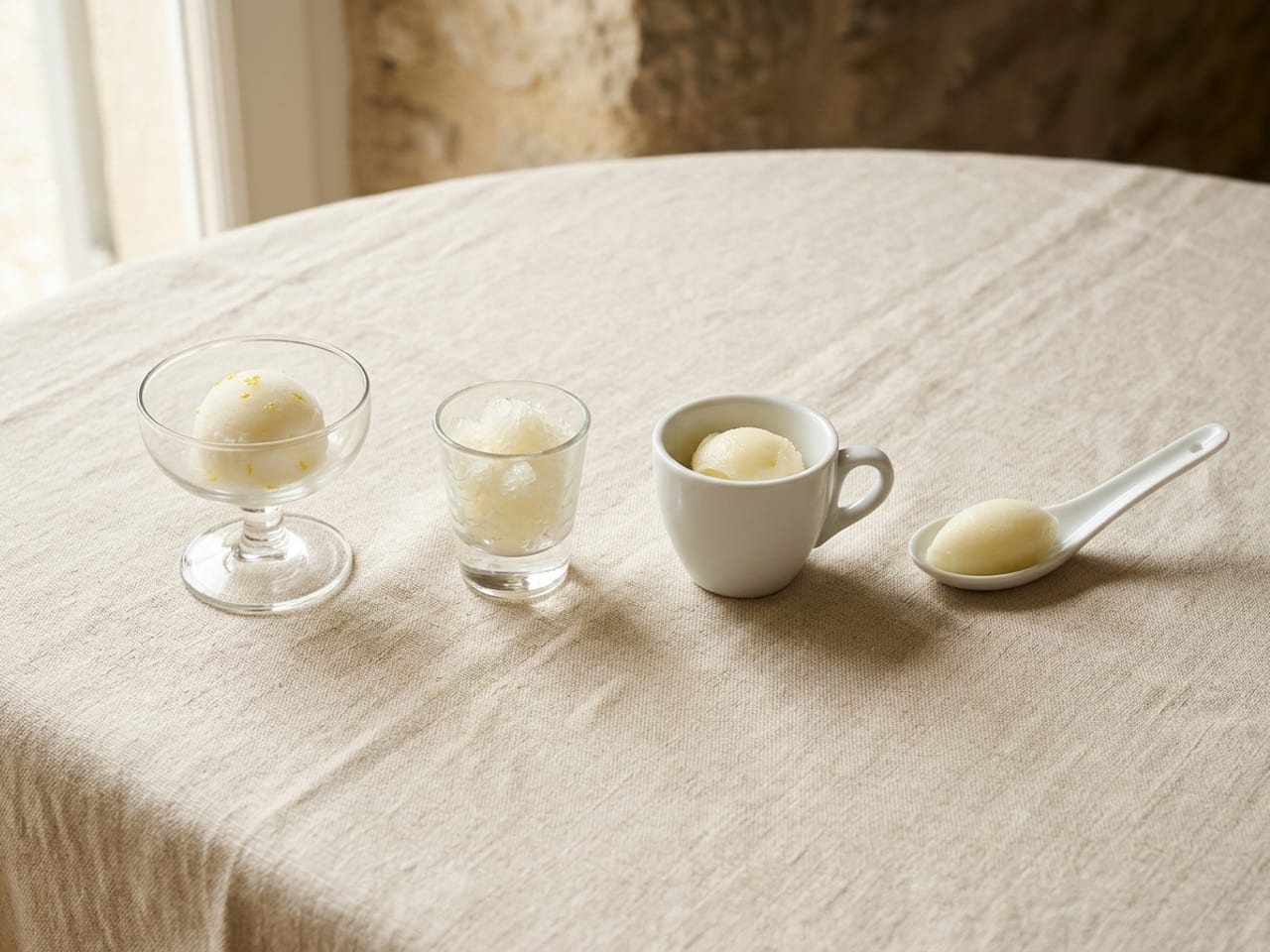
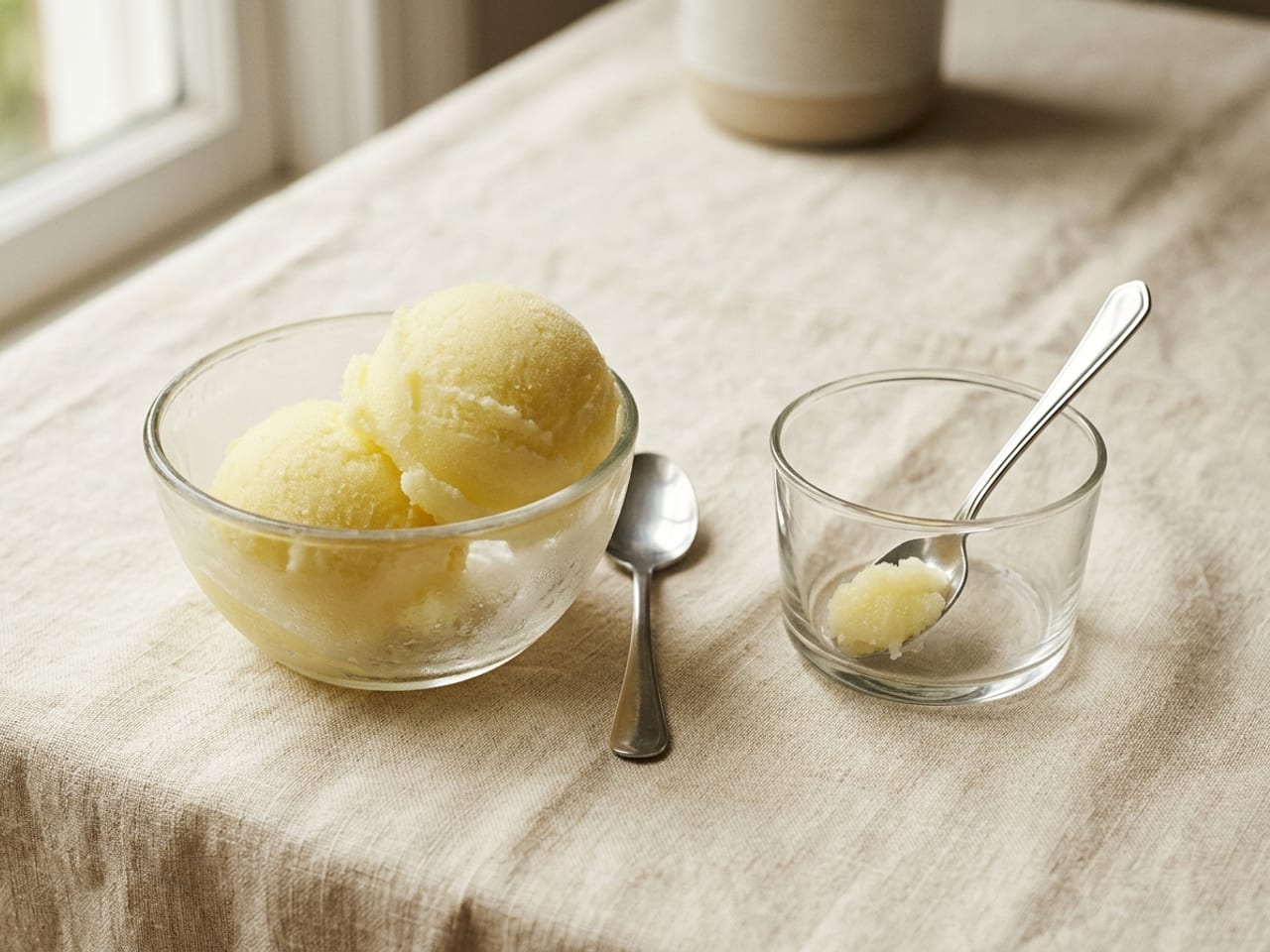
- Portion: one or two spoonfuls1 to 2 tablespoons (15 to 30 ml, roughly ½ to 1 oz or 15 to 30 g) per guest. The sources count in bites: "a spoonful of lemon sorbet", "only one or two bites", and for a pre-dessert "Two or three bites (four at the very maximum)".44, 45, 41 The one measured figure is Per Se's sorbet, 0.6 oz (17 g) on New York magazine's scale.51 Tyler Florence's intermezzo recipe works out to about 3½ tablespoons (50 ml).60 Escoffier allowed a quart for ten people, roughly 3 to 4 fl oz (95 to 115 ml) each, but his sherbet was soft enough to drink.18 At our size a quart (0.95 L) of sorbet makes 30 to 60 portions.
- Vessel: a small chilled glass on a saucerEscoffier set his sherbets "in Sherbet or Sherry glasses, shaping it to a point"; Ranhofer used handled glasses, "fancy cups" or "the peels of fresh fruits".18, 20 Modern recipes use a footed glass dish or a small wine or juice glass,49 a martini glass or coupe for sgroppino,63 a shot glass for the trou normand52 and shot or sherry glasses for tomato water.65 An espresso cup, The Nibble's demitasse, suits a soup or tea,49 and a porcelain tasting spoon holds a single quenelle (the spoon is our suggestion; none of our sources uses one). Stand the glass on a saucer with a small spoon; our guide to types of plates covers the rest.
- Temper sorbet, never granita"Allow the sorbet to sit at room temperature for five minutes to soften before serving."70 Our course meal builder says ten minutes in the fridge instead; that gentler version is ours, not a sourced one. Granita goes straight from the freezer to the glass after a last scrape with a fork.69 A sorbet with more than a spoonful of spirit in it melts fast and refreezes harder and icier, so scoop it straight from the freezer and put the tub back at once.54
- Shape: one quenelle or one small scoopFor a quenelle, dip two identical spoons in hot water, take a generous scoop and pass it between the spoons, turning and smoothing each side.72 Our quenelle guide shows how to quenelle with one spoon or two, and the plating techniques glossary has the move in context. A small disher (a #40 to #60 scoop holds roughly ½ to ¾ fl oz, 16 to 24 ml) or a melon baller lands in the same range; the choice of tool is ours.
- Garnish: one, or noneThe recipes we read use a few curls of lemon zest or a leaf of basil, mint or tarragon.56, 49 Our rule: one garnish at most, taken from the cleanser's own ingredients, and nothing creamy, crunchy-sweet or sauced. For the eye, the same discipline as Michelin-star plating: one small thing, placed once. The mint leaf on the green apple sorbet in our own picture is the one exception we would not repeat.
- What not to serveAnything too sweet: "The sorbet should be sharp in flavor, not sweet".48 Anything creamy or fatty, with the one exception of milk or lassi after chili: the fat and protein in cheese coat the taste buds, as Decanter puts it.79 Anything that lingers; the WSET's list of things to avoid before tasting (strongly flavored foods, toothpaste, coffee, chewing gum) ends "if it sticks around, it's not helping."78 And anything large: a pre-dessert, in Migoya's rule, "must be small".41
- The pause: clear first, then serveClear the plates of the last course, then bring the cleanser, so it arrives on an empty table. No modern source we read gives the pause in minutes. Our course meal builder allows 10 from the cleanser to the next course, and Ranhofer, in 1894, allowed "Ten to fifteen minutes" at the same point while the wine glasses were changed.20 Our run sheet: the cleanser is on the table within 2 to 3 minutes of scooping, eaten in 3 or 4, and the next course follows about 10 minutes after it was served.
The make-ahead plan
| When | What |
|---|---|
| A week to five days before | Churn the sorbet: it is best within a week, and one test kitchen says 5 days.54, 70 A canister machine needs its canister in the freezer for at least 24 hours, preferably 48, first.70 Gari can be made any time.66 Check that the freezer reads 0 °F (-18 °C) with a thermometer.122 Clear a flat shelf for the granita dish and room for the glasses (ours). |
| One to two days before | Make the granita. It holds up to 4 days,57 but a day or two keeps the flakes freshest (ours). The grapefruit granita is frozen for 8 to 24 hours, so make that one the day before.58 |
| The day before | Start the tomato water: 8 to 24 hours to drip,65 in the fridge (ours). Put the Calvados, vodka or Armagnac in the freezer, as the published trou normand recipe does,52 and the prosecco in the fridge. Decide what the guests who don't drink will get (ours). |
| The morning | If the granita has set hard, leave it out for a few minutes and rake it again.71 Pick and box the garnish leaves and zest, cut the citrus segments and count one glass, saucer and small spoon per guest (all ours). |
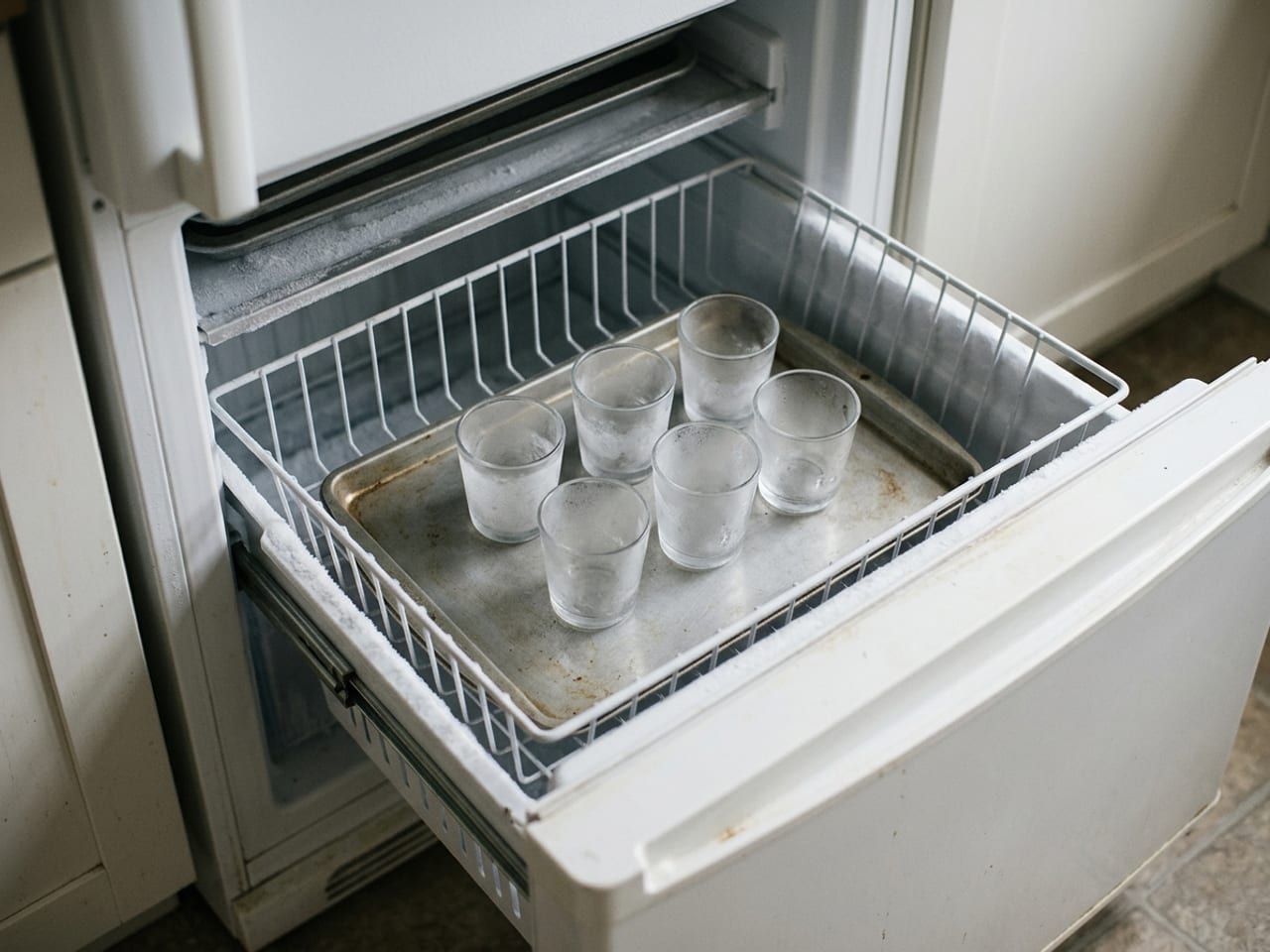
| One hour before the course | Glasses into the freezer: at least an hour for a frost, 15 minutes as a minimum.58, 64 |
| As the plates are cleared | Take the sorbet out for about 5 minutes70 and fill a jug with hot water for the spoons.72 Granita gets a last scrape and goes straight into the frozen glasses.69, 58 Sgroppino is whisked at the last second.64 For a trou normand, scoop first and pour the cold spirit at the table (the order is ours). Put the tub straight back in the freezer (ours). |
Steps marked "ours" are our own suggestions; the rest come from the cited recipes. For the rest of the evening, the dinner party menu planner builds a cooking timeline around your menu, and the prix fixe guide has a make-ahead plan for a whole tasting menu.
Palate cleanser safety
A cleanser is uncooked and often frozen, which hides two things: raw ingredients stay raw, and alcohol stays alcohol.
- Egg white: use pasteurized, and don't count on hot syrupRoman punch, spooms and Escoffier-style sorbets are lightened with Italian meringue, and the hot syrup does not cook the whites through. They "do not reach much above 125° F" (52 °C) unless the syrup is taken to the hard-ball stage, 250 to 266 °F (121 to 130 °C);117 a popular modern Punch Romaine recipe stops at 240 °F (115 °C).73 For any recipe served raw the FDA says to use pasteurized eggs or egg products, above all for children, older adults, pregnant women and people with weakened immune systems.116
- Alcohol: count it, and offer a cleanser with noneA US standard drink is 0.6 fl oz (14 g) of pure alcohol, the amount in a 1.5 fl oz (45 ml) shot of 40% spirits.118 By our arithmetic a trou normand of 1 oz (30 ml) is about two thirds of a standard drink, a full sgroppino from the recipe above about 1.2 (with prosecco at 11%), and a teaspoon or two of Calvados over sorbet 0.1 to 0.2. None of it is cooked, and frozen alcohol is still alcohol. A short simmer does not remove it either: the USDA's retention table still finds 40% of the alcohol after 15 minutes of simmering,129 so a sorbet made with alcoholic cider is not alcohol-free. "There is no known safe amount of alcohol use during pregnancy."119 Our advice: for children, pregnant guests, drivers and anyone who doesn't drink, serve a cleanser made with no alcohol at all, such as the lemon granita above (juice, sugar and water only) or a sorbet from a base with no vodka, gin or alcoholic cider in it. Say what is in each glass, because a sorbet does not look alcoholic.
- Unpasteurized juice: freezing does not fix itFresh-squeezed and juice-bar juices can carry bacteria from the fruit, and children, older adults, pregnant women and people with weakened immune systems risk serious illness from untreated juice.120 Freezing only puts microbes on hold: "Once thawed, however, these microbes can again become active".121 Wash the fruit and squeeze it yourself or buy pasteurized juice; for at-risk guests use pasteurized juice or a recipe that boils it, as the green apple sorbet does.
- Sulfites, dairy, egg and glutenProsecco, Champagne, wine and cider can contain sulfites; every wine sold in the United States with 10 parts per million or more of sulfur dioxide must say "Contains Sulfites".123 That covers sgroppino and Roman punch. US sherbet contains dairy by law (1 to 2 percent milkfat),37 and a sorbet can too: Per Se's was a buttermilk sorbet.51 Read the tub. Lassi and yogurt are dairy, Roman punch contains egg, and bread and crackers contain gluten; an apple slice and water do the same job at a tasting.74
- Acid and reactive metalThe FDA Food Code, as adopted in Minnesota's rules, bars copper and brass from contact with food below pH 6 "such as vinegar, fruit juice, or wine", and galvanized metal from contact with acidic food.124 Those are rules for food businesses, but they are sound at home: freeze lemon, grapefruit and wine mixtures in glass or stainless steel, and skip the copper mug for a sgroppino.
- Small childrenOne state child-care brochure lists whole grapes, raw vegetables and ice cubes among the foods not to serve to children under 4.125 No source we found addresses sorbet or granita, so this is our reading: skip frozen whole grapes, raw apple slices and hard chunks of ice for that age, and give a softened spoonful of alcohol-free sorbet.
Intermezzo meaning in food, and the palate cleanser's other names
Palate cleanser is a twentieth-century name, though not the newest: the menu sense of intermezzo and the pre-dessert are younger. Merriam-Webster's own entry for sorbet says "palate refresher".2 The earliest "palate cleanser" we could find is from 1901, describing a new coffee, and the phrase only became common in print in the 1980s.4, 5
What does intermezzo mean in food? On an American menu the intermezzo course is the small sorbet or ice between courses. The word is Italian for the interval between the acts of a play and the short piece that fills it,8 and English borrowed it for the stage and for music in 1771.9 An American hotel restaurant was printing it over the sorbet by 1976;10 neither Merriam-Webster nor the OED defines a food sense for it.9, 126 Treccani gives it no food sense either, so it is not "the Italian name for the sorbet course". A nineteenth-century menu could use its French cousin, intermède: Delmonico's printed it above the sorbet on the menu of its dinner for Charles Dickens, although Ranhofer's own rule was to give the ice no heading at all.20
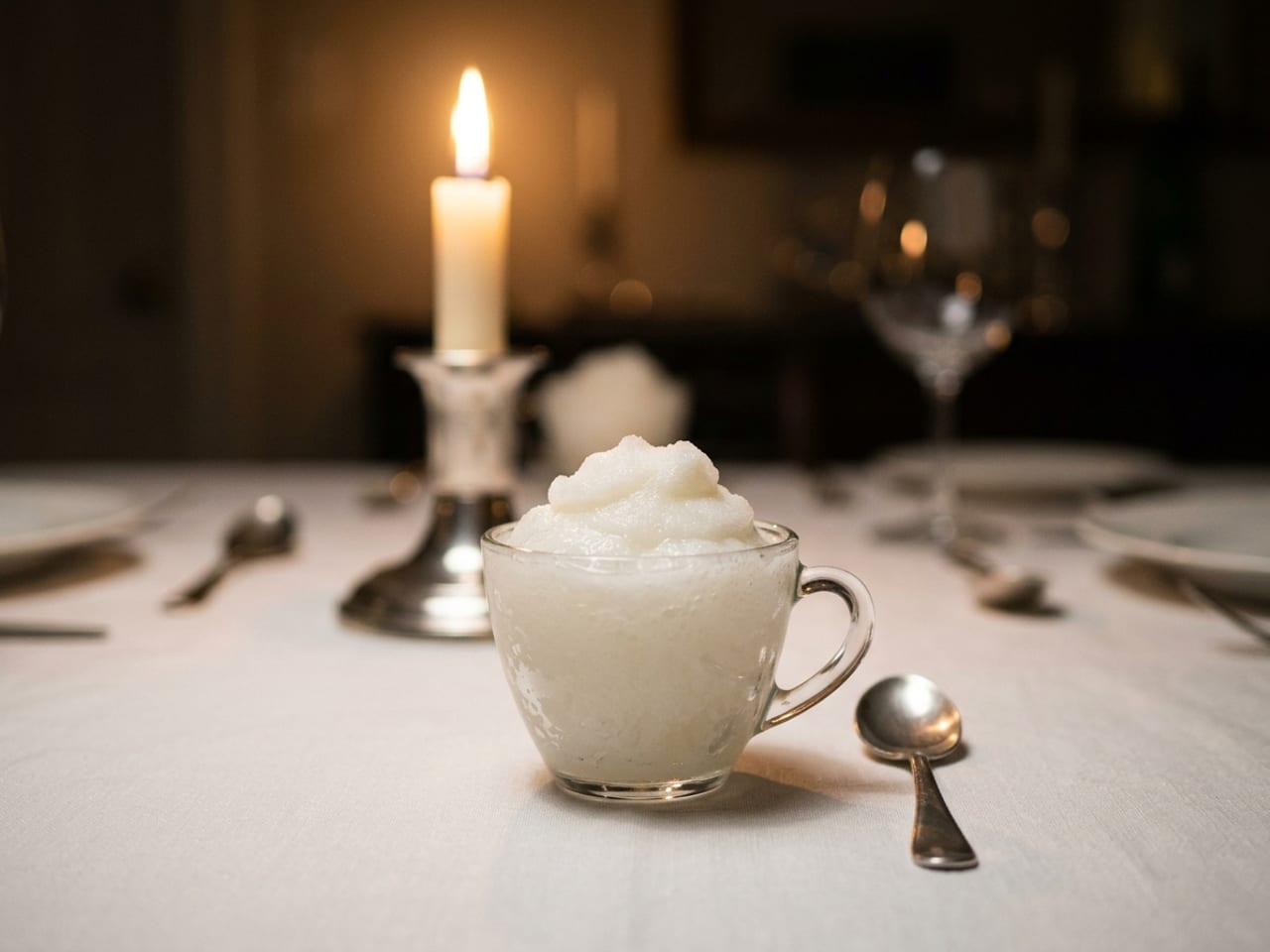
Trou normand. In Normandy this was a small glass of brandy, today Calvados, drunk between the courses of a long feast. A French book of 1841 already describes it, and Maupassant put it in a wedding banquet in a story of 1882.12, 13 The name is usually explained as a "hole" dug to make room. The Trésor de la langue française files it under another meaning of trou: a gap, a pause.11 By 1877 a French cookbook said sorbets were served at the moment when, formerly, one made the trou normand.14 Today's scoop of apple or pear sorbet with Calvados poured over it combines the old drink and its replacement.47
Coup du milieu, Roman punch, the sorbet course. Paris had its own mid-meal glass, the coup du milieu, which Grimod de La Reynière named in 1806 and described in full in 1808.127, 15 The ice that took over was often a punch à la romaine: in Ranhofer's recipe, "one quart of lemon water ice" with Italian meringue, rum and Champagne.20 An American cookbook of 1887 still says its Roman punch "is usually served at dinners as a coup de milieu."25 A French writer of 1927 calls the sorbet a refined invention to replace a coup du milieu or trou normand that had become a little too rough for city stomachs,16 and Larousse Gastronomique says simply: "The coup du milieu was replaced by sorbets".17
Sgroppino, pre-dessert and two Japanese words. Sgroppino is a regional Italian word for lemon sorbet taken with vodka or sparkling wine.32 A pre-dessert is the small course before the main dessert.41 Japanese has two words for the idea: hashiyasume, "a rest for the chopsticks", is any small sharp dish between richer ones; hashiarai, "chopstick wash", is the small cup of barely seasoned broth in a kaiseki meal.38, 39
Not entremets. Several websites say palate cleansers are "also known as entremets". The word means "between the dishes", but it was a medieval side dish or spectacle and is now a sweet.34
| Name | Language and literal sense | Earliest use we could date |
|---|---|---|
| Palate cleanser | English, from the idiom "cleanse the palate" | 1901, about coffee (earliest we found) |
| Intermezzo | Italian: the short piece played between the acts of an opera | 1771 in English, for the stage and music; 1976 on a menu (earliest we found) |
| Trou normand | French: literally the Norman hole; the Trésor de la langue française files it as a gap or pause | 1841 (earliest we found) |
| Coup du milieu | French: the drink in the middle of the meal | 1806, in Grimod's Almanach des gourmands; described in full in 1808 |
| Sorbet | French, probably through Italian sorbetto, from Turkish şerbet, from the Arabic for a drink | 1553 in French, as a drink; 1864 for the ice in Merriam-Webster |
| Sherbet | The same word as sorbet in nineteenth-century kitchen English | used for sorbet in cookbooks of 1894 and 1907 |
| Granita | Italian, from granire, for the grainy look of the ice | 1869 in English (Merriam-Webster); as granité in Escoffier, 1903 |
| Sgroppino | Regional Italian, probably from sgroppare, to undo a knot | not dated here; the origin stories are unverified |
| Roman punch | English; punch à la romaine in French | 1813 in English |
| Entremets | Old French: between the dishes | early 1200s as a dish |
| Pre-dessert | English; avant-dessert in French | common in English from the 1990s |
| Gari | Japanese sushi-counter slang, from the crunch of biting it | not dated here |
| Hashiyasume | Japanese: a rest for the chopsticks | not dated here |
| Hashiarai | Japanese: chopstick wash | not dated here |
Where the palate cleanser came from
It began as a drink, and its job was the stomach. Grimod's coup du milieu of 1808 was a small glass of bitter liqueur or spirits taken as a stomach tonic.15 When the sorbet replaced it, the explanation stayed the same. Escoffier: sherbets "serve in freshening the stomach; preparing it to properly receive the roast."18 Ward McAllister, writing about New York society dinners in 1890, called the sorbet "a digestive" that "produces on the mind the effect that the dinner is finished, when the grandest dish of the dinner makes its appearance".23 None of the three writes about taste. The palate first turns up in our sources in 1884, in an etiquette book that still pairs it with the stomach.22 "Cleansing the palate" as the whole point of the course is later language laid over an older custom, and the digestive claim it replaced has no support either: where alcohol with a meal has been tested, it slowed the stomach (see the research).
It was already old-fashioned by 1922, when Emily Post confined Roman punch to public dinners,26 and by 1976 an American hotel menu was listing it again under a new name, the intermezzo.10 In today's tasting menus the small cold course sits before dessert.
| Year | What happened |
|---|---|
| 1553 | Sorbet enters French as a Turkish drink of lemon, sugar and water cooled with snow, not a frozen dish.35 |
| 1690s | The first books on frozen sorbetti appear in Naples, written for aristocratic households. Through the 1700s and 1800s cafés and street vendors sell them there as a refreshment.36 None of our sources puts one in the middle of dinner before the nineteenth century. |
| 1808 | Grimod de La Reynière describes the coup du milieu, newly arrived in Paris from Bordeaux: one small glass of bitter liqueur or spirits immediately after the roast, taken as a stomach tonic, and only ever one per dinner.15 He had already named it, in the same place after the roast, in his Almanach des gourmands two years earlier.127 |
| 1813 | "Roman punch" appears in English.31 |
| 1841 | A French portrait of the provinces records that at Norman banquets a glass of eau-de-vie is drunk between each service and is called a trou normand: the earliest use of the name we found.12 |
| 1877 | A French household manual says sorbets are served at the moment when, formerly, one made the trou normand.14 In the US, Mary Henderson gives Roman punch a course of its own: "It is a refreshing arrangement, preparing one for the game which comes after".21 |
| 1884 | M. E. W. Sherwood writes that Roman punch "prepares the palate and stomach for the canvas-back ducks or other game", the earliest of our sources to mention the palate at all, and that it arrives "in the heart of a red, red rose, or in the bosom of a swan, or the cup of a lily".22 |
| 1886 | A Washington journalist claims that at the Hayes White House rum-laced punch was first hidden in oranges and then, as Roman punch, served "about the middle of the state dinners", a moment guests named "the Life-Saving Station".27 Hayes answered in his diary that the punch was only rum-flavored: "There was not a drop of spirits in them!"28 The story is disputed.29 Either way, the punch came mid-dinner. |
| 1894 | Charles Ranhofer of Delmonico's files the punch or sherbet under "Interval": the white wine glasses are swapped for Burgundy glasses, cigarettes may be handed round if no ladies are present, and "Ten to fifteen minutes must now be allowed between the courses."20 |
| 1901 | The earliest "palate cleanser" we found, and it is about coffee: one taster of a new Congo coffee "described its effect as that of a 'palate cleanser.'"4 |
| 1903 | Escoffier's Guide culinaire, in the words of its 1907 English edition: sherbets are "served after the Entrées. They serve in freshening the stomach; preparing it to properly receive the roast."19, 18 Nothing about taste. |
| 1912 | The first-class dinner menu of the Titanic for 14 April lists punch romaine after the roasts and before the roast squab.30 Calling it "the sixth course" is a modern count; the card carries no course numbers. |
| 1922 | Emily Post declares the custom dead in private houses: a dinner "interlarded with a row of extra entrées, Roman punch, and hot dessert is unknown except at a public dinner, or in the dining-room of a parvenu."26 |
| 1950 | The figurative sense is in print: a novel of that year calls married life "the perfect palate-cleanser."6 |
| 1976 | A Hilton Hawaiian Village restaurant advertises a "Guava Sorbet Intermezzo" between the salad and the prime rib: the earliest menu use of the word we found.10 |
| 1980s | "Palate cleanser" becomes about seven times more frequent in print than in the 1970s.5 |
| 1990s | "Pre-dessert" takes off in English.5 In tasting menus the small cold course now sits before dessert, not before the roast (our reading).41 |
Palate cleanser vs amuse-bouche, pre-dessert and digestif
| Course | When | Size | What it is |
|---|---|---|---|
| Amuse-bouche | Before the first course | One or two bites | A small complimentary appetizer, sent out by the kitchen before the meal.42 |
| Palate cleanser | Between courses, or just before dessert | One or two spoonfuls | Something neutral, sharp or cold that marks a pause before a change of flavor. |
| Trou normand | Between the courses of a long meal | A small glass | Apple brandy, or apple sorbet with apple brandy poured over.46 |
| Pre-dessert | After the last savory course, before the main dessert | Two or three bites | A small dessert that does not have to be sweet.41 |
| Digestif | After the meal | A glass | "an alcoholic drink (such as brandy or a liqueur) usually taken after a meal".43 |
An amuse-bouche opens the meal and a palate cleanser interrupts it; a small granita can do either job, which is why the two get confused. The pre-dessert is the cleanser's modern descendant in restaurant tasting menus, the kind our guide to what Michelin stars mean describes.
Palate cleansers for tastings: wine, olive oil, cheese and sushi
Professional tasters do not reach for sorbet. Olive oil panels chew a slice of apple and rinse with water, wine competition rules put a carafe of cold water and pieces of bread on every judge's table, and the ISO sensory standard suggests water and unsalted crackers.
| Tasting | What the protocol or the trade uses | What the evidence says |
|---|---|---|
| Olive oil | A small slice of apple, chewed and spat out, then water at room temperature; at most four oils a session and 15 minutes between sessions.74 | No published comparison found. The apple is there by convention. |
| Wine | Competition rules give each judge "a carafe of cold water" and "pieces of bread".76 A WSET blog post suggests "a small piece of plain bread" if needed,78 and Decanter's tasting events serve plain crackers and water.79 | No cleanser stops tannin building up; crackers slowed it most in one test and were worst for telling wines apart in another. A longer gap between sips helped in one experiment.86, 91, 96 |
| Cheese with wine | Tempting between wines, but Decanter explains why it flatters them.79 | Cheese mutes a wine a little: in a trained-panel study of eight cheeses and eight reds, wines tasted after cheese were less astringent and less oaky, whichever wine it was.95 |
| Beer | "Use water and French-style bread or unsalted crackers between entries to cleanse the palate."77 | One nine-person panel included beer among its six drinks: vanilla ice cream eased the alcohol burn most, with water crackers a little behind. We found no comparison for beer's bitterness.93 |
| Whisky and other spirits | The same kit as wine: plenty of water and plain, unflavored crackers, in one bourbon historian's advice.83 | In a nine-person panel vanilla ice cream eased alcohol burn most, with water crackers a little behind and plain water among the least effective. Leaving more time also worked.93 |
| Cheese | "Sliced apple is always provided by the organisers," says a judge at the International Cheese Awards.80 | No comparison found. |
| Sushi | A piece of gari between kinds of fish, used sparingly and never on the sushi.81, 82 | We found no test. A compound in ginger boosts a salivary enzyme that clears some sulfur aromas, but that was pure 6-gingerol, not pickled ginger.109 |
| Coffee | None named: the cupping protocol we read covers water, spoons and timing only.84 | No cleanser comparison found for coffee. |
| Any food panel | "Still and carbonated water and bland foods (for example, unsalted crackers)", with care that they don't change the flavor of what comes next.75 | A cracker with water was the only cleanser that worked across seven foods in one test; three others found nothing beat water or no cleanser.85, 88, 89, 90 |
| Perfume | A jar of coffee beans on the counter. | In the one published test we found, coffee beans did no better than lemon slices or plain air.110 |
Ten palate cleanser myths
- Myth: sorbet resets your taste budsWe found no test of a sorbet served between the courses of a meal, and the chefs who codified the course never claimed it: Escoffier's reason was the stomach, and Ranhofer's was an interval.18, 20 What tests do show is in the research section. A sorbet earns its place as a pause.
- Myth: the trou normand digs a hole to help you digestThat is how the name is usually explained. The Trésor de la langue française files it under another meaning of trou: a gap, a pause. It is the Norman break, although the same entry repeats the old belief that the glass helps digestion.11 And in controlled studies alcohol with a meal slowed the stomach; a dietitian quoted by France 3 calls the digestive benefit a myth.112, 113, 47
- Myth: palate cleansers are also called entremetsThe word means "between the dishes", which is where the confusion starts. It was a medieval side dish or spectacle, then the dishes served between the roast and the dessert, and in modern French it is a sweet.34
- Myth: lemon sorbet was invented as a palate cleanserSorbet was a drink in 1553, the first books on frozen sorbetti came out of aristocratic kitchens in Naples in the 1690s, and cafés and street vendors sold it there through the 1700s and 1800s.35, 36 Its mid-dinner job dates from the nineteenth century, and then it was usually a wine, liqueur or rum ice, not plain lemon.14, 18
- Myth: sparkling water scrubs the tongue cleanIn the tests so far fizz has not out-cleaned still water. It lowered the bitterness of cream cheese without helping tasters tell samples apart, it did not clear wine tannin where milk did, and it was among the least effective drinks for chili burn.88, 92, 101
- Myth: cheese is a good palate cleanser for wineCheese flatters wine. Its fat and protein blunt tannin, which hides the faults of a poor wine and some of the character of a good one,79 and in a trained-panel study of eight cheeses and eight reds, tasting cheese first made the wines a little less astringent and less oaky, whichever wine it was.95
- Myth: the ginger goes on the sushiGari is eaten between pieces, sparingly. A chef quoted by the MICHELIN Guide calls it a palate cleanser "in between sushi bites", and Sushi Yasuda's house rules say to avoid putting it on the sushi,81, 82 and the name itself is counter slang for the crunch of biting it.40
"Palate cleanser" as a figure of speech
People call a light book, show or song a palate cleanser when it comes after a heavy one. Wiktionary gives that sense as "Anything that serves as a temporary break or variation from the norm."3 It is not new: a 1950 novel already calls married life "the perfect palate-cleanser."6 Japanese has the same double meaning. Kuchinaoshi is both something eaten to take a taste away and something done to change your mood after a bad experience.7
Plate the courses on either side of it
The cleanser is the easy plate of the night. For the ones around it, photograph a dish you cooked and Plate Artists re-plates your own dish the way a restaurant would, with the moves named so you can repeat them. The plating techniques glossary explains each one.
Your dish, plated like a chef's
Snap it, upload it, and get the composed version back, with the steps to recreate it at home.
Start free · 1 enhancement →Free account · 1 free enhancement · No credit card
Palate cleanser terms, defined
Palate cleanser · palate refresher
A small, sharp, usually cold bite or sip served between the courses of a meal, or between samples at a tasting, as a pause before a change of flavor.
Intermezzo
The American menu word for the small sorbet or ice served between courses, borrowed from the Italian for an interlude between the acts of an opera; neither Merriam-Webster nor the OED defines a food sense for it.
Trou normand
In Normandy, a small glass of brandy, today Calvados, drunk between the courses of a long meal, in print by 1841 and today often served as apple or pear sorbet with Calvados poured over.
Coup du milieu
A single small glass of bitter liqueur or spirits drunk straight after the roast at grand French dinners, described by Grimod de La Reynière in 1808 as a stomach tonic and later replaced by sorbets.
Sorbet
A light ice of water or fruit juice and sugar, sometimes with a liqueur; the word arrived in French in 1553 as a Turkish drink cooled with snow, and in Escoffier's kitchen a sorbet was still soft enough to drink.
Sherbet
Historically the same thing as sorbet; in the United States today it is a fruit ice that by law contains 1 to 2 percent milkfat, so it is a dairy product.
Granita · granité
A coarse ice made by stirring or scraping a sweetened juice as it freezes into tiny crystals, with less sugar than a sorbet and no machine.
Sgroppino
A regional Italian drink of lemon sorbet whisked with vodka, sparkling wine or both, taken as a digestive, a dessert or a palate cleanser.
Roman punch · punch à la romaine
A nineteenth-century frozen punch of lemon or wine ice mixed with Italian meringue and rum or Champagne, served in glasses after the entrées and before the roast at formal dinners.
Entremets
Literally "between the dishes": in medieval France a side dish or a spectacle staged mid-banquet, later the dishes served between the roast and the dessert, and today a sweet; it is not a palate cleanser.
Pre-dessert · avant-dessert
A small dessert of two or three bites served before the main dessert as a bridge between the last savory course and the sweet ones; it does not have to be sweet.
Gari
Thin slices of young ginger pickled in sweetened vinegar, served with sushi and eaten between pieces to refresh the mouth, not as a topping.
Hashiyasume
Any small dish, such as something vinegared or a dressed salad, eaten partway through a Japanese meal to change the mood or refresh the mouth.
Hashiarai
The small cup of very lightly seasoned clear soup served between dishes in a kaiseki meal to refresh the mouth.
Palate cleansers, answered
What is a palate cleanser?
A palate cleanser is a small, sharp, usually cold bite or sip served between courses as a pause before a change of flavor. The classic is one or two spoonfuls of tart sorbet or granita. It is also called an intermezzo or sorbet course, and a slice of apple or a sip of tea can do the same job.
What is the palate cleanser between courses called?
In English it is the palate cleanser or sorbet course, and on American menus, since at least 1976, the intermezzo. In France the older custom is the trou normand, a glass of brandy that sorbet later replaced. A small sweet course just before dessert is a pre-dessert. Entremets is not the word: today it means a sweet dish.
When should you serve a palate cleanser?
Serve it once, at the biggest change of gear. Escoffier put the sorbet after the entrées and before the roast, Normandy puts its trou normand between fish and meat, and restaurants now serve a pre-dessert. At a home dinner we suggest after the main course and before dessert, or between two meat courses.
Is sorbet a dessert or a palate cleanser?
Both: it is the same food at a different size and sharpness. As a dessert it is a full scoop or two and can be sweet. As a palate cleanser it is one or two spoonfuls, 1 to 2 tablespoons (15 to 30 ml), tart more than sweet, and served mid-meal or just before dessert.
Do palate cleansers actually work?
Partly, and it depends on what you just ate. In taste-panel tests a plain cracker with water kept ratings steadiest across foods, milk calmed chili burn, and nothing fully stopped red-wine astringency building. We found no test of a sorbet served inside a real dinner, so its proven value is the pause.
What is a good palate cleanser besides sorbet?
A lemon or grapefruit granita, which needs no machine. For something that is not frozen, try chilled tomato water in a small glass, two or three citrus segments, a few sips of mint tea, or a salty lassi after a spicy course. At a tasting, a slice of tart apple, plain crackers and water are the standard.
How much sorbet do you serve as a palate cleanser?
One or two spoonfuls: 1 to 2 tablespoons (15 to 30 ml) per guest. Per Se's sorbet weighed 0.6 oz (17 g) when New York magazine put its tasting menu on a scale, and one recipe written as an intermezzo works out to about 3½ tablespoons (50 ml). A quart (0.95 L) serves about 30 guests at 2 tablespoons each.
What do you serve a palate cleanser in?
A small chilled glass on a saucer. Escoffier used sherbet or sherry glasses; modern writers use a coupe, a small wine glass, a shot glass or an espresso cup. Put the glasses in the freezer for 15 minutes to an hour first, add one small scoop or quenelle, and give each guest a small spoon.
What does intermezzo mean on a menu?
On an American menu an intermezzo is a small sorbet or ice served between courses as a palate cleanser. The word is Italian for the short piece played between the acts of an opera. The earliest menu use we found is from 1976, and neither Merriam-Webster nor the OED defines a food sense for it.
What is a trou normand, and does it help digestion?
A trou normand is a small glass of Calvados, Normandy's apple brandy, drunk between the courses of a long meal, today often poured over apple sorbet. It is a pause, not a digestive aid: in controlled studies alcohol taken with a meal slowed stomach emptying. The only registered trial of it we found had posted no results by October 2026.
Is an amuse-bouche the same as a palate cleanser?
No. An amuse-bouche opens the meal: one savory bite the chef sends out before the first course. A palate cleanser comes later, between courses or just before dessert, and is meant to be neutral, sharp or cold. A small granita can do either job, which is why the two get confused.
What is the best palate cleanser for wine tasting?
Water and a piece of plain bread or an unsalted cracker, with time between glasses. That is what international wine competition rules put on every judge's table. In panel tests crackers slowed the build-up of red-wine astringency more than water, but no cleanser stopped it, and cheese mutes a wine instead of cleansing.
Is pickled ginger a palate cleanser for sushi?
Yes, by custom. Gari, thin sweet-pickled ginger, is eaten between pieces of sushi to refresh the mouth before the next fish, not laid on top. A chef quoted by the MICHELIN Guide calls it a palate cleanser between bites, and Sushi Yasuda's house rules say not to put it on the sushi. We found no lab test of it.
What does "palate cleanser" mean when people say it about a book or a show?
Figuratively, a palate cleanser is anything that gives a short break or a change from the norm: a light novel after a heavy one, a comedy between two dramas. Wiktionary records that sense, and writers were using it by 1950. It is spelled palate; palette cleanser and pallet cleanser are misspellings.
The books, standards, recipes and research behind this guide
Dictionaries and primary texts read in scans (Grimod 1808, Ranhofer 1894, Escoffier 1903 and 1907, Post 1922) for the names and the history, with two lending-library books read only as search fragments and marked as such; published recipes for every method, quoted with their own quantities and not kitchen-tested by us; official tasting protocols; peer-reviewed sensory and physiology papers verified through Crossref, with a PMID where PubMed indexes them; and US government pages for food safety. "Earliest we found" means exactly that, not first ever. Figures marked as our arithmetic are calculated from the quantities the sources print.
- Merriam-Webster (n.d.). Cleanse the palate. Merriam-Webster.com Dictionary, the idiom defined, with a sorbet example; no date of first use given. merriam-webster.com
- Merriam-Webster (2026). Sorbet. Merriam-Webster.com Dictionary, read in an Internet Archive capture of 18 May 2026; "palate refresher", first known use of the ice sense 1864. merriam-webster.com (archived)
- Wiktionary (n.d.). Palate cleanser. en.wiktionary.org, crowd-sourced; used here only for the wording of the literal and the figurative sense. en.wiktionary.org
- Planting Opinion (1901). Memo from the Royal Gardens, Kew, on Coffea robusta. Planting Opinion, vol. VI (Madras: Higginbotham & Co.), near the issue of 30 November 1901; the earliest "palate cleanser" we found, in quotation marks, about coffee. archive.org
- Google Books (2019). Ngram Viewer: palate cleanser. Google Books Ngram Viewer, English 2019 corpus, decade means; also read for "intermezzo course", "Roman punch" and "pre-dessert"; single early hits are noisy. books.google.com
- Tey, J. (1950). To Love and Be Wise. Pocket Books (1951 printing), read as a full-text search fragment only; an early figurative "palate-cleanser". archive.org
- Kotobank (n.d.). 口直し (kuchinaoshi). Daijisen, via kotobank.jp, the Japanese word carries the same two senses, a change of taste and a change of mood. kotobank.jp
- Treccani (n.d.). Intermezzo. Vocabolario Treccani, an interval between acts, and the short piece that fills it; no food sense. treccani.it
- Merriam-Webster (2026). Intermezzo. Merriam-Webster.com Dictionary, read in an Internet Archive capture of 14 September 2026; first known use 1771; stage and music senses plus "a usually brief interlude or diversion", no food sense. merriam-webster.com (archived)
- Hilton Hawaiian Village (1976). Restaurant advertisement listing a "Guava Sorbet Intermezzo". Hawaii Architect (AIA Honolulu), October 1976; the earliest menu use of intermezzo for the sorbet course that we found. archive.org
- Trésor de la langue française informatisé (n.d.). Trou. CNRTL, trou normand filed under the sense "moment of interruption"; cited here only for that classification, because the definition itself says the glass is taken to ease digestion; with the Académie's 1935 entry. cnrtl.fr
- Les Français peints par eux-mêmes (1841). Le Normand. Province, tome 2. Paris: L. Curmer, p. 139; a glass of eau-de-vie between each service, "called a trou normand"; the earliest use we found. gallica.bnf.fr
- Maupassant, G. de (1883). Farce normande. Contes de la bécasse (Project Gutenberg), first printed in Gil Blas, 8 August 1882; a Norman wedding feast with a glass of eau-de-vie between each dish. gutenberg.org
- Dumont, É. (dir.) (1877). La bonne cuisine française. Paris: Degorce-Cadot, p. 632; sorbets served with the roast, "at the moment when, formerly, one made the trou normand". gallica.bnf.fr
- Grimod de La Reynière (1808). Manuel des amphitryons. Paris: Capelle et Renand, pp. 296–297; the coup du milieu, one small glass of bitter liqueur or spirits straight after the roast, only ever one. gallica.bnf.fr
- Des Ombiaux, M. (1927). Le nobiliaire des eaux-de-vie et liqueurs de France. Read on Gallica, the sorbet as a refined replacement for the coup du milieu and the trou normand. gallica.bnf.fr
- Larousse Gastronomique (1961). Trou du milieu or coup du milieu. Larousse Gastronomique, English edition (first French edition 1938), p. 968, read as a full-text search fragment only; "The coup du milieu was replaced by sorbets". archive.org
- Escoffier, A. (1907). A Guide to Modern Cookery. London: William Heinemann, nos. 2926 to 2933, pp. 813–815; sherbets, granités and punch à la romaine, when they are served and how much. archive.org
- Escoffier, A. (1903). Le Guide culinaire. Paris: L'Art culinaire, first edition, read on Gallica, p. 749; the French original of the sorbet passage (p. 1186 in the second edition of 1907). gallica.bnf.fr
- Ranhofer, C. (1894). The Epicurean. New York, pp. 1–2, 7–8, 10–11, 1000–1002 and the Delmonico's menus on pp. 1084–1087 and 1091; the punch or sherbet as the interval before the roast. archive.org
- Henderson, M. F. (1877). Practical Cooking and Dinner Giving. New York: Harper & Brothers (Project Gutenberg), Roman punch as a course just after the beef, and sometimes before the soup. gutenberg.org
- Sherwood, M. E. W. (1887). Manners and Social Usages (first published 1884). New York: Harper & Brothers (Project Gutenberg), chs. XXX and XXXI; Roman punch "prepares the palate and stomach" for the game; both passages are already in the first edition of 1884. gutenberg.org
- McAllister, W. (1890). Society as I Have Found It. New York: Cassell (Project Gutenberg), the sorbet before the roast canvasbacks, "a digestive, and is intended as such". gutenberg.org
- Farmer, F. M. (1910). The Boston Cooking-School Cook Book (revised edition, 1910 printing). Boston: Little, Brown (Project Gutenberg), "A Full Course Dinner": the punch always precedes the game course. gutenberg.org
- Gillette, F. L., & Ziemann, H. (1887). The White House Cook Book. Project Gutenberg, Roman Punch No. 2, "usually served at dinners as a coup de milieu". gutenberg.org
- Post, E. (1922). Etiquette in Society, in Business, in Politics and at Home. New York: Funk & Wagnalls (Project Gutenberg), ch. XIV, "Formal Dinners"; Roman punch as a thing of public dinners and parvenus. gutenberg.org
- Poore, B. P. (1886). Perley's Reminiscences of Sixty Years in the National Metropolis, vol. 2. Project Gutenberg, the "Life-Saving Station" story at the Hayes White House: frozen rum punch hidden in oranges, then Roman punch in glasses. gutenberg.org
- Williams, C. R. (1914). The Life of Rutherford Birchard Hayes, vol. 2. Boston: Houghton Mifflin, Hayes's diary for 10 January 1887, denying that the punch held any spirits. archive.org
- Hopkins, C. (n.d.). Lucy Hayes, Temperance, and the Politics of the White House Dinner Table. White House Historical Association, a steward "supposedly concocted" the punch. whitehousehistory.org
- Evans, S. (2025). Last Meal on Titanic. History.com, 14 April 2012, updated 28 May 2025; punch romaine midway through the first-class dinner of 14 April 1912. history.com
- Oxford English Dictionary (n.d.). Roman punch, n. OED Online (free summary), earliest evidence 1813, in the writing of the poet Thomas Moore. oed.com
- Treccani (n.d.). Sgroppino. Vocabolario Treccani, regional; lemon sorbet taken as a digestive with vodka or sparkling wine; probably from sgroppare, to undo a knot. treccani.it
- Treccani (n.d.). Granita. Vocabolario Treccani, a kind of sorbet stirred as it freezes into a mass of tiny ice crystals. treccani.it
- Trésor de la langue française informatisé (n.d.). Entremets. CNRTL, with the Littré and Académie entries: a medieval side dish or spectacle, then the dishes between roast and dessert, today a sweet. cnrtl.fr
- Trésor de la langue française informatisé (n.d.). Sorbet. CNRTL, 1553 as a drink of lemon, sugar and water cooled with snow; 1782 as a frozen item. cnrtl.fr
- López, A. (2020). How long has everyone screamed for ice cream? National Geographic History, 9 July 2020 (July/August issue); the first sorbetti books in Naples, 1690 and 1692 to 1694; cafés and street vendors in the eighteenth and nineteenth centuries. nationalgeographic.com
- US Food and Drug Administration (n.d.). 21 CFR 135.140: Sherbet. Electronic Code of Federal Regulations, the US standard of identity: 1 to 2 percent milkfat, 2 to 5 percent total milk solids. ecfr.gov
- Kotobank (n.d.). 箸休め (hashiyasume). Daijisen and a cuisine dictionary, via kotobank.jp, a small dish eaten partway through a meal to change the mood or refresh the mouth. kotobank.jp
- Kotobank (n.d.). 箸洗い (hashiarai). Daijisen and a cuisine dictionary, via kotobank.jp, the small cup of very lightly seasoned clear soup in a kaiseki meal. kotobank.jp
- Kotobank (n.d.). がり (gari). Nihon Kokugo Daijiten, via kotobank.jp, sushi-shop word for ginger, from the crunch of biting it. kotobank.jp
- Migoya, F. (2012). The Elements of Dessert: Pre-desserts. The Culinary Institute of America / Wiley (read on ckbk), two or three bites, a bridge between the last savory course and the sweet ones. ckbk.com
- Merriam-Webster (2026). Amuse-bouche. Merriam-Webster.com Dictionary, read in an Internet Archive capture of 31 July 2026; first known use 1959. merriam-webster.com (archived)
- Merriam-Webster (2026). Digestif. Merriam-Webster.com Dictionary, read in an Internet Archive capture of 16 May 2026; first known use 1909. merriam-webster.com (archived)
- Mowry, A. (2009). Tastebud: an encore for the intermezzo. archive.jamesbeard.org, James Beard Foundation blog, 1 June 2009; an "icy interlude"; sorbets, granitas and other ices, usually sharp citrus. archive.jamesbeard.org
- Lange, C. (2013). A brief history of the palate cleanser. The Daily Meal, 21 June 2013; "one or two bites", served about halfway through a long meal or just before the entree. thedailymeal.com
- Normandie Tourisme (2025). Unveiling the secrets of the Trou Normand. en.normandie-tourisme.fr, updated February 2025; between the fish and meat courses, sometimes before the cheese; apple sorbet added to the Calvados. normandie-tourisme.fr
- Singh, K., & Ormain, F. (2025). Boire un trou normand en plein milieu d'un repas, est-ce que ça aide vraiment à digérer ? France 3 Normandie (franceinfo), 24 December 2025; a dietitian on why it is a festive tradition, not a digestive aid; apple or pear sorbet with the Calvados today. franceinfo.fr
- Franklin, R. (2020). Traditional French palate cleansers. thespruceeats.com, 11 October 2020; "sharp in flavor, not sweet"; lightly brewed tea with minimal sweetener. thespruceeats.com
- The Nibble (2023). Palate cleanser: a way to refresh your taste buds between courses. blog.thenibble.com, 22 June 2023; glassware, citrus, cucumber water and herbs. thenibble.com
- Auguste Escoffier School of Culinary Arts (2024). What are palate cleansers? escoffieronline.com, updated 1 February 2024; milk and yogurt after spicy food, a go-between before dessert. escoffieronline.com
- New York Magazine (2007). Lab test: Per Se's nine-course tasting menu. New York, weight and calories of every course; the buttermilk sorbet weighed 0.6 oz (17 g). nymag.com
- Morrissey, S. (n.d.). Trou Normand (recipe from Le Veau d'Or, New York). Punch, equal parts fresh-pressed Granny Smith juice and freezer-cold blanche Armagnac in a shot glass. punchdrink.com
- Falkowitz, M. (n.d.). Rich, tart lemon sorbet. Serious Eats, lemon juice, zest, water, corn syrup, a spoonful of vodka or gin and salt, churned. seriouseats.com
- Falkowitz, M. (2023). How to make the best sorbet. Serious Eats, 2014, updated 2023; sugar between 20% and 30%, acid and salt to taste, alcohol and the freezing point, keeping time. seriouseats.com
- McGee, H. (2004). On Food and Cooking: Frozen purées and juices (ices, sorbets, sherbets). Read on ckbk, sugar to 25 to 35 percent and acid to 0.5 percent. ckbk.com
- Nice, M. (n.d.). Lemon sorbet. BBC Good Food, a no-machine sorbet, whisked once an hour; "serve as a light dessert or in between courses". bbcgoodfood.com
- Saveur (2015). Lemon granita. Saveur, lemon juice, sugar and water, forked every 30 minutes for about 4 hours; keeps up to 4 days. saveur.com
- Williams-Sonoma (2014). Grapefruit granita. williams-sonoma.com (from Frozen Desserts), whisked every 30 minutes, frozen 8 to 24 hours, scraped into glasses frozen for at least an hour. williams-sonoma.com
- Kitchen Konfidence (2011). Green apple and sparkling cider sorbet. kitchenkonfidence.com, adapted from David Lebovitz, The Perfect Scoop; we read the adaptation, not the book. kitchenkonfidence.com
- Florence, T. (n.d.). Blood orange sorbetto. Food Network, "Yield: about 15 intermezzo servings". foodnetwork.com
- McLay, B. (2011). Cucumber-lime granita. bettycrocker.com, a thin syrup blended with peeled, seeded cucumber and lime juice, frozen and raked. bettycrocker.com
- Syhabout, J. (2012). Cucumber granita. Bon Appétit, a savory granita with no sugar: cucumber, lime juice, matcha and salt. bonappetit.com
- Wildy, S. (2012). Sgroppino. Saveur, lemon sorbet whisked with prosecco and vodka; "common in Italy as a palate cleanser, a dessert, or a pre-dinner drink". saveur.com
- Bastianich, L. (n.d.). Sgroppino. lidiasitaly.com, the glass chilled in the freezer for 15 minutes; served right away. lidiasitaly.com
- Crumbs on the Table (2015). Essence of tomato. crumbsonthetable.co.uk, a raw tomato essence the author learned at Chez Panisse and compares with Raymond Blanc's consommé, dripped through muslin for 8 to 24 hours. crumbsonthetable.co.uk
- Chen, N. H. (n.d.). Pickled ginger (gari). Just One Cookbook, young ginger sliced thin, salted, blanched and pickled in sweetened rice vinegar. justonecookbook.com
- Usmani, S. (2016). Salty lassi. Great British Chefs, yoghurt, a little milk, salt, sugar and roasted cumin, blended until frothy. greatbritishchefs.com
- Nice, M. (n.d.). Fresh mint tea. BBC Good Food Middle East, a handful of fresh mint infused in boiling water for 2 to 3 minutes. bbcgoodfoodme.com
- Bomze, L. (2023). Granita is the easiest frozen dessert. America's Test Kitchen, the ratio, why sugar level matters, scraping every 30 minutes to an hour, a last scrape before serving. americastestkitchen.com
- America's Test Kitchen (n.d.). Raspberry sorbet. America's Test Kitchen, five minutes at room temperature before serving; keeps up to 5 days; the canister frozen 24 to 48 hours. americastestkitchen.com
- Lebovitz, D. (2007). Recipes: The Perfect Scoop. NPR, 4 June 2007; granita scraped every 30 minutes, and how to rescue one that has frozen hard. npr.org
- Great British Chefs (n.d.). How to quenelle. greatbritishchefs.com, two identical spoons dipped in hot water. greatbritishchefs.com
- Miller, M. (2022). Punch Romaine. Tasting History, a modern adaptation of Escoffier's punch à la romaine with Italian meringue, the syrup taken to 240 °F (115 °C). tastinghistory.com
- International Olive Council (2024). Sensory analysis of olive oil: method for the organoleptic assessment of virgin olive oil. COI/T.20/Doc. No 15/Rev. 11, June 2024; sections 7 and 10.1.2: a small slice of apple, then water at ambient temperature. internationaloliveoil.org
- International Organization for Standardization (2005). ISO 6658. Sensory analysis: Methodology: General guidance. ISO, clause 4.5, read in the publisher's sample of the 2005 edition; water and bland foods such as unsalted crackers. standards.iteh.ai
- International Organisation of Vine and Wine (2009). OIV standard for international wine and spirituous beverages of vitivinicultural origin competitions. Resolution OIV/CONCOURS 332A/2009, point 2.4: a carafe of cold water and pieces of bread on each juror's table. oiv.int
- Beer Judge Certification Program (2010). Judge procedures manual. BJCP, updated February 2010; water and French-style bread or unsalted crackers between entries. bjcp.org
- Wine & Spirit Education Trust (2026). How to prepare your palate for tasting. wsetglobal.com, blog post, 24 April 2026; a small piece of plain bread "if needed", and what to avoid beforehand. wsetglobal.com
- Decanter China (2013). Why do professionals cleanse their palates? decanterchina.com, plain crackers and water at tasting events, and why cheese flatters a wine. decanterchina.com
- Paxton & Whitfield (2019). The life of a cheese judge. paxtonandwhitfield.co.uk, Ruth Holbrook on judging at the International Cheese Awards: sliced apple is always provided. paxtonandwhitfield.co.uk
- MICHELIN Guide (2024). 14 pro sushi tips from America's top omakase chefs. guide.michelin.com, 29 January 2024; chef Mike Collantes on ginger between sushi bites. guide.michelin.com
- Sushi Yasuda (n.d.). Traditions. sushiyasuda.com, the restaurant's house guidance: gari between kinds of fish, sparingly, never on the sushi or in the soy. sushiyasuda.com
- Veach, M. (2019). What food should I serve at a bourbon tasting? bourbonveach.com, 5 August 2019; a bourbon historian's blog: plenty of water and plain, unflavored crackers. bourbonveach.com
- Specialty Coffee Association of America (2005). SCAA cupping protocols. SCAA, water, ratios, spoons and timing; no palate cleanser is named in the text we read. atlanticspecialtycoffee.com
- Lucak, C. L., & Delwiche, J. F. (2009). Efficacy of various palate cleansers with representative foods. Chemosensory Perception, 2(1), 32–39. doi:10.1007/s12078-009-9036-6
- Ross, C. F., Hinken, C., & Weller, K. (2007). Efficacy of palate cleansers for reduction of astringency carryover during repeated ingestions of red wine. Journal of Sensory Studies, 22(3), 293–312. doi:10.1111/j.1745-459X.2007.00107.x
- Colonna, A. E., Adams, D. O., & Noble, A. C. (2004). Comparison of procedures for reducing astringency carry-over effects in evaluation of red wines. Australian Journal of Grape and Wine Research, 10(1), 26–31. doi:10.1111/j.1755-0238.2004.tb00005.x
- Johnson, E. A., & Vickers, Z. (2004). The effectiveness of palate cleansing strategies for evaluating the bitterness of caffeine in cream cheese. Food Quality and Preference, 15(4), 311–316. doi:10.1016/S0950-3293(03)00071-5
- Vickers, Z., Morris, E. E., & Savaria, M. (2008). Effectiveness of palate cleansers for evaluating sourness. Journal of Sensory Studies, 23(4), 526–532. doi:10.1111/j.1745-459X.2008.00170.x
- Lee, C. A., & Vickers, Z. M. (2010). Discrimination among astringent samples is affected by choice of palate cleanser. Food Quality and Preference, 21(1), 93–99. doi:10.1016/j.foodqual.2009.08.003
- Vidal, L., Antúnez, L., Giménez, A., & Ares, G. (2016). Evaluation of palate cleansers for astringency evaluation of red wines. Journal of Sensory Studies, 31(2), 93–100. doi:10.1111/joss.12194
- Taladrid, D., Lorente, L., Bartolomé, B., Moreno-Arribas, M. V., & Laguna, L. (2019). An integrative salivary approach regarding palate cleansers in wine tasting. Journal of Texture Studies, 50(1), 75–82. doi:10.1111/jtxs.12361 · PMID 30198574
- Seo, Y., Kwak, H. S., Kim, M., Jeong, Y., & Lee, Y. (2015). Effectiveness of palate cleansers on various alcoholic beverages. Journal of the Institute of Brewing, 121(4), 474–480. doi:10.1002/jib.248
- Yoon, G., Jung, H., & Oh, J. (2025). Influence of temperature and lemon solutions on palate cleansing for sensory evaluation of Atlantic salmon. Journal of Sensory Studies, 40(6), e70084. doi:10.1111/joss.70084
- Madrigal-Galan, B., & Heymann, H. (2006). Sensory effects of consuming cheese prior to evaluating red wine flavor. American Journal of Enology and Viticulture, 57(1), 12–22. doi:10.5344/ajev.2006.57.1.12
- Guinard, J.-X., Pangborn, R. M., & Lewis, M. J. (1986). The time-course of astringency in wine upon repeated ingestion. American Journal of Enology and Viticulture, 37(3), 184–189. doi:10.5344/ajev.1986.37.3.184
- Peyrot des Gachons, C., Mura, E., Speziale, C., Favreau, C. J., Dubreuil, G. F., & Breslin, P. A. S. (2012). Opponency of astringent and fat sensations. Current Biology, 22(19), R829–R830. doi:10.1016/j.cub.2012.08.017 · PMID 23058798
- Nasrawi, C. W., & Pangborn, R. M. (1990). Temporal effectiveness of mouth-rinsing on capsaicin mouth-burn. Physiology & Behavior, 47(4), 617–623. doi:10.1016/0031-9384(90)90067-E · PMID 2385629
- Hutchinson, S. E., Trantow, L. A., & Vickers, Z. M. (1990). The effectiveness of common foods for reduction of capsaicin burn. Journal of Sensory Studies, 4(3), 157–164. doi:10.1111/j.1745-459X.1990.tb00466.x
- Stevens, D. A., & Lawless, H. T. (1986). Putting out the fire: effects of tastants on oral chemical irritation. Perception & Psychophysics, 39(5), 346–350. doi:10.3758/BF03203002 · PMID 3737366
- Nolden, A. A., Lenart, G., & Hayes, J. E. (2019). Putting out the fire: efficacy of common beverages in reducing oral burn from capsaicin. Physiology & Behavior, 208, 112557. doi:10.1016/j.physbeh.2019.05.018 · PMID 31121171
- Gaiser, J., & Hayes, J. E. (2024). Fat, protein, and temperature each contribute to reductions in capsaicin oral burn. Journal of Food Science, 89(8), 5091–5100. doi:10.1111/1750-3841.17221 · PMID 38955775
- Green, B. G., & Frankmann, S. P. (1987). The effect of cooling the tongue on the perceived intensity of taste. Chemical Senses, 12(4), 609–619. doi:10.1093/chemse/12.4.609
- Green, B. G., & Nachtigal, D. (2015). Temperature affects human sweet taste via at least two mechanisms. Chemical Senses, 40(6), 391–399. doi:10.1093/chemse/bjv021 · PMID 25963040
- Epstein, L. H., Rodefer, J. S., Wisniewski, L., & Caggiula, A. R. (1992). Habituation and dishabituation of human salivary response. Physiology & Behavior, 51(5), 945–950. doi:10.1016/0031-9384(92)90075-D · PMID 1615055
- Romer, M., Lehrner, J., Van Wymelbeke, V., Jiang, T., Deecke, L., & Brondel, L. (2006). Does modification of olfacto-gustatory stimulation diminish sensory-specific satiety in humans? Physiology & Behavior, 87(3), 469–477. doi:10.1016/j.physbeh.2005.11.015 · PMID 16458336
- Watanabe, S., & Dawes, C. (1988). The effects of different foods and concentrations of citric acid on the flow rate of whole saliva in man. Archives of Oral Biology, 33(1), 1–5. doi:10.1016/0003-9969(88)90089-1 · PMID 3190508
- Bartoshuk, L. M. (1968). Water taste in man. Perception & Psychophysics, 3(1), 69–72. doi:10.3758/BF03212715
- Bader, M., Stolle, T., Jennerwein, M., Hauck, J., Sahin, B., & Hofmann, T. (2018). Chemosensate-induced modulation of the salivary proteome and metabolome alters the sensory perception of salt taste and odor-active thiols. Journal of Agricultural and Food Chemistry, 66(29), 7740–7749. doi:10.1021/acs.jafc.8b02772 · PMID 29957939
- Grosofsky, A., Haupert, M. L., & Versteeg, S. W. (2011). An exploratory investigation of coffee and lemon scents and odor identification. Perceptual and Motor Skills, 112(2), 536–538. doi:10.2466/24.PMS.112.2.536-538 · PMID 21667761
- Dalton, P. (2000). Psychophysical and behavioral characteristics of olfactory adaptation. Chemical Senses, 25(4), 487–492. doi:10.1093/chemse/25.4.487 · PMID 10944515
- Heinrich, H., Goetze, O., Menne, D., Iten, P. X., Fruehauf, H., Vavricka, S. R., Schwizer, W., Fried, M., & Fox, M. (2010). Effect on gastric function and symptoms of drinking wine, black tea, or schnapps with a Swiss cheese fondue: randomised controlled crossover trial. BMJ, 341, c6731. doi:10.1136/bmj.c6731 · PMID 21156747
- Franke, A., Nakchbandi, I. A., Schneider, A., Harder, H., & Singer, M. V. (2005). The effect of ethanol and alcoholic beverages on gastric emptying of solid meals in humans. Alcohol and Alcoholism, 40(3), 187–193. doi:10.1093/alcalc/agh138 · PMID 15699055
- Kasicka-Jonderko, A., Jonderko, K., Bożek, M., Kamińska, M., & Mgłosiek, P. (2013). Potent inhibitory effect of alcoholic beverages upon gastrointestinal passage of food and gallbladder emptying. Journal of Gastroenterology, 48(12), 1311–1323. doi:10.1007/s00535-013-0752-y · PMID 23420574
- Hospices Civils de Lyon (2026). Evaluation of the impact of calvados ("trou normand") consumption on gastric emptying after a high-calorie meal (GASTON). ClinicalTrials.gov, NCT06728761, a registry record, not a paper; completed 11 March 2026, no results posted when read on 3 October 2026. clinicaltrials.gov
- US Food and Drug Administration (n.d.). What you need to know about egg safety. fda.gov, pasteurized eggs or egg products for recipes served raw or undercooked; who is at greater risk. fda.gov
- South Dakota State University Extension (n.d.). Egg safety: holiday foods. extension.sdstate.edu, whites in an Italian meringue "do not reach much above 125° F" unless the syrup reaches the hard-ball stage. extension.sdstate.edu
- National Institute on Alcohol Abuse and Alcoholism (n.d.). What's a standard drink? Rethinking Drinking, niaaa.nih.gov, 0.6 fl oz (14 g) of pure alcohol: a 1.5 fl oz shot of 40% spirits or 5 fl oz of 12% wine. niaaa.nih.gov
- Centers for Disease Control and Prevention (2026). About alcohol use during pregnancy. cdc.gov, page dated 2 April 2026; no known safe amount, time or type. cdc.gov
- US Food and Drug Administration (n.d.). What you need to know about juice safety. fda.gov, untreated juice and who is at risk; washing produce before juicing. fda.gov
- USDA Food Safety and Inspection Service (n.d.). Freezing and food safety. fsis.usda.gov, freezing inactivates microbes without killing them; food kept at 0 °F stays safe, only quality suffers. fsis.usda.gov
- US Food and Drug Administration (n.d.). Refrigerator thermometers: cold facts about food safety. fda.gov, the freezer at 0 °F, checked with an appliance thermometer. fda.gov
- Alcohol and Tobacco Tax and Trade Bureau (n.d.). Sulfite waivers. ttb.gov, all wines for sale in the US with 10 ppm or more sulfur dioxide must say "Contains Sulfites" (27 CFR 4.32(e)). ttb.gov
- Minnesota Office of the Revisor of Statutes (n.d.). Minnesota Rules 4626.0465 and 4626.0470 (FDA Food Code 4-101.14 and 4-101.15). revisor.mn.gov, no copper, brass or galvanized metal in contact with food below pH 6 such as fruit juice or wine; rules for food businesses. revisor.mn.gov
- Massachusetts Department of Early Education and Care (n.d.). Preventing choking in our children. mass.gov, foods not to serve to children under 4, including whole grapes, raw vegetables and ice cubes. mass.gov
- Oxford English Dictionary (n.d.). Intermezzo, n. OED Online (free summary), two meanings, music and theatre; earliest evidence 1771, in the writing of Charles Burney. oed.com
- Grimod de La Reynière (1806). Almanach des gourmands. Paris: Maradan, the volume dated 1806, view 61 on Gallica; the coup du milieu served immediately after the roast, two years before the Manuel. gallica.bnf.fr
- Merriam-Webster (2025). Granita. Merriam-Webster.com Dictionary, read in an Internet Archive capture of 6 December 2025; first known use 1869. merriam-webster.com (archived)
- USDA Agricultural Research Service, Nutrient Data Laboratory (2007). USDA table of nutrient retention factors, release 6. ars.usda.gov, December 2007; alcohol retained: 85% when stirred into a hot liquid, 40% after 15 minutes of baking or simmering, 5% after 2.5 hours. ars.usda.gov
Keep going
Prix fixe, à la carte and tasting menus
Every menu term, the real math on the bill, and a seven-course tasting menu to cook at home, sorbet course included.
What is an amuse-bouche?
The bite that opens the meal, where the cleanser interrupts it: meaning, history and twelve to make ahead.
Course meal builder
A 3 to 12-course menu in order, dealt from real recipes, with the palate cleanser in its place from 8 courses up.
Dessert plating
The quenelle, sauce work and temperature contrast for the course that comes next.
Types of plates
Charger to saucer, rimmed to coupe, and which plate to serve each course on.
How Michelin stars work
What one, two and three stars mean, and how the restaurants behind the long tasting menus are judged.