Garde manger: what the cold station makes, where it sits in the kitchen, and how to plate cold food
What the word means and how to say it, what the cold station makes, source by source, where it sits in the kitchen brigade, how to plate and keep cold food, and a cold table at home for a party, each from a named source.
The photos on this page are AI-generated illustrations.
What is garde manger?
Garde manger ([gard-mahn-zhay], Dictionary.com) names three things: the cool room where cold food is kept and prepared, the cold station of a restaurant kitchen, and the cook in charge of it, also called the pantry chef. Literally "keep to eat", it is often glossed "keeper of the food".3, 18, 20, 21, 27, 62 In French it is also a food cupboard with a fine mesh against flies, the only sense Larousse gives.6, 9
- What the station makes: every textbook, course and posting we read gives it salads and cold sauces and dressings; most add hors d'oeuvre and buffets, and the garde manger textbooks cured and smoked foods and charcuterie (sausages, pâtés and terrines) (the tally).18, 20, 21, 24
- Where it sits: one of the station chefs (chefs de partie) in the brigade lists we read, from a Paris kitchen of 1867 to today's textbooks; in Escoffier's 1903 text the chef garde-manger holds the general board of orders, apart from the boards of the other parties. None of those textbooks calls it the entry-level station (the brigade).27, 30, 37, 40
- Cold, but not uncooked: "This does not mean that no cooking is done in the pantry" (Gisslen): terrines are baked, galantines poached, foods smoked.28
- Plating cold food: chilled plates, food cool but not ice cold, slices cut with a hot, wiped knife (plating).18, 28
- Keeping it safe: the cold line is 40°F (4°C) on US consumer pages, 41°F (5°C) in the FDA Food Code and 8°C in UK law, so the page keeps each country apart (safety).66, 67, 81
- At home: a cold table for a party, built from the agencies' time limits and the textbooks' make-ahead windows (ours).
On this page: Meaning · Pronunciation · Other names · What the station makes · Food examples · The brigade · Entry level? · Duties, classes and pay · Chilled plates · Slicing terrines · Cold platters · Food safety · A cold station at home · History · Popular claims · Terms · FAQ
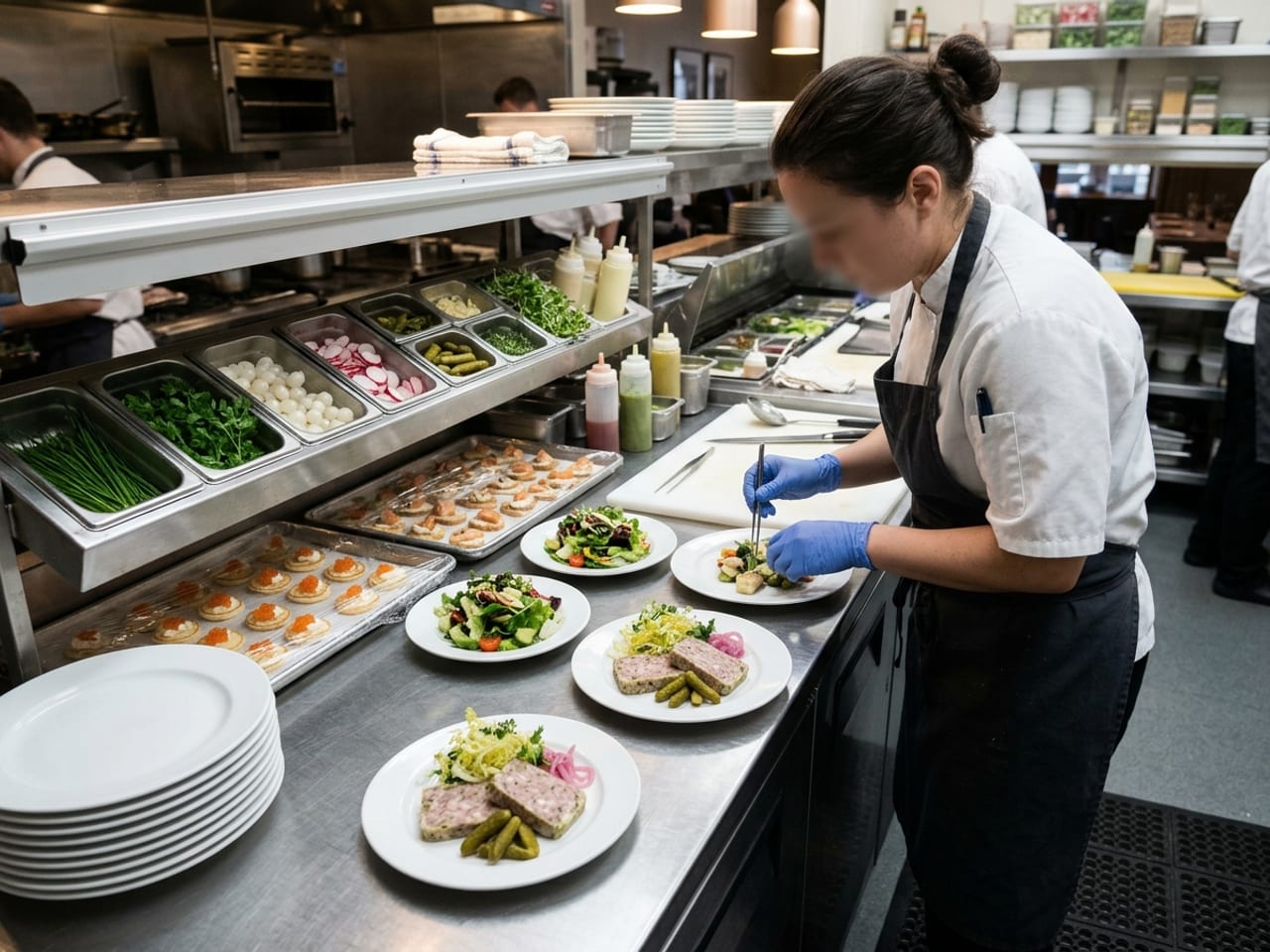
How this page was made. Every definition, figure, quotation and verdict comes from the source named beside it: English, French and Scots dictionaries; the garde manger textbooks (Professional Garde Manger, read only as ckbk's free previews; the Culinary Institute of America's, read in the publisher's excerpts; Thibodeaux's open textbook, read in full); Gisslen's Professional Cooking; college course outlines and job postings; US, UK, German, Finnish, EU and Australian food agencies; and old books read in library scans or transcriptions. The archive.org server did not answer us all of 21 October 2026, so the CIA's 2nd and 3rd editions in full, Larousse's Professional Garde Manger, Meyer's Working Garde Manger, Leto and Bode's chapters, Sonnenschmidt, Labensky's US On Cooking, the CIA's Professional Chef in full and the Professional Garde Manger study guide were NOT read, and no claim here rests on them. Plate Artists cooked, tasted, timed and measured nothing for this page. A metric or US twin in brackets is the source's own where it prints one and our conversion where it does not; sums, readings and advice marked "ours" are our own. Sources are at the bottom.
Garde manger in English: every dictionary, the pronunciation and the other names
Garde manger definition. The English dictionaries lean to the person: Merriam-Webster has only the cook, "a cook who specializes in the preparation of cold foods (such as meats, fish, and salads)", and Dictionary.com the room and the cook; Cambridge has no entry.1, 3, 4 The French dictionaries lean to the place and the cupboard and leave the cook out; only the Québec terminology office and the community-edited Wiktionnaire add the chef de partie.6, 8, 9, 10, 13 Professional Garde Manger counts three senses, "garde manger (place, person, or craft/profession)"; the CIA adds the station.18, 21 The definitions we read, side by side:
| Source | Senses | Its wording |
|---|---|---|
| Merriam-Webster1 English dictionary | The cook only | "a cook who specializes in the preparation of cold foods (such as meats, fish, and salads)"; first known use 1928 |
| Dictionary.com3 English dictionary | The room and the cook | "a cool room used for storing foods and for preparing certain dishes, especially cold buffet dishes"; "a chef or cook who supervises the preparation of cold dishes" |
| Cambridge4 English dictionary | No entry | No entry with or without the hyphen; Collins and the Oxford English Dictionary could not be read from this machine |
| The New Food Lover's Companion (2007)5 Culinary dictionary | The person or station, and the area | "the person or station responsible for cold pantry items such as salads, pâtés, chaud-froids and other decorative dishes. The term garde manger also refers to the area in which such foods are prepared and stored." |
| Professional Garde Manger (2010)18 Textbook | The place, the person and the craft | "a place in which cold foods are prepared and stored", "the person in charge of cold foods preparation and preservation" and "the craft, or profession, of cold foods preparation" |
| Culinary Institute of America, Garde Manger (4th ed., 2012)21 Textbook | The storage area, the station, the cooks, the specialism | "was originally used to identify a cool food storage area"; now also the station and its cooks and chefs, "and nowadays also an area of specialization" |
| Gisslen, Professional Cooking (7th ed., 2011)27 Textbook | The pantry department | The pantry, "the department responsible for cold foods", "often referred to by its French name, garde manger", a term whose "basic meaning is 'larder' or 'food storage place'" |
| Académie française, 1st ed. (1694)7 French dictionary | The place only | "Lieu pour garder, ou serrer de la viande, & autres choses servant à la nourriture" (a place to keep or store meat and other foods) |
| Littré (1863 to 1872)6 French dictionary | The place and the cupboard | "Lieu pour garder ou serrer de la viande et autres aliments", and a "Petite armoire formée de châssis garnis de toile" where flies cannot get in |
| Académie française, 9th ed. (current)8 French dictionary | The cool room and the cupboard | "Pièce fraîche et aérée où l'on conserve les aliments" (a cool, airy room where food is kept), then the meshed cupboard; no cook |
| Larousse9 French dictionary | The cupboard only | "Petite armoire garnie de toile métallique, ou placard extérieur à l'aplomb d'un mur, servant à conserver les aliments" |
| Office québécois de la langue française10, 11 French dictionary | The cook (1989) and a camp building (2002) | "Chef de partie chargé de conserver tous les comestibles crus ou cuits et de préparer les plats froids"; and the provisions building of the old logging camps |
| Wiktionnaire13 French dictionary | The place, the cupboard and the chef de partie | A place to keep meat and food; a small meshed cupboard; the "Chef de partie responsable des plats froids dans une brigade de cuisine" |
| Scottish National Dictionary14 Scots dictionary | The larder or meat-safe | Scots gardymang, "A larder, a meat-safe", from French garde-manger, "a food cupboard" |
| Wikipedia (English)15 Encyclopedia | The area and the chef | "a cool, well-ventilated area where savory cold dishes" are prepared, and its chef "the chef garde manger, or pantry chef" |
Garde manger pronunciation
The US respellings that mark stress put it on the last syllable, "-zhay", and they agree on a nasal "mahn" or "mawn"; they keep the d of garde (gard-), which the Escoffier school's blog drops ("gahr-mahn-zhay"). Wiktionnaire's French drops the mute e of garde, three syllables, /ɡaʁ.dmɑ̃.ʒe/; Littré's 19th-century respelling keeps it, (gar-de-man-jé).1, 3, 6, 13, 62 We found no British pronunciation: Cambridge has no entry, and Collins and the Oxford English Dictionary could not be read.4 How to pronounce garde manger, every respelling as printed:
| Source | As printed | Which |
|---|---|---|
| Merriam-Webster1 | \ˌgärd-ˌmäⁿ-ˈzhā\ | US |
| Dictionary.com3 | [gard-mahn-zhay], /gard mɑ̃ˈʒeɪ/ | US |
| The New Food Lover's Companion5 | [gahrd mahn-ZHAY] | US |
| Professional Garde Manger18 | gahrd mawn-ZHAY | US |
| Gisslen, Professional Cooking27, 29 | gard mawn-zhay (gard-mawn-zhay in the 6th edition) | US |
| Auguste Escoffier School of Culinary Arts (blog)62 | gahr-mahn-zhay | School blog |
| Littré6 | (gar-de-man-jé) | French |
| Wiktionnaire13 | /ɡaʁ.dmɑ̃.ʒe/ | French |
| Wikipedia (English), the French form15 | [gaʁd mɑ̃ʒe] | French |
Garde manger or garde-manger: spelling and plural
The general dictionaries hyphenate: Merriam-Webster, Dictionary.com, Littré, the Académie, Larousse and the Québec office all print garde-manger, as do Escoffier, Carême and Gouffé. The cooks' books mostly do not: the Food Lover's Companion, Gisslen, the CIA's Garde Manger, Professional Garde Manger, Thibodeaux and the ACF's 2026 exam write garde manger.1, 3, 5, 9, 10, 18, 20, 21, 27, 40, 54 The Québec office also accepts one word, gardemanger.10 In English the plural is garde-mangers (Merriam-Webster); in French it is traditionally invariable, des garde-manger (Littré, the Académie, Larousse), and garde-mangers under the 1990 spelling reform (Larousse, the Québec office).1, 6, 8, 9, 10 This page writes garde manger, as the cooks' textbooks do, and garde-manger when quoting French.
What garde manger means literally
The French words are garder, to keep, and manger, to eat, which Littré also records as a noun, the act of eating, and in Normandy "ce qu'on mange", what one eats.6, 13 The sources read the pair four ways: a purpose (keep to eat), a person (one who keeps food, keeper of the food), a thing ((that which) keeps food) and a place (larder). None is the true one; each source's own words:
| Source | Its gloss | Reads it as |
|---|---|---|
| Culinary Institute of America, Garde Manger (2008, 2012)21, 22 | "keep to eat" | a purpose |
| Professional Garde Manger (2010)18 | "literally translates as 'keep to eat'" | a purpose |
| Wikipedia (English)15 | "literally means 'keeping to eat'" (citing Professional Garde Manger, which says keep to eat) | a purpose |
| Wikipédia (French)16 | many read it as "garder pour manger", keep in order to eat | a purpose |
| Merriam-Webster1 | "French, literally, one who keeps food" | a person |
| Thibodeaux's open textbook20 | "Keeper of the Food" | a person |
| Auguste Escoffier School of Culinary Arts (blog)62 | "keeper of the food" | a person |
| Wikipedia, Kitchen brigade17 | "food keeper" | a person |
| Dictionary.com3 | "Literally, '(that which) keeps food'" | a thing |
| Gisslen, Professional Cooking (7th ed.)27 | "basic meaning is 'larder' or 'food storage place'" | a place |
The French garde-manger: a cupboard
In French homes the word is a piece of furniture: Littré's "Petite armoire formée de châssis garnis de toile" where food is shut away and flies cannot get in; Larousse's and the Académie's cupboard "garnie de toile métallique", metal mesh, or set against an outside wall or under a window; French Wikipedia adds that it is best kept outside in shade and a draught, and much less used since refrigerators.6, 8, 9, 16 Scots borrowed it as gardymang, "A larder, a meat-safe", printed "guard-mangé" in 1766.14 In Québec it was also the small provisions building of the old logging camps.11 When a French search for garde-manger shows cupboards, that is this sense; the rest of this page is the kitchen one.
Other names: pantry chef, larder chef, chef du froid, cold kitchen
| Name | Who uses it |
|---|---|
| Pantry chef | Gisslen ("The pantry chef, or garde manger"), the CIA's Professional Chef ("also known as the PANTRY CHEF"), Wikipedia; O*NET files "Pantry Chef" under chefs and "Pantry Cook" under food preparation workers15, 27, 30, 45 |
| Cold-foods chef | The CIA's Professional Chef ("The COLD-FOODS CHEF (garde manger)"); Canada's occupational index ("Cold foods chef")30, 49 |
| Larder chef, larder cook, the larder | Leto and Bode's UK textbook The Larder Chef; the UK chef de partie standard ("larder" section); O*NET's "Larder Cook"; the Québec office's English equivalent "larder cook"10, 25, 45, 51 |
| Chef du froid | Escoffier, 1903 ("chef du froid", the chef of the cold, once, for the cook whose ideas shape the cold hors-d'oeuvre; he does not equate him with the chef garde-manger); a chapter title in Leto and Bode, apart from their "Le Garde-Manger"25, 40 |
| Cold kitchen, cuisine froide | The ACF's textbook (Garde Manger: Cold Kitchen Fundamentals); Tri-C's course ("Garde Manger station -- cold kitchen"); a French apprentice school's "La cuisine froide"24, 52, 57 |
| The pantry, the salad station, the cold side | The CIA's Garde Manger: "Some operations refer to it as the pantry, others may call it the salad station, still others the cold side"21 |
| Cold line | Professional Garde Manger: the garde manger chef's service line18 |
| Cold-meat cook | The Québec office's English equivalent; O*NET's "Cold Meat Cook" (food preparation workers)10, 45 |
| Hors-d'œuvrier | Escoffier's separate hors-d'oeuvre cook; Kinton and Ceserani (1973), "near the larder", as the Québec office quotes them12, 41 |
| Garmo | Kitchen slang in the Escoffier school's blog; Wikipedia tags the word "citation needed"; no dictionary we read has it15, 62 |
The sources split on rank: Gisslen's pantry chef is a station chef, while O*NET files the pantry cook with food preparation workers; Canada's occupational classification lists "Garde-manger chef" with the chefs, apart from the cooks.27, 45, 49 Neither English name means cold by origin: Merriam-Webster takes pantry from Anglo-French paneterie, from pain, bread, and larder from a word for a "supply of cured meat"; it gives pantry a kitchen sense too, "a room (as in a hotel or hospital) for preparation of foods on order".2
Garde manger vs pantry chef, saucier, pâtissier and line cook
| Garde manger vs | What the sources say |
|---|---|
| Pantry chef | The same post in the US textbooks: "The pantry chef, or garde manger" (Gisslen); "The COLD-FOODS CHEF (garde manger), also known as the PANTRY CHEF" (the CIA). US labour statistics split the names: a "Pantry Chef" is a chef, a "Pantry Cook" a food preparation worker.27, 30, 45 |
| Larder chef | The British name for the same section: Leto and Bode's The Larder Chef opens with a chapter called "Le Garde-Manger", and the UK chef de partie standard lists a "larder" section. Gouffé's English translator already wrote "larder" for the cool store in 1868.25, 38, 51 |
| Saucier | The sauce and sauté station. Gisslen calls it "usually the highest position of all the stations" and the CIA "often considered the most demanding, responsible, and glamorous on the line"; neither ranks the garde manger. In 1867 Chavette printed a Paris kitchen's pay: the saucier 2,000 francs, the chef du garde-manger 2,000 or 2,400.27, 30, 37 |
| Pâtissier | The pastry chef: "The pastry chef, or pâtissier (pa-tees-syay), prepares pastries and desserts", in the line after the garde manger's in Gisslen's list. Whether cold desserts belong to the garde manger is a split (where the sources disagree).28, 62 |
| Line cook | Gisslen's line cooks finish hot à la carte food and "are said to be on the hot line, or simply on the line"; Professional Garde Manger calls the garde manger's own counter the "cold line". A New Yorker writer quoted by Dictionary.com worked "in garde-manger" and was "occasionally allowed to work on the line". So "garde manger line cook" joins two words that Gisslen keeps apart; the CIA's Professional Chef uses them as one: "the station chefs (or line cooks)".3, 18, 27 |
| Commis | The junior cook: "The COMMIS or apprentice works under a station chef to learn how the station operates" (the CIA). The CIA's Garde Manger adds that many chefs "got their start in the garde manger as apprentices or commis"; the UK commis standard rotates the trainee "around each section of the kitchen".21, 30, 50 |
| Charcutier | "One who prepares and sells pork products" (Gisslen). Professional Garde Manger makes charcuterie "a specialized discipline within the garde manger profession"; the Food Lover's Companion lists a separate charcutière for pâtés and galantines, and Wikipedia has a charcutier reporting to the garde manger in larger kitchens.5, 17, 18, 28 |
| Hors-d'œuvrier | Escoffier's own partie for hors-d'oeuvre, precious in a brigade "car cette partie, pour secondaire qu'elle paraisse" (however secondary it may appear) needs rare qualities; his English edition: "his duties do not by any means rank first in importance".41, 42 |
What the garde manger station makes, source by source
What does a garde manger make? Fifteen sources side by side: the contents of four garde manger textbooks (the CIA's in two editions, so five columns), Gisslen's station line, four college course outlines and the Illinois school lessons, a school blog, two job postings and the ACF's competition manual. Y is a chapter, unit, outline line or duty that names the category; a note in brackets is a mention that is not one of its own; a dot is not named in what we read.
| Category | Thib20 | PGM18 | CIA 421 | CIA 123 | ACF24 | Giss28 | Tri-C57 | Napa58 | CSCC59 | DTCC60 | ISBE61 | Esc62 | Avra65 | MUST64 | ACFM55 |
|---|---|---|---|---|---|---|---|---|---|---|---|---|---|---|---|
| Cold sauces, dressings, vinaigrettes, mayonnaise | Y | Y | Y | Y | Y | Y | Y | Y | Y | Y | Y | Y: aioli | Y | Y | (sauce boats) |
| Salads | Y | Y | Y | Y | Y | Y | Y | Y | Y | Y | Y | Y | Y | Y | Y: category G |
| Sandwiches | Y: hot too | Y | Y | Y | Y | · | Y: hot and cold | · | Y: hot and cold | Y: tea | (own problem area) | · | · | Y | · |
| Cold soups | · | Y | Y | Y | Y | · | Y | · | Y | Y | · | Y | · | · | · |
| Hors d'oeuvre, canapés, appetizers | Y: hot too | Y: cold | Y | Y: two chapters | Y | Y: cold | Y | Y | Y | Y: canapés | (own problem area) | Y | Y | Y | Y: two hot, two cold, all shown cold |
| Cheese | Y: making | Y | Y | Y | · | · | Y: making | · | (dairy, in unit 6) | · | Y | Y | · | · | · |
| Cured and smoked foods | Y | Y | Y | Y | Y | · | Y | Y | · | Y: basic charcuterie | · | Y | · | Y: charcuterie | · |
| Sausages | Y | Y | Y | · | (in Basic Charcutière) | · | Y | Y | · | (basic charcuterie) | · | · | · | · | · |
| Pâtés, terrines, galantines, ballottines | Y | Y | Y | Y | (in Basic Charcutière) | Y: pâtés | Y | Y | Y: forcemeat | Y | · | Y | Y | · | (cold platters; no pâté named) |
| Mousselines, mousses | Y | Y | (not a title) | · | · | · | Y | Y | Y | · | · | · | · | · | · |
| Aspic, chaud-froid | Y | Y | (not a title) | · | · | (chapters 22 and 29, not the station line) | Y | Y | · | · | · | · | · | · | Y: glaze rules |
| Condiments, pickles, relishes, crackers | Y | Y | Y | Y | Y | · | Y | Y | Y | · | · | Y: pickles | · | · | · |
| Caviar, raw seafood, sushi | Y | Y | · | · | · | · | Y: sushi, raw bar | · | Y: caviar, foie gras | · | · | Y | · | · | · |
| Fruit and vegetable carving, ice, tallow, salt dough, décor | (ice centrepiece) | Y: décor | · | · | Y: decorative work | · | Y | Y | Y: ice, an introduction | Y: vegetable | · | Y: ice | · | · | Y: categories D and E |
| Buffets, platters, catering | Y | Y | Y | · | Y | Y | Y | Y | Y | · | · | Y | · | Y | Y |
| Charcuterie and cheese boards | Y | · | · | · | · | · | (cheese and charcuterie week) | · | · | · | · | · | · | · | · |
| Cold desserts | (platter rule only) | · | · | · | · | (the pâtissier's) | · | · | · | · | · | Y: some; plated in many kitchens | Y | · | (pastry option in G) |
| Hot items on the station | Y: hot hors d'oeuvre and sandwiches | (cold titles only) | · | · | · | · | Y: omelet and pasta stations, warm salads | · | Y: hot sandwiches | · | · | · | · | · | (cooked hot, shown cold) |
The columns: Thib = Thibodeaux, open textbook (2022); PGM = Professional Garde Manger (2010); CIA 4 = CIA Garde Manger, 4th ed. (2012); CIA 1 = CIA Garde Manger, 2000 catalogue contents; ACF = ACF, Cold Kitchen Fundamentals (2011); Giss = Gisslen's station line; Tri-C = Tri-C HOSP-2560 (2026); Napa = Napa Valley HCTM 112 (2020); CSCC = Columbus State HOSP 2217 (2025); DTCC = Delaware Tech CUL 171 (2026); ISBE = Illinois CAERT lessons; Esc = Escoffier school blog; Avra = Avra Group posting, New York; MUST = MUST posting, Macau; ACFM = ACF competition manual (2024). The CIA's 2nd and 3rd editions, Larousse, Meyer, Leto and Bode, Sonnenschmidt and the US On Cooking could not be opened, so they are not columns. A general textbook has no garde manger chapter at all: the Canadian On Cooking spreads the station's food over its charcuterie, salads, fruits, appetizers and sandwiches, and plate presentation chapters.26
Where the sources disagree
- Desserts. The Escoffier school's blog ("some cold desserts", and "in many kitchens so do plated desserts"), the CIA's Garde Manger (in à la carte service the station "may also be responsible for plating desserts") and one New York posting ("salads, appetizers, and desserts") put desserts on the station. Gisslen gives "pastries and desserts" to the pâtissier, the CIA's Professional Chef "frozen and cold desserts" to the glacier, and no garde manger textbook or course outline we read has a dessert chapter or unit. Thibodeaux's "Do not mix desserts with savory on the same platter" is a platter rule, not a station rule.20, 21, 28, 30, 62, 65 So the sources split, and the page does not say the garde manger makes the desserts. The blog's line between the two: the garde manger's are cold desserts "that do not require last-minute preparation, such as mousse, panna cotta, fruit terrine"; the pastry chef's involve "baking, sugar work".62
- Hot food. Thibodeaux's book has hot hors d'oeuvre and a hot Kentucky Hot Brown sandwich; Tri-C's course runs omelet and pasta stations and warm salads; Columbus State's makes hot and cold sandwiches. Professional Garde Manger's chapter titles are all cold, and the ACF's finger-food category has two hot and two cold items, "all presented cold".18, 20, 55, 57, 59
- Sandwiches. A chapter in every garde manger textbook's contents, but the Illinois lessons file them in a separate problem area, and Gisslen's station line leaves them out.18, 21, 28, 61
- Cold soups. A chapter in Professional Garde Manger, the CIA and the ACF's book; none in Thibodeaux or Napa Valley's outline.18, 20, 21, 24, 58
- Cheese. In Professional Garde Manger, the CIA, Thibodeaux, Tri-C and the Illinois lessons; the ACF's textbook has no cheese unit.18, 20, 21, 24, 57, 61
- Breakfast. Only Tri-C in what we read, with an omelet station and a sausage week of "Breakfast, Italian and chicken".57
Garde manger food examples, category by category

Cold sauces and dressings
in every textbook, course outline and posting we read
Thibodeaux's list of "Sauces Relating to the Garde Manger": cold emulsion sauces ("vinaigrettes and mayonnaise"), dairy-based sauces and dressings, contemporary sauces, salsas, "Coulis and purees", coating sauces ("aspics and chaud-froid") and others such as Cumberland, horseradish and mignonette. Its rules of thumb: "one part acid to two or three parts oil" for a vinaigrette, and "each yolk can handle 6-8 ounces of oil" (170 to 230 g).20
How to make each: mayonnaise, coulis, and how to put them on a plate: sauce plating.
Salads
in every source we read
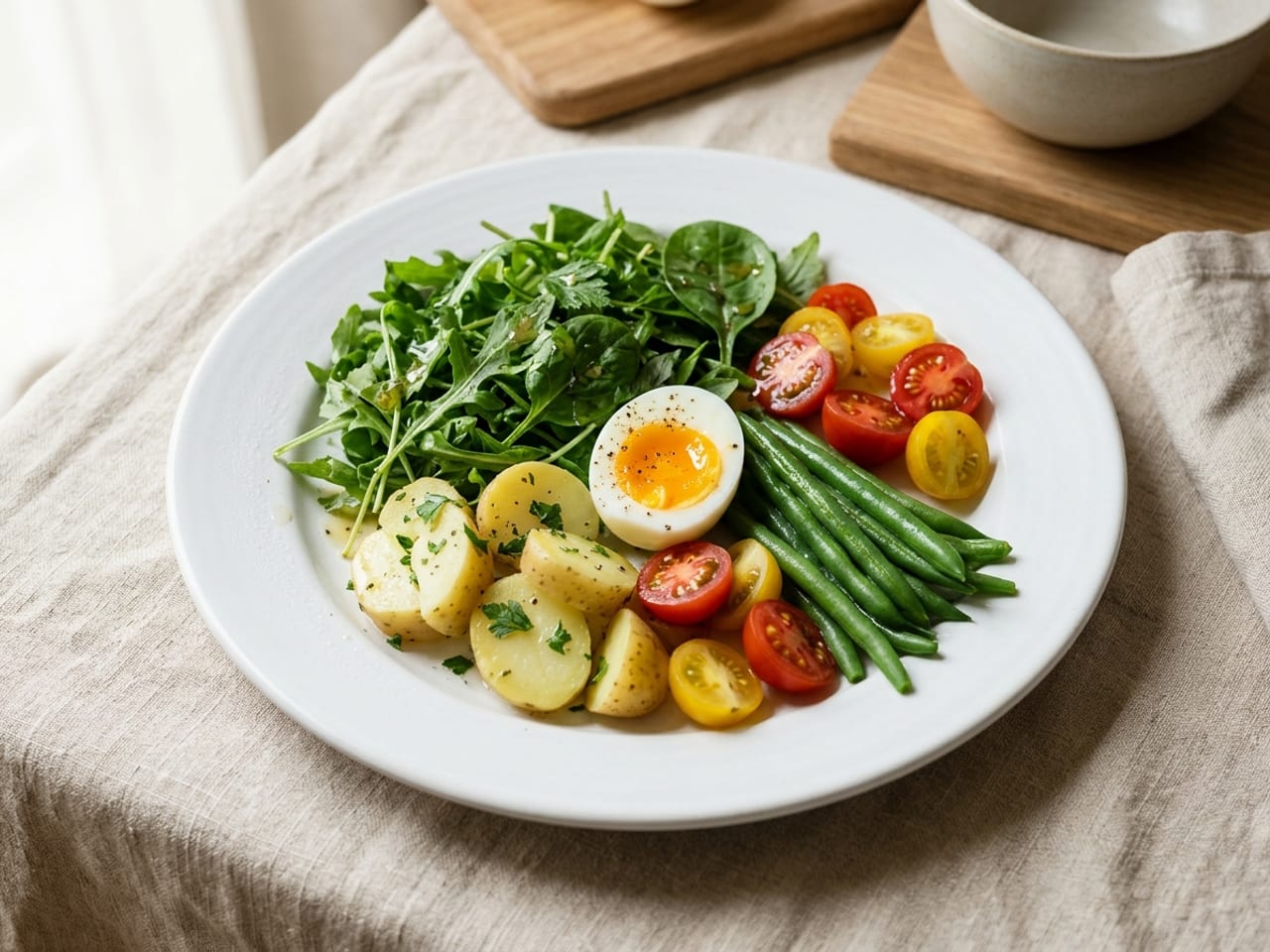
Thibodeaux groups them as green salads, side salads (legume, potato, pasta and grain, fruit) and composed salads, "carefully arranged salads that often have a protein element"; a US school lesson gives a formally presented salad "four basic elements", base, body, garnish and dressing. Thibodeaux dresses "2oz. greens to ½ or ¾ oz. dressing" (57 g to 14 or 21 g), lightly, with nothing pooling on the plate.20, 61
Every classic salad, built step by step: how to plate a salad.
Hors d'oeuvre, canapés and appetizers
in every textbook; the Illinois lessons file them apart
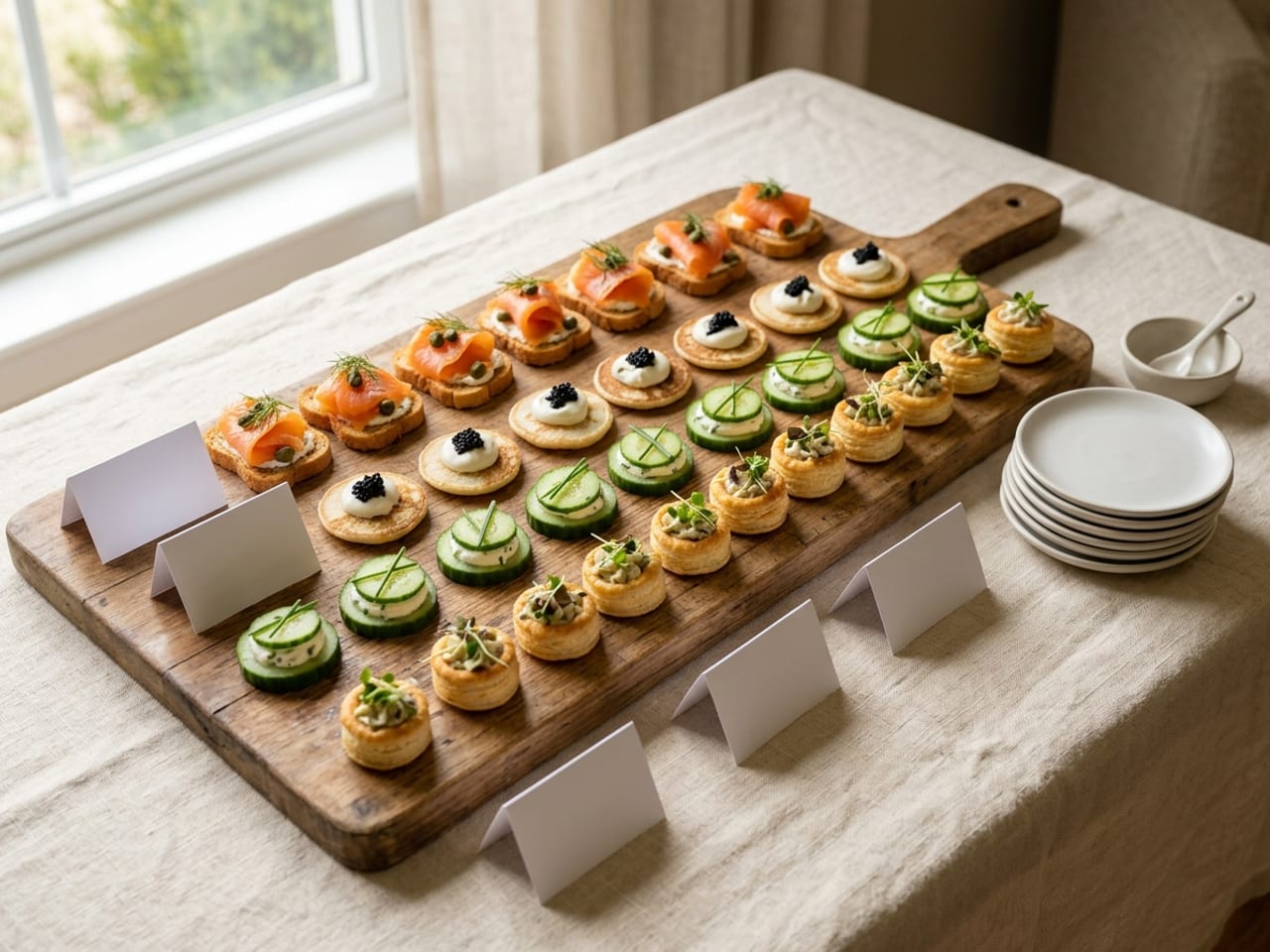
Thibodeaux's four kinds of hors d'oeuvre are hot, cold, finger food and canapés ("1 or 2 bites- always consists of four parts"), and it draws the line: "Appetizers are part of a meal vs. Hors d' oeuvre, which are apart from the meal." Professional Garde Manger's chapter is "Cold Hors d'Oeuvres"; the CIA's college course teaches "hot and cold hors d'oeuvre".18, 20, 56
Canapé bases, toppings and counts per guest: canapés; the free bite before a meal: amuse-bouche.
Sandwiches
a chapter in every garde manger textbook; not in Gisslen's station line
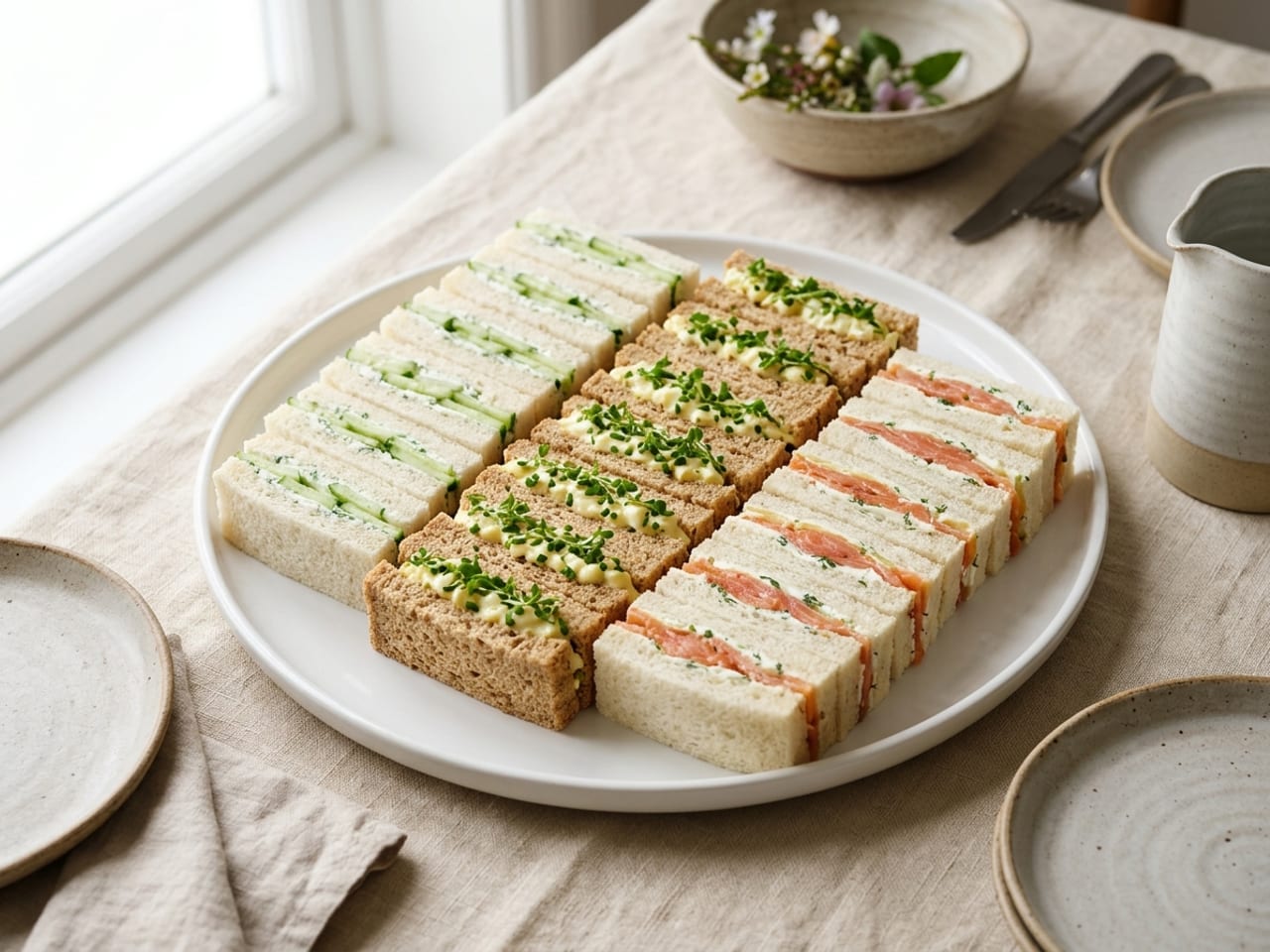
Thibodeaux sorts them into "hot sandwiches, cold sandwiches, and finger or tea sandwiches", built from "bread, spread or flavoring base, filling, and garnishes", and spreads soft butter first because it "keeps the bread from becoming soggy if making ahead of service". The Illinois school lessons put sandwiches in a separate problem area from garde manger.20, 61
Professional Garde Manger's chapter is "Garde Manger Sandwiches"; the CIA's, "Sandwiches".18, 21
Cold soups
a chapter in PGM, the CIA and the ACF book; none in Thibodeaux
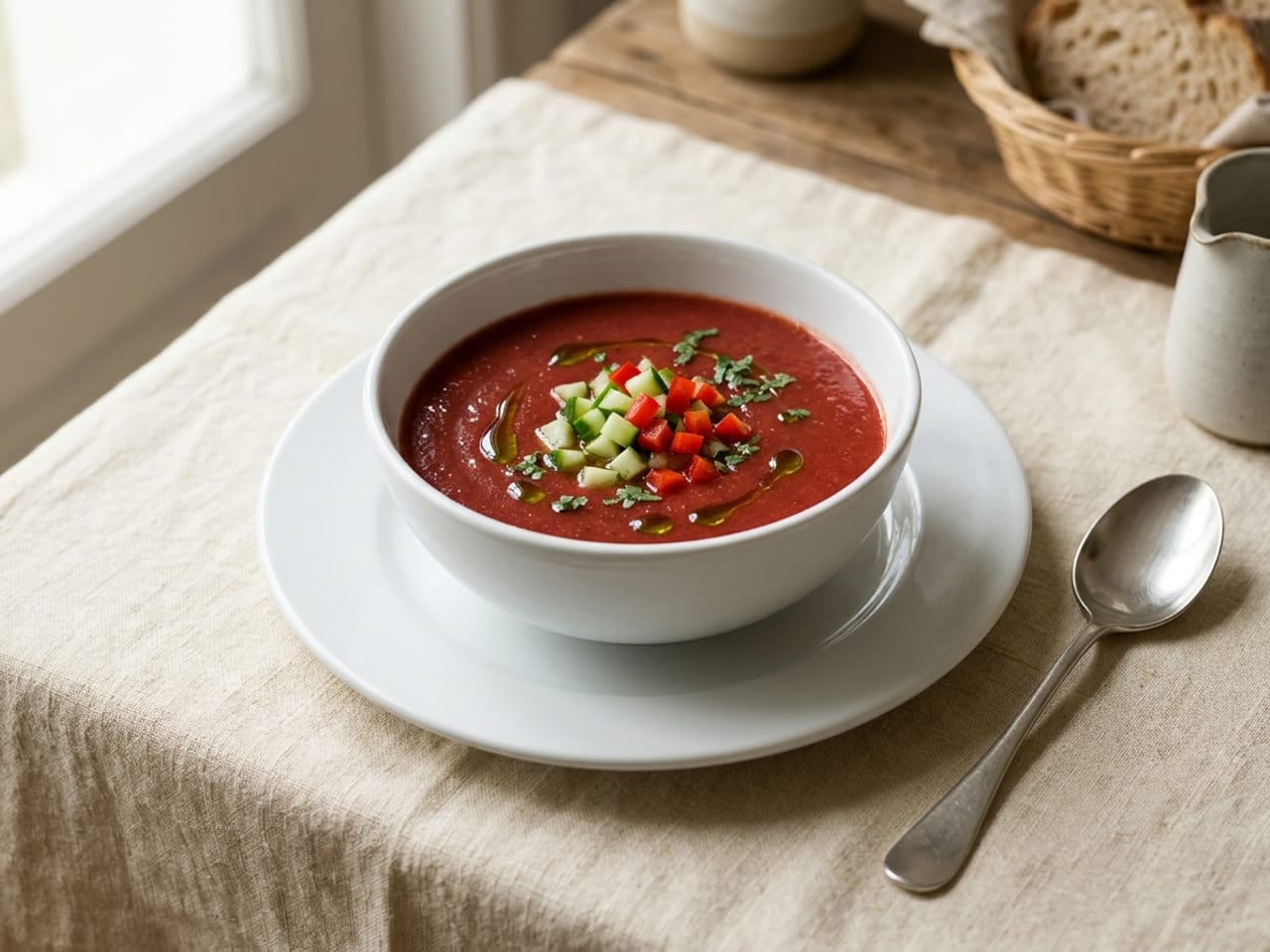
"Some cold soups are merely hot soups that are chilled before serving. However, there is a category of rustic cold soup made by chopping and pounding a mixture of juicy raw vegetables and enriching them with olive oil or fermented dairy products." (Professional Garde Manger)18 The CIA pairs them with the cold sauces in one chapter.21
Neither Thibodeaux nor Napa Valley's course outline has a cold soup unit.20, 58
Cured and smoked foods: gravlax, smoked salmon, ceviche
in every garde manger textbook
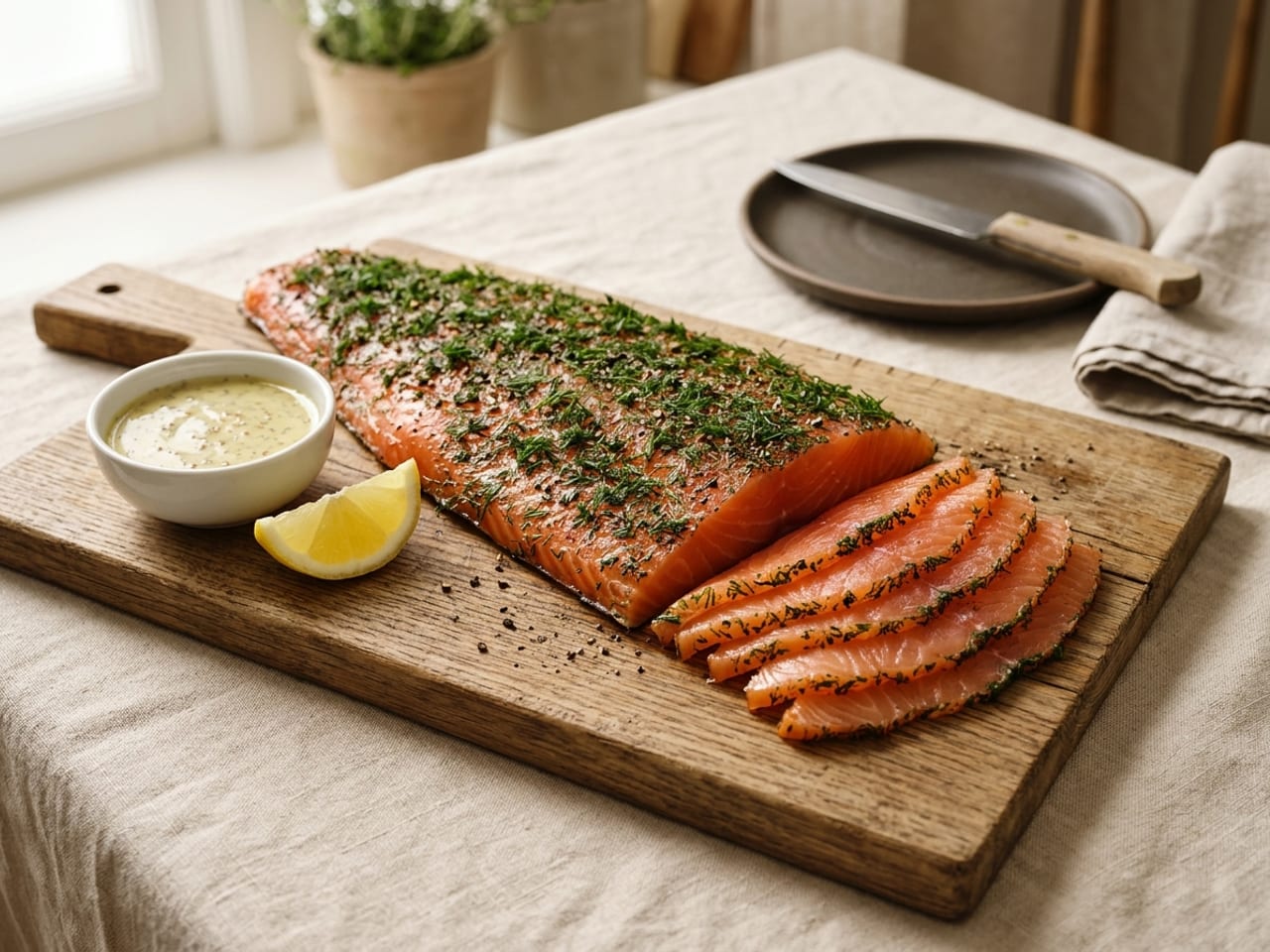
"To cure means to treat a food with salt, making it less hospitable to bacteria, molds, and other harmful microorganisms and thus delaying spoilage" (Professional Garde Manger). Thibodeaux separates a dry cure from a wet cure, "also known as brines", and files ceviche under curing as "cooking without heat". Gisslen's gravlax cures a 2½ lb (1.2 kg) salmon fillet in 4 oz (125 g) salt, 4 oz (125 g) sugar and dill for 2 days, turned once, and slices it on a sharp diagonal.18, 20, 28
Cold and hot smoking ranges, book by book: below. Parasites and Listeria: safety.
Sausages and charcuterie
in Thibodeaux, PGM and the CIA; inside Basic Charcutière for the ACF
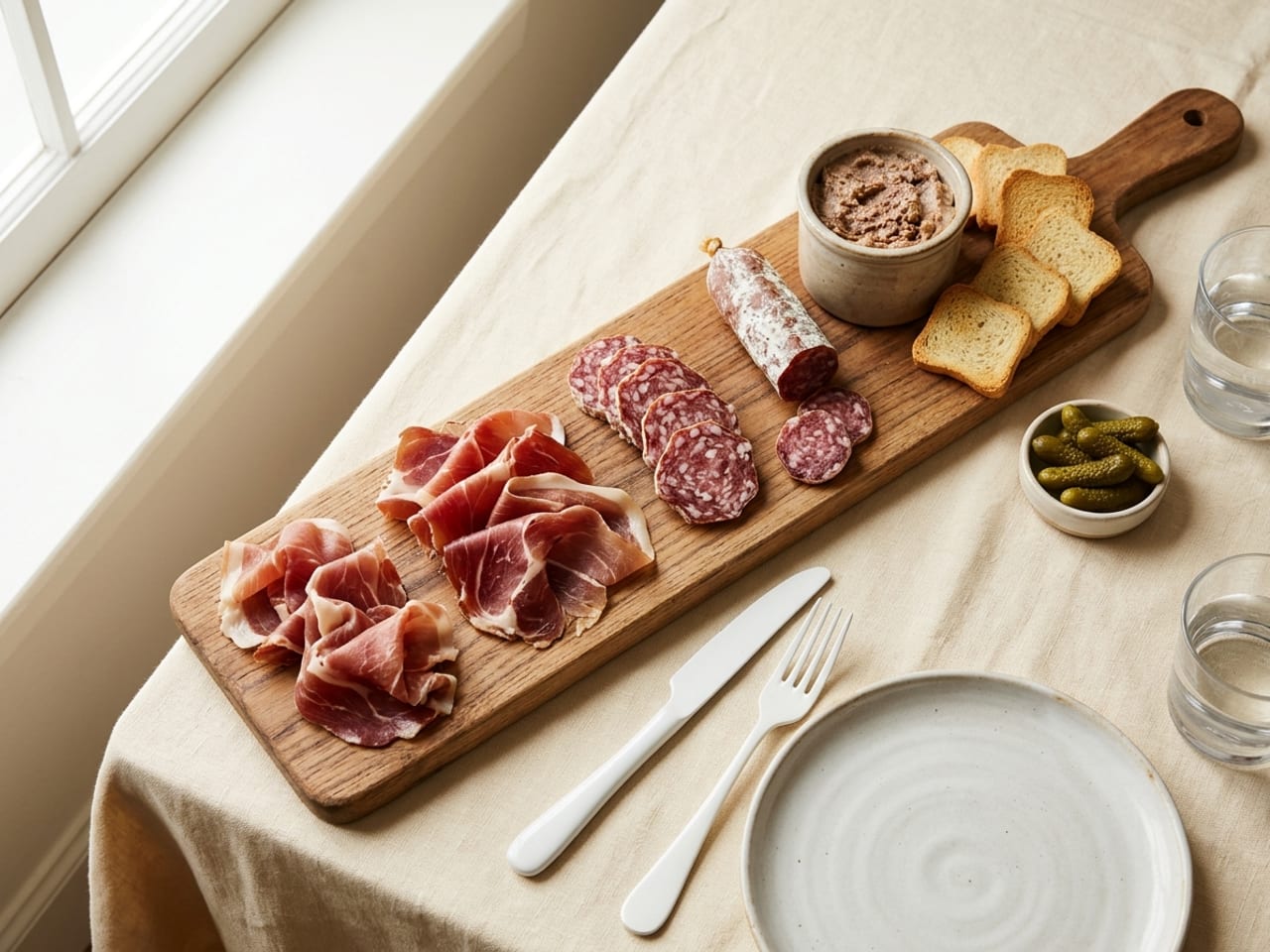
Thibodeaux: "Sausages come in two main types: fresh and cured", and "All smoked sausages are cured. The reason is the threat of botulism." Meat and fat are chilled "as close to freezing as possible, 30-32°F" (-1 to 0°C), and an emulsion sausage runs 5 parts meat, 4 fat, 3 water, usually as ice. Professional Garde Manger calls charcuterie "a specialized discipline within the garde manger profession": "cured and smoked products, sausages, and pâtés".18, 20
Thibodeaux: "The charcuterie board today is almost necessary for the menu today."20 How to build one: charcuterie board ideas.
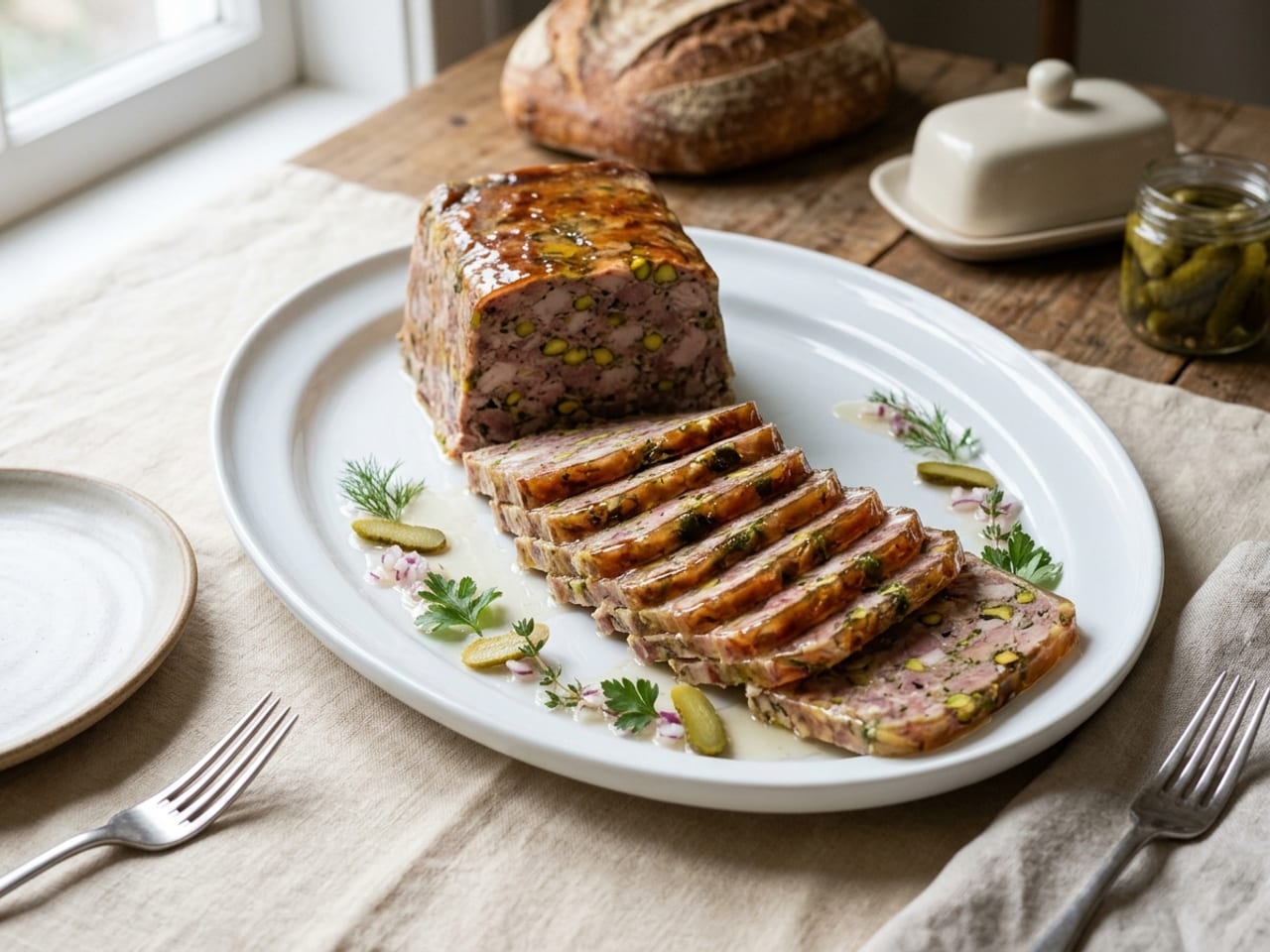
Pâtés, terrines, galantines and ballottines
"the heart and soul" of the cold kitchen, for Thibodeaux
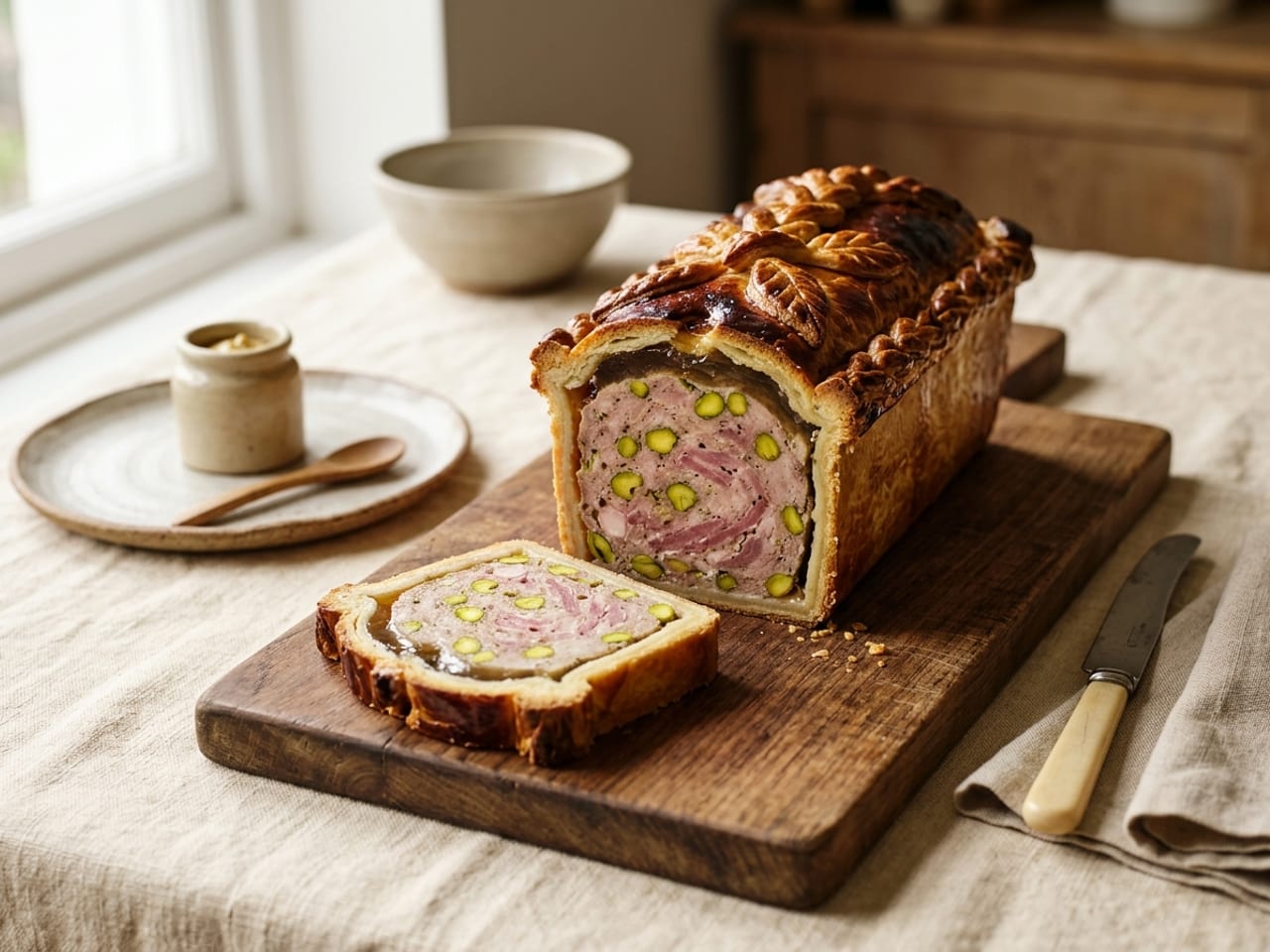
Most begin with a forcemeat, "a lean meat emulsified with fat by grinding or processing" (Thibodeaux), from the French farce, "stuffing" (Gisslen); Thibodeaux's cold vegetable terrine is set in layers of aspic instead. Professional Garde Manger: "A pâté [pah-TAY] is a forcemeat baked in a pastry crust and usually served cold", a terrine the same without the crust; galantines and ballottines are "forcemeats wrapped in skin or meat prior to being cooked". 18, 20, 28 The books do not draw these lines alike (the definitions).
How to slice and plate them: slicing terrines; how long they keep: keeping.
Aspic and chaud-froid
in Thibodeaux, PGM and two course outlines; "an advanced topic"
"Aspic is a translucent, gelatinized coating that adds sparkle and shine to the products it enhances"; chaud-froid, whose name "literally means 'hot-cold'", is "an opaque coating sauce used to mask foods", made hot and served cold (Professional Garde Manger, which calls the work "an advanced topic"). Thibodeaux: "Aspics are made by adding gelatin to a flavorful stock while Chaud-froids are made by adding gelatin to warm sauces like béchamel, demi-glace, and veloute."18, 20
Gelatin strengths and how to coat: aspic glazing.
Cheese
a chapter in Thibodeaux, PGM and the CIA; no ACF unit
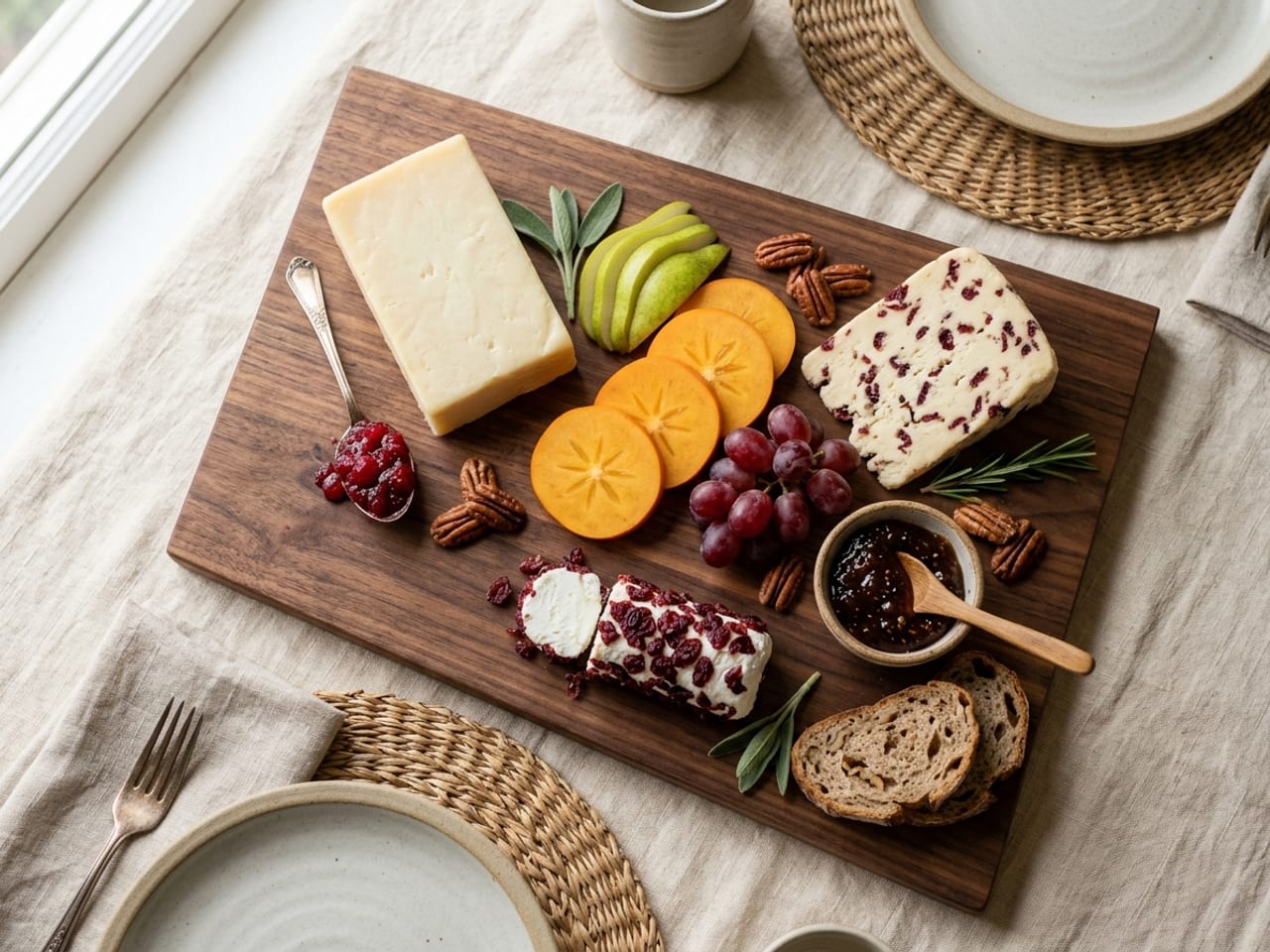
Thibodeaux puts cheese making in the cold kitchen because it is preservation: "Cheese is, after all a means of preserving excess milk." Its "kitchen cheeses", ricotta, mascarpone and crème fraîche, set with acid and need no cultures.20 Professional Garde Manger's chapter 14 and the CIA's chapter 8 are on cheese; the ACF's textbook has no cheese unit.18, 21, 24
A cheese board for a party: boards.
Condiments, pickles and relishes
a chapter in every garde manger textbook
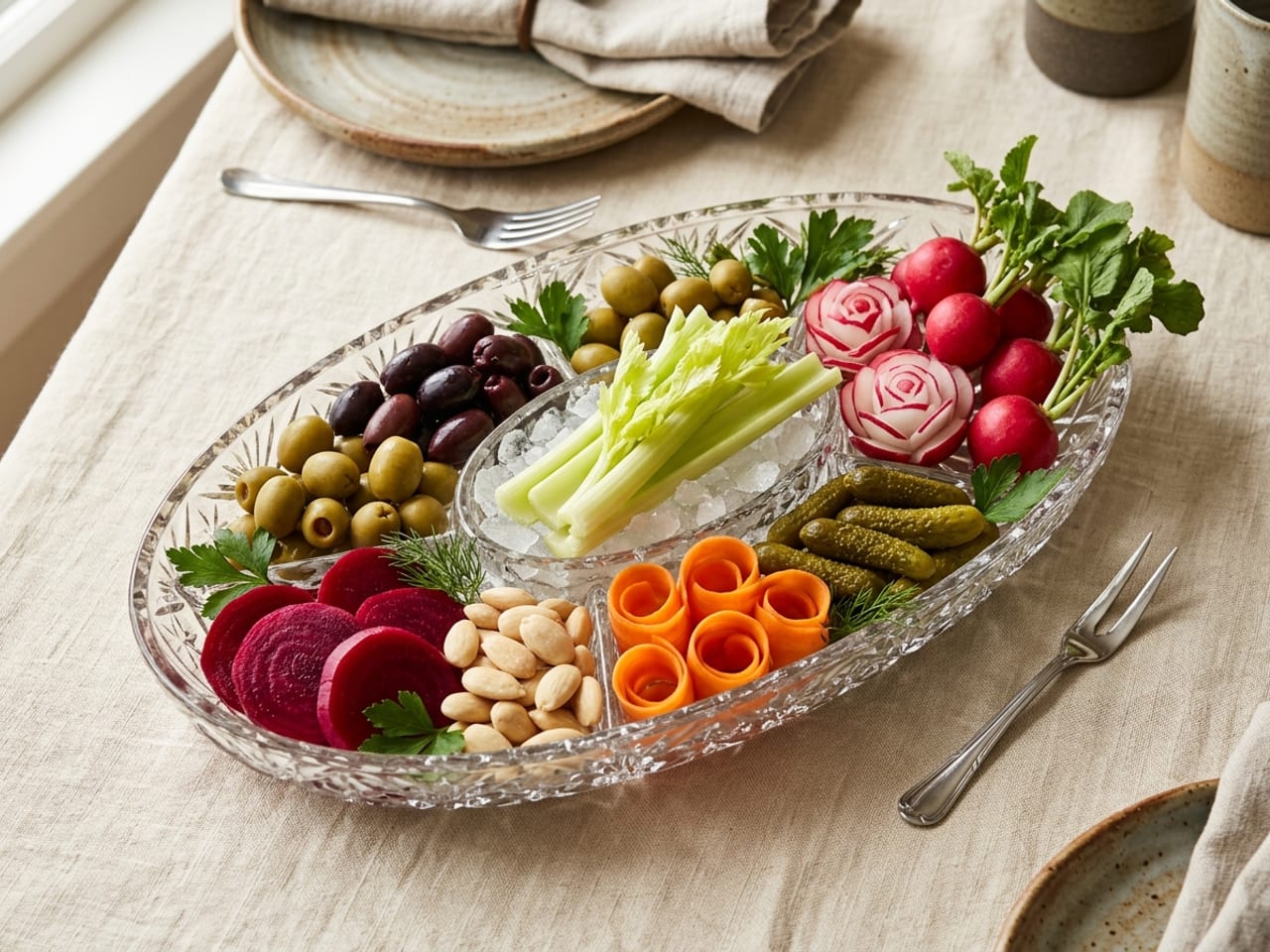
Thibodeaux: "Condiments are the 'building blocks' of the Garde Manger", its examples "mustards, ketchups, chutneys, relishes, pickles, and compotes", "often served on the side". Professional Garde Manger divides finishing touches into "condiments, garnishes, and décor" and warns against using condiments "in such large quantity that they mask or overwhelm the flavor".18, 20
Thibodeaux's canning section is the USDA's text: "Pressure canning is the only recommended method for canning meat, poultry, seafood, and vegetables."20
Garnishes, carving and décor
in the ACF book, PGM, four course outlines and the ACF competitions
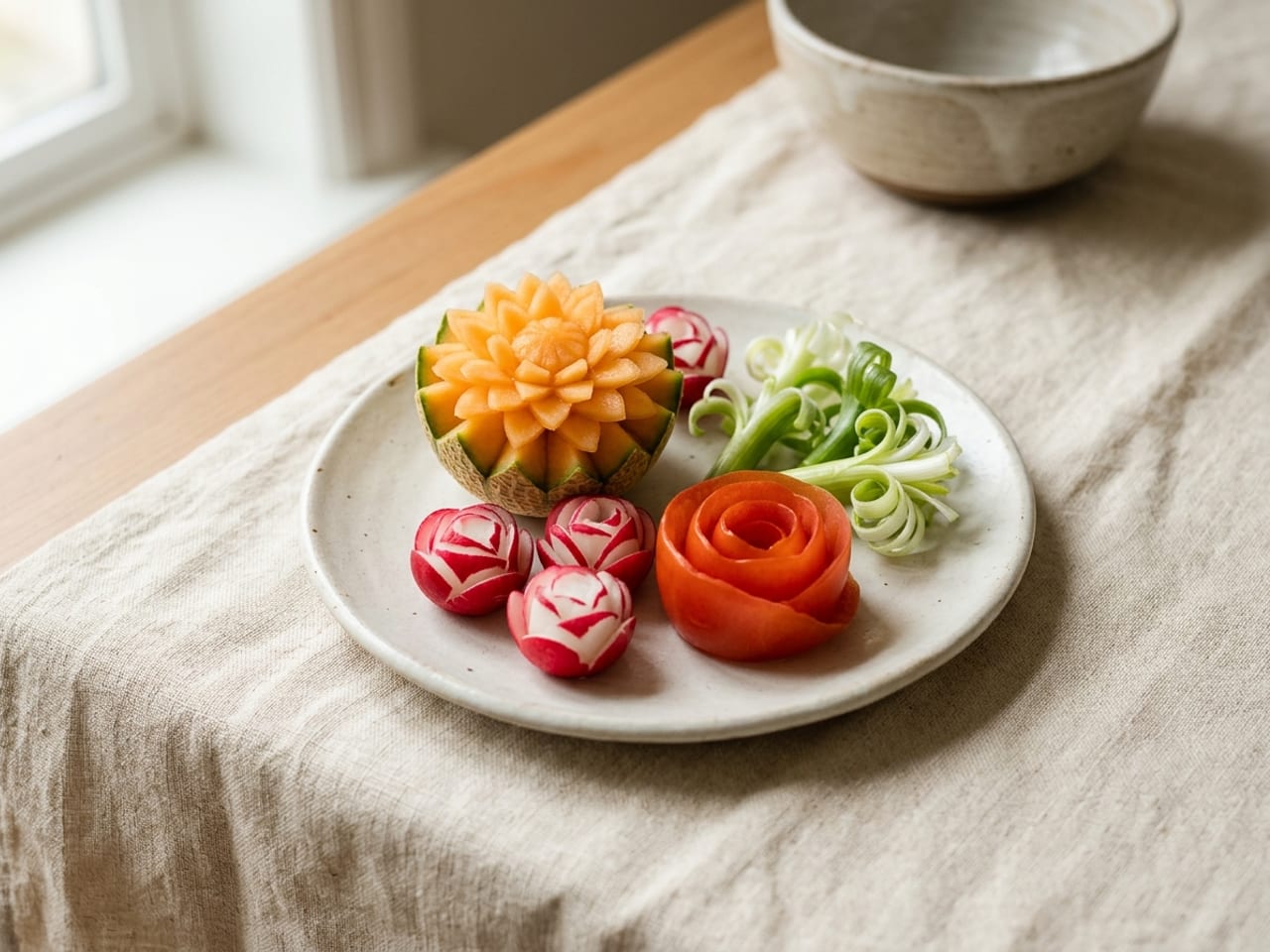
Tri-C's course carves ice, tallow, vegetables, salt dough and puff pastry; the ACF's textbook calls its unit "Decorative Work, the Heart of the Garde Manger"; for Professional Garde Manger, large décor items, "pièces montées, become the focal point for a buffet table or station". 18, 24, 57 The ACF's competitions have vegetable and fruit, tallow and salt dough ("Saltillage") and bread dough showpieces, and a three-hour carving basket.55
Garnishes for one plate: food garnishes; fruit cuts and carving: how to cut fruit; the cuts: knife skills.
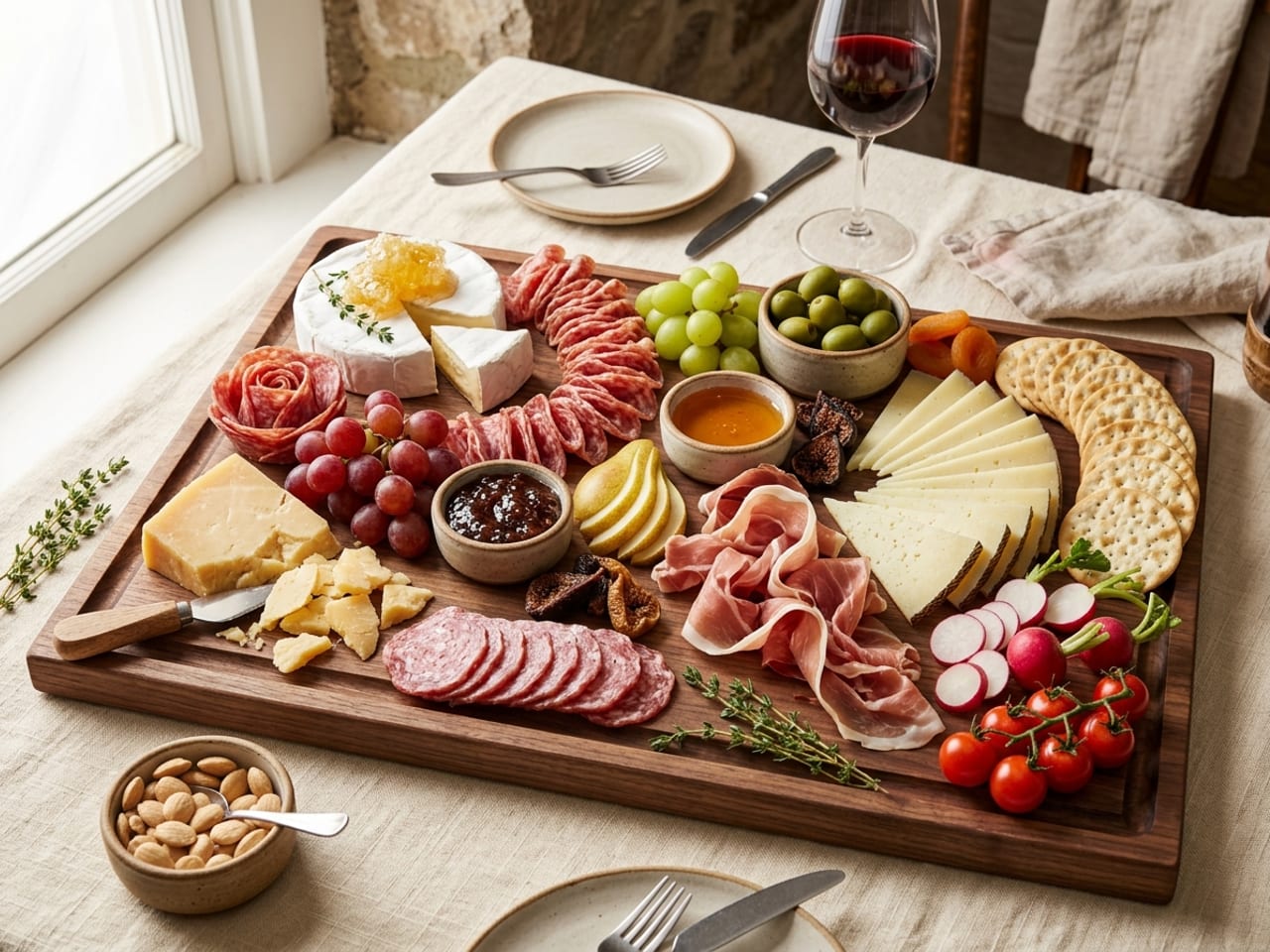
Buffet platters and boards
in every garde manger textbook and most course outlines
"You will be creating foods for platter presentation rather than plate presentation", and "scheduling for a buffet results in a heavier workload for the garde manger department" (Professional Garde Manger). Thibodeaux's course ends with a board built from "the cheeses and cured meats you have aged and the condiments from canning day".18, 20
How the platter is laid out: platter rules; the whole buffet table: how to set up a buffet table; boards: boards.
Terrine, pâté, galantine and ballottine: where the textbooks split
The same words mean different things in the three books we could read past their contents. This page uses Professional Garde Manger's and Gisslen's line (a pâté has a crust, a terrine has none) because two of the three draw it, and says so where it matters.18, 20, 28
| Term | Thibodeaux | Professional Garde Manger | Gisslen |
|---|---|---|---|
| Terrine vs pâté | "Terrines refer to pates that are made in an earthenware mold": a terrine is a kind of pâté | A pâté is "a forcemeat baked in a pastry crust"; "when specifying a pâté without a crust we use the term terrine" | "By definition, a terrine is baked in an earthenware dish"; the book uses pâté for crust, terrine for none, and advises "pâté en croûte" |
| Forcemeat types | Four: straight, country-style, gratin, mousseline | Names gratin forcemeat and mousseline among its terms (no count in the previews) | "three basic types": straight ("including country-style forcemeat"), gratin, mousseline |
| Galantine | "In most every case, a galantine is made with chicken", rolled in the bird's own skin, poached to 165°F (74°C) | "forcemeats wrapped in skin or meat prior to being cooked"; the galantine is fowl, from galine, chicken | A forcemeat wrapped "in the skin of the product it is made from, such as chicken or duck", "almost always poached" |
| Ballottine | Not defined | More generic, from ballot, bundle: "it can refer to any kind of wrapped forcemeat" | Not defined in what we read |
| Aspic vs chaud-froid | Gelatin in a clarified stock vs gelatin in a warm sauce (béchamel, demi-glace, velouté) | A translucent coating vs "an opaque coating sauce"; with mayonnaise collée, the two "masking sauces" | "Aspic jelly, or gelée (zhuh lay), is clarified stock that contains enough gelatin to solidify when cold" |
| Charcuterie | "the art of making sausages both fresh and dried, rillettes and various forms of terrines, pates and galantines" | "the preparation of cooked meat products, today referring specifically to cured and smoked products, sausages, and pâtés" | A charcutier is "one who prepares and sells pork products" |
Sources: 18, 20, 28 Gisslen's word for the popular use: "Popular usage of the terms, however, is much looser."28
Cold smoking vs hot smoking, each book's range
The textbooks name the two by temperature, and no two print quite the same figures; Thibodeaux gives no cold range at all.18, 20, 28, 76
| Source | Cold smoking | Hot smoking |
|---|---|---|
| Professional Garde Manger18 Textbook | Below 100°F (38°C), 80 to 90°F (26 to 32°C) ideal; served as is, "at cool room temperature", in paper-thin slices | 150 to 200°F (65 to 93°C), most to 165°F (75°C) inside (the book's own twins) |
| Gisslen, Professional Cooking (PDF)28 Textbook | "at or below 85°F (30°C)": flavoured, "not cooked"; the smoke generator outside the chamber | Up to 165°F (74°C) for sausage and meats, 200°F (93°C; the book prints "93°F") for fish and poultry; 150 to 165°F (65 to 74°C) inside |
| Thibodeaux20 Textbook | Not given (its own exercise asks for the range) | 185 to 285°F (85 to 141°C), the widest and hottest range |
| PNW238, Smoking Fish at Home76 Extension service | Below a range of 80 to 90°F (27 to 32°C), so "unpasteurized"; the guide gives no home method | Fish heated to 150°F (66°C) inside, preferably 160°F (71°C), and held there at least 30 minutes |
A business that smokes food to preserve it, rather than for flavour, or cures it, needs a variance from its regulator under the FDA Food Code, and Thibodeaux warns of the same.20, 66 Cold-smoked fish and pregnancy: Listeria, country by country.
Where garde manger sits in the brigade, and is it the entry-level station?
In the brigade, the kitchen's chain of stations, the garde manger is one of the chefs de partie, the station chefs, in every list we read that names it (Escoffier's 1903 passage is not a list: it gives the garde-manger the general board, apart from "chaque partie"). The lists differ on who set the system up: the CIA's Professional Chef says it "was instituted by Escoffier", the CIA's Garde Manger that it was "recorded by" him, Gisslen that it was his "reorganization", while Escoffier's own 1903 text describes how the work is divided in a large brigade without claiming to have invented it.21, 27, 30, 40 And in 1815, decades before him, Carême already called the garde-manger "cette importante partie".34
| Source (as read) | Who set it up | The garde manger's line | Top station or rank | The junior rung |
|---|---|---|---|---|
| Chavette, Paris, 186737 | A Paris restaurant kitchen, described by a journalist | "Le chef du garde-manger": keeps the meat and fish on ice-cooled slabs, cuts and trims every piece the others call for, has charge of the chaud-froid and makes the decorative socles | Paid 2,000 or 2,400 francs, the saucier 2,000, the others 1,800: "Place de confiance" | Aides, 40 to 70 francs a month |
| Escoffier, Le Guide culinaire, 1903 (and 1907)40, 41 | His own account of how the work is divided in "une grande brigade" of 60; he claims no invention | The "tableau général" of every order goes to the garde-manger: "Le chef garde-manger a donc sous les yeux toutes les commandes annoncées" | None printed | No kitchen commis list in the passage |
| Gisslen, Professional Cooking, 6th, 7th and 9th eds. (2007 to 2019), and a chapter PDF whose edition is not printed27, 28, 29 | Escoffier's "reorganization divided the kitchen into departments, or stations" | "The pantry chef, or garde manger (gard mawn-zhay), is responsible for cold foods, including salads and dressings, patés, cold hors d'oeuvres, and buffet items." | The saucier, "usually the highest position of all the stations" | Cooks and assistants: "With experience, assistants may be promoted to station cooks and then to station chefs." |
| CIA, The Professional Chef, 8th and 9th eds. (2006, 2011)30 | "The brigade system was instituted by Escoffier to streamline and simplify work in hotel kitchens." | "The COLD-FOODS CHEF (garde manger), also known as the PANTRY CHEF, is responsible for preparation of cold foods including salads, cold appetizers, pâtés, and the like. This is considered a separate category of kitchen work." | The saucier, "often considered the most demanding, responsible, and glamorous on the line" | "The COMMIS or apprentice works under a station chef to learn how the station operates"; the communard |
| CIA, Garde Manger, 3rd and 4th eds. (2008, 2012)21, 22 | "the brigade system, recorded by Auguste Escoffier" | Stations still carry "the names assigned by Escoffier: saucier, rôtisseur, pâtissier, and garde manger" | None | Many chefs "got their start in the garde manger as apprentices or commis" |
| The New Food Lover's Companion, 4th ed. (2007)5 | "instituted by Georges Auguste Escoffier toward the end of the 19th century", "modeled after French military organization" | "the person or station responsible for cold pantry items such as salads, pâtés, chaud-froids and other decorative dishes"; a separate charcutière | None (the stations are listed alphabetically) | Chefs de partie are "also known as station chefs or journeyman cooks" |
| Wikipedia, Kitchen brigade (read 2026)17 | "developed by Auguste Escoffier", cited to two web pages | "(pantry supervisor; 'food keeper')": cold hors d'oeuvres, pâtés, terrines, aspics, salads, buffet displays, charcuterie | None | The commis "reports directly to the chef de partie" |
| École des Métiers Dijon, 201952 | The classic brigade tends to disappear, it says; today work is organised in three sectors: "La cuisine froide. La cuisine chaude. La pâtisserie." | The cold kitchen and all cold preparations, the first preparation of meat, poultry and fish, and "la responsabilité de l'économat et des chambres froides": deliveries, stock and orders (translation ours) | The saucier is "confié à un cuisinier d'expérience" | The communard ("un cuisinier débutant ou à un apprenti") and the tournant |
| UK apprenticeship standards (2017, 2025)50, 51 | No history | A Level 3 chef de partie oversees a section, which could be "the pastry, larder, butchery, fish, sauce or vegetable section" | None among the sections | The Level 2 commis, "rotating around each section of the kitchen" |
| Office québécois de la langue française, 198910 | No history | "Chef de partie chargé de conserver tous les comestibles crus ou cuits et de préparer les plats froids" | A chef de partie | None |
Not read, so not rows: Labensky's On Cooking, Leto and Bode's chapters, Sonnenschmidt, and the brigade section of Professional Garde Manger, which is not in the free previews; Thibodeaux prints no brigade list.
Is garde manger an entry-level position?
No textbook we read calls the station entry level. The claim on English Wikipedia, "In many restaurants, it is a station which is generally an entry-level cooking position", rests on one memoir (Buford, 2020) that we did not read; the Escoffier school's blog says "It depends on the restaurant". The CIA says many chefs started there "as apprentices or commis", Professional Garde Manger says to specialise after time on the hot side, and a Paris kitchen in 1867, the Québec terminology office and the UK chef de partie standard (for the larder section) treat it as a chef de partie's post.10, 15, 18, 21, 37, 51, 62 Our verdict: mixed. Who says what:
| Source (date) | What it says | Its words |
|---|---|---|
| Wikipedia (read 2026)15 | Entry level, generally | "In many restaurants", "generally an entry-level cooking position", cited to one book, Bill Buford's memoir Dirt (2020), which we did not read; the same paragraph gives the specialised position "a higher status in the 21st century" |
| Escoffier school blog (2015, updated)62 | It depends | "often one of the first stations you'll work"; "It depends on the restaurant. In casual dining establishments, Garde-Manger may be an entry-level salad station position." |
| CIA, Garde Manger (2008, 2012)21, 22 | Commis often start there | Many chefs "got their start in the garde manger as apprentices or commis"; within the field, entry-level work is cleaning and cutting produce, "making vinaigrettes and compound butters", and the title "may advance to lead or executive chef"; of banquet and catering work, "many professionals choose it as a lifelong career path" |
| Professional Garde Manger (2010)18 | A specialty after general experience | "you should spend time working on the hot side as well"; "Once you have gained some well-rounded work experience, you can then settle in to a career in garde manger" |
| Gisslen (2007 to 2019)27, 29 | No verdict | A station chef among the others; the saucier is the top station; assistants are promoted to station cooks, then station chefs |
| CIA, The Professional Chef (2006, 2011)30 | No verdict | "a separate category of kitchen work"; no kitchen station is called the first one, though the dining room's back waiter is "generally the first position assigned to new dining room workers" |
| Escoffier (1903, 1907)40, 41 | A central post | The chef garde-manger holds the board of all orders; the hors-d'oeuvre partie, "pour secondaire qu'elle paraisse" (however secondary it may appear), asks for rare qualities |
| Chavette (1867)37 | Senior | Paid at or above the saucier; "Place de confiance, car le gaspillage lui est facile !" (a post of trust, for waste is easy for him) |
| Gouffé (1873)39 | Easier than pastry, for a pastry chef | It is more difficult to work almond paste and bake large set pieces "que de faire un garde-manger ou un fourneau" (than to do a garde-manger or a stove) |
| École des Métiers Dijon (2019)52 | Not the beginner's post | Its beginners' posts are the communard and the tournant |
| UK apprenticeship standards (2017, 2025)50, 51 | A chef de partie's section | The larder section is run by a Level 3 chef de partie; the Level 2 commis rotates through every section |
| Canada: NOC 2021 and a 2026 posting49, 63 | A chef, with years of experience | "Garde-manger chef" is filed with the chefs, who "usually require several years of experience"; a Québec posting ranks the garde-manger chef "Chef de partie" and asks for 2 to under 3 years |
A cold station that cooks
"Cold" is how the food is served, not how it is made. Gisslen: "Today, the pantry is the department responsible for cold foods and related items. This does not mean that no cooking is done in the pantry." Professional Garde Manger: "The same stoves, ovens, broilers, steamers, grills, and refrigeration units are also found in the garde manger prep kitchen", with charcuterie and cheese making best kept apart from the rest. Wiley's copy for the CIA book lists "roasting, poaching, simmering, and sautéing meats, fish, poultry, vegetables, and legumes".18, 19, 28 Terrines are baked in a water bath, galantines poached, sausages and fish hot smoked (ranges).20, 28
The garde manger station in a small kitchen
Professional Garde Manger: "Large operations, such as hotels and institutions, have entire departments in charge of cold foods preparation and service, while smaller operations have garde manger sections staffed by one or two chefs and assistants." A big lunch restaurant's garde manger line may have a cold sandwich station, a salad station and a cold appetizer station; "In a small kitchen, the garde manger service line may be so compact it consists of only one station. All of the cold dishes, regardless of type, come out of that station, and one cook is expected to work it successfully."18 On a double line, the back line "might contain refrigeration for larger food items and workspace for cold foods that require last-minute assembly", the corridor "typically about 36 inches wide" (91 cm).18 No modern textbook, course outline or posting we read puts the station at a named spot in the kitchen, beside the walk-in or the pass (in 1867 Chavette's garde-manger was "une salle voisine de la cuisine", a room next to the kitchen); Professional Garde Manger says the layout depends "on the type of operation you join".18, 37 Cruise ships, "a floating hotel", run whole garde manger departments.18
Garde manger equipment
Thibodeaux lists the machines: a food processor ("Commonly referred to by its brand name, Robot Coupe"), a table-top mixer, a meat slicer, a buffalo chopper, a vacuum sealer, a sausage stuffer and a meat grinder.20 Professional Garde Manger's tables of hand tools are the only full list we read: cutting tools from a Thai decorating knife and a smoked salmon knife to oyster knives, a quail egg cutter, a truffle plane, a vegetable sheeter, a spiral slicer and mandolines; shaping tools (scoops, parisiennes, ring and square forms, tartlet and barquette pans, silicone molds); application tools (tweezers, squeeze and spray bottles, piping bags); and straining tools (chinois, drum sieve, food mill, ricer). "Some of these tools were adopted from baking and pastry".18 For one plate: plating tools; ring molds: how to stack food. No garde manger source we read gives a colour-coded cutting board rule.
Garde manger duties today: what kitchens ask for, certification, classes and pay
What is the garde manger chef responsible for? The textbooks' station lines say cold foods: Gisslen's "salads and dressings, patés, cold hors d'oeuvres, and buffet items", the CIA's "salads, cold appetizers, pâtés, and the like". In catering, Professional Garde Manger adds the edible decorations, "such as aspic and chaud-froid showpieces, ice carvings, and fruit and vegetable arrangements".18, 27, 30 Escoffier's chef garde-manger also ran the master board of orders, and a French apprentice school today still gives the post the stores and cold rooms.40, 52
Garde manger duties: what kitchens ask for
Job postings and a school's career page, labelled as what they are: what some employers ask for, not a definition.
| Who | What it is | What it asks for |
|---|---|---|
| The Avra Group, New York (2026)65 | Job posting, mid level | "responsible for preparing cold dishes, such as salads, appetizers, and desserts"; "salads, appetizers, pâtés, terrines, and cold sauces"; "Previous experience as a Garde Manger or in a similar role is required." |
| Macau University of Science and Technology (undated)64 | Job posting | "daily cold food production" for a restaurant and a retail store; salads, cold dressings, sandwiches, hors d'oeuvre, appetizers, charcuterie, buffet, catering and banquets; "At least five years" preferred |
| Chez Rioux et Pettigrew, Québec (2026)63 | Job posting, via Job Bank | "Ranks of chefs: Chef de partie. Garde-manger chef."; general cook's tasks such as dishes for guests "with food allergies or intolerances"; 2 to under 3 years' experience |
| Escoffier school blog (2015, updated)62 | School career page | "Cold appetizers, salads, soups, charcuterie, garnishes, buffet presentations"; in a chain kitchen "tossing greens", in fine dining "making stocks for cold sauces", "hand-forming terrines" and "slicing charcuterie" |
Certification and competitions
The American Culinary Federation's certification levels name no garde manger credential in what we read, but its top exam has a garde manger day: the 2026 Certified Master Chef exam lists "Major: Contemporary Charcuterie & Garde Manger Preparation" on 7 March.53, 54 In its competitions, Category A is "Garde Manger" (the manual's contents page calls it "Cooking"): a cold buffet platter of meat, of fish or of poultry, and finger foods, two hot and two cold, "all presented cold", each 10 to 20 grams and one bite. Category A is a display with no tasting portions in its rules; Category G, "Edible Cold Food", sets portions aside "for tasting", and its products "are to be kept at 40°F or below" (4°C).55 The rules for hot-cooked food shown cold: "Dishes prepared hot, but displayed cold, should be glazed with aspic", and not set on a chemise platter.55
What is a garde manger class?
A course in the cold kitchen, usually after the basics: the CIA's own needs 15 lab credits first, and Tri-C's needs Contemporary Cuisine before or alongside it. Tri-C sets the CIA's Garde Manger as required reading and Napa Valley names it as its example textbook, and Columbus State sets the ACF's.56, 57, 58, 59 So a class's chapter numbers are its textbook's: chapter 5 is "Cured and Smoked Foods" in the CIA's 4th edition and "Complex Salads" in Professional Garde Manger.18, 19, 21 The outlines we read:
| Course | Size | What it covers |
|---|---|---|
| Culinary Institute of America, CULP-22556 | 3 credits; needs 15 culinary lab credits first | "An introduction to three main areas of the cold kitchen: reception foods, plated appetizers, and buffet arrangements": canapés, "hot and cold hors d'oeuvre", forcemeats, pâtés, galantines, terrines, salads, sausages, curing and smoking |
| Cuyahoga Community College (Tri-C), HOSP-2560, Fall 202657 | 3 credits (1 lecture, 6 lab hours) | Station design, cold sauces and soups, salads, canapés, charcuterie, cheese, hors d'oeuvre, condiments; ice, tallow, vegetable and salt-dough carving; aspic and chaud-froid; a 16-week schedule ending in a practical exam and a "culminating classical buffet" |
| Napa Valley College, HCTM 112 (2020)58 | Course outline of record | Dressings and salads, fruit and vegetable carving, salt dough, hors d'oeuvre and canapés, forcemeats and mousselines, sausages, aspic and chaud-froid, pâtés and terrines, hot and cold smoking, cures and brines; no cheese, sandwich or cold soup unit |
| Columbus State Community College, HOSP 2217 (2025)59 | 2 credits (1 lecture, 3 lab hours), 8 weeks | Week 1 is the history of the cold kitchen and "structure of classic kitchen brigade system"; then garnitures, appetizers, salads, sandwiches, cold sauces, forcemeat, "An introduction to ice carving" and buffet presentation; tied to the ACF apprenticeship log book's Garde Manger section |
| Delaware Technical Community College, CUL 171 (2026)60 | 4 credits | "salads, dressings, canapes, tea sandwiches and cold soups, pates, ballottines, basic charcuterie, and vegetable carvings" |
| Illinois CAERT lessons (school level)61 | Lesson plans | The narrowest: cheeses, dressings and salads only; sandwiches, canapés and appetizers in another problem area |
Garde manger salary: what the agencies publish
Only one agency we read publishes pay under the title: Canada's Job Bank has a "Garde-manger Chef" page, but its figures are "applicable to all Chefs (NOC 62200)": 16.03 Canadian dollars an hour low, 23.00 median and 32.69 high, for 2023-2024, updated 19 November 2025.48 The US has no figure for the title: O*NET has no garde manger occupation (its cold-kitchen titles are split between chefs, restaurant cooks and food preparation workers), and the Bureau of Labor Statistics' pages for cooks and chefs do not name it. France's job register, ROME, has no garde-manger title either.45, 46, 47 The salary on the Escoffier school's blog comes from a private job site, not an agency, so we do not print it.62
Chilled plates, serving temperature, slicing terrines, aspic and cold platters
Gisslen's reason cold food is plated with more care, not less: it has no aroma to help it, so "cold foods must rely more completely on visual impact to make their first impression"; the cook has more time, but "'Keep it simple' is a good rule of thumb. Food is not made more appetizing by excessive handling."28 The general rules of a plate are on how to plate food; what follows is what changes when the food is cold.
Chilled plates for cold food
The three garde manger and cooking textbooks we read on plating cold food all ask for cold plates under cold food, and none says how cold or for how long: "Salads must be served on cool plates" (Professional Garde Manger); "Cold plates, please" (Gisslen); "Warm plates for hot food- cold plates for cold food" (Thibodeaux). The times we found come from two chefs quoted by America's Test Kitchen, 30 minutes to an hour in the fridge, and a magazine, 15 minutes; our salad guide adds food-site figures of 10 to 15 minutes. No agency speaks to it, and we found no study of what a chilled plate does to cold food.18, 20, 28, 97, 98 One practical point only Professional Garde Manger makes, in what we read: a chilled plate fogs in a warm room, so take care not to leave fingerprints in the condensation on the rim.18
| Source | What it is | What it says | How long |
|---|---|---|---|
| Professional Garde Manger18 | Textbook | "Salads must be served on cool plates"; most kitchens keep salad plates chilled in service, and chilled plates fog in warm air, so leave no fingerprints on the rims | None given |
| Gisslen, Professional Cooking28 | Textbook | "Cold plates, please. Don't use plates right out of the dishwasher." | None given |
| Thibodeaux20 | Textbook | "Warm plates for hot food- cold plates for cold food. Think ahead." | None given |
| A US school lesson, quoting the CIA's Professional Chef61 | Lesson plan | "Served properly chilled on chilled plates but not ice cold" | None given |
| ACF competition manual55 | Judging rule | "Hot food should be hot, and cold food should be cold (including plates)." | None given |
| America's Test Kitchen, quoting two chefs97 | Test kitchen | For crudo, sushi and "especially salad": the fridge, or rinse the plate under cold water and dry it | 30 minutes to an hour |
| Food Republic98 | Magazine | "A mere 15 minutes in the refrigerator is plenty of time to chill your bowls." | 15 minutes |
How cold should cold food be when it is served?
Cool, not ice cold, say the textbooks. Gisslen: "A common error is to serve these items too cold. At refrigerator temperature, their flavors are masked. Furthermore, their textures are too firm; the fat in pâtés and the gelatin in aspics are firmly congealed." His fix: "remove individual portions from refrigeration and let stand at room temperature about 5 or 10 minutes, but no longer", and put the cut pâté back in the fridge at once.28 Professional Garde Manger seasons forcemeats boldly because the pâté "is served at a cool temperature, which tends to dull the taste buds", and serves most cold-smoked foods "at cool room temperature"; a US school lesson: "Salads should be served cool, not ice cold."18, 61 The nearest tested reason we found is a 2005 study of a taste channel that responds more steeply as it warms from 15 to 35°C (59 to 95°F), in cells and mice, not on plated food.96 Professional Garde Manger's own serving range for cold meats is past its paywall, so we do not have it.18 The 5 to 10 minutes are a textbook's figure, not an agency's, and they count against the time limits in the safety section.
How to slice and plate a terrine
- Use a sharp, thin slicing knife, hot and clean. "Before each slice, wipe off any residue from the previous slice and dip the blade in hot water. Slice the pâté with a gentle sawing motion, using the full length of the blade", never forcing it straight down (Gisslen).28
- Plate each slice best side up. A discoloured cut end goes face down (Gisslen).28
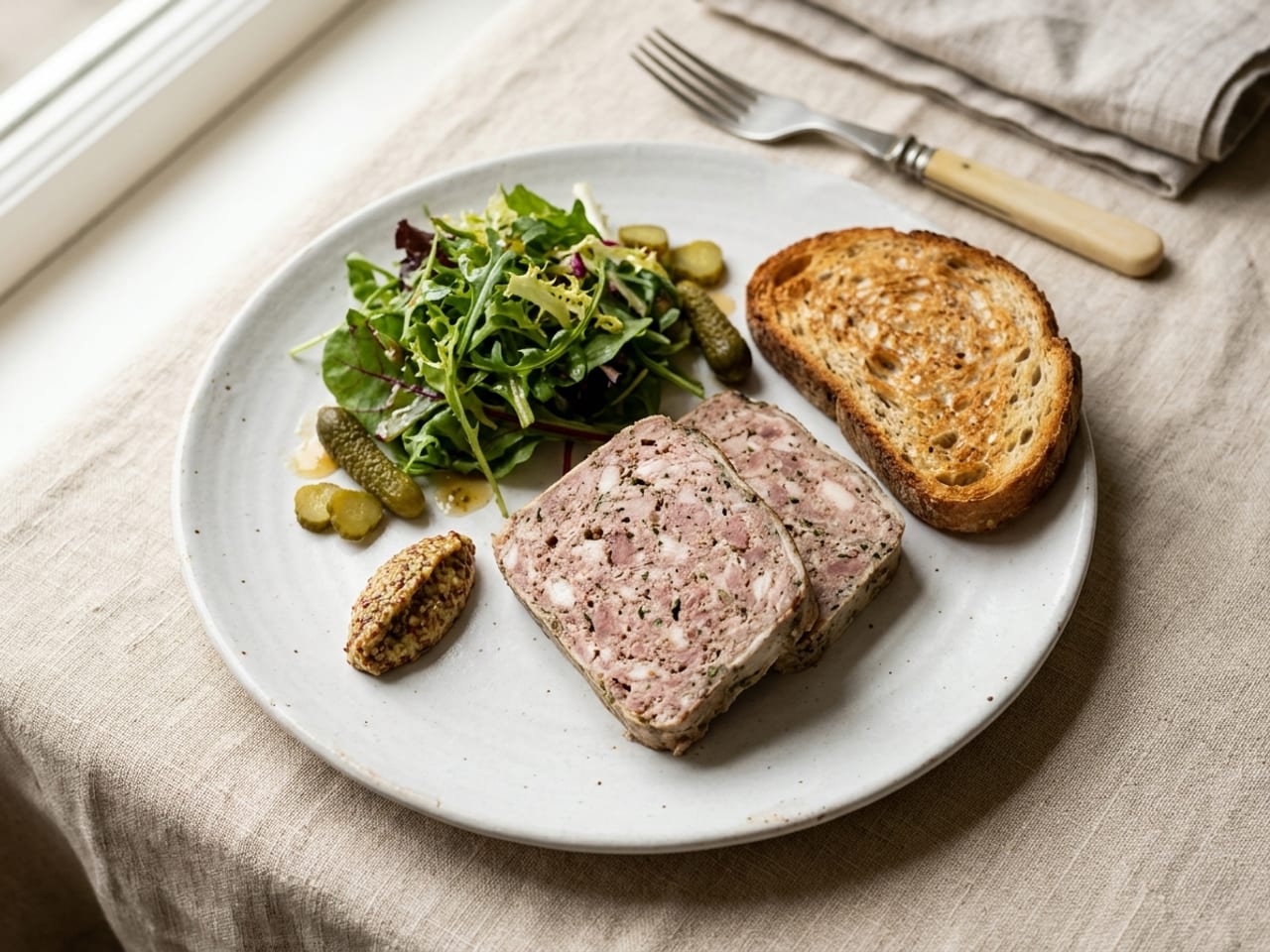
- One or two slices a plate. "In simple, traditional presentations, one or two slices of pâté are plated with a liner leaf or herb sprig garnish, a condiment, and perhaps a simple or composed salad accompaniment" (Professional Garde Manger). No source we read gives a slice thickness.18
- Something sharp beside it. Rich pâtés are "traditionally accented with foods that are tart and crunchy" (Professional Garde Manger, which makes bread "the essential accompaniment"); "sour pickles and mustard are classic accompaniments" (Gisslen).18, 28
- Or serve it in its dish. In en terrine service "a small, sharp knife is typically stuck into the terrine" and guests cut their own, with the accompaniments in bowls beside it.18
Aspic glazing
Gisslen gives aspic three jobs: "To protect foods from the air, which would dry them out and discolor them", "To improve appearance and give shine" and "To add flavor". To coat, chill the food first, set it on a rack over a tray, cool the aspic until syrupy and nap it on, chill, and repeat; a brush does for small things "such as canapés, that need only a light glaze".28 Professional Garde Manger says aspic "was originally used to form a protective barrier on foods that were set out on buffet tables for lengthy periods"; Thibodeaux goes further, that "The gelatin keeps out air and bacteria". No agency we read credits aspic with keeping food safe, and meat under aspic is still food that has to stay cold (ours).18, 20 Gelatin strengths as printed:
| Use | Source | Gelatin per gallon of stock |
|---|---|---|
| Delicate coating | Thibodeaux20 | 2 oz per gallon (about 15 g per litre, ours) |
| Edible chaud-froid | Thibodeaux20 | 4 oz per gallon (about 30 g per litre, ours) |
| Coating, with a regular stock | Gisslen28 | More than 4 oz (125 g) per gallon (4 L) |
| Sliceable or moldable | Thibodeaux20 | 8 oz per gallon (about 60 g per litre, ours) |
| Aspic for slicing | Gisslen28 | About 8 oz (250 g) per gallon (4 L) |
| Tough, not to be eaten (a chaud-froid platter) | Thibodeaux20 | 12 oz per gallon (about 90 g per litre, ours) |
Thibodeaux does not say whether its ounces are weight; we read them as weight. Professional Garde Manger sets the ratio by use, less gelatin for a delicate set and more for a firm one; its figure is past the paywall.18, 20 For a platter, Thibodeaux first coats the platter itself, a chemise: aspic brushed on "a level and cold platter", garnish attached, more aspic over it, and the gel left to strengthen before the food goes on. The ACF's competition rules forbid that for food cooked hot and shown cold, and allow more gelatin than "normal quantities", within limits.20, 55
Cold platters: the grosse pièce, the flow, and no odd-number rule
The three textbooks agree on the classic cold platter: Gisslen's "three elements" are a centrepiece or grosse pièce ("Whether or not the grosse pièce is intended to be eaten, it should be made of edible materials"), the slices, and garnish "in proportion to the cut slices". 18, 20, 28 None of them prints an odd-number rule, and the one test we found, of seared scallops on plates, found no odd or even preference; it did find plates with more pieces liked more, for the same amount of food.94 Who prints what:
| Rule | Gisslen28 | Professional Garde Manger18 | Thibodeaux20 | Tested? |
|---|---|---|---|---|
| A focal point (the grosse pièce) | Yes: the centerpiece "isn't always in the center"; it goes "at the back or toward the side so it doesn't hide the food" | Yes: about two-thirds of the pâté sliced, the last third "at the head of the platter as a grosse pièce" | Yes: "The grosse piece is the focal point of the platter" | None found |
| Movement: flow lines | "curves and angles are said to have movement. Square corners do not." | Not in the previews | Slices shingled out from the grosse pièce "to convey movement" | None found |
| Height | "Flat foods on flat trays on flat tables are uninteresting to the eye." | The uncut piece "contributes height"; an attelet skewer may raise it | Height on the buffet; an epergne keeps sight lines clear | None found |
| Overlapping slices | "Angle overlapping slices and wedge-shaped pieces toward the customer", best side up | Slices arranged from the grosse pièce | "shingled over each other" | None found |
| Odd numbers | Not printed; he starts a sketch by dividing the platter into "six or eight equal parts", a symmetrical layout | Not printed in the previews | Not printed | Tested: "No consistent evidence for a preference for odd or even numbers" (PeerJ 2016, with scallops on plates)94 |
| One portion off, the rest intact | "one portion can be removed without ruining the arrangement"; a simple design still looks good "half demolished" | Slice one-half to two-thirds of a roast; the rest is the focal point | Equal slices | None found |
| Keep it simple | "'Keep it simple' is a good rule of thumb"; "Lavishness is not the same as clutter." | Condiments never so many "that they mask or overwhelm" the food | "the trick is not to overdesign" | A neat arrangement liked more than a messy one, and an artful salad more than a tossed one95 |
On a buffet, Gisslen puts the cold food first: "Hot foods are best served last. If served first, hot foods get cool while the guests make other selections from the cold foods", and the decorative cold platters look better up front.28 Thibodeaux's buffet lists follow his almost word for word, so we count them as one line; they differ on one point, where the small plates go at a cocktail buffet: "at the start of the service point" (Thibodeaux) or "beside each item rather than at the beginning of the table" (Gisslen).20, 28 Thibodeaux's own platter rule is B.U.F.F., Balance, Unity, Focal point, Flavor, with "Do not mix desserts with savory on the same platter".20 For a delicate or costly appetizer, Professional Garde Manger pre-plates small portions "on little plates, or in little cups, that are lined up on the buffet in a symmetrical pattern".18 The whole buffet table, its length, order and holding times: how to set up a buffet table.
Replenishing a cold platter: swap it, do not top it up
The food-safety sources agree: put out small platters and swap a used one for a fresh one, rather than adding new food to what has been sitting out. The textbooks' "replenish" is about looks and does not say how.
| Source | What it is | Its rule |
|---|---|---|
| USDA, AskFSIS68 | US agency, home buffet | "use small serving trays and replace them within two hours" |
| UNH Cooperative Extension75 | Extension service | "Replace empty platters rather than adding fresh food to a dish that already had food in it." |
| UK Food Standards Agency81 | UK agency, businesses | "remove a small amount at a time. Make sure that food on display is used up before you add new food." |
| Professional Garde Manger18 | Textbook, food bars | "Never combine food from a used pan with food from a fresh pan." |
| FDA, egg safety73 | US agency | For reheated egg dishes, small platters, "Replenish as needed, or at least every 2 hours" (it does not say whether to top up or swap) |
| Gisslen28 | Textbook, on looks | "Replenish items as they become depleted. A nearly empty bowl isn't as appetizing as a full one." (how, it does not say) |
Food safety for the cold kitchen, kept apart by country
Everything the cold kitchen sends out is eaten without being cooked again, which is why the textbooks single it out: cold foods "present special problems because they are stored and handled after cooking" (Gisslen).28 The rules below are each agency's own, for its own country and its own audience: a rule for food businesses is not a rule for a home cook, and no figure from one country is blended with another's. The full holding table for a buffet is on how to set up a buffet table.
How cold: the cold line, country by country
| Source | Where | For whom | As printed |
|---|---|---|---|
| FDA Food Code 2026 (and 2022)66 | US | Food businesses, where adopted | "At 5°C (41°F) or less" |
| USDA FSIS, Danger Zone67 | US | Home cooks | "at or below 40 °F" (4°C) |
| USDA, AskFSIS68 | US | A home buffet | "40 °F or colder" (4°C) |
| FSA, Safer Food Better Business81 | UK | Food businesses | "8°C or below", the law in England, Wales and Northern Ireland and advice in Scotland; fridges and displays at 5°C or below recommended |
| FSA, chilling at home82 | UK | Home cooks | Fridge "between 0 and 5°C"; the danger zone "8 - 63°C" |
| BfR leaflet87 | Germany | Home cooks | "maximal 7 °C", better under 5°C (44.6°F, 41°F) |
| Finnish Food Authority90 | Finland | Home cooks, fish | "preferably at 0…+3°C (32…37°F)" |
| FSANZ92 | Australia, New Zealand | Food businesses | "5°C or colder" (41°F) |
| FSANZ, Listeria93 | Australia, New Zealand | Home cooks | Fridge "5°C or colder" (41°F) |
| EU Regulation 852/200489 | EU | Food businesses | No number: "The cold chain is not to be interrupted" |
How long cold food can sit out
US home advice says 2 hours (1 hour above 90°F, 32°C); the UK, Scotland, Australia and New Zealand and the US Food Code's business option all say 4 hours, each with its own conditions.66, 67, 81, 86, 91 They disagree on what happens after: the UK business rule lets food out for under four hours go back in the fridge once, while the Australian rule forbids re-chilling food out for 2 to 4 hours.81, 91 Gisslen's textbook has its own "four-hour rule", cumulative from receiving to serving, which is not the Food Code's.28
| Source | Where | For whom | The rule |
|---|---|---|---|
| USDA FSIS67 | US | Home cooks | "Never leave food out of refrigeration over 2 hours"; 1 hour above 90°F (32°C) |
| USDA, AskFSIS68 | US | A home buffet | Discard food on the table "for more than two hours"; small trays "replace them within two hours" |
| CDC, cut melon71 | US | Home cooks | Not cut melon "left out for more than 2 hours (1 hour if it's exposed to temperatures hotter than 90°F" (32°C) |
| FDA Food Code 202666 | US | Food businesses with written procedures | Time as a control: out of the fridge at 41°F (5°C) or less, marked, and served or thrown away "within four hours"; for cold food only, up to six hours if it never passes 70°F (21°C) |
| FSA, Safer Food Better Business81 | UK | Food businesses | "You can display food out of chilled storage for up to four hours, but you can only do this once." |
| FSA, community and charity events83 | UK | Events | Chilled buffet food "for no more than four hours"; "In extremely hot weather, use food that's been out of the fridge within 2 hours." |
| FSA, chilling at home82 | UK | Home cooks | "a maximum of four hours" out of the fridge during preparation |
| Food Standards Scotland86 | Scotland | A home buffet | Chilled foods out of the fridge "no longer than four hours" |
| FSANZ, 2-hour / 4-hour rule91 | Australia, New Zealand | Food businesses | Cumulative time between 5°C and 60°C (41°F and 140°F): under 2 hours, use or refrigerate; 2 to 4 hours, use but do not re-chill; over 4 hours, throw away |
| EU Regulation 852/200489 | EU | Food businesses | "limited periods outside temperature control are permitted", no number |
The FDA keeps cold egg dishes and cold seafood "on ice" if they will be out longer than 2 hours, which reads as if ice buys time; USDA says to nest dishes "in bowls of ice" but still to discard food on the buffet table after two hours, and neither gives a longest time on ice. At home we keep the 2 hours, ice or not (ours).68, 73, 74
What has to stay cold: cut melon, cut leafy greens, cut tomatoes
The Food Code counts "cut melons", cut leafy greens and "cut tomatoes" among the foods that need time and temperature control, with raw sprouts and garlic in oil; leafy greens are lettuces, spinach, cabbage, kale, arugula and chard, and "does not include herbs such as cilantro or parsley".66 The CDC adds a home rule for cut melon: not left out for more than 2 hours, or in the fridge for more than a week.71 Gisslen on mayonnaise salads: "Cooked ingredients must be thoroughly cooled before being mixed with mayonnaise, and the completed salad mixture must be kept chilled at all times."28 In a kitchen, ready-to-eat food is not touched with bare hands (deli tissue, tongs, gloves), and raw meat is kept apart from it; at home, the CDC uses one board for raw meat and another for food that will not be cooked.66, 72
Cooling terrines and cooked food
The Food Code cools cooked food in two stages, from 135°F to 70°F (57°C to 21°C) within 2 hours and to 41°F (5°C) "Within a total of six hours"; its 2026 edition adds a depth of no more than 2 inches (5 cm) to its cooling methods. Australia and New Zealand cool from 60°C to 21°C (140°F to 70°F) in 2 hours, then to 5°C (41°F) in 4 more; the UK home advice is into the fridge "within one to two hours".66, 82, 92 The textbooks cool a terrine differently: Thibodeaux on the table "until the pate falls to 90°F" (32°C), and Professional Garde Manger, weighted, "to room temperature", neither with a time limit.18, 20 That is a gap the agencies close: at home we follow their cooling times, not the books' (ours).
Terrine temperatures: the textbook against the agency
Thibodeaux bakes terrines to an internal 145°F (63°C) for fish, shellfish and pork, 155°F (68°C) for beef, venison, lamb and veal and 165°F (74°C) for poultry; Professional Garde Manger to "usually 155°F (68°C)".18, 20 A forcemeat is ground meat, and the USDA figure for ground meat is higher, as UNH Extension prints it: "Raw ground beef, pork, lamb, and veal should be cooked to an internal temperature of 160 °F" (71°C). USDA's own chart gives the same 160°F (71.1°C) for ground meats; its 145°F (62.8°C) is for whole steaks, chops and roasts with a 3-minute rest, not for ground meat.69, 75 Side by side:
| Forcemeat | Thibodeaux | USDA (FSIS chart; UNH Extension) | Difference |
|---|---|---|---|
| Pork forcemeat (ground pork) | 145°F (63°C) | 160°F (71°C) for ground pork | 15°F (8°C) below |
| Beef, venison, lamb and veal forcemeat | 155°F (68°C) | 160°F (71°C) for ground beef, lamb and veal | 5°F (3°C) below |
| Poultry | 165°F (74°C) | 165°F (74°C) for all poultry | The same |
We print the textbook figures so you can recognise them, not to follow them: for a terrine of ground meat, use the agency figure (ours).20, 69, 75
How long does a terrine keep?
The textbooks give weeks for a sealed, uncut terrine; the agencies give days for ready-to-eat food. A month is professional practice for a terrine sealed and untouched in its dish, not a home rule; at home we follow the agencies (ours): the US home chart gives cooked meat 3 to 4 days in the fridge, and the Food Code's seven days, counting the day it was made, is the ceiling it sets for food businesses.18, 28, 66, 70
| What | Source | What it is | How long, as printed |
|---|---|---|---|
| Meat terrine, sealed, uncut, in its dish | Professional Garde Manger18 | Textbook | "easily keeps in the refrigerator for a month" |
| Pâté en croûte, uncut, sealed with aspic | Professional Garde Manger18 | Textbook | "at least two weeks" |
| Any pâté, once cut | Professional Garde Manger18 | Textbook | "served within a few days" |
| Meat terrine sealed with fat, uncut | Gisslen28 | Textbook | "may keep as long as several weeks (although the quality may start to decline after a week or so)" |
| Seafood and vegetable terrines | Gisslen28 | Textbook | "no more than two or three days, or even less" |
| Ready-to-eat food that needs refrigeration (TCS food), made in-house and held over 24 hours | FDA Food Code 202666 | Agency, business rule | At 41°F (5°C) or less, "a maximum of seven days", the day it is made counted as Day 1 |
| Cooked meat or poultry, leftovers | FoodSafety.gov70 | Agency, home | 3 to 4 days in the fridge |
| Egg, chicken, ham, tuna and macaroni salads | FoodSafety.gov70 | Agency, home | 3 to 4 days in the fridge |
| Deli-sliced luncheon meat | FoodSafety.gov70 | Agency, home | 3 to 5 days |
| Gravlax, once cured | UC Master Food Preservers78 | Extension service | "up to 5 to 7 days", tightly wrapped |
Listeria, pregnancy, pâté and smoked salmon, by country
Listeria is the cold kitchen's particular risk, because "The germs even can grow in food kept in the refrigerator" (CDC); the UK FSA says the same.71, 82 Every agency we read says pregnant women and other people at higher risk should avoid refrigerated smoked fish, or eat it cooked; the UK, German and Finnish agencies name cured fish such as gravlax too. On pâté they split: on its page reviewed 15 June 2026 the NHS lists meat pâté under foods to be careful with, kept chilled and eaten before its use-by date, while the CDC, the BfR and FSANZ still say to avoid refrigerated pâté. Liver pâté stays on the NHS's avoid list, for its vitamin A. We did not read an older NHS page, so we do not date the change.71, 74, 80, 85, 87, 90, 93
| Agency | Where | Refrigerated meat pâté | Cold-smoked or cured fish |
|---|---|---|---|
| CDC71 | US | Avoid "Refrigerated pâté or meat spreads"; choose shelf-stable ones | Avoid "Refrigerated smoked fish"; choose shelf-stable, or smoked fish cooked in a dish |
| FDA74 | US | Not on its seafood page | Avoid refrigerated smoked seafood "except in a cooked recipe, such as a casserole" |
| NHS (page reviewed 15 June 2026)80 | UK | Meat pâté is on the "be careful" list: "keep chilled and eat before the use-by date"; liver pâté stays on the avoid list (vitamin A) | Cold-smoked and cured fish, like smoked salmon, "must be cooked until steaming hot" |
| FSA85 | UK | Not on the page | "advised to avoid" ready-to-eat cold-smoked or cured fish such as smoked salmon or gravlax; warming it through in a dish does not make it safe |
| BfR87 | Germany | Avoid pâtés of meat, fish or plants, except canned, unless heated to 70°C (158°F) at the core | Avoid smoked and gravad fish unless heated the same way |
| Finnish Food Authority90 | Finland | Not on the page | Not "cold-smoked and gravad fish products without cooking" |
| FSANZ93 | Australia, New Zealand | Avoid "refrigerated paté or meat spreads" | Avoid "smoked ready-to-eat seafood" |
In German official testing from 2007 to 2017, 7 to 18% of cold-smoked or cured fish samples carried Listeria, against 3 to 9% of hot-smoked ones.88 The FSA: "Cook the fish first as warming it through as you prepare your meal will not heat the fish to a high enough temperature to kill listeria."85
Gravlax and parasites: the agencies disagree on farmed salmon
Fish served raw or raw-cured must be frozen first under the Food Code, to -4°F (-20°C) for 7 days, or -31°F (-35°C) until solid and then 15 hours, but the Code exempts farmed fish "such as salmon" raised on parasite-free feed.66 A University of California extension handout disagrees: salt and acid "are not sufficient for killing parasites", the freezing applies "to both wild caught and to aquacultured (farmed) fish", and most home freezers cannot reach or hold those temperatures, so it recommends "commercially frozen salmon only".78 At home we follow the handout (ours). Curing takes 1 to 3 days, and the cured fish keeps "up to 5 to 7 days".78
Curing salts and smoking at home
Curing salts carry nitrite, which inhibits Clostridium botulinum, and have "a relatively high toxicity, so they must be used in the quantities established in researched recipes"; most are dyed pink and are not Himalayan pink salt. Prague Powder #1 is 6.25% sodium nitrite in the extension's figure; Thibodeaux rounds it to 6%.20, 77 The Pacific Northwest home guide covers hot smoking only; cold-smoked fish, it says, is "unpasteurized and therefore must be handled carefully", and if a home fridge cannot hold under 40°F (4°C), smoked fish should be kept frozen.76 We found no home cold-smoking method from an extension service in what we read.
Raw egg, raw meat
For dishes with raw egg (the FDA's examples are Caesar dressing and homemade ice cream; mayonnaise is the same case, ours), the US FDA says pasteurized eggs; the NHS allows raw-egg mayonnaise in pregnancy with British Lion or Laid in Britain eggs; the details are on our mayonnaise guide.73, 80 For steak tartare and carpaccio, Professional Garde Manger: "Only beef, lamb, and farmed venison are considered safe for raw service", prepared "at the last possible moment" for a buffet, with "freshly thawed pasteurized egg yolk".18
Allergens on a cold buffet
A UK food business must give allergen information "for each food item separately" on a buffet ("You should not provide it for the buffet as a whole"), by labels on each dish or a sign sending guests to staff, for 14 allergens.84 An activity that need not register as a food business, such as a community event, is "not legally required" to, though the FSA encourages it.83 The US Food Code requires written notification of major food allergens in unpackaged food where it is adopted.66 Professional Garde Manger puts a placard on each self-service dish and notes "a potential allergen, such as nuts or shellfish" on it.18 A self-service buffet, the Food Code adds, is watched by trained staff.66
Run a cold station at home for a party (ours)
A garde manger station at home is a cold table for a party: made ahead, kept cold, put out in small batches. This plan is ours, built only from the make-ahead windows the sources print and the agencies' time limits; we have not tested it.
- Two or three days ahead: the terrine, the gravlax, the pickles. A terrine wants time: Professional Garde Manger rests it at least 48 hours "to mellow". Making it two or three days before keeps that rest and stays inside the US home chart's 3 to 4 days for cooked meat (our reading of both); serve it within that window.18, 70 Gravlax cures in 1 to 3 days, from commercially frozen salmon; its mustard and dill sauce can be made up to 3 days ahead.78 Refrigerator pickles keep 2 to 6 weeks, so they can come first of all.79
- The day before: greens, bound salads, room in the fridge. Wash and dry the greens and keep them under a damp cover, "use within two days" (Thibodeaux).20 Make mayonnaise-bound salads only from fully cooled ingredients and keep them chilled; US advice gives them 3 to 4 days.28, 70 Clear a shelf for the plates if you will chill them (15 minutes to an hour, by the figures in the chilled-plates table) and plan the ice.97, 98
- The morning: as little cooling as possible. Anything cooked today has to cool fast: the Food Code's 2026 edition adds food no more than 2 inches (5 cm) deep to its list of cooling methods, beside stirring in an ice-water bath.66 Salads for a crowd can be plated undressed, covered and refrigerated, with crisp garnishes such as croûtons or bacon left until the end (Professional Garde Manger).18
- An hour or two before: plate and slice. Plate salads no earlier than "an hour or two before service" (Gisslen) and dress them just before service. Slice the terrine with a hot, wiped knife (Gisslen) and keep the slices covered in the fridge until they go out (ours).28
- Service: small platters on ice, swapped, labelled. Put out small platters and keep the rest cold until needed; nest each dish in a bowl of ice, as USDA suggests.68, 75 Take terrine portions out 5 to 10 minutes before eating, "but no longer" (Gisslen).28 When a platter runs low, swap it for a fresh one instead of topping it up.75, 81 Allergen information for each dish, on a label or by a sign telling guests to ask, is what the UK asks of businesses at a buffet and only encourages at events; at home a card on each dish is a courtesy (ours).83, 84 Tongs or a fork on every platter keep hands off the food (ours, after the Food Code's rule for kitchens).66
- The clock: your country's, and nothing goes back. Count from when each platter goes out: 2 hours for US home cooks, 1 above 90°F (32°C); 4 hours for chilled buffet food on the UK's community-events page and Scotland's home page, 2 in extremely hot weather (FSA); under 2 hours, then use but do not re-chill up to 4, in the Australian and New Zealand rule for businesses.67, 83, 86, 91 Food left on the table past its limit is thrown away, not chilled for later (ours, the strictest reading of the rules above).
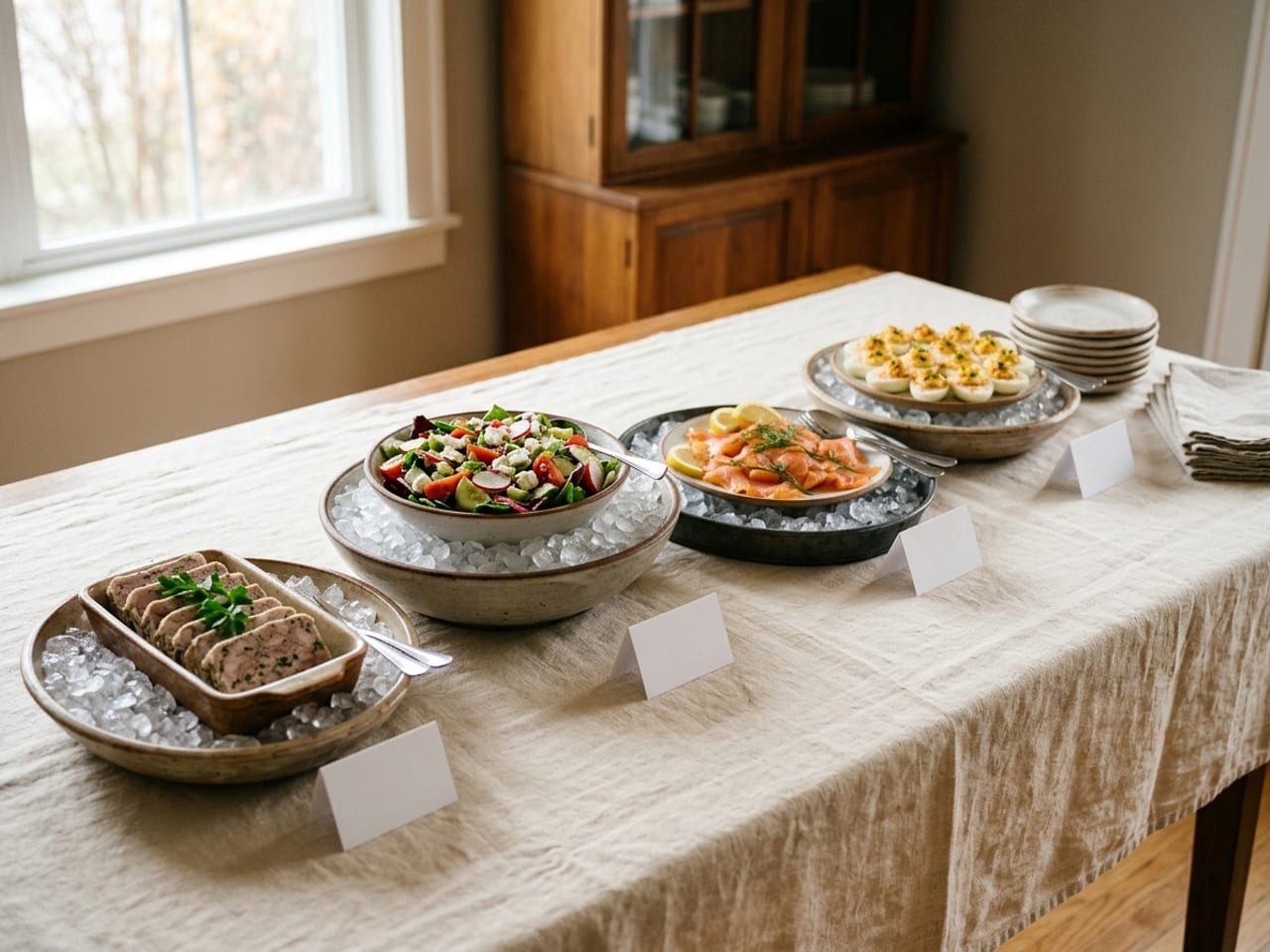
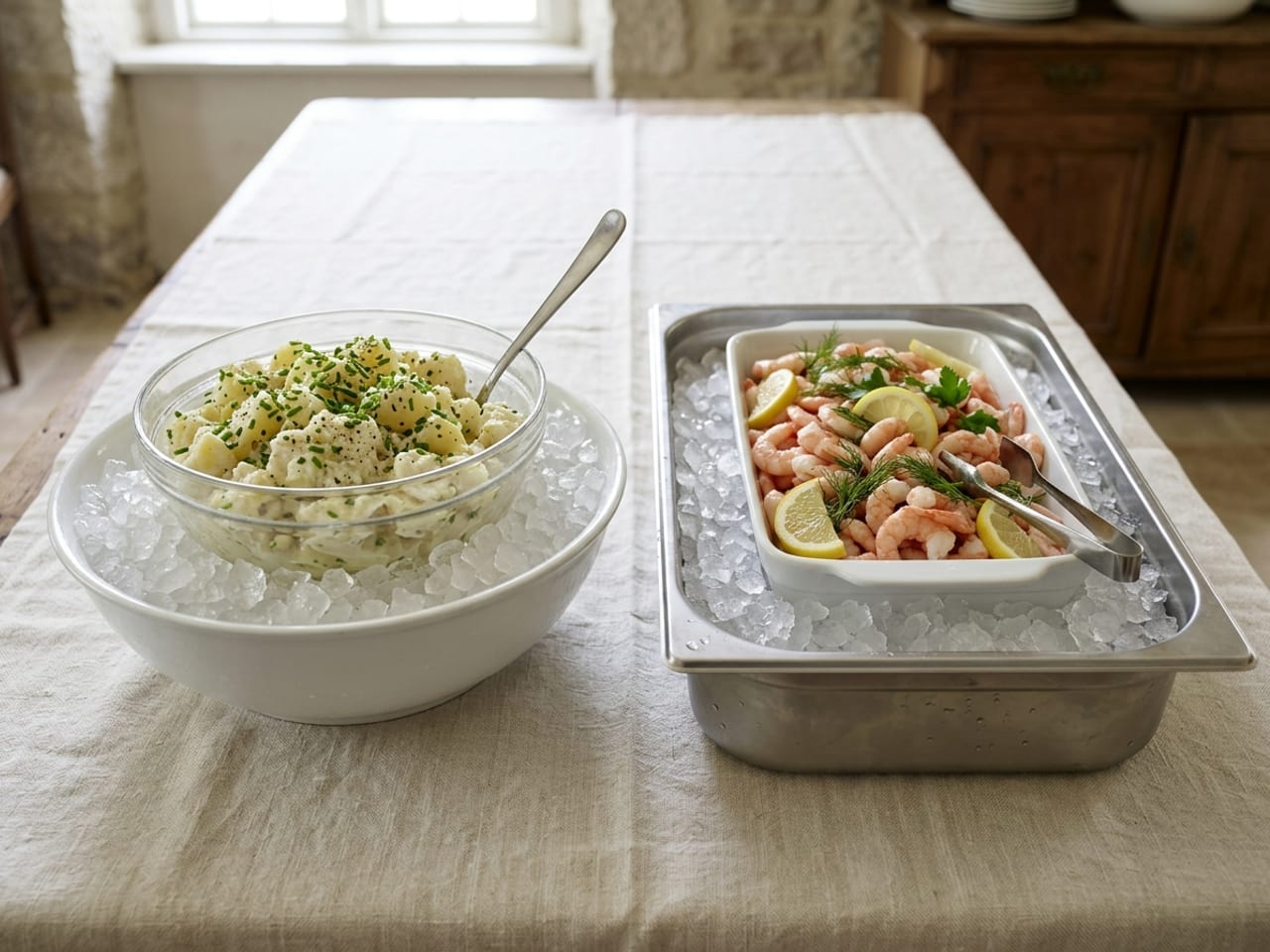
What to make ahead, and how far
| What | Source | Window, as printed |
|---|---|---|
| Terrine, before serving | Professional Garde Manger; Thibodeaux18, 20 | Rest "at least 48 hours to mellow"; Thibodeaux, "several days" |
| Gravlax, curing | UC Master Food Preservers78 | 1 to 3 days |
| Mustard and dill sauce | UC Master Food Preservers78 | Up to 3 days ahead |
| Refrigerator pickles | UC ANR Mariposa79 | 2 to 6 weeks in the fridge |
| Washed salad greens | Thibodeaux20 | "use within two days" |
| Mayonnaise-bound salads (egg, chicken, tuna) | FoodSafety.gov70 | 3 to 4 days |
| Legume salads, dressed | Thibodeaux20 | No more than a few hours before serving |
| Plated green salads | Gisslen28 | No more than "an hour or two before service" |
| Raw meat dishes for a buffet | Professional Garde Manger18 | "at the last possible moment" |
How much to make
We give no counts here; the counts with owners are on other pages. Canapés per guest, every printed figure: canapés. Portions for a crowd, by dish: the catering calculator and the party food calculator. A board for the table: the charcuterie board calculator. Professional Garde Manger's own method for banquets is portion size times guests, "6 oz (168 g) (portion size) by 100 (number of guests)" in its example.18
Garde manger history: the larder, the household officer, Escoffier and the modern station
Dates are the earliest we saw in what we read, never claimed as firsts. Old books were read in library scans or transcriptions; Escoffier is dated to the edition read.
| When | What the source says |
|---|---|
| 13th century | Littré quotes "Au gart mangier" from the Roman de Renart; the Académie dates the word to the 13th century.6, 8 |
| 14th century | A household of three cooks, "et sera l'un gardemangier": one of them shall be the garde-manger, a person, in a text Littré quotes through Du Cange.6 |
| 1578 | The wage roll of the household of Marguerite de Valois, Queen of Navarre, pays 150 écus "pour l'entretenement du sommier du garde manger", the pack animal of the travelling food store; its kitchen has cooks, roasters and soup cooks, but no officer called garde-manger.31 |
| 1694 | The Académie's first dictionary: "Lieu pour garder, ou serrer de la viande, & autres choses servant à la nourriture", a place.7 |
| 1700 | In a great house the maître d'hôtel, not a garde-manger, "regarde la dépense générale qui se fait journellement" and chooses the officers of the kitchen: Audiger's La Maison réglée, as a later editor quotes its 1700 edition (we did not read Audiger himself).32 |
| 1757 | The Encyclopédie: "un petit lieu près d'une cuisine" for meat, game and poultry, its provisions "sous la garde du chef de cuisine": a room kept by the head cook.33 |
| 1766 | The Scots gardymang, "A larder, a meat-safe", an 18th-century borrowing that the Caledonian Mercury printed as "guard-mangé" on 1 March 1766.14 |
| Before 1789 | In the king's kitchen the écuyer "recevait la viande qu'il distribuait aux autres", and "Le sommier du garde-manger portait pour un repas la viande du roi allant par pays": Saint-Allais's account of the king's kitchen, published 1816, which recalls Louis XV's time.36 |
| 1815 | Carême plans a treatise whose second part is "les détails et la tenue du garde-manger, et des observations sur cette importante partie"; his pâtés rest overnight in the garde-manger, "comme étant un lieu frais", and in a badly run kitchen he finds "quelques entrées froides dressées" there.34, 35 |
| 1867 | A Paris restaurant: "Le chef du garde-manger (fixe 2,000 fr. ou 2,400). Place de confiance", keeping meat and fish on slabs cooled by ice, cutting every portion, in charge of the chaud-froid (Chavette).37 |
| 1868 | Gouffé's English translator writes "larder" for the cool store, and the cook should advise the architect "more particularly of the larder".38 |
| 1873 | Gouffé ranks pastry above "faire un garde-manger ou un fourneau": by now the garde-manger is a post you work.39 |
| 1903 | Escoffier's Guide culinaire, 1st edition: in "une brigade de 60 hommes", the general board of orders goes to the garde-manger, so "Le chef garde-manger a donc sous les yeux toutes les commandes annoncées"; elsewhere the "chef du froid".40 |
| 1907 | The 2nd edition repeats the passage (p. 1216). The English edition, A Guide to Modern Cookery, has no brigade section and no garde-manger in what we searched, but writes that "Jellies are to cold cookery what consommés and stock are to hot", with the Savoy's Suprême de Volaille Jeannette.41, 42 |
| Late 1800s to early 1900s | Grand-hotel buffets: "Blocks of ice, often carved into elaborate shapes, were used to keep the buffet foods cold" (Professional Garde Manger).18 |
| 1925 | The earliest English job use we saw in a dated scan: Bradley's book list names "The Hotel Butcher, Garde Manger and Carver, by Frank Rivers".43 |
| 1928 | Merriam-Webster's first known use of garde-manger for the cook.1 |
| Late 1960s onward | With nouvelle cuisine, food is plated in the kitchen, and "garde manger chefs began to create intricate plate presentations that included individual food portions formed in molds" (Professional Garde Manger).18 |
| 1973 | A British catering textbook (Kinton and Ceserani, 3rd ed.) puts the hors d'oeuvre cook "near the larder", as the Québec office quotes it; library records date Sonnenschmidt and Nicolas's The Professional Chef's Art of Garde Manger, a US textbook, to about the same year (not read).12, 44 |
| 1989 | The Québec office defines the cook as a chef de partie who keeps "tous les comestibles crus ou cuits" and prepares the cold dishes.10 |
| 1999 to 2012 | The US textbooks: the CIA's Garde Manger, first published 1999 (Wiley; catalogue records say 2000), 4th edition 2012; Professional Garde Manger, April 2010; the ACF's Cold Kitchen Fundamentals, 2011.19, 21, 23, 24 |
| 2017 to 2026 | The UK apprenticeship standard names a "larder" section run by a chef de partie (2017); the ACF's 2026 Certified Master Chef exam has a garde manger day.51, 54 |
The textbooks' stories, and where they split. The CIA and Professional Garde Manger tell a similar arc: the larder of medieval castles and manors, below ground ("On French estates, the larder was called the garde manger", Professional Garde Manger), and preservation first; the CIA adds an "officier de la bouche, or steward" who managed the storeroom, and does not date him.18, 21 On the end of the guilds the books disagree: Thibodeaux has them last "until the latter part of the sixteenth century until the French Revolution", while Gisslen has the revolutionary government abolish them and the CIA writes "When the guild system was officially abolished in 1791, some members of the charcutiers' guild also joined the ranks of restaurant and hotel kitchen garde manger staffs". We follow 1791 as the CIA states it; Thibodeaux's own exercise says "the latter part of the 1700's".20, 21, 27 Thibodeaux also credits Carême with creating chaud-froid and dates an aspic recipe in Le Viandier to about 1375, citing neither, so we print them only as its claims.20
Popular claims about the garde manger, each with a verdict
Thirteen claims, each against what we read. "Supported, narrowly" means the sources cover less than the claim says; "Mixed", that they point both ways; "No source found", that we found nothing for it.
| The claim | Verdict | What we found |
|---|---|---|
| Garde manger means "keeper of the food". | Mixed | That is Thibodeaux's and the Escoffier school blog's gloss. The CIA's and Professional Garde Manger's is "keep to eat", Merriam-Webster's "one who keeps food", Dictionary.com's "(that which) keeps food" and Gisslen's a larder or "food storage place"; Wikipedia's "keeping to eat" is its own paraphrase of Professional Garde Manger.1, 3, 15, 18, 20, 21, 27, 62 |
| Garde manger is the entry-level station. | Mixed | No textbook we read says so. Wikipedia's "In many restaurants, it is a station which is generally an entry-level cooking position" rests on a 2020 memoir we did not read; the Escoffier school says "It depends on the restaurant"; the CIA says many chefs started there "as apprentices or commis"; Professional Garde Manger puts it after time on the hot side; a Paris kitchen in 1867 paid its garde-manger as much as its saucier or more, and Canada files the job with chefs who need "several years of experience" (who says what).15, 18, 21, 37, 49, 62 |
| The garde manger makes the desserts. | Mixed | The Escoffier school blog says "some cold desserts", and plated desserts "in many kitchens"; the CIA's Garde Manger says the station "may also be responsible for plating desserts" in à la carte service; one New York posting lists desserts. Gisslen gives "pastries and desserts" to the pâtissier, the CIA's Professional Chef "frozen and cold desserts" to the glacier, and no garde manger textbook or course outline we read has a dessert unit.21, 28, 30, 62, 65 |
| Escoffier invented the garde manger station. | Not supported | Carême called the garde-manger "cette importante partie" in 1815 and a Paris kitchen paid a chef du garde-manger in 1867, decades before Escoffier's 1903 Guide culinaire, which describes the work of a large brigade without claiming to have invented it. The textbooks split on the verb: "instituted" (the CIA's Professional Chef), "recorded" (the CIA's Garde Manger), a "reorganization" (Gisslen).21, 27, 30, 34, 37, 40 |
| The garde manger only makes cold food and never cooks. | Not supported | Gisslen: "This does not mean that no cooking is done in the pantry." Professional Garde Manger's prep kitchen has "The same stoves, ovens, broilers, steamers, grills"; terrines are baked and galantines poached; Thibodeaux's book and two course outlines include hot hors d'oeuvre, hot sandwiches or hot action stations.18, 20, 28, 57, 59 |
| Cold food should go straight from the fridge to the table. | Mixed | For pâtés, terrines and aspics, Gisslen calls serving them too cold "a common error" and lets portions stand "about 5 or 10 minutes, but no longer"; salads are served "cool, not ice cold" in a US lesson. The FDA, for cold seafood and egg dishes: keep them refrigerated "until time to serve". The time limits apply either way (how long food can sit out).28, 61, 73, 74 |
| Always put an odd number of pieces on a platter. | Not supported | No textbook we read prints the rule; Gisslen sketches platters in six or eight sections. The one test we found, of scallops on plates, found "No consistent evidence for a preference for odd or even numbers"; plates with more pieces were liked more.28, 94 |
| Aspic keeps cold food safe on a buffet. | Not supported | Thibodeaux says the gelatin "keeps out air and bacteria"; Professional Garde Manger says aspic "was originally used" as a barrier; no agency we read credits it with safety, and the agencies' time limits make no exception for it.18, 20, 66 |
| Garde manger is just the French for pantry. | Supported, narrowly | For the department, yes in the US textbooks: Gisslen's "pantry chef, or garde manger", the CIA's "also known as the PANTRY CHEF". The French dictionaries' room is a pantry or larder too, but the word is also a cupboard and, for the Québec office and the textbooks, a cook; British kitchens call the section the larder.8, 9, 10, 25, 27, 30, 51 |
| The garde manger began in pre-Revolutionary French households. | Supported, narrowly | Wikipedia's sentence has no source, and the word is older than it suggests: a 13th-century "gart mangier", a 14th-century household cook called "gardemangier", a 1578 royal roll, the Académie's place of 1694. The CIA's "officier de la bouche, or steward" who ran the storeroom is undated, and the Académie makes the officiers de la bouche kitchen squires.6, 7, 15, 21, 31 |
| Smoked salmon is fine in pregnancy if it is kept cold. | Not supported | Every agency we read says to avoid refrigerated smoked fish in pregnancy or cook it, the NHS "until steaming hot"; the UK, German and Finnish agencies say the same of cured fish such as gravlax. Listeria grows in the fridge.71, 74, 80, 85, 87, 90, 93 |
| Pâté is off the menu in pregnancy everywhere. | Mixed | The CDC, the BfR and FSANZ say to avoid refrigerated pâté; the NHS page reviewed in June 2026 lists meat pâté under foods to be careful with, kept chilled and eaten by its use-by date, with liver pâté still to avoid.71, 80, 87, 93 |
| A terrine keeps for a month. | Supported, narrowly | Professional Garde Manger: a terrine "untouched in its dish easily keeps in the refrigerator for a month"; Gisslen, "several weeks" if sealed with fat and uncut, with quality falling "after a week or so". Once cut, "within a few days". The Food Code caps food businesses' food made ahead at seven days, and the US home chart gives cooked meat 3 to 4 days in the fridge.18, 28, 66, 70 |
Photograph your plate, see it re-plated
Plated a slice of terrine or a composed salad? Photograph it and Plate Artists re-plates that dish, with the food kept as it is and the changes named so you can repeat them. Start with a re-plate.
Your food, plated like a chef's
Snap it, upload it, and get the composed version back, with the steps to recreate it at home.
Start free · 1 enhancement →Free account · 1 free enhancement · No credit card
Garde manger terms, defined
Garde manger · gard-mahn-zhay; also garde-manger
The cool room where cold food is kept and prepared, the cold station of a kitchen, and the cook in charge of it.
Where it comes from. French garder, to keep, and manger, to eat; Merriam-Webster: "one who keeps food".1, 3, 18
Chef garde manger · chef garde-manger
The chef de partie who runs the garde manger station.
Where it comes from. Escoffier 1903: "Le chef garde-manger a donc sous les yeux toutes les commandes".5, 40
Pantry chef · pantry cook
The US textbooks' English name for the garde manger chef and the cold department.
Where it comes from. Gisslen: "The pantry chef, or garde manger"; Merriam-Webster's pantry, from paneterie, from pain, bread.2, 27, 30
Larder chef · larder cook
The British name for the cook in charge of the cold larder section.
Where it comes from. Leto and Bode's UK textbook, The Larder Chef; the UK chef de partie standard's "larder" section.25, 51
Chef du froid
French for the chef of the cold, the cook whose ideas shape the cold hors-d'oeuvre in Escoffier's 1903 Guide culinaire; a chapter title in Leto and Bode's Larder Chef.
Where it comes from. Escoffier 1903: "les variations d'idées du chef du froid".25, 40
Cold kitchen · cuisine froide
The part of a kitchen, or the craft, that prepares food served cold.
Where it comes from. The ACF's Garde Manger: Cold Kitchen Fundamentals; Tri-C's "Garde Manger station -- cold kitchen".24, 52, 57
Brigade · kitchen brigade, brigade system
A kitchen's staff organised into stations, each run by a station chef under the chef and sous chef.
Where it comes from. The CIA: "instituted by Escoffier to streamline and simplify work in hotel kitchens"; Escoffier 1903: "une grande brigade".30, 40
Chef de partie · station chef
The chef in charge of one station, such as the saucier or the garde manger.
Where it comes from. The Food Lover's Companion: "also known as station chefs or journeyman cooks".5, 27, 51
Commis
A junior cook or apprentice working under a station chef.
Where it comes from. The CIA: "The COMMIS or apprentice works under a station chef".30, 50
Forcemeat · farce
Seasoned ground meat or fish, the base of pâtés, terrines, galantines and sausages.
Where it comes from. Gisslen: from "the French word farce, which means 'stuffing'".20, 28
Pâté · pah-TAY
In the textbooks, a forcemeat baked in a crust; in popular use, any smooth meat or liver spread.
Where it comes from. Professional Garde Manger: "a forcemeat baked in a pastry crust and usually served cold".18, 28
Pâté en croûte
A forcemeat baked inside a pastry crust.
Where it comes from. Gisslen: "To avoid confusion, perhaps the best advice is to use the term pâté en croûte".18, 28
Terrine
A forcemeat or layered mixture cooked in a mould without a crust, and the mould itself.
Where it comes from. Gisslen: from "the French terre, meaning 'earth'", the earthenware dish.18, 20, 28
Galantine
A forcemeat rolled in the skin of the bird it is made from, poached and served cold.
Where it comes from. Professional Garde Manger: from galine, chicken.18, 28
Ballottine · ballotine
A forcemeat wrapped in skin or meat before it is cooked; a wider word than galantine.
Where it comes from. Professional Garde Manger: from ballot, bundle, "any kind of wrapped forcemeat".18
Mousseline
A light forcemeat of raw fish, shellfish, poultry or meat puréed with cream.
Where it comes from. Professional Garde Manger: "a light-textured, puréed forcemeat".18, 20
Aspic · aspic jelly, gelée
Clear stock set with gelatin, used to glaze, bind and protect cold food.
Where it comes from. Gisslen: "clarified stock that contains enough gelatin to solidify when cold".18, 28
Chaud-froid
An opaque sauce set with gelatin, used to mask cold food.
Where it comes from. Professional Garde Manger: "literally means 'hot-cold'", made hot and served cold.18, 20
Chemise
A decorated coat of aspic set on a platter before the food goes on.
Where it comes from. Thibodeaux: a "chemise" or shirt, an aspic coat on the platter.20, 55
Grosse pièce · large piece
The uncut part of a terrine or roast set on a cold platter as its focal point.
Where it comes from. Professional Garde Manger: the uncut third "at the head of the platter as a grosse pièce".18, 20, 28
Charcuterie
Cured and smoked meats, sausages and pâtés, and the craft of making them.
Where it comes from. Gisslen: charcutier, "one who prepares and sells pork products".18, 20, 28
Gravlax · gravad fish
Raw salmon cured with salt, sugar and dill, sliced thin and served cold.
Where it comes from. Gisslen's recipe: salmon cured in salt, sugar and dill for 2 days.28, 78
Cold smoking
Smoking food at a low temperature for flavour, so that it is not cooked.
Where it comes from. Professional Garde Manger: food held "below 100°F (38°C)" while smoked, 80 to 90°F (26 to 32°C) ideal.18, 28
Hot smoking
Smoking food at a temperature that also cooks it.
Where it comes from. Professional Garde Manger: "smoky flavors and cooked textures".18, 28
TCS food · time/temperature control for safety food
A food that needs time or temperature control to stop harmful bacteria growing.
Where it comes from. The FDA Food Code's term, which includes cut melons, cut leafy greens and cut tomatoes.66
Garde manger, answered
What is garde manger?
Garde manger names three things: the cool room where cold food is kept and prepared, the cold station of a restaurant kitchen, and the cook in charge of it, also called the pantry chef. Professional Garde Manger counts three senses too, but not the same ones: place, person and craft. Dictionary.com gives the room and the cook; Merriam-Webster gives only the cook. In French it is also a meshed food cupboard, the only sense Larousse gives.
How do you pronounce garde manger?
As the US dictionaries print it: gard-mahn-zhay (Dictionary.com), with the stress on the last syllable, "zhay". Merriam-Webster prints \ˌgärd-ˌmäⁿ-ˈzhā\, Gisslen gard mawn-zhay and Professional Garde Manger gahrd mawn-ZHAY. In French, Wiktionnaire gives three syllables, /ɡaʁ.dmɑ̃.ʒe/, and Littré's older respelling four, (gar-de-man-jé). We found no British dictionary pronunciation: Cambridge has no entry.
What does garde manger mean in English?
Literally "keep to eat" for the CIA and Professional Garde Manger, "one who keeps food" for Merriam-Webster, "(that which) keeps food" for Dictionary.com and "keeper of the food" for Thibodeaux and the Escoffier school's blog; Gisslen says its basic meaning is larder, a food storage place. In kitchens it means the cold station and its cook.
What does a garde manger do?
Prepares the cold food: in Gisslen's words "salads and dressings, patés, cold hors d'oeuvres, and buffet items", and in the garde manger textbooks also cold sauces, sandwiches, cold soups, cured and smoked foods, sausages, terrines, aspic, cheese, condiments and buffet platters. For catered buffets, Professional Garde Manger adds the decorations: aspic and chaud-froid showpieces, ice carvings, and fruit and vegetable arrangements. Escoffier's chef garde-manger in 1903 also held the board of every order.
What is the difference between a garde manger and a pantry chef?
In the US textbooks there is none: Gisslen writes "The pantry chef, or garde manger" and the CIA "The COLD-FOODS CHEF (garde manger), also known as the PANTRY CHEF". The British name is larder chef. US labour statistics split the titles: a pantry chef is filed with chefs, a pantry cook with food preparation workers.
Is a garde manger a line cook?
It depends on whose terms. Gisslen's line cooks finish hot à la carte food "on the hot line, or simply on the line", and Professional Garde Manger calls the garde manger's counter the cold line; the CIA's Professional Chef calls station chefs line cooks ("the station chefs (or line cooks)"). In the brigade lists we read the garde manger is a station chef. In small kitchens one cook may run the whole cold station alone.
Is garde manger an entry-level position?
The sources are mixed, and no textbook we read calls it entry level. Wikipedia's "In many restaurants, it is a station which is generally an entry-level cooking position" rests on one 2020 memoir; the Escoffier school's blog says it depends on the restaurant; the CIA says many chefs started there as apprentices or commis; Professional Garde Manger advises time on the hot side first; the UK chef de partie standard gives the larder section to a Level 3 chef de partie, and Canada files the garde-manger chef with chefs who usually need several years of experience.
What food is garde manger?
Cold food. The categories most of the textbooks and course outlines we read share are cold sauces and dressings, salads, hors d'oeuvre and canapés, sandwiches, cold soups, cured and smoked foods such as gravlax, pâtés, terrines and galantines, cheese, condiments and pickles, garnishes and carving, and buffet platters. Fewer name sausages or aspic and chaud-froid, and only Thibodeaux has a charcuterie board.
Does the garde manger make desserts?
The sources split. The Escoffier school's blog says some cold desserts, and plated desserts in many kitchens; the CIA's Garde Manger says it may plate desserts in à la carte service; one New York job posting lists desserts. Gisslen gives pastries and desserts to the pastry chef, the CIA's Professional Chef frozen and cold desserts to the glacier, and no garde manger textbook or course outline we read has a dessert unit.
What is a garde manger class?
A course in the cold kitchen, usually taken after the basics: the Culinary Institute of America's needs 15 lab credits first. The outlines we read cover station design, cold sauces and soups, salads, sandwiches, hors d'oeuvre and canapés, charcuterie and sausages, pâtés and terrines, aspic and chaud-froid, cheese, carving and buffet presentation, and three of the six name the CIA's Garde Manger (Tri-C, Napa Valley) or the ACF's Cold Kitchen Fundamentals (Columbus State) as the textbook.
How cold should cold food be when it is served?
Cool, not ice cold, say the textbooks: Gisslen calls serving pâtés, terrines and aspics too cold "a common error" and lets portions stand at room temperature about 5 or 10 minutes, but no longer. They are stored cold: 41°F (5°C) or less in the US Food Code, 40°F (4°C) on US home pages, 8°C by UK law with 5°C advised.
How long can cold food sit out on a buffet?
It depends on the country: US home advice is 2 hours, or 1 hour above 90°F (32°C); the UK's events page and Scotland's home page say up to 4 hours for chilled buffet food (2 in extremely hot weather, says the FSA), and the UK business rule allows 4 hours once; Australia and New Zealand count 2 hours then 4, cumulative, for businesses. Small platters nested in ice and swapped, never topped up, help keep food inside those limits (ours).
Can a pregnant guest eat pâté?
The agencies differ. The CDC, Germany's BfR and FSANZ say to avoid refrigerated pâté; the NHS page reviewed in June 2026 lists meat pâté under foods to be careful with, kept chilled and eaten before its use-by date, but liver pâté is still to avoid. Every agency we read says to avoid refrigerated smoked fish such as smoked salmon in pregnancy, or cook it (the NHS: until steaming hot); the UK, German and Finnish agencies say the same of gravlax.
How long does a terrine keep?
The textbooks give weeks for a sealed, uncut terrine: Professional Garde Manger "a month", Gisslen "several weeks", with quality falling after a week or so, and a few days once cut. The US Food Code caps ready-to-eat food that food businesses make ahead at seven days at 41°F (5°C), counting the day it was made; the US home chart gives cooked meat 3 to 4 days in the fridge. At home we follow the home chart, not the books.
Is it garde manger or garde-manger?
Both. The dictionaries hyphenate (Merriam-Webster, Dictionary.com, the French dictionaries); the US cooking textbooks mostly write garde manger. The English plural is garde-mangers; in French it is traditionally invariable, des garde-manger, or garde-mangers after the 1990 spelling reform.
Did Escoffier invent the garde manger?
No source we read shows that. Carême called the garde-manger "cette importante partie" in 1815 and a Paris kitchen paid a chef du garde-manger in 1867, before Escoffier's Guide culinaire of 1903, which describes how a large brigade divides the work without claiming to have invented it. The textbooks say he instituted, recorded or reorganised the brigade.
How much does a garde manger chef earn?
The only agency figure we found that names the job is Canada's Job Bank, whose garde-manger chef page uses the figures for all chefs: 16.03 Canadian dollars an hour low, 23.00 median and 32.69 high, for 2023-2024. US labour statistics have no garde manger title, so there is no US agency figure for it.
The dictionaries, textbooks, course outlines, old books and food agencies behind this guide
How each source was read (in full, in an archived copy, as the machine-read text of a scan or an uploaded copy, as a publisher's excerpt or preview, or only as search fragments) is in its entry and under how this page was made. Books read from copies uploaded to the Internet Archive are cited without a link. Blogs, schools, magazines and job postings are labelled. Readings, sums and conversions marked ours are our own.
- Merriam-Webster (2025). Garde-manger. Merriam-Webster.com Dictionary, one sense only, the cook; \ˌgärd-ˌmäⁿ-ˈzhā\; plural garde-mangers; "French, literally, one who keeps food"; first known use 1928; read in an Internet Archive (Wayback) capture of 8 October 2025, because the live page refused this machine on 2026-10-21. merriam-webster.com (archived)
- Merriam-Webster (2025). Pantry; Larder. Merriam-Webster.com Dictionary, pantry: "a room (as in a hotel or hospital) for preparation of foods on order", from Anglo-French paneterie, from pain, bread; larder: from "supply of cured meat", first known use 1567; read in Wayback captures of 6 October 2025 and 14 January 2026. merriam-webster.com (archived)
- Dictionary.com (2026). Garde-manger. Dictionary.com, two senses, the cool room and the chef or cook; [gard-mahn-zhay], /gard mɑ̃ˈʒeɪ/; "Literally, '(that which) keeps food'"; with example sentences from The New Yorker (18 November 2019); read in full on 2026-10-21. dictionary.com
- Cambridge University Press (2026). Garde-manger (no entry). Cambridge Dictionary, the entry address returns the dictionary's home page and the spelling check offers only garden centre and gardener: no entry, read 2026-10-21. Collins and the Oxford English Dictionary could not be read from this machine. dictionary.cambridge.org
- Sharon Tyler Herbst and Ron Herbst (2007). The New Food Lover's Companion, 4th ed. Barron's, the entry "brigade system", where garde manger is "the person or station responsible for cold pantry items", [gahrd mahn-ZHAY]; read as the machine-read text (OCR) of a copy uploaded to the Internet Archive; cited as the book, without a link to that copy.
- Émile Littré (2026). Garde-manger; Manger. Dictionnaire de la langue française (1863 to 1872), online edition littre.org, two senses, the place and the fly-proof cupboard; plural "Des garde-manger"; (gar-de-man-jé); its Historique quotes a 13th-century "gart mangier" and a 14th-century household of three cooks of whom one "sera l'un gardemangier" (via Du Cange); le manger, "l'action de manger", and in Normandy "ce qu'on mange", in the Supplément; read in full. littre.org
- Académie française (1694). Garder (garde-manger); Officier. Dictionnaire de l'Académie française, 1st edition, with the 2nd (1718), garde-manger, "Lieu pour garder, ou serrer de la viande, & autres choses servant à la nourriture"; the officiers de la bouche, "Les Escuyers de cuisine qui travaillent pour la bouche du Roy"; read in full on the Académie's portal. dictionnaire-academie.fr
- Académie française (2026). Garde-manger; Bouche. Dictionnaire de l'Académie française, 9th edition, "nom masculin invariable", 13th century; "Pièce fraîche et aérée où l'on conserve les aliments" and the meshed cupboard; no cook sense; read in full. dictionnaire-academie.fr
- Larousse (2026). Garde-manger. Dictionnaire de français en ligne, one sense, the cupboard lined with metal mesh or set against an outside wall; invariable, garde-mangers after the 1990 spelling reform; read in full. larousse.fr
- Office québécois de la langue française (1989). Garde-manger (cuisinier). Grand dictionnaire terminologique, "Chef de partie chargé de conserver tous les comestibles crus ou cuits et de préparer les plats froids"; English equivalents cold-meat cook, larder cook and, for the United States, garde manger; both plurals; read in full. oqlf.gouv.qc.ca
- Office québécois de la langue française (2002). Garde-manger (construction). Grand dictionnaire terminologique, the small provisions building of the old Canadian logging camps; English equivalents meat house, pantry; read in full. oqlf.gouv.qc.ca
- Office québécois de la langue française (1978). Hors d'œuvrier. Grand dictionnaire terminologique, quoting, at second hand, Kinton and Ceserani's The Theory of Catering, 3rd ed. (London, 1973, p. 290): "Responsible for preparing hors d'oeuvres and salads near the larder"; read in full. oqlf.gouv.qc.ca
- Wiktionnaire contributors (2026). Garde-manger. Wiktionnaire (community-edited French dictionary), /ɡaʁ.dmɑ̃.ʒe/; garder + manger; the place, the cupboard and the chef de partie; read in full (raw wikitext). fr.wiktionary.org
- Dictionaries of the Scots Language (1956). Gardymang, n. Scottish National Dictionary (online 2004), "A larder, a meat-safe", 18th-century Scots, with "guard-mangé" in the Caledonian Mercury of 1 March 1766; read in full. dsl.ac.uk
- Wikipedia contributors (2026). Garde manger. Wikipedia (English, community-edited), the revision read 2026-10-21 (raw wikitext), used only as a pointer and checked against what it cites: "keeping to eat", "generally an entry-level cooking position" (cited to Bill Buford's Dirt, 2020, p. 155, which we did not read), "garmo" (citation needed). en.wikipedia.org
- Wikipédia contributors (2026). Garde-manger. Wikipédia (French, community-edited), leads with the meshed cupboard, then the chef de partie for cold dishes; read 2026-10-21 (raw wikitext). fr.wikipedia.org
- Wikipedia contributors (2026). Kitchen brigade. Wikipedia (English, community-edited), garde manger "(pantry supervisor; 'food keeper')"; the concept "developed by Auguste Escoffier", cited to two web pages; read 2026-10-21 (raw wikitext). en.wikipedia.org
- Sackett, L., & Pestka, J., with Gisslen, W. (2010). Professional Garde Manger: A Comprehensive Guide to Cold Food Preparation. John Wiley & Sons, chapters 1 (the profession, history, stations, facilities and Tables 1.2 to 1.5 of tools), 3 (salads), 7 (cold meats), 8 (cold soups), 11 (cured and smoked foods), 13 (pâtés and terrines), 15 (mousselines), 16 (aspic and chaud-froid), 17 (condiments and décor) and 18 (buffets and food bars), and the 18-chapter contents; read ONLY as the free section previews on ckbk (the opening paragraphs of each section; the rest is paywalled), so as fragments that the page never completes. ckbk.com
- Wiley-VCH (2026). Professional Garde Manger; Garde Manger: The Art and Craft of the Cold Kitchen, 4th ed. publisher product pages, "1. Edition April 2010", 816 pages, and "4. Edition April 2012", 720 pages, with both contents lists; the CIA book's copy dates its "original publication in 1999"; read in full. wiley-vch.de
- Welsh, M., & Thibodeaux, W. R. (2022). Garde Manger: A Guide to the Cold Kitchen, chapters 1.1 to 1.14. Workforce LibreTexts (open textbook, Finch Henry Job Corps Center and Nicholls State University, CC BY-NC 4.0), each chapter last modified 5 October 2022; read in full: the contents, equipment, curing and smoking, charcuterie, condiments, cold sauces and salads, hors d'oeuvre and buffets, terrines and galantines, aspic and cold platters, sausages and the board event. libretexts.org
- The Culinary Institute of America (2012). Garde Manger: The Art and Craft of the Cold Kitchen, 4th ed. John Wiley & Sons, Hoboken, ISBN 978-0-470-58780-5; chapter 1, The Professional Garde Manger, pp. 1 to 7, read in full as the publisher's excerpt PDF (chapter 1); its contents from the Open Library record and the publisher's page. wiley.com (excerpt)
- The Culinary Institute of America (2008). Garde Manger: The Art and Craft of the Cold Kitchen (the 3rd edition by date). John Wiley & Sons, ISBN 978-0-470-05590-8 (the excerpt prints no edition statement); chapter 1, read in full as the publisher's excerpt PDF (chapter 1): the same history as the 4th edition, with "officier de bouche" and "charcutière guild". wiley.com (excerpt)
- The Culinary Institute of America (2000). Garde Manger: The Art and Craft of the Cold Kitchen. John Wiley & Sons, first published 1999 (Wiley; catalogue records say 2000); its contents from the Open Library record of the 2000 printing, and the 2000, 2004 and 2008 printings read only as Internet Archive search fragments saved by our canapés research on 16 October 2026 (no page numbers; archive.org did not answer this machine on 21 October). archive.org
- American Culinary Federation, Leonard, E. G., Carlos, B. R., & Powers, T. (2011). Garde Manger: Cold Kitchen Fundamentals. Pearson Prentice Hall, the 9 sections and 21 units of its contents as the publisher prints them ("Published 2011 (2011 update)"); the units themselves were not read. pearson.com
- Leto, M. J., & Bode, W. K. H. (2006). The Larder Chef, 4th ed. (3rd ed., Larder Chef: Food Preparation and Presentation, 1989). Butterworth-Heinemann / Elsevier, only the publisher's contents list was read (chapters "Le Garde-Manger" and "Chef du froid"); the chapters were not. elsevier.com
- Labensky, S. R., et al. (2017). On Cooking: A Textbook of Culinary Fundamentals, Canadian 7th ed. Pearson Canada, only the publisher's contents list was read: no garde manger chapter among 36. pearson.com
- Wayne Gisslen (2011). Professional Cooking, 7th ed. John Wiley & Sons, chapter 1 (the classical brigade, the history of restaurants), the openings of the salads and the pâtés chapters, and the bibliography; read as the machine-read text (OCR) of a copy uploaded to the Internet Archive; cited as the book, without a link to that copy.
- Wayne Gisslen (2026). Professional Cooking, chapters 1, 2, 22, 28, 29 and 30. John Wiley & Sons, edition not printed in the PDF we read: the chapters hosted as PDFs by the Auguste Escoffier School of Culinary Arts (the profession, sanitation, salads, sausages and cured foods, pâtés and terrines, food presentation; pp. 859 onward for chapter 29), read in full on 2026-10-21 and cited apart from the 7th edition. escoffier.edu (PDF)
- Wayne Gisslen (2019). Professional Cooking, 6th and 9th eds., chapter 1. John Wiley & Sons, ISBNs 978-0-471-66374-4 and 978-1-119-39961-2; the publication years 2007 and 2019 are the editions' usual ones, not printed in the excerpts; read in full as the publisher's excerpt PDF (chapter 1)s. wiley.com (excerpt)
- The Culinary Institute of America (2011). The Professional Chef, 9th ed. John Wiley & Sons, Hoboken, ISBN 978-0-470-42135-2; chapter 1, The Kitchen Brigade System, pp. 8 and 9, read in full as the publisher's excerpt PDF (chapter 1); the 8th edition's excerpt (ISBN 978-0-7645-5734-7) prints the same list (its usual year, 2006, is not printed in the excerpt). wiley.com (excerpt)
- Philippe Lauzun (ed.) (1902). Estat des gaiges ... de la Royne de Navarre (the household roll of Marguerite de Valois for 1578). Itinéraire raisonné de Marguerite de Valois en Gascogne (Paris: Alphonse Picard), the kitchen officers, and 150 écus "pour l'entretenement du sommier du garde manger"; read in the Wikisource transcription of the scan. wikisource.org
- Édouard Fournier (ed.) (1863). L'Œconomie ou le Vray Advis pour se faire bien servir (Crespin, 1641), with notes quoting Audiger, La Maison réglée (Amsterdam, 1700). Variétés historiques et littéraires, vol. 10 (Paris: Pagnerre), the maître d'hôtel's charge over a great house's daily spending; Audiger read only at second hand, in the editor's notes; read in the Wikisource transcription of the scan. wikisource.org
- Diderot, D., & d'Alembert, J. le R. (eds.) (1757). Garde (Garde-manger, Architecture). Encyclopédie, ou Dictionnaire raisonné des sciences, des arts et des métiers, vol. 7, Paris, "un petit lieu près d'une cuisine", its provisions "sous la garde du chef de cuisine"; read in the Wikisource transcription of the scan. wikisource.org
- Antonin Carême (1815). Le Pâtissier royal parisien, tome 1. Paris: J.-G. Dentu, the Discours préliminaire, p. x ("cette importante partie"), and baked pâtés set overnight "dans le garde-manger, comme étant un lieu frais"; read as the machine-read text (OCR) of the library scan; quotations correct obvious OCR misreadings. archive.org
- Antonin Carême (1815). Le Pâtissier royal parisien, tome 2. Paris: J.-G. Dentu, the aspic mayonnaise made "dans le garde-manger ou autre lieu frais", and "quelques entrées froides dressées" in a badly run garde-manger; read as the machine-read text (OCR) of the library scan; quotations correct obvious OCR misreadings. archive.org
- Nicolas Viton de Saint-Allais (1816). Dictionnaire encyclopédique de la noblesse de France, vol. 2 (Officiers de la bouche du roi). Paris, the king's kitchen officers as they served under Louis XV, and "Le sommier du garde-manger"; read in the Wikisource transcription of the scan. wikisource.org
- Eugène Chavette (1867). Restaurateurs et restaurés. Paris: A. Le Chevalier, pp. 25 to 39: the chefs de partie of a Paris restaurant and their pay, "Le chef du garde-manger (fixe 2,000 fr. ou 2,400). Place de confiance"; read in the Wikisource transcription of the scan. wikisource.org
- Jules Gouffé (1868). The Royal Cookery Book, translated by Alphonse Gouffé. London: Sampson Low, "larder" for the cool store, and the cook advising the architect "more particularly of the larder"; read as the machine-read text (OCR) of the library scan; quotations correct obvious OCR misreadings. archive.org
- Jules Gouffé (1873). Le Livre de pâtisserie. Paris: Hachette, the preface on Carême: "faire un garde-manger ou un fourneau"; read as the machine-read text (OCR) of the library scan; quotations correct obvious OCR misreadings. archive.org
- Auguste Escoffier (1903). Le Guide culinaire, 1st ed. Paris (printed by Émile Colin, Lagny), p. 768, "Méthode de répartition et de mise en marche du travail dans une grande brigade": the general order board "destiné au garde-manger", "une brigade de 60 hommes"; "chef du froid" in the hors-d'oeuvre chapter; read as the machine-read text (OCR) of the library scan; quotations correct obvious OCR misreadings (Internet Archive dates this scan 1907; its title page reads 1903). archive.org
- Auguste Escoffier (1907). Le Guide culinaire, 2nd ed. Paris, p. 1216, the same brigade passage, and p. 262, the hors-d'œuvrier, "cette partie, pour secondaire qu'elle paraisse"; read as the machine-read text (OCR) of the library scan; quotations correct obvious OCR misreadings (the preface to the second edition is dated 1 February 1907; Internet Archive dates the scan 1903). archive.org
- Auguste Escoffier (1907). A Guide to Modern Cookery. London: William Heinemann, the aspic chapter ("Jellies are to cold cookery what consommés and stock are to hot"; the Savoy's Suprême de Volaille Jeannette) and p. 139, the hors-d'oeuvrier; in what we searched it has no brigade section and no garde-manger; read as the machine-read text (OCR) of the library scan; quotations correct obvious OCR misreadings. archive.org
- Alice Bradley (1925). Cooking for Profit: Catering and Food Service Management. Chicago, the book list naming "The Hotel Butcher, Garde Manger and Carver, by Frank Rivers" (a US trade book whose first date we could not confirm); read as the machine-read text (OCR) of the library scan; quotations correct obvious OCR misreadings. archive.org
- Sonnenschmidt, F. H., & Nicolas, J. F. (1973). The Professional Chef's Art of Garde Manger. Institutions/Volume Feeding magazine, distributed by Cahners Books; 5th ed., John Wiley & Sons / Van Nostrand Reinhold, 1993, not read: the c1973 date and the later editions are from library-catalogue search snippets only (weak); the 1993 5th edition is in Gisslen's 7th-edition bibliography.
- US Department of Labor, O*NET (2026). Quick search "garde manger"; O*NET 30.1 Alternate Titles file. O*NET OnLine (US labour statistics), "No quick matches found"; no title containing garde manger; Pantry Chef under Chefs and Head Cooks, Larder Cook under Cooks, Restaurant, Pantry Cook and Cold Meat Cook under Food Preparation Workers; read 2026-10-21. onetonline.org
- US Bureau of Labor Statistics (2026). Occupational Outlook Handbook: Cooks; Chefs and Head Cooks. BLS, neither page names garde manger, pantry or cold food; read through a text extraction because the pages refused direct requests. bls.gov
- France Travail (2026). Répertoire opérationnel des métiers et des emplois (ROME 4.0), open data, version 462. France Travail (French labour agency), published 19 October 2026: no job title or description containing garde-manger; the kitchen titles are chef de partie, demi-chef de partie and commis; read in full (filtered). data.gouv.fr
- Government of Canada, Job Bank (2025). Garde-manger Chef in Canada: wages. Employment and Social Development Canada, the summary page says its figures are "applicable to all Chefs (NOC 62200)"; wages page: low 16.03, median 23.00, high 32.69 Canadian dollars an hour, reference period 2023-2024, Labour Force Survey, updated 19 November 2025; read in full. jobbank.gc.ca
- Employment and Social Development Canada, Statistics Canada (2021). National Occupational Classification 2021 v1.0, unit group 62200, Chefs. NOC, "Garde-manger chef" and "Cold foods chef" among the titles; chefs "usually require several years of experience"; read in full. noc.esdc.gc.ca
- Skills England (2025). Commis chef (Level 2, ST0228). UK apprenticeship standard, basic cooking "in every section of a kitchen", "rotating around each section"; read in versions 1.2 and 1.4 (from 2 June 2025). skillsengland.education.gov.uk
- Skills England (2017). Chef de partie (Level 3, ST0227 v1.2). UK apprenticeship standard, approved 7 April 2017: overseeing a section, which could be "the pastry, larder, butchery, fish, sauce or vegetable section"; read in full. skillsengland.education.gov.uk
- École des Métiers Dijon Métropole (2019). La brigade de cuisine. a French apprenticeship training centre (CFA) handout, uploaded July 2019; the garde-manger's cold kitchen, preliminary preparation, stores and cold rooms; the communard and tournant as the beginners' posts; read in full, translations ours. ecoledesmetiers.fr
- American Culinary Federation (2026). Certification Designations. ACF (US trade body), the savoury, pastry and educator designations, none naming garde manger; read through a text extraction (the page is drawn by script). acfchefs.org
- American Culinary Federation (2026). 2026 Certified Master Chef Exam. ACF (US trade body), Schoolcraft College, March 2026: "Major: Contemporary Charcuterie & Garde Manger Preparation" on 7 March; read in full. acfchefs.org
- American Culinary Federation (2024). ACF Professional Culinary Competition Manual (revised March 2024). ACF (US trade body), copy hosted by Cincinnati State, Category A, Garde Manger (cold buffet platters, finger foods "all presented cold"), its aspic and chemise rules, Category G edible cold food "kept at 40°F or below" (4°C), the showpiece categories and the judging line on cold plates; read in full. cincinnatistate.edu
- The Culinary Institute of America (2026). CULP-225 Garde Manger. CIA Academic Catalog (course description), 3 credits, prerequisite 15 culinary lab credits: reception foods, plated appetizers and buffet arrangements; read in full. ciachef.edu
- Cuyahoga Community College (2026). Official Course Outline HOSP-2560: Garde Manger (Fall 2026). Tri-C (course outline), approved by the Board of Trustees May 2026, 3 credits (1 lecture and 6 lab hours), with its 16-week schedule; read in full. tri-c.edu
- Napa Valley College (2020). HCTM 112 Garde Manger, course outline of record. Napa Valley College (course outline), approved 12 December 2019, effective 14 August 2020, units A to M; read in full. napavalley.edu
- Columbus State Community College (2025). HOSP 2217 Garde Manger syllabus (Autumn 2025). Columbus State (syllabus), the course description, week 1 history of the cold kitchen and the brigade, and the ACF textbook units it assigns; read in full. cscc.edu
- Delaware Technical Community College (2026). CUL 171 Garde Manger. Delaware Tech 2026-2027 Catalog (course description), 4 credits: salads, dressings, canapés, tea sandwiches, cold soups, pâtés, ballottines, basic charcuterie and vegetable carvings; read in full. smartcatalogiq.com
- CAERT, Inc. (2012). Lessons L700008, L700028, L700058 and L700063 (Problem Area: Gardé Mangér). US school lesson plans hosted by the Illinois State Board of Education, no byline and no date (a resource list accessed 17 August 2012): cheeses, dressings and salads in the garde manger problem area, sandwiches in another; the salads lesson quotes the CIA's Professional Chef on chilled plates; read in full. isbe.net
- Auguste Escoffier School of Culinary Arts (2015). Starting a Career as a Garde-Manger. school blog (not Auguste Escoffier's own books), first published 20 August 2015 and since updated; "keeper of the food", "gahr-mahn-zhay", "some cold desserts", "It depends on the restaurant"; no sources cited; read in full on 2026-10-21. escoffier.edu
- Chez Rioux et Pettigrew (via Government of Canada Job Bank) (2026). Garde-manger chef (job posting 50175212). job posting, Québec, posted 28 August 2026: "Ranks of chefs: Chef de partie. Garde-manger chef.", 2 to under 3 years' experience; read in full. jobbank.gc.ca
- Macau University of Science and Technology (2026). Garde Manger Chef (University Restaurant). job posting (undated PDF), daily cold food production for a restaurant and a retail store; at least five years preferred; read in full. must.edu.mo
- The Avra Group (via Built In NYC) (2026). Garde Manger. job posting, New York ("Mid level"), reposted about two months before we read it on 2026-10-21: cold dishes "such as salads, appetizers, and desserts"; read in full. builtinnyc.com
- US Food and Drug Administration (2026). Food Code 2026. FDA (a model code for food businesses, binding only where a jurisdiction adopts it), § 3-501.16 cold holding at 5°C (41°F) or less; § 3-501.14 cooling; § 3-501.15 cooling methods (the 2-inch depth new in 2026); § 3-501.17 date marking, seven days; § 3-501.19 time as a public health control; § 3-402.11 parasite destruction; § 3-502.11 variances for curing and smoking; § 3-602.12 allergen notification; § 1-201.10 definitions (cut melons, cut leafy greens, cut tomatoes); read in full in an Internet Archive capture of 29 September 2026; the 2022 edition prints the same cold-holding line. fda.gov
- USDA Food Safety and Inspection Service (2026). "Danger Zone" (40°F - 140°F). USDA FSIS (consumer advice), "Never leave food out of refrigeration over 2 hours", 1 hour above 90°F (32°C), cold food "at or below 40 °F" (4°C); read in full. fsis.usda.gov
- USDA Food Safety and Inspection Service (2026). How do I keep foods safe at a buffet? AskFSIS (consumer advice), cold foods at 40°F (4°C) or colder, dishes nested in bowls of ice or small trays replaced within two hours; read in full. ask.fsis.usda.gov
- USDA Food Safety and Inspection Service (2026). Safe Minimum Internal Temperature Chart. USDA FSIS (consumer advice), ground meats 160°F (71.1°C); beef, pork, veal and lamb steaks, chops and roasts 145°F (62.8°C) with a 3-minute rest; all poultry 165°F (73.9°C); read in full, rendered in a headless browser. fsis.usda.gov
- FoodSafety.gov (US Department of Health and Human Services) (2026). Cold Food Storage Charts. FoodSafety.gov (consumer advice), egg, chicken, ham, tuna and macaroni salads 3 to 4 days; deli-sliced luncheon meat 3 to 5 days; cooked meat or poultry leftovers 3 to 4 days; cut dry-cured ham 2 to 3 months; read in full. foodsafety.gov
- US Centers for Disease Control and Prevention (2026). Preventing Listeria Infection; How Listeria Spreads. CDC, the higher-risk groups and the safer-food table (refrigerated pâté or meat spreads, refrigerated smoked fish, cut melon); read in Internet Archive captures of 1 October and 11 September 2026 (the table's columns read by row order). cdc.gov
- US Centers for Disease Control and Prevention (2026). Four Steps to Food Safety. CDC, separate boards for raw meat and for foods that will not be cooked; 2 hours out (1 hour above 90°F, 32°C); read in an Internet Archive capture. cdc.gov
- US Food and Drug Administration (2026). What You Need to Know About Egg Safety. FDA (consumer advice), pasteurized eggs for dishes served raw; cold egg dishes on ice past 2 hours; read in an Internet Archive capture of 9 October 2026. fda.gov
- US Food and Drug Administration (2026). Selecting and Serving Fresh and Frozen Seafood Safely. FDA (consumer advice), cold seafood on ice past 2 hours; refrigerated smoked seafood only cooked for pregnant women and other susceptible groups; read in an Internet Archive capture of 30 September 2026. fda.gov
- DeLisle, J. (2026). Holiday Buffet Safety Tips. UNH Cooperative Extension (extension service), undated: multiple small platters, "Replace empty platters rather than adding fresh food"; it gives the USDA's figure for ground beef, pork, lamb and veal, 160 °F (71°C); read in full. unh.edu
- Pacific Northwest Extension (Washington State, Oregon State and University of Idaho) (2009). PNW238, Smoking Fish at Home: Safely. extension service publication, first published July 1983, revised November 2009: hot smoking only; cold-smoked fish "is unpasteurized"; read in full in a copy hosted by UC ANR. ucanr.edu
- Waite-Cusic, J., & Hibbard-Swanson, J. (2025). PNW 784, Making Cured Bacon at Home. Oregon State University Extension, curing salts' "relatively high toxicity"; Prague Powder #1 at 6.25% sodium nitrite; read in full. oregonstate.edu
- UC Cooperative Extension Master Food Preservers of Amador and Calaveras Counties (2019). Make & Take Workshop: Gravlax (Cured Salmon). extension service workshop handout, 9 November 2019: freeze salmon first, farmed fish too; home freezers cannot reach the temperatures; cure 1 to 3 days, keep 5 to 7 days; read in full. ucanr.edu
- UC ANR Mariposa County (2026). Refrigerator Dill Pickles. extension service handout (undated), refrigerator pickles last 2 to 6 weeks in the fridge; read in full. ucanr.edu
- NHS (2026). Foods to avoid in pregnancy. NHS (UK health service), page reviewed 15 June 2026: meat pâté under foods to be careful with, liver pâté to avoid; cold-smoked and cured fish cooked until steaming hot; read in full. nhs.uk
- Food Standards Agency (2026). Safer Food, Better Business: Chilling 01, Chilled storage and display. UK Food Standards Agency (for food businesses), 8°C or below a legal requirement in England, Wales and Northern Ireland; 5°C or below recommended; the once-only four-hour display rule; read in full. gov.uk
- Food Standards Agency (2017). How to chill, freeze and defrost food safely. UK Food Standards Agency (consumer advice), published 18 December 2017: fridge 0 to 5°C, chilled food out a maximum of four hours during preparation, cooked food into the fridge within one to two hours; read in full. gov.uk
- Food Standards Agency (2026). Providing food at community and charity events. UK Food Standards Agency, chilled buffet food out no more than four hours (within 2 hours in extremely hot weather); allergen information not legally required for unregistered activities; read in full. gov.uk
- Food Standards Agency (2026). Allergen guidance for food businesses. UK Food Standards Agency (for food businesses), the 14 allergens, and section 3.1, Buffets: information for each food item separately; read in full. gov.uk
- Food Standards Agency (2018). Listeria. UK Food Standards Agency, published 8 January 2018: pregnant women "advised to avoid" ready-to-eat cold-smoked or cured fish such as smoked salmon or gravlax; read in full. gov.uk
- Food Standards Scotland (2026). Christmas food safety. Food Standards Scotland (consumer advice), chilled buffet food out of the fridge "no longer than four hours"; read in full. foodstandards.gov.scot
- Bundesinstitut für Risikobewertung (BfR) (2017). Verbrauchertipps: Schutz vor Lebensmittelinfektionen mit Listerien. BfR (German Federal Institute for Risk Assessment), consumer leaflet, Berlin 2017: fridge "maximal 7 °C" (better under 5°C); pâtés, smoked and gravad fish for risk groups only heated to 70°C at the core; read in full, translations ours. bfr.bund.de
- Bundesinstitut für Risikobewertung (BfR) (2020). Unsichtbare Gefahr: Listerien in Räucherfisch (press release 32/2020). BfR, 30 September 2020: 7 to 18% of cold-smoked or cured fish samples and 3 to 9% of hot-smoked samples, 2007 to 2017, carried L. monocytogenes; read in full. bfr.bund.de
- European Parliament and Council (2004). Regulation (EC) No 852/2004 on the hygiene of foodstuffs (consolidated 24 March 2021), Annex II, Chapter IX. EUR-Lex (EU law for food businesses), "The cold chain is not to be interrupted", with "limited periods" allowed for display and service, and no temperature figure; read in full. eur-lex.europa.eu
- Finnish Food Authority (Ruokavirasto) (2026). Microbiological dangers and other risks (fish). Ruokavirasto (consumer advice), risk groups not to eat cold-smoked and gravad fish without cooking; fish kept "preferably at 0…+3°C (32…37°F)"; read in full. ruokavirasto.fi
- Food Standards Australia New Zealand (2026). 2-hour / 4-hour rule. FSANZ (a rule for food businesses), cumulative time between 5°C and 60°C: under 2 hours back in the fridge, 2 to 4 hours use, over 4 hours throw away; read in full. foodstandards.gov.au
- Food Standards Australia New Zealand (2026). Keeping food at the right temperature; Displaying food; Processing food safely. FSANZ (for food businesses), 5°C or colder; self-service displays need separate utensils, barriers and supervision; cooling 60°C to 21°C within 2 hours, then to 5°C within 4 more; read in full. foodstandards.gov.au
- Food Standards Australia New Zealand (2025). Listeria in food. FSANZ (consumer advice), updated 2 October 2025: refrigerated pâté or meat spreads, smoked ready-to-eat seafood and pre-prepared salads "including those from buffets and salad bars" for people at risk to avoid; read in full. foodstandards.gov.au
- Woods, A. T., Michel, C., & Spence, C. (2016). Odd versus even: a scientific study of the 'rules' of plating. PeerJ, 4, e1526, preference tests with seared scallops, three against four and one to six, on white plates: no consistent odd or even preference; read in full.
- Michel, C., Velasco, C., Gatti, E., & Spence, C. (2014). A taste of Kandinsky: assessing the influence of the artistic visual presentation of food on the dining experience. Flavour, 3, 7, the same salad tossed, neat or arranged after a Kandinsky painting; read in full.
- Talavera, K., Yasumatsu, K., Voets, T., Droogmans, G., Shigemura, N., Ninomiya, Y., Margolskee, R. F., & Nilius, B. (2005). Heat activation of TRPM5 underlies thermal sensitivity of sweet taste. Nature, 438(7070), 1022-1025, abstract only: a taste channel whose currents rise steeply between 15 and 35°C, in cells and mice, not a study of plated food.
- Li, V. S. (2022). How to Warm Your Dinner Plates. America's Test Kitchen (test kitchen; chefs quoted, no test reported), chefs Joshua Lewin and Paul Butler: plates for cold dishes in the fridge "30 minutes to an hour", or rinsed under cold water and dried; read in full. americastestkitchen.com
- Polcastro, R. A. (2024). Serve Up A Better, Fresher Salad By Chilling The Bowls. Food Republic (magazine), "A mere 15 minutes in the refrigerator is plenty of time to chill your bowls"; read in full. foodrepublic.com
Keep going
Canapés
The cold station's party bite: bases, toppings, and how many per guest.
Amuse-bouche
The free bite before the meal, and how it differs from an hors d'oeuvre.
How to plate a salad
Every classic salad, built step by step on a chilled plate.
Buffet table setup
The whole table: length, order and the agencies' holding times.
Mayonnaise
The cold kitchen's base sauce, and the raw-egg question by country.
Food garnishes
Garnishes for one plate, from herbs to carved vegetables.