How to carve prime rib: bones off, slice across the grain, how thick, and the platter
Five lines for any rib roast, then the steps for bone-in, boneless and tied-back.
The photos on this page are AI-generated illustrations.
The short answer
How to carve prime rib, in five lines
Rest it (a reverse-seared roast rests before the sear, not after). 20 minutes loosely tented for a classic roast, 30 to 90 minutes before the sear for a reverse-seared one, and no second rest after the sear (our calculator times it).13, 41
Take the bones off in one piece. Knife against the ribs, following their curve. If the butcher cut them off and tied them back, just cut the string.1, 16, 37
Lay it flat side down. On the side the bones came off, so it cannot rock.38
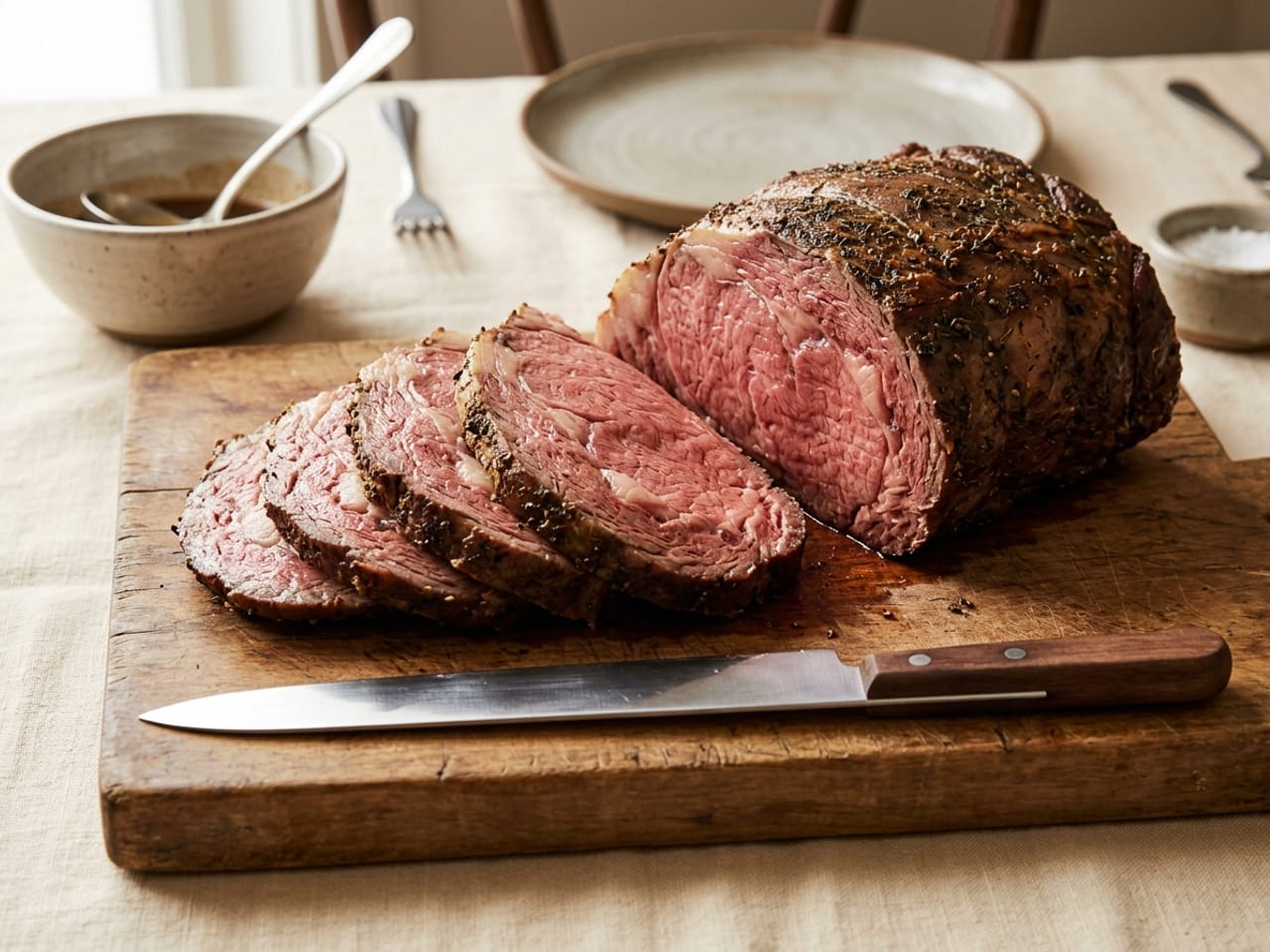
Slice straight down, across the grain. Each slice parallel to where the bones were, never down the length of the roast.43, 51
3/4 in (19 mm) thick. Thinner for a British-style carvery plate, thicker for a steakhouse slab (every figure).1, 2, 3
How thick, in one line: About 3/4 in (19 mm): America's Test Kitchen's figure on all three of its pages, and 11 of the 15 pages we read that give one fall between 1/4 and 3/4 in (6 and 19 mm).
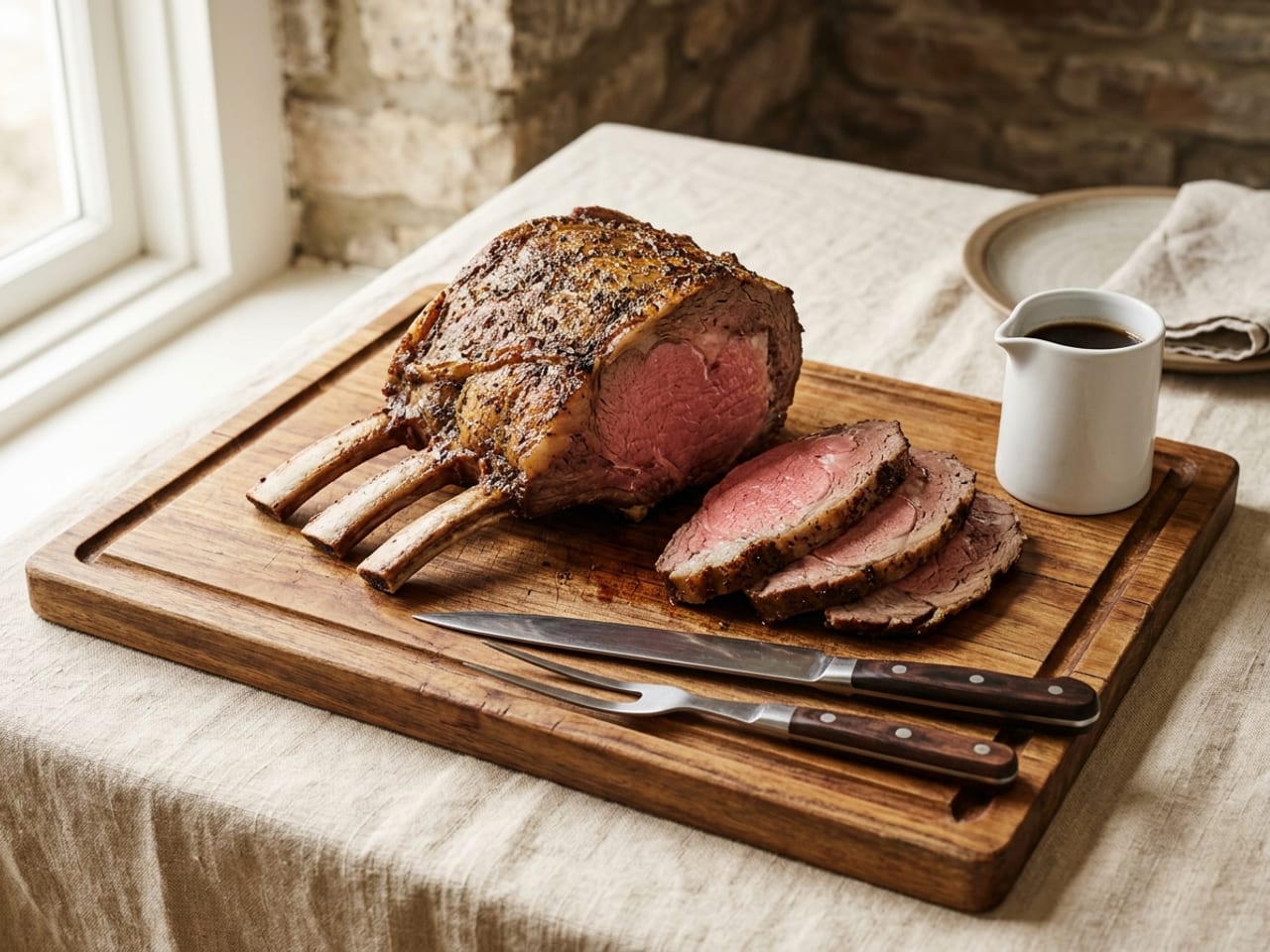
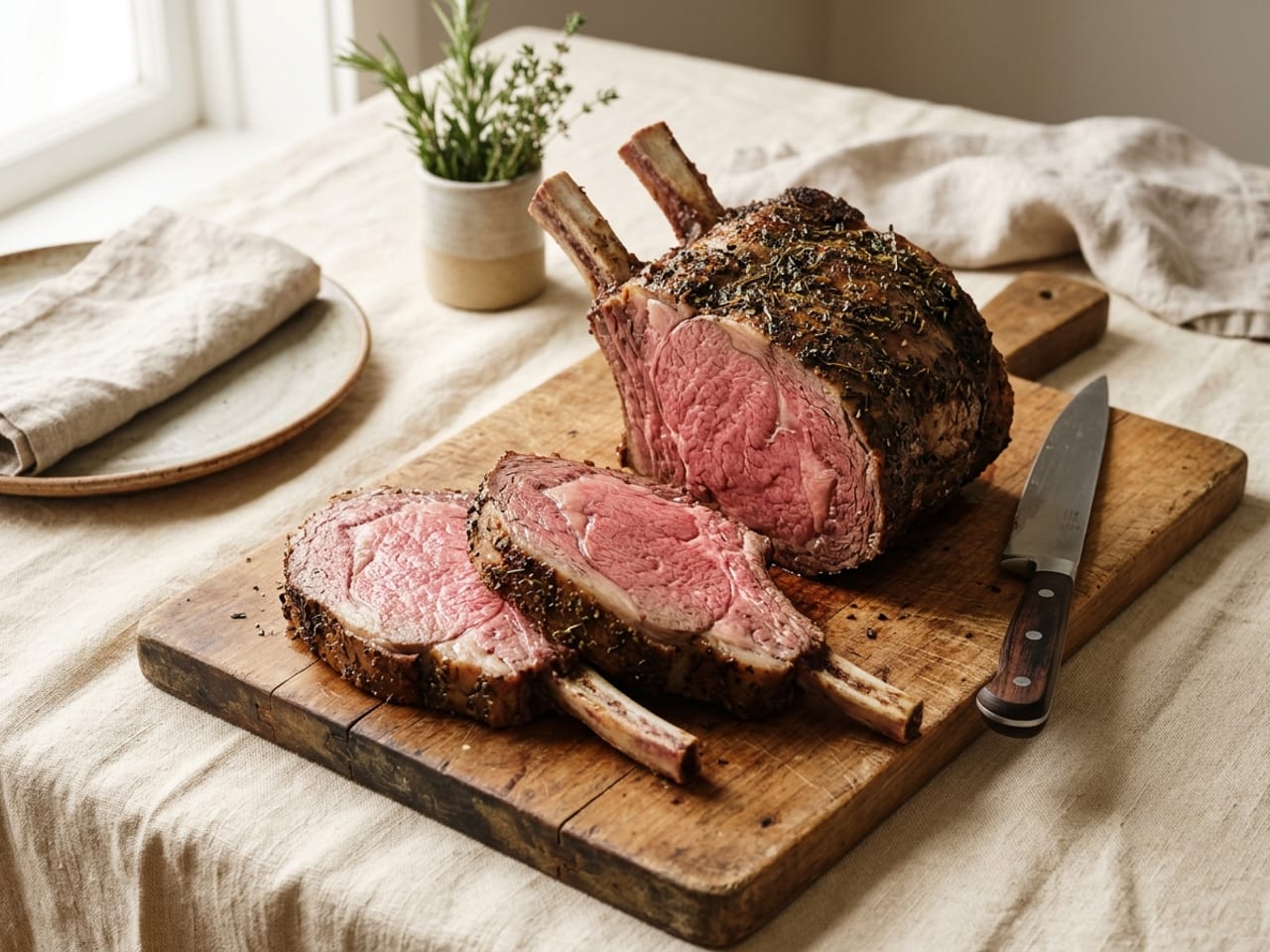
A rested bone-in rib roast with its first slices cut. An AI render, not a photograph.
1. Bone-in standing rib roast
Also searched as: prime rib on the bone, bone-in prime rib, standing rib roast, rib of beef
The rib bones are still on, curving down one side. Dictionary.com: “a cut of beef taken from the small end of the ribs and containing a large rib eye and two or more ribs.”78
Rest it, loosely tented with foil, for as long as your method says.(the beef checkoff; our calculator gives the minutes)41
Stand it on the board, ribs pointing up, or lay it ribs uppermost if it will not balance.(Leiths School of Food and Wine)37
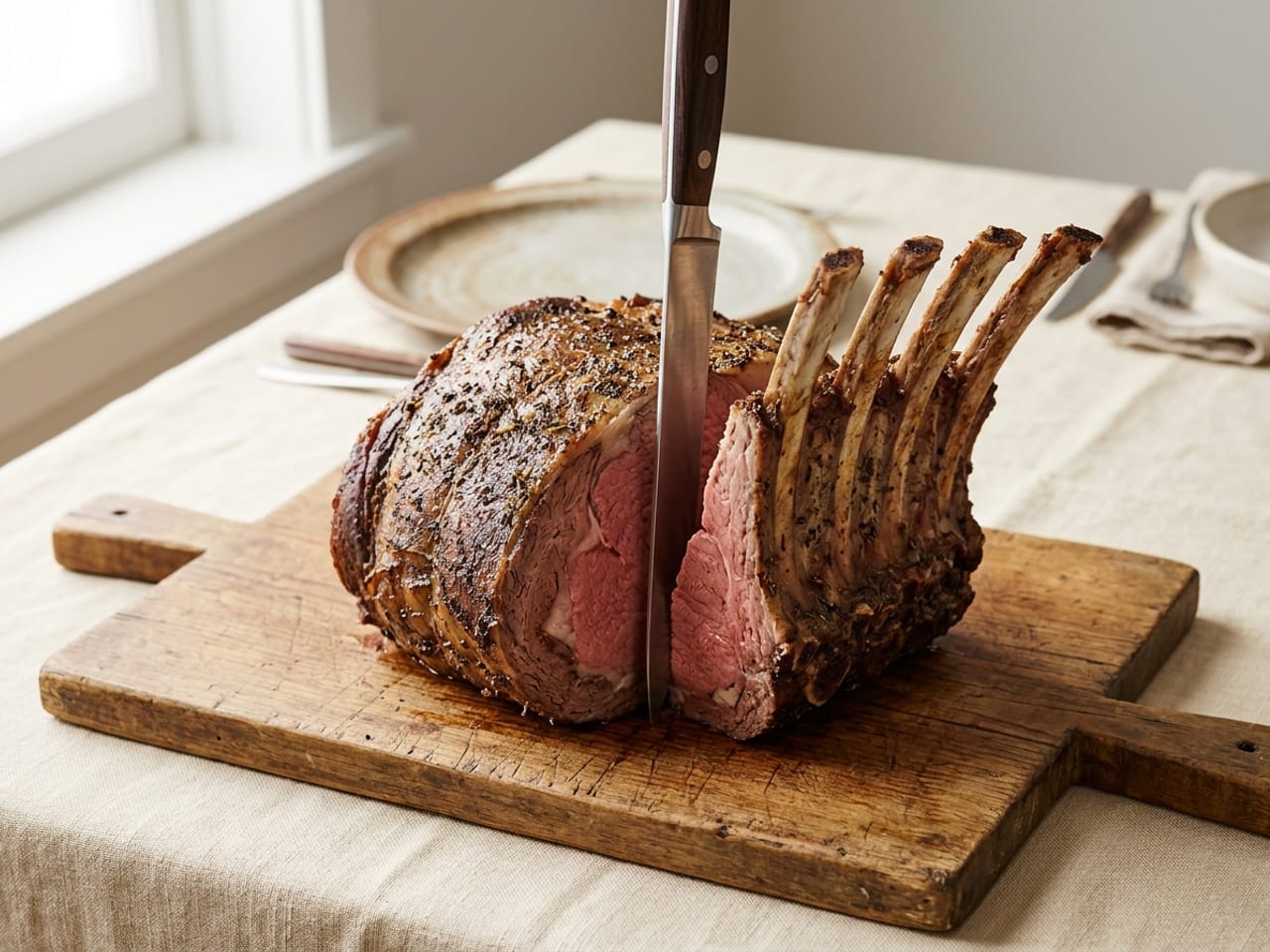
Run the knife down between the meat and the bones, following their curve, until the rack comes away in one piece.(The Daily Meal; The Takeout and Leiths cut the same way)16, 18, 37
Lay the boneless roast down on the side the bones came off, so it sits flat.(Escoffier School)38
Slice about 3/4 in (19 mm) thick, across the roast (the grain section says which way).(America's Test Kitchen)1
Cut the rack apart between the ribs and put the bones on the platter too.(Sunset; Whole Foods Market sends them out the same way)31, 47
How thick. America's Test Kitchen: 3/4 in (19 mm). The pages we read run from 3 mm to 1 in (2.5 cm); the whole tally is below.1
The bones, and the sources' own words
The bones. Keep the blade on the bone. Great Italian Chefs: “keeping the knife as close to the bones as possible to prevent excess waste”. The cut bones are good to eat and go on the platter, or into stock (both below).33
The beef checkoff: "Transfer the finished roast to a carving board and tent loosely with aluminum foil to rest before slicing."41
Leiths School of Food and Wine: "Once the meat is cooked and rested, stand the joint so the ribs are pointing upwards; if it doesn't balance well like this then lie the meat so the ribs are uppermost"37
The Daily Meal: "Position the meat so the ribs are vertical, and then slice downward, letting the curve of the bones guide your knife."16, 18, 37
Escoffier School: "Then place the roast bone-side down and slice the roast against the grain to your desired thickness."38
America's Test Kitchen: "Carve into ¾-inch-thick slices and season with coarse sea salt."1
Sunset: "Cut between bones and add them to platter."31, 47
Done differently. Another way carves slices off the roast with the bones still on. Saveur cuts a thin slice off one side for a flat base, steadies the roast with the fork on the top bone, and frees each slice with “a smooth, downward cut as close to the bone as possible”. Simpson's master cook: “The beef should be sitting on the rib bones on the carving board with the chine bones away from you.” Beeton (1861) first runs the knife “immediately between the bone and the meat, before commencing to cut it into slices”, and Farmer (1896) says to “cut slices from ribs”. Chicago Steak Company, a butcher, cuts between the bones first: “Slice between each bone first to create a number of large slabs, then hold the bone again as you cut thinner slices of meat from the slab.” The Takeout's view of carving on the bone: “the biggest mistake people make is not removing the bones before carving.”14, 18, 30, 45, 79, 80
2. Boneless ribeye roast
Also searched as: boneless prime rib, rib eye roast, prime rib with no bones, rolled rib
No bones: the eye of the rib, tied with string once it is boned. A butcher ties a boned roast “with twine every few inches to keep it together.”55
Turn it so the slices go across the log, never down its length.(ThermoWorks)51
Slice straight down, about 1/2 in (13 mm) thick, or thicker for a steakhouse slice.(Chicago Steak Company)45
How thick. Chicago Steak Company: about 1/2 in (13 mm). ThermoWorks leaves it to you: “thin slices or fat slabs are your prerogative.”45, 51
The bones, and the sources' own words
The bones. None to work round. Each slice shows the round eye and, on one side, the cap (the grain section has a drawing).
ThermoWorks: "Take off all the string you used to tie the roast up!"51
ThermoWorks: "Slice perpendicular to the cylinder. Don’t carve down the length of the roast…it will not be good!"51
Chicago Steak Company: "Aim for slices around ½ inch thick."45
3. Bones cut off and tied back
Also searched as: cradled prime rib, bones tied on, bone-in prime rib with the bones removed
Bone-in, but the butcher (or you) cut the meat off the ribs before roasting and tied it back on. Tasting Table: “It simply means removing the bones from the meat and then tying them back on.” America's Test Kitchen roasts it this way: “We remove them again before carving.”1, 22
Lift the meat off the rack of bones in one piece.(Girl Carnivore)34
Trim a thin slice off the end to show the centre.(Girl Carnivore)34
Slice 3/4 in (19 mm) thick and season the slices with coarse salt.(America's Test Kitchen)1, 2
How thick. America's Test Kitchen: 3/4 in (19 mm). KQED's bones-off roast: “To serve, carve the roast into 1/4 to 1/2 inch thick slices.” Girl Carnivore: 1/2 to 3/4 in (13 to 19 mm).2, 32, 34
The bones, and the sources' own words
The bones. The reason for doing it, KQED: “to make carving easier once the roast is cooked, ask your butcher (or do it yourself!) ahead of time to cut the ribs off of the roast.” Tasting Table: “Cradling also makes it easier to slice the meat around each rib bone more thinly.”22, 32
America's Test Kitchen: "Transfer roast to carving board; cut twine and remove roast from ribs."2
Girl Carnivore: "Cut the twine and lift the bone rack away."34
Girl Carnivore: "Trim a thin slice off the end first to expose the center."34
America's Test Kitchen: "Slice meat into ¾-inch-thick slices. Season with coarse salt to taste, and serve."1, 2
Done differently. Saveur's recipe leaves them on: “we found that the roast came out juicier when the bones were left attached.” That is the magazine's claim; America's Test Kitchen, KQED and Tasting Table cut them off for easier carving. Nobody we read measured the difference.1, 15, 22, 32
The steps are the named pages', in our plain words, not from our kitchen; each card's fold has the sources' own words.
How thick
How thick to slice prime rib: every figure we found
Of the 15 pages we read that print a figure, 2 say 3 to 5 mm, 11 say between 1/4 and 3/4 in (6 and 19 mm) and 2 say an inch (25 mm). America's Test Kitchen, the only test kitchen among them, says 3/4 in on all three of its pages. Thinnest first:
Who
How thick
In their words
Simpson's-in-the-Strand's master cook (The Gentleman's Journal)30
Words, no number:Leiths, "slice the meat very thinly across the grain."37; Beeton (1861), "All joints of roast beef should be cut in even and thin slices."79; Farmer (1896), "cut a sirloin or rib roast in thin slices parallel to the ribs"80; Saveur, "make a horizontal cut toward the bone to make a thick slice"14; The Takeout, "slice your prime rib thick for hearty-looking servings"18; The Manual, "Some people enjoy super-thin English-style cuts of prime rib."29; ThermoWorks, "thin slices or fat slabs are your prerogative."51; The beef checkoff, three rib roast recipes, "Carve roast into slices."42 Our own roast beef recipe carves "against the grain into thick slices".
Which to use when (our reading of the tally):
A plated dinner: 3/4 in (19 mm), America's Test Kitchen's figure.1, 2, 3
A steakhouse slab: an inch (25 mm), or a whole rib cut between the bones (below).16, 29
A British carvery plate: 3 mm, "even thin slices", as Simpson's master cook carves; The Manual calls them "super-thin English-style cuts".29, 30
Sandwiches and French dip: as thin as you can, from the cold roast (leftovers). No page we read gives a number.
One maker claims "thin slices cool fast and lose their juicy pink center"; it is a knife seller's line with nothing measured.50
A thick bone-in portion, cut between the ribs
For a chop with the bone on, cut between the ribs instead of taking them off. Chowhound's chef: "If you want to keep the bones in and serve a chop," "make sure the bones are facing toward you and upward, so you can see and slice in between each section."20 Chicago Steak Company cuts the slabs this way first and then slices them thinner.45 Lawry's sells a "thick, bone-in Diamond Cut".60 No page we read gives a thickness for a cooked bone-in portion; it is as thick as the space between two ribs. With our calculator's one rib for every two guests, one such portion is about two servings (our arithmetic).
Cut between the ribs: one bone to a portion. An AI render, not a photograph.
The grain
Which way the grain runs in a rib roast
Ours and schematic. The direction is the one the sources below describe in words, not a measurement: nobody we read measured the fibres in a rib roast. The muscle names are the beef checkoff's and America's Test Kitchen's; their sizes here are not measured.7, 44
The answer: slice straight across the roast, each slice parallel to the rib bones (or to where they were), never down its length. The sources word it differently:
Farmer, first edition (1896): "cut a sirloin or rib roast in thin slices parallel to the ribs"80
Farmer, a later printing (copyright 1896 to 1906): "cut a sirloin or rib roast in thin slices at right angles to the ribs"81
Virginia Cooperative Extension (2000): "slice across the grain toward the ribs"39
USA Beef Cookery (US Meat Export Federation, 2019): "If you have a rib roast, cut each slice along the rib bone. Always cut across the grain for maximum tenderness."43
The Daily Meal (2025): "you turn the roast so that you're now cutting perpendicular to the direction of the ribs. This ensures you cut the meat against the grain"16
Chicago Steak Company (butcher): "They run contrary to the grain of the roast, so if you slice along their orientation, you’ll be making cross-grain cuts."46
ThermoWorks (thermometer maker): "Slice perpendicular to the cylinder."51
The two Farmer printings say "parallel to" and "at right angles to" for what reads as the same cut; we do not know why the wording changed. The eye is the long back muscle, which the beef checkoff's summary of the research lists in a lip-on ribeye as the "Longissimus thoracis", beside the "Spinalis dorsi" (the cap) and the "Complexus".44 How much it matters, and the general argument, are in why across the grain and our turkey guide. America's Test Kitchen's own view: "Luxe cuts such as rib eye or tenderloin are tender no matter how you slice them, but for tougher cuts such as flank steak or skirt steak, cutting against the grain is important to ensure pleasant eating."4
The cap, and the end slices
The cap is the curved muscle over the eye. America's Test Kitchen, on a rib-eye steak: "The cap is a muscle called the Spinalis dorsi and the eye, the Longissimus dorsi muscle." and "Separate the two muscles and then slice and eat each part individually."7 ThermoWorks, a thermometer maker: "The long-fiber structure of the cap means that it is best sliced across the grain, much like a flank steak."52 Meathead (AmazingRibs) removes it before cooking, because "the rib cap is almost always well done" on a roast.53 Crowd Cow, an online butcher, says that at the table "it ends up in the end slices or in the cook's mouth", and lifts it off the rested roast to carve it separately; that is one seller's line, the only one we read for a cooked roast.54
The end slices are more done than the middle. Sunset: "the ends will be more done".31 Our reading of the reason is the heat gradient, which America's Test Kitchen describes for the outside against the center of a roast: "The exterior of meat heats up far more quickly than the interior, resulting in a huge temperature differential between the outside and the center of a roast."8 Serious Eats puts numbers on it for a hot oven: "the center of the meat may be at, say, 110°F (43°C), while the outer layers could be as hot as 170 or 180°F (77 to 82°C)."12 So offer the end slices to the guests who like their beef more done, as a preference. They are not a safety step: for guests who should not eat medium rare, see safety.
How much
How much prime rib per guest
Our prime rib calculator plans 1 lb (450 g) of raw bone-in roast a guest, one rib for every two guests, or 3/4 lb (340 g) with plenty else on the table, one rib for every three; boneless, 3/4 lb (340 g), or 1/2 lb (225 g). For eight: an 8 lb (3.6 kg), 4-rib roast, the same roast as our Christmas prime rib menu. America's Test Kitchen's 7 lb (3.2 kg) three-bone roast "Serves 6 to 8".2
How much of it is meat. The beef checkoff sizes its roasts for "an approximate 3 oz serving of cooked beef per person" (85 g), a cooked serving, not the raw weight the calculator buys. USDA's Food Buying Guide gives boneless yields only: 1 lb (450 g) of ribeye roll as purchased gives 0.63 lb (285 g) of cooked, trimmed, sliced lean meat, and its boneless rib roast row 0.56 lb (255 g); it has no bone-in standing rib roast row.41, 73
Slices per guest: no source we read gives one, because a slice depends on the roast and the thickness, so we give none.
The platter
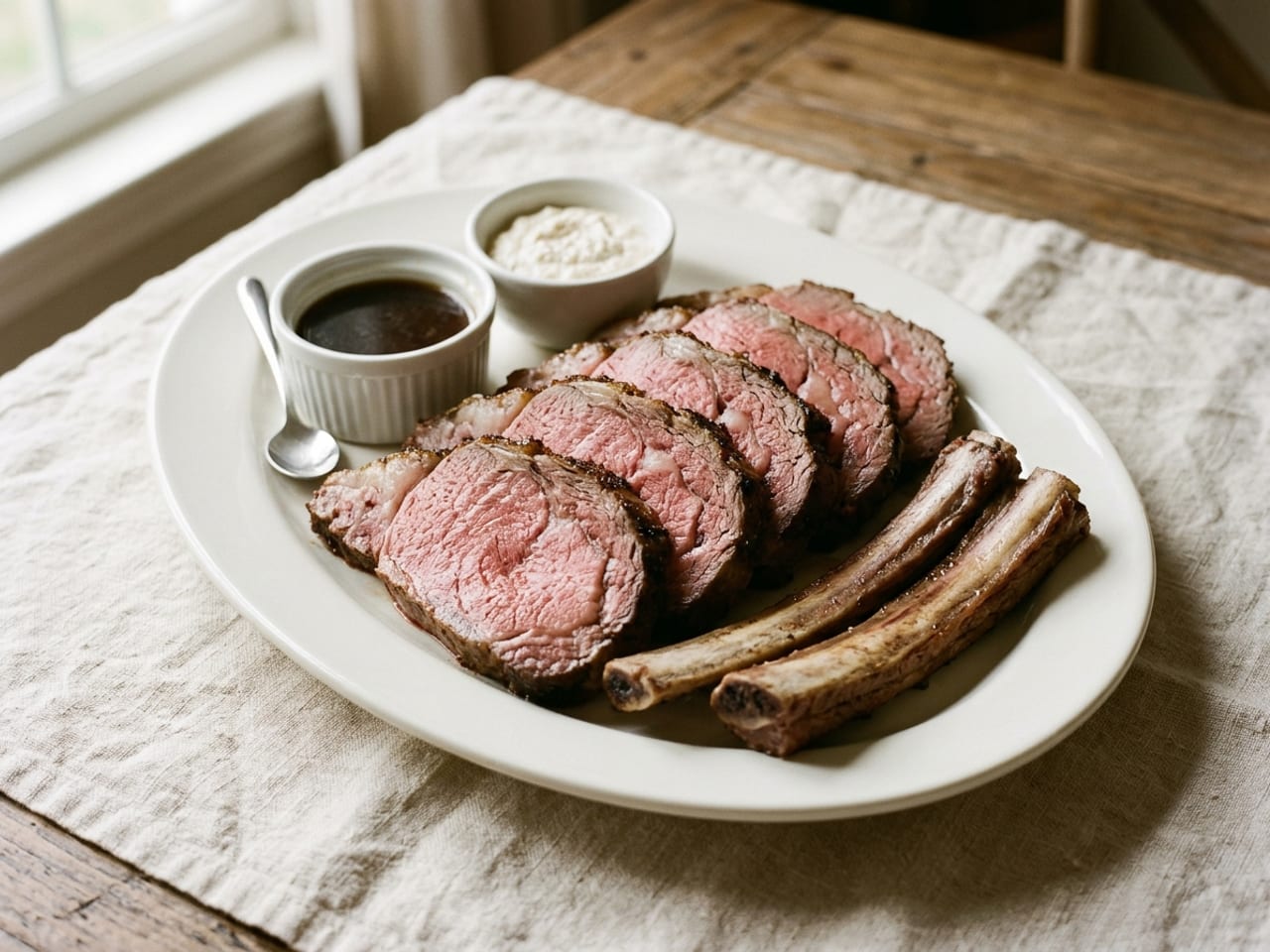
The platter: slices, bones, jus and horseradish
A warm platter. Saveur moves each slice "to a warmed serving platter"; Virginia Extension: "Hot platters should be used unless the slices will be served immediately."14, 39
Slices overlapped. Virginia Extension: "overlap them "shingle" style on a warm serving platter".39
The bones alongside. Whole Foods Market: "arrange on a platter with the bones (there's meat left on the bones and some people may want one)". Sunset cuts between them and adds them to the platter.31, 47
Jus in a warm ramekin. Our au jus guide: a warm ramekin or gravy boat next to the plate is "The classic for prime rib." How much to make is in its recipe. Whole Foods Market and Escoffier pour it over the slices instead (where the sources disagree).38, 47
Horseradish sauce. Sunset serves its roast with a fresh horseradish sauce; Beeton (1861): "Garnish with tufts of scraped horseradish, and send horseradish sauce to table with it". Ours: horseradish sauce.31, 79
The arrangement in our render (one shingled row, the bones beside it, jus and horseradish at one end) is ours, built from those lines. The only garnish we found on a carved prime rib platter is in a user-submitted recipe (sautéed onions and cherry tomatoes), so ours has none.65
Shingled slices, the bones alongside, jus and horseradish. Our layout; an AI render, not a photograph.
One plate
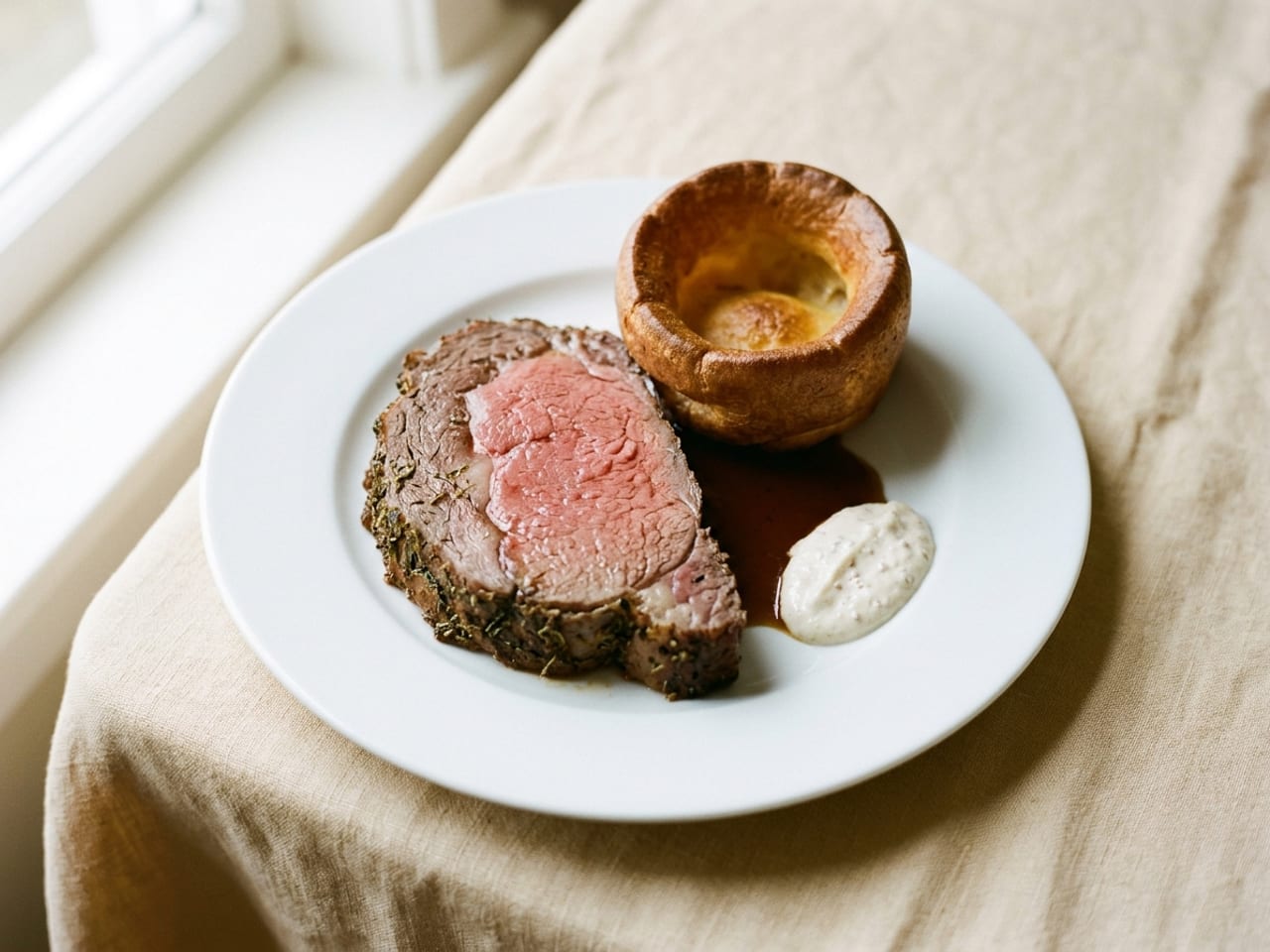
One slice, the jus beside it rather than over the crust, and a Yorkshire pudding, as on our Christmas prime rib menu ("One thick slice, cut side up, jus pooled beside it and not over the crust of the pudding."); the horseradish sauce is our addition, after Sunset and Beeton (the platter). The pudding with roast ribs is old: Beeton writes that "A Yorkshire pudding (see Puddings) sometimes accompanies this dish".79 The puddings themselves: our Yorkshire puddings. For a single ribeye steak on a plate, see how to plate steak.
One slice, jus, horseradish and a Yorkshire pudding. Our plate; an AI render, not a photograph.
Warm and safe
Keeping prime rib warm without cooking it more
The rule first. USDA FSIS: "After food is safely cooked, hot food must be kept hot at 140° F or warmer to prevent bacterial growth. Within 2 hours of cooking food or after it is removed from an appliance keeping it warm, leftovers must be refrigerated." (1 hour above 90°F, 32°C.)66 Ways to hold it, FSIS says, include the oven, "heated chafing dishes, or on preheated steam tables, warming trays, and/or slow cookers."67
The catch: 140°F (60°C) is hotter than medium rare, which our calculator serves at 130°F (54°C), so a roast held hot for long keeps cooking (our arithmetic from the two numbers). No source we read times how long a prime rib stays warm on the board; the one measured hold we know of is America's Test Kitchen's whole turkeys, in our turkey guide.
So time it instead.
Keep it whole and carve as the table needs it: "Leaving the rest of the roast intact will help it stay warm and retain flavorful juices." (America's Test Kitchen)1
Reverse sear: rest the roast after the low oven, sear it just before dinner and carve it hot. Tasting Table: "Then it's ready to slice and serve hot from the oven." If the roast is ready long before the guests, Serious Eats rewarms it whole: "reheat the roast by placing it in a 200°F (93°C) oven for 45 minutes before you continue with step 2." That is Serious Eats' method for a roast fresh from its rest, not USDA's 165°F (74°C) reheat for leftovers.13, 24 The warm oven does not stop the 2-hour clock: FSIS's line is food "kept hot at 140° F or warmer", and a medium-rare centre, 130°F (54°C) in our calculator, sits below it (our reading of the two numbers). So the rest, the rewarm, the sear and the carving all count toward the 2 hours. Serious Eats rests it for up to 1½ hours; with its 45-minute rewarm that is already 2¼ hours out of the oven (our arithmetic), so rewarm only after a short rest.66
Warm the platter and the plates (above) so the slices do not cool on them.
Restaurants. Lawry's carvers keep each Silver Cart, which holds "an array of standing rib roasts", "at the perfect temperature (190 degrees)" (about 88°C if that is Fahrenheit, which the page does not say). That is the cart's heat, by the restaurant's account, not the meat's, and the carver slices to order.58 The FDA Food Code lets food businesses hold hot food at 135°F (57°C), and a roast cooked to its roast chart at 130°F (54°C): a rule for licensed kitchens, not home advice.71
What we do not advise: forum posts hold a cooked roast wrapped in a cooler for "an hour and a half or two", or in an oven set to 130°F (54°C) ("I put that in oven at 130 deg.") with the party "an hour and 45 min" away. Both run below 140°F (60°C) or past the 2 hours; one reply in such a thread warns "you will still have a roast in a sensitive food-safety range for two hours."63, 64
Carving ahead, at the table or in the kitchen
Carve as you serve. America's Test Kitchen: "Carve only as many slices as you need."1 Virginia Extension carves the first serving for everyone before serving anyone, and when leftovers are expected says to "leave some meat unsliced. A solid piece of meat will not dry out in the refrigerator as quickly as slices."39 Slices cut ahead are on the same 2-hour clock as the roast. Kitchen or table: in 1922 Emily Post found carving in the kitchen the norm in New York, for "quicker service, and hotter food"; restaurants such as Lawry's carve at the table from a cart.60, 83 More in the turkey guide.
Safety: medium rare, the 2 hours, and who should skip it
145°F (63°C) and 3 minutes. USDA's safe minimum for beef roasts: "145 degrees F (62.8 degrees C) and allow to rest for at least 3 minutes". Medium rare, served at 130°F (54°C) by our calculator, is below it.68, 69
Why a whole roast is treated differently from ground beef. USDA FSIS's 1999 notice treats "steaks, roasts, and other intact cuts" as cuts "in which the meat interior remains protected from pathogens migrating below the exterior surface", unlike ground beef (for E. coli O157:H7; the notice says nothing about other germs or about at-risk guests). A roast bought whole and not needled, injected or tenderized is intact by that definition (our reading).70
Guests who should not eat medium rare. Our Christmas hub's rule, which this page follows: "For these guests, roast the meat to 145°F (63°C), or cook their slices on in a hot pan to 145°F (63°C) on a thermometer; do not judge by color or count on end slices." The guests and the label warning are on the hub.
The 2 hours. In the fridge within 2 hours of leaving the oven, 1 hour above 90°F (32°C). CDC on C. perfringens: "Most outbreaks happen in November and December. Many of them have been linked to popular holiday foods, such as turkey and roast beef."66, 72
After dinner
Leftover prime rib: storing, slicing thin and reheating
Into the fridge within 2 hours. USDA FSIS: "For whole roasts or hams, slice or cut them into smaller parts.", then shallow containers (FSIS, and our calculator).66
What
How long
Who says
Cooked beef, in the fridge
3 to 4 days
USDA FSIS, Beef from Farm to Table, and our calculator69
Cooked beef, in the freezer
2 to 3 months (FSIS's beef chart; its general leftovers page says 3 to 4 months, frozen leftovers being safe indefinitely)
Thin slices for sandwiches and French dip. Slice it cold. Tasting Table: "It's easiest to slice a roast when it's still chilled, so get out your best slicing knife and cut your roast against the grain while it's fresh out of the refrigerator."25 A food blog: "It is okay if it is more "shaved" than sliced. A GOOD electric knife works well for this to, as does a meat slicer." (a blog's opinion).36 No page we read gives a thickness for sandwich slices. The jus for dipping: our au jus.
Reheating without overcooking. USDA's line is 165°F (74°C). The cooks' methods for keeping it pink: America's Test Kitchen warms a whole leftover roast in a 250°F (121°C) oven "until meat registers 120 degrees (1 to 1½ hours)" (49°C), then sears it ("Do not sear cut ends."); Chowhound aims for "between 140 degrees Fahrenheit (for medium rare) and 160 degrees Fahrenheit (for slightly more cooked)" (60 and 71°C). The Daily Meal warms strips in a pan with "a little broth or stock" for about six minutes on medium-low and gives no meat temperature; The Takeout covers slices in a dish in an oven "no higher than 300 degrees Fahrenheit" (149°C) and gives no target either. Only America's Test Kitchen and Chowhound print a meat temperature, and both sit below USDA's 165°F (74°C); USDA's line is the one to follow.9, 17, 19, 21, 66
Sellers print longer storage times (a beef seller: 5 to 7 days in the fridge); we follow USDA's.57
The bones
Serve them: Whole Foods Market puts them on the platter because there is meat on them.47 Or flavour the sauce: Leiths, "The ribs can be divided into individual ribs and added to the gravy while you carve the meat, to lend extra flavour."37 Or make stock, as Beeton did in 1861: "The bones should be put in with a few vegetables and herbs, and made into stock."79 Tasting Table's chef: "Make sure to place the bone in cold stock or water when making your soup."27 Its stock page simmers them "for at least two hours"; our beef broth starts cold too.26 Keep the stock 3 to 4 days in the fridge, USDA's figure for home-cooked soups and stews, not the week that page gives; USDA's chart has no row for cooked bones.69 We found no authority page on cooked rib bones for dogs that we could read, so we give no advice on it.
Tools
The knife, the fork, the board and an electric knife
A long slicing knife. America's Test Kitchen: "Unlike shorter chef's knives and pointed, flexible carving knives, slicing knives are long and straight for smooth, even slicing. They have rounded tips so as to be less threatening for tableside serving."1 How long: Chowhound's chef, "It should be no less than 10 inches." (25 cm), or "at least an inch longer in length compared to the width of the roast".20 Tasting Table: "at least a 10-inch blade".22 Serrated or not, the sources split (the table). The knife in detail: our turkey guide.
An electric knife. America's Test Kitchen: "to carve a roast, we think an electric knife can be a very effective alternative—as long as you choose the right one." Most of the blades it tested are slightly under 7 in (18 cm), "so they can't be used for truly large roasts or briskets", and it tested them on turkey and chicken, not prime rib.10 More in the turkey guide.
A fork or tongs. USA Beef Cookery (US Meat Export Federation) uses the back of the fork, or tongs; Saveur steadies the roast "by pressing the carving fork firmly against the topmost bone."14, 43 Fork, tongs or a towel: the turkey guide.
A board with a groove, on a damp towel. America's Test Kitchen: "Carving boards are designed to avoid messy juices dribbling onto the counter, traditionally by relying on a trench around their perimeter that traps the liquid." Tasting Table puts "a damp kitchen towel underneath it".1, 22 Board sizes: the turkey guide.
Mistakes the sources name
Sawing. The Manual: “If you don’t use a long slicing motion, it could look like a chainsaw cut it.” Lawry's tells its carvers “saw marks are a no-no”.29, 58
Pressing down. Simpson's master cook: “Remember do not press down the knife, which will alter the shape of the meat, let the knife do the work for you.”30
Stabbing the fork in. USA Beef Cookery (US Meat Export Federation): “If you're using a meat fork, don't pierce the roast to hold it in place. Use the back of the fork instead (tongs work great, too).” Simpson's: “It is not necessary to plunge it deeply.”30, 43
Slicing along the grain. The Takeout: “Whatever you do, don't slice the meat parallel to the grain.” (America's Test Kitchen thinks rib eye forgives it; see why, below.)4, 18
Carving it all at once. America's Test Kitchen: “Carve only as many slices as you need. Leaving the rest of the roast intact will help it stay warm and retain flavorful juices.”1
Raw butchery
Cutting a raw rib roast into ribeye steaks, and tying it
This is butchery on the raw roast, not carving; the basics from the pages we read:
Chill it. Tasting Table's chef: "It's easiest to cut the meat when it's super chilled because that way, the fat is firmer". A whole roast gives him "14 to 16 nice sized steaks", each 1 to 1 1/2 in (2.5 to 4 cm) thick.28
Between the bones, not through them. Traeger, a grill maker: "With home equipment, you can only cut between the bones, not through them." A butcher: "If you cut between each bone, you'll end up with 8-10 thick-cut steaks from each rib roast." Chicago Steak Company: "One bone per steak gives the perfect thickness". Meathead cuts the boned eye into 2 in (5 cm) steaks for the reverse sear.46, 53, 55, 56
Trim the fat cap. The butcher leaves "one-quarter to one-half inch" (6 to 13 mm); Escoffier: "Trim the fat down to a ¼” layer all the way around, and tie the roast with twine between each rib."38, 55
Bones off and tied back for roasting. America's Test Kitchen: "use a sharp knife and run it down the length of the bones, following the contours as closely as possible until the meat is separated", then "tie meat to bones with 2 lengths of twine between ribs."2
Across the grain, measured. America's Test Kitchen cut flank steak and strip loin with and against the grain and measured the force to bite in: "Strip loin slices carved against the grain required 329 grams of force; with the grain, 590 grams of force." Flank: 383 against 1,729 grams. Its conclusion: "Slicing against the grain dramatically narrowed the gap in tenderness between the strip and flank steaks."5 On flank steak its tasters "unanimously agreed the slices cut with the grain were chewier and stringier than those cut against it."6 The strip loin is the same long back muscle as the eye of a rib roast, further back (our reading, not America's Test Kitchen's). A 2008 study of round and chuck stir-fry strips: "Slices removed perpendicular to the fiber direction had shear values up to 50% lower than slices removed parallel."75 The reason in plain words, Iowa State Extension: slicing across makes "short fibers making the meat more tender and tastier as chewed."40 A tender cut gains less than a tough one, but America's Test Kitchen's own strip loin still fell from 590 to 329 grams, and that page says "all cuts benefit from slicing against the grain"; its separate how-to says rib eye is "tender no matter how you slice them". The two pages do not quite agree. Nobody we read tested a rib roast.4, 5
Resting. The general evidence (juice-loss tests on turkey, pork loin and steak) is in our turkey guide. One test included roast beef: a Danish congress abstract found that "With respect to loss of meat juice these results indicate that it is not an advantage to allow roasts to rest 20 minutes before slicing.", and that "Roast beef sliced immediately after cooking looked more brown in the carve surface than roast beef sliced after 20 minutes rest". All three cuts together (pork loin, pork neck and roast beef) lost 5.8 against 6.8% of their juice, about 1 percentage point, P=0.0635; the roasts gave 7 to 14 slices of 1 cm each. It is an abstract, not a full paper.76 We found no rest test on a prime rib. The rest still sets the final temperature (the climb while it rests, in the table), which is why our calculator times it.
Where it came from
The name, and a short history of carving prime rib
"Prime rib" is a place on the animal, not the USDA grade. America's Test Kitchen: ""Prime" rib is something of a misnomer. Originally used to refer to the most desirable portions of the rib section, the term became somewhat confusing once the U.S. Department of Agriculture began using the label "Prime" as one of its beef-grading classifications."11 CooksInfo: "It’s also a misconception that the “prime” in its name refers to the United States Department of Agriculture (USDA) top grade of beef."77 Some pages say otherwise, a grill maker's for one ("Only USDA Prime-graded rib roasts qualify as a true prime rib."), and some call prime rib "not to be confused with rib roast"; in what we read, the cut is the rib roast, any grade.18, 62
1747. Hannah Glasse cooks “A Yorkshire Pudding” under the roasting meat so the fat falls on it: “let the Dripping drop on the Pudding”, and “the Gravy of the Meat eats well with it” (the OCR's long s read as f is cleaned up here).82
1848. Simpson's in the Strand dates its silver carving trolleys to this year, in its own history: “originally devised to avoid disturbing chess players.” That is the restaurant's account; we read no outside record of it.61
1861. Isabella Beeton calls the fore-rib “the primest roasting piece”, garnishes it with scraped horseradish, sends horseradish sauce with it and adds that “A Yorkshire pudding (see Puddings) sometimes accompanies this dish”. In a dinner à la Russe, she writes, “the dishes are cut up on a sideboard, and handed round to the guests”.79
1885 to 1890. “Rib roast” is first recorded in English, by Dictionary.com's dating. We found no first print of “prime rib” or “standing rib roast”.78
1896. Fannie Farmer's chart of the fore-quarter names “Five Prime Ribs” next to “Five Chuck Ribs”, and she notes that “Sirloin or rib roasts may have the bones removed, and be rolled, skewered, and tied in shape.”80
1916 to 1927. USDA's beef grades: tentative standards in 1916, made official on 3 June 1926, and a grading and stamping service from May 1927. So “prime rib” as a cut and “Prime” as a grade are two different things (the name section below).74
1922. Emily Post: “in forty-nine houses out of fifty, in New York at least, the carving is done by the cook in the kitchen”, for “quicker service, and hotter food”.83
1938. Lawry's The Prime Rib opens in Beverly Hills, by the company's own story: “Its unique single entree menu features the standing rib roast Sunday dinner of Lawrence’s boyhood.” Today it serves the beef “table-side from gleaming silver carts”; we found no dated source that puts the carts there in 1938.59, 60
Reference
Where the sources disagree
Question
One camp
The other
Our note
Bones off first, or carve on the bone?
Off first: The Daily Meal, The Takeout, Leiths, Escoffier, Whole Foods Market, Chowhound's chef.16, 18, 20, 37, 38, 47
Slices cut with the bones still on, close to the bone: Saveur, Simpson's master cook, Beeton (1861, after first running the knife between the bone and the meat), Farmer (1896), Virginia Extension (2000).14, 30, 39, 79, 80
Of the 11 pages in this row, six take the bones off first and five carve with them on. Our bone-in card follows the first group and keeps the other way in its fold.
Cut the bones off before roasting?
Yes, and tie them back: America's Test Kitchen, KQED, Tasting Table, Girl Carnivore.1, 22, 32, 34
No: Saveur found the roast "came out juicier when the bones were left attached".15
Nobody we read measured it.
How thick
Thin: 3 mm at Simpson's, "very thinly" at Leiths.30, 37
An inch (25 mm): The Daily Meal, The Manual.16, 29
11 of the 15 pages we read that print a figure sit between 1/4 and 3/4 in (6 to 19 mm); America's Test Kitchen says 3/4 in (the tally).
How the direction is worded
"parallel to the ribs" (Farmer, first edition, 1896); "along the rib bone" (USA Beef Cookery, US Meat Export Federation, 2019); "toward the ribs" (Virginia Extension, 2000).39, 43, 80
"at right angles to the ribs" (a later Farmer printing); "perpendicular to the direction of the ribs" (The Daily Meal).16, 81
We read them as the same cut: across the roast, each slice parallel to the bone faces. The wordings point two ways and nothing we read measured it; why Farmer's wording changed between printings, we do not know (the drawing).
A serrated knife?
Yes: Chicago Steak Company, "Use a long, serrated knife that's at least 12 inches in length".45
No: TV chef Jeff Mauro wants one "non-serrated and sharp"; Girl Carnivore lists "Using a dull or serrated knife." as a mistake.23, 34
America's Test Kitchen's slicing knife is long and straight-edged; nobody tested the two on a rib roast.
How long to rest it
10 minutes (Virginia Extension), 15 to 20 (the beef checkoff), 20 (our calculator), 25 (Whole Foods Market).39, 41, 47
30 minutes or more (The Takeout's experts), at least 45 (Chowhound's chef), 30 to 75 (America's Test Kitchen).2, 18, 20
Our calculator owns the timing; the only safety rest is USDA's 3 minutes at 145°F (63°C).
How much it climbs while it rests
About 10°F, 6°C (our calculator, from a 350°F, 177°C oven); 10 to 15°F, 6 to 8°C (the beef checkoff).42
5 to 7°F, about 4°C (RecipeTin Eats, a 250°F, 121°C oven); 5 to 9°F, 3 to 5°C (ThermoWorks, a 225°F, 107°C oven: pulled at 125°F, 52°C, it "should get to between 130 and 134°F" in a 30-minute rest; the subtraction is ours).35, 51
Both camps fit America's Test Kitchen's rule that "carryover cooking is greater in a roast cooked in a hot oven".8
Jus over the slices, or on the side?
Over: Whole Foods Market ("spoon hot pan juices over the top"), Escoffier ("douse with pan-dripping gravy").38, 47
On the side: our au jus guide calls a warm ramekin "The classic for prime rib."
For quality: 120°F (49°C) for a whole leftover roast (America's Test Kitchen), 140 to 160°F (60 to 71°C) (Chowhound).9, 21
The lower targets keep it pink but sit below USDA's line; we print both, and whose each is.
FAQ
Carving prime rib, answered
How do you carve a bone-in prime rib?
Rest it, stand it ribs up, run a long knife down between the meat and the bones following their curve so the rack comes off in one piece, lay the meat on that flat side and slice across the roast, about 3/4 in (19 mm) thick. Then cut between the ribs and put the bones on the platter (The Daily Meal, Leiths, Escoffier, America's Test Kitchen, Sunset). The other way, carving slices off the roast with the bones still on, is Saveur's, Simpson's and Virginia Extension's.
How thick should you slice prime rib?
About 3/4 in (19 mm): America's Test Kitchen's figure on all three of its pages, and 11 of the 15 pages we read that give one fall between 1/4 and 3/4 in (6 and 19 mm). The thinnest we read is 3 mm at Simpson's in London; the thickest, an inch (25 mm), at The Daily Meal and The Manual.
Which way do you cut prime rib against the grain?
Straight across the roast, each slice parallel to the rib bones, never down its length. USA Beef Cookery (US Meat Export Federation): "cut each slice along the rib bone"; ThermoWorks: "Slice perpendicular to the cylinder." Nobody we read measured the fibres in a rib roast; this is the carving rule, and America's Test Kitchen says rib eye is tender however you slice it.
How do you carve a boneless prime rib?
Take off all the string, turn it so you slice across the log rather than down its length, and slice straight down; Chicago Steak Company aims for about 1/2 in (13 mm). ThermoWorks: "thin slices or fat slabs are your prerogative."
Do you cut the bones off prime rib before or after cooking?
Either. Of the pages we read that say which, six take them off after the rest and five carve with them on. America's Test Kitchen, KQED and Tasting Table cut them off raw and tie them back for roasting, so at the table you only cut the string and lift the meat off. Saveur's recipe says the roast came out juicier with the bones left attached; nobody we read measured it.
How do you slice prime rib thin for sandwiches or French dip?
Cold, from the fridge, with your best slicing knife. Tasting Table: "It's easiest to slice a roast when it's still chilled", and the slices "warm up quickly with a brief dunk in barely simmering au jus sauce." No page we read gives a thickness for sandwich slices, only "thinly" or "paper-thin". Reheated leftovers should reach 165°F (74°C), USDA says.
How do you keep prime rib warm without cooking it more?
Time it so you need not hold it: carve only what the table eats now and keep the rest whole, which stays warmer than slices (America's Test Kitchen). A held roast must stay at 140°F (60°C) or above, which is hotter than medium rare (our calculator serves it at 130°F (54°C)), so a long hot hold does cook it further. Anything at room temperature goes in the fridge within 2 hours. No source we read times how long a prime rib stays warm.
Can you carve prime rib ahead of time?
Carve as you serve. America's Test Kitchen: "Carve only as many slices as you need." Virginia Extension, when leftovers are expected: "leave some meat unsliced", because "A solid piece of meat will not dry out in the refrigerator as quickly as slices." Carved slices go onto a warm platter and are on the same 2-hour clock.
How much prime rib per person?
Our prime rib calculator plans 1 lb (450 g) of bone-in roast a guest, one rib for every two guests, or 3/4 lb (340 g) with plenty else on the table, one rib for every three; boneless, 3/4 lb (340 g). Eight guests: an 8 lb (3.6 kg), 4-rib roast. No source we read gives a number of slices per guest.
What do you do with prime rib bones?
Serve them: there is meat on them, and Whole Foods Market puts them on the platter. Leiths adds them to the gravy while you carve; Beeton (1861) puts them "in with a few vegetables and herbs" for stock, and Tasting Table's chef starts them in cold water and simmers for at least two hours. Stock: 3 to 4 days in the fridge, USDA's figure for home-cooked soups and stews; USDA's chart has no row for cooked bones.
Can you carve prime rib with an electric knife?
America's Test Kitchen calls an electric knife "a very effective alternative" for carving a roast, but most of the blades it tested are slightly under 7 in (18 cm), "so they can't be used for truly large roasts", and it tested them on turkey and chicken, not prime rib. A long slicing knife is what America's Test Kitchen and Chowhound's chef name.
How do you cut a prime rib into ribeye steaks?
Raw and well chilled, between the bones (home knives cannot cut through them), or bone it and slice the eye. Tasting Table's chef gets 14 to 16 steaks of 1 to 1 1/2 in (2.5 to 4 cm) from a whole roast; a butcher trims the fat cap to 1/4 to 1/2 in (6 to 13 mm) first.
Do you roast prime rib bones up or down?
Bones down, fat side up: the bones act as a rack, as our prime rib calculator's countdown says. Leiths carves it the other way up, ribs pointing upward, to take them off.
Method
How this page was made
We carved, cooked, timed and tasted nothing for this page. On 27 November 2026 we read America's Test Kitchen's prime rib pages, magazines and recipe sites, two cookery schools and a university extension, butchers, grill, knife and thermometer makers and two restaurants (each labelled where it is used), USDA and FDA pages, a meat-science abstract and old books from 1747 to 1922 read as scans. Every step is quoted from, or attributed to, the page named beside it. Ours: the plain-language leads on the step cards, the grouping into three roasts, the counts in the tally, which thickness to use when, the grain drawing, the platter and plate layouts, and the arithmetic labelled as ours.
We could not read Serious Eats directly (it refused us; its pages here come from the Internet Archive or from the research behind our calculator), Williams-Sonoma's carving tip, Food Network, Food52, Bon Appétit, Epicurious, The New York Times, MasterClass and the live USDA FSIS and FDA pages on the day (we used saved or archived copies, named in each source). We found no first print of the words "prime rib" or "standing rib roast". The figures are AI renders, not photographs.
Sources
The pages and books behind this page
How each source was read is in its entry. Sellers (butchers, makers, a grocer, restaurants), forums and weak sources are labelled as such wherever the page uses them.
Dresser, K. (America's Test Kitchen / Cook's Illustrated) (2023). A Guide to Prime Rib. Cook's Illustrated (article 564), 13 November 2023, read in full on 27 November 2026: bones off, tied back and removed again before carving, carve only what you need, 3/4 in slices, the board and the slicing knife, and the leftover reheat. cooksillustrated.com
America's Test Kitchen (2026). Best Prime Rib. America's Test Kitchen (recipe 6843), undated page, read in full on 27 November 2026: the bones cut off before roasting and tied back, the carve step and "Serves 6 to 8" for a 7 lb roast. americastestkitchen.com
Morrison, C. (America's Test Kitchen) (2013). One-Pan Prime Rib and Roasted Vegetables. America's Test Kitchen (recipe 7619), 7 October 2013, read in full on 27 November 2026. americastestkitchen.com
America's Test Kitchen (2026). Slicing Against the Grain: What It Means and How to Do It. America's Test Kitchen (how-to 12172), undated page, read in full on 27 November 2026. americastestkitchen.com
America's Test Kitchen (2026). Science: How to Slice Steak. America's Test Kitchen (how-to 9580), undated page, read in full on 27 November 2026. A texture-analyser test of flank steak and strip loin, three runs averaged; no rib roast was tested. americastestkitchen.com
America's Test Kitchen (2026). Cutting Across the Grain Explained. America's Test Kitchen (how-to 6106), undated page, read in full on 27 November 2026. The taste panel was on flank steak. americastestkitchen.com
Cook's Illustrated (America's Test Kitchen) (2023). Why the Rib Eye Cap is the Best Part of the Steak. Cook's Illustrated (article 7014), 2 March 2023, read in full on 27 November 2026. About a rib-eye STEAK, not a whole roast. americastestkitchen.com
America's Test Kitchen (2026). All About Carryover Cooking. America's Test Kitchen (how-to 6369), undated page, read in full on 27 November 2026. americastestkitchen.com
Dresser, K. (America's Test Kitchen) (2021). How to Reheat Prime Rib without Overcooking It. America's Test Kitchen (article 4113), 23 December 2021, read on 27 November 2026 (a members' feature; the steps are visible). A method for quality: its 120°F target is below USDA's 165°F reheat line. americastestkitchen.com
Cook's Illustrated (America's Test Kitchen) (2025). The Best Electric Knives of 2025. Cook's Illustrated (equipment review 1829), 11 June 2025, read in full on 27 November 2026. The knives were tested on turkey and chicken breast; no prime rib was carved in the test. americastestkitchen.com
America's Test Kitchen / Cook's Illustrated (2026). Is Prime Rib Worth It? Cook's Illustrated (how-to 5410), undated page, read in full on 27 November 2026. americastestkitchen.com
López-Alt, J. K. (Serious Eats) (2024). How to Buy and Cook Prime Rib | The Food Lab. Serious Eats, updated 20 January 2024, the live page refused this server, so we read the Internet Archive copy of 28 August 2025 in full on 27 November 2026. web.archive.org
López-Alt, J. K. (Serious Eats) (2026). Perfect Prime Rib (reverse sear). Serious Eats, prior: read by the run behind our prime rib calculator through an Internet Archive copy (30 September 2026); the live page refused this server on 27 November 2026, so the words here are that run's. seriouseats.com
Saveur (2026). Carving Prime Rib (Techniques) and Carving a Rib Roast (gallery). saveur.com, illustrations credited to André Baranowski, undated page, read in full on 27 November 2026: carves slices off the standing roast, close to the bone, onto a warmed platter. saveur.com
Saveur (2026). Prime Rib. saveur.com (recipe), undated page, read in full on 27 November 2026. Its "juicier" line is the magazine's own claim; we did not test it. saveur.com
Trivedi, D. (The Daily Meal) (2025). How To Cut That Bone-In Prime Rib Like A Total Pro. thedailymeal.com, updated 2 January 2025, read in full on 27 November 2026. thedailymeal.com
The Daily Meal (2023). How To Reheat Prime Rib To Keep It Nice And Juicy. thedailymeal.com, citing chef Charlie Palmer, 14 December 2023, read in full on 27 November 2026. thedailymeal.com
Smith, C. A. (The Takeout) (2025). Here's How You Should Cut Bone-In Prime Rib. thetakeout.com, 14 January 2025, read in full on 27 November 2026. thetakeout.com
The Takeout (2024). How To Reheat Prime Rib Slices Without Drying Them Out. thetakeout.com, 31 December 2024, read in full on 27 November 2026 (byline not captured). thetakeout.com
Traynor, S. (Chowhound), quoting chef Jonathan Bautista (Ember & Rye) (2025). How To Cut A Bone-In Prime Rib The Right Way. chowhound.com, 18 July 2025, read in full on 27 November 2026. chowhound.com
Chowhound (2024). The Best Way To Reheat Prime Rib So It's Not Dry. chowhound.com, 7 May 2024, read in full on 27 November 2026. Its targets sit below USDA's 165°F reheat line. chowhound.com
Tasting Table (2025). The Pro Technique That Makes Prime Rib Way Easier To Serve. tastingtable.com, 7 April 2025, read in full on 27 November 2026. tastingtable.com
Tasting Table, quoting TV chef Jeff Mauro (2026). Jeff Mauro Says This Is The Best Knife For Cutting Prime Rib. tastingtable.com, 7 March 2026, read in full on 27 November 2026. tastingtable.com
Tasting Table (2023). Reverse Cook Your Prime Rib Roast To Serve It Up Immediately. tastingtable.com, 14 August 2023, read in full on 27 November 2026. tastingtable.com
Tasting Table (2025). How To Transform Leftover Prime Rib Into Flavorful French Dip Sandwiches. tastingtable.com, 9 March 2025, read in full on 27 November 2026. tastingtable.com
Tasting Table (2026). Don't Throw Out Those Prime Rib Bones, Turn Them Into This Rich Fridge Staple. tastingtable.com, 28 January 2026, read in full on 27 November 2026 (the headline's dash is printed here as a comma): the stock, simmered for at least two hours. Its one-week fridge life for the stock is longer than USDA's 3 to 4 days, so we do not print it. tastingtable.com
Tasting Table, quoting chef Pierre Albaladejo (Park Hyatt Aviara) (2026). Don't Toss Your Prime Rib Bones, Make A Flavorful Soup Instead. tastingtable.com, undated page, read in full on 27 November 2026 (the headline's dash is printed here as a comma): the bone goes into cold stock or water. tastingtable.com
Tasting Table, quoting chef Matthew Stowe (JOEY Restaurants) (2025). How To Turn Prime Rib Into 15 Ribeye Steaks. tastingtable.com, 2 April 2025, read in full on 27 November 2026. tastingtable.com
Lu, H. (The Manual, Digital Trends Media), quoting a steakhouse chef in Monterey (2024). How to cook prime rib like a boss. themanual.com, 20 March 2024, read in full on 27 November 2026. The inch-thick preference is the writer's, not the chef's. themanual.com
Tillard, P. (The Gentleman's Journal), with Gerry Rae (master cook, Simpson's-in-the-Strand) (2015). A gentleman's guide to carving. thegentlemansjournal.com, 14 May 2015, read in full on 27 November 2026: a magazine quoting a restaurant's master cook on roast beef fore ribs. thegentlemansjournal.com
Sinskey, M. H. (Sunset) (2008). Salt- & Herb-Crusted Prime Rib & Fresh Horseradish Sauce. sunset.com (recipe), 22 November 2008, read in full on 27 November 2026. sunset.com
Goodfriend, W. (KQED Bay Area Bites) (2016). A Holiday Classic: Slow-Roasted Beef Prime Rib Roast. kqed.org (public media food blog; dates on the page from 2016), read in full on 27 November 2026. kqed.org
Great Italian Chefs (2016). How to Roast a Rib of Beef. greatitalianchefs.com (UK recipe site), 9 November 2016, read in full on 27 November 2026. greatitalianchefs.com
Roberts, K. (Girl Carnivore) (2025). How to Carve a Bone-In Prime Rib (The Right Way). girlcarnivore.com (food blog), 9 December 2025, read in full on 27 November 2026. girlcarnivore.com
Maehashi, N. (RecipeTin Eats) (2021). Standing Rib Roast. recipetineats.com (recipe blog), 12 December 2021, read in full on 27 November 2026. recipetineats.com
Or Whatever You Do (food blog) (2023). Prime Rib French Dip. orwhateveryoudo.com, January 2023, read in full on 27 November 2026. A blog's opinion, nothing tested: weak. orwhateveryoudo.com
Leiths School of Food and Wine (2023). How To Carve a Roast Rib of Beef. leiths.com (UK cookery school), 3 October 2023, read in full on 27 November 2026. leiths.com
Auguste Escoffier School of Culinary Arts (2024). Beef Carving 101: How to Cut Corned Beef, Roast, and More. escoffier.edu (the school's blog), 28 May 2024, read in full on 27 November 2026. Its 1/4 to 1/2 in figure is for tenderloin, so it is not in our prime rib tally. escoffier.edu
Marriott, N. G. (Virginia Cooperative Extension, Virginia Tech) (2000). Meat Carving. Virginia Cooperative Extension publication, read in full on 27 November 2026 as the PDF's OCR text; quotes keep its spacing and its "arc" for "are". vtechworks.lib.vt.edu
Iowa State University Extension and Outreach (AnswerLine) (2025). Tender vs Less Tender Cuts of Meat. blogs.extension.iastate.edu, 21 October 2025, read in full on 27 November 2026. General advice on meat, not a rib roast test. iastate.edu
Beef. It's What's For Dinner (the beef checkoff, an industry program) (2019). Beef Roasting Information. beefitswhatsfordinner.com (PDF, file dated 2019), read in full on 27 November 2026 as PDF text: the 3 oz serving behind its roast sizes, one rib for two, and the loose foil tent. beefitswhatsfordinner.com
Beef. It's What's For Dinner (the beef checkoff) (2026). Beef Rib Roast with Red Wine-Cherry Sauce; Classic Beef Rib Roast; Peppery Beef Rib Roast. beefitswhatsfordinner.com (three recipes), undated pages, read in full on 27 November 2026. None gives a slice thickness. beefitswhatsfordinner.com
U.S. Meat Export Federation, with the National Cattlemen's Beef Association and Cattlemen's Beef Board (2019). USA Beef Cookery: A Guide for Beef Enthusiasts. PDF, copyright 2019 NCBA and Cattlemen's Beef Board, read in full on 27 November 2026 as PDF text: the oven-roast steps 4 and 5 (rest; carve and serve). usmef-caribbean.org
Beef Research (Cattlemen's Beef Board / NCBA) (2005). Cataloging Beef Muscles. beefresearch.org project summary, 2001 to 2005, read in full on 27 November 2026. Table 2 lists the muscles of a lip-on ribeye; it says nothing about fibre direction. beefresearch.org
Chicago Steak Company (an online butcher) (2025). Ultimate Prime Rib Recipe (Steak University). mychicagosteak.com, published 3 October 2025 by the page's own date, a seller's page (it sells what it writes about), read in full on 27 November 2026. mychicagosteak.com
Chicago Steak Company (an online butcher) (2025). Cutting Ribeye Steaks. mychicagosteak.com (updated 2023 to 2025), a seller's page (it sells what it writes about), read in full on 27 November 2026. mychicagosteak.com
Whole Foods Market (a grocer) (2026). Herbed Prime Rib Roast. wholefoodsmarket.com (recipe), a seller's page (it sells what it writes about), read in full on 27 November 2026. wholefoodsmarket.com
Whole Foods Market (a grocer) (2026). Bone-in Beef Rib Roast with Dill-Black Pepper Rub. wholefoodsmarket.com (recipe), a seller's page (it sells what it writes about), read in full on 27 November 2026. wholefoodsmarket.com
Ryle, G. (Swaledale Butchers, a Yorkshire butcher) (2022). How To Cook Rib Of Beef. journal.swaledale.co.uk, 21 February 2022, a seller's page (it sells what it writes about), read in full on 27 November 2026. swaledale.co.uk
Seido Knives (a knife maker) (2025). How to cut bone-in prime rib. seidoknives.com (blog), 8 August 2025, a seller's page (it sells what it writes about), read in full on 27 November 2026. Weak: its claims are not sourced. seidoknives.com
ThermoWorks (a thermometer maker) (2025). How to Cook Perfect Prime Rib Roast. blog.thermoworks.com, 19 November 2025, a seller's page (it sells what it writes about), read in full on 27 November 2026. Its roasts were boneless. thermoworks.com
ThermoWorks (a thermometer maker) (2026). Two holiday dinners: rib roast for them, ribeye cap for you. blog.thermoworks.com, a seller's page (it sells what it writes about), read in full on 27 November 2026. thermoworks.com
Goldwyn, C. "Meathead" (AmazingRibs.com) (2026). The Rib Cap, The Best Cut On The Steer. amazingribs.com (barbecue site that sells memberships), undated page, read in full on 27 November 2026. amazingribs.com
Crowd Cow (an online butcher) (2026). Prime Rib Roast (cut page). crowdcow.com, a seller's page (it sells what it writes about), read in full on 27 November 2026. Weak: it reads like generic copy. crowdcow.com
The Bearded Butchers (butchers with a shop and a video channel) (2021). How to Cut Ribeye Steaks. beardedbutchers.com, 24 March 2021 (updated 26 March), a seller's page (it sells what it writes about), read in full on 27 November 2026. beardedbutchers.com
Traeger (a grill maker) (2026). How to Cut a Ribeye Steak Like a Pro. traeger.com, a seller's page (it sells what it writes about), read in full on 27 November 2026. traeger.com
Snake River Farms (a beef seller) (2026). What to Do with Leftover Prime Rib, and Leftover Prime Rib French Dip. snakeriverfarms.com, a seller's page (it sells what it writes about), read in full on 27 November 2026. Its storage times (5 to 7 days, 6 months) are longer than USDA's, so we do not print them. snakeriverfarms.com
Lawry's Restaurants, Inc. (the restaurant company) (2025). The Carvers. lawrysonline.com, 23 April 2025, the restaurant's own page, read in full on 27 November 2026: the carvers, the silver carts and their 190 degrees, "saw marks are a no-no"; its own account, not a test. lawrysonline.com
Lawry's Restaurants, Inc. (the restaurant company) (2026). Our Story & History. lawrysonline.com, the restaurant's own page, read in full on 27 November 2026: the 1938 opening and its single-entree menu; its own account. lawrysonline.com
Lawry's Restaurants, Inc. (the restaurant company) (2026). Lawry's The Prime Rib Beverly Hills. lawrysonline.com, the restaurant's own page, read in full on 27 November 2026: the silver carts at the table and the Diamond Cut; its own account. lawrysonline.com
Simpson's in the Strand (the restaurant) (2026). History. simpsonsinthestrand.co.uk, the restaurant's own history page, read in full on 27 November 2026; we read no outside document for its dates. simpsonsinthestrand.co.uk
Lobel, S., for Weber (a grill maker) (2014). The Finer Points Of Choosing A Rib Roast. weber.com (Burning Questions blog), 18 December 2014, a seller's page (it sells what it writes about), read in full on 27 November 2026. weber.com
Smoking Meat Forums (posters) (2026). quick advice needed. how long can you "hold" a Prime rib? smokingmeatforums.com, a forum thread, the weakest kind of source here: anonymous posters, nothing measured; read on 27 November 2026. smokingmeatforums.com
The Virtual Weber Bulletin Board (posters) (2005). Holding prime rib in cooler? tvwbb.com, thread opened 19 December 2005, a forum thread, the weakest kind of source here: anonymous posters, nothing measured; read on 27 November 2026. tvwbb.com
Food.com (a recipe submitted by a user, "Olha7397") (2026). Standing Rib Roast With Horseradish Sauce and Yorkshire Pudding. food.com (user-submitted recipe), a user-submitted recipe, a weak source, read in full on 27 November 2026: the only garnish on a carved prime rib platter we found. food.com
USDA Food Safety and Inspection Service (2026). Leftovers and Food Safety. fsis.usda.gov, prior: read in full by our turkey guide's run on 10 October 2026; the page refused this server on 27 November 2026. fsis.usda.gov
USDA Food Safety and Inspection Service (Ask FSIS) (2024). At what temperature should I hold hot foods? ask.fsis.usda.gov, last updated 17 December 2024, prior: read by our turkey guide's run in October 2026. ask.fsis.usda.gov
USDA Food Safety and Inspection Service (2026). Safe Minimum Internal Temperature Chart. fsis.usda.gov, the live page refused this server, so we read the Internet Archive copy of 26 September 2026 in full on 27 November 2026. web.archive.org
USDA Food Safety and Inspection Service (2026). Beef from Farm to Table. fsis.usda.gov, prior: read on 30 September 2026 through the Internet Archive by the run behind our prime rib calculator (the live page is the same address without the web.archive.org prefix); we checked the 4 September 2026 archive copy again on 27 November 2026: the storage chart and the 3-minute rest. web.archive.org
USDA Food Safety and Inspection Service (1999). Beef Products Contaminated With Escherichia Coli O157:H7 (Docket No. 97-068N). Federal Register vol. 64 no. 11, 19 January 1999, pp. 2803 to 2805, read in full on 27 November 2026. A federal policy notice quoting the National Advisory Committee on Microbiological Criteria for Foods; the reason behind the rules, not cooking advice. govinfo.gov
US Food and Drug Administration (2022). Food Code 2022, sections 3-501.16 and 3-401.11. FDA Food Code (rules for food businesses, not home kitchens), fda.gov refused this server, so we read the 2022 text in a town health department's public copy (Wallingford, Connecticut) on 27 November 2026. wallingfordct.gov
US Centers for Disease Control and Prevention (2026). About C. perfringens food poisoning. cdc.gov, prior: read by our turkey guide's run in October 2026. cdc.gov
USDA Food and Nutrition Service (2026). Food Buying Guide for Child Nutrition Programs, Section 1: Meats/Meat Alternates. foodbuyingguide.fns.usda.gov (PDF), pp. 1-14 and 1-15, read on 27 November 2026 as PDF text. Its beef rib rows are boneless only; there is no bone-in standing rib roast row. fns.usda.gov
USDA Agricultural Marketing Service (2026). United States Standards for Grades of Carcass Beef (section: Development of the Standards). ams.usda.gov (PDF), read in full on 27 November 2026. ams.usda.gov
Meat Science (journal) (2008). Effect of muscle location, fiber direction, and slice thickness on the processing characteristics and tenderness of beef stir-fry strips from the round and chuck. Meat Science (2008), PMID 22062454, the abstract read in Europe PMC on 27 November 2026 (full text not read). Round and chuck stir-fry strips 2 to 8 mm thick, not a rib roast. doi:10.1016/j.meatsci.2007.06.024
Clausen, I. and Christensen, J. C. (Danish Veterinary and Food Administration) (2002). Effect of resting time on loss of meat juice. 48th International Congress of Meat Science and Technology (ICoMST), Rome, 25 to 30 August 2002, vol. 1, a 2-page congress abstract, read as PDF text from our turkey guide's saved copy on 27 November 2026. Small roasts sliced 1 cm thick; not a rib roast.
CooksInfo (a food encyclopedia site) (2026). Prime Rib Roast. cooksinfo.com, undated page, read in full on 27 November 2026. Weak: its 1894 restaurant date has no source on the page, so we do not print it. cooksinfo.com
Dictionary.com (2026). rib roast. dictionary.com, read on 27 November 2026. dictionary.com
Beeton, I. (1861). The Book of Household Management. London: S. O. Beeton, 1861, read on 27 November 2026 in the Internet Archive's OCR of the 1861 first edition (the carving entry "Ribs of Beef") and Project Gutenberg's text (recipes 657 and 658, and dinners à la Russe). archive.org
Farmer, F. M. (1896). The Boston Cooking-School Cook Book (first edition, facsimile). Boston: Little, Brown, 1896 (first edition); read in a facsimile reprint, New York: Plume (New American Library), read on 27 November 2026 in the OCR of a Plume (New American Library) facsimile reprint of the 1896 first edition on the Internet Archive (item originalbostonco0000farm_g4p1); the carving entry is on a page numbered about 180 in the OCR. archive.org
Farmer, F. M. (1911). The Boston Cooking-School Cook Book (a later printing). Boston: Little, Brown and Company, 1911 printing, copyright 1906 (the Internet Archive record says 1911, c1906), read on 27 November 2026 in the Internet Archive OCR of a later printing (item bostoncookingsch00farmrich). Its carving line words the direction differently from the first edition. archive.org
Glasse, H. (1747). The Art of Cookery Made Plain and Easy. London (Internet Archive item artofcookerymade00glas), read in the OCR of a full scan (an earlier save, excerpt re-read 27 November 2026); the long s reads as f in the OCR. archive.org
Post, E. (1922). Etiquette in Society, in Business, in Politics and at Home. New York: Funk & Wagnalls, 1922 (Project Gutenberg #14314), prior: the section "Carving on the Table", read by our turkey guide's run. gutenberg.org
Plated your prime rib? Photograph it and Plate Artists re-plates that dish, with the food kept as it is and the changes named. Start with a re-plate.
Your food, plated like a chef's
Snap it, upload it, and get the composed version back, with the steps to recreate it at home.