Kitchen brigade: every role and station, who plates your food, and who checks it at the pass
Who runs a restaurant kitchen, what each station cooks, and how one plate travels from the ticket to the pass.
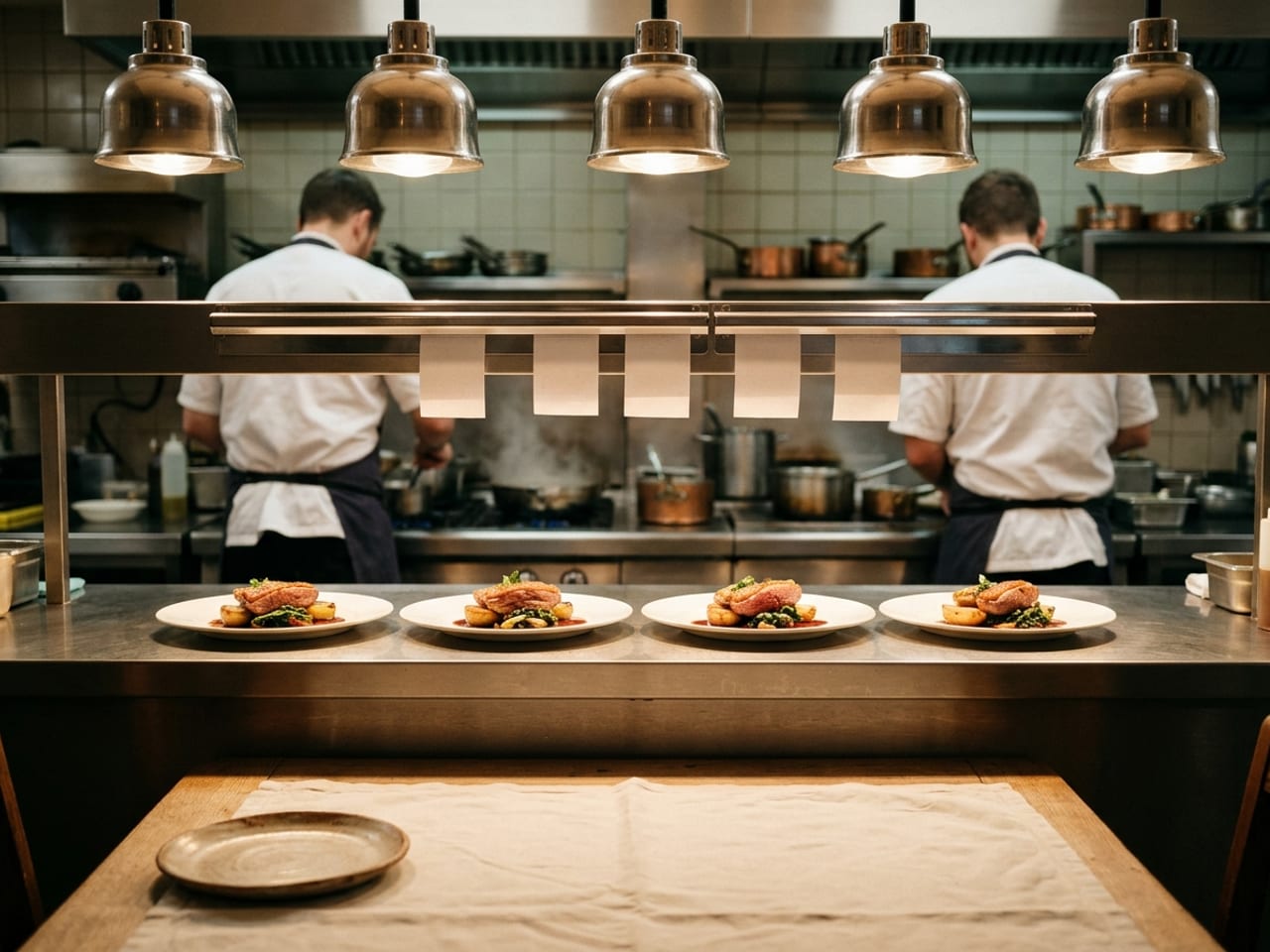
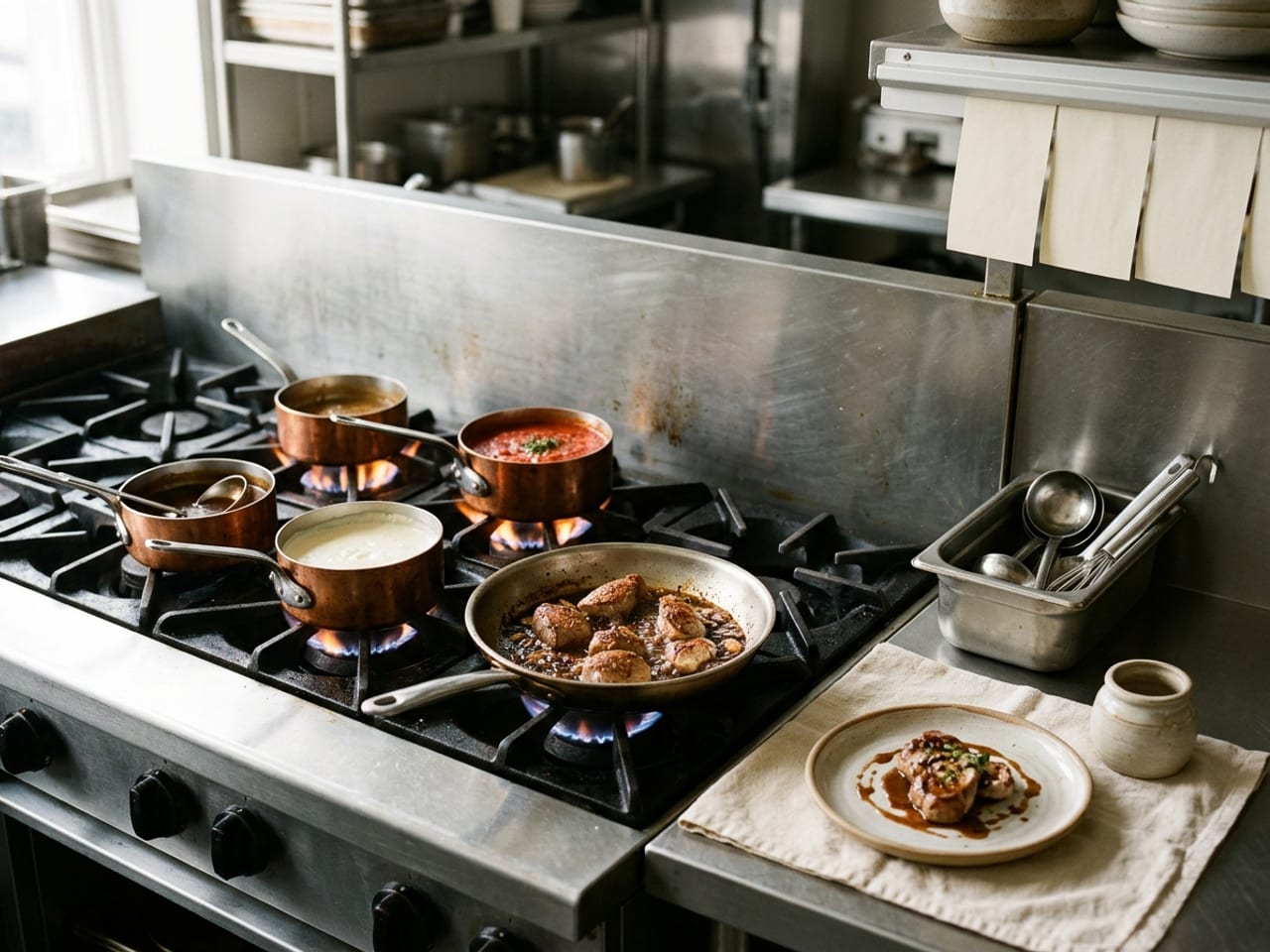
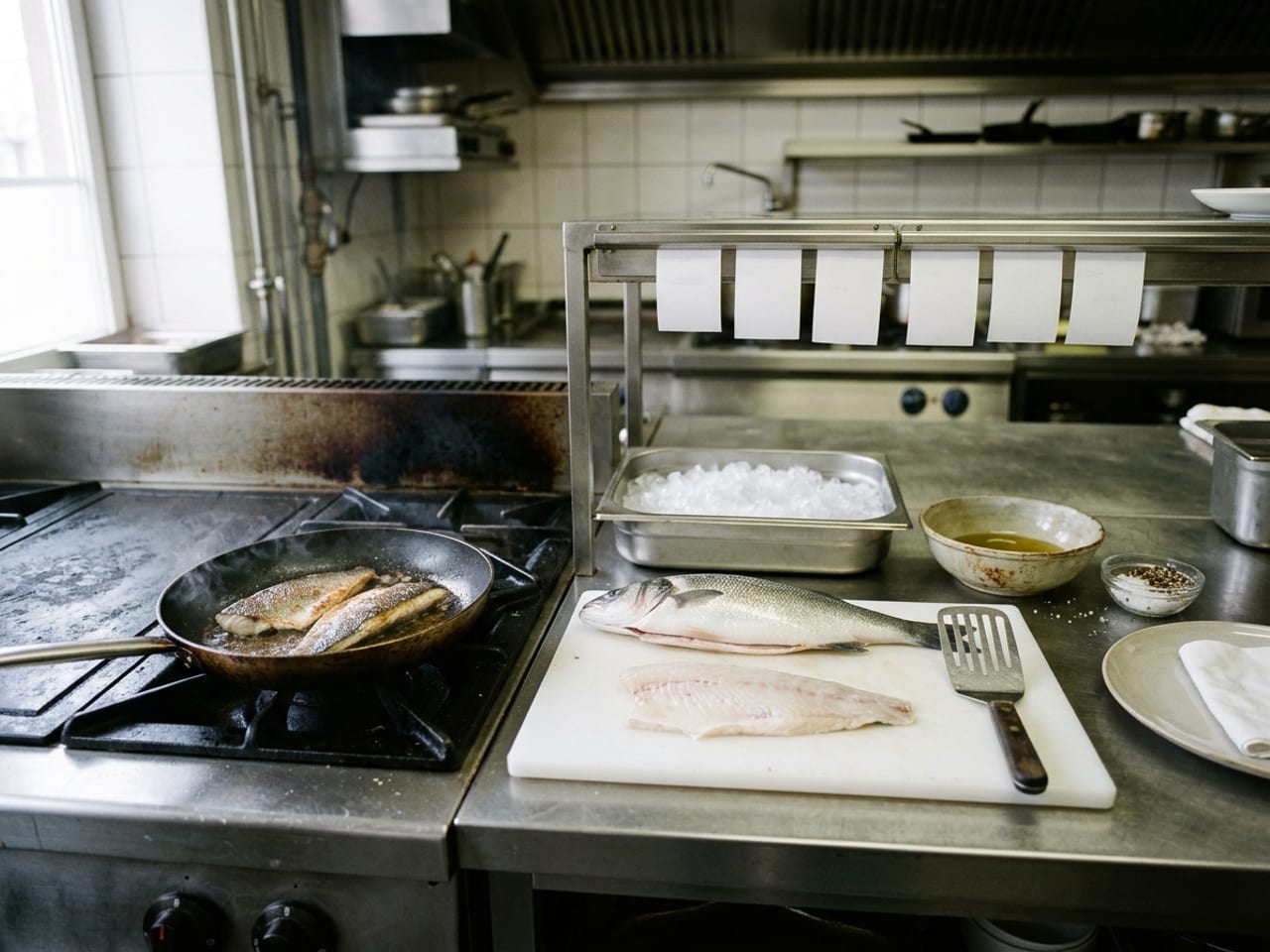
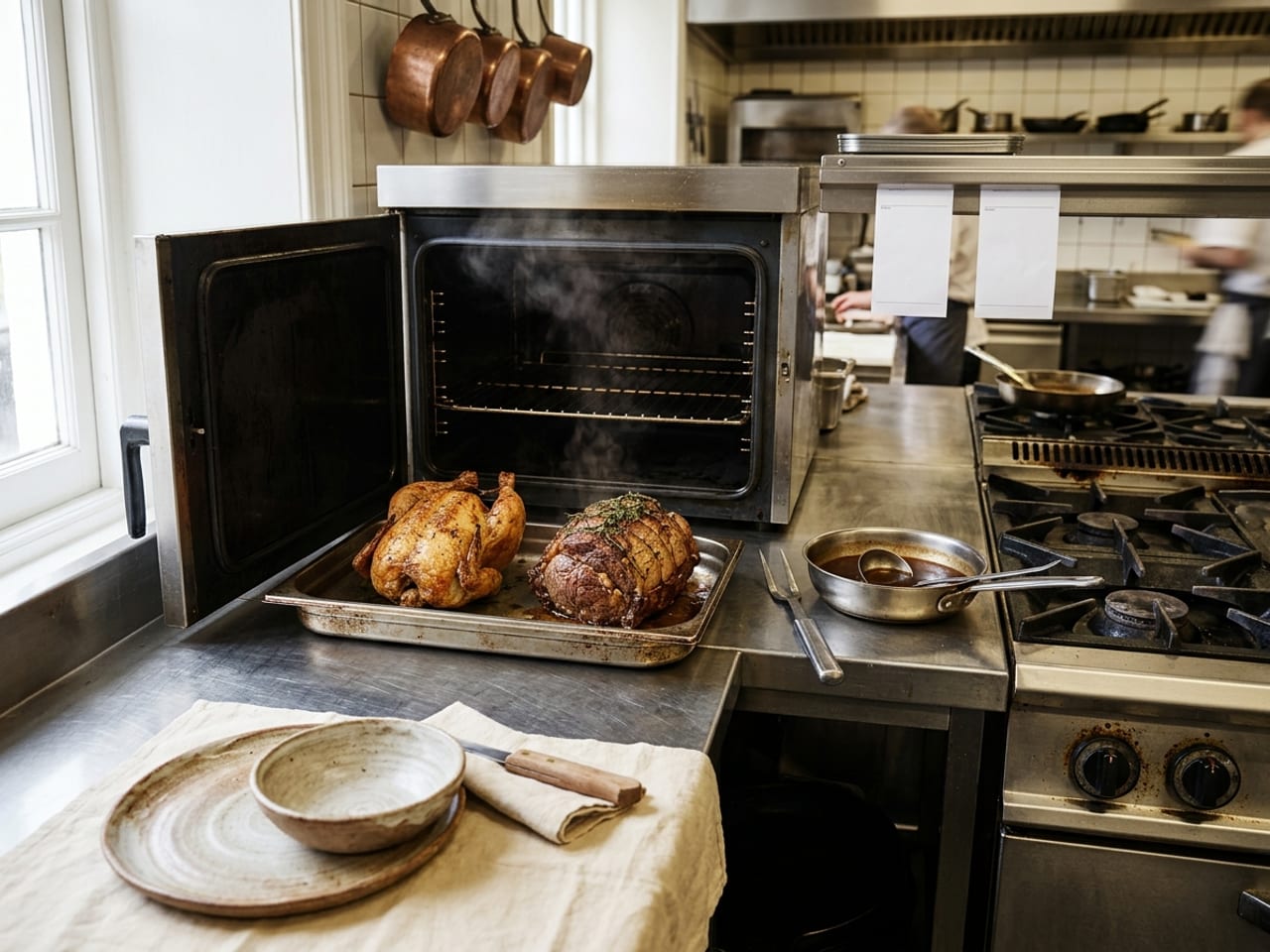
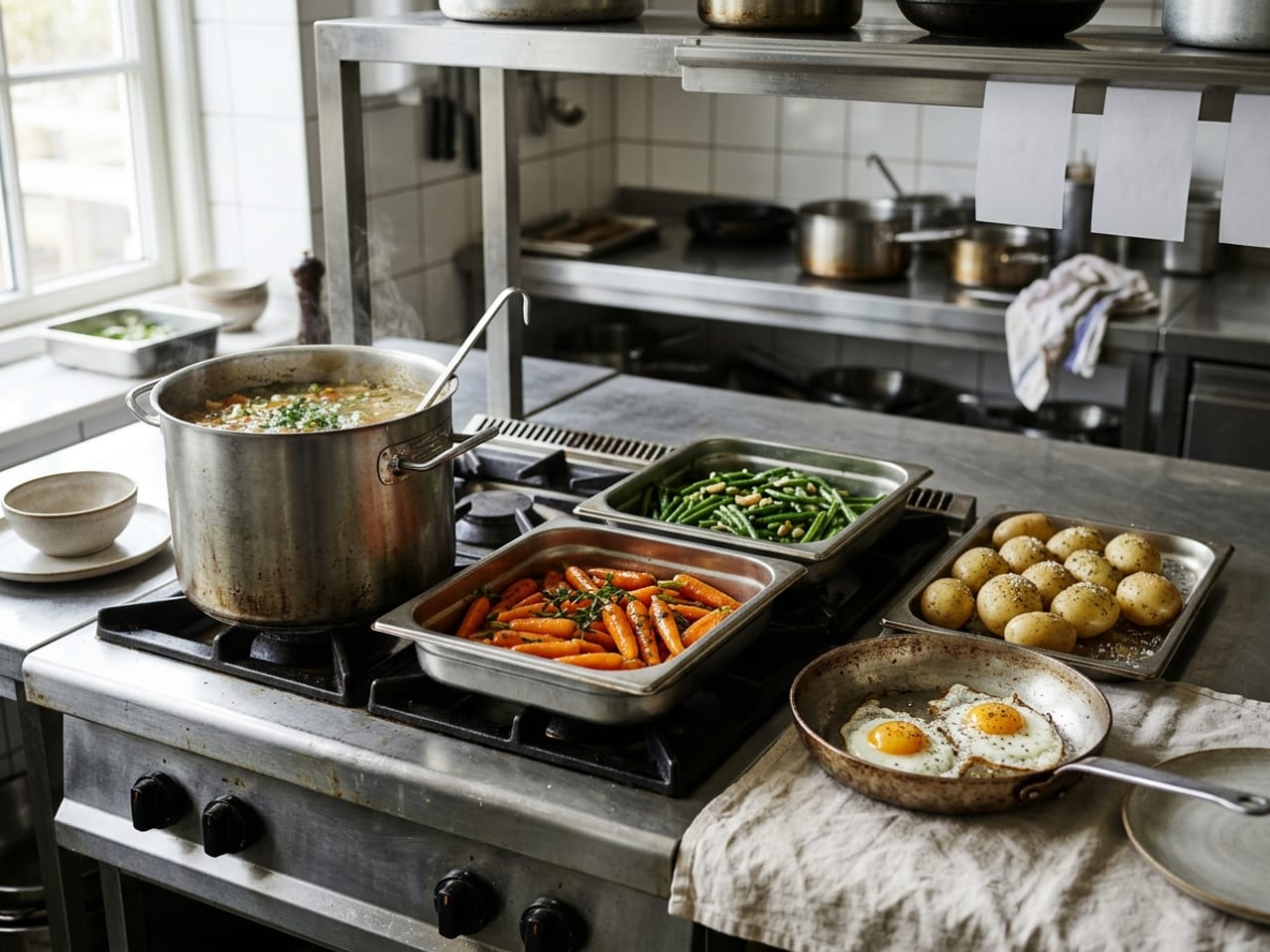
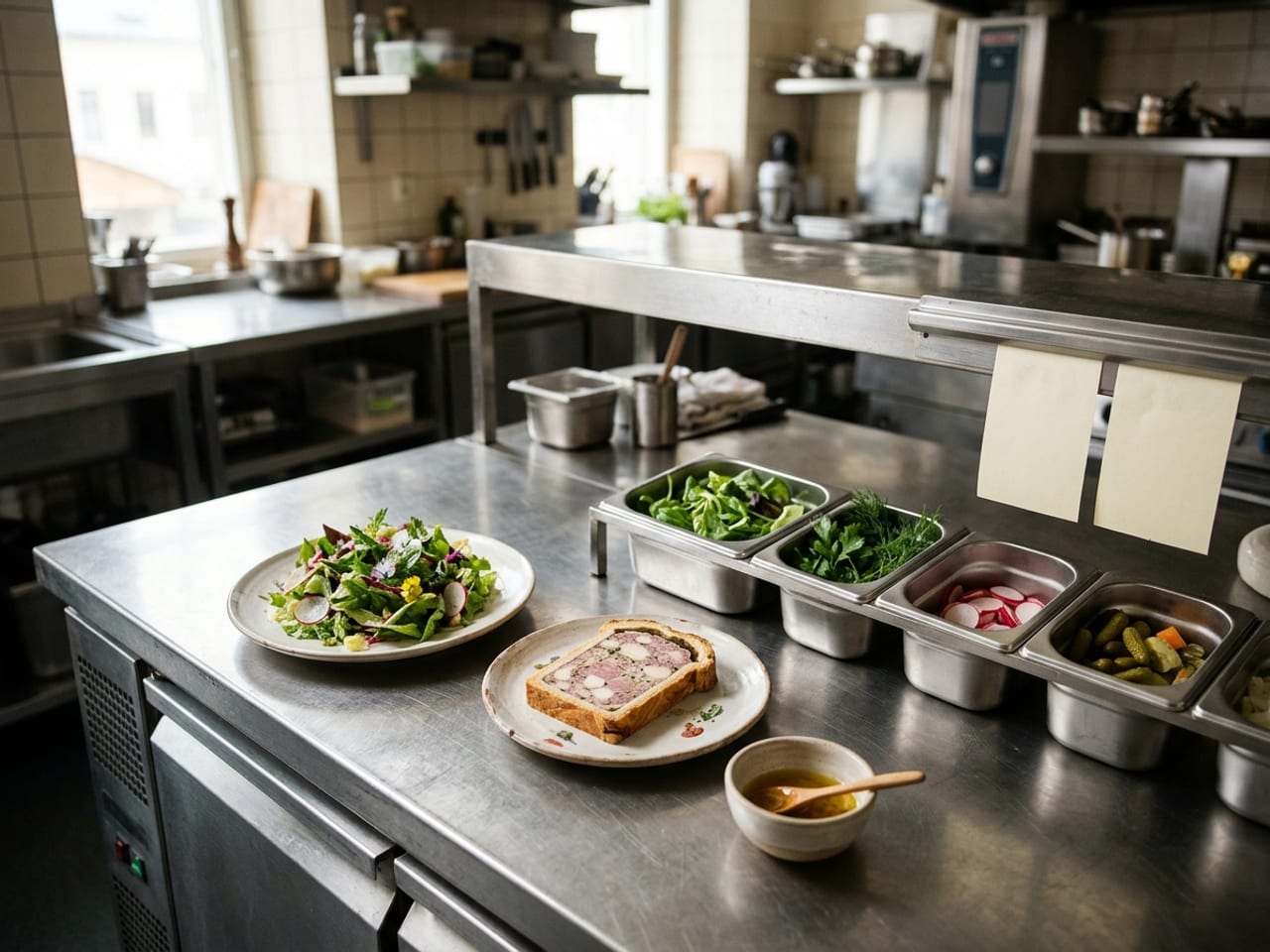
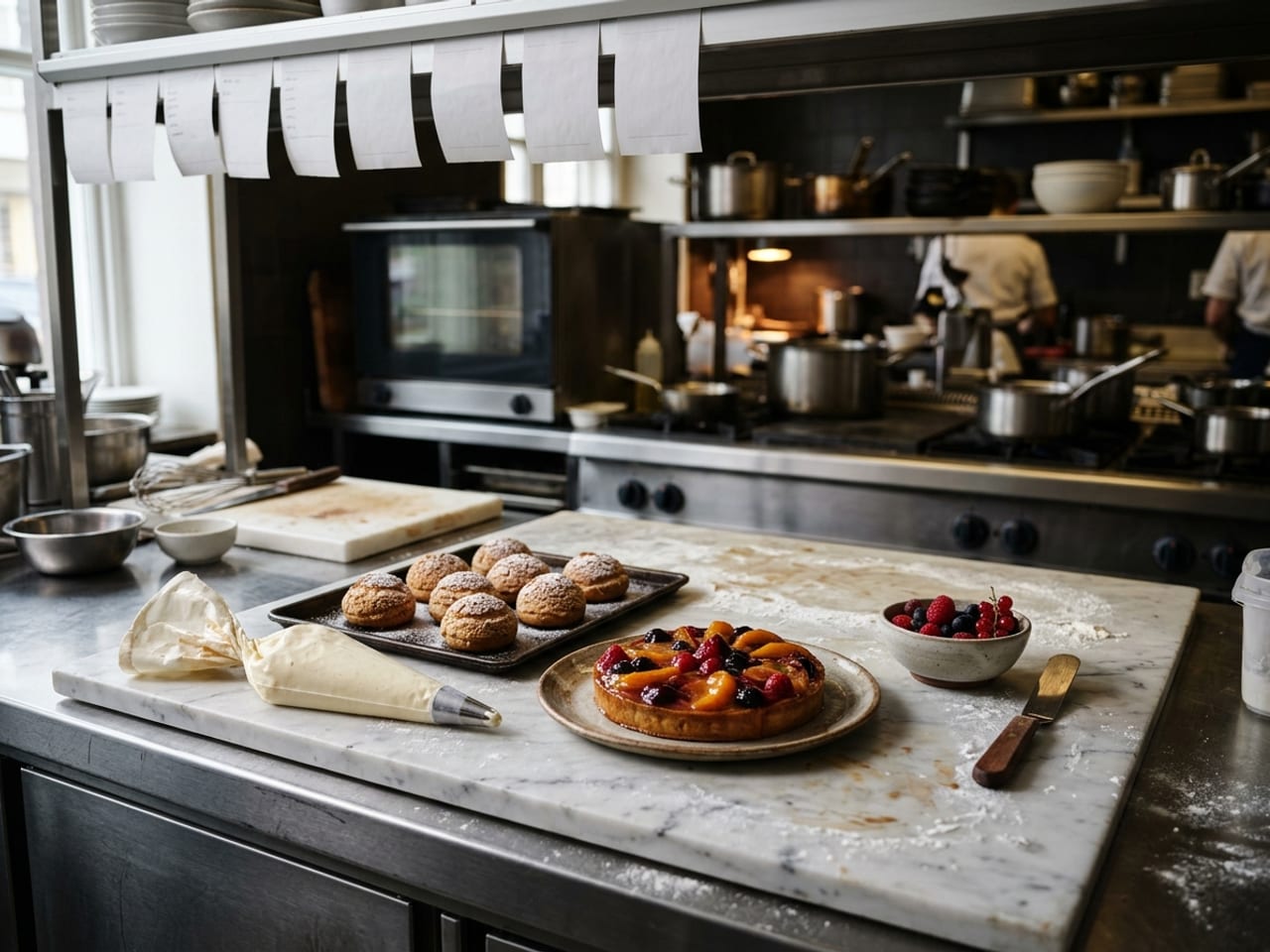
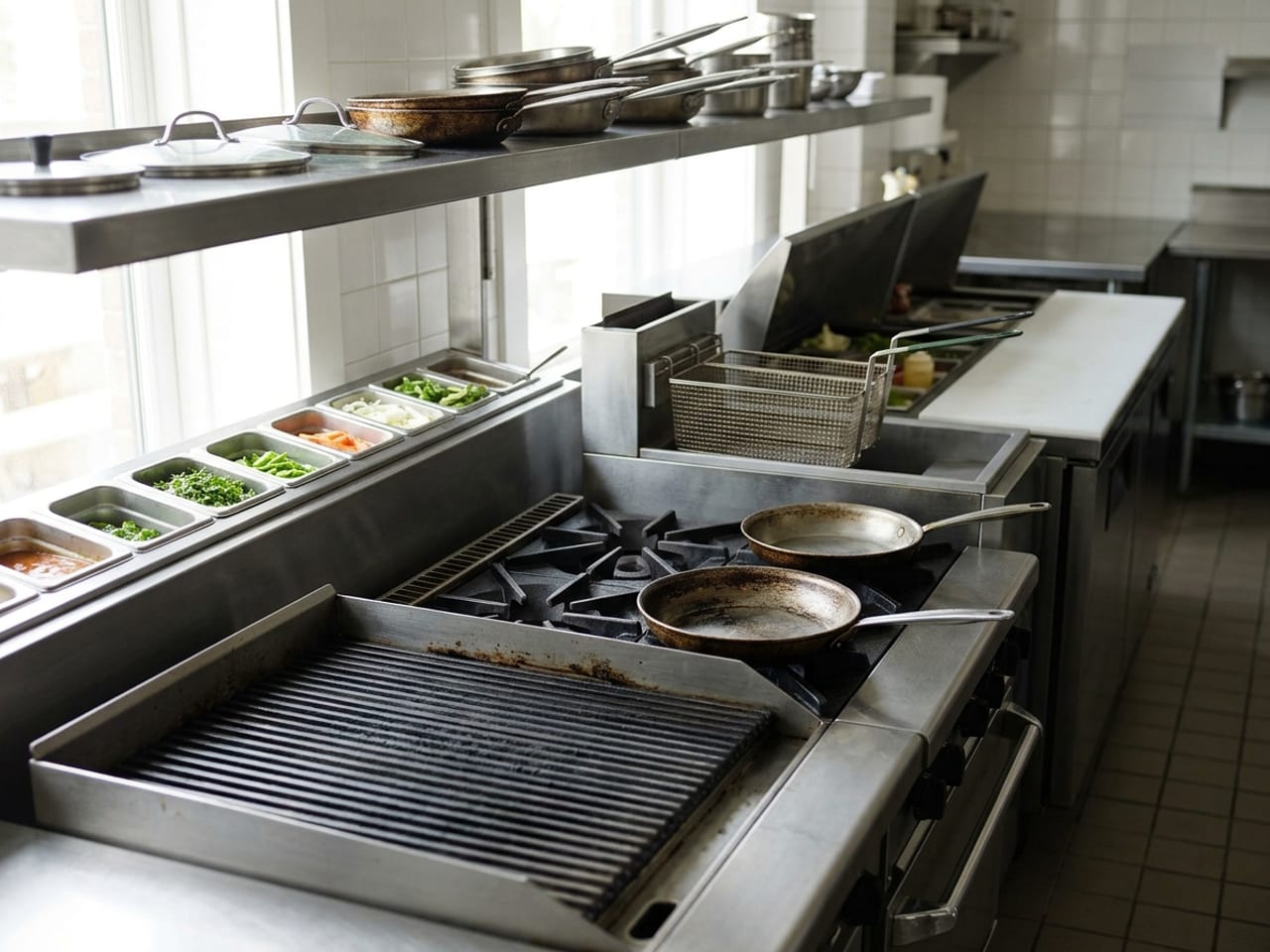
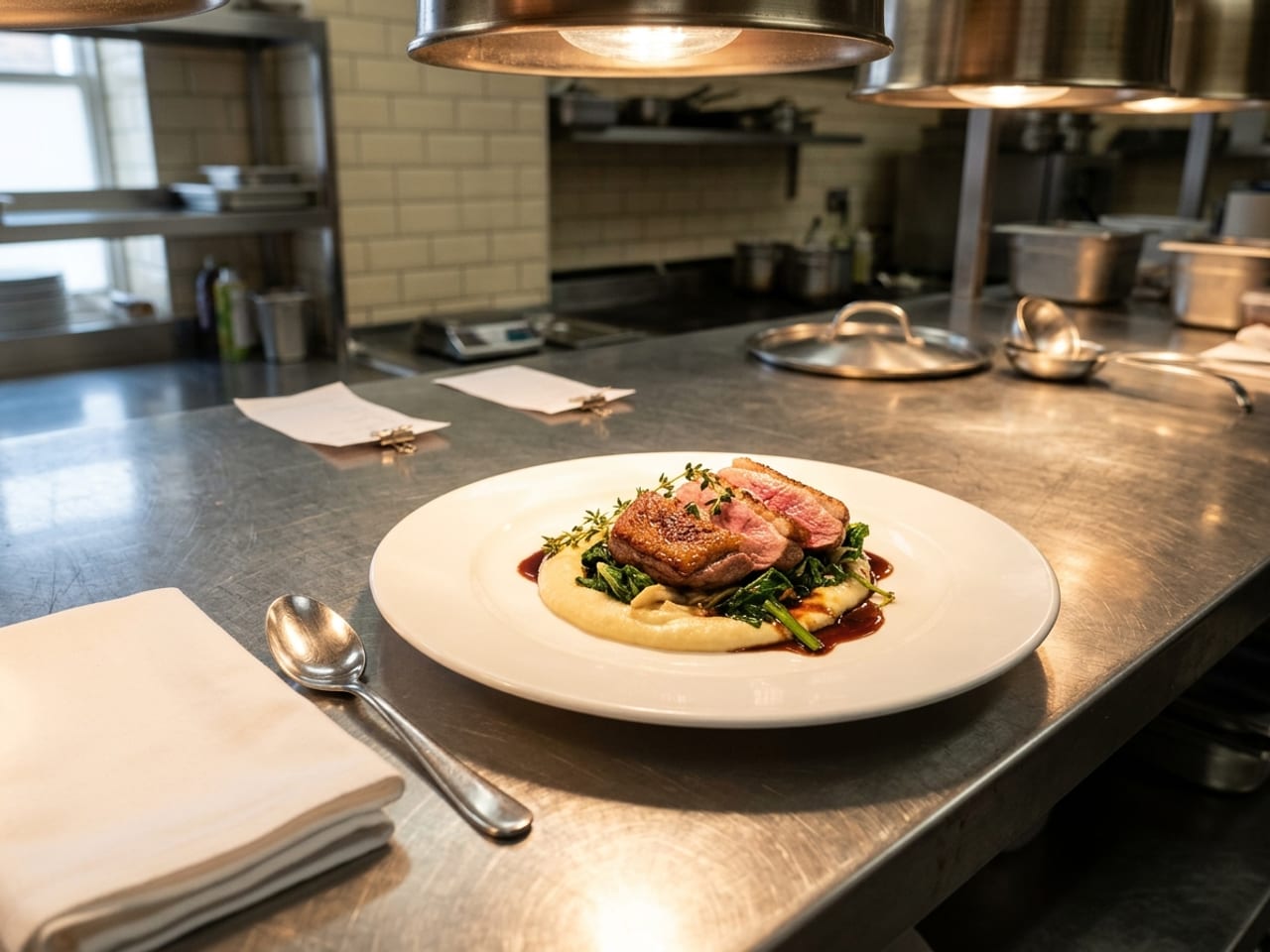
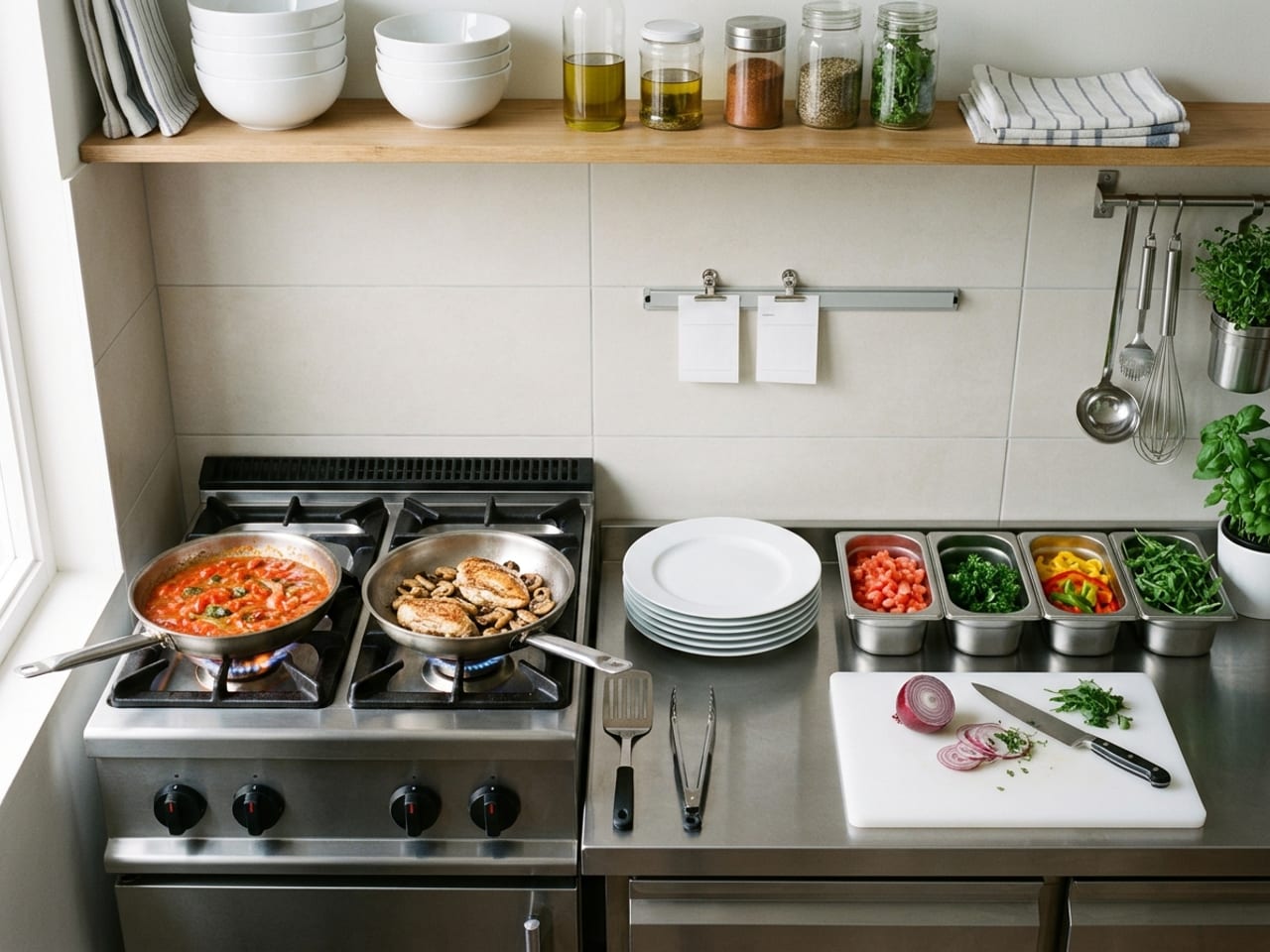
The photos on this page are AI-generated illustrations.
What is a kitchen brigade?
A kitchen brigade is a kitchen's chain of command, split into stations. At the top an executive chef or chef de cuisine (head chef), then the sous chef, then chefs de partie who each run one station (sauces, fish, roasts, vegetables, cold food, pastry), then the commis, with a plongeur washing up.1, 3, 10 Textbooks credit Escoffier but split on the verb (instituted, recorded, reorganised); his own 1903 text describes a 60-man brigade without claiming it, and Gouffé was writing of kitchen "brigades" by 1868.1, 3, 4, 63, 64, 65
- Who plates your food: the stations, or the sous chef at the pass, by kitchen; then the expediter or chef gives it a last look (follow one plate).2, 51, 53
- Small kitchens merge the posts: a second cook may do sauce, fish, soup and vegetables (what merges).2
On this page: Every role · The stations · Follow one plate · The pass and the expediter · Big hotel vs small kitchen · Chef de partie vs sous chef vs commis · Careers and pay · History · Where sources disagree · FAQ
Every role, top to bottom
Eleven posts, from the manager to the dishwasher. The top titles vary: Gisslen puts the chef de cuisine under an executive chef and Le Cordon Bleu lists the executive chef above, while the CIA, the Food Lover's Companion and the BLS use the two titles for one post (the split).1, 3, 5, 14, 44
- Chef exécutif (Executive chef): Gisslen: “The executive chef is a manager who is responsible for all aspects of food production, including menu planning, purchasing, costing, planning work schedules, hiring, and training.” In the UK the title “normally applies to hotels with multiple outlets”.2, 12
- Chef de cuisine (Head chef, kitchen chef): French for “head of the kitchen” (Gisslen); Cambridge's head chef is “in charge of the preparation of food in a restaurant or hotel”, including “checking the dishes before they are served”.2, 25 Reports to the executive chef in Gisslen (“The chef de cuisine reports to the executive chef.”). Le Cordon Bleu calls the executive chef “typically the most senior kitchen staff”, over “one or more busy restaurants”, and says the chef de cuisine “may be at the top of the kitchen hierarchy”; High Speed Training's executive chefs “manage kitchens at multiple outlets”; the CIA, Food Lover's and the BLS treat the two as one post.1, 3, 5, 14, 15, 44
- Sous-chef (Sous chef, under chef, second chef): “The sous chef (soo shef) is directly in charge of production” (Gisslen, who glosses sous as French for “under”); Merriam-Webster: “the top assistant in a professional kitchen”.1, 16 Reports to the chef: the CIA's sous chef “answers to the chef” and fills in for him or her.3
- Chef de partie (Station chef, section chef, line chef): “The station chefs, or chefs de partie, are in charge of particular areas of production.” (Gisslen); Cambridge: “in charge of one section of a kitchen in a restaurant”.2, 23 Reports to “a senior chef (such as sous chef, head chef, chef patron depending on the hierarchy of the establishment)”, in the UK standard.41
- Demi-chef de partie (Junior station chef, demi chef): English Wikipedia gives “demi-chef” to a lesser station; France's labour agency files “Demi-chef de partie” with the chefs de partie, and Australia's statistics list “Demi Chef” as a kind of chef.10, 48, 49
- Tournant (Relief cook, swing cook, roundsman): “The relief cook, swing cook, or tournant (toor-nawn), replaces other station heads.” (Gisslen); Québec: “Cuisinier appelé à remplacer n'importe quel chef de partie absent”.2, 39
- Aboyeur (Expediter, expeditor, expo, announcer): “The expediter, or aboyeur (ah-bwa-yer), accepts orders from waiters and passes them on to the cooks on the line.” and “inspects each plate before passing it to the dining room staff” (Gisslen). Escoffier's 1903 text has no word aboyeur; the man who announces the orders in it is “l'homme chargé des annonces” (the man in charge of announcing).2, 65 Reports to the chef, or is the chef: “In many restaurants, this position is taken by the head chef or the sous chef.”2
- Commis (Commis chef, junior cook): “The COMMIS or apprentice works under a station chef to learn how the station operates” (the CIA); in the UK standard the commis does basic cooking “in every section of a kitchen”, “rotating around each section”.3, 42 Reports to the chef de partie “of wherever they're assigned” (Le Cordon Bleu); in a small UK kitchen, the head chef or chef patron.14, 42
- Apprenti (Apprentice, trainee): The CIA pairs them (“The COMMIS or apprentice”); India's school ladder ends at “Trainees”; Carême in 1822 describes pre-Revolution great houses with “un ou deux apprentis” under the chef.3, 9, 59
- Communard (Staff cook): “The COMMUNARD prepares the meal served to staff at some point during the shift (also called the family meal).” (the CIA); Québec adds “This applies in large hotels.”3, 40 Reports to the chef: “Relève du chef.” (Québec, 1981).40
- Plongeur (Dishwasher; kitchen porter in the UK): “Celui, celle qui lave la vaisselle et les verres dans un restaurant” (the one who washes the dishes and glasses in a restaurant; this sense dated 1869); Cambridge's UK kitchen porter is “someone whose job is to wash dishes, etc. in a hotel or restaurant kitchen”.26, 31
How to say the titles (dictionaries only)
Sous-chef: Merriam-Webster ˈsü-ˌshef; Cambridge / ˈsuːˌʃef /; Oxford Learner's /ˈsuː ʃef/.16, 20, 21
Chef de partie: Cambridge UK / ˌʃef də pɑːˈtiː /, US / ˌʃef də pɑːrˈtiː /; plural chefs de partie.23
Aboyeur: The Food Lover's Companion [ah-bwah-YER].5
Commis: Cambridge (commis chef) UK / ˈkɒm.i ˌʃef /, US / kəˌmiː ˈʃef /; Merriam-Webster gives commis alone as ˌkəˈmē, a “deputy, assistant, clerk”, with no kitchen sense.17, 22
Saucier: The Food Lover's Companion [saw-see-YAY].5
Rôtisseur: The Food Lover's Companion [raw-tee-see-YAY].5
Entremetier: The Food Lover's Companion [ahn-trah-may-TYAY].5
Garde manger: The Food Lover's Companion [gahrd mahn-ZHAY].5
The Food Lover's Companion is a food dictionary; we print its respellings as it prints them, stressed syllable in capitals. We found no dictionary respelling of "brigade de cuisine" as a phrase.
The classical stations, one line each
Seventeen station names from the lists we read; no single list has them all, and a small kitchen has a few. Where the lists split, the line says so.
- Saucier (Sauce cook, sauté chef): “prepares sauces, stews, and hot hors d’oeuvres, and sautés foods to order. This is usually the highest position of all the stations.” (Gisslen)2 The saucier's sauces.
- Poissonnier (Fish cook): fish dishes; Gisslen (who spells it poissonier): “In some kitchens, this station is handled by the saucier.” Québec leaves fried and grilled fish to other stations.2, 35
- Rôtisseur (Roast cook): roasted and braised meats and their gravies, and broiled items to order (Gisslen); the CIA: “all roasted foods and related jus or other sauces.”2, 3
- Grillardin (Grill cook): “responsible for all grilled foods. This position may be combined with that of rôtisseur.” (the CIA)3
- Friturier (Fry cook): “responsible for all fried foods” and may be combined with the rôtisseur (the CIA); Québec's English note: “Term not commonly used in the hotel industry.”3, 36
- Entremetier (Vegetable cook): “vegetables, soups, starches, and eggs” in Gisslen; the CIA adds “hot appetizers”; in Chavette's 1867 Paris kitchen “les potages et les entremets sucrés” (soups and sweet entremets).2, 3, 62 The entremetier and the entremet.
- Potager (Soup cook): soups, inside the entremetier's work: “In a full traditional brigade system, soups are prepared by the soup station or potager” (the CIA).3
- Légumier (Vegetable cook or kitchen hand): vegetables in a full brigade (the CIA); a paid chef de partie in Chavette's 1867 kitchen (“Son nom indique sa spécialité”), but for Québec's English note “merely a kitchen hand”.3, 37, 62
- Garde manger (Pantry chef, cold-foods chef, larder): cold foods: “salads, cold appetizers, pâtés, and the like” (the CIA).3 The cold station in depth.
- Hors-d'œuvrier (Hors d'oeuvre cook): “Cuisinier s'occupant uniquement de la préparation des hors-d'œuvre, des salades diverses et de la décoration des pièces froides en gelée” (Québec, 1978: hors d'oeuvres, salads and cold pieces in aspic); Escoffier's 1907 partie “pour secondaire qu'elle paraisse” (however secondary it may seem).38, 67
- Boucher (Butcher): the meat cutting: a station of its own in the CIA's list; Gisslen names a butcher only among the extra posts of some large hotels.2, 3
- Charcutier (Charcuterie cook): charcuterie such as pâtés, rillettes, galantines and crépinettes (the Food Lover's Companion's charcutière); English Wikipedia files it under the garde manger.5, 10
- Pâtissier (Pastry chef): “The pastry chef, or pâtissier (pa-tees-syay), prepares pastries and desserts.” (Gisslen)2
- Boulanger (Baker): “prepares unsweetened doughs”, one of the four pastry specialists in the CIA's list.3
- Confiseur (Confectioner): “prepares candies and petits fours” (the CIA).3
- Glacier (Ice-cream and frozen-dessert maker): “prepares frozen and cold desserts” (the CIA).3
- Décorateur (Decorator): showpieces, the last of the CIA's four pastry specialists (the line in the excerpt we read breaks off after “prepares showpieces and special”).3
Which list names which post (ours)
The saucier, poissonnier, garde manger and pâtissier have a heading of their own in 8 or 9 of the 9 lists; the potager and légumier in none (they sit inside the entremetier's job), the charcutier in one. Fish goes to the saucier where there is no poissonnier (merges), and the entremetier's job differs by century (the split).
The tally: 17 posts across 9 lists
| Post | A heading of its own in | Named only inside another post in |
|---|---|---|
| Saucier | 8 of 91, 3, 5, 6, 7, 10, 13, 15 | 111 |
| Poissonnier | 9 of 91, 3, 5, 6, 7, 10, 11, 13, 15 | none |
| Rôtisseur | 6 of 91, 3, 5, 7, 10, 15 | none |
| Grillardin | 4 of 93, 5, 6, 15 | 41, 7, 10, 13 |
| Friturier | 3 of 93, 5, 15 | 41, 7, 10, 13 |
| Entremetier | 8 of 91, 3, 5, 6, 7, 10, 13, 15 | none |
| Potager | 0 of 9 | 31, 3, 10 |
| Légumier | 0 of 9 | 23, 10 |
| Garde manger | 9 of 91, 3, 5, 6, 7, 10, 11, 13, 15 | none |
| Boucher | 4 of 93, 10, 13, 15 | 11 |
| Charcutier | 1 of 95 | 110 |
| Pâtissier | 9 of 91, 3, 5, 6, 7, 10, 11, 13, 15 | none |
| Tournant | 8 of 91, 3, 5, 6, 7, 10, 11, 15 | none |
| Aboyeur | 8 of 91, 3, 5, 7, 10, 11, 13, 15 | 16 |
| Communard | 4 of 93, 7, 10, 11 | none |
| Commis | 6 of 93, 6, 10, 11, 13, 15 | none |
| Plongeur | 3 of 910, 11, 13 | 115 |
The 9 lists: Gisslen, Professional Cooking (6th, 7th, 9th eds.); CIA, The Professional Chef (8th, 9th eds.); The New Food Lover's Companion (2007); Wikipedia, Kitchen brigade; Wikipédia, Brigade (cuisine); École des Métiers Dijon (2019); BCcampus open textbook (2015); Escoffier school blog; High Speed Training (UK). The plongeur's fourth mention is a UK training company's "Escuelerie", a word no dictionary or textbook we read uses, so we count it as a mention only. Not counted: Escoffier's 1903 passage (no list), Chavette's 1867 kitchen (five chefs de partie, in history), the UK standard and the Indian textbooks (sections, not stations).8, 9, 15, 41, 62, 65
Follow one plate, from the ticket to the table
Ours: the example, one main course for table 12: a grilled steak, fries, green beans and a red wine sauce. Each step is in its sources' words (a chef's trade page, textbooks, magazines, Escoffier's 1903 method and a late-1920s Paris hotel memoir); we watched no service ourselves.
- The order reaches the kitchen (Server, ticket printer)
Chef David Buchanan's trade page (undated), in a night at a seafood grill told in the second person: “the ticket machine is an oblivious task master”.51 - The caller reads it out (Expediter (aboyeur), chef or sous chef)
Buchanan's example kitchen: “Ordering: 3 New York’s…2 medium rare, 1 medium; 2 bounty bowls; 1 Halibut.”51 - Each station answers back (Every station)
Buchanan: “Each station echoes back both sets of instructions.” A call with no answer is called again.51 - Fired so it all lands at once (The caller)
Buchanan: the caller times the stations “so that the five-minute dish from Sauté comes up at the same time as the 20 minute steak from the Grill station.”51 - Each station cooks its part (Grill or roast, fry, vegetable and sauce stations)
Ours, by the textbooks' job split: the steak to the grill (grillardin, CIA) or the roast station, which broils to order (rôtisseur, Gisslen); the fries to the fry cook (friturier), a post the CIA says “may be combined with the rôtisseur position”; the beans to the entremetier (vegetables, Gisslen); the sauce to the saucier.2, 3 - Plated at the stations, or at the pass (Line cooks, or the sous chef)
At the stations: in Buchanan's example kitchen “Plating:” means the dishes “are to be plated and in the pass within the next 2 minutes”, and the cooks “add the finishing touches”; Le Cordon Bleu: “All food that leaves a station is the responsibility of the chef de partie” (it does not say who plates).14, 51 - The last look at the pass (Expediter, chef or sous chef)
Chef Terrance Brennan: “the chef gives each plate a final look, adds last-minute garnishes, makes any necessary adjustments, wipes the rim if needed”. The CIA's expediter is “the last person to see the plate before it leaves the kitchen.”3, 52 - Out to the table (Runner or server)
Brennan: the chef then “either places it on a tray or hands it directly to the waitstaff to take into the dining room.” St. Louis Magazine's dining editor writes that a food runner works “Often at the direction of the food expeditor”.52, 56
A second source for each step
1. Escoffier in 1903: each order is written on a general board as it arrives, sorted by partie, by the kitchen secretary “sous le contrôle du chef” (under the chef's control).65
2. Escoffier 1903: orders “sont annoncées par l’homme qui en est spécialement chargé” (are announced by the man specially charged with it), and each chef de partie notes his own items on his own board.65
3. A cooking school's blog: “Yes Chef/Oui, Chef : Response that lets the chef know their order has been heard and understood”.58
4. Escoffier 1903: each card is called again “en indiquant qu’on doit la faire marcher” (saying it must be started); Orwell's Paris head cook, in the late 1920s, called “Faites marcher une côtelette de veau”.50, 65
5. Tasting Table: “It wouldn't make sense for one cook to run from the grill to the saute station and back again trying to assemble all the components of one plate.”53
6. At the pass: Tasting Table (2023): “Each cook passes the pot or pan of food to the pass where the sous chef assembles the final dish.”53
7. Orwell, 1933, on the head cook of a Paris hotel, in a passage about how dirty kitchens were: “When he is satisfied, he takes a cloth and wipes his fingerprints from the dish, and hands it to the waiter.”50
8. In 1903 it was the dining-room commis: the dish is ready “aussitôt que les commis de la salle viennent le réclamer” (as soon as the dining-room commis come to claim it).65
Who plates is a split. In Buchanan's example the cooks add the finishing touches at the stations and the caller inspects at the pass, though he also lists "plating dishes" among the caller's duties; Gisslen says only that the expediter "calls for orders to be finished and plated" and "inspects each plate", and that in a small kitchen a working chef "may handle the sauté station, plate foods during service"; in Tasting Table's account the sous chef assembles each plate at the pass. One club's banquet line is "a traditional assembly line, assigning one component per person".2, 51, 53, 55
What the pass is, and who stands there
The pass is "The area in a restaurant kitchen where the finished dishes are passed from the chefs to the waiting staff" (Wiktionary); Tasting Table: "the counter where finished plates of food cross from the kitchen to the dining room."32, 53 The only origin of the word we found is Chef David Buchanan's, on an undated trade page: "Pass is short for “pass-through”". No dictionary we could read gives one (Merriam-Webster and Collins refused our fetch).51
The expediter (Merriam-Webster's headword is "expediter", with "expeditor" as the less common variant, and it prints no kitchen sense; "expo" in Québec's English terms) is the aboyeur of the French lists.19, 33 Who takes the post:
- the head chef or sous chef “In many restaurants” (Gisslen); “In some operations, this may be either the chef or sous chef” (the CIA); in low-volume restaurants “souvent le chef ou le sous-chef” (Québec).2, 3, 33
- “typically the Chef, sous chef, or lead line cook”, and in a very busy kitchen a caller plus “a separate Expeditor who does finishing garnishes and organizes plates for the waitstaff” (Buchanan).51
- at another club's banquets, in the same trade-magazine article, “the F&B manager who expedites, wipes and loads plates” (Club + Resort Chef).55
The last look. Brennan: "the chef gives each plate a final look, adds last-minute garnishes, makes any necessary adjustments, wipes the rim if needed"; Buchanan's list includes "clean plate edges"; Tasting Table's chefs wait for plates "to have the edges wiped clean and given a final inspection."51, 52, 53 The wiping cloth and its liquid are in our plating tools guide.
Kitchen calls, and whose kitchen they come from
No call is universal: each row says where it is recorded.
| Call | Means | Recorded in |
|---|---|---|
| Ordering | a new order, read out item by item | Chef David Buchanan's trade page (undated), a night at a seafood grill told in the second person51 |
| Plating | plate it now and have it in the pass within 2 minutes | Buchanan's page (undated)51 |
| Fire | start that dish now; also the call to start a table's next course | the MICHELIN Guide's lingo piece (2021) and Buchanan's page (undated)51, 57 |
| Pick up | the order is ready to be served | the MICHELIN Guide (2021); Buchanan's page (undated) uses pick up as another name for the plating call51, 57 |
| All day | how many of one dish are needed across all open tickets | Chef Steve Doucakis of Quince, in the MICHELIN Guide (2021); Buchanan's page (undated)51, 57 |
| Heard / Yes, chef / Oui, chef | message received | a cooking school's blog (first published 22 December 2015; no kitchen named); the MICHELIN Guide adds that many now think “Yes, chef” obsolete57, 58 |
| Behind / Hot | I am behind you; I am carrying something hot | Chef Sujira Pongmorn of Saawaan (a Thai restaurant), in the MICHELIN Guide (2021)57 |
| Ça marche / Faites marcher | it's going / get it going | a Paris hotel kitchen of the late 1920s (Orwell, 1933); Escoffier's “faire marcher” (1903)50, 65 |
| Drag | hold a table back while a station catches up | Buchanan's page (undated): “Sauté, drag table 23 x 10 minutes.”51 |
Which roles merge in a small kitchen
Gisslen: "only a large establishment needs a staff like the classical brigade just described."2 What merges, one line each:
- Gisslen: “The size of the classical brigade may be reduced simply by combining two or more positions where the workload allows it. For example, the second cook may combine the duties of the sauce cook, fish cook, soup cook, and vegetable cook.”2
- Medium size: “a chef, a second cook, a broiler cook, a pantry cook, and a few cooks’ helpers.” Small: “only a chef, one or two cooks, and perhaps one or two assistants to handle simple jobs such as washing and peeling vegetables.” (Gisslen)2
- The working chef, in a kitchen too small for an executive chef, “may handle the sauté station, plate foods during service, and help on other stations when needed.” (Gisslen)2
- The short-order cook “may handle the broiler, deep fryer, griddle, sandwich production, and even some sautéed items.” (Gisslen)2
- Fish goes to the saucier when there is no poissonnier (Gisslen, the CIA, Québec's chef saucier); one UK training company sends it to the butcher instead.2, 3, 15, 34
- In small establishments, “head of the larder or sauce section acts as Sous Chef” (an Indian open university's hotel-management course).8
- A former New York chef's 2026 account of a modern American casual restaurant (the same article says the brigade still exists in serious fine dining and large hotel kitchens): “The friturier is gone. The poissonnier is folded into sauté.” and “The communard is whoever has time.”54
- A French training centre (2019): the classic hierarchy tends to disappear, and the current trend is an organisation around three main sectors (our translation): “La cuisine froide. La cuisine chaude. La pâtisserie.”7
- At Killiecrankie House in Perthshire, “there are only three chefs in the kitchen and no a la carte menu”, so its chef-patron sees no point in a meat or sauce specialist (Great British Chefs).73
- The smallest case on record here: Orwell's Paris “Auberge”, a kitchen “fifteen feet long by eight broad” (about 4.6 by 2.4 m, ours), one cook “expected to cook for fifty people” and a plongeur who also did “the simpler cooking”.50
And the other way, bigger:
- Large hotels may add separate day and night sous chefs, an assistant chef, a banquet chef, a butcher and a baker (Gisslen).2
- Escoffier's own figure, in his method for “une grande brigade”: 400 to 500 à la carte covers in 1 to 1½ hours “avec une brigade de 60 hommes” (with a brigade of 60 men).65
- An Indian hotel course compares a kitchen of a hundred chefs doing banquets for up to 1,000 with a small restaurant doing thirty set lunches, and says “there are no set rules for deciding how many sections and how many staff a particular kitchen requires.”8
Classical titles and what kitchens call them today
| Classical | Today |
|---|---|
| Chef de cuisine | Head chef (UK); kitchen manager (BCcampus, an O*NET title)6, 43, 46 |
| Sous-chef | Sous chef; executive sous chef in big operations6, 46 |
| Chef de partie | Line cook (Cambridge's synonym), line chef or section chef (UK standard), section cook (BCcampus)6, 24, 41 |
| Cuisinier (cook) | Line cook: cooks who “prepare or finish hot à la carte items during service” (Gisslen)2, 6 |
| Commis | Junior cook (BCcampus, Cambridge); one school blog heads it “Commis Chef (Line Cook)”6, 13, 22 |
| Cooks' assistants | Prep cook (O*NET files it with restaurant cooks, 35-2014; ours to pair it with Gisslen's “cooks’ helpers”)2, 46 |
| Aboyeur | Expediter, expeditor or expo (Québec's English terms; Merriam-Webster prints both spellings)19, 33 |
| Tournant | Swing cook or relief cook (US), tournant or relief cook (UK), roundsman3, 39 |
| Plongeur | Dishwasher (US), kitchen porter (UK)26, 46 |
Kitchen hierarchy by country, as the authorities file it
- UK: “head chef” is the title in charge; “executive chef” mostly for hotels with several outlets; government apprenticeships run commis chef (Level 2), chef de partie (Level 3), Senior Culinary Chef (Level 4).12, 41, 42, 43
- US: O*NET files the sous chef with the chefs (35-1011) and the saucier, line cook and prep cook with the restaurant cooks (35-2014). The BLS has no chef de partie occupation; O*NET lists “Chef de Partie (Cook Hotel & Restaurant)” only as an apprenticeship title under Cooks, Restaurant; neither files a commis.45, 46
- Canada: one unit group, 62200 Chefs, holds the executive chef, head chef, sous-chef, chef de partie and saucier.47
- Australia: occupation 321131 Chef covers the commis chef, demi chef and chef de partie; the senior chef is a separate manager occupation (161631).48
- India (hotels): executive chef, “Under Chef or Sous Chef”, “Section Chefs (Chef de Partie or CDP)”, assistant cooks graded Commis I, II and III, trainees; sections include an Indian kitchen and a Chinese kitchen.8, 9
- France: the labour agency files the “Premier commis” and the demi-chef de partie with the chefs de partie, and the plain commis apart; French Wikipédia: “Le premier commis est généralement le plus ancien commis”.11, 49
In a hotel the executive chef directs food production "in all outlets" (an Indian hotel course), each kitchen with its own chef de cuisine in Gisslen's model.1, 8 We found no named source for a cruise-ship galley hierarchy, so there is none here.
Chef de partie vs sous chef vs commis vs line cook
| Question | Answer, by source |
|---|---|
| Chef de partie vs sous chef | The sous chef is the kitchen's second in command; the chef de partie runs one station under the sous chef. Every ladder we read puts the sous above (in Dijon an experienced chef de partie may stand in as sous-chef).3, 7, 41 |
| Chef de partie vs line cook | Cambridge gives them the same definition; the UK standard lists “Line chef” as a chef de partie title; BCcampus makes the line cook the plain cook below the chef de partie; the BLS has no chef de partie occupation, and O*NET lists one only as an apprenticeship title under Cooks, Restaurant.6, 24, 41, 45, 46 |
| Chef de partie vs commis | The commis works under the chef de partie to learn the station (the CIA, Le Cordon Bleu). UK apprenticeships: commis at Level 2 (12 months), chef de partie at Level 3 (18 months).3, 14, 41, 42 |
| Commis vs line cook | A split: one school blog heads its commis “Commis Chef (Line Cook)”; BCcampus calls the commis a “Junior cook” and the cuisineur the line cook; India grades commis I, II and III.6, 9, 13 |
| Sous chef vs head chef | The head chef (chef de cuisine) runs the kitchen; the sous chef is the second, who often takes command of production minute by minute (Gisslen) and runs the kitchen when the head chef is away (UK National Careers Service).2, 43 |
| Executive chef vs head chef | Titles vary. Gisslen puts the chef de cuisine under the executive chef; Le Cordon Bleu lists the executive chef above, over “one or more busy restaurants”; the CIA, the Food Lover's Companion and the BLS treat them as one post.1, 3, 5, 14, 44 |
Careers and pay, from the labour agencies
- US pay: chefs and head cooks $62,470 a year, the BLS median for May 2025 (SOC 35-1011, which includes executive chefs and chefs de cuisine); restaurant cooks $37,390 a year, O*NET's 2025 median (SOC 35-2014, which includes line cooks).44, 46
- UK training: the commis chef apprenticeship typically runs 12 months (Level 2), the chef de partie apprenticeship 18 months (Level 3); the National Careers Service describes moving “from being a commis chef, preparing and cooking dishes, to sous chef, supervising staff and running a kitchen when the head chef is away.”41, 42, 43
- Canada: executive chefs “usually require management training and several years of experience in commercial food preparation, including two years in a supervisory capacity”.47
- Australia rates a chef at skill level 2: “AQF Associate Degree, Advanced Diploma, Diploma, or at least three years of relevant experience”.48
Pay here is the US agencies' only, dated and coded; we quote no salary sites.
The dining-room brigade (maître d'hôtel, waiters, runners) is the other half: in 1903 the dining-room commis came to claim each dish, and today a runner carries plates "Often at the direction of the food expeditor".3, 56, 65 Who serves and who plates in each style is in our types of table service guide.
Where the kitchen brigade comes from
- The word “brigade” was used for kitchens before Escoffier: Jules Gouffé's Le Livre de cuisine (first published 1867; we read the 1877 printing, pp. 339 to 340, in its second part) describes the old great-house kitchens with a chef for each partie and their aides, “représentant autant de brigades particulières, commandées par un homme spécial” (so many separate brigades, each under its own man); he says he does not ask for that back, and that the old households often had “à la fois confusion et profusion” (confusion and profusion at once). The 1868 English edition, his brother's translation, has the same passage: “forming so many brigades, each under the control of its special chef”.63, 64
- Carême (1822) looks back at the great houses before the Revolution: a house serving four entrées “de fondation” had a chef “ainsi secondé par de bons aides” (so seconded by good aides): an aide pâtissier, an “aide rôtisseur”, a “garçon de cuisine” and one or two apprentices. In his Art de la cuisine française (volume 3 in the Internet Archive's catalogue, dated 1833) he writes of “les cuisiniers qui peuvent avoir des sauciers avec eux”. For Dubois and Bernard (1864), “La rédaction des menus appartient au chef de cuisine” (writing the menus belongs to the chef de cuisine).59, 60, 61
- In 1867 a journalist toured a Paris restaurant kitchen: under the “grand chef” the “chefs de partie”, each with two or three aides; the saucier, “l'artiste de la maison”, paid 2,000 francs; the rôtisseur (who also had the frying), the entremétier (soups and sweet entremets) and a légumier at 1,800; the chef du garde-manger at 2,000 or 2,400.62
- The words: “chef de cuisine” is dated 1740 in French (“chef” from Latin caput, head); “commis” meant a person charged with a function by 1369; “brigade” was a troop of soldiers about 1370, and its sense of workers under a chief is dated 1867. In English, “brigade” is a military unit first (Oxford Learner's, Merriam-Webster, which dates it 1634; Dictionary.com, first recorded 1630 to 1640).18, 27, 28, 29, 30
- Escoffier's own text is one passage, at the end of the 1903 Guide culinaire: a method for “une grande brigade” in which the kitchen secretary posts the orders, “l'homme chargé des annonces” calls them, the chefs de parties note theirs, and the dining-room commis claim the dishes, serving 400 to 500 covers in 1 to 1½ hours with 60 men. It prints no station chart and does not claim the system as his invention.65
- In our machine count over the 1903 text the words “aboyeur”, “sous-chef”, “poissonnier” and “communard” never appear (OCR could hide a variant), and the 1907 English edition has no brigade section in the text we searched. The simplification Escoffier claims in his preface is of plating: “dressage simplifié” and doing away with the socles. The station lists come from later textbooks.66, 68
- The textbooks split on the verb: the system “was instituted by Escoffier” (the CIA's Professional Chef; the Food Lover's Companion says “instituted by Georges Auguste Escoffier”), “recorded by” him (the CIA's Garde Manger); Gisslen calls it his “reorganization of the kitchen” and says “The system of organization he established is still in use”. The Food Lover's Companion also says it “was modeled after French military organization”, the only reference book we read that says so.1, 3, 4, 5
- Popular accounts say he drew on the army he cooked for in the Franco-Prussian War of 1870 (a cooking school's blog, the CIA's library page, Wikipedia; Tasting Table only “Thought to”). None gives a source, and they disagree on the story itself: Great British Chefs and a 2014 review essay (“the first formal” brigade de cuisine) put the creation at the Savoy, while PBS SoCal says the structure goes back to “the battlefields of 14th-century Europe”. A food encyclopedia ties his army years to preserving food, not to the brigade.53, 69, 70, 71, 72, 73, 74, 75
- In the late 1920s, in the Paris hotel where Orwell washed dishes (his 1933 memoir), “twelve cooks skipped to and fro” at the furnaces while the head cook “stood in the middle booming continuously”; “It is not the cooking that is so difficult, but the doing everything to time.”50
- John McPhee's New Yorker piece “Brigade de Cuisine” (19 February 1979; collected in Giving Good Weight, per a blogger) is not about the system: the blogger says its theme is an extraordinary chef who does the work of an “entire brigade de cuisine” (second-hand; we could not read it).76
Today: a French training centre says the classic brigade tends to disappear, and The Bear brought the word to television (/Film: the show calls the system "the brigade").7, 77
The hierarchy's critics, in dated studies
- 54 Michelin-starred chefs in Britain and Ireland (2017): “Strict rules and discipline are often used in kitchen brigades as a means of monitoring quality and maintaining the high standards of performance”; the socialisation of new members is “analogous to the military induction”; the authors call bullying and violence unacceptable.78
- 54 head chefs of Michelin-starred restaurants in Britain and Ireland, volunteers from 86 invited (2018): the paper found alcohol and other drug use to be part of their occupational culture; the same paper, after Fine, says “communal links are reinforced by a kitchen brigade’s interdependency and cooperation”.79
- 710 Italian chefs recruited online through their national chefs federation (2020) averaged 66.4 working hours a week (plus or minus 28.9), and longer weeks went with more health complaints; the study does not test the hierarchy as a cause.81
- 460 chefs in a self-selected 2025 survey: 69% “often or always consider leaving”; written answers describe “toxic and abusive management cultures”.82
- Unite surveyed 87 of its own members in London (2017): 44% worked over 48 hours a week, 69% said long hours affected their health and 51% had suffered depression from overwork.83
- An ethnography and interview study of chefs and aspiring chefs (2023; sample size not in the abstract): workers respond to kitchen violence by avoiding, resisting or enduring it, responses that “reinforce, normalise and even exacerbate violence within commercial kitchens”.80
What none of them measures is the brigade itself as a cause: they count hours, stress, drink and abuse in kitchens. The Bournemouth report's own review sums up Fine's classic ethnography the other way, kitchen brigades as "tightly bonded communities, steeped in pride, craftsmanship and camaraderie", and the MICHELIN Guide notes that many now think the strict "Yes, chef" is obsolete.57, 82
The real splits, side by side
| Question | One side | The other | Our note |
|---|---|---|---|
| Did Escoffier invent the brigade? | “invented” (a cooking school's blog), “created by Escoffier” (Tasting Table), “developed” (Wikipedia), “instituted” (the CIA; the Food Lover's Companion), “established” (Gisslen).1, 3, 5, 10, 13, 53 | “recorded by” (the CIA's Garde Manger); Gisslen's “reorganization of the kitchen”; Gouffé wrote of kitchen brigades in a book first published in 1867 (the passage is in the 1868 English edition), and Escoffier's 1903 text claims no invention.1, 4, 63, 64, 65 | We follow the dated texts: he described a brigade at work in 1903, and we found nothing in his own words saying he founded it. |
| Is it modelled on the army? | Yes, say a school blog, the CIA's library page, Wikipedia and the Food Lover's Companion (“modeled after French military organization”).5, 70, 71, 72 | None gives a source; a food encyclopedia ties his army service to preserving food; the CIA's and Gisslen's textbooks print no army link.1, 3, 69 | The word is military (a dictionary fact); the story of the model is unsourced in everything we read. |
| Executive chef and chef de cuisine: one post or two? | Two: the chef de cuisine reports to the executive chef in Gisslen; Le Cordon Bleu and High Speed Training list the executive chef above (Le Cordon Bleu adds that a chef de cuisine “may be at the top of the kitchen hierarchy”, by the size of the business).1, 14, 15 | One: the CIA, the Food Lover's Companion and the BLS use the titles for the same post.3, 5, 44 | Titles vary by company and country; in the UK the person in charge is usually the head chef. |
| Is a line cook a chef de partie? | Yes: Cambridge's definitions are identical, and the UK standard lists “Line chef” for the chef de partie.24, 41 | No: BCcampus puts the line cook below the chef de partie; one school blog equates the line cook with the commis.6, 13 | Ask whose kitchen. The UK standard adds that in smaller kitchens a chef de partie may be the only person in the section. |
| Who plates the food? | The stations: line cooks plate and send to the pass (Buchanan's example, a club banquet line); Gisslen's expediter calls for orders to be “finished and plated” and inspects each plate, and his small-kitchen working chef “may handle the sauté station, plate foods during service”.2, 51, 55 | The sous chef, at the pass, from the pans each cook sends (Tasting Table, 2023).53 | Both happen. No source we read says the chef plates every dish. |
| Is the expediter a cook or a server? | Kitchen side: the chef, sous chef or a lead line cook calls the tickets and checks the plates (Gisslen, the CIA, Buchanan).2, 3, 51 | Front of house: BCcampus lists the expediter as the food runner; at another club's banquets an F&B manager expedited and wiped the plates.6, 55 | The word covers both; in a big kitchen Buchanan splits it into a caller and a separate expeditor. |
| Does the entremetier make desserts? | No: vegetables, soups, starches and eggs (Gisslen); hot appetizers (the CIA); desserts are the pâtissier's.2, 3 | Sometimes: soups and sweet entremets in Chavette's 1867 kitchen; “naturellement les entremets” (entremets, of course) in Québec's 1985 entry; kitchen entremets in Dijon's sheet when there is no pâtissier (crêpes, crème caramel, rice pudding).7, 37, 62 | It depends on the century and the kitchen. |
| Is the légumier a cook? | A cook: a paid chef de partie in 1867; the vegetable station of a full brigade (the CIA).3, 62 | A kitchen hand who “does no cooking as such” (Québec's English note).37 | No list we read gives the post a heading of its own. |
The kitchen brigade, answered
What is a kitchen brigade?
A kitchen brigade (brigade de cuisine) is a kitchen's staff organised as a chain of command over a set of stations: at the top an executive chef or chef de cuisine (head chef), then a sous chef, then station chefs called chefs de partie, each running one kind of food (sauces, fish, roasts, vegetables, cold food, pastry), then commis, the junior cooks. Gisslen's textbook says only a large establishment needs the full classical brigade; smaller kitchens combine the posts.
What does brigade de cuisine mean in English?
Kitchen brigade. "Brigade" was a troop of soldiers in French from about 1370, and the French dictionary TLFi dates its sense of a troop of workers under a chief to 1867; "cuisine" is the kitchen. English dictionaries define brigade as a military unit first. We found no dictionary respelling of the whole French phrase.
What are the chef titles in order?
Top to bottom, in the order of our list below (the lists we read differ): executive chef (in large operations), chef de cuisine or head chef, sous chef, chef de partie (station chef), demi-chef de partie, commis, apprentice; beside them the tournant (relief cook), the aboyeur or expediter, the communard (staff cook) and the plongeur (dishwasher). Titles at the top vary: some textbooks put the chef de cuisine under an executive chef, others treat the two as one post.
What does sous chef mean, and how do you say it?
Sous is French for "under": the sous chef is the second in command, "the top assistant in a professional kitchen" (Merriam-Webster), "the second most important cook in a hotel or restaurant kitchen, who helps the chef" (Cambridge). Merriam-Webster prints the pronunciation ˈsü-ˌshef and Cambridge / ˈsuːˌʃef /, roughly "soo shef". Merriam-Webster dates the English word to 1892.
What is the difference between a chef de partie and a sous chef?
The sous chef is second in command of the whole kitchen and runs production; a chef de partie runs one station (sauce, fish, roast, vegetables, cold food or pastry) and reports to the sous chef or head chef. In the UK a chef de partie apprenticeship is Level 3 and lasts about 18 months; the sous chef is a step up from there.
What is the difference between a commis chef and a line cook?
It depends whose titles. Cambridge defines a commis chef as "a junior cook in a restaurant kitchen" and gives the line cook the same definition as a chef de partie; BCcampus calls the commis a junior cook and the cuisineur the line cook; one cooking school's blog heads its commis section "Commis Chef (Line Cook)". In the US labour statistics there is no commis at all: the line cook is a restaurant cook.
What is an expediter (expeditor) in a kitchen?
The expediter, also spelled expeditor and called expo, is the caller at the pass: Gisslen's expediter "accepts orders from waiters and passes them on to the cooks on the line", calls for orders to be plated and "inspects each plate before passing it to the dining room staff". The French title is aboyeur. In many restaurants the head chef or sous chef does it; Chef David Buchanan's trade page adds a lead line cook. Merriam-Webster's headword is "expediter", with "expeditor" as the less common variant, and it gives no kitchen sense.
What is the pass in a kitchen?
The counter where finished plates leave the kitchen for the dining room: Wiktionary, "The area in a restaurant kitchen where the finished dishes are passed from the chefs to the waiting staff". There the chef, sous chef or expediter gives each plate a last look, adds last garnishes and wipes the rim if needed (Brennan; Buchanan). The only origin of the word we found is one chef's undated trade page: "Pass is short for “pass-through”".
What are the kitchen stations called in French?
Saucier (sauces), poissonnier (fish), rôtisseur (roasts), grillardin (grill), friturier (fry), entremetier (vegetables, soups, starches, eggs), potager (soups), légumier (vegetables), garde manger (cold food), hors-d'œuvrier (cold starters), boucher (butcher), charcutier (charcuterie), pâtissier (pastry), and under the pâtissier the boulanger (baker), confiseur (confectioner), glacier (frozen desserts) and décorateur (showpieces): 17 names, though no single list has them all.
Who plates the food in a restaurant?
It splits by kitchen. In Chef David Buchanan's example (an undated trade page) the cooks add the finishing touches at their stations and the caller inspects at the pass, though he also lists "plating dishes" among the caller's duties; Gisslen's textbook says only that the expediter "calls for orders to be finished and plated" and "inspects each plate", and that a small kitchen's working chef "may handle the sauté station, plate foods during service"; Tasting Table (2023) describes each cook sending a pan to the pass "where the sous chef assembles the final dish". At a banquet one club runs "a traditional assembly line, assigning one component per person". No source we read says the head chef plates every dish.
Did Escoffier invent the kitchen brigade?
Not in his own words. The CIA's Professional Chef says it "was instituted by Escoffier" (the Food Lover's Companion also says "instituted"), the CIA's Garde Manger that it was "recorded by" him, and Gisslen calls it his "reorganization of the kitchen" and says "The system of organization he established is still in use". Escoffier's own 1903 Guide culinaire describes how work is shared in "une grande brigade" of 60 men without claiming to have invented it, and Jules Gouffé was already describing kitchen "brigades" in a book first published in 1867 (the passage is in the 1868 English edition).
Is the kitchen brigade based on the military?
The word is: dictionaries define brigade as an army unit first. The story that Escoffier drew on the army he cooked for in 1870 is told by a cooking school's blog, the CIA's library page and Wikipedia, and the Food Lover's Companion says the system "was modeled after French military organization", but none of them gives a source, and they disagree on the story itself. A food encyclopedia ties his army years to preserving food instead.
What is Brigade de Cuisine by John McPhee?
A New Yorker profile of 19 February 1979 (collected in Giving Good Weight), not an essay on the system. A blogger describes its theme as a chef who does the work of an "entire brigade de cuisine"; we could not read the article itself, so this is second-hand.
What is the difference between an executive chef and a head chef?
In Gisslen's textbook the executive chef is the manager "responsible for all aspects of food production" and the chef de cuisine (head chef) reports to the executive chef; Le Cordon Bleu calls the executive chef "typically the most senior kitchen staff", over "one or more busy restaurants". The CIA, the Food Lover's Companion and the US labour statistics treat the titles as one post. In the UK the person in charge is usually called head chef, and executive chef mostly applies to hotels with several outlets.
Your food, plated like a chef's
Snap it, upload it, and get the composed version back, with the steps to recreate it at home.
Start free · 1 enhancement →Free account · 1 free enhancement · No credit card
How this page was made
We worked in, visited, timed and interviewed no kitchen: every role, station, step and call is its sources' words, read on 28 November 2026 unless its entry says otherwise; the textbook, Escoffier, Chavette, Wikipedia, Dijon and UK standard readings are our garde manger guide's, and Brennan's is our mise en place guide's. Ours: the chart and the tally behind it, the example plate and its path, the one-line wording of each role and station, the grouping of the lists and tables, the translations of French quotes (outside the quote marks) and every line marked ours.
We could not read: Merriam-Webster live (read in Internet Archive captures) and Collins, the BLS pages directly (read through a text extraction), Labensky's On Cooking, Larousse Gastronomique, Escoffier's memoirs, Kitchen Confidential, Fine's Kitchens (only the publisher's page), McPhee's article (only a blog's description), and the Toast and MasterClass pages. The 1903 word counts are machine counts over a scan's OCR. The figures are AI renders, not photographs.
The textbooks, dictionaries, agencies, chefs and pages behind this guide
How each source was read (in full, as an excerpt, as OCR of a scan, as an abstract, second-hand, or as a prior reading for another of our guides) is in its entry. Schools, training companies and software firms sell something, and their entries say so.
- Wayne Gisslen (2011). Professional Cooking, 7th ed. John Wiley & Sons, chapter 1 (the classical brigade, the history of restaurants), the openings of the salads and the pâtés chapters, and the bibliography; read as the machine-read text (OCR) of a copy uploaded to the Internet Archive; cited as the book, without a link to that copy.
- Wayne Gisslen (2019). Professional Cooking, 6th and 9th eds., chapter 1. John Wiley & Sons, ISBNs 978-0-471-66374-4 and 978-1-119-39961-2; the publication years 2007 and 2019 are the editions' usual ones, not printed in the excerpts; read in full as the publisher's excerpt PDF (chapter 1)s. wiley.com (excerpt)
- The Culinary Institute of America (2011). The Professional Chef, 9th ed. John Wiley & Sons, Hoboken, ISBN 978-0-470-42135-2; chapter 1, The Kitchen Brigade System, pp. 8 and 9, read in full as the publisher's excerpt PDF (chapter 1); the 8th edition's excerpt (ISBN 978-0-7645-5734-7) prints the same list (its usual year, 2006, is not printed in the excerpt). wiley.com (excerpt)
- The Culinary Institute of America (2012). Garde Manger: The Art and Craft of the Cold Kitchen, 4th ed. John Wiley & Sons, Hoboken, ISBN 978-0-470-58780-5; chapter 1, The Professional Garde Manger, pp. 1 to 7, read in full as the publisher's excerpt PDF (chapter 1); its contents from the Open Library record and the publisher's page. wiley.com (excerpt)
- Sharon Tyler Herbst and Ron Herbst (2007). The New Food Lover's Companion, 4th ed. Barron's, the entry "brigade system", where garde manger is "the person or station responsible for cold pantry items", [gahrd mahn-ZHAY]; read as the machine-read text (OCR) of a copy uploaded to the Internet Archive; cited as the book, without a link to that copy.
- BC Cook Articulation Committee (2015). Working in the Food Service Industry, chapter 7: Food Service Positions and Job Titles. BCcampus Open Education (an open textbook, CC BY 4.0), read in full on 28 November 2026: Table 2, kitchen positions with a modern alternative title (chef de partie = "Section cook", cuisineur = "Cook, Line cook", commis = "Junior cook"), and Table 3, where the expediter is listed in the front of house as the food runner. opentextbc.ca
- École des Métiers Dijon Métropole (2019). La brigade de cuisine. a French apprenticeship training centre (CFA) handout, uploaded July 2019; the garde-manger's cold kitchen, preliminary preparation, stores and cold rooms; the communard and tournant as the beginners' posts; read in full, translations ours. ecoledesmetiers.fr
- Uttarakhand Open University (2026). Introduction to Food and Beverage Production (BHM/DHM 103), units 1 and 2. an Indian state open university's hotel-management course, undated self-learning material, read in full on 28 November 2026 as PDF text: hotel kitchen sections including an Indian section; "In small establishments, head of the larder or sauce section acts as Sous Chef"; much of unit 1 repeats Gisslen's wording, so it is not counted as a separate list. uou.ac.in (PDF)
- Central Board of Secondary Education (India) (2018). Food Production, Class IX (code 409), student handbook, chapter 10: Hierarchy in kitchen. CBSE vocational curriculum, pp. 78 to 81, read in full on 28 November 2026 as PDF text: Executive Chef, "Under Chef or Sous Chef", "Section Chefs (Chef de Partie or CDP)", Assistant Cooks (Commis I, II and III), Trainees. cbseacademic.nic.in (PDF)
- Wikipedia contributors (2026). Kitchen brigade. Wikipedia (English, community-edited), garde manger "(pantry supervisor; 'food keeper')"; the concept "developed by Auguste Escoffier", cited to two web pages; read 2026-10-21 (raw wikitext). en.wikipedia.org
- Wikipédia contributors (2026). Brigade (cuisine). Wikipédia (French, community-edited; tagged "à sourcer", November 2021), read in full on 28 November 2026 (raw wikitext): its hierarchy from chef de cuisine to plongeur and communard; "Le premier commis est généralement le plus ancien commis". fr.wikipedia.org
- Wikipedia contributors (2026). Chef. Wikipedia (English, community-edited), read in full on 28 November 2026 (raw wikitext): "In the UK, the title executive chef normally applies to hotels with multiple outlets in the same hotel. Other establishments in the UK tend to use the title head chef.". en.wikipedia.org
- Auguste Escoffier School of Culinary Arts (2026). Kitchen Hierarchy Explained: Different Jobs in the Brigade de Cuisine. escoffier.edu (a for-profit cooking school's blog), the page says "originally published on November 5, 2019, and has since been updated"; read in full on 28 November 2026: Escoffier "invented the brigade de cuisine"; "Commis Chef (Line Cook)"; "Aboyeur (Expediter)", with "Food Runner or Food Expeditor" as other names. escoffier.edu
- Le Cordon Bleu International (2025). What is the kitchen brigade system? cordonbleu.edu (a cooking school group's news page), dated 11 August 2025, read in full on 28 November 2026: the executive chef "typically the most senior kitchen staff", over "one or more busy restaurants"; the chef de cuisine, who "may be at the top of the kitchen hierarchy"; "All food that leaves a station is the responsibility of the chef de partie"; the commis "answering directly to the chef de partie". cordonbleu.edu
- High Speed Training (2026). The Kitchen Hierarchy Explained: What is the Brigade de Cuisine? highspeedtraining.co.uk (a UK online training company), undated page, read in full on 28 November 2026: the executive chef "primarily managerial", managing "kitchens at multiple outlets"; aboyeur "literally translates to 'barker'". highspeedtraining.co.uk
- Merriam-Webster (2026). Sous-chef. merriam-webster.com, read in an Internet Archive (Wayback) capture, because the live page refused us (capture of 16 July 2026): "the top assistant in a professional kitchen"; ˈsü-ˌshef; "short for sous-chef de cuisine 'second in command of the kitchen'"; first known use 1892. merriam-webster.com
- Merriam-Webster (2026). Commis. merriam-webster.com, read in an Internet Archive (Wayback) capture, because the live page refused us (capture of 5 September 2026): "deputy, assistant, clerk", no kitchen sense printed; ˌkəˈmē; from French commettre, "to commit, entrust". merriam-webster.com
- Merriam-Webster (2026). Brigade. merriam-webster.com, read in an Internet Archive (Wayback) capture, because the live page refused us (capture of 11 July 2026): "a large body of troops", then "a group of people organized for special activity"; "French, from Italian brigata, from brigare to fight"; first known use 1634; no kitchen sense printed. merriam-webster.com
- Merriam-Webster (2026). Expediter. merriam-webster.com, read in an Internet Archive (Wayback) capture, because the live page refused us (capture of 21 April 2026): "expediter or less commonly expeditor", "one that expedites"; ˈek-spə-ˌdī-tər; first known use 1891; no kitchen sense printed. merriam-webster.com
- Cambridge University Press (2026). sous-chef. Cambridge Advanced Learner's Dictionary (dictionary.cambridge.org), read in full on 28 November 2026: "the second most important cook in a hotel or restaurant kitchen, who helps the chef"; / ˈsuːˌʃef /. dictionary.cambridge.org
- Oxford University Press (2026). sous-chef. Oxford Advanced Learner's Dictionary (oxfordlearnersdictionaries.com), read in full on 28 November 2026: "a person who is the second most senior cook in a restaurant"; /ˈsuː ʃef/. oxfordlearnersdictionaries.com
- Cambridge University Press (2026). commis chef. Cambridge Advanced Learner's Dictionary (dictionary.cambridge.org), read in full on 28 November 2026: "a junior cook in a restaurant kitchen"; UK / ˈkɒm.i ˌʃef /, US / kəˌmiː ˈʃef /. dictionary.cambridge.org
- Cambridge University Press (2026). chef de partie. Cambridge Advanced Learner's Dictionary (dictionary.cambridge.org), read in full on 28 November 2026: "a chef (= a cook) who is in charge of one section of a kitchen in a restaurant"; UK / ˌʃef də pɑːˈtiː /, US / ˌʃef də pɑːrˈtiː /; plural chefs de partie. dictionary.cambridge.org
- Cambridge University Press (2026). line cook. Cambridge Advanced Learner's Dictionary (dictionary.cambridge.org), read in full on 28 November 2026: "mainly US", the same definition as chef de partie, which it lists as the synonym. dictionary.cambridge.org
- Cambridge University Press (2026). head chef. Cambridge Advanced Learner's Dictionary (dictionary.cambridge.org), read in full on 28 November 2026: head chef, "the cook who is in charge of the preparation of food in a restaurant or hotel", including "checking the dishes before they are served". dictionary.cambridge.org
- Cambridge University Press (2026). kitchen porter. Cambridge Advanced Learner's Dictionary (dictionary.cambridge.org), read in full on 28 November 2026: labelled UK, "someone whose job is to wash dishes, etc. in a hotel or restaurant kitchen". dictionary.cambridge.org
- Oxford University Press (2026). brigade. Oxford Advanced Learner's Dictionary (oxfordlearnersdictionaries.com), read in full on 28 November 2026: "a large group of soldiers that forms a unit of an army". oxfordlearnersdictionaries.com
- Dictionary.com (Random House Unabridged; Collins English Dictionary on the same pages) (2026). brigade; expediter. dictionary.com, read in full on 28 November 2026: brigade first recorded 1630 to 1640 (printed with a dash), from French, from Old Italian brigata, "company of soldiers," originally "group, band,"; expediter, "a person or thing that expedites something", first recorded 1890 to 1895, no kitchen sense printed. dictionary.com
- ATILF (CNRS and Université de Lorraine) (2026). brigade. Trésor de la langue française informatisé (cnrtl.fr), read in full on 28 November 2026: a troop of soldiers about 1370; "1867 p. ext. « troupe d'ouvriers travaillant ensemble sous les ordres d'un chef »"; "Brigade de cuisine." as an example of a trade use. cnrtl.fr
- ATILF (CNRS and Université de Lorraine) (2026). chef; commis. Trésor de la langue française informatisé (cnrtl.fr), read in full on 28 November 2026: chef from Latin caput, "tête", "celui qui est à la tête de quelque chose" from 1172 to 1174, "1740 chef de cuisine (Ac.)"; commis, past participle of commettre, "personne chargée d'une certaine fonction" (1369). cnrtl.fr
- ATILF (CNRS and Université de Lorraine) (2026). plongeur; marmiton. Trésor de la langue française informatisé (cnrtl.fr), read in full on 28 November 2026: plongeur, "Celui, celle qui lave la vaisselle et les verres dans un restaurant, une collectivité", this sense dated 1869 (Littré); marmiton, "Jeune aide de cuisine, apprenti cuisinier"; its entries for commis and aboyeur carry no kitchen sense. cnrtl.fr
- Wiktionary contributors (2026). pass. en.wiktionary.org (a wiki, weak), read in full on 28 November 2026: the cooking sense, "The area in a restaurant kitchen where the finished dishes are passed from the chefs to the waiting staff", quoting Fred Sirieix (2017); no etymology for this sense. en.wiktionary.org
- Office québécois de la langue française (2014). Aboyeur. Grand dictionnaire terminologique, read in full on 28 November 2026: English equivalents "expo" and "expediter"; "Dans les restaurants à petit volume, c'est souvent le chef ou le sous-chef qui assume le rôle d'aboyeur.". oqlf.gouv.qc.ca
- Office québécois de la langue française (1985). Saucier; chef saucier. Grand dictionnaire terminologique, read in full on 28 November 2026: the chef saucier "le cas échéant, il remplit aussi la fonction de poissonnier" and "peut superviser un ou plusieurs commis". oqlf.gouv.qc.ca
- Office québécois de la langue française (1978). Poissonnier. Grand dictionnaire terminologique, read in full on 28 November 2026: the poissonnier cooks fish "exception faite de ceux qui sont traités par la friture ou la grillade" (after the Nouveau Larousse gastronomique, 1967). oqlf.gouv.qc.ca
- Office québécois de la langue française (1985). Friturier. Grand dictionnaire terminologique, read in full on 28 November 2026: the English note, "[friturier] Term not commonly used in the hotel industry.". oqlf.gouv.qc.ca
- Office québécois de la langue française (1985). Entremettier, entremettière. Grand dictionnaire terminologique, read in full on 28 November 2026: "potages, consommés, œufs, omelettes, légumes garnitures et naturellement les entremets"; English note: the légumier "is merely a kitchen hand and does no cooking as such". oqlf.gouv.qc.ca
- Office québécois de la langue française (1978). Hors d'œuvrier. Grand dictionnaire terminologique, read 2026-10-21 for our garde manger guide and again on 28 November 2026: "Cuisinier s'occupant uniquement de la préparation des hors-d'œuvre, des salades diverses et de la décoration des pièces froides en gelée". oqlf.gouv.qc.ca
- Office québécois de la langue française (1978). Tournant. Grand dictionnaire terminologique, read in full on 28 November 2026: "Cuisinier appelé à remplacer n'importe quel chef de partie absent"; "'Relief cook' and 'swing cook' are the most common job titles currently used in American kitchens while British usage favours 'tournant' or 'relief cook'". oqlf.gouv.qc.ca
- Office québécois de la langue française (1978). Communard; chef communard (1981); grillardin (2001). Grand dictionnaire terminologique, read in full on 28 November 2026: the staff cook, "This applies in large hotels"; the chef communard "Relève du chef"; the grillardin "s'occupe des cuissons sur le gril dans un restaurant". oqlf.gouv.qc.ca
- Skills England (2017). Chef de partie (Level 3, ST0227 v1.2). UK apprenticeship standard, approved 7 April 2017: overseeing a section, which could be "the pastry, larder, butchery, fish, sauce or vegetable section"; read in full. skillsengland.education.gov.uk
- Skills England (2025). Commis chef (Level 2, ST0228). UK apprenticeship standard, basic cooking "in every section of a kitchen", "rotating around each section"; read in versions 1.2 and 1.4 (from 2 June 2025). skillsengland.education.gov.uk
- National Careers Service (UK Department for Education) (2026). Job profiles: Chef; Kitchen porter. nationalcareers.service.gov.uk, undated page, read in full on 28 November 2026: alternative titles "Head chef, sous chef, commis chef, cook"; the apprenticeship ladder from commis chef (Level 2) to Senior Culinary Chef (Level 4); kitchen porters "keep the kitchen clean". nationalcareers.service.gov.uk
- US Bureau of Labor Statistics (2026). Occupational Outlook Handbook: Chefs and Head Cooks (SOC 35-1011). BLS, median annual wage $62,470 in May 2025; "Executive chefs, head cooks, and chefs de cuisine" as one occupation; read on 28 November 2026 through a text extraction, because bls.gov refused direct requests. bls.gov
- US Bureau of Labor Statistics (2026). Occupational Outlook Handbook: Cooks. BLS, "Teams of restaurant cooks, sometimes called assistant cooks or line cooks, work at assigned stations"; read on 28 November 2026 through a text extraction, because bls.gov refused direct requests. bls.gov
- US Department of Labor, O*NET OnLine (2026). Chefs and Head Cooks (35-1011.00); Cooks, Restaurant (35-2014.00); Dishwashers (35-9021.00). O*NET OnLine (CC BY 4.0), read in full on 28 November 2026: sample titles (Executive Chef and Sous Chef under chefs; Line Cook, Prep Cook and Saucier under restaurant cooks); "Chef de Partie (Cook Hotel & Restaurant)" among the example apprenticeship titles for restaurant cooks; medians for 2025, $62,470 for chefs and head cooks and $37,390 for restaurant cooks. onetonline.org
- Employment and Social Development Canada, Statistics Canada (2021). National Occupational Classification 2021 v1.0, unit group 62200, Chefs (job titles and duties). NOC, read in full on 28 November 2026: Chef de partie, Saucier, Sous-chef, Executive chef and Head chef in one unit group; executive chefs "usually require management training and several years of experience in commercial food preparation, including two years in a supervisory capacity". noc.esdc.gc.ca
- Australian Bureau of Statistics (2024). OSCA: Occupation Standard Classification for Australia, 2024 v1.0, occupation 321131 Chef. ABS, released 6 December 2024, read in full on 28 November 2026: specialisations "Chef de Partie", "Commis Chef", "Demi Chef"; "Senior Chefs are included in Occupation 161631 Senior Chef". abs.gov.au
- France Travail (2026). ROME 4.0 open data, job titles (version 62). France Travail (French labour agency), published 19 October 2026; read 2026-10-21 for our garde manger guide and re-checked on 28 November 2026 (filtered lines): "Premier commis / Première commise de cuisine" and "Demi-chef de partie" under G1609 with the chefs de partie; "Commis / Commise de cuisine" under G1602. data.gouv.fr
- George Orwell (1933). Down and Out in Paris and London. London: Victor Gollancz (a memoir, names disguised), the chapters on "Hôtel X", a Paris hotel where Orwell worked as a plongeur, and on a small restaurant, the "Auberge"; read in full on 28 November 2026 in the Project Gutenberg Australia plain text. gutenberg.net.au
- Buchanan, D. (2026). Kitchen Expeditor aka The Wheelman. chefs-resources.com (a chef's trade site), undated page, read in full on 28 November 2026: the calls in his example of a night on the line at a seafood grill, told in the second person ("Ordering:", "Plating:", "Fire", "All day", the call back), who takes the wheel, and "Pass is short for “pass-through”"; procedures "vary by establishment", in his words. chefs-resources.com
- Brennan, T. (2026). Mise en Place: Everything in Its Place. Chef Terrance Brennan's newsletter (Substack), 30 August 2026, the public part read in full on 18 November 2026: a station's mise en place, the line check, the pass, and his own dinner for guests at home. terrancebrennan.substack.com
- Murray, T. (2023). Everything You Need To Know About The Kitchen Brigade System. Tasting Table (a food magazine), published 18 February 2023, read in full on 28 November 2026: "Each cook passes the pot or pan of food to the pass where the sous chef assembles the final dish"; "It was created by Escoffier"; "Thought to have been derived from his time serving in the French army". tastingtable.com
- Ruiz, D. (2026). The Kitchen Brigade System and What's Left of It Today. Sobremesa Press (an industry site; the author, a former chef, co-founds restaurant software), published 20 May 2026, read in full on 28 November 2026: the aboyeur "Stands at the pass during service"; "The friturier is gone. The poissonnier is folded into sauté.". sobremesapress.com
- Club + Resort Chef (2026). Bettering Club Banquets: From Mise En Place to Service. clubandresortchef.com (a trade magazine), undated page, read in full on 23 November 2026: a club sous chef, Brian Sorin, "opts for a traditional assembly line, assigning one component per person": "You want to have your fastest person at the start to set the pace and the most detail-oriented person at the end to make sure all the plates look the same". clubandresortchef.com
- Mahe, G. (2024). Ask George: If you could work any position in a restaurant, what would it be? St. Louis Magazine, published 17 May 2024, updated 8 February 2025, read in full on 28 November 2026: the food runner, "Often at the direction of the food expeditor"; "a moniker that didn’t exist 25 years ago". stlmag.com
- MICHELIN Guide (2021). Restaurant Lingo: Talk Like A Chef. guide.michelin.com, published 21 May 2021, read in full on 28 November 2026: "Fire", "Pick up", "all day" (Chef Steve Doucakis of Quince), "Behind" and "hot" (Chef Sujira Pongmorn of Saawaan, a Thai restaurant), "Yes, chef". guide.michelin.com
- Auguste Escoffier School of Culinary Arts (2026). Kitchen Slang: A Guide to Jargon Used in Professional Kitchens. escoffier.edu (a for-profit cooking school's blog), the page says "originally published on Dec. 22, 2015, and has since been updated"; read in full on 28 November 2026: "Heard/Heard That", "Yes Chef/Oui, Chef"; no kitchen named. escoffier.edu
- Antonin Carême (1822). Le Maître d'hôtel français, vol. 1. Paris, the Discours préliminaire, p. 4: a chef with an aide pâtissier, an "aide rôtisseur", a "garçon de cuisine" and one or two apprentices; read as the machine-read text (OCR) of the library scan; quotations correct obvious OCR misreadings (the title page reads M DCCC XXII, 1822). archive.org
- Antonin Carême (1833). L'Art de la cuisine française au dix-neuvième siècle (Traité des petites sauces). Paris, p. 87: "les cuisiniers qui peuvent avoir des sauciers avec eux"; read as the machine-read text (OCR) of the library scan; quotations correct obvious OCR misreadings (the Internet Archive catalogues it as volume 3, dated 1833; the text we read prints no date). archive.org
- Urbain Dubois and Émile Bernard (1864). La Cuisine classique. Paris: Dentu, the section on menus: "La rédaction des menus appartient au chef de cuisine"; no "brigade" in the text we searched; read as the machine-read text (OCR) of the library scan; quotations correct obvious OCR misreadings (an edition after the first; the year is the scan's metadata). archive.org
- Eugène Chavette (1867). Restaurateurs et restaurés. Paris: A. Le Chevalier, pp. 25 to 39: the chefs de partie of a Paris restaurant and their pay, "Le chef du garde-manger (fixe 2,000 fr. ou 2,400). Place de confiance"; read in the Wikisource transcription of the scan. wikisource.org
- Jules Gouffé (1867). Le Livre de cuisine. Paris: Hachette, first published 1867; read in the 4th edition (1877 title page; preface dated 15 July 1867), Part 2, pp. 339 to 340 (we did not read the 1867 first edition): the old great-house kitchens, "représentant autant de brigades particulières, commandées par un homme spécial"; read as the machine-read text (OCR) of the library scan; quotations correct obvious OCR misreadings. archive.org
- Jules Gouffé, translated by Alphonse Gouffé (1868). The Royal Cookery Book. London: Sampson Low, Son, and Marston, Preliminary observations, pp. 262 to 263: "forming so many brigades, each under the control of its special chef", which "led undoubtedly to confusion and waste"; read as the machine-read text (OCR) of the library scan; quotations correct obvious OCR misreadings. archive.org
- Auguste Escoffier (1903). Le Guide culinaire, 1st ed. Paris (printed by Émile Colin, Lagny), p. 768, "Méthode de répartition et de mise en marche du travail dans une grande brigade": the general order board "destiné au garde-manger", "une brigade de 60 hommes"; "chef du froid" in the hors-d'oeuvre chapter; read as the machine-read text (OCR) of the library scan; quotations correct obvious OCR misreadings (Internet Archive dates this scan 1907; its title page reads 1903). archive.org
- Auguste Escoffier (1903). Le Guide culinaire, 1st ed.: the preface, the saucier, the rôtisseur, and a word count. Paris, the Avant-propos (pp. vi to vii, "dressage simplifié"), the sauce chapter (the saucier after the marquis de Cussy) and the roasts (Brillat-Savarin's "on naît rôtisseur"), plus our machine count of words over the whole OCR text (no "aboyeur", "sous-chef", "poissonnier" or "communard"; OCR could hide a variant); read as the machine-read text (OCR) of the library scan; quotations correct obvious OCR misreadings. archive.org
- Auguste Escoffier (1907). Le Guide culinaire, 2nd ed. Paris, p. 1216, the same brigade passage, and p. 262, the hors-d'œuvrier, "cette partie, pour secondaire qu'elle paraisse"; read as the machine-read text (OCR) of the library scan; quotations correct obvious OCR misreadings (the preface to the second edition is dated 1 February 1907; Internet Archive dates the scan 1903). archive.org
- Auguste Escoffier (1907). A Guide to Modern Cookery. London: William Heinemann, the aspic chapter ("Jellies are to cold cookery what consommés and stock are to hot"; the Savoy's Suprême de Volaille Jeannette) and p. 139, the hors-d'oeuvrier; in what we searched it has no brigade section and no garde-manger; read as the machine-read text (OCR) of the library scan; quotations correct obvious OCR misreadings. archive.org
- Newman, J. M. (2026). Escoffier, Georges-Auguste. Encyclopedia of Food and Culture (Gale / Scribner), via encyclopedia.com, read in full on 28 November 2026: "Escoffier's experience in the military taught him the importance of preserving food"; Monte Carlo 1884, the Savoy 1890; the entry never uses the word brigade. encyclopedia.com
- Wikipedia contributors (2026). Auguste Escoffier. Wikipedia (English, community-edited), read in full on 28 November 2026 (raw wikitext): the Savoy from 1890, dismissed on 8 March 1898, the Carlton from 1899 (citing the Oxford DNB); "he tapped into his own military experience to develop the hierarchical brigade de cuisine system". en.wikipedia.org
- Auguste Escoffier School of Culinary Arts (2025). Who Was Auguste Escoffier? escoffier.edu (a for-profit cooking school's blog), dated 24 March 2025 ("originally published on November 19, 2015"), read in full on 28 November 2026: "a hierarchical system inspired by his experiences in the military"; no source given. escoffier.edu
- Culinary Institute of America Library (2026). Georges Auguste Escoffier: The King of Chefs and the Chef of Kings (Pages of the Past). library.culinary.edu (a school library page), undated page, read in full on 28 November 2026: "The French Brigade system, inspired by Escoffier’s military experience in the Franco-Prussian War of 1870"; no source given. library.culinary.edu
- Great British Chefs (2025). Kitchen hierarchy: the modern Escoffier. greatbritishchefs.com (a food magazine), dates on the page 28 June 2023 and 14 February 2025, read in full on 28 November 2026: "Escoffier created his kitchen brigade system while working at the Savoy"; chef-patrons on smaller brigades ("only three chefs in the kitchen and no a la carte menu"). greatbritishchefs.com
- PBS SoCal (2026). How The Military Has Shaped The Way Restaurant Kitchens Operate Today. pbssocal.org (a public broadcaster's web article), undated page, read in full on 28 November 2026: the brigade "traces its roots back to the battlefields of 14th-century Europe"; no source given. pbssocal.org
- Claremont Review of Books (2014). Work the Line. claremontreviewofbooks.com (a review essay), published 11 April 2014, read in full on 28 November 2026: at the Savoy Escoffier "organized them into the first formal" brigade de cuisine; no source given. claremontreviewofbooks.com
- The New Yorker & Me (a blog) (2019). John McPhee's "Brigade de Cuisine" Retitled. thenewyorkerandme.blogspot.com, published 1 November 2019, read in full on 28 November 2026: quotes McPhee's New Yorker piece of 19 February 1979 on a chef "who does the work of an “entire brigade de cuisine.”"; second-hand, we could not read the article or the book. thenewyorkerandme.blogspot.com
- /Film (2024). The Bear's Kitchen Lingo, Explained. slashfilm.com (an entertainment site), updated 8 February 2024, read in full on 28 November 2026: the show calls the Escoffier-style system "the brigade". slashfilm.com
- Cooper, J., Giousmpasoglou, C. & Marinakou, E. (2017). Occupational identity and culture: the case of Michelin-starred chefs. International Journal of Contemporary Hospitality Management, 54 interviews with Michelin-starred chefs in Great Britain and Ireland; abstract only (the OpenAlex record), read on 28 November 2026. doi:10.1108/ijchm-02-2016-0071
- Giousmpasoglou, C., Brown, L. & Cooper, J. (2018). Alcohol and other drug use in Michelin-starred kitchen brigades. International Journal of Hospitality Management, 54 head chefs of 86 invited (63%); read in full as the accepted manuscript in Bournemouth University's repository on 28 November 2026. doi:10.1016/j.ijhm.2017.11.003
- Meiser, E. T. & Wilson, E. R. Y. (2023). Avoiding, Resisting and Enduring: A New Typology of Worker Responses to Workplace Violence. Work, Employment and Society, chefs and aspiring chefs in commercial kitchens; the sample size is not in the abstract; abstract only (the OpenAlex record), read on 28 November 2026. doi:10.1177/09500170231159845
- Cerasa, A., Fabbricatore, C., Ferraro, G. A., Pozzulo, R., Martino, I. & Liuzza, M. T. (2020). Work-Related Stress Among Chefs: A Predictive Model of Health Complaints. Frontiers in Public Health, 710 chefs recruited through the Italian Chefs Federation, online; abstract only (the OpenAlex record), read on 28 November 2026. doi:10.3389/fpubh.2020.00068
- Giousmpasoglou, C. (Bournemouth University) with The Burnt Chef Project (2026). Chefs' Intention to Leave: Global Survey. Bournemouth University repository (a survey report, not peer-reviewed as far as the PDF says), survey run in 2025, PDF made January 2026, read in full on 28 November 2026: 460 chefs, mainly in the UK and other English-speaking markets, reached through the Burnt Chef Project's own channels, so a self-selected sample. eprints.bournemouth.ac.uk (PDF)
- Restaurant Online (2017). Majority of London chefs struggle with long working hours. restaurantonline.co.uk (UK trade press, reporting a Unite union survey), 27 April 2017, read in full on 28 November 2026: Unite surveyed 87 of its own members in London restaurants, pubs and hotels. restaurantonline.co.uk
Keep going
Garde manger
The cold station in depth: what it makes and where it sits in the brigade.
Mise en place
What every station sets up before service, and the line check.
Entremet
The layered dessert, and the entremetier who once made entremets.
Types of table service
The dining-room side: who plates in plated, silver and Russian service.
Michelin-star plating
How restaurant plates are built, checked and sent.
The mother sauces
The saucier's five classical sauces and what they become.