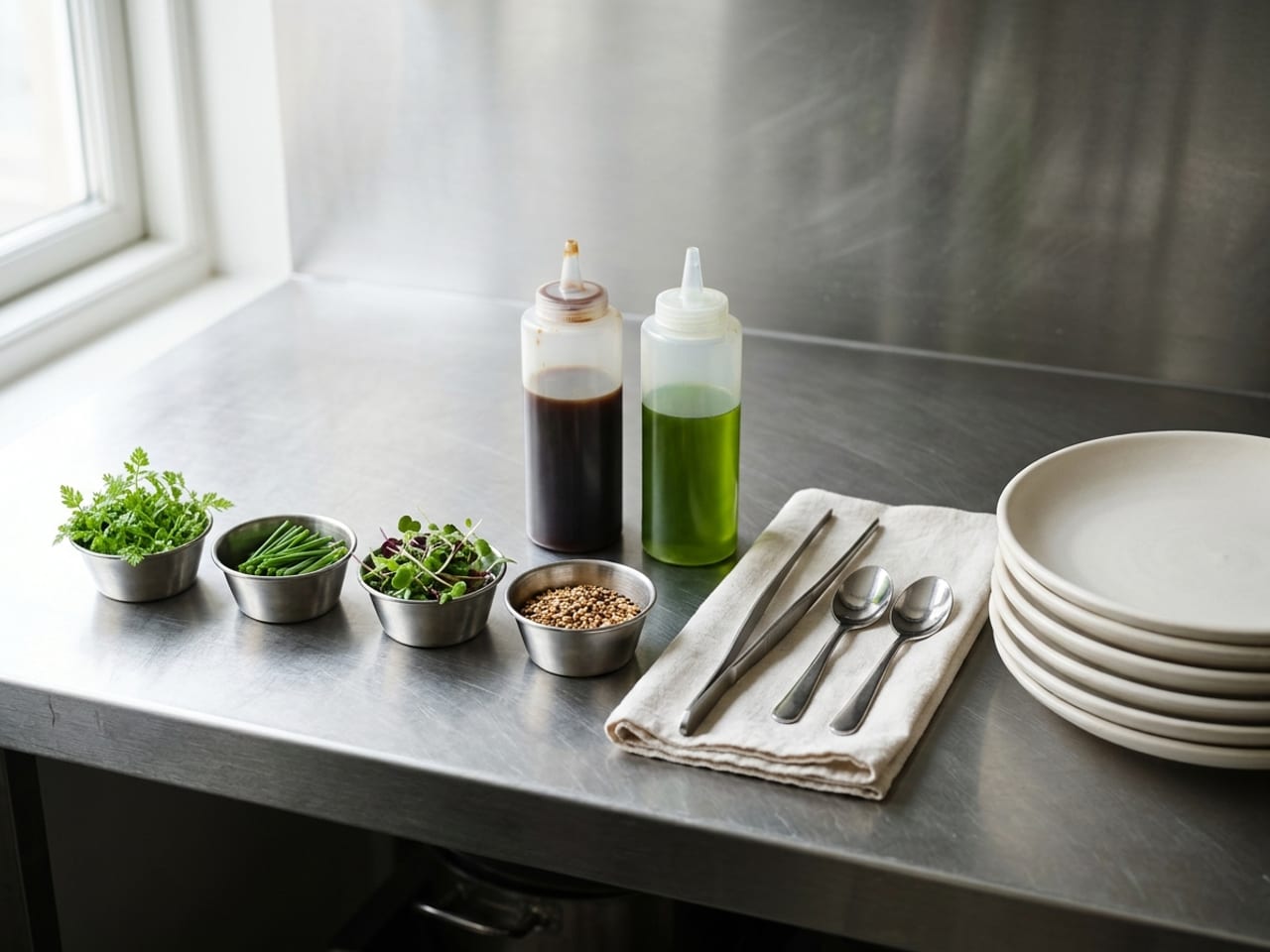
The photos on this page are AI-generated illustrations.
The short answer
What is mise en place?
Mise en place is "the preparation of the food and equipment you will need before you start cooking".1 French, literally "a putting in place"; textbooks say "put in place", and the CIA's blog and others say "everything in its place".2, 10, 23
Say it meez-on-plahss9: US /ˌmiːz ɑːn ˈplɑːs/, UK /ˌmiːz ɒ̃ ˈplæs/.1 Cooks shorten it to "meez".22
Read the whole recipe, and flag anything that needs time first.
Get out every ingredient and tool, and heat the oven if the recipe needs it. Raw meat stays cold until it goes on the heat.30
Wash, then trim and cut everything; raw meat last, on its own board. Raw meat last, on its own board, never the one for produce.35, 43
Measure into small bowls, one bowl for what goes into the pan together.
Line the bowls up in the order you will use them, next to the stove.
Clean as you go: wipe the board, put things away, stack the empty bowls.
The sources' own words and counts, step by step
1.What's In The Pan: “Flag anything that needs advance time - defrosting meat, softening butter, soaking beans, marinating”.29 The Institute of Child Nutrition: “Start with the meal service time and work backward, so you know when to start preparing the meal.”27
2.What's In The Pan: “Pull everything from the fridge, pantry, and freezer at once.”29 The Institute of Child Nutrition: “Preheat the oven if necessary.”27 Tramontina: “Keep the meat in the refrigerator until it is ready to go on the heat.”30
3.Nebraska Extension: “Wash fruits and vegetables under running water just before eating, cutting, or cooking, not before you store them.”44 Caraway (a cookware maker): “Prep raw proteins last”.35 Penn State Extension: “Use one clean cutting board for fresh produce and a separate one for raw meat, poultry, and seafood.”43
4.The Institute of Child Nutrition: “Pre-measure and portion ingredients (e.g., spices, chopped vegetables) into one portion cup or bowl based on when you will add them to the recipe.”27 Tramontina: “The most useful way to organize mise en place is by cooking stage: ingredients that go into the pan together share a bowl.”30
5.The Institute of Child Nutrition: “Organize your prepped and measured ingredients on the countertop in the order you will add them to the recipe.”27 Preppy Kitchen: “Arrange in cooking order, closest to the stove. The first ingredient in the pan sits closest to the burner.”28
6.Preppy Kitchen: “Clean as you go. This is the principle most home cooks skip, and it matters.”28 Sun Basket: “Stack the mise bowls as you empty ingredients into the pan and clean as you cook.”31
Ours: the count is of the 6 home step lists we read in full (Preppy Kitchen, What's In The Pan, the Institute of Child Nutrition, Tramontina, Sun Basket, My Eclectic Bites). A rimmed sheet tray under the bowls carries them to the stove in one trip, as What's In The Pan and Tramontina say.27, 28, 29, 30, 31, 32
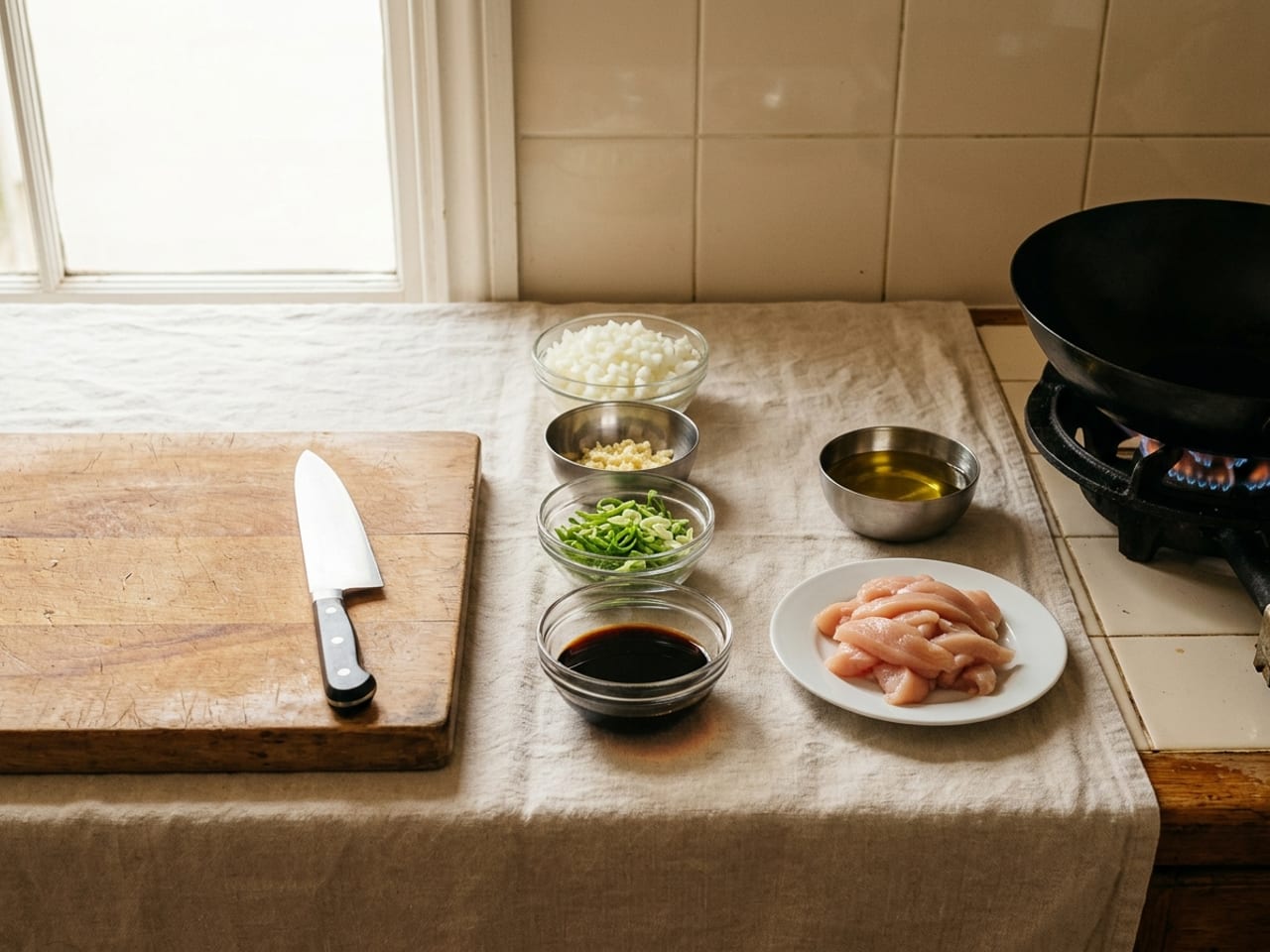
A finished mise en place for a stir-fry, the bowls in order of use beside the wok and the raw chicken on its own plate. An AI render, not a photograph.
What goes in each bowl, in the order it goes into the pan. Tramontina sorts dishes into full mise (fast cooking and baking), partial mise (pasta, sheet-pan dinners) and prep as you go (soups, stews, braises); the order inside each card is the source's, or ours where the card says so.30
1. Stir-fry
Full mise, in Tramontina's sorting
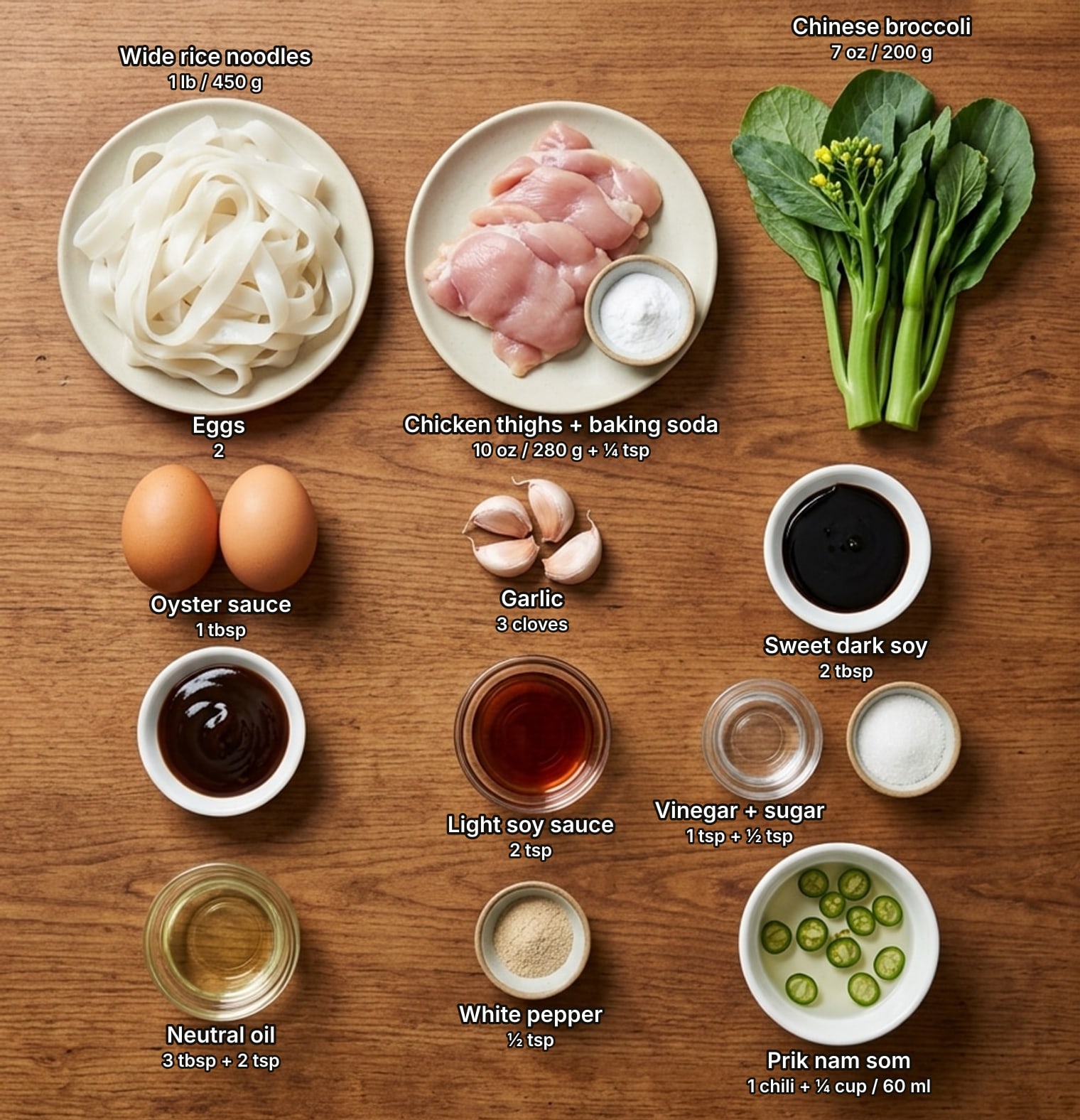
The photo is the gather step, not the finished mise: everything for our pad see ew laid out and labelled, mostly not yet cut or measured. An AI render with our labels.
In the bowls, in order of use:
Bowl 1, protein: Sliced chicken, seasoned and ready to sear.
Bowl 2, aromatics: Garlic, ginger, and the white parts of the scallions.
Bowl 3, firm vegetables: Broccoli florets and sliced carrots, which need the longest cook.
Bowl 4, tender vegetables: Bell pepper and snap peas, which need only a minute or two.
Bowl 5, sauce: Soy sauce, a pinch of sugar, and cornstarch, stirred together ahead of time.
Bowl 6, finish: Scallion greens and sesame seeds.
Tramontina's six bowls for a chicken and broccoli stir-fry, in its own words. America's Test Kitchen often adds the aromatics later: “Adding other ingredients in stages ensures they all finish cooking at the same time.” Follow your recipe's order.30, 38
Why it matters here. Tramontina: “A stir-fry can go from raw to done in under ten minutes, which leaves no time to slice a pepper once the wok is hot.” Even Sara Moulton, who calls mise en place a waste of time at home, makes an exception for Asian food with a lot of ingredients, where “each ingredient might spend 30 seconds in the pan”.30, 36
2. A sauté finished with a glaze
Full mise, in Tramontina's sorting
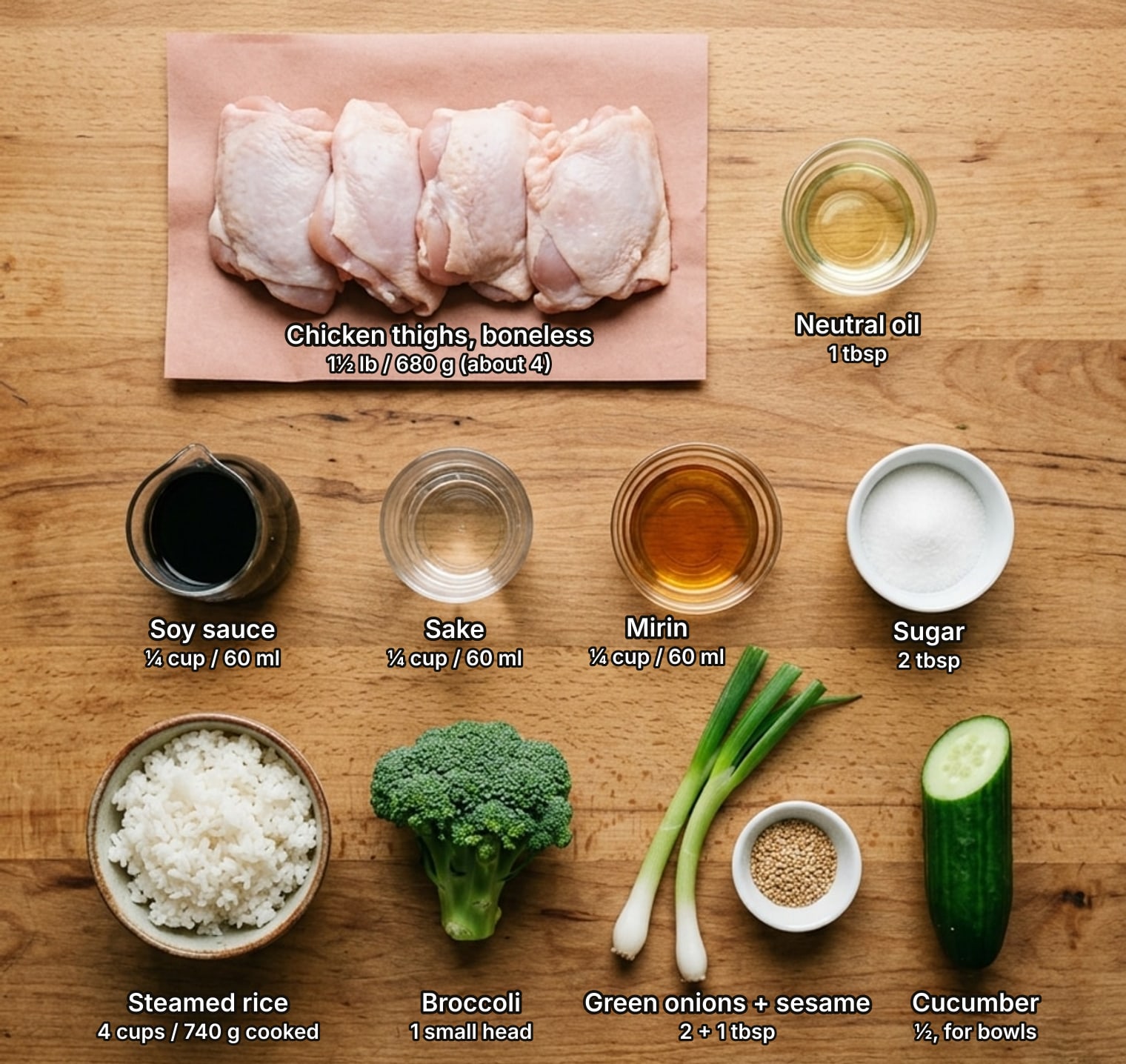
The photo is the gather step, not the finished mise: everything for our teriyaki chicken laid out and labelled, mostly not yet cut or measured. An AI render with our labels.
In the bowls, in order of use:
The meat, seasoned, on a tray with a rack.
Oil in a squeeze bottle; salt and pepper.
For the glaze: the liquids measured into one bowl; any aromatics chopped.
Tongs, an instant-read thermometer, a plate for serving.
Ours, built from two lists: a Boston University gastronomy student's steak set-up, “Three thick sirloins, a squeeze bottle of oil, kosher salt, fresh ground pepper, tongs, a half-sheet tray with a rack, a digital instant-read thermometer, and a plate for serving were all within arms reach”, and All-Clad's sauce line. Our teriyaki chicken is the nearest recipe we have: it sears the thighs, then reduces a measured four-liquid sauce to a glaze in the same pan; it has no chopped aromatics.34, 37
Why it matters here. All-Clad (a cookware maker): “having aromatics chopped, liquids measured, and utensils nearby allows you to focus on heat control and texture instead of scrambling for the next ingredient.” Tramontina puts pan sears with stir-fries: “Full mise: Stir-fries, sautés, and pan sears that cook in minutes”.30, 34
3. Baking: a cake or bread dough
Full mise, in Tramontina's sorting
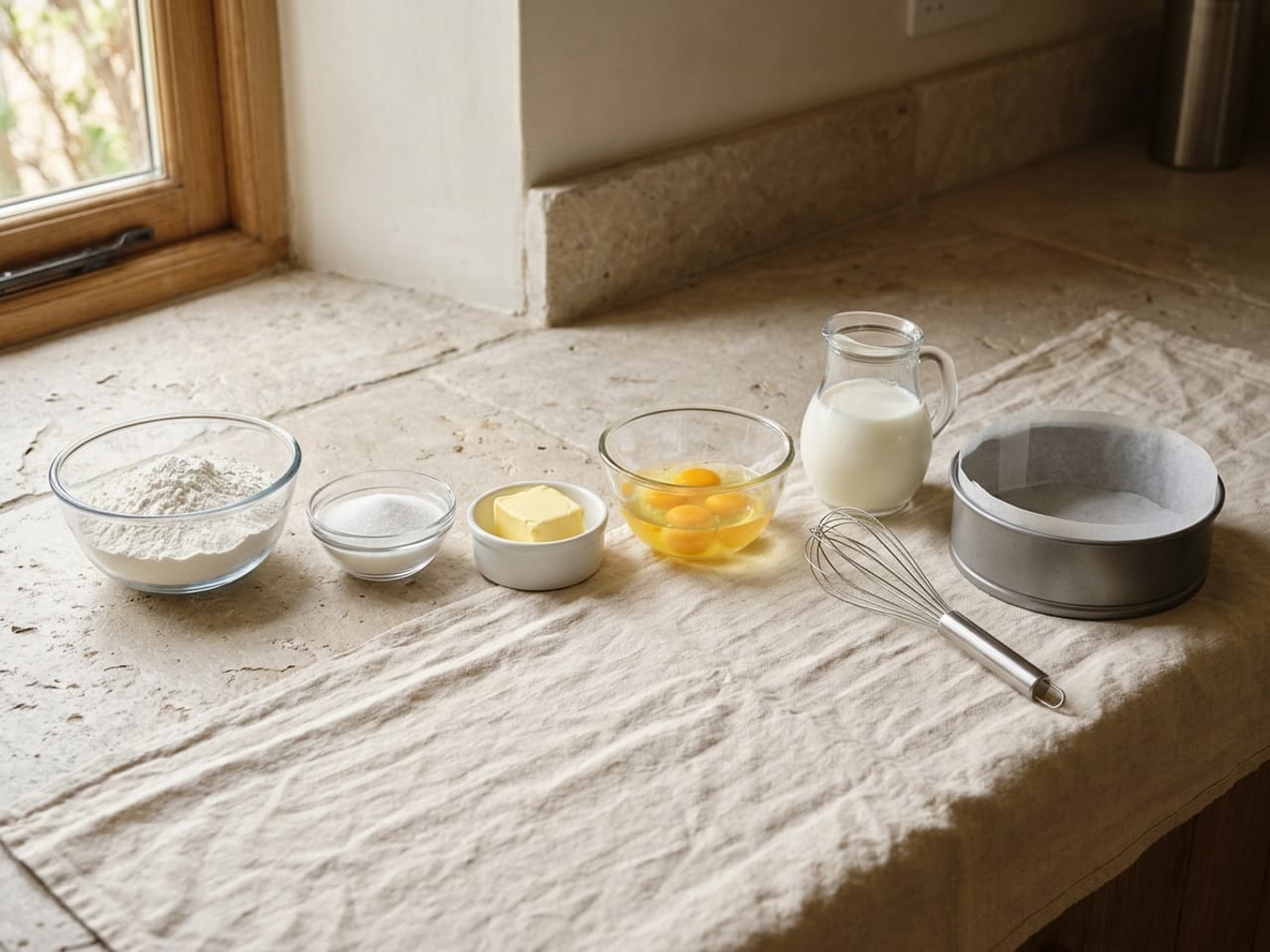
The photo: a finished baking mise en place, an AI render, not a photograph. For a recipe, our soft dinner rolls; its ingredient photo shows the gather step.
In the bowls, in order of use:
Butter and eggs out of the fridge first, to warm up; the eggs used or back in the fridge within 2 hours (1 hour above 90°F, 32°C).
The dry ingredients, weighed.
The eggs, cracked into a bowl.
The milk or other liquid, measured.
Pans lined, oven heating, whisk and spatula out.
Ours, using the items All-Clad and King Arthur name (the order is ours: butter and eggs first because they take time to warm): “pre-measured dry ingredients, softened butter, cracked eggs, and tools like whisks and pans laid out in advance” (All-Clad); “Gather all the equipment and tools that you'll be using ahead of time;” and “If you have a scale: Use it.” (King Arthur). The 2-hour limit on the eggs is the FDA's rule for perishables.34, 41, 42, 47
Why it matters here. King Arthur sets room temperature at 68 to 75°F (20 to 24°C) and warms cold butter, still wrapped, “in a bowl of barely warm (73°F) tap water for 10 to 15 minutes” (23°C), and cold eggs “in a bowl of hot tap water for 10 minutes”. The Institute of Child Nutrition: organizing first “helps minimize the risk of mistakes, such as missing an ingredient or adding an ingredient twice.”27, 41
4. Pasta with a quick sauce
Partial mise, in Tramontina's sorting
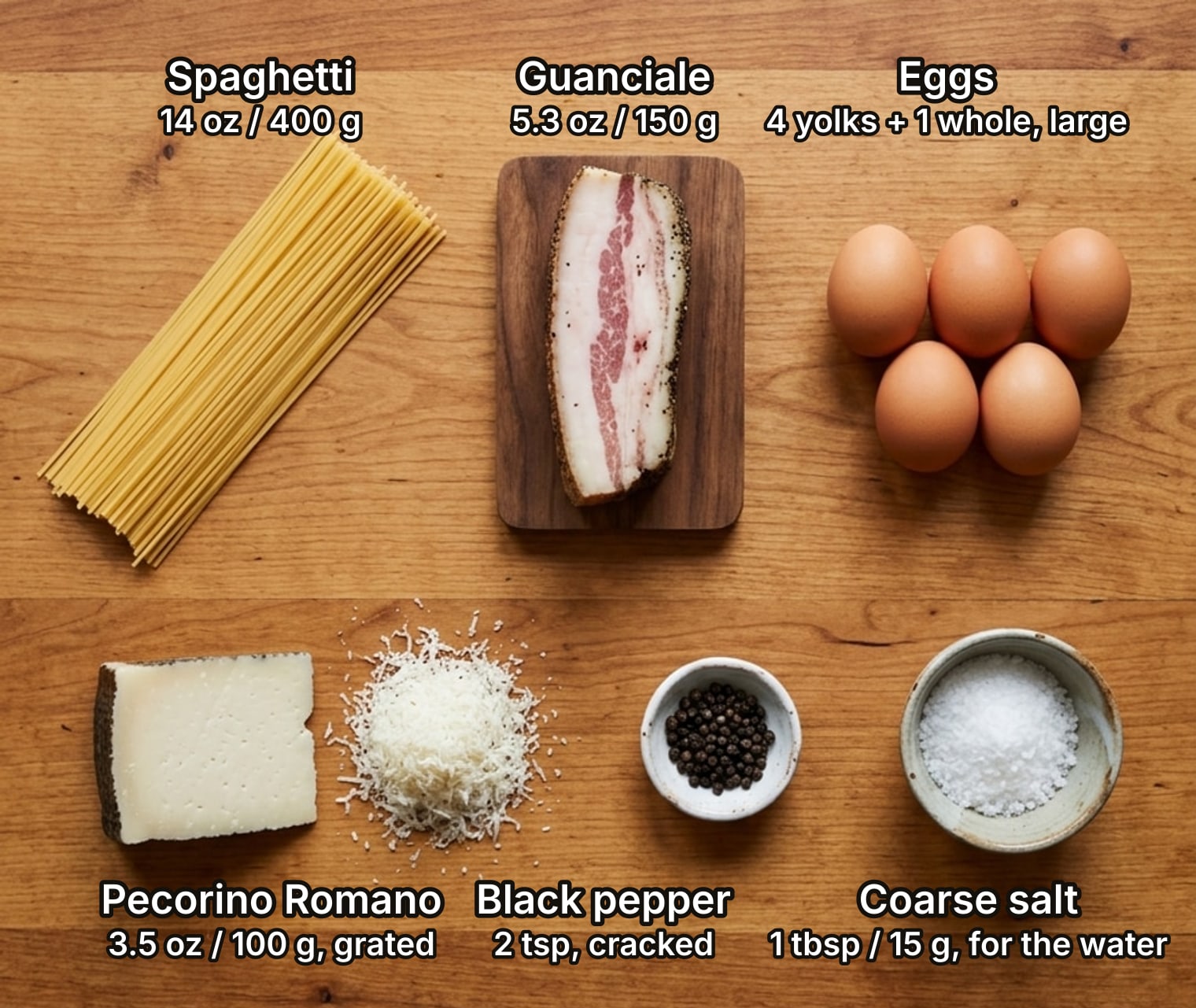
The photo is the gather step, not the finished mise: everything for our spaghetti carbonara laid out and labelled, mostly not yet cut or measured. An AI render with our labels.
In the bowls, in order of use:
The pot of salted water, on the heat first.
While it comes to a boil: the sauce's meat or vegetables cut.
Why it matters here. Tramontina: “Partial mise: Pasta, where you can prep the sauce while the water comes to a boil, and sheet pan dinners, where the quick-roasting vegetables can wait until the pan is in the oven.”30
5. Soup, stew or braise
Prep as you go, in Tramontina's sorting
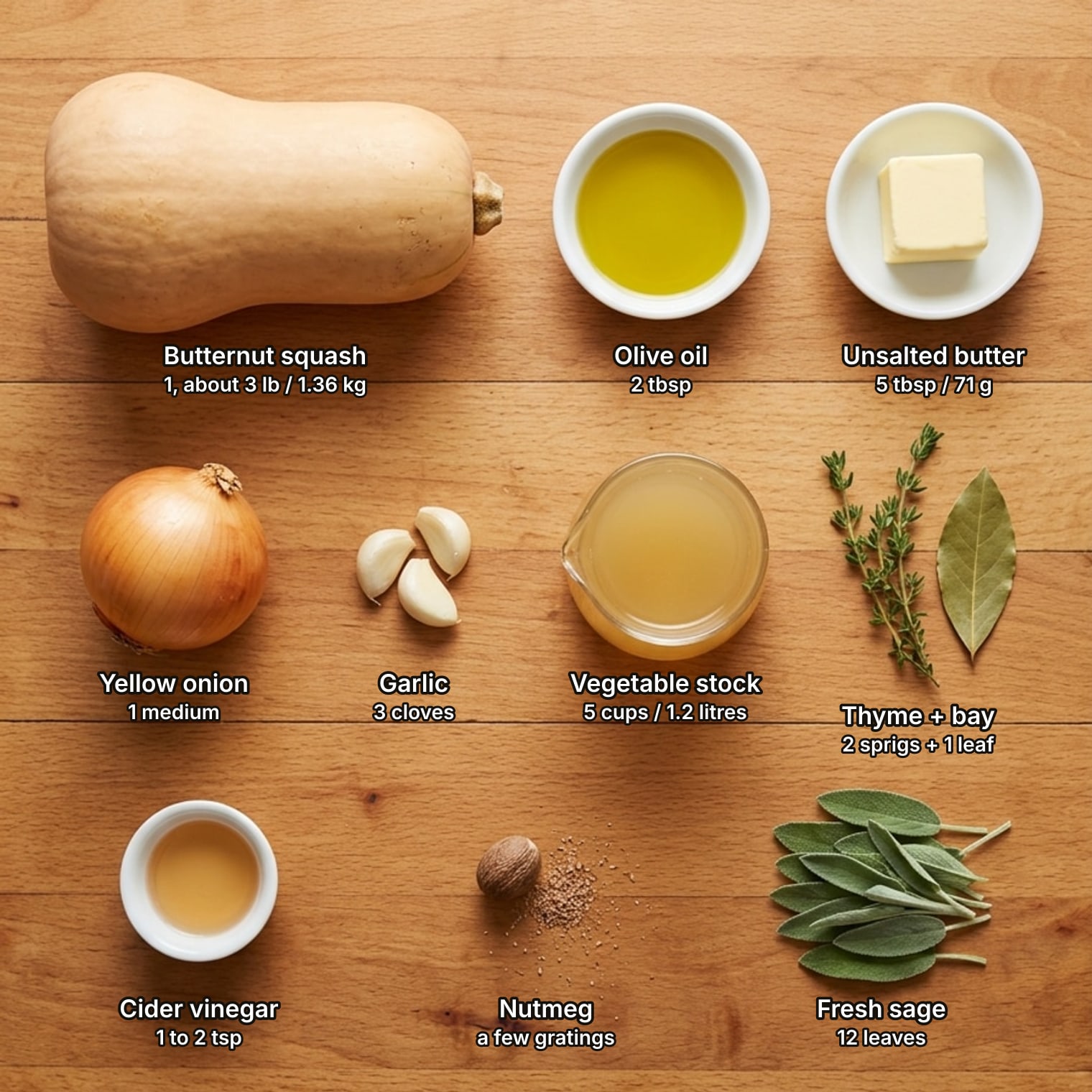
The photo is the gather step, not the finished mise: everything for our butternut squash soup laid out and labelled, mostly not yet cut or measured. An AI render with our labels.
In the bowls, in order of use:
The onion, carrot and celery, diced first.
The rest, cut while the pot simmers.
One corner of the board or a sheet tray instead of a bowl each.
Tramontina's order, in our words. Our butternut squash soup uses squash, onion and garlic instead of a mirepoix, but follows the same prep-as-you-go order.30
Why it matters here. Tramontina: “Prep as you go: Soups, stews, and braises with long simmer times. Dice the onion, carrot, and celery for the mirepoix first, then prep the vegetables that go in later while the pot does its work.” And: “For a long braise, you do not need a bowl for every ingredient.”30
Why
Why is mise en place important?
Gisslen's textbook: “There is far too much work to do in a kitchen to leave until the last minute, so some work must be done ahead.” And: “Only if advance preparation is done thoroughly and systematically can service go smoothly.”9, 11
Escoffier, 1907, on “those bad operators who, having neglected their mise en place, are obliged to make it in the course of other work, and thereby not only run the risk of making it badly, but also of losing valuable time which might be used to better advantage.”8
The Institute of Child Nutrition: “Being organized and prepared helps minimize the risk of mistakes, such as missing an ingredient or adding an ingredient twice.”27
A Penn State open textbook: gathering first means “reducing traveling around the kitchen during preparation, kitchen congestion, loss of focus from frequent starting and stopping, and errors from interruptions to their work.”16
Dwayne Lipuma, a Culinary Institute of America instructor, to NPR in 2014: “Every component of one single dish is in one single corner so their hand literally moves inches”.19
The MICHELIN Guide: “The goal of mise en place is two-fold: organization and focus.”33
The evidence is words, not numbers. We found no study that timed cooks with and without mise en place or counted their mistakes. The one study we found observed a single hotel restaurant kitchen and concluded its mise en place "still has some inefficiencies".26 A Johnson & Wales University blog cites a study in the journal Sustainability; we could not find it, so we do not repeat its claim.
Containers
Mise en place bowls, trays and pans
Any small bowl works. Sun Basket: "you don’t need to find special bowls to be an organized cook."31 The MICHELIN Guide lists sheet pans, bowls, ramekins and muffin tins.33 Tramontina: "Small bowls hold each stage of your prep, which is why cooks often call them mise en place bowls."30
Sizes. Preppy Kitchen's pick: "A nesting set of glass or stainless steel bowls in 4 oz, 6 oz, and 8 oz is the best single upgrade you can make" (118, 177 and 237 ml), plus pinch bowls "Small (2 oz or less)" (59 ml) for spices and salt.28 What's In The Pan matches the container to the job:
Single spices, small measures: a shot glass or ramekin.
Minced garlic, ginger, herbs: a small prep bowl.
Chopped vegetables: a medium mixing bowl.
Proteins: a plate or shallow bowl.
Liquid sauces, stocks: a liquid measuring cup.
Combined spice blends: one shared ramekin.
Ramekins or prep bowls? Cook's Country calls a ramekin "a stand-in for a mini prep bowl or salt cellar"; CooksInfo says ramekins "don't stack well for storage", so professionals prefer small prep bowls of clear glass or stainless steel.66, 67 Sizes and oven ratings are in our ramekin guide.
A tray under it all. Tramontina: "A rimmed sheet tray works like a portable station." For lids, VJ Cuisine covers everything "in labeled containers".30, 64
In a restaurant: hotel pans and deli cups. MICHELIN: "Restaurant kitchens are stocked with hotel pans and assorted containers to hold mise en place in various quantities."33 As a dealer prints the makers' sizes (ours in cm):
Full-size hotel pan: fits the standard 12 x 20 in (30.5 x 50.8 cm) opening.15, 52
Sixth pan: 6.28 x 6.84 in (16 x 17.4 cm), Vollrath's; six fill one opening.52
Ninth pan: 4.25 x 6.88 in (10.8 x 17.5 cm), Vollrath's; nine fill one opening.52
Depths: 2½, 4 and 6 in (6.4, 10.2 and 15.2 cm), the dealer's common depths; CAERT gives 2, 4 or 6.15, 52
Deli containers: pint and quart rounds (about 470 ml and 950 ml), in one software company's blog (we found no maker's size page).51
A full sheet pan is a different system: "A full sheet is about 18 x 26 inches, so it won't fit that opening" (46 x 66 cm).52 For squeeze bottles, tweezers and the rest of a plating kit, see plating tools.
Timing and safety
How far ahead can you do mise en place?
Gisslen: "Most foods are at their best quality immediately after preparation, and they deteriorate as they are held."11 Only hold times a source gives are here; where none does, the row says so.
Take them out ahead so they warm to 68 to 75°F (20 to 24°C), or warm them: butter, still wrapped, 10 to 15 minutes in a bowl of barely warm 73°F (23°C) tap water; cold eggs 10 minutes in a bowl of hot tap water (King Arthur)
Eggs: used or back in the fridge within 2 hours (1 hour above 90°F, 32°C), the FDA's 2-hour rule for perishables. Butter: no source we read gives a limit, so we give none
Sauces, dressings and garnishes for a dinner46, 64, 65
Sauces and dressings ahead, “store them separately”; on the morning: “slice garnishes and portion butter or dips”
Covered, in labelled containers; cold food kept at 40°F (4°C) or colder
Restaurant: prepped ready-to-eat food that needs cold holding48, 49
Kept over 24 hours: date-marked, at most 7 days, the prep day counting as day one, as one Illinois public health district prints it for food businesses
At 41°F (5°C) or less, the Food Code's cold-holding figure for restaurants where the Food Code is adopted; for food businesses, not a home kitchen
The home rule. FDA: "Remember the 2-Hour Rule: Discard any perishables left out at room temperature for more than 2 hours, unless you're keeping it hot or cold."47 USDA: "Cold foods should be held at 40 °F or colder" (4°C).46 FDA again: "If the buffet is held in a place where the temperature is above 90 °F, the safe holding time is reduced to 1 hour." (32°C.)47 The restaurant row is for food businesses, not a home kitchen: 41°F (5°C) is the Food Code's cold-holding figure for restaurants where the Food Code is adopted,48 and the date marks are as one Illinois public health district prints them.49 Our buffet guide sets the home and restaurant rules side by side.
The professional kitchen
Mise en place in a restaurant kitchen
What it covers. Gisslen: "Chefs refer to performing these preliminary tasks as “doing the mise en place.”" It includes stocks and sauces "as well as the cutting and trimming of all the meat, poultry, fish, and vegetables the chef expects will be needed during the meal service."11 "A large part of a cook’s workday is spent doing mise en place"11; NPR: "Cooks can easily do six hours of prep for a three-hour dinner shift."19
The station. The Culinary Pro: "Every kitchen station, whether a prep station or a line station, should be set so that all tools, equipment, and mise en place are within arm’s reach, from left to right and from top to bottom."17 CAERT adds plates and bowls out for service, "towels, gloves, and sanitizers adjacent to the line", and backups within reach.15 Chef Terrance Brennan lists "ingredients, sauces, garnishes, pans, utensils, towels, spoons, blenders, immersion blenders, and any other tools or equipment you may need." His rule: "When service starts, you should not be looking for anything."21
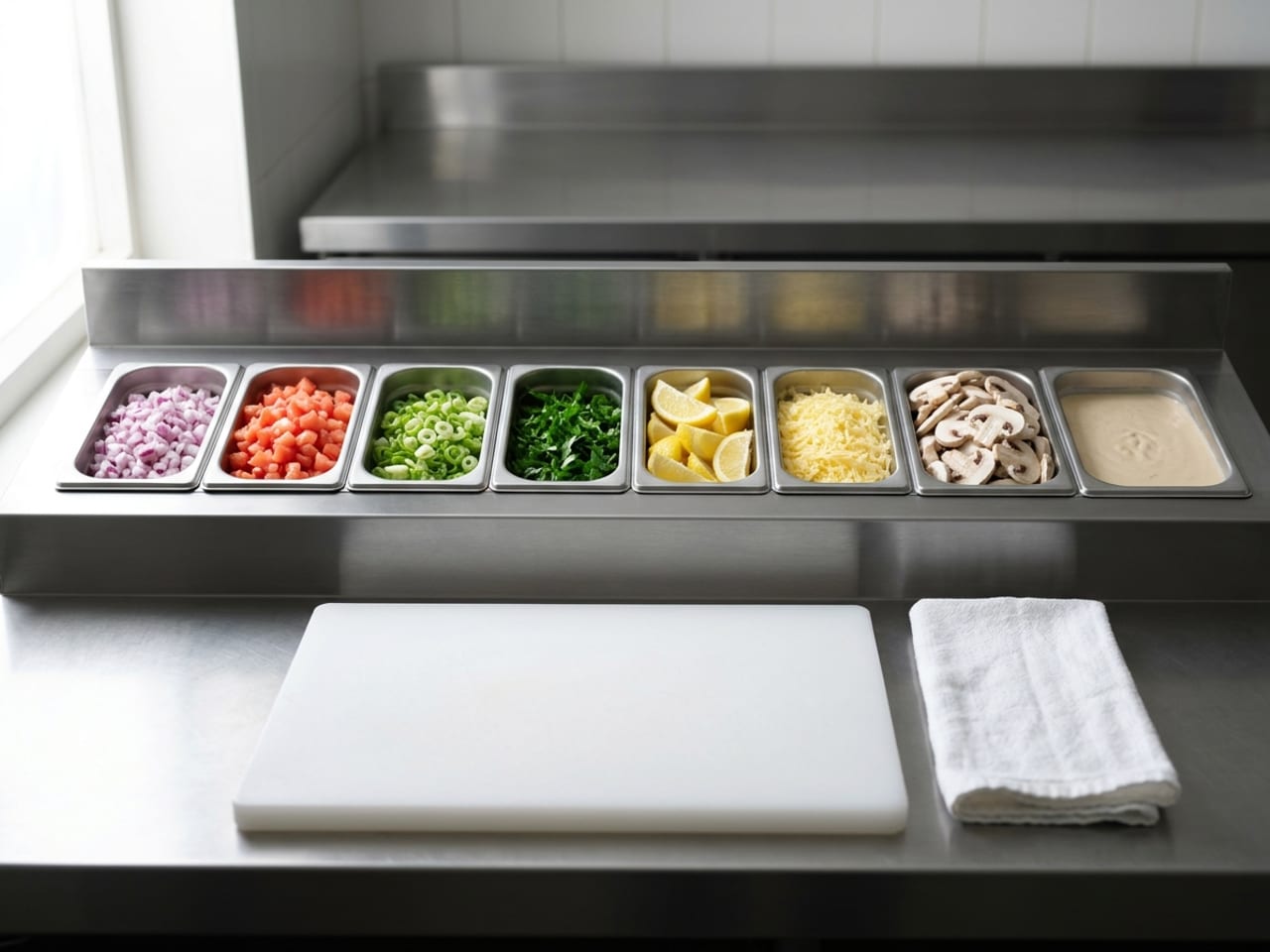
A line station before service: a rail of small pans, the board in front, a towel at hand. An AI render, not a photograph.
The prep list and par
A prep list is "the game plan for your kitchen’s mise en place", and "Par math is simple: par minus on hand equals to prep."50 How much comes from sales: "By analyzing sales, you can see how much was sold on a given day of the week."17 Wylie Dufresne wrote his list out on the way home and again on the way in: "let's say I had 23 items of mise-en-place I had to do every day."19 Ours, an example in FoodDocs' columns (its romaine row and Tableview's shallot and broccolini pars; the other figures are ours):50, 51
Item
Par
On hand
To prep
Note
Romaine hearts
3 pans
1 pan
2 pans
Wash. Spin. Chill. Label.
Shallots, minced
2 quarts (1.9 L)
½ quart (470 ml)
1½ quarts (1.4 L)
Label with date, time, initials
Broccolini, blanched
1 full hotel pan
0
1 pan
Chill in an ice bath, drain, label
Lemon wedges
1 ninth pan
1 ninth pan
0
Check, top up
Pan sauce base
1 quart (950 ml)
0
1 quart (950 ml)
Cool, label, date
Labels and dates. FoodDocs: "Label every item with date, time, and initials".50 A local health district's page for food businesses says ready-to-eat food that needs cold holding and is kept over 24 hours must be date-marked, at most seven days at 41°F (5°C), the prep day counting as day one.49 The Culinary Pro: "There needs to be a place for everything and labels to match them."17
Who does it. Brennan: "Each station is run by a chef de partie (the cook in charge of that station), often with one or more commis working underneath."21 The Culinary Pro: "In some kitchens, prep cooks will handle the bulk preparation and distribute it to stations as needed."17 Then "the chef or sous chef conducts a line check, going station by station to make sure the mise en place is complete, properly prepared, and ready for service."21 The cold station's share is in our garde manger guide.
In culinary contests. ProStart's 2025 rubric gives its top marks for "Mise en place maintained throughout all of competition" and a "Detailed timeline/prep list displayed and utilized".60 Its rules give a team "twenty (20) minutes to pre-set their station", with no knife work in that window.61
Front of house
Mise en place in restaurant service (f&b and hospitality)
The same words, the dining room. GuildSomm: "This concept is also used in reference to setting up a dining room, bar, or side station before service."57 South Africa's Grade 12 guide names two kinds: restaurant mise-en-place, "Preparing equipment (cutlery and crockery) and setting the table before a meal is served and guests arrive", and station mise-en-place, "Preparing a waiter's workstation, storing all the service equipment required for service in a food service area."53 CAERT: "Both sides of the line require their own mise en place prior to the restaurant opening."15
What the textbooks list, one job a line:
Check the reservations: “Checking reservations”.56
Polish cutlery and glasses: “Polishing silverware and glassware, and inspecting them for chips or other irregularities.”57
Fold the napkins: “Folding serviettes, napkins, or side towels.”57
Fill the cruets: “Salt and pepper containers must be refilled daily, and must be emptied and washed weekly.”54
Check the menus: “Verifying that menus are clean, correct, and current.”57
Stock the side station: “Bottles and jars containing salt, pepper, sauces, ketchup, chutneys, jams, pickles, etc., must be kept ready at the side station.”54
Set the tables: “Set tables using the appropriate linen, cutlery, glassware, china, cruets, and additional equipment necessary”.58
Prepare the butter and the bread: “Preparation of butter”; “Warming bread and preparing breadbaskets for guest tables”.15, 56
Check the garnishes on the line: “Checking that an adequate amount of specified garnishes (final plate decorations before plates leave the kitchen) are available on the line”.15
Who. "The Maître d’ is responsible for ensuring that mise en place is carried out correctly" (Shannon College's lecture site); in India's Class IX textbook the waiter does it and the captain checks it.54, 56 After service comes closing mise-en-place: "Return all equipment to the storeroom", "Reset the tables".53 The WorldSkills restaurant service standard gives "Preparation for service (mise en place)" 10 of its 100 marks.58 Where each piece goes is in our table setting guide.
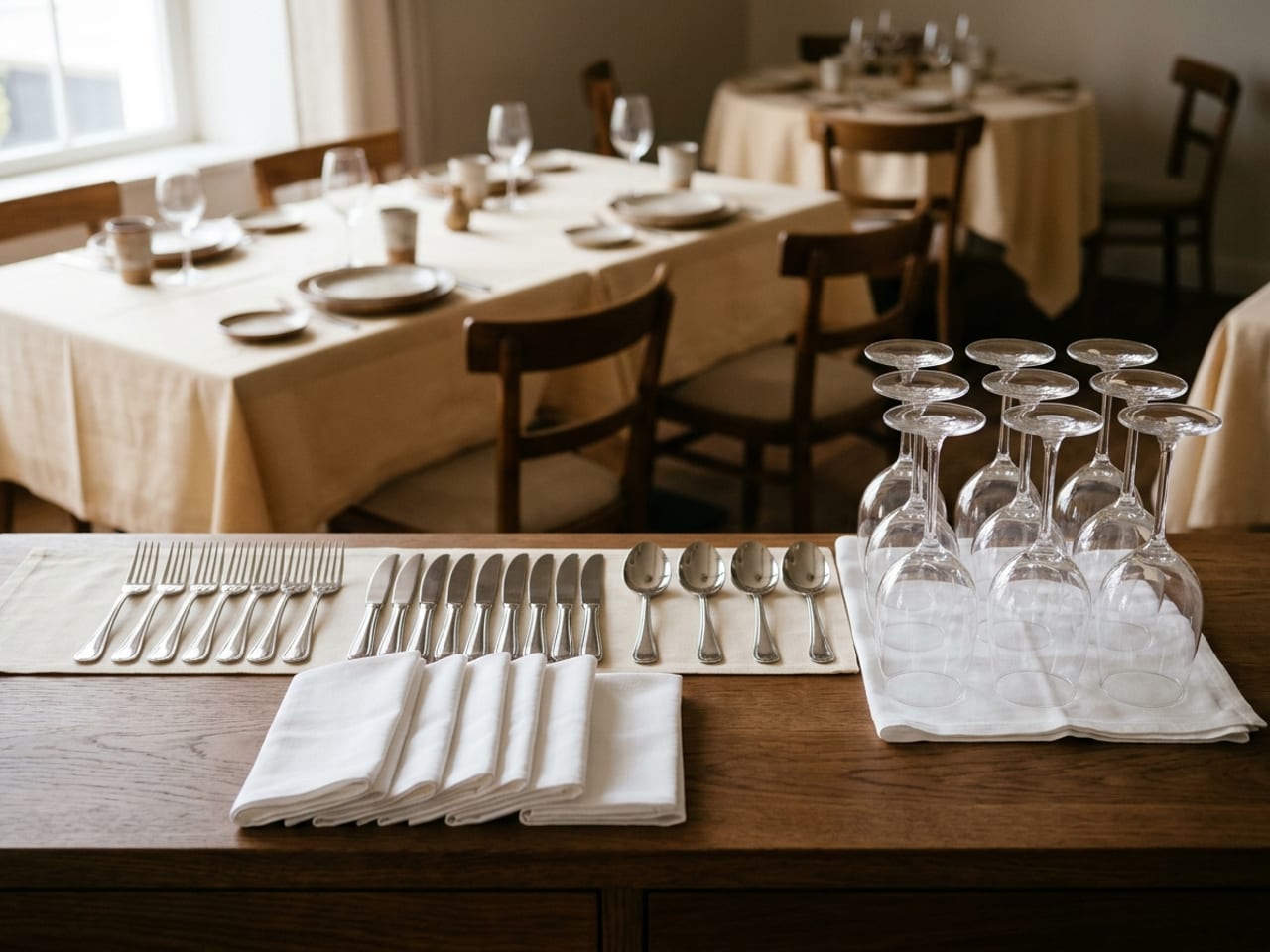
A side station before service: cutlery polished, napkins folded, glasses ready. An AI render, not a photograph.
Mise en place vs mise en scène
Mise en place: The preparation of the food and equipment you need before you start cooking, from the French for “a putting in place”; in restaurant service, also the set-up of the dining room and side stations before guests arrive.1, 2, 53
Mise en scène: In theatre and film, the setting in which the action happens (literally “a placing on stage”); in some Indian hospitality texts, preparing the restaurant's environment before service.6, 7, 55
In Cambridge, mise en scène is "the type of place and situation in which the action of a film or play happens".6 In a restaurant, the Indian course texts split: IHM Bhubaneswar, "Mise-en-scene is preparing the environment of the restaurant to make it clean, comfortable, safe and hygienic."55 South Africa's guide and WorldSkills never use the term and put the room under mise en place (the split).53, 58
Plating
Mise en place for plating: the pass and a home plating tray
The pass. Brennan: in a fine dining restaurant the chef or sous chef often stands at "the pass (the area where finished plates come off the line to be inspected before being handed off to the waitstaff)", and when the plates arrive the chef "gives each plate a final look, adds last-minute garnishes, makes any necessary adjustments, wipes the rim if needed".21 A software company's blog lists the pass's own mise: "sauce spoons, tasting spoons, wipes, garnishes for finishing, printed specials, and the ticket rail or screen".51
Garnishes and the rim. The Culinary Pro: "garnishes must be precisely prepped to maximize their impact and give the plate the final visual pop." It wipes plates with "mildly acidulated water with lemon or vinegar and a clean, lint-free cloth".18 Sources do not agree on the wiping liquid: the rim cloth entry has the others. Tableview keeps garde manger garnishes "cut fine and covered with damp paper".51 ProStart's textbook plans plating inside the mise: its Mise en Place Report ends with "PLATING DIAGRAM:", "Draw a basic sketch here of how to present, plate, and garnish the dish."14
A plating station: garnishes in small containers, sauces in squeeze bottles, tweezers, spoons, a cloth and a stack of plates. An AI render, not a photograph.
Before guests: a home plating tray
Leiths: "Presentation starts at mise en place."63 Brennan at home: "The salad dressing is made, the vegetables are blanched, the potato puree is finished, the sauce is made, the herbs are picked, and the garnishes are ready." "I don’t want to be standing at the cutting board prepping something while everyone else is enjoying an apéritif." And: "Warm your dinner plates. You can put them in a low oven for a few minutes or use a bread warmer if you have one."21 VJ Cuisine: "Complete your mise en place: chop vegetables, measure spices, portion garnishes and cover everything in labeled containers."64 Easyfeast's personal chefs: "Assume you’ll need about 15 to 30 minutes to get everything on platters and garnished."65
Ours, built from those lines: a small tray with each garnish in its own covered container (see how to prep garnishes), the sauce in a squeeze bottle or with a spoon (sauce plating), a damp cloth for the rims, and the plates warming. Garnishes that sit out are on the same 2-hour clock as the food (1 hour above 90°F, 32°C).
Where sources disagree
Full mise or prep as you go, and the other splits
Question
One side
The other
Our note
At home, prep everything first?
Yes (4 sources): Preppy Kitchen, “Half-mise is just regular cooking with extra dishes”; also the Institute of Child Nutrition, the MICHELIN Guide and All-Clad (for fast cooking).27, 28, 33, 34
By dish (2): Tramontina and Caraway, “Prep Only What Needs It”. Against (1): Sara Moulton, “a waste of time, literally”, except for Asian dishes with many ingredients and restaurant cooking.30, 35, 36
Ours: every source we read agrees on the stir-fry. For a slow soup, prep as it cooks.
Does it save time?
Preppy Kitchen, in its author's experience: a recipe that takes 45 minutes “freestyle” takes “35 minutes with proper mise en place.”28
Moulton, for her burgers: “If I did all my mise en place first, dinner would not have been ready for 30 minutes, it would have taken double the time.”36
Two anecdotes, one recipe each. We found no study that timed it.
How far ahead can you cut onions?
Cook's Illustrated: for raw onion, “it is best to chop them immediately before you need them.”39
The same page: “If onions are a mere accent in your dish, feel free to prep them in advance.”39
Not a contradiction: raw or focal, cut last; an accent, cut ahead. No page we read gives a day count.
Is cutting part of mise en place?
Yes, in the textbooks: “Wash, trim, cut, prepare, and measure your raw materials.”11
Not in two competitions: ProStart's 20-minute mise en place bars knife work, and SkillsUSA's set-up is “with equipment only.”61, 62
ProStart times cutting separately; in a kitchen it is the bulk of the job.
What does it translate to?
“put in place” or “a putting in place”: Dictionary.com, Gisslen's glossary, the CIA's textbook, the ProStart textbook, NPR.2, 10, 12, 13, 19
“everything in its place”: the CIA's blog, Escoffier School, the Institute of Child Nutrition, Chef Terrance Brennan. The Culinary Pro's “implementation” is the odd one out.17, 21, 23, 24, 27
Ours: “a putting in place” is the literal French; “everything in its place” is a free gloss.
In a dining room, is the room part of mise en place?
Separate: Indian course texts call the room's cleaning, light and air mise en scène, and keep mise en place for the covers and the side station. They split on flowers and linen: India's Class IX textbook puts both under mise en scène, IHM Bhubaneswar and Tutorials Point under mise en place.54, 55, 59
One topic: South Africa's Grade 12 guide and the WorldSkills standard put room layout and ambience under mise en place and never use “mise en scène”.53, 58
Both are in use. Outside restaurants, mise en scène is a film and theatre word.
Did Escoffier invent it?
Escoffier School: “He created the system of organization known as mise en place”.25
Escoffier himself, 1907, writes of “what are technically called the mise en place” and of cooks who neglect theirs: a word already in use.8
We follow his own text: he named and used it, and we found nothing showing he coined it.
Neither page shows its quotation. The OED's entry refused us.
History
Where mise en place comes from
In French, “mise” is the act of putting (“Action de mettre”), and Wiktionnaire gives “mise en place” a cooking sense for the kitchen AND the dining room, “et en salle, préparation des tables”. Neither source dates it.4, 5
In English, Dictionary.com dates it to 1860 to 1865 and Merriam-Webster to 1876.2, 3
Escoffier's 1907 English Guide to Modern Cookery, glossary p. xiv: “Mise-en-place, a general name given to those elementary preparations which are constantly resorted to during the various stages of most culinary operations.” He means things kept ready for use at a moment's notice, such as breadcrumbs, bouquets garnis, forcemeats, mirepoix and batters, and he says chopped nuts belong in the pastry cook's “permanent” mise en place.8
NPR, 2014: “Some cooks call it their religion.” Wylie Dufresne, then of wd~50, wrote his list out twice a day: “let's say I had 23 items of mise-en-place I had to do every day.”19
In 2016 Dan Charnas, who wrote that NPR piece, turned it into a book, Work Clean, which “spells out the 10 major principles of mise-en-place” (from the publisher's page; we did not read the book).20
FAQ
Mise en place, answered
What is mise en place?
Mise en place is "the preparation of the food and equipment you will need before you start cooking, especially in a restaurant kitchen", in Cambridge's words. At home that means every ingredient washed, cut and measured and the tools laid out before the heat goes on. Dictionary.com's definition adds serving food, and in restaurant service the same words mean setting up the dining room and side stations before guests arrive.
What does mise en place mean in English?
Literally "a putting in place" (Dictionary.com): "mise" is the French noun for the act of putting. Textbooks shorten it to "put in place" (Gisslen's glossary, the CIA's Baking and Pastry, the ProStart textbook); "everything in its place" is a freer gloss used by the CIA's blog, Escoffier School and the Institute of Child Nutrition. One teaching site translates it as "implementation", which no dictionary we read supports.
How do you pronounce mise en place?
Meez-on-plahss, in Gisslen's Professional Cooking. Cambridge gives US /ˌmiːz ɑːn ˈplɑːs/ and UK /ˌmiːz ɒ̃ ˈplæs/ or /ˌmiːz ɒn ˈplæs/: in our plain reading of those, "mise" rhymes with "keys", "en" is a nasal "ahn" and the stress falls on "place", said "plahss". Cooks shorten it to "meez".
What are the steps of mise en place?
Across the 6 home step lists we read, six steps each turn up in at least five: read the whole recipe and flag anything that needs time; get out every ingredient and tool; wash and cut, raw meat last on its own board; measure into small bowls, one bowl for what goes in together; line the bowls up in the order of use by the stove; and clean as you go.
What are 5 examples of mise en place?
A stir-fry, with Tramontina's six bowls from protein to finish; a sauté finished with a glaze; baking, with the dry ingredients weighed and the butter and eggs at room temperature; pasta, where the sauce is cut while the water boils; and a soup or braise, where you prep as it simmers. In a restaurant: a cook's station with everything within arm's reach, and a server's side station of polished cutlery, napkins and cruets.
Why is mise en place important?
Gisslen: "There is far too much work to do in a kitchen to leave until the last minute, so some work must be done ahead." The Institute of Child Nutrition says it helps avoid "missing an ingredient or adding an ingredient twice", and Escoffier in 1907 warned that cooks who neglect it end up making it in the middle of other work, which risks doing it badly and losing time. We found no study that measured the time or the mistakes saved; the one small study we found observed a single hotel kitchen.
What is mise en place in service, f&b and hospitality?
In food and beverage service it means making the dining room ready before guests arrive: South Africa's Grade 12 guide defines restaurant mise-en-place as "Preparing equipment (cutlery and crockery) and setting the table before a meal is served and guests arrive." The tasks the textbooks list: reservations checked, cutlery and glasses polished, napkins folded, cruets filled, menus checked, the side station stocked and the tables set. The WorldSkills restaurant service standard gives it 10 of its 100 marks.
What is the difference between mise en place and mise en scène?
Mise en scène is a theatre and film word, "a placing on stage" (Dictionary.com, first recorded 1830 to 1835). In Indian hospitality texts it means preparing the restaurant's environment (clean, aired, lit, hygienic), while mise en place is the cutlery, covers and side station. The texts split on flowers and linen: India's Class IX textbook puts fresh flowers and replacing dirty linen under mise en scène, while IHM Bhubaneswar and Tutorials Point put them under mise en place. South Africa's Grade 12 guide and the WorldSkills standard do not use mise en scène at all and put the room under mise en place.
What are mise en place bowls called, and what size?
Prep bowls, pinch bowls, or simply mise en place bowls ("which is why cooks often call them mise en place bowls", Tramontina). Preppy Kitchen suggests a nesting glass or steel set of 4, 6 and 8 oz (118, 177 and 237 ml) plus pinch bowls of 2 oz (59 ml) or less. Ramekins work at home, but CooksInfo notes they "don't stack well for storage", so restaurants prefer glass or steel prep bowls, and hotel pans and deli containers for bulk.
What is a mise en place list or sheet?
In a restaurant it is the prep list: each item with its par (how much the station needs for service), what is on hand and what to prep; FoodDocs: "Par math is simple: par minus on hand equals to prep." ProStart's textbook has a Mise en Place Report that lists ingredients, tools and steps and ends with a plating diagram. At home, a written plan of every small job, from taking the butter out to heating the oven, does the same job (Leiths).
How far ahead can you do mise en place?
Cut fruit and vegetables go in the fridge within 2 hours of cutting (Penn State and Nebraska Extension; 1 hour above 90°F, 32°C, as USDA and FDA say for food left out), at 40°F (4°C) or colder. Eggs set out for baking are on the same 2-hour clock (FDA). Raw onion for a raw dish and garlic are best cut at the last minute (America's Test Kitchen); onion as an accent in a cooked dish can be cut ahead. Herbs and apples last: they wilt and brown. For a dinner, sauces and dressings can be made ahead and stored separately, and garnishes sliced the morning of (Easyfeast). No source we read gives a day count for cut onions or herbs.
How do you use mise en place in a sentence?
Gisslen: chefs call these preliminary tasks "doing the mise en place." Cooks use it as a verb too: a Culinary Institute of America student told NPR in 2014, "You mise-en-place your life." And Escoffier in 1907: "those bad operators who, having neglected their mise en place..."
Did Escoffier invent mise en place?
Not in his own words. Escoffier School's blog says he "created the system of organization known as mise en place", but his 1907 English Guide to Modern Cookery treats it as a word already in kitchen use ("what are technically called the mise en place") and defines it in its glossary as "a general name given to those elementary preparations which are constantly resorted to". Merriam-Webster dates the English word to 1876, Dictionary.com to 1860 to 1865.
Your food, plated like a chef's
Snap it, upload it, and get the composed version back, with the steps to recreate it at home.
Free account · 1 free enhancement · No credit card
Method
How this page was made
We prepped nothing: every step is its sources'. Nor did we cook, time or test anything for this page; each bowl, time and temperature is what its source printed, read on 18 November 2026 unless its entry says otherwise; the food-safety lines reuse the wording of our buffet guide, and the Merriam-Webster date is our knife skills guide's earlier reading. Ours: the plain wording of each step, the step count across the 6 home step lists, the bowls in the glaze, baking and pasta cards, the example prep list's figures, the home plating tray, the grouping of the tables, the conversions in brackets and every line marked ours. Four example photos are our recipes' labelled ingredient renders, which show the gather step, not a finished mise. The step counts (how many of the 6 lists have each step) are in the fold under the steps.
We could not read: Merriam-Webster, Collins and the OED (they refused us; Merriam-Webster's date is from our earlier reading), the FDA Food Code, FDA, USDA and CDC pages in this run (the Food Code line and the FDA and USDA quotes are our buffet guide's earlier readings), Larousse Gastronomique, Pépin's La Technique, the Lillicrap and Cousins service textbook, and Anthony Bourdain's Kitchen Confidential, whose much-quoted line on mise en place we found only in secondary pages, so we leave it out. Also unread: a Washington Post column and a Mark Bittman piece against mise en place, known to us only from search summaries. The figures are AI renders, not photographs.
Sources
The dictionaries, textbooks, chefs and pages behind this guide
How each source was read (in full, as an excerpt, as OCR of a scan, as an abstract, or as a prior reading for another of our guides) is in its entry. Makers, shops and software companies sell something, and their entries say so.
Cambridge University Press (2026). mise en place. Cambridge Advanced Learner's Dictionary (dictionary.cambridge.org), read in full on 18 November 2026: noun, uncountable, "the preparation of the food and equipment you will need before you start cooking, especially in a restaurant kitchen"; UK /ˌmiːz ɒ̃ ˈplæs/ or /ˌmiːz ɒn ˈplæs/, US /ˌmiːz ɑːn ˈplɑːs/. dictionary.cambridge.org
Dictionary.com (Random House Unabridged; Collins English Dictionary quoted on the same page) (2026). mise en place. dictionary.com, read in full on 18 November 2026: "the gathering and preliminary preparation of the ingredients and equipment to be used in cooking or serving food"; American [mee zah n plos], /mi zɑ̃ ˈplɒs/; British (Collins) /miz ɑ̃ plas/ and "(in a restaurant kitchen) the preparation of equipment and food before service begins"; French, literally "a putting in place"; first recorded in 1860 to 1865 (printed with a dash). dictionary.com
Merriam-Webster (2025). Mise en place. merriam-webster.com, first known use 1876; read in the Internet Archive capture of 18 December 2025 for our knife skills guide (its source 101); the live page refused us on 18 November 2026, so this is that prior reading. merriam-webster.com
ATILF (CNRS and Université de Lorraine) (2026). mise. Trésor de la langue française informatisé (cnrtl.fr), read in full on 18 November 2026: the noun "mise" is "Action de mettre, de se mettre; résultat de cette action" (the act of putting, and its result), with a cross-reference to "Mise en place". cnrtl.fr
Wiktionnaire contributors (2026). mise en place. fr.wiktionary.org (a wiki, weak), read in full on 18 November 2026: "De mettre en place"; the cooking sense covers the kitchen and the dining room: "en cuisine, préparation de ce qui sera nécessaire pour le dressage des assiettes commandées, et en salle, préparation des tables, etc.". fr.wiktionary.org
Cambridge University Press (2026). mise en scène. Cambridge Advanced Learner's Dictionary (dictionary.cambridge.org), read in full on 18 November 2026: theatre and film, "the type of place and situation in which the action of a film or play happens". dictionary.cambridge.org
Dictionary.com (2026). mise en scène. dictionary.com, read in full on 18 November 2026: "the process of setting a stage, with regard to placement of actors, scenery, properties, etc."; French, literally "a placing on stage"; first recorded in 1830 to 1835. dictionary.com
Escoffier, A. (1907). A Guide to Modern Cookery. W. Heinemann, London; Internet Archive scan cu31924000610117 (Cornell copy), OCR, read on 18 November 2026 as OCR text: glossary p. xiv, "Mise-en-place, a general name given to those elementary preparations which are constantly resorted to during the various stages of most culinary operations"; chapter VII, "Elementary Preparations" (page number not in the OCR), on "those bad operators who, having neglected their mise en place, are obliged to make it in the course of other work"; the same glossary entry, same page, is in the 1909 printing (scan b21530142). archive.org
Gisslen, W. (2025). Professional Cooking, 10th ed., chapter 7, Mise en Place (opening). Wiley; excerpt shown on ckbk.com (the same opening paragraph is in the 8th edition there), excerpt read on 18 November 2026: "Good chefs take pride in the thoroughness and quality of their advance preparation, or mise en place (meez-on-plahss)"; "Only if advance preparation is done thoroughly and systematically can service go smoothly"; the edition's publication year (2025) is from ckbk. ckbk.com
Gisslen, W. (2014). Professional Cooking, 8th ed., glossary: mise en place. Wiley; glossary entry shown on ckbk.com, excerpt read on 18 November 2026: "French term meaning “put in place” or “everything in place.” The setup for food production.". ckbk.com
Gisslen, W. (2026). Professional Cooking, chapter 7, Mise en Place. Wiley; the chapter as a PDF on Escoffier School's textbook resources site (the PDF does not print its edition), read in full on 18 November 2026 as PDF text, pp. 139 to 143: for one short recipe, assemble tools, assemble ingredients, "Wash, trim, cut, prepare, and measure your raw materials", "Prepare your equipment (preheat oven, line baking sheets, etc.)"; "The goal of pre-preparation is to do as much work in advance as possible without loss of quality"; the year given is the year we read it. resources.escoffier.edu (PDF)
The Culinary Institute of America (2015). Baking and Pastry: Mastering the Art and Craft, glossary: mise en place. Wiley; glossary entry shown on ckbk.com, excerpt read on 18 November 2026: "French for “put in place.” The preparation and assembly of ingredients, pans, utensils, and plates or serving pieces needed for a particular dish or service period.". ckbk.com
National Restaurant Association Educational Foundation (2026). Mise en Place Plan (student resources). textbooks.restaurant.org (Foundations of Restaurant Management & Culinary Arts, the ProStart textbook), undated page, read in full on 18 November 2026: "Mise en place is a French term meaning “to put in place” and is the method used by professional chefs to stay organized"; "It also includes making lists and detailed timelines to keep yourself organized.". textbooks.restaurant.org
National Restaurant Association Educational Foundation (2017). Mise en Place Report (blank template). Foundations of Restaurant Management & Culinary Arts, 2nd ed., student worksheet (PDF), read in full on 18 November 2026 as PDF text: sections "STANDARDIZED RECIPE:" and "ESSENTIAL SKILLS STEPS", then "PLATING DIAGRAM:", "Draw a basic sketch here of how to present, plate, and garnish the dish.". textbooks.restaurant.org (PDF)
CAERT, Inc. (2026). Table Service: Back of the House Pre-Preparation (e-unit 700109). career and technical education curriculum, hosted by the Illinois State Board of Education (PDF), undated PDF, read in full on 18 November 2026: "Both sides of the line require their own mise en place prior to the restaurant opening"; the service side "typically conducted by servers"; full-size hotel pan "roughly 12 × 20 × 2 inches". isbe.net (PDF)
Egan, B. (Pennsylvania State University) (2026). Introduction to Food Production and Service. LibreTexts open textbook (PDF export), undated, read on 18 November 2026 as PDF text (the 3 relevant of 8 "mise en place" passages): a standardized recipe lists its "Mise en place" as "a list of small equipment and individual ingredient preparation"; standard station set-ups "might include a cutting board, salt and pepper, tasting spoons, composting containers, etc.". libretexts.org (PDF)
The Culinary Pro (2026). Mise en Place. theculinarypro.com (a culinary teaching site; no author named on the page), undated page, read in full on 18 November 2026: station set-up, prep sheets, the "125% rule" (not defined on the page); it also says the term "translates as “implementation”", which no dictionary we read agrees with. theculinarypro.com
The Culinary Pro (2026). Plate Presentations. theculinarypro.com (a culinary teaching site), undated page, read in full on 18 November 2026: "garnishes must be precisely prepped"; "Use mildly acidulated water with lemon or vinegar and a clean, lint-free cloth to wipe the plate.". theculinarypro.com
Charnas, D. (2014). For A More Ordered Life, Organize Like A Chef. NPR, The Salt (Morning Edition), 11 August 2014, read in full on 18 November 2026: "The system that makes kitchens go is called mise-en-place, or, literally, “put in place.”"; "Some cooks call it their religion."; Wylie Dufresne's 23-item list; "Cooks can easily do six hours of prep for a three-hour dinner shift.". npr.org
Penguin Random House (2016). Work Clean: The Life-Changing Power of Mise-en-Place to Organize Your Life, Work, and Mind, by Dan Charnas (book page). penguinrandomhouse.com (the publisher's description; the book itself not read), read in full on 18 November 2026: Rodale, 3 May 2016; "Work Clean spells out the 10 major principles of mise-en-place or putting in place for chefs". penguinrandomhouse.com
Brennan, T. (2026). Mise en Place: Everything in Its Place. Chef Terrance Brennan's newsletter (Substack), 30 August 2026, the public part read in full on 18 November 2026: a station's mise en place, the line check, the pass, and his own dinner for guests at home. terrancebrennan.substack.com
D'Artagnan (2016). What Does Mise en Place Mean? Center of the Plate (the blog of D'Artagnan, a meat and game seller), 14 May 2016, read in full on 18 November 2026: "Mise en place (pronounced meez ahn plas)"; "Often referred to as simply “meez” by the pros.". center-of-the-plate.com
The Culinary Institute of America (2020). Perfect your Mise en Place. CIA Foodies (the school's blog), published 9 January 2020, updated 30 June 2026 (dates in the page's markup), read in full on 18 November 2026: "“Mise en place” is a French culinary term meaning “everything in place.”"; "Mise en place doesn’t have to mean measuring out every tablespoon of oil into a bowl". ciafoodies.com
Auguste Escoffier School of Culinary Arts (2022). What Is Mise en Place and Why Is It So Important to Chefs? escoffier.edu (a cooking school named after Escoffier, not a source for him), originally published 8 February 2022 and since updated (republished 18 October 2024, per its markup), read in full on 18 November 2026: "This French term means “everything in its place.”". escoffier.edu
Auguste Escoffier School of Culinary Arts (2025). Kitchen Hierarchy Explained: Different Jobs in the Brigade de Cuisine. escoffier.edu (a cooking school's blog), published 12 May 2025, updated 18 February 2026 (dates in the page's markup), read in full on 18 November 2026: of Escoffier, "He created the system of organization known as mise en place"; "prep cooks do a lot of the preliminary work, like peeling and chopping vegetables". escoffier.edu
Wibawa, I. S., Fajri, I. & Tanuhadi, K. (2023). Mise En Place Efficiency in the Kitchen of 18th Restaurant, the Trans Luxury Hotel. The Journal Gastronomy Tourism 10(1), published 21 June 2023; abstract only, read in its Crossref record on 18 November 2026: one hotel kitchen observed, with interviews; its mise en place "still has some inefficiencies"; no time or error figures in the abstract. doi:10.17509/gastur.v10i1.59096
Institute of Child Nutrition (2024). Culinary Basics: Mise En Place (May Mealtime Memo). posted by the National CACFP Association, 7 May 2024 (ICN is the national child-nutrition training institute), read in full on 18 November 2026: six steps from "Read over the entire recipe and develop a plan" to "Set up your workstation"; pronounced "me-zohn plahs"; “everything in its place” or “gather.”. cacfp.org
Kanell, J. (Preppy Kitchen) (2026). Mise En Place: The Secret To Stress-Free Cooking. preppykitchen.com (a recipe blog), updated 11 June 2026, read in full on 18 November 2026: seven steps, the bowl sizes, and the author's own estimates ("For a typical weeknight recipe with 8 to 12 ingredients, the full mise en place takes about 10-20 minutes"; no study cited). preppykitchen.com
What's In The Pan (2026). Mise en Place for Home Cooks (Step-by-Step Guide). whatsinthepan.com (a recipe blog), undated page, read in full on 18 November 2026: six steps and a container table ("Single spices / small measures Shot glass or ramekin"). whatsinthepan.com
Tramontina (2026). Mise En Place (Interactive Planner Included). tramontina.com (a cookware maker's blog (it sells cookware)), published 4 November 2026 (date in the page's markup), read in full on 18 November 2026: the stir-fry bowls ("Bowl 1, protein" to "Bowl 6, finish"), full mise, partial mise and prep as you go by dish, and common mistakes. tramontina.com
Sun Basket (2018). A Guide to Mise en Place for Home Cooks. sunbasket.com (a meal-kit company's blog), published 19 December 2018, updated 1 March 2021 (dates in the page's markup), read in full on 18 November 2026: "you don’t need to find special bowls to be an organized cook"; "Stack the mise bowls as you empty ingredients into the pan and clean as you cook.". sunbasket.com
My Eclectic Bites (2022). How to perform mise en place. myeclecticbites.com (a recipe blog), published 8 April 2022 (date in the page's markup), read in full on 18 November 2026: "I recommend using a big plate or even a baking sheet to place all the prepared ingredients in one place.". myeclecticbites.com
Turner, D. (2019). Kitchen Language: Mise en Place. MICHELIN Guide (US edition, features), published 5 September 2019, read in full on 18 November 2026: "The goal of mise en place is two-fold: organization and focus"; "Restaurant kitchens are stocked with hotel pans and assorted containers to hold mise en place in various quantities.". guide.michelin.com
All-Clad (2026). Mise en Place: Master Your Prep Flow. all-clad.com (a cookware maker's blog (it sells cookware)), 6 February 2026, read in full on 18 November 2026: "It matters most when recipes move quickly or require precise heat and timing"; the stir-fry, sauce and baking examples. all-clad.com
Caraway Home (2026). Mise en Place for Real Life: Prep Like a Pro Without Extra Dishes. carawayhome.com (a cookware maker's blog (it sells cookware)), 22 January 2026, read in full on 18 November 2026: under what mise en place does not mean, "Prepping every ingredient into a separate bowl"; "Garlic, herbs, and acid can often wait"; "Prep raw proteins last". carawayhome.com
Moulton, S. (2012). Sara's Kitchen Revelations: Mise En Place is a Waste of Time for the Home Cook. saramoulton.com, 6 July 2012 (updated 21 March 2016), read in full on 18 November 2026: her burger dinner, about 15 minutes of prep before a burner went on and "30 minutes" in all with mise first, against 15 to 20 working in parallel (her own account of one recipe); "There are two situations where you MUST prep all your food before you start cooking:". saramoulton.com
Catalano, C. (2016). The Meaning of Mise-en-Place. Boston University Gastronomy program blog, 15 February 2016, read in full on 18 November 2026: a culinary-school steak set-up, "Three thick sirloins, a squeeze bottle of oil, kosher salt, fresh ground pepper, tongs, a half-sheet tray with a rack, a digital instant-read thermometer, and a plate for serving were all within arms reach.". sites.bu.edu
America's Test Kitchen (2023). How to Stir Fry without a Wok. americastestkitchen.com, published 12 October 2023; its public part read on 18 November 2026: "Prep all ingredients ahead of time and set next to stove, since cooking will go quickly."; "Adding other ingredients in stages ensures they all finish cooking at the same time.". americastestkitchen.com
Cook's Illustrated (America's Test Kitchen) (2026). Cutting Onions in Advance. americastestkitchen.com (members' page), undated page, its public part read on 18 November 2026: onions chopped over four days were tested; "If onions are a mere accent in your dish, feel free to prep them in advance. If they’re a focal point, chop them right before using."; no day limit in the public text. americastestkitchen.com
America's Test Kitchen (2026). Prepping Tips for Improving Flavor. americastestkitchen.com (members' page), undated page, its public part read on 18 November 2026: garlic and onions "release sharp odors and flavors that intensify over time, so it’s best to cut them at the last minute" (the page prints a stray hyphen before "flavors"). americastestkitchen.com
King Arthur Baking (2026). Recipe Success Guide. kingarthurbaking.com (a flour maker with a test kitchen), undated page, read in full on 18 November 2026: "Room temperature: 68°F to 75°F"; for cold butter, "place wrapped stick in a bowl of barely warm (73°F) tap water for 10 to 15 minutes before using"; for cold eggs, "place them in a bowl of hot tap water for 10 minutes before using"; "If you have a scale: Use it.". kingarthurbaking.com
King Arthur Baking (2015). Building a better butter cake. King Arthur Baking blog, 16 March 2015, read in full on 18 November 2026: "Gather all the equipment and tools that you'll be using ahead of time;"; "Crack the eggs and whisk them before weighing, so that you have the proper ratio of egg white and yolk in whatever you weigh out.". kingarthurbaking.com
Penn State Extension (2025). Proper Care and Handling of Fruits and Vegetables. extension.psu.edu (United States), updated 14 April 2025, read in full on 18 November 2026: "Refrigerate fresh produce within two hours of peeling or cutting. Discard cut produce left at room temperature for more than two hours."; separate boards for produce and raw meat; scrub melon rinds before slicing. extension.psu.edu
University of Nebraska-Lincoln Extension (2026). Fruit and Vegetable Safety. food.unl.edu (United States), undated page, read in full on 18 November 2026: "Refrigerate fresh produce within 2 hours of peeling or cutting."; "Wash fruits and vegetables under running water just before eating, cutting, or cooking, not before you store them.". food.unl.edu
University of Illinois Extension (2020). Tips for Preventing Apples from Turning Brown. extension.illinois.edu (United States), published 6 July 2020, read in full on 18 November 2026: an ascorbic acid dip, "Mix 1 teaspoon powder or six crushed tablets with two cups of water and dip apples in the solution for 3 to 5 minutes"; or "mix 1-quart water with three tablespoons of lemon juice"; "Citric acid alone is not a good substitute for ascorbic acid to prevent browning.". extension.illinois.edu
USDA Food Safety and Inspection Service (2024). How do I keep foods safe at a buffet? AskUSDA (United States), last updated 10 July 2024; prior reading for our buffet guide (read in a browser on 12 October 2026), quoted with that guide's wording: "Cold foods should be held at 40 °F or colder" and "use small serving platters and replace them within two hours or less (1 hour at above 90 °F)"; home advice, and the answer itself sends food businesses to the Food Code. ask.fsis.usda.gov
U.S. Food and Drug Administration (2024). Serving Up Safe Buffets. FDA (United States), content current as of 5 March 2024; prior reading for our buffet guide in the Internet Archive capture of 29 September 2026 (the live page refused this run): "Remember the 2-Hour Rule: Discard any perishables left out at room temperature for more than 2 hours, unless you're keeping it hot or cold." and "If the buffet is held in a place where the temperature is above 90 °F, the safe holding time is reduced to 1 hour.". fda.gov (archived)
U.S. Food and Drug Administration (2026). Food Code 2026. FDA (United States; a MODEL code that binds food establishments only where a jurisdiction has adopted it, never a home host), prior reading for our buffet guide, as the text of the full PDF in an Internet Archive capture of 29 September 2026 (the live page refused this run), quoted with that guide's wording: cold holding "At 5°C (41°F) or less.". fda.gov (PDF)
Champaign-Urbana Public Health District (2026). Date Marking. c-uphd.org (a local US health district's page for food businesses in Illinois; it does not name the FDA Food Code), undated page, read in full on 18 November 2026: ready-to-eat TCS food held over 24 hours is date-marked, "Maximum of seven (7) days when held at 41° F. or below. The day the food was prepared, or the day commercially processed food was opened, counts as day one."; TCS "now includes cut tomatoes". c-uphd.org
FoodDocs (2026). Kitchen Prep List Template. fooddocs.com (a food-safety software company), undated page, read in full on 18 November 2026: a prep list is "the game plan for your kitchen’s mise en place"; "Par math is simple: par minus on hand equals to prep."; "Label every item with date, time, and initials"; its example row, romaine, par 3 pans, "Wash. Spin. Chill. Label.". fooddocs.com
Tableview (2026). Mise en Place in Restaurant Kitchens. tableview.com (a restaurant software company's blog), published 10 July 2026, read in full on 18 November 2026: pars ("two quarts of minced shallot" and a hotel pan of blanched broccolini as its examples), the container system, fixed positions, and the pass's own mise. tableview.com
Food Service Surplus (2026). Hotel Pan Sizes Chart. foodservicesurplus.com (a restaurant equipment dealer, citing Vollrath and Cambro; the makers' own pages refused us), published 23 September 2026, updated 9 November 2026 (dates in the page's markup), read in full on 18 November 2026: the standard opening "12 x 20 inches (30.5 x 50.8 cm)"; a Vollrath sixth pan "6.28 x 6.84" in, a ninth "4.25 x 6.88" in; "The common depths are 2 1/2, 4 and 6 inches."; "A full sheet is about 18 x 26 inches, so it won't fit that opening.". foodservicesurplus.com
Department of Basic Education, South Africa (2022). Hospitality Studies Grade 12: Food and Beverage, Self Study Guide Booklet 3. education.gov.za (a government school study guide, PDF), read in full on 18 November 2026 as PDF text, pp. 5 to 13: "Mise-en-place is a French word meaning 'put in place'"; restaurant and station mise-en-place; closing mise-en-place; the string "mise en scène" does not occur in it. education.gov.za (PDF)
PSS Central Institute of Vocational Education (NCERT) (2020). Food and Beverage Service Trainee, Class IX. psscive.ac.in (an Indian government vocational textbook, PDF), read on 18 November 2026 as PDF text, Unit 3, pp. 76 to 77 and the staff duties: "It means making a restaurant ready for service, i.e., doing all the preparatory work."; the waiter does the mise-en-place, the captain checks it and the mise-en-scène. psscive.ac.in (PDF)
Institute of Hotel Management, Bhubaneswar (2026). Chapter 2: Preparation for Service. ihmbbs.org (a government hotel-management institute's course handout, PDF), undated PDF, read in full on 18 November 2026: "Mise-en-scene is preparing the environment of the restaurant to make it clean, comfortable, safe and hygienic.". ihmbbs.org (PDF)
F&B Training (Shannon College of Hotel Management lecture site) (2011). Setting Up. fandbtraining.net, published 19 September 2011, updated 12 October 2020 (dates in the page's markup), read in full on 18 November 2026: "This preparation is often called “mise en place” or a place for everything."; "The Maître d’ is responsible for ensuring that mise en place is carried out correctly."; the duty list. fandbtraining.net
GuildSomm (Guild of Sommeliers) (2026). Preparing for Service. guildsomm.com (a sommelier education body, wiki PDF), undated one-page PDF, read in full on 18 November 2026: "This concept is also used in reference to setting up a dining room, bar, or side station before service.". guildsomm.com (PDF)
WorldSkills International (2021). WorldSkills Occupational Standards: Restaurant Service (WSC2022_WSOS35), version 1.1. worldskills.org (an international skills competition standard, PDF), 27 January 2021, read in full on 18 November 2026 as PDF text: section 3, "Preparation for service (mise en place)", weighted 10 of 100; ambience, rooms and tables are inside that section, and the word "scene" does not occur in the standard. worldskills.org (PDF)
Tutorials Point (2026). Food and Beverage Services: Preparation. tutorialspoint.com (a tutorial site, weak), undated page, read in full on 18 November 2026: splits mise en scène (preparing the room) from mise en place (linen, condiments, "Polishing cutlery and glassware."). tutorialspoint.com
National Restaurant Association Educational Foundation (2025). 2025 Judging Rubric: Culinary Competition (National ProStart Invitational). competition rubric (PDF), read in full on 18 November 2026 as PDF text, p. 2: top band "Mise en place maintained throughout all of competition" and "Detailed timeline/prep list displayed and utilized"; bottom band "Mise en place rarely maintained, station excessively cluttered". noviams.com (PDF)
National Restaurant Association Educational Foundation (2025). 2025 National ProStart Invitational: Procedures and Rules for the Culinary Competition. competition rules (PDF), read in full on 18 November 2026 as PDF text, Production Mise en Place: "The team has twenty (20) minutes to pre-set their station for the meal production segment."; teams may "Measure dry and liquid ingredients" but may not process food, knife work included. chooserestaurants.org (PDF)
SkillsUSA (2024). National Culinary Arts Contest, Post-Secondary. competition sheet (PDF), 26 June 2024, Atlanta, read in full on 18 November 2026 as PDF text: "Mise en Place" is a judging item under Technical Skills (120 points), with no rubric lines under it; "Every contestant has from 8:10 until 8:25 to set their station with equipment only.". skillsusa.org (PDF)
Leiths Online Cookery School (2023). How To Plan a Dinner Party Menu. leithsonline.com (a cookery school), published 12 April 2023 (date in the page's markup), read in full on 18 November 2026: "Presentation starts at mise en place."; "Make an exhaustive time plan, the day before if possible.". leithsonline.com
VJ Cuisine (2026). 30 Minute Buffer: Build Your Dinner Party Timeline Backward. vjcuisine.com (a private-dining company's blog), published 15 October 2026 (date in the page's markup), read in full on 18 November 2026: "Complete your mise en place: chop vegetables, measure spices, portion garnishes and cover everything in labeled containers.". vjcuisine.com
Easyfeast (2026). Make-Ahead Thanksgiving: A Timeline from Personal Chefs. easyfeast.com (a personal-chef service's blog; it never uses the words mise en place), published 27 October 2026 (the page shows "Oct 27"; the year is in its markup), read in full on 18 November 2026: "Make the sauces, dressings and garnishes ahead and store them separately"; "Assume you’ll need about 15 to 30 minutes to get everything on platters and garnished.". easyfeast.com
Bromberg, M. & Savoie, L. (America's Test Kitchen) (2025). The Best Ramekins of 2025. Cook's Country and America's Test Kitchen equipment reviews, last updated 11 June 2025; prior reading for our ramekin guide (8 November 2026): ramekins as "a stand-in for a mini prep bowl or salt cellar". cookscountry.com
CooksInfo (2018). Mise en place. cooksinfo.com (a food encyclopedia site), first published 10 August 2004, updated 24 June 2018; prior reading for our ramekin guide (8 November 2026): "At home, items are often placed in ramekins, but ramekins don't stack well for storage, which creates problems in restaurant kitchens. So professionals prefer small prep bowls of clear glass or stainless steel". cooksinfo.com