Types of table service: 9 styles compared, who plates the food, and why the names clash
Who puts the food on the plate in each style, from the kitchen to the guest, and whose book means what by "French", "Russian" and "English" service.
The types of table service, in short
There is no standard list: the books we read name 3 to 7 styles. What tells them apart is who plates: the kitchen, a server at the table, the host, or the guests. The names "French", "Russian" and "English" service mean different things in US, UK and Indian textbooks: whose is whose. The 9 styles below are our grouping.
The 9 styles, one line each (name · other name · who plates · where):
- Plated service (American service) · also plate service · the kitchen plates · restaurants
- Silver service · also "English" or "banquet French" · a server, from a platter · formal dining, banquets
- Russian service (platter or sideboard) · also platter service · a server, or the guests · sideboard or table
- Guéridon service ("French" in US books) · also cart service · a server, at the table · luxury restaurants
- English service (host service) · also host service · the host, at the table · home dinners
- Family style · also family service · each guest, from shared dishes · homes, casual restaurants
- Butler service · also butlered service · each guest, from a held dish · formal meals, receptions
- Banquet plated service · variants: hand service, the wave · the kitchen, on a line · weddings, conferences
- Buffet · also self-service · each guest, at a table of food · parties, events
On this page: Why the names clash · The styles · Which side · Choosing · History · Terms · FAQ
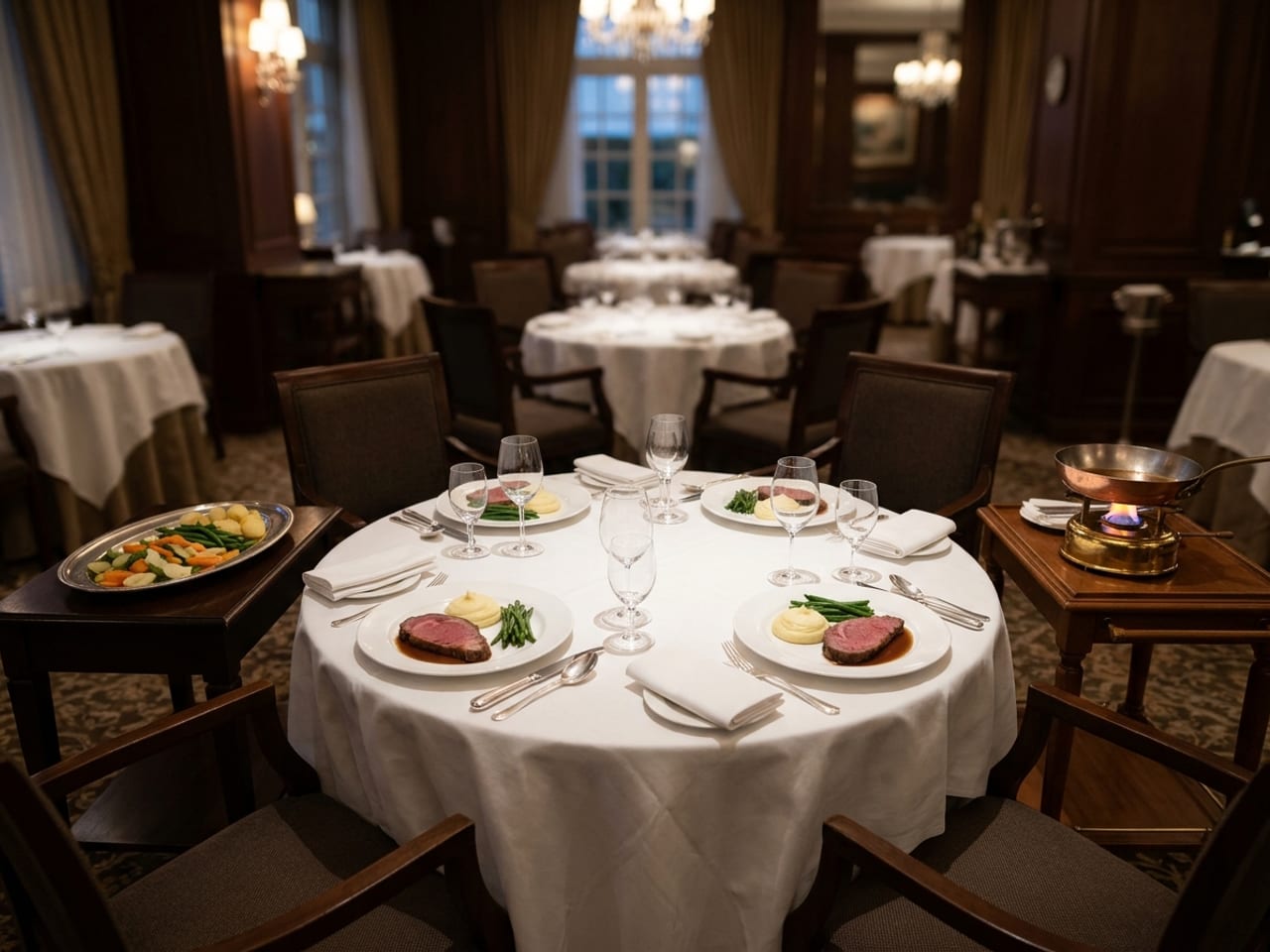
The photos on this page are AI-generated illustrations.
"French service" and "Russian service" mean different things in different books
Ask which style is "French service" and the answer depends on the country of the textbook. In what we read, "French" has seven meanings, "Russian" six and "English" five (our count of the rows below). The only study we found that compared the textbooks, Krause & Bahls (2016, a peer-reviewed Brazilian paper), says the literature does not agree and proposes cutting the classics to three: French, direct English and plated service.20
By whose book
- UK textbook (Lillicrap; read as search fragments only): Silver = English, Butler = French, Plate = American; Russian = guests help themselves.11, 13
- US textbooks (Axler 1990; AHLEI's Cichy 2005): French = guéridon or cart, Russian = platter, English = butler (Axler) or family style (Cichy).14, 17
- Indian university e-texts (INFLIBNET, two authors): English = silver, French = family service, Russian = sideboard, American = plated.6, 7
- French school texts (Nomad Éducation; a Lyon library differs on à la russe): à la française = guest serves self, à l'anglaise = server serves, à la russe = guéridon.38, 39
- US event and restaurant software sellers (Cvent, TouchBistro): Cart French and Banquet French, Russian = silver, English = family style.41, 45
"French service": seven meanings
- Cooked or finished at the table from a cart or guéridon: Axler (US, 1990), AHLEI's Cichy (US, 2005), the Dusit table (UK lineage), Cvent 2019 ("Cart French").11, 14, 17, 41
- A server plates each guest from kitchen platters, from the left ("Banquet French"): Cvent's Patti Shock (US, 2019) and a CSJMU chapter with the same wording (one voice).10, 41
- Silver service, the waiter dividing portions onto plates already on the table: a CSJMU handout (India, 2021: "Generally French service is also known as silver service.").9
- The guest helps themself from a dish the server holds (butler service): Lillicrap (UK, fragments), Meyer, Schmid & Spühler (Switzerland, 1991), UOU (India), a French hotel-restaurant school revision site (Nomad Éducation), a US school lesson plan.8, 13, 16, 39, 40
- Family service: platters set on the table, the host or the guests serve: two INFLIBNET e-texts by two authors (India).6, 7
- The old service à la française: every dish of a course set on the table at once: Ranhofer (New York, 1894: it "threatens to disappear"), the CIA (from "the court of Louis XIV").19, 31
"Russian service": six meanings
- Nothing on the table: carved at a sideboard or in the kitchen and handed round by servers: Beeton (UK, 1861), Hill (US, 1906), Ranhofer (1894), Post (1922), INFLIBNET ("Sideboard Service").6, 23, 29, 31, 32
- Platter service: a server portions onto each plate from the platter: AHLEI's Cichy (2005), Axler (1990), a US school lesson plan, Strianese (Russian = silver); TESDA (Philippines, 2013) gives only the name, "Platter Service".4, 14, 15, 17, 40
- The guests help themselves from platters passed or laid on the table: Cvent 2019 ("Russian (silver)"), UOU (India), Lillicrap (UK, fragments, which calls the use confusing), the CSJMU handout's table.8, 9, 13, 41
- Everything served from the kitchen or pantry by an attendant: Best (1921), WSU / USDA extension (2003).22, 24
- Guéridon service ("A la russe : ou au guéridon"): a French hotel-restaurant school revision site (Nomad Éducation); a Lyon library gives à la russe the carved-in-the-kitchen sense instead.38, 39
- The old service à la russe: one dish after another instead of tablefuls: Carême (1822), Dubois and Bernard (1856), Escoffier (1912).27, 28, 33
So for Russian service the sources split on the one thing this page is about: a server plates the food in some (INFLIBNET, a US school lesson plan, Beeton), the guests in others (Cvent, UOU, the Lillicrap fragment), and in 1894 Ranhofer had the dishes passed round to guests "who help them- selves or are helped, according to their wish" (a line-break hyphen in the scan).6, 8, 13, 29, 31, 40, 41
"English service": five meanings
- Silver service: a waiter serves each guest from the platter: INFLIBNET (India, two authors), UOU, Lillicrap ("Silver/English"), the Dusit table, à l'anglaise on a French school revision site (Nomad Éducation, our reading of the same act).6, 7, 8, 11, 13, 39
- The host carves and plates at the table: Hill (1906), Best (1921), WSU (2003), the CSJMU handout, a Lyon library ("service par l’hôte ou le serveur").9, 22, 23, 24, 38
- Family style: AHLEI's Cichy (2005; the fragment, "also called English", is cut off there), Cvent (2017, 2023), TouchBistro (a seller); WSU: "considered by some to be family service".17, 22, 43, 44, 45
- Butler service, "a combination" of "Russian, or platter" service (the fragment is cut off there): Axler (US, 1990).14
- Cold meats left whole on the sideboard, and guests cut their own: Post (New York, 1922).32
Cvent's 2019 post and a CSJM University chapter share one text (the wording is nearly the same), so we count them as one voice. On Russian service the two part ways: Cvent has the guests help themselves, the chapter has the server serve. Class decks we saw on slide-sharing and upload sites mix all of these meanings; we used none of them as a source.
How many types of table service? Each source's own count, fewest first (3 to 7; no count is a standard):
- 3, TESDA NC II (Philippines, 2013): American (plate), Russian (platter), buffet.4
- 3, Krause & Bahls (Brazil, 2016), their proposal: French, direct English, plated.20
- 3, Dusit course table (Thailand, UK lineage): plate/American, silver/English, French/guéridon.11
- 4, Cvent, Patti Shock (US, 2019): cart French, banquet French, butlered, Russian (silver).41
- 4, Nicolet College open textbook (US), chapters: American; French; Russian and butler; contemporary and casual.12
- 5, AHLEI, Cichy (US, 2005; fragments): plate, cart, platter, family style, buffet.17
- 5, UOU HM-201 (India): English/silver, French/butler, American/plate, Russian, family; guéridon in a later unit.8
- 6, INFLIBNET e-texts (India, two authors): English, French, American, Russian, guéridon, tray.6, 7
- 6, Lillicrap (UK; fragments), table service: silver/English, family, plate/American, butler/French, Russian, guéridon.13
- 6, Brown, The Waiter's Handbook (Australia, 2004; fragments): plate, silver, guéridon, family, smorgasbord, buffet.18
- 7, CSJMU handout (India, 2021): silver, family, American, butler, Russian, guéridon or flambé, bar counter.9
- 7, TouchBistro (US seller): informal silver, formal silver, French, Russian, American, English, guéridon.45
Cvent's 2017 guide lists eleven event styles, receptions and buffets included, so it is left out of this count.43 Australia's general table-service unit names no style at all; silver service and guéridon service are units of their own there.1, 2, 3
Nine styles of table service in our grouping, one by one
One card per style: what happens, who portions and plates, which side (the sources' answers), staff and kit, speed and cost only as named sources rate them, where it is used today, and one line on what it means for the plate. The grouping into nine and the plate lines marked ours are our reading.
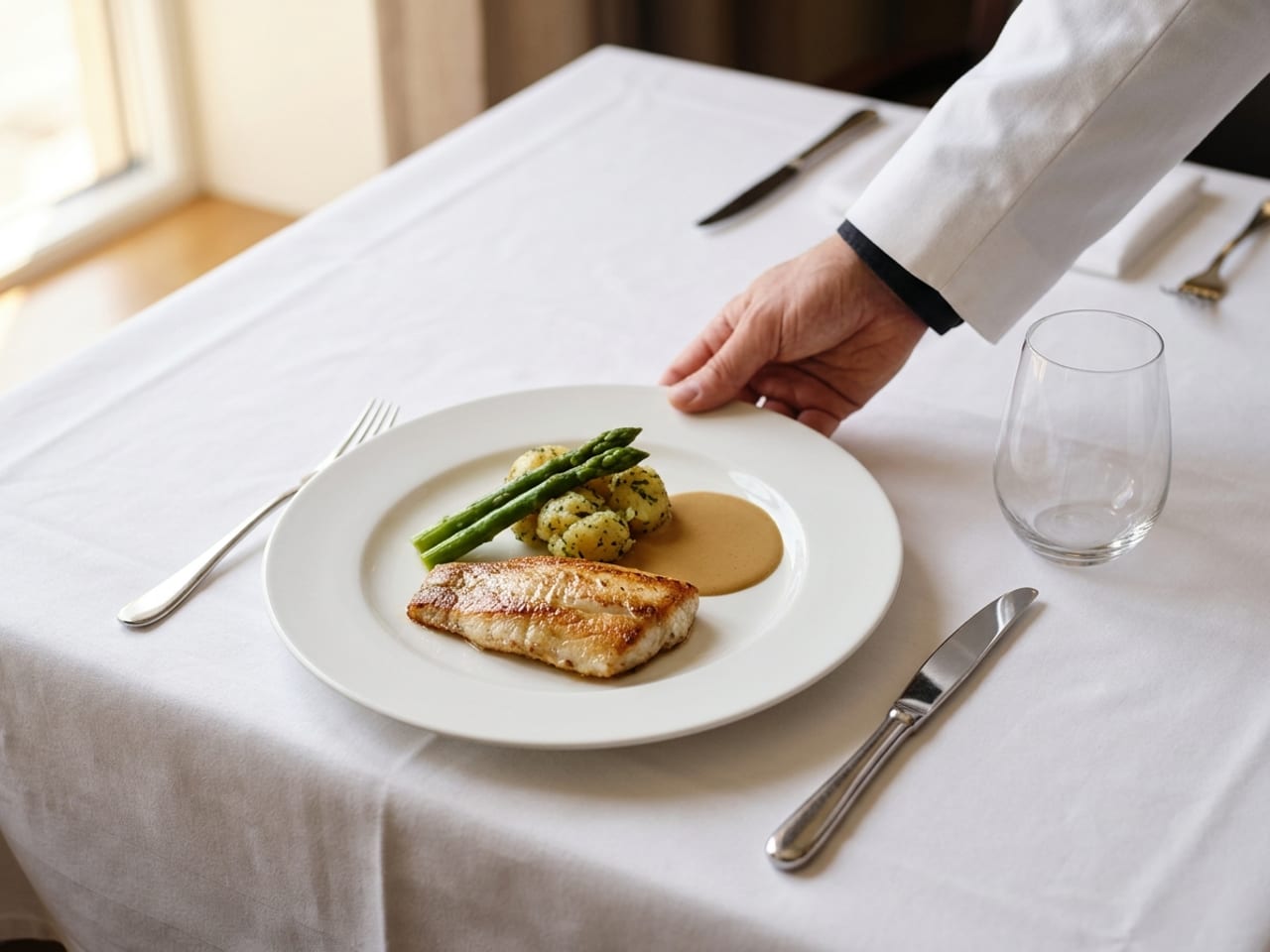
Plated service (American service)
Each plate is portioned and arranged in the kitchen, carried out, and set down in front of the guest.6, 12, 21
- Who plates: Kitchen staff: "All food components are arranged on the plate in the kitchen according to the chef’s specifications" (Nicolet College).12
- Sides: Most texts we read set the plate down from the guest's right and clear from the right; two Cvent posts serve food from the left (the side table below).6, 8, 18, 43
- Staff: INFLIBNET: one waiter serves many and needs no special training; Cvent (Patti Shock): at least 1 server per 20 guests for American service with some foods preset.6, 42
- Speed and cost: Rated quick, low in labour and high in seat turnover (INFLIBNET, UOU, CSJMU), but the food may get cold; Cvent calls it "the most functional, common, economical, controllable and efficient type of service".6, 8, 9, 44
- Used today: "the most common service style in restaurants throughout the United States and much of the world" (Nicolet College); "used in most restaurants" (US Navy manual, 1990).12, 21
- Not the eating style: American SERVICE is who plates the food; the American way of EATING (switching the fork to the right hand) is a different thing, on our fine-dining etiquette guide. American vs Continental eating.
For the plate: The cook composes the finished plate: layout, sauce and the main item at the front are all decided at the pass, and what leaves the kitchen is what the guest sees. (ours)6 See how to plate food and sauce plating.
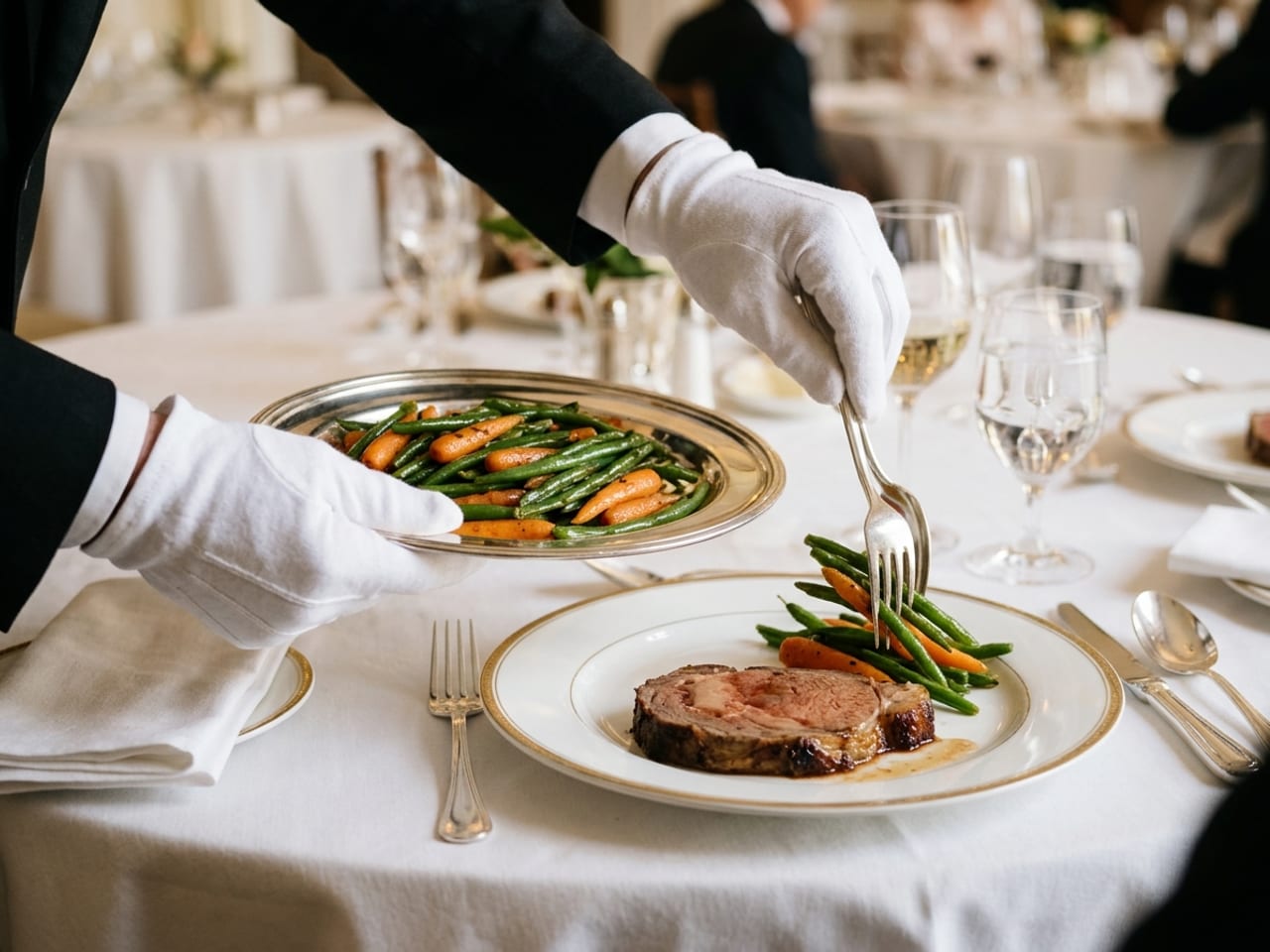
Silver service
The kitchen arranges the food on a platter; at the table a server moves it onto each guest's hot plate with a service spoon and fork.1, 6, 11, 48
- Who plates: The server, who must "Portion and place food and condiments based on advice from kitchen or head waiter" (Australia's SITHFAB035); the kitchen portions the food onto silver platters and garnishes them (INFLIBNET).1, 6
- Sides: From the guest's left in every source we read that gives a side except a UK staffing handout and Arduser & Brown (2005, as Krause & Bahls report them), who say right; INFLIBNET's two e-texts split on which way round the table, counter-clockwise or clockwise.6, 7, 18, 20, 48
- Staff and kit: Servers balanced and positioned "correctly at the table for silver service", heated plates and cutlery changes (SITHFAB035); oval flats or portion bowls (CSJMU); Cvent (Shock) asks 1 server per 16 guests for Russian or banquet French service.1, 9, 42
- Speed and cost: Slow, low seat turnover, high labour and more staff, but personal (INFLIBNET); "these styles take more time and usually cost more" (Cvent).6, 41
- Its names: "Silver/English" (Lillicrap, fragments), English service in INFLIBNET and UOU (India); Cvent's Patti Shock calls a server plating from kitchen platters banquet French.6, 8, 13, 41
- Used today: A national training unit of its own in Australia (SITHFAB035); CSJMU lists high-class restaurants, cruise liners, first-class travel and formal banquets; for Brown (2004) it is one of "The two most commonly used food service styles".1, 9, 18
For the plate: The kitchen designs a platter, not a plate; the server builds each plate at the table, the meat first on the part nearest the guest (Lillicrap, fragments; a UK staffing handout: "Meat - in the middle to front of plate").13, 48 See the clock plating method.
Russian service (platter or sideboard)
Whole dishes are shown, then carved or portioned at a sideboard and handed round; in some books the guests help themselves from the platters instead.6, 29, 41
- Who plates: A server in INFLIBNET ("carved and portioned at the side board by the waiter"), a US school lesson plan ("measured portions") and Beeton 1861; the guest in Cvent (Shock), UOU and the Lillicrap fragment ("Table laid with food for customers to help themselves"). TESDA only names the style, "Platter Service", and says no more.4, 6, 8, 13, 29, 40, 41
- Sides: Platters from the left (CSJMU Chapter 5 and Cvent, one text); Larousse, as a Lyon library quotes it: dishes presented at the left, the plate set down or removed at the right.10, 38, 41
- Staff: Highly skilled staff, more waiters and carving skill (INFLIBNET); at home, Hill (1906) wanted more than one waitress for each eight covers and Best (1921) one for every six or seven guests.6, 23, 24
- Speed and cost: Slow, high labour, low turnover, and "The last guest to be served from the platter may see a less attractive display" (INFLIBNET).6
- Used today: "not practiced much in recent times" (INFLIBNET) and "no longer exists" as a separate form (CSJMU), yet one of only three styles in the Philippines' national standard (TESDA NC II).4, 6, 9
For the plate: The platter is the design: arranged and garnished in the kitchen, it has to still look good when it reaches the last guest, and each plate is built at the table. (ours)6 See service à la russe in our table-setting glossary.
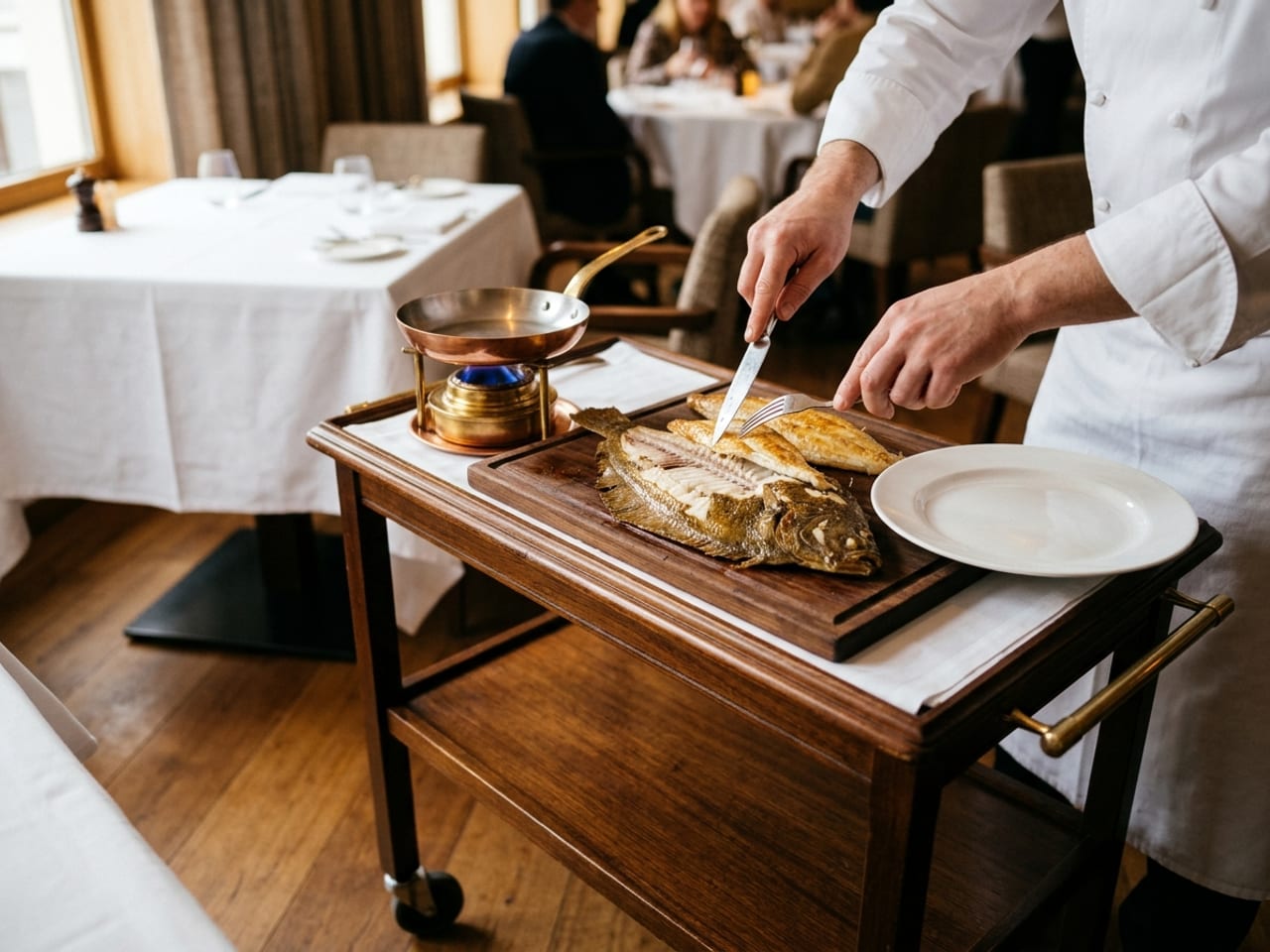
Guéridon service ("French" in US books)
A dish is finished beside the table on a side trolley, the guéridon: carved, filleted, dressed or flambéed, then plated and served.2, 6, 13
- Who plates: The server: at The Ritz London, "dishes are completed and plated at your table"; Australia's SITHFAB018 lets guests choose the ingredients, the finishing method and the portion size.2, 51
- Sides: Cvent's Patti Shock calls cart French "the only style of service where food is served from the right"; INFLIBNET has the cheese plated on the trolley and served from the right. Krause & Bahls list four authors who give the left for their French service, finished on the guéridon and then presented to the guest.6, 20, 41
- Staff and kit: A trolley with gas burners, a flare lamp, chafing dish, Suzette pan and carving board, and trolleys for carving, flambé, hors d'oeuvre, salad, cheese, liqueur and dessert (INFLIBNET); the senior unit in the Philippines (TESDA NC III) and a separate unit in Australia (SITHFAB018).2, 5, 6
- Speed and cost: Slow, low turnover, costly kit, more floor space and "The chances of accidents will be high", but a high spend per cover (INFLIBNET); the Brazilian study's panel called it "em desuso", out of use.6, 20
- Used today: The Ritz London's Arts de la Table menu, for parties of two or four; The Savoy Grill, Wiltons and The Game Bird (Hot Dinners, 2022); Dover sole filleted at the table at Scott's and at The Chesterfield Mayfair.50, 51, 53, 55, 56
- Classic dishes: Crêpes Suzette flambéed, joints of meat portioned and monkfish with a sauce finished on the trolley at The Ritz (The Good Food Guide); beef Wellington carved at The Savoy Grill (Hot Dinners); Caesar salad, "Traditionally" made tableside (National Geographic).53, 54, 57
For the plate: The server is the last cook: for a Dover sole the bones stay on the tray and the fillets go back into shape with the flat of the knife (PORT, at Scott's).55 See guéridon in our fine-dining etiquette guide.
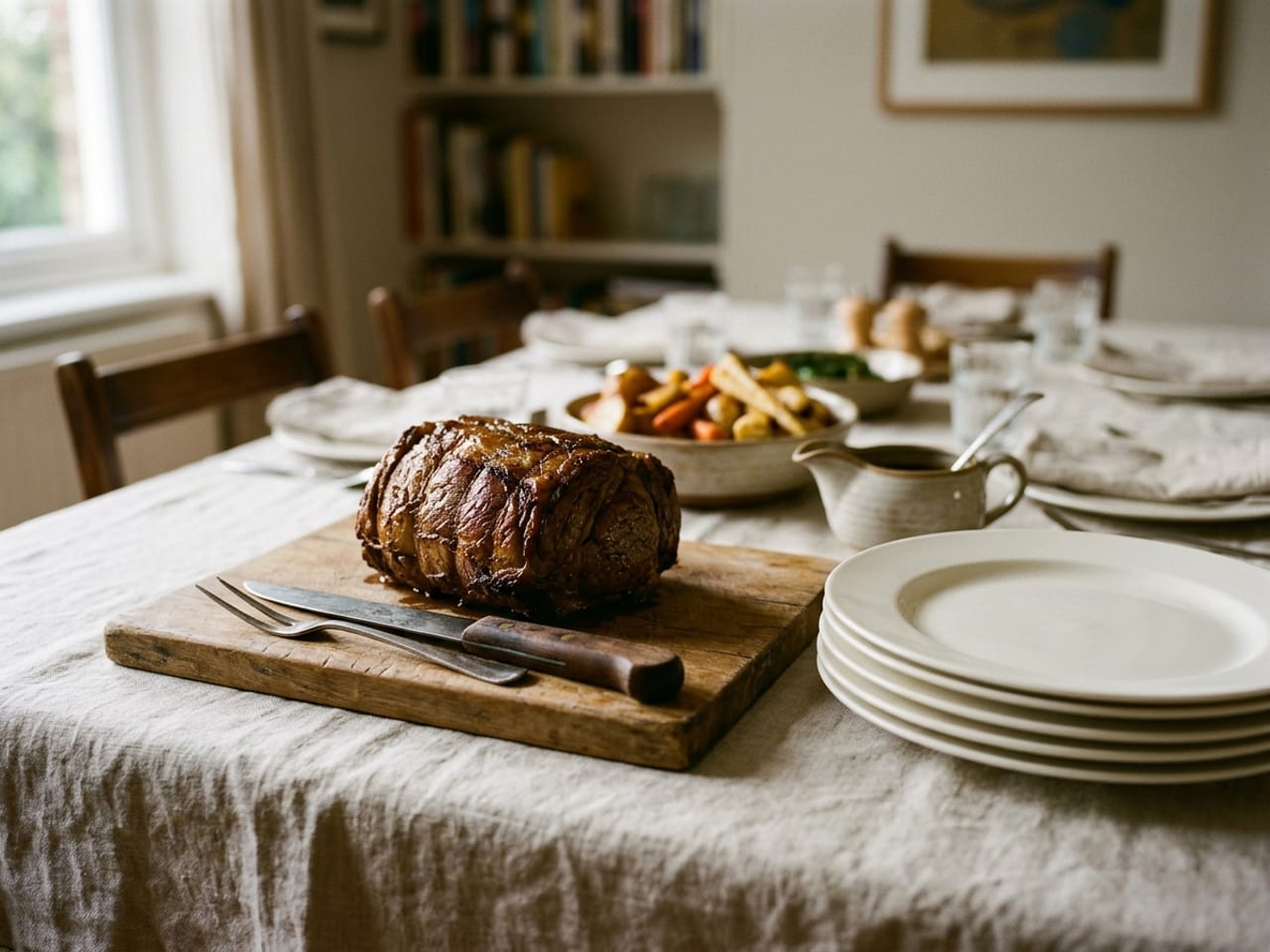
English service (host service)
The roast is set before the host, who carves and fills each plate at the table; the plates are passed or carried round.22, 23, 24
- Who plates: The host carves and serves the meat, the hostess may add the vegetables and sauce, and the plates go down one side of the table, then the other (WSU / USDA extension, 2003).22
- Sides: WSU: a meal may be served from either side, "Once you choose a method, be consistent."22
- Staff: Traditionally an attendant sets the served plates at each place, but it can be done without one (WSU); no source we read rates its speed or cost.22
- Used today: Simpson's in the Strand says its "silver carving trolleys and Master Carvers serve signature roasts".52
- A century ago: Beeton's later editions keep carving for "breakfasts, luncheons, and quiet family repasts"; Post (1922) wrote that in New York "in forty-nine houses out of fifty" the cook carved in the kitchen instead (her estimate).30, 32
- Other meanings: INFLIBNET and UOU (India) and the UK Lillicrap fragments use "English service" for silver service, and AHLEI and Cvent for family style: see the names above.6, 8, 13, 17, 43
For the plate: The host is the plater: one carved portion and the sides on each warm plate, at the table. (ours) See how to carve a turkey and how to carve a ham.
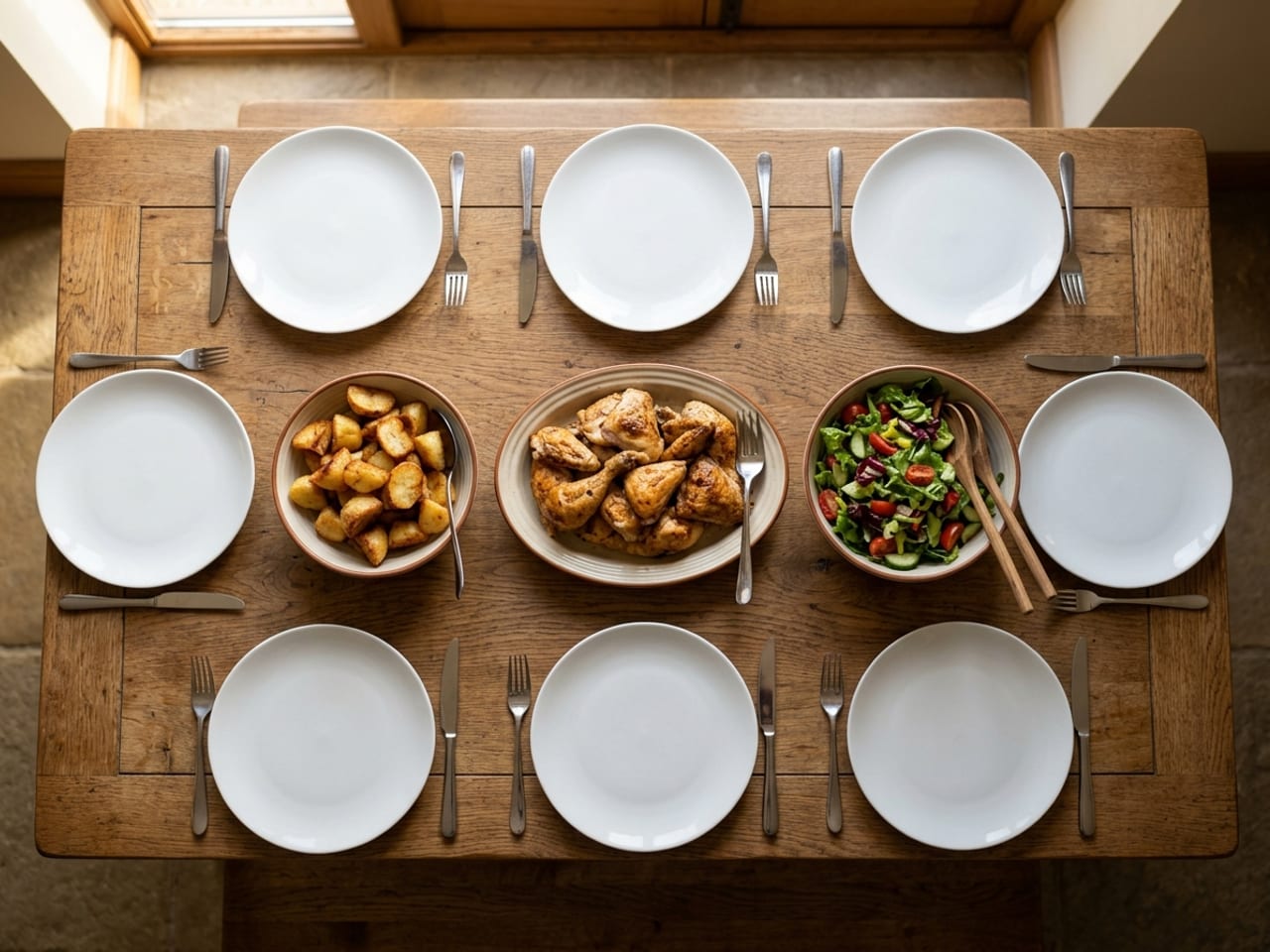
Family style
The food comes to the table in serving dishes, each with its own utensil, and everyone helps themselves, passing the dishes round.21, 22, 26
- Who plates: The guest: "Each officer serves himself or herself and passes the serving dishes around the table" (US Navy, 1990); WSU has the host start the main dish.21, 22
- Passing: "Food is passed around the table in a counterclockwise direction, or to the right." (Emily Post Institute); "It is common practice to pass everything to the right." (WSU).22, 26
- Staff: A caterer, On The Fly Tapsters: 1 server per 10 guests to deliver, refill and clear the platters. UOU says its family service "normally does not exceed" 15 to 20 people (a dash in the original), a group size, not a server ratio.8, 47
- Its names: "Family-Style (English) Service" in Cvent; English service in AHLEI (Cichy, a cut-off fragment); French service in two INFLIBNET e-texts (India).6, 7, 17, 43
- Speed and cost: Quick, low skill, low labour, but the food may go cold and it takes more table (INFLIBNET, under its name "French"); guests decide portions, with more waste (CSJMU).6, 9
- Used today: One of the US Navy wardroom's informal styles (1990); practised in Chinese and Indian restaurants (INFLIBNET). No source we read gives a number of platters per table or portions per platter.6, 21
For the plate: The cook designs serving dishes, not plates: each guest builds their own plate, so a platter has to hold its look as it goes round. (ours) See family-style pasta and family-style in our table-setting glossary.
Butler service
A server holds the dish at each guest's left and the guest serves themself with the serving spoon and fork.8, 13, 16, 41
- Who plates: The guest, from "a serving plate held by the waiter (butler)" (UOU); in the US Navy's semiformal service each diner "places them on his or her plate while the serving dish is held".8, 21
- Sides: From the left (Cvent's Patti Shock; and a French hotel-restaurant school revision site, Nomad Éducation, for à la française, "par la gauche du client afin qu’il puisse se servir seul").39, 41
- Its names: "Butler/French" (Lillicrap, fragments), "French, or butler" (Meyer, Schmid & Spühler, 1991), but "English, or butler" in Axler (1990).13, 14, 16
- Two other meanings: Canapés passed on trays at a standing party (Cvent; our canapés guide), and food and drink brought to V.I.P. guests in their room or lounge (CSJMU).9, 44
For the plate: The guest builds the plate from a held platter, so the platter has to stay tidy to the last guest. (ours) See butler service for canapés.
Banquet plated service
Plated service for a whole room: the kitchen plates every cover on a line and servers set them down table by table, sometimes all at once.11, 40, 43
- Who plates: The kitchen, often as "a traditional assembly line, assigning one component per person" (a club sous chef, Club + Resort Chef).49
- Setting down: Hand service: "One server is assigned for every two guests" and every plate at a table goes down at once; the wave: servers start at one end of the room and work across (Cvent, 2017).43
- Staff: Cvent (Shock): 1 server per 32 guests on average "regardless of the style of service", at least 1 per 20 for American service; Marquette: 1 per 20 at lunch and dinner; a caterer: 1 per 10.42, 46, 47
- Speed: The wave is fast and needs less labour but "does not provide individualized service" (Cvent, 2023).43, 44
- Its names: A US school lesson plan: "Banquet service, or American service"; the Dusit table: plated service is "Now also widely used for banqueting".11, 40
For the plate: Design for a line: one plate made many times, built component by component (Club + Resort Chef). Put the main item at 6 o'clock, nearest the guest, as our clock plating guide's banquet sources put it.49 See the clock plating method.
Buffet
Guests take a plate to the food and serve themselves; the kinds of buffet (seated, semi-buffet, stations, finger) are in our buffet guide.4
- In the standards: One of only three serving styles in the Philippines' national standard (TESDA NC II).4
- Staff: Marquette: 1 server per 30 guests at lunch and dinner; a caterer: 1 attendant per 2 chafing dishes.46, 47
For the plate: The cook designs the line and the platters; the guest plates. (ours) See buffet, family style or plated, and the kinds of buffet.
Outside table service. The textbooks file the rest of food service under other headings: INFLIBNET splits all service into waiter, assisted and self-service; a CSJM University chapter lists cafeteria, food court, kiosks, vending, tray service and room service; the Dusit course table sorts by customer process (table, assisted, self, single point and in-situ service).6, 10, 11 They are not compared here.
Which side food is served and cleared from, by source
No rule survives every source. Food from a platter comes from the guest's left in every source we read that gives a side except a UK staffing handout and Arduser & Brown (as Krause & Bahls report them); plated food and guéridon service split between right and left.
- Plated (American) · served: right · cleared: right · INFLIBNET (both e-texts), UOU, Brown 2004, Nicolet ("generally"), a UK staffing handout6, 7, 8, 12, 18, 48
- Plated (American) · served: left (drinks from the right) · cleared: right · Cvent 2017 and 2023 (also clearing from the right); Kotschevar & Luciani 2007, "sem justificá-lo" (without saying why), as Krause & Bahls list them (service side only)20, 43, 44
- Silver, platter, Russian · served: left · cleared: right · INFLIBNET, UOU, CSJMU, Brown 2004, Cvent 2019 (banquet French, Russian); Post 1922 (dishes "always presented at the left", plates "occasionally" removed at the right); Larousse via a Lyon library; Allen 19156, 8, 9, 18, 25, 32, 38, 41
- Silver · served: right · cleared: right (the handout) · one UK staffing handout (a weak source); Arduser & Brown 2005, as Krause & Bahls (2016) report them for the server portioning from the dish20, 48
- Guéridon, cart French · served: right (Cvent, INFLIBNET) or left (four authors in Krause & Bahls) · cleared: not stated · Cvent 2019 ("the only style" from the right); INFLIBNET (cheese plated on the trolley, served from the right); four authors cited by Krause & Bahls give the left for their French service (finished on the guéridon, then the dish presented to the guest), while others name no side6, 20, 41
- Butler (guest serves self) · served: left · cleared: not stated · Cvent 2019; à la française on a French school revision site (Nomad Éducation); the same four authors Krause & Bahls cite for their French ("diplomat") service, in which the guest serves themself (see the guéridon row)20, 39, 41
- Family, English, Russian at home · served: either side · cleared: either side · WSU / USDA extension 2003: "Once you choose a method, be consistent."22
- Any, for a left-handed server · served: may reverse · cleared: may reverse · Brown 2004: "Left-handed waiters may reverse the technique and serve and clear from the left."18
Which style to choose: guests, helpers and courses
For a dinner at home (ours)
- Up to 8 guests at a wide table: pass platters family style. 9 to 20: serve from a sideboard. Above about 20: a two-sided buffet. These bands are ours, the same rule of thumb as our buffet guide; no source we read gives a guest count for choosing a style.
- Plated service when you can plate every cover in the kitchen at once (ours); silver, Russian and guéridon service need skilled staff in the sources that rate them, and Australia trains silver and guéridon service as units of their own.1, 2, 6, 9
- Whichever you pick, the place settings are in our table-setting guide and the order of the courses in courses of a meal.
Guests per server, each source's own figure
- Cvent, Patti Shock (2019): 1 server per 32 guests on average, any style; at least 1 per 20 for American service with some foods preset; 1 per 16 for Russian, banquet French or poured wine.42
- Marquette University Event Services: plated: 1 per 20 at lunch and dinner, 1 per 25 at breakfast; buffet: 1 per 30, or 1 per 40 at breakfast.46
- On The Fly Tapsters (a caterer): plated: 1 per 10; family style: 1 per 10; buffet: 1 attendant per 2 chafing dishes.47
- Cvent (2017, 2023): hand service: 1 server per 2 guests.43, 44
- INFLIBNET (Davar): American service: "Generally, one waiter is sufficient for three guests".7
- Hill (1906); Best (1921): Russian service at home: more than one waitress per 8 covers (Hill); at least one per 6 or 7 guests (Best).23, 24
- The Ritz London: guéridon menu for parties of two or four guests only.51
- UOU: family service "normally does not exceed" 15 to 20 people (a dash in the original): a group size, not a server ratio.8
The figures for a plated meal run from 1 server per 3 guests (INFLIBNET) and 1 per 10 (the caterer) to 1 per 20 to 32 (Marquette, Shock), so none is printed as the rule. No source we read gives a number of platters per family-style table or of portions per platter, and we print no price per guest (the planners' pages that give one refused our fetcher).
By course
Styles can be mixed within one meal: Cvent suggests "use French service for the soup course, use Russian service for the entrée"; a US extension guide calls a meal with some courses from the host and some from the kitchen compromise service; and Best (1921) lets two or all of a family meal's courses go on the table at once.22, 24, 43 The order of the courses is in our courses of a meal guide.
Food safety, where a style changes it
Platters left on a family-style table or a sideboard: USDA's general rule is "Never leave food out of refrigeration over 2 hours. If the temperature is above 90 °F, food should not be left out more than 1 hour" (90°F is 32°C); applying it to a table of platters is ours.58 Flames at a guéridon: the Philippines' standard asks for a "Fire extinguisher in place", and INFLIBNET for at least two feet (about 60 cm) between the trolley and the guest's table.5, 6
Where the names come from, and why they moved
The names moved. In 1894 a Delmonico's chef, Charles Ranhofer, wrote that "The American service is copied more or less from the French and Russian", and his American dinner was handed round on silver salvers, not plated in the kitchen.31 In 1922 Emily Post's "Russian" service meant nothing on the table but fruit and candy, with the meat carved in the kitchen, and her English service was cold meat left whole on the sideboard; in New York, she wrote, the cook did the carving "in forty-nine houses out of fifty".32 Today's textbooks use the same three words for other things.
From tablefuls to plates. In the old service à la française every dish of a course went on the table at once; service à la russe brought one dish after another. The earliest full account we hold is Carême's, in 1822; Dubois and Bernard called it "une méthode nouvelle" in 1856; Beeton in 1861 had the dishes "cut up on a sideboard, and handed round"; and Escoffier in 1912 put the switch in the second half of the nineteenth century.27, 28, 29, 33 Our courses of a meal history uses Dan Jurafsky's dating: it "took over in France in the 19th century; in England and the US the custom shifted roughly between 1850 and 1890."34 The end of the old French service is dated three ways: about 1830 (Krause & Bahls, citing the 1995 Larousse Gastronomique), the end of the Second Empire in 1870 (a Lyon library's answer), and still hanging on but "rarely used" in 1894 (Ranhofer, Delmonico's chef). A magazine summary of a study of 85 American restaurant menus from 1838 says American restaurants served à la russe earlier than European ones.20, 31, 36, 38
Prince Kurakin. The story that the Russian ambassador brought the new service to Paris around 1810 is disputed: we found no source from the time that names him. Krause & Bahls repeat it from the 1995 American edition of Larousse Gastronomique, and a US school lesson plan prints it with no source; a Lyon library repeats it from the 2017 Larousse while correcting Larousse's date.20, 38, 40
Plating in the kitchen. A Gale reference entry says service à la russe was "often plated in the kitchen for each person", and Nicolet College dates plated (American) service's rise to dominance in the US to the mid-20th century.12, 35 We found no primary source that credits one hotel, chef or movement with the move to plating in the kitchen.
The guéridon. In French the word first named a small pedestal table, in 1650, possibly after a farce character called Gueridon (1614): the dictionary says "peut-être", perhaps.37 The UK textbook Lillicrap dates flambé and then guéridon service to the Edwardian era (1901 to 1910, our gloss), and says the first flambé dish, crêpes Suzette, was "supposedly invented by Henri Charpentier": a legend, not a dated fact.13
Silver service: French or English? Of the sources we could read, only one says where it began, and it points to France: the US textbook Strianese says the new style of service "in France was referred to as silver service" (a search fragment; the book was not opened). A French school revision site, Nomad Éducation, calls a server serving from the dish service à l'anglaise, English service; that this is the same act as silver service is our reading.15, 39 An Indian handout says "silver service is claimed to be of French origin by the British as well as the French people".9 We found no source that gives silver service a British origin. We found no dated first use of "silver service", "butler service" or "English service" as a style. Our table-setting guide prints "family-style" as in print since 1857, from an earlier dictionary reading that we could not re-check.
Table service terms, defined
One sentence each, ours, from the sources named under each term. Place settings and the older service words are also in our table-setting glossary.
Service à la française
The old French way of serving dinner: every dish of a course set on the table at once. Ranhofer, 1894: it "threatens to disappear entirely".19, 31
Service à la russe
Dinner served one dish after another, carved or plated away from the table and handed round. Earliest account we hold: Carême, 1822; Beeton, 1861: cut up on a sideboard and handed round.27, 29
American service · plate service, plated service
Service in which each plate is filled in the kitchen and set down in front of the guest. Nicolet College; TESDA: "American Service (Plate Service)".4, 12
Silver service
Service in which a server moves food from a platter to the guest's plate with a spoon and fork. Australia's SITHFAB035 and a UK staffing handout; called English, French or Russian service in other books.1, 48
Platter service · Russian service
Service from platters brought to the table, portioned onto plates by a server or, in some books, by the guests. TESDA; AHLEI: "Platter service (also called Russian service)".4, 17
Sideboard service
Russian service in the Indian e-texts: joints carved and portioned at a sideboard by the waiter. INFLIBNET, two authors.6, 7
Guéridon · trolley, cart
A side table or trolley at which a dish is carved, dressed or flambéed and plated beside the guest. As furniture, a small pedestal table, in French since 1650 (TLFi).2, 6, 37
Réchaud
A table burner on the guéridon that keeps a pan hot in front of the guest. Cvent's Patti Shock, on cart French.41
Cart French and banquet French
A US events split of French service: cart French is finished at the table, banquet French is plated by a server from kitchen platters. Cvent's Patti Shock, 2019; TouchBistro repeats it.41, 45
Butler service
Service in which guests help themselves from a dish a server holds; also canapés passed on trays. UOU, Lillicrap (fragments), Cvent; the canapé sense is on our canapés guide.8, 13, 44
Family style · family service
Service in which the food comes to the table in shared dishes and the guests help themselves. US Navy, 1990; WSU, 2003.21, 22
English service · host service
Service in which the host carves and plates at the table; some books use the name for silver service or family style. Hill, 1906; WSU, 2003.22, 23
Hand service
Banquet service with one server for every two guests and every plate at a table set down at once. Cvent, 2017.43
The wave
Banquet service in which servers start at one end of the room and work across it. Cvent, 2017.43
Table service, answered
What are the types of table service?
There is no standard list: the sources we read name 3 to 7 styles. Grouped by who puts the food on the plate, this page has 9: plated (American) service, where the kitchen plates; silver service, Russian (platter) service and guéridon service, where a server plates at the table; English service, where the host carves and plates; family style, butler service and buffet, where the guests serve themselves; and banquet plated service, the kitchen plating for a whole room. The grouping is ours.
Which style of service plates the food in the kitchen?
American service, also called plated or plate service: "All food components are arranged on the plate in the kitchen according to the chef’s specifications" (Nicolet College), and the server only sets the plate down. Banquet plated service is the same thing for a whole room. In silver, Russian and guéridon service a server plates at the table; in English service the host does; in family style, butler service and a buffet the guests do.
What is the difference between French and Russian service?
It depends on whose book you read. US textbooks: French = guéridon or cart service, finished at the table; Russian = platter service, a server portions from a platter (Axler; AHLEI). UK textbook (Lillicrap, fragments): French = butler service, the guest helps themself from a held dish; Russian = food on the table for guests to help themselves. Two INFLIBNET e-texts (India): French = family service; Russian = sideboard service. UOU and a CSJMU handout (India) use "French" for butler and silver service. In history, service à la française set a whole course on the table at once and service à la russe brought one dish after another. We found 7 meanings of "French" and 6 of "Russian".
What is the difference between American, French and Russian service?
Who plates and where. American: the kitchen plates and the server sets the plate down, from the right in most of the texts we read (two Cvent posts say left). French in US books: a server finishes the dish on a guéridon trolley and plates it beside the table. Russian in US books: the kitchen sends platters and a server portions onto each plate. Indian and UK books give the French and Russian names to other styles: check whose definition your course uses.
Family style service is also known as?
English service in Cvent's event guides ("Family-Style (English) Service") and, in a cut-off fragment, AHLEI's textbook (Cichy); French service in two INFLIBNET e-texts from India ("also known as family service"); and family service. A US extension guide adds that "English service is considered by some to be family service", though its own English service has the host carve and plate.
Guéridon service is also known as?
Trolley service (INFLIBNET, India), cart service or French service (AHLEI; Axler: "French, or Gueridon, Service"), cart French (Cvent), and tableside service. A French hotel-restaurant school revision site (Nomad Éducation) calls it à la russe ("A la russe : ou au guéridon").
What are the 4 types of table service?
There is no standard four. In what we read the counts run from 3 (the Philippines' national standard: American, Russian and buffet) to 7 (an Indian university handout and a software seller's blog). Four is Cvent's count (cart French, banquet French, butlered and Russian) and the number of service-style chapters in Nicolet College's open textbook (American; French; Russian and butler; contemporary and casual).
What is silver service?
A server moves the food from a platter onto the guest's plate with a service spoon and fork, at the table. Australia trains it as its own national unit (SITHFAB035), where the server will "Portion and place food and condiments based on advice from kitchen or head waiter". INFLIBNET and UOU (India) and the UK Lillicrap fragments call it English service, Cvent calls the same act banquet French, and a US textbook calls silver service another term for Russian service.
What is English service?
Three answers, by source. The host carves and plates at the table (Hill 1906, Best 1921, a US extension guide of 2003); silver service (INFLIBNET and UOU in India, and the UK Lillicrap fragments); or family style (AHLEI, Cvent). We found 5 meanings in all.
What is butler service?
Three meanings. At a seated meal, the server holds the dish and the guest serves themself (UOU; Lillicrap's "Butler/French"; Cvent's "butlered" service). At a reception, canapés passed on trays (Cvent; our canapés guide). And, in an Indian university handout, food and drink brought to V.I.P. guests in their room or lounge.
Which style of service is the fastest?
The textbooks rate plated (American) service the quickest, with low labour and high seat turnover (INFLIBNET, UOU, CSJMU), and banquet "wave" service as fast with less labour (Cvent). They rate silver, Russian and guéridon service slow, with more staff and lower turnover. Nobody we read timed them.
Plated service vs buffet: which needs more staff?
Plated, in the one source we read that gives both as guests per server: Marquette's event office allows 1 server per 20 guests for a plated lunch or dinner and 1 per 30 for a buffet. A caterer, On The Fly Tapsters, staffs plated meals at 1 per 10 but counts a buffet by chafing dishes (1 attendant per 2), so the two cannot be compared. Cvent (Patti Shock) gives 1 per 32 on average "regardless of the style of service". Buffet kinds are in our buffet guide.
Which side do you serve from in table service?
The sources split. Most texts we read set a plated main down from the guest's right and clear from the right; two Cvent posts serve plated food from the left. Food from a platter (silver or Russian service) comes from the left in every source we read that gives a side except a UK staffing handout and Arduser & Brown (as Krause & Bahls report them). Cvent's Patti Shock says cart French is "the only style of service where food is served from the right"; Krause & Bahls list four authors who give the left for their French service. A US extension guide: either side, "Once you choose a method, be consistent."
Is Russian service still used?
As a separate style, rarely: INFLIBNET says it is "not practiced much in recent times" and a CSJMU handout that it "no longer exists" as a distinctive form. Yet the Philippines' national standard still lists "Russian Service (Platter Service)" as one of its three serving styles, and Cvent quotes a staffing ratio for it at banquets.
Studying this for a class? Test yourself with our plating quiz, and describe a plate in the trade's words with how to describe plating.
Plated a dish at home? Photograph it and Plate Artists re-plates that dish, with the food kept as it is and the changes named. Start with a re-plate.
Your food, plated like a chef's
Snap it, upload it, and get the composed version back, with the steps to recreate it at home.
Start free · 1 enhancement →Free account · 1 free enhancement · No credit card
How this page was made
We served, timed and tested nothing for this page. Every definition, figure and date is its source's, read on 23 November 2026 unless its entry says otherwise: national training standards (Australia, the Philippines), Indian, Thai and US college texts, a peer-reviewed Brazilian study, a US Navy manual, a US extension guide, dated household books from 1861 to 1922, French school and library pages, restaurants' own pages, and event and software sellers, labelled as sellers. Ours: the grouping into nine styles, the one-line summaries, the plate lines marked ours, the home rule of thumb and the metric conversions.
What we could not read: the UK and US service textbooks in full. Lillicrap & Cousins, Axler, Strianese, Meyer, Schmid & Spühler, AHLEI's Cichy and Brown's Waiter's Handbook were read only as short search fragments of borrow-only scans (each entry says so; a cut-off sentence is left cut off), and Dahmer & Kahl's Restaurant Service Basics and the styles chapter of the CIA's Remarkable Service not at all. Nicolet College's chapters on French, Russian and butler service, the OED, Britannica, a university extension page on service-style food safety, and the wedding planners' price pages refused our fetcher. Left out: Wikipedia, whose guéridon page carries a machine-written-text warning, and every slide deck. The figures are AI renders, not photographs.
The standards, textbooks, old books and pages behind this page
How each source was read (in full, as search fragments of a scan, as OCR, or as a prior reading for another of our guides) is in its entry. Sellers sell what they describe.
- Commonwealth of Australia (SkillsIQ) (2023). SITHFAB035 Provide silver service, Release 1. training.gov.au (Australia's national training standard), document generated 2 March 2023 (supersedes SITHFAB015), read in full on 23 November 2026 as a PDF: "Silver service standard refers to superior table service in a fine-dining setting where diners are provided with a high level of personalised attention and table service. Some menu items may also be prepared and served at the table rather than being ready plated in the kitchen."; "Balance servers and position them correctly at the table for silver service."; "Portion and place food and condiments based on advice from kitchen or head waiter." The unit uses neither "French" nor "Russian". training.gov.au
- Commonwealth of Australia (SkillsIQ) (2022). SITHFAB018 Provide gueridon service, Release 1, and its Assessment Requirements. training.gov.au (Australia's national training standard), documents generated 8 April 2022, read in full on 23 November 2026 as PDFs: "This unit describes the performance outcomes, skills and knowledge required to provide gueridon service in a fine dining restaurant."; "Carve and serve meats, fish and poultry according to customer preferences."; customers invited to "select ingredients, choose the finishing method and determine the size of portions"; the assessment lists "historical origins of gueridon service" and asks for meals served "using silver service techniques". training.gov.au
- Commonwealth of Australia (SkillsIQ) (2023). SITHFAB034 Provide table service of food and beverage, Release 1. training.gov.au (Australia's national training standard), document generated 2 March 2023, read in full on 23 November 2026 as a PDF (also cited by our fine-dining etiquette guide): the general unit for "à la carte or fine-dining settings"; a search of its text finds no American, French or Russian service and no side to serve from. training.gov.au
- Technical Education and Skills Development Authority (TESDA), Philippines (2013). Training Regulations: Food and Beverage Services NC II (Amended). tesda.gov.ph (national training standard), promulgated December 2013, read in full on 23 November 2026 as PDF text: the serving styles "May include: 1.1 American Service (Plate Service) 1.2 Russian Service (Platter Service) 1.3 Buffet Service"; "Gueridon" is listed as dining-room equipment (6.2), not as a style; no French, English, family or butler service in its text. tesda.gov.ph
- Technical Education and Skills Development Authority (TESDA), Philippines (2013). Training Regulations: Food and Beverage Services NC III (Amended). tesda.gov.ph (national training standard), promulgated December 2013, read in full on 23 November 2026 as PDF text: the senior unit "Specialized dining room service": "3.1 Flaming or flambé service", carving, deboning fish; "Gueridon or sidetable trolley is set up with proper mise" (the line breaks there); "5.2 Fire extinguisher in place". tesda.gov.ph
- Deena, S. (2026). Styles of Service (Quantity food production, hsp06, chapter 29). INFLIBNET / UGC e-PG Pathshala, India (an open university e-text), undated e-text, read in full on 23 November 2026; its bibliography cites Singaravelavan 2011, Dhawan 2007, Dahmer & Kahl 2002 and Kotschevar & Luciani 2006. Six waiter styles: English ("also known as “silver service”", served "from the left-hand side", cleared from the right), French ("also known as “family service”"), American ("also known as “plated service”", placed "from the right-hand side"), Russian ("Sideboard Service"; "not practiced much in recent times"; "The last guest to be served from the platter may see a less attractive display"), Gueridon ("Trolley service"; "A minimum of two feet space should be there between the trolley and guest’s table"), Tray. Speed, labour and turnover rated per style. ebooks.inflibnet.ac.in
- Davar, V. (2026). Traditional vs. Modern Food Service (Management of Food Service, hsp05, chapter 37). INFLIBNET / UGC e-PG Pathshala, India (an open university e-text), undated e-text, read in full on 23 November 2026: a second author with the same names as hsp06: English = silver ("It is one of the most formal kinds of service methods."; served "in a clockwise fashion", where hsp06 says counter-clockwise), American = "plated service" ("Generally, one waiter is sufficient for three guests."), French = "family service", Russian = "sideboard service", Gueridon = "trolley service"; clearing and flight-catering trolleys "do not constitute gueridon service". ebooks.inflibnet.ac.in
- Uttarakhand Open University (2026). HM-201 Food and Beverage Service (Self-Learning Material), units 4.4 and 5.3. uou.ac.in (an Indian state open university's course book), undated PDF, read in full on 23 November 2026 as text (pp. 106 to 107 and 157): "4.4.1 ENGLISH SERVICE / SILVER SERVICE" ("transferring food from a service dish/platter or flat to the guest's plate from the left"); "4.4.2 FRENCH SERVICE / BUTLER SERVICE" (guests "help themselves from a serving plate held by the waiter (butler)"); American / plate "always served from the right side"; Russian "The table is laid with food and the customers help themselves." and "Food is served from the platter to the plate."; family service, which "normally does not exceed 15" to 20 people (the PDF prints a dash between the numbers); guéridon "not widely used in many establishments due to high level of labour". uou.ac.in
- CSJM University, Kanpur (no author named) (2021). Types of Service (course handout). Gyan Sanchay, gyansanchay.csjmu.ac.in (an Indian university's course notes), undated PDF uploaded December 2021, read in full on 23 November 2026 as text; it cites no textbook: table service "divided into seven categories" (platter to plate or silver, family, pre-plated or American, butler, Russian, guéridon or flambé, bar counter); silver from "oval, flat dishes or portion bowls from the left"; butler service = food and drink for V.I.P. guests in their room or lounge; Russian, in its table, "Table is laid with food for guests to help themselves.", later "Otherwise Russian service as a distinctive and separate form of service of this style no longer exists."; "Generally French service is also known as silver service."; "silver service is claimed to be of French origin by the British as well as the French people". gyansanchay.csjmu.ac.in
- CSJM University, Kanpur (no author named) (2022). Chapter Five: Types of Service. Gyan Sanchay, gyansanchay.csjmu.ac.in (an Indian university's course notes), PDF uploaded January 2022, read in full on 23 November 2026 as text: "English or Family Service"; "American or Plate Service" ("The food is served on guest's plate in the kitchen itself in predetermined portion."); French in two variants, "Cart French Service: The food is prepared and assembled at tableside." and Banquet French; Russian "identical to the Cart French service barring the servers place the food on the platters and serves it from the left side." Cvent's 2019 post uses nearly the same words: one voice in our tallies. gyansanchay.csjmu.ac.in
- Dusit Thani College, Thailand (2021). Categorising the different service methods (course IHM1213 Food and Beverage Service and Operations). learn.dusit.com (a hotel school's course page), last modified 22 January 2021, read in full on 23 November 2026: table service in rows "Waiter", "Plate/American" ("Service of pre-plated foods to customers. Now also widely used for banqueting"), "Silver/English" ("Presentation and service of food by waiting staff, using a spoon and fork, onto a customer’s plate, from food flats or dishes") and "French/Gueridon" (served "at a side table or trolley"). It names no textbook; its wording matches a search fragment attributed to Lillicrap & Cousins, whose book we could not open. learn.dusit.com
- Nicolet College (open textbook) (2026). Chapter 4: American service. Professional Service and Beverage Management for Culinary Students (Pressbooks open textbook; our fine-dining etiquette guide cites it as Dining Room & Beverage Management for Culinary Students), undated chapter, first read in full in October 2026 for that guide and re-checked from the saved copy: "American service, also known as plated service, is the most common service style in restaurants throughout the United States and much of the world."; "All food components are arranged on the plate in the kitchen according to the chef’s specifications."; "American service emerged as the dominant style in the United States during the mid-20th century."; food "generally served from the guest’s right side". Its chapters 5 to 7 (French, Russian and butler, casual styles) refused our fetcher (403) on 23 November 2026. nicoletcollege.pressbooks.pub
- Lillicrap, D. R. (later editions with Cousins, J. A.) (2002). Food and Beverage Service (Hodder; editions of 1971 to 2010). Internet Archive scans (a UK service textbook), read on 23 November 2026 only as Internet Archive full-text search fragments of a borrow-only scan (the book itself was not opened; quotes are verbatim to a fragment and a cut-off sentence is left cut off). Figure 1.9 "Group A: table service" (scans catalogued 1998 and 2002) pairs "Silver/English", "Plate/American" and "Butler/French" ("Presentation of food individually to customers by food service", where the fragment ends); its Russian row: "Table laid with food for customers to help themselves (also sometimes" / "confusingly used to indicate Gueridon or Butler service)". 1971 scan: "For a true French service the plates are placed at each cover and then" (cut off); "Flambée dishes and subsequently gueridon service first became popular in the Edwardian era."; "The first claimed flambée dish was Crépes Suzette which was supposedly invented by Henri Charpentier when" (cut off). Silver service, meat placed "nearest the guest" (prior reading, our clock plating guide). archive.org
- Axler, B. H. (1990). Food and Beverage Service. Wiley; Internet Archive scan (a US service textbook), read on 23 November 2026 only as Internet Archive full-text search fragments of a borrow-only scan (the book itself was not opened; quotes are verbatim to a fragment and a cut-off sentence is left cut off); catalogue date 1990: "American, or plate, service"; "French, or Gueridon, Service"; "Russian, or platter, service"; "English, or butler, service is a combination" (cut off) "of Russian, or platter" (a second fragment). archive.org
- Strianese, A. J. (2003). Dining Room and Banquet Management. Delmar; Internet Archive scans of 1990 and 2003 (a US textbook), read on 23 November 2026 only as Internet Archive full-text search fragments of a borrow-only scan (the book itself was not opened; quotes are verbatim to a fragment and a cut-off sentence is left cut off): "silver service: Another term for Russian service, so called because food is served on silver" (cut off; another window ends "on silver trays"); "This new style of service in France was referred to as silver service."; another window: "French restaurants, it is called French or silver service." (the subject of "is called" is cut off, so the page does not use it); the page uses only these lines on the name silver service. archive.org
- Meyer, S., Schmid, E., & Spühler, C. (1991). Professional Table Service. Wiley (translated from German); Internet Archive scan (a Swiss service textbook in English), read on 23 November 2026 only as Internet Archive full-text search fragments of a borrow-only scan (the book itself was not opened; quotes are verbatim to a fragment and a cut-off sentence is left cut off): "In French, or butler, service the guests help themselves from" (cut off); "styles are internationally recognized: French service Platter service Side-table service Plate" (cut off). archive.org
- Cichy, R. F. (2005). Managing Service in Food and Beverage Operations. Educational Institute of the American Hotel & Lodging Association (AHLEI); Internet Archive scan, read on 23 November 2026 only as Internet Archive full-text search fragments of a borrow-only scan (the book itself was not opened; quotes are verbatim to a fragment and a cut-off sentence is left cut off): five service styles, "Plate Service • Cart Service • Platter Service • Family-Style Service • Buffet Service"; "Platter service (also called Russian service) requires" (cut off); "Cart service (also called French service)"; "Family-style service (also called English" (cut off); glossary: "cart, then served to the guest. Also called French service.". archive.org
- Brown, G. (2004). The Waiter's Handbook. Pearson Education Australia / Hospitality Press; Internet Archive scan, read on 23 November 2026 only as Internet Archive full-text search fragments of a borrow-only scan (the book itself was not opened; quotes are verbatim to a fragment and a cut-off sentence is left cut off): "The two most commonly used food service styles are plate service and silver service."; "Silver service takes place from the left of the guest."; "plates are placed from the guests right"; "Left-handed waiters may reverse the technique and serve and clear from the left." Its styles: plate, silver, guéridon, family, smorgasbord and buffet service. archive.org
- The Culinary Institute of America (2001). Remarkable Service. John Wiley & Sons (the CIA's service textbook), chapter 1 read in the publisher's sample PDF (proof dated 2000) on 23 November 2026: "Service à la française (French service) had its origins in the court of Louis XIV"; on Urbain-Dubois's La Cuisine classique (1856): "It introduced service à la russe (Russian service) to European dining rooms." Its styles chapter could not be read, so nothing from it is used here. wiley.com (sample chapter)
- Krause, R. W., & Bahls, Á. A. D. S. M. (2016). Serviços clássicos na restauração comercial: proposta de padronização e esclarecimentos para futuras pesquisas. Revista Brasileira de Pesquisa em Turismo 10(3), 550 to 573, peer-reviewed, Portuguese with an English abstract, read in full on 23 November 2026 in the open PDF on redalyc.org (SciELO refused our fetcher); English glosses are ours. They compare the textbooks and propose three services: "We came to simplify the services into three basic categories: French Service; Direct English Service and Platted Service." Name pairs: "Serviço à Francesa ou Serviço à Diplomata", "Serviço à Russa ou Serviço à Inglesa Indireto", "Serviço à Americana ou Serviço Empratado". Side splits by author: "Kotschevar & Luciani (2007) apresentam o serviço pela esquerda do cliente, sem justificá-lo." A panel of "três chefs e três hostesses" found the guéridon style "está em desuso". Their "Lang, 1995" (the Kurakin story, the c. 1830 date) is Lang, J. H. (Ed.), The Larousse Gastronomique: The New American Edition, an encyclopedia. doi:10.7784/rbtur.v10i3.1186
- Naval Education and Training Command (US Navy) (1990). Mess Management Specialist 3 (Training Manual), NAVEDTRA 10090. Internet Archive scans (a US government training manual), May 1990, read as full OCR text (first for our charger plates guide, re-read 23 November 2026): FAMILY STYLE (a heading): "For this type of service the food is attractively arranged in the pantry or galley in the proper serving dishes with serving utensils and placed on the table. Each officer serves himself or herself and passes the serving dishes around the table."; AMERICAN STYLE: "This type of service is used in most restaurants."; "Formal meal service includes the semiformal and the formal styles referred to as French service."; "Each diner selects desired items from the serving dishes and places them on his or her plate while the serving dish is held.". archive.org
- Meakin, E. A., rev. Price, M. C. (2003). Dinner Is Served: An Etiquette Guide (EM3443). Washington State University Cooperative Extension / USDA, reprinted December 2003, read in full on 23 November 2026 as a PDF: "Family Service. This is a comfortable, casual type of service if carefully planned."; "It is common practice to pass everything to the right."; "English service is considered by some to be family service."; "All food is served at the table by the host or hostess."; Russian: "All food is served from the kitchen by an attendant."; "A meal may be served using either right- or left-hand service regardless of whether family, English, or Russian service is used. Once you choose a method, be consistent.". wsu.edu
- Hill, J. M. (1906). The Up-to-Date Waitress (Little, Brown, Boston). Internet Archive scan (a household-service manual), read as full OCR text (first in October 2026, re-read 23 November 2026), chapter "Styles of Serving Meals": Russian service by attendants, food passed "to the left of those at table", needing more than one waitress "for each eight covers at table"; English service from the table, the meat set before the head of the house, "who carves it and selects the portion desired by each". archive.org
- Best, Sarah (1921). Table Service. College of Industrial Arts, Denton, Texas; Internet Archive scan, read as full OCR text (first in October 2026, re-read 23 November 2026): Russian "the most formal"; "At least one waitress should be provided for every six or seven persons."; English: "The food is served from the table by the host and hostess"; "Family : a modification and adaptation of the English service"; "Two or all of the courses may be placed on the table at the same time.". archive.org
- Allen, L. G. (1915). Table Service (Little, Brown, Boston). Internet Archive scan (a household-service manual), a prior reading for another of our guides, copied into this run's sheets and not re-read on 23 November 2026 (our fine-dining etiquette guide, October 2026, OCR text): food from the left, beverages from the right. archive.org
- The Emily Post Institute (2026). Passing Food at the Table. emilypost.com (US etiquette institute), undated page, read in full on 23 November 2026: "Food is passed around the table in a counterclockwise direction, or to the right."; "What's important is that when several dishes are being passed at the same time, they all go in the same direction.". emilypost.com
- Carême, M.-A. (1822). Le Maître d'hôtel français, tome 2: Observations sur le service des tables servies à la Russe. Paris; digitized by the Bibliothèque nationale de France (Gallica), a prior reading for another of our guides, copied into this run's sheets and not re-read on 23 November 2026 (our courses of a meal and prix fixe guides): the earliest full account of a dinner served "à la Russe" that we hold; French service "plus élégant et plus somptueux", Russian "très-agréable pour l'intérieur d'une famille"; translation ours. gallica.bnf.fr
- Dubois, U., & Bernard, É. (1856). La Cuisine classique. Paris; digitized by the Bibliothèque nationale de France (Gallica), a prior reading for another of our guides, copied into this run's sheets and not re-read on 23 November 2026 (our courses of a meal guide): Russian service "une méthode nouvelle, qui s'avance vers nous à grands pas" (a new method advancing on us with great strides; translation ours). gallica.bnf.fr
- Beeton, I. (1861). The Book of Household Management. S. O. Beeton, London; Project Gutenberg eBook #10136, a prior reading for another of our guides, copied into this run's sheets and not re-read on 23 November 2026 (our courses of a meal guide): "In a dinner à la Russe, the dishes are cut up on a sideboard, and handed round to the guests, and each dish may be considered a course.". gutenberg.org
- Beeton, I. (2026). Mrs Beeton's Book of Household Management, chapter XXXIX: The Art of Carving at Table. Wikisource transcription (edition not stated; the chapter is in later printings, not the 1861 original), read in full on 23 November 2026: "It must be admitted that the modern fashion of serving à la Russe has to a large extent relieved the host and hostess from carving at dinner, but the art is still required at breakfasts, luncheons, and quiet family repasts.". wikisource.org
- Ranhofer, C. (1894). The Epicurean (New York). Internet Archive scan (Delmonico's chef), read as full OCR text on 23 November 2026, the opening chapter, listed in the contents as "Table Service and Bills of Fare, 1": "The American service is copied more or less from the French and Russian, and remodeled to the tastes and customs of this country"; "no dish served from the kitchen appears on the table"; "The old style of French service threatens to disappear entirely and is rarely used, except on" (the OCR garbles the next words); Russian service: "nothing hot appears on the table, everything is cut up as needed, either in the kitchen or pantry."; the dishes are "passed round to the guests, who help them- selves or are helped, according to their wish." (the hyphen is the scan's line break); "Every article handed round must be on a silver salver.". archive.org
- Post, E. (1922). Etiquette in Society, in Business, in Politics and at Home (Funk & Wagnalls). Internet Archive scan of a 1923 printing, read as full OCR text on 23 November 2026 (the OCR garbles quote marks): "So-called "Russian" service is the only one known in New York which merely means that nothing to eat is ever put on the table except ornamental dishes of fruit and candy."; "The meat is carved in the kitchen or pantry, vegetables are passed and returned to the side table."; cold meats in the English service are "put whole on the sideboard and the family and guests cut off what they choose themselves" (the OCR garbles the words before); "dishes are always presented at the left of the person served"; "in forty-nine houses out of fifty, in New York at least, the carving is done by the cook in the kitchen". archive.org
- Escoffier, A. (1912). Le Livre des menus. Paris; digitized by the Bibliothèque nationale de France (Gallica), a prior reading for another of our guides, copied into this run's sheets and not re-read on 23 November 2026 (our prix fixe guide): the menu card at each place spread "à la suite de la substitution du service dit « à la Russe » à l'ancien service à la Française, dans la seconde moitié du siècle dernier" (in the second half of the last century; translation ours). gallica.bnf.fr
- Jurafsky, D. (2009). The Language of Food: Entrée. The Language of Food (blog), posted 25 August 2009; a prior reading for our courses of a meal guide, which quotes his dating: Russian service "took over in France in the 19th century; in England and the US the custom shifted roughly between 1850 and 1890.". languageoffood.blogspot.com
- Encyclopedia.com (Gale; the author is not shown on the page) (2026). Serving of Food. encyclopedia.com (an online reprint of a Gale reference entry), read in full on 23 November 2026: service à la russe "brings a series of dishes through the meal, perhaps carved in the dining room but often plated in the kitchen for each person"; the change "reflects the broad historical trend from simultaneous serving to successive presentation, and from mass displays to individualized plates.". encyclopedia.com
- JSTOR Daily (2026). The First American Restaurants' Culinary Concoctions. daily.jstor.org (a magazine summary of Paul Freedman's study; the study itself was not opened), undated page, read in full on 23 November 2026: Freedman "looked at menus from eighty-five American restaurants that existed between 1838" and 1865; "Service in American restaurants was “a la russe”" (Russian style, a dash in the original); "Waiters, who were all male, brought courses in succession. This style was taken up earlier by Americans than by Europeans.". daily.jstor.org
- CNRTL / ATILF (2026). Guéridon (Trésor de la langue française informatisé). cnrtl.fr (French dictionary), read in full on 23 November 2026 through its API: the word for a small pedestal table, first attested 1650; "Du nom d'un personnage de farce Gueridon (1614, Conférence d'Antitus, Panurge et Gueridon" (the entry's bracket continues); the link to the character "est peut-être due" (is perhaps due) to a song and dance. The extract gives the furniture sense only, no restaurant sense. cnrtl.fr
- Bibliothèque municipale de Lyon (Guichet du Savoir) (2026). Question 140590: le service à la russe. guichetdusavoir.org (a public library's reference answer), answered 25 June 2026, read in full on 23 November 2026; it quotes Le grand Larousse gastronomique (2017) on Russian service: "Les plats se présentent à la gauche de la personne assise et l'assiette se retire ou se pose par la droite."; it repeats the Kurakin attribution with a correction ("Une erreur s'est glissée dans le Larousse": the diplomate served under the First Empire); "Urbain Dubois, cuisinier français, le popularisa vers 1880"; the old French service "était courant jusqu'à la fin du second Empire (1870)"; "le service à l’anglaise (service par l’hôte ou le serveur) et le service à l’américaine (ou service à l’assiette)". guichetdusavoir.org
- Nomad Éducation (2026). Les principales caractéristiques d'un service (seconde STHR). nomadeducation.fr (a French school revision publisher; the hotel-restaurant track), undated page, read in full on 23 November 2026: "A la française : le serveur présente le plat par la gauche du client afin qu’il puisse se servir seul"; "A l’anglaise : le serveur présente le plat, la saucière, la verseuse par la gauche du client afin de le servir"; "A la russe : ou au guéridon, le serveur prépare devant le client son met (découpe, flambage…)"; "A l'assiette" = the plate brought from the right. nomadeducation.fr
- CAERT, Inc. (2026). Service Styles and Table Settings (lesson L700043). a US school lesson plan hosted by the Illinois State Board of Education (a curriculum publisher's), undated PDF, read in full on 23 November 2026: French service brings the food on a platter for the guest to place on his or her plate; "Russian service is a service style that calls for serving each guest individually at the table."; "Instead of guests serving themselves, the servers would dish food onto the guests’ plates in measured portions."; "Banquet service, or American service, is often used for special occasions."; "Traditional French service (in the 1800s) often involved as many as 32 courses." Its line that Russian service "was introduced in the early 1800s by an ambassador of the Russian Czar" cites nothing. isbe.net
- Shock, P. (Cvent Blog) (2019). Just What Is French Service, Anyway? cvent.com, 20 August 2019, read in full on 23 November 2026; Cvent sells event-management software (labelled a seller here); its wording is nearly the same as CSJM University's Chapter 5, so the page counts the two as one voice. "there are two types of French service", "Cart French and Banquet French" (two windows of one sentence; the post puts a dash between them): cart French finished tableside on a guéridon, "Servers plate the finished foods onto individual plates and serve them to guests from the right. (This is the only style of service where food is served from the right)."; Banquet French: "Platters of foods are assembled in the kitchen", served with two large silver forks, "Guests are served from the left."; butlered: "Foods are presented on trays, from the left of the guest, by servers with utensils available for seated guests to serve themselves."; Russian (silver): "Guests help themselves to the foods and assemble their own plates."; "these styles take more time and usually cost more". cvent.com
- Shock, P. (Cvent Blog) (2019). Banquet Service Ratios. cvent.com, 20 August 2019, read in full on 23 November 2026; Cvent sells event-management software (labelled a seller here): "The average ratio is one server for every 32 attendees at a meal function regardless of the style of service, the type of menu, or whether the servers are responsible for wine service."; "the minimum service ratio for conventional sit-down meal functions with American-style service with some foods preset is one server for every 20 guests."; "If the conventional sit-down meal function includes Russian, banquet French, or poured-wine service, you normally should request one server for every 16 attendees.". cvent.com
- Sarayu, A. (Cvent Blog) (2017). A Guide to the Various Types of Table Service. cvent.com, 29 March 2017, read in full on 23 November 2026; Cvent sells event-management software (labelled a seller here): eleven event styles; "Plated (American) Service: In this table service, guests are seated and pre-plated foods are served by servers from the left. Beverages are served from the right, while used dishes and glasses are removed from the right."; "Family-Style (English) Service"; "Occasionally, a host would carve the meat."; hand service, "One server is assigned for every two guests and all guests at a particular table are served at precisely the same time."; "The wave is typically used in conjunction with plated and pre-set service styles."; "use French service for the soup course, use Russian service for the entrée". cvent.com
- Howard, C. (Cvent Blog) (2023). Choose the Best Service Style for Your Next Event. cvent.com, 6 December 2023, read in full on 23 November 2026; Cvent sells event-management software (labelled a seller here): plated (American) food from the left, used dishes removed from the right, "the most functional, common, economical, controllable and efficient type of service"; "Family-style (English) Service" with "Optional: A host could carve the meat for the table."; hand service "Guests are seated and there is one server for every two guests."; the wave "does not provide individualized service"; "Butlered Hors d’ Oeuvres Service". cvent.com
- Pendrill, K. (TouchBistro blog) (2026). 7 Types of Restaurant Table Service to Know. touchbistro.com (a restaurant point-of-sale software seller), undated page, read in full on 23 November 2026: seven types (informal and formal silver, French cart and banquet, Russian, American, English, guéridon); "English Service, also known as Host Service or Family Style, is the epitome of communal dining"; Russian "is similar to French, except all food is served on the diners’ left side.". touchbistro.com
- Marquette University Event Services (2026). Food and Beverage Planning Tips. marquette.edu (a university event office), undated page, read in full on 23 November 2026: "For every plated meal, allow for at least one wait staff for every 25 guests at breakfast and one for every 20 at lunch and dinner."; "For buffet, allow one wait staff for every 40 guests at breakfast and one for every 30 at lunch and dinner.". marquette.edu
- On The Fly Tapsters (2026). Essential Staffing Guide for Catering Events: Buffet, Plated, and Bar Service. ontheflytapsters.com (a Washington DC caterer: a seller), undated page, read in full on 23 November 2026: plated and family style each "1 server for every 10 guests"; family-style servers "are responsible for delivering shared platters, replenishing dishes, clearing tables, and assisting guests throughout the meal."; buffet "1 buffet attendant for every 2 chafing dishes". ontheflytapsters.com
- thebestof.co.uk (a staffing handout; no author named) (2026). Your Guide to Silver Service. a training PDF on a UK local-business directory (weak), undated PDF, read in full on 23 November 2026: silver service "requires the use of a spoon and fork to serve food from a platter to a guest’s plate whilst seated at a table"; "Meat - in the middle to front of plate" (printed with a hyphen), potatoes on top, vegetables to the left; "Silver Service: food is served from the right hand side of the guest and cleared from the right hand side.". thebestof.co.uk
- Club + Resort Chef (2026). Bettering Club Banquets: From Mise En Place to Service. clubandresortchef.com (a trade magazine), undated page, read in full on 23 November 2026: a club sous chef, Brian Sorin, "opts for a traditional assembly line, assigning one component per person": "You want to have your fastest person at the start to set the pace and the most detail-oriented person at the end to make sure all the plates look the same". clubandresortchef.com
- The Ritz London (2026). Arts de la Table Menu in The Ritz Restaurant. theritzlondon.com (the hotel's own page), undated page, read in full on 23 November 2026: "the guéridon style of tableside service for the Arts de la Table menus creates a dining experience filled with theatre and delight.". theritzlondon.com
- The Ritz London (2026). The Ritz Restaurant. theritzlondon.com (the hotel's own page), undated page, read in full on 23 November 2026 (also cited by our fine-dining etiquette guide): "a refined technique where dishes are completed and plated at your table."; "This exclusive set menu is available for parties of two or four guests.". theritzlondon.com
- Simpson's in the Strand (2026). Grand Divan: Roasts. simpsonsinthestrand.co.uk (the restaurant's own page), undated page, read in full on 23 November 2026: "In its iconic Edwardian dining room, silver carving trolleys and Master Carvers serve signature roasts alongside classic English dishes". simpsonsinthestrand.co.uk
- Hanly, C. (Hot Dinners) (2022). London's best restaurant trolleys. hot-dinners.com (a London food site), 8 February 2022, read in full on 23 November 2026: "You need a taste of Guéridon service - that's where the waiter brings your chosen dish to the table and finishes it off in a flurry of theatrical activity." (printed with a hyphen); The Ritz, Wiltons, The Game Bird and "They LOVE their trolleys at The Savoy Grill.". hot-dinners.com
- The Good Food Guide (2024). Trolley service: 12 restaurants with tableside theatre. thegoodfoodguide.co.uk (a UK restaurant guide), undated (it mentions Simpson's reopening in November 2024), read in full on 23 November 2026 up to its free-read wall: at The Ritz, "Working from silver trolleys, tailcoated waiters smoothly portion and serve joints of meat, slice monkfish to be served with a shellfish sauce finished on the trolley, and flambé crêpes Suzette."; The Game Bird uses trolleys "to carve roast beef, flambé crêpes Suzette, serve afternoon tea"; "Trolleys are about tableside theatre." (Victor Garvey). thegoodfoodguide.co.uk
- Wood, B. (PORT Magazine) (2026). Taking a Dover sole to the bone. port-magazine.com, undated page, read in full on 23 November 2026: a chef de rang at Scott's, Mayfair, fillets a Dover sole at the table: "Transfer the fish to the plate, leaving the bones on the tray."; "Using the flat side of the knife, reposition the fish-meat and serve.". port-magazine.com
- The Chesterfield Mayfair (2026). Butlers Restaurant. chesterfieldmayfair.com (the hotel's own page), undated page, read in full on 23 November 2026: "Our signature Dover sole is filleted at your table, adding a touch of theatre to your meal.". chesterfieldmayfair.com
- National Geographic Traveller (UK) (2025). The story behind Caesar salad. nationalgeographic.com, last updated 4 July 2025, read in full on 23 November 2026: "Traditionally, Caesar salad would be made tableside, showcasing the freshness of the ingredients, and adding dramatics to the diner’s experience."; "And salad prep mostly stays in the kitchen, although those who revel in its history still offer the tableside show.". nationalgeographic.com
- USDA Food Safety and Inspection Service (2017). Danger Zone (40 °F - 140 °F). fsis.usda.gov, page last updated 28 June 2017; a prior reading for another of our guides, copied into this run's sheets and not re-read on 23 November 2026 (our buffet guide, an archived copy, as cited by our caviar guide): "Never leave food out of refrigeration over 2 hours. If the temperature is above 90 °F, food should not be left out more than 1 hour". fsis.usda.gov (archived)
Keep going
Courses of a meal
The order of courses, and how tablefuls became a run of plates.
Table setting
Basic, informal and formal place settings, and the service words.
How to set up a buffet
Buffet, family style or plated, and the kinds of buffet.
Fine-dining etiquette
The diner's side of the table, guéridon service included.
The clock plating method
Where the main item, starch and vegetables go, and why.