What is a ramekin? Sizes in oz and ml, what each size is for, and oven safety
35 ramekins from 10 makers' spec sheets, or shops repeating them, in one table, the size 17 named recipes call for dish by dish, and each maker's printed oven, broiler and freezer rating side by side. We measured, baked and bought nothing: every figure is its source's.
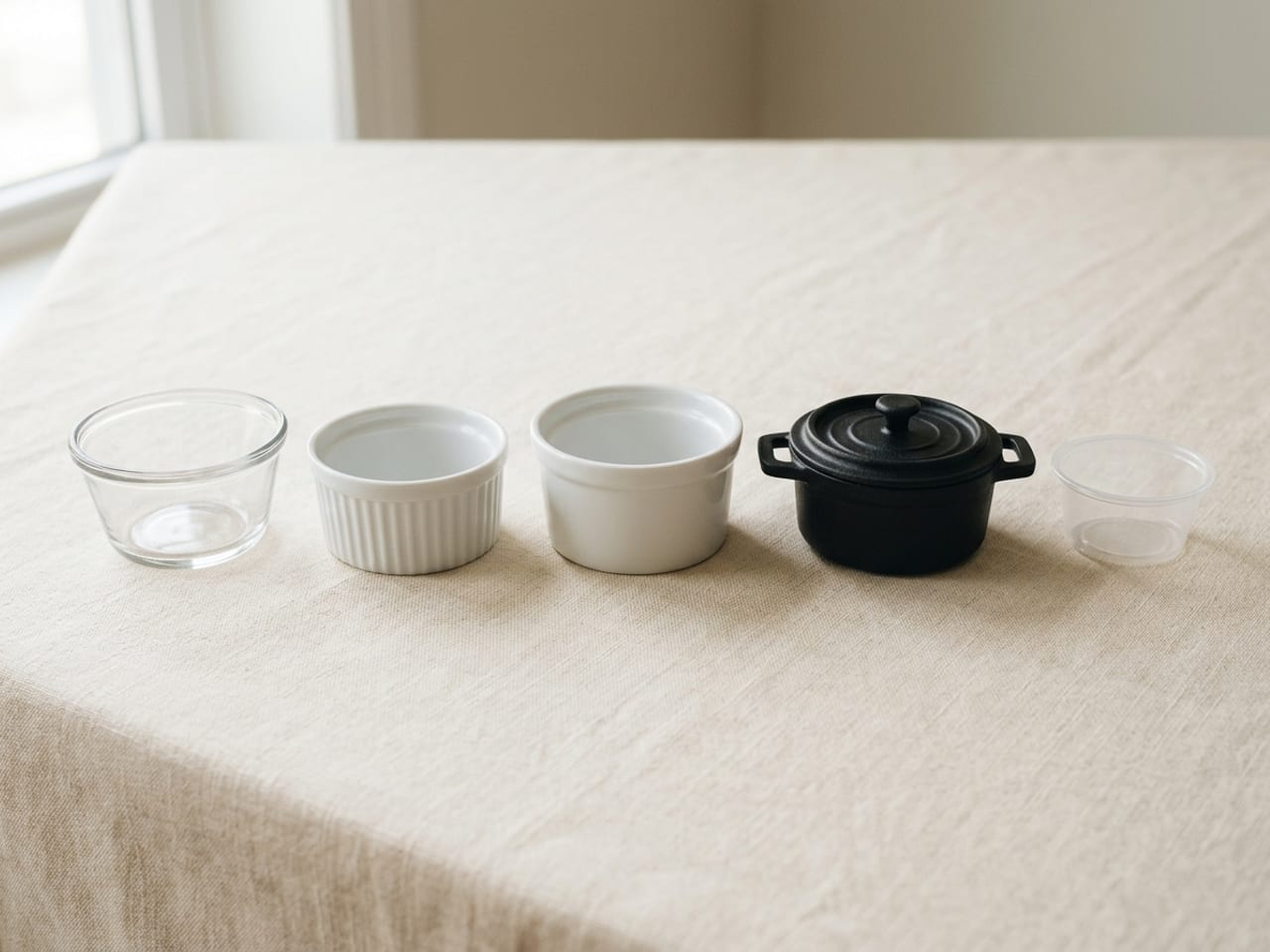
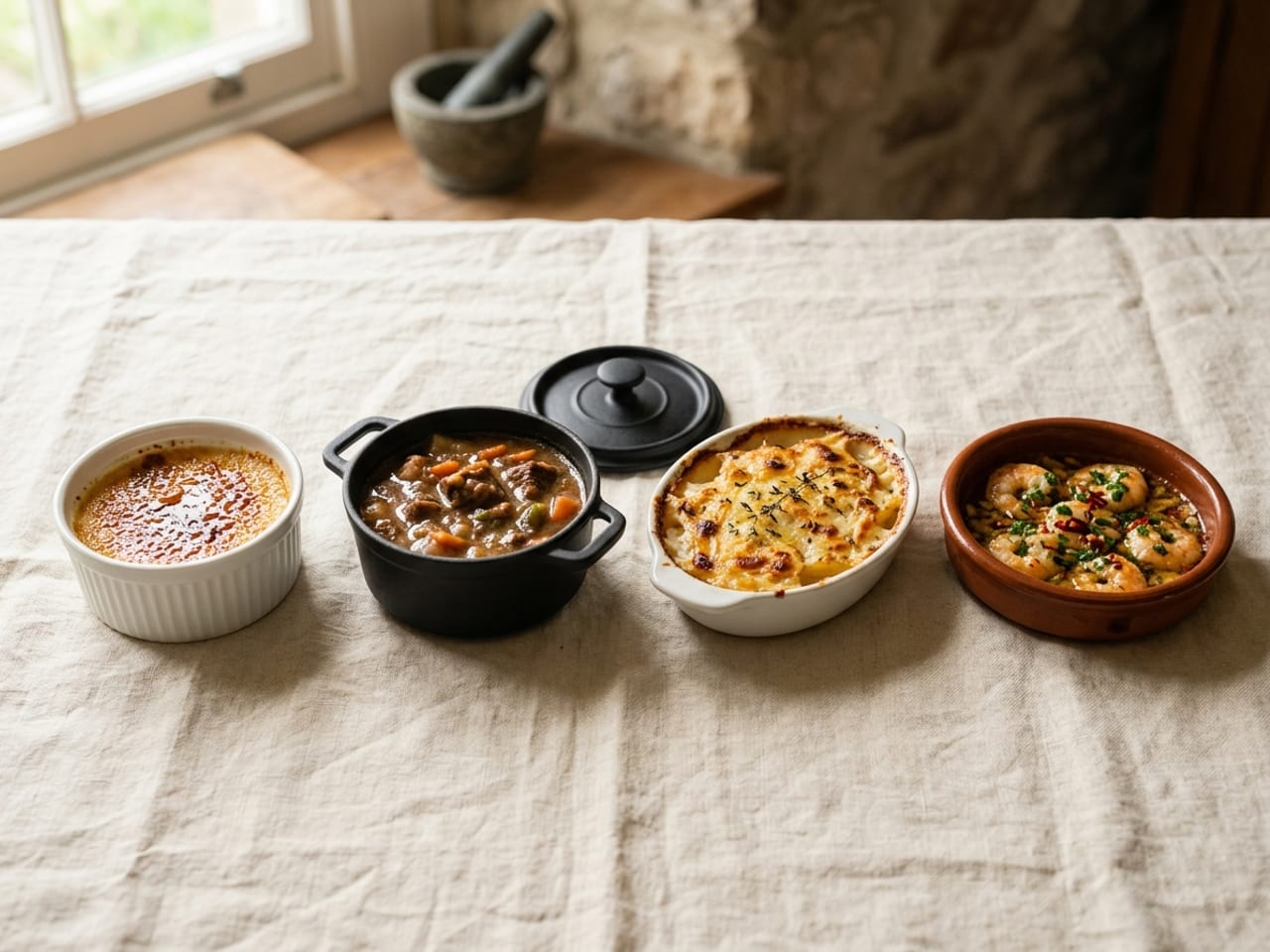
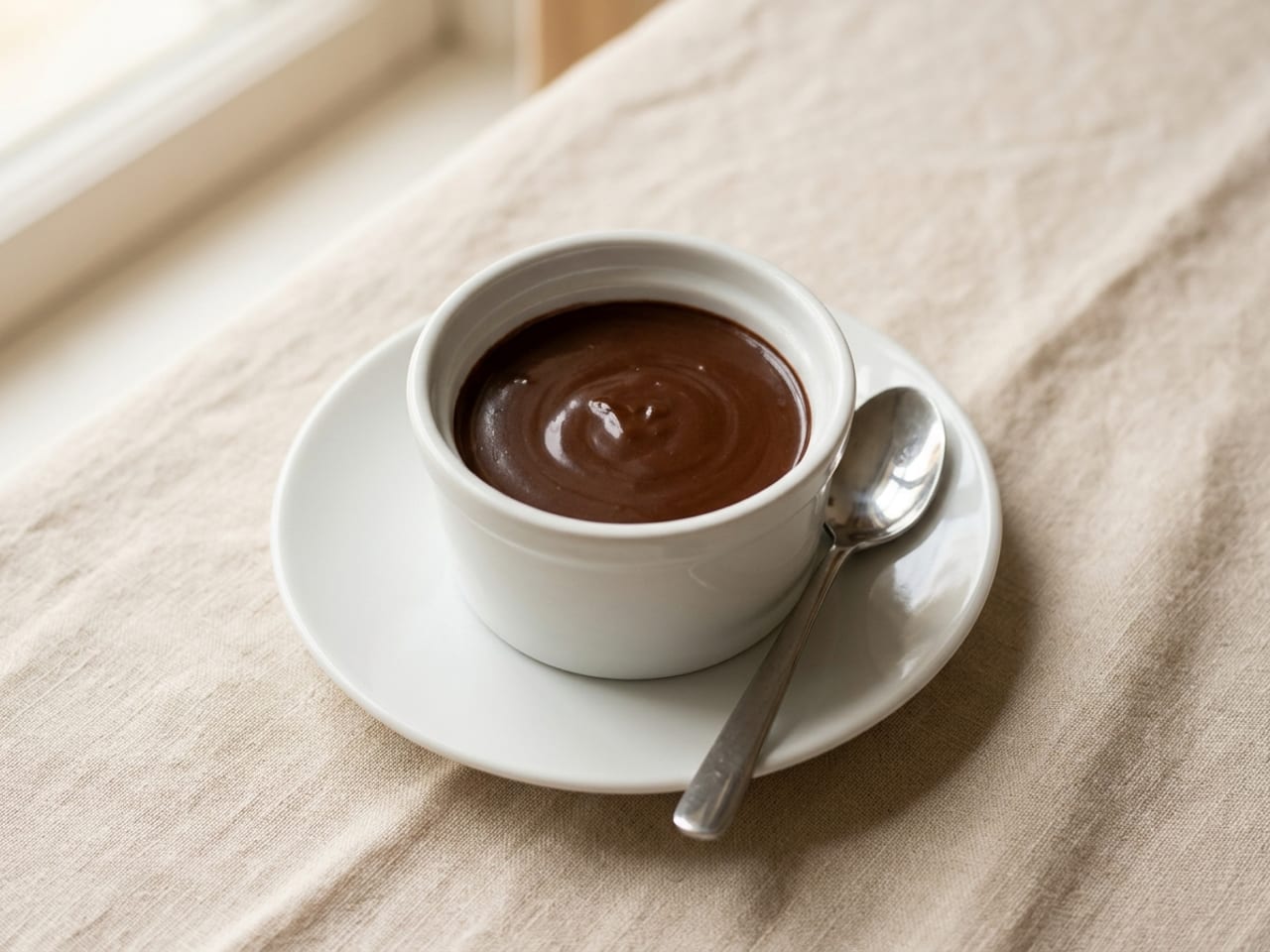
The photos on this page are AI-generated illustrations.
What is a ramekin?
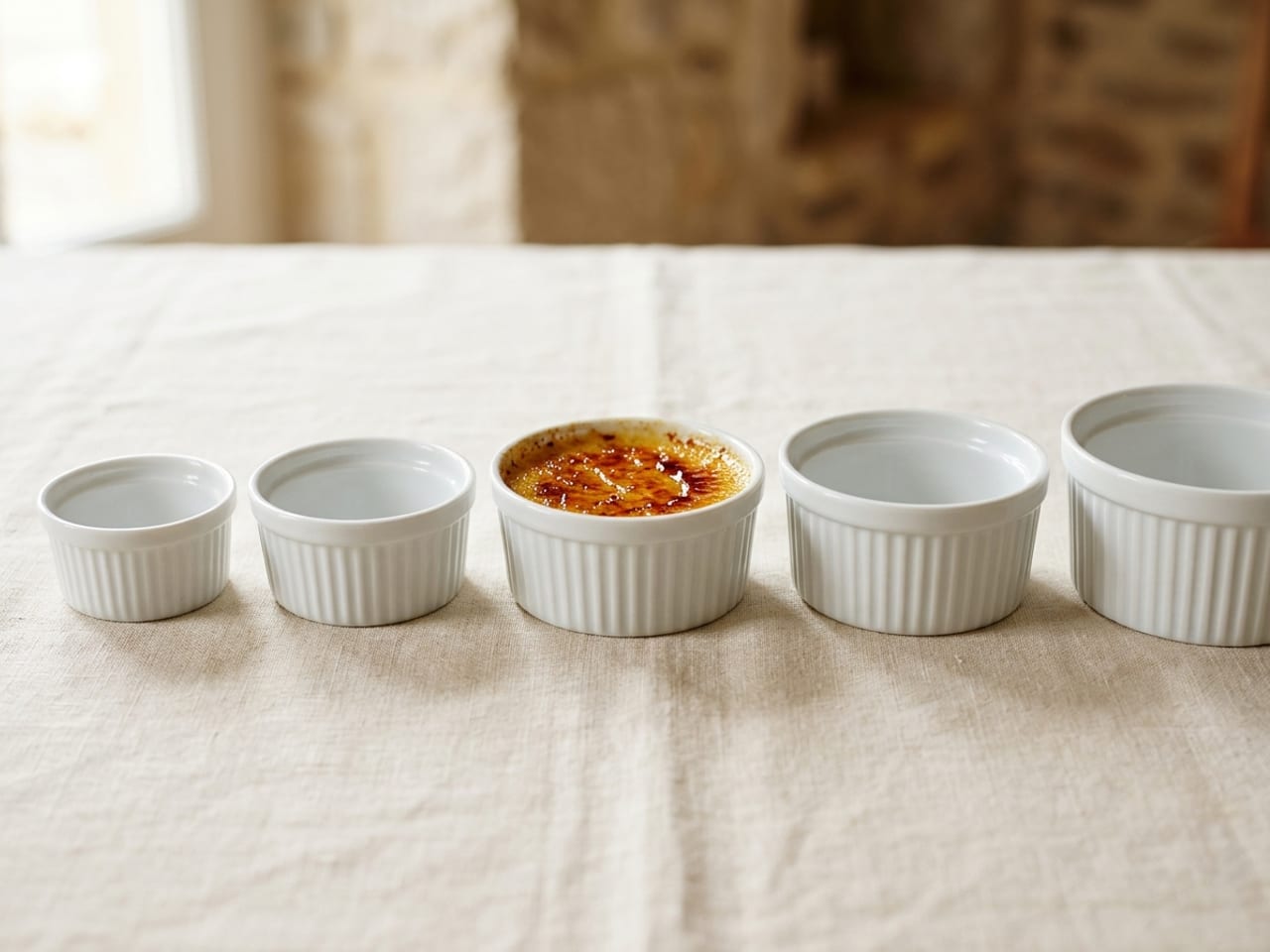
A ramekin is "a small dish in which food for one person is baked and served".70 Makers label them from 1.5 to 14 oz (44 to 414 ml); 4 oz (118 ml) and 6 oz (177 ml) are the labels the most makers in our tally print. There is no size standard in what we read, and labels run small: Cook's Country filled ten ramekins to the brim and nine held more than the label said.1 Of the 17 recipes we read that print a ramekin size, 7 name about 6 oz or a range that includes it (Ina Garten 6 to 8 oz, Le Cordon Bleu 150 to 200 ml) and 5 about 4 oz (one as a shallow 120 to 150 ml).34, 36, 41 Oven safe means your dish's own printed rating: the oven figures we read run from 350°F (177°C), in shop copies of HIC's text, and 425°F (218°C) for Anchor Hocking glass custard cups, as a distributor prints it, to 570°F (299°C) for Staub; Cook's Country lists 400°F (204°C) for one stoneware set. Freezer to hot oven splits them: Emile Henry, Pillivuyt, Staub and HIC say yes; Le Creuset, Denby and the glass custard-cup makers say no, and Cook's Country does not recommend it.1, 5, 9, 14, 15, 18, 23, 24, 26 Follow your own dish's maker.
On this page: Ramekin sizes · Which size for which dish · Oven, broiler, freezer · The water bath · Lead in glazes · Ramekin vs the lookalikes · Serving · Substitutes · The word · FAQ
Ramekin sizes: what makers print, in oz, ml, inches and cm
Ramekin sizes are labels, not a standard: no standard turned up in anything we read. Here are 35 ramekins from 10 makers as their own pages print them (or a shop repeating the maker's text, marked "via a shop"), read on 8 November 2026. The ml, fl oz, inch and cm figures in brackets are our conversions (1 US fl oz = 29.57 ml). Of the 10 makers, eight do not say whether a capacity is to the brim: Pillivuyt's shop prints the "comfortable" capacity, Emile Henry prints a working and a total figure, and Mason Cash names its ramekins by width with no capacity at all. Makers sell what they rate. The first 11 rows are the 4 to 8 oz (118 to 237 ml) labels (4 and 6 oz are the ones most makers print) and one row from each metric line.
| Maker and line | Capacity as labelled (our conversion) | Across, as printed (diameter or width) | High | Material | Oven rating as printed |
|---|---|---|---|---|---|
| Revol2, 3 French Classics | 4 oz (118 ml) | 3.25 in (8.3 cm) | 1.5 in (3.8 cm) | Porcelain | "Bake in the oven", no figure; freezer and thermal shocks to -20°C (-4°F) |
| Revol2 French Classics | 6 oz (177 ml) | 4 in (10.2 cm) | 1.75 in (4.4 cm) | Porcelain | "Bake in the oven", no figure; freezer and thermal shocks to -20°C (-4°F) |
| Emile Henry4 Ramekin N°8 | 170 ml (5.7 fl oz) 0.17 L capacity, "Capacité totale" 0.20 L (6.8 fl oz); height as printed on the maker's page, taller than its N°10, so possibly a typo | 8.5 cm (3.35 in) | 7.5 cm (2.95 in) | Ceramic | Max 270°C (518°F), min -20°C (-4°F) |
| Pillivuyt8, 13 Deep pleated, via a shop | 4 oz (118 ml) "comfortable" capacity, not to the brim | 2.75 in (7 cm) | 2 in (5.1 cm) | Porcelain | Oven to 550°F (288°C) |
| HIC14 Soufflé 98004 | 4 oz (118 ml) | 3.25 in (8.3 cm) | 1.875 in (4.8 cm) | Porcelain | "safe for ... oven, and broiler (to 350-degrees Fahrenheit)" (177°C): the figure follows "broiler"; no separate oven figure |
| HIC14 Soufflé 98005 | 6 oz (177 ml) | 3.75 in (9.5 cm) | 2 in (5.1 cm) | Porcelain | "safe for ... oven, and broiler (to 350-degrees Fahrenheit)" (177°C): the figure follows "broiler"; no separate oven figure |
| HIC14 Soufflé 98006 | 8 oz (237 ml) | 4 in (10.2 cm) | 2 in (5.1 cm) | Porcelain | "safe for ... oven, and broiler (to 350-degrees Fahrenheit)" (177°C): the figure follows "broiler"; no separate oven figure |
| Tuxton16 White ramekin | 4 oz (118 ml) | 3.375 in (8.6 cm) | 1.75 in (4.4 cm) | Vitrified china | Oven to 500°F (260°C) |
| Le Creuset17 Stackable ramekin, "8 cm" (UK) | 200 ml (6.8 fl oz) Sold as "8 cm"; its own key gives the width as 9.3 cm | 9.3 cm (3.66 in) | 5.6 cm (2.2 in) | Stoneware | -23 to +260°C (-9 to 500°F) |
| Mason Cash19 Classic Collection, "9cm" | Not printed No capacity printed | 9 cm (3.54 in) | 5 cm (1.97 in) | Stoneware | "240°C / 464°F" |
| Pyrex20 Custard cup (sold as a custard cup) | 6 oz (177 ml) | 4 in (10.2 cm) | 2 in (5.1 cm) | Tempered glass | "preheated-oven safe", no figure |
Show all 35 rows (24 more)
| Maker and line | Capacity as labelled (our conversion) | Across, as printed (diameter or width) | High | Material | Oven rating as printed |
|---|---|---|---|---|---|
| Revol2 French Classics | 2.75 oz (81 ml) | 2.75 in (7 cm) | 1.5 in (3.8 cm) | Porcelain | "Bake in the oven", no figure; freezer and thermal shocks to -20°C (-4°F) |
| Revol2, 3 French Classics | 5.25 oz (155 ml) Sold in France as 15 cl, 9.5 cm (the same reference, 615970) | 3.75 in (9.5 cm) | 1.75 in (4.4 cm) | Porcelain | "Bake in the oven", no figure; freezer and thermal shocks to -20°C (-4°F) |
| Revol2 French Classics | 8.75 oz (259 ml) | 4.25 in (10.8 cm) | 2 in (5.1 cm) | Porcelain | "Bake in the oven", no figure; freezer and thermal shocks to -20°C (-4°F) |
| Emile Henry4 Ramekin N°9 | 150 ml (5.1 fl oz) 0.15 L capacity, total 0.20 L (6.8 fl oz) | 9 cm (3.54 in) | 5.5 cm (2.17 in) | Ceramic | Max 270°C (518°F), min -20°C (-4°F) |
| Emile Henry4 Ramekin N°10 | 250 ml (8.5 fl oz) 0.25 L capacity, total 0.25 L | 10 cm (3.94 in) | 6 cm (2.36 in) | Ceramic | Max 270°C (518°F), min -20°C (-4°F) |
| Pillivuyt8 Deep pleated, via a shop | 5 oz (148 ml) "comfortable" capacity | 3 in (7.6 cm) | 2 in (5.1 cm) | Porcelain | Oven to 550°F (288°C) |
| Pillivuyt8 Deep pleated, via a shop | 7 oz (207 ml) "comfortable" capacity | 3.25 in (8.3 cm) | 2.25 in (5.7 cm) | Porcelain | Oven to 550°F (288°C) |
| Pillivuyt10, 12, 13 Classic pleated, via a shop | 3 oz (89 ml) Two other shops list it as 10 cl, 8 cm (one as "plissé n°2") | 3 in (7.6 cm) | 1.5 in (3.8 cm) | Porcelain | Not on the shop's page |
| Pillivuyt9, 11, 12 Ramekin white (EU shop), via a shop | 150 ml (5.1 fl oz) | 9 cm (3.54 in) | 4 cm (1.57 in) | Porcelain | Thermal shock -30 to +350°C (-22 to 662°F), the shops' line; Pillivuyt's own blog says -30 to +300°C (-22 to 572°F) |
| HIC14 Ramekin 98002 | 2 oz (59 ml) | 2.75 in (7 cm) | 1.5 in (3.8 cm) | Porcelain | "safe for ... oven, and broiler (to 350-degrees Fahrenheit)" (177°C): the figure follows "broiler"; no separate oven figure |
| HIC14 Soufflé 98003 | 3 oz (89 ml) | 3 in (7.6 cm) | 1.375 in (3.5 cm) | Porcelain | "safe for ... oven, and broiler (to 350-degrees Fahrenheit)" (177°C): the figure follows "broiler"; no separate oven figure |
| HIC14 Soufflé 98007 | 10 oz (296 ml) | 4.25 in (10.8 cm) | 2.375 in (6 cm) | Porcelain | "safe for ... oven, and broiler (to 350-degrees Fahrenheit)" (177°C): the figure follows "broiler"; no separate oven figure |
| HIC14 Deep soufflé 98008 | 10 oz (296 ml) | 3.75 in (9.5 cm) | 2.75 in (7 cm) | Porcelain | "safe for ... oven, and broiler (to 350-degrees Fahrenheit)" (177°C): the figure follows "broiler"; no separate oven figure |
| HIC14 Soufflé 98009 | 14 oz (414 ml) | 4.625 in (11.7 cm) | 2.5 in (6.4 cm) | Porcelain | "safe for ... oven, and broiler (to 350-degrees Fahrenheit)" (177°C): the figure follows "broiler"; no separate oven figure |
| Tuxton16 White ramekin | 1.5 oz (44 ml) | 2.25 in (5.7 cm) | 1.5 in (3.8 cm) | Vitrified china | Oven to 500°F (260°C) |
| Tuxton16 White ramekin | 2 oz (59 ml) | 2.625 in (6.7 cm) | 1.5 in (3.8 cm) | Vitrified china | Oven to 500°F (260°C) |
| Tuxton16 White ramekin | 2.5 oz (74 ml) | 3 in (7.6 cm) | 1.5 in (3.8 cm) | Vitrified china | Oven to 500°F (260°C) |
| Tuxton16 White ramekin | 3.5 oz (103 ml) | 3.25 in (8.3 cm) | 1.625 in (4.1 cm) | Vitrified china | Oven to 500°F (260°C) |
| Tuxton16 Fluted ramekin | 1.5 oz (44 ml) | 2.625 in (6.7 cm) | 1 in (2.5 cm) | Porcelain (as named) | Oven to 500°F (260°C) |
| Tuxton16 Fluted ramekin | 5 oz (148 ml) | 3.5 in (8.9 cm) | 1.75 in (4.4 cm) | Porcelain (as named) | Oven to 500°F (260°C) |
| Mason Cash19 Classic Kitchen, "9.5cm" | Not printed No capacity printed | 9.5 cm (3.74 in) | 4.5 cm (1.77 in) | Stoneware | "Conventional Oven Safe", no figure |
| Pyrex21 Ceramic ramekin | 6 oz (177 ml) No diameter in the text | Not printed | Not printed | Ceramic | Preheated oven up to 450°F (232°C) |
| Apilco27 Ramequin Londres (French shop), via a shop | 150 ml (5.1 fl oz) | 9.5 cm (3.74 in) | 4.5 cm (1.77 in) | Porcelain | Not in the shop's text |
| Staub24 3.5-inch bowl / ramekin | Not printed No capacity in the text | 3.5 in (8.9 cm) | Not printed | Ceramic | Oven and broiler to 570°F (299°C) |
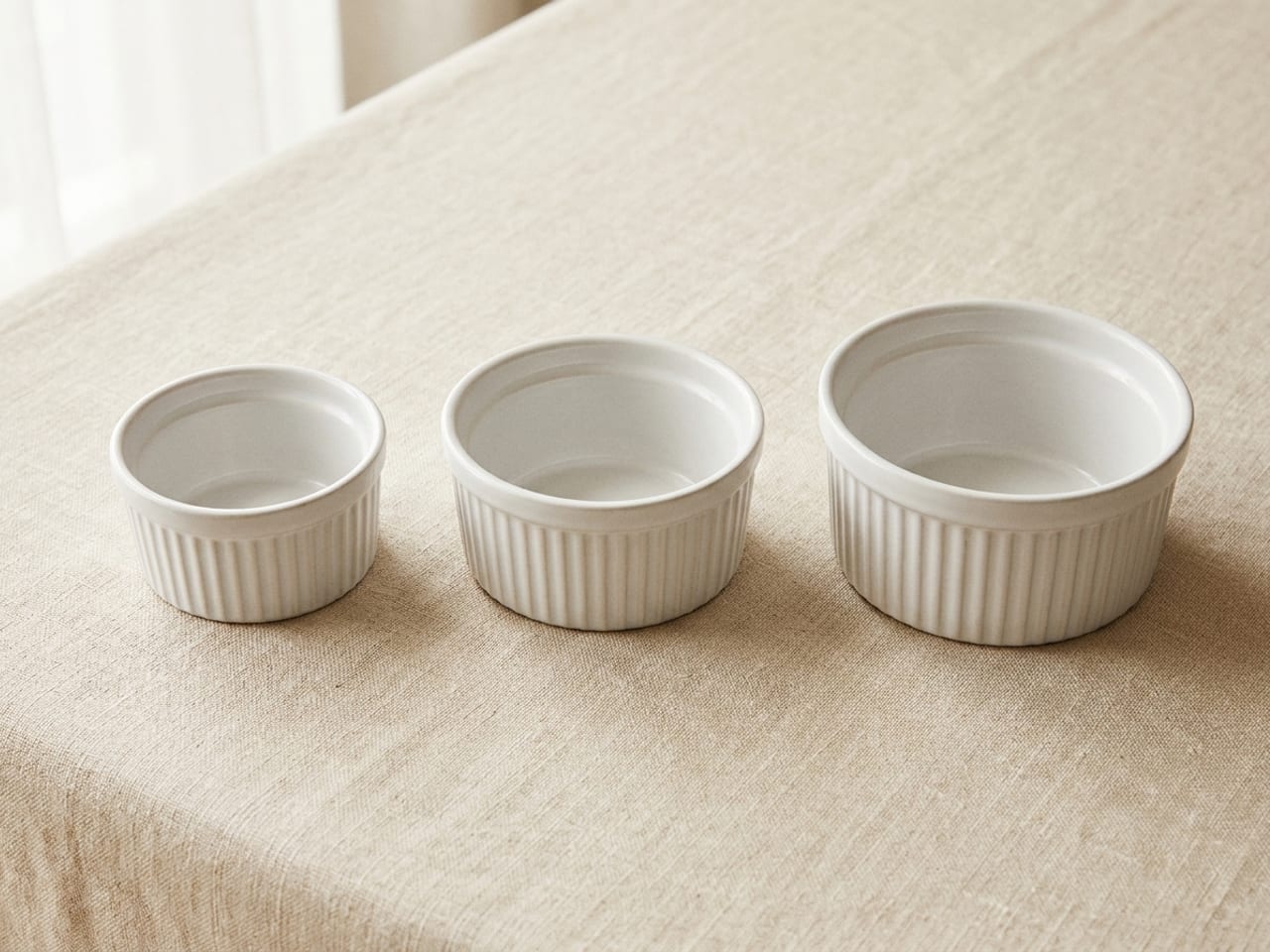
How wide is a 4, 6 or 8 oz ramekin?
It depends on the maker. Our spread from the table above, with Cook's Country's measured widths added for the labels it tested: a 4 oz (118 ml) ramekin runs 2.75 to 3.375 in (7 to 8.6 cm) across (Revol, Pillivuyt, HIC, Tuxton), a 6 oz (177 ml) one 3.5 to 4 in (8.9 to 10.2 cm) (Revol, HIC, Pyrex, and six tested by Cook's Country), and the one 8 oz (237 ml) in our tally, HIC's, 4 in (10.2 cm). The 4 to 8 oz ramekins stand 1.5 to 2.25 in (3.8 to 5.7 cm) high. One label can hide two shapes: HIC sells two 10 oz (296 ml) ramekins, one 4.25 in (10.8 cm) wide and 2.375 in (6 cm) high, the other 3.75 in (9.5 cm) wide and 2.75 in (7 cm) high.1, 2, 8, 14, 16, 20 Shops do not always agree with each other either: one lists Pillivuyt's 4 oz (118 ml) deep pleated ramekin at 3 in, 7 cm, where the Pillivuyt shop says 2.75 in (7 cm); and Le Creuset UK sells its stackable ramekin as "8 cm" while its own measurement key gives a 9.3 cm width.8, 13, 17
| Label (ours in ml) | Makers printing it | Across, as printed (diameter or width) | High |
|---|---|---|---|
| 1.5 oz (44 ml) | Tuxton | 2.25 to 2.625 in (5.7 to 6.7 cm) | 1 to 1.5 in (2.5 to 3.8 cm) |
| 2 oz (59 ml) | HIC, Tuxton | 2.625 to 2.75 in (6.7 to 7 cm) | 1.5 in (3.8 cm) |
| 2.5 oz (74 ml) | Tuxton | 3 in (7.6 cm) | 1.5 in (3.8 cm) |
| 2.75 oz (81 ml) | Revol | 2.75 in (7 cm) | 1.5 in (3.8 cm) |
| 3 oz (89 ml) | Pillivuyt, HIC | 3 in (7.6 cm) | 1.375 to 1.5 in (3.5 to 3.8 cm) |
| 3.5 oz (103 ml) | Tuxton | 3.25 in (8.3 cm) | 1.625 in (4.1 cm) |
| 4 oz (118 ml) | Revol, Pillivuyt, HIC, Tuxton | 2.75 to 3.375 in (7 to 8.6 cm) | 1.5 to 2 in (3.8 to 5.1 cm) |
| 5 oz (148 ml) | Pillivuyt, Tuxton | 3 to 3.5 in (7.6 to 8.9 cm) | 1.75 to 2 in (4.4 to 5.1 cm) |
| 5.25 oz (155 ml) | Revol | 3.75 in (9.5 cm) | 1.75 in (4.4 cm) |
| 6 oz (177 ml) | Revol, HIC, Pyrex | 3.5 to 4 in (8.9 to 10.2 cm) | 1.75 to 2 in (4.4 to 5.1 cm) |
| 7 oz (207 ml) | Pillivuyt | 3.25 to 4.3 in (8.3 to 10.9 cm) | 2.25 in (5.7 cm) |
| 8 oz (237 ml) | HIC | 4 in (10.2 cm) | 2 in (5.1 cm) |
| 8.75 oz (259 ml) | Revol | 4.25 in (10.8 cm) | 2 in (5.1 cm) |
| 10 oz (296 ml) | HIC | 3.75 to 4.25 in (9.5 to 10.8 cm) | 2.375 to 2.75 in (6 to 7 cm) |
| 14 oz (414 ml) | HIC | 4.625 in (11.7 cm) | 2.5 in (6.4 cm) |
Labels run small: what ten ramekins held filled to the brim
Cook's Country (America's Test Kitchen) tested ramekins "advertised as having a capacity between 6 and 7 fluid ounces", the size it found "the most useful for most tasks", and measured each one "filled to the brim", because "Different manufacturers use different benchmarks". Nine of ten held more than the label: "by as much as 2 ounces" (59 ml), it writes; the largest gap in its own table is 1.8 fl oz. It found that "ramekins that were a true 6 ounces struggled to hold all the filling for our recipes", while a true 7.5 or 8 oz (222 or 237 ml) held them with room to spare, and it preferred ramekins "about 3.5 inches across" (8.9 cm), narrow enough to load six or eight into a 13 by 9 in (33 by 23 cm) baking dish.1 The widths and limits below are as it prints them; the ml are ours.
| Ramekin | Label | Filled to the brim | Width | Temperature limit |
|---|---|---|---|---|
| HIC Kitchen Souffle 6 oz (their winner) Porcelain | 6 fl oz (177 ml) | 7⅛ fl oz (211 ml) | 3.7 in (9.4 cm) | 500°F (260°C) |
| Le Creuset Straight Wall Ramekin Stoneware | 7 fl oz (207 ml) | 7½ fl oz (222 ml) | 3.5 in (8.9 cm) | 500° |
| Emile Henry Ramekins (set of 2) Ceramic | 6.8 fl oz (201 ml) | 8 fl oz (237 ml) | 3.3 in (8.4 cm) | 500° |
| Casafina Round Ramekin Pacifica Stoneware | 7 fl oz (207 ml) | 8 fl oz (237 ml) | 3.6 in (9.1 cm) | 400°F (204°C) |
| BIA Cordon Bleu 6 oz Ceramic | 6 fl oz (177 ml) | 6 fl oz (177 ml) | 3.5 in (8.9 cm) | Not specified |
| Anchor Hocking 6 oz Custard Cups Glass | 6 fl oz (177 ml) | 7.3 fl oz (216 ml) | 4 in (10.2 cm) | 425° |
| Pyrex Custard Cups 6 oz Glass | 6 fl oz (177 ml) | 7 fl oz (207 ml) | 4 in (10.2 cm) | Conventional oven, not broiler |
| CorningWare French White 7 oz Ceramic | 7 fl oz (207 ml) | 8 fl oz (237 ml) | 4.3 in (10.9 cm) | Not broiler-safe |
| Mrs. Anderson's Baking Souffle 6 oz (discontinued) Ceramic | 6 fl oz (177 ml) | 7.8 fl oz (231 ml) | 3.7 in (9.4 cm) | Not specified |
| Emile Henry Ramekin, set of 4, 6 oz Ceramic | 6 fl oz (177 ml) | 7 fl oz (207 ml) | 3.7 in (9.4 cm) | 500° |
How to check your own ramekin
The method the sources use: Cook's Country filled each ramekin to the brim and measured what it held, which it calls "the most accurate way to compare".1 Le Cordon Bleu's soufflé recipe says to "Check the volume of your ramekins before starting".41 For width, America's Test Kitchen's baked eggs measure the diameter "from the inner lip", while Pillivuyt's shop measures "from top edge to top edge", so a printed width and your own can differ by the rim.8, 53
What size ramekin for crème brûlée, soufflé, lava cake and the rest
No recipe source we read names a standard size, so here is what 26 named recipes call for, 7 kinds of dish, as printed (cups and ml converted by us). Of the 17 that print a ramekin size, 7 name about 6 oz or a range that includes it (Ina Garten 6 to 8 oz, Le Cordon Bleu 150 to 200 ml) and 5 about 4 oz (one as a shallow 120 to 150 ml): 6 oz is the size named most often, not the size most recipes use. The rest run from 5 oz (148 ml) pots de crème to 10 oz (296 ml) pot pies, and one soufflé dish King Arthur calls a ramekin holds 1½ quarts. A few rows use no ramekin at all; they show what the dish was baked in instead. Serious Eats, Food Network, Delia Online, Martha Stewart, Allrecipes, The Kitchn and Simply Recipes refused this machine and NYT Cooking was paywalled, so they are missing, and we read no Julia Child, Joy of Cooking or mac and cheese recipe.
| Dish, recipe (date) | Vessel and size, as printed | Fill, water bath, time |
|---|---|---|
| Crème brûlée King Arthur Baking31 Undated | ½ cup (4 fl oz, 118 ml) ramekins "about 2" tall" (5 cm) | Water halfway up; torch or broiler |
| Crème brûlée BBC Good Food32 Undated | Four 175 ml (5.9 fl oz) ramekins | Filled "right to the top"; water 1.5 cm (0.6 in) up; 30 to 35 min |
| Crème brûlée Cook's Illustrated33 Undated | Eight 6 oz (177 ml) ramekins | On a towel; boiling water two-thirds up, poured once the pan is on the rack |
| Crème brûlée Ina Garten34 Undated | 6 to 8 oz (177 to 237 ml) ramekins | Filled "until almost full"; water halfway; 35 to 40 min |
| Soufflé Le Cordon Bleu41 Undated | Six 150 to 200 ml (5.1 to 6.8 fl oz) ramekins | Ramekins of 250 to 300 ml (8.5 to 10.1 fl oz): the batch serves four, 3 to 5 min longer |
| Soufflé King Arthur Baking39 Undated | One 7½ in (19.1 cm), 1½ quart (48 fl oz, 1.4 L) "ramekin" | Batter below the top; rises 2 in (5 cm) above the rim in 35 to 40 min |
| Chocolate lava cake (molten cake, fondant) Once Upon a Chef (Jennifer Segal)42 17 Oct 2024 | Six oven-proof 6 oz (177 ml) ramekins | Slightly larger ramekins: "a minute or two" more and fewer servings |
| Chocolate lava cake (molten cake, fondant) Chowhound43 Undated | Six 4 oz (118 ml) ramekins | Buttered and floured, turned out onto plates |
| Pots de crème, flan and crème caramel Bon Appétit (pots de crème)45 8 Apr 2015 | Twenty-four 4 oz (118 ml) ramekins "or small heatproof bowls" | Water halfway |
| Pots de crème, flan and crème caramel America's Test Kitchen (pots de crème)46 Undated | Eight 5 oz (148 ml) ramekins | A stovetop custard: no oven, no water bath |
| Pots de crème, flan and crème caramel Epicurious (caramel flan)47 3 Jun 2024 | Six ¾ cup (6 fl oz, 177 ml) "ramekins or custard cups" | Caramel in first; pan on the rack, then the hot water |
| Individual pot pie Emeril Lagasse49 Undated | Six 10 oz (296 ml) ramekins | Oven at 400°F (204°C) |
| Individual pot pie Trisha Yearwood and Beth Yearwood Bernard50 Undated | Eight 10 oz (296 ml) ramekins | About ½ in (1.3 cm) of room at the top; on a rimmed baking sheet |
| French onion soup Taste of Home51 Undated | Twelve 8 oz (237 ml) "broiler-safe bowls or ramekins" | On baking sheets, broiled 4 in (10 cm) from the heat |
| French onion soup BBC Good Food52 Undated | "heatproof bowls" Not a ramekin: a heatproof bowl | No ramekin in the recipe |
| Baked, shirred and poached eggs America's Test Kitchen (baked eggs Florentine)53 Undated | 6 oz (177 ml) ramekins, 3¼ in (8.3 cm) across "measured from the inner lip" | Whites "just opaque but still tremble", 6 to 8 min |
| Baked, shirred and poached eggs Jacques Pépin, in Saveur (oeufs en cocotte)54 5 Oct 2015 | "ramekins or small pots", no size | Steamed in a water bath on the stove |
Show all 26 recipes (9 more)
| Dish, recipe (date) | Vessel and size, as printed | Fill, water bath, time |
|---|---|---|
| Crème brûlée Egg Farmers of Canada (an egg board)35 Undated | Four ½ cup (125 mL as printed) ramekins or custard cups | Tall, about 2 in (5 cm): 30 to 35 min; shallow, about 1 in (2.5 cm): 25 to 30 min |
| Crème brûlée Chef Chloe Hammond, in The Takeout36 15 Aug 2025 | Shallow ramekins "around 120/150ml" (4.1 to 5.1 fl oz) | "Shallow ramekins cook faster" |
| Crème brûlée Saveur37 Undated | Four shallow gratin dishes, "each about 1/2 cup" (118 ml) Not a ramekin: a gratin dish | Cold water halfway; 30 to 35 min |
| Crème brûlée Milk Street38 Undated | "ramekins", no size in the part we read | On a wet towel, cold oven set to 275°F (135°C), about an hour, no water bath |
| Soufflé BBC Good Food40 Undated | One soufflé dish, "approx 20 x 8cm deep" (7.9 x 3.1 in) Not a ramekin: a soufflé dish | No ramekin in the recipe |
| Chocolate lava cake (molten cake, fondant) Gordon Ramsay (chocolate fondant)44 Nov 2008 | "ramekins" (no size), or 150 ml (5.1 fl oz) aluminium muffin tins | Ramekins 10 to 12 min, muffin tins 10; baked from frozen: 5 min more |
| Pots de crème, flan and crème caramel BBC Good Food (crème caramel)48 Undated | "ramekins", no size printed | Boiling water halfway; 15 to 20 min |
| Baked, shirred and poached eggs Yankee Magazine (shirred eggs)55 Undated | "Ramekins or custard cups", no size | Muffin tins to make many at once |
| Baked, shirred and poached eggs Salon (microwave poached egg)56 5 Mar 2023 | "the ramekin, bowl, or mug", no size | Covered; the yolk set at about 1 min 20 s in one writer's microwave |
On this site, our crème brûlée bakes in six shallow 4 oz ramekins (120 ml in the recipe), and the fancy desserts hub puts its pots de crème, soufflé and molten cakes in 6 oz (177 ml) ones and its flan in ¾ cup ramekins, each after a named recipe.
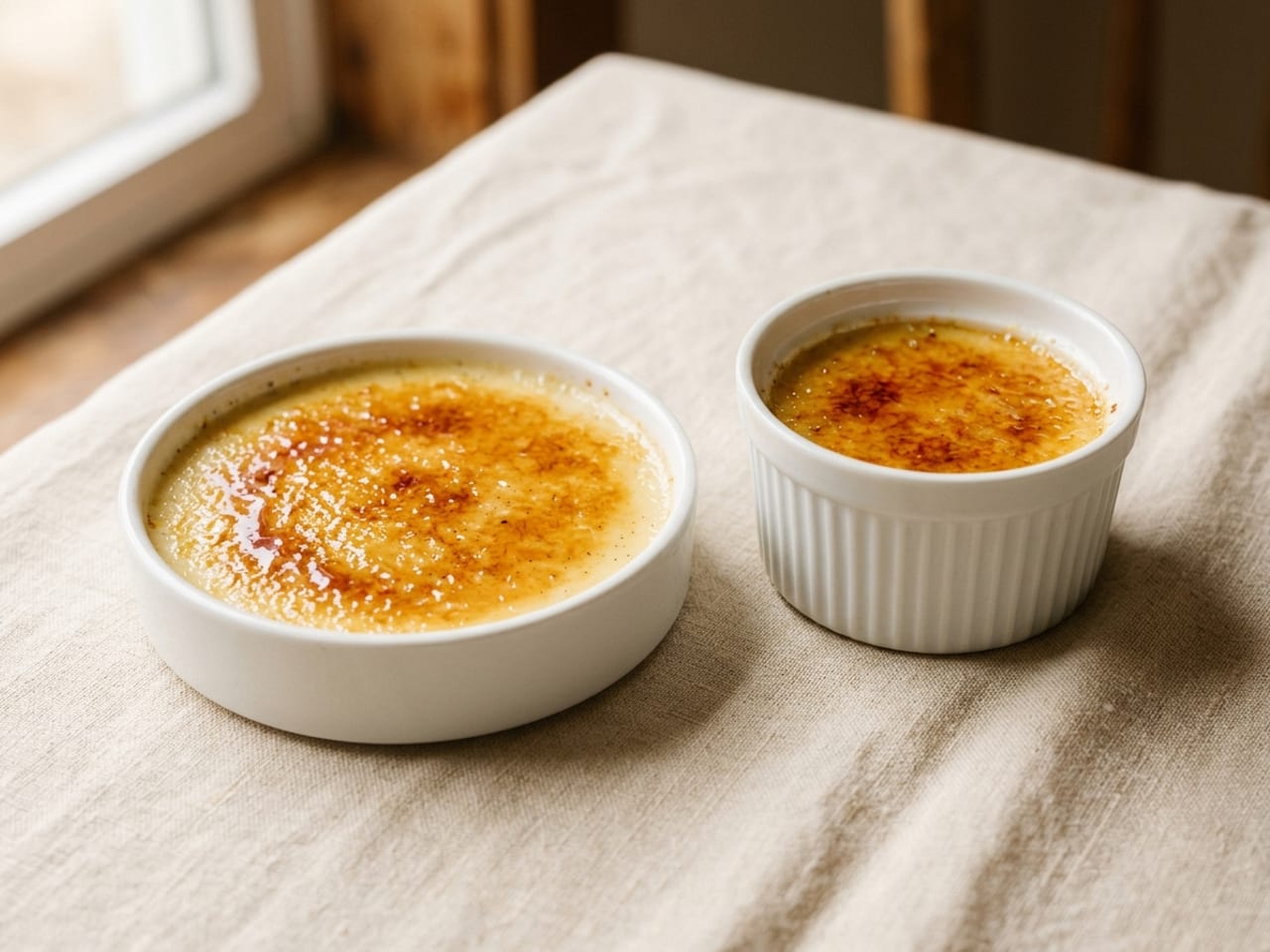
What changes when your ramekin is a different size
- Bigger soufflé ramekins: Le Cordon Bleu says ramekins of 250 to 300 ml (8.5 to 10.1 fl oz) take its six-ramekin batch for four, and need 3 to 5 minutes longer.41
- Bigger lava-cake ramekins: Once Upon a Chef says the recipe "is still doable" in slightly larger ones, with "a minute or two" more and fewer servings.42
- Shallow vs tall for crème brûlée: Egg Farmers of Canada gives 30 to 35 minutes for ramekins about 2 in (5 cm) high and 25 to 30 for shallow ones about 1 in (2.5 cm) high, with 1½ tsp of sugar on top of a shallow one against 1 tsp on a tall one. Chef Chloe Hammond: "Deeper ramekins take longer, which increases the risk of the edges overcooking before the center sets". Saveur's shallow gratin dishes still take 30 to 35 minutes, so the sources differ on how much faster.35, 36, 37
- A true 6 oz (177 ml) may be too small: Cook's Country found ramekins that held a true 6 oz "struggled to hold all the filling" of its recipes; the same review says a true 6 oz still cooked eggs and soufflés well, if a little cramped.1
- Muffin tins instead: Gordon Ramsay's fondant times (10 to 12 minutes) are for ramekins; in 150 ml (5.1 fl oz) muffin tins, "10 mins in the oven will be fine".44
- How full: the sources disagree. BBC Good Food fills crème brûlée "right to the top", Ina Garten "until almost full"; King Arthur's soufflé batter "should not reach the top", and Trisha Yearwood leaves about ½ in (1.3 cm) of room on a pot pie.32, 34, 39, 50
The earliest ramekins we found were a cheese dish
Before it was a pot, a ramekin was a food: a small baked cheese dish. Menon's cookbook of 1749 prints "ramequins soufflés", puffed with whipped egg whites (our prior reading does not say whether they hold cheese); Eliza Acton's ramekins of 1845 are cheese and puff pastry cut out and baked about fifteen minutes; Mrs Beeton's "ramakins" of 1861 are a cheese paste baked in "small pans or saucers, which should not be more than half filled"; and Mary Harrison in 1905 fills "little ramequin cases". In what we read, none of them gives a dish size.75, 76, 77, 78 How the name moved from the cheese to the dish is under the word.
Are ramekins oven safe? Oven, broiler, microwave, freezer and dishwasher
A ramekin is oven safe to the figure its maker prints, and the figures differ: in what we read, from 350°F (177°C), in shop copies of HIC's text, 425°F (218°C) for Anchor Hocking's glass custard cups (as a distributor prints it) and 450°F (232°C) for Pyrex's ceramic ramekins to 570°F (299°C) for Staub, with Revol printing "Bake in the oven" and no number. Denby's leaflet prints "250°" with no unit, and Cook's Country lists 400°F (204°C) for one stoneware set. Here is each maker's printed rating, from its own page first; where a shop's copy of the maker's text says something else, both are shown. Makers sell what they rate, and none of these figures is a test of ours. The first 7 rows are the makers that disagree with each other or with a tester.
| Maker (material) | Oven | Broiler | Freezer to a hot oven | Microwave, dishwasher, hob |
|---|---|---|---|---|
| Le Creuset17, 18 Stoneware | "500°F / 260°C" (care page and leaflet); the UK ramekin page says -23 to +260°C (-9 to 500°F) | Yes, with at least 2½ in (6.5 cm) between rim and element | No: "Place the frozen dish in a cold oven" and heat them together | Microwave and dishwasher yes; no stovetop; a room-temperature dish: preheat no higher than 205°C (400°F) |
| Emile Henry4, 5, 6, 7 Ceramic | +250°C/500°F on its US page; 270°C (518°F) on its French spec pages; a shop copy says 520°F (271°C) | Not named on its US page ("Use with: Oven; Microwave; Dishwasher"); the shop copy says yes | Yes: "directly from the freezer to the hot oven" | Microwave and dishwasher yes |
| Pillivuyt8, 9 Porcelain | 550°F (288°C) on the Pillivuyt-branded US shop; its own blog gives a range of -30 to +300°C (-22 to 572°F) | Not stated | Yes: "from the freezer to the oven, microwave, or air fryer without risk of cracking" | Microwave, dishwasher and air fryer yes; gas or electric hobs "with a diffuser" |
| HIC1, 14, 15 Porcelain | No separate oven figure: its own page puts "(to 350-degrees Fahrenheit)" after "broiler"; shop copies read "heat safe to 350°F" (177°C) as the limit for the dish; Cook's Country lists 500°F (260°C) for the 6 oz | Yes, with "(to 350-degrees Fahrenheit)" (177°C) after the word | Yes, its own page: "from the fridge or freezer to microwave or conventional oven, without risking cracks"; a shop copy adds "freezer to microwave, oven, and broiler with ease" | Microwave and dishwasher yes |
| Revol2 Porcelain | "Bake in the oven", no figure | Not named | "Resistant to freezer and thermal shocks (-20°C)" (-4°F); no freezer-to-oven line | Microwave and dishwasher yes; "No flame cooking, neither gas nor electric" |
| Pyrex (glass custard cups)20, 22 Tempered glass | "preheated-oven safe", no figure; it can break near the element while the oven preheats | No; nor a toaster oven | Its FAQ gives two answers: thaw a frozen dish completely, or bring it to room temperature | No stovetop |
| Anchor Hocking (glass custard cups)23 Glass | Preheated oven up to 425°F (218°C), as an Australian distributor prints it; Cook's Country prints 425° too | No; nor a toaster oven (the distributor's text) | No: "do not take directly from freezer to pre-heated oven" (the distributor's text) | No stovetop |
Show all 12 makers (5 more)
| Maker (material) | Oven | Broiler | Freezer to a hot oven | Microwave, dishwasher, hob |
|---|---|---|---|---|
| Staub (Zwilling)24 Ceramic | 570°F (299°C) | Yes, to 570°F (299°C) | "goes from freezer to oven to table" | Microwave and dishwasher yes |
| Tuxton16 Vitrified china | 500°F (260°C) | Not stated | Freezer safe; freezer to oven not stated | Microwave and dishwasher yes |
| Mason Cash19 Stoneware | "240°C / 464°F" (9 cm); "Conventional Oven Safe", no figure (9.5 cm) | Not stated | Freezer safe; freezer to oven not stated | "Do not put hot dish directly into cold water" |
| Denby26 China (a general care leaflet) | "250°", no unit printed | No: no "hob or grill" | No: "don't take items from the freezer and put them straight into the oven" | No hob |
| Pyrex (ceramic ramekins)21 Ceramic | Preheated oven up to 450°F (232°C) | Not stated | Not stated | Not stated |
Two disagreements, printed as each source has them. HIC's own page puts "(to 350-degrees Fahrenheit)" (177°C) after "broiler" and prints no separate oven figure; a shop copy reads 350°F as the limit for the dish, while Cook's Country lists a 500°F (260°C) temperature limit for the same 6 oz model. Emile Henry's US page says 500°F (260°C) (+250°C), its French spec pages 270°C (518°F) and a shop's copy 520°F (271°C).1, 4, 5, 6, 14, 15 We do not merge them. Our advice: go by the rating printed for your own dish.
Broiler: Le Creuset allows it with "a gap of no less than 2 ½ inches" (6.5 cm) between rim and element, Staub to 570°F (299°C), HIC with "(to 350-degrees Fahrenheit)" (177°C) after the word; their glass cups never, by Pyrex's FAQ (about its glass bakeware generally) and Anchor Hocking's text (as a distributor prints it).14, 18, 22, 23, 24 Cook's Country says ramekins that are heat-safe to higher temperatures can be broiled or torched "for short periods", as it does for crème brûlée, and King Arthur warns that a broiler can take sugar "from browned to burned quickly".1, 31 Microwave and dishwasher: every maker here that names them says yes for its own ramekins. Air fryer: only Pillivuyt names it, in what we read.9 Toaster oven: Pyrex and Anchor Hocking (the distributor's text) say no for their glass; no ceramic maker we read mentions one. Stovetop: Le Creuset, Revol, Denby, Pyrex and Anchor Hocking say no; Pillivuyt allows gas or electric hobs "with a diffuser".2, 9, 18, 22, 23, 26 Melamine: "generally not suitable for conventional oven baking", says a restaurant-supply shop that sells it.29
Can ramekins go from the freezer to the oven?
The makers split, four to four. Yes: Emile Henry ("directly from the freezer to the hot oven"), Pillivuyt ("without risk of cracking"), Staub ("from freezer to oven to table") and HIC (its own page: "from the fridge or freezer to microwave or conventional oven, without risking cracks"; a shop copy adds "freezer to microwave, oven, and broiler with ease").5, 9, 14, 15, 24 No: Le Creuset ("Do not place a frozen dish of food in a preheated oven"; put it in a cold oven and heat the two together), Denby, Anchor Hocking ("Thaw food before cooking", as a distributor prints its text), and Pyrex, whose FAQ gives two answers, thaw completely or bring the dish to room temperature.18, 22, 23, 26 Cook's Country: "We don't recommend it. Both ceramic and glass ramekins can experience thermal shock if they go straight from the freezer to the oven".1 Revol says its porcelain resists "freezer and thermal shocks (-20°C)" (-4°F) without a freezer-to-oven line.2 A frozen dessert is a different claim: Gordon Ramsay bakes fondants from frozen, adding 5 minutes, without naming the ramekin's maker.44 Our line: follow the maker of the dish in your hand, never a rule for all ramekins.
Thermal shock: why a hot ramekin cracks
Denby's care leaflet puts it plainly: "All pottery and china can crack if exposed to sudden changes in temperature, no matter how strong it is".26 The makers' rules follow from that. Le Creuset: a dish at room temperature goes into an oven preheated no higher than 205°C (400°F), and before adding liquid to a hot dish, "Take the dish out of the oven and allow it to cool for a few minutes first". Mason Cash: "Do not put hot dish directly into cold water". Pyrex: glass "can break when exposed to the direct heating element while the oven is preheating", so preheat fully first.17, 19, 22 Pillivuyt and Revol call their porcelain thermal-shock resistant, a maker's claim.2, 9
Glass custard cups. The American Ceramic Society, summarising a 2012 paper in its Bulletin, calls the margin of safety for soda-lime glass cookware "borderline": in theory it resists fracture only for "temperature differentials less than about 55°C (99°F)", and "virtually all of the reports of glassware failure involved vessels made of the soda lime silicate glass", which "Both World Kitchen and Anchor Hocking now use". We read it as a summary extract, not the full paper.62 Pyrex says it makes both glasses, soda-lime "slightly more resistant to impact breakage" and borosilicate "slightly more resistant to extreme thermal changes".22 In the kitchen, Cook's Country found that glass ramekins "struggled with recipes that require higher oven temperatures of 450 degrees or more" (232°C), because "Glass conducts heat much more effectively than ceramic".1 Our crème brûlée recipe's broiler method, as our fancy desserts hub describes it, says porcelain or stoneware only, never glass; that agrees with every glass maker here.
The water bath: how deep, how hot, and when to pour
Most of the custard recipes we read bake their ramekins standing in a pan of water, and they differ on the water. Depth: of the 10 we read that give one, 8 say about halfway up the ramekins, Cook's Illustrated two-thirds and BBC Good Food 1.5 cm (0.6 in). Heat: 4 of the 10 say boiling or just-boiled, 4 just "hot" or "very hot", BBC Good Food's crème brûlée "hot water (from the tap)" and Saveur's "cold water"; Milk Street skips the bath for a cold oven and a wet towel. We print the split rather than pick one.
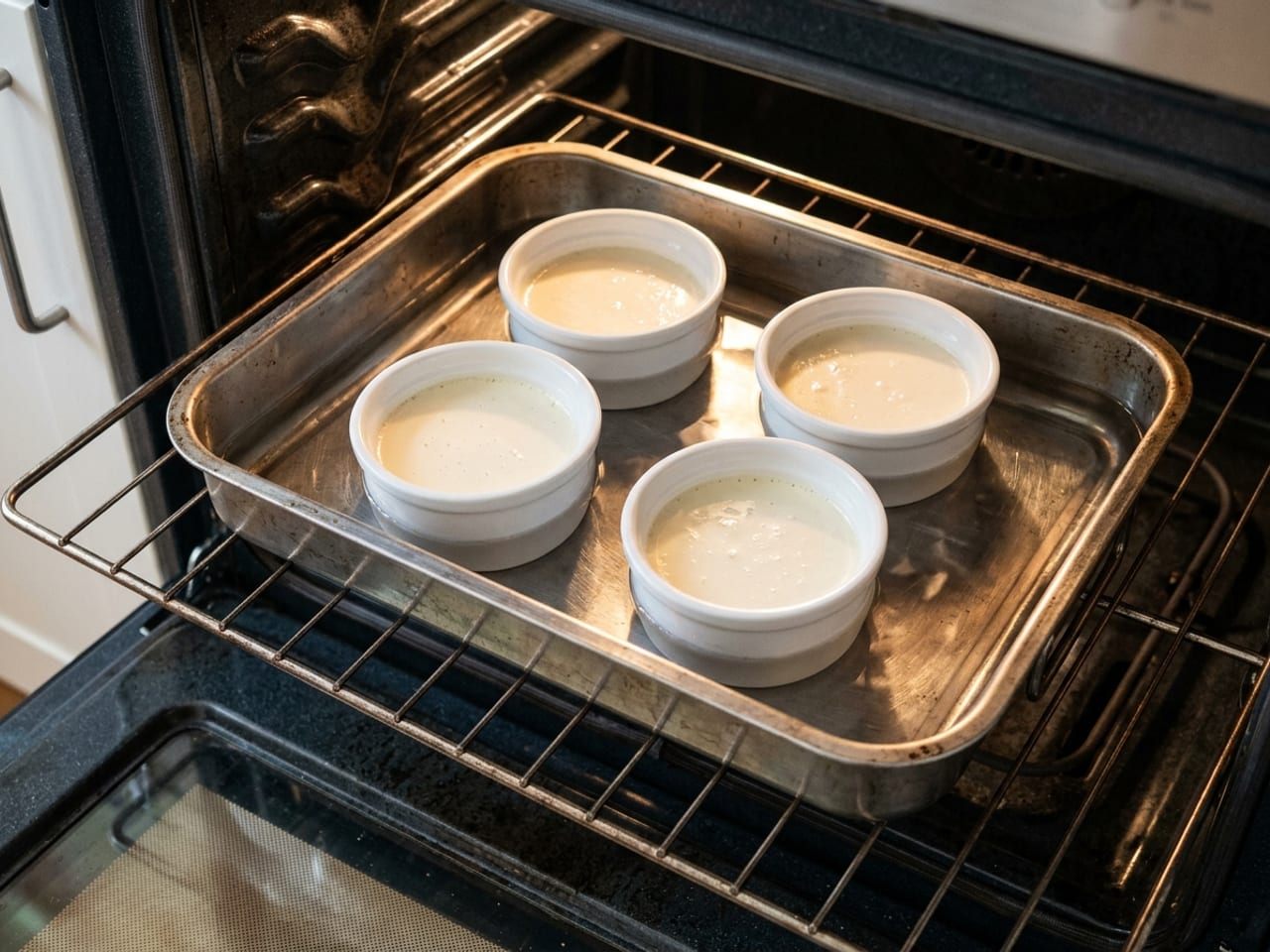
When to pour, the sources split too. Cook's Illustrated ("Set baking dish on oven rack", then the boiling water) and Epicurious ("If you add water to the pan before moving it, you risk sloshing water into your custards") pour with the pan on the rack, and the writer of a Yahoo Lifestyle article on chef instructor Elise Bayard Franklin's tips says "it's useful to wait to pour in the water until your roasting pan is already situated in the oven". BBC Good Food and Egg Farmers of Canada pour first and then put the pan in the oven. Bayard Franklin herself pours just-boiled water and puts the pan straight in the oven, says "Pour slowly and from a low height", and lifts each ramekin out by its rim with tongs.32, 33, 35, 47, 57 Ours, not a rule the recipes share: set the pan on the oven rack first, then pour, so you never carry a pan of hot water. That is the safety line on our fancy desserts hub too: fill the water bath once the dish is sitting on the oven rack.
| Recipe | Depth and water, as printed |
|---|---|
| King Arthur Baking (crème brûlée) | Halfway up. Water: "hot water"31 |
| BBC Good Food (crème brûlée) | "about 1.5cm" (0.6 in) up. Water: "hot water (from the tap)", then the tin goes in the oven32 |
| BBC Good Food (crème caramel) | Halfway up. Water: "boiling water from the kettle"48 |
| Cook's Illustrated (crème brûlée) | Two-thirds up. Water: Boiling, poured once the pan is on the rack, over a towel33 |
| Ina Garten (crème brûlée) | Halfway up. Water: Boiling34 |
| Egg Farmers of Canada (crème brûlée) | Halfway up. Water: "very hot water", then the dish goes in the oven35 |
| Bon Appétit (pots de crème) | Halfway up. Water: Hot45 |
| Elise Bayard Franklin, chef instructor (Yahoo) | "about halfway", allowing for what the ramekins displace. Water: "just-boiled or simmering", then straight into the oven57 |
| Epicurious (flan) | Halfway up ("the outsides of ramekins"). Water: Hot, poured once the dish is on the rack47 |
| Saveur (crème brûlée, gratin dishes) | "about halfway". Water: "cold water"37 |
| Milk Street (cold-oven crème brûlée) | No water bath. Water: A wet towel under the ramekins, cold oven38 |
Lead and cadmium in ramekin glazes
The rules below are each authority's, in its own terms; none of them names ramekins, and neither FDA's table nor the EU, English or Dutch categories say which category a ramekin falls in, so we make no claim about that. A maker's "lead-free" line is the maker's claim, and none we read cites a test.
| Authority | What it says |
|---|---|
| US FDA, 21 CFR 109.16 (rule of 1994) | Decorative ceramicware must say "Not for Food Use" so it "is not mistakenly used to hold food"; without the label and base statement (or "A hole is bored through the potential food-contact surface"), ware introduced from 13 July 1994 that looks fit for food "will be considered to be for food use"63, 64 |
| US FDA action levels (CPG 545.450, 545.400) | Lead leached from small hollowware (other than cups and mugs): 2 µg/ml; cadmium: 0.5 µg/mL. FDA's table does not say which category a ramekin falls in65 |
| EU, Directive 84/500/EEC (1984 text) | Category 1 (cannot be filled, or filled no deeper than 25 mm, 1 in): lead 0.8 mg/dm2, cadmium 0.07 mg/dm2. Category 2 ("All other articles which can be filled"): lead 4.0 mg/l, cadmium 0.3 mg/l. Category 3 ("Cooking ware", and storage vessels over 3 L): lead 1.5 mg/l, cadmium 0.1 mg/l. The directive does not say which category a ramekin is in, and we make no claim67 |
| England, SI 2006/1179 (as made) | The same three categories and figures (as made in 2006; amendments since not read)68 |
| The Netherlands, from 29 May 2026 (via SGS) | Other fillable articles (category II): cadmium 20 µg/L, lead 30 µg/L; cooking ware (category III) tighter still, cadmium 7 µg/L, lead 10 µg/L; far tighter than the 1984 EU figures; a Dutch rule, not EU-wide69 |
| California, Proposition 65 | A general level for lead of 0.5 micrograms a day; we read no Prop 65 text written for ceramics66 |
| Makers (sellers) | HIC: "lead- and cadmium-free"; Tuxton: "no lead or cadmium"; Pyrex ceramic: "made without lead or cadmium". Their claims; none cites a test14, 16, 21 |
Our advice, not an authority's: bake and serve only in ware sold for food; a decorative pot, or one labelled "Not for Food Use", stays decorative. The same rules for plates are on our types of plates guide.
Ramekin vs custard cup, soufflé dish, mini cocotte and sauce cup
The names overlap in shops and recipes, and most of them have no definition in anything we read. Where a dictionary, a blog or a shop defines one, it is credited; a maker's product name counts only as "sold as"; where we found nothing, the line says "Ours".
| Name | What it is | Sizes seen | Against a ramekin |
|---|---|---|---|
| Ramekin1, 70, 71 | A small dish in which food for one person is baked and served (Cambridge). | Labelled 1.5 to 14 oz (44 to 414 ml) in the makers' tally above; often white, fluted and straight-sided | The vessel this page is about |
| Custard cup20, 21, 47, 59, 60 | Small cups used for baking custards (CulinaryLore, a one-author blog); Pyrex sells its glass 6 oz (177 ml) cup as a custard cup and its ceramic 6 oz as a ramekin. | Pyrex glass 6 oz (177 ml), 4 x 2 in (10.2 x 5.1 cm); Anchor Hocking glass 6 oz (177 ml) | Recipes swap them freely (Epicurious, Egg Farmers of Canada, Yankee). One blog says custard cups flare and ramekins are straight; one listicle says custard cups are shallower. No maker or dictionary we read settles the shape |
| Soufflé dish2, 14, 39, 40 | Ours: a straight-sided baking dish sold under the soufflé name, from ramekin size up to a family-size dish; no dictionary or maker we read defines it. | HIC sells 3 to 64 oz (89 ml to 1.9 L) under the name; Revol sells an "Individual Souffle" of 5¼ to 13 oz (155 to 384 ml) apart from its ramekins; BBC Good Food's is about 20 x 8 cm (7.9 x 3.1 in) | At ramekin sizes the names overlap: HIC's 4, 6 and 8 oz (118, 177 and 237 ml) ramekins are "soufflés" in its own list, and King Arthur calls a 1½ quart soufflé dish a ramekin |
| Mini cocotte24, 25, 54, 55 | Ours: a small lidded pot with handles, sold as a mini cocotte; we read no definition. | Staub's, sold by a shop: 5.4 x 4 x 2.6 in (13.7 x 10.2 x 6.6 cm) with its handles; the shop's copy says to 572°F (300°C), while Zwilling prints 570°F (299°C) for Staub's 3.5 in (8.9 cm) ramekin | The dish oeufs en cocotte is cooked in ramekins too: Pépin steams the eggs in "ramekins or small pots", and Yankee calls ramekins and custard cups "today's most common cocottes" |
| Crème brûlée dish27, 35 | Ours: a wide, shallow single-portion dish for crème brûlée, sold under that name; we read no definition. | Apilco's "ASSIETTE LONDRES CREME BRULEE" (an "assiette", a plate), as a French shop lists it: 14 cm (5.5 in) across, 2.5 cm (1 in) high, 11 cl (3.7 fl oz) | Apilco's is wider (14 cm, 5.5 in) and shallower (2.5 cm, 1 in) than the 2 in (5 cm) ramekins in the recipes; Egg Farmers of Canada times 1 in (2.5 cm) shallow ramekins 5 minutes faster than 2 in ones |
| Pot de crème cup45, 46, 61 | Ours: a small lidded porcelain cup for pots de crème; Wikipedia, the only source we read on it, says the dessert is served in ramekins or such cups. | No maker's size read | The recipes we read use ramekins: 4 oz, 118 ml (Bon Appétit), 5 oz, 148 ml (America's Test Kitchen) |
| Sauce cup, portion cup or soufflé cup28, 29 | A cup smaller than a ramekin, made mainly for dips, dressings and condiments (RestaurantSupply, a shop); the plastic version is sold as a soufflé or portion cup. | Sauce cups about 1 to 4 oz (30 to 118 ml) against ramekins at about 2 to 12 oz (59 to 355 ml) (RestaurantSupply); Dart's single-use 4 oz (118 ml) plastic cup, 2⅞ in (7.3 cm) across | A sauce cup is for the table, not the oven; a plastic "soufflé cup" is not a soufflé dish |
| Monkey dish | Ours, unsourced: a restaurant-supply name for a small shallow side bowl; the pages that sell them under that name refused us, so we read no definition or size. | None read | Ours: a serving bowl for sides, not a baking dish; check its maker's rating before it goes in an oven |
Serving and plating in a ramekin
On a plate. We found no named source that says a ramekin should sit on an underliner (a small plate under it), or where it goes in a place setting. The nearest is a UK catering shop, Nisbets, in an archived copy of its plate-size page (a seller's claim): "Given that most crème brulée is prepared in a three inch ramekin, it can be challenging to fill or decorate the rest of an 8” plate" (20 cm), so some restaurants serve such desserts on smaller plates, such as their starter plates.30 (Cook's Country prefers ramekins about 3.5 in, 8.9 cm, across.) Our way, unsourced: set the ramekin on a small plate with the teaspoon on the plate beside it, so a hot dish has somewhere to go and the drips stay off the cloth; that is how our fancy desserts hub plates its pots de crème. To size that plate, use the plate size chart; for where a dessert course sits, the table setting guide.
As sauce, dip and prep cups. Cook's Country calls ramekins "perfect for serving nuts, dips, small snacks, and individually portioned soups, custards, pies, and soufflés", and "a stand-in for a mini prep bowl or salt cellar".1 CooksInfo notes the catch in a restaurant: "ramekins don't stack well for storage", so professionals prefer small prep bowls of glass or stainless steel.58 A restaurant-supply shop that sells both sizes them by job: 1 to 2 oz for "Mustard, ketchup, butter, small dips", 3 to 4 oz for "Ranch, salsa, marinara, small sides", 5 to 6 oz for "Custard, baked dips, individual sides" and 8 to 12 oz for "Casseroles, larger desserts, baked appetizers" (ours in ml: 30 to 59, 89 to 118, 148 to 177 and 237 to 355).29 Our au jus guide serves it in a warmed gravy boat or ramekins.
As a ring mold. A greased ramekin, filled and turned out, stands in for a ring mold in the published stacking recipes; it builds upside down, so the top layer goes in first. How, and who does it, is in how to stack food and our plating tools guide.
Carrying it hot. Lift ramekins out of a water bath by the rim with tongs, as chef instructor Elise Bayard Franklin does.57
What to use instead of a ramekin
Only swaps a named recipe or writer uses, with what they say changes; we tested none. Whatever you use, our advice is to check its own oven rating first, and to expect the time to change with the depth of the custard.
| Swap | What the source says |
|---|---|
| A muffin tin, for chocolate fondant (lava cake); shirred eggs for a crowd | Ramsay's 150 ml (5.1 fl oz) aluminium tins bake in 10 minutes, against 10 to 12 in ramekins; Yankee calls a tin "a handy alternative for shirring en masse"44, 55 |
| Custard cups, for flan, crème brûlée, baked eggs | Named beside ramekins by Epicurious, Egg Farmers of Canada and Yankee; one listicle says time or temperature may need changing35, 47, 55, 59 |
| Small heatproof bowls, for pots de crème | Bon Appétit names them beside its 4 oz (118 ml) ramekins45 |
| Shallow gratin dishes, for crème brûlée | Saveur: about ½ cup (118 ml) each, 30 to 35 minutes37 |
| One large soufflé dish, for soufflé | King Arthur bakes 35 to 40 minutes in 1½ quarts (1.4 L); Le Cordon Bleu says large soufflés are the "most tricky" to judge39, 40, 41 |
| Broiler-safe bowls, for french onion soup | Taste of Home: with none, melt the cheese on the toasts instead51, 52 |
| Small pots, a bowl or a mug, for eggs en cocotte; a microwave poached egg | Pépin steams eggs in "ramekins or small pots"; Salon covers "the ramekin, bowl, or mug"54, 56 |
Ours, untested: our crème brûlée recipe says any oven-safe dish that fits the water bath will do if the custard is about ¾ to 1 in (2 to 2.5 cm) deep.
Ramekin meaning, origin and pronunciation
Meaning. Three dictionaries we read give the dish first: Cambridge, "a small dish in which food for one person is baked and served"; American Heritage, "A small ceramic bowl used for baking and serving"; WordNet, "a small fireproof dish used for baking and serving individual portions".70, 71 The food is the older sense, and it is first in Merriam-Webster: "a preparation of cheese especially with bread crumbs or eggs baked in a mold or shell" (from our earlier reading; its site refused us this time), and the Century Dictionary of 1889 to 1891 gives "Toasted cheese and bread, or toast and cheese; Welsh rabbit", then "The case or mold in which a ramekin is baked and served".71, 72 The TLFi's first sense of ramequin is a hot cheese toast or small cheese pastry, with the small porcelain or glass container it bakes in second; Larousse's one-line teaser, the only text of its entry we could read, gives the container: "Petit récipient en terre ou en porcelaine utilisé pour la cuisson au four".73, 74
Origin. English took the word from French ramequin, and there the dictionaries part. Merriam-Webster traces ramequin to Low German ramken, a diminutive of ram, cream, first used in 1653; the TLFi says it was borrowed from Dutch rammeken, with its first date 1656 for a "petit gâteau au fromage" (a small cheese cake), and lists it in the Académie française dictionary from 1694. American Heritage hedges between the two: "perhaps from Dutch dialectal rammeken, toasted bread, or from Low German ramken". The TLFi's earliest citation for the container is 1957; that is the earliest it prints, not necessarily the first use.71, 72, 73 These are the earliest dates we found. English cookbooks used it for the cheese dish long before: Acton in 1845, Beeton ("ramakins") in 1861.76, 77
Pronunciation. Cambridge prints /ˈræm.ə.kɪn/ for UK and US English alike: RAM-uh-kin, three syllables with the stress on the first (our respelling).70 The French ramequin is [ʀamkε̃], two syllables, in the TLFi.73
Ramekins, answered
What is a ramekin used for?
A ramekin is "a small dish in which food for one person is baked and served", in Cambridge's words. The recipes we read bake crème brûlée, soufflés, lava cakes, pots de crème, flan, individual pot pies, French onion soup and eggs in them, and Cook's Country adds nuts, dips, small snacks and a stand-in "mini prep bowl or salt cellar". In the dictionaries and cookbooks we read, the word first named a baked cheese dish, not the pot.
What size is a standard ramekin?
No size standard turned up in what we read. Makers label ramekins from 1.5 to 14 oz (44 to 414 ml); 4 oz (118 ml) and 6 oz (177 ml) are the labels the most makers in our tally print. By the widths makers and Cook's Country print, a 4 oz ramekin is 2.75 to 3.375 in (7 to 8.6 cm) across and a 6 oz one 3.5 to 4 in (8.9 to 10.2 cm), and the 4 to 8 oz (118 to 237 ml) ones stand 1.5 to 2.25 in (3.8 to 5.7 cm) high. Cook's Country calls the straight-sided fluted white dish "the standard in professional kitchens": a shape, not a size.
How big is a ramekin in cups?
Our arithmetic, at 8 US fl oz to the cup: a 4 oz (118 ml) ramekin is ½ cup, a 6 oz (177 ml) one ¾ cup and an 8 oz (237 ml) one 1 cup, as labelled. Recipes print it both ways: King Arthur's crème brûlée uses "1/2-cup capacity ramekins" and Epicurious's flan "¾-cup ramekins". Labels run small: the six ramekins labelled 6 oz in Cook's Country's test held 6 to 7.8 fl oz filled to the brim.
What size ramekin for crème brûlée?
The recipes we read run from ½ cup (118 to 125 ml) to 8 oz (237 ml): King Arthur and Egg Farmers of Canada ½ cup, BBC Good Food 175 ml, Cook's Illustrated 6 oz (177 ml), Ina Garten 6 to 8 oz, and chef Chloe Hammond shallow ones of 120 to 150 ml. Shallow ones can be quicker: Egg Farmers of Canada gives 25 to 30 minutes for ramekins about 1 in (2.5 cm) high against 30 to 35 for ones about 2 in (5 cm) high, while Saveur's shallow gratin dishes still take 30 to 35. Our own crème brûlée recipe uses six shallow 4 oz ramekins (120 ml in the recipe).
What size ramekin for lava cake?
4 or 6 oz in what we read: Chowhound uses six 4 oz (118 ml) ramekins, Once Upon a Chef six 6 oz (177 ml) and says slightly larger ones need "a minute or two" more and give fewer servings. Gordon Ramsay's fondants take 10 to 12 minutes in ramekins (no size printed); his restaurants' 150 ml (5.1 fl oz) muffin tins take 10.
What size ramekin for a soufflé?
For individual soufflés, Le Cordon Bleu uses six ramekins of 150 to 200 ml (5.1 to 6.8 fl oz) and says ramekins of 250 to 300 ml make four and need 3 to 5 minutes more. King Arthur bakes one cheese soufflé in a 1½ quart (1.4 L) dish it calls a ramekin, and BBC Good Food uses a soufflé dish about 20 x 8 cm (7.9 x 3.1 in). No recipe we read calls one size the standard.
What size ramekin for pot pie or French onion soup?
Bigger ones. Both individual pot pies we read use 10 oz (296 ml) ramekins: Emeril Lagasse's, and Trisha Yearwood's with about ½ in (1.3 cm) of room left at the top. Taste of Home's French onion soup goes in 8 oz (237 ml) "broiler-safe bowls or ramekins", broiled 4 in (10 cm) from the heat; BBC Good Food uses heatproof bowls.
Are ramekins oven safe?
Up to their maker's printed rating, and makers differ. In what we read: Le Creuset stoneware 500°F (260°C), Tuxton 500°F (260°C), Pillivuyt 550°F (288°C) on a Pillivuyt-branded US shop, Staub 570°F (299°C), Mason Cash 240°C (464°F), Pyrex's ceramic ramekins 450°F (232°C), Anchor Hocking's glass custard cups 425°F (218°C) (as a distributor prints it), and Revol "Bake in the oven" with no figure. HIC's own page puts "(to 350-degrees Fahrenheit)" after "broiler" and prints no separate oven figure; a shop copy reads 350°F (177°C) as the limit for the dish. Our advice: a ramekin with no printed rating has nothing to go by, so keep it for serving.
Can ramekins go under the broiler?
Some porcelain and stoneware ones can, by their makers: Le Creuset with at least 2½ in (6.5 cm) between rim and element, Staub to 570°F (299°C), HIC "to 350-degrees Fahrenheit" (177°C). Their glass cups cannot: Pyrex's FAQ (about its glass bakeware generally) and Anchor Hocking's text (as a distributor prints it) say no broiler and no toaster oven. Cook's Country says ramekins that are heat-safe to higher temperatures can be broiled or torched "for short periods", as it does for crème brûlée, and King Arthur warns a broiler can take sugar "from browned to burned quickly".
Can ramekins go from the freezer to the oven?
The makers split. Emile Henry, Pillivuyt, Staub and HIC say yes for their own ceramics (HIC on its own page, "from the fridge or freezer to microwave or conventional oven, without risking cracks"). Le Creuset says to put a frozen dish in a cold oven and heat them together; Denby says not straight from the freezer; Anchor Hocking's text, as a distributor prints it, says thaw first; Pyrex's FAQ says thaw or bring it to room temperature. Cook's Country does not recommend it: ceramic and glass ramekins "can break or even explode". Follow your own dish's maker.
Are ramekins microwave, dishwasher and air fryer safe?
Every maker in our table that names the microwave and the dishwasher says yes for its own ramekins. Only Pillivuyt names the air fryer in what we read. The stovetop is a no from Le Creuset, Revol, Denby, Pyrex and Anchor Hocking; Pillivuyt allows hobs "with a diffuser". Melamine ones are "generally not suitable for conventional oven baking", a restaurant-supply shop says.
What is the difference between a ramekin and a custard cup?
Mostly the name, and often the material. Pyrex sells its glass 6 oz (177 ml) cup as a custard cup and its ceramic 6 oz as a ramekin, and recipes swap the two (Epicurious, Egg Farmers of Canada, Yankee). One blog says custard cups flare while ramekins are straight-sided; no maker or dictionary we read settles it. Glass has its own limits: Pyrex and Anchor Hocking say no broiler for their glass cups, and Cook's Country found glass struggled at 450°F (232°C) and above.
What can I use instead of a ramekin?
What a named recipe says works: a muffin tin for fondants (Ramsay: 10 minutes) and for shirred eggs, custard cups, small heatproof bowls for pots de crème, shallow gratin dishes for crème brûlée, one large soufflé dish, broiler-safe bowls for onion soup. Our advice: check the swap's own oven rating, and expect the time to change with depth.
How do you pronounce ramekin?
Cambridge prints /ˈræm.ə.kɪn/ for both UK and US English: RAM-uh-kin, stress on the first syllable (our respelling). The French ramequin is [ʀamkε̃] in the TLFi, two syllables.
Baked something in a ramekin? Photograph the plate and Plate Artists re-plates that dish, with the food kept as it is and the changes named. Start with a re-plate.
Your food, plated like a chef's
Snap it, upload it, and get the composed version back, with the steps to recreate it at home.
Start free · 1 enhancement →Free account · 1 free enhancement · No credit card
How this page was made
We measured, baked, tested and bought nothing for this page. Every capacity, width, height, temperature, time and date is what its source printed, read on 8 November 2026 unless its entry says otherwise. Makers and shops sell ramekins and are labelled so where their claims sell product; a shop repeating a maker's text is marked as a copy, and where a maker's own page and a copy differ, the maker's page comes first. Ours: the ml, fl oz, inch, cm and degree conversions (1 US fl oz = 29.57 ml), the cups arithmetic, the per-label spreads, the "about 6 oz" (175 to 200 ml) and "about 4 oz" (½ cup) bands the recipe count uses (a recipe counts in a band when its printed size or range touches it), the grouping of the tables, and every line marked ours. The figures are AI renders, not photographs.
The makers, recipes, dictionaries and rules behind this page
How each source was read (in full, as a shop's copy, as a summary extract, as OCR of a scan or as a prior reading for another of our guides) is in its entry. Makers and shops sell what they describe.
- Bromberg, M. & Savoie, L. (America's Test Kitchen) (2025). The Best Ramekins of 2025. Cook's Country and America's Test Kitchen equipment reviews, last updated 11 June 2025, read in full on 8 November 2026: ten ramekins "advertised as having a capacity between 6 and 7 fluid ounces" measured "filled to the brim"; "the actual capacity of some exceeded the manufacturer's advertised capacity by as much as 2 ounces"; "We preferred ramekins that measured about 3.5 inches across"; "ramekins that were a true 6 ounces struggled to hold all the filling for our recipes"; on freezer to oven, "We don't recommend it"; the same review is on americastestkitchen.com. cookscountry.com
- Revol (2026). Ramekins, French Classics (category and product pages). revol1768.com, US pages (the maker's own page (makers sell what they rate), French porcelain), undated page, read in full on 8 November 2026: sizes "1 2/4 oz 2 3/4 oz 4 oz 5 1/4 oz 6 oz 8 3/4 oz"; e.g. the 4 oz "Diameter 3 1/4INCH Height 1 1/2INCH Volume 4OZ" and the 6 oz "Diameter 4INCH Height 1 3/4INCH Volume 6OZ"; care "Dishwasher safe Bake in the oven Put in the microwave Resistant to freezer and thermal shocks (-20°C) No flame cooking, neither gas nor electric"; no oven temperature printed; the pages do not say whether the volume is brim-full. revol1768.com
- Revol (2026). Ramequin 12 cl and 15 cl, blanc porcelaine. revol1768.com, French pages (the maker's own page (makers sell what they rate)), undated page, read in full on 8 November 2026: "Tailles 4 CL 8 CM 8 CL 12 CL 15 CL 17 CL 18 CL 25 CL"; reference 615076 "Diamètre 8CM Volume 12CL" (the same reference is "4OZ", "3 1/4INCH" on the US page); the 15 cl "Diamètre 9,5CM Volume 15CL", reference 615970, the same reference as the US page's 5 1/4 oz. revol1768.com (FR)
- Emile Henry (2026). Ramekin N°8, N°9 and N°10. emilehenry.com (the maker's own page (makers sell what they rate), French ceramics), undated page, read in full on 8 November 2026: N°8 "Width (cm) 8,5 cm ... Height (cm) 7,5 cm Capacity (L) 0.17 L ... Max Temp. (°C) 270.00 °C Temp. Min (°C) -20.00 °C Capacité totale - L 0.20 L"; N°9 9 cm, 5,5 cm, 0.15 L, total 0.20 L; N°10 10 cm, 6 cm, 0.25 L, total 0.25 L; "Use the right ramekin for the right recipe!"; the N°8 height as printed looks inconsistent with its width. emilehenry.com
- Emile Henry USA (2026). Ramekins (Set of 2). emilehenryusa.com (the maker's own page (makers sell what they rate)), undated page, read in full on 8 November 2026: "Our ceramics allow our products to be taken directly from the freezer to the hot oven (+250°C/500°F)"; "Use with: Oven; Microwave; Dishwasher" (the broiler is not named). emilehenryusa.com
- eKitchenWorld (2026). Emile Henry 5 oz ramekin, set of 2. ekitchenworld.com (a shop's page repeating the maker's product text (retailer copy)), undated page, read in full on 8 November 2026: "For use in the oven up to 520 degrees F. Oven, broiler, and microwave safe: can go directly from freezer or refrigerator, to a hot oven, to Table" (the maker's own US page prints 500°F). ekitchenworld.com
- Kateishop (2026). Emile Henry Ramequin 10 cm. kateishop.com (a shop's page repeating the maker's product text (retailer copy)), undated page, read in full on 8 November 2026: "You can take your dish out of the freezer (-20 ºC) and put it directly in your preheated oven at 250 ºC or in your microwave.". kateishop.com
- Pillivuyt (pillivuytshop.com) (2026). Deep Pleated Ramekins. pillivuytshop.com (a Pillivuyt-branded US shop; we could not confirm it is the maker's own), undated page, read in full on 8 November 2026: "2.75" diam x 2" H - 4 oz", "3" diam x 2" H - 5 oz", "3.25" diam x 2.25" H - 7 oz"; "The capacity shown for each dish is the "comfortable" capacity, rather than the capacity of the dish to the very brim"; dimensions "measured from top edge to top edge"; "can be used safely in the oven (up to 550 degrees F), freezer, microwave and dishwasher"; "can be safely transferred from the freezer to a hot oven". pillivuytshop.com
- Pillivuyt (2026). Caring for Your Pillivuyt Porcelain. pillivuyt.com, English blog (the maker's own page (makers sell what they rate)), undated page, read in full on 8 November 2026: "withstand extreme temperature fluctuations from -30°C to +300°C (-22°F to +572°F)" (excluding precious metal decors); "Our pieces transition seamlessly from the freezer to the oven, microwave, or air fryer without risk of cracking"; "Pillivuyt porcelain is dishwasher safe"; "Gas or Electric Hobs (with a diffuser)". pillivuyt.com
- Athens Cooks (2026). Pillivuyt Ramekin Classic Pleated 3 oz. athenscooks.com (a US shop), undated page, read in full on 8 November 2026: "Volume: 3 fl oz Dimensions: 3" diam x 1.5" H". athenscooks.com
- Kitchentime (2026). Pillivuyt ramekin white. kitchentime.com (an EU shop), undated page, read in full on 8 November 2026: "Diameter (cm) 9 Height (cm) 4 ... Volume (L) 0.15"; "It withstands thermal shock from -30 °C to +350 °C, allowing you to go smoothly from freezer to hot oven without worry". kitchentime.com
- Culinarion (2026). Pillivuyt ramequin plissé n°1 and n°2. culinarion.com (a French shop), undated page, read in full on 8 November 2026: "D. 9 cm - Contenance : 15 cl" and "D. 8 cm - Contenance : 10 cl"; repeats the -30°C to +350°C claim: "Vous pouvez donc passez du congélateur, au four et à la table avec un seul plat". culinarion.com
- AZ-boutique (2026). Pillivuyt porcelain classic and deep pleated ramekins. az-boutique.com (a shop; page titles only, specs not in the text), undated page, read in full on 8 November 2026: "Porcelain classic pleated ramekin 3oz / 10cl white 3" / 8cm" and "Porcelain deep pleated ramekin 4oz / 11cl (3" / 7cm)" (3 in is 7.6 cm, and the Pillivuyt shop gives this ramekin 2.75 in: as printed). az-boutique.com
- HIC Harold Import Co. (2026). Porcelain (category page, items 1 to 12). hickitchen.com (the maker's own page (makers sell what they rate), US importer), undated page, read in full on 8 November 2026: each item "measures W x W x H-inches and holds N-ounces", from 98002 "2.75 x 2.75 x 1.5-inches and holds 2-ounces" to 98012 "7.875 x 7.875 x 3.625-inches and holds 64-ounces (2-quarts)"; care "safe for freezer, microwave, oven, and broiler (to 350-degrees Fahrenheit) ... dishwasher safe" (the figure follows "broiler"); "from the fridge or freezer to microwave or conventional oven, without risking cracks"; "lead- and cadmium-free"; no other oven figure; it does not say whether capacity is brim-full. hickitchen.com
- The Grateful Gourmet (2026). Porcelain Souffle Ramekin 10 ounces by Harold Import. gratefulgourmetgalena.com (a shop's page repeating the maker's product text (retailer copy)), undated page, read in full on 8 November 2026: "Oven, broiler, microwave, freezer, and dishwasher safe (heat safe to 350°F)"; "this ramekin travels from freezer to microwave, oven, and broiler with ease"; "it's lead- and cadmium-free for safe, lasting use" (no test cited). gratefulgourmetgalena.com
- Tuxton (2026). White Ramekin and Porcelain White Ramekin Fluted. tuxton.com (the maker's own page (makers sell what they rate), US foodservice), undated page, read in full on 8 November 2026: plain round sizes "1-1/2oz 2oz 2-1/2oz 3-1/2oz 4oz", the 4 oz "Product Width (Diameter) 3.375 inches ... Product Height 1.75"; fluted 5 oz 3.5 in wide, 1.75 in high; "Oven safe to 500°F, plus microwave, freezer and dishwasher safe, with no lead or cadmium". tuxton.com
- Le Creuset UK (2026). Stoneware Stackable Ramekin (SW0403). lecreuset.co.uk (the maker's own page (makers sell what they rate)), undated page, read in full on 8 November 2026: "size selected: 8 cm / 0.2L" with a measurement key giving width 9.3 cm, height 5.6 cm, base diameter 7.55 cm, "0.2 L"; "our stoneware is thermoresistant from -23°C to +260°C"; "don't preheat your oven above 205°C (that's 400°F)" for a dish at room temperature; "Take the dish out of the oven and allow it to cool for a few minutes first" before adding liquid; "at least a 6.5 cm (2 ½ inch) gap" under the grill. lecreuset.co.uk
- Le Creuset Canada (2026). Care and Use: Stoneware Bakeware. lecreuset.ca (the maker's own page (makers sell what they rate)), undated page, read in full on 8 November 2026: "Le Creuset Stoneware is safe for use in the microwave, freezer, refrigerator, dishwasher, oven and broiler. The maximum oven-safe temperature is 500°F / 260°C"; "DO NOT use any Stoneware piece on the stovetop"; "Do not place a frozen dish of food in a preheated oven. Place the frozen dish in a cold oven and set the temperature"; under a broiler "a gap of no less than 2 ½ inches". lecreuset.ca
- Mason Cash (2026). Classic Collection Set of 4 Ramekins 9cm; Classic Kitchen Set of 4 Grey Ramekins 9.5cm. masoncash.co.uk (the maker's own page (makers sell what they rate), UK stoneware), undated page, read in full on 8 November 2026: the 9 cm "Product Length (mm) 90 Product Width (mm) 90 Product Height (mm) 50", "Oven safe up to temperature 240°C / 464°F Do not put hot dish directly into cold water", "Microwave Safe Dishwasher Safe Freezer Safe"; the 9.5 cm 95 x 95 x 45 mm, "Conventional Oven Safe"; no capacity printed on either. masoncash.co.uk
- Pyrex (Corelle Brands) (2026). Pyrex 4-piece 6-ounce Custard Cup Set. pyrexhome.com (the maker's own page (makers sell what they rate)), undated page, read in full on 8 November 2026: "4'' diameter x 2'' high 6 ounces *All measurements are approximate"; "Durable high-quality tempered glass"; "Dishwasher, freezer, microwave and preheated-oven safe". pyrexhome.com
- Pyrex (Corelle Brands) (2026). Pyrex 8-pc 6-ounce Ceramic Ramekin Set. pyrexhome.com (the maker's own page (makers sell what they rate)), undated page, read in full on 8 November 2026: "Includes (8) 6-ounce ramekin baking dishes"; "Preheated oven safe and suitable for high heat baking up to 450˚ F"; "intentionally made without lead or cadmium"; no diameter in the text. pyrexhome.com
- Pyrex (Corelle Brands) (2026). Frequently Asked Questions. pyrexhome.com (the maker's own page (makers sell what they rate); about glass bakeware in general, custard cups not named), undated page, read in full on 8 November 2026: "Do not use Pyrex® glassware on the stovetop (open flame, electric burner), under the broiler, in a toaster oven, or on a barbecue grill"; "it can break when exposed to the direct heating element while the oven is preheating"; on frozen dishes two answers, "allowing your frozen dish to thaw completely" and "allow the dish to come to room temperature"; "Soda lime is slightly more resistant to impact breakage than borosilicate, and borosilicate is slightly more resistant to extreme thermal changes than soda lime". pyrexhome.com
- Global Kitchen Brands (2026). Anchor Hocking Custard Cups 8 Pc Set. globalkitchenbrands.com.au (a shop's page repeating the maker's product text (retailer copy), Australian distributor), undated page, read in full on 8 November 2026: "Use the dish in pre-heated gas and electric conventional or convection ovens up to 425˚F"; "Not for use on or under a flame or other direct heat source, including on a stovetop, under a broiler, in a toaster oven or on a grill"; "do not take directly from freezer to pre-heated oven or microwave". globalkitchenbrands.com.au
- Zwilling (Staub) (2026). Staub Ceramic 3.5-inch 2-pc Prep Bowl Set. zwilling.com, US (the maker's own page (makers sell what they rate); Zwilling owns Staub), undated page, read in full on 8 November 2026: "Microwave, freezer, broiler, and oven safe up to 570°F"; "goes from freezer to oven to table". zwilling.com
- Over the Moon (2026). Staub Ceramic Mini Round Cocotte Set. overthemoon.com (a shop's page repeating the maker's product text (retailer copy)), undated page, read in full on 8 November 2026: sold as a "mini cocotte", lidded, "5.4" L x 4" W x 2.6" H"; "Oven and broiler safe up to 572˚F"; no capacity on the page. overthemoon.com
- Denby (2026). Care & Use (Denby China leaflet). Denby care leaflet, PDF hosted on an Amazon image server (the maker's text; undated; general care, not about ramekins), read in full on 8 November 2026: "oven safe to 250°" (no unit printed); "please don't take items from the freezer and put them straight into the oven or microwave"; "Please do not expose to direct heat sources such as the hob or grill". PDF
- CDB Expert (Groupe Comptoir) (2026). Porcelaine Apilco. cdb-expert.com (a French foodservice shop selling Apilco porcelain), undated page, read in full on 8 November 2026: "RAMEQUIN LONDRES BLANC 15 CL D. 95 MM HT 45 MM"; "ASSIETTE LONDRES CREME BRULEE .14 X H.2.5 CM - 11 CL", "Diamètre de 14 cm Hauteur de 2.5cm Contenance de 11 cl"; no temperature rating in the text. cdb-expert.com
- Purpac (2026). Souffle 4 oz Portion Cups (Dart 400PC). purpacinc.com (a distributor), undated page, read in full on 8 November 2026: "Top Diameter: 2 7/8" Height: 1 13/16" Bottom Diameter: 2" Capacity: 4 oz."; a single-use plastic cup sold by the case; the title says polystyrene, while another distributor's spec line for the same cup says "PP - Polypropylene" (dash as a hyphen). purpacinc.com
- RestaurantSupply Team (2026). Top Ramekins and Sauce Cups for Culinary Serving Needs. restaurantsupply.com (a restaurant-supply shop; it sells both), 3 July 2024, updated 22 October 2026, read in full on 8 November 2026: "A ramekin is generally a small bowl or baking dish used for individual portions. A sauce cup is usually smaller and designed primarily for dips, dressings, and condiments"; ramekins "About 2-12 oz", sauce cups "About 1-4 oz"; "Not every glass ramekin is oven-safe"; melamine "generally not suitable for conventional oven baking"; its size table: 1-2 oz "Mustard, ketchup, butter, small dips", 3-4 oz "Ranch, salsa, marinara, small sides", 5-6 oz "Custard, baked dips, individual sides", 8-12 oz "Casseroles, larger desserts, baked appetizers". restaurantsupply.com
- Nisbets (2026). What size are plates? nisbets.co.uk (a UK catering shop, so a seller's claim); read in an Internet Archive copy dated 26 October 2026 for our charger plates guide (the live site refused this machine on 8 November 2026), "Given that most crème brulée is prepared in a three inch ramekin, it can be challenging to fill or decorate the rest of an 8” plate. Some restaurants therefore choose to utilise smaller plates, such as their starter plates, when serving rich, pre-bowled desserts such as crème brulée or panna cotta". nisbets.co.uk
- King Arthur Baking (2026). Classic Crème Brûlée Recipe. kingarthurbaking.com, undated page, read in full on 8 November 2026: "pour it into 1/2-cup capacity ramekins about 2" tall"; "Pour enough hot water into the pan to come halfway up the sides of the dishes"; under the broiler, "watch carefully". kingarthurbaking.com
- BBC Good Food (2026). Ultimate crème brûlée recipe. bbcgoodfood.com, undated page, read in full on 8 November 2026: "Sit four 175ml ramekins in a deep roasting tin at least 7.5cm deep"; "enough hot water (from the tap) ... to come about 1.5cm up the sides of the ramekins"; "fill them up right to the top"; "Bake for 30-35 mins". bbcgoodfood.com
- Cook's Illustrated (America's Test Kitchen) (2026). Classic Crème Brûlée. americastestkitchen.com, undated page, read in full on 8 November 2026 (the free part): "place dish towel in bottom of large baking dish or roasting pan; set eight 6-ounce ramekins on towel"; "Set baking dish on oven rack. Taking care not to splash water into ramekins, pour enough boiling water into dish to reach two-thirds up sides of ramekins". americastestkitchen.com
- Garten, I. (Barefoot Contessa) (2026). Crème Brûlée. barefootcontessa.com, undated page, read in full on 8 November 2026: "pour into 6- to 8-ounce ramekins until almost full"; "pour boiling water into the pan to come halfway up the sides of the ramekins. Bake for 35 to 40 minutes". barefootcontessa.com
- Egg Farmers of Canada (2026). Classic Crème Brûlée. eggs.ca (an egg marketing board: it promotes eggs), undated page, read in full on 8 November 2026: "Place four 1/2 cup (125 mL) ramekins or custard cups in a baking dish"; "about 30 to 35 minutes for taller ramekins (about 2 inches (5 cm) high), and 25 to 30 minutes for shallow ramekins (about 1 inch (2.5 cm) high)"; sugar "(1 tsp for taller ramekins and 1-1/2 tsp for shallow ramekins)". eggs.ca
- Hoeffner, J. (The Takeout) (2025). Why Ramekin Size Matters When Making Crème Brûlée. thetakeout.com, 15 August 2025, read in full on 8 November 2026: chef Chloe Hammond, "I tend to use shallow ramekins that hold around 120/150ml"; "Shallow ramekins cook faster because the custard layer is thinner ... Deeper ramekins take longer, which increases the risk of the edges overcooking before the center sets". thetakeout.com
- Saveur (2026). Crème Brûlée. saveur.com, undated page, read in full on 8 November 2026: "Divide custard between 4 shallow gratin dishes (each about 1⁄2 cup in capacity) ... Pour enough cold water into pan to come about halfway up sides of dishes. Bake until custards set, 30-35 minutes". saveur.com
- Christopher Kimball's Milk Street (2026). Cold-Oven Crème Brûlée. 177milkstreet.com, undated page, read in full on 8 November 2026: "We pour the mixture into ramekins set on a wet towel in a baking dish to insulate the bottoms, then slip them into a cold oven and only then set the temperature to a cool 275°F. In about an hour, the custards are done"; no ramekin size in the part we read. 177milkstreet.com
- King Arthur Baking (2026). Classic Cheese Soufflé Recipe. kingarthurbaking.com, undated page, read in full on 8 November 2026: "a 7 1/2" (1 1/2 quart) ramekin"; "Pour the soufflé batter into the prepared ramekin (it should not reach the top)"; "Bake ... 35 to 40 minutes, or until it has risen 2" above the rim". kingarthurbaking.com
- BBC Good Food (2026). Classic cheese souffle recipe. bbcgoodfood.com, undated page, read in full on 8 November 2026: "Brush the insides of a soufflé dish (approx 20 x 8cm deep)"; no ramekin in the recipe. bbcgoodfood.com
- Le Cordon Bleu (2026). Individual Cheese Soufflés Recipe. cordonbleu.edu (a cooking school), undated page, read in full on 8 November 2026: "Brush six 150-200 ml ramekins"; "Check the volume of your ramekins before starting. Some will hold 250-300 ml, in which case the amount of soufflé mixture given here will be enough for four and you will need to increase the cooking time by 3-5 minutes"; "It's the large soufflés that are most tricky". cordonbleu.edu
- Segal, J. (Once Upon a Chef) (2024). Molten Chocolate Cakes. onceuponachef.com, updated 17 October 2024, read in full on 8 November 2026: "You'll need six oven-proof 6-ounce ramekins"; "If you have ramekins that are slightly larger, the recipe is still doable, but you'll likely need to add a minute or two from the baking time (and this will also impact the number of servings you get from the batter)". onceuponachef.com
- Chowhound (2026). Chocolate Molten Lava Cake Recipe. chowhound.com, undated page, read in full on 8 November 2026 (print view): "Grease six 4-ounce ramekins generously with butter, coat them lightly with flour". chowhound.com
- Ramsay, G. (BBC Good Food) (2008). Chocolate fondant recipe. bbcgoodfood.com, from Good Food magazine, November 2008, read in full on 8 November 2026: "we use disposable 150ml aluminium muffin tins, but ramekins work just as well. The cooking times I have given here are for ramekins but if you want to use the muffin tins then 10 mins in the oven will be fine"; frozen fondants: "adding 5 mins more to the cooking time"; no ramekin size printed. bbcgoodfood.com
- Perry, D. (Bon Appétit) (2015). Chocolate Pots de Crème. bonappetit.com, 8 April 2015, read in full on 8 November 2026: "Twenty-four 4-ounce ramekins or small heatproof bowls"; "pour in hot water to come halfway up sides of ramekins". bonappetit.com
- America's Test Kitchen (2026). Chocolate Pots de Crème. americastestkitchen.com, undated page, read in full on 8 November 2026: a stovetop custard, "Divide mixture evenly among eight 5-ounce ramekins" (no oven, no water bath). americastestkitchen.com
- Morrow, S. B. (Epicurious) (2024). Caramel Flan. epicurious.com, 3 June 2024, read in full on 8 November 2026: "Quickly pour caramel into six ¾-cup ramekins or custard cups"; "Place the baking dish on the oven rack and then fill it with hot water. If you add water to the pan before moving it, you risk sloshing water into your custards"; "you could divide the ramekins among a few round cake pans". epicurious.com
- BBC Good Food (2026). Crème caramel recipe. bbcgoodfood.com, undated page, read in full on 8 November 2026: "Pour boiling water from the kettle into a roasting tin to come halfway up the sides of the ramekins. Bake for 15-20 mins"; no ramekin size printed. bbcgoodfood.com
- Lagasse, E. (2026). Individual chicken pot pies (print recipe 126975). emerils.com, undated page, read in full on 8 November 2026: "Preheat the oven to 400 degrees F. Lightly grease 6 (10-ounce) ramekins". emerils.com
- Yearwood, T. & Yearwood Bernard, B. (TASTE) (2026). Individual chicken pot pies. tastecooking.com, undated page, read in full on 8 November 2026: "Grease eight 10-ounce ramekins with softened butter and place on a large rimmed baking sheet"; "leaving about ½ inch of room at" the top. tastecooking.com
- Taste of Home (recipe by L. Sansevero) (2026). Classic French Onion Soup. tasteofhome.com, undated page, read in full on 8 November 2026: "ladle the soup into twelve 8-ounce broiler-safe bowls or ramekins ... broil 4 inches from the heat"; "If you don't have broiler-safe bowls ... You can melt the cheese directly on the toasts". tasteofhome.com
- BBC Good Food (2026). French onion soup recipe. bbcgoodfood.com, undated page, read in full on 8 November 2026: "Ladle the soup into heatproof bowls". bbcgoodfood.com
- America's Test Kitchen (2026). Baked Eggs Florentine. americastestkitchen.com, undated page, read in full on 8 November 2026: "Use 6-ounce ramekins with 3 1⁄4-inch diameters, measured from the inner lip"; "bake until whites are just opaque but still tremble ... 6 to 8 minutes". americastestkitchen.com
- Saveur Editors (2015). Jacques Pépin Knows the Easiest Way to Incredible Eggs. saveur.com, 5 October 2015, read in full on 8 November 2026: "The dish is oeufs en cocotte, eggs steamed in ramekins or small pots"; "the cocottes steam in a water bath right on the stove". saveur.com
- Yankee Magazine (2026). Shirred Eggs. newengland.com, undated page, read in full on 8 November 2026: "Ramekins or custard cups are today's most common cocottes for individual baked eggs, but muffin tins are a handy alternative for shirring en masse"; "similar to the French oeufs en cocotte, or "eggs in a pot"". newengland.com
- La Corte, M. (Salon) (2023). Want better poached eggs? Microwave them. salon.com, 5 March 2023, read in full on 8 November 2026: "You do, however, need to cover the ramekin, bowl, or mug"; the yolk "gets decisively un-runny around the 1 minute and 20 second mark"; results differ with "microwave wattage and power, the ramekin used and the quality or freshness of the egg"; one writer's trial. salon.com
- Morris, R. (Yahoo Lifestyle) (2022). When to Use a Bain Marie, or Hot-Water Bath, When Baking. yahoo.com (syndicated; the original publisher is not named on the page), 3 October 2022, read in full on 8 November 2026: the writer: "it's useful to wait to pour in the water until your roasting pan is already situated in the oven"; chef instructor Elise Bayard Franklin, quoted or paraphrased: "pour just-boiled or simmering water into the pan and put it straight in the oven" (the article's paraphrase), "Pour slowly and from a low height", "the water won't surpass about halfway up the sides", "using a pair of tongs to lift the rim of each ramekin". yahoo.com
- CooksInfo (2018). Mise en place. cooksinfo.com (a food encyclopedia site), first published 10 August 2004, updated 24 June 2018, read in full on 8 November 2026: "At home, items are often placed in ramekins, but ramekins don't stack well for storage, which creates problems in restaurant kitchens. So professionals prefer small prep bowls of clear glass or stainless steel". cooksinfo.com
- Tasting Table (2026). What To Consider Before Cooking With Custard Cups In Place Of Ramekins. tastingtable.com (a listicle; no maker or figures named), undated page, read in full on 8 November 2026: "Custard cups are generally shallower than ramekins"; "adjustments may need to be made to the cooking time and temperature". tastingtable.com
- Troy, E. (CulinaryLore) (2015). Difference between ramekins and custard cups. culinarylore.com (a one-author blog; summary extract, the site refused a full copy), 17 December 2015, read on 8 November 2026 as a summary extract: "Custard cups, as the name implies, are small cups used for baking custards"; "While custard cups have flared sides, ramekins have straight sides". culinarylore.com
- Wikipedia (2026). Pot de crème. en.wikipedia.org (an encyclopedia; tertiary, used only where nothing better was read), read in full on 8 November 2026: "These may be ramekins or specialty pot de crème porcelain cups, fitted with a lid". wikipedia.org
- American Ceramic Society (2012). New paper addresses causes of shattering glass cookware; margin of safety described as 'borderline'. Ceramic Tech Today (ceramics.org), on R. C. Bradt and R. L. Martens, Bulletin of the American Ceramic Society, September 2012, 11 September 2012, read on 8 November 2026 as a summary extract (the site refused a full copy): "the margin of safety for avoiding thermal stress failures of soda lime silicate cookware is borderline"; "in theory, it can only resist fracture stress for temperature differentials less than about 55°C (99°F)"; "virtually all of the reports of glassware failure involved vessels made of the soda lime silicate glass"; "Both World Kitchen and Anchor Hocking now use the soda lime silicate glass". ceramics.org
- US Food and Drug Administration (1994). Requirements for Decorative Ceramicware To Be Deemed not for Food Use (final rule). Federal Register 59(8), 12 January 1994 (FR Doc 94-706; 21 CFR 109.16), read in full on 8 November 2026: "This final rule is intended to ensure that decorative ceramicware is not mistakenly used to hold food"; the permitted statements include "Not for Food Use. May Poison Food". govinfo.gov
- US Code of Federal Regulations (2026). 21 CFR 109.16, Ornamental and decorative ceramicware. eCFR (current text), read in full on 8 November 2026: "The use of ornamental or decorative ceramicware to prepare, serve, or hold food may result in the leaching of lead from the glaze or decoration into the food"; such ware, if introduced "on or after July 13, 1994", "will be considered to be for food use unless" it carries the label and base statement or "A hole is bored through the potential food-contact surface". ecfr.gov
- US Food and Drug Administration (2026). Chemical Contaminants Transparency Tool: lead and cadmium levels. hfpappexternal.fda.gov (FDA's table, citing CPG Sec. 545.450 and 545.400; the CPG texts refused this machine), read in full on 8 November 2026: lead, "Ceramicware - small hollowware (other than cups and mugs) Action Level 2 µg/ml leaching solution", flatware 3 µg/ml, large hollowware (other than pitchers) 1 µg/ml, cups and mugs 0.5 µg/ml; cadmium, small hollowware 0.5 µg/mL, large hollowware 0.25 µg/mL; FDA's table does not say which category a ramekin is in. fda.gov
- State of California (2026). Cal. Code Regs. tit. 27, § 25805 (Proposition 65 levels for reproductive toxicity). Cornell Legal Information Institute copy, read in full on 8 November 2026: lead "0.5" micrograms a day; a general dose level, not a limit written for ceramics. law.cornell.edu
- Council of the European Communities (1984). Council Directive 84/500/EEC on ceramic articles intended to come into contact with foodstuffs. EUR-Lex (the 1984 text as published; later amendments not read), read in full on 8 November 2026: "The quantities of lead and cadmium transferred from ceramic articles shall not exceed the limits laid down below"; articles filled no deeper than 25 mm "0,8 mg/dm2" lead and "0,07 mg/dm2" cadmium; "All other articles which can be filled // 4,0 mg/l // 0,3 mg/l"; "Cooking ware; packaging and storage vessels having a capacity of more than three litres // 1,5 mg/l // 0,1 mg/l". eur-lex.europa.eu
- UK Parliament (statutory instrument) (2006). The Ceramic Articles in Contact with Food (England) Regulations 2006, SI 2006/1179. legislation.gov.uk (as made; amendments since not read), read in full on 8 November 2026: "The quantities of lead and cadmium transferred from a ceramic article shall not exceed the limits laid down in Schedule 1"; Category 1 (depth "does not exceed 25 mm"); "Category 2: All other articles which can be filled 4.0 mg/l 0.3 mg/l"; "Category 3: Cooking ware, packaging and storage vessels having a capacity of more than three litres 1.5 mg/l 0.1 mg/l". legislation.gov.uk
- SGS (2026). The Netherlands Revises Rules for Food Contact Ceramics (SafeGuardS 076/26). sgs.com (a testing and certification firm's bulletin on a Dutch rule), 27 May 2026, read in full on 8 November 2026: "The new law will become effective on May 29, 2026"; "All other articles which can be filled ≤ 20 µg/L ≤ 30 µg/L" and "Cooking ware; packaging and storage vessels having a capacity of more than three liters ≤ 7 µg/L ≤ 10 µg/L" (cadmium, lead); the Netherlands only, not the EU. sgs.com
- Cambridge Dictionary (2026). ramekin. Cambridge Advanced Learner's Dictionary & Thesaurus (dictionary.cambridge.org), read in full on 8 November 2026: "a small dish in which food for one person is baked and served"; UK and US "/ ˈræm.ə.kɪn /". dictionary.cambridge.org
- Wordnik (American Heritage Dictionary, 5th ed.; Century Dictionary; WordNet 3.0) (2026). ramekin. wordnik.com, read in full on 8 November 2026: American Heritage "A small ceramic bowl used for baking and serving", from French ramequin, "perhaps from Dutch dialectal rammeken, toasted bread, or from Low German ramken, diminutive of ram, cream"; Century "Toasted cheese and bread, or toast and cheese; Welsh rabbit" and "The case or mold in which a ramekin is baked and served"; WordNet "a small fireproof dish used for baking and serving individual portions". wordnik.com
- Merriam-Webster (2026). ramekin; ramequin. merriam-webster.com; prior reading for our types of plates guide, not re-fetched (the site refused this machine on 8 November 2026), first sense "a preparation of cheese especially with bread crumbs or eggs baked in a mold or shell"; from French ramequin, from Low German ramken, diminutive of ram "cream"; "first use 1653". merriam-webster.com
- ATILF (CNRS and Université de Lorraine) (2026). ramequin. Trésor de la langue française informatisé (cnrtl.fr), read in full on 8 November 2026: "Rôtie ou petite pâtisserie chaude à base de fromage"; by extension "Petit récipient en porcelaine ou en verre où l'on cuit directement de la crème fromagée"; "Empr. au néerl. rammeken"; "1656 « petit gâteau au fromage »"; the container sense "1957"; "Att. ds Ac. dep. 1694"; pronounced [ʀamkε̃]. cnrtl.fr
- Larousse (2026). ramequin. larousse.fr, dictionnaire de français (only a teaser line on another word's page was readable), read on 8 November 2026: "ramequin n.m. Petit récipient en terre ou en porcelaine utilisé pour la cuisson au four". larousse.fr
- Menon (1749). La science du maître d'hôtel cuisinier. Paris; Gallica scan, pages 365 to 366; prior reading for our fancy desserts guide, not re-fetched, "Les ramequins soufflés se font de la même façon ... des blancs d'œufs fouetés" (as copied in the prior reading). gallica.bnf.fr
- Acton, E. (1845). Modern Cookery, in all its branches. London (preface dated July 1845); Internet Archive scan b21531869, OCR, read on 8 November 2026 as OCR text: "Ramekins à l'Ude, or Seeton fancies", cheese and puff pastry: "Cut the ramekins with a small paste-cutter ... bake them about fifteen minutes. Serve them very hot". archive.org
- Beeton, I. (1861). The Book of Household Management. Project Gutenberg eBook #10136 (the file prints "First Published in a Bound Edition 1861"), read in full on 8 November 2026: recipe 1649, "RAMAKINS, to serve with the CHEESE COURSE": "put it into small pans or saucers, which should not be more than half filled. Bake them from 10 to 12 minutes"; recipe 1650, "PASTRY RAMAKINS". gutenberg.org
- Harrison, M. (1905). A Guide to Modern Cookery (4th ed.). J. M. Dent & Co., London; Internet Archive scan b28133808, OCR, read on 8 November 2026 as OCR text: "Cheese Ramequins", "Partly fill little ramequin cases with it, and bako [bake] in a quick oven for a few minutes". archive.org
Keep going
Types of plates
The ramekin among the cocottes, gratin dishes and every other plate.
Crème brûlée
Our recipe, in six shallow 4 oz ramekins (120 ml in the recipe), with a no-torch finish.
Fancy desserts for a dinner party
Pots de crème, soufflé, flan and molten cake, each in its ramekin.
How to stack food
A ramekin turned out as a ring mold, and why it builds upside down.
Food plating tools
Ring molds, squeeze bottles and what to buy first.
Plate size chart
Measure the small plate that goes under a ramekin.