Scalloped Potatoes Recipe: Creamy, Never Curdled or Hard
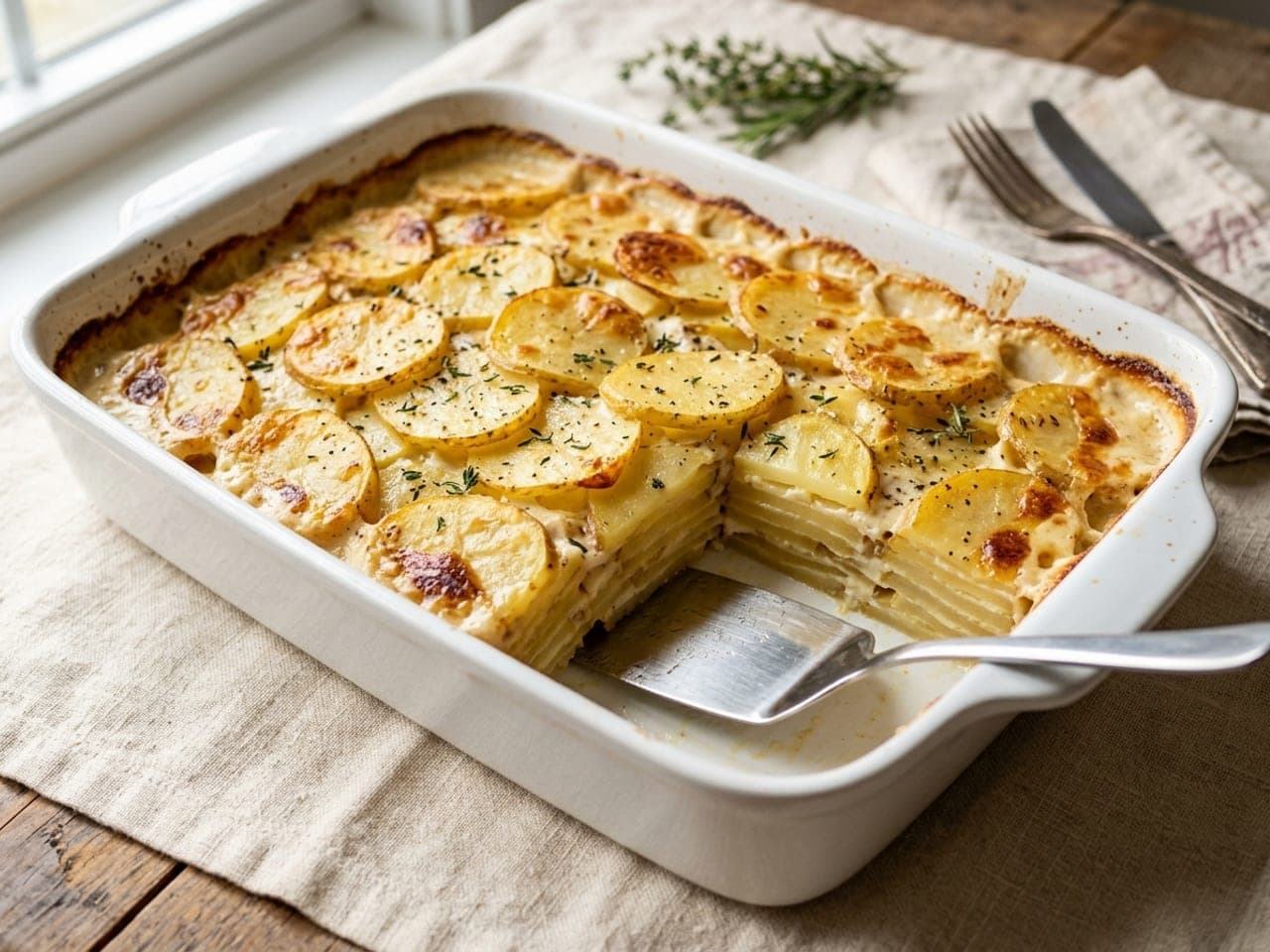
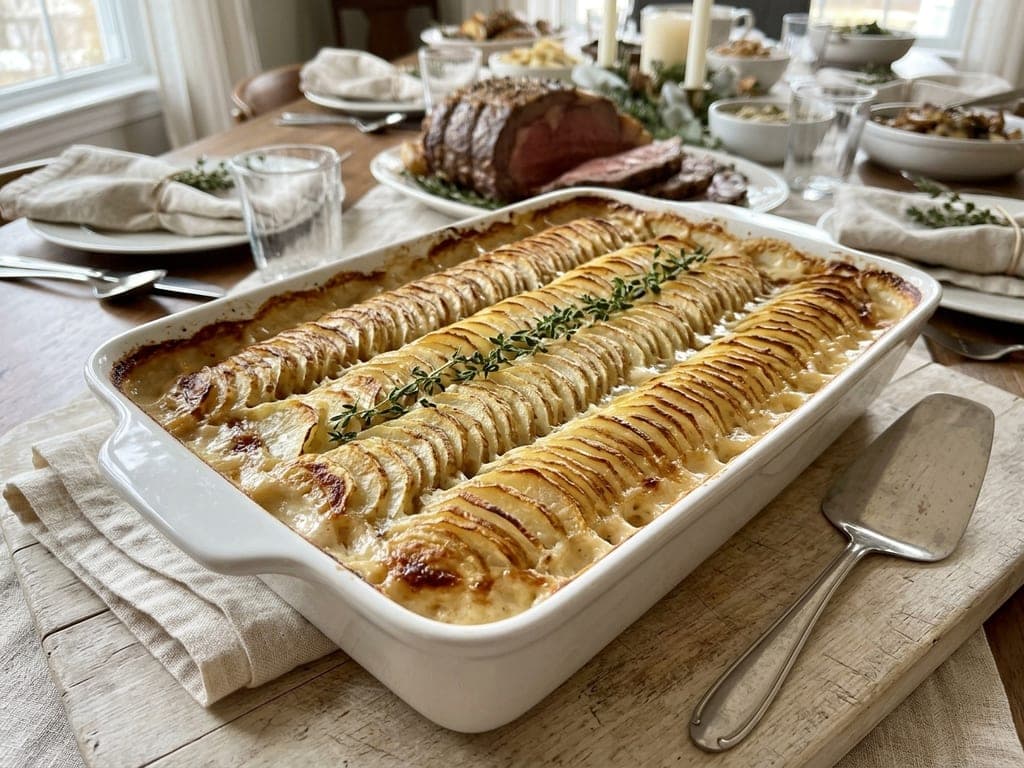
A from-scratch scalloped potatoes recipe for the holiday table: thin Yukon Gold slices simmered in seasoned cream and milk until the potato’s own starch thickens the sauce, then baked in one 9x13 inch (23x33 cm) dish until golden. No roux, no flour, no curdling, no crunchy middle. Make it as the no-cheese classic or with Gruyère, salt it by the gram, and use the three-tier make-ahead plan. Plus the history nobody tells right: the first scalloped potatoes were mashed and baked in shells.
Ingredients
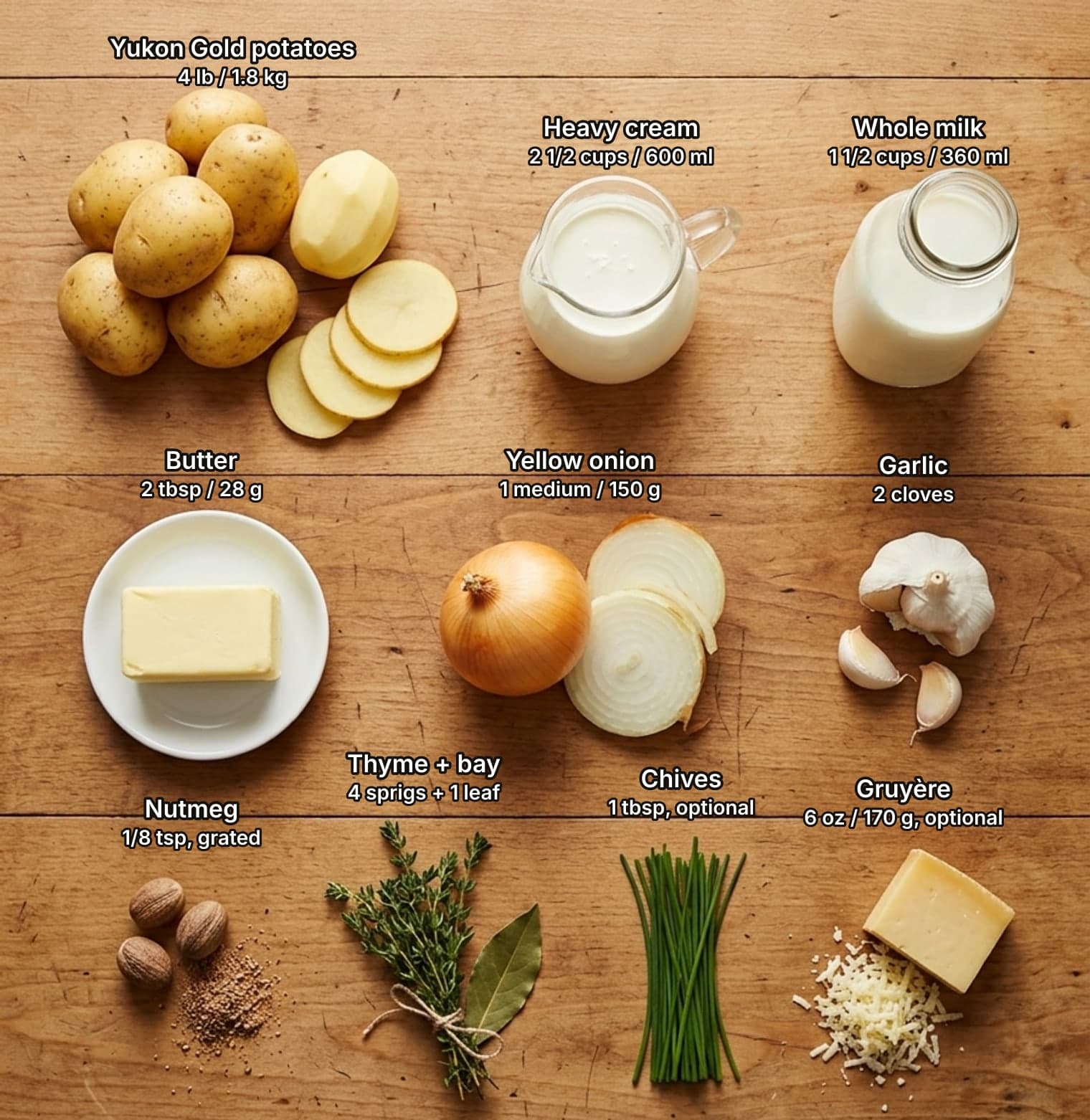
- Yukon Gold potatoes, peeled and sliced 1/8 inch (3 mm) thick, not rinsed (or half Yukon Gold, half russet for a looser, creamier sauce)4 lb (1.8 kg) as bought, about 8 medium; about 3 1/2 lb (1.6 kg) peeled
- heavy cream, at least 36% fat (whipping cream in the UK) (contains milk)2 1/2 cups (600 ml)
- whole milk (contains milk)1 1/2 cups (360 ml)
- unsalted butter, 1 tbsp for the onion and 1 tbsp for the dish (contains milk)2 tbsp (28 g)
- yellow onion, halved and very thinly sliced1 medium, about 5 oz (150 g)
- garlic: 1 clove halved to rub the dish, 1 clove finely grated2 cloves
- salt, weighed (Diamond Crystal and Morton kosher salt measure very differently by the spoon)Classic: 8.4 g (1 tbsp Diamond Crystal, 1 3/4 tsp Morton kosher, or a scant 1 1/2 tsp fine table salt). With Gruyère: 5.6 g (2 tsp Diamond Crystal, a scant 1 1/4 tsp Morton, or a scant 1 tsp table salt)
- black or white pepper, freshly ground1/2 tsp
- nutmeg, freshly grated1/8 tsp
- fresh thyme sprigs (optional) and 1 bay leaf4 sprigs + 1 leaf
- OPTIONAL, for the Gruyère version: Gruyère, grated from the block (bagged cheese carries anti-caking starch and can seize); Comté or aged white cheddar also work (contains milk; traditional Gruyère is made with animal rennet, so vegetarians should pick a vegetarian-rennet cheese or make the classic)6 oz (170 g), about 2 1/4 cups (540 ml) coarsely grated
- chives or thyme leaves, to finish (optional)1 tbsp
What makes these scalloped potatoes different
Scalloped potatoes are thinly sliced potatoes baked in cream and milk until the slices are soft, the sauce is thick and the top is golden. They are the side that sits next to the ham at Easter and the turkey at Thanksgiving and Christmas, and they fail in two famous ways: the middle stays crunchy, or the sauce curdles into grainy puddles.
This homemade scalloped potatoes recipe avoids both by changing where the cooking starts. The slices go straight from the mandoline into seasoned cream and milk and simmer on the stove until almost tender, so the potato’s own starch thickens the sauce and protects it before the dish ever reaches the oven. There is no roux and no flour, which also makes it naturally gluten-free. Then it bakes at a gentle 350°F (175°C) for about 35 minutes instead of the hour and a half that raw-layered versions need.
You get one 9x13 inch (23x33 cm) dish that serves 10: 4 lb (1.8 kg) of Yukon Golds, 2 1/2 cups (600 ml) of heavy cream, 1 1/2 cups (360 ml) of whole milk, a sweated onion, garlic, nutmeg and thyme. Make it as the no-cheese classic, which is what “scalloped” traditionally means in the US, or layer in 6 oz (170 g) of Gruyère, which technically makes it potatoes au gratin. The salt is given in grams, because the same spoonful of kosher salt can differ by 70% between brands.
It is also the most make-ahead-friendly side on a holiday table. You can assemble it the day before and bake it cold, bake it fully and reheat it, or freeze it, and each of those has a different clock, set out below with US and UK windows. And the history is not the one you have read elsewhere: the first scalloped potatoes were mashed, and the famous 1788 “gratin dauphinois” record says neither “dauphinois” nor “potatoes”.
How to make Scalloped Potatoes
- Heat the oven and rub the dish with garlic. Heat the oven to 350°F (175°C) with a rack in the middle. Rub the inside of a 9x13 inch (23x33 cm), 3 qt (2.8 L) baking dish all over with the cut face of the halved garlic clove, pressing so it leaves a sheen, then butter it with 1 tbsp of the butter. The garlic rub is the old gratin dauphinois move (Escoffier’s gratin went into buttered earthenware “frottés d’ail”, rubbed with garlic): it perfumes every edge without leaving chunks. The standard size matters here. Filled about 2 inches (5 cm) deep, it is the depth the test kitchens designed around, and a deeper dish cooks far more slowly in the middle. Set a rimmed baking sheet on the rack below to catch any bubble-over.
- Sweat the onion in butter before it meets the dairy. Melt the remaining 1 tbsp butter in a wide, heavy 6 to 7 qt (5.7 to 6.6 L) Dutch oven or pot over medium-low heat. Add the sliced onion and a pinch of the weighed salt and cook, stirring now and then, until soft and translucent but not browned, 5 to 6 minutes. Add the grated garlic for the last 30 seconds. Why cook it first: raw onion layered into dairy is one reason scalloped potatoes curdle. In a 1946 Journal of Dairy Science study, onion extract cut skim milk’s heat stability from 269 minutes to 25, while potato extract raised it to 435. Those were sterilizer conditions (239°F (115°C), with filtered extracts), not a home oven, but the direction is clear, and sweated onion also leaves its water in the pot instead of in your sauce. Take the pot off the heat.
- Build and season the dairy, then taste it. Pour the cream and milk into the pot with the onion. Add the rest of the salt (8.4 g for the classic, 5.6 g if you are using Gruyère, which brings its own salt), the pepper, nutmeg, thyme sprigs and bay leaf, and stir. Taste the cold dairy. For the classic it should taste slightly too salty on its own, like a well-seasoned soup; for the Gruyère version it should taste just seasoned, because the cheese brings the rest. That is correct, because 3 1/2 lb (1.6 kg) of bland potato is about to absorb it. Weigh the salt if you can. A tablespoon of Diamond Crystal weighs about 8.4 g and a tablespoon of Morton kosher about 14.4 g, so “1 tbsp kosher salt” can mean about 1.7 times the salt depending on the box.
- Slice the potatoes straight into the dairy, and do not rinse. Slice the peeled potatoes 1/8 inch (3 mm) thick with a mandoline, the slicing disc of a food processor, or a sharp knife, and let the slices fall straight into the pot, stirring them under every so often. Two reasons. Slices kept under the dairy cannot turn gray, and they keep their surface starch, which is the thickener in this recipe: there is no flour and no roux, so do not rinse or soak them. Uniform thickness matters more than the exact number, since thick and thin slices cook at different speeds. On a mandoline, use the hand guard or a cut-resistant glove, and stop when about 1 inch (2.5 cm) of potato is left; finish that nub with a knife or save it for soup. Hospital emergency rooms saw an estimated 21,699 slicer and chopper injuries in 2011 in the US alone.
- Simmer the slices in the dairy until almost tender. Set the pot over medium heat and bring it to a gentle simmer, 8 to 10 minutes, sliding a flexible heatproof spatula along the bottom every couple of minutes so the starch cannot catch and scorch. Cover, turn the heat to low and simmer 10 to 15 minutes more, stirring gently every 3 or 4 minutes, until a paring knife slips into a slice with some resistance. The dairy will thicken visibly as the potatoes release starch. This stovetop stage is the whole trick: every slice starts the bake hot and evenly cooked, the starch is already protecting the dairy, and you have tasted the seasoning. It is why this dish does not stay hard in the middle, and why it bakes in about 35 minutes instead of an hour and a half. Fish out the thyme stems and the bay leaf.
- Layer it in the dish (add the Gruyère now if using). For the classic, tip everything into the prepared dish and use the spatula to lay the slices flat and level, so the sauce comes up to the top layer without drowning it. For a neater top, lift the last 20 or so slices out first and shingle them in overlapping rows across the surface. For the Gruyère version, spoon in half the potatoes and sauce, scatter over half the cheese, add the remaining potatoes and sauce, level, and scatter the rest of the cheese on top. With cheese it is, strictly, potatoes au gratin by American convention; the method is identical. You can stop here and refrigerate the dish for up to 24 hours (see the make-ahead plan).
- Bake uncovered until golden and knife-tender. Bake uncovered at 350°F (175°C) on the middle rack, 30 to 40 minutes, until the sauce bubbles thickly at the edges, the top is golden in patches, and a paring knife slides through the center of the dish with no resistance. An instant-read thermometer in the center should read about 200°F (93°C): potatoes turn fully tender close to the boiling point, and the sauce cannot get much hotter than 212°F (100°C), so the knife and the number agree. Why not a hotter oven: above about 350°F (175°C) the edges reduce and can break before the center is ready. If the top is browning before the center is tender, lay a sheet of foil loosely over it. For more color, finish 2 to 3 minutes under the broiler (the overhead grill), watching it every second. Broil only in a metal or broiler-safe ceramic dish, never in glass bakeware such as Pyrex.
- Rest 20 minutes before serving. Let the dish stand on a rack for 20 minutes, or 30 if you want clean squares for plating. A straight-from-the-oven gratin is runny, and cutting it early is the most common cause of “watery” scalloped potatoes. As it cools a little, the starch-thickened sauce firms up and the slices keep absorbing free liquid, so it goes from soupy to creamy on its own. It will still be well above serving temperature. Scatter over chives or thyme leaves and serve. On a buffet, keep it in a 200°F (93°C) oven or on a warming tray, or treat it as a two-hour dish (see the safety notes).
Safety & hygiene Important
- Mandoline safety. Slicers and choppers sent an estimated 21,699 people to US emergency rooms in 2011, up from 12,001 in 2001 (US Consumer Product Safety Commission figures, reported by The New York Times in 2013). Set the mandoline on a damp towel so it cannot slide, use the hand guard or a cut-resistant glove, keep your palm flat, and stop slicing when about 1 inch (2.5 cm) of potato is left; finish with a knife. A glove resists slicing, not stabbing, so it does not make a knife tip safe.
- The two-hour rule on a holiday buffet. This is a cooked dairy dish. In the US, USDA says to keep hot food at 140°F (60°C) or above, or refrigerate it within 2 hours of cooking (1 hour if the room is above 90°F (32°C)); after that, discard it. In the UK, the Food Standards Agency tells home cooks to cool cooked food and get it into the fridge within one to two hours. The four-hour limit you may see quoted applies to chilled food taken out of the fridge, not to a hot dish. For buffets, its catering guidance keeps hot food at 63°C or above, or lets it out of hot holding once, for up to two hours; after that it must be reheated until steaming hot, chilled, or thrown away. A 200°F (93°C) oven or a warming tray keeps it safely hot for a long meal.
- Cool leftovers fast in shallow containers. A full 9x13 inch (23x33 cm) dish cools slowly because cooling time grows roughly with the square of depth. Portion leftovers into shallow containers, about 2 inches (5 cm) deep or less, cover, and refrigerate within 2 hours. US guidance (USDA): eat within 3 to 4 days. UK guidance (FSA): eat within 48 hours. Do not plunge a hot glass or ceramic dish into ice water to speed it up; it can shatter.
- Reheat to 165°F (74°C), and only once. Reheat leftovers until the center reaches 165°F (74°C) (USDA); in the UK the FSA asks for food to be steaming hot all the way through (its cooking check is 70°C in the middle for 2 minutes) and says to reheat leftovers only once. Reheat straight from the fridge; do not leave the dish out to come to room temperature first. Dense casseroles reheat unevenly in the microwave, so smaller portions or the oven are safer; if you do microwave, stir and check the center in several places.
- Make-ahead and freezing windows. An assembled dish of par-cooked potatoes is a cooked dairy food: cool it and refrigerate within 2 hours, at 40°F (4°C) or below (UK: 5°C or below), and bake it within 24 hours, until the center reaches at least 165°F (74°C). Baked scalloped potatoes can be frozen; USDA puts best quality at 3 to 4 months and notes cream sauces can separate and look curdled after thawing, which is a texture change, not a safety problem. Frozen casseroles can be reheated without thawing.
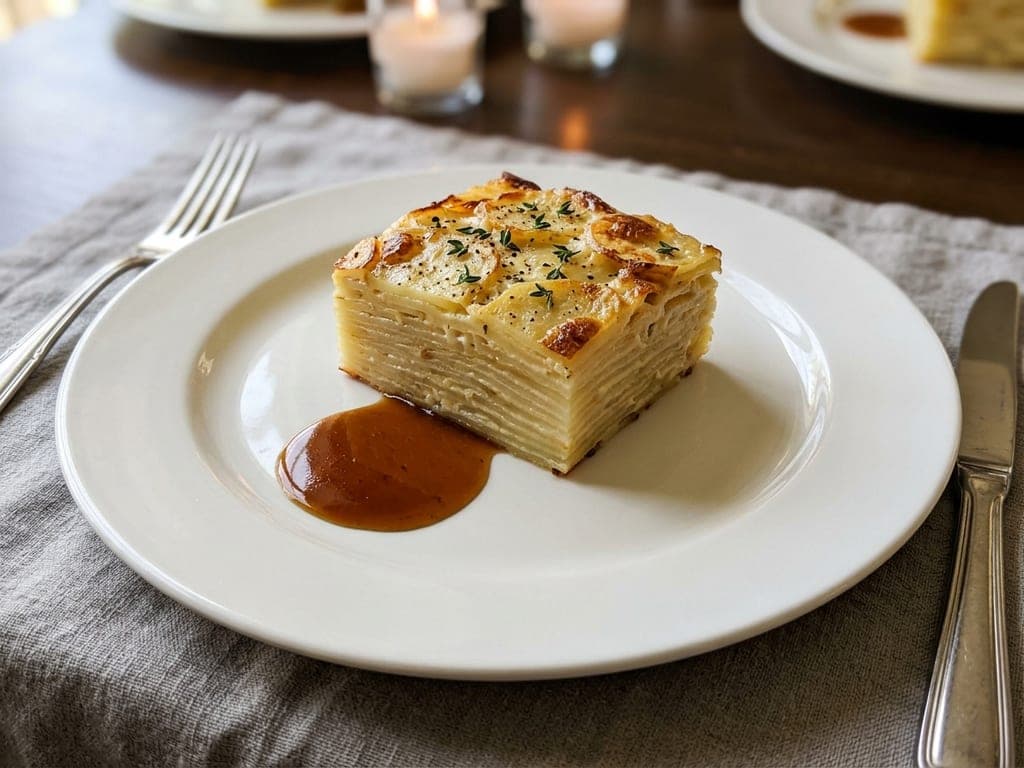
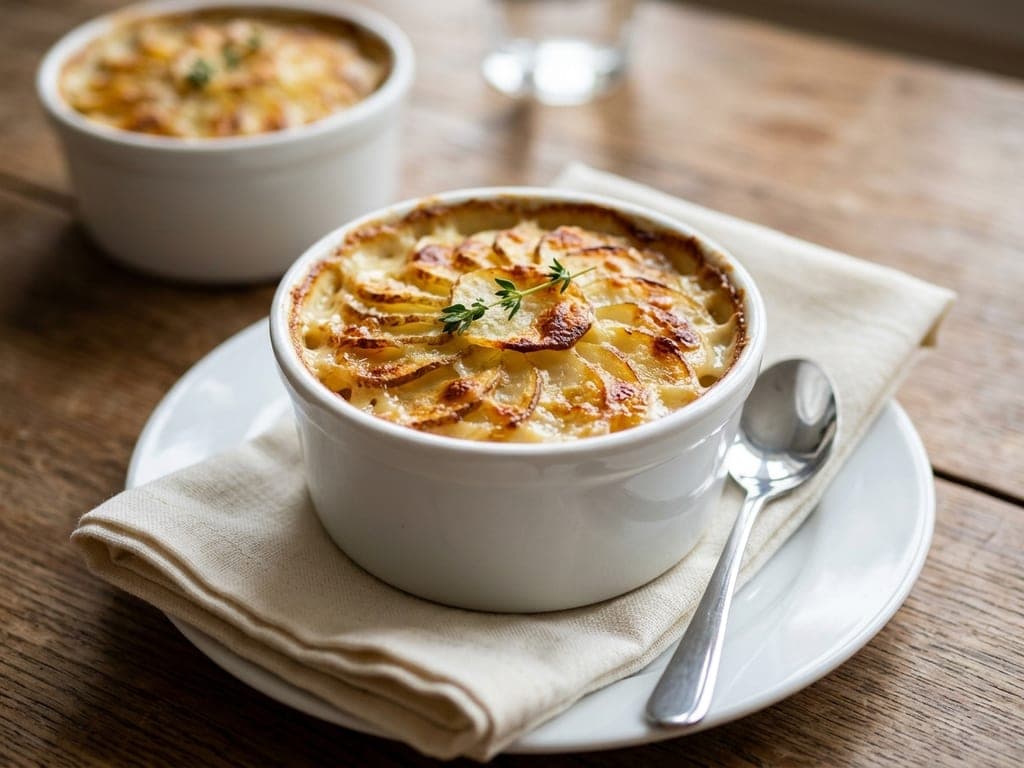
3 ways to plate it
Scalloped potatoes vs au gratin: the honest answer
The short answer: in the US today, scalloped potatoes are thin potato slices baked in cream or milk with no cheese, and potatoes au gratin add cheese, often with breadcrumbs, for a browned crust. That is the modern convention, and it is how this page labels its two versions.
Two common add-ons to that answer are wrong. The first is that scalloped potatoes use a flour-and-butter roux and au gratin use cream. Plenty of classic scalloped potatoes use no flour at all: America’s Test Kitchen relies on heavy cream lightened with milk, and Martha Stewart calls making a cream sauce “overcomplicating the dish”. The method and the name are independent. The second is that “gratin” means cheese. It means the browned crust (from the French gratter, to scrape), and the French original, gratin dauphinois, is usually made without cheese.
The cheese rule is also younger than it sounds. In Fannie Farmer’s Boston Cooking-School Cook Book of 1896, “Potatoes au Gratin” are creamed potatoes covered with “buttered crumbs”, with no cheese at all. The very next recipe reads: “Delmonico Potatoes. To Potatoes au Gratin add one-third cup grated mild cheese”. So in 1896 cheese made a different dish. In 1960 Betty Crocker test-marketed boxed Scalloped Potatoes and Au Gratin Potatoes as two separate products. Whether that helped fix today’s naming split is our guess; no source says so, and today’s Scalloped box contains some cheese too.
Slice thickness is sometimes given as a difference too (thicker for scalloped, thinner for au gratin), but recipes on both sides range from 1/16 to 1/4 inch (1.5 to 6 mm). What matters is that the slices are even. Our Gruyère version is au gratin by the American convention, and we say so; the classic is the same recipe with the cheese left out and a little more salt.
The three methods compared, and a bake table
Almost every scalloped potatoes recipe uses one of three methods, and the method, not the oven setting, decides how long it takes and how likely it is to fail.
1. Simmer the slices in the dairy, then bake (this recipe; Martha Stewart; America’s Test Kitchen; Serious Eats slices into hot dairy too). The potatoes start the bake hot and partly cooked, the released starch has already thickened and stabilized the sauce, and you can taste the seasoning before it is locked in. It is the fastest and most predictable. Martha’s version scored 9.5 out of 10 in The Kitchn’s four-recipe test. The only cost is one extra pot.
2. Pour a flour-and-butter white sauce over raw layers (Tastes of Lizzy T), or dredge each raw layer with flour and butter and pour hot milk over (Allrecipes, and Fannie Farmer in 1896). The flour makes an all-milk sauce stable and keeps the fat down, which is why it suits a lighter dish, but it can taste pasty, and raw slices in a full 9x13 inch (23x33 cm) dish need an hour or more.
3. Parboil the slices in water, then bake in a white sauce (King Arthur Baking: boil 1 minute, drain, layer with a milk roux). The parboil evens out the start, but the water carries away starch that would otherwise thicken the sauce, so the roux has to do that job.
A fourth, the French way, layers raw slices in cream alone: it gives the most elegant layers and the longest bake, and it is the one most likely to curdle if the dairy is lean or the oven is hot.
How long at 350°F (175°C) or 375°F (190°C)? By method, from the recipes that tested them:
Simmered in the dairy until almost tender (this recipe): 350°F (175°C), uncovered, 30 to 40 minutes. America’s Test Kitchen bakes its 3 qt (2.8 L) gratin dish about 20 minutes.
Brought to a boil in the dairy and simmered 1 minute (Martha Stewart): 375°F (190°C), 35 to 40 minutes loosely covered, then 3 to 5 minutes under the broiler.
Par-cooked and refrigerated up to 24 hours (America’s Test Kitchen): 400°F (200°C), 45 minutes covered, then about 30 minutes uncovered.
Raw 1/16 inch (1.5 mm) slices in hot infused dairy, 2 qt (1.9 L) dish (Serious Eats): 350°F (175°C), 60 minutes covered plus 15 to 20 uncovered, then a 30-minute rest.
Raw slices under a white sauce, 9x13 inch (23x33 cm) dish (Tastes of Lizzy T): 400°F (200°C), 40 minutes covered plus 15 to 20 uncovered.
Parboiled in water, milk roux, 9x13 inch (23x33 cm) dish (King Arthur): 350°F (175°C), 1 hour uncovered.
Raw layers dredged with flour, warm milk poured over (Allrecipes): 375°F (190°C), 45 to 60 minutes.
Raw layers in plain milk, low and slow (Sara Moulton’s anti-curdle method): 350°F (175°C), about 2 hours, covered for all but the last 15 minutes.
Whatever the method, the finish line is the same: a paring knife slides through the center with no resistance.
Why scalloped potatoes stay hard or curdle (and how this method fixes both)
Potatoes that stay hard have four usual causes, roughly in order of impact. First, a deep dish. Heat travels into a dish of potatoes by conduction, and conduction time grows with roughly the square of depth, so a dish twice as deep can take close to four times as long to cook in the middle (once the sauce is simmering, convection helps, so treat this as a direction rather than a formula). For a crowd of 20, bake two 9x13 inch (23x33 cm) dishes, not one deep pan. Second, cold dairy poured over raw slices, which spends much of the bake just warming up; Serious Eats found that skipping the pre-heated milk can add up to half an hour. Third, acid and calcium. Potato cells soften when heat breaks down the pectin that glues them together, and acid slows that down; the food scientist Shirley Corriher’s advice is to cook potatoes in cream or milk and stir in sour cream only after they soften. Calcium in hard water firms pectin too. America’s Test Kitchen adds 1/4 tsp baking soda to its buttermilk scalloped potatoes to help the slices soften. Fourth, and less proven, a long stall at warm temperatures: potatoes held between about 122°F and 158°F (50°C and 70°C) switch on an enzyme that firms their cell walls, and a deep dish of cold cream spends a long time in that range. That is our inference from lab studies on potatoes, not a gratin test.
Starting the slices in simmering dairy removes the first three problems in one move: the potatoes are already hot and nearly tender when they go in, and they pass through the firming range on the stove in minutes. If your dish is still hard at the stated time, cover it and keep baking in 15-minute rounds at the same temperature. Turning the oven up is how a hard dish becomes a curdled one.
Curdling is milk protein clumping, and acid is the main trigger. As the food scientist Harold McGee put it in a 2010 NPR interview, milk proteins “are resistant to heat but very sensitive to acidity”. Fat protects: in cream of about 25% fat or more, there are enough fat globules to coat the proteins before they clump. Our dairy mix is just under that line (2 1/2 cups (595 g) of 36% cream holds 215 g of fat and 1 1/2 cups (366 g) of whole milk 12 g, so 227 g of fat in 961 g of dairy, 23.6%), and the unrinsed potato starch covers the rest: starch molecules physically get between the proteins. Onion pushes the other way: the 1946 Journal of Dairy Science study in step 2, which heated skim milk with filtered, clear vegetable extracts, found onion extract cut its heat stability by about 90%, which is why the onion is sweated first. Potato extract lengthened it by about 60% in the same test, but because the extract was filtered, that tells us nothing about the starch. The other triggers are a hot oven, low-fat milk used alone without a starch binder, and pre-shredded cheese, whose anti-caking coating can seize.
Watery scalloped potatoes have their own three causes: waxy or new potatoes that shed water, rinsed slices that have lost their thickening starch, and cutting the dish before it has rested for 20 minutes.
Which potatoes, and why you should never rinse them
The usual advice sorts potatoes into waxy and starchy and explains the difference with amylose and amylopectin. The chemistry is oversimplified. Ordinary waxy-textured potatoes are not “all amylopectin”: a 2025 study in Scientific Reports measured 24.7 to 27.5% amylose in waxy-textured cultivars against 29.5 to 33.0% in mealy ones. What really drives texture is how much starch (dry matter) the potato holds, which growers measure as specific gravity. Oregon State University’s bands read a specific gravity of 1.070 to 1.079 as waxy and 1.080 to 1.089 as mealy and dry.
By that measure Yukon Gold sits near the bottom of the waxy band (it averaged 1.071 over 20 Florida growing seasons), though cooks treat it as all-purpose, and Russet Burbank typically runs higher, about 1.08 (1.078 averaged across 18 US trial sites), right at the line between the two bands. When cooked, russet cells become completely engorged with gelatinized starch, so more of it leaks into the cream: the sauce gets thicker and the slices softer and more likely to break. Yukon Golds hold neat, visible layers and taste more buttery, which is why this recipe uses them; half Yukon and half russet is a good compromise if you want a looser, creamier sauce. Avoid red and new potatoes, which release water and can leave the dish thin.
Do not rinse or soak the slices. The starch on their surface is the thickener in a no-roux recipe, and Martha Stewart’s test kitchen notes that rinsing also makes the potatoes more watery. Browning is solved by where the slices go, not by water: as Serious Eats puts it, slicing them “directly into the milk they’ll be baked in” prevents oxidation “while keeping all their starches right where you want them”. The minority advice to rinse to avoid gluey potatoes applies to slices baked without enough liquid between them; the fix there is more dairy, not less starch.
Make-ahead scalloped potatoes: three tiers and their clocks
Tier 1: assemble a day ahead, bake on the day (best for the holiday oven). Follow the recipe through the simmer. To cool it fast, set the metal pot in a sink of cold water for about 10 minutes, turning the slices gently once (never do this with a hot glass or ceramic dish, which can crack), then layer it into the dish, press parchment or plastic wrap onto the surface so no potato is exposed to air, cover, and refrigerate within 2 hours of cooking, for up to 24 hours. For the Gruyère version, layer in half the cheese now and keep the rest for the top. Remove the plastic and bake straight from the fridge (no counter time to take the chill off) at 400°F (200°C); if your dish is glass, put it only into a fully preheated oven. Bake covered with parchment and then foil (so nothing sticks) for 45 minutes, then uncovered (lift the foil away from you; trapped steam burns), with the remaining Gruyère scattered over, for about 30 minutes, America’s Test Kitchen’s timing for a chilled, par-cooked dish, until bubbling, golden, knife-tender, and at least 165°F (74°C) in the center. Many online recipes say an assembled dish keeps 3 days; the test kitchens that give a window say one day, and uncooked slices held that long turn gray. Par-cooked, chilled potatoes can also firm up slightly (cooling strengthens the pectin between cells, per potato-processing research), so trust the knife, not the clock.
Tier 2: bake it fully and reheat. Cool, portion into shallow containers, and refrigerate within 2 hours. Keep up to 3 to 4 days (USDA) or 48 hours (UK FSA). Reheat covered at 325°F (163°C) with a splash of milk until the center reaches 165°F (74°C): about 20 minutes for a single portion, 45 to 60 minutes for a full dish, uncovering for the last 5 minutes to re-crisp the top. Reheat once.
Tier 3: freeze. It is safe, but it costs texture. USDA lists cream sauces among foods that do not freeze well, and potatoes can turn soft and grainy. A cream-heavy version like this one holds up better than a milk version. Bake it until almost done, cool, wrap well, and freeze for up to 3 to 4 months for best quality. Freeze it in a metal or foil pan, or thaw a glass dish in the fridge overnight before it goes into a fully preheated oven; a frozen glass dish in a hot oven can shatter. Reheat from frozen, covered, at 325°F (163°C) until it reaches 165°F (74°C), stirring the sauce back together at the edges if it looks split, and reheat it only once (UK FSA).
A holiday timeline: simmer and layer the day before. On the day, take the dish straight from the fridge into the oven about 1 3/4 hours before dinner: 45 minutes covered and about 30 uncovered at 400°F (200°C), plus the 20-minute rest and a few minutes’ slack. Do not leave it on the counter to take the chill off while the roast cooks. If it has to share a 325°F to 350°F (163°C to 175°C) oven with the roast, put it in earlier and keep it covered for longer, then uncover and finish at 400°F (200°C) while the roast rests, checking the center with a knife and for 165°F (74°C).
The history: shells, mashed potatoes and a Grenoble catering bill
“Scalloped” comes from the shell. The Oxford English Dictionary derives the cooking verb from the noun scallop, with its first evidence in 1737, and Merriam-Webster defines it as “to bake in a sauce usually covered with seasoned bread or cracker crumbs”, explaining it comes “from the use of a scallop shell as a baking dish”. Food was baked and served in scallop shells long before potatoes were: Robert May’s Accomplisht Cook (1660; the line is legible in later editions) lists “Stewed oysters in Scollop shells”, and in Jane Austen’s Emma (1815) Emma presses “the minced chicken and scalloped oysters” on her supper guests while her father frets that suppers are unwholesome. The popular theories that the word comes from the French escalope, a thin slice, or from the old English collop have no support in either dictionary.
The first scalloped potatoes were not sliced at all. The earliest we found is Charlotte Mason’s The Lady’s Assistant (London, 1773): “Potatoes scalloped”, mealy potatoes beaten fine with cream, an egg yolk and butter, filled into “scollop shells”, smoothed with the back of a spoon and browned in a Dutch oven as “a pretty supper dish”. E. Taylor’s The Lady’s, Housewife’s, and Cookmaid’s Assistant (second edition, London, 1778) gives: “Scalloped POTATOES. Boil, skin, and bruise potatoes in a little thick cream, put in melted butter, salt, nutmeg, pepper, some bread crumbs; roast them before the fire in scallop-shells”. John Farley’s London Art of Cookery (first published 1783) does the same with mashed potato smoothed into “scollop-shells”, scored with a knife and browned. That mashed version crossed the Atlantic and lasted a century: Marion Harland’s Common Sense in the Household (1871) still fills “buttered scallop shells” with mashed potato.
In American cookbooks, raw slices baked in milk turn up in the 1880s. The earliest we found is Margery Daw in the Kitchen (Auburn, New York, 1881): thin raw slices layered with flour, pepper, salt and butter, then “Pour over all the milk the dish will hold. Bake two hours in a moderate oven.” The White House Cook Book (1887) calls its version “Kentucky Style”: raw slices, butter, “a bit of onion chopped fine, if liked”, a little flour and about a quart (950 ml) of hot milk. Fannie Farmer’s 1896 “Escalloped Potatoes” layers 1/4 inch (6 mm) slices with flour and butter and adds “hot milk until it may be seen through top layer”. None of them makes a white sauce first. The oven and the potato’s starch made the sauce, which is exactly the principle this recipe uses, only moved to the stove. And Farmer’s menus already pair it with ham: “Broiled Ham. Scalloped Potatoes. Brown Bread and Butter.” (Pages that cite Mrs. Lincoln’s Boston Cook Book of 1884 for scalloped potatoes are mistaken: its “scalloped” recipes are seafood, eggs and leftover turkey.)
The 20th century added shortcuts. Campbell’s launched Cream of Mushroom soup in 1934, and by 1956 the Ladies’ Home Journal was printing “Creamy Scalloped Potatoes” layered with a can of it. In spring 1960 General Mills test-marketed Betty Crocker Scalloped Potatoes and Au Gratin Potatoes; the trade magazine Canner/Packer noted that the boxes cooked in “30-35 minutes vs. 1-1 1/2 hrs.” for raw potatoes. Scalloped potatoes are often called a Thanksgiving or Easter tradition, but we found no dated source that establishes either; the ham pairing, at least, goes back to 1896.
The French side of the story has its own myth. Almost every account says gratin dauphinois was first recorded on 12 July 1788, at a dinner in Gap given by the Duc de Clermont-Tonnerre. The source is document CC 1128 in Grenoble’s municipal archives, which the archive featured as its document of the month in April 2026. It is a payment order of 26 May 1789 telling the town treasurer to pay the caterer Allier 114 livres for the meal that “la ville”, the town of Grenoble, gave on 12 July 1788 to the municipal officers of Gap, at the Grenoble town hall. The archivist’s own note on the menu is the punchline: it lists “le fameux gratin (sans la précision de « dauphinois » hélas)”, the famous gratin, without the word “dauphinois”, alas. It does not say what the gratin was made of, so we cannot even be sure it was potatoes.
Nor is the no-cheese rule as old as purists claim. Escoffier’s Guide culinaire (1907 edition) makes gratin dauphinois with 125 g of grated Gruyère per kilo of raw sliced potatoes, in a buttered earthenware dish rubbed with garlic, and a sonnet recipe by the Dauphinois gourmet Maurice Champavier, printed in the 1890s, calls for eggs. The famous ban, “Surtout n’ajoutez pas d’œufs ni de fromage” (above all, add neither eggs nor cheese), comes from René Fonvieille’s La cuisine dauphinoise à travers les siècles in 1983. The sister dishes split along the same lines: Escoffier’s gratin savoyard swaps the milk for stock, pommes boulangère bake potatoes with butter-softened onions and no milk or cream, traditionally under a roast, Sweden’s Janssons frestelse layers potatoes with spice-cured sprats and cream (first printed as a recipe in 1940), and a Czech cookbook of 1897 layers boiled sliced potatoes with hard-boiled egg, smoked meat and cream and calls them francouzské brambory, “French potatoes”.
Questions, answered
What is the difference between scalloped potatoes and au gratin potatoes?
In the US, scalloped potatoes are thin slices baked in cream or milk with no cheese, and au gratin potatoes add cheese, often with breadcrumbs, for a browned crust. Strictly, “gratin” means the crust, not the cheese, and neither dish requires flour: many classic scalloped potatoes are thickened only by potato starch. The cheese split is newer than it looks; in Fannie Farmer’s 1896 cookbook, “au gratin” meant buttered crumbs and the cheese version had its own name, Delmonico Potatoes.
Why are my scalloped potatoes still hard?
Usually because the slices are thicker than about 1/4 inch (6 mm) or uneven, the dish is too deep, the dairy went in cold over raw slices, or something acidic (sour cream, wine) or hard water kept the potato’s pectin from breaking down. Simmering the slices in the dairy until almost tender before baking fixes all three. If a dish is still firm at the stated time, cover it and keep baking in 15-minute rounds at 350°F (175°C); do not turn the oven up, or the sauce may curdle.
Why did my scalloped potatoes curdle?
Milk proteins clump when the dairy is acidic, lean or overheated. Use mostly heavy cream (ours is 2 1/2 cups (600 ml) cream to 1 1/2 cups (360 ml) whole milk), do not rinse the slices so their starch can protect the sauce, sweat the onion before it goes in, grate your own cheese, and bake at 350°F (175°C) or below. Cutting before a 20-minute rest makes it look watery rather than curdled.
Can you make scalloped potatoes ahead of time or freeze them?
Yes. Assemble with the par-cooked slices, press parchment onto the surface and refrigerate up to 24 hours, then bake straight from the fridge at 400°F (200°C) (a glass dish only into a fully preheated oven), 45 minutes covered and about 30 uncovered, to at least 165°F (74°C) in the center. Baked leftovers keep 3 to 4 days (USDA) or 48 hours (UK FSA). You can freeze them for 3 to 4 months, but the cream sauce may look slightly split after thawing.
What potatoes are best for scalloped potatoes?
Yukon Golds for neat layers and a buttery taste; russets for the creamiest, loosest sauce, because they hold more starch (specific gravity around 1.08 against Yukon Gold’s 1.071) and shed more of it into the cream. Half and half is a good compromise. Avoid red and new potatoes, which release water.
Should scalloped potatoes be covered when baking?
For raw-layered recipes, yes: cover for the first half so trapped steam cooks the top layer and the cream does not reduce and break before the potatoes are tender, then uncover to brown. In this recipe the slices are already nearly cooked when they go in, so the dish bakes uncovered from the start; lay foil loosely on top only if it browns before the center is tender. A dish baked from the fridge starts covered.
How long do scalloped potatoes take at 350°F (175°C)?
It depends on the method more than the oven. Slices simmered in the dairy first, as here, take 30 to 40 minutes at 350°F (175°C). Raw-layered scalloped potatoes in a 9x13 inch (23x33 cm) dish take about 1 1/4 to 1 1/2 hours at 350°F (175°C), or about 1 hour at 375°F (190°C), covered for the first half. They are done when a paring knife slides through the center with no resistance and the center reads about 200°F (93°C).
Can I use milk instead of cream? Do you need flour?
All-milk scalloped potatoes need a starch binder, either a roux or 1 to 2 tsp of flour or cornstarch per cup (240 ml) of milk, or they are likely to curdle. With mostly cream, as here, you need no flour at all: potato starch thickens the sauce. The trade-off is richness: by our USDA-based math, an all-milk roux version is about 240 kcal per tenth of the dish against 375 kcal for this classic.
Do you rinse potatoes for scalloped potatoes?
No. The surface starch is what thickens the sauce and protects it from curdling, and rinsing also leaves the slices wetter. To stop them turning gray, slice them straight into the dairy they will cook in.
How do you reheat scalloped potatoes?
Covered, in a 325°F (163°C) oven with a splash of milk, until the center reaches 165°F (74°C): about 20 minutes for a portion and 45 to 60 minutes for a full dish, uncovered for the last 5 minutes to re-crisp. The microwave is faster (use 50% power, stir, and check the center in several places) but can split the sauce. Reheat straight from the fridge, and only once.
How many calories and how much sodium are in scalloped potatoes?
About 375 kcal per serving (one tenth of the dish) for the classic, 445 kcal with Gruyère. From USDA figures: 1.6 kg peeled potatoes 1,232 kcal + 595 g heavy cream 2,023 + 366 g whole milk 223 + 28 g butter 201 + onion 60 + garlic 9 = 3,748 kcal, divided by 10. Gruyère adds 170 g × 4.13 = 702 kcal. Per serving the classic has about 25 g fat (16 g saturated), 33 g carbohydrate and 6 g protein. Sodium: the ingredients carry about 424 mg; the classic’s 8.4 g salt adds 3,301 mg (salt is 39.3% sodium), about 373 mg per serving; the Gruyère version’s 5.6 g salt (2,201 mg) plus the cheese (1,214 mg) gives about 384 mg. That is roughly 135 mg per 100 g of raw ingredients, against 341 mg per 100 g for a boxed scalloped potato mix prepared as directed (USDA). If you are cutting back, a 2011 Journal of Dairy Science taste panel needed about a 15% sodium cut in a milk-based soup before noticing it (against 2% in plain water), so trimming the salt by about 10% is unlikely to be noticed.
Snap your finished plate and let the AI plate it again — more beautifully.