Pecan Pie Recipe: Classic, Doneness Temp and True History
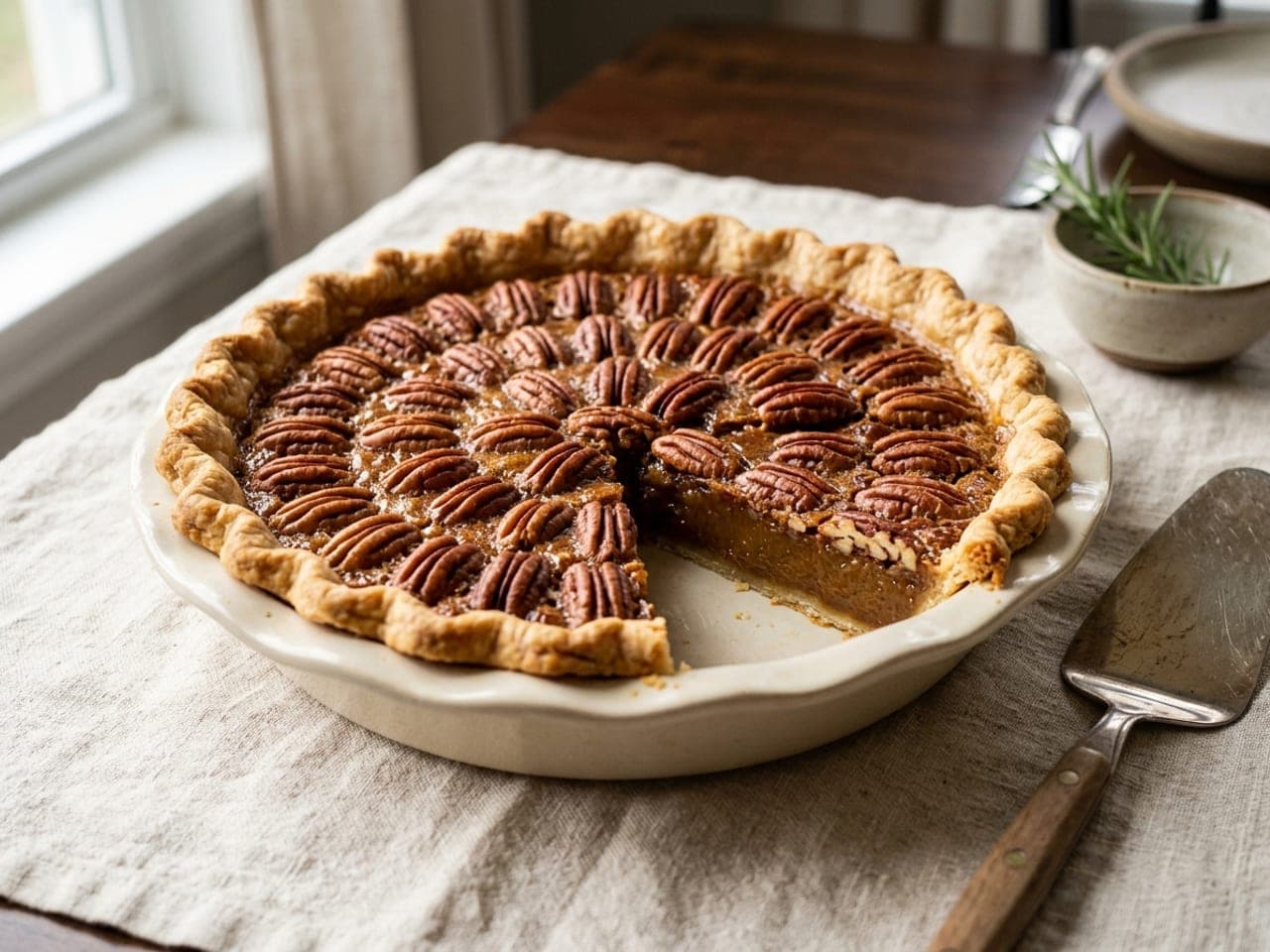
A classic pecan pie with a crisp all-butter crust, toasted pecans and a glossy filling that slices clean, taken out of the oven at the one number that matters: 200°F (93°C) in the center. We explain why other recipes say 175°F (79°C) or 185°F (85°C), why pies go runny, whether to refrigerate, and how Karo quietly rewrote its own story of who invented the pie.
Ingredients
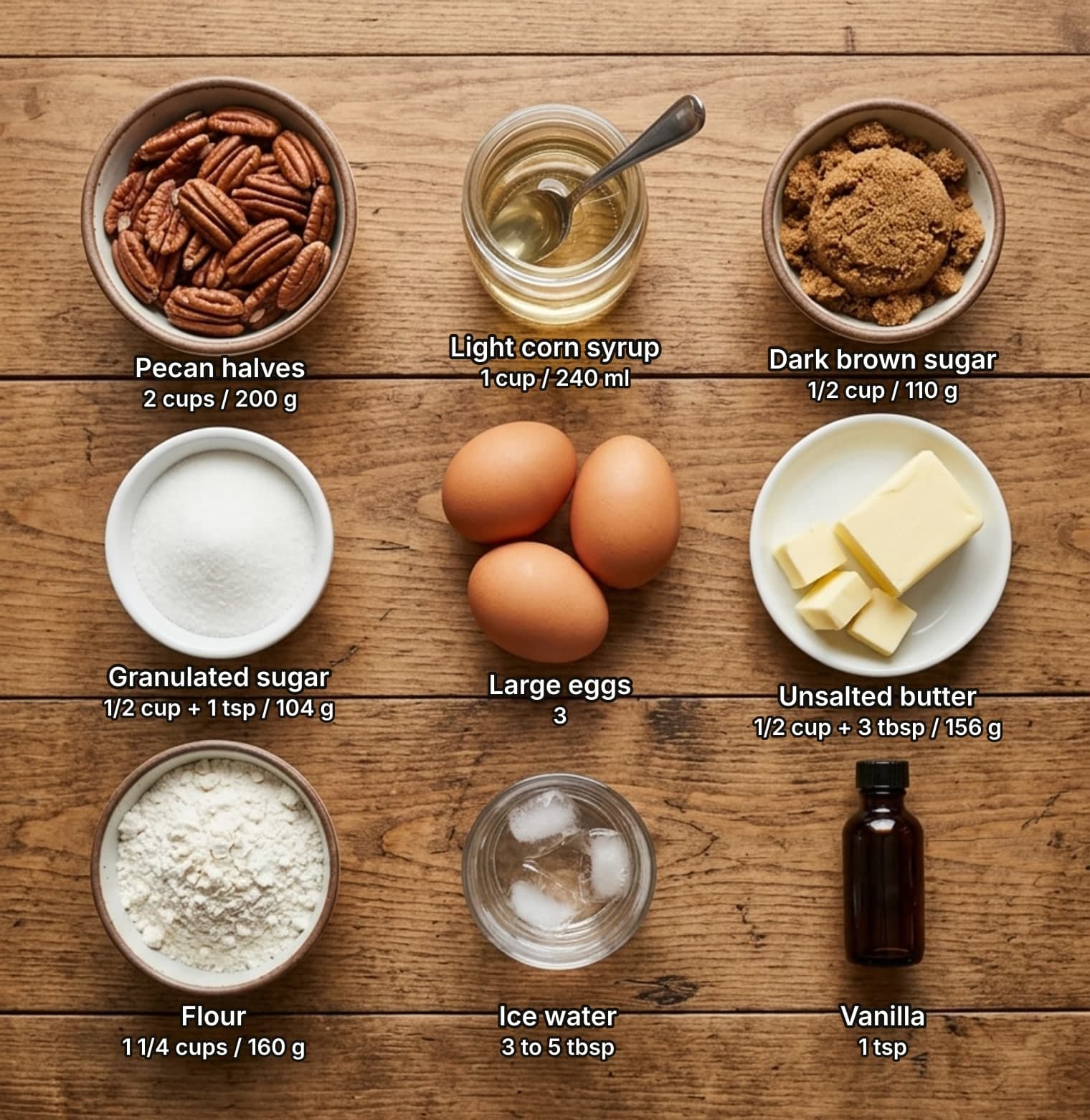
- all-purpose flour (plain flour), plus a little for rolling (contains wheat/gluten)1 1/4 cups (160 g)
- granulated sugar, for the crust1 tsp
- fine salt, for the crust1/4 tsp
- unsalted butter, very cold, cut into 1/2-inch (1.3 cm) cubes, for the crust (1 US stick; contains milk)1/2 cup (113 g)
- ice water3 to 5 tbsp
- pecan halves, toasted (about 60 of the best set aside for the top, the rest coarsely chopped; tree nut)2 cups (200 g)
- light corn syrup (Karo Light in the US; golden syrup is the nearest UK swap, see the corn syrup section)1 cup (240 ml / 341 g)
- dark brown sugar, firmly packed (soft dark brown sugar in the UK)1/2 cup (110 g)
- granulated sugar, for the filling1/2 cup (100 g)
- large eggs, out of the fridge no more than 30 minutes ahead, or warmed 5 minutes in a bowl of warm tap water (US large, about 50 g each out of the shell; a UK/EU medium; contains egg)3
- unsalted butter, melted and cooled to about 100°F (38°C), just warm, for the filling (contains milk)3 tbsp (43 g)
- pure vanilla extract1 tsp
- fine salt, for the filling1/2 tsp
- bourbon, 80-proof, optional, for bourbon pecan pie (some alcohol stays in the baked pie, see the safety notes; not counted in the nutrition)2 tbsp (30 ml)
- heavy cream (double cream), whipped to soft peaks with 1 tsp sugar, to serve (optional; contains milk; not counted in the nutrition)1/2 cup (120 ml)
What makes a great pecan pie
Pecan pie is a Southern American custard pie: eggs set with a large amount of syrup and sugar into a glossy, caramel-dark filling, packed with pecans and baked in a single crust. It is the pie of Thanksgiving and Christmas in the South, the official state pie of Texas, and one of the sweetest things on the American holiday table.
Most recipes are the same five ingredients in different proportions, so the difference between a runny, grainy or soggy pie and a great one is almost entirely technique. This recipe keeps the classic Karo-style balance of 1 cup (240 ml) of corn syrup to 3 eggs, swaps half the white sugar for dark brown for a deeper caramel note, adds salt, uses 200 g of pecans to Karo’s 170 g and toasts them, and bakes the filling in a par-baked all-butter crust. Then it gives you one number to trust, 200°F (93°C) in the center, and explains where it comes from.
Plan for a day. Allow about 45 minutes of hands-on work, an hour to chill the dough, about 85 minutes in the oven, counting the pecan toast and the par-bake, 2 hours of cooling and at least 3 hours in the fridge before you slice. Pecan pie is at its best made the day before, which makes it the easiest dessert on a holiday menu to get out of the way.
How to make Pecan Pie
- Make an all-butter crust and let it rest. Whisk the 1 1/4 cups (160 g) flour, 1 tsp sugar and 1/4 tsp salt in a bowl. Add the 1/2 cup (113 g) cold butter cubes and rub or pinch them in until most pieces are the size of peas, with a few larger flakes left. Sprinkle in 3 tbsp ice water and toss with a fork; add more, a tablespoon at a time, only until a handful holds together when squeezed. Press into a disk, wrap and chill at least 1 hour (up to 2 days). Why: butter is about 16 to 18% water, and the visible pieces turn to steam in the oven and push the dough into flakes, which is why an all-butter crust bakes lighter and flakier than a shortening blend. The rest lets the flour hydrate evenly and relaxes the gluten so the shell does not shrink. Short on time? A store-bought 9-inch (23 cm) crust works, but read the label: many are made with lard, which makes the pie unsuitable for vegetarians.
- Roll, fit and chill the shell. Roll the dough on a lightly floured surface into a 12-inch (30 cm) circle about 1/8 inch (3 mm) thick. Ease it into a 9-inch (23 cm) metal pie pan about 1 1/2 inches (4 cm) deep without stretching it (stretched dough shrinks back in the heat). A glass or ceramic pie plate works too, but it needs the gentler handling in step 4. Trim to a 1/2-inch (1.3 cm) overhang, fold it under and crimp. Chill the shell 30 minutes in the fridge until the dough is firm, so the crimp holds its shape in the oven. In a metal pan you can freeze it 15 to 20 minutes instead; never put a frozen glass or ceramic plate into a hot oven. Check your pan first: this filling is about 3 1/4 cups (770 ml), and it puffs as it bakes. Pour water into the empty pan; it should hold about 5 cups (1.2 litres) to the brim, because the crust itself takes up about 3/4 cup (170 ml). A shallower pan that holds only about 4 cups (950 ml) will take about 3 cups (700 ml) of this filling once lined, so bake the rest in a buttered ramekin alongside. The finished filling should sit 1/4 to 1/2 inch (6 mm to 1.3 cm) below the rim. Overflowing syrup glues the pie to the pan and burns on the oven floor.
- Toast the pecans, then sort them. Heat the oven to 350°F (175°C). Spread the 2 cups (200 g) pecan halves on a baking sheet and toast 8 to 10 minutes, shaking the pan halfway, until they smell nutty and look a shade darker. Cool. Pick out about 60 of the best-looking halves for the top and coarsely chop the rest. Why: toasting builds roasted, Maillard flavor and dries the nut (USDA puts raw pecans at about 3.5 g water per 100 g and dry-roasted at about 1.1 g), so the pieces stay crisp inside a wet filling instead of going soft. Taste one before you start: pecans are about 72% fat, rich in linoleic acid, and an old bag tastes sharp and paint-like. No amount of sugar hides a rancid nut.
- Par-bake the crust on a hot sheet pan. Put a rimmed baking sheet on the lower-middle rack and raise the oven to 400°F (200°C). Prick the chilled shell with a fork, line it with foil or parchment and fill it to the top with pie weights (baking beans) or dried beans. Bake on the hot sheet 15 minutes, then lift out the liner and weights by the corners of the liner with dry oven gloves and tip them into a heatproof bowl (they are as hot as the oven). Bake 5 to 8 minutes more, until the bottom looks dry and pale gold. Lower the oven to 350°F (175°C) and leave the shell on the sheet. Using a glass or ceramic plate? Glass makers warn against putting glass straight from the freezer into a hot oven, setting hot glass on a metal surface and pouring liquid into hot glass, because it can shatter. So fridge-chill the shell rather than freeze it, par-bake it on the bare rack with the preheated sheet on the rack below to catch drips, and let the par-baked shell cool for 10 minutes before you pour in the filling. Why: tested recipes split here. Karo and Martha Stewart pour into a raw shell; America’s Test Kitchen and Gimme Some Oven par-bake. A raw shell under an hour of wet custard can turn leathery. Par-baking sets the bottom first, and under a metal pan the preheated sheet (Karo’s trick) pushes heat straight into the base and catches any drips.
- Mix the filling gently. While the crust bakes, whisk the 3 eggs in a large bowl just until the yolks and whites are combined. Whisk in the 1 cup (240 ml) corn syrup, 1/2 cup (110 g) dark brown sugar, 1/2 cup (100 g) granulated sugar, the 3 tbsp melted butter (cooled to about 100°F (38°C), because hot butter can start to cook the eggs into strands), 1 tsp vanilla, the 2 tbsp bourbon if using, and 1/2 tsp salt until the sugar is no longer gritty on the bottom of the bowl. Stir in the chopped pecans. Why: whisk, do not whip. Air beaten into the eggs expands in the oven, domes the filling and then collapses and cracks as it cools. Salt matters more than it seems in a filling this sweet: it rounds the syrup and makes the pecans taste like pecans. Do not taste the raw filling; it is raw egg.
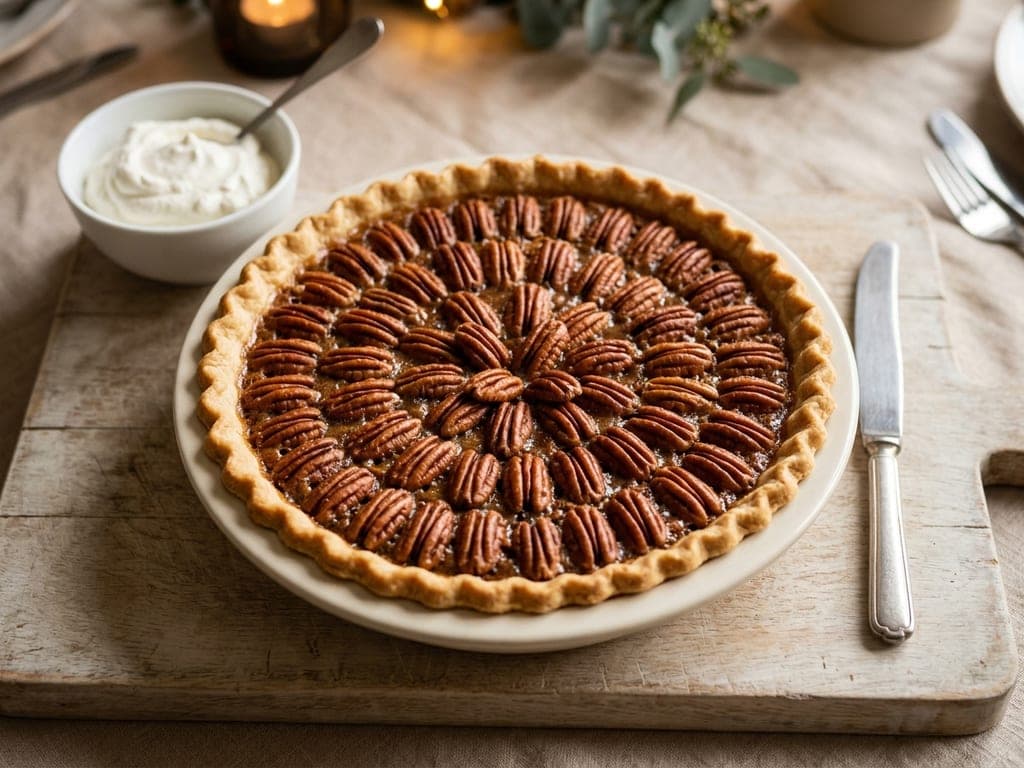
- Fill the warm shell and bake. Slide the rack out and pour the filling into the still-warm shell on the hot sheet, from a jug with a spout, keeping your forearms clear of the hot metal (in a glass or ceramic plate, into the shell cooled 10 minutes, on the bare rack). Nudge the chopped pecans level. Lay the reserved halves on top in rings, starting at the edge and working in, rounded side up. Do not brush them with extra syrup for shine; it only makes the top sticky. Bake at 350°F (175°C) for 50 to 60 minutes. After 25 minutes, cover the crust edge with a pie shield or a ring of foil so it does not over-brown. Why: pouring into a warm shell starts setting the filling where it touches the crust before it can soak in, and America’s Test Kitchen found that filling a warm crust (they also warm the filling) helps keep the bottom from going soggy. The pecans float no matter what (they are lighter than the syrup), so the halves you place stay on top and give you a clean, even surface to slice through.
- Take it out at 200°F (93°C). Start checking at 45 minutes. Push an instant-read thermometer into the very center of the filling, not into a pecan or the crust. The pie is done at 200°F (93°C). By eye: the whole surface has puffed slightly, the edges are firm, and when you nudge the pan the middle 1 to 2 inches (2.5 to 5 cm) wobbles as one piece, like gelatin, rather than rippling like liquid. Tapped lightly in the center, it should spring back. Not there yet? Give it 5 more minutes and check again. Why so high, when a plain egg sets far lower: sugar raises the temperature at which egg proteins set. This filling is about 70% dissolved sugars by weight in its liquid part, the same as Karo’s classic, and Karo’s own target for its recipe is 200°F (93°C). Pull it at 175°F (79°C) and it will stay loose however long it cools.
- Cool, then chill for clean slices. Set the pie on a rack and let it cool for 2 hours, until barely warm. Then refrigerate it uncovered until cold (at least 3 hours, or overnight), and cover it loosely once cold so condensation does not drip onto the crust. Why: the filling finishes setting as it cools, and a pie cut warm will run however well it was baked. Two hours also keeps you inside the food-safety window for an egg-rich pie (see the safety notes). Take slices out of the fridge 20 to 30 minutes before serving, because fridge-cold filling mutes the flavor, or rewarm the whole pie at 250°F (120°C) for about 15 minutes, as America’s Test Kitchen suggests.
- Slice like a pastry kitchen. Cut the pie cold, straight from the fridge. Dip a long, thin knife in very hot water, wipe it dry, and cut each wedge with one firm downward press through the pecans and crust rather than a sawing motion; wipe and reheat the blade between every cut. Cut 8 wedges by halving, then quartering, then halving each quarter, so every slice gets the same arc of crust and the same share of the ringed halves on top. Lift the first slice out with an offset spatula slid flat under the crust. Why: syrup filling sticks to a cool blade and drags the pecans with it; a hot, clean blade melts a thin path and leaves a glossy, sharp cut face, which is what the camera and the guest see first.
Safety & hygiene Important
- Refrigerate it once cooled: it is an egg pie. Pecan pie is an egg custard pie, and USDA guidance is to refrigerate egg-rich pies after baking and cooling unless they are eaten within 2 hours. FoodSafety.gov lists pecan pie at 3 to 4 days in the refrigerator at 40°F (4°C) or below, and 1 to 2 months in the freezer at 0°F (-18°C), the freezer time being for best quality. UK Food Standards Agency advice is to keep the fridge between 0 and 5°C (32 and 41°F) and to eat leftovers within 48 hours, or freeze them. The sugar lowers the water available to bacteria, but not enough to make an egg filling with no preservatives safe on the counter for days. Unrefrigerated pies on supermarket shelves are a different product, made with preservatives and shelf-stable ingredients, so their storage advice does not carry over to a homemade pie.
- The 2-hour clock on a holiday buffet. The USDA rule for cooked food is no more than 2 hours between 40°F and 140°F (4°C and 60°C), or 1 hour when the room or the outdoors is above 90°F (32°C). On a Thanksgiving sideboard, start counting when the pie comes out of the fridge. Put it back within 2 hours, or throw out whatever is left after that. Don’t keep taking the same pie in and out of the fridge all day.
- Bourbon does not fully bake off. If you add bourbon, most of the alcohol leaves, but not all. The USDA Table of Nutrient Retention Factors (2007) gives 35% of the alcohol retained after 30 minutes and 25% after 1 hour for alcohol stirred into a mixture and baked. This pie bakes 50 to 60 minutes and the filling never boils, so 2 tbsp of 80-proof bourbon (about 9.3 g of alcohol) leaves roughly 2.3 to 3.3 g in the whole pie, about 0.3 to 0.4 g per slice, around 1/40 of a US standard drink. It is tiny, but it is not zero. Leave it out for children, during pregnancy, and for anyone avoiding alcohol or in recovery. For a completely alcohol-free pie, also swap the vanilla extract (which by US standard is at least 35% alcohol) for an alcohol-free vanilla or a scraped vanilla bean.
- Raw filling and the endpoint. The unbaked filling is raw egg, so do not taste it, and wash your hands and the whisk after cracking the eggs. Count the 2-hour limit from when the eggs leave the fridge: take them out no more than 30 minutes ahead, or warm them in a bowl of warm tap water for 5 minutes, and bake the filling as soon as it is mixed. Baking to 200°F (93°C) in the center puts the whole filling well above the 160°F (71°C) that US food-safety guidance sets for egg dishes, so the eggs in the finished pie are fully cooked.
- Allergens. This pie contains tree nuts (pecans), egg, milk (butter, cream) and wheat (the crust). Walnuts are the usual swap for pecans but are also a tree nut. If you buy a ready-made pie, read the label: Marie Callender’s frozen pecan pie, for example, lists sodium metabisulfite, a sulfite, in its crust. The chocolate variation adds whatever your chocolate contains, usually soy (lecithin) and often milk; check the label. Many pecans are packed in facilities that also handle peanuts, so check the bag if peanut allergy is a concern. For children under 5, pick the whole pecan halves off or serve the chopped-nut part, because whole nuts are a choking risk. Don’t use the honey swap for babies under 1.
- Hot sugar and hot weights. Sugar filling burns worse than boiling water because it sticks to skin, and it stays hot long after the pie leaves the oven. Use dry oven gloves. Lift the pie weights out by the corners of the liner and tip them into a heatproof bowl; they are as hot as the oven. Pour the filling from a jug with a spout, keeping your forearms clear of the rack and the hot sheet (or, in a metal pan, pull the sheet onto the stovetop to fill it). Keep children away from the oven door, and let the pie cool the full 2 hours before anyone touches the filling. If syrup hits skin, cool it under cold running water for 20 minutes.
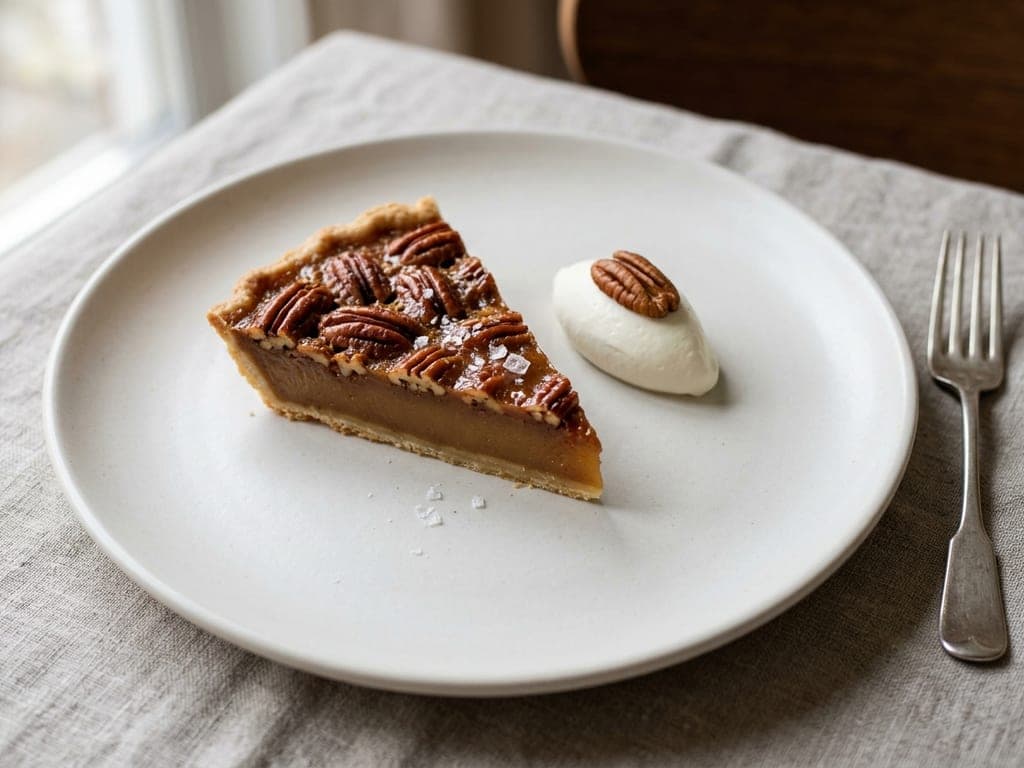
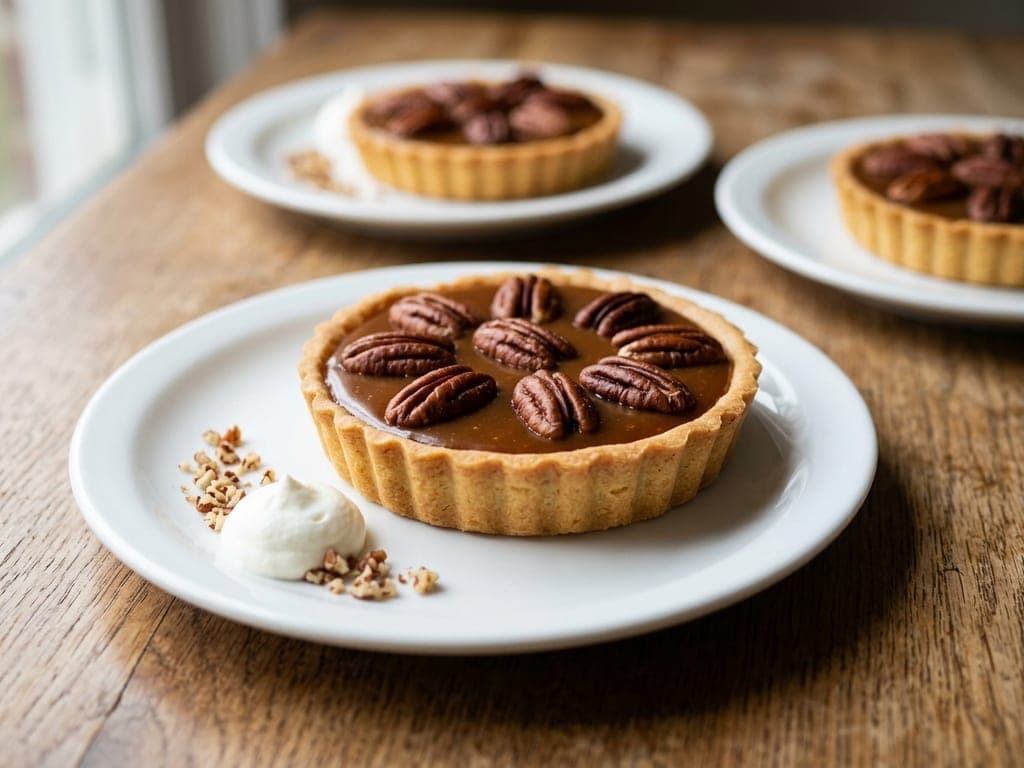
3 ways to plate it
How to tell when pecan pie is done (and why recipes disagree)
Ask the top recipes when pecan pie is done and you get four answers. Karo, whose recipe is also Allrecipes’ “Classic Pecan Pie”, says 200°F (93°C) in the center. America’s Test Kitchen’s doneness guide says 185°F (85°C). Serious Eats says 175 to 180°F (79 to 82°C). America’s Test Kitchen’s own Perfect Pecan Pie gives no temperature at all, just a filling that is set but yields “like gelatin”. None of these pages explains the spread. Here is the explanation: they are not the same pie.
Sugar raises the temperature at which egg proteins set. Calorimetry studies of egg white by John W. Donovan’s group at the USDA show a 10% sugar solution pushes the temperatures at which the proteins unfold up about 2°C (4°F), and a 54% sugar solution pushes them up by about 13°C (23°F). A 1977 USDA study of angel cake batter by Donovan, published in the Journal of the Science of Food and Agriculture, found that with the sugar present most egg-white proteins unfold near 95°C (203°F), against about 65 and 85°C (149 and 185°F) without it. A pecan pie filling is sweeter than any cake batter.
So we did the arithmetic on the liquid part of each filling, using USDA water contents (corn syrup is about 23% water, a large egg about 76%). Karo’s filling is about 70% sugar and bakes to 200°F (93°C). America’s Test Kitchen’s is about 67% and targets 185°F (85°C). Serious Eats’, with less sugar and some honey, is about 63% and stops at 175 to 180°F (79 to 82°C). Our recipe: 341 g corn syrup (263 g of dissolved sugar solids, 78 g water), 210 g white and brown sugar (207 g sugar solids), 3 eggs (114 g water), plus about 11 g water from the butter, vanilla and brown sugar. That is about 470 g of dissolved sugar solids in about 203 g water, or 70%, the same as Karo, so our target is Karo’s 200°F (93°C). The ordering is consistent, more sugar, higher set point, but no one has published a study of pecan pie specifically, so treat it as a rule of thumb: match the temperature to the recipe you are baking, not to a number from another one.
The cues that go with 200°F (93°C): the surface has puffed a little all the way across, and the middle 1 to 2 inches (2.5 to 5 cm) jiggles as one piece when nudged, not in waves. A big, high dome means it has gone too far. The filling keeps firming as it cools, which is why every tested recipe rests the pie at least 2 hours before cutting.
Why is my pecan pie runny? And why did it crack?
A runny pecan pie is almost always one of five things. First, it was underbaked for its sugar level: a 70% sugar filling pulled at 175°F (79°C), a number that works for a leaner recipe, will not set. Readers of popular jiggle-test-only recipes report exactly this, runny pies even after a full chill, and the fix is a thermometer. Second, it was cut warm; the gel firms as it cools. Third, too little egg for the syrup: the tested recipes use at least 3 large eggs per cup (240 ml) of syrup, and small eggs or a missing egg leave too little protein. Fourth, a wetter syrup swapped in one for one: maple syrup is about 32% water against corn syrup’s 23%. Fifth, an oven running cold, which an oven thermometer will show you.
Cracks and a big dome are the opposite problem. Air whisked into the eggs and steam from the filling puff the surface as it nears doneness; a slight puff is normal. Bake well past the target and the egg network tightens, then the dome falls as it cools and the set surface tears. The same overbaking squeezes syrup out of the tightened gel (weeping) and leaves tiny grainy curds at the edge, where the filling gets hottest first. America’s Test Kitchen’s answer for a flawless, smooth filling is gentle heat: a 275°F (135°C) oven with filling pre-warmed to about 130°F (54°C). Ours is a thermometer and a pull at 200°F (93°C).
Corn syrup, light or dark, and pecan pie without it
Corn syrup is glucose syrup made by breaking down corn starch. It is not high-fructose corn syrup: that is corn syrup converted further, with enzymes, into fructose. Karo Light and Karo Dark contain no HFCS; the company says it added HFCS in the 1970s and later removed it after consumer requests. A typical corn syrup is only about 40 to 45% as sweet as table sugar, because most of it is long chains of glucose rather than simple sugars. Karo Light’s label shows 30 g of carbohydrate but only 10 g of “sugars” per 2 tbsp. Those long chains are the reason the pie exists: they add body and stop the sugar from crystallizing, so the filling sets glossy and smooth instead of grainy.
Light or dark is a flavor choice, not a structural one; Karo says they can be used interchangeably. Karo Light is corn syrup, salt and vanilla. Karo Dark adds molasses and a preservative, sodium benzoate, which gives a deeper color and a bittersweet edge. The early Karo pecan pies of the 1920s to 1950s used Karo’s Blue Label, which was the dark syrup. We use light syrup plus dark brown sugar, which gives the molasses depth while letting the toasted pecans and butter lead, the same approach as America’s Test Kitchen.
You can make pecan pie without corn syrup, but every swap changes something. Maple syrup (about 32% water, mostly sucrose) is wetter and sweeter; the usual fix is to add about 1 tbsp flour per cup (240 ml) of syrup and expect a longer bake. Honey (about 17% water, mostly fructose and glucose) is much sweeter and browns fast, so tent the pie earlier (and don’t serve a honey pie to babies under 1). Cane syrup (about 26% water) is the old Southern choice. Golden syrup, the partly inverted cane syrup Lyle’s has made in London since the early 1880s, is the closest in texture and is what a British baker has in the cupboard for treacle tart. With any of them, keep the eggs at 3 and bake to the same set: puffed, wobbling as one piece.
Who invented pecan pie? The record versus the Karo story
The story on much of the internet, and in the Texas Legislature’s own resolution, is that the wife of a Karo executive invented pecan pie around 1930. The source of that story is Karo itself, and Karo has quietly changed it. Its 2002 website timeline read: “The wife of corporate sales executive discovers a new use for corn syrup.” By 2020 the entry had become “Down South, a new use for corn syrup is born,” and the executive’s wife was gone. The Texas resolution that made pecan pie the state pie in 2013 still says “the wife of an executive at the Karo Syrup Company combined that product with pecans to make a pie.”
The printed record is older. The first known printed “pecan pie” appeared on 6 February 1886, on the same day in Harper’s Bazar (spelled with one “a” until 1929) and in the Texas humor weekly Texas Siftings. Harper’s called it “capable of being made ‘a real state pie’”. It was a different dish: pecans boiled in milk and stirred into a custard, with an optional meringue, and no syrup at all. In January 1898 a letter to the Dallas Morning News from Mrs. Matt Bradley of Tioga, Texas, offered a “Texas Pecan Pie” of sugar, milk, chopped pecans and eggs under a meringue, “claiming to be its originator and the right to christen it”. In July 1898 the Ladies’ Home Journal printed the same recipe, almost word for word, as sent in by “Mrs. M. B.”. That the two are the same woman is our inference from the matching initials, recipe and timing; the Journal does not name her. Her claim to have invented the pie was, in any case, 12 years too late.
The syrup pie we know shows up in the 1920s, before Karo’s supposed invention. One of the earliest known Karo pecan pies is Mrs. H. W. Woodruff’s, in a 1925 First Baptist Church of Dallas Sunday-school cookbook, made with dark Karo. By 1929 Vieh’s bakery in Memphis was selling “Vieh’s Karo Pecan Pie, made of pure Karo Syrup”. Food historian Rebecca Sharpless, who had repeated the Karo-wife story in her 2022 book Grain and Fire, corrected herself on her publisher’s blog that November: “I bit on a corporate line from the Karo Syrup website… I was dead wrong.” The fair verdict is the cookbook writer Jean Anderson’s: “If Karo did not originate pecan pie, it certainly popularized the recipe.” In 1941 a Karo ad in a Texas newspaper, the Big Spring Daily Herald, still sold it as “this Texas favorite.”
Two more corrections. The often-cited “1900” New Orleans booklet that points to Slidell, Louisiana, as “the original home of pecan pie” is probably from the 1930s: its drinks pages include a Sidecar and recipes using Herbsaint, which went on sale in 1934, and its “original home of pecan pie” sentence turns up again, almost word for word, in a 1941 book. And the Texas state pie resolution is Senate Concurrent Resolution 12, signed on 14 June 2013, not “HCR 87”, which made the pumpkin the state squash. Cooks with cane syrup at hand kept using it: in Cross Creek Cookery (1942), Marjorie Kinnan Rawlings made hers with “Southern cane syrup” and wrote, “True Southern pecan pie is one of the richest, most deadly desserts of my knowledge.”
Pecans: toasting, halves or chopped, keeping them fresh
Pecans are native to North America, growing wild from the Midwest through Texas into Mexico. Modern pecan growing began with a grafting job on a Louisiana sugar plantation. The USDA’s William A. Taylor recorded in 1905 that an enslaved gardener at Oak Alley, “Antoine by name, succeeded in grafting 16 trees” with nuts from a celebrated large-nut tree “in the winter of 1846 or 1847”, work Taylor said “marks the beginning of modern pecan culture”. By 1865 there were 126 grafted trees in bearing on the plantation. The nuts won praise at the 1876 Philadelphia Centennial Exposition, and the variety became known as ‘Centennial’, the first pecan variety propagated by grafting and the first planted as a commercial orchard. (Taylor describes its shell as “rather thick”, not the paper shell of later retellings.)
The 2025 US crop came to 284 million lb (129 million kg) of pecans in the shell, led by Georgia (first in each of the last three crops) and New Mexico, then Texas and Arizona. Harvest starts in October and the crop is marketed through March, which is part of why pecan pie is a winter holiday pie. How to say it is less settled: in the Harvard Dialect Survey the most common answer was pee-KAHN (about 29%), then pick-AHN (21%) and PEE-can (17%).
Toast them. It deepens the flavor and dries the nuts so they stay crisp in the filling. Halves or chopped is about texture and slicing: chopped nuts under a layer of halves, as here, give an even bite and a clean cut, while all halves look dramatic but tear when you slice. Either way, they float. Pecans are lighter than the syrup, so they always rise to form a top layer.
Pecans are about 72% fat, mostly unsaturated, which is why they go rancid. New Mexico State University’s storage table gives shelled pecans about 3 months at 70°F (21°C), about 12 months at 32 to 36°F (0 to 2°C) and 2 to 5 years frozen at 0°F (-18°C). Chopped pieces keep far less well than halves (NMSU gives them only 1 or 2 months even near freezing), so store halves and chop just before baking. Keep them airtight and away from strong smells (NMSU warns that even paint and vegetables will taint them), and let frozen nuts warm up gradually, still sealed, so they do not gather condensation.
Bourbon pecan pie and other variations
Bourbon pecan pie: whisk the optional 2 tbsp (30 ml) bourbon into the filling with the vanilla. It adds a little liquid, so expect up to 5 minutes more baking; the target stays 200°F (93°C). The oak and vanilla notes suit the brown sugar, and a small share of the alcohol stays in the pie (see the safety notes).
Chocolate pecan pie: scatter 1/2 cup (85 g) chopped dark chocolate over the par-baked crust before pouring in the filling. Check the chocolate’s label: it usually adds soy and often milk. Brown butter pecan pie: cook the 3 tbsp filling butter until it smells nutty and the solids are brown, then cool it before whisking it in. Maple pecan pie, with no corn syrup: see the corn syrup section; add about 1 tbsp flour and expect it to take longer to reach the set.
Pecan pie also has cousins. Chess pie and the old transparent pie are the same butter, sugar and egg custard without the nuts; the cookbook writer Bill Neal counted pecan pie among the chess pie family. Old molasses pie was essentially pecan pie without the pecans. Britain’s treacle tart is golden syrup set with breadcrumbs, and Marjorie Kinnan Rawlings thought pecan pie was “more overpowering than English treacle pie, which it resembles in texture”. Canada’s butter tart has its earliest known recipe in a 1900 hospital auxiliary cookbook from Barrie, Ontario.
Questions, answered
How do you know when pecan pie is done?
Use an instant-read thermometer in the very center of the filling: this pie, like Karo’s classic, is done at 200°F (93°C). By eye, the surface has puffed slightly all the way across and the middle 1 to 2 inches (2.5 to 5 cm) wobbles as one piece, like gelatin, rather than rippling. Tapped lightly, the center springs back. Recipes with less sugar set lower (Serious Eats says 175 to 180°F (79 to 82°C)), because sugar raises the temperature at which eggs set; match the number to the recipe.
Why is my pecan pie runny?
Usually because it was underbaked for its sugar level or cut before it cooled. A classic corn-syrup filling needs about 200°F (93°C) in the center; pulled at 175°F (79°C) it stays loose. Let it cool at least 2 hours, and chill it for clean slices. Other causes: too few or small eggs (use 3 large per cup, or 240 ml, of syrup), a wetter syrup such as maple swapped in without flour, or an oven running cold.
Does pecan pie need to be refrigerated?
Yes. Pecan pie is an egg custard pie, so refrigerate it once it has cooled, within 2 hours of baking. FoodSafety.gov gives 3 to 4 days in the fridge and 1 to 2 months in the freezer. Pecan pies sold unrefrigerated in shops are made with preservatives, so their shelf life does not apply to a homemade pie.
Should I use light or dark corn syrup for pecan pie?
Either works: Karo says they are interchangeable, and the set and baking time do not change. Dark corn syrup contains molasses, so it gives a darker, more bittersweet pie; light lets the pecans and butter lead. This recipe uses light syrup with dark brown sugar to get the caramel depth without the molasses edge.
Can you make pecan pie without corn syrup?
Yes. Golden syrup is the closest swap in texture. Maple syrup works but is wetter (about 32% water against 23%), so add about 1 tbsp flour and expect a longer bake. Honey is sweeter and browns fast, so cover the pie earlier (and don’t give a honey pie to babies under 1). Corn syrup’s long glucose chains are what keep the filling smooth, so a sucrose-heavy syrup can bake up slightly grainier.
Do you need to blind bake the crust for pecan pie?
You don’t have to, but it helps. Karo and Martha Stewart bake the filling in a raw crust; America’s Test Kitchen par-bakes. We par-bake 15 minutes with weights at 400°F (200°C) and 5 to 8 minutes without, then pour the filling into the still-warm shell and bake on a preheated sheet pan. In a metal pan, that combination gives the crispest bottom. In a glass or ceramic plate, skip the preheated sheet and let the shell cool 10 minutes before filling, because hot glass can crack under cold liquid or on hot metal.
Who invented pecan pie?
No single person. The first printed pecan pie, a custard pie with pecans boiled in milk, ran in Harper’s Bazar (and the same day in Texas Siftings) on 6 February 1886. Mrs. Matt Bradley of Tioga, Texas, claimed a “Texas Pecan Pie” in 1898. Syrup pecan pies made with Karo are in print by 1925, before the company’s story that an executive’s wife invented it around 1930, a story Karo has since dropped from its website.
Why did my pecan pie crack or puff up?
It was overbaked or the eggs were beaten too hard. A slight puff at doneness is normal; a high dome means the filling went well past its set point and will fall and crack as it cools. Whisk the eggs just to combine, and take the pie out when the center reaches 200°F (93°C).
Can you freeze pecan pie?
Yes, for 1 to 2 months for best quality (FoodSafety.gov). Cool and chill it fully, wrap it well, and thaw it overnight in the fridge. The crust softens a little and the filling can separate slightly, so freezing suits a make-ahead pie, not a showpiece. Freeze it straight from the fridge. A pie that has been out more than 2 hours should be thrown away, not frozen.
Does the bourbon cook off in bourbon pecan pie?
Not completely. USDA retention data gives 35% of the alcohol left after 30 minutes of baking and 25% after an hour, so this 50 to 60 minute bake keeps about a quarter to a third. With 2 tbsp of 80-proof bourbon, that is about 2.3 to 3.3 g in the whole pie, roughly 0.3 to 0.4 g per slice: tiny, but not zero, so skip it for children, in pregnancy and for anyone avoiding alcohol. Vanilla extract carries a little alcohol too; use an alcohol-free vanilla for a fully alcohol-free pie.
How many calories are in a slice of pecan pie?
About 640 calories per 1/8 slice of this pie, or about 510 per 1/10, before any cream. From USDA values for the whole pie: 341 g corn syrup 965 kcal, 100 g sugar 387, 110 g brown sugar 418, 3 eggs 215, 43 g butter 308, vanilla 12, 200 g pecans 1,382, and the crust (160 g flour 582, 113 g butter 810, 1 tsp sugar 16), about 5,095 kcal in total. Per 1/8 that is about 36 g fat, 78 g carbohydrate, 7 g protein, 278 mg sodium and 36 g added sugar (73% of the Daily Value). The 36 g is the label basis: corn syrup’s long glucose chains count as carbohydrate, not sugar. Counting every gram of syrup and sugar solids, each slice carries about 59 g of sweetener. It is about 414 kcal per 100 g, close to USDA’s 412 for a homemade pecan pie.
Snap your finished plate and let the AI plate it again — more beautifully.