Pasta alla Gricia: the Roman Guanciale Pasta, Done Right
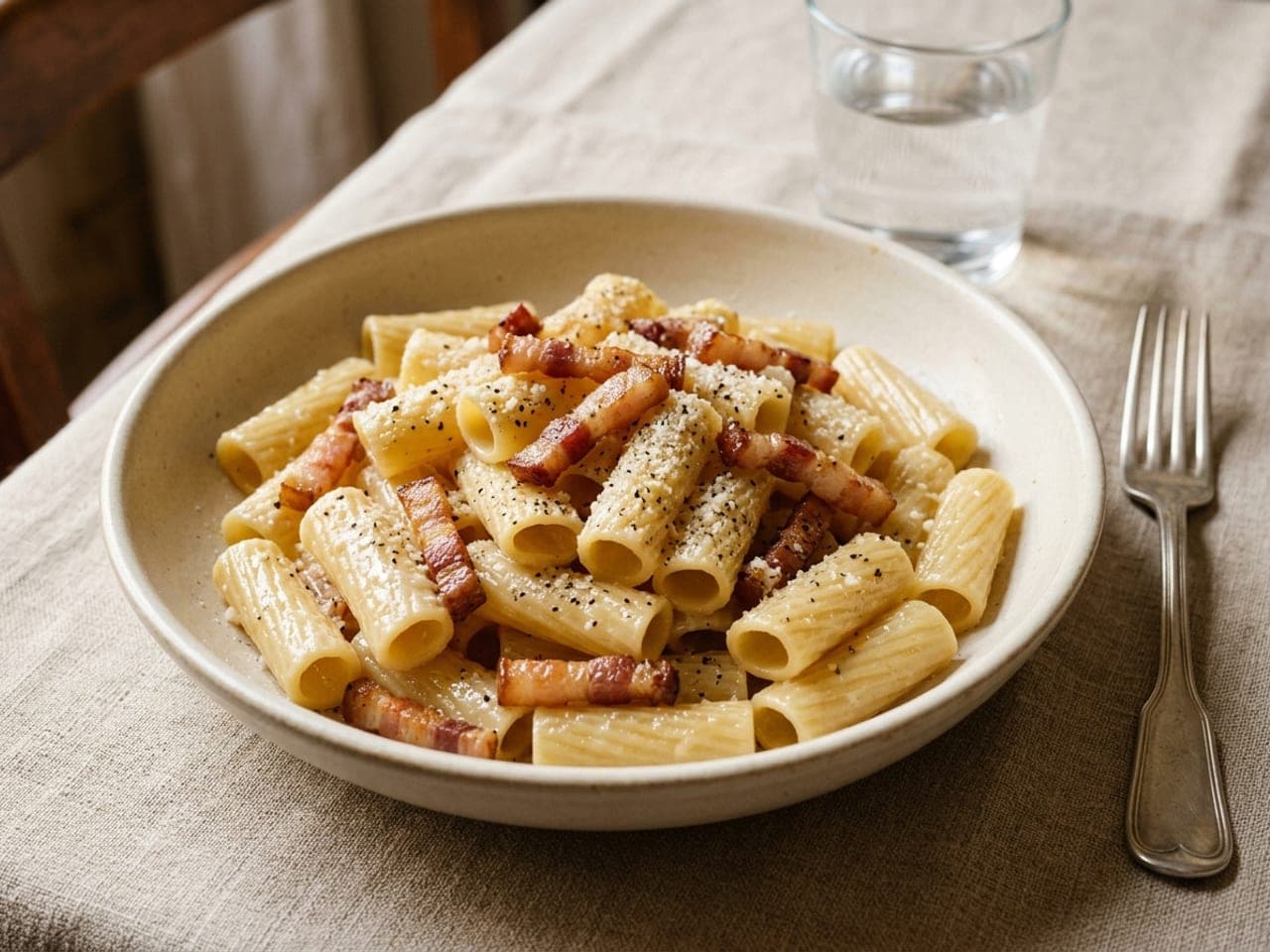
Pasta alla gricia (say GREE-cha) is the Roman pasta of guanciale, Pecorino Romano and black pepper, bound into a glossy sauce by rendered pork fat and starchy pasta water, with no egg, no tomato and no cream. It is carbonara without the egg, amatriciana without the tomato, and cacio e pepe with pork. This recipe renders the guanciale gently, blooms the pepper in its fat, finishes rigatoni in the pan, and adds the cheese off the heat once the pan has cooled to about 140°F (60°C). Then it sorts out the name, the ‘oldest Roman pasta’ claim, and the substitutes with real numbers.
Ingredients
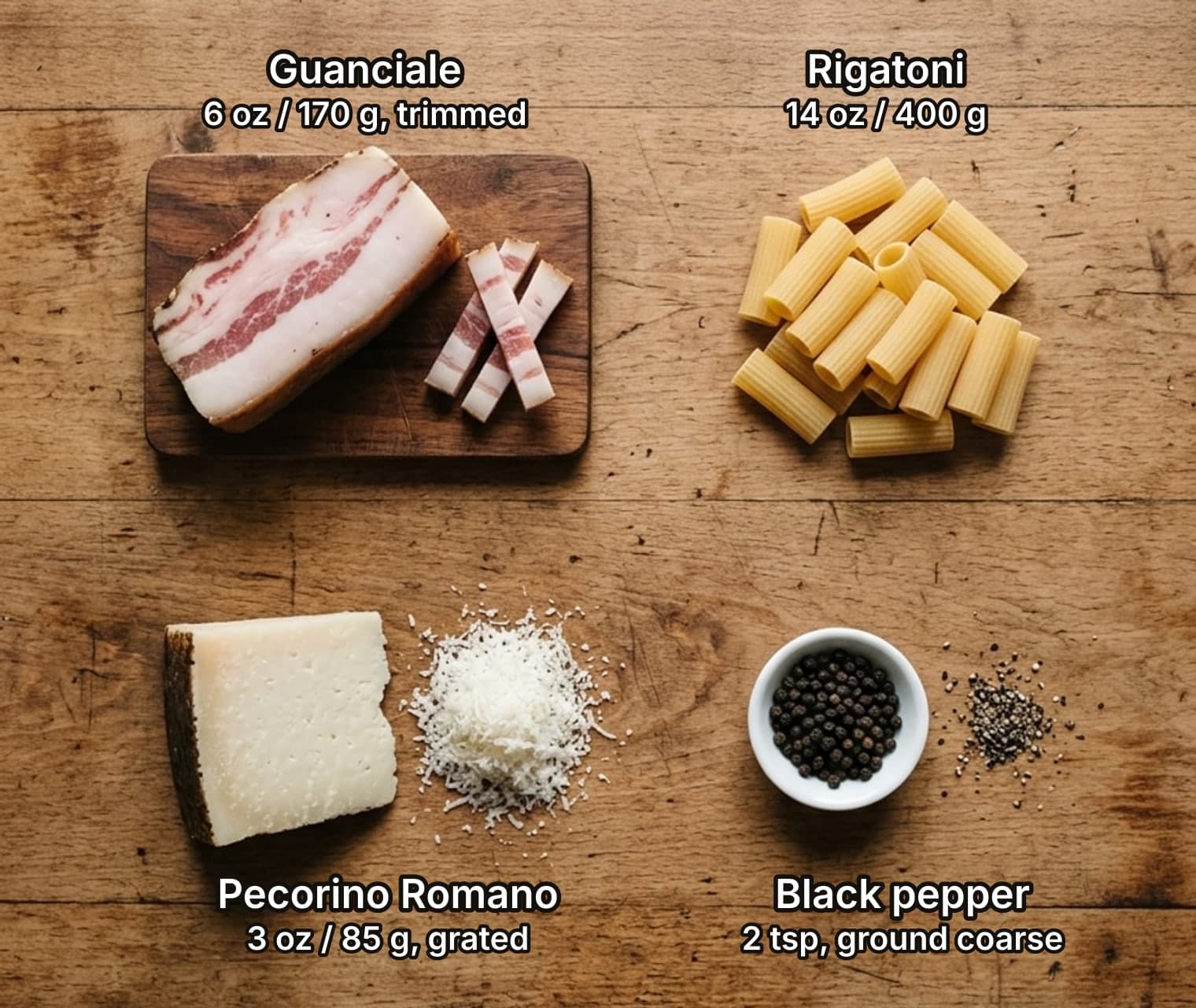
- guanciale (cured pork jowl), in one piece if you can get it: hard rind and most of the peppery outer crust trimmed off. Unsmoked pancetta is the nearest substitute; smoked bacon changes the dish (see the substitutes section). Contains pork6 oz (170 g), weighed after trimming
- rigatoni, bronze-cut (the rough, matte kind sheds more starch). Mezze maniche or spaghetti also work. Contains wheat/gluten14 oz (400 g)
- Pecorino Romano DOP, grated from a wedge on the finest holes of a microplane; not pre-grated (anti-caking cellulose keeps it from melting smoothly) and not a US ‘Romano’ unless the label says sheep’s milk. Split into two equal piles of 1 1/4 oz (35 g) for the sauce, the rest for the table. Contains milk; made with lamb rennet3 oz (85 g)
- black peppercorns, freshly ground medium-coarse: 1 tsp bloomed in the fat, the rest to finish2 tsp (about 4 g)
- fine sea salt, for the pasta water only: about a fifth of the usual amount, because the guanciale and the cheese do the seasoning1 scant tsp (5 g)
- water, for the pasta: deliberately less than the package says, so the water gets starchy2 1/2 quarts (2.4 liters)
- extra-virgin olive oil, only if your guanciale renders less than 1/4 cup (60 ml) of fat (or if you use leaner pancetta or bacon)1 to 2 tbsp, optional
What is pasta alla gricia?
Pasta alla gricia is a Roman pasta dressed with rendered guanciale (cured pork jowl), finely grated Pecorino Romano and black pepper. The unlisted fifth ingredient is the pasta’s own starchy cooking water. There is no egg, no tomato, no butter, no cream and, in today’s Roman version, no onion or garlic. The sauce is an emulsion: rendered jowl fat broken into tiny droplets in starchy water, held there by starch and by the proteins in the cheese. Done right it is glossy and clings to every tube; done wrong it is a slick of grease with clumps of cheese in it.
Gricia is pronounced GREE-cha. Romans also call it amatriciana bianca, white amatriciana, and it has a blunter nickname, cacio e unto, ‘cheese and grease’, which the Roman chef Arcangelo Dandini uses (caciu e untu in the Amatrice dialect). It is usually made with rigatoni or mezze maniche in Rome today, and spaghetti or bucatini work too.
It sits in the middle of Rome’s four famous pastas. Our cacio e pepe page draws the family tree: start with cacio e pepe (pasta, Pecorino, pepper, water). Add guanciale and you have gricia. Add tomato to gricia and you have amatriciana; add egg and you have carbonara. As on our carbonara page, read that as a cook’s map rather than a pedigree: carbonara is the youngest of the four (first recorded in 1939, first printed as a recipe in 1952) and borrowed its pantry from the others, and the order in which the other three were invented is a good argument, not a documented fact (more below).
The dish looks like three ingredients and a shrug, which is why so many versions fail. Joël Robuchon’s line, quoted by Serious Eats in its own gricia recipe, fits: ‘The simpler the food, the harder it is to prepare well.’
How to make Pasta alla Gricia
- Chill and cut the guanciale. Put the guanciale in the freezer for 15 minutes; firm fat slices cleanly instead of smearing. Cut away the hard rind and scrape or trim off most of the pepper crust (a little is fine, a lot tastes dusty). Slice the piece into planks 1/4 inch (6 mm) thick, then cut the planks into batons about 1 inch (2.5 cm) long, and weigh after trimming so the ratio to the pasta is real. Why: every baton then carries the same stripe of lean and fat and renders at the same speed, so nothing burns while its neighbor is still raw. Thin strips curl and chew; neat batons turn crisp outside and stay soft inside, and they lodge in the rigatoni.
- Set up: grate, weigh, boil lightly salted water. Grate the Pecorino on the finest holes of a microplane and split it into two piles of 1 1/4 oz (35 g) for the sauce and a small pile for the table. Fine, fluffy cheese melts in seconds; coarse shreds melt slowly and clump while you wait. Bring 2 1/2 quarts (2.4 liters) of water to a boil in a wide pot and add 1 scant tsp (5 g) of fine salt, about 0.2%, a fifth of the usual. Why so little of both: less water means more starch per cup, and starch is what stabilizes the sauce; light salt, because part of this water gets boiled down into the sauce, concentrating its salt, and guanciale plus Pecorino Romano already bring plenty.
- Render the guanciale from a cold pan. Put the batons in a cold 12-inch (30 cm) stainless or carbon-steel skillet, no oil, and set it over medium-low heat. Cook 10 to 12 minutes, stirring now and then, until the fat has gone from white to translucent and the edges are golden and crisp while the centers still give when pressed. Stop before dark brown: over-rendered guanciale turns bitter and hard. Why a cold start: the fat melts out gradually and fries the meat in its own fat, instead of the surface searing shut and trapping it. Lift the guanciale onto a plate with a slotted spoon so it stays crisp. Tip the fat into a heatproof measuring cup (glass or metal, never plastic): you want 1/4 cup (60 ml) back in the pan. Save any extra for roasting potatoes; if you are short, make up the difference with olive oil.
- Bloom the pepper in the fat. With the 1/4 cup (60 ml) of fat back in the skillet over low heat, add 1 tsp of the ground pepper and swirl for 30 to 60 seconds, until it foams gently and smells floral and resinous rather than just hot. Take the pan off the heat. Why: the compounds that make pepper taste like pepper, piperine among them, dissolve in fat and barely at all in water. Bloomed in fat, the pepper is carried through the whole sauce instead of sitting on top as specks. Keep the heat low: scorched pepper tastes acrid, and there is no fixing it.
- Par-cook the rigatoni. Drop the rigatoni into the boiling water and stir for the first minute so the tubes do not stick. Cook for about half the package time (5 to 6 minutes for a 12-minute rigatoni); the pasta should still be chalky in the center. A minute before it is ready, ladle 1 1/2 cups (360 ml) of the cloudy cooking water into the skillet, return it to high heat and boil hard for a minute, swirling, until fat and water turn into a pale, milky liquid. That is the emulsion starting: the boil breaks the fat into tiny droplets and the starch coats them. Water flashing to steam in hot fat throws fat: pour a first small splash down the side of the pan, let it calm, then add the rest. Keep the pasta pot at a simmer: that water is your reserve.
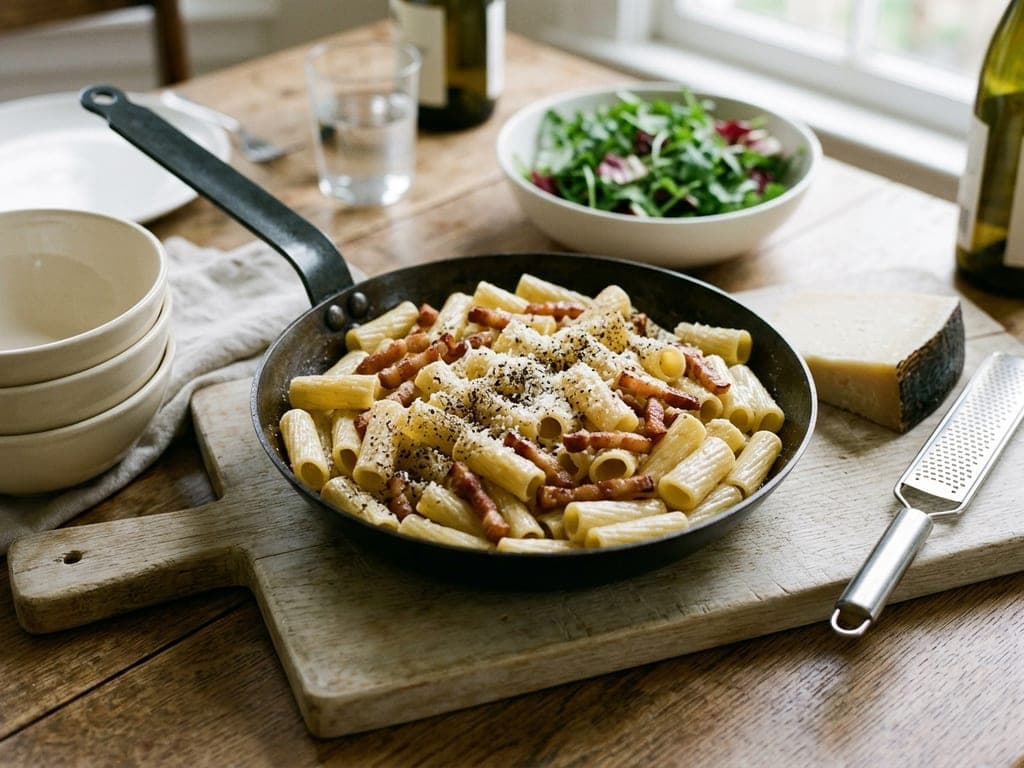
- Finish the pasta in the pan. Lift the rigatoni straight into the skillet with a spider or slotted spoon (a little clinging water is welcome). Cook over medium-high heat for 5 to 7 minutes, stirring and tossing with a wooden spoon or spatula rather than tongs, which tear tubes. The pasta finishes cooking in the sauce, keeps shedding starch into it, and the liquid reduces around it. If the pan starts to look dry before the pasta is al dente, add pot water 1/4 cup (60 ml) at a time. You want the pasta just al dente, coated in a thin, glossy glaze, with a spoonful or two of loose sauce still pooling when you tilt the pan. This is the Roman way of doing it, and it is more forgiving than it sounds: the reserve water is the safety net. Stir most of the guanciale back in, keeping a spoonful of the crispest pieces for the top.
- Cool the pan off the heat, then add the cheese in two goes. Take the skillet off the heat and toss for 1 to 2 minutes, until the steam is gentle. If you have an instant-read thermometer, wait for about 140°F (60°C). Without one, the second pile is your insurance: if the first addition grains, whisk the rest into a crema with warm pasta water (see the FAQ). For the surest drop, tip the pasta into a room-temperature bowl before the cheese goes in, as Dandini does. Why: Pecorino proteins tighten into rubbery clumps in hot water. The Pecorino Romano consortium’s own recipe says its casein starts to set at 131°F (55°C), and a 2025 physics study of cacio e pepe saw big clumps at about 149°F (65°C) in plain water. The same study found that enough starch keeps the cheese smooth well into that range. So aim for about 140°F (60°C) or a little below: cool enough to stay clear of the big-clump zone, and the starchy water covers the rest. Scatter over the first 1 1/4 oz (35 g) of cheese and toss hard, stirring and flipping, for about 30 seconds until it vanishes into the sauce. Add the second pile and toss again. Two additions keep the cheese from landing all in one hot, concentrated patch. Loosen with pot water a tablespoon at a time until the sauce flows like heavy cream: it will tighten on the plate.
- Season and serve at once. Taste before you reach for salt; with this much guanciale and Pecorino it rarely needs any. Grind over the rest of the pepper, scatter the reserved crisp guanciale on top and serve within two minutes in bowls warmed under the hot tap and dried (warm, not hot: a cold bowl sets the sauce, a scorching one keeps cooking it), with the extra cheese at the table. Why the hurry: the sauce is a starch-stabilized emulsion held together by warmth and movement, and as it cools the cheese sets and the starch stiffens. Gricia waits for nobody, which is why Romans cook it to order.
Safety & hygiene Important
- Guanciale: cured, but check which kind you bought. Italian-style guanciale is salt-cured and air-dried, and imported guanciale is usually sold as ready to eat, so you are rendering it for texture. The long, hot render is a bonus margin, not a substitute for good handling, and it is no fix for a recalled piece. Some US producers also sell fresh pork jowl, which is raw meat. ‘Uncured’ on a US label is not a safety category (today it usually means the cure came from celery powder rather than sodium nitrite), so go by the label, not the word ‘cured’: ‘ready to eat’ or ‘fully cooked’ means it is safe as sold. A Safe Handling Instructions box, ‘cook thoroughly’, or no information at all means treat it as raw pork and cook it to at least 145°F (63°C) with a 3-minute rest, the USDA FSIS minimum for whole pork cuts (in this recipe it is rendered for 10 to 12 minutes, far past that). Keep guanciale in the refrigerator at 40°F (4°C) or below, sealed or opened, unless the label says it is shelf-stable. Wrap an opened piece tightly and follow the producer’s date. Wash the board, knife and your hands with hot soapy water (hands for 20 seconds) after cutting it, before they touch anything that will not be cooked. Recall, September 2026: on September 6 the USDA FSIS announced the recall of about 1,513 lb (686 kg) of imported guanciale (Ferrarini and Prime Line/DOK packs, lot 263311US, best-by 05.16.27, establishment IT 1937 L CE) for possible Listeria. If yours matches, do not cook it: throw it away or return it to the store.
- Leftovers: two hours out, then the fridge. USDA advice is to refrigerate cooked food within 2 hours (1 hour if the room is above 90°F (32°C)) and eat leftovers within 3 to 4 days, reheated to 165°F (74°C); spread them in a shallow container so they cool fast. The UK Food Standards Agency advises getting leftovers into a fridge at 5°C (41°F) or below within 2 hours, eating them within 2 days, and reheating them only once, until steaming hot all the way through. Quality is the bigger problem: the emulsion sets as it cools and breaks when reheated, so reheat leftovers in a pan with a splash of water, stirring, until steaming hot throughout, 165°F (74°C), rather than in the microwave.
- Hot fat and water spit. Step 5 pours boiling pasta water into fat that is hotter than boiling, and the water flashes to steam and throws fat. Keep the skillet off the flame to pour, add a small first splash down the side of the pan rather than into the middle, let it settle before adding the rest, and keep your face and forearms back. If the fat is smoking, wait until it stops. Never put water on a fat fire: turn off the heat, slide a lid or baking sheet over the pan and leave it covered until it is completely cool. Do not carry the pan. If the fire does not go out, get out and call the fire service. Use a pan with a long handle and at least 12 inches (30 cm) across, so the fat has room.
- Allergens and diets. This dish contains milk (Pecorino Romano is a sheep’s-milk cheese, which does not help anyone with a cow’s-milk allergy, because the allergy is to milk proteins shared across species), wheat (the pasta) and pork. It is not vegetarian: guanciale is pork, and Pecorino Romano DOP is made with lamb rennet. For a gluten-free version, cook a gluten-free rigatoni in fresh water in a clean pot and use that water; gluten-free pasta sheds less starch, so add water to the pan in smaller amounts. Check the guanciale or pancetta label too: cure and spice blends vary. If you deglaze with wine (see the schools section), it adds sulphites.
- Salt is the real health issue. By our component math a serving carries about 870 mg of sodium, roughly 38% of the 2,300 mg US Daily Value and, as salt, about 2.2 g of the UK’s 6 g daily maximum for adults. Nearly all of it comes from the guanciale and the Pecorino. That figure uses the USDA value for Romano cheese (1,430 mg sodium per 100 g); Pecorino Romano is dry-salted and research puts finished wheels at 3.5 to 6.5% salt, so a wheel at the salty end of that range (6.5% salt is about 2,560 mg sodium per 100 g) would add up to about 240 mg per serving, and a saltier guanciale adds more. That is why this recipe salts the pasta water at about 0.2% instead of ‘like the sea’ and asks you to taste before adding salt at the end. Serious Eats’ own nutrition panel for its gricia lists 2,365 mg of sodium per serving; the pot you salt is the part you control.
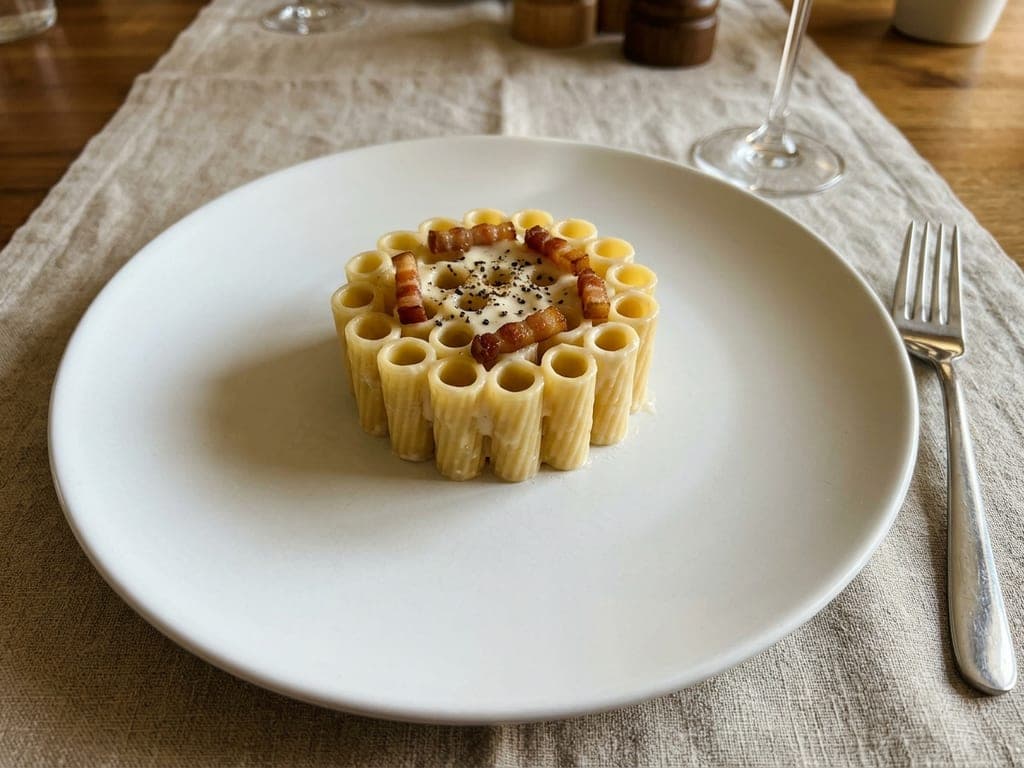
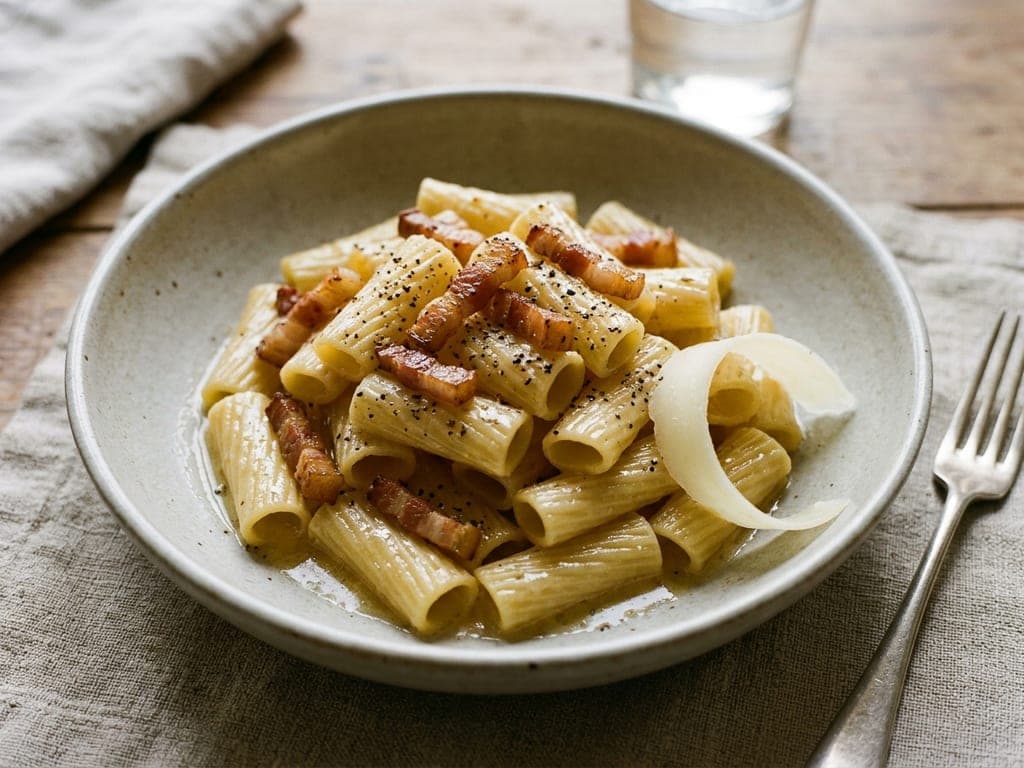
3 ways to plate it
Gricia vs carbonara, amatriciana and cacio e pepe
The real difference between the four is what holds the sauce together, and so what can go wrong.
Carbonara adds egg. Yolk is an emulsifier and a thickener, so it gives the sauce a safety net and a new risk: the egg sets and scrambles if the pan is too hot. Gricia has no egg, so the only things holding its fat in water are pasta starch and cheese protein, and the risk is cheese clumping, not scrambling. Alessandro Roscioli of Rome’s Roscioli, recalling how his restaurant’s first gricias failed, points out that in carbonara you can loosen the pecorino and egg cream with guanciale fat, while ‘nella Gricia non puoi’: in gricia, you can’t (as reported by Passione Pasta). If your carbonara keeps splitting, practice on gricia: it teaches the fat-and-starch glaze the egg sits on. Our spaghetti carbonara and carbonara sauce pages take it from there.
Amatriciana adds tomato (and, in Amatrice, a little chili). Tomato brings water, body and acid, which makes its sauce far more forgiving. It is also the only one of the four with a legal definition: ‘Amatriciana Tradizionale’ has been an EU Traditional Speciality Guaranteed since 2020 (Regulation (EU) 2020/395). Gricia has no legal specification at all, which is one reason its recipes vary so much.
Cacio e pepe drops the pork. It is a cheese-in-water sauce with no added fat, so it needs far more cheese (our cacio e pepe uses 7 oz (200 g) for 14 oz (400 g) of pasta) and is the most fragile of the four. Gricia is the reverse: a fat-in-water emulsion in which the rendered jowl fat is the main event and the Pecorino is a binder and a seasoning, so this recipe uses 2 1/2 oz (70 g) of cheese in the sauce for the same amount of pasta. Same cheese, same pepper, same pasta water, different architecture.
The name: Rome’s grocers, a mountain hamlet, or neither
Most pages repeat two stories about the word gricia and pick one. Here is what the documents actually show.
The word is older than the dish, and it was an insult. The Roman dialect poet Giuseppe Gioachino Belli used ‘griscio’ in his sonnets in the 1830s. In ‘Er galantomo’ (1 October 1831) his note glosses it as the name given to the orzaroli, Rome’s grocers who sold bread, flour, pasta, oil and other staples. In ‘Er carnovale der trentatre’ (10 February 1833) he hurls it at Pope Gregory XVI: ‘Ah ggriscio, rafacàno, pataccone!’ And in an 1835 note Belli says who these people were: ‘Nome appellativo degli indigeni del Lago di Como’, a name for natives of Lake Como who came to Rome to scrape a living in small trades and save up to buy land back home. So Belli himself puts them at Lake Como, not in the Swiss Grisons that most recipe pages name.
Theory one, then, is that pasta alla gricia means pasta ‘the way the grici make it’. The Treccani dictionary takes this line and hedges on where the grici came from: the Swiss Grisons, the Valtellina (which the Grisons ruled from 1512 to 1797) or perhaps Friuli. The word is solidly documented; the link between the grocers and this particular pasta is not. No document ties the recipe to them.
Theory two is Grisciano, a hamlet of Accumoli on the Via Salaria near Amatrice, which holds its own Sagra della Gricia festival. This one is in print by 1960: a review of Alberto Consiglio’s 1959 book La storia dei maccheroni in the Trieste paper Il Piccolo (19 July 1960) mentions ‘vermicelli alla gricia’ and glosses ‘«gricia» da Griciano, un paesino prossimo ad Amatrice’, gricia from Griciano, a village near Amatrice. Consiglio’s ‘vermicelli alla gricia’ is the earliest ‘alla gricia’ in print we could find, and the village gloss may be his or the reviewer’s. Buccini, in a 2006 paper for the Oxford Symposium on Food and Cookery, argued that ‘alla grisciana’ was reshaped into ‘gricia’ to fit occupational dish names such as carbonara and carrettiera.
Neither side can win on spelling. Belli writes ‘griscio’ with the same -sc- as Grisciano, so the Grisciano camp’s spelling argument proves nothing. Belli also uses ‘griscio’ in another sonnet to mean grey, a dialect form of grigio, which is one more reason to be careful with neat derivations (that last point is our inference). The honest verdict: both theories are plausible, the grocers’ word is older, the village link is, as far as we found, the older of the two in print for the dish, and nothing yet settles it.
Is gricia really the ancestor of amatriciana?
‘Gricia is the oldest Roman pasta, and amatriciana is just gricia plus tomato’ is the most repeated claim about this dish. It is plausible as logic and not documented as history.
The logic is sound. Tomato is a New World plant, and in Italian cookbooks it met pasta only around 1800. Antonio Latini printed a ‘Spanish-style’ tomato sauce in Naples in 1692, but not for pasta; the Roman cook Francesco Leonardi’s L’Apicio moderno pairs tomato with pasta around 1800 (sources disagree on whether the 1790 first edition or the 1807 edition has it); and Ippolito Cavalcanti’s Neapolitan vermicelli with tomato, from the late 1830s, is the canonical early recipe. A mountain dish of cured jowl, sheep’s cheese and pasta needs no tomato, so a tomato-less version could easily be older. The shepherd version of that story, told most often, has shepherds on the transhumance routes around Amatrice carrying what kept: guanciale, pecorino and flour. Treat it as our cacio e pepe page treats its own shepherd story, as the usual telling, not documented history. Even the 2017 Italian application for the amatriciana designation, which tells it, lists flour rather than dried pasta and no pepper, and pepper was a bought trade good, not something a flock provides.
The printed record runs the other way round. Ada Boni’s La cucina romana (undated, usually given as 1929), the classic early collection of Roman home cooking, gives spaghetti ‘alla matriciana’ and, according to two independent accounts of the book, a variant ‘alla marchiciana’, without tomato and with sliced guanciale: the dish, under another name. The Touring Club Italiano’s 1931 gastronomic guide lists Rome’s spaghetti as matriciana (with tomato, and with onion and lard), cacio e pepe, anchovy, tuna and aglio e olio, and no gricia at all. The name ‘alla gricia’ is in print by 1959. The first printed claim that gricia is the ‘capostipite’, the founding ancestor, that we found is Secondino Freda’s, in the Strenna dei Romanisti of 21 April 1983: gricia, he wrote, can claim the title ‘sia per l’anzianità che per la prevalenza del condimento a base di maiale’, by age and by its pork-based dressing. His own recipe started with olive oil or lard, and guanciale or pork belly.
So: gricia is very probably the older idea and amatriciana the tomato version of it, but the claim is a Roman tradition and a sensible inference, not a fact with a date. And the pages that say gricia was ‘invented around 400 AD in the taverns of ancient Rome’ are wrong on every count: there is no evidence of boiled dried pasta in ancient Rome, dried pasta is first documented as an industry in Sicily in 1154, and Rome’s pasta makers only formed their guild in 1642.
The emulsion, with numbers
No ranking recipe gives you a temperature for the cheese. Here is where ours comes from. Pecorino Romano’s proteins aggregate when heated in water, and they do it more, not less, as the water gets hotter. The Pecorino Romano consortium’s own gricia recipe says the cheese’s casein ‘coagula a 55 °C’ (131°F) and rests the pasta off the heat for a minute before adding it. A 2025 study in Physics of Fluids by Bartolucci and colleagues, the cacio e pepe paper, found cheese in plain hot water forming large clumps at about 65°C (149°F). That puts 140°F (60°C) inside the trouble zone, not below it: it works because of the starch (next paragraph), which keeps the cheese smooth well above 131°F (55°C). So aim for about 140°F (60°C) or a little below, clear of the big-clump zone. That takes longer than the consortium’s one-minute rest suggests. By our estimate a full pan of pasta just off the boil is still around 165 to 185°F (75 to 85°C) after a minute off the heat, so toss for 1 to 2 minutes and check with an instant-read thermometer, or do as Dandini does and move the pasta to a room-temperature bowl, which pulls the heat out much faster.
Starch is the other lever. The same study found that when starch fell below about 1% of the cheese’s weight the whole sauce clumped, and that 2 to 3% kept it smooth. Ordinary pasta water carries only a little; water that has been reduced carries much more. That is the scientific case for the Roman method in this recipe: cook the pasta in less water than usual, then finish it in the pan so it keeps shedding starch into a sauce that is reducing around it.
America’s Test Kitchen tried the Roman method and called it more art than science, because the amount of water you need depends on how much the pasta drinks. Its fix: cook the pasta fully in half the usual water, then boil 2 cups (480 ml) of pasta water with about 1/3 cup (75 ml) of fat down to exactly 1 1/2 cups (360 ml) before the pasta and cheese go in. It is a good method and a useful check. If you are nervous, use their target: the milky fat-and-water mixture should measure about 1 1/2 cups (360 ml) before the pasta goes in.
There is a third Roman way, the crema. Dandini works grated Pecorino with the rendered fat and a ladle of pasta water into a cream in a big bowl, then tosses the barely cooked pasta in the bowl, never on the flame. The consortium’s chef whisks cheese with an equal weight of lukewarm water into a thick cream and spoons it over the plated pasta. All three routes obey the same rule: the cheese never meets boiling liquid.
Why no butter or cream? The rendered fat is already the fat in the emulsion, and dairy would dilute the jowl’s flavor. The pork fat and the starch do the job cream does in the shortcut versions.
The schools: crisp or soft, onion or not, pepper or not
Romans argue about gricia. This recipe picks a path, and here are the others, because they are not wrong, just different.
Crisp or soft guanciale. Serious Eats, Dandini and the consortium cook it crisp; America’s Test Kitchen stops at ‘deep golden brown but still has slight pinkish hue’. Rachel Roddy, the Rome-based food writer, wants it soft and never ‘brown and crisp, which would negate the pleasure of biting into soft, fatty, sweetly flavored curls’ (as quoted by Food52). Our batons sit in between: crisp edges, yielding centers, fat translucent rather than grey. Roscioli goes the other way on heat, putting the guanciale into a very hot pan and then lowering the flame so it sweats.
Onion. Today’s orthodoxy says never, but onion used to be normal. The New York Times printed chef Sandro Fioriti’s gricia with ‘1 small onion, sliced thin’ in January 2008, and English-language guides from 1997 to Lonely Planet’s 2017 Rome described gricia as pasta with pig’s cheek and onions. The strict no-onion, no-oil rule is younger than it looks. We leave onion out because it makes the sauce sweeter and wetter; if you like it, soften it slowly in the fat after the guanciale comes out.
Pepper. Pepper is in almost every modern recipe, including ours, but Dandini says flatly that historically it isn’t part of gricia: ‘niente pepe’. White wine is another split: some Roman cooks deglaze with a splash once the guanciale is crisp, while Serious Eats, America’s Test Kitchen, Dandini, Roscioli and the consortium skip it and let the pasta water lift the browned bits. If you use it, 1/4 cup (60 ml) of dry white, boiled off completely before the water goes in.
Shape. Serious Eats and America’s Test Kitchen use rigatoni, Roscioli uses mezzi rigatoni, the consortium uses mezze maniche and Dandini uses fettuccelle. Short ridged tubes suit a sauce that is mostly fat and only lightly cheesed, and they trap the batons. Long shapes need more sauce to coat them.
Substitutes, with the arithmetic
Guanciale, when you can get it. It is jowl, not belly, and much fattier: a typical Italian guanciale label gives about 68 g of fat per 100 g, against 37 g for raw US bacon in the USDA database. It renders into a clear, fragrant fat, and its cure is salt and pepper, with no smoke. A well-stocked Italian deli will cut it to order. Ignore ‘Guanciale Amatriciano IGP’ on shop pages: as of September 2026 the EU’s eAmbrosia register lists no protected designation for guanciale at all. The only protected Amatrice pork product is Prosciutto Amatriciano PGI, and ‘guanciale del tipo Amatriciano’ exists only as an ingredient definition inside the amatriciana TSG.
Pancetta is the honest substitute. America’s Test Kitchen builds its whole gricia on it (and titles the recipe ‘rigatoni with pancetta and Pecorino Romano’). Buy unsmoked flat pancetta in a piece, cut the same batons, expect it to render faster (ATK says 8 to 10 minutes) and to give less fat, and top up with olive oil to reach the 1/4 cup (60 ml).
Bacon works in a pinch but changes the dish. US bacon is smoked and Italian pancetta and guanciale are not, and smoke fights sheep’s-milk cheese. It also has about half the fat per gram of guanciale, so you will need oil to make up the fat. Some cooks simmer bacon for a minute or two and dry it before rendering; that mutes the smoke and some of the salt, but does not remove them. Call the result ‘gricia-style’, as the more honest recipe writers do.
Pecorino Romano, not ‘Romano’. Under US rules (21 CFR 133.183) a cheese labeled simply ‘Romano’ may be made from cow’s, sheep’s or goat’s milk. Look for Pecorino Romano DOP, which must be made from whole sheep’s milk; most of it comes from Sardinia rather than Lazio. A newer grade, Pecorino Romano DOP Riserva (added in 2026), is aged at least 18 months and capped at 4% salt as sold. Parmigiano-Reggiano can stand in, as many cooks do; it is milder and less salty, so taste for salt at the end. Grate it yourself: pre-grated cheese is coated in cellulose to stop it caking, and the coating that keeps it loose in the tub keeps it from melting smoothly into a sauce.
Questions, answered
What is pasta alla gricia?
A Roman pasta of guanciale (cured pork jowl), Pecorino Romano, black pepper and starchy pasta water. The rendered jowl fat, the water and the cheese emulsify into a glossy sauce with no egg, cream or tomato. It is often called ‘white amatriciana’ or ‘carbonara without the egg’, and it is one of Rome’s four classic pastas with cacio e pepe, amatriciana and carbonara.
What is the difference between gricia and carbonara?
Egg. Carbonara is gricia’s ingredients plus egg, which thickens and emulsifies the sauce but can scramble if the pan is too hot. Gricia has no egg, so its sauce is held only by pasta starch and cheese protein, and the thing to avoid is clumped cheese, not scrambled egg. Carbonara is also much younger: it is first recorded in 1939 and first printed as a recipe in 1952.
What is the difference between gricia and amatriciana?
Tomato. Amatriciana is gricia with tomato (and, in Amatrice, a little chili), which makes the sauce wetter and more forgiving. Amatriciana is also legally defined in the EU as a Traditional Speciality Guaranteed since 2020; gricia has no official recipe.
Is gricia just cacio e pepe with guanciale?
Almost, but the sauce is built differently. Cacio e pepe is cheese melted into starchy water with no added fat, so it uses a lot of cheese: our cacio e pepe puts 7 oz (200 g) on 14 oz (400 g) of pasta. Gricia is rendered pork fat emulsified into starchy water, with the cheese as a binder and seasoning, so this recipe uses 2 1/2 oz (70 g) in the sauce for the same pasta. Because the fat carries the sauce, gricia is a little easier to get right.
Can I use pancetta or bacon instead of guanciale?
Unsmoked pancetta, yes: America’s Test Kitchen’s gricia uses it. It is leaner, so top up the rendered fat with olive oil to 1/4 cup (60 ml). Bacon works in a pinch, but it is smoked, and the smoke clashes with the sheep’s cheese, and at about 37 g of fat per 100 g against guanciale’s roughly 68 g it gives you half the fat. The result is good pasta, just not quite gricia.
Why is my Pecorino clumping?
Almost always because the pan was too hot. Pecorino proteins clump in hot water from about 131°F (55°C), and form big clumps near 149°F (65°C) unless there is enough starch in the water. Take the pan off the heat and toss for 1 to 2 minutes, to about 140°F (60°C) if you have a thermometer, before adding the cheese. The other causes: too little starch (cook the pasta in less water and finish it in the pan), cheese grated too coarsely or bought pre-grated, and adding all the cheese at once instead of in two additions. If the first addition grains, do not add the second to the pan: whisk it in a bowl with an equal weight of warm, not boiling, pasta water into a smooth crema and toss that through off the heat.
What pasta shape is best for gricia?
Rigatoni is the most common choice today (Serious Eats and America’s Test Kitchen both use it), with mezze maniche, mezzi rigatoni, spaghetti and bucatini all traditional in Rome. Short, ridged, bronze-cut tubes hold a fat-rich sauce well and trap the pieces of guanciale.
Should guanciale be crispy or soft for gricia?
Both schools are Roman. Serious Eats and many Roman chefs cook it crisp; the food writer Rachel Roddy wants soft, sweet curls, never brown and crisp. This recipe aims between them: render slowly until the fat is translucent and the edges are golden and crisp, while the centers still give. Stop before it turns dark brown, when it starts to taste bitter.
Where does the name gricia come from?
Nobody knows for sure. One theory links it to the ‘grici’, the grocers of 19th-century Rome, a word the poet Belli used in 1831 and said in 1835 meant migrants from Lake Como. The other links it to Grisciano, a hamlet near Amatrice, a derivation in print by 1960. No document settles it, and the spelling cannot, because Belli wrote ‘griscio’ with the same -sc- as Grisciano.
How many calories are in pasta alla gricia?
About 727 kcal per serving, counting all the guanciale, its fat and all the cheese. The math for four servings, from USDA and label values: 14 oz (400 g) dry pasta 1,484 kcal, 6 oz (170 g) guanciale 1,085 kcal, 3 oz (85 g) Pecorino Romano 329 kcal, 4 g pepper 10 kcal, total 2,908 kcal, or about 727 per serving, with about 36 g fat, 22 g protein and 77 g carbohydrate. Sodium is about 700 mg per serving from the guanciale and cheese plus roughly 160 mg the pasta picks up from its lightly salted water, about 870 mg in all. Each tablespoon of extra fat you pour off takes off about 29 kcal per serving; each tablespoon of olive oil you add puts back about 30.
Can you make gricia ahead or reheat it?
Not really. The sauce is an emulsion that sets as it cools and breaks when reheated, so gricia is cooked to order. You can cut the guanciale and grate the cheese hours ahead, and even render the guanciale ahead and keep it and its fat, covered, in the fridge for up to 3 to 4 days (USDA’s window for cooked leftovers); then the pasta takes 15 minutes. To rescue leftovers, reheat them in a pan with a splash of water, stirring, until steaming hot throughout, 165°F (74°C), rather than in the microwave.
Snap your finished plate and let the AI plate it again — more beautifully.