Turkey Gravy Recipe: Drippings, Make-Ahead or No Drippings
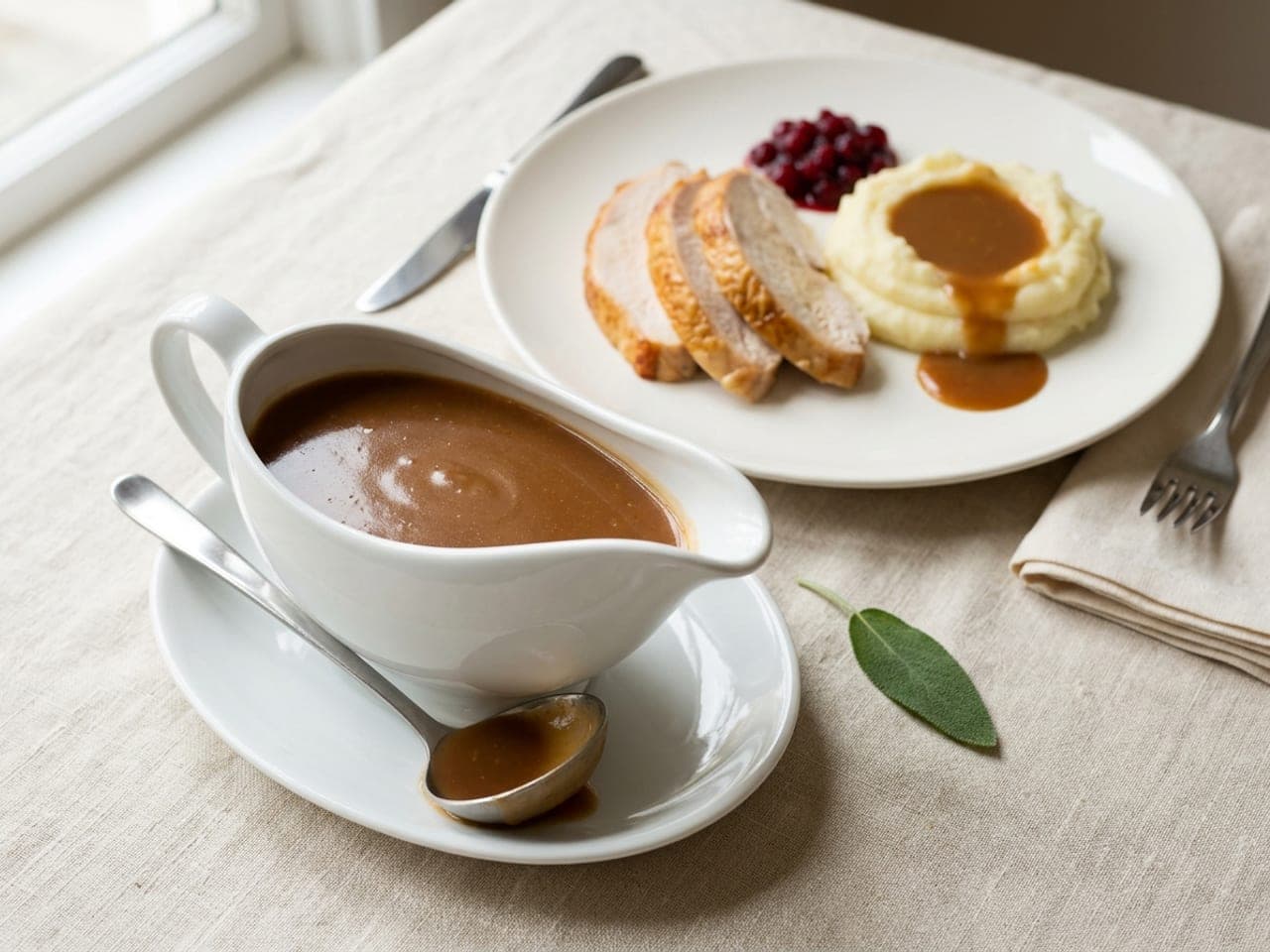
Turkey gravy the way a good kitchen makes it: glossy, pourable and built on the roast’s own drippings, with the thickness set by one ratio instead of guesswork, 1 1/2 tbsp fat and 1 1/2 tbsp flour for every cup (240 ml) of liquid. It makes about 4 cups (1 liter), enough for 8, and gives three clear routes: day-of gravy from the drippings, make-ahead gravy from roasted turkey wings, and gravy with no drippings at all (gluten-free too), plus Southern giblet gravy with egg, a salt check for brined birds and the fixes that actually work. And the history nobody tells: for more than a century, England’s best-known cookbooks made the gravy for a turkey from beef.
Ingredients
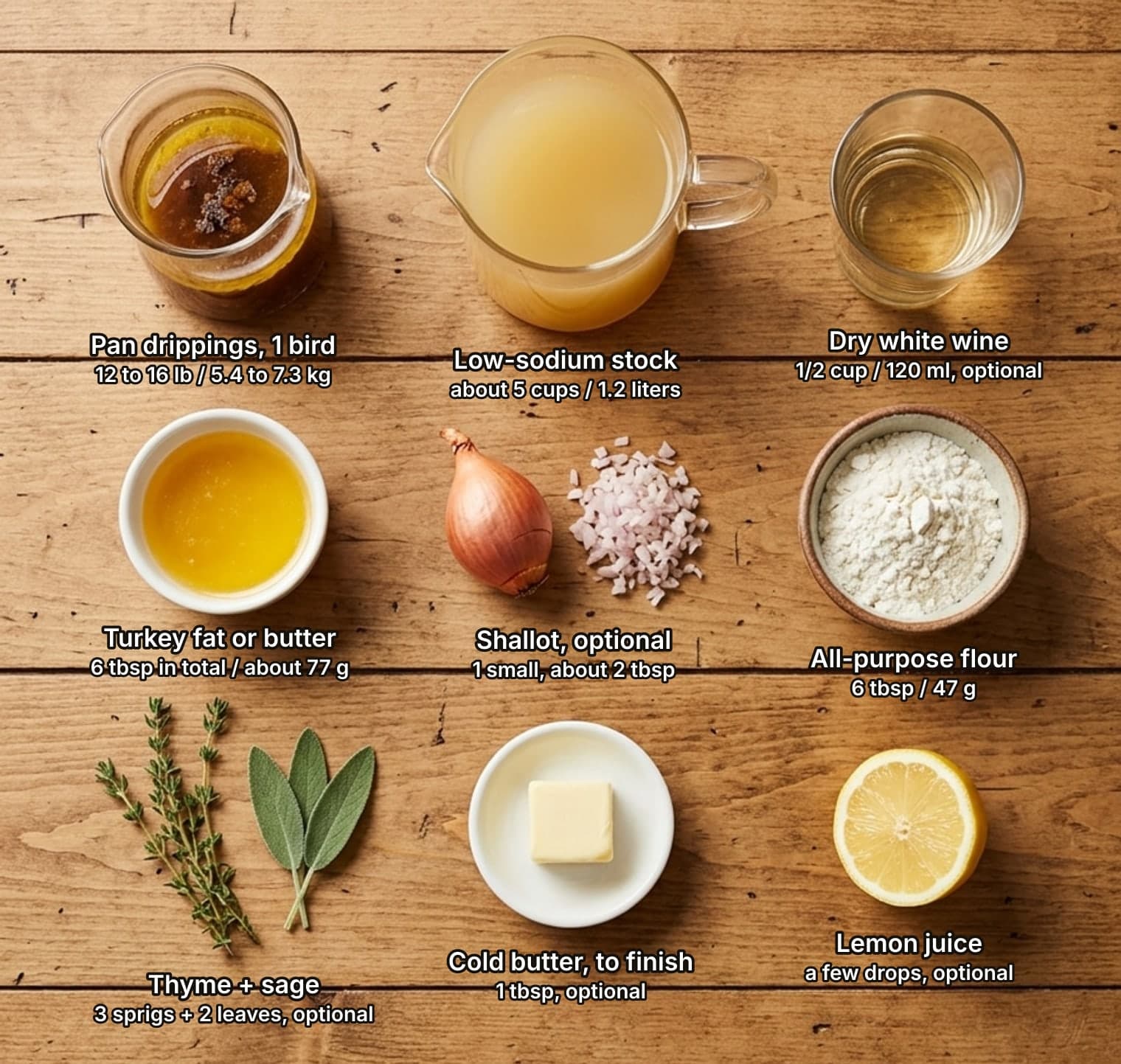
- pan drippings from a roast turkey, with the browned bits (fond) left in the roasting pan (roasting tin); if the bottom of the pan is black and burnt, use the juices but leave the burnt bits behindfrom 1 bird, 12 to 16 lb (5.4 to 7.3 kg)
- low-sodium turkey or chicken stock, hot (homemade wing stock from the make-ahead method is best; with a wet-brined, kosher or self-basting bird it becomes almost all of the liquid, see step 3). Most stocks contain celery, and some contain wheat or barley: check the label if you cook for allergiesabout 5 cups (1.2 liters): part to deglaze, part to top up the juices, the rest to thin (you may not need it all)
- dry white wine, dry sherry or Madeira (optional; use more stock for an alcohol-free gravy). Contains sulphites1/2 cup (120 ml)
- turkey fat skimmed from the drippings, made up with unsalted butter if the bird gives less (butter contains milk; for dairy-free, make it up with a neutral oil)6 tbsp in total (about 77 g turkey fat)
- shallot, very finely minced (optional)1 small, about 2 tbsp
- all-purpose flour (plain flour), contains wheat. For gluten-free gravy, use sweet rice flour (glutinous rice flour, mochiko) in the same amount; for a darker, nuttier roux, use 7 tbsp of fat and 7 of flour (see the ratio section)6 tbsp (47 g)
- fresh thyme and fresh sage (optional)3 thyme sprigs, 2 sage leaves
- unsalted butter, cold, for a glossy finish (optional; contains milk; not included in the nutrition, adds about 13 kcal per serving)1 tbsp
- lemon juice or sherry vinegar (optional, to brighten a flat gravy; sherry vinegar contains sulphites)a few drops
- kosher salt, added only at the end (the nutrition assumes none; each 1/4 tsp of Diamond Crystal adds about 35 mg sodium per serving; with Morton kosher or table salt, use about half as much)to taste
- black pepper, freshly groundto taste
Turkey gravy three ways: from drippings, made ahead, or with no drippings
Turkey gravy is the sauce that holds the Thanksgiving plate together: a roux of turkey fat and flour, loosened with the roast’s own juices and stock until it pours like velvet. This page gives you one ratio and three routes to it, so you can choose by your day rather than by luck. The recipe above is the day-of route: gravy from the drippings, made while the turkey rests. The make-ahead route builds the gravy days early from roasted turkey wings and finishes it on the day with the browned bits from the roasting pan. The no-drippings route needs no roast at all, and it is where you will find the gluten-free version. Giblet gravy, including the Southern version with hard-boiled egg, is a variation on any of them.
Which route? If you are roasting a whole bird that was not brined, the day-of gravy tastes best and is the least work. Make it ahead if the bird was wet-brined, kosher or self-basting (its drippings can only season), if you are roasting just a breast, which gives too few drippings, or if the stovetop will be crowded on the day. Go no-drippings if there is no turkey at all, or if a guest can’t eat gluten.
How much to make: plan on 1/2 cup (120 ml) per person, and more if you want leftovers for sandwiches. That is why this recipe makes about 4 cups (1 liter) for 8. A roast turkey rarely gives enough juice on its own: The Kitchn’s drippings gravy, for one 12 to 15 lb (5.4 to 6.8 kg) bird, tops the drippings up with as much as 2 cups (480 ml) of broth and still makes only about 2 cups (480 ml), which runs out at a table of eight. Every route here tops up with stock, so the quantity never depends on the bird. To scale, multiply the ratio rather than boiling a small batch down: for 12 people, make 6 cups (1.4 liters) with 9 tbsp each of fat and flour.
How to make Turkey Gravy
- Pour off the drippings and let the fat rise. As soon as the turkey is out of the oven, tilt the bird so the juices in its cavity run back into the roasting pan (roasting tin), then set it to rest on a carving board with a juice groove, or on a rack over a rimmed tray, so the juices it sheds while resting can go into the gravy too. Next, pour everything liquid from the pan through a fine-mesh sieve into a fat separator (a jug that pours from the bottom) or a tall, narrow heatproof glass jug, and leave the browned bits stuck to the pan for step 2. No separator? Let the drippings cool for a few minutes, until warm rather than scalding, then pour them into a resealable freezer bag standing in a jug; after 10 minutes, hold it over a bowl, snip one bottom corner and let the juices run out, pinching the bag shut when the fat reaches the hole. Why: drippings are two liquids with two jobs. The clear golden fat on top becomes the roux; the dark, gelatin-rich juice underneath becomes the sauce. Separated, you can measure both, and measuring the fat is what keeps gravy from turning greasy: a gravy only breaks when more fat goes in than the flour can hold. The turkey has to rest before carving anyway, and the gravy fits inside that rest.
- Deglaze the pan: the browned bits are the flavor. Look at the bottom of the pan first. Golden to dark brown bits (the fond) are concentrated roast turkey; black bits are burnt, taste bitter and never cook out, so if the pan is black, skip this step. Otherwise, if the pan is metal, set it across two burners over medium-high heat (glass, ceramic and foil pans are covered at the end of this step). When it sizzles, pour in the wine (or 1/2 cup (120 ml) of the stock) and scrape the bottom hard with a wooden spoon or flat spatula until every browned bit has lifted, then add 1/2 cup (120 ml) of stock and let it bubble for 1 to 2 minutes, until the wine no longer smells sharp. Pour it through the sieve into the separator (or the bag) with the drippings and let everything settle for 5 to 10 minutes, until the fat sits in a clear layer on top. If your roasting pan is glass or ceramic, never put it on a burner, and don’t pour liquid into it while it is oven-hot; the makers warn it can shatter. Set it on a dry towel or rack, let it cool for about 10 minutes, then pour in 1 cup (240 ml) of hot stock and scrape. A disposable foil pan can take the hot stock straight away, off the heat. Why: the liquid dissolves the fond, and Serious Eats calls fond “an instant gravy-enhancer.” Most of the gravy’s roast flavor is on the pan, not in the juices.
- Taste the juices, then measure: 6 tbsp fat, 4 cups (960 ml) liquid. Spoon 6 tbsp of the clear fat off the top into a 3 quart (2.8 liter) saucepan. If the bird gave less, make up the difference with butter; save any extra fat for roasting potatoes. Now taste the defatted juices, warm, from a spoon. If they taste like good, lightly seasoned broth, pour them into a measuring jug and add hot stock to make 4 cups (960 ml) in all. If they taste salty, and they will if the bird was wet-brined, kosher (salted during processing), or labeled enhanced or self-basting (a frozen Butterball “contains up to 8% of a solution of water, salt, spices, and natural flavor”), use them as seasoning, not as the base: measure 3 1/2 cups (840 ml) of low-sodium stock and keep up to 1/2 cup (120 ml) of the juices aside for step 6. A dry-brined bird can go either way, so trust the spoon. Why: the ratio sets the thickness, but the taste test saves you from the one mistake you can’t undo. The New York Times’ Thanksgiving help line says of brined birds: “Most cooks find these drippings, even when deglazed with stock, inedibly salty.”
- Cook the roux to blond, 2 to 3 minutes. Heat the fat in the saucepan over medium heat. Add the shallot, if using, and stir for about 1 minute, until soft but not browned. Sprinkle in the 6 tbsp flour and whisk constantly for 2 to 3 minutes, until the roux is smooth, bubbling, light golden (blond) and smells like toasted pie crust. If you see black specks, start again: a burnt roux is bitter and won’t thicken. Why: every grain of flour is now coated in fat, so the grains can’t clump when the liquid arrives. That coating is the whole difference between a roux, which makes smooth gravy, and dry flour dumped into hot liquid, which makes lumps. Cooking it also takes away the raw, pasty taste of flour. But color costs thickening power: America’s Test Kitchen measured a blond roux thickening about 14% less than a white one cooked for 1 minute, and a peanut-butter-colored roux 26% less. The 6 tbsp here are sized for blond; for a darker, nuttier gravy, cook it to peanut-butter color and use 7 tbsp each of fat and flour.
- Add the hot liquid slowly, whisking hard. Make sure the liquid is hot; if it has cooled, heat it in a small pan or the microwave. Pour in about 1 cup (240 ml), standing back a little because it hisses and spits, and whisk hard: the roux will seize into a thick paste, then loosen. Whisk until it is completely smooth, then pour in the rest in a thin, steady stream, whisking all the while and reaching into the corners of the pan. Drop in the thyme and sage. Why: “The harder you whisk and the slower you add the stock, the smoother your gravy will be,” as Serious Eats puts it. Hot liquid into hot roux disperses evenly, while stock straight from the fridge sets bits of the fat solid, and those are hard to whisk out. Adding the first cup alone lets you work out any lumps while the mixture is thick enough for the whisk to grip them; once it is thin, lumps slip through the wires. If a few survive anyway, step 7 has the fix that won a head-to-head test.
- Simmer 5 to 10 minutes: it thickens only near the boil. Raise the heat to medium-high and bring the gravy to a boil, whisking often, then lower it to a gentle simmer for 5 to 10 minutes, skimming off any foam or fat that rises. If you kept brined juices aside in step 3, whisk them in now, a splash at a time, tasting after each, and stop when the gravy tastes of turkey but not of salt. Why: flour starch doesn’t start to thicken a sauce until it is almost at the boil, and it keeps working for several minutes at a simmer as the starch granules swell. Gravy that looks thin before it boils isn’t ready to judge, and adding more flour at that point is how gravy ends up gluey. The simmer also cooks out the last raw-flour taste and draws the flavor out of the herbs.
- Judge the thickness hot, with the spoon test. Dip a spoon into the gravy and draw a finger across the back: it should coat the spoon and hold a clean line (cooks call this nappe). That is the pourable rung of the ratio ladder, 1 1/2 tbsp fat and 1 1/2 tbsp flour per cup (240 ml) of liquid, and it is the one you want, because roux gravy keeps thickening as it cools on the plate. Too thick: whisk in hot stock, 2 tbsp at a time. Too thin: simmer it a few minutes longer, or mash 1 tbsp soft butter with 1 tbsp flour (beurre manié), whisk it in and simmer at least 5 minutes more. Lumpy: blend it right in the pan with an immersion blender; in The Kitchn’s five-way test it scored 10 out of 10, while 3 minutes of whisking scored 3. Why judge it hot: a spoonful left to cool sets firmer as the gelatin and starch set, so cold gravy always looks thicker than it will be on a hot plate.
- Season last, strain, and taste it on the turkey. Take out the herbs, whisk in any juices from the resting turkey and let the gravy come back to a simmer. Now, and only now, season: add salt a pinch at a time and a few grinds of pepper, tasting between each, the way it will be eaten, hot, on a piece of turkey and a forkful of mashed potatoes. Turkey is mild, and gravy is its seasoning. If it tastes flat but not undersalted, a few drops of lemon juice or sherry vinegar will brighten it where more salt would not. For a smooth restaurant finish, pour the gravy through a fine-mesh sieve into a warmed jug or back into the rinsed pan; for a glossy sheen, whisk in 1 tbsp cold butter off the heat until it just disappears. Keep it hot, at 140°F (60°C) or above, over the lowest heat or in a heatproof bowl set over a pan of barely simmering water, whisking now and then, until you serve; once the butter is in, don’t let it boil, or the butter separates. Why: salting last is not fussiness. Reducing concentrates salt, and thickening hides it: in a 2003 study in the Journal of Agricultural and Food Chemistry, the same salt solution tasted significantly less salty when it was more heavily thickened with food gums. Salt the thin broth “to taste” and then thicken and reduce it, and you make both errors at once; the gravy tastes right at the stove and too salty at the table.
Safety & hygiene Important
- Hold it hot, reheat it to a boil: gravy and C. perfringens. Clostridium perfringens is the bacterium of big roasts and gravy. CDC estimates it causes nearly 900,000 US illnesses a year, lists gravy among the foods commonly linked to it, and notes that most outbreaks happen in November and December, many tied to holiday foods such as turkey and roast beef. Its spores survive cooking, then germinate and multiply as food sits warm; in lab tests in cooked ground beef, one strain doubled every 7.1 minutes at 106°F (41°C) (Labbe and Huang, Journal of Food Protection, 1995). At a 2018 Mothering Sunday buffet in south-west England, 81 people fell ill, and those who ate the gravy had 5.35 times the odds of illness (Food Control, 2020). So keep gravy at 140°F (60°C) or hotter while serving (USDA FSIS; the UK’s legal hot-holding temperature for food businesses is 63°C (145°F) or above), and reheat it the way USDA FSIS says: “Reheat sauces, soups and gravies by bringing them to a rolling boil,” which takes it well past the 165°F (74°C) leftovers target.
- Cool it fast and shallow. Don’t leave the pan on the stove after dinner: a pot of gravy cooling slowly is the classic setup for C. perfringens. Refrigerate leftovers within 2 hours of cooking, or within 1 hour if the room is above 90°F (32°C) (USDA FSIS). Set the pan in a sink of ice water and stir for a few minutes, then pour the gravy into shallow containers no more than 2 inches (5 cm) deep and refrigerate them uncovered or loosely covered until cold, as the FDA Food Code advises for cooling, then put the lids on. In a 2024 study of 224 restaurant recipes, food depth had a highly significant effect on cooling speed, food 5.1 cm (2 inches) deep or less posed little risk of significant pathogen growth, and the shallow dishes that still cooled slowly were partly or wholly covered (Journal of Food Protection). Hot food can go straight into the fridge (USDA FSIS); the UK FSA says to cool it first and refrigerate it within 1 to 2 hours, and the ice bath does both. Gravy that has sat out longer than 2 hours (1 hour above 90°F (32°C)) goes in the bin (FSIS names gravy in this rule): reheating kills bacteria, but it can’t be relied on to make time-abused food safe. The FDA Food Code standard for kitchens, a good benchmark at home, is from 135°F (57°C) to 70°F (21°C) within 2 hours and to 41°F (5°C) within 6 hours in total.
- Leftovers: the US and UK windows differ. US: USDA FSIS gives gravy 3 to 4 days in the fridge at 40°F (4°C) or below. Count the days from when you made the gravy, not from the last reheat. Frozen at 0°F (-18°C), it stays safe indefinitely; for best quality, use it within 2 to 3 months, the figure on FSIS’s current storage charts (its Ask USDA answer allows 4 to 6 months). Some recipes say gravy keeps 5 days or a week, which is longer than USDA advises; older USDA charts, still reprinted by some extension services, said only 1 to 2 days in the fridge. Bring it to a rolling boil every time you reheat it. UK: the Food Standards Agency says to eat leftovers within 2 days or freeze them, to reheat them only once, until steaming hot all the way through, and to use defrosted food within 24 hours. Since gravy gets only one reheat, freeze it in portions you will use in one go. A make-ahead gravy reheated on the day has used its one reheat, so in the UK make the stock no more than 2 days ahead (or freeze it) and make the gravy on the day.
- Giblets and liver: check both cavities, cook them through. A whole turkey usually hides the neck and a packet of giblets (heart, gizzard, liver), one in the body cavity and one under the flap of skin at the neck end, so check both after thawing and cook the giblets separately (USDA FSIS). If you forgot them and they roasted inside the bird in a paper wrapper, they are fine to use if they cooked through; if a plastic giblet bag melted or changed shape in the oven, FSIS says not to use the giblets or the turkey. Cook giblets to 165°F (74°C). Take extra care with liver, because bacteria live inside it, not only on the surface: a CDC report on a chicken-liver pâté outbreak noted that Campylobacter was found in 77% of chicken livers in one study, that washing is not enough, and that livers must reach 165°F (74°C). Liver simmered through with the giblets is safe; a pink, quick-seared liver stirred in at the end is not. Wash your hands for 20 seconds, and wash boards and knives in hot soapy water, after handling raw giblets.
- Salt and allergens. As written, with no added salt, a 1/2 cup (120 ml) serving has about 170 mg of sodium: 7% of the US Daily Value of 2,300 mg, or about 0.4 g of salt against the UK adult maximum of 6 g (arithmetic in the FAQ). Your salt and your bird decide the rest. Each 1/4 tsp of Diamond Crystal kosher salt adds about 35 mg a serving, and drippings from a wet-brined, kosher or enhanced bird can add much more: USDA data put raw turkey with added solution at 180 mg sodium per 100 g, against 112 mg for plain turkey, about 60% saltier before it is even seasoned. Allergens: wheat (flour; also regular soy sauce, Marmite, Wondra and most jarred and packet gravies), soy (soy sauce and tamari, in the no-drippings version), milk (butter; many jarred and packet gravies contain milk too), celery (in most stocks, in every homemade stock on this page and in Marmite; a major allergen in the UK and EU), sulphites (wine, sherry or Madeira, and sherry vinegar) and egg (the Southern giblet version); Marmite also lists barley, oats and rye. For gluten-free gravy, see the no-drippings section: sweet rice flour, despite its other name, glutinous rice flour, contains no gluten, but for celiac disease choose one labeled gluten-free.
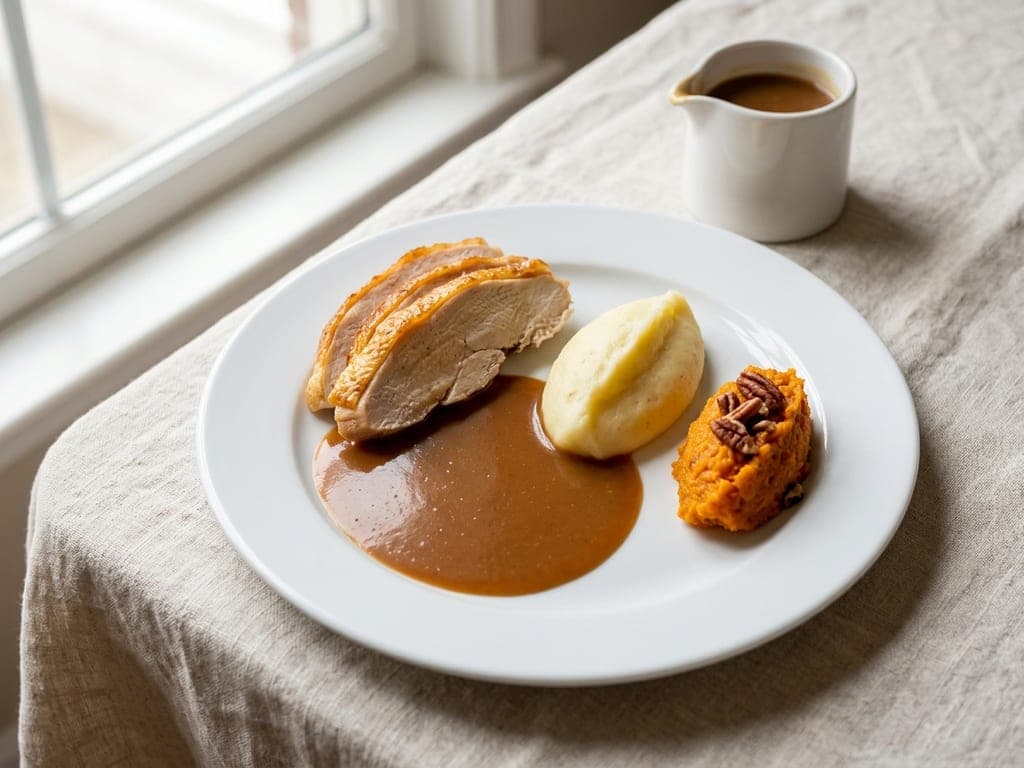
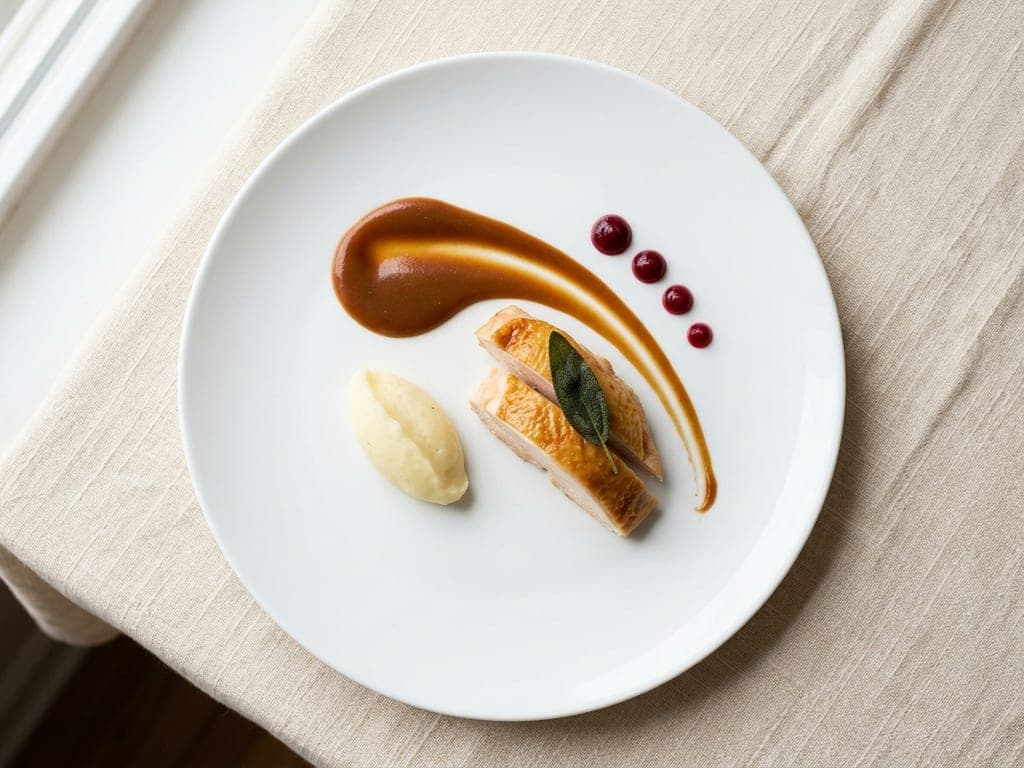
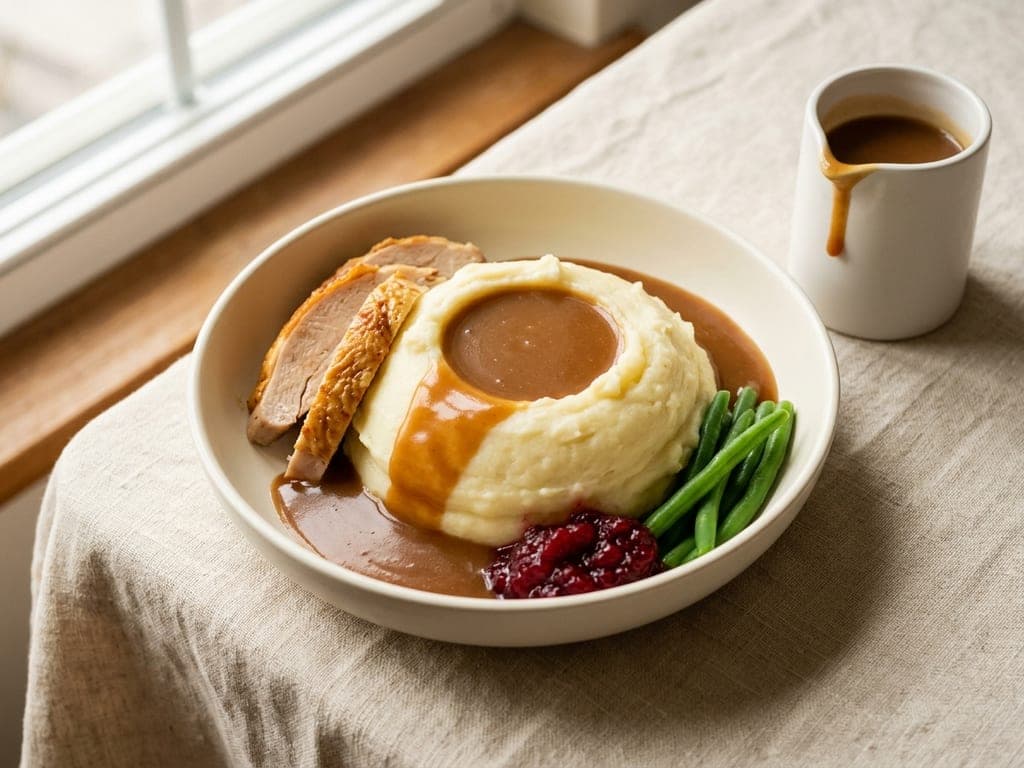
3 ways to plate it
The gravy ratio: a thickness ladder, not a slogan
Gravy has one moving part: how much roux goes into each cup (240 ml) of liquid. The roux is always equal amounts of fat and flour, and the amount per cup sets the thickness. Per cup of liquid: 1 tbsp fat and 1 tbsp flour gives a thin, jus-like gravy that runs off the spoon, which suits a rich, gelatinous homemade stock. 1 1/2 tbsp of each gives a pourable gravy that coats the spoon and pools on the plate without flooding it; it is this recipe’s default, and it matches the “thin or light” sauce in the roux table of Wayne Gisslen’s Professional Cooking, about 1.4 tbsp flour per cup. 2 tbsp of each gives a thick, spoonable gravy that sits on mashed potatoes. That is Fannie Farmer’s 1896 ratio, 6 tbsp fat and 6 tbsp flour to 3 cups (720 ml) of stock, and The Kitchn’s today. This recipe uses Farmer’s exact 6 and 6, stretched over a fourth cup.
The widely repeated “3-2-1 rule” is where many gravies go wrong. In its usual form, from the University of Wyoming Extension, it is 3 tbsp flour, 2 tbsp fat and 1 cup (240 ml) of hot liquid. That much flour isn’t gravy: a USDA school-lunch recipe standard classes about 3 tbsp flour per cup as a thick white sauce, a “binder for soufflés, croquettes.” One widely shared version even defines 3-2-1 as 3 parts liquid, 2 parts stock and 1 part roux, which counts the liquid twice and mixes cups with tablespoons. Use the ladder instead.
Two things move you up or down the ladder. The first is roux color. The longer a roux cooks, the more flavor it has and the less it thickens, because heat breaks the starch into shorter pieces: America’s Test Kitchen measured a blond roux (3 minutes) at 14% less thickening power than a white one (1 minute), and a peanut-butter-colored roux (5 minutes) at 26% less. So a peanut-butter roux needs about a third more fat and flour than a white roux, and about a sixth more than this recipe’s blond one: 7 tbsp of each instead of 6. The second is gelatin. A stock from wings and necks that sets like jelly in the fridge brings its own body, so with homemade stock the gravy can land a rung thicker than the numbers say. Either way, judge it hot, at a simmer: roux gravy only thickens near the boil and keeps thickening as it cools.
Is it French? By construction, turkey gravy is a velouté, one of the French mother sauces: poultry stock thickened with a roux (our guide to the mother sauces has the family tree). But its ancestry is English. Escoffier served roasts with their jus, the pan juices deglazed and reduced, with no flour at all: “It is a mistake to remove all the grease from, and to clarify, the gravy of roasts,” he wrote in Le Guide culinaire (1903; quoted from the 1907 English edition), because “the gravy of a roast is not a consommé,” and “the gravy is invariably served separately.” When he did thicken a gravy for meat or poultry, his jus lié, he used pure starch, and in the same book, in the French original, he predicted that pure starch, potato starch or arrowroot would before long “replace flour in roux.” Turkey gravy is built like a velouté and served like a jus. Escoffier would have skipped the flour.
Make-ahead turkey gravy, from roasted wing stock
Make-ahead gravy is the calmest way to Thanksgiving, and it tastes like the day-of version because its flavor also comes from roasted turkey, just not the one you are serving. First, the stock. Heat the oven to 400°F (204°C). Cut 2 1/2 lb (1.1 kg) of turkey wings at the joints (if you already have the bird, add its neck, heart and gizzard, but keep the liver out) and spread them in a roasting pan with 1 quartered onion, 1 carrot and 1 celery rib, cut in chunks. Roast, turning once, until deep brown, 45 minutes to 1 hour. For scale: Food Network Kitchen roasts 1 lb (450 g) of wings for 30 minutes, and America’s Test Kitchen roasts a much bigger batch at 450°F (232°C) for 1 to 1 1/2 hours.
Tip everything into a large pot. Pour 1 cup (240 ml) of hot water into the roasting pan (if it is glass or ceramic, let it cool for about 10 minutes first; see step 2), scrape up the browned bits and add that too, with 8 cups (1.9 liters) of low-sodium chicken stock, 1/2 cup (120 ml) of dry white wine, 4 thyme sprigs, 1 bay leaf and 6 black peppercorns. Bring it to a boil, then simmer gently, uncovered, skimming now and then, until it has reduced by half, to about 4 1/2 cups (1.1 liters), about 1 1/2 hours. Strain it, pressing on the solids, then cool it fast: stir it in a sink of ice water until lukewarm (fat that sets on warm stock holds the heat in), pour it into shallow containers and refrigerate it overnight. The fat sets into a lid on top: lift it off and use it as your roux fat, made up with butter to 6 tbsp. The stock underneath should be as firm as jelly. That is gelatin from the skin and joints of the wings, and it means body.
Then the gravy. Heat 3 cups (720 ml) of the stock and follow steps 4 to 6 of the main recipe; it will be thick, on Fannie Farmer’s rung, and that is on purpose, so don’t thin it or salt it yet. Keep the rest of the stock, about 1 1/2 cups (360 ml), for the day. Cool the finished gravy fast and refrigerate it. On the day it will have set almost solid; bring it to a rolling boil, whisking, and it loosens as it heats. The finish that makes it taste of this year’s turkey: while the bird rests, deglaze its roasting pan with 1 cup (240 ml) of the saved stock, heated (step 2), strain the liquid, skim off the fat and whisk it into the hot gravy, which brings it to 4 cups (960 ml) on the pourable rung. Simmer for a few minutes and check it with the spoon test (step 7), thinning with the last of the stock if needed. Add a little defatted drippings too if you like, tasting first (step 3), and season last (step 8).
Timeline: for a Thursday dinner, make the stock on Monday, then lift off the fat and make the gravy on Tuesday. USDA FSIS gives gravy 3 to 4 days in the fridge, counted from when it was made, so Tuesday’s gravy still leaves room for leftovers on Friday. For a longer lead, freeze the stock or the finished gravy; flour gravy freezes well, and cornstarch gravy doesn’t. Thaw it in the fridge the day before. In the UK, where leftovers keep 2 days and get one reheat, make the stock no more than 2 days ahead (or freeze it) and make the gravy on the day.
Turkey gravy without drippings, and gluten-free gravy
No roast, a turkey breast with barely any juices, or a bird whose drippings are too salty: the wing-stock gravy above is the best no-drippings gravy there is, because it roasts its own turkey, and the fat lifted from the chilled stock gives the roux the flavor of drippings (with no roasting pan to deglaze on the day, build it on 4 cups (960 ml) of the stock rather than 3). When there is no time for that, spend 30 minutes improving store-bought stock. Brown 1 chopped onion, 1 carrot and 1 celery rib in 1 tbsp butter or oil in a saucepan, add 5 cups (1.2 liters) of low-sodium turkey or chicken stock, 1 bay leaf, 6 peppercorns and a few thyme or parsley stems, simmer for 30 minutes and strain; top it up with stock to 4 cups (960 ml) if it has reduced below that. Make the roux with 6 tbsp butter and 6 tbsp flour and follow steps 4 to 8. For a deeper, meatier taste, Serious Eats simmers 1 tsp soy sauce and 1/4 tsp Marmite into 1 1/2 quarts (1.4 liters) of stock, and calls that amount about right for every quart (about 1 liter) of gravy; add them with the stock, before you salt. For savory depth without soy or wheat, brown 4 oz (113 g) of sliced mushrooms with the vegetables instead. For a vegetarian table, the same method works with a well-browned vegetable or mushroom stock.
Gluten-free turkey gravy: make the roux with sweet rice flour (also sold as glutinous rice flour or mochiko), swapped 1:1 for wheat flour, so 6 tbsp here. Despite the name, it contains no gluten (for celiac disease, buy one labeled gluten-free), and it is the easy gluten-free thickener that behaves most like flour after the fridge and freezer, because nearly all of its starch is amylopectin, which does not squeeze out water when frozen and thawed. In a 2012 study of 26 starches in Carbohydrate Polymers, waxy rice starch gels did not weep through five freeze-thaw cycles, and in Epicurious’s gluten-free gravy test, sweet rice flour gravy “reheated like a dream the next day.”
Cornstarch (cornflour in the UK) is fine for gravy you will eat right away. It has about twice the thickening power of flour (Illinois Extension: 1 tbsp cornstarch does the work of 2 tbsp flour in 1 cup (240 ml) of liquid), so for this batch whisk 3 tbsp cornstarch into 1/3 cup (80 ml) of cold stock, stir it into 4 cups (960 ml) of simmering defatted juices and stock, and simmer for 1 to 2 minutes, until glossy. It needs no roux; whisk in 2 tbsp cold butter at the end for richness if you like. Add it just before serving, because cornstarch thins with long simmering, turns thin and uneven when reheated, and weeps after freezing. It also makes a glossier, more translucent gravy than flour does.
Hidden wheat is the trap in gluten-free gravy. Regular soy sauce contains wheat, so use tamari labeled gluten-free. Marmite is made from brewer’s yeast and is not gluten-free: its label lists barley, wheat, oats and rye, and celery. Wondra is wheat flour. The best-known gravy mixes and jarred gravies contain wheat and milk: McCormick’s turkey gravy mix lists enriched wheat flour first, and Heinz’s jarred roasted turkey gravy, though thickened mainly with modified food starch, still lists bleached wheat flour and nonfat dry milk. Some stocks and bouillons contain wheat or barley (often as yeast extract or malt), so read the label. For a dairy-free gravy, use turkey fat or a neutral oil instead of butter.
Fixing turkey gravy: salt, lumps, grease and thickness
Too salty is the one problem you can’t cook away, and the famous fix doesn’t work. The Kitchn simmered a potato in boxed chicken broth for 30 minutes, covered, and reported that the broth “didn’t seem much less saltier”; Serious Eats notes that “it can take hours for the potatoes to take on a noticeable amount of salt.” A potato soaks up salty liquid, not salt, and lemon juice masks saltiness without removing any. What works is dilution: make a small unsalted batch of gravy, 3 tbsp butter and 3 tbsp flour cooked into 2 cups (480 ml) of unsalted stock, and whisk the two together until it tastes right. Better still, prevent it: taste the drippings before you build on them (step 3), and salt last (step 8).
Lumps are dry flour that swelled on the outside and sealed a dry pocket inside, which is why a roux, where every grain is already coated in fat, prevents them. If they happen, blend. In The Kitchn’s test on deliberately lumpy gravy, an immersion blender scored 10 out of 10 (1 minute, no froth), a food processor 9, a sieve 8 (smooth, but thinner, because you throw away thickener with the lumps), a countertop blender 7.5 (frothy for about 10 minutes) and 3 minutes of whisking only 3. With a countertop blender, fill it no more than halfway, vent the lid, cover it with a folded towel and start on low, because hot gravy can erupt. Never fix thin gravy by sprinkling dry flour or cornstarch straight into the pan: that is exactly how the test made its lumps.
Greasy or broken gravy, with a slick of fat on top or a yellow ring around the plate, has more fat than the flour can hold. Measure the fat, 6 tbsp here, and pour the rest off before you deglaze. If it breaks anyway, skim off what you can, then whisk in a little more starch (a spoonful of beurre manié) or blend it back into an emulsion.
Too thin: simmer it down before you salt it, or whisk in beurre manié, 1 tbsp soft butter mashed with 1 tbsp flour, a spoonful at a time, and simmer for 5 minutes; for a last-minute fix, stir 1 tbsp cornstarch into 2 tbsp cold water and whisk it into the simmering gravy. Wondra, a pre-cooked instant flour, can go straight in without lumping (it is wheat). Too thick: whisk in hot stock rather than water, which thins the flavor along with the gravy. Bitter: burnt fond or a burnt roux, and neither cooks out. Start a fresh roux, and use the liquid again only if it tastes clean.
Where turkey gravy came from: for a century, it was beef
No ranking recipe tells you this, but the gravy on the Thanksgiving turkey is a fairly young idea. When the word arrived in English, it didn’t mean meat juice at all. The earliest English gravies are sweet-spiced sauces of broth and ground almonds. The Forme of Cury, an English cookery roll of about 1390, stews rabbits in “grauey” made with blanched, ground almonds, sugar and powdered ginger, then adds: “Chykens in gravey. Take Chykens and serue hem the same manere.” A Middle English recipe dated 1381, “For to make Grave enforse,” grinds ginger and saffron with almonds, and the Anglo-French gravé is older still: the Anglo-Norman Dictionary dates it to 1235 to 1255, in Walter of Bibbesworth’s treatise, where a feast brings “rabbits in gravy, all sunk in sugar.” Where the word came from is disputed. The story repeated everywhere, that a scribe misread the Old French grané (“grained,” spiced) as gravé, is the Oxford English Dictionary’s own best guess: its entry, not yet fully revised, calls the word “of obscure origin” and the misreading “the most probable conclusion.” Others doubt it. The Middle English Dictionary points out that gravé, the supposed misreading, is actually the commoner Old French spelling, and Etymonline traces the theory to the 19th-century lexicographer Frédéric Godefroy, who, it says, “adjusted the spellings of his citations to match his theory.” Treat the scribe story as a theory, not a fact.
By the 1600s, gravy meant the juice that runs from roasting meat, and cooks used it as an ingredient: Robert May’s The Accomplisht Cook (first published 1660; quoted from the 1685 edition) makes a sauce for roast turkey from boiled onions, water, salt, pepper, grated bread “and the gravy of the fowl.” Then comes the surprise. When Hannah Glasse wrote “To make Gravy for a Turky, or any Sort of Fowl” in The Art of Cookery (first published 1747; quoted here from the 1748 edition), the turkey wasn’t in it. “Take a pound of the lean part of the beef, hack it with a knife, flour it well,” she begins: 1 lb (450 g) of beef, fried brown in butter, then stewed with water, mace, cloves, pepper, an onion, sweet herbs, a crust of bread and a little carrot. Her turkey went to table with “good Gravy in the Dish, and either Bread or Onion Sauce in a Bason.”
England’s leading cookbooks kept it that way for more than a century. Eliza Acton (1845) serves roast turkey “with good brown gravy, and well-made bread-sauce.” Her cheap gravy for a roast fowl does use the neck and the skimmed pan juices, but she notes that when cooks mix the pan gravy of roast game into the gravy they send to table, “it is not always considered an improvement by the eaters,” and in later editions, “to many persons it is peculiarly distasteful.” Isabella Beeton (1861) still sends turkey out with “a tureen of good brown gravy,” and her gravy for poultry begins with 1/2 lb (225 g) of lean beef, simmered for 3 hours and thickened with arrowroot. She printed a giblet gravy too, from the necks, feet, livers and gizzards of the fowls, which is worth remembering the next time you read that giblet gravy is a Southern invention.
The American drippings gravy, the one on your table, is in print in Boston by 1831. Amelia Simmons, in American Cookery (1796), the first cookbook by an American author, still uses “gravy” for the pan juices a turkey is basted with: “put one third of a pound of butter into the gravy, dust flour over the bird and baste with the gravy” (a third of a pound is about 150 g). Lydia Maria Child’s The Frugal Housewife (Boston, 1831 edition) does the modern thing: “When the meat is about done, pour these drippings into a skillet, and let it boil. If it is not thick enough, shake in a little flour; but be sure to let it boil, and be well stirred, after the flour is in.” For poultry, she notes, many people parboil the liver and gizzard, chop them fine into the gravy, and “the water they are boiled in should be used to make the gravy.” (Neither of the two first-hand accounts of the 1621 Plymouth harvest mentions gravy: Edward Winslow’s describes “fowle” and five deer, and William Bradford’s notes that that autumn there was “great store of wild Turkies, of which they tooke many.”) Then Fannie Farmer’s Boston Cooking-School Cook Book (1896) fixed the proportions: “skim off six tablespoons fat; return fat to pan and brown with six tablespoons flour; pour on gradually three cups stock in which giblets, neck, and tips of wings have been cooked.” Three cups is 720 ml; the ratio is 2 tbsp of each per cup, the thick rung of the ladder, and still a common ratio (The Kitchn’s, for one).
The Southern signature is the egg. Giblets in gravy were a Boston and London habit as much as a Southern one, but hard-boiled egg in giblet gravy is in print from a Georgia cook by 1870: Annabella Hill’s Mrs. Hill’s New Cook Book (text copyrighted 1870; first edition 1867) boils the liver and gizzard, sprinkles flour into the dripping pan, and adds “the giblets cut up, and three or four hard-boiled eggs cut in half; serve in a tureen.” It is one of the earliest printed examples we found, and she sent the turkey out with “a dish of rice boiled dry,” the natural partner for that gravy.
Giblet gravy, and the Southern way with hard-boiled eggs
Giblet gravy is turkey gravy built on a stock of the neck and giblets, with the cooked heart and gizzard minced back in. Start it when the turkey goes into the oven. Take out the neck and the giblets, one usually in the body cavity and one under the flap of skin at the neck end (check both; see the safety notes). Put the neck, heart and gizzard in a saucepan with 6 cups (1.4 liters) of water or low-sodium stock, half an onion, a celery rib and a bay leaf, bring it to a boil, then simmer gently, partly covered, for 1 to 2 hours, until the gizzard is tender when pierced with a knife. Strain it and keep the liquid: it is your stock for step 3 of the main recipe (top it up with stock if you have less than you need), just as Lydia Maria Child advised in 1831. Pick the meat off the neck and mince it with the heart and gizzard.
The liver: most good cooks leave it out. America’s Test Kitchen warns that its “potent, unpleasant flavor” can ruin a good gravy, and its mineral bitterness gets stronger when it is boiled. If your family always adds it, simmer it with the other giblets for the last 15 minutes only, until it is cooked through with no pink, 165°F (74°C), and mince it in with the rest. Never stir in a liver that was seared pink.
To finish, make the gravy with the giblet stock (steps 4 to 8), then stir in the minced giblets and neck meat and let it come back to a simmer. For the Southern version, fold 2 or 3 chopped hard-boiled eggs into the gravy just before serving (Mrs. Hill used three or four for her turkey). Steam the eggs as for our deviled eggs, 12 minutes and then an ice bath, and they peel cleanly. Add the eggs only to the gravy you will serve now, not to the part you plan to freeze, because hard-boiled eggs don’t freeze well. Even in the South the egg is optional: “Some southern cooks add chopped, hard boiled egg to their gravy. Mama never did and neither do I,” writes the Southern food blog Deep South Dish, so it is your call.
Questions, answered
How do you make turkey gravy from drippings?
Pour the drippings into a fat separator and let the fat rise for 5 to 10 minutes. Deglaze the roasting pan with 1/2 cup (120 ml) of wine and 1/2 cup (120 ml) of stock (or 1 cup (240 ml) of stock) and add it to the juices. Cook 6 tbsp of the turkey fat with 6 tbsp flour for 2 to 3 minutes, until blond, then whisk in 4 cups (960 ml) of hot defatted juices topped up with stock, the first cup (240 ml) alone and then the rest in a stream. Simmer for 5 to 10 minutes, until it coats a spoon, and season only at the end. Taste the juices before you use them: drippings from a wet-brined, kosher or self-basting bird are often too salty to be the base, so build on low-sodium stock and add the juices to taste.
How do you make turkey gravy without drippings?
Roast 2 1/2 lb (1.1 kg) of turkey wings at 400°F (204°C) until deep brown, simmer them in 8 cups (1.9 liters) of low-sodium stock for about 1 1/2 hours, until reduced by half, and chill it. Then make the roux with the fat from the top and 6 tbsp flour and whisk in 4 cups (960 ml) of that stock, exactly as you would drippings; if a turkey is roasting anyway, build the gravy on 3 cups (720 ml) and deglaze its pan with 1 cup (240 ml) more on the day. It tastes like roast turkey because it is roast turkey. In a hurry, simmer store-bought stock for 30 minutes with browned onion, carrot, celery and herbs, and make the roux with butter. A teaspoon of soy sauce per quart (about 1 liter) adds savory depth; it contains wheat, so use gluten-free tamari if you need to.
What is the ratio of flour to fat to liquid for gravy?
Equal amounts of fat and flour, and the amount per cup (240 ml) of liquid sets the thickness: 1 tbsp each for thin, 1 1/2 tbsp each for pourable (this recipe) and 2 tbsp each for thick (Fannie Farmer’s 1896 ratio). The so-called 3-2-1 rule, 3 tbsp flour and 2 tbsp fat per cup, lands closer to a croquette binder than a gravy. A darker roux thickens less: a peanut-butter-colored roux needs about a sixth more fat and flour than a blond one (a third more than a white roux) for the same body.
Is it better to thicken gravy with flour or cornstarch?
Flour, for any gravy you will make ahead, freeze or reheat: a roux adds a toasted flavor, reheats evenly and freezes well. Cornstarch has about twice the thickening power (1 tbsp does the work of 2 tbsp flour) and makes a glossier, clearer gravy, but it thins with long simmering, reheats unevenly and weeps after freezing, so add it just before serving. For a gluten-free gravy you need to make ahead, use sweet rice flour in the roux, 1:1 for wheat flour.
How far ahead can you make turkey gravy?
Up to 2 days ahead is the sweet spot. USDA FSIS gives gravy 3 to 4 days in the fridge, counted from when you made it, so gravy made on Tuesday still leaves room for Friday’s leftovers. For more lead time, freeze the gravy or its stock (frozen at 0°F (-18°C), it stays safe indefinitely; USDA’s freezer chart says it is best within 2 to 3 months). Reheat it to a rolling boil, and while the turkey rests, deglaze its roasting pan with 1 cup (240 ml) of stock and whisk that in, so it tastes of the day’s roast. In the UK, where leftovers keep 2 days and get one reheat, make the stock no more than 2 days ahead (or freeze it) and make the gravy on the day.
How do you fix lumpy gravy?
Blend it. In The Kitchn’s five-way test, an immersion blender scored 10 out of 10, a food processor 9, a sieve 8 (it also strains out some thickener, so the gravy ends up thinner), a countertop blender 7.5 (it makes the gravy frothy) and whisking only 3, because the lumps slip through the wires. With a countertop blender, fill it no more than halfway, vent the lid, cover it with a towel and start on low. To prevent lumps, add hot liquid to a hot roux gradually while whisking hard, and never sprinkle dry flour into hot gravy.
What do you do if gravy is too salty?
Dilute it: make a small unsalted batch (3 tbsp butter, 3 tbsp flour and 2 cups (480 ml) of unsalted stock) and whisk the two together until it tastes right. The raw-potato trick barely works: The Kitchn simmered a potato in boxed chicken broth for 30 minutes and found it “didn’t seem much less saltier.” A squeeze of lemon masks salt but removes none. Next time, taste the drippings before you build on them, especially from a brined, kosher or self-basting bird, and salt only after the gravy has thickened.
What is giblet gravy, and is the liver safe to use?
Giblet gravy is turkey gravy made with a stock of the neck, heart and gizzard, with the cooked meat minced back in; in the South it sometimes gets chopped hard-boiled egg too. The liver is safe only when cooked through to 165°F (74°C), because bacteria such as Campylobacter live inside poultry liver, not just on its surface. Most cooks leave it out for flavor anyway: America’s Test Kitchen says its “potent, unpleasant flavor” can ruin a good gravy.
How do you thicken gravy, or thin gravy that set too thick?
Judge it hot first: roux gravy thickens only near the boil, keeps thickening as it cools, and sets almost solid in the fridge as its gelatin and starch set, then loosens again when reheated. To thicken, simmer it down before salting, whisk in beurre manié (1 tbsp soft butter mashed with 1 tbsp flour) and simmer for 5 minutes, or for a last-minute fix whisk in 1 tbsp cornstarch mixed with 2 tbsp cold water and bring it back to a simmer. To thin, whisk in hot stock, 2 tbsp at a time; water thins the flavor too.
How long does leftover gravy keep, and can you freeze it?
In the fridge, 3 to 4 days (USDA FSIS), counted from when it was made; the UK Food Standards Agency says 2 days. Refrigerate it within 2 hours of cooking, in shallow containers. Gravy thickened with flour or sweet rice flour freezes well: it stays safe as long as it stays frozen at 0°F (-18°C), and USDA FSIS’s freezer chart says to use it within 2 to 3 months for best quality. Freeze it in 1 cup (240 ml) portions or flat freezer bags, reheat it to a rolling boil and whisk it smooth; a little separation after thawing whisks back together. Cornstarch gravy weeps and thins after freezing.
How many calories are in turkey gravy?
About 153 calories per 1/2 cup (120 ml) serving, with 11 g fat (about 3 g saturated), 9 g carbohydrate, 4 g protein and about 170 mg sodium before you salt it. The math for the whole batch, divided by 8: 6 tbsp turkey fat, 77 g: 691 kcal, 77 g fat, 23 g saturated (USDA FDC 173571). 6 tbsp all-purpose flour, 47 g: 171 kcal, 36 g carbohydrate, 5 g protein (FDC 168894). 4 cups (960 ml) of juices and stock, counted as 960 g of home-prepared stock, the closest USDA match: 346 kcal, 12 g fat, 34 g carbohydrate, 24 g protein, 1,373 mg sodium (FDC 172884). A small shallot, 20 g: 14 kcal. Total about 1,222 kcal and 1,376 mg sodium, so about 153 kcal and 172 mg per serving. Made with butter instead of turkey fat, it is about 143 kcal, and the optional 1 tbsp butter finish adds about 13 kcal per serving; with low-sodium boxed stock alone, sodium drops to about 35 mg. Each 1/4 tsp of Diamond Crystal kosher salt adds about 35 mg per serving, and drippings from a brined or enhanced bird add more that no one can measure for you. For comparison, jarred turkey gravy runs about 25 to 30 calories and 230 to 340 mg sodium per 1/4 cup (60 ml).
Snap your finished plate and let the AI plate it again — more beautifully.