Butternut Squash Soup Recipe: Roasted, Silky, No Cream Needed
A roasted butternut squash soup recipe that gets its silk from the squash, not from cream: one 3 lb (1.36 kg) squash cut into 1-inch (2.5 cm) cubes, roasted hard at 425°F (220°C), simmered for ten minutes with onion and vegetable stock, blended properly, then balanced with salt and a teaspoon or two of vinegar. It makes about 2 quarts (1.9 litres), serves 6, and is vegetarian as written, with a one-line vegan swap. The page explains the roast-or-simmer choice with real numbers, gives the pre-cut squash conversion, fixes bland, thin and grainy soup, and finishes the bowl the restaurant way with brown butter and fried sage, plated three ways.
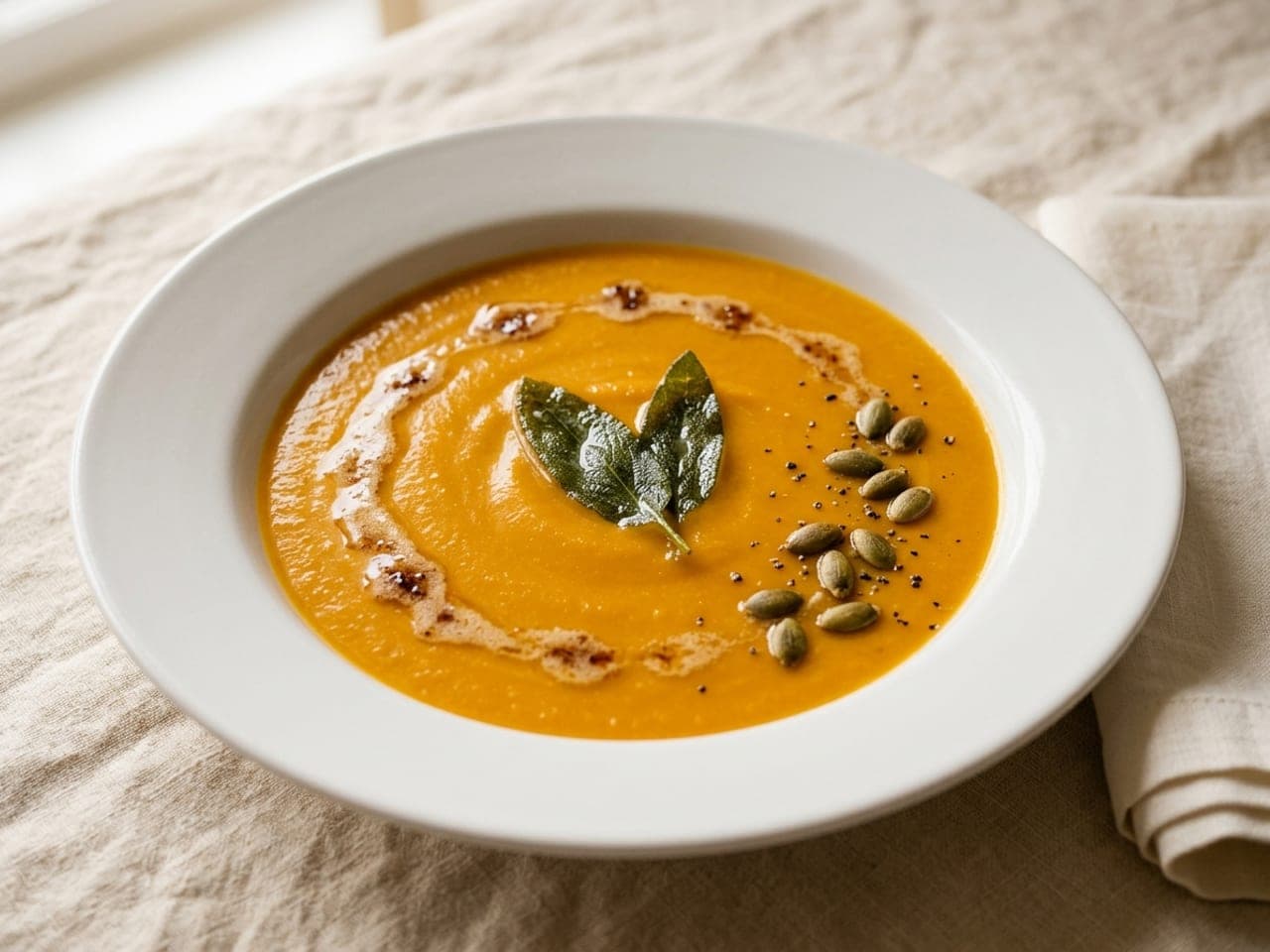
Ingredients
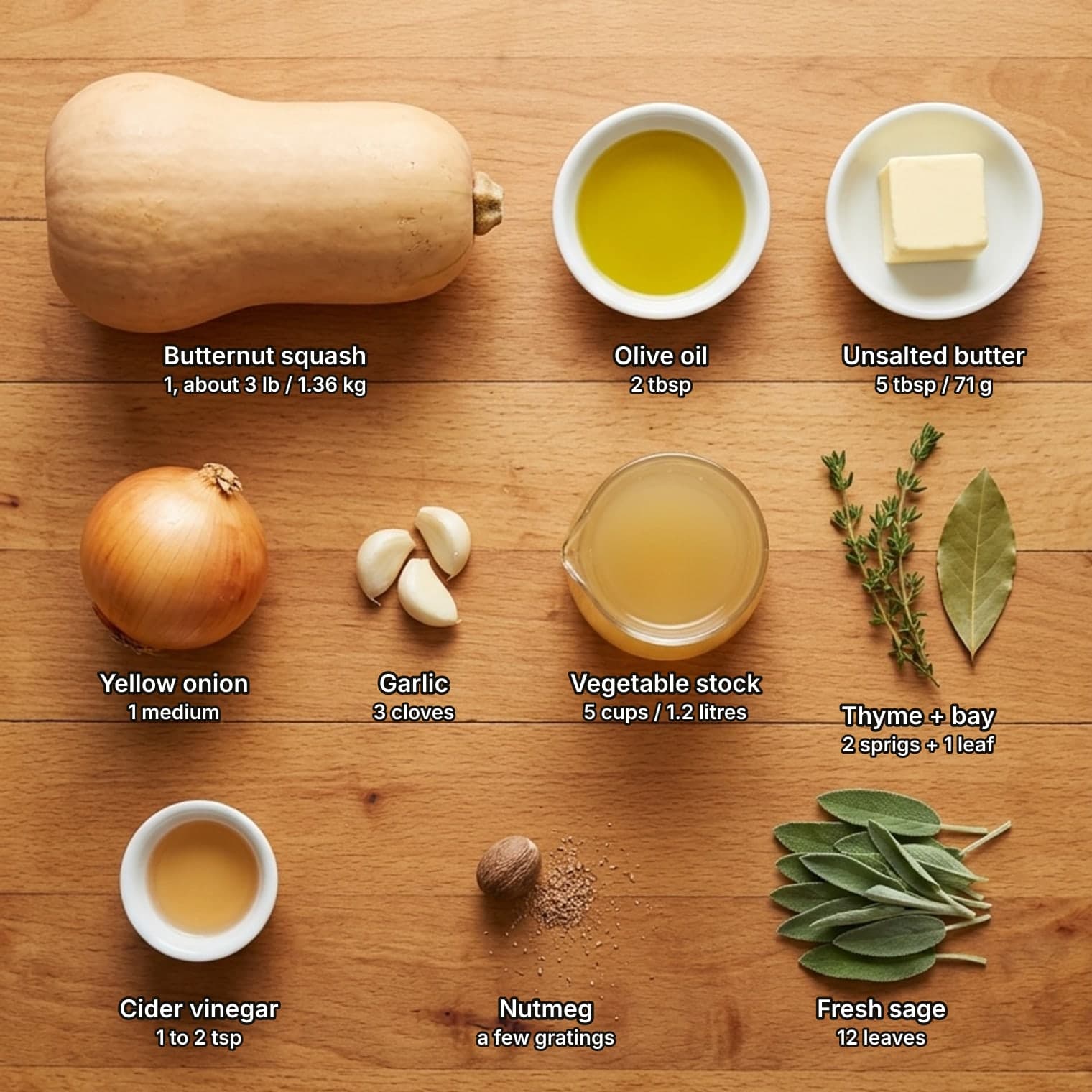
- butternut squash, whole: peeled, seeded and cut into 1-inch (2.5 cm) cubes, which gives about 2 to 2.2 lb (900 g to 1 kg) of cubes, about 6 1/2 to 7 cups by volume. Pre-cut squash: buy 2.2 lb (1 kg)1 squash, about 3 lb (1.36 kg)
- olive oil, for roasting2 tbsp
- unsalted butter (milk), divided: 2 tbsp for the pot, 3 tbsp for the brown butter and sage. Vegan: use olive oil for both5 tbsp (71 g)
- yellow onion, thinly sliced1 medium (about 5 oz / 150 g peeled)
- garlic cloves, thinly sliced3
- low-sodium vegetable stock (labelled low sodium: 140 mg a cup or less), divided: 4 cups (950 ml) for the pot and about 1 cup (240 ml) for thinning. Check the label for celery if that is an allergen for you, and for gluten5 cups (1.2 litres)
- fresh thyme sprigs2
- bay leaf1
- Diamond Crystal kosher salt, divided (a light, flaky coarse salt; weigh it if you can). The same weight is about 1 3/4 tsp Morton kosher salt or a scant 1 1/2 tsp fine sea salt or table salt1 tbsp (about 8 g)
- cider vinegar, or sherry vinegar as the alternative, to taste; start with 1 tsp. Either may contain sulphites. Vegetarians: check the sherry vinegar label, since some sherry is fined with animal products1 to 2 tsp
- nutmeg, freshly grated, and freshly ground black peppera few gratings, to taste
- fresh sage leaves, dry, for frying12 leaves
- optional: maple syrup or honey, only if the squash tastes flat after salting (honey is not vegan, and never give honey to a baby under 12 months; use maple syrup)1 to 2 tsp
- optional garnish, not counted in the calories: toasted pepitas (hulled green pumpkin seeds; check the pack for nut and sesame cross-contact) and crème fraîche (milk)2 tbsp pepitas, 1/4 cup (60 ml) crème fraîche
Roast or simmer? What each route buys you
Every popular butternut squash soup recipe picks one method and tells you to cook until “tender”. The choice deserves reasons. There are three honest routes, and they produce three different soups.
Roasted cubes (this recipe). Peeled 1-inch (2.5 cm) cubes on two sheets at 425°F (220°C) for about 40 minutes. This is the method Daniel Gritzer tested for Serious Eats, where he writes: “The more deeply you can brown the squash in the oven, the more intense and caramelized its flavor will be.” It costs you the peeling and two trays, and it buys the deepest, most savory flavor. Deglazing the trays is part of the method, not a flourish.
Roasted halves, no peeling. Halve the squash lengthwise, scoop out the seeds, oil and salt the cut faces and roast cut side down at 400°F (200°C) for 45 to 60 minutes, until a knife slides through the thickest part of the neck without resistance. Scoop the flesh from the skin and carry on from step 3 with 4 cups (950 ml) of the stock, keeping the last cup (240 ml) for thinning. You get sweetness and ease but much less browned surface, so the soup is milder. Iowa State Extension puts it simply: for a purée, “it is not necessary to peel it at all.”
One pot, no oven. The easy weeknight route: soften the onion as in step 3, add the raw cubes and 4 cups (950 ml) of the stock, and simmer gently for about 20 minutes until the cubes crush with no resistance, then blend. It is faster and it works, but the flavor is plainer and less sweet. Serious Eats’ quick stovetop version adds 1 to 2 tbsp of sugar to make up the difference; we would rather you taste first and add 1 tsp of maple syrup at a time, plus the vinegar, which no simmer-only recipe we read uses.
A third idea worth knowing: America’s Test Kitchen steams unpeeled quarters over a broth made by sautéing the squash’s own seeds and fibers in butter, then scrapes the flesh from the skin. It gives a clean, pure squash flavor with no peeling at all. And one shortcut to skip: the pressure cooker with baking soda that works so well for carrot soup. Serious Eats tried it on butternut and reported that the squash tasted like a pretzel and “completely lacked sweetness”.
How to make Butternut Squash Soup
- Break down the squash into even 1-inch (2.5 cm) cubes. Heat the oven to 425°F (220°C; 200°C fan) with racks in the upper and lower thirds. Trim the stem and base off the squash so both ends are flat, then cut the straight neck away from the round bulb. Stand each piece on a flat end and peel it with a sharp Y-peeler or a knife until you reach bright orange flesh; the pale, green-veined layer under the skin stays tough. Halve the bulb, scoop out the seeds and strings, and cut everything into 1-inch (2.5 cm) cubes. You should have about 2 to 2.2 lb (900 g to 1 kg) of cubes. Why this matters: even cubes brown and soften at the same rate, and cubes give far more browned surface than halves. If raw squash leaves your hands tight and dry, wear gloves next time (see the safety notes).
- Roast on two sheets until well browned. Toss the cubes with the 2 tbsp olive oil and 1 tsp of the kosher salt and spread them over two rimmed baking sheets (baking trays with a lip), leaving space between the pieces. Roast for about 40 minutes, turning the cubes two or three times and swapping the sheets halfway, until they are very soft and deeply browned on a couple of sides. Why this matters: one crowded sheet steams the squash in its own moisture, while two sheets let that water leave, so the flavor concentrates and the surfaces brown. Color is flavor here. You cannot really overcook squash for soup short of burning it, so go by the browning, not the clock: 25 minutes makes it tender, the extra 15 make it taste roasted.
- Brown the butter, then soften the onion without color. While the squash roasts, melt 2 tbsp of the butter in a heavy pot of at least 4 quarts (3.8 litres), such as a Dutch oven (a heavy lidded casserole), over medium heat. Keep it going, swirling, until the foam subsides, the milk solids on the bottom turn golden brown and it smells of toasted nuts, 3 to 4 minutes. Add the sliced onion and 1 tsp of the salt straight away, standing back because wet onion spatters in hot butter. The onion stops the butter going further. Lower the heat to medium-low and cook, stirring now and then, for about 10 minutes until completely soft and translucent. Add the garlic for the last minute. Why this matters: the nuttiness comes from the butter, so the onion can stay pale. Dark, caramelized onion pushes an already sweet soup toward dessert.
- Deglaze the sheets and simmer briefly. Tip the roasted squash into the pot. Wearing oven mitts, set each hot sheet flat on the stovetop or another heatproof surface. Pour 1/2 cup (120 ml) of the stock onto it, standing back with your face away, because it will hiss and throw up steam, then scrape up every browned patch with a wooden spoon or spatula. Tip the liquid into the pot from one corner, holding the sheet with both mitts. Add 3 cups (710 ml) more stock, the thyme sprigs and the bay leaf, keeping the last cup (240 ml) for thinning. Bring to a boil, then simmer gently, uncovered, for about 10 minutes. Why this matters: the dark film stuck to the sheets is the most concentrated roasted flavor you made, and stock dissolves it in seconds. The simmer is short because the squash is already cooked; it only needs to give its flavor to the liquid. Doneness test: a cube should smear against the side of the pot under a spoon with no resistance at all.
- Blend longer than feels necessary. Take the pot off the heat, fish out the thyme stems and bay leaf, and let the soup stand for 5 to 10 minutes. Blend in batches in a countertop (jug) blender: fill the jar no more than half full, remove the center cap from the lid, cover the opening with a folded kitchen towel and hold the lid down firmly with your hand on the towel, start on the lowest speed and work up to high. Blend each batch until completely smooth, usually a minute or two in a high-speed blender and longer in a standard one. Why this matters: steam trapped under a sealed lid can blow it off, and the vent plus towel lets it escape. Time is what turns a purée from smooth to silky, and the blender is also emulsifying the butter and oil already in the pot, which is where the creamy feel comes from. An immersion (stick) blender works, with a slightly more rustic result; keep its head fully submerged and switch it off before lifting it out.
- Optional: pass it through a sieve. For a restaurant finish, pour the blended soup through a fine-mesh sieve into the rinsed pot, pushing it through with the bottom of a ladle. With a high-speed blender you can skip this; with a standard blender or a stick blender it is the step that makes the difference. Why this matters: the sieve catches the few fibers and bits of onion that the blades missed, and those are exactly what the tongue reads as grainy. What stays behind should be no more than a spoonful or two of paste. If much more than that is left in the sieve, the squash was not cooked soft enough or the soup needed longer in the blender; return it to the jar and blend again.
- Adjust thickness first, then salt, then acid. Return the soup to low heat. It will be thick. Stir in the last cup (240 ml) of stock a splash at a time until it pours like heavy cream and coats the back of a spoon; expect to use nearly all of it, which brings the pot to about 2 quarts (1.9 litres). Now season in order. Add the last 1 tsp of salt gradually, tasting as you go. Then stir in 1 tsp of the vinegar, taste, and add the second only if the soup still tastes flat or too sweet. Finish with a few gratings of nutmeg and some black pepper. Why this order: thinning dilutes seasoning, so set the texture first. Salt intensifies what is already there; acid is the contrast that keeps a sweet, rich soup from tasting heavy. Taste before you reach for any sweetener.
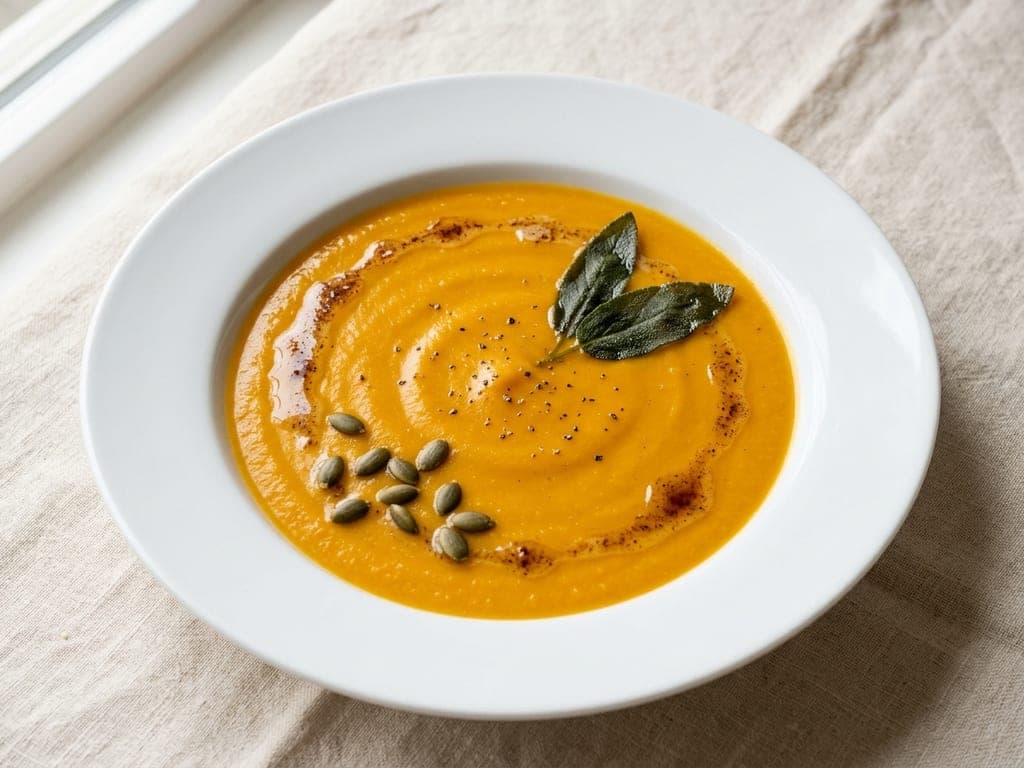
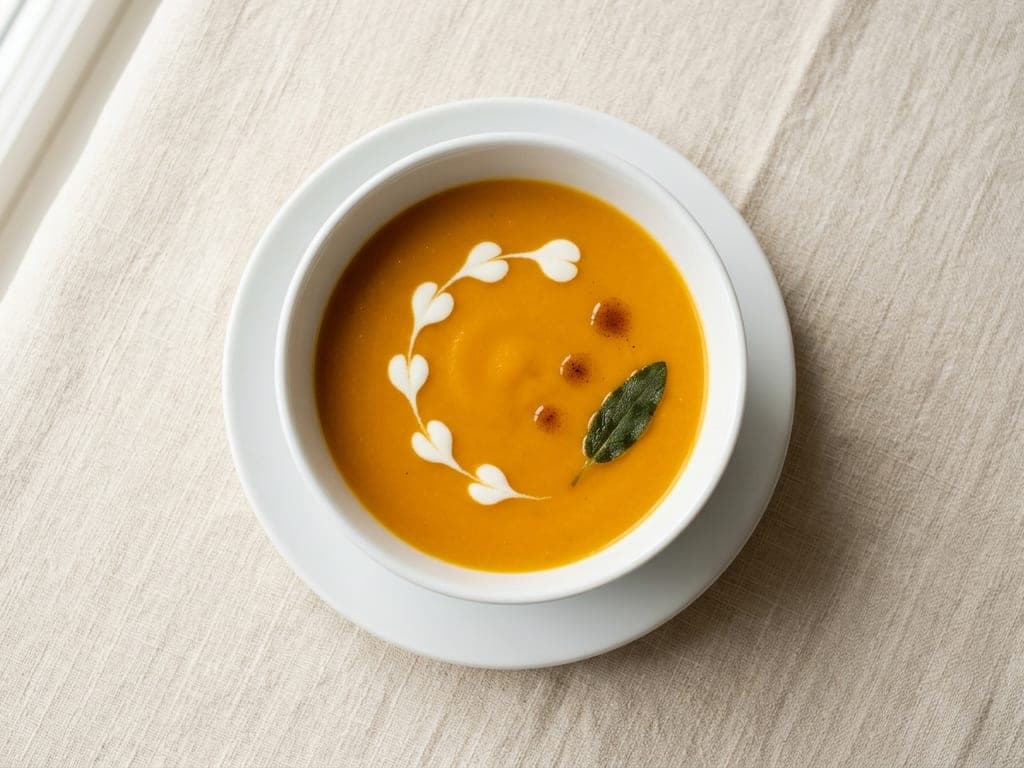
- Fry the sage in brown butter and serve in warm bowls. Warm six bowls in a low oven or with hot water. Melt the remaining 3 tbsp of butter in a small skillet over medium heat. Pat the sage leaves completely dry, because any water makes the butter spit. When the butter foams, lay the leaves in away from you in a single layer and fry for about 15 seconds, until they darken, stiffen and stop sizzling; lift them onto paper towel and salt them lightly. Keep cooking the butter, swirling, until it is hazelnut brown and smells nutty, then pour it into a small heatproof bowl at once, scraping in the brown specks. Ladle about 1 1/3 cups (320 ml) of soup into each bowl, spoon over about 1 tsp of brown butter and top with two sage leaves. Why this matters: the fat floats, so every spoonful picks up toasted butter, and the crisp sage is the only texture in the bowl.
Safety & hygiene Important
- Blending hot soup: vent the lid, half-fill the jar. Hot soup releases steam, and under a sealed blender lid that steam can throw the lid off and the soup with it. The method that works: let the pot stand off the heat for 5 to 10 minutes, fill the jar between one third and one half full, take out the center cap, cover the hole with a folded kitchen towel and hold the lid down firmly through the towel, start on the lowest speed and build up slowly. Check your blender’s manual: some models are not made for hot liquids at all. Never blend hot soup in a sealed personal or bullet-style cup. With an immersion blender, take the pot off the heat, tilt it so the soup is deep enough to cover the head completely, start on low, and switch off before you lift the blender out. Unplug it before touching the blade.
- Hot trays and hot butter: three moments that spit. Burns are the real hazard in this recipe, and three moments cause them. Stock poured onto a baking sheet straight from a 425°F (220°C) oven flashes to steam, and a thin sheet can warp and jump, so set the sheet down flat first, wear oven mitts and keep your face back. Onion going into browned butter spatters, and so do sage leaves if they carry any water, so dry the leaves completely and add both away from you. Browned butter is far hotter than boiling water; pour it into a heatproof bowl, not thin glass.
- Cutting a hard squash, and “squash hands”. The danger is a hard, round vegetable rolling under a dull knife. Put a damp cloth under the board so it cannot slide. Use a sharp, heavy chef’s knife, trim both ends flat first, cut the neck from the bulb, and always stand the piece on a flat cut face before you peel or split it. To soften a very hard squash, prick it all over with a fork and microwave it on high for up to 5 minutes, then let it rest until it is cool enough to handle; the skin and any escaping steam are hot (Food & Wine). Never microwave a whole squash without piercing it. Some people get tight, dry, peeling skin on the hand that held the raw squash. It is a contact dermatitis from raw butternut, described in a peer-reviewed case report (Shah and Feldman, Case Reports in Dermatology, 2022) in which the palm tightened within minutes of peeling and recovered in a few days. Gloves are the simple way to avoid it.
- If the raw squash tastes bitter, throw it out. Rarely, a squash carries high levels of cucurbitacins, natural bitter compounds that cause what poison centers call toxic squash syndrome. The US Poison Control center says such squash can “look and smell normal but taste very bitter”, names butternut among the types affected, and states plainly: “Cooking does not destroy cucurbitacin.” Symptoms are nausea, vomiting, diarrhea and abdominal pain within minutes to hours. Poison Control’s advice is to take a very small taste of the raw squash and, if it is bitter, to spit it out and throw it away. So if anything seems off, touch a very small piece of the raw flesh to your tongue. If it is distinctly bitter, spit it out and bin the whole squash; soup will not fix it. The same goes for a finished soup that tastes sharply bitter: do not eat it or try to mask it.
- Cooling, the fridge and freezer windows, and reheating (US and UK). A thick purée holds heat, and a deep pot of it cools slowly, which is the real risk with this soup. Divide it into shallow containers and refrigerate within 2 hours of cooking, or within 1 hour if the room is above 90°F (32°C) (USDA FSIS). For a thick purée, food-service practice under the FDA Food Code is a depth of no more than about 2 inches (5 cm); a sink of ice water, with stirring, is faster still. US guidance (FSIS): keep it 3 to 4 days in the fridge at 40°F (4°C) or colder, or freeze it at 0°F (-18°C) and use it within 2 to 3 months for best quality; reheat to 165°F (74°C), and FSIS advises bringing soups to a rolling boil. A thick purée spits as it comes to the boil: loosen it with a splash of stock, stir constantly and keep a lid ajar. UK guidance (Food Standards Agency): cool leftovers within 1 to 2 hours, eat them within 2 days or freeze them, and reheat only once until steaming hot all the way through. Once frozen soup has thawed in the fridge, use it within 3 to 4 days (FSIS), or within 24 hours in the UK (FSA). Store the soup plain; make the brown butter and sage fresh, and add any cream or crème fraîche at serving.
- Do not home-can this soup. The National Center for Home Food Preservation is unambiguous: “Home canning is not recommended for mashed or pureed pumpkin or winter squash.” USDA withdrew its directions in 1989 because purées vary too much in thickness for a safe processing time to be calculated, and squash is a low-acid food in which botulism spores can survive. Only 1-inch (2.5 cm) cubes packed in water in a pressure canner have a tested process. That rules out canning this soup by any home method, pressure canner included. Freeze it instead.
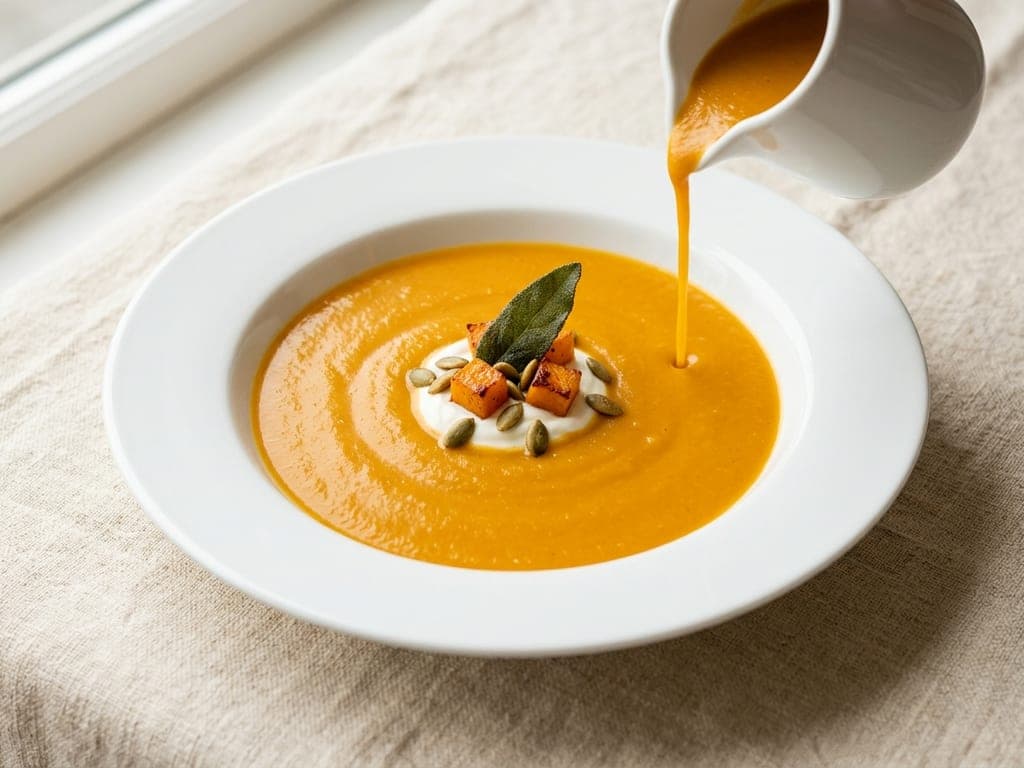
3 ways to plate it
How to cut and peel a butternut squash, and the pre-cut conversion
The safe order is always the same: flat ends first, then separate the two shapes. Slice off the stem and the base. Cut straight across where the neck meets the bulb. Now you have a cylinder and a sphere, each with a flat face to stand on. Peel downward with a Y-peeler, taking two passes: the first removes the tan skin, the second the pale layer with green veins beneath it, and you stop at clear, bright orange. Halve the bulb and scrape out the seeds with a spoon. Cut the neck into 1-inch (2.5 cm) planks, the planks into batons and the batons into cubes. Our knife skills guide shows the grips.
If the squash is rock hard, prick it all over with a fork, microwave it for up to 5 minutes and let it cool until you can hold it. That softens the skin enough for the peeler to bite.
Yield is where recipes go quiet. The yield tables we read put the usable flesh of a whole butternut at 66 to 70 percent, so it loses roughly a third of its weight as skin, seeds and trim. A 3 lb (1.36 kg) squash therefore gives about 2 lb (900 to 950 g) of cubes, and up to 2.2 lb (1 kg) only if you peel thinly. This recipe works anywhere from 2 to 2.2 lb (900 g to 1 kg).
So for pre-cut squash, buy by weight: 2.2 lb (1 kg) of cubes comfortably replaces one 3 lb (1.36 kg) whole squash. By volume that is about 7 cups, since USDA lists raw butternut cubes at 140 g per cup. If your packs add up to only 2 lb (900 g), make the soup anyway: thin it by eye, expect to use a little less of the last cup (240 ml) of stock and to end up a little under 2 quarts (1.9 litres), and hold the last 1/2 tsp of salt until you have tasted. Cut any large chunks down to 1 inch (2.5 cm) so they roast evenly. Frozen cubes can go straight into the one-pot route; they carry too much surface water to brown well in the oven.
Sweetness is decided before you cook
A butternut squash is harvested full of starch. The sugar arrives later. University extension services are consistent on this: UMass says butternut should be stored one to two months before eating, and the Maine Organic Farmers and Gardeners Association, citing the late University of New Hampshire breeder Brent Loy, gives 60 days at 56 to 60°F (13 to 16°C) for the best eating quality. One UNH thesis measured the change in this species: soluble solids, a rough proxy for sugar, rose from 8.7 percent at 60 days after pollination to 11.5 percent after a further 60 days in storage.
The practical reading: a squash bought in late September or early October may be only weeks off the vine and can taste noticeably flatter than one bought in December. That is our inference from the storage data, not a measured supermarket fact, but it explains why the same recipe disappoints one month and delights the next. It is also why step 7 says to taste before adding any sweetener. An under-cured squash may need 1 to 2 tsp of maple syrup or honey (never honey if a baby under 12 months will eat the soup; cooking does not make it safe for them). A December one almost never does.
How to pick one: heavy for its size, matte rather than glossy, an even tan with no green streaks, a rind too hard to dent with a fingernail, and a dry, corky stem still attached. A long, thick neck means more seedless flesh and easier cubing. At home, keep it whole somewhere cool and dry, ideally 50 to 55°F (10 to 13°C), not in the fridge. Once cut, or bought pre-cut, keep it refrigerated and use it by the pack date.
Butternut or pumpkin? “Pumpkin” is a loose word for many squashes, and big carving pumpkins tend to be watery and stringy. Butternut is one consistent type: dense, sweet, fine-grained flesh and a small seed cavity. The line between the two is cultural, not botanical. The earliest catalogue listing we found, Breck’s of 1937, said so in its first sentence, “In certain sections of the South this is classified as a pumpkin”, and Australians still call it butternut pumpkin. This page is butternut only; for pumpkin, see our pumpkin soup.
The modern sequel is the honeynut, a palm-sized squash from Cornell. Its breeders describe it as derived from a cross between butternut and buttercup, a squash of a different species (Cucurbita maxima), and then selected to be self-fertile. The cross goes back to Richard Robinson’s work in the 1980s, was continued by Molly Jahn and finished by Michael Mazourek, with flavor feedback from chef Dan Barber, whom Mazourek met in 2009. In a 2016 HortScience trial run by its own breeders it scored higher soluble solids than Waltham butternut. Use 3 lb (1.36 kg) of honeynuts in this recipe: halve them and roast them without peeling (the skin is thin enough to eat) until tender and browned. They are far smaller than a butternut and cook faster, so start checking early. Expect to need the full measure of vinegar.
Bland, thin, thick or grainy: the fix table
Bland. Usually it is salt. Here is the arithmetic: 1 1/2 tsp of Diamond Crystal kosher salt weighs about 4 g, and in a 2-quart (1.9 litre) batch that is only about 0.2 percent salt by weight, which tastes flat. This recipe uses 1 tbsp of Diamond Crystal, about 8 g, or just over 0.4 percent. If it is salted and still dull, the missing note is acid: 1 tsp of cider or sherry vinegar, stirred in off the heat, then a second if needed. Paul Adams of Cook’s Illustrated puts it best: salt tends to intensify the flavor that is already there, “whereas acid balances it”. Add lemon juice or vinegar at the very end, because the fresh aroma cooks off.
Too sweet. Do not dilute it. Add salt, then acid, then something bitter or hot: black pepper, a pinch of chile flakes, the brown butter. And look at your onions; if they went dark, they added sugar of their own.
Too thin. The cure is a ratio, not a starch. Start with roughly equal weights of prepared squash and stock, which is what this recipe does before the final thinning (about 2.2 lb / 1 kg of cubes to 4 cups / 950 ml), blend, and only then loosen. If yours is already thin, simmer it uncovered, stirring, until it coats a spoon. Squash is about 86 percent water and low in starch, so it will not thicken the way potato does, and blended potato turns gluey.
Too thick. Stock, a splash at a time, over low heat. Soup thickens as it stands and again in the fridge, so expect to add a little more when you reheat.
Grainy or stringy. In order of likelihood: the squash was undercooked (it must crush with no resistance; the pectin that holds vegetables together does not break down until about 180°F / 82°C, so it needs a real simmer, not a brief warm-through), the blend was too short, or the squash was old and fibrous. Blend again for a full minute and sieve it. Unlike potato, squash can take hard blending.
The squash is older than 1944, and the soup is younger than you think
The version most often repeated online, Wikipedia’s included, is that the butternut squash was created in 1944 by Charles Leggett of Stow, Massachusetts, who crossed a gooseneck squash with a Hubbard. The printed record disagrees on the date and on the cross.
The date first. The Boston seed house Joseph Breck & Sons listed “Squash, Butternut” in its 1937 catalogue, describing it as “little known and as yet grown only by connoisseurs”. Reading the scanned run of Breck catalogues from 1930 to 1948, 1937 is the first year it appears, and it is absent in 1936 (the catalogues were searched as scanned text, so an earlier listing elsewhere cannot be ruled out). By 29 November 1940 a Boston newspaper market column was quoting “butternut squash, 10 cents pound”, twice the price of pumpkin. Where 1944 comes from is not documented. One candidate, and this is our own inference, not something any source states, is a New York Times seed advertisement of 9 April 1944 that called it “Something NEW”. New to New York, perhaps; old news in Boston. Even the breeders’ record sits a year off the catalogue: Robert E. Young, who later bred the Waltham Butternut, gave 1936 as the year Breck marketed it.
Then the cross. The standard paper on the subject (Mutschler and Pearson, HortScience, 1987) says: “The first butternut-type squash was found by a Mr. Legget of Stow, Mass., in a field of ‘Canada Crookneck’.” Found, not bred. The family account, as local reporters relayed it from an interview with his widow Dorothy decades later, is that he crossed a gooseneck with other squash varieties. Both versions are on the record and they do not match. The Hubbard is the least likely part. It belongs to a different species (Cucurbita maxima; butternut is Cucurbita moschata). Crosses between the two can be made, with difficulty, as the honeynut shows, but the first-generation plants are largely sterile, and no breeder’s account of the butternut mentions a Hubbard; the geneticists place it entirely within Cucurbita moschata. In the family story the Hubbard was the squash he wanted to beat on size, not a parent.
The famous line, that he named it for being “smooth as butter and sweet as a nut”, comes to us through the Vineyard Gazette’s 2012 summary of a late-life interview with Dorothy Leggett. None of the 1930s and 1940s sources we read explains the name. And the Waltham Butternut in seed racks today is a separate, later variety, released by Young in 1968 and an All-America Selections winner in 1970. In April 1945 Young himself was still writing that “Butternut is not a very good squash for storage after Christmas.”
In print, the soup seems to arrive a generation after the squash. The 1940s sources we read say to bake it, steam it, or put it in pie; Young wrote that “it also makes excellent pie”. None mentions soup. Among the earliest recipes with the title that turn up in digitized books are one in a 1973 Baltimore community cookbook, Private Collections: A Culinary Treasure, and an “Apple and Butternut Squash Soup” in Annemarie Huste’s cooking-school cookbook of 1974. Gourmet printed a curried, oven-baked version in 1981, the year before The Silver Palate Cookbook (1982) made curried butternut and apple soup a dinner-party fixture. Silver Palate popularized it; it did not invent it. Newspaper archives were not searched, so earlier examples may exist.
The nearest American forerunner is plainer: the milk-based “Squash Soup” of Fannie Farmer’s Boston Cooking-School Cook Book, which is already in the first edition of 1896 (page 125) and which, as the 1906 revision prints it, uses just 3/4 cup (180 ml) of sieved squash to a quart (950 ml) of milk. It closely resembles the much older French potage of pumpkin and milk, which La Varenne printed in 1651. Haiti’s soup joumou, inscribed by UNESCO in 2021, is a separate and far weightier tradition, a chunky beef and vegetable soup eaten on Independence Day, and no relation to this purée beyond the squash.
Vegan, creamy, coconut, apple and curried versions
Vegan. The soup itself needs one change: replace the 2 tbsp of butter in the pot with olive oil. For the finish, fry the sage in 3 tbsp of olive oil instead and spoon that sage oil over the bowls, with toasted pepitas (hulled green pumpkin seeds) for the nuttiness the brown butter would have given. Check that your stock is vegan, use maple syrup rather than honey, choose cider vinegar, and skip the crème fraîche in the plating ideas or use a plant-based one. Make the sage oil just before serving; refrigerate any left over, use it within a few days and never keep it at room temperature. The body does not suffer, because it never came from dairy. As the New York Times put it of butternut, it can “whirl into something shiny, thick and luxurious without any cream”.
Creamy. If you want it richer, stir in up to 1/2 cup (120 ml) of heavy cream (double or whipping cream) after blending and warm it through. That adds about 67 calories a serving. Use cream rather than milk or half-and-half, which are the ones that curdle with heat and acid, and add the vinegar last. Be aware that dairy fat mutes flavor as well as softening it, so taste for salt again.
Coconut milk. Swap the 1 cup (240 ml) of thinning stock for the same amount of full-fat coconut milk (coconut is an allergen for some people). Stir it in off the boil at the end, or blend it in, and do not boil the soup hard afterward; coconut milk’s proteins begin to coagulate at around 176°F (80°C) and the emulsion can separate. When reheating leftovers of this version, bring them to 165°F (74°C) by thermometer, stirring, rather than to a hard boil. It pairs naturally with the curried version, with lime juice in place of the vinegar.
Apple. Peel and core one tart apple such as Granny Smith, cut it into 1-inch (2.5 cm) chunks and roast it on the sheets with the squash. It brings its own acidity, so start with 1 tsp of vinegar and you may stop there.
Curried. Add 2 tsp of curry powder to the pot with the garlic and stir for 30 seconds before the squash goes in, so the spices bloom in the butter. Check the curry powder label for mustard and celery if either is an allergen for you. Bon Appétit’s test kitchen rule is to use about double the spice you would put on a roasted side dish, because the liquid dilutes it. Leave out the thyme, bay and nutmeg, and finish with lime, cilantro (fresh coriander) and pepitas instead of sage.
Toppings, what to serve with it, and making it ahead for Thanksgiving
A purée is one texture and one color, so each topping should add something the soup lacks. Crunch: toasted pepitas, the squash’s own seeds roasted, or small croutons. Fat and aroma: brown butter, sage oil or chile oil. Acid: crème fraîche, sour cream or yogurt. Herb and color: fried sage or snipped chives. Pick one from two or three of those groups and stop. Allergen notes: croutons, bread and rolls contain wheat (gluten), the dairy toppings contain milk, bottled chile oil often contains sesame, soy or peanut, and packaged pepitas are often processed alongside nuts and sesame. Our food garnishes guide covers frying herbs and the rest.
As a main course, the batch makes six bowls of about 1 1/3 cups (320 ml). Serve it with warm dinner rolls or crusty bread and a sharp salad. As a Thanksgiving first course, pour 3/4 cup (180 ml) and the same batch serves ten, ahead of roast turkey with turkey gravy, sweet potato casserole or scalloped potatoes, and pecan pie. Keep the starter small and the garnish crisp; the meal that follows is rich.
Make it ahead. The soup improves overnight. For Thursday, November 26, 2026, make it on Monday or Tuesday, cool it quickly in shallow containers and refrigerate it, which keeps it inside the 3 to 4 day window (in the UK, make it no more than 2 days ahead). Or make it weeks earlier and freeze it flat in bags. On the day, reheat it gently to a simmer, stirring, loosen it with a splash of stock, re-taste for salt and vinegar, and only then make the brown butter and fry the sage, which take five minutes and do not keep their crispness. Reheat only what you will serve. The 3 to 4 days count from the day you cooked it, not from Thanksgiving, so a Monday batch should be finished by Friday. Keep soup that is waiting, in the pot or in a jug for pouring, hot, above 140°F (60°C), and do not leave it out for more than 2 hours.
Questions, answered
Is it better to roast or boil butternut squash for soup?
Roast it if flavor is the goal. Cubes at 425°F (220°C) for about 40 minutes brown and lose water, so the soup tastes sweeter, deeper and more concentrated. Simmering raw cubes in stock takes about 20 minutes and makes a milder, plainer soup that often needs a little sweetener and acid. Roasting halves is the middle path: no peeling, good sweetness, less browning.
Do you have to peel butternut squash for soup?
Only if you cube it. Peeled cubes roast with the most browned surface, which is why this recipe peels. If you would rather not, halve the squash, roast it cut side down at 400°F (200°C) for 45 to 60 minutes and scoop the flesh from the skin. The skin is edible but tough and leathery, and blending it in dulls the color and texture.
What spices go well with butternut squash soup?
Three directions work. Classic: thyme and bay in the simmer, a few gratings of nutmeg at the end, fried sage on top. Warm: a pinch each of cinnamon, nutmeg and clove added just before the stock. Bold: 2 tsp curry powder with coconut milk and lime, or smoked paprika, or ancho chile with lime and pepitas. Because the soup is already sweet, savory herbs, black pepper, chile and a little vinegar do more for it than extra sweet spice.
How do you thicken butternut squash soup?
Hold back liquid rather than adding starch. Start with about equal weights of squash cubes and stock, here about 2.2 lb (1 kg) to 4 cups (950 ml) before the final thinning, blend, then thin to taste. If it is already too thin, simmer it uncovered, stirring, until it coats the back of a spoon. Squash is low in starch, so it will not thicken on its own the way potato soup does.
Why is my butternut squash soup bland?
Usually too little salt: 1 1/2 tsp of Diamond Crystal kosher salt (about 4 g) in a 2-quart (1.9 litre) pot is only about 0.2 percent, and this soup wants about twice that. Next, no acid; stir in 1 tsp of cider or sherry vinegar off the heat. Then too much stock. Last, the squash itself: one sold soon after harvest has not yet turned its starch to sugar, and may need 1 to 2 tsp of maple syrup.
Can you freeze butternut squash soup, and how long does it last in the fridge?
Yes, it freezes very well. USDA FSIS gives soups 3 to 4 days in the fridge and 2 to 3 months in the freezer for best quality; in the UK the Food Standards Agency says to eat leftovers within 2 days. Freeze it plain, before any cream or garnish, leaving room in the container for expansion. Thaw overnight in the fridge or reheat from frozen in a saucepan, to 165°F (74°C), and whisk or re-blend if it has separated. Once thawed in the fridge, use it within 3 to 4 days (FSIS), or within 24 hours in the UK (FSA).
How do you make butternut squash soup creamy without cream, or vegan?
The creaminess comes from the squash and the blender, not from dairy: cook the squash until it crushes with no resistance, blend each batch until completely smooth, usually a minute or two in a high-speed blender and longer in a standard one, so the fat in the pot emulsifies, and sieve it. For a vegan soup, use olive oil instead of the butter, fry the sage in olive oil for the finish, and check that the stock is vegan. Coconut milk is optional, not required.
Can I use pre-cut or frozen butternut squash, and how much do I need?
Yes. Buy 2.2 lb (1 kg) of pre-cut cubes, about 7 cups, to replace one 3 lb (1.36 kg) whole squash. Trim any large pieces to 1 inch (2.5 cm) and roast them as written. Frozen cubes are better simmered than roasted: add them straight to the softened onion with the stock and cook until completely soft.
Why is my butternut squash soup grainy or stringy?
Most often the squash was undercooked; it should smear against the pot with no resistance before you blend. Second, the blend was too short or the blender too weak: blend each batch until completely smooth, usually a minute or two in a high-speed blender and longer in a standard one, and pass it through a fine sieve. Third, an old squash, whose flesh turns fibrous and watery in long storage. As long as it has no mold, soft or wet patches or off smell, it is safe to eat, just poorer, and sieving rescues the texture.
How many calories are in butternut squash soup?
About 220 per 1 1/3 cup (320 ml) serving of this recipe, brown butter included. From USDA values for the batch: squash, counted at the full 1 kg, 450; butter 5 tbsp (71 g), 509; olive oil 2 tbsp (27 g), 239; onion 150 g, 60; garlic, 13; stock, 5 cups (1.2 litres) at a typical 10 calories a cup, about 50. Total about 1,321, divided by 6. Skip the brown butter finish and it is about 170. Sodium is about 680 mg if you use all the salt (8.4 g of salt is about 3,300 mg sodium, plus up to 700 mg from 5 cups of stock labelled low sodium, 140 mg a cup or less, plus about 55 mg naturally present in the squash, onion and butter, divided by 6). A “reduced sodium” stock is not the same thing and can add a few hundred milligrams a bowl, so read the label. Pepitas and crème fraîche are not counted.
What is the difference between pumpkin soup and butternut squash soup?
Mostly the squash. Butternut is one consistent type with dense, sweet, fine-grained flesh and a small seed cavity, so the soup comes out smooth and reliably sweet. “Pumpkin” covers many squashes; cooking varieties make a good soup, while large carving pumpkins tend to be watery and stringy. The two are close relatives and the names overlap: Australians call butternut a pumpkin. You can swap a dense cooking pumpkin into this recipe by weight.
Snap your finished plate and let the AI plate it again — more beautifully.