Garniture: what Clamart, Florentine, Parmentier and 50 more mean on a menu, and how to plate them
On a French menu, the name after the dish tells you what comes with it. 53 names, one line each, then how to plate six of them.
The photos on this page are AI-generated illustrations.
The short answer
Garniture vs garnish
A garniture is the named set of accompaniments that comes with the main item on a French menu: Escoffier calls garnishes "the principal accompaniments to dishes" and "very often the adornment thereof".1, 10A garnish, in much current English usage, is the small finishing touch on top. The sources draw that line differently: Rouxbe says a garniture is cooked into the dish, Peterson that in America it often means a decoration, usually a sprig of parsley, not meant to be eaten, and CooksInfo that the two words are the same (who says what).13, 14, 15
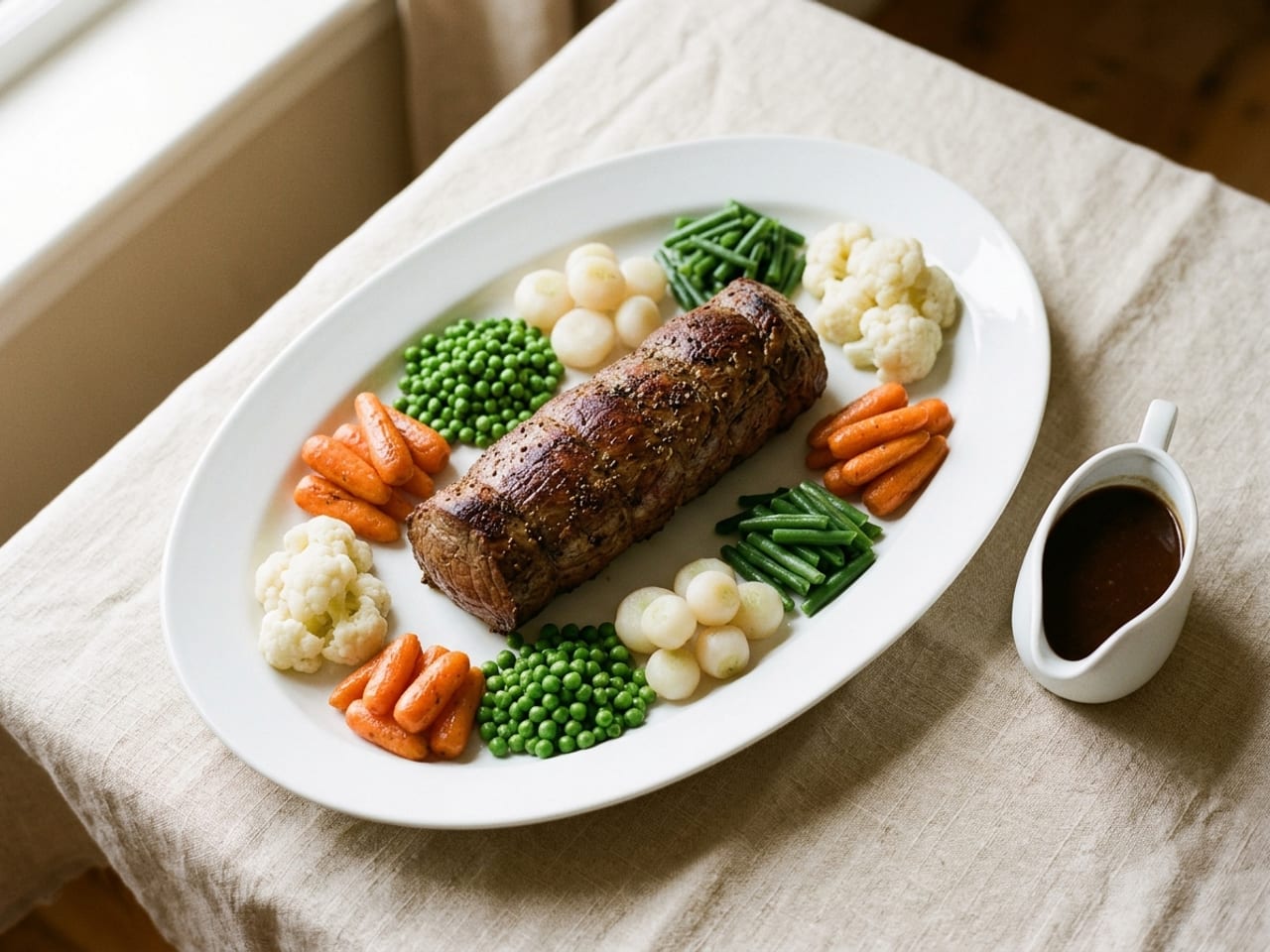
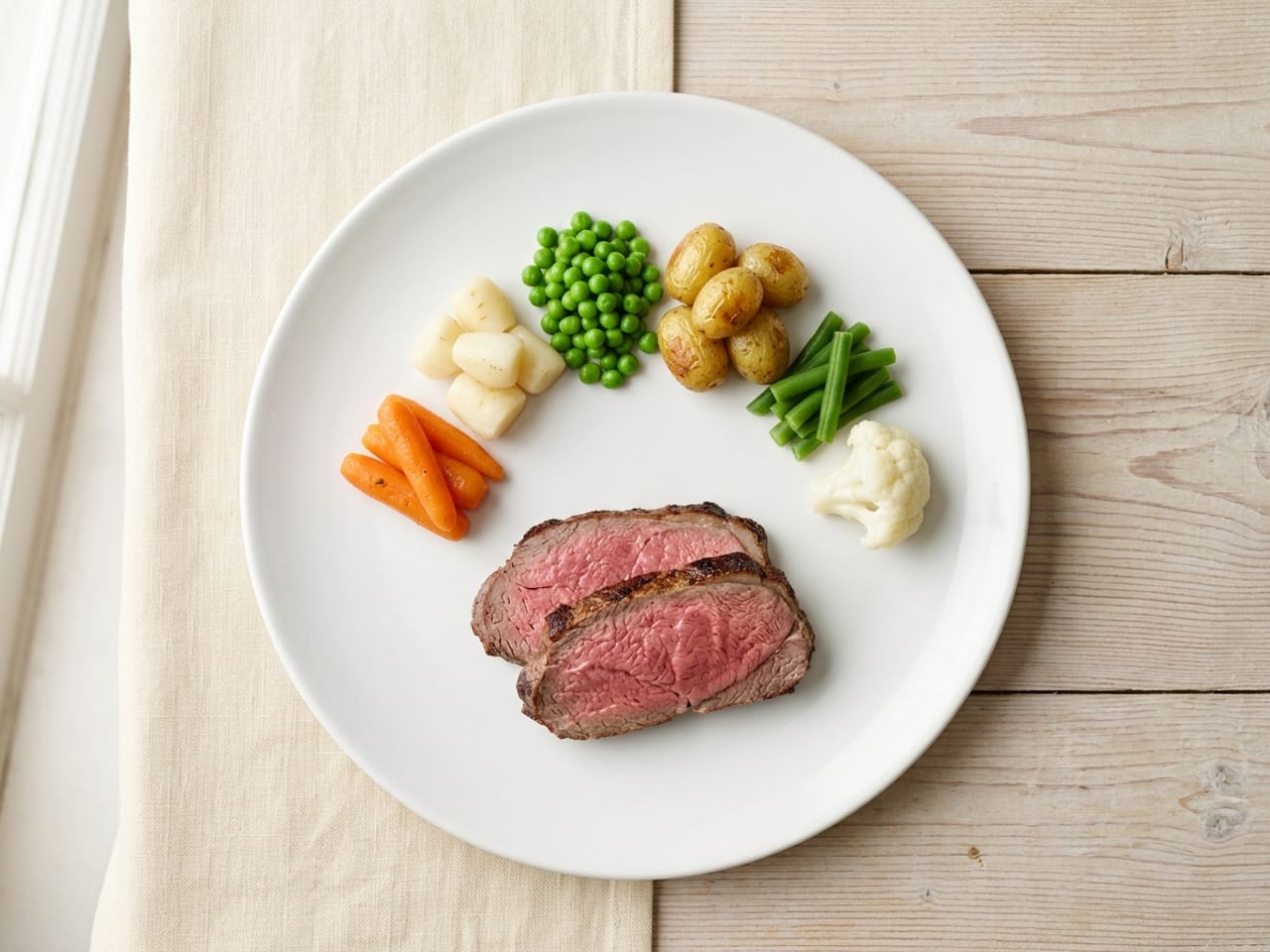
A jardinière after Escoffier (No. 1057), our arrangement: the roast fillet on a long dish, the vegetables in heaps (he wants them in "distinct heaps in such wise as to alternate their colours"), the gravy in a sauceboat. An AI render, not a photograph.
The decoder
53 garniture names, A to Z, and what each means on a menu
One line per name: what it means on a menu, in plain words. Tap a name for Escoffier's own words (recipe number and dish), what a French school handout says, where the name comes from and our pages. varies by dish means the name changes with the dish (9 names, such as Bonne femme, Bretonne and Dubarry); one source means the line is our summary of one source's composition (20 names).
A
Argenteuil: asparagus
In Escoffier's 1907 English edition:
No. 697, p. 245, Crème d'asperges, otherwise Argenteuil (soup): "Parboil for five or six minutes one and one-half lbs. of Argenteuil asparagus"1
No. 414, p. 169, Poached eggs Argenteuil: "Garnish the bottom of some tartlet-crusts with asparagus cut into pieces and cooked, and six green asparagus-heads, about one and one-half inches in length, arranged like a star."1
His vegetable chapter names it as a kind of asparagus: "The Argenteuil asparagus, very much in demand while it is in season" (p. 627; the printed dash after "asparagus" is left out).1
A French vocational-class student list (Les Épicuriens de Montbrison):"Argenteuil : Asperges." (our translation: asparagus).4
Elsewhere:CooksInfo: "À l'Argenteuil is a French expression for a dish accompanied by asparagus as a side garnish."7
Where the name comes from (a place): Argenteuil, which CooksInfo places "11 km northwest of Paris on the Seine" and says "The growers in Argenteuil developed a technique of growing asparagus underground to make it white."7
B
Bonne femme: a homely style, not one ingredient: shallots, parsley and mushrooms under sole; small onions, bacon and potatoes with chicken, veal and peasvaries by dish
Also written: à la bonne femme.
In Escoffier's 1907 English edition:
No. 862, p. 291, Sole bonne femme: "Butter the bottom of the dish intended for the sole, and besprinkle it with two chopped shallots, one pinch of parsley, and one and one-half oz. of raw minced mushrooms."1
No. 1632, p. 518, Poulet de grains bonne femme: "fry in a frying-pan two-thirds lb. of potatoes cut to the shape of corks and divided into roundels; put these round the chicken"1
No. 1254, p. 419, Côte de veau à la bonne femme: "Add six small onions cooked in butter, three oz. of potatoes cut into roundels"1
No. 2191, p. 656, Petits pois à la bonne femme: "Fry twelve oz. of small onions and four oz. of breast of bacon, cut into dice and blanched in butter"1
Elsewhere:CooksInfo: "À la Bonne Femme is a French term used to refer to a homey and simple but honest cooking style."7
Where the name comes from (no sourced origin): French for "good woman" (our translation). We found no sourced origin for the name.
Bouquetière: mixed vegetables in small separate heaps round the meat: carrots, turnips, potatoes, peas, green beans, cauliflower
Also written: à la bouquetière.
In Escoffier's 1907 English edition:
No. 1045, p. 353 to 354, Filet de bœuf bouquetière: "(1) Small heaps of carrots and turnips, turned by means of a small grooved spoon, and cooked in consommé; (2) small heaps of little potatoes turned to the shape of olives and cooked in butter; (3) small heaps of peas and of French beans, cut into lozenges and cohered with butter; (4) five bunches of cauliflower."1
His arrangement for it: "Arrange these different products in such wise as to vary their colours and throw them into relief." The sources do not agree on the vegetables (see the French Culinary Institute's line below).1
Elsewhere:Office québécois de la langue française: "Se dit d'une garniture faite de légumes disposés en « bouquets » de différentes couleurs autour des grosses pièces de boucherie rôties, des volailles poêlées ou des tournedos sautés."8 The French Culinary Institute: "It always contains carrots and turnips but all of the remaining vegetables can vary according to the season."9
Where the name comes from (an ordinary French word): CooksInfo: "'Bouquetière' in French means both a small bouquet of flowers, and a young woman who sells them at theatres, street-side cafes, etc."7
Bourgeoise: carrots and small onions (and bacon, in a school handout) with a braised piece
In Escoffier's 1907 English edition:
No. 1155, p. 383, Langue de bœuf bourgeoise: "surround it with carrots fashioned to the shape of olives and already two-thirds cooked, and small onions browned in butter."1
A French school handout (2003):"Bourgeoise (pour grosses pièces) Carottes tournées en gousses d'ail, oignons glacés à brun et lardons." (our translation: for large cuts: carrots turned to the shape of garlic cloves, onions glazed brown, and lardons).3
Elsewhere:CooksInfo: "The vegetables will always include carrots and onions, and sometimes other vegetables such as celery as well."7
Where the name comes from (no sourced origin): We found no sourced origin for the name.
Bourguignonne: onions glazed brown, mushrooms and bacon, in a school handoutone source
Not a garniture in Escoffier's 1907 English text: there Bourguignonne is a red-wine sauce (No. 38a). This line rests on one school handout.1
A French school handout (2003):"Bourguignonne (pour grosses pièces) Oignons glacés à brun, quartiers de champignons sautés et lardons." (our translation: for large cuts: onions glazed brown, quartered sautéed mushrooms and lardons).3
Where the name comes from (no sourced origin): French for "Burgundian" (our translation). We found no sourced origin for the name.
The one-line meaning above is our summary of what one source puts in it, not a sourced definition.
Bretonne: white haricot beans in Bretonne sauce; Escoffier's sautéed chicken Bretonne is leek, onion and mushrooms insteadvaries by dishone source
In Escoffier's 1907 English edition:
No. 2153, p. 649, Haricots blancs à la Bretonne: "cohere them with a Bretonne sauce, in the proportion of one-third pint of sauce per lb. of cooked haricot-beans."1
No. 1540, p. 499, Poulet sauté Bretonne: "add thereto three oz. of the white of a leek and the half of an onion, both sliced and stewed in butter beforehand."1
Where the name comes from (no sourced origin): French for "Breton", from Brittany (our translation). We found no sourced origin for the name.
The one-line meaning above is our summary of what one source puts in it, not a sourced definition.
C
Chasseur: a sauce more than a garniture; on Escoffier's eggs, sautéed chicken livers with Chasseur sauceone source
Also written: hunter's style.
In Escoffier's 1907 English edition:
No. 398, p. 165, Eggs chasseur: "garnish on either side with a tablespoonful of sliced chicken's liver, rapidly sautéd and cohered with a little Chasseur sauce."1
No. 1089, p. 366 to 367, Tournedos chasseur: "swill the sautépan with white wine, and add to this a quantity of Chasseur sauce"1
Where the name comes from (no sourced origin): French for "hunter" (our translation). We found no sourced origin for the name.
The one-line meaning above is our summary of what one source puts in it, not a sourced definition.
Châtelaine: artichoke bottoms filled with onion purée, chestnuts and browned potatoesone source
In Escoffier's 1907 English edition:
No. 1047, p. 354 to 355, Filet de bœuf Châtelaine: "(1) Medium-sized artichoke-bottoms garnished with thick Soubise; (2) fine, peeled chestnuts cooked in the poêling-liquor; (3) small heaps of lightly browned potatoes, cooked in butter at the last moment."1
Where the name comes from (no sourced origin): We found no sourced origin for the name.
The one-line meaning above is our summary of what one source puts in it, not a sourced definition.
Choisy: braised lettuce (with Château potatoes, in a school handout)
In Escoffier's 1907 English edition:
No. 497, p. 187, Omelet à la Choisy: "Stuff the omelet with two tablespoonfuls of braised lettuce; the latter should have been ciseled and cohered by means of cream sauce."1
He also names Choisy among the garnishes for a cushion of veal (No. 1198), with no composition there.1
A French school handout (2003):"Choisy (pour tournedos et noisettes) Laitues braisées et pommes Château." (our translation: for tournedos and noisettes: braised lettuces and Château potatoes).3
Where the name comes from (no sourced origin): We found no sourced origin for the name.
Choron: artichoke bottoms filled with peas or asparagus, with browned potatoes; also a sauce
In Escoffier's 1907 English edition:
No. 1090, p. 367, Tournedos Choron: "in the middle of each set a medium-sized artichoke-bottom garnished with peas or asparagus-heads cohered with butter. All round, arrange a border of potatoes, lightly browned in butter"1
A French school handout (2003):"Choron (pour tournedos et noisettes) Fonds d'artichauts garnis de petits pois et de pommes noisettes." (our translation: for tournedos and noisettes: artichoke bottoms filled with peas, and noisette potatoes).3
Where the name comes from (a person): Wikipedia (weak, no second source) says the sauce "is named after Alexandre Étienne Choron."21
Also written: à la Clamart; petits pois à la Clamart.
In Escoffier's 1907 English edition:
No. 1048, p. 355, Filet de bœuf Clamart: "(1) Little tartlet-crusts garnished with peas, prepared à la Française (No. 2193), combined with the ciseled lettuce used in their cooking-process, and cohered with butter; (2) small quoits of "Pommes Macaire" (No. 2228). Arrange the tartlet-crusts and the quoits alternately."1
No. 420, p. 170, Poached eggs à la Clamart: "Garnish some tartlet-crusts with small, green peas, cooked à la française (No. 2193), and mixed with finely ciseled lettuce which should have cooked with them."1
No. 498, p. 187, Omelet à la Clamart: "Stuff the omelet with two tablespoonfuls of fresh peas, bound by means of butter and combined with a portion of the lettuce used in cooking them, finely ciseled."1
No. 1635, p. 519, Poulet de grains Clamart: "put it in a cocotte with one-half pint of half-cooked peas à la Française (No. 2193)"1
No. 2029, p. 624, Cœurs d'artichauts à la Clamart: "Set them in a buttered cocotte, with a small quartered carrot and three tablespoonfuls of freshly-shelled peas"1
A French school handout (2003):"Clamart (pour grosses pièces) Tartelettes ou fonds d'artichauts garnis de petits pois à la française (ou de purée de petits pois frais), accompagnés de petites pommes Château." (our translation: for large cuts: tartlets or artichoke bottoms filled with peas à la française (or a purée of fresh peas), with small Château potatoes).3
A French vocational-class student list (Les Épicuriens de Montbrison):"Clamart : idem" (our translation: the same as the line above it on that list, Choron: artichoke bottoms with peas and noisette potatoes).4
Elsewhere:CooksInfo: "À la Clamart is a French cooking term for a garnish containing peas"7 CooksInfo: "Sometimes the term is applied to dishes that come with just plain peas."7 Gisslen, W.: "Clamart: peas"5
Where the name comes from (a place): Clamart, a town close to Paris. Only Wikipedia, which we count as weak, says why: "Close to Paris and its central marketplace (Les Halles), Clamart's peas were the first of the season."21
No. 640, p. 228, Purée de lentilles, otherwise Conti (soup): "Soak three-quarters of a pint of lentils in lukewarm water for two hours. Put them in a stewpan with two oz. of very lean breast of bacon, blanched, cooled, and cut into dice"1
A French vocational-class student list (Les Épicuriens de Montbrison):"Conti : lentilles, lard maigre" (our translation: lentils, lean bacon).4
Elsewhere:CooksInfo: "À la Conti is a French cooking term that means accompanied by small croquettes made of puréed lentils, and with potatoes carved into small olive-sized balls and sautéed."7
Where the name comes from (no sourced origin): We found no sourced origin for the name.
Crécy: carrots
Also written: potage Crécy.
In Escoffier's 1907 English edition:
No. 630, p. 225, Purée de carottes, otherwise Crécy (soup): "Cut one lb. of the red part only of carrots"1
No. 211, p. 88, Carrot or Crécy royale (a custard garnish for soup): "Stew gently in butter five oz. of the red part only of carrots."1
Elsewhere:CooksInfo: "À la Crécy is a French cooking term that describes a dish that is served with carrots, or that has carrots in it."7 Gisslen, W.: Crécy: carrots.5
Where the name comes from (a place): A place called Crécy, but which one is not settled in what we read: CooksInfo says "Crécy is in the Picardie area in northern France; it is famous in France for its carrot production.", and Wikipedia (weak) names Crécy-en-Ponthieu, which it says "has been purported to produce carrots with the best flavor".7, 21
D
Dauphine: potato croquettes, friedone source
In Escoffier's 1907 English edition:
No. 1049, p. 355, Filet de bœuf Dauphine: "surround it with a garnish of potato croquettes à la Dauphine, moulded to the shape of corks, and fried just before dishing up."1
Where the name comes from (no sourced origin): We found no sourced origin for the name.
The one-line meaning above is our summary of what one source puts in it, not a sourced definition.
Dieppoise: mussels and shrimp tails (and mushrooms, in a school handout), on fish
In Escoffier's 1907 English edition:
No. 860, p. 291, Sole Dieppoise: "surround it with poached mussels (shelled and cleared of their beards) and shrimps' tails"1
A French school handout (2003):"Dieppoise (pour poissons) Queues de crevettes, moules ébarbées et têtes de champignons." (our translation: for fish: shrimp tails, bearded mussels and mushroom heads).3
Where the name comes from (no sourced origin): French for "from Dieppe" (our translation). We found no sourced origin for the name.
Doria: cucumber, turned and cooked in butter
In Escoffier's 1907 English edition:
No. 843, p. 287, Sole meunière aux concombres, otherwise Doria: "Garnish it at both ends with little heaps of cucumber, turned and cooked in butter with a little salt and a pinch of sugar."1
No. 1593, p. 510, Suprêmes de volaille Doria: "surround them with pieces of cucumber, shaped like garlic cloves and cooked in butter."1
No. 563, p. 204, Consommé Doria (soup): "Thirty pellets of cucumber in the shape of large pearls"1
A French vocational-class student list (Les Épicuriens de Montbrison):"Doria, concombres tournés, étuvés." (our translation: turned cucumbers, stewed).4
Dubarry: cauliflower: gratinéed balls with Mornay round a roast, or a purée; also the name of a cherry tartvaries by dish
Also written: Du Barry; crème Dubarry.
In Escoffier's 1907 English edition:
No. 1050, p. 355, Filet de bœuf Dubarry: "surround it with small heaps of cauliflower moulded to the shape of balls, coated with Mornay sauce, besprinkled with grated cheese, and put in the oven for the gratin to form just in time for the dishing up."1
No. 2114, p. 643, Purée de chou-fleur dite à la Dubarry: "Cook the cauliflower in salted water; drain it well; rub it through tammy, and combine the resulting purée with one quarter of its bulk of somewhat firm, mashed potatoes with cream."1
No. 634, p. 226, Purée de choux-fleurs, otherwise Dubarry (soup): "Parboil one lb. of cauliflower divided into bunches."1
No. 2671, p. 773, Cerises à la Dubarry (a dessert): "garnish with fine, stoned cherries"1
Two cauliflower forms in one book (gratinéed balls, No. 1050; a purée, No. 2114), and one dessert with no cauliflower at all (No. 2671).1
A French vocational-class student list (Les Épicuriens de Montbrison):"DuBarry : Chou fleur moulé, sauce Mornay, pommes château." (our translation: moulded cauliflower, Mornay sauce, Château potatoes).4
Elsewhere:CooksInfo: "In a broader sense, it is now used for any dish with cauliflower in it, or served with cauliflower."7 Gisslen, W.: "Garnished with or containing cauliflower."5 Westney, L.: "recipes with the name Du Barry usually indicate the presence of cauliflower as a main ingredient"16
Where the name comes from (a person): Madame du Barry (Marie-Jeanne Bécu, 1743 to 1793), Louis XV's favourite after Madame de Pompadour. The cauliflower is said to stand for her wigs: one journal article reports that from secondary sources, and the same article says it was Pompadour who started the tall hairstyle, and asks for "more thorough verification of all recipe names".16
Duchesse: duchesse potatoes, shaped or piped and browned in the oven
In Escoffier's 1907 English edition:
No. 1051, p. 355, Filet de bœuf Duchesse: "surround it with potatoes à la Duchesse (the shape of which may be varied according to fancy), lightly browned and coloured in the oven for a few minutes before the dishing."1
He shapes them by hand (cottage loaves, shuttles, quoits, lozenges, No. 221) and allows the piping-bag (No. 2212); Gisslen pipes them with a star tube.1
Elsewhere:Gisslen, W.: "Cone-shaped spiral mounds are most popular for individual portion service."5
Where the name comes from (no sourced origin): We found no sourced origin for the name.
Financière: quenelles, mushrooms, cocks' combs and kidneys and olives, with financière sauce
In Escoffier's 1907 English edition:
No. 1052, p. 355, Filet de bœuf financière: "(1) quenelles of ordinary forcemeat; (2) grooved and cooked button-mushroom heads; (3) cocks' combs and kidneys; (4) turned and blanched olives. Each garnish should be placed on the dish in distinct heaps."1
Elsewhere:CooksInfo: "As a garnish, used for poultry and meat, it consists of cocks' combs and cocks' kidneys, chicken quenelles, lamb sweetbreads, mushrooms, olives and truffles."7
Where the name comes from (no sourced origin): We found no sourced origin for the name.
Florentine: spinach (on fish, eggs, tournedos and ham); in Escoffier's consommé Florentine, quenelles of which half are spinach, plus peas · recipe: eggs Florentine (2016)varies by dish
Also written: à la Florentine; eggs Florentine.
In Escoffier's 1907 English edition:
No. 831, p. 284, Sole Florentine: "Spread a layer of shredded spinach, stewed in butter, on the bottom of a dish; place the sole thereon; cover it with Mornay sauce; sprinkle with a little grated cheese, and set to glaze quickly in the oven or at a salamander."1
No. 400, p. 165, Eggs à la Florentine (eggs on the dish): "Garnish the bottom of a dish with spinach-leaves stewed in butter; sprinkle thereon two pinches of grated cheese; break the eggs upon this garnish, and cover them with two tablespoonfuls of Mornay sauce."1
No. 1094, p. 368, Tournedos à la Florentine: "Prepare (1) as many subrics of shredded spinach as there are tournedos"1
No. 1434, p. 470, Mousselines de jambon à la Florentine: "Spread a layer of shredded spinach, fried in butter, on a dish."1
No. 567, p. 206, Consommé Florentine (soup): "The quenelles with spinach should number twice those with the other two ingredients, in order that the preparation may be in keeping with its designation "à la Florentine." ... put them in the soup-tureen with two tablespoonfuls of very green, cooked peas."1
No. 998, p. 337, Barquettes de laitances à la Florentine: "Cover the sliced milts with a soufflé au Parmesan (No. 2295a)"1
The milt barquettes (No. 998) have no spinach at all: in the 1907 book Florentine is spinach on fish, eggs, tournedos and ham, not on every dish.1
A French school handout (2003):"Florentine (pour poissons et ris de veau) Épinard en feuilles, éventuellement crémés." (our translation: for fish and veal sweetbreads: leaf spinach, sometimes creamed).3
Elsewhere:CooksInfo: "À la Florentine is a French cooking term used to indicate that spinach is an ingredient."7 Gisslen, W.: "Florentine: spinach"5
Where the name comes from (a legend): Literally "in the manner of Florence" (CooksInfo). The Florence link is explained by a legend: the story that Catherine de' Medici brought her love of spinach from Florence to France is a popular one with no source we could trust. CulinaryLore tells it and calls it "thoroughly debunked by food historians". The Oxford Companion to Food calls the wider idea that she transformed French cooking a myth; that entry does not mention spinach, and its spinach entry says the plant reached Europe in the 11th century.7, 19, 20
In a dated recipe today: Eggs Florentine: English muffins, spinach, poached eggs and Hollandaise (not Mornay) (Abé, S. (Great British Chefs), 2016).22
Forestière: mushrooms (morels) with potatoes and bacon; Escoffier's tournedos Forestière has noodles and potatoes and no mushroomsvaries by dish
Also written: à la forestière.
In Escoffier's 1907 English edition:
No. 1555, p. 502, Poulet sauté Forestière: "add five oz. of quartered morels ... Surround with four small heaps of potatoes, cut into large dice and tossed in butter; put a rectangle of frizzled bacon between each heap"1
No. 1095, p. 368, Tournedos Forestière: "Surround them with alternate heaps of noodles and potatoes cut into large dice and tossed in butter."1
A French school handout (2003):"Forestière (1) (pour grosses pièces) Morilles sautées, lardons et pommes Parmentier. Forestière (2) Cèpes sautés, champignons sautés et pommes en cocotte." (our translation: (1) for large cuts: sautéed morels, lardons and Parmentier potatoes; (2) sautéed ceps, sautéed mushrooms and cocotte potatoes).3
Elsewhere:CooksInfo: "Sometimes it indicates a simpler garnish just of wild mushrooms."7 Gisslen, W.: "Forestière: mushrooms"5
Where the name comes from (an ordinary French word): Literally "in the forest manner" (CooksInfo); no source we read gives a history of the name.7
No. 1054, p. 356, Filet de bœuf Godard: "(1) quenelles of ordinary forcemeat with chopped mushrooms and truffles added thereto, moulded by means of a coffee-spoon, and poached just before dishing up; (2) turned and cooked button-mushroom heads; (3) glazed lamb sweetbreads; (4) cocks' combs and kidneys; (5) truffles fashioned like olives."1
Where the name comes from (no sourced origin): We found no sourced origin for the name.
The one-line meaning above is our summary of what one source puts in it, not a sourced definition.
Grand-mère: bacon, onions, mushrooms and potatoes, in a school handoutone source
Not a garniture in Escoffier's 1907 English text: there Grand-mère is scrambled eggs (No. 468) and a fritter (No. 2432). This line rests on one school handout.1
A French vocational-class student list (Les Épicuriens de Montbrison):"Grand Mère : lardons, oignons à brun, champignons sautés, pommes tournées rissolées." (our translation: lardons, onions browned, sautéed mushrooms, turned potatoes browned in fat).4
Where the name comes from (no sourced origin): French for "grandmother" (our translation). We found no sourced origin for the name.
The one-line meaning above is our summary of what one source puts in it, not a sourced definition.
H
Henri IV: Escoffier: an artichoke bottom of tiny potatoes, with Béarnaise; a school handout: Pont-Neuf potatoes and watercressvaries by dishone source
In Escoffier's 1907 English edition:
No. 1097, p. 368, Tournedos Henri IV: "Round the edge of each tournedos lay a thread of Béarnaise sauce, and on top of each an artichoke-bottom garnished with very small potatoes (of the size of hazel-nuts) cooked in butter."1
A French school handout (2003):"Henri IV (pour tournedos et noisettes) Pommes Pont-Neuf et cresson." (our translation: for tournedos and noisettes: Pont-Neuf potatoes and watercress).3
Where the name comes from (no sourced origin): The name of a French king (ours). We found no sourced origin for the name.
The one-line meaning above is our summary of what one source puts in it, not a sourced definition.
Jardinière: mixed vegetables, each in its own heap: carrots, turnips, peas, green beans, flageolets, cauliflower
Also written: à la jardinière.
In Escoffier's 1907 English edition:
No. 1057, p. 357, Filet de bœuf jardinière: "Carrots and turnips, raised by means of a grooved spoon-cutter and cooked separately in consommé; peas, French beans in lozenge-form and small flageolets, each of which vegetables should be cooked in a manner in keeping with its nature, and separately cohered with butter; portions of freshly-cooked cauliflower, kept very white and of tight growth. Send some Hollandaise sauce for the cauliflower, and some clear gravy, to the table, separately."1
Elsewhere:CooksInfo: "It means the dish is accompanied with “garden vegetables.”"7 Gisslen, W.: "The classical garnitures most often adapted to modern platter presentation are those called bouquetière, jardinière, and printanière."5
Where the name comes from (an ordinary French word): Literally "in the manner of the gardener's wife" (CooksInfo).7
Judic: braised lettuce (with truffle in Escoffier; with stuffed tomatoes and potatoes in a school handout)
In Escoffier's 1907 English edition:
No. 1098, p. 368 to 369, Tournedos Judic: "On each tournedos set a crown of truffle slices, with a cock's kidney in the centre, and surround with braised, trimmed, and quartered lettuces"1
A French vocational-class student list (Les Épicuriens de Montbrison):"Judic : tomates farcies, pommes château, laitues." (our translation: stuffed tomatoes, Château potatoes, lettuces).4
Where the name comes from (no sourced origin): We found no sourced origin for the name.
L
Lorette: Lorette potatoes and asparagus tipsone source
In Escoffier's 1907 English edition:
No. 1058, p. 357, Filet de bœuf Lorette: "(1) A small pyramid of Lorette potatoes (No. 2226) at either end of the fillet; (2) fine heaps of asparagus-heads, cohered with butter, on either side."1
Where the name comes from (no sourced origin): We found no sourced origin for the name.
The one-line meaning above is our summary of what one source puts in it, not a sourced definition.
No. 2227, p. 663, Pommes de terre à la Lyonnaise: "Likewise toss some sliced onions in butter, the quantity of the former measuring one-fourth of that of the potatoes."1
Where the name comes from (a place): "“À la Lyonnaise” means in the style of Lyons, France." (CooksInfo)7
M
Macédoine: the Jardinière vegetables mixed together instead of heapedone source
In Escoffier's 1907 English edition:
No. 1059, p. 357, Filet de bœuf macédoine: "The latter comprises the same ingredients as the "Jardinière"; but, instead of their being heaped separately, they are mixed together and cohered by means of butter."1
Where the name comes from (no sourced origin): We found no sourced origin for the name.
The one-line meaning above is our summary of what one source puts in it, not a sourced definition.
Maintenon: onion purée (Soubise) under a Mornay coatone source
In Escoffier's 1907 English edition:
No. 424, p. 170, Poached eggs Maintenon: "Garnish some tartlet-crusts with a Soubise à la Béchamel, slightly thickened by reduction. Coat the eggs with Mornay sauce"1
Where the name comes from (no sourced origin): We found no sourced origin for the name.
The one-line meaning above is our summary of what one source puts in it, not a sourced definition.
Mascotte: artichoke bottoms, small potatoes and truffles, cooked with the meat in a cocotteone source
In Escoffier's 1907 English edition:
No. 1106, p. 370, Tournedos Mascotte: "Have a garnish ready consisting of raw, quartered artichoke-bottoms fried in butter; small, olive-shaped potatoes, also cooked in butter; and olive-shaped truffles."1
Where the name comes from (no sourced origin): We found no sourced origin for the name.
The one-line meaning above is our summary of what one source puts in it, not a sourced definition.
Milanaise: macaroni with cheese, tomato and a julienne of ham, tongue, mushrooms and truffles, with meat; grated Parmesan, on vegetablesvaries by dishone source
In Escoffier's 1907 English edition:
No. 1258, p. 420, Côte de veau à la Milanaise: "Milanaise garnish consists of cooked macaroni, seasoned with salt, pepper and nutmeg, and cohered with butter, grated Gruyère and Parmesan cheeses, and very red tomato purée; and combined with a julienne of very lean cooked ham, salted tongue, mushrooms and truffles, heated in Madeira."1
No. 2041, p. 627, Asperges à la Milanaise: "set it on a long, buttered dish sprinkled with grated Parmesan; arrange it in successive rows, each of which sprinkle in the region of the heads with grated Parmesan."1
Elsewhere:CooksInfo: "There are varying interpretations as to what “À la Milanaise” means."7
Where the name comes from (no sourced origin): French for "from Milan" (our translation). We found no sourced origin for the name.
The one-line meaning above is our summary of what one source puts in it, not a sourced definition.
Mirabeau: a lattice of anchovy fillets, olives and tarragon on grilled meat
In Escoffier's 1907 English edition:
No. 1111, p. 371, Tournedos Mirabeau: "Lay eight fine strips of anchovy fillets upon each, crossing the former after the manner of a lattice. Cover the edges with a crown of blanched tarragon leaves, and set a large stoned olive in the middle of each tournedos."1
A French school handout (2003):"Mirabeau (pour grillades) Grillage de filets d'anchois et olives dénoyautées ; à part : beurre d'anchois." (our translation: for grilled meats: a lattice of anchovy fillets and stoned olives; on the side, anchovy butter).3
Elsewhere:CooksInfo: "À la Mirabeau is a garnish of pitted olives, anchovy fillets and tarragon."7
Where the name comes from (no sourced origin): We found no sourced origin for the name.
N
Nantua: crayfish: the tails, and a sauce finished with crayfish butter
In Escoffier's 1907 English edition:
No. 864, p. 292, Sole Nantua: "surround it with twelve shelled crayfishes' tails, and coat it with Nantua sauce."1
No. 1497, p. 487, Poularde à la Nantua: "surround it with small heaps of quenelles with crayfish butter, crayfishes' tails, and slices of truffle."1
No. 95, p. 40, Nantua sauce: "finish it with a further addition of two tablespoonfuls of cream, three oz. of very fine crayfish butter, and one tablespoonful of small, shelled crayfishes' tails."1
Elsewhere:CooksInfo: "À la Nantua is a French expression that indicates a dish is served with crayfish tails and sometimes thinly sliced truffle."7
Where the name comes from (a place): The town of Nantua, which Wikipedia (weak) says "is known for its crayfish".21
Niçoise: tomatoes (with garlic and tarragon on a tournedos; with beans, potatoes, olives and anchovy in the salad)
In Escoffier's 1907 English edition:
No. 1118, p. 373, Tournedos à la Niçoise: "In the centre of each tournedos set a small heap, consisting of one half-tablespoonful of peeled, pressed, and concassed tomatoes, tossed in butter, together with a little crushed garlic and chopped tarragon."1
No. 2015, p. 621, Salade Niçoise: "Take equal quantities of French beans, potato dice, and quartered tomatoes. Decorate with capers, small, stoned olives, and anchovy fillets."1
Where the name comes from (no sourced origin): French for "from Nice" (our translation). We found no sourced origin for the name.
Nivernaise: small glazed carrots shaped like olivesone source
In Escoffier's 1907 English edition:
No. 1063, p. 358 to 359, Filet de bœuf Nivernaise: "(1) Heaps of small carrots, shaped like elongated olives, cooked in white consommé and a little butter and sugar, and rolled in their cooking-liquor (reduced to the consistence of syrup), with the view of glazing them."1
Where the name comes from (no sourced origin): We found no sourced origin for the name.
The one-line meaning above is our summary of what one source puts in it, not a sourced definition.
Normande: on fish, mussels, oysters, shrimp and mushrooms; on chicken and pheasant, apples (and cider)varies by dishone source
In Escoffier's 1907 English edition:
No. 856, p. 290, Sole Normande: "surround it with mussels, poached oysters (cleared of their beards), shrimps' tails, and small cooked mushrooms."1
No. 1570, p. 505, Poulet sauté Normande: "set the pieces in a cocotte with one lb. of peeled and sliced russet apples. Swill with a small glassful of liqueur cider"1
No. 1841, p. 583, Faisan à la Normande: "quarter, peel, mince, and slightly toss in butter six medium-sized apples."1
A French school handout (2003):"Normande (pour poissons) Huîtres et moules ébarbées, têtes de champignons tournées, queues d'écrevisses, filets de soles en goujon et frits ou éperlans. Former un "N" en pain de mie et frire au beurre puis ajouter des lames de truffes." (our translation: for fish: bearded oysters and mussels, turned mushroom heads, crayfish tails, strips of sole fried, or smelts; a bread "N" fried in butter, then slices of truffle).3
Where the name comes from (no sourced origin): French for "Norman" (our translation). We found no sourced origin for the name.
The one-line meaning above is our summary of what one source puts in it, not a sourced definition.
P
Parisienne: small potato balls; on Escoffier's sole, truffle and mushroom slices insteadvaries by dish
In Escoffier's 1907 English edition:
No. 2237, p. 664, Pommes de terre Parisienne: "Prepare some "Pommes Noisettes" as above; but cut them a little smaller. When they are cooked, roll them in melted meat glaze, and sprinkle them with chopped parsley."1
No. 863, p. 292, Sole Parisienne: "Garnish with a row of six slices of truffle and six fine roundels of cooked mushrooms"1
A French school handout (2003):"Parisienne (1) (pour entrées) Laitues braisées entourées de pommes Parisiennes." (our translation: for entrées: braised lettuces ringed with Parisienne potatoes).3
Elsewhere:CooksInfo: "It will always involve “Pommes Parisienne” (small, olive-sized balls of sautéed potatoes.)"7
Where the name comes from (no sourced origin): French for "Parisian" (our translation). We found no sourced origin for the name.
Parmentier: potatoes, diced, puréed or as a soup · recipe: hachis Parmentier (2026)
Also written: hachis Parmentier; potage Parmentier.
In Escoffier's 1907 English edition:
No. 1120, p. 373, Tournedos Parmentier: "set a fine heap of potatoes, cut into regular cubes of two-thirds inch side, or raised by means of an oval, grooved spoon-cutter. The potatoes should be cooked in butter and kept very soft."1
No. 658, p. 232, Purée de pommes de terre, otherwise Parmentier (soup): "Add three medium-sized peeled and quartered potatoes, one pint of white consommé, and cook quickly."1
No. 408, p. 167, Parmentier eggs: "Half-fill the potato-shells with this purée, break an egg into each, besprinkle with cream, and cook in the oven."1
No. 512, p. 189, Omelet Parmentier: "add two tablespoonfuls of potato cut into dice, seasoned, sautéd in butter, and very hot."1
No. 1571, p. 505, Poulet sauté Parmentier: "dish the chicken with the potatoes arranged in heaps all round."1
No. 1179, p. 391, Hachis de bœuf à Parmentier: "add to it as much beef in dice as there is pulp ... fill the empty potato shells with the preparation."1
Escoffier's hachis fills baked potato shells; today's hachis Parmentier is a cottage pie of beef under mashed potato (Taste France calls it "a refined shepherd's pie").1
Elsewhere:Gisslen, W.: "To this day, many classical recipes featuring the potato are called Parmentier"6 Gisslen, W.: Parmentier: potatoes.5
Where the name comes from (a person): Antoine-Augustin Parmentier (1737 to 1813), whose 1773 memoir won a prize from the Besançon Academy and who ran a "long and successful campaign to popularize the cultivation and use of the potato in France" (Dictionary of Scientific Biography); Gisslen calls him "an army pharmacist". The potato flowers in the king's buttonhole and the armed guards on his potato fields are anecdotes: Taste France tells them as what he "is remembered for", and the biography does not mention them.6, 17, 18
In a dated recipe today: Hachis Parmentier, a French cottage pie of braised beef shin under piped mashed potato (GBC Kitchen (Great British Chefs), 2026).25
No. 750, p. 259, Soupe à la Paysanne: "Finely mince one small carrot, one small turnip, one leek, one-third of a stick of celery, one-third of an onion, and some cabbage leaves."1
No. 1256, p. 420, Côte de veau en cocotte à la Paysanne: "Add four small onions, and two small, long potatoes, cut paysanne-fashion"1
Where the name comes from (no sourced origin): French for "peasant" (our translation). We found no sourced origin for the name.
The one-line meaning above is our summary of what one source puts in it, not a sourced definition.
Portugaise: stuffed tomatoes, with olive-shaped potatoesone source
In Escoffier's 1907 English edition:
No. 1067, p. 359, Filet de bœuf Portugaise: "1. A row of medium-sized, stuffed tomatoes on either side. 2. At either end a nice heap of potatoes, shaped like long olives, and cooked in butter just before dishing up."1
Where the name comes from (no sourced origin): French for "Portuguese" (our translation). We found no sourced origin for the name.
The one-line meaning above is our summary of what one source puts in it, not a sourced definition.
No. 1507, p. 489, Poularde Princesse: "finished with two oz. of asparagus-head butter per pint of sauce"1
No. 682, p. 240, Velouté d'éperlans Princesse (soup): "one tablespoonful of very green asparagus-heads per quart of velouté."1
A French school handout (2003):"Princesse (pour tournedos, noisettes et ris de veau) Fonds d'artichauts remplis de pointes d'asperges et pommes noisettes." (our translation: for tournedos, noisettes and veal sweetbreads: artichoke bottoms filled with asparagus tips, and noisette potatoes).3
Where the name comes from (no sourced origin): We found no sourced origin for the name.
Printanier: young spring vegetables cut to shapes
Also written: printanière.
In Escoffier's 1907 English edition:
No. 1380, p. 455, Sauté d'agneau printanier: "Twenty new carrots, cut to the shape of large olives, cooked in consommé and glazed; twenty pieces of turnip, similarly treated; fifteen small, new onions, cooked in butter; twenty very small new potatoes, cooked in butter"1
A French school handout (2003):"Printanière (2) Carottes et navets tournés et glacés, oignons glacés à brun, petits pois, dés de haricots verts et pointes d'asperges." (our translation: turned and glazed carrots and turnips, onions glazed brown, peas, diced green beans and asparagus tips).3
Elsewhere:CooksInfo: "In the latter half of the 1900s, outside of French haute cuisine, it came to indicate more loosely a side accompaniment of fresh vegetables, particularly those first to appear in a growing season."7
Where the name comes from (an ordinary French word): Escoffier's glossary: "Printanier (Eng. Vernal), a name given to a garnish of early-season vegetables, cut to various shapes." (quoted on our list of garnishes).1
Provençale: tomatoes and mushrooms stuffed à la Provençale, alternatedone source
In Escoffier's 1907 English edition:
No. 1068, p. 359 to 360, Filet de bœuf Provençale: "Tomatoes and mushrooms stuffed à la Provençale (Nos. 2266 and 2075)."1
Where the name comes from (no sourced origin): French for "from Provence" (our translation). We found no sourced origin for the name.
The one-line meaning above is our summary of what one source puts in it, not a sourced definition.
R
Renaissance: whatever early-season vegetables there are: no fixed listone source
In Escoffier's 1907 English edition:
No. 1070, p. 360, Filet de bœuf Renaissance: "Renaissance garnish is, however, subject to no fixed rules, and it may consist of all the available early-season vegetables, small artichoke-bottoms included."1
Where the name comes from (no sourced origin): We found no sourced origin for the name.
The one-line meaning above is our summary of what one source puts in it, not a sourced definition.
Richelieu: stuffed tomatoes and mushrooms, braised lettuce and small potatoesone source
In Escoffier's 1907 English edition:
No. 1071, p. 360, Filet de bœuf Richelieu: "(1) Small tomatoes and medium-sized mushrooms, stuffed; (2) small or half-lettuces, braised and well trimmed; (3) potatoes, the size of pigeons' eggs, cooked in butter and prepared just in time for the dishing up."1
Where the name comes from (no sourced origin): We found no sourced origin for the name.
The one-line meaning above is our summary of what one source puts in it, not a sourced definition.
Rossini: foie gras and truffle, on a steak · recipe: tournedos Rossini (2017)
Also written: tournedos Rossini.
In Escoffier's 1907 English edition:
No. 1126, p. 374, Tournedos Rossini: "On each tournedos set a round slice of foie gras, just a little smaller than the former; the slices should be seasoned, dredged, and fried in butter. On each slice of foie-gras, set a fine slice of truffle."1
A French vocational-class student list (Les Épicuriens de Montbrison):"Rossini : Escalopes de foie gras sauté, lames de truffes." (our translation: sautéed foie gras escalopes, slices of truffle).4
Elsewhere:CooksInfo: "Accompanied by slices of truffle and foie gras sautéed in butter."7
Where the name comes from (a person): The composer Gioachino Rossini. Who made it is told two ways: Taste France gives Carême, "as the story goes", and Great British Chefs gives the chef Casimir Moissons (its spelling).18, 23
In a dated recipe today: Tournedos Rossini: steak, foie gras and truffle on bread, Madeira gravy poured over (Turner, R. (Great British Chefs), 2017).23
Saint-Germain: peas as a purée (in little moulds round a roast, with glazed carrots)
In Escoffier's 1907 English edition:
No. 1073, p. 361, Filet de bœuf Saint-Germain: "(1) At either end of the fillet a nice heap of glazed carrots, cut to the shape of olives; (2) a heap of very small potatoes, cooked in butter, on either side of the carrots; (3) a row of small timbales of very green peas purée (No. 2196) on either side of the fillet."1
No. 212, p. 88, Fresh peas or St. Germain royale (a custard garnish for soup): "Cook one-half lb. of fresh, small peas"1
A French vocational-class student list (Les Épicuriens de Montbrison):"Saint Germain : Purée de petits pois nouveaux, au beurre dans fonds d'artichauts ou darioles petits pois liés jaunes d'œufs et crème, carottes glacées, pommes fondantes." (our translation: a buttered purée of new peas in artichoke bottoms, or pea darioles bound with egg yolks and cream; glazed carrots; fondant potatoes).4
Elsewhere:CooksInfo: "It consists of a purée of garden peas, either by itself or with sautéed artichoke hearts."7
Where the name comes from (no sourced origin): We found no sourced origin for the name. CooksInfo's one line, "a district in Paris", has no second source.7
Sévigné: braised lettuce, in Escoffier's consommé (with chicken quenelles and peas) and under his poached eggs; no joint garniture
In Escoffier's 1907 English edition:
No. 612, p. 219, Consommé Sévigné (soup): "Prepare ten quenelles of chicken forcemeat, moulded by means of a small coffee-spoon, and poach them; also have ready four braised lettuces."1
No. 430, p. 171, Poached eggs Sévigné: "Prepare some thin rusks; fry them in clarified butter, and stuff them with a mince of braised lettuce."1
In his 1907 English text Sévigné is a consommé garnish (No. 612) and poached eggs on rusks stuffed with braised lettuce (No. 430); neither is a garniture round a joint.1
Where the name comes from (no sourced origin): We found no sourced origin for the name.
Soubise: onion purée, a sauce in its own right
In Escoffier's 1907 English edition:
No. 104, p. 43, Soubise sauce: "Stew in butter two lbs. of finely-minced onions, scalded for three minutes and well dried."1
No. 1130, p. 375, Tournedos Soubise: "Serve a light Soubise purée separately."1
No. 2184, p. 655, Purée d'oignons, dite Soubise: "See No. 104, in the chapter on sauces."1
Where the name comes from (a person): CooksInfo: "Reputedly named after Charles de Rohan, Prince de Soubise (1715 to 4 July 1787)."; Soubise is also a town, it adds.7
Talleyrand: macaroni with cheese, truffle and foie gras, sent separately
In Escoffier's 1907 English edition:
No. 1074, p. 361 to 362, Filet de bœuf Talleyrand: "Poached macaroni, cut into pieces one and one-half inches long, and combined per lb. with three oz. of grated Gruyère and Parmesan, one and one-half oz. of butter, three oz. of a julienne of truffles, and three oz. of cooked foie gras, cut into large dice."1
Elsewhere:CooksInfo: "Macaroni with cheese and goose liver, served as a side accompaniment with meat or poultry"7
Where the name comes from (no sourced origin): We found no sourced origin for the name.
Véronique: grapes (muscadel in Escoffier; white in a modern recipe), on sole · recipe: lemon sole Véronique (2022)
Also written: sole Véronique.
In Escoffier's 1907 English edition:
No. 903, p. 302, Filets de soles Véronique: "When about to serve, set a pyramid of skinned and very cold muscadel grapes in the middle of the dish."1
Where the name comes from (no sourced origin): We found no sourced origin for the name.
In a dated recipe today: Lemon sole Véronique, where Great British Chefs calls Véronique a sauce: "a French cream sauce, made with vermouth, white grapes and often tarragon" (GBC Kitchen (Great British Chefs), 2022).24
Vichy: sliced glazed carrots
In Escoffier's 1907 English edition:
No. 2061, p. 631, Carottes à la Vichy: "Slice the carrots, and, if they be old, parboil them. Treat them exactly after the manner of the "Glazed Carrots" of No. 2059; dish them in a timbale, and sprinkle them with chopped parsley."1
No. 1578, p. 507, Poulet sauté Vichy: "add one-half lb. of half-cooked carrots à la Vichy (No. 2061) to it"1
A French vocational-class student list (Les Épicuriens de Montbrison):"Vichy : carottes émincées cuites à l'eau de Vichy, persil haché." (our translation: sliced carrots cooked in Vichy water, chopped parsley).4
Where the name comes from (a place): Vichy's mineral water: CooksInfo describes food "simmered in a covered pan with a small amount of Vichy water, butter and sugar (no salt)", and adds that "The food writer Jane Grigson pooh-poohed the idea that anyone could taste the difference".7
Why one name means different things. Escoffier says a garnish's name, as a rule, "distinctly denotes, in a word, what it is and how it is made", and that adding anything foreign to it "would be a grave mistake"1, yet his own Florentine is spinach under a sole and, in a consommé, quenelles (half of them spinach) with peas. Lynn Westney, writing on dish names: "Naming a dish after a person (or place) in itself offers little or no information about the recipe".16 Gisslen's textbook prints a short list of what the names mean "in today's kitchens" and warns that those "are not the classical ones".5
Plating
How to plate a garniture: Escoffier's platter, then one plate
How Escoffier arranged a garniture
Nearly all of his fillet-of-beef garnishes, which he says apply "to all Relevés of butcher's meat", start the same way: set the roast on a long dish and surround it with the garnish.1 Then, in his words:
Separate heaps, colours alternated: "distinct heaps in such wise as to alternate their colours" (jardinière, No. 1057); "Arrange these different products in such wise as to vary their colours and throw them into relief." (bouquetière, No. 1045); "to contrast its colouring" (Richelieu, No. 1071).
Ends and sides: a pyramid of potatoes "at either end of the fillet" and asparagus "on either side" (Lorette, No. 1058); braised half-lettuces set so "that they frame the ends of the fillet in half-circles" (Moderne, No. 1061).
Mixed is a different name: the macédoine has the jardinière's vegetables, "but, instead of their being heaped separately, they are mixed together" (No. 1059).
Sauce on the side: "Send some Hollandaise sauce for the cauliflower, and some clear gravy, to the table, separately." (No. 1057). Nearly every fillet garnish sends its sauce separately; Financière, Godard and Régence are the ones whose garnish is lightly coated with sauce ("Slightly coat these garnishes, which should be arranged in heaps, with sauce", No. 1054; No. 1069 for Régence), and Dubarry's cauliflower is coated with Mornay as part of the garnish itself.
Shaped for the name: "Vegetables for garnishing are fashioned and treated in accordance with the use and shape implied by the name of the dish" (No. 279).
These are dishes sent to the table for carving and serving, not single plates, which is how our sauce plating guide reads his arrangements too.
Three or four elements: his 1907 advice for ordinary service
In the introduction to the second edition of Le Guide culinaire, dated 1 February 1907, Escoffier wrote: "Dans les circonstances ordinaires du travail, il faut arriver à simplifier considérablement les garnitures et les réduire à trois ou quatre éléments au plus" (in ordinary working conditions, garnitures must be simplified considerably and cut to three or four elements at most; our translation). When quick service is wanted, he adds, garnitures "doivent toujours être servies à part, ainsi que les sauces" (must always be served apart, as must the sauces).2
It is advice for ordinary service, not a description of his recipes: by our count his own 1907 fillet garnishes run from one element (Dubarry, Dauphine) to six or more (Renaissance).1 We read the second edition; we did not read a first-edition scan, so we date the rule 1907.
From platters to plates
Escoffier's 1907 introduction already names both ways of serving: "Le service, soit qu'il se fasse à l'assiette, soit que le mets soit passé aux convives, est aisé et facile" (whether on the plate or passed to the guests, service is easy; our translation).2 Gisslen's textbook says that "until well after the middle of the twentieth century" fine dining sent food "on platters and in casseroles and other serving dishes to the dining room, where it would be transferred to dinner plates by the serving staff", and that the chefs of nouvelle cuisine "began to arrange food on dinner plates in the kitchen".5 In 1982 The Christian Science Monitor reported that the Troisgros brothers "did away with the showy tableside serving performed by headwaiters".26
No source we read dates the change, and none lays out a named garniture on a single plate with positions. So every plate below is our layout, built from Escoffier's composition. Gisslen's rule for the platter still fits a plate: "The garnish should never dominate or hide the meat, which is the center of attention."5 If you place by the clock, the hours are not agreed between sources (see our clock method guide); the plates below say front, behind, left and right instead.
Six garnitures on one plate
Clamart, Florentine, Parmentier, Dubarry, Bouquetière and Forestière: what goes on the plate (from his composition), how each part is cut and cooked, and our layout.
Clamart: roast fillet of beef Clamart
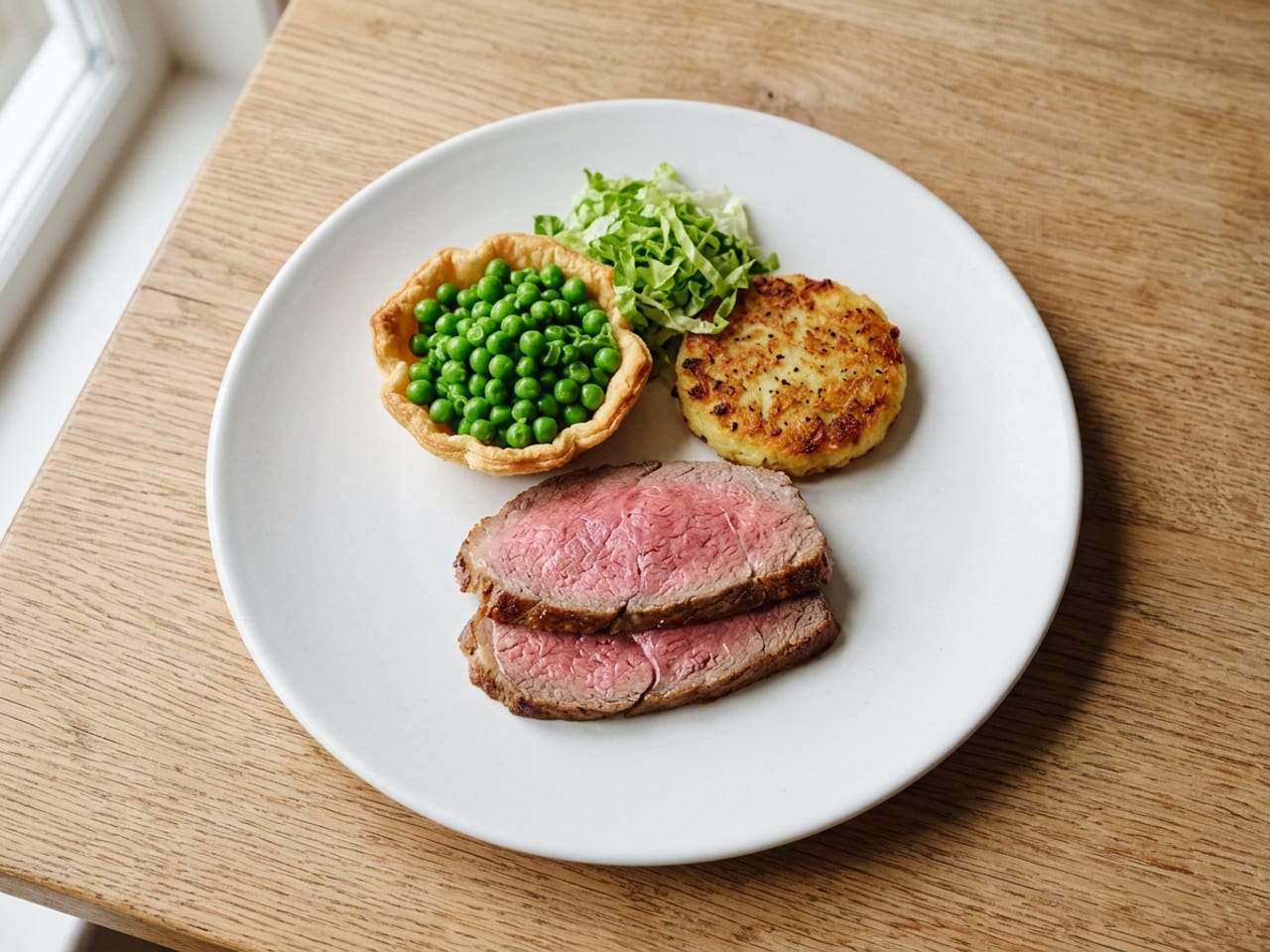
Roast fillet of beef Clamart on one plate, our layout after Escoffier's No. 1048. An AI render, not a photograph.
On the plate: two slices of roast fillet of beef, one small tartlet of peas à la française with shredded lettuce and one small round of Pommes Macaire.1
Peas à la française: peas cooked covered with a lettuce heart, parsley, chervil, small onions and butter; the lettuce is shredded and stirred back in, with butter, off the heat (his No. 2193).
Tartlet: a small baked tartlet crust holds the peas; Gisslen's 2011 platter rules put peas in "artichoke bottoms, tomato halves, or tartlet shells" so they are easy to serve.
Pommes Macaire: his No. 2228, shaped into small flat rounds ("quoits"); its recipe is not part of what we quote here.
Layout: Ours: the beef slices overlapping at the front, the pea tartlet behind on the left, the Macaire round behind on the right, so the two garnish elements still alternate as he asks. Sauce: The slightly thickened gravy goes to the table separately, as his line for this fillet says.
What Clamart means and every Escoffier line for it: the decoder.
Florentine: sole Florentine
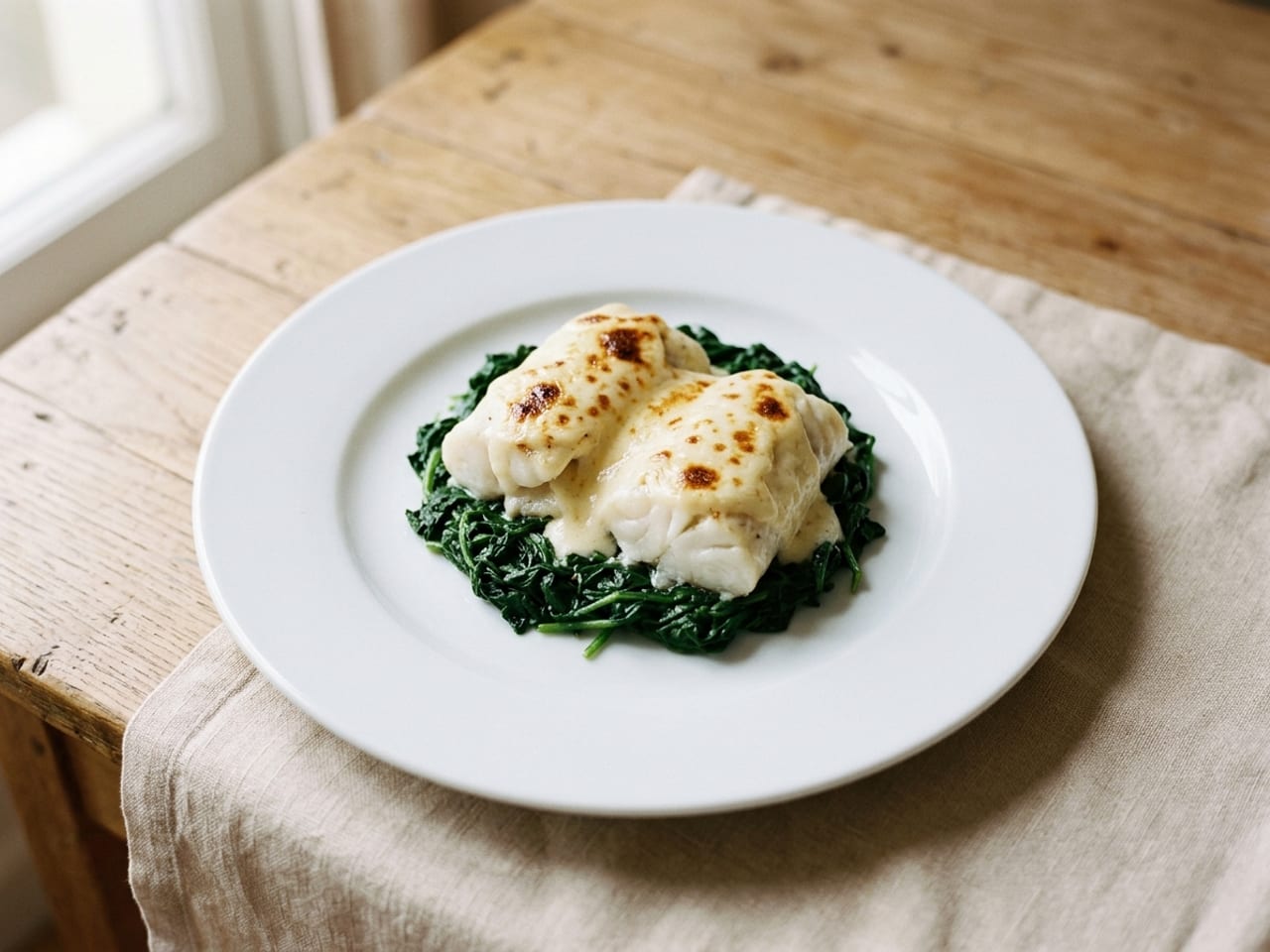
Sole Florentine on one plate, our layout after Escoffier's No. 831. An AI render, not a photograph.
On the plate: a bed of shredded spinach stewed in butter, two folded poached sole fillets and Mornay sauce and grated cheese, browned.1
Spinach: shredded and stewed in butter, then spread in a layer under the fish.
Sole: poached in fish fumet and butter (his words for the whole fish; fillets are our swap for a single plate).
Mornay: béchamel with Gruyère and Parmesan; it covers the sole, which is sprinkled with cheese and glazed quickly "in the oven or at a salamander" (an overhead grill). (Mornay on our mother sauces guide)
Layout: Ours: one oval of spinach in the centre, the two fillets side by side on it, coated and browned; nothing else on the plate. Sauce: The Mornay is on the fish, as in his recipe.
What Florentine means and every Escoffier line for it: the decoder.
Parmentier: tournedos Parmentier
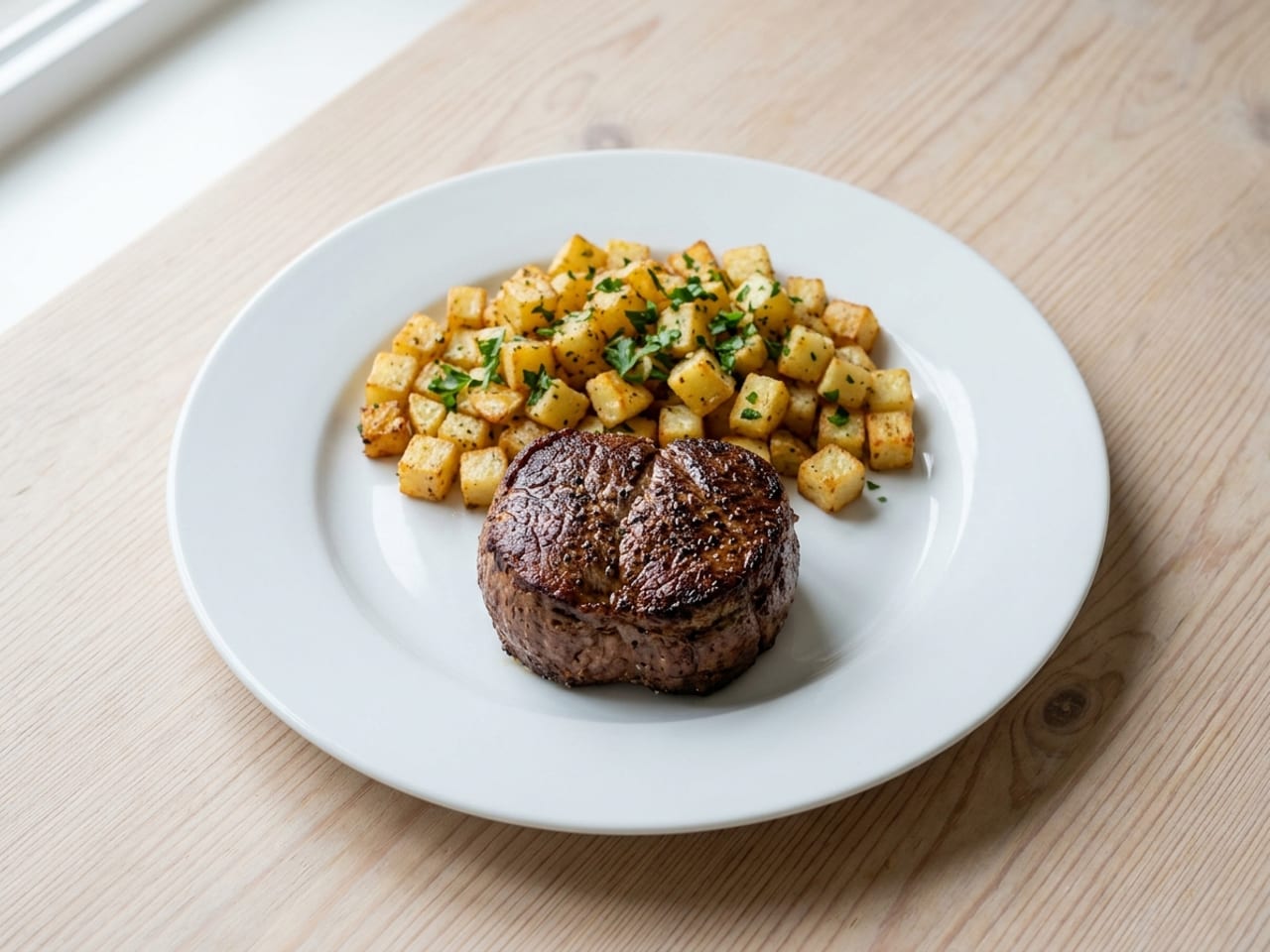
Tournedos Parmentier on one plate, our layout after Escoffier's No. 1120. An AI render, not a photograph.
On the plate: one tournedos fried in butter, a heap of potato cubes cooked in butter and chopped parsley on the potatoes.1
Potatoes: cut into regular cubes of two-thirds of an inch (about 1.7 cm, our conversion), or scooped with an oval spoon-cutter, cooked in butter and "kept very soft".
Tournedos: fried in butter; he dishes several in a crown, with the potatoes in the middle or round them; we plate one. (what a tournedos is)
Layout: Ours: the tournedos at the front of the plate, the potato heap behind it, parsley over the potatoes only. Sauce: No sauce is named in his line; we add none.
What Parmentier means and every Escoffier line for it: the decoder.
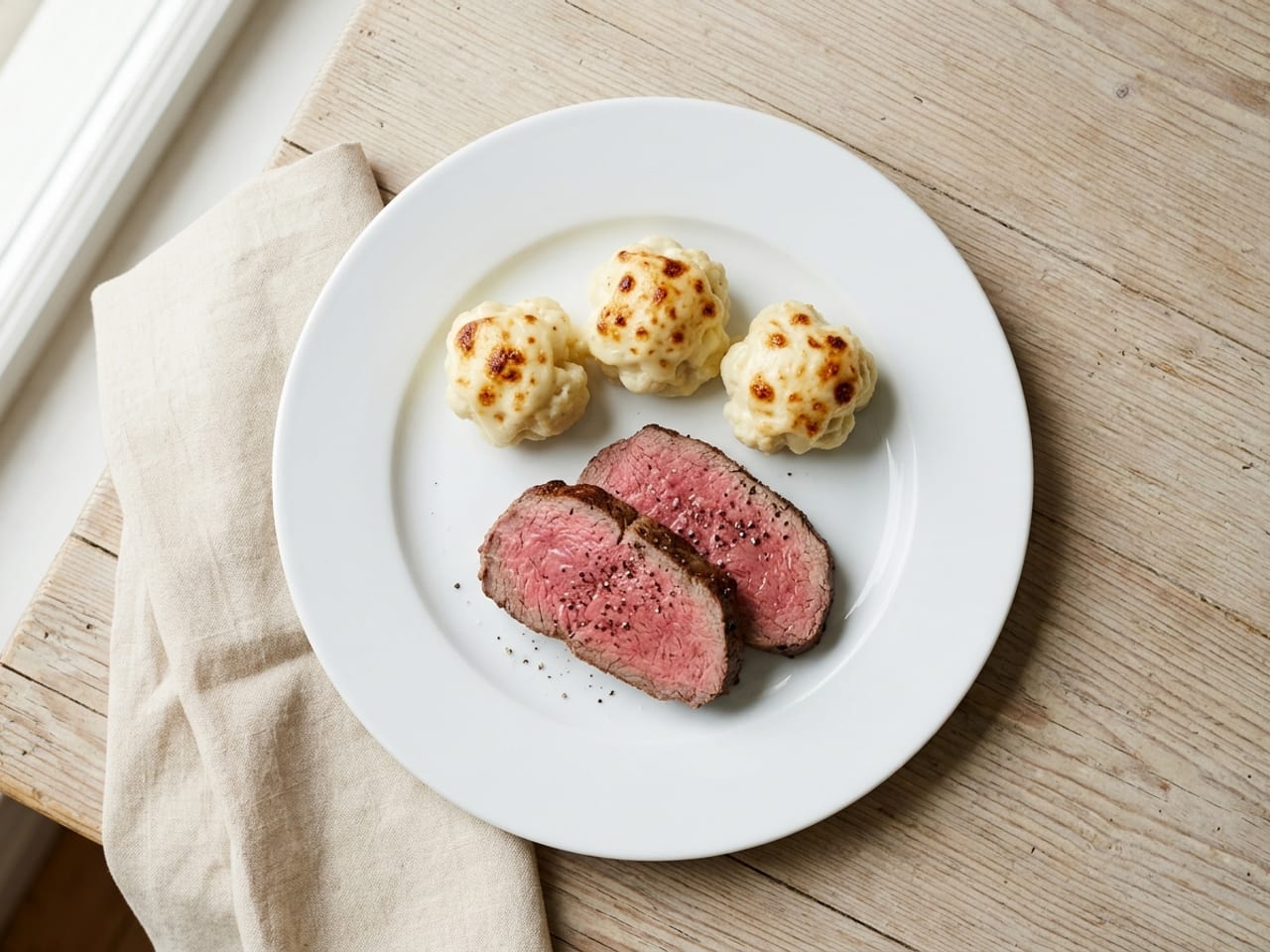
Dubarry: roast fillet of beef Dubarry
Roast fillet of beef Dubarry on one plate, our layout after Escoffier's No. 1050. An AI render, not a photograph.
On the plate: two slices of roast fillet of beef and three small balls of cauliflower, coated with Mornay and cheese and browned.1
Cauliflower: moulded into small balls, coated with Mornay, sprinkled with grated cheese and put in the oven "for the gratin to form just in time for the dishing up".
Beef: larded and roasted, sliced for the plate (the slicing is ours).
Layout: Ours: the beef slices at the front, the three cauliflower balls in a short curve behind them. Sauce: Gravy sent separately in his line; a school handout adds Château potatoes, which we leave out to keep to his one element.
What Dubarry means and every Escoffier line for it: the decoder.
Bouquetière: roast fillet of beef bouquetière
Roast fillet of beef bouquetière on one plate, our layout after Escoffier's No. 1045. An AI render, not a photograph.
On the plate: two slices of roast fillet of beef, turned carrots, turned turnips, small olive-shaped potatoes, peas, green beans cut into lozenges and one cauliflower floret.1
Carrots and turnips: "turned by means of a small grooved spoon" in his text and cooked in consommé; our tourné guide shows the knife-turned shape. (our tourné guide)
Potatoes: turned to the shape of olives and cooked in butter. (Château potatoes)
Peas and beans: the beans cut into lozenges; both bound with butter.
Layout: Ours, a bouquetière-style arrangement: the beef at the front, six small separate heaps in an arc behind it, left to right carrots, turnips, peas, potatoes, beans and cauliflower, so the colours alternate. Sauce: "Serve the gravy of the fillet separately", his line ends.
What Bouquetière means and every Escoffier line for it: the decoder.
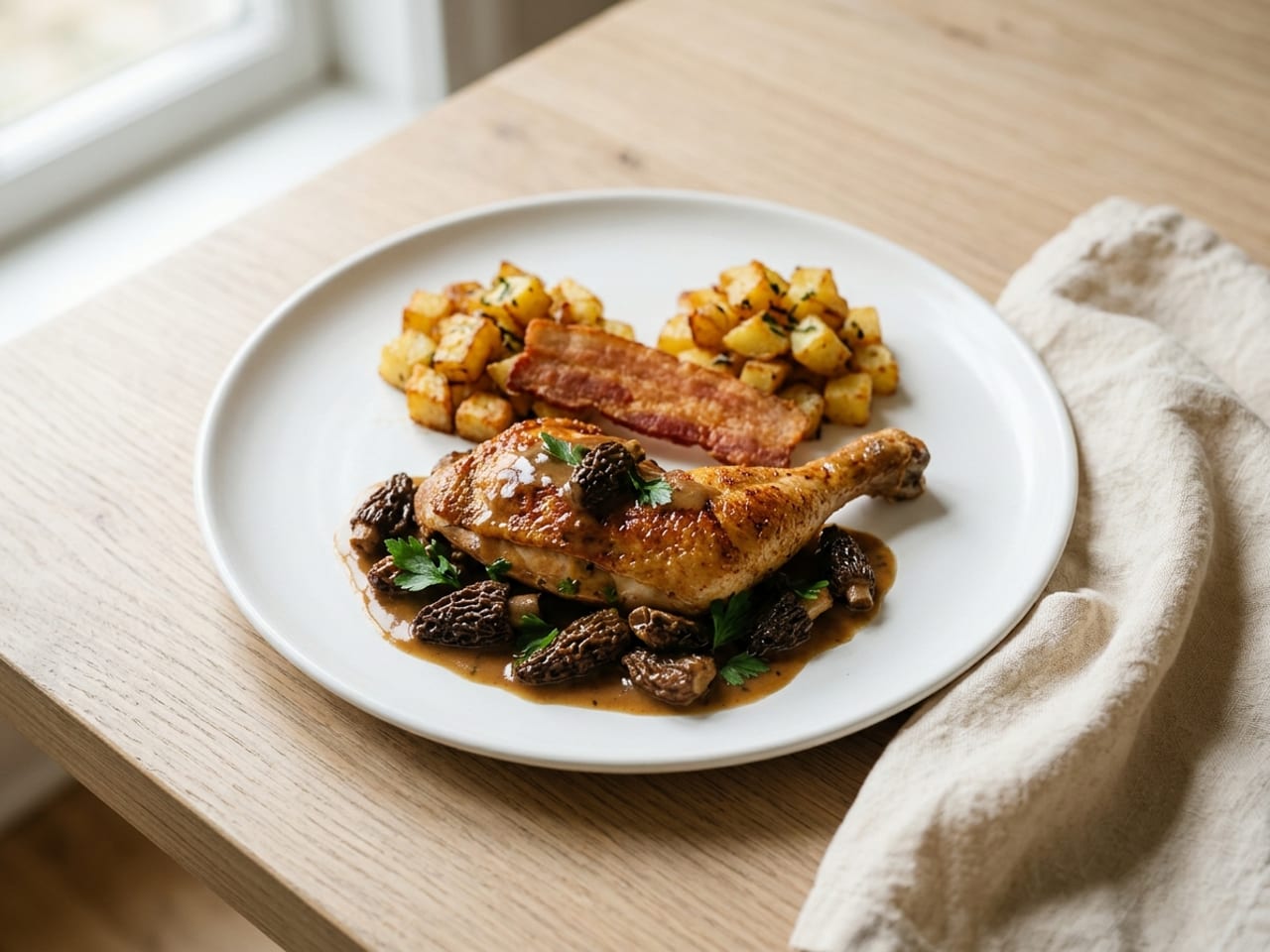
Forestière: poulet sauté Forestière
Poulet sauté Forestière on one plate, our layout after Escoffier's No. 1555. An AI render, not a photograph.
On the plate: a piece of sautéed chicken with quartered morels and their sauce, two small heaps of diced potatoes tossed in butter, one rectangle of crisp bacon between them and a pinch of chopped parsley on the chicken.1
Chicken and morels: sautéed in butter with chopped shallots and quartered morels; the pan is swilled with white wine and veal stock, reduced and poured over.
Potatoes: cut into large dice and tossed in butter; he puts four heaps round the chicken, we put two on one plate.
Bacon: a rectangle of "frizzled" (crisped) bacon between the heaps.
Layout: Ours: the chicken at the front with its morels and sauce, the two potato heaps behind it, the bacon between them. Sauce: The reduced pan sauce goes over the chicken and morels, as in his recipe.
What Forestière means and every Escoffier line for it: the decoder.
Other meanings
Pie filling, garniture aromatique and the mantel set
In French pastry, the filling. The French national standard for pastry cooks uses garniture for what goes in a tart and asks students to "Distinguer les garnitures cuites avec la pâte de celles ajoutées après cuisson." (tell fillings baked with the pastry from those added after baking; our translation), with fruit "utilisés en garniture de tarte" among them.28
Garniture aromatique: aromatic vegetables that flavour and come out. Le Cordon Bleu calls mirepoix "an aromatic garnish" for cooking fish, shellfish, meat, poultry or a marinade and adds: "The mirepoix is always strained from the cooking liquid and is never served with the main dish."29 A French kitchen glossary of unknown authorship defines the aromatic garniture as "Végétaux destinés à renforcer la saveur d'une préparation culinaire" (plants meant to strengthen a dish's flavour), naming carrots, onions, leeks, a bouquet garni, celery and garlic.30 The vegetables are not fixed: Le Cordon Bleu's mirepoix is "carrots, onions, and/or leeks and celery", the glossary's is carrots and onions only.29, 30
Not food: the mantel garniture. A matched set of ornaments for a mantelpiece, a clock with vases or candelabra (the French garniture de cheminée).10, 31 English dictionaries also give a set of armour.12
The word
Where garniture comes from, and who says what
From the French garnir. The French dictionary of record dates garneture to about 1260 as a saddle ornament, and garniture by 1498 as "ce qui est mis à une chose pour la garnir" (what is put on a thing to garnish it); garnir comes from a Germanic word for taking care, "prendre garde à quelque chose".10 English borrowed garniture in 1525 to 1535.12 The entries we read give no date for the kitchen sense.
Both: the main accompaniment and often the decoration; as a rule prepared apart from the dish, at other times mixed with it (matelotes, civets)
"besides being the principal accompaniments to dishes, they are very often the adornment thereof ... As a rule, garnishes are independent of the dish itself"
Our reading: on a French menu, a garniture is the named set of accompaniments that comes with the main item, which is how our food garnishes guide's glossary puts it. Rouxbe's line is one school's distinction, not the definition: Escoffier says garnishes are "As a rule ... independent of the dish itself", prepared apart, and at other times mixed with it, as in matelotes and civets.1
Still cooked, from dated recipes:eggs Florentine (Abé, S., 2016)22; hachis Parmentier (GBC Kitchen, 2026)25; tournedos Rossini (Turner, R., 2017)23; lemon sole Véronique (GBC Kitchen, 2022)24. Taste France says tournedos Rossini can still be found "at classic culinary institutions like Chez Dumonet or Maxim's" (undated).18 We found no dated menu or recipe for Dubarry, Clamart, Crécy or Forestière.
FAQ
Garniture, answered
What is garniture in food?
On a French menu, a garniture is the named set of accompaniments served with the main item: the vegetables, potatoes or other parts that come with a roast, a steak or a fish. Escoffier calls garnishes "the principal accompaniments to dishes" and "very often the adornment thereof", and the French TLFi dictionary gives "Ce qui accompagne et garnit la pièce principale" (what accompanies and garnishes the main piece). The name on the menu tells you which garniture: Clamart is peas, Florentine spinach, Parmentier potatoes. This page decodes 53 of them.
What is the difference between garniture and garnish?
In French cooking a garniture is the accompaniment that comes with the main item; in English a garnish is often the small finishing touch on top. The sources draw the line differently: Rouxbe says a garniture is added during cooking and becomes part of the dish, Peterson says that in America a garniture often means a decoration not meant to be eaten, and CooksInfo says "A garniture is a garnish." Escoffier himself says garnishes are both the main accompaniment and often the decoration, and as a rule are prepared apart from the dish.
What does Florentine mean in cooking?
Spinach, on fish and eggs: Escoffier's sole Florentine and eggs Florentine sit on spinach stewed in butter under Mornay sauce, a French school handout gives leaf spinach for fish and sweetbreads, and Gisslen's 2011 textbook lists "Florentine: spinach". It is not spinach alone on every dish: Escoffier's consommé Florentine is chicken quenelles, half of them spinach, with peas, and his milt barquettes Florentine carry a Parmesan soufflé and no spinach. The Catherine de' Medici story behind the name is a legend we found no trustworthy source for.
What does Parmentier mean in cooking?
Potatoes. It is named for Antoine-Augustin Parmentier (1737 to 1813), who campaigned to popularise the potato in France, and in Escoffier's 1907 book it is a potato soup, eggs baked in potato shells, an omelet with diced potato and tournedos with potato cubes. Hachis Parmentier today is a French cottage pie of beef under mashed potato; Escoffier's own hachis filled baked potato shells. Gisslen: "To this day, many classical recipes featuring the potato are called Parmentier".
What does Dubarry mean in cooking?
Cauliflower. Round a roast it is small balls of cauliflower coated with Mornay sauce and browned in the oven (Escoffier No. 1050); as a vegetable or a soup it is a cauliflower purée with potato. CooksInfo says the name is now used for any dish with cauliflower. It is named for Madame du Barry; that the cauliflower stands for her wigs is a story one journal article reports from secondary sources, not a documented reason.
What does forestière mean in cooking?
Mushrooms, in today's kitchens (Gisslen: "Forestière: mushrooms"): Escoffier's sautéed chicken Forestière has morels, diced potatoes and bacon, and a French school handout gives morels, lardons and Parmentier potatoes, or ceps and mushrooms with cocotte potatoes. His tournedos Forestière is the exception: noodles and diced potatoes, no mushrooms. Literally it is "in the forest manner".
What is petits pois à la Clamart?
Peas. All five Clamart dishes we found in Escoffier's 1907 book have peas, most of them cooked à la française with lettuce: in tartlets round a roast fillet (alternating with small rounds of Macaire potatoes), under poached eggs in tartlets, in an omelet, with a chicken in a cocotte and with small artichokes (with a carrot, no lettuce). CooksInfo: "Sometimes the term is applied to dishes that come with just plain peas." Clamart is a town close to Paris whose peas, Wikipedia says, were the first of the season.
What does bouquetière mean?
A garniture of several vegetables set round the meat in small separate heaps, like bouquets: Escoffier's has turned carrots and turned turnips, olive-shaped potatoes, peas and green beans and five bunches of cauliflower, arranged "to vary their colours". The sources do not agree on the list: the French Culinary Institute says it always has carrots and turnips and the rest changes with the season. In French, bouquetière is also a flower seller.
What is garniture aromatique?
The aromatic vegetables cooked with the main item or in its cooking liquid to flavour it, and taken out before serving, such as carrots, onions, leeks and celery with a bouquet garni. Le Cordon Bleu says the mirepoix "is always strained from the cooking liquid and is never served with the main dish". The exact vegetables differ from source to source, so there is no one fixed list. Le Cordon Bleu's English for the mirepoix is "an aromatic garnish".
What is a classic French garnish?
In classical French cooking, a garniture named after a place, a person or a style, which tells the diner what comes with the dish: Jardinière means mixed vegetables, each in its own heap: carrots, turnips, peas, green beans, flageolets, cauliflower; Crécy means carrots; Argenteuil means asparagus; Rossini means foie gras and truffle, on a steak. The page lists 53 of them, with Escoffier's 1907 words for each.
Plated a garniture of your own? Photograph it and Plate Artists re-plates that dish, with the food kept as it is and the changes named. Start with a re-plate.
Your food, plated like a chef's
Snap it, upload it, and get the composed version back, with the steps to recreate it at home.
Free account · 1 free enhancement · No credit card
Method
How this page was made
We cooked, plated and tested nothing for this page. On 16 November 2026 we read Escoffier's 1907 English edition whole (as a scan's machine-read text, 92 compositions quoted with their recipe numbers), the introduction and garnish chapter of his 1907 French second edition, two French school handouts, Gisslen's textbook, CooksInfo, French and English dictionaries, a journal article on dish names and the dated recipes named above. Where only a book's public preview was readable (Peterson, Le Cordon Bleu, the French Culinary Institute), we quote those words only.
We could not read Saulnier's Le Répertoire de la cuisine or the Larousse Gastronomique. The two French school handouts are labelled as handouts wherever we use them, and Escoffier leads every line. Two names (Bourguignonne and Grand-mère) rest on a handout because his 1907 English text has no such garniture. Ours: the one-line meanings marked "one source", the grouping by ingredient, every translation, every count and all six plate layouts. Escoffier's words are quoted as the scan prints them, with obvious scan errors corrected. The figures are AI renders, not photographs.
Sources
The books, handouts and pages behind this page
How each source was read (in full, as OCR of a scan, or as a book's public preview) is in its entry. Weak sources (Wikipedia, a blog, a glossary of unknown authorship) are named as weak wherever the page uses them, and never carry a fact alone.
Escoffier, A. (1907). A Guide to Modern Cookery. William Heinemann, London (the English edition of Le Guide culinaire); Internet Archive scan cu31924000610117 (Cornell copy), OCR, read on 16 November 2026 as the OCR text of the whole book, searched for each name and read in context; recipe numbers and pages as the text prints them. Obvious scan errors are corrected in our quotes ("k la" and "h la" as "à la", "Frangaise" as "Française", "consomm^" and "consommd" as "consommé", "pur^e" as "purée", "poele" as "poêle", "Gruy^re" as "Gruyère", "Releves" as "Relevés", "ciseled" kept as printed, words broken across lines joined, page headers dropped). Used: No. 279 "Garnishes" (pp. 133 to 134), the fillet-of-beef garnishes Nos. 1044 to 1074 (pp. 353 to 362), the tournedos, soups, eggs, fish, poultry, vegetables and potato chapters. archive.org
Escoffier, A. (1907). Le Guide culinaire (deuxième édition). Paris; Internet Archive scan b21525912, OCR, read on 16 November 2026 as OCR text: the title page reads "DEUXIEME EDITION" and the "Introduction à la deuxième édition" is dated 1 February 1907 at its end (the archive's record dates the scan 1903; we did not read a first-edition scan). Used: that introduction, pp. xi to xii ("les réduire à trois ou quatre éléments au plus"; garnitures and sauces "servies à part" for quick service; service "à l'assiette"), and the chapter "Garnitures", p. 85; translations ours. archive.org
Vigne, S. (hospitality-school teacher) (2003). Les arts de la table et du service: Connaissance des sauces et des garnitures: Les garnitures. educarest.free.fr (a French hospitality-school teaching page, (c) 2002/2003), read in full on 16 November 2026: a French school handout that pairs each garniture name with its parts and the dishes it suits, for example "Clamart (pour grosses pièces) Tartelettes ou fonds d'artichauts garnis de petits pois à la française (ou de purée de petits pois frais), accompagnés de petites pommes Château."; a teaching list, not a reference book; translations ours. educarest.free.fr
Les Épicuriens de Montbrison (2026). Les Garnitures Classiques. lesepicuriensdemontbrison.jimdofree.com (a student page for second-year vocational classes), undated page, read in full on 16 November 2026: a list of classical garnitures for second-year vocational students, which says its examples are taken from Escoffier's Guide culinaire ("Ces quelques exemples sont tirés du "Guide Culinaire" du grand maître Auguste Escoffier."); a teaching list, not a reference book; translations ours. jimdofree.com
Gisslen, W. (2011). Professional Cooking, 7th edition. John Wiley & Sons, Hoboken; Internet Archive item professional-cooking-7th-edition, OCR, read on 16 November 2026 as OCR excerpts: chapter 1 (history: "In traditional classical cuisine, many dishes were plated in the dining room by waiters."), the chapter "Food Presentation and Garnish" ("Modern Hot Platter Garnish": "The classical garnitures most often adapted to modern platter presentation are those called bouquetière, jardinière, and printanière."; "Classical Terms in the Modern Kitchen", which says its definitions "are not the classical ones but simply the garnish or accompaniment generally indicated by the terms in today's kitchens"), the potato chapter (duchesse potatoes, pp. 612 to 613) and the glossary; a textbook. Scan accents are repaired in our quotes ("Forestiére", "bouquetiére", "jardiniére", "printaniére" as Forestière, bouquetière, jardinière, printanière) and a word broken across lines is joined ("Cone-shaped"). archive.org
Gisslen, W. (2026). Professional Cooking, chapter 13: Potatoes. a chapter PDF hosted by the Auguste Escoffier School of Culinary Arts (the edition is not stated in the PDF), read in full on 16 November 2026: "To this day, many classical recipes featuring the potato are called Parmentier"; "His Guide Culinaire lists more than 50 potato preparations, far more than for any other vegetable or starch.". escoffier.edu
CooksInfo (2018). The "À la" entries: Clamart, Dubarry, Forestière, Florentine, Jardinière, Bonne femme, Bouquetière, Bourgeoise, Argenteuil, Crécy, Saint-Germain, Vichy, Doria, Milanaise, Nantua, Lyonnaise, Rossini, Conti; and "Soubise Sauce". cooksinfo.com (a food reference site; one author, no sources given on these pages), each page first published 2004 or 2005 and updated 2018 (Soubise Sauce: 2005, updated 2020), read in full on 16 November 2026: e.g. "À la Clamart is a French cooking term for a garnish containing peas" and "what the other ingredients are will vary"; "In a broader sense, it is now used for any dish with cauliflower in it" (Dubarry); "Sometimes it indicates a simpler garnish just of wild mushrooms." (Forestière); "“À la Florentine” means literally “in the manner of Florence”."; Soubise "Reputedly named after Charles de Rohan, Prince de Soubise". Used as a cross-check: no composition on this page rests on CooksInfo alone. cooksinfo.com
Office québécois de la langue française (1986). Grand dictionnaire terminologique: "à la bouquetière"; "petits pois à la française". vitrinelinguistique.oqlf.gouv.qc.ca (the Quebec government's terminology office), read in full on 16 November 2026: à la bouquetière (last updated 1986): "Se dit d'une garniture faite de légumes disposés en « bouquets » de différentes couleurs autour des grosses pièces de boucherie rôties, des volailles poêlées ou des tournedos sautés."; petits pois à la française: "Cuits sans eau dans une casserole, avec beurre, lardons maigres, petits oignons, un ou deux cœurs de laitue"; translations ours. oqlf.gouv.qc.ca
The French Culinary Institute (2007). The Fundamental Techniques of Classic Cuisine: Bouquetière Garniture. Stewart, Tabori & Chang, New York (via ckbk), only the public preview text was read (the rest of the book is behind a login), so we quote those words only: "A bouquetière garniture, composed of various cooked vegetables (usually three chosen from the following: potatoes, carrots, celery, turnips, and onions), is most often used as a garnish or accompaniment to meat or poultry entrées. It always contains carrots and turnips but all of the remaining vegetables can vary according to the season."; read 16 November 2026. ckbk.com
ATILF (CNRS and Université de Lorraine) (2026). Trésor de la langue française informatisé: "garniture" (definition and etymology) and "garnir" (etymology). cnrtl.fr (the French national dictionary of record, compiled 1960 to 1990), read in full on 16 November 2026: culinary sense "Ce qui accompagne et garnit la pièce principale." and "Légumes accompagnant une viande (pièce de boucherie, volaille)."; the mantel sense "Ensemble des objets (pendules, flambeaux, etc.) qui ornent le dessus d'une cheminée."; etymology "Ca 1260 garneture « ornement d'une selle »", "1498 garniture « ce qui est mis à une chose pour la garnir »", and garnir "Du germ. * warnjan « prendre garde à quelque chose »"; it also quotes Larousse ménager (1926) and the Académie gastronomique (1962); translations ours. cnrtl.fr
Larousse (2026). Dictionnaire de français: "garniture", sense 3. larousse.fr (the online French dictionary, not the Larousse Gastronomique), read in full on 16 November 2026: "Aliments que l'on ajoute à un plat avant de le servir pour le compléter ou pour le décorer."; translation ours. larousse.fr
Dictionary.com (2026). "garniture". dictionary.com (the Random House entry, and the Collins English Dictionary entry it carries), read in full on 16 November 2026: "something that garnishes; decoration; adornment."; Collins: "decoration or embellishment"; the armour sense "a set of plate armor having pieces of exchange for all purposes."; word history: borrowed from French in 1525 to 1535 (its entry prints the dates with a dash). dictionary.com
Rouxbe Online Culinary School (2026). Tips & Techniques 405: Garniture vs. Garnish. rouxbe.com (an online cooking school), undated page, read in full on 16 November 2026: "Garniture consists of ingredients that are added to a dish during, or near the end of, cooking and therefore become an integral part of the dish."; "Garnish refers to a finishing step whereby ingredient(s) are placed on top of a dish for color, texture and visual appeal. All garnish should be edible and something that you would normally eat.". rouxbe.com
Peterson, J. (2017). Sauces: Classical and Contemporary Sauce Making. Houghton Mifflin Harcourt (first published 1991; via ckbk, page copyright 2017), only the public preview text was read (the rest of the book is behind a login), so we quote those words only, from the section "Garnitures" and the glossary entry "Garniture": "In America, a garniture often means a bit of decoration, usually not meant to be eaten, that is put on the side of the plate to give added color"; "In French terminology, a garniture is usually a vegetable or vegetables served as an accompaniment to meat or fish."; "Much of the vocabulary of classic French cuisine exists only to describe variations in garniture, the basic cooking method remaining the same."; read 16 November 2026. ckbk.com
CooksInfo (2020). Garnishes. cooksinfo.com (a food reference site; it cites Gisslen, Essentials of Professional Cooking, 2004), first published 25 April 2011, updated 17 June 2020, read in full on 16 November 2026: "A “garniture” is a garnish."; "If a joint of meat were being served on a platter for carving at the table, and the Garnishes were solid, they could be arranged around the joint.". cooksinfo.com
Westney, L. (2007). From Courtesans to Queens: Recipes Named for Women. Names 55(3), 277 to 285 (American Name Society), read in full on 16 November 2026 (PDF): "recipes with the name Du Barry usually indicate the presence of cauliflower as a main ingredient"; "The cauliflower was symbolic of Madame du Barry's wigs" (one sentence split by a page header in the PDF; it cites secondary sources); "It was actually Madame de Pompadour, however, who initiated this tall hairstyle trend"; "Naming a dish after a person (or place) in itself offers little or no information about the recipe"; its abstract asks for "more thorough verification of all recipe names". ans-names.pitt.edu
Berman, A. (2026). Parmentier, Antoine-Augustin. Complete Dictionary of Scientific Biography, via encyclopedia.com, the entry as encyclopedia.com prints it (no edition date on the page, which carries a 2019 site copyright), read in full on 16 November 2026: "PARMENTIER, ANTOINE-AUGUSTIN (b. Montdidier, France, 12 or 17 August 1737; d. Paris, France, 17 December 1813)"; a memoir of 1773 "awarded a prize by the Besançon Academy"; "his long and successful campaign to popularize the cultivation and use of the potato in France". encyclopedia.com
Taste France Magazine (2026). French Foods Named After Famous People. tastefrance.com (a French food magazine run under a delegation from the French Ministry of Agriculture, per its legal notice), undated page, read in full on 16 November 2026: tournedos Rossini "is attributed to the grandfather of French cuisine, Marie-Antoine Careme" and "as the story goes, his friend Carême made it a reality"; "you can still find this showstopper at classic culinary institutions like Chez Dumonet or Maxim's"; hachis Parmentier "popularized in Paris bistros after his death"; Parmentier "is remembered for placing potato flowers in the buttonholes of Louis XVI and Marie Antoinette, posting armed guards to protect his experimental potato patches". tastefrance.com
Davidson, A. (2014). The Oxford Companion to Food (3rd edition): "Culinary Mythology: Catherine de' Medici Transformed French Cookery" and "spinach". Oxford University Press (via ckbk), the two entries' full public text, read 16 November 2026: "The myth consists in the idea that she and her retinue between them transformed what had been a rather primitive cuisine at the French court into something much more elegant and sophisticated, on Italian lines."; "it has become an almost routine activity for food historians" to demolish it; spinach "only reached Europe in the 11th century". Neither entry mentions spinach and Florentine together. ckbk.com
Troy, E. (CulinaryLore) (2026). Why Are Dishes With Spinach Called Florentine? Meaning, Method, and the Medici Myth. culinarylore.com (a one-author food history blog: weak), first posted 15 January 2014, updated 23 September 2026, read in full on 16 November 2026: it tells the Catherine de' Medici spinach story and adds "While this tale is popular, it has been thoroughly debunked by food historians." and "The true answer is: food historians don't actually know."; cited here only as a place the story is told. culinarylore.com
Wikipedia (2026). "Clamart", "Carrot soup", "Sauce Nantua", "Sauce Choron", "Soup du Barry", "Florentine (culinary term)". en.wikipedia.org (an encyclopedia anyone can edit: weak, so it is never the only source for a fact here and every line that uses it says so), the current revisions, read in full on 16 November 2026: Clamart "A speciality with peas as a side-dish, is called "à la Clamart". Close to Paris and its central marketplace (Les Halles), Clamart's peas were the first of the season."; "Potage Crécy is named after Crécy-en-Ponthieu, a commune in Northern France that has been purported to produce carrots with the best flavor within the country."; Nantua "is known for its crayfish"; sauce Choron "is named after Alexandre Étienne Choron."; Florentine: "Food historians have debunked this story". wikipedia.org
Abé, S. (Great British Chefs) (2016). Eggs Florentine. greatbritishchefs.com (a recipe by a named chef), first published 2016, read in full on 16 November 2026: "A heavenly combination of fluffy English muffins, spinach, poached eggs and Hollandaise sauce". greatbritishchefs.com
Turner, R. (Great British Chefs) (2017). Tournedos Rossini. greatbritishchefs.com (a recipe by a named chef, from a Mitchell Beazley book), first published 2017, read in full on 16 November 2026: "Steak, foie gras, truffles and gravy on toast."; "Place a steak on each bread slice, arrange the foie gras on top and cover with the thinly sliced truffle."; it says the dish was "created and named in honour of the Italian composer Gioachino Antonio Rossini by the 19th-century chef Casimir Moissons". greatbritishchefs.com
GBC Kitchen (Great British Chefs) (2022). Lemon Sole Veronique. greatbritishchefs.com (the site's test kitchen), first published 2022, read in full on 16 November 2026: "Veronique sauce is a French cream sauce, made with vermouth, white grapes and often tarragon". greatbritishchefs.com
GBC Kitchen (Great British Chefs) (2026). Hachis Parmentier (French cottage pie). greatbritishchefs.com (the site's test kitchen), first published 2026, read in full on 16 November 2026: "We opted for shredded braised beef shin for maximum flavour and texture, and beautifully piped mashed Nanna Tate potatoes enriched with butter, egg yolk, Gruyère and nutmeg.". greatbritishchefs.com
Hanes, P. (The Christian Science Monitor) (1982). Tennis and truffles mix with today's cuisine at Troisgros. The Christian Science Monitor, 1 April 1982, read in full on 16 November 2026: the Troisgros brothers "did away with the showy tableside serving performed by headwaiters, which often meant the food was cold by the time it was served" and "introduced large serving plates on which to arrange food and sauces in the best way"; the reporter's account. csmonitor.com
Glynn, A. (The Johnston Collection) (2012). The Art of Dining: Dining à la russe. fairhall, issue 6, July 2012, p. 18 (the journal of a Melbourne house museum), read in full on 16 November 2026: "Dining à la russe was a new style of dining that replaced service à la française"; introduced "at a dinner given by the Russian diplomat, Prince Borisovitch Kourakin" and "in 1810 at Clichy" (one date among several in other sources); the main course "initially shown whole so guests could appreciate it, then carved at the sideboard". johnstoncollection.org
Ministère de l'Éducation nationale et de la Jeunesse (2022). Certificat d'aptitude professionnelle Pâtissier: référentiel (modifié 2022). eduscol.education.fr (the French national vocational standard for pastry cooks), read in full on 16 November 2026 (PDF): the knowledge table "Les différentes garnitures": "Distinguer les garnitures cuites avec la pâte de celles ajoutées après cuisson."; "utilisés en garniture de tarte" (a fragment of a table cell); it uses the word for tart and pastry fillings and does not define it; translations ours. eduscol.education.fr
Le Cordon Bleu (2010). Cuisine Foundations: Mirepoix. Delmar Cengage (via ckbk), only the public preview text was read (the rest of the book is behind a login), so we quote those words only: the mirepoix cut "is used as an aromatic garnish for any cooking process applied to fish, seafood, crustaceans, meat, poultry, marinade, etc."; "The mirepoix is always strained from the cooking liquid and is never served with the main dish."; "Mirepoix also refers to a blend of aromates made up of carrots, onions, and/or leeks and celery"; read 16 November 2026. ckbk.com
Unknown author (2026). Le vocabulaire professionnel (glossaire cuisine). a French kitchen glossary PDF hosted on a company website (author, publisher and date not stated: weak, used only beside another source), read in full on 16 November 2026: entry GARNITURE, "a) AROMATIQUE : Végétaux destinés à renforcer la saveur d'une préparation culinaire, exemple : carottes, oignons, poireaux, bouquet-garni, céleri, ail, etc." and "b) APPELLATION : Eléments divers placés autour d'une pièce de viande, de volaille, de poisson, déterminant le nom du mets servi."; MIREPOIX "Garniture aromatique composée de carottes et d'oignons taillés en gros dés"; translations ours. PDF
The Cleveland Museum of Art; the Victoria and Albert Museum (2026). Garniture Set (one clock and 2 vases), 1736 to 1770, acc. 2020.421; mantel clock by Raingo Frères, Paris, 1860 to 1870. clevelandart.org; collections.vam.ac.uk (museum collection records), read in full on 16 November 2026: Cleveland, "A set of vases and clock, connected visually by the use of the same materials, often adorned a mantlepiece"; V&A, "A garniture of a mantel clock and pair of candelabra of white marble and ormolu.". clevelandart.org