Vegetable garnishes: 19 cuts, curls and flowers, which dish each suits, and how far ahead to make them
Nineteen vegetable garnishes, each with steps from a named cookbook, test kitchen or garnish book, the ice-water soak from 51 readings side by side, which dish each goes on and how far ahead it keeps. We cut, soaked, timed and tasted nothing: every figure is its source's.
The photos on this page are AI-generated illustrations.
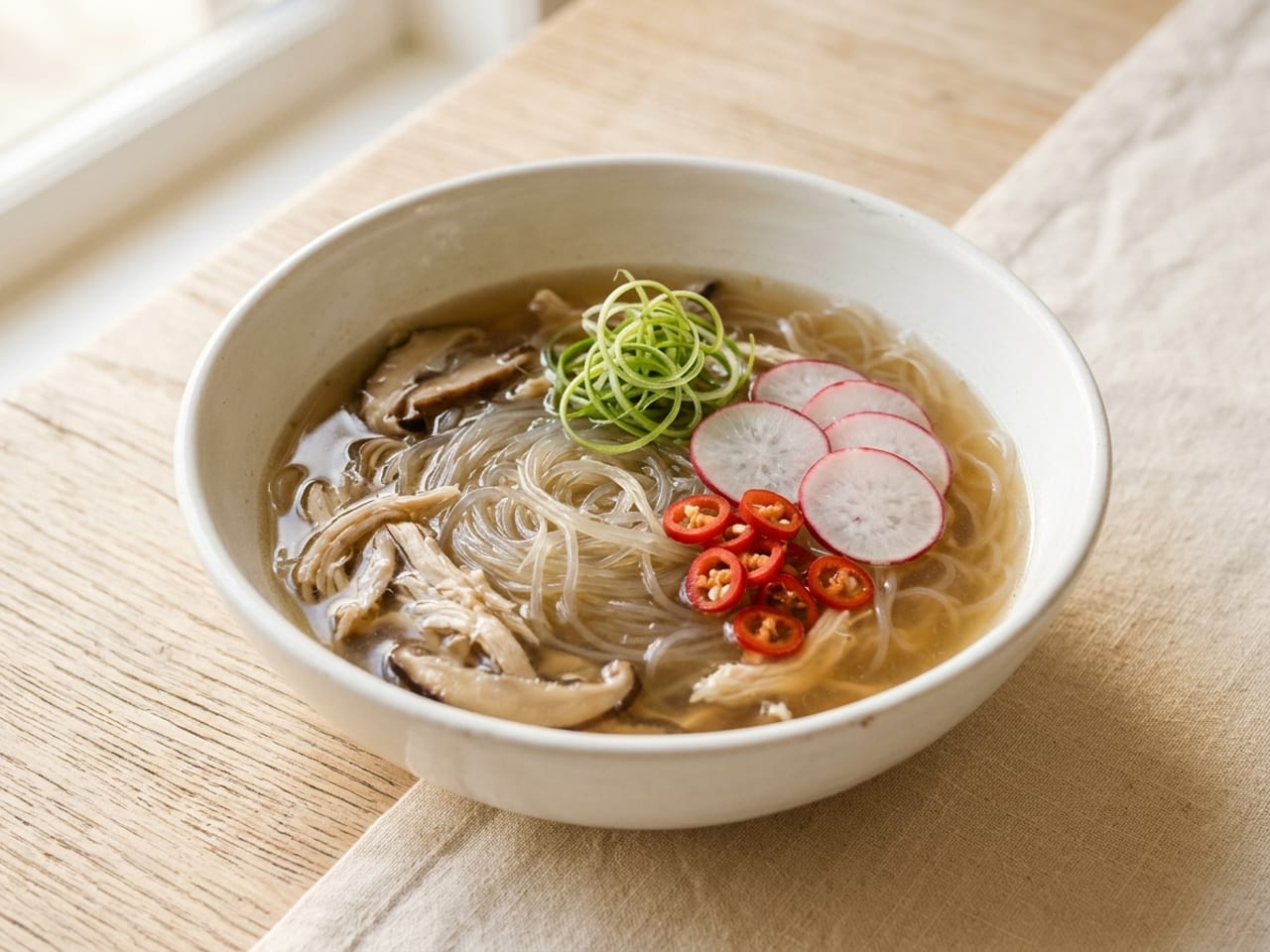
Vegetable garnish ideas, in one paragraph
Cut a raw vegetable thin, crisp it in ice water, dry it, and put it on a dish that already suits it: sliced scallion on pho and ramen, sliced radish on tacos and pozole, scallion brushes on Peking duck, daikon threads under sashimi, crisp shallots on Indonesian dishes, and radish roses or celery curls on salads and cold platters. That is our summary of what the cookbooks we read print.1, 50, 71, 72, 76, 77, 88, 92, 108 The ice water has no single time: thin scallion strips take about 10 minutes at America's Test Kitchen, a scallion brush "a minute or two" for Ken Hom and an hour for Gloria Bley Miller, celery curls overnight or for several hours for Fannie Farmer.1, 2, 5, 108 Make ahead: most of the cuts we read about keep cold in water for hours to a day or two.6, 10, 31 Cut cucumber and tomato last (our rule; no source we read gives them a time).
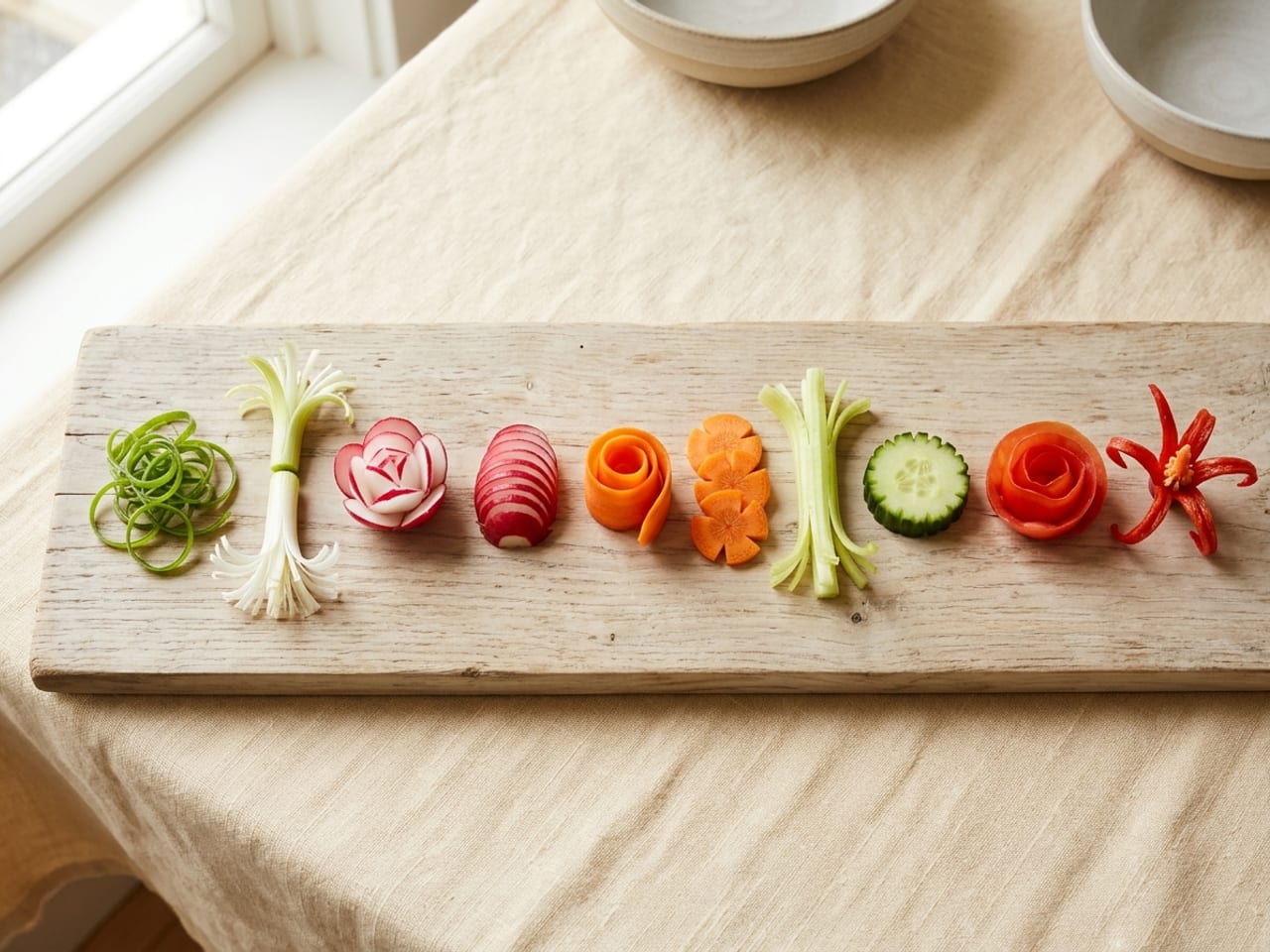
| Garnish | What it is | Best on |
|---|---|---|
| Scallion curls (green onion curls) | Thin lengthwise strips that curl in ice water | Salads, grilled meats, eggs, soups |
| Scallion brushes (onion brushes) | Short lengths slashed at the ends, which open in ice water | Peking duck, Chinese platters, Thai side dishes |
| Sliced and bias-cut scallion | Thin rings or long diagonal slices of the greens or whites | Pho, ramen, noodle bowls, soups |
| Thin radish slices | Raw rounds, sliced thin | Tacos, pozole, salads |
| Radish roses (radish rosettes) | Petals cut into a whole radish that open in ice water | Salads, relish trays, cold platters |
| Radish fans and accordions | Thin slices cut most of the way through, fanned open | Cold platters; in China, dipped in a soy sauce |
| Radish tulip (Fannie Farmer, 1896) | The skin cut in six petals and folded back | A relish dish on crushed ice |
| Cucumber ribbons | Long thin strips shaved with a wide peeler | Salads and platters; drinks on the cocktail guide |
| Fluted (scored) cucumber slices | Skin scored lengthwise, then sliced into notched rounds | Salad plates, cold plates, platter borders |
| Carrot curls | Peeler strips rolled tight, held, crisped in ice water | Salads, relish trays, sashimi plates |
| Carrot flowers | A notched carrot sliced into flower-shaped rounds | Relish trays, hors d'oeuvres, dinner plates |
| Carrot feathers and crisscrosses | Notched carrot strips, or squares scored into thick slices | Salads, meat and poultry platters, coleslaw |
| Celery curls | Short pieces slit at the ends, curled overnight in ice water | Relish trays, salads, turkey |
| Tomato rose (and cherry tomato rose) | One long spiral of peel, rolled back into a rose | Main-course platters, deviled eggs |
| Chilli flowers (chili flowers) | A chilli split into petals that fan out in cold water | Thai dishes, beside a scallion brush |
| Crispy fried shallots | Thin rings fried golden, then drained or oven-dried | Indonesian dishes, pho, scallops, deviled eggs |
| Raw onion rings and slices, soaked milder | Sliced thin, soaked or rinsed to take the bite off | Pho, pozole, tacos, salads |
| Daikon threads (ken) for sashimi | A continuous paper-thin sheet of daikon, cut into threads | Sashimi |
| Shaved ribbons: fennel, beet, celery, carrot, radish | Shaved thin, held in ice water for hours, spun dry | Salads |
The strip is our summary of each card below, where every step, size and dish carries its source.
On this page: The garnishes by vegetable · The ice-water soak · Which garnish on which dish · Carved garnishes today · How far ahead · Washing and safety · Japan and Thailand · History · Tools · FAQ
The 19 vegetable garnishes: how to make each one
One card per garnish, grouped by vegetable, and a card only where a named source gives the steps: the numbered steps follow the source or sources named above them, and where other sources give different sizes or soak times, each is printed under its own name, never merged into one "standard". Garnishes we found only mentioned are in also seen below. A 1980s U.S. military recipe card sets the rule every card keeps: "Generally, garnishes should be edible and should be an integral part of the food", and "Not all food requires garnishing."68 Knife-cut sizes (julienne, brunoise, rondelle) are on our knife skills guide; we do not print a second size.
Scallion (green onion, spring onion) garnishes
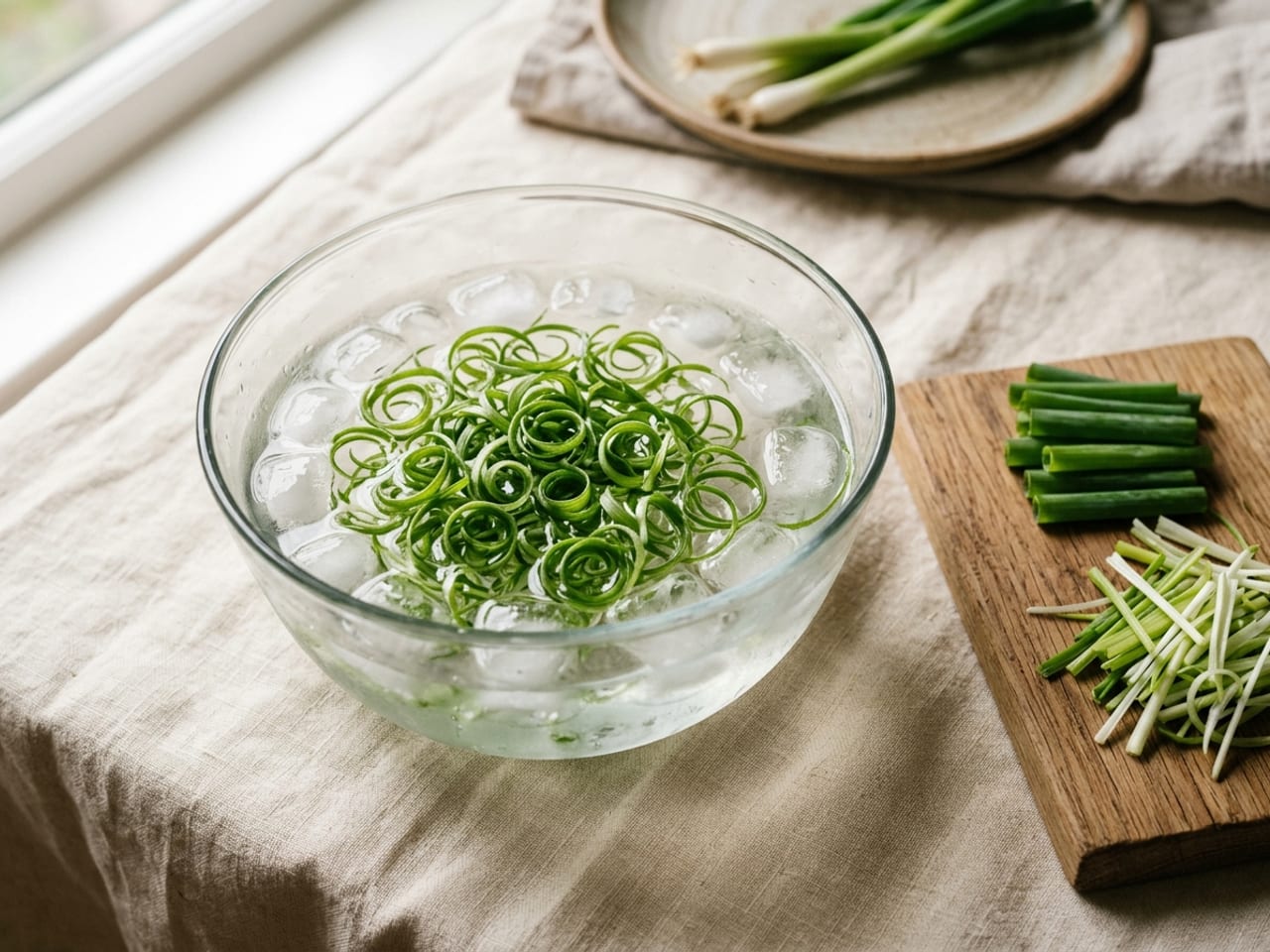
Scallion curls (green onion curls)
Also: spring onion curls; scallion threads; Serious Eats' "pretty little threads".
Steps as America's Test Kitchen (2016) gives them:
- Cut scallions into 2-inch (5 cm) pieces, then slice each piece lengthwise into thin strips.5
- Put them in a small bowl of ice water "until scallions curl and crisp, about 10 minutes".5
- Drain and "dry thoroughly with paper towels".5
Sizes: America's Test Kitchen: 2-inch (5 cm) pieces cut into thin strips (2016); in 2023, the greens in 2-inch (5 cm) lengths cut as very thin matchsticks. Monica Matheny (The Yummy Life): shreds "3-5 inches long" (7.5 to 13 cm). Foodal: threads from 3-inch (7.5 cm) sections.5, 6, 9, 14
Ice water: About 10 minutes (America's Test Kitchen, 2016) to 2 to 16 hours in the fridge (America's Test Kitchen, 2023); the blogs run from "a few minutes" to about an hour.5, 6, 11, 16 (every source's time)
Tool: A knife in America's Test Kitchen's steps; The Yummy Life links a scallion-cutting tool through a shop (seller-adjacent).5, 9
Suits: A frisée salad (America's Test Kitchen, 2016) and a shaved vegetable salad, where the curled greens "make an attractive garnish" (2023); "grilled meats, egg dishes, dips, or soups" (Foodal). In Korean spring onion salad (pa muchim) the curled scallion is the salad (BBC Good Food Middle East, Sainsbury's Magazine).5, 6, 12, 13, 14
On this site: Korean fried chicken, scallion threads on the soy-garlic side.
How far ahead: Under ice water in the fridge, 2 to 16 hours (America's Test Kitchen); drained and wrapped in paper towel in a bag, 2 to 3 days (The Yummy Life, a blog).6, 9 The make-ahead table.
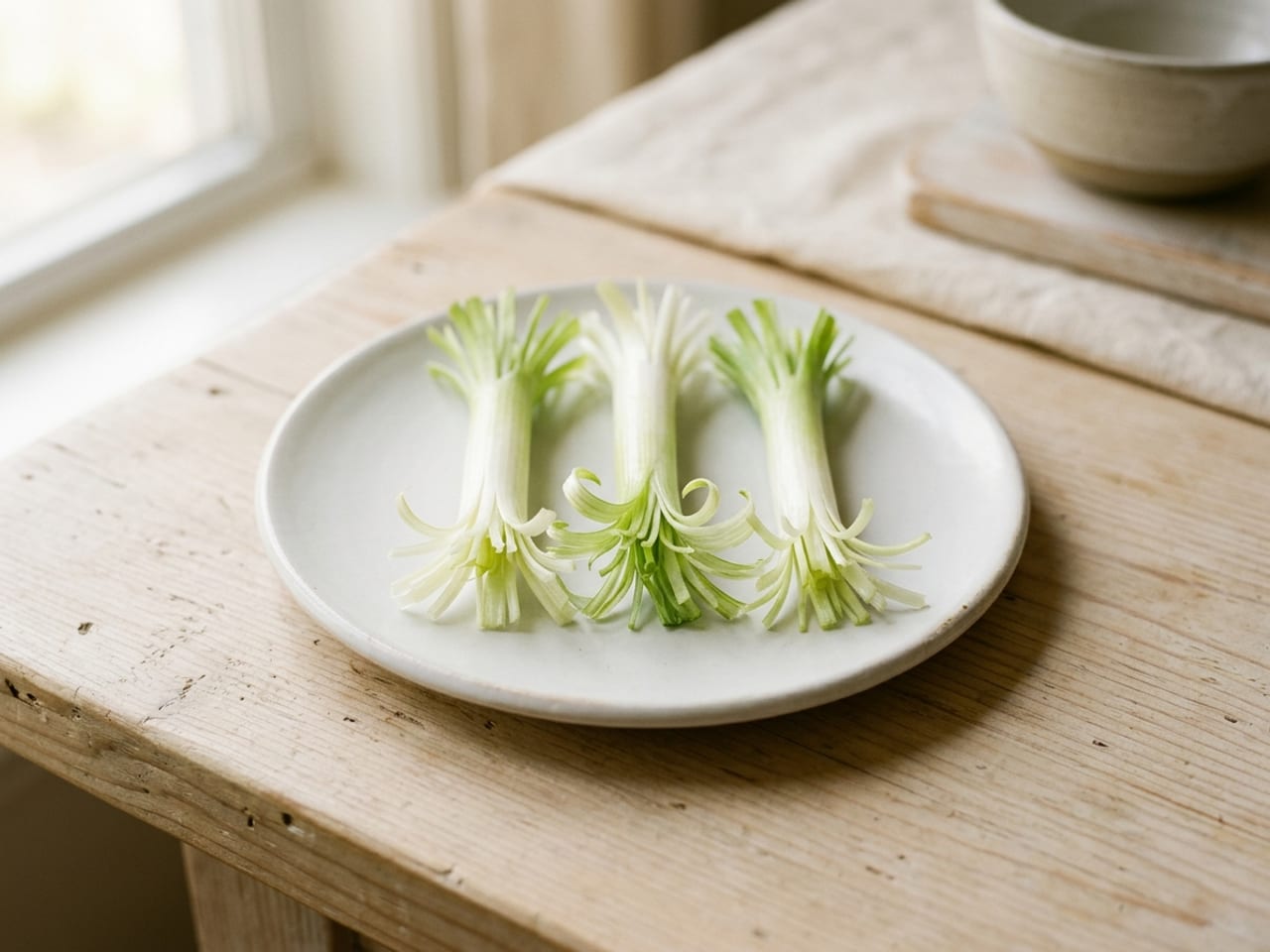
Scallion brushes (onion brushes)
Also: spring onion brushes; often searched as a scallion or green onion flower.
Steps as Ken Hom, Chinese Technique (1981) gives them:
- Trim the scallions, "cutting off the stem end and leaving them in 3-inch lengths" (7.5 cm).1
- "Make a 1-inch cut through one end" (2.5 cm), turn the scallion and cut again; repeat at the other end.1
- "Drop the scallions into ice water." "After a minute or two, the ends curl attractively."1
Sizes: Hom: 3-inch (7.5 cm) lengths, 1-inch (2.5 cm) cuts at both ends. Miller: the white stalks only, cuts "about 1/2-inch deep" (13 mm) at one or both ends. Lin and Lin (1957): 1 1/2-inch (4 cm) lengths of the white and light green, slashed about 1/2 inch (13 mm) deep.1, 2, 3
Ice water: "A minute or two" (Hom) against "1 hour" (Miller) for the same cut; Ellwood gives no time, only "until the spring onion opens out and curls". The 10 minutes and 2 to 16 hours on the curls card are for thin strips, not brushes.1, 2, 4 (every source's time)
Tool: A knife; no source we read names another tool.1
Suits: Peking duck and mu shu pork, where the brush carries the hoisin "from the bowl to the pancake" (Hom; Miller); chicken and duck platters (Leung, 1976); Thai dishes whose names are cut off in the fragments we read (Walden, 1992); and, in one Thai cookbook (Ashworth, 1996), shrimp rolls with coriander and, in another recipe, a battered dish with lime slices and a chilli flower.1, 2, 84, 85, 86
How far ahead: No source we read gives a hold time for brushes. The make-ahead table.
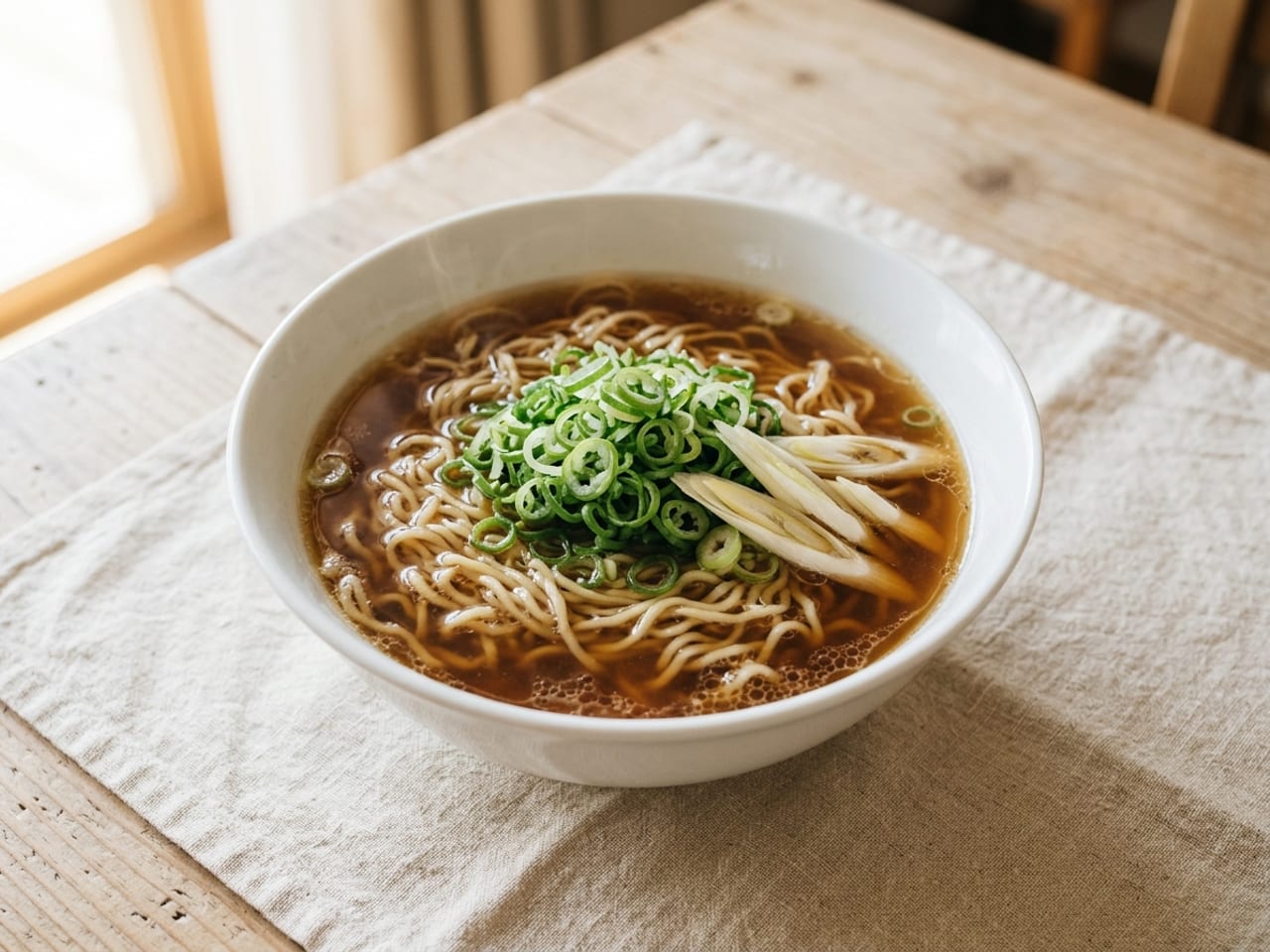
Sliced and bias-cut scallion
Also: the everyday noodle-shop and soup garnish.
Steps as Jacki Passmore (1994), Foodal and Serious Eats gives them:
- "Finely slice the scallion greens diagonally and set aside for garnish" (a noodle-shop cookbook).18
- For long bias slices, Foodal cuts the white part "on a 33 or 45-degree angle into pieces 1 to 2 inches in length" (2.5 to 5 cm).14
- For crisper, milder slices, Serious Eats keeps them in ice water in the fridge "for at least 30 minutes and up to overnight".8
Sizes: Foodal: 1 to 2 inches (2.5 to 5 cm) long at 33 or 45 degrees. Blake: "very thinly sliced or shredded". No other source we read gives a figure.14, 73
Ice water: Optional. Serious Eats: 30 minutes to overnight, and they "absorb liquid, firming up and curling".8 (every source's time)
Suits: Pho (Trang, 1999; Moorman, 2017: "Garnish each bowl with onion and scallion."), ramen (Shimbo, 2000), soups (Blake, 2007), borscht with dill (Goldstein, 2020), sashimi (Steinberg, 1968).69, 71, 72, 73, 80, 83
On this site: Shoyu ramen, scallion whites, sliced fine, finish the set; Dan dan noodles, sliced scallion greens over the crumble; Tonkotsu ramen, a third of the bowl in sliced scallion, "a component, not a garnish".
How far ahead: In ice water in the fridge up to overnight (Serious Eats); no other hold time read.8 The make-ahead table.
Radish garnishes
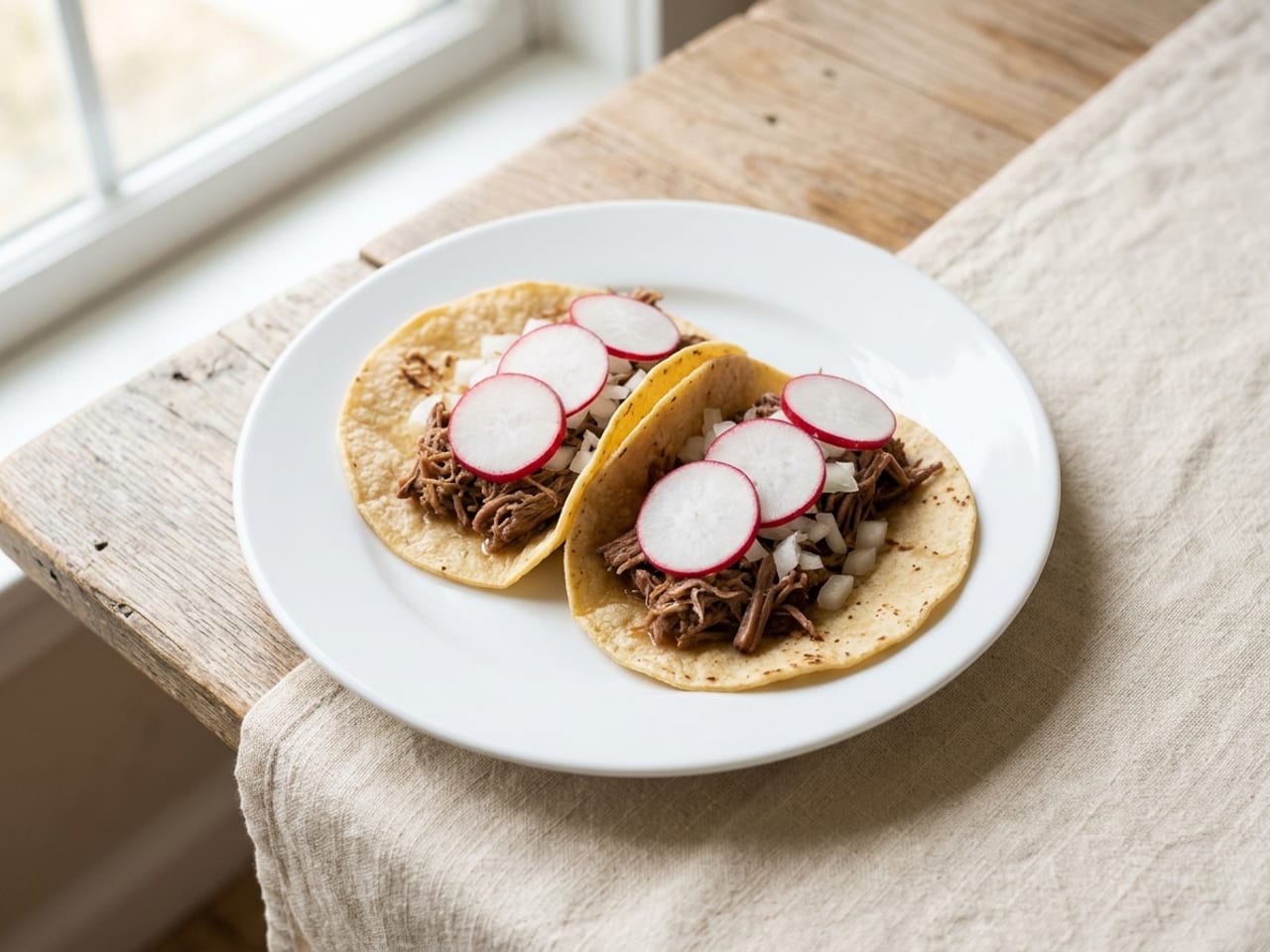
Thin radish slices
Steps as the U.S. Armed Forces Recipe Service and Anne Lindsay Greer McCann (1995) gives them:
- Wash the radishes and trim them; the U.S. military recipe card says radishes "DO NOT PEEL".68
- Slice them thin: McCann's taco garnish is "Thinly sliced radishes".76
- To crisp them: "Radishes, carrots, celery, and cucumbers may be crisped in ice water. Drain before using." America's Test Kitchen revives limp radishes in ice water "for about an hour".68, 104
Sizes: No source we read gives a thickness: "thinly sliced" (McCann), "sliced" (Gabilondo, Tausend).75, 76, 78
Ice water: Not needed; to crisp, ice water with no time (U.S. military card), or about an hour for limp radishes (America's Test Kitchen).68, 104 (every source's time)
Tool: No source we read names one; for paper-thin rounds, the mandoline and its guard are on our plating tools guide (ours).
Suits: Tacos (Gabilondo, 1992: "2 or 3 sliced radishes"; McCann, 1995), pozole (Stein, 2017; Tausend, 1997), and salads, from a Boston list of 1899 ("plain lettuce, cress, string-bean, pea, spinach, and potato salads") to America's Test Kitchen's frisée salad with radishes.5, 75, 76, 77, 78, 109
How far ahead: Whole radishes in unsealed bags in the fridge, about a week (America's Test Kitchen); cut radishes submerged in cold water, the water changed daily, as on our crudité platter. The FDA Food Code lets cut raw vegetables "such as celery or carrot sticks" sit in ice or water; it does not name radish.95, 104 The make-ahead table.
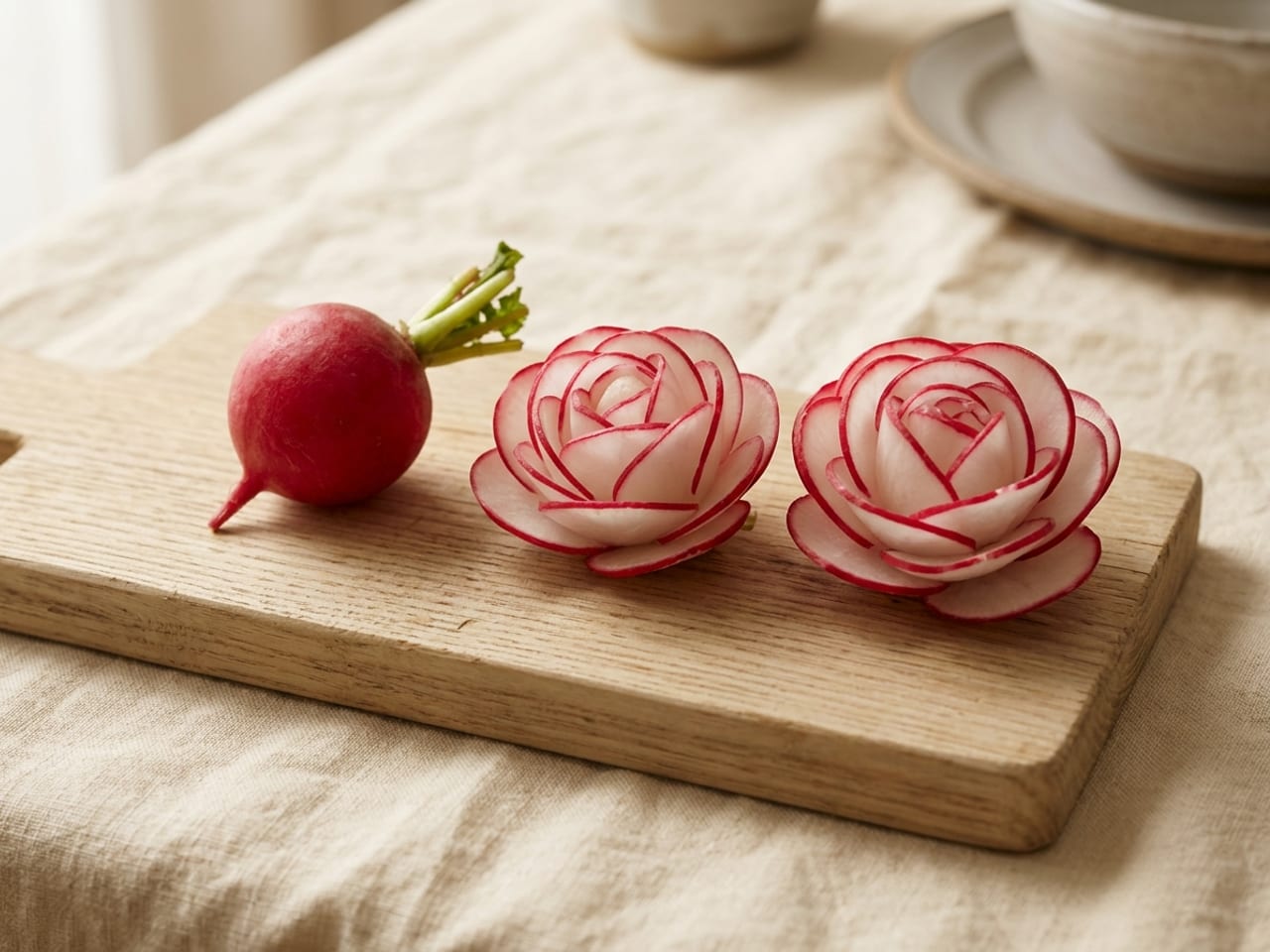
Radish roses (radish rosettes)
Also: a radish floret (Rada); radish flowers.
Steps as Rada Cutlery, a knife maker (its video transcript) gives them:
- Cut off both ends of the radish.24
- On four sides, "go in about a quarter of inch and slice down to about a quarter of an inch" (6 mm) to make the petals.24
- Put them "into ice water so the ice water helps them to expand out".24
The 1965 American Home rose is built differently: "Cut slanted gashes in large radish. Slice several smaller radishes thinly for petals. Insert slices in gashes in large radish." Then "Crisp in ice water."25
Sizes: Rada: petals a quarter inch (6 mm) in and a quarter inch down. A 1979 cafeteria training guide leaves "about one inch of" (the fragment ends there). One eHow style cuts a crosshatch 1/4 inch (6 mm) apart and deep.23, 24, 67
Ice water: Ice water with no time in every cookbook and garnish book we read (Ellwood, Crowley, Baskett, the Complete Garnishing Guide); two eHow pages say "at least 15 minutes" and overnight. No cookbook we read gives a time.4, 22, 23, 58, 61, 62 (every source's time)
Tool: A paring knife (Rada sells them).24
Suits: Salads (Heinz, 1925: "Garnish each serving with a radish rose."; Watkins, 1946; Kraft, 1955), meat and fish platters and cold-cut plates (Wenker, 1951), "cold mousses, cold buffet plates, and platters" (Nicolas, 1983), and "a canape or hors d'oeuvres tray" (The American Home, 1965).17, 25, 65, 92, 93, 94
How far ahead: Kept in cold water in the fridge until used (eHow); "The radish roses can be kept in cold water and will remain" (Complete Garnishing Guide, 1994; the fragment ends there).22, 61 The make-ahead table.
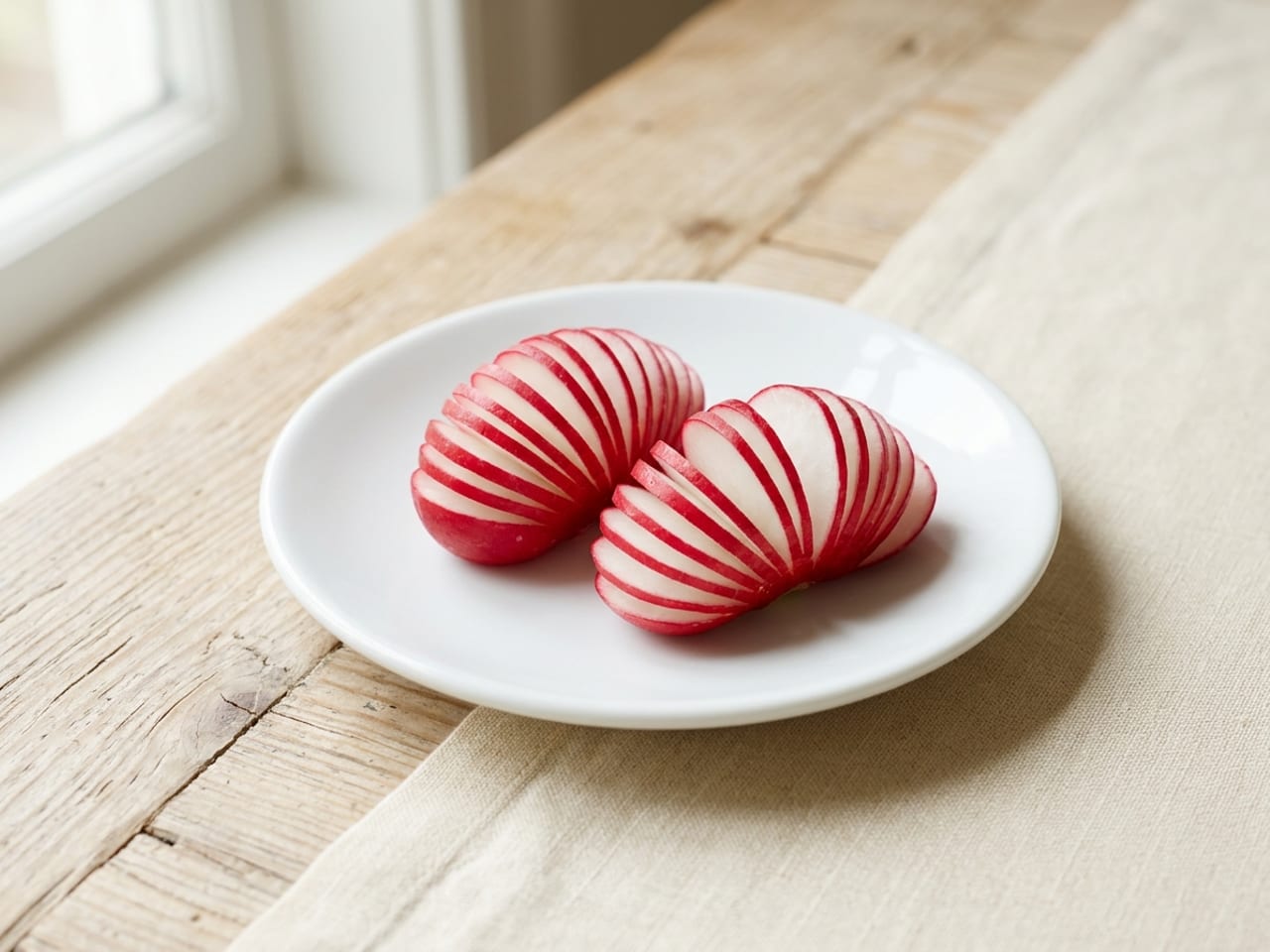
Radish fans and accordions
Steps as HowStuffWorks (2006), as Brit + Co reprints it gives them:
- Wash the radish and trim the tips.21
- "Cut ⅛-inch-thick slices across, about three-quarters of the way into the radish. Do NOT cut all the way through the radish." (3 mm)21
- "Chill for several hours or until radish fans out, remove, drain well".21
Sizes: 1/8 inch (3 mm), three-quarters of the way through (HowStuffWorks); "paper-thin wedge half slices to the center" for Alma Lach's 1974 "fan flowers", which are built from overlapped slices rather than one radish fanned open.19, 21
Ice water: "Several hours" (HowStuffWorks); ice water "to force it open into an accordion shape", no time (Crowley, 1978). Barbara Tropp's Chinese fan "unfolds in a zestily flavored sauce rather than in ice water" (1982).20, 21, 58 (every source's time)
Tool: A knife.21
Suits: Tropp's soy-dipped fan is "an edible garnish"; a 1979 cafeteria training guide lists radish accordions with radish roses, celery fans and carrot curls.20, 67
How far ahead: No source we read gives a hold time. The make-ahead table.
Radish tulip (Fannie Farmer, 1896)
Steps as Fannie Farmer, The Boston Cooking-School Cook Book (1896) gives them:
- Use round radishes: they "look very attractive cut to imitate tulips", and are not scraped.108
- Then, in Farmer's words, "begin at root end and make six incisions through skin running three-fourths length of radish."108
- Slip the knife under the skin sections and put the radishes in cold water, where the sections fold back.108
Sizes: Cuts three-fourths of the radish's length (Farmer). The Boston Cooking-School Magazine of 1899 has the skin "cut so it falls back and shows white underneath".108, 109
Ice water: Cold water, no time given.108 (every source's time)
Tool: A small knife.108
Suits: Served on crushed ice as a relish (Farmer); on salads (Boston Cooking-School Magazine, 1899).108, 109
How far ahead: No hold time given. The make-ahead table.
Cucumber garnishes
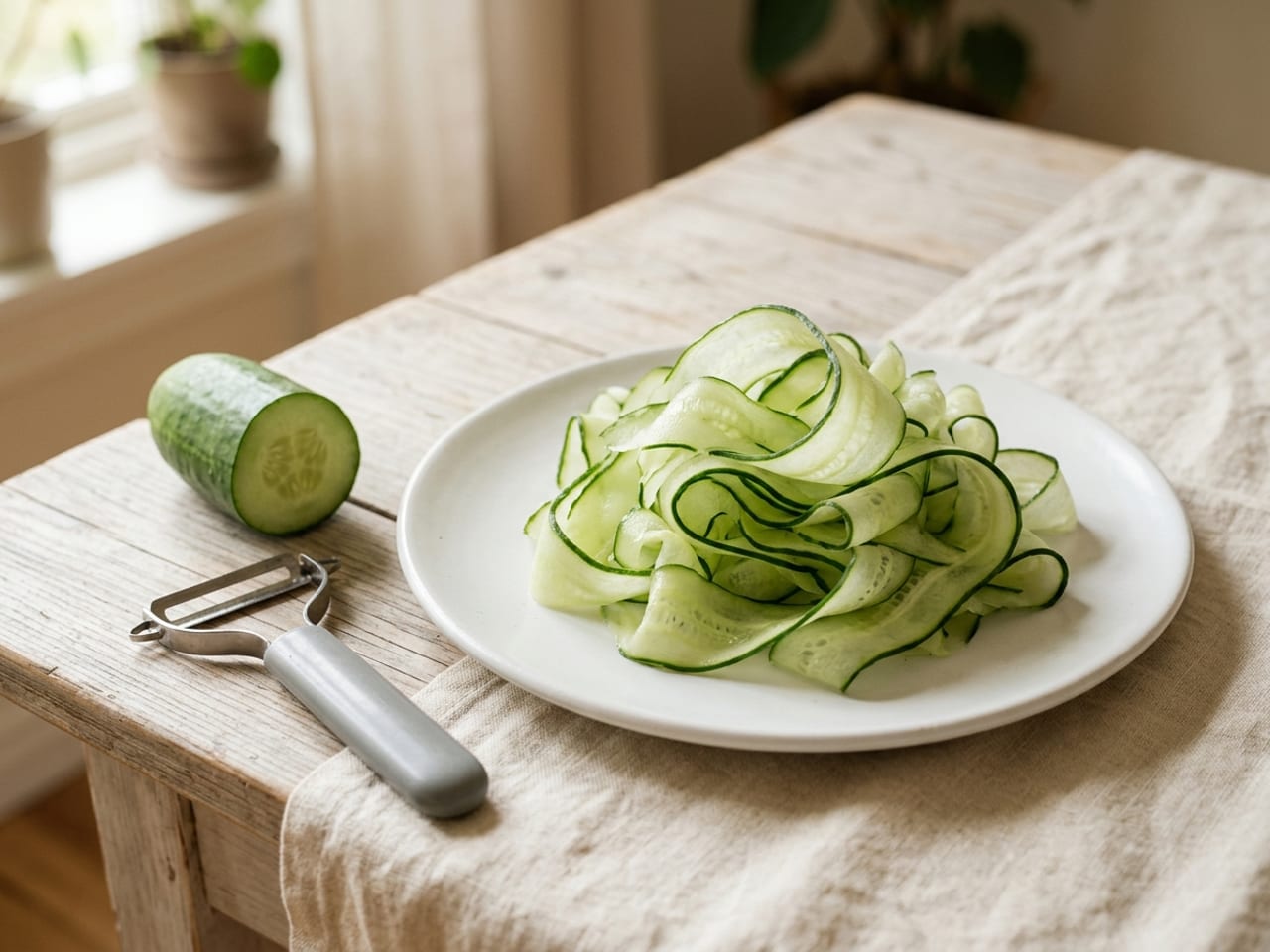
Cucumber ribbons
Steps as Marian Getz (2015), the booklet of a peeler set (maker) gives them:
- With the set's peeler: "... the WIDE BLADE PEELER, make long ribbons from the cucumbers."51
- Pick a long cucumber with few seeds: June Budgen says so for cucumber twists ("Use long tender cucumbers which have few seeds").52
- Salt or dress them at the last moment: salt draws water out of the cells "in a process called osmosis" and the cells weaken, so the vegetable softens (America's Test Kitchen on salting vegetables; the timing advice is ours).103
Sizes: No source we read gives a width or thickness.
Ice water: No source we read gives a soak time for cucumber ribbons or fans. The U.S. military card says cucumbers "may be crisped in ice water", with no time.68 (every source's time)
Tool: A wide-blade peeler (Getz, who sells one).51
Suits: No food dish in our tally names cucumber ribbons. In drinks, a ribbon lines a Gin and Tonic glass: that is on our cocktail garnishes guide. Read the cucumber ribbon in a Gin and Tonic.
On this site: Aguachile, cucumber half-moons and onion strewn over the shrimp.
How far ahead: No source we read gives a time for a cut cucumber garnish, so we cut it last (ours); our crudité platter cuts cucumbers the morning of, dry and airtight. USDA FoodKeeper's 4 to 6 days are for whole cucumbers.100 The make-ahead table.
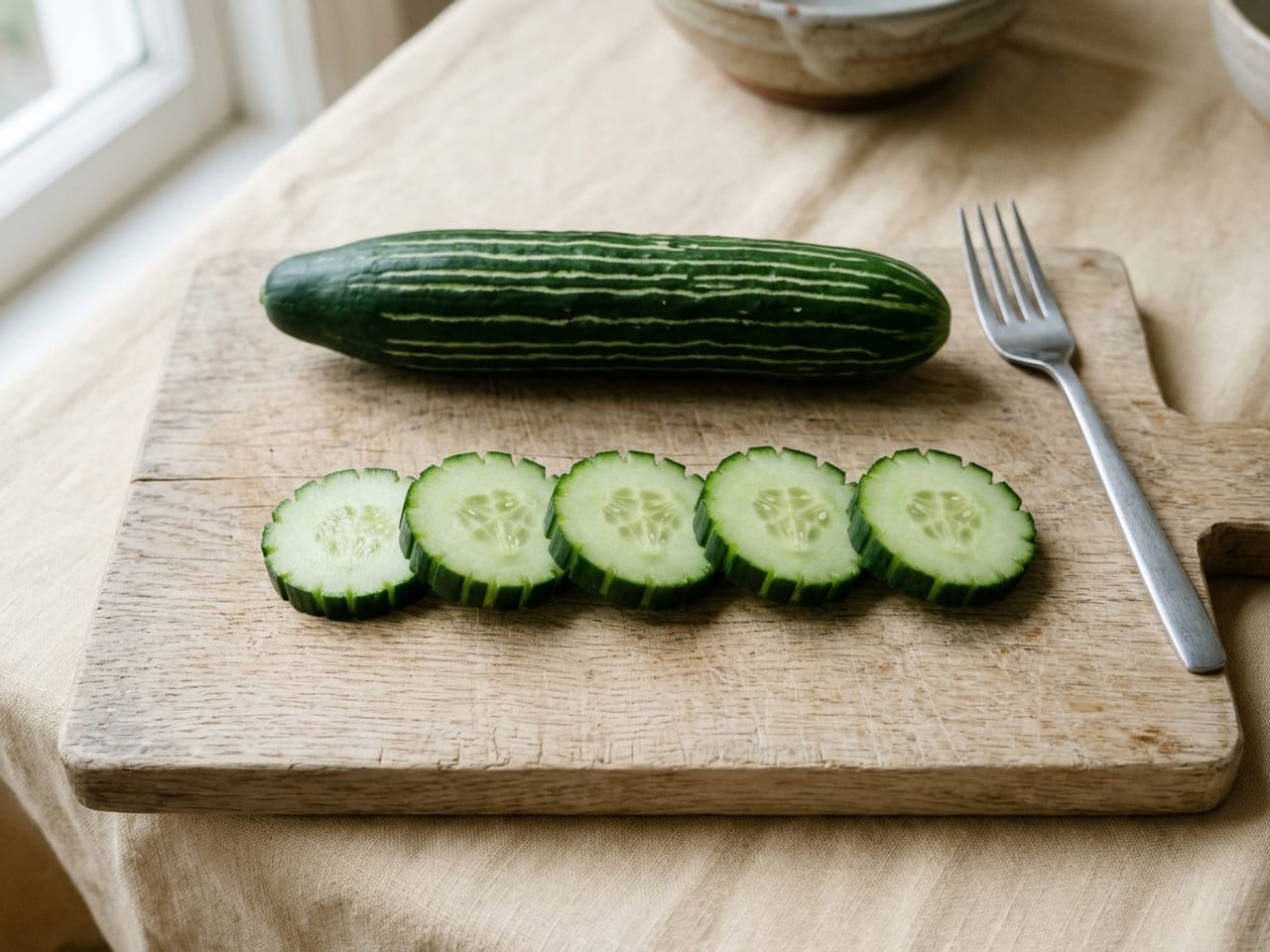
Fluted (scored) cucumber slices
Steps as an undated "GARNISHES" handout (publisher unknown) and The Nibble gives them:
- "Run tines of fork lengthwise down cucumber, repeat to cover whole surface. Slice thinly."53
- Or score the skin with a lemon peel tool "before slicing: it makes an attractive border design" (The Nibble).54
Sizes: "Slice thinly": no figure.53
Ice water: None given; the U.S. military card's ice-water crisp has no time.68 (every source's time)
Tool: A fork (the handout) or a lemon peel tool (The Nibble, a site that reviews products).53, 54
Suits: "Sliced cucumber" on a 1951 cold-plate menu beside radish roses and scallions (Wenker); in 1907 Escoffier laid sliced radish "on cut cucumber to form a dish-border".92, 110
How far ahead: As cucumber ribbons: no source gives a time; we cut it last (ours). The make-ahead table.
Carrot garnishes
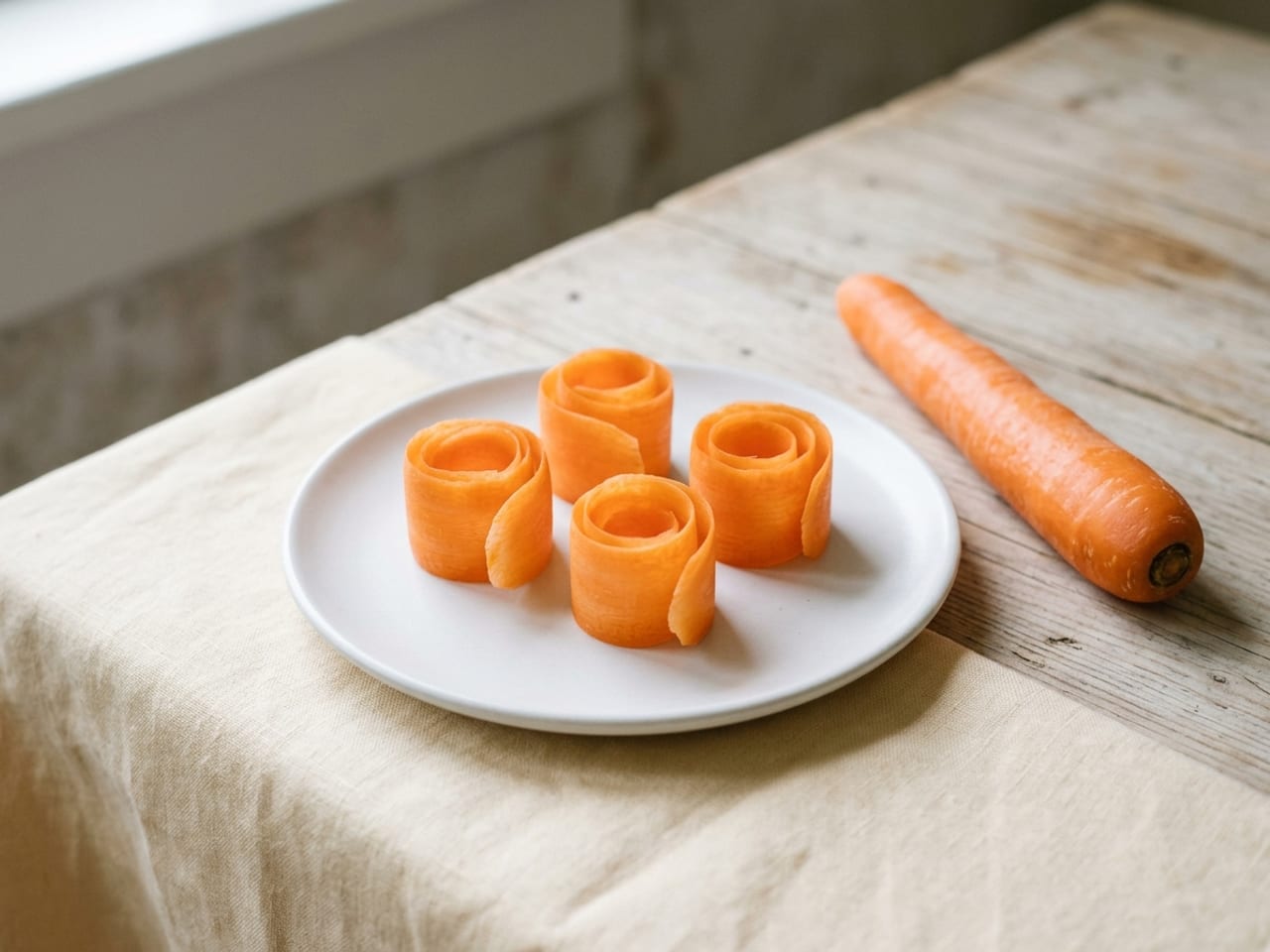
Carrot curls
Steps as The American Home (Winter 1965) gives them:
- Pare the carrot. "Shave thin lengthwise strips from carrot with a vegetable parer."25
- "Curl a strip around your finger as you would a pin curl. Fasten with wooden pick."25
- "Crisp in ice water. Remove pick when ready to serve."25
Take the picks or clips out before the plate goes out: the sources that say what happens to the pick or clip take it out first (The American Home, RecipeTips, The Yummy Life, and Christina Waters in 2000). No food-safety authority we read has a rule on picks.10, 25, 27, 114
Sizes: No figure in what we read.
Ice water: Ice water with no time (The American Home, 1965; Better Homes and Gardens, 1958: "Chill in ice water to open."); "several hours" (Crowley, 1978); 2 to 3 hours (RecipeTips); at least 2 hours, up to 2 days (The Yummy Life); about 20 minutes for plain strips (The Daily Meal).10, 11, 25, 26, 27, 58 (every source's time)
Tool: A vegetable peeler ("vegetable parer") and wooden picks (The American Home); vinyl paper clips (The Yummy Life).10, 25
Suits: Salads: "Everyone knows about carrot curls", says the 1965 article, "still wonderful in an arranged salad"; Better Homes and Gardens' 1958 salad book; relish trays; and a Japanese sashimi plate with "shred-cut daikon and carrot; carrot curl; shiso buds" (Tsuji, 1980). "Carrot Curls cannot be cooked or they will flatten" (Haydock).25, 26, 50, 59
How far ahead: In ice water in the fridge up to 2 days, or drained and sealed up to a week (The Yummy Life, a blog).10 The make-ahead table.
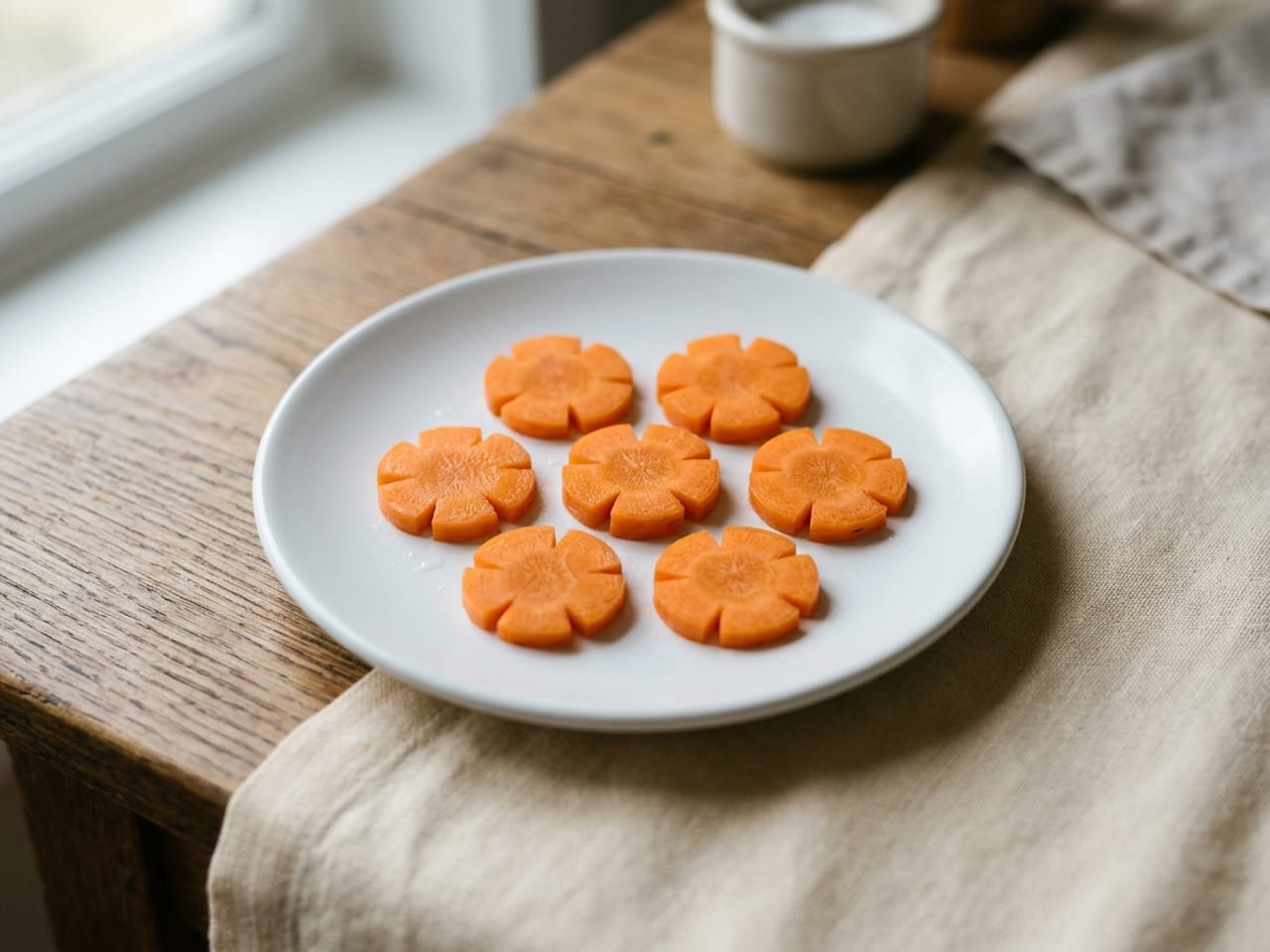
Carrot flowers
Also: The American Home's "larkspurs".
Steps as The American Home (Winter 1965) gives them:
- "Pare carrot; cut in thin crosswise slices."25
- "With sharp paring knife, cut V-shaped notches all around outside edge. A small, fancy hors d'oeuvres cutter may also be used."25
- "Keep refrigerated in ice water until ready to use."25
Sizes: No figure. Rada (a knife maker) notches the whole peeled carrot on four sides before slicing, gets "ten to twelve carrot flowers per carrot", and warns "if you get too thin carrots it gets real hard to work with".24
Ice water: "For about an hour" (Rada); "until ready to use" (The American Home).24, 25 (every source's time)
Tool: A paring knife or a small hors d'oeuvres cutter (The American Home); a paring knife (Rada).24, 25
Suits: "A raw relish tray" and hors d'oeuvres, cooked or raw (The American Home); "garnish on your dinner plates" (Rada).24, 25
How far ahead: In ice water in the fridge until used (The American Home); no day count.25 The make-ahead table.
Carrot feathers and crisscrosses
Steps as The American Home (Winter 1965) gives them:
- Feathers: pare the carrot and cut it in thin lengthwise slices; "Cut long, thin V-shaped notches with sharp paring knife at an angle along both sides of each lengthwise edge."25
- "Drop in ice water to crisp and curl prettily."25
- Crisscrosses: "Cut into 3/4-inch crosswise slices" (2 cm), cut closely spaced lines across each slice, not all the way through, turn a quarter and repeat, then "Crisp in ice water."25
Sizes: Crisscross slices 3/4 inch (2 cm) thick; feathers "thin", no figure.25
Ice water: Ice water, no time.25 (every source's time)
Tool: A sharp paring knife.25
Suits: Feathers "as a salad garnish in individual salads or on a platter"; crisscrosses tucked in greens "to garnish a meat or poultry platter", or on "green or mixed vegetable salads or coleslaw".25
How far ahead: No hold time given. The make-ahead table.
Celery garnishes
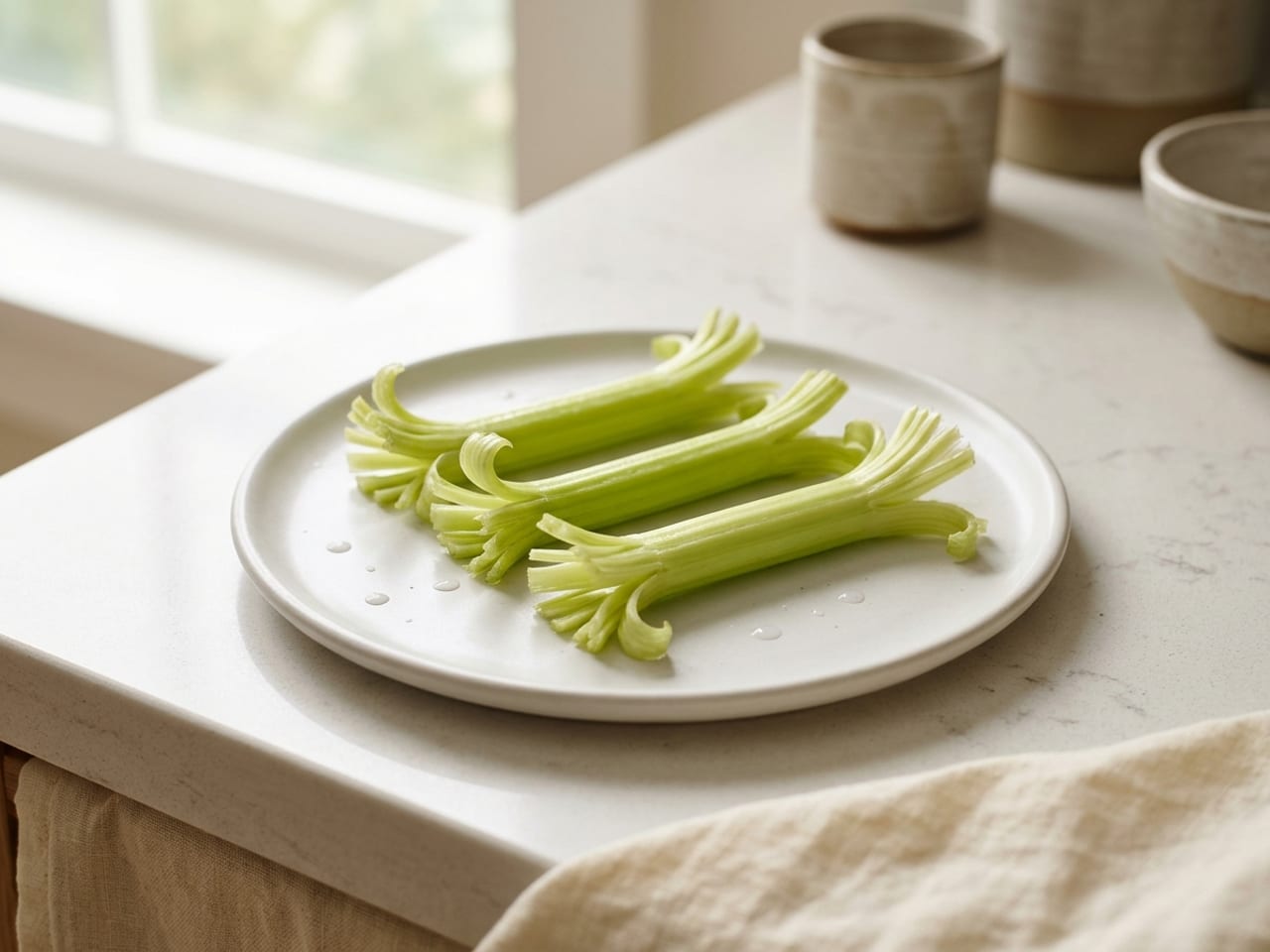
Celery curls
Also: celery fans; celery tassels.
Steps as Fannie Farmer, The Boston Cooking-School Cook Book (1896) gives them:
- Cut thick stalks into 2-inch (5 cm) pieces.108
- Make five parallel cuts one-third of the length of each piece, then six cuts at right angles to them.108
- "Put pieces in cold or ice water and let stand over night or for several hours, when they will curl back and celery will be found very crisp."108
Celery is on the allergen list of EU food law (Annex II, entry 9, "Celery and products thereof", read in the UK's retained copy), so where that law applies a celery curl counts as celery.107
Sizes: Farmer: 2-inch (5 cm) pieces, cuts a third of their length. Boston Cooking-School Magazine (1899): cuts three-quarters of an inch (2 cm) deep. An undated handout: 3-inch (7.5 cm) lengths, slit "almost to the center of piece". The Silent Hostess (1932): "three- or four-inch" (7.5 to 10 cm). Food for Fifty (1950): "Celery curls, 214-in. pieces" as the scan's OCR reads it, so 2 1/4 or 2 1/2 inches (5.5 or 6.5 cm). Berolzheimer (1940): "Both ends may be curled."53, 55, 56, 57, 108, 109
Ice water: Overnight or several hours (Farmer, 1896); "several hours, or until curled" (Boston Cooking-School Magazine, 1899); "until celery curls" (Berolzheimer, 1940).56, 108, 109 (every source's time)
Tool: A knife.108
Suits: A border on lobster salad (Farmer, 1896) and on roast turkey with "rings and discs of carrots strung on fine wire" (Farmer, 1918); relish trays (Better Homes and Gardens, 1938; Food for Fifty, 1950); salads (Watkins, 1946); a capon dinner menu (The Silent Hostess, 1932).55, 57, 93, 108, 112
How far ahead: Overnight in water (Farmer). The FDA Food Code lets cut raw vegetables "such as celery or carrot sticks" sit in ice or water; our crudité platter keeps cut celery submerged, the water changed daily.95, 108 The make-ahead table.
Tomato garnishes
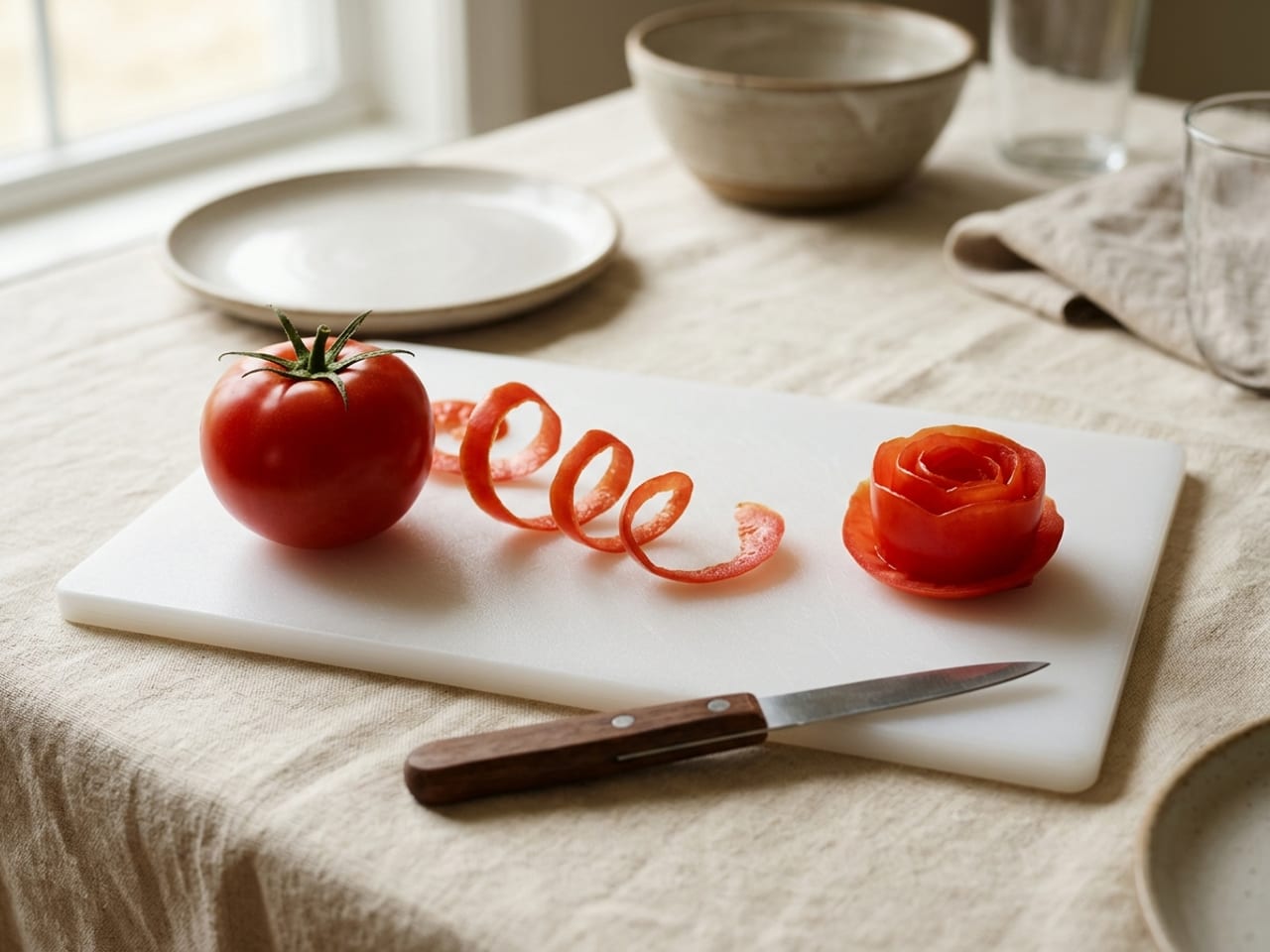
Tomato rose (and cherry tomato rose)
Also: tomato rosette; tomato flower.
Steps as The American Home (Winter 1965), whose lemon rose it says to copy gives them:
- "Cut a thin slice across bottom ... but do not cut completely through. This will be the base on which the rose stands."25
- "Without removing knife, continue to cut in spiral fashion from point at which base is attached. Cut through thin outer skin only".25
- "Recurl spiral of rind onto base as it curls naturally." The article does the lemon this way, then: "Cut lime, tomato, and cherry tomato roses in the same manner."25
Sizes: RecipeTips: peel "3/4" to 1" wide" (2 to 2.5 cm), continuous and thin "with very little flesh attached", rolled flesh side up. Kokko (1982) uses "a solid ripe tomato"; a cherry tomato rose "is very simple to do".28, 29
Ice water: None: a tomato rose is not soaked in any source we read. (every source's time)
Tool: A paring knife (Rada peels it "going around the tomato"); a potato peeler (Consumer Guide, 1982).24, 30
Suits: "A tomato rose can also garnish a main-course platter, or it can be stuffed" (The American Home); chipotle deviled eggs (Rada); cherry tomato roses "as hors d'oeuvres on wooden picks" (The American Home).24, 25
How far ahead: "Cover with foil or transparent plastic wrap until ready to use" (The American Home, of its lemon rose; tomato roses are cut "in the same manner"); no time. A tomato rose is cut tomato: see washing and safety.25 The make-ahead table.
Chilli and pepper garnishes
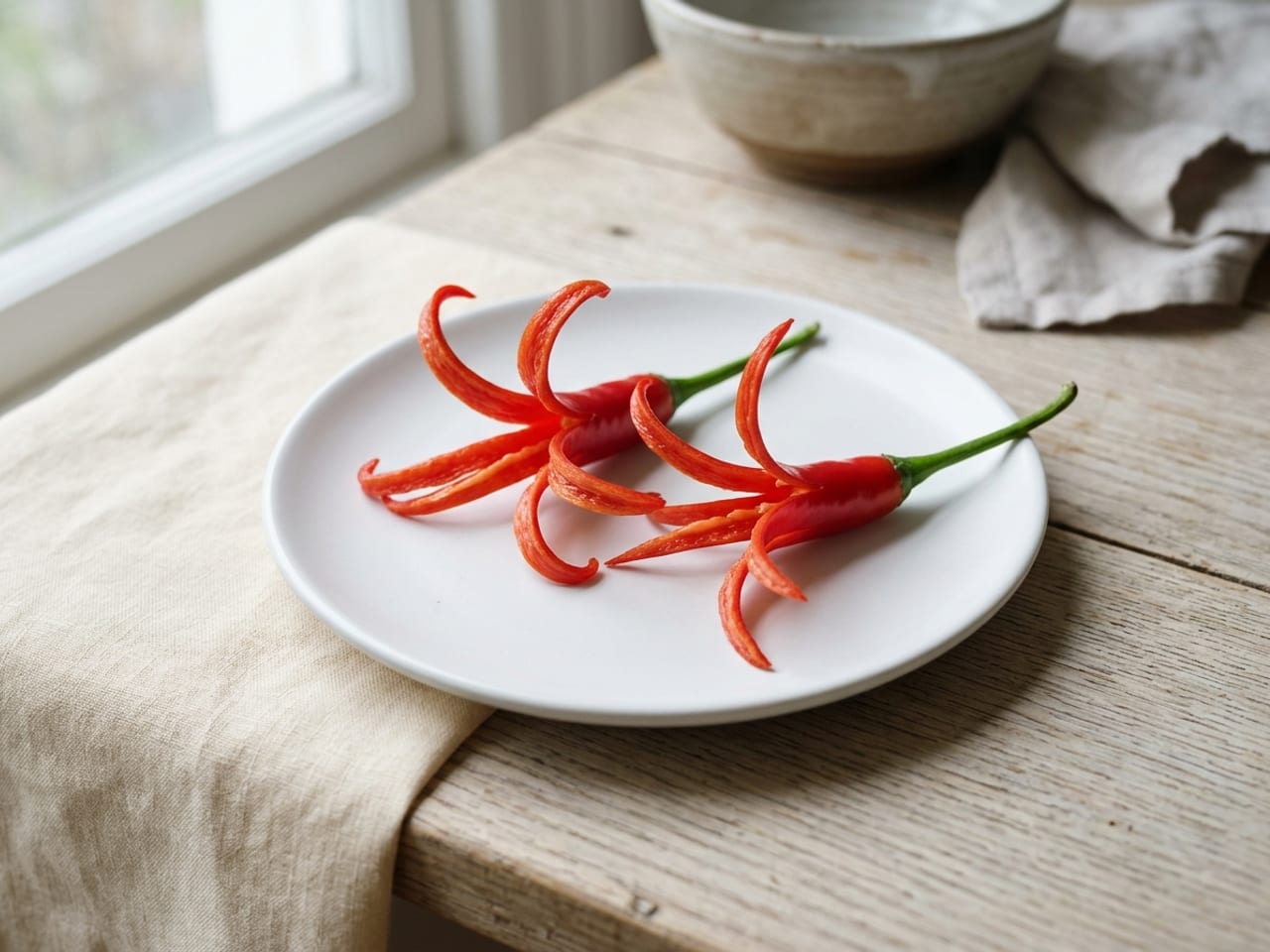
Chilli flowers (chili flowers)
Steps as Diana Kuan (Appetite for China) gives them:
- Snip off the tip with kitchen shears and cut the chilli in half lengthwise almost to the stem.31
- Scrape out the seeds and cut each half into 2 or 3 strips.31
- "Soak the finished flowers in a bowl of cold water for 15 to 20 minutes" so the petals "fan out". Kuan suggests gloves.31
Sizes: Nita Mehta (2006): "Choose a slightly thick chilli." No other figure.32
Ice water: 15 to 20 minutes in cold water (Kuan); iced water "for about 1 hour to open" (Ellwood, 1982); "for some time" (Mehta). Baskett's pepper curls in a bowl of ice water and is kept there.4, 31, 32, 62 (every source's time)
Tool: Kitchen shears (Kuan).31
Suits: In the one Thai cookbook we read for it (Ashworth, 1996): a battered dish (its name is not in the fragment) finished with "spring onion (scallion) brush, lime slices and a chilli flower", and a roast red pork stir-fry with mint or coriander and a chilli flower.86
How far ahead: "Store in the fridge in cold water for up to a day" (Kuan). Our crudité platter keeps cut pepper STICKS dry and airtight, by a produce sheet's rule: a different cut.31 The make-ahead table.
Onion, shallot and leek garnishes
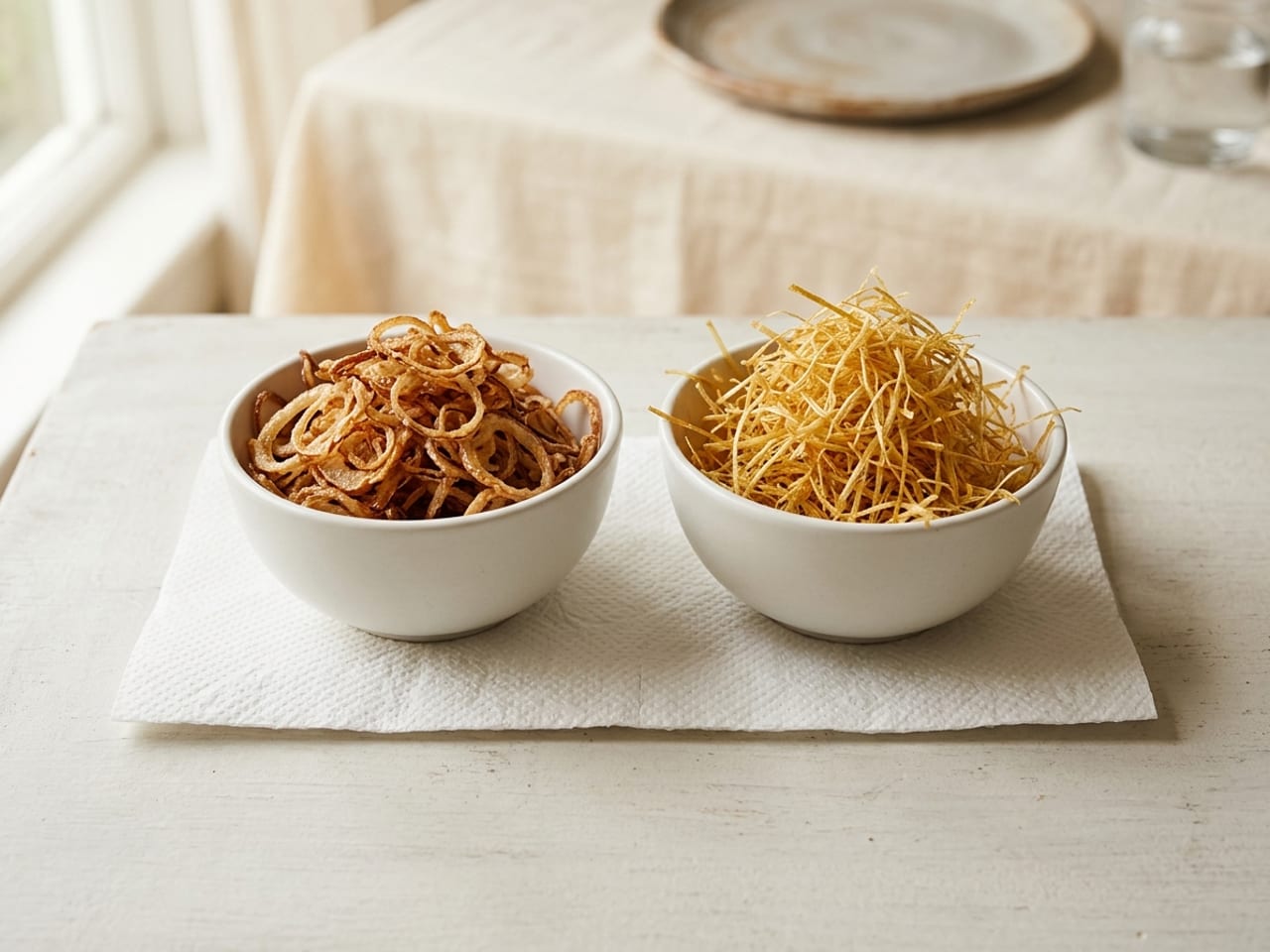
Crispy fried shallots
Also: bawang goreng (Indonesian); fried onions.
Steps as America's Test Kitchen (Dan Souza, 2016) gives them:
- Slice 1 lb (450 g) shallots 1/16 inch (1.5 mm) thick on a mandoline.33
- Put them in a saucepan with 2 cups (480 ml) of oil, still cold, and "heat over high heat, stirring frequently" until a few turn golden (8 to 11 minutes after the oil is bubbling), then drop to medium-low for 2 to 4 minutes more, until deep golden, and strain at once.33
- Strain, then dry them in a 200°F (93°C) oven for 15 to 25 minutes: the low oven "removes their excess moisture without the risk of overbrowning".33
Sizes: 1/16 inch (1.5 mm) (America's Test Kitchen); "thin" rings of "2-3mm (1/16in)" (Anna Shepherd, 2024, as printed; the two figures do not match).33, 36
Ice water: Not soaked. The heat splits: cold oil on high heat (America's Test Kitchen), cold oil on low heat for 22 to 25 minutes (Shepherd), or hot oil at 325°F (163°C) in 5 or 6 small batches for 1 to 1 1/2 minutes each (Saveur). Pailin Chongchitnant: they darken after leaving the oil, "so take them out a little earlier".33, 35, 36, 37 (every source's time)
Tool: A mandoline and a saucepan (America's Test Kitchen).33
Suits: "Indonesian dishes are frequently garnished with crispy deep-fried shallots" (Chesman, 2007); Sri Owen suggests fried onions as a garnish for "a number of recipes" in her Indonesian book; Patricia Tanumihardja calls them "the perfect garnish for just about any dish, whether Indonesian or not"; pho (Trang, 1999); scallops (Manfield, 2005).69, 87, 88, 90, 91
On this site: Deviled eggs, fried shallots among the toppings for crunch.
How far ahead: Up to 3 days at room temperature, pan-drained (America's Test Kitchen 5760); up to 1 week in the fridge (Saveur); up to 1 month at room temperature, oven-dried (America's Test Kitchen 9098). Airtight, or "they will absorb moisture from the air and turn soft" (Hot Thai Kitchen).33, 34, 35, 37 The make-ahead table.
Raw onion rings and slices, soaked milder
Steps as America's Test Kitchen's onion test gives them:
- Slice the onion thin (Ricardo: "slice them thinly or cut them into larger chunks").44
- Soak at least 15 minutes: America's Test Kitchen soaked cut onion 5 and 15 minutes and "found that 15 minutes was necessary for any of the treatments to be effective".41
- Its best soak was a baking-soda solution, 1 tablespoon per cup (240 ml) of water, then a thorough rinse; plain water worked, less well; vinegar left a sour taste and milk a "washed-out" one.41
Sizes: No figure; "thinly sliced onion rings" on pho (Le, 2006).70
Ice water: 15 minutes (America's Test Kitchen; Ricardo, "about 15 minutes"). Inez Krech by onion: "Soak Bermuda onions for 10 minutes, yellow onions for 30 minutes", mild ones 15, rings "30 minutes or longer". McGee says chopped raw alliums for a garnish "are best rinsed".41, 43, 44, 118 (every source's time)
Tool: A knife.44
Suits: Pho (Le, 2006; Moorman, 2017), pozole (Stein, 2017: radishes, lettuce, chillies and onion; Spieler, 1995: "Sliced red onion"), and, by Jan Whitaker's account, the one garnish James Beard allowed on a salad, "raw onion rings".70, 71, 77, 79, 113
On this site: Birria tacos, diced white onion and cilantro on the consommé; Aguachile, red onion over the shrimp.
How far ahead: Slice as needed: sliced onions kept two days under water were "most odorous with the sharpest flavor"; America's Test Kitchen keeps spare slices in a zipper-lock bag and rinses them just before use.42 The make-ahead table.
Daikon, fennel, beet and other shaved vegetables
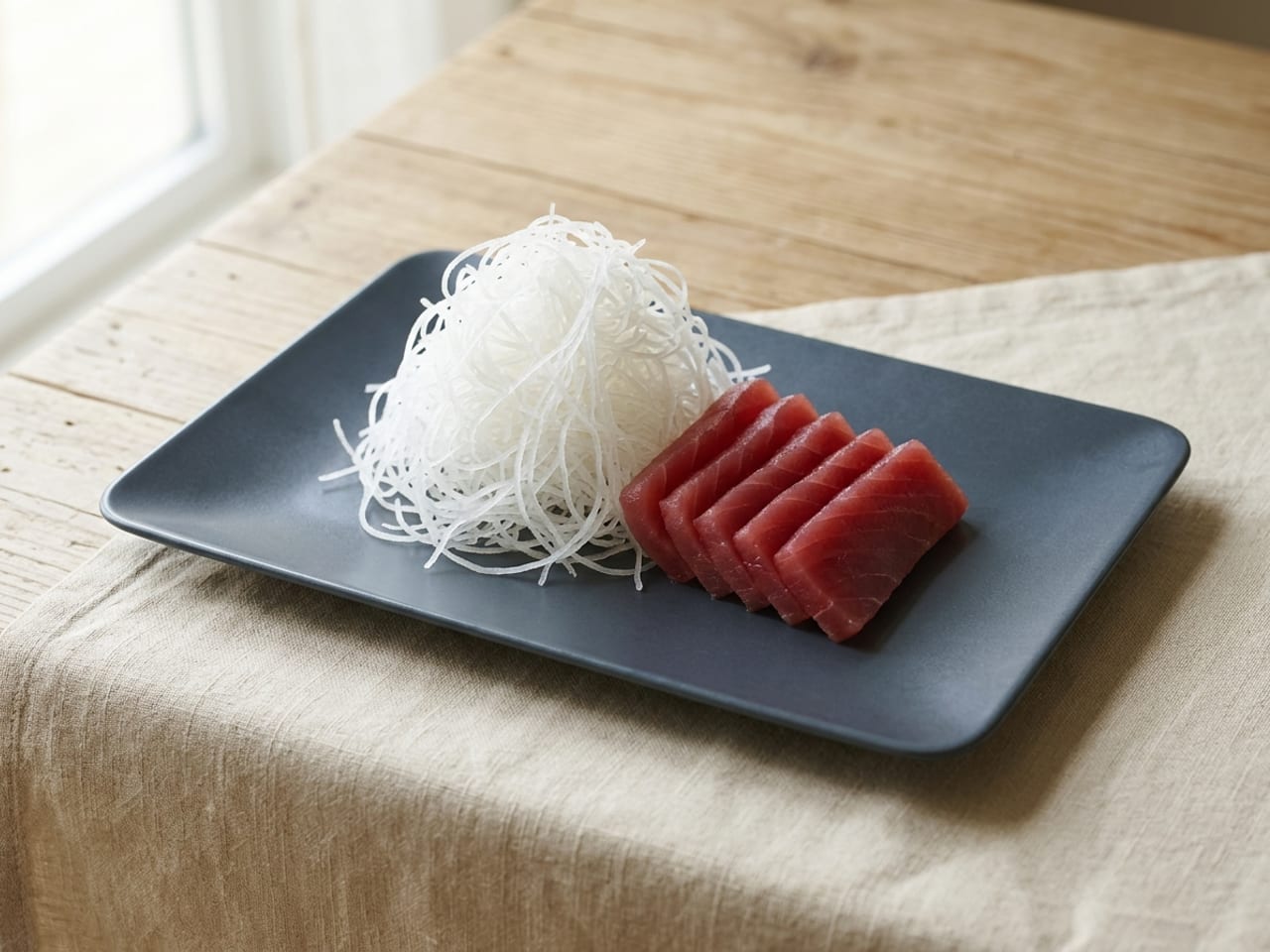
Daikon threads (ken) for sashimi
Also: tsuma; cut by katsura-muki.
Steps as the Kodansha cooking dictionary (our translation) gives them:
- Cut daikon (or udo, or cucumber) into 5 to 6 cm (2 to 2 3/8 in) rounds.46
- Peel each round into one continuous band, "in the manner of peeling skin": this is katsura-muki.46
- Cut the band into fine strips to use as sashimi tsuma (the ken laid under the fish).46, 124
Sizes: Kodansha: 5 to 6 cm rounds. Spayde (1984): "a 3in length" (7.5 cm). Kazuko (2002): sheets "about 3mm/1/8in thick and 20cm/8in" (the fragment ends there). Shimbo (2006): a "2 1/2- by 8-inch" sheet (6.5 by 20 cm). Tsuji (1980): "continuous paper-thin".46, 47, 48, 49, 50
Ice water: None in what we read. (every source's time)
Tool: A knife; no source we read names the knife for katsura-muki.46
Suits: Sashimi: shred-cut daikon "with a decorative leaf or vegetable curl" (Tsuji, 1980); a grated daikon-and-pepper ball and sliced scallions (Steinberg, 1968).50, 83
How far ahead: No hold time in what we read. The make-ahead table.
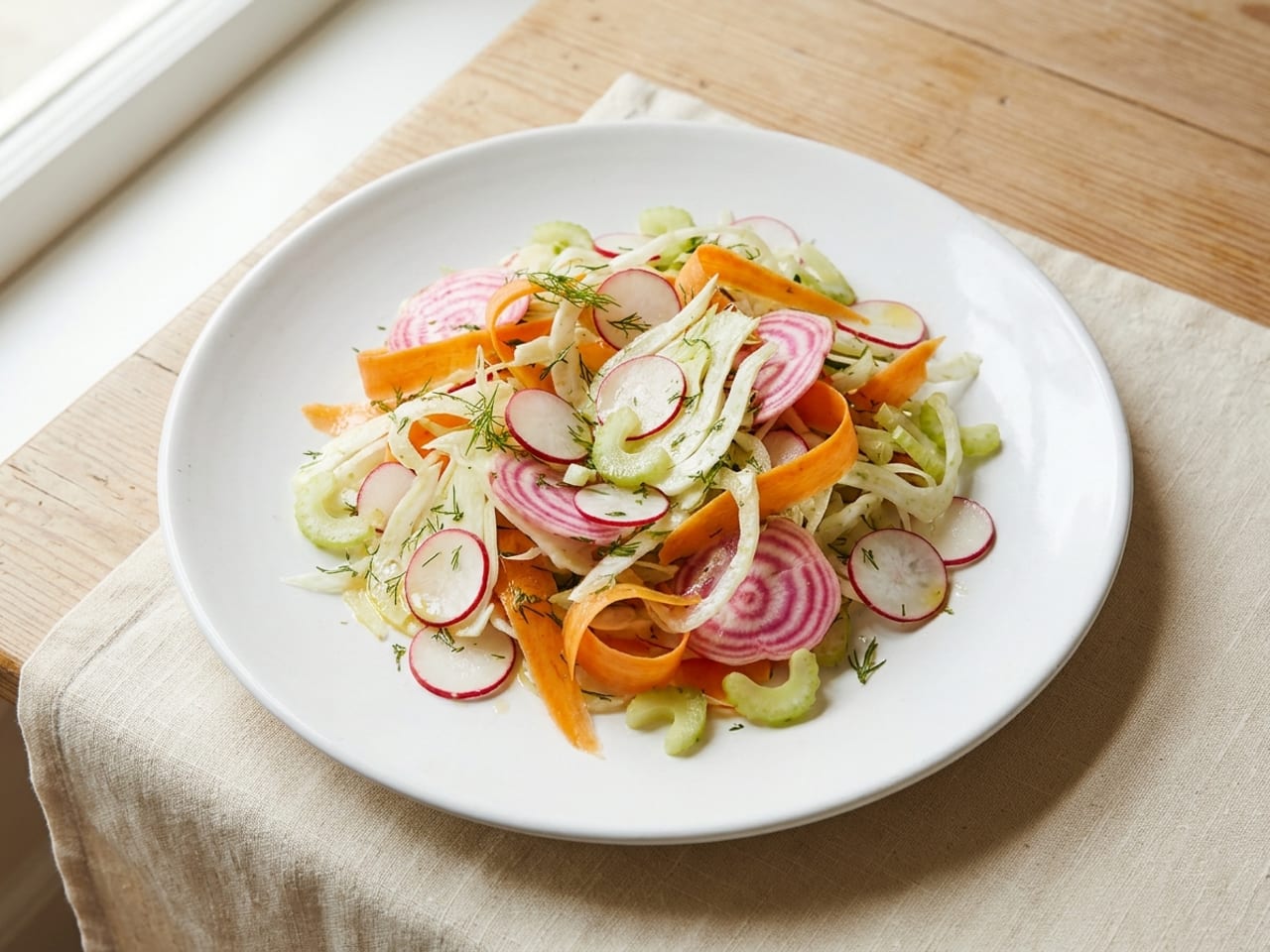
Shaved ribbons: fennel, beet, celery, carrot, radish
Also: carrot ribbons; shaved vegetables.
Steps as America's Test Kitchen (Andrea Geary, 2023) gives them:
- Slice fennel, beets, celery, carrots and radishes "to the thickness of a dime", on a mandoline or with a knife.6
- Cover with ice and cold water: "Cover and refrigerate for at least 2 hours or up to 16 hours."6
- Drain and spin, repeating "until less than 1 teaspoon water collects in bottom of salad spinner, 2 to 3 more times".6
Sizes: "The thickness of a dime" (America's Test Kitchen, 2023); no millimetre figure given.6
Ice water: 2 to 16 hours (America's Test Kitchen); Bon Appétit, as Tasting Table relays it, holds shaved produce in ice water "for up to six hours".6, 105 (every source's time)
Tool: A mandoline or a knife, and a salad spinner (America's Test Kitchen); the mandoline's guard is on our plating tools guide (ours).6
Suits: Salads (America's Test Kitchen's shaved vegetable salad, with the curled scallion greens on top).6
How far ahead: Up to 16 hours in ice water in the fridge (America's Test Kitchen); up to six hours (Bon Appétit, second hand).6, 105 The make-ahead table.
Covered on other pages
- Fried leeks (crispy leek julienne). Restaurant cookbooks put fried leek julienne on scallops (The Cork Cook Book, 1999), "a pinch of fried leek julienne" on lobster risotto (Philippe Jeanty, 1991) and on a vegetable plate (Daniel Martin, 1992). No source we read gives the fry; Gisslen's line, "dusted in flour before frying" (quoted on our julienne guide, not read for this page), and the julienne sizes are on our julienne guide.38, 39, 40
- Quick-pickled red onion. America's Test Kitchen keeps one recipe up to 1 week and another up to 2 weeks; no extension service we read gives a fridge time for quick pickles. The method is on our plating components guide.45, 102
- Vegetable crisps (beet, parsnip and other root crisps). Thin root slices fried or baked crisp: the method is on our plating components guide.
- Celery in a Bloody Mary, cucumber in a Gin and Tonic. Drinks have their own guide: our cocktail garnishes guide.
- Vegetable sticks for dipping. Cuts for dipping, blanching times and the make-ahead plan are on our crudité platter.
Fine julienne, the cut for fried leek, is 1/16 × 1/16 × 1 to 2 in (1.5 × 1.5 × 25 to 50 mm) on our knife cuts chart.
Also seen: vegetable garnishes we found named but gave no card (no steps we could read, or steps for a centrepiece rather than a plate garnish)
- Cucumber fans: a title and a "use as a garnish for" line in Wendy Veale's book (1989: cold mousses and pâtés); on Christina Waters' list of carved garnishes (2000). The steps were not in what we read.63, 114
- Cucumber twists: June Budgen (1986); the steps were not in the fragment.52
- Cucumber frills: on a salmon mould, Kraft (1955); the fragment stops mid-method.94
- Cucumber lily, water lily and green orchid: The American Home (1965) prints steps; they are carved centrepieces or a holder for an individual salad, so no card.25
- Scallion flower: Jerry Crowley (1978), a centrepiece; the fragment stops at "select scallion onions which are".58
- Radish mouse: "a novel decoration" (Crowley, 1978).58
- Radish fuchsia: radishes cut to imitate "the pendulous flowers of the fuchsia" (Escoffier, 1907).110
- Celery fans: 2 1/2-inch (6.5 cm) pieces, then cold water (a 1979 cafeteria training guide).67
- Turnip narcissus, carrot cattails, red pepper poppy: The American Home (1965) prints steps; they are carved centrepieces, so no card.25
- Pepper rings and sliced jalapeño: sweet green pepper rings on the U.S. military card; "thinly sliced jalapenos or serranos" on pozole (Spieler, 1995); "thinly sliced jalapeno" (Michael Natkin, 2011).68, 79, 115
- Diced cucumber and cherry tomato halves: a soup's "To garnish diced cucumber" (Patten, 1997); "finely diced cucumbers ... cherry tomato halves" (Natkin, 2011). Dice sizes are on our brunoise guide.74, 115
- Beet slices, julienne or grated: the U.S. military garnish card.68
- Cutter shapes: "stars, crescents, birds, and abstracts" from small vegetable cutters (The Nibble).54
- Pepper palm trees, fluted mushrooms, chive feathers: on Christina Waters' 2000 list.114
Cucumber roses, watermelon radish and zucchini ribbons are searched for, but no source we read gives steps for them, so they have no card.
The ice-water soak: 51 readings side by side
Every ice-water step we read (and the cold-water soaks), one row per source and garnish: 51 readings from 41 saved pages and books (cookbooks from 1896 on, garnish books, test kitchens, magazines, makers, a military standard and blogs), with the cut, the water, the time in the source's own words and what it says happens. Raw onion soaks are here too, because they share the bowl; they are about taste, not shape.
Our counts from the table. 33 of the 51 readings give a time in figures or words; eighteen give none, only "until curled" or "crisp in ice water". In figures the times run from "a minute or two" (Ken Hom's scallion brushes) to 2 days in the fridge (The Yummy Life's carrot curls, a blog), and three say overnight (Fannie Farmer's celery, Serious Eats' scallions, an eHow radish rose). For radish roses, fans and tulips, zero of the six cookbook, garnish-book and magazine readings give a time: the only minutes are two eHow pages, "at least 15 minutes" and overnight.1, 8, 10, 22, 23, 108
| Garnish | Cut | Water | Time, in their words | What they say happens | Who |
|---|---|---|---|---|---|
| Scallion brush | 3-in (7.5 cm), 1-in (2.5 cm) cuts at both ends | Ice water | "A minute or two" | "the ends curl attractively" | Ken Hom (1981; cookbook)1 |
| Onion brush | White stalks, cuts 1/2 in (13 mm) deep | Ice water | "1 hour" | "The shredded ends will open and become frilly." | Gloria Bley Miller (1994; cookbook)2 |
| Scallion curls | 2-in (5 cm) pieces, thin lengthwise strips | Ice water | "About 10 minutes" | "curl and crisp" | America's Test Kitchen (2016; test kitchen)5 |
| Scallion slices and threads | Thin hairs or bias slices | Ice water, in the fridge | "At least 30 minutes and up to overnight" | "absorb liquid, firming up and curling"; milder | Serious Eats (J. Kenji López-Alt) (2014; test kitchen)8 |
| Scallion greens and shaved vegetables | 2-in (5 cm) matchsticks; shaved fennel, beet, celery, carrot, radish | Ice and cold water, in the fridge | "At least 2 hours or up to 16 hours" | Greens "curled up"; vegetables gained about 1 oz (28 g) of water per 1 1/2 lb (680 g) in 2 hours | America's Test Kitchen (2023; test kitchen)6, 7 |
| Radish with petals | "Small petals all around" | Iced water | None given | "until the petals open" | Caroline Ellwood (1982; cookbook)4 |
| Radish rose | Petals | Cold water | "At least 15 minutes" | "The 'petals' will open up like roses." | eHow (undated; blog)22 |
| Radish rose | Cuts made the day before | Water packed with ice, in the fridge | Overnight | "will spread open to complete the radish rose" | eHow (undated; blog)23 |
| Carrot curls and feathers | Peeler strips on a pick; notched strips | Ice water | None given | "to crisp and curl prettily" | The American Home (1965; magazine)25 |
| Carrot curls | Strips | Ice-cold water | None given | "This is what causes the curling." | Yukiko and Bob Haydock (1980; garnish book)59 |
| Carrot curls | Peeler strips held with paper clips | Cold water and a few ice cubes, in the fridge | "At least 2 hours and as long as 2 days" | Curled | The Yummy Life (undated; blog)10 |
| Celery curls | 2-in (5 cm) pieces, cuts a third of their length | Cold or ice water | "Over night or for several hours" | "they will curl back and celery will be found very crisp" | Fannie Farmer (1896; cookbook)108 |
| Chilli flower | Halved almost to the stem, 2 or 3 strips a half | Cold water | "15 to 20 minutes" | The petals "fan out" | Diana Kuan (undated; blog)31 |
| Chilli flower | Not in the fragment | Iced water | "About 1 hour" | "to open" | Caroline Ellwood (1982; cookbook)4 |
| Radishes, carrots, celery, cucumbers | Not said | Ice water | None given (wilted greens 10 minutes) | "may be crisped" | U.S. Armed Forces Recipe Service (1980s; standard)68 |
| Raw onion | Cut | Water, milk, vinegar or baking-soda solution | 5 and 15 minutes tested; "15 minutes was necessary" | Less bite; baking soda best | America's Test Kitchen (undated; test kitchen)41 |
Show all 51 readings (35 more)
| Garnish | Cut | Water | Time, in their words | What they say happens | Who |
|---|---|---|---|---|---|
| Spring onion brush | Not in the fragment | Iced water | None given | "until the spring onion opens out and curls" | Caroline Ellwood (1982; cookbook)4 |
| Green onion curls | Strips of the greens | Ice water | "A few minutes" | "They curl up on their own" | The Daily Meal (undated; blog)11 |
| Spring onion (pa muchim) | Long, thin strips (soaked with sliced red onion) | Iced water, in the fridge | "At least 5 mins (or up to 2 hrs)" | "until the spring onions curl up" | BBC Good Food Middle East (undated; recipe site)12 |
| Green onion curls | Shreds 3 to 5 in (7.5 to 13 cm) | Ice water | "10-15 minutes" | "until curled" | The Yummy Life (undated; blog)9 |
| Green onion curls | Julienned | Ice water | "10 to 15 minutes" | "until they curl" | Savor the Flavour (undated; blog)15 |
| Scallion threads | Fine threads from 3-in (7.5 cm) sections | Ice water | 30 minutes | To curl them | Foodal (undated; blog)14 |
| Spring onion (pa muchim) | Thin lengthwise slices | Iced water | 30 minutes | "until curly and to take off some of the harsh bite" | Sainsbury's Magazine (a supermarket's) (undated; magazine)13 |
| Whole scallions, sliced after | Whole, then sliced thin | Ice water | "Half an hour" | Not said | Heinz (a maker's booklet) (1925; maker)17 |
| Green onion curls | Strips | Water and ice, in the fridge | "About 1 hour" | "until onions curl" | Food.com reader (undated; recipe site)16 |
| "Tassel strands" | Vegetable not in the fragment | Iced water | "At least 30 minutes"; a second fragment, "at least 1 hour" | "until curled" | Lyn Rutherford (1991; garnish book)60 |
| Radish tulip | Six cuts through the skin | Cold water | None given | The skin sections fold back | Fannie Farmer (1896; cookbook)108 |
| Radish rose | Slices pushed into gashes | Ice water | None given | "Crisp" | The American Home (1965; magazine)25 |
| Radish accordion | Not in the fragment | Ice water | None given | "to force it open into an accordion shape" | Jerry Crowley (1978; garnish book)58 |
| Radish rose | Not in the fragment | Ice water; kept in cold water | None given | "the petals will fan out even further during chilling" | Complete Garnishing Guide (1994; garnish book)61 |
| Radish | Not in the fragment | Ice water | None given | "they will open" | Mickey Baskett (2006; garnish book)62 |
| Radish floret | Four sides, 1/4 in (6 mm) in and down | Ice water | None given | "helps them to expand out" | Rada Cutlery (maker) (undated; maker)24 |
| Radish fan | 1/8 in (3 mm) slices, three-quarters through | Ice water | "Several hours" | "until radish fans out" | HowStuffWorks, via Brit + Co (2006; blog)21 |
| Limp radishes, whole or cut | Whole or cut | Ice water | "About an hour" | Revived | America's Test Kitchen (undated; test kitchen)104 |
| Carrot slices | Slices | Ice water | "1 hour" | "until crisp" | Ruth Berolzheimer (ed.) (1940; cookbook)56 |
| Carrot curls | Long slices rolled on a toothpick | Ice water | None given | "Chill in ice water to open." | Better Homes and Gardens (1958; cookbook)26 |
| Rolled carrot curls | Rolled | Ice water, in the fridge | "Several hours" | Not in the fragment | Jerry Crowley (1978; garnish book)58 |
| A rose (vegetable not named) | Not in the fragment | Ice water | "5 minutes" | "to set the shape" | Jerry Crowley (1978; garnish book)58 |
| Carrot strips | Thin strips | Ice water | "Around 20 minutes" | "a similar effect" (they curl) | The Daily Meal (undated; blog)11 |
| Carrot flowers | Notched, sliced thin | Ice water | "About an hour" | Not said | Rada Cutlery (maker) (undated; maker)24 |
| Carrot curls | Strip rolled on a toothpick | Cold water, in the fridge | "2 to 3 hours" | "the peel should remain curled" | RecipeTips (undated; blog)27 |
| Carrot shreds and curls | Not in the fragment | Ice water | None given | Not in the fragment | Mickey Baskett (2006; garnish book)62 |
| Celery curls | Cuts 3/4 in (2 cm) deep | Ice water | "Several hours, or until curled" | Curled | Boston Cooking-School Magazine (1899; magazine)109 |
| Celery curls | Ends slit; "Both ends may be curled." | Ice water | None given | "until celery curls" | Ruth Berolzheimer (ed.) (1940; cookbook)56 |
| Celery curls | Pieces, "214-in." in the scan's OCR (2 1/4 or 2 1/2 in, 5.5 or 6.5 cm) | Ice water | None given | Not in the fragment | Food for Fifty (1950; cookbook)57 |
| Celery curls | 3-in (7.5 cm) lengths, slit almost to the centre | Ice water | None given | "until edges curl" | Undated handout (publisher unknown) (undated; reference)53 |
| Radish roses, celery fans, carrot curls | Celery fans in 2 1/2-in (6.5 cm) pieces | Cold water (not ice) | None given | Not in the fragment | A cafeteria training guide (1979; standard)67 |
| Chilli flower | A "slightly thick chilli", halved | Iced water | "For some time" | Opens "like a flower" (OCR-damaged) | Nita Mehta (2006; cookbook)32 |
| Pepper curl | Not in the fragment | Ice water; stored in it in the fridge | None given | "It will curl." | Mickey Baskett (2006; garnish book)62 |
| Raw onion slices and rings | Slices, rings | Ice water | Bermuda 10 minutes, yellow 30, mild 15; rings "30 minutes or longer" | Not in the fragments | Inez Krech (undated; cookbook)43 |
| Raw onion | Thin slices or chunks | Very cold water | "About 15 minutes" | "To soften the taste" | Ricardo Cuisine (undated; recipe site)44 |
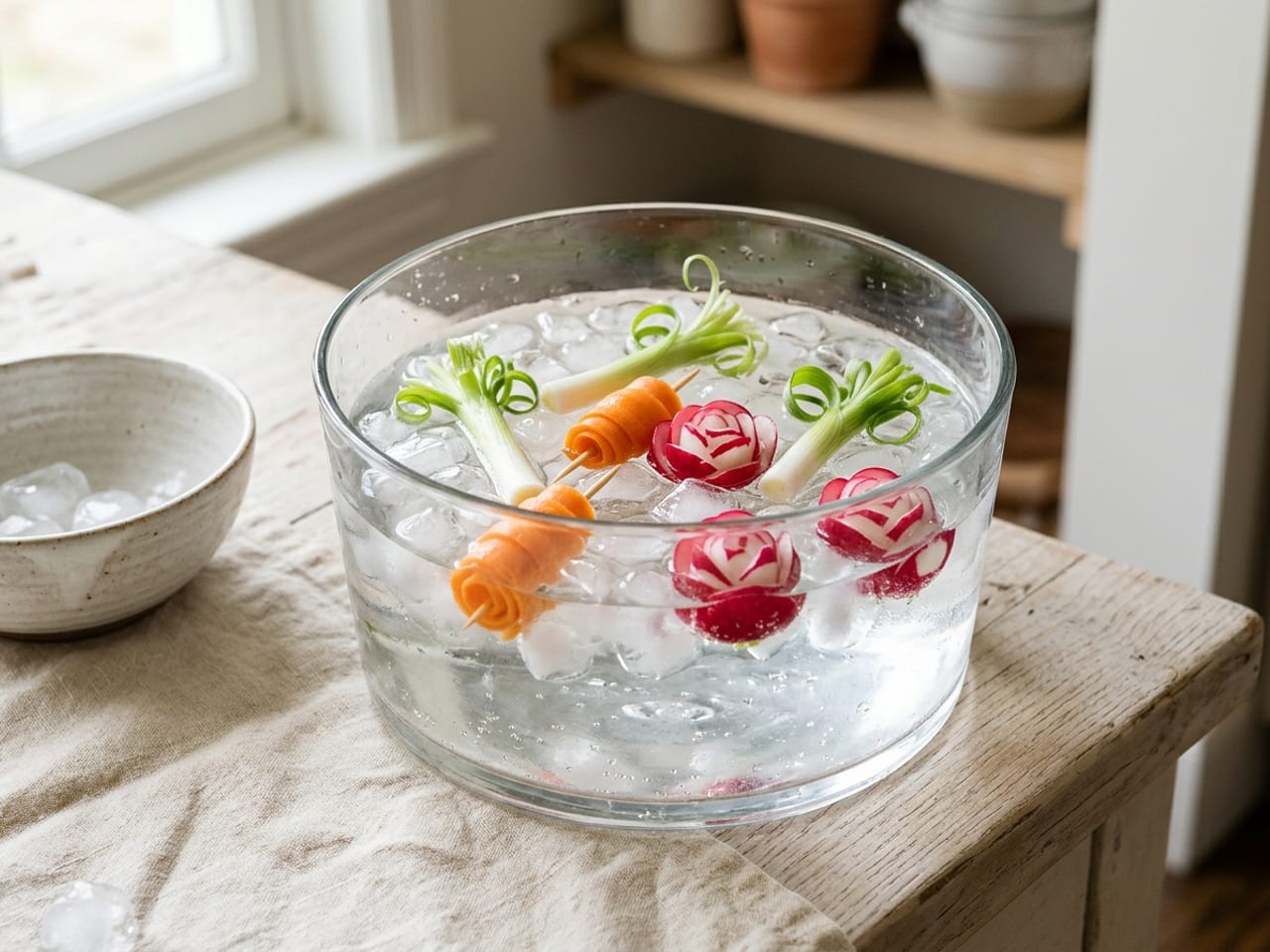
Brushes and curls are different cuts with different times
A scallion brush is a short piece slashed at the ends; Hom's open in "a minute or two", Miller's in "1 hour", Ellwood gives no time.1, 2, 4 A scallion curl is the whole piece cut into thin strips; the nine strip readings with figures run from 5 minutes (BBC Good Food Middle East's shortest) to 16 hours (America's Test Kitchen, 2023), and Serious Eats goes up to overnight.6, 8, 12 The split sits inside one publisher: America's Test Kitchen curls strips in about 10 minutes in a 2016 recipe and leaves greens 2 to 16 hours in a 2023 one, made ahead with a salad.5, 6 So "about 10 minutes" belongs to thin strips, not to scallions in general.
Can you soak too long?
Two food sources we read warn, each about something different. America's Test Kitchen's shaved vegetables took up almost three times as much water by 16 hours as by 2, which Andrea Geary called "a mixed blessing": crisp, but the water would thin the dressing; her fix was a dressing thick enough to take it and a salad spinner, not a shorter soak.7 America's Test Kitchen found sliced onions kept two days under water the sharpest of the lot.42 An Australian postharvest reference, about whole produce rather than a garnish, adds that too much water gives "swelling and cracking, as occurs with broccoli stems left in melt-water".119 The line a food scientist gave Saveur, "soaking removes flavor", is about soaking a whole onion before chopping it, to stop tears, so it is not counted here.106 No source we read gives a time after which a curl goes limp or soggy.
Dry them before they touch the food
America's Test Kitchen drains scallion curls and dries them "thoroughly with paper towels", and spins its shaved vegetables until "less than 1 teaspoon water collects"; The Daily Meal pats them dry so the dressing is not diluted.5, 6, 11 An undated garnish handout: a garnish "should always be dry, edible and used sparingly."53 The FDA's produce page also dries after washing, "to further reduce bacteria".96
Why ice water crisps them, and what nobody explains
Crisp is water pressure. McGee: bulging cells pressing on each other, at up to 50 times the pressure of the surrounding air, make a "full, firm, turgid" vegetable; as celery and lettuce use up their water, "their cells lose turgor pressure and they become limp".117 America's Test Kitchen weighed it: 1 1/2 lb (680 g) of shaved vegetables took up 1 oz (28 g) of water in 2 hours and almost three times that by 16, and "The extra liquid restores and increases turgor"; ice-cold water adds crunch "because chilling causes their pectin to firm up". One kitchen weighing, not a study.7
No source we read tests why the strips curl. Fannie Farmer gives the cut as the cause: gash the tops of the stalks and "they will curl back".108 The Haydocks write of carrot strips in ice-cold water, "This is what causes the curling", and the sentence before it is cut off in what we read.59 America's Test Kitchen and The American Home show the curl and give no reason.5, 6, 25 The nearest study we could read measured dandelion flower stalks, not a vegetable: their outer skin is held in tension by the tissue inside (Niklas and Paolillo, 1998).120 Two explanations we could not source are in the labelled stories.
Which vegetable garnish on which dish: noodles, tacos, sashimi, duck, salads and platters
A tally, not a rule: 53 lines from 46 named works (cookbooks, garnish books, test kitchens and magazines) that put a vegetable garnish on a dish (named, except where a fragment cuts the name off), grouped into 13 kinds of dish (our grouping). Many are in-book search fragments, quoted only as far as they run. "Usually" appears below only where three or more sources agree. No source we read says a garnish should repeat an ingredient of the dish; the U.S. military card asks only that it be "Suitable in texture and size to the food" and that "Bland foods require a more highly seasoned garnish".68
| Dish | Rows | The garnishes named |
|---|---|---|
| Pho and noodle bowls | 5 | Scallions, chilies; Fried shallots, chilies; Onion rings; Onion, scallion; Scallion greens, diagonal |
| Ramen and other soups | 3 | Scallions; Scallions, sliced or shredded; Diced cucumber |
| Tacos | 2 | Sliced radishes; Thinly sliced radishes |
| Pozole | 3 | Radishes, onion, chillies; Sliced radishes; Red onion, jalapeño or serrano |
| Borscht | 3 | Scallions (with dill); No vegetable (dill, sour cream) |
| Sashimi | 3 | Daikon, scallions; Shred-cut daikon, a vegetable curl; Daikon and carrot threads, a carrot curl |
| Chinese duck, roast meats and platters | 3 | Scallion brushes; Onion brushes |
| Thai dishes whose names the fragments cut off | 2 | Spring onion brushes; Spring onion brush, lime, chilli flower |
| Fish, shellfish and restaurant plates | 5 | Spring onion brushes, coriander; Crispy fried shallots; Fried leek julienne; Fried leek |
| Salads | 9 | Radishes, sliced or skin cut back; Radish rose; Celery curls, radish roses, tomato; Radish roses; Carrot curls; Carrot curls, feathers, crisscrosses; Radish roses, celery fans, carrot curls, radish accordions; Raw onion rings; Scallion curls, shaved vegetables |
| Cold platters, relish trays and sandwiches | 11 | Curled celery; Curled celery, carrot rings; Celery curls, radish roses; Celery curls, radishes (relish tray); Radish roses, tulips, jonquils, daisies; Radish-rose bouquet; Radish roses; Carrot crisscrosses, tomato rose; Cucumber fans |
| Indonesian and Indian dishes | 3 | Crispy fried shallots; Crisp-fried onions; Crispy fried onions (birista) |
| Deviled eggs | 1 | Tomato rose |
| Dish | Garnish | Who | As printed |
|---|---|---|---|
| Pho and noodle bowls | Scallions, chilies | Corinne Trang (1999)69 | "garnish with some traditional: herbs, mung bean sprouts, scallions, chilies," |
| Pho and noodle bowls | Onion, scallion | Tom Moorman (2017)71 | "Garnish each bowl with onion and scallion." |
| Ramen and other soups | Scallions | Hiroko Shimbo (2000)72 | Ramen toppings: "simmered bamboo shoots, scallions, and nori" |
| Tacos | Sliced radishes | Aida Gabilondo (1992)75 | "Garnish with pickled red chile pieces or 2 or 3 sliced radishes" |
| Pozole | Radishes, onion, chillies | Rick Stein (2017)77 | "garnish the pozole with radishes, lettuce, chillies and onion" |
| Borscht | Scallions (with dill) | Darra Goldstein (2020)80 | "garnish with dill and scallions" |
| Sashimi | Daikon, scallions | Rafael Steinberg (1968)83 | A grated daikon-and-pepper ball; "Garnish with sliced scallions and serve with sashimi." |
| Chinese duck, roast meats and platters | Scallion brushes | Ken Hom (1981)1 | "Use with Peking Duck and Mu Shu Pork to convey the hoisin sauce" |
| Thai dishes whose names the fragments cut off | Spring onion brushes | Hilaire Walden (1992)85 | "spoon over sauce. Garnish with spring onion (scallion) brushes. Serves 2." (the dish name is cut off; the recipe starts "Season flour with") |
| Salads | Radishes, sliced or skin cut back | Boston Cooking-School Magazine (1899)109 | "Radishes may be used to garnish plain lettuce, cress, string-bean, pea, spinach, and potato salads." |
| Salads | Celery curls, radish roses, tomato | Watkins Salad Book (1946, maker)93 | "garnish with celery curls, radish roses and quartered ripe tomatoes." |
| Salads | Scallion curls, shaved vegetables | America's Test Kitchen (2016, 2023)5, 6 | "The scallion greens, which curl in the ice water, make an attractive garnish." |
| Cold platters, relish trays and sandwiches | Curled celery, carrot rings | Fannie Farmer (1918 edition)108 | Turkey: "curled celery and rings and discs of carrots strung on fine wire" |
| Cold platters, relish trays and sandwiches | Radish roses, tulips, jonquils, daisies | Mary Albert Wenker (1951)92 | "Place radish roses, tulips, jonquils, or daisies on meat platter" |
| Cold platters, relish trays and sandwiches | Carrot crisscrosses, tomato rose | The American Home (1965)25 | "to garnish a meat or poultry platter"; "A tomato rose can also garnish a main-course platter" |
| Indonesian and Indian dishes | Crispy fried shallots | Andrea Chesman (2007)88 | "Indonesian dishes are frequently garnished with crispy deep-fried shallots" |
| Deviled eggs | Tomato rose | Rada Cutlery (maker)24 | "for a garnish with our chipotle chili deviled eggs" |
Show all 53 rows (36 more)
| Dish | Garnish | Who | As printed |
|---|---|---|---|
| Pho and noodle bowls | Fried shallots, chilies | Corinne Trang (1999), another recipe69 | "herbs, mung bean sprouts, chilies, and fried shallots" |
| Pho and noodle bowls | Onion rings | Ann Le (2006)70 | "chopped cilantro, bean sprouts, and thinly sliced onion rings" |
| Pho and noodle bowls | Scallion greens, diagonal | Jacki Passmore (1994)18 | "Finely slice the scallion greens diagonally and set aside for garnish." |
| Ramen and other soups | Scallions, sliced or shredded | Susannah Blake (2007)73 | "Fresh scallions, very thinly sliced or shredded" |
| Ramen and other soups | Diced cucumber | Marguerite Patten (1997)74 | "To garnish diced cucumber" (the soup is not named in the fragment) |
| Tacos | Thinly sliced radishes | Anne Lindsay Greer McCann (1995)76 | "Shredded lettuce Thinly sliced radishes" |
| Pozole | Sliced radishes | Marilyn Tausend (1997)78 | "shredded cabbage, sliced radishes, dried oregano" |
| Pozole | Red onion, jalapeño or serrano | Marlena Spieler (1995)79 | "Sliced red onion, thinly sliced jalapenos or serranos"; another garnish set in the book lists "red radishes" (its recipe is not shown) |
| Borscht | No vegetable (dill, sour cream) | Jeffrey Yoskowitz and Liz Alpern (2016)81 | "Garnish with sour cream and chopped fresh dill." |
| Borscht | No vegetable (dill, sour cream) | Anya von Bremzen and John Welchman (1990)82 | "Chopped fresh dill for garnish Sour cream for garnish (optional)" |
| Sashimi | Shred-cut daikon, a vegetable curl | Shizuo Tsuji (1980)50 | "shred-cut daikon and garnish with a decorative leaf or vegetable curl." |
| Sashimi | Daikon and carrot threads, a carrot curl | Shizuo Tsuji (1980), another recipe50 | "shred-cut daikon and carrot; carrot curl; shiso buds" |
| Chinese duck, roast meats and platters | Onion brushes | Gloria Bley Miller (1994)2 | "served with Peking Duck or as a relish with hoisin sauce" |
| Chinese duck, roast meats and platters | Scallion brushes | Mai Leung (1976)84 | Chicken: "Pour sauce over chicken. Garnish platter with scallion brushes, parsley, or other greens." |
| Fish, shellfish and restaurant plates | Spring onion brushes, coriander | Sue Ashworth (1996)86 | "shrimp rolls garnished with spring onion (scallion) brushes and fresh coriander (cilantro)" |
| Thai dishes whose names the fragments cut off | Spring onion brush, lime, chilli flower | Sue Ashworth (1996), another recipe86 | A battered dish (name not in the fragment): "spring onion (scallion) brush, lime slices and a chilli flower and serve at once." |
| Fish, shellfish and restaurant plates | Crispy fried shallots | Christine Manfield (2005)87 | Scallops: "Sprinkle with the Crispy Fried Shallots and Garlic" |
| Fish, shellfish and restaurant plates | Fried leek julienne | The Cork Cook Book (1999)38 | Scallops: "garnish with the julienne of leek" |
| Fish, shellfish and restaurant plates | Fried leek julienne | Philippe Jeanty (1991)39 | Lobster risotto: "Garnish the top with a pinch of fried leek julienne." |
| Fish, shellfish and restaurant plates | Fried leek | Daniel Martin (1992)40 | "Fried leek can be served as a garnish for the vegetables" |
| Salads | Radish rose | Heinz (1925, maker)17 | "Garnish each serving with a radish rose." |
| Salads | Radish roses | Kraft (1955, maker)94 | "Garnish the plate with radish roses." |
| Salads | Carrot curls | Better Homes and Gardens (1958)26 | "Carrot Curls: Roll up long slices; toothpick" |
| Salads | Carrot curls, feathers, crisscrosses | The American Home (1965)25 | Carrot curls "still wonderful in an arranged salad"; crisscrosses for "salads or coleslaw" |
| Salads | Radish roses, celery fans, carrot curls, radish accordions | A cafeteria training guide (1979)67 | The four in its unit-test answers; the unit opens on "the most common garnishes: Radish roses" (two separate fragments) |
| Salads | Raw onion rings | James Beard, as Jan Whitaker tells it113 | "He could allow watercress with lamb chops or raw onion rings on a salad" |
| Cold platters, relish trays and sandwiches | Curled celery | Fannie Farmer (1896)108 | A border of curled celery on lobster salad |
| Cold platters, relish trays and sandwiches | Celery curls, radish roses | The Silent Hostess (1932)55 | "Baked Capon Creamed Onions Molded Spinach Celery Curls* Radish Roses" |
| Cold platters, relish trays and sandwiches | Celery curls, radishes (relish tray) | Better Homes and Gardens (1938)112 | "mounds of celery curls, whole pickled onions, green and ripe olives, and radishes" |
| Cold platters, relish trays and sandwiches | Radish-rose bouquet | Mary Albert Wenker (1951)92 | Fish platter: "Form bouquet with radish roses, tulips" |
| Cold platters, relish trays and sandwiches | Radish roses | Kraft (1955, maker)94 | A broiled cheese sandwich: "Partially broiled bacon Radish roses" |
| Cold platters, relish trays and sandwiches | Radish roses | The American Home (1965)25 | "the center of attraction on a canape or hors d'oeuvres tray" |
| Cold platters, relish trays and sandwiches | Radish roses | John F. Nicolas (1983)65 | "Use radish roses to decorate cold mousses, cold buffet plates, and platters" |
| Cold platters, relish trays and sandwiches | Cucumber fans | Wendy Veale (1989)63 | "Feathery Cucumber Fans" for cold mousses and pâtés |
| Indonesian and Indian dishes | Crisp-fried onions | Sri Owen (1994)90 | "Fried onions are suggested as garnish for a number of recipes in this book." |
| Indonesian and Indian dishes | Crispy fried onions (birista) | Tahera Rawji (2008)89 | Lamb palak: "garnish with the rest of the crispy fried onions and chopped cilantro" |
Where the sources agree. Pho and noodle bowls usually take scallion or onion (4 of the 5 pho rows, from four books), tacos and pozole take sliced radish (four rows: Gabilondo, McCann, Stein, Tausend), and Peking duck takes the scallion brush in both Chinese cookbooks that name it (Hom, Miller); Mai Leung (1976) garnishes chicken and duck platters with brushes, parsley or greens.1, 2, 18, 69, 70, 71, 75, 76, 77, 78, 84 Sashimi takes daikon in all three of its rows, from two books.50, 83 Radish roses, celery curls and carrot curls appear in our tally on salads, menus and cold platters dated 1896 to 1983.25, 55, 65, 92, 93, 94, 108
Where they split. Borscht: Darra Goldstein adds scallions to the dill; two other books garnish it with dill and sour cream only, no cut vegetable.80, 81, 82
Not found in what we read: a vegetable garnish row for steak, burgers, hot dogs, fried rice, congee, bibimbap, sesame noodles, a canapé with a vegetable garnish on top. The 1965 American Home put mushrooms in toast cups around a steak, not a vegetable cut; its radish roses went on "a canape or hors d'oeuvres tray", not on the canapés.25 Our canapés guide uses cucumber as a base, not a garnish.
On this site: our shoyu ramen ends on finely sliced scallion whites, our dan dan noodles on sliced scallion greens, our Korean fried chicken puts scallion threads on the soy-garlic side, our aguachile strews cucumber and red onion over the shrimp, and our deviled eggs list fried shallots among the toppings. For a carved turkey or a ham, see how to carve a turkey and the ham calculator.
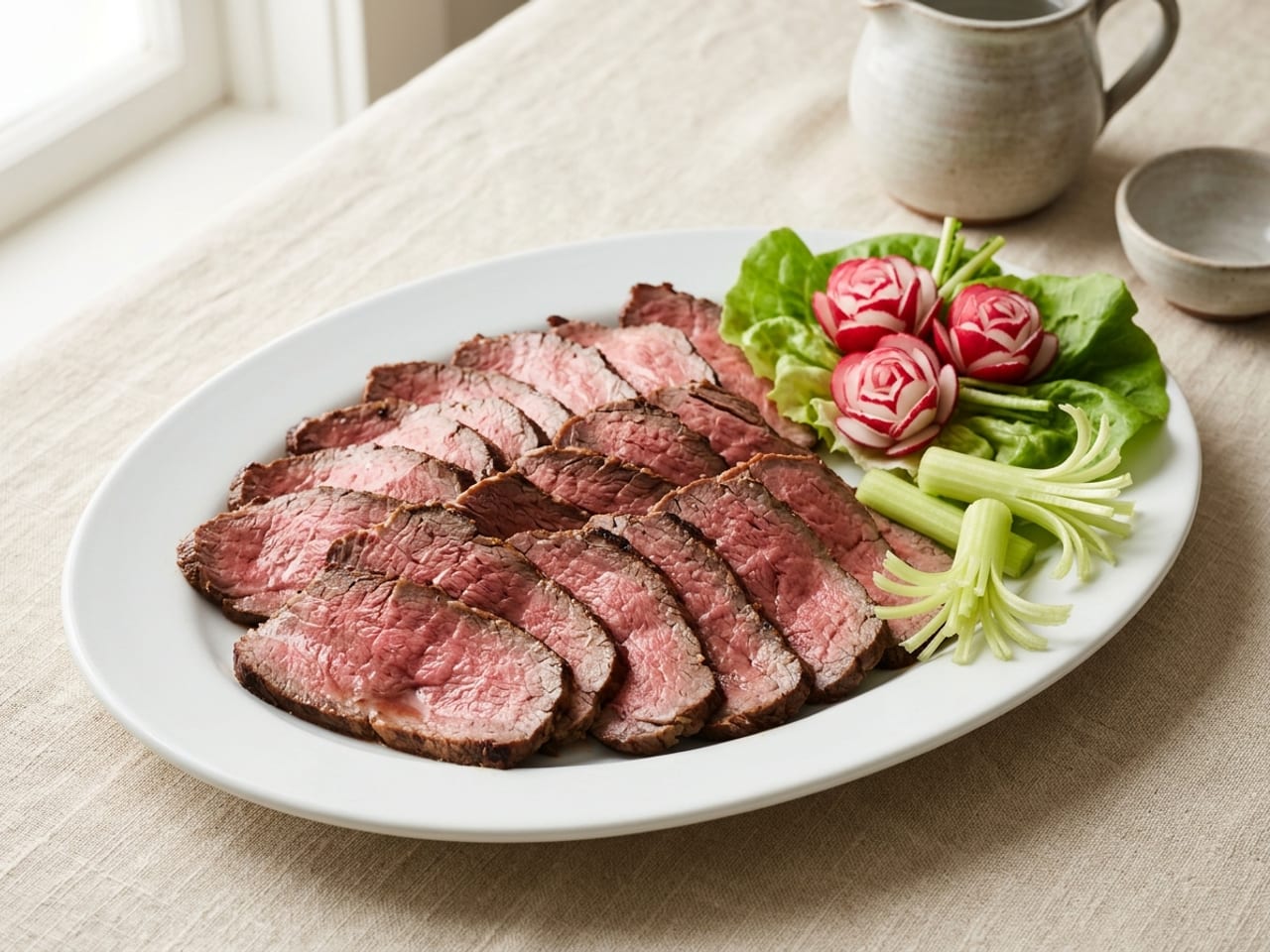
Radish roses, tomato roses and carved garnishes today
Eight of the cards above are carved or shaped garnishes, the ones people search as "fancy": scallion brushes, radish roses, radish fans and accordions, radish tulip, carrot flowers, carrot feathers and crisscrosses, tomato rose and chilli flowers. They get real steps here because they are searched for. Here is where they stand, in the words of the people who wrote about them, by date.
When they were common, in the sources' words. From Fannie Farmer's radish tulips and curled celery (1896) to Good Housekeeping's "Radish roses" on a 1911 menu, Wenker's radish roses, tulips, jonquils and daisies on a 1951 meat platter, and The American Home's 1965 garden of "sculptured works of art ... used simply for adornment".25, 92, 108, 111 A 1979 cafeteria training guide opens its garnish unit with "the most common garnishes: Radish roses", and its test answers list radish roses, celery fans, carrot curls and radish accordions (two separate fragments); Jerry Crowley (1978) wrote "The radish is the most common garnish used" (a fragment; the sentence is cut off).58, 67
Who mocked them. Jan Whitaker writes that, next to orange slices and twists, James Beard's "most detested 'tricky' garnishes were tomato roses and flowers", adds "Funny that he didn't mention radish roses", and says he "could allow ... raw onion rings on a salad": her words, not his.113 In 2000 the columnist Christina Waters wrote that "the mind boggles before the compulsion to carve radish roses, tomato twists, pepper palm trees with carrot trunks", and mocked the toothpicked carrot curl.114 In 2011 the blogger Michael Natkin listed "a sad radish rose, a carrot curl" among the garnishes you "probably picture", which he says have "decorated plates for a hundred years - and still does in some quarters" (his estimate).115 A 1999 plating book described traditional vegetable sculpting as "tedious and time-consuming handiwork".66
What named sources do instead. Natkin garnishes with things that add taste and crunch: "finely diced cucumbers, thinly sliced jalapeno, cherry tomato halves, and quick fresh salsas".115 The later cookbooks in our dish tally (1992 to 2017) use cuts you eat with the dish: sliced radish on tacos and pozole, scallion on pho and ramen, crisp shallots on Indonesian dishes. That is our grouping, not a shift any source describes: eaten cuts are older too (Steinberg's scallions on sashimi, 1968; Hom's duck brushes, 1981).1, 71, 72, 76, 77, 83, 88 And the curl has not gone away: America's Test Kitchen's 2023 scallion greens "make an attractive garnish".6
Ours, labelled: none of the sources we read calls a carved garnish wrong to eat or wrong to make; the critics object to garnish that is only decoration. A radish rose is a radish: if it goes on the plate, it is food, which is also the line our food garnishes guide takes on the reflex parsley sprig: use what belongs to the dish, or nothing.
How far ahead to make vegetable garnishes, and how to keep them
What the sources we read support: the crisp raw cuts (scallion, radish, carrot, celery, chilli) keep cold in water for hours to a day or two; raw onion is cut as needed; fried shallots keep dry and airtight. No source we read gives a time for cut cucumber or tomato: our crudité platter cuts cucumbers the morning of, and the U.S. military card cuts tomato slices and wedges "shortly before serving", so we cut them last (ours).68 The FDA Food Code lets cut raw vegetables "such as celery or carrot sticks" sit in ice or water, and our crudité platter keeps cut carrots, celery and radishes submerged in cold water the day before, the water changed daily, and cucumbers and peppers dry and airtight.95
Every hold time is its source's own. USDA FoodKeeper has no row for cut garnish vegetables: its radishes 10 to 14 days, carrots 2 to 3 weeks, celery 1 to 2 weeks, cucumbers 4 to 6 days and green onions 1 week are for WHOLE vegetables from purchase, so we do not apply them to cut garnishes.100 Chilli flowers keep in cold water up to a day (Diana Kuan); that is a flower, not the pepper sticks our crudité platter keeps dry.31
| Garnish | How the sources keep it | How long, by whose count |
|---|---|---|
| Scallion curls | Under ice water in the fridge, or drained and wrapped in paper towel in a bag | 2 to 16 hours under water (America's Test Kitchen); 2 to 3 days wrapped (The Yummy Life); "a few hours ahead" (Sainsbury's Magazine)6, 9, 13 |
| Sliced scallion | In ice water in the fridge | Up to overnight (Serious Eats)8 |
| Radish roses and slices | In cold water in the fridge | No day count from a cookbook; "can be kept in cold water and will remain" (Complete Garnishing Guide, cut off). Whole radishes: about a week in unsealed bags (America's Test Kitchen)22, 61, 104 |
| Carrot curls and flowers | In ice water in the fridge, or drained and sealed | Up to 2 days in water, or up to a week drained (The Yummy Life); "until ready to use" (The American Home)10, 25 |
| Celery curls | In cold or ice water | Overnight (Farmer); the Food Code allows cut raw celery and carrot in ice or water95, 108 |
| Shaved ribbons | In ice water in the fridge, spun dry before use | Up to 16 hours (America's Test Kitchen); up to six hours (Bon Appétit, second hand)6, 105 |
| Cucumber ribbons and slices | Our crudité platter cuts cucumbers the morning of, dry and airtight; cutting it last and salting last are ours (America's Test Kitchen only explains why salt softens) | No source gives a time for cut cucumber garnish; whole cucumbers 4 to 6 days (USDA FoodKeeper)100, 103 |
| Tomato rose | Covered with foil or plastic wrap until used (The American Home, of its lemon rose; tomato roses "in the same manner"); the U.S. military card cuts tomato slices and wedges "shortly before serving" | No time in what we read for a tomato rose; cutting it last is ours25, 68 |
| Chilli flowers | In cold water in the fridge | Up to a day (Diana Kuan)31 |
| Raw onion slices | Slice as needed; spare slices in a zipper-lock bag, rinsed before use | Two days under water made them sharpest (America's Test Kitchen)42 |
| Crispy shallots | Airtight, once cooled | 3 days at room temperature (America's Test Kitchen 5760); 1 week in the fridge (Saveur); 1 month at room temperature, oven-dried (America's Test Kitchen 9098)33, 34, 35 |
| Fried shallot oil | In the fridge | Up to 1 month (America's Test Kitchen). Oregon State's 4 days is for raw vegetables held in oil and names garlic, mushrooms and chili peppers; no source we read says which rule covers fried-shallot oil33, 101 |
| Quick-pickled red onion | In its brine in the fridge | Up to 1 week or up to 2 weeks, two America's Test Kitchen recipes; no extension figure found45, 102 |
| Scallion brushes, radish fans, daikon threads, carrot feathers | Not given | No source we read gives a hold time |
Pickled onion: America's Test Kitchen gives one recipe up to 1 week and another up to 2 weeks in the fridge; our plating components guide says "about a week", which matches the first. We found no extension-service figure for quick pickles.45, 102 White carrot: carrot blush has two causes: surface drying, where "An easy fix for this is to simply moisten the carrot", and cell damage from cutting, which "is not reversible"; peeled carrots "partially regained their original color when water-dipped" in a 1995 study.121, 122
Ours, for a dinner: cut and soak the scallion, radish, carrot and celery garnishes in the morning and keep them in water in the fridge; fry shallots the day before; cut cucumber, tomato and raw onion in the last hour; drain and dry everything just before it goes on the food.
Washing, cut tomatoes and the two-hour rule
Wash under plain running water, then dry. The FDA: wash produce "thoroughly under running water", no soap, detergent or produce wash, and dry it with a clean cloth or paper towel. Nebraska Extension scrubs firm produce "like melons, potatoes, carrots and cucumbers" with a clean brush, just before cutting, not before storing.96, 99
Two hours out, then the fridge. Penn State and Nebraska Extension: refrigerate fresh produce within 2 hours of peeling or cutting; Penn State adds, discard cut produce left at room temperature longer. It is the same two-hour line our lemon and orange garnish guides print from UF/IFAS for cut citrus (our herb guide prints USDA's general two-hour rule).97, 98, 99
Cut tomatoes are different in a food business. The 2022 FDA Food Code, as we read it (a 2026 edition is out; we did not re-read it), names raw seed sprouts, cut tomatoes, cut melons, cut leafy greens (shredded cabbage and lettuce among them), heat-treated plant food and garlic-in-oil mixtures as time/temperature control for safety food, held at 5°C (41°F) or less; it does not name cut carrot, celery, cucumber, radish or scallion. A tomato rose is cut tomato: we give it no time of our own.95 In a restaurant, staff "may not contact exposed, READY-TO-EAT FOOD with their bare hands", garnish included (the Code has exceptions).95
Picks, decoration and allergens. The sources that roll carrot curls on wooden picks or clips take them out before serving; no authority we read has a rule on picks in garnishes, so "remove them before the plate goes out" is ours. Everything on the plate should be food, as our food garnishes guide says and the U.S. military card puts it: "Generally, garnishes should be edible".25, 27, 68 Celery is a named allergen in EU food law ("Celery and products thereof").107 Fried-shallot oil: America's Test Kitchen keeps it a month in the fridge; Oregon State's 4-day rule is for raw vegetables in oil and names garlic, mushrooms and chili peppers, not shallots, and no source we read settles which applies.33, 101
Ken, katsura-muki, mukimono and Thai carving, in short
Ken and tsuma. In Japan the garnishes served with sashimi are tsuma; the shredded daikon or myoga laid under the fish is sometimes called ken (or shiki-zuma), a Japanese encyclopedia says, adding that "in the Edo period calling it ken was usual"; the dictionary's earliest example of the word ken is from about 1504 to 1521, a date for the word, not for daikon threads (our translations).124, 125 The threads are cut by katsura-muki, peeling a 5 to 6 cm (2 to 2 3/8 in) round into one continuous band; steps are on the daikon card. The earliest English use of "katsura-muki" we found is a 1959 Japan Quarterly fragment, a cucumber "first cut into pieces about two inches long."46, 116
Mukimono and kazari-giri. Mukimono carves tubers (imo), daikon and carrot into fish, shellfish, cranes and turtles; one encyclopedia says the technique "markedly improved from the late Edo period". Kazari-giri is decorative cutting "as dish decoration or to express the season", such as a twisted-plum carrot slice or a chrysanthemum turnip.126, 127 In English, the Haydocks' 1980 book Japanese Garnishes: The Ancient Art of Mukimono has carrot curls, radish buds and fans, and cucumber twigs and loops.59 The short definitions agree with our food garnishes glossary.
Thai carving. A 2013 paper by Mahasarakham University authors: "There are no historical proofs of the origin of Thai fruits and vegetable carvings"; its main purpose is "to accompany gourmet dishes of palace meals and for religious offerings", and carving classes entered Thai schools after 1931. Its abstract and conclusion are bolder than its body: carving "has been passed down since the Sukhothai period". In one Thai cookbook we read (Ashworth, 1996), a scallion brush, lime slices and a chilli flower share one garnish line.86, 128 We found no how-to for Thai carving we could source, so there is none here; the origin story is in the labelled stories.
Radish roses, celery curls and the tomato rose: the earliest we found
"Earliest we found" means exactly that: each row is the oldest dated source we read for it, never a claim of who invented it. Escoffier's 1907 English edition says radishes are "used chiefly as a garnish" for hors d'oeuvres, cut like fuchsia flowers; its glossary calls printanier "a garnish of early-season vegetables, cut to various shapes", cut vegetables that are served and eaten (our reading).110
| When | Who | What we read |
|---|---|---|
| 1896 | Fannie Farmer, Boston | A radish cut "to imitate tulips" and celery curled in ice water "over night or for several hours": the earliest steps we found for either.108 |
| 1899 to 1900 | Boston Cooking-School Magazine | Celery curls "several hours, or until curled"; radishes on lettuce, cress, string-bean, pea, spinach and potato salads.109 |
| 1907 | Escoffier (English edition) | Radishes "used chiefly as a garnish" for hors d'oeuvres, cut like fuchsia flowers or sliced on cucumber as a dish border; his "American relishes" are pickles.110 |
| 1911 | Good Housekeeping | "Radish roses" on a May dinner menu: the earliest dated use of the name we found, a menu line, not a method.111 |
| 1925 | Heinz Book of Salads (maker) | Scallions soaked in ice water half an hour, then sliced; a radish rose on each serving.17 |
| 1932 to 1951 | The Silent Hostess, Better Homes and Gardens, Berolzheimer, Wenker | Celery curls and radish roses on menus, relish trays (1938), salads and meat and fish platters (1951).55, 56, 92, 112 |
| 1965 | The American Home | "A Bumper Crop of Garnishes": carrot curls ("Everyone knows about carrot curls"), radish roses, carrot larkspurs and the spiral-peel tomato rose, the earliest tomato-rose steps we found, "sculptured works of art ... used simply for adornment".25 |
| 1970s (her date for the over-garnishing) | James Beard, as Jan Whitaker tells it | "Next to orange slices and twists, his most detested 'tricky' garnishes were tomato roses and flowers" (Whitaker's words; when Beard said it is not given, and his own text was not read).113 |
| 1978 to 1991 | Garnish books | Crowley (1978), the Haydocks' mukimono (1980), Kokko (1982), Quan (1984), Budgen (1986), Veale (1989), Rutherford (1991); a 1979 cafeteria guide's test answers list radish roses, celery fans, carrot curls and radish accordions.29, 52, 58, 59, 60, 63, 64, 67 |
| 1999 to 2011 | Mitchell, Waters, Natkin | Vegetable sculpting described as "tedious and time-consuming handiwork" (Mitchell, 1999); the "compulsion to carve radish roses, tomato twists" (Waters, 2000); "a sad radish rose, a carrot curl" (Natkin, 2011).66, 114, 115 |
| 2016 to 2023 | America's Test Kitchen | Scallion curls, "a fun technique that restaurants use" (2016), and curled greens that "make an attractive garnish" on a shaved salad (2023).5, 6 |
The relish tray itself is older than these garnishes: our Thanksgiving board traces it to the 1880s and 1890s, when relishes meant pickles, olives, celery and radishes.
Labelled stories: what we could and could not trace
| The claim | Verdict | Why |
|---|---|---|
| Thin strips curl because they take up water unevenly | Not tested on food | No source we read says it or tests it for scallions or any vegetable strip. The nearest study measured DANDELION flower stalks, whose outer skin is held in tension by the tissue inside (Niklas and Paolillo, 1998): a stalk, not a food, and the abstract says nothing about strips curling in water.120 |
| Scallions curl because their cells are thin-walled on one side and thick-walled on the other | Not found | We could not trace it: no reference, study or page we read says it. |
| Hotel or cruise-ship buffet chefs invented the tomato rose | Not found | No tomato-rose steps earlier than The American Home in 1965 in what we read, which cuts tomato roses "in the same manner" as a lemon rose. That is the earliest we found, not an invention date.25 |
| Thai fruit and vegetable carving began with Nang Noppamas at the Sukhothai court | Legend | A 2013 academic paper: "There are no historical proofs of the origin of Thai fruits and vegetable carvings". The tale itself, by Wikipedia's account, "comes from a poem written in the early-Bangkok period".128, 129 |
| Daikon threads are under sashimi to do a particular job | What one reference says | The Heibonsha encyclopedia says tsuma (ken) serves "to refresh the palate and to set the look of the arrangement" (our translation). We found no reference for why daikon in particular.124 |
| Soaking raw onion in water makes it milder | Partly | America's Test Kitchen: 15 minutes is needed, baking soda beats plain water, and onions stored two days under water came out the sharpest. McGee says rinse.41, 42, 118 |
The science, in short
- Crisp: water pressure in the cells (turgor); soaking restores it, cold firms the pectin. See why ice water crisps them.7, 117
- The curl: observed in every source we read that makes curls; Farmer names the gashes and the Haydocks the ice water as the cause, and none says why.5, 59, 108
- Onion bite: cutting lets an enzyme reach the sulfur compounds; McGee says chopped raw alliums for a garnish "are best rinsed", and America's Test Kitchen's baking-soda soak neutralises the acid that makes the sharp compounds.41, 118
- Radish bite: "Isothiocyanates derived from the breakdown of glucosinolates in damaged tissue impart a pungent and bitter flavor", in a 2022 study of a Korean radish, not the round red one.123
- Salted cucumber weeps: salt pulls water out of the cells by osmosis and the cells weaken, so salt it last (ours).103
- White carrot: two causes: surface drying that water partly reverses, and cell damage that it does not; not a safety matter.121, 122
Vegetable garnish tools
- A paring or chef's knife does most of the cuts above (ours); Rada, which sells paring knives, cuts its radish roses, carrot flowers and tomato rose with one, and the Haydocks' mukimono kit is a "peeler, Japanese chef's knife, bowl of ice water."24, 59
- A peeler for carrot curls ("a vegetable parer") and cucumber ribbons; Marian Getz's booklet, sold with a peeler set, uses its "WIDE BLADE PEELER".25, 51
- A mandoline for shallots sliced 1/16 inch (1.5 mm) and shaved salad vegetables cut "to the thickness of a dime" (America's Test Kitchen); for thin radish it is our suggestion, not a source's. Its guard and a cut-resistant glove are on our plating tools guide.6, 33
- Kitchen shears for chilli flowers (Diana Kuan); wooden picks or clips to hold carrot curls while they set, taken out before serving.10, 25, 31
- A lemon peel tool to score cucumbers, and small vegetable cutters for stars and crescents (The Nibble, a site that reviews products).54
- A bowl of ice water and a salad spinner: America's Test Kitchen spins shaved vegetables dry.6
Garnish cutters and carving sets are sold widely; no source we read compares them, so we name none.
Vegetable garnishes, answered
What vegetables are used for garnish?
In the cookbooks, garnish books and test kitchens we read: scallions (curls, brushes, slices), radishes (slices, roses, fans), cucumber, carrot (curls, flowers), celery curls, tomato (a rose from the peel), chillies (flowers, rings), onions and shallots (raw rings, crisp-fried) and daikon threads for sashimi. A 1980s U.S. military recipe card lists celery, carrots, cucumbers, onion rings, radishes, tomatoes, beets and sweet green peppers. This page has 19 of them with steps from a named source.
How do you make easy vegetable garnishes?
The easiest in the sources are cuts, not carvings: thin radish slices on tacos or pozole, sliced scallion on pho, ramen and soups, raw onion rings soaked about 15 minutes, and scallion curls: 2-inch (5 cm) pieces sliced lengthwise into thin strips and dropped in ice water for about 10 minutes (America's Test Kitchen). Dry them well before they go on the food.
How do you make scallion curls?
America's Test Kitchen: cut scallions into 2-inch (5 cm) pieces, slice each lengthwise into thin strips, leave them in ice water "until scallions curl and crisp, about 10 minutes", then drain and "dry thoroughly with paper towels". To make them ahead, the greens can sit under ice water in the fridge for 2 to 16 hours.
How long do you soak vegetables in ice water to make them curl?
It depends on the cut, and the sources split. Across our 51 readings the times run from "a minute or two" (Ken Hom's scallion brushes) to 2 days (a blog's carrot curls), with three saying overnight; 18 give no time at all. Thin scallion strips: about 10 minutes (America's Test Kitchen, 2016). Scallion brushes: a minute or two (Hom) or 1 hour (Miller). Carrot curls: 2 to 3 hours (RecipeTips) to "several hours" (Crowley). Celery curls: overnight or several hours (Fannie Farmer, 1896).
How do you make radish roses?
Rada Cutlery's way: cut off both ends, cut petals on four sides ("about a quarter of inch" in and down, 6 mm), then put them in ice water "so the ice water helps them to expand out". The 1965 American Home rose instead pushes thin radish slices into slanted gashes in a large radish. No cookbook we read gives a soaking time; two eHow pages say at least 15 minutes and overnight.
How do you make a tomato rose?
Cut one long, thin spiral of peel from the tomato, starting at a small base you leave attached, then roll the spiral back up onto the base: The American Home (1965) cuts its lemon rose this way and says "Cut lime, tomato, and cherry tomato roses in the same manner." RecipeTips likes the peel 3/4 to 1 inch (2 to 2.5 cm) wide, thin, with very little flesh.
How do you make a chili flower garnish?
Diana Kuan: snip off the tip, cut the chilli in half lengthwise almost to the stem, scrape out the seeds, cut each half into 2 or 3 strips and soak the flowers in cold water for 15 to 20 minutes so the petals fan out. They keep in cold water in the fridge up to a day. Caroline Ellwood (1982) soaks them about an hour.
What vegetables go on a meat or turkey platter?
The dated books we read: radish roses, tulips, jonquils or daisies on a meat platter and a radish-rose bouquet on a fish platter (Wenker, 1951); carrot crisscrosses "to garnish a meat or poultry platter" and a tomato rose on a main-course platter (The American Home, 1965); curled celery with carrot rings on roast turkey (Fannie Farmer, 1918). These are dated habits, printed as found.
What radish garnish goes on tacos?
Sliced raw radish: "2 or 3 sliced radishes" (Aida Gabilondo, 1992) and "Thinly sliced radishes" with shredded lettuce (Anne Lindsay Greer McCann, 1995). Pozole takes sliced radish too (Rick Stein, Marilyn Tausend), with cabbage or lettuce, onion and chillies; Marlena Spieler's set is red onion and jalapeño or serrano.
How do you keep fried shallots crispy, and how long do they last?
Airtight, or they "absorb moisture from the air and turn soft" (Hot Thai Kitchen). The keeping times split by method: up to 3 days at room temperature for pan-drained shallots (America's Test Kitchen), up to 1 week in the fridge (Saveur), up to 1 month at room temperature after drying in a 200°F (93°C) oven (America's Test Kitchen).
Can you make vegetable garnishes ahead of time?
Most of the cuts we read about keep hours to a day or two, cold in water: scallion curls under ice water in the fridge 2 to 16 hours (America's Test Kitchen), carrot curls in ice water up to 2 days (The Yummy Life), chilli flowers in cold water up to a day (Diana Kuan). Cut cucumber and tomato last: no source we read gives them a time, so that is our rule. Raw onion is the exception: America's Test Kitchen found slices kept under water for two days the sharpest.
What is the daikon garnish on sashimi called?
Ken: the fine shreds laid under the fish, most often daikon (the Japanese references we read also name myoga, udo and cucumber, and Tsuji's sashimi plates add carrot). With the other sashimi garnishes they are tsuma, and a Japanese encyclopedia says calling them ken was usual in the Edo period. The threads are cut from a continuous paper-thin sheet peeled off a 5 to 6 cm (2 to 2 3/8 in) round of daikon, katsura-muki.
Are radish roses and carved garnishes old-fashioned?
Some writers say so; we print who. Jan Whitaker writes that James Beard detested tomato roses, after orange slices and twists; a 2000 newspaper column mocked the "compulsion to carve radish roses, tomato twists"; a 2011 food blog called the radish rose "sad". Later cookbooks in our tally garnish tacos, noodles and soups with sliced radish, scallion and crisp shallots (our grouping, not a shift any source describes), and America's Test Kitchen still calls curled scallion greens "an attractive garnish" (2023).
Cooked something with a garnish on top? Photograph the plate and Plate Artists re-plates that dish, with the food kept as it is and the changes named. Start with a re-plate.
Your food, plated like a chef's
Snap it, upload it, and get the composed version back, with the steps to recreate it at home.
Start free · 1 enhancement →Free account · 1 free enhancement · No credit card
How this page was made
We cut, soaked, timed, tasted and tested nothing for this page. Every step, size, time and date is what its source printed, read on 13 November 2026 unless its entry says otherwise. Many of the dated books are lending-only on the Internet Archive, so we read them as in-book search fragments and quote only as far as each fragment runs. Makers and sellers (a knife maker, a peeler-set booklet, brand cookbooks, a supermarket's magazine) are labelled where they make a claim. Ours: the grouping by vegetable and by dish, every count in the tallies, the strip's summaries, the °C, cm and mm conversions, and every line marked ours. Left out: a textbook garnish chapter (Gisslen, the CIA, Labensky, Pépin) we could not open for vegetable garnishes, Jacques Pépin's tomato rose (a video page with no written steps), a cucumber rose (no source with steps), an 1885 hotel chef's relish dish we could read only second hand, and a dandelion-stalk coiling paper we could read only by its title. The figures are AI renders, not photographs. The scallion, ice-water and keeping lines agree with our food garnishes, crudité platter and plating components pages, which hand vegetable garnishes on to this one.
The cookbooks, garnish books, test kitchens and references behind this page
How each source was read (in full, as OCR of a scan, as an in-book search fragment, as an open excerpt, as an abstract, in an archived copy, or as a prior reading for another of our guides) is in its entry. Makers sell what they describe.
- Hom, K. (1981). Chinese Technique: "Scallion Brushes". Simon & Schuster; ckbk.com, read on 13 November 2026 as the open excerpt on ckbk.com (the rest is behind a login), the whole section: 3-inch (7.5 cm) lengths, "Make a 1-inch cut through one end", rotate and cut again, repeat at the other end; "Drop the scallions into ice water." "After a minute or two, the ends curl attractively."; "Use with Peking Duck and Mu Shu Pork to convey the hoisin sauce from the bowl to the pancake". ckbk.com
- Miller, G. B. (1994). The Thousand Recipe Chinese Cookbook: "Onion Brushes". reprinted on dvo.com (a cookbook-software host), read in full on 13 November 2026 on the reprint host, which does not name the book on the page (the cuts research matched it to Miller): white stalks only, "vertical, parallel cuts about 1/2-inch deep at one end", "Soak 1 hour in ice water. (The shredded ends will open and become frilly.)"; "served with Peking Duck or as a relish with hoisin sauce". dvo.com
- Lin, H. J. & Lin, T. (1957). Chinese Gastronomy: "Spring Onion (Scallion) Brushes". ckbk.com, read on 13 November 2026 as the open excerpt on ckbk.com (the rest is behind a login): "Wash and cut into 1½-inch lengths the white and light green stalks of spring onions, one for each person", slashed about 1/2 inch (13 mm) deep; the soaking sentence is behind the login and was not read. ckbk.com
- Ellwood, C. (1982). The Sainsbury Book of Chinese Cooking (also Chinese Cooking, 1986). Internet Archive, read on 13 November 2026 as in-book search fragments only (Internet Archive full-text search; the book is lending-only), so only the quoted words were read: radish petals, "chill in iced water until the petals open"; spring onion brushes "Immerse in iced water until the spring onion opens out and curls"; chilli flower "Place in iced water for about 1 hour to open." (a supermarket's book: label). archive.org
- Souza, D. (America's Test Kitchen) (2016). Frisée and Bibb lettuce salad with radishes, scallions and fried shallot-sherry vinaigrette. americastestkitchen.com, 7 September 2016; a prior reading for our food garnishes guide, re-read for this page on 13 November 2026: 2-inch (5 cm) pieces sliced lengthwise into thin strips; "Place scallions in small bowl of ice water and set aside until scallions curl and crisp, about 10 minutes. Drain scallions and dry thoroughly with paper towels."; "a fun technique that restaurants use", with no reason given for the curl. americastestkitchen.com
- Geary, A. (America's Test Kitchen / Cook's Illustrated) (2023). Shaved vegetable salad with creamy miso dressing (recipe 15481). americastestkitchen.com, 6 February 2023; read in full on 13 November 2026: fennel, beets, celery, carrots, radishes and scallion greens in ice and cold water, "Cover and refrigerate for at least 2 hours or up to 16 hours."; "pluck scallion greens from top of ice water (they will have curled up)"; "The scallion greens, which curl in the ice water, make an attractive garnish."; spin "until less than 1 teaspoon water collects in bottom of salad spinner, 2 to 3 more times". americastestkitchen.com
- Geary, A. (America's Test Kitchen / Cook's Illustrated) (2023). The crunchiest ice water salad. americastestkitchen.com, 6 February 2023; read in full on 13 November 2026: 1 1/2 lb (680 g) of shaved vegetables weighed before and after a cold soak, "after 2 hours, they had absorbed 1 ounce of water; after 16 hours, they had soaked up almost three times that amount"; "The extra liquid restores and increases turgor", "the water pressure within the vegetables' cell walls", "that is released when the produce is cut"; "ice-cold water further enhances the crunch because chilling causes their pectin to firm up"; the gain was "a mixed blessing" because the dressing would be diluted (one kitchen test, sample size not stated; a weighing, not a peer-reviewed study). americastestkitchen.com
- López-Alt, J. K. (Serious Eats) (2014). How to slice scallions. Serious Eats, read in its Yahoo Lifestyle syndication, 29 May 2014; read in full on 13 November 2026 (the Yahoo copy): "Store the sliced scallions in a container of ice water in the fridge for at least 30 minutes and up to overnight, and they'll absorb liquid, firming up and curling into pretty little threads"; the cold water "will temper their potency a little, resulting in crisp, fresh, and milder tasting scallions". yahoo.com
- Matheny, M. (The Yummy Life) (2026). Green onion curls. theyummylife.com (blog), undated page, read in full on 13 November 2026: "very thin shreds that are 3-5 inches long"; "Immerse cut onions in bowl of ice water for 10-15 minutes until curled."; "Use right away or wrap in paper towel, insert in plastic bag, and refrigerate for 2-3 days."; links a scallion-cutting tool through a shop (seller-adjacent). theyummylife.com
- Matheny, M. (The Yummy Life) (2026). Carrot curls. theyummylife.com (blog), undated page, read in full on 13 November 2026: peeler strips rolled and held with vinyl paper clips, "cover them with cold water. Add a few ice cubes to lower the water temperature, cover, and refrigerate for at least 2 hours and as long as 2 days."; "remove the paper clips"; drained curls "They'll be good for up to a week.". theyummylife.com
- The Daily Meal (2026). Add curled green onions to your salad for a deliciously decorative look. thedailymeal.com, undated page, read in full on 13 November 2026: "Put the sliced onion greens into a bowl of ice water, and voilà: They curl up on their own. It only takes a few minutes"; carrot strips "in ice water for around 20 minutes"; pat dry so "your salad dressing" is not diluted. thedailymeal.com
- BBC Good Food Middle East (2026). Spicy spring onion salad. bbcgoodfoodme.com (the Middle East edition, not the UK site), undated page, read in full on 13 November 2026: "soak for at least 5 mins (or up to 2 hrs) in the fridge, until the spring onions curl up"; drain, spin or pat dry. bbcgoodfoodme.com
- Sainsbury's Magazine (2026). Pa muchim (spring onion salad). sainsburysmagazine.co.uk (a supermarket's magazine: seller), undated page, read in full on 13 November 2026: "Thinly slice the spring onions lengthwise and put in iced water for 30 minutes, until curly and to take off some of the harsh bite."; "Ice and drain the spring onions a few hours ahead. Keep chilled and dress before serving.". sainsburysmagazine.co.uk
- Foodal (2026). How to select, prep and chop scallions. foodal.com, undated page, read in full on 13 November 2026: bias slices "on a 33 or 45-degree angle into pieces 1 to 2 inches in length"; threads from 3-inch sections, "chill in a bowl of ice water for 30 minutes. Drain and lightly pat dry before adding as a final touch to grilled meats, egg dishes, dips, or soups.". foodal.com
- Savor the Flavour (2026). Cutting green onions. savortheflavour.com (blog), undated page, read in full on 13 November 2026: "immerse the onions in a bowl of ice water for 10 to 15 minutes until they curl. Drain and pat dry.". savortheflavour.com
- Food.com reader recipe (2026). Green onion curls (recipe 214961). food.com, undated page, read in full on 13 November 2026: "Refrigerate until onions curl (about 1 hour)." (a reader recipe: the weakest kind of source here). food.com
- H. J. Heinz Co. (1925). The Heinz Book of Salads: "Radish and Scallion Salad". Internet Archive scan, OCR (a maker's booklet: Heinz sold the dressings), read on 13 November 2026 as OCR text: "Soak scallions in ice water half an hour and then slice thin."; "Garnish each serving with a radish rose.". archive.org
- Passmore, J. (1994). The Noodle Shop Cookbook. Internet Archive, read on 13 November 2026 as in-book search fragments only (Internet Archive full-text search; the book is lending-only), so only the quoted words were read: "Garnish is never neglected and is almost always edible", then "herbs, onion, chili," (the scan's line-break hyphens removed); "Finely slice the scallion greens diagonally and set aside for garnish." (the scan reads "tor"). archive.org
- Lach, A. (1974). Hows and Whys of French Cooking: radishes. University of Chicago Press; ckbk.com, read on 13 November 2026 as the open excerpt on ckbk.com (the rest is behind a login), cut off mid-entry: radish "fan flowers": "Cut the end off a radish and discard. Then, beginning at the outside of the radish, cut paper-thin wedge half slices to the center of the radish."; no soaking step in the part read. ckbk.com
- Tropp, B. (1982). The Modern Art of Chinese Cooking: "Soy-Dipped Red Radish Fans". William Morrow; ckbk.com, read on 13 November 2026 as the open excerpt on ckbk.com (the rest is behind a login), the introduction only (the steps were not read): "This is the Chinese version of our radish “roses,” a delicate fan of crisp radish that unfolds in a zestily flavored sauce rather than in ice water"; "an edible garnish". ckbk.com
- Brit + Co, crediting HowStuffWorks "How to Garnish" (22 August 2006) (2006). Make a radish fan. guides.brit.co, read in full on 13 November 2026: "Cut ⅛-inch-thick slices across, about three-quarters of the way into the radish. Do NOT cut all the way through the radish."; "Chill for several hours or until radish fans out, remove, drain well". guides.brit.co
- eHow (2026). How to make radish roses. ehow.com, undated page, read in full on 13 November 2026: "Place the radishes in a container of cold water for at least 15 minutes. The "petals" will open up like roses."; kept in cold water in the fridge until used; a toothpick sticks roses to a lettuce head "for a floral centerpiece". ehow.com
- eHow (2026). How to cut radishes for a vegetable tray. ehow.com, undated page, read in full on 13 November 2026: radish in "water heavily packed with ice cubes" in the fridge overnight, "The cuts you made the day before will spread open to complete the radish rose."; a crosshatch style cut 1/4 inch (6 mm) apart and deep, "Soak in ice water overnight". ehow.com
- Rada Cutlery (maker: sells paring knives) (2026). Garnish ideas, tips and videos. radacutlery.com, undated page, read in full on 13 November 2026, with its video transcript: radish floret, "go in about a quarter of inch and slice down to about a quarter of an inch", "put into ice water so the ice water helps them to expand out"; carrot flower, peeled, four-sided notch, thin slices, "Put them in ice water for about an hour", "ten to twelve carrot flowers per carrot", "if you get too thin carrots it gets real hard to work with"; tomato rose peeled thin "going around the tomato" and rolled, used "for a garnish with our chipotle chili deviled eggs". radacutlery.com
- The American Home (1965). A bumper crop of garnishes (Winter, January to February 1965, p. 60). The American Home; reprinted by Click Americana (2018) as "Do-it-yourself garnishes (1965)", read on 13 November 2026 in the magazine's scan (usmodernist.org, title, issue and page) and in full in the reprint: carrot curls "Shave thin lengthwise strips from carrot with a vegetable parer. Curl a strip around your finger as you would a pin curl. Fasten with wooden pick. Crisp in ice water. Remove pick when ready to serve."; "Everyone knows about carrot curls"; feathers "Drop in ice water to crisp and curl prettily."; carrot flowers with "V-shaped notches all around outside edge"; radish roses "Cut slanted gashes in large radish. Slice several smaller radishes thinly for petals. Insert slices in gashes in large radish. ... Crisp in ice water."; the lemon rose's spiral peel, then "Cut lime, tomato, and cherry tomato roses in the same manner."; "Tuck these in greens to garnish a meat or poultry platter or use them to brighten green or mixed vegetable salads or coleslaw"; "Keep refrigerated in ice water until ready to use."; "sculptured works of art ... used simply for adornment". clickamericana.com
- Better Homes and Gardens (1958). Salad Book. Meredith; Internet Archive (also the 1966 printing), read on 13 November 2026 as in-book search fragments only (Internet Archive full-text search; the book is lending-only), so only the quoted words were read: "Carrot Curls: Roll up long slices; toothpick" and, in a separate fragment, "Chill in ice water to open.". archive.org
- RecipeTips.com (2026). Carrot curls. recipetips.com (tip site), undated page, read in full on 13 November 2026: strip rolled on a toothpick, in cold water in the fridge, "Wait 2 to 3 hours and remove from water. When toothpick is removed, the peel should remain curled". recipetips.com
- RecipeTips.com (2026). Tomato rose garnish. recipetips.com (tip site), undated page, read in full on 13 November 2026: "The garnish works best if the peel is 3/4" to 1" wide, is a continuous peel, and the peel is thin with very little flesh attached."; rolled flesh side up. recipetips.com
- Kokko, M. (1982). The Final Touch: Decorative Garnishes. Internet Archive, read on 13 November 2026 as in-book search fragments only (Internet Archive full-text search; the book is lending-only), so only the quoted words were read: "Tomato Peel Rose This uses a solid ripe tomato without" (cut off); "A cherry tomato rose is very simple to do.". archive.org
- Consumer Guide (1982). The Ultimate House-Holder's Book. Internet Archive, read on 13 November 2026 as in-book search fragments only (Internet Archive full-text search; the book is lending-only), so only the quoted words were read: "You can make a tomato “rose” by removing a continuous peel with potato peeler and twisting" (cut off). archive.org
- Kuan, D. (Appetite for China) (2026). How to make chili flower garnishes. Diana Kuan's site (blog of a cookbook author; read at its Squarespace address), undated page, read in full on 13 November 2026: kitchen shears; tip snipped, halved lengthwise almost to the stem, seeds scraped out, each half cut into 2 or 3 strips; "Soak the finished flowers in a bowl of cold water for 15 to 20 minutes" so the petals "fan out"; "store in the fridge in cold water for up to a day"; gloves "if you plan on touching your eyes within the next few hours". Diana Kuan
- Mehta, N. (2006). Nita Mehta's Thai Cooking. Internet Archive, read on 13 November 2026 as in-book search fragments only (Internet Archive full-text search; the book is lending-only), so only the quoted words were read, OCR-damaged: "CHILLI FLOWER: Choose a slightly thick chilli. Cut into half" (cut off); placed in iced water "for some time" until it opens (the soaking words are partly unreadable). archive.org
- Souza, D. (America's Test Kitchen) (2016). Fried shallots and fried shallot oil (recipe 9098). americastestkitchen.com, 17 August 2016; read in full on 13 November 2026: 1 lb (450 g) shallots sliced 1/16 inch (1.5 mm) on a mandoline into 2 cups (480 ml) oil, "Combine shallots and oil in medium saucepan and heat over high heat, stirring frequently"; baked at 200°F (93°C) for 15 to 25 minutes; "Finishing the shallots in a low oven removes their excess moisture without the risk of overbrowning."; "(Shallots can be stored at room temperature for up to 1 month; shallot oil can be stored in refrigerator for up to 1 month.)". americastestkitchen.com
- America's Test Kitchen (2026). Fried shallots (recipe 5760). americastestkitchen.com, undated page, read in full on 13 November 2026: 3 shallots, cold oil over high heat 11 to 13 minutes until deep golden; "let drain and turn crisp, about 5 minutes"; "Once cooled, you can store the shallots in an airtight container at room temperature for up to 3 days.". americastestkitchen.com
- Saveur (2026). Fried shallots. saveur.com, undated page, read in full on 13 November 2026: oil heated "until a deep-fry thermometer registers 325°", "Working in 5-6 small batches, add shallots to oil and fry, stirring constantly, until light golden brown, about 1-1 1⁄2 minutes."; "To store, refrigerate in an airtight container for up to 1 week.". saveur.com
- Shepherd, A. (2024). Love Vegetables: "Crispy Fried Shallots". ckbk.com, read on 13 November 2026 as the open excerpt on ckbk.com (the rest is behind a login), cut off before storage: rings cut "thin", 2 to 3 mm "(1/16in)" (the book's dash between the numbers printed as "to"); "Starting the shallots off in cold oil ensures they turn sweet, crisp and golden evenly without burning or taking on any bitterness."; "Cook over a low heat", 22 to 25 minutes, "until each ring is golden". ckbk.com
- Chongchitnant, P. (Hot Thai Kitchen) (2026). How to make crispy fried shallots. hot-thai-kitchen.com, undated page, read in full on 13 November 2026: "It's very important to keep fried shallots in an airtight container otherwise they will absorb moisture from the air and turn soft."; "They will darken more after the leave the oil, so take them out a little earlier." (sic); old ones re-crisped "at a 300°F/150°C oven for just 5 minutes"; no day count for keeping. hot-thai-kitchen.com
- The Cork Cook Book (recipes from The Waterside Inn) (1999). The Cork Cook Book. Internet Archive, read on 13 November 2026 as in-book search fragments only (Internet Archive full-text search; the book is lending-only), so only the quoted words were read: scallops "garnish with the julienne of leek" (the leek julienne deep-fried, as the surrounding fragment reads). archive.org
- Jeanty, P., in The California Wine Country Cookbook (1991). The California Wine Country Cookbook. Internet Archive, read on 13 November 2026 as in-book search fragments only (Internet Archive full-text search; the book is lending-only), so only the quoted words were read: lobster risotto, "Garnish the top with a pinch of fried leek julienne.". archive.org
- Martin, D., in Best of Arizona (1992). Best of Arizona. Internet Archive, read on 13 November 2026 as in-book search fragments only (Internet Archive full-text search; the book is lending-only), so only the quoted words were read: "Fried leek can be served as a garnish for the vegetables". archive.org
- America's Test Kitchen (Cook's Illustrated) (2026). Toning down raw onion's bite. americastestkitchen.com, undated page, read in full on 13 November 2026: it tested "three of the most commonly recommended liquids", water, milk and vinegar, "by soaking the cut onions in each for 5 and 15 minutes. We found that 15 minutes was necessary for any of the treatments to be effective."; vinegar left a sour taste, milk "washed-out"; "The best method", "better than even plain water", "was our own: a baking-soda solution (1 tablespoon per cup of water)", rinsed thoroughly; it neutralises sulfenic acid, while the other liquids "merely do their best to leach away" sulfur compounds. americastestkitchen.com
- America's Test Kitchen (2026). Storing sliced onions. americastestkitchen.com, undated page, read in full on 13 November 2026: sliced onions kept two days: "The onions submerged in water were unanimously deemed to be most odorous with the sharpest flavor."; water spreads the enzymes over the cut surfaces; "store them in the fridge in a zipper-lock bag and give them a quick rinse ... right before using" (a test on onion only). americastestkitchen.com
- Krech, I. (n.d.). Onions. Internet Archive (date not shown), read on 13 November 2026 as in-book search fragments only (Internet Archive full-text search; the book is lending-only), so only the quoted words were read: "Soak Bermuda onions for 10 minutes, yellow onions for 30 minutes."; "If the onions are mild, soak them in ice water for 15 minutes"; "Let them soak in the ice water for 30 minutes or longer."; "soak the pieces in ice water for 15 to 30 minutes." (onion as a salad and sandwich ingredient; whether any line is a garnish is not shown). archive.org
- Ricardo Cuisine (2026). Tips to soften the taste of raw onions. ricardocuisine.com, undated page, read in full on 13 November 2026: "slice them thinly or cut them into larger chunks and soak them in very cold water for about 15 minutes". ricardocuisine.com
- America's Test Kitchen (2016). Pickled red onions (recipe 9137) and Quick pickled red onions (recipe 12861). americastestkitchen.com, a prior reading for our food garnishes guide, re-read for this page on 13 November 2026: 9137 (24 August 2016), "Onions can be refrigerated in pickling liquid for up to 2 weeks."; 12861, cooled about 1 hour, refrigerated up to 1 week. The same publisher gives both figures. americastestkitchen.com
- Kodansha, Sekai no ryōri ga wakaru jiten, via Kotobank (2026). Katsuramuki (桂剥き). kotobank.jp, undated page, read in full on 13 November 2026, our translation: udo, daikon or cucumber cut into 5 to 6 cm rounds, then peeled in a continuous band "in the manner of peeling skin"; used to wrap other foods, or cut into fine strips and used as sashimi tsuma ("うど・大根・きゅうりなどを5~6cmの輪切りにしたのち、皮をむく要領で帯状にむく。"). kotobank.jp
- Emi, K. (2002). Masterclass in Japanese Cooking. Internet Archive, read on 13 November 2026 as in-book search fragments only (Internet Archive full-text search; the book is lending-only), so only the quoted words were read: katsura-muki sheets "about 3mm/1/8in thick and 20cm/8in" (cut off; the scan reads "//in"). archive.org
- Spayde, J. (1984). Japanese Cooking. Internet Archive, read on 13 November 2026 as in-book search fragments only (Internet Archive full-text search; the book is lending-only), so only the quoted words were read: "Sheet-paring (katsura-muki): 1. Hold a 3in length of daikon in" (cut off). archive.org
- Shimbo, H. (2006). The Sushi Experience. Internet Archive, read on 13 November 2026 as in-book search fragments only (Internet Archive full-text search; the book is lending-only), so only the quoted words were read: "Prepare a 21/2- by 8-inch rectangular katsura-muki daikon sheet." (2 1/2 by 8 inches, 6.5 by 20 cm). archive.org
- Tsuji, S. with Sutherland, M. (1980). Japanese Cooking: A Simple Art. Kodansha International; Internet Archive, read on 13 November 2026 as in-book search fragments only (Internet Archive full-text search; the book is lending-only), so only the quoted words were read: "the katsura-muki technique for cutting a continuous paper-thin" (cut off); "finely shred-cut daikon, cut with the katsura-muki technique (see page 138) or shred on a" (cut off); "shred-cut daikon and garnish with a decorative leaf or vegetable curl."; "garnishes: shred-cut daikon and carrot; carrot curl; shiso buds;". archive.org
- Getz, M. (2015). Simply the Best Garnish Set Recipes. Internet Archive (the booklet of a peeler set: maker), read on 13 November 2026 as in-book search fragments only (Internet Archive full-text search; the book is lending-only), so only the quoted words were read: "... the WIDE BLADE PEELER, make long ribbons from the cucumbers." (the fragment starts there). archive.org
- Budgen, J. (1986). The Book of Garnishes. Internet Archive, read on 13 November 2026 as in-book search fragments only (Internet Archive full-text search; the book is lending-only), so only the quoted words were read: "CUCUMBER TWISTS Use long tender cucumbers which have few seeds." (the steps were not in the fragment). archive.org
- Unidentified "GARNISHES" handout (University of the Fraser Valley archives) (n.d.). GARNISHES (page 20). ufv.arcabc.ca, extracted text file, read in full on 13 November 2026 as the archive's extracted text (the record page refused this machine, so the publisher and date are unknown): celery "Cut stalks into 3-inch lengths. Slit ends in narrow parallel strips almost to the center of piece. Crisp in ice water until edges curl."; cucumber "Run tines of fork lengthwise down cucumber, repeat to cover whole surface. Slice thinly."; a garnish "should always be dry, edible and used sparingly.". ufv.arcabc.ca
- The Nibble (2026). Garnish glamour. thenibble.com (a food site that reviews products), undated page, read in full on 13 November 2026: "use the lemon peel tool to score the sides of lemons, cucumbers and zucchini before slicing: it makes an attractive border design."; vegetable cutters, "like small cookie cutters", "in the shape of stars, crescents, birds, and abstracts.". thenibble.com
- The Silent Hostess (1932). The Silent Hostess: "Relishes". Internet Archive, read on 13 November 2026 as in-book search fragments only (Internet Archive full-text search; the book is lending-only), so only the quoted words were read: "CELERY CURLS Cut stalks of celery into three- or four-inch" (cut off); a menu, "Baked Capon Creamed Onions Molded Spinach Celery Curls* Radish Roses Bread and Butter Sandwiches". archive.org
- Berolzheimer, R. (ed.) (1940). 500 Delicious Salads: "Salad Garnishes". Internet Archive (read in item salad_202008; the linked copy is the 1954 printing, same text, as are the 1941 and 1953 printings), read on 13 November 2026 as in-book search fragments only (Internet Archive full-text search; the book is lending-only), so only the quoted words were read: "Place in ice water until celery curls. Both ends may be curled."; "Place carrot slices in ice water for 1 hour until crisp.". archive.org
- Fowler, S. and others (1950). Food for Fifty, 3rd edition. Internet Archive, read on 13 November 2026 as in-book search fragments only (Internet Archive full-text search; the book is lending-only), so only the quoted words were read: "Prepare celery curls and place in ice water"; a relish list with "Celery curls, 214-in. pieces" (as the scan's OCR reads it; the same OCR prints one gallon figure as both "214" and "21%", so we read it as 2 1/4 or 2 1/2 inches). archive.org
- Crowley, J. (1978). The Fine Art of Garnishing. Internet Archive, read on 13 November 2026 as in-book search fragments only (Internet Archive full-text search; the book is lending-only), so only the quoted words were read: "Drop these rolled carrot curls into ice water and refrigerate for several hours"; "place it in ice water for 5 minutes to set the shape" (a rose; which vegetable is not in the fragment); "place the radish in ice water to force it open into an accordion shape"; "The radish is the most common garnish used" (cut off); "is the scallion flower. 1. To make this flower, select scallion onions which are" (cut off); "Radish Mouse The radish mouse is a novel decoration". archive.org
- Haydock, Y. & Haydock, B. (1980). Japanese Garnishes: The Ancient Art of Mukimono. Holt, Rinehart and Winston; Internet Archive, read on 13 November 2026 as in-book search fragments only (Internet Archive full-text search; the book is lending-only), so only the quoted words were read: carrot curls, "strips in ice cold water. This is what causes the curling." (the sentence before is cut off); "Carrot Curls cannot be cooked or they will flatten"; "Carrot Curls look easy to make, but they are a bit deceiving"; tools "peeler, Japanese chef’s knife, bowl of ice water.". archive.org
- Rutherford, L. (1991). Garnishes. Internet Archive, read on 13 November 2026 as in-book search fragments only (Internet Archive full-text search; the book is lending-only), so only the quoted words were read: "form thin tassel strands. 3 Leave to stand in iced water for at least 30 minutes until curled." and "Leave to stand in iced water for at least 1 hour before using." (which vegetables is not in the fragments). archive.org
- Complete Garnishing Guide / L'art de garnir vos plats (1994). Complete Garnishing Guide. Internet Archive, read on 13 November 2026 as in-book search fragments only (Internet Archive full-text search; the book is lending-only), so only the quoted words were read: radish roses, "is placed in ice water the petals will fan out even further during chilling"; "The radish roses can be kept in cold water and will remain" (cut off: how long is not shown). archive.org
- Baskett, M. (2006). Gourmet Garnishes: Creative Ways to Dress Up Your Food. Internet Archive, read on 13 November 2026 as in-book search fragments only (Internet Archive full-text search; the book is lending-only), so only the quoted words were read: radishes "Soak. Place in a bowl of ice water - they will open. Drain before using."; a pepper in "a bowl of ice water. It will curl. Store the peppers in a bowl of ice water in the refrigerator" (how long is not shown); carrot shreds and curls in ice water. archive.org
- Veale, W. (1989). Step-by-Step Garnishing. Internet Archive (also the 1994 and 1996 printings), read on 13 November 2026 as in-book search fragments only (Internet Archive full-text search; the book is lending-only), so only the quoted words were read, OCR errors kept: "Feathery Cucumber Fans & Fleurs-de-Lys USE ASA GARNISH FOR: MOUSSES AND FATES COLD" ("pates"); "The perfect garnish should make a dish look both decorative and" (cut off); the cucumber-fan steps were not in the fragments. archive.org
- Quan, C. (1984). Garnishing: The Basics and Beyond. Internet Archive, read on 13 November 2026 as in-book search fragments only (Internet Archive full-text search; the book is lending-only), so only the quoted words were read: "In choosing which garnish to use, consider the following: Taste, color" (the list is cut off). archive.org
- Nicolas, J. F. (1983). Elegant and Easy: Decorative Ideas for Food Presentations. Internet Archive, read on 13 November 2026 as in-book search fragments only (Internet Archive full-text search; the book is lending-only), so only the quoted words were read: "Use radish roses to decorate cold mousses, cold buffet plates, and platters". archive.org
- Mitchell, S. (1999). Arranging Food Beautifully. Internet Archive, read on 13 November 2026 as in-book search fragments only (Internet Archive full-text search; the book is lending-only), so only the quoted words were read: "Traditional garde-manger work and vegetable sculpting involves tedious and time-consuming handiwork.". archive.org
- East Texas State University, Occupational Curriculum Lab (1979). Salad Maker (DOT No. 317.384-010), Cafeteria Occupations, Coordinator's Guide. ERIC microfiche; Internet Archive, read on 13 November 2026 as in-book search fragments only (Internet Archive full-text search; a microfiche scan), so only the quoted words were read: "the most common garnishes: Radish roses Wash radishes and cut off the root, leaving about one inch of" (cut off); a list "radish roses b. celery fans c.. carrot curis d. radish accordions" (OCR "curis" = curls); "Celery fans--Wash celery; cut into 2 1/2 inch pieces."; "Place in cold water." (cold, not ice). archive.org
- U.S. Armed Forces Recipe Service (Army TM 10-412, NAVSUP 7, AFM 146-12) (198x). Recipe cards A-22 "Guidelines for Garnishes" and M-G No. 1(1) "Guidelines for Preparing Fresh Salad Ingredients". Department of Defense; Internet Archive scan, OCR, read in full on 13 November 2026 as OCR text of a reprint whose year digits are cut off ("REPRINT OF OCTOBER 198x"): "Generally, garnishes should be edible and should be an integral part of the food so that they will not be left on the" (line ends); "Not all food requires garnishing."; "Used sparingly"; "Suitable in texture and size to the food"; "Flavorful. Bland foods require a more highly seasoned garnish"; forms "Radishes-slices, roses", "Celery-sticks, curls", carrot sticks and curls, cucumber rings, slices and sticks, onion rings, tomato slices and wedges, beet slices, julienne and grated, sweet green pepper rings, slices and sticks; "Radishes, carrots, celery, and cucumbers may be crisped in ice water. Drain before using."; "Soak wilted greens in ice water 10 minutes"; radishes "DO NOT PEEL"; "Cut tomatoes in slices or wedge shortly before serving.". archive.org
- Trang, C. (1999). Authentic Vietnamese Cooking. Internet Archive, read on 13 November 2026 as in-book search fragments only (Internet Archive full-text search; the book is lending-only), so only the quoted words were read, two recipes: "garnish with some traditional herbs, mung bean sprouts, chilies, and fried shallots"; "garnish with some traditional: herbs, mung bean sprouts, scallions, chilies," (line-break hyphens removed). archive.org
- Le, A. (2006). The Little Saigon Cookbook. Internet Archive, read on 13 November 2026 as in-book search fragments only (Internet Archive full-text search; the book is lending-only), so only the quoted words were read: pho, "chopped cilantro, bean sprouts, and thinly sliced onion rings. Or you can arrange these garnish items on a separate" (cut off). archive.org
- Moorman, T. (2017). Elizabeth Street Cafe. Internet Archive, read on 13 November 2026 as in-book search fragments only (Internet Archive full-text search; the book is lending-only), so only the quoted words were read: pho, "Garnish each bowl with onion and scallion.". archive.org
- Shimbo, H. (2000). The Japanese Kitchen. Internet Archive, read on 13 November 2026 as in-book search fragments only (Internet Archive full-text search; the book is lending-only), so only the quoted words were read: ramen toppings, "simmered bamboo shoots, scallions, and nori", then "on a platter at hand.". archive.org
- Blake, S. (2007). 500 Soups. Internet Archive, read on 13 November 2026 as in-book search fragments only (Internet Archive full-text search; the book is lending-only), so only the quoted words were read: toppings, "scallions Fresh scallions, very thinly sliced or shredded, look" (cut off). archive.org
- Patten, M. (1997). Soups. Internet Archive, read on 13 November 2026 as in-book search fragments only (Internet Archive full-text search; the book is lending-only), so only the quoted words were read: a soup's "To garnish diced cucumber" (the soup is not named in the fragment). archive.org
- Gabilondo, A. (1992). Mexican Family Cooking. Internet Archive, read on 13 November 2026 as in-book search fragments only (Internet Archive full-text search; the book is lending-only), so only the quoted words were read: tacos, "Garnish with pickled red chile pieces or 2 or 3 sliced radishes for" (cut off). archive.org
- McCann, A. L. G. (1995). The Ultimate Low-Fat Mexican Cookbook. Internet Archive, read on 13 November 2026 as in-book search fragments only (Internet Archive full-text search; the book is lending-only), so only the quoted words were read: tacos, "Garnish: Crema (p. 21) Shredded lettuce Thinly sliced radishes". archive.org
- Stein, R. (2017). The Road to Mexico. Internet Archive, read on 13 November 2026 as in-book search fragments only (Internet Archive full-text search; the book is lending-only), so only the quoted words were read: "At the table, garnish the pozole with radishes, lettuce, chillies and onion (the bandera colours" (cut off). archive.org
- Tausend, M. (1997). Cocina de la Familia. Internet Archive, read on 13 November 2026 as in-book search fragments only (Internet Archive full-text search; the book is lending-only), so only the quoted words were read: pozole garnish, "It may be shredded cabbage, sliced radishes, dried oregano, chopped" (cut off). archive.org
- Spieler, M. (1995). Flavors of Mexico. Internet Archive, read on 13 November 2026 as in-book search fragments only (Internet Archive full-text search; the book is lending-only), so only the quoted words were read: pozole garnish sets with "Sliced red onion, thinly sliced jalapenos or serranos, crumbled oregano" and red radishes. archive.org
- Goldstein, D. (2020). Beyond the North Wind. Internet Archive, read on 13 November 2026 as in-book search fragments only (Internet Archive full-text search; the book is lending-only), so only the quoted words were read: borscht, "Ladle the soup into bowls and garnish with dill and scallions. Top with a dollop of sour cream, if desired". archive.org
- Yoskowitz, J. & Alpern, L. (2016). The Gefilte Manifesto. Internet Archive, read on 13 November 2026 as in-book search fragments only (Internet Archive full-text search; the book is lending-only), so only the quoted words were read: borscht, "Garnish with sour cream and chopped fresh dill.". archive.org
- Von Bremzen, A. & Welchman, J. (1990). Please to the Table. Internet Archive, read on 13 November 2026 as in-book search fragments only (Internet Archive full-text search; the book is lending-only), so only the quoted words were read: borscht, "Chopped fresh dill for garnish Sour cream for garnish (optional)". archive.org
- Steinberg, R. (1968). The Cooking of Japan (Time-Life Foods of the World). Internet Archive, read on 13 November 2026 as in-book search fragments only (Internet Archive full-text search; the book is lending-only), so only the quoted words were read: sashimi with a 2-inch (5 cm) daikon section, a grated daikon-and-pepper ball to each dish, "Garnish with sliced scallions and serve with sashimi.". archive.org
- Leung, M. (1976). The Classic Chinese Cook Book. Internet Archive, read on 13 November 2026 as in-book search fragments only (Internet Archive full-text search; the book is lending-only), so only the quoted words were read: "Garnish platter with scallion brushes, parsley, or other greens. Serve hot.". archive.org
- Walden, H. (1992). The Book of Thai Cooking. Internet Archive (read in the 2004 reprint, same text), read on 13 November 2026 as in-book search fragments only (Internet Archive full-text search; the book is lending-only), so only the quoted words were read: "spoon over sauce. Garnish with spring onion (scallion) brushes. Serves 2." (the dish name is cut off; the recipe starts "Season flour with") and "lime juice and garnished with spring onion (scallion) brushes. Serves 3-4." (also unnamed); no fragment names the dish. archive.org
- Ashworth, S. (1996). Thai Side Dishes. Internet Archive, read on 13 November 2026 as in-book search fragments only (Internet Archive full-text search; the book is lending-only), so only the quoted words were read: "shrimp rolls garnished with spring onion (scallion) brushes and fresh coriander (cilantro) and accompanied" (cut off); "spring onion (scallion) brush, lime slices and a chilli flower and serve at once.". archive.org
- Manfield, C. (2005). Spice. Internet Archive, read on 13 November 2026 as in-book search fragments only (Internet Archive full-text search; the book is lending-only), so only the quoted words were read: scallops, "Sprinkle with the Crispy Fried Shallots and Garlic and serve". archive.org
- Chesman, A. (2007). Serving Up the Harvest. Internet Archive, read on 13 November 2026 as in-book search fragments only (Internet Archive full-text search; the book is lending-only), so only the quoted words were read: "Indonesian dishes are frequently garnished with crispy deep-fried shallots". archive.org
- Rawji, T. (2008). Simply More Indian. Internet Archive, read on 13 November 2026 as in-book search fragments only (Internet Archive full-text search; the book is lending-only), so only the quoted words were read: crispy fried onions (birista) on a lamb palak, "garnish with the rest of the crispy fried onions and chopped cilantro". archive.org
- Owen, S. (1994). Indonesian Regional Food and Cookery: "Crisp-Fried Onions (Goreng Bawang)". ckbk.com, read on 13 November 2026 as the open excerpt on ckbk.com (the rest is behind a login), the headnote only: "Fried onions are suggested as garnish for a number of recipes in this book."; Thai shops make them from small red onions with less water. ckbk.com
- Tanumihardja, P. (2024). Mortar and Pestle: "Fried Shallots (Bawang Goreng)". ckbk.com, read on 13 November 2026 as the open excerpt on ckbk.com (the rest is behind a login), the headnote only: "They’re the perfect garnish for just about any dish, whether Indonesian or not."; her family's cook sun-dried the slices before frying. ckbk.com
- Wenker, M. A. (1951). The Art of Serving Food Attractively. Internet Archive, read on 13 November 2026 as in-book search fragments only (Internet Archive full-text search; the book is lending-only), so only the quoted words were read: "RADISHES Place radish roses, tulips, jonquils, or daisies on meat platter"; "garnishing fish platter. RADISHES Form bouquet with radish roses, tulips" (cut off); cold-cut plates with "Radish roses". archive.org
- Allen, E. (Watkins Salad Book) (1946). Watkins Salad Book. Internet Archive (published by a spice company: maker), read on 13 November 2026 as in-book search fragments only (Internet Archive full-text search; the book is lending-only), so only the quoted words were read: "garnish with celery curls, radish roses and quartered ripe tomatoes.". archive.org
- Kraft Foods Limited (1955). Kraft Television Recipes for 1955. McGill Library scan, Internet Archive (a brand booklet: maker), read on 13 November 2026 as in-book search fragments only (Internet Archive full-text search; a library scan), so only the quoted words were read: "Garnish the plate with radish roses."; a broiled cheese sandwich with "Partially broiled bacon Radish roses"; a salmon mould, "Garnish with cucumber frills made by cutting each slice" (cut off). archive.org
- U.S. Food and Drug Administration (2022). Food Code 2022. FDA (a model code: law only where a state or city adopts it), read on 13 November 2026 as the full text of the 2022 edition, in the Internet Archive copy of 16 September 2026 (the 2026 edition was not re-read); TCS food includes a plant food that "consists of raw seed sprouts, cut melons, cut leafy greens, cut tomatoes or mixtures of cut tomatoes" or is heat-treated, or "garlic-in-oil mixtures" (1-201.10); "Cut melons, cut tomatoes, and cut leafy greens are examples where intrinsic factors are unable to control bacterial growth" (Annex 3); "cut, raw vegetables such as celery or carrot sticks or cut potatoes; and tofu may be immersed in ice or water" (3-303.12(C)); cold holding "At 5°C (41°F) or less" (3-501.16); "FOOD EMPLOYEES may not contact exposed, READY-TO-EAT FOOD with their bare hands" (3-301.11(B)); no rule in the text that uses the word garnish. fda.gov (archived)
- U.S. Food and Drug Administration (2026). Selecting and serving produce safely. fda.gov, read in full on 13 November 2026 in an Internet Archive copy (fda.gov refuses this machine): "Wash all produce thoroughly under running water before preparing and/or eating"; "Washing fruits and vegetables with soap, detergent, or commercial produce wash is not recommended."; "dry produce with a clean cloth towel or paper towel to further reduce bacteria that may be present on the surface". fda.gov
- Simonne, A. & Ritenour, M. (UF/IFAS Extension), in a UCCE Master Food Preservers handout (2019). Citrus: Preserve It, Serve It (part 1: FCS8739, Citrus: Safe Handling Practices for Consumers). UC Agriculture and Natural Resources, UCCE Master Food Preservers of Central Sierra, a prior reading for our orange and lemon garnish guides, not re-read for this page: "Refrigerate fresh citrus products within two hours of peeling or cutting" (the house two-hour line on our sister guides; it is written for citrus). ucanr.edu (PDF)
- Penn State Extension (2025). Proper care and handling of fruits and vegetables. extension.psu.edu, updated 14 April 2025; read in full on 13 November 2026: "Refrigerate fresh produce within two hours of peeling or cutting. Discard cut produce left at room temperature for more than two hours."; "Fresh produce should be held unrefrigerated on the table for no longer than two hours."; no soaps or detergents. extension.psu.edu
- University of Nebraska-Lincoln Extension (2022). Fruit and vegetable safety. food.unl.edu, read in full on 13 November 2026: "Refrigerate fresh produce within 2 hours of peeling or cutting."; "Wash fruits and vegetables under running water just before eating, cutting, or cooking, not before you store them."; "Scrub firm produce like melons, potatoes, carrots and cucumbers with a clean vegetable brush.". food.unl.edu
- USDA Food Safety and Inspection Service (2025). FoodKeeper data (foodkeeper.json, version 128). USDA FSIS; Internet Archive copy of 2 July 2025, read on 13 November 2026 as the data file: fridge times for WHOLE vegetables from purchase (radishes 10 to 14 days, carrots and parsnips 2 to 3 weeks, celery 1 to 2 weeks, cucumbers 4 to 6 days, spring or green onions 1 week); no row for cut raw garnish vegetables. fsis.usda.gov (archived)
- Raab, C. & Woodburn, M. (Oregon State University Extension) (2025). Herbs and vegetables in oil (SP 50-701). extension.oregonstate.edu, revised January 2025; read in full on 13 November 2026: "Low acid foods stored in oil create an oxygen-free environment which is perfect for growth of Clostridium botulinum bacteria."; "Add oil and refrigerate. Use within 4 days or freeze"; it names garlic, mushrooms and chili peppers, not onions or shallots, and concerns raw vegetables held in oil. extension.oregonstate.edu
- National Center for Home Food Preservation (University of Georgia) (2026). General information on pickling; Kim and others, Listeria monocytogenes survival in refrigerator dill pickles (IFT 2004 poster). nchfp.uga.edu, read in full on 13 November 2026: "Fresh-pack or quick-process pickles are not fermented"; the poster "does not represent findings or advice for any other type of refrigerator pickles"; no fridge time for quick pickled onions on the pages read. nchfp.uga.edu
- America's Test Kitchen (2023). How to salt vegetables. americastestkitchen.com, 25 October 2023; read in full on 13 November 2026: "In order to equalize the salt concentration levels, the water deep within the cells migrates outward in a process called osmosis"; "This exodus of water from the cells also causes the cells to weaken, which translates into the vegetables becoming softer". americastestkitchen.com
- America's Test Kitchen (2026). Getting to know: radishes. americastestkitchen.com, undated page, read in full on 13 November 2026: "If they start to soften, revive them (and all radishes) in a bowl of ice water for about an hour; this trick works with both whole and cut radishes."; "Store this radish, and most other varieties, in unsealed plastic bags in the refrigerator; they’ll keep for about a week."; greens kept apart or they "pull moisture from the radishes". americastestkitchen.com
- Tasting Table (2026). The best way to keep shaved veggies crisp. tastingtable.com, undated page, read in full on 13 November 2026, a second-hand summary (the Bon Appétit page itself was not read): "Bon Appétit advises adding the sliced produce into a bowl of ice water, which can keep for up to six hours until they're ready to serve.". tastingtable.com
- Saveur, quoting Swanson, B. G. (Washington State University) (2026). Onion tears. saveur.com, undated page, read in full on 13 November 2026: "freezing will result in a less crisp onion, and soaking removes flavor" (said of soaking or freezing an onion before chopping it, to slow the tear-inducing compounds; no time given; not a test of sliced onion or of garnish soaking). saveur.com
- Regulation (EU) No 1169/2011, Annex II (2011). Substances or products causing allergies or intolerances. legislation.gov.uk (the text as retained in Great Britain), read in full on 13 November 2026: "9. Celery and products thereof;" (EUR-Lex returned an empty page to this machine, so the UK copy was read). legislation.gov.uk
- Farmer, F. M. (1896). The Boston Cooking-School Cook Book. Little, Brown; read in the 1996 facsimile of the first edition and the 1918 edition, Internet Archive OCR, read on 13 November 2026 as OCR text: "Round radishes look very attractive cut to imitate tulips"; "begin at root end and make six incisions through skin running three-fourths length of radish."; celery, 2-inch (5 cm) pieces with five parallel cuts one-third their length and six at right angles, "Put pieces in cold or ice water and let stand over night or for several hours, when they will curl back and celery will be found very crisp."; "If tops of stalks are gashed several times before putting in water, they will curl back and make celery look more attractive."; a border of curled celery on lobster salad; in 1918, turkey garnished with "curled celery and rings and discs of carrots strung on fine wire". archive.org
- Boston Cooking-School Magazine (1899). Vol. IV, no. 4 (December 1899 to January 1900), pp. 71 and 73. Internet Archive scan, OCR, read on 13 November 2026 as OCR text: celery cut three-quarters of an inch deep, "Put the pieces of celery in ice water, and let them stand several hours, or until curled."; radishes "sliced, or the red skin cut so it falls back and shows white underneath"; "Radishes may be used to garnish plain lettuce, cress, string-bean, pea, spinach, and potato salads.". archive.org
- Escoffier, A. (1907). A Guide to Modern Cookery (the English edition of Le Guide culinaire). Heinemann; Internet Archive scan, OCR, read on 13 November 2026 as OCR text: No. 376, "In the preparation of hors-d'oeuvres by the kitchen, radishes are used chiefly as a garnish."; "They are used especially in imitating the pendulous flowers of the fuchsia; sometimes, too, they are sliced and placed on cut cucumber to form a dish-border"; No. 377, "American relishes" are fruit, small onions and gherkins in vinegar. archive.org
- Good Housekeeping (1911). What to eat in May (vol. LII). Internet Archive scan, OCR, read on 13 November 2026 as OCR text: a Friday dinner menu, "Broiled bluefish Potato souffle Spinach Radish roses Rhubarb tutti frutti cake" (the scan reads "blucfish"); the earliest dated "radish roses" we found, a menu line, not a method. archive.org
- Better Homes and Gardens (1938). Relish tray with accent on beauty (vol. 17, no. 3, November 1938). Better Homes and Gardens, a prior reading for our Thanksgiving charcuterie board, not re-opened for this page: "From this arrange mounds of celery curls, whole pickled onions, green and ripe olives, and radishes.".
- Whitaker, J. (2015). Why the parsley garnish? Restaurant-ing through History (blog of a food historian), first published 2008, revised 22 March 2015; read in full on 13 November 2026: "Next to orange slices and twists, his most detested “tricky” garnishes were tomato roses and flowers."; "He could allow watercress with lamb chops or raw onion rings on a salad" (her account of James Beard; Beard's own text was not read). restaurant-ingthroughhistory.com
- Waters, C. (2000). Gratuitous garnishes. MetroActive Dining (Metro Santa Cruz), an opinion column, 2 August 2000 (date from the page address); read in full on 13 November 2026: "the mind boggles before the compulsion to carve radish roses, tomato twists, pepper palm trees with carrot trunks and pineapple bases, fluted mushrooms, cucumber fans, lemon nests, chive feathers, carrot bundles, citrus baskets"; "Place the carrot curls in ice water; to garnish the plate, just remove the toothpick.". goodtimes.sc (archive)
- Natkin, M. (Herbivoracious) (2011). Garnish: the most misunderstood word in cooking. herbivoracious.com (blog), 2 May 2011; read in full on 13 November 2026: "a sad radish rose, a carrot curl, or doodle of sauce, or some barely edible flower that has decorated plates for a hundred years" (his estimate); "Vegetables: finely diced cucumbers, thinly sliced jalapeno, cherry tomato halves, and quick fresh salsas add crunch and refreshment.". herbivoracious.com
- Japan Quarterly (1959). Vol. 6, no. 3 (July to September 1959). Internet Archive serial scan, read on 13 November 2026 as in-book search fragments only (Internet Archive full-text search; the article's title and author were not read), so only the quoted words were read: katsura-muki for English readers, a cucumber "first cut into pieces about two inches long."; a dish "garnished with cucumber cut in threads".
- McGee, H. (2004). On Food and Cooking: "Crisp Tenderness: The Roles of Water Pressure and Temperature" and "Post-Harvest Deterioration". Scribner; ckbk.com, read on 13 November 2026 as the open excerpt on ckbk.com (the rest is behind a login), one paragraph of each section: "The pressure exerted against each other by many bulging cells", "which can reach 50 times the pressure of the surrounding air", "results in a full, firm, turgid fruit or vegetable."; "As crisp, crunchy lettuce and celery use up their water, their cells lose turgor pressure and they become limp and chewy"; nothing on curling. ckbk.com
- McGee, H. (2004). On Food and Cooking: "The Flavors and Sting of Raw Alliums". Scribner; ckbk.com, read on 13 November 2026 as the open excerpt on ckbk.com (the rest is behind a login): "Chopped alliums to be eaten raw", "as a garnish or in an uncooked sauce", "are best rinsed to remove all the sulfur compounds from the damaged surfaces, since these tend to become harsher with time and exposure to the air." (rinsed, not soaked). ckbk.com
- Postharvest Management of Vegetables (2026). Osmosis and vapour pressure. postharvest.net.au (an Australian industry reference), undated page, read in full on 13 November 2026: osmosis "creates turgor pressure and is what keeps vegetables firm and crisp"; "However, if the process goes too far, the result is swelling and cracking, as occurs with broccoli stems left in melt-water." (whole produce, not cut garnish). postharvest.net.au
- Niklas, K. J. & Paolillo, D. J. Jr (1998). Preferential states of longitudinal tension in the outer tissues of Taraxacum officinale (Asteraceae) peduncles. American Journal of Botany, 85(8):1068 to 1081; abstract only, read on 13 November 2026 through Crossref: a study of DANDELION flower stalks, not of any food vegetable: "the epidermis was stiffer in longitudinal tension than any other immature peduncle tissue"; nothing on curling in water. doi:10.2307/2446340
- Schwarcz, J. (McGill Office for Science and Society) (2020). Baby carrots and carrot blush. mcgill.ca/oss, 29 January 2020; read in full on 13 November 2026: carrot blush "is the result of two separate factors: moisture loss and damage to the carrot cells"; for the first, "An easy fix for this is to simply moisten the carrot."; the second "is not reversible"; neither is a safety matter. mcgill.ca
- Cisneros-Zevallos, L., Saltveit, M. E. & Krochta, J. M. (1995). Mechanism of surface white discoloration of peeled (minimally processed) carrots during storage. Journal of Food Science, 60(2):320 to 323; abstract only, read on 13 November 2026 through Crossref: "Carrots partially regained their original color when water‐dipped, due to reversal of the physical response component.". doi:10.1111/j.1365-2621.1995.tb05664.x
- Chae, S.-H., Lee, O. N., Park, H. Y. & Ku, K.-M. (2022). Seasonal effects of glucosinolate and sugar content determine the pungency of small-type (Altari) radishes (Raphanus sativus L.). Plants, 11(3):312; read in full on 13 November 2026 (open access): "Isothiocyanates derived from the breakdown of glucosinolates in damaged tissue impart a pungent and bitter flavor" (a Korean radish for kimchi, not the round red salad radish). doi:10.3390/plants11030312
- Suzuki, S. (Heibonsha World Encyclopedia), via Kotobank (2026). Tsuma (つま). kotobank.jp, undated page, read in full on 13 November 2026, our translation: shredded daikon or myoga laid under sashimi are ken or shiki-zuma; "in the Edo period calling it ken was usual" ("江戸時代には〈けん〉と呼ぶのがふつうで"); the older edition: tsuma "is also called ken; it serves to refresh the palate and to set the look of the arrangement" ("つまは〈けん〉ともいい,口直しの役目とともに,景容を整えるために使われる。"). kotobank.jp
- Nihon Kokugo Daijiten (Shogakukan), via Kotobank (2026). Ken (けん). kotobank.jp, undated page, read in full on 13 November 2026, our translation: the garnish of a dish, the tsuma of sashimi or namasu; the word's origin is "not clear"; the earliest example given is the Otogi-zoshi "Tokiwa no uba" (about 1504 to 1521), a date for the word, not for daikon threads. kotobank.jp
- Tada, T. (Nipponica encyclopedia), via Kotobank (2026). Mukimono (剥物). kotobank.jp, undated page, read in full on 13 November 2026, our translation: potato, daikon and carrot carved into fish, shellfish, fruit, cranes and turtles; the technique "markedly improved from the late Edo period" ("剥物は江戸後期から技術が著しく向上し"); one encyclopedia's account. kotobank.jp
- Digital Daijisen (Shogakukan), via Kotobank (2026). Kazari-giri (飾り切り). kotobank.jp, undated page, read in full on 13 November 2026, our translation: cutting mainly vegetables into flower and other shapes "as dish decoration or to express the season" ("料理の飾りや、季節感を出すものとして、主に野菜類を花などの形に切ること。"), such as the twisted plum (nejiri-ume) of daikon or carrot and the chrysanthemum turnip. kotobank.jp
- Panprom, S., Somtrakool, K. & Tidpad, P. (2013). Fruits and vegetable carving: development of carving patterns for banquets. International Journal of Academic Research in Business and Social Sciences, 3(9):699; read in full on 13 November 2026 (open access, a lower-tier journal; authors at Mahasarakham University): "There are no historical proofs of the origin of Thai fruits and vegetable carvings"; the only reference is the literature of Thao Sichulalak, set in the Sukhothai era (1238 to 1438); "The main purpose of fruits and vegetable carvings is to accompany gourmet dishes of palace meals and for religious offerings."; carving classes in Thai schools after 1931. doi:10.6007/IJARBSS/v3-i9/259
- Wikipedia (2026). Loy Krathong. en.wikipedia.org (an encyclopedia anyone can edit: weak), a prior copy of 28 September 2026, re-read on 13 November 2026: "it is now known that the Nopphamat tale comes from a poem written in the early-Bangkok period", citing Phongpaichit and Baker (2017), which we did not read. wikipedia.org
Keep going
Food garnishes
Every kind of garnish, vegetables among herbs, citrus, crunch and flowers.
Herb garnishes
Parsley and fifteen more herbs, the dish each suits.
List of garnishes
Every food and drink garnish we could source, A to Z, with the rare ones marked.
Garniture
Jardinière, bouquetière and the other classic vegetable garnitures, decoded.
Julienne
The matchstick cut, its sizes, and fried leek julienne.
Crudité platter
Raw vegetables for dipping, cut and kept crisp a day ahead.
Garde manger
The cold kitchen, where carving garnishes is taught.
Shoyu ramen
Our recipe, finished with finely sliced scallion whites.