Eggplant Parmesan Recipe: The Classic, Done Right
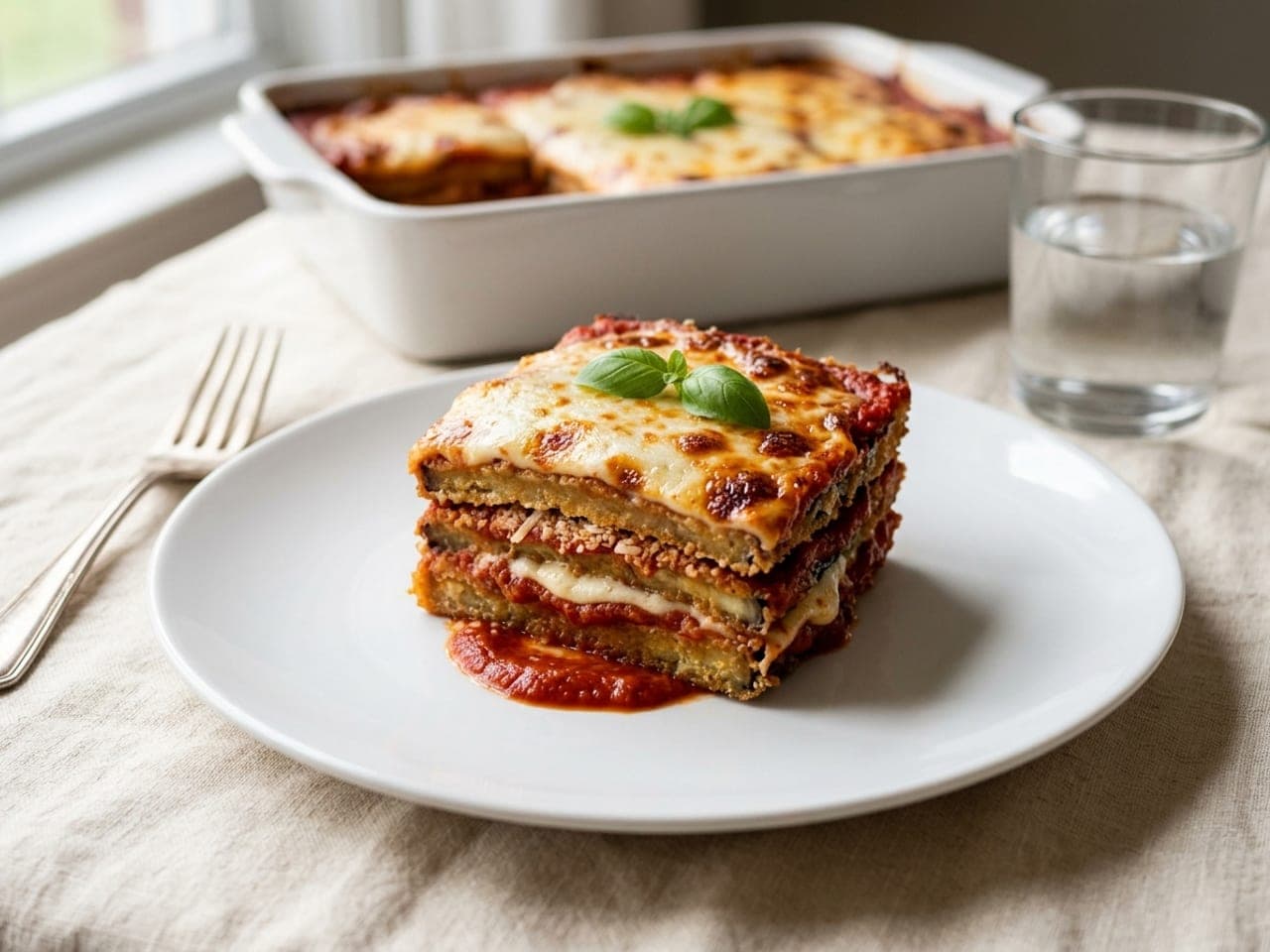
Eggplant parmesan (eggplant parm, or eggplant parmigiana) is the Italian-American casserole of breaded, fried eggplant layered with a thick tomato sauce, mozzarella and Parmigiano, then baked until it bubbles. This recipe is the classic, done right and explained: why salting eggplant is about air, not bitterness; why eggplant parm goes soggy and the fix for each cause; a baked eggplant parmesan variation for no-fry nights; and the disputed history of the name, traced through the Neapolitan cookbooks that printed the dish first.
Ingredients
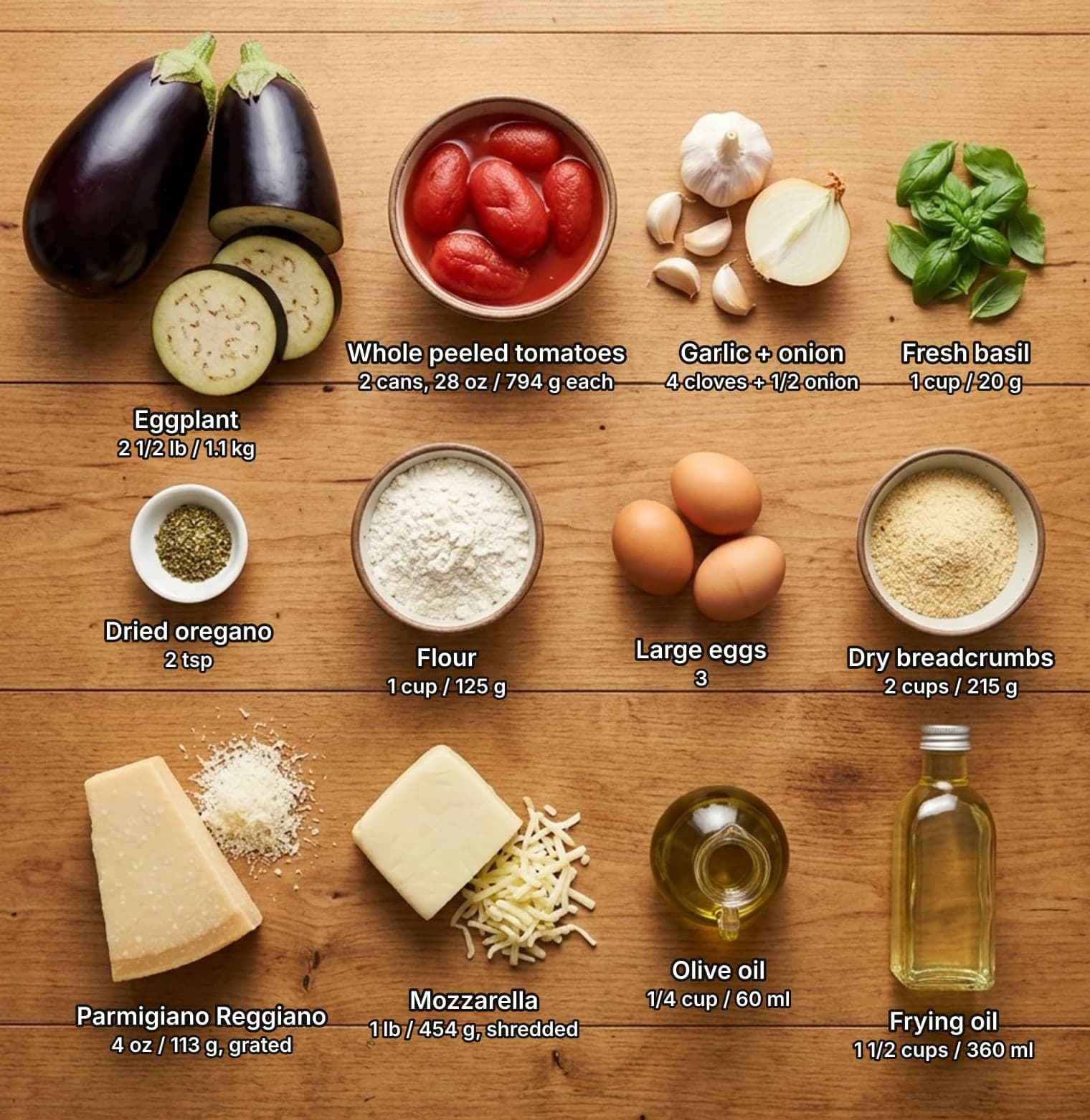
- eggplant: firm, glossy and heavy for its size, with a green cap, bought within 2 to 3 days of cooking. Italian eggplants are denser and less seedy; globe eggplants work (see step 2)2 1/2 lb (1.1 kg), about 2 large globe or 4 to 5 Italian
- Diamond Crystal kosher salt (with Morton kosher or table salt, use about half), divided: 1 tsp for purging the slices, 1/2 tsp for the sauce, 1/4 tsp for the egg, pinches over the fried slicesabout 2 tsp in total
- whole peeled tomatoes in juice (San Marzano type if you like; no-salt-added cans cut about 200 mg sodium per serving)2 cans, 28 oz (794 g) each
- extra-virgin olive oil, for the sauce1/4 cup (60 ml)
- garlic, grated or very finely chopped4 cloves
- yellow onion, peeled, root end left on so it holds together (simmered in the sauce, then discarded)1/2 medium
- dried oregano, divided: 1 tsp for the sauce, 1 tsp for the crumbs2 tsp
- red pepper flakes (optional)1/2 tsp
- fresh basil leaves, divided: some for the sauce, some between the layers, a few to finish1 cup (240 ml) loosely packed, about 3/4 oz (20 g)
- all-purpose flour (contains wheat/gluten; a gluten-free 1:1 blend works)1 cup (125 g)
- large eggs, beaten with 1 tbsp water and 1/4 tsp of the salt (contains egg)3
- plain dry breadcrumbs (not seasoned Italian crumbs, which add salt and garlic you cannot control), or panko for a lighter, crisper crust (contains wheat/gluten; gluten-free panko works)2 cups (7 1/2 oz / 215 g), or 3 cups (6 oz / 170 g) panko
- Parmigiano Reggiano, finely grated on a microplane, divided: 1 oz (28 g) for the crumbs, 2 oz (57 g) between the layers, 1 oz (28 g) to finish. Contains milk; PDO Parmigiano is made with calf rennet, so for a vegetarian dish use a hard cheese labeled vegetarian (see the allergens note)4 oz (113 g), about 2 cups (480 ml) loosely packed
- low-moisture whole-milk mozzarella, shredded from a block (pre-shredded bags carry anti-caking starch and melt less smoothly). Contains milk; look for a vegetarian mark if cooking for vegetarians1 lb (454 g), about 4 cups (950 ml) shredded
- neutral oil with a high smoke point for shallow-frying: canola, sunflower, vegetable, or peanut (peanut is an allergen; label it if you use it)1 1/2 cups (360 ml), plus more to top up
What is eggplant parmesan?
Eggplant parmesan is a baked casserole of fried eggplant slices layered with tomato sauce and cheese. In the United States it goes by eggplant parm or eggplant parmigiana, and the standard version is Italian-American: the slices are breaded in flour, egg and breadcrumbs, fried, and layered with a long-cooked tomato sauce, low-moisture mozzarella and grated Parmesan. In Italy the same dish is parmigiana di melanzane (the usual Sicilian word order) or melanzane alla parmigiana (the traditional Neapolitan one), and the slices are not breadcrumbed: they are fried bare or in a flour-and-egg coat.
This page cooks the Italian-American version, which is what most people searching for an eggplant parmesan recipe want, and gives the Italian parmigiana its own section as the counterpoint. The method is built around three things the classic recipe usually gets vague about: purging the air from the eggplant so it fries dense instead of greasy, cooking the sauce thick enough that the crust survives the oven, and resting the dish long enough to cut clean portions.
One 9x13-inch (23x33 cm) dish makes 8 generous servings. In Italy parmigiana is a secondo, a main course, or a piatto unico, a dish that is the whole meal; the side of spaghetti that often comes with it in the US is an Italian-American restaurant habit. If you want pasta the same night, serve it as its own course: our spaghetti carbonara, cacio e pepe, pasta alla gricia and ragù alla bolognese all live on the same Italian shelf.
How to make Eggplant Parmesan
- Start the sauce and cook it thick. Crush the tomatoes by hand in a bowl, or pulse them briefly in a blender, and keep all the juice. Warm the olive oil in a wide pot over medium heat, add the garlic, 1 tsp of the oregano and the pepper flakes, and stir for 30 seconds, just until the garlic smells sweet and has not colored. Add the tomatoes, the half onion and a few basil leaves, bring to a lively simmer, then lower the heat and cook uncovered for 45 to 60 minutes, stirring now and then, until the sauce has reduced to about 3 1/2 cups (830 ml) and is as thick as thin applesauce: a spoon drawn across the bottom of the pot should leave a trail that closes slowly. Fish out the onion, season with 1/2 tsp salt, and stir in a small handful of torn basil. Why: a thin, watery sauce is the number one reason eggplant parmesan goes soggy. Free water in the sauce migrates into the breadcrumb crust during baking and resting, and the casserole never sets. Reducing drives that water off and concentrates the tomato solids that hold the rest. The onion, simmered whole and removed, rounds off the acidity without leaving pieces in the layers.
- Slice the eggplant 3/8 inch (1 cm) thick and peel it in stripes. While the sauce simmers, trim the eggplant ends and peel off the skin in lengthwise stripes, leaving about half of it on (Italian eggplants, thinner-skinned, can stay unpeeled). Cut globe eggplants into rounds 3/8 inch (1 cm) thick; cut Italian eggplants into rounds, or into lengthwise planks of the same thickness if you prefer fewer, larger pieces. You should have about 36 rounds from globe eggplants (Italian eggplants give more, smaller rounds, or about 18 to 20 planks), enough for three layers in a 9x13-inch (23x33 cm) dish. Why: the stripes of skin act like a frame that keeps each slice from falling apart after frying, while fully unpeeled slices from a large, old fruit can stay chewy. At 3/8 inch (1 cm) the slice is thick enough to stay meaty under the sauce and thin enough to cook through in the pan, which matters because undercooked eggplant tastes tannic and astringent and the oven will not fix it: the bake only reheats and melts. Rounds also carry a ring of the denser flesh from just under the skin, which drinks less oil than the airy core.
- Purge the air: salt lightly, microwave, then press. Sprinkle the slices lightly on both sides with 1 tsp of the kosher salt. Line a large microwave-safe plate with two layers of plain paper towels, lay down a single layer of slices, cover with more towels and repeat for two or three layers, then set a second plate on top. Microwave on high for about 3 minutes, until the slices are limp and compress easily when you push them. Lift the top plate away from you, since the steam and plates are hot; repeat with the rest. Then press each slice firmly between dry paper towels, flattening it. No microwave: salt the slices on a rack for 30 to 45 minutes, then press them hard between towels. Why: eggplant is about 42% air by volume, more in the core, and that open, spongy tissue is what soaks up frying oil. Salt and heat collapse the cells so that pressing can squeeze the air out; salting alone gets there too, but it takes the better part of an hour. Pressed slices fry into dense, creamy, meaty pieces instead of oil sponges. This step is not about bitterness (see the salting section).
- Bread the slices and let the coating set. Set up three shallow dishes: the flour in the first; the eggs beaten with the water and 1/4 tsp salt in the second; and in the third, the breadcrumbs mixed with 1 oz (28 g) of the Parmigiano and the remaining 1 tsp oregano. Working with one dry hand and one wet hand, dredge each slice in flour and tap off the excess, dip it in egg and let the extra drip back, then lay it in the crumbs and press so they stick on both sides. Set the breaded slices on a wire rack in a single layer and let them rest for 10 minutes while the oil heats. Why: the flour gives the wet eggplant a dry, even surface for the egg to cling to; the egg is the glue for the crumbs; and the short rest lets the coating hydrate and bind, so it does not slide off in the pan. The Parmigiano in the crumbs browns and seasons the crust itself, which is the first of three places the cheese goes.
- Shallow-fry to deep golden and blot at once. Heat the oven to 375°F (190°C). Pour oil into a 12-inch (30 cm) skillet to a depth of about 1/4 inch (6 mm) and heat it over medium-high to 350°F to 365°F (175°C to 185°C); without a thermometer, a pinch of crumbs should sizzle briskly at once. Fry five or six slices at a time, 2 to 2 1/2 minutes on the first side and 1 1/2 to 2 minutes on the second, until deep golden, letting the oil come back to 350°F (175°C) between batches, skimming out loose crumbs before they burn, and topping it up as needed. Move each slice to a wire rack set over a sheet pan, blot both sides with paper towels straight away and give it a pinch of salt; never pile hot slices, or the bottoms steam soft. Why: hotter oil is not less greasy. In J. Kenji López-Alt’s side-by-side test at Serious Eats, slices fried at 375°F (190°C) took up about 14% more oil than slices fried at 300°F (150°C), taken to the same color, and most absorption happens in the seconds after food leaves the oil, as the crust cools and pulls surface oil in. So the levers you control are time in the pan and blotting the moment it comes out. Salt now, while the surface is hot, sticks and reads as flavor.
- Layer it like shutter slats. Spread 1/2 cup (120 ml) of the sauce over the bottom of a 9x13-inch (23x33 cm) baking dish. Lay a third of the eggplant over it, overlapping the slices slightly like the slats of a shutter. Spoon 3/4 cup (180 ml) of sauce over the slices, then scatter a third of the mozzarella, a third of the layering Parmigiano (2 oz / 57 g in total) and a few basil leaves. Repeat once. For the top layer, spoon 1 cup (240 ml) of sauce down the middle of each slice rather than over every inch, leaving the crisp edges bare, then finish with the last of the mozzarella and layering Parmigiano. Set the dish on a rimmed baking sheet to catch drips. You should have about 1/2 cup (120 ml) of sauce left: keep it for serving. Why: the sauce under the first layer stops it sticking and scorching; measured sauce per layer keeps the dish juicy without flooding the crumbs; and edges left out of the sauce stay crunchy, so every portion has both textures. Basil goes between the layers, not on top, where it would burn.
- Bake covered, then uncovered until bubbling and browned. Cover the dish with foil and bake for 20 minutes, then remove the foil and bake 20 to 25 minutes more, until the sauce bubbles at the edges and the cheese is melted, blistered and spotted light brown. For deeper color, and only if your dish is broiler-safe (metal, enameled cast iron or broiler-rated ceramic, never glass bakeware), finish under the broiler (the overhead grill) for 1 to 2 minutes, watching the whole time. For a firm check, an instant-read thermometer in the center should read 165°F (74°C). That is the USDA reheating temperature, and it applies whenever the sauce or slices were made ahead and chilled; with same-day components it is simply a good target for a fully molten middle. Why: under foil the casserole heats through without the cheese drying into a skin; with the foil off, the surface dries enough to brown. Whole-milk mozzarella releases a little free fat as it melts, and that fat keeps the surface from skinning over, which is why it blisters and browns while part-skim cheese tends to scorch. Research on melted mozzarella found that covered cheese melted but did not brown, which is exactly why the foil comes off halfway.
- Rest 15 to 20 minutes, then finish with Parmigiano. Let the dish rest on a rack for 15 to 20 minutes before cutting. It will look wet at first; by the end of the rest most of the free juice will have been drawn back in. Scatter the last 1 oz (28 g) of Parmigiano and a few torn basil leaves over the top, then cut into 8 portions, each about 3 1/4 by 4 1/2 inches (8 by 11 cm), with a thin, sharp knife and lift them out with a flat spatula. Why: as Daniel Gritzer notes at Serious Eats, the eggplant reabsorbs the extra liquid during the rest, and at the same time the molten mozzarella firms as it cools, so the layers stop sliding and the portions hold their shape. Parmigiano added after baking, in the style of Brooklyn’s Di Fara pizzeria that Kenji borrowed, stays sharp and nutty instead of melting into the rest; with the crumb and layer cheese it is the third place it appears. In Italy parmigiana is often eaten warm rather than hot, even at room temperature; the 2-hour room-temperature limit still applies.
Safety & hygiene Important
- Shallow-frying: dry slices, a lid within reach. Pat the slices dry before breading: water hitting 350°F (175°C) oil flashes to steam and throws fat. Use an oil with a high smoke point (USDA FSIS lists canola around 435°F (224°C) and peanut, safflower and soybean around 450°F (232°C)), keep the oil about 1/4 inch (6 mm) deep in a 12-inch (30 cm) skillet with room to spare, lower the slices in away from you, and never leave the pan. If the oil smokes or smells acrid, turn off the burner and let it cool down. Keep a metal lid or a baking sheet beside the pan, and a kitchen fire extinguisher nearby if you have one: if the oil catches fire, slide the metal lid over it and turn off the heat, leave it covered until completely cool, and never use water or carry the pan. If the fire does not go out, get out and call the fire service. Let the used oil cool fully before straining or discarding it.
- Leftovers: the US and UK windows differ. Refrigerate leftovers within 2 hours of baking (1 hour if the room is above 90°F (32°C)), in shallow containers so they cool quickly. US: USDA FSIS advises eating leftovers within 3 to 4 days and reheating them to 165°F (74°C) in the center; frozen, they stay safe indefinitely at 0°F (-18°C) and are best within 3 to 4 months. Some recipe sites say up to 5 days in the fridge; that is longer than USDA advises. UK: the Food Standards Agency says to eat leftovers within 2 days or freeze them, to reheat only once, and to reheat until steaming hot all the way through. A frozen casserole in a metal or foil pan can go straight into the oven without thawing; it just takes longer (see the make-ahead FAQ). Glass and ceramic dishes should thaw in the fridge first. If you made the sauce or fried slices ahead, our rule is to count the leftover days from the day you cooked them, not from the bake. UK readers: under the FSA’s reheat-once advice, a dish built from chilled, made-ahead components has had its one reheat when it bakes, so eat it fresh or freeze portions straight after baking, but do not reheat those leftovers again.
- Make-ahead and buffet serving. An assembled dish made ahead should be covered, kept in the fridge at 40°F (4°C) or below (UK: 5°C (41°F) or below), and baked within a day. Because it goes into the oven cold, bake it until the center reaches 165°F (74°C), the USDA reheating temperature, not just until the top bubbles. On a buffet, hold it at 140°F (60°C) or above (UK: 63°C (145°F) or above), or serve it and put any leftovers away within 2 hours; putting it back in the oven does not reset that clock.
- Allergens, raw egg and flour, vegetarian guests. This dish contains milk (mozzarella and Parmigiano), egg (the breading) and wheat/gluten (flour and breadcrumbs), and peanut if you fry in peanut oil. It is not strictly vegetarian as written: Parmigiano Reggiano PDO is made, by its specification, with calf rennet, and some mozzarella is made with animal rennet too. To make it vegetarian, use a hard cheese labeled vegetarian (in the US, ‘vegetarian Parmesan’; in the UK and EU, where the name Parmesan is protected, ‘Italian-style hard cheese’) and a mozzarella with a vegetarian mark. On US labels ‘enzymes’ alone does not tell you which kind, so check with the maker. The eggs mean it is not vegan. For gluten-free, use a 1:1 gluten-free flour and gluten-free panko, and fry in fresh oil that has not cooked anything breaded with wheat. Raw egg and raw flour are not ready-to-eat foods: do not taste the breading. Keep one hand for the egg dish, lower the breaded slices into the oil by hand or with one pair of tongs, and lift the fried slices out with a second, clean pair or a slotted spoon. Throw away the leftover flour, egg and crumbs, and wash your hands with soap for 20 seconds before handling the fried slices. Check the breadcrumb or panko label too: many contain soy or milk, or carry a sesame warning.
- Salt is the number to watch. By our component math a serving carries about 1,150 mg of sodium: about half of the 2,300 mg US Daily Value and, as salt, about 2.9 g of the UK’s 6 g daily maximum for adults. The biggest sources are the mozzarella (about 400 mg per serving), the canned tomatoes (about 230 mg), the breadcrumbs (about 130 mg) and the Parmigiano (about 170 mg); the added salt is about 190 mg. The easy levers: no-salt-added canned tomatoes (about 200 mg less per serving), panko instead of seasoned or plain dry crumbs, and tasting the sauce before you salt it. Eggplant is not a practical toxin risk: its bitter compounds (solasonine and solamargine, not the potato’s solanine) are usually reported in market fruit at or below the 200 mg/kg yardstick set for potatoes, and people eat it safely worldwide. Cooking does not destroy them, so the lever is the one in the salting section: buy firm, glossy, small-seeded fruit, because levels climb as it over-ripens.
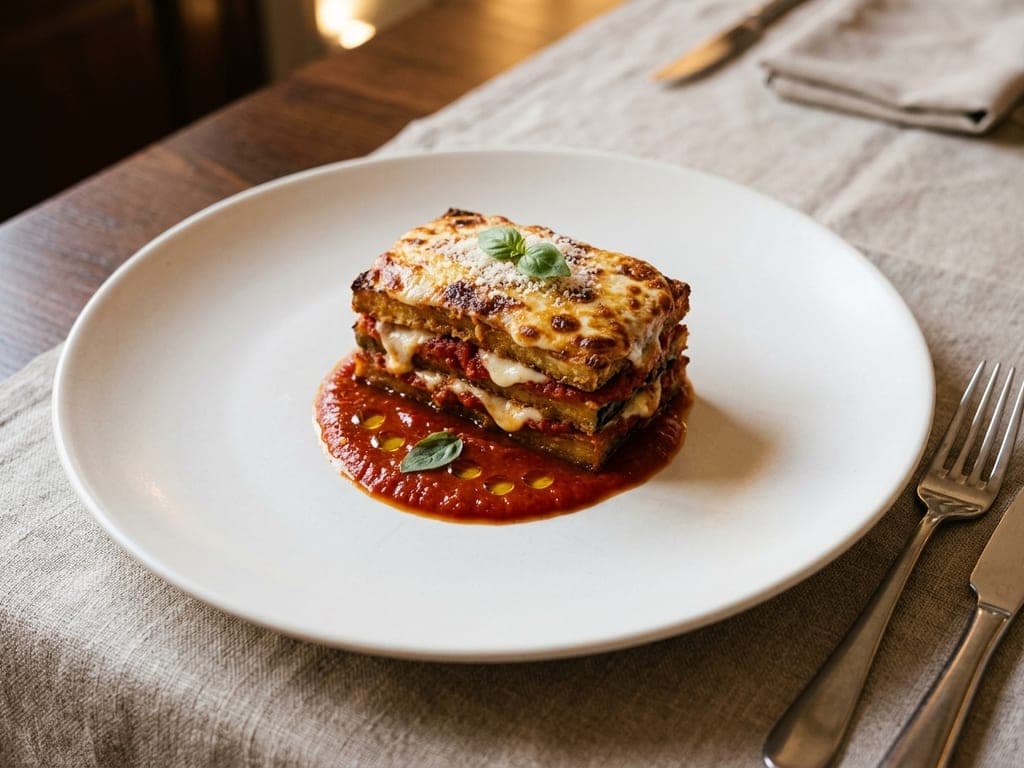
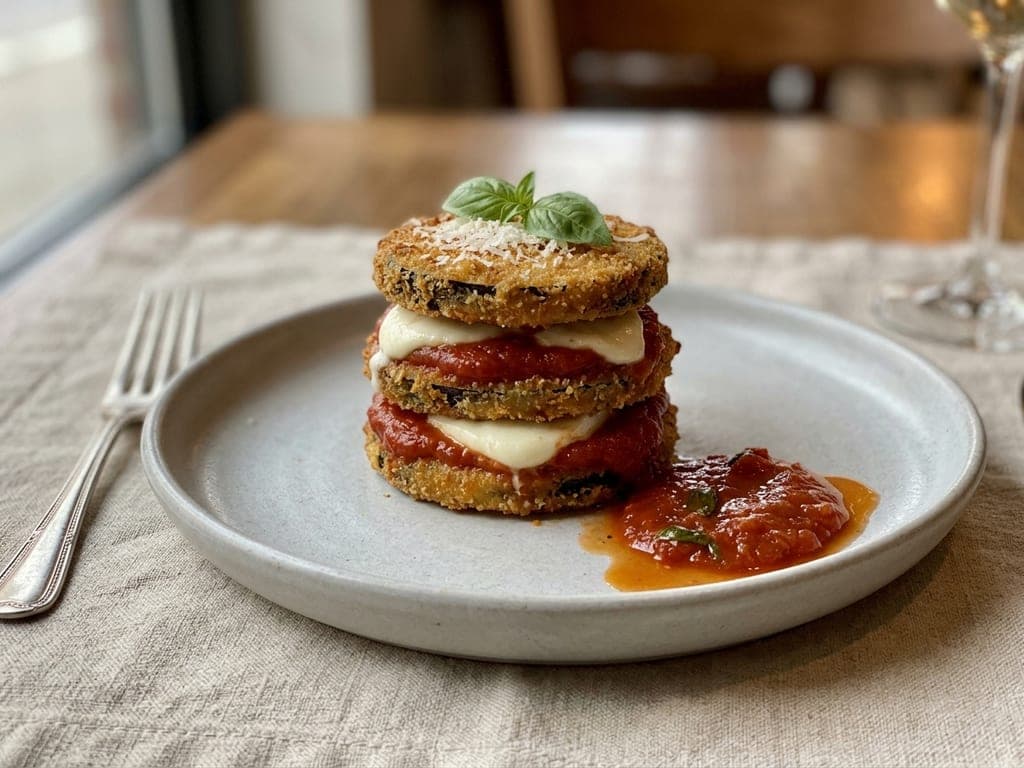
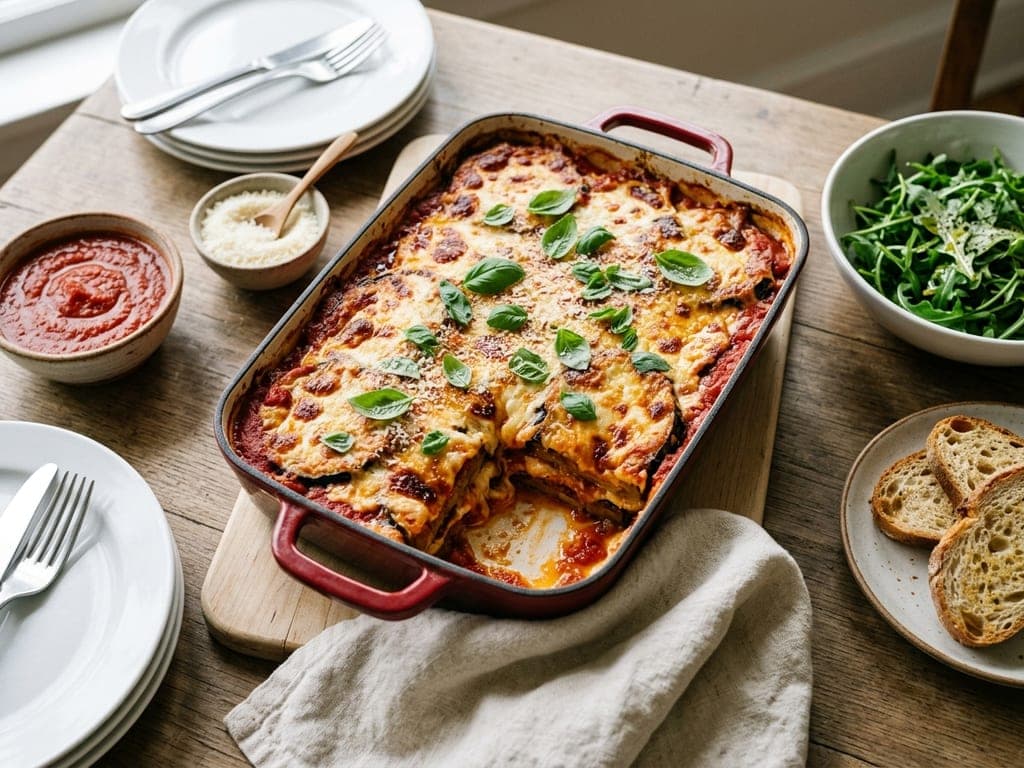
3 ways to plate it
Why you salt eggplant: air, not bitterness
Most recipes tell you to salt eggplant ‘to draw out the bitterness’. That is not what salt does. Salt suppresses bitterness on the tongue: the classic study, Breslin and Beauchamp’s ‘Salt enhances flavour by suppressing bitterness’ in Nature (1997), showed that sodium selectively damps bitter taste more than sweet, so salted food tastes sweeter and rounder. It does not pull the bitter compounds out of the fruit. Harold McGee has made the same point: the water that salt draws out almost certainly would not carry away even a majority of them. The writer Nicholas Clee tested it directly, roasting half an eggplant salted in advance and half salted just before cooking, and found they tasted the same.
What salting really does is structural. Eggplant is remarkably porous: X-ray CT scans at KU Leuven measured purple globe eggplant at about 42% air by volume, against about 23% for turnip, 20% for apple and 4% for pear, with the core reaching 45% to 65%. That open, air-filled tissue is why raw eggplant drinks oil. In a test at Serious Eats, a 24-gram slice of raw eggplant left in oil for 20 minutes weighed 46 grams, having absorbed 92% of its own weight. Salt, or heat, collapses the cells, and once they have collapsed you can press the air out. The water that leaves is modest: America’s Test Kitchen salts 2 pounds (900 g) of slices and collects about 2 tablespoons of liquid, around 3% of the weight. The collapse matters more than the drip.
That is why this recipe uses Kenji López-Alt’s microwave method: a light salting for seasoning, 3 minutes of microwave heat to collapse the slices, then a firm press. It does in minutes what salt alone does in 30 to 45, and it does it evenly.
The real fix for bitterness happens at the store. The bitter compounds in eggplant are glycoalkaloids called solasonine and solamargine, and they climb as the fruit over-matures: in one study, fully ripe, big-seeded fruit carried 3.5 to 4 times as much solasonine as fruit picked at the normal market stage. Buy firm, glossy eggplants that feel heavy for their size, with small seeds; the ‘male or female’ blossom-end test is a myth, since the fruit has no sex. Then do not leave them in the fridge for a week: eggplant is damaged by cold below about 50°F (10°C), and at 41°F (5°C), a typical fridge, UC Davis postharvest research finds pitting and browning of the seeds and pulp within 6 to 8 days. Buy them within 2 to 3 days of cooking and keep them in the warmest part of the fridge, or on the counter for a day or two. Some of the brown seeds cooks blame on ‘old’ eggplant come from the fridge.
Why eggplant parmesan gets soggy, and the fix for each cause
A soggy eggplant parm almost always has one of five causes. In rough order of how often they are to blame:
1. The sauce is too thin. This is the big one. Daniel Gritzer of Serious Eats puts it plainly: ‘The most important thing is that the tomato sauce is not too thin and watery.’ Loose sauce keeps soaking into the crumbs through the bake and the rest. Fix: reduce it to the thickness of thin applesauce before layering (step 1), and measure it per layer instead of flooding the dish.
2. The eggplant was not purged or not cooked through. Unpressed slices are still sponges; they steam in the dish and weep. Undercooked slices never turn creamy, because the oven only reheats them. Fix: microwave and press (step 3), and fry until the slices are tender all the way through.
3. The mozzarella is wet. US rules put fresh mozzarella at 52% to 60% water and low-moisture mozzarella at 45% to 52%, and in a breaded casserole that extra water ends up in the crust. Fix: low-moisture whole-milk mozzarella shredded from a block for this breaded style. Fresh mozzarella belongs in the unbreaded Italian version, torn and patted dry.
4. It was cut too soon. Straight from the oven the dish looks wet, and cut then, it slumps. Fix: rest it 15 to 20 minutes; the eggplant reabsorbs the juices and the cheese firms.
5. Every inch of crust is under sauce. Fix: spoon the top layer of sauce in a stripe down the middle of each slice so the edges stay crisp (step 6).
And one myth to drop: frying hotter does not make the slices less greasy. In Kenji López-Alt’s test, slices fried at 375°F (190°C) absorbed about 14% more oil than slices fried at 300°F (150°C), taken to the same color. A 2023 study on fried eggplant rings found no significant difference between 320°F and 355°F (160°C and 180°C), but found that frying time mattered a lot: oil content rose from about 32% to 47% between 2 and 8 minutes. Hot-fried food does taste less greasy, because greasiness is oil plus sogginess. So: moderate oil at 350°F to 365°F (175°C to 185°C), fry only to deep golden, and blot the second the slices come out.
Where the name comes from, and who printed it first
The name is genuinely disputed, and there are three stories. Standard Italian dictionaries (DELIN, Zingarelli) derive ‘parmigiana’ from Parma, the city or its cheese, and in 18th-century Naples ‘alla parmegiana’ was a general cooking label for dishes finished with parmesan and butter: Vincenzo Corrado’s Il cuoco galante (Naples, 1773) uses it for everything from squid to suckling pig. Food historians including Massimo Montanari favor an older root: the Latin parma, a round shield, by way of the medieval layered pie called torta parmigiana, which appears in early 14th-century Italian cookbooks such as the Liber de coquina. The historical dictionary of Italian gastronomy (VoSLIG) judges that shield reading the better documented of the two. The popular Sicilian story, that parmiciana was a word for the slatted wooden shutters the overlapping slices resemble, comes from the linguist Fabio Ruggiano (2015), not from a ruling by the Accademia della Crusca; the pages that say the Crusca confirmed it cite no Crusca text. And here is the twist: the 19th-century Sicilian dictionary behind that story, Mortillaro’s (3rd edition, Palermo, 1876), defines parmiciana as a kind of shutter ‘so called perhaps because it is made that way everywhere in the Duchy of Parma’. Even the shutter leads back to Parma. None of the three is settled.
Every printed recipe before Artusi’s comes from Naples. Corrado’s 1773 book has no eggplant parmigiana of its own: it layers fried, floured squash with parmesan and butter under an egg-yolk sauce, sets it in the oven, and says eggplant, once blanched, can be served ‘in all the ways’ given for squash (and for parsnips and tomatoes). But his later Del cibo pitagorico (Naples, 1781) has an eggplant recipe called ‘All’Italiana’ that is recognizably the dish: slices salted for a few hours, squeezed, floured and fried, then ‘Fritte si tramezzano nel piatto con cacio grattato, pepe, e basilico; e si servono con Purè di Pomidoro’ (layered in the dish with grated cheese, pepper and basil, and served with tomato purée). Later in the same book, his entry on basil says it is layered into fried squash and eggplant ‘quando incaciate alla parmegiana si servono’, when served cheesed alla parmegiana. That is fried eggplant, cheese, basil and tomato in print in 1781, more than half a century before the recipe usually cited as the first.
That usual first is Ippolito Cavalcanti’s ‘Molignane a la parmisciana’, written in Neapolitan dialect in his Cucina teorico-pratica (1837; the text as printed in the 1839 edition). He salts the slices under the weight of a mortar ‘pe nce fa scola chell’acqua amara’, to drain off the bitter water, fries them, and layers them in a pan with grated cheese, basil and stew broth, or tomato sauce: in 1839 tomato is still an option. Pellegrino Artusi’s 1891 ‘Tortino di petonciani’ is the dish as we know it, fried floured slices layered with parmigiano and tomato sauce, but he never called it parmigiana. In the same book he recalled that eggplants had been scorned in Florence ‘come cibo da ebrei’, as Jewish food; his first edition says that was ‘trent’anni’ (thirty years) earlier, and the ‘forty years’ quoted online is from later editions.
A few corrections to the story as it usually circulates online: Il cuoco galante was published in 1773, not 1733 (Corrado was born in 1736); the Corrado ‘eggplant with butter, cinnamon and egg-yolk sauce’ repeated on many pages is two of his squash recipes merged into one; and no early recipe we have read uses mozzarella. The cheese is parmesan, or simply ‘cheese’, or, in Cavalcanti’s 1847 edition, parmesan ‘or whatever cheese you can get’. By 1903 an English guidebook, The Gourmet’s Guide to Europe, was praising ‘an excellent Neapolitan method of treating egg-plants, fried in oil, cut in slices, sandwiched with cheese and tomatoes, and then baked.’
Parmigiana di melanzane: the Italian way, no crumb coat
Italian parmigiana does not coat the slices in breadcrumbs. The regional versions differ in how the slice is fried and which cheese goes in. In Naples and Campania the slices are often dipped in flour and egg before frying (indorate e fritte) and layered with fior di latte or mozzarella and Parmigiano or pecorino. In Sicily the slices are usually fried bare and layered with caciocavallo or pecorino, sometimes with hard-boiled egg; Calabrian versions can add hard-boiled egg and cooked ham. Slices are thinner, often 1/8 to 1/4 inch (3 to 6 mm), the sauce is a quick, thick passata sugo used sparingly, and the dish is shallower. It is juicier and softer all the way through, and in Italy it is as likely to be eaten tiepida, lukewarm, as hot.
To cook it the Neapolitan way from this recipe: slice 1/4 inch (6 mm) thick, skip the breadcrumbs, dip the purged slices in flour then egg and fry them in olive oil; layer them with 1 1/4 to 1 1/2 cups (300 to 360 ml) of thick sauce in a smaller, 6-cup (1.4 liter) dish with torn, well-drained fresh mozzarella, Parmigiano and basil; and bake at 400°F (200°C) for 25 to 30 minutes. Serve it after a 10-minute rest, or at room temperature within the 2-hour window.
The American breadcrumb coat probably came from that Campanian flour-and-egg dip, carried by immigrants and made heartier, but that is a likely explanation rather than a documented one. Early US Italian cookbooks do not use the name at all: Maria Gentile’s The Italian Cook Book (New York, 1919) gives ‘Egg-plants in the oven (Melanzane al forno)’, which is Artusi’s tortino translated almost word for word, and the book’s eggplant recipes open by calling them ‘mad-apples’. ‘Eggplant parmigiana’ was in steady American print by the 1950s.
Fried, baked or air-fried: the no-fry eggplant parmesan
Frying gives the best crust and the most flavor, and it costs oil. Every no-fry method has to replace hot-oil contact some other way, and the good ones do it with preheated, oiled pans or pre-toasted crumbs.
Baked eggplant parmesan: heat the oven to 425°F (220°C) with two rimmed baking sheets inside. Bread the purged slices as in step 4, then carefully pour 3 tbsp of the neutral frying oil (not olive oil, which smokes at about 410°F (210°C)) onto each hot sheet and, with dry oven mitts, tilt to coat, and lay the slices on it; the crumbs sizzle on contact, the way they would in a pan. Bake about 30 minutes, flipping at 20, until deep golden on both sides (this is America’s Test Kitchen’s method). Then assemble and bake as in steps 6 to 8. It is less crisp than fried, and oven-crisped crumbs soften faster under sauce, which is one more reason to leave the top edges bare.
Air fryer: work in batches of 5 or 6 slices at 350°F (175°C) for 15 to 18 minutes, flipping halfway. Toast the panko with a spoonful of oil first (3 to 5 minutes in the microwave, stirring every minute) because raw crumbs brown unevenly in an air fryer. It is best for a small dish or individual stacks.
What frying really costs, by our component math: the fried version comes to about 607 kcal per serving. The total is 4,857 kcal for the dish: eggplant 282, flour that sticks (about 60 g) 218, eggs 214, breadcrumbs that stick (about 140 g) 553, Parmigiano 443, low-moisture whole-milk mozzarella 1,444, tomatoes 254, the olive oil in the sauce 477, and an estimated 110 g of frying oil absorbed, 972. Divided by 8, that is 607 kcal, with about 42 g fat and 26 g protein per serving. The absorbed oil is the least certain number: every 40 g more or less moves a serving by about 45 kcal. The oven method uses about 6 tbsp (81 g) of oil in total, so it saves roughly 30 to 60 kcal per serving, an estimate rather than a measurement.
Eggplant parm vs chicken parm
Eggplant parm is the ancestor; chicken parm is its American descendant. Veal and chicken ‘alla parmegiana’ already appear in Corrado’s 1773 book, finished with parmesan and butter; what was born in the United States is the breaded veal or chicken cutlet under tomato sauce and mozzarella. The usual explanation is that Italian immigrants crossed the parmigiana with the cotoletta, a breaded veal cutlet served in Italy without sauce or cheese. Veal came first. A 1939 New York restaurant guide reportedly prints a veal parmigiana recipe from Pietro’s on East 45th Street, though that version is reportedly baked with parmesan and butter, with no tomato. The earliest chicken parmigiana recipe usually cited is from 1953 (in the New York Herald Tribune), and the dish was in The New York Times by 1962. Bamonte’s in Brooklyn tells a story of inventing it in 1945 by swapping chicken for eggplant; it is a good story, but unproven.
The two dishes are cooked differently. Chicken parm is usually a single breaded cutlet, fried, topped with sauce and cheese and baked or broiled, rather than a layered casserole, and the chicken has a safety endpoint: 165°F (74°C) in the thickest part, the USDA temperature for poultry. Eggplant has no such number of its own (the 165°F (74°C) in step 7 is for reheating made-ahead parts); it is done when it is tender and creamy right through. Eggplant parm takes longer to make, because of the purging, the sauce and the layering, and it makes more servings from one dish.
The same family gave New York the parm hero. There is no documented first, but in one oral history, from Paul Punzone speaking to Bon Appétit in 2023, his father Charlie, who took over the family’s Brooklyn grocery in the 1950s, began selling eggplant parm heroes, the eggplant chopped to fit the bread, for customers eating meatless on Fridays. A cold slice of tomorrow’s leftovers, reheated to 165°F (74°C) and tucked into a toasted roll, is still one of the best reasons to make a full 9x13-inch (23x33 cm) dish.
Questions, answered
Do you have to salt eggplant before making eggplant parmesan?
Not for bitterness, but it helps the texture. Salt masks bitterness on the tongue; it does not pull the bitter compounds out, and fresh, firm eggplant is rarely bitter anyway. What salting (or salting plus a few minutes in the microwave) really does is collapse the eggplant’s air-filled cells so you can press the air out. Eggplant is about 42% air, and pressed slices drink far less frying oil. If you roast rather than fry, you can skip it.
Should you peel eggplant for eggplant parmesan?
Peel it in stripes, leaving about half the skin on. The skin helps each slice hold together after frying, while fully peeled slices can fall apart. Peel completely only if the fruit is large, dull or old, when the skin gets tough. Italian eggplants, which are smaller and thinner-skinned, can be left unpeeled.
Is it better to fry or bake eggplant for eggplant parmesan?
Frying gives the crispest crust and the best flavor. Baking the breaded slices on preheated, oiled sheet pans at 425°F (220°C) comes close, uses less oil (about 30 to 60 kcal less per serving by our estimate) and is less messy. An air fryer at 350°F (175°C) works for small batches if you pre-toast the crumbs. Whichever you choose, purge the slices first and cook them fully tender before layering.
Why is my eggplant parmesan soggy?
Usually a thin sauce. Cook it down to the thickness of thin applesauce, about 3 1/2 cups (830 ml) from two 28-oz (794 g) cans, and measure it per layer. The other causes, in order: eggplant not purged or not cooked through, watery fresh mozzarella in a breaded version, cutting before a 15 to 20 minute rest, and sauce over every inch of the top crust.
What is the difference between Italian and American eggplant parmesan?
Italian parmigiana di melanzane does not bread the slices in crumbs: the slices are fried bare (Sicily) or dipped in flour and egg (Naples), layered thinly with a quick, thick tomato sauce, fresh mozzarella or caciocavallo, Parmigiano or pecorino and basil, and often eaten warm or at room temperature. Italian-American eggplant parmesan breads the slices in flour, egg and breadcrumbs, uses low-moisture mozzarella and a longer-cooked sauce, and is built as a deep casserole.
Should I use fresh or low-moisture mozzarella?
Match it to the style. For breaded Italian-American eggplant parm, use low-moisture whole-milk mozzarella shredded from a block: it carries less water into the crust (45% to 52% water versus 52% to 60% for fresh) and whole milk blisters and browns instead of scorching. Fresh mozzarella suits the unbreaded Italian version; tear it and pat it dry, and keep the sauce thick.
Can you make eggplant parmesan ahead or freeze it?
Yes. Make the sauce up to 3 days ahead, and fry the slices up to a day ahead and refrigerate them on a rack, covered. You can also assemble the whole dish up to a day ahead, cover and refrigerate it, then bake it at 375°F (190°C), covered for the first 40 minutes, until the center reaches 165°F (74°C): often 60 to 75 minutes from cold, so probe rather than guess. To freeze, wrap the baked or unbaked dish tightly and use it within 3 to 4 months for best quality. To bake from frozen, freeze it in a metal or disposable foil pan: glass and ceramic dishes can shatter going straight from the freezer into a hot oven (Pyrex says to thaw its dishes completely first). In a glass or ceramic dish, thaw it in the fridge for 24 to 48 hours, then bake it as you would from the fridge, until the center reaches 165°F (74°C). From frozen in metal, bake at 375°F (190°C), covered for the first hour, and allow roughly 1 1/2 to 2 hours for a full 9x13-inch (23x33 cm) pan; probe rather than guess. The crust softens either way. One option we have not tested head to head: freeze the fried slices instead of the whole dish. Cool them on a rack, freeze them flat on a sheet within 2 hours of frying, bag them, and use them within 3 to 4 months. Thaw them in the fridge or layer them frozen, then bake until the center reaches 165°F (74°C), which takes longer from frozen slices.
How long should eggplant parmesan rest before cutting?
15 to 20 minutes for a deep, breaded 9x13-inch (23x33 cm) dish, about 10 for a shallow Italian one. The eggplant reabsorbs the free juices and the mozzarella firms as it cools, so the layers hold together when you cut.
Is eggplant parmesan vegetarian?
It is meatless, but not strictly vegetarian with authentic Parmigiano Reggiano, which by its PDO specification is made with calf rennet; some mozzarella uses animal rennet too. To make it vegetarian, use a hard cheese labeled vegetarian (in the US, ‘vegetarian Parmesan’; in the UK and EU, where the name Parmesan is protected, ‘Italian-style hard cheese’) and a mozzarella with a vegetarian mark; on US labels ‘enzymes’ alone does not say which kind. It contains eggs and milk, so it is not vegan.
What is the difference between eggplant parm and chicken parm?
Chicken parm is the younger, American-born relative: a breaded, fried chicken cutlet topped with sauce and cheese and baked, usually served as a single piece rather than a layered casserole. Veal parmigiana appears in American print first, from the late 1930s; chicken versions from the 1950s (the earliest recipe usually cited is 1953). The chicken must reach 165°F (74°C) inside; eggplant parm has no safety endpoint of its own (reheated made-ahead parts should reach 165°F (74°C) too) and is done when the eggplant is tender and the cheese is bubbling.
What do you serve with eggplant parmesan?
Something bitter, sharp or crunchy to cut through a rich, soft casserole: garlicky broccoli rabe or sautéed escarole, an arugula or fennel and orange salad with a sharp vinaigrette, and thin toasted bread rather than soft garlic bread. In Italy parmigiana is a main course on its own; the side of spaghetti is an Italian-American custom.
Snap your finished plate and let the AI plate it again — more beautifully.