Orange garnish: 13 cuts for food and drinks, dried orange wheels, and how far ahead to make them
Every orange cut with steps and the sizes its sources print, dried wheels from 27 named sources side by side, which cut 63 named recipes and references put on 10 kinds of dish and 8 drinks, and how long each cut keeps, authorities first. We cut, dried, timed and tasted nothing: every figure is its source's.
The photos on this page are AI-generated illustrations.
Orange garnish ideas, in one paragraph
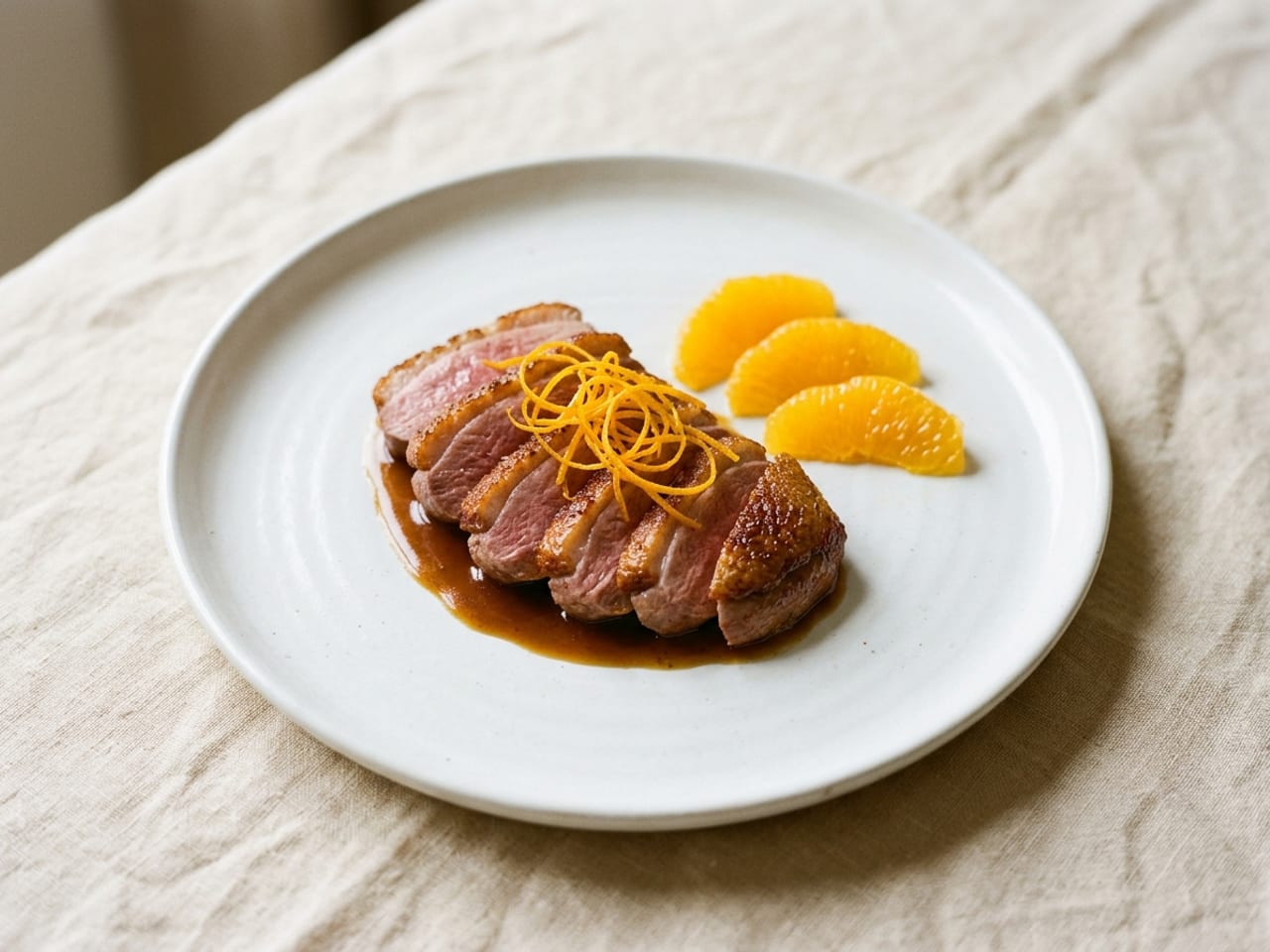
Julienned zest and segments for duck à l'orange, a slice or wedge on the mugs of mulled wine, a twist or wide peel on an Old Fashioned or Negroni, a slice or half-wheel on an Aperol Spritz, candied slices on orange cake, dried wheels for drinks and boards. That is what the named recipes we read print: eight of nine duck recipes use a julienne of peel and seven of seven mulled-wine recipes garnish the cup with orange.12, 14, 18, 33, 34, 38, 61, 77 Wash the orange under running water with a brush, no soap, even if nobody eats the peel.109, 113 For zest, twists and candied peel, buy unwaxed or untreated oranges where you can (ours): in a study of oranges, the residues that dissolve in the peel's wax "could not easily be removed by washing".114 Refrigerate any cut orange within two hours (UF/IFAS); no source gives an orange-specific keeping time for cut wheels or wedges, so cut them the day you serve (ours).109, 110 Dried wheels: no source gives a drying time by thickness, so the tally of 27 sources is printed instead.
| Cut | What it is | Best on | Holds |
|---|---|---|---|
| Orange wheel (slice) and half-wheel | A round cut across the fruit, or half of one | Mulled wine, sangria, Aperol Spritz, wheat beer | Cut the day you serve (ours) |
| Orange wedge, quarter or seared half | A lengthwise piece, a quarter, or a half seared cut side down | Mulled wine mugs, turkey and ham platters | Cut the day you serve (ours) |
| Orange twist | A strip of peel, twisted over a drink | Old Fashioned, Negroni | "Little more than one day" (Difford's) |
| Wide orange peel (swath) | A broad, flat strip of peel | Negroni, Old Fashioned | "Little more than one day" (Difford's) |
| Flamed orange peel (zest coin) | A coin of peel squeezed through a flame | Stirred drinks; a Cosmopolitan, by bar habit | Cut it as you serve (ours) |
| Grated orange zest | Fine gratings of the coloured peel | Duck à l'orange, chocolate mousse | Grate it over the plate (ours) |
| Zest strips and julienne (blanched or raw) | Thin threads of peel, no pith | Duck à l'orange, crêpes Suzette, mousse | Make it the day you serve (ours) |
| Orange segment (suprême) | Flesh only, no peel, pith or membrane | Duck à l'orange, salads, crêpes Suzette | Cut the day you serve (ours) |
| Candied orange slices | Slices simmered in syrup until translucent | Orange cake, cheesecake, cheese boards | Weeks to months, by the recipe |
| Candied peel strips and orangettes | Peel strips candied, plain or half-dipped in chocolate | Chocolate desserts, orange cake, creams | 1 week to 6 months, by the recipe |
| Dried orange wheel | A thin wheel dried in a low oven or dehydrator | Cocktails, hot drinks, cheese boards, cakes | About a year at 60°F (16°C) for dried fruit (NCHFP); a bar, a month for its lemon and lime wheels |
| Clove-studded orange or slice | Whole cloves pushed into an orange, a slice or a strip of zest | Mulled wine (in the pot), spiced sangria, a toddy | No source gives a figure |
| Orange cup (oranges givrées) | The emptied shell, filled | Sorbet and ices | No figure in what we read |
"Best on" is our summary of each card's sources; "holds" marked ours is our advice, and the sources' own figures are in how far ahead.
On this page: The cuts · Dried orange wheels · Which cut for which dish or drink · How far ahead · Washing and treated peel · Which orange · History and stories · FAQ
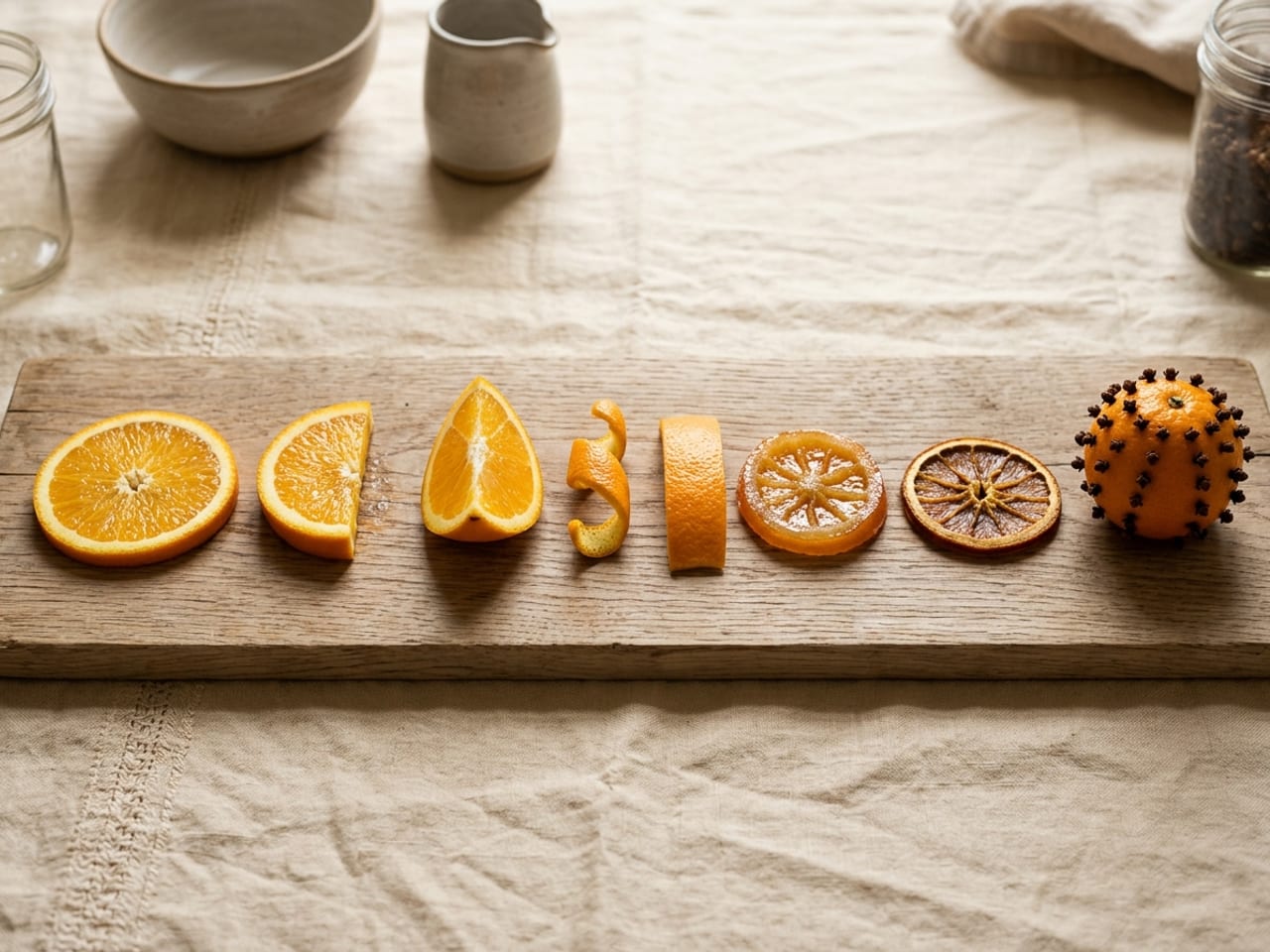
How to cut an orange for garnish: 13 cuts, step by step
One card per cut: the steps, the size where a named source prints one (where sources disagree, each is shown), the tool, what it suits and how far ahead. Three are drink or knife techniques our other guides own, so their cards say what the cut is and hand you over: the flamed peel and expressing a twist (cocktail garnishes) and the suprême (how to cut fruit). Steps marked ours are ours.
Orange wheel (slice) and half-wheel
- Scrub the orange under running water with a clean brush, no soap.
- Trim the two ends and cut across the core into even rounds; The Nibble finds it easier to halve the orange first, then slice the halves.
- Flick out any seeds with the knife tip (ours).
- For a half-wheel, cut a wheel in two; to sit one on a glass, slit it to the centre (Microplane). Blue Moon's brewer cut "a nick" in a wheel to hang it on a beer glass.
Size: ⅛ to ¼ in (3 to 6 mm) thick, says Microplane, a grater maker, for citrus in general. The recipes print their own: ¼ in (6 mm) slices for a mulled-wine pot (Feast and West) and ¼ in (6 mm) rounds for a sangria pitcher (The Mediterranean Dish); "thin slices" of peeled orange for a fennel salad (SBS).1, 46, 60, 70
Tool: A sharp knife; a serrated one grips the peel (ours).
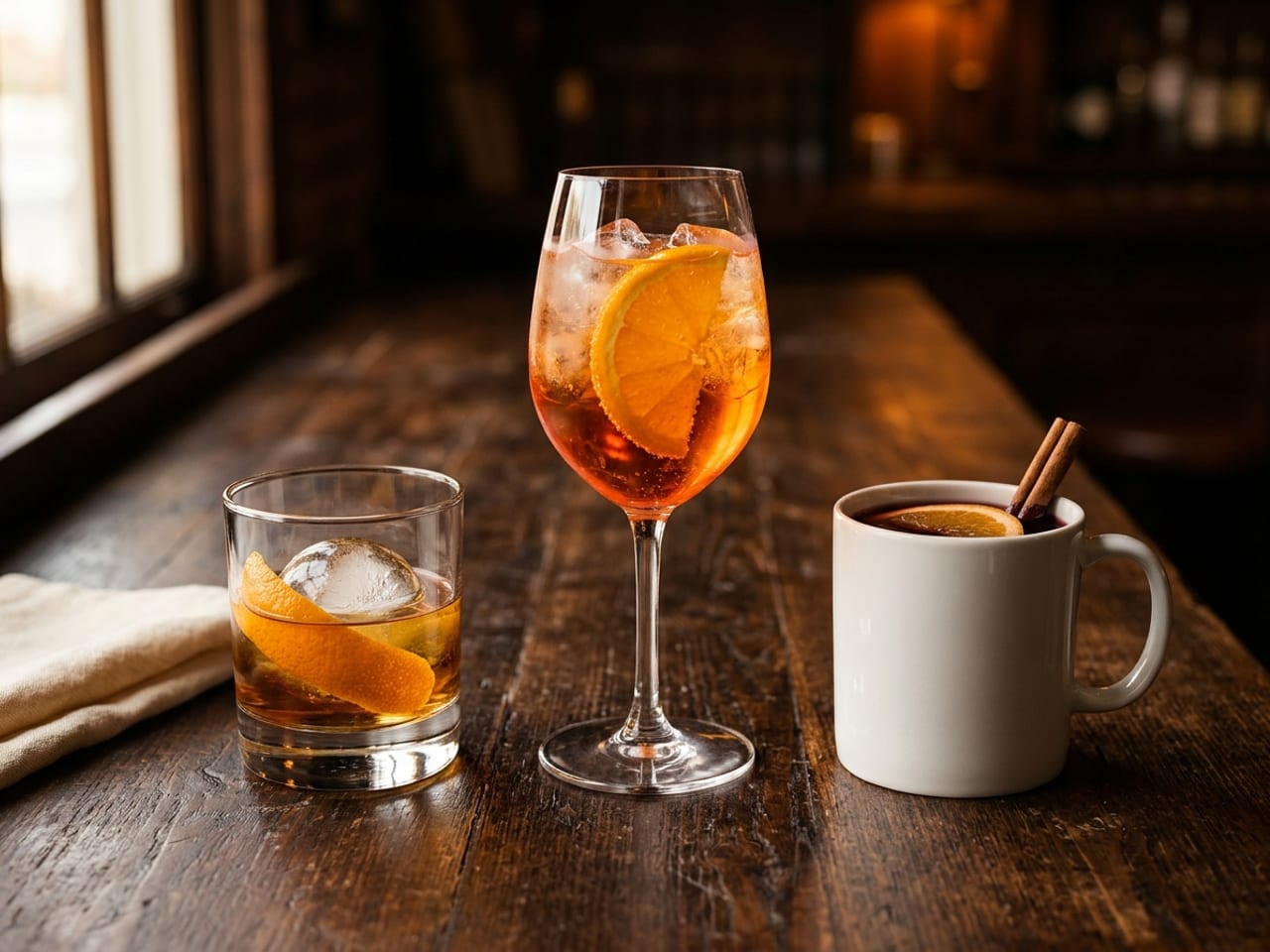
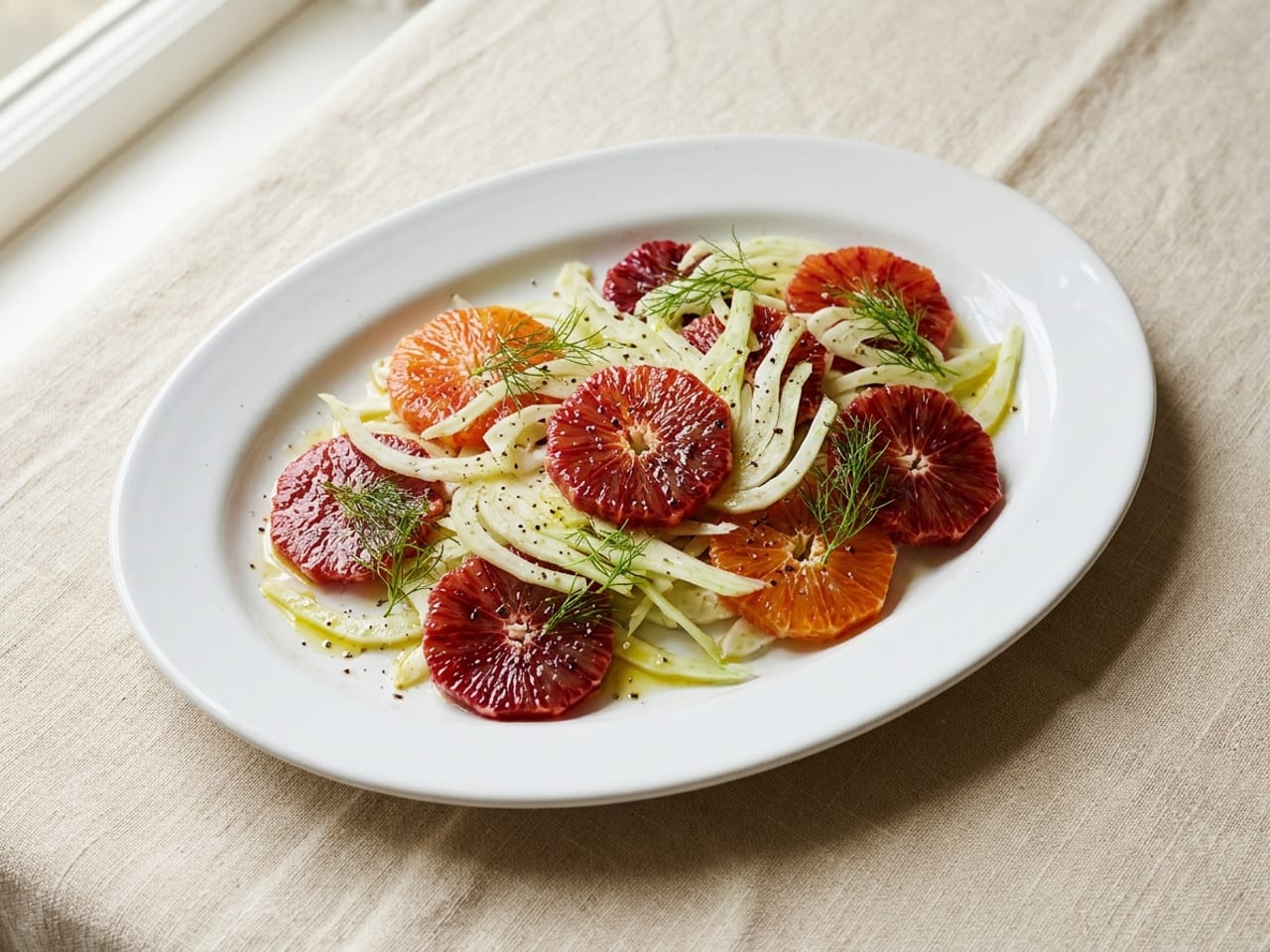
Suits: The cup of mulled wine (every mulled-wine recipe we read puts slices, rounds or wedges on it), clove-studded slices on a spiced sangria (James Beard Foundation), an Aperol Spritz (IBA: "Slice of orange"; Punch: an orange half-wheel), a half slice on a Negroni or Whiskey Sour (IBA), a wheel on a wheat beer (Blue Moon's brewer), peeled slices in a Sicilian fennel salad or a Moroccan dessert salad, and Escoffier's sole meunière à l'orange.11, 12, 33, 46, 48, 60, 61, 69, 71
How far ahead: UF/IFAS: refrigerate cut citrus within 2 hours and discard it after 2 hours at room temperature. USDA FoodKeeper has no cut-orange entry; its 4 days is for any cut fruit, a quality guide. No orange-specific figure in what we read; see how far ahead.109, 110 The make-ahead tables.
Orange wedge, quarter or seared half
- Scrub the orange under running water with a clean brush, no soap.
- Wedges: halve the orange lengthwise through the stem end, then cut each half into wedges (ours, as for a lemon).
- Quarters: Hannah Glasse (1747) and Elizabeth Raffald (1788 edition) cut the orange into quarters to lay round the dish.
- Seared halves: halve the oranges, cook them cut side down in butter "for 3-4 minutes", dip them in sugar and set them round the ham (Paula Deen).
Size: Microplane (a grater maker, citrus in general): wedges ¼ to ½ in (6 to 12 mm) thick, "about 3-4 wedges per half". No orange-specific figure in what we read.1
Tool: A chef's knife; a heavy pan for the seared half.
Suits: A wedge on a mug of mulled wine (Feast and West; The Mediterranean Dish says wheels or wedges); citrus wedges round a carved turkey (National Turkey Federation); seared, sugared halves round a glazed ham (Paula Deen, a celebrity brand); quarters of Seville orange round 18th-century veal and fritters (Glasse, Raffald).40, 42, 60, 63, 127, 128
How far ahead: UF/IFAS: refrigerate cut citrus within 2 hours and discard it after 2 hours at room temperature. USDA FoodKeeper has no cut-orange entry; its 4 days is for any cut fruit, a quality guide. No orange-specific figure in what we read; see how far ahead.109, 110 The make-ahead tables.
Orange twist
- Scrub the orange under running water with a clean brush, no soap.
- Pick a firm fruit: Jeffrey Morgenthaler looks for a pebbly surface, the sign of a thicker skin, and says the rule holds for oranges too.
- Peel a strip from tip to tip with a Y-peeler (Good Life Eats), or take a 3 in (7.5 cm) strip and slice it lengthwise into slender strips to curl (America's Test Kitchen).
- Pith splits: Death & Co takes "as little of the pith as possible"; Good Life Eats leaves "a small amount of pith" so the twist holds its shape.
- Express it over the drink: that step is on our cocktail garnishes guide.
3, 4, 5, 6, 113 Read how to express a twist.
Size: A Y-peeler is designed to take "the bare minimum", says Morgenthaler, and "the thickness of a potato skin is about a millimeter" (1 mm); he wants the peel "longer and thicker" so the twist holds; America's Test Kitchen starts from a 3 in (7.5 cm) strip; our cocktail garnishes guide takes a strip about ½ in (12 mm) wide.5, 6
Tool: A Y-peeler or paring knife; a channel knife for a long thin strand (America's Test Kitchen).
Suits: The Old Fashioned (Difford's: "EXPRESS orange zest twist over the cocktail"; Punch: "an orange peel") and the Negroni (Punch: orange or lemon peel). Death & Co sometimes rubs an orange twist on the rim, a lemon one very rarely. For a long spiral, see our cocktail garnishes guide.3, 13, 14
How far ahead: Difford's: cut fresh; if not, refrigerated in a sealed box with moist paper towel, and even then "little more than one day". Good Life Eats keeps twists in an airtight box in the fridge, with no time given.4, 15 The make-ahead tables.
Wide orange peel (swath)
- Scrub the orange under running water with a clean brush, no soap.
- Cut "a wide swath of peel" with a sharp vegetable peeler or paring knife, "removing as little of the pith as possible" (Death & Co).
- For a thicker peel, Morgenthaler reaches for a cheese slicer; Tasting Table's "rustic swath" is cut with a peeler or cheese slicer to keep the bitter pith off.
- For a Negroni, stand it upright in the glass, orange side against the glass, rather than running it round the rim (Tasting Table, relaying a bartender).
3, 5, 8, 113 Read how to express it.
Size: No figure beyond "wide" in what we read; a Y-peeler takes about potato-skin thickness, 1 mm (Morgenthaler).3, 5
Tool: A Y-peeler, a paring knife or a cheese slicer.
Suits: The Negroni (Tasting Table's swath; Punch's orange peel) and the Old Fashioned (Punch's orange peel). The same peeler strip flavours a mulled-wine pot in Love and Lemons and Chowhound, and is fished out: an ingredient, not a garnish.8, 13, 62, 64
How far ahead: Difford's gives cut peel "little more than one day", refrigerated in a sealed box with moist paper towel.15 The make-ahead tables.
Flamed orange peel (zest coin)
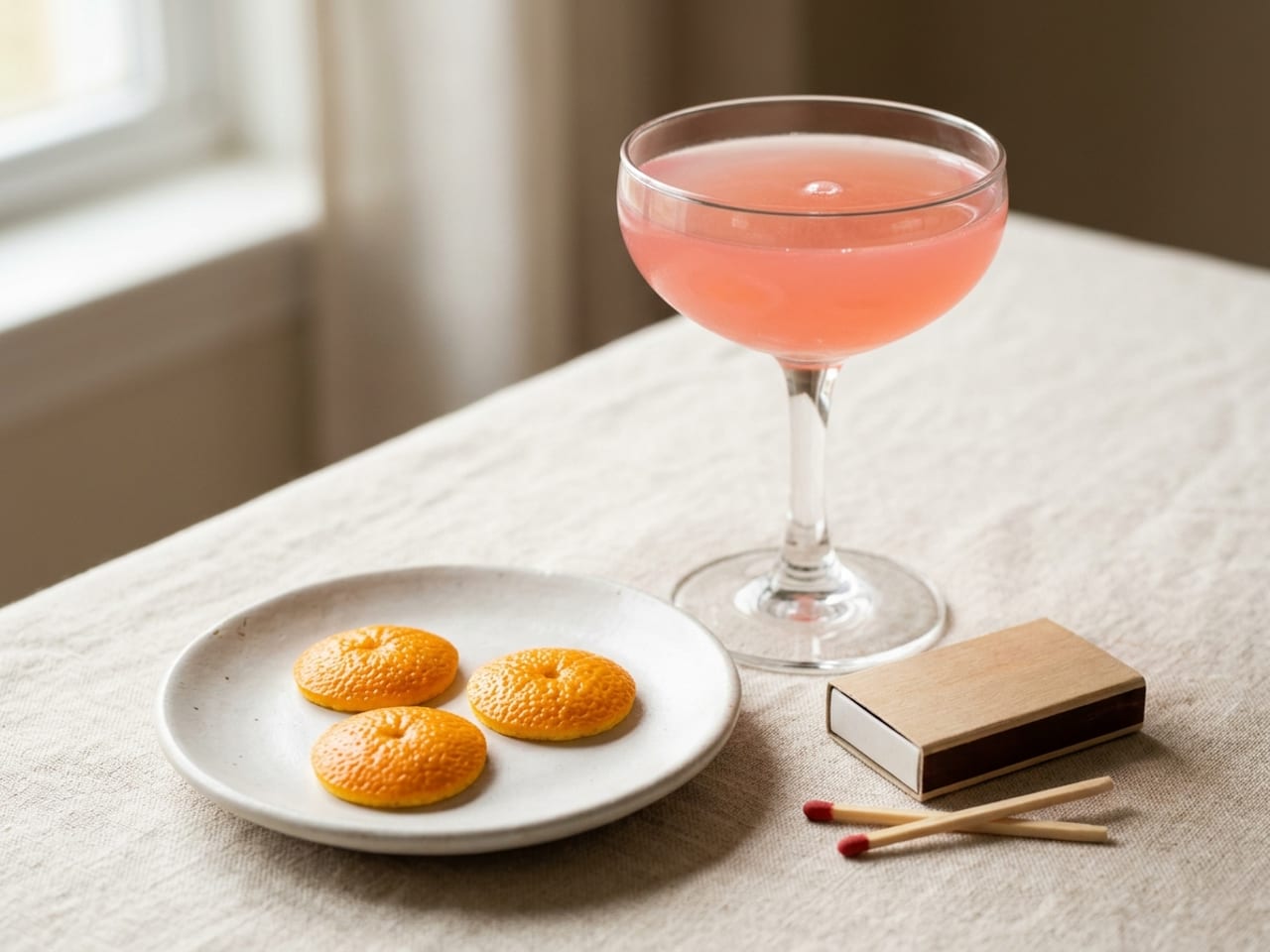
- A drink technique, and our cocktail garnishes guide owns it: Dale DeGroff's method, step by step, with the match and the distances.
Size: Two sizes, each its source's: a coin "the size of a quarter" of zest from a thick-skinned orange, no pith (Dale DeGroff; a US quarter is about 24 mm, 15/16 in, across: ours), the size our cocktail garnishes guide uses; or "a silver dollar-sized disk or slightly longer strip" (Punch; a silver dollar is about 38 mm, 1½ in: ours).9, 10
Tool: A paring knife or peeler, and wooden matches.
Suits: Our cocktail garnishes guide prints the Cosmopolitan with a flamed orange peel as the common bar version; the IBA's own garnish for it is a lemon twist.11
How far ahead: No source gives a figure; cut it as you serve (ours). The make-ahead tables.
Grated orange zest
- Scrub the orange under running water with a clean brush, no soap.
- Grate only the coloured skin on a fine rasp: the candied-peel recipes blanch the peel because the white pith is bitter.
- Grate it over the plate at the last moment (ours).
Steps: ours where no source is named. 22, 25, 113
Size: No figure in what we read.
Tool: A fine rasp grater.
Suits: Hank Shaw garnishes duck à l'orange "with the grated zest"; A Baking Journey and The Missing Lokness finish a chocolate orange mousse with orange zest on the cream.37, 56, 57
How far ahead: No orange source. America's Test Kitchen found frozen LEMON zest fine for baking but "not as a garnish", since its colour fades.112 The make-ahead tables.
Zest strips and julienne (blanched or raw)
- Scrub the orange under running water with a clean brush, no soap.
- Take the coloured peel off in strips with a vegetable peeler, leaving the pith on the fruit (Taste of France, Julia Child as reposted; Saveur says only "Using a peeler"); Gourmet Traveller peels, then cuts the pith away. A channel knife cuts thin ribbons straight off the fruit: America's Test Kitchen's top pick made "the cleanest, most uniform, and longest ribbons of orange, lemon, and lime".
- Cut the strips into fine julienne: "no more than 1/16-inch wide and 1-1/2 inches long" in Julia Child's recipe as reposted.
- Blanch or not: the recipes split, from none printed (Saveur) to 10 seconds repeated 4 to 5 times (Gourmet Traveller), "five minutes" (Escoffier's Bigarrade sauce) and a 15-minute simmer (Child as reposted; Taste of France).
Size: 1/16 in (1.5 mm) wide and 1½ in (4 cm) long (Julia Child, The French Chef Cookbook, read as a 1999 repost): the size our julienne guide calls fine julienne. It is the only julienne size we found for orange.38
Tool: A vegetable peeler and a sharp knife; Paarman cuts the strips with scissors.
Suits: Duck à l'orange (the duck rows in the tally below: in the sauce, on the duck or both); crêpes Suzette (Not Quite Nigella: "finely sliced orange zest"; Rouxbe: "a curled piece of orange zest"); chocolate mousse (Paarman candies thin strips for the top).34, 35, 38, 53, 54, 55
How far ahead: The duck recipes cook the julienne into the dish; no source gives a keeping time for raw strips. Difford's gives cut peel for drinks "little more than one day".15 The make-ahead tables.
Our cranberry sauce takes two pith-free peeler strips of orange zest and fishes them out before serving: an ingredient there, not a garnish.
Orange segment (suprême)
- Our how to cut fruit guide owns the suprême: cut off the peel and pith, then cut each segment out from between the membranes, step by step.
Read how to supreme an orange.
Size: No size: a segment is the fruit's own. Yields are on that guide.
Tool: A paring knife.
Suits: Escoffier surrounds braised duckling à l'orange, wild duck à la Bigarrade and duckling aiguillettes à l'orange with "sections of orange, skinned raw", but not when the sauce is made with Seville oranges: then the sections "must not appear as garnish, owing to their bitterness". Saveur, Gourmet Traveller, Taste of France and Julia Child's recipe as reposted put segments on or round the duck; Non Sprecare's fennel salad, Rouxbe's crêpes Suzette and The Missing Lokness's mousse use them too.33, 34, 35, 38, 39, 47, 53, 57
How far ahead: UF/IFAS: refrigerate cut citrus within 2 hours and discard it after 2 hours at room temperature. USDA FoodKeeper has no cut-orange entry; its 4 days is for any cut fruit, a quality guide. No orange-specific figure in what we read; see how far ahead.109, 110 The make-ahead tables.
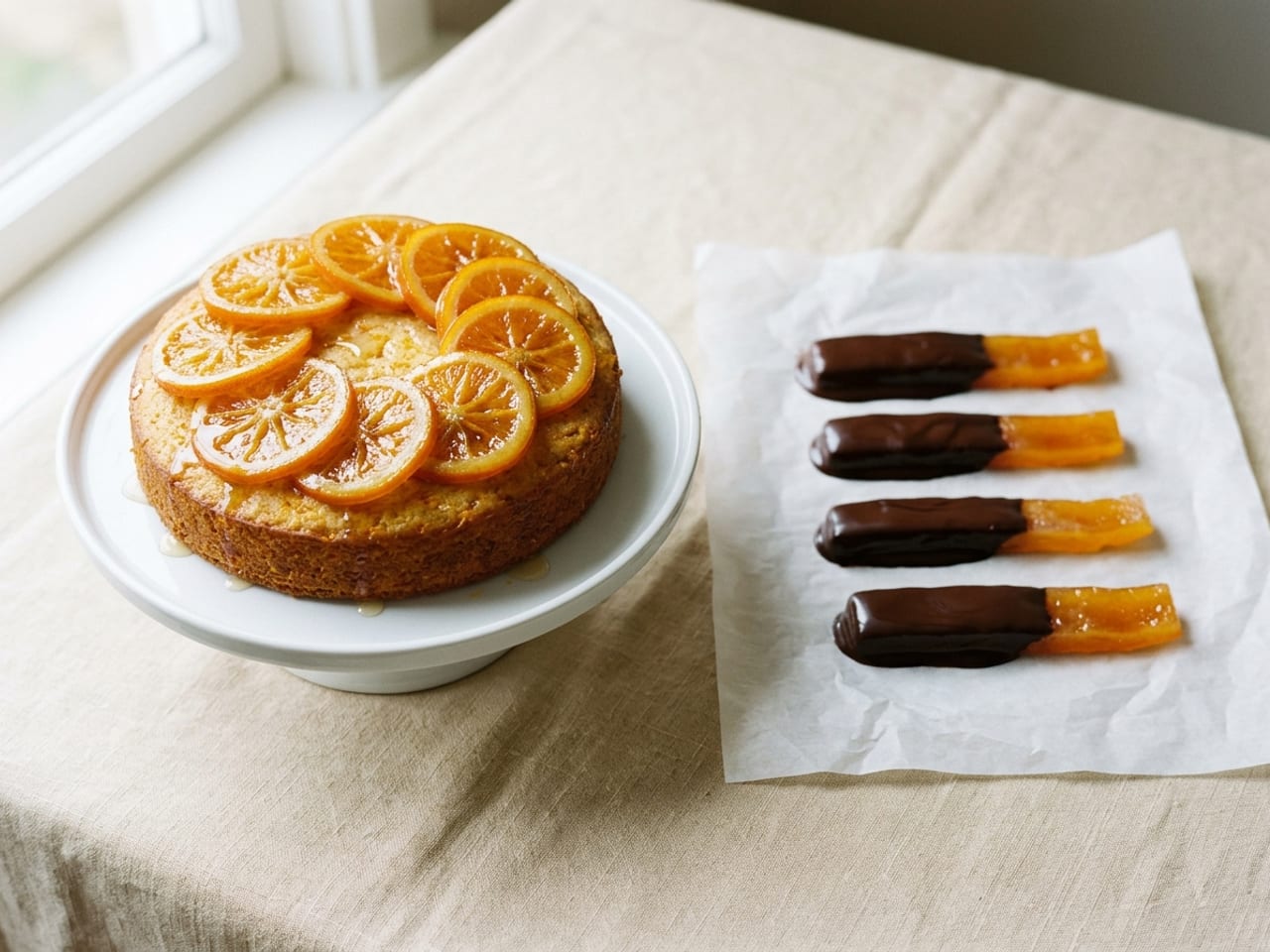
Candied orange slices
- Scrub the orange under running water with a clean brush, no soap.
- Slice the oranges evenly and take out the seeds.
- Blanch: the recipes split, 1 minute (Foodie With Family), 2 minutes (Feast and West) or 10 minutes "to remove their bitterness" (Savor the Flavour); Sunset prints no blanch.
- Simmer in sugar syrup until the rinds are translucent: 30 to 40 minutes (Feast and West) or 45 to 60 (Savor the Flavour, Foodie With Family); Sunset simmers its thinner slices 5 minutes covered, then about 20 uncovered.
- Dry them: Savor the Flavour finishes them in a 175°F (79°C) oven.
Size: Thickness splits: ⅛ to ¼ in (3 to 6 mm), because thinner slices "will fall apart" (Savor the Flavour); ⅛ in (3 mm) (Foodie With Family); between 1/16 and ⅛ in (1.5 to 3 mm) for a cheesecake top (Sunset); about 3 mm, ⅛ in (Baked by an Introvert), 4 mm, 1/6 in (Sugar Salt Magic), 4 to 5 mm, about 3/16 in (This Jess).16, 18, 20, 29, 30, 31
Tool: A sharp knife or mandoline, a wide pan, a rack.
Suits: On top of an orange olive oil cake (Foodie With Family; Of Batter and Dough, which serves one with each slice), overlapping on a cheesecake (Sunset, with a thin-skinned Valencia), drinks and desserts (Feast and West), half a slice with Gorgonzola on a cheese board (The Delicious Life).17, 18, 19, 20, 59
How far ahead: Recipe figures only, none tested: see the candied table.16, 19, 29 The make-ahead tables.
Candied peel strips and orangettes
- Scrub the orange under running water with a clean brush, no soap.
- Score the peel and take it off in quarters (NPR) or sections (Sunset); trim the pith thinner (Sunset, Leite's).
- Cut strips ¼ in (6 mm) wide (NPR, Leite's, Taste of Home) or ½ in (12 mm), tapered at the ends (Sunset).
- Blanch from cold water three times (NPR, Sunset, Taste of Home, Aliette de Bodard), or simmer once for 20 minutes (Leite's).
- Simmer in syrup until translucent: 25 to 40 minutes "depending on the thickness" (Leite's) up to 1 to 1½ hours (Sunset, de Bodard); one home cook needed 75 minutes (Use Real Butter).
- Dry, then roll in sugar or dip halfway in melted chocolate (Sunset, Leite's).
Size: Strip width splits: ¼ in (6 mm) in three recipes (NPR, Leite's, Taste of Home), ½ in (12 mm) tapered in one (Sunset); Sunset trims the peel to about ¼ in (6 mm) thick.21, 22, 23, 24
Tool: A paring knife, a pan, a rack; chocolate for orangettes.
Suits: Chocolate-dipped orangettes (NPR, Leite's, Taste of Home, Sunset); candied strips on chocolate mousse (Paarman, a mousse-mix maker); candied peel as an optional decoration on an orange cake (The Mediterranean Dish); "candied orange-peel or preserved chips" on Seville orange creams (Mrs Beeton, 1861).21, 22, 23, 24, 50, 55, 132
How far ahead: Recipe figures only: from 1 week at room temperature (NPR) to 6 months airtight (Aliette de Bodard's blog). See the candied table.22, 25 The make-ahead tables.
Dried orange wheel
- Scrub the orange under running water with a clean brush, no soap.
- Slice the oranges evenly, unpeeled; the sources split on thickness (see the dried tally).
- Dry on a rack or parchment in a low oven or a dehydrator, turning them, until dry and not sticky; the sources split on heat, time and the doneness test.
- Cool completely before sealing: "Warm food causes sweating which could provide enough moisture for mold to grow" (NCHFP).
Size: No agreed figure: 27 sources in the dried tally, ⅛ in (3 mm) to ¼ in (6 mm) for most.77, 82, 83
Tool: An oven with a low setting or a dehydrator, a wire rack.
Suits: Cocktails (Campari Academy, a brand; Imbibe, for lemon and lime; The Takeout), cheese and charcuterie boards (Good Life Eats; The Delicious Life), and decorating a cake instead of candied slices (Of Batter and Dough).19, 59, 77, 78, 80, 82
How far ahead: NCHFP's general rule for dried fruit: about 1 year at 60°F (16°C), 6 months at 80°F (27°C). A bar director: "about a month" (his lemon and lime wheels; orange not named). The blogs we read: 6 months to 5 years.80, 102 The make-ahead tables.
The method, the 27 sources and their split: dried orange wheels.
Clove-studded orange or slice
- Scrub the orange under running water with a clean brush, no soap.
- A whole orange: push cloves into the peel about 1 in (2.5 cm) apart (Feast and West); it goes in the mulled-wine pot.
- A slice: "press 6 cloves into the pith of each slice" (Tasting Table), also for the pot; the James Beard Foundation's spiced sangria studs the wheels that garnish the glass.
- A strip of zest: Punch's Scotch Toddy takes "a thick orange zest studded with whole cloves".
Size: Cloves about 1 in (2.5 cm) apart on a whole orange (Feast and West); 6 a slice (Tasting Table).60, 61
Tool: Whole cloves; a skewer to start the holes (ours).
Suits: In what we read the studded orange or slice goes IN the mulled-wine pot (Feast and West, Tasting Table), never on the cup; studded wheels garnish a spiced sangria (James Beard Foundation) and a studded zest a Scotch toddy (Punch). Eliza Acton (1845) floated a clove-stuck lemon in hot Bishop and wrote that a clove-stuck Seville orange "to many tastes imparts a finer flavour".60, 61, 67, 69, 130
How far ahead: No source we read says how long a studded orange or slice keeps, or whether a decorative pomander may go in food or drink. The make-ahead tables.
Orange cup (oranges givrées)
- Scrub the orange under running water with a clean brush, no soap.
- Cut a small slice off the base so the orange stands (Vegetarian Times).
- Cut ½ in (12 mm) off the top and scoop out the fruit (Vegetarian Times); Escoffier cuts "a slice of peel from the top".
- Fill with sorbet (Vegetarian Times) or, for Escoffier's oranges à la norvégienne, orange or tangerine ice under meringue.
Size: A ½ in (12 mm) lid (Vegetarian Times).58
Tool: A paring knife and a spoon.
Suits: Sorbet (Vegetarian Times suggests blood oranges in season); Escoffier's ices, and his quail supremes set "in the rinds of small oranges or tangerines".33, 58
How far ahead: No figure in what we read. The make-ahead tables.
Not a reflex garnish. An orange slice on the rim of a plate that has no orange in it is the garnish our food garnishes guide calls a reflex: there, a parsley sprig and an orange slice nobody will eat. A culinary textbook says that "In the past, chefs casually threw a piece of kale and an orange slice onto every plate", and a restaurant historian names "orange slices and twists" among the 1970s garnishes James Beard disliked.151, 152 Ours: put orange on a dish or drink that has orange in it, or that the sources above pair it with.
Dried orange slices: thickness, oven and dehydrator times from 27 sources
How long to dry orange slices: at about 200°F (93°C) in the oven, the thirteen sources that give hours at that main setting say 2 hours (Kitchen Serf) to 10 (Reviewed), and a bar director "about a day" for lemon and lime wheels; at 135°F (57°C) in a dehydrator, the eight that give hours say 3 (Platings and Pairings) to 15 (Excalibur, a dehydrator maker). No source we read gives a drying time by slice thickness: twelve of the 27 say in words that thickness changes the time (Eat, Little Bird, Feast and West, Good Life Eats, The View from Great Island, Lil Luna, Bites with Bri, Drinks World, Spoon Fork Bacon, Platings and Pairings, Recipe Girl, Fine Dining Lovers, The Purposeful Pantry), none prints a chart, and none times two thicknesses of one fruit at one heat. So here is the tally instead, each row its source's own method, with who the source is.75, 79, 80, 85, 94 None of these is an authority for orange wheels: the extension services we read (Colorado State, NDSU, UC via Healthy Canning) give methods for orange PEEL, and UC calls drying "not a recommended preservation method for oranges" because they are too juicy and soft.103, 104, 106
The method, in plain words
- Wash the oranges under running water with a brush, no soap.113
- Slice them evenly, unpeeled, and flick out the seeds; uniform wheels dry "at the same rate" (Reviewed), and Excalibur, a dehydrator maker, suggests a mandoline.75, 79 Most sources pick ⅛ to ¼ in (3 to 6 mm); the counts are below. Some pat the slices dry first (Emily Fabulous, SBS, Bites with Bri).86, 88, 92
- Lay them in one layer on a wire rack or parchment (Feast and West, Good Life Eats, Spoon Fork Bacon), or straight on the dehydrator trays (Healthy Canning).81, 82, 93, 106
- Dry them low, turning them: every 30 minutes (Kitchen Serf, Lil Luna, Binky's, Platings and Pairings), every 2 to 3 hours (Reviewed) or once halfway (BBC Good Food Middle East).79, 84, 85, 89, 91, 94 The oven door splits too: keep it shut (a bar director in Imbibe, for lemon and lime) or prop it open with a wooden spoon (Binky's).80, 89
- Let them cool completely before you seal the jar: "Warm food causes sweating which could provide enough moisture for mold to grow" (NCHFP). NCHFP, NDSU and Oregon State also "condition" dried fruit in a loosely packed jar, shaken daily, for 7 to 10, 4 to 7 or 2 to 4 days; Binky's does the same for wheels, 7 to 10 days.89, 102, 104, 105
| Source | Thickness | Oven | Dehydrator (air fryer) | Done when |
|---|---|---|---|---|
| Excalibur75 (maker) | ⅛ to ¼ in (3 to 6 mm) | None given | 135°F (57°C), 7 to 15 h ("depending on the humidity", its book) | "crisp and leathery" (its book) |
| Campari Academy77 (brand) | ⅛ in (3 mm) | 170°F (77°C) (or 200°F (93°C)), 3 to 5 h | 125°F (52°C), 8 to 10 h | "snap them easily in two"; oven: "aren't sticky anymore" |
| The Takeout (2025)78 (magazine) | "thinly", no figure | 200°F (93°C), about 3 h (blood orange) or 4 to 5 h (navel) | None given | None given |
| Reviewed (2021)79 (magazine) | Uniform, no figure | 200°F (93°C) about 10 h, or 170°F (77°C) 15 h | None given | "brittle to the touch" |
| Imbibe (2017), a bar director80 (bar magazine) | "thin wheels", no figure | About 200°F (93°C), "about a day" (lemons and limes) | None given | Dry and not tacky |
| The View from Great Island83 (blog) | ¼ in (6 mm) | 200°F (93°C), 2 to 3 h | 135°F (57°C), 8 to 10 h | Oven: "dry and slightly translucent"; dehydrator: "slightly pliable, not brittle" |
| Bites with Bri86 (blog) | ¼ in (6 mm) | 200°F (93°C), 2 to 4 h (its FAQ: 250°F (121°C), about 3 h) | 135°F (57°C), 4 to 6 h Air fryer: 175°F (79°C), about 3½ h. | None given; brown means "the oven is too hot" |
| Binky's Culinary Carnival89 (blog) | ¼ in (6 mm) | Lowest, 150 to 170°F (77°C), 2 to 4 h, door propped open | 100°F (38°C), 18 to 24 h (or 170°F (77°C), 2 to 4 h) Air fryer: Lowest setting, 30 min, flip, 20 min more. | Rind cracks, "very little bend left" |
| BBC Good Food Middle East91 (magazine) | 2 mm (a little under ⅛ in) | 110°C (90°C fan; about 230°F), 2 h; check at 1 h 15 min | None given | "firm and dry" |
| SBS Food (2020)92 (magazine) | "around 2mm" (a little under ⅛ in) | 50°C (about 122°F), 8 to 10 h overnight, no fan | None given | Bone dry and crisp |
| The Purposeful Pantry100 (blog) | ¼ in (6 to 7 mm) | None given | 125°F (52°C) or lower, 18 to 36+ h | Snap when cooled |
| UF/IFAS craft plan (decoration only)101 (extension-hosted craft plan) | ¼ to ⅛ in (3 to 6 mm) | 400°F (204°C), flipped halfway | None given | "Once dry" |
Show all 27 sources (15 more)
| Source | Thickness | Oven | Dehydrator (air fryer) | Done when |
|---|---|---|---|---|
| Eat, Little Bird76 (blog) | "about 3-5 mm or 1/4 inch" | No oven method; remarks that oven drying of food can take "as long as 14 hours or more" | 140°F (60°C), 8 to 12 h; oranges at least 12 h | "completely dry to the touch" |
| Feast and West81 (blog) | ⅛ in (3 mm) | 170°F (77°C), 3 to 4 h | None given | Dry; cooled overnight |
| Good Life Eats82 (blog) | "Aim for ⅛ to ¼ inch"; hers ¼ in (6 mm) | 200°F (93°C), up to 3 h | Up to 12 h, no temperature given | "no longer wet to the touch" |
| Lil Luna84 (blog) | No figure | 200°F (93°C), 6 h, flipped every 30 min | 135°F (57°C), 8 to 12 h | No longer sticky |
| Kitchen Serf85 (blog) | ⅛ to ¼ in (3 to 6 mm) | 200°F (93°C), 2 h | None given | Snaps in half |
| Drinks World87 (blog) | ⅛ to ¼ in (3 to 6 mm) | About 200°F (93°C), 3 to 4 h | 135°F (57°C), 8 to 12 h | Crisp; "brittle and flavorless" = dried too long |
| Emily Fabulous88 (blog) | ¼ in (6 mm) | 200°F (93°C), 3 to 4 h | 135°F (57°C), 6 to 10 h ("Mine were perfect at 8 hours") | None given |
| Crave the Good90 (blog) | ⅛ to ¼ in (3 to 6 mm) | None given | 135°F (57°C), no time given | "if it cracks, it's done" |
| Spoon Fork Bacon93 (blog) | ¼ in (6 mm) | 170°F (77°C), blood orange 6 to 7 h | None given | "slightly brittle" |
| Platings and Pairings94 (blog) | ¼ in (6 mm) | 200°F (93°C), 2 to 4 h | 135°F (57°C), 3 to 7 h | "can still be bent without crumbling"; crisp as they cool |
| Cocktail Society95 (blog) | ⅛ to ¼ in (3 to 6 mm) | 200 to 225°F (107°C), 3½ to 4 h | 5 to 7 h, no temperature given | None given |
| Mindful Mocktail96 (blog) | 6 mm (¼ in) | 70°C (160°F) or as low as it goes, 4 h | None given | None given |
| Recipe Girl97 (blog) | ¼ in (6 mm) | 200°F (93°C), 2½ to 3½ h | 130°F (54°C), "about 2 days" | "until translucent" |
| Farmers' Almanac98 (magazine) | ¼ in (6 mm) | 200°F (93°C), about 3 h | None given Air fryer: 135°F (57°C) on its "dehydrate setting", 6 to 8 h. | None given |
| Fine Dining Lovers (2021)99 (magazine) | ⅛ to ¼ in (printed "3 to 6.5 cm", a unit slip) | 200°F (93°C), 3 to 4 h | 60°C / 135°F as printed (60°C is 140°F), up to 7 h | None given |
What the 27 sources say, counted (our count)
Thickness: ⅛ in (3 mm) alone, 2; about 2 mm, 2; ⅛ to ¼ in (3 to 6 mm), 9; ¼ in (6 mm), 10; no figure, 4. Oven: 23 give a setting, from 122°F (50°C), SBS overnight, to 400°F (204°C), a University of Florida craft plan for garlands, decoration only; 14 of them give 200°F (93°C) as their main oven setting (Reviewed and Bites with Bri also print another). Dehydrator: 16 give a method, 14 with a temperature, from 100°F (38°C) to 140°F (60°C); 9 use 135°F (57°C) (Fine Dining Lovers prints 60°C beside it, which is 140°F). Air fryer: three sources, 135°F (57°C) on its "dehydrate setting" for 6 to 8 hours (Farmers' Almanac), 175°F (79°C) for about 3½ hours (Bites with Bri) or the lowest setting for 30 minutes plus 20 (Binky's).86, 89, 98
Thinner, faster: "The thinner you slice your oranges, the less time they'll take to dehydrate" (Fine Dining Lovers); thicker ones "take much longer" (Good Life Eats); thinner than ⅛ in they are "easy to burn" and curl (Feast and West). The only paired figures from one source are by FRUIT, at one thickness: Spoon Fork Bacon dries ¼ in (6 mm) blood oranges 6 to 7 hours at 170°F (77°C) against 4 to 5 for lemons and limes; Eat, Little Bird gives oranges at least 12 hours at 140°F (60°C), lemons 10, limes 8; The Takeout gives blood oranges about 3 hours at 200°F (93°C) and navels up to 4 or 5.76, 78, 81, 82, 93, 99 Across two sources at 125°F (52°C), 8 to 10 hours for ⅛ in (3 mm) wheels (Campari Academy, a drinks brand) and 18 to 36+ hours for ¼ in (6 mm) (The Purposeful Pantry) are different authors and machines: not a pair.77, 100 SBS argues the common "around 3 hours" at a low heat "might not dry them out enough" and dries 2 mm slices overnight at 50°C (122°F).92
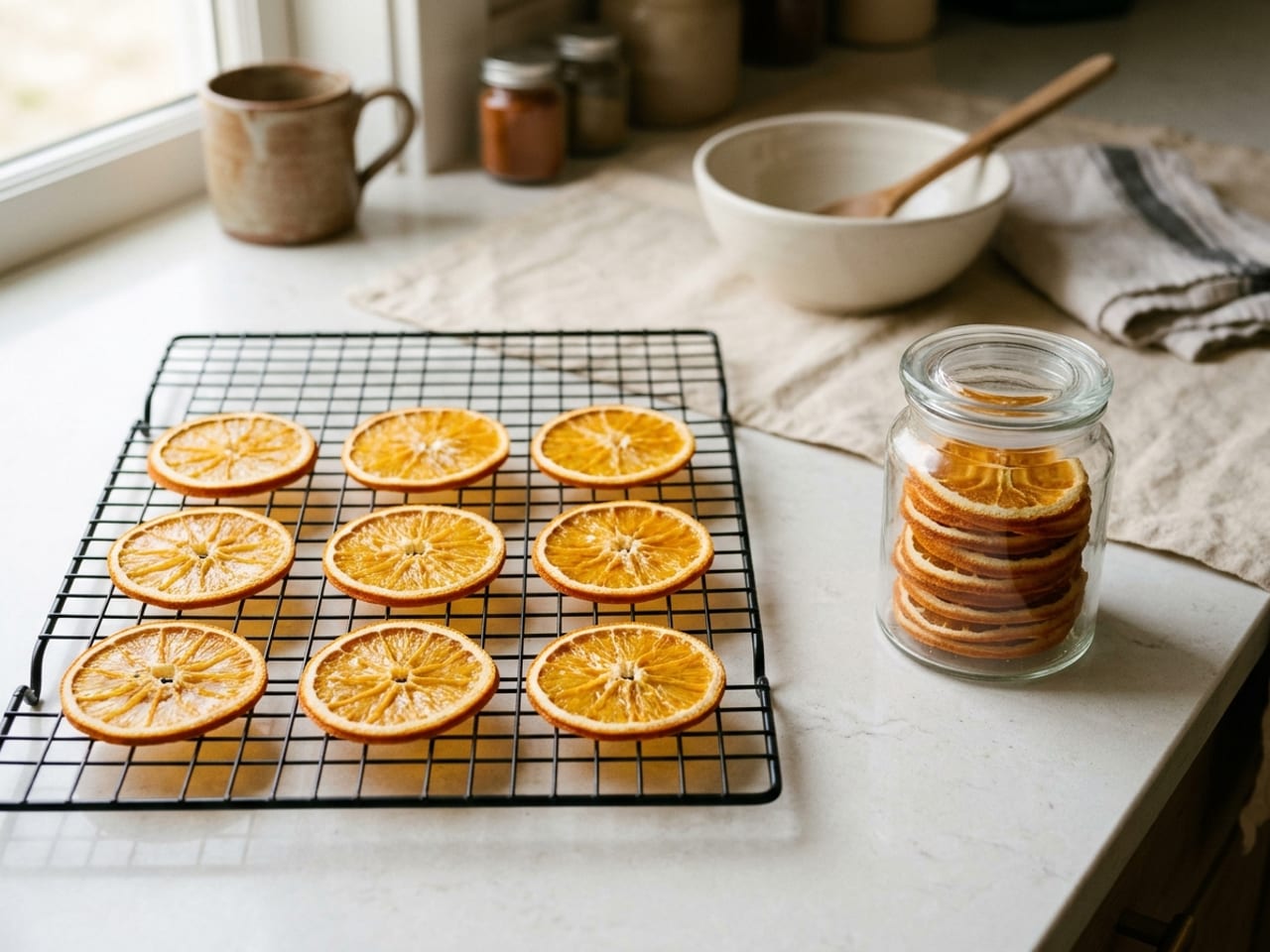
How to tell they are done: the sources disagree
"Snap": Campari Academy ("snap them easily in two"), Kitchen Serf and The Purposeful Pantry. Crack when bent: Crave the Good and Binky's ("very little bend left", though "the flesh will still bend"). "Brittle to the touch": Reviewed; "slightly brittle": Spoon Fork Bacon. The other way: The View from Great Island wants them "dry but still slightly pliable, not brittle", Platings and Pairings "can still be bent without crumbling", and Drinks World says brittle and flavourless means dried too long.77, 79, 83, 85, 87, 89, 90, 93, 94, 100 For dried fruit in general, NDSU says "leathery and pliable", not brittle; for orange peel, Colorado State and NDSU say "until crisp", and UC says peel may stay pliable but "should not be sticky or tacky".103, 104, 106 The words that recur are "not sticky" (Imbibe, Campari Academy for the oven, Eat, Little Bird, Lil Luna) and dry to the touch; twenty of the 27 give a doneness test of some kind, and seven give none.
Why dried orange slices turn brown
In what we read, only blogs give a reason. The Purposeful Pantry: "oranges often brown during the drying phase as the sugars brown from the heat"; Binky's: "Turning up the heat can make the natural sugars in the orange turn brown". Feast and West: they "turn brown or black the longer you cook them"; Bites with Bri: brown means "the oven is too hot".81, 86, 89, 100 Those are the cooks' words, not a measured cause. One peer-reviewed study dried orange slices at 50 to 125°C (122 to 257°F) and measured a browning index; we read only its abstract, which gives no browning figures.108 In storage, The Purposeful Pantry says they may "turn darker over time", and Spoon Fork Bacon replaces them once the colour has "faded significantly".93, 100
How long dried orange slices last
The authorities give figures for dried fruit or orange peel in general, not wheels: NCHFP about 1 year at 60°F (16°C) and 6 months at 80°F (27°C); Colorado State and NDSU six to 12 months; Oregon State up to a year.102, 103, 104, 105 Then a bar director's "about a month" in a jar, for his lemon and lime wheels (Imbibe), and a drinks brand's "up to 18 months" with a desiccant (Campari Academy).77, 80 The magazines and blogs we read run from 6 months to 5 years, 18 claims in all, none of which cites a test: a range, not advice. Every row is in the dried table.
To eat, or to hang on the tree?
Two sources split the two uses: The View from Great Island, eat within 6 months but craft with them for 2 years; Bites with Bri, edible up to two years, decoration longer "even if they turn brown".83, 86 Healthy Canning says the dried pulp "becomes unappealing to consume", and the University of Florida plan at 400°F (204°C) is for garlands only.101, 106 Drying is not a kill step: Purdue's produce specialists say most dehydration processes "do not adequately kill" the microbes that make people ill (produce in general; oranges not named). So wash the fruit first, and do not treat a dried wheel as safe because it is dry.107, 113 For dried wheels in drinks, see our cocktail garnishes guide; lemon slices dry the same way on our lemon garnish guide.
Which orange cut for which dish or drink: duck, ham, salads, cakes, mulled wine and cocktails
A tally, not a rule: 63 named recipes, chefs, cookbooks, bar books and references we read, grouped into 10 kinds of dish and 8 drinks, each with the cut it prints. "Usually" appears only where the count is one-sided. The IBA lines are as our cocktail garnishes guide prints them; the twist, the flamed peel and the drinks themselves are there. Serious Eats, Liquor.com, Food Network and a few others refused this machine, so they are missing.
| Dish or drink | What the sources print (our count) | Related on this site |
|---|---|---|
| Duck à l'orange (bigarade) | Zest strips or julienne 8, segments 8, grated zest 1 | None |
| Game birds and fish, the old books | Slices or wheels 3 | None |
| Glazed ham | Seared half 1, slice or wheel 1 | Ham calculator |
| Carved turkey platter | "oranges", no cut named 2, wedge 1, slice or wheel 1 | How to carve a turkey |
| Salads | Slices or wheels 2, segments 1, "oranges", no cut named 1 | None |
| Orange cake and cheesecake | Candied slices 3, candied peel 1, no orange on top 1 | Christmas desserts |
| Crêpes Suzette | Zest strips or julienne 2, slice or wheel 1, segments 1 | None |
| Chocolate mousse and creams | Candied peel 2, grated zest 2, segments 1 | Chocolate garnishes |
| Sorbet and ices | Orange cups 2 | None |
| Cheese and charcuterie boards | Candied slices 1, dried wheels 1 | Charcuterie board ideas |
| Mulled wine | Slices or wheels 6, wedges 2 | None |
| Hot toddy | Clove-studded 1, "oranges", no cut named 1 | None |
| Sangria | Clove-studded 1, fresh citrus slices, orange not named 1 | None |
| Negroni | Half slice 1, peel or twist 1, wide peel 1 | Cocktail garnishes |
| Old Fashioned | Peel or twist 3, slices or wheels 2 | Cocktail garnishes |
| Aperol Spritz | Slices or wheels 2, half slice 1 | None |
| Whiskey Sour | Half slice 1 | Cocktail garnishes |
| Wheat beer (Blue Moon) | Slices or wheels 3 | None |
| Dish or drink | Who | Cut | As printed |
|---|---|---|---|
| Duck à l'orange (bigarade) | Escoffier (1907), braised duckling à l'orange33 | Zest strips or julienne and segments | A julienne of "the blanched yellow part only of the rind" in the sauce; the duck surrounded "with sections of orange, skinned raw". With Seville oranges, no sections: "only the juice" |
| Duck à l'orange (bigarade) | Saveur34 | Zest strips or julienne and segments | Peel julienned, half with the duck and half in the sauce; "Garnish with orange segments and parsley" |
| Duck à l'orange (bigarade) | Hank Shaw (Honest Food)37 | Segments and grated zest | "Give everyone some orange supremes"; "Garnish with the grated zest"; the peel goes in the sauce in large pieces, no julienne |
| Duck à l'orange (bigarade) | Julia Child (1968 text, read as a 1999 repost)38 | Zest strips or julienne and segments | Fine julienne simmered 15 minutes, in the sauce; "the orange segments are to be used as a garnish", a few on the breast and the rest piled at the ends |
| Game birds and fish, the old books | Escoffier (1907), sole meunière à l'orange33 | Slice or wheel | "a row of orange slices, peeled to the pulp and thoroughly pipped" on the fish (or sections), under browned butter |
| Glazed ham | Paula Deen (a celebrity brand)40 | Seared half | Halved oranges and lemons seared cut side down "for 3-4 minutes", dipped in sugar, round the platter |
| Carved turkey platter | National Turkey Federation (an industry body)42 | Wedge | "wedges of citrus, such as lemons, oranges, clementines or limes" |
| Salads | SBS, Sicilian fennel and blood orange salad46 | Slice or wheel | Peeled oranges: "Then cut oranges crosswise into thin slices", layered with fennel; fennel fronds on top |
| Salads | Non Sprecare, Sicilian fennel and orange salad47 | Segments | "Peel an orange and separate the segments" |
| Orange cake and cheesecake | Foodie With Family, orange olive oil cake18 | Candied slices | "Arrange candied orange slices over" the cake |
| Orange cake and cheesecake | Sunset, orange ribbon cheesecake20 | Candied slices | Thin candied slices of a Valencia, "slightly overlapping, over top" |
| Crêpes Suzette | Sur La Table (a cookware retailer)52 | Slice or wheel | "Orange slices, for garnish" |
| Chocolate mousse and creams | Paarman (a mousse-mix maker)55 | Candied peel | Peeler strips, cut thin, candied for the top |
| Sorbet and ices | Vegetarian Times, oranges givrées58 | Orange cup | Sorbet served in the scooped-out orange shell |
| Cheese and charcuterie boards | The Delicious Life (blog)59 | Candied slices | "half a candied orange slice with Gorgonzola Dolce"; dried or candied citrus over marmalade |
| Mulled wine | Feast and West60 | Wedge | "Garnish with an orange wedge and/or a cinnamon stick"; a clove-studded whole orange goes in the pot |
| Mulled wine | Tasting Table61 | Slice or wheel | "one orange slice and one cinnamon stick to each mug"; clove-studded slices go in the pot |
| Mulled wine | The Mediterranean Dish, vin brulé63 | Slice or wheel and wedge | "wheels or wedges to garnish glasses"; peel without pith in the pot |
| Hot toddy | Punch, Scotch Toddy67 | Clove-studded | "a thick orange zest studded with whole cloves" |
| Sangria | James Beard Foundation, spiced sangria69 | Clove-studded | "stud the orange slices with the cloves" for the garnish |
| Negroni | IBA spec (as our cocktail garnishes guide prints it)11 | Half slice | "Half orange slice" |
| Old Fashioned | IBA spec (as our cocktail garnishes guide prints it)11 | Slice or wheel and peel or twist | "Orange slice or zest, and a cocktail cherry" |
| Old Fashioned | Difford's Guide14 | Peel or twist | "EXPRESS orange zest twist over the cocktail and use as garnish" |
| Aperol Spritz | IBA spec (as our cocktail garnishes guide prints it)11 | Slice or wheel | "Slice of orange" |
| Whiskey Sour | IBA spec (as our cocktail garnishes guide prints it)11 | Half slice | "Half orange slice and a maraschino cherry" |
| Wheat beer (Blue Moon) | Molson Coors, Blue Moon's brewer (it sells the beer)71 | Slice or wheel | A wheel with "a nick in it" on the glass, to bring out the Valencia peel in the beer |
Show all 63 rows (37 more)
| Dish or drink | Who | Cut | As printed |
|---|---|---|---|
| Duck à l'orange (bigarade) | Escoffier (1907), wild duck à la Bigarrade33 | Zest strips or julienne and segments | "Surround it with sections of orange, skinned raw", with a clear Bigarrade sauce (his bigarrade sauce takes rind julienne "scalded for five minutes") |
| Duck à l'orange (bigarade) | Escoffier (1907), aiguillettes of duckling, à la bigarrade and à l'orange33 | Zest strips or julienne and segments | Slices of breast in a clear bigarrade sauce (No. 31, rind julienne); the à l'orange version is "surrounded with sections of orange, skinned raw" |
| Duck à l'orange (bigarade) | Gourmet Traveller (chef Daniel Southern)35 | Zest strips or julienne and segments | Julienne blanched 10 seconds, 4 to 5 times, then candied; "scattered with orange segments and a little orange rind" |
| Duck à l'orange (bigarade) | Adam Liaw (SBS)36 | Zest strips or julienne | "zest thinly julienned" and "⅓ cup orange segments", both in the sauce; no orange garnish beside it |
| Duck à l'orange (bigarade) | Taste of France magazine39 | Zest strips or julienne and segments | Juliennes simmered 15 minutes; "a line of orange segments along the length of the duck", the rest heaped at the two ends |
| Game birds and fish, the old books | Escoffier (1907), pheasant33 | Slice or wheel | "Surround with slices of bitter orange, and send the gravy separately" |
| Game birds and fish, the old books | Robert May (1685 edition)125 | Slice or wheel | Broiled carp, "slices of orange, lemon, and branches of rosemary"; oysters, "garnish them with slices of orange" |
| Glazed ham | Skinnytaste (blog)41 | Slice or wheel | Orange slices in a layer UNDER the ham in the pan, not on top |
| Carved turkey platter | Southern Living (2024)43 | Slice or wheel | "sliced oranges", with cranberries and figs |
| Carved turkey platter | Bon Appétit (2009)44 | "oranges", no cut named | "Pomegranates, oranges, pears, grapes" and herbs; no cut named |
| Carved turkey platter | Epicurious (2023)45 | "oranges", no cut named | Oranges roasted with the turkey, served "alongside"; no cut named |
| Salads | Taste of Maroc, Moroccan orange dessert salad48 | Slice or wheel | Oranges "peeled and cleaned of all pith, then sliced", with cinnamon and orange flower water |
| Salads | Harvest to Table (a gardening site)49 | "oranges", no cut named | Oranges to garnish chicken or turkey salads and seafood; no cut named |
| Orange cake and cheesecake | Of Batter and Dough, orange olive oil cake19 | Candied slices | Candied slices on top and one with each slice; dried oranges instead, if you like |
| Orange cake and cheesecake | The Mediterranean Dish, orange cake50 | Candied peel | A glaze; "candied orange peels if you’re feeling ambitious" |
| Orange cake and cheesecake | Saveur, orange-scented olive oil cake51 | No orange on top | The candied orange is IN the cake; an orange-juice glaze on top, no orange cut |
| Crêpes Suzette | Rouxbe (a cooking school)53 | Segments and zest strips or julienne | Segments and whipped cream; "a curled piece of orange zest, if desired" |
| Crêpes Suzette | Not Quite Nigella (2023)54 | Zest strips or julienne | "Decorate with finely sliced orange zest" |
| Chocolate mousse and creams | A Baking Journey56 | Grated zest | "shaved chocolate and orange zest" on the cream |
| Chocolate mousse and creams | The Missing Lokness57 | Segments and grated zest | "an orange segment on top of the cream", then chocolate curls and zest |
| Chocolate mousse and creams | Mrs Beeton (1861), orange creams132 | Candied peel | "garnish the tops of the creams with candied orange-peel or preserved chips" |
| Sorbet and ices | Escoffier (1907), oranges à la norvégienne33 | Orange cup | The emptied peel filled with orange or tangerine ice and meringue |
| Cheese and charcuterie boards | Good Life Eats (blog)82 | Dried wheels | Dried orange slices on a charcuterie board |
| Mulled wine | Love and Lemons62 | Slice or wheel | Rounds kept "for garnish"; peeler strips in the pot |
| Mulled wine | Chowhound64 | Slice or wheel | "extra orange slices and cinnamon sticks" on each mug |
| Mulled wine | Fine Dining Lovers65 | Slice or wheel | "top with the orange slices" |
| Mulled wine | Once Upon a Chef66 | Slice or wheel | "garnish with orange slices, cinnamon sticks, or star anise, if desired" |
| Hot toddy | Not Quite Nigella68 | "oranges", no cut named | A lemon wheel studded with a clove; "Oranges also work" |
| Sangria | The Mediterranean Dish, holiday sangria70 | Fresh citrus slices, orange not named | ¼ in (6 mm) orange rounds go in the pitcher and turn purple; for the glass it suggests "Fresh citrus slices, apples, cranberries, pomegranate seeds, or grapes" |
| Negroni | Punch13 | Peel or twist | "Garnish with an orange or lemon peel" |
| Negroni | Tasting Table, after a bartender8 | Wide peel | A "rustic swath", upright in the glass |
| Old Fashioned | Punch13 | Peel or twist | "Garnish with an orange peel" |
| Old Fashioned | The Savoy Cocktail Book (1930)137 | Slice or wheel | "twist of lemon peel and slice of orange" |
| Aperol Spritz | Punch12 | Half slice | "Garnish with an orange half-wheel" |
| Aperol Spritz | Oxford Companion (Aperol before the spritz)139 | Slice or wheel | "For decades", Aperol with soda "and a slice of orange" |
| Wheat beer (Blue Moon) | Keith Villa, to Brewbound (2019)73 | Slice or wheel | "I created that orange slice garnish in 1997", when the beer had been dropped by many stores |
| Wheat beer (Blue Moon) | VinePair72 | Slice or wheel | The orange wheel is "Not a Belgian tradition" |
Duck à l'orange: julienne and segments. Eight of the nine duck recipes we read use a julienne of peel, in the sauce, on the duck or both, and eight put segments on or round the bird (Adam Liaw stirs his into the sauce; Hank Shaw grates zest instead of a julienne).33, 34, 35, 36, 37, 38, 39 Escoffier's one exception: made with Seville oranges, the duck gets no sections, "owing to their bitterness", only the juice.33 Where a cooking time for the julienne is printed (Escoffier, Gourmet Traveller, Julia Child as reposted, Taste of France), it runs from 10 seconds four or five times to 15 minutes; Saveur and Adam Liaw print none. See the julienne card.
Ham and turkey. The two ham recipes we read disagree: Paula Deen sears sugared orange halves for the platter, Skinnytaste lays slices under the ham.40, 41 Round a carved turkey, the National Turkey Federation names citrus wedges, Southern Living sliced oranges, Bon Appétit just "oranges"; more platter ideas are on our turkey carving guide.42, 43, 44
Salads and desserts. The Sicilian fennel and orange salad splits: thin slices of peeled orange (SBS) or segments (Non Sprecare).46, 47 Cakes: candied slices on top in three of the five cake and cheesecake recipes we read, candied peel optional in one, and none in Saveur's, whose candied orange is inside.18, 19, 20, 50, 51 Crêpes Suzette gets a different cut in each of three recipes: slices, segments with a curl of zest, fine strips of zest.52, 53, 54 For chocolate desserts, see our chocolate garnishes guide; for a Christmas table, Christmas desserts.
Mulled wine: the cup gets a slice, the pot gets the cloves. All seven mulled-wine recipes garnish the cup with orange slices, rounds or wedges, so a slice is what the recipes usually print; the clove-studded orange or slices go IN the pot in two, and on the cup in none we read.60, 61, 62, 63, 64, 65, 66 They split on pith for the pot's peel: "leave as much of the bitter white pith behind as possible" (The Mediterranean Dish) against strips cut "leaving the white pith on the orange" (Chowhound).63, 64 In sangria, The Mediterranean Dish keeps its orange rounds in the pitcher, where they turn purple, and suggests "Fresh citrus slices, apples, cranberries, pomegranate seeds, or grapes" for the glass; the James Beard Foundation studs orange slices with cloves for its glasses.69, 70
Cocktails split between the IBA's slice and the bars' peel. The IBA specs, as our cocktail garnishes guide prints them, give the Negroni and the Whiskey Sour half an orange slice, the Old Fashioned an orange slice or zest with a cherry, and the Aperol Spritz a slice of orange.11 The bar sources we read lean to peel: Punch garnishes its Old Fashioned with orange peel and its Negroni with orange or lemon peel, Difford's expresses an orange zest twist over the Old Fashioned, and Punch puts a half-wheel on its Aperol Spritz.12, 13, 14
Gaps, in what we read: no source for a fresh orange slice on a cheese board, a yule log or Christmas pudding, a mimosa, or the orange slice on a breakfast plate; no peel rose or crown with a source behind it, and nothing on how long a clove-studded orange lasts. For boards, candied and dried orange are what we found (see charcuterie board ideas); our hot chocolate board puts orange peel on its grown-up tray.
How long do cut oranges last, and can you cut them ahead?
Two questions hide in this one: is it still safe, and does it still look fresh? On safety, the nearest rule is UF/IFAS Extension's for all cut citrus: refrigerate it within two hours of cutting, and throw it out after two hours at room temperature.109 USDA FoodKeeper has no cut-orange entry; its 4 days is for any cut fruit, kept cold, and it is a quality guide, not a safety limit.110 On looks, we found no orange-specific figure from an authority and none from a bar manual: the nearest is a bar director's "a day or two" for lemon and lime wedges.80 Ours: cut wheels, wedges and segments the day you serve, covered and cold; candied and dried orange are the cuts to make days or weeks ahead. The same rules are on our lemon garnish guide.
Cut wheels, wedges, halves and segments
No orange-specific figure and no bar-manual figure in what we read. The authority rows come first; the bar row is for lemon and lime wedges.
| Source | Kind | The figure | Also: freezer, storing |
|---|---|---|---|
| UF/IFAS Extension (FCS8739)109 | Authority | "Refrigerate fresh citrus products within two hours of peeling or cutting"; no day count | Room temperature: cut citrus "discarded after two hours" |
| USDA FoodKeeper, "Fruit, cut"110 | Authority | 4 days (any cut fruit; it has no orange entry; a quality guide) | Freezing: "Not Recommended" |
| Rob Hamic, bar director, in Imbibe (2017)80 | Bar trade | Lemon and lime wedges "only good for a day or two" | Then they "oxidize, change color and become disgusting and slimy" |
| Tasting Table (2024)111 | Magazine | No figure: keep the cut flesh away from air | Zip-top bag or wrap, in the crisper |
Twists and wide peel
One bar reference, and a blog with no time.
Grated zest
One test-kitchen trial, on lemon zest.
| Source | Kind | The figure | Also: freezer, storing |
|---|---|---|---|
| America's Test Kitchen (lemon zest)112 | Test kitchen | Not as a garnish once frozen: "its color fades" | Frozen zest is fine for baking |
Candied slices and peel
Recipe and magazine figures only: no authority or test gives a keeping time for candied orange in what we read. The twelve recipes and articles run from 1 week to 6 months out of the freezer.
| Source | Kind | The figure | Also: freezer, storing |
|---|---|---|---|
| Tasting Table (slices)27 | Magazine | Room temperature "about a month, so long as they're kept dry" | Freezer "upward of six months" |
| Tasting Table (peel)28 | Magazine | Cool, dry place up to two months; fridge one month | Freezer three months; a desiccant packet in the box |
| Sunset (peel, chocolate-dipped)21 | Magazine | "Up to 3 months, chilled airtight" | Not stated |
| Savor the Flavour (slices)16 | Recipe | Room temperature, sealed, cool and dark: up to 3 months | Freezer up to 1 year |
| Sugar Salt Magic (slices)31 | Recipe | Up to 3 months "depending on how carefully you store them": a jar or airtight container in the pantry, or in syrup in the fridge | Not stated |
| Of Batter and Dough (slices)19 | Recipe | Up to a month ahead, "no refrigeration" | Not stated |
| This Jess (slices)29 | Recipe | Fridge only, up to one month: not fully dried | Not stated |
| Baked by an Introvert (slices)30 | Recipe | Fridge up to 1 month | "I don’t recommend freezing these" |
| The Daring Gourmet (peel)32 | Recipe | Cool, dry place "at least a month"; longer in the fridge | "a few months" frozen |
| NPR, after Judith Sutton (orangettes)22 | Recipe | "an airtight tin at room temperature for up to 1 week" | Not stated |
| Leite's Culinaria (orangettes)23 | Recipe | Fridge, airtight, "up to 1 week" once chocolate-covered | Not stated |
| Aliette de Bodard (peel and orangettes; blog)25 | Recipe | "airtight containers for up to 6 months" | Not stated |
Dried wheels
The authority rows are for dried fruit or orange peel in general, not wheels; the rest are each source's own claim. The 18 non-authority rows run from about a month to 5 years.
| Source | Kind | The figure | Also: freezer, storing |
|---|---|---|---|
| National Center for Home Food Preservation (dried fruit in general)102 | Authority | About 1 year at 60°F (16°C), 6 months at 80°F (27°C) | Cool completely before packing; condition 7 to 10 days; discard mouldy food |
| Colorado State University Extension (dried fruit; orange peel)103 | Authority | "six to 12 months" | Discard if off odours or mould |
| NDSU Extension (dried fruit; orange peel)104 | Authority | Six to 12 months | Condition four to seven days |
| Oregon State University Extension (dried fruit in general)105 | Authority | "up to a year" at room temperature, airtight | Condition two to four days |
| UC ANR 8199, via Healthy Canning (orange peel)106 | Authority | Colour, flavour and aroma "start to decrease after a year" | Peel must not be "sticky or tacky" |
| Rob Hamic, in Imbibe (2017), for lemon and lime wheels80 | Bar trade | "about a month" in a glass jar at room temperature | Can be rehydrated |
| Campari Academy (a spirits brand)77 | Brand | "up to 18 months", airtight, optional desiccant | Not stated |
| Reviewed (2021)79 | Magazine | "at least one year" if the jar stays dry | Dark, cool place |
| The Takeout (2025)78 | Magazine | "can last for years" (no source given) | Not stated |
| Fine Dining Lovers (2021)99 | Magazine | "up to two years" | Not stated |
| Drinks World87 | Recipe | "several months" | Not stated |
| The View from Great Island83 | Recipe | To eat: within 6 months | For crafts: up to 2 years |
| Bites with Bri86 | Recipe | To eat: up to two years | As decoration: longer, "even if they turn brown" |
| Mindful Mocktail96 | Recipe | "up to 12 months" | Not stated |
| Eat, Little Bird76 | Recipe | Up to 1 year, airtight, cool and dry | Not stated |
| Crave the Good90 | Recipe | Up to a year, cool and dark | Not stated |
| Kitchen Serf85 | Recipe | "up to a year" and, on the same page, "up to two years" | Not stated |
| The Purposeful Pantry100 | Recipe | "up to eighteen months" | May "turn darker over time in storage" |
| Platings and Pairings94 | Recipe | "about 1 to 2 years" | Not stated |
| Lil Luna84 | Recipe | "up to two years" | Cool completely first or "condensation can form" |
| Feast and West81 | Recipe | "up to two years" | Airtight, cool and dry |
| Good Life Eats82 | Recipe | "2+ years" | Airtight container or bag |
| Spoon Fork Bacon93 | Recipe | "up to 5 years" if no moisture is left | Replace them once the colour "has faded significantly" |
Whole oranges, to buy ahead and cut late
USDA files orange with the other citrus.
| Source | Kind | The figure | Also: freezer, storing |
|---|---|---|---|
| USDA FoodKeeper, citrus (lemon, lime, orange and others)110 | Authority | 10 to 21 days in the fridge | Pantry 10 days; freezing "Not Recommended" |
Freezing, and the punch bowl
Freezing splits. USDA FoodKeeper says "Not Recommended" for cut fruit and for whole citrus; America's Test Kitchen freezes zest for baking, "not as a garnish", because the colour fades (lemon zest, the only test we read).110, 112 Candied orange is the one cut the recipes freeze, and they split: up to 1 year (Savor the Flavour), "upward of six months" (Tasting Table, slices), three months (Tasting Table, peel), "a few months" (The Daring Gourmet), or "I don't recommend freezing these" (Baked by an Introvert).16, 27, 28, 30, 32
Slices in a pitcher or pot change. The Mediterranean Dish suggests fresh fruit for sangria glasses because "The citrus in the pitcher will take on a purple hue from the wine"; the mulled-wine recipes likewise keep fresh rounds back for the cups.62, 63, 70 Tasting Table's advice for cut citrus in the fridge is to keep the flesh away from air.111
Washing oranges and treated peel
Wash it, even if no one eats the peel. The FDA: "it is still important to wash produce first so dirt and bacteria are not transferred from the surface when peeling or cutting produce", and washing with "soap, detergent, or commercial produce wash is not recommended". UF/IFAS says the same for citrus: no soap or detergents.109, 113
Waxed and treated peel. US rules let coatings go on fresh citrus "for protection of the fruit" and set residue limits for the post-harvest fungicides imazalil and thiabendazole on citrus (10 ppm each, on the fruit); in the EU text we read, the pack must name any preserving agent used after harvest.116, 117, 118 A 2022 study on oranges, read as its abstract, found the residues "mostly dispersed on orange peels"; tap-water washing cut them by 26 to 84%, but the ones that dissolve in the wax "could not easily be removed by washing".114 On lemons, a 2015 study found no washing method removed more than 30% of the imazalil.115 So for zest, twists, candied peel or a slice in a hot drink, buy unwaxed or untreated oranges where you can (ours, as on our lemon garnish guide); for drying PEEL, NDSU asks for oranges with "no color added to skin".104
The restaurant slice. The one study we know of swabbed LEMON slices on restaurant drinks, not orange: 53 of 76 grew microbes, and the authors found no reported illness from them and did not measure any.119 We found no orange-slice study. A hygiene point, not a reason for alarm; the details are on our lemon garnish guide and the general rules on our food garnishes guide.
Dried and clove-studded oranges. Drying is not a kill step (Purdue, for produce in general): as Purdue says, microbes may survive it, so wash the fruit first.107 For a clove-studded orange or pomander, no source we read says how long it keeps or whether a decorative one may go into food or drink.
Which orange for garnish, and orange versus lemon or lime
Only what a named source says; we tasted nothing. For drying, one blog picks seedless fruit for "fewer holes in your pretty dehydrated fruit" and skips sour or bitter oranges if you plan to eat the slices.88
| Orange | What the sources say |
|---|---|
| Navel (Washington) | Seedless and easy-peeling, rind "medium-thick" (UC Riverside's collection); thick-skinned navels "dry better than thin-skinned types", say Colorado State and UC for drying PEEL.103, 106, 161 |
| Valencia | The one Valencia we read in UC Riverside's collection (Midknight) has a "very smooth rind" and ripens March to July at Riverside, after the navels. Sunset picks a "thin-skinned orange, such as Valencia" for thin candied slices; UC says its thin peel dries less well than a navel's.20, 106, 161 |
| Blood orange (Moro and others) | The red is anthocyanin, switched on by cold, and it is uneven, so segments of one fruit can differ (Sicilia 2020); deep colour needs wide swings in temperature (Modica 2024). Feast and West dries blood oranges "because they have the prettiest color"; Vegetarian Times suggests them for sorbet cups.58, 81, 159, 160, 161 |
| Cara Cara | A navel with pink flesh from lycopene, not anthocyanin; skin "of average thickness" (UC Riverside). Feast and West and Foodie With Family use it for candied slices.17, 18, 161 |
| Seville (sour or bitter orange) | "seedy, bitter, and acidic", and a synonym for sour orange, not a variety (UC Riverside). Bitter orange carries more flavanones than sweet, about 48 mg of total flavanone aglycones per 100 g of fruit against about 17; naringin, neohesperidin and rutin are named as chiefly in the peel (Scurria 2022, a pectin paper's background). Escoffier keeps its sections off the duck "owing to their bitterness".33, 158, 161 |
Orange, lemon or lime? Sweet-orange peel oil is "usually reported between 90 and 97%" limonene, though one study put it as low as 64%; the compounds that set sweet-orange oil apart from mandarin's are minor, usually under 0.1%.155 Our food garnishes guide notes that lemon peel carries more of the lemony citral. Death & Co sometimes rubs an orange twist on a glass rim and a lemon one only very rarely; USDA files orange with lemon and lime for storage.3, 110 On a wheat beer, the lemon came first in what we read: beer writer Michael Jackson (a 1991 column, quoted in a 2017 magazine) met South German wheat beers in the 1960s "customarily garnished with a slice of lemon", though German voices in the same article say lemon was a 1980s habit; Blue Moon's brewer saw American drinkers doing the same before he put orange on his.71, 74 Lemon has its own page: our lemon garnish guide.
Orange as a garnish, from Scappi's roasts to the dried wheel
Sour orange on meat and fish in the old cookbooks
In what we read, the orange of the old garnish lines is the sour one or is not named. The sour orange reached Europe with the Muslims through Iberia and Sicily, and the sweet orange arrived in the West only between the 15th and 19th centuries (a peer-reviewed history, read as its abstract).142 Bartolomeo Scappi, cook to a pope, served roast meats in his 1570 menus with "melangole tagliate", cut sour oranges, laid on top, about 50 times by our count of the Italian scan's OCR.120, 121 The English translation of La Varenne (1653) uses lemon or orange peel in a daube only sparingly, because of their bitterness.124 Robert May (first published 1660; we read the 1685 edition) garnishes meat, fowl and fish with orange slices, quarters, boiled peel and even "carved oranges", without saying which orange.125 Hannah Glasse (1747) is the first we read who names Seville: rabbits garnished with "Seville Orange cut into thin Slices and notched, the Peel that is cut out lay prettily between the Slices".127 Elizabeth Raffald, in her 1788 edition, lays quarters of Seville orange round fritters.128
Duck à l'orange, or à la bigarade
Bigarade is French for the bitter orange; the TLFi dictionary's dated quotations run from 1600 (a variant, "bigarrat", for the tree) to 1651 for the fruit and 1660 for the spelling bigarade.141 In the five pre-1800 cookbooks we searched, no duck dish is named à l'orange or à la bigarade; Massialot (1693) eats roast river ducks with orange juice.126 The first bigarade duck we read is Louis Eustache Ude's "Ducklings a la Bigarade" (in the 1815 third edition and the 1818 fifth, both as OCR; the 1813 first was not read): blanched bitter-orange rind in the sauce, a squeeze of bigarade juice, and no orange garnish on the dish.129 Escoffier (1907 English edition) adds the raw skinned sections round the duck, except with Seville oranges, and the julienne of blanched rind; a 20th-century Larousse, read only as a search snippet, garnishes ducklings à la bigarade with "quarters of peeled" oranges.33, 140
Cloves, Bishop and mulled wine
The earliest clove-and-orange line we found is a gift: in Ben Jonson's Christmas masque of 1616, New Year's Gift "h'as an Orenge, and Rosmarie, but not a clove to sticke in't", and the Folger Shakespeare Library says citrus stuck with cloves was given at Christmas and New Year, its smell thought to drive off disease.122, 123 In a drink, Eliza Acton (1845) roasts a clove-stuck lemon for Bishop, a hot spiced port (Dickens names a "smoking bishop" in A Christmas Carol, 1843, with no recipe), and says a clove-stuck Seville orange gives "a finer flavour".130, 131 Mrs Beeton (1861) records oranges "stuck full with cloves" as an old New Year present, and her mulled wine has cloves, nutmeg and cinnamon or mace, but no orange.132
The orange slice and twist in drinks
By the end of the 17th century the fresh peel of lemons and bitter oranges went into punch; by the 1730s zests were integral to punch, the Oxford Companion to Spirits and Cocktails says, and James Ashley's London Punch House had a ceiling decorated with "the dried orange zests rescued from finished bowls of punch".138 Jerry Thomas (1862) tops a Mint Julep with "small pieces of sliced orange" and ornaments cobblers with it; Harry Johnson (1882) has bartenders cut up oranges at the start of the day.133, 136 Twisting peel over a drink appears in the 1870s, by the same Companion.138 The Savoy Cocktail Book (1930) decorates its Old Fashioned with "twist of lemon peel and slice of orange".137 Aperol was drunk "For decades" with soda and a slice of orange before the spritz.139 Blue Moon's orange wheel is dated by its brewer: "I created that orange slice garnish in 1997".73 The earliest dated mentions of dried wheels as a drink garnish we found: a 2016 drinks blog calling a dehydrated wheel "one of the greatest and latest ways" to garnish, and, from a bar source, Imbibe in 2017 (a bar that dried lemon and lime wheels to cut waste); nothing earlier from a bar source.80, 154 Clemson's extension service says drying oranges for holiday decoration in America goes back to the 19th century, without a source for it.153
| The story | Verdict | Why |
|---|---|---|
| Catherine de' Medici brought duck à l'orange from Italy to France | No source | The earliest reference Wikipedia knows for Catherine as the bringer of Italian cooking is the Encyclopédie of 1754; Gambero Rosso traces the story to an earlier French critique of the early 18th century, which we did not find. We read the 1754 article: a complaint about the "Italiens corrompus" (corrupt Italians, our translation) at her court, naming no duck and no orange; food historians call the wider legend discredited (Wikipedia's wording). In the five pre-1800 cookbooks we searched (La Varenne 1653, May 1685, Massialot 1693, Glasse 1747, Raffald 1788; searched, not read through) we found no duck à l'orange or bigarade by name; Massialot has roast river ducks eaten with orange juice. The first bigarade duck we read is Ude's (the 1815 third edition). Scappi's 1570 menus do show sour orange on roast meats in Italy in her lifetime: the ingredients fit, the dish is not dated.120, 124, 125, 126, 127, 128, 129, 143, 144, 145 |
| The orange in the Christmas stocking stands for St Nicholas's gold | Legend | Smithsonian's own telling hedges it ("may have had something to do with" the three balls of gold). What is dated is trade: the California Fruit Growers Exchange's Sunkist campaign from 1908, and a 1921 citrus-trade line, "A Christmas orange for the toe of every Christmas stocking", relayed by Smithsonian (we did not read the original).146 |
| Blue Moon's orange slice is a Belgian tradition | No: its brewer says he added it in 1997 | Keith Villa, in 2019: "I created that orange slice garnish in 1997", when stores had dropped the beer; the brewer's own 2016 blog dates it more loosely ("20 years ago") and says it took about six years to spread nationwide, and that the wheel brings out the Valencia peel in the beer. VinePair calls it "Not a Belgian tradition". Before it, US bars served wheat beer with lemon, a habit The Takeout traces to a Portland pub in the 1980s.71, 72, 73, 150 |
| The Negroni has had an orange slice since 1919 | A brand story | Campari's own page says the drink "is said to have been created" in 1919 with an orange slice. The dated books Wikipedia quotes (we did not open them) print lemon zest in 1929 (a French gin, vermouth and Campari drink called Campari Mixte) and an orange PEEL in the earliest Italian Negroni text, 1947; the half orange slice is the IBA's modern spec.11, 147, 148 |
| Campari swapped the spritz's olive for an orange slice in 2006 | Unverified media claim | VinePair says so and names no source (we found none). The Oxford Companion's Aperol entry says nothing about an olive; it says Aperol was drunk with soda and "a slice of orange" "For decades" before the large-glass spritz, so the orange slice on Aperol drinks is older than 2006, which does not settle what the US spritz wore.139, 149 |
| A pomander is a clove-studded orange | Partly: a scent ball first | The 1874 Archaeological Journal article defines it as "a ball compounded of various ingredients, mostly highly scented"; an orange emptied and filled with spices was sometimes used as one, and it describes no clove-studding and no food use. Wiktionary, quoting an 1864 Chambers' Book of Days (we did not open it), has a pomander that "sometimes consisted of a dried Seville orange, stuffed with cloves", so the clove-studded sense is at least that old, and a scent object, not a garnish.134, 135 |
| Mulled wine has always meant orange and cloves | Not in 1861 | Mrs Beeton's "To mull wine" uses cloves, nutmeg and cinnamon or mace, with no orange; the clove-stuck citrus of the period is in Bishop (Acton, 1845).130, 132 |
The science, as far as the sources go
The oil. Sweet-orange peel oil is mostly limonene, "usually reported between 90 and 97%", as low as 64% in some studies.155 The bitterness. In navel orange JUICE, the delayed bitterness is limonin, which forms after juicing from a tasteless precursor held, the paper's background says, in the albedo (the white pith) and endocarp.156 Naringin is the grapefruit and pomelo bitter, a USDA team writes.157 In bitter orange, naringin, neohesperidin and rutin are named as chiefly in the peel, and the fruit holds about 48 mg of total flavanone aglycones per 100 g against about 17 for sweet orange (a pectin paper's background).158 None of these is a taste test of pith on a garnish; the recipes that blanch peel "to remove their bitterness" are the practical side.16, 22 The colours. Blood orange red is anthocyanin switched on by cold, unevenly, so segments in one fruit differ; Cara Cara pink is lycopene.159, 160, 161
Orange garnish, answered
How do you cut an orange for garnish?
Wash it under running water with a brush, no soap, then pick the cut for the job: a wheel ⅛ to ¼ in (3 to 6 mm) thick to lie flat or sit on a glass, a wedge for a mug or a platter, a twist or wide strip of peel for a cocktail, a julienne of zest or segments for duck, candied or dried slices for cakes and boards. All 13 cuts, with steps and each source's sizes, are in the cards on this page.
What is an orange wheel, and a half-wheel?
A wheel is a round slice cut across the orange, "a horizontal slice of orange" in The Nibble's words; Microplane, a grater maker, cuts citrus wheels ⅛ to ¼ in (3 to 6 mm) thick and slits one to the centre to sit it on a glass. A half-wheel is a wheel cut in two: Punch garnishes its Aperol Spritz with one, and the IBA gives the Negroni and the Whiskey Sour half an orange slice.
How do you make an orange twist?
Peel a strip from a firm, pebbly-skinned orange with a Y-peeler, tip to tip. The sources split on pith: Death & Co takes "as little of the pith as possible", Good Life Eats leaves "a small amount" so the twist holds its shape. Then hold it coloured side down over the drink and twist it to spray the oil; our cocktail garnishes guide has that step and the flamed version.
What orange garnish goes on an Old Fashioned, a Negroni or an Aperol Spritz?
As our cocktail garnishes guide prints the IBA specs: an orange slice or zest and a cherry on the Old Fashioned, half an orange slice on the Negroni, a slice of orange on the Aperol Spritz. The bar sources we read lean to peel: Difford's expresses an orange zest twist over the Old Fashioned, Punch uses orange peel on the Old Fashioned, orange or lemon peel on the Negroni and an orange half-wheel on the Aperol Spritz.
How long do you dry orange slices in the oven?
It depends on the source, and no source gives a chart by thickness. At about 200°F (93°C), the 14 that name it as their main oven setting run from 2 hours (Kitchen Serf) to 10 (Reviewed), and a bar director says "about a day" for lemons and limes; SBS dries 2 mm slices overnight at 50°C (122°F). Turn them, and stop when they are dry and no longer sticky; the full tally is on this page.
How thick should dried orange slices be?
Of the 27 sources we read, 10 say ¼ in (6 mm), 9 say ⅛ to ¼ in (3 to 6 mm), 2 say ⅛ in (3 mm), 2 say about 2 mm, and 4 give no figure. Several say thinner slices dry faster and thicker ones "take much longer"; Feast and West warns that thinner than ⅛ in they burn and curl.
How long do dried orange slices last?
The authorities speak of dried fruit in general, not wheels: NCHFP about 1 year at 60°F (16°C) and 6 months at 80°F (27°C); Colorado State and NDSU six to 12 months. A bar director keeps his lemon and lime wheels "about a month"; a drinks brand says 18 months; the blogs and magazines we read say 6 months to 5 years, none of which cites a test. Keep them airtight, cool and dry, and bin any with mould.
How long do cut oranges last, and can you cut them ahead of time?
UF/IFAS Extension says refrigerate cut citrus within two hours and discard it after two hours at room temperature. USDA FoodKeeper has no cut-orange entry; its 4 days is for any cut fruit and is a quality guide. We found no orange-specific or bar-manual figure for wheels or wedges; a bar director gives lemon and lime wedges "a day or two". Our advice: cut them the day you serve, covered and cold. Twists keep "little more than one day" (Difford's).
How long do candied orange slices last?
By the recipe, none of them tested: 1 week to 6 months out of the freezer across the twelve we read, for slices and peel. Savor the Flavour keeps slices up to 3 months sealed at room temperature; This Jess keeps hers in the fridge, up to a month, because they are not fully dried; chocolate-covered orangettes get 1 week at Leite's Culinaria. Freezing splits, from 1 year to "I don't recommend freezing these".
What garnish goes with duck à l'orange?
A julienne of orange peel and orange segments: 8 of the 9 duck recipes we read use the julienne, 8 put segments on or round the duck. Julia Child's recipe, read as a later repost, cuts the julienne "no more than 1/16-inch wide" and piles the segments at both ends of the platter. Escoffier's exception: made with Seville oranges, no sections on the dish, "owing to their bitterness".
What is an orange studded with cloves called, and what is it for?
Today it is often called a pomander. The 1874 scholarly account we read defines a pomander as a scent ball (an emptied orange filled with spices is mentioned), and an 1864 book quoted by Wiktionary describes one as a dried Seville orange stuffed with cloves. Clove-stuck oranges were New Year gifts in Ben Jonson's day (1616). In the recipes we read, a clove-studded orange or slices go in the mulled-wine pot, studded wheels garnish a spiced sangria (James Beard Foundation), and Punch studs a thick orange zest for a Scotch toddy. No source we read says how long one lasts.
Why is Blue Moon served with an orange slice?
Its brewer, Keith Villa, says he created the orange slice garnish in 1997, when stores had dropped the beer; the brewer's blog says the wheel brings out the Valencia orange peel the beer is brewed with. VinePair calls it "Not a Belgian tradition". Before it, beer writer Michael Jackson (a 1991 column, quoted in a 2017 magazine) recalled South German wheat beers of the 1960s "customarily garnished with a slice of lemon", though German voices in the same article say lemon was a 1980s habit.
What is the best orange for garnish, and is blood orange good?
The sources pick by job: seedless navels for clean wheels, a thin-skinned Valencia for thin candied slices (Sunset), thick-skinned navels for drying peel (Colorado State, UC), blood oranges for colour (Feast and West dries them "because they have the prettiest color"). Blood orange red is switched on by cold and varies even between segments of one fruit (a 2020 study). Seville is "seedy, bitter, and acidic": Escoffier keeps its sections off the duck.
Cooked something with orange on it? Photograph the plate and Plate Artists re-plates that dish, with the food kept as it is and the changes named. Start with a re-plate.
Your food, plated like a chef's
Snap it, upload it, and get the composed version back, with the steps to recreate it at home.
Start free · 1 enhancement →Free account · 1 free enhancement · No credit card
How this page was made
We cut, dried, timed, tasted and tested nothing for this page. Every size, time, temperature and date is what its source printed, read on 13 November 2026 unless its entry says otherwise. Makers, brands and sellers (a grater maker, a dehydrator maker, a spirits brand, a brewer, a mousse-mix maker, a cookware retailer, a celebrity cook's brand) are labelled where they make a claim. Ours: the grouping and counts of both tallies, the °C and mm conversions, the "best on" and "holds" summaries, the grated-zest steps, and every line marked ours. Left out: a drying-time-by-thickness chart (no source gives one), two dried-wheel sources' advice to wash with soap (the FDA advises against it), a vinegar soak and a fridge shelf life that cite nothing, peel roses and crowns (no source), and EU wax E-numbers (not read in the regulation itself). The figures are AI renders, not photographs. The drink lines agree with our cocktail garnishes guide, the keeping rules with our lemon garnish guide, and the suprême with how to cut fruit.
The cookbooks, recipes, bar books, studies and rules behind this page
How each source was read (in full, as OCR of a scan, as an abstract, as a fragment, as a later edition or repost, or as a prior reading for another of our guides) is in its entry. Makers, brands and sellers sell what they describe.
- Microplane (Grace Manufacturing) (2026). Wedges, Wheels, and Slices: Cocktail Garnishes. microplane.com blog (a tool maker, a maker's page: it sells the product it describes), a prior reading for our lemon garnish guide (read 11 November 2026), re-quoted from the saved copy; undated; citrus in general, not orange by name: wheels, "Cut 1/8-1/4 inch thick slices with knife"; "Cut a slit in the wheel up to the center so that it will sit on the rim of a glass. If you want to make a slice, cut the wheel in half"; wedges "between 1/4-1/2 inch thick", "about 3-4 wedges per half"; a twist "is almost always done with a lemon or orange peel". microplane.com
- The Nibble (2018). Food Fun: Hexagon Orange Garnish. The Nibble, Webzine of Food Adventures (blog), 25 August 2018, read in full on 13 November 2026: "How often have you had a cocktail with an orange wheel, a horizontal slice of orange?" (its dash printed as a comma here); "We found it easier to first slice the orange in half, then in slices; and then we trimmed each slice into the hexagon. Use a very sharp knife!". blog.thenibble.com
- Death & Co (2026). Citrus, Smarter: Fresh Techniques for Better Cocktails. Death & Co (a cocktail bar group) online journal, 9 April 2026; a prior reading for our lemon garnish guide (read 11 November 2026), re-quoted from the saved copy: "Use a sharp vegetable peeler or paring knife to cut a wide swath of peel, removing as little of the pith as possible"; "we’ll occasionally rub orange twists, and only very rarely lemon twists" on the rim. deathandcompany.com
- Good Life Eats (2026). How to Make an Orange Twist. goodlifeeats.com (a recipe blog: its figures are the cook's own, with no test or source behind them), undated page, read in full on 13 November 2026: peel tip to tip with a Y-peeler; "Leave a small amount of pith : You’ll need part of the white pith attached because it will help the orange peel garnish hold it’s shape, but remove any excess for a cleaner appearance"; "Yes, you can make the orange twists in advance and then store them in an airtight container in the fridge" (no time given). goodlifeeats.com
- VinePair, interviewing Jeffrey Morgenthaler (2026). How to Nail the Perfect Citrus Twist for Cocktails Every Time. vinepair.com (drinks trade magazine), undated page, read in full on 13 November 2026: "You’ll feel a pebbly surface, which is a sign that it’s got a thicker skin"; "whether you’re peeling grapefruits, lemons, limes, or oranges, you’ll want to reach for that hard, pebbly fruit"; "The longer and thicker the peel, the better your twist will hold"; a Y-peeler takes skin like a potato peel, and "the thickness of a potato skin is about a millimeter"; he prefers a cheese slicer for a thicker peel. vinepair.com
- America's Test Kitchen (2026). How to Make A Citrus Spiral Garnish for Cocktails; How to Garnish with Citrus Zest. Cook's Illustrated and America's Test Kitchen how-tos (test kitchen), undated members' pages, read on 13 November 2026 (only the short intro and steps were visible); citrus in general: "Remove 3-inch strip zest with vegetable peeler, then slice zest lengthwise into slender strips"; with a channel knife, "a 3- to 4-inch strand of citrus peel, working around the circumference of the fruit in a spiral pattern"; "The essential oils in the zest and bitter compounds in the pith enhance the aroma and flavor of the drink as well". americastestkitchen.com
- America's Test Kitchen (2025). The Best Channel Knives for Cocktail Garnishes in 2025. Cook's Illustrated equipment reviews (test kitchen), last updated 22 January 2025; a prior reading for our lemon garnish guide (read 11 November 2026), re-quoted from the saved copy: the top model "made the cleanest, most uniform, and longest ribbons of orange, lemon, and lime"; "While you could just use a vegetable peeler to remove large swaths of peel and then cut each swath into strips, a channel knife can make this process neater and more efficient". cooksillustrated.com
- Tasting Table (2026). The Subtle Art Of Placing Orange Peel In Your Negroni. tastingtable.com (food and drink magazine; second-hand, it relays a YouTube bartender, Steve the Bartender, and Food & Wine), undated page, read in full on 13 November 2026: "you'll want to use what is called a "rustic swath" orange slice for this drink using a peeler or cheese slicer to cut away at the skin of the orange so you don't get a lot of the white, bitter pith"; set upright in the glass, orange side against the glass, not run round the rim. tastingtable.com
- Punch (2015). The Extras: How (and When) to Garnish With a Flamed Orange Peel. punchdrink.com (drinks magazine), 4 September 2015, read in full on 13 November 2026: "use a sharp knife or vegetable peeler to cut a an ample peel (a silver dollar-sized disk or slightly longer strip works well), taking care to avoid the flesh" (its typo "a an" kept). punchdrink.com
- DeGroff, D., in Wondrich, D. & Rothbaum, N. (eds.) (2021). Flaming a twist. In: The Oxford Companion to Spirits and Cocktails. Oxford University Press (entry text as hosted on spiritsanddistilling.com), read in full on 13 November 2026 (also a prior reading for our cocktail garnishes guide): a fresh thick-skinned orange or lemon; "Cut the peel into small coin shapes the size of a quarter but avoid cutting deeply into the fruit"; held about five inches above the drink with a lit match between. spiritsanddistilling.com
- International Bartenders Association (2026). IBA official cocktails. iba-world.com, the 'Garnish' lines as our cocktail garnishes guide prints them (read for that guide on 27 September 2026; not re-read for this page): Negroni "Half orange slice"; Old Fashioned "Orange slice or zest, and a cocktail cherry"; Whiskey Sour "Half orange slice and a maraschino cherry"; Aperol Spritz "Slice of orange"; Cosmopolitan "Lemon twist". iba-world.com
- Punch (2026). Aperol Spritz. punchdrink.com recipes (drinks magazine), undated page, read in full on 13 November 2026: "Garnish with an orange half-wheel.". punchdrink.com
- Punch (2026). Old Fashioned; Negroni. punchdrink.com recipes (drinks magazine), undated pages, read in full on 13 November 2026: Old Fashioned, "Garnish with an orange peel."; Negroni, "Garnish with an orange or lemon peel.". punchdrink.com
- Difford's Guide (2026). Old Fashioned; Old Fashioned Cocktail (muddled fruit version). diffordsguide.com (a cocktail reference publisher), undated pages, read in full on 13 November 2026: "EXPRESS orange zest twist over the cocktail and use as garnish."; the muddled version, "Garnish: Orange zest twist & Luxardo Maraschino Cherry", and muddling orange in the drink "is almost unknown outside North America". diffordsguide.com
- Difford, S. (Difford's Guide) (2026). Citrus zest twists. Difford's Guide (a cocktail reference publisher), undated; a prior reading for our lemon garnish guide (read 11 November 2026), re-quoted from the saved copy: "Select an un-waxed and cleaned lemon, lime, orange or grapefruit with a firm skin"; "Ideally, zests should be cut fresh for each drink, but if this is not possible, they should be kept pre-cut and refrigerated. Store in a sealed plastic box with some moist paper towel, but even then, once cut, their shelf life is little more than one day". diffordsguide.com
- Savor the Flavour (2026). Candied Orange Slices. savortheflavour.com (a recipe blog: its figures are the cook's own, with no test or source behind them), undated page, read in full on 13 November 2026: "Cut the oranges no thinner than ⅛ inch, and no thicker than ¼ inch; aim for even thickness of all slices"; "Thinner than ⅛ inch, and they will fall apart; thicker than ¼ inch, and the slices will take far too long to dry"; "Blanch the orange slices by simmering them in water for 10 minutes to remove their bitterness"; simmer "45-60 minutes, or until they are translucent"; dried at 175°F; "Seal in an airtight container and store in a cool, dark place for up to 3 months. Freeze in an airtight container or zip-top bag for up to 1 year". savortheflavour.com
- Feast and West (2026). Candied Orange Slices (print page). feastandwest.com (a recipe blog: its figures are the cook's own, with no test or source behind them), undated page, read in full on 13 November 2026: slices boiled 2 minutes, then "Cook for 30-40 minutes, until the fruit part of the slices are thinned"; "The candied slices can be used to decorate drinks and desserts, or you can eat them plain"; "I used navel oranges, cara cara oranges and blood oranges"; no thickness given. feastandwest.com
- Foodie With Family (2026). Orange Olive Oil Cake with Candied Oranges (print page). foodiewithfamily.com (a recipe blog: its figures are the cook's own, with no test or source behind them), undated page, read in full on 13 November 2026: "3 Cara Cara or Navel Oranges , cut into 1/8-inch thick slices"; boiled 1 minute and iced; "Simmer gently (do not boil) the orange slices 45-60 minutes or until rinds are slightly translucent"; "Arrange candied orange slices over" the cake. foodiewithfamily.com
- Of Batter and Dough (2026). Orange Olive Oil Cake. ofbatteranddough.com (a recipe blog: its figures are the cook's own, with no test or source behind them), undated page, read in full on 13 November 2026: "Decorate the top of the cake with candied orange slices"; "Candied orange slices can be prepared up to a month ahead of time and require no refrigeration"; "Use dried oranges or any kind of dried fruit to decorate and to serve with this cake instead of candied orange slices". ofbatteranddough.com
- Sunset (2026). Orange Ribbon Cheesecake. sunset.com recipes (magazine), undated page, read in full on 13 November 2026: "1 large thin-skinned orange, such as Valencia"; "slice into thin rounds (between 1/8 and 1/16 in. thick; see Notes)"; simmered 5 minutes covered, then about 20 uncovered; "Arrange slices, slightly overlapping, over top of cheesecake". sunset.com
- Colling, E. (Sunset) (2026). Candied Citrus Peels. sunset.com recipes (magazine; the recipe uses grapefruit, oranges and lemons), undated page, read in full on 13 November 2026: peels trimmed "so peels are about 1/4 in. thick" and cut "into strips about 1/2 in. wide in center and tapered on ends"; brought to a boil and drained, "Repeat twice more"; simmered about 1 1/2 hours, dried overnight; "Dip peels halfway into chocolate"; "Make ahead: Up to 3 months, chilled airtight". sunset.com
- NPR, adapted from Sutton, J., Sweet Gratitude (Artisan, 2005) (2026). Chocolate Candied Orange Peel. npr.org (public radio recipe page), undated page, read in full on 13 November 2026: "Cut each quarter crosswise into 1/4-inch-wide strips"; blanched from cold water, "Repeat two more times (blanching the peel removes the bitterness)"; "Let cool and let stand until dry, at least 4 hours"; "it can be stored in an airtight tin at room temperature for up to 1 week"; dipped in melted chocolate. npr.org
- Leite's Culinaria (2008). Chocolate-Dipped Candied Orange Peel (print page). leitesculinaria.com (food site), first published 27 April 2008, read in full on 13 November 2026: "Cut each portion of peel lengthwise into 1/4-inch-wide strips"; one 20-minute simmer, not three blanches; syrup "until they are soft and translucent, 25 to 40 minutes, depending on the thickness"; "(The chocolate-covered candied orange peels will keep in an airtight container in the refrigerator for up to 1 week.)". leitesculinaria.com
- Taste of Home (2026). Chocolate-Dipped Candied Orange Peel (print page). tasteofhome.com (magazine brand), undated page, read in full on 13 November 2026: "Cut the peel into 1/4-in. strips"; "Reduce heat; cover and simmer for 20 minutes. Drain. Repeat process twice, draining well each time"; syrup 30 to 35 minutes; "transfer strips to wire racks for at least 3 hours or until dry". tasteofhome.com
- de Bodard, A. (2026). Candied orange peel and orangettes. aliettedebodard.com (a recipe blog: its figures are the cook's own, with no test or source behind them), undated page, read in full on 13 November 2026: "Put the strips into a saucepan, cover with water, bring to a boil, and discard the water. Repeat twice: this removes the bitterness of the pith"; simmered 1 to 1 1/2 hours; "Leave to dry for 24 hours"; "Store in airtight containers for up to 6 months". aliettedebodard.com
- Use Real Butter (2007). Candied Orange Peels. userealbutter.com (a recipe blog: its figures are the cook's own, with no test or source behind them), 9 October 2007, read in full on 13 November 2026: "I found I had to boil it for 75 minutes before I guessed it was translucent enough"; "I think the concern is that the pith makes the peel bitter. You can remedy the bitterness by blanching the peels". userealbutter.com
- Legare, N. (Tasting Table) (2026). Follow This Temperature Tip For Perfectly Candied Orange Slices. tastingtable.com (food site), undated page, read in full on 13 November 2026: dried one to two days on a rack; "you can keep them at room temperature for about a month, so long as they're kept dry"; "store the freezer for upward of six months" (its wording). tastingtable.com
- Tasting Table (2026). How Long Do Candied Orange Peels Last In The Fridge? tastingtable.com (food site), undated page, read in full on 13 November 2026: "they'll last for up to two months in a cool, dry place. They'll also last one month in the fridge and three months in the freezer"; "Placing a food-safe desiccant packet in the box will also keep your peels fresher by absorbing extra moisture". tastingtable.com
- This Jess (2026). Candied Orange Slices. thisjess.com (a recipe blog: its figures are the cook's own, with no test or source behind them), undated page, read in full on 13 November 2026: slices 4 to 5 mm, boiled 2 minutes, simmered 45 to 60; "Store Candied Orange Slices in an airtight container in the fridge for up to one month"; "Because they have not been dried out completely (remember, we want the sugar to stick to them), they do need to be stored in the refrigerator". thisjess.com
- Baked by an Introvert (2026). Candied Orange Slices. bakedbyanintrovert.com (a recipe blog: its figures are the cook's own, with no test or source behind them), undated page, read in full on 13 November 2026: "Aim for about 3mm thick"; boiled 2 minutes; fridge up to 1 month; in a comment reply, "I don’t recommend freezing these". bakedbyanintrovert.com
- Sugar Salt Magic (2026). Candied Orange Slices. sugarsaltmagic.com (a recipe blog: its figures are the cook's own, with no test or source behind them), undated page, read in full on 13 November 2026: slices 4 mm (1/6 in); simmered 45 to 60 minutes; "Whichever way you choose, the candied orange slices will keep for up to 3 months depending on how carefully you store them" (a mason jar or airtight container in the pantry, or in syrup in the fridge). sugarsaltmagic.com
- The Daring Gourmet (2026). How to Make Candied Orange and Lemon Peel. daringgourmet.com (a recipe blog: its figures are the cook's own, with no test or source behind them), undated page, read in full on 13 November 2026: strips 1/4 in wide; "Stored in an airtight container in a cool, dry place, the candied citrus peel will keep for at least a month"; longer in the fridge, "a few months" frozen. daringgourmet.com
- Escoffier, A. (1907). A Guide to Modern Cookery. William Heinemann, London (the English edition of Le Guide culinaire); Internet Archive scan of the Cornell copy, OCR, read on 13 November 2026 as OCR text of the scan (searched, not read cover to cover): No. 31 Sauce Bigarrade, rind "cut regularly and finely. Julienne- fashion, and scalded for five minutes"; No. 134 Cumberland sauce, the julienne "scalded for two minutes"; No. 1750 braised duckling à l'orange, with Seville oranges "the sections of orange must not appear as garnish, owing to their bitterness, and only the juice is used for the sauce", "a julienne of the blanched yellow part only of the rind of a half-orange and a half-lemon", the duck "surround[ed] ... with sections of orange, skinned raw"; wild duck à la Bigarrade, "Surround it with sections of orange, skinned raw, and serve a clear Bigarrade sauce separately"; No. 1755 aiguillettes, "surrounded with sections of orange, skinned raw"; pheasant, "Surround with slices of bitter orange, and send the gravy separately"; No. 848 sole meunière à l'orange, "lay thereon a row of orange slices, peeled to the pulp and thoroughly pipped"; No. 2570 oranges à la norvégienne, "Cut a slice of peel from the top of each of the oranges"; No. 1909 quail supremes set "in the rinds of small oranges or tangerines"; Nos. 2690 to 2692, "These quartered oranges are sometimes used for the garnishing of cold entremets". archive.org
- Saveur (2026). Duck À l'Orange. saveur.com (magazine), undated page, read in full on 13 November 2026: "Using a peeler, peel 2 oranges; juice them into a bowl (you should have about 2⁄3 cup of juice). Julienne the peel"; "Arrange breasts and legs on a platter; pour sauce over top. Garnish with orange segments and parsley"; no blanching step printed. saveur.com
- Southern, D. (Comme Kitchen, Melbourne), in Australian Gourmet Traveller (2026). Whole roast duck with winter vegetables and orange. gourmettraveller.com.au (magazine, chef's recipe), undated page, read in full on 13 November 2026: "remove orange rind with a peeler (reserve flesh), then remove pith (discard) from rind. Cut rind into julienne, then blanch (10 seconds). Drain, then repeat process 4 to 5 times until tender"; then candied 2 to 3 minutes; "Serve duck hot, scattered with orange segments and a little orange rind". gourmettraveller.com.au
- Liaw, A. (SBS Food) (2026). Quick duck à la orange. sbs.com.au/food (public broadcaster), undated page, read in full on 13 November 2026: "1 orange, juiced, zest thinly julienned" and "⅓ cup orange segments", both into the sauce; the plate is potatoes and beans, no separate orange garnish. sbs.com.au
- Shaw, H. (Honest Food) (2026). Duck a l'Orange Recipe. honest-food.net (a cookbook author's blog; his recipe, after reading Julia Child's), undated page, read in full on 13 November 2026: peel kept in large pieces for the sauce, some grated fine; "Give everyone some orange supremes and pour over the sauce"; "Garnish with the grated zest". honest-food.net
- Child, J. (1968). Duck Roasted with Orange Sauce (Canard à l'Orange), from The French Chef Cookbook (Knopf, 1968). a REPOST: the recipe text as posted to the cyber-kitchen.com archive on 29 July 1999 (not the 1961 Mastering the Art of French Cooking text, which we did not read), read in full on 13 November 2026; provenance weak (a later copy, posted as "Julia Child's Roast Duck with Orange Sauce" and signed only "The French Chef Cookbook (NY: Alfred A. Knopf, 1968)"; the repost paraphrases in places, so the wording is not certainly Child's own): "Cut into small strips no more than 1/16-inch wide and 1-1/2 inches long (fine julienne)"; "To remove its bitterness, simmer orange peel in water for 15 minutes"; "while the orange segments are to be used as a garnish"; "Use a few orange sections to garnish duck breast, while piling the others" at the ends of the platter. cyber-kitchen.com (repost)
- Taste of France magazine (2026). Canard à l'Orange. tasteoffrancemag.com (magazine), undated page, read in full on 13 November 2026: "Take the oranges and remove the orange part of the skin in strips with a vegetable peeler. Cut into juliennes. Simmer for 15 minutes in a litre of water"; "Place a line of orange segments along the length of the duck and heap the rest at the two ends of the platter". tasteoffrancemag.com
- Deen, P. (2026). Holiday Glazed Ham. pauladeen.com (a celebrity cook's brand site, which sells products), undated page, read in full on 13 November 2026: halved oranges and lemons seared in butter, "add oranges and lemons, sliced side down. Allow to cook for 3-4 minutes, dip in sugar, then garnish platter with the oranges and lemons". pauladeen.com
- Skinnytaste (2026). Spiral Ham with Orange and Clove. skinnytaste.com (a recipe blog: its figures are the cook's own, with no test or source behind them), undated page, read in full on 13 November 2026: "Place the orange slices in an even layer in the bottom of a baking dish or roasting pan. Place the ham on top of the oranges, cut side down"; zest, juice and ground cloves in the glaze. skinnytaste.com
- Workman, K. (National Turkey Federation) (2022). How to Carve a Turkey. eatturkey.org (the National Turkey Federation, an industry body), a prior reading for our turkey carving guide: "You can also add some wedges of citrus, such as lemons, oranges, clementines or limes". eatturkey.org
- Rosenhouse, K. (2024). How To Carve A Turkey: A Step-By-Step Guide. Southern Living, as reprinted by Yahoo, a prior reading for our turkey carving guide (the syndicated copy dated 25 November 2024): "You can also garnish with seasonal touches like fresh cranberries, figs, or sliced oranges for additional interest". yahoo.com (reprint)
- Fleischaker, E. (2009). The 7 Most Common Turkey Emergencies (and How to Fix Them). Bon Appétit, 12 November 2009; a prior reading for our turkey carving guide: "Pomegranates, oranges, pears, grapes, and bunches of fresh herbs will make a platter of turkey look like a masterpiece". bonappetit.com
- Szewczyk, J. (2023). The Ultimate Thanksgiving Flex Is the Turkey You Cooked on Monday. Epicurious, 6 November 2023; a prior reading for our turkey carving guide: turkey cooked with oranges and shallots, served with "the roasted oranges and shallots alongside for a festive presentation". epicurious.com
- SBS Food (2026). Fennel and blood orange salad (insalata di finocchi e arance rosse). sbs.com.au/food (public broadcaster), undated page, read in full on 13 November 2026: oranges peeled of peel and pith with a knife; "Then cut oranges crosswise into thin slices"; "Arrange on a large serving platter in a decorative manner, layering slices of orange with fennel. Garnish with fennel fronds"; "When Sicilians prepare a Christmas feast, it more often that not will include a fennel and orange salad" (its typo kept). sbs.com.au
- Non Sprecare (2026). Sicilian-Style Fennel and Orange Salad Recipe. nonsprecare.it (Italian food site, English page), undated page, read in full on 13 November 2026: "Peel an orange and separate the segments", tossed with thinly sliced fennel. nonsprecare.it
- Kiffa, N. (Taste of Maroc) (2026). Moroccan Orange and Cinnamon Dessert Salad. tasteofmaroc.com (a Moroccan food writer's blog), undated page, read in full on 13 November 2026: "The oranges are peeled and cleaned of all pith, then sliced and garnished with ground cinnamon and orange flower water". tasteofmaroc.com
- Harvest to Table (2026). Ways to Serve Oranges. harvesttotable.com (a home-gardening site), undated page, read in full on 13 November 2026: "Use oranges to garnish chicken or turkey salads and seafood" (no cut named). harvesttotable.com
- The Mediterranean Dish (2026). Orange cake recipe. themediterraneandish.com (a recipe blog: its figures are the cook's own, with no test or source behind them), undated page, read in full on 13 November 2026: a glaze poured over; "Decorate with candied orange peels if you’re feeling ambitious". themediterraneandish.com
- Saveur (after Yosses, B. & Clark, M., The Perfect Finish) (2026). Orange-Scented Olive Oil Cake. saveur.com (magazine), undated page, read in full on 13 November 2026: "A heady mixture of olive oil and candied oranges flavors this moist, dense Sicilian dessert": the candied orange is IN the cake; the top gets an orange-juice glaze and flaky salt, no orange cut. saveur.com
- Sur La Table (2026). Crêpes Suzette. surlatable.com (a cookware retailer's recipe, a seller), undated page, read in full on 13 November 2026: "Orange slices, for garnish". surlatable.com
- Rouxbe (2026). Crêpes Suzette. rouxbe.com (an online cooking school), undated page, read in full on 13 November 2026: each plate finished with orange segments and whipped cream; "garnish with a curled piece of orange zest, if desired". rouxbe.com
- Not Quite Nigella (2023). Crêpes Suzette (print page). notquitenigella.com (a recipe blog: its figures are the cook's own, with no test or source behind them), 26 June 2023, read in full on 13 November 2026: "Decorate with finely sliced orange zest". notquitenigella.com
- Paarman, I. (2026). Chocolate Mousse with Candied Orange Peel. paarman.co.za (a maker's page: it sells the product it describes: it sells a chocolate mousse mix), undated page, read in full on 13 November 2026: "Peel the oranges with a potato peeler leaving the white pith behind. Slice the zest into thin strips or cut it with a pair of scissors", then candied in syrup for the topping. paarman.co.za
- A Baking Journey (2026). Chocolate Orange Mousse. abakingjourney.com (a recipe blog: its figures are the cook's own, with no test or source behind them), undated page, read in full on 13 November 2026: "To garnish, I topped the cream with some shaved chocolate and orange zest". abakingjourney.com
- The Missing Lokness (2017). Orange Chocolate Mousse. themissinglokness.com (a recipe blog: its figures are the cook's own, with no test or source behind them), 20 December 2017, read in full on 13 November 2026: "Place an orange segment on top of the cream. Top with curls and orange zest, serve". themissinglokness.com
- Vegetarian Times (2026). Oranges Givrées. vegetariantimes.com (magazine), undated page, read in full on 13 November 2026: "Cut small slice of skin from nonstem end of whole oranges so that they stand up straight. Cut 1/2 inch from tops of oranges, and scoop out fruit inside"; "Scooped-out orange shells make an elegant presentation for homemade sorbet. Try this recipe with blood oranges when they’re in season". vegetariantimes.com
- The Delicious Life (2026). Visual Guide to Cheeseboard Accompaniments. thedeliciouslife.com (a recipe blog: its figures are the cook's own, with no test or source behind them), undated page, read in full on 13 November 2026: "half a candied orange slice with Gorgonzola Dolce"; "I usually stick with the dried/candied or dehydrated citrus crisps for cheese boards". thedeliciouslife.com
- Feast and West (2026). Mulled Wine. feastandwest.com (a recipe blog: its figures are the cook's own, with no test or source behind them), undated page, read in full on 13 November 2026: "Wash and dry the oranges. Slice one of the oranges into ¼-inch slices"; a whole orange studded with cloves about 1 inch apart goes in the pot; "Garnish with an orange wedge and/or a cinnamon stick". feastandwest.com
- Tasting Table (2026). Classic Cozy Mulled Wine Recipe. tastingtable.com (food magazine), undated page, read in full on 13 November 2026: "Take 5 slices of orange and press 6 cloves into the pith of each slice" (they go in the pot); "Add one orange slice and one cinnamon stick to each mug". tastingtable.com
- Love and Lemons (2026). Mulled Wine. loveandlemons.com (a recipe blog: its figures are the cook's own, with no test or source behind them), undated page, read in full on 13 November 2026: "Use a vegetable peeler to slice 3 to 4 strips of zest off half an orange. Slice the other half into rounds, and reserve them for garnish". loveandlemons.com
- The Mediterranean Dish (2026). Mulled Wine (Italian Vin Brulé). themediterraneandish.com (a recipe blog: its figures are the cook's own, with no test or source behind them), undated page, read in full on 13 November 2026: peel for the pot, "You want only the colored part for this recipe, leave as much of the bitter white pith behind as possible"; "Slice the remaining orange into wheels or wedges to garnish glasses and serve". themediterraneandish.com
- Chowhound (2026). Stovetop Mulled Wine Recipe. chowhound.com (food site), undated page, read in full on 13 November 2026: "Use a vegetable peeler to remove the peel from the orange in wide strips, leaving the white pith on the orange"; "Garnish each mug with extra orange slices and cinnamon sticks, if desired, before serving". chowhound.com
- Fine Dining Lovers (2026). Mulled Wine with Orange Slices. finedininglovers.com (magazine), undated page, read in full on 13 November 2026: "1 strip, unwaxed orange peel" in the pot; "Strain into heatproof serving glasses and top with the orange slices. Serve hot". finedininglovers.com
- Once Upon a Chef (2026). Mulled Wine. onceuponachef.com (a recipe blog: its figures are the cook's own, with no test or source behind them), undated page, read in full on 13 November 2026: "Ladle into mugs or heatproof glasses and garnish with orange slices, cinnamon sticks, or star anise, if desired". onceuponachef.com
- Punch (2026). Scotch Toddy. punchdrink.com recipes (drinks magazine), undated page, read in full on 13 November 2026: "Garnish with a thick orange zest studded with whole cloves.". punchdrink.com
- Not Quite Nigella (2026). Classic Hot Toddy Recipe. notquitenigella.com (a recipe blog: its figures are the cook's own, with no test or source behind them), undated page, read in full on 13 November 2026: "Lemon slice and clove - A wheel of lemon studded with a clove adds a cute and practical decoration"; "Oranges also work in a hot toddy". notquitenigella.com
- James Beard Foundation (2026). Spiced Sangria. jamesbeard.org recipe archive, undated page, read in full on 13 November 2026: an orange cut into wheels, "Make the garnish: stud the orange slices with the cloves", served with cinnamon sticks. jamesbeard.org
- The Mediterranean Dish (2026). Holiday Sangria. themediterraneandish.com (a recipe blog: its figures are the cook's own, with no test or source behind them), undated page, read in full on 13 November 2026: "slice the remaining oranges and 1 lemon into ¼-inch rounds" for the pitcher; "The citrus in the pitcher will take on a purple hue from the wine, so fresh fruit is useful when you want a brighter garnish". themediterraneandish.com
- Molson Coors (White, S.) (2016). Why there's an orange in your beer. molsoncoorsblog.com (the brewer's own blog: it sells the beer), 27 January 2016, read in full on 13 November 2026: "20 years ago, bartenders rarely had oranges behind the bar"; Villa and his team took "about six years to make the orange garnish happen nationwide"; of Blue Moon's brewer Keith Villa, "He’d slice the orange into wheels, make a nick in it and put it on the glass"; "It brings out the flavor of the Valencia orange peel that Blue Moon is brewed with"; "As Keith traveled the country to introduce folks to Blue Moon, he noticed people were garnishing it with a lemon". molsoncoorsblog.com
- VinePair (2026). Blue Moon beer guide. vinepair.com (drinks trade magazine), undated page, read in full on 13 November 2026: "Blue Moon’s signature orange wheel garnish? Not a Belgian tradition, either". vinepair.com
- Brewbound staff (2019). Brewbound Podcast Episode 37: Keith Villa on Building Blue Moon and the Future of Cannabis Beer. brewbound.com (beer trade publication), 23 May 2019, read in full on 13 November 2026 (the written page; the audio was not heard): Villa, "So I created that orange slice garnish in 1997, because Blue Moon had been discontinued in quite a few places,". brewbound.com
- Craft Beer & Brewing, quoting Michael Jackson (What's Brewing, 1991) (2017). Traditional Hefeweizen: Worth the Trouble? beerandbrewing.com (trade magazine; Gear Guide issue, April to May 2017), read in full on 13 November 2026; the 1991 column is quoted, not read: South German wheat beer in the 1960s, "The beer was at that time customarily garnished with a slice of lemon"; German voices today: "Oh, no no, that is something that was done in the 1980s"; "Lemon with hefeweizen you only will see when Aussies and Kiwis drink it". beerandbrewing.com
- Excalibur (2026). Dried Orange Slices; Dried Citrus Slices. recipes.excaliburdehydrator.com (a dehydrator maker, a maker's page: it sells the product it describes), undated pages, read in full on 13 November 2026: "Slice oranges into 1/8-1/4" slices. We recommend using a mandoline slicer for even slices"; "Dry at 135° F for 7-15 hours". Its book Preserve It Naturally (4th ed. 2012, p. 43), read only as quoted by Healthy Canning: "Dry at 135 F / 57 C until crisp and leathery"; "The estimated drying time is 7 to 15 hours, depending on the humidity in your area at the time"; Healthy Canning notes the book rates the result "Poor". excaliburdehydrator.com
- Thanh (Eat, Little Bird) (2025). How to Dehydrate Citrus. eatlittlebird.com (a recipe blog: its figures are the cook's own, with no test or source behind them), March 2025, updated October 2025, read in full on 13 November 2026: slices "about 3-5 mm or 1/4 inch"; "Dehydrate them at 60°C/140°F for 8-12 hours"; oranges and small grapefruits "at least 12 hours at 60°C/140°F"; "the dehydrating time usually depends on the thickness of the slices and how juicy the fruits are"; "The citrus slices are sufficiently dehydrated when they are completely dry to the touch"; oven drying "as long as 14 hours or more"; "Store the dehydrated citrus slices in an airtight container, and in a cool and dry place for up to 1 year". eatlittlebird.com
- Campari Academy (2026). How To: Dehydrated Citrus. campariacademy.com (a spirits brand's bar-training site: it sells the drinks), undated page, read in full on 13 November 2026: slices 1/8 in; "Dehydrate for 8-10 hours at 125 degrees Fahrenheit"; "They are done when you can snap them easily in two"; oven at its lowest, 170°F preferred (some ovens 200°F), "Place in the oven for about 3-5 hours, flipping them every few hours"; "They are done when they aren’t sticky anymore"; "Store in an airtight container for up to 18 months with an optional desiccant pack". It also says to wash citrus with soap, which the FDA advises against: we do not repeat it. The source of our cocktail garnishes guide's dehydrated card. campariacademy.com
- Hillin, B. (The Takeout) (2025). For Cocktail Bar Worthy Garnishes, Try Dehydrating Citrus In Your Oven. thetakeout.com (food site), 28 October 2025, read in full on 13 November 2026: oven 200°F; "Limes, lemons, and blood oranges will need about three hours, while larger citrus like navel oranges and grapefruit might take up to four or five"; "Once they're done, let them cool in the oven as well"; "your dehydrated citrus can last for years when stored properly" (no source given). thetakeout.com
- Stack, V. L. (Reviewed) (2021). How to dehydrate citrus for cocktail garnishes. reviewed.com (a product-review site with affiliate links), 23 February 2021, read in full on 13 November 2026: "Let dehydrate for about 10 hours at 200°F or 15 hours at 170°F"; "Creating wheels with uniform thickness will mean all your fruit dehydrates at the same rate"; "Your citrus slices are done drying when they are brittle to the touch"; "They should last for at least one year as long as the moisture level in the container stays low". reviewed.com
- Janzen, E. (Imbibe), quoting Rob Hamic (2017). How to Dehydrate Citrus for Cocktail Garnishes. Imbibe Magazine (bar trade), 16 March 2017, read in full on 13 November 2026 (also a prior reading for our lemon garnish guide); the bar, Perennial in San Francisco, "dehydrate citrus wheels for future garnish needs"; lemons and limes, orange not named: oven as low as it goes, "(this will be 200 degrees F for most ovens)"; "Hamic estimates the process will take about a day"; "don’t open the oven door too often"; done when dry and not tacky; "They will keep for about a month and can also be rehydrated when needed"; "Most bartenders will cut lemon and lime wedges and those are really only good for a day or two before they start to oxidize, change color and become disgusting and slimy". imbibemagazine.com
- Feast and West (2026). Dehydrated Citrus. feastandwest.com (a recipe blog: its figures are the cook's own, with no test or source behind them; affiliate links), undated page, read in full on 13 November 2026: navel, Cara Cara and blood oranges; slices 1/8 in; oven at its lowest (hers 170°F / 77°C); "Bake in the oven for 3 to 4 hours, the time will vary based on your oven, the temperature, the size of your fruit and how thin they are sliced" (its dash printed as a comma); "Any thinner and they’re easy to burn and likely will curl up pretty badly"; "Citrus slices turn brown or black the longer you cook them in the oven"; "If stored properly, dehydrated citrus slices will keep for up to two years". feastandwest.com
- Good Life Eats (2026). How to Make Dried Orange Slices the Easy Way. goodlifeeats.com (a recipe blog: its figures are the cook's own, with no test or source behind them; affiliate links), undated page, read in full on 13 November 2026: "Aim for ⅛ to ¼ inch"; "Thinly slice the oranges. You want them to be about ¼ inch thick. Any thicker, and they’ll take much longer to dry in the oven"; "Bake at 200ºF for up to 3 hours"; "Let the dehydrator run for up to 12 hours, rotating the trays every 3 hours"; "You’ll know the oranges are ready when they’ve shrunk in size and are no longer wet to the touch"; "Do NOT try air drying or microwaving the orange slices"; "Keep dry sliced oranges in an airtight container or bag for 2+ years"; dried slices on charcuterie boards and cocktails. goodlifeeats.com
- The View from Great Island (2026). How to Make Dried Orange Slices. theviewfromgreatisland.com (a recipe blog: its figures are the cook's own, with no test or source behind them), undated page, read in full on 13 November 2026: 1/4 in rounds; oven 200°F / 95°C, "Let the slices dry for 2-3 hours, flipping them occasionally"; "The slices are ready when they are dry and slightly translucent"; dehydrator 135°F / 57°C, "Dry the orange slices for 8-10 hours, depending on the thickness and moisture content"; "they should be dry but still slightly pliable, not brittle"; "If you plan to consume your dried orange slices use them within 6 months. For crafting purposes they will last up to 2 years". theviewfromgreatisland.com
- Merkley, K. (Lil Luna) (2026). Dried Orange Slices in the Oven. lilluna.com (a recipe blog: its figures are the cook's own, with no test or source behind them), undated page, read in full on 13 November 2026: oven 200°F, "Bake for 6 hours, flipping every 30 minutes to make sure the slices do not burn and to check the dryness of the oranges"; dehydrator 135°F, 8 to 12 hours, the time varying "depending on the thickness of the slices"; done when no longer sticky; "Avoid brown orange slices by keeping the oven temperature low, flipping consistently, and not overbaking"; "Make sure they are completely cool; otherwise, condensation can form and cause mold"; "Dried oranges can last for up to two years if stored properly". lilluna.com
- Kitchen Serf (2026). Easy Dried Orange Slices. kitchenserf.com (a recipe blog: its figures are the cook's own, with no test or source behind them), undated page, read in full on 13 November 2026: "Slice the oranges to a thickness of ⅛ to a ¼ inch"; "Bake in oven at 200°F for two hours, turning the slices over every 30 minutes"; done when you can snap one in half; the page says both "Orange slices will last up to a year" and "Properly stored in an airtight container, dried oranges will last up to two years". kitchenserf.com
- Bites with Bri (2026). How to Dry Orange Slices in the Oven (Decorative & Edible). biteswithbri.com (a recipe blog: its figures are the cook's own, with no test or source behind them), undated page, read in full on 13 November 2026: 1/4 in; "Bake for 2-4 hours, flipping every 30-45 minutes. If they begin to turn brown, the oven is too hot"; "The dehydration time will vary based on the fruit’s thickness and moisture level"; "dehydrate them for 4-6 hours at 135F degrees"; "Set the air fryer to 175F and cook for about 3.5 hours"; its own FAQ says "bake them in the oven at 250F for about three hours" (the page splits with itself); edible up to two years, decoration longer. biteswithbri.com
- Ottaiano, A. (Drinks World) (2026). How to Make and Use Dehydrated Garnishes for Cocktails: The Complete Guide. drinksworld.com (a drinks blog; a recipe blog: its figures are the cook's own, with no test or source behind them), updated 28 March 2026, read in full on 13 November 2026: citrus 1/8 to 1/4 in; dehydrator 135°F, "Citrus and fruits usually take between 8 to 12 hours, depending on thickness" (its en dash printed as "to"); oven about 200°F, 3 to 4 hours; "Over-drying: If your garnishes are brittle and flavorless, you’ve dried them too long"; "Your dehydrated garnishes will last for several months". drinksworld.com
- Emily Fabulous (2026). Dehydrated Oranges. emilyfabulous.com (a recipe blog: its figures are the cook's own, with no test or source behind them; she uses a Nesco), undated page, read in full on 13 November 2026: blood oranges, 1/4 in; dehydrator 135°F, "It will take anywhere from 6-10 hours for the oranges to dehydrate fully"; "Bake at 200º for 3-4 hours, flipping once or twice while baking"; "If you want these to be more like a sweet treat or candied orange peels, sprinkle some sugar on them before dehydrating"; "Seedless varieties are also a good choice because there are fewer holes in your pretty dehydrated fruit". emilyfabulous.com
- Binky's Culinary Carnival (2026). Dried Orange Slices. binkysculinarycarnival.com (a recipe blog: its figures are the cook's own, with no test or source behind them), undated page, read in full on 13 November 2026: 1/4 in; "Set dehydrator to 100°F / 40°C. Dehydrate for 18-24 hours", or 170°F for 2 to 4 hours; "Turning up the heat can make the natural sugars in the orange turn brown"; oven at its lowest (150 to 170°F), 2 to 4 hours, "crack open the door and prop it with a wooden spoon"; air fryer, "Air fry for 30 minutes. Remove and flip the pieces over. Air fry for an additional 20 minutes"; "The rind should crack pretty easily and have very little bend left. (the flesh will still bend)"; condition in a jar, "Allow them to stay in the jar for 7-10 days, shaking daily". binkysculinarycarnival.com
- Crave the Good (2026). Dehydrated Citrus {Oranges, Grapefruit, Lemons and Limes}. cravethegood.com (a recipe blog: its figures are the cook's own, with no test or source behind them; an Excalibur owner), undated page, read in full on 13 November 2026: 1/8 to 1/4 in; "Dehydrate at 135f until completely dry and crisp. You can test for doneness by folding the fruit, if it cracks, it’s done!"; "Store your dehydrated citrus wheels in an airtight container for up to a year in a cool, dark place". It also says to wash in hot soapy water, which the FDA advises against: we do not repeat it. cravethegood.com
- BBC Good Food Middle East (2026). Dried orange & lemon slices. bbcgoodfoodme.com (a licensed edition of the BBC brand; no byline in our copy), undated page, read in full on 13 November 2026: "both unpeeled and thinly sliced into 2mm-thick rounds"; "Heat the oven to 110C/90C fan/gas ¼. Bake for 2 hrs until firm and dry, turning the trays around halfway through"; "Check after 1 hr 15 mins, removing any orange slices that are drying out too quickly, then continue to cook the rest". bbcgoodfoodme.com
- Aebischer, C. (SBS Food) (2020). How to make oven-dried citrus slices while you sleep. sbs.com.au/food (public broadcaster), 2020 (per the URL listing), read in full on 13 November 2026; one writer's own method: "To make life easier you want to slice the fruit super thin, around 2mm if you can manage it"; oven "turn it on to 50°C", no fan; "Leave overnight, around 8-10 hours"; "Many recipes online call for oven-baking at a low temperature for around 3 hours. This might not dry them out enough and you risk burning/browning them". sbs.com.au
- Spoon Fork Bacon (2026). Dehydrated Citrus Wheels. spoonforkbacon.com (a recipe blog: its figures are the cook's own, with no test or source behind them), undated page, read in full on 13 November 2026: all wheels 1/4 in, oven 170°F on racks; "Blood Oranges: 6 to 7 hours, rotating baking sheets every 2 hours" (lemons and limes 4 to 5, grapefruit 8 to 9); "The thinner your citrus wheels are the better they will dry out, and the shorter time they will take"; "Wheels should be completely dry and slightly brittle to the touch"; "They can last up to 5 years if you ensure there is no moisture left"; "Once you see that the color has faded significantly, that is a good time to throw them out and replace them". spoonforkbacon.com
- Platings and Pairings (2026). How to Make Oven Dried Orange Slices. platingsandpairings.com (a recipe blog: its figures are the cook's own, with no test or source behind them), undated page, read in full on 13 November 2026: 1/4 in; "Bake the orange slices in a 200ºF oven (or the lowest temperature on your oven) for between 2 to 4 hours"; dehydrator 135°F, about 3 to 7 hours; "The thicker the fruit slices, the longer they’ll take to dry out"; "completely dry to the touch but can still be bent without crumbling. They’ll crisp up as they cool"; "Dried orange slices will last for about 1 to 2 years". platingsandpairings.com
- Cocktail Society (2026). How to Make Dried Orange Slices for Cocktails. cocktail-society.com (a cocktail blog; a recipe blog: its figures are the cook's own, with no test or source behind them), undated page, read in full on 13 November 2026: 1/8 to 1/4 in; "At a temperature between 200°F to 225°F, the process takes between 3.5 and 4 hours" (the page also says 3 1/2 to 4 1/2); dehydrator "After 5-7 hours, the dried fruit slices are ready" (no temperature). cocktail-society.com
- Mindful Mocktail (2026). Dried Orange Slices. mindfulmocktail.com (a recipe blog: its figures are the cook's own, with no test or source behind them), undated page, read in full on 13 November 2026: 6 mm (1/4 in); "Preheat your oven to 70ºC (160ºF), or as low as your oven will go"; "Bake for 2 hours then flip the orange wheels. Return to the oven and bake for another 2 hours, then check"; "dehydrated oranges have a shelf life of up to 12 months if dehydrated and stored properly". mindfulmocktail.com
- Recipe Girl (2026). Dehydrated Orange Slices. recipegirl.com (a recipe blog: its figures are the cook's own, with no test or source behind them), undated page, read in full on 13 November 2026: 1/4 in; oven 200°F, "Bake for about 2½ to 3½ hours, or until translucent", the time depending on how thinly you cut them; dehydrator 130°F, "about 2 days"; a fridge shelf life with "Research says" and no source (not repeated). recipegirl.com
- Tukua, D. (Farmers' Almanac) (2026). Dried Fruit Decorations: How to Dry Citrus for Gifts. farmersalmanac.com (almanac publisher), updated 19 August 2026, read in full on 13 November 2026: firm oranges, 1/4 in rounds; "Oven method: 200 degrees Fahrenheit for about 3 hours, turning every hour"; an air fryer's "dehydrate setting" at 135°F for 6 to 8 hours (its "Air fryer method"); even 1/4 in rounds dry at the same rate. farmersalmanac.com
- Fine Dining Lovers (2021). Dried Orange Slices: How to Make and Use Them. finedininglovers.com (magazine), 30 March 2021, read in full on 13 November 2026: 1/8 to 1/4 in (the page misprints it as "approximately 3 to 6.5 cm": mm, not cm); "The thinner you slice your oranges, the less time they’ll take to dehydrate"; oven 200°F, 3 to 4 hours; dehydrator 60°C / 135°F as printed (60°C is 140°F), "up to 7 hours"; "Properly stored dried orange slices should last for up to two years". finedininglovers.com
- The Purposeful Pantry (2026). How to Dehydrate Oranges. thepurposefulpantry.com (a recipe blog: its figures are the cook's own, with no test or source behind them), undated page, read in full on 13 November 2026: 1/4 in (6 to 7 mm); "Dry at 125°F/52°C or lower for 18-36+ hours"; "oranges often brown during the drying phase as the sugars brown from the heat. Dropping the temperature can help prevent that"; time depends on how thick the slices are, humidity and machine, "Use the time mentioned as a window of time, not an exact"; snap when cooled; "Blanching oranges before dehydrating helps remove some bitterness from the fruit"; "Your citrus may turn darker over time in storage"; "Store in an airtight container for up to eighteen months". Its vinegar soak is unsourced: not repeated. thepurposefulpantry.com
- McMullen, C. (UF/IFAS Therapeutic Horticulture Activity Database) (2026). Citrus Fruit Garlands. University of Florida IFAS (an extension-hosted craft activity plan: DECORATION, not food), undated PDF, read in full on 13 November 2026 (pdftotext): "cut thin (¼-⅛ in thick) citrus slices using knives"; "Dry citrus pieces in an oven at 400F, flipping halfway through"; says nothing about eating them. ufl.edu (PDF)
- National Center for Home Food Preservation (University of Georgia) (2026). Packaging and Storing Dried Foods. nchfp.uga.edu (authority), undated; a prior reading for our lemon garnish guide (read 11 November 2026), re-quoted from the saved copy: "Most dried fruits can be stored for 1 year at 60ºF, 6 months at 80ºF"; "Warm food causes sweating which could provide enough moisture for mold to grow"; "The moisture content of home dried fruit should be about 20 percent"; condition by letting jars "stand for 7 to 10 days"; "Moldy foods should be discarded". No page naming orange slices was read (its drying-fruits URLs returned 404). nchfp.uga.edu
- Colorado State University Extension (Preserve Smart) (2026). Citrus Fruits (drying). apps.chhs.colostate.edu (extension service), undated page, read in full on 13 November 2026; PEEL, not wheels: "Thick-skinned navel oranges dry better than thin-skinned types"; "Dry at 140 degrees F (60°C) in an oven or dehydrator"; "Total Drying Time: 8-12 hours in a dehydrator (may take up to twice as long in a conventional oven)"; "Fruits can scorch easily toward the end of drying"; "Properly stored, dried fruits keep well for six to 12 months"; "Discard dried foods that have off odors or show signs of mold". colostate.edu
- NDSU Extension (2026). Food Preservation: Drying Fruits (FN1587). ndsu.edu (extension service), read in full on 13 November 2026; orange PEEL and fruit in general: "Select thick skinned oranges without mold or decay and no color added to skin"; "Dip in ascorbic acid or other anti-microbial solution for 10 minutes"; "Dry until crisp (8 to 12 hours)"; "Fruits should not be dried to the point of being brittle or hard; they should be leathery and pliable"; condition "stirring or shaking the container(s) daily for four to seven days"; dried fruit keeps six to 12 months. ndsu.edu
- Oregon State University Extension Service (2026). Food dehydrators (video transcript). extension.oregonstate.edu (extension service; apples and fruit leather, not citrus), undated page, read in full on 13 November 2026: "dried fruits, vegetables and herbs can be held at room temperature in an airtight container for up to a year"; conditioning, shake "daily for two to four days". oregonstate.edu
- Healthy Canning, quoting Snart, J. et al. (UC ANR Publication 8199, 2006) (2026). Drying citrus fruit. healthycanning.com (a canning-education site, SECONDARY: the UC publication itself refused the fetcher), undated page, read in full on 13 November 2026; UC's words as quoted there: "Drying is not a recommended preservation method for oranges because they are too juicy and not very firm"; "The peel of a thick-skinned Navel orange dries better than that of a thin-skinned Valencia"; for peel, "Some orange peel may remain pliable, but it should not be sticky or tacky"; "The peel’s color, flavor, aroma and nutritive value will start to decrease after a year". Healthy Canning's own line: dried wheels lose their juice and "the pulp becomes unappealing to consume". healthycanning.com
- Purdue Vegetable Crops Hotline; Alexander, A. O. (Purdue Agriculture news, 24 November 2025) (2025). Ensuring Food Safety in Produce Drying; Make your harvest last: Safe tips for drying apples from Purdue food scientists. Purdue University (extension and university news; produce in general, orange not named), read in full on 13 November 2026: "most dehydration processes are not kill steps", that is, "they do not adequately kill foodborne illness-causing microorganisms"; "These microorganisms may survive the drying process"; "very high drying temperatures, 219 °F to 275 °F, can significantly reduce Salmonella on apples, but these temperatures are higher than what most home dehydrators can reach" (its dash printed as a comma). vegcropshotline.org
- Alibas, I. & Yilmaz, A. (2022). Microwave and convective drying kinetics and thermal properties of orange slices and effect of drying on some phytochemical parameters. Journal of Thermal Analysis and Calorimetry, 147, 8301 to 8321 (online 21 November 2021); read on 13 November 2026 as the ABSTRACT only (the full text was not read): 100 g of orange slices dried by "convective drying at 50, 75, 100, and 125 °C along with microwave drying at eight output power between 90 and 1000 W"; colour, browning index and vitamin C measured; no slice thickness and no browning figures in the abstract. doi:10.1007/s10973-021-11108-3
- Simonne, A. & Ritenour, M. (UF/IFAS Extension), in a UCCE Master Food Preservers handout (2019). Citrus: Preserve It, Serve It (part 1: FCS8739, Citrus: Safe Handling Practices for Consumers). UC Agriculture and Natural Resources, UCCE Master Food Preservers of Central Sierra, the handout is dated January 2019; FCS8739 first published October 2002, revised 2006, reviewed July 2015; a prior reading for our lemon garnish guide (read 11 November 2026), re-quoted from the saved copy: "Refrigerate fresh citrus products within two hours of peeling or cutting. Leftover cut citrus and freshly squeezed juice should be discarded after two hours at room temperature"; "Don't use soap or detergents (they may contain materials not approved for food contact)"; fresh citrus "has not been traced to any cases of foodborne illness" while unpasteurised orange juice has been linked to outbreaks. ucanr.edu (PDF)
- USDA Food Safety and Inspection Service (2025). FoodKeeper data (version 128). fsis.usda.gov (the FoodKeeper app's dataset), a prior reading for our lemon garnish guide (read 11 November 2026), re-quoted from the saved copy, from the Internet Archive capture of 2 July 2025: no entry for cut orange; "Fruit, cut": refrigerate 4 days, freezing "Not Recommended"; "Citrus fruit: lemon, lime, orange, grapefruit, tangerines, clementines": pantry 10 days, refrigerator 10 to 21 days, freezing "Not Recommended". fsis.usda.gov (archived)
- Regina, L. (Tasting Table) (2024). How To Store Cut Citrus So It Doesn't Dry Out. tastingtable.com (food site), 8 February 2024, read in full on 13 November 2026: cut citrus is "a race against time to use it before its juicy flesh eventually dries out and loses its flavor"; "To keep your sliced citrus fresh, minimizing the fleshy side's exposure to air is key"; no figure for cut slices. tastingtable.com
- America's Test Kitchen (2026). Storing Lemon Zest. Cook's Illustrated how-tos (test kitchen), undated; a prior reading for our lemon garnish guide (read 11 November 2026), re-quoted from the saved copy; LEMON zest, not orange: "Frozen zest is suitable for baking but, since its color fades, not as a garnish". americastestkitchen.com
- US Food and Drug Administration (2026). Selecting and Serving Produce Safely. fda.gov, a prior reading for our lemon garnish guide (read 11 November 2026), re-quoted from the saved copy, from the Internet Archive (the live page refused the fetcher): "Washing fruits and vegetables with soap, detergent, or commercial produce wash is not recommended"; "Even if you do not plan to eat the skin, it is still important to wash produce first so dirt and bacteria are not transferred from the surface when peeling or cutting produce". fda.gov
- Omeroglu, P. Y., Acoglu Celik, B. & Koc Alibasoglu, E. (2022). The Effect of Household Food Processing on Pesticide Residues in Oranges (Citrus sinensis). Foods, 11(23), 3918 (PubMed 36496727); read on 13 November 2026 as the ABSTRACT only (the full text was not read) via the Europe PMC API (the full text asked for a CAPTCHA): "Pesticide residues were mostly dispersed on orange peels and washing with tap water decreased the residue levels by 26-84%"; "Pesticides with a high octanol-water coefficient were absorbed by the wax of the orange peel, therefore they remained on the peel and could not easily be removed by washing". doi:10.3390/foods11233918
- Vass, A., Korpics, E. & Dernovics, M. (2015). Follow-up of the fate of imazalil from post-harvest lemon surface treatment to a baking experiment. Food Additives & Contaminants: Part A, 32(11), 1875 to 1884; a prior reading for our lemon garnish guide (read 11 November 2026), re-quoted from the saved copy (the PubMed abstract); LEMONS: "none of the addressed five washing protocols could remove more than 30% of imazalil from the surface of the lemon samples". doi:10.1080/19440049.2015.1086824
- US Code of Federal Regulations (2026). 21 CFR 172.210: Coatings on fresh citrus fruit. Title 21, Food and Drugs (Cornell LII copy), a prior reading for our lemon garnish guide (read 11 November 2026), re-quoted from the saved copy: "Coatings may be applied to fresh citrus fruit for protection of the fruit". law.cornell.edu
- US Code of Federal Regulations (2026). 40 CFR 180.413 (imazalil) and 40 CFR 180.242 (thiabendazole): tolerances for residues. Title 40, Protection of Environment (Cornell LII copies), a prior reading for our lemon garnish guide (read 11 November 2026), re-quoted from the saved copy: imazalil, "Fruit, citrus, postharvest 10.0" ppm; thiabendazole, "Fruit, citrus, group 10-10 10" ppm (residue limits on the fruit). law.cornell.edu
- European Commission (2011). Implementing Regulation (EU) No 543/2011, Annex I Part B Part 2: Marketing standard for citrus fruit (consolidated text). as published by the UK government (assets.publishing.service.gov.uk), a prior reading for our lemon garnish guide (read 11 November 2026), re-quoted from the saved copy (a pre-Brexit consolidation; we do not say it is current UK law); oranges are among the citrus it covers; the label must carry, "When used, mention of the preserving agent or other chemical substances used at post-harvest stage". gov.uk (PDF)
- Loving, A. L. & Perz, J. (2007). Microbial flora on restaurant beverage lemon slices. Journal of Environmental Health, 70(5), 18 to 22 (PubMed 18189035; no DOI found); a prior reading for our lemon garnish guide (read 11 November 2026), re-quoted from the saved copy; LEMON slices, not orange: "Fifty-three (69.7 percent) of the lemon slices produced microbial growth"; the authors found no reported illness from lemon slices in drinks and did not measure illness. PubMed 18189035
- Scappi, B. (1570). Opera. Venice; Internet Archive scan operavenetiascap00scap (Italian), OCR, read on 13 November 2026 as OCR text of the scan (searched, not read cover to cover); the long s reads as f in the OCR: roast meats served "co melangole tagliate fopra" (with cut sour oranges on top), the phrase about 50 times in the menus by our regex count (a floor: the OCR is garbled); "melangolo" is his word for the sour orange. archive.org
- Helewyse de Birkestad (2004). October menus from Scappi; Lost in Translation. medievalcookery.com (a hobbyist translation and review, weak; used only to confirm the reading), read in full on 13 November 2026: "Quail roasted on the spit, served with sour orange slices"; "The majority of orange use in Scappi is sour orange". medievalcookery.com
- Jonson, B. (1616). Christmas His Masque (performed at court, Christmas 1616). The Cambridge Edition of the Works of Ben Jonson online (second folio, old-spelling text), read in full on 13 November 2026: "And heer's New-yeares-gift h'as an Orenge, and Rosmarie, but not a clove to sticke in't": a clove-stuck orange as a New Year gift, not a garnish. uvic.ca (Cambridge edition)
- Folger Shakespeare Library (2026). Shakespeare's Asia: Ships, spices, and porcelain. Shakespeare and Beyond (the Folger's blog; secondary), read in full on 13 November 2026: "Citruses, orange or lemon, stuck with cloves were given as Christmas or New Year’s gifts"; "The sweet smell of these odorous Asian gifts was thought to drive off disease or to induce sleep". folger.edu
- La Varenne, F. P. de (1653). The French Cook (English translation of Le Cuisinier françois, 1651). London; Internet Archive scan of the 1653 edition, OCR, read on 13 November 2026 as OCR text of the scan (searched, not read cover to cover); long s normalised, OCR typos kept: in a daube of mutton, "lemon or orange peele, bur very lirtle,, by reason of their bitternefle". archive.org
- May, R. (1685). The Accomplisht Cook (5th ed.; first published 1660). Project Gutenberg eBook #22790 (the 1685 edition, a later edition), read in full on 13 November 2026 (text first fetched for our lemon garnish guide); whether his orange is Seville or sweet he does not say: "Garnish the dish with oranges and lemons in quarters or slices"; a capon, "Garnish it with orange peel boil'd in strong broth"; fried meats, "slic't oranges, or lemons"; broiled carp, "garnish the fish with slices of orange, lemon, and branches of rosemary"; oysters, "garnish them with slices of orange"; "garnish the dish with carved oranges". gutenberg.org
- Massialot, F. (1693). Le Cuisinier roial et bourgeois (2nd ed.). Paris; Internet Archive scan lecuisinierroyal00mass, OCR, read on 13 November 2026 as OCR text of the scan (searched, not read cover to cover); OCR spelling normalised, translation ours: ducks, teal and other river birds are spit-roasted unlarded and eaten "avec sel, poivre blanc, jus d'orange ou poivrade naturelle" (with salt, white pepper, orange juice or a plain poivrade); in our count of the OCR, citron (lemon) appears 372 times and orange 91, most of them orange-flower water or juice; no duck dish named à l'orange or à la bigarade. archive.org
- Glasse, H. (1747). The Art of Cookery Made Plain and Easy. London, first edition; Internet Archive scan, OCR, read on 13 November 2026 as OCR text of the scan (searched, not read cover to cover); long s normalised: rabbits in casserole, "Garnish with Seville Orange cut into thin Slices and notched, the Peel that is cut out lay prettily between the Slices"; a veal dish, "garnish with Seville Orange cut in Quarters, and send it to Table hot"; roast pig "Lamb Fashion", "or with a Sallad or Seville Orange". archive.org
- Raffald, E. (1788). The Experienced English Housekeeper (1788 edition; first published 1769, not read). Internet Archive scan, OCR (a later edition), read on 13 November 2026 as OCR text of the scan (searched, not read cover to cover): fritters, "serve them up with quarters. of Seville oranges: laid round them"; "serve them up with slices of orange round them"; a pudding, "a Seville or sweet orange". archive.org
- Ude, L. E. (1818). The French Cook (5th ed.; the 3rd edition, catalogued 1815, also searched; the 1813 first edition was not read). London, John Ebers; Wellcome Collection copy, Internet Archive b29288423, OCR (a later edition); 3rd edition: Internet Archive frenchcookorart00udegoog, OCR, read on 13 November 2026 as OCR text of the scan (searched, not read cover to cover): No. 88 "Sauce a la Bigarade, or Bitter Orange Sauce", "Cut off the thin rind only, and quite equally, of two bitter oranges. Blanch it"; Ducklings à la Bigarade (pp. 212 to 213), served in the sauce, "squeeze a little juice of bigarade (bitter orange) over the whole"; no orange slice or segment garnish; the third edition (title page dated 1815, OCR) already has "Ducklings a la Bigarade" (No. 4) and a Bigarade sauce (No. 88). archive.org
- Acton, E. (1845). Modern Cookery in all its branches (1st ed.). London; Google scan, Internet Archive moderncookeryin00actogoog, OCR, read on 13 November 2026 as OCR text of the scan (searched, not read cover to cover); OCR typos kept: Oxford receipt for Bishop, "Make several incisions in the rind of a lemon,* stick cloves in these, and roast the lemon by a slow fire"; her footnote, "A Seville orange stuck with cloves, to many tastes imparts a finer flavour tlian the lemon"; "serve it up with the lemcm and spioe floating in it". archive.org
- Dickens, C. (1843). A Christmas Carol. Project Gutenberg eBook #46, read in full on 13 November 2026: "over a Christmas bowl of smoking bishop, Bob!" (the drink is named; no recipe). gutenberg.org
- Beeton, I. (1861). The Book of Household Management. Project Gutenberg eBook #10136, read in full on 13 November 2026 (searched): "ORANGE AND CLOVES.--It appears to have been the custom formerly, in England, to make new year's presents with oranges stuck full with cloves"; orange creams, "garnish the tops of the creams with candied orange-peel or preserved chips"; "The principal varieties are the sweet, or China orange, and the bitter, or Seville orange"; To mull wine (No. 1838), "The spices usually used for mulled wine are cloves, grated nutmeg, and cinnamon or mace" (no orange). gutenberg.org
- Thomas, J. (1862). How to Mix Drinks, or The Bon-Vivant's Companion. Internet Archive scan howtomixdrinkso00schugoog, OCR, read on 13 November 2026 as OCR text of the scan (searched, not read cover to cover): Mint Julep, "arrange berries, and small pieces of sliced orange on top in a tasty manner"; Catawba Cobbler, "ornament with sliced orange and berries in season"; no orange peel garnish or twist in the orange lines we read. archive.org
- Soden-Smith, R. H. (1874). Notes on Pomanders. The Archaeological Journal, vol. 31, pp. 337 ff. (Internet Archive archaeologicaljo31brit, OCR), read on 13 November 2026 as OCR text (the article in full): "the primary signification of pomander was not a jewel, but a ball compounded of various ingredients, mostly highly scented"; "An orange with the pulp removed and replaced by spices and perfumes seems to have been sometimes used as a po- mander"; no clove-studded orange and no food use. archive.org
- Wiktionary contributors (2026). Pomander. en.wiktionary.org (secondary: it quotes Chambers, The Book of Days, 1864, which we did not open), read in full on 13 November 2026: a sense "An apple or orange studded with cloves used for the same purpose", with Chambers (1864): a pomander "sometimes consisted of a dried Seville orange, stuffed with cloves and other spices". wiktionary.org
- Johnson, H. (1882). Bartender's Manual. Internet Archive scan harryjohnsonsnew00john, OCR, read on 13 November 2026 as OCR text of the scan (searched, not read cover to cover): "cut up your fruits that you will require during the day, such as oranges, pine- apples, berries, and cocktail peels"; the Knickerbocker, "1 slice of pineapple; 1 slice of orange". archive.org
- Craddock, H. (1930). The Savoy Cocktail Book. London, Constable; Internet Archive scan savoycocktailboo0000vari, OCR (columns jumbled), read on 13 November 2026 as OCR text of the scan (searched, not read cover to cover): Old Fashioned, "decorate with twist of lemon peel and slice of orange using medium size glass, and stir well"; "Squeeze orange peel on top" in many drinks; "Add slice of orange and a cherry" (Chorus Lady); cobblers, "decorate with slices of orange or pineapple". Our rough regex count over the OCR: "orange peel" about 42 times, "lemon peel" about 64. archive.org
- Wondrich, D. & Rothbaum, N. (eds.) (2021). Zest, citrus. In: The Oxford Companion to Spirits and Cocktails. Oxford University Press (entry text as hosted on spiritsanddistilling.com), read in full on 13 November 2026: by the end of the 17th century "the fresh peel of lemons and bitter oranges was being used as an ingredient in making punch and other mixed drinks"; "By the 1730s, the thinly cut, largely pith-free zests were an integral part of punch making"; "James Ashley’s London Punch House, the most famous of its kind, had a ceiling decorated with the dried orange zests rescued from finished bowls of punch" (no date given for the ceiling); "Only in the 1870s do we find mention of “twisting” the peel to express a fragrant sheen of oil onto the surface of the drink". spiritsanddistilling.com
- Wondrich, D. & Rothbaum, N. (eds.) (2021). Aperol Spritz. In: The Oxford Companion to Spirits and Cocktails. Oxford University Press (entry text as hosted on spiritsanddistilling.com), read in full on 13 November 2026: Aperol, "For decades, it was generally drunk with soda and a slice of orange, often from a glass rimmed with sugar", before the large-glass spritz; the entry says nothing about an olive garnish. spiritsanddistilling.com
- Montagné, P. (Larousse Gastronomique, English editions) (1961). Larousse Gastronomique (bigarade entry). Internet Archive full-text search of the English editions catalogued 1961, 1965 and 1977 (a FRAGMENT: the books are lending-restricted), read on 13 November 2026 as a search snippet only; edition and page not confirmed: "ducklings à la bigarade are garnished with quarters of peeled". archive.org
- TLFi (ATILF, CNRS), via CNRTL (2026). Bigarade (definition and etymology). cnrtl.fr (French dictionary), read in full on 13 November 2026: "Variété d'orange amère utilisée en cuisine, en confiserie, en parfumerie, ainsi que pour la fabrication de certaines boissons, dont le curaçao"; dated uses "1600 bigarrat « arbre qui produit des oranges amères »" (an isolated variant, for the tree), "1651 bigarrades « orange amère »" and "1660 bigarade ( Cuisinier méthodique, titre, ibid. )"; translation ours. cnrtl.fr
- Ramón-Laca, L. (2003). The introduction of cultivated citrus to Europe via Northern Africa and the Iberian Peninsula. Economic Botany, 57(4), 502 to 514; read on 13 November 2026 as the ABSTRACT only (the full text was not read): the sour orange came to Europe with the Muslims via the Iberian Peninsula and Sicily; "sweet orange (C. x aurantium L.) arrived to the West between the fifteenth and nineteenth centuries as a result of the trade with the British and Portuguese colonies". doi:10.1663/0013-0001(2003)057[0502:TIOCCT]2.0.CO;2
- Jaucourt, L. de, et al. (1754). Cuisine. In: Encyclopédie, ou Dictionnaire raisonné, vol. 4, pp. 537 to 539. Paris; read as the Wikisource transcription (page images not seen), read in full on 13 November 2026: one of the lesser debts "à cette foule d’Italiens corrompus qui servirent à la cour Catherine de Médicis" (to that crowd of corrupt Italians who served at the court of Catherine de Médicis; translation ours); no duck and no orange in the article. wikisource.org
- Wikipedia contributors (2026). Catherine de' Medici (legacy); Duck à l'orange. en.wikipedia.org (secondary; it cites Wheaton 2011 and Mennell 1996, which we did not open), read in full on 13 November 2026: "The legend that de' Medici introduced a long list of foods, techniques and utensils from Italy to France is discredited by food historians"; the earliest reference is the Encyclopédie of 1754; on duck à l'orange (its own page, "Duck à l'orange"), "However, this claim is debated among food historians". wikipedia.org
- Gambero Rosso International (2026). From Marco Polo's Spaghetti to Risotto alla Milanese: myths and fake news about food that have been circulating for Centuries. gamberorossointernational.com (Italian food-trade site), undated page, read in full on 13 November 2026: Catherine "is said to have introduced numerous Italian recipes to French cuisine, from onion soup to duck à l’orange , omelettes, and macarons"; the site says there is no historical evidence of Italian cooks in her entourage. gamberorossointernational.com
- Mansky, J. (Smithsonian) (2018). Why We Should Bring Back the Tradition of the Christmas Orange. smithsonianmag.com (magazine; it relays a 1921 California Citrograph line we did not read), 21 December 2018, read in full on 13 November 2026: an orange in the toe "may have had something to do with the legend of the three balls" of gold; "Citrus scholarship has actually traced the origins of the mass marketing of oranges to 1908 when the California Fruit Growers Exchange began a massive sales campaign for its Sunkist label"; "‘A Christmas orange for the toe of every Christmas stocking’ is a wish that the Exchange would like to see fulfilled this year" (1921, relayed). smithsonianmag.com
- Campari (2026). Negroni. campari.com (the brand's own page: it sells Campari; a brand story), undated page, read in full on 13 November 2026: the Negroni "is said to have been created" in Florence in 1919; "Scarselli added an orange slice as garnish, rather than the usual lemon twist". campari.com
- Wikipedia contributors (2026). Negroni. en.wikipedia.org (secondary: it quotes Alimbau & Milhorat 1929 and Gandiglio 1947, which we did not open), read in full on 13 November 2026: Campari Mixte (1929), "servir avec un zeste de citron"; the earliest Italian Negroni text (1947), "1 buccia d'arancia; servite con del selz.". wikipedia.org
- VinePair (2026). The Rise of the Spritz: a Timeline. vinepair.com (drinks media; no primary source given), undated page, read in full on 13 November 2026: "Campari swapped out the Spritz’s classic olive garnish with the now-ubiquitous orange slice" (2006, VinePair's account). vinepair.com
- The Takeout (2026). Here's The Reason Blue Moon Beer Is Served With An Orange Slice. thetakeout.com (food site; secondary), undated page, read in full on 13 November 2026: "most establishments initially served the drink with a lemon slice. This lemon garnish was inspired by the Dublin Pub in Portland, Oregon, which started serving white beers with a slice of lemon in the 1980s". thetakeout.com
- Whitaker, J. (2015). Why the parsley garnish? Restaurant-ing through History (a restaurant historian's blog; 2008, revised 22 March 2015; James Beard's own text not read), read in full on 13 November 2026: of 1970s American plates, "Next to orange slices and twists, his most detested “tricky” garnishes were tomato roses and flowers" (Beard). restaurant-ingthroughhistory.com
- Cheramie, C. & Thibodeaux, S. (2026). Culinary Foundations, 4.1 Food Presentation. LibreTexts (open textbook; also a prior reading for our food garnishes guide), undated page, read in full on 13 November 2026: "In the past, chefs casually threw a piece of kale and an orange slice onto every plate as it left their kitchen". libretexts.org
- Clemson Cooperative Extension (Home & Garden Information Center) (2026). Drying Oranges for Holiday Decorations. hgic.clemson.edu (extension service; one fetch of the page was refused, another read it in full), undated page, read in full on 13 November 2026: "Drying oranges for holiday decorations in America is a tradition that dates back to the 19th century and was commonly used before glass ornaments became popular in the mid-1800s" (no source cited for it). hgic.clemson.edu
- The Best Drink Ever (blog) (2016). The Dehydrated Citrus Wheel #GarnishGame. thebestdrinkever.com (a personal drinks blog, weak), 24 June 2016, read in full on 13 November 2026: "One of the greatest and latest ways bartenders have been garnishing cocktails is by simply adding a wheel of dehydrated fruit to the cocktail". thebestdrinkever.com
- González-Mas, M. C., Rambla, J. L., López-Gresa, M. P., Blázquez, M. A. & Granell, A. (2019). Volatile compounds in citrus essential oils: a comprehensive review. Frontiers in Plant Science, 10, 12; read in full (open access, Europe PMC) on 13 November 2026: "Limonene is usually reported between 90 and 97% in C. sinensis , although this percentage decreased down to 64% in some studies"; sweet orange's distinctive volatiles "are minor compounds with a concentration usually lower than 0.1%". doi:10.3389/fpls.2019.00012
- Zhang, J. et al. (2018). Effects of Postharvest Time, Heat Treatment, pH and Filtration on the Limonin Content in Newhall Navel Orange Juice. Molecules, 23(10), 2691; read in full (open access) on 13 November 2026; a JUICE study: a non-bitter precursor "was present in the albedo and endocarp tissues, and was released from the tissues when fruit was juiced and then came in direct contact with the acidic juice to form the bitter compound limonin". doi:10.3390/molecules23102691
- Jeffries, K. A. et al. (USDA-ARS) (2025). Flavonoid contributors to bitterness in juice from Citrus and Citrus hybrids. Food Chemistry: X, read in full (open access) on 13 November 2026; a JUICE study: the well-known citrus bitters are "two highly oxygenated triterpenes, limonin and nomilin, as well as a flavonoid, naringin, which is produced in pummelo and grapefruit". doi:10.1016/j.fochx.2025.102289
- Scurria, A. et al. (2022). Red Orange and Bitter Orange IntegroPectin: Structure and Main Functional Compounds. Molecules, 27(10), 3243; read in full (open access) on 13 November 2026; a pectin paper's background, citing earlier work: bitter orange holds "naringin, neohesperidin, and rutin chiefly contained in the peel", with "a total flavanone aglycones amount of about 48 mg/100 g fruit, significantly higher than that of sweet oranges (about 17 mg total flavanone aglycones/100 g)". doi:10.3390/molecules27103243
- Sicilia, A. et al. (2020). Anthocyanin Biosynthesis and DNA Methylation Dynamics in Sweet Orange Fruit under Cold Stress. Journal of Agricultural and Food Chemistry, 68(26), 7024 to 7031; read in full (open access) on 13 November 2026: "cold temperature induces an increase of anthocyanin content"; blood oranges make it "not evenly, but determining differently pigmented segments inside the same fruit". doi:10.1021/acs.jafc.0c02360
- Modica, G. et al. (2024). Qualitative Traits and Antioxidant Properties of Blood Oranges Are Affected by the Genotype and the Climatic Conditions. Foods, 13(19), 3137; read in full (open access) on 13 November 2026: high pigmentation needs "temperature excursions wide enough to stimulate the synthesis of anthocyanins" while days stay warm enough for sugars. doi:10.3390/foods13193137
- Givaudan Citrus Variety Collection, University of California Riverside (2026). Accession pages: Washington navel (CRC 1241A), Cara Cara navel (CRC 3994), Moro blood orange, Seville sour orange (CRC 3856), Midknight Valencia (CRC 3955). citrusvariety.ucr.edu (a university collection), read in full on 13 November 2026: Washington navel "seedless, easy-peeling", "Rind medium-thick, somewhat tender"; Cara Cara skin "of average thickness", its colour "due to the presence of lycopene"; Moro "the most highly-colored of the blood oranges", from anthocyanin; "The term "Seville orange" is considered a synonym for "Sour orange", not a variety therof" (its typo), "seedy, bitter, and acidic"; Midknight Valencia (one cultivar), "Season of ripeness at Riverside March to July", "very smooth rind texture". citrusvariety.ucr.edu
Keep going
Cocktail garnishes
Flame an orange peel, express a twist, and the garnish for 20 classic drinks.
Lemon garnish
Every lemon cut, which dish, how far ahead, and why lemon goes with fish.
Vegetable garnishes
Scallion curls, radish roses and the other cut vegetables, with their ice-water times.
List of garnishes
Every food and drink garnish we could source, A to Z, with the rare ones marked.
Food garnishes
Every kind of garnish, and the reflex garnishes to skip.
How to cut fruit
How to supreme an orange, step by step.
Julienne
The fine julienne size the duck recipes cut their zest to.
Cranberry sauce
Our recipe, with two pith-free strips of orange zest, fished out.
Christmas desserts
Puddings, cakes and trifles for the holiday table.