Chimichurri Recipe: Argentine Ratio, Storage and Steak
Authentic Argentine chimichurri sauce: flat-leaf parsley chopped by knife, dried oregano and chili bloomed in hot salted water, garlic, red wine vinegar and oil at 2 parts oil to 1 of vinegar, stirred by hand so it never turns bitter. About 1 1/4 cups (300 ml), 8 servings of a generous 2 tbsp, ready in 20 minutes plus a short rest. Keep it 4 days in the fridge (not the weeks some recipes promise), freeze it for longer, and serve it with sliced skirt steak, choripán or provoleta. Red chimichurri (rojo) variation included.
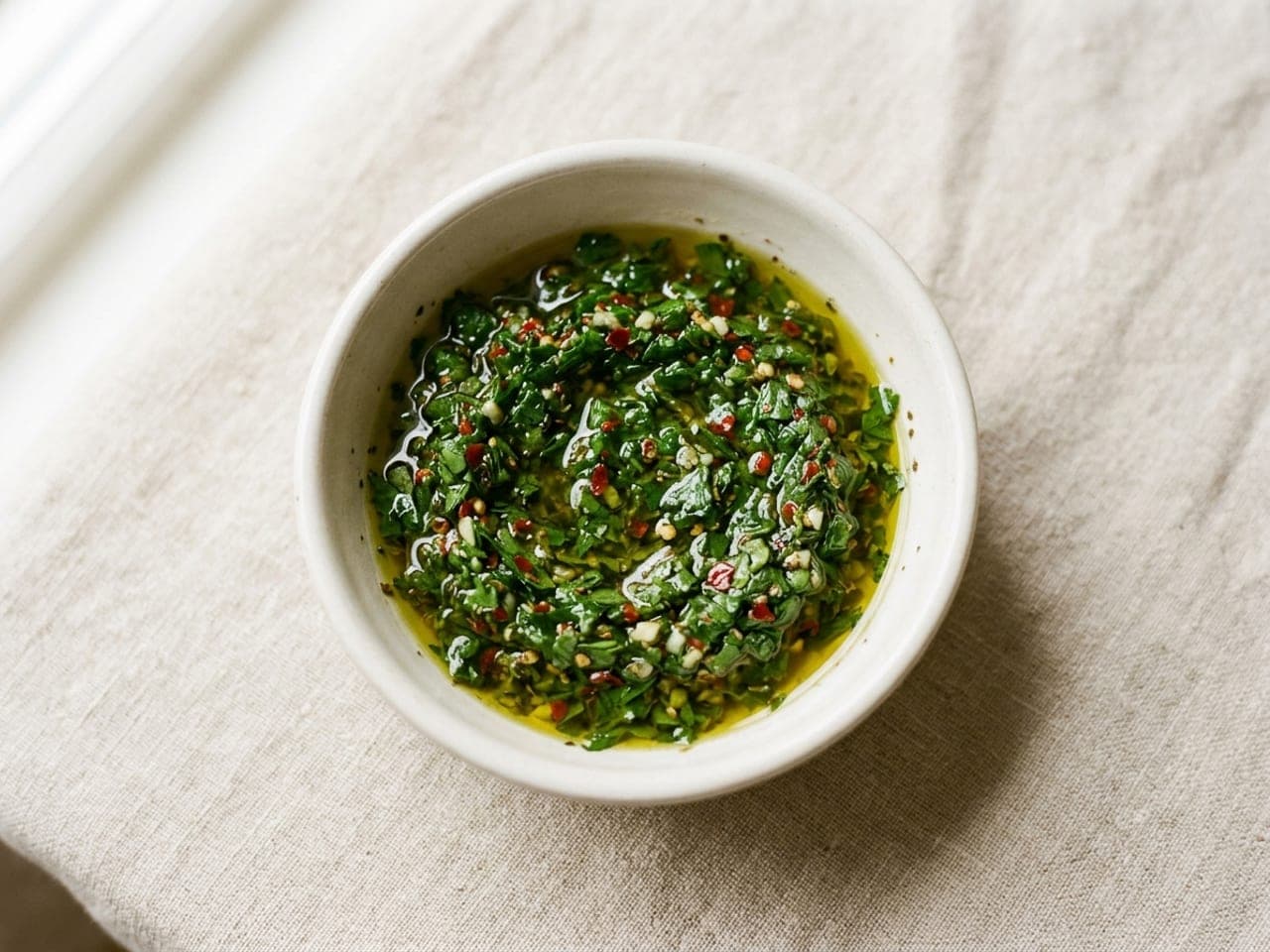
Ingredients
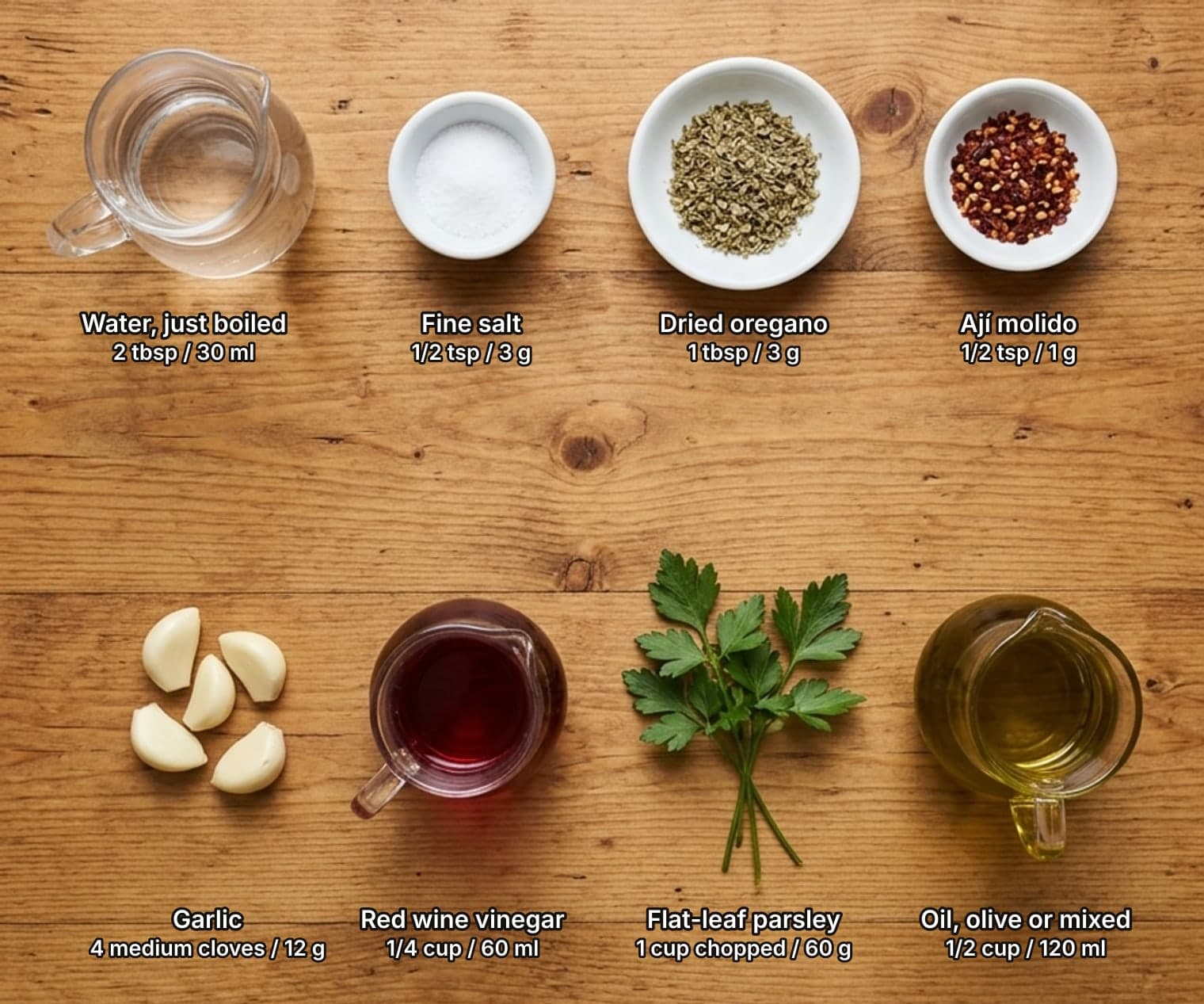
- water, just off the boil (it softens the dried oregano and dissolves the salt, which barely dissolves in oil)2 tbsp (30 ml)
- fine sea salt or table salt (with Diamond Crystal kosher salt use about 1 tsp, since it weighs about half as much per spoon; 3 g either way)1/2 tsp (3 g)
- dried oregano, rubbed between your palms (dried, not fresh, is the Argentine norm; with fresh use about 3 tbsp, finely chopped)1 tbsp (3 g)
- ají molido (Argentine ground dried red pepper) or red pepper flakes (chilli flakes); use 1/4 tsp for a mild sauce1/2 tsp (1 g)
- garlic, finely minced by knife4 medium cloves (12 g)
- red wine vinegar (white wine vinegar works; lemon juice changes the character)1/4 cup (60 ml)
- flat-leaf parsley, leaves and thin upper stems only, washed, dried completely and finely chopped by knife (about 1 large bunch; not curly parsley)1 cup chopped (60 g)
- oil: half extra virgin olive oil and half sunflower oil, as many Argentine cooks make it, or all extra virgin olive oil1/2 cup (120 ml)
What chimichurri is (and what it is not)
Chimichurri is an uncooked, loose sauce from the Río de la Plata, the region shared by Argentina and Uruguay, made from finely chopped flat-leaf parsley, dried oregano, garlic, ají molido (ground dried red pepper), salt, red wine vinegar and oil. It is sharp, garlicky and herbal, with a mild heat, and it is spooned over grilled beef, sausages and provoleta at an asado, the Argentine barbecue, to cut through the fat. It is not a paste and not an emulsion: the oil floats over the herbs and seasoned vinegar, and you stir before every spoonful.
Ají molido matters more than people think. It is Argentina’s everyday ground dried red pepper, seeds included, defined in the national food code (Código Alimentario Argentino, article 1203) in sweet and hot versions. Food historian Mario Aiscurri goes as far as to say “es, precisamente, la presencia del ají molido lo que le da identidad argentina al chimichurri” (it is precisely the ají molido that gives chimichurri its Argentine identity). Outside Argentina, red pepper flakes are the usual stand-in; they are a little hotter, so start with 1/4 tsp if you are unsure, or mix sweet paprika with a pinch of flakes to get closer to ají molido’s sweet-and-hot balance.
Per serving (one eighth of the batch, a generous 2 tbsp) it has about 127 calories, 13.6 g fat, 1.3 g carbohydrate and 151 mg sodium. The arithmetic, from USDA FoodData Central: 108 g of oil (1/2 cup) is 955 kcal, 60 g of parsley 22, 12 g of garlic 18, 3 g of dried oregano 8, 1 g of pepper flakes 3 and 60 g of red wine vinegar 11, a total of about 1,017 kcal, divided by 8. The oil is 94% of the calories, and olive and sunflower oil are identical at 884 kcal per 100 g, so the oil choice changes the taste, not the number. Sodium: 3 g of fine salt brings 1,164 mg and the rest about 44, so 1,208 mg in all, or 151 per serving. If you spoon mostly herbs and leave oil in the bowl, you eat fewer calories than this, but how many fewer depends on your spoon.
How to make Chimichurri
- Wash the parsley, then get it bone dry. Swish the parsley in a big bowl of cold water and lift it out, so the grit sinks and stays behind; repeat if the water looks sandy. Then dry it properly: a salad spinner, then a roll in a clean towel. Water left on the leaves dilutes the vinegar, makes the sauce watery and stops the oil clinging to the herbs, and wet leaves smear rather than cut on the board. Strip off the leaves and the thin, tender stems at the top; discard the thick lower stems, which stay stringy in a hand-cut sauce and taste grassy and harsh. Weigh out about 60 g of leaves if you have a scale, which is the most reliable way to land on 1 cup (60 g) once chopped, because a “bunch” of parsley varies a lot from shop to shop.
- Bloom the oregano and chili in hot salted water. In a medium glass or stainless steel bowl (the vinegar reacts with aluminium), stir the salt into the 2 tbsp of just-boiled water until it dissolves. Add the oregano, crushing it between your palms as it goes in, and the ají molido or pepper flakes, and leave it for 10 minutes. Dried oregano is leathery and dusty straight from the jar; hot water softens it and pulls its aroma into the liquid, which is why Argentine chef Javier Brichetto soaks his dried herbs in water “a punto de hervir” (on the point of boiling) for 10 minutes and America’s Test Kitchen stands its oregano in hot water for 5. It also seasons evenly: salt dissolves in water, but hardly at all in oil, so salting the water now beats sprinkling salt over an oily sauce later. The step has history too: salted, garlicky water (salmuera) basted onto meat at the grill is one of the sauce’s two ancestors.
- Add the garlic and vinegar, and let them sit. Mince the garlic finely with a knife and stir it into the oregano water with the vinegar. Leave it while you chop the parsley. Sitting in salt and acid for those few minutes takes the hardest raw edge off the garlic and lets it flavour the whole liquid instead of arriving as hot little pieces in one bite. Skip the rasp, the press and the jar: garlic crushed to a wet paste, or minced in a processor and held for hours, turns sharp and acrid in the sauce. Four medium cloves gives a clearly garlicky sauce, which is how it is eaten at an asado; use 2 if you are serving it with something delicate like white fish.
- Chop the parsley by knife, fine but not to a paste. Pile the dry leaves on the board and chop them with your sharpest knife, slicing down through the pile in passes and gathering it back together, rather than rocking the blade over the same spot again and again. Stop when the pieces are about the size of a grain of rice. A sharp blade cuts the leaves cleanly; a dull one or a long run in a processor crushes them, and crushed leaves bleed juice and darken faster in the acid. This is also where the texture of real chimichurri comes from: loose, flecked and spoonable, with oil around the herbs. Brichetto is blunt about it: “Es imprescindible prepararla picando sus elementos a cuchillo” (it is essential to make it by chopping everything with a knife), because a blender turns it into something like a pesto. If you must use a processor, pulse the parsley alone in about 10 short bursts (America’s Test Kitchen pulses its herbs about 10 times) and stop while you can still see separate pieces.
- Stir in the parsley, then the oil, by hand. By now the bowl should be no more than warm to the touch; if it is still hot, wait, because heat speeds up the browning of the parsley. Stir the chopped parsley into the vinegar mixture, then pour in the oil and stir it through with a spoon. Never run the oil through a blender or processor. Cook’s Illustrated tested this and found that blitzing extra virgin olive oil breaks it into tiny droplets and frees its bitter polyphenols, which are normally coated by the fat; the processor batch was “markedly bitter”. America’s Test Kitchen’s chimichurri says it plainly: “To keep the sauce from becoming bitter, whisk in the olive oil by hand.” Using half sunflower oil, as many Argentine cooks do, softens the sauce further and keeps it pourable in the fridge. Do not expect it to come together: chimichurri is a broken sauce, a layer of oil floating over herbs in seasoned vinegar and water, and that separation is correct.
- Rest it 20 to 60 minutes, then taste. Cover the bowl and leave it at room temperature for 20 minutes to an hour. That rest is part of its 2 hours out of the fridge, so make it shortly before you eat. In that time the oregano finishes softening, the garlic and chili flavour the liquid and the salt reaches the parsley; straight after mixing it tastes like its separate parts. Do not stretch the rest into hours. Acid slowly swaps the magnesium out of chlorophyll and turns bright green to olive-drab, faster in the warm, so the sauce is at its greenest in the first couple of hours, and food safety asks for the same thing (see the safety notes). Then taste it on a piece of bread or a slice of whatever you are serving: add a pinch of salt if it tastes flat, a teaspoon of vinegar if it tastes oily, a pinch more chili if you want heat. Stir before you taste, because the oil rises.
- Serve it loose, with a spoon that reaches the bottom. Stir again and spoon it on, taking herbs and liquid from the bottom as well as oil from the top; a spoonful of only the oil layer is just herb oil. Serve it at room temperature, in a small bowl with its own spoon, and keep the rest in the fridge to top it up rather than leaving the whole batch out on the table through a long lunch. If it has been chilled, take it out 20 to 30 minutes ahead (that time counts towards the 2 hours too): extra virgin olive oil clouds and thickens in the fridge and loosens again as it warms, while sunflower oil stays liquid, which is one more reason for the half-and-half oil. A generous 2 tablespoons, one eighth of the batch, is a serving for a steak or a sandwich; 1 tablespoon is plenty over vegetables.
- Store it cold for 4 days, or freeze it. Spoon leftovers into a clean glass jar, press them down so the oil covers the herbs (for colour, not for safety; the 4-day limit still applies), and refrigerate at 40°F (4°C) or below. Use it within 4 days, the outside limit Oregon State University and Pacific Northwest extension services set for fresh garlic and herbs in oil (the reasons are in the storage section below). For longer, freeze it in an ice-cube tray, then tip the cubes into a freezer bag; they keep their quality for about 3 months. Freeze it on the day you make it, thaw just what you need overnight in the fridge, and use thawed cubes within 24 hours (the UK Food Standards Agency’s rule for defrosted food); never refreeze them. To make it ahead for a party, keep two jars in the fridge: the parsley stirred into the oil in one, the bloomed oregano, garlic and vinegar in the other. Combine them within an hour of serving, and the sauce comes to the table as green as if you had just made it. Freshest of all: make the oregano, garlic and vinegar base ahead and chop the parsley on the day.
Safety & hygiene Important
- Fridge life: 4 days at most. Homemade chimichurri is raw garlic and fresh herbs in oil, and the extension services that have studied garlic and herbs in oil (Oregon State University and the Pacific Northwest Extension guide PNW 664) say to refrigerate such mixtures and use them within 4 days, or freeze them; Clemson’s extension service is stricter still at 2 to 3 days. We use 4 days as the outside limit; sooner is better. Health Canada says to use homemade flavoured oils within one week, kept at 4°C (40°F) or lower, and never to keep vegetables and herbs in oil at room temperature; we use the stricter 4 days. In the UK, the Food Standards Agency’s fridge advice is 5°C or below, and its general advice for leftovers is to eat them within 2 days; if you follow that rule, freeze what you will not eat in 2 days. Recipes that promise two weeks or months are not backed by any of these authorities. Use a clean spoon each time.
- The vinegar is not a tested safety step. Clostridium botulinum spores can be present on garlic and herbs, and covering them in oil shuts out the air they dislike. Toxin is not reported to form below pH 4.6, which is the dividing line food rules use for acidified foods, and chimichurri’s vinegar probably lowers the risk, but no tested pH or method has been published for homemade chimichurri, and acid has to get right into the garlic pieces to count. The only tested home method for garlic or herbs in oil (Pacific Northwest Extension guide PNW 664, also used by Clemson extension) is a 24-hour soak in a 3% citric acid solution, 1 tbsp citric acid in 2 cups (480 ml) of water, before the oil goes on; it was tested for infused oils made with garlic, basil, oregano or rosemary only, not parsley and not for a sauce like chimichurri. Those same guides say vinegar and lemon juice have not been tested for this job. So treat chimichurri as a refrigerated, short-life sauce. Shop-bought jars last longer because their acidity is controlled.
- At the table: 2 hours out, 1 in the heat. Health Canada’s advice for herbs in oil is never to keep them at room temperature. At a meal, follow USDA’s rule for perishable food: back in the fridge or thrown out within 2 hours of being made or leaving the fridge, counting the 20 to 60 minute rest, or 1 hour when it is above 90°F (32°C), as it often is beside a grill in summer. Put out a small bowl, set in a bowl of ice on a hot day, and top it up from a cold jar rather than leaving the whole batch out all afternoon, and do not pour what is left in the table bowl back into the jar. One popular recipe tells you to rest the sauce overnight on the counter; do not.
- As a marinade: keep raw meat away from the table sauce. If you marinate with chimichurri, spoon the table portion into its own bowl first and use a separate batch on the raw meat; sauce that has touched raw meat never goes back to the table unless it has been brought to a full boil, which ruins it anyway. Chop the parsley and garlic on a clean board, not the one that held the raw steak or sausage, and wash the brush or spoon that touched the raw meat before it goes near cooked food. Put the cooked meat on a clean plate, not the one that carried it raw, and wash your hands with soap for 20 seconds after handling raw meat. For the USDA safe minimum, cook whole cuts of beef such as skirt steak until a thermometer reads at least 145°F (63°C) before they leave the heat, then rest them 3 minutes; the medium-rare that most steak lovers want, 130 to 135°F (54 to 57°C), is below that line, so it is your call, and not one for anyone pregnant, very young, elderly or immune-compromised. Fresh sausage for choripán is ground meat: USDA says 160°F (71°C).
- Vitamin K, if you take warfarin. Parsley is very rich in vitamin K. By USDA FoodData Central figures, this batch made with the half-sunflower oil mix carries about 1,040 micrograms, of which parsley supplies 984, so a serving (one eighth, a generous 2 tbsp) has about 130 micrograms, around 108% of the 120 microgram Daily Value (a little more with all olive oil). That is not a reason to avoid it, but people on warfarin are usually asked to keep their vitamin K intake steady rather than suddenly eating a lot more, so if you take it, mention a new chimichurri habit to whoever manages your dose.
3 ways to plate it
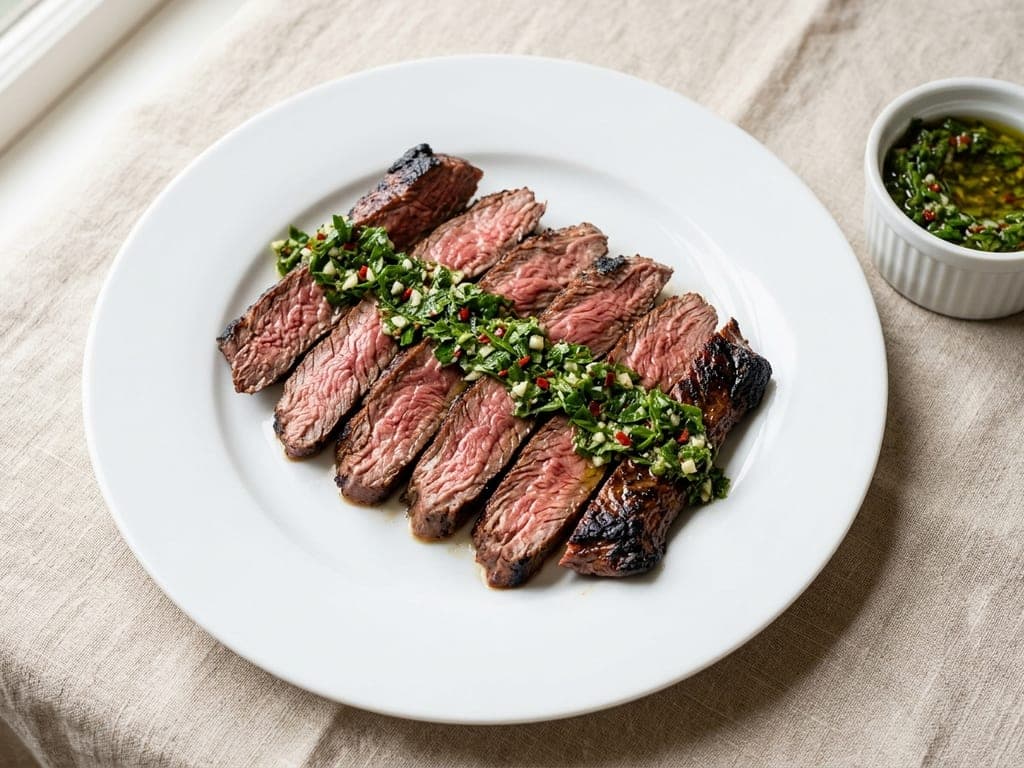
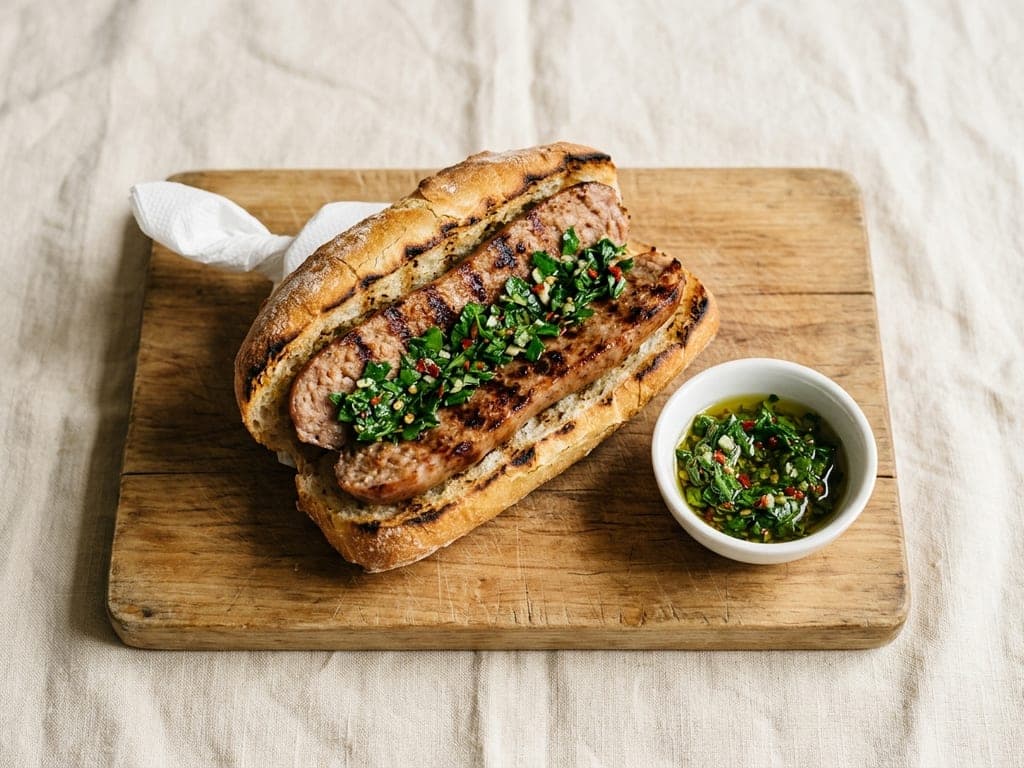
The ratio: where ours sits between Buenos Aires and the US blogs
The ratio that matters is oil to vinegar, by volume, and the published recipes are all over the place. Argentine chef Javier Brichetto, of Piantao in Madrid, uses 40 ml of oil (half sunflower, half olive), 40 ml of wine vinegar and 40 ml of near-boiling water: 1 to 1, plus as much water again. America’s Test Kitchen uses 1/2 cup (120 ml) oil, 1/4 cup (60 ml) red wine vinegar and 1/4 cup (60 ml) water: 2 to 1. The popular US recipes we read, Rachel Cooks, Natasha’s Kitchen and Love and Lemons, sit at about 2.7 to 1 (1/2 cup (120 ml) to 3 tbsp, or 1/3 cup (80 ml) to 2 tbsp). Garden Betty goes to 4 or 5 to 1, and La Nación’s asado recipe uses 5 vasos (glasses) of oil to 1 vaso of vinegar and the juice of a lemon, also about 5 to 1.
Ours is 2 to 1, 1/2 cup (120 ml) oil to 1/4 cup (60 ml) vinegar, with 2 tbsp of hot water. That makes it sharper than the US blogs and oilier than Brichetto. The reasoning: vinegar is what cuts the fat of grilled beef and chorizo, and at 4 or 5 to 1 the sauce drifts towards herb oil; at 1 to 1 with as much water it is a thin, vinegary dressing that is superb on a fatty asado but harsh on a lean steak or vegetables. If you want the sharper Buenos Aires style, take the vinegar up to 1/3 cup (80 ml) and the hot water to 1/4 cup (60 ml); for a softer sauce, drop the vinegar to 3 tbsp.
The oil is the other half of the question. Argentine home cooks often use sunflower or corn oil, which are milder than olive; Brichetto uses half sunflower and half olive, and La Nación says “En vez de oliva podés usar aceite de girasol” (instead of olive you can use sunflower oil). We follow Brichetto: half and half keeps a little olive fruitiness, lowers the risk of bitterness and keeps the sauce pourable straight from the fridge, where extra virgin olive oil clouds and thickens.
Why chimichurri turns bitter, and how to stop it
The commonest cause is the machine. Cook’s Illustrated found that when extra virgin olive oil is emulsified at high speed in a blender or processor, it breaks into tiny droplets and frees polyphenols that are normally coated by the fatty acids, and its tasters found the processor batch “markedly bitter”. That is why America’s Test Kitchen’s chimichurri pulses its herbs, garlic and pepper flakes briefly, about 10 times, then whisks the olive oil in by hand, and why our method never puts the oil near a blade. If you prefer a smoother sauce, blend the herbs with sunflower oil and stir the olive oil in afterwards.
The other usual suspects, with fixes: thick parsley stems (fibrous and grassy; use leaves and thin upper stems only); curly parsley (coarser and more bitter in a raw sauce; use flat-leaf); garlic minced in a processor and held for hours (sharp and acrid; mince it fresh by knife); old oil (taste it alone first; rancid oil smells of crayons or putty); too much dried oregano (it turns medicinal; 1 tbsp per batch is plenty); and a sauce left too long, which loses its fresh green taste with its colour. A small pinch of salt or a few more drops of oil will soften a sauce that is slightly harsh; nothing rescues rancid oil.
The colour clock: rest it, then serve it the same day
Chimichurri has a built-in contradiction. It needs a rest so the flavours join up, but the vinegar that makes it taste right is what dulls it. As Harold McGee explains in On Food and Cooking, acid replaces the magnesium at the heart of the chlorophyll molecule, and the green turns olive-drab; the change runs faster the more acidic and the warmer the food is. So the sauce is at its brightest on the day you make it and goes on fading in the fridge.
The published rest times stretch from minutes to a day. Brichetto soaks only his dried herbs for 10 minutes; America’s Test Kitchen rests the sauce at least an hour at room temperature; Saveur says 30 minutes to 3 hours; Argentine TV channel elgourmet leaves the dried herbs in brine for 24 hours, then lifts them out and adds oil; one blog rests it overnight on the counter, which food-safety authorities would not accept. Our window is 20 to 60 minutes at room temperature, and the rest counts towards the 2 hours it can spend out of the fridge in all (1 hour in heat above 90°F (32°C)).
To make it ahead without losing the colour, separate the acid from the green: parsley in oil in one jar, the bloomed oregano, garlic and vinegar in the other, both in the fridge, both used within 4 days. Stir them together within an hour of serving. If you are freezing it, freeze the parsley, oil and oregano without the vinegar and add the vinegar once it has thawed in the fridge, then use it within 24 hours.
How long does chimichurri last? The answer with sources
The recipe pages disagree by weeks. Of those we read, SBS says 2 to 3 days, Natasha’s Kitchen and Love and Lemons 4 days, Tasting Table 5, Rachel Cooks and Milk Street a week, other pages two weeks, and a reader comment under Garden Betty’s recipe 2 to 3 months. None of them gives a reason.
Here is the reason. Chimichurri is fresh herbs and raw garlic under oil, and garlic and herbs can carry spores of Clostridium botulinum, which grow and make toxin in low-oxygen conditions. Oregon State University Extension’s guide to herbs and vegetables in oil says: “Use within 4 days or freeze for long-term storage”; the Pacific Northwest guide PNW 664 gives 2 to 4 days, and Clemson’s extension service says 2 to 3. Health Canada says never to keep herbs or vegetables in oil at room temperature, keeps the fridge at 4°C (40°F) or lower and says to use homemade oils within a week. So: 4 days in the fridge at most, sooner is better, freeze for longer, which is also when the sauce tastes best.
What about the vinegar? It is the reason many cooks believe the sauce keeps for weeks, and it probably does lower the risk, but it is not a tested safety step. Nobody has published a measured pH for home-made chimichurri, and acid has to reach the inside of the garlic pieces to protect them; that is why the only tested home method for garlic or herbs in oil, from the Pacific Northwest extension services (guide PNW 664, also published by Clemson and North Carolina State), is a 24-hour soak in 3% citric acid before any oil goes on, and it was tested only for infused oils made with garlic, basil, oregano or rosemary, not parsley and not a sauce like chimichurri. Commercial chimichurri lasts longer because the maker controls its acidity, not because chimichurri as such is self-preserving.
Freezing is the honest answer for a big batch. Oregon State recommends freezing herbs in oil in ice-cube trays, then moving the cubes to an airtight container; we would use them within about 3 months, for taste rather than safety, since parsley softens and fades in the freezer. Freeze it on the day you make it, thaw cubes overnight in the fridge, not on the counter, and use them within 24 hours, the UK Food Standards Agency’s rule for defrosted food; never refreeze them.
Where chimichurri comes from: the recipe is older than the name
The story on most recipe pages is that chimichurri is a 19th-century gaucho sauce with a Basque or Irish name. The documents tell it the other way round. Argentine food historian Mario Aiscurri, who has worked through the country’s old cookbooks, concludes that chimichurri is a late sauce, born when a meat adobo merged with the criollo salmuera, and that “la adopción del nombre es posterior al uso del adobo como salsa” (the name was adopted after the adobo was already used as a sauce).
Both ancestors are on paper long before the word. Travellers in the 1820s to 1880s describe meat roasted over fire and seasoned with salmuera, salted water with crushed garlic. An English visitor’s Cinco años en Buenos Aires, 1820-1825, as Aiscurri quotes the Spanish translation, already grumbles: “Me gustarían las salsas si no fuera por el horrendo ajo con que son aderezadas” (I would like the sauces if it were not for the horrid garlic they are dressed with). Then the adobo: Teófila Benavento’s La perfecta cocinera argentina, in its 1895 edition, copying almost word for word the Almanaque de la cocinera argentina of 1881, gives a meat marinade of “vinagre, pimentón, oréganos, ajos pisados, cominos, ají molido, laurel, pimienta en grano y sal” (vinegar, paprika, oregano, crushed garlic, cumin, ají molido, bay, peppercorns and salt). That is chimichurri without the parsley and oil. Doña Petrona’s famous cookbook has, from its early editions (Aiscurri found it in the index of the second and quotes the 1941 and 1942 printings), a bottled “salsa para adobos” with ají molido, for marinating suckling pig or saucing meat on the spit, still not called chimichurri; the often-repeated claim that her 1934 first edition has a chimichurri recipe is not supported.
The name turns up as a sauce only in the middle of the 20th century. Bilbao food historian Ana Vega Pérez de Arlucea found earlier uses of the word that do not mean a sauce; from 1950 they do, starting with the French writer Maurice Lelong’s En Patagonie et Terre de Feu (1950), followed by Hugo Wast’s novel Morir con las botas puestas (1952), which spells it “chimichurria”. Aiscurri also reports, via Ana Vega, a 1944 recipe in the Bilbao newspaper La Gaceta del Norte for a gaucho-style lamb sauce whose writer would not print its name, taking it for a swear-word, so the word was probably being said before it was printed. One of the earliest known printed recipes under the name is in Especialidades de la cocina criolla, the 1958 recipe book of the Buenos Aires magazine Mucho Gusto. In English, Merriam-Webster dates the first known use to 1967, while Dictionary.com says 1955 to 1960; the dictionaries disagree.
And the famous etymologies? The Basque word “tximitxurri”, said to mean “a mix of things”, is the one you will read everywhere, but the Basque Academy’s dictionaries, historical and modern, have no such entry, and Elhuyar, the main modern Basque-Spanish dictionary, gives tximitxurri only as the name of the Argentine sauce, which is what a loanword into Basque looks like. Ana Vega put it bluntly in a 2019 letter Aiscurri quotes: “esa palabra no existe en euskera” (that word does not exist in Basque). Merriam-Webster’s tentative Basque link is a different word, zurrumurru, “rumour”, through Spanish zurriburri, “hubbub”. That does not disprove a Basque origin; it means the word usually quoted is undocumented. The Jimmy McCurry story exists in at least three incompatible versions (an Irish immigrant missing his Worcestershire sauce, an English landowner at Cañuelas called Jimmy Curry, a meat wholesaler), and the British prisoners’ “give me curry” story is set among the prisoners of the failed British invasions of 1806-07 by some tellers, and among British estancia workers in Patagonia in the version Aiscurri attributes to the gastronome Miguel Brascó. Aiscurri, who has read British prisoners’ own accounts of 1806 and 1807 and found neither the name nor the sauce in them, calls it “una bella leyenda sin respaldo documental” (a beautiful legend with no documentary support). Argentine historian Daniel Balmaceda, quoted in an English BBC Travel feature in late May 2021 (BBC Mundo ran the Spanish version that June), traces the word to Quechua, as an old generic term for strong sauces served with meat; no Quechua source word has been published.
Is it Argentine or Uruguayan? It is a Río de la Plata sauce, eaten on both banks. Every dated Argentine cookbook recipe above was printed in Buenos Aires, but that says as much about where cookbooks were published as about where people cooked. In Houston, Nicaraguan-born Michael Cordúa built his restaurant Churrascos, opened in 1988, around grilled churrasco steak with chimichurri; he later recalled that his first customers “were expecting Mexican food, not Nicaraguan. It was a nightmare, really.” Not everyone in Argentina loves it, either: Aiscurri reports rural asadores who make salmuera, not chimichurri, and one grill master who grumbled that the sauce covers up the taste of the meat.
Chimichurri rojo, and the cilantro question
Red chimichurri, chimichurri rojo, leans on dried peppers instead of parsley. To make it from this recipe, cut the parsley to 1/4 cup (15 g), raise the ají molido or pepper flakes to 1 tsp and add 2 tsp of sweet, unsmoked pimentón (Spanish paprika; smoked pimentón pushes it towards Spanish chorizo), blooming both in the hot water with the oregano; everything else stays the same. Brichetto’s recipe and La Nación’s both include pimentón. The versions with roasted red peppers or tomato that you will find online are modern variations; we found no dated origin for them.
Red is arguably the older of the two. The 1881 adobo above is red with pimentón and ají molido and has no parsley at all, and Aiscurri lists parsley as frequent rather than essential in chimichurri; parsley-forward green became the standard later. That is an inference from the cookbooks rather than a documented date, but it means rojo is not a twist on the green sauce so much as a cousin closer to the original.
Cilantro (fresh coriander) is not part of the Argentine canon: it is absent from every Argentine source we checked, from the 1881 adobo to modern chefs. It does appear in many US and Central American versions, and America’s Test Kitchen uses 2/3 cup (160 ml) of it beside 1 1/3 cups (320 ml) of parsley. Some versions are a different sauce altogether: Tasting Table’s popular recipe blends cilantro with lime juice, honey and cumin until smooth, which its own page describes as tasting like “a blended green salsa”. If you like cilantro, swap up to a third of the parsley for it and call it what it is, a variation. The word itself travelled further than the recipe: in Costa Rica chimichurri is a tomato salsa, and in the Dominican Republic a “chimi” is a burger.
Questions, answered
What is chimichurri made of?
Seven things: finely chopped flat-leaf parsley, dried oregano, garlic, ají molido (ground dried red pepper) or red pepper flakes, salt, red wine vinegar and oil. Our batch is 1 cup (60 g) chopped parsley, 1 tbsp dried oregano, 4 garlic cloves, 1/2 tsp ají molido, 1/2 tsp fine salt, 1/4 cup (60 ml) red wine vinegar, 1/2 cup (120 ml) oil (half olive, half sunflower) and 2 tbsp hot water to bloom the oregano. It is uncooked and loose, not a paste. No cheese, no nuts, no cilantro in the Argentine version. Allergens: none of the major ones in the sauce itself, but wine vinegar often contains sulphites, which UK and EU labels must declare; check the bottle if you avoid them (lemon juice is the usual swap, though it changes the taste).
Is chimichurri Argentinian or Uruguayan, and where does the name come from?
Both: it is a Río de la Plata sauce, eaten on both sides of the river, though every early Argentine cookbook recipe we know of was printed in Buenos Aires. The name’s origin is uncertain. The ingredients are documented as a meat adobo by 1881, but the word first appears in print as the name of a sauce in 1950, and one of the earliest known recipes under that name is from 1958. The popular Basque “tximitxurri” etymology rests on a word that the Basque Academy’s dictionaries do not record, and the Jimmy McCurry and “give me curry” stories have no documents behind them.
Does authentic chimichurri have cilantro?
No. Argentine and Uruguayan chimichurri is parsley with dried oregano; cilantro (fresh coriander) is absent from every Argentine source we checked. It shows up in many US and Central American versions. If you like it, replace up to a third of the parsley with cilantro and treat it as a variation.
Should chimichurri use fresh or dried oregano?
Dried is traditional: it is in the 1881 adobo that is chimichurri’s ancestor, and Argentine cooks use it today. Bloom it first in a little hot, salted water for 5 to 10 minutes so it softens and releases its aroma. If you only have fresh oregano, use about three times the volume, 3 tbsp finely chopped for our 1 tbsp of dried, and expect a more resinous, greener taste.
Is it better to chop chimichurri by hand or in a food processor?
By hand. A sharp knife gives the loose, flecked texture with oil around the herbs; a processor bruises the parsley, makes it darken faster and pushes the sauce towards pesto. Argentine chef Javier Brichetto calls the knife “imprescindible” (essential). If you use a processor, pulse only the parsley, about 10 short pulses, mince the garlic by knife, and always stir the oil in by hand: Cook’s Illustrated found that olive oil blitzed in a processor turns markedly bitter.
Why is my chimichurri bitter?
Usually because extra virgin olive oil went through the blender or processor, which frees its bitter polyphenols (Cook’s Illustrated tested it). Other causes: thick parsley stems, curly parsley, garlic processed and held for hours, old or rancid oil and too much dried oregano. Stir the oil in by hand, use leaves and thin stems of flat-leaf parsley, mince garlic fresh, and consider half sunflower oil.
What is the difference between red and green chimichurri, and is chimichurri spicy?
Green chimichurri is built on parsley; red chimichurri (rojo) uses little or no parsley and more ají molido and pimentón (paprika), which make it red, earthier and usually hotter. The oldest documented ancestor, an 1881 meat adobo, had paprika and ají molido and no parsley, so a pepper-heavy, parsley-light sauce is not a modern twist; whether today’s rojo descends from it directly is not documented. Green chimichurri is mildly spicy, not hot: our 1/2 tsp of ají molido or pepper flakes per batch (about 1 1/4 cups (300 ml) of sauce) gives a gentle warmth, 1/4 tsp makes it mild, and the garlic and vinegar bite is what some people read as heat.
How long does chimichurri last in the fridge, and can you freeze it?
Four days in the fridge at 40°F (4°C) or below, the outside limit Oregon State University and Pacific Northwest extension services give (Clemson’s says 2 to 3 days) for fresh garlic and herbs in oil; the vinegar helps but is not a tested safety step, so ignore recipes promising weeks. Never leave it out at room temperature for more than 2 hours in all, counting the rest after mixing (1 hour above 90°F (32°C)). Yes, you can freeze it: in ice-cube trays, then a freezer bag, for about 3 months for best quality. Freeze it on the day you make it, thaw it overnight in the fridge and use it within 24 hours; never refreeze it. For the brightest colour, freeze it without the vinegar and add the vinegar after thawing.
Is chimichurri a marinade?
In Argentina it is above all a table sauce, though many asadores (grill cooks) also shake it over the meat as it cooks from a bottle with a notched cork; the older baste is salmuera, salted water with crushed garlic. It does work as a marinade for thin cuts like skirt or flank steak for 30 minutes to 2 hours in the fridge; longer, and the vinegar turns the surface grey and mushy. Pat the meat dry before it goes on a hot grill so it browns instead of steaming. Set the table portion aside before any of it touches raw meat, and never serve marinade that has.
What is the difference between chimichurri, pesto and salsa verde?
Pesto is basil pounded with pine nuts, cheese and olive oil into a thick emulsion, with no acid. Italian salsa verde is parsley with capers and often anchovy, sharpened with vinegar or lemon. Mexican salsa verde is a tomatillo salsa, unrelated. Chimichurri is parsley with dried oregano, garlic, chili, vinegar and oil, no cheese, no nuts, loose rather than pounded, with the oil floating on top.
How do you serve chimichurri with steak?
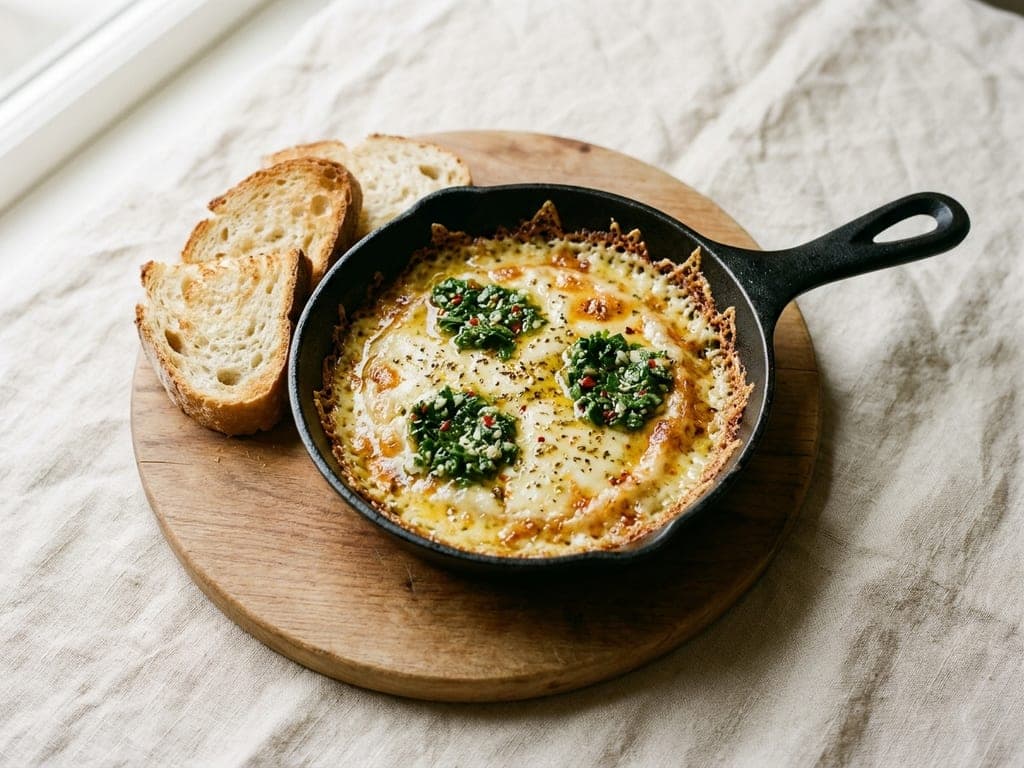
The Argentine default is a bowl on the table, and America’s Test Kitchen also passes it separately; others spoon it over the sliced meat. On a plate, slice the steak across the grain, fan the slices cut side up and spoon a ribbon across the middle of them, leaving the crust at each end dry, with more in a small bowl beside. A generous 2 tbsp per person, one eighth of the batch, is plenty. Beyond steak it goes on choripán, provoleta, grilled vegetables, potatoes, roast chicken, white fish and eggs.
Snap your finished plate and let the AI plate it again — more beautifully.