Brisket Recipe: Make-Ahead Oven Braise, Texas Oven or Smoker
The brisket recipe for the holiday table: one 5 lb (2.3 kg) flat, salted a day ahead, seared, and braised sealed on 3 lb (1.4 kg) of onions with red wine and tomato paste, then chilled overnight in its liquid so the fat lifts off in one sheet and the meat slices cleanly, cold, before it reheats in its own sauce. It serves 10. This braised brisket comes with the numbers most beef brisket recipes leave out: safe at 145°F (63°C) but tender only near 200°F (93°C), a two-stage oven (325°F / 163°C, then 250°F / 121°C) that keeps a covered braise from stalling, and a first stage timed by the flat’s thickness, not by the pound. Texas-style brisket in the oven and a whole packer on the smoker get full methods of their own, plus slow cooker and Instant Pot conversions. And the history no ranking page prints: the oldest brisket in a Jewish cookbook in English is from London, 1846, stewed with onions and raisins, and the earliest “smoked brisket” advertised in Texas that historian Daniel Vaughn has found (El Paso, 1910) was a deli meat, the kind packers sold “principally to Kosher (Jewish) trade.” Dairy-free if the horseradish is the plain grated kind and the broth has no milk; contains wheat (flour) and sulfites (wine and red wine vinegar), with Passover swaps.
Ingredients
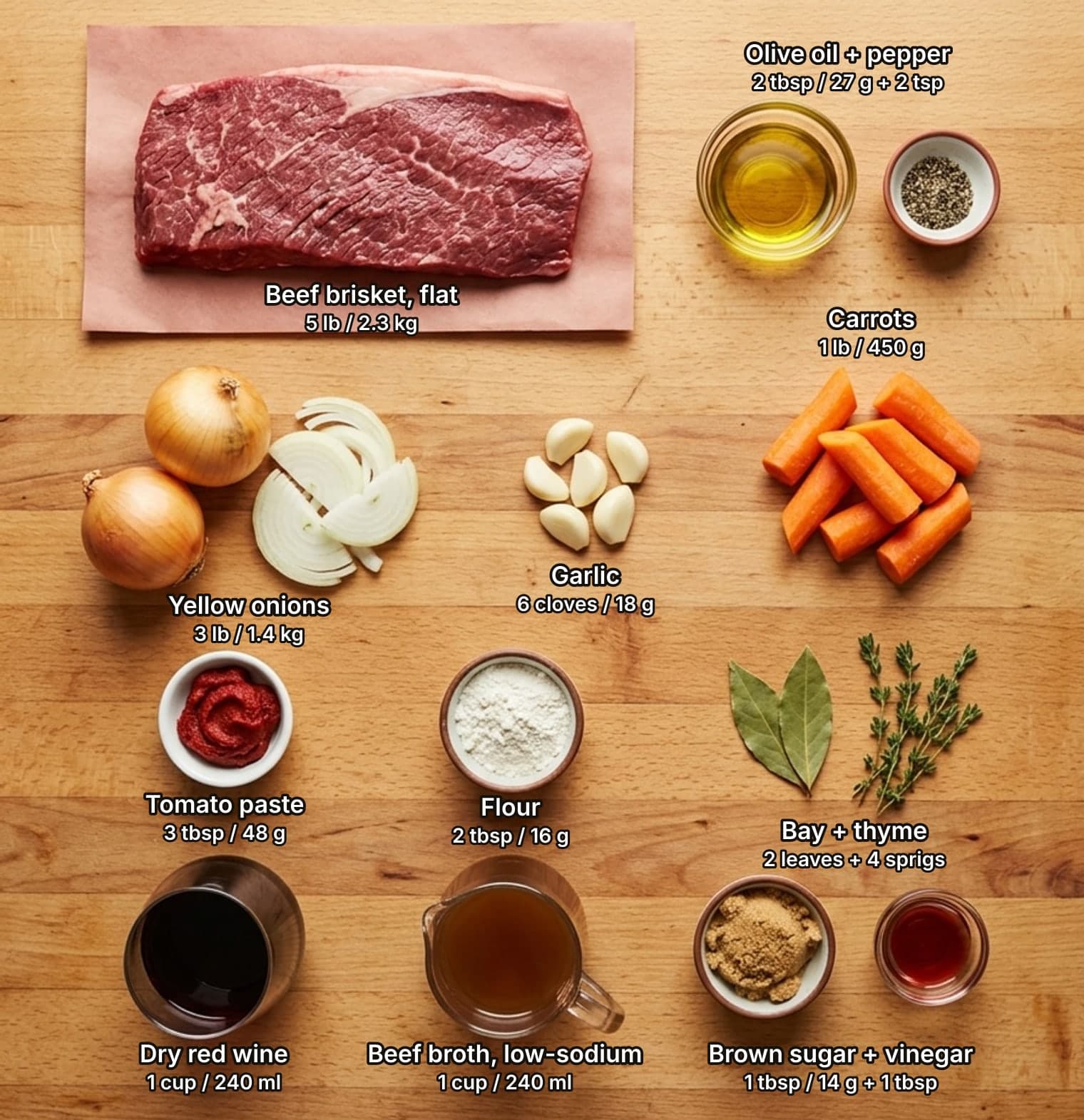
- beef brisket, flat cut (also called first cut), fat cap trimmed to about 1/4 inch (6 mm), hard fat removed; buy it unenhanced if you can (brisket labeled enhanced or containing a solution is already salted, so halve the salt). UK: a boneless rolled brisket joint, untied; Czech: hovězí hrudí bez kosti5 lb (2.3 kg)
- kosher salt, for salting 12 to 48 hours ahead (weigh it if you can: a teaspoon of Diamond Crystal weighs about 3 g, a teaspoon of Morton about 5 g)5 tsp Diamond Crystal or 1 tbsp Morton (15 g)
- black pepper, freshly ground2 tsp
- olive oil or rendered chicken fat (schmaltz), for searing (either one also sidesteps the kitniyot question that corn or soybean oil raises at Passover for many Ashkenazi households)2 tbsp (27 g)
- yellow onions, halved and sliced 1/4 inch (6 mm) thick (about 6 very large or 9 large; weigh them)3 lb (1.4 kg)
- garlic cloves, smashed6 (18 g)
- tomato paste3 tbsp (48 g)
- all-purpose flour (contains wheat; for Passover use the same amount of matzo cake meal, which is also wheat, or for a wheat- and gluten-free sauce leave the flour out and thicken with potato starch, see the make-ahead section)2 tbsp (16 g)
- dry red wine (contains sulfites; kosher for Passover if needed; for no wine, use the same amount of broth plus 1 tbsp fresh lemon juice, since red wine vinegar usually contains sulfites too)1 cup (240 ml)
- reduced-sodium or low-sodium beef broth (check the label if you avoid celery, wheat, barley, soy or milk: many UK stock cubes are wheat-based, some stock pots contain barley malt, and some cubes contain milk sugar; kosher for Passover if needed)1 cup (240 ml)
- bay leaves2
- fresh thyme sprigs4
- carrots, peeled and cut on a diagonal into 2 inch (5 cm) chunks, added for the last hour or so of the braise1 lb (450 g)
- light brown sugar, for finishing the sauce1 tbsp (14 g)
- red wine vinegar, for finishing the sauce (usually contains sulfites; if you avoid them, use fresh lemon juice)1 tbsp
- flat-leaf parsley, chopped, and plain prepared horseradish (grated root, vinegar and salt; some brands add sulfites), to serve. Creamed horseradish and most UK horseradish sauces contain egg and mustard and often milk and sulfites, which would break the dairy-free and kosher meat-meal notesoptional
Brisket internal temp: safe at 145°F (63°C), tender at 195 to 205°F (91 to 96°C)
Brisket has two temperatures, and most recipes give you one or neither. The safety number is the USDA’s for any whole beef roast: 145°F (63°C) held for 3 minutes. The tenderness number is far higher: about 195 to 205°F (91 to 96°C) for smoked or oven-roasted brisket, while a braise is judged by a fork, usually near 200°F (93°C). Hostess at Heart puts it plainly: baked brisket is “actually safe to eat at 145°F” (63°C), “but will be tough.”
The gap is connective tissue. The flat is the deep pectoral muscle; raw, it had the highest shear force (the toughest bite) of 14 beef muscles Torrescano and colleagues tested, and the studies summarized in a Texas Tech thesis measured 6 to 9 mg of collagen per gram of brisket, two to three times what is reported for loin. Heat pulls two ways. Muscle fibers shrink and squeeze out water from about 140 to 150°F (60 to 66°C) upward (Douglas Baldwin), so the longer brisket spends there the drier it gets, while collagen only softens quickly above about 180°F (82°C). ATK’s rule is to “hold the meat between 180 and 200 degrees” (82 to 93°C). Time at temperature does the tenderizing, not a number touched once: Chris Young calculates that in a traditional 13-hour smoke the first eight hours contribute “less than 20% of the total tenderization,” and the rest comes in the final push above 195°F (91°C) and the early hold. That is why The Kitchn calls its oven brisket done when it holds about 200°F (93°C) for about an hour. And most of the collagen never melts; it “merely softens enough to make the brisket tender” (ATK).
The numbers in one place. 145°F (63°C) plus 3 minutes: safe (USDA). 150 to 170°F (66 to 77°C): the stall zone, where evaporation can hold a smoked brisket’s temperature flat for hours. 180°F (82°C): collagen starts softening fast, and this recipe drops its oven from 325°F to 250°F (163 to 121°C) here. 195 to 205°F (91 to 96°C): probe-tender for smoked and Texas-style brisket. About 200°F (93°C): a fork-tender braise. 140 to 155°F (60 to 68°C): where barbecue cooks like to slice a rested brisket. 165°F (74°C): reheating leftovers (USDA).
The stall isn’t collagen melting. It’s evaporative cooling: the meat sweats and cools itself, which Greg Blonder showed with a wet sponge that stalled at about 140°F (60°C) in a smoker while a lump of beef fat didn’t stall at all. A covered braise can stall too. ThermoWorks says a braise avoids evaporative cooling, but ATK measured a covered brisket in a 250°F (121°C) oven that “never exceeded 165 degrees” (74°C) in 6 hours. The fixes are a tight seal and more heat, which is why this recipe starts at 325°F (163°C) and only drops to 250°F (121°C) once the center reaches 180°F (82°C).
How to check: push an instant-read probe into the thickest part of the flat, not the fatty point, which reads tender sooner. Tender means the probe slides in with no resistance; in a braise, a fork slides in and out easily. Carryover is small in a braise, because meat and liquid finish at nearly the same temperature. And a pink edge on braised or oven brisket isn’t undercooking: the USDA says color can’t be used to judge doneness, and pinking can come from oven gases (in a gas or electric oven) or from nitrites in vegetables cooked with the meat.
How to make Brisket
- Trim, notch and salt it a day or two ahead. Trim the fat cap of the 5 lb (2.3 kg) flat to an even 1/4 inch (6 mm) and cut away any hard, waxy fat underneath, but leave the rest: a flat is lean (Serious Eats’ Daniel Gritzer trims none at all, because “the lean flat cut needs all the fat it can get”). Look at the lean side, see which way the fibers run, and cut a small notch across them at one corner; once the meat is braised and dark, that notch tells you which way to slice. Poke the meat about 20 times on each side with a thin skewer, then rub the 15 g of kosher salt and the pepper all over. Wrap it tightly, or set it in a covered dish, on the bottom shelf of the fridge (below everything else, so raw juices can’t drip onto other food) for at least 12 and up to 48 hours. Keep the fridge at 40°F (4°C) or below (UK: 0 to 5°C, 32 to 41°F), and count the salting days against the meat’s use-by date (USDA gives raw roasts 3 to 5 days in the fridge). Wash your hands with soap for 20 seconds afterward, and wash the skewer, knife and board in hot soapy water. Poking, like needle tenderizing, carries surface bacteria inside; the braise takes the center far past 145°F (63°C), so it’s safe here, but don’t borrow this step for meat you’ll serve pink. Why: salt moves into meat slowly (in America’s Test Kitchen’s brining tests on pork loin it reached about 1/3 inch (8 mm) in 2 hours and 3/4 inch (19 mm) in 24), and ATK found brisket salted 16 to 48 hours ahead, poked to help the salt in, tasted “juicier and better seasoned.” Weigh the salt if you can: brands differ by weight per spoon. Cooking today? Salt it just before searing; the center will be less seasoned, so taste the sauce with care at the end, and allow about 6½ hours from raw brisket to table (the same-day route is in the make-ahead section). If the label says enhanced, injected or contains a solution, use about half the salt.
- Sear it hard, for flavor. Heat the oven to 325°F (163°C) with a rack in the lower third. Pat the brisket dry. Heat the oil in a heavy metal roasting pan that is safe on the stovetop (never glass, ceramic or a disposable foil pan) and holds the brisket snugly, set over two burners (or in a large oval Dutch oven), over medium-high heat until it shimmers. Lay the brisket in away from you, since the fat will spit, and brown it fat side down first, 5 to 7 minutes per side, until deep brown all over; if it won’t fit, cut it crosswise into two pieces, which keeps the grain running the same way in both. Move it to a tray (it’s still raw inside: wash that tray and the tongs before they touch cooked meat). Why: browning builds flavor through Maillard reactions, and the brown film on the pan becomes the base of the sauce; a covered braise “won’t brown later,” as Gritzer puts it. Searing does not seal in juices. A 1939 USDA study of 595 rib roasts found searing “not only did not reduce shrinkage as it was formerly believed to do but actually increased it significantly,” and modern tests at ATK and Serious Eats found no juice benefit either.
- Cook the onions down into the sauce base. Spoon off all but about 2 tbsp of the fat (don’t tip a hot pan that straddles two burners). Add the onions, lower the heat to medium and cook, stirring and scraping up the browned bits, until they are soft and golden, 15 to 20 minutes. Stir in the garlic and tomato paste and cook 2 minutes, until the paste darkens to brick red, then sprinkle in the flour and stir 1 minute. Pour in the wine, scrape the pan clean and simmer 2 minutes, then add the broth, bay leaves and thyme. Why: this is the approach of Nach Waxman’s 1989 recipe, the one behind Once Upon a Chef’s widely read version: a mountain of onions (the recipe calls for eight) that slumps into its own sauce, so the braise needs little added liquid. Tomato paste brings savory depth, and the flour gives the finished sauce enough body to cling to a slice, which matters because, as ATK found, most of brisket’s collagen “merely softens” instead of dissolving into gelatin, so the liquid won’t thicken much on its own.
- Nestle it fat side up and seal it tight. Turn off the heat. Set the brisket on the onions fat side up, with any juices from the tray; the liquid should come part of the way up the sides, not cover it. If you cut it in two, lay the pieces side by side, not stacked. Cover the pan with two layers of heavy-duty foil crimped tightly all around the rim (on a Dutch oven, foil under the lid). Why fat side up: the lean underside braises in the liquid while the cap covers the exposed top. It doesn’t baste the meat; as meat scientist Tony Mata puts it, “Fat will not migrate into the muscle as it is cooked.” Why sealed: in Gritzer’s tests, “lean brisket cooked in a completely sealed vessel retained more juice than brisket that was partially exposed.” A snug pan matters too; Once Upon a Chef warns that “too much empty space can cause the liquid to evaporate too fast and burn.”
- Braise in two stages: 325°F (163°C), then 250°F (121°C). Braise at 325°F (163°C) until the thickest part reads 180°F (82°C) on a leave-in probe through the foil (or lift the far corner of the foil, away from your face, to check quickly), about 1½ to 2 hours for a typical flat 2 to 2½ inches (5 to 6.4 cm) thick at its thickest; a 3 inch (7.6 cm) piece can take closer to 3 hours. Lower the oven to 250°F (121°C) and keep braising. About an hour later, wearing dry oven mitts, open the far corner of the foil so the steam vents away from you and tuck the carrots into the liquid around the meat (if the liquid has dropped below about 1/2 inch (13 mm), add a splash of broth or water so the onions don’t scorch), then reseal. Braise until a fork slides in and out of the thickest part with little resistance and a test slice from the end holds together but pulls apart when tugged, 1 to 1½ hours more (2 to 2½ hours at the lower setting in all); the center will be about 200°F (93°C). Why two stages: collagen softens fastest above 180°F (82°C), while muscle fibers keep squeezing out juice the longer they cook, so ATK’s method gets the meat into the 180 to 200°F (82 to 93°C) window quickly and holds it there. Starting low is the trap: ATK braised a brisket covered in a 250°F (121°C) oven and “it never exceeded 165 degrees” (74°C) after 6 hours, stalled by evaporation. The carrots go in late for the reason Gritzer gives for stews: added later, they “retain flavor and texture,” and they still have a reheat ahead of them. Thickness, not weight, sets the clock, so trust the fork.
- Cool it fast, then chill it overnight. Lift the brisket and the carrots out with clean tongs, the meat onto a clean board. Let the meat cool there for 20 to 30 minutes, then cut it crosswise into 2 or 3 pieces (across the grain, so slicing tomorrow still works) and lay them in a shallow glass, ceramic or stainless dish (not a disposable aluminum pan) no more than 2 inches (5 cm) deep, with a ladle of the liquid over them. Put the carrots in a small container. Divide the onions and the rest of the liquid among wide, shallow containers no more than 2 inches (5 cm) deep; for a batch this size it also helps to stand them in a sink of ice water and stir until the liquid is barely warm. Everything goes into the fridge within 2 hours of leaving the oven, loosely covered until cold, then covered tightly. Why: Clostridium perfringens, whose spores survive cooking, causes nearly 900,000 illnesses in the US a year (CDC), typically from large batches of meat and gravy that cool too slowly, and most outbreaks come in November and December. A whole 5 lb (2.3 kg) brisket in a deep pot of hot liquid is exactly that. The UK Food Standards Agency advises against putting hot food straight in the fridge: cool it, and refrigerate within 1 to 2 hours. The USDA allows hot food straight in.
- Lift off the fat and slice it cold. The next day (or up to 3 days after cooking; 2 in the UK, see the safety notes), lift the solid fat off the chilled liquid and the meat in sheets and discard it. That one move takes about 24 g of fat and 220 kcal off every serving (the arithmetic is in the make-ahead section). Set the cold brisket on a clean board, find your notch, and slice across the grain 1/4 inch (6 mm) thick with a long, sharp knife or an electric knife. Why cold: warm braised brisket shreds under the knife. After a night in its liquid, ATK found, “the cold brisket could now be sliced without shredding,” and the fat that had “congealed on top of the liquid, was easy to remove.”
- Finish the sauce, the old sweet-sour way. Scrape the chilled onions and liquid into a saucepan and fish out the bay leaves and thyme stems. Blend about half of it (an immersion blender in the pan is easiest) so the onions thicken the sauce, then bring it to a boil and simmer until it coats a spoon, 5 to 10 minutes. Stir in the brown sugar and vinegar (or lemon juice, if you avoid sulfites), taste, and add salt only if it needs it. Why: the onion purée gives body without more flour, and a spoon of sugar and a splash of vinegar wake up a sauce that has cooked for hours. It is also an old finish: The Jewish Manual (London, 1846) stirs “a tea-spoonful of brown sugar and a table spoonful of flour” into its brisket with onions and raisins, and sharpens another brisket with coarse brown sugar and “a large tea-cup full of vinegar.” Bring the sauce to a full boil before it meets the meat; the USDA’s advice is to reheat sauces and gravies to a rolling boil.
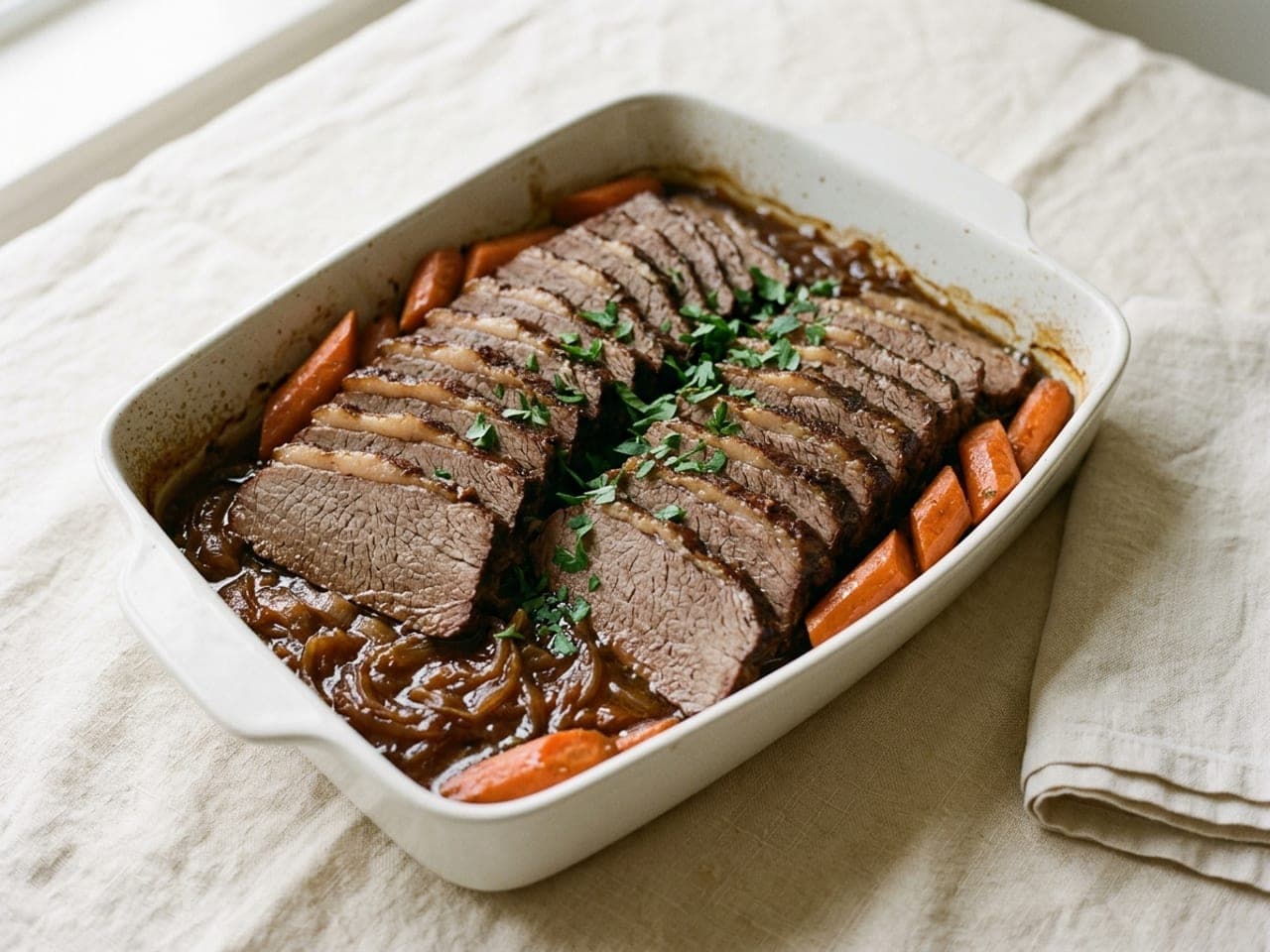
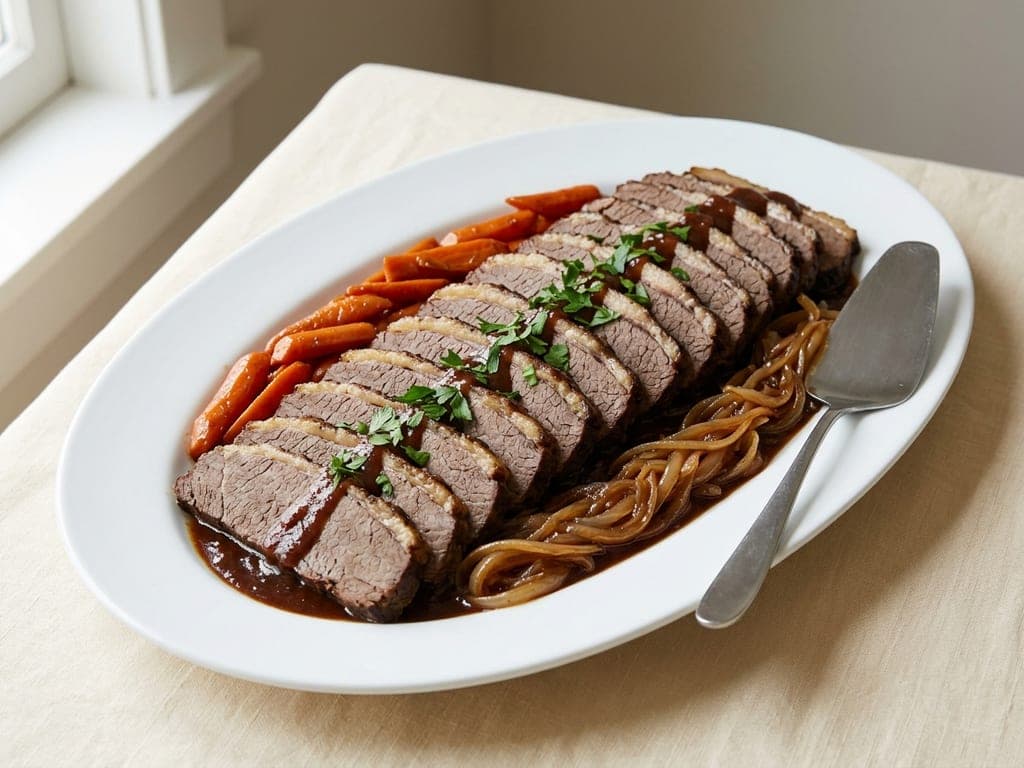
- Reheat the slices in the sauce and serve. Heat the oven to 350°F (177°C). Spoon a thin layer of the hot sauce into a baking dish, then shingle the slices in overlapping rows, each leaning back slightly on the one behind, so the dish looks like the unsliced brisket. Tuck the carrots along the sides and pour the rest of the sauce over and between the slices. Lay a sheet of parchment on the sauce, then cover tightly with foil (the tomato, wine and vinegar sauce can pit foil), and bake until the sauce bubbles at the edges and the center of the dish reads 165°F (74°C), 30 to 45 minutes. Scatter parsley over and serve with plain prepared horseradish on the side. Why: slices reheat evenly in a sauce bath and take on its flavor, and 165°F (74°C) is the USDA’s reheating temperature (the UK FSA says “steaming hot throughout”). Reheat only what you’ll serve, and only once; on a buffet, keep it at 140°F (60°C) or hotter, and once it drops below that, eat or refrigerate it within 2 hours, or within 1 hour above 90°F (32°C).
Safety & hygiene Important
- Safe at 145°F (63°C), tender near 200°F (93°C). USDA FSIS sets whole beef roasts at “145 degrees F (62.8 degrees C) and allow to rest for at least 3 minutes.” Brisket passes that hours before it is tender, so there’s no safety reason to stop there and every eating reason not to: the tender zone is about 195 to 205°F (91 to 96°C), or fork-tender in a braise. In the UK, brisket is usually sold rolled and tied, and the Food Standards Agency lists rolled joints among meats that “need to be cooked all the way through” (one of its safe combinations is 70°C (158°F) for 2 minutes); a tender braised or smoked brisket is far past that. Brisket labeled mechanically, blade or needle tenderized (including meat injected with a solution) needs no change: FSIS keeps it at 145°F (63°C) plus 3 minutes and requires cooking instructions on the label. Color can’t judge doneness, and a pink edge on a braised or oven brisket can come from oven gases or vegetables, so go by the thermometer.
- Cool the braise fast: the Clostridium perfringens problem. The CDC says Clostridium perfringens causes nearly 900,000 foodborne illnesses in the US each year, typically from “foods cooked in large batches and held at unsafe temperatures (between 40°F and 140°F)” (4 and 60°C), with beef and gravy among the usual vehicles and most outbreaks in November and December. Its spores survive cooking, and the FDA puts its doubling time at under 10 minutes during cool-down around 109 to 113°F (43 to 45°C). So never cool a whole brisket in a deep pot of liquid, and never on the counter overnight. Cut the meat into pieces, use shallow containers no deeper than 2 inches (5 cm), cool the liquid separately (an ice bath speeds it up), and refrigerate within 2 hours, or 1 hour if the room is above 90°F (32°C) (USDA). The UK FSA says don’t put hot food in the fridge, but cool it and refrigerate within 1 to 2 hours.
- Holding and reheating. Hot brisket waiting for guests should stay at 140°F (60°C) or above (USDA); UK food-business law sets 63°C (145°F) for hot food held for service. A wrapped whole packer can stay above 150°F (66°C) for about 3 hours in a preheated, towel-lined cooler; a 5 lb (2.3 kg) flat or a dish of slices cools faster, so probe it every 30 minutes and keep it at 140°F (60°C) or above. Once it drops below 140°F (60°C), the 2-hour clock starts and it includes the time on the table: eat or refrigerate it within 2 hours in all, or 1 hour above 90°F (32°C), as at a summer cookout (USDA). Reheat slices covered in their sauce to 165°F (74°C), bringing the sauce to a rolling boil first (USDA), or until steaming hot throughout (UK FSA), and reheat only once. Don’t reheat leftovers in a slow cooker: FSIS says “Reheating leftovers in a slow cooker is not recommended.”
- Fridge and freezer windows: US 3 to 4 days, UK 2. US: eat cooked brisket within 3 to 4 days (USDA FSIS). UK: the FSA says “Eat leftovers within 48 hours or freeze them.” Count from the day you braised, not the day you sliced. Freeze slices in their sauce in shallow, airtight containers; quality is best within 2 to 3 months (USDA ranges run 2 to 6), and food kept at 0°F (-18°C) stays safe indefinitely. Thaw in the fridge (Once Upon a Chef allows 2 days), and the FSA says to eat defrosted food within 24 hours.
- Raw brisket and slow cookers. Keep raw brisket on the bottom shelf of the fridge in a dish that catches drips, and give it its own board. Don’t rinse it: the USDA advises against washing raw meat, because the splashes spread bacteria around the sink. The easy miss is the next day: slice the cooked, chilled brisket on a clean board, not the one that held it raw. For a slow cooker, follow FSIS: “Always thaw meat or poultry before putting it into a slow cooker,” keep the lid on, and if the power went out while you were away, “throw away the food even if it looks done.” Starting on HIGH for the first hour is optional, not required.
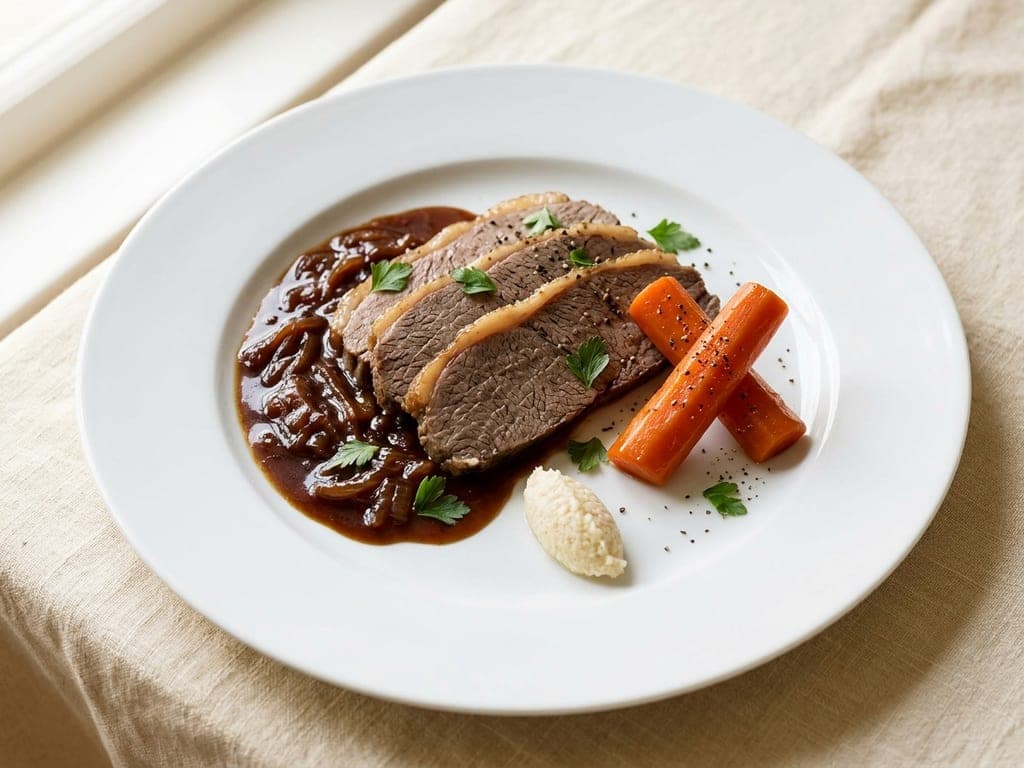
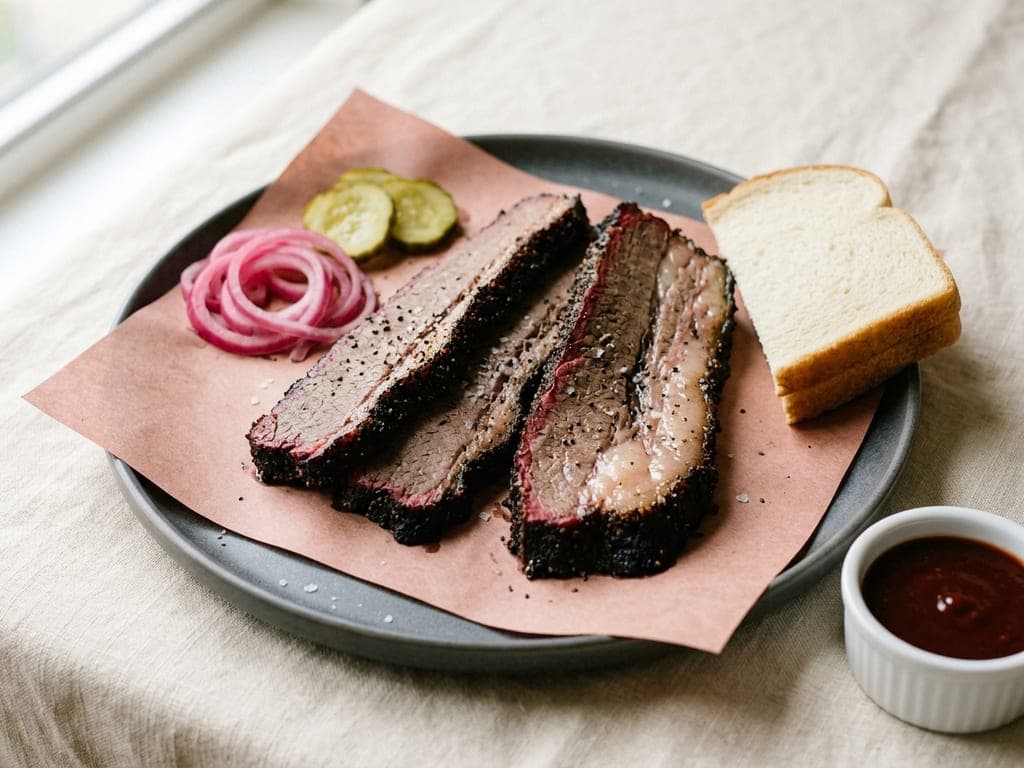
3 ways to plate it
How long to cook brisket: in the oven, on a smoker, in a slow cooker or Instant Pot
We lined up 12 published brisket cooks, from Serious Eats’ braise to research smokers at Texas Tech, and worked out their minutes per pound. They run from about 28 to 90 minutes per pound (61 to 198 minutes per kg). No rule survives that spread, because thickness, not weight, sets the time. Douglas Baldwin’s rule of thumb for heating meat: “doubling the thickness of the meat increases the cooking time four fold!” A 3 lb (1.4 kg) flat is about as thick as a 6 lb (2.7 kg) one, so it doesn’t cook in half the time.
Use these as planning windows, then finish by feel. Oven braise, a 5 lb (2.3 kg) flat sealed at 300 to 325°F (149 to 163°C): 3½ to 4½ hours, about 4 for this recipe’s two-stage method. Thickness moves that window: by our heat-flow estimate, the first stage (to 180°F / 82°C) takes about 1½ hours for a flat 2 inches (5 cm) thick at its thickest point, about 2 hours at 2½ inches (6.4 cm) and close to 3 hours at 3 inches (7.6 cm), so measure the raw flat before you plan. Texas-style brisket in the oven, a 5 to 6 lb (2.3 to 2.7 kg) point or thick flat at 300°F (149°C): 6 to 8 hours, plus a rest. A whole packer on a smoker: 12 to 18 hours at 225°F (107°C) with a late wrap; research smokers running 250°F (121°C) and wrapping in foil at about 145 to 151°F (63 to 66°C) finished 8 to 12 lb (3.7 to 5.3 kg) trimmed briskets in about 6½ to 7½ hours. Start checking about 30 minutes before the early end of the window (at about 3 hours for this braise), and budget an hour of rest, or cook a braise the day before; served the same day, this braise takes about 6½ hours from raw brisket to table.
Slow cooker brisket: use a thawed 3 to 5 lb (1.4 to 2.3 kg) flat, seared, cut in half to fit, set fat side up on the cooked onions, and halve the wine and broth to 1/2 cup (120 ml) each, because nothing evaporates (“Most slow cooker recipes are better with less liquid than you would use” on the stove, says ATK’s Jack Bishop). Fill the crock half to two-thirds full. Cook on LOW 8 to 10 hours or HIGH 5 to 7 hours, until fork-tender (ATK gives a 5 lb (2.3 kg) flat 9 to 10 hours on low; Cook’s Country allows 10 to 12), then rest it 20 to 30 minutes and reduce the liquid on the stove, since a slow cooker can’t thicken it. Keep the lid on, never start with frozen meat, and chill and slice it cold like the oven version if you want neat slices.
Instant Pot brisket (6 quart / 5.7 liter): the inner pot is only about 8½ inches (22 cm) across, so cut the flat across the grain into pieces that fit in one or two layers, and sear them in batches on the highest Sauté setting. Cook the onions, garlic and tomato paste as in step 3 but leave out the flour, because the manual says sauces “should be fairly thin in consistency before cooking begins.” Pour in the wine, scrape the bottom clean and simmer 2 minutes, then add the broth: 2 cups (480 ml) of thin liquid in all, more than the minimum the Instant Pot manual asks for. Cook on High pressure 60 to 65 minutes for 3 to 3½ lb (1.4 to 1.6 kg) or 70 to 75 minutes for 4 to 5 lb (1.8 to 2.3 kg). Let the pressure release naturally for 15 minutes, then turn the valve to vent the rest, keeping your hands and face clear of the steam; when the float valve drops, open the lid tilted away from you, since the fat can spatter. Leave the meat in the liquid 30 to 60 minutes (Cook’s Country rests its brisket an hour in the pot to “soak up some of the liquid it lost”), then lift it out, reduce the sauce on Sauté and blend about half of it as in step 8; for more body, stir in the potato-starch slurry from the make-ahead section. Don’t fill past the PC MAX line, two-thirds full; if a 5 lb (2.3 kg) flat and all the onions won’t fit under it, use a smaller flat.
Texas-style brisket in the oven (no smoker)
When you want bark and beefy slices instead of a sauce, cook brisket dry, the Texas way, in the oven. Choose a 5 to 6 lb (2.3 to 2.7 kg) point-on piece (The Kitchn says “always choose the point”) or the thickest flat with a good fat cap; a small whole packer works if it fits your oven. Trim the cap to 1/4 inch (6 mm) and remove the silverskin. For 6 lb (2.7 kg), mix 2 tbsp Diamond Crystal kosher salt (18 g; or 3¾ tsp Morton), 2 tbsp coarse black pepper and, if you like, 1 tbsp garlic powder. A thin binder of yellow mustard (a listed allergen in the UK and EU) or oil helps the rub stick but doesn’t make it taste of mustard; in Meathead Goldwyn’s experience, water, oil and mustard made “little or no difference in the final outcome.” Pack on the rub and refrigerate the brisket on a rack set in a rimmed tray, loosely covered, on the bottom shelf below any ready-to-eat food, for 12 to 24 hours; The Kitchn credits the overnight rest to Franklin Barbecue in Austin.
Heat the oven to 300°F (149°C). Set the brisket fat side up on a rack over a foil-lined rimmed baking sheet and cover the whole pan tightly with foil. Roast until the thickest part reads 180°F (82°C), about 5 to 6 hours; the foil traps humidity, which heads off the evaporative stall and keeps the lean meat moist. Then uncover it and keep roasting until the bark is dark and set and a probe slides into the thickest part of the flat with no resistance, 200 to 205°F (93 to 96°C), 1 to 2 hours more. The Kitchn calls it done when it “holds a temperature close to 200°F for about an hour” (93°C). Why 300°F (149°C) and not a smoker’s 250°F (121°C)? “In the oven, that kind of time and temperature would dry the meat out,” The Kitchn explains. The reverse order works too, the way a smoker does it: roast uncovered at 275°F (135°C) until the bark sets and the meat stalls in the 160s°F (about 71 to 76°C), then wrap it tightly in foil and finish to probe-tender; the bark ends a little softer. Rest it 30 to 60 minutes loosely tented (sealing it in foil softens the bark), then slice across the grain, the flat 1/4 inch (6 mm) thick and the point a little thicker.
For a smoky note without a smoker, liquid smoke is condensed, filtered wood smoke, and a little goes a long way. The Kitchn stirs 2 tbsp into its mustard binder for 6 lb (2.7 kg); Meathead’s advice is to “add just a few drops at a time,” so we’d start with 1/2 tsp and go up next time. In the EU, smoke flavourings lost their authorisation after EFSA’s 2023 safety (genotoxicity) assessments (Regulation 2024/2067). The flavourings themselves can be sold until 1 July 2029, but foods made with them only until 1 July 2026, or 1 July 2029 for meat, fish and cheese, so bottles may get harder to find. What an oven can’t give you is a smoke ring, and that’s fine: the pink band is a reaction between the meat’s myoglobin and combustion gases, not a measure of smoke flavor or doneness.
A 5 oz (140 g) serving of Texas-style oven brisket comes to about 470 kcal, 37 g protein and 35 g fat, using USDA’s braised whole brisket with 1/8 inch (3 mm) trim (FDC 168665, 331 kcal per 100 g; USDA has no roasted or smoked brisket record, so this is the closest). A 6 lb (2.7 kg) piece yields about 1.6 to 1.9 kg (3.6 to 4.3 lb) cooked (dry heat loses more than a braise: trimmed briskets smoked in Texas Tech research kept 59 to 60% of their weight), roughly 12 to 14 servings, so the rub above adds about 490 to 580 mg of sodium to each, for about 580 to 670 mg in all; end slices with more bark are saltier.
Smoked brisket: the whole-packer method
The smoker version is its own project, often 12 to 18 hours for a whole packer, and the one that made Texas brisket famous. Buy a 12 to 14 lb (5.4 to 6.4 kg) packer, Choice or better, and plan on about 1 lb (450 g) raw per person. Trim it cold from the fridge: the fat cap to 1/4 inch (6 mm), the hard fat between point and flat down to a smooth seam, and the thin edge of the flat squared off so it doesn’t dry out. Expect a lot of trim; AmazingRibs cut about 4 lb (1.8 kg) from a 13 lb (5.9 kg) packer. Season with coarse kosher salt and coarse black pepper. Texas habit is equal parts by volume (Hey Grill Hey uses 2 tbsp of each for a 12 to 14 lb (5.4 to 6.4 kg) packer), but a spoon of Morton holds far more salt than a spoon of Diamond Crystal, so weigh the salt: about 5 to 7 g per kg of trimmed meat (1/2 tsp Morton or 1 tsp Diamond Crystal per pound), with pepper to taste.
Run the smoker outdoors only, well away from the house, deck railings, eaves and branches, and never in a garage, carport, enclosed porch or tent: burning charcoal and wood make carbon monoxide. Don’t leave a live fire unattended, and let coals cool completely before dumping them into a metal container. Smoke at 225 to 275°F (107 to 135°C) on indirect heat, fat side up, with the thicker point toward the heat source. (The rule is fat toward the heat: on a grill heated from below, the cap is a shield, so fat side down.) Leave it unwrapped until the bark is set and deep mahogany and the meat has stalled, usually somewhere between 150 and 170°F (66 and 77°C). The stall can last hours; the surface is sweating, and the evaporation cools it. Then wrap it tightly in uncoated pink (peach) butcher paper or in foil and put it back on. Foil is the original “Texas crutch”: faster and moister, with a softer bark (in Greg Blonder’s test, a foiled pork butt reached 180°F (82°C) in about half the time of an unwrapped one). Paper breathes, keeps more bark and cooks a little slower. We found no controlled test showing either one is juicier, so choose bark or speed.
Cook until a probe slides into the thickest part of the flat with no resistance, usually 200 to 205°F (93 to 96°C); Hey Grill Hey pulls at 202°F (94°C), Meathead at 203°F (95°C). Then rest it wrapped for at least an hour. For longer holds, a dry cooler preheated with hot water and lined with towels kept meat “well above 150°F” (66°C) for three hours in AmazingRibs’ test, and in The Virtual Weber Bullet’s test, an electric oven set to its 170°F (77°C) minimum actually held its air at 143 to 147°F (62 to 64°C), and a brisket kept in it for 4 hours was still juicy; the meat’s own temperature wasn’t logged. Check your oven with an oven thermometer first: the air should stay between 140 and 170°F (60 and 77°C), and if its lowest setting runs hotter, it will keep cooking the meat, so use the cooler. Probe the brisket either way: it should stay at 140°F (60°C) or above.
To slice, separate the point from the flat along the fat seam. Slice the flat across the grain about the width of a No. 2 pencil, 1/4 inch (6 mm). Turn the point a quarter turn (the angle varies, so look at the fibers) and slice it about 3/8 inch (10 mm) thick, or cube it for burnt ends. Slice only what you’ll serve and keep the rest wrapped and warm, at 140°F (60°C) or above; sliced brisket on the table should be eaten or refrigerated within 2 hours, or 1 hour above 90°F (32°C). The pink smoke ring is chemistry, combustion gases binding the meat’s myoglobin, and it tells you nothing about flavor or doneness; the smoke you taste comes from compounds such as guaiacol, which can be detected in water at under 1 microgram per liter.
Make-ahead brisket: why we slice it cold (and whether it’s better the next day)
The make-ahead method is the main recipe for three practical reasons, all of them tested. Cold brisket slices cleanly: after a night in the liquid, ATK found, “the cold brisket could now be sliced without shredding.” The fat sets on top and lifts off in sheets. And the oven is free on the day, which matters at Thanksgiving or a Seder.
What it doesn’t reliably do is taste better. Serious Eats’ Daniel Gritzer tested the claim and wrote that “it’s not true that it tastes better on subsequent days,” adding, “we’ve put that one to the test, and it doesn’t hold up.” Food science leans his way: chilled and reheated cooked beef develops “warmed-over flavor” from fat oxidation, and in a 2024 consumer study of smoked brisket, samples served hot on the day they were cooked scored higher on every trait than reheated ones. So we make it ahead for the slice, the sauce and the schedule, and reheat it gently in plenty of sauce. To serve it the same day instead (about 6½ hours from raw brisket to table), do what Gritzer does: rest the whole brisket 30 minutes, slice it thin across the grain, skim the liquid with a ladle or fat separator, return the slices to it, and hold them covered in a warm place for 30 minutes.
The nutrition math, and the one step that changes it. Per serving (a tenth of the recipe), from USDA FoodData Central: a 5 lb (2,268 g) flat braises down to about 62% of its weight (the ratio of raw to braised protein in USDA’s records), or 141 g (5 oz) each. At 289 kcal, 28.8 g protein and 18.4 g fat per 100 g for braised flat with 1/8 inch (3 mm) trim (FDC 169488, the closest record to a 1/4 inch (6 mm) cap once it has rendered), that’s 408 kcal, 41 g protein and 26 g fat. The sauce and vegetables for the whole pot come to about 1,211 kcal: onions 544, oil 239, carrots 186, flour 58, brown sugar 53, tomato paste 39, wine 36 (after about 95% of its alcohol cooks off in a braise this long, per USDA retention factors), garlic 27, broth 14, pepper 12 and vinegar 3, or 121 kcal a serving. Total: about 530 kcal, 43 g protein, 29 g fat (11 g saturated), 22 g carbohydrate (10 g sugars, 1.4 g of them added), 4 g fiber and 150 mg cholesterol. Sodium is nearly all the salt you add: cooked brisket carries only 46 to 77 mg per 100 g in USDA’s records, the sauce ingredients add about 95 mg a serving, and the 15 g of kosher salt about 590 mg, for about 750 mg in all (about 725 mg if you measure 5 level teaspoons of Diamond Crystal, which weigh closer to 14 g). That’s why we give the salt in grams: a teaspoon of Diamond Crystal carries about 1,120 mg of sodium and a teaspoon of Morton about 1,920 mg, so a recipe that just says “1 tbsp kosher salt” can swing by 2,400 mg a batch.
Skip the skimming and each serving keeps about 24 g more fat and 220 kcal more (a raw flat is 22.2% fat and the braised meat 18.4%, so about 244 g of fat renders out of a 5 lb (2.3 kg) piece), about 750 kcal in all. That is how a popular published label reaches 726 kcal and 55 g of fat per serving: it counts the rendered fat.
Holiday logistics. Thanksgiving: braise it 1 to 2 days ahead, then reheat the sliced brisket covered at 350°F (177°C) for 30 to 45 minutes while the turkey rests and is carved. If you must braise on the day in a shared oven, a sealed braise is happy at 325°F (163°C), the lowest oven setting FSIS recommends for roasting turkey, so leave it there and start checking the brisket at 3 hours; from raw brisket to table, the same-day route takes about 6½ hours. Passover: swap the flour for the same amount of matzo cake meal (Once Upon a Chef’s swap; it is still wheat), or, for a wheat- and gluten-free sauce, leave it out and stir about 1 tbsp potato starch mixed with 2 tbsp cold water into the simmering sauce at the end. Cornstarch is kitniyot for many Ashkenazi households (the Conservative movement’s law committee permitted kitniyot in 2015), so potato starch is the safer choice, and the wine and broth need a kosher-for-Passover mark. We don’t use onion soup mix: the standard Lipton envelope now lists soy sauce made with wheat, so it isn’t kosher for Passover (a separate Passover box exists). With no dairy in the pot, the recipe fits a meat meal if the meat, wine and broth are kosher, the broth has no milk (some stock cubes contain milk sugar), and the horseradish is the plain grated kind, not a creamed sauce. For Rosh Hashanah, add 1/2 cup (80 g) of raisins with the carrots (the 1846 London recipe added its raisins when the brisket was nearly done); that’s about 24 kcal more per serving. Golden raisins usually contain added sulfites, so check the label.
To freeze, slice it cold and pack the slices in their sauce in shallow airtight containers (Tori Avey slices hers cold and freezes them with the sauce). It’s best within 2 to 3 months; thaw it in the fridge and reheat covered to 165°F (74°C).
Point, flat or whole packer, and how much brisket per person
A whole brisket is two muscles, one partly on top of the other, and it’s sold three ways. The flat (USDA item 120A, the deep pectoral) is the long, lean, even piece most stores sell, 4 to 10 lb (1.8 to 4.5 kg); Jewish cooks and kosher butchers call it the first cut. The point (item 120B, the superficial pectoral) sits over the thick end of the flat, overlapping it rather than forming an end of the brisket, and it’s fattier: USDA lists braised point at 349 kcal and 27.2 g fat per 100 g against 289 kcal and 18.4 g for the flat (both with 1/8 inch / 3 mm trim). To the same cooks and butchers, it’s the second cut. The whole packer (item 120) is both together, usually 8 to 16 lb (3.6 to 7.3 kg). You’ll often read that the point is “the deckle”; in the USDA spec the deckle is hard fat and rib meat from the bone side, already removed from every item 120.
Which to buy: the flat for a braise (it slices into neat, even slices and fits a pan), a point-on piece or the thickest flat you can find for Texas-style oven brisket, and a whole packer for the smoker. Fat buys forgiveness. In a Texas Tech consumer panel the point beat the flat for tenderness at every grade (Choice point 81.9 against Choice flat 57.0 on a 100-point scale), and a Prime flat scored above Choice and Select flats. Grade isn’t destiny, though: in a 2020 blind tasting of briskets smoked side by side, there was “no statistical difference in scores between Prime, Chairman’s Reserve, Choice, and Select.” Choice is the sweet spot; Prime buys a margin for error.
How much per person: a braised flat keeps about two thirds of its raw weight (USDA measured 69%, range 65 to 76%, braising flats to 185°F (85°C); a fork-tender braise near 200°F (93°C) loses more, and the protein in USDA’s raw and braised records works out to about 62%, the figure we use for the nutrition math), so 1/2 lb (225 g) of raw flat per person gives 140 to 155 g (about 5 to 5.5 oz) cooked. That’s why this recipe feeds 10 from 5 lb (2.3 kg). When brisket shares the table with a turkey or another main, about 1/3 lb (150 g) raw each is plenty (our estimate). An untrimmed packer loses about half its weight to trimming and cooking, so smokers plan on about 1 lb (450 g) raw per person. The popular “brisket always loses 50%” figure is that packer number, not a braised flat.
Outside the US: in the UK, brisket usually comes as a boneless rolled joint, anywhere from 750 g to 3 kg (about 1¾ to 6½ lb); a typical 1.35 kg (3 lb) joint serves 6 or 7 with this method. Cut the strings and open it out to braise it flat, or braise it tied and slice it thinner; either way it ends up cooked through, as the FSA wants for rolled joints. In the Czech Republic ask for hovězí hrudí bez kosti (boneless brisket), usually sold in smaller pieces, so you may need two or three. Don’t substitute Tafelspitz: it’s a rump cut, not brisket. And in US and UK butchery, brisket means beef unless the label says otherwise.
Brisket history: London 1846, a Thursday dinner, and a deli meat in Texas
The top-ranking brisket recipes stop at Nach Waxman’s 1989 recipe or a line about brisket being cheap. A line copied across the web goes further and traces brisket to “the 1600’s” as an Eastern European holiday delicacy; it cites nothing, and we found no 17th-century source. The printed record says something more surprising. The oldest brisket recipe in a Jewish cookbook in English is from London, 1846, and it’s sweet. The Jewish Manual, published anonymously (“Edited by a Lady”) and traditionally attributed to Lady Judith Montefiore, gives “BRISKET STEWED WITH ONIONS AND RAISINS”: “Stew about five pounds of brisket of beef in sufficient water to cover,” season it with allspice, pepper, salt and nutmeg, add “four large onions cut in pieces and half a pound of raisins stoned” when it is nearly done, and finish with brown sugar and flour. A few pages earlier, the same book cooks brisket with French beans and onions and sharpens it with coarse brown sugar and “a large tea-cup full of vinegar.” Sweet-and-sour brisket was in print by 1846.
Baked brisket is older still, and English. Elizabeth Raffald’s The Experienced English House-keeper (Manchester, 1769) larded a boned brisket with bacon, parsley and oysters, poured over a pint of boiling red wine, and said to “send it to the Oven, and bake it three Hours or better.” Mary Randolph’s The Virginia Housewife closely adapted it as “Brisket of Beef Baked”: the same bacon, parsley and oyster stuffing, a pint of red wine, and “bake it three hours.” The word itself is on record by 1338, as brusket; where it came from is uncertain. Dictionaries hedge, most often pointing to Old Norse brjósk, “gristle, cartilage,” and the etymologist Anatoly Liberman favors a Germanic word (brjósk, or Low German bröske, “sweetbread”) with a French-style ending. It was cheap early: a Boston price list in The Cook’s Own Book (1832) has brisket at 6 cents a pound against 10 to 12 for sirloin.
The earliest American Jewish cookbooks we could read didn’t treat brisket as a holiday roast at all. “Aunt Babette’s” Cook Book (Cincinnati, 1889) boils it with sauerkraut and lists “Brisket of Beef. Sauer Kraut. Kartoffel Kloesse.” for an ordinary Thursday dinner; its Passover chapter (titled “Easter Dishes”) is puddings, cakes and matzo dishes, with no brisket or any other roast. The Settlement Cook Book (Milwaukee, 1901) files brisket under tough cuts for stews and makes its pot roast from chuck or rump. The earliest oven-braised brisket we found in an American Jewish cookbook is in Florence Kreisler Greenbaum’s International Jewish Cook Book (New York, 1918): “Take four pounds of brisket, season with salt, pepper and ginger, add three tablespoons of tomatoes and an onion cut up. Cover with water in an iron pot and a close-fitting cover, put in oven and bake from three to four hours.” That’s today’s holiday brisket in outline. The same book explains the cut: hindquarter joints could not be used until they had been “porged” of blood vessels, forbidden fat and the prohibited sinew, and “In New York City no hind-quarter meat is used by orthodox Jews.” Brisket is a forequarter cut. Joan Nathan adds the economics: “Slow cooking, of course, became a practical necessity with grainy cuts of forequarter meat. Because a brisket stretched into many meals, it was an economical cut for large families in Europe.” In the scanned cookbooks we searched, “Rosh Hashanah brisket” as a named dish turns up no earlier than 1987, in a community cookbook recipe that starts with an envelope of onion soup mix. The holiday brisket as a named tradition is largely a late-20th-century American one; as Nathan wrote, “Braised brisket was one of those dishes that became Americanized early on.”
The recipe most American brisket pages still measure themselves against arrived in 1989: “Nach Waxman’s Brisket of Beef” in Julee Rosso and Sheila Lukins’s The New Basics Cookbook, a first-cut brisket on a mountain of onions. Waxman, who opened the New York cookbook shop Kitchen Arts & Letters in 1983 and died in August 2021, called it “a traditional Eastern European dish of the utmost simplicity.” The version his shop publishes bakes it 1½ hours, slices it and returns it to the pot for 1¾ to 2 hours more, with a single carrot (“Just one, please. It’s important.”). Cooks called to ask whether they could skip the slicing step or add more carrots, some broth or a little sugar; as his shop tells it, “The answers were always no.” (Our recipe adds all three, so call it Waxman-inspired, not Waxman’s.) He also rejected the idea of an original. Asked by Stephanie Pierson whether there was one original brisket recipe, he answered, “It’s like looking for the original recipe for toast. No one invented a brisket except a cow.” You’ll read that his is “the world’s most Googled brisket recipe.” That began as a hedge (Pierson wrote in 2011 that he “seems to have” it; Food52’s Genius Recipes said in 2015 that it was the most googled “by some accounts”), and we found no published search data, so the fair word is reputedly.
Texas barbecue brisket is younger than most people think. The earliest Texas ad for “Smoked Brisket Beef” that barbecue historian Daniel Vaughn has found ran for Watson’s Grocery in El Paso on 18 January 1910, at 30 cents a pound. It was a deli meat, not barbecue: a 1910 University of Illinois bulletin on meat trade classes says briskets of choice cattle were “smoked in some cases and sold as ‘Smoked Brisket Beef,’ principally to Kosher (Jewish) trade.” Whether the Texas grocers were Jewish is unknown; Vaughn: “I’m not certain of the religion of these grocers.” Brisket as its own cut on Texas barbecue menus arrived in the 1950s; before that, Texas pits cooked bone-in forequarter cuts, and brisket was simply the fatty piece (“If they wanted it fatty we’d give them the brisket,” Luling’s Joe Capello told Vaughn). At Black’s in Lockhart, Edgar Black Jr. told Robb Walsh (Legends of Texas Barbecue Cookbook, 2002), “I was the first one around here to start ordering brisket,” a family claim no record confirms or refutes. At Louie Mueller’s in Taylor, brisket went on the menu in 1959 over the pitmaster’s objections; Wayne Mueller recalls, “Grandpa told me Fred would intentionally under- and overcook the early briskets with the hopes Grandpa would drop it.” Boxed beef in the mid-to-late 1960s made uniform briskets easy to order, and in Vaughn’s words, “It wasn’t until the sixties that brisket made its move.”
The wrap has a history too. The earliest printed “Texas crutch” we know of is from 1996, and it wasn’t praise: in Lolis Eric Elie’s Smokestack Lightning, Kansas City’s Paul Kirk tells a barbecue class “you can’t use the Oklahoma or Texas crutch,” meaning foil, which “just basically steams everything.” Butcher paper was Central Texas practice long before Aaron Franklin: in 1973 Texas Monthly gave the secret of Louie Mueller’s pitmaster Fred Fountaine as “keep the beef wrapped in paper after it’s cooked.” Franklin popularized wrapping in paper mid-cook and explained why in his 2015 book: “Whereas foil creates a fairly hermetic pocket, the butcher paper still allows a bit of interchange with the outside environment.”
Questions, answered
How long does it take to cook a brisket in the oven?
It depends on the method and the thickness more than the weight. Braised and sealed like this recipe, a 5 lb (2.3 kg) flat takes about 3½ to 4½ hours: 1½ to 2 hours at 325°F (163°C) until the center reads 180°F (82°C), longer for a flat more than 2½ inches (6.4 cm) thick, then 2 to 2½ hours at 250°F (121°C) until fork-tender. Texas-style, roasted dry at 300°F (149°C), a 5 to 6 lb (2.3 to 2.7 kg) point or thick flat takes 6 to 8 hours, covered until 180°F (82°C) and uncovered for the bark. Add 30 to 60 minutes of rest, or, for a braise, a night in the fridge; served the same day, this braise takes about 6½ hours from raw brisket to table. Start checking about 30 minutes before the early end of the window (at about 3 hours for this braise) and finish by feel: a fork or probe that slides in with almost no resistance.
What temperature do you cook brisket in the oven?
For a braise, 300 to 325°F (149 to 163°C), sealed; this recipe starts at 325°F (163°C) and drops to 250°F (121°C) once the center reaches 180°F (82°C), ATK’s way of getting the meat into the tenderizing window fast and holding it there. For Texas-style brisket, 300°F (149°C): The Kitchn’s point is that a smoker’s 250°F (121°C) would dry the meat out over the long hours an oven needs. Don’t braise at 250°F (121°C) from the start: ATK’s covered brisket at that setting “never exceeded 165 degrees” (74°C) in 6 hours. A sealed braise tolerates 325 to 350°F (163 to 177°C), which helps when it shares the oven with a turkey.
What internal temperature should brisket be?
Safe at 145°F (63°C) with a 3-minute rest (USDA, for any whole beef roast), but tender only at about 195 to 205°F (91 to 96°C) in the thickest part of the flat, where a probe slides in with no resistance; a braise is done when a fork slides in and out, usually near 200°F (93°C). In Celsius: 63°C safe, 82°C where collagen starts softening fast, 91 to 96°C tender, about 93°C for a braise. The number isn’t a finish line on its own, because tenderness comes from time at temperature; The Kitchn wants its oven brisket to hold about 200°F (93°C) for an hour. If the probe still meets resistance at 203°F (95°C), keep cooking.
Do you cook brisket fat side up or down?
Put the fat toward the heat. On a grill or smoker heated from below, the cap is a heat shield, so fat side down; with heat all around, most Texas pitmasters cook fat side up (even Traeger, which argues for fat side down, concedes it), and Hey Grill Hey’s side-by-side test found “no difference in final product.” In an oven braise, fat side up: the lean underside cooks in the liquid while the cap covers the exposed top. What the cap doesn’t do is baste. As meat scientist Tony Mata put it to AmazingRibs, “Fat will not migrate into the muscle as it is cooked,” and Greg Blonder adds, “No way fat can swim upstream.” Trim it to about 1/4 inch (6 mm) either way.
Should brisket be covered or uncovered in the oven?
Covered for a braise, the whole time, and sealed tight: Serious Eats found that “lean brisket cooked in a completely sealed vessel retained more juice than brisket that was partially exposed,” and even uncovering it for the last 30 minutes dried it. For Texas-style brisket in the oven, covered first and uncovered last: foil on until the center reads about 180°F (82°C), then off for the final 1 to 2 hours so the bark can crisp (The Kitchn’s method). On a smoker the order flips: unwrapped first for bark and smoke, wrapped later to push through the stall. Covering works because it traps humidity, and evaporation from the surface is what causes the stall.
How long to cook brisket per pound?
It’s the wrong question. Across 12 published brisket cooks we compared, times ran from about 28 to 90 minutes per pound (61 to 198 minutes per kg), because thickness, not weight, sets the time: by Douglas Baldwin’s rule of thumb, doubling the thickness quadruples it. A 3 lb (1.4 kg) flat is nearly as thick as a 6 lb (2.7 kg) one and won’t cook in half the time. For this recipe’s braise, by our heat-flow estimate, the first stage to 180°F (82°C) takes about 1½ hours for a flat 2 inches (5 cm) thick and close to 3 hours for one 3 inches (7.6 cm) thick. As rough planning figures only: a sealed braise at 300 to 325°F (149 to 163°C), about 30 to 60 minutes per pound (66 to 132 per kg); Texas-style in a 300°F (149°C) oven, 60 to 80 (132 to 176 per kg); a smoker, about 40 to 90 (88 to 198 per kg). Then finish by fork or probe, not the clock.
Should I wrap brisket in foil or butcher paper?
In the oven, foil (or a tight lid): it’s what both the braise and the Texas-style oven method use. The choice matters on a smoker. Foil, the original “Texas crutch,” traps moisture and speeds the cook (in Greg Blonder’s test, a foiled pork butt at 230°F (110°C) reached 180°F (82°C) in about half the time, about six hours, while the unwrapped half still hadn’t passed 180°F (82°C) four hours later), but the bark softens. Uncoated pink (peach) butcher paper breathes, so it keeps more bark and cooks a little slower; as Aaron Franklin wrote, foil “creates a fairly hermetic pocket” while paper “still allows a bit of interchange with the outside environment.” We found no controlled test showing either is juicier. Wrap when the bark is set, usually around 150 to 170°F (66 to 77°C).
Why is my brisket tough?
Almost always because it isn’t done. Tough brisket feels tight and springy and resists the probe: the connective tissue hasn’t softened yet, so put it back, covered, and check every 30 to 60 minutes. Don’t confuse it with dry brisket, which crumbles and turns stringy because it went too long, was sliced too hot or too thin, or sat uncovered on the board. Two other causes: slicing with the grain instead of across it (the point’s grain runs at a different angle from the flat’s), and, in a braise, a leaky foil seal or a too-low oven that stalls the meat below the temperature where collagen softens. Pulling brisket at the 145°F (63°C) safety number guarantees toughness; it needs about 195 to 205°F (91 to 96°C), or a fork that slides in easily. More time won’t fix a dry brisket, though: chop or shred it into the sauce, or into chili, hash or tacos.
Point or flat, which is better?
Better for what? The flat (first cut, USDA item 120A) is lean and even, so it slices neatly and is the classic choice for braised holiday brisket. The point (second cut, 120B) is fattier and more forgiving: a Texas Tech consumer panel rated the point more tender than the flat at every grade (Choice point 81.9, Choice flat 57.0 on a 100-point scale), and USDA’s braised point carries 27.2 g of fat per 100 g against the flat’s 18.4 g (349 against 289 kcal). For smoking, buy the whole packer (item 120), which gives you both. Supermarkets mostly sell the flat; ask the butcher for a point or a packer.
How long should brisket rest?
It depends on the style. A braised brisket’s best rest is the overnight chill in its liquid; served the same day, rest it 30 minutes, slice, and let the slices sit in the hot sauce 30 minutes more (about 6½ hours from raw brisket to table). A Texas-style oven brisket needs 30 to 60 minutes, loosely tented. A smoked packer wants at least an hour, wrapped, and can hold for hours in a dry, towel-lined cooler (AmazingRibs measured meat “well above 150°F” (66°C) after three hours) or in an oven at its lowest setting, 150 to 170°F (66 to 77°C), checked with an oven thermometer. Keep it at 140°F (60°C) or above (63°C in UK terms), checked with a probe. Resting is about temperature: Serious Eats found juice loss tracks the core temperature at slicing, “not about reabsorption or thickening.” A 200°F (93°C) brisket simply sheds steam and liquid when you cut it.
How do you slice brisket?
Across the grain, and at the right temperature for the style. Braised brisket slices best cold, straight from the fridge, 1/4 inch (6 mm) thick with a long knife or an electric knife, then reheats in its sauce. Smoked or Texas-style brisket is sliced warm after its rest, only as you serve: separate the point from the flat along the fat seam, slice the flat about the width of a No. 2 pencil, 1/4 inch (6 mm), then turn the point a quarter turn and slice it about 3/8 inch (10 mm) thick. Find the grain before cooking and notch a corner across it, because bark and braising hide it. It matters: in tests on round and chuck, slices cut across the fibers took up to 50% less force to shear than slices cut along them.
Snap your finished plate and let the AI plate it again — more beautifully.