Herb garnish ideas: parsley and 15 more herbs, which dish each suits, and how to keep them green
Every herb with its taste, the forms its sources use and the dishes they put it on (61 herb-and-dish pairings from named textbooks, test kitchens, extension pages and recipes), then how far ahead and how to keep each one green, authorities first. We chopped, fried, timed and tasted nothing: every figure is its source's.
The photos on this page are AI-generated illustrations.
Herb garnish ideas, in one paragraph
Use one herb, the one the dish already has, raw and last: parsley on fried fish, eggs and soups, chives on eggs and cream cheese, dill on salmon and potatoes, cilantro on salsa and pho, basil on tomato and pizza, mint on desserts, chervil on clear soups, and sage only fried. That is what the textbooks, test kitchens and recipes we read print.1, 2, 3, 32, 35, 36, 48 Wash herbs under running water and dry them; chop close to serving.6, 26, 27 To keep them green, Cook's Illustrated keeps tender herbs in slightly damp paper towels and hardy ones dry, both in the fridge, and files basil with the tender herbs; America's Test Kitchen and Maine Extension keep basil out of the fridge, and UC Davis and USDA call it chilling sensitive.3, 6, 15, 16, 19
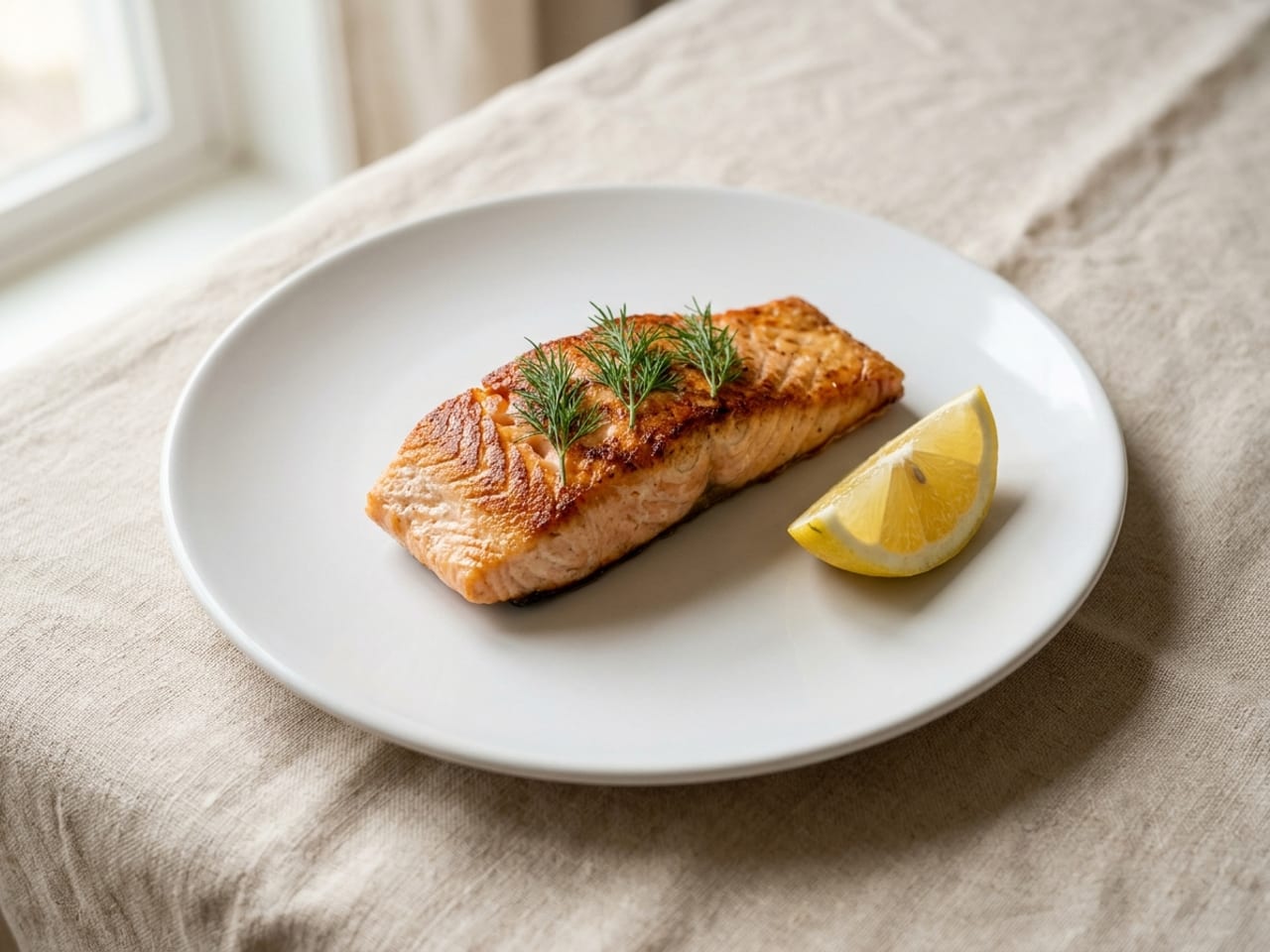
| Herb | Tastes like | Best on |
|---|---|---|
| Parsley (curly and flat-leaf) | Delicate and sweet; flat-leaf the stronger | Fried fish, eggs, soups, osso buco |
| Chives | Mild onion | Soups, eggs, cream cheese, potatoes |
| Dill | Lemony, a little bitter, caraway-like | Salmon and fish, potatoes, eggs, kulajda |
| Cilantro | Penetrating; soapy to some | Salsa and Mexican dishes, pho, curry, fish |
| Basil (sweet and Thai) | Licorice and citrus; Thai basil licorice-like | Pizza and tomato, pho, chilled soup |
| Mint | Cool, bright, eucalyptus | Desserts, lamb, pho |
| Chervil | Parsley with anise | Clear soups, eggs |
| Tarragon | Anise, assertive, numbing | Cream sauces, fish, eggs, chicken |
| Thyme | Clove and mint; mellows cooked | Roasts, stews, roast vegetables |
| Rosemary | Pine, resinous | Grilled chicken, lamb, pork |
| Sage | Earthy, musky; crisp when fried | Fried, on squash soup, gnocchi, pork |
| Oregano and marjoram | Earthy, spicy; marjoram sweeter | Pizza, tomato sauce, chili; marjoram on lamb |
| Shiso | Crisp, aromatic; peppery to some | Sashimi, rice bowls, cold noodles, tofu |
| Mitsuba | Refreshing, slightly bitter | Oyakodon, chawanmushi, clear soups |
| Celery leaf (and lovage) | Celery; lovage stronger and sweeter | Salads, shrimp cocktail |
| Fennel fronds | Anise, licorice | Fish, soups |
The strip is our summary of each herb's card below, where every taste word and dish carries its source.
On this page: The herbs · Which herb for which dish · Parsley · Leaves, chopped, fried, oil · Keep them green · Washing and safety · Names · Drinks · FAQ
Garnish leaves by name: parsley and 15 more herbs
One card per herb, which is also the answer to "garnish leaves names": what it tastes like in a named source's words, whether it is tender or hardy, raw or cooked, the forms sources use, the dishes in our tally and how it keeps. "Tender" and "hardy" are our words for one split that two sources draw in their own: Cook's Illustrated's "delicate" and "hearty" and the CIA's "tender" and "resinous".2, 6 UC Davis's postharvest sheet lists dill, oregano, tarragon, basil and mint as "soft or semi-woody" leafy stems, which is a harvest description, not the same split (oregano is in it).15 By those lists eight of these herbs are tender and four hardy (our grouping; chervil, in none of the lists, we put with the tender ones on McGee's word that heat "drives away its flavor").13 The CIA's rule for the tender ones is that their flavour "tends to dissipate during cooking; hence they should be added at the very end".2 "Named as a garnish" counts only the sources we read that have an entry for the herb.
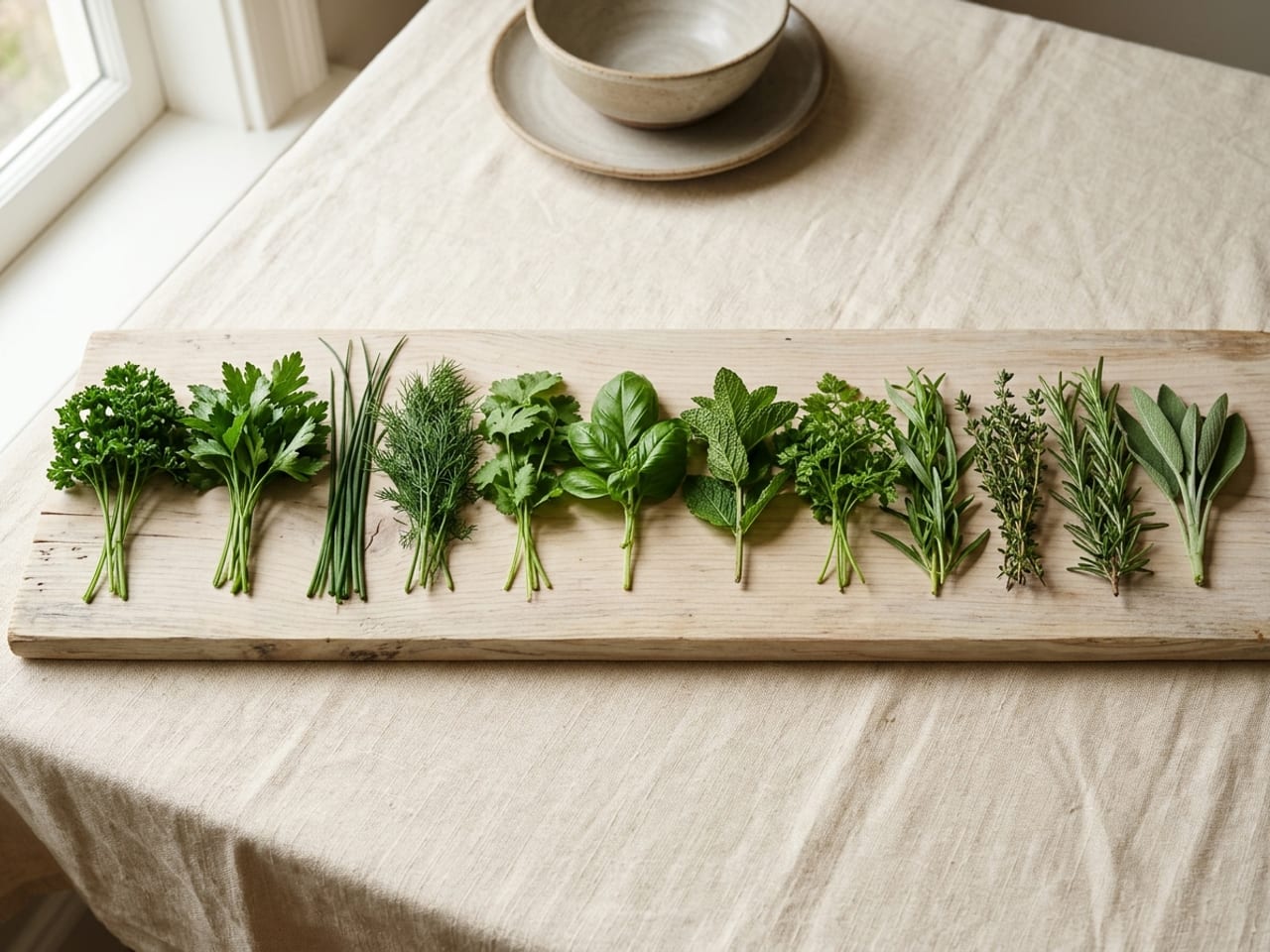
Parsley (curly and flat-leaf)
Also: flat-leaf is sold as Italian parsley.
Tastes: "Delicate, sweet flavor" (Gisslen). In America's Test Kitchen's tasting, flat-leaf was "fresh" and "vibrant", curly "mild" and "vegetal".1, 4
Tender: Delicate (Cook's Illustrated), tender (CIA).2, 6
Raw or cooked: Raw, chopped or as a sprig, added at the very end (CIA); or fried, the oldest garnish form in the cookbooks we read.2, 48, 55
Forms: Sprigs (Escoffier's "curled-leaf kind", kept in fresh water), chopped (a Gisslen recipe line: "Garnish each portion with a little chopped parsley"), fried, gremolata and persillade, and herb oil.1, 12, 48
Dishes in the tally: on the plate: fish and seafood, eggs, meat and poultry, soups, cream sauces (tally).
Named as a garnish by 5 of the 5 sources we read with an entry for it: Escoffier, Gisslen, America's Test Kitchen (curly "Best for garnishes"), Illinois Extension and the CIA.1, 2, 4, 14, 48
Keeps: Cold, in damp paper towels or stems in water (whose days).
Chives
Tastes: "Grasslike herb with onion flavor" (Gisslen); "much milder and more subtle than other members of the onion family" (Illinois Extension).1, 14
Tender: Delicate (Cook's Illustrated), tender (CIA).2, 6
Raw or cooked: Raw: Illinois says the leaves "are used fresh"; dried, they "discolor".14
Forms: Thin slices: Gisslen stacks chives and cuts them crosswise with the knife. The flowers are "an edible garnish" (Illinois).1, 14
Dishes in the tally: on the plate: soups, salads, dips, cheese and canapés, cream sauces; cooked into: eggs (tally).
Named as a garnish by 3 of the 4 sources we read with an entry for it: Gisslen (soup toppings), Illinois Extension (the flowers) and the CIA ("cream cheese garnish"); Escoffier uses chive only inside fines herbes.1, 2, 14, 48
Keeps: Cold, in damp paper towels (Cook's Illustrated) (whose days).
Dill
Also: the leaves are often called fronds.
Tastes: "Slightly bitter, with a refreshing, lemony quality and aroma akin to caraway seeds" (America's Test Kitchen); "familiar dill pickle flavor" (Gisslen).1, 3
Tender: Delicate (Cook's Illustrated); harvested as a "soft or semi-woody" leafy stem (UC Davis).6, 15
Raw or cooked: Raw, last: "best used as a finishing herb" (America's Test Kitchen); a Czech recipe blog adds it at the end because fresh dill "loses its flavor and vivid color the longer it is cooked".3, 37
Forms: A tiny sprig (Gisslen, on a canapé), loose leaves on top of a soup, or chopped. Escoffier's 1907 English edition never mentions dill in the text we read.1, 37, 48
Dishes in the tally: on the plate: fish and seafood, salads, dips, cheese and canapés, soups, potatoes and vegetables (tally).
Named as a garnish by 3 of the 5 sources we read with an entry for it: Gisslen, America's Test Kitchen ("finishing herb") and Cook Like Czechs; Illinois Extension and the CIA list it as a flavouring only.1, 2, 3, 14, 37
Keeps: Cold, stems in water (America's Test Kitchen) (whose days).
Cilantro
Also: coriander leaf, fresh coriander, Chinese parsley.
Tastes: "A penetrating odor and flavor" (Illinois Extension); "love-it-or-loathe-it" (America's Test Kitchen). A 2012 study of 14,604 people of mainly European ancestry linked one gene variant to noticing a soapy smell in it.3, 14, 47
Tender: Delicate (Cook's Illustrated); one of the bolder tender herbs, says the CIA.2, 6
Raw or cooked: Raw, at the end; the CIA says leaves and stems "should not be chopped too finely".2
Forms: Whole leaves or chopped (Gisslen prints both: "Chopped cilantro or whole cilantro leaves"); sprigs on a shared herb plate.1, 35
Dishes in the tally: on the plate: fish and seafood, pho, noodles and curries, soups, salsa, tacos and Mexican dishes (tally).
Named as a garnish by 2 of the 4 sources we read with an entry for it: Gisslen and the CIA; America's Test Kitchen and Illinois Extension list it as a flavouring only (Andrea Nguyen's pho plate uses culantro, a different herb with the same kind of flavour).1, 2, 3, 14, 35
Keeps: Cold, in damp paper towels or stems in water; chop at the last minute (whose days).
Basil (sweet and Thai)
Tastes: Sweet basil "balances licorice and citrus notes" (America's Test Kitchen), "a spicy odor and flavor" (Illinois Extension); Thai basil has a "Licorice-like aroma" (Illinois, the one source we read on its taste).3, 14
Tender: Delicate (Cook's Illustrated), tender (CIA); the one tender herb that must not go cold (UC Davis).2, 6, 15
Raw or cooked: Raw whole leaves or ribbons, at the end; on a margherita, before or after baking (Ken Forkish: "I like it both ways").2, 36
Forms: Whole leaves ("3 to 5 whole basil leaves" on a margherita), chiffonade (Gisslen, on a chilled soup), sprigs (Thai basil on the pho plate), fried, or oil.1, 10, 31, 35, 36
Dishes in the tally: on the plate: pizza, pasta and tomato, soups, fish and seafood, pho, noodles and curries (tally).
Named as a garnish by 2 of the 4 sources we read with an entry for it: Gisslen and Andrea Nguyen (Thai basil); the CIA and America's Test Kitchen list it for cooking only.1, 2, 3, 35
Keeps: Sources split: counter, stems in water (America's Test Kitchen, Maine); fridge in damp towels (Cook's Illustrated) (whose days).
Mint
Tastes: "Smooth and bright, with a eucalyptus quality" (America's Test Kitchen); "familiar cool flavor" (Gisslen).1, 3
Tender: Delicate (Cook's Illustrated); a soft leafy stem (UC Davis). Unlike basil, it takes the cold.6, 15, 17
Raw or cooked: Raw leaves or a sprig.2, 35
Forms: A sprig on a dessert, sprigs on the pho plate, picked leaves, fried (America's Test Kitchen's microwave method).2, 9, 35
Dishes in the tally: on the plate: desserts, pho, noodles and curries; cooked into: meat and poultry, salads, dips, cheese and canapés (tally).
Named as a garnish by 3 of the 5 sources we read with an entry for it: the CIA ("garnish for desserts"), Gisslen and Andrea Nguyen (both pho); Illinois Extension and America's Test Kitchen list it as a flavouring.1, 2, 3, 14, 35
Keeps: Cold, stems in water (America's Test Kitchen) (whose days).
Chervil
Tastes: "A mix of parsley and anise" (Illinois Extension); "Herb with mild flavor of parsley" (Gisslen); "anise flavor" (CIA).1, 2, 14
Tender: Not in the three hearty and delicate lists; McGee says heat "drives away its flavor", so it behaves as a tender herb (ours).13
Raw or cooked: Raw, last: Escoffier's pluches go into soups "raw" at "the last moment"; McGee has it "barely warmed".13, 48
Forms: Pluches, picked leaves with the stem removed (Escoffier 1903); chopped, in fines herbes.48, 49
Dishes in the tally: on the plate: soups, eggs (tally).
Named as a garnish by 3 of the 4 sources we read with an entry for it: Escoffier, Illinois Extension and the CIA; Gisslen lists it for soups, salads and sauces with no garnish line.1, 2, 14, 48
Keeps: Cold and moist (whose days).
Tarragon
Tastes: "Very assertive, with a mouth-numbing, anesthetic quality and a sweet orange-anise aroma" (America's Test Kitchen); "anise flavor" (CIA).2, 3
Tender: Delicate (Cook's Illustrated); a soft leafy stem (UC Davis).6, 15
Raw or cooked: Chopped into or onto the dish at the end (Gisslen); Escoffier blanches whole leaves first.1, 11, 48
Forms: Chopped (Gisslen's herbed cream sauce; one of the four fines herbes); Escoffier garnishes poached eggs, cold fish and tournedos with blanched or parboiled tarragon leaves.1, 11, 48
Dishes in the tally: on the plate: cream sauces, eggs; cooked into: fish and seafood (tally).
Named as a garnish by 2 of the 4 sources we read with an entry for it: Escoffier (blanched or parboiled leaves on poached eggs, cold fish and tournedos) and Gisslen ("such as tarragon, chives, or parsley"); America's Test Kitchen and the CIA list it for cooking.1, 2, 3, 48
Keeps: Cold, stems in water (America's Test Kitchen) (whose days).
Thyme
Tastes: "Highly aromatic with a hint of clove and mint fragrance" (Illinois Extension); "Its flavor mellows with cooking" (America's Test Kitchen).3, 14
Hardy: Hearty (Cook's Illustrated), resinous (CIA).2, 6
Raw or cooked: Mostly cooked: "not adversely affected by long, slow cooking" (Illinois); America's Test Kitchen often adds "extra at the end of a recipe".3, 14
Forms: Picked leaves or a small sprig; the stems are "stiff and woody" (Illinois).14
Dishes in the tally: no garnish row; cooked into: meat and poultry, potatoes and vegetables (tally).
Named as a garnish by 0 of the 4 sources we read with an entry for it: none of America's Test Kitchen, the CIA, Illinois Extension or Gisslen names it as a garnish.1, 2, 3, 14
Keeps: Cold; dry or in damp towels (America's Test Kitchen splits) (whose days).
Rosemary
Tastes: "An obvious pine aroma", clean and sweet in moderation, "like Vicks VapoRub" if overused (America's Test Kitchen); "pungent and resinous" (Illinois Extension).3, 14
Hardy: Hearty (Cook's Illustrated), resinous (CIA).2, 6
Raw or cooked: Mostly cooked, and "sparingly" (Illinois); America's Test Kitchen adds a sprig during cooking and removes it before serving.3, 14
Forms: A whole sprig (Gisslen: "Garnish each portion with a sprig of rosemary").1
Dishes in the tally: on the plate: meat and poultry (tally).
Named as a garnish by 1 of the 4 sources we read with an entry for it: Gisslen only; America's Test Kitchen, Illinois Extension and the CIA use it in cooking.1, 2, 3, 14
Keeps: Cold and dry (Cook's Illustrated) (whose days).
Sage
Tastes: "Earthy and floral, with a musky bite" (America's Test Kitchen); "musty flavor" (CIA).2, 3
Hardy: Hearty (Cook's Illustrated); "pungent gray-green herb with fuzzy leaves" (Gisslen).1, 6
Raw or cooked: Cooked: "Because of its cottony texture when raw, sage should be cooked" (America's Test Kitchen).3
Forms: Fried whole leaves: "a crispy, elegant garnish" (Saveur), "FRIED SAGE" on a menu in Gisslen.1, 32
Dishes in the tally: on the plate: soups, pizza, pasta and tomato; cooked into: meat and poultry (tally).
Named as a garnish by 2 of the 5 sources we read with an entry for it: Saveur and Gisslen, both FRIED; America's Test Kitchen, the CIA and Illinois Extension use it cooked.1, 2, 3, 14, 32
Keeps: Cold and dry (Cook's Illustrated) (whose days).
Oregano and marjoram
Tastes: Oregano "earthy and musty, with a spicy-hot bite"; marjoram "sweet, with a delicate, fleeting spiciness" (both America's Test Kitchen). Gisslen calls oregano the "pizza herb".1, 3
Hardy: Hearty (Cook's Illustrated), resinous (CIA, oregano).2, 6
Raw or cooked: Oregano mostly cooked; marjoram "best used as a finishing herb" (America's Test Kitchen).3
Forms: Picked leaves.3
Dishes in the tally: on the plate: meat and poultry; cooked into: pizza, pasta and tomato (tally).
Named as a garnish by 1 of the 4 sources we read with an entry for it: America's Test Kitchen, for marjoram as a finishing herb; no source we read names oregano as a garnish.1, 2, 3, 14
Keeps: Cold and dry (Cook's Illustrated) (whose days).
Shiso
Also: perilla; ooba for the green leaf in Japanese.
Tastes: Sources split: "Crisp and aromatic" (Nippon.com); "a peppery bite" and "a twang of bitterness" (TASTE).39, 42
Not in the lists: Chilling sensitive, like basil (UC Davis).15
Raw or cooked: The green leaf raw; the red leaf "should not be eaten raw" (Nippon.com).39
Forms: A whole leaf under or beside sashimi (eaten wrapped round the fish), chiffonade on rice and noodles, the flower buds (hojiso).39, 42, 43
Dishes in the tally: on the plate: Japanese dishes (tally).
Named as a garnish by 2 of the 2 sources we read with an entry for it: Nippon.com and TASTE (which still argues it should be treated "like an herb, not a garnish").39, 42
Keeps: Above 10°C (50°F), like basil (whose days).
Mitsuba
Also: Japanese parsley.
Tastes: "A distinctive refreshing aroma and slightly bitter taste" (Nippon.com).40
Not in the lists: In the parsley family with chervil and dill (McGee).13
Raw or cooked: Raw on top of the dish: "it can also be enjoyed raw" (Nippon.com).40
Forms: A three-leaf sprig on top; the long stems tie sushi parcels.40
Dishes in the tally: on the plate: Japanese dishes, soups (tally).
Named as a garnish by 2 of the 2 sources we read with an entry for it: Nippon.com ("a valuable garnish in Japanese cuisine") and Kikkoman, a soy sauce maker ("an added topping").40, 41
Keeps: No source we read (whose days).
Celery leaf (and lovage)
Tastes: The inner leaves are "tender and delicate" (FoodPrint); lovage tastes "much like celery only stronger and sweeter" (Illinois Extension).14, 44
Not in the lists: Not in the herb lists we read; the pale inner leaves are soft, the dark outer ones "tough and fibrous" (FoodPrint).44
Raw or cooked: Inner leaves raw; cook the outer ones (FoodPrint).44
Forms: Whole pale inner leaves.44
Dishes in the tally: on the plate: salads, dips, cheese and canapés (tally).
Named as a garnish by 1 of the 1 source we read with an entry for it: FoodPrint ("great in salads or used as a garnish"), the one source we read.44
Keeps: Cold, with a damp paper towel (whose days).
Fennel fronds
Tastes: "An anise or licorice flavor", foliage "resembling dill" (Illinois Extension).14
Not in the lists: Not in the herb lists we read; FoodPrint says the fronds "can be used like an herb".45
Raw or cooked: Raw or cooked (FoodPrint).45
Forms: Minced "as you would dill" to break down the grassy texture (FoodPrint), or small sprigs (ours).45
Dishes in the tally: no garnish row; cooked into: fish and seafood (tally).
Named as a garnish by 0 of the 2 sources we read with an entry for it: neither FoodPrint nor Illinois Extension uses the word garnish for the fronds; they say use them like an herb.14, 45
Keeps: Cold, wrapped (whose days).
Not a herb, used like one: scallion greens. America's Test Kitchen calls the scallion "not a true herb but often used like one" and says to use it straight after chopping, because it turns slimy as it sits.7 Gisslen tops a soup and steamed fish with scallion slices; we found no extension or test-kitchen page on scallion greens as a garnish, so they are not counted among the herbs.1 Curled scallion is on our food garnishes guide.
Which herb for which dish: fish, eggs, soup, tacos, pho and dessert
A tally, not a rule: 61 herb-and-dish pairings from the textbooks, test kitchens, extension pages, cookbooks and recipes we read (a printed line that names several herbs, or one herb for several dishes, counts once for each), grouped into 12 kinds of dish (our grouping). 40 of them put the herb on the plate as a garnish or finishing herb; the rest name it as a flavouring cooked into the dish, kept apart so a cooking herb is never counted as a garnish. Escoffier's English edition never mentions dill in the text we read, so the dill rows come from others.48 Serious Eats, Food Network and Just One Cookbook refused this machine, so they are missing.
| Dish | On the plate (our count of rows) | Cooked in | On this site |
|---|---|---|---|
| Fish and seafood | Parsley 3, dill 1, cilantro 1, basil 1 | Dill 1, tarragon 1, fennel fronds 1 | grilled salmon: the remaining fresh dill; fish fillet: chopped parsley scattered over |
| Eggs | Parsley 2, chervil 1, tarragon 1 | Chives 1, tarragon 1 | deviled eggs: paprika and snipped chives |
| Soups | Parsley 1, chives 1, dill 1, cilantro 1, basil 1, chervil 1, sage 1, mitsuba 1 | Chervil 1 | kulajda: the reserved dill, scattered over; butternut squash soup: two fried sage leaves |
| Potatoes and vegetables | Dill 1 | Dill 1, thyme 1 | boiled potatoes: chopped parsley; scalloped potatoes: chives or thyme leaves |
| Meat and poultry | Parsley 1, rosemary 1, oregano and marjoram 1 | Mint 2, parsley 1, thyme 1, rosemary 1, sage 1 | brisket: a few parsley leaves; roast pork: one sprig of chervil or parsley; roast turkey: a single fried sage leaf; risotto alla milanese: gremolata over the shank |
| Pizza, pasta and tomato | Basil 1, sage 1 | Basil 1, sage 1, oregano and marjoram 1 | eggplant parmesan: one or two small basil leaves; cacio e pepe: "No parsley" |
| Pho, noodles and curries | Mint 2, cilantro 1, basil 1 | Cilantro 1 | drunken noodles: a few fresh basil leaves; chicken satay: cilantro sprigs |
| Salsa, tacos and Mexican dishes | Cilantro 1 | Cilantro 1 | chicken enchiladas: cilantro, added after baking; birria tacos: onion and cilantro scattered from a height |
| Japanese dishes | Shiso 3, mitsuba 1 | None | oyakodon: mitsuba (or scallion) in one cluster |
| Salads, dips, cheese and canapés | Chives 1, dill 1, celery leaf 1 | Chives 1, mint 1 | shrimp cocktail: celery leaves or chives, "not parsley everywhere" |
| Cream sauces | Parsley 1, chives 1, tarragon 1 | None | dill sauce: reserved dill fronds |
| Desserts | Mint 1 | None | crème brûlée: a small mint sprig with raspberries |
| Herb | Dish | Who | How | As printed |
|---|---|---|---|---|
| Parsley | Fish and seafood | Escoffier, 190748 | Garnish | Fried fish "garnished with fried parsley and properly trimmed half-lemons" |
| Parsley | Fish and seafood | Gisslen, 20111 | Garnish | "Garnish the plate with lemon and parsley sprig" |
| Parsley | Eggs | Escoffier, 190748 | Garnish | Fried eggs "Set in a circle on a dish, with fried parsley in the centre" |
| Chives | Soups | Gisslen, 20111 | Garnish | A shellfish broth: "Sprinkle with chives and serve immediately" |
| Chives | Salads, dips, cheese and canapés | CIA2 | Garnish | "Flavoring for salads and cream cheese garnish" |
| Dill | Fish and seafood | America's Test Kitchen, 20163 | Finishing herb | "works well for seafood, potatoes, and eggs. It's best used as a finishing herb" |
| Dill | Soups | Cook Like Czechs (blog)37 | Garnish | Kulajda: "sprinkle a few green leaves on top as a final touch" |
| Cilantro | Pho, noodles and curries | Gisslen, 20111 | Garnish | Vietnamese-style beef noodle soup: "Fresh mint leaves Fresh cilantro leaves" |
| Cilantro | Salsa, tacos and Mexican dishes | CIA2 | Garnish | "Flavoring for salsa and uncooked sauces ; garnish" |
| Basil | Pizza, pasta and tomato | Ken Forkish (James Beard Foundation)36 | Garnish | Margherita: "3 to 5 whole basil leaves", before baking or after |
| Basil | Pho, noodles and curries | Andrea Nguyen, The Pho Cookbook35 | Garnish | "2 or 3 sprigs Thai basil" on the garnish plate |
| Mint | Desserts | CIA2 | Garnish | "garnish for desserts" |
| Chervil | Soups | Escoffier, 190748 | Garnish | Consommés and soups: "Add a pinch of chervil pluches" |
| Tarragon | Cream sauces | Gisslen, 20111 | Garnish | "Garnish the sauce with appropriate chopped fresh herbs, such as tarragon, chives, or parsley" |
| Rosemary | Meat and poultry | Gisslen, 20111 | Garnish | Grilled chicken: "Garnish each portion with a sprig of rosemary" |
| Sage | Soups | Saveur, 202432 | Garnish | Fried sage "crushed and sprinkled on squash or bean soups" |
| Shiso | Japanese dishes | Nippon.com, 202539 | Garnish | "placing sashimi on the shiso garnish and wrapping the leaf around the fish to eat" |
| Mitsuba | Japanese dishes | Nippon.com, 202640 | Garnish | Oyakodon and katsudon "topped with mitsuba" |
Show all 61 rows (43 more)
| Herb | Dish | Who | How | As printed |
|---|---|---|---|---|
| Parsley | Fish and seafood | Beeton, 186157 | Garnish | "plenty of parsley, horseradish, and lemon should be used" |
| Parsley | Eggs | Escoffier, 190748 | Garnish | Hard-boiled egg hors d'oeuvre on "watercress or curled-leaf parsley" |
| Parsley | Meat and poultry | Robert May, 1685 edition55 | Garnish | Fried beef: "garnish them with fried parsley" |
| Parsley | Soups | Gisslen, 20111 | Garnish | Clear soups: "Occasional exceptions are toppings of chopped parsley or chives" |
| Parsley | Meat and poultry | Merriam-Webster52 | Cooking use | Gremolata, "a seasoning mixture" of lemon zest, garlic and parsley "used especially with osso buco" |
| Parsley | Cream sauces | Gisslen, 20111 | Garnish | Herbed cream sauce: "such as tarragon, chives, or parsley" |
| Chives | Salads, dips, cheese and canapés | Illinois Extension14 | Cooking use | "salads, dips, soups, stews, vinegars, cheese dishes sour cream and butter" |
| Chives | Eggs | Gisslen, 20111 | Cooking use | "Salads, egg and cheese dishes, fish, Soups" |
| Chives | Cream sauces | Gisslen, 20111 | Garnish | Herbed cream sauce: "such as tarragon, chives, or parsley" |
| Dill | Fish and seafood | Illinois Extension14 | Cooking use | "Used to flavor fish, lamb, egg dishes, soups and potato salad" |
| Dill | Salads, dips, cheese and canapés | Gisslen, 20111 | Garnish | Shrimp-filled cucumber slices: "Decorate the top of each with a tiny sprig of dill" |
| Dill | Potatoes and vegetables | America's Test Kitchen, 20163 | Finishing herb | "works well for seafood, potatoes, and eggs" |
| Dill | Potatoes and vegetables | Saveur (Latvian potatoes)38 | Cooking use | "6 tbsp. minced fresh dill" tossed through |
| Cilantro | Fish and seafood | Gisslen, 20111 | Garnish | "Garnish the top of the fish with a few leaves of Thai basil or cilantro" |
| Cilantro | Soups | Gisslen, 20111 | Garnish | A chickpea and corn soup: "Chopped cilantro or whole cilantro leaves" |
| Cilantro | Salsa, tacos and Mexican dishes | Illinois Extension14 | Cooking use | "most often associated with Mexican or Asian foods. It is used in salsa, fish and chicken dishes" |
| Cilantro | Pho, noodles and curries | America's Test Kitchen, 20163 | Cooking use | "Try it in: Thai Chicken Curry with Potatoes and Peanuts" |
| Basil | Pizza, pasta and tomato | America's Test Kitchen, 20163 | Cooking use | "Try it in: Thin-Crust Whole-Wheat Pizza with Garlic Oil, Three Cheeses, and Basil" |
| Basil | Soups | Gisslen, 20111 | Garnish | A chilled soup: "top each portion with a little basil chiffonade" |
| Basil | Fish and seafood | Gisslen, 20111 | Garnish | "a few leaves of Thai basil or cilantro" on fish |
| Mint | Meat and poultry | CIA2 | Cooking use | "mint is a traditional accompaniment to lamb" |
| Mint | Meat and poultry | Illinois Extension14 | Cooking use | "often used with veal, lamb and pork dishes as well as beverages and jellies" |
| Mint | Pho, noodles and curries | Andrea Nguyen, The Pho Cookbook35 | Garnish | "2 or 3 sprigs mint, regular or spicy" |
| Mint | Pho, noodles and curries | Gisslen, 20111 | Garnish | Vietnamese-style beef noodle soup: "Fresh mint leaves" |
| Mint | Salads, dips, cheese and canapés | America's Test Kitchen, 20163 | Cooking use | "Try it in: Lentil Salad with Olives, Mint, and Feta" |
| Chervil | Eggs | Escoffier, 190748 | Garnish | Eggs en cocotte: "drop a fine chervil pluche on each yolk" |
| Chervil | Soups | Illinois Extension14 | Cooking use | "used much the same way parsley is used in soups, salads, sauces and cheese and egg dishes" |
| Tarragon | Eggs | Escoffier, 190748 | Garnish | Poached or soft-boiled eggs "garnished with blanched tarragon leaves" |
| Tarragon | Fish and seafood | America's Test Kitchen, 20163 | Cooking use | "Tarragon can be used in fish, egg, and chicken dishes" |
| Tarragon | Eggs | America's Test Kitchen, 200711 | Cooking use | Fines herbes omelet: "equal parts minced fresh parsley, chives, tarragon, and chervil", folded in |
| Thyme | Meat and poultry | America's Test Kitchen, 20163 | Cooking use | "good in long-cooked soups and stews and with roasted meats and poultry" |
| Thyme | Potatoes and vegetables | America's Test Kitchen, 20163 | Cooking use | "Try it in: Roasted Carrots and Shallots with Lemon and Thyme" |
| Rosemary | Meat and poultry | Illinois Extension14 | Cooking use | "Use with fish, pork, lamb, poultry and game" |
| Sage | Pizza, pasta and tomato | Gisslen, 20111 | Garnish | A menu example: duck confit ravioli with "FRIED SAGE" |
| Sage | Pizza, pasta and tomato | America's Test Kitchen, 20163 | Cooking use | "Try it in: Potato Gnocchi with Browned Butter and Sage" |
| Sage | Meat and poultry | Illinois Extension14 | Cooking use | "Leaves are used in fish, pork and poultry dishes" |
| Oregano and marjoram | Pizza, pasta and tomato | America's Test Kitchen, 20163 | Cooking use | Oregano "great in tomato sauces, chili, and Mexican and Latin dishes ... and sprinkled on pizzas" |
| Oregano and marjoram | Meat and poultry | America's Test Kitchen, 20163 | Finishing herb | Marjoram "often paired with poultry, lamb, or vegetables, and is best used as a finishing herb" |
| Shiso | Japanese dishes | Heibonsha encyclopedia43 | Garnish | Green shiso leaf used as sashimi tsuma (our translation) |
| Shiso | Japanese dishes | TASTE, 201842 | Garnish | "a mint or basil chiffonade on top of various donburi, noodles, and tofu" |
| Mitsuba | Soups | Kikkoman (a food maker)41 | Garnish | "an added topping on savory chawanmushi or clear broth soups" |
| Celery leaf | Salads, dips, cheese and canapés | FoodPrint, 201944 | Garnish | Inner leaves "great in salads or used as a garnish" |
| Fennel fronds | Fish and seafood | Illinois Extension14 | Cooking use | "Herb fennel is used in fish dishes, soup and stews" |
Where the sources agree. Parsley has the widest agreement: every source we read with a parsley entry names it as a garnish (5 of 5), from Escoffier's fried parsley on fried fish and fried eggs to a Gisslen recipe line, "Garnish each portion with a little chopped parsley".1, 48 Chervil belongs on clear soups: Escoffier closes consommé after consommé with "Add a pinch of chervil pluches".48 Japanese shiso and mitsuba are garnish herbs in every source we read on them.39, 40, 41, 42
Where the herb is a cooking herb. No source we read names thyme as a garnish (0 of 4); America's Test Kitchen puts it in long-cooked soups, stews and roasts, though it "often" adds extra at the end.3 Rosemary is a garnish in one line, Gisslen's sprig on grilled chicken.1 Sage is a garnish only fried, because raw sage is cottony and "should be cooked".3, 32
Basil splits on timing. On a margherita, Ken Forkish calls basil before baking "traditional", while Franco Pepe adds it after, and Forkish writes "I like it both ways".36 Pho takes its herbs at the table: Andrea Nguyen's garnish plate has sprigs of mint and Thai basil, culantro leaves and rice paddy herb.35
On this site: chicken enchiladas add every fresh garnish after baking ("heat wilts cilantro"), bramborák puts its chives on the sour cream so the crust stays dry, and cacio e pepe says "No parsley". Our turkey gravy and roast turkey end on a single fried sage leaf.
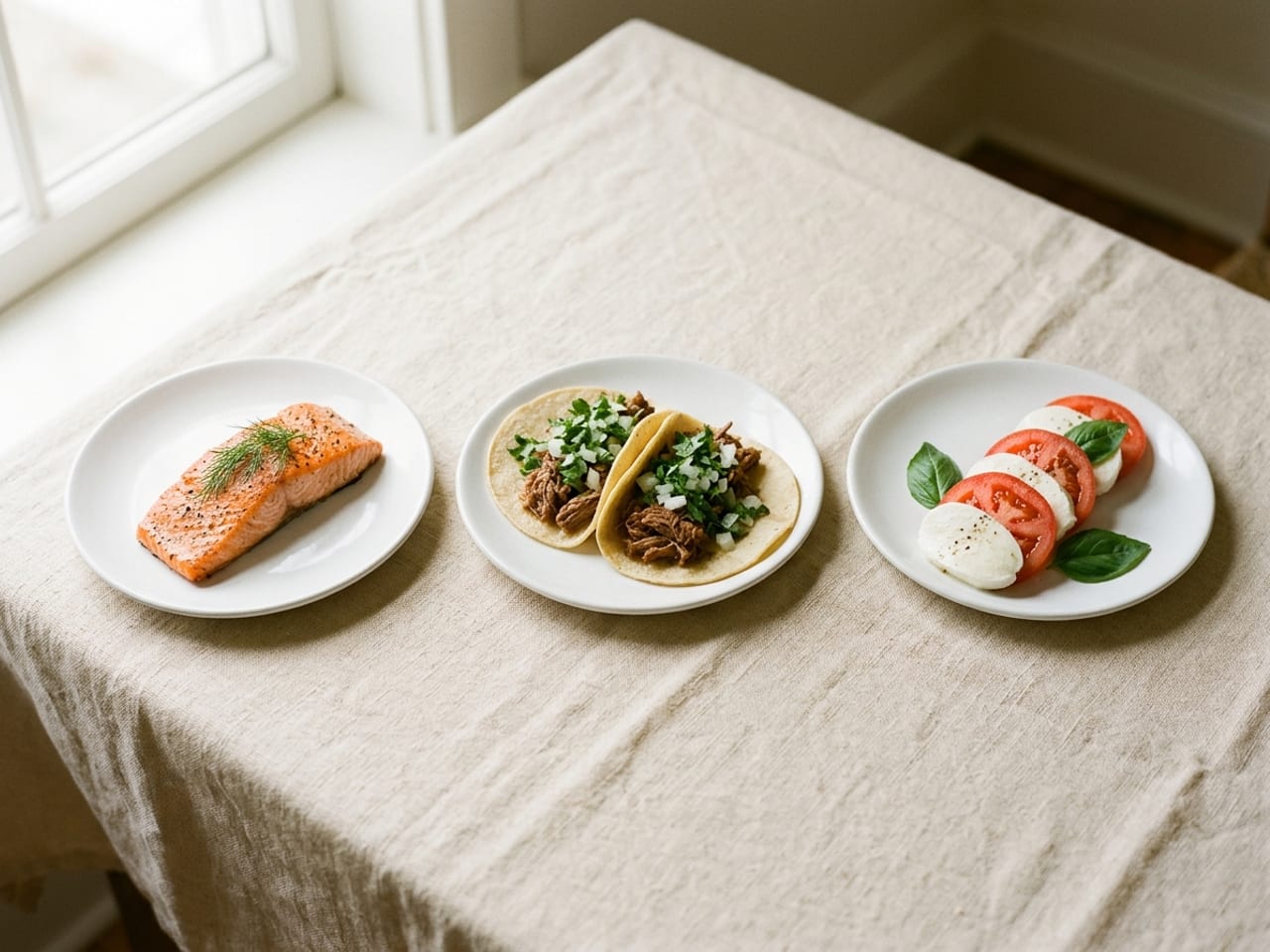
Parsley garnish: curly or flat, why it is on the plate, can you eat it, and what instead
Curly or flat-leaf parsley for garnish
Curly is the garnish parsley in the sources that choose. America's Test Kitchen labels it "Best for garnishes", Illinois Extension says the moss-curled kind "is often used for garnish", and Escoffier wanted "the curled-leaf kind" for garnishing.4, 14, 48 Flat-leaf is the cooking parsley: America's Test Kitchen prefers its flavour and finds it "easier to chop", Illinois calls it "the preferred parsley for cooking as it has more flavor".4, 14 For "a little chopped parsley over a dish to add color, it doesn't matter which kind you use", America's Test Kitchen says; its tasters could not tell the two apart where parsley was a small part of the dish.4
The chefs split. In a 2023 New Zealand piece, Ben Bayly "would only use curly in soups or purees", Jamie Hogg thinks flat-leaf has the stronger flavour but that tabbouleh needs curly, and, as the writer relays it, that curly is "more satisfying to chop" (America's Test Kitchen calls flat-leaf "easier to chop"); Josh Emett blames curly's use as a garnish for its fall from favour.46 No source we read says curly "holds its shape" better; we found it only unsourced (our own food garnishes guide used to print it).
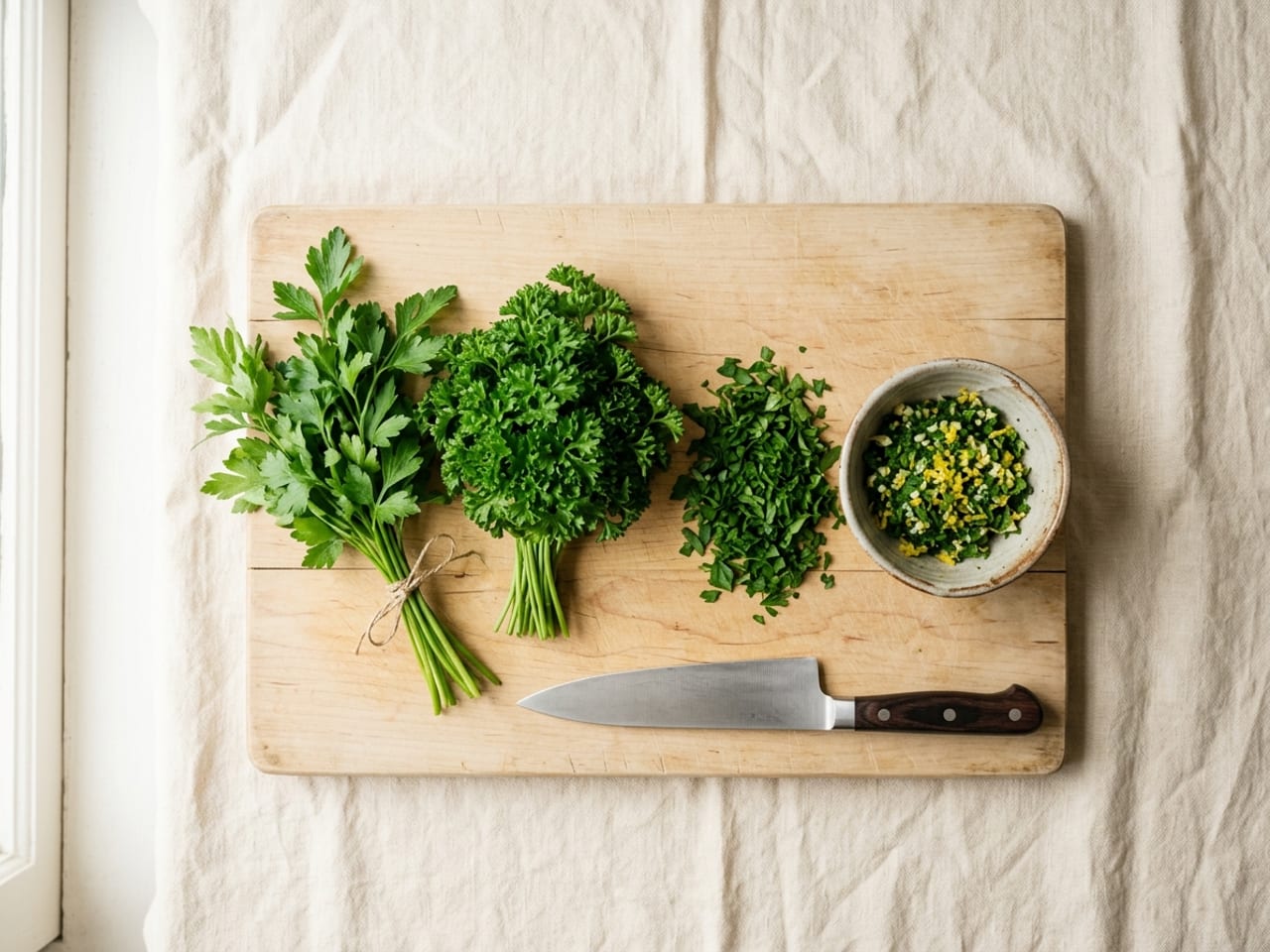
Why parsley is on the plate: the dated sprig
Parsley is a garnish in all five dated cookbooks we searched, from the 1685 edition of May's 1660 book to Farmer in 1910; they split on the form. In what we read, none says whether the sprig was meant to be eaten.
| When | Who | Form | As printed |
|---|---|---|---|
| 1660 (1685 ed.) | Robert May | Fried | Fried beef: "garnish them with fried parsley"55 |
| 1747 (1770 ed.) | Hannah Glasse | Crisped before the fire, or fried | "a good deal of parfley crifped before the fire" (long s as printed)56 |
| 1861 | Isabella Beeton | Fried | "instantly it will be green and crisp"57 |
| 1903 and 1907 | Auguste Escoffier | Curled sprays kept in fresh water, and fried | "make as much use as possible of the curled-leaf kind"48, 49 |
| 1910 | Fannie Farmer | Plain sprig | "garnish with parsley", a stock ending58 |
Then it became a reflex. Food historian Jan Whitaker: "Nothing decorated more restaurant plates in the 20th century than parsley, most of it by all accounts uneaten"; the sprigs were there "to fill empty spaces on the plate and to add color to dull looking food", and by 1915 "many regarded" them "as a nuisance", while "Diners sometimes suspected" theirs had been recycled (her dates carry no source on her page).59 Gisslen's 2011 textbook: "To many people, the word garnish means a sprig of parsley haphazardly placed on the plate", but the every-plate sprig "has become rare", and a sprig can still balance a plate of two items.1 Older still, Greek victors and tombs were wreathed with selinon, which translators read as parsley or wild celery: a wreath, not a garnish.60, 61
Can you eat the parsley garnish?
Yes: it is food. USDA lists fresh parsley at 1640 µg of vitamin K per 100 g; a tablespoon weighs 3.8 g, so about 62 µg (our arithmetic).63 If you take a blood thinner, ask your doctor about vitamin K: we did not research that. A Christian Science Monitor columnist eats the sprig ("I not only eat it, I relish it") and complained that restaurants were swapping it for "a sullen clump of kale".64 Escoffier on parsley: "when quite fresh and used in moderation, is an excellent thing", but left "too long in the heat, it becomes quite insufferable".48
| The claim | Verdict | Why |
|---|---|---|
| The parsley garnish took off in the 1980s | Wrong as an origin | Two listicles say so with no source (we cite The Takeout); every dated cookbook above is older, and food historian Jan Whitaker (her dates unsourced) has the sprig ubiquitous on US restaurant plates by 1915. A peak in memory, at most.55, 58, 59, 67 |
| The Romans invented the parsley garnish | Unsupported | The Pliny passage we read has Roman cooks correcting the taste of vinegar with parsley and butlers using it against bad smells in wine: flavour and smell, not a plate garnish. Greek victors and tombs were wreathed with selinon, which translators read as parsley or wild celery.60, 61, 62 |
| Parsley on the plate freshens your breath | Untested for leaves | The garlic-breath study we found tested apple, lettuce, mint leaves and green tea, not parsley; the one study with a parsley product (a seed-oil product) found it "did not reduce" mouth-air sulfur gases. We found no study of fresh parsley leaves.65, 66 |
| The sprig showed the chef had inspected the plate | No source | We found it only as a reader comment under Whitaker's own post, and in a search result we did not open; her history has no such line.59 |
| A green herb makes food look fresher | One small study | Fifteen students rated photos of fried chicken with 25 garnishes: a citrus, sudachi, was judged the best for balancing the taste and looking freshly prepared, and coriander, basil, lettuce and parsley fell in one "green cluster". One dish, photos only; no study we found isolates herb colour.68 |
Substitutes: the CIA's two, and ours for parsley
- Instead of chervil: Parsley, "or a 50/50 mix of parsley and tarragon" (CIA)2
- Instead of dill: "Parsley or basil", though "the flavor won't be the same" (CIA)2
- Instead of parsley: The herb the dish already has: chives on eggs and potatoes, dill on fish, cilantro on tacos and curry, basil on tomato, chervil on a clear soup (our suggestions, not a sourced list; the same idea as our food garnishes guide, which adds gremolata, scallion curls, microgreens or a little zest)
No test kitchen or textbook we read lists substitutes for parsley as a garnish; the CIA uses parsley as the substitute.2 The CIA also warns that chives are often a "non-functional" garnish: "If called for as garnish, you can leave them out entirely".2
Picked leaves, chopped, fried herbs, herb oil and microgreens
Picked leaves and sprigs
Wash, then dry well: America's Test Kitchen spins delicate herbs in a paper-towel-lined salad spinner, Maine Extension shakes them dry or spins them and pats off the rest.6, 19 Escoffier took the long stalks off his parsley sprays and kept them "in fresh water until required"; his chervil pluches are the leaves with the stem removed, held in water and added raw at the last moment.48, 49 For cilantro, the CIA says "Leaves and stems should be used and should not be chopped too finely".2 Placing them on the plate (one cluster or a loose scatter) is in our food garnishes guide.
Chopped herbs
- Wash and dry the leaves first: America's Test Kitchen gathers "washed, dried leaves into a tight pile".8
- Hold the pile with your other hand and rock the knife through it, then turn and repeat; loose piles chop "inconsistently".6, 8
- Chives are sliced, not chopped: Gisslen stacks them and cuts crosswise. No source we read compares scissors with a knife for chives on a plate.1
- Chop as late as you can: most herbs can wait "a few hours", cilantro and basil cannot (America's Test Kitchen); see how far ahead.7
Ribbons of basil, mint or sage are a chiffonade: the steps, and why basil darkens, are in our chiffonade guide. Gremolata, the parsley, garlic and lemon zest mix, is on our lemon garnish guide and in names below.
Fried herbs: parsley, sage and basil
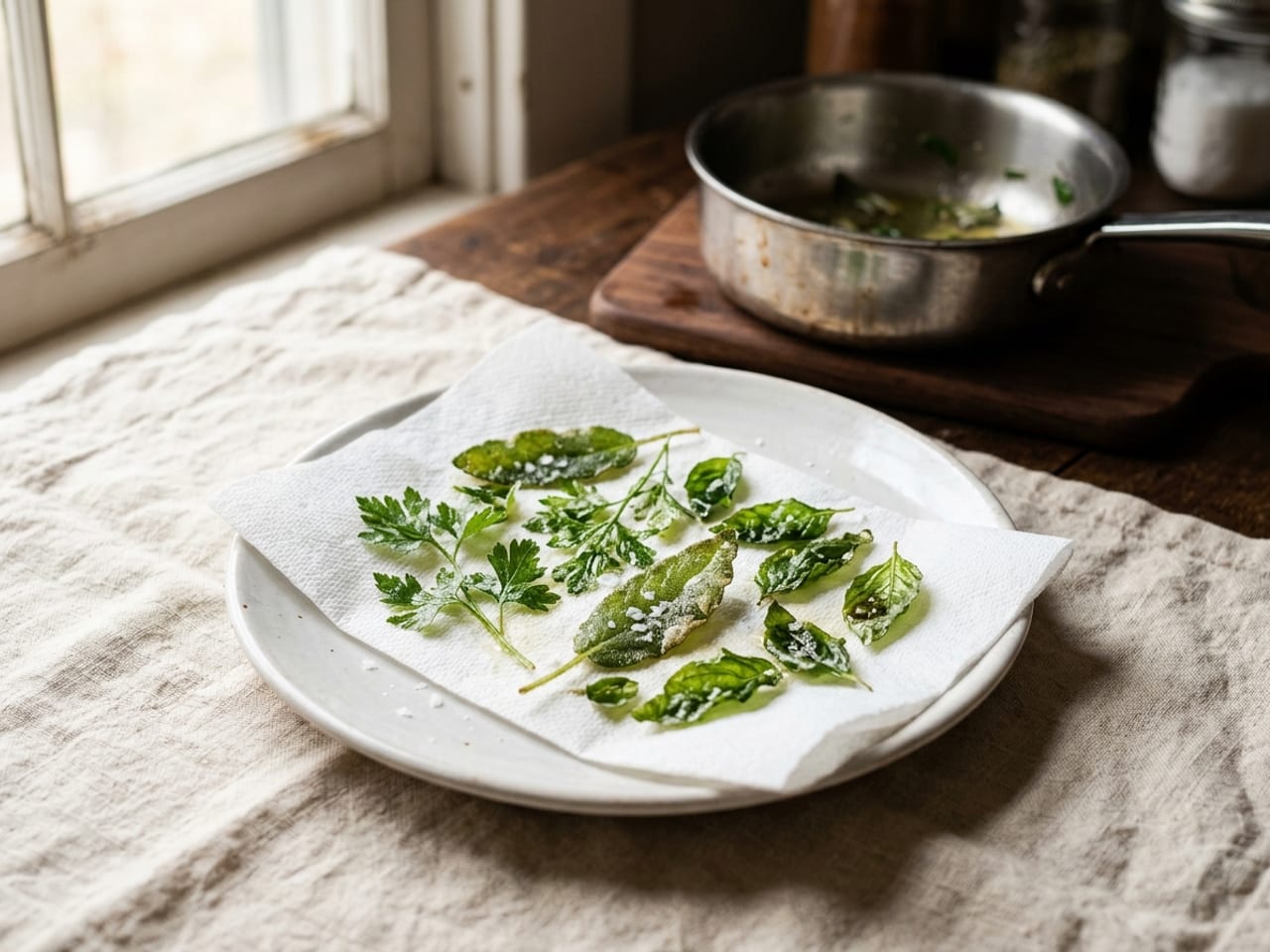
In what we read, sage, parsley and basil are the leaves fried most ("Basil, sage and parsley make good candidates", says Rouxbe), and sage is the one that has to be cooked.3, 31 The steps mostly agree (dry the leaves, fry a few at a time, drain); the numbers do not, so here is each source's own.
- Dry the leaves completely: Rouxbe wants them "clean and thoroughly dry", Kathy Gunst "thoroughly patted dry before frying".31, 33 (Mrs Beeton threw parsley into the fat straight from water in one passage, and dried it in a cloth in her recipe.)57
- Fry a few at a time: Saveur does 6 to 8 sage leaves a batch.32
- Lift them out as soon as they are crisp and even in colour, drain on paper towel and salt.31, 32, 48
| Who | Herb | Oil | Time |
|---|---|---|---|
| Rouxbe (cooking school)31 | Basil, sage, parsley | 275 to 300°F (135 to 150°C) | 5 to 10 seconds, "just until they become even in color" |
| Saveur, 202432 | Sage, 6 to 8 leaves a batch | "Hot and shimmering" oil | 2 to 3 seconds a batch |
| Kathy Gunst, 201533 | Sage and parsley | Until the oil "just begins to smoke" | About 30 seconds |
| Mrs Beeton, 186157 | Young parsley | Boiling lard or dripping | "A minute or two"; "the quicker it is fried the better" |
| Escoffier, 190748 | Parsley sprays | "Very hot fat" | "For an instant" |
| America's Test Kitchen (microwave)9 | Parsley, sage, mint, basil | Oil-dipped leaves between parchment, vented plastic wrap | 3 to 4 minutes |
The spread, from 2 seconds to "a minute or two", may follow the herb and how hot the oil is (our guess); no source we read tested one against another. America's Test Kitchen's microwave route needs "just a few teaspoons of oil".9 Hannah Glasse also crisped parsley with no fat at all, "before the fire".56 Serve them soon: Gunst says not to fry sage more than 15 minutes ahead "or it will wilt".33 Saveur crushes fried sage over squash or bean soups.32
Herb oil, in short
Blanch soft herbs, chill them, blend with neutral oil and strain: the method and how to plate it are in our plating components guide. The blanch splits: 10 seconds (Gisslen), 20 to 30 (America's Test Kitchen's basil oil), 30 (Great British Chefs), which says blanching "destroys the enzyme that causes the herbs to oxidise and turn brown".1, 10, 34 Keep it cold, 4 days at most, or freeze it: herbs in oil make an airless, low-acid mix in which Clostridium botulinum can grow (Oregon State Extension; Penn State says 2 to 4 days).21, 22
Microgreens, in short
Their tastes and kinds are in our food garnishes guide. Penn State Extension says to harvest them right before use, or to bag and store them cold and wash them only just before use, because after washing their shelf life "may be substantially reduced". Cold matters: mustard microgreens held 14 days at 5°C (41°F) and less than a day at room temperature in one study.24, 25
Herb flowers
Chive flowers "can also be harvested for use as an edible garnish" (Illinois Extension); chive and garlic chive blossoms are on our edible flowers list, with how to pick them apart.14
How to keep herbs fresh and green, and how far ahead to prep them
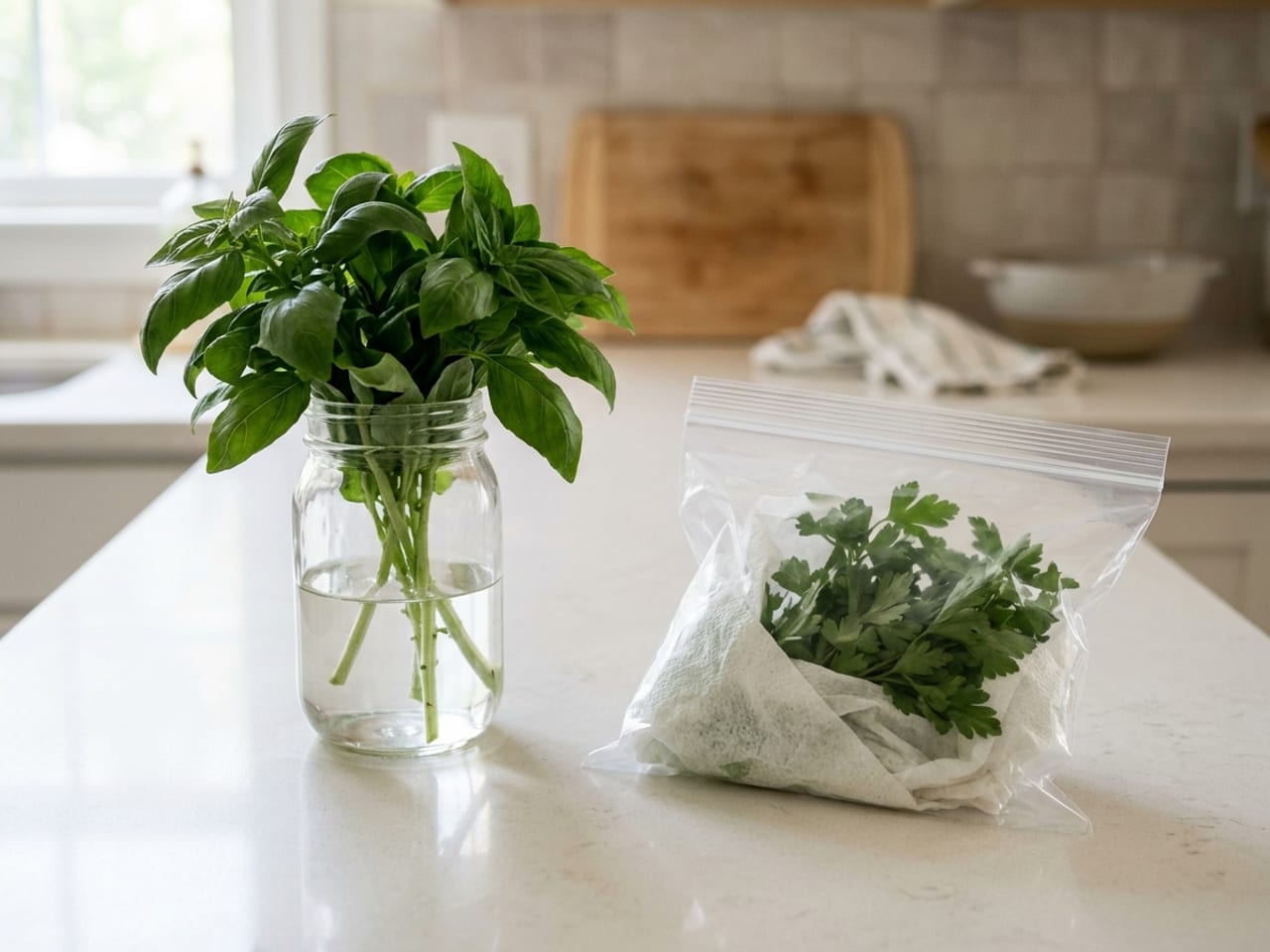
The rule the sources support: tender herbs cold and moist but not wet, hardy herbs cold and dry; basil and shiso out of the cold in most of what we read, though Cook's Illustrated files basil with its delicate herbs. Cook's Illustrated wraps delicate herbs "in slightly damp paper towels" in an open zipper-lock bag in the fridge, because they "must be kept moist lest they wilt" but "should not touch liquid, which encourages rot", and keeps hearty herbs dry.6 UC Davis names basil and shiso as the only chilling-sensitive culinary herbs, to be kept above 10°C (50°F); USDA says 12°C (54°F) for basil.15, 16 Mint is the reverse of basil: up to 4 weeks at 0°C (32°F) in bags but only 2 to 4 days at 20°C (68°F), in a 2023 review, so "mint ribbons can wait in the fridge" on our chiffonade guide and basil cannot.17 Parsley, mint, marjoram and oregano are "very sensitive to ethylene", the gas ripening fruit gives off: keep them apart.15
Days are each source's own, never ours. The extension services disagree by weeks for the same herb in the same jar: Maine says a towel-wrapped herb lasts "approximately 2-3 days" and a jar of water in the fridge 5 to 7; Ohio State "up to a week"; Alaska lists up to 21 days for parsley with no test behind it.18, 19, 20 USDA's and UC Davis's weeks are for commercial cold rooms near 0°C (32°F), not a home fridge, and UC Davis adds that a herb can look fine long after its aroma has gone: cilantro's "notably declines after 10 days".15, 16 Ohio State's jar-in-the-fridge method and Cook's Illustrated's damp-towel rule make no exception for basil; America's Test Kitchen, Maine Extension, UC Davis and USDA do.3, 6, 15, 16, 19, 20
| Herb | How the sources keep it | How long, by whose count |
|---|---|---|
| Parsley | Cook's Illustrated's rule for delicate herbs: "Wrap in slightly damp paper towels, place in open zipper-lock bag, and refrigerate". America's Test Kitchen: stems in water or damp towels, either way. UC Davis calls it "very sensitive to ethylene", the gas ripening fruit gives off (keeping it apart is our reading).3, 6, 15 | Up to 21 days in a jar of water in the fridge (Alaska Extension, no test given); for most herbs, 3 weeks at 0°C (32°F) and 2 at 5°C (41°F) in commercial storage (UC Davis). Maine Extension's general figures: 2 to 3 days in a towel, 5 to 7 in a jar.15, 18, 19 |
| Cilantro | Cook's Illustrated's rule for delicate herbs: "Wrap in slightly damp paper towels, place in open zipper-lock bag, and refrigerate". America's Test Kitchen: stems in water, or damp towels in the crisper. The CIA revives wilted cilantro in ice water.2, 3, 6 | Up to 14 days in a jar (Alaska Extension); 2 weeks at 0°C (32°F) commercially (USDA); aroma "notably declines after 10 days" though it may look fine at 21 (UC Davis).15, 16, 18 |
| Basil | Splits. Out of the fridge: upright in a glass of water at room temperature, water changed daily (America's Test Kitchen, Maine Extension); it is chilling sensitive below 10°C (50°F, UC Davis) or 12°C (54°F, USDA). In the fridge: Cook's Illustrated (2019) lists basil with its delicate herbs, in slightly damp paper towels in an open bag.3, 5, 6, 15, 16, 19 | Splits: "doesn't keep for more than a few days" (America's Test Kitchen card); up to 31 days on the counter (Alaska Extension, no test given); blackens in as little as 3 days at 5°C (41°F), and mould grew on basil after 3 days at 22°C (72°F) (a 2023 review).5, 17, 18 |
| Mint | The opposite of basil: cold. America's Test Kitchen: "in the refrigerator with its stems in water"; Illinois Extension: in a glass of water, or dry and wrapped in plastic in the fridge.3, 14 | 3 to 7 days in water, or a week dry in the fridge (Illinois); 2 to 3 weeks at 0°C (32°F) commercially (USDA); up to 4 weeks at 0°C but 2 to 4 days at 20°C (68°F) (a 2023 review).14, 16, 17 |
| Dill | America's Test Kitchen: "in the refrigerator with its stems in water". Cook's Illustrated files it with the delicate herbs (damp towels).3, 6 | 9 days in a jar (Alaska Extension); 2 weeks at 0°C (32°F) commercially (USDA).16, 18 |
| Chives | Cook's Illustrated's rule for delicate herbs: "Wrap in slightly damp paper towels, place in open zipper-lock bag, and refrigerate".6 | 9 days in a jar (Alaska Extension); 2 to 3 weeks at 0°C (32°F) commercially (USDA).16, 18 |
| Chervil | Cold and moist; Escoffier kept picked chervil in water until the last moment.48 | 8 days in a jar (Alaska Extension); 1 week at 0°C (32°F) commercially, the shortest top figure of the herbs USDA lists.16, 18 |
| Tarragon | America's Test Kitchen: "in the refrigerator with its stems in water".3 | Up to 17 days in a jar (Alaska Extension); 1 to 2 weeks at 0°C (32°F) commercially (USDA).16, 18 |
| Thyme | America's Test Kitchen splits: "Wrap thyme in damp paper towels" (2016) against "Store thyme dry in a plastic bag in the refrigerator" (its undated card). The newest dated one, Cook's Illustrated in 2019, keeps hearty herbs dry.3, 5, 6 | 2 to 3 weeks at 0°C (32°F) commercially (USDA).16 |
| Rosemary | Cook's Illustrated keeps hearty herbs dry: "Store in original packaging or open zipper-lock bag; refrigerate". America's Test Kitchen (2016) wraps it in damp paper towels: the same split as thyme.3, 6 | 2 to 3 weeks at 0°C (32°F) commercially (USDA).16 |
| Sage | Cook's Illustrated keeps hearty herbs dry: "Store in original packaging or open zipper-lock bag; refrigerate". America's Test Kitchen (2016) wraps it in damp paper towels.3, 6 | 2 to 3 weeks at 0°C (32°F) commercially (USDA).16 |
| Oregano and marjoram | Cook's Illustrated keeps hearty herbs dry: "Store in original packaging or open zipper-lock bag; refrigerate". America's Test Kitchen (2016) wraps oregano and marjoram in damp paper towels. Both are "very sensitive to ethylene" (UC Davis).3, 6, 15 | 1 to 2 weeks at 0°C (32°F) commercially (USDA).16 |
| Shiso | Like basil, chilling sensitive: "stored above 10°C (50°F)" (UC Davis).15 | 1 to 2 weeks above 10°C, commercially (UC Davis).15 |
| Mitsuba | No storage source we read. | None in what we read. |
| Celery leaf | "In an airtight container with a damp paper towel in your crisper drawer" (FoodPrint).44 | "Several days" (FoodPrint).44 |
| Fennel fronds | "Wrapped well and refrigerated" (FoodPrint).45 | "Up to a week" (FoodPrint).45 |
How far ahead, by form
| Form | What the sources say |
|---|---|
| Picked or chopped leaves | "Most herbs can be chopped a few hours ahead with no ill effect", but cilantro (soapy), basil (slimy, blackens) and scallion go "immediately after chopping" (America's Test Kitchen, a quality note). For safety, in the 1998 parsley outbreaks the restaurants usually chopped the parsley in the morning and left it at room temperature, "sometimes until the end of the day"; CDC: store chopped parsley for shorter times, keep it cold, chop smaller batches.7, 27 |
| Fried leaves | One source gives a limit: "Don't make the sage more than 15 minutes ahead of time or it will wilt" (Kathy Gunst). No other source we read times it.33 |
| Herb oil | Up to 4 days in the fridge, or freeze it (Oregon State Extension; America's Test Kitchen freezes basil oil within 4 days of making, for up to a month). Penn State Extension says 2 to 4 days. Great British Chefs' "up to 2 weeks" is longer than either extension service allows.10, 21, 22, 34 |
| Frozen herbs | "Usually are not suitable for garnish, as the frozen product becomes limp when it thaws" (NCHFP). America's Test Kitchen freezes parsley for cooking, up to four months.5, 23 |
| Microgreens | Wash right before use and keep them cold: after washing their shelf life "may be substantially reduced" (Penn State Extension). Mustard microgreens kept 14 days at 5°C (41°F) but under a day at 20 to 25°C (68 to 77°F) in one study.24, 25 |
| A sprig on the plated dish | No source we read says how long a sprig or a scatter holds on a plate. Escoffier's warning is the nearest: parsley left "too long in the heat" becomes "quite insufferable".48 |
Wilted herbs and ice water. The CIA refreshes wilted cilantro "in an ice water bath before drying and using"; that is the only herb source we read for it. Gisslen soaks limp vegetables "briefly in cold water to restore crispness", but not for long, because flavour leaches out.1, 2 Ours, for a dinner: wash and dry the herbs in the morning and store them as above; chop or pick them in the last half hour, cilantro and basil last of all; fry sage within 15 minutes of serving, the one hold a source gives.
Washing herbs, and why to chop them close to serving
Wash under plain running water, then dry. The FDA: wash produce "under running water", no soap or produce wash, and dry it with a clean cloth or paper towel; washing "can reduce bacteria ... but will not eliminate it". Ohio State Extension: no soap, detergent or bleach, "because these liquids absorb into the herb". A pack labelled pre-washed needs no second wash.20, 26 Washing is not a cure: the supplier in a 1997 outbreak tied to basil pesto washed its basil, and the FDA says washing "may not be sufficient" against Cyclospora, which has been linked to cilantro.28, 29 Our food garnishes guide has these outbreaks in more detail.
Chop close to serving and keep chopped herbs cold. In the 1998 Shigella outbreaks traced to chopped curly parsley, the restaurants usually chopped it in the morning and left it out, "sometimes until the end of the day". Laboratory tests reported with the outbreak are the only measured numbers we found: at 70°F (21°C), bacteria on chopped parsley (Shigella added to the parsley in a laboratory) grew a thousandfold (3 logs) within 24 hours, against tenfold in the first one to two days on whole sprigs; in the fridge at 39°F (4°C) they fell about tenfold a week. CDC's advice: store chopped parsley for shorter times, keep it cold and chop smaller batches.27 USDA's general rule for food is not more than 2 hours out of the fridge, 1 hour above 90°F (32°C); it is not herb-specific.30
Herb oil and pesto stay cold: fresh herbs in oil can carry Clostridium botulinum spores; use within 4 days or freeze (Oregon State, Alaska for pesto; Penn State 2 to 4 days).18, 21, 22 The FDA keeps herbs at 40°F (4°C) or below with other produce; UC Davis and USDA make basil the exception, for quality.15, 16, 26
Fines herbes, pluches, persillade, gremolata and other herb garnish names
| Name | What it is | As read |
|---|---|---|
| Fines herbes | Chopped parsley, chives, chervil and tarragon in about equal parts, the set Escoffier gives for the omelette; chopped herbs are mixed into eggs and sauces or sprinkled on at the end. | The TLFi dictionary dates the phrase to 1540; Escoffier's 1903 omelette entry names the four herbs to add to eggs and says an omelette with parsley alone is not an omelette aux fines herbes; America's Test Kitchen (2007) uses the same four. McGee lists three (tarragon, chervil, chive).11, 13, 48, 49, 50 |
| Pluches | Picked chervil leaves with the stem removed, added raw at the last moment, mostly to soups. | Escoffier 1903: "la feuille sans tige" (the leaf without stem), into the soup only "au dernier moment"; 1907: "a fine chervil pluche on each yolk".48, 49 |
| Persillade | Chopped parsley, often with garlic, added to some dishes (Larousse). | That is Larousse's definition; Gisslen's persillade adds fresh bread crumbs and is pressed onto a rack of lamb and browned: the sources split.1, 51 |
| Gremolata | Minced parsley, garlic and grated lemon zest, a mixture used especially with osso buco. | America's Test Kitchen: 2 tablespoons parsley, 1 garlic clove, 1 teaspoon zest; Merriam-Webster dates the word in English to 1954.12, 52 |
| Cilantro and coriander | One plant: Wikipedia lists the leaves as coriander leaves, fresh coriander, Chinese parsley, or cilantro (US, commercially in Canada, and Spanish-speaking countries). | Wikipedia (weak) and the Cambridge Dictionary, which labels cilantro as US; Wikipedia says American English calls the seeds coriander.53, 54 |
| Tsuma and ken | The garnishes served with Japanese sashimi. Heibonsha says those laid under it (shredded daikon, myoga) are sometimes called ken, those set in front (shiso flower spikes, tade, bofu) tsuma. | Heibonsha encyclopedia, our translation; in the Edo period "ken" was the usual word, and its tsuma meant soup garnishes.43 |
Escoffier's 1907 English edition prints four different "fine herbs" sets (ravigote, remoulade, a fish forcemeat, and the omelette); the four-herb set is the omelette's.48
Herbs in drinks: the short version
A mint, basil, rosemary or thyme sprig in a cocktail: drinks have their own guide. Our cocktail garnishes guide wakes the sprig with one clap between the palms and stands it by the straw, out of the drink. Illinois Extension lists mint for "beverages and jellies" as well as meat.14
Herb garnishes, answered
What herbs are used for garnish?
In the sources we read: parsley first (named as a garnish by 5 of 5 sources with a parsley entry), then chives, dill, cilantro, chervil and mint, basil and Thai basil, and in Japanese cooking shiso and mitsuba. Sage is a garnish only fried; thyme, rosemary and oregano are mostly cooked, though Gisslen lays a rosemary sprig on grilled chicken. This page has 16 herbs and herb-like leaves with the dishes sources put each on.
Can you eat the parsley garnish?
Yes, it is food. USDA lists parsley at 1640 µg of vitamin K per 100 g, about 62 µg in a tablespoon (our arithmetic), and a Christian Science Monitor columnist wrote of the sprig, "I not only eat it, I relish it". No dated cookbook we read says whether the sprig was meant to be eaten. If you take a blood thinner, ask your doctor about vitamin K; we did not research that.
Why do restaurants put parsley on your plate?
Habit with a long history. Fried parsley garnished fried beef in the 1685 edition of Robert May's 1660 book, and Escoffier chose the curled kind for garnishing. Food historian Jan Whitaker says 20th-century sprigs were there "to fill empty spaces on the plate and to add color to dull looking food", and by 1915 many diners found them a nuisance. Gisslen's textbook says the every-plate sprig "has become rare".
Is curly or flat-leaf parsley better for garnish?
America's Test Kitchen labels curly "Best for garnishes" and cooks with flat-leaf, which it finds more flavourful and easier to chop; for "a little chopped parsley over a dish to add color, it doesn't matter which kind you use". Escoffier and Illinois Extension also name curly for garnish. One New Zealand chef, as a writer relays it, finds curly "more satisfying to chop": the sources split on that.
What can I use instead of parsley as a garnish?
No test kitchen we read lists parsley substitutes; the CIA goes the other way, using parsley in place of chervil, or parsley or basil for dill. Our advice: the herb already in the dish, such as chives on eggs and potatoes, dill on fish, cilantro on tacos, basil on tomato.
How do you keep herbs fresh in the fridge?
Cook's Illustrated: wrap delicate herbs (basil, parsley, cilantro, dill, mint, chives, tarragon) in slightly damp paper towels in an open zipper-lock bag in the fridge, and keep hearty ones (rosemary, thyme, oregano, sage, marjoram) dry. Its page makes no exception for basil; America's Test Kitchen, Maine Extension, UC Davis and USDA say basil should not go in the fridge. Day counts split by source: Maine Extension says 2 to 3 days in a towel and 5 to 7 in a jar of water, Alaska Extension up to 21 days for parsley in a jar.
How do you keep basil fresh?
Most sources we read say on the counter, not in the fridge: stand it in a glass of water and change the water daily (America's Test Kitchen, Maine Extension). Cook's Illustrated (2019) is the exception: it wraps basil with the other delicate herbs in damp paper towels in the fridge. Below about 10 to 12°C (50 to 54°F) basil is injured by cold (UC Davis, USDA); a 2023 review has leaves blackening in as little as 3 days at 5°C (41°F). Chopped basil should be used at once: America's Test Kitchen says it "becomes slimy and blackens".
How do you keep parsley and cilantro fresh?
In the fridge, either with the stems in water or wrapped in damp paper towels in a zipper-lock bag (America's Test Kitchen). UC Davis calls parsley very sensitive to ethylene, the gas ripening fruit gives off, so keep it apart (our reading). Chop cilantro just before serving: chopped ahead it turns "soapy tasting", says America's Test Kitchen.
How do you make fried herbs for garnish?
Wash and dry the leaves completely, fry a few at a time in hot oil, drain on paper towel and salt. The sources split on heat and time: Rouxbe 275 to 300°F (135 to 150°C) for 5 to 10 seconds, Saveur 2 to 3 seconds for sage in shimmering oil, Kathy Gunst about 30 seconds in oil just smoking, Beeton "a minute or two". America's Test Kitchen microwaves oiled leaves between parchment for 3 to 4 minutes.
How long does homemade herb oil keep?
Up to 4 days in the fridge, or frozen, say Oregon State Extension and America's Test Kitchen; Penn State Extension says 2 to 4 days. Fresh herbs in oil can carry Clostridium botulinum spores, so it belongs in the fridge. Great British Chefs' "up to 2 weeks" is longer than either extension service allows.
What is a good green garnish for food?
A fresh herb the dish already uses, picked or chopped at the last minute: parsley, chives, dill, cilantro, basil, chervil or mint, or pale celery leaves (FoodPrint calls them "great in salads or used as a garnish"). A 2005 newspaper column complained of parsley "replaced on plates by a sullen clump of kale"; the textbooks we read garnish with herbs.
Why does cilantro taste like soap to some people?
A 2012 study of 14,604 people of mainly European ancestry linked one gene variant near smell-receptor genes, OR6A2 the likeliest, to noticing a soapy smell and disliking cilantro. The authors say the dislike being driven by smell is "suspected, although not proven".
Can you garnish with dried or frozen herbs?
The sources say no. The National Center for Home Food Preservation says frozen herbs "usually are not suitable for garnish, as the frozen product becomes limp when it thaws", and America's Test Kitchen says to avoid dried delicate herbs such as basil, parsley, chives, mint and cilantro.
Cooked something with a herb on top? Photograph the plate and Plate Artists re-plates that dish, with the food kept as it is and the changes named. Start with a re-plate.
Your food, plated like a chef's
Snap it, upload it, and get the composed version back, with the steps to recreate it at home.
Start free · 1 enhancement →Free account · 1 free enhancement · No credit card
How this page was made
We chopped, fried, timed, tasted and tested nothing for this page. Every taste word, time, temperature and date is what its source printed, read on 12 November 2026 unless its entry says otherwise. Makers (a soy sauce company) are labelled where they make a claim. Ours: the tender and hardy grouping and where chervil sits in it, the dish groups and every count in the tally, the strip's summaries, the °C, °F and µg arithmetic, the "instead of parsley" list and every line marked ours. Left out: a test-kitchen "herb keeper" trial whose day counts we could not re-read at its address, the CIA's line that Mexican oregano is "also called epazote" (Illinois Extension and Gisslen treat them as different plants), a newspaper column's 10 days for herb oil, a Serious Eats storage method we could read only second hand, scissors-versus-knife claims for chives (no source beyond blogs), and Nippon.com's line that the shiso on sashimi began as protection against food poisoning (no study cited). The figures are AI renders, not photographs. The parsley, fried herb, keeping and safety lines agree with our food garnishes, chiffonade and plating components guides, which hand herbs on to this page.
The textbooks, test kitchens, extension services and studies behind this page
How each source was read (in full, as OCR of a scan, as a fragment, as an abstract, in an archived copy, or as a prior reading for another of our guides) is in its entry. Makers sell what they describe.
- Gisslen, W. (2011). Professional Cooking, 7th edition. John Wiley & Sons; Internet Archive scan, OCR, read on 12 November 2026 as OCR text: Table 4.1 "Herbs and Spices" (parsley "Most widely used herb; dark green curly or flat leaves with delicate, sweet flavor"; chervil "Herb with mild flavor of parsley"; chive "Grasslike herb with onion flavor"; dill "familiar dill pickle flavor"; mint "familiar cool flavor"; oregano the "pizza herb"); "Fresh herbs are almost always superior to dried herbs"; ch. 28 "To many people, the word garnish means a sprig of parsley haphazardly placed on the plate", "Today, the use of parsley sprigs on every plate has become rare", "adding a simple sprig of parsley completes the picture"; recipe garnish lines (chopped parsley; a sprig of rosemary on grilled chicken; "a tiny sprig of dill" on shrimp-filled cucumber; "a few leaves of Thai basil or cilantro" on fish; mint and cilantro leaves with Vietnamese-style beef noodle soup; clear soups "Occasional exceptions are toppings of chopped parsley or chives"; scallion slices on soup and steamed fish; "a little deep-fried parsley"; "FRIED SAGE" on a menu); herb oils (blanch 10 seconds, paste plus 4 times its volume of olive oil); "Limp vegetables can be soaked briefly in cold water to restore crispness" (vegetables, not herbs). The table's columns are split by the OCR, so its pairings are read by row order. archive.org
- The Culinary Institute of America (2026). Guide to herbs. CIA Foodies (ciafoodies.com), undated page, read in full on 12 November 2026 (a reader comment on it is dated 14 January 2025): tender herbs "such as basil, parsley, and chives" vs resinous "rosemary, thyme, and oregano"; tender herbs' flavour "tends to dissipate during cooking; hence they should be added at the very end"; per-herb uses naming garnish for chervil, chives ("cream cheese garnish"), cilantro ("Leaves and stems should be used and should not be chopped too finely"), mint ("garnish for desserts"; "a traditional accompaniment to lamb") and parsley; chives often a "non-functional" garnish ("you can leave them out entirely"); "If your cilantro is wilted, refresh it in an ice water bath before drying and using"; "Parsley is more than a green garnish"; chervil substitute "parsley is a good substitute, or a 50/50 mix of parsley and tarragon"; dill substitute "choose a bright, fresh herb, like parsley or basil"; sage "musty flavor". ciafoodies.com
- America's Test Kitchen (2016). How and where to buy, use, and store fresh herbs. americastestkitchen.com, 4 November 2016, read in full on 12 November 2026: dill "slightly bitter, with a refreshing, lemony quality", for "seafood, potatoes, and eggs", "best used as a finishing herb", stored "with its stems in water"; sage "should be cooked" (cottony raw), stored in damp paper towels; marjoram "best used as a finishing herb"; tarragon "mouth-numbing" with "a sweet orange-anise aroma"; mint "smooth and bright, with a eucalyptus quality", stored "with its stems in water"; basil "balances licorice and citrus notes", rooted basil kept "upright in a glass at room temperature"; cilantro "love-it-or-loathe-it", stems in water or damp towels; rosemary "an obvious pine aroma", like "Vicks VapoRub" if overused; thyme "Its flavor mellows with cooking"; "Wrap thyme in damp paper towels"; parsley either way; "Avoid dried forms of delicate, leafy herbs such as basil, parsley, chives, mint, and cilantro". americastestkitchen.com
- America's Test Kitchen (2026). Curly-leaf vs. flat-leaf parsley. americastestkitchen.com, undated page, read in full on 12 November 2026: "we almost always call for flat-leaf parsley because we prefer its flavor", flat-leaf "easier to chop"; "If you're just sprinkling a little chopped parsley over a dish to add color, it doesn't matter which kind you use"; "CURLY-LEAF PARSLEY: Best for garnishes"; in tabbouleh and salsa verde tasters called flat-leaf "fresh" and "vibrant", curly "mild" and "vegetal". americastestkitchen.com
- America's Test Kitchen (2026). All about fresh herbs. americastestkitchen.com, undated page, read in full on 12 November 2026: "Basil doesn't keep for more than a few days", a glass of water on the counter, water changed daily; parsley stems in water or damp towels, frozen "for up to four months"; "Store thyme dry in a plastic bag in the refrigerator"; curly parsley "once made its living as a ubiquitous restaurant garnish". americastestkitchen.com
- Bomze, L. (Cook's Illustrated) (2019). Our guide to fresh herbs. americastestkitchen.com, 29 May 2019, read in full on 12 November 2026: hearty (rosemary, thyme, oregano, sage, marjoram) vs delicate (basil, parsley, cilantro, dill, mint, chives, tarragon); "HEARTY: Store in original packaging or open zipper-lock bag; refrigerate. DELICATE: Wrap in slightly damp paper towels, place in open zipper-lock bag, and refrigerate"; delicate herbs "should not touch liquid, which encourages rot"; dry them "in a paper towel-lined salad spinner"; no day counts. americastestkitchen.com
- America's Test Kitchen (2026). When to chop herbs. americastestkitchen.com, undated page, read in full on 12 November 2026: "most herbs can be chopped a few hours ahead with no ill effect"; "Cilantro becomes soapy tasting if chopped in advance. Basil becomes slimy and blackens once chopped"; chopped scallion, "not a true herb but often used like one", turns slimy; "use each of these three immediately after chopping". americastestkitchen.com
- America's Test Kitchen (2026). Chop (and mince) leafy herbs like a pro. americastestkitchen.com, undated page, read in full on 12 November 2026: "Gather washed, dried leaves into a tight pile and hold them with your nonknife hand", rock the knife, turn and repeat; loose piles chop "inconsistently". americastestkitchen.com
- America's Test Kitchen (2026). Microwave-fried herbs. americastestkitchen.com, undated page, read in full on 12 November 2026: "Crisp-fried herbs such as parsley, sage, mint, and basil make appealing garnishes"; leaves dipped in vegetable oil, in a single layer on parchment on a plate, under plastic wrap with vent holes, "microwave for 3 to 4 minutes", then blotted; "just a few teaspoons of oil". americastestkitchen.com
- Luchtel, A. (America's Test Kitchen) (2024). Fresh basil oil. americastestkitchen.com, 5 March 2024, read in full on 12 November 2026: basil blanched "until leaves are just wilted but still bright green, 20 to 30 seconds", blended and strained; 4 oz (113 g) of leaves and stems to 1¼ cups (300 ml) of vegetable oil; "refrigerated for up to 4 days or frozen, within 4 days of making, for up to 1 month". americastestkitchen.com
- America's Test Kitchen (2007). Fines herbes omelet. americastestkitchen.com, 22 August 2007, read in full on 12 November 2026: "1 tablespoon fines herbes (equal parts minced fresh parsley, chives, tarragon, and chervil)", folded into the eggs. americastestkitchen.com
- America's Test Kitchen (2011). Gremolata. americastestkitchen.com, 19 July 2011, read in full on 12 November 2026: "2 tablespoons minced fresh parsley 1 garlic clove, minced 1 teaspoon grated lemon zest". americastestkitchen.com
- McGee, H. (2004). On Food and Cooking: The Science and Lore of the Kitchen, revised edition. Scribner; Internet Archive copy, read on 12 November 2026 as full-text search fragments only (the herb chapter was not read whole): "Fines herbes Tarragon, chervil, chive"; chervil "barely warmed, since heat drives away its flavor"; the parsley family lists chervil, coriander leaf, dill, fennel, lovage, mitsuba and parsley. archive.org
- University of Illinois Extension (2026). Herbs (one page per herb: parsley, chervil, chives, dill, cilantro, basil, mint, thyme, rosemary, sage, oregano, lovage, fennel). extension.illinois.edu, undated pages, read in full on 12 November 2026: parsley "the most widely grown herb for both garnish and flavoring", moss-curled "often used for garnish", flat-leaf "the preferred parsley for cooking as it has more flavor"; chervil "a mix of parsley and anise", "also used as a garnish"; chives "much milder and more subtle than other members of the onion family", flowers "an edible garnish"; dill "fish, lamb, egg dishes, soups and potato salad"; cilantro "most often associated with Mexican or Asian foods"; basil "a spicy odor and flavor", Thai basil "Licorice-like aroma"; mint "with veal, lamb and pork dishes as well as beverages and jellies", "Bunches of mint in a glass of water will keep fresh for 3-7 days"; thyme "a hint of clove and mint fragrance"; rosemary "Use rosemary sparingly as an accent"; sage "fish, pork and poultry dishes"; lovage "much like celery only stronger and sweeter"; herb fennel "an anise or licorice flavor", used "in fish dishes". extension.illinois.edu
- UC Davis Postharvest Research and Extension Center (photos M. Cantwell) (2026). Herbs (fresh culinary): produce fact sheet. University of California, Davis, read in full on 12 November 2026 in an Internet Archive copy (the live site refuses this machine): herbs harvested as "soft or semi-woody leafy stems (dill, oregano, tarragon, basil, mint)"; "Expected shelf-life is 3 weeks at 0°C (32°F) and 2 weeks at 5°C (41°F)" (commercial storage); "Basil and shiso are chilling sensitive and should be stored above 10°C (50°F)", 1 to 2 weeks; "visual shelf-life is much longer than useful culinary shelf-life", cilantro aroma "notably declines after 10 days"; marjoram, mint, parsley and oregano "very sensitive to ethylene exposure"; freeze damage on dill, chives and parsley just below 0°C. ucdavis.edu
- Gross, K. C., Wang, C. Y. & Saltveit, M. (eds.); chapters by K. P. Wright (2016). The Commercial Storage of Fruits, Vegetables, and Florist and Nursery Stocks (Agriculture Handbook 66). USDA Agricultural Research Service, Annual Culinary Herbs pp. 173 to 174 and Perennial Culinary Herbs p. 485, read in the saved PDF text (a prior reading for our chiffonade guide) and re-quoted on 12 November 2026: "Postharvest life ranges from 1 week for chervil ... to 2 weeks for coriander and dill"; "Basil should be stored at 12 °C (54 °F)", about 2 weeks; "Chives and mint can be stored for 2 to 3 weeks at 0 °C (32 °F)"; marjoram, oregano and tarragon 1 to 2 weeks; rosemary, sage and thyme 2 to 3 weeks; perennials "not chilling sensitive". Commercial cold rooms, not a home fridge. ars.usda.gov (PDF)
- Brindisi, L. J. & Simon, J. E. (2023). Preharvest and postharvest techniques that optimize the shelf life of fresh basil (Ocimum basilicum L.): a review. Frontiers in Plant Science, 14:1237577; read in full (a prior reading for our chiffonade guide, quotes re-checked on 12 November 2026): basil "blacken from necrosis in as little as 1 day at 0°C or 3 days at 5°C"; "mint can maintain freshness at 0°C for up to 4 weeks in bags and only 2-4 days at 20°C". doi:10.3389/fpls.2023.1237577
- University of Alaska Fairbanks Cooperative Extension Service (2019). Herbs (FNH-00561L). uaf.edu, revised October 2019, read in full on 12 November 2026: towel-wrapped herbs "keep well enough for a day or two"; stems in a jar of water under a loose plastic bag in the fridge; "Basil will last on the counter top for up to 31 days. In the refrigerator, chervil stays fresh for eight days, chives for nine, cilantro up to 14, dill for nine, parsley up to 21 and tarragon for up to 17 days" (the page gives no test or source for these days); pesto "Do not store in the refrigerator longer than four days". uaf.edu
- University of Maine Cooperative Extension (2024). Using fresh herbs in cooking. extension.umaine.edu, 1 August 2024, read in full on 12 November 2026: in a damp paper towel in a perforated bag "approximately 2-3 days"; in a jar with about 1 inch (2.5 cm) of water under a bag in the fridge, water changed daily, "5 to 7 days"; "Basil does not store well in the refrigerator, instead, store it at room temperature in a jar with water"; "Wash fresh herbs under running water, shake dry (or use a salad spinner)"; delicate herbs (basil, chives, cilantro, dill leaves, parsley, mint) added "as a garnish before the dish is served". extension.umaine.edu
- Ohio State University Extension (2021). Selecting, storing, and using fresh herbs (HYG-5520). ohioline.osu.edu, page dated 26 July 2021, read in full on 12 November 2026: stems trimmed, in a glass with one inch (2.5 cm) of water, loosely bagged, in the fridge, water changed daily, "up to a week" (no basil exception on the page); "Wash herbs in cool running water ... Do not use soap, detergent, or bleach". ohioline.osu.edu
- Oregon State University Extension Service (2026). Herbs and vegetables in oil (SP 50-701). extension.oregonstate.edu, read in full on 12 November 2026: "Low acid foods stored in oil create an oxygen-free environment which is perfect for growth of Clostridium botulinum bacteria"; herbs in oil, "refrigerate. Use within 4 days or freeze for long-term storage". extension.oregonstate.edu
- Penn State Extension (2024). How to safely make infused oils. extension.psu.edu, updated 4 April 2024, read in full on 12 November 2026: fresh-herb oils refrigerated "to use within 2 to 4 days"; herbs "can be a source of Clostridium botulinum spores". extension.psu.edu
- National Center for Home Food Preservation (University of Georgia) (2014). Freezing fresh herbs (from So Easy to Preserve, 6th edition, Bulletin 989). nchfp.uga.edu, read in full on 12 November 2026: frozen herbs "can be chopped and used in cooked dishes. These usually are not suitable for garnish, as the frozen product becomes limp when it thaws". nchfp.uga.edu
- Di Gioia, F. (Penn State Extension) (2023). A step-by-step guide for growing microgreens at home. extension.psu.edu, read in full on 12 November 2026: harvest "right before being used"; "their shelf life may be substantially reduced after washing. An alternative could be to bag and store microgreens at low temperatures and wash them right before they are used". extension.psu.edu
- Dayarathna, N. N., Gama-Arachchige, N. S., Damunupola, J. W., Xiao, Z., Gamage, A., Merah, O. & Madhujith, T. (2023). Effect of storage temperature on storage life and sensory attributes of packaged mustard microgreens. Life, 13(2):393; abstract only, read on 12 November 2026 through Europe PMC: good sensory quality for 14 days at 5°C, 4 days at 10°C, 2 days at 15°C, and "deteriorated beyond consumption within one day" at 20 and 25°C; one species, one bag. doi:10.3390/life13020393
- U.S. Food and Drug Administration (2024). Selecting and serving produce safely. fda.gov, content current as of 5 March 2024; read in full on 12 November 2026 in an Internet Archive copy (the live site refuses this machine): "Wash all produce thoroughly under running water"; "Washing can reduce bacteria that may be present but will not eliminate it"; dry "with a clean cloth towel or paper towel"; pre-washed packs can be used "without further washing"; "Store perishable fresh fruits and vegetables (like strawberries, lettuce, herbs, and mushrooms) in a clean refrigerator at a temperature of 40° F or below". fda.gov
- Centers for Disease Control and Prevention (1999). Outbreaks of Shigella sonnei infection associated with eating fresh parsley: United States and Canada, July to August 1998. MMWR 48(14):285 to 289, read in full on 12 November 2026 in an Internet Archive copy (the live site refuses this machine): "chopped, uncooked, curly parsley as the common vehicle"; "Usually parsley was chopped in the morning and left at room temperature, sometimes until the end of the day"; the University of Georgia tests it reports: about 1 log fewer bacteria a week in the fridge at 39°F (4°C), but at 70°F (21°C) "on chopped parsley a 3 log cfu/g increase was observed within 24 hours" against 1 log in the first 1 to 2 days on whole parsley; "storing chopped parsley for shorter times, keeping it refrigerated, and chopping smaller batches". cdc.gov
- Centers for Disease Control and Prevention (1997). Outbreak of cyclosporiasis: northern Virginia, Washington, D.C., Baltimore, Maryland, metropolitan area, 1997. MMWR, read in full on 12 November 2026 in an Internet Archive copy (the live site refuses this machine): basil the probable vehicle in a basil-pesto pasta salad; the supplier "reported that its practice was to wash basil that it used to make pesto sauce". cdc.gov
- U.S. Food and Drug Administration (2026). Questions and answers regarding cilantro from Puebla, Mexico. fda.gov, read in full on 12 November 2026 in an Internet Archive copy (the live site refuses this machine): "washing and cleaning may not be sufficient to eliminate pathogens such as Cyclospora"; cooking kills most pathogens. fda.gov
- USDA Food Safety and Inspection Service (2026). Danger zone (40°F to 140°F). fsis.usda.gov, a prior reading (21 October 2026, for our garde manger guide; the live page refuses this machine): "Never leave food out of refrigeration over 2 hours. If the temperature is above 90 °F, food should not be left out more than 1 hour". fsis.usda.gov
- Rouxbe (online cooking school) (2026). Fried herbs. rouxbe.com, undated page, read in full on 12 November 2026: "Basil, sage and parsley make good candidates for fried herbs"; "Make sure the herbs are clean and thoroughly dry"; oil "between 275 to 300ºF (or 135 to 150ºC)", "Fry them for about 5 to 10 seconds or so, just until they become even in color". rouxbe.com
- Saveur editors (2024). Fried sage leaves. Saveur, updated 11 October 2024, read in full on 12 November 2026: "A quick turn in hot oil transforms the fragrant herb into a crispy, elegant garnish or snack"; oil "hot and shimmering", "6-8 sage leaves at a time and fry until crisp, 2-3 seconds per batch", then salt; "crushed and sprinkled on squash or bean soups". saveur.com
- Gunst, K. (Here & Now) (2015). More than a garnish: 6 great parsley recipes. KLCC / Here & Now (public radio), 1 April 2015, read in full on 12 November 2026: oil heated "until the oil just begins to smoke"; herbs "thoroughly patted dry before frying"; "Fry for about 30 seconds"; "Don't make the sage more than 15 minutes ahead of time or it will wilt". klcc.org
- Great British Chefs (2026). How to make herb oil. greatbritishchefs.com, undated page, read in full on 12 November 2026: blanch 30 seconds, ice water, 200 g herbs to 300 g oil, strain overnight; "blanching destroys the enzyme that causes the herbs to oxidise and turn brown"; the page says "Store the herb oil in the fridge for up to 2 weeks", longer than the extension services allow. greatbritishchefs.com
- Nguyen, A. (The Pho Cookbook, Ten Speed Press 2017) (2017). Pho garnish plate. The Splendid Table, read in full on 12 November 2026: "2 or 3 sprigs mint", "2 or 3 sprigs Thai basil", "3 or 4 fresh culantro leaves", "2 or 3 sprigs rice paddy herb"; Thai basil added "During the warmer months". splendidtable.org
- Forkish, K. (James Beard Foundation recipe archive) (2026). Pizza margherita. archive.jamesbeard.org, undated page, read in full on 12 November 2026: "3 to 5 whole basil leaves"; "It's traditional to put the basil leaves on the pizza before baking ... But Franco Pepe at Pepe in Grani puts fresh basil on his margherita after it is baked, and so do others I admire. I like it both ways". jamesbeard.org
- Cook Like Czechs (recipe blog) (2026). Kulajda: Czech mushroom soup. cooklikeczechs.com, undated page, read in full on 12 November 2026: "add dill only at the end of cooking to kulajda, as fresh dill loses its flavor and vivid color the longer it is cooked"; "If you have any fresh dill remaining, sprinkle a few green leaves on top as a final touch". cooklikeczechs.com
- Saveur (2026). Kartupeli ar dillem (boiled potatoes with dill). Saveur, undated page, read in full on 12 November 2026: "6 tbsp. minced fresh dill", tossed with the potatoes. saveur.com
- Nippon.com (2025). Building blocks: the basic ingredients behind Japan's flavors (shiso). nippon.com, 15 June 2025, read in full on 12 November 2026: "Crisp and aromatic, shiso (perilla) is a widely used Japanese herb"; "placing sashimi on the shiso garnish and wrapping the leaf around the fish to eat"; hojiso buds "sometimes served as a garnish or condiment"; red shiso "very bitter, so should not be eaten raw"; the page also says the sashimi garnish "is a tradition that developed to help avoid food poisoning" (its claim; no study cited). nippon.com
- Nippon.com (2026). Mitsuba: an aromatic leaf that brings color to every dish. nippon.com, 30 May 2026, read in full on 12 November 2026: "a distinctive refreshing aroma and slightly bitter taste"; "a valuable garnish in Japanese cuisine"; oyakodon and katsudon "topped with mitsuba", a three-leaved mitsuba on chawanmushi; the earliest written record from the Muromachi period (1333 to 1568). nippon.com
- Kikkoman Corporation (a soy sauce maker) (2026). Glossary: mitsuba / Japanese parsley. kikkoman.com, undated page, read in full on 12 November 2026: "widely used as an added topping on savory chawanmushi or clear broth soups". kikkoman.com
- Bautista, T. (2018). Treat shiso like an herb, not a garnish. TASTE, 5 October 2018, read in full on 12 November 2026: "a peppery bite and pungency unlike anything else"; "Not as sharp as mint, shiso retains a subdued freshness that lingers with a twang of bitterness"; in Japan "the same treatment as a mint or basil chiffonade on top of various donburi, noodles, and tofu". tastecooking.com
- Suzuki, S. and others (Heibonsha World Encyclopedia, via Kotobank) (2026). Tsuma; shiso (entries in Sekai Daihyakka Jiten). kotobank.jp, read on 12 November 2026 (tsuma a prior reading for our food garnishes guide, re-read): tsuma are added to sashimi as ashirai; those laid under it (shredded daikon, myoga) are ken or shikizuma, those set in front (ho-jiso, tade, bofu) tsuma; in the Edo period "ken" was the usual word; green shiso (ooba) is used as sashimi tsuma and chopped into dressed dishes "to enjoy colour and aroma"; translations ours. kotobank.jp
- Vinton, S. B. (FoodPrint, GRACE Communications Foundation) (2019). How to use celery leaves. foodprint.org, 15 October 2019, updated 25 January 2021, read in full on 12 November 2026: inner leaves "fine enough to eat raw. These are great in salads or used as a garnish"; dark outer leaves "a bit tough and fibrous"; kept with a damp paper towel in an airtight container "for several days". foodprint.org
- Vinton, S. B. (FoodPrint, GRACE Communications Foundation) (2018). How to use fennel stalks and fronds. foodprint.org, 7 December 2018, updated 10 June 2026, read in full on 12 November 2026: "Fennel fronds can be used like an herb ... The fronds keep, wrapped well and refrigerated, for up to a week"; "mince them finely, as you would dill". foodprint.org
- Rawhiti-Connell, A. (2023). In defence of curly parsley. The Spinoff, 31 July 2023, read in full on 12 November 2026 (an opinion newsletter quoting chefs): Ben Bayly "would only use curly in soups or purees"; Jamie Hogg thinks flat-leaf "has a stronger flavour" but tabbouleh "wouldn't be complete without curly parsley"; "curly parsley is more satisfying to chop"; Josh Emett "blames the use of curly parsley as a garnish for its demise". thespinoff.co.nz
- Eriksson, N., Wu, S., Do, C. B., Kiefer, A. K., Tung, J. Y., Mountain, J. L., Hinds, D. A. & Francke, U. (2012). A genetic variant near olfactory receptor genes influences cilantro preference. Flavour, 1:22; read on 12 November 2026 in its arXiv preprint (1209.2096): 14,604 participants "of primarily European ancestry"; one variant linked to "detecting a soapy smell and disliking cilantro"; OR6A2 "the most promising candidate"; that dislike is driven by smell is "suspected, although not proven". doi:10.1186/2044-7248-1-22
- Escoffier, A. (1907). A Guide to Modern Cookery. William Heinemann, London (the English edition of Le Guide culinaire); Internet Archive scan cu31924000610117, OCR, read on 12 November 2026 as OCR text: parsley sprays "chiefly used in garnishing dishes ... make as much use as possible of the curled-leaf kind, after having removed the long stalks", "Keep the sprays in fresh water until required"; fried parsley "immersed for an instant in very hot fat", "used to dress fried viands", on fried fish with "properly trimmed half-lemons" and in the centre of fried eggs; "parsley, when quite fresh and used in moderation, is an excellent thing; but, should it have remained too long in the heat, it becomes quite insufferable"; chervil pluches kept in water and "at the last moment withdrawn, so as to be added, raw, to either soups or boiling consommes"; "drop a fine chervil pluche on each yolk" (the OCR prints "chervil -pluche"; we drop the stray hyphen); poached or soft-boiled eggs "garnished with blanched tarragon leaves"; omelet aux fines herbes, "parsley, chervil, chive, and tarragon leaves, all to be finely chopped and almost equally apportioned". Our machine count of the OCR: fried parsley 34 times, chervil pluches 41, dill none. archive.org
- Escoffier, A. (1903). Le Guide culinaire. Paris; Internet Archive scan b21525912, OCR, read on 12 November 2026 as OCR text: "Les pluches de cerfeuil ne comportent que la feuille sans tige", put in the soup only "au dernier moment"; fines herbes "persil, ciboulette, cerfeuil et estragon hachés"; fried dishes "avec touffe de persil frit bien vert au milieu"; translations ours. archive.org
- CNRS / ATILF (2026). Trésor de la langue française informatisé: herbe. cnrtl.fr, read in full on 12 November 2026: dates the plural "fines herbes" to 1540 (citing a regional history bulletin we did not open). cnrtl.fr
- Larousse (2026). Persillade (dictionnaire de français). larousse.fr, a saved copy read on 12 November 2026: "Persil haché, souvent additionné d'ail, que l'on ajoute à certaines préparations" (chopped parsley, often with garlic, added to some dishes; translation ours). larousse.fr
- Merriam-Webster (2025). Gremolata. merriam-webster.com, read on 12 November 2026 in an archived copy of 6 September 2025: "a seasoning mixture consisting usually of grated lemon zest, minced garlic, and minced parsley that is used especially with osso buco"; first known use 1954. merriam-webster.com
- Wikipedia contributors (2026). Coriander. Wikipedia, read in full on 12 November 2026 (weak: an open encyclopedia): the leaves are "coriander leaves, fresh coriander, Chinese parsley, or cilantro (US, commercially in Canada, and Spanish-speaking countries)". wikipedia.org
- Cambridge Dictionary (2026). Cilantro. dictionary.cambridge.org, read in full on 12 November 2026: US label, "the leaves of the coriander plant, used to add flavour to food". cambridge.org
- May, R. (1685). The Accomplisht Cook (1685 edition; first published 1660). London; Project Gutenberg #22790, read on 12 November 2026 in the Gutenberg text (a prior reading for our food garnishes guide): fried beef, "garnish them with fried parsley"; "garnish of this fried meat, either parsley, sage," among others (pp. 120 to 121). gutenberg.org
- Glasse, H. (1770). The Art of Cookery Made Plain and Easy (1770 edition; first published 1747). London; Internet Archive scan artofcookerymad00glas, OCR, read on 12 November 2026 as OCR text (long s printed as f): "have fome parfley in a plate before the fire a-crifping, Garnifh your difb with that and lemon"; "a good deal of parfley crifped before the fire"; "ftrew it all over with fried parfley". The 1747 wording was not compared. archive.org
- Beeton, I. (1861). The Book of Household Management. S. O. Beeton, London; Project Gutenberg #10136, read on 12 November 2026 in the Gutenberg text: garnishing fish, "plenty of parsley, horseradish, and lemon should be used", fried parsley thrown in from fresh water and "instantly it will be green and crisp" (para. 222); No. 494 "Fried Parsley, for Garnishing": "Gather some young parsley; wash, pick, and dry it thoroughly in a cloth", held in boiling lard or dripping "for a minute or two", "the quicker it is fried the better"; No. 495 "Parsley Juice, for Colouring various Dishes". gutenberg.org
- Farmer, F. M. (1910). The Boston Cooking-School Cook Book (revised edition). Little, Brown; Project Gutenberg #65061, read on 12 November 2026 in the Gutenberg text: "Remove to hot platter, pour around remaining sauce, and garnish with parsley"; our regex finds "garnish" and "parsley" within about 100 characters of each other in 67 places. gutenberg.org
- Whitaker, J. (2015). Why the parsley garnish? Restaurant-ing through history (blog of a food historian), 22 March 2015, read in full (a prior reading for our food garnishes guide, re-checked on 12 November 2026): "Nothing decorated more restaurant plates in the 20th century than parsley, most of it by all accounts uneaten"; sprigs "there to fill empty spaces on the plate and to add color to dull looking food"; "By 1915 parsley sprigs were a ubiquitous restaurant garnish that many regarded as a nuisance"; "Diners sometimes suspected that the parsley on their plate had been recycled from a previous customer". Her 1886 and 1915 dates carry no source on the page. restaurant-ingthroughhistory.com
- Plutarch (trans. B. Perrin) (1918). Life of Timoleon 26 (Plutarch's Lives, vol. VI). Harvard University Press / Heinemann, Loeb; Perseids text, read in full on 12 November 2026: "we are generally accustomed to wreath the tombs of the dead with parsley"; "parsley was still used for wreaths at the Isthmian, as it is now at the Nemean games". The Greek word is selinon. perseids.org
- Touwaide, A. & Appetiti, E. (2024). Herbs in history: celery. American Herbal Products Association, March 2024, read in full on 12 November 2026: selinon "is generally interpreted as referring to parsley" in scholarly literature, while the Pindar translation they quote crowns the Isthmian victor with "wild Dorian celery". ahpa.org
- Pliny the Elder (trans. J. Bostock & H. T. Riley) (1855). The Natural History, Book XIX, ch. 62. Taylor and Francis, London; Perseus Digital Library, read in full on 12 November 2026: "our cooks correct the flavour of vinegar in their dishes with parsley"; butlers put it "in sachets, for removing a bad odour in wine". tufts.edu
- USDA Agricultural Research Service (2019). FoodData Central: Parsley, fresh (SR Legacy, FDC ID 170416). fdc.nal.usda.gov, published 1 April 2019, read through the FoodData Central API on 12 November 2026: vitamin K 1640 µg per 100 g; 1 tbsp = 3.8 g, 10 sprigs = 10 g (about 62 µg a tablespoon: our arithmetic). fdc.nal.usda.gov
- Christian Science Monitor (2005). Eat that parsley sprig on your plate? Why not? Christian Science Monitor, 14 November 2005, read in full on 12 November 2026 (a personal column): "I not only eat it, I relish it"; "Too often in restaurants these days parsley is replaced on plates by a sullen clump of kale". csmonitor.com
- Mirondo, R. & Barringer, S. (2016). Deodorization of garlic breath by foods, and the role of polyphenol oxidase and phenolic compounds. Journal of Food Science, abstract only, read on 12 November 2026 through Europe PMC: "Raw apple, raw lettuce, and mint leaves significantly decreased all of the garlic breath volatiles"; parsley was not tested. doi:10.1111/1750-3841.13439
- Lodhia, P., Yaegaki, K., Khakbaznejad, A. and others (2008). Effect of green tea on volatile sulfur compounds in mouth air. Journal of Nutritional Science and Vitaminology, 54:89 to 94; abstract only, read on 12 November 2026 through Europe PMC: "Chewing gum, mints and parsley-seed oil product did not reduce the concentration of VSCs in mouth air at any time". doi:10.3177/jnsv.54.89
- The Takeout (2026). Why almost everything was garnished with parsley during the '80s. thetakeout.com, undated page, read in full on 12 November 2026: "it really took off when French cuisine became en vogue in the '80s" (no source given). thetakeout.com
- Kokaji, N. & Nakatani, M. (2021). With a hint of sudachi: food plating can facilitate the fondness of food. Frontiers in Psychology, 12:699218; read in full on 12 November 2026: 15 students rated photos of fried chicken with 25 garnishes; sudachi (a citrus) was rated best; "coriander/basil/lettuce/parsley fell under the green vegetable cluster". doi:10.3389/fpsyg.2021.699218
Keep going
Food garnishes
Every kind of garnish, herbs among citrus, crunch, flowers and the rest.
Chiffonade
Basil and mint ribbons, and why cold blackens basil.
Lemon garnish
Wedges, wheels and zest, and gremolata's lemon.
Herb oil
The blanch, blend and strain method, and how to plate the drops.
Edible flowers
Chive blossoms and the other herb flowers you can eat.
Grilled salmon
Our recipe, finished with fresh dill.