Beef Wellington Recipe: Doneness Chart and Make-Ahead Plan
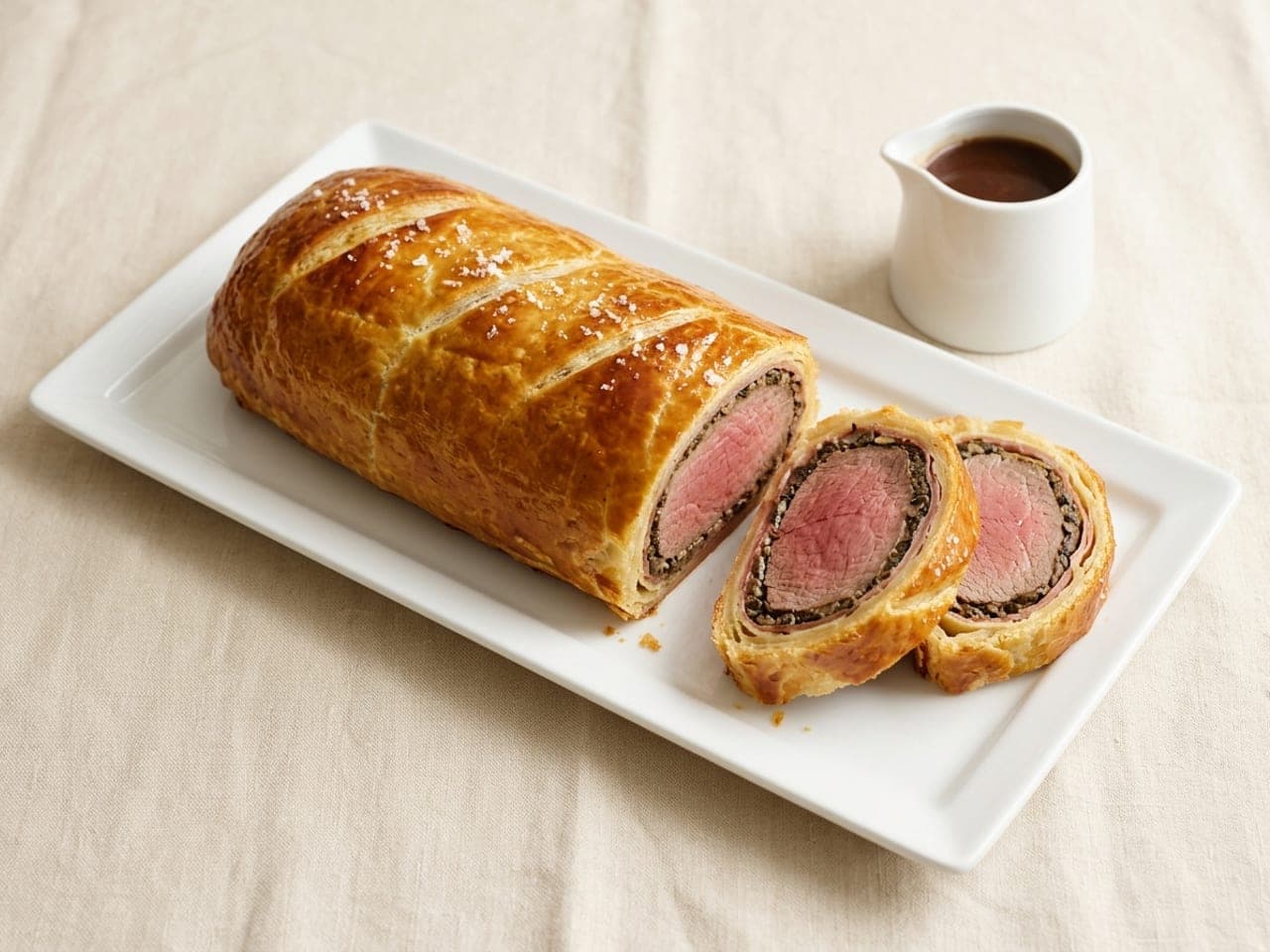
A beef Wellington recipe for one 2 lb (900 g) center-cut beef tenderloin, a whole Wellington for 6 at Christmas or New Year’s Eve: seared beef, a bone-dry mushroom duxelles, prosciutto and a crêpe layer that keeps the bottom crisp, wrapped in one box of all-butter puff pastry, with a Madeira sauce served beside it. It gives what the ranking recipes leave out: a real doneness chart (pull temperature, rest and final temperature in °F and °C, for a whole Wellington and for individual ones) built on how far beef climbs under pastry; a make-ahead plan that sears the beef on the day instead of chilling it overnight as most chefs do, the closest we could get to USDA food-safety advice; how much pastry to buy in the US and the UK; and three ways to plate it. And the history: the earliest recipe we found for a beef fillet in pastry under the Wellington name is Viennese, printed in 1883.
Ingredients
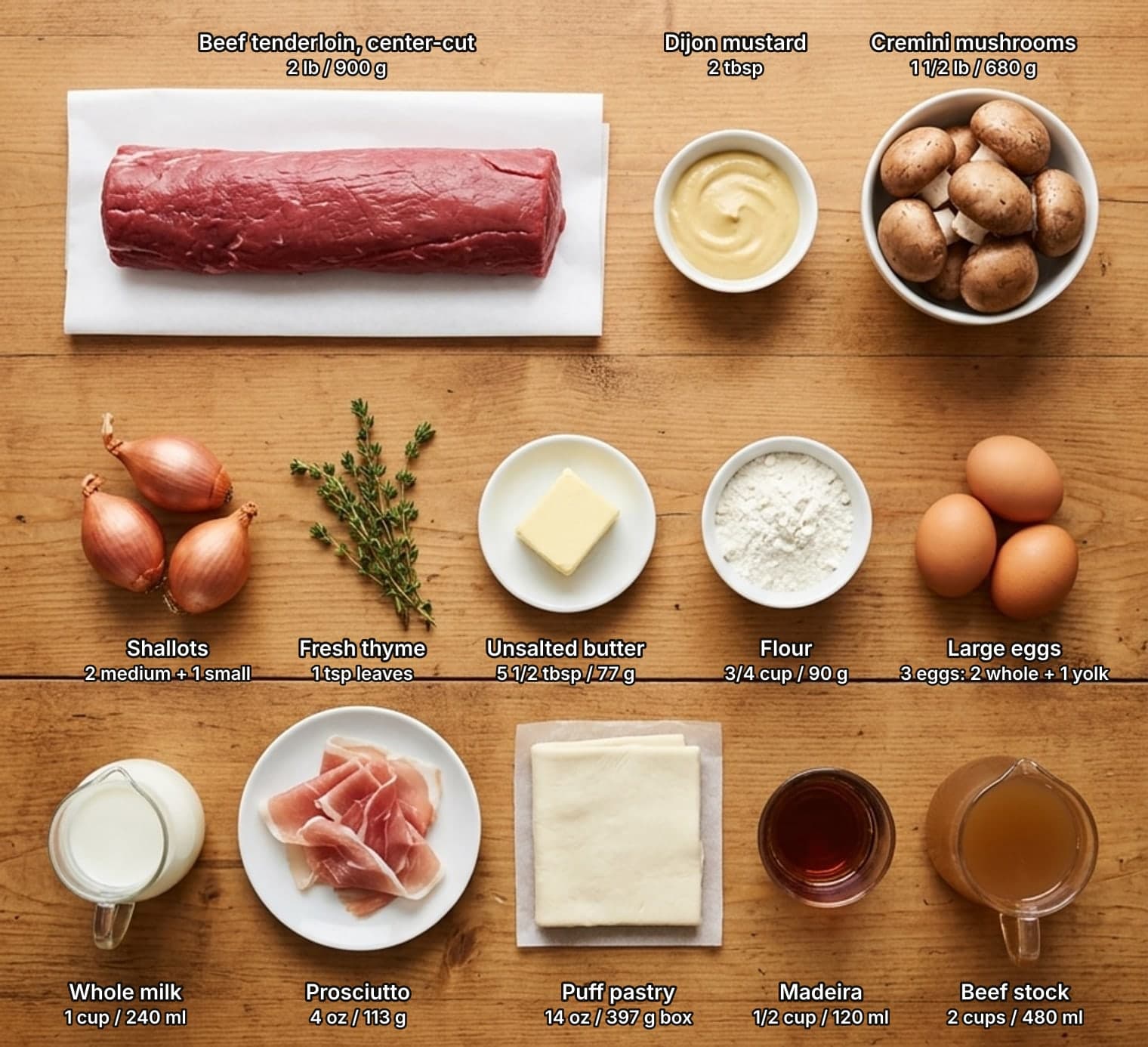
- Center-cut beef tenderloin (UK: middle-cut beef fillet), trimmed of fat and silverskin, an even 3 in (7.5 cm) across; an intact cut, not one labeled mechanically, blade or needle tenderized2 lb (900 g)
- Kosher salt for the beef (Diamond Crystal; or 1 tsp Morton kosher, or 3/4 tsp fine salt)1 1/2 tsp
- Black pepper, freshly ground1 tsp
- Neutral oil with a high smoke point, for searing1 tbsp
- Dijon mustard (mustard, sulphites), or English mustard for more heat (mustard; also contains wheat)2 tbsp
- Cremini mushrooms (UK: chestnut mushrooms), wiped clean and finely chopped, for the duxelles1 1/2 lb (680 g)
- Unsalted butter, for the duxelles (milk)3 tbsp (42 g)
- Shallots, finely minced, for the duxelles2 medium (2 oz / 60 g)
- Fresh thyme leaves1 tsp
- Kosher salt for the duxelles (Diamond Crystal; or 1/4 tsp Morton kosher, or 1/4 tsp fine salt)1/2 tsp
- All-purpose flour (UK: plain flour), for the crêpes (gluten)3/4 cup (90 g)
- Large egg plus 1 extra egg yolk, for the crêpes (egg)1 egg + 1 yolk
- Whole milk, for the crêpes (milk)1 cup (240 ml)
- Unsalted butter, melted: half in the crêpe batter, half to film the pan (milk)1 1/2 tbsp (21 g)
- Fine salt for the crêpe batter; 1 tbsp chopped chives optionalpinch
- Prosciutto di Parma, thinly sliced (leave it out for a pregnant or other higher-risk guest: see the safety notes)4 oz (113 g), about 8 to 10 slices
- Puff pastry, all-butter for the best flavor, thawed overnight in the fridge (gluten, milk). US: one 14 oz (397 g) Dufour box, or both sheets of a 17.3 oz (490 g) Pepperidge Farm box (made with vegetable fats; also contains soy). UK: two 320 g ready-rolled sheets or one 500 g blockone 14 oz (397 g) box
- Large egg, beaten with a pinch of salt, for the egg wash (egg)1
- Flaky sea salt, to finish the pastry and the cut slicesto taste
- Shallot, finely minced, for the sauce1 small (1 oz / 30 g)
- Madeira, or ruby port (contains sulphites)1/2 cup (120 ml)
- Low-sodium beef or veal stock (check the label: may contain celery, gluten, milk)2 cups (480 ml)
- Cold unsalted butter, to finish the sauce (milk)1 tbsp (14 g)
Beef Wellington doneness chart: pull, rest and final temperature
You cannot see or press the beef inside a Wellington, so a thermometer is the only real test. And the pastry keeps cooking the beef after it leaves the oven, more than an open roast does. America’s Test Kitchen measured it. Steve Dunn baked his Wellington “just until the pastry was well browned, at which point the meat was a mere 85 degrees. As the roast rested, the temperature at its center climbed 45 degrees, reaching a perfect 130-degree medium-rare in about 45 minutes.” That is 85°F (29°C) to 130°F (54°C) on the counter. His explanation: “the pastry also insulates the meat, so heat on its surface tends to travel toward the center rather than dissipate into the air”. So every pull temperature below is well under the final one.
Whole Wellington, 2 lb (900 g), this recipe: pull at 130°F (54°C) in a 425°F (220°C) oven and rest uncovered 15 to 20 minutes; the center reaches 145°F (63°C) during the rest, then give it 3 more minutes: medium, with a little pink. USDA measures its 145°F (63°C) before the meat leaves the oven, so to follow it to the letter, pull at 145°F (63°C) instead; it will finish well past medium. The 15°F (8°C) rise is our estimate, so go by the thermometer, not the clock.
Whole Wellington, chef temperature, below the USDA minimum: Serious Eats (J. Kenji López-Alt) pulls at 110°F (43°C) for rare or 120°F (49°C) for medium-rare, in a 425°F (220°C) oven, then rests 10 minutes. He does not print a final temperature.
Whole Wellington, chef temperature, below the USDA minimum: chef Richard Holden, on Thermapen UK, takes it out at 48°C (118°F) and rests it 20 minutes to about 56°C (133°F), medium-rare.
Whole Wellington, chef temperature, below the USDA minimum: America’s Test Kitchen bakes at 450°F (230°C), pulls at 85°F (29°C), and rests 40 to 45 minutes uncovered to 130°F (54°C). Their crust is a sturdier pâte brisée, not puff pastry.
Individual Wellingtons, 8 oz (225 g) filets 2 in (5 cm) thick, this recipe: bake at 400°F (200°C) until the probe reads 145°F (63°C), USDA’s minimum, measured before they come out, then rest them at least 3 minutes. They will finish well past medium.
Individual Wellingtons, chef temperature, below the USDA minimum: America’s Test Kitchen bakes the same filets at 400°F (200°C) only until they read 110°F (43°C), then rests them 10 minutes for medium-rare or 20 minutes for medium: “Puff pastry packets act as oven and continue to cook steaks while they rest.”
One published number to treat with care: Gordon Ramsay Restaurants’ classic beef Wellington recipe bakes “until an internal probe thermometer reaches 32°C”, which is 90°F, then rests it 10 minutes, and the group’s Wellington for two pulls at 33°C (91°F) and rests to “42°C to 45°C for medium-rare” (108 to 113°F). Those are probe readings far below any doneness the other chefs here serve, and far below the USDA minimum. ATK pulls even lower, but rests 45 minutes under a thicker crust.
Why the chef numbers sit below the line: a pink Wellington is a pleasure, and the USDA’s 145°F (63°C) is medium. The UK’s NHS accepts pink whole cuts that are cooked on the outside, which the sear does, as long as the cut is intact, not folded or rolled. We print the USDA number as the safe minimum and the chef numbers as what they are.
How to make Beef Wellington
- Cook the duxelles to a dry paste (up to 3 days ahead). Chop the mushrooms to the size of lentils, by knife or in a food processor in two batches with short pulses; a purée weeps instead of browning. Melt the 3 tbsp (42 g) butter in a 12 in (30 cm) skillet (frying pan) over medium-high heat, soften the shallots for a minute, then add the mushrooms, thyme and the 1/2 tsp salt. The salt pulls water out of the mushrooms, so the pan floods first: keep stirring and let it boil off. After 20 to 30 minutes you are looking for three signs. The sound changes from a wet hiss to a dry sizzle and brown bits stick to the pan. A spatula drawn across the pan leaves a clean line that does not fill back with liquid. And when you shake the pan, the paste moves as one mass. Why it matters: water left in the duxelles turns to steam in the oven, and the only way out is through the pastry. That steam is the main cause of a soggy bottom. Spread the paste on a plate to cool, then cover and refrigerate for up to 3 days (2 days if you follow the UK’s 48-hour guidance for cooked food).
- Make the crêpes (up to 3 days ahead). Whisk the 3/4 cup (90 g) flour, the egg and yolk, a pinch of salt and half the milk to a smooth paste, then whisk in the rest of the milk and half the melted butter; chives go in now if you use them. Rest the batter 15 minutes so the flour hydrates and the crêpes do not tear. Heat an 8 in (20 cm) nonstick pan over medium heat, wipe it with a little butter, pour in about 3 tbsp of batter and swirl it thin. Cook 45 to 60 seconds until the edge lifts, flip for 15 seconds, and slide it out. The batter makes at least eight thin, pale crêpes: the whole Wellington uses four or five, the individual ones six, and the spares cover any that tear; color does not matter, thickness does, because a thick crêpe turns gummy under the pastry. Why crêpes at all: they sit between the duxelles and the pastry and drink the moisture that would otherwise soak the crust. Stack them with baking paper between, wrap, and refrigerate for up to 3 days (2 days if you follow the UK’s 48-hour guidance for cooked food). The duxelles, the crêpes and the sauce, all fully cooked, are the only parts we make ahead (up to 3 days; 2 in the UK): the beef is seared on baking day (see the safety notes for why).
- On the day: season and sear the beef hard and fast. Pat the beef dry; if one end is thinner, trim it off (save it for a stir-fry) so the log is even, or sear the thin end first and then fold it under and tie it with kitchen string, so no unseared surface ends up inside. An even log cooks evenly under pastry. Season all over with the 1 1/2 tsp salt and the pepper (you can salt it the night before and leave it uncovered on a rack set in a rimmed tray on the bottom shelf of the fridge, below and away from anything eaten without cooking: it is still raw, so it is outside the food-safety rule about partly cooked meat). Heat the oil in a heavy skillet over high heat until it shimmers and just begins to smoke; turn on the extractor fan and lower the beef in away from you. Sear it 45 to 60 seconds a side, ends included, about 5 minutes in all: you want a deep brown crust and a raw center. The sear builds flavor the pastry cannot add, and it heats the surface hard, which is where bacteria on an intact cut live. Move the beef to a rack, snip off any string, and brush it all over with the mustard while it is hot so it sticks. Keep the unwashed pan for the sauce. Let the beef cool 10 minutes, then refrigerate it uncovered for 30 minutes, until cold to the touch: warm beef melts the butter in the pastry and gives you a greasy, flat crust.
- Layer crêpe, prosciutto and duxelles, and roll a tight log. Lay two overlapping sheets of plastic wrap (cling film) about 18 in (45 cm) long on the counter. Arrange the crêpes on it in an overlapping rectangle about 10 by 12 in (25 by 30 cm), the long side facing you, and trim any edge that hangs past it. Lay the prosciutto over the crêpes, slices overlapping by a third. Spread the duxelles over the prosciutto in a thin, even layer, about 1/8 in (3 mm), leaving a 1 in (2.5 cm) border. Set the cold beef along the near edge and use the plastic to lift and roll the layers around it, keeping them tight against the meat, then twist the ends of the plastic like a sweet wrapper to compress the log. Why this order: from the outside in it reads crêpe, prosciutto, duxelles, beef, so the crêpe is the layer that touches the pastry and catches moisture, and the prosciutto holds the duxelles in place and seasons it. Air gaps fill with steam and lift the pastry off the beef, so roll it tight. Refrigerate 30 minutes to firm.
- Roll the pastry to size and wrap it, seam underneath. On a lightly floured counter, roll the pastry to a rectangle about 14 by 16 in (36 by 40 cm), a little under 1/8 in (2.5 to 3 mm) thick. With Pepperidge Farm, overlap the two sheets by 1 in (2.5 cm), press the seam and roll them as one; in the UK, do the same with two 320 g sheets, or roll out a 500 g block. Unwrap the log and lay it along the long side. Brush the far border with egg wash, roll the pastry over the log so it overlaps by about 1 in (2.5 cm), and trim the rest away: you want a single seam, not a thick fold of doubled pastry, which stays raw and gummy under the beef. Fold the ends up like a parcel, trim the excess, and seal with egg wash. Turn the Wellington seam side down onto a sheet of baking paper and refrigerate 20 to 30 minutes. Meanwhile set a heavy baking sheet on the lower-middle rack and heat the oven to 425°F (220°C, gas 7); in a fan (convection) oven, 400°F (200°C). Why cold pastry: the butter has to stay in its layers until the oven turns its water to steam; that steam is what lifts the pastry. Thawing it in the fridge keeps the butter cold; if you thaw it on the counter, follow the pack (Pepperidge Farm says no more than 40 minutes) and use it while it is still cold.
- Egg wash, score and bake on the hot sheet. Brush the top and sides with egg wash, now and not earlier, so it glazes evenly instead of soaking in, and do not let it pool around the base, where it glues the pastry to the paper and keeps the bottom soft. With the back of a knife, mark long diagonal lines across the top without cutting through, and scatter on a little flaky salt. Pull the oven rack out rather than reaching in, and with oven gloves on both hands slide the Wellington, still on its paper, onto the preheated sheet. The hot metal sets the bottom pastry before the moisture from the filling can reach it, which is the second half of the soggy-bottom fix. Why the back of the knife: the marks are decoration and let the top expand evenly; none of the major recipes we read cut steam vents through the pastry, and a cut lets juices run out onto the crust. Bake at 425°F (220°C): hot enough to puff and set the pastry quickly, so the layers of air in it slow the heat on its way to the beef. Start checking the center temperature at 30 minutes. In our estimate it takes 40 to 50 minutes to reach the pull temperature in the next step; if the pastry is deep brown before then, lay a loose sheet of foil over the top.
- Pull at 130°F (54°C) and rest it to 145°F (63°C). Push an instant-read or probe thermometer in through the top at an angle, so the tip sits in the middle of the thickest part of the beef. Take the Wellington out at 130°F (54°C) and move it, on its paper, to a rack. Rest it uncovered, with a leave-in probe in place if you have one (otherwise check with the instant-read every few minutes): under a foil tent the pastry steams and softens. The pastry holds heat against the beef, so the center keeps climbing after it leaves the oven; in our estimate about 15°F (8°C) in 15 to 20 minutes, in line with chef Richard Holden’s advice on Thermapen UK to take it out 8°C early. When the probe reads 145°F (63°C), give it 3 more minutes before slicing; the beef will be medium, with a little pink. That is USDA’s number, but reached during the rest: USDA measures its 145°F (63°C) before the meat leaves the oven. To follow USDA to the letter, leave the Wellington in until the probe reads 145°F (63°C), then rest it at least 3 minutes; it will finish well past medium. If the temperature stops short of 145°F (63°C), take out an instant-read thermometer (only a leave-in probe can go back in the oven), return the Wellington to the oven, loosely covered with foil, for 5 minutes and check again. Chefs’ pull temperatures are lower than ours, and they are all below the USDA minimum; they are in the doneness chart below, labelled.
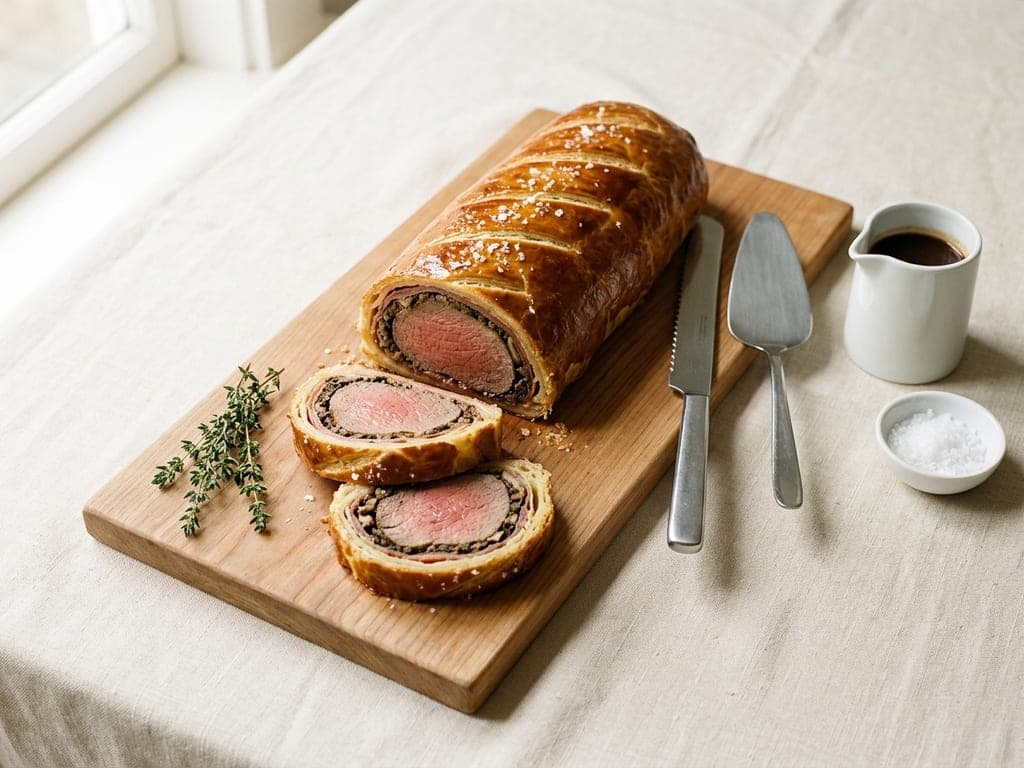
- Make the sauce while it rests, then slice with a serrated knife. Pour off all but a film of fat from the searing pan into a heatproof bowl, not down the sink, add the sauce shallot and soften it over medium heat for a minute, scraping up the browned bits. Add the 1/2 cup (120 ml) Madeira and boil it down by half, then add the 2 cups (480 ml) stock and reduce to about 3/4 cup (180 ml), around 15 minutes, until it coats a spoon. Off the heat, whisk in the cold butter for gloss, and season. (You can make the sauce up to 3 days ahead, 2 in the UK, in a clean pan; reheat it to a rolling boil. It just misses the browned bits.) To slice: slide a large spatula under the Wellington and move it to a board. Trim off the pastry ends. Use a long serrated knife, a bread knife works, with long, light sawing strokes and no downward pressure, so the pastry cuts instead of crushing. Cut six slices about 1 1/4 in (3 cm) thick, because a thin slice falls apart; Gordon Ramsay’s tip, as his restaurant group quotes it, is “do not slice it thinly. Slice it about an inch thick.” Lift each slice with a bench scraper so the layers stay together, salt the cut face, and spoon the sauce beside it, never over the pastry.
Safety & hygiene Important
- USDA’s safe minimum: 145°F (63°C), then a 3-minute rest. USDA FSIS lists beef roasts at “145 degrees F (62.8 degrees C) and allow to rest for at least 3 minutes”, and it measures that temperature “before removing food from the heat source”. This recipe does not do it that way. The whole Wellington comes out of the oven at 130°F (54°C) and reaches 145°F (63°C) during the rest, carried there by the pastry; give it 3 more minutes before slicing. To follow USDA to the letter, leave it in the oven until the probe reads 145°F (63°C), then rest it at least 3 minutes; under pastry it will finish well past medium. The individual Wellingtons do follow USDA to the letter: each comes out of the oven at 145°F (63°C); America’s Test Kitchen’s lower pull for them is in the chart, labelled. The chef temperatures in our doneness chart finish at about 125 to 140°F (52 to 60°C), below the USDA minimum, and we label them so. In the UK, the NHS says you can eat whole cuts of beef “when they are pink inside”, or rare, “as long as they are cooked on the outside.” That applies only to an intact cut whose outside has been seared all round; a folded or rolled piece is not covered. Do not cook a Wellington below 145°F (63°C) if the beef was mechanically tenderized (needled or bladed to soften it), because the blades push surface bacteria into the center; follow the cooking instructions on its label. In the US such beef must be labelled “mechanically tenderized”, “blade tenderized” or “needle tenderized”; the UK has no such label, so ask the butcher for an untenderized fillet.
- Why the beef is seared on baking day, not the night before. USDA FSIS: “Never brown or partially cook beef to refrigerate and finish cooking later because any bacteria present wouldn’t have been destroyed.” FSIS allows a partial cook only “immediately before” the meat goes on to finish cooking. No Wellington method we know of meets that, because the seared beef has to be cold before the pastry goes on. Many chefs hold it far longer: America’s Test Kitchen keeps the prosciutto-wrapped beef up to 2 days and the pastry-wrapped roast up to 24 hours, Serious Eats chills its wrapped roll for up to a couple of days, and Nigella.com’s kitchen team says a Wellington “can be prepared up to 24 hours in advance”. Their reasoning is that on an intact cut the bacteria sit on the surface, which the sear heats hard. Ours keeps the gap to about 1 1/2 hours in the fridge on the day, not overnight: make the duxelles, crêpes and sauce (fully cooked) up to 3 days ahead (in the UK, the Food Standards Agency’s 48-hour limit for cooked food in the fridge makes that 2 days), and sear, wrap, chill and bake on the same day. Keep the fridge at 40°F (4°C) or below (UK: 5°C or below), and the chill as short as the recipe allows.
- Pregnant, elderly, very young or immunocompromised guests. The NHS pregnancy guidance counts whole cuts of beef “thoroughly cooked on the outside” as safe, but says cold cured meats such as prosciutto “should be cooked until steaming hot before eating”. Inside a Wellington the prosciutto sits just outside the beef and gets only a little hotter than it, far short of steaming hot, so for a pregnant guest leave it out (the crêpe still protects the pastry) or bake them an individual Wellington without it. Skip liver pâté and foie gras versions for them too: the NHS tells pregnant women to avoid “liver and liver products”. The same goes for anyone else at higher risk from Listeria (the CDC lists adults 65 and over and people with weakened immune systems alongside pregnant women): leave the prosciutto out, or make theirs an individual Wellington without it, baked until the probe reads 145°F (63°C) before it comes out of the oven, and check that their slice reached 145°F (63°C).
- Leftovers: how long, and reheating (US and UK). Refrigerate leftovers within 2 hours of taking the Wellington out of the oven (1 hour if the room is above 90°F (32°C)), cut into slices so they chill fast. USDA FSIS: “Leftovers can be kept in the refrigerator for 3 to 4 days or frozen for 3 to 4 months,” and reheated leftovers should reach 165°F (74°C). The UK Food Standards Agency is stricter on time: “Eat leftovers within 48 hours or freeze them,” reheat until “steaming hot throughout”, and “only ever reheat once”. If you made the duxelles and crêpes ahead, the bake was already their reheat, so in the UK eat leftovers cold. Reheating to 165°F (74°C) takes the beef to well done. If you want it pink, eat it cold: the FSA says leftovers can be eaten cold if they were cooked properly, cooled and refrigerated within two hours.
- Raw beef handling and allergens. Trim and season the raw beef on its own board, away from the prosciutto, which is eaten as it is and must not pick up raw juices. Wash the board, the knife, the tongs, the thermometer probe and your hands (soap and water, at least 20 seconds) before you touch the prosciutto, the pastry or the seared beef, and keep raw beef on the bottom shelf of the fridge. Allergens in this recipe: gluten (pastry, crêpes; also wheat in English mustard and wheat or barley in many stock cubes), egg (crêpes, egg wash), milk (butter, crêpes, all-butter pastry; some stock cubes), mustard, and sulphites (Madeira, and the preservative in most Dijon mustard). Pepperidge Farm pastry contains soy, and many stock cubes and pots contain celery. Mustard, celery and sulphites are among the 14 allergens UK and EU law requires to be declared, so check your stock’s label.
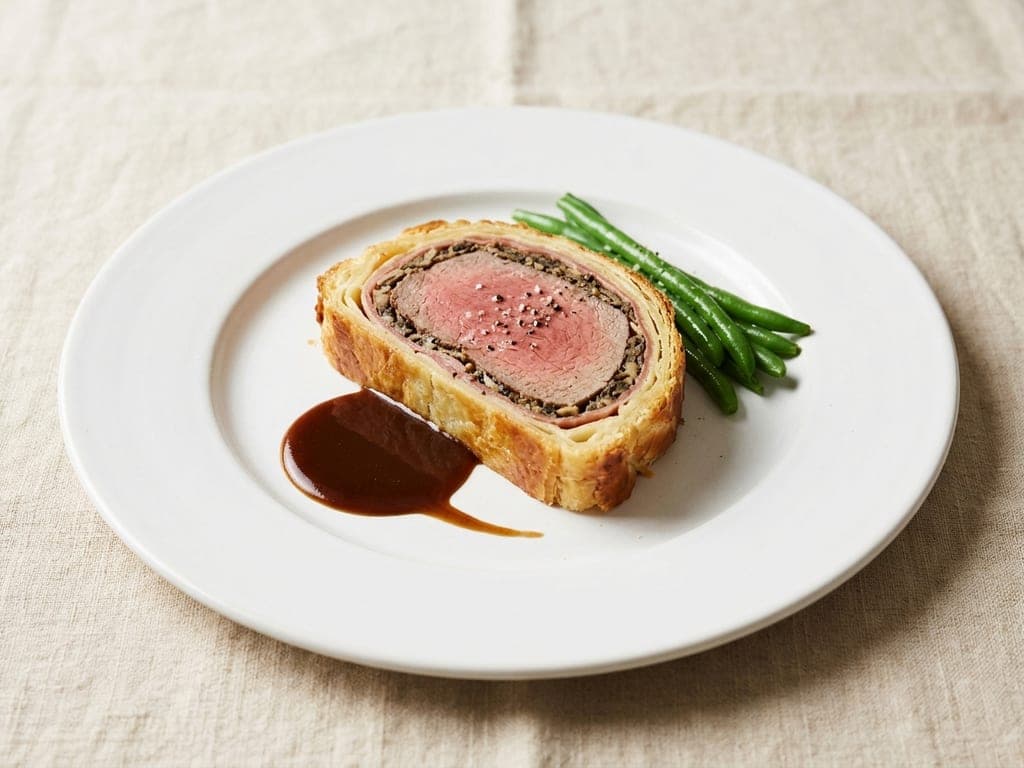
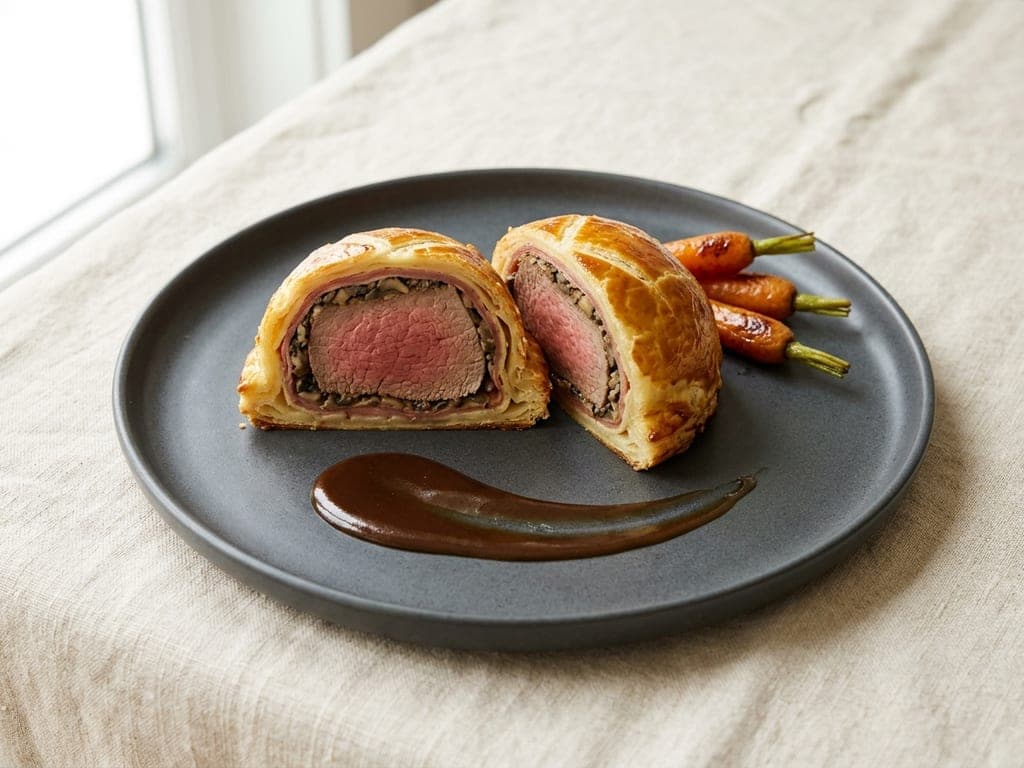
3 ways to plate it
Make-ahead plan: where we part company with the chefs
Almost every Wellington recipe that offers a make-ahead plan sears the beef, wraps it and holds it in the fridge for a day or two before baking. USDA FSIS advises against exactly that: “Never brown or partially cook beef to refrigerate and finish cooking later because any bacteria present wouldn’t have been destroyed.” FSIS allows a partial cook only immediately before the meat finishes cooking, and no Wellington method we know of meets that, because the seared beef has to be cold before it is wrapped. The chefs’ answer is that the seared surface is where the bacteria are. We stay much closer to FSIS: no overnight hold, only the short same-day chill the pastry needs, about 1 1/2 hours in all, and the plan still takes most of the work off the day.
Up to 3 days before (2 days in the UK, where the Food Standards Agency’s guideline for cooked food in the fridge is 48 hours): cook the duxelles and the crêpes, and the Madeira sauce if you like; all three are fully cooked, so they keep, covered, in the fridge. The day before: move the pastry from the freezer to the fridge to thaw, and trim and salt the raw beef and leave it uncovered on a rack set in a rimmed tray on the bottom shelf of the fridge, which seasons it deeper and dries the surface for a better sear. Raw beef can wait; it is partly cooked beef that should not.
On the day, start about 3 1/2 hours before you want to carve: sear (15 minutes), chill (30), layer and roll (15), chill (30), wrap in pastry (20), chill and heat the oven (25), bake (40 to 50), rest (15 to 20). The chill steps are not optional: a cold log keeps its shape and a cold pastry puffs.
For a dinner at 8 pm, that means searing at about 4:30. It is a longer afternoon than the overnight version, but nothing in it is hard, and the kitchen is clean before the doorbell goes. The same reasoning is why we do not freeze an assembled Wellington to bake later.
How much puff pastry for beef Wellington, by pack (US and UK)
A 2 lb (900 g) center-cut, once wrapped in crêpe, prosciutto and duxelles, is a log about 3 3/4 in (9.5 cm) across and 8 to 9 in (20 to 23 cm) long. To go round it with a 1 in (2.5 cm) overlap you need about 13 in (33 cm) of pastry, and to fold in the ends about 16 in (40 cm) of length. So the target is a rectangle about 14 by 16 in (36 by 40 cm), a little under 1/8 in (2.5 to 3 mm) thick.
US, Dufour: one 14 oz (397 g) box is enough. It is a single, nearly square all-butter sheet; roll it out to size. Serious Eats uses 14 oz (397 g) of puff pastry, frozen or homemade, for its 2 lb (900 g) roast.
US, Pepperidge Farm: one sheet is not enough. The 17.3 oz (490 g) box holds two sheets, each about 9.75 by 10.5 in (25 by 27 cm) frozen, per the brand. Overlap them by 1 in (2.5 cm), press the seam, and roll them out as one. It is made with vegetable fats rather than butter: in Serious Eats’ taste test it rose higher than Dufour but lost points for its lack of buttery flavor.
UK, Jus-Rol ready-rolled: one 320 g sheet, about 35 by 23 cm, is too small for a 900 g fillet. Use two sheets overlapped and rolled as one, or one 500 g block, the pack size Gordon Ramsay’s published recipes call for. Jus-Rol makes an all-butter sheet; the standard one is made with vegetable fats.
Thickness matters more than brand. Thinner than about 1/16 in (2 mm) and the pastry tears at the seam; much thicker than 1/8 in (3 mm) and the layer under the beef never cooks through before the beef is done.
The soggy bottom: prosciutto, crêpe or phyllo?
Gordon Ramsay wraps the beef in Parma ham before the pastry, and the usual claim is that the ham stops the pastry going soggy. J. Kenji López-Alt, at Serious Eats, disagrees: he writes that the ham does not really stop moisture leaking out, and that as it cooks it renders moisture of its own, adding to the problem. The classic French and British answer is a crêpe: BBC Food describes Michel Roux Jr’s recipe as one that “keeps the pastry nice and crisp with a layer of crêpes.” Kenji does not like that either: in his view the crêpe dissolves and turns soggy, and is one more thing to make. His fix is prosciutto plus a sheet of phyllo, which he describes as ultra-thin but strong, made to wrap moist fillings without leaking.
We use both prosciutto and a crêpe, crêpe outermost. The prosciutto is there for seasoning and to hold the duxelles to the beef, not as a barrier. The crêpe is the layer that touches the pastry; if it softens, it softens instead of the crust, which is its job, and it can be made three days ahead. Two sheets of phyllo, brushed with butter, are a good swap if you would rather not make crêpes.
But no barrier saves a wet duxelles, and that is the lever that matters most. Mushrooms are mostly water: USDA lists raw cremini at 92 g of water per 100 g, which is why 1 1/2 lb (680 g) of them cooks down to a thin layer’s worth of paste. Cook them until the pan sizzles dry, a spatula leaves a clean line, and the paste moves as one mass. Those pan cues are the test.
In order of importance: a dry duxelles; seared beef chilled until cold; a barrier layer against the pastry; a single thin layer of pastry underneath, seam down, with the overlap trimmed; and a heavy baking sheet preheated in a 425°F (220°C) oven, on the lower-middle rack. Then the last one, at the table: the sauce goes beside the slice, never over it.
Individual beef Wellingtons
Six individual Wellingtons take the same duxelles and sauce, six crêpes, and about twice the pastry in the US (one and a half times in the UK). They also take more beef: six filet mignon steaks of about 8 oz (225 g) each, cut 2 in (5 cm) thick, 3 lb (1.35 kg) in all, the cut America’s Test Kitchen uses for its individual Wellingtons. ATK insists on that thickness “to ensure accuracy” of its times and temperatures; thinner filets cook through faster. Use six of the crêpes from step 2. Sear the filets 45 seconds a side, brush with mustard, and chill them until cold, about 30 minutes: the same short same-day chill as the whole roast, and no longer (see the safety notes).
Wrap each filet in one crêpe, trimmed to fit, with a slice of prosciutto and a thin coat of duxelles inside it. Each one then needs a square of pastry about 10 in (25 cm) across: lay the filet upside down in the middle, bring the corners up underneath, pinch the seams, trim the excess and turn it seam side down. US: two Dufour boxes, each rolled to the 10 by 30 in (25 by 76 cm) the package suggests and cut into three squares; or two Pepperidge Farm boxes, the two sheets of each overlapped by 1 in (2.5 cm), pressed together, rolled to 10 by 30 in (25 by 76 cm) and cut into three. UK: three 320 g sheets, each rolled to about 50 by 25 cm and cut in two.
Chill the parcels 20 to 30 minutes but no longer than an hour; ATK’s instruction is “Do not chill the pastry packets longer than 1 hour”, or the pastry goes soggy. Egg-wash and score the tops and bake on a preheated sheet at 400°F (200°C, gas 6), as ATK does; in a fan oven, 350°F (180°C). Start checking at 15 minutes, and take each parcel out when the probe reads 145°F (63°C), USDA’s minimum, measured before it leaves the oven; rest it at least 3 minutes. It will finish well past medium. America’s Test Kitchen bakes theirs only until the beef reads 110°F (43°C), 18 to 20 minutes, then rests them 10 minutes for medium-rare or 20 for medium; those are ATK’s numbers, and they finish below the USDA minimum. If you follow them, still bake any parcel for a pregnant or other higher-risk guest to 145°F (63°C).
Is beef Wellington named after the Duke of Wellington?
That is the story everyone tells: Arthur Wellesley, 1st Duke of Wellington, and his victory at Waterloo in 1815. Gordon Ramsay Restaurants wrote in 2022 that “It is generally agreed that the dish was created in celebration of the first Duke of Wellington”. The evidence does not support it. We found no beef dish of the name from 1815 or from the Duke’s lifetime (he died in 1852). The nearest, as National Geographic reports, is an Italian “myspaik alla welington”, a pie of chopped meat, raisins and rum in pastry, which the lexicographer Manfred Höfler traced to the Roman pastry cook Vincenzo Agnoletti around 1834; the same article notes that the surviving menu of the Duke’s own 1839 Waterloo banquet has no Wellington on it. The Oxford English Dictionary, as quoted by the word historian Barry Popik, derives the culinary “Wellington” from the name, “perhaps with reference to Arthur, first Duke of Wellington”. Perhaps.
Paul Martin Blüher’s 1904 menu dictionary adds a footnote explaining who the Duke was, but no story. The earliest printed claim that the dish recalls Waterloo we found is from 1937, in a Viennese word-history book, A. J. Storfer’s Im Dickicht der Sprache: “The fillet à la Wellington, roasted in a pastry case, reminds us of the commander-in-chief of the Allies at Waterloo” (our translation). He gives no source. In the 19th century the Duke’s name was a fashionable label on all sorts of things, from Italian “pantaloni alla Wellington” (trousers, 1832) to boots and an English apple; the dish may honor him the same way, without the Duke ever having eaten it.
Writing in the Daily Telegraph in 2013, Leah Hyslop floated the idea that the name was a “timely patriotic rebranding of a trendy continental dish”, French filet de bœuf en croûte, then noted there is no sign of the dish in 19th-century British cookbooks. The continental part holds up: the earliest recipe we found is Viennese (see the history below).
Beef Wellington or filet de bœuf en croûte? En croûte just means a fillet in a crust, puff pastry or brioche, with or without a filling. Today “Wellington” signals the mushroom duxelles layer. The oldest Wellington recipe we found had none: bacon did that job.
Where beef Wellington comes from: an 1883 Viennese recipe
The Food Timeline says recipes “surface in 1940s USA”; Wikipedia cites an Austrian cookbook of 1891. The earliest recipe we found for beef in pastry under the name is older. In Vienna in 1883, Louise Seleskowitz’s Wiener Kochbuch printed recipe no. 491, “Lungenbraten. (Filet a la Wellington.)”: a trimmed, salted and peppered beef tenderloin (a very thin one, she says), covered with slices of bacon, wrapped in a strip of puff pastry rolled to the thickness of a knife’s back, slashed, brushed with beaten egg and baked at moderate heat, served with truffle sauce, mixed pickles or gherkins. There were no mushrooms. And her second method is the one cooks still argue about: brown the tenderloin for 15 minutes, let it cool, then wrap it, in which case the bacon is left out.
Why the French name on a Viennese roast? Her preface, dated May 1883, explains that this edition now gives a French translation next to the German recipe names, to help readers who might find themselves “in the position of having to write French menus” (our translation). Filet à la Wellington was menu French for a Viennese Lungenbraten in Butterteig.
By 1899 the name was on menus across two continents: at a Capuchin friars’ feast in Tyrol on 30 April, reported in the Kraków socialist weekly Naprzód, where it came with Madeira sauce; at a Patent Law Class dinner of Columbian University in Washington, D.C., reported in Scientific American; and on the Hamburg-America Line’s Fürst Bismarck on 10 November, “Filet Of Beef A La Wellington”. Around 1900 the name did not always mean pastry. Paul Martin Blüher’s 1904 menu dictionary, printed in Leipzig, translates it as fillet “w. malmsey madeira, Wellington style”, and a 1908 New York pocket menu dictionary lists chicken legs “a la Wellington; with chutney sauce, fried in oil”.
The pastry meaning won. In 1910 the Munich magazine Simplicissimus ran a cartoon joke (our translation): “Waiter, what is a fillet à la Wellington?” “Roast meat wrapped in puff pastry.” “Then give me a fillet.” “With or without Wellington?”
The earliest English-language recipe we found is in the March 1923 Bulletin of the Southern Pacific railroad, from its Saxony-born supervising chef Otto Reiss: “Roast a filet very lightly. Prepare a dressing which will consist chiefly of meat-farce. Wrap this dressing around the filet, envelope the whole in pie-dough and bake from 20 to 35 minutes. Serve in thick cuts with mushroom sauce.” The exact words “beef Wellington” appear in a syndicated newspaper novel in January 1930. Chicago’s Palmer House hotel printed a Tenderloin of Beef Wellington in its 1940 cookbook, and by 1958, when James Beard published the hotel’s recipe in the Los Angeles Times, it had a duxelles of mushrooms, shallots, ham, parsley and a spoonful of Madeira sauce.
Then the 1960s made it famous in America. A 1963 book on Jacqueline Kennedy describes a White House dinner where “The main course was filet of beef Wellington”, under the French chef René Verdon. Julia Child made it on The French Chef: a November 1965 TV listing reads “whole tenderloin of beef cloaked in wine and mushrooms and baked in a pastry crust.” The food historian Sylvia Lovegren called it “the premier party dish of the 1960s”.
Questions, answered
What temperature should beef Wellington be cooked to?
USDA’s safe minimum for a beef roast is 145°F (63°C), measured before it comes out of the oven, then a 3-minute rest; that is medium. Our whole Wellington comes out at 130°F (54°C) and reaches 145°F (63°C) during a 15 to 20 minute uncovered rest, carried there by the pastry. To follow USDA to the letter, leave it in until the probe reads 145°F (63°C); it will finish well past medium. Chefs pull much lower (Serious Eats at 110 to 120°F, 43 to 49°C) and serve it rare to medium, about 125 to 140°F (52 to 60°C) after resting; that is below the USDA minimum. Our doneness chart has every number with its source.
Can you make beef Wellington ahead of time?
Partly. Make the duxelles, the crêpes and the sauce up to 3 days ahead (2 in the UK), and trim and salt the raw beef the day before. Sear, wrap, chill and bake on the day. USDA FSIS says never to brown or partly cook beef and refrigerate it to finish later, and allows a partial cook only immediately before the meat finishes cooking. No Wellington method we know of meets that, because the seared beef has to be cold before it is wrapped; ours keeps the gap to about 1 1/2 hours in the fridge on the day, not overnight. Many chefs (America’s Test Kitchen, Serious Eats, Nigella.com) hold a seared, wrapped Wellington for 24 hours or more; that is their practice, not USDA’s advice. Start about 3 1/2 hours before you carve.
How do you keep beef Wellington from getting soggy on the bottom?
Five things, in order: cook the duxelles until the pan sizzles dry; sear the beef and chill it cold before wrapping; put a barrier between filling and pastry (we use a crêpe; Kenji López-Alt uses phyllo); use one thin layer of pastry underneath, seam down, with the overlap trimmed; and bake on a heavy sheet preheated in a 425°F (220°C) oven. Then serve the sauce beside the slice, not over it.
Why is it called beef Wellington?
Nobody knows. The usual story credits the 1st Duke of Wellington and Waterloo (1815), but we found no record of a beef Wellington in his lifetime, and the Oxford English Dictionary says only “perhaps” with reference to him. The earliest recipe we found for beef in pastry under the name is Viennese, from 1883, where “Filet a la Wellington” was the French menu name for a tenderloin in puff pastry. A 1904 German menu dictionary glosses the name with a footnote on the Duke; the earliest claim we found that the dish recalls Waterloo is from 1937.
What is the difference between beef Wellington and filet de bœuf en croûte?
En croûte means a fillet baked in a crust, puff pastry or brioche, with or without a filling. A Wellington today is the version with a mushroom duxelles layer, usually with prosciutto, a crêpe or pâté as well. In practice they are the same family; the oldest Wellington recipe we found (Vienna, 1883) used bacon and no mushrooms at all.
What sauce goes with beef Wellington?
A Madeira sauce is the classic, and it is old: an 1899 menu reported in Kraków lists “Filet à la Wellington” followed by Madeira sauce. Ours is Madeira reduced by half, beef stock reduced to about 3/4 cup (180 ml), and a knob of cold butter. A red wine jus or a port reduction work the same way; a peppercorn cream suits steakhouse tastes. Serve it in a jug or pooled beside the slice, never poured over the pastry.
What oven temperature and how long for beef Wellington?
425°F (220°C, 200°C fan, gas 7), on a preheated heavy baking sheet. For a chilled 2 lb (900 g) Wellington, start checking the center at 30 minutes; in our estimate it reaches the 130°F (54°C) pull temperature in 40 to 50 minutes. Go by the thermometer, not the clock: thickness and how cold it went in change the time more than weight does. Tent with foil if the pastry browns first. Individual Wellingtons bake at 400°F (200°C, gas 6; 350°F (180°C) fan), as America’s Test Kitchen does, until the probe reads 145°F (63°C); ATK’s own, lower 110°F (43°C) pull takes 18 to 20 minutes.
How do you slice beef Wellington without crushing the pastry?
Rest it fully first, so the juices settle and the pastry firms. Move it to a board with a large spatula, trim the ends, and cut with a long serrated knife in long, light sawing strokes, without pressing down. Slices about 1 to 1 1/4 in (2.5 to 3 cm) thick hold together; Gordon Ramsay’s tip, as his restaurant group quotes it, is “do not slice it thinly. Slice it about an inch thick.” Lift each slice with a bench scraper so the layers stay in place.
Do you need prosciutto, pâté or crêpes in beef Wellington?
Only beef, duxelles and pastry are essential. Prosciutto adds seasoning and holds the duxelles in place (Kenji López-Alt argues it adds moisture rather than blocking it). A crêpe is the classic barrier against a soggy bottom, used by Michel Roux Jr. Pâté or foie gras is optional richness; leave it out, and the prosciutto, for a pregnant or other higher-risk guest.
How long does leftover beef Wellington keep, and how do you reheat it?
Refrigerate it within 2 hours of it leaving the oven. USDA says 3 to 4 days in the fridge; the UK Food Standards Agency says eat within 48 hours. To reheat, put slices on a rack in a 350°F (180°C) oven until hot, about 165°F (74°C) in the center per USDA, or steaming hot per the FSA, which says to reheat only once; if you made the duxelles and crêpes ahead, the bake was already their reheat, so in the UK eat leftovers cold. The oven re-crisps the pastry, a microwave makes it rubbery. Reheated that far the beef is well done, so if you like it pink, eat it cold.
How many calories are in a slice of beef Wellington?
About 826 kcal for one of six servings with the sauce, or 767 without it, made with one 14 oz (397 g) Dufour box. The arithmetic (kcal): beef 900 g at USDA’s 158 per 100 g = 1,422; Dufour pastry 397 g at 425 per 100 g (label) = 1,687; prosciutto 113 g = 302; crêpes: the batch (90 g flour 328, egg and yolk 127, 244 g milk 149, butter 151) = 755 for at least eight, so the five in the Wellington = 472; duxelles (680 g cremini 150, 42 g butter 301, shallots 43) = 494; sear oil 124; mustard 30; egg wash 72. Wellington total 4,603, sauce 354 (Madeira about 198, stock 34, butter 100, shallot 22): 4,957 ÷ 6 = 826. It is an upper bound: we count all the pastry, oil and egg wash, though some is trimmed or left in the pan. Other pastry changes it: with Pepperidge Farm it is about 865, with a 500 g UK block about 875, and with two 320 g UK sheets about 970, before trimmings. Individual Wellingtons, with 8 oz (225 g) filets, six crêpes and two Dufour boxes, come to about 1,240 with the sauce.
Snap your finished plate and let the AI plate it again — more beautifully.