Shrimp Cocktail Recipe: Tender Shrimp at 145°F (63°C)
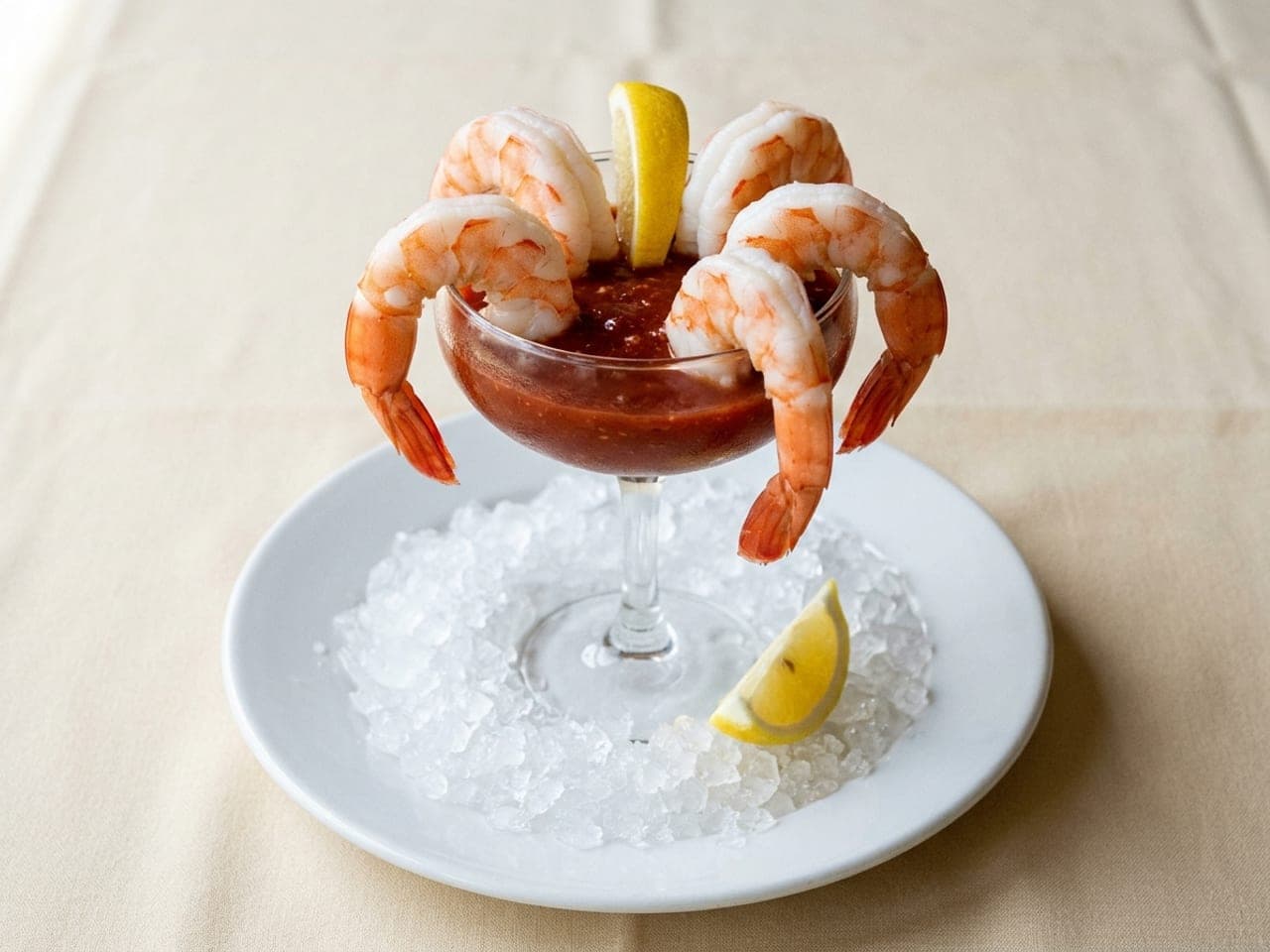
The classic American party starter, written for a crowd: 2 pounds (900 g) of shell-on jumbo shrimp (prawns), about 36 shrimp, poached from cold so they finish opaque all the way through at 145°F (63°C) without the rubbery edge a rolling boil gives, then chilled in their own seasoned water and served on ice with a 4-to-1 ketchup and horseradish cocktail sauce. That is 4 to 5 shrimp each for 8 guests as one starter among several, about 100 kcal a serving with the arithmetic shown, and a scale line for 20. The page reconciles the four ways recipes cook shrimp cocktail with temperature data, quotes what the FDA actually says about seafood on an ice bed at a party, explains why the horseradish in a make-ahead sauce fades, and tells the history no ranking page does: the earliest oyster cocktail we found was credited to a New York club barkeeper in 1891, and shrimp joined it in a Boston cookbook in 1907.
Ingredients
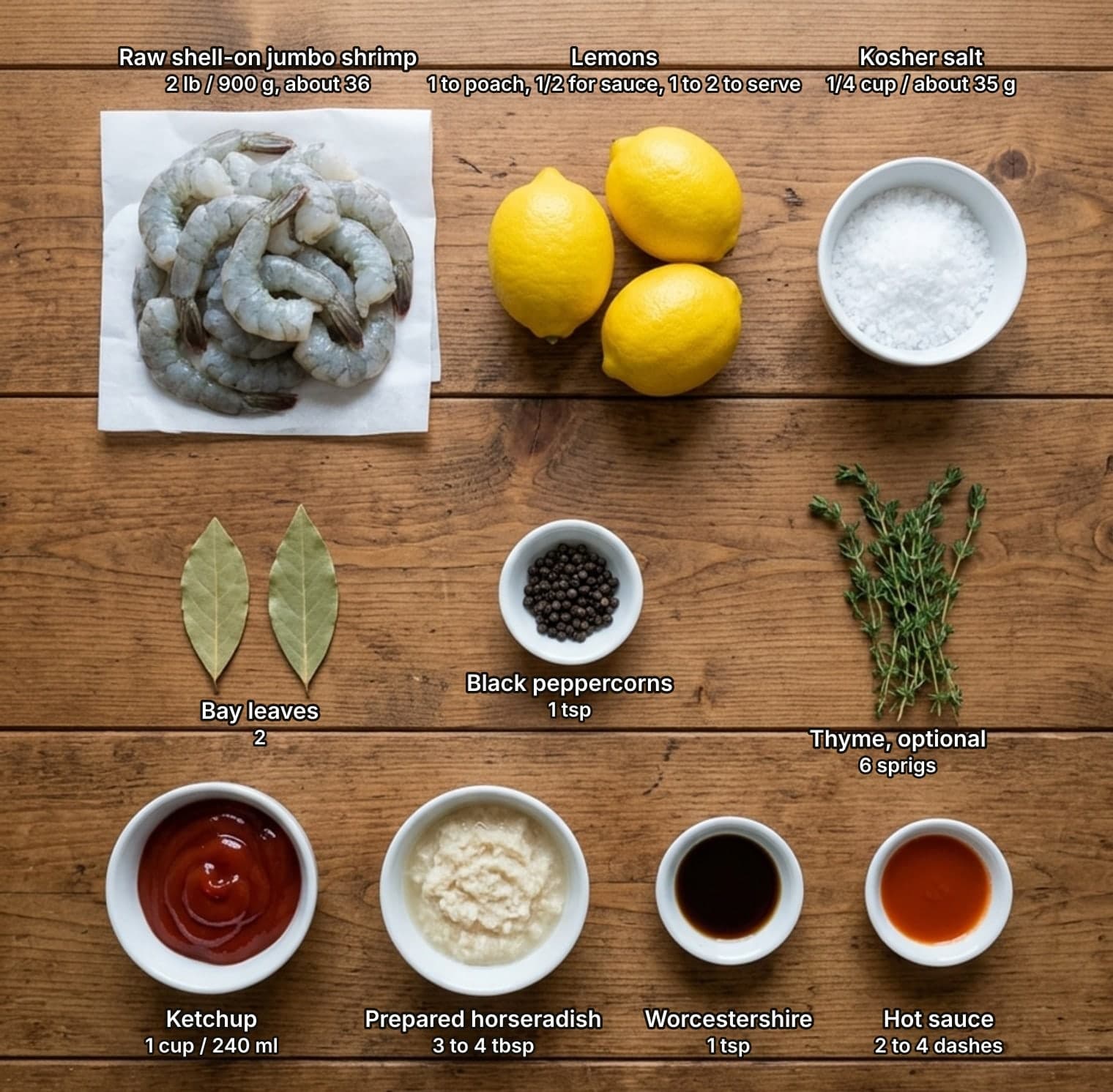
- raw shell-on jumbo shrimp (large prawns in the UK), 16/20 count (16 to 20 per pound, 35 to 44 per kg), thawed if frozen. Check the label: “shrimp” (and water as an ice glaze) should be the only ingredient, with no sodium tripolyphosphate (STPP) or other added “moisture retention” agents, and, for sulphite-sensitive guests, no sodium bisulfite or metabisulfite (used against black spot). Bags marked “EZ-peel” or “shell split and deveined” save the scissors work. Contains crustacean shellfish2 lb (900 g), about 36 shrimp
- cold water, for the poach4 cups (950 ml)
- Diamond Crystal kosher salt (a coarse, flaky salt), or 2 tbsp fine table salt1/4 cup (about 35 g)
- lemon: zest pared off in wide strips with a vegetable peeler, then juiced; keep the squeezed halves1
- bay leaves2
- black peppercorns1 tsp
- celery seed (optional; leave it out for a celery-allergic guest)1/2 tsp
- fresh thyme sprigs (optional)6
- ice cubes, to stop the cooking in the pot8 cups (about 2 lb / 1 kg)
- ketchup, for the cocktail sauce (or 3/4 cup / 180 ml ketchup plus 1/4 cup / 60 ml US bottled chili sauce, a chunkier, more vinegary ketchup, not a hot sauce)1 cup (240 ml)
- prepared horseradish, drained (the white grated root in vinegar, not creamy “horseradish sauce”); start with 3 tbsp, taste, go to 43 to 4 tbsp
- fresh lemon juice, for the sauce (about half a lemon)1 tbsp
- Worcestershire sauce (contains anchovies, a fish allergen; UK and Canadian Lea & Perrins is made with barley malt vinegar, so it is not gluten-free)1 tsp
- hot sauce, such as Tabasco2 to 4 dashes
- freshly ground black peppera pinch
- crushed ice, for the serving bedabout 6 cups (1.4 L)
- lemons, cut into wedges, to serve1 to 2
Is shrimp cocktail raw or cooked? Cooked, to 145°F (63°C)
Shrimp cocktail is cooked shrimp, chilled and served cold. It is not ceviche, where raw seafood is “cooked” by lime juice (our shrimp ceviche explains that dish and its risks); every shrimp in a cocktail has been heated until opaque. What no ranking recipe gives you is the number. The FDA says “Most seafood should be cooked to an internal temperature of 145°F” (63°C). For shrimp in particular, both the FDA and FoodSafety.gov give a visual test instead, flesh that is “pearly” and “opaque”, and FoodSafety.gov’s chart prints no number for shrimp at all. The FDA Food Code, the model rulebook for US restaurant kitchens rather than home advice, is more specific: fish must reach 145°F (63°C) for 15 seconds, and its definition of fish includes crustaceans such as shrimp.
Cooks who chase tenderness quote a lower figure. J. Kenji López-Alt’s sous-vide tests at Serious Eats found shrimp “soft and mushy” below 125°F (52°C) and “tough and rubbery” above 140°F (60°C), with 135°F (57°C) “barely opaque” and juicy. That window is real, but it is for shrimp held at one temperature right through, and the low end of it is not opaque. For a party platter that will sit out, feed guests you do not know, and include pregnant or older guests, we cook to opaque all the way through, which is the FDA’s 145°F (63°C).
The reason that costs so little texture is the method. Kenji’s own line on boiling is blunt: “At a boiling-hot 212°F (100°C), the outsides of your shrimp are going to get tough no matter what.” A jumbo shrimp dropped into a rolling boil has a centre at 145°F (63°C) and an outer layer far hotter. Started in cold water and never heated past 170°F (77°C), the outer layer cannot overshoot by much, so a shrimp that is safely opaque in the middle is still tender at the edge. The cut test in step 5 and a thermometer in the thick end are how you know.
How to make Shrimp Cocktail
- Thaw the shrimp the slow way. Most shrimp sold as “fresh” at a fish counter were frozen and thawed in the store, so frozen bags are usually the better buy. Thaw them overnight in the fridge, in a bowl to catch the drips. If you are short of time, the FDA’s quick method is to seal them in a plastic bag and submerge it in cold water; USDA adds to change the water every 30 minutes and to cook the shrimp as soon as they are thawed. A colander under cold running water also works. Never thaw them on the counter or in warm water. Do not poach from frozen solid: a block of icy shrimp drops the water temperature unevenly and leaves cold cores, and the whole method below depends on every shrimp starting at the same temperature. Thawed shrimp should feel cold and pliable, with no ice in the middle when you bend one.
- Devein through the shell. Leave the shells on: they flavour the poaching water, hold each shrimp in its curve and stand between the meat and the hot water. With small scissors, snip along the curved back of each shell from the head end almost to the tail, then lift out the dark “vein” with the scissor tip or a toothpick and rinse. The vein is the digestive tract. Once the shrimp is fully cooked it is safe to eat, so this is about grit and looks: on a naked, chilled jumbo shrimp served cold, a dark line is the first thing a guest sees. The slit also makes peeling quick after cooking. With EZ-peel shrimp this is already done; just check for any vein left behind. If the bag is mixed, or you bought wild shrimp that vary, note the very largest: in step 5, lift the others out into a bowl of iced water when they test done and leave the big ones covered a minute or two longer.
- Make the sauce first so it can chill. Stir the ketchup, 3 tablespoons of the horseradish, the tablespoon of lemon juice, the Worcestershire, 2 dashes of hot sauce and a pinch of black pepper together in a bowl. Taste on a cracker or a cold shrimp from a previous batch, not off a spoon, because the shrimp’s sweetness tames the heat: add the fourth tablespoon of horseradish for more nasal kick, more hot sauce for lingering mouth heat. With all 4 tablespoons the ratio is 1 cup (240 ml) of ketchup to 1/4 cup (60 ml) of horseradish, 4 to 1, America’s Test Kitchen’s proportion and the middle of the classic range; at 3 tablespoons it is closer to 5 to 1. Cover and refrigerate. You can make it up to a week ahead, but the horseradish loses punch in the fridge, so if you do, hold back the horseradish or add a spoonful more on the day you serve.
- Start the shrimp in cold water. Put the shrimp in a large pot or Dutch oven (a heavy casserole pot) with the 4 cups (950 ml) of cold water, the salt, bay leaves, peppercorns, celery seed and thyme. Set it over medium-high heat and stir every minute or so, with an instant-read thermometer in the water, until the water reaches 170°F (77°C) and the shrimp are just starting to turn pink at the edges, 5 to 7 minutes. This is the cold-start method America’s Test Kitchen published in 2012, and Serious Eats recommends a cold start too. Why it works: in boiling water the outside of a jumbo shrimp races far past done while the centre catches up. Starting cold, the meat heats with the water and never sees more than 170°F (77°C), so the outer layer and the centre finish close together.
- Off the heat, covered, to opaque all the way through. Take the pot off the heat. Drop in the lemon zest strips, the juice of the lemon and the squeezed halves, put the lid on and leave it for 5 to 7 minutes, until the shrimp are pink, firm and opaque. Pink shells come early, before a jumbo centre is done, so check properly: lift out the largest shrimp and cut it across at its thickest point. The meat should be white and opaque right through, with no glassy grey in the middle. An instant-read thermometer pushed into the thick end should read 145°F (63°C), the FDA’s line for seafood. If the centre is still translucent, cover again and check after a minute or two. If it is still not done 7 minutes after the pot came off the heat, set the pot back over low heat until the water returns to about 170°F (77°C), take it off again, cover and check after 2 minutes. Do not leave the shrimp in cooling water hoping they will finish. Bigger U/15 shrimp need a few minutes more; smaller 21/25 a minute or two less. The cut shrimp is the test, not the clock.
- Ice into the pot, not a separate bath. As soon as the shrimp test done, tip the 8 cups (about 1 kg) of ice straight into the pot and stir. Pouring ice into the cooking liquid, as America’s Test Kitchen and the New York Times’ Eric Kim both do, stops the cooking within a minute or two and keeps the shrimp in their seasoned, lemony water instead of rinsing it off in a plain ice bath. Stir for about 5 minutes, until the shrimp are cold to the touch; if all the ice melts first, add more. This step is the control: a shrimp is small, so it gains only a few degrees after leaving the heat, but left sitting in warm water it keeps cooking. Do not leave them soaking for long once cold, or they turn waterlogged.
- Peel, dry and chill. Drain the shrimp and pick out the aromatics. Peel each one, leaving the last segment of shell and the tail on as a handle; the slit you cut makes the shell lift off in one piece. Pat them dry with paper towels (kitchen paper), because a wet shrimp waters down the sauce and slides off the ice. Spread them on a rimmed baking sheet (baking tray), refrigerate uncovered, on a shelf above, not below, any raw meat or fish, for about 30 minutes to chill thoroughly, then move them to a covered container. They are best served within 24 hours, which is the make-ahead window America’s Test Kitchen, Once Upon a Chef and The Kitchn all give; after that they slowly firm up and dry out, though USDA guidance keeps cooked shellfish safe for 3 to 4 days in the fridge.
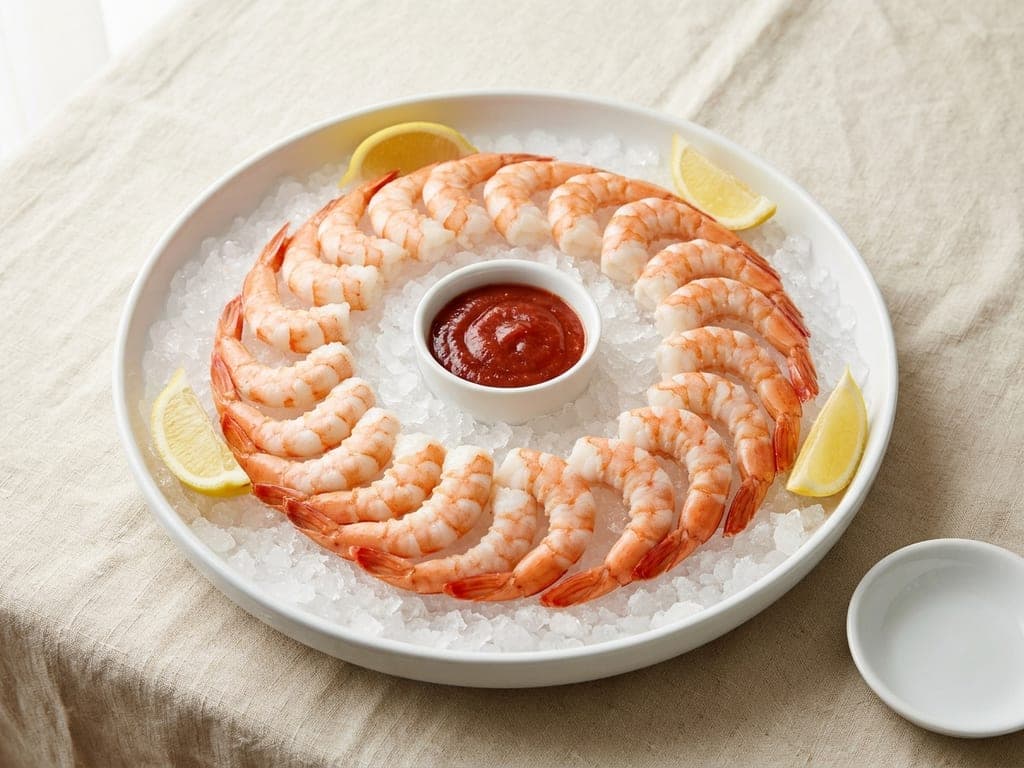
- Build the ice bed and serve. Keep the shrimp and sauce in the fridge until the moment guests arrive. Fill a wide, shallow bowl or rimmed platter with crushed ice, nest a smaller bowl of sauce in the middle, and arrange the shrimp on the ice with their tails pointing out, plus lemon wedges and a small dish for tails. Crushed ice packs around the shrimp; whole cubes leave gaps and warm pockets. The ice is not decoration: the FDA’s party advice is to serve cold seafood on ice if it will be out longer than 2 hours, and our own test that the ice is working is that the shrimp themselves stay at 40°F (4°C) or below. If you have one, set the shrimp in a perforated insert or colander pressed down into the ice, so they stay in contact with it while the meltwater drains away; drain and top up the ice as it slumps, and bring out half the shrimp at a time, refilling from the fridge. Every 30 minutes or so, push a thermometer into a thick shrimp in the middle of the pile: probe the shrimp, not the ice. If one reads above 40°F (4°C), swap in a fresh tray from the fridge and pack in more ice. Never use ice that chilled raw seafood.
Safety & hygiene Important
- Cooked to opaque, 145°F (63°C). Shrimp cocktail is cooked shrimp, served cold, never raw. The FDA’s consumer guidance says “Most seafood should be cooked to an internal temperature of 145°F” (63°C), and for shrimp without a thermometer, cook until “the flesh becomes firm, pearly, and opaque”. FoodSafety.gov’s chart gives no number for shrimp, only “pearly or white, and opaque”. This page uses both: cut the biggest shrimp and check it is opaque through the thickest part, and probe it at 145°F (63°C).
- On the table: 2 hours, or on ice. The FDA says: “Never leave seafood or other perishable food out of the refrigerator for more than 2 hours or for more than 1 hour when temperatures are above 90°F” (32°C), because bacteria grow fastest between 40°F and 140°F (4°C and 60°C). For parties its advice is “Keep cold chilled seafood refrigerated until time to serve” and “Serve cold seafood on ice if it is going to stay out longer than 2 hours.” So the 2-hour clock applies to shrimp sitting at room temperature; an ice bed is the FDA’s own fix for a longer party. Our test that the ice is working, not an FDA rule: the shrimp themselves read 40°F (4°C) or below. The FDA does not give an unlimited time on ice, and ice in the bowl is not proof the shrimp are cold. Our practice: probe a thick shrimp in the middle of the pile every 30 minutes or so, bring out half at a time and swap in a fresh tray from the fridge every couple of hours. If a shrimp reads above 40°F (4°C), count the 2-hour clock from your last good reading: swap in a fresh tray and pack in more ice. If you cannot check the temperature, treat the 2-hour clock as running. Throw out shrimp that have sat off the ice for more than 2 hours, or 1 hour above 90°F (32°C), and do not save a bowl of sauce that guests have been dipping into.
- Fridge life, platter leftovers and raw handling. Refrigerate cooked shrimp within 2 hours of cooking (the ice step does this in minutes), in a covered container at 40°F (4°C) or below in the US, or 5°C or below as the UK Food Standards Agency advises. USDA FoodKeeper lists cooked shellfish at 3 to 4 days in the fridge and 1 to 3 months in the freezer (for quality); the FSA’s general rule for leftovers is to eat them within 48 hours. For the best texture, cook no more than 24 hours ahead. Shrimp that went out on the platter are not leftovers to keep for days: discard any that spent more than 2 hours off the ice, or 1 hour above 90°F (32°C), and eat the rest that day. Only shrimp that stayed in the fridge get the 3 to 4 days. Keep raw shrimp, their thawing juices, the scissors and the board away from the cooked shrimp and the sauce, wash your hands with soap for at least 20 seconds after handling them raw (FDA), and wash the thermometer probe before it goes near the platter. Raw seafood can carry Vibrio bacteria, and the CDC notes that some people are infected when “an open wound comes in contact with” raw seafood or its juices, so cover any cut on your hands; the shell edges you snip in step 2 are sharp. Lemon and hot sauce are no substitute for cooking: in the CDC’s words, “Hot sauce and lemon juice don’t kill Vibrio”.
- Allergens: shellfish, fish, celery and sulphites. Shrimp is a crustacean shellfish, one of the nine major food allergens in the US and one of the 14 allergens UK food businesses must declare. The sauce adds a second allergen many hosts miss: Worcestershire sauce contains anchovies, which are fish, a separate allergen from shellfish. Lea & Perrins in the UK and Canada also uses barley malt vinegar, so it contains gluten; leave the Worcestershire out, or check the label, for guests avoiding fish or gluten. Celery is a declarable allergen in the UK and EU, and this recipe has it three ways: celery seed in the poaching water (leave it out for a celery-allergic guest), celery leaves if you garnish with them, and UK Heinz ketchup, which declares celery in its spice extracts. Shrimp are sometimes treated with sulphites against black spot, which matters for sulphite-sensitive (often asthmatic) guests and must be declared on the label at 10 ppm or more. UK horseradish sauces such as Colman’s contain egg, mustard and sulphites; plain grated horseradish in vinegar usually does not, but read the jar. Bottled cocktail sauces and chili sauces vary, so read those labels too. Use separate tongs for the shrimp so a shellfish-allergic guest can trust the rest of the table.
- Pregnant, older and immunocompromised guests. The FDA and EPA put shrimp on their “Best Choices” list of low-mercury seafood for pregnant and breastfeeding women. The food-poisoning risks are raw or undercooked shellfish, and Listeria, which can grow slowly in cold ready-to-eat seafood. The NHS says cooked prawns are safe in pregnancy but that cold, pre-cooked ready-to-eat prawns should be cooked until steaming hot. So for pregnant, older or immunocompromised guests, serve shrimp you cooked yourself within the last day, kept at 40°F (4°C) or below the whole time, and take their portion from the fridge rather than from a platter that has been out; do not use store-bought pre-cooked shrimp for them.
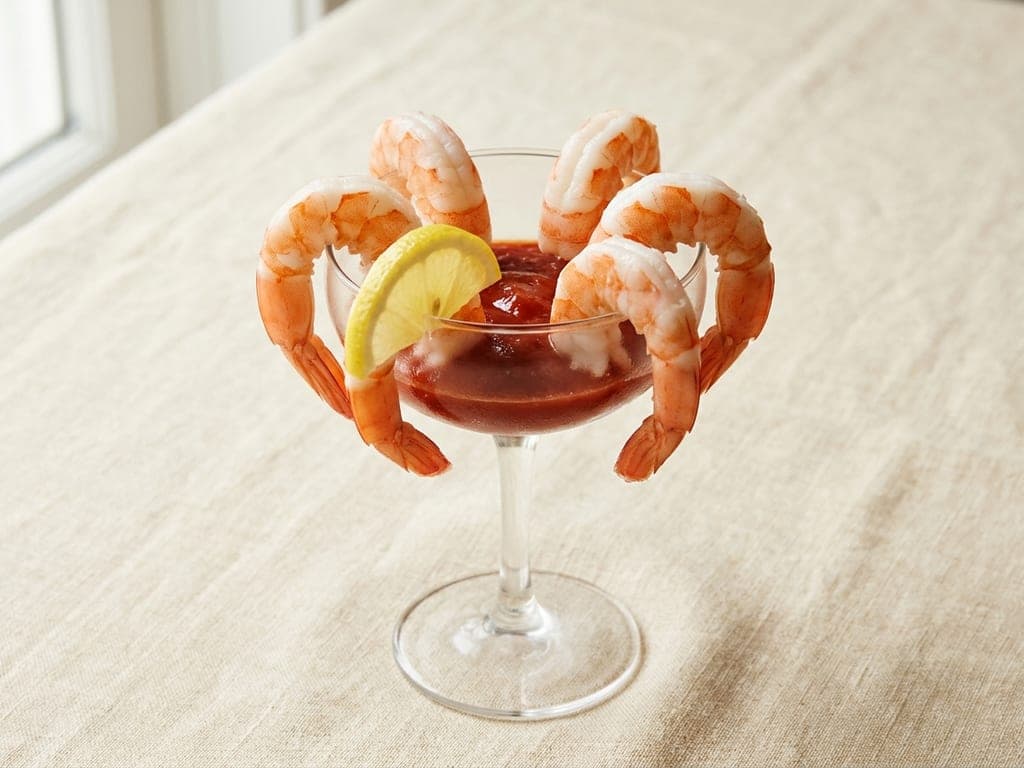
3 ways to plate it
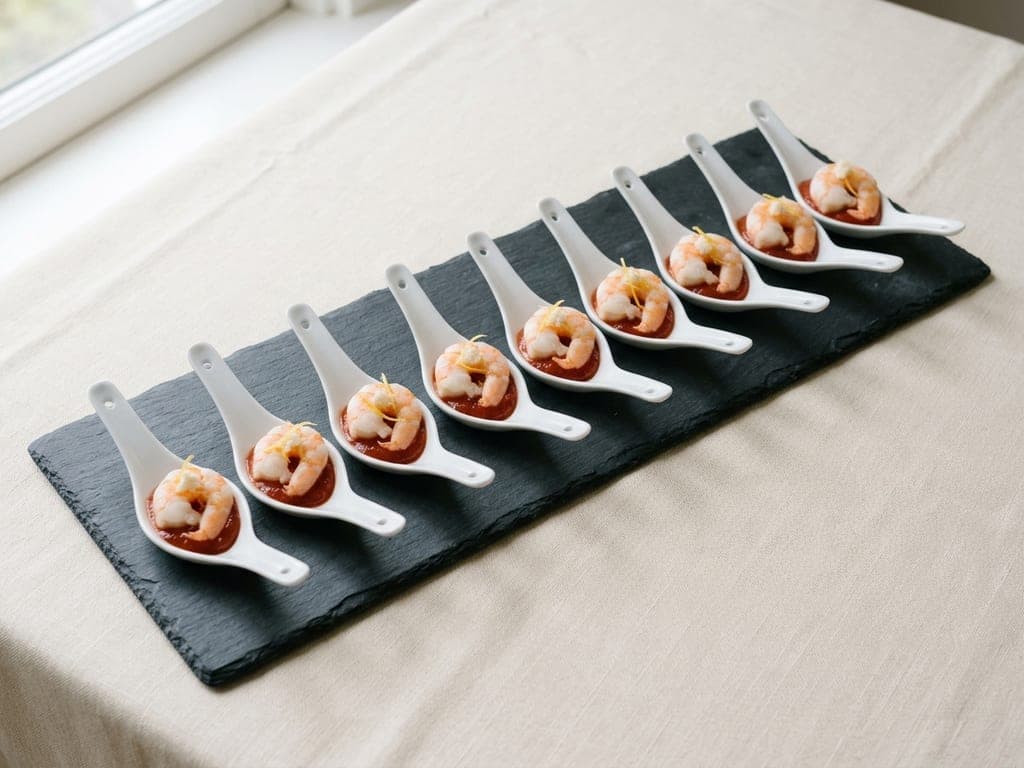
Four ways to cook shrimp cocktail, and why we start cold
Recipes for shrimp cocktail split into four camps, and the difference between them is how hot the water is when the shrimp are in it. The rolling boil is the oldest: Chef John’s Allrecipes version boils jumbo shrimp in a court bouillon for “about 5 minutes”. It is the fastest and the easiest to overdo, for the reason Kenji gives above: 212°F (100°C) water toughens the outside before a big shrimp’s centre is done.
The second camp drops the shrimp into boiling water and lets the temperature fall. Once Upon a Chef keeps the pot on the burner and cooks 16/20s for “exactly 3 1/2 minutes” in salted, sugared water, noting that “The water will not really return to a boil once you add the shrimp; that’s okay”; The Kitchn takes the pot off the heat and pulls them after 1 1/2 to 2 minutes. The falling temperature limits the overshoot, and it is a good method if you trust the timer and your shrimp size. Its weakness is that the time depends on how much water, how many shrimp and how cold they were.
The third camp, which this page uses, starts cold. America’s Test Kitchen’s 2012 recipe heats shrimp from cold water to 170°F (77°C), then finishes them covered off the heat. Serious Eats goes gentler still: Daniel Gritzer starts shrimp in a court bouillon cooled down with an equal amount of cold water and stops at 150°F (66°C), writing that “By starting cold and not exceeding 150°F [66°C], instead of dropping them into boiling liquid, you get the plumpest, most tender shrimp from edge to edge.” We stop the water at 170°F (77°C) rather than 150°F (66°C) because the shrimp must reach 145°F (63°C) in the centre, and with water at 150°F (66°C) that last stretch is slow to judge.
The fourth idea is a brine, and it is an add-on to any method rather than a method. Serious Eats dry-brines shrimp with salt and baking soda (1 teaspoon kosher salt and 1/4 teaspoon baking soda per pound, 450 g, in its brining guide) for 15 minutes to an hour in the fridge, which keeps them plump and juicy; Gritzer describes the texture as a “tightly-filled water balloon”. Once Upon a Chef’s salt and sugar in the boiling water is different: three and a half minutes is seasoning, not a brine. If you want the snappier texture, toss the 2 pounds (900 g) of deveined shrimp with 2 teaspoons of kosher salt and 1/2 teaspoon of baking soda an hour before step 4, refrigerate, and halve the poaching salt to 2 tablespoons (about 18 g) Diamond Crystal.
How many shrimp per person, and a 20-guest scale line
Shrimp are sold by count: 16/20 means 16 to 20 shrimp per pound (35 to 44 per kg), so each raw shell-on 16/20 weighs about 23 to 28 g. This recipe’s 2 pounds (900 g) is about 36 shrimp, 4 to 5 per guest for 8, which matches The Kitchn’s “3 to 5 shrimp per person” for a starter. Peeling and cooking shrink them: by the USDA Food Buying Guide’s yield figure, 1 pound (450 g) of shell-on shrimp gives about 0.54 pound (245 g) of cooked, peeled meat, so 2 pounds (900 g) shell-on is about 490 g (just over 1 pound) on the platter, roughly 14 g per shrimp.
Count labels drift too. A foodservice rule of thumb is one size lost to peeling and another to cooking, so a bag of cooked, peeled 26/30 cocktail shrimp is about the same shrimp as a raw shell-on 16/20. Buy by the raw count if you are cooking, and do not compare a cooked bag’s count with a raw one’s.
Our guide, by role on the menu, for 16/20 shrimp: 4 to 5 each when shrimp cocktail is one starter among several; 6 to 8 each when it is the only starter; 12 to 14 each as a main course. For 20 guests at a drinks party with other food, 4 each is 80 shrimp, about 4 1/2 pounds (2 kg) of raw shell-on 16/20; if shrimp is the star, 6 to 8 each is 120 to 160 shrimp, 7 to 9 pounds (3.2 to 4.1 kg). Cook in 2-pound (900 g) batches with fresh water and ice each time rather than crowding one pot. Two batches of sauce (about 2 2/3 cups, 640 ml) give 20 guests 2 tablespoons each. Our catering calculator does the same arithmetic for the rest of the menu.
Buying shrimp: frozen beats fresh, and read the label
By 2023, according to a NOAA Fisheries report, “93% of shrimp consumed in the U.S. were imported”, most of it farmed. Almost all of it travels frozen. Cook’s Illustrated found that “virtually all shrimp sold at fish counters were bought previously frozen and thawed by the fishmonger”, and that within a day of thawing the texture starts to soften. So the bag in the freezer case, individually quick-frozen (IQF) and thawed by you the night before, is usually fresher than the “fresh” shrimp on ice.
Turn the bag over. The ingredient list should say shrimp, perhaps with water for the protective ice glaze. Sodium tripolyphosphate (STPP) and similar “moisture retention agents” are soaked in to hold water; the National Fisheries Institute’s labelling guidance says they must be declared, and they add sodium. For shrimp cocktail they matter more than in a curry: the shrimp is eaten plain and cold, and a soaked shrimp poaches up bouncy, slightly translucent and salty, with any added salt in the poach doubling up. Black spots on shells are an enzyme reaction, not spoilage, according to the American Shrimp Processors Association, though they show on a cold platter.
Size: 16/20 jumbo is the standard in the recipes we read (America’s Test Kitchen, Once Upon a Chef, The Kitchn) and the easiest to cook evenly; 21/25 gives more shrimp per pound for a crowd and cooks a minute or two faster. Shell-on, deveined “EZ-peel” shrimp are the best compromise: the shell is already slit and the vein gone, but the shell is still there for cooking.
Cocktail sauce: the 4 to 1 ratio, and why the horseradish fades
What is in shrimp cocktail sauce? Ketchup and prepared horseradish, sharpened with lemon, Worcestershire and hot sauce. The recipes we read range from 3 parts ketchup to 1 of horseradish (Chef John, with chili sauce in the mix) to 24 to 1 (The Kitchn, which gets its heat from hot sauce, chili paste and pepper instead). America’s Test Kitchen’s 4 to 1 sits in the middle, and it is ours: 1 cup (240 ml) ketchup to 1/4 cup (60 ml) horseradish, starting at 3 tablespoons and tasting. US bottled chili sauce can replace a quarter of the ketchup for texture; it is a tomato condiment with vinegar and onion, not a hot sauce, and Heinz’s carries more sodium per tablespoon than ketchup.
The heat in horseradish is a volatile compound, allyl isothiocyanate, made when grating breaks the root’s cells, and vinegar stops the reaction at whatever level it has reached. From then on it only goes one way. A 2021 review in Horticulturae notes that ground horseradish “will slowly lose its pungency, become darkened, and develop off flavors even under proper refrigeration”, and Oregon State University Extension says homemade horseradish relish loses its pungency within 1 to 2 months in the fridge. The Kitchn says a made-ahead sauce tastes hotter; any extra heat would have to come from its chili paste, hot sauce and black pepper, not the horseradish. Our advice: make the sauce up to a week ahead, and stir in the horseradish, or a spoonful more, on the day. An old jar is weaker than a new one, so taste.
Cocktail sauce without horseradish works, but it is a different heat. Use hot sauce or a pinch of cayenne with extra lemon: chili heat lingers in the mouth, while horseradish hits the nose and fades. Two cousins use a different sauce entirely. A British prawn cocktail is dressed in Marie Rose sauce, mayonnaise with tomato ketchup, Worcestershire and lemon, usually over small prawns and shredded lettuce in a glass. A Mexican cóctel de camarones sets cooked shrimp in a loose, spoonable tomato and lime broth with onion, cilantro (coriander) and avocado, more like a cold soup than a dip.
History: a New York club’s oyster cocktail, 1891
The parent of shrimp cocktail is the oyster cocktail, and the earliest account we found is a New York Herald report reprinted in the Red Lake Falls News of Minnesota on 26 March 1891. It credits “the young barkeeper of the Manhattan club”, at Fifth Avenue and Thirty-fourth Street, and says that “alcoholic liquors do not enter into its composition”: lemon juice, Tabasco, pepper sauce, a trace of vinegar, salt and pepper, poured over half a dozen Blue Point oysters in a goblet. The paper explains the name: “The idea of the newly devised drink is to combine the preliminary cocktail and the first course of a dinner.” The cocktail was the slot in the meal, not the liquor. No ranking recipe page we read mentions this credit.
Tomato and horseradish arrived quickly. In March 1892 a London item reprinted in New York’s Medical Record had the Manhattan Club’s version “fill[ed] up with tomato juice” and laced with horseradish, and the San Francisco Argonaut reported that “tabasco, chilli, lemon-juice, and horse-radish” left an oyster cocktail “heated to a fiery temperature”. In 1904 the stage star May Irwin printed an “Oyster Cocktail Sauce” in May Irwin’s Home Cooking: lemon juice, grated horseradish, onion, Worcestershire, Tabasco and a quarter cup of ketchup, the ingredients of today’s sauce, though heavier on lemon, and bottled “oyster cocktail sauce” was on grocery shelves by 1905. Fannie Farmer’s revised Boston Cooking-School Cook Book (1906) said to “serve in cocktail glasses”. Shrimp came last, as an afterthought: Lowney’s Cook Book (Boston, 1907) gives a clam cocktail, then one line, “Shrimp Cocktail. Substitute one pint shrimp for clams, and proceed as for clam cocktail.” By 1910 to 1916 it was on hotel menus from Arkansas to Atlanta and Victoria, British Columbia, usually priced at or below the lobster cocktail.
Three popular origin stories do not survive the record. The Gold Rush miner who dropped oysters into his whisky glass turns up earliest, in the record we found, in a 1928 trade paper, The Restaurateur, which dates the event “about 1866”, well after the Gold Rush and some sixty years before the article, with no name or saloon. The idea that Prohibition left cocktail glasses idle and restaurants filled them with shrimp is undone by Steuben and the United States Glass Co., which were selling oyster cocktail glasses in 1907 to 1910, a decade before Prohibition. And Al Levy of Los Angeles, called “Inventor of the Oyster Cocktail” in his 1941 New York Times obituary, is described in an 1897 Los Angeles Times profile as a former waiter who had started out a few years earlier selling oyster cocktails from a pushcart, an existing street trade, and who then copied a San Francisco fad for bottled oyster cocktails. The profile never calls him the inventor; even his obituary’s text says only that he “popularized” it.
The later landmarks are firmer. The Golden Gate in downtown Las Vegas began selling a 50-cent shrimp cocktail in 1959 and raised it to 99 cents only in 1991. “Prawn cocktail” is on a Hong Kong hotel menu by 1934 and in British cookbooks by 1939, and boomed from the 1960s; “Marie-Rose” was a classical French name for a shrimp garnish before it was a pink sauce, and the Mary Rose Trust has dismissed the story that its wreck divers invented it: “Not one of them has any recollection of this happening.”
Questions, answered
How long do you boil shrimp for shrimp cocktail?
With this method you do not boil them at all. Start 2 pounds (900 g) of 16/20 shell-on shrimp in cold salted water, heat to 170°F (77°C) over 5 to 7 minutes, then cover off the heat for 5 to 7 minutes until opaque all the way through and 145°F (63°C) in the thickest part. If you boil them instead, add the shrimp to boiling salted water and keep the pot on the heat: Once Upon a Chef’s times are about 1 1/2 minutes for 26/30, 2 for 21/25, 3 1/2 for 16/20 and 4 for 13/15. A rolling boil for 5 minutes, as some recipes say, toughens jumbo shrimp. Always cut the largest one to check.
Is shrimp cocktail raw or cooked?
Cooked, then chilled. The shrimp are poached until opaque all the way through, 145°F (63°C), cooled quickly in ice and served cold from the fridge, on ice. That is the difference from ceviche, where raw seafood is cured in citrus. Shrimp cocktail is served cold, but it is not raw.
What is in shrimp cocktail sauce?
Ketchup and prepared horseradish, about 4 to 1 by volume (1 cup / 240 ml to 1/4 cup / 60 ml), with 1 tablespoon of lemon juice, 1 teaspoon of Worcestershire sauce, a few dashes of hot sauce and black pepper. Some cooks swap a quarter of the ketchup for US chili sauce. Note that Worcestershire contains anchovies, so the sauce contains fish.
Do you peel and devein shrimp before boiling for shrimp cocktail?
Devein before, peel after. Snip down the back of the shell with scissors and lift out the dark vein, but leave the shell on for cooking: it flavours the water, keeps the shape and shields the meat from the heat. Peel after the shrimp are chilled, leaving the tail on as a handle. The vein is the digestive tract and is safe once cooked; it is removed for grit and looks.
How many shrimp per person for shrimp cocktail?
For 16/20 jumbo shrimp: 4 to 5 each when it is one of several starters, 6 to 8 when it is the only one, 12 to 14 as a main course. One pound (450 g) of raw shell-on 16/20 is about 18 shrimp, enough for about 4 guests at 4 to 5 each. For 20 guests with other food, buy about 4 1/2 pounds (2 kg); for 20 guests where shrimp is the star, 7 to 9 pounds (3.2 to 4.1 kg).
Can you use frozen cooked shrimp for shrimp cocktail?
Yes. Thaw them overnight in the fridge, or in a sealed bag in cold water, pat them dry, chill and serve. Do not boil them again: they are already cooked, and a second cooking makes them rubbery. Expect a softer, less sweet shrimp than one you poach yourself, and remember the counts shift: a bag of cooked 26/30 is about the size of a raw 16/20. Use thawed cooked shrimp within 3 to 4 days, and throw out any that smell of ammonia. Because pre-cooked shrimp go to the table with no cooking step, check the bag is not under a recall: in 2021 a Salmonella outbreak investigated by the CDC was traced to frozen cooked shrimp from one processor, recalled under many brand names. And do not serve them to pregnant guests: the NHS advises that cold, pre-cooked prawns be cooked until steaming hot in pregnancy, so poach raw shrimp for them instead.
How far ahead can you make shrimp cocktail, and how long does it last in the fridge?
Cook the shrimp up to 24 hours ahead for the best texture, and keep them covered at 40°F (4°C) or below. USDA FoodKeeper keeps cooked shellfish safe for 3 to 4 days in the fridge; the UK Food Standards Agency’s rule for leftovers is 48 hours. The sauce keeps about a week, but add the horseradish, or top it up, on the day, because its heat fades in the fridge. Store shrimp and sauce separately.
How long can shrimp cocktail sit out?
Two hours at room temperature, or 1 hour above 90°F (32°C), according to the FDA. On ice is different: the FDA’s own party advice is “Serve cold seafood on ice if it is going to stay out longer than 2 hours”. Our own test that the ice is working: a thick shrimp in the middle of the pile reads 40°F (4°C) or below. Use crushed ice under and around the shrimp, drain the meltwater, put out half at a time, and replace the platter from the fridge every couple of hours. Discard any shrimp left off the ice for more than 2 hours, or 1 hour above 90°F (32°C).
What is the difference between shrimp cocktail and prawn cocktail?
Mostly the sauce. Shrimp and prawn are largely regional words for the same thing here. American shrimp cocktail uses large shrimp with a red ketchup and horseradish cocktail sauce, served on ice or hung on a glass. British prawn cocktail uses small prawns on shredded lettuce in a glass, dressed with pink Marie Rose sauce made from mayonnaise and ketchup. Mexico’s cóctel de camarones is a third dish, shrimp in a cold tomato and lime broth eaten with a spoon.
How do you make cocktail sauce without horseradish?
Mix 1 cup (240 ml) of ketchup with 1 to 2 tablespoons of lemon juice, 1 teaspoon of Worcestershire sauce, 1/2 to 1 teaspoon of hot sauce and a pinch of cayenne, then taste. It will be hot in a different way: chili heat lingers on the tongue, while horseradish hits the nose and fades. A little finely grated lemon zest adds back some of the sharpness.
Is shrimp cocktail healthy? How many calories?
It is one of the leaner party starters: about 100 kcal per serving here. The arithmetic, from USDA FoodData Central: 2 pounds (907 g) of shell-on shrimp gives about 490 g cooked and peeled (a 54% yield), so each of 8 servings is about 61 g, at 99 kcal per 100 g that is 61 kcal and 15 g of protein. The sauce batch is 1 cup ketchup (272 g, 275 kcal), 1/4 cup horseradish (60 g, 29 kcal), 1 tablespoon lemon juice (3 kcal) and 1 teaspoon Worcestershire (4 kcal), 311 kcal in all, or 39 kcal a serving. 61 + 39 = 100 kcal, if every drop of sauce is eaten. The sauce carries the sugar (about 8 g a serving) and most of the sodium: about 350 to 400 mg from the sauce, depending on the ketchup (Heinz is 180 mg a tablespoon), and 70 mg from the shrimp, so roughly 420 to 470 mg, plus some salt absorbed from the poaching water, which we cannot measure.
Snap your finished plate and let the AI plate it again — more beautifully.