Lemon Sorbet Palate Cleanser: Sharp, Scoopable, 2 Tbsp a Guest
A lemon sorbet written for the pause between courses, not for dessert. It is 25% sugar by weight, a number we chose and show the arithmetic for, with the sharpness coming from about 1.4% lemon acid, so it is firm, clean and clearly less sweet than the dessert recipes that rank for it (about 30 to 34% on the same basis, by our arithmetic). One machine batch, about 750 g of base, churns to roughly 0.8 L: 26 palate-cleanser portions of 2 tablespoons (30 ml), at about 28 kcal each, so a dinner for 8 uses less than a third of it. The page gives a machine method and a no-churn method, the per-guest maths for 8 and 12, where the sorbet goes in a multi-course menu, how long to temper it and how to quenelle it, and an honest answer to what it does for your palate: no study has tested a sorbet between courses. And history the ranking pages leave out: in Naples in 1694, Antonio Latini wrote that what the city called sorbetta had started out as the limonea, a lemon drink.
Ingredients
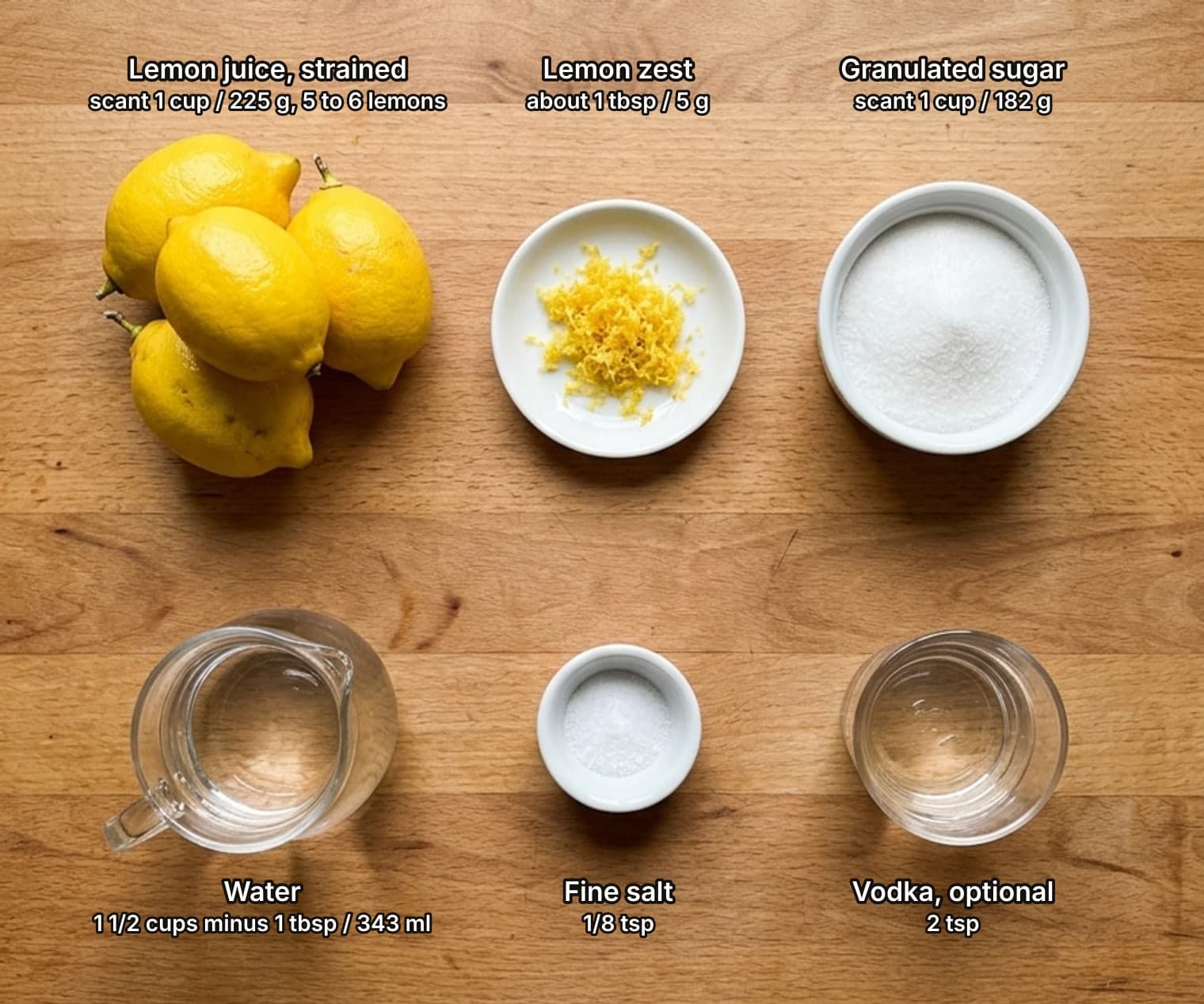
- fresh lemon juice, strained (from 5 to 6 ordinary lemons, not Meyer: MasterClass suggests Meyer lemons when lemon tastes too harsh, which is the opposite of what a cleanser wants; use unwaxed or well-scrubbed lemons, since 2 of them are zested first). For guests who are pregnant, elderly, very young or immunocompromised, see the safety notes on raw juicescant 1 cup (225 g, about 220 ml)
- finely grated lemon zest, yellow part only, no white pith (from 2 of the lemons above)about 1 tbsp (about 5 g)
- granulated sugar (weigh it: the 25% depends on it)scant 1 cup (182 g)
- water1 1/2 cups minus 1 tbsp (343 g / 343 ml)
- fine salt1/8 tsp (0.75 g)
- vodka, 80 proof (40%), optional, for a slightly softer scoop; leave it out for children, pregnant guests, drivers and anyone avoiding alcohol, and make the batch without it if the sorbet is also the alcohol-free option2 tsp (10 ml)
Why this sorbet is 25% sugar: the palate cleanser number
A palate cleanser and a dessert sorbet can be made from the same three ingredients and still be different things. The difference is sugar. Our palate cleanser guide says a cleanser should be “sharp, not sweet” but declines to print a number, because no source gives a sugar target for a cleanser sorbet. This recipe goes further: 25% sugar by weight of the base, about 26 °Brix on a refractometer. The number is ours, not a published standard, and here is why we chose it.
It is inside every published range for a sorbet that scoops. Serious Eats puts it at “between 20% to 30%”, warning that with less the sorbet is too icy to scoop, and Harold McGee gives 25 to 35%. At 25% we sit in the middle of the first and at the floor of the second: about the least sugar that still freezes to a scoopable texture in a home freezer. It also matches history: Escoffier wanted his granités “not overreaching fourteen degrees” on the Baumé scale, which converts to roughly 25 °Brix by our arithmetic, a little below his sorbets.
The dessert recipes that rank for “lemon sorbet palate cleanser” are sweeter. Working from their quantities, sugar as a share of the whole mix, counting the juice’s own sugar as we do for ours: The Spruce Eats about 30%, Recipes from Italy about 33%, MasterClass about 34%; BBC Good Food’s no-churn lemon sorbet is about 40%. Serious Eats’ lemon sorbet uses corn syrup, about 41% solids, which is far less sweet than table sugar weight for weight, so it is a texture choice rather than a sweeter sorbet.
The sharpness comes from acid, not from cutting sugar further. Our base carries about 1.4% citric acid from the juice, a sugar to acid ratio of about 18 to 1 by weight. By the same arithmetic BBC Good Food’s lemon sorbet is about 53 to 1 and Serious Eats’ about 47 to 1, and McGee’s general advice for fruit sorbets is a ratio of 30 to 60 to 1, “similar to that of the melons”. That is the measurable meaning of “sharp, not dessert-sweet”: two to three times the acid for the sugar.
Temperature finishes the job. In a 1987 study by Barry Green and S. P. Frankmann, cooling the tongue weakened the sweetness of sugar but left sourness unaffected, so a spoonful at freezer temperature tastes sharper than the same base at room temperature. The price is firmness: about 82% of the water is frozen at 0°F (-18°C), by our freezing-point arithmetic, which is why this sorbet needs 8 to 10 minutes on the counter before it will quenelle. And if you only own a sweeter recipe, the guide’s advice holds: serve less of it.
How to make Lemon Sorbet Palate Cleanser
- Zest two lemons, then juice and weigh. Wash and dry the lemons. Grate the zest of 2 of them on a fine rasp, taking only the yellow skin: the white pith underneath is bitter, and a 2-tablespoon portion has nowhere to hide it. Zest before you juice, because a squeezed half is impossible to grate. Then juice 5 to 6 lemons and pour the juice through a fine sieve to catch seeds and pulp. Weigh out 225 g (about 220 ml, a scant cup). USDA puts the juice of an average lemon at 48 g, so 225 g is a little under 5 lemons, but small or dry fruit give less, which is why the recipe asks for a weight and not a count. The weight matters more here than in a dessert sorbet: lemon juice’s own sugar barely varies, while its acid varies by about 8% from fruit to fruit (a 2008 lab measurement found 48 g of citric acid per liter, give or take 4 g), and the whole recipe is a ratio of sugar to water to acid. Keep the juice cold in the fridge while you make the syrup.
- Steep the zest in hot syrup, off the heat, and strain. Put the 182 g sugar in a heatproof glass or stainless steel bowl, add the zest and rub the two together with your fingertips for a minute, until the sugar is damp, pale yellow and smells strongly of lemon: the aroma is in the oil of the zest, and sugar pulls it out. Heat the 343 g water until it steams and small bubbles form at the edge, about 180°F (82°C), not a boil, then pour it over the sugar and stir until the syrup is completely clear. Cover and leave to steep for 20 to 30 minutes, then pour through a fine sieve, pressing the zest to get the syrup out of it, and discard the zest. Two reasons for steeping rather than boiling the zest in the syrup, as some recipes do: a few minutes of boiling in an acid mix can give lemon oil a cooked, flat edge (the source for that is a gelato-balancing site, so treat it as our caution), and a quenelle this small shows every fleck and grain of zest. The lemon juice never goes near the heat (unless you are boiling it for at-risk guests, see the safety notes): it is added cold in the next step, so its fresh flavor stays fresh. Weigh the strained syrup: it should be about 525 g. If it has lost more than 10 g to steam and to the zest, top it back up with cold water.
- Combine, season and check the number. Stir the cold lemon juice and the 1/8 tsp salt into the cooled syrup. The base should now weigh about 750 g. That is our palate-cleanser number: 25% sugar by weight (182 g added sugar plus the juice’s own 2.5%, about 188 g in 750 g) and about 1.4% citric acid, a sugar to acid ratio of roughly 18 to 1. The salt is a seasoning, not a preservative: Serious Eats adds salt to its lemon sorbet to taste and argues that many sorbets are underseasoned; at 0.1% you will not taste salt, only a rounder lemon. If you own a refractometer, expect about 26 °Brix, a point above the true sugar, because citric acid reads almost like sugar on the instrument. Skip the old egg-float test: it is calibrated for dessert sorbet at about 30 to 31 °Brix (that is Ice Cream Nation’s own conversion), so the classic coin-sized patch of shell would steer you to a dessert, and it puts a raw eggshell into a base that is never cooked. Taste the base: it will seem sweet as well as sharp. Do not add sugar. Cold mutes sweetness but not sourness (Green and Frankmann, 1987), so frozen it will taste far sharper than it does now.
- Chill the base hard; freeze the machine’s bowl. Cover the base and refrigerate it until it is 40°F (4°C) or colder: at least 2 hours, or overnight. If you are using the vodka, stir the 2 tsp (10 ml) in now. A cold base reaches freezing sooner once it is in the machine, so more of its water turns to ice while it is being stirred, and stirred ice stays in small crystals; a warm base spends longer as a slush and sets coarser. The same 40°F (4°C) figure is Serious Eats’ instruction for re-churning a batch that went wrong. If your machine has a freezer bowl, America’s Test Kitchen gives it at least 24 hours in the freezer, preferably 48: a bowl that is only nearly frozen gives up halfway through and leaves you with slush. Clear a flat space at the back of the freezer for the container now, so the churned sorbet can go straight in.
- Churn until it looks like thick soft-serve. Pour the cold base into the running machine and churn by the maker’s instructions until it is thick, pale and glossy, like soft-serve, and the dasher leaves a trail: about 20 minutes in a compressor or freezer-bowl machine, and up to 40 in some (one Leite’s Culinaria tester took 40 minutes in a Cuisinart ICE-100). Churning does two jobs at once: it keeps the crystals small by moving them while they form, and it beats in air. Fruit sorbets swell by about 20 to 35% as they take in air (Callebaut’s figure for overrun), so 750 g of base, about 0.68 L as liquid, comes out at roughly 0.8 L; a slow machine or a soft finish may give less, closer to 0.7 L. The batch is sized to fill a home machine properly, not to the number of guests: most 1 1/2 quart (1.4 L) bowls churn a half batch as a thin layer that freezes on the wall and scrapes off icy (our caution, not a tested figure). The per-guest maths is in the section below; the short version is that this makes plenty.
- No machine: freeze it flat, then blitz it. Without a machine, pour the base into a freezer bag laid flat on a tray, or into a shallow glass or stainless steel dish (not bare aluminium, which reacts with acid), and freeze until solid, about 4 hours or overnight. Break it into chunks, leave them 5 to 10 minutes to soften at the edges, then pulse in a food processor, scraping down, until smooth and pale; pack and refreeze for 1 to 2 hours. Expect less volume than from a machine, since little air gets in: closer to 0.7 L, about 23 portions of 30 ml (our estimate). A food processor does what the machine does in reverse: it breaks big crystals small instead of keeping them small, which is the same idea as a Pacojet or a Ninja Creami. No one has published a side-by-side sorbet test of the no-machine routes; the nearest is The Kitchn’s test of ice cream methods, where the food processor won on ease, speed and texture. The fork method also works: freeze the base in a shallow dish and stir it hard every 30 minutes for 3 to 4 hours. It gives a finer texture than granita and a coarser one than a churned sorbet, which for a single mouthful between courses is perfectly acceptable. Do not expect a fork-scraped 25% base to break into granita flakes: granita wants about 15% sugar, and ours stays a fine slush.
- Pack, cover and freeze until firm. Scrape the sorbet into a shallow airtight container that it nearly fills, and press a sheet of baking parchment or cling film (plastic wrap) onto the surface: air is what dries the top and grows ice on it. Freeze at 0°F (-18°C) or colder, at the back and bottom of the freezer, away from the door, for at least 3 hours and preferably overnight. This is where the 25% shows its cost. By our freezing-point arithmetic, about 82% of the sorbet’s water is ice at 0°F (-18°C), against about 69% for Serious Eats’ corn-syrup lemon sorbet, so ours sets firm in a home freezer, firm enough to hold a sharp quenelle and too firm to scoop straight out. That is deliberate: a softer sorbet means more sugar or more alcohol, and both work against a cleanser. It is at its best for 3 days (our window for the fresh lemon aroma) and good for a week, which is Serious Eats’ advice; America’s Test Kitchen says 5 days. After that it is still safe but icier and duller.
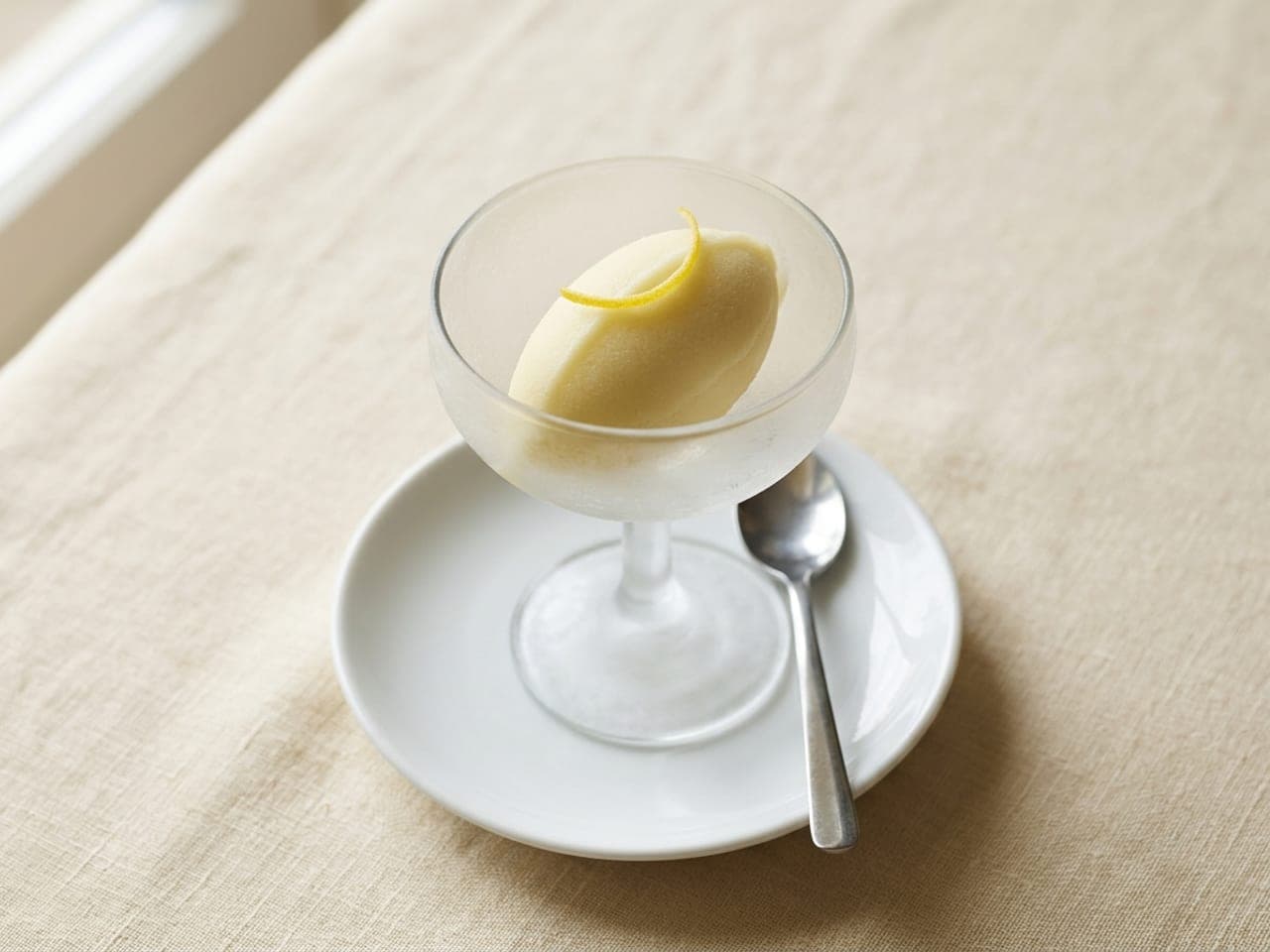
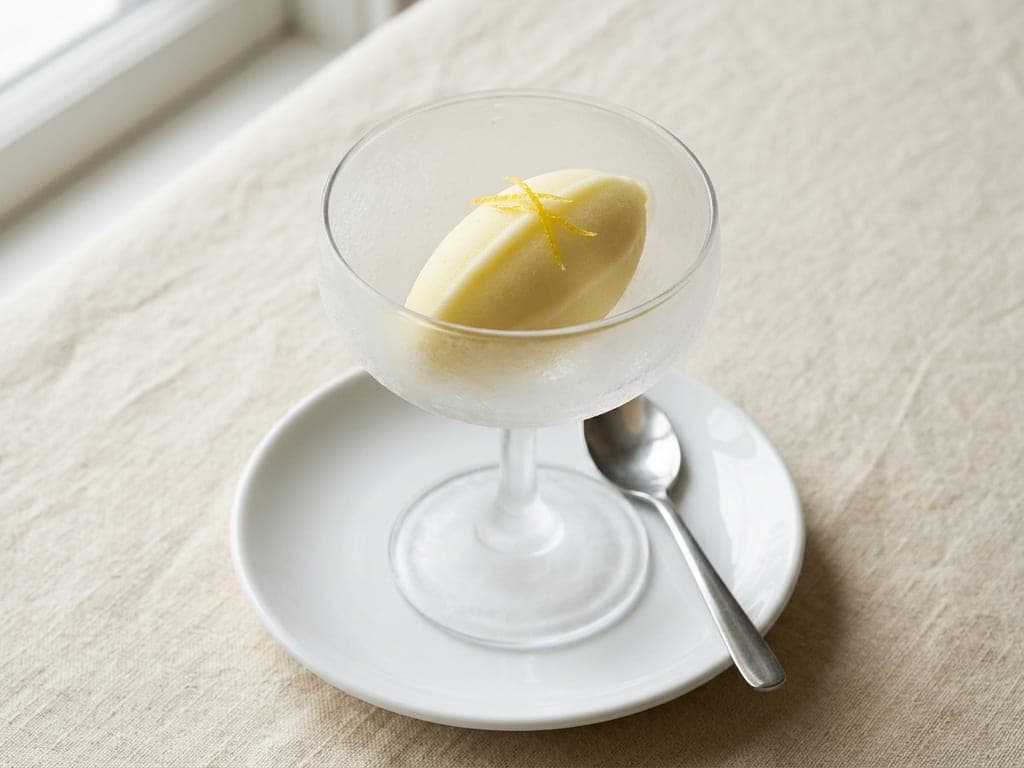
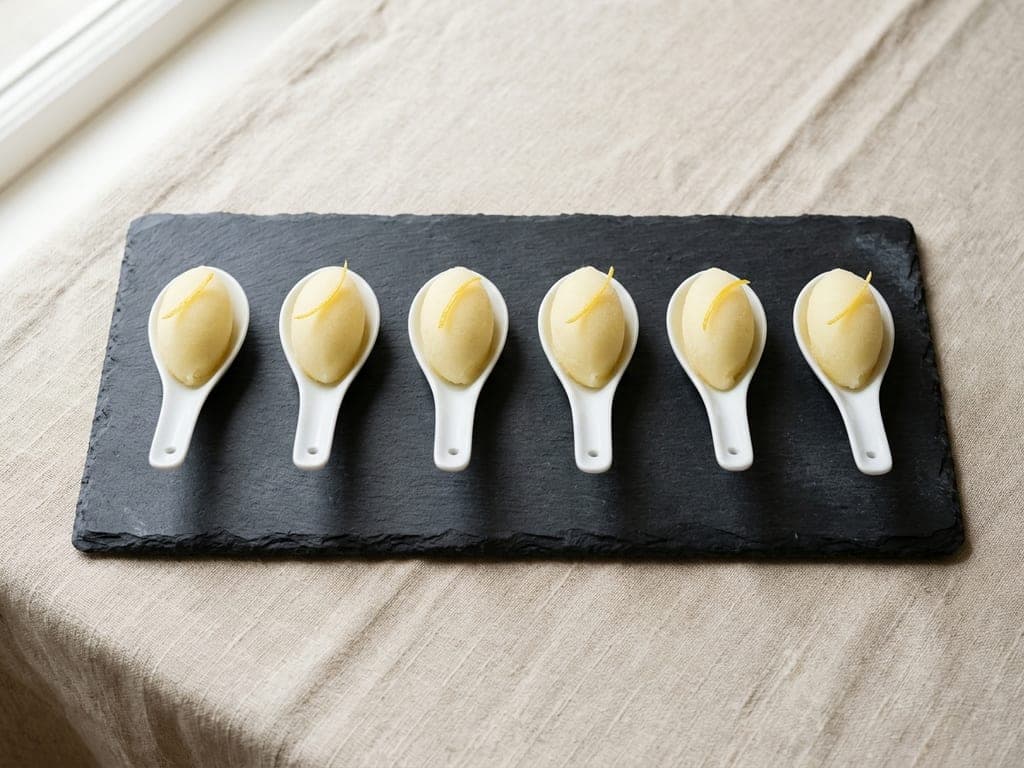
- Temper, quenelle and serve within minutes. Put small glasses (or tasting spoons) in the freezer 15 minutes to an hour before the course: an hour gives a frosted glass. As the plates of the previous course are cleared, take the sorbet out and leave it on the counter for 8 to 10 minutes. Our palate cleanser guide quotes America’s Test Kitchen’s 5 minutes; that is for a softer dessert sorbet, and by our arithmetic this one only becomes scoopable at about 10 to 12°F (-12 to -11°C), so give it the longer time. Set a jug of hot water beside it. Dip two dessert spoons, take a heaped spoonful, about 2 tablespoons, and pass it from spoon to spoon three or four times, turning it, until it has three smooth sides (our quenelle guide shows the move). A #40 disher, about 24 ml, or a #60, about 16 ml, does the same job faster. One quenelle per glass, one garnish at most: a few threads of zest. Serve on a saucer with a small spoon within 2 to 3 minutes of shaping, put the tub straight back in the freezer, and bring the next course about 10 minutes after the sorbet.
Safety & hygiene Important
- Freezer life: quality, not safety. USDA’s Food Safety and Inspection Service says “Food stored constantly at 0 °F will always be safe. Only the quality suffers with lengthy freezer storage.” (0°F is -18°C.) So the 3-day and one-week windows on this page are about texture and lemon aroma, not about risk. Check the freezer with a thermometer: it should read 0°F (-18°C) or lower. A tub that has melted should not simply go back in the freezer: it sets into an icy block. Chill the melted base to 40°F (4°C) in the fridge and churn it again, which is Serious Eats’ fix for a batch that went wrong. That is safe here because a lemon base is far too acidic for bacteria to grow in; do not do it with an ice cream or any sorbet made with dairy or egg. If you made it with raw juice for at-risk guests, or it sat out overnight, start again (ours).
- Fresh lemon juice is a raw ingredient. The FDA warns that “When fruits and vegetables are fresh-squeezed or used raw, bacteria from the produce can end up in your juice”, and that children, older adults, pregnant women and people with weakened immune systems are at risk of serious illness from untreated juice. Freezing does not kill bacteria, it only stops them growing. Scrub the lemons before zesting and squeezing. For at-risk guests, use pasteurized lemon juice (check the label: many bottled juices are preserved with sulfites, an allergen), or bring the juice to a full boil with the water, pour it over the sugar and zest as in step 2, and top the strained base back up to 750 g with cold water (boiling is Health Canada’s advice for unpasteurized juice). Both cost some fresh-lemon flavor (our note), and neither changes the sugar arithmetic. For the same guests, skip the raw zest garnish, or take it from a lemon scrubbed under running water just before you grate it (ours).
- Alcohol: optional, small, and still declared. The 2 tsp (10 ml) of 40% vodka holds about 3.2 g of pure alcohol in the whole batch, about 0.1 g in a 30 ml portion: around 1% of a US standard drink (14 g) and about 1.5% of a UK unit (8 g, per the NHS). It is there only to soften the texture. Leave it out for children, pregnant guests (the CDC says there is no known safe amount of alcohol in pregnancy), drivers and anyone who avoids alcohol for any reason, and tell guests when it is in. A sorbet made with it is not alcohol-free, and it does not look alcoholic: if anyone at the table should not drink, make the batch without vodka, or keep a small tub without it for them. Do not add more for a softer scoop: Serious Eats puts the danger zone above five tablespoons of 80 proof spirit per quart, about 75 ml per 0.95 L, beyond which a home freezer may not set it. The prosecco in the third plating idea is a real pour: see that note.
- Egg white: not needed here, and only ever pasteurized. Some Italian lemon sorbetti fold in whipped egg white for a lighter, creamier texture. This recipe does not need it. If you add it, the FDA advises pasteurized eggs or egg products for anything served raw, and pouring hot syrup over the whites is not enough: South Dakota State University Extension notes that the whites in an Italian meringue “do not reach much above 125° F” (52°C) unless the syrup is taken to the hard-ball stage, 250 to 266°F (121 to 130°C). Use carton pasteurized whites, and declare egg as an allergen. Without it the sorbet itself contains none of the major allergens; the prosecco and Calvados in the third plating idea can contain sulfites, which UK and EU law counts as an allergen (sulphur dioxide and sulphites) and US wine labels declare as “Contains Sulfites”. A machine that also churns dairy, egg or nut ice creams should be taken apart and washed in hot soapy water first, dasher and lid included, and so should the scoop and spoons you shape with.
- Acid needs a non-reactive container. Lemon base is acidic enough to dissolve copper and the zinc coating of galvanized metal, enough to make people ill, which is why the FDA Food Code bars both from contact with acidic food, and bare aluminium gives it a metallic taste. Steep, chill, freeze and store it in glass, stainless steel, enamel or food-grade plastic; recipe writers from David Lebovitz on specify a non-reactive pan or tray.
3 ways to plate it
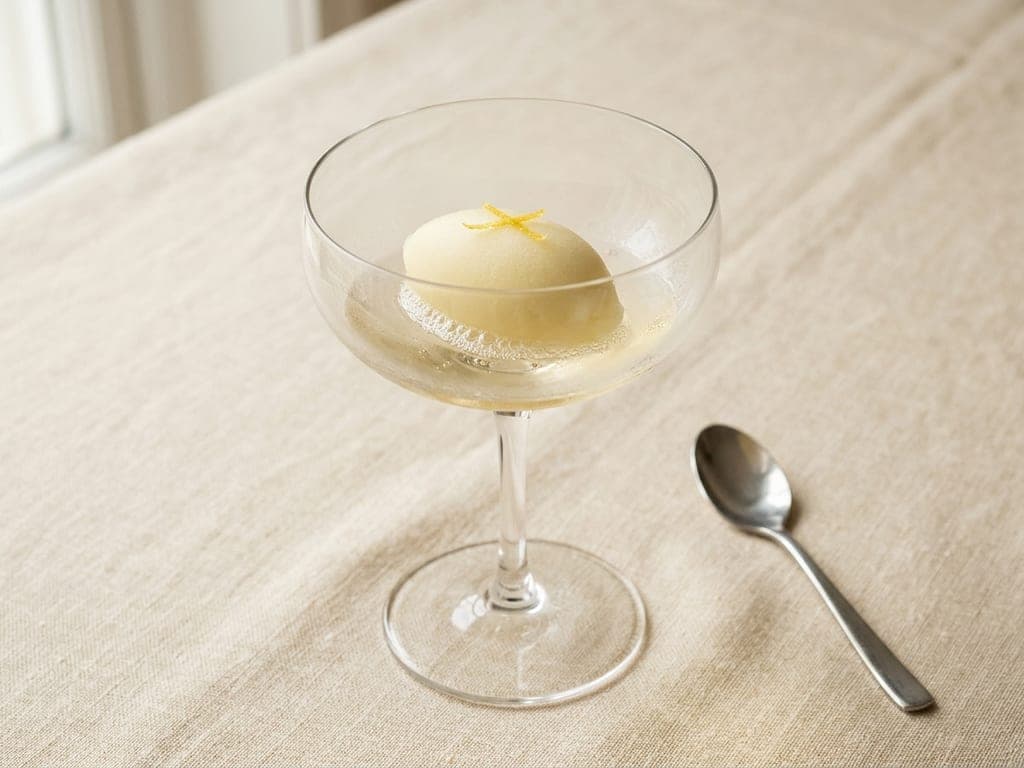
How much per guest, and what one batch makes
A palate cleanser portion is 1 to 2 tablespoons, 15 to 30 ml: the same range our palate cleanser guide uses, and the size the sources describe in bites (“a spoonful”, “one or two bites”). The one weighed figure we know is Per Se’s sorbet at 0.6 oz (17 g) on New York magazine’s scale, about 18 ml at this sorbet’s density. We count servings at the top of the range, 30 ml, a generous quenelle.
One batch is 750 g of base, which churns to about 0.8 L (between roughly 0.7 and 0.9 L, depending on how much air your machine beats in). At 30 ml that is 26 portions, which is why the card says 26 servings; at 20 ml it is 40, and at 15 ml, 53.
For 8 guests at 30 ml you use 240 ml, under a third of the batch, and about 560 ml is left: 18 more portions. Take two spare quenelles for the ones that come out ragged. For 12 guests at 30 ml you use 360 ml and about 440 ml is left: 14 more. 12 guests at a second helping would use about 720 ml, close to the whole batch.
What to do with the rest: it is at its best for 3 days and good for a week, so the batch covers a dinner and a second one within the week, or several evenings of a spoonful after supper. Past a week it is still safe at 0°F (-18°C) but grows icier and the lemon aroma fades; a pass through the food processor brings back the texture, not the aroma. Why not simply make half? A half batch is too shallow for most freezer-bowl machines to churn well. With the food-processor method you can halve every quantity (all of them, including the 1/8 tsp salt: a generous pinch).
Per portion, 30 ml weighs about 28 g and carries about 28 kcal and 7 g of sugars, a little under 2 teaspoons; the arithmetic is in the FAQ.
Where the sorbet goes in a multi-course dinner
Once, at the biggest change of gear. For 150 years the classic place has been before the roast: Charles Ranhofer, chef at Delmonico’s, wrote in 1894 that a punch or sherbet is “always served after the entrées and before the roast”, and Escoffier set it after the entrées, to prepare the stomach “to properly receive the roast”. Italian weddings often keep the same slot: an Italian pastry chef, remembering the Neapolitan weddings of the 1990s, calls the sorbetto al limone “la linea di demarcazione”, the line between the fish menu and the meat menu. The other place, and the commoner one at home today, is between the last savory course and dessert.
In practice, by menu length: the course ladder our course meal builder follows (WebstaurantStore’s sample sequences) only has a sorbet from 8 courses, after the main in an 8 or 9-course dinner and between the two mains in a 10 to 12-course one. Shorter menus do without. If you want one in a 5 to 7-course dinner (our suggestion), put it between the main and dessert, or between a fish course and the meat if you serve both. Never more than once: two sorbets is a menu that has lost its shape. On a long tasting-style menu, make the portion 1 tablespoon (15 ml); for a shorter dinner, 2 tablespoons (30 ml) (our rule of thumb).
The run sheet: clear the previous course completely, so the sorbet arrives on an empty table; it reaches the table within 2 to 3 minutes of shaping and is eaten in 3 or 4; the next course follows about 10 minutes after the sorbet was served. Ranhofer allowed “Ten to fifteen minutes” at the same point while the wine glasses were changed. The pause also gives the mouth time to warm up again, about 2 minutes after a cold rinse in one study, before the next course’s sweetness and aroma have to register.
Does a lemon sorbet really cleanse the palate?
Honestly: nobody knows, because nobody has tested it. We searched the research literature again in November 2026 and found no study of a sorbet served between the courses of a meal. Pages that say a sorbet “resets the palate” or “aids digestion” cite nothing, and the chefs who made the course famous never claimed the first.
What lab studies do show is suggestive. Sour is the strongest everyday trigger of saliva: in a 1988 study by Watanabe and Dawes, 5% citric acid drove more saliva than any of the ordinary foods they tested, and this sorbet is strongly sour at 1.4% acid. Cold dulls sweetness but not sourness, as above. Against chili burn, the only laboratory test of a water ice (Gaiser and Hayes, 2024) found Italian ice about as effective as cold water: useful, not magic. None of this was measured inside a dinner.
Digestion is a harder no. Writing about sgroppino, the lemon-sorbet-and-vodka digestivo of the Veneto, La Cucina Italiana says flatly that “il fondamento scientifico della cosa è inesistente”: there is no scientific basis. And in Spain, where lemon sorbet with cava was a wedding fixture of the 1980s and 1990s, chef Carlos Casillas told Directo al Paladar that the sugar and alcohol meant “No es un elemento que ayude a hacer la digestión.”
So we serve it for what it certainly is: a pause. A cold, sour, small mouthful that marks the end of one part of the meal and the start of the next. That is reason enough.
Machine, food processor or fork: what changes
A machine stirs the base while it freezes, so ice forms as millions of small crystals with air between them: the smooth, dense texture you want in a quenelle. Without one, there are two good routes and one honest alternative. The food processor route (freeze the base flat, break it up, blitz until smooth) gets closest, because it breaks the crystals small after freezing; the Ninja Creami works on the same principle. The fork route (stir every 30 minutes for 3 to 4 hours) is coarser but fine for a single spoonful. Or make lemon granita on purpose, with about 15% sugar instead of 25%: our palate cleanser guide has one.
Homemade sorbet goes icy or rock hard for four usual reasons: too little sugar (below about 20% it will not scoop), a base or freezer bowl that was not cold enough, storage in the freezer door where it partly melts and refreezes, or simply the temperature of a home freezer, at which even a good sorbet is mostly ice. The fixes are to temper it on the counter, to re-churn or re-blitz it, or, next time, to add the optional vodka. Swapping some sugar for corn syrup or glucose syrup, as Serious Eats does, makes it smoother but not softer, and less sweet: a fair trade for a dessert sorbet, an unnecessary one here.
Lemon sorbet began as a lemon drink: Naples, 1694
We file this recipe under Italian because the earliest recipe written as a lemon sorbet that we can quote is Neapolitan. Antonio Latini, steward in the household of the Spanish viceroy’s first minister in Naples, printed nine sorbet recipes, by the food historian Jeri Quinzio’s count, in the second part of Lo scalco alla moderna, published in Naples in 1694. The date is often given as 1692, the year of the first part; the sorbet chapter, Trattato XX, “Di varie sorti di Sorbette, ò d’Acque aggiacciate”, is in the second.
It opens with a sentence we have not seen on any recipe page: “Marina Briancesca fù la prima ch’usasse la Limonea, hoggi detta Sorbetta”. Marina Briancesca was the first to use the limonea, the lemon drink, “today called sorbetta”. No one we have read has identified her. But in Latini’s telling the Neapolitan sorbet starts as a lemon drink, and lemon is the first recipe in the chapter: “Per fare venti Giare di Sorbetta di Limone”, to make twenty goblets of lemon sorbet, from three pounds (about 1 kg) of sugar and three lemons “quando sieno grossi”, if they are fat, with snow and salt for the freezing tub. Quinzio thinks it “would seem to have been tooth-achingly sweet, not very lemony, and unlikely to freeze very well”. Latini also explains why he bothered: in Naples “pare ch’ogn’uno nasca col genio, e con l’istinto di fabricar Sorbette”, everyone seems born with the instinct for making sorbets.
Was it the first? National Geographic reports an anonymous book on sorbetti printed in Naples in 1690, and two years before Latini, in Paris in 1692, Audiger told readers to turn his lemonade into an ice by doubling the sugar. So we call Latini’s the earliest recipe written as a lemon sorbet that we can quote, not the first lemon ice. Paris got a dedicated “glace de citron” from Emy in 1768; London a “Lemon Water Ice” from Frederick Nutt’s Complete Confectioner (first published 1789; the 1807 printing reads “RASP one lemon, squeeze three, and put in two gills of syrup and half a pint of water; pass it and freeze it rich”). None of them puts the ice in the middle of dinner.
How lemon became the palate cleanser, and the stories that are not true
The sorbet course is a nineteenth-century French and American invention, and in its classic form it was rarely called lemon, though lemon was underneath. Ranhofer’s Roman punch at Delmonico’s begins with “one quart of lemon water ice” (0.95 L), then adds Italian meringue, rum and champagne, and “should be sufficiently liquid to be drank without using spoons”. Escoffier’s sherbets are wine sharpened with lemon and orange juice. The menus named the punch, not the lemon. In English books “Roman punch” falls away in the 1910s and 1920s, and the phrase “lemon sorbet” only becomes common from the 1980s, by our reading of Google’s Ngram data. The plain lemon sorbet as the palate cleanser is a twentieth-century simplification.
Some stories to leave out of the toast. Nero did not eat sorbet: what Pliny credits him with is boiling water and chilling it in a glass vessel in snow. Marco Polo brought back no recipe for ices; as Quinzio points out, if he had, Italian scientists would not still have been experimenting with freezing three centuries later. Catherine de’ Medici did not bring sorbet to France; the ice historians Caroline Liddell and Robin Weir (Ices: The Definitive Guide, 1993) found no mention of such stories before the nineteenth century. The Arab world gave us the word (sharbat, a drink) and the sweet lemon drink, but freezing a syrup needed snow mixed with saltpetre, and later salt, a trick Italian scientists such as della Porta described in the sixteenth century. And sgroppino, the Veneto whisk of lemon sorbet and vodka (often with prosecco), is often said to date from 16th-century Venice; none of the pages we found that say so cites a source, and the restaurant Villa Revedin near Treviso claims it was invented there in the late 1970s.
Questions, answered
Is lemon sorbet a good palate cleanser?
Yes, as a pause, if it is made sharp rather than sweet. A cold, sour spoonful triggers saliva and tastes less sweet than it is, and it marks a clear break in the meal. What no study has shown is that sorbet “resets” the palate: nobody has tested a sorbet between courses. Most recipes sold as palate cleansers are dessert sorbets at about 30 to 34% sugar (BBC Good Food’s no-churn about 40%); this one is 25%, with the sharpness from lemon acid.
Why is sorbet served between courses?
Tradition first: from the nineteenth century the sorbet or Roman punch was served after the entrées and before the roast, to mark the break before the biggest course, and Italian weddings often still put a lemon sorbet between the fish and the meat. The plausible reasons are acid (sour is the strongest everyday trigger of saliva), cold, and the change itself. The claim that it aids digestion has no evidence behind it.
What is the sorbet between courses called?
In English, an intermezzo or simply the sorbet course; in Italian, sorbetto; in Normandy the trou normand, a glass of Calvados or an apple sorbet with Calvados poured over; in nineteenth-century menus, Roman punch or a named sherbet. Our palate cleanser guide has the full list of names.
When do you serve a sorbet palate cleanser?
Once, at the biggest change of gear: between the fish and the meat in a long menu, or between the last savory course and dessert. In the course ladder our course meal builder follows, it appears from 8 courses: after the main at 8 or 9 courses, between the two mains at 10 to 12. In a shorter dinner, put it between the main and dessert, or between fish and meat (our suggestion). Bring the next course about 10 minutes after the sorbet.
How much sorbet do you serve as a palate cleanser?
1 to 2 tablespoons (15 to 30 ml) per guest: one small quenelle or one small scoop (a #40 disher holds about 24 ml, a #60 about 16 ml). This batch makes about 0.8 L, which is 26 portions at 30 ml, 40 at 20 ml and 53 at 15 ml, so a dinner for 8 uses 240 ml and a dinner for 12 uses 360 ml.
Can you make sorbet without an ice cream maker?
Yes. The best route is to freeze the base flat (a freezer bag or a shallow glass or stainless dish), break it into chunks, rest them 5 to 10 minutes and blitz in a food processor until smooth, then refreeze for 1 to 2 hours. Stirring with a fork every 30 minutes for 3 to 4 hours also works but gives a coarser texture. No one has published a side-by-side sorbet test of the two.
How much sugar should a palate cleanser sorbet have?
Our number is 25% sugar by weight of the base, about 26 °Brix on a refractometer (lemon acid adds about a point to the reading). Published scoopable ranges are 20 to 30% (Serious Eats) and 25 to 35% (Harold McGee), and dessert lemon sorbets usually run about 30 to 34% (counting the juice’s own sugar, as our 25% does). So sorbet can be a dessert or a palate cleanser; the difference is the sugar, the size of the portion and where it sits in the meal.
Why is my homemade sorbet icy or so hard?
Usually too little sugar (below about 20% it freezes too hard and icy to scoop), a base or freezer bowl that was not cold enough, storage in the freezer door, or simply the freezer’s temperature. At 0°F (-18°C) about 82% of the water in this sorbet is ice, so it needs 8 to 10 minutes on the counter before scooping. To rescue an icy batch, re-churn it or blitz it in a food processor.
How long does homemade lemon sorbet last in the freezer?
It is safe indefinitely kept constantly at 0°F (-18°C), according to USDA, but quality is another matter: best within 3 days for the fresh lemon aroma, good for a week (Serious Eats says to eat it within a week; America’s Test Kitchen says 5 days). Keep it airtight, with parchment or cling film pressed on the surface, at the back of the freezer.
What is the difference between sorbet, granita and sherbet?
Sorbet is churned, so it has small crystals and some air, and needs about 20 to 30% sugar to scoop. Granita is frozen still and raked with a fork into flakes, with less sugar: about 15% in a sharp lemon granita. Sherbet, in today’s American sense, contains a little dairy: US rules (21 CFR 135.140) require 1 to 2% milkfat; in nineteenth-century menus a “sherbet” was a water ice with spirit or wine stirred in.
How many calories are in a palate cleanser portion?
About 28 kcal per 30 ml portion. The arithmetic, from USDA values: 182 g sugar at 3.87 kcal per g is 704 kcal, and 225 g lemon juice at 0.22 kcal per g is 50 kcal, so the 751 g base holds about 754 kcal, almost exactly 1 kcal per gram. Churned to about 0.8 L, a 30 ml portion weighs about 28 g: about 28 kcal and 7 g of sugars, with no fat and about 11 mg of sodium. The optional vodka adds about 22 kcal to the whole batch, under 1 kcal a portion. If your machine beats in less air (0.7 L), a portion is nearer 32 kcal.
Snap your finished plate and let the AI plate it again — more beautifully.