How to make a crudité platter weighed per guest, blanched by the clock, arranged by colour
The ranking pages disagree on how much a guest eats, how long to blanch and how far ahead to cut. Here are their numbers side by side, ours labelled, and the platter plated: dips as anchors, colour in bands, a cold base.
The photos on this page are AI-generated illustrations.
A crudité platter is raw and briefly blanched vegetables arranged around dips. Carrots, celery, cucumber, radishes and peppers go on raw; broccoli, green beans, asparagus and snap peas spend 30 to 60 seconds in boiling salted water, then ice, which turns them bright green and takes away the raw squeak. Plan 5 oz (140 g) of trimmed vegetables and 3 tbsp of dip a guest when the platter is the main nibble before a meal, 3 oz (85 g) when it is one appetizer of several, and buy a third more for trimming.
Of the thirteen pages that rank, five give an amount, worth 3.2 to 6 oz (90 to 170 g) a guest once weighed; blanching times run from 30 seconds to 5 minutes, make-ahead advice from 2 hours to 5 days. This page reconciles them. General board rules and full food safety are on the charcuterie board flagship. It is also spelled crudite platter or crudités platter.
The scoop: for about five hundred years, French doctors used “crudités” for indigestion, and they forbade raw food. The plate of raw vegetables under that name is a twentieth-century idea that arrived with vitamins; raw radishes and celery had been relishes long before.
What is a crudité platter, and how do you say crudités?
Crudités are, in Merriam-Webster’s words, “pieces of raw vegetables (such as celery or carrot sticks) served as an hors d’oeuvre often with a dip.” For the food the word is plural, in English and French. Say kroo-dih-TAY in the US, stress at the end (Merriam-Webster: \ˌkrü-di-ˈtā\); British speakers stress the first syllable, /ˈkruː.dɪ.teɪ/ (Cambridge Dictionary); French is [kʁy.di.te], with the French ü.
A correction to the pages that rank: cru means raw; crudité means rawness, “état ou qualité de ce qui est cru” (TLFi). And the French plate need not be raw: Larousse’s crudités are “légumes crus ou cuits (betterave, poireau) servis froids et assaisonnés de vinaigrette”, raw or cooked vegetables served cold in vinaigrette, eaten with a fork. The American tray of sticks and dip is French in name, American in format.
Is it a veggie tray? In substance, yes, as My Quiet Kitchen says. The veggie tray grew from the relish tray (its story is on the Thanksgiving board) and the supermarket tub of ranch; a crudité platter is cut to size, arranged by colour and carries two or three dips.
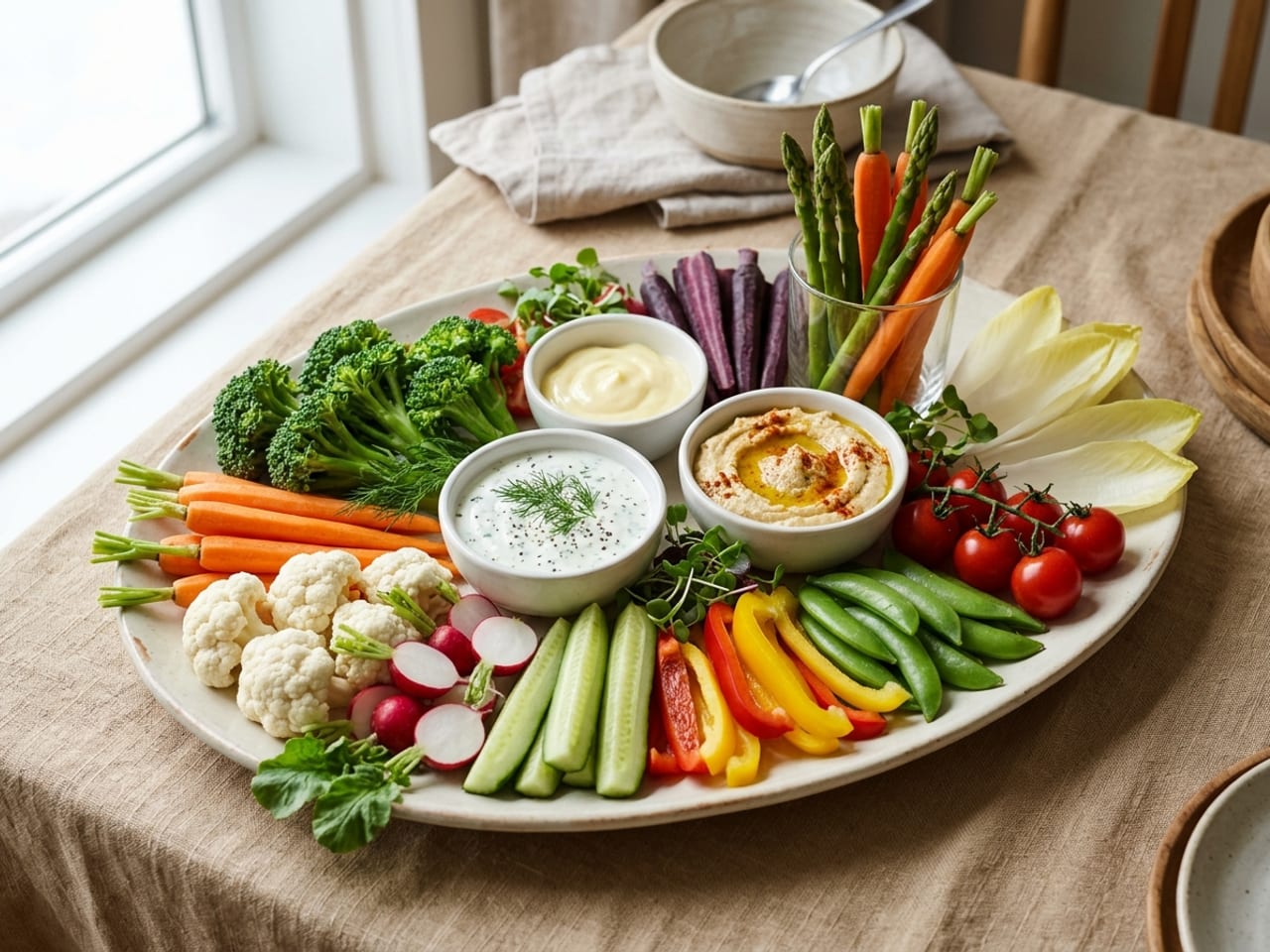
What vegetables go on a crudité platter?
Five to seven vegetables in at least four colours, chosen by job. The Mediterranean Dish asks for at least four or five.
Crisp and raw
Carrots, bunched with tops on (ATK), celery, Persian or English cucumbers (thin skins, less bitter), radishes, bell peppers, jicama, fennel. ATK’s radish heat scale: French Breakfast mild, round red and Purple Ninja hot.
Blanched green
Broccoli, green beans, asparagus, sugar snap peas: 30 to 60 seconds in boiling water, then ice.
Sweet
Whole cherry tomatoes on the vine, orange and yellow mini peppers, snap peas, rainbow carrots: they carry the sharp dips.
Bitter and peppery
Belgian endive leaves as boats, radicchio, watermelon radish sliced thin, hot red radishes: they want garlic or anchovy in the dip.
Cooked, the French way
Roasted or steamed beet quarters (The Mediterranean Dish), small boiled potatoes for an aïoli platter. Larousse counts cooked vegetables as crudités.
Extras, and which are traditional
Olives and pickles are the relish tray’s inheritance; hard-boiled eggs belong to the grand aïoli. Crackers are disputed: “Traditionally, crudités platter doesn’t contain any crackers or bread slices” (Unicorns in the Kitchen). Ours: breadsticks in a glass of their own, no cheese board in disguise.
How much crudité per person?
Our picks, inside the published figures below: 5 oz (140 g) of trimmed vegetables a guest when the platter is the main nibble before a meal, 3 oz (85 g) when it is one of several appetizers, 6 oz (170 g) for a long party with no meal; 3 tbsp of dip a guest. Buy about a third more by weight.
Cups mislead: a cup of snap peas weighs 2.2 oz (63 g), a cup of cherry tomatoes 5.3 oz (149 g); six common crudités average 3.7 oz (104 g) a cup (USDA), close to ATK’s per-guest floor of 4 oz (115 g). Store trays count smaller: a Taylor Farms serving is 1 cup (240 ml) of vegetables plus 3 tbsp of ranch, 123 g in all, about 2.7 oz (78 g) of vegetables, so its “About 12 servings” feed about eight guests at ATK’s floor.
Purchase weight is what the ranking pages leave out. The USDA Food Buying Guide gets 0.70 lb (318 g) of sticks from 1 lb (454 g) of carrots; asparagus loses 47% at the butt end (USDA SR28), so buy twice what you serve. For broccoli and cauliflower florets the USDA datasets disagree, keeping anywhere from 39% to 89% of a cauliflower, because each starts from a different head; we use about 60%. Alberta’s 1983 quantity guide allowed even more: serve 120 to 160 g, buy 170 to 250 g, about half as much again, “because of large amount of waste”.
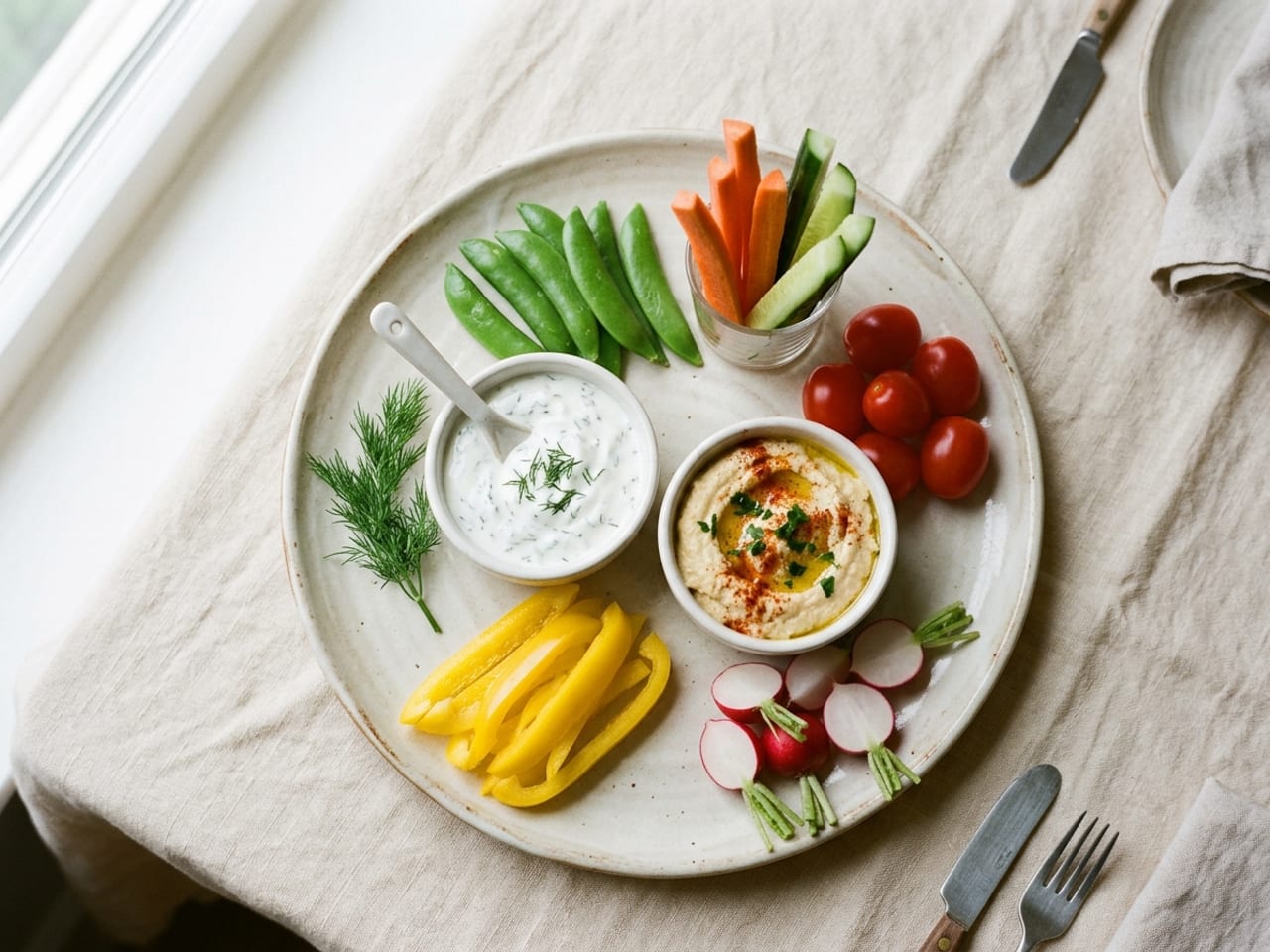
Crudités per guest: every source, by weight
Converted to weight at 3.7 oz (104 g) a cup where a source gives cups.
| Source | As given | Vegetables per guest, by weight | Dip per guest | Setting |
|---|---|---|---|---|
| America’s Test Kitchen (2022) | “4 to 6 ounces” | 4 to 6 oz (115 to 170 g) | ¼ cup (60 ml) | Hors d’oeuvre |
| Alberta Agriculture quantity guide (1983) | serve 120 to 160 g, buy 170 to 250 g | 4.2 to 5.6 oz (120 to 160 g) served | not given | Raw vegetable tray, catering |
| Feel Good Foodie | “about 4 ounces” | 4 oz (115 g) | 2 tbsp | Blog |
| Iowa State Extension AnswerLine (2026) | 12 to 16 lb (5.4 to 7.3 kg) for 50 | 3.8 to 5.1 oz (110 to 145 g) as bought | not given | Open house, other food |
| Alphafoodie | “about 1 cup” (240 ml) | about 3.7 oz (104 g) | 3 tbsp | Blog |
| My Quiet Kitchen | 6 to 8 pieces, or 1 to 1½ cups (240 to 355 ml) | about 3.7 to 5.5 oz (104 to 156 g) | not given | Blog |
| Feasting at Home | 2 to 3 lb (0.9 to 1.4 kg) for 8 to 10 | 3.2 to 6 oz (90 to 170 g) | not given | Blog |
| Ellen’s Kitchen | “Two ounces per person” | 2 oz (55 g) | 2 to 3 tbsp | Veggie tray, catering |
| Clay County, Minnesota, quantity table | 4 to 5 lb (1.8 to 2.3 kg) of sticks for 50 | 1.3 to 1.6 oz (36 to 45 g) | not given | Relish sticks with a meal |
| Taylor Farms tray serving | 1 cup (240 ml) vegetables + 3 tbsp dip, 123 g | about 2.7 oz (78 g) | 3 tbsp | Store tray |
| Plate Artists (ours) | one of several / main nibble / long party | 3 / 5 / 6 oz (85 / 140 / 170 g) trimmed | 3 tbsp | Our picks |
Crudité platter amounts for 8, 16 and 30 guests
Trimmed weight is what goes on the platter; buy weight divides it by 0.76, the blended yield of the mix in our cost table. Dip at 3 tbsp a guest.
| Guests | Trimmed, main nibble (5 oz / 140 g) | Buy for 5 oz (140 g) | Trimmed, one of several (3 oz / 85 g) | Buy for 3 oz (85 g) | Dip | Platter |
|---|---|---|---|---|---|---|
| 8 | 2.5 lb (1.1 kg) | 3.3 lb (1.5 kg) | 1.5 lb (680 g) | 2 lb (0.9 kg) | 1½ cups (355 ml), two dips | One 16 in (40 cm) round or a 14 × 20 in (35 × 50 cm) oval |
| 16 | 5 lb (2.3 kg) | 6.6 lb (3 kg) | 3 lb (1.4 kg) | 3.9 lb (1.8 kg) | 3 cups (710 ml), three dips | One 18 × 24 in (45 × 60 cm) board, or two 16 in (40 cm) rounds |
| 30 | 9.4 lb (4.3 kg) | 12.3 lb (5.6 kg) | 5.6 lb (2.6 kg) | 7.4 lb (3.4 kg) | 5⅝ cups (1.3 L), three dips per platter | Two 18 × 24 in (45 × 60 cm) boards, plus a refill platter in the fridge |
Platter sizes are ours, scaled from Skinnytaste’s 15.5 in (39 cm) round for six. Past about 16 guests, split into two platters and keep a third in the fridge: USDA FSIS advises replacing small platters “often, rather than adding fresh food to a serving dish already on the table.” For the rest of the food, use the party food calculator or the catering calculator.
Do you blanch vegetables for crudités? Vegetable by vegetable
Blanch the tough greens; leave the watery and the tender raw. Platter times are America’s Test Kitchen’s. The freezer column is why other pages say “3 minutes”.
| Vegetable | Raw or blanched | Platter time | Freezer time (not for platters) | Why |
|---|---|---|---|---|
| Broccoli florets | Blanch | 30 to 45 seconds | 3 minutes | Raw is chewy and cabbagey; the flash turns it bright |
| Green beans, haricots verts | Blanch | 30 seconds; thick beans longer, test one | 3 minutes | Raw beans are tough and taste beany |
| Asparagus | Blanch, or shave thin spears raw | 30 to 45 seconds, by thickness | 2 to 4 minutes, by stalk size | Peel the lower half; don’t snap it (ATK) |
| Sugar snap peas | Blanch or raw | 60 seconds (ATK) | 1½ to 3 minutes | Brighter green; string them first |
| Cauliflower, white, orange or green | Optional | 90 seconds | 3 minutes | Takes off the raw edge; small raw florets are fine |
| Purple cauliflower | Raw, or 90 seconds at most | 90 seconds | 3 minutes | Its purple dissolves into the water |
| Carrots | Raw; blanch only thick, old ones | 90 seconds | 2 minutes (strips) | The raw crunch is the point |
| Snow peas | Raw | none; Ellen’s Kitchen gives “pea pods” about 30 seconds | 1½ to 3 minutes | Thin and tender already |
| Watery or tender vegetables | Never | none | not relevant | Cucumber, radish, bell pepper, cherry tomato, Belgian endive, fennel, jicama, celery. Heat only wilts them. ATK’s don’t-blanch list names peppers, tomatoes, cucumbers, endive and radishes |
The freezer times are the National Center for Home Food Preservation’s, for a different job: before months in a freezer, blanching must stop the enzymes that dull flavour and colour. A platter is eaten the same day and needs only colour and a softer bite: about a quarter of the time or less for broccoli and beans, half for cauliflower. Better Homes & Gardens’ “3 minutes” for broccoli is the freezer figure.
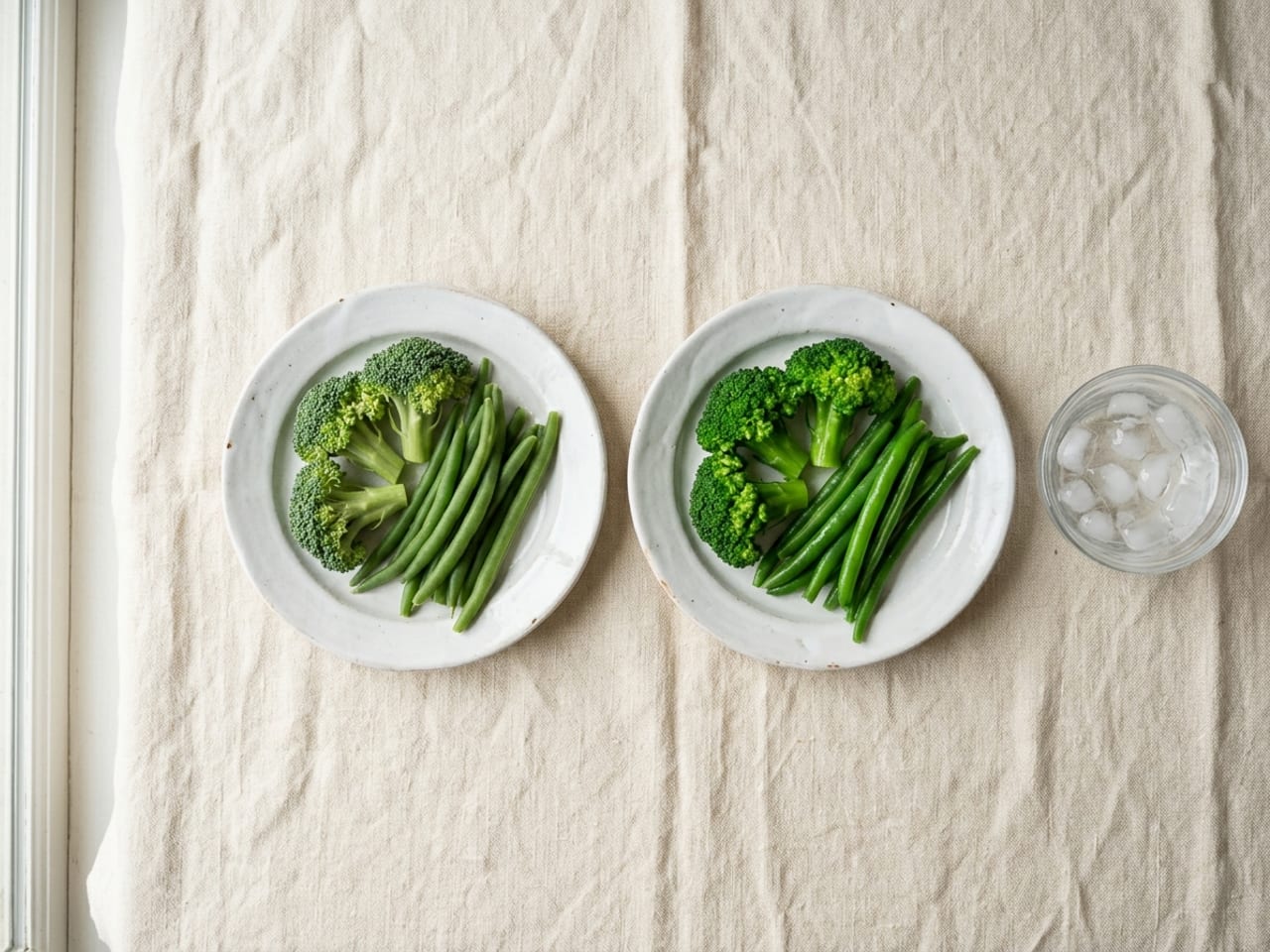
How to blanch for a platter: salt, ice, dry
Bring a big pot to a rolling boil, salt it, and set a bowl of ice water beside it. Blanch one vegetable at a time in small batches, so the water comes straight back to the boil, and time from there. Lift them into the ice until cold right through, drain, spin in a salad spinner and spread on towels: wet vegetables thin the dip.
Salt is for flavour. ATK uses “½ cup of table salt per 2 quarts of water”, ½ cup (145 g) in 2 quarts (1.9 L), about 7% by weight; Daniel Gritzer’s tests at Serious Eats found salt changed flavour, not colour or crunch. Our pick is about 3%, close to sea water: 3 tbsp of table salt to 2 quarts (1.9 L). The ice matters more: in Gritzer’s blind tastings, ice-cooled vegetables were “consistently crisper, greener, and fresher-tasting” (Laila Ibrahim’s summary, Serious Eats, 2026).
Why green goes bright, then olive: in the first seconds, gas trapped between the cells is driven out and stops scattering light (J. Kenji López-Alt, Serious Eats). Then heat and acid swap the magnesium in chlorophyll for hydrogen, making olive pheophytin, faster the more acidic the liquid 1; boiling makes more of it than steaming 2. So: short time, ice at once, and no lemony dip on blanched greens until they are eaten.
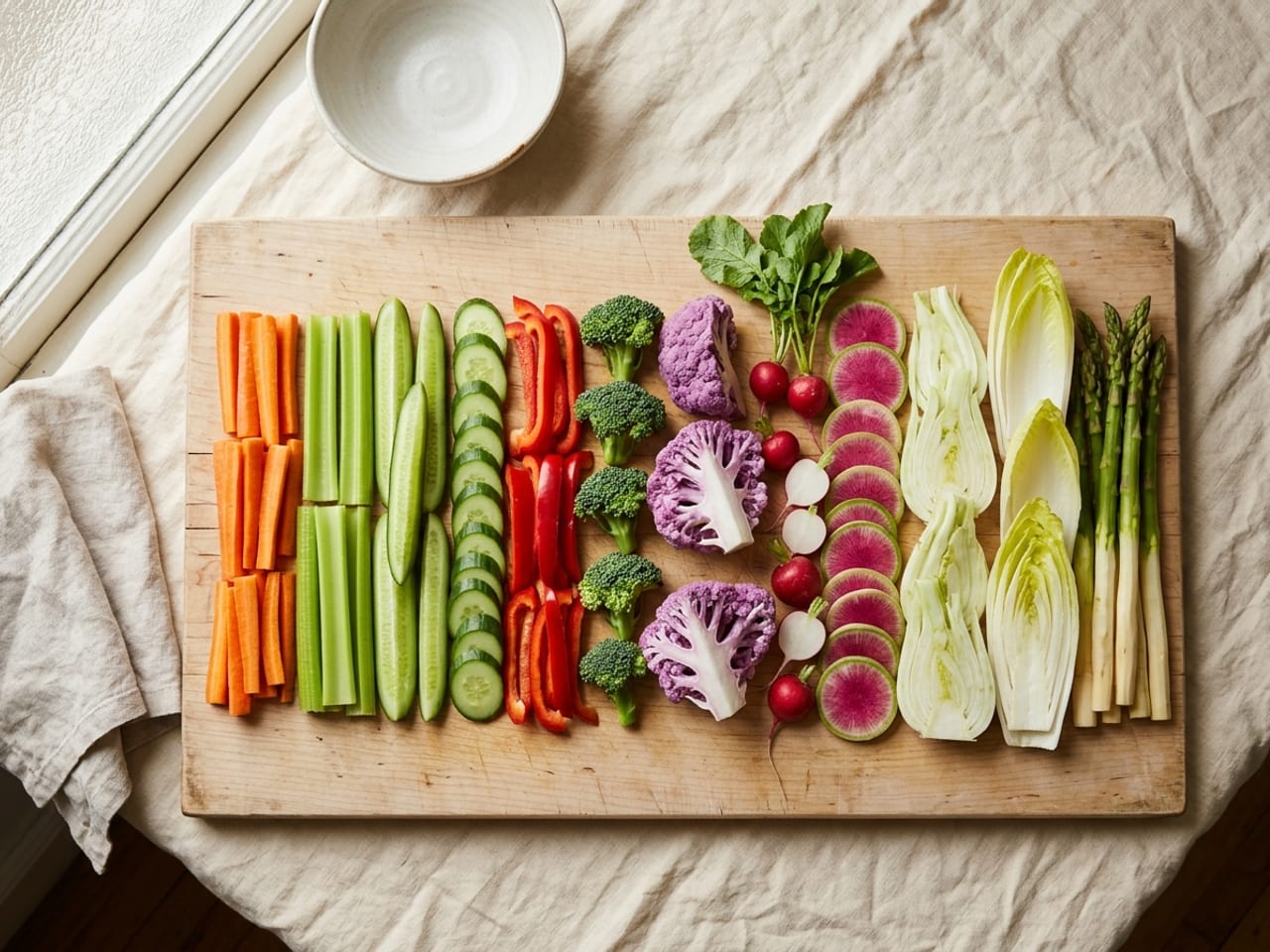
The cut for each vegetable, with sizes
Cut for one hold and one dip. The classic stick cut is the batonnet, ¼ × ¼ × 2 to 2½ in (6 × 6 mm × 5 to 6 cm); USDA’s vegetable stick is fatter, ½ × 4 in (12 mm × 10 cm), and scoops more. Our sizes sit between the two.
| Vegetable | Cut | Size |
|---|---|---|
| Carrots | Sticks; bunched carrots halved lengthwise with a little top left on | ¼ to ½ in (6 to 12 mm) thick, 2½ to 4 in (6 to 10 cm) long |
| Celery | Strings peeled, then sticks | ½ × 4 in (12 mm × 10 cm) |
| Cucumber, Persian or English | Spears, or coins cut on the bias | Spears 3 to 4 in (7.5 to 10 cm); coins ¼ in (6 mm) |
| Bell peppers | Strips along the ribs; mini peppers halved, seeds out | ½ in (12 mm) wide |
| Broccoli, cauliflower | Florets with a stem to hold; the broccoli stem peeled and cut into sticks too; coloured cauliflower quartered to show its gradient (ATK) | Heads 1 to 1½ in (2.5 to 4 cm) |
| Radishes | Whole with a green handle; large ones halved through the stem, so they sit flat; watermelon radish in rounds | Handle ½ in (12 mm); rounds ⅛ in (3 mm) |
| Fennel | Wedges through the core, so the layers hold | ½ in (12 mm) at the back |
| Belgian endive | Whole leaves, as boats | As they come |
| Asparagus | Whole spears, lower half peeled | 1 in (2.5 cm) trimmed off the base (ATK) |
| Green beans, snap peas | Whole; stem end off, strings pulled | As they come |
| Jicama, zucchini | Sticks; jicama peeled, zucchini unpeeled | ½ in (12 mm) thick, 3 to 4 in (7.5 to 10 cm) long |
| Cherry tomatoes | Whole, on the vine | Uncut, they stay out of the cut-tomato rule below |
Mix long and short cuts of one vegetable, as ATK suggests, and spears, coins and florets give rhythm even in one colour. A julienne, ⅛ in (3 mm) thick, is too thin to dip: keep it, a chiffonade of mint and a cucumber brunoise for the dips, and a tourné radish for showing off. The knife-cuts chart draws each cut at full size; knife skills covers the grip.
What dips go with crudités, and how much?
Three tbsp a guest in two or three contrasting dips: one creamy, one bean, one sharp with garlic or anchovy for the bitter leaves. Calories per 2 tbsp are USDA values, taking 2 tbsp as 30 g; 4 oz (115 g) of mixed vegetables is about 31 kcal.
Aïoli
Garlic and olive oil, usually bound with yolk: a garlic mayonnaise. Raw yolk: FDA advises pasteurized eggs for any raw-egg sauce; in the UK, FSA says British Lion or Laid in Britain eggs are safe raw even for pregnant guests and young children. Egg. About 188 kcal (USDA mayonnaise as the stand-in).
Yogurt and dill, or tzatziki
Greek yogurt, grated cucumber, garlic, dill. Milk. Tzatziki is 27 kcal (USDA FNDDS), the lightest here.
Hummus
Chickpeas, tahini, lemon. Vegan; sesame. 50 kcal for a commercial hummus (USDA).
Ranch-style
Ranch (a buttermilk herb dressing) thickened into a dip; Feel Good Foodie’s uses 1 cup (240 ml) sour cream and ½ cup (120 ml) Greek yogurt. Milk, often egg. 130 kcal, 58 if yogurt-based (USDA FNDDS).
French onion
Sour cream and onion, the California Dip line. Milk. 104 kcal, 48 made with yogurt (USDA FNDDS).
White bean
Cannellini, olive oil, lemon, herbs; Love and Lemons uses one 15 oz (425 g) can. Vegan, free of the US major allergens.
Anchoïade or bagna càuda
Anchovy, garlic and olive oil: pounded and cold in Provence; Piedmont’s bagna càuda is its hot cousin. Fish; walnut oil in some bagna càuda, milk in others. Garlic in oil can grow botulism toxin at room temperature: keep anchoïade, bagna càuda and egg-free aïoli in the fridge and use within 4 days (NCHFP, CDC). For endive, fennel, radicchio, peppers.
Romesco or muhammara
Roasted red peppers with almonds, hazelnuts or walnuts, thickened with bread. Vegan; tree nuts and wheat. A red dip where the platter runs green.
How far in advance can you make a crudité platter?
Cut most of it the day before, the watery things on the day, and assemble in the last two hours. The ranking pages say anything from 2 hours to 5 days; each is right for some vegetable.
| When | Do | How to store it, and how long it keeps |
|---|---|---|
| 2 days before | Hummus, bean dips, ranch-style and onion dips | Covered, in the fridge. Feel Good Foodie makes its ranch “up to 2 days in advance” |
| The day before | Anchoïade | In the fridge, never at room temperature; garlic in oil is used within 4 days (NCHFP, CDC) |
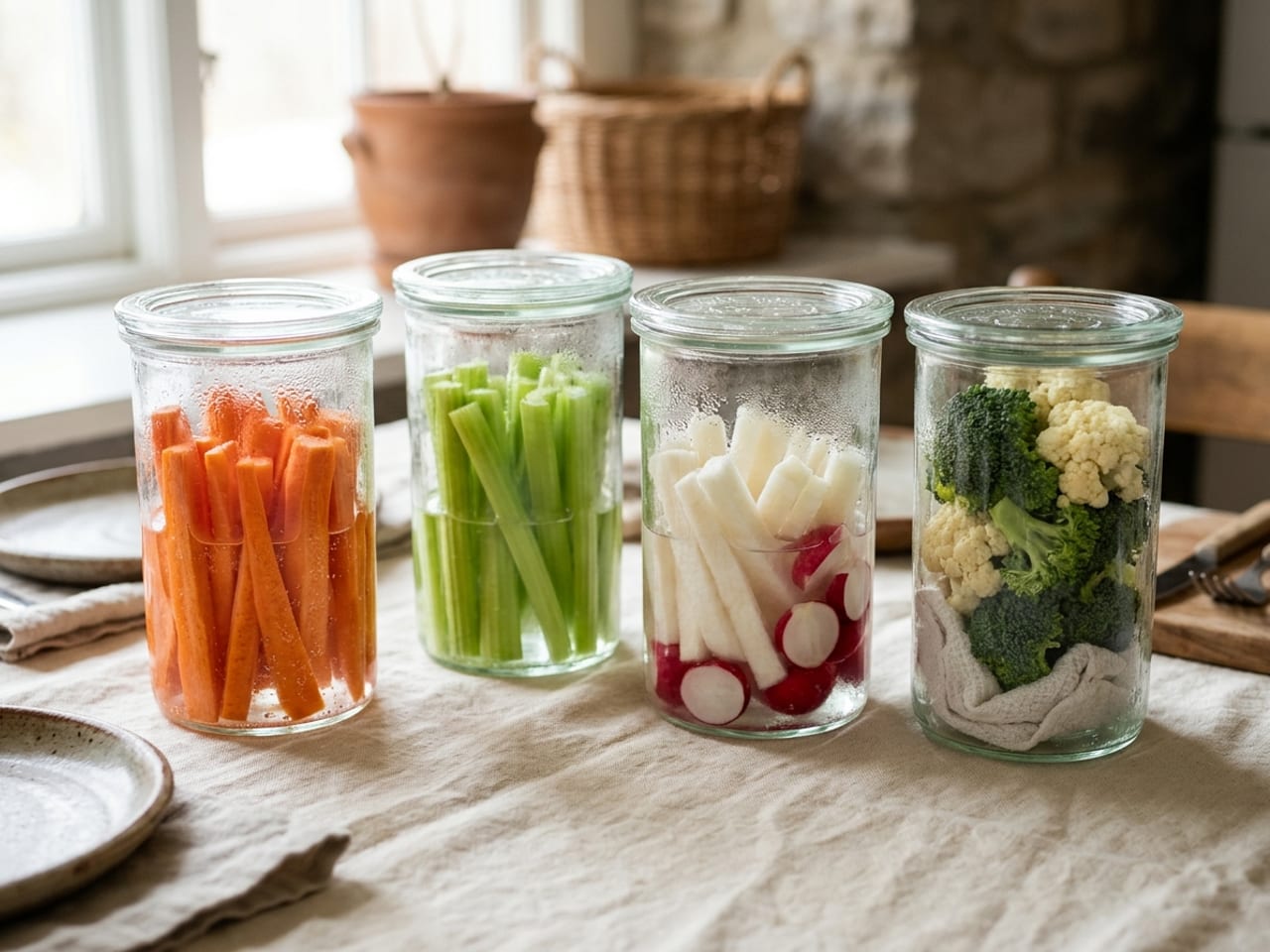
| The day before | Cut carrots, celery, jicama, radishes | Submerged in cold water in a covered container, water changed daily (Philadelphia’s produce sheet for cut carrots; Purdue’s Amanda Deering, in the Washington Post, for carrot sticks: “change the water frequently”); we treat celery, jicama and radishes the same, and the FDA Food Code lets cut raw vegetables such as celery or carrot sticks sit in ice or water. Ellen’s Kitchen, keeping them bagged with ice cubes changed daily, uses carrot sticks by day 6 and celery within a week |
| The day before | Cut broccoli and cauliflower florets; blanch the greens | Florets wrapped in a damp towel, not in water; Ellen’s Kitchen uses bagged florets by day 4. Blanched vegetables dried well, in a towel-lined container |
| The day before | Cut peppers | Dry, airtight (Philadelphia); Ellen’s Kitchen uses cut peppers by day 2 |
| The morning | Cut cucumbers; string snap peas; make aïoli | Cucumbers dry and airtight; seeded spears last to day 2 but weep, so we cut them last. Aïoli in the fridge |
| Last 2 hours | Assemble on the chilled platter | Cover with a damp towel, then plastic, in the fridge. Unicorns in the Kitchen: “up to 2 hours before serving” |
| Just before serving | Water-stored sticks into ice water, then dry; dips go on last | Straight from the fridge |
Water or towel? Carrots, celery, jicama and radishes stay crisp submerged: water moves into their cells and pushes them taut, which is also how limp celery revives. Broccoli and cauliflower waterlog, so they get a damp towel. Peppers and cucumbers go in dry and airtight.
The white blush on carrot sticks is not spoilage. It starts as surface drying that scatters light, grows faster in drier air and partly reverses in water 3; after a few days lignin forms on the cut cells and the white stays 4. McGill’s Office for Science and Society: neither has “anything to do with the safety”.
How long can a veggie tray sit out?
Two hours at room temperature, one hour above 90°F (32°C): the FDA and USDA FSIS rule, set out in full on the flagship. Under the FDA Food Code (2026 edition, unchanged from 2022 on this point), heat-treated plant food needs time and temperature control, so every blanched vegetable does, along with cut tomatoes, cut leafy greens (torn radicchio counts), raw sprouts (garnish with herbs instead) and every dip here: dairy, egg, bean, anchovy, roasted-pepper and garlic-in-oil dips all count. Raw carrot, celery, pepper and cucumber sticks are not on the Food Code’s list, but USDA still says to refrigerate cut vegetables within 2 hours, so clock the whole platter. Blanching broccoli makes it more regulated, not less.
Wash hands for 20 seconds and cut on a board that has not had raw meat on it (FDA). Wash the vegetables under running water before peeling, scrub cucumbers with a clean brush, skip soap and produce washes (FDA), and dry well. Hold it cold: FSIS suggests “nesting dishes in bowls of ice”, so set the dip bowls in crushed ice (it extends the clock only while the dip stays at 40°F (4°C) or colder), chill the platter, and swap in a fresh one from the fridge rather than topping up. Packaged trays are not exempt: in 2018, pre-packaged vegetable trays of broccoli, cauliflower, carrots and dill dip were linked to a cyclosporiasis outbreak: 250 laboratory-confirmed cases in people from four Midwest states, eight of them hospitalized (CDC; the trays were bought in three, since Michigan’s cases bought theirs in Wisconsin).
How to arrange a crudité platter, in build order
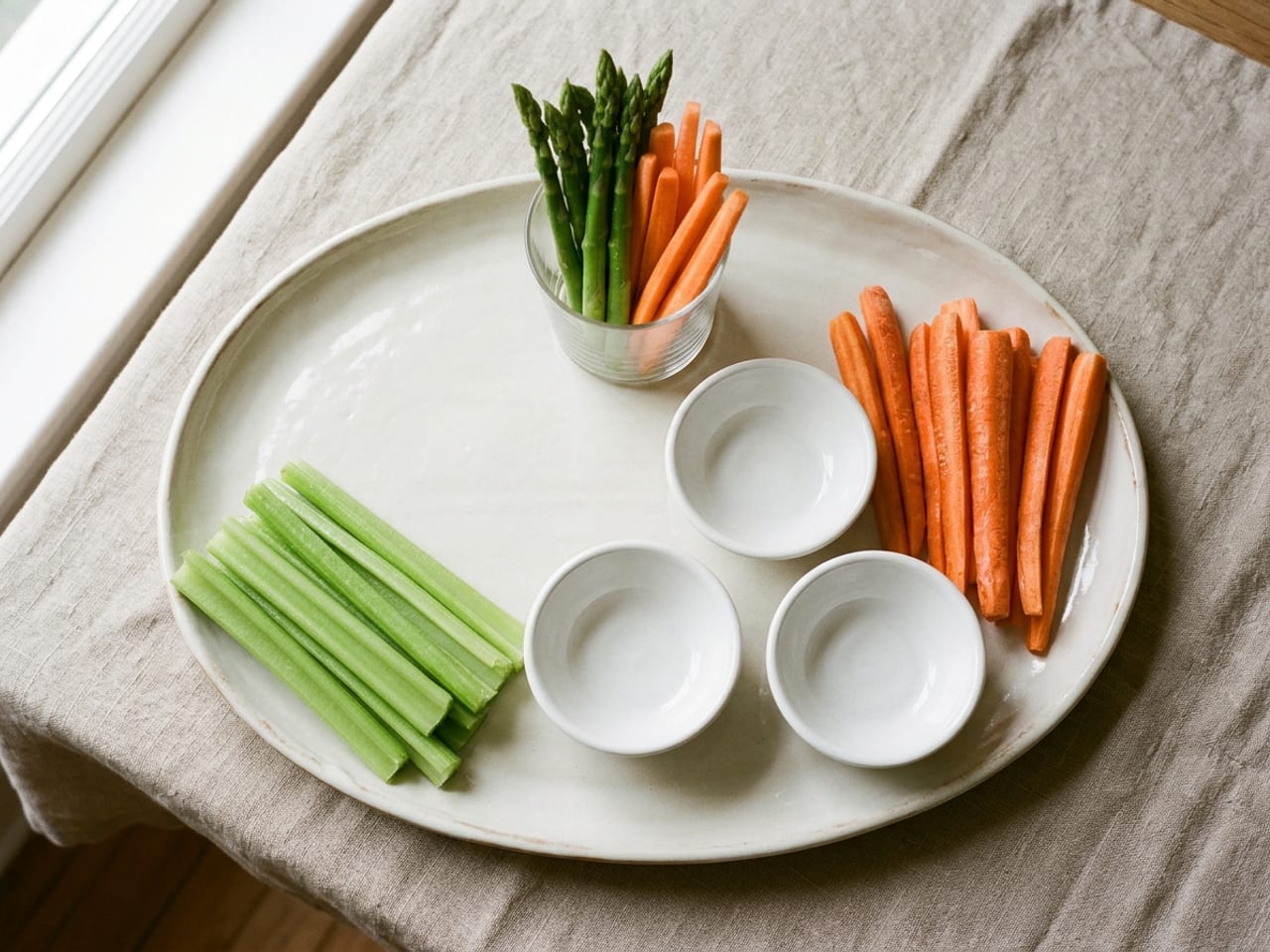
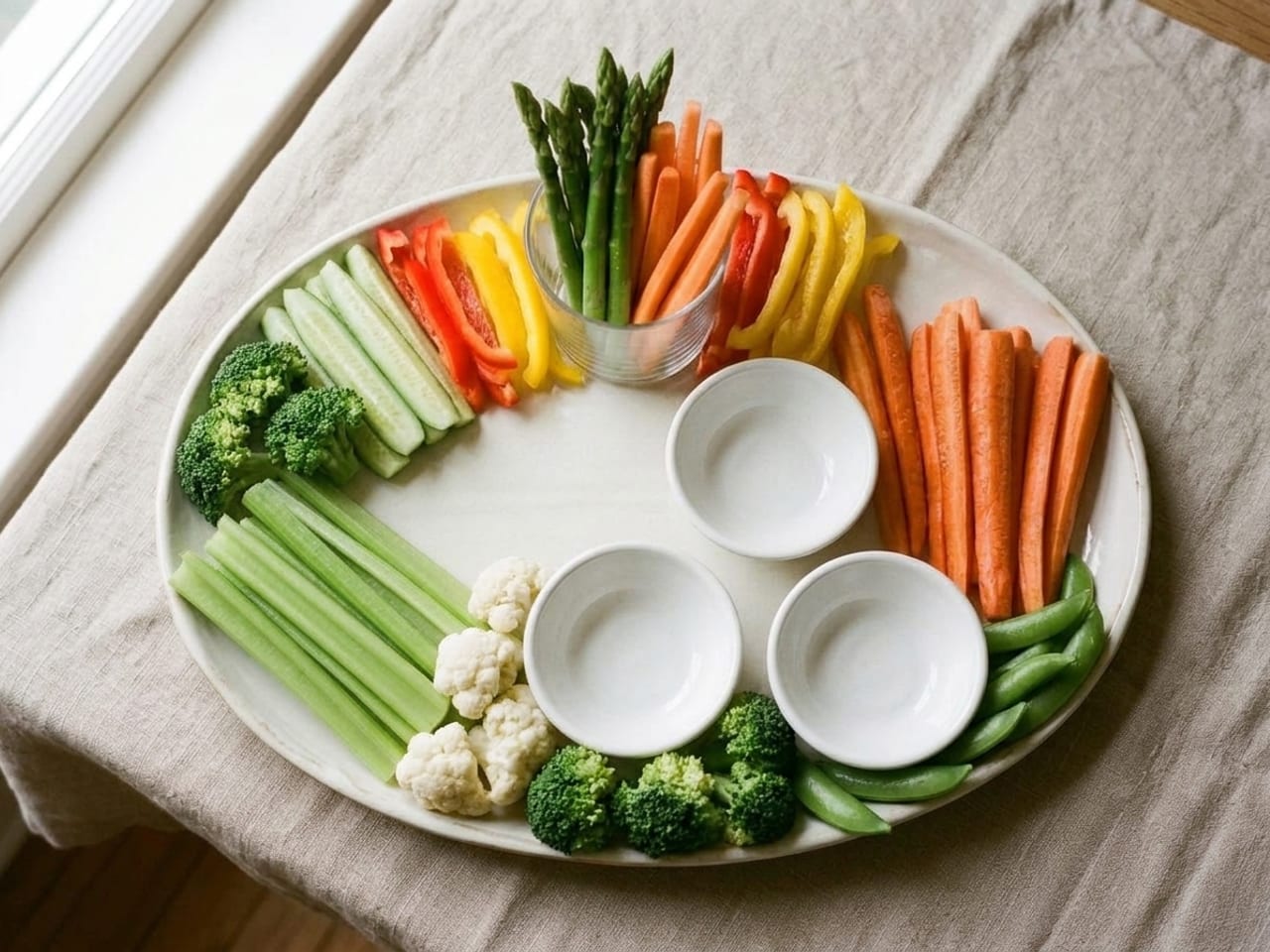
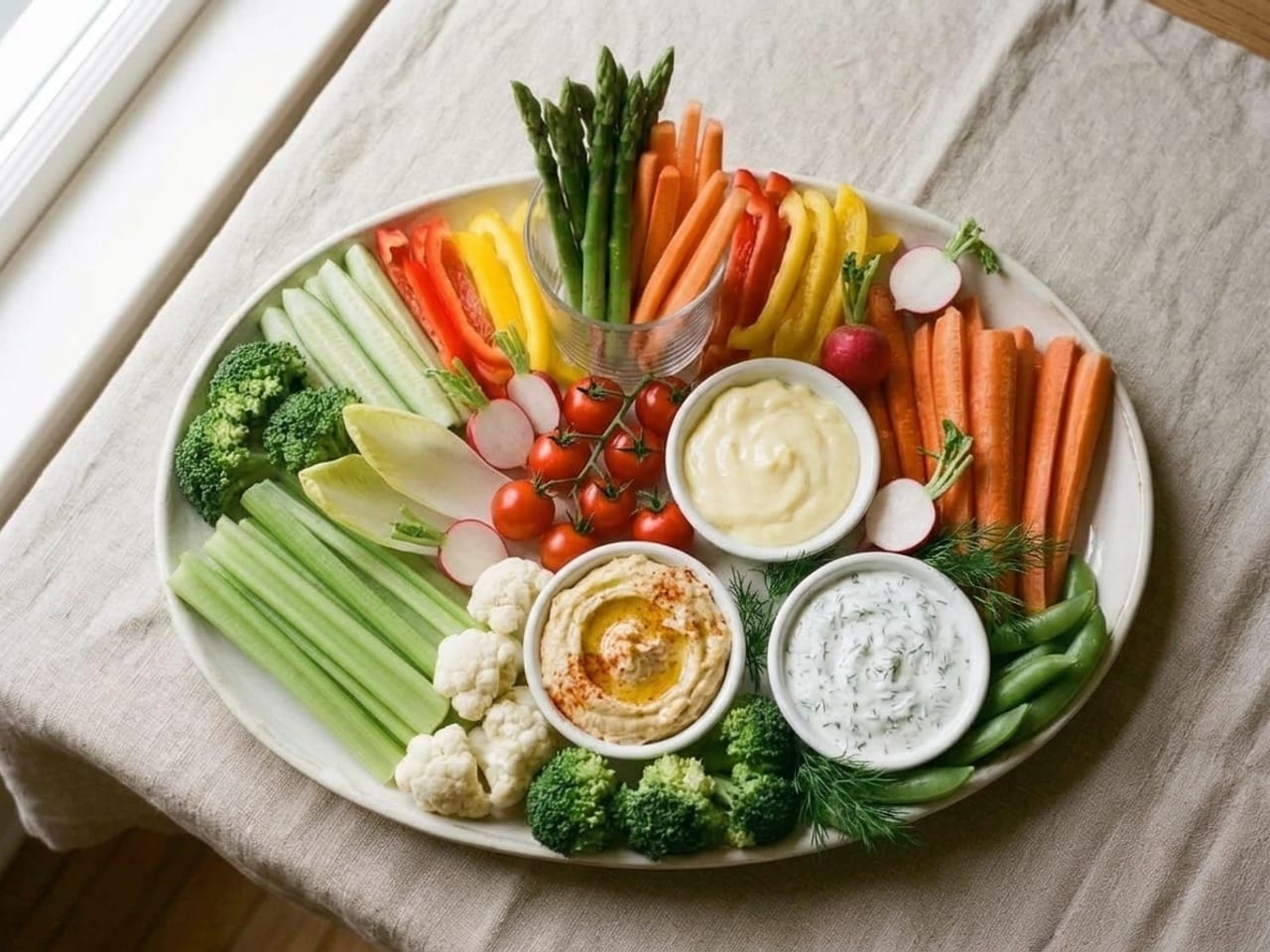
Three stages, photographed on the same platter: anchors, colour, then the fill.
- A cold baseChill the platter while you cut, or build on a tray over crushed ice for a long party; ice only buys time if the food stays at 40°F (4°C) or below, so check with a thermometer or keep to the two-hour swap. Big but not too big: a huge board for a little food “will make your board look sparse” (Jessica in the Kitchen).
- Dips first, as anchorsBowls before any vegetable (ATK: “Place the dips down first”), an odd number (Belly Rumbles), three in a loose triangle (Jessica in the Kitchen), off-centre. Place them empty; fill them last, from the fridge.
- The largest and longestLong items on the perimeter, small pieces in the middle (ATK); asparagus, carrot and celery spears standing in a short glass at the back for height.
- Colour in bandsGreen first and spread out, or it becomes “a giant green mass” (Belly Rumbles). Then orange, red, white and purple between, no two same-colour groups touching: no celery against cucumber, no red pepper against tomato (Unicorns in the Kitchen). On a big platter, split each vegetable into two or three places (My Quiet Kitchen).
- Fill, but leave roomRadishes and tomatoes into the gaps (Jessica in the Kitchen). Leave about 1 in (2.5 cm) of platter between groups so a hand can reach in, and turn cut faces inward, where they dry more slowly.
- Garnish and the wiped edgeA few sprigs of dill or mint, a pinch of flaky salt just before serving (Feasting at Home), the rim wiped, the dips filled.
The colour palette, pigment by pigment
Four pigment families paint the platter. Chlorophyll (broccoli, beans, cucumber, snap peas) goes olive with acid and time. Carotenoids (carrots, peppers, tomatoes, orange cauliflower) are fat-soluble 5, so they stay put in water and beside wet dips. Anthocyanins (purple carrots and cauliflower, radicchio, radish skins) dissolve in water and change with pH: red in acid, blue and unstable above about pH 6 5, 6. Hard, alkaline tap water can tint purple cauliflower blue-green, and a purple stick left standing in a white dip stains it. Betalains (beets) hold colour from about pH 3 to 7 but bleed into anything wet 7: keep red beets away from white dips, or use golden and Chioggia.
Read it as a colour wheel with no neighbours the same: our colour on the plate guide explains why, and the plate colour pairing tool picks a platter to set it off.
Crudité platter ideas: seasonal, shaped and classic
The rest of the holiday spread is on the Christmas appetizers and Thanksgiving sides hubs.
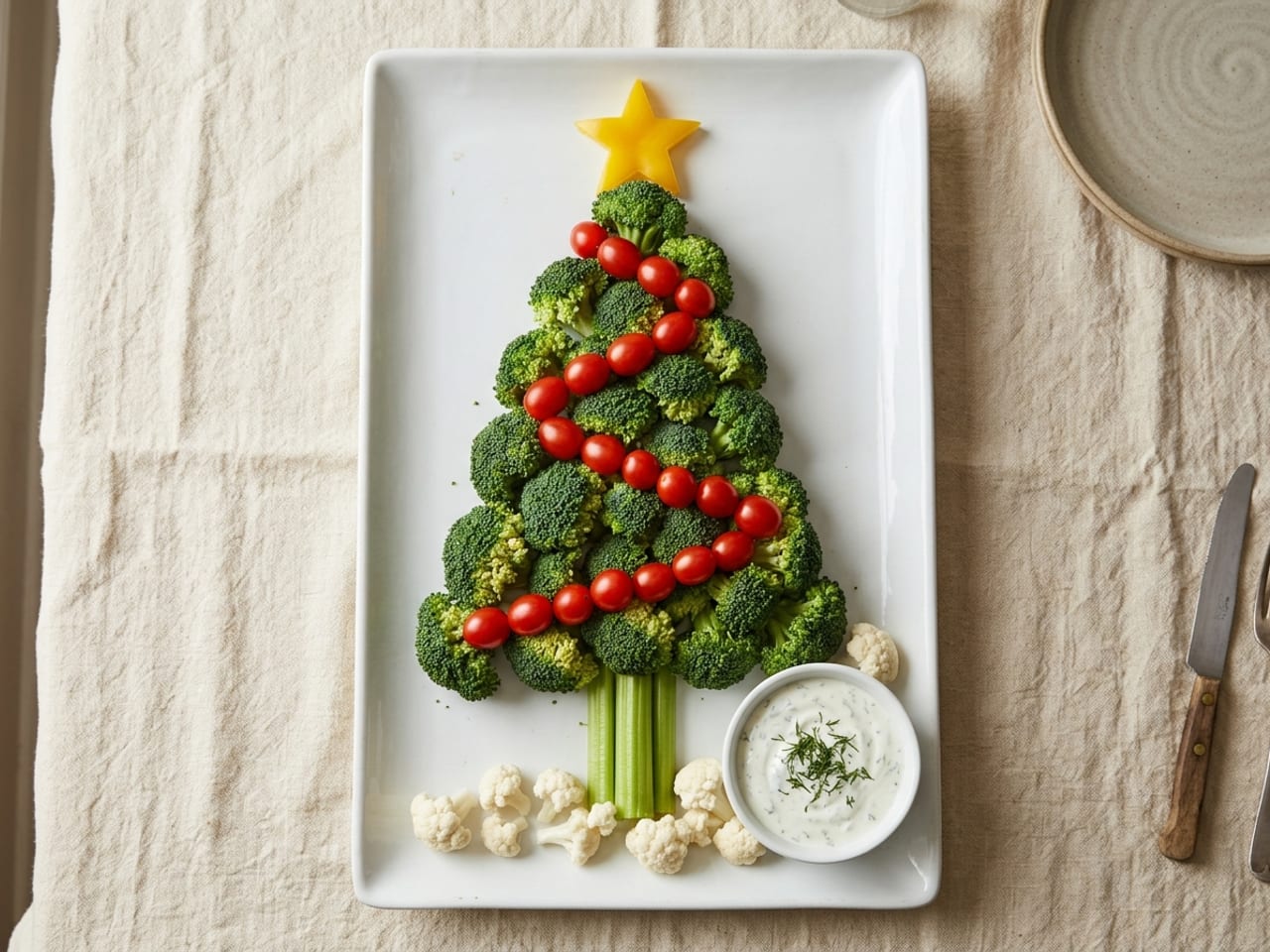
- Christmas treeBroccoli packed into a triangle, a cherry or grape tomato garland, a yellow pepper star, cauliflower snow and the dip beside it: Betty Crocker’s flat version, reposted in 2011, used pretzel sticks for the trunk; a celery trunk keeps it all vegetable.
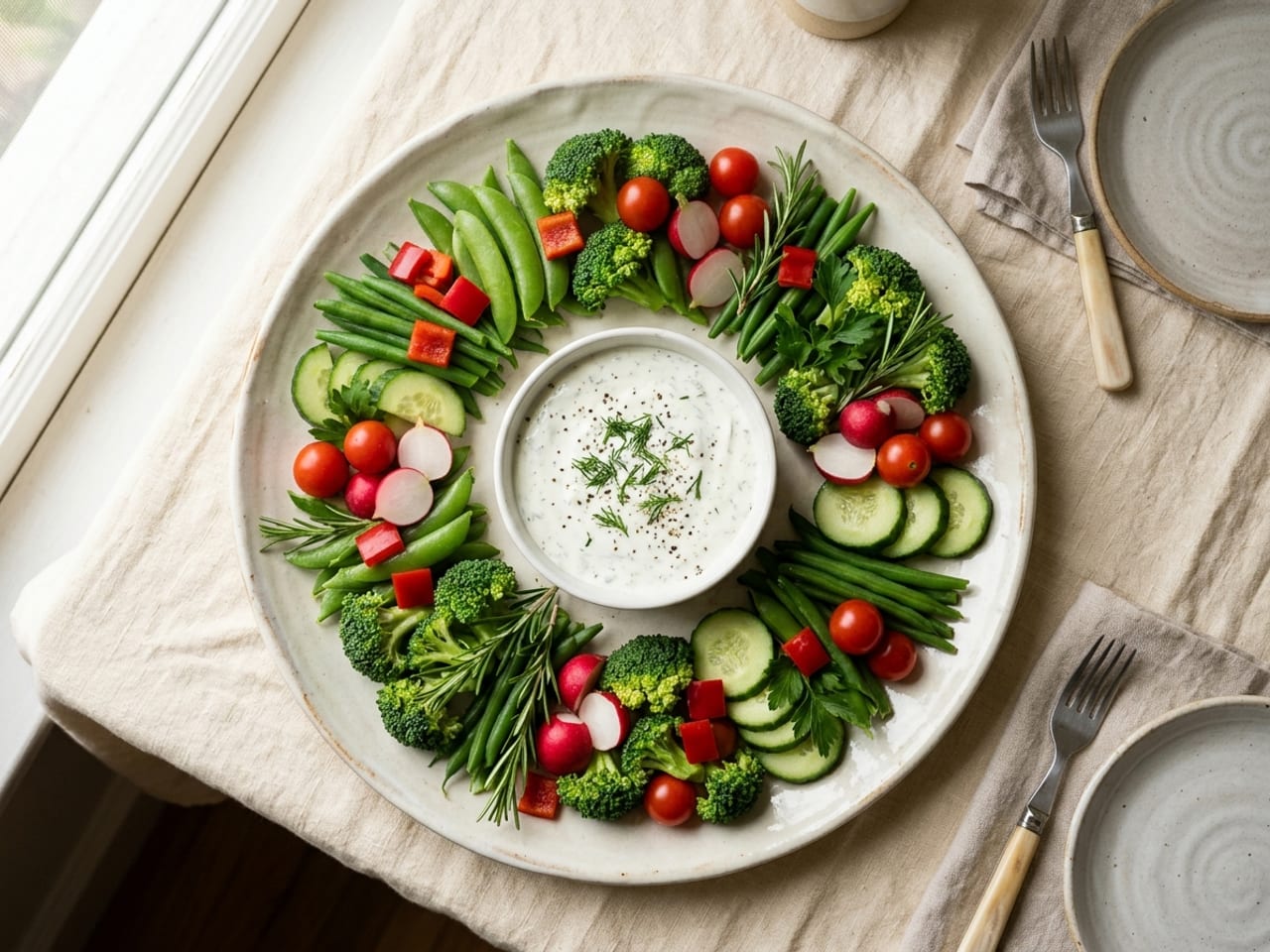
- WreathA ring of green (broccoli, snap peas, beans, cucumber) dotted with tomatoes, radishes and red pepper around a central bowl of dip. Southern Living did it in 1979, on a parsley-covered foam ring.
- Thanksgiving turkeyPepper strips, carrot, cucumber and celery fanned as feathers behind the dip bowl; the geometry is on the Thanksgiving board.
- Spring or EasterRadishes with their leaves, carrots with tops, snap peas, blanched asparagus, a yogurt-dill dip and a few edible flowers.
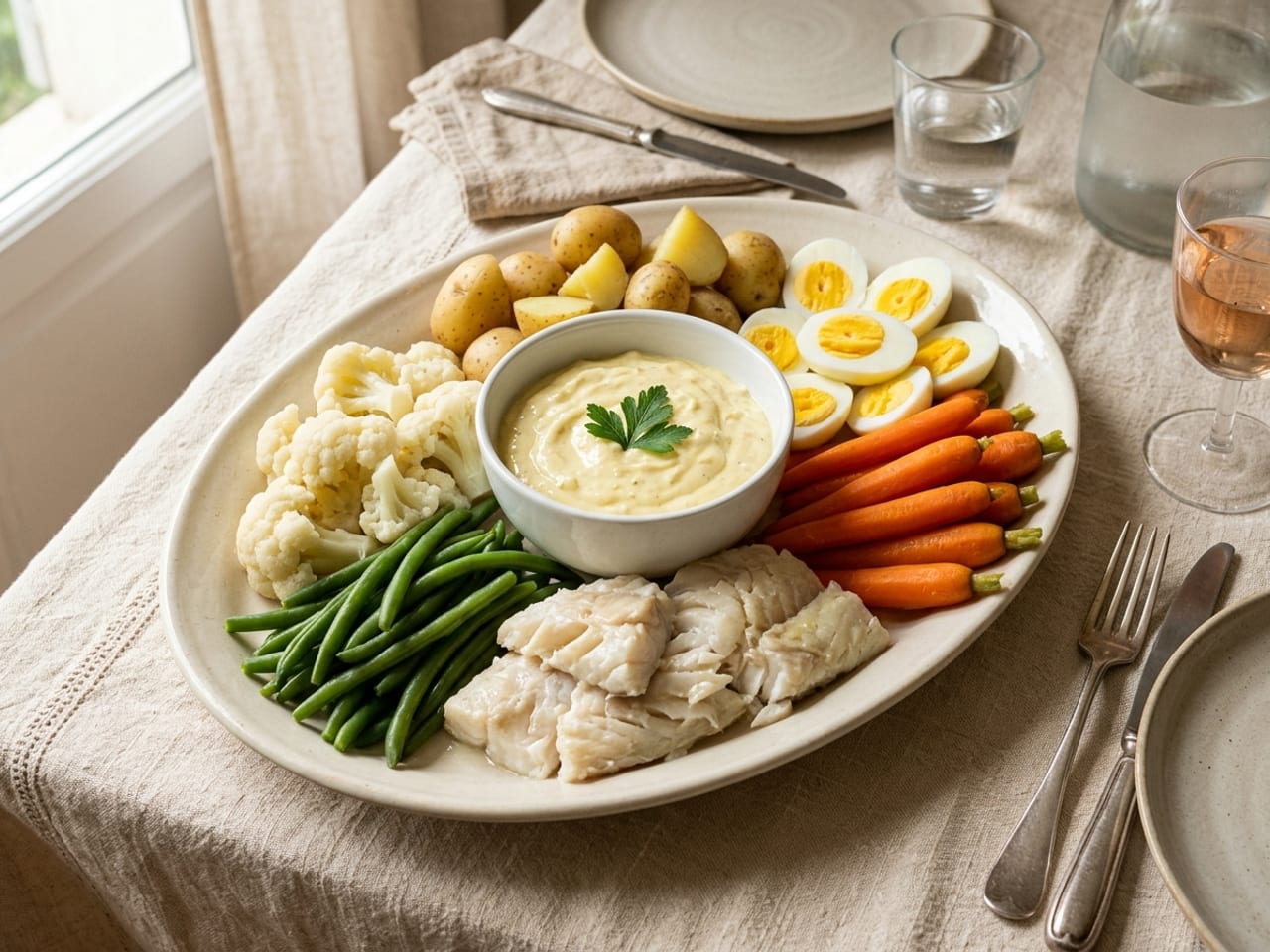
- Grand aïoliProvence’s feast: boiled potatoes, carrots, green beans and cauliflower, hard-boiled eggs and poached salt cod around the aïoli. Cooked, and a meal. Egg, fish; all of it on the two-hour clock.
- Bagna càudaPiedmont’s hot anchovy-garlic oil with raw peppers, cardoons, cabbage hearts and endive, plus boiled potatoes and beets (Accademia Italiana della Cucina, 2005).
- PinzimonioCentral Italy’s version (cazzimperio in Rome): raw fennel, celery, radishes and artichokes, and a small bowl of olive oil, salt and pepper for each guest.
- Japanese-styleAn adaptation, not a tradition: cucumber, daikon and carrot sticks upright in glasses over ice, with miso mayonnaise and a sesame dip. Egg, soy, sesame, and usually wheat (soy sauce; some miso is made with barley).
- Kids’ platterCucumber spears, carrot sticks rather than coins, snap peas, cherry tomatoes quartered lengthwise, ranch-style dip in small cups. For under-fours, AAP lists raw vegetables such as carrot sticks among choking foods: steam carrots and green beans until soft, quarter the tomatoes, skip raw snap peas and radishes, and cut everything to ½ in (12 mm) or smaller (AAP, CDC). Quartered tomatoes are cut tomatoes: cut them last and keep that platter on the two-hour clock.
- Crudité cupsDip in the bottom of a small glass, sticks standing in it: Feasting at Home’s catering format. No double-dipping, and good for 30.
- Keto or low-carbCelery, cucumber, radishes, peppers and broccoli with full-fat dips. Carrots carry about twice cucumber’s net carbs (6.8 g against 3.1 g per 100 g, USDA SR28); snap peas (5.0 g) sit close to broccoli (4.0 g).
- BudgetCarrots, cucumbers, celery and red peppers, the cheapest per pound in our cost table ($1.01 to $1.71 a lb, $2.22 to $3.76 a kg, USDA ERS 2023), and a white bean dip.
- Platter for twoAbout 10 oz (280 g) trimmed on a 10 in (25 cm) plate: four or five vegetables, two small dips, a spear jar the size of a shot glass.
- Assiette de cruditésThe Paris bistro starter: grated carrot, celeriac rémoulade, beetroot, cucumber and radishes with butter, each dressed, eaten with a fork. Celery, egg, mustard and milk.
Allergens and diets on a crudité platter
The vegetables are vegan and gluten-free, and only celery is an allergen among them (in the EU and UK); the dips carry the rest. Label each bowl, and keep celery in its own spot if a guest is allergic to it.
- CeleryOne of the EU’s 14 allergens (Regulation 1169/2011), celeriac included; not a US major allergen. It also hides in celery salt and celery seed in some seasoning blends and dip mixes, and on a platter the sticks touch everything beside them.
- MustardAnother EU allergen: Dijon-based dips, many vinaigrettes, the dressing on an assiette de crudités.
- SesameHummus, tahini and baba ganoush. The ninth US major allergen, on labels since 1 January 2023 (FASTER Act), and an EU allergen.
- Egg and milkEgg in aïoli, mayonnaise dips and many ranch dressings; milk in yogurt, sour cream, ranch, onion, blue cheese and tzatziki dips.
- Fish and tree nutsAnchovy in anchoïade, bagna càuda and classic green goddess (check the recipe); almonds, hazelnuts or walnuts in romesco and muhammara, and walnut oil in some bagna càuda.
- Vegan and gluten-freeHummus, white bean and romesco are vegan. Crackers, breadsticks (often sesame too) and some packaged dips carry wheat, and romesco and muhammara are thickened with bread: read labels, and if a coeliac or sesame-allergic guest is coming, give the breadsticks their own glass, not the spear jar. Give the vegan dip its own end and spoon.
Is it cheaper to make a crudité platter or buy a veggie tray?
Sixteen guests at 5 oz (140 g): about $12.50 of vegetables, 78 cents a guest before dip, at USDA ERS 2023 national average prices. They are averages, not this week’s shelf prices; store sites blocked our checks, so re-price in store. Dips are not priced.
| Item | Amount | Price | Note |
|---|---|---|---|
| Carrots, whole | 1.43 lb (649 g) for 1 lb (454 g) of sticks | $1.44 | $1.01 a lb ($2.22 a kg); yield 0.70 (USDA Food Buying Guide) |
| Celery, trimmed bunch | 0.68 lb (308 g) for 0.5 lb (227 g) | $0.91 | $1.33 a lb ($2.93 a kg); yield 0.73 (ERS) |
| Cucumbers | 0.77 lb (349 g) for 0.75 lb (340 g) | $0.84 | $1.09 a lb ($2.41 a kg); yield 0.97 (ERS) |
| Red peppers | 0.91 lb (413 g) for 0.75 lb (340 g) | $1.56 | $1.71 a lb ($3.76 a kg); yield 0.82 (ERS) |
| Broccoli, heads | 0.82 lb (372 g) for 0.5 lb (227 g) of florets | $2.48 | $3.02 a lb ($6.67 a kg); yield 0.61 florets only (USDA SR28); about 0.8 if you use the peeled stem too (Food Buying Guide) |
| Cauliflower, heads | 0.81 lb (367 g) for 0.5 lb (227 g) of florets | $1.71 | $2.12 a lb ($4.68 a kg); yield 0.62 (Food Buying Guide) |
| Grape and cherry tomatoes | 0.55 lb (249 g) for 0.5 lb (227 g) | $2.28 | $4.16 a lb ($9.16 a kg); yield 0.91 (ERS) |
| Radishes | 0.28 lb (127 g) for 0.25 lb (113 g) | $0.51 | $1.85 a lb ($4.08 a kg); yield 0.90 (ERS) |
| Green beans | 0.29 lb (132 g) for 0.25 lb (113 g) | $0.79 | $2.66 a lb ($5.86 a kg); yield 0.85 (ERS) |
| Homemade total, 16 guests | 6.55 lb (2.97 kg) bought, 5 lb (2.27 kg) trimmed | $12.52 | $0.78 a guest, dips extra |
| Walmart Marketside tray with ranch dip | 40 oz (1.13 kg) | $11.97 | Search-result snapshot, 7 Nov 2026; 20 oz (567 g) is $6.97 |
| ShopRite, Taylor Farms tray with ranch dip | 40 oz (1.13 kg) | $12.99 | Search-result snapshot, 7 Nov 2026 |
| H-E-B, Taylor Farms dual-dip tray | 32 oz (907 g) | $8.98 | Search-result snapshot, 7 Nov 2026 |
Three 40 oz (1.13 kg) Walmart trays cost $35.91 and, if about 63% vegetables by weight like a Taylor Farms serving (78 of 123 g), give 16 guests about 4¾ oz (135 g) each. Homemade is about $12.50 of vegetables at 2023 prices, plus dips, with nine vegetables cut, blanched and coloured your way; the dips and three years of price rises narrow the gap, so make it for variety and freshness more than the saving.
The history a platter can carry
For about five hundred years, crudités also meant indigestion. The first French sense, in 1398, is the state of being hard to digest (TLFi); the Académie française kept the stomach sense, “Il a des crudités d’estomac”, from its 1762 edition to its 1932 one. Doctors forbade raw food: the Montpellier consultation Tobias Smollett printed in 1766 bans “autres crudites, alimens grossiers, ou de difficille digestion”. Escoffier’s Guide culinaire (1907) never uses the word.
Vitamins turned it round. In 1919 Gustave Houlbert told nursing and pregnant women to eat “des crudités tels que des hors-d’œuvres”; in 1931 the naturist doctor Paul Carton prescribed “Les hors d’œuvre vitalisants”. “Assiette de crudités” is in print by 1955 (“plat de crudités” by the 1930s).
English had the word before its dictionaries: Etymonline says 1960, but James Beard and Sam Aaron wrote in 1954 of “serving a variety of raw vegetables (the French call this les crudités) with two or three good dips or dunks”. California Dip (1954 to 1955) was first served with potato chips and crackers; ranch was devised in Alaska around 1950, and “Veggie Tray (with Ranch Dip)” was in a Wisconsin student dining ad by 1990.
Shaped trays are older than Pinterest. Southern Living served dip “from a wreath of fresh vegetables” in 1979, and on 21 December 1983 the Twin Falls Times-News pinned vegetables to a styrofoam cone: “The easy-to-create vegetable Christmas tree is an alternative to the relish tray.” The relish tray’s story is on the Thanksgiving board.
Five things to avoid on a crudité platter
The flagship’s general five are on the charcuterie board guide. These are the platter’s.
- Freezer blanching timesThree minutes is for the freezer. On a platter it makes broccoli soft and olive; 30 to 45 seconds, then ice.
- Lemon on blanched greensAcid turns chlorophyll olive 1. Keep lemony dips in their bowl and the greens dry until eaten.
- Cucumbers and tomatoes cut the night beforeCucumbers weep, cut tomatoes leak and become a Food Code TCS food. Cucumbers on the morning; tomatoes whole.
- Red beets beside whiteBetalains bleed into anything wet 7. Golden or Chioggia beets, or red ones in a bowl of their own.
- Topping up the dipAfter two hours out, a bowl is done. Bring a fresh, cold one from the fridge; never add new dip to old.
Your platter, re-arranged
Photograph the crudité platter you built, upload it, and Plate Artists returns it re-arranged: dips anchored, colours in bands, gaps left for hands. Same vegetables, better platter.
Start free · 1 enhancement →Free account · 1 free enhancement · No credit card
Crudité platter questions, answered
How much crudité per person?
5 oz (140 g) of trimmed vegetables and 3 tbsp of dip a guest when the platter is the main nibble before a meal, 3 oz (85 g) when it is one appetizer of several, 6 oz (170 g) for a long party with no meal: our picks, inside the published range (ATK: 4 to 6 oz (115 to 170 g); Ellen’s Kitchen: 2 oz (55 g) for a catering tray). Buy a third more by weight, twice as much asparagus.
How far in advance can you make a crudité platter?
Most dips up to 2 days ahead, anchoïade the day before, aïoli on the morning. Carrots, celery, radishes and jicama the day before, kept in water; florets and peppers the day before, in a damp towel or dry; cucumbers on the morning. Assemble in the last 2 hours, covered, in the fridge.
How do you pronounce crudités?
kroo-dih-TAY in American English (Merriam-Webster); British English stresses the first syllable, KROO-dih-tay (Cambridge Dictionary). French: [kʁy.di.te]. For the food the word is plural.
What vegetables go on a crudité platter?
Five to seven in four or more colours: raw carrots, celery, cucumbers, radishes, peppers and whole cherry tomatoes; blanched broccoli, green beans, asparagus and snap peas; endive or radicchio for bitterness; fennel or jicama for crunch.
Do you blanch vegetables for crudités?
The tough greens: broccoli 30 to 45 seconds, green beans 30, snap peas 60, asparagus 30 to 45, then ice water (ATK). Never cucumbers, radishes, peppers, tomatoes or endive. The 3-minute times elsewhere are freezer times.
How long can a veggie tray sit out?
2 hours, 1 hour above 90°F (32°C) (FDA, USDA FSIS), for the whole platter. Blanched vegetables, cut tomatoes and every dip are Food Code TCS foods; ice helps only while they stay at 40°F (4°C) or colder, so swap in a fresh platter from the fridge.
What dips go with crudités?
Two or three that differ: creamy (ranch-style, tzatziki, French onion), bean (hummus, white bean) and sharp (aïoli, anchoïade, bagna càuda). 3 tbsp of dip a guest in all.
What is the difference between crudités and a veggie tray?
Little in substance. The veggie tray descends from the relish tray and the tub of ranch; a crudité platter is cut to size, arranged by colour and carries two or three dips.
Do you put crackers on a crudité platter?
Traditionally no (Unicorns in the Kitchen), though Belly Rumbles and Alphafoodie add them. A few breadsticks in a glass of their own are plenty.
Why do carrot sticks turn white?
Surface drying, not spoilage. It partly reverses in water; after a few days lignin forms and the white stays. Store carrot sticks in water.
Is crudité singular or plural?
Plural for the food: crudités. The French singular crudité means rawness, or crudeness of speech. “Crudité platter” is English shorthand.
Is a crudité platter gluten-free?
The vegetables are. Check crackers, breadsticks and packaged dips or seasoning mixes for wheat; hummus, a homemade yogurt dip and aïoli are gluten-free if every ingredient is. Romesco and muhammara usually contain bread. Keep breadsticks out of the vegetable glass.
The research behind this guide
Peer-reviewed studies, retrieved via PubMed and Crossref. Every numbered figure quoted above comes from one of these papers.
- Koca, N., Karadeniz, F., & Burdurlu, H. S. (2007). Effect of pH on chlorophyll degradation and colour loss in blanched green peas. Food Chemistry, 100(2), 609-615. doi:10.1016/j.foodchem.2005.09.079
- Turkmen, N., Poyrazoglu, E. S., Sari, F., & Velioglu, Y. S. (2006). Effects of cooking methods on chlorophylls, pheophytins and colour of selected green vegetables. International Journal of Food Science & Technology, 41(3), 281-288. doi:10.1111/j.1365-2621.2005.01061.x
- Cisneros-Zevallos, L., Saltveit, M. E., & Krochta, J. M. (1995). Mechanism of surface white discoloration of peeled (minimally processed) carrots during storage. Journal of Food Science, 60(2), 320-323. doi:10.1111/j.1365-2621.1995.tb05664.x
- Howard, L. R., & Griffin, L. E. (1993). Lignin formation and surface discoloration of minimally processed carrot sticks. Journal of Food Science, 58(5), 1065-1067. doi:10.1111/j.1365-2621.1993.tb06113.x
- Tanaka, Y., Sasaki, N., & Ohmiya, A. (2008). Biosynthesis of plant pigments: anthocyanins, betalains and carotenoids. The Plant Journal, 54(4), 733-749. doi:10.1111/j.1365-313X.2008.03447.x
- Mattioli, R., Francioso, A., Mosca, L., & Silva, P. (2020). Anthocyanins: a comprehensive review of their chemical properties and health effects on cardiovascular and neurodegenerative diseases. Molecules, 25(17), 3809. doi:10.3390/molecules25173809
- Azeredo, H. M. C. (2009). Betalains: properties, sources, applications, and stability, a review. International Journal of Food Science & Technology, 44(12), 2365-2376. doi:10.1111/j.1365-2621.2007.01668.x
Agency guidance, dictionaries and archives cited by name in the text:
- America’s Test Kitchen, Liz Bomze, How to make a stunning crudités platter (2022): 4 to 6 oz (115 to 170 g) per person, platter blanching times, salt ratio
- Alberta Agriculture, Home Economics Branch, Food purchasing guide for quantity service (1983): raw vegetable tray, serve 120 to 160 g, buy 170 to 250 g
- Iowa State University Extension, AnswerLine, Graduation party tips (2026): veggie tray for 50
- Clay County, Minnesota, Cooking for large groups (vegetable sticks for relish, amounts for 50)
- Ellen’s Kitchen, Appetizers and salads for a crowd (amounts per person; keeping times for cut vegetables)
- Feel Good Foodie, Crudité platter (4 oz (115 g) per person, 2 tbsp dip; ranch-style dip)
- Alphafoodie, Crudité platter (1 cup (240 ml) and 3 tbsp dip per person)
- My Quiet Kitchen, How to build a veggie tray (1 to 1½ cups (240 to 355 ml) per person; colour placement)
- Feasting at Home, Crudités platter (2 to 3 lb (0.9 to 1.4 kg) for 8 to 10; crudité cups)
- Taylor Farms, Dual dip veggie tray 52 oz (1.47 kg) (serving size), read 7 Nov 2026
- USDA FNS, Food Buying Guide for Child Nutrition Programs, vegetables yield table
- USDA ARS, National Nutrient Database for Standard Reference, Release 28 (refuse, portion weights, nutrients)
- USDA ARS, FNDDS 2021-2023 nutrient values (dips)
- USDA ERS, Fruit and vegetable prices (2023 national average retail prices, updated December 2025)
- Walmart, fruit and veggie trays category (Marketside tray prices, search-result snapshot 7 Nov 2026)
- ShopRite, Taylor Farms vegetable tray with ranch dip 40 oz (search-result snapshot 7 Nov 2026)
- H-E-B, Taylor Farms vegetable tray with dual dip (search-result snapshot 7 Nov 2026)
- National Center for Home Food Preservation, Blanching times (freezer table)
- Serious Eats, J. Kenji López-Alt, How to blanch spring produce (why green brightens)
- Serious Eats, Daniel Gritzer, Blanching vegetables (salt tests; blind tasting of ice-cooled vegetables)
- Serious Eats, Laila Ibrahim, Common vegetable cooking myths (2026, summary of Gritzer’s ice-bath tastings)
- Better Homes & Gardens, How to blanch vegetables (the 3-minute freezer figure for broccoli)
- Purdue food scientist Amanda Deering, quoted in the Washington Post (Charlotte Observer reprint, 2018): carrot sticks stored in water, “change the water frequently”
- City of Philadelphia, Office of Sustainability, Produce storage tip sheet (2022)
- McGill Office for Science and Society, Baby carrots and carrot blush (2020)
- FDA, Selecting and serving produce safely (washing; no soap or produce wash)
- FDA, Safe food handling (2 hours, 1 hour above 90°F (32°C))
- USDA FSIS, Steps to keep food safe (cold food at 40°F (4°C) or colder; nesting dishes in ice)
- USDA FSIS, Safe handling of take-out foods (replace small platters rather than adding food)
- FDA, Food Code 2026 (issued 17 Sep 2026), ¶1-201.10(B) TCS definition
- FDA, Time and temperature control for safety foods, Food Code job aid
- CDC, Multistate outbreak of cyclosporiasis linked to Del Monte Fresh Produce vegetable trays, final update (6 Sep 2018), archived copy: 250 cases, 4 states, 8 hospitalized, trays with dill dip
- CDC newsroom, Investigation update: cyclosporiasis (19 Jun 2018), archived: Michigan cases bought trays in Wisconsin
- CDC, MMWR 67(39), Multiple cyclosporiasis outbreaks, United States, 2018 (250 cases, exposures in three states)
- FDA, FASTER Act: sesame is the ninth major food allergen
- Regulation (EU) No 1169/2011, Annex II (14 allergens)
- Merriam-Webster, crudités
- Cambridge Dictionary, crudités
- Larousse, crudités
- CNRTL, TLFi and Académie française dictionaries, crudité (sense history from 1398)
- Etymonline, crudites (dated 1960)
- Tobias Smollett, Travels through France and Italy (1766), Letter XI
- Auguste Escoffier, Le Guide culinaire, 2nd ed. (1907)
- Gustave Houlbert, Contribution à l’étude des vitamines (1919)
- Paul Carton, La Cuisine simple, 3rd ed. (1931)
- Portrait de la France et des Français (1955): “assiette de crudités”
- James Beard and Sam Aaron, How to Eat Better for Less Money (1954)
- Barry Popik on ADS-L (2004), Los Angeles Times California Dip citations, 1954 to 1956
- Santa Barbara Independent (2015), ranch dressing’s origins
- Stoutonia, University of Wisconsin-Stout, April 1990: “Veggie Tray (with Ranch Dip)”
- Southern Living 1979 Annual Recipes: dip “from a wreath of fresh vegetables”
- Times-News, Twin Falls, Idaho, 21 December 1983: vegetable Christmas tree
- Pattycakes in the Kitchen (2011), Betty Crocker’s Christmas tree vegetable platter
- Marseille tourist office, L’aïoli (grand aïoli)
- La Cucina Italiana (2024), bagna càuda and the Accademia Italiana della Cucina recipe (2005)
- Treccani, pinzimonio (oil, salt and pepper for raw vegetables; cazzimperio in Rome)
- Wikipedia (Italian), Pinzimonio (central Italy; a small bowl for each guest)
- Unicorns in the Kitchen, Easy crudités platter (2 hours ahead; no crackers traditionally)
- Belly Rumbles, Ultimate crudité platter (odd number of dips; green placement)
- Jessica in the Kitchen, How to create an easy crudité platter (triangle of dips)
- The Mediterranean Dish, Simple crudités platter
- Skinnytaste, How to make a colorful crudités platter (15.5 in (39 cm) platter for six)
- Love and Lemons, Crudité platter (white bean dip)
- USDA, Farmers market food safety tips: refrigerate cut or peeled vegetables within 2 hours
- FDA, What you need to know about egg safety (pasteurized eggs for raw-egg sauces)
- UK Food Standards Agency, Advice on safe storage, handling and use of eggs for catering (British Lion, Laid in Britain)
- National Center for Home Food Preservation, Garlic in oil (refrigerate, use within 4 days)
- CDC, Botulism prevention: refrigerate homemade garlic or herb oils, discard after 4 days
- Washington WAC 246-215-03327(3), adopting FDA Food Code 3-303.12: cut raw vegetables may be immersed in ice or water
- AAP, HealthyChildren, Choking prevention for children (raw vegetables such as carrot sticks; ½ in pieces)
- CDC, Choking hazards for infants and toddlers (uncut cherry tomatoes, hard raw vegetables)
- Food Standards Scotland, Managing allergens (celery includes stalks, leaves, seeds and celeriac)
- Serious Eats, Romesco sauce (toasted bread in the base)
- Taste of Home, Muhammara (roasted peppers, walnuts, bread crumbs)
- Celiac Disease Foundation, Sources of gluten (traditional soy sauce)
Keep going
How to make a charcuterie board: the flagship
Quantities per person with the arithmetic, the four-stage build and the full two-hour clock: the rules this platter leans on.
Christmas appetizers
The rest of the holiday spread the crudité Christmas tree sits beside.
Knife skills
How to hold the knife and cut evenly: the base for every stick, coin and spear on the platter.