How to plate fish: fillets, salmon skin side up, whole fish, and where the sauce goes
Salmon, white fish, fried, poached, steaks, bowls, parcels and the whole fish, each with the chef, book or test kitchen that says it.
How do you plate a fish fillet?
Put it on a warm plate with its best side up: crisp skin up, and on a skinless fillet the better-looking side, often the one seared first (sources vary). Put the sauce where that sauce belongs: a light sauce or purée under, brown butter or hollandaise over, tartare beside. Group the sides beside the fish (our styling) and set the lemon at the side.1, 4, 6, 7, 11, 21 A whole fish lies flat with its head to the left: whole fish below.
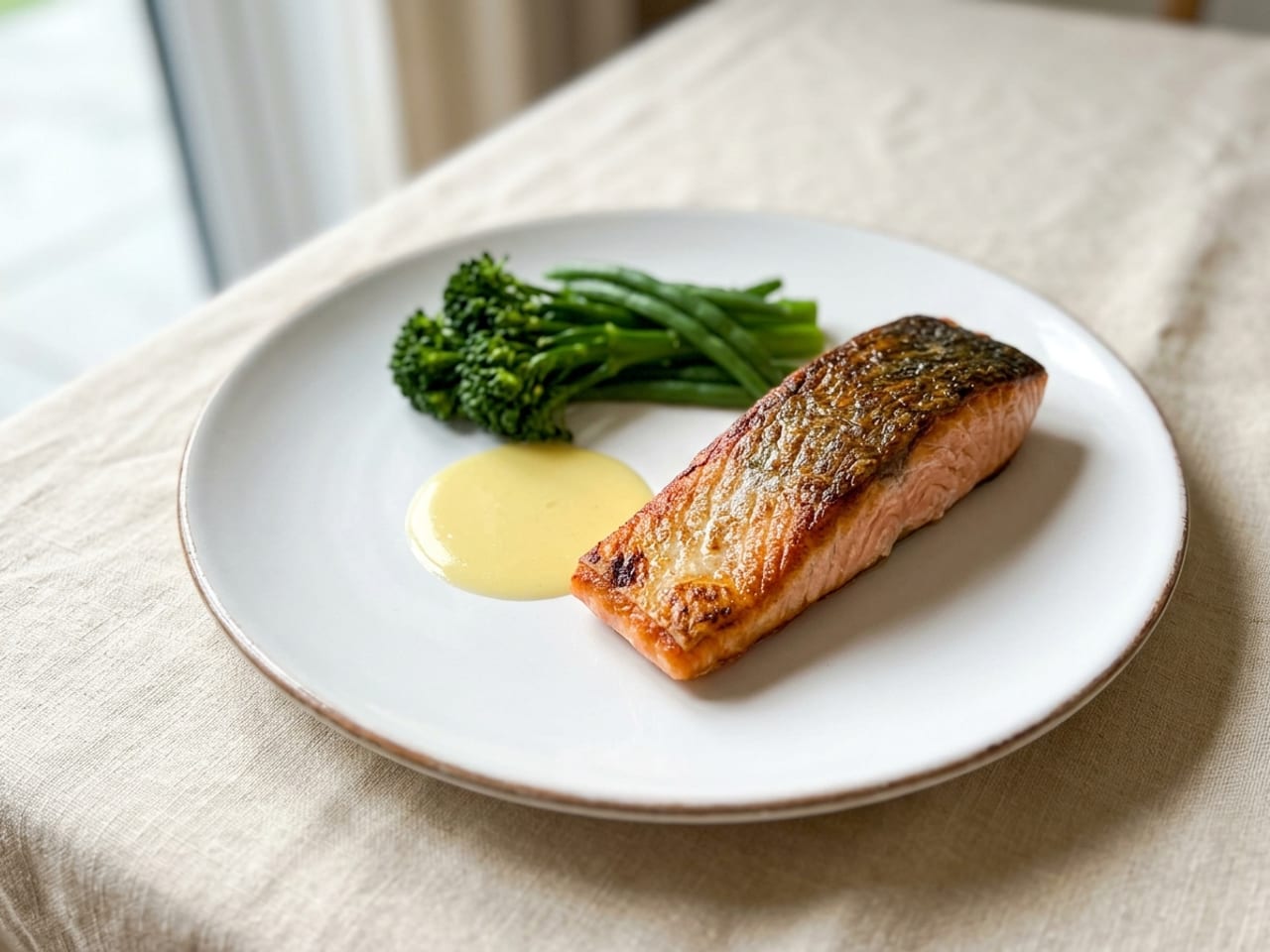
The photos on this page are AI-generated illustrations.
Form by form: how it goes on · where the sauce goes
- Skin-on fillet (salmon, sea bass, snapper, trout): crisp skin up · under or around, off the skin (the sources split)
- White fillet (cod, halibut, haddock, sole): the side you seared first up (one recipe) · brown butter and hollandaise over, a light sauce under
- Fried fish, fish and chips: on paper or a napkin, lemon beside · tartare beside
- Poached fish: on a hot dish · coated with its sauce
- Fish steak (tuna, swordfish, salmon steak): sliced (the fan, cut faces up, is ours), or whole on a very hot dish · a slaw or purée under it, or a butter with it
- Fish in a bowl (broth, nage, bouillabaisse): broth in first, fish on top, crust up (one recipe) · the broth is the sauce; some chefs pour it at the table
- En papillote (in a parcel): the parcel on a plate, opened at the table · inside the parcel
- Whole fish: flat, head to the left · beside it, or served on the side
On this page: The six steps · Salmon and skin-on fillets · White fish · Where the sauce goes · Sides · Whole fish · How much per person · When it is done · FAQ
How to plate fish in six steps
- Warm the plate. The recipes ask for it: Escoffier's "hot dish", Troisgros's large hot plates, the Ritz's heated plate for its tableside sole.8, 11, 21 How hot is not settled: warm plates below.
- Cook the side you will show first. James Peterson starts skin-on salmon skin side down "so that the crispy (and attractive) skin faces up when you serve it"; a halibut recipe sears the fish "presentation-side down".1, 6
- If the sauce goes under, it goes on first. A vinaigrette, sauce vierge, a cream or sorrel sauce or a purée goes on the warm plate before the fish (Thomas Keller, Steven Doherty, Troisgros, Pierre Koffmann).7, 8, 27, 43 Which sauce goes where is sauce by sauce below.
- Lift it on, best side up. With a wide, thin spatula: cooked fish is "very fragile" when moved from pan to plate (Harold McGee).86 A second spatula under a big fillet is ours; America's Test Kitchen uses two to flip flaky fillets in the pan.87 Crisp skin up; on skinless salmon, the side "that was facing the backbone" (Peterson).1
- Sauce over or beside, sides grouped, lemon at the side. Brown butter and hollandaise go over, tartare beside, a modern reduction around: 2 to 3 tablespoons (30 to 45 ml), says Peterson's sauce book.11, 13, 19, 21 Keep the sides in one or two groups beside the fish (ours) and the lemon "on the side" (Hank Shaw).4
- Serve it at once. Fish keeps cooking off the heat: salmon rose 7 to 27°F (4 to 15°C) in 5 minutes in America's Test Kitchen's measurements, and it says to eat thin fillets "right away".82, 83 Escoffier's meunière is "sent to the table at once".11
Skin-on fillets: salmon, sea bass, snapper, trout
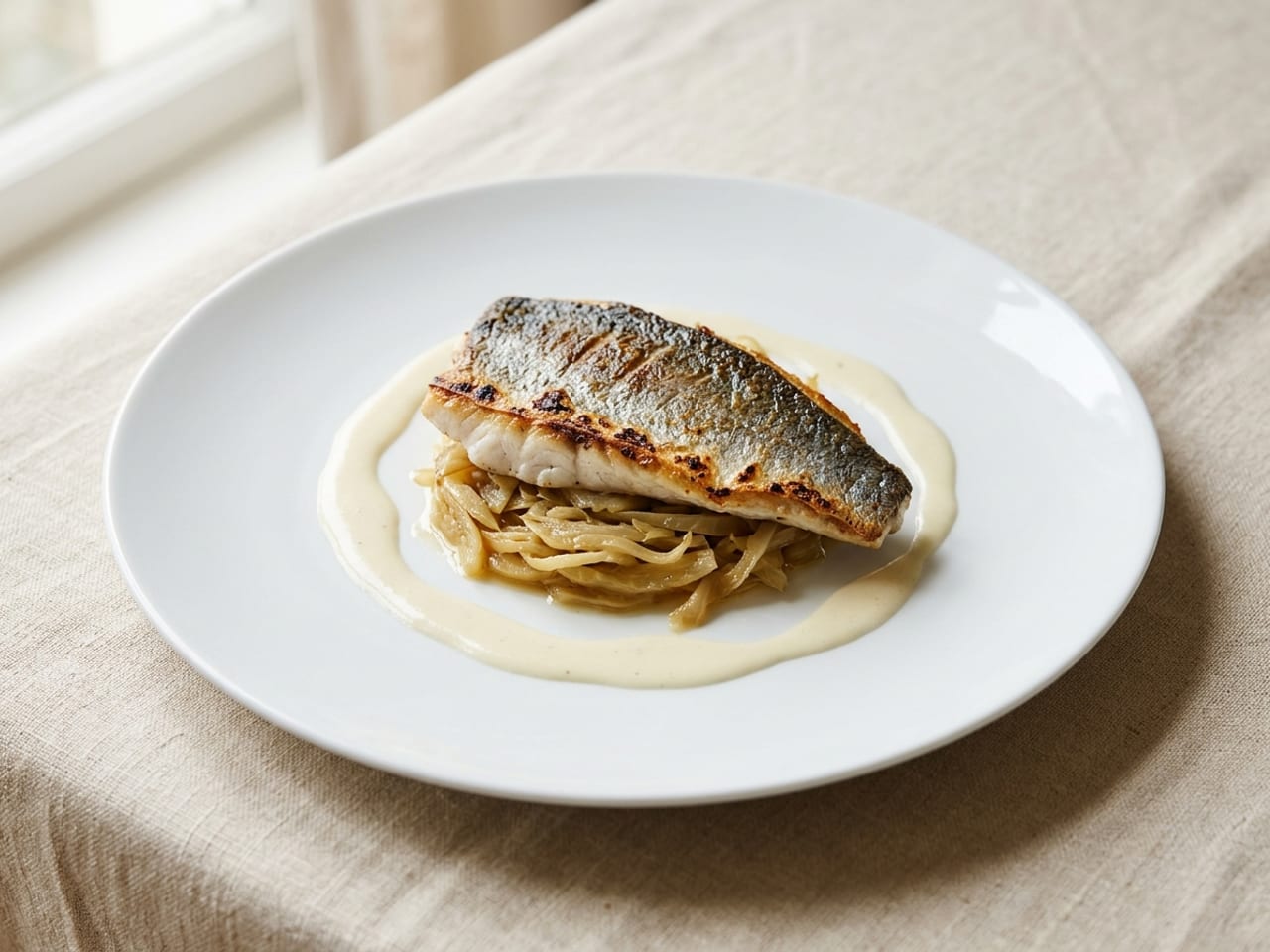
In one line: crisp skin up · sauce: under or around, off the skin (the sources split).
- Crisp skin goes up: cook it skin side down first, "so that the crispy (and attractive) skin faces up when you serve it" (James Peterson).1
- Up keeps it crisp: on "something moist" the skin "can quickly turn mushy" (Tasting Table); America's Test Kitchen's sea bass and Hank Shaw's seared fish go skin side up too.2, 3, 4
- Sauce under or around, not on the skin: Shaw's goes "underneath the fish", Tony Fleming spoons his around skin-up bass; America's Test Kitchen spoons sauce over its crisp-skin salmon, so the sources split.4, 14, 29
- Skin off: on salmon, the side "that was facing the backbone" goes up (Peterson). Skin used to be served down or on the side, a dining columnist writes, and he names tough skins (monkfish, shark, swordfish, tuna) as the exception.1, 5
- Japan does it the other way: a fillet such as salmon goes "wider side to the left, with the skin underneath" (Nippon.com).10
Classic dishes
- Saumon à l'oseille (Troisgros): a thin salmon escalope (the fillet split in thickness and flattened), the sorrel sauce spread over the bottom of large hot plates first and the salmon laid on top.8
- Thomas Keller's seared salmon: a skinless top loin set "slightly off-center" on a circle of vinaigrette, tomatoes nestled against it.7
Our recipes and more: Grilled salmon · Citrus salmon with pea purée · Teriyaki salmon.
White fish fillets: cod, halibut, haddock, sole
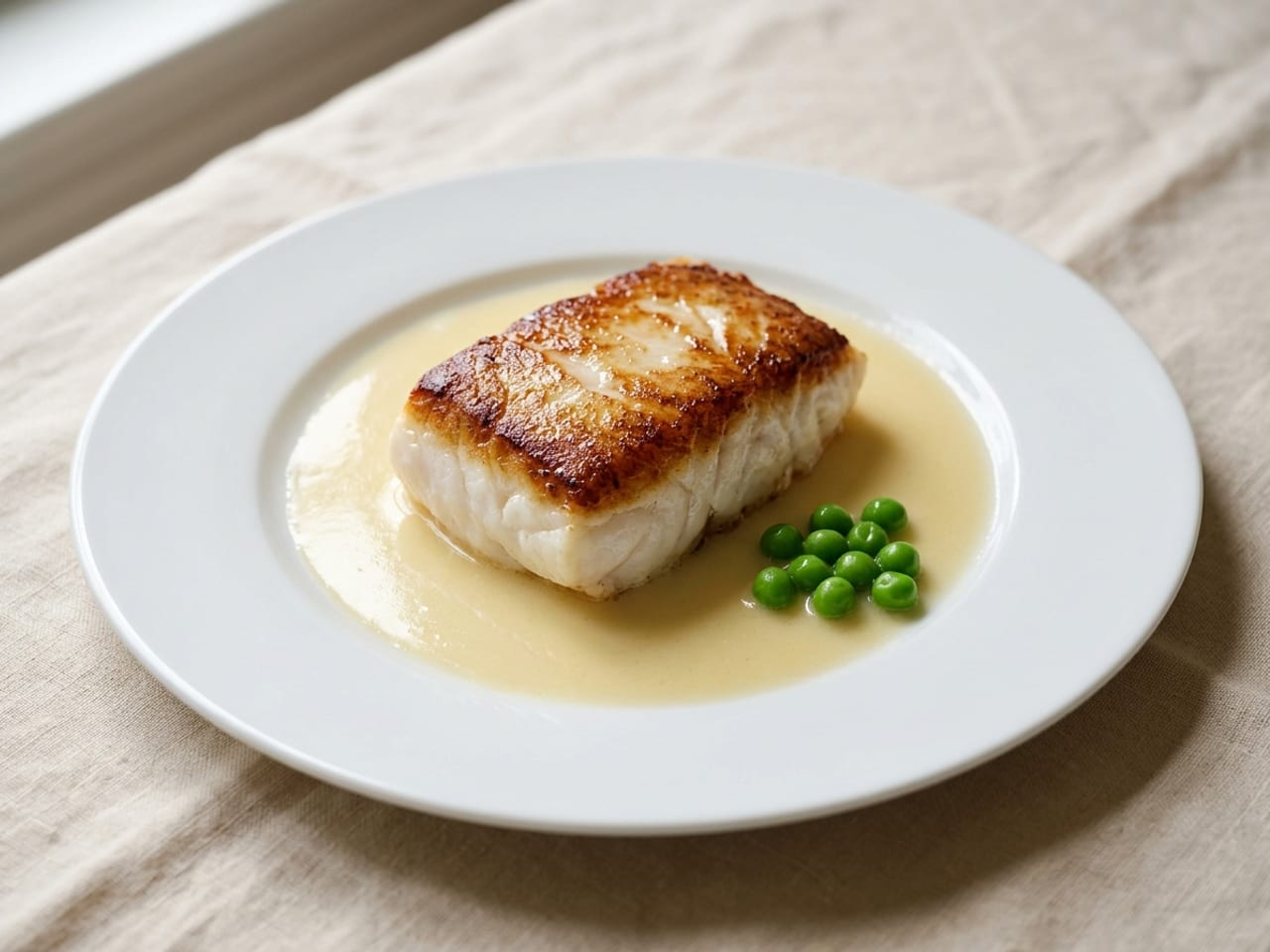
In one line: the side you seared first up (one recipe) · sauce: brown butter and hollandaise over, a light sauce under.
- The side seared first goes up, in one recipe: its halibut goes into the pan "presentation-side down" and onto the plate "golden-crusted side facing up" (FOX 4). No other source we read names a show side for white fish.6
- Lift it with a wide, thin spatula: Harold McGee calls cooked fish "very fragile" when moved from pan to plate; America's Test Kitchen flips flaky fillets in the pan with two thin spatulas.86, 87
- The sauce decides: brown butter and hollandaise go over, a purée or light sauce under (Pierre Koffmann's sea bass), tartare beside. One line per sauce below.31, 35, 43
- Fillets plate more neatly than the whole fish: Escoffier put sole fillets on dinner menus because they "dish more elegantly and are more easily served".11
- A thick loin can sit on a base of mash, peas or purée; a thin fillet lies flat on the plate. (ours)
Classic dishes
- Sole meunière: on a hot dish, browned butter poured over at the last moment and sent out "while still covered by the froth" (Escoffier); Great British Chefs' version pours the butter sauce over the fillets too.11, 31
- Boiled cod: floury potatoes "must always be sent to the table with it", with oyster sauce, hollandaise or melted butter (Escoffier).11
Our recipes and more: Fish fillet.
Fried and battered fish, fish and chips
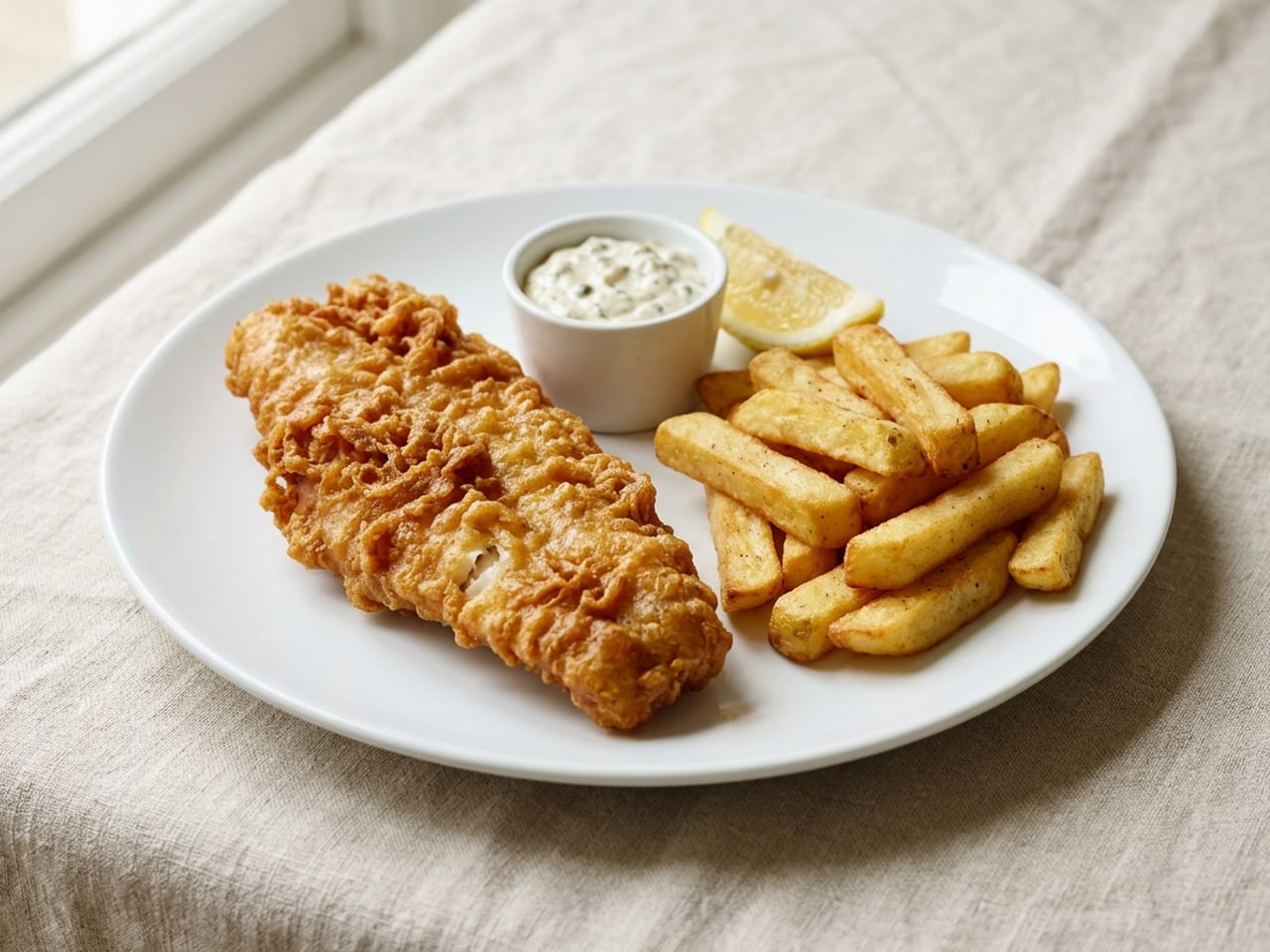
In one line: on paper or a napkin, lemon beside · sauce: tartare beside.
- Escoffier served fried fish "on a napkin, on a drainer, or on special dish-papers", with fried parsley and "properly trimmed half-lemons".11
- Tartare goes beside: Tasting Table serves fish and chips "alongside the chips, and the homemade tartar sauce"; the Ritz's rule for tableside sole is "Do not place the sauce on top of the fish".21, 22
- A crust keeps its sauce apart: "If a dish has crispy texture, serve the sauce on the side" (Nation's Restaurant News, 2007).17
- Plate it last: Escoffier warns that fried garnish left to wait will "very quickly lose their crispness".11
- In a chip shop the salt and vinegar go on "at the time it is served", and newspaper wrapping "has almost ceased on grounds of hygiene" (Wikipedia).45
Classic dishes
- Fish and chips: tartar sauce, "a slice of lemon each, and a side of peas, if desired" (Tasting Table); the small pot for the sauce and the fish laid against the chips are ours.22
- Sole Colbert: fried, the bone taken out and the space filled with maître d'hôtel butter, served "on a very hot dish" (Escoffier).11
Poached fish
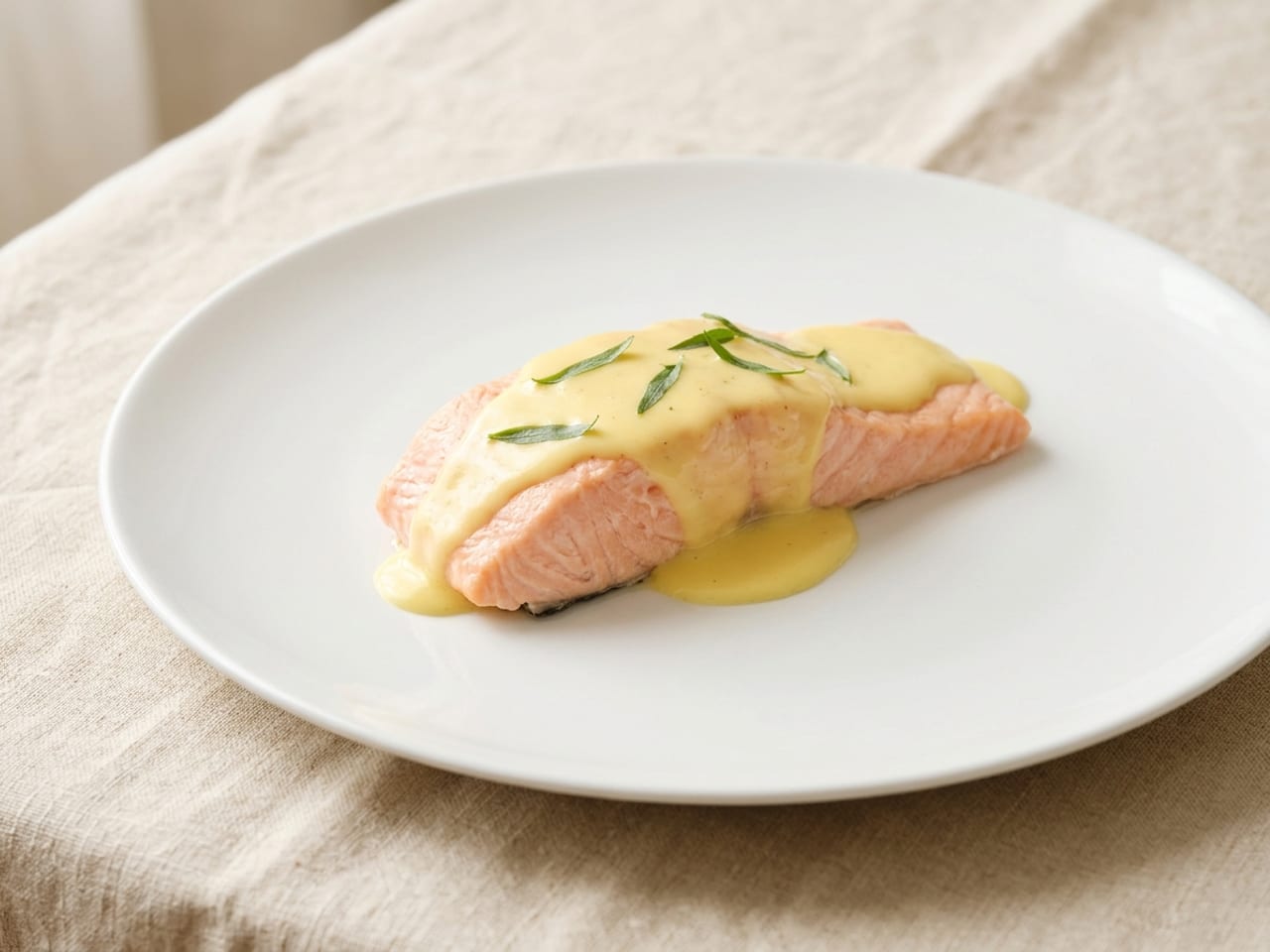
In one line: on a hot dish · sauce: coated with its sauce.
- Poached fish is coated: "Poached fish are always served sauced; i.e., covered with the sauce which properly forms their accompaniment" (Escoffier).11
- Hollandaise goes over: Andrew Zimmern spoons it "over the salmon fillets" and garnishes with tarragon.19
- Boiled fish is the exception: Escoffier dishes it on a napkin with parsley and sends the sauce and potatoes "to the table separately".11
- Thin fillets can be rolled first: paupiettes, stood "upright" in the pan to poach (Escoffier), or turbans, "rolled from the wide end to the thin end" (Josceline Dimbleby).11, 48
Classic dishes
- Sole Véronique: the fillets in an oval on the dish they poached in, glazed, with "a pyramid of skinned and very cold muscadel grapes in the middle" (Escoffier).11
- Sole Marguery: a border of mussels and shrimps' tails, sole and garnish coated with white wine sauce and glazed (Escoffier).11
- Truite au bleu: on a napkin "with curled-leaf parsley all round", hollandaise or melted butter with it (Escoffier).11
More: The mother sauces.
Fish steaks: tuna, swordfish, salmon steak
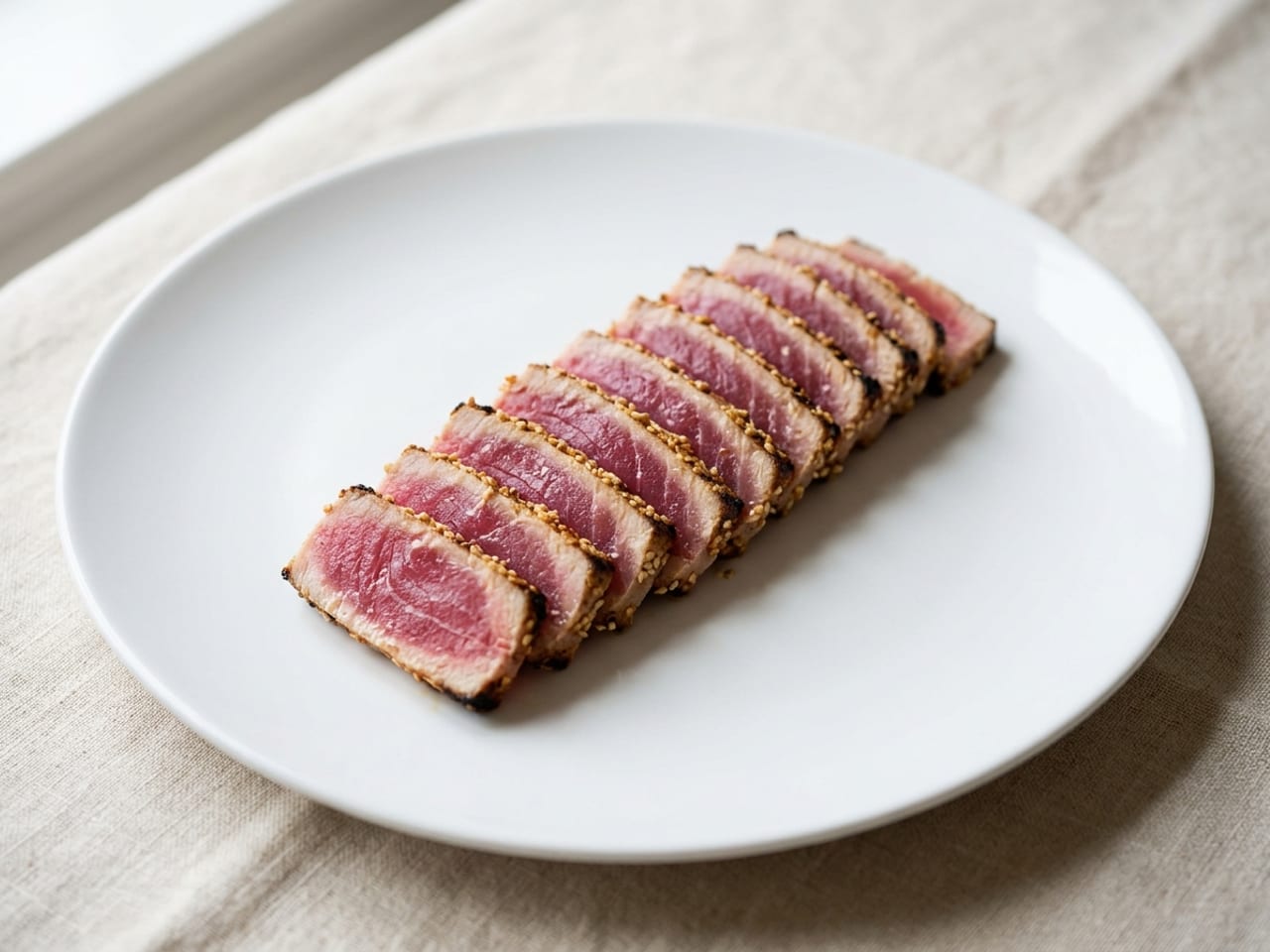
In one line: sliced (the fan, cut faces up, is ours), or whole on a very hot dish · sauce: a slaw or purée under it, or a butter with it.
- Tuna is sliced to serve: "cut into 1/4-inch-thick slices" (6 mm; America's Test Kitchen). Fanning them in a row with the cut faces up is ours.46
- In Japanese raw-fish plating, "sliced fish such as tuna, for example, cascade in layers" (Kikkoman's magazine, a soy-sauce maker's).47
- A base under it: Adam Gray spreads coleslaw over the plate and tops it "with the broccoli and sliced tuna".44
- Grilled fish go on "a very hot dish, without paper or a napkin", with parsley and grooved lemon slices, and maître d'hôtel or anchovy butter with them (Escoffier).11
- Plan 1 oz (28 g) more per person for steaks than for fillets (James Peterson); Escoffier sized a salmon darne "in proportion to the number of people".11, 69
Our recipes and more: Sesame-crusted tuna steak.
Fish in a bowl: broth, nage, bouillabaisse
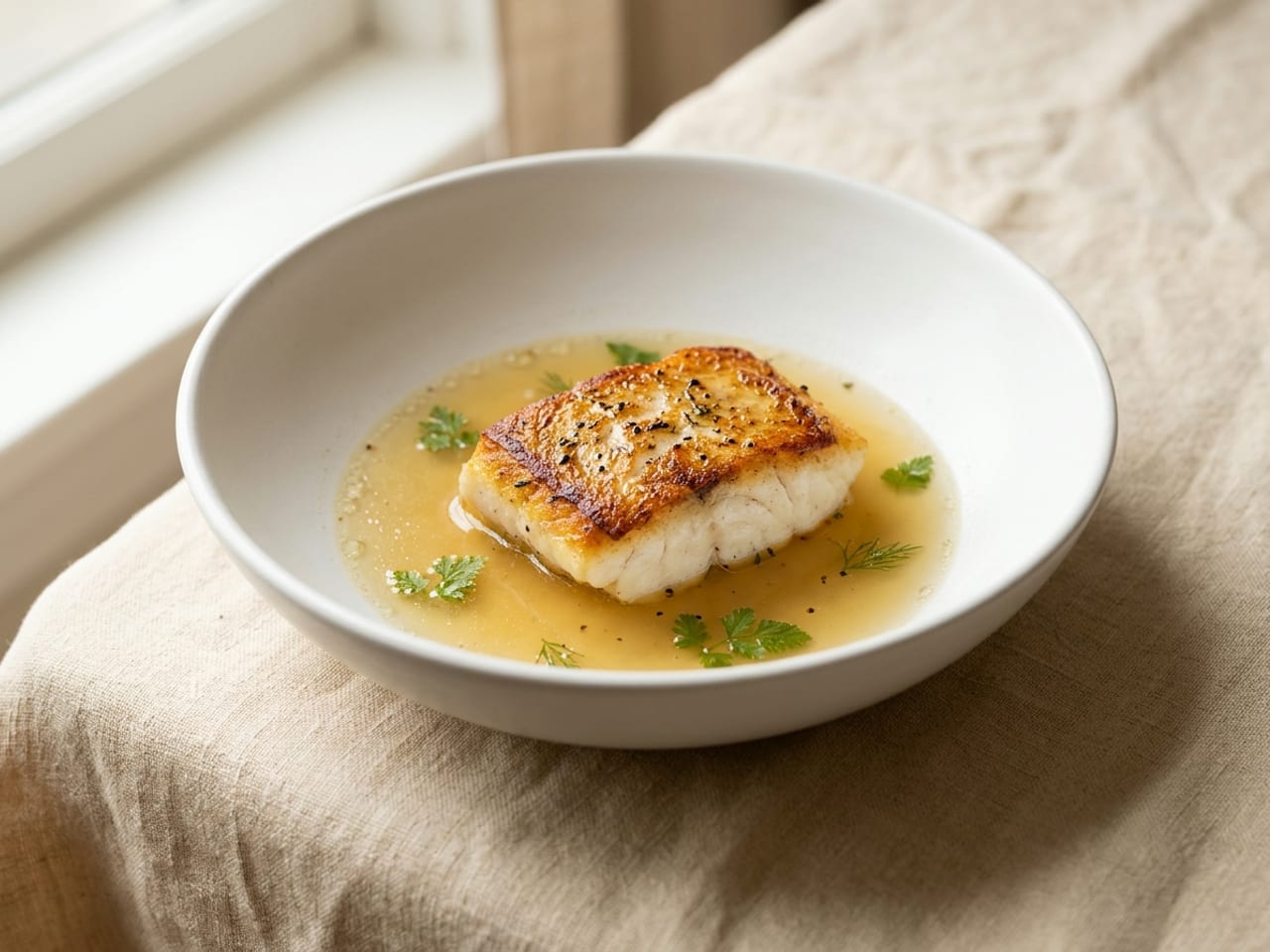
In one line: broth in first, fish on top, crust up (one recipe) · sauce: the broth is the sauce; some chefs pour it at the table.
- Broth first, fish on top: one recipe puts "3 to 4 oz" (90 to 120 ml) of broth in a shallow bowl, then the halibut in the centre, crust up (FOX 4); Martin Wishart divides the broth, then tops it with the sea bass.6, 38
- Or pour it at the table: Kuba Winkowski's sturgeon has its hot sauce poured "into the bowls at the table".37
- Keep a seared crust above the liquid, so only the flesh sits in the broth. (ours)
- Bouillabaisse comes as fish and broth in two dishes, mixed "in a soup plate or served separately" as the guest likes, and "the fish must be cut up in front of the guests" (Marseille's tourist office).49
- National Geographic reads the 1980 bouillabaisse charter differently: the fish shown and filleted at the table "prior to preparation, as a proof of freshness".50
More: Which bowl.
Fish en papillote
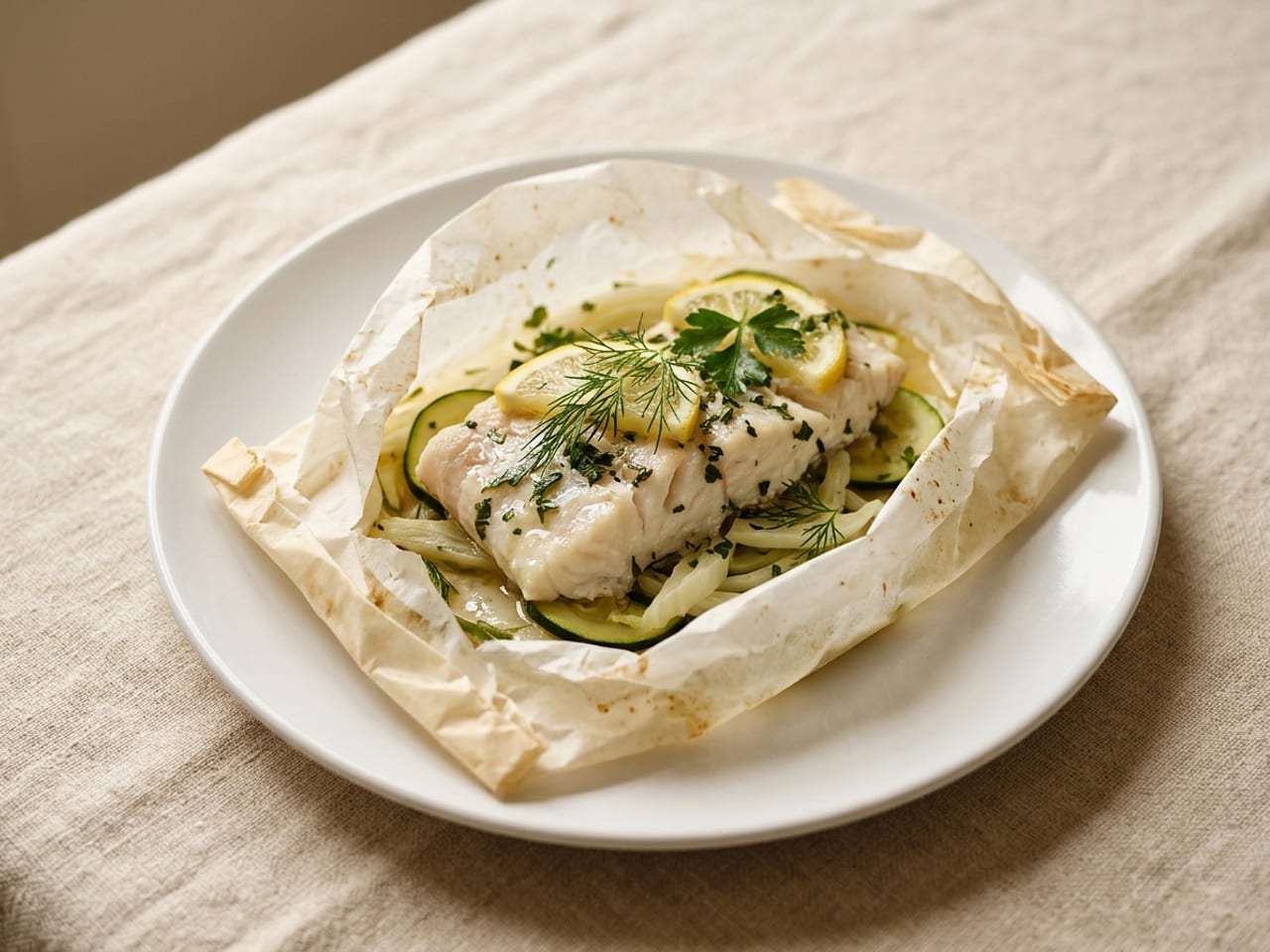
In one line: the parcel on a plate, opened at the table · sauce: inside the parcel.
- Served in the pouch: en papillote dishes are "often served in their pouch, meaning no time spent plating individual components" (the Culinary Institute of America's consumer site).51
- The guest opens it: PBS Food sends each packet out on a dinner plate, "allowing each guest to cut open the packet at the table".52
- Puffed at the last minute: Escoffier put a red mullet papillote in the oven for five minutes before serving, "that it may be souffled".12
- We found no source for opening it in the kitchen; a side plate for the paper is our suggestion. (ours)
More: Cartouche, the parchment lid.
Where the sauce goes, sauce by sauce
Over, under, around, beside and separate are all in the books and recipes; the sauce decides. One line each, with who does it.
- Brown butter (meunière): over. Escoffier: "always served on the fish"; Great British Chefs' sole meunière pours it over. One chef serves it in a jug beside turbot.11, 31, 32
- Hollandaise: over. Over the fish in every recipe we read that says where: Andrew Zimmern, Sur La Table (a retailer), Graham Campbell (over the asparagus too), Ben Tunnicliffe, Richard Bainbridge.19, 20, 33, 34, 35
- Beurre blanc: over or around. Dominic Chapman spoons it over turbot; Anova (an appliance maker) spoons it around skin-up salmon.18, 30
- Vinaigrette, sauce vierge: under. Thomas Keller spoons vinaigrette in a circle and sets the salmon on it; Steven Doherty spoons sauce vierge over the plate and tops it with salmon.7, 27
- Cream, sorrel or dill sauce: under. Troisgros spreads sorrel sauce over the bottom of large hot plates, salmon on top; Great British Chefs puts dill sauce on the vegetables and the salmon on top, skin up.8, 28
- Tartare: beside. The Ritz's rule for its tableside sole is "Do not place the sauce on top of the fish"; Tasting Table's fish and chips has it alongside.21, 22
- Romesco, salsa: under or on the side. Harvard's Nutrition Source spoons dollops on the plate, fillets "skin side up, on top of sauce"; Rick Moonen's whole trout: "extra sauce on the side".24, 25
- Teriyaki glaze: over. Poured over the fillets and topped with scallions (Once Upon a Chef, a recipe blog).26
- White wine sauce on poached fish: coated. Escoffier's poached sole (Marguery: the sauce over sole and garnish; Véronique: the buttered fumet over the fillets), then glazed.11
- Sauce with boiled fish: separately. Escoffier sends it "to the table separately", with the potatoes.11
- Broth, nage: in the bowl. Broth first and the fish on top (Martin Wishart), or poured in at the table (Kuba Winkowski).37, 38
- A modern reduction or jus: around. James Peterson (1991): "a small amount of fish sauce is often served around the fish", 2 to 3 tablespoons (30 to 45 ml) a serving; Matthew Tomkinson pours red wine sauce around and serves "a little extra at the table".13, 36
The tally. One of our research passes, the sauce research only, sorted 36 fish recipes and texts by where the sauce goes: 19 put it over the fish, 6 around, 6 separate or on the side and 5 under. It counts Great British Chefs recipes, Escoffier, James Peterson and a few columns, seller and blog recipes; it does not count the chefs quoted above from a second pass (Thomas Keller, Troisgros, Hank Shaw), who all put it under. Most of the "over" recipes are UK chefs on one publisher (Great British Chefs), so read it as what we found, not a rule.4, 7, 8, 11, 13
Sauce on crisp skin? The sources split: in what we read, most keep it under or around a skin-up fillet, America's Test Kitchen spoons it over, and RecipeTin Eats waits until just before serving.4, 14, 15, 29 The same split is examined on our sauce plating guide, where the verdict is Mixed.
Seared scallops: a James Beard Foundation recipe sets them on a cauliflower purée and spoons the sauce "over the scallops and around the plate".23
Salmon with rice, mashed potatoes, asparagus or salad
- Salmon and rice: under, or a moulded round beside. Georgina Fuggle spoons rice onto the plates and tops it with the salmon; a moulded round with the fillet leaning on it is our styling (the slider below).39
- Fish and mashed or crushed potatoes: under or beside. Adam Gray sets salmon on the potato and spoons sauce around; Daniel Galmiche serves it "on a bed of the warm potatoes"; Charlie Hibbert puts aligot "on the side" of cod.40, 41, 42
- Salmon and asparagus: beside. Graham Campbell places the salmon "next to the asparagus" and spoons hollandaise over both; Ben Tunnicliffe serves turbot "with the asparagus alongside".33, 34
- Fish and broccoli: under as a purée or slaw; florets beside. A purée under Pierre Koffmann's sea bass, a slaw under Adam Gray's sliced tuna; florets in one group beside the fish are ours.43, 44
- Fish and salad: beside (ours). Harvard's romesco fish (a white fish) is served "with salad"; beside the fish, never under it while the fish is hot, is ours.24
- Fish and chips: side by side. The fish with the chips, tartare beside, a slice of lemon and peas (Tasting Table).22
The lemon: at the side. Escoffier sent fried fish with trimmed half-lemons and grilled fish with grooved lemon slices; Hank Shaw serves a wedge "on the side".4, 11 Cuts and the history are on our lemon garnish guide.
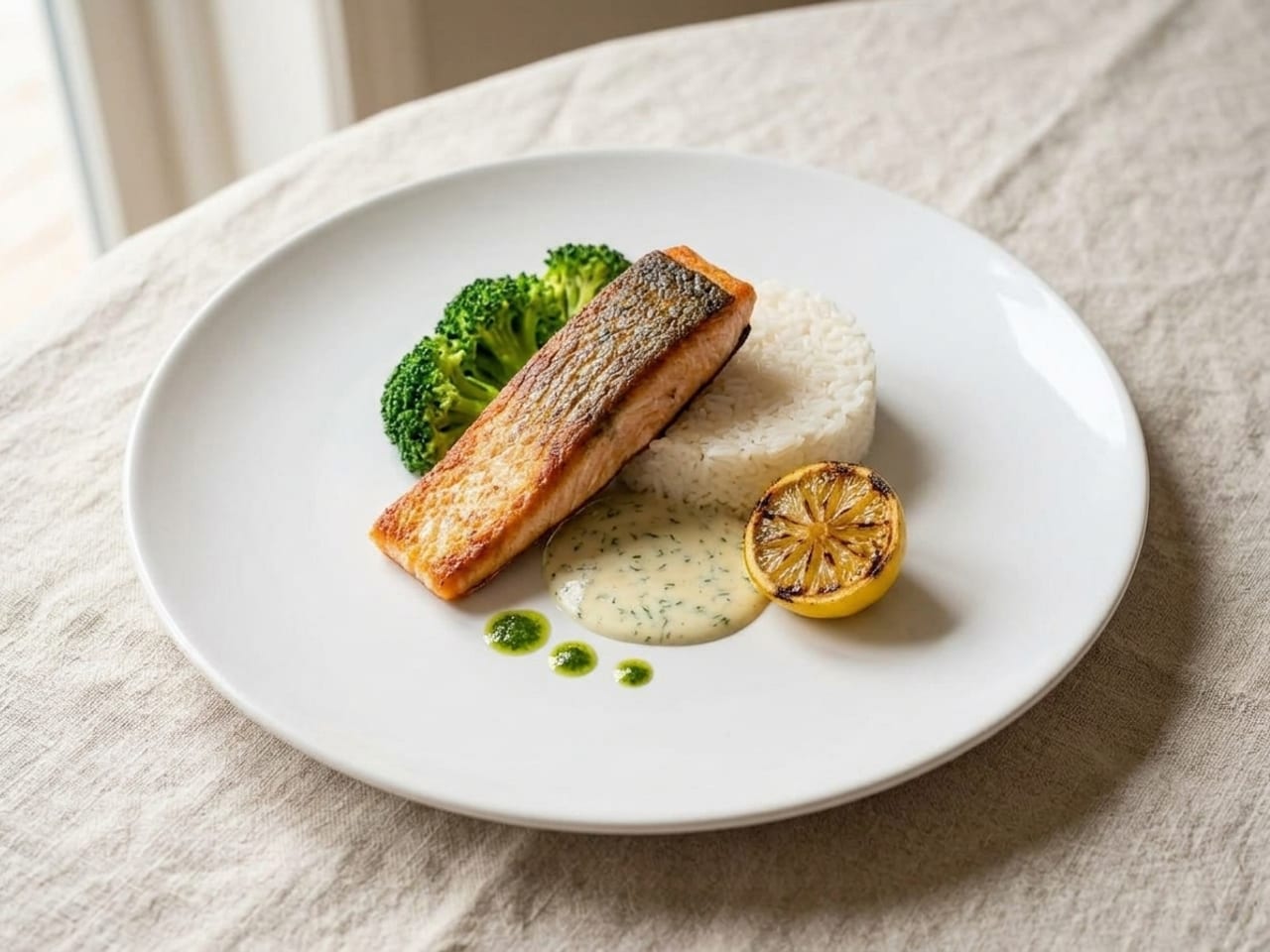
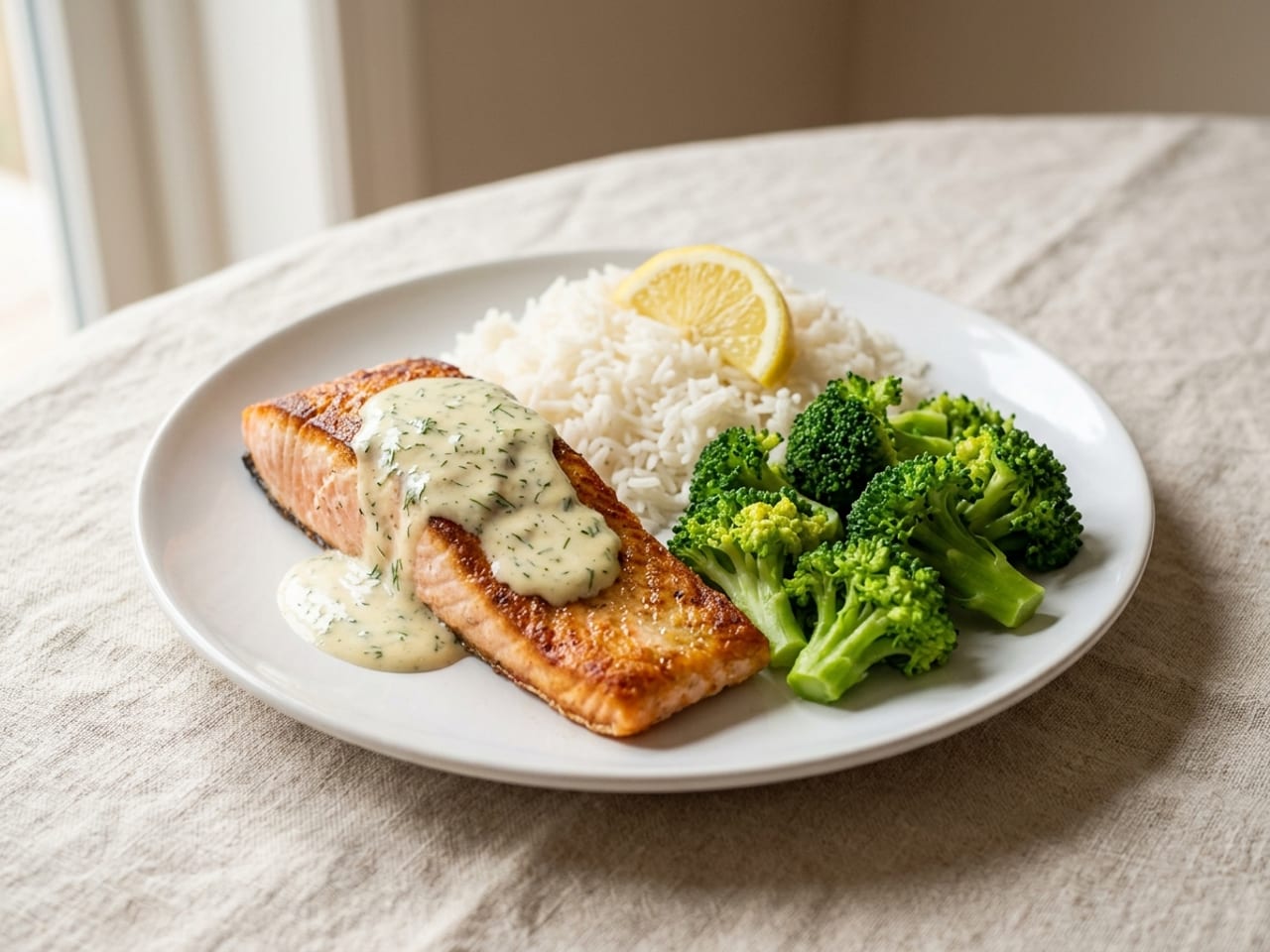 BeforeAfter
How to serve a whole fish
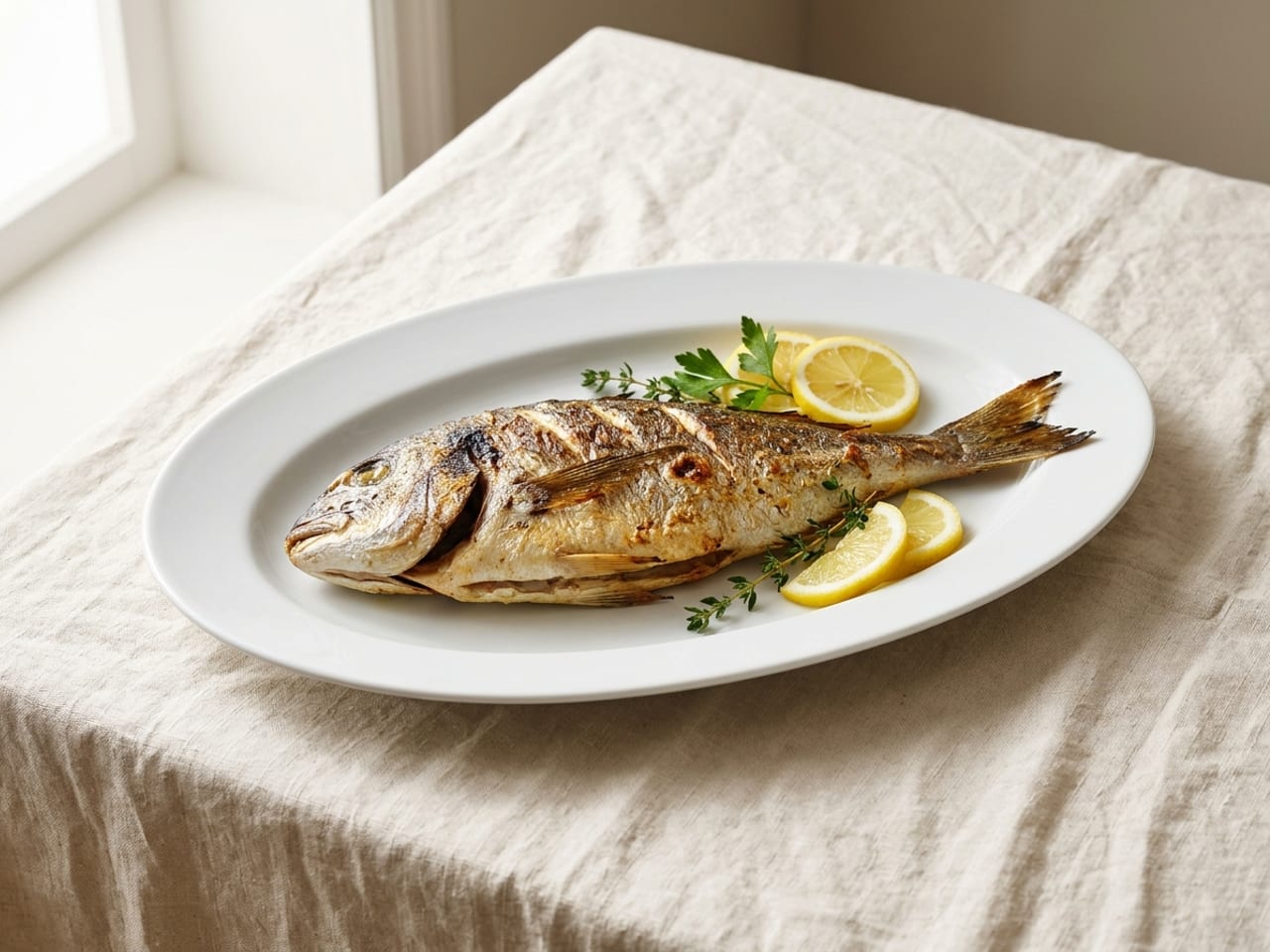
- Plate or platter: a small whole fish "served individually" goes on the plate with the head on and the tail and fins trimmed (Anne Willan, 1989); the Institute of Culinary Education plans "a larger square plate" for a whole fish; Rick Moonen moves whole trout to a platter.25, 53, 54
- Head to the left: Willan says so "that the flesh is easy to remove for a right-handed person"; the Ritz rebuilds a filleted sole head left; in Japan the head goes left, the belly toward the diner (Nippon.com, Elizabeth Andoh).10, 21, 53, 59
- Show it, then fillet it: the Ritz presents the whole sole, then fillets it beside the table; a Chinese-American family blog says you can "just dig in (many Chinese families do)" or bone it for your guests.21, 58
- By size: Willan's individual fish is a "small" one, and no source we read gives a weight for it. To buy, NC Sea Grant's table lists 3/4 lb (340 g) of whole fish for a 3.5 oz (100 g) serving, Fulton Fish Market (a seller) 1 lb (454 g) a person; Rick Moonen's two 1 lb (454 g) trout serve 2 to 4.25, 53, 72, 73
- Bones for guests: on their own plate, out of sight (the Ritz); for a Chinese guest, the family blog keeps the bony pieces on the plate, since throwing them away is "considered wasteful".21, 58
- Fish-bone impaction is "a common reason for patients to seek emergent care", and bones in the esophagus were more common in older patients (286 patients, a Korean hospital study); for babies the NHS says to remove all bones. Fillets for small children and older guests is our suggestion.90, 91
Deboning a whole fish at the table, step by step
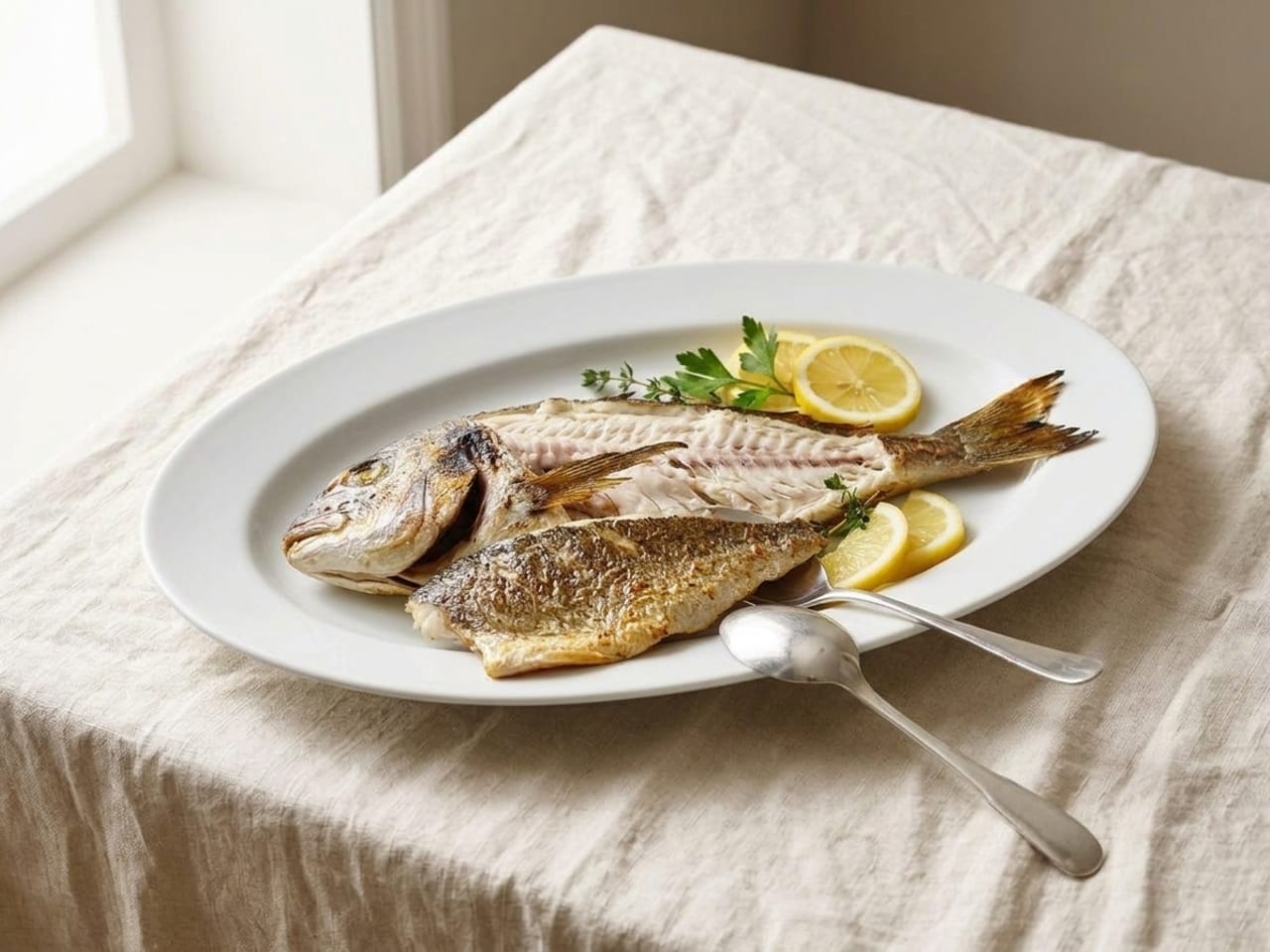
From four accounts: the Ritz London's restaurant manager on Dover sole (2022), a maître d'hôtel at Rolancy's in Nice (French trade press), St. Louis Magazine's dining editor (2016) and James Peterson's flatfish (2007). It takes "a minute or two" (St. Louis Magazine); work quickly, the Ritz says, because cooled sole turns rubbery.21, 55, 56, 57 Three of the four are about flatfish (sole twice, Peterson's flatfish), which have two fillets on each side of the bone; St. Louis Magazine's is a trout. The renders below show a round fish (a sea bream), which has one fillet a side, so the pictures show the order of the moves, not the fillet count.
- Set out two plates. One for the bones and one hot plate for the guest: the Ritz's "heated plate" and a plate for the bones "which you will remove from the guests' view"; a waste plate and a hot plate at Rolancy's in Nice; a discards plate (St. Louis Magazine).21, 56, 57
- Take two tools. A fish knife and fork (the Ritz), a spoon and fork (Rolancy's), a table knife and spoon (St. Louis Magazine), a fish knife or large spoon (James Peterson).21, 55, 56, 57
- Clear the edges. Scrape off the fins and cut at the head and tail (St. Louis Magazine); the Ritz takes off the side bones first, and Rolancy's pushes them out with the spoon and fork.21, 56, 57
- Cut down the middle. A long cut along the centre (the Ritz), a slit along the top (St. Louis Magazine), a cut along the backbone (Rolancy's).21, 56, 57
- Lift off the top fillets. Slide the knife under "starting from the tail end, where it is most fragile" (the Ritz); "Slide a fish knife or large spoon under the fillet to your left" (Peterson).21, 55
- Lift out the bone. "Lift off the bones and head to reveal the bottom two fillets" (Peterson); then pick out any stray bones (St. Louis Magazine).55, 56
- Rebuild it on the hot plate. Lay the fillets "as if the fillets were still attached, with the head on the left of the plate and the tail on the right" (the Ritz), or "the two smaller fillets atop the larger one" (St. Louis Magazine); the sauce goes on last (Rolancy's), tartare beside, never on top (the Ritz).21, 56, 57
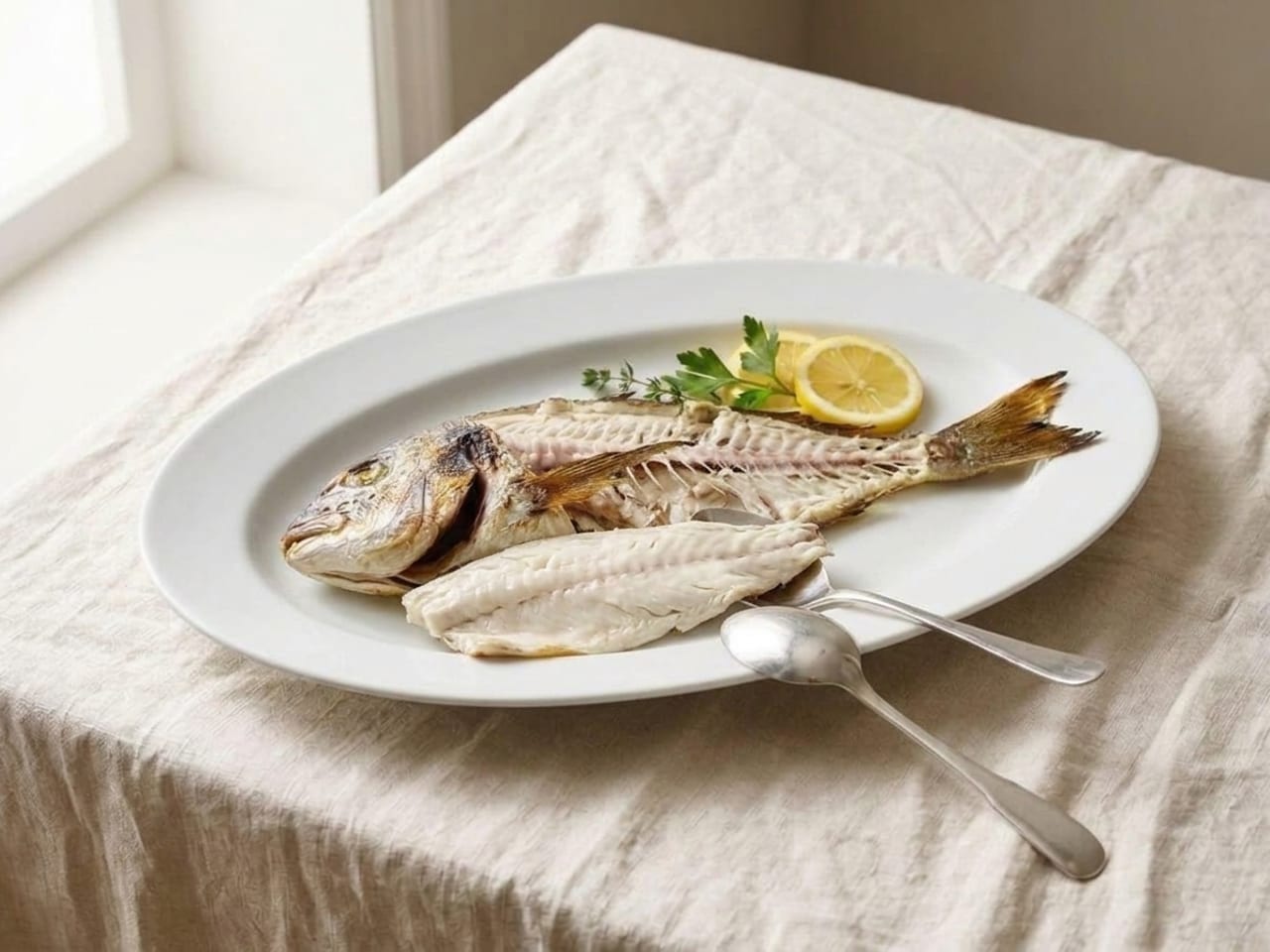
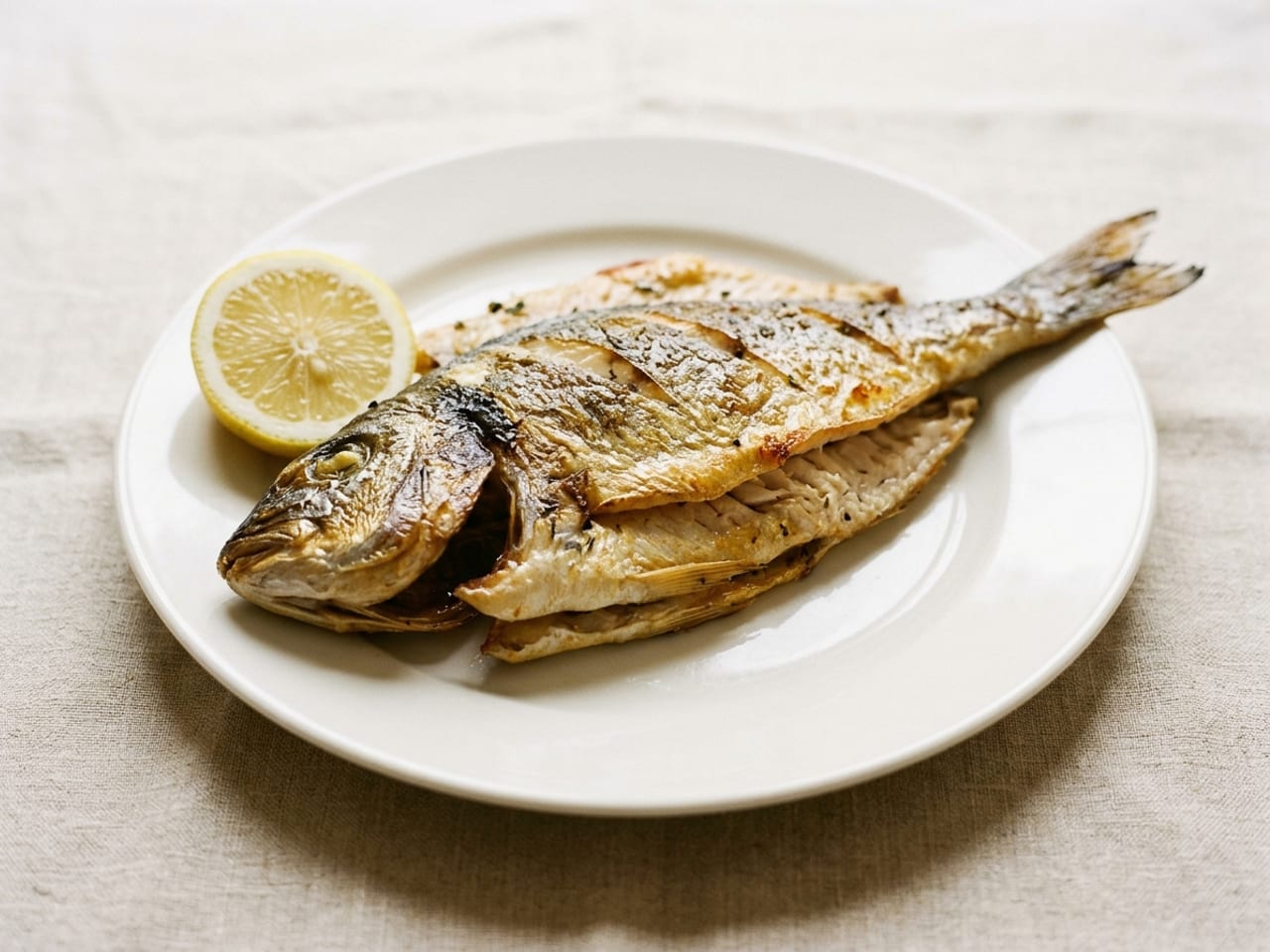
How a guest takes a bone out of the mouth is on our fine dining etiquette guide; why a whole fish is laid flat and never stacked, on how to stack food.
Customs, each as its source tells it
- Don't flip it (coastal China): flipping is "said to bring bad luck" because it "symbolizes a fishing boat being flipped over" (Food Republic, 2023); SBS (2018) says the same of "any number of fishing regions in China", and one family that emigrated from Guangzhou to Sydney pulls "the meat from beneath the fish, leaving the bone in place". Elsewhere, Food Republic adds, flipping it is normal.60, 61
- Said to: head toward the most honourable person (Chinese New Year, China): "the head of the fish should be positioned towards the most honourable member of the group" (SBS, 2018); "some families" point it at elders or respected guests (Food Republic, 2024).61, 63
- Or said to be: head and tail served to the guest of honour (Cantonese, China): a Sydney restaurateur says "The guest of honour is served the most prized parts of the fish: the head and tail" (SBS, 2020). Pointed at them or served to them: the sources differ, so we print both.62
- Leave some: whoever eats the head "should leave some behind" (SBS, 2018), and "Many people don't finish their whole fish" at Lunar New Year, the leftovers standing for wealth to come (Food Republic, 2024).61, 63
- Senegal: "the head of the fish should go to the eldest person at the table", said to be unlucky otherwise (SBS, 2018).61
- Feast of the Seven Fishes (Italian-American): in Italy the holiday is simply "la vigilia", "the eve" of Christmas, and "fish is really only eaten in Southern Italy on the holiday" (National Geographic, which cites the anthropologist Michael Di Giovine on the name).64
- Czech Christmas carp: a carp scale is hidden under the plate, believed to bring luck and plenty in the coming year (CzechTourism).65
- Polish Christmas carp: a guest who finds a scale and keeps it in the wallet "is believed" to have good luck all year (Notes from Poland).66
How much fish per person
No standard: the NHS and Health Canada print 100 to 140 g (3.5 to 4.9 oz), Washington State's health department 6 to 8 oz (170 to 227 g), cooks 5 to 8 1/2 oz (142 to 240 g) and a seller 6 to 8 oz (170 to 227 g) for a main. Every figure, with whose it is:
- NHS (UK), in its weekly-intake advice: "A portion is around 140g" (4.9 oz).67
- Health Canada's labelling reference amounts (not a plating rule): 125 g (4.4 oz) raw or 100 g (3.5 oz) cooked for plain fish, 140 g (4.9 oz) cooked with a sauce.71
- Washington State Department of Health, for fish-advisory meal sizes, not plating: 8 oz (227 g) raw or about 6 oz (170 g) cooked for a 160 lb (73 kg) adult, scaled by weight.68
- James Peterson: 4 oz (113 g) for a first course, 6 to 8 oz (170 to 227 g) for a main, steaks 1 oz (28 g) more.69
- The French Culinary Institute: 180 to 240 g (6 1/2 to 8 1/2 oz) for an entrée.70
- Thomas Keller: 5 oz (142 g) raw, skinless pieces of salmon top loin.7
- NC Sea Grant: 100 g (3.5 oz) "is considered a serving"; its recipes allow 1/4 to 1/3 lb (113 to 151 g) a person, and its buying table, "based on approximately 3.5 ounces per serving", lists 1/3 lb (151 g) of fillets or steaks.72
- Fulton Fish Market (a seller), raw: fillets 6 to 8 oz (170 to 227 g), steaks 6 to 10 oz (170 to 283 g), a starter 3 to 4 oz (85 to 113 g).73
- Whole fish: NC Sea Grant's buying table for a 3.5 oz serving lists 3/4 lb (340 g) of round fish or 1/2 lb (227 g) dressed; Peterson doubles the fillet amount; Fulton Fish Market (a seller) 1 lb (454 g) a person.69, 72, 73
- Yield: the edible part of a whole fish "may be only about 40 percent" (French Culinary Institute); FAO's 1989 yield tables put skinless cod fillet at 34% of the fish; 1 lb raw fillet cooks to 0.70 lb (USDA).70, 74, 75
When fish is done, and the bones
- US: 145°F (63°C) for fish (USDA FSIS); in restaurants under the FDA Food Code, 145°F (63°C) for 15 seconds.76, 80
- Canada: 70°C (158°F) for fish (Health Canada).79
- No thermometer: cook "until flesh is no longer translucent and separates easily with a fork" (FoodSafety.gov); the FDA's page words it "The flesh is clear and separates easily with a fork" and keeps "opaque" for shellfish.77, 78
- America's Test Kitchen goes lower, and says so: it takes farmed salmon to 125°F (52°C) and wild to 120°F (49°C), its own preference, and says that below 145°F "should be avoided by immune-compromised people"; the FDA says pregnant women, children, older adults and people with weakened immune systems should avoid raw or undercooked fish. Restaurants may serve lightly cooked fish on request, with the menu advisory (Food Code).78, 80, 81
- It keeps cooking: 1-inch (2.5 cm) salmon fillets taken out at 125°F (52°C) rose 7°F (4°C) in 5 minutes from a 250°F (121°C) oven and 27°F (15°C) from a 450°F (232°C) one (America's Test Kitchen, measured); another ATK page says "a mere 5-degree" rise. So plate it promptly (our reading of those numbers).82, 83
- Thin fillets: "Eat these types of fish right away"; fattier fish "can tolerate a 5- to 10-minute covered or sauced resting period" (America's Test Kitchen).83
- At the table: on a large fish, if the head will not come away, it is a sign the fish is not cooked enough, and a Nice maître d'hôtel says to send it back to the kitchen for more cooking (L'Hôtellerie Restauration).57
- Pin bones are "sometimes missed by the fishmonger": pull them "in direction bone is naturally pointing rather than straight up" (America's Test Kitchen).89
- Fish is one of the 14 allergens food businesses in England, Wales and Northern Ireland must declare (FSA); people allergic to one fish "often react to other types", and cooking does not make a reaction less likely (NHS).67, 92
Raw fish (crudo, sashimi, ceviche): the freezing rules are on our tasting menu guide; our ceviche is cured in lime.
Fish spatula, fish knife and warm plates
- A wide, thin spatula (a fish slice in Britain), two for a big or flaky fillet: America's Test Kitchen flips flaky fillets with "two thin spatulas", Whole Foods Market (a grocer) uses two for a whole fish or a large fillet, and Escoffier moves the fish "by means of a spatula, to a hot dish".11, 87, 88
- Tweezers for pin bones: "Use tweezers to grasp tip of bone" (America's Test Kitchen).89
- On the table, a fish knife and fork: the Ritz sets them "on a side plate" for its tableside sole.21
- Warm plates: the recipes ask for them (Escoffier's "hot dish", Troisgros's "assiettes chaudes" and its dish "quickly assembled on a warm plate", the Ritz's heated plate, Matthew Tomkinson's "warm serving plate", Sur La Table's "warmed dinner plate"); one wine bar's co-chef warms plates in a 325 to 400°F (163 to 204°C) oven for 10 to 40 seconds, and another restaurant parks them in an unused oven set as low as possible (America's Test Kitchen). No source we read gives a temperature for a fish plate.8, 9, 11, 20, 21, 36, 85
More: spatula and fish slice · offset spatula · fish knife · fish fork.
Fish plating myths, checked
- "Never put sauce on crisp skin": Mixed. Most recipes we read keep the sauce under or around a skin-up fillet (Hank Shaw, Tony Fleming, Great British Chefs, Harvard's Nutrition Source, Anova, a Globe and Mail columnist); America's Test Kitchen spoons it over, and RecipeTin Eats only says not "until just before serving".4, 14, 15, 16, 18, 24, 28, 29
- "The sauce always goes beside the fish": Not supported. In the recipes and texts we read, over is the most common placement, then around and separate (level), then under; it depends on the sauce (the tally above).11, 13
- "Fish skin always goes up": Depends. Crisp skin, yes (Peterson, Tasting Table, America's Test Kitchen, Shaw). A dining columnist names tough skins (monkfish, shark, swordfish, tuna) as the exception, and in Japan a fillet goes "with the skin underneath".1, 2, 3, 4, 5, 10
- "Fish cools faster than meat": Said, not measured. America's Test Kitchen's science editor says fish "typically cools off faster", and the Ritz's restaurant manager works fast because cooled sole "becomes rubbery"; neither measured it, and we found no one who did.21, 84
- "Move a fillet only once or it breaks": Partly. Cooked fish is "very fragile" when moved (Harold McGee), and America's Test Kitchen flips flaky fillets with two spatulas; the only "once" we found is a grocer's tip about flipping in the pan, not plating.86, 87, 88
- "A lemon wedge on top of the fish is wrong": No source found. The sources put lemon beside the fish (Escoffier's trimmed half-lemons, Shaw's wedge "on the side"), but none says on top is wrong; where it goes is styling.4, 11
Darne, tronçon, paupiette: the words on a fish menu
- Darne: A steak cut across a round fish such as salmon, with its skin and a piece of backbone.11, 93, 94
- Tronçon: A steak cut at a right angle from half of a flat fish, usually turbot or halibut, bone and skin on.93
- Suprême: A portion sliced from a large fillet such as cod (one magazine's use).94
- Paupiette: A fillet spread with forcemeat and rolled like a scroll, then cooked.12
- Meunière: Pan-cooked fish sent out with browned butter poured over it and parsley.11
- En papillote: Cooked wrapped in paper (a parcel or pouch), and often served in it.12, 51
We found no source for pavé, délice or goujons, so they are not here. The fish course's place in a menu is on the courses of a meal.
Plating fish, answered
How do you plate fish?
Put the fillet on a warm plate with its best side up: crisp skin up, or on a skinless fillet the side you seared first (James Peterson for salmon, one halibut recipe; no source gives a rule for every white fish). Then the sauce goes where that sauce belongs (a vinaigrette or light sauce under, brown butter or hollandaise over, tartare beside), the sides go in a group beside the fish (our styling) and the lemon goes at the side. In what we read, fried fish keeps its sauce apart, poached fish is coated, a fish steak is sliced, fish in a bowl sits on its broth, en papillote is opened at the table, and a whole fish lies flat with its head to the left.
How do you plate salmon?
Cook it skin side down first so the crisp skin faces up on the plate (James Peterson); on skinless salmon the side that faced the backbone goes up. Set it on a warm plate on its sauce if the sauce belongs under (Thomas Keller's vinaigrette, Troisgros's sorrel sauce) or spoon hollandaise over (Andrew Zimmern). Rice or mashed potatoes can go under it or beside it, vegetables in one group beside it (ours), the lemon at the side.
Salmon skin side up or down?
Up on the plate when the skin is crisp: cook it skin side down first so it ends up on top (James Peterson); Tasting Table says skin on something moist "can quickly turn mushy". A dining columnist says skin used to be served down or on the side, and in Japan a salmon fillet goes "with the skin underneath" (Nippon.com).
How do you plate salmon and rice?
Rice under the salmon (Georgina Fuggle spoons it onto the plate and tops it with the fish), or pressed into a round beside it with the fillet leaning on it, skin up (our styling). Teriyaki glaze is poured over the fillet in the recipe blog we read. Vegetables in one group beside it, not around it (ours).
How do you plate salmon and mashed potatoes?
On it or beside it: Adam Gray sets the salmon on the potato and spoons the sauce around; Daniel Galmiche serves it "on a bed of the warm potatoes"; Charlie Hibbert puts the aligot "on the side" of cod. Crisp skin up either way (ours).
How do you plate salmon and asparagus?
Side by side: Graham Campbell places the salmon "next to the asparagus" and spoons hollandaise over both; Ben Tunnicliffe serves turbot "with the asparagus alongside" and hollandaise over. Laying the spears parallel is our styling.
How do you serve a whole fish?
Flat on a plate or a platter with the head to the left: Anne Willan (1989) says so "that the flesh is easy to remove for a right-handed person", and in Japan the head goes left with the belly toward the diner. Show it whole, then fillet it at the table or let everyone dig in; put a plate out for the bones and warm plates for the guests (the Ritz).
How do you cut and serve a whole fish?
From four accounts (the Ritz, Rolancy's in Nice, St. Louis Magazine, James Peterson): set out a plate for bones and a hot plate; take two tools (fish knife and fork, or spoon and fork); clear the fins and side bones; cut down the middle; lift off the top fillets from the tail end; lift out the bone with the head; rebuild the fillets on the hot plate, head on the left. It takes a minute or two (St. Louis Magazine).
How do you plate sea bass, cod or halibut?
Sea bass, skin on: skin side up, as America's Test Kitchen and Tony Fleming plate it, with the sauce around rather than on the skin. Cod or halibut, skinless: the side seared first goes up (one halibut recipe calls it the presentation side), lifted onto the plate with a wide, thin spatula because cooked fish is fragile when moved (Harold McGee); America's Test Kitchen flips flaky fillets in the pan with two thin spatulas. The sauce decides the rest: brown butter and hollandaise over, a light sauce or purée under, tartare beside.
How much fish per person?
There is no single figure. The NHS says a portion is "around 140g" (4.9 oz) and Health Canada's label reference is 100 g (3.5 oz) of cooked plain fish; a US state health department says about 6 oz (170 g) cooked. Cooks print more: James Peterson 6 to 8 oz (170 to 227 g) for a main (raw or cooked not stated), the French Culinary Institute 180 to 240 g (6 1/2 to 8 1/2 oz). For a whole fish, NC Sea Grant's buying table lists 3/4 lb (340 g) for a 3.5 oz serving and Fulton Fish Market, a seller, 1 lb (454 g) a person.
How is fish plated in fine dining?
In the chefs' recipes we read: Thomas Keller puts a 5 oz (142 g) raw piece of salmon "slightly off-center" on a circle of vinaigrette; Troisgros lays its salmon on sorrel sauce in hot plates; James Peterson's sauce book says modern fish sauce is "often served around the fish", 2 to 3 tablespoons (30 to 45 ml) a serving. A whole Dover sole is filleted beside the table at the Ritz.
How do you plate fish and chips?
Side by side, the tartar sauce beside them (Tasting Table serves it "alongside the chips, and the homemade tartar sauce", "a slice of lemon each, and a side of peas, if desired"). Escoffier served fried fish on a napkin or dish-paper with fried parsley and trimmed half-lemons; in a chip shop the salt and vinegar go on "at the time it is served".
How this page was made
Nothing here was cooked, plated, measured or tested by us. Every rule is its source's, read on 25 November 2026 unless its entry says otherwise: two editions of Escoffier, James Peterson's books, Anne Willan, Harold McGee and a culinary school textbook (their public excerpts on ckbk), America's Test Kitchen, chefs' recipes (most on Great British Chefs, a UK publisher, so the sauce tally leans British), the Ritz London and a Nice restaurant on tableside service, US, Canadian and UK government pages, a hospital study, magazines and broadcasters on customs, and a few sellers and recipe blogs, labelled. Ours: the grouping into forms, the one-line summaries, the dish picks, the lines marked ours, and the conversions in brackets.
What we could not read: Serious Eats and MasterClass (Thomas Keller's skin-up salmon on spinach is known to us only from a search summary, so it is not used), the FDA's fish-advice page (its 4 oz portion is not used), the Royal Museums Greenwich fish and chips page, Gisslen's and the CIA's textbooks beyond a short excerpt, and Merriam-Webster. We found no study of plating a fish fillet and no measurement of how fast fish cools on a plate. The figures are AI renders, not photographs.
The books, chefs, test kitchens and pages behind this page
How each source was read (in full, as an excerpt, in an archived copy, or as an earlier reading for another of our guides) is in its entry. Sellers sell what they describe; recipe blogs are examples.
- Peterson, J. (2001). Simply Salmon: "Serving the Best-Looking Side Up". a cookbook by a cooking-school author, via ckbk, the public section page ckbk serves without a login, read on 25 November 2026: "start cooking with the skin side facing down so that the crispy (and attractive) skin faces up when you serve it"; "cook the skin side last so the more attractive side of the salmon, the side that was facing the backbone, ends facing up on the plate" (the book prints a dash where we print a comma). ckbk.com
- Friedman, S. (2023). When To Serve Salmon Skin Side Up To Keep It Crispy From Pan To Plate. Tasting Table (a food magazine site), published 30 April 2023, read in full on 25 November 2026: the skin "can quickly turn mushy if you plate it on top of something moist"; a sauce can go under the salmon or "drizzle it around the fish". tastingtable.com
- America's Test Kitchen (2026). Crispy Pan-Seared Black Sea Bass. America's Test Kitchen (a test kitchen), the public recipe page, read on 25 November 2026: "Transfer bass, skin side up, to platter and serve.". americastestkitchen.com
- Shaw, H. (2012). Perfect Seared Fish. Hunter Angler Gardener Cook (a recipe blog by a published cookbook author; an example), published 2 June 2012, updated 16 November 2026, read in full on 25 November 2026: "If you are using a sauce, it goes underneath the fish. Serve with a lemon or lime wedge on the side.". honest-food.net
- St. Louis Magazine ("Ask George") (2026). Ask George: When served a fish entrée with the skin still on it, should you eat the skin? St. Louis Magazine (a dining column), the date was not captured, read in full on 25 November 2026: "In years past, fish entrées tended to be served skin side down or on the side"; now chefs "sear the skin until crispy, then serve the fish portion skin side up"; thick, tough skins (monkfish, shark, swordfish, tuna) are the exception the columnist names. stlmag.com
- FOX 4 Dallas-Fort Worth (2026). Alaskan Halibut à la Plancha. FOX 4 (a TV station's recipe page; the chef is not named in our copy), published 11 August 2026, read in full on 25 November 2026: "Place the halibut presentation-side down and sear until deeply golden brown"; "Spoon approximately 3 to 4 oz of warm spiced coconut broth into each shallow bowl"; "Place the seared halibut in the center, golden-crusted side facing up". fox4news.com
- Keller, T. (2024). Seared Salmon with Demi-Sec Tomatoes and Olive Basil Vinaigrette. Wine Spectator Top 100 (a chef's own recipe, printed by a magazine), 2024, read in full on 25 November 2026: the vinaigrette spooned in a circle on each plate first, then "place 1 piece slightly off-center on each plate"; "Eight 5-ounce top loin pieces" with "pin bones, skin and gray fat removed"; the salmon stored uncovered overnight "to allow a thin, dry skin to develop on its top surface". winespectator.com
- Labro, C. (interview with the Troisgros family) (2014). L'escalope de saumon à l'oseille de la maison Troisgros. Le Monde, M le magazine, the URL is dated 23 October 2014; read on 25 November 2026 in an Internet Archive copy (the live site refused our fetcher), full recipe text: "Assaisonner les escalopes de sel sur le côté le moins présentable" (salt the least presentable side) and "répartir la sauce au fond de 4 grandes assiettes chaudes. Déposer dessus les escalopes" (the sauce into four large hot plates, the escalopes on top); our translations. lemonde.fr (archived)
- Miseviciute, A. (2020). La Maison Troisgros: the birthplace of nouvelle cuisine. Club Oenologique, published 2 June 2020, a prior reading for another of our guides, copied into this run's sheets and re-checked in the saved copy on 25 November 2026: in the kitchen, "the dish quickly assembled on a warm plate". cluboenologique.com
- Nippon.com (Nippon Communications Foundation) (2022). Rise and Shine with Japanese Breakfast Table Manners. Nippon.com, Japan Data, published 14 December 2022, a prior reading for another of our guides, copied into this run's sheets and re-checked in the saved copy on 25 November 2026 (our stacking guide): a whole fish "with its head on the left and its tail on the right", belly toward you; "If the serving of fish is a fillet, such as salmon or gindara black cod, it is standard to place the wider side to the left, with the skin underneath.". nippon.com
- Escoffier, A. (1909). A Guide to Modern Cookery. William Heinemann, London; Project Gutenberg eBook #71395, the "New and Revised Edition" of 1909 in its 1920 impression (never "the 1907 edition"); the full plain text read on 25 November 2026 (a copy saved for our sauce-plating guide, since Gutenberg was down for maintenance that day); numbers are the book's own: 776 boiled fish, 777 fried fish, 778 meunière, 779 poached fish, 781 grilled fish, 790 darne, 817 truites au bleu, 903 Véronique, 914 paupiettes, 152 butter à la meunière. gutenberg.org
- Escoffier, A. (1907). A Guide to Modern Cookery. William Heinemann, London (Cornell copy, Internet Archive), the first English edition, read on 25 November 2026 in a full-text OCR copy saved on 24 October 2026; quoted as the OCR prints it: "Paupiette, a strip of chicken, of fish fillet, or other meat, garnished with forcemeat, rolled to resemble a scroll and cooked"; Rouget en Papillote (1035e): "When about to serve, put the papillote for five minutes in the oven, that it may be souffled". archive.org
- Peterson, J. (1991). Sauces: Classical and Contemporary Sauce Making: "Contemporary Fish Sauces". a reference book, via ckbk, the public section page ckbk serves without a login, read on 25 November 2026: "Today, a small amount of fish sauce is often served around the fish. Two to 3 tablespoons (30 to 45 milliliters) of sauce per serving is typical.". ckbk.com
- America's Test Kitchen (2017). Cast Iron Crisp-Skin Salmon with Honey-Lime Sauce. America's Test Kitchen (a test kitchen), a prior reading for another of our guides, copied into this run's sheets and re-checked in the saved copy on 25 November 2026 (our sauce-plating guide): "Transfer salmon to serving platter and spoon sauce over top."; the page is partly paywalled and does not say which side is up when the sauce goes on. americastestkitchen.com
- Maehashi, N. (RecipeTin Eats) (2026). Crispy Skin Fish. RecipeTin Eats (a recipe blog; an example), a prior reading for another of our guides, copied into this run's sheets and re-checked in the saved copy on 25 November 2026 (our sauce-plating guide): "Do not pour sauce on the skin until just before serving else it will soften the fish skin.". recipetineats.com
- Waverman, L. (2019). How do I make crispy-skinned fish? The Globe and Mail (a newspaper column), published 11 September 2019, a prior reading for another of our guides, copied into this run's sheets and re-checked in the saved copy on 25 November 2026: a brown-butter sauce to "pour around the fish"; "Some chefs make a purée of peas or a pesto and use that underneath the fish". theglobeandmail.com
- Nation's Restaurant News (2007). On Food: Losing streaks. Nation's Restaurant News (a trade column), 1 October 2007, a prior reading for another of our guides, copied into this run's sheets and re-checked in the saved copy on 25 November 2026: "If a dish has crispy texture, serve the sauce on the side". nrn.com
- Heimendinger, S. (Anova Culinary) (2023). Simple Salmon with Crispy Skin. Anova (an appliance maker's recipe; a seller), published 15 September 2023, read in full on 25 November 2026: fillets "skin-side up"; "Spoon the beurre blanc sauce, if using, around the fish.". anovaculinary.com
- Zimmern, A. (2026). Poached Salmon with No-Fail Hollandaise. andrewzimmern.com (a chef's own page), undated page, read in full on 25 November 2026: "Spoon the hollandaise over the salmon fillets, garnish with tarragon leaves and serve.". andrewzimmern.com
- Sur La Table (2026). Seared Salmon with Saffron Hollandaise. Sur La Table (a retailer's recipe; a seller), undated page, read in full on 25 November 2026: "Place each salmon fillet on a warmed dinner plate and spoon hollandaise on top of each portion.". surlatable.com
- Cagnin, L. (restaurant manager, The Ritz London) (2022). How to fillet a Dover sole. The Caterer (trade press; a Gold Service Scholarship masterclass), published 31 March 2022, read in full on 25 November 2026: the sole "presented on a serving plate with two plates alongside. One heated plate to serve the fish to the guest, and another for the bones and offcuts"; "A fork and fish knife sit on a side plate"; the upper fillets lifted "starting from the tail end, where it is most fragile"; reassembled "with the head on the left of the plate and the tail on the right"; tartare: "Do not place the sauce on top of the fish"; "if the temperature of the fish drops it becomes rubbery, so we must work quickly". thecaterer.com
- Rye, J. (Tasting Table) (2022). Classic British Fish And Chips Recipe. Tasting Table (a recipe on a food magazine site), published 9 December 2022, read in full on 25 November 2026: "serve it immediately alongside the chips, and the homemade tartar sauce"; a second card on the page: "with the tartar sauce, a slice of lemon each, and a side of peas, if desired". tastingtable.com
- Real Urbieta, J. (James Beard Foundation) (2026). Seared Scallops with Cauliflower Purée and Anchovy Sauce. James Beard Foundation (a chef's recipe), undated page, read in full on 25 November 2026: "arrange the scallops over the cauliflower purée and spoon the anchovy sauce over the scallops and around the plate". jamesbeard.org
- Harvard T.H. Chan School of Public Health, The Nutrition Source (2026). Crispy Pan Seared White Fish with Walnut Romesco and Pea Shoot Salad. The Nutrition Source (a university health school's recipe), undated page, read in full on 25 November 2026: "Spoon dollops of sauce onto individual plates. Place fillets, skin side up, on top of sauce and serve with salad.". hsph.harvard.edu
- Moonen, R. (in Sunset) (2008). Whole Grilled Trout With Romesco. Sunset (a magazine recipe by a named chef, from Fish Without a Doubt, 2008), read in full on 25 November 2026: two whole trout "about 1 lb. each", "Serves 2 to 4"; "Carefully transfer fish to a platter. Serve extra sauce on the side.". sunset.com
- Segal, J. (Once Upon a Chef) (2025). Easy Teriyaki Salmon Recipe. Once Upon a Chef (a recipe blog; an example), updated 13 May 2025, read in full on 25 November 2026: "4 (6-oz) salmon fillets, skin removed"; "Pour the sauce over salmon fillets, top with scallions, and serve.". onceuponachef.com
- Doherty, S. (2016). Sauce vierge. Great British Chefs (a chef's recipe on a recipe publisher), first published 2016, read in full on 25 November 2026: "Spoon the sauce over each serving plate and top with cooked salmon fillets to serve". greatbritishchefs.com
- Great British Chefs (in-house) (2026). Brined salmon, seasonal vegetables and creamy dill sauce. Great British Chefs (a chef's recipe on a recipe publisher), first published 2026, read in full on 25 November 2026: "Divide up the warm vegetables onto plates and spoon over the dill sauce. Top with salmon fillets, skin-side up.". greatbritishchefs.com
- Fleming, T. (2022). Sea bass marinière. Great British Chefs (a chef's recipe on a recipe publisher), first published 2022, read in full on 25 November 2026: "Place a fillet of bass skin-side up on top of the fennel on each dish, then spoon the sauce around it (any remaining sauce can be served on the side).". greatbritishchefs.com
- Chapman, D. (2016). Turbot with cucumber beurre blanc. Great British Chefs (a chef's recipe on a recipe publisher), first published 2016, read in full on 25 November 2026: "spoon the warm beurre blanc sauce over the fillets". greatbritishchefs.com
- Great British Chefs (in-house) (2022). Sole meunière. Great British Chefs (a chef's recipe on a recipe publisher), first published 2022, read in full on 25 November 2026: "Carefully transfer the sole fillets to plates, then add the parsley to the butter sauce and pour the sauce over the fish to finish". greatbritishchefs.com
- Beynon, A. (2025). Pepper dulse turbot with brown butter. Great British Chefs (a chef's recipe on a recipe publisher), first published 2025, read in full on 25 November 2026: the brown butter: "Pour into a small pan or jug for serving alongside the fish". greatbritishchefs.com
- Campbell, G. (2015). Salmon with hollandaise. Great British Chefs (a chef's recipe on a recipe publisher), first published 2015, read in full on 25 November 2026: "Divide the asparagus spears between plates and place the salmon next to the asparagus."; "Spoon some hollandaise over the fish and asparagus". greatbritishchefs.com
- Tunnicliffe, B. (2026). Pan-fried turbot with smoked butter hollandaise and asparagus. Great British Chefs (a chef's recipe on a recipe publisher), first published 2026, read in full on 25 November 2026: "Serve the turbot with the asparagus alongside, then spoon over lots of the hollandaise.". greatbritishchefs.com
- Bainbridge, R. (2019). Baked cod with mint hollandaise. Great British Chefs (a chef's recipe on a recipe publisher), first published 2019, read in full on 25 November 2026: "Spoon the fricassee of peas into the potatoes, place the cod on top and spoon over the hollandaise sauce". greatbritishchefs.com
- Tomkinson, M. (2015). Wild sea bass with smoked bacon, red chicory and red wine reduction. Great British Chefs (a chef's recipe on a recipe publisher), first published 2015, read in full on 25 November 2026: "On a warm serving plate place a spoon of the purée, a pile of the runner bean mixture and top with the fish"; "Pour some of the sauce around and serve a little extra at the table". greatbritishchefs.com
- Winkowski, K. (2019). Sturgeon with caviar and fennel. Great British Chefs (a chef's recipe on a recipe publisher), first published 2019, read in full on 25 November 2026: "Serve and pour the sauce into the bowls at the table". greatbritishchefs.com
- Wishart, M. (2017). Sea bass in Japanese mushroom broth. Great British Chefs (a chef's recipe on a recipe publisher), first published 2017, read in full on 25 November 2026: "divide the broth between bowls, arranging the vegetables evenly and elegantly"; "Top with the sea bass". greatbritishchefs.com
- Fuggle, G. (2016). Grilled salmon with sticky coconut rice. Great British Chefs (a chef's recipe on a recipe publisher), first published 2016, read in full on 25 November 2026: "spoon the rice and edamame beans onto 4 plates"; "Top with the salmon and dress with the pickled cucumber.". greatbritishchefs.com
- Gray, A. (2015). Salmon fillets with peas and chorizo. Great British Chefs (a chef's recipe on a recipe publisher), first published 2015, read in full on 25 November 2026: "Place the salmon on top of the potato. Spoon the pea, chorizo and cream sauce around the salmon". greatbritishchefs.com
- Galmiche, D. (2015). Pan-roasted salmon with crushed potatoes. Great British Chefs (a chef's recipe on a recipe publisher), first published 2015, read in full on 25 November 2026: "Serve on a bed of the warm potatoes, a good helping of the mayonnaise and extra lime zest". greatbritishchefs.com
- Hibbert, C. (2021). Cod with Gruyère pommes aligot. Great British Chefs (a chef's recipe on a recipe publisher), first published 2021, read in full on 25 November 2026: "Place a fillet of cod onto each plate with a generous spoon of pommes aligot on the side and serve immediately". greatbritishchefs.com
- Koffmann, P. (2015). Sea bass with citrus. Great British Chefs (a chef's recipe on a recipe publisher), first published 2015, read in full on 25 November 2026: "Add some purée to each plate, followed by the citrus sauce. Top with the sea bass". greatbritishchefs.com
- Gray, A. (2017). Grilled tuna steak with coleslaw. Great British Chefs (a chef's recipe on a recipe publisher), first published 2017, read in full on 25 November 2026: "spread the coleslaw over the plate and top with the broccoli and sliced tuna". greatbritishchefs.com
- Wikipedia (2026). Fish and chips. Wikipedia (an encyclopedia; secondary), read in full on 25 November 2026: "salt and vinegar are traditionally sprinkled over fish and chips at the time it is served"; shops wrapped it in white paper and newspaper, "though the use of newspaper for wrapping has almost ceased on grounds of hygiene". wikipedia.org
- America's Test Kitchen (2026). Pan-Seared Sesame-Crusted Tuna Steaks. America's Test Kitchen (a test kitchen), read in full on 25 November 2026: "To serve, cut into 1/4-inch-thick slices."; no arrangement of the slices is given. americastestkitchen.com
- Kikkoman (2017). Japanese Style, vol. 30 no. 4. Kikkoman (a soy-sauce maker's magazine; a company publication), January 2017, read in full on 25 November 2026: raw fish on a pile of shredded daikon; "sliced fish such as tuna, for example, cascade in layers"; "larger food is at the back, smaller in front". kikkoman.com
- Dimbleby, J. (1991). The Cook's Companion: "Shaping Fish Fillets". a cookbook, via ckbk, the public section page ckbk serves without a login, read on 25 November 2026: "A 'turban' is half a flat fish fillet rolled from the wide end to the thin end.". ckbk.com
- Marseille Tourisme (2026). Bouillabaisse. Marseille's city tourist office, undated page, read in full on 25 November 2026: fish and broth in two dishes, which "can be mixed together in a soup plate or served separately"; "one rule remains fundamental: the fish must be cut up in front of the guests". marseille-tourisme.com
- National Geographic Travel (2026). Bouillabaisse: deconstructing the pride of Marseille. National Geographic (a magazine; the date was not captured), read in full on 25 November 2026: the 1980 charter "recommended presenting the fish to the customer and filleting them at the table, prior to preparation, as a proof of freshness"; "the fear of lawsuits from clients who've choked on fish bones has done enough to persuade many restaurateurs to switch to fillets". nationalgeographic.com
- Culinary Institute of America (CIA Foodies) (2026). Cooking en Papillote. CIA Foodies (the school's consumer site), undated page, read in full on 25 November 2026: "Cooked at the last minute, they are often served in their pouch, meaning no time spent plating individual components.". ciafoodies.com
- PBS Food (2026). Red Snapper and Sugar Snap Peas En Papillote. PBS Food (a public broadcaster's recipe; an example), undated page, read in full on 25 November 2026: "Transfer each packet to a dinner plate and serve, allowing each guest to cut open the packet at the table.". pbs.org
- Willan, A. (1989). La Varenne Pratique: "Presenting Fish". a reference cookbook by a cooking-school founder, via ckbk, the public section page ckbk serves without a login, read on 25 November 2026: "For small whole fish served individually, the head should be left on and the tail and fins trimmed."; "Traditionally, the fish is set on the plate with its head facing left, so that the flesh is easy to remove for a right-handed person.". ckbk.com
- Natural Gourmet Center (Institute of Culinary Education) (2015). How to Plate a Fish Dish. Institute of Culinary Education blog, published 3 February 2015, a prior reading for another of our guides, copied into this run's sheets and re-checked in the saved copy on 25 November 2026 (our steak and plating-tools guides): "place the now-green grain slightly off-center on a round white plate, and strategically place the fish to build a bit of height"; "If choosing to serve a fish whole, plan to use a larger square plate.". ice.edu
- Peterson, J. (2007). Cooking: "How to Fillet a Cooked Whole Flatfish for Eating". a cookbook, via ckbk, the public section page ckbk serves without a login, read on 25 November 2026 (three steps shown): "Slide a fish knife or large spoon under the fillet to your left."; the fish turned round; "Lift off the bones and head to reveal the bottom two fillets.". ckbk.com
- Mahe, G. (2016). Ask George: How hard is it to debone a whole, cooked fish at the table and should I even attempt it? St. Louis Magazine, published 9 December 2016, read in full on 25 November 2026: a spoon and a table knife, a discards plate; scrape the fins, cut at head and tail, slit along the top; "Using both knife and spoon, gently slide the upper fillet off the bone cage"; lift the skeleton out, remove stray bones; "For best presentation, carefully place the two smaller fillets atop the larger one"; a minute or two. stlmag.com
- Sallé, A. (2021). Technique de salle : la découpe de la sole meunière au Rolancy's à Nice. L'Hôtellerie Restauration (French trade press), published 11 January 2021 (the page's own date; its comments date from January 2016), read in full on 25 November 2026: the side table set with "une pince (cuillère + fourchette), une assiette à déchets, une assiette chaude" (a spoon-and-fork pair, a waste plate, a hot plate); the sole boned with spoon and fork, the sauce added last; on large fish, "si la tête ne se détache pas bien, c'est signe que le poisson n'est pas assez cuit" (if the head will not come away, the fish is not cooked enough), and to send it back to the kitchen for more cooking; our translations. lhotellerie-restauration.fr
- The Woks of Life (2026). Steamed Whole Fish. The Woks of Life (a recipe blog by a Chinese-American family; an example), undated page, read in full on 25 November 2026: present it whole, then "you could just dig in (many Chinese families do), or you could remove some of the bones and prepare it for your guests at the table"; bones kept on the plate for a Chinese guest, "it's considered wasteful to throw that piece away". thewoksoflife.com
- Andoh, E. (quoted by A. Nguyen) (2014). Why Japanese Fish Point to the Left. Viet World Kitchen (a blog quoting Andoh's book Washoku), published 28 October 2014, a prior reading for another of our guides, copied into this run's sheets and re-checked in the saved copy on 25 November 2026 (our stacking guide; the book read second-hand): "they position them with the head facing left, the tail to the right, the belly forward, and the back away from the diner". vietworldkitchen.com
- Food Republic (2023). Why It's Bad Etiquette To Flip Over A Whole Fish In China. Food Republic (a food site; no byline read), page data 24 November 2023, read in full on 25 November 2026: "it is said to bring bad luck. Flipping the fish symbolizes a fishing boat being flipped over"; and "In many cultures, it is normal to eat the meat from one side of the fish and then flip it over". foodrepublic.com
- SBS Food (2018). Fishy superstitions for good and bad luck. SBS Food (Australia's public broadcaster), published 12 November 2018, read in full on 25 November 2026: "At a Chinese new year gathering, the head of the fish should be positioned towards the most honourable member of the group"; whoever eats the head "should leave some behind"; on flipping, a family that emigrated from Guangzhou: "we pull the meat from beneath the fish, leaving the bone in place"; in Senegal "the head of the fish should go to the eldest person at the table". sbs.com.au
- SBS Food (2020). Whole fish from around the globe. SBS Food (Australia's public broadcaster, quoting a Sydney restaurateur), published 23 June 2020, read in full on 25 November 2026: Eric Wong of Golden Century Seafood Restaurant: "The guest of honour is served the most prized parts of the fish: the head and tail.". sbs.com.au
- Espinoza Jaen, C. (2024). How Whole Fish Became A Symbol For Lunar New Year. Food Republic, published 6 February 2024, read in full on 25 November 2026: "some families choose to point the heads of the steamed fish toward elders or respected guests"; "Many people don't finish their whole fish". foodrepublic.com
- Yang, A. (2023). What is the Feast of the Seven Fishes? National Geographic, last updated 13 December 2023, read in full on 25 November 2026: National Geographic's writer, citing the anthropologist Michael Di Giovine on the name, says in Italy the holiday is "simply 'la vigilia'", and "fish is really only eaten in Southern Italy on the holiday". nationalgeographic.com
- CzechTourism (Kudy z nudy) (2026). Tradiční české Vánoce si nelze představit bez vánočního kapra. Kudy z nudy (the Czech national tourism agency's portal), undated page, read in full on 25 November 2026: "Typické je také schování šupiny kapra pod talíř" (it is typical to hide a carp scale under the plate), believed to bring luck and plenty in the coming year; our translation. kudyznudy.cz
- Notes from Poland (2024). Carp in the bath, hay on the table and home alone: the most unusual Polish Christmas traditions. Notes from Poland (a news site), published 18 December 2024, read in full on 25 November 2026: "If a guest finds one of the fish's scales at the dinner table and keeps it in their wallet, it is believed they will have good luck across the coming year.". notesfrompoland.com
- NHS (2026). Fish and shellfish. NHS, Live Well (UK government health service), page last reviewed 26 June 2026, read in full on 25 November 2026: "A portion is around 140g."; "Allergies to fish or shellfish are quite common and can cause severe reactions. People who are allergic to 1 type of fish often react to other types."; "Cooking fish or shellfish does not make someone with a fish or shellfish allergy less likely to have a bad reaction.". nhs.uk
- Washington State Department of Health (2026). Fish Meal Serving Size. Washington State Department of Health (written for fish advisories, not plating), undated page, read in full on 25 November 2026: "A fish meal serving size is 8 ounces uncooked or about 6 ounces cooked for a 160-pound adult.". doh.wa.gov
- Peterson, J. (2007). Cooking: "How Much to Serve". a cookbook, via ckbk, the public section page ckbk serves without a login, read on 25 November 2026: "plan on 4 ounces for a first course and 6 to 8 ounces for a main course. If serving steaks, plan on 1 ounce more. Whole fish are about half bone, head, and innards by weight, so double the amounts when buying whole fish." (raw or cooked is not stated in the excerpt). ckbk.com
- The French Culinary Institute (2021). The Fundamental Techniques of Classic Cuisine: "Preparing Fish for Cooking". a culinary school textbook, via ckbk, the public section page ckbk serves without a login, read on 25 November 2026: "a 180- to 240-gram (6½- to 8½-ounce) portion is considered an appropriate entrée serving"; of a whole fish, "the edible portion may be only about 40 percent of the original weight". ckbk.com
- Health Canada (2024). Nutrition labelling: Table of reference amounts for food. Health Canada (a labelling table, not a plating rule), published 18 October 2024, read in full on 25 November 2026: fish "without sauce, such as plain or fried fish" 125 g raw or 100 g cooked; fish "with sauce, such as fish with cream sauce" 140 g cooked. canada.ca
- Taylor, J. (NC Sea Grant, NC State University) (2026). Seafood: How Much to Buy and Serve. Mariner's Menu (a university extension program), undated page, read in full on 25 November 2026: "One hundred grams (about 3.5 ounces) is considered a serving"; "In these recipes we have allowed one-fourth to one-third pound per person"; a buying table "based on approximately 3.5 ounces per serving": "Whole or Round Fish, 3/4 pound; Dressed Fish, 1/2 pound; Fillets and Steaks, 1/3 pound" (we print the page's line breaks as commas). ncsu.edu
- Fulton Fish Market (2026). Seafood Serving Sizes. Fulton Fish Market blog (a seafood seller), undated page, read in full on 25 November 2026: sizes "based on the weight before cooking"; whole fish "One pound per person for an entrée portion"; fillets 6 to 8 oz, steaks and portions 6 to 10 oz, a starter 3 to 4 oz. fultonfishmarket.com
- FAO (prepared by the Torry Research Station, Aberdeen) (1989). Yield and nutritional value of the commercially more important fish species (Fisheries Technical Paper 309, T0219E). Food and Agriculture Organization of the United Nations, Rome, 1989, Part 1 read in full on 25 November 2026, Table 1: skinless fillet as a share of the whole fish, Atlantic cod 34%, Pacific cod 30%, yellowfin sole 34%; and its caveat "it is not impossible to find published yields for a species that vary by a factor of 2". fao.org
- USDA Food and Nutrition Service (2026). Food Buying Guide, Example 7: Fish Fillets. USDA FNS (school meals), read in full on 25 November 2026: "1 lb AP = 0.70 lb cooked fish". usda.gov
- USDA Food Safety and Inspection Service (2025). Safe Minimum Internal Temperature Chart. USDA FSIS, last updated 14 April 2025, read on 25 November 2026 in an Internet Archive copy (the live site refused our fetcher): "Fish & Shellfish 145 degrees F (62.8 degrees C)". fsis.usda.gov
- FoodSafety.gov (2024). Cook to a Safe Minimum Internal Temperature (the safe minimum cooking temperature chart). FoodSafety.gov (US government), date last reviewed 21 November 2024, read on 25 November 2026 in an Internet Archive copy (the live site refused our fetcher): fish "145°F (63°C) or cook until flesh is no longer translucent and separates easily with a fork". foodsafety.gov
- US Food and Drug Administration (2024). Selecting and Serving Fresh and Frozen Seafood Safely. FDA, content current as of 5 March 2024, read on 25 November 2026 in an Internet Archive copy (the live site refused our fetcher): "Most seafood should be cooked to an internal temperature of 145°F"; without a thermometer, "Fish: The flesh is clear and separates easily with a fork" (the word printed is "clear"; "opaque" is its test for shrimp, scallops, crab and lobster). fda.gov
- Health Canada (2024). Safe cooking temperatures. Health Canada, published 4 June 2024, read on 25 November 2026 in an Internet Archive copy (the live site refused our fetcher): fish 70°C (158°F). canada.ca
- US Food and Drug Administration (2022). Food Code 2022. FDA (the model code for US food businesses), a prior reading for another of our guides, copied into this run's sheets and re-checked in the saved copy on 25 November 2026 (our steak guide, via an Internet Archive copy): 3-401.11(A)(1) fish at "63°C (145°F) or above for 15 seconds"; 3-401.11(D) "lightly cooked FISH" may be served "upon CONSUMER request" with the consumer advisory of 3-603.11. fda.gov
- America's Test Kitchen (2026). What's the Ideal Temperature of Cooked Salmon? America's Test Kitchen (a test kitchen), undated page, read in full on 25 November 2026: farmed Atlantic salmon "just 125 degrees", wild salmon off the heat at "120 degrees"; and "there is risk involved in consuming salmon that's been cooked to less than the USDA-recommended temperature of 145 degrees Fahrenheit. Doing so should be avoided by immune-compromised people.". americastestkitchen.com
- America's Test Kitchen (2026). Carryover Cooking in Fish. America's Test Kitchen (a test kitchen; measured), undated page, read in full on 25 November 2026: 1-inch salmon fillets taken out at 125°F and watched for 5 minutes rose "an average of 7 degrees" from a 250°F oven, 9 from 325°F, 15 from 350°F and "a whopping average of 27 degrees" from 450°F. americastestkitchen.com
- White, C. (2023). Do You Have to Rest Fish After Cooking? America's Test Kitchen, published 14 April 2023, read in full on 25 November 2026: "Thin fillets (like tilapia) cool quickly. Eat these types of fish right away"; "Fish with a higher fat content and more connective tissue can tolerate a 5- to 10-minute covered or sauced resting period"; "carryover for fish is a mere 5-degree difference". americastestkitchen.com
- Bernot, K. (quoting P. Adams) (2021). The Science Is Clear: Letting Meat Rest Makes It More Delicious. America's Test Kitchen, published 2 July 2021, read in full on 25 November 2026: the science editor Paul Adams: "Fish typically cools off faster, contains more collagen, and gets cooked to a lower target temperature, all of which make it less amenable to and needing of resting" (an expert's statement, not a measurement). americastestkitchen.com
- Li, V. S. (2022). How to Warm Up Plates for Dinner Guests. America's Test Kitchen, published 22 September 2022, a prior reading for another of our guides, copied into this run's sheets and re-checked in the saved copy on 25 November 2026 (our steak and pasta guides): Paul Butler, co-chef of Spoke Wine Bar: they "warm their plates in a hot oven (between 325 and 400 degrees) for just 10 to 40 seconds"; Joshua Lewin of Juliet, at "a much lower temperature": "Set the temperature as low as possible"; "If hot food should go on a hot plate, then cold food should go on a cold plate." No fish-specific plate temperature. americastestkitchen.com
- McGee, H. (2004). On Food and Cooking: "The Sensitivity and Fragility of Fish in the Pan". a reference book, via ckbk, the public section page ckbk serves without a login, read on 25 November 2026: "even when they're perfectly done, their flesh is very fragile and tends to fall apart when moved from pan or grill to plate". ckbk.com
- America's Test Kitchen (2023). How to Sauté Flaky Fish. America's Test Kitchen (a test kitchen), published 14 October 2023, read in full on 25 November 2026: "For flaky fish fillets, it's safest to take the precaution of using two thin spatulas for flipping.". americastestkitchen.com
- Eubanks, A. (Whole Foods Market) (2026). 7 Chef Secrets for Cooking Perfect Fish Every Time. Whole Foods Market (a grocer's guide; a seller), undated page, read in full on 25 November 2026: a long, wide, slightly flexible spatula, two for a whole fish or a large fillet; "Flip fish just once so that it's less likely to fall apart.". wholefoodsmarket.com
- America's Test Kitchen (2026). Removing Pin Bones from Salmon. America's Test Kitchen (a test kitchen), undated page, read in full on 25 November 2026: pin bones "are difficult to see and are sometimes missed by the fishmonger"; "pull slowly but firmly at slight angle in direction bone is naturally pointing rather than straight up". americastestkitchen.com
- Kim, J. P., et al. (2015). Analysis of Clinical Feature and Management of Fish Bone Ingestion of Upper Gastrointestinal Tract. Clinical and Experimental Otorhinolaryngology, 8(3):261 to 267; the abstract, read on 25 November 2026 (the full text sat behind a bot check): 286 patients at one Korean hospital; "Fish bone impaction in the upper gastrointestinal tract is a common reason for patients to seek emergent care"; more common in older patients. It counts patients who came in, not a rate per meal. doi:10.3342/ceo.2015.8.3.261
- NHS Best Start in Life (2026). Preparing food safely (weaning). NHS (UK government health service), undated page, read in full on 25 November 2026: for babies and young children, "Remove all bones from meat or fish.". nhs.uk
- UK Food Standards Agency (2025). Allergen Information for Non-Prepacked Foods: Best Practice Approach. Food Standards Agency, published 24 February 2025, applies to England, Northern Ireland and Wales, read in full on 25 November 2026, section 8: "There are 14 allergens that food businesses must tell consumers about"; the list includes "Fish and products thereof", with crustaceans a separate item. food.gov.uk
- Culinary Institute of America (CIA Foodies) (2026). Tronçon de Turbot aux Champignons Sauvages. CIA Foodies (the school's recipe note, not a glossary), undated page, read in full on 25 November 2026: "A tronçon is a fish steak cut at a 90-degree angle from half of a flat fish (usually a turbot or halibut). It traditionally includes the bone and skin. A cut across a round fish, such as salmon, is called a darne.". ciafoodies.com
- Evans, K. (2014). The Slice is Right. Saveur (a magazine), published 30 April 2014, read in full on 25 November 2026: "The darne, or steak, is a crosscut of a larger round fish such as salmon or hake, usually one to two inches thick"; cod fillets are "sliced into individual portions, sometimes labeled supremes". saveur.com
Cooked fish for dinner? Photograph it and Plate Artists re-plates that plate, with the food kept as it is and the changes named: try a re-plate.
Your food, plated like a chef's
Snap it, upload it, and get the composed version back, with the steps to recreate it at home.
Start free · 1 enhancement →Free account · 1 free enhancement · No credit card
Keep going
How to plate food
The six-step method, then dish by dish: steak, salmon, chicken, rice and more.
Sauce plating
Swoosh, dots, pool: where the sauce goes and how to make each move.
Lemon garnish
Wedge, cheek, half or twist, and why lemon goes with fish.
Herb garnishes
Which herb on which dish, fried parsley included.
How to serve caviar
How much per guest, keeping it cold and how to plate it.