Lemon garnish: 13 cuts for food and drinks, which dish each suits, and how far ahead to cut them
Every lemon cut with steps and the sizes its sources print, which lemon cut 38 named recipes and references put on 13 kinds of dish, and how long each cut keeps, authorities first. We cut, timed and tasted nothing: every figure is its source's.
The photos on this page are AI-generated illustrations.
Lemon garnish ideas, in one paragraph
Wedges for fish and chips, katsu and shrimp cocktail, a slice for svíčková, grooved or trimmed halves for Escoffier's fish, candied slices for tarts and cakes, zest for risotto and desserts. That is what the named recipes we read print; Wiener Schnitzel splits between slices and wedges.1, 21, 23, 27, 32, 41, 45, 46 Wash the lemon with a brush under running water, no soap, and buy unwaxed if anyone will eat the peel.70, 75 Cut it the day you serve (ours): the sources run from "at the last moment" to USDA's 4 days for any cut fruit.1, 62
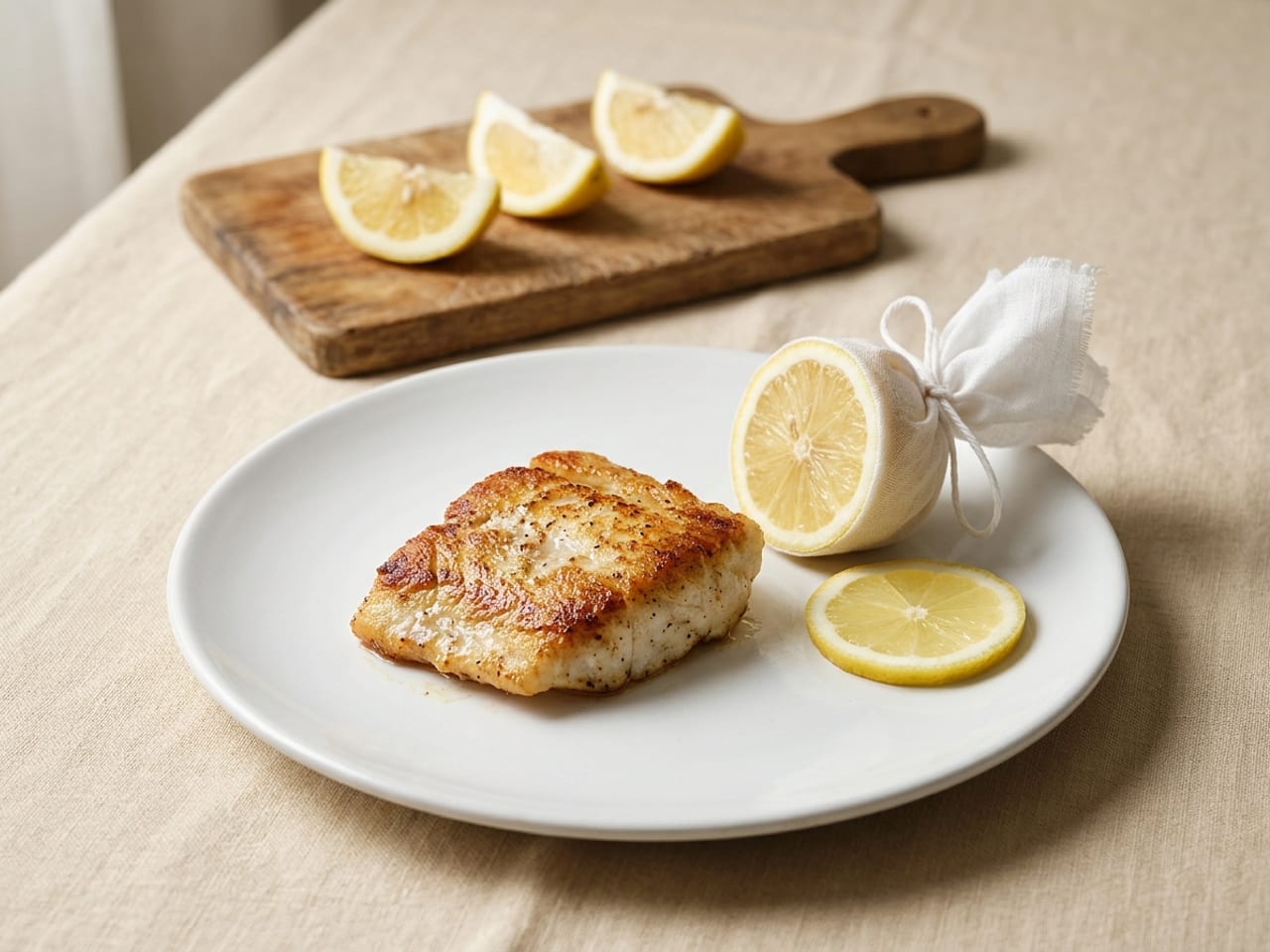
| Cut | What it is | Best for | Holds |
|---|---|---|---|
| Lemon wedge | A lengthwise piece, for squeezing | Fish and chips, katsu, shrimp cocktail, oysters | Cut the day you serve (ours) |
| Lemon wheel (slice) and half-wheel | A round cut across the core | Svíčková, Wiener Schnitzel, poached salmon, tea | Cut the day you serve (ours) |
| Grooved (channelled) slices and half-discs | Wheels with a striped, serrated edge | Fried and cold fish, the classic French way | As late as possible (Escoffier) |
| Trimmed lemon half | Half a lemon, ends cut flat | Fried fish, oysters, Wiener Schnitzel | As late as possible (Escoffier) |
| Lemon crown (zig-zag half, dents de loup) | A half with a zig-zag edge | Fish, buffet platters | Cut the day you serve (ours) |
| Lemon wrapped in muslin (cheesecloth or mesh) | A half or wedge in a cloth wrap | Fish and shellfish, by the sellers' account | Wrap it as you serve (ours) |
| Charred (grilled) lemon half | A half seared cut side down | Grilled fish, oysters | Char it as you serve (ours) |
| Grated lemon zest | Fine gratings of the yellow peel | Risotto, fish, desserts | Grate it over the plate (ours) |
| Zest strips and julienne | Fine threads of peel, no pith | Risotto, sorbet, desserts, fish | Escoffier scalds them and sets them aside |
| Lemon twist | A strip of peel, twisted | Drinks: Martini, Cosmopolitan | "Little more than one day" (Difford's) |
| Long lemon spiral (horse's neck) | The whole peel in one strip | Tall drinks, punch bowls, platters | Cut it as you serve (ours) |
| Candied lemon slices | Slices simmered in syrup until translucent | Tarts, cakes, cupcakes, cheesecake | Fridge 1 week to 1 month, by the recipe |
| Dried (dehydrated) lemon slices | Thin wheels dried crisp | Drinks, platters, tea | 6 months to 1 year for dried fruit in general (NCHFP); one bar says a month |
"Best for" is our summary of each card's sources; "holds" marked ours is our advice, and the sources' own figures are in how far ahead.
On this page: The cuts · Which cut for which dish · How far ahead · Cakes and desserts · Drinks · Why lemon with fish · Washing and waxed lemons · Lime and orange · FAQ
How to cut a lemon for garnish: 13 cuts, step by step
One card per cut: the steps, the size where a named source prints one (where sources disagree, each is shown), the tool, what it suits and how far ahead. Wash first: scrubbing with a clean brush suits citrus, and washing with soap "should be avoided", says the FDA Food Code.69 Escoffier's rule stands over all of them: lemon "should be, as far as possible, only prepared at the last moment".1 Steps marked ours are ours.
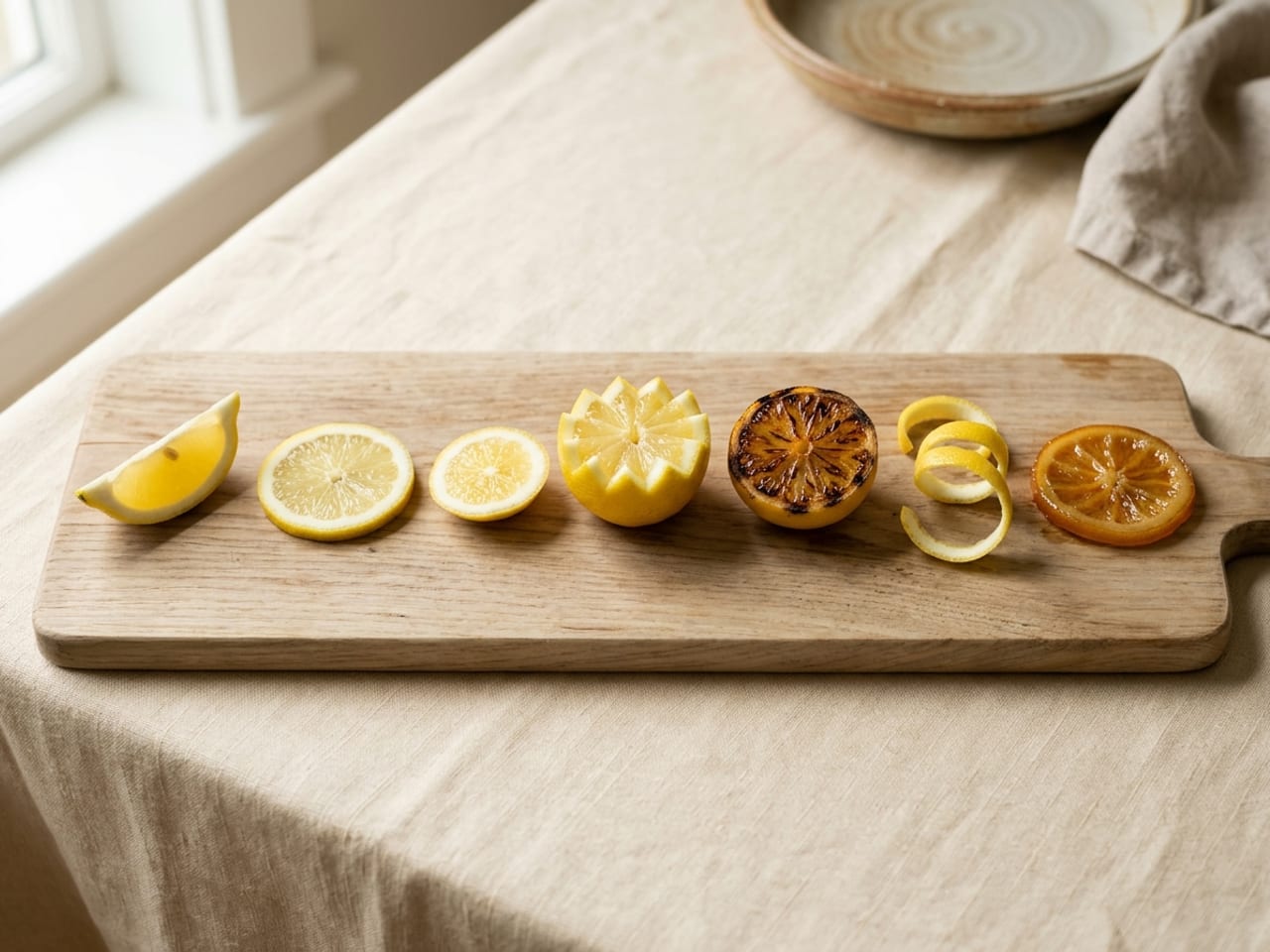
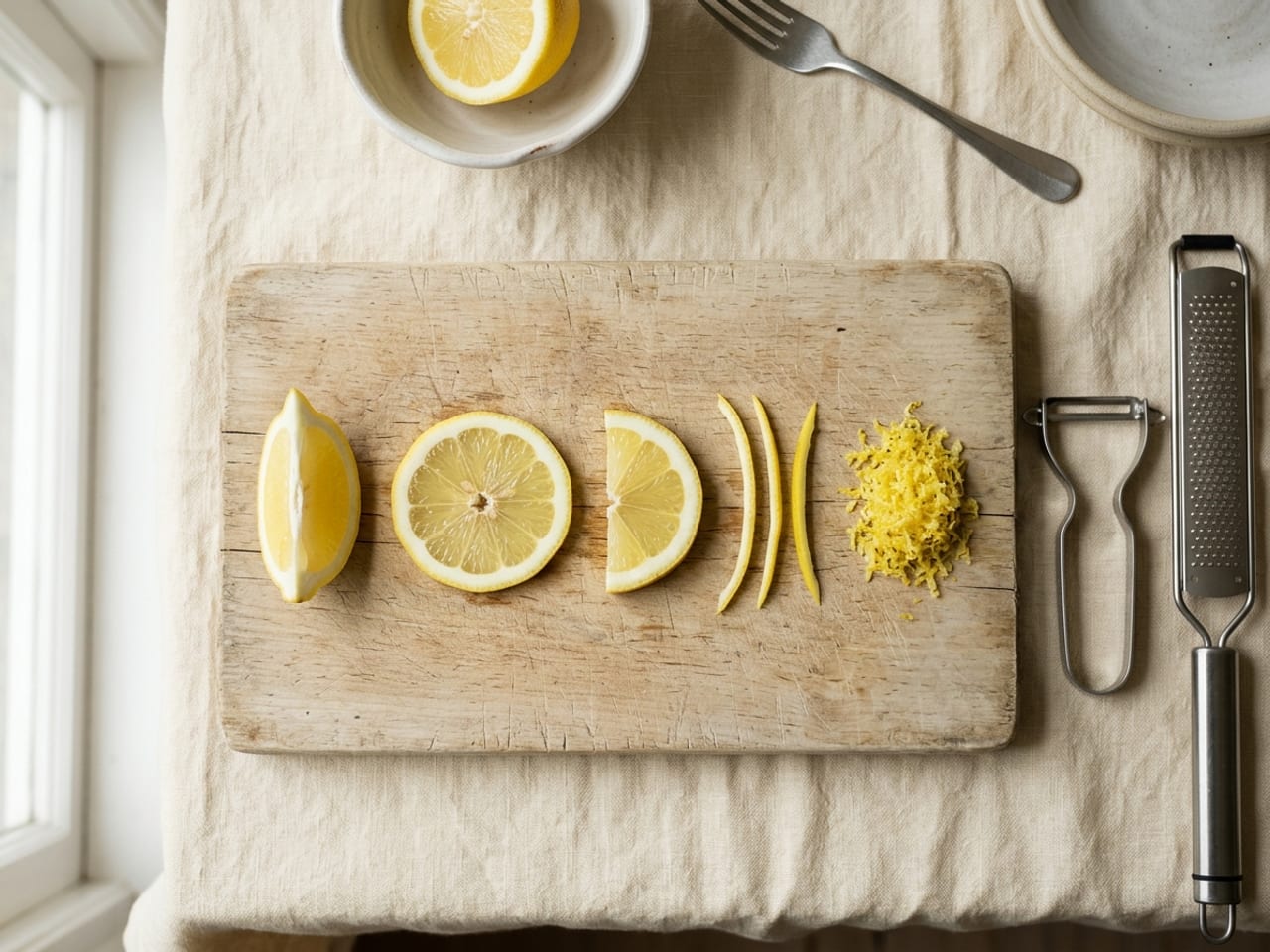
Lemon wedge
- Scrub the lemon under running water with a clean brush, no soap.
- Cut off both ends and halve the lemon lengthwise, through the core.
- Stand each half on end and cut it into wedges with flat ends (Raichlen); Prue Leith squares off both ends of each wedge instead.
- Slice the white fibrous centre (the rib) off each wedge and flick out the seeds, so the diner squeezes juice, not pips.
Size: ¼ to ½ in (6 to 12 mm) thick, says Microplane, a grater maker. Wedges per lemon split: 6 (Blue Apron, three a half), 6 or 8 (Prue Leith), 6 to 8 (Microplane, "about 3-4 wedges per half"); Raichlen gives no count.4, 5, 6, 7
Tool: A chef's or paring knife and a board.
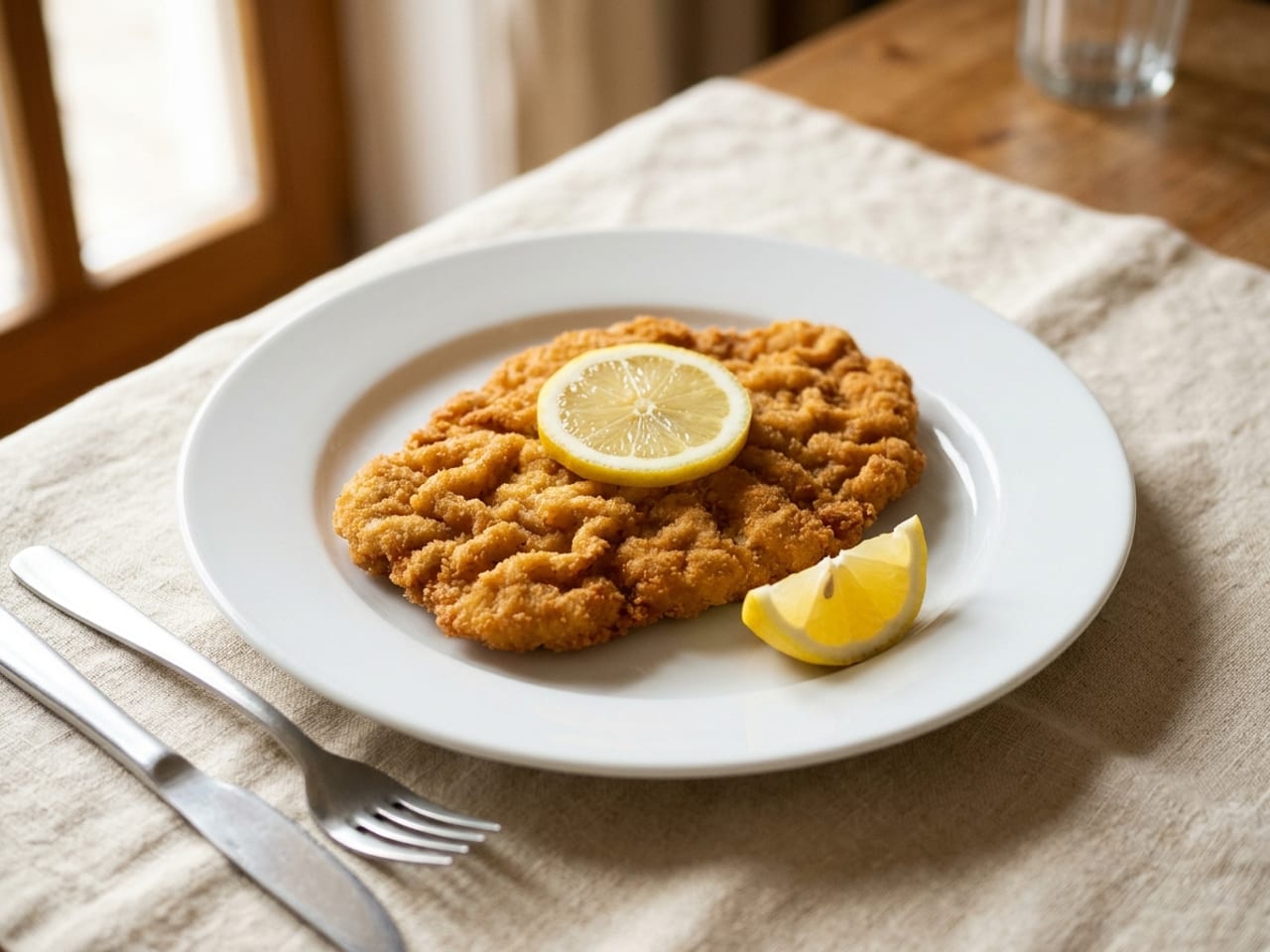
Suits: Fish and chips, tonkatsu and karaage, shrimp cocktail, oysters and sole meunière in the recipes we read; one of the cuts the Austrian ministry names for Wiener Schnitzel.19, 27, 31, 32, 34, 35, 37
How far ahead: Escoffier: prepare it, "as far as possible", "at the last moment", or keep it "in a bowl of fresh water". UF/IFAS: refrigerate within 2 hours of cutting. Bars split from "within hours" (a bar-tool seller) to "a day or two" (a bar director). See the make-ahead table.1, 60, 61, 67
Lemon wheel (slice) and half-wheel
- Scrub the lemon under running water with a clean brush, no soap.
- Trim the two ends and cut across the core into even slices.
- Flick out any seeds with the knife tip (ours).
- For a half-wheel, cut a wheel in two (Microplane: "If you want to make a slice, cut the wheel in half"). For a glass rim, slit one to the centre so it sits on the edge (Microplane).
Size: ⅛ to ¼ in (3 to 6 mm) thick: Microplane and Cuisine at Home print the same range.6, 8
Tool: A sharp knife; a serrated one grips the peel (ours).
Suits: A slice of lemon with cranberries on svíčková (all four Czech sources we read), slices on Wiener Schnitzel in the two Austrian tourism recipes, slices with cold poached salmon (Octopus Books), and slices in tea and water.21, 22, 40, 41, 42, 44, 61
How far ahead: Escoffier: prepare it, "as far as possible", "at the last moment", or keep it "in a bowl of fresh water". UF/IFAS: refrigerate within 2 hours of cutting. Bars split from "within hours" (a bar-tool seller) to "a day or two" (a bar director). See the make-ahead table.1, 60, 61, 67
Grooved (channelled) slices and half-discs
- Scrub the lemon under running water with a clean brush, no soap.
- Cut equally spaced grooves from top to bottom all round the lemon with a channel knife (Cuisine at Home); Escoffier's channel "excises parallel ribbons from the surface of the rind and lays the white bare".
- For Escoffier's half-discs: cut the channelled lemon in two lengthwise through the core, take off both ends and cut each half across into thin, regular slices "to look like serrated half-discs".
- For whole grooved wheels, slice straight across instead.
Size: ⅛ to ¼ in (3 to 6 mm) for grooved wheels (Cuisine at Home); "thin, regular slices" (Escoffier, no figure).1, 8
Tool: A channel knife (canelle): America's Test Kitchen says a peeler and a knife can do the job, the channel knife "neater and more efficient".
Suits: Escoffier: grooved half-lemons with fried smelts, thin grooved slices laid on cold marinated trout, sections of channelled lemon with fried fish.1, 2, 9
How far ahead: Escoffier's rule for every lemon garnish: "as far as possible, only prepared at the last moment", or held "in a bowl of fresh water".1
Trimmed lemon half
- Scrub the lemon under running water with a clean brush, no soap.
- Trim the two ends "quite straight" so the half will stand.
- Cut the lemon through the centre.
- Remove the rind "roughly from the edge" of each half, Escoffier's last step; flick out the seeds you can see (ours).
Size: No figure in what we read.
Tool: A chef's knife.
Suits: Escoffier calls it "the simplest, and perhaps the best" lemon for fried fish, oysters and certain game; his 1903 French text puts "demi-citrons parés" (trimmed halves) with fried fish. The Austrian ministry names a lemon half or a wedge for Wiener Schnitzel.1, 2, 19
How far ahead: Escoffier: "as far as possible, only prepared at the last moment", or "in a bowl of fresh water".1
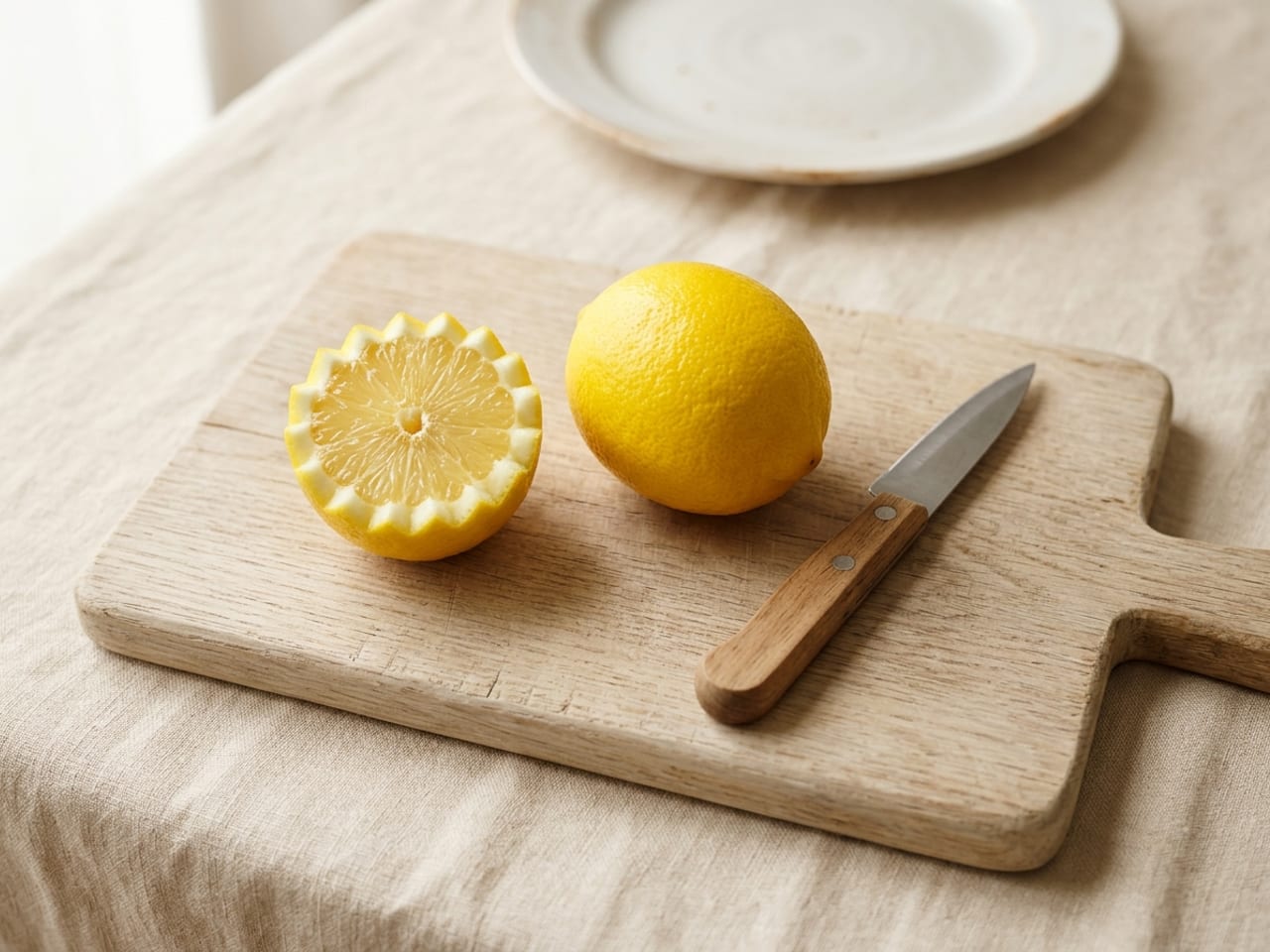
Lemon crown (zig-zag half, dents de loup)
- Scrub the lemon under running water with a clean brush, no soap.
- Push a small sharp knife into the middle of the lemon at an angle, through to the centre.
- Pull it out and make the next cut at the opposite angle, so the two cuts meet in a point; go all the way round.
- Pull the two halves apart and trim a sliver off each base so it stands.
Steps: ours; no source we read gives them. 70
Size: No figure in what we read.
Tool: A paring knife (ours).
Suits: The French Culinary Institute's glossary: "Wolf’s teeth", "cutting a lemon in half in a zigzag manner as a garnish for fish dishes". Hannah Glasse garnished a stewed salmon with "Lemon notched" in 1747, but she does not say how it was notched.3, 79
How far ahead: No source gives a figure; ours: cut it the day you serve, like a wedge.
Lemon wrapped in muslin (cheesecloth or mesh)
- Cut a trimmed half or a wedge and flick out the seeds you can see.
- Set it cut side down on a square of clean muslin (cheesecloth), gather the cloth behind it and tie it with kitchen string, or slip on a ready-made wrap.
- Serve it beside the fish; the diner squeezes it through the cloth.
Steps: ours; no source we read gives them. 17
Size: Sellers sell wraps for wedges and larger ones for halves.17
Tool: Food-grade muslin or a bought lemon wrap, and string.
Suits: What wrap SELLERS say: for fish, lobster and mussels, and wedges in tea; the wrap lets juice through "while preventing unwanted seeds and pulp from coming into contact with food", and lets customers handle the lemon "without direct contact to citrus" (a seller's claim, untested). We found no chef, cookbook or caterer that prints the wrapped half; the earliest date we found is one retailer's line about a brand's fabrics, 1985.17, 18
How far ahead: No source gives a figure.
Charred (grilled) lemon half
- Halve the lemon (Sonoma-Cutrer's list says "halved") and oil the cut sides (Sonoma-Cutrer).
- Grill cut side down "2 to 3 minutes or until grill marks appear" (Sonoma-Cutrer), or "about 3 minutes" until charred (The Nibble).
- In a hot skillet, "give them a little press with a spatula" so the char is even (Tasting Table).
Size: The Nibble plans one lemon for two people.11
Tool: A grill or a heavy skillet, and tongs.
Suits: Grilled fish (Sonoma-Cutrer, a winery's recipe); a charred wedge with raw oysters at a restaurant Tasting Table reported on. The Nibble says the heat "helps soften the juice sacs": its claim, with no source.11, 12, 13
How far ahead: No source gives a figure; ours: char just before serving.
Grated lemon zest
- Scrub the lemon under running water with a clean brush, no soap.
- Grate only the yellow skin on a fine rasp; Utah State's extension says leave the white pith, "as it is bitter".
- Grate it straight over the plate at the last moment (ours).
Size: No figure; Saveur stirs the grated zest of three lemons into one risotto.45
Tool: A fine rasp grater.
Suits: Risotto (Saveur stirs it in and puts julienned zest on top), fish, desserts.45
How far ahead: America's Test Kitchen kept grated zest a week and baked it in a pound cake: pantry and fridge zest "lacked a citrus punch", frozen zest "tasted almost as good as fresh" and keeps "up to 3 weeks before its flavor begins to diminish", but "since its color fades, not as a garnish".66
Zest strips and julienne
- Scrub the lemon under running water with a clean brush, no soap.
- Take the peel off in wide strips with a peeler, or peel to the flesh and lay the rind flat, inside up.
- With a very sharp, flexible knife, cut away all the white pith (Escoffier).
- Cut the zest into strips "about one inch wide" (2.5 cm), then across into fine julienne (Escoffier).
- Escoffier scalds the threads for five minutes, cools and drains them; for a raw garnish, skip that step (ours).
Size: Strips about 1 in (2.5 cm) wide before cutting (Escoffier).1
Tool: A peeler or channel knife, and a sharp knife.
Suits: Julienned zest spooned over lemon risotto (Saveur); fish and desserts.45
How far ahead: Escoffier puts the scalded threads "aside until wanted", with no time; America's Test Kitchen's grated zest, kept a week in the pantry or fridge, "lacked a citrus punch" in a cake (frozen zest did not); it did not test julienne.1, 66
Lemon twist
- Scrub the lemon under running water with a clean brush, no soap.
- Cut "a wide swath of peel, removing as little of the pith as possible" with a sharp peeler or paring knife (Death & Co).
- Hold it coloured side down over the glass and gently bend it to spray the oil (Death & Co); Microplane pinches it or gives it a twist.
- From a wheel instead: one cut from the rind to the centre, then twist the two ends in opposite directions (Cuisine at Home).
Size: Our cocktail garnishes guide takes a strip about ½ in (12 mm) wide.
Tool: A Y-peeler or paring knife.
Suits: Drinks: the technique, and which classic drinks take one, are on our cocktail garnishes guide.
How far ahead: Difford's: cut fresh; if not, refrigerated in a sealed box with moist paper towel, and even then "little more than one day".16
For drinks, see our cocktail garnishes guide.
Long lemon spiral (horse's neck)
- Scrub the lemon under running water with a clean brush, no soap.
- Start at the top with a channel knife and cut slowly in one continuous strip, turning the fruit against a still knife (Microplane).
- Arrange it inside a narrow glass with one end over the rim (Microplane), or lay it across a platter or punch bowl (The Nibble).
Size: Our cocktail garnishes guide leaves about 1 cm (⅜ in) between turns.
Tool: A channel knife.
Suits: The Nibble: "Someone with dexterity can carve the entire peel in one continuous strip, to decorate a punch bowl or a platter"; the Horse's Neck drink is on our cocktail garnishes guide.10
How far ahead: No figure for spirals; Difford's gives cut twists "little more than one day".16
For drinks, see our cocktail garnishes guide.
Candied lemon slices
- Scrub the lemon under running water with a clean brush, no soap.
- Slice the lemon across and take out the seeds.
- Blanch the slices 2 to 3 minutes (Taste of Home) or boil them first (Saveur), then drain.
- Simmer in sugar syrup until the rinds are translucent.
- Lift them out to dry on a rack; Taste of Home dries them overnight.
Size: Thickness splits: "at least 1 cm" (about ⅜ in), because thinner "will fall apart" (Savor the Flavour), ¼ in (6 mm) (Taste of Home), ⅛ to ¼ in (3 to 6 mm) (Barley & Sage). Simmer time splits: about 10 minutes (Saveur), 30 to 35 (Taste of Home), 30 to 40 (Feast and West, Coley Cooks), 45 to 60 (Barley & Sage).46, 47, 49, 50, 51, 52
Tool: A sharp knife or mandoline, a wide pan, a rack.
Suits: Laid on lemon tarts (Saveur, Coley Cooks); "a garnish for cakes, cupcakes, and cheesecakes" (Savor the Flavour); desserts or cocktails (Barley & Sage).46, 47, 50, 51
How far ahead: Each recipe's own figure, none tested: see the candied table. A lemon growers' tip says candied slices are "easily frozen in plastic wrap".61
Dried (dehydrated) lemon slices
- Scrub the lemon under running water with a clean brush, no soap.
- Slice unpeeled lemons thin and discard the ends.
- Lay the slices on a wire rack or parchment and dry at the lowest oven setting or in a dehydrator, turning any that curl.
- Let them cool completely before you seal them in a jar: "Warm food causes sweating which could provide enough moisture for mold to grow" (NCHFP).
Size: Thickness splits: ⅛ in (3 mm) (Feast and West; the lemon growers' tip; Wonderful, a grower's brand) or ¼ in, "6-7 mm" (The Purposeful Pantry). Heat and time split too: 170°F (77°C) for 3 to 4 hours (Feast and West) or 4 hours (the growers' tip), 170°F (77°C) or 200°F (93°C) for 2 to 3 hours (Wonderful), 125°F (52°C) in a dehydrator for 18 to 36 hours or more (The Purposeful Pantry), about 200°F (93°C) for "about a day" (a bar director in Imbibe). Our cocktail garnishes guide prints another source's 8 to 10 hours at 125°F (52°C) for ⅛ in (3 mm) wheels.57, 58, 59, 60, 61
Tool: An oven with a low setting or a dehydrator, a rack.
Suits: "Dried lemon slices make a terrific garnish" (the growers' tip); cocktails (Imbibe).60, 61
How far ahead: NCHFP's general rule for dried fruit: about 1 year at 60°F (16°C), 6 months at 80°F (27°C). A bar director: "about a month" in a jar. One blog: "up to two years".57, 60, 65
Which lemon cut for which dish: fish, schnitzel, katsu, svíčková and dessert
A tally, not a rule: 38 named recipes, chefs, cookbooks and references we read, grouped into 13 kinds of dish, each with the cut it prints. "Usually" appears only where every source we read agrees. Food Network, Just One Cookbook and a few others refused this machine, so they are missing.
| Dish | What the sources print (our count) | On this site |
|---|---|---|
| Wiener Schnitzel | Slices 2, wedges 2, wedge or half 1 | Our pork schnitzel: a wedge of lemon alongside |
| Tonkatsu, chicken katsu and karaage | Wedges 4, slice or wedge 1 | Our chicken katsu: one lemon wedge leaning on the cabbage |
| Fish and chips | Wedges 3 | Not yet |
| Oysters | Trimmed half 1, wedge 1, charred lemon 1 | Not yet |
| Shrimp cocktail | Wedges 2 | Our shrimp cocktail: lemon wedges on the ice |
| Sole meunière | Wedges 2 | Not yet |
| Poached salmon | Wedge 1, slice 1 | Not yet |
| Fried, grilled and cold fish | Grooved slices or halves 2, slice 1, "lemon", no cut named 1, charred lemon 1 | Not yet |
| Svíčková (Czech beef in cream sauce) | Slices 4 | Our svíčková: cranberries and a slice of lemon |
| Lemon risotto | Zest 1 | Not yet |
| Lemon tarts | Candied slices 2 | Not yet |
| Cakes, cupcakes and cheesecake | Candied slices 2 | Not yet |
| Tea and water | Slices 2 | Not yet |
| Dish | Who | Cut | As printed |
|---|---|---|---|
| Wiener Schnitzel | Austrian National Tourist Office21 | Slice | "mit Zitronenscheiben garnieren" (lemon slices), just before serving |
| Wiener Schnitzel | Austrian ministry of agriculture19 | Wedge or half | "mit einer Zitronenspalte oder Zitronenhälfte" (a lemon wedge or half), "traditionell"; another sentence says "eine Zitronenscheibe oder -spalte" (a slice or wedge) "hat Tradition"; it quotes Rokitansky's cookbook: a wedge with every schnitzel |
| Wiener Schnitzel | Plachutta, Vienna23 | Wedge | "Served with lemon wedges"; 4 wedges and an anchovy ring with capers in the list |
| Tonkatsu, chicken katsu and karaage | America's Test Kitchen, tonkatsu27 | Wedge | "Serve with lemon wedges, soy sauce, and wasabi" |
| Tonkatsu, chicken katsu and karaage | RecipeTin Japan, tonkatsu29 | Slice or wedge | "Lemon slices/wedges" with shredded cabbage |
| Fish and chips | Marks & Spencer32 | Wedge | "a lemon wedge (1)" with each piece of fish |
| Oysters | Escoffier, 19071 | Trimmed half | Fried fish, oysters and certain game get "lemon slices fashioned according to the taste of the cook"; the simplest, he says, is a lemon cut through the centre (counted here as a half; he does not say whether the oysters are fried) |
| Shrimp cocktail | Tasting Table35 | Wedge | Lemon wedges on crushed ice with the shrimp |
| Poached salmon | Clodagh McKenna (chef)39 | Wedge | Fennel sprigs and lemon wedges round the rim of a whole salmon |
| Poached salmon | Octopus Books (2022)40 | Slice | "1 lemon, sliced" with sliced cucumber |
| Fried, grilled and cold fish | Escoffier, 1907 and 1903, fried smelts1, 2 | Grooved slice or half | "grooved half-lemons" (1903: "demi-citrons cannelés") and fried parsley |
| Svíčková (Czech beef in cream sauce) | CzechTourism41 | Slice | "a spoonful of cranberries and a slice of lemon" |
| Lemon risotto | Saveur45 | Zest | "garnish with julienned lemon zest" |
| Lemon tarts | Saveur, lemon custard tart46 | Candied slices | Candied slices laid on the tart |
| Cakes, cupcakes and cheesecake | Savor the Flavour (blog)50 | Candied slices | Candied slices "as a garnish for cakes, cupcakes, and cheesecakes" |
| Tea and water | Susan Jung, South China Morning Post (2014)48 | Slice | A slice in a glass of water: "the bitterness leeches out" as it sits |
Show all 38 rows (22 more)
| Dish | Who | Cut | As printed |
|---|---|---|---|
| Wiener Schnitzel | Vienna Tourist Board, from Das Neue Sacher-Kochbuch22 | Slice | Fried parsley and lemon slices |
| Wiener Schnitzel | Vienna Sunday Kitchen (blog)24 | Wedge | "4 lemon wedges" and an anchovy ring with capers in the list |
| Tonkatsu, chicken katsu and karaage | Bento.com, tonkatsu (a reprint)30 | Wedge | "lemon wedges (optional)" |
| Tonkatsu, chicken katsu and karaage | Well Plated, chicken katsu (blog)26 | Wedge | With cabbage, rice and lemon wedges |
| Tonkatsu, chicken katsu and karaage | America's Test Kitchen, karaage28 | Wedge | "Lemon wedges" in the list |
| Fish and chips | Arla Foods UK31 | Wedge | Tartar sauce, lemon wedges and vinegar |
| Fish and chips | Tasting Table33 | Wedge | Lemon wedges, malt vinegar and peas, "if desired" |
| Oysters | Sur La Table34 | Wedge | Lemon wedges with oysters in butter sauce |
| Oysters | Tasting Table (dated 2013 on the page), at a restaurant13 | Charred lemon | "a blistered lemon wedge" with raw oysters |
| Shrimp cocktail | Sur La Table36 | Wedge | "Lemon wedges" to serve |
| Sole meunière | Foodal37 | Wedge | "Serve with lemon wedges" |
| Sole meunière | The Good Life France (blog)38 | Wedge | "Add a lemon wedge and serve" |
| Fried, grilled and cold fish | Escoffier, 1907, grilled fish1 | Slice | "surround them with slices of lemon and bunches of fried parsley" |
| Fried, grilled and cold fish | Escoffier, 1907, cold marinated trout1 | Grooved slice or half | "thin, grooved slices of lemon upon the fish" |
| Fried, grilled and cold fish | Escoffier, 1907, fried cod1 | "lemon", no cut named | "with fried parsley and lemon" |
| Fried, grilled and cold fish | Sonoma-Cutrer, grilled fish (a winery)12 | Charred lemon | Halves grilled cut side down, served with the fish |
| Svíčková (Czech beef in cream sauce) | Forbes Česko, recipe 142 | Slice | A slice of lemon, whipped cream, cranberries, parsley |
| Svíčková (Czech beef in cream sauce) | Forbes Česko, recipe 243 | Slice | Whipped cream, cranberries and lemon slices |
| Svíčková (Czech beef in cream sauce) | Cook Like Czechs (blog)44 | Slice | "a lemon slice, a dollop of whipped cream, and a teaspoon of cranberry jam" |
| Lemon tarts | Coley Cooks, Meyer lemon tart (blog)47 | Candied slices | Candied slices on the tart; the curd is dusted with confectioners' sugar "just before serving" |
| Cakes, cupcakes and cheesecake | Barley & Sage (blog)51 | Candied slices | Candied lemons on a layer cake; "a garnish for desserts or cocktails" |
| Tea and water | UF/IFAS Extension61 | Slice | Scrub the fruit "before ... putting slices into tea or other drinks" |
Where the count is one-sided. Svíčková: four of four Czech sources put a slice of lemon beside cranberries (three add whipped cream), so a slice is what we found.41, 42, 43, 44 Fish and chips: wedges in all three recipes, one a piece at Marks & Spencer.31, 32, 33 Katsu and karaage: wedges in four of five; RecipeTin Japan prints "Lemon slices/wedges".26, 27, 28, 29, 30
Wiener Schnitzel splits. The two Austrian tourism recipes garnish with lemon slices, wien.info's with fried parsley; Plachutta and a Vienna cook's blog print wedges, with an anchovy ring and capers in the list; and the Austrian ministry calls a lemon wedge or half traditional in one sentence and a slice or wedge in another, quoting Marie von Rokitansky's cookbook: a wedge with every schnitzel (the ministry page dates her 1897, 1908 and 1913 in different sentences).19, 21, 22, 23, 24 Lemon itself is old on it: the city of Vienna's history wiki says 18th-century breaded veal came mostly with lemon juice and/or spices, anchovies and cream.20 The French "à la viennoise" in the TLFi dictionary adds egg, capers, olives, anchovies and lemon slices; Escoffier's 1907 poussins à la viennoise get only fried parsley and "sections of lemon".1, 25
Salmon splits too: chef Clodagh McKenna rims a whole poached salmon with lemon wedges, Octopus Books slices the lemon.39, 40 No source we read covers lemon on pasta or a salad by name; The Nibble says only that wedges are for squeezing over "beverages, salads, seafood".10
On this site: pork schnitzel and chicken schnitzel serve a wedge, the Czech way; chicken katsu leans one wedge on the cabbage; karaage puts the wedge beside the pile, never squeezed over a shared plate; yakitori adds a wedge for the salt-grilled skewers; shrimp cocktail sets wedges on the ice; and svíčková gets cranberries and a slice.
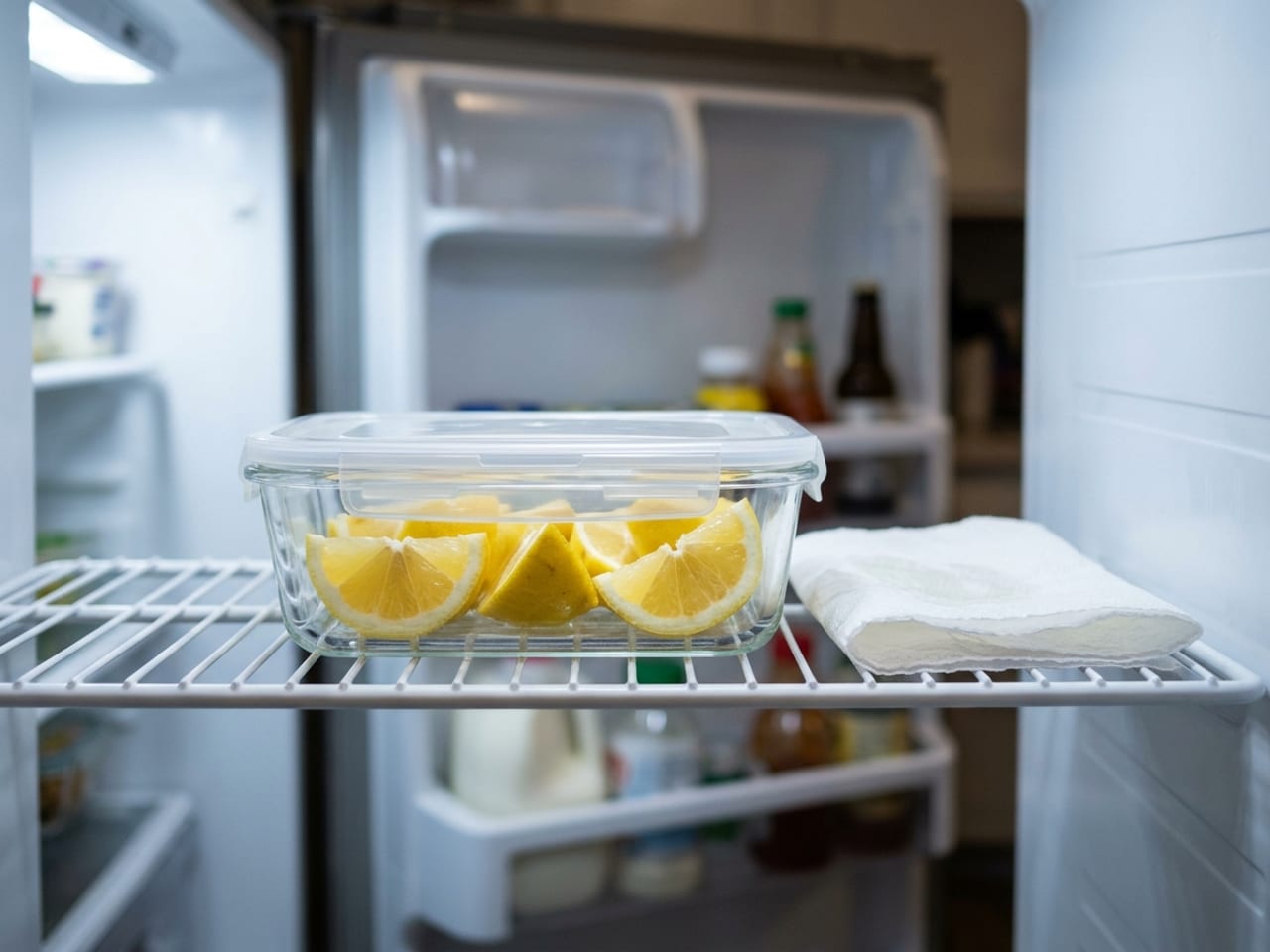
How long do cut lemons last, and can you cut them ahead?
Two different questions hide in this one: is it still safe, and does it still look fresh? On safety, the nearest rule is UF/IFAS Extension's: refrigerate cut citrus within two hours of cutting, and throw it out after two hours at room temperature.61 USDA FoodKeeper has no cut-lemon entry; its 4 days, a quality guide, is for any cut fruit, kept cold.62 On looks, Escoffier wanted lemon prepared, "as far as possible, only ... at the last moment", or held in fresh water, and the bar sources give wedges anything from "within hours" to "a day or two".1, 60, 67 Ours: cut wedges and wheels the day you serve, keep them covered and cold, and treat USDA's 4 days as the outer limit for cut fruit in general, not as how long a wedge looks fresh.
Cut wedges, wheels and halves
No source we read gives a lemon-specific time in the fridge. The authority rows come first; the rest are quality calls.
| Source | Kind | The figure | Also: room temperature, freezer, storing |
|---|---|---|---|
| UF/IFAS Extension (FCS8739)61 | Authority | "Refrigerate fresh citrus products within two hours of peeling or cutting"; no day count | Room temperature: "discarded after two hours" |
| USDA FoodKeeper, "Fruit, cut"62 | Authority | 4 days (generic cut fruit; it has no lemon entry) | Freezing: "Not Recommended" |
| Utah State University Extension (2023)63 | Authority | "Use lemons as quickly as possible after cutting"; no figure | Not stated |
| FDA Food Code 2022 (restaurants)69 | Authority | No figure: cut citrus is not among the plant foods the Code names as needing time/temperature control | Washed raw fruit counts as ready-to-eat: no bare hands |
| Escoffier (1907)1 | Textbook | "as far as possible, only prepared at the last moment" | If it must be cut ahead, keep it "in a bowl of fresh water" |
| Rob Hamic, bar director, in Imbibe (2017)60 | Bar trade | Wedges "only good for a day or two" | Then they "oxidize, change color and become disgusting and slimy" |
| Cocktail Ceremony (a bar-tool shop)67 | Seller | "Wheels and wedges oxidize and dry out within hours" | "Store covered and cold" |
| StillTasty (no source named)68 | Consumer site | "3 to 4 days" | Frozen: "mushy when thawed, but can be used for juice" |
Twists and peel strips
One bar reference, for drinks.
| Source | Kind | The figure | Also: room temperature, freezer, storing |
|---|---|---|---|
| Difford's Guide16 | Bar trade | "little more than one day", in a sealed box with moist paper towel | Ideally cut fresh for each drink |
Grated zest
One test-kitchen trial: a week, a pound cake.
| Source | Kind | The figure | Also: room temperature, freezer, storing |
|---|---|---|---|
| America's Test Kitchen66 | Test kitchen | After a week, fridge and pantry zest "lacked a citrus punch" | Frozen: up to 3 weeks, for baking, "not as a garnish" (the color fades) |
Candied slices
Recipe figures only: no authority or test gives a keeping time for candied lemon slices in what we read. The seven recipes run from 1 week to 1 month in the fridge.
| Source | Kind | The figure | Also: room temperature, freezer, storing |
|---|---|---|---|
| Saticoy Lemon Association tip (a growers' body)61 | Seller | Not stated | "easily frozen in plastic wrap" |
| Taste of Home (test-kitchen tested recipe)49 | Recipe | Up to a week | Freezer up to two months |
| Pastry & Beyond (blog)53 | Recipe | Up to 2 weeks | Room temperature up to 5 days; freezer up to 3 months |
| Barley & Sage (blog)51 | Recipe | Up to 2 weeks | Freezer up to 2 months |
| Running to the Kitchen (blog)55 | Recipe | Up to 2 to 3 weeks, between parchment | Not stated |
| One Sweet Appetite (blog)56 | Recipe | Up to 3 weeks | Room temperature up to 1 week; freezer within 2 months |
| Ambitious Foodie (blog)54 | Recipe | Up to a month | Room temperature up to a week; freezer up to three months |
| Feast and West (blog)52 | Recipe | Up to a month (they get chewier) | Not stated |
Dried slices
The authority row is NCHFP's rule for dried fruit in general, not lemon slices.
| Source | Kind | The figure | Also: room temperature, freezer, storing |
|---|---|---|---|
| National Center for Home Food Preservation65 | Authority | Dried fruit in general: about 1 year at 60°F (16°C), 6 months at 80°F (27°C) | Cool completely before packing; recheck for moisture |
| Rob Hamic, in Imbibe (2017)60 | Bar trade | "about a month" in a glass jar at room temperature | The same article also says they "last for months" |
| Feast and West (blog)57 | Recipe | "up to two years", stored properly | Airtight, cool and dry |
Whole lemons, to buy ahead and cut late
For uncut fruit; the figures split by source.
| Source | Kind | The figure | Also: room temperature, freezer, storing |
|---|---|---|---|
| USDA FoodKeeper, whole citrus62 | Authority | 10 to 21 days from purchase | Pantry 10 days; freezing "Not Recommended" |
| USDA Agriculture Handbook 66 (commercial storage)64 | Authority | 3 to 4 weeks at 37 to 41°F (3 to 5°C) "usually tolerated without harm" | Chilling sensitive; keep away from strong-smelling produce |
| Utah State University Extension63 | Authority | About 6 weeks in a plastic bag | About 2 weeks at room temperature |
| Saticoy Lemon Association tip (a growers' body)61 | Seller | "several weeks" in a sealed bag | "several days" at room temperature; "Whole lemons should not be frozen" |
Freezing, water and the lid
Freezing splits. USDA FoodKeeper says freezing is "Not Recommended" for cut fruit and for whole citrus; StillTasty says frozen cut lemon is mushy but fine for juice; a lemon growers' tip says pieces freeze in their own juice and whole lemons should not be frozen; America's Test Kitchen freezes zest for baking, "not as a garnish". None of them freezes cut wedges or wheels as a garnish.61, 62, 66, 68
In water. Escoffier's bowl of fresh water is the only source we read that holds cut lemon in water, with no time limit given; Susan Jung notes that a slice left in drinking water lets "the bitterness" leach out.1, 48 Covered and cold: "A sealed container in the fridge buys you time; open air steals it", says a bar-tool shop, and Difford's keeps cut twists on moist paper towel in a sealed box.16, 67 Whole lemons keep weeks in the fridge, but they are chilling sensitive, so the USDA handbook calls 3 to 4 weeks at 37 to 41°F (3 to 5°C) "usually tolerated" rather than ideal.64
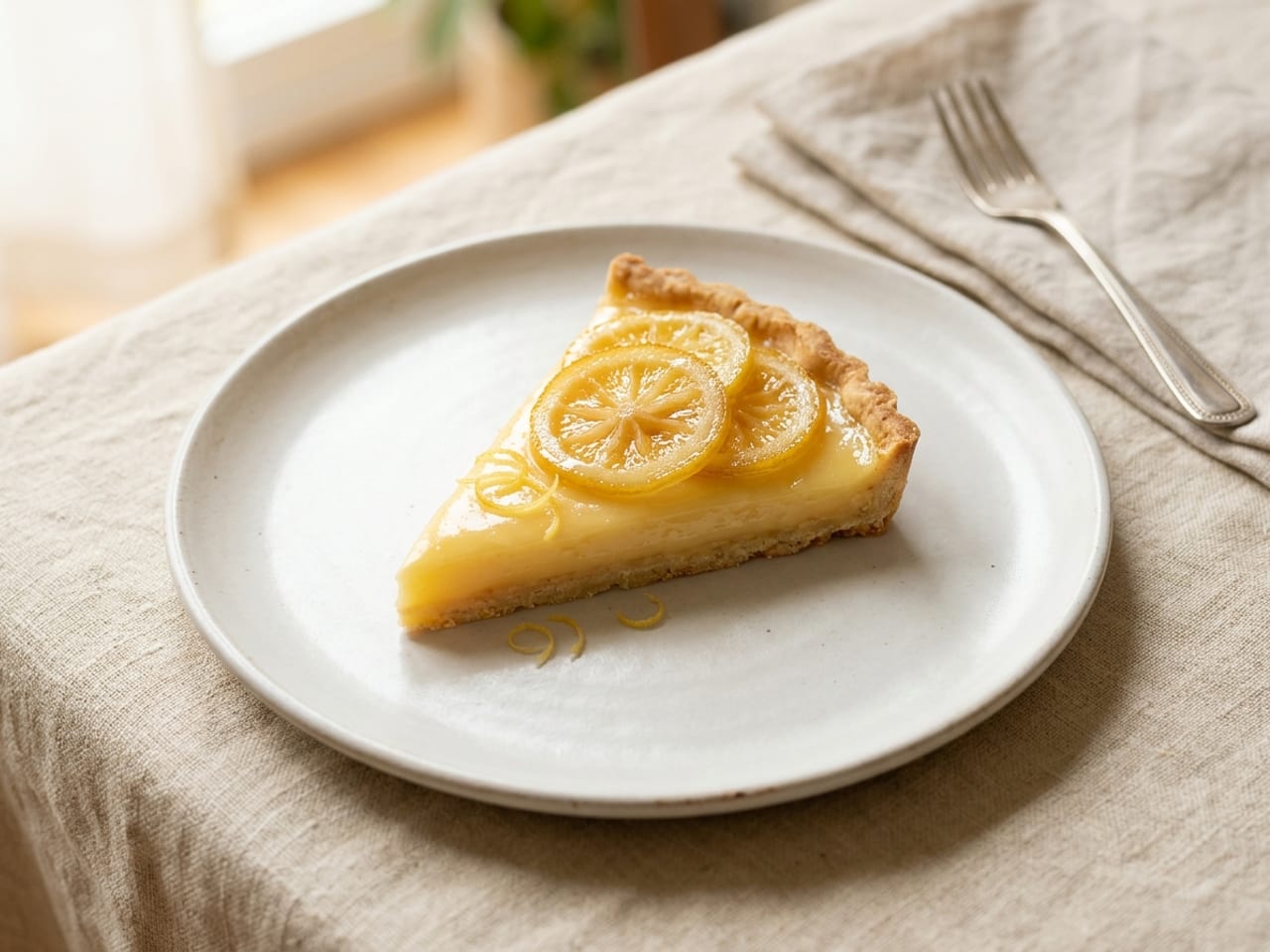
Lemon garnish for cakes, tarts and desserts
Candied lemon slices for cake. Simmered in syrup until the rind is translucent, they go on top: Saveur and Coley Cooks lay them on lemon tarts, Savor the Flavour uses them on "cakes, cupcakes, and cheesecakes", Barley & Sage on a layer cake.46, 47, 50, 51 There is no one method in what we read. Thickness: at least 1 cm (about ⅜ in), or "thinner slices than this will fall apart" (Savor the Flavour), ¼ in (6 mm) (Taste of Home) or ⅛ to ¼ in (3 to 6 mm) (Barley & Sage). Simmer: about 10 minutes (Saveur) to 45 to 60 (Barley & Sage).46, 49, 50, 51 Keeping: 1 week to 1 month in the fridge across seven recipes, none tested; the candied table has each. Coley Cooks lays its slices on the tart and dusts the curd with confectioners' sugar "just before serving".47
Dried slices keep longest in what we read (NCHFP's general dried-fruit rule, 6 months to a year) and suit a platter or a cup of tea; the methods split on thickness (⅛ or ¼ in, 3 or 6 mm) and heat (125°F (52°C) to about 200°F (93°C)), as the dried slices card shows.
Zest curls and threads. Cut them fresh: America's Test Kitchen says frozen zest loses its colour, so it is for baking, "not as a garnish".66 Our lemon sorbet takes "one garnish at most: a few threads of zest". For other sweet garnishes, see chocolate garnishes.
Lemon in drinks: the short version
Drinks have their own guide: our cocktail garnishes guide owns the twist, the flamed peel, the long spiral and dried wheels, and the drinks that take each. As it prints the IBA specs: a Martini gets lemon oil from a peel, a Cosmopolitan a lemon twist, a Bloody Mary a lemon wedge (optional), and a French 75 none. In short: a wedge or wheel slit to sit on the rim (Microplane), a twist cut wide with little pith (Death & Co), a twist kept "little more than one day" (Difford's), and dried wheels "about a month" in a jar by one bar director's count.6, 15, 16, 60
Water and tea. Scrub the lemon "before ... putting slices into tea or other drinks", says UF/IFAS Extension.61 Food writer Susan Jung warns that a slice sitting in water lets its bitterness out.48 Peel in a hot drink also carries some of the fruit's fungicide: see waxed lemons.
Why is lemon served with fish?
From a 14th-century recipe to Escoffier
The oldest line we found is a medieval Latin recipe, the Liber de coquina (two copies from the early 14th century): fried stuffed sardines or anchovies "may be eaten with lemon juice", in a modern translation.77 Robert May dished boiled carp "with sippets round about it, and slic't lemon" (first published 1660) and laid "slices of orange, lemon, and branches of rosemary" on a broiled one.78 Hannah Glasse in 1747: little fried fish get "nothing but plain Butter. Garnish with Lemon", and a stewed salmon "Lemon notched"; by our rough count of her book, about half of her "garnish" instructions name lemon.79 Mrs Beeton in 1861: "In Garnishing Fish, great attention is required, and plenty of parsley, horseradish, and lemon should be used"; her fried plaice and soles get "fried parsley and cut lemon".80 Escoffier, in 1903 and 1907, gave fried fish grooved or trimmed half lemons and fried parsley1, 2; in 1907 he also wrote that pieces of lemon that had garnished a dish "must not be used" again.1 In May's book lemon garnishes meat, fowl and pies as well as fish (our reading of the book, not a count): it was a general garnish of its day, not a fish rule.78
What lemon does to the fishy smell
A main source of the "fishy" smell is trimethylamine (TMA), which bacteria make from a compound in the fish as it spoils; FAO's fish-quality handbook calls TMA "one of the dominant components of spoiling fish".82 Acid cuts it: "The acid turns the volatile gas into a non-volatile salt", three University of Tasmania chemists explain, so lemon juice and vinegar make fish smell less.83 That is a mechanism; by that logic it should matter most for fish that is no longer very fresh (our reading; no study tests it). We found no study that measures lemon squeezed on a plate of fish; the nearest is a panel of eight who rinsed with lemon water after salmon, where room-temperature lemon water reduced the fishy aftertaste.84 More on that in our palate cleanser guide.
| The claim | Verdict | Why |
|---|---|---|
| In the Middle Ages lemon was eaten with fish to dissolve swallowed bones | Untraced legend | The Takeout, whose article ranks for it, found no primary source; its only possible support is two early 20th-century items (1913, 1918) that it says pass on folk advice about lemon juice for a choking fishbone, and we could not open them. We found none either (an archive.org full-text search, and one scan of The Rural Efficiency Guide that archive.org dates 1920). The oldest lemon-with-fish line we found, from the early 14th century, says nothing about bones.77, 81 |
| Lemon neutralises the fishy smell | Supported as chemistry, not measured on a plate | A main source of the "fishy" smell is trimethylamine (TMA), which bacteria make from a compound in the fish as it spoils (FAO). Acid turns TMA into a salt that does not evaporate, chemists at the University of Tasmania explain. By that logic it should matter most for fish that is no longer very fresh (our reading; no study tests it). We found no study that measures lemon on a plate of fish; the nearest is a lemon-water mouth rinse after salmon.82, 83, 84 |
| Lemon was put on schnitzel to hide bad meat or old fat | Unsourced | One sentence on the Austrian ministry's page says so, with no source; we found no cookbook that does.19 |
| Field Marshal Radetzky brought the breaded veal cutlet from Milan to Vienna | Legend | The Austrian ministry calls it invented, after linguist Heinz Dieter Pohl, who traced it to an Italian guide of 1969; the city of Vienna's history wiki calls it an anecdote that an 1844 diary entry contradicts.19, 20 |
Washing lemons, waxed lemons and the restaurant lemon slice
Wash it, even if you will not eat the peel. The FDA: "it is still important to wash produce first so dirt and bacteria are not transferred from the surface when peeling or cutting"; no soap, detergent or produce wash; and washing "will not eliminate" bacteria. The Food Code names citrus among produce to scrub with a clean brush.69, 70
Waxed lemons. US rules allow coatings on fresh citrus "for protection of the fruit", in "the minimum amount required", and set residue limits for the post-harvest fungicides imazalil and thiabendazole on citrus (10 ppm each).72, 73 In the EU text we read, the pack must name any preserving agent used after harvest.74 In one study no washing method removed more than 30% of the imazalil from lemon peel, and a 2026 study found peel fungicides in all 25 drinks and soups it tested, "well below regulatory limits".75, 76 So for zest, twists or a slice in a hot drink, buy unwaxed; Taste of Home says to "always reach for unsprayed lemons" when you use the rind (for the best taste, it says).49 The same advice is on our food garnishes guide.
The restaurant lemon slice. Anne LaGrange Loving and John Perz swabbed lemon slices served on water and soda in 21 restaurants, without the staff knowing: 53 of 76 (69.7%) grew microbes, on the rind, the flesh or both. They found no reported outbreak or illness from lemon slices in drinks and did not measure whether anyone got ill; in what we searched, no one has repeated the study.71 An older extension text says fresh citrus "has not been traced to any cases of foodborne illness".61 A hygiene point, then, not a reason for alarm.
Hands. The FDA Food Code bars restaurant staff from touching exposed ready-to-eat food with bare hands, unless the regulator has approved another procedure, and a washed lemon counts as ready-to-eat; the Code never uses the word "garnish".69 Use tongs or a pick (ours). Lemon-wrap sellers say a wrap lets diners handle the lemon "without direct contact": a seller's claim.17 Escoffier (1907) would not reuse it: "Pieces of lemon that have once served to garnish a dish must not be used, for they have mostly been tainted by grease". His reason is grease, not germs.1 Pips: the wedge methods take them out so the diner squeezes juice, not seeds; we found no source on pips as a hazard.4, 5, 7
Lime garnish and orange garnish instead of lemon
Only what a named source says; we tasted nothing. Ours: cut them as you would a lemon. For drinks (lime on a Margarita, orange on a Negroni or Old Fashioned) see our cocktail garnishes guide; for orange suprêmes, how to cut fruit.
| Swap | What the sources say |
|---|---|
| Lime | Kept like lemon in what we read: a bar director gives lemon and lime wedges the same "day or two", and USDA FoodKeeper files lime with lemon. Death & Co never rubs lime peel on a rim: its oils are "so assertive they tend to overwhelm the drink".15, 60, 62 |
| Orange | Robert May laid "slices of orange, lemon, and branches of rosemary" on a broiled carp in the 1685 edition of his book. Death & Co sometimes rubs an orange twist on the rim, lemon very rarely. USDA FoodKeeper files orange with lemon for storage.15, 62, 78 |
Lemon garnish, answered
How do you cut a lemon for garnish?
Wash it under running water with a brush first. Then pick the cut for the job: a wedge to squeeze (halve lengthwise, cut each half into three or four, trim the white rib, flick out the pips), a wheel ⅛ to ¼ in (3 to 6 mm) thick to lie flat, grated zest or thin strips of peel for aroma without juice. Escoffier's simplest lemon for fried fish, oysters and certain game is a lemon cut through the centre, both ends trimmed straight and the rind roughly removed from the edge. All 13 cuts, with steps, are in the cards on this page.
How many wedges do you get from a lemon?
Six to eight, by the sources we read: Blue Apron cuts six (three a half), Prue Leith six or eight, and Microplane, a grater maker, "about 3-4 wedges per half", ¼ to ½ in (6 to 12 mm) thick. Steven Raichlen gives no count.
What is the difference between a lemon wedge and a lemon slice?
A wedge is cut lengthwise, along the core, so it holds its juice and is easy to squeeze; a slice (a wheel) is cut across the core and lies flat. In the recipes we read, fish and chips, katsu and karaage mostly get wedges and Czech svíčková gets a slice; Wiener Schnitzel splits, slices in the Austrian tourism recipes, wedges at Plachutta.
How long do cut lemons last in the fridge?
Sources split. USDA FoodKeeper gives 4 days, but that is its figure for any cut fruit (it has no lemon entry); StillTasty says 3 to 4 days; a bar director gives wedges "a day or two" before they turn slimy; a bar-tool seller says wedges and wheels dry out "within hours". Our line: cut garnishes the day you serve, covered and cold.
Can you cut lemons ahead of time?
Sources split. A bar-tool shop says wedges and wheels dry out "within hours" and to store them covered and cold; a bar director says wedges are good for "a day or two". UF/IFAS Extension says refrigerate cut citrus within two hours of cutting. Escoffier wanted lemon prepared, "as far as possible", "at the last moment", or kept "in a bowl of fresh water" if it had to be cut ahead. Twists last "little more than one day" even in a sealed box (Difford's).
How long can cut lemons sit out at room temperature?
Two hours, says UF/IFAS Extension: "Leftover cut citrus and freshly squeezed juice should be discarded after two hours at room temperature." The FDA Food Code's list of plant foods that need time and temperature control names cut melons, leafy greens and tomatoes, not cut citrus; it does not say either way.
Can you freeze lemon slices or wedges?
Sources disagree. USDA FoodKeeper says freezing cut fruit is "Not Recommended"; StillTasty says frozen cut lemons are "mushy when thawed, but can be used for juice"; a lemon growers' tip says pieces freeze well in their own juice but whole lemons should not be frozen. For garnish, America's Test Kitchen found frozen zest fine for baking but "not as a garnish", because its colour fades.
Why is fish served with lemon?
Habit first: the oldest lemon-with-fish line we found is in a medieval Latin recipe (Liber de coquina, early 14th-century copies), fried sardines that "may be eaten with lemon juice", in a modern translation; as a garnish it runs through Robert May (first published 1660), Hannah Glasse (1747), Mrs Beeton (1861) and Escoffier. The chemistry: a main source of the fishy smell is trimethylamine, which bacteria make as fish spoils, and acid turns it into a salt that does not evaporate. The story that lemon dissolved swallowed fish bones has no source anyone has found.
Why is lemon wrapped in cheesecloth or muslin?
So the juice comes out and the pips stay in, say the companies that sell lemon wraps; they also say it keeps hands off the fruit, which no study we read has tested. We found no chef or cookbook source for the wrapped half; the earliest date we found is one retailer's line about a wrap brand's fabrics in 1985.
What lemon garnish goes on a cake or tart?
Candied slices, laid on top: Saveur and Coley Cooks put them on lemon tarts, and Savor the Flavour uses them on cakes, cupcakes and cheesecakes. The recipes split on thickness (⅛ in, 3 mm, to at least 1 cm) and simmer time (about 10 to 60 minutes) and keep them in the fridge from 1 week to 1 month. Fine zest curls are the other choice, cut fresh.
How do you make a lemon crown?
Push a small knife into the middle of the lemon at an angle, through to the centre, then make the next cut at the opposite angle, zig-zag all the way round, and pull the halves apart. That is our method: no source we read gives steps. The French Culinary Institute calls the cut dents de loup, wolf's teeth, "a garnish for fish dishes".
How do you make a lemon twist?
Cut "a wide swath of peel, removing as little of the pith as possible" with a sharp peeler (Death & Co), then gently bend it over the glass to spray the oil. Our cocktail garnishes guide has the full method and the drinks that take one.
Are lemon slices in restaurant drinks clean?
In a 2007 study, 53 of 76 lemon slices (69.7%) served on drinks in 21 restaurants grew microbes. The same authors found no reported illness from lemon slices in drinks and did not measure whether anyone got sick. So it is a hygiene point, not proof the lemon makes you ill; skip it if you would rather.
Can I use lime or orange instead of lemon?
In what we read they are kept the same way: a bar director gives lemon and lime wedges the same "day or two", and USDA files all three as citrus (cutting them like lemon is our advice). Robert May put orange and lemon slices on a broiled carp in the 1685 edition of his book. Death & Co never rubs lime peel on a glass rim: "their oils are so assertive they tend to overwhelm the drink".
Cooked something with a lemon on the side? Photograph the plate and Plate Artists re-plates that dish, with the food kept as it is and the changes named. Start with a re-plate.
Your food, plated like a chef's
Snap it, upload it, and get the composed version back, with the steps to recreate it at home.
Start free · 1 enhancement →Free account · 1 free enhancement · No credit card
How this page was made
We cut, timed, tasted and tested nothing for this page. Every size, time, temperature and date is what its source printed, read on 11 November 2026 unless its entry says otherwise. Sellers (tool makers, lemon-wrap sellers, a winery, lemon growers, a bar-tool shop) are labelled as sellers where they make a claim. Ours: the grouping of the dish tally and its counts, the °C and mm conversions, the "best for" and "holds" summaries, the crown and wrapped half steps, and every line marked ours. Left out: lemon roses, baskets and knots (no source beyond a photo article), a dried-slice shelf life of "five years" that cites nothing, and EU wax E-numbers (we could not read the list in the regulation itself). The figures are AI renders, not photographs. The wedge sizes, the restaurant study and the wax line agree with our food garnishes and cocktail garnishes guides, which hand lemon on to this page.
The cookbooks, recipes, studies and rules behind this page
How each source was read (in full, as OCR of a scan, as a fragment, in an archived copy, or as a prior reading for another of our guides) is in its entry. Sellers sell what they describe.
- Escoffier, A. (1907). A Guide to Modern Cookery. William Heinemann, London (the English edition of Le Guide culinaire); Internet Archive scan cu31924000610117, OCR, read on 11 November 2026 as OCR text (a copy saved for our food garnishes guide): No. 179 "Peeled, Channelled, and Zested Lemons", pp. 73 to 74: "Lemons are channelled by means of a little knife, or a special instrument for the purpose, which excises parallel ribbons from the surface of the rind and lays the white bare"; the channelled lemon is cut in two lengthwise and "cut laterally into thin, regular slices to look like serrated half-discs"; "Fried fish, oysters, and certain game are generally garnished with lemon slices fashioned according to the taste of the cook ; but the simplest, and perhaps the best, way is to cut the lemon through the centre, after having trimmed the two ends quite straight, and then to remove the rind roughly from the edge"; zest "into strips about one inch wide, and cut these laterally in fine julienne- fashion", scalded five minutes; "it should be, as far as possible, only prepared at the last moment. If it must be prepared beforehand, it would be well to keep it in a bowl of fresh water". No. 256, p. 119: "When lemons accompany a roast, they should be served separately. Pieces of lemon that have once served to garnish a dish must not be used, for they have mostly been tainted by grease". Fried cod "with fried parsley and lemon"; smelts "with fried parsley and grooved half-lemons"; grilled fish "surround them with slices of lemon and bunches of fried parsley"; No. 394 marinaded trout, "thin, grooved slices of lemon upon the fish"; No. 1651 Poussins à la Viennoise, "Surround with fried parsley and sections of lemon". archive.org
- Escoffier, A. (1903). Le Guide culinaire. Paris; Internet Archive scan b21525912, OCR, read on 11 November 2026 as OCR text (prior reading): smelts "persil frit et demi-citrons cannelés" (grooved half lemons); fried fish "On les garnit de persil frit et de demi-citrons parés correctement" (trimmed half lemons); translations ours. archive.org
- The French Culinary Institute (2021). The Fundamental Techniques of Classic Cuisine (glossary: Dents de Loup). Abrams, via the ckbk cookbook library, read in full on 11 November 2026 (the glossary entry): "“Wolf’s teeth;” cutting a lemon in half in a zigzag manner as a garnish for fish dishes". ckbk.com
- Raichlen, S. (2001). How to Grill (Cutting a Lemon into Wedges). Workman, via the ckbk cookbook library, read in full on 11 November 2026 (the entry): cut the ends off, halve lengthwise, stand each half on end and cut wedges with flat ends; "Remove any seeds and cut off the white fibrous center; the lemon is now ready to use"; no wedge count. ckbk.com
- Leith, P. (2018). Prue: My All-time Favourite Recipes (Lemon wedges). via the ckbk cookbook library, read in full on 11 November 2026 (the entry): "First cut the lemon lengthways into six or eight wedges. Cut both ends squarely off each lemon wedge", then trim the thin inner edge to take off the pith and flick out the pips. ckbk.com
- Microplane (Grace Manufacturing) (2026). Wedges, Wheels, and Slices: Cocktail Garnishes. microplane.com blog (a tool maker: it sells graters and zesters), undated page, read in full on 11 November 2026: wedges, "Begin to slice wedges between 1/4-1/2 inch thick. This should net about 3-4 wedges per half"; wheels, "Cut 1/8-1/4 inch thick slices with knife"; a slit to seat each on a glass rim. microplane.com
- Blue Apron (2026). How to Cut a Lemon Wedge the Right Way. Blue Apron blog (a meal-kit company), undated page, read in full on 11 November 2026: halve end to end, "After you cut the lemon in two, slice each half into three wedges", then cut the rib away from each wedge to take out most seeds. blog.blueapron.com
- Cuisine at Home (2026). How to Make Lemon Wheels for Garnishes. cuisineathome.com tips (magazine), undated page, read in full on 11 November 2026: "With your canelle, cut equally spaced vertical grooves in the lemon-from the top to bottom. Then cut the lemon into ⅛"-¼" slices"; for a twist, one cut from the rind to the centre, then twist the ends in opposite directions. cuisineathome.com
- America's Test Kitchen (2025). The Best Channel Knives for Cocktail Garnishes in 2025. Cook's Illustrated equipment reviews, last updated 22 January 2025, read on 11 November 2026 (some product details paywalled): a channel knife cuts thin ribbons of lemon, lime or orange peel; "While you could just use a vegetable peeler to remove large swaths of peel and then cut each swath into strips, a channel knife can make this process neater and more efficient". cooksillustrated.com
- The Nibble (2016). Food Fun: Beyond The Twist, Lemon & Lime Flowers & Art. The Nibble, Webzine of Food Adventures (blog), 20 November 2016, read in full on 11 November 2026: a channel zester carves strips of peel, and "Someone with dexterity can carve the entire peel in one continuous strip, to decorate a punch bowl or a platter"; wedges are for squeezing over beverages, salads and seafood. blog.thenibble.com
- The Nibble (2015). Tip of the Day: Grilled Lemon. The Nibble, Webzine of Food Adventures (blog), 24 September 2015, read in full on 11 November 2026: "Cook until the lemons are heated through and charred on the cut side, about 3 minutes"; "the heat from grilling or pan-charring a sliced lemon helps soften the juice sacs" (its own claim, no source given). blog.thenibble.com
- Sonoma-Cutrer (2026). Grilled Fish with Charred Lemons. sonomacutrer.com recipes (a winery's recipe page), undated page, read in full on 11 November 2026: oil the cut sides; "Grill lemons, cut sides down, 2 to 3 minutes or until grill marks appear. Serve lemons with fish". sonomacutrer.com
- Tasting Table (2013). Charred Lemons Are The New Food Trend. tastingtable.com, read in full on 11 November 2026 (the page's date line reads 25 March 2013, not checked further): at a restaurant it names, "a blistered lemon wedge supplied robust acidity and concentrated floral sweetness to a plate of raw oysters". tastingtable.com
- Tasting Table (2026). The Skillet Tip That Ensures Perfectly Charred Citrus. tastingtable.com, undated page, read in full on 11 November 2026: in a hot skillet, "give them a little press with a spatula once they hit the hot surface". tastingtable.com
- Death & Co (2026). Citrus, Smarter: Fresh Techniques for Better Cocktails. Death & Co (a cocktail bar group) online journal, 9 April 2026, read in full on 11 November 2026: "Use a sharp vegetable peeler or paring knife to cut a wide swath of peel, removing as little of the pith as possible"; orange twists are sometimes rubbed on the rim, lemon very rarely, and never grapefruit or lime: "their oils are so assertive they tend to overwhelm the drink"; "we juice each day before service" (juice, not garnish). deathandcompany.com
- Difford, S. (Difford's Guide) (2026). Citrus zest twists. Difford's Guide (a cocktail reference publisher), undated page, read in full on 11 November 2026: "Ideally, zests should be cut fresh for each drink, but if this is not possible, they should be kept pre-cut and refrigerated. Store in a sealed plastic box with some moist paper towel, but even then, once cut, their shelf life is little more than one day". diffordsguide.com
- CiboWares (2026). What is a Lemon Wrap and What Do You Use Them For? cibowares.com blog (a restaurant supplier, a seller's page: it sells the product it describes), undated page, read in full on 11 November 2026: "Lemon wraps are often called lemon mesh bags, lemon muslin wraps and lemon covers"; wraps allow "lemon juice to be squeezed onto a dish while preventing unwanted seeds and pulp from coming into contact with food"; "They also allow customers to handle them without direct contact to citrus" (the seller's claims). cibowares.com
- Gourmet-Versand (2026). Original Regency Lemon Wraps, lemon serving cloth. gourmet-versand.com (a German retailer, a seller's page: it sells the product it describes), undated page, read in full on 11 November 2026: "With the production of special fabrics in 1985, the inventors of Orginal Regency Lemon Wraps succeeded in growing upmarket food with their disposable products" (spelling theirs); the wraps "hold back the seeds". gourmet-versand.com
- Austrian Federal Ministry of Agriculture (BMLUK) (2026). Wiener Schnitzel (Traditionelle Lebensmittel). bmluk.gv.at, the ministry's register of traditional foods, undated page, read in full on 11 November 2026: served "mit einer Zitronenspalte oder Zitronenhälfte" (with a lemon wedge or lemon half), "traditionell"; another sentence says "Die Zugabe einer Zitronenscheibe oder -spalte ... hat Tradition" (a lemon slice or wedge); quotes Marie von Rokitansky's Österreichische Küche, "Man gibt eine Zitronenspalte zu jedem Schnitzel" (dated 1913 in that sentence, 1897 and 1908 elsewhere on the same page); calls the Radetzky story invented, after Heinz Dieter Pohl (2007), who traces it to a 1969 Italian guide; the remark that the acid once covered "schlechtes Fleisch oder altes Fett" (bad meat or old fat) cites no source. Translations ours. bmluk.gv.at
- Wien Geschichte Wiki (City of Vienna) (2025). Wiener Schnitzel. geschichtewiki.wien.gv.at, the city's history encyclopedia, last changed 17 September 2025, read in full on 11 November 2026: 18th-century breaded veal "meistens mit Zitronensaft und/oder verschiedenen Gewürzen, Sardellen und Milchrahm" (mostly with lemon juice and/or spices, anchovies and cream); the name first in Maria Anna Neudecker's cookbook, Prague 1831; the Radetzky-from-Milan story is an anecdote that an Archduke's diary entry of 26 September 1844 (schnitzel at Lambach) contradicts. Translation ours. geschichtewiki.wien.gv.at
- Österreich Werbung (Austrian National Tourist Office) (2026). Rezept: Original Wiener Schnitzel. austria.info, undated page, read in full on 11 November 2026: "Anrichten und vor dem Servieren mit Zitronenscheiben garnieren" (garnish with lemon slices before serving). Translation ours. austria.info
- Vienna Tourist Board, from Das Neue Sacher-Kochbuch (2026). Wiener Schnitzel. wien.info, undated page, read in full on 11 November 2026: "mit frittierter Petersilie sowie Zitronenscheiben garnieren" (garnish with fried parsley and lemon slices). Translation ours. wien.info
- Plachutta (Vienna restaurants) (2026). Original Wiener Schnitzel Recipe: Step by Step. plachutta.at, English page, undated page, read in full on 11 November 2026: "Served with lemon wedges and a side dish"; four lemon wedges and an anchovy ring with capers in the list. plachutta.at
- Vienna Sunday Kitchen (2026). How to make an authentic Wiener Schnitzel. vienna-sunday.kitchen (a Vienna cook's blog), undated page, read in full on 11 November 2026: "4 lemon wedges" and an anchovy ring with capers in the list; "Drain on some kitchen paper and serve garnished with lemon". vienna-sunday.kitchen
- Trésor de la langue française informatisé (CNRTL) (2026). Viennois, -oise. cnrtl.fr (the TLFi dictionary), undated page, read in full on 11 November 2026: in cookery, à la viennoise = escalopes, poultry or fish fillets breaded and sautéed, served with chopped hard-boiled egg, parsley, capers, olives, anchovies "et de tranches de citron" (and lemon slices). cnrtl.fr
- Clarke, E. (Well Plated) (2026). Chicken Katsu. wellplated.com (blog), undated page, read in full on 11 November 2026: "Serve with cabbage, a small bowl of rice, and lemon wedges". wellplated.com
- America's Test Kitchen (2026). Tonkatsu (Japanese Fried Pork Chops). Cook's Illustrated recipes, read on 11 November 2026 (paywalled; the method was visible): "Serve with lemon wedges, soy sauce, and wasabi". americastestkitchen.com
- America's Test Kitchen (2026). Karaage (Japanese Fried Chicken Thighs). America's Test Kitchen recipes, read on 11 November 2026 (paywalled; the ingredient list only): "Lemon wedges". americastestkitchen.com
- RecipeTin Japan (2026). Tonkatsu (Japanese Pork Schnitzel). japan.recipetineats.com (blog), undated page, read in full on 11 November 2026: served with shredded cabbage, parsley, tomato wedges and "Lemon slices/wedges". japan.recipetineats.com
- Bento.com, reprinted by Just A Pinch (2026). Tonkatsu (Pork Cutlet) Recipe. justapinch.com (a reprint), undated page, read in full on 11 November 2026 (the reprint): "lemon wedges (optional)". justapinch.com
- Arla Foods UK (2026). Fish and chips. arlafoods.co.uk recipes (a dairy brand), undated page, read in full on 11 November 2026: "Serve the fish and chips with tartar sauce, lemon wedges, and vinegar". arlafoods.co.uk
- Marks & Spencer (2026). British fish and chips. marksandspencer.com recipes (a retailer), undated page, read in full on 11 November 2026: "Serve each piece of fish with some of the chips, lemon mayo, kimchi mayo, watercress (1 bag) and a lemon wedge (1)". marksandspencer.com
- Tasting Table (2026). Classic British Fish And Chips Recipe. tastingtable.com, undated page, read in full on 11 November 2026: "To serve, you can add lemon wedges, additional malt vinegar, and some peas, if desired". tastingtable.com
- Sur La Table (2026). Oysters on the Half Shell with Lemon-herb Butter Sauce. surlatable.com recipes (a retailer), undated page, read in full on 11 November 2026: "serve oysters in the pan with lemon wedges and bread for dipping in the butter sauce". surlatable.com
- Tasting Table (2026). Classic Shrimp Cocktail Recipe. tastingtable.com, undated page, read in full on 11 November 2026: "Fill a plate with crushed ice and arrange the peeled and deveined shrimp, along with lemon wedges and a ramekin of cocktail sauce". tastingtable.com
- Sur La Table (2026). Perfect Shrimp Cocktail. surlatable.com recipes (a retailer), undated page, read in full on 11 November 2026: "Lemon wedges" for serving; lemon zest and juice in the sauce. surlatable.com
- Foodal (2026). Fish in Brown Butter Sauce Recipe (Sole Meunière). foodal.com, undated page, read in full on 11 November 2026: "Pour sauce over fish. Serve with lemon wedges". foodal.com
- The Good Life France (2026). How to make classic French Sole Meunière. thegoodlifefrance.com (blog), undated page, read in full on 11 November 2026: "Add a lemon wedge and serve with fries or a green salad". thegoodlifefrance.com
- McKenna, C. (2026). Whole poached wild salmon with fresh horseradish cream. clodaghmckenna.com (a chef's recipe page), undated page, read in full on 11 November 2026: "Garnish the rim of the salmon with the sprigs of fennel and lemon wedges". clodaghmckenna.com
- Octopus Books (2022). Cold-poached salmon with herb garden sauce. octopusbooks.co.uk (a publisher's recipe excerpt), 24 August 2022, read in full on 11 November 2026: in the garnish list, "1 lemon, sliced". octopusbooks.co.uk
- CzechTourism (VisitCzechia) (2026). Svíčková na smetaně. visitczechia.com, undated page, read in full on 11 November 2026: "a spoonful of cranberries and a slice of lemon, which add a sweet and sour contrast to the dish". visitczechia.com
- Forbes Česko (2026). Poctivá svíčková pro nepoctivé kuchaře. forbes.cz, read on 11 November 2026 (date not read): "Na talíři můžete jídlo dozdobit plátkem citronu, šlehačkou, brusinkami i retro petrželkou" (on the plate: a slice of lemon, whipped cream, cranberries, even retro parsley). Translation ours. forbes.cz
- Forbes Česko (2026). Vánoční hostina: božská svíčková. forbes.cz, read on 11 November 2026 (date not read): "podávejte s omáčkou, plátky knedlíku, ušlehanou smetanou, brusinkami a plátky citronu" (serve with the sauce, dumpling slices, whipped cream, cranberries and lemon slices). Translation ours. forbes.cz
- Cook Like Czechs (2026). Svíčková na smetaně. cooklikeczechs.com (a Czech cook's blog), undated page, read in full on 11 November 2026: "If desired, garnish each portion with a lemon slice, a dollop of whipped cream, and a teaspoon of cranberry jam". cooklikeczechs.com
- Saveur (2026). Lemon Risotto (Risotto al Limone). saveur.com, read on 11 November 2026 (date not read): grated zest of three lemons stirred in at the end, and "Spoon risotto onto plates and garnish with julienned lemon zest. Serve immediately". saveur.com
- Saveur (2026). Lemon Custard Tart. saveur.com, read on 11 November 2026 (date not read): thin slices boiled, then simmered in syrup: "Cook until lemon rind is softened and translucent, about 10 minutes; let candied lemon cool in syrup", then laid on the tart. saveur.com
- Coley Cooks (2026). Meyer Lemon Tart. coleycooks.com (a recipe blog: its figures are the cook's own, with no test or source behind them), undated page, read in full on 11 November 2026: "Simmer lemon slices 30-40 minutes until pulp looks transparent"; the slices go on the tart and the curd is dusted with confectioners' sugar "just before serving". coleycooks.com
- Jung, S. (2014). Signature dish: a seedy issue. South China Morning Post, Post Magazine, 26 April 2014, read on 11 November 2026 as a FRAGMENT (paywalled after about the fourth paragraph): on a lemon slice in a glass of water, "As the slice of fruit sits in the water, the bitterness leeches out". scmp.com
- Knoebel, M. (Taste of Home) (2025). Candied Lemon Slices. tasteofhome.com (the page says tested by the Taste of Home Test Kitchen), updated 18 March 2025, read in full on 11 November 2026: "slice them into 1/4-inch slices"; "Simmer on medium-low, uncovered, until the lemon slices are translucent, 30 to 35 minutes"; "After drying overnight, candy lemon slices can last up to a week in an airtight container in the refrigerator. You can also store them in the freezer for up to two months"; "Whenever a recipe uses a lemon's rind, always reach for unsprayed lemons". tasteofhome.com
- Savor the Flavour (2026). Candied Lemon Slices. savortheflavour.com (a recipe blog: its figures are the cook's own, with no test or source behind them), undated page, read in full on 11 November 2026: "Slice the lemons to at least 1 cm thickness. Thinner slices than this will fall apart"; "Use them as a garnish for cakes, cupcakes, and cheesecakes". savortheflavour.com
- Barley & Sage (2026). How to Make Candied Lemons. barleyandsage.com (a recipe blog: its figures are the cook's own, with no test or source behind them), undated page, read in full on 11 November 2026: "thinly slice the lemons (⅛ to ¼ inch)"; simmered 45 minutes to 1 hour until the rinds are translucent; "Store in an airtight container in the fridge for up to 2 weeks. Or freeze for up to 2 months!"; used "as a garnish for desserts or cocktails" and on a layer cake. barleyandsage.com
- Feast and West (2026). Candied Lemon Slices. feastandwest.com (a recipe blog: its figures are the cook's own, with no test or source behind them), undated page, read in full on 11 November 2026: "This simple recipe for candied lemon slices makes a wonderful garnish and chewy tart snack"; simmered 30 to 40 minutes; "store in the refrigerator for up to a month". feastandwest.com
- Pastry & Beyond (2026). Candied Lemon Slices. pastryandbeyond.com (a recipe blog: its figures are the cook's own, with no test or source behind them), undated page, read in full on 11 November 2026: "store the slices at room temperature in an airtight container for up to 5 days, in the fridge for up to 2 weeks, or in the freezer for up to 3 months". pastryandbeyond.com
- Ambitious Foodie (2026). Candied Lemon Slices. ambitiousfoodie.com (a recipe blog: its figures are the cook's own, with no test or source behind them), undated page, read in full on 11 November 2026: "Store candied lemon slices in an airtight container at room temperature for up to a week, or in the refrigerator for up to a month"; freezer up to three months. ambitiousfoodie.com
- Running to the Kitchen (2026). Candied Lemon Slices. runningtothekitchen.com (a recipe blog: its figures are the cook's own, with no test or source behind them), undated page, read in full on 11 November 2026: "Store any leftover lemon slices between sheets of parchment in an air-tight container in the refrigerator for up to 2-3 weeks". runningtothekitchen.com
- One Sweet Appetite (2026). Candy Lemon Slices. onesweetappetite.com (a recipe blog: its figures are the cook's own, with no test or source behind them), undated page, read in full on 11 November 2026: room temperature up to 1 week; "Refrigerator: Store in the fridge for up to 3 weeks"; freezer within 2 months. onesweetappetite.com
- Feast and West (2026). Dehydrated Lemon Slices. feastandwest.com (a recipe blog: its figures are the cook's own, with no test or source behind them), undated page, read in full on 11 November 2026: "Slice lemons into ⅛-inch pieces"; oven at its lowest, "mine was 170°F (77°C)", 3 to 4 hours; "If stored properly, dehydrated lemon slices will keep for up to two years". feastandwest.com
- The Purposeful Pantry (2026). How to Dehydrate Lemons. thepurposefulpantry.com (a recipe blog: its figures are the cook's own, with no test or source behind them), undated page, read in full on 11 November 2026: "Slice lemons into 1/4″ slices (6-7 mm)"; "Dry at 125°F/52°C for 18-36+ hours until dehydrated lemon slices snap when cooled"; lemons brown when dried hotter. thepurposefulpantry.com
- Wonderful Seedless Lemons (2026). Dried Wonderful Seedless Lemon Slices. wonderfulseedlesslemons.com (a lemon grower's brand, a seller's page: it sells the product it describes), undated page, read in full on 11 November 2026: "Slice the lemons ⅛" thick. Place the lemon slices on parchment paper and bake for 2 to 3 hours until completely dry. Store in an airtight container"; oven 170°F, or 200°F if it does not go lower; no keeping time. wonderfulseedlesslemons.com
- Janzen, E. (Imbibe), quoting Rob Hamic (2017). How to Dehydrate Citrus for Cocktail Garnishes. Imbibe Magazine, 16 March 2017, read in full on 11 November 2026 (the bar it names, Perennial in San Francisco, has since closed): "Most bartenders will cut lemon and lime wedges and those are really only good for a day or two before they start to oxidize, change color and become disgusting and slimy"; dehydrated wheels "will keep for about a month" in a glass jar at room temperature (the same article also says they "last for months"); oven about 200°F, "about a day". imbibemagazine.com
- Simonne, A. & Ritenour, M. (UF/IFAS Extension), in a UCCE Master Food Preservers handout (2019). Citrus: Preserve It, Serve It (part 1: FCS8739, Citrus: Safe Handling Practices for Consumers). UC Agriculture and Natural Resources, UCCE Master Food Preservers of Central Sierra, the handout is dated January 2019; FCS8739 was first published October 2002, revised 2006, reviewed July 2015; read in full on 11 November 2026: "Refrigerate fresh citrus products within two hours of peeling or cutting"; "Leftover cut citrus and freshly squeezed juice should be discarded after two hours at room temperature"; "Scrub citrus fruits with a clean produce brush before making juice or putting slices into tea or other drinks"; "Fresh citrus is rich in many nutrients and has not been traced to any cases of foodborne illness" (old text). The "Lemony Facts & Tips" part is the Saticoy Lemon Association's (a growers' body, a seller): "Whole lemons should not be frozen"; "Boil thin slices of lemon with sugar to make small candied slices for garnishes. Candied slices are easily frozen in plastic wrap for later use"; dried slices, "cut unpeeled fruit into 1/8" thick slices, discarding ends", "170-degree oven for 4 hours". ucanr.edu (PDF)
- USDA Food Safety and Inspection Service (2025). FoodKeeper data (version 128). fsis.usda.gov (the FoodKeeper app's dataset), read on 11 November 2026 in the Internet Archive capture of 2 July 2025 (the live host refused the fetcher): no entry for cut lemon; "Fruit, cut": refrigerate 4 days, freezing "Not Recommended"; "Citrus fruit: lemon, lime, orange, grapefruit, tangerines, clementines": pantry 10 days, refrigerator 10 to 21 days from purchase, freezing "Not Recommended". fsis.usda.gov (archived)
- Utah State University Extension (2023). Fruit and Vegetable Guide Series: Lemons. extension.usu.edu (PDF), 21 July 2023, read in full on 11 November 2026: "Lemons can be stored at room temperature for about 2 weeks. They will keep for about 6 weeks in a plastic bag in the refrigerator. Use lemons as quickly as possible after cutting"; "Wash the skin so that any dirt or bacteria residing on the surface will not be transferred to the fruits interior"; "Garnish: Slice the lemon in half and then slice into several sections". extension.usu.edu
- Gross, K. C. & Smilanick, J. L., in Gross, Wang & Saltveit (eds.) (2016). Lemon. In: The Commercial Storage of Fruits, Vegetables, and Florist and Nursery Stocks. USDA Agricultural Research Service, Agriculture Handbook 66, pp. 382 to 383, read in full on 11 November 2026: lemons "are chilling sensitive" and "should not be stored for prolonged periods below 10 °C (50 °F), though 3 to 4 weeks storage at 3 to 5 °C (37 to 41 °F) ... is usually tolerated without harm"; "Lemons should be stored away from produce having a strong odor". ars.usda.gov (PDF)
- National Center for Home Food Preservation (University of Georgia) (2026). Packaging and Storing Dried Foods. nchfp.uga.edu, undated page, read in full on 11 November 2026: "Most dried fruits can be stored for 1 year at 60ºF, 6 months at 80ºF"; "First, cool completely. Warm food causes sweating which could provide enough moisture for mold to grow". nchfp.uga.edu
- America's Test Kitchen (2026). Storing Lemon Zest. Cook's Illustrated how-tos, undated page, read in full on 11 November 2026: zest kept a week in the pantry, the fridge and the freezer, then baked in a pound cake: "The cakes made with refrigerated and pantry-stored zest lacked a citrus punch, but the frozen-zest cake tasted almost as good as fresh, despite a slightly washed-out color"; "Frozen zest is suitable for baking but, since its color fades, not as a garnish"; "Zest can be frozen for up to 3 weeks before its flavor begins to diminish". americastestkitchen.com
- Cocktail Ceremony (2026). Fruit Prep and Knife Skills for the Bar: Wheels, Wedges, Twists, and Zests. cocktailceremony.com blog (a bar-tool shop, a seller's page: it sells the product it describes), undated page, read in full on 11 November 2026: "Cut close to service. Wheels and wedges oxidize and dry out within hours; browning edges are the tell of fruit cut too early"; "Store covered and cold. A sealed container in the fridge buys you time; open air steals it". cocktailceremony.com
- StillTasty (2026). How Long Do Cut Lemons Last in the Fridge? stilltasty.com (a consumer shelf-life site; it names no source), undated page, read in full on 11 November 2026: "Properly stored, cut lemons will last for 3 to 4 days in the refrigerator"; frozen cut lemons "will be mushy when thawed, but can be used for juice". stilltasty.com
- US Food and Drug Administration (2022). Food Code 2022. FDA (a model code: law only where a state or local body adopts it), read on 11 November 2026 in full, in the Internet Archive copy of 16 September 2026 (fda.gov refused the fetcher): 3-301.11(B) "FOOD EMPLOYEES may not contact exposed, READY-TO-EAT FOOD with their bare hands"; ready-to-eat includes "Raw fruits and vegetables that are washed as specified under § 3-302.15"; 3-302.15(A) raw fruit "shall be thoroughly washed in water ... before being cut"; Annex 3: scrubbing with a clean brush suits "citrus fruits that will not be bruised easily", and washing "with soap, detergent or other surfactants should be avoided". The word "garnish" does not occur in the Code, and cut citrus is not among the plant foods it names as time/temperature control for safety food (cut melons, cut leafy greens, cut tomatoes). fda.gov (archived)
- US Food and Drug Administration (2026). Selecting and Serving Produce Safely. fda.gov, read on 11 November 2026 in the Internet Archive (the live page refused the fetcher): "Even if you do not plan to eat the skin, it is still important to wash produce first"; "Washing fruits and vegetables with soap, detergent, or commercial produce wash is not recommended"; "Washing can reduce bacteria that may be present but will not eliminate it". fda.gov
- Loving, A. L. & Perz, J. (2007). Microbial flora on restaurant beverage lemon slices. Journal of Environmental Health, 70(5), 18 to 22 (PubMed 18189035; no DOI found), read in full on 11 November 2026 from the publisher's PDF: "Seventy-six lemons from 21 restaurants were sampled during 43 visits. Fifty-three (69.7 percent) of the lemon slices produced microbial growth"; samples taken "surreptitiously"; "Water and soda were the only beverages used in the study"; "An extensive search of the literature yielded no reported outbreaks or illnesses attributed to lemon slices in beverages"; the likelihood of illness "was not determined in this study". PubMed 18189035
- US Code of Federal Regulations (2026). 21 CFR 172.210: Coatings on fresh citrus fruit. Title 21, Food and Drugs (Cornell LII copy), read in full on 11 November 2026: "Coatings may be applied to fresh citrus fruit for protection of the fruit"; "The coating is applied in the minimum amount required to accomplish the intended effect"; the permitted components include wood rosin and fatty acids. law.cornell.edu
- US Code of Federal Regulations (2026). 40 CFR 180.413 (imazalil) and 40 CFR 180.242 (thiabendazole): tolerances for residues. Title 40, Protection of Environment (Cornell LII copies), read in full on 11 November 2026: imazalil, "Fruit, citrus, postharvest 10.0" ppm; thiabendazole, "Fruit, citrus, group 10-10 10" ppm (residue limits on the fruit). law.cornell.edu
- European Commission (2011). Implementing Regulation (EU) No 543/2011, Annex I Part B Part 2: Marketing standard for citrus fruit (consolidated text). as published by the UK government (assets.publishing.service.gov.uk), read in full on 11 November 2026 (a pre-Brexit consolidation; we do not say it is current UK law): the pack label must carry, "When used, mention of the preserving agent or other chemical substances used at post-harvest stage". gov.uk (PDF)
- Vass, A., Korpics, E. & Dernovics, M. (2015). Follow-up of the fate of imazalil from post-harvest lemon surface treatment to a baking experiment. Food Additives & Contaminants: Part A, 32(11), 1875 to 1884; the PubMed abstract, read on 11 November 2026: "none of the addressed five washing protocols could remove more than 30% of imazalil from the surface of the lemon samples". doi:10.1080/19440049.2015.1086824
- Lányi, K., Ágai, V., Buzás, A., Ivacs, V. & Sörös, C. (2026). Leaching of postharvest pesticides from lemon fruits into liquid foodstuffs. Food Chemistry, 525(Pt 2), 150490; the PubMed abstract, read on 11 November 2026: "All fungicides were detectable in every matrix", 25 drinks and soups; "Although resulting concentrations remained well below regulatory limits". doi:10.1016/j.foodchem.2026.150490
- Redon, O., Sabban, F. & Serventi, S. (trans. E. Schneider) (2026). The Medieval Kitchen: Recipes from France and Italy (sample recipe 68, Inside-Out Stuffed Fresh Sardines or Anchovies). University of Chicago Press, sample page, read in full on 11 November 2026: from the Latin Liber de coquina (ed. Mulon), in translation, "Then fry them in oil. They may be eaten with lemon juice" (we did not see the Latin word); the authors' modern version adds "garnished with additional lemon wedges", their own. The two surviving codices date from "the beginning of the 14th century" per English Wikipedia, read the same day (encyclopedia, used for the date only). press.uchicago.edu
- May, R. (1685). The Accomplisht Cook (5th ed.; first published 1660). Project Gutenberg eBook #22790, read in full on 11 November 2026: boiled carp, "with sippets round about it, and slic’t lemon"; broiled carp, "garnish the fish with slices of orange, lemon, and branches of rosemary"; pike, "garnish the fish with slic’t lemons". gutenberg.org
- Glasse, H. (1747). The Art of Cookery Made Plain and Easy. London, first edition; Internet Archive scan, OCR, read on 11 November 2026 as OCR text (long s normalised): little fish, "nothing but plain Butter. Garnish with Lemon. And to boiled Salmon the same, only garnish with Lemon, and Horse-reddish"; stewed salmon, "Garnish with scraped Horse-reddish and Lemon notched". Our count over the OCR (approximate): 101 of 189 "garnish" instructions name lemon within the next 60 characters. archive.org
- Beeton, I. (1861). The Book of Household Management. S. O. Beeton, London; Internet Archive scan b21527799, OCR, read on 11 November 2026 as OCR text (prior reading): para. 222, "In Garnishing Fish, great attention is required, and plenty of parsley, horseradish, and lemon should be used"; fried plaice and soles, "garnish with fried parsley and cut lemon". Our count over the OCR (approximate): "cut lemon" 35 times. archive.org
- Scinto, M. (The Takeout) (2024). Why Is Fish Traditionally Served With Lemon? thetakeout.com, 20 August 2024, read in full on 11 November 2026: on the story that people in the Middle Ages ate lemon with fish so swallowed bones would not choke them, "we couldn't find even a hint of primary source documentation"; its only possible support is two early 20th-century items (1913 and 1918), which we could not open. thetakeout.com
- Huss, H. H. (1995). Quality and quality changes in fresh fish, chapter 5: Postmortem changes in fish. FAO Fisheries Technical Paper 348, read in full on 11 November 2026: "One of the volatile compounds may be trimethylamine (TMA) derived from the bacterial reduction of trimethyl-aminoxide (TMAO). TMA has a very characteristic "fishy" smell"; TMA "is one of the dominant components of spoiling fish". fao.org
- Kilah, N., Zare, D. & Shellie, R. A. (University of Tasmania) (2026). Why does microwaving fish smell so bad? The Conversation, 8 September 2026, read in full on 11 November 2026 (an explainer by chemists, not a study): "The smell of trimethylamine can be reduced by acids. The acid turns the volatile gas into a non-volatile salt"; "So it's not surprising many fish dishes make use of acidic vinegar, or lemon juice". theconversation.com
- Yoon, G., Jung, H. & Oh, J. (2025). Influence of temperature and lemon solutions on palate cleansing for sensory evaluation of Atlantic salmon. Journal of Sensory Studies, 40(6), e70084; a prior reading (the abstract) for our palate cleanser guide: a trained panel of eight rinsed with water or 0.5% diluted lemon juice, with a cracker, after Atlantic salmon; room-temperature lemon water reduced the lingering fishy taste. A mouth rinse, not lemon on the plate. doi:10.1111/joss.70084
Keep going
Food garnishes
Every kind of garnish, with lemon among parsley, herbs and the rest.
Cocktail garnishes
Twists, flamed peel, spirals and dried wheels for drinks.
How to cut fruit
Citrus suprêmes and the rest of the fruit board.
Chicken katsu
Our recipe, with one lemon wedge against the cabbage.
Svíčková
Our recipe, with cranberries and a slice of lemon.
Palate cleanser
Lemon sorbet, and the lemon-water study after salmon.
Herb garnishes
The fried parsley beside Escoffier's lemon, and every other herb.