Types of bowls: 18 bowls by name, size and use, and which dish each one suits
From the soup plate to the ramen bowl: what each bowl is called, what makers say it holds, and what goes in it.
The types of bowls, in short
Bowls are named by their rim, their depth and the dish they hold: a soup plate is wide with a rim, a cereal bowl deep without one, a ramen bowl big enough for noodles and broth. There is no single standard size: each maker prints its own, and names its own. Steelite sells a 9 1/2 in rimmed "Soup Plate" and a 4 3/4 in deep "Soup Bowl" that both hold 12 oz (355 ml), and Libbey's 12 in pasta bowls print 21.5, 25 and 61 oz.13, 15, 22
The 18 bowls, one line each (name · its size in what we read · what it is for):
- Soup plate (rimmed soup bowl) · 10 to 17 oz (296 to 500 ml), 9 to 9 3/4 in · soup at a sit-down dinner
- Coupe soup bowl · 6 to 9 in across (no maker capacity read) · soup at an informal meal
- Deep soup bowl · 12 to 16 oz (355 to 473 ml), 4 1/2 to 5 1/4 in · smooth soups, soup as a meal
- Cream soup bowl and bouillon cup · bouillon cups 7 oz (207 ml); bowls 4 to 5 in · a light first-course soup
- Onion soup crock (lug soup bowl) · about 15 oz (450 ml) at Le Creuset · onion soup under the broiler
- Pasta bowl · 10 to 26 oz (302 to 769 ml), 10 5/8 to 12 1/8 in with a rim · one serving of pasta in sauce
- Cereal bowl · 17 to 22 oz (500 to 650 ml) in 5 of 8 listings, about 6 in · cereal, oatmeal and soup
- Fruit or dessert bowl (nappie) · about 6 oz (177 ml), 5 3/8 in at Fiesta · fruit, a scoop of ice cream
- Individual salad bowl · 21 oz (621 ml) at 12 in, one listing · tossed salad eaten with a fork
- Serving bowl · 48 to 129 oz (1.4 to 3.8 L) · salad, sides and pasta for the table
- Rice bowl (chawan, Chinese rice bowl) · 6 to 19 oz (177 to 570 ml), 3 3/4 to 6 in · rice, held in the hand
- Donburi · 450 to 790 ml (15 to 27 oz), 14 to 16.5 cm · rice with a topping (katsudon, tendon)
- Ramen or noodle bowl (pho bowl) · 32 to 38 oz (946 to 1,136 ml), 6 3/4 to 8 1/4 in · noodles in broth
- Poke or grain bowl · no maker sells one by that name · a base, a protein, toppings and a sauce
- Dip or sauce bowl · sizes on our ramekin guide · one dip, sauce or condiment
- Korean rice and soup bowls · no maker size read · rice and soup, a bowl each
- Ttukbaegi (Korean earthenware pot) · 162 mm (6.4 in), one seller · stews served bubbling in the pot
- Katori · 150 to 200 ml (5 to 7 oz), two sellers · each dish of a thali
On this page: The bowls · Sizes chart · Which bowl for which dish · Food in a bowl · Japan, Korea, China, India · Microwave and oven · Mixing bowls · History · FAQ
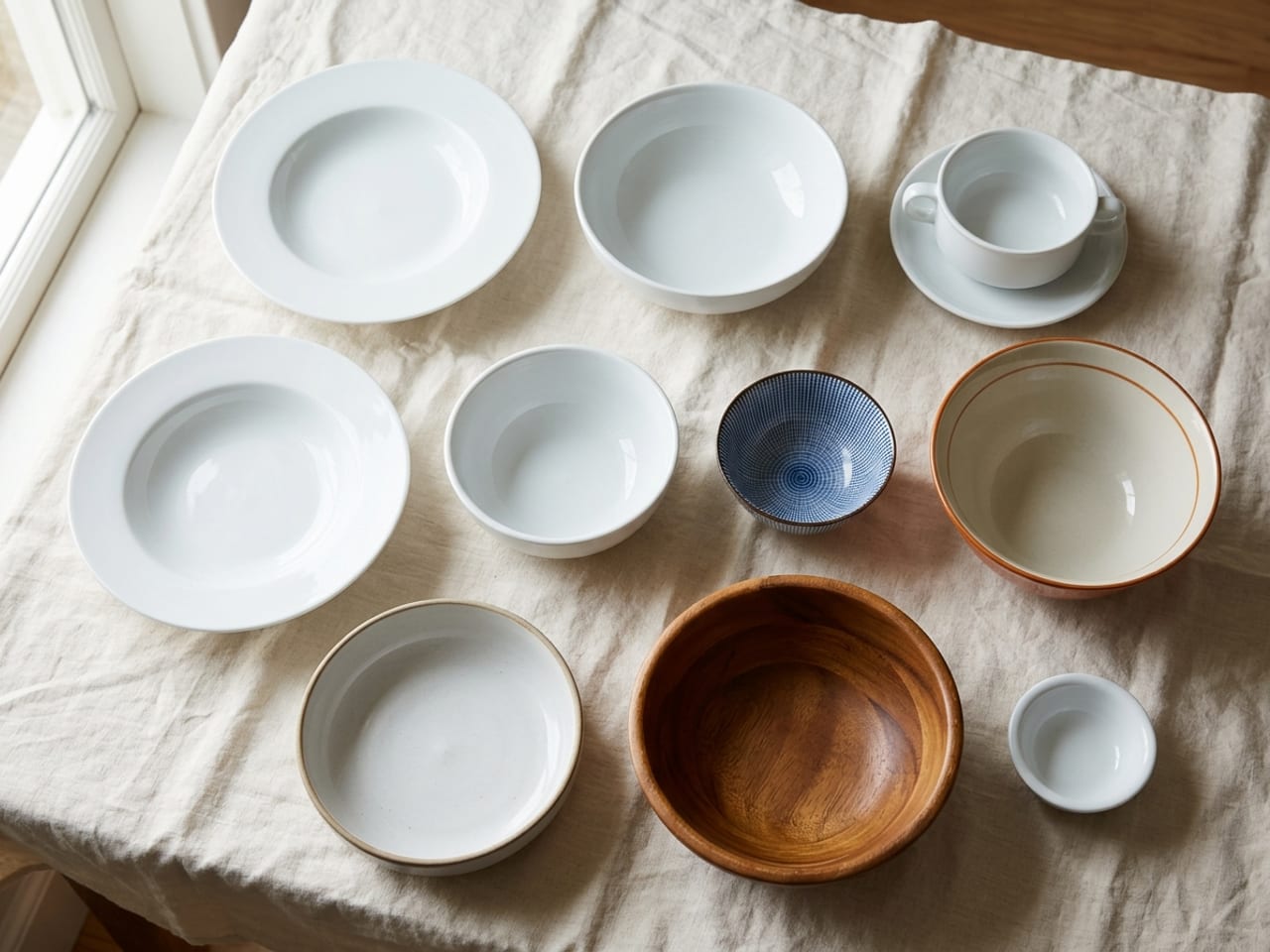
The photos on this page are AI-generated illustrations.
Eighteen types of bowls, one by one
One card per bowl: what it looks like, the sizes makers print (oz with ml, inches with cm; the twin in brackets is our conversion), which dishes it suits and one line on how the food sits in it. The grouping into eighteen and the lines marked ours are our reading; nothing here was measured or cooked in by us.
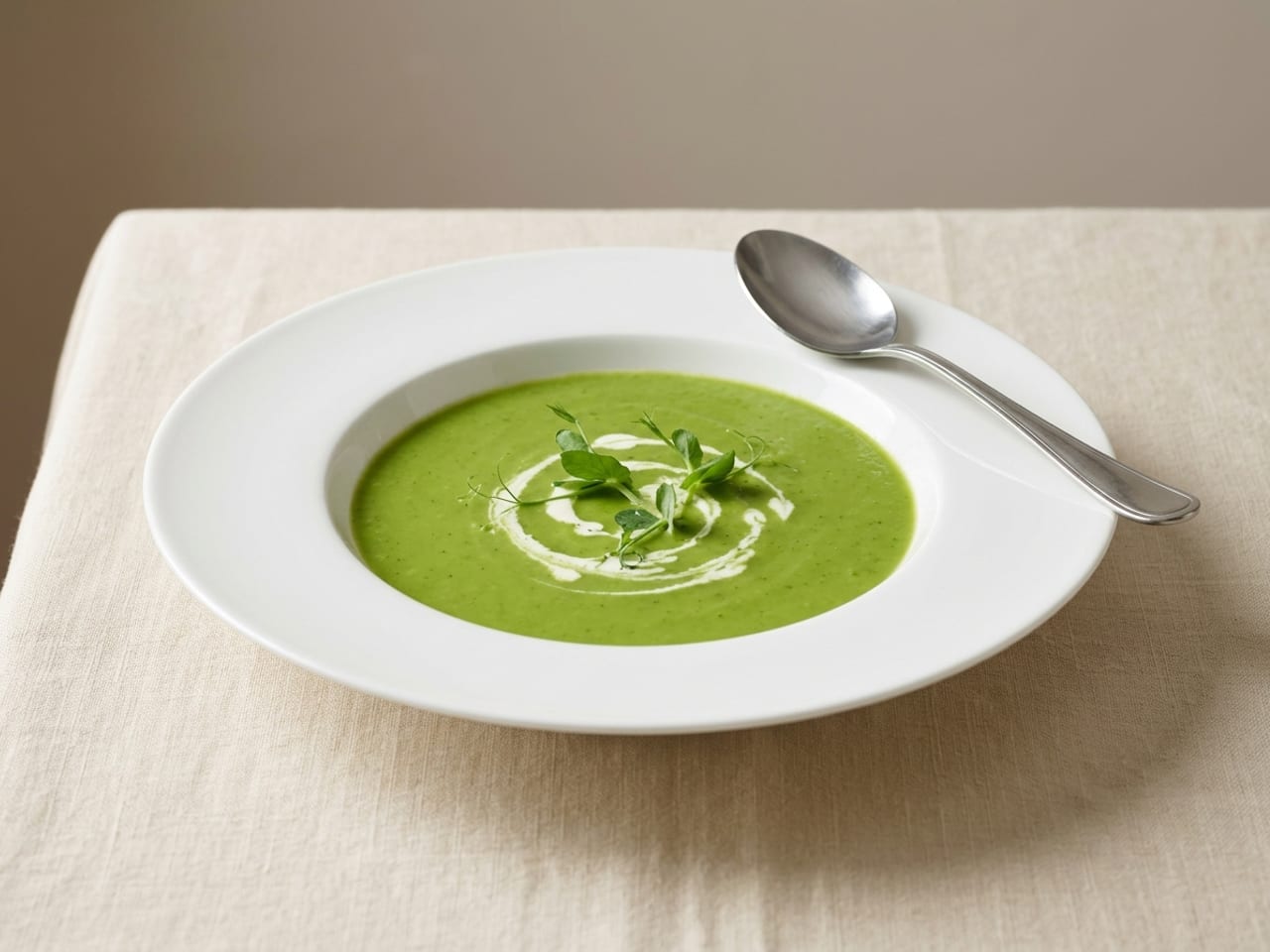
Soup plate (rimmed soup bowl)
A wide, shallow bowl with a flat rim all round. The makers' listings we read put it at 9 to 9 3/4 in (23 to 25 cm) across and 1 5/8 in (4.1 cm) high; Etiquette Scholar, an etiquette site, gives 9 to 10 in with a 1 to 2 in rim, up to 1 1/2 in deep.1, 13, 19, 20, 44
Makers print 12 oz (355 ml; two Steelite lines), 13 1/4 oz (392 ml; Fiesta's 9 in, which its title rounds to 13 oz), 14 oz (414 ml; Libbey's 9 1/8 in and Churchill's oval 10 3/4 x 8 3/4 in) and 500 ml (17 oz; Churchill Profile, 24.8 cm), so near-identical widths hold 12 to 17 oz. Churchill also sells a 9 1/2 in wide-rim piece of 10 oz (296 ml) simply as a "Bowl".1, 13, 14, 16, 18, 19, 20
For soup at a sit-down dinner: Lucy Allen's Table Service (1915) says dinner soup goes "always" in soup plates, and Emily Post (1923) set the soup plate on the place plate at dinner. Etiquette Scholar puts thick, chunky soups in "shallow, wide bowls" and calls the soup plate "The only soup bowl used in formal dinner service": one site's rule.44, 75, 76
In the bowl: the rim is a frame for the soup and somewhere a garnish can sit, as our plates guide reads it (ours; Gisslen's "picture frame" rule is written for plates). The picture shows the spoon waiting on the rim; when you finish, the Emily Post Institute leaves it in a shallow bowl.45, 78
Also called: Rim soup bowl (Fiesta), soup bowl (Steelite, Libbey), deep plate, assiette creuse. See the soup plate on our plates guide · soup etiquette.
Coupe soup bowl
The soup plate without its flat rim: a saucer-like, shallow bowl. Etiquette Scholar gives about 6 to 9 in (15 to 23 cm) across.44
No maker page we read sells a bowl under this name with a capacity, so we print none. The width is an etiquette site's, "Only for informal dining" in its words.44
For soup at informal meals, in Etiquette Scholar's account. The makers' rimless everyday bowls we read are sold as soup and cereal bowls (Corelle, Mikasa): see the cereal bowl.4, 6, 44
In the bowl: with no rim to frame it, a garnish goes on the soup itself, near the middle. (ours)
Also called: Coupe soup, rimless soup bowl. See rimmed vs coupe shapes · the coupe plate.
Deep soup bowl
A small, deep, rimless bowl. The hotel makers' versions we read are 4 1/2 to 4 7/8 in (11.4 to 12.4 cm) across and 2 to 2 1/4 in (5.1 to 5.7 cm) high.15, 17, 20
Steelite's 4 3/4 in bowl holds 12 oz (355 ml), Libbey's 4 7/8 in 13 oz (384 ml), Churchill's 4 1/2 in 14 oz (414 ml), and Corelle sells a 16 oz (473 ml) "Small Soup Bowl" at 5 1/4 in (13.3 cm) across and 2 in high. Steelite calls both this 12 oz deep bowl and a 9 1/4 in rimmed one a "Soup Bowl": the name follows the maker, not the size.4, 14, 15, 17, 20
For smooth, puréed soups, which Etiquette Scholar serves in a deep bowl to hold the heat (asserted, not measured), and for a soup that is the meal: Gisslen's main-course portion is 10 to 12 oz (300 to 350 mL).44, 78
In the bowl: Etiquette Scholar sets every bowl on an underplate, and the Emily Post Institute rests the spoon there, not in a deep bowl, when you finish.44, 45
Also called: Consommé/soup bowl (Churchill), soup/cereal bowl (Libbey), small soup bowl (Corelle). See the soup spoon.
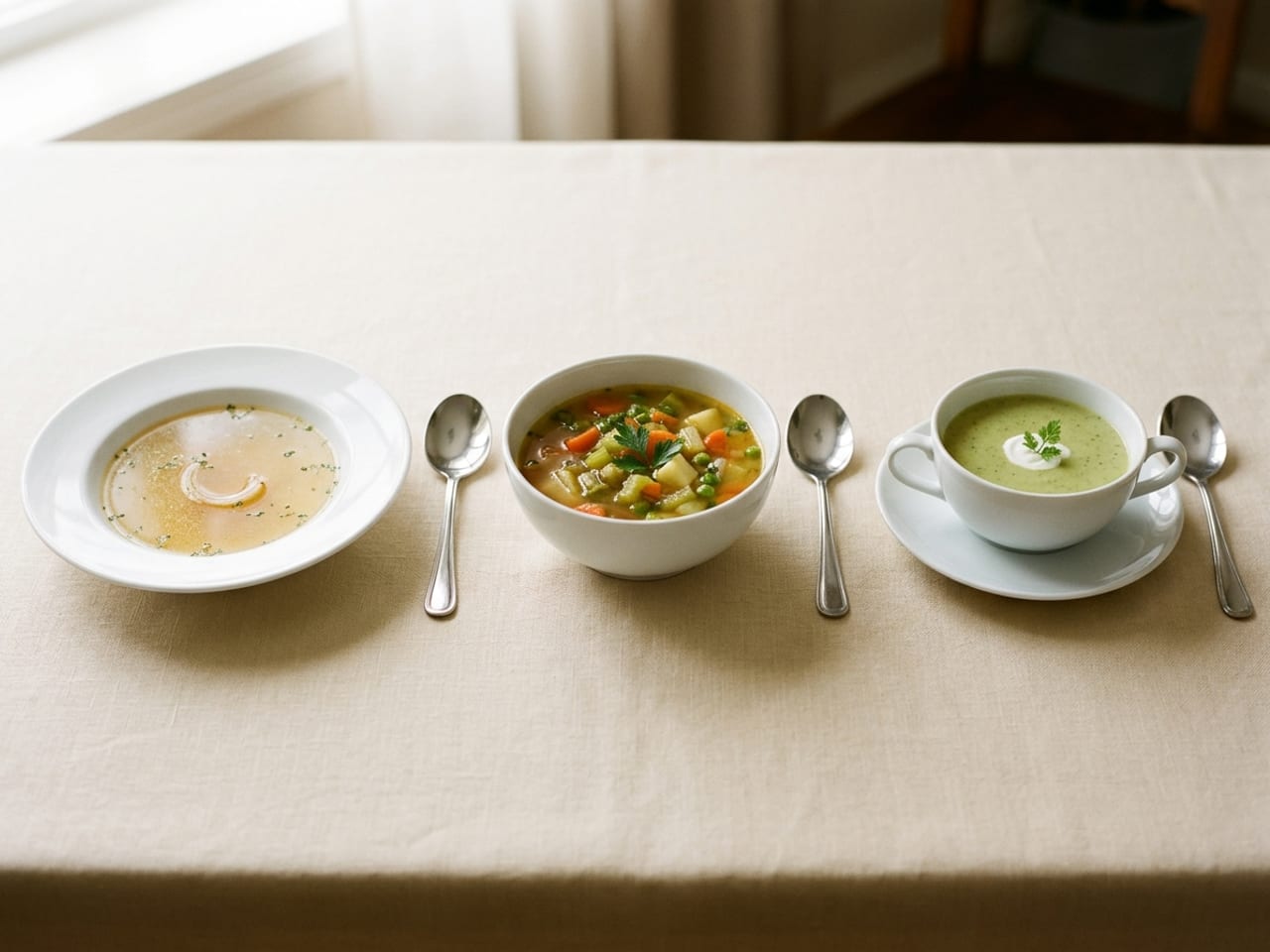
Cream soup bowl and bouillon cup
Two handles and a saucer. The cream soup bowl "looks like a wide, shallow cup with two handles" (a glass collectors' association); the bouillon cup is a smaller two-handled cup.44, 77
Libbey and Steelite both print their bouillon cups at 7 oz (207 ml), 3 3/8 to 3 1/2 in (8.6 to 8.9 cm) across, each made to fit its own saucer. Etiquette Scholar gives 3 3/4 in for a bouillon cup on a 5 1/2 in saucer and 4 to 5 in for a cream soup bowl; its "Soup cups hold approximately 4 ounces" is well under both makers' 7 oz.23, 44
For a light first course: Etiquette Scholar serves puréed soup in the cream soup bowl "at meals with a light menu"; Emily Post (1923) served luncheon soup "in two-handled cups", and Lucy Allen (1915) kept bouillon cups away from dinner except for an iced consommé.44, 75, 76
In the bowl: you may lift it by both handles and drink, or use the spoon: Miss Manners (2005), Etiquetteer (2017) and Etiquette Scholar all allow it. The round cream soup spoon is made for this bowl.44, 48, 49
Also called: Two-handled soup cup (Post, 1923); the Met catalogues old covered bowls as an écuelle and as a bouillon bowl. See the cream soup spoon · the bouillon spoon.
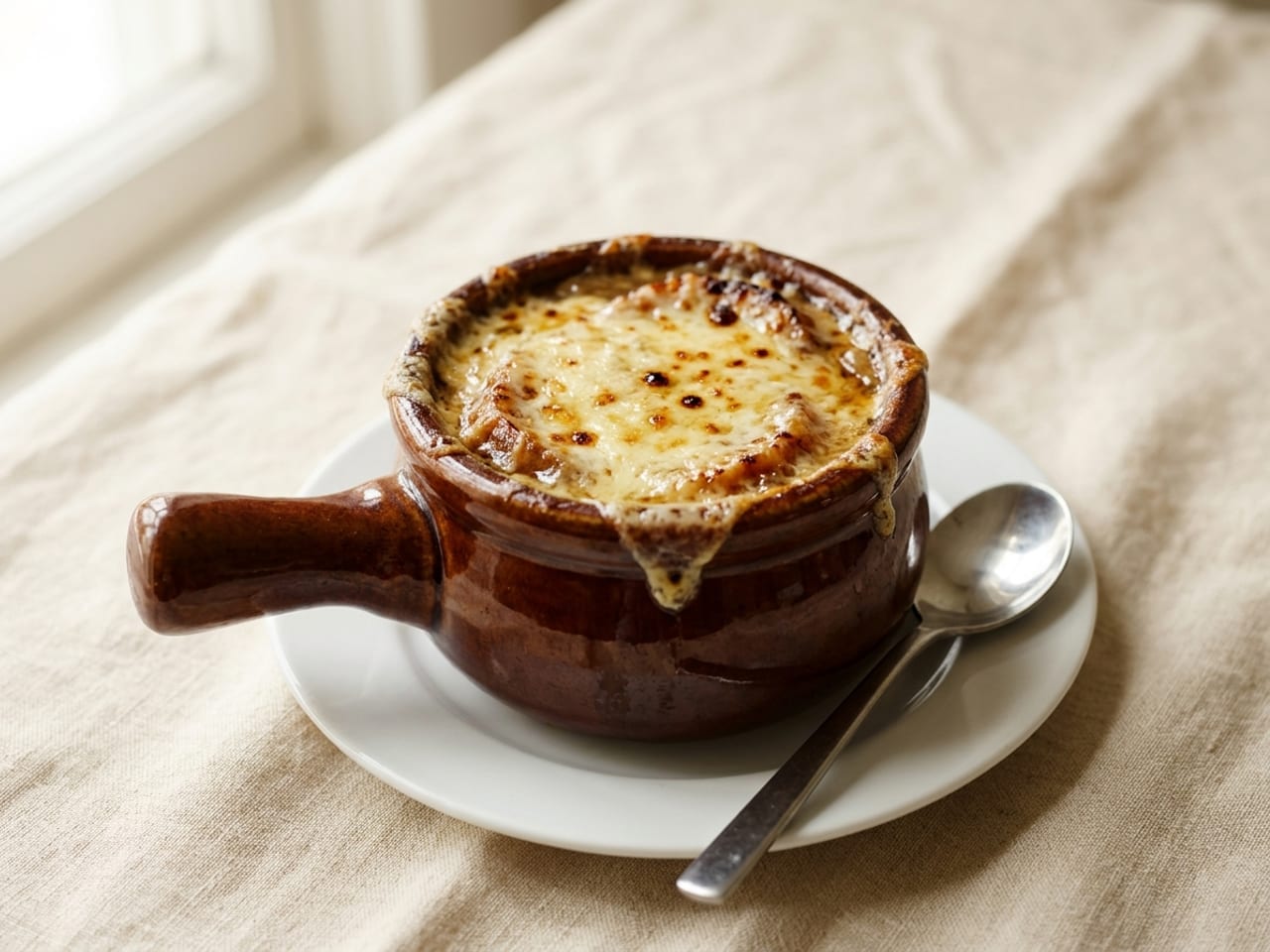
Onion soup crock (lug soup bowl)
A deep, thick-walled bowl with one or two solid handles that stick out sideways: a lug is "A part of something which sticks out, used as a handle or support" (Wiktionary).8, 44, 67
Le Creuset's holds 0.45 L (about 15 oz) at 16 cm (6.3 in) across and 6.3 cm (2.5 in) high, 20 cm (7.9 in) long with its handle. Etiquette Scholar gives a lug bowl 4 1/2 to 5 1/2 in (11.4 to 14 cm) across and 2 1/2 in (6.3 cm) deep, and a seller's buying guide calls 10 to 12 oz (296 to 355 ml) the "Traditional individual crock".8, 29, 44
For French onion soup: Etiquette Scholar's lug bowl is "used to present an individual serving of French onion soup put under the broiler to melt cheese". Le Creuset sells its bowl for side dishes too, and the recipes our ramekin guide read use 8 oz (237 ml) broiler-safe bowls or ramekins.8, 44
In the bowl: check the broiler rating, not just the oven one: "oven safe does not automatically mean broiler safe" (a seller's guide), and Le Creuset's stoneware wants at least 2 1/2 in (6.5 cm) between rim and element. The solid side handles are for tilting the bowl to gather the last of the soup (Etiquette Scholar).9, 10, 29, 44
Also called: Onion soup bowl, lug bowl, soup crock. See onion soup on our ramekin guide.
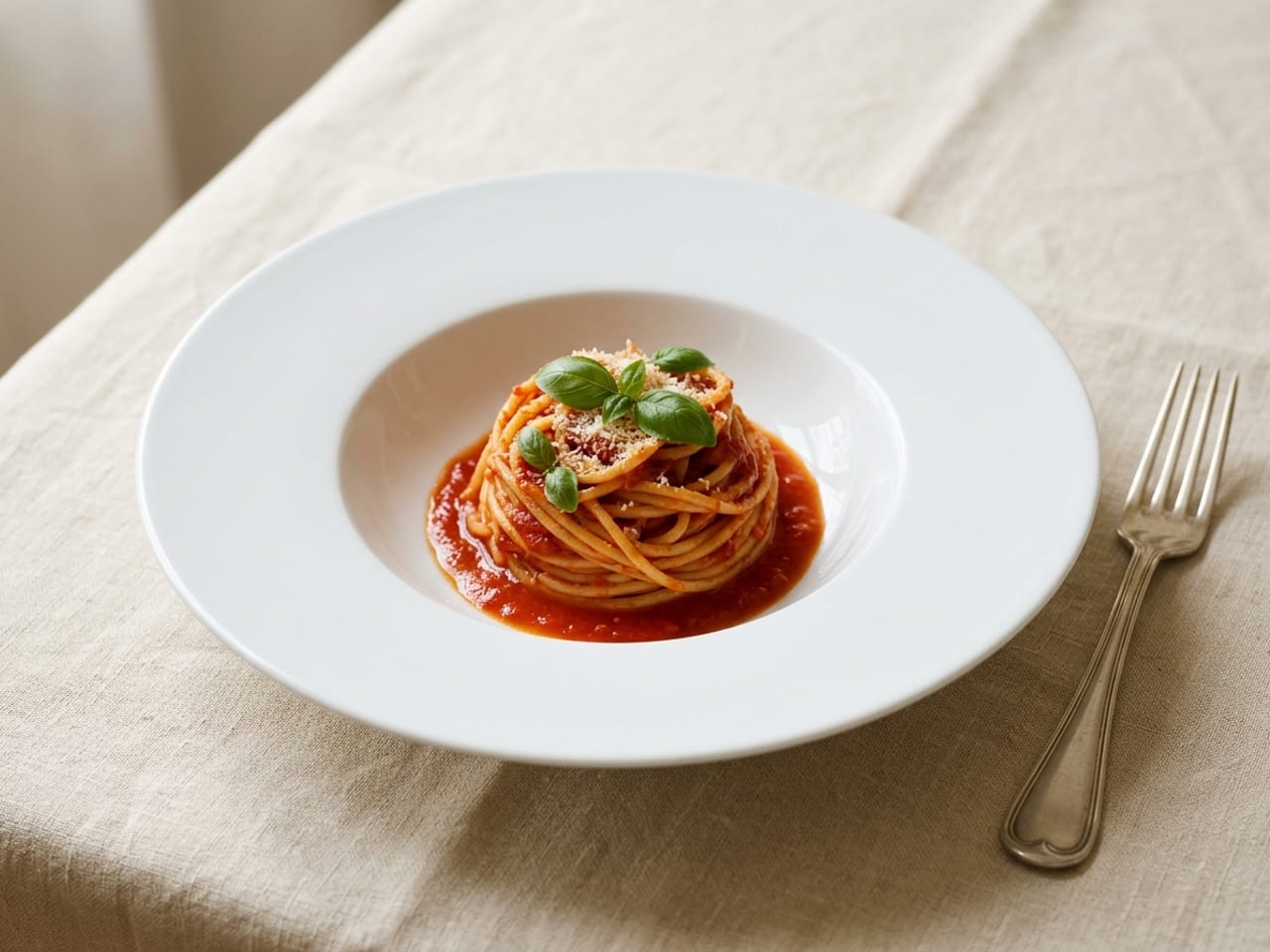
Pasta bowl
A wide, shallow bowl, wider than a soup plate. The wide-rim pasta bowls on our pasta guide run 10 5/8 to 12 1/8 in (27 to 30.8 cm) across.31, 32, 33, 34
Printed capacities: 14 1/2 oz (429 ml; Steelite, 10 5/8 in), 16 oz (473 ml; Churchill, 11 in), 26 oz (769 ml; Steelite, 11 3/4 in). Libbey prints 21.5 and 25 oz (636 and 739 ml) on two 12 in lines and 61 oz (1.8 L) on a deeper 12 in one; Villeroy & Boch's 11 in Manufacture bowl holds 10.2 oz (302 ml). Same width, up to three times the capacity: "Check the actual well capacity rather than judging by outside diameter" (a seller's guide).7, 22, 30, 31, 32, 33
For a plated pasta course. The cooks our pasta guide read split on a warm bowl or a flat plate. Fiesta's "Large Pasta Bowl" (12 7/8 in, 129 oz, 3.8 L) is a serving bowl, not a place-setting one.3
In the bowl: a nest in the middle with the sauce held around it, in a bowl warmed first; the steps are on our pasta guide. (ours)
Also called: Pasta plate (Villeroy & Boch's Rock Blanc, our plates guide), wide-rim pasta bowl; Libbey's deep one is a "Stadium Pasta Bowl". See bowl or plate for pasta · warming the bowl.
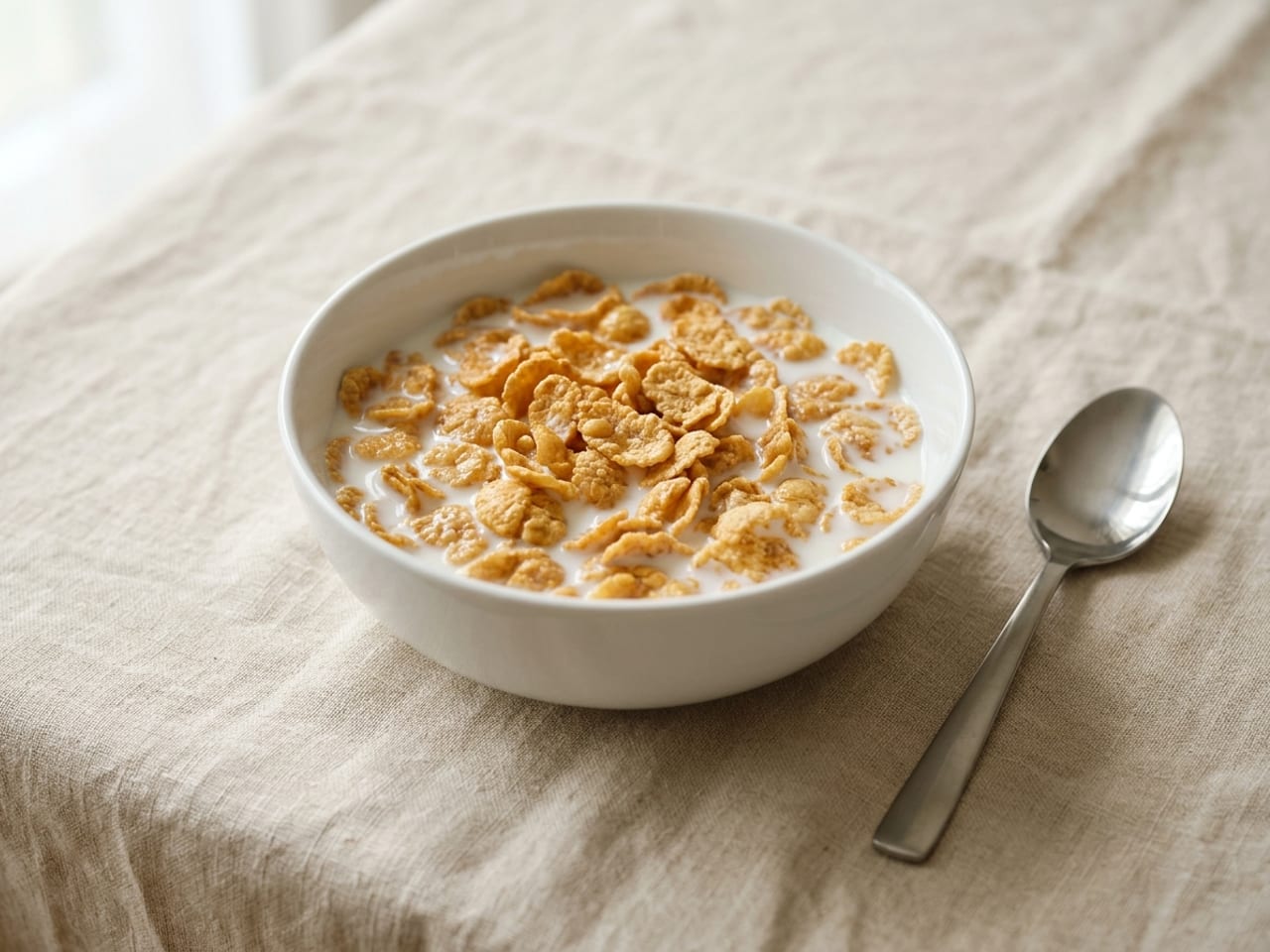
Cereal bowl
A deep, rimless everyday bowl. The bowls makers sell as cereal bowls are 5 1/2 to 6 5/8 in (14 to 16.8 cm) across and about 2 in (5 cm) high in what we read; Mikasa's soup cereal bowls run up to 8 1/2 in.4, 6, 21
Corelle 18 oz (532 ml) at 6 1/4 in; Libbey 17 1/2 oz (518 ml) at 6 5/8 in and 20 oz (591 ml) at 6 in; Mikasa's "soup cereal" bowls 21 oz (621 ml) at 5 1/2 in and 22 oz (651 ml) at 6 1/4 in, up to 38 oz (1.1 L) at 8 1/2 in; Villeroy & Boch 14.6 and 15.9 oz (432 and 470 ml); Libbey's tempered glass 26 3/4 oz (791 ml). Capacity does not follow width: Mikasa's narrowest holds 21 oz.4, 6, 7, 21
For cold cereal and oatmeal, and for soup: Corelle files its 18 oz cereal bowl and its 16 oz small soup bowl under "Soup and Cereal Bowls", and a glass collectors' association says casual dinnerware "often has only one bowl that serves for both soup and cereal". In 1920s to 1940s glass, it adds, the cereal bowl was the deeper, narrower one.4, 77
In the bowl: people pour more than the label serving: in a 2014 Consumer Reports test with bowls of 12, 18 and 28 oz, 92 percent of 124 shoppers did, 43 to 114 percent more into the 18 oz (532 ml) bowl; in 2020, 122 Which? volunteers reported the dry weight of their usual bowl, on average 63% over the pack's portion.80, 81
Also called: Soup/cereal bowl (Libbey), soup cereal bowl (Mikasa), oatmeal bowl (Etiquette Scholar). See cereal portions.
Fruit or dessert bowl (nappie)
A small, shallow bowl with a flat bottom: "A shallow, flat-bottomed earthenware or glass bowl with sloping sides" is Wiktionary's nappy, and a museum adds "no rim".67, 68
Fiesta's Fruit Bowl is 5 3/8 in (13.7 cm) across and 1 1/4 in (3.2 cm) high and holds 6 oz (177 ml); a 1941 table book speaks of "the 4-inch nappie" (10 cm). A Homer Laughlin history quoted in Wiktionary lists the nappie and the fruit bowl as separate pieces; pairing them by shape here is our reading.2, 67
For fruit and ice cream: a 1914 trade journal puts "a slice of pineapple in a fruit nappy" under a cone of vanilla ice cream, and the 1941 book finds the nappie "more practical than the sherbet glass" for family service. We found no source that gives a dessert bowl a size of its own.67
In the bowl: one scoop or a cup of fruit sits below the rim, with room for the spoon. (ours)
Also called: Nappy, nappie, fruit nappy; a museum calls nappy a shape word, not a purpose word. See where nappie comes from.
Individual salad bowl
A wide, fairly shallow bowl a fork can work in; restaurant supply sells one shape as a pasta and salad bowl.30
Tuxton's BPD-1204 pasta and salad bowl is 12 in (30.5 cm) wide and holds 21 oz (621 ml), as a seller's guide lists it. No maker page we read sells a bowl only as an individual salad bowl.30
For a tossed salad eaten with a fork; Etiquette Scholar files salad with pasta in its soup-cereal bowl, for informal meals. A composed salad often goes on a plate in what we read; our salad guide weighs plate or bowl.44
In the bowl: chill it first: two food sites give about 15 minutes in the fridge (Food Republic, Tasting Table); neither tested it.84, 85
Also called: Pasta/salad bowl (Tuxton). See plate or bowl for salad · chilling.
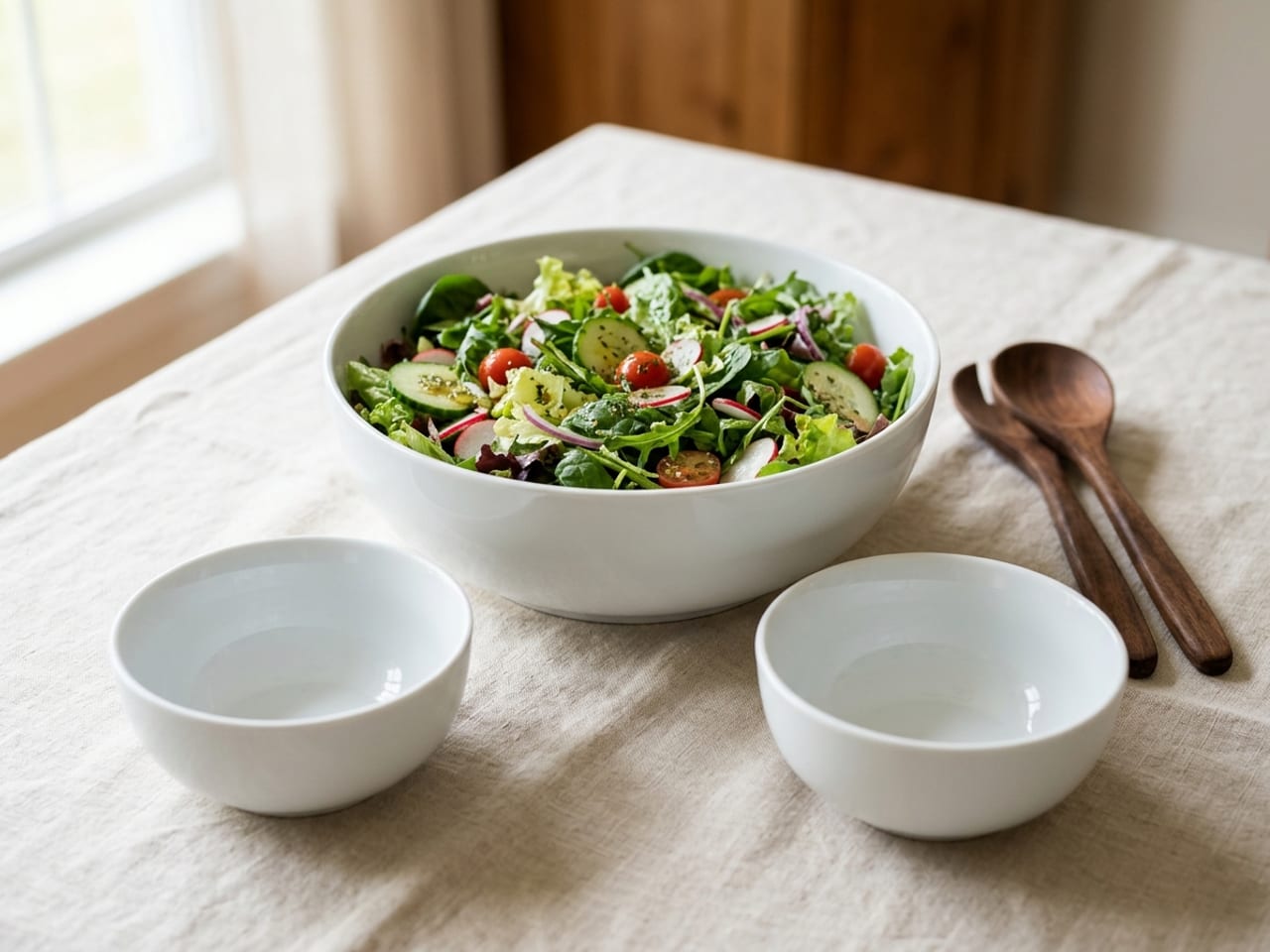
Serving bowl
A large bowl that holds more than one portion and goes to the table with servers or a spoon: Wikipedia names punch bowls and salad bowls as the large ones.66
Steelite's Pillivuyt salad bowl holds 1.5 qt (1.4 L) at 8 3/4 in (22.2 cm); Fiesta's retired Large Pasta Bowl, 129 oz (3.8 L) at 12 7/8 in (32.7 cm) and 3 1/8 in (7.9 cm) high. In 1920s to 1940s glass, the "master" berry bowl was about 8 in (20 cm) with small ones to match.3, 24, 77
For a tossed salad, vegetables, potatoes or pasta passed at the table or set on a buffet. "Berry bowls are an older name", a glass collectors' association says, for what are now serving and vegetable bowls.77
In the bowl: toss the salad in the big bowl just before it goes out, with servers beside it. (ours)
Also called: Salad bowl (Steelite), vegetable bowl; berry bowl (an older name); Fiesta's "Large Pasta Bowl". See setting up a buffet · dressing a salad.
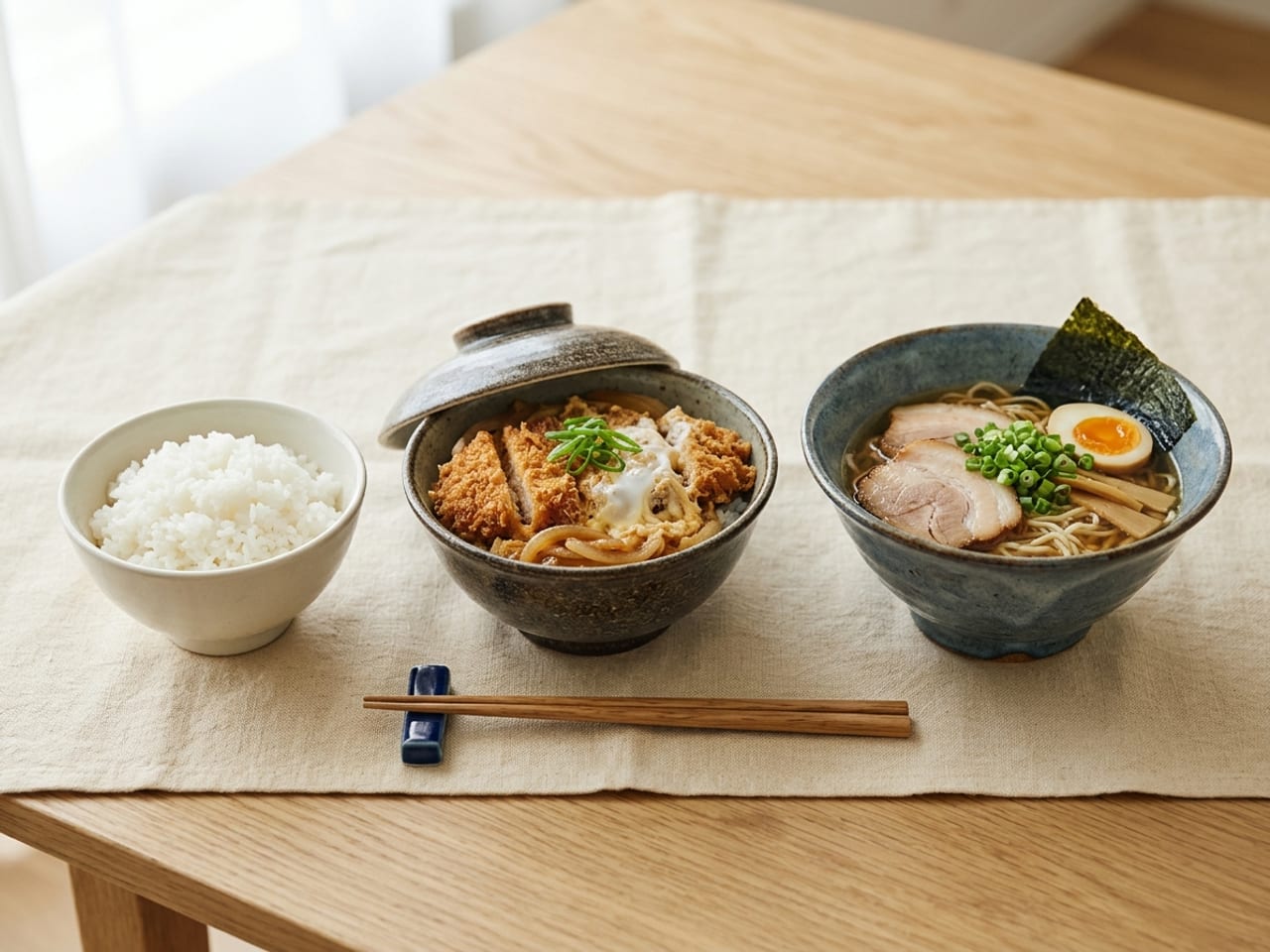
Rice bowl (chawan, Chinese rice bowl)
A small, deep, round bowl, sized to be lifted in one hand while you eat.51
As printed: CAC China's 3 3/4 in (9.5 cm) holds 6 oz (177 ml); Royal Porcelain's 100 mm (3.9 in) 190 ml (6.4 oz) and 150 mm (5.9 in) 540 ml (18.3 oz); MTC Kitchen's chawan, 11.6 cm (4.6 in) across and 6.2 cm high, 320 ml (10.8 oz) "filled up" (brim-full), and a 12.5 cm one 570 ml (19.3 oz); a Korean-made rice bowl of 11.5 cm, 350 ml (11.8 oz).26, 27, 35, 41
For plain steamed rice beside the other dishes: in the Japanese meal of rice, soup and sides the rice sits front left (nippon.com), and a Chinese place setting has "a small, empty rice bowl" on a large plate (Wikipedia, a pointer only). FDA's labelling reference for plain cooked rice is 140 g: a label figure, not a bowl size.52, 53, 79
In the bowl: you hold it: JNTO says to hold the rice bowl in one hand while you eat with chopsticks, "reasonable to prevent the food from dropping", and a Chinese diner may pick it up close to the mouth with the left hand.51, 53
Also called: Chawan or gohan chawan (Japanese; chawan also means a tea bowl); rice/soup bowl (many researchers, says a University of Idaho library glossary). See Japanese, Korean and Chinese bowls · Japanese table manners.
Donburi
A large, thick, deep ceramic bowl for food, in the Japanese dictionary Daijisen's words.56
One Japanese-ware retailer's five donburi run from 450 ml (15.2 oz) at 14 cm (5.5 in) to 790 ml (26.7 oz) at 16.5 cm (6.5 in), and the same 16 cm (6.3 in) holds 500 or 700 ml depending on its height; MTC Kitchen's 15.9 cm bowl holds 665 ml (22.5 oz) "filled up". A recipe site, Just One Cookbook, gives 15 cm and 900 ml: more than any donburi we read.36, 37, 40
For donburi-mono, rice with the topping laid over it: Daijisen's examples are katsudon and tendon. A ramen writer at The Takeout says ramen is "typically served in a donburi-style bowl".56, 82
In the bowl: rice in the bowl with the topping laid over it, which is what donburi-mono means in Daijisen.56
Also called: Donburi-bachi (Daijisen); the dish is donburi-mono, shortened to -don (katsudon, tendon). See the word's dates.
Ramen or noodle bowl (pho bowl)
A big, deep bowl; The Takeout's ramen writer says most are cupped at the bottom with a slight flared lip, some V-shaped, and the flared lip is a handle for a hot bowl.82
Miya's Aranami holds 32 oz (946 ml) at 8 1/4 in (21 cm) across and 3 1/2 in high; Musubi Kiln's Mino-ware bowl 1,100 ml (37.2 oz) at 20.5 cm (8.1 in); G.E.T.'s melamine Fuji bowl 1.2 qt (1,136 ml) "Rim Full" at 6 3/4 in (17.1 cm), filed by its seller under Asian dinnerware (its feature list also gives a 32 to 63 oz range). Just One Cookbook's 18 cm and 1,400 ml is larger than any we read; a seller's guide's 18 to 24 oz (532 to 710 ml) for "Ramen, pho, grain bowls" is far smaller.28, 29, 38, 39, 40
For noodles in broth: Musubi Kiln sells its bowl as "perfect for ramen and other noodle dishes like udon and soba".38
In the bowl: warm it first (ramen shops pour in boiling noodle water; The Takeout's writer uses a 170°F (77°C) oven), then lay the toppings around the noodles: his own habit is green onion in the middle, meat at 6 o'clock, nori at 1 or 2, the egg at 11 or 12.82
Also called: Noodle bowl, pho bowl (sellers' names). See the pattern on the rim.
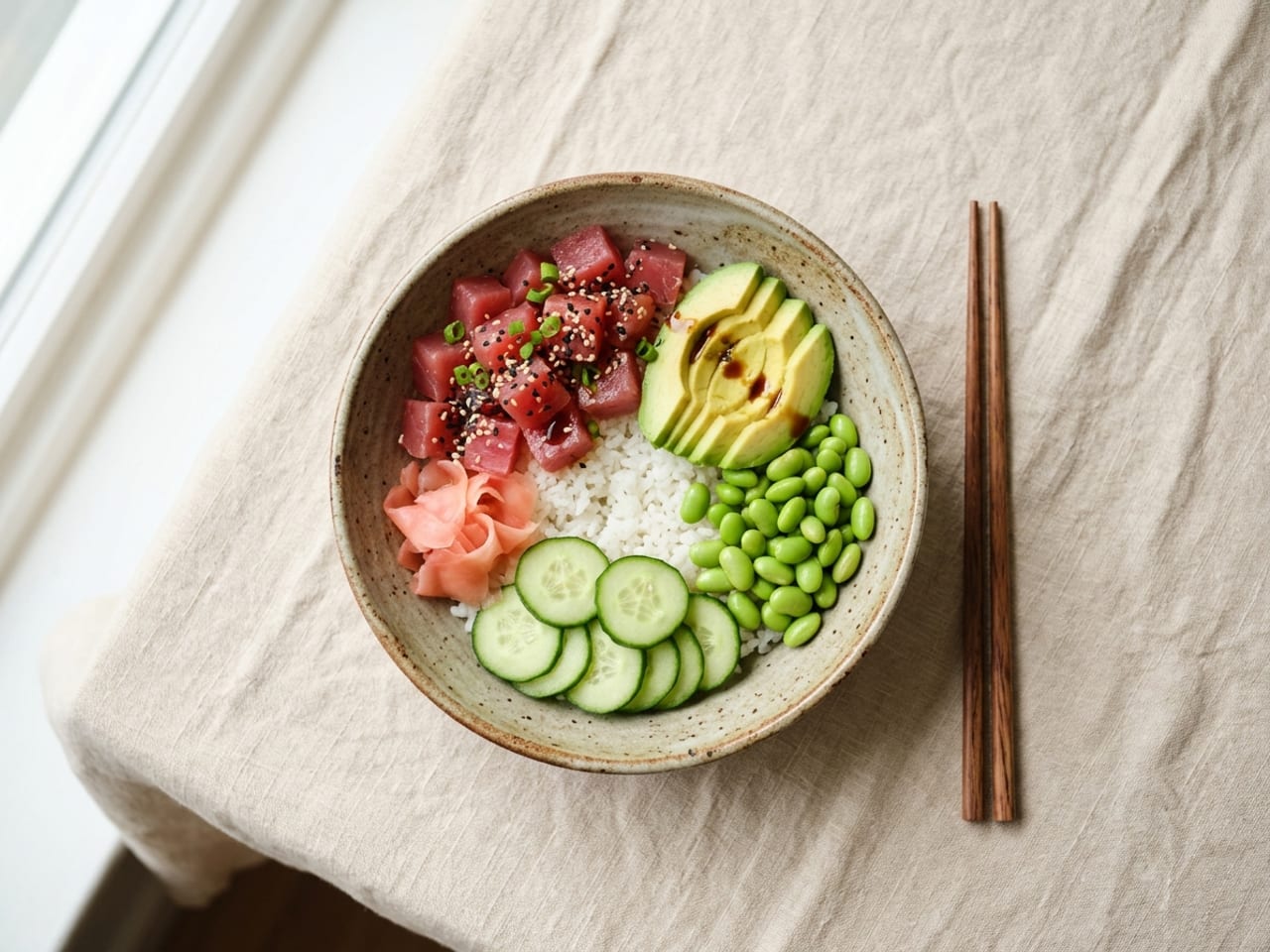
Poke or grain bowl
A restaurant's dish more than a maker's shape: a base of rice, grains or greens with the toppings over it. A wide bowl with room for the toppings in sections is our reading of the shape.86, 87
No maker page we read sells a bowl under either name. A seller's buying guide files grain bowls with ramen and pho at 18 to 24 oz (532 to 710 ml); Libbey's 6 1/4 in (15.9 cm), 24 oz (710 ml) stoneware bowl is the size at its top.25, 29
For the build-your-own bowl: America's Test Kitchen calls grain bowls "meals made popular by fast-casual restaurants where you pile your protein and vegetables over a bowl of cooked grains"; Sweetfin's poke "begins with a base (rice, greens, etc.)". In Hawaii, a 2017 magazine piece reported, most poke is sold by weight in deli containers.86, 87, 89
In the bowl: base first, then the protein and toppings, sauce last (Sweetfin, America's Test Kitchen, University of Illinois Extension).86, 87, 88
Also called: Buddha bowl, power bowl: "They go by many names" (Consumer Reports). See who named the poke bowl.
Dip or sauce bowl
A small bowl for one dip or sauce; the ones that also go in the oven are ramekins.
Sizes are on our ramekin guide, which lists the makers' labels; no source we read gives a dip bowl a size of its own.
For dips, sauces and condiments. In old Korean tableware, small bowls for sauces or dips had their own name, jongji (KOCIS).54
In the bowl: one sauce to a bowl, filled low enough that a dipped piece does not push it over the rim. (ours)
Also called: Sauce dish, sauce cup, ramekin; jongji (Korean). See ramekin and its lookalikes · ramekin sizes.
Three more from the tables of Korea and India, where a bowl has a name of its own (the world section has their words and customs):
Korean rice and soup bowls
A rice bowl and a soup bowl set side by side. In the past, the KOCIS writer says, men's rice bowls (jubal) were broad and straight-lined and women's (bari) round and deep with a knob on the lid, each in a set with a soup bowl (daejeob); in the Joseon era white porcelain went out in summer and well-insulated bronze in winter.54
No maker page we read sells a bowl under these names, so we print no size.
For rice and soup at a Korean meal, where everything comes out at once with rice and soup nearest the diner; "They believe that there’s a perfect bowl for each and every dish", the KOCIS writer says of Korean connoisseurs.54
In the bowl: rice and soup nearest the diner, the shared side dishes beyond them (KOCIS).54
Also called: Bap-geureut and guk-geureut (밥그릇, 국그릇: rice bowl and soup bowl, our gloss); bosigi, a small soup bowl (KOCIS). See Korean bowls.
Ttukbaegi (Korean earthenware pot)
A small, black-to-brown earthenware pot, glazed or unglazed, that goes on the heat and then to the table.63, 64
A Japan-based retailer sells size "4ho" at 162 mm (6.4 in) across, "ideal for individual servings"; Korea's national encyclopedia gives large central-region pots about 10 to 15 cm (4 to 6 in) deep. No capacity read.42, 63
For jjigae (stew) cooked and served in the pot, and for seolleongtang, yukgaejang and samgyetang (Encyclopedia of Korean Culture).63
In the bowl: it comes to the table in the pot it cooked in, and the encyclopedia says the outside does not get very hot; it is still a pot that has just boiled, so handle it as one (ours). Not every one takes a flame: low-fired pots have weak heat resistance (Wikipedia), so check the seller's line.42, 63, 64
Also called: Ttukbaeki; al-ttukbaegi, the rice-bowl-sized one for steamed egg. See heat and care.
Katori
A small, round metal bowl; the two we read are hammered copper and steel, and stainless steel. Several sit on one thali.43, 65
Two sellers of Indian ware: 7 cm (2 3/4 in) across, about 150 ml (5 oz), and 9.3 cm (3 2/3 in), 200 ml (6.8 oz). No Indian maker's spec read.43
For the separate dishes of a thali, which "are usually served in small bowls, called katori in India" (Wikipedia, a pointer only).65
In the bowl: one dish to a katori, so the wet dishes stay apart from the rice or bread on the thali, as our plates guide puts it. (ours)
Also called: The small bowls of a thali (Wikipedia). See the thali on our plates guide.
Other bowls, one line each (not counted in the eighteen; mixing bowls have their own section):
- Owan (wan): A hemispherical bowl of wood or ceramic for rice or soup (Daijisen's wan); at a kaiseki meal, JNTO says, it is appropriate to lift the bowl to your mouth and sip some of the broth.50, 57 Japanese table manners.
- Finger bowl: A small bowl of water for rinsing the fingertips at the table; 1920s to 1940s glass patterns made them with their own underplates.77 How to use one.
- Punch bowl: A large bowl for a shared drink, one of the bowls that hold more than one portion.66 The glasses to serve it in.
- Tureen: "A broad, deep serving dish used for serving soup or stew", from French terrine. In Beeton's 1861 dinner the master "is to distribute the soup" and her recipes put soups into a tureen; by 1915 Lucy Allen, writing for a home dinner without a maid, said "the soup tureen is rarely used".67, 74, 75
- Porringer or écuelle: A small cup or bowl, usually with a handle, for porridge or broth; the V&A says French écuelles were bedroom and toilette pieces, not dinner-table ones.67, 70, 73
Bowl sizes chart: what makers print, in oz and ml
One row per bowl, from the makers' own pages or their catalogue lines as sellers copy them (each source says which). Capacities are as printed; only MTC Kitchen and G.E.T. say theirs is brim-full. The metric or US twin is our conversion.
| Bowl | Capacity in oz | Capacity in ml | Across, in and cm | Makers named |
|---|---|---|---|---|
| Soup plate | 10 to 17 oz | 296 to 500 ml | 9 to 9 3/4 in (23 to 25 cm); Churchill's oval 10 3/4 x 8 3/4 in | Steelite, Fiesta, Libbey, Churchill1, 13, 14, 18, 19, 20 |
| Coupe soup bowl | not read | not read | 6 to 9 in (15 to 23 cm) | Etiquette Scholar (an etiquette site, not a maker)44 |
| Deep soup bowl | 12 to 16 oz | 355 to 473 ml | 4 1/2 to 5 1/4 in (11.4 to 13.3 cm) | Steelite, Libbey, Churchill, Corelle4, 15, 17, 20 |
| Cream soup bowl and bouillon cup | 7 oz (bouillon cup) | 207 ml | 3 3/8 to 3 1/2 in (8.6 to 8.9 cm); cream soup bowls 4 to 5 in (Etiquette Scholar) | Libbey, Steelite23, 44 |
| Onion soup crock | about 15 oz | 450 ml | 16 cm (6.3 in), 20 cm (7.9 in) with the handle | Le Creuset8 |
| Pasta bowl | 10.2 to 26 oz; deep ones to 61 oz | 302 to 769 ml; to 1.8 L | 10 5/8 to 12 1/8 in (27 to 30.8 cm), the wide-rim ones | Steelite, Churchill, Libbey, Villeroy & Boch7, 22, 31, 32, 33, 34 |
| Cereal bowl | 14.6 to 26 3/4 oz; 17 to 22 oz in 5 of 8 listings we read | 432 to 791 ml; 500 to 650 ml in 5 of 8 | 5 1/2 to 6 5/8 in (14 to 16.8 cm) | Corelle, Libbey, Mikasa, Villeroy & Boch4, 6, 7, 21 |
| Fruit or dessert bowl | 6 oz | 177 ml | 5 3/8 in (13.7 cm) | Fiesta2 |
| Individual salad bowl | 21 oz | 621 ml | 12 in (30.5 cm) | Tuxton (in a seller's guide)30 |
| Serving bowl | 48 to 129 oz | 1.4 to 3.8 L | 8 3/4 to 12 7/8 in (22.2 to 32.7 cm) | Steelite (Pillivuyt), Fiesta3, 24 |
| Rice bowl | 6 to 19 oz | 177 to 570 ml | 3 3/4 to 6 in (9.5 to 15 cm) | CAC China, Royal Porcelain, MTC Kitchen (retailer), a Korean-made set26, 27, 35, 41 |
| Donburi | 15 to 27 oz | 450 to 790 ml | 14 to 16.5 cm (5 1/2 to 6 1/2 in) | Musubi Kiln, MTC Kitchen (retailers of Japanese ware)36, 37 |
| Ramen or noodle bowl | 32 to 38 oz | 946 to 1,136 ml | 6 3/4 to 8 1/4 in (17.1 to 21 cm) | Miya, Musubi Kiln (retailer), G.E.T.28, 38, 39 |
| Katori | about 5 to 7 oz | 150 to 200 ml | 7 to 9.3 cm (2 3/4 to 3 2/3 in) | two sellers of Indian ware43 |
Not in the chart: the poke or grain bowl and the Korean rice and soup bowls (no maker we read sells one under those names), the dip bowl (see ramekin sizes) and the ttukbaegi (one seller's 162 mm, no capacity).
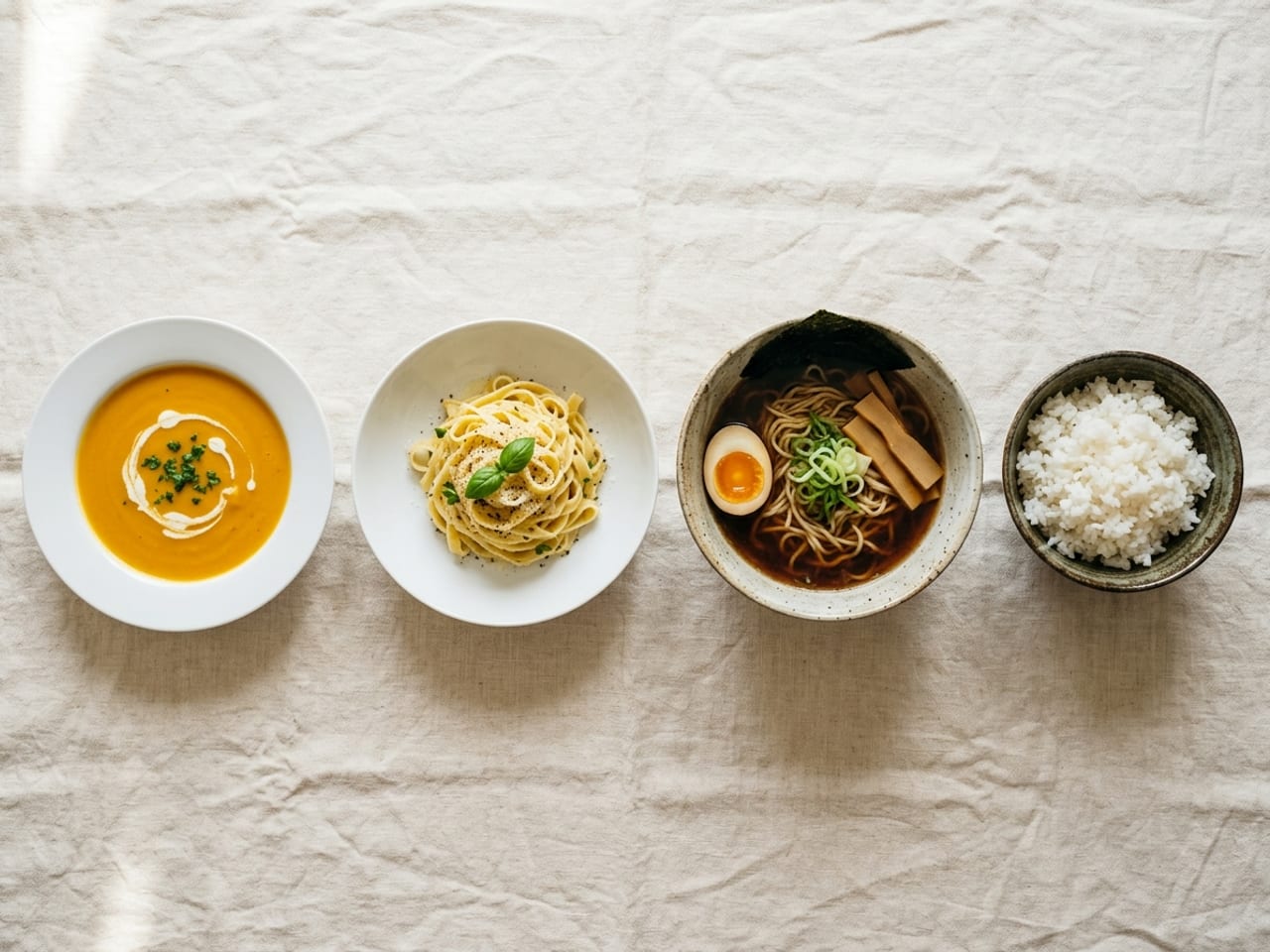
Where the sources disagree
- How much a soup bowl holds: Etiquette Scholar says soup bowls hold 8 to 12 oz (237 to 355 ml) on average; the rimmed soup plates of Steelite, Fiesta, Libbey and Churchill print 12 to 17 oz; a seller's buying guide says commercial soup bowls commonly fall in the 8 to 16 oz (237 to 473 ml) range.1, 13, 19, 20, 29, 44
- Cup or bowl: Gisslen's first-course soup is 6 to 8 oz (200 to 250 mL) and a main course 10 to 12 oz (300 to 350 mL); Etiquette Scholar's soup cup holds about 4 oz, while Libbey's and Steelite's bouillon cups hold 7 oz. The soup poured and the vessel's capacity are not the same number.23, 44, 78
- Names follow the maker, not the size: Steelite's 9 1/2 in rimmed "Soup Plate" and its 4 3/4 in deep "Soup Bowl" both hold 12 oz; Corelle files a cereal bowl and a small soup bowl under one heading; one Villeroy & Boch item is a soup plate in its page title and a pasta bowl in its text.4, 7, 13, 15
- One width, three capacities: Libbey's 12 in (30.5 cm) pasta bowls print 21.5, 25 and 61 oz; a seller's guide tells buyers to check the well, not the outside diameter.22, 30
- Donburi and ramen bowls: Just One Cookbook, a recipe site, gives a 15 cm donburi of 900 ml and an 18 cm ramen bowl of 1,400 ml; the retailers' donburi we read hold 450 to 790 ml at 14 to 16.5 cm and their ramen bowls about 946 to 1,136 ml at 17 to 21 cm.28, 36, 37, 38, 39, 40
- A seller's ramen figure: A restaurant-supply buying guide puts "Ramen, pho, grain bowls" at 18 to 24 oz (532 to 710 ml), well under the 32 to 38 oz ramen bowls we read.28, 29, 39
- The onion soup crock: Etiquette Scholar's lug bowl is 4 1/2 to 5 1/2 in (11.4 to 14 cm) across; Le Creuset's French onion soup bowl is 16 cm (6.3 in).8, 44
- Cereal or soup: which is deeper: In 1920s to 1940s glass, a collectors' association says, "The cereal was deeper and narrower and the soup was wider and flatter"; today Corelle and Mikasa sell one bowl for both.4, 6, 77
Which bowl for which dish
- Clear soup, consommé, bouillon · Cream soup bowl and bouillon cup · "Narrow cups are used to serve clear soup because they preserve temperature well" (Etiquette Scholar, asserted); Post's 1923 ball supper served bouillon "in cups"44, 76
- Cream and puréed soups · Deep soup bowl · a deep bowl, or the cream soup bowl for a light first course (Etiquette Scholar)44
- Chunky soups and stews · Soup plate · "shallow, wide bowls" (Etiquette Scholar); a coupe soup bowl at an informal meal44
- French onion soup · Onion soup crock · a broiler-safe crock, cheese melted on top8, 44
- Korean stew (jjigae) · Ttukbaegi · cooked and served in the ttukbaegi42, 63
- Ramen, pho, udon, soba · Ramen or noodle bowl · a big, deep bowl of about a litre38, 39
- Plain rice · Rice bowl · a small bowl you hold (JNTO)51
- Rice with a topping (katsudon, tendon) · Donburi · the donburi, topping over the rice (Daijisen)56
- Cereal, oatmeal · Cereal bowl · the 6 in everyday bowl, which also takes soup4, 44
- Pasta in sauce · Pasta bowl · a pasta bowl or a flat plate: the cooks split (who says which)
- Tossed salad · Individual salad bowl · an individual bowl, or the serving bowl for the table; a composed salad on a plate44
- Poke, grain and Buddha bowls · Poke or grain bowl · a wide bowl with room for a base and toppings (ours)
- Fruit, a scoop of ice cream · Fruit or dessert bowl · the small fruit bowl or nappie2, 67
- Dips and sauces · Dip or sauce bowl · a ramekin or small sauce bowl (the ramekin family)
- The dishes of a thali · Katori · one katori each65
How much goes in: portions from named sources
- Soup, a chef's textbook: first course 6 to 8 oz (200 to 250 mL), main course 10 to 12 oz (300 to 350 mL) (Gisslen, Professional Cooking).78
- Soup, an etiquette site: a soup cup holds about 4 oz (118 ml), a soup bowl 8 to 12 oz (237 to 355 ml) (Etiquette Scholar): smaller than Gisslen's first course.44
- Soup, the US label reference: 245 g for all soups (FDA, 21 CFR 101.12).79
- Rice and pasta, the US label reference: 140 g prepared (FDA).79
- Cereal, the US label reference: 15, 40 or 60 g by how much a cup weighs (FDA); Consumer Reports: a light cereal's serving can be 1 cup (237 ml, 1 oz or 28 g), a dense granola's only 1/2 cup (118 ml, 2 oz or 57 g).79, 80
FDA's figures are the amounts US labels are built on, not what a bowl should hold. No source we read gives a ramen broth volume, a dessert or açaí bowl portion, or a fill line, so we print none.
Does a bigger bowl make you eat more?
Mostly when you serve yourself, in what we read: a meta-analysis of 56 studies of plates, bowls and serving dishes (it includes many Cornell Food and Brand Lab studies) found an effect on what people served and ate when they helped themselves, and none when the portion was held constant (our summary of the paper, via an earlier reading).103 The well-known bowl studies come from that lab, whose director was later found by Cornell to have committed academic misconduct: 31% more ice cream served from 34 oz (1,005 ml) than from 17 oz (503 ml) bowls, and 77% more pasta served from a 6.9 L (about 7.3 qt) than a 3.8 L (about 4 qt) serving bowl (neither paper retracted, both to be read with caution), while its "Super Bowls" snack paper was retracted in 2018.99, 100, 101 A later lab test went the other way: people given a small popcorn bowl ate more.102 The plate studies are on our types of plates guide.
How food sits in a bowl: warm, chill, garnish, spoon
Warm it for hot food, chill it for cold
Gisslen's Professional Cooking: "Serve hot soups hot, in hot cups or bowls. Serve cold soups cold, in chilled bowls or even nested in a larger" (the fragment we could read stops there).78 In 1915 Lucy Allen had the soup brought from the kitchen "hot, in heated soup plates".75 To warm a bowl, ramen shops pour in boiling water from the noodle pot; at home The Takeout's ramen writer heats his in the oven at its lowest, 170°F (77°C), and Food Republic gives a warm (not hot) oven for 15 minutes.82, 84 Corelle warms empty dinnerware only in a pre-heated conventional oven, up to 350°F (176°C), and never heats an empty bowl in the microwave.5 For a salad, Food Republic and Tasting Table both give about 15 minutes in the fridge.84, 85 None of them measured what the bowl does to the food. More: warming a pasta bowl, chilling for salad and plate temperature for sauces.
Wide or deep
The reasons in print are reasoning, not tests. Tasting Table, citing Real Simple: "with a shallow bowl comes more surface area, which means your soup will get cold much quicker."83 Etiquette Scholar puts chunky soups in "shallow, wide bowls" and clear soup in narrow cups "because they preserve temperature well".44 For ramen, The Takeout's writer says shallow bowls make the noodles "look more bountiful, but makes the dish look less soupy", and "A darker bowl is going to hide the nuances of a clearer broth".82 We found no test that measured soup cooling in a wide bowl against a deep one, and nothing was measured by us.
Garnish and toppings
Gisslen adds a separately cooked soup garnish at service, "1-2 tbsp (15-30 mL) garnish to each portion", and keeps food off a plate's rim, a "picture frame". On a soup plate we read the rim as a frame for the soup and somewhere a garnish can sit, as our plates guide does (ours).78 In a ramen bowl the toppings go round the noodles; The Takeout's writer puts green onion in the middle, meat at 6 o'clock, nori at 1 or 2 and the egg at 11 or 12, his own habit, not a rule.82 A poke or grain bowl is built base first and sauced last.86, 87, 88 Ideas for what to put on top are in our food garnish guide.
The spoon and the last spoonful
The Emily Post Institute: "If the bowl is shallow, leave it in the bowl; if the bowl is deep or the soup is in a cup, leave the spoon on the underplot or saucer" (its spelling). Debrett's leaves the spoon in the bowl; both tilt the bowl away from you for the last spoonfuls.45, 46, 47 Etiquette Scholar puts every bowl, "even ones with saucers", on an underplate.44 The rest is in our soup etiquette. Plate Artists' studio has a shallow white bowl among the plates it re-plates a dish on.
Japanese, Korean, Chinese and Indian bowls
Japan: chawan, donburi, wan and the ramen bowl
Chawan is a tea bowl and a rice bowl. The dictionary Daijisen defines 茶碗 as a ceramic bowl "to put tea in, or to heap rice in" (our translation), and the Nihon Kokugo Daijiten's earliest example is in the Engishiki of 927. Heibonsha's encyclopedia says it was first a tea-drinking bowl, and that few ceramic eating bowls were made before the Edo period because wooden ones were the norm.55 The English Wiktionary entry gives only the tea bowl.67 A University of Idaho library glossary of ceramics from Japanese sites says many researchers call the gohan chawan a rice/soup bowl "because they could be used for either foods".62
Donburi is seen as a word from about the end of the 17th century, mostly for soba bowls, and a 1781 menu lists a Nanking blue-and-white donburi (Heibonsha); the dish word donburi-mono is quoted from 1782 and the bowl from Mimibukuro (1784 to 1814). That the name copies the sound of something dropped into water is, the dictionary says, not clear.56 Wan (owan) is the hemispherical wooden or ceramic bowl for rice and soup; at a kaiseki meal, JNTO says, it is appropriate to lift the soup bowl (owan) to your mouth and sip some of the broth.50, 57
The ramen bowl's square spiral is raimon (雷文, a "thunder pattern" in our gloss); in China, the encyclopedia Nipponica says, it is said to come from lightning or from a dragon motif, but that is not clear.58 How it got onto ramen bowls is not known either: a Shogakukan family site says so plainly, and the story that a Kutani-ware dealer supplied the pattern to Asakusa ramen shops such as Rai Rai Ken (opened 1910) comes from one noodle maker's blog.60, 61 Ramen itself came in during the Meiji era as "Shina soba", and "ramen" became the more common word from the Shōwa 30s (1955 to 1964) on.59
At the table, the everyday Japanese meal puts rice front left and soup front right, the rice bowl on the left "to facilitate lifting and putting it down", and you hold the rice bowl as you eat.51, 52 More in Japanese table manners.
Korea: a bowl for every dish
A Korean government webzine names the old bowls by use: jaengcheop for side dishes with lids, bosigi for small soups, jongji for sauces and dips, and rice bowls that differed by sex, jubal for men and bari for women, each in a set with a daejeob soup bowl.54 The ttukbaegi, the earthenware stew pot, goes back in its glazed form to the Unified Silla glaze method of about the 8th century in its encyclopedia author's view.63
China: the small rice bowl
A basic Chinese place setting has a small teacup, a large plate with "a small, empty rice bowl", chopsticks and a soup spoon, and the diner may pick the rice bowl up close to the mouth (Wikipedia, which we use only as a pointer).53 Royal Porcelain's "Oriental" rice bowls in the chart hold 190 and 540 ml.27
India: katori on a thali
The dishes of a thali "are usually served in small bowls, called katori in India" (Wikipedia, a pointer).65 The two we read hold 150 and 200 ml; the thali is on our plates guide.43 We found no dated source for the word katori, nor for the Korean words for rice bowl and soup bowl, so we print no origins for them.
Which bowls go in the microwave, oven and broiler
Bowl-specific lines only. What bowls are made of, how each body behaves in heat and the lead and cadmium rules for glazes are on our types of plates guide (and its safety section). The rule in what we read: the maker's line for that piece wins.
- Microwave: Clemson Extension lists "Ceramic dishes without metallic trim" as safe and gives a test for an unmarked bowl: one minute on high beside a cup of water, and if the empty bowl stays cool it is safe; Kansas State (citing USDA) wants glass, ceramic and plastic labelled for the microwave. Corelle: never heat an empty vessel in a microwave.5, 94, 95
- Oven: Read the piece's own line: Corelle glass goes in a pre-heated oven up to 350°F (176°C); Le Creuset stoneware to 500°F (260°C), while another Le Creuset range on the same care page is "Not suitable for microwave ovens, dishwasher, grill or use on direct heat". Fiesta, Mikasa and Libbey's Schönwald stoneware print their own oven or microwave marks.2, 5, 6, 10, 25
- Broiler (the overhead grill): Le Creuset stoneware: at least 2 1/2 in (6.5 cm) from rim to element. Corelle: never under a broiler. A seller's guide: "oven safe does not automatically mean broiler safe".5, 9, 10, 29
- Freezer to oven: Le Creuset: a frozen dish goes into a cold oven and heats with it, never into a preheated one.9
- Warming empty bowls: In the oven, not the microwave. Corelle: to warm empty dinnerware, "use pre-heated conventional oven only"; Food Republic, a warm (not hot) oven for 15 minutes.5, 84
- Melamine bowls: Fine for hot food served in them up to 70 °C (158°F), but not for heating food in them in a microwave: the German BfR found melamine and formaldehyde released above 70 °C.96
- Metal bowls: Clemson: no metal pans or foil in the microwave unless the microwave's maker approves; that a steel katori or mixing bowl counts as metal here is our reading.94
- Earthenware pots: One ttukbaegi seller rates its pot for gas stoves and electric cooktops; low-fired pots have weak heat resistance (Wikipedia).42, 64
Our plates guide also prints the US FDA's line on heating food in melamine in a microwave, from an earlier reading; the FDA and USDA pages refused our fetcher this time, so it is not re-checked here.
Types of mixing bowls
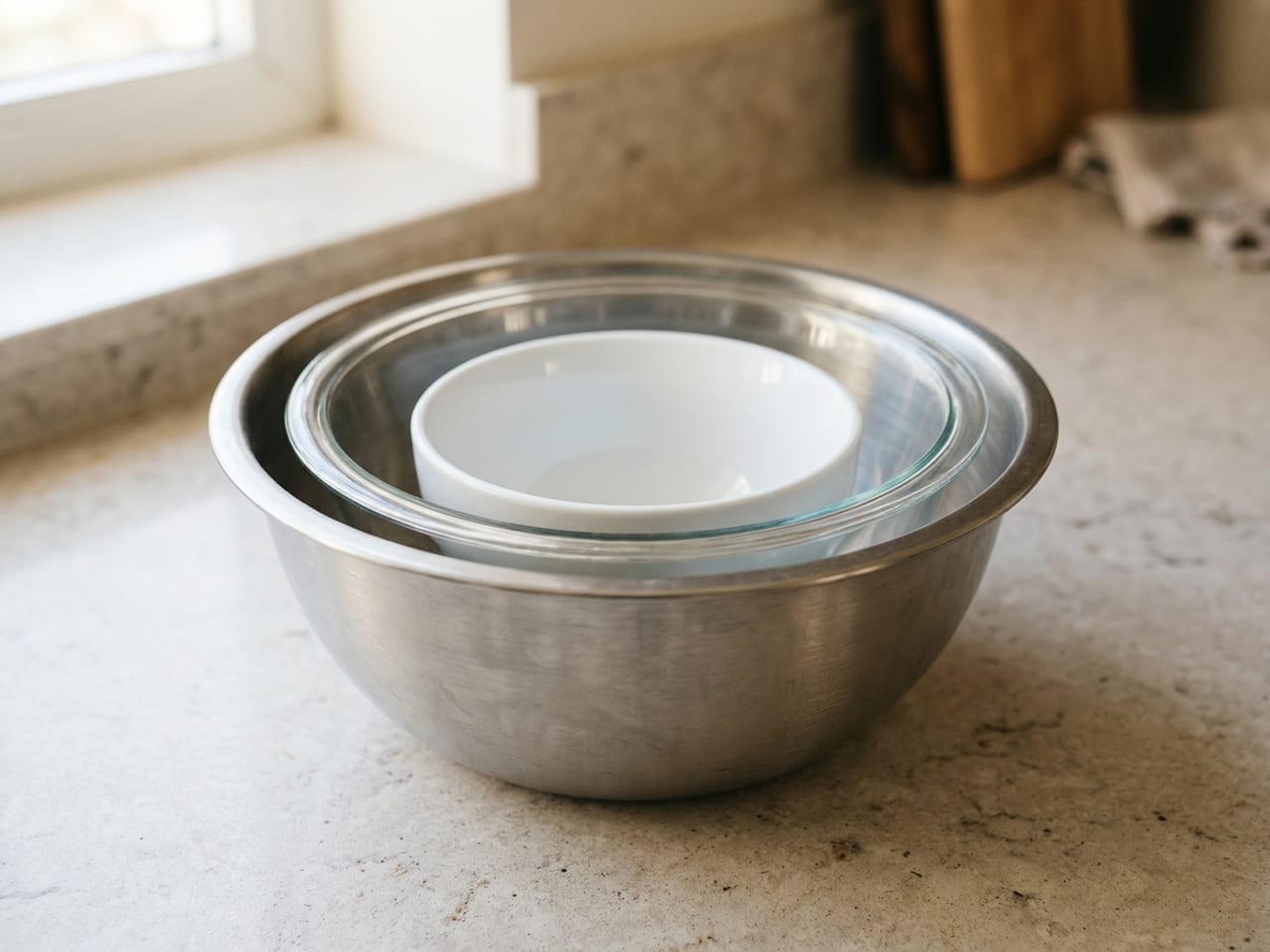
Mixing bowls are kitchen tools, not table bowls, so they are not in the eighteen. Three materials, with the sizes their makers print:
- Stainless steel: America's Test Kitchen: "every professional kitchen has dozens of stainless steel bowls"; its winner, the Vollrath Economy line, was tested in a set ATK compiled from the 1.5, 3 and 5 quart bowls (1.4, 2.8 and 4.7 L). A pastry chef in Saveur, Tab Volpe, likes steel because it cools or warms fast.97, 98
- Glass: Pyrex prints 1, 1.5 and 2.5 quarts (0.95, 1.4 and 2.4 L) at 7, 8.5 and 10 in (18, 22 and 25 cm) across (the 2.5 quart is 9.75 in in another set; Pyrex calls its figures approximate), and a 4 quart (3.8 L) at 11 3/4 in (30 cm); "Dishwasher and microwave safe".11
- Earthenware: Mason Cash's Cane bowls, "first developed in 1901": the Size 12 is 29 cm (11 3/8 in) across and holds 4 litres (about 4.2 US quarts).12
Bowls for prepped ingredients are in our mise en place guide.
Where the bowls and their names come from
The word. "Bowl" is Old English bolla, which already meant "bowl, cup, pot, beaker, measure". "Nappy", the small shallow dish, is in print by 1902 in the quotations we read, and a museum says it was a shape word from the Victorian period to the early 20th century; porringer comes from potager, a "small dish for stew"; tureen from French terrine.67, 68
At dinner, the soup plate. The V&A holds a Sèvres soup plate from the 800-piece service Catherine the Great ordered in 1776, and says dinner tables used "plate-like soup bowls", while the two-handled, covered écuelle was a bedroom and toilette piece.70, 71 The Met catalogues one silver-gilt covered bowl of 1769 to 1770 as an écuelle and a faience covered bowl of about 1760 as a "bouillon bowl".73 The French story that Cardinal Mazarin brought the deep plate from Italy in 1653 is a legend: French Wikipedia words it "La légende veut que" (legend has it that) and cites one 2010 popular book on genealogy (Beaucarnot, Entrons chez nos ancêtres), which we did not open.69
From the tureen to the plated bowl. At Beeton's 1861 dinner party the master "is to distribute the soup" at table; from the 1860s service à la russe changed the dinner table, and soup was drunk from tablespoons until the early 20th century, when the round soup spoon came in.72, 74 By 1915 Lucy Allen's Table Service, writing for a home dinner without a maid, says "the soup tureen is rarely used", that the soup comes from the kitchen "in heated soup plates", and that dinner soup is "never in bouillon cups, unless one is serving an iced consomme"; Emily Post (1923) kept two-handled cups for luncheon, wedding breakfasts and ball suppers.75, 76 More on the courses in types of table service.
One bowl for everything. A glass collectors' association writes that the American glass dinner sets of the 1920s to the mid 1940s often had several kinds of bowl, among them the cream soup, a bouillon cup, a flat soup, a cereal bowl, berry, fruit, grapefruit and finger bowls, though not every pattern had all of them; "Nowadays casual dinnerware often has only one bowl that serves for both soup and cereal".77 We found no dated source on when breakfast cereal made a "cereal bowl".
Bowl food. The co-owners of a Honolulu restaurant, Pa'ina Cafe, say they came up with the name "poke bowl" in 2007 and opened The Poke Bowl in 2008; the co-founders of another, Gyotaku, recall putting "assorted poke don" on their menu in early 2002. Both are recollections reported in a 2015 column, which we read as a blog repost.90 Bon Appétit traced the Buddha bowl to Martha Stewart's cookbook Meatless (2013), "one of the earliest Buddha bowl references in print I could find", and found no tie to Buddha.91 In November 2016 the forecasters Baum + Whiteman called bowls the serving vessel of 2017, and in 2017 Consumer Reports grouped "power bowls," "grain bowls" and Buddha bowls as one dish.92, 93
Bowls, answered
What are the types of bowls with names?
In our grouping, 18: the soup plate (rimmed), the coupe soup bowl, the deep soup bowl, the cream soup bowl and bouillon cup, the onion soup crock, the pasta bowl, the cereal bowl, the fruit or dessert bowl, the individual salad bowl, the serving bowl, the rice bowl, the donburi, the ramen or noodle bowl, the poke or grain bowl, the dip or sauce bowl, the Korean rice and soup bowls, the ttukbaegi and the katori. Bowls are named by rim, depth and the dish they hold, and each maker names its own, so the same 12 oz (355 ml) is a "soup plate" in one Steelite line and a "soup bowl" in another.
What are soup bowls called?
By shape: a soup plate (a rimmed soup bowl), a coupe soup bowl (no rim), a deep soup bowl, a cream soup bowl or bouillon cup (two handles, on a saucer) and an onion soup crock or lug bowl (solid side handles, for the broiler). Makers mix the names: Steelite sells a 9 1/2 in rimmed "Soup Plate" and a 4 3/4 in deep "Soup Bowl" that both hold 12 oz; Libbey and Mikasa sell "soup/cereal" bowls; Churchill pairs "Consomme/Soup Bowl"; Etiquette Scholar calls the soup-cereal bowl the "oatmeal bowl".
What is a good size for a soup bowl?
Start from the soup: Gisslen's Professional Cooking gives 6 to 8 oz (200 to 250 mL) for a first course and 10 to 12 oz (300 to 350 mL) for a main course. Makers' rimmed soup plates print 10 to 17 oz (296 to 500 ml) at 9 to 9 3/4 in (23 to 25 cm), and their deep soup bowls 12 to 16 oz (355 to 473 ml) at 4 1/2 to 5 1/4 in (11.4 to 13.3 cm). Etiquette Scholar says soup bowls hold 8 to 12 oz (237 to 355 ml) on average. No source we read gives a standard size for the bowl itself.
What size is a large soup bowl?
No maker we read sells one as a "large soup bowl". The biggest soup-named bowls in our chart are Churchill's Profile rimmed soup bowl at 500 ml (17 oz) and Mikasa's soup cereal bowl at 38 oz (1.1 L), 8 1/2 in (21.6 cm) across. Ramen bowls, at about 1 litre, are bigger still.
What size is a ramen bowl?
In what we read, about 32 to 38 oz (946 to 1,136 ml) at 6 3/4 to 8 1/4 in (17 to 21 cm): Miya's Aranami 32 oz at 8 1/4 in, Musubi Kiln's Mino-ware bowl 1,100 ml at 20.5 cm, and G.E.T.'s melamine Fuji bowl 1.2 qt rim-full at 6 3/4 in. A recipe site, Just One Cookbook, gives 18 cm and 1,400 ml, more than any we read; a seller's buying guide gives 18 to 24 oz, much less.
What size is a cereal bowl in oz?
In 5 of the 8 cereal bowl listings we read, 17 to 22 oz (500 to 650 ml), about 2 to 2 3/4 US cups, at 5 1/2 to 6 5/8 in (14 to 17 cm) across: Corelle 18 oz, Libbey 17 1/2 and 20 oz, Mikasa 21 and 22 oz. The other three: Villeroy & Boch's 14.6 and 15.9 oz and Libbey's glass one at 26 3/4 oz. A label serving is far smaller: 15, 40 or 60 g by the cereal's weight per cup (FDA).
What size is a rice bowl?
177 to 570 ml (6 to 19 oz) in what we read, 3 3/4 to 6 in (9.5 to 15 cm) across. A Japanese chawan from MTC Kitchen is 11.6 cm across and 6.2 cm high and holds 320 ml filled to the brim; Royal Porcelain's rice bowls hold 190 ml at 100 mm and 540 ml at 150 mm; CAC China's 3 3/4 in bowl holds 6 oz. The bowl is not the portion: FDA's label reference for cooked rice is 140 g.
What size is a serving bowl?
Far bigger than any place-setting bowl: Steelite's Pillivuyt salad bowl holds 1.5 qt (1.4 L) at 8 3/4 in (22.2 cm), and Fiesta's retired Large Pasta Bowl 129 oz (3.8 L) at 12 7/8 in (32.7 cm). No source we read gives one serving bowl size as the standard.
What kinds of bowls are microwave safe?
The ones marked for it: Kansas State (citing USDA) says glass, ceramic and plastic containers should be labelled for the microwave, and Clemson Extension lists "Ceramic dishes without metallic trim". For an unmarked bowl, Clemson's test: one minute on high beside a cup of water; if the empty bowl stays cool, it is safe. Not metal unless the microwave's maker allows it, not melamine for heating food (the German BfR), and never an empty Corelle bowl.
What kinds of bowls are oven safe?
Only those whose maker says so, and only to its temperature: Corelle glass to 350°F (176°C) in a pre-heated oven and never under the broiler; Le Creuset stoneware to 500°F (260°C), and under the broiler with at least 2 1/2 in (6.5 cm) of gap. Fiesta and Libbey's Schönwald stoneware print oven-safe marks. Oven safe is not broiler safe, a seller warns: check before you melt cheese on an onion soup.
Should pasta go in a bowl or on a plate?
The cooks split: Lidia Bastianich serves it in a warm bowl, the food writer Maureen Fant says a flat plate in proper restaurants; our pasta guide sets out who says which. The pasta bowls we read print 10 to 26 oz (302 to 769 ml), and the wide-rim ones are 10 5/8 to 12 1/8 in (27 to 30.8 cm) across.
What are Japanese bowls called?
Chawan, the rice bowl (the Japanese dictionaries define it as a bowl "to put tea in, or to heap rice in", our translation, so it is also the tea bowl); donburi, the big deep bowl for rice with a topping; the ramen bowl; and wan or owan, a wooden or ceramic bowl for rice or soup (the clear soup at a kaiseki meal comes in an owan).
What kind of mixing bowls do chefs use?
Stainless steel, in what we read: America's Test Kitchen says "every professional kitchen has dozens of stainless steel bowls" and its winner, the Vollrath Economy line, was tested in a set ATK compiled from the 1.5, 3 and 5 quart bowls (1.4, 2.8 and 4.7 L), and a pastry chef in Saveur, Tab Volpe, likes steel because it cools or warms fast. Glass (Pyrex) goes in the microwave; Mason Cash still makes the earthenware bowl it first developed in 1901.
What is the soup bowl size in a restaurant?
The hotel and restaurant makers we read (Steelite, Churchill, Libbey) print rimmed soup plates of 12 to 17 oz (355 to 500 ml) at 9 to 9 3/4 in (23 to 25 cm), deep soup bowls of 12 to 14 oz (355 to 414 ml) at 4 1/2 to 4 7/8 in (11.4 to 12.4 cm), and bouillon cups of 7 oz (207 ml). A restaurant-supply seller says commercial soup bowls commonly fall in the 8 to 16 oz (237 to 473 ml) range; Gisslen's textbook portions are 6 to 8 oz (200 to 250 mL) for a first course and 10 to 12 oz (300 to 350 mL) for a main.
How this page was made
Nothing here was measured, cooked or tested by us. Every size is the one a maker prints, on its own page or in the catalogue line a restaurant-supply seller copies (each source says which); every use, rule and date is its source's, read on 24 November 2026 unless its entry says otherwise: makers' pages, Japanese, Korean and Indian ware sellers, Japanese and Korean dictionaries and encyclopedias, museum catalogues, etiquette books from 1915 and 1923, a chef's textbook (as search fragments), US labelling rules, university extension pages, magazines, and Wikipedia and Wiktionary (community-edited, used as pointers). Ours: the grouping into eighteen bowls, the one-line summaries, the lines marked ours, and the conversions in brackets.
What we could not read: the Steelite, IKEA, OXO and Vollrath pages and the WebstaurantStore and KaTom guides (all refused our fetcher), Just One Cookbook (its figures are an earlier reading), HIC's onion soup crocks (no specs on any page we could open), the FDA and USDA microwave and melamine pages, Merriam-Webster and etymonline, the Kitchn's Buddha bowl page, the Met's own web pages (we read its open data instead), Crooke's 1888 glossary (so no origin for katori), and Martha Stewart's Meatless itself. Gisslen's textbook was read only as search fragments of a scan, and a cut-off sentence is left cut off. The bowl-size studies are earlier readings for our plates guide. The figures are AI renders, not photographs.
The makers, dictionaries, old books and pages behind this page
How each source was read (in full, via a seller, as search fragments of a scan, or as a prior reading for another of our guides) is in its entry. Sellers sell what they describe.
- Fiesta (Homer Laughlin) (2026). Rim Soup Bowl. fiestafactorydirect.com (the maker's own store), undated page, read in full on 24 November 2026: "Classic Rim 9 Inch Soup Bowl 13 OZ"; "Diameter 9""; "Height 1 5/8""; the same page's text says "Holding 13 1/4 ounces". fiestafactorydirect.com
- Fiesta (Homer Laughlin) (2026). Fruit Bowl. fiestafactorydirect.com (the maker's own store), undated page, read in full on 24 November 2026: "Diameter 5 3/8""; "Height 1 1/4""; "Holds 6 Ounces"; "Dishwasher, oven, and microwave safe". fiestafactorydirect.com
- Fiesta (Homer Laughlin) (2026). Retired Large Pasta Bowl. fiestafactorydirect.com (the maker's own store), undated page, read in full on 24 November 2026: "Diameter 12 7/8""; "Height 3 1/8""; "Holds 129 Ounces". fiestafactorydirect.com
- Corelle Brands (2026). Winter Frost White Meal Bowl 4-pack; 18-ounce Cereal Bowl; 16-ounce Small Soup Bowl. corelle.com (the maker's own shop), undated page, read in full on 24 November 2026: "Cereal Bowls 4 6.25'' diameter 18oz"; "*All measurements are approximate."; the 16 oz bowl's page title is "Corelle® Winter Frost White 16-ounce Small Soup Bowl" and the shop files both under "Soup and Cereal Bowls". corelle.com
- Corelle Brands (2026). Safety and Usage Instructions. corelle.com (the maker's own care page), undated page, read in full on 24 November 2026: "CORELLE Dinnerware can be used in microwave and pre-heated conventional ovens up to 350˚ F (176˚ C). To warm empty dinnerware for serving, use pre-heated conventional oven only."; "DO NOT heat an empty vessel in a microwave oven. It may become too hot to handle, crack or break."; "DO NOT USE ON STOVETOP , under a broiler/griller, under a microwave browning element, in a toaster oven". corelle.com
- Mikasa (2026). Soup Cereal Bowl pages (Red Berries, Arabella, Italian Countryside, Jade). mikasa.com (the maker's own shop), four undated pages, read in full on 24 November 2026: "Set of 4 soup cereal bowls, each measures 5-1/2 inch diameter and holds 21 ounces."; Arabella "Width: 6.25 inch", "Capacity: 22.0 oz"; Italian Countryside "Width: 7 inch", "Capacity: 24.0 oz"; Jade "Width: 8.5 inch", "Capacity: 38.0 oz"; each page says microwave and dishwasher safe. mikasa.com
- Villeroy & Boch (2026). Manufacture, Artesano, Vieux Luxembourg and Crafted bowl pages. villeroy-boch.com (the maker's own US shop), five undated pages, read in full on 24 November 2026: "Manufacture Pasta bowl White, 10.2 oz, Premium Porcelain"; "4x Wide Rim Pasta bowl, 11.02 in"; "Artesano Pasta bowl White, 15.6 oz, Premium Porcelain"; "Artesano Cereal bowl White, 14.6 oz, Premium Porcelain"; "Vieux Luxembourg Cereal bowl White, 15.9 oz, Premium Porcelain"; "Crafted Pasta bowl White, 15.3 oz, Premium Porcelain" (that item's page title calls it a soup plate and its address a soup bowl); no page says whether the figure is brim-full. villeroy-boch.com
- Le Creuset (2026). French Onion Soup Bowl. lecreuset.ca (the maker's own Canadian shop), undated page, read in full on 24 November 2026: "Capacity: 0.45 L", "Heat Source: Oven, Microwave", "Diameter: 16 cm", "Length: 20 cm", "Width: 13 cm", "Height: 6.3 cm" (each on its own line); "Our French Onion Soup Bowl is perfectly suited for serving French onion soup as well as a variety of delicious side dishes.". lecreuset.ca
- Le Creuset (2026). Care & Use: Le Creuset Products (stoneware). lecreuset.com.hk (the maker's own care page), undated page, read in full on 24 November 2026: "BROILER: When using under a broiler allow a gap of no less than 2 ½ inches between the rim of the dish and the heat source."; "FREEZER-TO-OVEN USE: Do not place a frozen dish of food in a preheated oven. Place the frozen dish in a cold oven and set the temperature, allowing the dish and oven to heat together.". lecreuset.com.hk
- Le Creuset (2026). Care and Use. lecreuset.co.uk (the maker's own care page), undated page, read in full on 24 November 2026: "Le Creuset Stoneware is safe for use in the microwave, freezer, refrigerator, dishwasher, oven and under the grill (at a minimum distance of 6.5cm/2 ½ inches from the heating element). The maximum oven-safe temperature is 260°C/500°F."; for another range on the same page: "Not suitable for microwave ovens, dishwasher, grill or use on direct heat.". lecreuset.co.uk
- Pyrex (Corelle Brands) (2026). 3-piece and Smart Essentials 4-piece glass mixing bowl sets. corelle.com and pyrexhome.com (the maker's own shops), two undated pages, read in full on 24 November 2026: "1 quart" at "7'' wide x 7'' deep x 3'' high", 1.5 quarts at 8.5 x 3.25 in, "2.5 quarts" at "10'' wide x 10'' deep x 4'' high"; the 4-piece set's "9.75'' diameter x 3.75'' high" 2.5 quart and "11.75'' diameter x 4.5'' high" "4 quarts"; "Dishwasher and microwave safe"; "*All measurements are approximate.". corelle.com
- Mason Cash (2026). Cane S12 Mixing Bowl 29cm. masoncash.co.uk (the maker's own page), undated page, read in full on 24 November 2026: "The Size 12 Cane Mixing bowl measures 29cm x 14cm, with a capacity of 4 litres"; "the Mason Cash Cane mixing bowls were first developed in 1901". masoncash.co.uk
- Steelite (via RestaurantSupply.com) (2026). Steelite 6940E679 soup plate. restaurantsupply.com (a seller), a seller's listing copying the maker's catalogue line (the maker's own page was not readable), read in full on 24 November 2026: "Steelite International, 6940E679, Soup Plate, 12 oz., 9-1/2" dia. x 1-5/8"H, rimmed, round, microwave/dishwasher safe, porcelain, white, Folio, Alpha Ceram, Stratford". restaurantsupply.com
- Steelite (via RestaurantSupply.com) (2026). Steelite 62101ST0673 Cadence soup bowl. restaurantsupply.com (a seller), a seller's listing copying the maker's catalogue line (the maker's own page was not readable), read in full on 24 November 2026: "Steelite International, 62101ST0673, Soup Bowl, 12.0 oz, 9.25"Cadence, rimmed, Royal Porcelain, Round, Fortified Porcelain". restaurantsupply.com
- Steelite (via RestaurantSupply.com) (2026). Steelite 6900E556 Varick soup bowl. restaurantsupply.com (a seller), a seller's listing copying the maker's catalogue line (the maker's own page was not readable), read in full on 24 November 2026: "Steelite International, 6900E556, Soup Bowl, 12 oz., 4-3/4" dia. x 2-1/4", round, stackable, Varick, Classic Cafe". restaurantsupply.com
- Churchill (via RestaurantSupply.com) (2026). Churchill WH OSP 1 soup plate. restaurantsupply.com (a seller), a seller's listing copying the maker's catalogue line (the maker's own page was not readable), read in full on 24 November 2026: "Churchill China, WH OSP 1, Soup Plate, 14 oz., 10-3/4" x 8-3/4", oval, deep, wide rim, curved, rolled edge, stackable, microwave & dishwasher safe, ceramic". restaurantsupply.com
- Churchill (via RestaurantSupply.com) (2026). Churchill WH NSU 1 consommé/soup bowl. restaurantsupply.com (a seller), a seller's listing copying the maker's catalogue line (the maker's own page was not readable), read in full on 24 November 2026: "Churchill China, WH NSU 1, Consomme/Soup Bowl, 14 oz., 4-1/2" dia., round, without handle, rolled edge, microwave & dishwasher safe, ceramic". restaurantsupply.com
- Churchill (via RestaurantSupply.com) (2026). Churchill RKBQVWBM1 bowl. restaurantsupply.com (a seller), a seller's listing copying the maker's catalogue line (the maker's own page was not readable), read in full on 24 November 2026: "Churchill China, RKBQVWBM1, Bowl, 10 oz., 9-1/2" dia., medium, round, wide rim, microwave & dishwasher safe, ceramic". restaurantsupply.com
- Churchill (via Brakes Catering Equipment) (2026). Churchill Profile rimmed soup bowl. brakesce.co.uk (a UK foodservice distributor), a distributor's listing repeating Churchill's range text, read in full on 24 November 2026: "Size 24.8cm (9.75") 500ml (17oz)"; "Holds 500ml (17oz)". brakesce.co.uk
- Libbey (via RestaurantSupply.com) (2026). Libbey 968001740 Zipline soup bowl and 950002469 Slenda soup/cereal bowl. restaurantsupply.com (a seller), a seller's listings copying the maker's catalogue lines (the maker's own page was not readable), read in full on 24 November 2026: "Libbey, 968001740, (Formerly Syracuse China) Soup Bowl, 14 oz., 9-1/8" dia. x 1-5/8"H, rimmed, highly polished foot, fully vitrified, porcelain, Zipline pattern and shape"; "Libbey, 950002469, (Formerly Syracuse China) Soup/Cereal Bowl, 13 oz., 4-7/8" dia. x 2"H, round, stackable, fully vitrified, porcelain, Slenda® pattern & shape". restaurantsupply.com
- Libbey (via RestaurantSupply.com) (2026). Libbey 988001760, 911194013 and 1789268 cereal bowls. restaurantsupply.com (a seller), a seller's listings copying the maker's catalogue lines (the maker's own page was not readable), read in full on 24 November 2026: "Libbey, 988001760, (Formerly Syracuse China) Cereal Bowl, 20 oz., 6" dia. x 2-1/8"H"; "Libbey, 911194013, (Formerly Syracuse China) Cereal Bowl, 17-1/2 oz., 6-5/8" dia. x 1-7/8"H"; "Libbey, 1789268, Cereal Bowl, 26-3/4 oz., 6" dia., round, glass, tempered". restaurantsupply.com
- Libbey (via ChefsDeal and RestaurantSupply.com) (2026). Libbey 740-901-051, 911194029 and 840-901-061 pasta bowls; 987659385 Stadium pasta bowl. chefsdeal.com and restaurantsupply.com (sellers), a seller's listings copying the maker's catalogue lines (the maker's own page was not readable), read in full on 24 November 2026: "Libbey 740-901-051 Pasta Bowl - 12" x 2" , 21.5 oz"; "Libbey 911194029 Pasta Bowl - 12" Dia x 2" H, 25 Oz"; "Libbey 840-901-061 Porcelana Pasta Bowl, 12" Dia x 2-1/4" H, 61 oz"; "Libbey, 987659385, (Formerly Syracuse China) Stadium Pasta Bowl, 53-1/2 oz., 11-7/8" dia. x 2"H". chefsdeal.com
- Libbey and Steelite (via RestaurantSupply.com) (2026). Libbey 950041951 and Steelite HL6526000 bouillon cups. restaurantsupply.com (a seller), a seller's listings copying the maker's catalogue lines (the maker's own page was not readable), read in full on 24 November 2026: "Libbey, 950041951, (Formerly Syracuse China) Bouillon, 7 oz., 3-3/8" dia. x 2-1/8"H ... (fits saucer 950041436)"; "Steelite International, HL6526000, Bouillon, 7 oz., 3-1/2" x 2-3/8", fits W HL655, Homer, Pristine". restaurantsupply.com
- Steelite (via RestaurantSupply.com) (2026). Steelite 6634V608 Pillivuyt salad bowl. restaurantsupply.com (a seller), a seller's listing copying the maker's catalogue line (the maker's own page was not readable), read in full on 24 November 2026: "Steelite International, 6634V608, Salad Bowl, 1.5 qt, 8.75", General Collection, Pillivuyt, Round, Porcelain". restaurantsupply.com
- Libbey (via RestaurantSupply.com) (2026). Libbey Schönwald 701316691000583 bowl, 24 oz. restaurantsupply.com (a seller), a seller's listing copying the maker's catalogue line (the maker's own page was not readable), read in full on 24 November 2026: "Libbey, 701316691000583, Bowl, 24 oz., 6-1/4" dia. x 2-1/2"H, round, stoneware, microwave/oven/dishwasher safe". restaurantsupply.com
- CAC China (via RestaurantSupply.com) (2026). CAC China 101-63 Lincoln rice bowl. restaurantsupply.com (a seller; the text reads as the seller's own), read in full on 24 November 2026: "With a capacity of 6 ounces, it measures 3-3/4 inches in diameter and stands 1-7/8 inches high.". restaurantsupply.com
- Royal Porcelain (via Advantage Catering Equipment) (2026). Royal Porcelain Oriental Rice Bowls, 100 mm and 150 mm. advantage-catering-equipment.co.uk (a UK distributor), two distributor listings, read in full on 24 November 2026: "The bowls hold 190ml" and "a practical capacity for a standard rice portion", "Dimensions 100(Ø)mm | 4(Ø)""; "Generous 540ml capacity handles individual rice servings and side dishes", "Dimensions 150(Ø)mm/ 6"". advantage-catering-equipment.co.uk
- G.E.T. Enterprises (via ChefsDeal) (2026). G.E.T. B-125-F Fuji melamine bowl. chefsdeal.com (a seller, filed under Asian dinnerware), a seller's listing copying the maker's catalogue line (the maker's own page was not readable), read in full on 24 November 2026: "GET B-125-F Fuji Bowl, 1.2 Qt (Rim Full), 6.75" Dia x 3.25" H, Red/Black Mel, Durable NSF - 1 Dozen"; its feature list gives "Capacity of 1.2 qt" with a 32 to 63 oz range in brackets. chefsdeal.com
- RestaurantSupply.com (2026). Soup Bowls vs Soup Crocks: What's the Difference? restaurantsupply.com buying guide (a seller's advice, not makers' specs), undated page, read in full on 24 November 2026: "Commercial soup bowls commonly fall in the 8 to 16 ounce range, though larger entrée bowls are widely available."; its table: "10 to 12 oz." "Light entrée soup" "Traditional individual crock"; "18 to 24 oz." "Ramen, pho, grain bowls"; "Some can, but oven safe does not automatically mean broiler safe .". restaurantsupply.com
- RestaurantSupply.com (2026). Ceramic bowl buying guide. restaurantsupply.com buying guide (a seller), undated page, read in full on 24 November 2026: "The Tuxton BPD-1204 has a 21 oz capacity and a wide 12-inch profile." (sold as a pasta and salad bowl); "24.5 oz, 12-inch ceramic pasta bowl." (Tuxton CQD-120); "Check the actual well capacity rather than judging by outside diameter.". restaurantsupply.com
- Steelite (as listed by KitchenRestock) (2026). Steelite A120P050 pasta bowl, 26 oz. kitchenrestock.com (a seller), a prior reading for another of our guides, copied into this run's sheets and not re-read on 24 November 2026 (our pasta guide): "11-3/4 inches in diameter and standing 2-1/4 inches high". kitchenrestock.com
- Churchill (as listed by KitchenRestock) (2026). Churchill China WH CTPB1 pasta bowl, 16 oz. kitchenrestock.com (a seller), a prior reading for another of our guides, copied into this run's sheets and not re-read on 24 November 2026 (our pasta guide): "a generous diameter of 11 inches". kitchenrestock.com
- Steelite (as listed by KitchenRestock) (2026). Steelite 17100314 pasta bowl, 14-1/2 oz. kitchenrestock.com (a seller), a prior reading for another of our guides, copied into this run's sheets and not re-read on 24 November 2026 (our pasta guide): "a diameter of 10-5/8 inches". kitchenrestock.com
- Churchill (as listed by Cooks Villa) (2026). Churchill Profile white pasta bowl. cooksvilla.co.uk (a seller), a prior reading for another of our guides, copied into this run's sheets and not re-read on 24 November 2026 (our pasta guide): "Diameter: 30.8 cm (12.13″), Height: 3.6 cm" (the page title says 30.5 cm). cooksvilla.co.uk
- MTC Kitchen (2026). Striped rice bowls, 11 fl oz and 19.5 fl oz. mtckitchen.com (a Japanese kitchenware retailer), two undated pages, read in full on 24 November 2026: "Dimensions: 4.6" dia x 2.44" ht (11.6cm dia x 6.2cm ht)", "Capacity (filled up): 11 fl oz / 320 ml"; "Dimensions: 4.92" dia x 3.15" ht (12.5cm dia x 8cm ht)", "Capacity (filled up): 19.5 fl oz (570ml)"; "This bowl is typically used for serving rice in Japanese cuisine, or to serve extra small tapas portions as a kobachi bowl.". mtckitchen.com
- MTC Kitchen (2026). Donburi bowl with striped interior, 22.5 fl oz. mtckitchen.com (a Japanese kitchenware retailer), undated page, read in full on 24 November 2026: "Dimensions: 6.25" dia x 3.1" ht (15.9cm dia x 7.9cm ht)"; "Capacity (filled up): 665 ml / 22.5 fl oz". mtckitchen.com
- Musubi Kiln (2026). Donburi bowl pages (Kutani, Tobe, Hasami and Mino ware). musubikiln.com (a US retailer of Japanese-made ware), five undated pages, read in full on 24 November 2026, each printing diameter, height and ml (brim-full or working not stated): "D 14 cm (5.5 in) x H 10 cm (3.9 in), 450 ml (15.2 fl oz)"; "D 15.5 cm (6.1 in) x H 7.5 cm (3.0 in), 550 ml (18.6 fl oz)"; "D 16 cm (6.3 in) x H 9.2 cm (3.6 in), 500 ml (16.9 fl oz)"; "D 16 cm (6.3 in) x H 8 cm (3.1 in), 700 ml (23.7 fl oz)"; "D 16.5 cm (6.5 in) x H 7.3 cm (2.9 in), 790 ml (26.7 fl oz)". musubikiln.com
- Musubi Kiln (2026). Whale Mino-ware ramen bowl M. musubikiln.com (a US retailer of Japanese-made ware), undated page, read in full on 24 November 2026: "D 20.5 cm (8.1 in) x H 8 cm (3.1 in), 1100 ml (37.2 fl oz)"; "Its size and shape are perfect for ramen and other noodle dishes like udon and soba.". musubikiln.com
- Miya Company (via Milk Street Store) (2026). Miya Aranami bowl. store.177milkstreet.com (a retailer), undated page, read in full on 24 November 2026: "Volume: 32 ounces"; "Dimensions: 8.25 inches x 3.5 inches" (brim-full or working not stated). store.177milkstreet.com
- Just One Cookbook (2026). The Ultimate Guide to Japanese Tableware. justonecookbook.com (a recipe site), a prior reading for another of our guides, copied into this run's sheets and not re-read on 24 November 2026 (our types of plates guide; the site refused our fetcher on 24 November 2026): donburi bowl 15 cm across, 8.5 cm high, 900 ml; ramen bowl 18 cm, 9.5 cm high, 1,400 ml; rice bowl 12 cm, 6 cm high, about 150 g of steamed rice. justonecookbook.com
- Ohouse (2026). Lining Rice Bowl & Soup Bowl Set. shop.ohouse.com (a Korean home-goods retailer), undated page, read in full on 24 November 2026: "4.5" Dia × 2.6" H / 11.8 oz (11.5 × 6.5 cm / 350 ml)"; "5.3" Dia × 3.0" H / 16.9 oz (13.5 × 7.5 cm / 500 ml)"; "KCL certified"; the page says microwave, dishwasher and oven safe. shop.ohouse.com
- Nikan Kitchen (2026). Korean earthenware ttukbaeki for Korean stews, 4ho. nikankitchen.com (a Japan-based retailer of Korean ware), undated page, read in full on 24 November 2026: "Sized at 4ho (162mm diameter), ideal for individual servings or small portions of Korean stew (Jjigae)."; "Highly resistant to thermal shock, making it suitable for direct use on gas stoves and electric cooktops.". nikankitchen.com
- Celebrate Festival; Swadesii (2026). Copper-steel hammered katori bowl, 5 oz; stainless steel katori, 200 ml. celebratefestivalinc.com and swadesii.com (sellers of Indian ware), two undated pages, read in full on 24 November 2026: "Diameter: ~2.75 inches (7 cm)", "Height: ~1.5 inches (3.8 cm)", "Capacity: ~5 oz (150 ml)"; "Dimension : 9.3 x 9.3 x 5.7 cm (L x B x H), Diameter : 9.3 cm, Weight : 90 grams, Capacity : 200 ML." (Swadesii sells its katori for tea, coffee and milk too). celebratefestivalinc.com
- Etiquette Scholar (2026). Bowls (Formal Table Setting: Dinnerware). etiquettescholar.com (an etiquette website, no named author; its sizes are its own, not makers'), undated page, read in full on 24 November 2026: soup plate "Wide, shallow bowl with a flanged rim. Diameter is approximately 9 to 10 inches, the rim is 1 to 2 inches wide, the depth is up to 1 ½ inches deep, and the well is 6 to 7 inches across.", "The only soup bowl used in formal dinner service."; coupe soup "Saucer-like shape approximately 6 to 9 inches across. Only for informal dining."; "Soup bowls hold 8 to 12 ounces on average. Soup cups hold approximately 4 ounces."; lug "4½ to 5½ inches in diameter and 2½ inches deep."; cream soup "4 to 5 inches in diameter"; bouillon cup "3 ¾ inches in diameter and features a companion saucer about 5 1/ 2 inches across."; "Thick, chunk-filled soups, like a hardy beef soup, retain heat and are served in shallow, wide bowls" and "which releases heat well."; "Narrow cups are used to serve clear soup because they preserve temperature well."; "Vertical open-loop handles (cream soup bowl or bouillon cup) can be lifted and the liquid is drunk. Solid horizontal handles (lug soup bowl) can be tilted to gather the last bit of liquid."; "All bowls, even ones with saucers, should be placed on an underplate."; soup-cereal bowl "AKA the oatmeal bowl", "Approximately 5 ¾ to 8 ¾ inches in diameter". etiquettescholar.com
- The Emily Post Institute (2026). Guide to food and drink. emilypost.com, a prior reading for another of our guides, copied into this run's sheets and not re-read on 24 November 2026 (our fine-dining etiquette guide, fetched 24 October 2026): "If the bowl is shallow, leave it in the bowl; if the bowl is deep or the soup is in a cup, leave the spoon on the underplot or saucer." (the page's own spelling). emilypost.com
- The Emily Post Institute (2026). How to Eat Soup the Proper Way. emilypost.com, a prior reading for another of our guides, copied into this run's sheets and not re-read on 24 November 2026 (our fine-dining etiquette guide): "Just tilt the bowl away from you (again to avoid spills or drips on you) and do it quietly, without clanking your spoon against the bowl.". emilypost.com
- Debrett's (2025). Breaking Bread. debretts.com (UK etiquette publisher), published 6 February 2025 (date from the live page, 24 November 2026), a prior reading for another of our guides, copied into this run's sheets and not re-read on 24 November 2026 (our fine-dining etiquette guide): "Tilt the bowl away from you in order to get the last few spoonfuls. Leave your spoon in the bowl when you have finished.". debretts.com
- Martin, J. (Miss Manners) (2005). It is appropriate to pick up bowl. The Spokesman-Review (United Feature Syndicate column), 26 December 2005, read in full on 24 November 2026: "Your grandmother was quite right: Atwo-handled cup may be taken up with two hands. It is customary to provide a soup spoon for those who do not care to do so." (the page's own run-together "Atwo"); the reader's bowl is a double-handled cream soup bowl with a liner plate. spokesman.com
- Etiquetteer (2017). Table Manners: Double-Handled Cups (vol. 16, issue 50). etiquetteer.com (an etiquette column), 1 November 2017, read in full on 24 November 2026: "One drinks bouillon from a bouillon cup using both handles, but if you're served coffee in one, it might be more Perfectly Proper to use only one handle.". etiquetteer.com
- Japan National Tourism Organization (2026). A Master Class in Kaiseki Ryori. japan.travel, a prior reading for another of our guides, copied into this run's sheets and not re-read on 24 November 2026 (our fine-dining etiquette guide): "It is appropriate to lift the bowl to your mouth and sip some of the broth before taking a bite of the fish or vegetables that are at the bottom of the bowl." (of the owan, the clear soup). japan.travel
- Japan National Tourism Organization (2026). Table Manners in Japan (US blog). japan.travel, a prior reading for another of our guides, copied into this run's sheets and not re-read on 24 November 2026 (our fine-dining etiquette guide): "Speaking of a rice bowl, it is better to hold the bowl with your hand, while scooping rice with chopsticks with the other hand. It is not only well mannered, but also reasonable to prevent the food from dropping.". japan.travel
- nippon.com (Nippon Communications Foundation) (2026). Ichiju Sansai: The Standard Elements of a Typical Japanese Meal. nippon.com, published 4 May 2026, updated 7 October 2026 (dates from the live page's metadata; the copy we saved carries none), read in full on 24 November 2026: "Front left: Rice." "Front right: Soup (miso soup, clear soup, etc.)."; "The rice bowl is placed to the left, to facilitate lifting and putting it down.". nippon.com
- Wikipedia contributors (2026). Customs and etiquette in Chinese dining. Wikipedia (an encyclopedia anyone can edit; a pointer only), read in full on 24 November 2026: "A basic place setting consists of a small teacup; a large plate with a small, empty rice bowl; a set of chopsticks, usually on the right of the plate; and a soup spoon."; "pick up the bowl close to the mouth with the left". wikipedia.org
- Lee Eun-yi (KOCIS) (2018). Bowls, A Universe of Their Own. Korean Culture and Information Service webzine, April 2018 (a Korean government body), read in full on 24 November 2026: "Bowls for side dishes with lids were called jaengcheop , small soup bowls were bosigi , and small bowls for sauces or dips were jongji ."; "Rice bowls for men were broad and marked by straight lines, while those for women were round and deep with a small knob on the lid."; "They believe that there’s a perfect bowl for each and every dish.". kocis.go.kr
- Shogakukan; Heibonsha (via Kotobank) (2026). 茶碗 (chawan): Daijisen, Nihon Kokugo Daijiten, Sekai Daihyakka Jiten. kotobank.jp (Japanese dictionaries and encyclopedias), read in full on 24 November 2026: Daijisen "茶を入れ、または飯を盛る陶磁製の碗。" (a ceramic bowl to put tea in or to heap rice in; our gloss); Nihon Kokugo Daijiten "茶を入れ、また、飯を盛る器。" and its earliest example from the Engishiki (927), "茶椀二十口〈径各五寸〉"; Heibonsha "江戸時代に入るまで陶磁器の飲食用碗はあまりつくられていない" (few ceramic eating bowls were made before the Edo period, wooden bowls being the norm) and "本来は喫茶用の碗である" (originally a tea-drinking bowl). kotobank.jp
- Shogakukan; Heibonsha (via Kotobank) (2026). 丼 and 丼物 (donburi, donburimono). kotobank.jp (Japanese dictionaries and encyclopedias), read in full on 24 November 2026: Daijisen "食物を盛るための厚手で深い陶製の大きな鉢。" (a large, thick, deep ceramic bowl for food) and "どんぶり飯の上に具をのせたもの。カツ丼・天丼など。"; Nihon Kokugo Daijiten quotes the bowl from Mimibukuro (1784 to 1814) and the dish word どんぶり物 from a 1782 sharebon, and says the name's origin from the sound of something dropped into water "はっきりしない" (is not clear); Heibonsha: "この語は17世紀末ごろから見られ" (seen from about the end of the 17th century), mainly for soba, and a 1781 menu lists "〈南京染付どんぶり〉" (a Nanking blue-and-white donburi). kotobank.jp
- Shogakukan; Heibonsha (via Kotobank) (2026). 椀 (wan). kotobank.jp (Japanese dictionaries and encyclopedias), read in full on 24 November 2026: Daijisen "飯・汁などを盛る木製・陶磁製などの半球形の器。" (a hemispherical vessel of wood or ceramic for rice, soup and the like); Heibonsha: bowl-shaped vessels in Japan go back to the Jōmon period. kotobank.jp
- Shogakukan; Heibonsha (via Kotobank) (2026). 雷文 (raimon). kotobank.jp (Nipponica, Daijisen, Mypedia), read in full on 24 November 2026: Nipponica (Muramoto Yūō) "角形の渦巻文。回文ともいう。" (a square spiral) and "元来、中国では雷光をかたどった文様とも、竜文から変化したものともいうが、明らかではない。" (said in China to be shaped on lightning or to come from a dragon motif, but it is not clear); Mypedia "現在でも皿や鉢の縁の模様や敷物の縁の模様等にしばしば用いられている。" (still often used on the rims of plates and bowls). kotobank.jp
- Shogakukan (via Kotobank) (2026). 拉麺 (ramen), Nihon Kokugo Daijiten usage note. kotobank.jp, read in full on 24 November 2026: "日本には拉麺と切麺が明治期に流入、「シナそば」「南京そば」と呼ばれ、主に中華街で食された。"; "昭和三〇年代から、ラーメンの方が一般的となる。" (ramen became the usual word from the Shōwa 30s, 1955 to 1964). kotobank.jp
- HugKum (Shogakukan) (2022). ラーメン丼の赤いグルグル模様、「アレ」なんて言うの? hugkum.sho.jp (a family magazine site), published 24 September 2022 (date from the live page's metadata), read in full on 24 November 2026: "中国の伝統的な模様がラーメン丼に描かれた経緯はよくわかりませんが" (how the Chinese pattern came onto ramen bowls is not well known); "日本でラーメンが広まったと言われるのは、大正時代。". hugkum.sho.jp
- Myojo USA (2023). The Art of Donburi, Chopsticks, and Renge: Unlock the Secrets of Ramen Mastery! myojousa.com (a noodle maker's blog, series Noodle Knowledge), published 21 December 2023 (updated 2 May 2024), read in full on 24 November 2026: "One of these, Rai Rai Ken, established in 1910, played a pivotal role." (a company blog's claim; single source). myojousa.com
- University of Idaho Library (2026). Chawan/Jawan and Gohan Chawan (Historical Japanese Ceramic Comparative Collection glossary). lib.uidaho.edu, two undated pages, read in full on 24 November 2026: "Literally "tea bowl," this term can be applied to a variety of similarly shaped bowls/cups used for tea, soup, rice, or other foods"; gohan chawan "A rice bowl. Many researchers refer to these as rice/soup bowls because they could be used for either foods" (the gohan chawan page: https://www.lib.uidaho.edu/digital/hjccc/glossary/gohan-chawan-rice-soup-bowl.html). lib.uidaho.edu
- Yun Yong-i (Academy of Korean Studies) (1995). 뚝배기 (ttukbaegi). Encyclopedia of Korean Culture (encykorea.aks.ac.kr), revised 16 June 2026, read in full on 24 November 2026: "찌개나 조림을 끓일 때 또는 설렁탕·육개장·삼계탕과 같은 것을 담을 때 쓰는 토속적인 그릇의 하나." (a folk vessel for boiling stews or holding seolleongtang, yukgaejang, samgyetang); the glazed kind follows the Unified Silla glaze method of about the 8th century (the author's view); "이러한 뚝배기는 그 자체에 열을 가하여 조리할 수 있고, 뜨거운 음식물을 담아도 그릇의 표면이 그다지 뜨겁지 않아 쓰기에 편리하다."; "중부지방의 것은 큰 뚝배기의 경우 깊이가 약 10∼15㎝ 정도로 깊으며" (large central-region pots about 10 to 15 cm deep). encykorea.aks.ac.kr
- Wikipedia contributors (2026). Ttukbaegi. Wikipedia (an encyclopedia anyone can edit), read in full on 24 November 2026: "The small, black to brown earthenware vessel is a cookware / serveware used for various jjigae (stew), gukbap"; "A regular earthen pot is an earthen pot that is baked at a low temperature of 800 °C and has a weak heat resistance properties.". wikipedia.org
- Wikipedia contributors (2026). Thali. Wikipedia (an encyclopedia anyone can edit; its sources not opened), read in full on 24 November 2026: "Dishes served in a thali vary from region to region in the Indian subcontinent and are usually served in small bowls, called katori in India.". wikipedia.org
- Wikipedia contributors (2026). Bowl. Wikipedia (an encyclopedia anyone can edit), read in full on 24 November 2026: "The size of bowls varies from small bowls used to hold a single serving of food to large bowls, such as punch bowls or salad bowls , that are often used to hold or store more than one portion of food."; "There is some overlap between bowls, cups , and plates .". wikipedia.org
- Wiktionary contributors (2026). bowl; nappy; nappie; porringer; tureen; lug; chawan. Wiktionary (a dictionary anyone can edit; the books it quotes were not opened), read in full on 24 November 2026: bowl "From Middle English bolle, from Old English bolla, bolle (“bowl, cup, pot, beaker, measure”)"; nappy "A shallow, flat-bottomed earthenware or glass bowl with sloping sides.", quoting C. A. Bates (1902) "Suppose you advertise a “five-inch glass nappy.”", the Southern Pharmaceutical Journal (1914) "Place a slice of pineapple in a fruit nappy, place on it a No. 10 cone of vanilla ice cream" and B. B. McLean, The Table Graces (1941) "For family service, the 4-inch nappie is more practical than the sherbet glass."; porringer "A small cup or bowl, usually with a handle, commonly used for porridge.", from Middle English potager "small dish for stew"; tureen "A broad, deep serving dish used for serving soup or stew.", from French terrine; lug "A part of something which sticks out, used as a handle or support."; chawan "An East Asian tea bowl, in which tea may be prepared and then consumed.". wiktionary.org
- Stickley Museum at Craftsman Farms (2026). Nappy (online collection, item 2302). stickleymuseum.org, undated page, read in full on 24 November 2026: "'Nappy' is not a term often used today to describe a bowl, but from the Victorian period through the early 20th century it denoted a shallow bowl or dish with no rim and a flat bottom."; "the term for these bowls did not define their purpose but instead quickly described their shape". stickleymuseum.org
- Wikipédia contributors (2026). Assiette (vaisselle). Wikipédia (French; an encyclopedia anyone can edit; it cites one 2010 genealogy book, Beaucarnot, Entrons chez nos ancêtres, p. 127, which we did not open), read in full on 24 November 2026: "La légende veut que ce soit le cardinal Mazarin qui ramène l'assiette creuse (appelée « mazarine ») d'Italie en 1653.". fr.wikipedia.org
- Victoria and Albert Museum (2026). Ecuelle ronde (Sèvres, François-Antoine Pfeiffer, 1781), O100096. collections.vam.ac.uk, read in full on 24 November 2026: "They were not used at the dinner table, where plate-like soup bowls were favoured, but in the bedroom or boudoir where they could be used to serve food during the lengthy toilette."; "They were not made as part of a dinner service, but were a standard component of toilet services.". vam.ac.uk
- Victoria and Albert Museum (2026). Assiette a potage (Sèvres porcelain factory, 1778), O99041. collections.vam.ac.uk, read in full on 24 November 2026: "This soup plate is from one of the grandest and most expensive services ever made at Sèvres. Comprising 800 pieces and serving 60 diners, this was commissioned by Catherine the Great, Empress of Russia, in 1776.". vam.ac.uk
- Victoria and Albert Museum (2026). Tablespoon (Charles Boyton), O48551. collections.vam.ac.uk, read in full on 24 November 2026: "From the 1860s Victorian society embraced the new method of serving dinner known as à la Russe, which fundamentally changed the look of the dining table."; "Tablespoons were used for drinking soup until the early 20th century, when a specialised soup spoon with a rounded bowl was introduced.". vam.ac.uk
- The Metropolitan Museum of Art (2026). Bowl with cover (Écuelle), object 195556; Bouillon bowl with cover, object 200817. Met Open Access API (the museum's web pages refused our fetcher), two API records, read on 24 November 2026: "title : Bowl with cover (Écuelle)" (silver gilt, Jacques-Pierre Marteau, 1769 to 1770, 3 1/2 x 6 1/8 in including handles); "title : Bouillon bowl with cover" (faience, about 1760). metmuseum.org API
- Beeton, I. (1861). The Book of Household Management. S. O. Beeton, London (Gutenberg e-text at the Internet Archive), full text searched on 24 November 2026: the butler stands behind "master, who is to distribute the soup; where soup and fish are served", the soup coming to table in the tureen; "soup-plate" appears only as a mould to bake in. archive.org
- Allen, L. G. (1915). Table Service. Little, Brown, Boston (1922 printing, Internet Archive OCR), full OCR text read on 24 November 2026: "Soup at dinner should always be served in soup plates, never in bouillon cups, unless one is serving an iced consomme."; "Since the soup tureen is rarely used, the soup is brought from the kitchen, hot, in heated soup plates". archive.org
- Post, E. (1923). Etiquette in Society, in Business, in Politics and at Home. Funk & Wagnalls, New York (1923 printing, Internet Archive OCR of a Google scan), full OCR text read on 24 November 2026: "Soup at luncheon, or at a wedding breakfast or a ball sup- per, is never served in soup plates, but in two-handled cups, and is eaten with a teaspoon or a bouillon spoon." (a line-break hyphen in the scan); "Bouillon or green turtle (clear) in cups."; at dinner, "The soup plate is also put on top of this same plate." (the place plate). archive.org
- Eickholt, K. (2008). What Is A Cream Soup Bowl? National Depression Glass Association (a collectors' association; the catalogues it cites were not opened), last updated 9 January 2008, read in full on 24 November 2026: "The cream soup bowl (shown at right) looks like a wide, shallow cup with two handles."; "The cereal was deeper and narrower and the soup was wider and flatter."; "Nowadays casual dinnerware often has only one bowl that serves for both soup and cereal."; "Berry bowls are an older name."; soup was "one course in a formal meal and served in small quantities, not a main part of the meal.". ndga.net
- Gisslen, W. (2011). Professional Cooking, 7th ed. Wiley, read on 24 November 2026 only as Internet Archive full-text search fragments of a borrow-only scan (the book itself was not opened; quotes are verbatim to a fragment and a cut-off sentence is left cut off): "Standard Portion Sizes Appetizer portion: 6 to 8 oz (200 to 250 mL) Main course portion:" then "10 to 12 oz (300 to 350 mL)"; "Serve hot soups hot, in hot cups or bowls. Serve cold soups cold, in chilled bowls or even nested in a larger" (the fragment stops there); "At service time, add 1-2 tbsp (15-30 mL) garnish to each portion"; on salads, "Keep the salad off the rim of the plate. Think of the rim as a picture frame and arrange" (cut off). archive.org
- US Food and Drug Administration (2026). 21 CFR 101.12, Reference amounts customarily consumed per eating occasion (Table 2). eCFR, read in full on 24 November 2026: "Soups: All varieties 245 g"; "Grains, e.g., rice, barley, plain 140 g prepared; 45 g dry"; plain pasta 140 g prepared (55 g dry); ready-to-eat breakfast cereals 15 g, 40 g or 60 g by weight per cup. Labelling reference amounts, not what a bowl holds. ecfr.gov
- Consumer Reports (2014). Cereal portion control matters. consumerreports.org, 11 December 2014, the public part read on 24 November 2026: 92 percent exceeded the recommended serving size; "They helped themselves to 24 percent to 92 percent more when using a 12-ounce bowl and 43 percent to 114 percent more when using an 18-ounce bowl." (124 shoppers, 12, 18 and 28 oz bowls); "a serving of a low-density cereal, such as Cheerios, might be 1 cup (1 ounce), while a serving of a dense cereal, such as granola, might be only ½ cup (2 ounces).". consumerreports.org
- Loth, S. (Which?) (2020). Are you eating too much breakfast cereal? which.co.uk (UK consumer body), 30 September 2020, read in full on 24 November 2026: "Our results show our volunteers served themselves, on average, 63% more than the recommended portion." (122 volunteers reporting their own weights). which.co.uk
- Satinover, M. (The Takeout) (2019). How To Put Together Your First Bowl Of Ramen, Step By Step. thetakeout.com, 12 June 2019, read in full on 24 November 2026: "Ramen is typically served in a donburi-style bowl, though virtually all aspects of the bowl can vary."; "Shallower bowls mean the noodles will sit on the bottom of the bowl, which makes them look more bountiful, but makes the dish look less soupy."; "A darker bowl is going to hide the nuances of a clearer broth"; "In ramen shops, they'll often take some of the boiling water from the noodle cooker and pour it into the bowl temporarily to heat things, but at home, I just set my oven to the lowest setting it has, in this case 170 degrees Fahrenheit, and preheat my serving bowls in there."; "I like green onion in the middle, chashu or meat at 6 o'clock, nori at 1 or 2 o'clock, egg at 11 or 12 o'clock, and other toppings at 3 or 9 o'clock.". thetakeout.com
- Boyette, E. (Tasting Table) (2023). Why The Type Of Bowl You Serve Soup In Really Does Matter. tastingtable.com, 3 January 2023, citing Real Simple, read in full on 24 November 2026: "But with a shallow bowl comes more surface area, which means your soup will get cold much quicker." (no measurement shown). tastingtable.com
- Polcastro, R. A. (Food Republic) (2024). Serve Up A Better, Fresher Salad By Chilling The Bowls. foodrepublic.com, 29 February 2024, read in full on 24 November 2026: "A mere 15 minutes in the refrigerator is plenty of time to chill your bowls."; "To create a pre-warmed bowl or plate, put your dishware in a warm (not hot) oven for 15 minutes." (no test cited). foodrepublic.com
- Tomczak, S. (Tasting Table) (2023). Chill plates before serving salad. tastingtable.com, 11 August 2023, read in full on 24 November 2026: "All you need to do is store a stack of clean and dry dishware in the fridge for about 15 minutes.". tastingtable.com
- Rudolph, J. (America's Test Kitchen) (2024). How Should I Build a Grain Bowl? americastestkitchen.com, 22 January 2024, the public part read on 24 November 2026: "meals made popular by fast-casual restaurants where you pile your protein and vegetables over a bowl of cooked grains and then dress it all with a tasty sauce and garnishes". americastestkitchen.com
- Sweetfin (2025). Poke Bowl Recipe: Bases, Sauces & Topping Combos You Can Make at Home. sweetfin.com (a poke restaurant's own blog), 30 September 2025, read in full on 24 November 2026: "begins with a base (rice, greens, etc.), topped with a sustainably sourced protein (e.g., fresh fish), and finished with a variety of textures, sauces, and vegetables". sweetfin.com
- Boeger, K. (University of Illinois Extension) (2024). 5 Ingredient Series: Grain Bowls. eat-move-save.extension.illinois.edu, 5 June 2024, read in full on 24 November 2026: "It starts with a grain base, topped with various proteins, vegetables, fruits, beans, nuts, garnishes and sauces, depending on your taste.". illinois.edu
- Cheng, M. (HAWAIʻI Magazine) (2017). How the Hawaiian Poke Bowl Became the World's New Fast Food. hawaiimagazine.com, 13 January 2017, read in full on 24 November 2026: "while most poke in Hawaii is sold by weight and scooped into plastic deli containers for pupu, Sweetfin serves it in a bowl over rice or vegetables to turn it into a more filling meal."; "poke bowls, where eaters can mix and match bases, sauces and toppings". hawaiimagazine.com
- Kam, N. (2015). Who named the poke bowl? Honolulu food column, read as a repost on the blog eatinhawaii.blogspot.com (the original newspaper page was not read), July 2015, read in full on 24 November 2026: Pa‘ina Cafe's co-owners "were brainstorming with Uyehara’s brother Craig in 2007" and "had come up with the poke bowl name in 2008 when they opened Paina Cafe’s predecessor, The Poke Bowl, at the Ward Farmer’s Market."; of Gyotaku's co-founders: "in early 2002 they introduced their new dish as “assorted poke don,” using the Japanese word for “rice bowl.”" (each restaurant's own recollection). eatinhawaii.blogspot.com
- Tepper Paley, R. (Bon Appétit) (2017). Why Do We Keep Calling It a Buddha Bowl? bonappetit.com, 17 April 2017, read in full on 24 November 2026: "Written in 2013, it’s one of the earliest Buddha bowl references in print I could find." (of Martha Stewart Living's cookbook Meatless, which we did not open); "And certainly there’s no evidence that Buddha bowls have much to do with Buddha, or anything religious, for that matter.". bonappetit.com
- Malay Mail (2016). ‘Bowl food’ to continue trending in 2017, say trendspotters. malaymail.com, 27 November 2016, reporting the forecasters Baum + Whiteman (their report not opened), read in full on 24 November 2026: "“bowls” will become even more popular as the serving vessel of 2017."; "in the vein of acai, poke, smoothie and Buddha bowls which were all over food blogs and Pinterest this year.". malaymail.com
- Meltzer Warren, R. (Consumer Reports) (2017). Grain Bowls: The New Super Bowls. consumerreports.org, 30 August 2017, read in full on 24 November 2026: "They go by many names: 'power bowls,' 'grain bowls' . . . even the enlightened-sounding 'Buddha bowls.'"; "A modern twist on the whole-grain-based macrobiotic bowls popular in the 1960s" (no source named for that line). consumerreports.org
- Clemson Cooperative Extension (2026). Microwave Food Safety (HGIC 3586). hgic.clemson.edu, updated 30 June 2026, read in full on 24 November 2026: safe: "Ceramic dishes without metallic trim"; avoid "Metal pans or aluminum foil containers (unless specifically approved by the microwave manufacturer)"; "If you are not sure whether pottery or dinnerware is microwave-safe, place the empty dish in the microwave alongside a cup of water in a glass measuring cup. Microwave on high for 1 minute. If the dish remains cool, it is safe to microwave.". hgic.clemson.edu
- Blakeslee, K. (Kansas State University) (2017). Safe Containers in a Microwave (You Asked It!). k-state.edu, 13 January 2017, updated 16 September 2026, citing USDA, read in full on 24 November 2026: "Glass, ceramic containers, and all plastics should be labeled for microwave oven use.". k-state.edu
- German Federal Institute for Risk Assessment (BfR) (2011). Release of melamine and formaldehyde from dishes and kitchen utensils (Opinion 012/2011). bfr.bund.de, 9 March 2011, the PDF read in full on 24 November 2026: "Consumer products made of melamine resins such as plates, cups, bowls or cutlery can release melamine and formaldehyde if they are exposed to high temperatures above 70 °C."; "the use of melamine resins at room temperature and temperatures up to 70 °C" when "hot beverages or foods are filled into cups, bowls or onto plates" "can be considered safe for human health."; heating food in them in a microwave can transfer amounts "which present a health risk". bfr.bund.de (PDF)
- America's Test Kitchen (2026). The Best Mixing Bowls (equipment review). americastestkitchen.com, undated page, the part we could read on 24 November 2026: "There’s a reason every professional kitchen has dozens of stainless steel bowls: They’re affordable, they’re lightweight, and they come in countless sizes."; "Our winner is the Vollrath Economy line. We compiled our own set of the 1.5-quart, 3-quart, and 5-quart sizes". americastestkitchen.com
- Izon, J. (Saveur) (2021). The Best Mixing Bowls to Replace Your Old, Mismatched Set. saveur.com, published 15 June 2021 (author and date from the live page's metadata), read in full on 24 November 2026: "“I think it’s the all-around best for mixing bowls because it will either cool down quickly or warm up faster when needed; it's a sturdy material,” says Chef Tab Volpe, corporate pastry chef for the Barbara Lynch Collective ." (of stainless steel). saveur.com
- Wansink, B., van Ittersum, K., & Painter, J. E. (2006). Ice cream illusions: bowls, spoons, and self-served portion sizes. American Journal of Preventive Medicine, 31(3), 240 to 243; a prior reading for another of our guides, copied into this run's sheets and not re-read on 24 November 2026 (our types of plates guide's science sheet): 85 nutrition experts given a 17 oz or 34 oz bowl served 31% more ice cream from the larger one (6.25 vs 4.77 oz). Cornell Food and Brand Lab; not retracted, cite with caution. doi:10.1016/j.amepre.2006.04.003
- van Kleef, E., Shimizu, M., & Wansink, B. (2012). Serving bowl selection biases the amount of food served. Journal of Nutrition Education and Behavior, 44(1), 66 to 70; a prior reading for another of our guides, copied into this run's sheets and not re-read on 24 November 2026: n = 68; pasta served from a 6.9 L vs a 3.8 L serving bowl, 77% more from the large one (364.0 vs 205.5 g); a serving bowl, not an eating bowl; Wansink co-author. doi:10.1016/j.jneb.2011.03.001
- JAMA (2018). Notice of retraction: Wansink & Cheney, Super Bowls: Serving Bowl Size and Food Consumption (JAMA 2005). JAMA, retracted 19 September 2018 after Cornell told JAMA it could not assure the validity of the data; a prior reading for another of our guides, copied into this run's sheets and not re-read on 24 November 2026. doi:10.1001/jama.2018.14249
- Robinson, E., Sheen, F., Harrold, J., Boyland, E., Halford, J. C. G., & Masic, U. (2016). Dishware size and snack food intake in a between-subjects laboratory experiment. Public Health Nutrition, 19(4), 633 to 637; a prior reading for another of our guides, copied into this run's sheets and not re-read on 24 November 2026: n = 61 adults self-served popcorn into a 16 cm (450 ml) or 18 cm (800 ml) bowl; the small-bowl group ate MORE (34.0 g vs 24.9 g); the authors call smaller-dishware advice "premature". doi:10.1017/S1368980015001408
- Holden, S. S., Zlatevska, N., & Dubelaar, C. (2016). Whether Smaller Plates Reduce Consumption Depends on Who's Serving and Who's Looking: A Meta-Analysis. Journal of the Association for Consumer Research, 1(1), 134 to 146; a prior reading for another of our guides, copied into this run's sheets and not re-read on 24 November 2026: 56 studies of plates, bowls and serving containers; an effect on the amount served (d = .51) and eaten when self-served (d = .70), and none when the portion was held constant (d = .03), in the earlier sheet's words, not the paper's; it includes many Cornell Food and Brand Lab studies. doi:10.1086/684441
Served something in a bowl at home? Photograph it and Plate Artists re-plates that dish, with the food kept as it is and the changes named. Start with a re-plate.
Your food, plated like a chef's
Snap it, upload it, and get the composed version back, with the steps to recreate it at home.
Start free · 1 enhancement →Free account · 1 free enhancement · No credit card
Keep going
Types of plates
Every plate by name and size, the materials bowls are made of, and lead in glazes.
How to plate pasta
Bowl or plate, the nest, and how much pasta per person.
Ramekin
The small oven dish: sizes as makers print them and which recipes use which.
Types of cutlery
The soup, cream soup and bouillon spoons that go with these bowls.
Types of glasses
Every glass by name and size, and which drink goes in which.