How to plate pasta: 5 methods by pasta shape, plus bowl or plate
Spaghetti, ribbons, short pasta, ravioli, lasagna and gnocchi, each with its tools, what good looks like and what goes wrong, credited to the chef, book or test kitchen that says it.
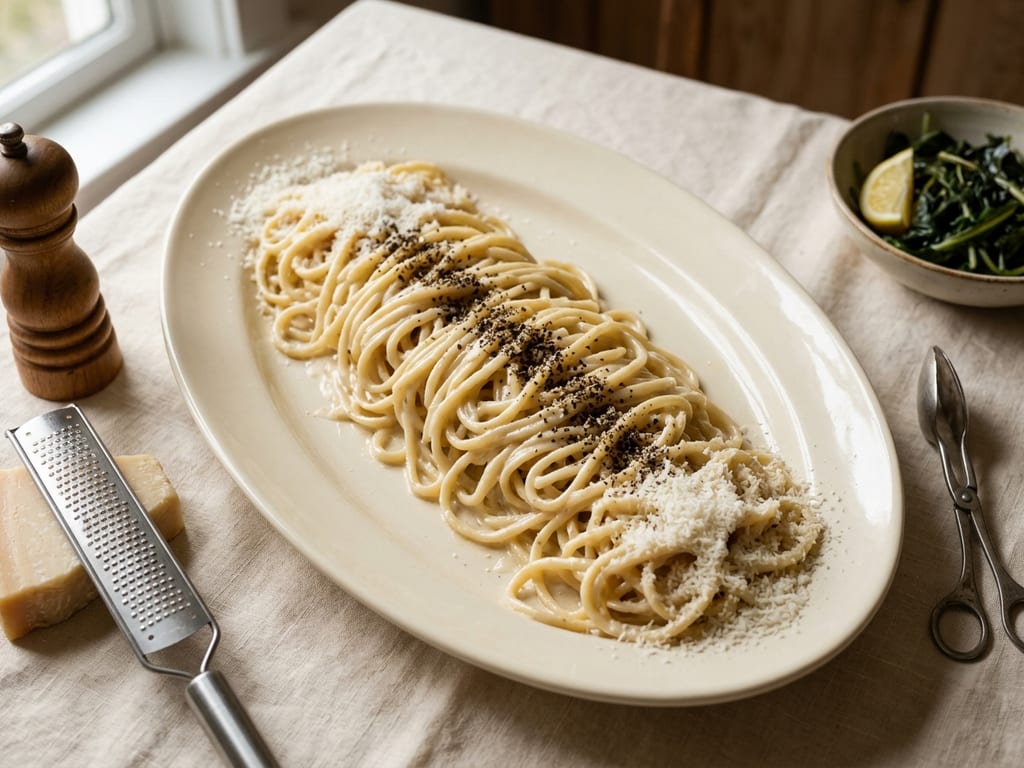
The photos on this page are AI-generated illustrations.
How do you plate pasta?
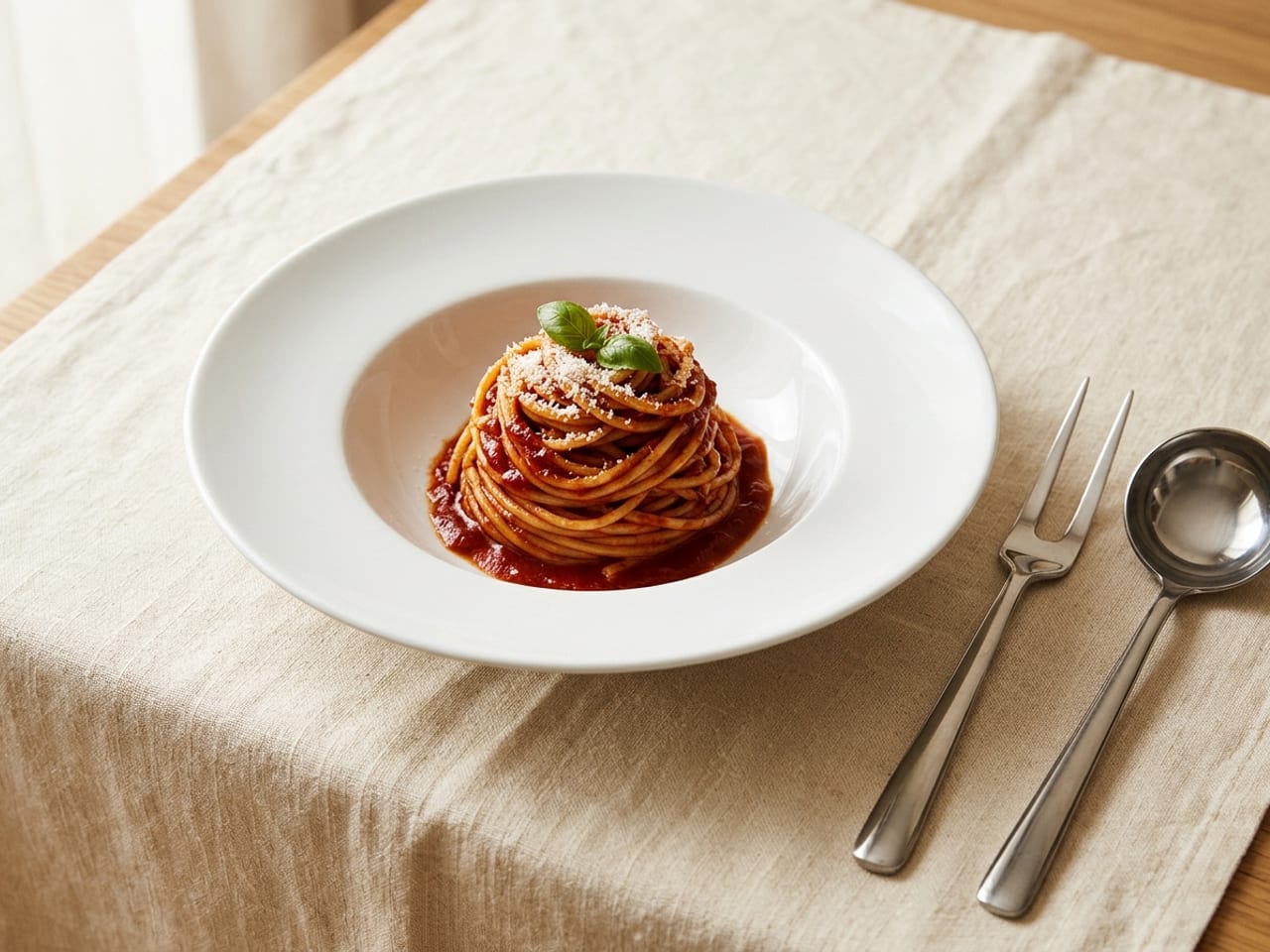
Toss the pasta in the pan with its sauce and a splash of the cooking water until the sauce clings, then plate it straight away into a warm bowl or onto a warm plate as one nest or mound in the centre: long pasta twirled on a carving fork or in a ladle, short pasta spooned or moulded, ravioli lifted out whole. Finish light: the cheese already tossed through, a little more on top (ours). That is what most of the chefs, cookbooks and test kitchens we read agree on (Marcella Hazan tosses in the warm bowl rather than the pan); where they split (tongs or carving fork, bowl or plate, sauce on top or not) this page prints each side with its name.
On this page: Before you plate · Long pasta · Short pasta · Filled pasta · Baked pasta · Gnocchi · Bowl or plate · How much per person · Cheese and toppings · Plated or family style · Myths · The studies · Holding and leftovers · FAQ
Before you plate: the five steps every pasta shares
- Finish the pasta in the pan with its sauce. Lift the pasta into the sauce a little before it is done, with tongs or a spider, add a splash of its cooking water and toss until the sauce clings. Lidia Bastianich: "If the pasta appears dry, ladle in more hot pasta water. If the pasta appears soupy, cook rapidly to thicken the sauce."3 America's Test Kitchen gives the plating reason: with sauce simply poured on, "too often the sauce slides right off and pools at the bottom of the bowl"; finishing the pasta in the sauce, it says, "makes the sauce viscous enough to cling to the pasta", as the starch it sheds thickens it.8 Italians call the step mantecatura, and Gambero Rosso names the starch as the binder.9 Giuliano Hazan's rule: "Do not serve pasta with sauce simply placed on top."2 Where to toss splits: Marcella Hazan tosses in the warm serving bowl, Lidia and the test kitchen in the pan.1, 3, 8 The cooking itself is in our cacio e pepe, carbonara and Alfredo recipes.
- Warm the bowls or plates. Lidia, both Hazans and Marc Vetri all serve pasta into warm bowls or onto warmed plates.1, 2, 3, 37 America's Test Kitchen gives the method: ovensafe dishes on the rack of a 350°F (177°C) oven, or boiling water for the rest, "but be sure that the water is really boiling. We found that hot tap water wasn't hot enough".14 For Alfredo it ladles about half a cup (120 ml) of the boiling pasta water into each bowl while the pasta finishes, because a creamy sauce's fat sets in a cold bowl.15 Draining the pot through a colander set in the serving bowl warms it too, a test kitchen tip.16 Its one measurement we read was on a soup, not pasta: about 10°F (5.5°C) hotter after 10 minutes in a warmed bowl.14
- One nest or mound, in the centre. Every source we credit that says where puts the pasta in the middle: Giada De Laurentiis as reported, Tantillo, Agrodolce, Cookist, Pomì and Lidia's "Mound the pasta in the center of the bowl"; none of them says off centre.4, 18, 24, 25, 26, 29 Long pasta is twirled, short pasta spooned or moulded, filled pasta lifted whole: the 5 methods below.
- Plate straight away. Marcella Hazan sends drained pasta to the bowl "without a moment's delay"; Lidia dresses it "at the last minute" and, when guests are late, revives the dish with a little pasta water.1, 4 No chef or test kitchen we read gives a number of seconds, and nobody timed it (see the myths).
- Finish light. Cheese goes in first, tossed through once the pasta is off the heat (Hazan, Lidia), then more at the table (Lidia) or a little on top (ours).1, 4 On top: raw olive oil or fresh butter to match the sauce's fat (Hazan), toasted crumbs (Lidia), the sauce's solids on the crown (Agrodolce).1, 3, 25 Wipe any drip off the rim before it leaves the kitchen (ours). Details in what goes where.
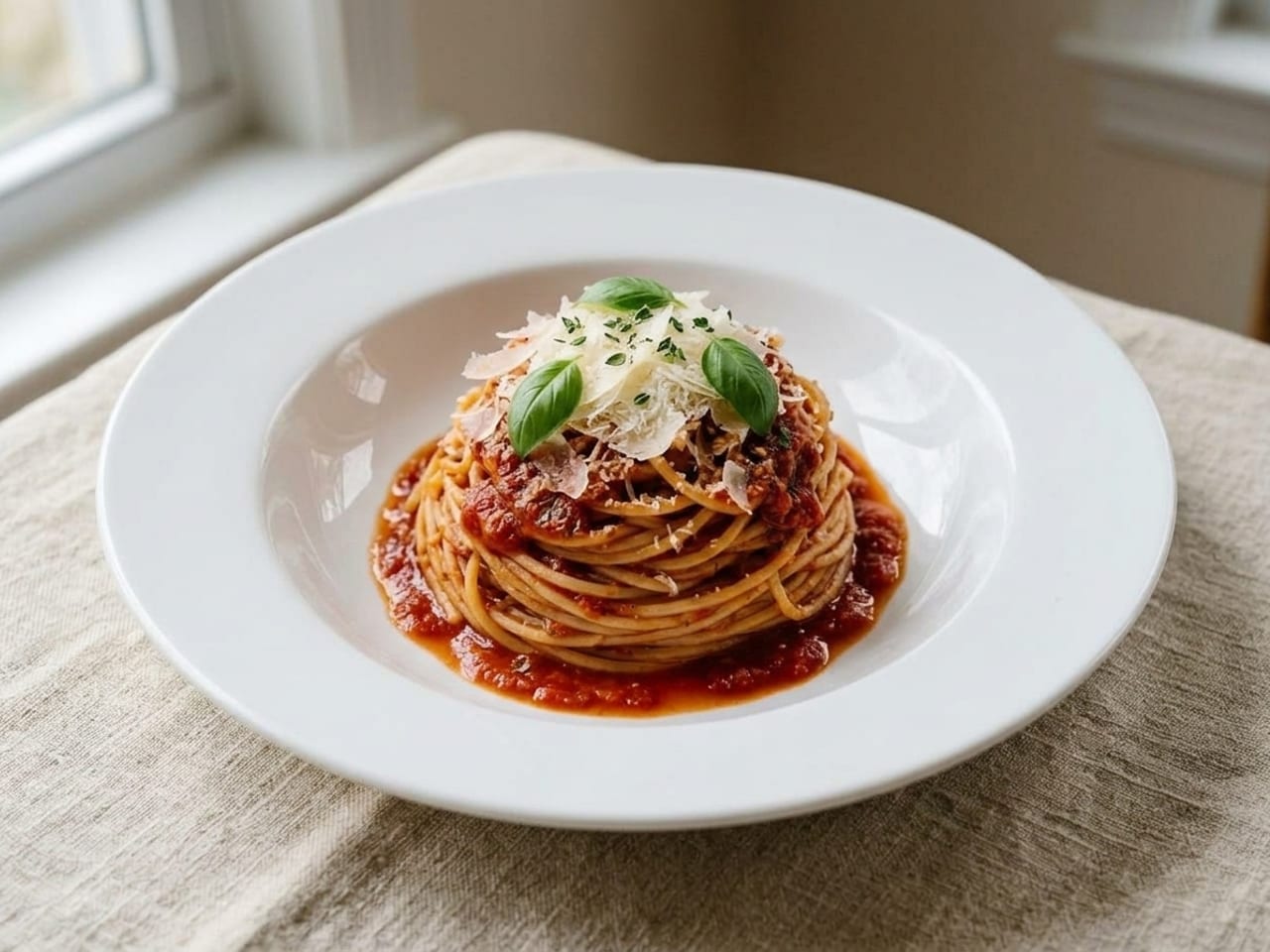
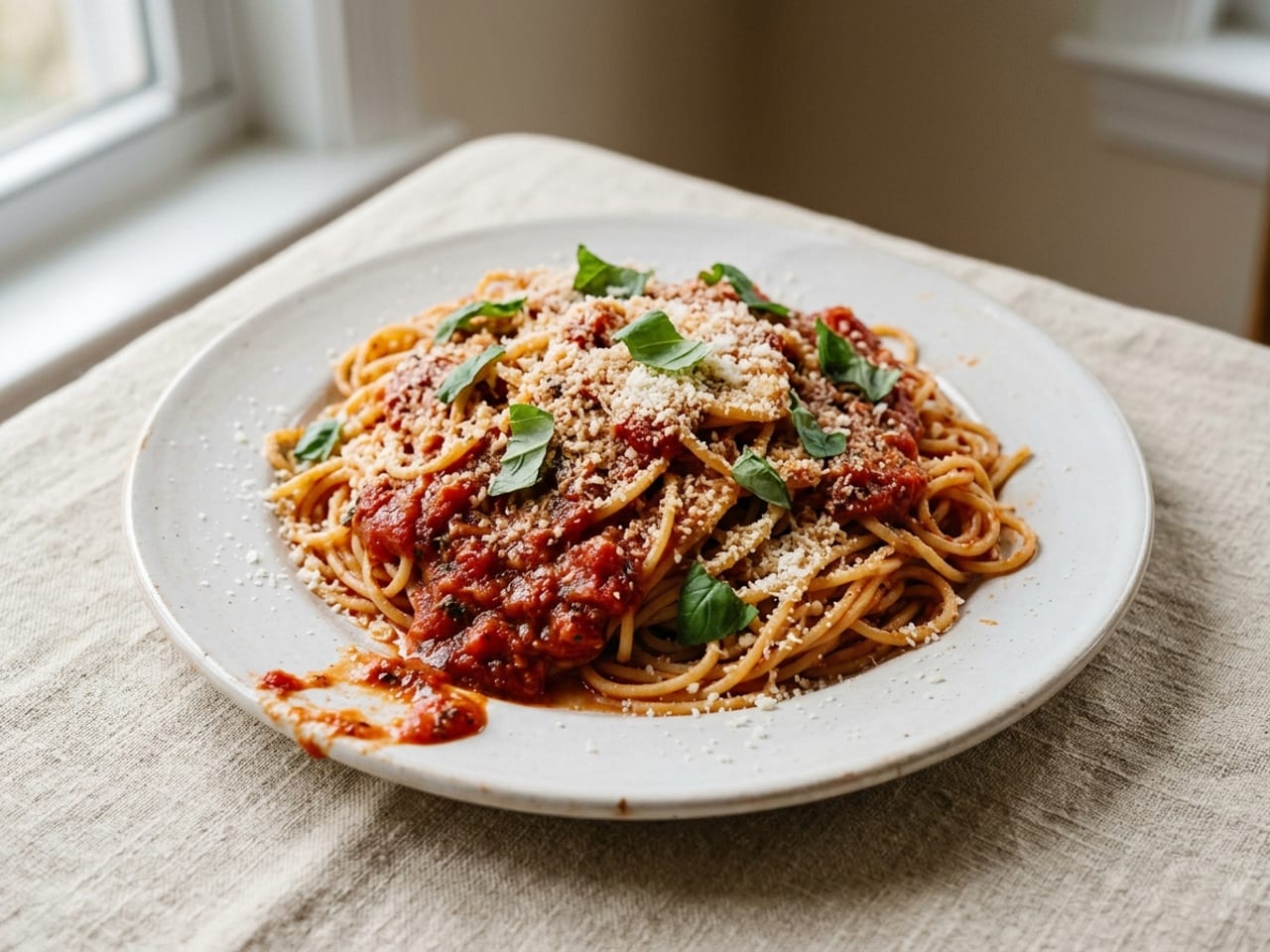 BeforeAfter
Pasta plating techniques: 5 methods by shape
Pasta plating ideas start from the shape: long strands twirl, short shapes mound, filled pasta is lifted, a bake is cut and gnocchi are heaped. One row a method; each name links to its section, with the tools, the steps, what good looks like and the usual failure.
| Method | Shapes | Tools | What good looks like | The usual failure |
|---|---|---|---|---|
| Long pasta | Spaghetti, linguine, bucatini, capellini; fettuccine and tagliatelle as ribbons | Carving fork + large spoon or ladle, or tongs | One tight nest in the centre, sauce clinging to every strand, toppings on the crown | A soupy sauce: the twirl slumps and the plate floods |
| Short pasta | Rigatoni, penne, paccheri, fusilli, farfalle, conchiglioni | Spoon or ladle; a ring mould, cookie cutter or open tin can | A neat mound or cylinder in the centre, the chunky bits on top (ours) | Sauce dripping off the spoon onto the rim |
| Filled pasta | Ravioli, tortelloni, tortellini, agnolotti | Slotted spoon (a spider), warmed broad soup plates | Whole pieces, none split, sauce added after them, a clean rim | Broken pieces from pouring them out of the pot |
| Baked pasta | Lasagna, baked ziti, pasta al forno, šunkofleky | Sharp knife, thin metal spatula | A clean square that stands, layers visible, on a flat plate | Cut too hot: the layers slide and the plate goes watery |
| Gnocchi | Potato gnocchi; small potato dumplings | Pan or warm bowl to toss in; spoon | A low heap in a warm bowl, sauce on every piece, cheese on top | Left to sit: they stick together (ours) |
Long pasta: the twirled nest
Tools: Carving fork + large spoon or ladle, or tongs. Good: One tight nest in the centre, sauce clinging to every strand, toppings on the crown. Goes wrong: A soupy sauce: the twirl slumps and the plate floods. Our recipes: Spaghetti carbonara, Cacio e pepe, Ragù alla Bolognese (tagliatelle), Alfredo sauce (fettuccine).
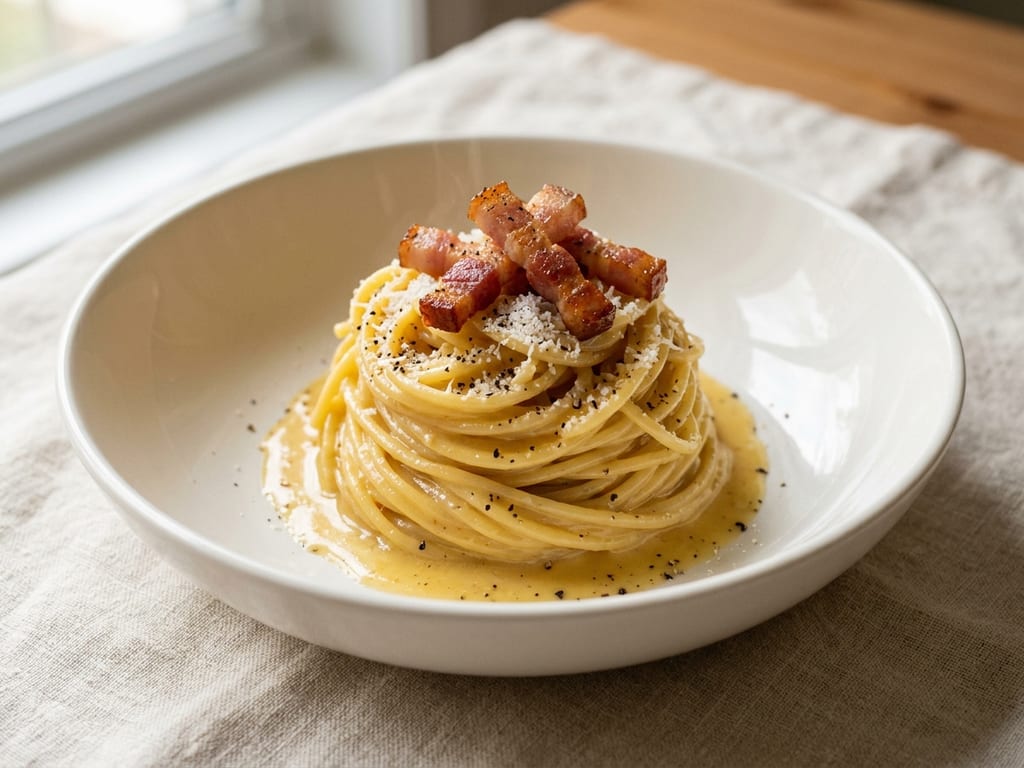
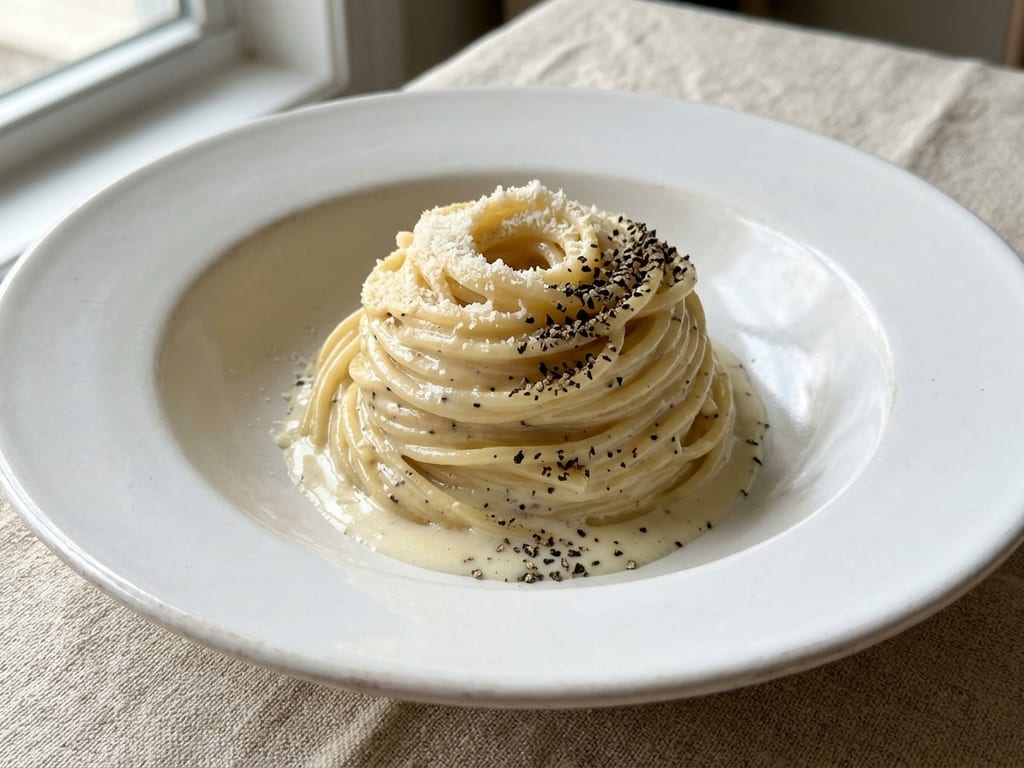
How to plate spaghetti, and how to twirl pasta for plating, comes down to one move: wind a portion of well-sauced strands into a tight coil and set it down in the middle. The sauce has to cling first: Food Republic's writer puts it plainly, "a soupy spaghetti bolognese won't hold its shape on the plate when twirled."18
With a carving fork and a spoon
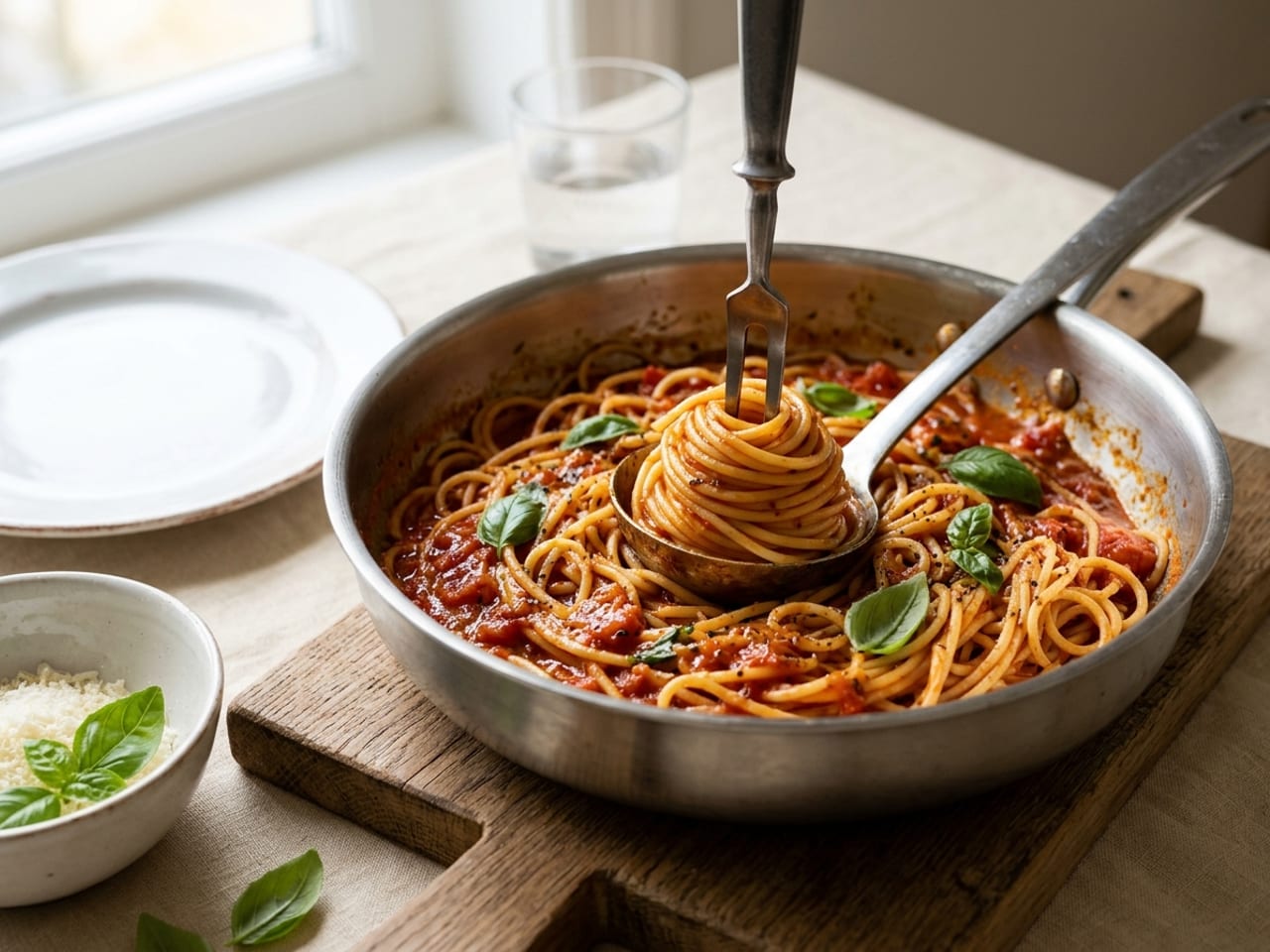
This is Giada De Laurentiis's method, as four of the magazines we read report it (her own video was not readable): stand a carving fork upright in the middle of the sauced pasta, tines down, and twirl it in place "while the noodles wrap themselves around it"; slide a large spoon underneath, carry it to the centre of the bowl, and push the pasta off the tines with the spoon.19 Food Republic adds that a soup ladle stands in for a spoon that is too small, and that the fork is "slowly lifted, leaving an impressive tall nest of pasta."18 David Ma, a food stylist and filmmaker, uses the same carving fork and then tops the nest with sauce, as reported by Mashed.20
With a ladle as the mould
Milk Street, from what it saw in Rome: "place a ladle into the pot of pasta, then use a long fork to gather and twist the pasta into a neat mound in the ladle. Slide the mound out onto a serving plate and lift out the fork."22 Cookist's chef Michele Ghedini calls the ladle nest "a great classic of restaurants" (our translation): tongs drop a portion into a big ladle, you turn it into a spiral and slide it into the centre of a deep plate.26 Tantillo Foods uses all three tools: tongs fill the ladle, the carving fork twirls, and the pasta will "climb" up the fork "in smooth strokes".24
How to plate pasta with tongs
Tongs are the tool most kitchens already own, and Giada's stand-in, as reported: grab a portion, twirl with the tongs "pressed firmly shut so you don't lose the volume", set it down, give it a few extra twirls, then open the tongs only slightly to slide them out.17, 18, 20 Her verdict, as Mashed quotes it: "It won't be as tall and perfect, but it'll still look great."20 The Italian sites Bioitalia, Pomì and Compagnia degli Chef twirl with tongs too, and Cookist rolls a portion against the side of the pan into a neat cylinder before lifting it out.26, 28, 29, 30 Chowhound lays the coil on its side, "like a spring resting on its side", and Compagnia degli Chef rolls it upright or lying down.17, 30
Who twirls with what: the tally
Every source we read that names a tool for a long-pasta nest, with where it puts the nest and the sauce. Nobody we read compares the tools by test; they split three ways: carving fork and spoon, a ladle as the container, or tongs alone. Chopsticks turn up online, but we found no chef or book we could credit.
| Who | Tools | Where the nest goes | Sauce |
|---|---|---|---|
| Giada De Laurentiis, as reported by Chowhound, Food Republic, Tasting Table and Mashed17, 18, 19, 20 | Carving fork and a large spoon under it (a soup ladle if the spoon is too small); tongs as the stand-in | Centre of the plate (Food Republic) or of the serving bowl (Tasting Table) | Tossed in the pan first; nothing added on top |
| Milk Street (test kitchen), from what it saw in Rome22 | Ladle set in the pot; a long fork twists the pasta into a mound inside it | Slid out onto a serving plate | Not stated |
| Tantillo Foods (pasta maker's blog)24 | Tongs fill the ladle, a carving fork twirls, tongs carry | Centre of the plate | More spooned over "if needed" |
| Agrodolce (Italian food site)25 | Carving fork and ladle; tongs if you are practised | Centre of a flat plate | Some of the sauce's solids kept back for the top of the nest |
| Cookist, chef Michele Ghedini (Italian)26 | Tongs drop a portion into a big ladle and spin it | Centre of a deep plate | Not stated |
Show all 14 rows (9 more)
| Who | Tools | Where the nest goes | Sauce |
|---|---|---|---|
| David Ma, food stylist and filmmaker, as reported by Mashed20 | Carving fork | The plate | On top, after the nest |
| Pomì (tomato brand's blog)29 | Tongs | Centre of the plate | In the centre or around it |
| Bioitalia (pasta maker's blog)28 | Tongs winding the spaghetti on a spoon | Not stated | Not stated |
| Parmalat Italia (company magazine)27 | A fork winding onto a spoon (several small mounds), or carving fork and ladle (one) | Not stated | Not stated |
| Compagnia degli Chef (Italian chefs' site)30 | Long tongs; a carving fork is harder | Rolled upright or on its side | Not stated |
| Donna Moderna, "Come impiattare i primi"32 | Square ring and a carving fork turned clockwise | In the ring, built up | Not stated |
| Donna Moderna, "Come impiattare gli spaghetti" (an older piece)31 | Against the ladle nest seen on television ("not nice to look at", our translation) | A mountain in the centre | Parsley, Parmigiano and oil on top |
| Food Republic, 201323 | A large fork in the pot, tongs holding the wrap | Set loosely in a bowl, tugged so it looks less styled | Not stated |
| Serious Eats and Food & Wine (prior reading)36 | Long tweezers, named for a pasta nest; no steps printed. Chef Christopher Kostow: "You don't need tweezers for pizza and pasta." | Not stated | Not stated |
Tweezers: Serious Eats and Food & Wine name a pasta nest as a tweezers job but print no steps, and chef Christopher Kostow, quoted there, says "You don't need tweezers for pizza and pasta."36 The tools themselves are in plating tools.
How tall, and where the sauce goes
No source we read gives a height. On the sauce, Giada's method adds nothing on top: the sauce went on in the pan.18 Four others do put sauce on the crown: Vincenzo's Plate spoons "a little extra sugo over the top so the pasta stays glossy and moist", Tantillo spoons more over "if needed", Agrodolce keeps some of the sauce's solids back for the top of the nest "and perhaps at the base" (our translation), and David Ma tops the nest with sauce.20, 24, 25, 34 Pomì pours it "in the centre or around" (our translation).29 What none of them does is the thing a Gambero Rosso column on kitchen crimes laments: "a portion of undressed pasta, on whose top sits a spoonful of sauce" (our translation).10 So: toss first, and a spoonful on top only of pasta that is already dressed. Our pick: the sauce's solids (guanciale, ragù, a meatball) on the crown, where they show.
Ribbons: fettuccine, tagliatelle, pappardelle
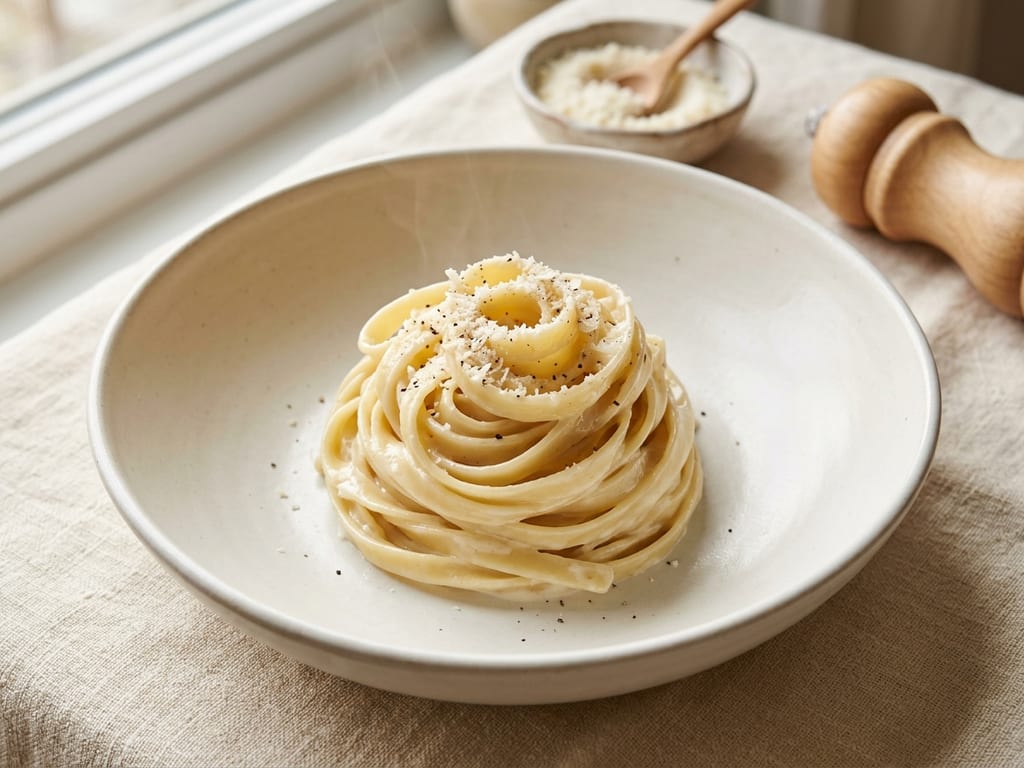
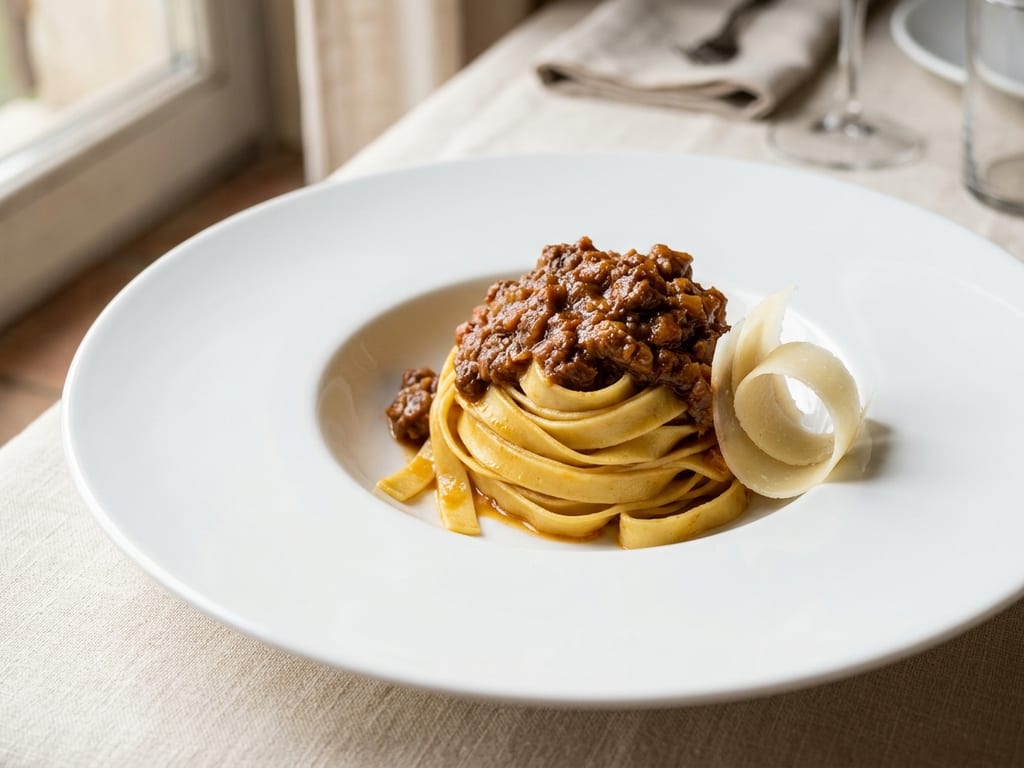
Tasting Table says Giada's fork method "also works for thicker and flatter pastas, such as fettuccine and tagliatelle."19 Pomì winds tagliatelle round a fork into a spiral, sets it down and only then adds the sauce, "to keep the shape" (our translation), and Ragù Bologna serves tagliatelle and pappardelle in a wide deep plate whose rim holds the sauce.29, 33 We found no chef who says whether to twirl or fold the widest ribbons. Ours: twirl fettuccine and tagliatelle loosely, since ribbons do not coil as tight as spaghetti, and lay pappardelle in loose folds rather than force a coil. The cooking is in our Alfredo (fettuccine) and ragù alla Bolognese (tagliatelle) recipes.
How to plate spaghetti and meatballs
Frank Proto, for the Institute of Culinary Education: toss the pasta with the sauce and torn basil in the pan "just to dress", then "Portion pasta onto a plate, top with 2-3 meatballs and a little more sauce. Serve with grated Pecorino Romano."35 Vincenzo's Plate twirls a nest on a flat plate, spoons a little extra sugo over it and scatters mini meatballs on top, and notes that in most of Italy "pasta is the primo, and meatballs are served separately as a secondo".34 The same goes for spaghetti bolognese or with meat sauce: toss the strands in the sauce, twirl, and the meat on the crown (ours).
Short pasta: a mound, or a ring
Tools: Spoon or ladle; a ring mould, cookie cutter or open tin can. Good: A neat mound or cylinder in the centre, the chunky bits on top (ours). Goes wrong: Sauce dripping off the spoon onto the rim. Our recipe: Pasta alla gricia (rigatoni).
Short pasta does not twirl. How to plate penne, rigatoni or farfalle: spoon it, or mould it. Parmalat's magazine uses a spoon or a ladle, to gather the pasta or simply lay it lengthwise on the plate, and Compagnia degli Chef gathers it in a small container so it takes shape, or lays it lengthwise on a flat plate: "Funziona sempre", it always works.27, 30 Lidia Bastianich and Milk Street match the sauce to the shape: short tubes take thick or chunky sauces, which stay where you put them.6, 12
With a ring mould, cookie cutter or tin can
Tantillo Foods' method: a big cookie cutter, or a clean tin can with both ends cut off ("be careful, the edges can be sharp"), in the centre of the plate; spoon the pasta in with a slotted spoon, "Gently press down, compacting the noodles", lift the mould off, and touch the spoon to a folded paper towel first so it does not drip. Its best shapes: conchiglioni, rigatoni, fusilloni, penne, ziti and bow ties.24 Chowhound describes the same mould in its piece on Giada, though not as her method.17 Cookist ladles the pasta into a steel ring without squashing it and lifts the ring straight up; Parmalat reminds you to take the ring away before serving.26, 27 Donna Moderna goes furthest: a ring, and tongs to place each rigatone or farfalla "to the millimetre", usually on a base of legumes or vegetables or a sauce dense enough not to spread (our translation).32 Pomì stands paccheri upright in a ring so the sauce runs between the tubes.29 How rings work in general is in how to stack food.
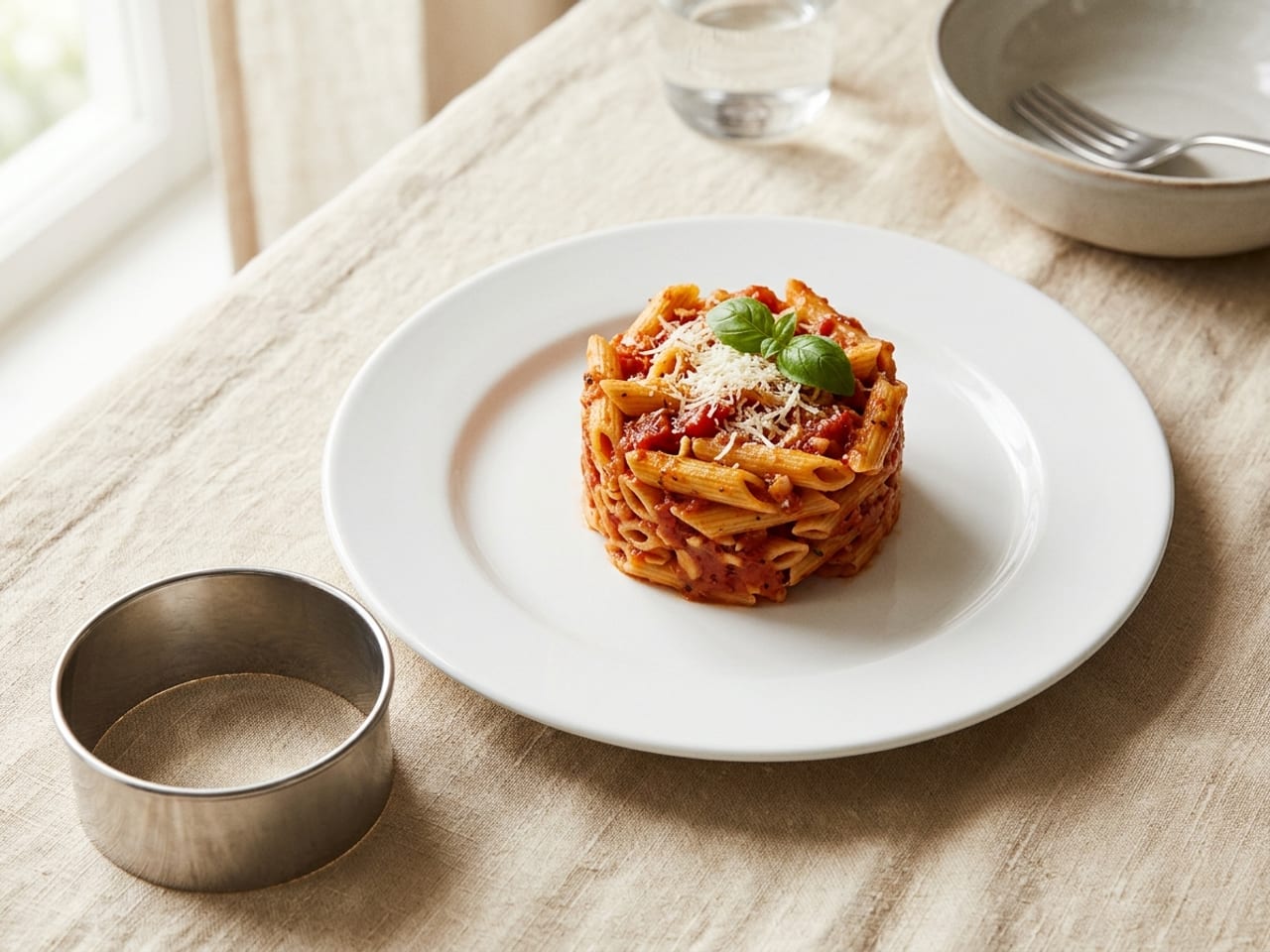
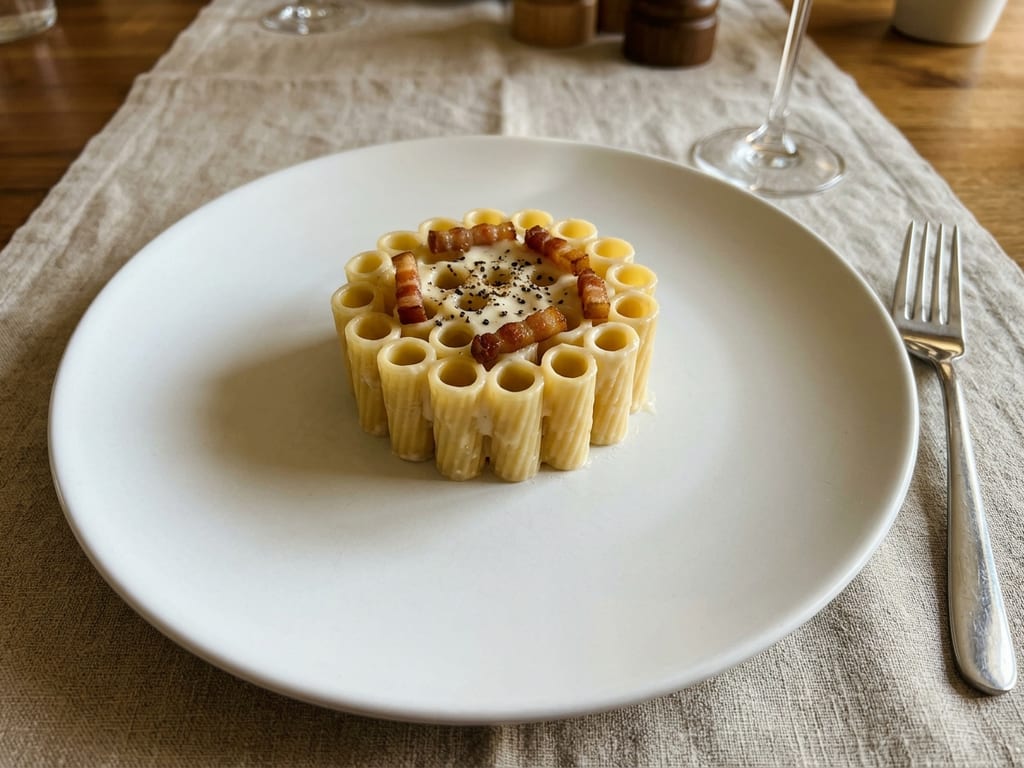
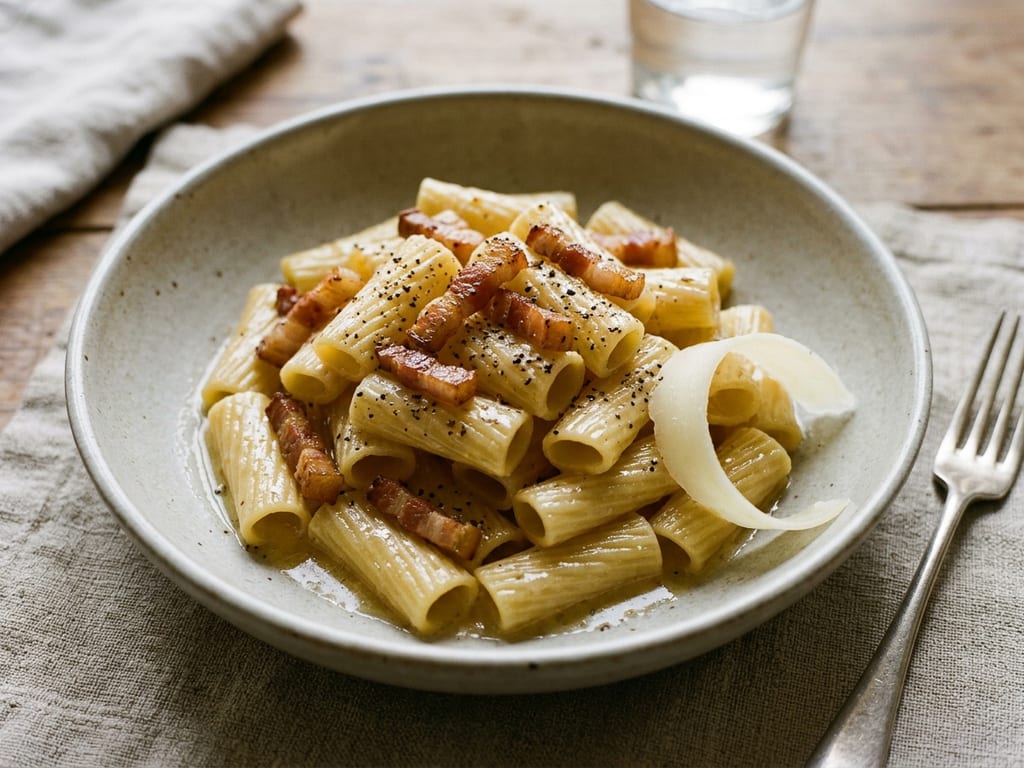
Ours: without a ring, a loose mound in the middle of a warm shallow bowl, the guanciale or vegetables from the sauce on top, is the everyday version, as our gricia shows. A ring makes a neater cylinder for a dinner party but packs the pasta; a mound keeps it loose.
Filled pasta: ravioli and tortellini
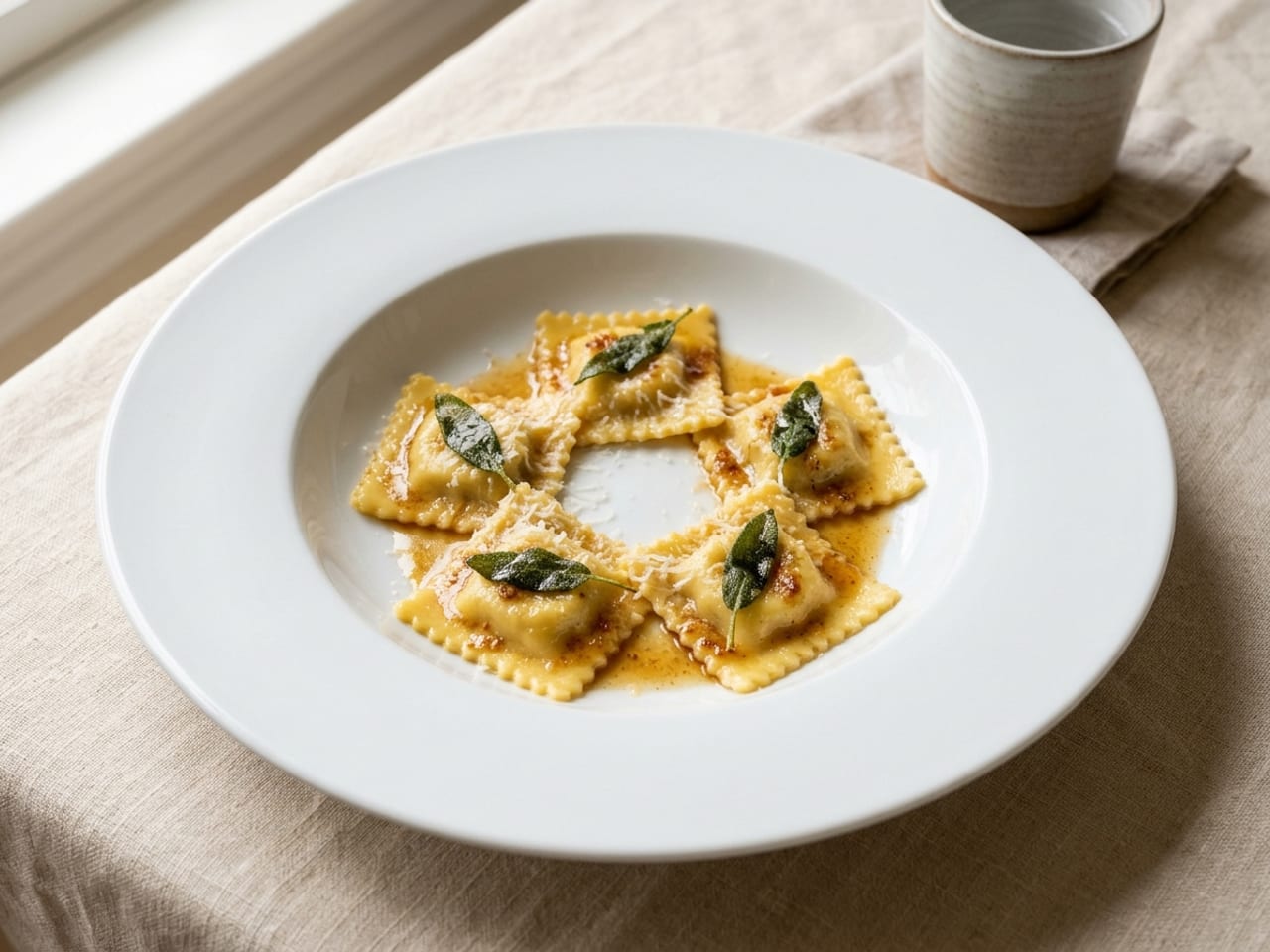
Tools: Slotted spoon (a spider), warmed broad soup plates. Good: Whole pieces, none split, sauce added after them, a clean rim. Goes wrong: Broken pieces from pouring them out of the pot.
How to plate ravioli: lift them rather than pour them. America's Test Kitchen: "With a slotted spoon, transfer ravioli to warmed bowls or plates; add sauce."39 Ragù Bologna, a Bologna fresh-pasta shop, in its guide to plating takeaway pasta, warns that tipping filled pasta out too fast can break the filling, and serves tortelloni in a wide deep plate and tortellini in brodo in a bowl or true deep plate, warmed first with very hot water and dried.33
How many ravioli a plate?
The only count we found is a textbook's: Gisslen's Professional Cooking makes "about 60 ravioli, or 5 per portion", arranged "in broad soup plates" with a lemongrass broth poured over, and portions another recipe at 3 oz (90 g) of ravioli in heated broad soup plates.38 That is one recipe each, not a rule. America's Test Kitchen's ravioli recipe makes about 60 for 4 to 6 servings, which works out at 10 to 15 each (our arithmetic).39 By weight, Italy's nutrition society puts a portion of filled pasta at 125 g (4.4 oz).59 None of the pasta sources we read asks for an odd number, and a plating study found "No consistent evidence for a preference for odd or even numbers of food items".71
Sauce under or over?
America's Test Kitchen and Gisslen put the sauce on after the pasta: over it.38, 39 Ragù Bologna spreads filled pasta in a single layer and pours the sauce over (our translation).33 We found no chef who sets ravioli on a pool of sauce, so that version is ours: it shows the pasta's edges, which suits a thin brown butter less than a tomato sauce. Ours too: the pieces a little apart so none sits on another. Tantillo Foods keeps the rim clean with a parchment frame: line the rim, cut a window, set the pasta inside it with a slotted spoon, then pull the parchment away "taking all the drips along with it".24
As an appetiser or first course, the restaurant figures in the portion table run 100 to 125 g (3.5 to 4.4 oz) of filled pasta.66 We have no ravioli recipe yet.
Baked pasta: lasagna and bakes
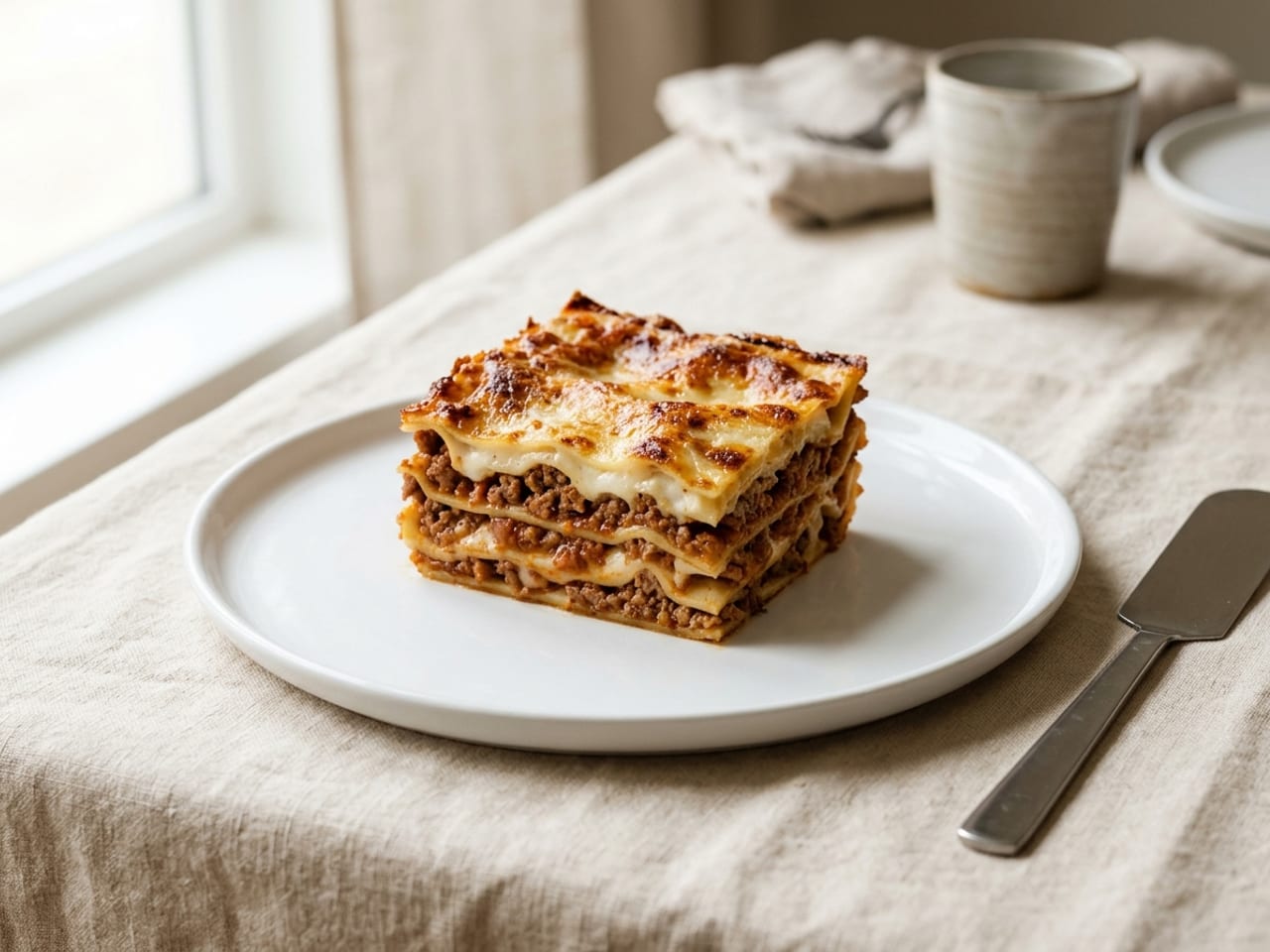
Tools: Sharp knife, thin metal spatula. Good: A clean square that stands, layers visible, on a flat plate. Goes wrong: Cut too hot: the layers slide and the plate goes watery. Our recipes: Baked pasta casserole, Šunkofleky (baked pasta squares with ham).
How to plate lasagna without it falling apart: let it rest, cut it in the dish, lift each piece with a thin spatula and set it on a flat plate. Levoni gives the reason for the rest: the portions divide without "taking apart" the layers (our translation); Lidia Bastianich says lasagna "cuts best when it has rested and cooled"; Tantillo Foods warns that otherwise "you'll have a watery mess on your hands."24, 41, 46 Nobody we read measured why.
How long to rest lasagna: every answer we read
| Source | Rest before cutting |
|---|---|
| Ragù Bologna (Bologna pasta shop, takeaway lasagna)33 | 1 minute, so the layers settle (our translation) |
| America's Test Kitchen, lasagna with meatballs (recipe 817)43 | 5 minutes |
| Dissapore (Italian food site)42 | 5 minutes |
| Levoni (Italian producer)41 | 5 minutes in the recipe; "5 or 10 minutes" in its tip (our translation) |
| Lidia Bastianich, tomato and zucchini bread lasagna44 | About 15 minutes |
| Jamie Oliver, fennel and leek lasagne45 | 15 minutes |
| Lidia Bastianich, lasagna with ricotta and mozzarella46 | About 20 minutes |
| Sale&Pepe (Italian magazine)40 | About half an hour |
| Lidia Bastianich, Italian-American lasagna47 | "About an hour" (headnote) and "at least 30 minutes or up to 3 hours" (method); her favourite: 3 to 4 hours, then cut and rewarm |
| Gisslen's textbook and Tantillo Foods24, 38 | No number (Tantillo: "Let your baked pasta rest!") |
From 1 minute to 3 or 4 hours, and one chef's own recipes print 15, 20 and 30 minutes or more. Our reading: the short rests are for serving it hot from the dish; the long ones, with Lidia's favourite of baking it, letting it stand 3 to 4 hours, then cutting the portions and rewarming them, are for clean squares.47
Cut and lift
Sale&Pepe: halve the lasagna lengthwise in the dish with a sharp knife, cut across to make squares, then lift each with a spatula onto its own plate.40 Tantillo levels the dish, marks the cuts with a ruler and lifts each portion with "a thin metal spatula", or presses in a deep square metal cutter, cleaned between cuts.24 For a crowd, Gisslen's textbook gives, as an example of even division, cutting a pan of lasagne "4 x 6 to make 24 equal portions."38 Ragù Bologna's takeaway guide puts it on a slightly wide flat plate, so the portion goes on whole without the layers being squashed.33 At a buffet the dish goes out whole, cut in the pan: see how to set up a buffet table.
The same applies to any bake that sets: our baked pasta casserole and the Czech šunkofleky, which is cut into squares. A loose bake such as baked ziti will not hold a square; spoon it, and the short-pasta mound applies (ours).
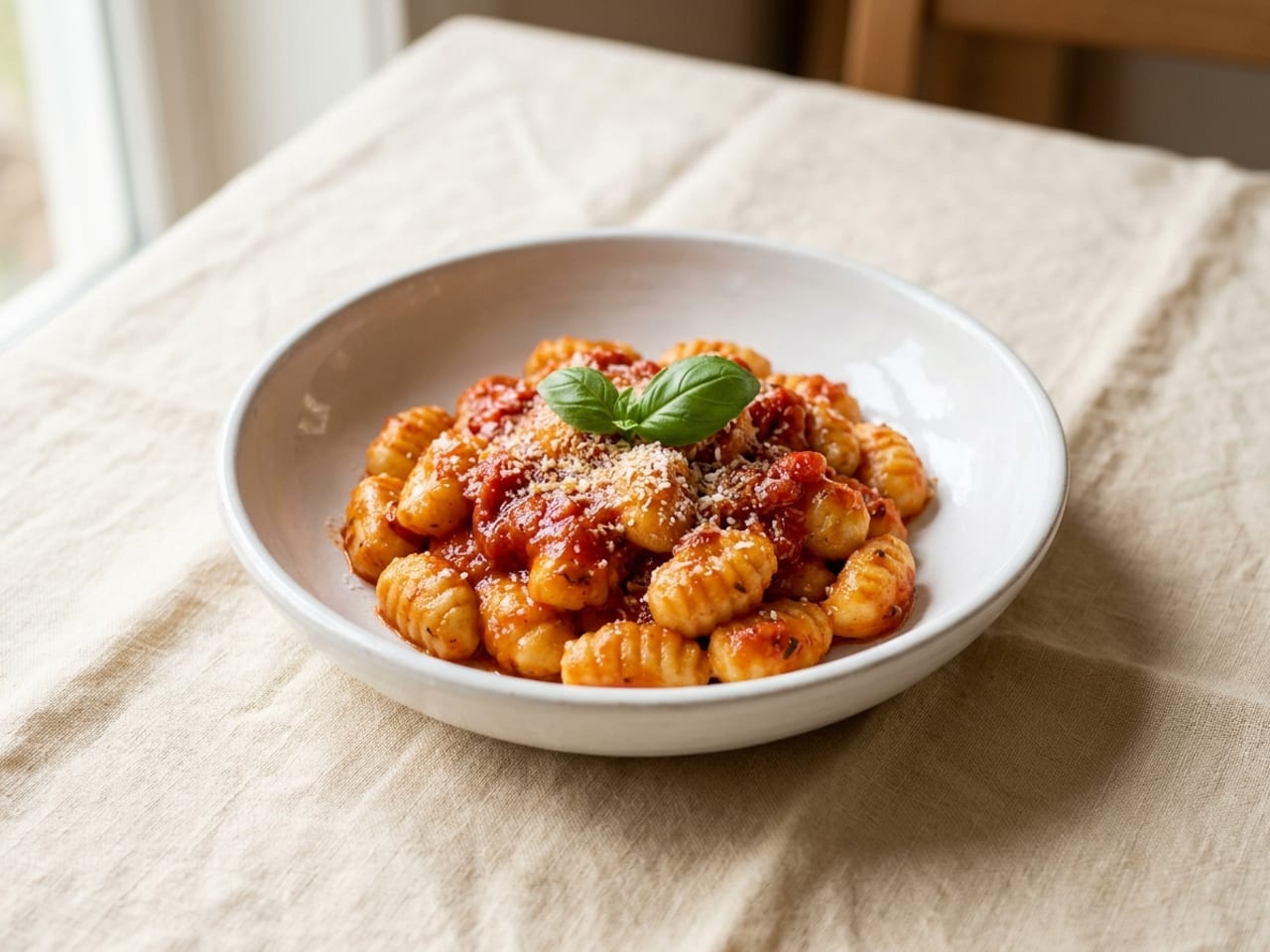
Gnocchi
Tools: Pan or warm bowl to toss in; spoon. Good: A low heap in a warm bowl, sauce on every piece, cheese on top. Goes wrong: Left to sit: they stick together (ours).
How to plate gnocchi: sauce them, then top them. Gisslen's textbook: "Plate the gnocchi. Top each portion with 2 fl oz (60 mL) tomato sauce" and 1 tbsp of grated parmesan, or serve them with pesto, or "simply with melted butter and grated cheese."38 Vincenzo's Plate pours a little sauce into the bottom of the serving bowl, adds the gnocchi and more sauce, tosses, and keeps some back so that each plate gets "some extra sauce on top for more flavour and a lovely presentation."48 For brown butter and sage, The Splendid Table finishes the gnocchi in the pan, then plates them with sage, Parmesan and pepper on top, "serve immediately."49 The Escoffier School plates them once the cheese has melted and sprinkles them with finely chopped fresh sage.50
No chef we read gives a number of gnocchi a plate or a mound rule. Italy's nutrition society puts a portion of potato gnocchi at 200 g (7.1 oz); the restaurant sources give far less.59, 66, 67 Ours: a low heap in a warm shallow bowl rather than a tall mound, and plated as soon as they are sauced, because gnocchi left to sit stick together. As a side dish, they go beside the main the way pasta does (see pasta next to a main).
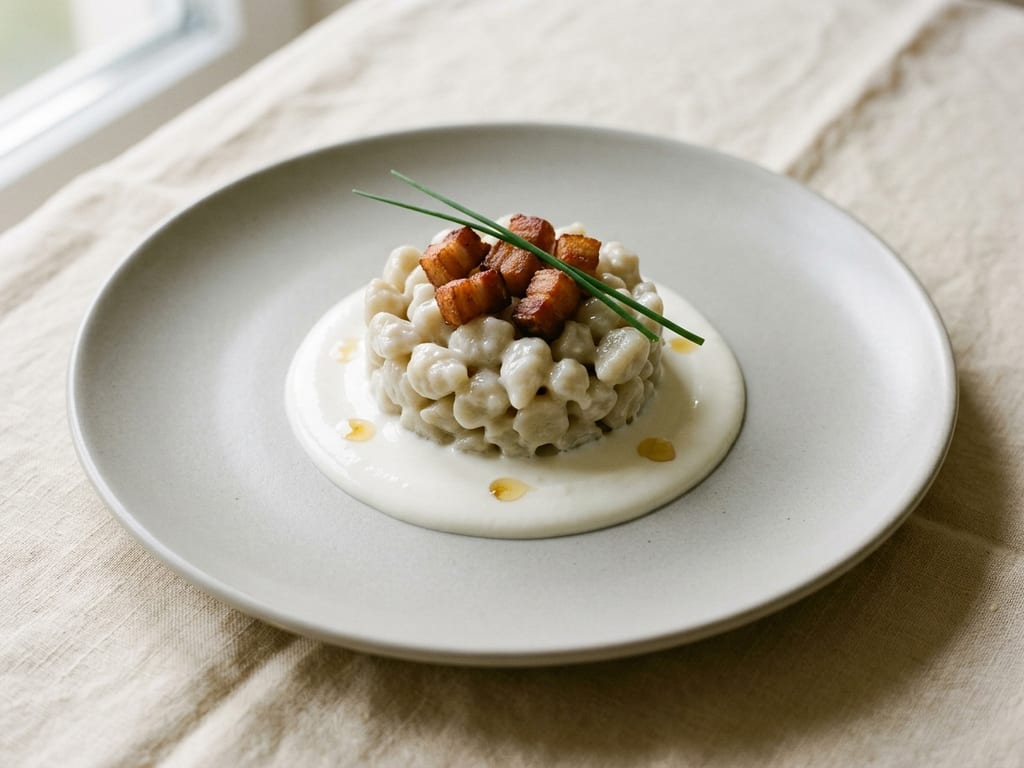
We have no gnocchi recipe. The nearest dish we cook is bryndzové halušky, Slovak potato dumplings: smaller and chewier than gnocchi and not the same thing, plated here in a ring on a pool of sauce (our styling).
Pasta bowl or plate?
Both, and the sources split. Lidia Bastianich, as TODAY printed her tips: "If you use a wide plate and spread it out, your pasta will be cold and that's the end of it. Instead, you want to use a soup bowl."4 Maureen Fant, a food writer who says she is not Italian and has "only lived here for 35 years": "To be perfectly proper, you serve it on a plate. But trattorias and families will use a soup bowl", and "Pasta bowls are something of a new scene recently on the Internet."51 Lidia's reason is heat; nobody we read measured pasta cooling on a plate against a bowl (America's Test Kitchen's one bowl test was a soup).14
| Who | Says | Why |
|---|---|---|
| Lidia Bastianich, as TODAY printed her tips4 | A warm soup bowl, not a wide plate; the pasta mounded in the centre | Heat: "If you use a wide plate and spread it out, your pasta will be cold" |
| Lidia Bastianich, her own site and book3, 5 | Individual warm bowls | "The shorter the trek from the hot skillet to the individual bowl, the better." |
| Maureen Fant, food writer (Splendid Table interview)51 | A flat plate when proper; a soup bowl in trattorias and families | Tradition: "in proper restaurants with proper service, it's a flat plate"; pasta bowls are "a new scene recently on the Internet" |
| Marcella Hazan, Marcella Cucina1 | A warm platter or bowl; egg pasta on a platter | Egg pasta "is too delicate to be piled deep in a bowl" |
| Milk Street, from Rome22 | A serving plate | Not given |
| Agrodolce; Vincenzo's Plate25, 34 | A flat plate for a spaghetti nest | Agrodolce: deep plates are for soups |
| Cookist; Ragù Bologna (takeaway guide)26, 33 | A deep plate: Cookist for the spaghetti nest, Ragù Bologna for tagliatelle, pappardelle and tortelloni; Ragù Bologna puts lasagna on a slightly wide flat plate | Ragù Bologna: the rim holds the sauce; the flat plate serves the lasagna portion whole; also, a flat plate "tends to lose heat quickly" (our translation) |
| Marc Vetri, Mastering Pasta; America's Test Kitchen, ravioli37, 39 | Warmed plates; warmed bowls or plates | Not given |
Ours: a warm shallow bowl or a wide-rimmed soup plate for anything saucy or creamy (carbonara, Alfredo, a ragù, ravioli in butter), where the rim holds the sauce and frames the nest; a warm flat plate for a tight Roman-style twirl or a square of lasagna. Spaghetti, bowl or plate: either, as long as it is warm. A fine-dining pasta bowl is often the wide-rimmed soup plate, the shape our types of plates guide calls a pasta plate.
How big is a pasta bowl?
The makers' listings we read run from 27 to 30.8 cm (10.6 to 12.1 in) across for a pasta bowl or pasta plate, most of them read on a retailer's page that prints the maker's figure. The conversions are ours, to 0.1.
| Maker | Piece | Diameter as printed | In the other unit |
|---|---|---|---|
| Churchill53 | Profile pasta bowl | 30.8 cm | 12.1 in |
| Steelite54 | A120P050 pasta bowl | 11-3/4 in | 29.8 cm |
| Villeroy & Boch55 | Manufacture Rock Blanc pasta plate | 28 cm | 11 in |
| Churchill57 | WH CTPB1 pasta bowl | 11 in | 27.9 cm |
| Mesa Ceramics56 | Pasta Plate 27 | 272 mm | 10.7 in |
| Steelite58 | 17100314 pasta bowl | 10-5/8 in | 27 cm |
How much pasta per person, in grams and ounces
About 80 g (2.8 oz) of dry pasta a person is Italy's standard portion; UK nutrition bodies say 75 g (2.6 oz), and the US label reference is 55 g (1.9 oz). Weights are dry unless the row says cooked; cups vary with the shape, so every source here weighs. Of the sources in this table, only a retailer, a restaurant group and a fresh-pasta company split a first course from a main (three blogs we read do too and are left out), so that column is practice, not a nutrition rule. The ounces are our conversion (1 oz = 28.35 g, to 0.1).
| Source | Dry, standard or first course | Dry, as a main | Fresh, filled, gnocchi | Cooked |
|---|---|---|---|---|
| SINU, LARN V (2024)59 Italian nutrition society | 80 g (2.8 oz); the standard portion for pasta, rice and other cereals, raw weight | Not given | Fresh egg pasta 100 g (3.5 oz); filled 125 g (4.4 oz); potato gnocchi 200 g (7.1 oz); lasagna as a recipe 250 g (8.8 oz) | Not given |
| CREA dietary guidelines (2018)60 Italian government research council | 80 g (2.8 oz) | Not given | Fresh egg pasta 100 g (3.5 oz); filled 125 g (4.4 oz) | Not given |
| British Nutrition Foundation62 UK nutrition charity | 75 g (2.6 oz) | Not given | Not given | 180 g (6.3 oz) |
| British Dietetic Association63 UK dietitians | 75 g (2.6 oz) | Not given | Not given | 150 g (5.3 oz) |
| US FDA reference amount61 US labelling rule, not advice | 55 g (1.9 oz); dry; labels may say 2 oz (56 g) | Not given | Not given | 140 g (4.9 oz) |
| BBC Good Food64 UK cooking magazine | 80 to 100 g (2.8 to 3.5 oz); no split by course | Not given | Not given | Not given |
| Eataly65 Italian food retailer | 75 g (2.6 oz); a first course with more dishes to follow | 100 to 125 g (3.5 to 4.4 oz) | Not given | Not given |
| San Carlo66 UK Italian restaurant group | 75 g (2.6 oz); as part of a 3-course meal | 100 to 120 g (3.5 to 4.2 oz); "UK-style" | First course: fresh 100 g (3.5 oz), filled 100 to 125 g (3.5 to 4.4 oz), gnocchi 80 g (2.8 oz). Main: fresh 125 to 150 g (4.4 to 5.3 oz), filled 150 to 175 g (5.3 to 6.2 oz) | Not given |
| Pasta Evangelists67 UK fresh-pasta company | Not given | 100 g (3.5 oz); dried | Head chef Roberta D'Elia: fresh pasta primo 90 g (3.2 oz) at a three-course dinner, 70 g (2.5 oz) at more than three courses | Not given |
First course or main: Eataly says 75 g (2.6 oz) as a first course "with more dishes to follow" and 100 to 125 g (3.5 to 4.4 oz) as a main; San Carlo 75 g against 100 to 120 g (3.5 to 4.2 oz).65, 66 For a tasting menu we found no figure; the nearest is Pasta Evangelists' 70 g (2.5 oz) of fresh pasta at a dinner of more than three courses.67 As a side dish no source we read gives a weight, and in Italy, Fant says, pasta "is not a side dish to the main attraction".51 Where the primo sits in the Italian meal is in courses of a meal; cooking for a crowd, the catering calculator.
Cheese, herbs, oil, pepper and breadcrumbs: what goes where
Cheese goes in before it goes on, in the three chefs we read on timing: Marcella Hazan "add some of it immediately" so "The heat will melt the cheese"; Lidia Bastianich "at the last minute after you've turned off the flame. You don't want to cook the cheese"; Giada De Laurentiis, as reported, grates it onto the pasta before the sauce, so "the sauce sticks to the cheese that sticks to the pasta."1, 4, 21 Others put it on the finished plate: Marc Vetri grates ricotta salata over the top, Gisslen tops gnocchi with parmesan, and Frank Proto serves Pecorino Romano with the meatballs.35, 37, 38 Lidia keeps Grana Padano on the table "so everyone can add it to their pasta to their liking."4 A light finish on top is ours.
| What | Where it goes | Who says so |
|---|---|---|
| Grated cheese | Tossed in (Hazan at once in the warm bowl; Lidia with the flame off; Giada before the sauce); Lidia also keeps more at the table | Marcella Hazan ("add some of it immediately"); Lidia Bastianich ("after you've turned off the flame", and Grana Padano on the table); Giada De Laurentiis, as reported, onto the pasta before the sauce1, 4, 7, 21 |
| Toasted breadcrumbs (pangrattato) | On top, just before serving; about 1 tbsp a serving, "most of it on top and some around the edges of the bowl" | Lidia Bastianich3, 7 |
| Olive oil or butter | On top, raw, matching the sauce's fat: "dribble some raw oil" or "a few dollops of fresh butter" | Marcella Hazan1 |
| Basil and soft herbs | Tossed in with the sauce (torn basil, Frank Proto), or a few leaves on top (ours) | Frank Proto for the Institute of Culinary Education; no chef or test kitchen we read sets a torn-or-whole rule35 |
| Black pepper | In the sauce for cacio e pepe and gricia (the recipes teach it); a grind on top otherwise (ours) | No plating rule found in what we read; our recipes own the cooking |
| Sauce solids (guanciale, ragù, meatballs) | On the crown of the nest | Agrodolce (kept back for the top, and perhaps the base); Vincenzo's Plate and the Institute of Culinary Education for meatballs25, 34, 35 |
Cheese on seafood pasta is a table custom rather than a plating rule: our fine dining etiquette guide has what the sources say, and how to eat spaghetti, fork alone or with a spoon, is there too. Grating at the table: a rasp gives the fine snow (plating tools).
Plated, fine dining or family style
Lidia Bastianich does both: "For family meals, I bring the skillet to the table and serve portions directly into warm bowls. For more formal occasions, I dish it up into warm bowls in the kitchen and bring them quickly to the table."5 Gambero Rosso makes the case for the shared dish: pasta dressed in a tureen or a platter, "at most in the emptied pot" it cooked in, so the dressing is even across the whole serving (our translation).10 For a dinner party, plated in the kitchen: line up the warm bowls, portion every nest, then add the toppings to all of them at once, so the first is not cold before the last is done (ours; no source we read gives an order for several plates).
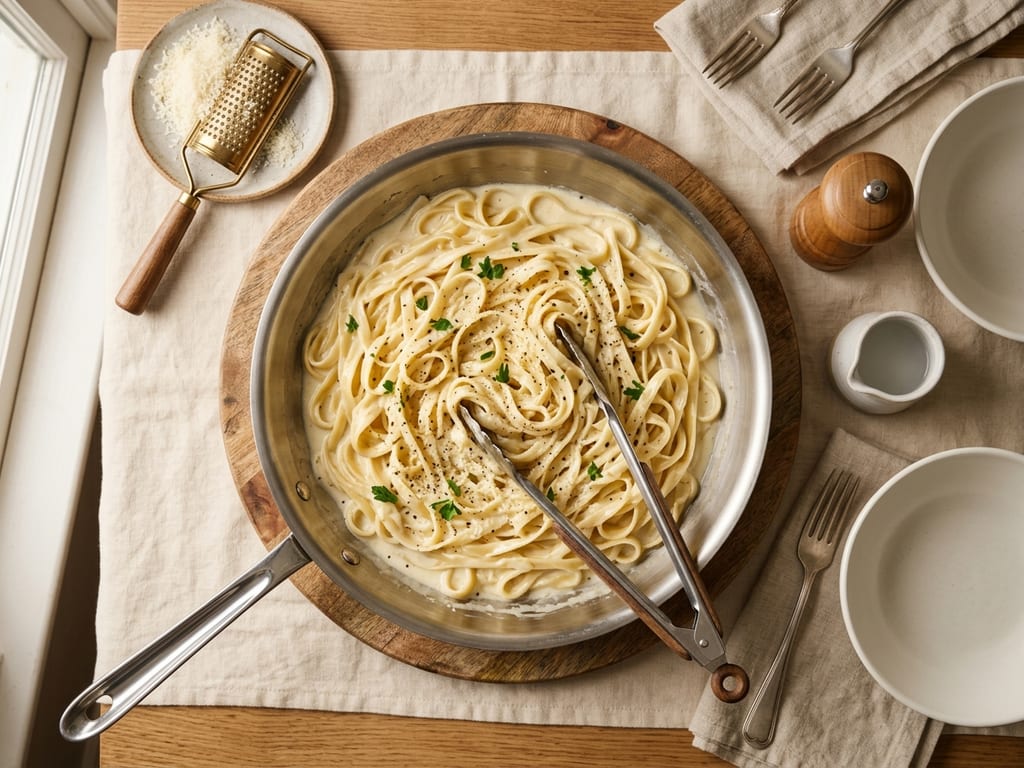
Fine dining pasta plating
The restaurant version is the same moves done tighter (ours). Marc Vetri, in Mastering Pasta, lifts the pasta with a spider or tongs straight into the pan of sauce, then: "Dish out the pasta onto warmed plates and grate the ricotta salata over the top."37 Maureen Fant: "in proper restaurants with proper service, it's a flat plate."51 Agrodolce uses a ring for the saucy dishes so the rim stays clean, and Cookist calls the ladle nest a restaurant classic.25, 26 The portion shrinks as the courses grow: Pasta Evangelists' head chef gives 70 g (2.5 oz) of fresh pasta at a dinner of more than three courses.67 Kostow, above, says you do not need tweezers for pasta. How courses are paced is in tasting menu.
Pasta next to a main: beside, not under
In Italy, Fant says, "pasta is eaten alone. It is not a side dish to the main attraction".51 Where it does share a plate, as with chicken parmesan in the United States and Canada, Wikipedia records both "a side of, or on top of, pasta".52 Ours: a small twirled nest beside the meat, not a bed under it, so neither one turns into a topping for the other. Worked examples: chicken parmesan and steak and pasta. Pasta salad is a salad: how to plate salad and our pasta salad recipe.
Pasta plating myths
"Plate within 60 seconds of tossing."
The only place we found a number is a kitchenware shop's blog, with no measurement behind it. The chefs say the same thing without a stopwatch: Marcella Hazan's "without a moment's delay", Lidia Bastianich's "last minute", and America's Test Kitchen's note that a creamy sauce starts to set "Within moments of hitting the serving bowl".1, 4, 15 Nobody we read timed it. Plate straight away; there is no magic minute.
"Flat plates cool pasta faster than bowls."
It is Lidia Bastianich's view, in a short tip, and Ragù Bologna's takeaway guide says a flat plate "tends to lose heat quickly" (our translation); neither measured it, and the magazines that repeat Lidia add nothing measured.4, 33 On the other side, Milk Street's Roman pasta is twirled onto a serving plate, and Marcella Hazan puts egg pasta on a broad platter.1, 22 The only bowl measurement we found, America's Test Kitchen's, was a warmed bowl against a cold one, with soup.14 Nobody we read tested the shape.
"Ravioli and meatballs go on in odd numbers."
None of the pasta sources we read says so: Gisslen's one count is 5 ravioli, and Frank Proto's meatballs are "2-3".35, 38 A study of plating rules found "No consistent evidence for a preference for odd or even numbers of food items".71
"The taller the nest, the bigger the portion looks."
Food Republic's writer says a tall nest makes "a smaller serving look bigger".18 The only controlled evidence we found points the other way on stacking, though not on pasta: in two experiments, food arrayed horizontally was rated a larger portion than the same food stacked (we read the abstract only, which does not name those foods).70 No source we read gives a nest height in centimetres or inches, and none tested a nest.
"Restaurant pasta has the sauce spooned on top."
Not on undressed pasta. Silvia Colloca: "there is nothing that irritates an Italian more than seeing a bowl of cooked pasta with just a few spoons of sauce on top."13 Giuliano Hazan and Gambero Rosso say the same.2, 10 A spoonful on top of pasta already tossed in its sauce is another matter, and four sources do it (see long pasta).
What the plating studies found
We found no study of pasta nests, or of pasta in a bowl against a plate. The closest is about the plate's colour: in a randomised crossover trial, 54 women aged 18 to 30 served themselves a lunch of pasta with tomato sauce on same-sized white, red or black plates, and ate more on red (1,102 kcal) and black (1,113 kcal) than on white (946 kcal), counting the pasta and the drink together; the red-plate difference only just reached significance (p = 0.05), and their appetite ratings did not differ.68 One trial, young women, a self-serve lunch: a reason to think about the plate, not a rule.
Two studies of plating in general, neither on pasta: the same food arranged neatly was liked more than the same food arranged messily, and "Neatness of the food presentation increases liking for the taste of the food";69 and food arrayed horizontally was rated a larger portion than the same food stacked, in two experiments, and a centred dessert larger than an offset one (abstract only; the foods other than the dessert are not named).70 The sauce has its own physics: a cacio e pepe with too little starch, below about 1% of the cheese's weight, forms clumps, which is one reason the pasta water matters (our reading).11 More on the evidence in how to stack food and colour on the plate.
Holding pasta hot, and leftovers
From the US Food Safety and Inspection Service (its 2011 sheet): "Hot food should be held at 140 °F or warmer" (60°C); on a buffet, "keep food hot with chafing dishes, slow cookers, and warming trays"; discard food left out more than 2 hours (1 hour above 90°F, 32°C); use cooked leftovers within 4 days and reheat them to 165°F (74°C).72 To bring leftover pasta back, America's Test Kitchen's test cook reheats it in a nonstick skillet, which "helps re-emulsify the sauce and heat the pasta up simultaneously"; for a dish that only had to wait for late guests, Lidia adds a little pasta water.4, 73 A pasta buffet is set out in how to set up a buffet table.
How to plate pasta, answered
How do you plate pasta?
Toss it in the pan with its sauce and a splash of the cooking water until the sauce clings, then plate it straight away into a warm bowl or onto a warm plate as one nest or mound in the centre, and finish light, with the cheese already tossed through and, our finish, a little more on top. The shape decides the move: this page has 5 methods, for long pasta, short pasta, filled pasta, baked pasta and gnocchi.
How do you plate spaghetti like a chef?
Twirl it. Giada De Laurentiis, as magazines report her method, stands a carving fork upright in the sauced pasta, twirls it in place, slides a large spoon under the coil and pushes it off the tines in the centre of the bowl. Milk Street and Italian sites use a ladle as the mould: the fork turns the pasta inside the ladle, and the mound slides out onto the plate. Every source we credit that says where puts the nest in the centre.
How do you twirl pasta for plating?
Make sure the sauce clings first (a soupy sauce will not hold a twirl), then wind one portion tightly on a carving fork, inside a ladle or between closed tongs, set it in the middle of the bowl and lift the tool out slowly. Ribbons such as fettuccine and tagliatelle twirl looser; Tasting Table says Giada's fork method works for them too.
How do you plate pasta with tongs?
Grab a portion, twirl it with the tongs pressed shut, set it down in the centre, give it a few more twirls and open the tongs only slightly to slide them out. That is Giada De Laurentiis's stand-in for a carving fork, as reported; her verdict, quoted by Mashed: "It won't be as tall and perfect, but it'll still look great."
How do you plate ravioli?
Lift them out with a slotted spoon rather than pour them, into warmed bowls or plates, then add the sauce: that is America's Test Kitchen's order. The only count we found is Gisslen's textbook, 5 ravioli a portion in a broad soup plate with broth poured over. One layer is Ragù Bologna's; setting them on a pool of sauce, and spacing them apart, is our styling.
How do you serve lasagna without it falling apart?
Let it rest, cut it in the dish with a sharp knife, and lift each square with a thin metal spatula onto a flat plate. The rest times we read run from 1 minute (Ragù Bologna, for takeaway lasagna) and 5 minutes (America's Test Kitchen, two Italian sites) to 3 or 4 hours (Lidia Bastianich, who then cuts it and rewarms the portions); nobody measured why it helps.
How do you plate gnocchi?
Sauce them, then top them: Gisslen's textbook tops each plated portion with 2 fl oz (60 mL) of tomato sauce and a tablespoon of parmesan, and Vincenzo's Plate keeps some sauce back to spoon on top of each plate. For brown butter and sage, finish them in the pan and serve at once. A low heap in a warm shallow bowl is our pick.
How do you plate spaghetti and meatballs?
Toss the spaghetti with the sauce first, then portion it and put the meatballs on top with a little more sauce: Frank Proto, for the Institute of Culinary Education, uses 2 to 3 meatballs and grated Pecorino Romano; Vincenzo's Plate twirls a nest on a flat plate and scatters mini meatballs over it. In most of Italy, it adds, meatballs are a second course of their own.
Should pasta be served in a bowl or on a plate?
Sources split. Lidia Bastianich wants a warm soup bowl, not a wide plate, because the pasta stays hot; Maureen Fant, interviewed by The Splendid Table, says a flat plate is proper and bowls belong to trattorias and families. Nobody we read measured the heat. Our pick: a warm shallow bowl or rimmed soup plate for saucy pasta, a warm flat plate for a tight nest or lasagna. Makers' pasta bowls run 27 to 30.8 cm (10.6 to 12.1 in) across.
How much pasta per person?
About 80 g (2.8 oz) of dry pasta is Italy's standard portion (SINU, CREA); British nutrition bodies say 75 g (2.6 oz), and the US label reference is 55 g (1.9 oz). Fresh egg pasta is 100 g (3.5 oz), filled pasta 125 g (4.4 oz) and potato gnocchi 200 g (7.1 oz) in the Italian tables.
How much pasta per person for a main course?
Eataly says 100 to 125 g (3.5 to 4.4 oz) of dry pasta as a main and 75 g (2.6 oz) as a first course with more to follow; San Carlo, 100 to 120 g (3.5 to 4.2 oz) against 75 g. As a side dish no source we read gives a weight, and in Italy pasta is a course of its own, not a side.
Do you put the sauce on top of pasta or mix it in?
Mix it in, in the pan. Giuliano Hazan: "Do not serve pasta with sauce simply placed on top." America's Test Kitchen explains why: pasta finished in its sauce sheds starch that thickens the sauce so it clings instead of pooling. Some cooks then spoon a little more sauce, or its solids, onto the crown of a nest that is already dressed.
When do you add the cheese to pasta?
Toss it in first: Marcella Hazan adds some "immediately" so the heat melts it; Lidia Bastianich adds it after the flame is off and keeps Grana Padano on the table; Giada De Laurentiis, as reported, grates it onto the pasta before the sauce goes in. A little more on top is our finish.
How do you keep pasta warm when serving?
Warm the bowls and plates, and serve straight away. America's Test Kitchen warms ovensafe dishes in a 350°F (177°C) oven, or fills the others with really boiling water (hot tap water was not hot enough), and for Alfredo ladles about half a cup (120 ml) of boiling pasta water into each bowl. To hold pasta on a buffet, the USDA's figure (its 2011 sheet) is 140°F (60°C) or warmer.
Made the pasta already? Photograph the bowl and Plate Artists re-plates that dish, with the food kept as it is and the moves named so you can repeat them. Try it free on the AI food plating demo, or start with a re-plate.
Your pasta, plated like a chef's
Snap it, upload it, and get the composed version back, with the steps to recreate it at home.
Start free · 1 enhancement →Free account · 1 free enhancement · No credit card
How this page was made
We tested, timed and measured nothing for this page. Every instruction is quoted from the chef, cookbook, textbook, test kitchen, Italian food site or study named beside it; where they disagree, the page prints each side. Giada De Laurentiis's method reached us only through magazine accounts, because her own video was not readable, so it is always "as reported". The Italian sources are quoted in our translation. The portion figures are each source's own, in grams, with our ounce conversion; the bowl sizes are makers' printed figures, mostly as a retailer prints them. Anything marked ours is our styling or our reading. The photos are AI renders, not photographs of a real dish. Read 5 November 2026.
The chefs, books, test kitchens and studies behind this page
How each source was read (in full, as a section excerpt, as a magazine's account of a chef, in Italian with our translation, or as a prior reading) is in its entry.
- Hazan, M. (1997). Marcella Cucina: the sections "Tossing" and "Saucing". HarperCollins, via ckbk.com, "Tossing makes them one"; drained pasta goes "without a moment's delay" to a warm platter or bowl; cheese added at once; egg pasta on a platter; the delay, cheese and platter lines are in the book's Saucing section, also on ckbk.com (the link goes to Tossing); section excerpts read in full on 5 November 2026. ckbk.com
- Hazan, G. (1993). The Classic Pasta Cookbook: "Serving Pasta". Dorling Kindersley, via ckbk.com, "Do not serve pasta with sauce simply placed on top"; section excerpt read in full on 5 November 2026. ckbk.com
- Bastianich, L. M. (2004). Lidia's Family Table (recipe excerpt: capellini with anchovies, capers and fresh tomatoes). Knopf, excerpt printed by NPR, 8 December 2004, pasta lifted into the simmering sauce with tongs or a spider; "individual warm bowls"; toasted crumbs "most of it on top and some around the edges of the bowl"; read in full on 5 November 2026. npr.org
- Bastianich, L. (interview) (n.d.). How to cook perfect pasta every time: Lidia Bastianich shares her secrets. TODAY, her tips as TODAY printed them: a warm soup bowl, not a wide plate; "just enough sauce to dress the pasta"; Grana Padano with the flame off; pasta water to revive a waiting dish; read in full on 5 November 2026. today.com
- Bastianich, L. (n.d.). Serving pasta. Lidia's Italy (lidiasitaly.com blog), the skillet at the table for family meals, warm bowls dished in the kitchen for formal ones; read in full on 5 November 2026. lidiasitaly.com
- Bastianich, L. (n.d.). Lidia's Master Class: Dry Pasta Basics. Lidia's Italy (lidiasitaly.com blog), "A properly dressed pasta should glide in the sauce, not drown in it or stick in lumps"; long thin pasta with oil-based sauces, short tubes with thick or chunky ones; read in full on 5 November 2026. lidiasitaly.com
- Bastianich, L. (n.d.). Toasted Bread Crumb and Butter Sauce (a 5-minute sauce). Lidia's Italy (lidiasitaly.com), cheese tossed in off the heat, crumbs sprinkled on top just before serving; read in full on 5 November 2026. lidiasitaly.com
- America's Test Kitchen (n.d.). How to Cook Pasta in Its Sauce for Infused Flavor (Technique #50 of 100 Techniques Every Home Cook Can Master). americastestkitchen.com, "too often the sauce slides right off and pools at the bottom of the bowl"; the starch the pasta sheds thickens the sauce so it clings; pasta water to adjust "to your liking"; read in full on 5 November 2026. americastestkitchen.com
- Gambero Rosso (quoting chef Peppe Guida) (n.d.). Mantecare la pasta è un'arte: le linguine di Peppe Guida. gamberorosso.it, mantecatura: the cooked pasta finished in its sauce in the pan, starch as the binder, cooking water added a little at a time for a light cream; in Italian; the translations on this page are ours; read in full on 5 November 2026. gamberorosso.it
- Gambero Rosso (2023). Delitti in cucina. I misfatti nei confronti del cibo italiano: la pasta. gamberorosso.it, 7 May 2023, opinion column against "una porzione di pasta scondita, sul cui vertice siede una cucchiaiata di salsa"; pasta dressed in a tureen or platter; in Italian; the translations on this page are ours; read in full on 5 November 2026. gamberorosso.it
- Bartolucci, G., et al. (2025). Phase behavior of Cacio e Pepe sauce. Physics of Fluids 37, 044122 (arXiv:2501.00536), below about 1% starch (relative to the cheese) the sauce forms clumps; cacio e pepe only; abstract read in full on 5 November 2026. arxiv.org
- Milk Street (2022). Milk Street's Tips and Tricks for Perfect Pasta. 177milkstreet.com, April 2022, thin long pasta with thin oil or cream sauces, short or tube shapes with chunkier ones; no oil in the water; read in full on 5 November 2026. 177milkstreet.com
- Hryso, C. (quoting Silvia Colloca) (2020). Feast like an Italian: How to cook the perfect dinner party pasta. SBS Food, 4 February 2020, Colloca: "Make sure each piece of pasta is covered with sauce"; read in full on 5 November 2026. sbs.com.au
- America's Test Kitchen (n.d.). How to Keep Hot Food Warmer Longer. americastestkitchen.com, a side-by-side test on a SOUP, not pasta: about 10°F (5.5°C) hotter after 10 minutes in a warmed bowl; 350°F (177°C) oven or boiling water; "hot tap water wasn't hot enough"; read in full on 5 November 2026. americastestkitchen.com
- America's Test Kitchen / Cook's Illustrated (n.d.). The Secret to Creamier Alfredo Is In the Bowl. americastestkitchen.com, about half a cup of boiling pasta water in each serving bowl while the pasta finishes; a cold bowl sets the sauce's fat; stated, not measured; read in full on 5 November 2026. americastestkitchen.com
- America's Test Kitchen (n.d.). Oh No, You Accidentally Drained Your Pasta Water. Now What? americastestkitchen.com, drain over the serving bowl: it catches the water and warms the bowl (a tip, not a test); read in full on 5 November 2026. americastestkitchen.com
- Swaminathan, S. (n.d.). The Genius Way Giada De Laurentiis Plates Her Pasta. Chowhound, carving fork and large spoon, tongs as the stand-in; the coil laid on its side; a cookie cutter or open tin can as a mould for short pasta (not credited to Giada); a magazine's account of Giada De Laurentiis's method; her own video was not readable, so this is second-hand; read in full on 5 November 2026. chowhound.com
- Food Republic (n.d.). The Unexpected Utensil Giada De Laurentiis Uses To Plate Pasta. foodrepublic.com, carving fork, serving spoon underneath (a ladle if the spoon is too small), lifted slowly from the centre of the plate; tongs give a lower nest; the writer adds that a soupy sauce will not hold a twirl; a magazine's account of Giada De Laurentiis's method; her own video was not readable, so this is second-hand; read in full on 5 November 2026. foodrepublic.com
- Tasting Table (n.d.). Giada De Laurentiis Uses These Unexpected Kitchen Utensils To Plate Pasta. tastingtable.com, the fork stood upright in the sauced pasta, twirled in place, set in the centre of the serving bowl; "also works for ... fettuccine and tagliatelle"; a magazine's account of Giada De Laurentiis's method; her own video was not readable, so this is second-hand; read in full on 5 November 2026. tastingtable.com
- Mashed (n.d.). The Meat Tool Used By Food Stylists To Beautifully Plate Pasta. mashed.com, Giada's 2020 Giadzy video ("It won't be as tall and perfect, but it'll still look great" with tongs), and chef David Ma (TikTok): a carving fork, then sauce on top; second-hand; read in full on 5 November 2026. mashed.com
- Food Republic (n.d.). Giada De Laurentiis' Pro-Tip For Tossing Cheesy Pasta. foodrepublic.com, cheese grated onto the pasta before it meets the sauce; reports her Williams Sonoma video, not watched; second-hand; read in full on 5 November 2026. foodrepublic.com
- Milk Street (n.d.). Roman Pasta Plating Technique. 177milkstreet.com digital library, "place a ladle into the pot of pasta, then use a long fork to gather and twist the pasta into a neat mound in the ladle"; the video was not watched; read in full on 5 November 2026. 177milkstreet.com
- Food Republic (2013). How Do You Plate Spaghetti To Make It Look Nice? foodrepublic.com, 10 September 2013 (URL date), a large fork in the pot, tongs to hold the wrap, set loosely in a bowl: "It's dinner, not a magazine shoot."; read in full on 5 November 2026. foodrepublic.com
- Tantillo Foods (2019). How To Plate Pasta For Perfection. tantillofoods.com blog, September 2019 (URL date), a US fresh-pasta maker's blog, the one source read that covers long, short, stuffed and baked pasta: ladle, tongs and carving fork; a tin can as a ring; a parchment frame; ruler-marked cuts and a thin metal spatula; read in full on 5 November 2026. tantillofoods.com
- Agrodolce (2024). Come si fa il nido con gli spaghetti. agrodolce.it, 6 March 2024, forchettone (carving fork) and mestolo (ladle), the nest in the centre of a FLAT plate, some sauce solids kept back for the top of the nest; in Italian; the translations on this page are ours; read in full on 5 November 2026. agrodolce.it
- Cookist (chef Michele Ghedini) (n.d.). 3 modi per impiattare la pasta: le tecniche facili per un risultato da chef. cookist.it, three spaghetti methods: a cylinder rolled with tongs against the pan's edge, a nest spun in a big ladle and slid into a deep plate ("un grande classico della ristorazione"), and a ring; the video was not watched; in Italian; the translations on this page are ours; read in full on 5 November 2026. cookist.it
- Parmalat Italia (n.d.). Come impiattare: i migliori trucchi e suggerimenti. parmalat.it magazine, spaghetti wound on a spoon with a fork (small mounds) or carving fork and ladle (one mound); short pasta with a spoon or ladle; take the ring away before serving; a corporate magazine; in Italian; the translations on this page are ours; read in full on 5 November 2026. parmalat.it
- Bioitalia (n.d.). Come impiattare gli spaghetti: i segreti. bioitalia.it blog, spaghetti wound on a spoon with tongs, which can fix stray strands; a pasta maker's blog; in Italian; the translations on this page are ours; read in full on 5 November 2026. bioitalia.it
- Pomì Italia (n.d.). Hai invitato la crush a cena da te ma non sai come impiattare la pasta? Ecco la guida definitiva! pomionline.it, a tongs nest in the centre, sauce "al centro o intorno"; paccheri stood upright in a ring; tagliatelle wound on a fork, sauce added after; a tomato brand's blog; in Italian; the translations on this page are ours; read in full on 5 November 2026. pomionline.it
- Compagnia degli Chef (n.d.). Come impiattare da vero Chef, 10 trucchi da copiare. compagniadeglichef.it, spaghetti rolled upright or on their side with long tongs (a carving fork is "più impegnativo"); short pasta in a small container or laid lengthwise on a flat plate; in Italian; the translations on this page are ours; read in full on 5 November 2026. compagniadeglichef.it
- Donna Moderna (n.d.). Come impiattare gli spaghetti. donnamoderna.com, the ladle-and-carving-fork nest seen on television is "non ... belli da vedersi"; a mountain in the centre instead; in Italian; the translations on this page are ours; read in full on 5 November 2026. donnamoderna.com
- Donna Moderna (n.d.). Come impiattare i primi. donnamoderna.com, a square ring and a carving fork turned clockwise for long pasta; short pasta placed with tongs in a ring, on a base of legumes, vegetables or a dense sauce; in Italian; the translations on this page are ours; read in full on 5 November 2026. donnamoderna.com
- Ragù Bologna (n.d.). Come impiattare pasta da asporto senza sbagliare. ragubologna.it, a Bologna fresh-pasta shop's guide to plating takeaway pasta (tipped out of its tub): tagliatelle, pappardelle and tortelloni in a wide deep plate; tortellini in brodo in a warmed bowl; lasagna on a slightly wide flat plate, rested one minute if it arrives hot; filled pasta in a single layer, sauce poured over; a flat plate loses heat quickly; in Italian; the translations on this page are ours; read in full on 5 November 2026. ragubologna.it
- Vincenzo's Plate (n.d.). How Spaghetti and Meatballs is Made in Italy. vincenzosplate.com, a nest on a flat plate, a little extra sugo over the top, mini meatballs scattered on; meatballs as a secondo in most of Italy; read in full on 5 November 2026. vincenzosplate.com
- Proto, F. (Institute of Culinary Education blog) (n.d.). How to Chef-ify Spaghetti and Meatballs. ice.edu blog (from an Epicurious video), pasta tossed with sauce and basil "just to dress", then 2 to 3 meatballs and a little more sauce on top, Pecorino; the video was not watched; read in full on 5 November 2026. ice.edu
- El-Waylly, S. (Serious Eats); Kostow, C. quoted (2017). Kitchen tweezers article (14 September 2017), with Food & Wine's tweezers review. Serious Eats; Food & Wine, a pasta nest named as a tweezers use, no steps printed; Christopher Kostow: "You don't need tweezers for pizza and pasta."; a prior reading for our plating tools guide, copied into this run's notes, not re-fetched.
- Vetri, M., with Joachim, D. (2015). Mastering Pasta (recipe excerpt: fettuccine with corn crema). Ten Speed Press, excerpt printed by New Jersey Monthly, pasta moved with a spider or tongs into the pan of sauce, then "onto warmed plates", cheese grated over the top; the excerpt only, not the book; read in full on 5 November 2026. njmonthly.com
- Gisslen, W. (2011). Professional Cooking, 7th edition: chapter 19, "Pasta, Noodles, and Dumplings", and the portioning section. John Wiley & Sons, 5 ravioli a portion in broad soup plates (vegetable ravioli in lemongrass broth); 3 oz (90 g) ravioli in heated broad soup plates (short rib ravioli); gnocchi topped with 2 fl oz (60 mL) tomato sauce and 1 tbsp parmesan; a lasagne pan cut 4 x 6 into 24 portions; read in the Internet Archive's full text (OCR) of the book, a prior reading for our brunoise guide, re-searched for this page. archive.org
- America's Test Kitchen (n.d.). Ravioli (recipe 1923). americastestkitchen.com, "With a slotted spoon, transfer ravioli to warmed bowls or plates; add sauce."; about 60 ravioli for 4 to 6; the page text as served; read in full on 5 November 2026. americastestkitchen.com
- Tagliabue, F. (2017). Quando le lasagne sono perfette... e occhio agli scivoloni. Sale&Pepe, 30 March 2017, updated March 2023, rest "per una mezz'oretta"; halve lengthwise in the pan, cut across into squares, lift each with a spatula onto its own plate; in Italian; the translations on this page are ours; read in full on 5 November 2026. salepepe.it
- Levoni (n.d.). Lasagne alla bolognese: tutti i segreti della ricetta originale. levoni.it, 5 minutes in the recipe, "5 o 10 minuti" in the tip, so the portions divide without the layers coming apart; an Italian producer's recipe page; in Italian; the translations on this page are ours; read in full on 5 November 2026. levoni.it
- Dissapore (n.d.). Lasagne al forno, la ricetta classica alla bolognese. dissapore.com, "fate riposare 5 minuti prima di tagliare e servire"; in Italian; the translations on this page are ours; read in full on 5 November 2026. dissapore.com
- America's Test Kitchen (n.d.). Lasagna with Herbed Meatballs, Tomato Sauce, and Mozzarella (recipe 817). americastestkitchen.com, "let lasagna rest 5 minutes. Cut and serve."; one recipe, not a rule; the public page text; read in full on 5 November 2026. americastestkitchen.com
- Bastianich, L. (n.d.). Tomato and Zucchini Bread Lasagna. Lidia's Italy (lidiasitaly.com), "Let it sit about 15 minutes before serving."; read in full on 5 November 2026. lidiasitaly.com
- Oliver, J. (n.d.). Jamie Oliver's Lasagne: slow-cooked fennel, sweet leeks and cheeses (from Jamie Cooks Italy). The Happy Foodie, "Leave to stand for 15 minutes, then dig in."; read in full on 5 November 2026. thehappyfoodie.co.uk
- Bastianich, L. (n.d.). Lasagna with Ricotta and Mozzarella. Lidia's Italy (lidiasitaly.com), "Let the lasagna rest about 20 minutes before cutting into squares and serving."; read in full on 5 November 2026. lidiasitaly.com
- Bastianich, L. (n.d.). Italian-American Lasagna. Lidia's Italy (lidiasitaly.com; the same text on PBS Food), "about an hour" in the headnote, "at least 30 minutes or up to 3 hours" in the method, and her favourite: stand 3 to 4 hours, cut, rewarm in the oven; read in full on 5 November 2026. lidiasitaly.com
- Vincenzo's Plate (n.d.). How To Make Potato Gnocchi Like an Italian Nonna. vincenzosplate.com, sauce in the bottom of the serving bowl, gnocchi, more sauce, toss; some sauce kept back for the top of each plate; read in full on 5 November 2026. vincenzosplate.com
- The Splendid Table (2025). Gnocchi with Sage and Burnt Butter. splendidtable.org, 12 August 2025, gnocchi finished in the butter in the pan, then sage, Parmesan and pepper on top, "serve immediately"; read in full on 5 November 2026. splendidtable.org
- Auguste Escoffier School of Culinary Arts (n.d.). How to Make Brown Butter and Sage Gnocchi. escoffier.edu blog, "Once the cheese has melted, plate and sprinkle with a pinch of the finely chopped fresh sage."; read in full on 5 November 2026. escoffier.edu
- Fant, M. (interview) (2014). You are probably doing it wrong: How to eat pasta like an Italian. The Splendid Table, 7 February 2014, a food writer ("I am not Italian. I've only lived here for 35 years."): a flat plate is proper, a soup bowl in trattorias and families; pasta is a course of its own, not a side; read in full on 5 November 2026. splendidtable.org
- Wikipedia contributors (2026). Chicken parmesan. Wikipedia, "sometimes with a side of, or on top of, pasta" in the United States and Canada; an encyclopedia's description, not a rule; read in full on 5 November 2026. wikipedia.org
- Churchill (as listed by Cooks Villa) (n.d.). Churchill Profile white pasta bowl. cooksvilla.co.uk, "Diameter: 30.8 cm (12.13″), Height: 3.6 cm" (the page title says 30.5 cm); a retailer's listing that prints the maker's dimensions (we did not see the maker's sheet); read in full on 5 November 2026. cooksvilla.co.uk
- Steelite (as listed by KitchenRestock) (n.d.). Steelite A120P050 pasta bowl, 26 oz. kitchenrestock.com, "11-3/4 inches in diameter and standing 2-1/4 inches high"; a retailer's listing that prints the maker's dimensions (we did not see the maker's sheet); read in full on 5 November 2026. kitchenrestock.com
- Villeroy & Boch (as listed by Royal Design) (n.d.). Manufacture Rock Blanc pasta plate 28 cm. royaldesign.com, "Diameter 28 cm Height 5 cm"; a retailer's listing that prints the maker's dimensions (we did not see the maker's sheet); read in full on 5 November 2026. royaldesign.com
- Mesa Ceramics (n.d.). Pasta Plate 27. mesa-ceramics.com, the maker's own page: 272 mm diameter, 56 mm high, 510 ml; read in full on 5 November 2026. mesa-ceramics.com
- Churchill (as listed by KitchenRestock) (n.d.). Churchill China WH CTPB1 pasta bowl, 16 oz. kitchenrestock.com, "a generous diameter of 11 inches"; a retailer's listing that prints the maker's dimensions (we did not see the maker's sheet); read in full on 5 November 2026. kitchenrestock.com
- Steelite (as listed by KitchenRestock) (n.d.). Steelite 17100314 pasta bowl, 14-1/2 oz. kitchenrestock.com, "a diameter of 10-5/8 inches"; a retailer's listing that prints the maker's dimensions (we did not see the maker's sheet); read in full on 5 November 2026. kitchenrestock.com
- Società Italiana di Nutrizione Umana (SINU) (2024). LARN, V Revisione: Standard quantitativi delle porzioni. Biomedia, Milano, dry pasta 80 g; fresh egg pasta 100 g; filled pasta 125 g; lasagna (as a recipe) 250 g; potato gnocchi 200 g; raw weights; "circa 50 penne/fusilli"; PDF read in full on 5 November 2026; in Italian; the translations on this page are ours. sinu.it
- CREA (Consiglio per la ricerca in agricoltura e l'analisi dell'economia agraria) (2018). Linee guida per una sana alimentazione, edizione 2018. CREA, pasta 80 g, fresh egg pasta 100 g, filled 125 g, "all'alimento crudo"; PDF read in full on 5 November 2026; in Italian; the translations on this page are ours. crea.gov.it
- US Food and Drug Administration (n.d.). 21 CFR 101.12, Table 2: reference amounts customarily consumed per eating occasion. eCFR, "Pastas, plain 140 g prepared; 55 g dry", and "2 oz (56 g/visual unit of measure) for dry bulk products (e.g., spaghetti)"; a labelling reference, not advice; read in full on 5 November 2026. ecfr.gov
- British Nutrition Foundation (n.d.). Your balanced diet: Get portion wise! nutrition.org.uk (PDF), plain pasta: dried 75 g, cooked 180 g (two figures from its portion table); read in full on 5 November 2026. nutrition.org.uk
- British Dietetic Association (n.d.). Food Fact Sheet: Portion sizes. BDA (PDF hosted by Yorkshire Cancer Research), "Pasta (boiled) 75g uncooked / 150g cooked"; read in full on 5 November 2026. yorkshirecancerresearch.org.uk
- BBC Good Food (n.d.). How to cook pasta. bbcgoodfood.com, "80-100g dried pasta per person", no split by course; read in full on 5 November 2026. bbcgoodfood.com
- Eataly (n.d.). How to cook pasta, the authentic Italian way. eataly.com magazine, 100 to 125 g a person as a main course, 75 g as a first course with more dishes to follow; an Italian food retailer's guidance; read in full on 5 November 2026. eataly.com
- San Carlo (n.d.). A Guide to Pasta Portions: How Much Pasta Per Person? sancarlo.co.uk blog, "Italian-style portions (as part of a 3-course meal)" against "UK-style portions (where pasta is the main course)"; a UK Italian restaurant group; read in full on 5 November 2026. sancarlo.co.uk
- Pasta Evangelists (head chef Roberta D'Elia) (n.d.). How Much Pasta Per Person? The Ultimate Guide to Pasta Portion Sizes. pastaevangelists.com blog, fresh pasta primo 90 g at a three-course dinner, 70 g at more than three courses; main 100 g dried; a UK fresh-pasta company; read in full on 5 November 2026. pastaevangelists.com
- Akyol, A., Ayaz, A., Inan-Eroglu, E., Cetin, C., Samur, G. (2018). Impact of three different plate colours on short-term satiety and energy intake: a randomized controlled trial. Nutrition Journal 17:46, 54 women aged 18 to 30, a self-serve lunch of pasta with tomato sauce on white, red or black plates; full text via Europe PMC read in full on 5 November 2026; doi 10.1186/s12937-018-0350-1. doi
- Zellner, D. A., Siemers, E., Teran, V., et al. (2011). Neatness counts. How plating affects liking for the taste of food. Appetite 57(3):642-648, neatly arranged food liked more than the same food messy; not a pasta study; abstract via Europe PMC read in full on 5 November 2026; doi 10.1016/j.appet.2011.08.004. doi
- Rowley, J., Spence, C. (2018). Does the visual composition of a dish influence the perception of portion size and hedonic preference? Appetite 128:79-86, food spread horizontally rated a larger portion than the same food stacked, and a centred dessert larger than an offset one; not pasta; abstract via Europe PMC read in full on 5 November 2026; doi 10.1016/j.appet.2018.06.005. doi
- Woods, A. T., Michel, C., Spence, C. (2016). Odd versus even: a scientific study of the 'rules' of plating. PeerJ 4:e1526, "No consistent evidence for a preference for odd or even numbers of food items was found"; a prior reading for our clock plating guide, not re-fetched; doi 10.7717/peerj.1526. doi
- USDA Food Safety and Inspection Service (2011). Basics for Handling Food Safely (Food Safety Facts, revised June 2011). USDA FSIS (govinfo copy), hot food held at 140°F or warmer; out no more than 2 hours (1 hour above 90°F); leftovers used within 4 days and reheated to 165°F; the 2011 edition, read as a PDF on 5 November 2026 because the live FSIS pages refused this reader; current wording not re-checked. govinfo.gov
- America's Test Kitchen (n.d.). How to Reheat Leftover Pasta So It's As Good As When You Made It. americastestkitchen.com, test cook Hannah Fenton: a nonstick skillet "helps re-emulsify the sauce and heat the pasta up simultaneously"; read in full on 5 November 2026. americastestkitchen.com
Keep going
How to plate food, dish by dish
The six-step method, then steak, salmon, chicken parmesan and more, each re-plated.
How to plate steak
Whole or sliced, the rest, the plate, every sauce and side, with sources.
How to plate salad
Tossed, composed or bound, and pasta salad among the classics.
Types of plates
Pasta plates, pasta bowls and soup plates, with their sizes.
Plating tools
Tongs, spoons, tweezers and rings: the kit behind a nest and a mound.